EP3539969A1 - Novel photo-initiators and their application - Google Patents
Novel photo-initiators and their application Download PDFInfo
- Publication number
- EP3539969A1 EP3539969A1 EP18161824.0A EP18161824A EP3539969A1 EP 3539969 A1 EP3539969 A1 EP 3539969A1 EP 18161824 A EP18161824 A EP 18161824A EP 3539969 A1 EP3539969 A1 EP 3539969A1
- Authority
- EP
- European Patent Office
- Prior art keywords
- formula
- alkyl
- group
- twice
- substituents
- Prior art date
- Legal status (The legal status is an assumption and is not a legal conclusion. Google has not performed a legal analysis and makes no representation as to the accuracy of the status listed.)
- Withdrawn
Links
- 239000003999 initiator Substances 0.000 title claims abstract description 18
- 150000001875 compounds Chemical class 0.000 claims abstract description 90
- 238000002360 preparation method Methods 0.000 claims abstract description 41
- XLYOFNOQVPJJNP-UHFFFAOYSA-N water Substances O XLYOFNOQVPJJNP-UHFFFAOYSA-N 0.000 claims abstract description 39
- 229910001868 water Inorganic materials 0.000 claims abstract description 37
- 238000000034 method Methods 0.000 claims abstract description 20
- 230000008569 process Effects 0.000 claims abstract description 13
- 125000001424 substituent group Chemical group 0.000 claims description 60
- -1 chloro, phenyl Chemical group 0.000 claims description 57
- 239000000203 mixture Substances 0.000 claims description 32
- 239000001257 hydrogen Substances 0.000 claims description 26
- 229910052739 hydrogen Inorganic materials 0.000 claims description 26
- 125000001997 phenyl group Chemical group [H]C1=C([H])C([H])=C(*)C([H])=C1[H] 0.000 claims description 25
- 150000002431 hydrogen Chemical class 0.000 claims description 22
- 239000002904 solvent Substances 0.000 claims description 19
- 125000004209 (C1-C8) alkyl group Chemical group 0.000 claims description 18
- 125000000217 alkyl group Chemical group 0.000 claims description 17
- 125000001309 chloro group Chemical group Cl* 0.000 claims description 16
- 125000004093 cyano group Chemical group *C#N 0.000 claims description 15
- 125000001153 fluoro group Chemical group F* 0.000 claims description 14
- 238000004519 manufacturing process Methods 0.000 claims description 14
- 125000000524 functional group Chemical group 0.000 claims description 13
- CSCPPACGZOOCGX-UHFFFAOYSA-N Acetone Chemical compound CC(C)=O CSCPPACGZOOCGX-UHFFFAOYSA-N 0.000 claims description 11
- QGZKDVFQNNGYKY-UHFFFAOYSA-O ammonium group Chemical group [NH4+] QGZKDVFQNNGYKY-UHFFFAOYSA-O 0.000 claims description 11
- 125000000623 heterocyclic group Chemical group 0.000 claims description 11
- 125000004178 (C1-C4) alkyl group Chemical group 0.000 claims description 10
- 125000003545 alkoxy group Chemical group 0.000 claims description 10
- 229920005989 resin Polymers 0.000 claims description 10
- 239000011347 resin Substances 0.000 claims description 10
- DGAQECJNVWCQMB-PUAWFVPOSA-M Ilexoside XXIX Chemical compound C[C@@H]1CC[C@@]2(CC[C@@]3(C(=CC[C@H]4[C@]3(CC[C@@H]5[C@@]4(CC[C@@H](C5(C)C)OS(=O)(=O)[O-])C)C)[C@@H]2[C@]1(C)O)C)C(=O)O[C@H]6[C@@H]([C@H]([C@@H]([C@H](O6)CO)O)O)O.[Na+] DGAQECJNVWCQMB-PUAWFVPOSA-M 0.000 claims description 9
- 125000003118 aryl group Chemical group 0.000 claims description 9
- QVGXLLKOCUKJST-UHFFFAOYSA-N atomic oxygen Chemical group [O] QVGXLLKOCUKJST-UHFFFAOYSA-N 0.000 claims description 9
- 125000001246 bromo group Chemical group Br* 0.000 claims description 9
- 229910052760 oxygen Inorganic materials 0.000 claims description 9
- 239000001301 oxygen Substances 0.000 claims description 9
- 239000011734 sodium Substances 0.000 claims description 9
- 229910052708 sodium Inorganic materials 0.000 claims description 9
- 125000003342 alkenyl group Chemical group 0.000 claims description 8
- 125000004414 alkyl thio group Chemical group 0.000 claims description 8
- 150000001768 cations Chemical class 0.000 claims description 8
- 230000001590 oxidative effect Effects 0.000 claims description 8
- ACVYVLVWPXVTIT-UHFFFAOYSA-N phosphinic acid Chemical compound O[PH2]=O ACVYVLVWPXVTIT-UHFFFAOYSA-N 0.000 claims description 8
- ZLMJMSJWJFRBEC-UHFFFAOYSA-N Potassium Chemical compound [K] ZLMJMSJWJFRBEC-UHFFFAOYSA-N 0.000 claims description 7
- 229910052700 potassium Inorganic materials 0.000 claims description 7
- 239000011591 potassium Substances 0.000 claims description 7
- KYVBNYUBXIEUFW-UHFFFAOYSA-N 1,1,3,3-tetramethylguanidine Chemical compound CN(C)C(=N)N(C)C KYVBNYUBXIEUFW-UHFFFAOYSA-N 0.000 claims description 6
- WSFSSNUMVMOOMR-UHFFFAOYSA-N Formaldehyde Chemical compound O=C WSFSSNUMVMOOMR-UHFFFAOYSA-N 0.000 claims description 6
- UFHFLCQGNIYNRP-UHFFFAOYSA-N Hydrogen Chemical compound [H][H] UFHFLCQGNIYNRP-UHFFFAOYSA-N 0.000 claims description 6
- WHXSMMKQMYFTQS-UHFFFAOYSA-N Lithium Chemical compound [Li] WHXSMMKQMYFTQS-UHFFFAOYSA-N 0.000 claims description 6
- ZRALSGWEFCBTJO-UHFFFAOYSA-O guanidinium Chemical compound NC(N)=[NH2+] ZRALSGWEFCBTJO-UHFFFAOYSA-O 0.000 claims description 6
- 229910052736 halogen Inorganic materials 0.000 claims description 6
- 150000002367 halogens Chemical class 0.000 claims description 6
- 229910052744 lithium Inorganic materials 0.000 claims description 6
- 125000000449 nitro group Chemical group [O-][N+](*)=O 0.000 claims description 6
- 239000004094 surface-active agent Substances 0.000 claims description 6
- 125000004104 aryloxy group Chemical group 0.000 claims description 5
- 150000002170 ethers Chemical class 0.000 claims description 5
- PCKZAVNWRLEHIP-UHFFFAOYSA-N 2-hydroxy-1-[4-[[4-(2-hydroxy-2-methylpropanoyl)phenyl]methyl]phenyl]-2-methylpropan-1-one Chemical compound C1=CC(C(=O)C(C)(O)C)=CC=C1CC1=CC=C(C(=O)C(C)(C)O)C=C1 PCKZAVNWRLEHIP-UHFFFAOYSA-N 0.000 claims description 4
- XTHFKEDIFFGKHM-UHFFFAOYSA-N Dimethoxyethane Chemical compound COCCOC XTHFKEDIFFGKHM-UHFFFAOYSA-N 0.000 claims description 4
- NINIDFKCEFEMDL-UHFFFAOYSA-N Sulfur Chemical group [S] NINIDFKCEFEMDL-UHFFFAOYSA-N 0.000 claims description 4
- 239000003831 antifriction material Substances 0.000 claims description 4
- 125000002915 carbonyl group Chemical group [*:2]C([*:1])=O 0.000 claims description 4
- 230000005670 electromagnetic radiation Effects 0.000 claims description 4
- 239000003381 stabilizer Substances 0.000 claims description 4
- 238000010546 Norrish type I reaction Methods 0.000 claims description 3
- 239000002202 Polyethylene glycol Substances 0.000 claims description 3
- 125000003158 alcohol group Chemical group 0.000 claims description 3
- 125000005110 aryl thio group Chemical group 0.000 claims description 3
- 239000012948 isocyanate Substances 0.000 claims description 3
- 150000002513 isocyanates Chemical class 0.000 claims description 3
- 229920001223 polyethylene glycol Polymers 0.000 claims description 3
- 229920002635 polyurethane Polymers 0.000 claims description 3
- 230000005855 radiation Effects 0.000 claims description 3
- QNODIIQQMGDSEF-UHFFFAOYSA-N (1-hydroxycyclohexyl)-phenylmethanone Chemical compound C=1C=CC=CC=1C(=O)C1(O)CCCCC1 QNODIIQQMGDSEF-UHFFFAOYSA-N 0.000 claims description 2
- 239000012956 1-hydroxycyclohexylphenyl-ketone Substances 0.000 claims description 2
- KWVGIHKZDCUPEU-UHFFFAOYSA-N 2,2-dimethoxy-2-phenylacetophenone Chemical compound C=1C=CC=CC=1C(OC)(OC)C(=O)C1=CC=CC=C1 KWVGIHKZDCUPEU-UHFFFAOYSA-N 0.000 claims description 2
- GJKGAPPUXSSCFI-UHFFFAOYSA-N 2-Hydroxy-4'-(2-hydroxyethoxy)-2-methylpropiophenone Chemical compound CC(C)(O)C(=O)C1=CC=C(OCCO)C=C1 GJKGAPPUXSSCFI-UHFFFAOYSA-N 0.000 claims description 2
- XMLYCEVDHLAQEL-UHFFFAOYSA-N 2-hydroxy-2-methyl-1-phenylpropan-1-one Chemical compound CC(C)(O)C(=O)C1=CC=CC=C1 XMLYCEVDHLAQEL-UHFFFAOYSA-N 0.000 claims description 2
- 229910003953 H3PO2 Inorganic materials 0.000 claims description 2
- XUIMIQQOPSSXEZ-UHFFFAOYSA-N Silicon Chemical compound [Si] XUIMIQQOPSSXEZ-UHFFFAOYSA-N 0.000 claims description 2
- 150000001450 anions Chemical class 0.000 claims description 2
- MQDJYUACMFCOFT-UHFFFAOYSA-N bis[2-(1-hydroxycyclohexyl)phenyl]methanone Chemical compound C=1C=CC=C(C(=O)C=2C(=CC=CC=2)C2(O)CCCCC2)C=1C1(O)CCCCC1 MQDJYUACMFCOFT-UHFFFAOYSA-N 0.000 claims description 2
- 239000003795 chemical substances by application Substances 0.000 claims description 2
- 239000013530 defoamer Substances 0.000 claims description 2
- 239000003085 diluting agent Substances 0.000 claims description 2
- ISNICOKBNZOJQG-UHFFFAOYSA-O guanidinium ion Chemical compound C[NH+]=C(N(C)C)N(C)C ISNICOKBNZOJQG-UHFFFAOYSA-O 0.000 claims description 2
- 239000004615 ingredient Substances 0.000 claims description 2
- 239000011256 inorganic filler Substances 0.000 claims description 2
- 229910003475 inorganic filler Inorganic materials 0.000 claims description 2
- 239000001023 inorganic pigment Substances 0.000 claims description 2
- 239000006224 matting agent Substances 0.000 claims description 2
- 229910021645 metal ion Inorganic materials 0.000 claims description 2
- 239000012860 organic pigment Substances 0.000 claims description 2
- 229920002401 polyacrylamide Polymers 0.000 claims description 2
- 229920000058 polyacrylate Polymers 0.000 claims description 2
- 229920001228 polyisocyanate Polymers 0.000 claims description 2
- 239000005056 polyisocyanate Substances 0.000 claims description 2
- 229920000193 polymethacrylate Polymers 0.000 claims description 2
- 229920001289 polyvinyl ether Polymers 0.000 claims description 2
- 229910052710 silicon Inorganic materials 0.000 claims description 2
- 239000010703 silicon Substances 0.000 claims description 2
- SYDJVRWZOWPNNO-UHFFFAOYSA-N sucrose-benzoate Natural products OCC1OC(OC2(COC(=O)c3ccccc3)OC(CO)C(O)C2O)C(O)C(O)C1O SYDJVRWZOWPNNO-UHFFFAOYSA-N 0.000 claims description 2
- 229910052717 sulfur Chemical group 0.000 claims description 2
- 239000011593 sulfur Chemical group 0.000 claims description 2
- 125000005915 C6-C14 aryl group Chemical group 0.000 claims 4
- 125000006702 (C1-C18) alkyl group Chemical group 0.000 claims 2
- 125000001453 quaternary ammonium group Chemical group 0.000 claims 2
- 239000002253 acid Substances 0.000 abstract description 10
- 150000003839 salts Chemical class 0.000 abstract description 7
- 150000007513 acids Chemical class 0.000 abstract description 3
- HEDRZPFGACZZDS-MICDWDOJSA-N Trichloro(2H)methane Chemical compound [2H]C(Cl)(Cl)Cl HEDRZPFGACZZDS-MICDWDOJSA-N 0.000 description 50
- YMWUJEATGCHHMB-UHFFFAOYSA-N Dichloromethane Chemical compound ClCCl YMWUJEATGCHHMB-UHFFFAOYSA-N 0.000 description 46
- VLKZOEOYAKHREP-UHFFFAOYSA-N n-Hexane Chemical compound CCCCCC VLKZOEOYAKHREP-UHFFFAOYSA-N 0.000 description 26
- 238000006243 chemical reaction Methods 0.000 description 24
- 150000007517 lewis acids Chemical class 0.000 description 21
- 238000004679 31P NMR spectroscopy Methods 0.000 description 20
- XKRFYHLGVUSROY-UHFFFAOYSA-N Argon Chemical compound [Ar] XKRFYHLGVUSROY-UHFFFAOYSA-N 0.000 description 20
- WYURNTSHIVDZCO-UHFFFAOYSA-N Tetrahydrofuran Chemical compound C1CCOC1 WYURNTSHIVDZCO-UHFFFAOYSA-N 0.000 description 20
- UHOVQNZJYSORNB-MZWXYZOWSA-N benzene-d6 Chemical compound [2H]C1=C([2H])C([2H])=C([2H])C([2H])=C1[2H] UHOVQNZJYSORNB-MZWXYZOWSA-N 0.000 description 18
- 239000007787 solid Substances 0.000 description 18
- 238000005160 1H NMR spectroscopy Methods 0.000 description 16
- QMMFVYPAHWMCMS-UHFFFAOYSA-N Dimethyl sulfide Chemical compound CSC QMMFVYPAHWMCMS-UHFFFAOYSA-N 0.000 description 15
- 239000002841 Lewis acid Substances 0.000 description 15
- ZMANZCXQSJIPKH-UHFFFAOYSA-N Triethylamine Chemical compound CCN(CC)CC ZMANZCXQSJIPKH-UHFFFAOYSA-N 0.000 description 15
- 239000011541 reaction mixture Substances 0.000 description 15
- 239000000725 suspension Substances 0.000 description 15
- PEDCQBHIVMGVHV-UHFFFAOYSA-N Glycerine Chemical compound OCC(O)CO PEDCQBHIVMGVHV-UHFFFAOYSA-N 0.000 description 14
- 239000000243 solution Substances 0.000 description 14
- OKKJLVBELUTLKV-UHFFFAOYSA-N Methanol Chemical compound OC OKKJLVBELUTLKV-UHFFFAOYSA-N 0.000 description 12
- XYFCBTPGUUZFHI-UHFFFAOYSA-N Phosphine Chemical compound P XYFCBTPGUUZFHI-UHFFFAOYSA-N 0.000 description 12
- YXFVVABEGXRONW-UHFFFAOYSA-N Toluene Chemical compound CC1=CC=CC=C1 YXFVVABEGXRONW-UHFFFAOYSA-N 0.000 description 12
- 238000004009 13C{1H}-NMR spectroscopy Methods 0.000 description 10
- IAZDPXIOMUYVGZ-WFGJKAKNSA-N Dimethyl sulfoxide Chemical compound [2H]C([2H])([2H])S(=O)C([2H])([2H])[2H] IAZDPXIOMUYVGZ-WFGJKAKNSA-N 0.000 description 10
- JRNVZBWKYDBUCA-UHFFFAOYSA-N N-chlorosuccinimide Chemical compound ClN1C(=O)CCC1=O JRNVZBWKYDBUCA-UHFFFAOYSA-N 0.000 description 10
- 229910052786 argon Inorganic materials 0.000 description 10
- 238000000576 coating method Methods 0.000 description 10
- 238000003756 stirring Methods 0.000 description 10
- RAHZWNYVWXNFOC-UHFFFAOYSA-N sulfur dioxide Inorganic materials O=S=O RAHZWNYVWXNFOC-UHFFFAOYSA-N 0.000 description 10
- YLQBMQCUIZJEEH-UHFFFAOYSA-N tetrahydrofuran Natural products C=1C=COC=1 YLQBMQCUIZJEEH-UHFFFAOYSA-N 0.000 description 10
- QGBHFHTYXPPAKA-UHFFFAOYSA-N benzoylphosphanyl(phenyl)methanone Chemical compound C=1C=CC=CC=1C(=O)PC(=O)C1=CC=CC=C1 QGBHFHTYXPPAKA-UHFFFAOYSA-N 0.000 description 9
- 239000011521 glass Substances 0.000 description 9
- 239000000976 ink Substances 0.000 description 9
- 238000001704 evaporation Methods 0.000 description 8
- 229910052751 metal Inorganic materials 0.000 description 8
- 239000002184 metal Substances 0.000 description 8
- 230000003647 oxidation Effects 0.000 description 8
- 238000007254 oxidation reaction Methods 0.000 description 8
- NHGXDBSUJJNIRV-UHFFFAOYSA-M tetrabutylammonium chloride Chemical compound [Cl-].CCCC[N+](CCCC)(CCCC)CCCC NHGXDBSUJJNIRV-UHFFFAOYSA-M 0.000 description 8
- TXBCBTDQIULDIA-UHFFFAOYSA-N 2-[[3-hydroxy-2,2-bis(hydroxymethyl)propoxy]methyl]-2-(hydroxymethyl)propane-1,3-diol Chemical compound OCC(CO)(CO)COCC(CO)(CO)CO TXBCBTDQIULDIA-UHFFFAOYSA-N 0.000 description 7
- 239000000853 adhesive Substances 0.000 description 7
- 230000001070 adhesive effect Effects 0.000 description 7
- 230000015572 biosynthetic process Effects 0.000 description 7
- 125000004122 cyclic group Chemical group 0.000 description 7
- 238000001035 drying Methods 0.000 description 7
- 230000008020 evaporation Effects 0.000 description 7
- 238000009472 formulation Methods 0.000 description 7
- 125000002887 hydroxy group Chemical group [H]O* 0.000 description 7
- 239000012044 organic layer Substances 0.000 description 7
- 239000000843 powder Substances 0.000 description 7
- 239000000126 substance Substances 0.000 description 7
- IJGRMHOSHXDMSA-UHFFFAOYSA-N Atomic nitrogen Chemical group N#N IJGRMHOSHXDMSA-UHFFFAOYSA-N 0.000 description 6
- CURLTUGMZLYLDI-UHFFFAOYSA-N Carbon dioxide Chemical compound O=C=O CURLTUGMZLYLDI-UHFFFAOYSA-N 0.000 description 6
- 238000005033 Fourier transform infrared spectroscopy Methods 0.000 description 6
- KFSLWBXXFJQRDL-UHFFFAOYSA-N Peracetic acid Chemical compound CC(=O)OO KFSLWBXXFJQRDL-UHFFFAOYSA-N 0.000 description 6
- PPBRXRYQALVLMV-UHFFFAOYSA-N Styrene Chemical compound C=CC1=CC=CC=C1 PPBRXRYQALVLMV-UHFFFAOYSA-N 0.000 description 6
- 229910052782 aluminium Inorganic materials 0.000 description 6
- 230000008901 benefit Effects 0.000 description 6
- 125000003236 benzoyl group Chemical group [H]C1=C([H])C([H])=C(C([H])=C1[H])C(*)=O 0.000 description 6
- 238000001723 curing Methods 0.000 description 6
- 229910000073 phosphorus hydride Inorganic materials 0.000 description 6
- FBPFZTCFMRRESA-FSIIMWSLSA-N D-Glucitol Natural products OC[C@H](O)[C@H](O)[C@@H](O)[C@H](O)CO FBPFZTCFMRRESA-FSIIMWSLSA-N 0.000 description 5
- FBPFZTCFMRRESA-JGWLITMVSA-N D-glucitol Chemical compound OC[C@H](O)[C@@H](O)[C@H](O)[C@H](O)CO FBPFZTCFMRRESA-JGWLITMVSA-N 0.000 description 5
- 239000007832 Na2SO4 Substances 0.000 description 5
- PMZURENOXWZQFD-UHFFFAOYSA-L Sodium Sulfate Chemical compound [Na+].[Na+].[O-]S([O-])(=O)=O PMZURENOXWZQFD-UHFFFAOYSA-L 0.000 description 5
- LINDOXZENKYESA-UHFFFAOYSA-N TMG Natural products CNC(N)=NC LINDOXZENKYESA-UHFFFAOYSA-N 0.000 description 5
- XAGFODPZIPBFFR-UHFFFAOYSA-N aluminium Chemical compound [Al] XAGFODPZIPBFFR-UHFFFAOYSA-N 0.000 description 5
- PASDCCFISLVPSO-UHFFFAOYSA-N benzoyl chloride Chemical compound ClC(=O)C1=CC=CC=C1 PASDCCFISLVPSO-UHFFFAOYSA-N 0.000 description 5
- YMIKTLVFXBBWKP-UHFFFAOYSA-N bis[hydroxy(phenyl)methyl]phosphinic acid Chemical compound C=1C=CC=CC=1C(O)P(O)(=O)C(O)C1=CC=CC=C1 YMIKTLVFXBBWKP-UHFFFAOYSA-N 0.000 description 5
- 239000007844 bleaching agent Substances 0.000 description 5
- 238000009835 boiling Methods 0.000 description 5
- 125000004432 carbon atom Chemical group C* 0.000 description 5
- 239000003054 catalyst Substances 0.000 description 5
- UFFHICIRJQPSAV-UHFFFAOYSA-M dibenzoylphosphinate tetrabutylazanium Chemical compound CCCC[N+](CCCC)(CCCC)CCCC.C1=CC=C(C=C1)C(=O)P(=O)(C(=O)C2=CC=CC=C2)[O-] UFFHICIRJQPSAV-UHFFFAOYSA-M 0.000 description 5
- 150000002148 esters Chemical class 0.000 description 5
- 235000011187 glycerol Nutrition 0.000 description 5
- 230000007062 hydrolysis Effects 0.000 description 5
- 238000006460 hydrolysis reaction Methods 0.000 description 5
- 239000003921 oil Substances 0.000 description 5
- 229910052938 sodium sulfate Inorganic materials 0.000 description 5
- 239000000600 sorbitol Substances 0.000 description 5
- 229940086542 triethylamine Drugs 0.000 description 5
- 229910052724 xenon Inorganic materials 0.000 description 5
- FHNFHKCVQCLJFQ-UHFFFAOYSA-N xenon atom Chemical compound [Xe] FHNFHKCVQCLJFQ-UHFFFAOYSA-N 0.000 description 5
- KUDUQBURMYMBIJ-UHFFFAOYSA-N 2-prop-2-enoyloxyethyl prop-2-enoate Chemical compound C=CC(=O)OCCOC(=O)C=C KUDUQBURMYMBIJ-UHFFFAOYSA-N 0.000 description 4
- HEDRZPFGACZZDS-UHFFFAOYSA-N Chloroform Chemical compound ClC(Cl)Cl HEDRZPFGACZZDS-UHFFFAOYSA-N 0.000 description 4
- IAZDPXIOMUYVGZ-UHFFFAOYSA-N Dimethylsulphoxide Chemical compound CS(C)=O IAZDPXIOMUYVGZ-UHFFFAOYSA-N 0.000 description 4
- GUUVPOWQJOLRAS-UHFFFAOYSA-N Diphenyl disulfide Chemical compound C=1C=CC=CC=1SSC1=CC=CC=C1 GUUVPOWQJOLRAS-UHFFFAOYSA-N 0.000 description 4
- LFQSCWFLJHTTHZ-UHFFFAOYSA-N Ethanol Chemical compound CCO LFQSCWFLJHTTHZ-UHFFFAOYSA-N 0.000 description 4
- CSNNHWWHGAXBCP-UHFFFAOYSA-L Magnesium sulfate Chemical compound [Mg+2].[O-][S+2]([O-])([O-])[O-] CSNNHWWHGAXBCP-UHFFFAOYSA-L 0.000 description 4
- CYTYCFOTNPOANT-UHFFFAOYSA-N Perchloroethylene Chemical compound ClC(Cl)=C(Cl)Cl CYTYCFOTNPOANT-UHFFFAOYSA-N 0.000 description 4
- DHKHKXVYLBGOIT-UHFFFAOYSA-N acetaldehyde Diethyl Acetal Natural products CCOC(C)OCC DHKHKXVYLBGOIT-UHFFFAOYSA-N 0.000 description 4
- 150000001241 acetals Chemical class 0.000 description 4
- 125000000304 alkynyl group Chemical group 0.000 description 4
- VSCWAEJMTAWNJL-UHFFFAOYSA-K aluminium trichloride Chemical compound Cl[Al](Cl)Cl VSCWAEJMTAWNJL-UHFFFAOYSA-K 0.000 description 4
- WTEOIRVLGSZEPR-UHFFFAOYSA-N boron trifluoride Chemical compound FB(F)F WTEOIRVLGSZEPR-UHFFFAOYSA-N 0.000 description 4
- 125000002837 carbocyclic group Chemical group 0.000 description 4
- 235000011089 carbon dioxide Nutrition 0.000 description 4
- 229920001577 copolymer Polymers 0.000 description 4
- BINLOMUMZSUBOH-UHFFFAOYSA-N dibenzoylphosphinic acid 1,1,3,3-tetramethylguanidine Chemical compound CN(C)C(=N)N(C)C.OP(=O)(C(=O)c1ccccc1)C(=O)c1ccccc1 BINLOMUMZSUBOH-UHFFFAOYSA-N 0.000 description 4
- 239000011737 fluorine Substances 0.000 description 4
- 229910052731 fluorine Inorganic materials 0.000 description 4
- 125000002485 formyl group Chemical group [H]C(*)=O 0.000 description 4
- 125000001449 isopropyl group Chemical group [H]C([H])([H])C([H])(*)C([H])([H])[H] 0.000 description 4
- 239000007788 liquid Substances 0.000 description 4
- BDAGIHXWWSANSR-UHFFFAOYSA-N methanoic acid Natural products OC=O BDAGIHXWWSANSR-UHFFFAOYSA-N 0.000 description 4
- QPJVMBTYPHYUOC-UHFFFAOYSA-N methyl benzoate Chemical compound COC(=O)C1=CC=CC=C1 QPJVMBTYPHYUOC-UHFFFAOYSA-N 0.000 description 4
- 230000003287 optical effect Effects 0.000 description 4
- 238000007639 printing Methods 0.000 description 4
- 238000006467 substitution reaction Methods 0.000 description 4
- XZZNDPSIHUTMOC-UHFFFAOYSA-N triphenyl phosphate Chemical compound C=1C=CC=CC=1OP(OC=1C=CC=CC=1)(=O)OC1=CC=CC=C1 XZZNDPSIHUTMOC-UHFFFAOYSA-N 0.000 description 4
- 238000002371 ultraviolet--visible spectrum Methods 0.000 description 4
- NHQDETIJWKXCTC-UHFFFAOYSA-N 3-chloroperbenzoic acid Chemical compound OOC(=O)C1=CC=CC(Cl)=C1 NHQDETIJWKXCTC-UHFFFAOYSA-N 0.000 description 3
- UQRONKZLYKUEMO-UHFFFAOYSA-N 4-methyl-1-(2,4,6-trimethylphenyl)pent-4-en-2-one Chemical class CC(=C)CC(=O)Cc1c(C)cc(C)cc1C UQRONKZLYKUEMO-UHFFFAOYSA-N 0.000 description 3
- UHOVQNZJYSORNB-UHFFFAOYSA-N Benzene Chemical compound C1=CC=CC=C1 UHOVQNZJYSORNB-UHFFFAOYSA-N 0.000 description 3
- ZAMOUSCENKQFHK-UHFFFAOYSA-N Chlorine atom Chemical compound [Cl] ZAMOUSCENKQFHK-UHFFFAOYSA-N 0.000 description 3
- PXGOKWXKJXAPGV-UHFFFAOYSA-N Fluorine Chemical compound FF PXGOKWXKJXAPGV-UHFFFAOYSA-N 0.000 description 3
- VEXZGXHMUGYJMC-UHFFFAOYSA-N Hydrochloric acid Chemical compound Cl VEXZGXHMUGYJMC-UHFFFAOYSA-N 0.000 description 3
- ZMXDDKWLCZADIW-UHFFFAOYSA-N N,N-Dimethylformamide Chemical compound CN(C)C=O ZMXDDKWLCZADIW-UHFFFAOYSA-N 0.000 description 3
- 238000010521 absorption reaction Methods 0.000 description 3
- 150000001252 acrylic acid derivatives Chemical class 0.000 description 3
- 125000001931 aliphatic group Chemical group 0.000 description 3
- 229910052784 alkaline earth metal Inorganic materials 0.000 description 3
- 150000007854 aminals Chemical class 0.000 description 3
- 239000007864 aqueous solution Substances 0.000 description 3
- 150000007860 aryl ester derivatives Chemical group 0.000 description 3
- 230000008033 biological extinction Effects 0.000 description 3
- UBKYFMROTGCAGV-UHFFFAOYSA-N bis[hydroxy-(4-propan-2-ylphenyl)methyl]phosphinic acid Chemical compound C1=CC(C(C)C)=CC=C1C(O)P(O)(=O)C(O)C1=CC=C(C(C)C)C=C1 UBKYFMROTGCAGV-UHFFFAOYSA-N 0.000 description 3
- 150000001735 carboxylic acids Chemical group 0.000 description 3
- 239000000460 chlorine Substances 0.000 description 3
- 229910052801 chlorine Inorganic materials 0.000 description 3
- KRKNYBCHXYNGOX-UHFFFAOYSA-N citric acid Chemical compound OC(=O)CC(O)(C(O)=O)CC(O)=O KRKNYBCHXYNGOX-UHFFFAOYSA-N 0.000 description 3
- 238000001816 cooling Methods 0.000 description 3
- 239000013078 crystal Substances 0.000 description 3
- 125000000113 cyclohexyl group Chemical group [H]C1([H])C([H])([H])C([H])([H])C([H])(*)C([H])([H])C1([H])[H] 0.000 description 3
- 239000006185 dispersion Substances 0.000 description 3
- 238000007720 emulsion polymerization reaction Methods 0.000 description 3
- 150000002085 enols Chemical class 0.000 description 3
- 239000000706 filtrate Substances 0.000 description 3
- 238000001914 filtration Methods 0.000 description 3
- 238000010438 heat treatment Methods 0.000 description 3
- 125000002346 iodo group Chemical group I* 0.000 description 3
- LVHBHZANLOWSRM-UHFFFAOYSA-N itaconic acid Chemical class OC(=O)CC(=C)C(O)=O LVHBHZANLOWSRM-UHFFFAOYSA-N 0.000 description 3
- VSQYNPJPULBZKU-UHFFFAOYSA-N mercury xenon Chemical compound [Xe].[Hg] VSQYNPJPULBZKU-UHFFFAOYSA-N 0.000 description 3
- CPOFMOWDMVWCLF-UHFFFAOYSA-N methyl(oxo)alumane Chemical compound C[Al]=O CPOFMOWDMVWCLF-UHFFFAOYSA-N 0.000 description 3
- 238000002156 mixing Methods 0.000 description 3
- 229910052757 nitrogen Inorganic materials 0.000 description 3
- 239000007800 oxidant agent Substances 0.000 description 3
- 239000003973 paint Substances 0.000 description 3
- 229910052698 phosphorus Inorganic materials 0.000 description 3
- 229920000642 polymer Polymers 0.000 description 3
- 239000000047 product Substances 0.000 description 3
- 230000009257 reactivity Effects 0.000 description 3
- 229950011008 tetrachloroethylene Drugs 0.000 description 3
- UOCLXMDMGBRAIB-UHFFFAOYSA-N 1,1,1-trichloroethane Chemical compound CC(Cl)(Cl)Cl UOCLXMDMGBRAIB-UHFFFAOYSA-N 0.000 description 2
- MYRTYDVEIRVNKP-UHFFFAOYSA-N 1,2-Divinylbenzene Chemical compound C=CC1=CC=CC=C1C=C MYRTYDVEIRVNKP-UHFFFAOYSA-N 0.000 description 2
- OZCMOJQQLBXBKI-UHFFFAOYSA-N 1-ethenoxy-2-methylpropane Chemical compound CC(C)COC=C OZCMOJQQLBXBKI-UHFFFAOYSA-N 0.000 description 2
- UZKWTJUDCOPSNM-UHFFFAOYSA-N 1-ethenoxybutane Chemical compound CCCCOC=C UZKWTJUDCOPSNM-UHFFFAOYSA-N 0.000 description 2
- ZCHGODLGROULLT-UHFFFAOYSA-N 2,2-bis(hydroxymethyl)propane-1,3-diol;propane-1,2-diol Chemical compound CC(O)CO.OCC(CO)(CO)CO ZCHGODLGROULLT-UHFFFAOYSA-N 0.000 description 2
- NIXOWILDQLNWCW-UHFFFAOYSA-N 2-Propenoic acid Natural products OC(=O)C=C NIXOWILDQLNWCW-UHFFFAOYSA-N 0.000 description 2
- HCLJOFJIQIJXHS-UHFFFAOYSA-N 2-[2-[2-(2-prop-2-enoyloxyethoxy)ethoxy]ethoxy]ethyl prop-2-enoate Chemical compound C=CC(=O)OCCOCCOCCOCCOC(=O)C=C HCLJOFJIQIJXHS-UHFFFAOYSA-N 0.000 description 2
- PTJWCLYPVFJWMP-UHFFFAOYSA-N 2-[[3-hydroxy-2-[[3-hydroxy-2,2-bis(hydroxymethyl)propoxy]methyl]-2-(hydroxymethyl)propoxy]methyl]-2-(hydroxymethyl)propane-1,3-diol Chemical compound OCC(CO)(CO)COCC(CO)(CO)COCC(CO)(CO)CO PTJWCLYPVFJWMP-UHFFFAOYSA-N 0.000 description 2
- 125000001340 2-chloroethyl group Chemical group [H]C([H])(Cl)C([H])([H])* 0.000 description 2
- 125000003903 2-propenyl group Chemical group [H]C([*])([H])C([H])=C([H])[H] 0.000 description 2
- OSWFIVFLDKOXQC-UHFFFAOYSA-N 4-(3-methoxyphenyl)aniline Chemical compound COC1=CC=CC(C=2C=CC(N)=CC=2)=C1 OSWFIVFLDKOXQC-UHFFFAOYSA-N 0.000 description 2
- FIHBHSQYSYVZQE-UHFFFAOYSA-N 6-prop-2-enoyloxyhexyl prop-2-enoate Chemical compound C=CC(=O)OCCCCCCOC(=O)C=C FIHBHSQYSYVZQE-UHFFFAOYSA-N 0.000 description 2
- 229910015900 BF3 Inorganic materials 0.000 description 2
- KZMGYPLQYOPHEL-UHFFFAOYSA-N Boron trifluoride etherate Chemical compound FB(F)F.CCOCC KZMGYPLQYOPHEL-UHFFFAOYSA-N 0.000 description 2
- VZCYOOQTPOCHFL-OWOJBTEDSA-N Fumaric acid Chemical compound OC(=O)\C=C\C(O)=O VZCYOOQTPOCHFL-OWOJBTEDSA-N 0.000 description 2
- 239000004831 Hot glue Substances 0.000 description 2
- MHAJPDPJQMAIIY-UHFFFAOYSA-N Hydrogen peroxide Chemical compound OO MHAJPDPJQMAIIY-UHFFFAOYSA-N 0.000 description 2
- CERQOIWHTDAKMF-UHFFFAOYSA-N Methacrylic acid Chemical class CC(=C)C(O)=O CERQOIWHTDAKMF-UHFFFAOYSA-N 0.000 description 2
- WHNWPMSKXPGLAX-UHFFFAOYSA-N N-Vinyl-2-pyrrolidone Chemical class C=CN1CCCC1=O WHNWPMSKXPGLAX-UHFFFAOYSA-N 0.000 description 2
- 238000005481 NMR spectroscopy Methods 0.000 description 2
- OFBQJSOFQDEBGM-UHFFFAOYSA-N Pentane Chemical compound CCCCC OFBQJSOFQDEBGM-UHFFFAOYSA-N 0.000 description 2
- OAICVXFJPJFONN-UHFFFAOYSA-N Phosphorus Chemical compound [P] OAICVXFJPJFONN-UHFFFAOYSA-N 0.000 description 2
- 239000004793 Polystyrene Substances 0.000 description 2
- 239000004820 Pressure-sensitive adhesive Substances 0.000 description 2
- 239000004823 Reactive adhesive Substances 0.000 description 2
- BLRPTPMANUNPDV-UHFFFAOYSA-N Silane Chemical compound [SiH4] BLRPTPMANUNPDV-UHFFFAOYSA-N 0.000 description 2
- UIIMBOGNXHQVGW-UHFFFAOYSA-M Sodium bicarbonate Chemical compound [Na+].OC([O-])=O UIIMBOGNXHQVGW-UHFFFAOYSA-M 0.000 description 2
- 239000005864 Sulphur Chemical group 0.000 description 2
- DKGAVHZHDRPRBM-UHFFFAOYSA-N Tert-Butanol Chemical compound CC(C)(C)O DKGAVHZHDRPRBM-UHFFFAOYSA-N 0.000 description 2
- 239000007983 Tris buffer Substances 0.000 description 2
- WEVYAHXRMPXWCK-FIBGUPNXSA-N acetonitrile-d3 Chemical compound [2H]C([2H])([2H])C#N WEVYAHXRMPXWCK-FIBGUPNXSA-N 0.000 description 2
- 150000003926 acrylamides Chemical class 0.000 description 2
- 239000012190 activator Substances 0.000 description 2
- 125000002015 acyclic group Chemical group 0.000 description 2
- 150000001299 aldehydes Chemical class 0.000 description 2
- 150000001338 aliphatic hydrocarbons Chemical class 0.000 description 2
- 239000003513 alkali Substances 0.000 description 2
- 150000001342 alkaline earth metals Chemical class 0.000 description 2
- 125000005907 alkyl ester group Chemical group 0.000 description 2
- 150000001412 amines Chemical class 0.000 description 2
- 238000013459 approach Methods 0.000 description 2
- 150000004945 aromatic hydrocarbons Chemical class 0.000 description 2
- 229910052785 arsenic Inorganic materials 0.000 description 2
- 125000004429 atom Chemical group 0.000 description 2
- 239000002585 base Substances 0.000 description 2
- HUMNYLRZRPPJDN-UHFFFAOYSA-N benzaldehyde Chemical compound O=CC1=CC=CC=C1 HUMNYLRZRPPJDN-UHFFFAOYSA-N 0.000 description 2
- NUPCIVRALFKODZ-UHFFFAOYSA-M bis(2,4,6-trimethylbenzoyl)phosphinate tetrabutylazanium Chemical compound C(CCC)[N+](CCCC)(CCCC)CCCC.C1(=C(C(=CC(=C1)C)C)C(=O)P([O-])(=O)C(=O)C1=C(C=C(C=C1C)C)C)C NUPCIVRALFKODZ-UHFFFAOYSA-M 0.000 description 2
- UTEVRDYVUYGQSW-UHFFFAOYSA-N bis(4-propan-2-ylbenzoyl)phosphinic acid 1,1,3,3-tetramethylguanidine Chemical compound CN(C)C(=N)N(C)C.CC(C)c1ccc(cc1)C(=O)P(O)(=O)C(=O)c1ccc(cc1)C(C)C UTEVRDYVUYGQSW-UHFFFAOYSA-N 0.000 description 2
- 125000006367 bivalent amino carbonyl group Chemical group [H]N([*:1])C([*:2])=O 0.000 description 2
- ILAHWRKJUDSMFH-UHFFFAOYSA-N boron tribromide Chemical compound BrB(Br)Br ILAHWRKJUDSMFH-UHFFFAOYSA-N 0.000 description 2
- 230000005587 bubbling Effects 0.000 description 2
- 229910002092 carbon dioxide Inorganic materials 0.000 description 2
- 239000011203 carbon fibre reinforced carbon Substances 0.000 description 2
- NEHMKBQYUWJMIP-NJFSPNSNSA-N chloro(114C)methane Chemical compound [14CH3]Cl NEHMKBQYUWJMIP-NJFSPNSNSA-N 0.000 description 2
- MVPPADPHJFYWMZ-UHFFFAOYSA-N chlorobenzene Chemical compound ClC1=CC=CC=C1 MVPPADPHJFYWMZ-UHFFFAOYSA-N 0.000 description 2
- 238000003776 cleavage reaction Methods 0.000 description 2
- 239000012043 crude product Substances 0.000 description 2
- WTWBUQJHJGUZCY-UHFFFAOYSA-N cuminaldehyde Chemical compound CC(C)C1=CC=C(C=O)C=C1 WTWBUQJHJGUZCY-UHFFFAOYSA-N 0.000 description 2
- NKLCNNUWBJBICK-UHFFFAOYSA-N dess–martin periodinane Chemical compound C1=CC=C2I(OC(=O)C)(OC(C)=O)(OC(C)=O)OC(=O)C2=C1 NKLCNNUWBJBICK-UHFFFAOYSA-N 0.000 description 2
- 125000004386 diacrylate group Chemical group 0.000 description 2
- 239000000539 dimer Substances 0.000 description 2
- 239000002270 dispersing agent Substances 0.000 description 2
- 238000009826 distribution Methods 0.000 description 2
- 238000002296 dynamic light scattering Methods 0.000 description 2
- FJKIXWOMBXYWOQ-UHFFFAOYSA-N ethenoxyethane Chemical compound CCOC=C FJKIXWOMBXYWOQ-UHFFFAOYSA-N 0.000 description 2
- 125000001495 ethyl group Chemical group [H]C([H])([H])C([H])([H])* 0.000 description 2
- 239000012467 final product Substances 0.000 description 2
- 125000004216 fluoromethyl group Chemical group [H]C([H])(F)* 0.000 description 2
- 235000019253 formic acid Nutrition 0.000 description 2
- DWRNSCDYNYYYHT-UHFFFAOYSA-K gallium(iii) iodide Chemical compound I[Ga](I)I DWRNSCDYNYYYHT-UHFFFAOYSA-K 0.000 description 2
- 239000007789 gas Substances 0.000 description 2
- BHEPBYXIRTUNPN-UHFFFAOYSA-N hydridophosphorus(.) (triplet) Chemical group [PH] BHEPBYXIRTUNPN-UHFFFAOYSA-N 0.000 description 2
- 230000010354 integration Effects 0.000 description 2
- 125000000468 ketone group Chemical group 0.000 description 2
- 229910052943 magnesium sulfate Inorganic materials 0.000 description 2
- 238000003760 magnetic stirring Methods 0.000 description 2
- 239000000463 material Substances 0.000 description 2
- QSHDDOUJBYECFT-UHFFFAOYSA-N mercury Chemical compound [Hg] QSHDDOUJBYECFT-UHFFFAOYSA-N 0.000 description 2
- 229910052753 mercury Inorganic materials 0.000 description 2
- 229910001507 metal halide Inorganic materials 0.000 description 2
- 150000005309 metal halides Chemical class 0.000 description 2
- 229940095102 methyl benzoate Drugs 0.000 description 2
- 125000002496 methyl group Chemical group [H]C([H])([H])* 0.000 description 2
- UAEPNZWRGJTJPN-UHFFFAOYSA-N methylcyclohexane Chemical compound CC1CCCCC1 UAEPNZWRGJTJPN-UHFFFAOYSA-N 0.000 description 2
- 125000004108 n-butyl group Chemical group [H]C([H])([H])C([H])([H])C([H])([H])C([H])([H])* 0.000 description 2
- 125000001624 naphthyl group Chemical group 0.000 description 2
- CTSLXHKWHWQRSH-UHFFFAOYSA-N oxalyl chloride Chemical compound ClC(=O)C(Cl)=O CTSLXHKWHWQRSH-UHFFFAOYSA-N 0.000 description 2
- 239000002245 particle Substances 0.000 description 2
- 125000004437 phosphorous atom Chemical group 0.000 description 2
- 238000006303 photolysis reaction Methods 0.000 description 2
- 230000015843 photosynthesis, light reaction Effects 0.000 description 2
- 125000003367 polycyclic group Chemical group 0.000 description 2
- 229920002223 polystyrene Polymers 0.000 description 2
- KMUONIBRACKNSN-UHFFFAOYSA-N potassium dichromate Chemical compound [K+].[K+].[O-][Cr](=O)(=O)O[Cr]([O-])(=O)=O KMUONIBRACKNSN-UHFFFAOYSA-N 0.000 description 2
- 125000002924 primary amino group Chemical group [H]N([H])* 0.000 description 2
- UBQKCCHYAOITMY-UHFFFAOYSA-N pyridin-2-ol Chemical compound OC1=CC=CC=N1 UBQKCCHYAOITMY-UHFFFAOYSA-N 0.000 description 2
- LEHBURLTIWGHEM-UHFFFAOYSA-N pyridinium chlorochromate Chemical compound [O-][Cr](Cl)(=O)=O.C1=CC=[NH+]C=C1 LEHBURLTIWGHEM-UHFFFAOYSA-N 0.000 description 2
- 238000007650 screen-printing Methods 0.000 description 2
- 229910000077 silane Inorganic materials 0.000 description 2
- MFRIHAYPQRLWNB-UHFFFAOYSA-N sodium tert-butoxide Chemical compound [Na+].CC(C)(C)[O-] MFRIHAYPQRLWNB-UHFFFAOYSA-N 0.000 description 2
- 238000003786 synthesis reaction Methods 0.000 description 2
- 125000000999 tert-butyl group Chemical group [H]C([H])([H])C(*)(C([H])([H])[H])C([H])([H])[H] 0.000 description 2
- CIHOLLKRGTVIJN-UHFFFAOYSA-N tert‐butyl hydroperoxide Chemical compound CC(C)(C)OO CIHOLLKRGTVIJN-UHFFFAOYSA-N 0.000 description 2
- 238000012360 testing method Methods 0.000 description 2
- CMJCEVKJYRZMIA-UHFFFAOYSA-M thallium(i) iodide Chemical compound [Tl]I CMJCEVKJYRZMIA-UHFFFAOYSA-M 0.000 description 2
- 238000001029 thermal curing Methods 0.000 description 2
- VZCYOOQTPOCHFL-UHFFFAOYSA-N trans-butenedioic acid Natural products OC(=O)C=CC(O)=O VZCYOOQTPOCHFL-UHFFFAOYSA-N 0.000 description 2
- 239000013638 trimer Substances 0.000 description 2
- 229910052720 vanadium Inorganic materials 0.000 description 2
- 125000000391 vinyl group Chemical group [H]C([*])=C([H])[H] 0.000 description 2
- 229920002554 vinyl polymer Polymers 0.000 description 2
- 239000002023 wood Substances 0.000 description 2
- 238000002424 x-ray crystallography Methods 0.000 description 2
- DTGKSKDOIYIVQL-WEDXCCLWSA-N (+)-borneol Chemical group C1C[C@@]2(C)[C@@H](O)C[C@@H]1C2(C)C DTGKSKDOIYIVQL-WEDXCCLWSA-N 0.000 description 1
- 125000004169 (C1-C6) alkyl group Chemical group 0.000 description 1
- WRIDQFICGBMAFQ-UHFFFAOYSA-N (E)-8-Octadecenoic acid Natural products CCCCCCCCCC=CCCCCCCC(O)=O WRIDQFICGBMAFQ-UHFFFAOYSA-N 0.000 description 1
- WBYWAXJHAXSJNI-VOTSOKGWSA-M .beta-Phenylacrylic acid Natural products [O-]C(=O)\C=C\C1=CC=CC=C1 WBYWAXJHAXSJNI-VOTSOKGWSA-M 0.000 description 1
- MYWOJODOMFBVCB-UHFFFAOYSA-N 1,2,6-trimethylphenanthrene Chemical compound CC1=CC=C2C3=CC(C)=CC=C3C=CC2=C1C MYWOJODOMFBVCB-UHFFFAOYSA-N 0.000 description 1
- KOMNUTZXSVSERR-UHFFFAOYSA-N 1,3,5-tris(prop-2-enyl)-1,3,5-triazinane-2,4,6-trione Chemical compound C=CCN1C(=O)N(CC=C)C(=O)N(CC=C)C1=O KOMNUTZXSVSERR-UHFFFAOYSA-N 0.000 description 1
- VDYWHVQKENANGY-UHFFFAOYSA-N 1,3-Butyleneglycol dimethacrylate Chemical compound CC(=C)C(=O)OC(C)CCOC(=O)C(C)=C VDYWHVQKENANGY-UHFFFAOYSA-N 0.000 description 1
- 125000004955 1,4-cyclohexylene group Chemical group [H]C1([H])C([H])([H])C([H])([*:1])C([H])([H])C([H])([H])C1([H])[*:2] 0.000 description 1
- HMDQPBSDHHTRNI-UHFFFAOYSA-N 1-(chloromethyl)-3-ethenylbenzene Chemical compound ClCC1=CC=CC(C=C)=C1 HMDQPBSDHHTRNI-UHFFFAOYSA-N 0.000 description 1
- ZRZHXNCATOYMJH-UHFFFAOYSA-N 1-(chloromethyl)-4-ethenylbenzene Chemical compound ClCC1=CC=C(C=C)C=C1 ZRZHXNCATOYMJH-UHFFFAOYSA-N 0.000 description 1
- ZDQNWDNMNKSMHI-UHFFFAOYSA-N 1-[2-(2-prop-2-enoyloxypropoxy)propoxy]propan-2-yl prop-2-enoate Chemical compound C=CC(=O)OC(C)COC(C)COCC(C)OC(=O)C=C ZDQNWDNMNKSMHI-UHFFFAOYSA-N 0.000 description 1
- XXCVIFJHBFNFBO-UHFFFAOYSA-N 1-ethenoxyoctane Chemical compound CCCCCCCCOC=C XXCVIFJHBFNFBO-UHFFFAOYSA-N 0.000 description 1
- OVGRCEFMXPHEBL-UHFFFAOYSA-N 1-ethenoxypropane Chemical compound CCCOC=C OVGRCEFMXPHEBL-UHFFFAOYSA-N 0.000 description 1
- NVZWEEGUWXZOKI-UHFFFAOYSA-N 1-ethenyl-2-methylbenzene Chemical compound CC1=CC=CC=C1C=C NVZWEEGUWXZOKI-UHFFFAOYSA-N 0.000 description 1
- OZFIGURLAJSLIR-UHFFFAOYSA-N 1-ethenyl-2h-pyridine Chemical compound C=CN1CC=CC=C1 OZFIGURLAJSLIR-UHFFFAOYSA-N 0.000 description 1
- JWYVGKFDLWWQJX-UHFFFAOYSA-N 1-ethenylazepan-2-one Chemical class C=CN1CCCCCC1=O JWYVGKFDLWWQJX-UHFFFAOYSA-N 0.000 description 1
- 125000004206 2,2,2-trifluoroethyl group Chemical group [H]C([H])(*)C(F)(F)F 0.000 description 1
- VFFFESPCCPXZOQ-UHFFFAOYSA-N 2,2-bis(hydroxymethyl)propane-1,3-diol;oxirane Chemical compound C1CO1.OCC(CO)(CO)CO VFFFESPCCPXZOQ-UHFFFAOYSA-N 0.000 description 1
- MFGALGYVFGDXIX-UHFFFAOYSA-N 2,3-Dimethylmaleic anhydride Chemical compound CC1=C(C)C(=O)OC1=O MFGALGYVFGDXIX-UHFFFAOYSA-N 0.000 description 1
- BSYJHYLAMMJNRC-UHFFFAOYSA-N 2,4,4-trimethylpentan-2-ol Chemical compound CC(C)(C)CC(C)(C)O BSYJHYLAMMJNRC-UHFFFAOYSA-N 0.000 description 1
- SMZOUWXMTYCWNB-UHFFFAOYSA-N 2-(2-methoxy-5-methylphenyl)ethanamine Chemical compound COC1=CC=C(C)C=C1CCN SMZOUWXMTYCWNB-UHFFFAOYSA-N 0.000 description 1
- JAHNSTQSQJOJLO-UHFFFAOYSA-N 2-(3-fluorophenyl)-1h-imidazole Chemical compound FC1=CC=CC(C=2NC=CN=2)=C1 JAHNSTQSQJOJLO-UHFFFAOYSA-N 0.000 description 1
- OEPOKWHJYJXUGD-UHFFFAOYSA-N 2-(3-phenylmethoxyphenyl)-1,3-thiazole-4-carbaldehyde Chemical compound O=CC1=CSC(C=2C=C(OCC=3C=CC=CC=3)C=CC=2)=N1 OEPOKWHJYJXUGD-UHFFFAOYSA-N 0.000 description 1
- MTPIZGPBYCHTGQ-UHFFFAOYSA-N 2-[2,2-bis(2-prop-2-enoyloxyethoxymethyl)butoxy]ethyl prop-2-enoate Chemical compound C=CC(=O)OCCOCC(CC)(COCCOC(=O)C=C)COCCOC(=O)C=C MTPIZGPBYCHTGQ-UHFFFAOYSA-N 0.000 description 1
- HWSSEYVMGDIFMH-UHFFFAOYSA-N 2-[2-[2-(2-methylprop-2-enoyloxy)ethoxy]ethoxy]ethyl 2-methylprop-2-enoate Chemical compound CC(=C)C(=O)OCCOCCOCCOC(=O)C(C)=C HWSSEYVMGDIFMH-UHFFFAOYSA-N 0.000 description 1
- FDSUVTROAWLVJA-UHFFFAOYSA-N 2-[[3-hydroxy-2,2-bis(hydroxymethyl)propoxy]methyl]-2-(hydroxymethyl)propane-1,3-diol;prop-2-enoic acid Chemical compound OC(=O)C=C.OC(=O)C=C.OC(=O)C=C.OC(=O)C=C.OC(=O)C=C.OCC(CO)(CO)COCC(CO)(CO)CO FDSUVTROAWLVJA-UHFFFAOYSA-N 0.000 description 1
- 125000005999 2-bromoethyl group Chemical group 0.000 description 1
- VUIWJRYTWUGOOF-UHFFFAOYSA-N 2-ethenoxyethanol Chemical compound OCCOC=C VUIWJRYTWUGOOF-UHFFFAOYSA-N 0.000 description 1
- CMAOLVNGLTWICC-UHFFFAOYSA-N 2-fluoro-5-methylbenzonitrile Chemical compound CC1=CC=C(F)C(C#N)=C1 CMAOLVNGLTWICC-UHFFFAOYSA-N 0.000 description 1
- 125000000954 2-hydroxyethyl group Chemical group [H]C([*])([H])C([H])([H])O[H] 0.000 description 1
- IJSVVICYGLOZHA-UHFFFAOYSA-N 2-methyl-n-phenylprop-2-enamide Chemical compound CC(=C)C(=O)NC1=CC=CC=C1 IJSVVICYGLOZHA-UHFFFAOYSA-N 0.000 description 1
- VFZKVQVQOMDJEG-UHFFFAOYSA-N 2-prop-2-enoyloxypropyl prop-2-enoate Chemical compound C=CC(=O)OC(C)COC(=O)C=C VFZKVQVQOMDJEG-UHFFFAOYSA-N 0.000 description 1
- LQJBNNIYVWPHFW-UHFFFAOYSA-N 20:1omega9c fatty acid Natural products CCCCCCCCCCC=CCCCCCCCC(O)=O LQJBNNIYVWPHFW-UHFFFAOYSA-N 0.000 description 1
- 125000004189 3,4-dichlorophenyl group Chemical group [H]C1=C([H])C(Cl)=C(Cl)C([H])=C1* 0.000 description 1
- WMEDSSFYIKNTNG-UHFFFAOYSA-N 3,6-dimethyloctane-3,6-diol Chemical compound CCC(C)(O)CCC(C)(O)CC WMEDSSFYIKNTNG-UHFFFAOYSA-N 0.000 description 1
- REEBWSYYNPPSKV-UHFFFAOYSA-N 3-[(4-formylphenoxy)methyl]thiophene-2-carbonitrile Chemical compound C1=CC(C=O)=CC=C1OCC1=C(C#N)SC=C1 REEBWSYYNPPSKV-UHFFFAOYSA-N 0.000 description 1
- NCNNNERURUGJAB-UHFFFAOYSA-N 3-[2,2-bis(3-prop-2-enoyloxypropoxymethyl)butoxy]propyl prop-2-enoate Chemical compound C=CC(=O)OCCCOCC(CC)(COCCCOC(=O)C=C)COCCCOC(=O)C=C NCNNNERURUGJAB-UHFFFAOYSA-N 0.000 description 1
- NQGDHQASSFDDLD-UHFFFAOYSA-N 3-[2,2-dimethyl-3-(3-prop-2-enoyloxypropoxy)propoxy]propyl prop-2-enoate Chemical compound C=CC(=O)OCCCOCC(C)(C)COCCCOC(=O)C=C NQGDHQASSFDDLD-UHFFFAOYSA-N 0.000 description 1
- 125000006275 3-bromophenyl group Chemical group [H]C1=C([H])C(Br)=C([H])C(*)=C1[H] 0.000 description 1
- CXJAFLQWMOMYOW-UHFFFAOYSA-N 3-chlorofuran-2,5-dione Chemical compound ClC1=CC(=O)OC1=O CXJAFLQWMOMYOW-UHFFFAOYSA-N 0.000 description 1
- 125000004207 3-methoxyphenyl group Chemical group [H]C1=C([H])C(*)=C([H])C(OC([H])([H])[H])=C1[H] 0.000 description 1
- OFNISBHGPNMTMS-UHFFFAOYSA-N 3-methylideneoxolane-2,5-dione Chemical compound C=C1CC(=O)OC1=O OFNISBHGPNMTMS-UHFFFAOYSA-N 0.000 description 1
- FQMIAEWUVYWVNB-UHFFFAOYSA-N 3-prop-2-enoyloxybutyl prop-2-enoate Chemical compound C=CC(=O)OC(C)CCOC(=O)C=C FQMIAEWUVYWVNB-UHFFFAOYSA-N 0.000 description 1
- XOJWAAUYNWGQAU-UHFFFAOYSA-N 4-(2-methylprop-2-enoyloxy)butyl 2-methylprop-2-enoate Chemical compound CC(=C)C(=O)OCCCCOC(=O)C(C)=C XOJWAAUYNWGQAU-UHFFFAOYSA-N 0.000 description 1
- JLBJTVDPSNHSKJ-UHFFFAOYSA-N 4-Methylstyrene Chemical compound CC1=CC=C(C=C)C=C1 JLBJTVDPSNHSKJ-UHFFFAOYSA-N 0.000 description 1
- 125000004800 4-bromophenyl group Chemical group [H]C1=C([H])C(*)=C([H])C([H])=C1Br 0.000 description 1
- 125000004801 4-cyanophenyl group Chemical group [H]C1=C([H])C(C#N)=C([H])C([H])=C1* 0.000 description 1
- SXIFAEWFOJETOA-UHFFFAOYSA-N 4-hydroxy-butyl Chemical group [CH2]CCCO SXIFAEWFOJETOA-UHFFFAOYSA-N 0.000 description 1
- FUGYGGDSWSUORM-UHFFFAOYSA-N 4-hydroxystyrene Chemical compound OC1=CC=C(C=C)C=C1 FUGYGGDSWSUORM-UHFFFAOYSA-N 0.000 description 1
- 125000004172 4-methoxyphenyl group Chemical group [H]C1=C([H])C(OC([H])([H])[H])=C([H])C([H])=C1* 0.000 description 1
- LBSYWDTVBUZMCM-UHFFFAOYSA-N 4-propan-2-ylbenzoyl chloride Chemical compound CC(C)C1=CC=C(C(Cl)=O)C=C1 LBSYWDTVBUZMCM-UHFFFAOYSA-N 0.000 description 1
- QSBYPNXLFMSGKH-UHFFFAOYSA-N 9-Heptadecensaeure Natural products CCCCCCCC=CCCCCCCCC(O)=O QSBYPNXLFMSGKH-UHFFFAOYSA-N 0.000 description 1
- 229910021630 Antimony pentafluoride Inorganic materials 0.000 description 1
- 238000012935 Averaging Methods 0.000 description 1
- CPELXLSAUQHCOX-UHFFFAOYSA-M Bromide Chemical compound [Br-] CPELXLSAUQHCOX-UHFFFAOYSA-M 0.000 description 1
- WKBOTKDWSSQWDR-UHFFFAOYSA-N Bromine atom Chemical compound [Br] WKBOTKDWSSQWDR-UHFFFAOYSA-N 0.000 description 1
- 125000005914 C6-C14 aryloxy group Chemical group 0.000 description 1
- 229910052684 Cerium Inorganic materials 0.000 description 1
- VEXZGXHMUGYJMC-UHFFFAOYSA-M Chloride anion Chemical compound [Cl-] VEXZGXHMUGYJMC-UHFFFAOYSA-M 0.000 description 1
- WBYWAXJHAXSJNI-SREVYHEPSA-N Cinnamic acid Chemical compound OC(=O)\C=C/C1=CC=CC=C1 WBYWAXJHAXSJNI-SREVYHEPSA-N 0.000 description 1
- 238000005675 Corey-Kim oxidation reaction Methods 0.000 description 1
- XFXPMWWXUTWYJX-UHFFFAOYSA-N Cyanide Chemical compound N#[C-] XFXPMWWXUTWYJX-UHFFFAOYSA-N 0.000 description 1
- XDTMQSROBMDMFD-UHFFFAOYSA-N Cyclohexane Chemical compound C1CCCCC1 XDTMQSROBMDMFD-UHFFFAOYSA-N 0.000 description 1
- 239000004641 Diallyl-phthalate Substances 0.000 description 1
- QOSSAOTZNIDXMA-UHFFFAOYSA-N Dicylcohexylcarbodiimide Chemical compound C1CCCCC1N=C=NC1CCCCC1 QOSSAOTZNIDXMA-UHFFFAOYSA-N 0.000 description 1
- RTZKZFJDLAIYFH-UHFFFAOYSA-N Diethyl ether Chemical compound CCOCC RTZKZFJDLAIYFH-UHFFFAOYSA-N 0.000 description 1
- MYMOFIZGZYHOMD-UHFFFAOYSA-N Dioxygen Chemical compound O=O MYMOFIZGZYHOMD-UHFFFAOYSA-N 0.000 description 1
- 229910052692 Dysprosium Inorganic materials 0.000 description 1
- 229910052691 Erbium Inorganic materials 0.000 description 1
- 229910052693 Europium Inorganic materials 0.000 description 1
- KRHYYFGTRYWZRS-UHFFFAOYSA-M Fluoride anion Chemical compound [F-] KRHYYFGTRYWZRS-UHFFFAOYSA-M 0.000 description 1
- 229910052688 Gadolinium Inorganic materials 0.000 description 1
- 229910052689 Holmium Inorganic materials 0.000 description 1
- 101150032643 IVa2 gene Proteins 0.000 description 1
- RAXXELZNTBOGNW-UHFFFAOYSA-O Imidazolium Chemical compound C1=C[NH+]=CN1 RAXXELZNTBOGNW-UHFFFAOYSA-O 0.000 description 1
- 229910021620 Indium(III) fluoride Inorganic materials 0.000 description 1
- RRHGJUQNOFWUDK-UHFFFAOYSA-N Isoprene Natural products CC(=C)C=C RRHGJUQNOFWUDK-UHFFFAOYSA-N 0.000 description 1
- 229930194542 Keto Natural products 0.000 description 1
- 239000002879 Lewis base Substances 0.000 description 1
- 238000006633 Ley oxidation reaction Methods 0.000 description 1
- FXHOOIRPVKKKFG-UHFFFAOYSA-N N,N-Dimethylacetamide Chemical compound CN(C)C(C)=O FXHOOIRPVKKKFG-UHFFFAOYSA-N 0.000 description 1
- CNCOEDDPFOAUMB-UHFFFAOYSA-N N-Methylolacrylamide Chemical compound OCNC(=O)C=C CNCOEDDPFOAUMB-UHFFFAOYSA-N 0.000 description 1
- LFTLOKWAGJYHHR-UHFFFAOYSA-N N-methylmorpholine N-oxide Chemical compound CN1(=O)CCOCC1 LFTLOKWAGJYHHR-UHFFFAOYSA-N 0.000 description 1
- 229910052779 Neodymium Inorganic materials 0.000 description 1
- BEAWHIRRACSRDJ-UHFFFAOYSA-N OCC(CO)(CO)CO.OC(=O)CC(=C)C(O)=O.OC(=O)CC(=C)C(O)=O Chemical compound OCC(CO)(CO)CO.OC(=O)CC(=C)C(O)=O.OC(=O)CC(=C)C(O)=O BEAWHIRRACSRDJ-UHFFFAOYSA-N 0.000 description 1
- 239000005642 Oleic acid Substances 0.000 description 1
- ZQPPMHVWECSIRJ-UHFFFAOYSA-N Oleic acid Natural products CCCCCCCCC=CCCCCCCCC(O)=O ZQPPMHVWECSIRJ-UHFFFAOYSA-N 0.000 description 1
- 238000006036 Oppenauer oxidation reaction Methods 0.000 description 1
- 239000004952 Polyamide Substances 0.000 description 1
- 239000005062 Polybutadiene Substances 0.000 description 1
- 239000004721 Polyphenylene oxide Chemical group 0.000 description 1
- 229910052777 Praseodymium Inorganic materials 0.000 description 1
- OFOBLEOULBTSOW-UHFFFAOYSA-N Propanedioic acid Natural products OC(=O)CC(O)=O OFOBLEOULBTSOW-UHFFFAOYSA-N 0.000 description 1
- CQXADFVORZEARL-UHFFFAOYSA-N Rilmenidine Chemical compound C1CC1C(C1CC1)NC1=NCCO1 CQXADFVORZEARL-UHFFFAOYSA-N 0.000 description 1
- 229910006074 SO2NH2 Inorganic materials 0.000 description 1
- 229910052772 Samarium Inorganic materials 0.000 description 1
- 239000005708 Sodium hypochlorite Substances 0.000 description 1
- 238000006859 Swern oxidation reaction Methods 0.000 description 1
- 229910052771 Terbium Inorganic materials 0.000 description 1
- ZMZDMBWJUHKJPS-UHFFFAOYSA-M Thiocyanate anion Chemical compound [S-]C#N ZMZDMBWJUHKJPS-UHFFFAOYSA-M 0.000 description 1
- 229910052775 Thulium Inorganic materials 0.000 description 1
- 229910021626 Tin(II) chloride Inorganic materials 0.000 description 1
- 229910021627 Tin(IV) chloride Inorganic materials 0.000 description 1
- DAKWPKUUDNSNPN-UHFFFAOYSA-N Trimethylolpropane triacrylate Chemical compound C=CC(=O)OCC(CC)(COC(=O)C=C)COC(=O)C=C DAKWPKUUDNSNPN-UHFFFAOYSA-N 0.000 description 1
- OKKRPWIIYQTPQF-UHFFFAOYSA-N Trimethylolpropane trimethacrylate Chemical compound CC(=C)C(=O)OCC(CC)(COC(=O)C(C)=C)COC(=O)C(C)=C OKKRPWIIYQTPQF-UHFFFAOYSA-N 0.000 description 1
- 229910021552 Vanadium(IV) chloride Inorganic materials 0.000 description 1
- XTXRWKRVRITETP-UHFFFAOYSA-N Vinyl acetate Chemical compound CC(=O)OC=C XTXRWKRVRITETP-UHFFFAOYSA-N 0.000 description 1
- BZHJMEDXRYGGRV-UHFFFAOYSA-N Vinyl chloride Chemical compound ClC=C BZHJMEDXRYGGRV-UHFFFAOYSA-N 0.000 description 1
- QYKIQEUNHZKYBP-UHFFFAOYSA-N Vinyl ether Chemical class C=COC=C QYKIQEUNHZKYBP-UHFFFAOYSA-N 0.000 description 1
- 229910052769 Ytterbium Inorganic materials 0.000 description 1
- HCHKCACWOHOZIP-UHFFFAOYSA-N Zinc Chemical compound [Zn] HCHKCACWOHOZIP-UHFFFAOYSA-N 0.000 description 1
- HIYWDGDQUIMZBV-UHFFFAOYSA-N [(4-butylphenoxy)-(2,6-dichlorobenzoyl)phosphoryl]-(2,6-dichlorophenyl)methanone Chemical compound C1=CC(CCCC)=CC=C1OP(=O)(C(=O)C=1C(=CC=CC=1Cl)Cl)C(=O)C1=C(Cl)C=CC=C1Cl HIYWDGDQUIMZBV-UHFFFAOYSA-N 0.000 description 1
- GQPVFBDWIUVLHG-UHFFFAOYSA-N [2,2-bis(hydroxymethyl)-3-(2-methylprop-2-enoyloxy)propyl] 2-methylprop-2-enoate Chemical compound CC(=C)C(=O)OCC(CO)(CO)COC(=O)C(C)=C GQPVFBDWIUVLHG-UHFFFAOYSA-N 0.000 description 1
- CQHKDHVZYZUZMJ-UHFFFAOYSA-N [2,2-bis(hydroxymethyl)-3-prop-2-enoyloxypropyl] prop-2-enoate Chemical compound C=CC(=O)OCC(CO)(CO)COC(=O)C=C CQHKDHVZYZUZMJ-UHFFFAOYSA-N 0.000 description 1
- JUDXBRVLWDGRBC-UHFFFAOYSA-N [2-(hydroxymethyl)-3-(2-methylprop-2-enoyloxy)-2-(2-methylprop-2-enoyloxymethyl)propyl] 2-methylprop-2-enoate Chemical compound CC(=C)C(=O)OCC(CO)(COC(=O)C(C)=C)COC(=O)C(C)=C JUDXBRVLWDGRBC-UHFFFAOYSA-N 0.000 description 1
- HVVWZTWDBSEWIH-UHFFFAOYSA-N [2-(hydroxymethyl)-3-prop-2-enoyloxy-2-(prop-2-enoyloxymethyl)propyl] prop-2-enoate Chemical compound C=CC(=O)OCC(CO)(COC(=O)C=C)COC(=O)C=C HVVWZTWDBSEWIH-UHFFFAOYSA-N 0.000 description 1
- SWHLOXLFJPTYTL-UHFFFAOYSA-N [2-methyl-3-(2-methylprop-2-enoyloxy)-2-(2-methylprop-2-enoyloxymethyl)propyl] 2-methylprop-2-enoate Chemical compound CC(=C)C(=O)OCC(C)(COC(=O)C(C)=C)COC(=O)C(C)=C SWHLOXLFJPTYTL-UHFFFAOYSA-N 0.000 description 1
- HSZUHSXXAOWGQY-UHFFFAOYSA-N [2-methyl-3-prop-2-enoyloxy-2-(prop-2-enoyloxymethyl)propyl] prop-2-enoate Chemical compound C=CC(=O)OCC(C)(COC(=O)C=C)COC(=O)C=C HSZUHSXXAOWGQY-UHFFFAOYSA-N 0.000 description 1
- MPIAGWXWVAHQBB-UHFFFAOYSA-N [3-prop-2-enoyloxy-2-[[3-prop-2-enoyloxy-2,2-bis(prop-2-enoyloxymethyl)propoxy]methyl]-2-(prop-2-enoyloxymethyl)propyl] prop-2-enoate Chemical compound C=CC(=O)OCC(COC(=O)C=C)(COC(=O)C=C)COCC(COC(=O)C=C)(COC(=O)C=C)COC(=O)C=C MPIAGWXWVAHQBB-UHFFFAOYSA-N 0.000 description 1
- FHLPGTXWCFQMIU-UHFFFAOYSA-N [4-[2-(4-prop-2-enoyloxyphenyl)propan-2-yl]phenyl] prop-2-enoate Chemical compound C=1C=C(OC(=O)C=C)C=CC=1C(C)(C)C1=CC=C(OC(=O)C=C)C=C1 FHLPGTXWCFQMIU-UHFFFAOYSA-N 0.000 description 1
- VPMUJGQVWGHDFX-UHFFFAOYSA-F [Cl-].[Cl-].[Cl-].[Br-].[Ti+4].[Cl-].[Cl-].[Cl-].[Cl-].[Hf+4] Chemical compound [Cl-].[Cl-].[Cl-].[Br-].[Ti+4].[Cl-].[Cl-].[Cl-].[Cl-].[Hf+4] VPMUJGQVWGHDFX-UHFFFAOYSA-F 0.000 description 1
- GUCYFKSBFREPBC-UHFFFAOYSA-N [phenyl-(2,4,6-trimethylbenzoyl)phosphoryl]-(2,4,6-trimethylphenyl)methanone Chemical compound CC1=CC(C)=CC(C)=C1C(=O)P(=O)(C=1C=CC=CC=1)C(=O)C1=C(C)C=C(C)C=C1C GUCYFKSBFREPBC-UHFFFAOYSA-N 0.000 description 1
- 238000000862 absorption spectrum Methods 0.000 description 1
- 239000008351 acetate buffer Substances 0.000 description 1
- WXMSPVSQYSKXBI-UHFFFAOYSA-L acetyloxy(methyl)alumanylium;chloride Chemical compound [Cl-].C[Al+]OC(C)=O WXMSPVSQYSKXBI-UHFFFAOYSA-L 0.000 description 1
- KCOZCSUMLJKABQ-UHFFFAOYSA-K acetyloxyaluminum(2+);dichloride Chemical compound [Cl-].[Cl-].CC(=O)O[Al+2] KCOZCSUMLJKABQ-UHFFFAOYSA-K 0.000 description 1
- 150000008065 acid anhydrides Chemical class 0.000 description 1
- 230000002378 acidificating effect Effects 0.000 description 1
- 150000008360 acrylonitriles Chemical class 0.000 description 1
- 150000001263 acyl chlorides Chemical class 0.000 description 1
- 125000005073 adamantyl group Chemical group C12(CC3CC(CC(C1)C3)C2)* 0.000 description 1
- 239000000654 additive Substances 0.000 description 1
- 150000001298 alcohols Chemical class 0.000 description 1
- 229910052783 alkali metal Inorganic materials 0.000 description 1
- 238000005904 alkaline hydrolysis reaction Methods 0.000 description 1
- 150000001336 alkenes Chemical class 0.000 description 1
- 229920000180 alkyd Polymers 0.000 description 1
- DTOSIQBPPRVQHS-PDBXOOCHSA-N alpha-linolenic acid Chemical compound CC\C=C/C\C=C/C\C=C/CCCCCCCC(O)=O DTOSIQBPPRVQHS-PDBXOOCHSA-N 0.000 description 1
- 235000020661 alpha-linolenic acid Nutrition 0.000 description 1
- 239000004411 aluminium Substances 0.000 description 1
- PQLAYKMGZDUDLQ-UHFFFAOYSA-K aluminium bromide Chemical compound Br[Al](Br)Br PQLAYKMGZDUDLQ-UHFFFAOYSA-K 0.000 description 1
- PNEYBMLMFCGWSK-UHFFFAOYSA-N aluminium oxide Inorganic materials [O-2].[O-2].[O-2].[Al+3].[Al+3] PNEYBMLMFCGWSK-UHFFFAOYSA-N 0.000 description 1
- 150000001408 amides Chemical class 0.000 description 1
- 125000004397 aminosulfonyl group Chemical group NS(=O)(=O)* 0.000 description 1
- 125000000129 anionic group Chemical group 0.000 description 1
- 125000002178 anthracenyl group Chemical group C1(=CC=CC2=CC3=CC=CC=C3C=C12)* 0.000 description 1
- 229910052787 antimony Inorganic materials 0.000 description 1
- VBVBHWZYQGJZLR-UHFFFAOYSA-I antimony pentafluoride Chemical compound F[Sb](F)(F)(F)F VBVBHWZYQGJZLR-UHFFFAOYSA-I 0.000 description 1
- FAPDDOBMIUGHIN-UHFFFAOYSA-K antimony trichloride Chemical compound Cl[Sb](Cl)Cl FAPDDOBMIUGHIN-UHFFFAOYSA-K 0.000 description 1
- VMPVEPPRYRXYNP-UHFFFAOYSA-I antimony(5+);pentachloride Chemical compound Cl[Sb](Cl)(Cl)(Cl)Cl VMPVEPPRYRXYNP-UHFFFAOYSA-I 0.000 description 1
- 239000013011 aqueous formulation Substances 0.000 description 1
- 239000008346 aqueous phase Substances 0.000 description 1
- 125000003435 aroyl group Chemical group 0.000 description 1
- YBGKQGSCGDNZIB-UHFFFAOYSA-N arsenic pentafluoride Chemical compound F[As](F)(F)(F)F YBGKQGSCGDNZIB-UHFFFAOYSA-N 0.000 description 1
- 150000001540 azides Chemical class 0.000 description 1
- DWSWCPPGLRSPIT-UHFFFAOYSA-N benzo[c][2,1]benzoxaphosphinin-6-ium 6-oxide Chemical compound C1=CC=C2[P+](=O)OC3=CC=CC=C3C2=C1 DWSWCPPGLRSPIT-UHFFFAOYSA-N 0.000 description 1
- 125000000499 benzofuranyl group Chemical group O1C(=CC2=C1C=CC=C2)* 0.000 description 1
- 125000004196 benzothienyl group Chemical group S1C(=CC2=C1C=CC=C2)* 0.000 description 1
- 125000001797 benzyl group Chemical group [H]C1=C([H])C([H])=C(C([H])=C1[H])C([H])([H])* 0.000 description 1
- 239000011230 binding agent Substances 0.000 description 1
- 230000002051 biphasic effect Effects 0.000 description 1
- ALKDYXATSCVBER-UHFFFAOYSA-M bis(2,2-dimethylpropanoyl)phosphinate rubidium(1+) Chemical compound [Rb+].C(C(C)(C)C)(=O)P([O-])(=O)C(C(C)(C)C)=O ALKDYXATSCVBER-UHFFFAOYSA-M 0.000 description 1
- RMCDOCJHQLUDDT-UHFFFAOYSA-N bis(2,2-dimethylpropanoyl)phosphinic acid Chemical compound C(C(C)(C)C)(=O)P(O)(=O)C(C(C)(C)C)=O RMCDOCJHQLUDDT-UHFFFAOYSA-N 0.000 description 1
- MJVSSGZYISJJCH-UHFFFAOYSA-N bis(2,4,6-trimethylbenzoyl)phosphinic acid 1,1,3,3-tetramethylguanidine Chemical compound CN(C)C(=N)N(C)C.Cc1cc(C)c(C(=O)P(O)(=O)C(=O)c2c(C)cc(C)cc2C)c(C)c1 MJVSSGZYISJJCH-UHFFFAOYSA-N 0.000 description 1
- NTKWFOGVBHZKAM-UHFFFAOYSA-M bis(4-propan-2-ylbenzoyl)phosphinate rubidium(1+) Chemical compound [Rb+].C(C)(C)C1=CC=C(C(=O)P([O-])(=O)C(C2=CC=C(C=C2)C(C)C)=O)C=C1 NTKWFOGVBHZKAM-UHFFFAOYSA-M 0.000 description 1
- IDZRYJBSNJKYIO-UHFFFAOYSA-M bis(4-propan-2-ylbenzoyl)phosphinate tetrabutylazanium Chemical compound C(CCC)[N+](CCCC)(CCCC)CCCC.C(C)(C)C1=CC=C(C(=O)P([O-])(=O)C(C2=CC=C(C=C2)C(C)C)=O)C=C1 IDZRYJBSNJKYIO-UHFFFAOYSA-M 0.000 description 1
- WSPRHJZTSUTEBP-UHFFFAOYSA-N bis(4-propan-2-ylbenzoyl)phosphinic acid Chemical compound C(C)(C)C1=CC=C(C(=O)P(O)(=O)C(C2=CC=C(C=C2)C(C)C)=O)C=C1 WSPRHJZTSUTEBP-UHFFFAOYSA-N 0.000 description 1
- AJCHRUXIDGEWDK-UHFFFAOYSA-N bis(ethenyl) butanedioate Chemical compound C=COC(=O)CCC(=O)OC=C AJCHRUXIDGEWDK-UHFFFAOYSA-N 0.000 description 1
- QUDWYFHPNIMBFC-UHFFFAOYSA-N bis(prop-2-enyl) benzene-1,2-dicarboxylate Chemical compound C=CCOC(=O)C1=CC=CC=C1C(=O)OCC=C QUDWYFHPNIMBFC-UHFFFAOYSA-N 0.000 description 1
- JHXKRIRFYBPWGE-UHFFFAOYSA-K bismuth chloride Chemical compound Cl[Bi](Cl)Cl JHXKRIRFYBPWGE-UHFFFAOYSA-K 0.000 description 1
- 229910052796 boron Inorganic materials 0.000 description 1
- 239000012267 brine Substances 0.000 description 1
- GDTBXPJZTBHREO-UHFFFAOYSA-N bromine Substances BrBr GDTBXPJZTBHREO-UHFFFAOYSA-N 0.000 description 1
- 229910052794 bromium Inorganic materials 0.000 description 1
- DKRDVQXZJNVXDP-UHFFFAOYSA-M bromo(dibutyl)alumane Chemical compound [Br-].CCCC[Al+]CCCC DKRDVQXZJNVXDP-UHFFFAOYSA-M 0.000 description 1
- NZIXICKPQWIFAU-UHFFFAOYSA-K bromo(dimethyl)alumane;dibromo(methyl)alumane Chemical compound C[Al](C)Br.C[Al](Br)Br NZIXICKPQWIFAU-UHFFFAOYSA-K 0.000 description 1
- 125000005997 bromomethyl group Chemical group 0.000 description 1
- GKRVGTLVYRYCFR-UHFFFAOYSA-N butane-1,4-diol;2-methylidenebutanedioic acid Chemical compound OCCCCO.OC(=O)CC(=C)C(O)=O.OC(=O)CC(=C)C(O)=O GKRVGTLVYRYCFR-UHFFFAOYSA-N 0.000 description 1
- QQHRHLXGCZWTDK-UHFFFAOYSA-L butylaluminum(2+);dibromide Chemical compound [Br-].[Br-].CCCC[Al+2] QQHRHLXGCZWTDK-UHFFFAOYSA-L 0.000 description 1
- SHOVVTSKTTYFGP-UHFFFAOYSA-L butylaluminum(2+);dichloride Chemical compound CCCC[Al](Cl)Cl SHOVVTSKTTYFGP-UHFFFAOYSA-L 0.000 description 1
- 239000006227 byproduct Substances 0.000 description 1
- 125000003917 carbamoyl group Chemical group [H]N([H])C(*)=O 0.000 description 1
- 239000001569 carbon dioxide Substances 0.000 description 1
- 229950005499 carbon tetrachloride Drugs 0.000 description 1
- 125000006297 carbonyl amino group Chemical group [H]N([*:2])C([*:1])=O 0.000 description 1
- 125000002091 cationic group Chemical group 0.000 description 1
- 239000003153 chemical reaction reagent Substances 0.000 description 1
- HYZXMVILOKSUKA-UHFFFAOYSA-K chloro(dimethyl)alumane;dichloro(methyl)alumane Chemical compound C[Al](C)Cl.C[Al](Cl)Cl HYZXMVILOKSUKA-UHFFFAOYSA-K 0.000 description 1
- VNWAZSKEPOODRR-UHFFFAOYSA-J chloro(trifluoro)stannane Chemical compound F[Sn](F)(F)Cl VNWAZSKEPOODRR-UHFFFAOYSA-J 0.000 description 1
- HZJGDIZLIXFZPE-UHFFFAOYSA-L chloro-(2,6-ditert-butylphenoxy)-methylalumane Chemical compound C[Al](Cl)OC1=C(C(C)(C)C)C=CC=C1C(C)(C)C HZJGDIZLIXFZPE-UHFFFAOYSA-L 0.000 description 1
- UBLSUOWHCRFTGB-UHFFFAOYSA-M chloro-methoxy-methylalumane Chemical compound [Cl-].CO[Al+]C UBLSUOWHCRFTGB-UHFFFAOYSA-M 0.000 description 1
- 125000004218 chloromethyl group Chemical group [H]C([H])(Cl)* 0.000 description 1
- ZCDOYSPFYFSLEW-UHFFFAOYSA-N chromate(2-) Chemical class [O-][Cr]([O-])(=O)=O ZCDOYSPFYFSLEW-UHFFFAOYSA-N 0.000 description 1
- 229940117975 chromium trioxide Drugs 0.000 description 1
- WGLPBDUCMAPZCE-UHFFFAOYSA-N chromium trioxide Inorganic materials O=[Cr](=O)=O WGLPBDUCMAPZCE-UHFFFAOYSA-N 0.000 description 1
- JOPOVCBBYLSVDA-UHFFFAOYSA-N chromium(6+) Chemical class [Cr+6] JOPOVCBBYLSVDA-UHFFFAOYSA-N 0.000 description 1
- GAMDZJFZMJECOS-UHFFFAOYSA-N chromium(6+);oxygen(2-) Chemical compound [O-2].[O-2].[O-2].[Cr+6] GAMDZJFZMJECOS-UHFFFAOYSA-N 0.000 description 1
- 229930016911 cinnamic acid Natural products 0.000 description 1
- 235000013985 cinnamic acid Nutrition 0.000 description 1
- 239000011248 coating agent Substances 0.000 description 1
- 239000013065 commercial product Substances 0.000 description 1
- 238000004891 communication Methods 0.000 description 1
- 239000002131 composite material Substances 0.000 description 1
- 238000010276 construction Methods 0.000 description 1
- LDHQCZJRKDOVOX-NSCUHMNNSA-N crotonic acid Chemical compound C\C=C\C(O)=O LDHQCZJRKDOVOX-NSCUHMNNSA-N 0.000 description 1
- 125000002933 cyclohexyloxy group Chemical group C1(CCCCC1)O* 0.000 description 1
- QOXHZZQZTIGPEV-UHFFFAOYSA-K cyclopenta-1,3-diene;titanium(4+);trichloride Chemical compound Cl[Ti+](Cl)Cl.C=1C=C[CH-]C=1 QOXHZZQZTIGPEV-UHFFFAOYSA-K 0.000 description 1
- BMTKGBCFRKGOOZ-UHFFFAOYSA-K cyclopenta-1,3-diene;zirconium(4+);trichloride Chemical compound [Cl-].[Cl-].[Cl-].[Zr+4].C=1C=C[CH-]C=1 BMTKGBCFRKGOOZ-UHFFFAOYSA-K 0.000 description 1
- 125000000058 cyclopentadienyl group Chemical group C1(=CC=CC1)* 0.000 description 1
- 125000001511 cyclopentyl group Chemical group [H]C1([H])C([H])([H])C([H])([H])C([H])(*)C1([H])[H] 0.000 description 1
- DEZRYPDIMOWBDS-UHFFFAOYSA-N dcm dichloromethane Chemical compound ClCCl.ClCCl DEZRYPDIMOWBDS-UHFFFAOYSA-N 0.000 description 1
- 239000008367 deionised water Substances 0.000 description 1
- 229910021641 deionized water Inorganic materials 0.000 description 1
- 125000005509 dibenzothiophenyl group Chemical group 0.000 description 1
- FITQNWDLIWXHMD-UHFFFAOYSA-M dibenzoylphosphinate rubidium(1+) Chemical compound [Rb+].C(C1=CC=CC=C1)(=O)P([O-])(=O)C(C1=CC=CC=C1)=O FITQNWDLIWXHMD-UHFFFAOYSA-M 0.000 description 1
- SWLCYLZTIHNCIZ-UHFFFAOYSA-N dibenzoylphosphinic acid Chemical compound C(C1=CC=CC=C1)(=O)P(O)(=O)C(C1=CC=CC=C1)=O SWLCYLZTIHNCIZ-UHFFFAOYSA-N 0.000 description 1
- GPEWMFGGQCTRBQ-UHFFFAOYSA-J dibromo(dichloro)titanium Chemical compound [Cl-].[Cl-].[Ti+4].[Br-].[Br-] GPEWMFGGQCTRBQ-UHFFFAOYSA-J 0.000 description 1
- FOICDNOPAGPEIG-UHFFFAOYSA-K dibromoalumanyl benzoate Chemical compound [Br-].[Br-].[Al+2]OC(=O)C1=CC=CC=C1 FOICDNOPAGPEIG-UHFFFAOYSA-K 0.000 description 1
- VJRUISVXILMZSL-UHFFFAOYSA-M dibutylalumanylium;chloride Chemical compound CCCC[Al](Cl)CCCC VJRUISVXILMZSL-UHFFFAOYSA-M 0.000 description 1
- AOYJIPLDLORDHC-UHFFFAOYSA-L dichloro(methoxy)alumane Chemical compound [Cl-].[Cl-].CO[Al+2] AOYJIPLDLORDHC-UHFFFAOYSA-L 0.000 description 1
- KNXBVEGLVFTMHL-UHFFFAOYSA-K dichloro-(2,6-ditert-butylphenoxy)alumane Chemical compound [Cl-].[Cl-].CC(C)(C)C1=CC=CC(C(C)(C)C)=C1O[Al+2] KNXBVEGLVFTMHL-UHFFFAOYSA-K 0.000 description 1
- NPEFICOHWIZPMC-UHFFFAOYSA-L dichloroalumanylium;ethanolate Chemical compound [Cl-].[Cl-].CCO[Al+2] NPEFICOHWIZPMC-UHFFFAOYSA-L 0.000 description 1
- ZTHNOZQGTXKVNZ-UHFFFAOYSA-L dichloroaluminum Chemical compound Cl[Al]Cl ZTHNOZQGTXKVNZ-UHFFFAOYSA-L 0.000 description 1
- 150000004816 dichlorobenzenes Chemical class 0.000 description 1
- 239000003989 dielectric material Substances 0.000 description 1
- JJSGABFIILQOEY-UHFFFAOYSA-M diethylalumanylium;bromide Chemical compound CC[Al](Br)CC JJSGABFIILQOEY-UHFFFAOYSA-M 0.000 description 1
- YNLAOSYQHBDIKW-UHFFFAOYSA-M diethylaluminium chloride Chemical compound CC[Al](Cl)CC YNLAOSYQHBDIKW-UHFFFAOYSA-M 0.000 description 1
- 125000001028 difluoromethyl group Chemical group [H]C(F)(F)* 0.000 description 1
- 239000012470 diluted sample Substances 0.000 description 1
- ZGMHEOLLTWPGQX-UHFFFAOYSA-M dimethylalumanylium;bromide Chemical compound C[Al](C)Br ZGMHEOLLTWPGQX-UHFFFAOYSA-M 0.000 description 1
- JGHYBJVUQGTEEB-UHFFFAOYSA-M dimethylalumanylium;chloride Chemical compound C[Al](C)Cl JGHYBJVUQGTEEB-UHFFFAOYSA-M 0.000 description 1
- 229910001882 dioxygen Inorganic materials 0.000 description 1
- ZSWFCLXCOIISFI-UHFFFAOYSA-N endo-cyclopentadiene Natural products C1C=CC=C1 ZSWFCLXCOIISFI-UHFFFAOYSA-N 0.000 description 1
- 230000007613 environmental effect Effects 0.000 description 1
- NHOGGUYTANYCGQ-UHFFFAOYSA-N ethenoxybenzene Chemical compound C=COC1=CC=CC=C1 NHOGGUYTANYCGQ-UHFFFAOYSA-N 0.000 description 1
- XJELOQYISYPGDX-UHFFFAOYSA-N ethenyl 2-chloroacetate Chemical compound ClCC(=O)OC=C XJELOQYISYPGDX-UHFFFAOYSA-N 0.000 description 1
- MEGHWIAOTJPCHQ-UHFFFAOYSA-N ethenyl butanoate Chemical compound CCCC(=O)OC=C MEGHWIAOTJPCHQ-UHFFFAOYSA-N 0.000 description 1
- BLCTWBJQROOONQ-UHFFFAOYSA-N ethenyl prop-2-enoate Chemical compound C=COC(=O)C=C BLCTWBJQROOONQ-UHFFFAOYSA-N 0.000 description 1
- MGDOJPNDRJNJBK-UHFFFAOYSA-N ethylaluminum Chemical compound [Al].C[CH2] MGDOJPNDRJNJBK-UHFFFAOYSA-N 0.000 description 1
- JFICPAADTOQAMU-UHFFFAOYSA-L ethylaluminum(2+);dibromide Chemical compound CC[Al](Br)Br JFICPAADTOQAMU-UHFFFAOYSA-L 0.000 description 1
- UAIZDWNSWGTKFZ-UHFFFAOYSA-L ethylaluminum(2+);dichloride Chemical compound CC[Al](Cl)Cl UAIZDWNSWGTKFZ-UHFFFAOYSA-L 0.000 description 1
- 238000011049 filling Methods 0.000 description 1
- OMRRUNXAWXNVFW-UHFFFAOYSA-N fluoridochlorine Chemical compound ClF OMRRUNXAWXNVFW-UHFFFAOYSA-N 0.000 description 1
- XFDFNIJNLNCAEJ-UHFFFAOYSA-L fluoro-methyl-phenoxyindigane Chemical compound C[In](F)OC1=CC=CC=C1 XFDFNIJNLNCAEJ-UHFFFAOYSA-L 0.000 description 1
- 235000013305 food Nutrition 0.000 description 1
- 239000012949 free radical photoinitiator Substances 0.000 description 1
- 239000001530 fumaric acid Substances 0.000 description 1
- 125000002541 furyl group Chemical group 0.000 description 1
- 229910052733 gallium Inorganic materials 0.000 description 1
- UPWPDUACHOATKO-UHFFFAOYSA-K gallium trichloride Chemical compound Cl[Ga](Cl)Cl UPWPDUACHOATKO-UHFFFAOYSA-K 0.000 description 1
- 239000000499 gel Substances 0.000 description 1
- 125000003055 glycidyl group Chemical group C(C1CO1)* 0.000 description 1
- 229910052735 hafnium Inorganic materials 0.000 description 1
- 150000004820 halides Chemical class 0.000 description 1
- 125000005843 halogen group Chemical group 0.000 description 1
- 125000005842 heteroatom Chemical group 0.000 description 1
- 125000004051 hexyl group Chemical group [H]C([H])([H])C([H])([H])C([H])([H])C([H])([H])C([H])([H])C([H])([H])* 0.000 description 1
- 229930195733 hydrocarbon Natural products 0.000 description 1
- 150000002430 hydrocarbons Chemical class 0.000 description 1
- 239000000017 hydrogel Substances 0.000 description 1
- XMBWDFGMSWQBCA-UHFFFAOYSA-N hydrogen iodide Chemical compound I XMBWDFGMSWQBCA-UHFFFAOYSA-N 0.000 description 1
- ZMZDMBWJUHKJPS-UHFFFAOYSA-N hydrogen thiocyanate Natural products SC#N ZMZDMBWJUHKJPS-UHFFFAOYSA-N 0.000 description 1
- 150000002432 hydroperoxides Chemical class 0.000 description 1
- 125000002768 hydroxyalkyl group Chemical group 0.000 description 1
- 125000002883 imidazolyl group Chemical group 0.000 description 1
- 239000007943 implant Substances 0.000 description 1
- 230000002779 inactivation Effects 0.000 description 1
- 229910052738 indium Inorganic materials 0.000 description 1
- 125000001041 indolyl group Chemical group 0.000 description 1
- 238000005342 ion exchange Methods 0.000 description 1
- 125000003010 ionic group Chemical group 0.000 description 1
- 150000002500 ions Chemical class 0.000 description 1
- RBTARNINKXHZNM-UHFFFAOYSA-K iron trichloride Chemical compound Cl[Fe](Cl)Cl RBTARNINKXHZNM-UHFFFAOYSA-K 0.000 description 1
- 230000001678 irradiating effect Effects 0.000 description 1
- 125000000959 isobutyl group Chemical group [H]C([H])([H])C([H])(C([H])([H])[H])C([H])([H])* 0.000 description 1
- ZFSLODLOARCGLH-UHFFFAOYSA-N isocyanuric acid Chemical compound OC1=NC(O)=NC(O)=N1 ZFSLODLOARCGLH-UHFFFAOYSA-N 0.000 description 1
- QXJSBBXBKPUZAA-UHFFFAOYSA-N isooleic acid Natural products CCCCCCCC=CCCCCCCCCC(O)=O QXJSBBXBKPUZAA-UHFFFAOYSA-N 0.000 description 1
- 125000001972 isopentyl group Chemical group [H]C([H])([H])C([H])(C([H])([H])[H])C([H])([H])C([H])([H])* 0.000 description 1
- 150000002540 isothiocyanates Chemical class 0.000 description 1
- 238000010030 laminating Methods 0.000 description 1
- 239000012939 laminating adhesive Substances 0.000 description 1
- 229910052746 lanthanum Inorganic materials 0.000 description 1
- 239000010410 layer Substances 0.000 description 1
- 150000007527 lewis bases Chemical class 0.000 description 1
- 229960004488 linolenic acid Drugs 0.000 description 1
- KQQKGWQCNNTQJW-UHFFFAOYSA-N linolenic acid Natural products CC=CCCC=CCC=CCCCCCCCC(O)=O KQQKGWQCNNTQJW-UHFFFAOYSA-N 0.000 description 1
- QYPPGDOQQRBQOG-UHFFFAOYSA-M lithium bis(2,2-dimethylpropanoyl)phosphinate Chemical compound [Li+].C(C(C)(C)C)(=O)P([O-])(=O)C(C(C)(C)C)=O QYPPGDOQQRBQOG-UHFFFAOYSA-M 0.000 description 1
- SHLUQQCPRVGFKL-UHFFFAOYSA-M lithium bis(4-propan-2-ylbenzoyl)phosphinate Chemical compound [Li+].C(C)(C)C1=CC=C(C(=O)P([O-])(=O)C(C2=CC=C(C=C2)C(C)C)=O)C=C1 SHLUQQCPRVGFKL-UHFFFAOYSA-M 0.000 description 1
- NNUZPSAOAXHPCQ-UHFFFAOYSA-M lithium dibenzoylphosphinate Chemical compound [Li+].C(C1=CC=CC=C1)(=O)P([O-])(=O)C(C1=CC=CC=C1)=O NNUZPSAOAXHPCQ-UHFFFAOYSA-M 0.000 description 1
- 125000000040 m-tolyl group Chemical group [H]C1=C([H])C(*)=C([H])C(=C1[H])C([H])([H])[H] 0.000 description 1
- VZCYOOQTPOCHFL-UPHRSURJSA-N maleic acid Chemical compound OC(=O)\C=C/C(O)=O VZCYOOQTPOCHFL-UPHRSURJSA-N 0.000 description 1
- 239000011976 maleic acid Substances 0.000 description 1
- 150000002689 maleic acids Chemical class 0.000 description 1
- FPYJFEHAWHCUMM-UHFFFAOYSA-N maleic anhydride Chemical compound O=C1OC(=O)C=C1 FPYJFEHAWHCUMM-UHFFFAOYSA-N 0.000 description 1
- AUHZEENZYGFFBQ-UHFFFAOYSA-N mesitylene Substances CC1=CC(C)=CC(C)=C1 AUHZEENZYGFFBQ-UHFFFAOYSA-N 0.000 description 1
- 125000001827 mesitylenyl group Chemical group [H]C1=C(C(*)=C(C([H])=C1C([H])([H])[H])C([H])([H])[H])C([H])([H])[H] 0.000 description 1
- 150000002734 metacrylic acid derivatives Chemical class 0.000 description 1
- LVWZTYCIRDMTEY-UHFFFAOYSA-N metamizole Chemical compound O=C1C(N(CS(O)(=O)=O)C)=C(C)N(C)N1C1=CC=CC=C1 LVWZTYCIRDMTEY-UHFFFAOYSA-N 0.000 description 1
- YDKNBNOOCSNPNS-UHFFFAOYSA-N methyl 1,3-benzoxazole-2-carboxylate Chemical compound C1=CC=C2OC(C(=O)OC)=NC2=C1 YDKNBNOOCSNPNS-UHFFFAOYSA-N 0.000 description 1
- WBYWAXJHAXSJNI-UHFFFAOYSA-N methyl p-hydroxycinnamate Natural products OC(=O)C=CC1=CC=CC=C1 WBYWAXJHAXSJNI-UHFFFAOYSA-N 0.000 description 1
- GYNNXHKOJHMOHS-UHFFFAOYSA-N methyl-cycloheptane Natural products CC1CCCCCC1 GYNNXHKOJHMOHS-UHFFFAOYSA-N 0.000 description 1
- XBKBZMOLSULOEA-UHFFFAOYSA-L methylaluminum(2+);dibromide Chemical compound C[Al](Br)Br XBKBZMOLSULOEA-UHFFFAOYSA-L 0.000 description 1
- YSTQWZZQKCCBAY-UHFFFAOYSA-L methylaluminum(2+);dichloride Chemical compound C[Al](Cl)Cl YSTQWZZQKCCBAY-UHFFFAOYSA-L 0.000 description 1
- 230000005012 migration Effects 0.000 description 1
- 238000013508 migration Methods 0.000 description 1
- 238000013008 moisture curing Methods 0.000 description 1
- 239000012452 mother liquor Substances 0.000 description 1
- 238000007040 multi-step synthesis reaction Methods 0.000 description 1
- UUORTJUPDJJXST-UHFFFAOYSA-N n-(2-hydroxyethyl)prop-2-enamide Chemical compound OCCNC(=O)C=C UUORTJUPDJJXST-UHFFFAOYSA-N 0.000 description 1
- KCTMTGOHHMRJHZ-UHFFFAOYSA-N n-(2-methylpropoxymethyl)prop-2-enamide Chemical compound CC(C)COCNC(=O)C=C KCTMTGOHHMRJHZ-UHFFFAOYSA-N 0.000 description 1
- XZSZONUJSGDIFI-UHFFFAOYSA-N n-(4-hydroxyphenyl)-2-methylprop-2-enamide Chemical compound CC(=C)C(=O)NC1=CC=C(O)C=C1 XZSZONUJSGDIFI-UHFFFAOYSA-N 0.000 description 1
- POVITWJTUUJBNK-UHFFFAOYSA-N n-(4-hydroxyphenyl)prop-2-enamide Chemical compound OC1=CC=C(NC(=O)C=C)C=C1 POVITWJTUUJBNK-UHFFFAOYSA-N 0.000 description 1
- DNTMQTKDNSEIFO-UHFFFAOYSA-N n-(hydroxymethyl)-2-methylprop-2-enamide Chemical compound CC(=C)C(=O)NCO DNTMQTKDNSEIFO-UHFFFAOYSA-N 0.000 description 1
- CEBFLGHPYLIZSC-UHFFFAOYSA-N n-benzyl-2-methylprop-2-enamide Chemical compound CC(=C)C(=O)NCC1=CC=CC=C1 CEBFLGHPYLIZSC-UHFFFAOYSA-N 0.000 description 1
- OHLHOLGYGRKZMU-UHFFFAOYSA-N n-benzylprop-2-enamide Chemical compound C=CC(=O)NCC1=CC=CC=C1 OHLHOLGYGRKZMU-UHFFFAOYSA-N 0.000 description 1
- JBLADNFGVOKFSU-UHFFFAOYSA-N n-cyclohexyl-2-methylprop-2-enamide Chemical compound CC(=C)C(=O)NC1CCCCC1 JBLADNFGVOKFSU-UHFFFAOYSA-N 0.000 description 1
- PMJFVKWBSWWAKT-UHFFFAOYSA-N n-cyclohexylprop-2-enamide Chemical compound C=CC(=O)NC1CCCCC1 PMJFVKWBSWWAKT-UHFFFAOYSA-N 0.000 description 1
- NIRIUIGSENVXCN-UHFFFAOYSA-N n-ethyl-2-methyl-n-phenylprop-2-enamide Chemical compound CC(=C)C(=O)N(CC)C1=CC=CC=C1 NIRIUIGSENVXCN-UHFFFAOYSA-N 0.000 description 1
- ZIWDVJPPVMGJGR-UHFFFAOYSA-N n-ethyl-2-methylprop-2-enamide Chemical compound CCNC(=O)C(C)=C ZIWDVJPPVMGJGR-UHFFFAOYSA-N 0.000 description 1
- BNTUIAFSOCHRHV-UHFFFAOYSA-N n-ethyl-n-phenylprop-2-enamide Chemical compound C=CC(=O)N(CC)C1=CC=CC=C1 BNTUIAFSOCHRHV-UHFFFAOYSA-N 0.000 description 1
- SWPMNMYLORDLJE-UHFFFAOYSA-N n-ethylprop-2-enamide Chemical compound CCNC(=O)C=C SWPMNMYLORDLJE-UHFFFAOYSA-N 0.000 description 1
- 125000003136 n-heptyl group Chemical group [H]C([H])([H])C([H])([H])C([H])([H])C([H])([H])C([H])([H])C([H])([H])C([H])([H])* 0.000 description 1
- 125000001280 n-hexyl group Chemical group C(CCCCC)* 0.000 description 1
- FYCBGURDLIKBDA-UHFFFAOYSA-N n-hexyl-2-methylprop-2-enamide Chemical compound CCCCCCNC(=O)C(C)=C FYCBGURDLIKBDA-UHFFFAOYSA-N 0.000 description 1
- GCGQYJSQINRKQL-UHFFFAOYSA-N n-hexylprop-2-enamide Chemical compound CCCCCCNC(=O)C=C GCGQYJSQINRKQL-UHFFFAOYSA-N 0.000 description 1
- NXURUGRQBBVNNM-UHFFFAOYSA-N n-nitro-2-phenylprop-2-enamide Chemical compound [O-][N+](=O)NC(=O)C(=C)C1=CC=CC=C1 NXURUGRQBBVNNM-UHFFFAOYSA-N 0.000 description 1
- 125000000740 n-pentyl group Chemical group [H]C([H])([H])C([H])([H])C([H])([H])C([H])([H])C([H])([H])* 0.000 description 1
- BPCNEKWROYSOLT-UHFFFAOYSA-N n-phenylprop-2-enamide Chemical compound C=CC(=O)NC1=CC=CC=C1 BPCNEKWROYSOLT-UHFFFAOYSA-N 0.000 description 1
- 125000004123 n-propyl group Chemical group [H]C([H])([H])C([H])([H])C([H])([H])* 0.000 description 1
- KKFHAJHLJHVUDM-UHFFFAOYSA-N n-vinylcarbazole Chemical compound C1=CC=C2N(C=C)C3=CC=CC=C3C2=C1 KKFHAJHLJHVUDM-UHFFFAOYSA-N 0.000 description 1
- SLCVBVWXLSEKPL-UHFFFAOYSA-N neopentyl glycol Chemical compound OCC(C)(C)CO SLCVBVWXLSEKPL-UHFFFAOYSA-N 0.000 description 1
- 125000001971 neopentyl group Chemical group [H]C([*])([H])C(C([H])([H])[H])(C([H])([H])[H])C([H])([H])[H] 0.000 description 1
- 230000007935 neutral effect Effects 0.000 description 1
- 229910052756 noble gas Inorganic materials 0.000 description 1
- 125000005246 nonafluorobutyl group Chemical group FC(F)(F)C(F)(F)C(F)(F)C(F)(F)* 0.000 description 1
- 125000002868 norbornyl group Chemical group C12(CCC(CC1)C2)* 0.000 description 1
- 238000000655 nuclear magnetic resonance spectrum Methods 0.000 description 1
- 230000000269 nucleophilic effect Effects 0.000 description 1
- 125000002347 octyl group Chemical group [H]C([*])([H])C([H])([H])C([H])([H])C([H])([H])C([H])([H])C([H])([H])C([H])([H])C([H])([H])[H] 0.000 description 1
- ZQPPMHVWECSIRJ-KTKRTIGZSA-N oleic acid Chemical compound CCCCCCCC\C=C/CCCCCCCC(O)=O ZQPPMHVWECSIRJ-KTKRTIGZSA-N 0.000 description 1
- 229920002601 oligoester Polymers 0.000 description 1
- ZDHCZVWCTKTBRY-UHFFFAOYSA-N omega-Hydroxydodecanoic acid Natural products OCCCCCCCCCCCC(O)=O ZDHCZVWCTKTBRY-UHFFFAOYSA-N 0.000 description 1
- 239000012074 organic phase Substances 0.000 description 1
- 239000003960 organic solvent Substances 0.000 description 1
- 125000002971 oxazolyl group Chemical group 0.000 description 1
- WYURNTSHIVDZCO-SVYQBANQSA-N oxolane-d8 Chemical compound [2H]C1([2H])OC([2H])([2H])C([2H])([2H])C1([2H])[2H] WYURNTSHIVDZCO-SVYQBANQSA-N 0.000 description 1
- 125000003854 p-chlorophenyl group Chemical group [H]C1=C([H])C(*)=C([H])C([H])=C1Cl 0.000 description 1
- 125000000636 p-nitrophenyl group Chemical group [H]C1=C([H])C(=C([H])C([H])=C1*)[N+]([O-])=O 0.000 description 1
- 125000001037 p-tolyl group Chemical group [H]C1=C([H])C(=C([H])C([H])=C1*)C([H])([H])[H] 0.000 description 1
- 238000004806 packaging method and process Methods 0.000 description 1
- 238000010422 painting Methods 0.000 description 1
- 239000000123 paper Substances 0.000 description 1
- QNGNSVIICDLXHT-UHFFFAOYSA-N para-ethylbenzaldehyde Natural products CCC1=CC=C(C=O)C=C1 QNGNSVIICDLXHT-UHFFFAOYSA-N 0.000 description 1
- 125000001147 pentyl group Chemical group C(CCCC)* 0.000 description 1
- 150000004965 peroxy acids Chemical class 0.000 description 1
- 125000001792 phenanthrenyl group Chemical group C1(=CC=CC=2C3=CC=CC=C3C=CC12)* 0.000 description 1
- 239000011574 phosphorus Substances 0.000 description 1
- 238000001394 phosphorus-31 nuclear magnetic resonance spectrum Methods 0.000 description 1
- 238000000016 photochemical curing Methods 0.000 description 1
- 150000003021 phthalic acid derivatives Chemical class 0.000 description 1
- FSDNTQSJGHSJBG-UHFFFAOYSA-N piperidine-4-carbonitrile Chemical compound N#CC1CCNCC1 FSDNTQSJGHSJBG-UHFFFAOYSA-N 0.000 description 1
- 229920003023 plastic Polymers 0.000 description 1
- 239000004033 plastic Substances 0.000 description 1
- 239000002798 polar solvent Substances 0.000 description 1
- 229920002647 polyamide Polymers 0.000 description 1
- 229920002857 polybutadiene Polymers 0.000 description 1
- 229920000647 polyepoxide Polymers 0.000 description 1
- 229920000570 polyether Chemical group 0.000 description 1
- 229920001195 polyisoprene Polymers 0.000 description 1
- 229920005862 polyol Polymers 0.000 description 1
- 150000003077 polyols Chemical class 0.000 description 1
- 239000004814 polyurethane Substances 0.000 description 1
- KCDCGUAWMRCYLQ-UHFFFAOYSA-M potassium bis(2,2-dimethylpropanoyl)phosphinate Chemical compound [K+].C(C(C)(C)C)(=O)P([O-])(=O)C(C(C)(C)C)=O KCDCGUAWMRCYLQ-UHFFFAOYSA-M 0.000 description 1
- DJFBCBODMCZYDO-UHFFFAOYSA-M potassium bis(4-propan-2-ylbenzoyl)phosphinate Chemical compound [K+].C(C)(C)C1=CC=C(C(=O)P([O-])(=O)C(C2=CC=C(C=C2)C(C)C)=O)C=C1 DJFBCBODMCZYDO-UHFFFAOYSA-M 0.000 description 1
- YOCFKLMZMKZOCR-UHFFFAOYSA-M potassium dibenzoylphosphinate Chemical compound [K+].C(C1=CC=CC=C1)(=O)P([O-])(=O)C(C1=CC=CC=C1)=O YOCFKLMZMKZOCR-UHFFFAOYSA-M 0.000 description 1
- 239000012286 potassium permanganate Substances 0.000 description 1
- 238000001556 precipitation Methods 0.000 description 1
- 239000002243 precursor Substances 0.000 description 1
- 150000003141 primary amines Chemical class 0.000 description 1
- 125000003373 pyrazinyl group Chemical group 0.000 description 1
- 125000002098 pyridazinyl group Chemical group 0.000 description 1
- 125000004076 pyridyl group Chemical group 0.000 description 1
- 125000000714 pyrimidinyl group Chemical group 0.000 description 1
- 239000010453 quartz Substances 0.000 description 1
- 150000003242 quaternary ammonium salts Chemical group 0.000 description 1
- 125000002943 quinolinyl group Chemical group N1=C(C=CC2=CC=CC=C12)* 0.000 description 1
- 239000002516 radical scavenger Substances 0.000 description 1
- 150000003254 radicals Chemical class 0.000 description 1
- 230000035484 reaction time Effects 0.000 description 1
- 229910052706 scandium Inorganic materials 0.000 description 1
- DVMZCYSFPFUKKE-UHFFFAOYSA-K scandium chloride Chemical compound Cl[Sc](Cl)Cl DVMZCYSFPFUKKE-UHFFFAOYSA-K 0.000 description 1
- 230000007017 scission Effects 0.000 description 1
- 239000000565 sealant Substances 0.000 description 1
- 238000007789 sealing Methods 0.000 description 1
- 150000003335 secondary amines Chemical class 0.000 description 1
- VYPSYNLAJGMNEJ-UHFFFAOYSA-N silicon dioxide Inorganic materials O=[Si]=O VYPSYNLAJGMNEJ-UHFFFAOYSA-N 0.000 description 1
- 229910000030 sodium bicarbonate Inorganic materials 0.000 description 1
- SQJUHAPEIKBLEI-UHFFFAOYSA-M sodium bis(2,2-dimethylpropanoyl)phosphinate Chemical compound [Na+].C(C(C)(C)C)(=O)P([O-])(=O)C(C(C)(C)C)=O SQJUHAPEIKBLEI-UHFFFAOYSA-M 0.000 description 1
- VXSGHYUXMIHUJX-UHFFFAOYSA-M sodium bis(4-propan-2-ylbenzoyl)phosphinate Chemical compound [Na+].C(C)(C)C1=CC=C(C(=O)P([O-])(=O)C(C2=CC=C(C=C2)C(C)C)=O)C=C1 VXSGHYUXMIHUJX-UHFFFAOYSA-M 0.000 description 1
- VZJAJAFUICSHSR-UHFFFAOYSA-M sodium dibenzoylphosphinate Chemical compound [Na+].C(C1=CC=CC=C1)(=O)P([O-])(=O)C(C1=CC=CC=C1)=O VZJAJAFUICSHSR-UHFFFAOYSA-M 0.000 description 1
- SUKJFIGYRHOWBL-UHFFFAOYSA-N sodium hypochlorite Chemical compound [Na+].Cl[O-] SUKJFIGYRHOWBL-UHFFFAOYSA-N 0.000 description 1
- HPALAKNZSZLMCH-UHFFFAOYSA-M sodium;chloride;hydrate Chemical compound O.[Na+].[Cl-] HPALAKNZSZLMCH-UHFFFAOYSA-M 0.000 description 1
- 229910000679 solder Inorganic materials 0.000 description 1
- 239000012453 solvate Substances 0.000 description 1
- 238000001228 spectrum Methods 0.000 description 1
- 238000013112 stability test Methods 0.000 description 1
- 235000011150 stannous chloride Nutrition 0.000 description 1
- 239000007858 starting material Substances 0.000 description 1
- 230000003068 static effect Effects 0.000 description 1
- 150000003440 styrenes Chemical class 0.000 description 1
- 150000003457 sulfones Chemical class 0.000 description 1
- 125000004213 tert-butoxy group Chemical group [H]C([H])([H])C(O*)(C([H])([H])[H])C([H])([H])[H] 0.000 description 1
- 150000003512 tertiary amines Chemical group 0.000 description 1
- ZLUPPMYQLOZJPZ-UHFFFAOYSA-N tetrachloro(fluoro)-$l^{5}-arsane Chemical compound F[As](Cl)(Cl)(Cl)Cl ZLUPPMYQLOZJPZ-UHFFFAOYSA-N 0.000 description 1
- VZGDMQKNWNREIO-UHFFFAOYSA-N tetrachloromethane Chemical compound ClC(Cl)(Cl)Cl VZGDMQKNWNREIO-UHFFFAOYSA-N 0.000 description 1
- UJJLJRQIPMGXEZ-UHFFFAOYSA-N tetrahydro-2-furoic acid Chemical compound OC(=O)C1CCCO1 UJJLJRQIPMGXEZ-UHFFFAOYSA-N 0.000 description 1
- 125000001412 tetrahydropyranyl group Chemical group 0.000 description 1
- CHPGDDYKLVMZGY-UHFFFAOYSA-M tetraphenylstibanium;chloride Chemical compound C=1C=CC=CC=1[Sb](C=1C=CC=CC=1)(Cl)(C=1C=CC=CC=1)C1=CC=CC=C1 CHPGDDYKLVMZGY-UHFFFAOYSA-M 0.000 description 1
- OSBSFAARYOCBHB-UHFFFAOYSA-N tetrapropylammonium Chemical compound CCC[N+](CCC)(CCC)CCC OSBSFAARYOCBHB-UHFFFAOYSA-N 0.000 description 1
- 238000009210 therapy by ultrasound Methods 0.000 description 1
- 125000001544 thienyl group Chemical group 0.000 description 1
- 229910052718 tin Inorganic materials 0.000 description 1
- AXZWODMDQAVCJE-UHFFFAOYSA-L tin(II) chloride (anhydrous) Chemical compound [Cl-].[Cl-].[Sn+2] AXZWODMDQAVCJE-UHFFFAOYSA-L 0.000 description 1
- HPGGPRDJHPYFRM-UHFFFAOYSA-J tin(iv) chloride Chemical compound Cl[Sn](Cl)(Cl)Cl HPGGPRDJHPYFRM-UHFFFAOYSA-J 0.000 description 1
- 229910052719 titanium Inorganic materials 0.000 description 1
- 239000010936 titanium Substances 0.000 description 1
- UBZYKBZMAMTNKW-UHFFFAOYSA-J titanium tetrabromide Chemical compound Br[Ti](Br)(Br)Br UBZYKBZMAMTNKW-UHFFFAOYSA-J 0.000 description 1
- XJDNKRIXUMDJCW-UHFFFAOYSA-J titanium tetrachloride Chemical compound Cl[Ti](Cl)(Cl)Cl XJDNKRIXUMDJCW-UHFFFAOYSA-J 0.000 description 1
- LDHQCZJRKDOVOX-UHFFFAOYSA-N trans-crotonic acid Natural products CC=CC(O)=O LDHQCZJRKDOVOX-UHFFFAOYSA-N 0.000 description 1
- 230000007704 transition Effects 0.000 description 1
- FAQYAMRNWDIXMY-UHFFFAOYSA-N trichloroborane Chemical compound ClB(Cl)Cl FAQYAMRNWDIXMY-UHFFFAOYSA-N 0.000 description 1
- JNLSTWIBJFIVHZ-UHFFFAOYSA-K trifluoroindigane Chemical compound F[In](F)F JNLSTWIBJFIVHZ-UHFFFAOYSA-K 0.000 description 1
- 125000002023 trifluoromethyl group Chemical group FC(F)(F)* 0.000 description 1
- MXSVLWZRHLXFKH-UHFFFAOYSA-N triphenylborane Chemical compound C1=CC=CC=C1B(C=1C=CC=CC=1)C1=CC=CC=C1 MXSVLWZRHLXFKH-UHFFFAOYSA-N 0.000 description 1
- XHGIFBQQEGRTPB-UHFFFAOYSA-N tris(prop-2-enyl) phosphate Chemical compound C=CCOP(=O)(OCC=C)OCC=C XHGIFBQQEGRTPB-UHFFFAOYSA-N 0.000 description 1
- 238000002604 ultrasonography Methods 0.000 description 1
- 238000009281 ultraviolet germicidal irradiation Methods 0.000 description 1
- 150000004670 unsaturated fatty acids Chemical class 0.000 description 1
- 235000021122 unsaturated fatty acids Nutrition 0.000 description 1
- 229920006305 unsaturated polyester Polymers 0.000 description 1
- JBIQAPKSNFTACH-UHFFFAOYSA-K vanadium oxytrichloride Chemical compound Cl[V](Cl)(Cl)=O JBIQAPKSNFTACH-UHFFFAOYSA-K 0.000 description 1
- JTJFQBNJBPPZRI-UHFFFAOYSA-J vanadium tetrachloride Chemical compound Cl[V](Cl)(Cl)Cl JTJFQBNJBPPZRI-UHFFFAOYSA-J 0.000 description 1
- KJXQRYHLQNYJJE-UHFFFAOYSA-J vanadium(4+) bromide trichloride Chemical compound [Cl-].[Cl-].[Cl-].[V+4].[Br-] KJXQRYHLQNYJJE-UHFFFAOYSA-J 0.000 description 1
- KOZCZZVUFDCZGG-UHFFFAOYSA-N vinyl benzoate Chemical compound C=COC(=O)C1=CC=CC=C1 KOZCZZVUFDCZGG-UHFFFAOYSA-N 0.000 description 1
- KAKZBPTYRLMSJV-UHFFFAOYSA-N vinyl-ethylene Natural products C=CC=C KAKZBPTYRLMSJV-UHFFFAOYSA-N 0.000 description 1
- 238000005406 washing Methods 0.000 description 1
- 229910052727 yttrium Inorganic materials 0.000 description 1
- 229910052725 zinc Inorganic materials 0.000 description 1
- 239000011701 zinc Substances 0.000 description 1
- 229910052726 zirconium Inorganic materials 0.000 description 1
- DUNKXUFBGCUVQW-UHFFFAOYSA-J zirconium tetrachloride Chemical compound Cl[Zr](Cl)(Cl)Cl DUNKXUFBGCUVQW-UHFFFAOYSA-J 0.000 description 1
Images

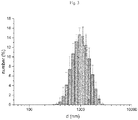
Classifications
-
- C—CHEMISTRY; METALLURGY
- C07—ORGANIC CHEMISTRY
- C07F—ACYCLIC, CARBOCYCLIC OR HETEROCYCLIC COMPOUNDS CONTAINING ELEMENTS OTHER THAN CARBON, HYDROGEN, HALOGEN, OXYGEN, NITROGEN, SULFUR, SELENIUM OR TELLURIUM
- C07F9/00—Compounds containing elements of Groups 5 or 15 of the Periodic Table
- C07F9/02—Phosphorus compounds
- C07F9/28—Phosphorus compounds with one or more P—C bonds
- C07F9/50—Organo-phosphines
- C07F9/53—Organo-phosphine oxides; Organo-phosphine thioxides
- C07F9/5337—Phosphine oxides or thioxides containing the structure -C(=X)-P(=X) or NC-P(=X) (X = O, S, Se)
-
- C—CHEMISTRY; METALLURGY
- C08—ORGANIC MACROMOLECULAR COMPOUNDS; THEIR PREPARATION OR CHEMICAL WORKING-UP; COMPOSITIONS BASED THEREON
- C08F—MACROMOLECULAR COMPOUNDS OBTAINED BY REACTIONS ONLY INVOLVING CARBON-TO-CARBON UNSATURATED BONDS
- C08F2/00—Processes of polymerisation
- C08F2/46—Polymerisation initiated by wave energy or particle radiation
- C08F2/48—Polymerisation initiated by wave energy or particle radiation by ultraviolet or visible light
- C08F2/50—Polymerisation initiated by wave energy or particle radiation by ultraviolet or visible light with sensitising agents
-
- G—PHYSICS
- G03—PHOTOGRAPHY; CINEMATOGRAPHY; ANALOGOUS TECHNIQUES USING WAVES OTHER THAN OPTICAL WAVES; ELECTROGRAPHY; HOLOGRAPHY
- G03F—PHOTOMECHANICAL PRODUCTION OF TEXTURED OR PATTERNED SURFACES, e.g. FOR PRINTING, FOR PROCESSING OF SEMICONDUCTOR DEVICES; MATERIALS THEREFOR; ORIGINALS THEREFOR; APPARATUS SPECIALLY ADAPTED THEREFOR
- G03F7/00—Photomechanical, e.g. photolithographic, production of textured or patterned surfaces, e.g. printing surfaces; Materials therefor, e.g. comprising photoresists; Apparatus specially adapted therefor
- G03F7/004—Photosensitive materials
- G03F7/027—Non-macromolecular photopolymerisable compounds having carbon-to-carbon double bonds, e.g. ethylenic compounds
- G03F7/028—Non-macromolecular photopolymerisable compounds having carbon-to-carbon double bonds, e.g. ethylenic compounds with photosensitivity-increasing substances, e.g. photoinitiators
- G03F7/029—Inorganic compounds; Onium compounds; Organic compounds having hetero atoms other than oxygen, nitrogen or sulfur
Definitions
- the present invention relates to novel bisacylphosphinic acids, salts, and derivatives thereof as well as their use as photo-initiators with superior water solubility and photoactivity.
- the invention further encompasses versatile processes for the preparation of the aforementioned compounds.
- Photo-initiators such mono- and bisacylphosphine oxides, in particular those bearing further functionalized substituents have attracted significant commercial attention since photo-initiators, which are tunable with respect to the wavelength at which photo-induced cleavage occurs or which are linkable to other additives, such as sensitizers, stabilizers or surface active agents in order to avoid migration e.g. in food packaging, are highly desirable.
- water solubility has become an increasingly interesting property for photo-initiators in general to cope with soaring demand for environmental friendly production of coatings, adhesives, inks and painting materials e.g. for water-borne UV-inkjet inks and to expand their applicability into interesting new fields such as fabrication of hydrogels for tissue engineering.
- WO2014/053455 A1 discloses novel mono- and bisacylphosphine oxides comprising additional functional groups inter alia those increasing water solubility.
- Such functional groups include quaternary ammonium salts, carboxylic acids and polyether functions and are introduced via addition of electron-poor olefins to mono- and bisacylphosphines or their corresponding salts.
- a further option to increase water solubility is to provide acylphosphine oxides carrying one or two hetero atom substituents besides one or two acyl substituents on the central phosphorus atom.
- US 4,710,523 discloses the use of monoacylphosphinic alkyl esters oxides as photo-initiators which were prepared via an Arbusov-type reaction of an acyl chloride with a suitable phosphinic acid ester.
- polycyclic monoacylphosphinic acid ester derivatives have been disclosed in US 5,096,935 .
- the aryl ester group is linked to a P-aryl substituent forming a polycyclic system (9,10-dihydro-9-oxa-10-phosphaphenanthrene 10-oxide, DOPO).
- DOPO dihydro-9-oxa-10-phosphaphenanthrene 10-oxide
- Bisacylphosphosphinic acid aryl esters such as bis(2,6-dichlorobenzoyl)-(4-butylphenoxy)-phosphine oxide and their use as photo-initiators are known from US 7,097,456 .
- a common feature of all compounds used as photo-initiators and known from the prior art mentioned above is that the aryl substituents bound to the carbonyl functions carry substituents in both the 2- and 6-position, i.e. the ortho positions.
- This substitution pattern is said to provide steric shielding of the carbonyl group, and thus sufficient chemical stability of the photo-initiator in formulations such as stability against nucleophilic attack in aqueous solutions which would lead to hydrolysis and thus inactivation of the photo-initiator.
- CN106554430A discloses acylphosphine photo-initiators bearing an additional tertiary amine functionality in the aroyl groups bound to the central phosphorous atom in order to shift the UV absorption wavelength to 380 nm to 395 nm.
- the compounds are said to exhibit a good solubility in various kinds of resins and oligomers.
- Many of the disclosed compounds do not bear any substituents in ortho-position of the aroyl substituents.
- their preparation requires a tedious multistep procedure starting from dihalophosphines which renders their manufacture commercially unattractive. Further due to lack of highly polar or ionic groups their water solubility is poor.
- aryl denotes carbocyclic aromatic substituents, whereby said carbocyclic, aromatic substituents are unsubstituted or substituted by up to five identical or different substituents per cycle.
- the substituents are selected from the group consisting of fluorine, bromine, chlorine, iodine, nitro, cyano, formyl or protected formyl, hydroxy or protected hydroxy, C 1 -C 8 -alkyl, C 1 -C 8 -haloalkyl, C 1 -C 8 -alkoxy, C 1 -C 8 -haloalkoxy, C 6 -C 14 -aryl, in particular phenyl and naphthyl, di(C 1 -C 8 -alkyl)amino, (C 1 -C 8 -alkyl)amino, CO(C 1 -C 8 -alkyl), OCO(C 1 -C 8 -alkyl
- the carbocyclic, aromatic substituents are unsubstituted or substituted by up to three identical or different substituents per cycle selected from the group consisting of fluorine, chlorine, cyano, C 1 -C 8 -alkyl, C 1 -C 8 -haloalkyl, C 1 -C 8 -alkoxy, C 1 -C 8 -haloalkoxy, C 6 -C 14 -aryl, in particular phenyl.
- the carbocyclic, aromatic substituents are unsubstituted or substituted by up to three identical or different substituents per cycle selected from the group consisting of fluorine, C 1 -C 8 -alkyl, C 1 -C 8 -fluoroalkyl, C 1 -C 8 -alkoxy, C 1 -C 8 -fluoroalkoxy, and phenyl, which are in an even more preferred embodiment not positioned in the ortho-positions.
- aryl substituents are C 6 -C 14 -aryl substituents, more preferably phenyl, naphthyl, phenanthrenyl and anthracenyl.
- C 6 -C 14 indicates that the number of carbon atoms of the respective carbocyclic, aromatic ring system is from 6 to 14.
- the possible and preferred substitution patterns mentioned above are likewise applicable.
- heterocyclyl denotes heterocyclic aliphatic, aromatic or mixed aliphatic and aromatic substituents in which no, one, two or three skeleton atoms per cycle, but at least one skeleton atom in the entire cyclic system is a heteroatom selected from the group consisting of phosphorous, nitrogen, sulphur and oxygen, preferably nitrogen, sulphur and oxygen, whereby such heterocyclic aliphatic, aromatic or mixed aliphatic and aromatic substituents are unsubstituted or substituted by up to the possible limit identical or different substituents per cycle, whereby the substituents are selected from the same group as given above for carbocyclic aromatic substituents including the areas of preference.
- Preferred heterocyclyl-substituents and heteroaryl-substituents respectively are pyridinyl, oxazolyl, thiophenyl, benzofuranyl, benzothiophenyl, dibenzofuranyl, dibenzothiophenyl, furanyl, indolyl, pyridazinyl, pyrazinyl, imidazolyl, pyrimidinyl and quinolinyl, either unsubstituted or substituted with one, two or three substituents selected from the group consisting of hydroxy, protected hydroxy, chloro, fluorine, C 1 -C 8 -alkyl, C 1 -C 8 -fluoroalkyl, C 1 -C 8 -alkoxy, C 1 -C 8 -fluoroalkoxy, and phenyl.
- keto compounds e.g. pyridone for 2-hydroxypyridine
- Preferred heterocyclylium cations are N-(C 1 -C 8 -alkyl)imidazolium or pyridinium cations.
- protected formyl is a formyl substituent which is protected by conversion to an aminal, acetal or a mixed aminal acetal, whereby the aminals, acetals and mixed aminal acetals are either acyclic or cyclic.
- protected formyl is 1,1-(2,4-dioxycyclopentanediyl).
- protected hydroxy is a hydroxy radical which is protected by conversion to a ketal, acetal or a mixed aminal acetal, whereby the aminals, acetals and mixed aminal acetals are either acyclic or cyclic.
- protected hydroxyl is tetrahydropyranyl (O-THP).
- alkyl, alkanediyl, alkenyl, alkenediyl, alkynyl, alkane-n-yl and alkene-n-yl, alkoxy, alkenoxy, alkyl-thio, alkanedioxy, alkenedioxy and alkeneoxy are straight-chained, cyclic either in part or as a whole, branched or unbranched.
- C 1 -C 18 -alkyl indicates that the straight-chained, cyclic either in part or as a whole, branched or unbranched alkyl substituent contains from 1 to 18 carbon atoms excluding the carbon atoms of optionally present substituents to the C 1 -C 18 -alkyl substituent.
- alkenyl denotes a substituent comprising at least one carbon-carbon double bond but also more than one double bond, irrespective of its or their location within the straight-chained, cyclic either in part or as a whole, branched or unbranched substituent.
- alkynyl denotes a substituent comprising at least one carbon-carbon triple bond but also more than one double bond, irrespective of its or their location within the straight-chained, cyclic either in part or as a whole, branched or unbranched substituent.
- C 1 -C 4 -alkyl are methyl, ethyl, n-propyl, isopropyl, n-butyl, tert-butyl.
- Additional examples for C 1 -C 8 -alkyl are n-pentyl, isopentyl, cyclohexyl, n-hexyl, n-heptyl, n-octyl, isooctyl.
- Additional examples for C 1 -C 18 -alkyl are norbornyl, adamantyl, n-decyl, n-dodecyl, n-hexadecyl, n-octadecyl.
- C 1 -C 8 -alkanediyl-substituents are methylene, 1,1-ethylene, 1,2-ethylene, 1,1-propylene, 1,2-propylene, 1,3-propylene, 1,1-butylene, 1,2-butylene, 2,3-butylene and 1,4-butylene, 1,5-pentylene, 1,6-hexylene, 1,1-cyclohexylene, 1,4-cyclohexylene, 1,2-cyclohexylene and 1,8-octylene.
- C 1 -C 4 -alkoxy-substituents are methoxy, ethoxy, isopropoxy, n-propoxy, n-butoxy and tert-butoxy.
- An additional example for C 1 -C 8 -alkoxy is cyclohexyloxy.
- C 2 -C 18 -alkenyl and C 2 -C 8 -alkenyl-substituents include vinyl, allyl, 3-propenyl and buten-2-yl.
- C 2 -C 18 -alkynyl and C 2 -C 8 -alkynyl-substituents include ethinyl-
- C 1 -C 8 -haloalkyl and C 1 -C 8 -haloalkoxy are C 1 -C 8 -alkyl and C 1 -C 8 - alkoxy substituents which are once, more than once or fully substituted by halogen atoms.
- Substituents which are partially or fully substituted by fluorine are referred to as C 1 -C 8 - fluoroalkyl and C 1 -C 8 -fluoroalkoxy, respectively.
- C 1 -C 8 -haloalkyl-substituents are fluoromethyl, difluoromethyl, trifluoromethyl, 2,2,2-trifluoroethyl, chloromethyl, fluoromethyl, bromomethyl, 2-bromoethyl, 2-chloroethyl, nonafluorobutyl and n-perfluorooctyl.
- the substituents R 1 are those of formula (IIb).
- Preferred substituents R 5 are selected from the group consisting of C 1 -C 18 -alkyl which is
- R 5 are selected from the group consisting of C 1 -C 6 -alkyl which is
- substituents of formula (IIb) include tert-butyl, isopropyl, cyclohexyl, cyclopentyl, 3,3dimethylbutyl, neopentyl and 2-ethylhexyl
- R 2 , R 3 and R 4 substituents of formula (IIa) are selected from the group consisting of hydrogen, fluoro, chloro, bromo, -NO 2 , -CN, -SO 2 N(R 6 ) 2 , -(NR 6 ) 2 , - (CO)OR 7 , -(CO)N(R 6 ) 2 , -NR 6 (CO)R 7 , alkyl, alkynyl and alkoxy whereby the alkyl and alkoxy substituents are
- R 1 at least one of R 2 , R 3 and R 4 is hydrogen, preferably at least R 2 and R 4 .
- R 2 , R 3 and R 4 substituents of formula (IIa) are selected from the group consisting of hydrogen, fluoro, chloro, bromo, -NO 2 , -CN, -(CO)OR 7 , -(CO)N(R 6 ) 2 , alkyl and alkoxy whereby the alkyl and alkoxy substituents are
- R 1 at least one of R 2 , R 3 and R 4 is hydrogen, preferably at least R 2 and R 4 .
- substituents of formula (IIa) include phenyl, p-tert-butylphenyl, 3-cyanophenyl, 4-cyanophenyl, 3-ethinylphenyl, 4-ethinylphenyl, 4-methylphenyl, 3-methylphenyl, 3,5-dimethylphenyl, 4-methoxyphenyl, 3-methoxyphenyl, p-chlorophenyl, 3,4-dichlorophenyl, 4-bromophenyl, 3-bromophenyl, 3,4-dibromophenyl, 4-nitrophenyl, 3-nitrophenyl, p-trifluoromethyl, p-ethoxycarbonyl-phenyl, p-methoxycarbonylphenyl and p-isopropylphenyl, whereby phenyl is even more preferred.
- Specific compounds of formula (I) include: Bis(benzoyl)phosphinic acid, bis(4-isopropylbenzoyl)phosphinic acid, bis(4-isopropylbenzoyl)phosphinic acid tetra-(n-butyl) ammonium salt, bis(benzoyl)phosphinic acid tetra-(n-butyl) ammonium salt, bis(4-isopropylbenzoyl)phosphinic acid 1,1,3,3-tetra- N -methyl-guanidinium salt and bis(benzoyl)phosphinic acid 1,1,3,3-tetra- N -methyl-guanidinium salt, bis(benzoyl)phosphinic acid lithium salt, bis(benzoyl)phosphinic acid sodium salt, bis(benzoyl)phosphinic acid potassium salt, bis(benzoyl)phosphinic acid rubidium salt, bis(4-isopropylbenzoyl)
- step c) first a compound of formula (III) is added wherein LG denotes C 1 -C 18 -alkoxy and then a compound of formula (III) wherein LG denotes chloro, bromo or iodo.
- phosphine (PH 3 ) and at least one alkali metal alkoxide such as lithium C 1 -C 18 -alkoxide, sodium C 1 -C 18 -alkoxide or potassium C 1 -C 18 -alkoxide may be employed as well instead of performing steps A) and B).
- Oxidation may be carried out in any manner known to those skilled in the art and includes reaction with molecular oxygen, hydrogen peroxide, sodium hypochlorite, sodium or potassium percarbonates, monoperoxodisulfate or monopersulfate, peracids such as peracetic acid and 3-chloroperbenzoic acid, hydroperoxides such as tert-butylhydroperoxide, permanganates such as potassium permanganate, chromates and dichromates such as potassium dichromate and aqueous solutions of all of the aforementioned.
- Formulae (IVa) and (IVb) as depicted above shall also encompass dimers, trimers and higher aggregated complexes as well as solvate complexes or other compounds wherein the metal is complexed of the compounds depicted therein.
- compounds of formula (I) may be prepared for example by the steps of:
- Specific compounds of formula (V) include benzoylchloride and p-isopropylbenzoylchloride.
- Lewis acid as used above is understood to mean the generally customary definition of those compounds which have an electron vacancy, as explained, for example, in Römpp's Chemie-Lexikon, 8th edition, Franck'sche Verlags Stuttgart 1983, Volume 3, H-L .
- the at least one Lewis acid is selected from the group including methyl aluminoxane (MAO) and compounds represented by formula (VII) M L R L (r) X L (z-r) (VII) wherein
- r is 0.
- Preferred compounds are aluminum trichloride and boron trifluoride.
- Lewis acids are often supplied or available in form of adducts with weak Lewis bases, in particular ethers. Examples thereof include boron trifluoride diethyletherate or tetrahydrofuranate. Such derivatives shall be encompassed by the mere description of the Lewis acids as well.
- r is 1, 2 or 3.
- two or more Lewis acids are employed for example two or three.
- LAF Lewis Acids Fragments
- Preferred Lewis Acids Fragments are structural units of formula (VIII) M L R L (rr) X L (zz-rr) (VIII) wherein
- LAF Lewis Acid Fragments
- Lewis Acid Repairments are formally q-times positively charged and that for example in compounds of formula (VI) the residue P(OCR 1 ) 2 is formally anionic with the negative charge being delocalized over the five-membered O-C-P-C-O unit.
- the process is typically carried out by adding phosphine (PH 3 ) to a mixture of compound of formula (V) and the at least one Lewis acid either neat or dissolved or suspended in a solvent. Thereby a reaction mixture is formed.
- phosphine (PH 3 ) phosphine (PH 3 )
- the reaction time is typically in the range of from 2 min to 72 hours, preferably 30 min to 24 hours.
- Suitable solvents include and preferably are those which do not or virtually not react under formation of new covalent bonds with phosphine (PH 3 ), the Lewis acid and the compounds of formula (V).
- Such solvents include
- Preferred solvents are halogenated aliphatic hydrocarbons such as methylchloride, methylenedichloride, chloroform, trichloroethane and tetrachloroethene.
- the amount of solvent is not critical at all and is just limited by commercial aspects, since they have to be removed if the compounds of formula (VI) shall finally be isolated.
- mixing energy e.g. by standard agitators stirrers and/or static mixing elements is introduced into the reaction mixture.
- mixing can also be supported by using high force dispersion devices such as, for example, ultrasound sonotrodes or high pressure homogenizers.
- the process may either be performed batch wise or continuously.
- a typical and preferred reaction temperature range to carry out the process is from -30°C to 120°C, preferably from -10 to 80°C and even more preferably from 0 to 40°C.
- reaction temperature is above the boiling point at 1013 hPa of the solvent employed, the reaction is carried out under sufficient pressure.
- the preferred reaction pressure range to carry out the process is from 800 hPa to 10 MPa, preferably from 1000 hPa to 0.5 MPa.
- the molar ratio of compounds of phosphine (PH 3 ) to compounds of formula (V) employed in the reaction is typically from 0.4 to 0.9 preferably 0.45 to 0.6.
- the molar ratio of compounds of formula (V) and Lewis acid employed in the reaction is typically from 0.01 to 1 mol of Lewis acid per mol of phosphine (PH 3 ).
- the main advantage of the preparation method 2 is that it allows the efficient and high-yielding synthesis of compounds of formula (I) starting from readily available Lewis acids and acid halides which allows a very broad substitution pattern to be applied.
- Oxidation of the alcohol functionalities may be carried out in any manner known to those skilled in the art and includes reaction with N-chlorosuccinimide or elemental chlorine in the presence of dialkylsulfides such as dimethylsulfide and an amine such as triethylamine (the Corey-Kim oxidation).
- the oxidation can further be carried out
- the main advantage of the preparation method 3 is that it allows the easy synthesis of compounds of formula (I) starting from cheap phosphinic acid and aldehydes which are available with a broad substitution pattern.
- compounds of formula (I) are obtained by the three preparation methods outlined above, wherein Cat (n+) is hydrogen or a cation already present in or added to the reaction mixture of the final oxidation step.
- the compounds of formula (I) exhibit unexpected stability again hydrolysis, superior reactivity under blue light irradiation compared to known bisacyl phosphinic acid derivatives and bisacylphosphine oxides bearing substituents at the ortho positions of the aroyl substituents such as mesitoyl substituents.
- Compounds of formula (I) are particularly useful as photo-initiators.
- one further aspect of the invention relates to photo-curable compositions comprising
- diacrylate esters such as 1,6-hexanediol diacrylate (HDDA), ethylene glycol diacrylate, propylene glycol diacrylate, dipropylene glycol diacrylate, tripropylene glycol diacrylate, neopentyl glycol diacrylate, hexamethylene glycol diacrylate and bisphenol A diacrylate, trimethylolpropane triacrylate, trimethylolethane triacrylate, trimethylolpropane trimethacrylate, trimethylolethane trimethacrylate, tetramethylene glycol dimethacrylate, triethylene glycol dimethacrylate, tetraethylene glycol diacrylate, pentaerythritol diacry- late, pentaerythritol triacrylate, pentaerythritol tetraacrylate, dipentaerythritol diacrylate, dipentaerythritol triacrylate, dipentaerythritol
- ethylenically unsaturated compounds include esters of ethylenically unsaturated mono- or poly-functional carboxylic acids and polyols or polyepoxides, and polymers having ethylenically unsaturated groups in the main chain or in or as side groups such as, for example, unsaturated polyesters, polyamides and polyurethanes and copolymers thereof, alkyd resins, polybutadiene and butadiene copolymers, polyisoprene and isoprene copolymers, polymers and copolymers having (meth)acrylic groups in side chains, and also mixtures of one or more of such polymers.
- ethylenically unsaturated compounds include include acrylates which have been modified by reaction with primary or secondary amines, as described, for example, in US3844916 , in EP280222 , in US5482649 or in US5734002 .
- Such amine-modified acrylates are also termed amine acrylates.
- Amine acrylates are obtainable, for example, under the name EBECRYL 80, EBECRYL 81 , EBECRYL 83, EBECRYL 7100 from UCB Chemicals, under the name Laromer PO 83F, Laromer PO 84F, Laromer PO 94F from BASF SE, under the name PHOTOMER 4775 F, PHOTOMER 4967 F from Cognis or under the name CN501 , CN503, CN550 from Cray Valley and GENOMER 5275 from Rahn.
- the at least one ethylenically unsaturated compound may be dissolved or emulsified in water.
- the concentration of water is for example from 5 to 80 % by weight, preferably from 10 to 60 % by weight.
- ethylenically unsaturated components compounds of formula (I), and optional other ingredients will vary according to the type of composition, the particular equipment to be used to apply it and the application.
- the amount of photo-initiator within the composition is in the range of from 0.05 to 12 wt.-%, preferably 2 to 10 wt.-%, more preferably 4 to 9 wt.-%.
- the invention further relates to a process for preparing a cured composition by exposing the photo-curable compositions according to the present invention to electromagnetic radiation, preferably ultraviolet or blue-light radiation.
- Suitable sources of electromagnetic radiation include UV lamps like low-pressure, medium-pressure, high-pressure and super-high-pressure mercury lamps which can be undoped or doped e.g. with gallium iodide, thallium iodide or other metal halides; blue, violet-blue LEDs or UV-LEDs; LED lamps, concentrated, direct or indirect sunlight; xenon or xenon mercury arc lamps such as continuous-output xenon short- or long-arc lamps, flash lamps such as xenon or xenon mercury flash lamps; microwave-excited metal vapour lamps; excimer lamps, superactinic fluorescent tubes; fluorescent lamps; and noble gas incandescent lamps.
- UV lamps like low-pressure, medium-pressure, high-pressure and super-high-pressure mercury lamps which can be undoped or doped e.g. with gallium iodide, thallium iodide or other metal halides; blue, violet-blue LEDs or UV-LEDs; LED lamps, concentrated
- Preferred sources are lamps like low-pressure, medium-pressure, high-pressure and super-high-pressure mercury lamps which can be undoped or doped e.g. with gallium iodide, thallium iodide or other metal halides; blue, violet-blue or UV-LEDs, xenon or xenon mercury arc lamps such as continuous-output xenon short- or long-arc lamps.
- compositions according to the invention can be used for various purposes, for example in overprint coatings, as printing ink, e.g. screen printing ink, ink for offset- or flexo printing, inkjet ink, ink for sheet-fed printing, electrophotography ink, intaglio ink, as clearcoats, white coats or colour-pigmented coats, e.g.
- printing ink e.g. screen printing ink, ink for offset- or flexo printing, inkjet ink, ink for sheet-fed printing, electrophotography ink, intaglio ink, as clearcoats, white coats or colour-pigmented coats, e.g.
- the compounds of formula (I) are also suitable for use in photo-curable adhesives; e.g. in the preparation of pressure-sensitive adhesives, laminating adhesives, hot-melt adhesives, moisture-cure adhesives, silane reactive adhesives or silane reactive sealants and the like, and related applications.
- Said adhesives can be hot melt adhesives as well waterborne or solvent borne adhesives, liquid solvent-free adhesives or 2-part reactive adhesives.
- the compounds of formula (I) may also be used as free-radical photoinitiators or photoinitiating systems for radiation-curable powder coatings.
- curing according to the invention can be carried out by irradiation with electromagnetic radiation.
- thermal curing before, during or after the irradiation may be advantageous.
- Thermal curing is carried out by methods known to the person skilled in the art. In general, the curing is carried out in an oven, e.g. a circulating air oven, on a heating plate or by irradiation with IR lamps. Unassisted curing at room temperature is also possible, depending on the binder system used.
- the curing temperatures are generally between room temperature and 150°C, for example from 25 to 150°C or from 50 to 150°C. In the case of powder coatings or coil coatings, the curing temperatures may be even higher, e.g. up to 350°C.
- the advantage of the invention is that the compounds provided based on readily available compounds s starting materials meet the high solubility in photo-curable formulations, especially photo-curable water containing formulations, significantly higher reactivity at desirable wavelengths compared to bisacylphosphine oxide derivatives commercially available today or known so far. It was shown that the compounds of formula (I) can be advantageously used in surfactant free emulsion polymerization.
- Example 2 Preparation of bis(benzoyl)phosphine (HP(COPh) 2 ) from PH 3 according to preparation method 1 (alternative method)
- Example 3 Preparation of aluminum tris[bis(benzoyl)phosphide][Al( Ph BAP) 3 ] from PH 3 according to preparation method 2
- Example 5 Oxidation of bis(benzoyl)phosphine HP(COPh) 2 to bis(benzoyl)phosphinic acid tetrabutylammonium salt ( Ph BAPO-ONBu 4 ) with 3-chloroperbenzoic acid according to preparation method 1 or 2
- Example 6 Oxidation of bis(benzoyl)phosphine HP(COPh) 2 to bis(benzoyl)phosphinic acid tetrabutylammonium salt ( Ph BAPO-ONBu 4 ) with peracetic acid according to preparation method 1 or 2
- Example 7) Preparation of bis(hydroxy(4-isopropylphenyl)methyl)phosphinic acid according to preparation method 3
- a 100 mL flask equipped with a large magnetic stirring bar was charged with water (30 mL), aqueous phosphinic acid (1 eq., 50 w-%, 22.6 mmol), and cuminaldehyde (2.1 eq., 47.5 mmol, 7.04 g).
- the reaction mixture was degassed for 30 min by bubbling through an argon stream while stirring. Subsequently, the flask was sealed with a glass stopper and the reaction mixture was stirred (400 rpm) for two days at 100 °C (oil bath temperature). An off-white solid was formed, which was triturated with 100 mL of water.
- the obtained suspension was filtered through a G4 glass frit and the solid was further washed with water and a minimal amount of toluene (10 mL). After drying the crude product in an air stream, it was dissolved in boiling MeOH under the addition of conc. HCl aq. (0.1 mL). After evaporation in vacuo, the white solid was recrystallized from boiling MeOH ( ⁇ -25 °C) to obtain bis(hydroxy(4-isopropylphenyl)methyl)phosphinic acid as a colourless solid, which was dried in vacuo (5.45 mmol, 1.975 g, 24 %). Evaporating the mother liquor yields a second batch (9.956 mmol, 3.608 g, 44 %).
- Example 8 Preparation of bis(4-isopropylbenzoyl)phosphinic acid 1,1,3,3-tetramethylguanidinium salt ( Cum BAPO-OTMG) according to preparation method 3
- the reaction mixture was degassed for 30 min by bubbling through an argon stream while stirring. Subsequently, the flask was sealed with a glass stopper and the reaction mixture was stirred (400 rpm) for five days at 100 °C (oil bath temperature).
- Example 11 Preparation of bis(benzoyl)phosphinic acid 1,1,3,3-tetra- N- methylguanidinium salt ph BAPO-OTMG according to preparation method 3
- a Schlenk flask is charged with bis(hydroxy(phenyl)methyl)phosphinic acid (4.055 g 14.58 mmol, 1 eq.) and N-chlorosuccinimide (4.09 g, 30.62 mmol, 2.1 eq.) and purged with argon. After dissolving in dry dichloromethane (250 mL), the reaction mixture is cooled to -78 °C in an aceton/dry ice bath. Dimethyl sulfide (2.8 mL, 30.62 mmol, 2.1 eq.) is added and the reaction is stirred at -78 °C for 10 min.
- Bismesitoylphosphinic acid (synthesised as described in patent application WO2014095724 A1 , 540 mg, 1.5 mmol) and NaHCO 3 (150 mg, 1.8 mmol, 1.2 eq.) were mixed with EtOH (30 mL) and treated in an ultrasonic bath for 1 h. After evaporation in vacuo , the residue was suspended in dichloromethane (DCM, 50 mL) followed by the addition of tetra- n -butylammonium chloride (417 mg, 1.5 mmol, 1.0 eq.) and another 15 min of ultrasound treatment.
- DCM dichloromethane
- Example 14 Preparation of bis(mesitoyl)phosphinic acid 1,1,3,3-tetra- N -methylguanidinium salt ( Mes BAPO-OTMG)
- Bismesitoylphosphinic acid (synthesised as described in patent application WO2014095724 A1 , 2025 mg, 5.65 mmol) was dissolved in absolute EtOH (30 mL) and 1,1,3,3-tetramethylguanidine (723 ⁇ L, 664 mg, 5.76 mmol, 1.02 eq.) was added. The clear yellow solution was evaporated in vacuo yielding an off-white solid. The solid was dissolved in boiling DCM. Upon addition of hexane and cooling to -20 °C, the final product was obtained as off-white solid after filtration, washing with Et 2 O, and drying in vacuo (2389 mg, 5.05 mmol, 89 %).
- TPP triphenylphosphate
- Example 17 UV-Vis spectra and photobleaching of Ph BAPO-ONBu 4 versus Mes BAPO-ONBu 4
- Rapid and quantitative photobleaching i.e. the formation of colourless photoproducts
- Fig 1 shows, a feast decay of the long wave absorption bands upon UV/Vis irradiation proves that upon photolysis Ph BAPO-ONBu 4 rapidly undergoes Norrish-type I cleavage reactions and only colourless photoproducts are formed.
- Ph BAPO-ONBu 4 likewise particularly suitable inter alia for free radical polymerisations in aqueous phase, clear coatings and powder coatings. Details are given in Table 3. Table 2.
- Ph BAPO-ONBu 4 46 mg, 0.089 mmol, 2 mol-% according to styrene
- deionized water 10 mL
- the mixture was degassed for 5 min with argon while stirring.
- styrene 0.5 mL, 4.4 mmol, filtered over neutral alumina to remove stabilizer
- the suspension was subsequently irradiated for 30 min in a blue LED reactor (465 nm) under vigorous stirring. A milky white dispersion is obtained.
Landscapes
- Chemical & Material Sciences (AREA)
- Organic Chemistry (AREA)
- Physics & Mathematics (AREA)
- Health & Medical Sciences (AREA)
- Inorganic Chemistry (AREA)
- Polymers & Plastics (AREA)
- Medicinal Chemistry (AREA)
- Chemical Kinetics & Catalysis (AREA)
- Spectroscopy & Molecular Physics (AREA)
- General Physics & Mathematics (AREA)
- Crystallography & Structural Chemistry (AREA)
- Life Sciences & Earth Sciences (AREA)
- Biochemistry (AREA)
- General Health & Medical Sciences (AREA)
- Molecular Biology (AREA)
Abstract
The present invention relates to novel bisacylphosphinic acids, salts and derivatives thereof as well as their use as photo-initiators with superior water solubility and photo-activity. The invention further encompasses versatile processes for the preparation of the aforementioned compounds.
Description
- The present invention relates to novel bisacylphosphinic acids, salts, and derivatives thereof as well as their use as photo-initiators with superior water solubility and photoactivity. The invention further encompasses versatile processes for the preparation of the aforementioned compounds.
- Photo-initiators such mono- and bisacylphosphine oxides, in particular those bearing further functionalized substituents have attracted significant commercial attention since photo-initiators, which are tunable with respect to the wavelength at which photo-induced cleavage occurs or which are linkable to other additives, such as sensitizers, stabilizers or surface active agents in order to avoid migration e.g. in food packaging, are highly desirable.
- Further, water solubility has become an increasingly interesting property for photo-initiators in general to cope with soaring demand for environmental friendly production of coatings, adhesives, inks and painting materials e.g. for water-borne UV-inkjet inks and to expand their applicability into interesting new fields such as fabrication of hydrogels for tissue engineering.
- It is well known to those skilled in the art, however, that in particular bisacylphosphine oxides are only sparingly soluble in water and thus hardly compatible with water borne formulations. Thus, the preparation of radiation curable formulations containing these photo-initiators is often a tedious process, requiring a long time and/or higher temperatures in order to get an adequate formulation. An exception is the commercial product Irgacure 819 DW which is a dispersion of bis(2,4,6-trimethylbenzoyl)-phenyl phosphine oxide (Irgacure 819) in water stabilized by significant amounts of dispersants. However, the use of high levels of dispersants is not desirable at all.
- During the last decade many approaches to overcome these limitations have been published.
-
WO2014/053455 A1 discloses novel mono- and bisacylphosphine oxides comprising additional functional groups inter alia those increasing water solubility. Such functional groups include quaternary ammonium salts, carboxylic acids and polyether functions and are introduced via addition of electron-poor olefins to mono- and bisacylphosphines or their corresponding salts. - It is known from
EP 1 749 513 to modify bisacylphosphine oxides by introduction of further substituents at the aryl moieties to improve water solubility and compatibility with aqueous formulations. However the introduction of such substituents requires a multi-step synthesis which renders this approach not attractive for most applications. - A further option to increase water solubility is to provide acylphosphine oxides carrying one or two hetero atom substituents besides one or two acyl substituents on the central phosphorus atom.
-
US 4,710,523 discloses the use of monoacylphosphinic alkyl esters oxides as photo-initiators which were prepared via an Arbusov-type reaction of an acyl chloride with a suitable phosphinic acid ester. - Further, polycyclic monoacylphosphinic acid ester derivatives have been disclosed in
US 5,096,935 . In these structures the aryl ester group is linked to a P-aryl substituent forming a polycyclic system (9,10-dihydro-9-oxa-10-phosphaphenanthrene 10-oxide, DOPO). By alkaline hydrolysis thereof acyl (hydroxybiphenyl) phosphinic acid metal salts are obtained. - Bisacylphosphosphinic acid aryl esters such as bis(2,6-dichlorobenzoyl)-(4-butylphenoxy)-phosphine oxide and their use as photo-initiators are known from
US 7,097,456 . - Further alkyl and aryl esters of bisacylphosphinic acid are known from
WO 2012/012067 A andCN103288873 A , bisacylphosphinic acids and derivatives thereof are known fromWO2014095724 A1 . - A common feature of all compounds used as photo-initiators and known from the prior art mentioned above is that the aryl substituents bound to the carbonyl functions carry substituents in both the 2- and 6-position, i.e. the ortho positions. This substitution pattern is said to provide steric shielding of the carbonyl group, and thus sufficient chemical stability of the photo-initiator in formulations such as stability against nucleophilic attack in aqueous solutions which would lead to hydrolysis and thus inactivation of the photo-initiator.
-
CN106554430A discloses acylphosphine photo-initiators bearing an additional tertiary amine functionality in the aroyl groups bound to the central phosphorous atom in order to shift the UV absorption wavelength to 380 nm to 395 nm. The compounds are said to exhibit a good solubility in various kinds of resins and oligomers. Many of the disclosed compounds do not bear any substituents in ortho-position of the aroyl substituents. However, their preparation requires a tedious multistep procedure starting from dihalophosphines which renders their manufacture commercially unattractive. Further due to lack of highly polar or ionic groups their water solubility is poor. - As a consequence, there is still a need for highly photo-active, water soluble photo-initiators.
- In one aspect the invention therefore provides and encompasses compounds of formula (I):

- X
- is oxygen or sulfur, preferably oxygen
- n
- is an integer of 1 or more, preferably 1 to 6, more preferably 1,2 or 3, and even more preferably 1
- Cat(n+)
- is an n-valent cation and
- the substituents R1
- are independently, preferably identically selected from those of formulae (IIa) and (IIb)
- R2, R3 and R4
- are independently selected from the group consisting of hydrogen, halogen, -NO2, -CN, -SO2N(R6)2, -NR6SO2R7, -(NR6)2, -COR7, -O(CO)R6, -(CO)OR7, -O(CO)OR7, -NR6(CO)N(R6)2, -NR6(CO)R7, -(CO)N(R6)2, -NR6(CO)OR7, -O(CO)N(R6)2, -Si(R7)3, -OSi(R7)3, Si(OR7)y(R7)3-y, -OSi(OR7)yR7)3-y with y = 1, 2 or 3, -SO3M, -COOM, PO3M2, -PO(N(R6)2)2, PO(OR7)2, N(R6)3 +An-, heterocyclyl, alkyl, alkoxy, alkyl-thio, alkenyl, alkenoxy, alkene-thio, aryl, aryloxy, aryl-thio or two substituents together are aryldiyl, alkanediyl or alkenediyl, alkanedioxy, alkaneoxy, alkenedioxy, alkeneoxy
whereby the alkyl, alkoxy, alkyl-thio, alkenyl, alkenoxy, alkene-thio, alkanediyl or alkenediyl, alkanedioxy, alkaneoxy, alkenedioxy, alkeneoxy substituents are- either not, once, twice or more than twice interrupted by non-successive functional groups selected from the group consisting of: -O-, -S-, -SO2-, -SO-, -SO2NR6-, -NR6SO2-, -NR6-, -CO-, -O(CO)-, (CO)O-, -O(CO)O-, -NR6(CO)NR6-, -NR6(CO)-, -(CO)NR6-, -NR6(CO)O-, -O(CO)NR6-, -Si(R7)2-, -OSi(R7)2-, -OSi(R7)2O-,-Si(R7)2O-,
and - either not, once, twice or more than twice interrupted by bivalent residues selected from the group consisting of heterocyclo-diyl, and aryldiyl, and
- either not, once, twice or more than twice substituted by substituents selected from the group consisting of:
halogen, -CN, C6-C14-aryl, C1-C8-alkoxy, C1-C8-alkylthio, -SO3M,-COOM, PO3M2, -PO(N(R6)2)2, PO(OR7)2, -SO2N(R6)2, -N(R6)2, -CON(R7)2, -COR6, -OCOR7, -NR6(CO)R7, -(CO)OR6,-NR6(CO)N(R6)2, -Si(OR7)y(R7)3-y, -OSi(OR7)y(R7)3-y with y = 1, 2 or 3 and -N(R6)3 +An-, and
- either not, once, twice or more than twice interrupted by non-successive functional groups selected from the group consisting of: -O-, -S-, -SO2-, -SO-, -SO2NR6-, -NR6SO2-, -NR6-, -CO-, -O(CO)-, (CO)O-, -O(CO)O-, -NR6(CO)NR6-, -NR6(CO)-, -(CO)NR6-, -NR6(CO)O-, -O(CO)NR6-, -Si(R7)2-, -OSi(R7)2-, -OSi(R7)2O-,-Si(R7)2O-,
- R5
- is alkyl being
- either not, once, twice or more than twice interrupted by non-successive functional groups selected from the group consisting of: -O-, -S-, -SO2-, -SO-, -SO2NR6-, -NR6SO2-, -NR6-, -CO-, -O(CO)-, -(CO)O-, -O(CO)O-, -NR6(CO)NR6-, -NR6(CO)-, -(CO)NR4-, -NR4(CO)O-, -O(CO)NR6-, -Si(R7)2-, -OSi(R7)2-, -OSi(R7)2O-, -Si(R7)2O-,
and - either not, once, twice or more than twice interrupted by bivalent residues selected from the group consisting of heterocyclo-diyl, and aryldiyl,
and - either not, once, twice or more than twice substituted by substituents selected from the group consisting of:
alkyl-thio, aryloxy, halogen, -CN, C6-C14-aryl, C1-C8-alkoxy, C1-C8-alkylthio, -SO3M, -COOM, PO3M2, -PO(N(R6)2)2, PO(OR7)2, -SO2N(R6)2, -N(R6)2, -CON(R7)2, -COR6, -OCOR7, -NR6(CO)R7, -(CO)OR6,-NR6(CO)N(R6)2, -Si(OR7)y(R7)3-y, -OSi(OR7)y(R7)3-y with y = 1, 2 or 3, and also -N(R6)3 +An-
R6 is independently selected from the group consisting of hydrogen, C1-C8-alkyl, C6-C14-aryl, and heterocyclyl or N(R6)2 as a whole is a N-containing heterocycle,
R7 is independently selected from the group consisting of C1-C8-alkyl, C6-C14-aryl, and heterocyclyl or N(R6)2 as a whole is a N-containing heterocycle
M is hydrogen, or 1/q equivalent of an q-valent metal ion or is an ammonium ion or a guanidinium ion or a primary, secondary, tertiary or quaternary organic ammonium ion, in particular those of formula [N(C1-C18-alkyl)sHt]+ wherein s is 1,2, 3 or 4 and t is (4-s) and
An- is 1/p equivalent of a p-valent anion. - either not, once, twice or more than twice interrupted by non-successive functional groups selected from the group consisting of: -O-, -S-, -SO2-, -SO-, -SO2NR6-, -NR6SO2-, -NR6-, -CO-, -O(CO)-, -(CO)O-, -O(CO)O-, -NR6(CO)NR6-, -NR6(CO)-, -(CO)NR4-, -NR4(CO)O-, -O(CO)NR6-, -Si(R7)2-, -OSi(R7)2-, -OSi(R7)2O-, -Si(R7)2O-,
- The scope of the invention encompasses all combinations of substituent definitions, parameters and illustrations set forth above and below, either in general or within areas of preference or preferred embodiments, with one another, i.e., also any combinations between the particular areas and areas of preference.
- Whenever used herein the terms "including", "e.g.", "such as" and "like" are meant in the sense of "including but without being limited to" or "for example without limitation", respectively.
- As used herein, and unless specifically stated otherwise, aryl denotes carbocyclic aromatic substituents, whereby said carbocyclic, aromatic substituents are unsubstituted or substituted by up to five identical or different substituents per cycle. For example and with preference, the substituents are selected from the group consisting of fluorine, bromine, chlorine, iodine, nitro, cyano, formyl or protected formyl, hydroxy or protected hydroxy, C1-C8-alkyl, C1-C8-haloalkyl, C1-C8-alkoxy, C1-C8-haloalkoxy, C6-C14-aryl, in particular phenyl and naphthyl, di(C1-C8-alkyl)amino, (C1-C8-alkyl)amino, CO(C1-C8-alkyl), OCO(C1-C8-alkyl), NHCO(C1-C8-alkyl), N(C1-C8-alkyl)CO(C1-C8-alkyl), CO(C6-C14-aryl), OCO(C6-C14-aryl), NHCO(C6-C14-aryl), N(C1-C8-alkyl)CO(C6-C14-aryl), COO-(C1-C8-alkyl), COO-(C6-C14-aryl), CON(C1-C8-alkyl)2 or CONH(C1-C8-alkyl), CO2M, CONH2, SO2NH2, SO2N(C1-C8-alkyl)2, SO3M and PO3M2.
- In a preferred embodiment, the carbocyclic, aromatic substituents are unsubstituted or substituted by up to three identical or different substituents per cycle selected from the group consisting of fluorine, chlorine, cyano, C1-C8-alkyl, C1-C8-haloalkyl, C1-C8-alkoxy, C1-C8-haloalkoxy, C6-C14-aryl, in particular phenyl.
- In a more preferred embodiment the carbocyclic, aromatic substituents are unsubstituted or substituted by up to three identical or different substituents per cycle selected from the group consisting of fluorine, C1-C8-alkyl, C1-C8-fluoroalkyl, C1-C8-alkoxy, C1-C8-fluoroalkoxy, and phenyl, which are in an even more preferred embodiment not positioned in the ortho-positions.
- The definitions given above, including their areas of preference, also apply analogously to aryloxy, aryl-thio, aryldiyl and aryl-n-yl substituents. Preferred aryl substituents are C6-C14-aryl substituents, more preferably phenyl, naphthyl, phenanthrenyl and anthracenyl. The term C6-C14 indicates that the number of carbon atoms of the respective carbocyclic, aromatic ring system is from 6 to 14. The possible and preferred substitution patterns mentioned above are likewise applicable.
- As used herein and unless specifically stated otherwise, heterocyclyl denotes heterocyclic aliphatic, aromatic or mixed aliphatic and aromatic substituents in which no, one, two or three skeleton atoms per cycle, but at least one skeleton atom in the entire cyclic system is a heteroatom selected from the group consisting of phosphorous, nitrogen, sulphur and oxygen, preferably nitrogen, sulphur and oxygen, whereby such heterocyclic aliphatic, aromatic or mixed aliphatic and aromatic substituents are unsubstituted or substituted by up to the possible limit identical or different substituents per cycle, whereby the substituents are selected from the same group as given above for carbocyclic aromatic substituents including the areas of preference.
- Preferred heterocyclyl-substituents and heteroaryl-substituents respectively are pyridinyl, oxazolyl, thiophenyl, benzofuranyl, benzothiophenyl, dibenzofuranyl, dibenzothiophenyl, furanyl, indolyl, pyridazinyl, pyrazinyl, imidazolyl, pyrimidinyl and quinolinyl, either unsubstituted or substituted with one, two or three substituents selected from the group consisting of hydroxy, protected hydroxy, chloro, fluorine, C1-C8-alkyl, C1-C8-fluoroalkyl, C1-C8-alkoxy, C1-C8-fluoroalkoxy, and phenyl. One skilled in the art is aware that e.g. heteroaryl-substituents bearing a hydroxyl group adjacent to e.g. nitrogen are typically depicted or denoted as keto compounds (e.g. pyridone for 2-hydroxypyridine). These tautomeric forms shall be encompassed by above definition as well.
- The definitions given above, including their areas of preference, also apply analogously to heterocyclylium and heteroarylium cations and the bivalent heterocyclo-diyl and heteroaryldiyl substituents.
- Preferred heterocyclylium cations are N-(C1-C8-alkyl)imidazolium or pyridinium cations.
- As used herein, and unless specifically stated otherwise, protected formyl is a formyl substituent which is protected by conversion to an aminal, acetal or a mixed aminal acetal, whereby the aminals, acetals and mixed aminal acetals are either acyclic or cyclic.
- For example, and with preference, protected formyl is 1,1-(2,4-dioxycyclopentanediyl).
- As used herein, and unless specifically stated otherwise, protected hydroxy is a hydroxy radical which is protected by conversion to a ketal, acetal or a mixed aminal acetal, whereby the aminals, acetals and mixed aminal acetals are either acyclic or cyclic. A specific example of protected hydroxyl is tetrahydropyranyl (O-THP).
- As used herein, and unless specifically stated otherwise, alkyl, alkanediyl, alkenyl, alkenediyl, alkynyl, alkane-n-yl and alkene-n-yl, alkoxy, alkenoxy, alkyl-thio, alkanedioxy, alkenedioxy and alkeneoxy are straight-chained, cyclic either in part or as a whole, branched or unbranched.
- The term C1-C18-alkyl indicates that the straight-chained, cyclic either in part or as a whole, branched or unbranched alkyl substituent contains from 1 to 18 carbon atoms excluding the carbon atoms of optionally present substituents to the C1-C18-alkyl substituent. The same analogously applies to alkyl, alkanediyl, alkenyl, alkenediyl, alkynyl, alkane-n-yl and alkene-n-yl, alkoxy, alkenoxy, alkyl-thio, alkanedioxy, alkenedioxy and alkeneoxy having an indicated number of carbon atoms and further substituents having an indicated number of carbon atoms.
- For the avoidance of doubt the term alkenyl denotes a substituent comprising at least one carbon-carbon double bond but also more than one double bond, irrespective of its or their location within the straight-chained, cyclic either in part or as a whole, branched or unbranched substituent.
- For the avoidance of doubt the term alkynyl denotes a substituent comprising at least one carbon-carbon triple bond but also more than one double bond, irrespective of its or their location within the straight-chained, cyclic either in part or as a whole, branched or unbranched substituent.
- Specific examples of C1-C4-alkyl are methyl, ethyl, n-propyl, isopropyl, n-butyl, tert-butyl. Additional examples for C1-C8-alkyl are n-pentyl, isopentyl, cyclohexyl, n-hexyl, n-heptyl, n-octyl, isooctyl. Additional examples for C1-C18-alkyl are norbornyl, adamantyl, n-decyl, n-dodecyl, n-hexadecyl, n-octadecyl.
- Specific examples of C1-C8-alkanediyl-substituents are methylene, 1,1-ethylene, 1,2-ethylene, 1,1-propylene, 1,2-propylene, 1,3-propylene, 1,1-butylene, 1,2-butylene, 2,3-butylene and 1,4-butylene, 1,5-pentylene, 1,6-hexylene, 1,1-cyclohexylene, 1,4-cyclohexylene, 1,2-cyclohexylene and 1,8-octylene.
- Specific examples of C1-C4-alkoxy-substituents are methoxy, ethoxy, isopropoxy, n-propoxy, n-butoxy and tert-butoxy. An additional example for C1-C8-alkoxy is cyclohexyloxy.
- Specific examples of C2-C18-alkenyl and C2-C8-alkenyl-substituents include vinyl, allyl, 3-propenyl and buten-2-yl.
- Specific examples of C2-C18-alkynyl and C2-C8-alkynyl-substituents include ethinyl-
- As used hereinabove, C1-C8-haloalkyl and C1-C8-haloalkoxy are C1-C8-alkyl and C1-C8 -alkoxy substituents which are once, more than once or fully substituted by halogen atoms. Substituents which are partially or fully substituted by fluorine are referred to as C1-C8 -fluoroalkyl and C1-C8-fluoroalkoxy, respectively.
- Specific examples of C1-C8-haloalkyl-substituents are fluoromethyl, difluoromethyl, trifluoromethyl, 2,2,2-trifluoroethyl, chloromethyl, fluoromethyl, bromomethyl, 2-bromoethyl, 2-chloroethyl, nonafluorobutyl and n-perfluorooctyl.
- In a preferred embodiment in formula (I):
- n
- is 1 and
- Cat(n+)
- is selected from the group consisting of hydrogen, lithium, sodium, potassium, ammonium, guanidinium, a primary, secondary, tertiary or quarternary ammonium ion, in particular those of formula [N(C1-C18-alkyl)sHt]+ wherein s is 1, 2, 3 or 4 and t is (4-s), guanidinium that is once, twice three times or four times N-substituted with s (C1-C18-alkyl) or heterocyclylium.
- In a more preferred embodiment in formula (I):
- n
- is 1 and
- Cat(n+)
- is selected from the group consisting of hydrogen, lithium, sodium, potassium, ammonium, guanidinium, quarternary ammonium of formula [N(C1-C4-alkyl)sHt]+ wherein s is 1, 2, 3 or 4 and t is (4-s), guanidinium that is once, twice three times or four times N-substituted with s (C1-C4-alkyl) or heterocyclylium.
- In an even more preferred embodiment in formula (I):
- n
- is 1 and
- Cat(n+)
- is selected from the group consisting of hydrogen, lithium, sodium, potassium, quarternary ammonium of formula [N(C1-C4-alkyl)4]+ and tetramethyl-guanidinium or di-N(C1-C8-alkyl)-imidazolium.
- In one embodiment in formula (I) the substituents R1 are those of formula (IIb).
- Preferred substituents R5 are selected from the group consisting of C1-C18-alkyl which is
- either not, once, twice or more than twice interrupted by non-successive functional groups selected from the group consisting of:
-O-, -O(C=O)-, -(C=O)-
and are - either not, once, twice or more than twice substituted by substituents selected from the group consisting of:
fluoro, chloro, phenyl - More preferred substituents R5 are selected from the group consisting of C1-C6-alkyl which is
- either not, once, twice or more than twice interrupted by non-successive functional groups selected from the group consisting of:
-O-,
and are - not further substituted.
- Examples of substituents of formula (IIb) include tert-butyl, isopropyl, cyclohexyl, cyclopentyl, 3,3dimethylbutyl, neopentyl and 2-ethylhexyl
- In another, more preferred embodiment, in formula (I) the substituents R1 are those of formula (IIa).
- Preferred substituents R2, R3 and R4 substituents of formula (IIa) are selected from the group consisting of hydrogen, fluoro, chloro, bromo, -NO2, -CN, -SO2N(R6)2, -(NR6)2, - (CO)OR7, -(CO)N(R6)2, -NR6(CO)R7, alkyl, alkynyl and alkoxy
whereby the alkyl and alkoxy substituents are - either not, once, twice or more than twice interrupted by non-successive functional groups selected from the group consisting of:
-O-, -O(C=O)-, -(C=O)-
and are - either not, once, twice or more than twice substituted by substituents selected from the group consisting of:
fluoro, chloro, -CN and phenyl
whereby in all formulae where used- R6
- is independently selected from the group consisting of hydrogen, C1-C4-alkyl, phenyl
- R7
- is independently selected from the group consisting of C1-C4-alkyl or phenyl.
- In one preferred embodiment for substituents R1 at least one of R2, R3 and R4 is hydrogen, preferably at least R2 and R4.
- More preferred substituents R2, R3 and R4 substituents of formula (IIa) are selected from the group consisting of hydrogen, fluoro, chloro, bromo, -NO2, -CN, -(CO)OR7, -(CO)N(R6)2, alkyl and alkoxy
whereby the alkyl and alkoxy substituents are - either not, once, twice or more than twice interrupted by non-successive functional groups selected from the group consisting of:
-O-, -O(C=O)-, -(C=O)-
and are - either not, once, twice or more than twice substituted by substituents selected from the group consisting of:
fluoro, chloro, -CN and phenyl
whereby in all formulae where used- R6
- is independently selected from the group consisting of hydrogen, C1-C4-alkyl, phenyl
- R7
- is independently selected from the group consisting of C1-C4-alkyl or phenyl.
- In one preferred embodiment for substituents R1 at least one of R2, R3 and R4 is hydrogen, preferably at least R2 and R4.
- Examples of substituents of formula (IIa) include phenyl, p-tert-butylphenyl, 3-cyanophenyl, 4-cyanophenyl, 3-ethinylphenyl, 4-ethinylphenyl, 4-methylphenyl, 3-methylphenyl, 3,5-dimethylphenyl, 4-methoxyphenyl, 3-methoxyphenyl, p-chlorophenyl, 3,4-dichlorophenyl, 4-bromophenyl, 3-bromophenyl, 3,4-dibromophenyl, 4-nitrophenyl, 3-nitrophenyl, p-trifluoromethyl, p-ethoxycarbonyl-phenyl, p-methoxycarbonylphenyl and p-isopropylphenyl, whereby phenyl is even more preferred.
- Specific compounds of formula (I) include:
Bis(benzoyl)phosphinic acid, bis(4-isopropylbenzoyl)phosphinic acid, bis(4-isopropylbenzoyl)phosphinic acid tetra-(n-butyl) ammonium salt, bis(benzoyl)phosphinic acid tetra-(n-butyl) ammonium salt, bis(4-isopropylbenzoyl)phosphinic acid 1,1,3,3-tetra-N-methyl-guanidinium salt and bis(benzoyl)phosphinic acid 1,1,3,3-tetra- N-methyl-guanidinium salt, bis(benzoyl)phosphinic acid lithium salt, bis(benzoyl)phosphinic acid sodium salt, bis(benzoyl)phosphinic acid potassium salt, bis(benzoyl)phosphinic acid rubidium salt, bis(4-isopropylbenzoyl)phosphinic acid lithium salt, bis(4-isopropylbenzoyl)phosphinic acid sodium salt, bis(4-isopropylbenzoyl)phosphinic acid potassium salt, bis(4-isopropylbenzoyl)phosphinic acid rubidium salt, bis(pivaloyl)phosphinic acid, bis(pivaloyl)phosphinic acid lithium salt, bis(pivaloyl)phosphinic acid sodium salt, bis(pivaloyl)phosphinic acid potassium salt and bis(pivaloyl)phosphinic acid rubidium salt. - The following preparation methods for compounds of formula (I) are also encompassed by the invention:
- Compounds of formula (I) may be prepared in any manner known per se for example by the steps of:
- A) contacting elemental phosphorous with a alkali or alkaline earth metal optionally in the presence of a catalyst or an activator in a solvent to obtain metal phosphides Met3P, wherein Met is an alkali or ½ equivalent of an alkaline earth metal, whereby the phosphides are usually present in a polymeric form and are therefore occasionally referred to as polyphosphides
- B) optionally adding a proton source, optionally in the presence of a catalyst or an activator to obtain metal dihydrogen phosphides MetPH2 which may depending on the proton source exist as complexes;
- C) reacting said dihydrogen phosphides with two equivalents of compounds selected from those of formula (III)


- D) oxidizing compounds of formula (IVa) or (IVb) to compounds of formula (I) whereby in formulae (III), (IVa), and (IVb)
R1 has the same meaning given above for formula (I) above and
LG denotes a leaving group, preferably chloro, bromo or iodo, C1-C8-alkylsulfonyloxy or C1-C18-alkoxy, more preferably chloro or C1-C18-alkoxy. - In a preferred embodiment in step c) first a compound of formula (III) is added wherein LG denotes C1-C18-alkoxy and then a compound of formula (III) wherein LG denotes chloro, bromo or iodo.In a modified procedure, in step C) phosphine (PH3) and at least one alkali metal alkoxide such as lithium C1-C18-alkoxide, sodium C1-C18-alkoxide or potassium C1-C18-alkoxide may be employed as well instead of performing steps A) and B).
- Oxidation may be carried out in any manner known to those skilled in the art and includes reaction with molecular oxygen, hydrogen peroxide, sodium hypochlorite, sodium or potassium percarbonates, monoperoxodisulfate or monopersulfate, peracids such as peracetic acid and 3-chloroperbenzoic acid, hydroperoxides such as tert-butylhydroperoxide, permanganates such as potassium permanganate, chromates and dichromates such as potassium dichromate and aqueous solutions of all of the aforementioned.
- For the avoidance of doubt, compounds of formulae (IVa) and (IVb) as depicted above shall also encompass their isomers of formulae (IVa2 and (IVb2)) which are typically present and observable in solution and solid state:
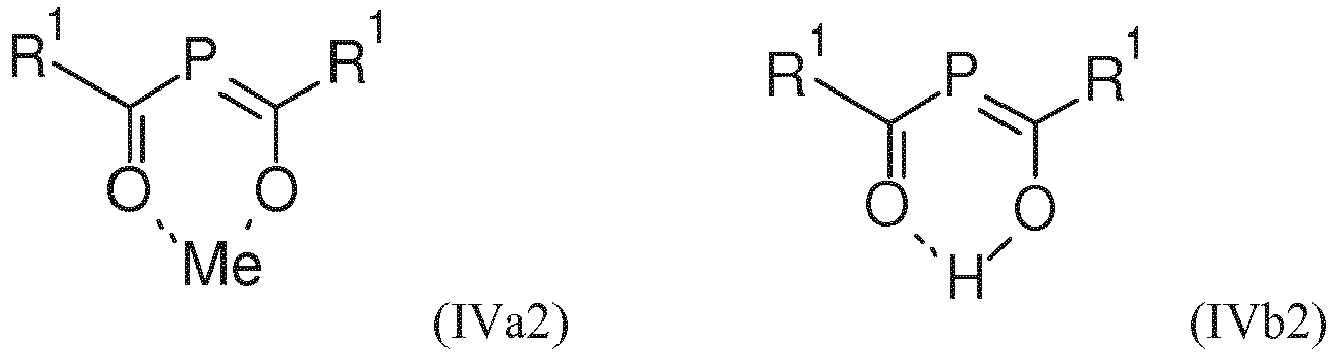
- Formulae (IVa) and (IVb) as depicted above shall also encompass dimers, trimers and higher aggregated complexes as well as solvate complexes or other compounds wherein the metal is complexed of the compounds depicted therein.
- It is apparent to those skilled in the art, that depending of whether optional step B) is applied or not compounds of formula (IVa) (if step B) is not applied) or (IVb) (if step B) is applied) are predominantly formed.
- In an another embodiment compounds of formula (I) may be prepared for example by the steps of:
- A) reacting phosphine (PH3) with compounds (carboxylic acid halides) of formula (V),

HAL represents fluoro, chloro, bromo or iodo, preferably chloro or bromo and even more preferably chloro
whereby the reaction is carried out in the presence of at least one lewis acid to obtain compounds of formula (VI)
[LAF][P(COR1)2]q (VI)
wherein- q
- is an integer of 1 to 5, preferably 1, 2 or 3, more preferably 1 or 3
- LAF
- represents hydrogen or a q-valent Lewis Acid Fragment as defined hereinafter, preferably a q-valent Lewis Acid Fragment and
- R1
- has the same meaning given above for formula (I) above
- B) protonating compounds of formula (VI) where LAF represents a Lewis Acid Fragment to obtain compounds of formula (IVb) as defined above and
- C) oxidizing compounds of formula (IVb) to obtain compounds of formula (I) as described already for preparation method 1
- Specific compounds of formula (V) include benzoylchloride and p-isopropylbenzoylchloride.
- It is known to those skilled in the art that compounds of formula (VI) might form oligomers such as dimers or trimers in solution or solid state depending on solvent or other conditions. These oligomers shall be encompassed by formula (VI).
- The term "Lewis acid" as used above is understood to mean the generally customary definition of those compounds which have an electron vacancy, as explained, for example, in Römpp's Chemie-Lexikon, 8th edition, Franck'sche Verlagshandlung 1983, Volume 3, H-L.
- In a preferred embodiment the at least one Lewis acid is selected from the group including methyl aluminoxane (MAO) and compounds represented by formula (VII)
MLRL (r)XL (z-r) (VII)
wherein - z
- is 2, 3, 4 or 5
- r
- is 0 or an integer of at maximum z, preferably 0, 1 or 2, more preferably 0 or 1 and even more preferably 0
- ML
- if z is 2 is Sn
if z is 3 is an element selected from the group consisting of Sc, Y, La, Ce, Pr, Nd, Sm, Eu, Gd, Tb, Dy, Ho, Er, Tm, Yb, Lu, Fe, B, Al, Ga, In, As
if z is 4 is an element selected from the group consisting of V, Ti, Zr, Hf, Sn
if z is 5 is an element selected from the group consisting of V, P, As, Sb, Bi - XL
- is independently selected from the group consisting of fluoride, chloride, bromide, iodide, azide, isocyanate, thiocyanate, isothiocyanate or cyanide, preferably fluoro, chloro or bromo, more preferably fluoro or chloro
- RL
- represents C1-C18-alkyl, cyclopentadienyl, C1-C18-haloalkyl, C1-C18-alkoxy, C1-C18-haloalkoxy, C6-C14-aryl, C7-C18-arylalkyl, C6-C14-aryloxy, C7-C18-arylalkoxy, -O(HC=O), -O(C=O)-(C1-C18-alkyl), -O(C=O)-(C6-C14-aryl) and -O(C=O)-(C7-C18-arylalkyl) or
- two RL together
- represent C4-C18-alkandiyl, C4-C18-haloalkandiyl, C4-C18-alkanedioxy, C4-C18-haloalkanedioxy, C6-C14-aryldiyl, C7-C18-arylalkanediyl, C6-C14-aryldioxy, C7-C18-arylalkanedioxy, -O(C=O)-(C1-C18-alkyl)-(C=O)O-, -O(C=O)-(C6-C14-aryl)-(C=O)O- and -O(C=O)-(C7-C18-arylalkyl)-(C=O)O-, or oxo (=O)
- In one embodiment r is 0.
- For this embodiment examples for such compounds include for
- z = 2
- tin dichloride
- z = 3
- aluminum trichloride, aluminum tribromide, boron trifluoride, boron trichloride, boron tribromide, gallium trichloride, indium trifluoride, scandium trichloride, iron trichloride, arsenic trifluoride, bismuth trichloride.
- z = 4
- titanium tetrachloride, titanium tetrabromide, vanadium tetrachloride, tin tetrachloride, zirconium tetrachloride, hafnium tetrachloride titanium bromide trichloride, titanium dibromide dichloride, vanadium bromide trichloride, and tin chloride trifluoride.
- z = 5
- antimony pentachloride, antimony pentafluoride, arsenic pentafluoride, antimony chloride pentafluoride and arsenic fluoride tetrachloride
- Preferred compounds are aluminum trichloride and boron trifluoride.
- Those skilled in the art are aware of the fact that Lewis acids are often supplied or available in form of adducts with weak Lewis bases, in particular ethers. Examples thereof include boron trifluoride diethyletherate or tetrahydrofuranate. Such derivatives shall be encompassed by the mere description of the Lewis acids as well.
- In one embodiment r is 1, 2 or 3.
- For this embodiment examples for such compounds include for
- z = 3
- methyl aluminum dibromide, methyl aluminum dichloride, ethyl aluminum dibromide, ethyl aluminum dichloride, butyl aluminum dibromide, butyl aluminum dichloride, dimethyl aluminum bromide, dimethyl aluminum chloride, diethyl aluminum bromide, diethyl aluminum chloride, dibutyl aluminum bromide, dibutyl aluminum chloride, methyl aluminum sesquibromide, methyl aluminum sesquichloride, ethyl aluminum sesquibromide, ethyl aluminum sesquichloride, methoxyaluminum dichloride, ethoxyaluminum dichloride, 2,6-di-tert-butylphenoxyaluminum dichloride, methoxy methylaluminum chloride, 2,6-di-tert-butylphenoxy methylaluminum chloride, isopropoxygallium dichloride and phenoxy methylindium fluoride, acetoxyaluminum dichloride, benzoyloxyaluminum dibromide, benzoyloxygallium difluoride, methyl acetoxyaluminum chloride, and isopropoyloxyindium trichloride and in one embodiment additionally triphenylboron.
- z = 4
- cyclopentadienyltitaniumtrichloride, dicyclopentadienyltitaniumdichloride, cyclopentadienylzirconiumtrichloride and dicyclopentadienylzirconium-dichloride
- z = 5
- tetraphenylantimony chloride and triphenylantimony dichloride and vanadium oxytrichloride.
- In one embodiment two or more Lewis acids are employed for example two or three.
- As a consequence q-valent Lewis Acids Fragments (LAF) are formally cationic structural units formally obtainable by removing q formally anionic substituents from a Lewis acid. It is apparent for those skilled in the art and understood that depending on the Lewis acid employed q is an integer of 1 up to the respective z.
- For methylaluminoxane q is at maximum 3.
- Preferred Lewis Acids Fragments (LAF) are structural units of formula (VIII)
MLRL (rr)XL (zz-rr) (VIII)
wherein - ML, XL and RL
- shall have the same meaning including their areas of preference as described for formula (VII) above
- zz
- is (z-q) with q being an integer of 1 up to z, wherein z shall have the same meaning including its areas of preference as described for formula (VII) above and
- rr
- is 0 or an integer of at maximum zz, preferably 0, 1 or 2, more preferably 0 or 1 and even more preferably 0.
- Preferred Lewis Acid Fragments (LAF) are
for q = 1 (monovalent): dichloroaluminyl AlCl2 and difluoroboryl BF2
for q = 2 (divalent): chloroaluminyl AlCl, fluoroboryl BF and zinc
for q = 3 (trivalent): aluminum Al - Those skilled in the art are aware of the fact that the Lewis Acid Fragements (LAF) are formally q-times positively charged and that for example in compounds of formula (VI) the residue P(OCR1)2 is formally anionic with the negative charge being delocalized over the five-membered O-C-P-C-O unit.
- The process is typically carried out by adding phosphine (PH3) to a mixture of compound of formula (V) and the at least one Lewis acid either neat or dissolved or suspended in a solvent. Thereby a reaction mixture is formed.
- The reaction time is typically in the range of from 2 min to 72 hours, preferably 30 min to 24 hours.
- Suitable solvents include and preferably are those which do not or virtually not react under formation of new covalent bonds with phosphine (PH3), the Lewis acid and the compounds of formula (V).
- Such solvents include
- aromatic hydrocarbons and halogenated aromatic hydrocarbons, such as mesitylene, chlorobenzene and dichlorobenzenes,
- amides such as dimethylformamide, dimethylacetamide
- sulfones such as tetraethylensulfone,
- liquid sulfur dioxide and liquid carbon dioxide
- aliphatic hydrocarbons such as pentane, hexane, cyclohexane, methylcyclohexane and
- halogenated aliphatic or olefinic hydrocarbons such as methylchloride, methylenedichloride, chloroform, trichloroethane, tetrachloromethane and tetrachloroethene
- Preferred solvents are halogenated aliphatic hydrocarbons such as methylchloride, methylenedichloride, chloroform, trichloroethane and tetrachloroethene.
- Those skilled in the art are aware that the selection of a suitable solvent depends inter alia from the solubility and reactivity of the Lewis acid(s) employed.
- The amount of solvent is not critical at all and is just limited by commercial aspects, since they have to be removed if the compounds of formula (VI) shall finally be isolated.
- To facilitate the reaction, mixing energy e.g. by standard agitators stirrers and/or static mixing elements is introduced into the reaction mixture.
- Even though not necessary, mixing can also be supported by using high force dispersion devices such as, for example, ultrasound sonotrodes or high pressure homogenizers.
- The process may either be performed batch wise or continuously.
- A typical and preferred reaction temperature range to carry out the process is from -30°C to 120°C, preferably from -10 to 80°C and even more preferably from 0 to 40°C.
- It is evident to those skilled in the art, that where the desired reaction temperature is above the boiling point at 1013 hPa of the solvent employed, the reaction is carried out under sufficient pressure.
- The preferred reaction pressure range to carry out the process is from 800 hPa to 10 MPa, preferably from 1000 hPa to 0.5 MPa.
- During the reaction compounds of formula (VI) are formed.
- The molar ratio of compounds of phosphine (PH3) to compounds of formula (V) employed in the reaction is typically from 0.4 to 0.9 preferably 0.45 to 0.6.
- The molar ratio of compounds of formula (V) and Lewis acid employed in the reaction is typically from 0.01 to 1 mol of Lewis acid per mol of phosphine (PH3).
- The main advantage of the
preparation method 2 is that it allows the efficient and high-yielding synthesis of compounds of formula (I) starting from readily available Lewis acids and acid halides which allows a very broad substitution pattern to be applied. - In a another embodiment compounds of formula (I) where X is oxygen may be prepared for example by the steps of:
- A) reacting phosphinic acid (H3PO2) with compounds (aldehydes) of formula (IX),

to obtain compounds of formula (X)
- B) oxidizing the alcohol functionalities in compounds of formula (X) to obtain compounds of formula (I).
- Oxidation of the alcohol functionalities may be carried out in any manner known to those skilled in the art and includes reaction with N-chlorosuccinimide or elemental chlorine in the presence of dialkylsulfides such as dimethylsulfide and an amine such as triethylamine (the Corey-Kim oxidation).
- This type of oxidation is disclosed e.g. in E. J. Corey, C. U. Kim, Journal of the American Chemical Society 1972, 94, 7586-7587 and O. Berger, L. Gavara, J.-L. Montchamp, ).
- The oxidation can further be carried out
- via the so called Swern oxidation using oxalyl chloride as oxidant, dimethylsulfoxide as catalyst and an amine as a base as disclosed in K. Omura, D. Swern, Tetrahedron 1978, 34, 1651-1660
- via the so called Pfitzner-Moffatt oxidation using dicyclohexylcarbodiimide as oxidant and dimethylsulfoxide as catalyst as disclosed in K. E. Pfitzner, J. G. Moffatt, Journal of the American Chemical Society 1963, 85, 3027-3027
- using hypervalent iodine-reagents like the Dess-Martin periodinane (see D. B. Dess, J. C. Martin, The Journal of Organic Chemistry 1983, 48, 4155-4156)
- via the so called Ley-Griffith oxidation using N-methylmorpholin-N-oxide as stoichiometric oxidant and tetrapropylammonium perruthenate (TPAP) as catalyst W. P. Griffith, S. V. Ley, G. P. Whitcombe, A. D. White, Journal of the Chemical Society, Chemical Communications 1987, 1625-1627
- via the so called Oppenauer oxidation using acetone and aluminium alcoholatesas disclosed in R. V. Oppenauer, Recueil des Travaux Chimiques des Pays-Bas 1937, 56, 137-144
- using chromium(VI) compounds such as chromiumtrioxide or pyridinium chlorochromate.
- The main advantage of the preparation method 3 is that it allows the easy synthesis of compounds of formula (I) starting from cheap phosphinic acid and aldehydes which are available with a broad substitution pattern.
- Typically, and depending on the presence or absence of metal salts, compounds of formula (I) are obtained by the three preparation methods outlined above, wherein Cat(n+) is hydrogen or a cation already present in or added to the reaction mixture of the final oxidation step.
- In order to vary the cation to prepare other compounds of formula (I) all methods known to those skilled in the art to exchange cations may be employed here as well. These methods include ion exchange e.g. with weakly or strongly acidic ion exchangers, adding salts to utilize different solubility of corresponding salt couples or where Cat(n+) represents hydrogen simply adding a base comprising the desired cation.
- Besides increased solubility in polar solvent systems such as in particular in water compared to those compounds known from prior art, the compounds of formula (I) exhibit unexpected stability again hydrolysis, superior reactivity under blue light irradiation compared to known bisacyl phosphinic acid derivatives and bisacylphosphine oxides bearing substituents at the ortho positions of the aroyl substituents such as mesitoyl substituents.
- Compounds of formula (I) are particularly useful as photo-initiators.
- Therefore one further aspect of the invention relates to photo-curable compositions comprising
- I) at least one ethylenically unsaturated compound and
- II) at least one compound of formula (I) as defined above.
Due to their superior water solubility, in one embodiment the photo-curable compositions further comprise - III) water
Suitable ethylenically unsaturated compounds contain one or more olefinic double bonds and include (meth)acrylic acid esters such as alkyl esters like methyl, ethyl, 2-chloroethyl, N-dimethylaminoethyl, n-butyl, isobutyl, pentyl, hexyl, cyclohexyl, 2-ethylhexyl, octyl, isobornyl esters, phenyl, benzyl and o-, m- and p-hydroxyphenyl esters, hydroxyalkyl esters such as 2-hydroxyethyl, 2-hydroxypropyl, 4-hydroxybutyl, 3,4- dihydroxybutyl or glycerol or [1,2,3-propanetriol] ester, epoxyalkyl esters such as glycidyl, 2,3-epoxybutyl, 3,4-epoxybutyl, 2,3-epoxycyclohexyl, 10,1 1-epoxyundecyl ester, (meth)acrylamides, N-substituted (meth)acrylamides such as N-methylolacrylamide, N- methylolmethacrylamide, N-ethylacrylamide, N-ethylmethacrylamide, N-hexylacryl- amide, N-hexylmethacrylamide, N-cyclohexylacrylamide, N-cyclohexylmethacrylamide, N-hydroxyethylacrylamide, N-phenylacrylamide, N-phenylmethacrylamide, N-benzyl-acrylamide, N-benzylmethacrylamide, N-nitrophenylacrylamide, N-nitrophenylmeth-acrylamide, N-ethyl-N-phenylacrylamide, N-ethyl-N-phenylmethacrylamide, N-(4-hydroxyphenyl)acrylamide and N-(4-hydroxyphenyl)methacrylamide, IBMAA (N-isobutoxymethylacrylamide), (meth)acrylonitriles, unsaturated acid anhydrides such as itaconic anhydride, maleic anhydride, 2,3-dimethylmaleic anhydride, 2-chloromaleic anhydride, unsaturated esters such as maleic acid esters, phthalic acid esters, itaconic acid esters, methylenesuccinic acid esters, styrenes such as methylstyrene, o-, m- or p-chloromethylstyrene and o-, m- and p-hydroxystyrene, divinylbenzene, vinyl ethers such as iso-butyl vinyl ether, ethyl vinyl ether, 2-chloroethyl vinyl ether, hydroxyethyl vinyl ether, propyl vinyl ether, butyl vinyl ether, isobutyl vinyl ether, octyl vinyl ether and phenyl vinyl ether, vinyl and allyl esters such as vinyl acetate, vinyl acrylate, vinyl chloroacetate, vinyl butyrate and vinyl benzoate, divinyl succinate, diallyl phthalate, triallyl phosphate, vinyl chloride and vinylidene chloride, isocyanurates such as triallyl isocyanurate and tris(2-acryloylethyl) isocyanurate, N-vinyl-heterocyclic compounds such as N- vinylpyrrolidones or substituted N-vinylpyrrolidones, N-vinylcaprolactam or substituted N-vinylcaprolactams, N-vinylcarbazole, N-vinylpyridine. - Further examples include diacrylate esters such as 1,6-hexanediol diacrylate (HDDA), ethylene glycol diacrylate, propylene glycol diacrylate, dipropylene glycol diacrylate, tripropylene glycol diacrylate, neopentyl glycol diacrylate, hexamethylene glycol diacrylate and bisphenol A diacrylate, trimethylolpropane triacrylate, trimethylolethane triacrylate, trimethylolpropane trimethacrylate, trimethylolethane trimethacrylate, tetramethylene glycol dimethacrylate, triethylene glycol dimethacrylate, tetraethylene glycol diacrylate, pentaerythritol diacry- late, pentaerythritol triacrylate, pentaerythritol tetraacrylate, dipentaerythritol diacrylate, dipentaerythritol triacrylate, dipentaerythritol tetraacrylate, dipentaerythritol pentaacry- late, dipentaerythritol hexaacrylate, tripentaerythritol octaacrylate, pentaerythritol dimethacrylate, pentaerythritol trimethacrylate, dipentaerythritol dimethacrylate, dipentaerythritol tetramethacrylate, tripentaerythritol octamethacrylate, pentaerythritol diitaconate, dipentaerythritol trisitaconate, dipentaerythritol pentaitaconate, dipentaerythritol hexaitaconate, ethylene glycol diacrylate, 1,3-butanediol diacrylate, 1,3- butanediol dimethacrylate, 1,4-butanediol diitaconate, sorbitol triacrylate, sorbitol tetraacrylate, pentaerythritol-modified triacrylate, sorbitol tetramethacrylate, sorbitol pentaacrylate, sorbitol hexaacrylate, oligoester acrylates and methacrylates, glycerol di- and tri-acrylate, 1,4-cyclohexane diacrylate, bisacrylates and bismethacrylates of polyethylene glycol having molecular weights of from 200 to 2,500, alkoxylated alcohols such glycerol ethoxylate triacrylate, glycerol propoxylate triacrylate, trimethylolpropane ethoxylate triacrylate, trimethylolpropane propoxylate triacrylate, pentaerythritol ethoxylate tetraacrylate, pentaerythritol propoxylate triacrylate, pentaerythritol propoxylate tetraacrylate, neopentyl glycol ethoxylate diacrylate, neopentyl glycol propoxylate diacrylate, unsaturated carboxylic acids such as acrylic acid, methacrylic acid, crotonic acid, cinnamic acid, maleic acid, fumaric acid, itaconic acid, unsaturated fatty acids such as linolenic acid or oleic acid
- Further examples for higher-molecular-weight ethylenically unsaturated compounds include esters of ethylenically unsaturated mono- or poly-functional carboxylic acids and polyols or polyepoxides, and polymers having ethylenically unsaturated groups in the main chain or in or as side groups such as, for example, unsaturated polyesters, polyamides and polyurethanes and copolymers thereof, alkyd resins, polybutadiene and butadiene copolymers, polyisoprene and isoprene copolymers, polymers and copolymers having (meth)acrylic groups in side chains, and also mixtures of one or more of such polymers.
- Further suitable ethylenically unsaturated compounds include include acrylates which have been modified by reaction with primary or secondary amines, as described, for example, in
US3844916 , inEP280222 US5482649 or inUS5734002 . Such amine-modified acrylates are also termed amine acrylates. Amine acrylates are obtainable, for example, under the name EBECRYL 80, EBECRYL 81 , EBECRYL 83, EBECRYL 7100 from UCB Chemicals, under the name Laromer PO 83F, Laromer PO 84F, Laromer PO 94F from BASF SE, under the name PHOTOMER 4775 F, PHOTOMER 4967 F from Cognis or under the name CN501 , CN503, CN550 from Cray Valley and GENOMER 5275 from Rahn. - Where water is present the at least one ethylenically unsaturated compound may be dissolved or emulsified in water.
- In such compositions the concentration of water is for example from 5 to 80 % by weight, preferably from 10 to 60 % by weight.
- Further components which may be additionally present in the photo-curable compositions or not are:
- polar diluents or solvents such as ethers like ethylenglycol dimethylether and polyethyleneglycol ethers
- organic or inorganic pigments
- UV-adsorbers
- inorganic fillers
- stabilizers
- isocyanates and/or polyisocyanates
- flattening agents
- matting agents,
- defoamer
- anti-friction agents such as silicon containing antifriction agents,
- surfactants
- resins such as formaldehyde resins, polyurethan resins, polyacrylates, polymethacrylates, polyacrylamides, polymethacrylamides, polyvinylethers, cellulosic resins and sucrose benzoate
- further photoinitiators, including but not limited to Norrish Type I initiators such as 2-hydroxy-1-{4-[4-(2-hydroxy-2-methyl-propionyl)-benzyl]-phenyl}-2-methyl-propan-1-one (Irgacure 127), 2-hydroxy-1-[4-(2-hydroxyethoxy)-phenyl]-phenyl]-2-methylpropan-1-one (Irgacure 2959), 1-hydroxy-cyclohexyl-phenyl-ketone (Irgacure 184), 2-hydroxy-2-methyl-1-phenyl-1-propanone (Irgacure 1173), benzildimethylketal and oligo[2-hydroxy-2-methyl-1-[4-(1-methylvinyl)phenyl]-propanone] (Esacure KIP 150 from Lamberti) as well as mono- or bisacylphosphinoxides.
- The amounts of ethylenically unsaturated components, compounds of formula (I), and optional other ingredients will vary according to the type of composition, the particular equipment to be used to apply it and the application.
- However, typically, the amount of photo-initiator within the composition is in the range of from 0.05 to 12 wt.-%, preferably 2 to 10 wt.-%, more preferably 4 to 9 wt.-%.
- The invention further relates to a process for preparing a cured composition by exposing the photo-curable compositions according to the present invention to electromagnetic radiation, preferably ultraviolet or blue-light radiation.
- Suitable sources of electromagnetic radiation include UV lamps like low-pressure, medium-pressure, high-pressure and super-high-pressure mercury lamps which can be undoped or doped e.g. with gallium iodide, thallium iodide or other metal halides; blue, violet-blue LEDs or UV-LEDs; LED lamps, concentrated, direct or indirect sunlight; xenon or xenon mercury arc lamps such as continuous-output xenon short- or long-arc lamps, flash lamps such as xenon or xenon mercury flash lamps; microwave-excited metal vapour lamps; excimer lamps, superactinic fluorescent tubes; fluorescent lamps; and noble gas incandescent lamps.
- Preferred sources are lamps like low-pressure, medium-pressure, high-pressure and super-high-pressure mercury lamps which can be undoped or doped e.g. with gallium iodide, thallium iodide or other metal halides; blue, violet-blue or UV-LEDs, xenon or xenon mercury arc lamps such as continuous-output xenon short- or long-arc lamps.
- The compositions according to the invention can be used for various purposes, for example in overprint coatings, as printing ink, e.g. screen printing ink, ink for offset- or flexo printing, inkjet ink, ink for sheet-fed printing, electrophotography ink, intaglio ink, as clearcoats, white coats or colour-pigmented coats, e.g. for wood or metal, as powder coatings, as paints, inter alia for paper, wood, metal or plastics, as daylight-curable paints for marking structures and roads, paints for buildings, constructions, vehicles, aircraft, etc., for photographic reproduction processes, for holographic recording materials, for image-recording processes or in the production of printing plates that can be developed using organic solvents or using aqueous-alkaline media, for the production of masks for screen printing, as dental filling compounds, as adhesives, as pressure-sensitive adhesives, as laminating resins, as etch resists or permanent resists, both liquid and dry films, as photostructurable dielectrics, and as solder masks for electronic circuits, as resists in the production of colour filters for any type of display screen or in the creation of structures during the manufacture of plasma displays and electroluminescent displays, in the production of optical switches, optical gratings (interference gratings), in the manufacture of three-dimensional articles by curing in the mass (photo-curing in transparent moulds) or according to the stereolithography process, in the manufacture of composite materials, in the coating or sealing of electronic components or as coatings for optical fibres. The compositions are also suitable for the production of optical lenses, e.g. contact lenses or Fresnel lenses, and also in the manufacture of medical apparatus, aids or implants. The compositions can also be used for the preparation of gels having thermotropic properties.
- The compounds of formula (I) are also suitable for use in photo-curable adhesives; e.g. in the preparation of pressure-sensitive adhesives, laminating adhesives, hot-melt adhesives, moisture-cure adhesives, silane reactive adhesives or silane reactive sealants and the like, and related applications. Said adhesives can be hot melt adhesives as well waterborne or solvent borne adhesives, liquid solvent-free adhesives or 2-part reactive adhesives.
- The compounds of formula (I) may also be used as free-radical photoinitiators or photoinitiating systems for radiation-curable powder coatings.
- As mentioned above, curing according to the invention can be carried out by irradiation with electromagnetic radiation. Depending on the composition of the formulation to be cured, however, thermal curing before, during or after the irradiation may be advantageous.
- Thermal curing is carried out by methods known to the person skilled in the art. In general, the curing is carried out in an oven, e.g. a circulating air oven, on a heating plate or by irradiation with IR lamps. Unassisted curing at room temperature is also possible, depending on the binder system used. The curing temperatures are generally between room temperature and 150°C, for example from 25 to 150°C or from 50 to 150°C. In the case of powder coatings or coil coatings, the curing temperatures may be even higher, e.g. up to 350°C.
- The advantage of the invention is that the compounds provided based on readily available compounds s starting materials meet the high solubility in photo-curable formulations, especially photo-curable water containing formulations, significantly higher reactivity at desirable wavelengths compared to bisacylphosphine oxide derivatives commercially available today or known so far. It was shown that the compounds of formula (I) can be advantageously used in surfactant free emulsion polymerization.
- The invention is hereinafter further explained by the examples without being limited thereto. Some of the experimental results are partially illustrated in figures.
-
Fig 1 shows UV-Vis spectra measured in tetrahydrofuran (THF) (0.25 mM) prior and after 15 min of 265 nm UV irradiation. The solid line shows bis(benzoyl)phosphinic acid tetrabutylammonium salt (PhBAPO-ONBu4) before irradiation, the dashed line PhBAPO-ONBu4 after irradiation, the dotted line bis(mesitoyl)phosphinic acid tetrabutylammonium salt (MesBAPO-ONBu4) before irradiation, the dash-dot-dotted line MesBAPO-ONBu4 after irradiation. -
Fig 2 shows the 31P NMR determination of the photoactivity of PhBAPO-ONBu4 and MesBAPO-ONBu4 via repeatedly irradiating 80 mM samples in CD3CN in presence of 3 molar equivalents of diphenyl disulfide for 2 min with a 405 nm LED. -
Fig. 3 shows the size distribution of polystyrene particles obtained by surfactant free emulsion polymerization using PhBAPO-ONBu4 as photoinitiator. - A suspension of elemental sodium (3.3 eq., 106 mmol, 2.44 g) and red phosphorus (1 eq. 32 mmol, 1.00 g) in dimethoxyethane (DME, 20 mL) was stirred for 3 days at 20 °C. After removing the pieces of excess sodium and cooling the black suspension to 0 °C, tert-butanol (1 eq., 32 mmol, 3.1 mL) was added. The suspension was warmed to 20 °C and stirred for 2 hours. Methyl benzoate (1 eq., 32 mmol, 4.0 mL) was added at 0 °C and the red suspension stirred for 1 hour at 20 °C. Subsequently, benzoyl chloride (1 eq., 32 mmol, 3.7 mL) was added at 0 °C and the suspension stirred for another 2 hours at 20 °C before it was treated with concentrated formic acid (3 eq., 96 mmol, 3.6 mL). The orange suspension was filtered through a G3 glass frit, washed with THF (
3x 20 mL) and the solvent was removed under reduced pressure. The residue was washed with n-hexane (5x 5 mL) and dried under reduced pressure, yielding bis(benzoyl)phosphine as a bright orange powder (5.75 g, 23.7 mmol, 74%).
1H-NMR (300 MHz, C6D6): δ/ppm = 20.1 (d, 3 J PH = 3.1 Hz, OHO), 8.20 - 8.10 (m, 4H, Ar), 7.12 - 6.95 (m, 6H, Ar). 13C{1H}-NMR (75 MHz, C6D6): δ/ppm = 228.3 (d, 1 J PC = 86.1 Hz, C(O)P), 140.1 (d, 2 J PC = 26.7 Hz, Cipso ), 144.0 (d, 5 J PC = 2.8 Hz, Cpara ), 128.9 (s, Cmeta ), 126.5 (d, 3 J PC = 16.7 Hz, Cortho ). 31P-NMR (C6D6, 121 MHz): δ/ppm = 60.1 (s, enol). - A 250 mL round bottom flask with two Normag spindle valves was charged with methyl benzoate (1 eq., 200 mmol, 25.2 mL), sodium tert-butoxide (1.02 eq., 204 mmol, 19.6 g) and THF (150 mL). One side of the flask was connected to a PH3 gas bottle and the other side to a series of three bleach bathes. The system was purged with argon for 15 min to remove traces of oxygen. Then it was pressurized with 80 kPa PH3 under vigorous stirring for 24 hours. The system was opened to the bleach baths and purged with argon for 60 min. Subsequently, benzoyl chloride was added in small portions at 0 °C until full conversion of the mono- to the bis(benzoyl)phosphide was observed by 31P-NMR spectroscopy (0.74 eq., 148 mmol, 17.0 mL). The bright red thick solution was stirred for 1 hour at 20 °C and then treated with formic acid (2.0 eq, 400 mmol, 15.0 mL). After stirring for 1 hour at 20 °C, the solvent was removed under reduced pressure, the bright orange residue dissolved in toluene (200 mL) and filtered through a G4 glass frit. The filtrate was concentrated under reduced pressure to about 25 % of its original volume and cooled -30 °C. Bright orange crystals formed, which were collected by filtration, washed with n-hexane (
3x 20 mL) and dried under reduced pressure. Additional product was isolated by repeated concentration and cooling of the filtrate. Combined yield: 26.7 g, 110 mmol, 55 %.
1H-NMR (300 MHz, C6D6): δ/ppm = 20.1 (d, 3 J PH = 3.1 Hz, OHO), 8.20 - 8.10 (m, 4H, Ar), 7.12 - 6.95 (m, 6H, Ar). 13C{1H}-NMR (75 MHz, C6D6): δ/ppm = 228.3 (d, 1 J PC = 86.1 Hz, C(O)P), 140.1 (d, 2 J PC = 26.7 Hz, Cipso ), 144.0 (d, 5 J PC = 2.8 Hz, Cpara ), 128.9 (s, Cmeta ), 126.5 (d, 3 J PC = 16.7 Hz, Cortho ). 31P-NMR (C6D6, 121 MHz): δ/ppm = 60.1 (s, enol). - A 100 mL round bottom flask with two Normag spindle valves was charged with benzoylchloride (PhCOCl, 6 eq., 17.4 mmol, 2.00 mL), AlCl3 (1 eq., 2.90 mmol, 290 mg) and tetrachloroethene C2Cl4 (10 mL). One side of the flask was connected to a PH3 gas bottle and the other side to a series of three bleach bathes. The system was purged with argon for 15 min to remove traces of oxygen. Then it was pressurized with 80 kPa PH3 under vigorous stirring. An incipient pressure drop was followed by a pressure rise to about 120 kPa due to the formation of HCl as by-product. The system was opened to the bleach bath and pressurized with PH3 again. This procedure was repeated several times until the pressure remained stable. The orange suspension was stirred for another 16 h under 80 kPa PH3 pressure, before it was opened to the bleach bath and purged with argon for 60 min. The suspension was transferred to a 100 mL round bottom Schlenk flask and the solvent removed to a minimum under reduced pressure. Precipitation of the product was completed by addition of n-hexane (50 mL). The product was collected on a G3 glass frit, washed with n-hexane (
3x 10 mL) and dried under reduced pressure, yielding the aluminum complex [Al(PhBAP)3] as a bright red powder (1.35 g, 1.80 mmol, 62%).
1H-NMR (300 MHz, CDCl3): δ = 8.19 (d, 3 J HH = 7.8 Hz, 12H, o-Ph-H), 7.51 (t, 3 J HH = 7.4 Hz, 8H, p-Ph-H), 7.37 (t, 3 J HH = 7.7 Hz, 12H, m-Ph-H) ppm.
13C{1H}-NMR (75 MHz, CDCl3): δ = 227.7 (d, 1 J PC = 88.5 Hz, C(O)P), 142.1 (d, 2 J PC = 32.6 Hz, ipso-Ph), 133.6 (s, p-Ph), 128.6 (s, m-Ph), 127.0 (d, 3 J PC = 17.0 Hz, o-Ph) ppm. 31P-NMR (CDCl3, 121 MHz): δ = 68.7 (s) ppm. - A suspension of the aluminum complex [Al(PhBAP)3] (1 eq, 0.100 mmol, 75 mg) prepared according to example 3) and citric acid (2 eq., 0.200 mmol, 38 mg) in toluene (2.0 mL) was refluxed for 2.5 hours. The resulting orange suspension was filtered over a G3 glass frit and the solvent of the filtrate removed under reduced pressure, yielding bis(benzoyl)phosphine HP(COPh)2 as a bright orange powder (70 mg, 0.289 mmol, 96%).
1H-NMR (300 MHz, C6D6): δ = 20.1 (d, 3 J PH = 3.1 Hz, OHO), 8.20 - 8.10 (s, 4H, Ar), 7.12 - 6.95 (s, 6H, Ar) ppm. 13C{1H}-NMR (75 MHz, C6D6): δ = 228.3 (d, 1 J PC = 86.1 Hz, C(O)P), 140.1 (d, 2 J PC = 26.7 Hz, Cipso ), 144.0 (d, 5 J PC = 2.8 Hz, Cpara ), 128.9 (s, Cmeta ), 126.5 (d, 3 J PC = 16.7 Hz, Cortho ) ppm. 31P-NMR (CDCl3, 121 MHz): δ = 90.2 (s, enol), 3.8 (d, 1 J PH = 243.6 Hz, keto) ppm. - To a suspension of bis(benzoyl)phosphine HP(COPh)2 (1 eq., 6.20 mmol, 1.50 g) in H2O (50 mL) was added 3-chloroperbenzoic acid (3 eq., 18.6 mmol, 3.21 g). After stirring the suspension for 3 hours in the dark at 20 °C, the pale yellow solid was removed by filtration. Subsequently, tetrabutylammonium chloride (1.5 eq., 9.3 mmol, 2.58 g) was added and the pale yellow solution stirred for 15 min at 20 °C. The aqueous solution was extracted with dichloromethane DCM (
3x 20 mL), the organic layer dried over MgSO4 and the solvent removed under reduced pressure, yielding PhBAPO-ONBu4 as deep yellow oil (3.19 g, 6.19 mmol, 99%).
1H NMR (400 MHz, CDCl3, 298 K) δ/ppm = 8.37 (d, J = 7.3 Hz, 4H, o-Ph-H), 7.49 (t, J = 7.3 Hz, 2H, p-Ph-H), 7.40 (t, J = 7.6 Hz, 4H, m-Ph-H), 3.25-3.14 (m, 8H, +N(CH 2CH2CH2CH3)4), 1.62-1.49 (m, 8H, +N(CH2CH 2CH2CH3)4), 1.33 (t, J = 7.3 Hz, 8H, +N(CH2CH 2CH2CH3)4), 0.91 (t, J = 7.3 Hz, 12H, +N(CH2CH2CH2CH 3)4); 13C{1H} NMR (100.6 MHz, CDCl3, 298 K) δ/ppm = 212.0 (d, J PC = 112.9 Hz, PCO), 137.4 (d, J PC = 44.8 Hz, ipso-Ph), 132.8 (p-Ph), 129.5 (o-Ph), 128.2 (m-Ph), 58.6 (+N(CH2CH2CH2CH3)4), 23.9 (+N(CH2 CH2CH2CH3)4), 19.6 (+N(CH2CH2 CH2CH3)4), 13.6 (+N(CH2CH2CH2 CH3)4); 31P NMR (161.2 MHz, CDCl3, 298 K) δ/ppm = 5.1 (s); FT-IR v/cm-1 = 2961 m, 2874 w, 2328 w, 1706 m, 1646 m, 1594 m, 1580 w, 1487 w, 1448 m, 1381 w, 1313 w, 1216 s, 1174 m, 1106 w, 1068 s, 1027 w, 1000 w, 967 w, 913 m, 882 w, 775 m, 737 w, 715 w, 692 s, 656 w; UV Vis (THF) λ/nm = 235, 266 (sh), 394. - A round bottom flask was charged with bis(benzoyl)phosphine HP(COPh) 2 (1 eq., 10 mmol, 2.42 g), tetrabutylammonium chloride (1.5 eq., 15 mmol, 4.17 g),DCM (30 mL) and an acetate buffer solution (pH = 7, 30 mL). Peracetic acid (2.5 eq., 25 mmol, 35 w-%, 4.8 mL) was added slowly over 15 min to the stirring biphasic system at 0 °C. The solution was warmed to 20 °C, the organic layer isolated and the aqueous layer extracted with DCM (
3x 10 mL). The combined organic layers were washed with H2O (5x 50 mL), dried over MgSO4 and the solvent removed under reduced pressure, yielding Ph BAPO-ONBu 4 as deep yellow oil (4.66 g, 9.08 mmol, 91 %).
1H NMR (400 MHz, CDCl3, 298 K) δ/ppm = 8.37 (d, J = 7.3 Hz, 4H, o-Ph-H), 7.49 (t, J = 7.3 Hz, 2H, p-Ph-H), 7.40 (t, J = 7.6 Hz, 4H, m-Ph-H), 3.25-3.14 (m, 8H, +N(CH 2CH2CH2CH3)4), 1.62-1.49 (m, 8H, +N(CH2 CH2cH2CH3)4), 1.33 (t, J = 7.3 Hz, 8H, +N(CH2CH2CH 2CH3)4), 0.91 (t, J = 7.3 Hz, 12H, +N(CH2CH2CH2CH 3)4); 13C{1H} NMR (100.6 MHz, CDCl3, 298 K) δ/ppm = 212.0 (d, J PC = 112.9 Hz, PCO), 137.4 (d, J PC = 44.8 Hz, ipso-Ph), 132.8 (p-Ph), 129.5 (o-Ph), 128.2 (m-Ph), 58.6 (+N(CH2CH2CH2CH3)4), 23.9 (+N(CH2 CH2CH2CH3)4), 19.6 (+N(CH2CH2 CH2CH3)4), 13.6 (+N(CH2CH2CH2 CH3)4); 31P NMR (161.2 MHz, CDCl3, 298 K) δ/ppm = 5.1 (s); FT-IR v/cm-1 = 2961 m, 2874 w, 2328 w, 1706 m, 1646 m, 1594 m, 1580 w, 1487 w, 1448 m, 1381 w, 1313 w, 1216 s, 1174 m, 1106 w, 1068 s, 1027 w, 1000 w, 967 w, 913 m, 882 w, 775 m, 737 w, 715 w, 692 s, 656 w; UV Vis (THF) λ/nm = 235, 266 (sh), 394. - A 100 mL flask equipped with a large magnetic stirring bar was charged with water (30 mL), aqueous phosphinic acid (1 eq., 50 w-%, 22.6 mmol), and cuminaldehyde (2.1 eq., 47.5 mmol, 7.04 g). The reaction mixture was degassed for 30 min by bubbling through an argon stream while stirring. Subsequently, the flask was sealed with a glass stopper and the reaction mixture was stirred (400 rpm) for two days at 100 °C (oil bath temperature). An off-white solid was formed, which was triturated with 100 mL of water. The obtained suspension was filtered through a G4 glass frit and the solid was further washed with water and a minimal amount of toluene (10 mL). After drying the crude product in an air stream, it was dissolved in boiling MeOH under the addition of conc. HCl aq. (0.1 mL). After evaporation in vacuo, the white solid was recrystallized from boiling MeOH (→ -25 °C) to obtain bis(hydroxy(4-isopropylphenyl)methyl)phosphinic acid as a colourless solid, which was dried in vacuo (5.45 mmol, 1.975 g, 24 %). Evaporating the mother liquor yields a second batch (9.956 mmol, 3.608 g, 44 %).
1H NMR (300 MHz, DMSO-d6, 298 K) δ/ppm = 7.36 (broad d, J = 7.0 Hz, 4H, arom-H), 7.20 (broad d, J = 8.1 Hz, 4H, arom-H), 5.10 (d, J = 7.1 Hz, CHOH), 2.88 (hept, J = 6.8 Hz, 2H, CH(CH3)2), 1.21 (d, J = 6.9 Hz, CH(CH 3)2); 31P NMR (121.5 MHz, DMSO-d6, 298 K) δ/ppm = 38.6 (bs) - A Schlenk flask was charged with bis(hydroxy(4-isopropylphenyl)methyl)phosphinic acid (1 eq., 4.462 mmol, 1.617 g) and N-chlorosuccinimide (2.1 eq., 9.37 mmol, 1.251 g) prepared according to example 5) under inert conditions. After dissolving in dry dichloromethane (150 mL), the reaction mixture was cooled to -78 °C in an aceton/dry ice bath. Dimethyl sulfide (2.1 eq., 9.37 mmol, 0.7 mL) was added and the reaction was stirred at -78 C for 10 min. After adding distilled triethyl amine (3 eq., 13.4 mmol, 1.9 mL), the reaction was warmed to room temperature overnight in the dark yielding a clear yellow solution. The crude reaction mixture was extracted with water (1×100 mL) and brine (2×100 mL). After drying the yellow organic layer over Na2SO4, evaporation in vacuo yielded a yellow solid, which was dissolved in dichloromethane (DCM). 1,1,3,3-Tetramethylguanidine (0.2 mL) was added and the mixture was evaporated in vacuo at elevated temperature. The residue was recrystallized from DCM/hexane at low temperature. Yield not determined.
1H NMR (300 MHz, CDCl3, 298 K) δ/ppm = 8.19 (d, J = 8.2 Hz, 4H, arom-H), 7.17 (d, J = 8.2 Hz, 4H, arom-H), 2.82 (hept, J = 7.4 Hz, 2H, CH(CH3)2), 2.75 (bs, 12H, +NH2C(N(CH 3)2)2), 1.15 (d, J = 6.9 Hz, CH(CH 3)2); 31P NMR (121.5 MHz, CDCl3, 298 K) δ/ppm = 5.6 (s). - A 500 mL flask equipped with a large magnetic stirring bar is charged with water (300 mL), aqueous phosphinic acid (1 eq., 50 w-%, 256 mmol, 28 mL, ρ = 1.206 g/cm3, 16.9 g,), and benzaldehyde (2.12 eq., 542 mmol, 57.5 g, ρ = 1.045 g/cm3, 55 mL). The reaction mixture was degassed for 30 min by bubbling through an argon stream while stirring. Subsequently, the flask was sealed with a glass stopper and the reaction mixture was stirred (400 rpm) for five days at 100 °C (oil bath temperature). An off-white solid was formed, which was triturated with 500 mL of water. The obtained suspension was filtered through a G4 glass frit and the solid further washed with water (300 mL) and a minimal amount of toluene (5× 50 mL). After drying the crude product (41.7 g) in an air stream, it was dissolved in boiling MeOH (300 mL) under the addition of conc. HCl aq. (0.5 mL). After evaporation in vacuo, the white solid obtained thereby was recrystallised from THF/MeOH (ca. 2/1) and covered with hexane to obtain bis(hydroxy(phenyl)methyl)phosphinic acid as a colourless solid, which is dried in vacuo (73.4 mmol, 20.4 g, 29 %). The final product still contained ca. 11 w-% (1.9 eq.) of water as determined by 1H NMR spectroscopy.
1 H NMR (300 MHz, MeOD-d4, 298 K) δ/ppm = 7.53 (d, J = 7.7 Hz, 4H, o-Ph-H), 7.36 (t, J = 7.3 Hz, 4H, m-Ph-H), 7.28 (t, J = 6.8 Hz, 2H, p-Ph-H), 5.32 (d, J = 7.2 Hz, 2H, CHOH); 31P NMR (121.5 MHz, MeOD-d4, 298 K) δ/ppm = 40.1 (bs); 1H NMR (400 MHz, THF-d48, 298 K) δ/ppm = 7.52-7.46 (m, 4H, Ph-H), 7.30-7.23 (m, 4H, Ph-H), 7.22-7.16 (m, 2H, Ph-H), 5.10 (d, J = 7.7 Hz, 2H, CHOH); 31P NMR (162.0 MHz, THF-d8, 298 K) δ/ppm = 39.7 (bs). - A 1 L Schlenk flask was charged with bis(hydroxy(phenyl)methyl)phosphinic acid obtained according to example 9 (5.00 g, 18.0 mmol, 1 eq.) and N-chlorosuccinimide (5.05 g, 37.8 mmol, 2.1 eq.) and purged with argon. After dissolving in dry dichloromethane (600 mL), the reaction mixture was cooled to -78 °C in an aceton/dry ice bath. Dimethyl sulfide (2.8 mL, 37.8 mmol, 2.1 eq.) was added and the reaction was stirred at -78 °C for 10 min. After adding distilled triethylamine (7.5 mL, 54.0 mmol, 3 eq.), the reaction was warmed to r.t. overnight in the dark yielding an orange solution. After addition of tetrabutylammonium chloride (5.00 g, 18.0 mmol, 1.0 eq.), the reaction mixture was extracted with water (3× 250 mL). After drying the organic layer over Na2SO4, evaporation in vacuo yielded PhBAPO-ONBu4 as deep yellow oil (5.38 g, 10.4 mmol, 58 %).
1H NMR (400 MHz, CDCl3, 298 K) δ/ppm = 8.37 (d, J = 7.3 Hz, 4H, o-Ph-H), 7.49 (t, J = 7.3 Hz, 2H, p-Ph-H), 7.40 (t, J = 7.6 Hz, 4H, m-Ph-H), 3.25-3.14 (m, 8H, +N(CH 2CH2CH2CH3)4), 1.62-1.49 (m, 8H, +N(CH2CH 2cH2CH-3)4), 1.33 (t, J = 7.3 Hz, 8H, +N(CH2CH2CH 2CH3)4), 0.91 (t, J = 7.3 Hz, 12H, +N(CH2CH2CH2CH 3)4); 13C{1H} NMR (100.6 MHz, CDCl3, 298 K) δ/ppm = 212.0 (d, J PC = 112.9 Hz, PCO), 137.4 (d, J PC = 44.8 Hz, ipso-Ph), 132.8 (p-Ph), 129.5 (o-Ph), 128.2 (m-Ph), 58.6 (+N(CH2CH2CH2CH3)4), 23.9 (+N(CH2 CH2CH2CH3)4), 19.6 (+N(CH2CH2 CH2CH3)4), 13.6 (+N(CH2CH2CH2 CH3)4); 31P NMR (161.2 MHz, CDCl3, 298 K) δ/ppm = 5.1 (s); FT-IR v/cm-1 = 2961 m, 2874 w, 2328 w, 1706 m, 1646 m, 1594 m, 1580 w, 1487 w, 1448 m, 1381 w, 1313 w, 1216 s, 1174 m, 1106 w, 1068 s, 1027 w, 1000 w, 967 w, 913 m, 882 w, 775 m, 737 w, 715 w, 692 s, 656 w; UV Vis (THF) λ/nm = 235, 266 (sh), 394. - A Schlenk flask is charged with bis(hydroxy(phenyl)methyl)phosphinic acid (4.055 g 14.58 mmol, 1 eq.) and N-chlorosuccinimide (4.09 g, 30.62 mmol, 2.1 eq.) and purged with argon. After dissolving in dry dichloromethane (250 mL), the reaction mixture is cooled to -78 °C in an aceton/dry ice bath. Dimethyl sulfide (2.8 mL, 30.62 mmol, 2.1 eq.) is added and the reaction is stirred at -78 °C for 10 min. After adding distilled triethyl amine (6.0 mL, 43.7 mmol, 3 eq.), the reaction is warmed to room temperature overnight in the dark yielding a clear orange solution. The crude reaction mixture is extracted with water (3× 50 mL). After the addition of 1,1,3,3-tetramethylguanidine (1.74 mL, 13.85 mmol, 0.95 eq.), the mixture is once extracted with water (20 mL). After drying the yellow organic layer over Na2SO4, evaporation in vacuo at 50 °C yields a semi-solid which is dissolved in DCM upon heating. Covering the solution with hexane leads to the formation of large yellow crystals of bis(benzoyl)phosphinic acid 1,1,3,3-tetra-N-methylguanidinium salt Ph BAPO-OTMG suitable for X-ray crystallography (1.76 g, 4.51 mmol, 31 %).
1H NMR (300 MHz, CDCl3, 298 K) δ/ppm = 8.63 (bs, 2H, C=NH 2 +), 8.25 (d, J = 7.4 Hz, 4H, o-Ph-H), 7.42 (t, J = 6.9 Hz, 2H, p-Ph-H), 7.33 (t, J = 7.2 Hz, 4H, m-Ph-H), 2.77 (s, 12H, C(N(CH 3)2)2); 13C{1H} NMR (75.5 MHz, CDCl3, 298 K) δ/ppm = 211.7 (d, J PC = 112.2 Hz, PCO), 162.1 (C=NH2), 137.1 (d, J PC = 45.3 Hz, ipso-Ph), 133.2 (p-Ph), 129.4 (o-Ph), 128.4 (m-Ph), 39.7 (C(N(CH3)2)2); 31P NMR (121.5 MHz, CDCl3, 298 K) δ/ppm = 5.15 (s); FT-IR v/cm-1 = 3019 w, 1699 w, 1645 m, 1626 w, 1591 m, 1577 w, 1447 m, 1407 m, 1309 w, 1232 s, 1217 w, 1171 m, 1096 w, 1071 w, 1061 s, 1036 w, 1000 w, 938 w, 916 m, 879 w, 777 m, 723 m, 694 s, 664 w, 616 w. - A Schlenk flask is charged with bis(hydroxyl(phenyl)methyl)phosphinic acid (4.055 g 14.58 mmol, 1 eq.) and N-chlorosuccinimide (4.09 g, 30.62 mmol, 2.1 eq.) and purged with argon. After dissolving in dry dichloromethane (250 mL), the reaction mixture is cooled to -78 °C in an acetone/dry ice bath. Dimethyl sulfide (2.8 mL, 30.62 mmol, 2.1 eq.) is added and the reaction is stirred at -78 °C for 10 min. After adding distilled triethyl amine (6.0 mL, 43.7 mmol, 3 eq.), the reaction is warmed to room temperature overnight in the dark yielding a clear orange solution. The crude reaction mixture is extracted with water (3× 50 mL). After the addition of 1,1,3,3-tetramethylguanidine (1.74 mL, 13.85 mmol, 0.95 eq.), the mixture is once extracted with water (20 mL). After drying the yellow organic layer over Na2SO4, evaporation in vacuo at 50 °C yields a semi-solid which is dissolved in DCM upon heating. Covering the solution with hexane leads to the formation of large yellow crystals of TMG[PhBAPO-O]_which were suitable for X-ray crystallography confirming the structure (1.76 g, 4.51 mmol, 31 %).
1H NMR (300 MHz, CDCl3, 298 K) δ/ppm = 8.63 (bs, 2H, C=NH 2 +), 8.25 (d, J = 7.4 Hz, 4H, o-Ph-H), 7.42 (t, J = 6.9 Hz, 2H, p-Ph-H), 7.33 (t, J = 7.2 Hz, 4H, m-Ph-H), 2.77 (s, 12H, C(N(CH 3)2)2); 13C{1H} NMR (75.5 MHz, CDCl3, 298 K) δ/ppm = 211.7 (d, J PC = 112.2 Hz, PCO), 162.1 (C=NH2), 137.1 (d, J PC = 45.3 Hz, ipso-Ph), 133.2 (p-Ph), 129.4 (o-Ph), 128.4 (m-Ph), 39.7 (C(N(CH3)2)2); 31P NMR (121.5 MHz, CDCl3, 298 K) δ/ppm = 5.15 (s) - Bismesitoylphosphinic acid (synthesised as described in patent application
WO2014095724 A1 , 540 mg, 1.5 mmol) and NaHCO3 (150 mg, 1.8 mmol, 1.2 eq.) were mixed with EtOH (30 mL) and treated in an ultrasonic bath for 1 h. After evaporation in vacuo, the residue was suspended in dichloromethane (DCM, 50 mL) followed by the addition of tetra-n-butylammonium chloride (417 mg, 1.5 mmol, 1.0 eq.) and another 15 min of ultrasound treatment. The organic phase was twice extracted with water (50 mL), dried over Na2SO4 and evaporated in vacuo to yield bismesitoylphosphinic acid tetrabutylammonium salt as off-white solid (723 mg, 1.21 mmol, 80 %).
1H NMR (500 MHz, CDCl3, 298 K) δ/ppm = 6.75 (s, 4H, Mes-H), 3.21-3.08 (m, 8H, N(CH 2CH2CH2CH3)4), 2.35 (s, 12H, o-Mes-CH 3), 2.25 (s, 6H, p-Mes-CH 3), 1.56-1.46 (m, 8H, N(CH2CH 2CH2CH3)4), 1.39-1.28 (m, 8H, N(CH2CH2CH 2CH3)4), 0.95 (t, J = 7.3 Hz, 12H, N(CH2CH2CH2CH 3)4); 31P NMR (121.5 MHz, CDCl3, 298 K) δ/ppm = 1.2 (broad); FT-IR v/cm-1 = 2961 m, 2935 w, 2875 w, 1665 m, 1643 w, 1609 w, 1489 m, 1460 m, 1427 w, 1380 m, 1238 s, 1227 w, 1208 w, 1070 s, 1034 w, 881 m, 849 m, 737 m, 704 m; UV Vis (THF) λ/nm = 244, 359 373. - Bismesitoylphosphinic acid (synthesised as described in patent application
WO2014095724 A1 , 2025 mg, 5.65 mmol) was dissolved in absolute EtOH (30 mL) and 1,1,3,3-tetramethylguanidine (723 µL, 664 mg, 5.76 mmol, 1.02 eq.) was added. The clear yellow solution was evaporated in vacuo yielding an off-white solid. The solid was dissolved in boiling DCM. Upon addition of hexane and cooling to -20 °C, the final product was obtained as off-white solid after filtration, washing with Et2O, and drying in vacuo (2389 mg, 5.05 mmol, 89 %).
1H NMR (300 MHz, CDCl3, 298 K) δ/ppm = 8.24 (bs, 2H, C=NH 2 +), 6.69 (s, 4H, m-Mes), 2.70 (s, 12H, C(N(CH 3)2)2), 2.29 (s, 12H, o-Mes-CH 3), 2.13 (s, 6H, p-Mes-CH 3); 1H NMR (300 MHz, DMSO-d6, 298 K) δ/ppm = 7.93 (bs, 2H, C=NH 2 +), 6.78 (s, 4H, m-Mes), 2.84 (s, 12H, C(N(CH 3)2)2), 2.24 (s, 12H, o-Mes-CH 3), 2.23 (s, 6H, p-Mes-CH 3); 13C{1H} NMR (75.5 MHz, DMSO-d6, 298 K) δ/ppm = 226.9 (d, J PC = 105.1 Hz, PCO), 160.9 (C=NH2), 140.4 (d, J PC = 40.0 Hz, ipso-Ph), 137.1 (o-Mes), 133.8 (p-Mes), 127.6 (m-Mes), 39.8 (C(N(CH3)2)2), 20.6 (p-Mes-CH 3), 19.1 (o-Mes-CH 3); 31P NMR (121.5 MHz, CDCl3, 298 K) δ/ppm = 1.42 (s); 31P NMR (121.5 MHz, DMSO-d6, 298 K) δ/ppm = 3.20 (s); FT-IR v/cm-1 = 2927 w, 1671 m, 1653 w, 1589 w, 1570 m, 1452 m, 1433 w, 1419 w, 1405 w, 1380 w, 1228 s, 1145 w, 1096 w, 1071 s, 1032 m, 961 w, 921 w, 885 w, 849 m, 811 m, 727 m, 701 w, 692 m, 622 w. - To determine the solubility, small samples of the respective substance were exactly weighed to Eppendorf tubes. Upon shanking at an Eppendorf thermomixer (25 C @ 1400 rpm), water is added until the whole samples was homogenously dissolved.
- While MesBAPO-ONBu4_shows only limited solubility in water (3.5 g/l @ 25°C) the inventive PhBAPO-ONBu4_has a far superior solubility of 17.2 g/l @ 25°C.
- To determine the stability of PhBAPO-ONBu4 against hydrolysis, 10 mg were dissolved in 0.6 mL of D2O in a NMR tube protected from light. To provide an external standard for integration, a sealed capillary with triphenylphosphate (TPP) in C6D6 was added. 31P NMR spectra have been repeatedly recorded over 84 days and the signal integrals of PhBAPO-ONBu4 relative to the TPP signal integrals have been taken from the NMR spectra (see table 1). Plotting the integrals against the t = 0 value and exponential fitting of the decay (y = e-x/t1, t1 = 74.2±1.8 d, T1/2 = ln(2)×t1 = 51.4±1.2 d, adj. R2 = 0.997) unveiled a half time of 51 days for PhBAPO-ONBu4 which shows its good stability against hydrolysis.
Table 1: Integrals of 31P NMR signals of PhBAPO-ONBu4 relative to TPP as external standard for integration over time. t/d integral rel. to TPP integral rel. to t = 0 0 4.24 1 4 4.02 0.94811 5 4.02 0.94811 14 3.46 0.81604 29 2.98 0.70283 56 1.98 0.46698 84 1.31 0.30896 - The absorption spectra of PhBAPO-ONBu4 and MesBAPO-ONBu4 prior to irradiation have been determined (see
Fig. 1 ). To compare photobleaching, 0.25 mM solutions of PhBAPO-ONBu4 and MesBAPO-ONBu4 were prepared in THF. UV-Vis spectra were recorded in 2 mm quartz cuvettes prior and after 15 min of irradiation with 265 nm (Lumos 43 LED reactor, Atlas Photonics). Spectra have been smoothed (adjacent averaging, points of window: 5). - The UV-Vis spectra clearly show that the longest wave absorption, λmax, which corresponds to the η-π* transition of the C=O groups and is responsible for the photoactivity of PhBAPO-ONBu4 (λmax = 394 nm) is red shifted by about 20 nm compared to the substituted derivative MesBAPO-ONBu4 (λmax = 373 nm). This allows to use light of lower energy as provided by standard LED lamps which represents a significant technical and commercial advantage.
- Rapid and quantitative photobleaching, i.e. the formation of colourless photoproducts, is one of the superior properties of bisacylphosphinoxide photoinitiators in general and is a significant advantage over other frequently applied compounds such as α-hydroxy ketones. As
Fig 1 shows, a feast decay of the long wave absorption bands upon UV/Vis irradiation proves that upon photolysis PhBAPO-ONBu4 rapidly undergoes Norrish-type I cleavage reactions and only colourless photoproducts are formed. This makes novel PhBAPO-ONBu4 likewise particularly suitable inter alia for free radical polymerisations in aqueous phase, clear coatings and powder coatings. Details are given in Table 3.Table 2. Molar extinction coefficients of PhBAPO-ONBu4 and MesBAPO-ONBu4 at various wave lengths λ PhBAPO-ONBu4 MesBAPO-ONBu4 λ/ nm ε/ Lmol-1cm-1 adj. R2 λ/ nm ε/ Lmol-1cm-1 adj. R2 235 16957±1372 0.974 244 5935±72 0.999 394 171±4 0.997 359 211±3 0.999 Table 3. Molar extinction coefficients of PhBAPO-ONBu4 and MesBAPO-ONBu4 at relevant LED wavelengths. PhBAPO-ONBu4 MesBAPO-ONBu4 λ/ nm ε/ Lmol-1cm-1 adj. R2 ε/ Lmol-1cm-1 adj. R2 265 3424±88 0.996 3368±88 0.997 365 106±2 0.998 216±4 0.999 - The results are further illustrated by
Fig. 1 - The photoactivities of the phenyl and the mesityl derivative have been determined upon irradiation with an LED at 405 nm (Lumos 43 LED reactor, Atlas Photonics) in CD3CN (80 mM BAPO) in the presence of diphenyl disulfide (3 eq.) as radical scavenger. The photolysis has been followed by 31P NMR.
Figure 2 clearly shows that the phenyl derivative PhBAPO-ONBu4 is completely photolyzed within 6 min while the signal of mesityl derivative MesBAPO-ONBu4requires over 12 min irradiation time to vanish completely. Hence, PhBAPO-ONBu4 can be regarded as at least twice as photoactive as MesBAPO-ONBu4 upon 405 nm irradiation. This is in excellent accordance with the stronger molar extinction coefficient of the phenyl vs. the mesityl derivative at 405 nm disclosed in example 17) above PhBAPO-ONBu4: ε405 = 154 Lmol-1cm-1, MesBAPO-ONBu4: ε405 = 64 Lmol-1cm-1). The results are further illustrated byFig. 2 - PhBAPO-ONBu4 (46 mg, 0.089 mmol, 2 mol-% according to styrene) and deionized water (10 mL) were stirred in a glass vial until the photoinitiator was completely dissolved. The mixture was degassed for 5 min with argon while stirring. After addition of styrene (0.5 mL, 4.4 mmol, filtered over neutral alumina to remove stabilizer), the mixture was again degassed for 5 min while stirring. The suspension was subsequently irradiated for 30 min in a blue LED reactor (465 nm) under vigorous stirring. A milky white dispersion is obtained. DLS (Dynamic Light Scattering) of a ten-fold diluted sample unveiled the presence of polystyrene particles of 400 to 2600 nm size with a maximum in the size distribution at 950 nm, see
Fig. 3 .

the arrows indicate the bond to the carbonyl function depicted in formula (I) and in formula (IIa)
Claims (15)
- Compounds of formula (I):
 X is oxygen or sulfur, preferably oxygenn is an integer of 1 or more, preferably 1 to 6, more preferably 1,2 or 3, and even more preferably 1Cat(n+) is an n-valent cation andthe substituents R1 are independently, preferably identically selected from those of formulae (IIa) and (IIb)
the arrows indicate the bond to the carbonyl function depicted in formula (I) and
in formula (IIa)R2, R3 and R4 are independently selected from the group consisting of hydrogen, halogen, -NO2, -CN, -SO2N(R6)2, -NR6SO2R7, -(NR6)2, -COR7, -O(CO)R6, -(CO)OR7, -O(CO)OR7, -NR6(CO)N(R6)2, -NR6(CO)R7, -(CO)N(R6)2, -NR6(CO)OR7, -O(CO)N(R6)2, -Si(R7)3, -OSi(R7)3, Si(OR7)y(R7)3-y, -OSi(OR7)y(R7)3-y with y = 1, 2 or 3, -SO3M, -COOM,-PO3M2, -PO(N(R6)2)2, -PO(OR7)2, -N(R6)3 +An-, heterocyclyl, alkyl, alkoxy, alkyl-thio, alkenyl, alkenoxy, alkene-thio, aryl, aryloxy, aryl-thio or two substituents together are aryldiyl, alkanediyl or alkenediyl, alkanedioxy, alkaneoxy, alkenedioxy, alkeneoxy
whereby the alkyl, alkoxy, alkyl-thio, alkenyl, alkenoxy, alkene-thio, alkanediyl or alkenediyl, alkanedioxy, alkaneoxy, alkenedioxy, alkeneoxy substituents are• either not, once, twice or more than twice interrupted by non-successive functional groups selected from the group consisting of:
-O-, -S-, -SO2-, -SO-, -SO2NR6-, -NR6SO2-, -NR6-, -CO-, -O(CO)-, -(CO)O-, -O(CO)O-, -NR6(CO)NR6-, -NR6(CO)-, -(CO)NR6-, -NR6(CO)O-, -O(CO)NR6-, -Si(R7)2-, -OSi(R7)2-, OSi(R7)2O-, -Si(R7)2O-,
and• either not, once, twice or more than twice interrupted by bivalent residues selected from the group consisting of heterocyclo-diyl, and aryldiyl,
and• either not, once, twice or more than twice substituted by substituents selected from the group consisting of:in formula (IIb)
halogen, -CN, C6-C14-aryl, C1-C8-alkoxy, C1-C8-alkylthio, - SO3M, -COOM, -PO3M2, -PO(N(R6)2)2, -PO(OR7)2, -SO2N(R6)2, -N(R6)2, -CON(R7)2, -COR6, -OCOR7, -NR6(CO)R7, -(CO)OR6,-NR6(CO)N(R6)2, -Si(OR7)yR7)3-y, -OSi(OR7)y(R7)3-y with y = 1, 2 or 3 and -N(R6)3 +An-, andR5 is alkyl being• either not, once, twice or more than twice interrupted by non-successive functional groups selected from the group consisting of:
-O-, -S-, -SO2-, -SO-, -SO2NR6-, -NR6SO2-, -NR6-, -CO-, -O(CO)-, -(CO)O-, -O(CO)O-, -NR6(CO)NR6-, -NR6(CO)-, -(CO)NR4-, -NR4(CO)O-, -O(CO)NR6-, -Si(R7)2-, -OSi(R7)2-, -OSi(R7)2O-, -Si(R7)2O-,
and• either not, once, twice or more than twice interrupted by bivalent residues selected from the group consisting of heterocyclo-diyl, and aryldiyl,
and• either not, once, twice or more than twice substituted by substituents selected from the group consisting of:
alkyl-thio, aryloxy, halogen, -CN, C6-C14-aryl, C1-C8-alkoxy, C1-C8-alkylthio, -SO3M, -COOM, -PO3M2, -PO(N(R6)2)2, -PO(OR7)2, -SO2N(R6)2, -N(R6)2, -CON(R7)2, -COR6, -OCOR7, -NR6(CO)R7, -(CO)OR6, -NR6(CO)N(R6)2, -Si(OR7)y(R7)3-y, -OSi(OR7)y(R7)3-y with y = 1, 2 or 3 and -N(R6)3 +An-
whereby in all formulae where usedR6 is independently selected from the group consisting of hydrogen, C1-C8-alkyl, C6-C14-aryl, and heterocyclyl or N(R6)2 as a whole is a N-containing heterocycle,R7 is independently selected from the group consisting of C1-C8-alkyl, C6-C14-aryl, and heterocyclyl or N(R6)2 as a whole is a N-containing heterocycleM is hydrogen, or 1/q equivalent of an q-valent metal ion or is an ammonium ion or a guanidinium ion or a primary, secondary, tertiary or quaternary organic ammonium ion, in particular those of formula [N(C1-C18-alkyl)sHt]+ wherein s is 1,2, 3 or 4 and t is (4-s) andAn- is 1/p equivalent of a p-valent anion. - Compounds according to claim 1, wherein in formula (I)n is 1 andCat(n+) is selected from the group consisting of hydrogen, lithium, sodium, potassium, ammonium, guanidinium, a primary, secondary, tertiary or quaternary ammonium ion, in particular those of formula [N(C1-C18-alkyl)sHt]+ wherein s is 1, 2, 3 or 4 and t is (4-s), guanidinium that is once, twice, three times or four times N-substituted with s (C1-C18-alkyl) or heterocyclylium.
- Compounds according to claim 1 or 2, wherein in formula (I)n is 1 andCat(n+) is selected from the group consisting of hydrogen, lithium, sodium, potassium, quaternary ammonium of formula [N(C1-C4-alkyl)4]- and tetramethyl-guanidinium or di-N(C1-C8-alkyl)-imidazolium.
- Compounds according to anyone of claims 1 to 3, wherein in formula (I) the substituents R1 are those of formula (IIb), preferably those selected from the group consisting of C1-C18-alkyl which is• either not, once, twice or more than twice interrupted by non-successive functional groups selected from the group consisting of:
-O-, -O(C=O)-, -(C=O)-
and are• either not, once, twice or more than twice substituted by substituents selected from the group consisting of:
fluoro, chloro, phenyl. - Compounds according to anyone of claims 1 to 4, wherein in formula (I) the substituents R1 are those of formula (IIa), preferably those wherein the substituents R2, R3 and R4 are selected from the group consisting of hydrogen, fluoro, chloro, bromo, -NO2, -CN, -SO2N(R6)2, -(NR6)2, -(CO)OR7, -(CO)N(R6)2, -NR6(CO)R7, alkyl, alkenyl and alkoxy
whereby the alkyl and alkoxy substituents are• either not, once, twice or more than twice interrupted by non-successive functional groups selected from the group consisting of:
-O-, -O(C=O)-, -(C=O)-
and are• either not, once, twice or more than twice substituted by substituents selected from the group consisting of:
fluoro, chloro, -CN and phenyl
whereby in all formulae where usedR6 is independently selected from the group consisting of hydrogen, C1-C4-alkyl, phenylR7 is independently selected from the group consisting of C1-C4-alkyl or phenyl. - Compounds according to claim 5, wherein for substituents R1 at least one of R2, R3 and R4 is hydrogen, preferably at least R2 and R4.
- Compounds according to claim 5 or 6, wherein at least one of substituents R2, R3 and R4 are selected from the group consisting of hydrogen, fluoro, chloro, bromo, -NO2, -CN, -(CO)OR7, -(CO)N(R6)2, alkyl and alkoxy
whereby the alkyl and alkoxy substituents are• either not, once, twice or more than twice interrupted by non-successive functional groups selected from the group consisting of:
-O-, -O(C=O)-, -(C=O)-
and are• either not, once, twice or more than twice substituted by substituents selected from the group consisting of:
fluoro, chloro, -CN and phenyl
whereby in all formulae where usedR6 is independently selected from the group consisting of hydrogen, C1-C4-alkyl, phenylR7 is independently selected from the group consisting of C1-C4-alkyl or phenyl. - Compounds according to anyone of claims 5 to 7, wherein at least one of substituents R2, R3 preferably at least R2 and R4 are hydrogen.
- A process for the preparation of compounds according to anyone of claims 1 to 8 comprising at least the step of oxidizing compounds of formula (IVa) or (IVb) to compounds of formula (I)


R1 has the same meaning as defined for formula (I) in anyone of claims 1 to 8. - A process for the preparation of compounds according to anyone of claims 1 to 8 comprising at least the steps ofA) reacting phosphinic acid (H3PO2) with compounds of formula (IX),

 B) oxidizing the alcohol functionalities in compounds of formula (X) to obtain compounds of formula (I).
 - Use of compounds according to anyone of claims 1 to 8 as photoinitiators.
- Photo-curable compositions comprisingI) at least one ethylenically unsaturated compound andII) at least one compound according to anyone of claims 1 to 8.
- Photo-curable compositions according to claim 12 further comprising one or more further ingredients selected from the group consisting of:• water• polar diluents or solvents such as ethers like ethylenglycol dimethylether and polyethyleneglycol ethers• organic or inorganic pigments• UV-adsorbers• inorganic fillers• stabilizer• isocyanates and/or polyisocyanates• flattening agents• matting agents,• defoamer• anti-friction agents such as silicon containing antifriction agents,• surfactants• resins such as formaldehyde resins, polyurethan resins, polyacrylates, polymethacrylates, polyacrylamides, polymethacrylamides, polyvinylethers, cellulosic resins and sucrose benzoate• further photoinitiators, including but not limited to Norrish Type I initiators such as 2-hydroxy-1-{4-[4-(2-hydroxy-2-methyl-propionyl)-benzyl]-phenyl}-2-methyl-propan-1-one (Irgacure 127), 2-hydroxy-1-[4-(2-hydroxyethoxy)-phenyl]-phenyl]-2-methylpropan-1-one (Irgacure 2959), 1-hydroxy-cyclohexyl-phenyl-ketone (Irgacure 184), 2-hydroxy-2-methyl-1-phenyl-1-propanone (Irgacure 1173), benzildimethylketal and oligo[2-hydroxy-2-methyl-1-[4-(1-methylvinyl)phenyl]propanone] (Esacure KIP 150 from Lamberti) as well as mono- or bisacylphosphinoxides.
- Process for preparing a cured composition by exposing a photo-curable composition according to claims 12 or 13 to electromagnetic radiation, preferably ultraviolet or blue-light radiation.
- The cured compositions obtainable by a process according to claim 14.
Priority Applications (2)
| Application Number | Priority Date | Filing Date | Title |
|---|---|---|---|
| EP18161824.0A EP3539969A1 (en) | 2018-03-14 | 2018-03-14 | Novel photo-initiators and their application |
| PCT/EP2019/056035 WO2019175112A1 (en) | 2018-03-14 | 2019-03-11 | Novel photo-initiators and their application |
Applications Claiming Priority (1)
| Application Number | Priority Date | Filing Date | Title |
|---|---|---|---|
| EP18161824.0A EP3539969A1 (en) | 2018-03-14 | 2018-03-14 | Novel photo-initiators and their application |
Publications (1)
| Publication Number | Publication Date |
|---|---|
| EP3539969A1 true EP3539969A1 (en) | 2019-09-18 |
Family
ID=61691676
Family Applications (1)
| Application Number | Title | Priority Date | Filing Date |
|---|---|---|---|
| EP18161824.0A Withdrawn EP3539969A1 (en) | 2018-03-14 | 2018-03-14 | Novel photo-initiators and their application |
Country Status (2)
| Country | Link |
|---|---|
| EP (1) | EP3539969A1 (en) |
| WO (1) | WO2019175112A1 (en) |
Families Citing this family (1)
| Publication number | Priority date | Publication date | Assignee | Title |
|---|---|---|---|---|
| EP4114339A1 (en) | 2020-05-29 | 2023-01-11 | Lumendo AG | Crosslinkable prepolymers for chemically stable polymer gels |
Citations (13)
| Publication number | Priority date | Publication date | Assignee | Title |
|---|---|---|---|---|
| US3844916A (en) | 1972-09-18 | 1974-10-29 | Desoto Inc | Radiation curable non-gelled michael addition reaction products |
| US4710523A (en) | 1979-03-14 | 1987-12-01 | Basf Aktiengesellschaft | Photocurable compositions with acylphosphine oxide photoinitiator |
| EP0280222A2 (en) | 1987-02-27 | 1988-08-31 | BASF Aktiengesellschaft | Addition products from acrylates and amines, and their use in radiation-curable masses |
| US5096935A (en) | 1987-08-24 | 1992-03-17 | Hoechst Ag | 6-acyl-(6H)-dibenz[c,e][1,2]oxaphosphorin 6-oxides, their preparation and their use as photoinitiators |
| US5482649A (en) | 1992-08-05 | 1996-01-09 | Bayer Aktiengesellschaft | Aminoacrylates and a process for their preparation |
| US5734002A (en) | 1995-03-09 | 1998-03-31 | Basf Aktiengesellschaft | Amino-modified urethaneacrylates |
| US7097456B1 (en) | 1999-10-22 | 2006-08-29 | 3M Espe Ag | Amalgam substitute |
| EP1749513A1 (en) | 2005-08-01 | 2007-02-07 | Ivoclar Vivadent AG | Photopolymerisable dental material with bisacylphosphine oxides as inhibitors |
| WO2012012067A1 (en) | 2010-06-30 | 2012-01-26 | Dsm Ip Assets B.V. | D1492 liquid bapo photoinitiator and its use in radiation curable compositions |
| CN103288873A (en) | 2012-03-02 | 2013-09-11 | 深圳市有为化学技术有限公司 | Sulfonyl or quinonyl functionalized acylphosphine oxide compound |
| WO2014053455A1 (en) | 2012-10-01 | 2014-04-10 | ETH Zürich | A process for the preparation of acylphosphanes |
| WO2014095724A1 (en) | 2012-12-19 | 2014-06-26 | Basf Se | Derivatives of bisacylphosphinic acid, their preparation and use as photoinitiators |
| CN106554430A (en) | 2016-06-20 | 2017-04-05 | 长沙新宇高分子科技有限公司 | A kind of acylphosphanes light trigger |
-
2018
- 2018-03-14 EP EP18161824.0A patent/EP3539969A1/en not_active Withdrawn
-
2019
- 2019-03-11 WO PCT/EP2019/056035 patent/WO2019175112A1/en not_active Ceased
Patent Citations (13)
| Publication number | Priority date | Publication date | Assignee | Title |
|---|---|---|---|---|
| US3844916A (en) | 1972-09-18 | 1974-10-29 | Desoto Inc | Radiation curable non-gelled michael addition reaction products |
| US4710523A (en) | 1979-03-14 | 1987-12-01 | Basf Aktiengesellschaft | Photocurable compositions with acylphosphine oxide photoinitiator |
| EP0280222A2 (en) | 1987-02-27 | 1988-08-31 | BASF Aktiengesellschaft | Addition products from acrylates and amines, and their use in radiation-curable masses |
| US5096935A (en) | 1987-08-24 | 1992-03-17 | Hoechst Ag | 6-acyl-(6H)-dibenz[c,e][1,2]oxaphosphorin 6-oxides, their preparation and their use as photoinitiators |
| US5482649A (en) | 1992-08-05 | 1996-01-09 | Bayer Aktiengesellschaft | Aminoacrylates and a process for their preparation |
| US5734002A (en) | 1995-03-09 | 1998-03-31 | Basf Aktiengesellschaft | Amino-modified urethaneacrylates |
| US7097456B1 (en) | 1999-10-22 | 2006-08-29 | 3M Espe Ag | Amalgam substitute |
| EP1749513A1 (en) | 2005-08-01 | 2007-02-07 | Ivoclar Vivadent AG | Photopolymerisable dental material with bisacylphosphine oxides as inhibitors |
| WO2012012067A1 (en) | 2010-06-30 | 2012-01-26 | Dsm Ip Assets B.V. | D1492 liquid bapo photoinitiator and its use in radiation curable compositions |
| CN103288873A (en) | 2012-03-02 | 2013-09-11 | 深圳市有为化学技术有限公司 | Sulfonyl or quinonyl functionalized acylphosphine oxide compound |
| WO2014053455A1 (en) | 2012-10-01 | 2014-04-10 | ETH Zürich | A process for the preparation of acylphosphanes |
| WO2014095724A1 (en) | 2012-12-19 | 2014-06-26 | Basf Se | Derivatives of bisacylphosphinic acid, their preparation and use as photoinitiators |
| CN106554430A (en) | 2016-06-20 | 2017-04-05 | 长沙新宇高分子科技有限公司 | A kind of acylphosphanes light trigger |
Non-Patent Citations (9)
| Title |
|---|
| "Rompp's Chemie-Lexikon, 8th ed", vol. 3, 1983, FRANCK'SCHE VERLAGSHANDLUNG |
| D. B. DESS; J. C. MARTIN, THE JOURNAL OF ORGANIC CHEMISTRY, vol. 48, 1983, pages 4155 - 4156 |
| E. J. COREY; C. U. KIM, JOURNAL OF THE AMERICAN CHEMICAL SOCIETY, vol. 94, 1972, pages 7586 - 7587 |
| GEORGINA MÜLLER ET AL: "Simple One-Pot Syntheses of Water-Soluble Bis(acyl)phosphane Oxide Photoinitiators and Their Application in Surfactant-Free Emulsion Polymerization", MACROMOLECULAR RAPID COMMUNICATIONS, vol. 36, no. 6, 4 February 2015 (2015-02-04), DE, pages 553 - 557, XP055379766, ISSN: 1022-1336 * |
| K. E. PFITZNER; J. G. MOFFATT, JOURNAL OF THE AMERICAN CHEMICAL SOCIETY, vol. 85, 1963, pages 3027 - 3027 |
| K. OMURA; D. SWERN, TETRAHEDRON, vol. 34, 1978, pages 1651 - 1660 |
| O. BERGER; L. GAVARA; J.-L. MONTCHAMP, ORGANIC LETTERS, vol. 14, 2012, pages 3404 - 3407 |
| R. V. OPPENAUER, RECUEIL DES TRAVAUX CHIMIQUES DES PAYS-BAS, vol. 56, 1937, pages 137 - 144 |
| W. P. GRIFFITH; S. V. LEY; G. P. WHITCOMBE; A. D. WHITE, JOURNAL OF THE CHEMICAL SOCIETY, CHEMICAL COMMUNICATIONS, 1987, pages 1625 - 1627 |
Also Published As
| Publication number | Publication date |
|---|---|
| WO2019175112A1 (en) | 2019-09-19 |
Similar Documents
| Publication | Publication Date | Title |
|---|---|---|
| EP2935289B1 (en) | Derivatives of bisacylphosphinic acid, their preparation and use as photoinitiators | |
| DE19708294B4 (en) | Alkylphenylbisacylphosphinoxide | |
| US10023675B2 (en) | Polymer nanoparticles | |
| EP0007508B1 (en) | Acylphosphinoxide compounds, their preparation and their use | |
| EP1072326B1 (en) | Surface active photoinitiator | |
| EP0040721B1 (en) | Acyl phosphine compounds and their application | |
| EP2903995B1 (en) | A process for the preparation of acylphosphanes | |
| SK107395A3 (en) | Bisacyl-phosphine oxides substituted by alkoxyphenyl group | |
| EP0826692A2 (en) | Molecular complexes as photoinitiators | |
| DE3034697A1 (en) | ACYLPHOSPHINE SULFIDE COMPOUNDS, THEIR PRODUCTION AND USE | |
| EP0670323B1 (en) | Dimeric bisacylphosphines, bisacylphosphine oxides and bisacylphosphine sulfides | |
| JP7413288B2 (en) | Novel vinylphosphines and photoinitiators obtained therefrom | |
| DE4240964A1 (en) | Arenebisphosphine oxides | |
| DE69506886T2 (en) | NEW ACYLPHOSPHINOXIDE | |
| WO2019175112A1 (en) | Novel photo-initiators and their application | |
| WO2002079271A2 (en) | Acid macromonomers and their method of preparation | |
| CN106349285A (en) | Hydroxyl-containing acyl phosphine oxides and their preparation and application | |
| DE60000476T2 (en) | Organosilyl radical formers and their application | |
| MXPA01000471A (en) | Thermal- and photoinitiated radical polymerization in the presence of an addition fragmentation agent | |
| CH695057A5 (en) | New metal-organic monoacyl-alkyl-phosphine compounds are used for production of acyl-phosphine oxide or acyl-phosphine sulfide photoinitiators for use in light-curable compositions, e.g. paint, printing ink, adhesives |
Legal Events
| Date | Code | Title | Description |
|---|---|---|---|
| PUAI | Public reference made under article 153(3) epc to a published international application that has entered the european phase |
Free format text: ORIGINAL CODE: 0009012 |
|
| AK | Designated contracting states |
Kind code of ref document: A1 Designated state(s): AL AT BE BG CH CY CZ DE DK EE ES FI FR GB GR HR HU IE IS IT LI LT LU LV MC MK MT NL NO PL PT RO RS SE SI SK SM TR |
|
| AX | Request for extension of the european patent |
Extension state: BA ME |
|
| STAA | Information on the status of an ep patent application or granted ep patent |
Free format text: STATUS: THE APPLICATION IS DEEMED TO BE WITHDRAWN |
|
| 18D | Application deemed to be withdrawn |
Effective date: 20200603 |