EP3538217B1 - Neutroneneinfangtherapie zur infektionskontrolle von chirurgischen implantaten - Google Patents
Neutroneneinfangtherapie zur infektionskontrolle von chirurgischen implantaten Download PDFInfo
- Publication number
- EP3538217B1 EP3538217B1 EP17869273.7A EP17869273A EP3538217B1 EP 3538217 B1 EP3538217 B1 EP 3538217B1 EP 17869273 A EP17869273 A EP 17869273A EP 3538217 B1 EP3538217 B1 EP 3538217B1
- Authority
- EP
- European Patent Office
- Prior art keywords
- dose
- implant
- implantation
- isotope
- boron
- Prior art date
- Legal status (The legal status is an assumption and is not a legal conclusion. Google has not performed a legal analysis and makes no representation as to the accuracy of the status listed.)
- Active
Links
Images




Classifications
-
- A—HUMAN NECESSITIES
- A61—MEDICAL OR VETERINARY SCIENCE; HYGIENE
- A61N—ELECTROTHERAPY; MAGNETOTHERAPY; RADIATION THERAPY; ULTRASOUND THERAPY
- A61N5/00—Radiation therapy
- A61N5/10—X-ray therapy; Gamma-ray therapy; Particle-irradiation therapy
-
- A—HUMAN NECESSITIES
- A61—MEDICAL OR VETERINARY SCIENCE; HYGIENE
- A61K—PREPARATIONS FOR MEDICAL, DENTAL OR TOILETRY PURPOSES
- A61K41/00—Medicinal preparations obtained by treating materials with wave energy or particle radiation ; Therapies using these preparations
- A61K41/009—Neutron capture therapy, e.g. using uranium or non-boron material
-
- A—HUMAN NECESSITIES
- A61—MEDICAL OR VETERINARY SCIENCE; HYGIENE
- A61K—PREPARATIONS FOR MEDICAL, DENTAL OR TOILETRY PURPOSES
- A61K41/00—Medicinal preparations obtained by treating materials with wave energy or particle radiation ; Therapies using these preparations
- A61K41/009—Neutron capture therapy, e.g. using uranium or non-boron material
- A61K41/0095—Boron neutron capture therapy, i.e. BNCT, e.g. using boronated porphyrins
-
- A—HUMAN NECESSITIES
- A61—MEDICAL OR VETERINARY SCIENCE; HYGIENE
- A61K—PREPARATIONS FOR MEDICAL, DENTAL OR TOILETRY PURPOSES
- A61K47/00—Medicinal preparations characterised by the non-active ingredients used, e.g. carriers or inert additives; Targeting or modifying agents chemically bound to the active ingredient
- A61K47/50—Medicinal preparations characterised by the non-active ingredients used, e.g. carriers or inert additives; Targeting or modifying agents chemically bound to the active ingredient the non-active ingredient being chemically bound to the active ingredient, e.g. polymer-drug conjugates
- A61K47/69—Medicinal preparations characterised by the non-active ingredients used, e.g. carriers or inert additives; Targeting or modifying agents chemically bound to the active ingredient the non-active ingredient being chemically bound to the active ingredient, e.g. polymer-drug conjugates the conjugate being characterised by physical or galenical forms, e.g. emulsion, particle, inclusion complex, stent or kit
- A61K47/6957—Medicinal preparations characterised by the non-active ingredients used, e.g. carriers or inert additives; Targeting or modifying agents chemically bound to the active ingredient the non-active ingredient being chemically bound to the active ingredient, e.g. polymer-drug conjugates the conjugate being characterised by physical or galenical forms, e.g. emulsion, particle, inclusion complex, stent or kit the form being a device or a kit, e.g. stents or microdevices
-
- A—HUMAN NECESSITIES
- A61—MEDICAL OR VETERINARY SCIENCE; HYGIENE
- A61L—METHODS OR APPARATUS FOR STERILISING MATERIALS OR OBJECTS IN GENERAL; DISINFECTION, STERILISATION OR DEODORISATION OF AIR; CHEMICAL ASPECTS OF BANDAGES, DRESSINGS, ABSORBENT PADS OR SURGICAL ARTICLES; MATERIALS FOR BANDAGES, DRESSINGS, ABSORBENT PADS OR SURGICAL ARTICLES
- A61L27/00—Materials for grafts or prostheses or for coating grafts or prostheses
- A61L27/50—Materials characterised by their function or physical properties, e.g. injectable or lubricating compositions, shape-memory materials, surface modified materials
-
- A—HUMAN NECESSITIES
- A61—MEDICAL OR VETERINARY SCIENCE; HYGIENE
- A61L—METHODS OR APPARATUS FOR STERILISING MATERIALS OR OBJECTS IN GENERAL; DISINFECTION, STERILISATION OR DEODORISATION OF AIR; CHEMICAL ASPECTS OF BANDAGES, DRESSINGS, ABSORBENT PADS OR SURGICAL ARTICLES; MATERIALS FOR BANDAGES, DRESSINGS, ABSORBENT PADS OR SURGICAL ARTICLES
- A61L27/00—Materials for grafts or prostheses or for coating grafts or prostheses
- A61L27/50—Materials characterised by their function or physical properties, e.g. injectable or lubricating compositions, shape-memory materials, surface modified materials
- A61L27/54—Biologically active materials, e.g. therapeutic substances
-
- A—HUMAN NECESSITIES
- A61—MEDICAL OR VETERINARY SCIENCE; HYGIENE
- A61L—METHODS OR APPARATUS FOR STERILISING MATERIALS OR OBJECTS IN GENERAL; DISINFECTION, STERILISATION OR DEODORISATION OF AIR; CHEMICAL ASPECTS OF BANDAGES, DRESSINGS, ABSORBENT PADS OR SURGICAL ARTICLES; MATERIALS FOR BANDAGES, DRESSINGS, ABSORBENT PADS OR SURGICAL ARTICLES
- A61L31/00—Materials for other surgical articles, e.g. stents, stent-grafts, shunts, surgical drapes, guide wires, materials for adhesion prevention, occluding devices, surgical gloves, tissue fixation devices
- A61L31/14—Materials characterised by their function or physical properties, e.g. injectable or lubricating compositions, shape-memory materials, surface modified materials
- A61L31/16—Biologically active materials, e.g. therapeutic substances
-
- A—HUMAN NECESSITIES
- A61—MEDICAL OR VETERINARY SCIENCE; HYGIENE
- A61L—METHODS OR APPARATUS FOR STERILISING MATERIALS OR OBJECTS IN GENERAL; DISINFECTION, STERILISATION OR DEODORISATION OF AIR; CHEMICAL ASPECTS OF BANDAGES, DRESSINGS, ABSORBENT PADS OR SURGICAL ARTICLES; MATERIALS FOR BANDAGES, DRESSINGS, ABSORBENT PADS OR SURGICAL ARTICLES
- A61L2300/00—Biologically active materials used in bandages, wound dressings, absorbent pads or medical devices
- A61L2300/40—Biologically active materials used in bandages, wound dressings, absorbent pads or medical devices characterised by a specific therapeutic activity or mode of action
- A61L2300/44—Radioisotopes, radionuclides
-
- A—HUMAN NECESSITIES
- A61—MEDICAL OR VETERINARY SCIENCE; HYGIENE
- A61L—METHODS OR APPARATUS FOR STERILISING MATERIALS OR OBJECTS IN GENERAL; DISINFECTION, STERILISATION OR DEODORISATION OF AIR; CHEMICAL ASPECTS OF BANDAGES, DRESSINGS, ABSORBENT PADS OR SURGICAL ARTICLES; MATERIALS FOR BANDAGES, DRESSINGS, ABSORBENT PADS OR SURGICAL ARTICLES
- A61L31/00—Materials for other surgical articles, e.g. stents, stent-grafts, shunts, surgical drapes, guide wires, materials for adhesion prevention, occluding devices, surgical gloves, tissue fixation devices
- A61L31/14—Materials characterised by their function or physical properties, e.g. injectable or lubricating compositions, shape-memory materials, surface modified materials
-
- A—HUMAN NECESSITIES
- A61—MEDICAL OR VETERINARY SCIENCE; HYGIENE
- A61N—ELECTROTHERAPY; MAGNETOTHERAPY; RADIATION THERAPY; ULTRASOUND THERAPY
- A61N5/00—Radiation therapy
- A61N5/10—X-ray therapy; Gamma-ray therapy; Particle-irradiation therapy
- A61N2005/1085—X-ray therapy; Gamma-ray therapy; Particle-irradiation therapy characterised by the type of particles applied to the patient
- A61N2005/109—Neutrons
-
- G—PHYSICS
- G21—NUCLEAR PHYSICS; NUCLEAR ENGINEERING
- G21G—CONVERSION OF CHEMICAL ELEMENTS; RADIOACTIVE SOURCES
- G21G4/00—Radioactive sources
- G21G4/04—Radioactive sources other than neutron sources
- G21G4/06—Radioactive sources other than neutron sources characterised by constructional features
- G21G4/08—Radioactive sources other than neutron sources characterised by constructional features specially adapted for medical application
Definitions
- Biological implants can serve as a nidus for infection. Direct inoculation can occur during the medical procedure or by hematogenous inoculation from various infections elsewhere in the body, even years after the implantation. Infections at the implant site, especially at the implant surface, can result in formation of a biofilm, a highly hydrated extracellular structure affixed to the surface of the implant. Infections that have formed a biofilm are difficult to treat with antibiotics. Accumulation of waste products and other substances in this structure cause microbes to either stop growing or force them into a low-growth mode, resulting in a microorganism that is up to 1,000 times more resistant to growth-dependent antimicrobial agents than non-biofilm organisms. In many cases, treating such an infection requires costly remediation (such as additional surgery, removal of implants, and hospitalization). In 2013 it was estimated that $9.8B was spent treating hospital acquired infections, with surgical site infections being the leading cause.
- BNCT targeted dose delivery relies on the delivery of 10 B specifically to the target tissues, and non-specific dose unrelated to boron content will, ideally, only slightly affect the delivered radiation dose.
- Previous studies have demonstrated that BNCT can be administered safely.
- injection of a drug containing 10 B is expected to localize at the tumor site a concentration of 0.001 wt %.
- BNCT has not been shown to be more effective than conventional radiotherapies.
- isotopes having high interactive probability e.g. capture cross section
- neutrons such as Li-6, Gd-157 and Dy-164
- the exposing step may be conducted prophylactically immediately after implantation or at the first signs of infection after implantation without removal of the implant or reopening of the implantation site.
- the exposing step may be conducted repeatedly over many years.
- the Boron-containing implants may be irradiated by thermal neutron sources in hospital prior to implantation to sterilize surfaces before surgery (when the conventional autoclave process is not available).
- the boron neutron capture therapy for infection control is a bimodal treatment modality that combines a 10 B nuclei at the treatment site with thermal neutrons.
- the source of 10 B may be a layer of boron containing ceramic material (for example, TiB 2 ) or boron containing alloy with a transition metal (for example Fe and boron containing steel) and other materials with high boron atom density.
- the source of neutrons could be a reactor or an accelerator. Suitable beams are known in the art, such as those described on pages 7 and 8 of Current Status of Neutron Capture Therapy , International Atomic Energy Agency, May, 2001.
- the disclosed method can deliver both shallow and deep neutron treatment to irradiate infection using differing energy levels.
- the treatment relies on thermal neutrons (energy range 0.001 eV - 0.5 eV) at the implant to initiate the nuclear reaction 10 B(n,alpha) 7 Li.
- Thermal neutrons have a range in tissue of 1 cm to 2 cm.
- the implant may be treated with higher energy (epithermal) neutrons.
- the epithermal neutrons penetrate tissue (in certain embodiments are expected to penetrate 7-8 cm) to treat deeper implants.
- Epithermal neutrons have an energy range from 0.5 eV up to 100 keV. Ranges of neutrons from 0.5 eV to 100 eV and from 100 eV up to 100 keV may be used.
- the aforesaid low energy neutrons may be produced by any low energy neutron source, such as nuclear reactors, electron beam accelerator facilities, or ion beam accelerators. Appropriate design and modification of the conventional low energy neutron sources may be adopted for the therapy.
- the flux of low energy neutrons produced at the implantation site during the exposing step is 1 ⁇ 10 8 to 15 ⁇ 10 8 neutrons cm -2 s -1 , 8.0 ⁇ 10 8 to 9.0 ⁇ 10 8 neutrons cm -2 s -1 , or is 8.4 ⁇ 10 8 neutrons cm -2 s -1 .
- FIG. 2 illustrates the basic mechanism of the BNCT.
- FIG. 2 illustrates the basic mechanism of the BNCT.
- FIG. 2 after neutron capture in B-10 with high probability of neutron capture, there is an immediate emission of alpha particles and recoiling Li-7 ions.
- These high energy ions result in the sterilization of the surface.
- the range of these ions in tissue is approximately or less than 10 microns, which is sufficient to eradicate the common bacteria, such as Staphylococcus with width and length roughly on the order of 1 micron (0.001 mm).
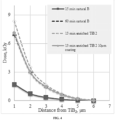
- the dose delivered in the exposing step within 6 ⁇ m of a surface of the implant is greater than 2 kGy, 2 to 60 kGy, 2 to 20 kGy, 5 to 15 kGy, or 10 to 15 kGy, or any range or value therebetween.
- the thermal neutron fluence delivered in the exposing step is greater than 7.5 ⁇ 10 11 n/cm 2 , greater than 1.5 ⁇ 10 12 n/cm 2 , 2.6 ⁇ 10 12 n/cm 2 to 3.0 ⁇ 10 12 n/cm 2 or greater than 3.0 ⁇ 10 12 n/cm 2 , or any range or value therebetween.
- the implant is exposed to the flux of low energy neutrons for 1 minute to 120 minutes, for 1 minute to 60 minutes, for five minutes to 30 minutes or for 10 minutes to 15 minutes, or any range or value therebetween.
- the dose within 6 ⁇ m of the surface of the device is greater than 2 kGy, 2 to 60 kGy, 2 to 20 kGy, 5 to 15 kGy, greater than 10 kGy, 10 to 60 kGy, 10 to 20 kGy, 10 to 15 kGy, or any range or value therebetween and the exposure is less than 30 minutes, less than 20 minutes, less than 15 minutes, less than 10 minutes or less than 5 minutes, or any value or range therebetween.
- the dose within 6 ⁇ m of the surface of the device is as described in the previous sentence, and a background dose delivered within 6 ⁇ m of the surface is less than 100 cGy, less than 75 cGy, less than 50 cGy or less than 25 cGy, or any value or range therebetween.
- the Boron-containing implant and BNCT method of the present disclosure are effective in infection control/treatment of the implant site.
- staph bacterium colonies on titanium diboride exposed to a thermal neutron flux showed a 3000 fold reduction compared to a control held outside of the neutron field.
- Staph colonies on pure titanium samples showed no difference between irradiated and non-irradiated samples.
- Most common bacteria grown on the surface of the implant may be treated using the inventive device and method.
- the survival fraction of bacteria at the implantation site after the exposing step is 0.62 ⁇ 10 -5 to 3.1 ⁇ 10 -5 compared to a non-irradiated control, less than 0.46 compared to a control, less than 0.21 compared to a control, less than 0.02 compared to a control, or less than 2.3 ⁇ 10 -3 compared to a control, or any value or range therebetween. In certain embodiments, 0.3% or fewer of the bacterial at the implantation site survive the exposing step, 0.2% or fewer or 0.004% or fewer survive or any range or value therebetween.
- the neutron flux in the MCNPX model was monitored above the TiB 2 material using an F4 tally.
- the calculated physical dose (Gy) from the 7 Li nuclei and the alpha particle produced from the 10 B neutron capture reaction in the glycerin layer above the TiB 2 surface was determined using the neutron capture ion algorithm (NCIA) option in MCNPX.
- the 7 th entry on the phys:n card was set to 5 to transport the alpha particles and 7 Li nuclei while preserving angular momentum.
- the physical radiation dose was calculated as the sum of the kinetic energy deposited by the ⁇ particle and the 7 Li ion in the glycerin volume above the TiB 2 surface.
- the inoculated disks were treated in the thermal neutron beam at MURR by mounting each petri dish into an irradiation position, as demonstrated in FIG. 3 .
- the larger disks are Ti disks, while the smaller are TiB2.
- Au/Cu flux wires are placed in the irradiation field to confirm neutron fluence.
- One group of TiB 2 disks were not exposed to radiation and was used as a control group a second group of Ti metal disks without B were irradiated for 60 minutes to serve as a neutron beam exposure only control. Two separate experiments were performed. In the first experiment, treatment groups were irradiated to 15 min, 30 min, 45 min, and 60 min of neutron exposure.
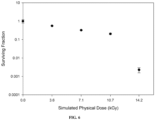
- the surviving fraction (compared to the TiB 2 control group) after 15, 30, 37.5, 45, 52.5, and 60 minutes of neutron irradiation was 0.62, 0.46, 0.34, 0.18, 0.02, and 3.1 ⁇ 10 -5 , respectively.
- the data for both experiments have been plotted in a bacterial survival curve in FIG. 5 .
- the data is also plotted in a survival curve in which the x-axis is converted from time into delivered physical dose via MNCP simulation FIG. 6 for experiment 1 and FIG. 7 for experiment 2.
- the shape of the bacterial survival curve with the data from the combined experiments has been fit using a linear model and a three-component polynomial. Surprisingly, there is little difference in fit between the linear and linear-quadratic models.
- Medical implants are treated with 25 kGy of ionizing radiation for sterilization. The majority of these radiations are performed using gamma rays at room temperature in a dry environment. This work suggests that medical implants could be sterilized for infection in-vivo using thermal neutrons to activate 10 B at the surface of an implant. A 60 minute irradiation resulted in S aureus survival of less than 0.3% in experiment 1 and 0.004% in experiment 2.
- the MCNPX calculation, Table 1 estimates that the physical dose in the first 6 ⁇ m above the TiB 2 surface is 12.1 kGy. However, we observed effective cell killing in a much thicker (-320 ⁇ m) layer of glycerin at the highest time points. Medical implants are not constructed from TiB 2 .
- the physical dose (Gy) was calculated using the neutron capture ion algorithm (NCIA) option.
- the 7 th entry on the phys:n card was set to 5 to transport the alpha particles and 7 Li nuclei while preserving angular momentum.
- the NCIA allows MCNPX to calculate the energy deposited by the alpha particle and the 7 Li ion created by the 10 B(n, ⁇ ) 7 Li reaction.
- the physical radiation dose was calculated as the sum of the kinetic energy deposited by the ⁇ particle and the 7 Li ion in each 1 ⁇ m increment of glycerin above the TiB 2 surface.
- a 60-minute irradiation of tissue using the BNCT facility at MURR results in a non-specific gamma dose of 1.6 Gy and a background neutron dose of 1.5 Gy.
- This background dose is comparable to a single fraction delivered for treatment of cancer.
- Isotopically enriched 10 B reduces the calculated time required to deliver 14.2 kGy of radiation from 60 minute to 13 minutes, shown in FIG. 8. This decrease in irradiation time also decreases the gamma ray and background neutron radiation dose by a factor of 4.6.
- Samples #1 and #2 are staph colonies on titanium plates (representing unboronated implant surface); Samples #3 and #4 are staph colonies on titanium diboride plates (representing boronated implant surface). Samples #2 and#4 were exposed to thermal neutron flux at 10 8 n/sec cm -3 for approximate 1hour to 180 minute, which delivered approximately 17kGy in the 10 microns at the surface of the implant and resulted in extremely low exposure to any bulk tissue.
- each sample was swabbed and rehydrated in 1ml of sterile buffer. The tube was vortexed and the 1 ml suspension was then serially diluted into tubes of 9ml sterile buffered water. 100 ⁇ l of each dilution was then plated onto TSA plates and incubated for three days. The colonies on each plate were counted, with every plate containing >300 CFU (colony forming units) considered "Too Numerous to Count (TNTC)". The two dilutions from each sample that gave greater than 6 CFU/plate but less than 300 CFU/plate were averaged and calculated from the estimated CFU/dis.
- TNTC Too Numerous to Count
- Samples #1 and #2 consisted of two titanium disks containing no Boron, while samples #3 and #4 were titanium diboride. Disks #2 and #4 were irradiated with a thermal neutron flux. The irradiated sample #4, which is with the titanium diboride surface, has the highest staph colony reduction. Table 3.
Landscapes
- Health & Medical Sciences (AREA)
- Life Sciences & Earth Sciences (AREA)
- Chemical & Material Sciences (AREA)
- Animal Behavior & Ethology (AREA)
- General Health & Medical Sciences (AREA)
- Public Health (AREA)
- Veterinary Medicine (AREA)
- Medicinal Chemistry (AREA)
- Epidemiology (AREA)
- Engineering & Computer Science (AREA)
- Biomedical Technology (AREA)
- Pharmacology & Pharmacy (AREA)
- Heart & Thoracic Surgery (AREA)
- Transplantation (AREA)
- Molecular Biology (AREA)
- Oral & Maxillofacial Surgery (AREA)
- Dermatology (AREA)
- Vascular Medicine (AREA)
- Surgery (AREA)
- Bioinformatics & Cheminformatics (AREA)
- Radiology & Medical Imaging (AREA)
- Pathology (AREA)
- Nuclear Medicine, Radiotherapy & Molecular Imaging (AREA)
- Chemical Kinetics & Catalysis (AREA)
- General Chemical & Material Sciences (AREA)
- Physics & Mathematics (AREA)
- General Engineering & Computer Science (AREA)
- High Energy & Nuclear Physics (AREA)
- Pharmaceuticals Containing Other Organic And Inorganic Compounds (AREA)
- Radiation-Therapy Devices (AREA)
- Apparatus For Disinfection Or Sterilisation (AREA)
Claims (11)
- Eine Implantationsvorrichtung, die Folgendes beinhaltet:ein Implantatkörper, der ein Isotop beinhaltet, das aus der Gruppe ausgewählt ist, die aus B-10, Li-6, Gd-157 und Dy-164 besteht, und das bei Exposition gegenüber einem Fluss von Neutronen niedriger Energie eine Dosis ionisierender Strahlung produziert;wobei die Dosis ionisierender Strahlung geeignet ist, um bakterielle Infektion an einer Implantationsstelle nach der Implantation zu behandeln;wobei die Vorrichtung eine Struktur aufweist, die zusätzlich zum Produzieren der Dosis ionisierender Strahlung für eine Verwendung nach der Implantation entworfen ist, und wobei die Vorrichtung kein Stent ist;wobei der Implantatkörper ein Material beinhaltet, das mit dem Isotop angereichert ist, wobei das Material das Isotop zu mehr als 30%, das Isotop zu mehr als 50% oder das Isotop zu mehr als 90 % oder mehr beinhaltet.
- Vorrichtung gemäß Anspruch 1,
wobei der Implantatkörper eine Oberflächenschicht beinhaltet, die das Isotop beinhaltet, wobei die Oberflächenschicht mehr als 1 µm dick, 1 bis 100 µm dick, 1 bis 50 µm, 1 bis 25 µm, 1 bis 10 µm oder 3 bis 7 µm dick ist. - Vorrichtung gemäß Anspruch 1,
wobei der Implantatkörper eine Borkeramik, eine Borlegierung, eine Borlegierung, die ein Übergangsmetall beinhaltet, oder Titanborid beinhaltet. - Vorrichtung gemäß einem der Ansprüche 1-3,
wobei die Vorrichtung eine Oberfläche beinhaltet und die Dosis ionisierender Strahlung innerhalb von 6 µm von der Oberfläche der Vorrichtung größer als 2 kGy ist. - Vorrichtung gemäß einem der Ansprüche 1-4,
wobei die Vorrichtung in einer Überlebensfraktion von Bakterien an der Implantationsstelle von 0,62 × 10⁻⁵ bis 3.1 × 10⁻⁵ verglichen mit einer nicht bestrahlten Kontrolle resultiert. - Vorrichtung gemäß einem der Ansprüche 1-5,
wobei die Dosis ionisierender Strahlung, die durch die Vorrichtung produziert wird, im Überleben von 0, 3 % oder weniger der Bakterien an der Implantationsstelle resultiert. - Vorrichtung gemäß Anspruch 4,
wobei die Dosis ionisierender Strahlung, die durch die Vorrichtung produziert wird, innerhalb von 6 µm von einer Oberfläche der Vorrichtung größer als 10 kGy ist. - Vorrichtung gemäß Anspruch 7,
wobei die Dosis ionisierender Strahlung, die durch die Vorrichtung produziert wird, innerhalb von 6 µm von der Oberfläche der Vorrichtung größer als 10 kGy ist, und eine Hintergrunddosis, die innerhalb der 6 µm geliefert wird, kleiner als 100 cGy ist. - Vorrichtung gemäß einem der Ansprüche 1-8,
wobei die Vorrichtung für wiederholte Expositionen gegenüber dem Fluss von Neutronen vorgesehen ist. - Implantationsvorrichtung gemäß Anspruch 1,
wobei die Implantationsvorrichtung eine Vorrichtung zum Behandeln von einer Infektion an einer Implantationsstelle ist. - Vorrichtung gemäß Anspruch 10,
wobei die Dosis innerhalb von 6 µm von einer Oberfläche der Vorrichtung größer als 2 kGy ist.
Applications Claiming Priority (3)
| Application Number | Priority Date | Filing Date | Title |
|---|---|---|---|
| US201662421620P | 2016-11-14 | 2016-11-14 | |
| US201762574176P | 2017-10-18 | 2017-10-18 | |
| PCT/US2017/061454 WO2018089972A1 (en) | 2016-11-14 | 2017-11-14 | Neutron capture therapy for infection control of surgical implants |
Publications (4)
| Publication Number | Publication Date |
|---|---|
| EP3538217A1 EP3538217A1 (de) | 2019-09-18 |
| EP3538217A4 EP3538217A4 (de) | 2020-07-22 |
| EP3538217C0 EP3538217C0 (de) | 2024-07-24 |
| EP3538217B1 true EP3538217B1 (de) | 2024-07-24 |
Family
ID=62110470
Family Applications (1)
| Application Number | Title | Priority Date | Filing Date |
|---|---|---|---|
| EP17869273.7A Active EP3538217B1 (de) | 2016-11-14 | 2017-11-14 | Neutroneneinfangtherapie zur infektionskontrolle von chirurgischen implantaten |
Country Status (3)
| Country | Link |
|---|---|
| US (1) | US12397173B2 (de) |
| EP (1) | EP3538217B1 (de) |
| WO (1) | WO2018089972A1 (de) |
Families Citing this family (1)
| Publication number | Priority date | Publication date | Assignee | Title |
|---|---|---|---|---|
| WO2022204680A1 (en) * | 2021-03-26 | 2022-09-29 | Westinghouse Electric Company Llc | Production of high energy gamma radiation using an electronic neutron generator for food and medical device sterilization |
Family Cites Families (19)
| Publication number | Priority date | Publication date | Assignee | Title |
|---|---|---|---|---|
| US5217493A (en) * | 1992-03-11 | 1993-06-08 | Board Of Regents, The University Of Texas System | Antibacterial coated medical implants |
| AU2867499A (en) | 1998-02-10 | 1999-08-23 | Implant Sciences Corporation | Soft x-ray emitting medical devices |
| US6187037B1 (en) | 1998-03-11 | 2001-02-13 | Stanley Satz | Metal stent containing radioactivatable isotope and method of making same |
| WO2000006244A2 (en) | 1998-07-30 | 2000-02-10 | Hainfeld James F | Loading metal particles into cell membrane vesicles and metal particle use for imaging and therapy |
| SE523926C2 (sv) * | 1999-06-15 | 2004-06-01 | Hans Lundqvist | Stentarrangemang |
| US6319189B1 (en) | 1999-09-13 | 2001-11-20 | Isotron, Inc. | Methods for treating solid tumors using neutron therapy |
| CA2398832A1 (en) | 1999-11-09 | 2002-08-12 | Forschungszentrum Karlsruhe Gmbh | Mixture containing rare earths and use thereof |
| WO2001070336A1 (en) | 2000-03-23 | 2001-09-27 | Neutron Therapy And Imaging Inc. | Methods and devices for radiation therapy |
| AU2002239719A1 (en) | 2000-10-25 | 2002-06-03 | Mayo Foundation For Medical Education And Research | Transcobalamin receptor binding conjugates for neutron capture therapy |
| EP1545705A4 (de) * | 2000-11-16 | 2010-04-28 | Microspherix Llc | Flexibler und/oder elastischer brachytherapie-seed oder strang |
| US6527693B2 (en) * | 2001-01-30 | 2003-03-04 | Implant Sciences Corporation | Methods and implants for providing radiation to a patient |
| US20030097035A1 (en) * | 2001-07-18 | 2003-05-22 | Tucker Robert D. | Combination radiation and thermal energy source |
| US8668935B2 (en) | 2002-02-14 | 2014-03-11 | Gholam A. Peyman | Method and composition for hyperthermally treating cells |
| GB2399014A (en) * | 2003-01-31 | 2004-09-08 | Psimedica Ltd | Device comprising resorbable silicon for boron neutron capture therapy |
| US8512294B2 (en) * | 2006-07-28 | 2013-08-20 | Becton, Dickinson And Company | Vascular access device antimicrobial materials and solutions |
| US8445008B2 (en) * | 2008-10-17 | 2013-05-21 | Medtronic, Inc. | Reduction of infection associated with medical device |
| WO2012129106A1 (en) | 2011-03-18 | 2012-09-27 | University Of Medicine And Dentistry New Jersey | Boron composite surface coatings and their application on implantable device to accelerate osseous healing |
| US20130102829A1 (en) | 2011-10-25 | 2013-04-25 | National Tsing Hua University | Method for treating osteosarcoma by boron neutron capture therapy using boric acid as a boron drug |
| WO2014176025A1 (en) * | 2013-04-26 | 2014-10-30 | Icon Medical Corp. | Improved metal alloys for medical devices |
-
2017
- 2017-11-14 EP EP17869273.7A patent/EP3538217B1/de active Active
- 2017-11-14 WO PCT/US2017/061454 patent/WO2018089972A1/en not_active Ceased
- 2017-11-14 US US16/349,445 patent/US12397173B2/en active Active
Also Published As
| Publication number | Publication date |
|---|---|
| US12397173B2 (en) | 2025-08-26 |
| EP3538217C0 (de) | 2024-07-24 |
| WO2018089972A1 (en) | 2018-05-17 |
| EP3538217A4 (de) | 2020-07-22 |
| US20190269938A1 (en) | 2019-09-05 |
| EP3538217A1 (de) | 2019-09-18 |
Similar Documents
| Publication | Publication Date | Title |
|---|---|---|
| Dertinger et al. | Molecular radiation biology: the action of ionizing radiation on elementary biological objects | |
| MX2010013322A (es) | Nanoparticulas inorganicas de alta densidad para destruir celulas in vivo. | |
| JP2003513938A (ja) | 希土類を含有している混合物及びその使用 | |
| Naji et al. | Evaluation of antimicrobial properties of conventional poly (methyl methacrylate) denture base resin materials containing hydrothermally synthesised anatase TiO2 nanotubes against cariogenic bacteria and Candida albicans | |
| Chidambaranathan et al. | Comparative evaluation of antifungal effect of titanium, zirconium and aluminium nanoparticles coated titanium plates against C. albicans | |
| Suntharalingam et al. | Basic radiobiology | |
| Ledney et al. | Modulation of mortality by tissue trauma and sepsis in mice after radiation injury | |
| US12397173B2 (en) | Neutron capture therapy for infection control of surgical implants | |
| Kim et al. | Exposure rate as a determinant of the synergistic interaction of heat combined with ionizing or ultraviolet radiation in cell killing | |
| Jo et al. | FLASH radiotherapy: A FLASHing idea to preserve neurocognitive function | |
| Lindborg et al. | Influence of microdosimetric quantities on observed dose-response relationships in radiation therapy | |
| Rosen | Possibilities and advantages of using negative pions in radiotherapy | |
| Tenforde et al. | RBE values for radiation-induced growth delay in rat rhabdomyosarcoma tumors exposed to plateau and peak carbon, neon and argon ions | |
| Maitz et al. | Demonstration of the bactericidal effects of the boron neutron capture reaction | |
| Mason et al. | Preclinical biologic assessment of proton beam relative biologic effectiveness at Proton Therapy Center Houston | |
| Rodriguez et al. | The RBE-LET relationship for rodent intestinal crypt cell survival, testes weight loss, and multicellular spheroid cell survival after heavy-ion irradiation | |
| Elliott et al. | Mixed-field neutrons and γ photons induce different changes in ileal bacteria and correlated sepsis in mice | |
| Korcyl | Track structure modelling for ion radiotherapy | |
| Afzal et al. | Radioprotection of mouse colony forming units-spleen against heavy-charged particle damage by WR 2721 | |
| Sabaa et al. | Insinuation Salmonella Typhi for 23Na and 60Co Radioactive Sources | |
| Luckey | Radiation hormesis: Biopositive effect of radiations | |
| JP2007176879A (ja) | 酵母を有効成分とする放射線防護剤 | |
| Sarhan et al. | Theoretical Study of Improving Radiotherapy at High Energies (2-15) MeV for Lung Cancer using Nanocomposites | |
| Hughes et al. | Boron Neutron Capture Therapy as a cutting-edge strategy for cancer veterinary patients | |
| Luckey | Abundant health from radioactive waste |
Legal Events
| Date | Code | Title | Description |
|---|---|---|---|
| STAA | Information on the status of an ep patent application or granted ep patent |
Free format text: STATUS: THE INTERNATIONAL PUBLICATION HAS BEEN MADE |
|
| PUAI | Public reference made under article 153(3) epc to a published international application that has entered the european phase |
Free format text: ORIGINAL CODE: 0009012 |
|
| STAA | Information on the status of an ep patent application or granted ep patent |
Free format text: STATUS: REQUEST FOR EXAMINATION WAS MADE |
|
| 17P | Request for examination filed |
Effective date: 20190514 |
|
| AK | Designated contracting states |
Kind code of ref document: A1 Designated state(s): AL AT BE BG CH CY CZ DE DK EE ES FI FR GB GR HR HU IE IS IT LI LT LU LV MC MK MT NL NO PL PT RO RS SE SI SK SM TR |
|
| AX | Request for extension of the european patent |
Extension state: BA ME |
|
| DAV | Request for validation of the european patent (deleted) | ||
| DAX | Request for extension of the european patent (deleted) | ||
| RIN1 | Information on inventor provided before grant (corrected) |
Inventor name: MAITZ, CHARLES Inventor name: STANNARD, JAMES Inventor name: VOLGAS, DAVID A. Inventor name: BROCKMAN, JOHN Inventor name: FLAGG, MICHAEL Inventor name: GAHL, JOHN |
|
| A4 | Supplementary search report drawn up and despatched |
Effective date: 20200624 |
|
| RIC1 | Information provided on ipc code assigned before grant |
Ipc: A61N 5/10 20060101AFI20200618BHEP Ipc: A61K 41/00 20200101ALI20200618BHEP Ipc: G21G 4/08 20060101ALI20200618BHEP |
|
| RIN1 | Information on inventor provided before grant (corrected) |
Inventor name: MAITZ, CHARLES Inventor name: FLAGG, MICHAEL Inventor name: VOLGAS, DAVID A. Inventor name: STANNARD, JAMES Inventor name: BROCKMAN, JOHN Inventor name: GAHL, JOHN |
|
| GRAP | Despatch of communication of intention to grant a patent |
Free format text: ORIGINAL CODE: EPIDOSNIGR1 |
|
| STAA | Information on the status of an ep patent application or granted ep patent |
Free format text: STATUS: GRANT OF PATENT IS INTENDED |
|
| INTG | Intention to grant announced |
Effective date: 20240108 |
|
| GRAJ | Information related to disapproval of communication of intention to grant by the applicant or resumption of examination proceedings by the epo deleted |
Free format text: ORIGINAL CODE: EPIDOSDIGR1 |
|
| STAA | Information on the status of an ep patent application or granted ep patent |
Free format text: STATUS: REQUEST FOR EXAMINATION WAS MADE |
|
| GRAP | Despatch of communication of intention to grant a patent |
Free format text: ORIGINAL CODE: EPIDOSNIGR1 |
|
| INTC | Intention to grant announced (deleted) | ||
| STAA | Information on the status of an ep patent application or granted ep patent |
Free format text: STATUS: GRANT OF PATENT IS INTENDED |
|
| GRAS | Grant fee paid |
Free format text: ORIGINAL CODE: EPIDOSNIGR3 |
|
| GRAA | (expected) grant |
Free format text: ORIGINAL CODE: 0009210 |
|
| STAA | Information on the status of an ep patent application or granted ep patent |
Free format text: STATUS: THE PATENT HAS BEEN GRANTED |
|
| INTG | Intention to grant announced |
Effective date: 20240606 |
|
| AK | Designated contracting states |
Kind code of ref document: B1 Designated state(s): AL AT BE BG CH CY CZ DE DK EE ES FI FR GB GR HR HU IE IS IT LI LT LU LV MC MK MT NL NO PL PT RO RS SE SI SK SM TR |
|
| REG | Reference to a national code |
Ref country code: GB Ref legal event code: FG4D |
|
| REG | Reference to a national code |
Ref country code: CH Ref legal event code: EP |
|
| REG | Reference to a national code |
Ref country code: IE Ref legal event code: FG4D Ref country code: DE Ref legal event code: R096 Ref document number: 602017083585 Country of ref document: DE |
|
| U01 | Request for unitary effect filed |
Effective date: 20240819 |
|
| U07 | Unitary effect registered |
Designated state(s): AT BE BG DE DK EE FI FR IT LT LU LV MT NL PT SE SI Effective date: 20240828 |
|
| U20 | Renewal fee for the european patent with unitary effect paid |
Year of fee payment: 8 Effective date: 20241021 |
|
| PG25 | Lapsed in a contracting state [announced via postgrant information from national office to epo] |
Ref country code: NO Free format text: LAPSE BECAUSE OF FAILURE TO SUBMIT A TRANSLATION OF THE DESCRIPTION OR TO PAY THE FEE WITHIN THE PRESCRIBED TIME-LIMIT Effective date: 20241024 |
|
| PG25 | Lapsed in a contracting state [announced via postgrant information from national office to epo] |
Ref country code: PL Free format text: LAPSE BECAUSE OF FAILURE TO SUBMIT A TRANSLATION OF THE DESCRIPTION OR TO PAY THE FEE WITHIN THE PRESCRIBED TIME-LIMIT Effective date: 20240724 Ref country code: GR Free format text: LAPSE BECAUSE OF FAILURE TO SUBMIT A TRANSLATION OF THE DESCRIPTION OR TO PAY THE FEE WITHIN THE PRESCRIBED TIME-LIMIT Effective date: 20241025 |
|
| PG25 | Lapsed in a contracting state [announced via postgrant information from national office to epo] |
Ref country code: IS Free format text: LAPSE BECAUSE OF FAILURE TO SUBMIT A TRANSLATION OF THE DESCRIPTION OR TO PAY THE FEE WITHIN THE PRESCRIBED TIME-LIMIT Effective date: 20241124 |
|
| PG25 | Lapsed in a contracting state [announced via postgrant information from national office to epo] |
Ref country code: HR Free format text: LAPSE BECAUSE OF FAILURE TO SUBMIT A TRANSLATION OF THE DESCRIPTION OR TO PAY THE FEE WITHIN THE PRESCRIBED TIME-LIMIT Effective date: 20240724 |
|
| PG25 | Lapsed in a contracting state [announced via postgrant information from national office to epo] |
Ref country code: RS Free format text: LAPSE BECAUSE OF FAILURE TO SUBMIT A TRANSLATION OF THE DESCRIPTION OR TO PAY THE FEE WITHIN THE PRESCRIBED TIME-LIMIT Effective date: 20241024 Ref country code: ES Free format text: LAPSE BECAUSE OF FAILURE TO SUBMIT A TRANSLATION OF THE DESCRIPTION OR TO PAY THE FEE WITHIN THE PRESCRIBED TIME-LIMIT Effective date: 20240724 |
|
| PG25 | Lapsed in a contracting state [announced via postgrant information from national office to epo] |
Ref country code: RS Free format text: LAPSE BECAUSE OF FAILURE TO SUBMIT A TRANSLATION OF THE DESCRIPTION OR TO PAY THE FEE WITHIN THE PRESCRIBED TIME-LIMIT Effective date: 20241024 Ref country code: PL Free format text: LAPSE BECAUSE OF FAILURE TO SUBMIT A TRANSLATION OF THE DESCRIPTION OR TO PAY THE FEE WITHIN THE PRESCRIBED TIME-LIMIT Effective date: 20240724 Ref country code: NO Free format text: LAPSE BECAUSE OF FAILURE TO SUBMIT A TRANSLATION OF THE DESCRIPTION OR TO PAY THE FEE WITHIN THE PRESCRIBED TIME-LIMIT Effective date: 20241024 Ref country code: IS Free format text: LAPSE BECAUSE OF FAILURE TO SUBMIT A TRANSLATION OF THE DESCRIPTION OR TO PAY THE FEE WITHIN THE PRESCRIBED TIME-LIMIT Effective date: 20241124 Ref country code: HR Free format text: LAPSE BECAUSE OF FAILURE TO SUBMIT A TRANSLATION OF THE DESCRIPTION OR TO PAY THE FEE WITHIN THE PRESCRIBED TIME-LIMIT Effective date: 20240724 Ref country code: GR Free format text: LAPSE BECAUSE OF FAILURE TO SUBMIT A TRANSLATION OF THE DESCRIPTION OR TO PAY THE FEE WITHIN THE PRESCRIBED TIME-LIMIT Effective date: 20241025 Ref country code: ES Free format text: LAPSE BECAUSE OF FAILURE TO SUBMIT A TRANSLATION OF THE DESCRIPTION OR TO PAY THE FEE WITHIN THE PRESCRIBED TIME-LIMIT Effective date: 20240724 |
|
| PG25 | Lapsed in a contracting state [announced via postgrant information from national office to epo] |
Ref country code: RO Free format text: LAPSE BECAUSE OF FAILURE TO SUBMIT A TRANSLATION OF THE DESCRIPTION OR TO PAY THE FEE WITHIN THE PRESCRIBED TIME-LIMIT Effective date: 20240724 Ref country code: SM Free format text: LAPSE BECAUSE OF FAILURE TO SUBMIT A TRANSLATION OF THE DESCRIPTION OR TO PAY THE FEE WITHIN THE PRESCRIBED TIME-LIMIT Effective date: 20240724 |
|
| PG25 | Lapsed in a contracting state [announced via postgrant information from national office to epo] |
Ref country code: CZ Free format text: LAPSE BECAUSE OF FAILURE TO SUBMIT A TRANSLATION OF THE DESCRIPTION OR TO PAY THE FEE WITHIN THE PRESCRIBED TIME-LIMIT Effective date: 20240724 |
|
| PG25 | Lapsed in a contracting state [announced via postgrant information from national office to epo] |
Ref country code: SK Free format text: LAPSE BECAUSE OF FAILURE TO SUBMIT A TRANSLATION OF THE DESCRIPTION OR TO PAY THE FEE WITHIN THE PRESCRIBED TIME-LIMIT Effective date: 20240724 |
|
| PLBE | No opposition filed within time limit |
Free format text: ORIGINAL CODE: 0009261 |
|
| STAA | Information on the status of an ep patent application or granted ep patent |
Free format text: STATUS: NO OPPOSITION FILED WITHIN TIME LIMIT |
|
| REG | Reference to a national code |
Ref country code: CH Ref legal event code: PL |
|
| 26N | No opposition filed |
Effective date: 20250425 |
|
| PG25 | Lapsed in a contracting state [announced via postgrant information from national office to epo] |
Ref country code: MC Free format text: LAPSE BECAUSE OF FAILURE TO SUBMIT A TRANSLATION OF THE DESCRIPTION OR TO PAY THE FEE WITHIN THE PRESCRIBED TIME-LIMIT Effective date: 20240724 |
|
| REG | Reference to a national code |
Ref country code: CH Ref legal event code: PL |
|
| PG25 | Lapsed in a contracting state [announced via postgrant information from national office to epo] |
Ref country code: CH Free format text: LAPSE BECAUSE OF NON-PAYMENT OF DUE FEES Effective date: 20241130 |
|
| PG25 | Lapsed in a contracting state [announced via postgrant information from national office to epo] |
Ref country code: IE Free format text: LAPSE BECAUSE OF NON-PAYMENT OF DUE FEES Effective date: 20241114 |
|
| U20 | Renewal fee for the european patent with unitary effect paid |
Year of fee payment: 9 Effective date: 20251023 |
|
| PGFP | Annual fee paid to national office [announced via postgrant information from national office to epo] |
Ref country code: GB Payment date: 20251016 Year of fee payment: 9 |
|
| PG25 | Lapsed in a contracting state [announced via postgrant information from national office to epo] |
Ref country code: HU Free format text: LAPSE BECAUSE OF FAILURE TO SUBMIT A TRANSLATION OF THE DESCRIPTION OR TO PAY THE FEE WITHIN THE PRESCRIBED TIME-LIMIT; INVALID AB INITIO Effective date: 20171114 |
|
| PG25 | Lapsed in a contracting state [announced via postgrant information from national office to epo] |
Ref country code: CY Free format text: LAPSE BECAUSE OF FAILURE TO SUBMIT A TRANSLATION OF THE DESCRIPTION OR TO PAY THE FEE WITHIN THE PRESCRIBED TIME-LIMIT; INVALID AB INITIO Effective date: 20171114 |