EP3536760B2 - Composition containing mixture of fluorinated hydrocarbons, and method for producing same - Google Patents
Composition containing mixture of fluorinated hydrocarbons, and method for producing same Download PDFInfo
- Publication number
- EP3536760B2 EP3536760B2 EP19164021.8A EP19164021A EP3536760B2 EP 3536760 B2 EP3536760 B2 EP 3536760B2 EP 19164021 A EP19164021 A EP 19164021A EP 3536760 B2 EP3536760 B2 EP 3536760B2
- Authority
- EP
- European Patent Office
- Prior art keywords
- composition
- mixture
- refrigerating
- point
- flammable
- Prior art date
- Legal status (The legal status is an assumption and is not a legal conclusion. Google has not performed a legal analysis and makes no representation as to the accuracy of the status listed.)
- Active
Links
Images
Classifications
-
- C—CHEMISTRY; METALLURGY
- C09—DYES; PAINTS; POLISHES; NATURAL RESINS; ADHESIVES; COMPOSITIONS NOT OTHERWISE PROVIDED FOR; APPLICATIONS OF MATERIALS NOT OTHERWISE PROVIDED FOR
- C09K—MATERIALS FOR MISCELLANEOUS APPLICATIONS, NOT PROVIDED FOR ELSEWHERE
- C09K5/00—Heat-transfer, heat-exchange or heat-storage materials, e.g. refrigerants; Materials for the production of heat or cold by chemical reactions other than by combustion
- C09K5/02—Materials undergoing a change of physical state when used
- C09K5/04—Materials undergoing a change of physical state when used the change of state being from liquid to vapour or vice versa
- C09K5/041—Materials undergoing a change of physical state when used the change of state being from liquid to vapour or vice versa for compression-type refrigeration systems
- C09K5/044—Materials undergoing a change of physical state when used the change of state being from liquid to vapour or vice versa for compression-type refrigeration systems comprising halogenated compounds
- C09K5/045—Materials undergoing a change of physical state when used the change of state being from liquid to vapour or vice versa for compression-type refrigeration systems comprising halogenated compounds containing only fluorine as halogen
-
- C—CHEMISTRY; METALLURGY
- C09—DYES; PAINTS; POLISHES; NATURAL RESINS; ADHESIVES; COMPOSITIONS NOT OTHERWISE PROVIDED FOR; APPLICATIONS OF MATERIALS NOT OTHERWISE PROVIDED FOR
- C09K—MATERIALS FOR MISCELLANEOUS APPLICATIONS, NOT PROVIDED FOR ELSEWHERE
- C09K5/00—Heat-transfer, heat-exchange or heat-storage materials, e.g. refrigerants; Materials for the production of heat or cold by chemical reactions other than by combustion
- C09K5/02—Materials undergoing a change of physical state when used
- C09K5/04—Materials undergoing a change of physical state when used the change of state being from liquid to vapour or vice versa
-
- C—CHEMISTRY; METALLURGY
- C09—DYES; PAINTS; POLISHES; NATURAL RESINS; ADHESIVES; COMPOSITIONS NOT OTHERWISE PROVIDED FOR; APPLICATIONS OF MATERIALS NOT OTHERWISE PROVIDED FOR
- C09K—MATERIALS FOR MISCELLANEOUS APPLICATIONS, NOT PROVIDED FOR ELSEWHERE
- C09K5/00—Heat-transfer, heat-exchange or heat-storage materials, e.g. refrigerants; Materials for the production of heat or cold by chemical reactions other than by combustion
- C09K5/02—Materials undergoing a change of physical state when used
- C09K5/04—Materials undergoing a change of physical state when used the change of state being from liquid to vapour or vice versa
- C09K5/041—Materials undergoing a change of physical state when used the change of state being from liquid to vapour or vice versa for compression-type refrigeration systems
- C09K5/044—Materials undergoing a change of physical state when used the change of state being from liquid to vapour or vice versa for compression-type refrigeration systems comprising halogenated compounds
-
- C—CHEMISTRY; METALLURGY
- C10—PETROLEUM, GAS OR COKE INDUSTRIES; TECHNICAL GASES CONTAINING CARBON MONOXIDE; FUELS; LUBRICANTS; PEAT
- C10M—LUBRICATING COMPOSITIONS; USE OF CHEMICAL SUBSTANCES EITHER ALONE OR AS LUBRICATING INGREDIENTS IN A LUBRICATING COMPOSITION
- C10M105/00—Lubricating compositions characterised by the base-material being a non-macromolecular organic compound
- C10M105/08—Lubricating compositions characterised by the base-material being a non-macromolecular organic compound containing oxygen
- C10M105/32—Esters
- C10M105/38—Esters of polyhydroxy compounds
-
- C—CHEMISTRY; METALLURGY
- C10—PETROLEUM, GAS OR COKE INDUSTRIES; TECHNICAL GASES CONTAINING CARBON MONOXIDE; FUELS; LUBRICANTS; PEAT
- C10M—LUBRICATING COMPOSITIONS; USE OF CHEMICAL SUBSTANCES EITHER ALONE OR AS LUBRICATING INGREDIENTS IN A LUBRICATING COMPOSITION
- C10M107/00—Lubricating compositions characterised by the base-material being a macromolecular compound
- C10M107/20—Lubricating compositions characterised by the base-material being a macromolecular compound containing oxygen
- C10M107/22—Macromolecular compounds obtained by reactions only involving carbon-to-carbon unsaturated bonds
- C10M107/24—Macromolecular compounds obtained by reactions only involving carbon-to-carbon unsaturated bonds containing monomers having an unsaturated radical bound to an alcohol, aldehyde, ketonic, ether, ketal or acetal radical
-
- C—CHEMISTRY; METALLURGY
- C10—PETROLEUM, GAS OR COKE INDUSTRIES; TECHNICAL GASES CONTAINING CARBON MONOXIDE; FUELS; LUBRICANTS; PEAT
- C10M—LUBRICATING COMPOSITIONS; USE OF CHEMICAL SUBSTANCES EITHER ALONE OR AS LUBRICATING INGREDIENTS IN A LUBRICATING COMPOSITION
- C10M107/00—Lubricating compositions characterised by the base-material being a macromolecular compound
- C10M107/20—Lubricating compositions characterised by the base-material being a macromolecular compound containing oxygen
- C10M107/30—Macromolecular compounds obtained otherwise than by reactions only involving carbon-to-carbon unsaturated bonds
- C10M107/32—Condensation polymers of aldehydes or ketones; Polyesters; Polyethers
- C10M107/34—Polyoxyalkylenes
-
- C—CHEMISTRY; METALLURGY
- C10—PETROLEUM, GAS OR COKE INDUSTRIES; TECHNICAL GASES CONTAINING CARBON MONOXIDE; FUELS; LUBRICANTS; PEAT
- C10M—LUBRICATING COMPOSITIONS; USE OF CHEMICAL SUBSTANCES EITHER ALONE OR AS LUBRICATING INGREDIENTS IN A LUBRICATING COMPOSITION
- C10M171/00—Lubricating compositions characterised by purely physical criteria, e.g. containing as base-material, thickener or additive, ingredients which are characterised exclusively by their numerically specified physical properties, i.e. containing ingredients which are physically well-defined but for which the chemical nature is either unspecified or only very vaguely indicated
- C10M171/008—Lubricant compositions compatible with refrigerants
-
- F—MECHANICAL ENGINEERING; LIGHTING; HEATING; WEAPONS; BLASTING
- F25—REFRIGERATION OR COOLING; COMBINED HEATING AND REFRIGERATION SYSTEMS; HEAT PUMP SYSTEMS; MANUFACTURE OR STORAGE OF ICE; LIQUEFACTION SOLIDIFICATION OF GASES
- F25B—REFRIGERATION MACHINES, PLANTS OR SYSTEMS; COMBINED HEATING AND REFRIGERATION SYSTEMS; HEAT PUMP SYSTEMS
- F25B1/00—Compression machines, plants or systems with non-reversible cycle
-
- F—MECHANICAL ENGINEERING; LIGHTING; HEATING; WEAPONS; BLASTING
- F25—REFRIGERATION OR COOLING; COMBINED HEATING AND REFRIGERATION SYSTEMS; HEAT PUMP SYSTEMS; MANUFACTURE OR STORAGE OF ICE; LIQUEFACTION SOLIDIFICATION OF GASES
- F25B—REFRIGERATION MACHINES, PLANTS OR SYSTEMS; COMBINED HEATING AND REFRIGERATION SYSTEMS; HEAT PUMP SYSTEMS
- F25B31/00—Compressor arrangements
- F25B31/002—Lubrication
-
- C—CHEMISTRY; METALLURGY
- C09—DYES; PAINTS; POLISHES; NATURAL RESINS; ADHESIVES; COMPOSITIONS NOT OTHERWISE PROVIDED FOR; APPLICATIONS OF MATERIALS NOT OTHERWISE PROVIDED FOR
- C09K—MATERIALS FOR MISCELLANEOUS APPLICATIONS, NOT PROVIDED FOR ELSEWHERE
- C09K2205/00—Aspects relating to compounds used in compression type refrigeration systems
- C09K2205/10—Components
- C09K2205/12—Hydrocarbons
- C09K2205/122—Halogenated hydrocarbons
-
- C—CHEMISTRY; METALLURGY
- C09—DYES; PAINTS; POLISHES; NATURAL RESINS; ADHESIVES; COMPOSITIONS NOT OTHERWISE PROVIDED FOR; APPLICATIONS OF MATERIALS NOT OTHERWISE PROVIDED FOR
- C09K—MATERIALS FOR MISCELLANEOUS APPLICATIONS, NOT PROVIDED FOR ELSEWHERE
- C09K2205/00—Aspects relating to compounds used in compression type refrigeration systems
- C09K2205/10—Components
- C09K2205/12—Hydrocarbons
- C09K2205/126—Unsaturated fluorinated hydrocarbons
-
- C—CHEMISTRY; METALLURGY
- C09—DYES; PAINTS; POLISHES; NATURAL RESINS; ADHESIVES; COMPOSITIONS NOT OTHERWISE PROVIDED FOR; APPLICATIONS OF MATERIALS NOT OTHERWISE PROVIDED FOR
- C09K—MATERIALS FOR MISCELLANEOUS APPLICATIONS, NOT PROVIDED FOR ELSEWHERE
- C09K2205/00—Aspects relating to compounds used in compression type refrigeration systems
- C09K2205/22—All components of a mixture being fluoro compounds
-
- C—CHEMISTRY; METALLURGY
- C09—DYES; PAINTS; POLISHES; NATURAL RESINS; ADHESIVES; COMPOSITIONS NOT OTHERWISE PROVIDED FOR; APPLICATIONS OF MATERIALS NOT OTHERWISE PROVIDED FOR
- C09K—MATERIALS FOR MISCELLANEOUS APPLICATIONS, NOT PROVIDED FOR ELSEWHERE
- C09K2205/00—Aspects relating to compounds used in compression type refrigeration systems
- C09K2205/40—Replacement mixtures
-
- C—CHEMISTRY; METALLURGY
- C10—PETROLEUM, GAS OR COKE INDUSTRIES; TECHNICAL GASES CONTAINING CARBON MONOXIDE; FUELS; LUBRICANTS; PEAT
- C10M—LUBRICATING COMPOSITIONS; USE OF CHEMICAL SUBSTANCES EITHER ALONE OR AS LUBRICATING INGREDIENTS IN A LUBRICATING COMPOSITION
- C10M2207/00—Organic non-macromolecular hydrocarbon compounds containing hydrogen, carbon and oxygen as ingredients in lubricant compositions
- C10M2207/28—Esters
- C10M2207/283—Esters of polyhydroxy compounds
- C10M2207/2835—Esters of polyhydroxy compounds used as base material
-
- C—CHEMISTRY; METALLURGY
- C10—PETROLEUM, GAS OR COKE INDUSTRIES; TECHNICAL GASES CONTAINING CARBON MONOXIDE; FUELS; LUBRICANTS; PEAT
- C10M—LUBRICATING COMPOSITIONS; USE OF CHEMICAL SUBSTANCES EITHER ALONE OR AS LUBRICATING INGREDIENTS IN A LUBRICATING COMPOSITION
- C10M2209/00—Organic macromolecular compounds containing oxygen as ingredients in lubricant compositions
- C10M2209/02—Macromolecular compounds obtained by reactions only involving carbon-to-carbon unsaturated bonds
- C10M2209/04—Macromolecular compounds obtained by reactions only involving carbon-to-carbon unsaturated bonds containing monomers having an unsaturated radical bound to an alcohol or ester thereof; bound to an aldehyde, ketonic, ether, ketal or acetal radical
- C10M2209/043—Macromolecular compounds obtained by reactions only involving carbon-to-carbon unsaturated bonds containing monomers having an unsaturated radical bound to an alcohol or ester thereof; bound to an aldehyde, ketonic, ether, ketal or acetal radical used as base material
-
- C—CHEMISTRY; METALLURGY
- C10—PETROLEUM, GAS OR COKE INDUSTRIES; TECHNICAL GASES CONTAINING CARBON MONOXIDE; FUELS; LUBRICANTS; PEAT
- C10M—LUBRICATING COMPOSITIONS; USE OF CHEMICAL SUBSTANCES EITHER ALONE OR AS LUBRICATING INGREDIENTS IN A LUBRICATING COMPOSITION
- C10M2209/00—Organic macromolecular compounds containing oxygen as ingredients in lubricant compositions
- C10M2209/10—Macromolecular compoundss obtained otherwise than by reactions only involving carbon-to-carbon unsaturated bonds
- C10M2209/103—Polyethers, i.e. containing di- or higher polyoxyalkylene groups
- C10M2209/1033—Polyethers, i.e. containing di- or higher polyoxyalkylene groups used as base material
-
- C—CHEMISTRY; METALLURGY
- C10—PETROLEUM, GAS OR COKE INDUSTRIES; TECHNICAL GASES CONTAINING CARBON MONOXIDE; FUELS; LUBRICANTS; PEAT
- C10N—INDEXING SCHEME ASSOCIATED WITH SUBCLASS C10M RELATING TO LUBRICATING COMPOSITIONS
- C10N2020/00—Specified physical or chemical properties or characteristics, i.e. function, of component of lubricating compositions
- C10N2020/09—Characteristics associated with water
- C10N2020/097—Refrigerants
- C10N2020/101—Containing Hydrofluorocarbons
-
- C—CHEMISTRY; METALLURGY
- C10—PETROLEUM, GAS OR COKE INDUSTRIES; TECHNICAL GASES CONTAINING CARBON MONOXIDE; FUELS; LUBRICANTS; PEAT
- C10N—INDEXING SCHEME ASSOCIATED WITH SUBCLASS C10M RELATING TO LUBRICATING COMPOSITIONS
- C10N2040/00—Specified use or application for which the lubricating composition is intended
- C10N2040/30—Refrigerators lubricants or compressors lubricants
Definitions
- the present invention relates to a composition comprising a mixture containing fluorinated hydrocarbons that are used as, for example, a refrigerant, and to a method for producing the composition.
- the present invention also includes a case in which the composition consists of the three basic components contained in the mixture, i.e., difluoromethane (R32), pentafluoroethane (R125), and 1,1,1,2-tetrafluoroethane (R134a).
- Refrigerants recently used, for example, for air conditioners, refrigerating devices, and refrigerators are mixtures of fluorinated hydrocarbons that contain no chlorine in their molecular structures, such as difluoromethane (CH 2 F 2 , R32, boiling point: -52°C), pentafluoroethane (CF 3 CHF 2 , R125, boiling point: -48°C), 1,1,1-trifluoroethane (CF 3 CH 3 , R143a, boiling point: -48°C), 1,1,1,2-tetrafluoroethane (CF 3 CH 2 F, R134a, boiling point: -26°C), and 1,1-difluoroethane (CHF 2 CH 3 , R152a, boiling point: -24°C) .
- difluoromethane CHF 2 , R32, boiling point: -52°C
- pentafluoroethane CF 3 CHF 2 , R125, boiling point: -48°
- R404A is currently widely used as a refrigerant for freezing and refrigerated storage (for example, JP-B-2869038 and US-B-8,168,077 ).
- the global warming potential (GWP) of R404A is as high as 3922, which is equal to or higher than that of CHClF 2 (R22), which is a chlorine-containing fluorinated hydrocarbon.
- R22 CHClF 2
- R404A a refrigerant and refrigerant composition that have, for example, a non-flammability similar to that of R404A, a refrigerating capacity that can replace that of R404A, a ratio of refrigerating capacity to power consumed in a refrigeration cycle (coefficient of performance (COP)) that is equal or superior to that of R404A, and a lower GWP than that of R404A.
- COP coefficient of performance
- An object of the present invention is to provide, as alternative refrigerants for the R404A that is currently widely used, a refrigerant and refrigerant composition that have, for example, a non-flammability similar to that of R404A, a refrigerating capacity that can replace that of R404A, a COP equal or superior to that of R404A, and a lower GWP than that of R404A.
- a refrigerant and refrigerant composition that have, for example, a non-flammability similar to that of R404A, a refrigerating capacity that can replace that of R404A, a COP equal or superior to that of R404A, and a lower GWP than that of R404A.
- the definition of non-flammability in the present specification conforms to U.S. ASHRAE Standard 34-2013.
- the present inventors conducted extensive research to achieve the above object, and found that the above object can be achieved by a composition comprising a mixture containing fluorinated hydrocarbons, the composition ratio of the fluorinated hydrocarbons contained in the mixture falling within a triangle having specific three points as vertices in a ternary composition diagram ( Fig. 1 ) in which the sum of the concentrations of difluoromethane (R32), pentafluoroethane (R125), and 1,1,1,2-tetrafluoroethane (R134a) is 100 wt%.
- the present invention has been accomplished through further research based on the above findings.
- the present invention provides a composition
- a composition comprising a mixture containing fluorinated hydrocarbons, the mixture comprising ⁇ 99.5 wt.-% of a total of difluoromethane (R32), pentafluoroethane (R125) and 1,1,1,2-tetrafluoroethane (R134a), and the composition ratio of R32, R125 and R134a in the mixture falls within a triangle having the points A, F and G as vertices in a ternary composition diagram in which the sum of R32, R125 and R134a is 100 wt.-%:
- the invention provides the use of the above composition (also "the present composition” hereinafter) in at least one of refrigerators, freezers, water coolers, ice machines, refrigerating showcases, freezing showcases, freezing and refrigerating units, refrigerating devices for freezing and refrigerating warehouses, chillers (chilling units), turbo refrigerators, and screw refrigerators.
- the invention provides a refrigeration method comprising operating a refrigeration cycle using the present composition, as well as a refrigerating device comprising the present composition.
- the invention provides a method for producing the present composition comprising mixing R32, R125 and R134a in the specified ratios and amounts.
- the present invention makes it possible to obtain a composition comprising a mixture containing fluorinated hydrocarbons that has, for example, a non-flammability similar to that of R404A, a refrigerating capacity that can replace that of R404A, a COP equal or superior to that of R404A, and a lower GWP than that of R404A because the composition ratio of the mixture falls within a triangle having the following three points as vertices in a ternary composition diagram for R32, R125, and R134a indicated by the triangular coordinates of Fig. 1 :
- the present composition comprises a mixture containing fluorinated hydrocarbons, the mixture comprising ⁇ 99.5 wt.-% of a total of difluoromethane (R32), pentafluoroethane (R125) and 1,1,1,2-tetrafluoroethane (R134a), and the composition ratio of R32, R125 and R134a in the mixture falls within a triangle having the following three points as vertices in a ternary composition diagram ( Fig. 1 ) in which the sum of the concentrations of R32, R125, and R134a is 100 wt%:
- the present composition has, for example, a non-flammability similar to that of R404A, a refrigerating capacity that can replace that of R404A, a COP equal or superior to that of R404A, and a lower GWP than that of R404A.
- the present composition is non-flammable according to ASHRAE like R404A (details of the definition are described later), it is safer than flammable refrigerants and can be used in a wide range of applications.
- the refrigerating capacity of the present composition can replace that of R404A. More specifically, the refrigerating capacity of the present composition is preferably ⁇ 94%, more preferably ⁇ 95%, and even more preferably ⁇ 100%, relative to that of R404A.
- the COP of the present composition is equal or superior to that of R404A ( ⁇ 100%), more preferably ⁇ 105, and even more preferably ⁇ 110, relative to that of R404A.
- the present composition has a GWP of ⁇ 1500, and thus can notably reduce a burden on the environment from a global warming perspective compared with other general-purpose refrigerants.
- R404A is a refrigerant currently widely used for freezing and refrigerated storage, and the present composition can be an alternative refrigerant for R404A.
- the mixture described above may consist of three basic components, i.e., difluoromethane (R32), pentafluoroethane (R125), and 1,1,1,2-tetrafluoroethane (R134a), or may comprise one or more components that are different from the three basic components (referred to as "other components") in addition to the three basic components.
- difluoromethane (R32), pentafluoroethane (R125), and 1,1,1,2-tetrafluoroethane (R134a) are referred to as "three basic components” and one or more components that are different from the three basic components are referred to as "other components.”
- Other components are described in detail later.
- the present composition may consist of the mixture, or may comprise any additives described later, such as a refrigerant oil, in addition to the mixture.
- the mixture preferably contains other components in amounts such that the functions of the three basic components are not impaired.
- the content of other components in the mixture is ⁇ 0.5 wt%, preferably ⁇ 0.3 wt%, and more preferably ⁇ 0.1 wt%.
- a straight line passing through two points shows an ASHRAE non-flammable border line
- a straight line passing through two points shows a line indicating a composition ratio at which the GWP is 1500
- a straight line passing through two points, i.e., point F and point G shows a line indicating a composition ratio at which the refrigerating capacity is 94% relative to that of R404A.
- Embodiments 2 or 3 In view of improving the refrigerating capacity, preferred embodiments are, the following Embodiments 2 or 3, in which the range of the triangle is smaller than the range of the triangle of Embodiment 1.
- the composition ratio of the fluorinated hydrocarbons contained in the mixture falls within a triangle having the following three points as vertices in a ternary composition diagram ( Fig. 1 ) in which the sum of the concentrations of R32, R125, and R134a is 100 wt%:
- a straight line passing through two points i.e., point D and point E, shows a line indicating a composition ratio in which the refrigerating capacity is 95% relative to that of R404A.
- the composition ratio of the fluorinated hydrocarbons contained in the mixture falls within a triangle having the following three points as vertices in a ternary composition diagram ( Fig. 1 ) in which the sum of the concentrations of R32, R125, and R134a is 100 wt%:
- a straight line passing through two points i.e., point B and point C, shows a line indicating a composition ratio at which the refrigerating capacity is 100% relative to that of R404A.
- the ASHRAE flammability classification of refrigerants is performed based on ANSI/ASHRAE Standard 34-2013.
- Refrigerants classified as Class 1 are non-flammable refrigerants. That is, the present composition being non-flammable according to ASHRAE means that the mixture containing fluorinated hydrocarbons used in the present invention (in particular, the three basic components) is classified as Class 1 in flammability classification.
- a leak test during storage, transportation, and use is performed based on ANSI/ASHRAE 34-2013 to specify the worst case of fractionation for flammability (WCFF).
- WCFF fractionation for flammability
- the R125 side from the line segment AF is classified as a mixed refrigerant that is non-flammable according to ASHRAE
- the R32 side from the line segment AF is classified as a mixed refrigerant that is flammable according to ASHRAE (Class 2: slightly flammable mixed refrigerants
- Class 3 flammable mixed refrigerants
- an allowable range (including an allowable error) is set for each refrigerant.
- the mixed refrigerant is not defined as a mixed refrigerant that is non-flammable according to ASHRAE.
- line segments indicating composition ratios at which the refrigerating capacity is 94%, 95%, and 100% relative to that of R404A are approximated by line segments represented by the following equations.
- the mixture contained in the present composition may further contain a tiny amount of water in addition to the three basic components (R32, R125, and R134a).
- the amount of water is preferably ⁇ 0.1 parts by weight (pbw), per 100 pbw of the mixture.
- the mixture contained in the present composition may contain other component(s) (fluorinated hydrocarbon(s) that are different from the three basic components) in addition to the three basic components (R32, R125, and R134a).
- the fluorinated hydrocarbon(s) as other component(s) are not particularly limited, and, are, for example, at least one fluorinated hydrocarbon selected from HCFC-1122, HCFC-124, CFC-1113, and 3,3,3-trifluoropropyne.
- the mixture contained in the present composition may contain, in addition to the three basic components (R32, R125, and R134a), at least one halogenated organic compound of the formula C m H n X p (1), wherein X each independently is F, Cl or Br, m is 1 or 2, p is ⁇ 1 and (2 m +2) ⁇ ( n + p ), as other component(s).
- the at least one halogenated organic compound as other component(s) is not particularly limited.
- Preferable examples include difluorochloromethane, chloromethane, 2-chloro-1,1,1,2,2-pentafluoroethane, 2-chloro-1,1,1,2-tetrafluoroethane, 2-chloro-1,1-difluoroethylene and trifluoroethylene.
- the mixture contained in the present composition may contain, in addition to the three basic components (R32, R125, and R134a), at least one organic compound of the formula C m H n X p (2), wherein X each independently is an atom other than halogen, m is 1 or 2, p is ⁇ 1 and (2m+2) ⁇ ( n + p ), as other component(s).
- the at least one organic compound as other component(s) is not particularly limited.
- Preferable examples include propane and isobutane.
- the content of other components in the mixture is ⁇ 0.5 wt%, preferably ⁇ 0.3 wt%, and more preferably ⁇ 0.1 wt%, as the total content amount.
- the present composition may appropriately contain various additives in addition to the mixture.
- the present composition may further contain a refrigerant oil.
- the refrigerant oil is not particularly limited and can be suitably selected from commonly used refrigerant oils.
- a refrigerant oil that is more excellent in terms of, for example, the effect of improving miscibility with the mixture and stability of the mixture may be appropriately selected, if necessary.
- the stability of the mixture can be evaluated by a commonly used method.
- examples of such methods include an evaluation method using the amount of free fluorine ions as an index according to ASHRAE Standard 97-2007, and the like.
- Preferred as the type of the refrigerant oil is, specifically, for example, at least one member selected from the group consisting of polyalkylene glycol (PAG), polyol ester (POE), and polyvinyl ether (PVE).
- PAG polyalkylene glycol
- POE polyol ester
- PVE polyvinyl ether
- the refrigerant oil to be used may have, for example, a kinematic viscosity at 40°C of 5-400 cSt.
- a kinematic viscosity at 40°C of 5-400 cSt When the refrigerant oil has a kinematic viscosity within this range, it is preferable in terms of lubricity.
- the concentration of the refrigerant oil is not particularly limited, and may be generally 10-50 wt%, relative to the entire composition.
- the present composition may further contain one or more tracers.
- the one or more tracers are added to the present composition at a detectable concentration so that, when the present composition is diluted, contaminated, or undergoes any other change, the change can be traced.
- the tracers There is no limitation on the tracers.
- Preferable examples include hydrofluorocarbons, deuterated hydrocarbons, deuterated hydrofluorocarbons, perfluorocarbons, fluoroethers, brominated compounds, iodinated compounds, alcohols, aldehydes, ketones and nitrous oxide (N 2 O). Particularly preferred are hydrofluorocarbons or fluoroethers.
- the present composition may further contain a compatibilizer.
- the type of compatibilizer is not particularly limited.
- Preferable examples include polyoxyalkylene glycol ethers, amides, nitriles, ketones, chlorocarbons, esters, lactones, aryl ethers, fluoroethers and 1,1,1-trifluoroalkans.
- Particularly preferred are polyoxyalkylene glycol ethers.
- the present composition may further contain one or more ultraviolet fluorescent dyes.
- ultraviolet fluorescent dyes There is no limitation on the ultraviolet fluorescent dyes.
- Preferable examples include naphthalimide, coumarin, anthracene, phenanthrene, xanthene, thioxanthene, naphthoxanthene, and fluorescein, and derivatives thereof. Either naphthalimide or coumarin, or both are particularly preferable.
- the present composition may further contain, for example, a stabilizer and a polymerization inhibitor, if necessary.
- stabilizers include, but are not particularly limited to, (i) aliphatic nitro compounds, such as nitromethane and nitroethane; and aromatic nitro compounds, such as nitrobenzene and nitrostyrene; (ii) ethers, such as 1,4-dioxane; amines, such as 2,2,3,3,3-pentafluoropropylamine and diphenylamine; butylhydroxyxylene and benzotriazole.
- the stabilizers can be used singly or in a combination of two or more.
- the concentration of the stabilizer varies depending on the type of stabilizer, but can be determined within a range in which the properties of the composition are not impaired.
- the concentration of the stabilizer is generally preferably 0.01-5 pbw, and more preferably 0.05-2 pbw, per 100 pbw of the mixture.
- polymerization inhibitors include, but are not particularly limited to, 4-methoxy-1-naphthol, hydroquinone, hydroquinonemethyl ether, dimethyl-t-butylphenol, 2,6-di-tert-butyl-p-cresol and benzotriazole.
- the concentration of the polymerization inhibitor is generally preferably 0.01-5 pbw, and more preferably 0.05-2 pbw, per 100 pbw of the mixture.
- an object can be refrigerated by a method comprising the step of operating a refrigeration cycle using the present composition.
- the present composition can be circulated via a compressor to form the refrigeration cycle.
- the method for producing the present composition comprises mixing R32, R125, and R134a such that the composition ratio thereof is adjusted to fall within a triangle having the following three points as vertices in a ternary composition diagram ( Fig. 1 ) in which the sum of the concentrations of R32, R125, and R134a is 100 wt%:
- the method for producing the composition of present Embodiment 2 comprises mixing R32, R125, and R134a such that the composition ratio thereof is adjusted to fall within a triangle having the following three points as vertices in a ternary composition diagram ( Fig. 1 ) in which the sum of the concentrations of R32, R125, and R134a is 100 wt%:
- the method for producing the composition of present Embodiment 3 comprises mixing R32, R125, and R134a such that the composition ratio thereof is adjusted to fall within a triangle having the following three points as vertices in a ternary composition diagram ( Fig. 1 ) in which the sum of the concentrations of R32, R125, and R134a is 100 wt%:
- compositions of Embodiments 1-3 can be produced by the above methods.
- the GWP of each of R404A and mixed refrigerants of R32, R125, and R134a was evaluated based on the values described in the Intergovernmental Panel on Climate Change (IPCC) fourth report.
- the COP and refrigerating capacity of each of R404A and the mixed refrigerants of R32, R125, and R134a were determined by performing refrigeration cycle theoretical calculations for the refrigerant and mixed refrigerants using the National Institute of Science and Technology (NIST) and Reference Fluid Thermodynamic and Transport Properties Database (Refprop 9.0) under the following conditions.
- Tables 1 and 2 show the GWP, COP, and refrigerating capacity calculated based on these results. Regarding the COP and refrigerating capacity, the percentages relative to those of R404A are shown.
- COP (refrigerating capacity or heating capacity) / amount of electrical power consumed
- Fig. 2 shows a non-flammable border line (P), a flammable region (Q), and a non-flammable region (R).
- a 12-L spherical glass flask was used so that the combustion state could be visually observed and photographically recorded.
- gas was allowed to escape from the upper lid. Ignition was achieved by electric discharge from electrodes disposed at one-third the distance from the bottom.
- Comparative Examples 1-5 compositions having composition ratios at which the refrigerating capacity was 100% relative to that of R404A were obtained.
- the compositions of Comparative Examples 1-3 had a GWP of > 1500, and the compositions of Comparative Examples 4 and 5 were flammable.
- Comparative Examples 6-9 compositions having composition ratios at which the refrigerating capacity was 95% relative to that of R404A were obtained.
- the compositions of Comparative Examples 6-8 had a GWP of > 1500, and the composition of Comparative Example 9 was flammable.
- Comparative Examples 10-12 compositions having composition ratios at which the refrigerating capacity was 94% relative to that of R404A were obtained.
- the compositions of Comparative Examples 10 and 11 had a GWP of > 1500, and the composition of Comparative Example 12 was flammable.
Landscapes
- Chemical & Material Sciences (AREA)
- Engineering & Computer Science (AREA)
- Organic Chemistry (AREA)
- Chemical Kinetics & Catalysis (AREA)
- Physics & Mathematics (AREA)
- Thermal Sciences (AREA)
- Oil, Petroleum & Natural Gas (AREA)
- General Chemical & Material Sciences (AREA)
- Health & Medical Sciences (AREA)
- Emergency Medicine (AREA)
- Combustion & Propulsion (AREA)
- Materials Engineering (AREA)
- General Engineering & Computer Science (AREA)
- Mechanical Engineering (AREA)
- Lubricants (AREA)
- Organic Low-Molecular-Weight Compounds And Preparation Thereof (AREA)
- Compositions Of Macromolecular Compounds (AREA)
Description
- The present invention relates to a composition comprising a mixture containing fluorinated hydrocarbons that are used as, for example, a refrigerant, and to a method for producing the composition. The present invention also includes a case in which the composition consists of the three basic components contained in the mixture, i.e., difluoromethane (R32), pentafluoroethane (R125), and 1,1,1,2-tetrafluoroethane (R134a).
- Refrigerants recently used, for example, for air conditioners, refrigerating devices, and refrigerators are mixtures of fluorinated hydrocarbons that contain no chlorine in their molecular structures, such as difluoromethane (CH2F2, R32, boiling point: -52°C), pentafluoroethane (CF3CHF2, R125, boiling point: -48°C), 1,1,1-trifluoroethane (CF3CH3, R143a, boiling point: -48°C), 1,1,1,2-tetrafluoroethane (CF3CH2F, R134a, boiling point: -26°C), and 1,1-difluoroethane (CHF2CH3, R152a, boiling point: -24°C) .
- Among the above fluorinated hydrocarbons, e.g. a ternary mixed refrigerant of R32/R125/R134a in which the proportions thereof are 23/25/52 wt% (R407C) and a ternary mixed refrigerant of R125/143a/R134a in which the proportions thereof are 44/52/4 wt% (R404A) have been proposed, and R404A is currently widely used as a refrigerant for freezing and refrigerated storage (for example,
JP-B-2869038 US-B-8,168,077 ). - However, the global warming potential (GWP) of R404A is as high as 3922, which is equal to or higher than that of CHClF2 (R22), which is a chlorine-containing fluorinated hydrocarbon. There is thus a desire to develop, as alternative refrigerants for R404A, a refrigerant and refrigerant composition that have, for example, a non-flammability similar to that of R404A, a refrigerating capacity that can replace that of R404A, a ratio of refrigerating capacity to power consumed in a refrigeration cycle (coefficient of performance (COP)) that is equal or superior to that of R404A, and a lower GWP than that of R404A.
-
EP-A-0 811 670 discloses a ternary mixture refrigerant which can be used as a substitute for R22 and a heat pump apparatus utilizing the same, the ternary mixture refrigerant being in a composition range defined by a straight line A connecting points a1 (R32/R134a = 43/57 wt%) and a2 (R125/R134a = 73/27 wt%), a line B connecting points b1 (R32/R134a = 21/79 wt%) and b2 (R125/R134a = 55/45 wt%), a line D connecting point d1 (R32/R125 = 60/40 wt%) and a vertex of R134a, and a line E connecting points e1 (R32/R125 = 53/47 wt%) and e2 (R32/R134a = 19/81 wt%) in a ternary composition diagram of R32, R125 and R134a. - An object of the present invention is to provide, as alternative refrigerants for the R404A that is currently widely used, a refrigerant and refrigerant composition that have, for example, a non-flammability similar to that of R404A, a refrigerating capacity that can replace that of R404A, a COP equal or superior to that of R404A, and a lower GWP than that of R404A. The definition of non-flammability in the present specification conforms to U.S. ASHRAE Standard 34-2013.
- The present inventors conducted extensive research to achieve the above object, and found that the above object can be achieved by a composition comprising a mixture containing fluorinated hydrocarbons, the composition ratio of the fluorinated hydrocarbons contained in the mixture falling within a triangle having specific three points as vertices in a ternary composition diagram (
Fig. 1 ) in which the sum of the concentrations of difluoromethane (R32), pentafluoroethane (R125), and 1,1,1,2-tetrafluoroethane (R134a) is 100 wt%. The present invention has been accomplished through further research based on the above findings. - Specifically, the present invention provides a composition comprising a mixture containing fluorinated hydrocarbons, the mixture comprising ≥ 99.5 wt.-% of a total of difluoromethane (R32), pentafluoroethane (R125) and 1,1,1,2-tetrafluoroethane (R134a), and the composition ratio of R32, R125 and R134a in the mixture falls within a triangle having the points A, F and G as vertices in a ternary composition diagram in which the sum of R32, R125 and R134a is 100 wt.-%:
- A: R32/R125/R134a = 37.3/17.0/45.7 wt%
- F: R32/R125/R134a = 30.7/10.9/58.4 wt%
- G: R32/R125/R134a = 29.4/14.1/56.5 wt%,
- Also, the invention provides the use of the above composition (also "the present composition" hereinafter) in at least one of refrigerators, freezers, water coolers, ice machines, refrigerating showcases, freezing showcases, freezing and refrigerating units, refrigerating devices for freezing and refrigerating warehouses, chillers (chilling units), turbo refrigerators, and screw refrigerators.
- Yet further, the invention provides a refrigeration method comprising operating a refrigeration cycle using the present composition, as well as a refrigerating device comprising the present composition.
- Even further, the invention provides a method for producing the present composition comprising mixing R32, R125 and R134a in the specified ratios and amounts.
- Preferred embodiments of the invention are as defined in the appended dependent claims and/or in the following detailed description.
- The present invention makes it possible to obtain a composition comprising a mixture containing fluorinated hydrocarbons that has, for example, a non-flammability similar to that of R404A, a refrigerating capacity that can replace that of R404A, a COP equal or superior to that of R404A, and a lower GWP than that of R404A because the composition ratio of the mixture falls within a triangle having the following three points as vertices in a ternary composition diagram for R32, R125, and R134a indicated by the triangular coordinates of
Fig. 1 : - point A (R32/R125/R134a = 37.3/17.0/45.7 wt%),
- point F (R32/R125/R134a = 30.7/10.9/58.4 wt%), and
- point G (R32/R125/R134a = 29.4/14.1/56.5 wt%).
-
-
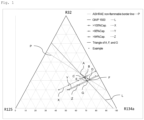
Fig. 1 illustrates a ternary composition diagram for R32, R125, and R134a in which the present compositions of mixtures (in order from biggest to smallest triangular range, a triangle defined by points A, F, and G, a triangle defined by points A, D, and E, and a triangle defined by points A, B, and C) are shown. -
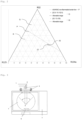
Fig. 2 illustrates a ternary composition diagram for R32, R125, and R134a in which P: ASHRAE non-flammable border line, Q: ASHRAE flammable region, and R: ASHRAE non-flammable region are shown. The diagram also shows the relationship between the allowable range (including an allowable error) set for each refrigerant in the production of a mixed refrigerant and criteria for determining whether the mixed refrigerant is classified as a mixed refrigerant that is non-flammable according to ASHRAE or a mixed refrigerant that is flammable according to ASHRAE. -
Fig. 3 illustrates a schematic view of an apparatus used in a flammability test. - The present composition comprises a mixture containing fluorinated hydrocarbons, the mixture comprising ≥ 99.5 wt.-% of a total of difluoromethane (R32), pentafluoroethane (R125) and 1,1,1,2-tetrafluoroethane (R134a), and the composition ratio of R32, R125 and R134a in the mixture falls within a triangle having the following three points as vertices in a ternary composition diagram (
Fig. 1 ) in which the sum of the concentrations of R32, R125, and R134a is 100 wt%: - point A (R32/R125/R134a = 37.3/17.0/45.7 wt%),
- point F (R32/R125/R134a = 30.7/10.9/58.4 wt%), and
- point G (R32/R125/R134a = 29.4/14.1/56.5 wt%),
- The present composition has, for example, a non-flammability similar to that of R404A, a refrigerating capacity that can replace that of R404A, a COP equal or superior to that of R404A, and a lower GWP than that of R404A.
- More specifically, since the present composition is non-flammable according to ASHRAE like R404A (details of the definition are described later), it is safer than flammable refrigerants and can be used in a wide range of applications.
- The refrigerating capacity of the present composition can replace that of R404A. More specifically, the refrigerating capacity of the present composition is preferably ≥ 94%, more preferably ≥ 95%, and even more preferably ≤ 100%, relative to that of R404A.
- The COP of the present composition is equal or superior to that of R404A (≥ 100%), more preferably ≥ 105, and even more preferably ≥ 110, relative to that of R404A.
- Moreover, the present composition has a GWP of ≤ 1500, and thus can notably reduce a burden on the environment from a global warming perspective compared with other general-purpose refrigerants.
- R404A is a refrigerant currently widely used for freezing and refrigerated storage, and the present composition can be an alternative refrigerant for R404A.
- In the present composition, the mixture described above may consist of three basic components, i.e., difluoromethane (R32), pentafluoroethane (R125), and 1,1,1,2-tetrafluoroethane (R134a), or may comprise one or more components that are different from the three basic components (referred to as "other components") in addition to the three basic components. Hereinafter, difluoromethane (R32), pentafluoroethane (R125), and 1,1,1,2-tetrafluoroethane (R134a) are referred to as "three basic components" and one or more components that are different from the three basic components are referred to as "other components." Other components are described in detail later. The present composition may consist of the mixture, or may comprise any additives described later, such as a refrigerant oil, in addition to the mixture.
- When the mixture contains other components, the mixture preferably contains other components in amounts such that the functions of the three basic components are not impaired. From this viewpoint, the content of other components in the mixture is ≤ 0.5 wt%, preferably ≤ 0.3 wt%, and more preferably ≤ 0.1 wt%.
- in the present composition (Embodiment 1) the composition ratio of the fluorinated hydrocarbons contained in the mixture falling within a triangle having the points A, F and G as vertices in a ternary composition diagram (
Fig. 1 ) in which the sum of the concentrations of R32, R125 and R134a is 100 wt%. - As is described in detail below, in
Fig. 1 , a straight line passing through two points, i.e., point A and point F, shows an ASHRAE non-flammable border line; a straight line passing through two points, i.e., point A and point G, shows a line indicating a composition ratio at which the GWP is 1500; and a straight line passing through two points, i.e., point F and point G, shows a line indicating a composition ratio at which the refrigerating capacity is 94% relative to that of R404A. - In view of improving the refrigerating capacity, preferred embodiments are, the following Embodiments 2 or 3, in which the range of the triangle is smaller than the range of the triangle of
Embodiment 1. - In Embodiment 2, the composition ratio of the fluorinated hydrocarbons contained in the mixture falls within a triangle having the following three points as vertices in a ternary composition diagram (
Fig. 1 ) in which the sum of the concentrations of R32, R125, and R134a is 100 wt%: - point A (R32/R125/R134a = 37.3/17.0/45.7 wt%),
- point D (R32/R125/R134a = 31.4/11.5/57.1 wt%), and
- point E (R32/R125/R134a = 30.2/14.4/55.4 wt%).
- In Embodiment 2, a straight line passing through two points, i.e., point D and point E, shows a line indicating a composition ratio in which the refrigerating capacity is 95% relative to that of R404A.
- In Embodiment 3, the composition ratio of the fluorinated hydrocarbons contained in the mixture falls within a triangle having the following three points as vertices in a ternary composition diagram (
Fig. 1 ) in which the sum of the concentrations of R32, R125, and R134a is 100 wt%: - point A (R32/R125/R134a = 37.3/17.0/45.7 wt%),
- point B (R32/R125/R134a = 34.0/13.9/52.1 wt%), and
- point C (R32/R125/R134a = 33.3/15.5/51.2 wt%).
- In Embodiment 3, a straight line passing through two points, i.e., point B and point C, shows a line indicating a composition ratio at which the refrigerating capacity is 100% relative to that of R404A.
- The technical meaning of each point in
Fig. 1 is described in detail below. - In
Fig. 1 , when the wt% of R32 = x, the wt% of R125 = y, and the wt% of R134a = z, a line segment indicating an ASHRAE non-flammable border line is approximated by a line segment represented by the following equations. - ASHRAE non-flammable border line: a straight line passing through two points, i.e., point A and point F (line segment P of
Fig. 1 )


- The ASHRAE flammability classification of refrigerants is now described.
- The ASHRAE flammability classification of refrigerants is performed based on ANSI/ASHRAE Standard 34-2013. Refrigerants classified as
Class 1 are non-flammable refrigerants. That is, the present composition being non-flammable according to ASHRAE means that the mixture containing fluorinated hydrocarbons used in the present invention (in particular, the three basic components) is classified asClass 1 in flammability classification. - More specifically, a leak test during storage, transportation, and use is performed based on ANSI/ASHRAE 34-2013 to specify the worst case of fractionation for flammability (WCFF). When the WCFF composition can be identified as being non-flammable in a test based on ASTM E681-09 (a standard test method for concentration limits of flammability of chemicals (vapors and gases)), it is classified as
Class 1. - In
Fig. 1 , the R125 side from the line segment AF is classified as a mixed refrigerant that is non-flammable according to ASHRAE, whereas the R32 side from the line segment AF is classified as a mixed refrigerant that is flammable according to ASHRAE (Class 2: slightly flammable mixed refrigerants, Class 3: flammable mixed refrigerants). - However, in the production of a mixed refrigerant, an allowable range (including an allowable error) is set for each refrigerant. Thus, even if the center composition of the mixed refrigerant is on the R125 side from the line segment AF of
Fig. 1 , when the allowable ranges are not all on the R125 side from the line segment AF, the mixed refrigerant is not defined as a mixed refrigerant that is non-flammable according to ASHRAE. - For example, in the case where R32 = (32.5±1) wt%, R125 = (15.0±1) wt%, and R134a = (52.5±2) wt%, all of the allowable ranges are on the R125 side from the line segment AF as shown in
Fig. 2 , and thus, the case is classified as a mixed refrigerant that is non-flammable according to ASHRAE. On the other hand, in the case where R32 = (32.0±1) wt%, R125 = (15.0±1) wt%, and R134a = (55.0±2) wt%, the allowable ranges are partially on the R32 side from the line segment AF, and thus, a mixed refrigerant in which these allowable ranges are set is classified as a mixed refrigerant that is flammable according to ASHRAE. - In
Fig. 1 , when the wt% of R32 = x, the wt% of R125 = y, and the wt% of R134a = z, a line segment indicating a composition ratio at which GWP = 1500 is approximated by a line segment represented by the following equations. - Line segment indicating a composition ratio at which GWP = 1500: a straight line passing through two points, i.e., points A and G (line segment L of
Fig. 1 )


- In addition, line segments indicating composition ratios at which the refrigerating capacity is 94%, 95%, and 100% relative to that of R404A are approximated by line segments represented by the following equations.
- Line segment indicating a composition ratio at which the refrigerating capacity is 94% relative to that of R404A: a straight line passing through two points, i.e., points F and G (line segment Z of
Fig. 1 )

- Line segment indicating a composition ratio at which the refrigerating capacity is 95% relative to that of R404A: a straight line passing through two points, i.e., points D and E (line segment Y of
Fig. 1 )

- Line segment indicating a composition ratio at which the refrigerating capacity is 100% relative to that of R404A: a straight line passing through two points, i.e., points B and C (line segment X of
Fig. 1 )

- The mixture contained in the present composition may further contain a tiny amount of water in addition to the three basic components (R32, R125, and R134a). The amount of water is preferably ≤ 0.1 parts by weight (pbw), per 100 pbw of the mixture. When the mixture contains a tiny amount of water, the double bonds in the molecules of unsaturated fluorinated hydrocarbons that may be contained in the composition can be stably present, and oxidation of unsaturated fluorinated hydrocarbons is less likely to occur, resulting in improved stability of the composition.
- The mixture contained in the present composition may contain other component(s) (fluorinated hydrocarbon(s) that are different from the three basic components) in addition to the three basic components (R32, R125, and R134a). The fluorinated hydrocarbon(s) as other component(s) are not particularly limited, and, are, for example, at least one fluorinated hydrocarbon selected from HCFC-1122, HCFC-124, CFC-1113, and 3,3,3-trifluoropropyne.
- The mixture contained in the present composition may contain, in addition to the three basic components (R32, R125, and R134a), at least one halogenated organic compound of the formula C m H n X p (1), wherein X each independently is F, Cl or Br, m is 1 or 2, p is ≥ 1 and (2m+2) ≥ (n+p), as other component(s). The at least one halogenated organic compound as other component(s) is not particularly limited. Preferable examples include difluorochloromethane, chloromethane, 2-chloro-1,1,1,2,2-pentafluoroethane, 2-chloro-1,1,1,2-tetrafluoroethane, 2-chloro-1,1-difluoroethylene and trifluoroethylene.
- The mixture contained in the present composition may contain, in addition to the three basic components (R32, R125, and R134a), at least one organic compound of the formula C m H n X p (2), wherein X each independently is an atom other than halogen, m is 1 or 2, p is ≥ 1 and (2m+2) ≥ (n+p), as other component(s). The at least one organic compound as other component(s) is not particularly limited. Preferable examples include propane and isobutane.
- As described above, when the mixture contains other components, the content of other components in the mixture, whether other components are used singly or in a combination of two or more, is ≤ 0.5 wt%, preferably ≤ 0.3 wt%, and more preferably ≤ 0.1 wt%, as the total content amount.
- The present composition may appropriately contain various additives in addition to the mixture.
- The present composition may further contain a refrigerant oil. The refrigerant oil is not particularly limited and can be suitably selected from commonly used refrigerant oils. In this case, a refrigerant oil that is more excellent in terms of, for example, the effect of improving miscibility with the mixture and stability of the mixture, may be appropriately selected, if necessary.
- Although there is no particular limitation, the stability of the mixture can be evaluated by a commonly used method. Examples of such methods include an evaluation method using the amount of free fluorine ions as an index according to ASHRAE Standard 97-2007, and the like. There is, for example, another evaluation method using the total acid number as an index. This method can be performed, for example, according to ASTM D 974-06.
- Preferred as the type of the refrigerant oil is, specifically, for example, at least one member selected from the group consisting of polyalkylene glycol (PAG), polyol ester (POE), and polyvinyl ether (PVE).
- The refrigerant oil to be used may have, for example, a kinematic viscosity at 40°C of 5-400 cSt. When the refrigerant oil has a kinematic viscosity within this range, it is preferable in terms of lubricity.
- The concentration of the refrigerant oil is not particularly limited, and may be generally 10-50 wt%, relative to the entire composition.
- The present composition may further contain one or more tracers. The one or more tracers are added to the present composition at a detectable concentration so that, when the present composition is diluted, contaminated, or undergoes any other change, the change can be traced. There is no limitation on the tracers. Preferable examples include hydrofluorocarbons, deuterated hydrocarbons, deuterated hydrofluorocarbons, perfluorocarbons, fluoroethers, brominated compounds, iodinated compounds, alcohols, aldehydes, ketones and nitrous oxide (N2O). Particularly preferred are hydrofluorocarbons or fluoroethers.
- The present composition may further contain a compatibilizer. The type of compatibilizer is not particularly limited. Preferable examples include polyoxyalkylene glycol ethers, amides, nitriles, ketones, chlorocarbons, esters, lactones, aryl ethers, fluoroethers and 1,1,1-trifluoroalkans. Particularly preferred are polyoxyalkylene glycol ethers.
- The present composition may further contain one or more ultraviolet fluorescent dyes. There is no limitation on the ultraviolet fluorescent dyes. Preferable examples include naphthalimide, coumarin, anthracene, phenanthrene, xanthene, thioxanthene, naphthoxanthene, and fluorescein, and derivatives thereof. Either naphthalimide or coumarin, or both are particularly preferable.
- The present composition may further contain, for example, a stabilizer and a polymerization inhibitor, if necessary.
- Examples of stabilizers include, but are not particularly limited to, (i) aliphatic nitro compounds, such as nitromethane and nitroethane; and aromatic nitro compounds, such as nitrobenzene and nitrostyrene; (ii) ethers, such as 1,4-dioxane; amines, such as 2,2,3,3,3-pentafluoropropylamine and diphenylamine; butylhydroxyxylene and benzotriazole. The stabilizers can be used singly or in a combination of two or more.
- The concentration of the stabilizer varies depending on the type of stabilizer, but can be determined within a range in which the properties of the composition are not impaired. The concentration of the stabilizer is generally preferably 0.01-5 pbw, and more preferably 0.05-2 pbw, per 100 pbw of the mixture.
- Examples of polymerization inhibitors include, but are not particularly limited to, 4-methoxy-1-naphthol, hydroquinone, hydroquinonemethyl ether, dimethyl-t-butylphenol, 2,6-di-tert-butyl-p-cresol and benzotriazole.
- The concentration of the polymerization inhibitor is generally preferably 0.01-5 pbw, and more preferably 0.05-2 pbw, per 100 pbw of the mixture.
- In one embodiment of the present invention, an object can be refrigerated by a method comprising the step of operating a refrigeration cycle using the present composition. For example, the present composition can be circulated via a compressor to form the refrigeration cycle.
- It is also possible to produce an apparatus for forming a refrigeration cycle in which the present composition is circulated via a compressor.
- Examples of refrigerating devices that can use the present composition include, but are not limited to, refrigerators, freezers, water coolers, ice machines, refrigerating showcases, freezing showcases, freezing and refrigerating units, refrigerating devices used, for example, for freezing and refrigerating warehouses, chillers (chilling units), turbo refrigerators and screw refrigerators.
- The method for producing the present composition comprises mixing R32, R125, and R134a such that the composition ratio thereof is adjusted to fall within a triangle having the following three points as vertices in a ternary composition diagram (
Fig. 1 ) in which the sum of the concentrations of R32, R125, and R134a is 100 wt%: - point A (R32/R125/R134a = 37.3/17.0/45.7 wt%),
- point F (R32/R125/R134a = 30.7/10.9/58.4 wt%), and
- point G (R32/R125/R134a = 29.4/14.1/56.5 wt%).
- The method for producing the composition of present Embodiment 2 comprises mixing R32, R125, and R134a such that the composition ratio thereof is adjusted to fall within a triangle having the following three points as vertices in a ternary composition diagram (
Fig. 1 ) in which the sum of the concentrations of R32, R125, and R134a is 100 wt%: - point A (R32/R125/R134a = 37.3/17.0/45.7 wt%),
- point D (R32/R125/R134a = 31.4/11.5/57.1 wt%), and
- point E (R32/R125/R134a = 30.2/14.4/55.4 wt%).
- The method for producing the composition of present Embodiment 3 comprises mixing R32, R125, and R134a such that the composition ratio thereof is adjusted to fall within a triangle having the following three points as vertices in a ternary composition diagram (
Fig. 1 ) in which the sum of the concentrations of R32, R125, and R134a is 100 wt%: - point A (R32/R125/R134a = 37.3/17.0/45.7 wt%),
- point B (R32/R125/R134a = 34.0/13.9/52.1 wt%), and
- point C (R32/R125/R134a = 33.3/15.5/51.2 wt%).
- The compositions of Embodiments 1-3 can be produced by the above methods.
- The present invention is described in detail below with reference to Examples.
- The GWP of each of R404A and mixed refrigerants of R32, R125, and R134a was evaluated based on the values described in the Intergovernmental Panel on Climate Change (IPCC) fourth report.
- The COP and refrigerating capacity of each of R404A and the mixed refrigerants of R32, R125, and R134a were determined by performing refrigeration cycle theoretical calculations for the refrigerant and mixed refrigerants using the National Institute of Science and Technology (NIST) and Reference Fluid Thermodynamic and Transport Properties Database (Refprop 9.0) under the following conditions.
- Evaporation temperature -40°C
-
Condensation temperature 40°C - Superheating temperature 20K
- Supercooling temperature 0K
-
Compressor efficiency 70% - In
Fig. 1 , the proportions of the components of the compositions of the Examples are indicated by solid triangles (▲). - Tables 1 and 2 show the GWP, COP, and refrigerating capacity calculated based on these results. Regarding the COP and refrigerating capacity, the percentages relative to those of R404A are shown.
- The coefficient of performance (COP) was calculated according to the following equation.
COP = (refrigerating capacity or heating capacity) / amount of electrical power consumed - The flammability of the mixture of the three basic components used in the composition was evaluated according to U.S. ASHRAE Standard 34-2013. The flammability test was conducted in accordance with ASTM E681-09.
Fig. 2 shows a non-flammable border line (P), a flammable region (Q), and a non-flammable region (R). - A 12-L spherical glass flask was used so that the combustion state could be visually observed and photographically recorded. When excessive pressure was generated by combustion, gas was allowed to escape from the upper lid. Ignition was achieved by electric discharge from electrodes disposed at one-third the distance from the bottom.
-
- Test vessel: 280 mm ϕ spherical (internal volume: 12 liters)
- Test temperature: (60±3)°C
- Pressure: (101.3±0.7) kPa
- Water: (0.0088±0.0005) g per gram of dry air
- Mixing ratio of composition/air: 1 vol.% increments ±0.2 vol.% Composition mixture: ±0.1 wt%
- Ignition method: AC discharge, voltage: 15 kV, electric current: 30 mA, neon transformer
- Electrode spacing: 6.4 mm (1/4 inch)
- Spark: (0.4±0.05) seconds
- Evaluation criteria: When the flame propagation extends at an angle of > 90° from the ignition point, it was evaluated as flammable.
- The composition ratio of R32, R125, and R134a (x/y/z wt%) in the non-flammability limit almost satisfied the relationship of the following equations (1)-(3).


- The results revealed that the present composition is non-flammable, and causes no combustion, even when mixed with air at any ratio.
Table 1 Item Unit R404A Example 1 Reference Example 2 Reference Example 3 Reference Example 4 5 6 7 8 9 Reference Example 10 Reference Example 11 Reference Example 12 Reference Example 13 Reference Example Point A Within ΔABC Point B Point C Within ΔADE Within ΔADE Within ΔADE Within ΔADE Within ΔADE Point D Point E Point F Point G Composition R32 mass % 0 37.3 34.0 34.0 33.3 32.5 32.5 33.0 33.0 32.0 31.4 30.2 30.7 29.4 R125 mass % 44.0 17.0 15.0 13.9 15.5 14.5 15.0 14.5 15.0 13.0 11.5 14.4 10.9 14.1 R134a mass % 4.0 45.7 51.0 52.1 51.2 53.0 52.5 52.5 52.0 55.0 57.1 55.4 58.4 56.5 R143a mass % 52.0 0 0 0 0 0 0 0 0 0 0 0 0 0 GWP year 3922 1500 1484 1461 1500 1485 1495 1481 1491 1458 1431 1500 1424 1500 Performance Coefficient of performance % (relative to that of R404A) 100 111 112 112 112 112 112 112 112 112 112 112 112 112 Refrigerating capacity % (relative to that of R404A) 100 106 101 100 100 98 99 99 99 97 95 95 94 94 Flammable/non-flammable - nonflammable nonflammable nonflammable nonflammable nonflammable nonflammable nonflammable nonflammable nonflammable nonflammable nonflammable nonflammable nonflammable nonflammable Table 2 Item Unit R404A Comparative Example 1 2 3 4 5 6 7 8 9 10 11 12 Composition R32 mass % 0 20.0 25.0 30.0 35.0 40.0 20.0 25.0 30.0 35.0 20.0 25.0 35.0 R125 mass % 44.0 47.0 35.0 23.0 11.7 1.0 38.5 26.5 14.5 3.0 37.0 24.5 1.0 R134a mass % 4.0 33.0 40.0 47.0 53.3 59.0 41.5 48.5 55.5 62.0 43.0 50.5 64.0 R143a mass % 52.0 0 0 0 0 0 0 0 0 0 0 0 0 GWP year 3922 2252 1966 1680 1408 1149 2076 1790 1504 1228 2045 1748 1186 Performance Coefficient of performance % (relative to that of R404A ) 100 107 109 111 112 113 109 110 112 113 109 111 113 Refrigerating capacity % (relative to that of R404A ) 100 100 100 100 100 100 95 95 95 95 94 94 94 Flarrmable/nonflammable - nonflammable nonflammable nonflammable nonflammable flammable flammable nonflammable nonflammable nonflammable flammable nonflammable nonflammable flammable - In Comparative Examples 1-5, compositions having composition ratios at which the refrigerating capacity was 100% relative to that of R404A were obtained. The compositions of Comparative Examples 1-3 had a GWP of > 1500, and the compositions of Comparative Examples 4 and 5 were flammable.
- In Comparative Examples 6-9, compositions having composition ratios at which the refrigerating capacity was 95% relative to that of R404A were obtained. The compositions of Comparative Examples 6-8 had a GWP of > 1500, and the composition of Comparative Example 9 was flammable.
- In Comparative Examples 10-12, compositions having composition ratios at which the refrigerating capacity was 94% relative to that of R404A were obtained. The compositions of Comparative Examples 10 and 11 had a GWP of > 1500, and the composition of Comparative Example 12 was flammable.
-
- A: Composition ratio of Example 1
- B: Composition ratio of Example 3
- C: Composition ratio of Example 4
- D: Composition ratio of Example 10
- E: Composition ratio of Example 11
- F: Composition ratio of Example 12
- G: Composition ratio of Example 13
- L: Approximation line segment of line segment indicating GWP = 1500
- X: Approximation line segment of line segment indicating a composition ratio at which the refrigerating capacity is 100% (relative to that of R404A)
- Y: Approximation line segment of line segment indicating a composition ratio at which the refrigerating capacity is 95% (relative to that of R404A)
- Z: Approximation line segment of line segment indicating a composition ratio at which the refrigerating capacity is 94% (relative to that of R404A)
- P: ASHRAE non-flammable border line
- Q: ASHRAE flammable region
- R: ASHRAE non-flammable region
- 1: Ignition source
- 2: Sample inlet
- 3: Springs
- 4: 12-liter glass flask
- 5: Electrodes
- 6: Stirrer
- 7: Insulated chamber
Claims (13)
- A composition comprising a mixture containing fluorinated hydrocarbons, the mixture comprising ≥ 99.5 wt.-% of a total of difluoromethane (R32), pentafluoroethane (R125) and 1,1,1,2-tetrafluoroethane (R134a), and the composition ratio of R32, R125 and R134a in the mixture falls within a triangle having the points A, F and G as vertices in a ternary composition diagram in which the sum of R32, R125 and R134a is 100 wt.-%:A: R32/R125/R134a = 37.3/17.0/45.7 wt%F: R32/R125/R134a = 30.7/10.9/58.4 wt%G: R32/R125/R134a = 29.4/14.1/56.5 wt%,wherein the composition ratio of R32, R125 and R134a in the mixture is in the ranges of (32.5±1) wt.-% R32, (15.0±1) wt.-% R125 and (52.5±2) wt.-% R134a.
- The composition of claim 1, wherein the mixture further comprises at least one of HCFC-1122, HCFC-124, CFC-1113, and 3,3,3-trifluoropropyne.
- The composition of claim 1 or 2, wherein the mixture further comprises at least one halogenated organic compound of the formula C m H n X p (1), wherein X each independently is F, Cl or Br, m is 1 or 2, p is ≥ 1 and (2m+2) ≥ (n+p).
- The composition of any of claims 1-3, wherein the mixture further comprises water.
- The composition of claim 1, wherein the mixture consists of R32, R125, and R134a.
- The composition of any of claims 1-5, wherein the mixture has a GWP of ≤ 1500, and the refrigerating capacity of the mixture is ≥ 94% relative to that of R404A.
- The composition of any of claims 1-6, comprising a refrigerant oil.
- The composition of claim 7, wherein the refrigerant oil comprises at least one polymer selected from polyalkylene glycol (PAG), polyol ester (POE), and polyvinyl ether (PVE).
- The composition of any of claims 1-8, comprising at least one substance selected from tracers, compatibilizers, ultraviolet fluorescent dyes, stabilizers, and polymerization inhibitors.
- The use of the composition of any of claims 1-9 in at least one of refrigerators, freezers, water coolers, ice machines, refrigerating showcases, freezing showcases, freezing and refrigerating units, refrigerating devices for freezing and refrigerating warehouses, chillers (chilling units), turbo refrigerators, and screw refrigerators.
- A refrigeration method comprising operating a refrigeration cycle using the composition of any of claims 1-9.
- A refrigerating device comprising the composition of any of claims 1-9.
- A method for producing a composition as defined in claim 1, comprising mixing R32, R125 and R134a in the specified ratios and amounts.
Priority Applications (3)
| Application Number | Priority Date | Filing Date | Title |
|---|---|---|---|
| HRP20220209TT HRP20220209T4 (en) | 2015-02-19 | 2016-01-22 | COMPOSITION CONTAINING A MIXTURE OF FLUORINATED HYDROCARBONS AND METHOD OF PRODUCTION OF THE SAME |
| SI201631445T SI3536760T2 (en) | 2015-02-19 | 2016-01-22 | Composition containing mixture of fluorinated hydrocarbons, and method for producing same |
| PL19164021.8T PL3536760T5 (en) | 2015-02-19 | 2016-01-22 | Composition containing mixture of fluorinated hydrocarbons, and method for producing same |
Applications Claiming Priority (3)
| Application Number | Priority Date | Filing Date | Title |
|---|---|---|---|
| JP2015030991 | 2015-02-19 | ||
| PCT/JP2016/051888 WO2016132818A1 (en) | 2015-02-19 | 2016-01-22 | Composition containing mixture of fluorinated hydrocarbons, and method for producing same |
| EP16752207.7A EP3141587B1 (en) | 2015-02-19 | 2016-01-22 | Composition containing mixture of fluorinated hydrocarbons, and method for producing same |
Related Parent Applications (2)
| Application Number | Title | Priority Date | Filing Date |
|---|---|---|---|
| EP16752207.7A Division EP3141587B1 (en) | 2015-02-19 | 2016-01-22 | Composition containing mixture of fluorinated hydrocarbons, and method for producing same |
| EP16752207.7A Division-Into EP3141587B1 (en) | 2015-02-19 | 2016-01-22 | Composition containing mixture of fluorinated hydrocarbons, and method for producing same |
Publications (3)
| Publication Number | Publication Date |
|---|---|
| EP3536760A1 EP3536760A1 (en) | 2019-09-11 |
| EP3536760B1 EP3536760B1 (en) | 2021-11-24 |
| EP3536760B2 true EP3536760B2 (en) | 2024-09-04 |
Family
ID=56688794
Family Applications (2)
| Application Number | Title | Priority Date | Filing Date |
|---|---|---|---|
| EP16752207.7A Active EP3141587B1 (en) | 2015-02-19 | 2016-01-22 | Composition containing mixture of fluorinated hydrocarbons, and method for producing same |
| EP19164021.8A Active EP3536760B2 (en) | 2015-02-19 | 2016-01-22 | Composition containing mixture of fluorinated hydrocarbons, and method for producing same |
Family Applications Before (1)
| Application Number | Title | Priority Date | Filing Date |
|---|---|---|---|
| EP16752207.7A Active EP3141587B1 (en) | 2015-02-19 | 2016-01-22 | Composition containing mixture of fluorinated hydrocarbons, and method for producing same |
Country Status (16)
| Country | Link |
|---|---|
| US (1) | US10005940B2 (en) |
| EP (2) | EP3141587B1 (en) |
| JP (2) | JP6020749B2 (en) |
| KR (1) | KR101918435B1 (en) |
| CN (1) | CN107250316B (en) |
| AU (1) | AU2016221082B2 (en) |
| ES (2) | ES2732502T3 (en) |
| HR (2) | HRP20220209T4 (en) |
| HU (2) | HUE057415T2 (en) |
| MY (1) | MY182105A (en) |
| PH (1) | PH12017501269B1 (en) |
| PL (2) | PL3536760T5 (en) |
| SG (1) | SG11201706415VA (en) |
| SI (2) | SI3141587T1 (en) |
| TR (1) | TR201910892T4 (en) |
| WO (1) | WO2016132818A1 (en) |
Families Citing this family (19)
| Publication number | Priority date | Publication date | Assignee | Title |
|---|---|---|---|---|
| WO2016132818A1 (en) | 2015-02-19 | 2016-08-25 | ダイキン工業株式会社 | Composition containing mixture of fluorinated hydrocarbons, and method for producing same |
| JP6315071B1 (en) * | 2016-11-28 | 2018-04-25 | ダイキン工業株式会社 | Method for transferring and filling refrigerant composition |
| JP6841066B2 (en) * | 2017-02-03 | 2021-03-10 | ダイキン工業株式会社 | A method of using a mixture of fluorinated hydrocarbons as a refrigerant, and a refrigerating device using the mixture as a refrigerant. |
| JP6504298B2 (en) * | 2017-04-21 | 2019-04-24 | ダイキン工業株式会社 | Composition containing refrigerant and application thereof |
| CN107011864A (en) * | 2017-05-03 | 2017-08-04 | 南通长江电器实业有限公司 | A kind of refrigerant motor high-efficiency environment friendly cooling medium |
| US11286409B2 (en) * | 2017-12-07 | 2022-03-29 | Daikin Industries, Ltd. | Composition containing refrigerant including R32, R125, R143a and R134a, and refrigeration method using said composition, method for operating refrigerator, and refrigerator |
| JPWO2019123898A1 (en) * | 2017-12-18 | 2020-12-10 | ダイキン工業株式会社 | Refrigerant oil for refrigerants or refrigerant compositions, how to use refrigerating machine oil, and use as refrigerating machine oil |
| US20230002659A1 (en) * | 2017-12-18 | 2023-01-05 | Daikin Industries, Ltd. | Composition containing refrigerant, use of said composition, refrigerator having said composition, and method for operating said refrigerator |
| JP6729626B2 (en) | 2018-04-18 | 2020-07-22 | ダイキン工業株式会社 | Composition containing refrigerant containing R32, R125, R143a, R1234yf and R134a, and refrigeration method, refrigerator operation method and refrigerator using the composition |
| EP3783081B1 (en) * | 2018-04-19 | 2024-06-12 | Daikin Industries, Ltd. | Composition containing refrigerant and application thereof |
| EP3922922B1 (en) * | 2019-02-05 | 2026-04-15 | Daikin Industries, Ltd. | Refrigerant-containing composition, and refrigerating method, refrigerating device operating method, and refrigerating device using said composition |
| KR20250040742A (en) * | 2019-02-07 | 2025-03-24 | 다이킨 고교 가부시키가이샤 | Composition containing trans-1,2-difluoroethylene (hfo-1132(e)) and 1,1,1-trifluoroethane (hfc-143a) and method for separating hfo-1132(e) and hfc-143a from composition containing hfo-1132(e) and hfc-143a |
| CN113840892B (en) * | 2019-04-25 | 2024-04-16 | 大金工业株式会社 | Refrigerant containing fluorocarbon and carbon dioxide, use thereof, refrigerator having the same, and method for operating the refrigerator |
| KR102842088B1 (en) | 2019-06-05 | 2025-08-04 | 삼성전자주식회사 | Server, heat pump system and method for authenticating installation of heat pump system |
| CN114008172A (en) | 2019-06-19 | 2022-02-01 | 大金工业株式会社 | Refrigerant-containing composition, use thereof, refrigerator having the composition, and method for operating the refrigerator |
| WO2020256119A1 (en) * | 2019-06-19 | 2020-12-24 | ダイキン工業株式会社 | Refrigerant-containing composition, use thereof, refrigerator having same, operation method for said refrigerator, and refrigeration cycle device equipped with said refrigerator |
| JP6879410B2 (en) * | 2019-06-19 | 2021-06-02 | ダイキン工業株式会社 | A composition containing a refrigerant, its use, a refrigerator having it, and a method of operating the refrigerator. |
| WO2020256109A1 (en) | 2019-06-19 | 2020-12-24 | ダイキン工業株式会社 | Composition containing refrigerant, use of same, refrigerator comprising same, and method for operating said refrigerator |
| ES2971432T3 (en) * | 2019-12-16 | 2024-06-05 | Angelantoni Test Tech S R L In Short Att S R L | Refrigerant |
Citations (9)
| Publication number | Priority date | Publication date | Assignee | Title |
|---|---|---|---|---|
| EP0451692A2 (en) † | 1990-04-04 | 1991-10-16 | Daikin Industries, Limited | Refrigerant |
| EP0509673A1 (en) † | 1991-04-18 | 1992-10-21 | Imperial Chemical Industries Plc | Refrigerant compositions |
| WO2005049759A1 (en) † | 2003-11-13 | 2005-06-02 | E.I. Dupont De Nemours And Company | Detectable refrigerant compositions and uses thereof |
| WO2009105512A1 (en) † | 2008-02-21 | 2009-08-27 | E. I. Du Pont De Nemours And Company | Processes for separation of 2,3,3,3-tetrafluoropropene from hydrogen fluoride by azeotropic distillation |
| US20090278075A1 (en) † | 2008-05-07 | 2009-11-12 | E. I. Du Pont De Nemours And Company | Compositions comprising 1,1,1,2,3-pentafluoropropane or 2,3,3,3- tetrafluoropropene |
| WO2010042781A2 (en) † | 2008-10-10 | 2010-04-15 | E. I. Du Pont De Nemours And Company | Compositions comprising 2,3,3,3-tetrafluoropropene, 2-chloro-2,3,3,3-tetrafluoropropanol, 2-chloro-2,3,3,3-tetrafluoro-propyl acetate or zinc (2-chloro-2,3,3,3-tetrafluoropropoxy) chloride |
| WO2010129416A2 (en) † | 2009-05-08 | 2010-11-11 | Brian Johnson | Media display apparatus |
| EP2308941A1 (en) † | 2009-10-06 | 2011-04-13 | Honeywell International Inc. | Refrigerant compositions and use thereof in low temperature refrigeration systems |
| WO2015083834A1 (en) † | 2013-12-06 | 2015-06-11 | ダイキン工業株式会社 | Composition including difluoromethane (hfc-32), pentafluoroethane (hfc-125), and 1,1,1,2-tetrafluoroethane (hfc-134a) |
Family Cites Families (14)
| Publication number | Priority date | Publication date | Assignee | Title |
|---|---|---|---|---|
| JPH0517753A (en) * | 1991-07-12 | 1993-01-26 | Matsushita Electric Ind Co Ltd | Working fluid |
| JPH06256757A (en) * | 1993-03-04 | 1994-09-13 | Daikin Ind Ltd | Cooling medium for air conditioner |
| US6018952A (en) * | 1995-04-18 | 2000-02-01 | Daikin Industries, Ltd. | Method for charging refrigerant blend |
| JP2795224B2 (en) * | 1995-07-20 | 1998-09-10 | ダイキン工業株式会社 | Coolant |
| JP2869038B2 (en) * | 1996-06-05 | 1999-03-10 | 松下電器産業株式会社 | Heat pump device using ternary mixed refrigerant |
| US6783691B1 (en) * | 1999-03-22 | 2004-08-31 | E.I. Du Pont De Nemours And Company | Compositions of difluoromethane, pentafluoroethane, 1,1,1,2-tetrafluoroethane and hydrocarbons |
| US7704404B2 (en) | 2003-07-17 | 2010-04-27 | Honeywell International Inc. | Refrigerant compositions and use thereof in low temperature refrigeration systems |
| FR2892125B1 (en) * | 2005-10-14 | 2010-07-30 | Arkema | COMPOSITION BASED ON HYDROFLUOROCARBONS |
| FR2936806B1 (en) | 2008-10-08 | 2012-08-31 | Arkema France | REFRIGERANT FLUID |
| CN102439108A (en) | 2009-05-08 | 2012-05-02 | 霍尼韦尔国际公司 | Hydrofluorocarbon refrigerant compositions for heat pump water heaters |
| GB0922288D0 (en) | 2009-12-21 | 2010-02-03 | Rpl Holdings Ltd | Non ozone depleting and low global warming potential refrigerants for refrigeration |
| GB2481443B (en) * | 2010-06-25 | 2012-10-17 | Mexichem Amanco Holding Sa | Heat transfer compositions |
| JP5767370B2 (en) * | 2014-06-27 | 2015-08-19 | Jx日鉱日石エネルギー株式会社 | Refrigerator oil and working fluid composition for refrigerator |
| WO2016132818A1 (en) | 2015-02-19 | 2016-08-25 | ダイキン工業株式会社 | Composition containing mixture of fluorinated hydrocarbons, and method for producing same |
-
2016
- 2016-01-22 WO PCT/JP2016/051888 patent/WO2016132818A1/en not_active Ceased
- 2016-01-22 TR TR2019/10892T patent/TR201910892T4/en unknown
- 2016-01-22 HR HRP20220209TT patent/HRP20220209T4/en unknown
- 2016-01-22 SI SI201630328T patent/SI3141587T1/en unknown
- 2016-01-22 HR HRP20191397 patent/HRP20191397T1/en unknown
- 2016-01-22 MY MYPI2017702801A patent/MY182105A/en unknown
- 2016-01-22 KR KR1020177022715A patent/KR101918435B1/en active Active
- 2016-01-22 AU AU2016221082A patent/AU2016221082B2/en active Active
- 2016-01-22 CN CN201680010685.5A patent/CN107250316B/en active Active
- 2016-01-22 JP JP2016010509A patent/JP6020749B2/en active Active
- 2016-01-22 SI SI201631445T patent/SI3536760T2/en unknown
- 2016-01-22 PL PL19164021.8T patent/PL3536760T5/en unknown
- 2016-01-22 EP EP16752207.7A patent/EP3141587B1/en active Active
- 2016-01-22 EP EP19164021.8A patent/EP3536760B2/en active Active
- 2016-01-22 HU HUE19164021A patent/HUE057415T2/en unknown
- 2016-01-22 SG SG11201706415VA patent/SG11201706415VA/en unknown
- 2016-01-22 PL PL16752207T patent/PL3141587T3/en unknown
- 2016-01-22 HU HUE16752207A patent/HUE045910T2/en unknown
- 2016-01-22 ES ES16752207T patent/ES2732502T3/en active Active
- 2016-01-22 ES ES19164021T patent/ES2901636T5/en active Active
- 2016-09-21 JP JP2016183865A patent/JP6249067B2/en active Active
-
2017
- 2017-01-13 US US15/405,427 patent/US10005940B2/en active Active
- 2017-07-11 PH PH12017501269A patent/PH12017501269B1/en unknown
Patent Citations (9)
| Publication number | Priority date | Publication date | Assignee | Title |
|---|---|---|---|---|
| EP0451692A2 (en) † | 1990-04-04 | 1991-10-16 | Daikin Industries, Limited | Refrigerant |
| EP0509673A1 (en) † | 1991-04-18 | 1992-10-21 | Imperial Chemical Industries Plc | Refrigerant compositions |
| WO2005049759A1 (en) † | 2003-11-13 | 2005-06-02 | E.I. Dupont De Nemours And Company | Detectable refrigerant compositions and uses thereof |
| WO2009105512A1 (en) † | 2008-02-21 | 2009-08-27 | E. I. Du Pont De Nemours And Company | Processes for separation of 2,3,3,3-tetrafluoropropene from hydrogen fluoride by azeotropic distillation |
| US20090278075A1 (en) † | 2008-05-07 | 2009-11-12 | E. I. Du Pont De Nemours And Company | Compositions comprising 1,1,1,2,3-pentafluoropropane or 2,3,3,3- tetrafluoropropene |
| WO2010042781A2 (en) † | 2008-10-10 | 2010-04-15 | E. I. Du Pont De Nemours And Company | Compositions comprising 2,3,3,3-tetrafluoropropene, 2-chloro-2,3,3,3-tetrafluoropropanol, 2-chloro-2,3,3,3-tetrafluoro-propyl acetate or zinc (2-chloro-2,3,3,3-tetrafluoropropoxy) chloride |
| WO2010129416A2 (en) † | 2009-05-08 | 2010-11-11 | Brian Johnson | Media display apparatus |
| EP2308941A1 (en) † | 2009-10-06 | 2011-04-13 | Honeywell International Inc. | Refrigerant compositions and use thereof in low temperature refrigeration systems |
| WO2015083834A1 (en) † | 2013-12-06 | 2015-06-11 | ダイキン工業株式会社 | Composition including difluoromethane (hfc-32), pentafluoroethane (hfc-125), and 1,1,1,2-tetrafluoroethane (hfc-134a) |
Non-Patent Citations (2)
| Title |
|---|
| "Specifications for Fluorocarbon Refrigerants", AHRI STANDARD 700, 1 January 2012 (2012-01-01), pages 1 - 17 † |
| ARI: "SPECIFICATIONS FOR FLUOROCARBON REFRIGERANTS", AIR-CONDITIONING AND REFRIGERATION INSTITUTE (ARI) STANDARD 700, 1 January 2006 (2006-01-01), pages 1 - 15 † |
Also Published As
Similar Documents
| Publication | Publication Date | Title |
|---|---|---|
| EP3141587B1 (en) | Composition containing mixture of fluorinated hydrocarbons, and method for producing same | |
| EP3922922B1 (en) | Refrigerant-containing composition, and refrigerating method, refrigerating device operating method, and refrigerating device using said composition | |
| US11034871B2 (en) | Composition containing refrigerant and application of said composition | |
| EP3812442B1 (en) | Composition containing refrigerant, use thereof, refrigerator having same, and operation method for said refrigerator | |
| US11773307B2 (en) | Refrigerant-containing composition, use thereof, refrigerating method using same, and refrigerator comprising same | |
| JP2020122134A (en) | Composition containing coolant, as well as, refrigeration method using the composition, operation method of refrigerator and refrigerator | |
| CN117210201A (en) | Compositions containing mixtures of fluorocarbons and uses thereof | |
| EP3382299A1 (en) | Method for using fluorinated hydrocarbon mixture as refrigerant, and refrigeration apparatus in which said mixture is used as refrigerant | |
| EP3783082A1 (en) | Composition containing refrigerant comprising r32, r125, r143a, r1234yf and r134a, and refrigeration method, refrigerator operating method and refrigerator using said composition | |
| WO2017171090A1 (en) | Composition containing fluorinated hydrocarbon mixture, and application for same | |
| JP6658948B2 (en) | Composition containing refrigerant, refrigeration method using the composition, method of operating refrigeration apparatus, and refrigeration apparatus |
Legal Events
| Date | Code | Title | Description |
|---|---|---|---|
| REG | Reference to a national code |
Ref country code: HR Ref legal event code: TUEP Ref document number: P20220209 Country of ref document: HR |
|
| PUAI | Public reference made under article 153(3) epc to a published international application that has entered the european phase |
Free format text: ORIGINAL CODE: 0009012 |
|
| STAA | Information on the status of an ep patent application or granted ep patent |
Free format text: STATUS: THE APPLICATION HAS BEEN PUBLISHED |
|
| AC | Divisional application: reference to earlier application |
Ref document number: 3141587 Country of ref document: EP Kind code of ref document: P |
|
| AK | Designated contracting states |
Kind code of ref document: A1 Designated state(s): AL AT BE BG CH CY CZ DE DK EE ES FI FR GB GR HR HU IE IS IT LI LT LU LV MC MK MT NL NO PL PT RO RS SE SI SK SM TR |
|
| STAA | Information on the status of an ep patent application or granted ep patent |
Free format text: STATUS: REQUEST FOR EXAMINATION WAS MADE |
|
| 17P | Request for examination filed |
Effective date: 20191203 |
|
| RBV | Designated contracting states (corrected) |
Designated state(s): AL AT BE BG CH CY CZ DE DK EE ES FI FR GB GR HR HU IE IS IT LI LT LU LV MC MK MT NL NO PL PT RO RS SE SI SK SM TR |
|
| STAA | Information on the status of an ep patent application or granted ep patent |
Free format text: STATUS: EXAMINATION IS IN PROGRESS |
|
| 17Q | First examination report despatched |
Effective date: 20210210 |
|
| GRAP | Despatch of communication of intention to grant a patent |
Free format text: ORIGINAL CODE: EPIDOSNIGR1 |
|
| STAA | Information on the status of an ep patent application or granted ep patent |
Free format text: STATUS: GRANT OF PATENT IS INTENDED |
|
| INTG | Intention to grant announced |
Effective date: 20210716 |
|
| GRAS | Grant fee paid |
Free format text: ORIGINAL CODE: EPIDOSNIGR3 |
|
| GRAA | (expected) grant |
Free format text: ORIGINAL CODE: 0009210 |
|
| STAA | Information on the status of an ep patent application or granted ep patent |
Free format text: STATUS: THE PATENT HAS BEEN GRANTED |
|
| AC | Divisional application: reference to earlier application |
Ref document number: 3141587 Country of ref document: EP Kind code of ref document: P |
|
| AK | Designated contracting states |
Kind code of ref document: B1 Designated state(s): AL AT BE BG CH CY CZ DE DK EE ES FI FR GB GR HR HU IE IS IT LI LT LU LV MC MK MT NL NO PL PT RO RS SE SI SK SM TR |
|
| REG | Reference to a national code |
Ref country code: GB Ref legal event code: FG4D |
|
| REG | Reference to a national code |
Ref country code: AT Ref legal event code: REF Ref document number: 1449876 Country of ref document: AT Kind code of ref document: T Effective date: 20211215 |
|
| REG | Reference to a national code |
Ref country code: DE Ref legal event code: R096 Ref document number: 602016066711 Country of ref document: DE |
|
| REG | Reference to a national code |
Ref country code: IE Ref legal event code: FG4D |
|
| REG | Reference to a national code |
Ref country code: NL Ref legal event code: FP |
|
| REG | Reference to a national code |
Ref country code: GR Ref legal event code: EP Ref document number: 20210403277 Country of ref document: GR Effective date: 20220113 |
|
| REG | Reference to a national code |
Ref country code: RO Ref legal event code: EPE |
|
| REG | Reference to a national code |
Ref country code: ES Ref legal event code: FG2A Ref document number: 2901636 Country of ref document: ES Kind code of ref document: T3 Effective date: 20220323 |
|
| REG | Reference to a national code |
Ref country code: LT Ref legal event code: MG9D |
|
| REG | Reference to a national code |
Ref country code: HR Ref legal event code: ODRP Ref document number: P20220209 Country of ref document: HR Payment date: 20220218 Year of fee payment: 7 |
|
| PG25 | Lapsed in a contracting state [announced via postgrant information from national office to epo] |
Ref country code: RS Free format text: LAPSE BECAUSE OF FAILURE TO SUBMIT A TRANSLATION OF THE DESCRIPTION OR TO PAY THE FEE WITHIN THE PRESCRIBED TIME-LIMIT Effective date: 20211124 Ref country code: LT Free format text: LAPSE BECAUSE OF FAILURE TO SUBMIT A TRANSLATION OF THE DESCRIPTION OR TO PAY THE FEE WITHIN THE PRESCRIBED TIME-LIMIT Effective date: 20211124 Ref country code: FI Free format text: LAPSE BECAUSE OF FAILURE TO SUBMIT A TRANSLATION OF THE DESCRIPTION OR TO PAY THE FEE WITHIN THE PRESCRIBED TIME-LIMIT Effective date: 20211124 |
|
| REG | Reference to a national code |
Ref country code: HR Ref legal event code: T1PR Ref document number: P20220209 Country of ref document: HR |
|
| REG | Reference to a national code |
Ref country code: HU Ref legal event code: AG4A Ref document number: E057415 Country of ref document: HU |
|
| PG25 | Lapsed in a contracting state [announced via postgrant information from national office to epo] |
Ref country code: IS Free format text: LAPSE BECAUSE OF FAILURE TO SUBMIT A TRANSLATION OF THE DESCRIPTION OR TO PAY THE FEE WITHIN THE PRESCRIBED TIME-LIMIT Effective date: 20220324 Ref country code: SE Free format text: LAPSE BECAUSE OF FAILURE TO SUBMIT A TRANSLATION OF THE DESCRIPTION OR TO PAY THE FEE WITHIN THE PRESCRIBED TIME-LIMIT Effective date: 20211124 Ref country code: PT Free format text: LAPSE BECAUSE OF FAILURE TO SUBMIT A TRANSLATION OF THE DESCRIPTION OR TO PAY THE FEE WITHIN THE PRESCRIBED TIME-LIMIT Effective date: 20220324 Ref country code: NO Free format text: LAPSE BECAUSE OF FAILURE TO SUBMIT A TRANSLATION OF THE DESCRIPTION OR TO PAY THE FEE WITHIN THE PRESCRIBED TIME-LIMIT Effective date: 20220224 Ref country code: LV Free format text: LAPSE BECAUSE OF FAILURE TO SUBMIT A TRANSLATION OF THE DESCRIPTION OR TO PAY THE FEE WITHIN THE PRESCRIBED TIME-LIMIT Effective date: 20211124 |
|
| PG25 | Lapsed in a contracting state [announced via postgrant information from national office to epo] |
Ref country code: SM Free format text: LAPSE BECAUSE OF FAILURE TO SUBMIT A TRANSLATION OF THE DESCRIPTION OR TO PAY THE FEE WITHIN THE PRESCRIBED TIME-LIMIT Effective date: 20211124 Ref country code: SK Free format text: LAPSE BECAUSE OF FAILURE TO SUBMIT A TRANSLATION OF THE DESCRIPTION OR TO PAY THE FEE WITHIN THE PRESCRIBED TIME-LIMIT Effective date: 20211124 Ref country code: EE Free format text: LAPSE BECAUSE OF FAILURE TO SUBMIT A TRANSLATION OF THE DESCRIPTION OR TO PAY THE FEE WITHIN THE PRESCRIBED TIME-LIMIT Effective date: 20211124 Ref country code: DK Free format text: LAPSE BECAUSE OF FAILURE TO SUBMIT A TRANSLATION OF THE DESCRIPTION OR TO PAY THE FEE WITHIN THE PRESCRIBED TIME-LIMIT Effective date: 20211124 |
|
| REG | Reference to a national code |
Ref country code: DE Ref legal event code: R026 Ref document number: 602016066711 Country of ref document: DE |
|
| PLBI | Opposition filed |
Free format text: ORIGINAL CODE: 0009260 |
|
| PG25 | Lapsed in a contracting state [announced via postgrant information from national office to epo] |
Ref country code: MC Free format text: LAPSE BECAUSE OF FAILURE TO SUBMIT A TRANSLATION OF THE DESCRIPTION OR TO PAY THE FEE WITHIN THE PRESCRIBED TIME-LIMIT Effective date: 20211124 |
|
| REG | Reference to a national code |
Ref country code: CH Ref legal event code: PL |
|
| PLAX | Notice of opposition and request to file observation + time limit sent |
Free format text: ORIGINAL CODE: EPIDOSNOBS2 |
|
| PLAS | Information related to reply of patent proprietor to notice(s) of opposition deleted |
Free format text: ORIGINAL CODE: EPIDOSDOBS3 |
|
| PLBB | Reply of patent proprietor to notice(s) of opposition received |
Free format text: ORIGINAL CODE: EPIDOSNOBS3 |
|
| 26 | Opposition filed |
Opponent name: ARKEMA FRANCE Effective date: 20220819 |
|
| PG25 | Lapsed in a contracting state [announced via postgrant information from national office to epo] |
Ref country code: LU Free format text: LAPSE BECAUSE OF NON-PAYMENT OF DUE FEES Effective date: 20220122 Ref country code: AL Free format text: LAPSE BECAUSE OF FAILURE TO SUBMIT A TRANSLATION OF THE DESCRIPTION OR TO PAY THE FEE WITHIN THE PRESCRIBED TIME-LIMIT Effective date: 20211124 |
|
| PG25 | Lapsed in a contracting state [announced via postgrant information from national office to epo] |
Ref country code: LI Free format text: LAPSE BECAUSE OF NON-PAYMENT OF DUE FEES Effective date: 20220131 Ref country code: CH Free format text: LAPSE BECAUSE OF NON-PAYMENT OF DUE FEES Effective date: 20220131 |
|
| PG25 | Lapsed in a contracting state [announced via postgrant information from national office to epo] |
Ref country code: IE Free format text: LAPSE BECAUSE OF NON-PAYMENT OF DUE FEES Effective date: 20220122 |
|
| REG | Reference to a national code |
Ref country code: HR Ref legal event code: ODRP Ref document number: P20220209 Country of ref document: HR Payment date: 20230113 Year of fee payment: 8 |
|
| PLBB | Reply of patent proprietor to notice(s) of opposition received |
Free format text: ORIGINAL CODE: EPIDOSNOBS3 |
|
| REG | Reference to a national code |
Ref country code: AT Ref legal event code: UEP Ref document number: 1449876 Country of ref document: AT Kind code of ref document: T Effective date: 20211124 |
|
| P01 | Opt-out of the competence of the unified patent court (upc) registered |
Effective date: 20230525 |
|
| REG | Reference to a national code |
Ref country code: HR Ref legal event code: ODRP Ref document number: P20220209 Country of ref document: HR Payment date: 20231212 Year of fee payment: 9 |
|
| APBM | Appeal reference recorded |
Free format text: ORIGINAL CODE: EPIDOSNREFNO |
|
| APBP | Date of receipt of notice of appeal recorded |
Free format text: ORIGINAL CODE: EPIDOSNNOA2O |
|
| APAH | Appeal reference modified |
Free format text: ORIGINAL CODE: EPIDOSCREFNO |
|
| PG25 | Lapsed in a contracting state [announced via postgrant information from national office to epo] |
Ref country code: MK Free format text: LAPSE BECAUSE OF FAILURE TO SUBMIT A TRANSLATION OF THE DESCRIPTION OR TO PAY THE FEE WITHIN THE PRESCRIBED TIME-LIMIT Effective date: 20211124 Ref country code: CY Free format text: LAPSE BECAUSE OF FAILURE TO SUBMIT A TRANSLATION OF THE DESCRIPTION OR TO PAY THE FEE WITHIN THE PRESCRIBED TIME-LIMIT Effective date: 20211124 |
|
| APBU | Appeal procedure closed |
Free format text: ORIGINAL CODE: EPIDOSNNOA9O |
|
| PUAH | Patent maintained in amended form |
Free format text: ORIGINAL CODE: 0009272 |
|
| STAA | Information on the status of an ep patent application or granted ep patent |
Free format text: STATUS: PATENT MAINTAINED AS AMENDED |
|
| 27A | Patent maintained in amended form |
Effective date: 20240904 |
|
| AK | Designated contracting states |
Kind code of ref document: B2 Designated state(s): AL AT BE BG CH CY CZ DE DK EE ES FI FR GB GR HR HU IE IS IT LI LT LU LV MC MK MT NL NO PL PT RO RS SE SI SK SM TR |
|
| REG | Reference to a national code |
Ref country code: DE Ref legal event code: R102 Ref document number: 602016066711 Country of ref document: DE |
|
| REG | Reference to a national code |
Ref country code: NL Ref legal event code: FP |
|
| PG25 | Lapsed in a contracting state [announced via postgrant information from national office to epo] |
Ref country code: MT Free format text: LAPSE BECAUSE OF FAILURE TO SUBMIT A TRANSLATION OF THE DESCRIPTION OR TO PAY THE FEE WITHIN THE PRESCRIBED TIME-LIMIT Effective date: 20211124 |
|
| REG | Reference to a national code |
Ref country code: GR Ref legal event code: EP Ref document number: 20240402289 Country of ref document: GR Effective date: 20241111 |
|
| REG | Reference to a national code |
Ref country code: ES Ref legal event code: DC2A Ref document number: 2901636 Country of ref document: ES Kind code of ref document: T5 Effective date: 20241217 |
|
| REG | Reference to a national code |
Ref country code: HR Ref legal event code: T4IZ Ref document number: P20220209 Country of ref document: HR |
|
| REG | Reference to a national code |
Ref country code: HR Ref legal event code: ODRP Ref document number: P20220209 Country of ref document: HR Payment date: 20241209 Year of fee payment: 10 |
|
| PGFP | Annual fee paid to national office [announced via postgrant information from national office to epo] |
Ref country code: GB Payment date: 20251204 Year of fee payment: 11 |
|
| PGFP | Annual fee paid to national office [announced via postgrant information from national office to epo] |
Ref country code: HR Payment date: 20251208 Year of fee payment: 11 Ref country code: NL Payment date: 20251215 Year of fee payment: 11 Ref country code: FR Payment date: 20251128 Year of fee payment: 11 |
|
| PGFP | Annual fee paid to national office [announced via postgrant information from national office to epo] |
Ref country code: GR Payment date: 20251210 Year of fee payment: 11 Ref country code: BE Payment date: 20251223 Year of fee payment: 11 |
|
| PGFP | Annual fee paid to national office [announced via postgrant information from national office to epo] |
Ref country code: PL Payment date: 20251128 Year of fee payment: 11 |
|
| PGFP | Annual fee paid to national office [announced via postgrant information from national office to epo] |
Ref country code: BG Payment date: 20251215 Year of fee payment: 11 |
|
| PGFP | Annual fee paid to national office [announced via postgrant information from national office to epo] |
Ref country code: RO Payment date: 20251215 Year of fee payment: 11 |
|
| PGFP | Annual fee paid to national office [announced via postgrant information from national office to epo] |
Ref country code: SI Payment date: 20251215 Year of fee payment: 11 |
|
| REG | Reference to a national code |
Ref country code: HR Ref legal event code: ODRP Ref document number: P20220209 Country of ref document: HR Payment date: 20251208 Year of fee payment: 11 |
|
| PGFP | Annual fee paid to national office [announced via postgrant information from national office to epo] |
Ref country code: HU Payment date: 20260112 Year of fee payment: 11 |
|
| PGFP | Annual fee paid to national office [announced via postgrant information from national office to epo] |
Ref country code: ES Payment date: 20260203 Year of fee payment: 11 |
|
| PGFP | Annual fee paid to national office [announced via postgrant information from national office to epo] |
Ref country code: DE Payment date: 20251203 Year of fee payment: 11 |
|
| PGFP | Annual fee paid to national office [announced via postgrant information from national office to epo] |
Ref country code: AT Payment date: 20251230 Year of fee payment: 11 |
|
| PGFP | Annual fee paid to national office [announced via postgrant information from national office to epo] |
Ref country code: IT Payment date: 20251219 Year of fee payment: 11 |
|
| PGFP | Annual fee paid to national office [announced via postgrant information from national office to epo] |
Ref country code: TR Payment date: 20260120 Year of fee payment: 11 |
|
| PGFP | Annual fee paid to national office [announced via postgrant information from national office to epo] |
Ref country code: CZ Payment date: 20260109 Year of fee payment: 11 |