EP3536478A1 - Method for selecting material of injection-molded article and method for manufacturing injection-molded article - Google Patents
Method for selecting material of injection-molded article and method for manufacturing injection-molded article Download PDFInfo
- Publication number
- EP3536478A1 EP3536478A1 EP17926781.0A EP17926781A EP3536478A1 EP 3536478 A1 EP3536478 A1 EP 3536478A1 EP 17926781 A EP17926781 A EP 17926781A EP 3536478 A1 EP3536478 A1 EP 3536478A1
- Authority
- EP
- European Patent Office
- Prior art keywords
- injection
- molded article
- elongation
- specimen
- selecting
- Prior art date
- Legal status (The legal status is an assumption and is not a legal conclusion. Google has not performed a legal analysis and makes no representation as to the accuracy of the status listed.)
- Granted
Links
Images
Classifications
-
- B—PERFORMING OPERATIONS; TRANSPORTING
- B29—WORKING OF PLASTICS; WORKING OF SUBSTANCES IN A PLASTIC STATE IN GENERAL
- B29C—SHAPING OR JOINING OF PLASTICS; SHAPING OF MATERIAL IN A PLASTIC STATE, NOT OTHERWISE PROVIDED FOR; AFTER-TREATMENT OF THE SHAPED PRODUCTS, e.g. REPAIRING
- B29C45/00—Injection moulding, i.e. forcing the required volume of moulding material through a nozzle into a closed mould; Apparatus therefor
- B29C45/17—Component parts, details or accessories; Auxiliary operations
- B29C45/76—Measuring, controlling or regulating
-
- B—PERFORMING OPERATIONS; TRANSPORTING
- B29—WORKING OF PLASTICS; WORKING OF SUBSTANCES IN A PLASTIC STATE IN GENERAL
- B29C—SHAPING OR JOINING OF PLASTICS; SHAPING OF MATERIAL IN A PLASTIC STATE, NOT OTHERWISE PROVIDED FOR; AFTER-TREATMENT OF THE SHAPED PRODUCTS, e.g. REPAIRING
- B29C45/00—Injection moulding, i.e. forcing the required volume of moulding material through a nozzle into a closed mould; Apparatus therefor
- B29C45/0001—Injection moulding, i.e. forcing the required volume of moulding material through a nozzle into a closed mould; Apparatus therefor characterised by the choice of material
-
- B—PERFORMING OPERATIONS; TRANSPORTING
- B29—WORKING OF PLASTICS; WORKING OF SUBSTANCES IN A PLASTIC STATE IN GENERAL
- B29B—PREPARATION OR PRETREATMENT OF THE MATERIAL TO BE SHAPED; MAKING GRANULES OR PREFORMS; RECOVERY OF PLASTICS OR OTHER CONSTITUENTS OF WASTE MATERIAL CONTAINING PLASTICS
- B29B9/00—Making granules
- B29B9/16—Auxiliary treatment of granules
-
- B—PERFORMING OPERATIONS; TRANSPORTING
- B29—WORKING OF PLASTICS; WORKING OF SUBSTANCES IN A PLASTIC STATE IN GENERAL
- B29C—SHAPING OR JOINING OF PLASTICS; SHAPING OF MATERIAL IN A PLASTIC STATE, NOT OTHERWISE PROVIDED FOR; AFTER-TREATMENT OF THE SHAPED PRODUCTS, e.g. REPAIRING
- B29C2945/00—Indexing scheme relating to injection moulding, i.e. forcing the required volume of moulding material through a nozzle into a closed mould
- B29C2945/76—Measuring, controlling or regulating
- B29C2945/76003—Measured parameter
-
- B—PERFORMING OPERATIONS; TRANSPORTING
- B29—WORKING OF PLASTICS; WORKING OF SUBSTANCES IN A PLASTIC STATE IN GENERAL
- B29C—SHAPING OR JOINING OF PLASTICS; SHAPING OF MATERIAL IN A PLASTIC STATE, NOT OTHERWISE PROVIDED FOR; AFTER-TREATMENT OF THE SHAPED PRODUCTS, e.g. REPAIRING
- B29C2945/00—Indexing scheme relating to injection moulding, i.e. forcing the required volume of moulding material through a nozzle into a closed mould
- B29C2945/76—Measuring, controlling or regulating
- B29C2945/76177—Location of measurement
- B29C2945/7629—Moulded articles
-
- B—PERFORMING OPERATIONS; TRANSPORTING
- B29—WORKING OF PLASTICS; WORKING OF SUBSTANCES IN A PLASTIC STATE IN GENERAL
- B29K—INDEXING SCHEME ASSOCIATED WITH SUBCLASSES B29B, B29C OR B29D, RELATING TO MOULDING MATERIALS OR TO MATERIALS FOR MOULDS, REINFORCEMENTS, FILLERS OR PREFORMED PARTS, e.g. INSERTS
- B29K2023/00—Use of polyalkenes or derivatives thereof as moulding material
- B29K2023/04—Polymers of ethylene
- B29K2023/06—PE, i.e. polyethylene
-
- B—PERFORMING OPERATIONS; TRANSPORTING
- B29—WORKING OF PLASTICS; WORKING OF SUBSTANCES IN A PLASTIC STATE IN GENERAL
- B29K—INDEXING SCHEME ASSOCIATED WITH SUBCLASSES B29B, B29C OR B29D, RELATING TO MOULDING MATERIALS OR TO MATERIALS FOR MOULDS, REINFORCEMENTS, FILLERS OR PREFORMED PARTS, e.g. INSERTS
- B29K2995/00—Properties of moulding materials, reinforcements, fillers, preformed parts or moulds
- B29K2995/0037—Other properties
- B29K2995/0077—Yield strength; Tensile strength
-
- B—PERFORMING OPERATIONS; TRANSPORTING
- B29—WORKING OF PLASTICS; WORKING OF SUBSTANCES IN A PLASTIC STATE IN GENERAL
- B29L—INDEXING SCHEME ASSOCIATED WITH SUBCLASS B29C, RELATING TO PARTICULAR ARTICLES
- B29L2031/00—Other particular articles
- B29L2031/40—Test specimens ; Models, e.g. model cars ; Probes
Definitions
- the present application relates to a method for selecting a material of an injection-molded article and a method for manufacturing an injection-molded article.
- Products made by injection molding of polyethylene may crack during use. Therefore, when a product is produced by injection molding, polyethylene should be selected, which is capable of producing an injection-molded article having excellent crack stability.
- the conventional method for selecting a material used for injection molding has a problem that the crack stability of an injection-molded article cannot be known unless an injection-molded article is manufactured by injection molding.
- Patent Document 1 Korean Patent No. 1638240
- the present application provides a method for selecting a material of an injection-molded article and a method for manufacturing an injection-molded article.
- the present application relates to a method for selecting a material of an injection-molded article. According to the method for selecting a material of an injection-molded article of the present application, it is possible to select polyethylene which can produce an injection-molded article having excellent crack stability through simple physical property evaluation of polyethylene used for injection molding, and to manufacture an injection-molded article using the polyethylene which can produce an injection-molded product having excellent crack stability.
- the method for selecting a material of an injection-molded article of the present invention is a method for selecting a material having a complex modulus within a specific range.
- the complex modulus is measured from a first specimen produced in the form of a sheet having a width of 6 mm, a height of 10 mm and a thickness of 0.3 mm from polyethylene. It will be understood by those skilled in the art that there may be errors, which are acceptable in the art, in describing the lengths and thickness, and the like of the specimen used in the measurement of the physical properties in detail herein. In the specimen manufacturing process, the error may be about 1% to 5% or so.
- the first specimen can be prepared by dissolving polyethylene pellets at 150°C to 250°C and applying the dissolved pellets to a pressing process at a molding pressure of 20 to 25 MPa. If the complex modulus is measured from the first specimen that is molded under the above conditions and produced, a material having excellent crack stability can be selected when the injection is performed under injection conditions of the method for manufacturing an injection-molded article to be described below.
- the measurement of the complex modulus can be performed by applying a displacement of 0.1% at a frequency of 1 Hz to the first specimen in the longitudinal direction of the first specimen at 25°C.
- the displacement is calculated by (length after applying tensile strain - length before applying tensile strain)/(length before applying tensile strain) x 100. If the complex modulus is measured under the above conditions, it is possible to select a material capable of producing an injection-molded article having excellent crack stability when the injection is performed under injection conditions of the method for manufacturing an injection-molded article to be described below.
- the crack stability of the injection-molded article produced through injection molding is related to stiffness of the injection-molded article.
- the stiffness of the injection-molded article can be deduced from the complex modulus of the material.
- the crack stability of the bottom surface of the crucible can be deduced from the complex modulus of the material.
- the material capable of producing an injection-molded article having excellent crack stability can have a complex modulus measured in the form of the first specimen described above in a range of 1.80 GPa or less, or 1.75 GPa or less.
- the complex modulus measured in the form of the first specimen is 1.3 GPa or more, 1.4 GPa or more, or 1.45 GPa or more.
- the material selection method of the injection-molded article of the present invention is a method for selecting a material having an elongation ratio in a specific range.
- the elongation ratio of the present invention means a ratio (A/B) of elongation in the transverse direction (A) and elongation in the longitudinal direction (B).
- the transverse direction in the elongation means the same direction as the injection direction in which a second specimen is produced, and the longitudinal direction in the elongation means a direction perpendicular to the injection direction.
- a second specimen in the form of a dog bone having a thickness of 3 mm, a width of 3 mm and an elongation part length of 13 mm is prepared, from which the elongation ratio is confirmed.
- the second specimen can be produced by an injection molding method with a resin temperature of 190°C to 250°C, a mold temperature of 40°C to 60°C and a molding pressure of 0.6 MPa to 1.2 MPa. If the elongation ratio is measured from the second specimen prepared by injection under the above conditions, a material having excellent crack stability can be selected when the injection is performed under the injection conditions of the method for manufacturing an injection-molded article to be described below.
- Determination of the elongation ratio (A/B) is performed by measuring elongation (A) in the transverse direction and elongation (B) in the longitudinal direction of the second specimen at 25°C.
- the elongation means a value obtained by elongating the specimen to the breaking point and dividing an additional length of the specimen elongated to the breaking point and thus additionally elongated to the elongation direction by a length in the elongation direction before elongation. Specifically, it is calculated by (length after elongation - length before elongation)/(length before elongation).
- the elongation (A) in the transverse direction can be measured by elongating the second specimen in the transverse direction at an elongation speed of 300 mm/min at 25°C.
- the elongation (B) in the longitudinal direction can be measured by elongating the second specimen in the longitudinal direction at an elongation speed of 300 mm/min at 25°C.
- the crack stability of the injection-molded article produced through injection molding is related to orientation of the injection-molded article.
- the orientation of the injection-molded article can be deduced from the elongation ratio of the material.
- the crack stability of the side surface of the crucible can be deduced from the elongation ratio of the material.
- the material capable of producing an injection-molded article having excellent crack stability may have an elongation ratio (A/B) as determined in the form of the above-mentioned second specimen in a range of 2.8 or less, 2.5 or less, or 2.2 or less.
- the range of the elongation ratio determined in the form of the above-mentioned second specimen is 1.5 or more, 1.6 or more, or 1.7 or more.
- Values of the elongation (A) in the transverse direction and the elongation (B) in the transverse direction are not particularly limited as long as the elongation ratio (A/B) satisfies the above value, but it is preferred that the elongation (A) in the transverse direction is 1.8 to 2.5 and the elongation in the longitudinal direction is 1.25 to 1.45.
- the present invention also relates to a method for manufacturing an injection-molded article with polyethylene which is capable of producing an injection-molded article having excellent crack stability.
- the method for manufacturing an injection-molded article of the present invention is a method for manufacturing an injection-molded article with polyethylene having a complex modulus and an elongation ratio in specific ranges.
- the manufacturing method of the first specimen relating to the complex modulus, the method of measuring the complex modulus and the preferred range of the complex modulus are as described above and will be omitted.
- the method for manufacturing the second specimen relating to the elongation ratio the method of determining the elongation ratio, the preferred elongation ratio and the preferred range of elongation are as described above and will be omitted.
- the injection molding method of the present invention may be an injection molding with a resin temperature of 190°C to 250°C, a mold temperature of 40°C to 60°C and a molding pressure of 0.6 MPa to 1.2 MPa.
- a material capable of producing an injection-molded article having excellent crack stability can be selected and an injection-molded article having excellent crack stability can be produced.
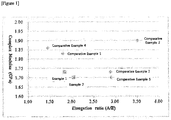
- Figure 1 is a view showing results of measuring complex moduli and ratios of elongation in the transverse direction to elongation in the longitudinal direction in Examples and Comparative Examples of the present invention.
- Polyethylene pellets were dissolved at 200°C and the dissolved polyethylene pellets were applied to a pressing process at a molding pressure of 20 to 25 MPa to prepare a specimen in the form of a sheet having a width of 6 mm, a height of 10 mm and a thickness of 0.3 mm.
- the complex modulus was measured by applying a displacement of 0.1% at a frequency of 1 Hz to the specimen at 25°C using Q800, a dynamic mechanical analyzer (DMA) from TA instruments. The measurement results were shown in Table 1 below.
- Polyethylene was injection-molded by an injection molding method with a resin temperature of about 230°C, a mold temperature of about 50°C and a molding pressure of about 0.9 to 1.0 MPa to prepare a specimen in the form of a dog bone having a thickness of 3 mm, a width of 3 mm, and an elongation part length of 13 mm.
- the specimen was elongated to the breaking point in the transverse direction and the longitudinal direction at an elongation speed of 300 mm/min at 25°C, and elongation in the transverse direction and elongation in the longitudinal direction (B) were measured.
- the measurement results were shown in Table 1 below.
- Polyethylene was injection-molded by an injection molding method with a resin temperature of about 230°C, a mold temperature of about 50°C and a molding pressure of about 0.9 to 1.0 MPa to manufacture a crucible having a top surface diameter of 30 cm, a bottom surface diameter of 27 cm and a height of 36 cm.
- the crucible manufactured by injection molding was filled with water and treated with a lid so as to prevent water from leaking during a drop process, and then, it was observed whether or not cracks were generated on the bottom surface and side surface of the crucible by dropping the crucible 10 times from a 2M height to the bottom surface and the side surface, respectively. Observation results were shown in Table 1 below, where notation criteria are as follows.
Landscapes
- Engineering & Computer Science (AREA)
- Manufacturing & Machinery (AREA)
- Mechanical Engineering (AREA)
- Injection Moulding Of Plastics Or The Like (AREA)
- Manufacture Of Macromolecular Shaped Articles (AREA)
Abstract
Description
- The present application relates to a method for selecting a material of an injection-molded article and a method for manufacturing an injection-molded article.
- Products made by injection molding of polyethylene may crack during use. Therefore, when a product is produced by injection molding, polyethylene should be selected, which is capable of producing an injection-molded article having excellent crack stability. However, the conventional method for selecting a material used for injection molding has a problem that the crack stability of an injection-molded article cannot be known unless an injection-molded article is manufactured by injection molding.
- Patent Document 1: Korean Patent No.
1638240 - The present application provides a method for selecting a material of an injection-molded article and a method for manufacturing an injection-molded article.
- The present application relates to a method for selecting a material of an injection-molded article. According to the method for selecting a material of an injection-molded article of the present application, it is possible to select polyethylene which can produce an injection-molded article having excellent crack stability through simple physical property evaluation of polyethylene used for injection molding, and to manufacture an injection-molded article using the polyethylene which can produce an injection-molded product having excellent crack stability.
- The method for selecting a material of an injection-molded article of the present invention is a method for selecting a material having a complex modulus within a specific range.
- The complex modulus is measured from a first specimen produced in the form of a sheet having a width of 6 mm, a height of 10 mm and a thickness of 0.3 mm from polyethylene. It will be understood by those skilled in the art that there may be errors, which are acceptable in the art, in describing the lengths and thickness, and the like of the specimen used in the measurement of the physical properties in detail herein. In the specimen manufacturing process, the error may be about 1% to 5% or so. The first specimen can be prepared by dissolving polyethylene pellets at 150°C to 250°C and applying the dissolved pellets to a pressing process at a molding pressure of 20 to 25 MPa. If the complex modulus is measured from the first specimen that is molded under the above conditions and produced, a material having excellent crack stability can be selected when the injection is performed under injection conditions of the method for manufacturing an injection-molded article to be described below.
- The measurement of the complex modulus can be performed by applying a displacement of 0.1% at a frequency of 1 Hz to the first specimen in the longitudinal direction of the first specimen at 25°C. The displacement is calculated by (length after applying tensile strain - length before applying tensile strain)/(length before applying tensile strain) x 100. If the complex modulus is measured under the above conditions, it is possible to select a material capable of producing an injection-molded article having excellent crack stability when the injection is performed under injection conditions of the method for manufacturing an injection-molded article to be described below.
- The crack stability of the injection-molded article produced through injection molding is related to stiffness of the injection-molded article. The stiffness of the injection-molded article can be deduced from the complex modulus of the material. Particularly, when a crucible is manufactured by injection molding, the crack stability of the bottom surface of the crucible can be deduced from the complex modulus of the material. The material capable of producing an injection-molded article having excellent crack stability can have a complex modulus measured in the form of the first specimen described above in a range of 1.80 GPa or less, or 1.75 GPa or less. The smaller the value of the complex modulus means the greater the stiffness of the injection-molded article, but if the complex modulus is too small, processability of the material deteriorates and efficiency of the injection process deteriorates, and thus it is preferred that the complex modulus measured in the form of the first specimen is 1.3 GPa or more, 1.4 GPa or more, or 1.45 GPa or more. When a material having a complex modulus in the above-mentioned range is used, an injection-molded article having excellent stiffness can be produced by an efficient process.
- The material selection method of the injection-molded article of the present invention is a method for selecting a material having an elongation ratio in a specific range. The elongation ratio of the present invention means a ratio (A/B) of elongation in the transverse direction (A) and elongation in the longitudinal direction (B). The transverse direction in the elongation means the same direction as the injection direction in which a second specimen is produced, and the longitudinal direction in the elongation means a direction perpendicular to the injection direction.
- A second specimen in the form of a dog bone having a thickness of 3 mm, a width of 3 mm and an elongation part length of 13 mm is prepared, from which the elongation ratio is confirmed. The second specimen can be produced by an injection molding method with a resin temperature of 190°C to 250°C, a mold temperature of 40°C to 60°C and a molding pressure of 0.6 MPa to 1.2 MPa. If the elongation ratio is measured from the second specimen prepared by injection under the above conditions, a material having excellent crack stability can be selected when the injection is performed under the injection conditions of the method for manufacturing an injection-molded article to be described below.
- Determination of the elongation ratio (A/B) is performed by measuring elongation (A) in the transverse direction and elongation (B) in the longitudinal direction of the second specimen at 25°C. The elongation means a value obtained by elongating the specimen to the breaking point and dividing an additional length of the specimen elongated to the breaking point and thus additionally elongated to the elongation direction by a length in the elongation direction before elongation. Specifically, it is calculated by (length after elongation - length before elongation)/(length before elongation). The elongation (A) in the transverse direction can be measured by elongating the second specimen in the transverse direction at an elongation speed of 300 mm/min at 25°C. The elongation (B) in the longitudinal direction can be measured by elongating the second specimen in the longitudinal direction at an elongation speed of 300 mm/min at 25°C. When the elongation ratio is determined under the above-described conditions, a material capable of producing an injection-molded article having excellent crack stability can be selected when the injection is performed under the injection conditions of the method for manufacturing an injection-molded article to be described below.
- The crack stability of the injection-molded article produced through injection molding is related to orientation of the injection-molded article. The orientation of the injection-molded article can be deduced from the elongation ratio of the material. Particularly, when the crucible is manufactured by injection molding, the crack stability of the side surface of the crucible can be deduced from the elongation ratio of the material. The material capable of producing an injection-molded article having excellent crack stability may have an elongation ratio (A/B) as determined in the form of the above-mentioned second specimen in a range of 2.8 or less, 2.5 or less, or 2.2 or less. The smaller the range of the elongation ratio is, the smaller the orientation in the transverse direction is and the stiffness in the longitudinal direction is increased, so that a probability of occurrence of cracks parallel to the transverse direction is reduced. However, when the range of the elongation ratio is too small, there is a problem that productivity is lowered when the injection-molded article is produced through injection, and thus it is preferred that the range of the elongation ratio determined in the form of the above-mentioned second specimen is 1.5 or more, 1.6 or more, or 1.7 or more. Values of the elongation (A) in the transverse direction and the elongation (B) in the transverse direction are not particularly limited as long as the elongation ratio (A/B) satisfies the above value, but it is preferred that the elongation (A) in the transverse direction is 1.8 to 2.5 and the elongation in the longitudinal direction is 1.25 to 1.45.
- The present invention also relates to a method for manufacturing an injection-molded article with polyethylene which is capable of producing an injection-molded article having excellent crack stability.
- The method for manufacturing an injection-molded article of the present invention is a method for manufacturing an injection-molded article with polyethylene having a complex modulus and an elongation ratio in specific ranges.
- In the method for manufacturing an injection-molded article of the present invention, the manufacturing method of the first specimen relating to the complex modulus, the method of measuring the complex modulus and the preferred range of the complex modulus are as described above and will be omitted.
- In the method for manufacturing an injection-molded article of the present invention, the method for manufacturing the second specimen relating to the elongation ratio, the method of determining the elongation ratio, the preferred elongation ratio and the preferred range of elongation are as described above and will be omitted.
- The injection molding method of the present invention may be an injection molding with a resin temperature of 190°C to 250°C, a mold temperature of 40°C to 60°C and a molding pressure of 0.6 MPa to 1.2 MPa. When the injection molding is performed under the above conditions, an injection-molded article having excellent crack stability can be manufactured with polyethylene satisfying the range of the complex modulus and the range of the elongation ratio as described above, and the injection molding can be efficiently performed.
- According to the method for selecting a material of an injection-molded article and the method for manufacturing an injection-molded article of the present application, a material capable of producing an injection-molded article having excellent crack stability can be selected and an injection-molded article having excellent crack stability can be produced.
-
Figure 1 is a view showing results of measuring complex moduli and ratios of elongation in the transverse direction to elongation in the longitudinal direction in Examples and Comparative Examples of the present invention. - Hereinafter, the present application will be described in more detail by way of examples according to the present application and comparative examples that do not comply with the present application, but the scope of the present application is not limited by the examples as set forth below.
- In order to evaluate crack stability of injection-molded articles made of seven types of polyethylene, the complex modulus and the ratio of elongation in the transverse direction and elongation in the longitudinal direction were measured from polyethylene as follows.
- Polyethylene pellets were dissolved at 200°C and the dissolved polyethylene pellets were applied to a pressing process at a molding pressure of 20 to 25 MPa to prepare a specimen in the form of a sheet having a width of 6 mm, a height of 10 mm and a thickness of 0.3 mm.
- The complex modulus was measured by applying a displacement of 0.1% at a frequency of 1 Hz to the specimen at 25°C using Q800, a dynamic mechanical analyzer (DMA) from TA instruments. The measurement results were shown in Table 1 below.
- Polyethylene was injection-molded by an injection molding method with a resin temperature of about 230°C, a mold temperature of about 50°C and a molding pressure of about 0.9 to 1.0 MPa to prepare a specimen in the form of a dog bone having a thickness of 3 mm, a width of 3 mm, and an elongation part length of 13 mm.
- Using a universal testing machine (UTM), the specimen was elongated to the breaking point in the transverse direction and the longitudinal direction at an elongation speed of 300 mm/min at 25°C, and elongation in the transverse direction and elongation in the longitudinal direction (B) were measured. The measurement results were shown in Table 1 below.
- Polyethylene was injection-molded by an injection molding method with a resin temperature of about 230°C, a mold temperature of about 50°C and a molding pressure of about 0.9 to 1.0 MPa to manufacture a crucible having a top surface diameter of 30 cm, a bottom surface diameter of 27 cm and a height of 36 cm.
- The crucible manufactured by injection molding was filled with water and treated with a lid so as to prevent water from leaking during a drop process, and then, it was observed whether or not cracks were generated on the bottom surface and side surface of the crucible by dropping the crucible 10 times from a 2M height to the bottom surface and the side surface, respectively. Observation results were shown in Table 1 below, where notation criteria are as follows.
- O: cracks were not found on both side and bottom surfaces of crucible.
- X: cracks were found on side surface or bottom surface of crucible.

Claims (15)
- A method for selecting a material of an injection-molded article comprising steps of:preparing a first specimen in a form of a sheet having a width of 6 mm, a height of 10 mm and a thickness of 0.3 mm using polyethylene;preparing a second specimen in a form of a dog bone having a thickness of 3 mm, a width of 3 mm and an elongation part length of 13 mm by injection-molding polyethylene;measuring a complex modulus of the first specimen at 25°C;measuring elongation (A) in the transverse direction and elongation (B) in the longitudinal direction of the second specimen at 25°C to determine an elongation ratio (A/B); andselecting the polyethylene having the complex modulus of 1.80 GPa or less and the elongation ratio (A/B) of 2.8 or less as a material for injection molding.
- The method for selecting a material of an injection-molded article according to claim 1, wherein the first specimen is prepared by dissolving polyethylene pellets at 150°C to 250°C and applying the dissolved pellets to a pressing process at a molding pressure of 20 to 25 MPa.
- The method for selecting a material of an injection-molded article according to claim 1, wherein the step of measuring the complex modulus of the first specimen comprises applying a displacement of 0.1% at a frequency of 1 Hz to the first specimen in the longitudinal direction of the first specimen at 25°C.
- The method for selecting a material of an injection-molded article according to claim 1, wherein the second specimen is prepared by an injection molding method with a resin temperature of 190°C to 250°C, a mold temperature of 40°C to 60°C and a molding pressure of 0.6 MPa to 1.2 MPa.
- The method for selecting a material of an injection-molded article according to claim 1, wherein the step of determining the elongation ratio of the second specimen comprises measuring the elongation in the transverse direction and the elongation in the longitudinal direction at an elongation speed of 300 mm/min at 25°C.
- The method for selecting a material of an injection-molded article according to claim 1,
wherein the step of selecting polyethylene as the material for injection molding is a step of selecting polyethylene having a complex modulus of 1.3 GPa to 1.80 GPa and a ratio (A/B) of elongation (A) in the transverse direction and elongation (B) in the longitudinal direction of 1.5 to 2.8. - The method for selecting a material of an injection-molded article according to claim 1,
wherein the step of selecting polyethylene as the material for injection molding is a step of selecting polyethylene having elongation (A) of the second specimen in the transverse direction of 1.8 to 2.5 and elongation (B) of the second specimen in the longitudinal direction of 1.25 to 1.45. - A method for manufacturing an injection-molded article using polyethylene as a raw material,
wherein the polyethylene has a complex modulus in a range of 1.3 GPa to 1.80 GPa as measured in a state of a first specimen in a form of a sheet having a width of 6 mm, a height of 10 mm and a thickness of 0.3 mm at 25°C, and also
has a ratio (A/B) of elongation (A) in the transverse direction and elongation (B) in the longitudinal direction of 1.5 to 2.8, as measured after a second specimen in a form of a dog bone having a thickness of 3 mm, a width of 3 mm and an elongation part length of 13 mm is prepared by injection molding. - The method for manufacturing an injection-molded article according to claim 8,
wherein the method for manufacturing an injection-molded article is an injection molding with a resin temperature of 190°C to 250°C, a mold temperature of 40°C to 60°C and a molding pressure of 0.6 MPa to 1.2 MPa. - The method for manufacturing an injection-molded article according to claim 8,
wherein the first specimen is prepared by dissolving polyethylene pellets at 150°C to 250°C and applying the dissolved pellets to a pressing process at a molding pressure of 20 to 25 MPa. - The method for manufacturing an injection-molded article according to claim 8,
wherein the complex modulus is measured by applying a displacement of 0.1% at a frequency of 1 Hz in the longitudinal direction of the first specimen at 25°C. - The method for manufacturing an injection-molded article according to claim 8,
wherein the second specimen is prepared by an injection molding method with a resin temperature of 190°C to 250°C, a mold temperature of 40°C to 60°C and a molding pressure of 0.6 MPa to 1.2 MPa. - The method for manufacturing an injection-molded article according to claim 8,
wherein the elongation (A) in the transverse direction and the elongation (B) in the longitudinal direction are measured at an elongation speed of 300 mm/min at 25°C. - The method for manufacturing an injection-molded article according to claim 8,
wherein the polyethylene has elongation (A) in the transverse direction of 1.8 to 2.5 and elongation (B) in the longitudinal direction of 1.25 to 1.45, as measured after the second specimen in the form of the dog bone is prepared. - The method for manufacturing an injection-molded article according to claim 8,
wherein the injection-molded article is a crucible.
Applications Claiming Priority (1)
| Application Number | Priority Date | Filing Date | Title |
|---|---|---|---|
| PCT/KR2017/011046 WO2019066112A1 (en) | 2017-09-29 | 2017-09-29 | Method for selecting material of injection-molded article and method for manufacturing injection-molded article |
Publications (3)
| Publication Number | Publication Date |
|---|---|
| EP3536478A1 true EP3536478A1 (en) | 2019-09-11 |
| EP3536478A4 EP3536478A4 (en) | 2019-12-18 |
| EP3536478B1 EP3536478B1 (en) | 2022-08-31 |
Family
ID=65902014
Family Applications (1)
| Application Number | Title | Priority Date | Filing Date |
|---|---|---|---|
| EP17926781.0A Active EP3536478B1 (en) | 2017-09-29 | 2017-09-29 | Method for selecting material of injection-molded article and method for manufacturing injection-molded article |
Country Status (5)
| Country | Link |
|---|---|
| US (1) | US11292165B2 (en) |
| EP (1) | EP3536478B1 (en) |
| JP (1) | JP6869361B2 (en) |
| CN (1) | CN110603129B (en) |
| WO (1) | WO2019066112A1 (en) |
Family Cites Families (19)
| Publication number | Priority date | Publication date | Assignee | Title |
|---|---|---|---|---|
| KR100459304B1 (en) * | 1995-02-08 | 2005-02-02 | 도레이 가부시끼가이샤 | Polyolefin-based crosslinked foam |
| EP0726290B2 (en) * | 1995-02-08 | 2005-10-19 | Toray Industries, Inc. | A polyolefin based crosslinked foam |
| JP3845191B2 (en) | 1998-02-24 | 2006-11-15 | 株式会社プライムポリマー | Mold for molding and molding method of lightweight resin molded product |
| AR018359A1 (en) * | 1998-05-18 | 2001-11-14 | Dow Global Technologies Inc | HEAT RESISTANT ARTICLE, CONFIGURED, IRRADIATED AND RETICULATED, FREE FROM A SILANAN RETICULATION AGENT |
| JP2002037897A (en) | 2000-07-21 | 2002-02-06 | Fuji Photo Film Co Ltd | Thermoplastic substrate and silver halide photosensitive material |
| PL203162B1 (en) * | 2001-08-31 | 2009-08-31 | Dow Global Technologies Inc | Multimodal polyethylene material |
| JP2005169841A (en) | 2003-12-11 | 2005-06-30 | Sumitomo Bakelite Co Ltd | Surface layer, decorative plate, and method for producing decorative plate |
| JP4564876B2 (en) * | 2004-04-06 | 2010-10-20 | 日本ポリエチレン株式会社 | Polyethylene resin for container lid |
| DE602006011430D1 (en) * | 2005-02-02 | 2010-02-11 | Exxonmobil Chem Patents Inc | MODIFIED POLYETHYLENE COMPOSITIONS |
| KR20090073567A (en) * | 2007-12-31 | 2009-07-03 | 주식회사 효성 | Molding method of heat-resistant pressure PET container for soft drink |
| JP2009235309A (en) | 2008-03-28 | 2009-10-15 | Jsr Corp | Thermoplastic elastomer composition and molded member |
| WO2011090759A2 (en) * | 2009-12-29 | 2011-07-28 | Saint-Gobain Performance Plastics Corporation | A flexible tubing material and method of forming the material |
| KR20130027320A (en) | 2011-09-07 | 2013-03-15 | 도레이첨단소재 주식회사 | In-mold decoration polyester film and manufacturing method thereof |
| CN103374168B (en) | 2012-04-27 | 2018-12-04 | 住友化学株式会社 | Polyethylene-based resin composition and formed body containing it |
| KR101746692B1 (en) * | 2012-05-31 | 2017-06-27 | 보레알리스 아게 | Ethylene polymers for extrusion coating |
| JP6167901B2 (en) * | 2012-06-08 | 2017-07-26 | 東レ株式会社 | Decorative molding film and method for producing decorative molded body |
| KR20150038416A (en) * | 2012-09-14 | 2015-04-08 | 엑손모빌 케미칼 패턴츠 인코포레이티드 | Ethylene-based polymers and articles made therefrom |
| KR101638240B1 (en) | 2013-09-30 | 2016-07-08 | 주식회사 엘지화학 | Rubbery polymer, graft copolymer, method of preparing the same, resistant impact and resistant heat resin composition |
| EP3115175A1 (en) | 2015-07-09 | 2017-01-11 | Keiryo Packaging SA | A method for manufacturing a polymer article |
-
2017
- 2017-09-29 JP JP2019542608A patent/JP6869361B2/en active Active
- 2017-09-29 CN CN201780090437.0A patent/CN110603129B/en active Active
- 2017-09-29 US US16/610,731 patent/US11292165B2/en active Active
- 2017-09-29 EP EP17926781.0A patent/EP3536478B1/en active Active
- 2017-09-29 WO PCT/KR2017/011046 patent/WO2019066112A1/en not_active Ceased
Also Published As
| Publication number | Publication date |
|---|---|
| EP3536478A4 (en) | 2019-12-18 |
| US20200282609A1 (en) | 2020-09-10 |
| US11292165B2 (en) | 2022-04-05 |
| JP2020506093A (en) | 2020-02-27 |
| JP6869361B2 (en) | 2021-05-12 |
| CN110603129A (en) | 2019-12-20 |
| CN110603129B (en) | 2021-09-10 |
| EP3536478B1 (en) | 2022-08-31 |
| WO2019066112A1 (en) | 2019-04-04 |
Similar Documents
| Publication | Publication Date | Title |
|---|---|---|
| Verbeeten et al. | Anisotropic rate-dependent mechanical behavior of poly (lactic acid) processed by material extrusion additive manufacturing | |
| KR101849868B1 (en) | Multimodal polypropylene with respect to comonomer content | |
| KR102335728B1 (en) | Solid-state stretched hdpe | |
| EP1931729B1 (en) | Polyethylene composition for injection moulding with improved stress crack/stiffness relation and impact resistance | |
| KR20070065389A (en) | Multimodal Polyethylene Composition with Improved Homogeneity | |
| JP2023513355A (en) | Expanded polypropylene beads, method for producing expanded polypropylene beads, molded article formed from expanded polypropylene beads, and method for forming the molded article | |
| CN112358709A (en) | Preparation method of degradable polyester foam material | |
| KR102678421B1 (en) | Resin film and its manufacturing method | |
| CN107540953A (en) | Injector for medical purpose polypropylene resin composite and preparation method thereof | |
| EP3536478A1 (en) | Method for selecting material of injection-molded article and method for manufacturing injection-molded article | |
| EP1931730A1 (en) | Polyethylene composition with improved stress crack resistance/stiffness relation for blow moulding | |
| KR101959784B1 (en) | Method for selecting material of injection molded article and manufactung injection molded article | |
| CN103529193B (en) | The drip irrigation zone evaluation method of tygon reclaimed materials | |
| KR20110052242A (en) | Lignin polymer, environmentally friendly composite materials for automobile interiors using the same, and methods for producing them | |
| KR20150032198A (en) | Nylon film | |
| CN109265804A (en) | A kind of guitar consolidates string nail and its processing method | |
| KR100655973B1 (en) | Measurement Method Using Rheological Properties of Scrap Content of Talc-Containing Polypropylene Composite | |
| CN107664608B (en) | Method for detecting vinyl content of low-vinyl methyl vinyl silicone rubber | |
| JP2003321555A (en) | Long fiber reinforced resin molded product | |
| JP2002202230A (en) | Simple evaluation method of long-term performance of synthetic resin material, material design method of molded article using the method, and quality control method | |
| LU100859B1 (en) | Plastic product with multilayer structure | |
| JP7065690B2 (en) | Method for manufacturing polyolefin sheet or film and its molded product | |
| Gu et al. | Preparation and Performance Research of the PBC/PLA Biodegradable Film | |
| WO2022268654A1 (en) | Polyethylene composition having improved melt strength and flexibility | |
| KR20150089284A (en) | A manufacturing method of polyamide resin having high melt flow properties |
Legal Events
| Date | Code | Title | Description |
|---|---|---|---|
| STAA | Information on the status of an ep patent application or granted ep patent |
Free format text: STATUS: THE INTERNATIONAL PUBLICATION HAS BEEN MADE |
|
| PUAI | Public reference made under article 153(3) epc to a published international application that has entered the european phase |
Free format text: ORIGINAL CODE: 0009012 |
|
| STAA | Information on the status of an ep patent application or granted ep patent |
Free format text: STATUS: REQUEST FOR EXAMINATION WAS MADE |
|
| 17P | Request for examination filed |
Effective date: 20190515 |
|
| AK | Designated contracting states |
Kind code of ref document: A1 Designated state(s): AL AT BE BG CH CY CZ DE DK EE ES FI FR GB GR HR HU IE IS IT LI LT LU LV MC MK MT NL NO PL PT RO RS SE SI SK SM TR |
|
| AX | Request for extension of the european patent |
Extension state: BA ME |
|
| A4 | Supplementary search report drawn up and despatched |
Effective date: 20191120 |
|
| RIC1 | Information provided on ipc code assigned before grant |
Ipc: B29C 45/76 20060101ALI20191114BHEP Ipc: B29C 45/00 20060101AFI20191114BHEP Ipc: B29K 23/00 20060101ALN20191114BHEP |
|
| DAV | Request for validation of the european patent (deleted) | ||
| DAX | Request for extension of the european patent (deleted) | ||
| STAA | Information on the status of an ep patent application or granted ep patent |
Free format text: STATUS: EXAMINATION IS IN PROGRESS |
|
| 17Q | First examination report despatched |
Effective date: 20211020 |
|
| REG | Reference to a national code |
Ref country code: DE Ref legal event code: R079 Ref document number: 602017061391 Country of ref document: DE Free format text: PREVIOUS MAIN CLASS: B29C0045760000 Ipc: B29C0045000000 |
|
| RIC1 | Information provided on ipc code assigned before grant |
Ipc: B29B 9/16 20060101ALN20220414BHEP Ipc: B29K 23/00 20060101ALN20220414BHEP Ipc: B29C 45/76 20060101ALI20220414BHEP Ipc: B29C 45/00 20060101AFI20220414BHEP |
|
| GRAP | Despatch of communication of intention to grant a patent |
Free format text: ORIGINAL CODE: EPIDOSNIGR1 |
|
| STAA | Information on the status of an ep patent application or granted ep patent |
Free format text: STATUS: GRANT OF PATENT IS INTENDED |
|
| INTG | Intention to grant announced |
Effective date: 20220531 |
|
| GRAS | Grant fee paid |
Free format text: ORIGINAL CODE: EPIDOSNIGR3 |
|
| GRAA | (expected) grant |
Free format text: ORIGINAL CODE: 0009210 |
|
| STAA | Information on the status of an ep patent application or granted ep patent |
Free format text: STATUS: THE PATENT HAS BEEN GRANTED |
|
| AK | Designated contracting states |
Kind code of ref document: B1 Designated state(s): AL AT BE BG CH CY CZ DE DK EE ES FI FR GB GR HR HU IE IS IT LI LT LU LV MC MK MT NL NO PL PT RO RS SE SI SK SM TR |
|
| REG | Reference to a national code |
Ref country code: CH Ref legal event code: EP Ref country code: GB Ref legal event code: FG4D |
|
| REG | Reference to a national code |
Ref country code: AT Ref legal event code: REF Ref document number: 1514996 Country of ref document: AT Kind code of ref document: T Effective date: 20220915 |
|
| REG | Reference to a national code |
Ref country code: DE Ref legal event code: R096 Ref document number: 602017061391 Country of ref document: DE |
|
| REG | Reference to a national code |
Ref country code: IE Ref legal event code: FG4D |
|
| REG | Reference to a national code |
Ref country code: LT Ref legal event code: MG9D |
|
| REG | Reference to a national code |
Ref country code: NL Ref legal event code: MP Effective date: 20220831 |
|
| PG25 | Lapsed in a contracting state [announced via postgrant information from national office to epo] |
Ref country code: SE Free format text: LAPSE BECAUSE OF FAILURE TO SUBMIT A TRANSLATION OF THE DESCRIPTION OR TO PAY THE FEE WITHIN THE PRESCRIBED TIME-LIMIT Effective date: 20220831 Ref country code: RS Free format text: LAPSE BECAUSE OF FAILURE TO SUBMIT A TRANSLATION OF THE DESCRIPTION OR TO PAY THE FEE WITHIN THE PRESCRIBED TIME-LIMIT Effective date: 20220831 Ref country code: NO Free format text: LAPSE BECAUSE OF FAILURE TO SUBMIT A TRANSLATION OF THE DESCRIPTION OR TO PAY THE FEE WITHIN THE PRESCRIBED TIME-LIMIT Effective date: 20221130 Ref country code: LV Free format text: LAPSE BECAUSE OF FAILURE TO SUBMIT A TRANSLATION OF THE DESCRIPTION OR TO PAY THE FEE WITHIN THE PRESCRIBED TIME-LIMIT Effective date: 20220831 Ref country code: LT Free format text: LAPSE BECAUSE OF FAILURE TO SUBMIT A TRANSLATION OF THE DESCRIPTION OR TO PAY THE FEE WITHIN THE PRESCRIBED TIME-LIMIT Effective date: 20220831 Ref country code: FI Free format text: LAPSE BECAUSE OF FAILURE TO SUBMIT A TRANSLATION OF THE DESCRIPTION OR TO PAY THE FEE WITHIN THE PRESCRIBED TIME-LIMIT Effective date: 20220831 |
|
| REG | Reference to a national code |
Ref country code: AT Ref legal event code: MK05 Ref document number: 1514996 Country of ref document: AT Kind code of ref document: T Effective date: 20220831 |
|
| PG25 | Lapsed in a contracting state [announced via postgrant information from national office to epo] |
Ref country code: PL Free format text: LAPSE BECAUSE OF FAILURE TO SUBMIT A TRANSLATION OF THE DESCRIPTION OR TO PAY THE FEE WITHIN THE PRESCRIBED TIME-LIMIT Effective date: 20220831 Ref country code: IS Free format text: LAPSE BECAUSE OF FAILURE TO SUBMIT A TRANSLATION OF THE DESCRIPTION OR TO PAY THE FEE WITHIN THE PRESCRIBED TIME-LIMIT Effective date: 20221231 Ref country code: HR Free format text: LAPSE BECAUSE OF FAILURE TO SUBMIT A TRANSLATION OF THE DESCRIPTION OR TO PAY THE FEE WITHIN THE PRESCRIBED TIME-LIMIT Effective date: 20220831 Ref country code: GR Free format text: LAPSE BECAUSE OF FAILURE TO SUBMIT A TRANSLATION OF THE DESCRIPTION OR TO PAY THE FEE WITHIN THE PRESCRIBED TIME-LIMIT Effective date: 20221201 |
|
| PG25 | Lapsed in a contracting state [announced via postgrant information from national office to epo] |
Ref country code: SM Free format text: LAPSE BECAUSE OF FAILURE TO SUBMIT A TRANSLATION OF THE DESCRIPTION OR TO PAY THE FEE WITHIN THE PRESCRIBED TIME-LIMIT Effective date: 20220831 Ref country code: RO Free format text: LAPSE BECAUSE OF FAILURE TO SUBMIT A TRANSLATION OF THE DESCRIPTION OR TO PAY THE FEE WITHIN THE PRESCRIBED TIME-LIMIT Effective date: 20220831 Ref country code: PT Free format text: LAPSE BECAUSE OF FAILURE TO SUBMIT A TRANSLATION OF THE DESCRIPTION OR TO PAY THE FEE WITHIN THE PRESCRIBED TIME-LIMIT Effective date: 20230102 Ref country code: ES Free format text: LAPSE BECAUSE OF FAILURE TO SUBMIT A TRANSLATION OF THE DESCRIPTION OR TO PAY THE FEE WITHIN THE PRESCRIBED TIME-LIMIT Effective date: 20220831 Ref country code: DK Free format text: LAPSE BECAUSE OF FAILURE TO SUBMIT A TRANSLATION OF THE DESCRIPTION OR TO PAY THE FEE WITHIN THE PRESCRIBED TIME-LIMIT Effective date: 20220831 Ref country code: CZ Free format text: LAPSE BECAUSE OF FAILURE TO SUBMIT A TRANSLATION OF THE DESCRIPTION OR TO PAY THE FEE WITHIN THE PRESCRIBED TIME-LIMIT Effective date: 20220831 Ref country code: AT Free format text: LAPSE BECAUSE OF FAILURE TO SUBMIT A TRANSLATION OF THE DESCRIPTION OR TO PAY THE FEE WITHIN THE PRESCRIBED TIME-LIMIT Effective date: 20220831 |
|
| REG | Reference to a national code |
Ref country code: CH Ref legal event code: PL |
|
| REG | Reference to a national code |
Ref country code: BE Ref legal event code: MM Effective date: 20220930 |
|
| PG25 | Lapsed in a contracting state [announced via postgrant information from national office to epo] |
Ref country code: SK Free format text: LAPSE BECAUSE OF FAILURE TO SUBMIT A TRANSLATION OF THE DESCRIPTION OR TO PAY THE FEE WITHIN THE PRESCRIBED TIME-LIMIT Effective date: 20220831 Ref country code: MC Free format text: LAPSE BECAUSE OF FAILURE TO SUBMIT A TRANSLATION OF THE DESCRIPTION OR TO PAY THE FEE WITHIN THE PRESCRIBED TIME-LIMIT Effective date: 20220831 Ref country code: EE Free format text: LAPSE BECAUSE OF FAILURE TO SUBMIT A TRANSLATION OF THE DESCRIPTION OR TO PAY THE FEE WITHIN THE PRESCRIBED TIME-LIMIT Effective date: 20220831 |
|
| REG | Reference to a national code |
Ref country code: DE Ref legal event code: R097 Ref document number: 602017061391 Country of ref document: DE |
|
| PG25 | Lapsed in a contracting state [announced via postgrant information from national office to epo] |
Ref country code: NL Free format text: LAPSE BECAUSE OF FAILURE TO SUBMIT A TRANSLATION OF THE DESCRIPTION OR TO PAY THE FEE WITHIN THE PRESCRIBED TIME-LIMIT Effective date: 20220831 Ref country code: LU Free format text: LAPSE BECAUSE OF NON-PAYMENT OF DUE FEES Effective date: 20220929 Ref country code: AL Free format text: LAPSE BECAUSE OF FAILURE TO SUBMIT A TRANSLATION OF THE DESCRIPTION OR TO PAY THE FEE WITHIN THE PRESCRIBED TIME-LIMIT Effective date: 20220831 |
|
| PLBE | No opposition filed within time limit |
Free format text: ORIGINAL CODE: 0009261 |
|
| STAA | Information on the status of an ep patent application or granted ep patent |
Free format text: STATUS: NO OPPOSITION FILED WITHIN TIME LIMIT |
|
| PG25 | Lapsed in a contracting state [announced via postgrant information from national office to epo] |
Ref country code: LI Free format text: LAPSE BECAUSE OF NON-PAYMENT OF DUE FEES Effective date: 20220930 Ref country code: IE Free format text: LAPSE BECAUSE OF NON-PAYMENT OF DUE FEES Effective date: 20220929 Ref country code: CH Free format text: LAPSE BECAUSE OF NON-PAYMENT OF DUE FEES Effective date: 20220930 |
|
| 26N | No opposition filed |
Effective date: 20230601 |
|
| PG25 | Lapsed in a contracting state [announced via postgrant information from national office to epo] |
Ref country code: SI Free format text: LAPSE BECAUSE OF FAILURE TO SUBMIT A TRANSLATION OF THE DESCRIPTION OR TO PAY THE FEE WITHIN THE PRESCRIBED TIME-LIMIT Effective date: 20220831 |
|
| PG25 | Lapsed in a contracting state [announced via postgrant information from national office to epo] |
Ref country code: BE Free format text: LAPSE BECAUSE OF NON-PAYMENT OF DUE FEES Effective date: 20220930 |
|
| PG25 | Lapsed in a contracting state [announced via postgrant information from national office to epo] |
Ref country code: HU Free format text: LAPSE BECAUSE OF FAILURE TO SUBMIT A TRANSLATION OF THE DESCRIPTION OR TO PAY THE FEE WITHIN THE PRESCRIBED TIME-LIMIT; INVALID AB INITIO Effective date: 20170929 |
|
| PG25 | Lapsed in a contracting state [announced via postgrant information from national office to epo] |
Ref country code: CY Free format text: LAPSE BECAUSE OF FAILURE TO SUBMIT A TRANSLATION OF THE DESCRIPTION OR TO PAY THE FEE WITHIN THE PRESCRIBED TIME-LIMIT Effective date: 20220831 |
|
| PG25 | Lapsed in a contracting state [announced via postgrant information from national office to epo] |
Ref country code: MK Free format text: LAPSE BECAUSE OF FAILURE TO SUBMIT A TRANSLATION OF THE DESCRIPTION OR TO PAY THE FEE WITHIN THE PRESCRIBED TIME-LIMIT Effective date: 20220831 Ref country code: IT Free format text: LAPSE BECAUSE OF FAILURE TO SUBMIT A TRANSLATION OF THE DESCRIPTION OR TO PAY THE FEE WITHIN THE PRESCRIBED TIME-LIMIT Effective date: 20220831 |
|
| PG25 | Lapsed in a contracting state [announced via postgrant information from national office to epo] |
Ref country code: BG Free format text: LAPSE BECAUSE OF FAILURE TO SUBMIT A TRANSLATION OF THE DESCRIPTION OR TO PAY THE FEE WITHIN THE PRESCRIBED TIME-LIMIT Effective date: 20220831 |
|
| PG25 | Lapsed in a contracting state [announced via postgrant information from national office to epo] |
Ref country code: MT Free format text: LAPSE BECAUSE OF FAILURE TO SUBMIT A TRANSLATION OF THE DESCRIPTION OR TO PAY THE FEE WITHIN THE PRESCRIBED TIME-LIMIT Effective date: 20220831 |
|
| PGFP | Annual fee paid to national office [announced via postgrant information from national office to epo] |
Ref country code: DE Payment date: 20250820 Year of fee payment: 9 |
|
| PGFP | Annual fee paid to national office [announced via postgrant information from national office to epo] |
Ref country code: GB Payment date: 20250820 Year of fee payment: 9 |
|
| PGFP | Annual fee paid to national office [announced via postgrant information from national office to epo] |
Ref country code: FR Payment date: 20250821 Year of fee payment: 9 |
|
| PG25 | Lapsed in a contracting state [announced via postgrant information from national office to epo] |
Ref country code: TR Free format text: LAPSE BECAUSE OF FAILURE TO SUBMIT A TRANSLATION OF THE DESCRIPTION OR TO PAY THE FEE WITHIN THE PRESCRIBED TIME-LIMIT Effective date: 20220831 |