EP3534431A1 - Separator for nonaqueous-electrolyte cell, and nonaqueous-electrolyte cell - Google Patents
Separator for nonaqueous-electrolyte cell, and nonaqueous-electrolyte cell Download PDFInfo
- Publication number
- EP3534431A1 EP3534431A1 EP17864241.9A EP17864241A EP3534431A1 EP 3534431 A1 EP3534431 A1 EP 3534431A1 EP 17864241 A EP17864241 A EP 17864241A EP 3534431 A1 EP3534431 A1 EP 3534431A1
- Authority
- EP
- European Patent Office
- Prior art keywords
- water
- nonaqueous electrolyte
- electrolyte battery
- resin
- battery separator
- Prior art date
- Legal status (The legal status is an assumption and is not a legal conclusion. Google has not performed a legal analysis and makes no representation as to the accuracy of the status listed.)
- Withdrawn
Links
- 239000011255 nonaqueous electrolyte Substances 0.000 title claims abstract description 83
- 229920003169 water-soluble polymer Polymers 0.000 claims abstract description 54
- 239000011256 inorganic filler Substances 0.000 claims abstract description 36
- 229910003475 inorganic filler Inorganic materials 0.000 claims abstract description 36
- 150000007514 bases Chemical class 0.000 claims abstract description 29
- 229920003176 water-insoluble polymer Polymers 0.000 claims abstract description 20
- 229920005672 polyolefin resin Polymers 0.000 claims abstract description 9
- 229920001721 polyimide Polymers 0.000 claims description 87
- 239000004962 Polyamide-imide Substances 0.000 claims description 23
- 229920002312 polyamide-imide Polymers 0.000 claims description 23
- -1 amine compound Chemical class 0.000 claims description 22
- 239000004952 Polyamide Substances 0.000 claims description 21
- 150000001875 compounds Chemical class 0.000 claims description 21
- 229920002647 polyamide Polymers 0.000 claims description 21
- 239000004642 Polyimide Substances 0.000 claims description 17
- 125000004432 carbon atom Chemical group C* 0.000 claims description 17
- 125000001931 aliphatic group Chemical group 0.000 claims description 12
- 229920000642 polymer Polymers 0.000 claims description 12
- 125000002887 hydroxy group Chemical group [H]O* 0.000 claims description 9
- 125000000962 organic group Chemical group 0.000 claims description 9
- 125000003178 carboxy group Chemical group [H]OC(*)=O 0.000 claims description 8
- 230000002378 acidificating effect Effects 0.000 claims description 7
- 125000000542 sulfonic acid group Chemical group 0.000 claims description 6
- 150000001339 alkali metal compounds Chemical class 0.000 claims description 4
- 150000003856 quaternary ammonium compounds Chemical class 0.000 claims description 4
- 229910002091 carbon monoxide Inorganic materials 0.000 claims description 3
- IPZJQDSFZGZEOY-UHFFFAOYSA-N dimethylmethylene Chemical compound C[C]C IPZJQDSFZGZEOY-UHFFFAOYSA-N 0.000 claims description 3
- 229910052736 halogen Inorganic materials 0.000 claims description 3
- 150000002367 halogens Chemical class 0.000 claims description 3
- 125000000449 nitro group Chemical group [O-][N+](*)=O 0.000 claims description 3
- 229910052760 oxygen Inorganic materials 0.000 claims description 3
- 229910052717 sulfur Inorganic materials 0.000 claims description 3
- RAHZWNYVWXNFOC-UHFFFAOYSA-N sulfur dioxide Inorganic materials O=S=O RAHZWNYVWXNFOC-UHFFFAOYSA-N 0.000 claims description 3
- 239000011347 resin Substances 0.000 description 108
- 229920005989 resin Polymers 0.000 description 108
- 239000007864 aqueous solution Substances 0.000 description 86
- 239000010410 layer Substances 0.000 description 79
- 230000015572 biosynthetic process Effects 0.000 description 74
- 238000003786 synthesis reaction Methods 0.000 description 74
- 238000000034 method Methods 0.000 description 70
- 239000009719 polyimide resin Substances 0.000 description 70
- PNEYBMLMFCGWSK-UHFFFAOYSA-N aluminium oxide Inorganic materials [O-2].[O-2].[O-2].[Al+3].[Al+3] PNEYBMLMFCGWSK-UHFFFAOYSA-N 0.000 description 66
- 239000004925 Acrylic resin Substances 0.000 description 57
- 229920000178 Acrylic resin Polymers 0.000 description 57
- HEMHJVSKTPXQMS-UHFFFAOYSA-M Sodium hydroxide Chemical compound [OH-].[Na+] HEMHJVSKTPXQMS-UHFFFAOYSA-M 0.000 description 54
- XLYOFNOQVPJJNP-UHFFFAOYSA-N water Substances O XLYOFNOQVPJJNP-UHFFFAOYSA-N 0.000 description 45
- 239000000203 mixture Substances 0.000 description 37
- 239000011248 coating agent Substances 0.000 description 36
- 238000000576 coating method Methods 0.000 description 36
- 239000007788 liquid Substances 0.000 description 34
- 150000004985 diamines Chemical class 0.000 description 32
- 229920006122 polyamide resin Polymers 0.000 description 30
- 239000002904 solvent Substances 0.000 description 29
- 230000000052 comparative effect Effects 0.000 description 28
- 239000002253 acid Substances 0.000 description 25
- 238000010438 heat treatment Methods 0.000 description 25
- 239000007787 solid Substances 0.000 description 23
- 239000000243 solution Substances 0.000 description 23
- KWYUFKZDYYNOTN-UHFFFAOYSA-M Potassium hydroxide Chemical compound [OH-].[K+] KWYUFKZDYYNOTN-UHFFFAOYSA-M 0.000 description 21
- ZMANZCXQSJIPKH-UHFFFAOYSA-N Triethylamine Chemical compound CCN(CC)CC ZMANZCXQSJIPKH-UHFFFAOYSA-N 0.000 description 21
- GTDPSWPPOUPBNX-UHFFFAOYSA-N ac1mqpva Chemical compound CC12C(=O)OC(=O)C1(C)C1(C)C2(C)C(=O)OC1=O GTDPSWPPOUPBNX-UHFFFAOYSA-N 0.000 description 18
- 125000004427 diamine group Chemical group 0.000 description 18
- CDBYLPFSWZWCQE-UHFFFAOYSA-L Sodium Carbonate Chemical compound [Na+].[Na+].[O-]C([O-])=O CDBYLPFSWZWCQE-UHFFFAOYSA-L 0.000 description 16
- 238000003756 stirring Methods 0.000 description 15
- 239000011148 porous material Substances 0.000 description 13
- SECXISVLQFMRJM-UHFFFAOYSA-N N-Methylpyrrolidone Chemical compound CN1CCCC1=O SECXISVLQFMRJM-UHFFFAOYSA-N 0.000 description 12
- 238000006243 chemical reaction Methods 0.000 description 12
- 239000000126 substance Substances 0.000 description 12
- OFOBLEOULBTSOW-UHFFFAOYSA-N Malonic acid Chemical compound OC(=O)CC(O)=O OFOBLEOULBTSOW-UHFFFAOYSA-N 0.000 description 10
- ZIUHHBKFKCYYJD-UHFFFAOYSA-N n,n'-methylenebisacrylamide Chemical compound C=CC(=O)NCNC(=O)C=C ZIUHHBKFKCYYJD-UHFFFAOYSA-N 0.000 description 10
- 239000002245 particle Substances 0.000 description 10
- 125000006158 tetracarboxylic acid group Chemical group 0.000 description 10
- 150000003628 tricarboxylic acids Chemical class 0.000 description 10
- YXFVVABEGXRONW-UHFFFAOYSA-N Toluene Chemical compound CC1=CC=CC=C1 YXFVVABEGXRONW-UHFFFAOYSA-N 0.000 description 9
- 150000008065 acid anhydrides Chemical class 0.000 description 9
- 238000006068 polycondensation reaction Methods 0.000 description 9
- JUJWROOIHBZHMG-UHFFFAOYSA-N Pyridine Chemical compound C1=CC=NC=C1 JUJWROOIHBZHMG-UHFFFAOYSA-N 0.000 description 8
- 150000003949 imides Chemical class 0.000 description 8
- 238000002156 mixing Methods 0.000 description 8
- 238000007363 ring formation reaction Methods 0.000 description 8
- 239000002002 slurry Substances 0.000 description 8
- 229910000029 sodium carbonate Inorganic materials 0.000 description 8
- WGTYBPLFGIVFAS-UHFFFAOYSA-M tetramethylammonium hydroxide Chemical compound [OH-].C[N+](C)(C)C WGTYBPLFGIVFAS-UHFFFAOYSA-M 0.000 description 8
- NGNBDVOYPDDBFK-UHFFFAOYSA-N 2-[2,4-di(pentan-2-yl)phenoxy]acetyl chloride Chemical compound CCCC(C)C1=CC=C(OCC(Cl)=O)C(C(C)CCC)=C1 NGNBDVOYPDDBFK-UHFFFAOYSA-N 0.000 description 7
- 229910052783 alkali metal Inorganic materials 0.000 description 7
- 150000001340 alkali metals Chemical class 0.000 description 7
- 230000000694 effects Effects 0.000 description 7
- 239000000047 product Substances 0.000 description 7
- WMFOQBRAJBCJND-UHFFFAOYSA-M Lithium hydroxide Chemical compound [Li+].[OH-] WMFOQBRAJBCJND-UHFFFAOYSA-M 0.000 description 6
- USIUVYZYUHIAEV-UHFFFAOYSA-N diphenyl ether Natural products C=1C=CC=CC=1OC1=CC=CC=C1 USIUVYZYUHIAEV-UHFFFAOYSA-N 0.000 description 6
- 238000011156 evaluation Methods 0.000 description 6
- AWJUIBRHMBBTKR-UHFFFAOYSA-N isoquinoline Chemical compound C1=NC=CC2=CC=CC=C21 AWJUIBRHMBBTKR-UHFFFAOYSA-N 0.000 description 6
- 239000000463 material Substances 0.000 description 6
- HBBGRARXTFLTSG-UHFFFAOYSA-N Lithium ion Chemical compound [Li+] HBBGRARXTFLTSG-UHFFFAOYSA-N 0.000 description 5
- UEEJHVSXFDXPFK-UHFFFAOYSA-N N-dimethylaminoethanol Chemical compound CN(C)CCO UEEJHVSXFDXPFK-UHFFFAOYSA-N 0.000 description 5
- 150000008064 anhydrides Chemical class 0.000 description 5
- 239000000919 ceramic Substances 0.000 description 5
- 239000006185 dispersion Substances 0.000 description 5
- 238000001035 drying Methods 0.000 description 5
- 238000001914 filtration Methods 0.000 description 5
- 230000010220 ion permeability Effects 0.000 description 5
- 229910001416 lithium ion Inorganic materials 0.000 description 5
- 238000004519 manufacturing process Methods 0.000 description 5
- 238000002844 melting Methods 0.000 description 5
- 230000008018 melting Effects 0.000 description 5
- 239000012299 nitrogen atmosphere Substances 0.000 description 5
- 229920000098 polyolefin Polymers 0.000 description 5
- 239000002244 precipitate Substances 0.000 description 5
- 238000009423 ventilation Methods 0.000 description 5
- FCSSPCOFDUKHPV-UHFFFAOYSA-N 2-Propenyl propyl disulfide Chemical compound CCCSSCC=C FCSSPCOFDUKHPV-UHFFFAOYSA-N 0.000 description 4
- XEEYBQQBJWHFJM-UHFFFAOYSA-N Iron Chemical compound [Fe] XEEYBQQBJWHFJM-UHFFFAOYSA-N 0.000 description 4
- 239000004793 Polystyrene Substances 0.000 description 4
- UIIMBOGNXHQVGW-UHFFFAOYSA-M Sodium bicarbonate Chemical compound [Na+].OC([O-])=O UIIMBOGNXHQVGW-UHFFFAOYSA-M 0.000 description 4
- PPBRXRYQALVLMV-UHFFFAOYSA-N Styrene Chemical compound C=CC1=CC=CC=C1 PPBRXRYQALVLMV-UHFFFAOYSA-N 0.000 description 4
- 230000002159 abnormal effect Effects 0.000 description 4
- 230000006866 deterioration Effects 0.000 description 4
- BWHMMNNQKKPAPP-UHFFFAOYSA-L potassium carbonate Chemical compound [K+].[K+].[O-]C([O-])=O BWHMMNNQKKPAPP-UHFFFAOYSA-L 0.000 description 4
- ASHGTUMKRVIOLH-UHFFFAOYSA-L potassium;sodium;hydrogen phosphate Chemical compound [Na+].[K+].OP([O-])([O-])=O ASHGTUMKRVIOLH-UHFFFAOYSA-L 0.000 description 4
- UMJSCPRVCHMLSP-UHFFFAOYSA-N pyridine Natural products COC1=CC=CN=C1 UMJSCPRVCHMLSP-UHFFFAOYSA-N 0.000 description 4
- LWIHDJKSTIGBAC-UHFFFAOYSA-K tripotassium phosphate Chemical compound [K+].[K+].[K+].[O-]P([O-])([O-])=O LWIHDJKSTIGBAC-UHFFFAOYSA-K 0.000 description 4
- QQGYZOYWNCKGEK-UHFFFAOYSA-N 5-[(1,3-dioxo-2-benzofuran-5-yl)oxy]-2-benzofuran-1,3-dione Chemical compound C1=C2C(=O)OC(=O)C2=CC(OC=2C=C3C(=O)OC(C3=CC=2)=O)=C1 QQGYZOYWNCKGEK-UHFFFAOYSA-N 0.000 description 3
- 239000004215 Carbon black (E152) Substances 0.000 description 3
- ZMXDDKWLCZADIW-UHFFFAOYSA-N N,N-Dimethylformamide Chemical compound CN(C)C=O ZMXDDKWLCZADIW-UHFFFAOYSA-N 0.000 description 3
- 229910019142 PO4 Inorganic materials 0.000 description 3
- 229920003171 Poly (ethylene oxide) Polymers 0.000 description 3
- 125000002015 acyclic group Chemical group 0.000 description 3
- 239000002585 base Substances 0.000 description 3
- 229910001593 boehmite Inorganic materials 0.000 description 3
- 239000003054 catalyst Substances 0.000 description 3
- 125000004122 cyclic group Chemical group 0.000 description 3
- BNIILDVGGAEEIG-UHFFFAOYSA-L disodium hydrogen phosphate Chemical compound [Na+].[Na+].OP([O-])([O-])=O BNIILDVGGAEEIG-UHFFFAOYSA-L 0.000 description 3
- 229910000397 disodium phosphate Inorganic materials 0.000 description 3
- 238000010292 electrical insulation Methods 0.000 description 3
- 239000008151 electrolyte solution Substances 0.000 description 3
- 239000010419 fine particle Substances 0.000 description 3
- 229930195733 hydrocarbon Natural products 0.000 description 3
- 150000002430 hydrocarbons Chemical class 0.000 description 3
- 125000004435 hydrogen atom Chemical group [H]* 0.000 description 3
- FAHBNUUHRFUEAI-UHFFFAOYSA-M hydroxidooxidoaluminium Chemical compound O[Al]=O FAHBNUUHRFUEAI-UHFFFAOYSA-M 0.000 description 3
- 238000005191 phase separation Methods 0.000 description 3
- 235000021317 phosphate Nutrition 0.000 description 3
- 229920002223 polystyrene Polymers 0.000 description 3
- 238000000926 separation method Methods 0.000 description 3
- WZCQRUWWHSTZEM-UHFFFAOYSA-N 1,3-phenylenediamine Chemical compound NC1=CC=CC(N)=C1 WZCQRUWWHSTZEM-UHFFFAOYSA-N 0.000 description 2
- OISVCGZHLKNMSJ-UHFFFAOYSA-N 2,6-dimethylpyridine Chemical compound CC1=CC=CC(C)=N1 OISVCGZHLKNMSJ-UHFFFAOYSA-N 0.000 description 2
- UENRXLSRMCSUSN-UHFFFAOYSA-N 3,5-diaminobenzoic acid Chemical compound NC1=CC(N)=CC(C(O)=O)=C1 UENRXLSRMCSUSN-UHFFFAOYSA-N 0.000 description 2
- RHRNYXVSZLSRRP-UHFFFAOYSA-N 3-(carboxymethyl)cyclopentane-1,2,4-tricarboxylic acid Chemical compound OC(=O)CC1C(C(O)=O)CC(C(O)=O)C1C(O)=O RHRNYXVSZLSRRP-UHFFFAOYSA-N 0.000 description 2
- CWLKGDAVCFYWJK-UHFFFAOYSA-N 3-aminophenol Chemical compound NC1=CC=CC(O)=C1 CWLKGDAVCFYWJK-UHFFFAOYSA-N 0.000 description 2
- 229940018563 3-aminophenol Drugs 0.000 description 2
- HLBLWEWZXPIGSM-UHFFFAOYSA-N 4-Aminophenyl ether Chemical compound C1=CC(N)=CC=C1OC1=CC=C(N)C=C1 HLBLWEWZXPIGSM-UHFFFAOYSA-N 0.000 description 2
- YEJRWHAVMIAJKC-UHFFFAOYSA-N 4-Butyrolactone Chemical compound O=C1CCCO1 YEJRWHAVMIAJKC-UHFFFAOYSA-N 0.000 description 2
- JYCTWJFSRDBYJX-UHFFFAOYSA-N 5-(2,5-dioxooxolan-3-yl)-3a,4,5,9b-tetrahydrobenzo[e][2]benzofuran-1,3-dione Chemical compound O=C1OC(=O)CC1C1C2=CC=CC=C2C(C(=O)OC2=O)C2C1 JYCTWJFSRDBYJX-UHFFFAOYSA-N 0.000 description 2
- VTYYLEPIZMXCLO-UHFFFAOYSA-L Calcium carbonate Chemical compound [Ca+2].[O-]C([O-])=O VTYYLEPIZMXCLO-UHFFFAOYSA-L 0.000 description 2
- BVKZGUZCCUSVTD-UHFFFAOYSA-L Carbonate Chemical compound [O-]C([O-])=O BVKZGUZCCUSVTD-UHFFFAOYSA-L 0.000 description 2
- IAZDPXIOMUYVGZ-UHFFFAOYSA-N Dimethylsulphoxide Chemical compound CS(C)=O IAZDPXIOMUYVGZ-UHFFFAOYSA-N 0.000 description 2
- LFQSCWFLJHTTHZ-UHFFFAOYSA-N Ethanol Chemical compound CCO LFQSCWFLJHTTHZ-UHFFFAOYSA-N 0.000 description 2
- WHXSMMKQMYFTQS-UHFFFAOYSA-N Lithium Chemical compound [Li] WHXSMMKQMYFTQS-UHFFFAOYSA-N 0.000 description 2
- ISWSIDIOOBJBQZ-UHFFFAOYSA-N Phenol Chemical compound OC1=CC=CC=C1 ISWSIDIOOBJBQZ-UHFFFAOYSA-N 0.000 description 2
- NBIIXXVUZAFLBC-UHFFFAOYSA-N Phosphoric acid Chemical compound OP(O)(O)=O NBIIXXVUZAFLBC-UHFFFAOYSA-N 0.000 description 2
- 239000004698 Polyethylene Substances 0.000 description 2
- KKEYFWRCBNTPAC-UHFFFAOYSA-N Terephthalic acid Chemical compound OC(=O)C1=CC=C(C(O)=O)C=C1 KKEYFWRCBNTPAC-UHFFFAOYSA-N 0.000 description 2
- GWEVSGVZZGPLCZ-UHFFFAOYSA-N Titan oxide Chemical compound O=[Ti]=O GWEVSGVZZGPLCZ-UHFFFAOYSA-N 0.000 description 2
- 150000007824 aliphatic compounds Chemical class 0.000 description 2
- ROOXNKNUYICQNP-UHFFFAOYSA-N ammonium persulfate Chemical compound [NH4+].[NH4+].[O-]S(=O)(=O)OOS([O-])(=O)=O ROOXNKNUYICQNP-UHFFFAOYSA-N 0.000 description 2
- QMKYBPDZANOJGF-UHFFFAOYSA-N benzene-1,3,5-tricarboxylic acid Chemical compound OC(=O)C1=CC(C(O)=O)=CC(C(O)=O)=C1 QMKYBPDZANOJGF-UHFFFAOYSA-N 0.000 description 2
- BKDVBBSUAGJUBA-UHFFFAOYSA-N bicyclo[2.2.2]oct-7-ene-2,3,5,6-tetracarboxylic acid Chemical compound C1=CC2C(C(O)=O)C(C(=O)O)C1C(C(O)=O)C2C(O)=O BKDVBBSUAGJUBA-UHFFFAOYSA-N 0.000 description 2
- 239000006227 byproduct Substances 0.000 description 2
- ZPWVASYFFYYZEW-UHFFFAOYSA-L dipotassium hydrogen phosphate Chemical compound [K+].[K+].OP([O-])([O-])=O ZPWVASYFFYYZEW-UHFFFAOYSA-L 0.000 description 2
- 235000019797 dipotassium phosphate Nutrition 0.000 description 2
- 229910000396 dipotassium phosphate Inorganic materials 0.000 description 2
- 235000019800 disodium phosphate Nutrition 0.000 description 2
- 239000012153 distilled water Substances 0.000 description 2
- 238000011049 filling Methods 0.000 description 2
- 125000000524 functional group Chemical group 0.000 description 2
- 238000005227 gel permeation chromatography Methods 0.000 description 2
- NAQMVNRVTILPCV-UHFFFAOYSA-N hexane-1,6-diamine Chemical compound NCCCCCCN NAQMVNRVTILPCV-UHFFFAOYSA-N 0.000 description 2
- XLYOFNOQVPJJNP-UHFFFAOYSA-M hydroxide Chemical compound [OH-] XLYOFNOQVPJJNP-UHFFFAOYSA-M 0.000 description 2
- MNUOZFHYBCRUOD-UHFFFAOYSA-N hydroxyphthalic acid Natural products OC(=O)C1=CC=CC(O)=C1C(O)=O MNUOZFHYBCRUOD-UHFFFAOYSA-N 0.000 description 2
- 229910052742 iron Inorganic materials 0.000 description 2
- QQVIHTHCMHWDBS-UHFFFAOYSA-N isophthalic acid Chemical compound OC(=O)C1=CC=CC(C(O)=O)=C1 QQVIHTHCMHWDBS-UHFFFAOYSA-N 0.000 description 2
- 229910052744 lithium Inorganic materials 0.000 description 2
- PQXKHYXIUOZZFA-UHFFFAOYSA-M lithium fluoride Chemical compound [Li+].[F-] PQXKHYXIUOZZFA-UHFFFAOYSA-M 0.000 description 2
- RLSSMJSEOOYNOY-UHFFFAOYSA-N m-cresol Chemical compound CC1=CC=CC(O)=C1 RLSSMJSEOOYNOY-UHFFFAOYSA-N 0.000 description 2
- 239000000178 monomer Substances 0.000 description 2
- 238000000465 moulding Methods 0.000 description 2
- 239000012454 non-polar solvent Substances 0.000 description 2
- NBIIXXVUZAFLBC-UHFFFAOYSA-K phosphate Chemical compound [O-]P([O-])([O-])=O NBIIXXVUZAFLBC-UHFFFAOYSA-K 0.000 description 2
- 239000010452 phosphate Substances 0.000 description 2
- XNGIFLGASWRNHJ-UHFFFAOYSA-N phthalic acid Chemical compound OC(=O)C1=CC=CC=C1C(O)=O XNGIFLGASWRNHJ-UHFFFAOYSA-N 0.000 description 2
- 229920000573 polyethylene Polymers 0.000 description 2
- 229920013716 polyethylene resin Polymers 0.000 description 2
- 238000006116 polymerization reaction Methods 0.000 description 2
- 239000011736 potassium bicarbonate Substances 0.000 description 2
- 229910000028 potassium bicarbonate Inorganic materials 0.000 description 2
- 235000015497 potassium bicarbonate Nutrition 0.000 description 2
- 229910000027 potassium carbonate Inorganic materials 0.000 description 2
- 235000011181 potassium carbonates Nutrition 0.000 description 2
- TYJJADVDDVDEDZ-UHFFFAOYSA-M potassium hydrogencarbonate Chemical compound [K+].OC([O-])=O TYJJADVDDVDEDZ-UHFFFAOYSA-M 0.000 description 2
- 229940086066 potassium hydrogencarbonate Drugs 0.000 description 2
- 229910000160 potassium phosphate Inorganic materials 0.000 description 2
- 235000011009 potassium phosphates Nutrition 0.000 description 2
- VLYFRFHWUBBLRR-UHFFFAOYSA-L potassium;sodium;carbonate Chemical compound [Na+].[K+].[O-]C([O-])=O VLYFRFHWUBBLRR-UHFFFAOYSA-L 0.000 description 2
- 239000000843 powder Substances 0.000 description 2
- 239000002243 precursor Substances 0.000 description 2
- FBCQUCJYYPMKRO-UHFFFAOYSA-N prop-2-enyl 2-methylprop-2-enoate Chemical compound CC(=C)C(=O)OCC=C FBCQUCJYYPMKRO-UHFFFAOYSA-N 0.000 description 2
- CYIDZMCFTVVTJO-UHFFFAOYSA-N pyromellitic acid Chemical compound OC(=O)C1=CC(C(O)=O)=C(C(O)=O)C=C1C(O)=O CYIDZMCFTVVTJO-UHFFFAOYSA-N 0.000 description 2
- CPRMKOQKXYSDML-UHFFFAOYSA-M rubidium hydroxide Chemical compound [OH-].[Rb+] CPRMKOQKXYSDML-UHFFFAOYSA-M 0.000 description 2
- 229910000030 sodium bicarbonate Inorganic materials 0.000 description 2
- 235000017557 sodium bicarbonate Nutrition 0.000 description 2
- 235000017550 sodium carbonate Nutrition 0.000 description 2
- 239000001488 sodium phosphate Substances 0.000 description 2
- 229910000162 sodium phosphate Inorganic materials 0.000 description 2
- 235000011008 sodium phosphates Nutrition 0.000 description 2
- ARCGXLSVLAOJQL-UHFFFAOYSA-N trimellitic acid Chemical compound OC(=O)C1=CC=C(C(O)=O)C(C(O)=O)=C1 ARCGXLSVLAOJQL-UHFFFAOYSA-N 0.000 description 2
- GETQZCLCWQTVFV-UHFFFAOYSA-N trimethylamine Chemical compound CN(C)C GETQZCLCWQTVFV-UHFFFAOYSA-N 0.000 description 2
- RYFMWSXOAZQYPI-UHFFFAOYSA-K trisodium phosphate Chemical compound [Na+].[Na+].[Na+].[O-]P([O-])([O-])=O RYFMWSXOAZQYPI-UHFFFAOYSA-K 0.000 description 2
- 239000003643 water by type Substances 0.000 description 2
- 238000004804 winding Methods 0.000 description 2
- KNDQHSIWLOJIGP-UMRXKNAASA-N (3ar,4s,7r,7as)-rel-3a,4,7,7a-tetrahydro-4,7-methanoisobenzofuran-1,3-dione Chemical compound O=C1OC(=O)[C@@H]2[C@H]1[C@]1([H])C=C[C@@]2([H])C1 KNDQHSIWLOJIGP-UMRXKNAASA-N 0.000 description 1
- CBCKQZAAMUWICA-UHFFFAOYSA-N 1,4-phenylenediamine Chemical compound NC1=CC=C(N)C=C1 CBCKQZAAMUWICA-UHFFFAOYSA-N 0.000 description 1
- RPPCFYFWGVIQFS-UHFFFAOYSA-N 1-(dimethylamino)butan-1-ol Chemical compound CCCC(O)N(C)C RPPCFYFWGVIQFS-UHFFFAOYSA-N 0.000 description 1
- VLDPXPPHXDGHEW-UHFFFAOYSA-N 1-chloro-2-dichlorophosphoryloxybenzene Chemical compound ClC1=CC=CC=C1OP(Cl)(Cl)=O VLDPXPPHXDGHEW-UHFFFAOYSA-N 0.000 description 1
- GOXQRTZXKQZDDN-UHFFFAOYSA-N 2-Ethylhexyl acrylate Chemical compound CCCCC(CC)COC(=O)C=C GOXQRTZXKQZDDN-UHFFFAOYSA-N 0.000 description 1
- MFGOFGRYDNHJTA-UHFFFAOYSA-N 2-amino-1-(2-fluorophenyl)ethanol Chemical compound NCC(O)C1=CC=CC=C1F MFGOFGRYDNHJTA-UHFFFAOYSA-N 0.000 description 1
- CZSLBAPYTZUENY-UHFFFAOYSA-N 2-amino-4-(3-amino-4-carboxyphenoxy)benzoic acid Chemical compound C1=C(C(O)=O)C(N)=CC(OC=2C=C(N)C(C(O)=O)=CC=2)=C1 CZSLBAPYTZUENY-UHFFFAOYSA-N 0.000 description 1
- KYACBXOQPZLDPV-UHFFFAOYSA-N 2-amino-4-(3-amino-4-carboxyphenyl)sulfonylbenzoic acid Chemical compound C1=C(C(O)=O)C(N)=CC(S(=O)(=O)C=2C=C(N)C(C(O)=O)=CC=2)=C1 KYACBXOQPZLDPV-UHFFFAOYSA-N 0.000 description 1
- GPWZWWICAGSVPI-UHFFFAOYSA-N 2-amino-4-[2-(3-amino-4-carboxyphenyl)-1,1,1,3,3,3-hexafluoropropan-2-yl]benzoic acid Chemical compound C1=C(C(O)=O)C(N)=CC(C(C=2C=C(N)C(C(O)=O)=CC=2)(C(F)(F)F)C(F)(F)F)=C1 GPWZWWICAGSVPI-UHFFFAOYSA-N 0.000 description 1
- DLLQVJOXCPRYAP-UHFFFAOYSA-N 2-amino-4-[2-(3-amino-4-carboxyphenyl)propan-2-yl]benzoic acid Chemical compound C=1C=C(C(O)=O)C(N)=CC=1C(C)(C)C1=CC=C(C(O)=O)C(N)=C1 DLLQVJOXCPRYAP-UHFFFAOYSA-N 0.000 description 1
- MSTZGVRUOMBULC-UHFFFAOYSA-N 2-amino-4-[2-(3-amino-4-hydroxyphenyl)-1,1,1,3,3,3-hexafluoropropan-2-yl]phenol Chemical compound C1=C(O)C(N)=CC(C(C=2C=C(N)C(O)=CC=2)(C(F)(F)F)C(F)(F)F)=C1 MSTZGVRUOMBULC-UHFFFAOYSA-N 0.000 description 1
- QRUWUSOUUMPANJ-UHFFFAOYSA-N 2-amino-5-[(4-amino-3-carboxyphenyl)methyl]benzoic acid Chemical compound C1=C(C(O)=O)C(N)=CC=C1CC1=CC=C(N)C(C(O)=O)=C1 QRUWUSOUUMPANJ-UHFFFAOYSA-N 0.000 description 1
- BBMYWMOZTWNHNL-UHFFFAOYSA-N 2-amino-5-[2-(4-amino-3-carboxyphenyl)-1,1,1,3,3,3-hexafluoropropan-2-yl]benzoic acid Chemical compound C1=C(C(O)=O)C(N)=CC=C1C(C(F)(F)F)(C(F)(F)F)C1=CC=C(N)C(C(O)=O)=C1 BBMYWMOZTWNHNL-UHFFFAOYSA-N 0.000 description 1
- HSPUJPOVWDGDJF-UHFFFAOYSA-N 2-amino-5-[2-(4-amino-3-carboxyphenyl)propan-2-yl]benzoic acid Chemical compound C=1C=C(N)C(C(O)=O)=CC=1C(C)(C)C1=CC=C(N)C(C(O)=O)=C1 HSPUJPOVWDGDJF-UHFFFAOYSA-N 0.000 description 1
- ISPYQTSUDJAMAB-UHFFFAOYSA-N 2-chlorophenol Chemical compound OC1=CC=CC=C1Cl ISPYQTSUDJAMAB-UHFFFAOYSA-N 0.000 description 1
- IQUPABOKLQSFBK-UHFFFAOYSA-N 2-nitrophenol Chemical compound OC1=CC=CC=C1[N+]([O-])=O IQUPABOKLQSFBK-UHFFFAOYSA-N 0.000 description 1
- HEMGYNNCNNODNX-UHFFFAOYSA-N 3,4-diaminobenzoic acid Chemical compound NC1=CC=C(C(O)=O)C=C1N HEMGYNNCNNODNX-UHFFFAOYSA-N 0.000 description 1
- LXJLFVRAWOOQDR-UHFFFAOYSA-N 3-(3-aminophenoxy)aniline Chemical compound NC1=CC=CC(OC=2C=C(N)C=CC=2)=C1 LXJLFVRAWOOQDR-UHFFFAOYSA-N 0.000 description 1
- LJGHYPLBDBRCRZ-UHFFFAOYSA-N 3-(3-aminophenyl)sulfonylaniline Chemical compound NC1=CC=CC(S(=O)(=O)C=2C=C(N)C=CC=2)=C1 LJGHYPLBDBRCRZ-UHFFFAOYSA-N 0.000 description 1
- ZBMISJGHVWNWTE-UHFFFAOYSA-N 3-(4-aminophenoxy)aniline Chemical compound C1=CC(N)=CC=C1OC1=CC=CC(N)=C1 ZBMISJGHVWNWTE-UHFFFAOYSA-N 0.000 description 1
- ZSEADYMLKBVVTB-UHFFFAOYSA-N 3-[methyl(trimethylsilyloxy)silyl]propan-1-amine Chemical compound C[SiH](CCCN)O[Si](C)(C)C ZSEADYMLKBVVTB-UHFFFAOYSA-N 0.000 description 1
- ADOUETJVLZBXEJ-UHFFFAOYSA-N 3-hydroxybenzene-1,2,4-tricarboxylic acid Chemical compound OC(=O)C1=CC=C(C(O)=O)C(C(O)=O)=C1O ADOUETJVLZBXEJ-UHFFFAOYSA-N 0.000 description 1
- ICNFHJVPAJKPHW-UHFFFAOYSA-N 4,4'-Thiodianiline Chemical compound C1=CC(N)=CC=C1SC1=CC=C(N)C=C1 ICNFHJVPAJKPHW-UHFFFAOYSA-N 0.000 description 1
- YBRVSVVVWCFQMG-UHFFFAOYSA-N 4,4'-diaminodiphenylmethane Chemical compound C1=CC(N)=CC=C1CC1=CC=C(N)C=C1 YBRVSVVVWCFQMG-UHFFFAOYSA-N 0.000 description 1
- YWKSINPSASCIMZ-UHFFFAOYSA-N 4,5-dimethyl-4,5-dihydro-1h-imidazole Chemical compound CC1NC=NC1C YWKSINPSASCIMZ-UHFFFAOYSA-N 0.000 description 1
- IFYXKXOINSPAJQ-UHFFFAOYSA-N 4-(4-aminophenyl)-5,5-bis(trifluoromethyl)cyclohexa-1,3-dien-1-amine Chemical compound FC(F)(F)C1(C(F)(F)F)CC(N)=CC=C1C1=CC=C(N)C=C1 IFYXKXOINSPAJQ-UHFFFAOYSA-N 0.000 description 1
- APXJLYIVOFARRM-UHFFFAOYSA-N 4-[2-(3,4-dicarboxyphenyl)-1,1,1,3,3,3-hexafluoropropan-2-yl]phthalic acid Chemical compound C1=C(C(O)=O)C(C(=O)O)=CC=C1C(C(F)(F)F)(C(F)(F)F)C1=CC=C(C(O)=O)C(C(O)=O)=C1 APXJLYIVOFARRM-UHFFFAOYSA-N 0.000 description 1
- WUPRYUDHUFLKFL-UHFFFAOYSA-N 4-[3-(4-aminophenoxy)phenoxy]aniline Chemical compound C1=CC(N)=CC=C1OC1=CC=CC(OC=2C=CC(N)=CC=2)=C1 WUPRYUDHUFLKFL-UHFFFAOYSA-N 0.000 description 1
- JCRRFJIVUPSNTA-UHFFFAOYSA-N 4-[4-(4-aminophenoxy)phenoxy]aniline Chemical compound C1=CC(N)=CC=C1OC(C=C1)=CC=C1OC1=CC=C(N)C=C1 JCRRFJIVUPSNTA-UHFFFAOYSA-N 0.000 description 1
- ALYNCZNDIQEVRV-UHFFFAOYSA-N 4-aminobenzoic acid Chemical compound NC1=CC=C(C(O)=O)C=C1 ALYNCZNDIQEVRV-UHFFFAOYSA-N 0.000 description 1
- VCJUSEFXUWAMHH-UHFFFAOYSA-N 4-ethynyl-2-benzofuran-1,3-dione Chemical compound C1=CC=C(C#C)C2=C1C(=O)OC2=O VCJUSEFXUWAMHH-UHFFFAOYSA-N 0.000 description 1
- CCTOEAMRIIXGDJ-UHFFFAOYSA-N 4-hydroxy-2-benzofuran-1,3-dione Chemical compound OC1=CC=CC2=C1C(=O)OC2=O CCTOEAMRIIXGDJ-UHFFFAOYSA-N 0.000 description 1
- VQVIHDPBMFABCQ-UHFFFAOYSA-N 5-(1,3-dioxo-2-benzofuran-5-carbonyl)-2-benzofuran-1,3-dione Chemical compound C1=C2C(=O)OC(=O)C2=CC(C(C=2C=C3C(=O)OC(=O)C3=CC=2)=O)=C1 VQVIHDPBMFABCQ-UHFFFAOYSA-N 0.000 description 1
- ZHBXLZQQVCDGPA-UHFFFAOYSA-N 5-[(1,3-dioxo-2-benzofuran-5-yl)sulfonyl]-2-benzofuran-1,3-dione Chemical compound C1=C2C(=O)OC(=O)C2=CC(S(=O)(=O)C=2C=C3C(=O)OC(C3=CC=2)=O)=C1 ZHBXLZQQVCDGPA-UHFFFAOYSA-N 0.000 description 1
- JVERADGGGBYHNP-UHFFFAOYSA-N 5-phenylbenzene-1,2,3,4-tetracarboxylic acid Chemical compound OC(=O)C1=C(C(O)=O)C(C(=O)O)=CC(C=2C=CC=CC=2)=C1C(O)=O JVERADGGGBYHNP-UHFFFAOYSA-N 0.000 description 1
- NLHHRLWOUZZQLW-UHFFFAOYSA-N Acrylonitrile Chemical compound C=CC#N NLHHRLWOUZZQLW-UHFFFAOYSA-N 0.000 description 1
- 239000005995 Aluminium silicate Substances 0.000 description 1
- IJGRMHOSHXDMSA-UHFFFAOYSA-N Atomic nitrogen Chemical compound N#N IJGRMHOSHXDMSA-UHFFFAOYSA-N 0.000 description 1
- 0 C*NC(C)(C)* Chemical compound C*NC(C)(C)* 0.000 description 1
- 229920002134 Carboxymethyl cellulose Polymers 0.000 description 1
- MQJKPEGWNLWLTK-UHFFFAOYSA-N Dapsone Chemical compound C1=CC(N)=CC=C1S(=O)(=O)C1=CC=C(N)C=C1 MQJKPEGWNLWLTK-UHFFFAOYSA-N 0.000 description 1
- DGAQECJNVWCQMB-PUAWFVPOSA-M Ilexoside XXIX Chemical compound C[C@@H]1CC[C@@]2(CC[C@@]3(C(=CC[C@H]4[C@]3(CC[C@@H]5[C@@]4(CC[C@@H](C5(C)C)OS(=O)(=O)[O-])C)C)[C@@H]2[C@]1(C)O)C)C(=O)O[C@H]6[C@@H]([C@H]([C@@H]([C@H](O6)CO)O)O)O.[Na+] DGAQECJNVWCQMB-PUAWFVPOSA-M 0.000 description 1
- CERQOIWHTDAKMF-UHFFFAOYSA-N Methacrylic acid Chemical compound CC(=C)C(O)=O CERQOIWHTDAKMF-UHFFFAOYSA-N 0.000 description 1
- FXHOOIRPVKKKFG-UHFFFAOYSA-N N,N-Dimethylacetamide Chemical compound CN(C)C(C)=O FXHOOIRPVKKKFG-UHFFFAOYSA-N 0.000 description 1
- ZWXPDGCFMMFNRW-UHFFFAOYSA-N N-methylcaprolactam Chemical compound CN1CCCCCC1=O ZWXPDGCFMMFNRW-UHFFFAOYSA-N 0.000 description 1
- OPKOKAMJFNKNAS-UHFFFAOYSA-N N-methylethanolamine Chemical compound CNCCO OPKOKAMJFNKNAS-UHFFFAOYSA-N 0.000 description 1
- CKRZKMFTZCFYGB-UHFFFAOYSA-N N-phenylhydroxylamine Chemical compound ONC1=CC=CC=C1 CKRZKMFTZCFYGB-UHFFFAOYSA-N 0.000 description 1
- LDSODIRWGRCZQO-UHFFFAOYSA-N NC=1C=C(C=C(C=1)C(=O)O)C(C(F)(F)F)(C(F)(F)F)C1=CC(=CC(=C1)C(=O)O)N Chemical compound NC=1C=C(C=C(C=1)C(=O)O)C(C(F)(F)F)(C(F)(F)F)C1=CC(=CC(=C1)C(=O)O)N LDSODIRWGRCZQO-UHFFFAOYSA-N 0.000 description 1
- GKPXEEVDGJRKLX-UHFFFAOYSA-N NC=1C=C(C=C(C=1)C(=O)O)C(C)(C)C1=CC(=CC(=C1)C(=O)O)N Chemical compound NC=1C=C(C=C(C=1)C(=O)O)C(C)(C)C1=CC(=CC(=C1)C(=O)O)N GKPXEEVDGJRKLX-UHFFFAOYSA-N 0.000 description 1
- 239000002033 PVDF binder Substances 0.000 description 1
- OAICVXFJPJFONN-UHFFFAOYSA-N Phosphorus Chemical compound [P] OAICVXFJPJFONN-UHFFFAOYSA-N 0.000 description 1
- LGRFSURHDFAFJT-UHFFFAOYSA-N Phthalic anhydride Natural products C1=CC=C2C(=O)OC(=O)C2=C1 LGRFSURHDFAFJT-UHFFFAOYSA-N 0.000 description 1
- 239000004743 Polypropylene Substances 0.000 description 1
- KZTYYGOKRVBIMI-UHFFFAOYSA-N S-phenyl benzenesulfonothioate Natural products C=1C=CC=CC=1S(=O)(=O)C1=CC=CC=C1 KZTYYGOKRVBIMI-UHFFFAOYSA-N 0.000 description 1
- UCKMPCXJQFINFW-UHFFFAOYSA-N Sulphide Chemical compound [S-2] UCKMPCXJQFINFW-UHFFFAOYSA-N 0.000 description 1
- GSEJCLTVZPLZKY-UHFFFAOYSA-N Triethanolamine Chemical compound OCCN(CCO)CCO GSEJCLTVZPLZKY-UHFFFAOYSA-N 0.000 description 1
- 229920001807 Urea-formaldehyde Polymers 0.000 description 1
- 229910021536 Zeolite Inorganic materials 0.000 description 1
- 150000007513 acids Chemical class 0.000 description 1
- 239000000654 additive Substances 0.000 description 1
- 150000001341 alkaline earth metal compounds Chemical class 0.000 description 1
- 229910000147 aluminium phosphate Inorganic materials 0.000 description 1
- 235000012211 aluminium silicate Nutrition 0.000 description 1
- 229960004050 aminobenzoic acid Drugs 0.000 description 1
- 229910001870 ammonium persulfate Inorganic materials 0.000 description 1
- 239000003963 antioxidant agent Substances 0.000 description 1
- 230000003078 antioxidant effect Effects 0.000 description 1
- 150000004982 aromatic amines Chemical class 0.000 description 1
- 150000001491 aromatic compounds Chemical class 0.000 description 1
- 125000003118 aryl group Chemical group 0.000 description 1
- FDQSRULYDNDXQB-UHFFFAOYSA-N benzene-1,3-dicarbonyl chloride Chemical compound ClC(=O)C1=CC=CC(C(Cl)=O)=C1 FDQSRULYDNDXQB-UHFFFAOYSA-N 0.000 description 1
- 230000000903 blocking effect Effects 0.000 description 1
- WKDNYTOXBCRNPV-UHFFFAOYSA-N bpda Chemical compound C1=C2C(=O)OC(=O)C2=CC(C=2C=C3C(=O)OC(C3=CC=2)=O)=C1 WKDNYTOXBCRNPV-UHFFFAOYSA-N 0.000 description 1
- JHIWVOJDXOSYLW-UHFFFAOYSA-N butyl 2,2-difluorocyclopropane-1-carboxylate Chemical compound CCCCOC(=O)C1CC1(F)F JHIWVOJDXOSYLW-UHFFFAOYSA-N 0.000 description 1
- QHIWVLPBUQWDMQ-UHFFFAOYSA-N butyl prop-2-enoate;methyl 2-methylprop-2-enoate;prop-2-enoic acid Chemical compound OC(=O)C=C.COC(=O)C(C)=C.CCCCOC(=O)C=C QHIWVLPBUQWDMQ-UHFFFAOYSA-N 0.000 description 1
- OJIJEKBXJYRIBZ-UHFFFAOYSA-N cadmium nickel Chemical compound [Ni].[Cd] OJIJEKBXJYRIBZ-UHFFFAOYSA-N 0.000 description 1
- ZMCUDHNSHCRDBT-UHFFFAOYSA-M caesium bicarbonate Chemical compound [Cs+].OC([O-])=O ZMCUDHNSHCRDBT-UHFFFAOYSA-M 0.000 description 1
- FJDQFPXHSGXQBY-UHFFFAOYSA-L caesium carbonate Chemical compound [Cs+].[Cs+].[O-]C([O-])=O FJDQFPXHSGXQBY-UHFFFAOYSA-L 0.000 description 1
- 229910000024 caesium carbonate Inorganic materials 0.000 description 1
- HUCVOHYBFXVBRW-UHFFFAOYSA-M caesium hydroxide Inorganic materials [OH-].[Cs+] HUCVOHYBFXVBRW-UHFFFAOYSA-M 0.000 description 1
- 229910000019 calcium carbonate Inorganic materials 0.000 description 1
- WUKWITHWXAAZEY-UHFFFAOYSA-L calcium difluoride Chemical compound [F-].[F-].[Ca+2] WUKWITHWXAAZEY-UHFFFAOYSA-L 0.000 description 1
- AXCZMVOFGPJBDE-UHFFFAOYSA-L calcium dihydroxide Chemical compound [OH-].[OH-].[Ca+2] AXCZMVOFGPJBDE-UHFFFAOYSA-L 0.000 description 1
- JUNWLZAGQLJVLR-UHFFFAOYSA-J calcium diphosphate Chemical compound [Ca+2].[Ca+2].[O-]P([O-])(=O)OP([O-])([O-])=O JUNWLZAGQLJVLR-UHFFFAOYSA-J 0.000 description 1
- 229910001634 calcium fluoride Inorganic materials 0.000 description 1
- 239000000920 calcium hydroxide Substances 0.000 description 1
- 229910001861 calcium hydroxide Inorganic materials 0.000 description 1
- 150000004649 carbonic acid derivatives Chemical class 0.000 description 1
- 239000001768 carboxy methyl cellulose Substances 0.000 description 1
- 235000010948 carboxy methyl cellulose Nutrition 0.000 description 1
- QKYHAGLNCAABEZ-UHFFFAOYSA-N carboxy(phenyl)carbamic acid Chemical compound OC(=O)N(C(O)=O)C1=CC=CC=C1 QKYHAGLNCAABEZ-UHFFFAOYSA-N 0.000 description 1
- 239000008112 carboxymethyl-cellulose Substances 0.000 description 1
- QPTUMKXXAAHOOE-UHFFFAOYSA-M cesium;hydron;phosphate Chemical compound [Cs+].OP(O)([O-])=O QPTUMKXXAAHOOE-UHFFFAOYSA-M 0.000 description 1
- 239000011247 coating layer Substances 0.000 description 1
- 239000002131 composite material Substances 0.000 description 1
- 230000001186 cumulative effect Effects 0.000 description 1
- QYQADNCHXSEGJT-UHFFFAOYSA-N cyclohexane-1,1-dicarboxylate;hydron Chemical compound OC(=O)C1(C(O)=O)CCCCC1 QYQADNCHXSEGJT-UHFFFAOYSA-N 0.000 description 1
- OCDXZFSOHJRGIL-UHFFFAOYSA-N cyclohexyloxycyclohexane Chemical compound C1CCCCC1OC1CCCCC1 OCDXZFSOHJRGIL-UHFFFAOYSA-N 0.000 description 1
- 229960002887 deanol Drugs 0.000 description 1
- 238000000354 decomposition reaction Methods 0.000 description 1
- 230000003247 decreasing effect Effects 0.000 description 1
- GFAUEQXLYWIWRU-UHFFFAOYSA-L dicesium hydrogen phosphate Chemical compound [Cs+].[Cs+].OP([O-])([O-])=O GFAUEQXLYWIWRU-UHFFFAOYSA-L 0.000 description 1
- 238000000113 differential scanning calorimetry Methods 0.000 description 1
- MOJITMJAFATXAX-UHFFFAOYSA-M dihydrogen phosphate;rubidium(1+) Chemical compound [Rb+].OP(O)([O-])=O MOJITMJAFATXAX-UHFFFAOYSA-M 0.000 description 1
- REKWWOFUJAJBCL-UHFFFAOYSA-L dilithium;hydrogen phosphate Chemical compound [Li+].[Li+].OP([O-])([O-])=O REKWWOFUJAJBCL-UHFFFAOYSA-L 0.000 description 1
- HPYNZHMRTTWQTB-UHFFFAOYSA-N dimethylpyridine Natural products CC1=CC=CN=C1C HPYNZHMRTTWQTB-UHFFFAOYSA-N 0.000 description 1
- 229910001873 dinitrogen Inorganic materials 0.000 description 1
- HNPSIPDUKPIQMN-UHFFFAOYSA-N dioxosilane;oxo(oxoalumanyloxy)alumane Chemical compound O=[Si]=O.O=[Al]O[Al]=O HNPSIPDUKPIQMN-UHFFFAOYSA-N 0.000 description 1
- 238000004090 dissolution Methods 0.000 description 1
- 238000009826 distribution Methods 0.000 description 1
- GVGUFUZHNYFZLC-UHFFFAOYSA-N dodecyl benzenesulfonate;sodium Chemical compound [Na].CCCCCCCCCCCCOS(=O)(=O)C1=CC=CC=C1 GVGUFUZHNYFZLC-UHFFFAOYSA-N 0.000 description 1
- 239000003792 electrolyte Substances 0.000 description 1
- 239000012776 electronic material Substances 0.000 description 1
- 239000003995 emulsifying agent Substances 0.000 description 1
- 238000007720 emulsion polymerization reaction Methods 0.000 description 1
- 230000002708 enhancing effect Effects 0.000 description 1
- 150000002148 esters Chemical class 0.000 description 1
- 239000000945 filler Substances 0.000 description 1
- 238000010304 firing Methods 0.000 description 1
- 238000005187 foaming Methods 0.000 description 1
- 239000007789 gas Substances 0.000 description 1
- 239000011521 glass Substances 0.000 description 1
- 230000009477 glass transition Effects 0.000 description 1
- 238000007756 gravure coating Methods 0.000 description 1
- 230000020169 heat generation Effects 0.000 description 1
- 229910052739 hydrogen Inorganic materials 0.000 description 1
- 239000001257 hydrogen Substances 0.000 description 1
- DKNCPRSXPBDRNI-UHFFFAOYSA-L hydrogen phosphate rubidium(1+) Chemical compound [Rb+].[Rb+].OP([O-])([O-])=O DKNCPRSXPBDRNI-UHFFFAOYSA-L 0.000 description 1
- KEDRKJFXBSLXSI-UHFFFAOYSA-M hydron;rubidium(1+);carbonate Chemical compound [Rb+].OC([O-])=O KEDRKJFXBSLXSI-UHFFFAOYSA-M 0.000 description 1
- 150000004679 hydroxides Chemical class 0.000 description 1
- SIZKDIQMNFWPBD-UHFFFAOYSA-N hydroxy(phenyl)carbamic acid Chemical compound OC(=O)N(O)C1=CC=CC=C1 SIZKDIQMNFWPBD-UHFFFAOYSA-N 0.000 description 1
- 238000002347 injection Methods 0.000 description 1
- 239000007924 injection Substances 0.000 description 1
- 238000009413 insulation Methods 0.000 description 1
- 238000005342 ion exchange Methods 0.000 description 1
- NLYAJNPCOHFWQQ-UHFFFAOYSA-N kaolin Chemical compound O.O.O=[Al]O[Si](=O)O[Si](=O)O[Al]=O NLYAJNPCOHFWQQ-UHFFFAOYSA-N 0.000 description 1
- 238000010030 laminating Methods 0.000 description 1
- 238000003475 lamination Methods 0.000 description 1
- XGZVUEUWXADBQD-UHFFFAOYSA-L lithium carbonate Chemical compound [Li+].[Li+].[O-]C([O-])=O XGZVUEUWXADBQD-UHFFFAOYSA-L 0.000 description 1
- 229910052808 lithium carbonate Inorganic materials 0.000 description 1
- 229910000032 lithium hydrogen carbonate Inorganic materials 0.000 description 1
- 229910001386 lithium phosphate Inorganic materials 0.000 description 1
- SNKMVYBWZDHJHE-UHFFFAOYSA-M lithium;dihydrogen phosphate Chemical compound [Li+].OP(O)([O-])=O SNKMVYBWZDHJHE-UHFFFAOYSA-M 0.000 description 1
- HQRPHMAXFVUBJX-UHFFFAOYSA-M lithium;hydrogen carbonate Chemical compound [Li+].OC([O-])=O HQRPHMAXFVUBJX-UHFFFAOYSA-M 0.000 description 1
- FPYJFEHAWHCUMM-UHFFFAOYSA-N maleic anhydride Chemical compound O=C1OC(=O)C=C1 FPYJFEHAWHCUMM-UHFFFAOYSA-N 0.000 description 1
- 238000010907 mechanical stirring Methods 0.000 description 1
- 239000010445 mica Substances 0.000 description 1
- 229910052618 mica group Inorganic materials 0.000 description 1
- CWQXQMHSOZUFJS-UHFFFAOYSA-N molybdenum disulfide Chemical compound S=[Mo]=S CWQXQMHSOZUFJS-UHFFFAOYSA-N 0.000 description 1
- 229910000402 monopotassium phosphate Inorganic materials 0.000 description 1
- 235000019796 monopotassium phosphate Nutrition 0.000 description 1
- 229910000403 monosodium phosphate Inorganic materials 0.000 description 1
- 235000019799 monosodium phosphate Nutrition 0.000 description 1
- FJJWJAFSUDWTTR-UHFFFAOYSA-N n,n-dihydroxyaniline Chemical compound ON(O)C1=CC=CC=C1 FJJWJAFSUDWTTR-UHFFFAOYSA-N 0.000 description 1
- PSHKMPUSSFXUIA-UHFFFAOYSA-N n,n-dimethylpyridin-2-amine Chemical compound CN(C)C1=CC=CC=N1 PSHKMPUSSFXUIA-UHFFFAOYSA-N 0.000 description 1
- OBKARQMATMRWQZ-UHFFFAOYSA-N naphthalene-1,2,5,6-tetracarboxylic acid Chemical compound OC(=O)C1=C(C(O)=O)C=CC2=C(C(O)=O)C(C(=O)O)=CC=C21 OBKARQMATMRWQZ-UHFFFAOYSA-N 0.000 description 1
- KYTZHLUVELPASH-UHFFFAOYSA-N naphthalene-1,2-dicarboxylic acid Chemical compound C1=CC=CC2=C(C(O)=O)C(C(=O)O)=CC=C21 KYTZHLUVELPASH-UHFFFAOYSA-N 0.000 description 1
- NZZGQZMNFCTNAM-UHFFFAOYSA-N naphthalene-2,6-dicarbonyl chloride Chemical compound C1=C(C(Cl)=O)C=CC2=CC(C(=O)Cl)=CC=C21 NZZGQZMNFCTNAM-UHFFFAOYSA-N 0.000 description 1
- 239000007773 negative electrode material Substances 0.000 description 1
- QELJHCBNGDEXLD-UHFFFAOYSA-N nickel zinc Chemical compound [Ni].[Zn] QELJHCBNGDEXLD-UHFFFAOYSA-N 0.000 description 1
- 230000003647 oxidation Effects 0.000 description 1
- 238000007254 oxidation reaction Methods 0.000 description 1
- 150000003013 phosphoric acid derivatives Chemical class 0.000 description 1
- PJNZPQUBCPKICU-UHFFFAOYSA-N phosphoric acid;potassium Chemical compound [K].OP(O)(O)=O PJNZPQUBCPKICU-UHFFFAOYSA-N 0.000 description 1
- 229910052698 phosphorus Inorganic materials 0.000 description 1
- 239000011574 phosphorus Substances 0.000 description 1
- CLYVDMAATCIVBF-UHFFFAOYSA-N pigment red 224 Chemical compound C=12C3=CC=C(C(OC4=O)=O)C2=C4C=CC=1C1=CC=C2C(=O)OC(=O)C4=CC=C3C1=C42 CLYVDMAATCIVBF-UHFFFAOYSA-N 0.000 description 1
- 239000002798 polar solvent Substances 0.000 description 1
- 229920000233 poly(alkylene oxides) Polymers 0.000 description 1
- 229920003229 poly(methyl methacrylate) Polymers 0.000 description 1
- 239000004926 polymethyl methacrylate Substances 0.000 description 1
- 229920000259 polyoxyethylene lauryl ether Polymers 0.000 description 1
- 229920000137 polyphosphoric acid Polymers 0.000 description 1
- 229920001155 polypropylene Polymers 0.000 description 1
- 239000004814 polyurethane Substances 0.000 description 1
- 229920002635 polyurethane Polymers 0.000 description 1
- 229920002981 polyvinylidene fluoride Polymers 0.000 description 1
- 239000007774 positive electrode material Substances 0.000 description 1
- 229940093956 potassium carbonate Drugs 0.000 description 1
- 239000003755 preservative agent Substances 0.000 description 1
- 230000002335 preservative effect Effects 0.000 description 1
- 230000002265 prevention Effects 0.000 description 1
- 150000003242 quaternary ammonium salts Chemical class 0.000 description 1
- 238000001953 recrystallisation Methods 0.000 description 1
- KBAHJOGZLVQNBH-UHFFFAOYSA-K rubidium(1+);phosphate Chemical compound [Rb+].[Rb+].[Rb+].[O-]P([O-])([O-])=O KBAHJOGZLVQNBH-UHFFFAOYSA-K 0.000 description 1
- 238000007650 screen-printing Methods 0.000 description 1
- 238000010008 shearing Methods 0.000 description 1
- 239000000377 silicon dioxide Substances 0.000 description 1
- VYPSYNLAJGMNEJ-UHFFFAOYSA-N silicon dioxide Inorganic materials O=[Si]=O VYPSYNLAJGMNEJ-UHFFFAOYSA-N 0.000 description 1
- BSWGGJHLVUUXTL-UHFFFAOYSA-N silver zinc Chemical compound [Zn].[Ag] BSWGGJHLVUUXTL-UHFFFAOYSA-N 0.000 description 1
- 238000005245 sintering Methods 0.000 description 1
- 239000011734 sodium Substances 0.000 description 1
- 229910052708 sodium Inorganic materials 0.000 description 1
- AJPJDKMHJJGVTQ-UHFFFAOYSA-M sodium dihydrogen phosphate Chemical compound [Na+].OP(O)([O-])=O AJPJDKMHJJGVTQ-UHFFFAOYSA-M 0.000 description 1
- 229940080264 sodium dodecylbenzenesulfonate Drugs 0.000 description 1
- 238000005507 spraying Methods 0.000 description 1
- 229920003048 styrene butadiene rubber Polymers 0.000 description 1
- 125000001174 sulfone group Chemical group 0.000 description 1
- 239000004094 surface-active agent Substances 0.000 description 1
- 239000000454 talc Substances 0.000 description 1
- 229910052623 talc Inorganic materials 0.000 description 1
- LXEJRKJRKIFVNY-UHFFFAOYSA-N terephthaloyl chloride Chemical compound ClC(=O)C1=CC=C(C(Cl)=O)C=C1 LXEJRKJRKIFVNY-UHFFFAOYSA-N 0.000 description 1
- 150000000000 tetracarboxylic acids Chemical class 0.000 description 1
- 229940073455 tetraethylammonium hydroxide Drugs 0.000 description 1
- LRGJRHZIDJQFCL-UHFFFAOYSA-M tetraethylazanium;hydroxide Chemical compound [OH-].CC[N+](CC)(CC)CC LRGJRHZIDJQFCL-UHFFFAOYSA-M 0.000 description 1
- DLYUQMMRRRQYAE-UHFFFAOYSA-N tetraphosphorus decaoxide Chemical compound O1P(O2)(=O)OP3(=O)OP1(=O)OP2(=O)O3 DLYUQMMRRRQYAE-UHFFFAOYSA-N 0.000 description 1
- 229920005992 thermoplastic resin Polymers 0.000 description 1
- MHRLWUPLSHYLOK-UHFFFAOYSA-N thiomorpholine-3,5-dicarboxylic acid Chemical compound OC(=O)C1CSCC(C(O)=O)N1 MHRLWUPLSHYLOK-UHFFFAOYSA-N 0.000 description 1
- 239000004408 titanium dioxide Substances 0.000 description 1
- IMFACGCPASFAPR-UHFFFAOYSA-N tributylamine Chemical compound CCCCN(CCCC)CCCC IMFACGCPASFAPR-UHFFFAOYSA-N 0.000 description 1
- CPWJKGIJFGMVPL-UHFFFAOYSA-K tricesium;phosphate Chemical compound [Cs+].[Cs+].[Cs+].[O-]P([O-])([O-])=O CPWJKGIJFGMVPL-UHFFFAOYSA-K 0.000 description 1
- RKBCYCFRFCNLTO-UHFFFAOYSA-N triisopropylamine Chemical compound CC(C)N(C(C)C)C(C)C RKBCYCFRFCNLTO-UHFFFAOYSA-N 0.000 description 1
- TWQULNDIKKJZPH-UHFFFAOYSA-K trilithium;phosphate Chemical compound [Li+].[Li+].[Li+].[O-]P([O-])([O-])=O TWQULNDIKKJZPH-UHFFFAOYSA-K 0.000 description 1
- NJMOHBDCGXJLNJ-UHFFFAOYSA-N trimellitic anhydride chloride Chemical compound ClC(=O)C1=CC=C2C(=O)OC(=O)C2=C1 NJMOHBDCGXJLNJ-UHFFFAOYSA-N 0.000 description 1
- 238000001132 ultrasonic dispersion Methods 0.000 description 1
- 230000000007 visual effect Effects 0.000 description 1
- 239000010457 zeolite Substances 0.000 description 1
Classifications
-
- H—ELECTRICITY
- H01—ELECTRIC ELEMENTS
- H01M—PROCESSES OR MEANS, e.g. BATTERIES, FOR THE DIRECT CONVERSION OF CHEMICAL ENERGY INTO ELECTRICAL ENERGY
- H01M50/00—Constructional details or processes of manufacture of the non-active parts of electrochemical cells other than fuel cells, e.g. hybrid cells
- H01M50/40—Separators; Membranes; Diaphragms; Spacing elements inside cells
- H01M50/409—Separators, membranes or diaphragms characterised by the material
- H01M50/446—Composite material consisting of a mixture of organic and inorganic materials
-
- C—CHEMISTRY; METALLURGY
- C08—ORGANIC MACROMOLECULAR COMPOUNDS; THEIR PREPARATION OR CHEMICAL WORKING-UP; COMPOSITIONS BASED THEREON
- C08L—COMPOSITIONS OF MACROMOLECULAR COMPOUNDS
- C08L77/00—Compositions of polyamides obtained by reactions forming a carboxylic amide link in the main chain; Compositions of derivatives of such polymers
-
- C—CHEMISTRY; METALLURGY
- C08—ORGANIC MACROMOLECULAR COMPOUNDS; THEIR PREPARATION OR CHEMICAL WORKING-UP; COMPOSITIONS BASED THEREON
- C08K—Use of inorganic or non-macromolecular organic substances as compounding ingredients
- C08K3/00—Use of inorganic substances as compounding ingredients
- C08K3/01—Use of inorganic substances as compounding ingredients characterized by their specific function
- C08K3/013—Fillers, pigments or reinforcing additives
-
- C—CHEMISTRY; METALLURGY
- C08—ORGANIC MACROMOLECULAR COMPOUNDS; THEIR PREPARATION OR CHEMICAL WORKING-UP; COMPOSITIONS BASED THEREON
- C08L—COMPOSITIONS OF MACROMOLECULAR COMPOUNDS
- C08L23/00—Compositions of homopolymers or copolymers of unsaturated aliphatic hydrocarbons having only one carbon-to-carbon double bond; Compositions of derivatives of such polymers
- C08L23/02—Compositions of homopolymers or copolymers of unsaturated aliphatic hydrocarbons having only one carbon-to-carbon double bond; Compositions of derivatives of such polymers not modified by chemical after-treatment
-
- C—CHEMISTRY; METALLURGY
- C08—ORGANIC MACROMOLECULAR COMPOUNDS; THEIR PREPARATION OR CHEMICAL WORKING-UP; COMPOSITIONS BASED THEREON
- C08L—COMPOSITIONS OF MACROMOLECULAR COMPOUNDS
- C08L79/00—Compositions of macromolecular compounds obtained by reactions forming in the main chain of the macromolecule a linkage containing nitrogen with or without oxygen or carbon only, not provided for in groups C08L61/00 - C08L77/00
- C08L79/04—Polycondensates having nitrogen-containing heterocyclic rings in the main chain; Polyhydrazides; Polyamide acids or similar polyimide precursors
- C08L79/08—Polyimides; Polyester-imides; Polyamide-imides; Polyamide acids or similar polyimide precursors
-
- H—ELECTRICITY
- H01—ELECTRIC ELEMENTS
- H01M—PROCESSES OR MEANS, e.g. BATTERIES, FOR THE DIRECT CONVERSION OF CHEMICAL ENERGY INTO ELECTRICAL ENERGY
- H01M50/00—Constructional details or processes of manufacture of the non-active parts of electrochemical cells other than fuel cells, e.g. hybrid cells
- H01M50/40—Separators; Membranes; Diaphragms; Spacing elements inside cells
- H01M50/409—Separators, membranes or diaphragms characterised by the material
- H01M50/411—Organic material
- H01M50/414—Synthetic resins, e.g. thermoplastics or thermosetting resins
-
- H—ELECTRICITY
- H01—ELECTRIC ELEMENTS
- H01M—PROCESSES OR MEANS, e.g. BATTERIES, FOR THE DIRECT CONVERSION OF CHEMICAL ENERGY INTO ELECTRICAL ENERGY
- H01M50/00—Constructional details or processes of manufacture of the non-active parts of electrochemical cells other than fuel cells, e.g. hybrid cells
- H01M50/40—Separators; Membranes; Diaphragms; Spacing elements inside cells
- H01M50/409—Separators, membranes or diaphragms characterised by the material
- H01M50/411—Organic material
- H01M50/414—Synthetic resins, e.g. thermoplastics or thermosetting resins
- H01M50/417—Polyolefins
-
- H—ELECTRICITY
- H01—ELECTRIC ELEMENTS
- H01M—PROCESSES OR MEANS, e.g. BATTERIES, FOR THE DIRECT CONVERSION OF CHEMICAL ENERGY INTO ELECTRICAL ENERGY
- H01M50/00—Constructional details or processes of manufacture of the non-active parts of electrochemical cells other than fuel cells, e.g. hybrid cells
- H01M50/40—Separators; Membranes; Diaphragms; Spacing elements inside cells
- H01M50/409—Separators, membranes or diaphragms characterised by the material
- H01M50/411—Organic material
- H01M50/414—Synthetic resins, e.g. thermoplastics or thermosetting resins
- H01M50/423—Polyamide resins
-
- H—ELECTRICITY
- H01—ELECTRIC ELEMENTS
- H01M—PROCESSES OR MEANS, e.g. BATTERIES, FOR THE DIRECT CONVERSION OF CHEMICAL ENERGY INTO ELECTRICAL ENERGY
- H01M50/00—Constructional details or processes of manufacture of the non-active parts of electrochemical cells other than fuel cells, e.g. hybrid cells
- H01M50/40—Separators; Membranes; Diaphragms; Spacing elements inside cells
- H01M50/409—Separators, membranes or diaphragms characterised by the material
- H01M50/449—Separators, membranes or diaphragms characterised by the material having a layered structure
-
- H—ELECTRICITY
- H01—ELECTRIC ELEMENTS
- H01M—PROCESSES OR MEANS, e.g. BATTERIES, FOR THE DIRECT CONVERSION OF CHEMICAL ENERGY INTO ELECTRICAL ENERGY
- H01M50/00—Constructional details or processes of manufacture of the non-active parts of electrochemical cells other than fuel cells, e.g. hybrid cells
- H01M50/40—Separators; Membranes; Diaphragms; Spacing elements inside cells
- H01M50/409—Separators, membranes or diaphragms characterised by the material
- H01M50/449—Separators, membranes or diaphragms characterised by the material having a layered structure
- H01M50/451—Separators, membranes or diaphragms characterised by the material having a layered structure comprising layers of only organic material and layers containing inorganic material
-
- H—ELECTRICITY
- H01—ELECTRIC ELEMENTS
- H01M—PROCESSES OR MEANS, e.g. BATTERIES, FOR THE DIRECT CONVERSION OF CHEMICAL ENERGY INTO ELECTRICAL ENERGY
- H01M50/00—Constructional details or processes of manufacture of the non-active parts of electrochemical cells other than fuel cells, e.g. hybrid cells
- H01M50/40—Separators; Membranes; Diaphragms; Spacing elements inside cells
- H01M50/46—Separators, membranes or diaphragms characterised by their combination with electrodes
-
- H—ELECTRICITY
- H01—ELECTRIC ELEMENTS
- H01M—PROCESSES OR MEANS, e.g. BATTERIES, FOR THE DIRECT CONVERSION OF CHEMICAL ENERGY INTO ELECTRICAL ENERGY
- H01M10/00—Secondary cells; Manufacture thereof
- H01M10/05—Accumulators with non-aqueous electrolyte
- H01M10/052—Li-accumulators
- H01M10/0525—Rocking-chair batteries, i.e. batteries with lithium insertion or intercalation in both electrodes; Lithium-ion batteries
-
- H—ELECTRICITY
- H01—ELECTRIC ELEMENTS
- H01M—PROCESSES OR MEANS, e.g. BATTERIES, FOR THE DIRECT CONVERSION OF CHEMICAL ENERGY INTO ELECTRICAL ENERGY
- H01M50/00—Constructional details or processes of manufacture of the non-active parts of electrochemical cells other than fuel cells, e.g. hybrid cells
- H01M50/40—Separators; Membranes; Diaphragms; Spacing elements inside cells
- H01M50/489—Separators, membranes, diaphragms or spacing elements inside the cells, characterised by their physical properties, e.g. swelling degree, hydrophilicity or shut down properties
-
- H—ELECTRICITY
- H01—ELECTRIC ELEMENTS
- H01M—PROCESSES OR MEANS, e.g. BATTERIES, FOR THE DIRECT CONVERSION OF CHEMICAL ENERGY INTO ELECTRICAL ENERGY
- H01M50/00—Constructional details or processes of manufacture of the non-active parts of electrochemical cells other than fuel cells, e.g. hybrid cells
- H01M50/40—Separators; Membranes; Diaphragms; Spacing elements inside cells
- H01M50/489—Separators, membranes, diaphragms or spacing elements inside the cells, characterised by their physical properties, e.g. swelling degree, hydrophilicity or shut down properties
- H01M50/491—Porosity
-
- Y—GENERAL TAGGING OF NEW TECHNOLOGICAL DEVELOPMENTS; GENERAL TAGGING OF CROSS-SECTIONAL TECHNOLOGIES SPANNING OVER SEVERAL SECTIONS OF THE IPC; TECHNICAL SUBJECTS COVERED BY FORMER USPC CROSS-REFERENCE ART COLLECTIONS [XRACs] AND DIGESTS
- Y02—TECHNOLOGIES OR APPLICATIONS FOR MITIGATION OR ADAPTATION AGAINST CLIMATE CHANGE
- Y02E—REDUCTION OF GREENHOUSE GAS [GHG] EMISSIONS, RELATED TO ENERGY GENERATION, TRANSMISSION OR DISTRIBUTION
- Y02E60/00—Enabling technologies; Technologies with a potential or indirect contribution to GHG emissions mitigation
- Y02E60/10—Energy storage using batteries
Definitions
- the present invention relates to a nonaqueous electrolyte battery separator, and a nonaqueous electrolyte battery using the nonaqueous electrolyte battery separator.
- nonaqueous electrolyte batteries such as lithium ion secondary batteries have been widely used as power sources for portable electronic devices and transportation equipment, and in particular, the demand for the nonaqueous electrolyte batteries is expected to grow as high-output power sources for driving vehicles because they are lightweight, and a high energy density can be obtained.
- a positive electrode and a negative electrode are disposed in a cell so as to be opposed to each other, and an ion-permeable separator is provided between both the electrodes for preventing a short circuit between these electrodes.
- a separator a polyolefin porous film is suitably used.
- the polyolefin porous film is excellent in electrical insulation property, ion permeability, electrolyte solution resistance and oxidation resistance. Further, at a temperature of about 100 to 150°C which is associated with abnormal temperature elevation, the polyolefin porous film blocks a current by closing pores, so that excessive temperature elevation can be suppressed. However, if temperature elevation is continued for some reason even after the pores are closed, the polyolefin porous film is shrunk, so that a short circuit may occur between the electrodes, resulting in firing of the nonaqueous electrolyte battery.
- a nonaqueous electrolyte battery separator including a resin porous film containing a thermoplastic resin as a main component and having a thermal shrinkage ratio of 10% or more at 150°C, and a heat-resistant porous layer containing heat-resistant fine particles
- Patent Document 1 a nonaqueous electrolyte solution secondary battery separator obtained by laminating a water-soluble polymer porous film and a polyolefin porous film
- Patent Document 2 a lithium ion battery separator including a polymer microporous film and a coating layer formed of a slurry composition containing inorganic fine particles, a water-soluble polymer, water-insoluble organic fine particles and water
- a lithium ion battery separator including a layer containing a heat-resistant nitrogen-containing aromatic polymer and ceramic powder
- an object of the present invention is to provide a nonaqueous electrolyte battery separator excellent in shape stability in a temperature range of 160 to 200°C.
- the present invention mainly has the following constitution.
- the present invention provides a nonaqueous electrolyte battery separator including a porous film (I) containing a polyolefin resin; and a porous layer (II) containing an inorganic filler, a water-soluble polymer having a structure represented by the following general formula (1), a water-insoluble polymer and a basic compound.
- R 1 and R 2 each independently represent a hydroxyl group, a carboxyl group or a sulfonic acid group
- R 3 and R 4 each independently represent a halogen, a nitro group or a monovalent organic group having 1 to 10 carbon atoms
- a and b each independently represent an integer of 1 or more
- c and d each independently represent an integer of 0 or more
- n 1 represents an integer of 0 to 3
- X 1 represents a single bond, CH 2 , SO 2 , CO, O, S, C(CH 3 ) 2 or C (CF 3 ) 2 .
- the present invention provides a nonaqueous electrolyte battery in which a positive electrode and a negative electrode are laminated with a separator interposed therebetween, the separator being the nonaqueous electrolyte battery separator described above.
- the battery separator of the present invention is excellent in shape stability in a temperature range of 160 to 200°C.
- a nonaqueous electrolyte battery separator of the present invention includes a porous film (I) containing a polyolefin resin; and a porous layer (II) containing an inorganic filler, a water-soluble polymer having a structure represented by the general formula (1), a water-insoluble polymer and a basic compound.
- the nonaqueous electrolyte battery separator has the porous layer (II) on one side or both sides of the porous film (I).
- the phrase “having the porous layer (II) on one side of the porous film (I)” means that the porous layer (II) is formed on one surface of the porous film (I).
- the phrase “having the porous layer (II) on both sides of the porous film (I)” means that the porous layer (II) is formed on each of both surfaces of the porous film (I).
- the porous film (I) in the present invention contains a polyolefin resin. Since the porous film (I) contains a polyolefin resin, the porous film (I) has such a function that in abnormal temperature elevation occurs, a current is blocked by closing pores, resulting in prevention of a short-circuit between both electrodes in a nonaqueous electrolyte battery.
- polystyrene resin examples include polyethylene resins and polypropylene resins.
- the porous film (I) may contain two or more of these resins. Among them, polyethylene resins are preferable because they have higher electrical insulation property and ion permeability and a higher pore closing effect.
- the porous film (I) may contain other resins together with the polyolefin resin.
- the melting point (softening point) of the resin forming the porous film (I) is preferably 150°C or lower, more preferably 140°C or lower, more preferably 130°C or lower from the viewpoint of the function of closing the pores (pore blocking function) in abnormal temperature elevation in charge-discharge reaction.
- the melting point (softening point) is preferably 70°C or higher, more preferably 80°C or higher, still more preferably 100°C or higher from the viewpoint of suppressing pore closing in a normal state.
- the melting point (softening point) can be determined by differential scanning calorimetry (DSC) in accordance with JIS K 7121: 2012.
- the weight average molecular weight of the polyolefin resin is preferably 300,000 or more, more preferably 400,000 or more, still more preferably 500,000 or more from the viewpoint of process workability, and mechanical strength (e.g. tensile strength, elastic modulus, elongation, puncture strength) with which the separator endures various external pressures generated at the time of winding the separator with electrodes.
- mechanical strength e.g. tensile strength, elastic modulus, elongation, puncture strength
- the pore diameter of the porous film (I) is preferably 0.01 ⁇ m or more, more preferably 0.05 ⁇ m or more, still more preferably 0.1 ⁇ m or more from the viewpoint of securing ion permeability and suppressing deterioration of battery characteristics.
- the pore diameter of the porous film (I) is preferably 1.0 ⁇ m or less, more preferably 0.5 ⁇ m or less, still more preferably 0.3 ⁇ m or less from the viewpoint of enhancing the response of the pore closing function to the temperature.
- the air resistance of the porous film (I) is preferably 500 s/100 cc Air or less, more preferably 400 s/100 cc Air or less, still more preferably 300 s/100 cc Air or less from the viewpoint of securing ion permeability and suppressing deterioration of battery characteristics, and is preferably 50 s/100 cc Air or more, more preferably 70 s/100 cc Air or more, still more preferably 100 s/100 cc Air or more for obtaining sufficient insulation quality in the battery.
- the air resistance can be determined by a Gurley densometer (type B) manufactured by Tester Sangyo Co., Ltd. in accordance with JIS P 8117: 2009.
- the porous layer (II) has a function of improving the shape stability of the separator at the time of heating.
- the porous layer (II) contains an inorganic filler, a water-soluble polymer having a structure represented by the general formula (1), a water-insoluble polymer and a basic compound.
- the porous layer (II) may further contain other components as necessary.
- the porous layer (II) can be formed by preparing slurry containing as essential components an inorganic filler, a water-soluble polymer having a structure represented by the general formula (1), a water-insoluble polymer, a basic compound and a solvent, applying the slurry onto the porous layer (I), and performing drying.
- the solvent to be used for the slurry is water, but a small amount of an alcohol may be added from the viewpoint of drying property and applicability to the porous layer (I). Details of the components will be described below.
- the porous layer (II) contains an inorganic filler, the porous layer (II) has an effect of improving the shape stability at the time of heating the separator.
- Examples of the inorganic filler may include inorganic fillers commonly referred to as filling materials.
- Examples of the filling material include alumina, boehmite, calcium carbonate, calcium phosphate, amorphous silica, crystalline glass fillers, kaolin, talc, titanium dioxide, silica-alumina composite oxide particles, calcium fluoride, lithium fluoride, zeolite, molybdenum sulfide and mica.
- the porous layer (II) may contain two or more of these materials.
- inorganic fillers selected from alumina and boehmite are preferable.
- Alumina and boehmite have high hydrophilicity on particle surfaces, so that the inorganic filler and the water-soluble polymer can be firmly bound by adding a small amount of the inorganic filler.
- the average particle diameter of the inorganic filler is preferably 0.1 ⁇ m or more.
- the average particle size is 0.1 ⁇ m or more, the specific surface area of the inorganic filler can be moderately reduced to decrease the amount of water adsorbed to the surface, and therefore water content of the separator can be reduced, so that battery characteristics can be further improved.
- the average particle diameter of the inorganic filler is preferably 2.0 ⁇ m or less, more preferably 1.0 ⁇ m or less. When the average particle diameter is 2.0 ⁇ m or less, the thickness of the porous layer (II) can be easily adjusted to a desired range as described later.
- average particle diameter refers to a particle diameter at 50% (D50) in a volume-based cumulative fraction, which is measured within 10 minutes after a liquid obtained by adding an inorganic filler to water is circulated for 3 minutes while being irradiated with an ultrasonic wave under conditions of a flow rate of 45% and a power of 25 W using a laser scattering particle size distribution meter ("MT3300 EXII” manufactured by MicrotracBEL Corp. (formerly Nikkiso Co., Ltd.)).
- the water-soluble polymer has an effect of improving the shape stability of the separator at the time of heating by binding inorganic fillers together. Since the water-soluble polymer having a structure represented by the following general formula (1) has a rigid main chain structure, heat resistance can be improved. In addition, since the water-soluble polymer has an acidic functional group selected from a hydroxyl group, a carboxyl group and a sulfone group as R 1 and R 2 in the general formula (1), an ionic bond is formed with the basic compound, and the inorganic filler is firmly bonded through the ionic bond. These effects make it possible to improve the shape stability of the separator at the time of heating. The water solubility of the water-soluble polymer is developed in the coexistence of the structure represented by the general formula (1) and the basic compound.
- R 1 and R 2 each independently represent a hydroxyl group, a carboxyl group or a sulfonic acid group.
- R 3 and R 4 each independently represent a halogen, a nitro group or a monovalent organic group having 1 to 10 carbon atoms.
- a and b each independently represent an integer of 1 or more, and c and d each independently represent an integer of 0 or more.
- a + c and b + d each independently represent an integer of 1 to 4.
- n 1 represents an integer of 0 to 3.
- X 1 represents a single bond, CH 2 , SO 2 , CO, O, S, C(CH 3 ) 2 or C(CF 3 ) 2 .
- R 1 and R 2 are each preferably a hydroxyl group or a carboxyl group, and c and d are each preferably 0.
- the water-soluble polymer is preferably a polymer selected from polyimide, polyamide and polyamideimide because heat resistance can be further improved.
- the water-soluble polymer has a structural unit selected from a structural unit represented by the following general formula (2) and a structural unit represented by the following general formula (3) because heat resistance can be further improved.
- R 5 represents a divalent organic group having 2 to 50 carbon atoms
- R 6 represents a trivalent or tetravalent organic group having 2 to 50 carbon atoms
- m 1 and c 1 each represent 0 or 1
- c 1 is 1 when m 1 is 0, and c 1 is 0 when m 1 is 1.
- R 7 and R 8 each independently represent a divalent organic group having 2 to 50 carbon atoms.
- R 6 in the general formula (2) and R 8 in the general formula (3) may have either an aromatic or aliphatic skeleton, but it is preferable that these groups have an aliphatic skeleton because the water-solubility of the water-soluble polymer is improved, and the addition amount of the basic compound as a water-solubilizing agent can be reduced.
- each of R 5 and R 7 in the general formulae (2) and (3) is a diamine residue represented by the general formula (1) because the inorganic filler can be more firmly bound to further improve shape stability at the time of heating.
- the water-soluble polymer contains only one of the structural unit represented by the general formula (2) and the structural unit represented by the general formula (3), it is preferable that at least 50 mol% of one of R 5 and R 7 is diamine residue represented by the general formula (1).
- the water-soluble polymer contains both the structural unit represented by the general formula (2) and the structural unit represented by the general formula (3), it is preferable that at least 50 mol% of the total of R 5 and R 7 is a diamine residue represented by the general formula (1), and it is more preferable that at least 50 mol% of each of R 5 and R 7 is a diamine residue represented by the general formula (1).
- the water-soluble polymer is polyimide when m 1 is 1.
- Polyimide is an imide cyclized product of a polyamide acid which is a polycondensate of a diamine and a tetracarboxylic dianhydride, and contains a residue of a diamine and a residue of a tetracarboxylic dianhydride.
- R 5 represents a residue of a diamine
- R 6 represents a residue of a tetracarboxylic dianhydride.
- Examples of the diamine having a structure represented by the general formula (1) include 3,5-diaminobenzoic acid, 3,4-diaminobenzoic acid, 5,5'-methylenebis(2-aminobenzoic acid), bis(3-amino-4-carboxyphenyl)sulfone, 2,2-bis(3-amino-4-carboxyphenyl)propane, 2,2-bis(3-amino-5-carboxyphenyl)propane, 2,2-bis(4-amino-3-carboxyphenyl)propane, 2,2-bis(3-amino-4-carboxyphenyl)hexafluoropropane, 2,2-bis(3-amino-5-carboxyphenyl)hexafluoropropane, 2,2-bis(4-amino-3-carboxyphenyl)hexafluoropropane, bis(3-amino-4-carboxyphenyl)ether, and these compounds having 1 to 4
- Examples of the diamine that does not have the structure represented by the general formula (1) include paraphenylene diamine, meta-phenylenediamine, 3,3'-diaminodiphenyl ether, 4,4'-diaminodiphenyl ether, 3,4'-diaminodiphenyl ether, 4,4'-diaminodiphenylmethane, 3,3'-diaminodiphenyl sulfone, 4,4'-diaminodiphenyl sulfone, 3,3'-diaminodiphenyl sulfide, 4,4'-diaminodiphenyl sulfide, 1,3-bis(4-aminophenoxy)benzene, 1,4-bis(4-aminophenoxy)benzene, 2,2-bis(trifluoromethyl)benzidine, 9,9'-bis(4-aminophenyl)fluorene, hexamethylenediamine and 1,3-
- tetracarboxylic dianhydride examples include aromatic tetracarboxylic anhydrides such as 4,4'-oxydiphthalic dianhydride, 3,3',4,4'-benzophenonetetracarboxylic dianhydride, pyromellitic dianhydride, 3,4,9,10-perylenetetracarboxylic dianhydride, 3,3',4,4'-diphenylsulfone tetracarboxylic dianhydride, 3,3',4,4'-biphenyltetracarboxylic dianhydride, 1,2,5,6-naphthalenetetracarboxylic dianhydride, 3,3',4,4'-para-terphenyltetracarboxylic dianhydride and 3,3',4,4'-meta-terphenyltetracarboxylic anhydride, aliphatic tetracarboxylic anhydrides such as 1,3,3a,4,5,9b-he
- the group R 6 has an aliphatic skeleton from the viewpoint of decreasing the necessary addition amount of the basic compound as a water solubilizing agent and suppressing the internal resistance at the time of preparing the battery.
- aliphatic skeleton refers to a skeleton containing an acyclic or cyclic nonaromatic hydrocarbon.
- acid dianhydride which gives R 6 preferable as an aliphatic skeleton include the above-mentioned aliphatic tetracarboxylic anhydrides, and these compounds having 1 to 4 hydrogen atoms replaced by hydroxyl groups, carboxyl groups or sulfonic acid groups. Two or more of these compounds may be used.
- the polyimide having a structural unit represented by the general formula (2) can be obtained by, for example, performing polycondensation of the above-mentioned diamine and tetracarboxylic dianhydride in a solvent to obtain a polyamide acid, and then subjecting the polyamide acid to imide cyclization.
- the polymerization degree of the generated polyamide acid increases, leading to an increase in molecular weight as the addition ratio (molar ratio) between the diamine and the tetracarboxylic dianhydride becomes closer to 1 : 1.
- the addition ratio (molar ratio) between the tetracarboxylic dianhydride and the diamine is preferably 100 : 50 to 150.
- the end of the polyimide may be capped with a dicarboxylic anhydride such as maleic anhydride, phthalic anhydride, nadic anhydride, ethynyl phthalic anhydride or hydroxy phthalic anhydride; or a monoamine such as hydroxyaniline, aminobenzoic acid, dihydroxyaniline, carboxyhydroxyaniline or dicarboxyaniline.
- a dicarboxylic anhydride such as maleic anhydride, phthalic anhydride, nadic anhydride, ethynyl phthalic anhydride or hydroxy phthalic anhydride
- a monoamine such as hydroxyaniline, aminobenzoic acid, dihydroxyaniline, carboxyhydroxyaniline or dicarboxyaniline.
- the solvent to be used for the polycondensation reaction is not particularly limited as long as the generated polyamide acid is soluble in the solvent, and for example, an aprotic polar solvent such as N-methyl-2-pyrrolidone, N-methylcaprolactam, N,N-dimethylacetamide, N, N-dimethylformamide, dimethylsulfoxide, ⁇ -butyrolactone and dimethylimidazoline; phenol-based solvents such as phenol, m-cresol, chlorophenol or nitrophenol; a phosphorus-based solvent with phosphorus pentaoxide added to polyphosphoric acid or phosphoric acid; or the like can be preferably used.
- an aprotic polar solvent such as N-methyl-2-pyrrolidone, N-methylcaprolactam, N,N-dimethylacetamide, N, N-dimethylformamide, dimethylsulfoxide, ⁇ -butyrolactone and dimethylimidazoline
- phenol-based solvents
- a diamine and a tetracarboxylic dianhydride are reacted in such a solvent at a temperature of 100°C or lower to obtain a polyamide acid which is a polyimide precursor.
- imidization cyclization is performed at a temperature preferably in a range of 100°C to 300°C to obtain a polyimide resin.
- a base such as triethylamine, isoquinoline or pyridine can be added as a catalyst, or water produced as a byproduct can be azeotropically mixed with a nonpolar solvent such as toluene to be removed.
- the reaction solution is added in water or the like to precipitate polyimide, and the polyimide is dried, whereby a polyimide solid can be obtained.
- the polyamide acid is once added in a poor solvent such as water to obtain a polyamide acid solid, and the polyamide acid solid is subjected to heat treatment at a temperature of 100°C to 500°C to perform imide cyclization, whereby a polyimide resin solid can be obtained.
- the water-soluble polymer is polyamideimide when m 1 is 0.
- Polyamideimide is an imide cyclized product of a polyamideamide acid which is a polycondensate of a diamine and a tricarboxylic acid, and contains a residue of a diamine and a residue of a tricarboxylic acid.
- R 5 in the general formula (2) represents a residue of a diamine, and R 6 represents a residue of a tricarboxylic acid.
- diamine examples include those exemplified above as the diamine forming the polyimide.
- tricarboxylic acid may include aromatic compounds such as trimellitic acid, hydroxytrimellitic acid, diphenyl ether tricarboxylic acid and diphenylsulfonetricarboxylic acid; aliphatic compounds such as dicyclohexyl ether tricarboxylic acid, dicyclohexylsulfonetricarboxylic acid, dicyclohexyl ether tricarboxylic acid and bicyclohexyltricarboxylic acid; acid anhydrides thereof; and phenol-substituted products of these compounds. Two or more of these compounds may be used.
- the group R 6 has an aliphatic skeleton.
- aliphatic skeleton refers to a skeleton containing an acyclic or cyclic nonaromatic hydrocarbon.
- examples of the tricarboxylic acid which gives R 6 preferable as an aliphatic skeleton may include the above-mentioned aliphatic compounds, acid anhydrides thereof, and phenol-substituted products of these compounds. Two or more of these compounds may be used.
- the tricarboxylic acid can be copolymerized with a dicarboxylic acid such as phthalic acid or hydroxyphthalic acid, or an anhydride thereof; other tricarboxylic acid such as trimesic acid or an anhydride thereof; or a tetracarboxylic acid such as pyromellitic acid, diphenyl ether tetracarboxylic acid, diphenylsulfone tetracarboxylic acid or biphenyltetracarboxylic acid or a hydroxyl group-substituted product thereof, or an anhydride thereof.
- the amount thereof is preferably 50 mol% or less based on the total amount of acids and acid anhydrides.
- the polyamideimide having a structural unit represented by the general formula (2) can be obtained by, for example, performing polycondensation of the above-mentioned diamine and tricarboxylic acid in a solvent to obtain a polyamideamide acid, and subjecting the polyamideamide acid to imide cyclization.
- the addition ratio (molar ratio) between the tricarboxylic acid and the diamine is preferably 100 : 50 to 150.
- the end of the polyamideimide can be capped.
- Examples of the solvent to be used in the polycondensation reaction may include those exemplified as solvents to be used for the polycondensation reaction of polyimide.
- a diamine and a tricarboxylic acid are reacted in such a solvent at a temperature of 100°C or lower to obtain a polyamide acid which is a polyamideimide precursor.
- imidization cyclization is performed at a temperature preferably in a range of 100°C to 300°C to obtain a polyamideimide resin.
- a base such as triethylamine, isoquinoline or pyridine can be added as a catalyst, or water produced as a byproduct can be azeotropically mixed with a nonpolar solvent such as toluene to be removed.
- the reaction solution is added in water or the like to precipitate polyamideimide, and the polyamideimide is dried, whereby a polyamideimide solid can be obtained.
- the polyamide acid is once added in a poor solvent such as water to obtain a polyamide acid solid, and the polyamide acid solid is subjected to heat treatment at a temperature of 100°C to 500°C to perform imide cyclization, whereby a polyamideimide resin solid can be obtained.
- the polyamide having a structural unit represented by the general formula (3) is a polycondensate of a diamine and a dicarboxylic acid.
- R 7 in the general formula (3) represents a residue of a diamine, and R 8 represents a residue of a dicarboxylic acid.
- diamine examples include those exemplified above as the diamine forming the polyimide.
- dicarboxylic acid examples include aromatic dicarboxylic acids such as terephthalic acid, isophthalic acid, diphenyl ether dicarboxylic acid, naphthalenedicarboxylic acid and diphenylsulfonedicarboxylic acid; and aliphatic dicarboxylic acids such as cyclohexanedicarboxylic acid, dicyclohexyl ether dicarboxylic acid, dicyclohexylsulfonedicarboxylic acid and bicyclohexyldicarboxylic acid. Two or more of these compounds may be used.
- aromatic dicarboxylic acids such as terephthalic acid, isophthalic acid, diphenyl ether dicarboxylic acid, naphthalenedicarboxylic acid and diphenylsulfonedicarboxylic acid
- aliphatic dicarboxylic acids such as cyclohexanedicarboxylic acid, dicyclohexyl
- the group R 8 has an aliphatic skeleton.
- aliphatic skeleton refers to a skeleton containing an acyclic or cyclic nonaromatic hydrocarbon.
- dicarboxylic acid which gives R 8 preferable as an aliphatic skeleton may include the above-mentioned aliphatic dicarboxylic acids. Two or more of these compounds may be used.
- the polyamide having a structural unit represented by the general formula (3) can be obtained by, for example, performing polycondensation of the above-mentioned diamine and dicarboxylic acid in a solvent.
- the addition ratio (molar ratio) between the dicarboxylic acid and the diamine is preferably 100 : 50 to 150.
- Examples of the solvent to be used in the polycondensation reaction may include those exemplified as solvents to be used for the polycondensation reaction of polyimide.
- an acid chloride or active ester of a dicarboxylic acid and a diamine are reacted in such a solvent at a temperature of 30°C or lower to obtain polyamide.
- a base such as triethylamine or pyridine can be added as a catalyst.
- the reaction solution is added in water or the like to precipitate polyamide, and the polyamide is dried, whereby a polyamide solid can be obtained.
- the weight average molecular weight of the water-soluble polymer is preferably as large as possible within the bounds of securing water solubility because the shape stability of the separator at the time of heating can be improved.
- the weight average molecular weight of the water-soluble polymer is preferably 20,000 or more, more preferably 25,000 or more.
- the preferred upper limit of the weight average molecular weight is 200,000 or less from the viewpoint of water solubility.
- the weight average molecular weight is a value which is measured by GPC (gel permeation chromatography) and determined in terms of polystyrene.
- the weight-average molecular weight of the water-soluble polymer was measured under the following conditions.
- polystyrene for use in conversion standard polystyrene from Polymer Laboratories Ltd. was used.
- the content of the water-soluble polymer in the porous layer (II) is preferably 0.4 to 5.0 parts by mass based on 100 parts by mass of the inorganic filler.
- the inorganic filler can be firmly bound to further improve the shape stability of the separator at the time of heating.
- the content of the water-soluble polymer is 5.0 parts by mass or less, clogging of the porous film (I) can be reduced to suppress an increase in air resistance of the separator.
- the water-insoluble polymer has an effect of suppressing separation of the porous layer (II) from the porous film (I).
- the water-insoluble polymer is preferably an electrochemically stable material that has electrical insulation property, is stable to a nonaqueous electrolyte, and is hardly oxidized and reduced in a battery operating voltage range.
- the material include styrene resins [polystyrene (PS) etc.], styrene-butadiene rubber (SBR), acrylic resins (PMMA etc.), polyalkylene oxides [polyethylene oxide (PEO) etc.], fluororesins (PVDF etc.) and derivatives thereof.
- PS polystyrene
- SBR styrene-butadiene rubber
- acrylic resins PMMA etc.
- PEO polyethylene oxide
- PVDF fluororesins
- styrene resins acrylic resins and fluororesins are preferable, with acrylic resins being more preferable.
- An acrylic resin has a low glass transition temperature (Tg) and high flexibility, and is therefore capable of more effectively suppressing separation of the porous layer (II) from the porous film (I).
- Tg glass transition temperature
- a resin having a low Tg and high flexibility tends to have low shape stability at the time of heating, but since the porous layer (II) contains the water-soluble polymer, it is possible to more reliably suppress separation of the porous layer (II) from the porous film (I) while softening at a high temperature is suppressed to improve shape stability at the time of heating.
- the content of the water-insoluble polymer in the porous layer (II) is preferably 0.5 to 5.0 parts by mass based on 100 parts by mass of the inorganic filler.
- the content of the water-insoluble polymer is 0.5 parts by mass or more, the porous layer (II) is firmly bound to the porous film (I) even at the time of heating, and therefore the shape stability of the separator can be further improved.
- the content of the water-insoluble polymer is 5.0 parts by mass or less, clogging of the porous film (I) can be reduced to suppress an increase in air resistance of the separator.
- the basic compound has an effect of improving the binding property to the inorganic filler by forming an ionic bond with the water-soluble polymer containing a structure represented by the general formula (1).
- the basic compound examples include alkali metal compounds, alkaline earth metal compounds, quaternary ammonium compounds having 1 to 20 carbon atoms, and amine compounds having 1 to 20 carbon atoms. From the viewpoint of ionic bondability with the water-soluble polymer, the basic compound is preferably at least one compound selected from an alkali metal compound, a quaternary ammonium compound having 1 to 20 carbon atoms, and an amine compound having 1 to 20 carbon atoms.
- alkali metal compound examples include hydroxides of alkali metal, carbonates and phosphates.
- hydroxide of an alkali metal examples include lithium hydroxide, sodium hydroxide, potassium hydroxide, rubidium hydroxide and cesium hydroxide. Two or more of these compounds may be contained. From the viewpoint of the solubility and stability of the water-soluble polymer, the hydroxide of an alkali metal is more preferably a compound selected from lithium hydroxide, sodium hydroxide and potassium hydroxide.
- Examples of the carbonate of an alkali metal include lithium carbonate, lithium hydrogencarbonate, sodium carbonate, sodium hydrogencarbonate, potassium carbonate, potassium hydrogencarbonate, rubidium hydrogencarbonate, cesium carbonate, cesium hydrogencarbonate and potassium sodium carbonate. Two or more of these resins may be used. From the viewpoint of the solubility and stability of the water-soluble polymer, the carbonate of an alkali metal is more preferably a compound selected from sodium carbonate, sodium hydrogencarbonate, potassium carbonate, potassium hydrogencarbonate and potassium sodium carbonate.
- Examples of the phosphate of an alkali metal include lithium phosphate, lithium hydrogenphosphate, lithium dihydrogenphosphate, sodium phosphate, sodium hydrogenphosphate, sodium dihydrogenphosphate, potassium phosphate, potassium hydrogenphosphate, potassium dihydrogenphosphate, rubidium phosphate, rubidium hydrogenphosphate, rubidium dihydrogenphosphate, cesium phosphate, cesium hydrogenphosphate, cesium dihydrogenphosphate, potassium sodium phosphate and potassium sodium hydrogenphosphate. Two or more of these resins may be used.
- the phosphate of an alkali metal is preferably a compound selected from sodium phosphate, sodium hydrogenphosphate, potassium phosphate, potassium hydrogenphosphate, potassium sodium phosphate and potassium sodium hydrogenphosphate.
- Examples of the amine compound having 1 to 20 carbon atoms include aliphatic tertiary amines such as trimethylamine, triethylamine, triisopropylamine, tributylamine, triethanolamine and N-methylethanolamine; aromatic amines such as pyridine, N,N-dimethylaminopyridine and lutidine. Two or more of these compounds may be used.
- Examples of the quaternary ammonium compound having 1 to 20 carbon atoms include quaternary ammonium salts such as tetramethylammonium hydroxide and tetraethylammonium hydroxide. Two or more of these compounds may be used.
- the content of the basic compound in the porous layer (II) is preferably 0.2 mole equivalent or more, more preferably 0.5 mole equivalent or more based on the amount of acidic functional groups in the water-soluble polymer.
- the content of the basic compound is more than 4 mole equivalent, the internal resistance of the battery may increase, leading to a decrease in charge-discharge rate, and therefore the content of the basic compound is preferably 4 mole equivalent or less.
- the content of the basic compound is still more preferably 3 mole equivalent or less from the viewpoint of suppressing decomposition of the water-soluble polymer and deterioration of the binding property between the water-soluble polymer and the inorganic filler.
- the porous layer (II) may contain various additives other than the above-mentioned components, such as, for example, an antioxidant, a preservative, a surfactant and the like as necessary.
- the thickness of the porous layer (II) is preferably 1 ⁇ m or more, more preferably 2 ⁇ m or more from the viewpoint of securing film breaking strength and insulating quality at the time when the porous film (I) is melted and shrunk at a temperature equal to or higher than melting point.
- the film thickness is preferably 10 ⁇ m or less, more preferably 5 ⁇ m or less.
- the nonaqueous electrolyte battery separator of the present invention includes the porous film (I) and the porous layer (II).
- the porous layer (II) is formed on one surface or both surfaces of the porous film (I) .
- the air permeation increase degree of the nonaqueous electrolyte battery separator is preferably +200 s/100 cc Air or less, more preferably less than +100 s/100 cc Air.
- the air permeation increase degree is +200 s/100 cc Air or less, ion permeability can be secured to suppress deterioration of battery characteristics.
- the air permeation increase degree is a value indicating an amount in which air resistance of the separator including the porous film (I) and the porous layer (II) increases with respect to the air resistance of the porous film (I) alone.
- the air resistance is measured in accordance with JIS P 8117: 2009 using a Gurley densometer (type B) manufactured by Tester Sangyo Co., Ltd.
- Examples of means for setting the air permeation increase degree to +200 s/100 cc Air or less include a method in which clogging of the porous film (I) is reduced by, for example, adjusting the content of each of the water-soluble polymer and the water-insoluble polymer to the above-mentioned preferred range.
- the thermal shrinkage ratio of the nonaqueous electrolyte battery separator is preferably 5% or less, more preferably less than 3%.
- the thermal shrinkage ratio is an index of shape stability at the time of heating, and as long as the thermal shrinkage ratio is 5% or less, it is possible to suppress a situation in which thermal shrinkage of the separator causes a positive electrode and a negative electrode to come into contact with each other, resulting in occurrence of a short-circuit even at the time of abnormal heat generation in the battery.
- the thermal shrinkage ratio refers to a ratio of the length of the separator after heating at a predetermined temperature to the length of the separator at room temperature.
- the nonaqueous electrolyte battery separator is cut to a size of 50 mm ⁇ 50 mm, and a marking with a length of 30 mm is then made in each of a side in a machine direction (MD) and a side in a traverse direction (TD) on the porous film (I) side.
- the separator with the markings is placed in an oven heated to a predetermined temperature (150°C, 160°C or 200°C) with the separator sandwiched between sheets of paper, and the separator is heated for 1 hour.
- Examples of means for setting the thermal shrinkage ratio to 5% or less include a method in which the content of the water-soluble polymer is adjusted to the above-mentioned preferred range.
- the nonaqueous electrolyte battery separator of the present invention can be obtained by, for example, applying to at least one surface of the porous film (I) the above-mentioned coating liquid containing an inorganic filler, a water-soluble polymer, a water-insoluble polymer, a basic compound and a solvent, and then removing the solvent to form a porous layer (II). Details thereof will be described below.
- the coating liquid is produced by adding an inorganic filler to an aqueous solution obtained by dissolving a water-soluble polymer and a basic compound in water, mixing and dispersing the mixture, adding a water-insoluble polymer, and mixing the mixture.
- an alcohol may be added to water from the viewpoint of drying property and applicability to the porous layer (I).
- Examples of the method for mixing and dispersing the inorganic filler include a mechanical stirring method, an ultrasonic dispersion method, a high-pressure dispersion method and a medium dispersion method.
- the media dispersion method is preferable in which the inorganic filler can be highly dispersed, and the inorganic filler and the water-soluble polymer can be adapted to each other in a short time.
- Examples of the method for producing the porous film (I) include a foaming method, a phase separation method, a dissolution and recrystallization method, a stretching and pore opening method and a powder sintering method.
- the phase separation method is preferable from the viewpoint of uniformity of fine pores and cost.
- Examples of the method for producing the porous film (I) by a phase separation method include a method in which polyethylene and a molding solvent are heated, melted and kneaded, the resulting molten mixture is extruded from a die, and cooled to form a gel-like molded product, the resulting gel-like molded product is stretched in at least a uniaxial direction, and the molding solvent is removed to obtain a porous film.
- the coating liquid obtained in [1] is applied to at least one surface of the porous film (I) obtained in [2], and the solvent is removed to form the porous layer (II).
- Examples of the method for applying the coating liquid to the porous film (I) include a gravure coater method, a small-diameter gravure coater method, a reverse roll coater method, a transfer roll coater method, a kiss coater method, a dip coater method, a knife coater method, an air doctor coater method, a blade coater method, a rod coater method, a squeeze coater method, a cast coater method, a die coater method, a screen printing method and a spray coating method.
- a gravure coater method a small-diameter gravure coater method, a reverse roll coater method, a transfer roll coater method, a kiss coater method, a dip coater method, a knife coater method, an air doctor coater method, a blade coater method, a rod coater method, a squeeze coater method, a cast coater method, a die coater method, a screen printing method and a spray coating method.
- Examples of the method for removing the solvent include a method in which the porous film (I) is heated and dried, or dried under reduced pressure, at a temperature equal to or lower than the melting point of the porous film (I) while being fixed. Among them, a method in which the porous film (I) is heated and dried is preferable because the process is simplified.
- the heating and drying temperature is preferably 70°C or lower, more preferably 60°C or lower, still more preferably 50°C or lower from the viewpoint of suppressing development of the pore closing function of the porous film (I) and reducing the use amount of heat.
- the heating and drying time is preferably several seconds to several minutes.
- the nonaqueous electrolyte battery separator of the present invention can be suitably used for a battery using a nonaqueous electrolyte.
- the nonaqueous electrolyte battery separator can be preferably used as a separator of a secondary battery such as a nickel-hydrogen battery, a nickel-cadmium battery, a nickel-zinc battery, a silver-zinc battery, a lithium secondary battery, a lithium ion secondary battery or a lithium polymer secondary battery.
- a nickel-hydrogen battery such as a nickel-hydrogen battery, a nickel-cadmium battery, a nickel-zinc battery, a silver-zinc battery, a lithium secondary battery, a lithium ion secondary battery or a lithium polymer secondary battery.
- a positive electrode and a negative electrode are laminated with a separator interposed therebetween.
- the separator contains an electrolytic solution (electrolyte).
- the structure of the electrode is not particularly limited, and examples thereof include an electrode structure in which disk-shaped positive and negative electrodes are disposed so as to face each other (coin type); an electrode structure in which plate-shaped positive and negative electrodes are alternately laminated (lamination type); and an electrode structure in which laminated band-like positive and negative electrodes are wound (winding type).
- the current collector, the positive electrode, the positive active material, the negative electrode, the negative active material and the electrolyte solution, which are used in the nonaqueous electrolyte battery are not particularly limited, and previously known materials can be used in combination as appropriate.
- NMP N-methylpyrrolidone
- APDS 1,3-bis-3-aminopropyltetramethyldisiloxane
- 11-100503 was added dropwise while being kept at 50°C or lower. After the whole amount of the acid anhydride was added dropwise, the mixture was reacted at 50 to 60°C for 1 hour, the temperature of the solution was then elevated to 180°C, and the reaction was carried out while distilled water was removed. After completion of the reaction, the temperature of the solution was lowered to room temperature, the solution was added in 1 L of water, and the resulting precipitate was separated by filtration to obtain a yellowish white solid.
- the solid was washed with 1 L of water three times, and then dried in a ventilation oven at 50°C for 3 days to obtain a polyimide resin D having a structural unit represented by the general formula (2), where 50 mol% of R 5 is a diamine residue represented by the general formula (1).
- the weight average molecular weight was 25,000.
- the washed solid was dried in a ventilation oven at 50°C for 3 days to obtain a polyamide resin A having a structural unit represented by the general formula (3), where the whole of R 7 is a diamine residue represented by the general formula (1).
- the weight average molecular weight was 21,000.
- a method for preparing a resin aqueous solution containing a water-soluble polymer and a basic compound will be described below.
- the solubility of the water-soluble polymer in water was evaluated by visual observation of the prepared aqueous solution. A sample with no turbidity was rated good, and a sample with turbidity was rated poor.
- DMAE denotes dimethylaminoethanol
- DMAB denotes dimethylaminobutanol
- TMAH denotes tetramethylammonium hydroxide
- NEt 3 denotes triethylamine.
- a Gurley densometer (type B) manufactured by Tester Sangyo Co., Ltd. was used.
- the porous film (I) used in each of examples and comparative examples and the separator obtained in each of examples and comparative examples were each fixed in such a manner that there were no creases between a clamping plate and an adapter plate, the air resistance was measured in accordance with JIS P-8117: 2009, and the air permeation increase degree was calculated from the following equation.
- Air permeation increase degree s / 100 cc Air Air resistance of separator s / 100 cc Air ⁇ air resistance of porous film I s / 100 cc Air
- a sample having an air resistance of less than +100 s/100 cc Air was rated A, a sample having an air resistance of +100 s/100 cc Air or more and +200 s/100 cc Air or less was rated B, and a sample having an air resistance of more than +200 s/100 cc Air was rated C.
- the nonaqueous electrolyte battery separator obtained in each of examples and comparative examples was cut to a size of 50 mm ⁇ 50 mm, and a marking with a length of 30 mm was then made in each of a side in a machine direction (MD) and a side in a traverse direction (TD) on the porous film (I) side.
- the separator with the markings was placed in an oven heated to each of temperatures of 150°C, 160°C and 200°C with the separator sandwiched between sheets of paper, and the separator was heated for 1 hour.
- the nonaqueous electrolyte battery separator was taken out from the oven, and cooled to room temperature, the length of the marking in each of MD and TD was then measured, and the thermal shrinkage ratio was calculated from the following equation where the length of the shorter marking portion is d (mm).
- Heat shrinkage ratio % 30 ⁇ d / 30 ⁇ 100
- the thermal shrinkage ratio was measured at each of temperatures of 150°C, 160°C and 200°C. A sample having a thermal shrinkage ratio of less than 3% was rated A, a sample having a thermal shrinkage ratio of 3% or more and 5% or less was rated B, and a sample having a thermal shrinkage ratio of more than 5% was rated C.
- Ceramic slurry was obtained by mixing alumina having an average particle diameter of 0.5 ⁇ m and the resin aqueous solution 1 in such a manner that the amount of the polyimide resin A was 2.0 parts by mass based on 100 parts by mass of alumina. Further, the concentration was adjusted with water so that the content of alumina in the ceramic slurry was 50% by mass.
- This ceramic slurry was mixed using a high-speed shearing stirrer (DESPA manufactured by Asada Iron Works Co., Ltd.), and dispersed using a continuous medium dispersing machine (NANO GRAIN MILL manufactured by Asada Iron Works Co., Ltd.).
- DESPA high-speed shearing stirrer
- NANO GRAIN MILL manufactured by Asada Iron Works Co., Ltd.
- the aqueous dispersion of the acrylic resin was added to the ceramic slurry in such a manner that the amount of the acrylic resin was 2.0 parts by mass based on 100 parts by mass of alumina, and the mixture was mixed using a three-one motor with a propeller blade to obtain a coating liquid for a porous layer (II).
- a polyethylene porous film (thickness: 12 ⁇ m, air resistance: 150 s/100 cc Air, thermal shrinkage ratio at 150°C: 80%) was prepared as a porous film (I).
- the coating liquid for forming the porous layer (II) was applied to one surface of the porous film (I) using a gravure coating machine, and dried at 50°C for 1 minute, whereby the porous layer (II) was formed on the porous film (I) to obtain a nonaqueous electrolyte battery separator.
- the thickness of the porous layer (II) in the obtained nonaqueous electrolyte battery separator was 4.0 ⁇ m.
- Example 2 Except that the resin aqueous solution was changed as in Tables 3 and 4, the same procedure as in Example 1 was carried out to obtain a coating liquid.
- a nonaqueous electrolyte battery separator was obtained by forming the porous layer (II) on the porous film (I) in the same manner as in Example 1 using the obtained coating liquid.
- the thickness of the porous layer (II) of the obtained nonaqueous electrolyte battery separator was 4.0 ⁇ m.
- Example 2 Except that alumina and the resin aqueous solution 1 were mixed in such a manner that the amount of the polyimide resin A was 5.0 parts by mass based on 100 parts by mass of alumina, the same procedure as in Example 1 was carried out to obtain a coating liquid for forming the porous layer (II).
- a nonaqueous electrolyte battery separator was obtained by forming the porous layer (II) on the porous film (I) in the same manner as in Example 1 using the obtained coating liquid.
- the thickness of the porous layer (II) of the obtained nonaqueous electrolyte battery separator was 4.0 ⁇ m.
- Example 2 Except that alumina and the resin aqueous solution 1 were mixed in such a manner that the amount of the polyimide resin A was 0.4 parts by mass based on 100 parts by mass of alumina, the same procedure as in Example 1 was carried out to obtain a coating liquid for forming the porous layer (II).
- a nonaqueous electrolyte battery separator was obtained by forming the porous layer (II) on the porous film (I) in the same manner as in Example 1 using the obtained coating liquid.
- the thickness of the porous layer (II) of the obtained nonaqueous electrolyte battery separator was 4.0 ⁇ m.
- Example 2 Except that the addition of the acrylic resin was 5.0 parts by mass based on 100 parts by mass of alumina, the same procedure as in Example 1 was carried out to obtain a coating liquid for forming the porous layer (II).
- a nonaqueous electrolyte battery separator was obtained by forming the porous layer (II) on the porous film (I) in the same manner as in Example 1 using the obtained coating liquid.
- the thickness of the porous layer (II) of the obtained nonaqueous electrolyte battery separator was 4.0 ⁇ m.
- Example 2 Except that the addition of the acrylic resin was 0.5 parts by mass based on 100 parts by mass of alumina, the same procedure as in Example 1 was carried out to obtain a coating liquid for forming the porous layer (II).
- a nonaqueous electrolyte battery separator was obtained by forming the porous layer (II) on the porous film (I) in the same manner as in Example 1 using the obtained coating liquid.
- the thickness of the porous layer (II) of the obtained nonaqueous electrolyte battery separator was 4.0 ⁇ m.
- Example 2 Except that alumina and the resin aqueous solution 1 were mixed in such a manner that the amount of the polyimide resin A was 5.5 parts by mass based on 100 parts by mass of alumina, the same procedure as in Example 1 was carried out to obtain a coating liquid for forming the porous layer (II).
- a nonaqueous electrolyte battery separator was obtained by forming the porous layer (II) on the porous film (I) in the same manner as in Example 1 using the obtained coating liquid.
- the thickness of the porous layer (II) of the obtained nonaqueous electrolyte battery separator was 4.0 ⁇ m.
- Example 2 Except that alumina and the resin aqueous solution 1 were mixed in such a manner that the amount of the polyimide resin A was 0.3 parts by mass based on 100 parts by mass of alumina, the same procedure as in Example 1 was carried out to obtain a coating liquid for forming the porous layer (II).
- a nonaqueous electrolyte battery separator was obtained by forming the porous layer (II) on the porous film (I) in the same manner as in Example 1 using the obtained coating liquid.
- the thickness of the porous layer (II) of the obtained nonaqueous electrolyte battery separator was 4.0 ⁇ m.
- Example 2 Except that the addition of the acrylic resin was 5.5 parts by mass based on 100 parts by mass of alumina, the same procedure as in Example 1 was carried out to obtain a coating liquid for forming the porous layer (II).
- a nonaqueous electrolyte battery separator was obtained by forming the porous layer (II) on the porous film (I) in the same manner as in Example 1 using the obtained coating liquid.
- the thickness of the porous layer (II) of the obtained nonaqueous electrolyte battery separator was 4.0 ⁇ m.
- Example 2 Except that the addition of the acrylic resin was 0.4 parts by mass based on 100 parts by mass of alumina, the same procedure as in Example 1 was carried out to obtain a coating liquid for forming the porous layer (II).
- a nonaqueous electrolyte battery separator was obtained by forming the porous layer (II) on the porous film (I) in the same manner as in Example 1 using the obtained coating liquid.
- the thickness of the porous layer (II) of the obtained nonaqueous electrolyte battery separator was 4.0 ⁇ m.
- Example 2 Except that the resin aqueous solution was changed as in Table 4, the same procedure as in Example 1 was carried out to obtain a coating liquid for forming the porous layer (II).
- a nonaqueous electrolyte battery separator was obtained by forming the porous layer (II) on the porous film (I) in the same manner as in Example 1 using the obtained coating liquid.
- the thickness of the porous layer (II) of the obtained nonaqueous electrolyte battery separator was 4.0 ⁇ m.
- Example 2 Except that the resin aqueous solution was changed as in Table 4, the same procedure as in Example 1 was carried out to obtain a coating liquid for forming the porous layer (II).
- a nonaqueous electrolyte battery separator was obtained by forming the porous layer (II) on the porous film (I) in the same manner as in Example 1 using the obtained coating liquid.
- the thickness of the porous layer (II) of the obtained nonaqueous electrolyte battery separator was 4.0 ⁇ m.
- Example 2 Except that a resin aqueous solution was not added, the same procedure as in Example 1 was carried out to obtain a coating liquid for forming the porous layer (II).
- a nonaqueous electrolyte battery separator was obtained by forming the porous layer (II) on the porous film (I) in the same manner as in Example 1 using the obtained coating liquid.
- the thickness of the porous layer (II) of the obtained nonaqueous electrolyte battery separator was 4.0 ⁇ m.
- Example 2 Except that an acrylic resin was not added, the same procedure as in Example 1 was carried out to obtain a coating liquid for forming the porous layer (II).
- a nonaqueous electrolyte battery separator was obtained by forming the porous layer (II) on the porous film (I) in the same manner as in Example 1 using the obtained coating liquid.
- the thickness of the porous layer (II) of the obtained nonaqueous electrolyte battery separator was 4.0 ⁇ m.
- Examples 1 to 37 which are nonaqueous electrolyte battery separators of the present invention, showed excellent evaluation results, whereas Comparative Examples 1 to 9, which are nonaqueous electrolyte battery separators that are out of the scope of the present invention, showed poor evaluation results.
Landscapes
- Chemical & Material Sciences (AREA)
- Chemical Kinetics & Catalysis (AREA)
- Electrochemistry (AREA)
- General Chemical & Material Sciences (AREA)
- Engineering & Computer Science (AREA)
- Medicinal Chemistry (AREA)
- Organic Chemistry (AREA)
- Polymers & Plastics (AREA)
- Health & Medical Sciences (AREA)
- Materials Engineering (AREA)
- Inorganic Chemistry (AREA)
- Manufacturing & Machinery (AREA)
- Composite Materials (AREA)
- Cell Separators (AREA)
Abstract
Description
- The present invention relates to a nonaqueous electrolyte battery separator, and a nonaqueous electrolyte battery using the nonaqueous electrolyte battery separator.
- In recent years, nonaqueous electrolyte batteries such as lithium ion secondary batteries have been widely used as power sources for portable electronic devices and transportation equipment, and in particular, the demand for the nonaqueous electrolyte batteries is expected to grow as high-output power sources for driving vehicles because they are lightweight, and a high energy density can be obtained.
- In a nonaqueous electrolyte battery, a positive electrode and a negative electrode are disposed in a cell so as to be opposed to each other, and an ion-permeable separator is provided between both the electrodes for preventing a short circuit between these electrodes. As a separator, a polyolefin porous film is suitably used. The polyolefin porous film is excellent in electrical insulation property, ion permeability, electrolyte solution resistance and oxidation resistance. Further, at a temperature of about 100 to 150°C which is associated with abnormal temperature elevation, the polyolefin porous film blocks a current by closing pores, so that excessive temperature elevation can be suppressed. However, if temperature elevation is continued for some reason even after the pores are closed, the polyolefin porous film is shrunk, so that a short circuit may occur between the electrodes, resulting in firing of the nonaqueous electrolyte battery.
- As separators capable of forming a nonaqueous electrolyte battery excellent in safety, there have been heretofore proposed a nonaqueous electrolyte battery separator including a resin porous film containing a thermoplastic resin as a main component and having a thermal shrinkage ratio of 10% or more at 150°C, and a heat-resistant porous layer containing heat-resistant fine particles (see, for example, Patent Document 1); a nonaqueous electrolyte solution secondary battery separator obtained by laminating a water-soluble polymer porous film and a polyolefin porous film (see, for example, Patent Document 2); a lithium ion battery separator including a polymer microporous film and a coating layer formed of a slurry composition containing inorganic fine particles, a water-soluble polymer, water-insoluble organic fine particles and water (see, for example, Patent Document 3); a lithium ion battery separator including a layer containing a heat-resistant nitrogen-containing aromatic polymer and ceramic powder (see, for example, Patent Document 4); and the like.
-
- Patent document 1: Japanese Patent Laid-open Publication No.
2008-123996 - Patent document 2: Japanese Patent Laid-open Publication No.
2009-224343 - Patent document 3: Japanese Patent Laid-open Publication No.
2016-25093 - Patent Document 4: Japanese Patent Laid-open Publication No.
2000-30686 - The techniques described in Patent Documents 1 to 4 are excellent in shape stability at a temperature of about 100 to 150°C, but do not have sufficient shape stability under a high temperature condition of 160 to 200°C which may occur in uses of high-output power sources which have been required in recent years. Thus, an object of the present invention is to provide a nonaqueous electrolyte battery separator excellent in shape stability in a temperature range of 160 to 200°C.
- For achieving the above-described object, the present invention mainly has the following constitution. The present invention provides a nonaqueous electrolyte battery separator including a porous film (I) containing a polyolefin resin; and a porous layer (II) containing an inorganic filler, a water-soluble polymer having a structure represented by the following general formula (1), a water-insoluble polymer and a basic compound.


- In the above general formula (1), R1 and R2 each independently represent a hydroxyl group, a carboxyl group or a sulfonic acid group; R3 and R4 each independently represent a halogen, a nitro group or a monovalent organic group having 1 to 10 carbon atoms; a and b each independently represent an integer of 1 or more, and c and d each independently represent an integer of 0 or more; provided that a + c and b + d each independently represent an integer of 1 to 4; n1 represents an integer of 0 to 3; and X1 represents a single bond, CH2, SO2, CO, O, S, C(CH3)2 or C (CF3)2.
- In addition, the present invention provides a nonaqueous electrolyte battery in which a positive electrode and a negative electrode are laminated with a separator interposed therebetween, the separator being the nonaqueous electrolyte battery separator described above.
- The battery separator of the present invention is excellent in shape stability in a temperature range of 160 to 200°C.
- As described above, a nonaqueous electrolyte battery separator of the present invention includes a porous film (I) containing a polyolefin resin; and a porous layer (II) containing an inorganic filler, a water-soluble polymer having a structure represented by the general formula (1), a water-insoluble polymer and a basic compound. Preferably, the nonaqueous electrolyte battery separator has the porous layer (II) on one side or both sides of the porous film (I). Here, the phrase "having the porous layer (II) on one side of the porous film (I)" means that the porous layer (II) is formed on one surface of the porous film (I). In addition, the phrase "having the porous layer (II) on both sides of the porous film (I)" means that the porous layer (II) is formed on each of both surfaces of the porous film (I). The present invention will be described in detail below.
- The porous film (I) in the present invention contains a polyolefin resin. Since the porous film (I) contains a polyolefin resin, the porous film (I) has such a function that in abnormal temperature elevation occurs, a current is blocked by closing pores, resulting in prevention of a short-circuit between both electrodes in a nonaqueous electrolyte battery.
- Examples of the polyolefin resin include polyethylene resins and polypropylene resins. The porous film (I) may contain two or more of these resins. Among them, polyethylene resins are preferable because they have higher electrical insulation property and ion permeability and a higher pore closing effect. The porous film (I) may contain other resins together with the polyolefin resin.
- The melting point (softening point) of the resin forming the porous film (I) is preferably 150°C or lower, more preferably 140°C or lower, more preferably 130°C or lower from the viewpoint of the function of closing the pores (pore blocking function) in abnormal temperature elevation in charge-discharge reaction. On the other hand, the melting point (softening point) is preferably 70°C or higher, more preferably 80°C or higher, still more preferably 100°C or higher from the viewpoint of suppressing pore closing in a normal state. Here, the melting point (softening point) can be determined by differential scanning calorimetry (DSC) in accordance with JIS K 7121: 2012.
- The weight average molecular weight of the polyolefin resin is preferably 300,000 or more, more preferably 400,000 or more, still more preferably 500,000 or more from the viewpoint of process workability, and mechanical strength (e.g. tensile strength, elastic modulus, elongation, puncture strength) with which the separator endures various external pressures generated at the time of winding the separator with electrodes.
- The pore diameter of the porous film (I) is preferably 0.01 µm or more, more preferably 0.05 µm or more, still more preferably 0.1 µm or more from the viewpoint of securing ion permeability and suppressing deterioration of battery characteristics. On the other hand, the pore diameter of the porous film (I) is preferably 1.0 µm or less, more preferably 0.5 µm or less, still more preferably 0.3 µm or less from the viewpoint of enhancing the response of the pore closing function to the temperature.
- The air resistance of the porous film (I) is preferably 500 s/100 cc Air or less, more preferably 400 s/100 cc Air or less, still more preferably 300 s/100 cc Air or less from the viewpoint of securing ion permeability and suppressing deterioration of battery characteristics, and is preferably 50 s/100 cc Air or more, more preferably 70 s/100 cc Air or more, still more preferably 100 s/100 cc Air or more for obtaining sufficient insulation quality in the battery. Here, the air resistance can be determined by a Gurley densometer (type B) manufactured by Tester Sangyo Co., Ltd. in accordance with JIS P 8117: 2009.
- The porous layer (II) has a function of improving the shape stability of the separator at the time of heating. The porous layer (II) contains an inorganic filler, a water-soluble polymer having a structure represented by the general formula (1), a water-insoluble polymer and a basic compound. The porous layer (II) may further contain other components as necessary.
- The porous layer (II) can be formed by preparing slurry containing as essential components an inorganic filler, a water-soluble polymer having a structure represented by the general formula (1), a water-insoluble polymer, a basic compound and a solvent, applying the slurry onto the porous layer (I), and performing drying. The solvent to be used for the slurry is water, but a small amount of an alcohol may be added from the viewpoint of drying property and applicability to the porous layer (I). Details of the components will be described below.
- Since the porous layer (II) contains an inorganic filler, the porous layer (II) has an effect of improving the shape stability at the time of heating the separator.
- Examples of the inorganic filler may include inorganic fillers commonly referred to as filling materials. Examples of the filling material include alumina, boehmite, calcium carbonate, calcium phosphate, amorphous silica, crystalline glass fillers, kaolin, talc, titanium dioxide, silica-alumina composite oxide particles, calcium fluoride, lithium fluoride, zeolite, molybdenum sulfide and mica. The porous layer (II) may contain two or more of these materials. Among them, inorganic fillers selected from alumina and boehmite are preferable. Alumina and boehmite have high hydrophilicity on particle surfaces, so that the inorganic filler and the water-soluble polymer can be firmly bound by adding a small amount of the inorganic filler.
- The average particle diameter of the inorganic filler is preferably 0.1 µm or more. When the average particle size is 0.1 µm or more, the specific surface area of the inorganic filler can be moderately reduced to decrease the amount of water adsorbed to the surface, and therefore water content of the separator can be reduced, so that battery characteristics can be further improved. On the other hand, the average particle diameter of the inorganic filler is preferably 2.0 µm or less, more preferably 1.0 µm or less. When the average particle diameter is 2.0 µm or less, the thickness of the porous layer (II) can be easily adjusted to a desired range as described later.
- The term "average particle diameter" as used herein refers to a particle diameter at 50% (D50) in a volume-based cumulative fraction, which is measured within 10 minutes after a liquid obtained by adding an inorganic filler to water is circulated for 3 minutes while being irradiated with an ultrasonic wave under conditions of a flow rate of 45% and a power of 25 W using a laser scattering particle size distribution meter ("MT3300 EXII" manufactured by MicrotracBEL Corp. (formerly Nikkiso Co., Ltd.)).
- The water-soluble polymer has an effect of improving the shape stability of the separator at the time of heating by binding inorganic fillers together. Since the water-soluble polymer having a structure represented by the following general formula (1) has a rigid main chain structure, heat resistance can be improved. In addition, since the water-soluble polymer has an acidic functional group selected from a hydroxyl group, a carboxyl group and a sulfone group as R1 and R2 in the general formula (1), an ionic bond is formed with the basic compound, and the inorganic filler is firmly bonded through the ionic bond. These effects make it possible to improve the shape stability of the separator at the time of heating. The water solubility of the water-soluble polymer is developed in the coexistence of the structure represented by the general formula (1) and the basic compound.
- In the general formula (1), R1 and R2 each independently represent a hydroxyl group, a carboxyl group or a sulfonic acid group. R3 and R4 each independently represent a halogen, a nitro group or a monovalent organic group having 1 to 10 carbon atoms. a and b each independently represent an integer of 1 or more, and c and d each independently represent an integer of 0 or more. It is to be noted that a + c and b + d each independently represent an integer of 1 to 4. n1 represents an integer of 0 to 3. X1 represents a single bond, CH2, SO2, CO, O, S, C(CH3)2 or C(CF3)2. From the viewpoint of binding to the inorganic filler, R1 and R2 are each preferably a hydroxyl group or a carboxyl group, and c and d are each preferably 0.
- The water-soluble polymer is preferably a polymer selected from polyimide, polyamide and polyamideimide because heat resistance can be further improved.
- Preferably, the water-soluble polymer has a structural unit selected from a structural unit represented by the following general formula (2) and a structural unit represented by the following general formula (3) because heat resistance can be further improved.

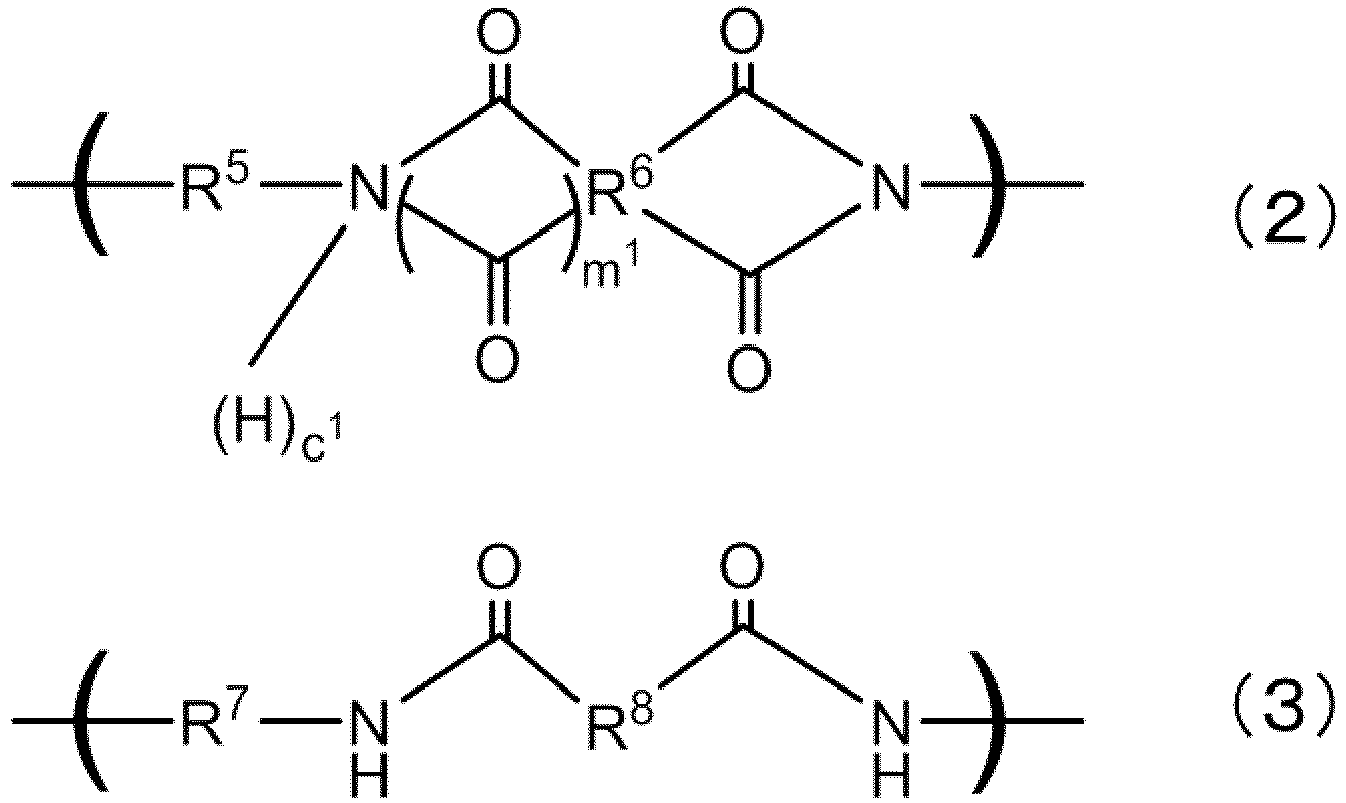
- In the general formula (2), R5 represents a divalent organic group having 2 to 50 carbon atoms, and R6 represents a trivalent or tetravalent organic group having 2 to 50 carbon atoms. In general formula (2), m1 and c1 each represent 0 or 1, c1 is 1 when m1 is 0, and c1 is 0 when m1 is 1. In the general formula (3), R7 and R8 each independently represent a divalent organic group having 2 to 50 carbon atoms.
- R6 in the general formula (2) and R8 in the general formula (3) may have either an aromatic or aliphatic skeleton, but it is preferable that these groups have an aliphatic skeleton because the water-solubility of the water-soluble polymer is improved, and the addition amount of the basic compound as a water-solubilizing agent can be reduced.
- It is more preferable that at least 50 mol% of each of R5 and R7 in the general formulae (2) and (3) is a diamine residue represented by the general formula (1) because the inorganic filler can be more firmly bound to further improve shape stability at the time of heating. When the water-soluble polymer contains only one of the structural unit represented by the general formula (2) and the structural unit represented by the general formula (3), it is preferable that at least 50 mol% of one of R5 and R7 is diamine residue represented by the general formula (1). When the water-soluble polymer contains both the structural unit represented by the general formula (2) and the structural unit represented by the general formula (3), it is preferable that at least 50 mol% of the total of R5 and R7 is a diamine residue represented by the general formula (1), and it is more preferable that at least 50 mol% of each of R5 and R7 is a diamine residue represented by the general formula (1).
- In the general formula (2), the water-soluble polymer is polyimide when m1 is 1. Polyimide is an imide cyclized product of a polyamide acid which is a polycondensate of a diamine and a tetracarboxylic dianhydride, and contains a residue of a diamine and a residue of a tetracarboxylic dianhydride. In the general formula (2), R5 represents a residue of a diamine, and R6 represents a residue of a tetracarboxylic dianhydride.
- Examples of the diamine having a structure represented by the general formula (1) include 3,5-diaminobenzoic acid, 3,4-diaminobenzoic acid, 5,5'-methylenebis(2-aminobenzoic acid), bis(3-amino-4-carboxyphenyl)sulfone, 2,2-bis(3-amino-4-carboxyphenyl)propane, 2,2-bis(3-amino-5-carboxyphenyl)propane, 2,2-bis(4-amino-3-carboxyphenyl)propane, 2,2-bis(3-amino-4-carboxyphenyl)hexafluoropropane, 2,2-bis(3-amino-5-carboxyphenyl)hexafluoropropane, 2,2-bis(4-amino-3-carboxyphenyl)hexafluoropropane, bis(3-amino-4-carboxyphenyl)ether, and these compounds having 1 to 4 hydrogen atoms replaced by hydroxyl groups, carboxyl groups or sulfonic acid groups. Two or more of these compounds may be used.
- Examples of the diamine that does not have the structure represented by the general formula (1) include paraphenylene diamine, meta-phenylenediamine, 3,3'-diaminodiphenyl ether, 4,4'-diaminodiphenyl ether, 3,4'-diaminodiphenyl ether, 4,4'-diaminodiphenylmethane, 3,3'-diaminodiphenyl sulfone, 4,4'-diaminodiphenyl sulfone, 3,3'-diaminodiphenyl sulfide, 4,4'-diaminodiphenyl sulfide, 1,3-bis(4-aminophenoxy)benzene, 1,4-bis(4-aminophenoxy)benzene, 2,2-bis(trifluoromethyl)benzidine, 9,9'-bis(4-aminophenyl)fluorene, hexamethylenediamine and 1,3-bis(3-aminopropyltetramethyldisiloxane). Two or more of these compounds may be used.
- Examples of the tetracarboxylic dianhydride include aromatic tetracarboxylic anhydrides such as 4,4'-oxydiphthalic dianhydride, 3,3',4,4'-benzophenonetetracarboxylic dianhydride, pyromellitic dianhydride, 3,4,9,10-perylenetetracarboxylic dianhydride, 3,3',4,4'-diphenylsulfone tetracarboxylic dianhydride, 3,3',4,4'-biphenyltetracarboxylic dianhydride, 1,2,5,6-naphthalenetetracarboxylic dianhydride, 3,3',4,4'-para-terphenyltetracarboxylic dianhydride and 3,3',4,4'-meta-terphenyltetracarboxylic anhydride, aliphatic tetracarboxylic anhydrides such as 1,3,3a,4,5,9b-hexahydro-5-(tetrahydro-2,5-dioxo-3-furanyl)naphtho[1,2-c]furane-1,3-dione, bicyclo[2,2,2]oct-7-ene-2,3,5,6-tetracarboxylic dianhydride, 3-(carboxymethyl)-1,2,4-cyclopentane tricarboxylic 1,4 : 2,3-dianhydride, dicyclohexylmethane-3,3',4,4'-tetracarboxylic dianhydride, dicyclohexyl ether-3,3',4,4'-tetracarboxylic dianhydride, dicyclohexylketone-3,3',4,4'-tetracarboxylic anhydride and bicyclohexyl-3,3',4,4'-tetracarboxylic dianhydride, and these compounds having 1 to 4 hydrogen atoms replaced by hydroxyl groups, carboxyl groups or sulfonic acid groups. Two or more of these compounds may be used.
- Preferably, the group R6 has an aliphatic skeleton from the viewpoint of decreasing the necessary addition amount of the basic compound as a water solubilizing agent and suppressing the internal resistance at the time of preparing the battery. The term "aliphatic skeleton" used herein refers to a skeleton containing an acyclic or cyclic nonaromatic hydrocarbon. Examples of the acid dianhydride which gives R6 preferable as an aliphatic skeleton include the above-mentioned aliphatic tetracarboxylic anhydrides, and these compounds having 1 to 4 hydrogen atoms replaced by hydroxyl groups, carboxyl groups or sulfonic acid groups. Two or more of these compounds may be used.
- The polyimide having a structural unit represented by the general formula (2) can be obtained by, for example, performing polycondensation of the above-mentioned diamine and tetracarboxylic dianhydride in a solvent to obtain a polyamide acid, and then subjecting the polyamide acid to imide cyclization. As in normal polycondensation reaction, the polymerization degree of the generated polyamide acid increases, leading to an increase in molecular weight as the addition ratio (molar ratio) between the diamine and the tetracarboxylic dianhydride becomes closer to 1 : 1. The addition ratio (molar ratio) between the tetracarboxylic dianhydride and the diamine is preferably 100 : 50 to 150.
- In addition, the end of the polyimide may be capped with a dicarboxylic anhydride such as maleic anhydride, phthalic anhydride, nadic anhydride, ethynyl phthalic anhydride or hydroxy phthalic anhydride; or a monoamine such as hydroxyaniline, aminobenzoic acid, dihydroxyaniline, carboxyhydroxyaniline or dicarboxyaniline.
- The solvent to be used for the polycondensation reaction is not particularly limited as long as the generated polyamide acid is soluble in the solvent, and for example, an aprotic polar solvent such as N-methyl-2-pyrrolidone, N-methylcaprolactam, N,N-dimethylacetamide, N, N-dimethylformamide, dimethylsulfoxide, γ-butyrolactone and dimethylimidazoline; phenol-based solvents such as phenol, m-cresol, chlorophenol or nitrophenol; a phosphorus-based solvent with phosphorus pentaoxide added to polyphosphoric acid or phosphoric acid; or the like can be preferably used.
- In general, a diamine and a tetracarboxylic dianhydride are reacted in such a solvent at a temperature of 100°C or lower to obtain a polyamide acid which is a polyimide precursor. Thereafter, imidization cyclization is performed at a temperature preferably in a range of 100°C to 300°C to obtain a polyimide resin. In the imide cyclization, a base such as triethylamine, isoquinoline or pyridine can be added as a catalyst, or water produced as a byproduct can be azeotropically mixed with a nonpolar solvent such as toluene to be removed. Thereafter, the reaction solution is added in water or the like to precipitate polyimide, and the polyimide is dried, whereby a polyimide solid can be obtained. Alternatively, the polyamide acid is once added in a poor solvent such as water to obtain a polyamide acid solid, and the polyamide acid solid is subjected to heat treatment at a temperature of 100°C to 500°C to perform imide cyclization, whereby a polyimide resin solid can be obtained.
- In the general formula (2), the water-soluble polymer is polyamideimide when m1 is 0. Polyamideimide is an imide cyclized product of a polyamideamide acid which is a polycondensate of a diamine and a tricarboxylic acid, and contains a residue of a diamine and a residue of a tricarboxylic acid. R5 in the general formula (2) represents a residue of a diamine, and R6 represents a residue of a tricarboxylic acid.
- Examples of the diamine include those exemplified above as the diamine forming the polyimide.
- Examples of the tricarboxylic acid may include aromatic compounds such as trimellitic acid, hydroxytrimellitic acid, diphenyl ether tricarboxylic acid and diphenylsulfonetricarboxylic acid; aliphatic compounds such as dicyclohexyl ether tricarboxylic acid, dicyclohexylsulfonetricarboxylic acid, dicyclohexyl ether tricarboxylic acid and bicyclohexyltricarboxylic acid; acid anhydrides thereof; and phenol-substituted products of these compounds. Two or more of these compounds may be used.
- In particular, from the viewpoint of reducing the necessary addition amount of the basic compound which is a water-solubilizing agent, and suppressing the internal resistance at the time of preparing a battery, it is preferable that the group R6 has an aliphatic skeleton. The term "aliphatic skeleton" used herein refers to a skeleton containing an acyclic or cyclic nonaromatic hydrocarbon. Examples of the tricarboxylic acid which gives R6 preferable as an aliphatic skeleton may include the above-mentioned aliphatic compounds, acid anhydrides thereof, and phenol-substituted products of these compounds. Two or more of these compounds may be used.
- In addition, the tricarboxylic acid can be copolymerized with a dicarboxylic acid such as phthalic acid or hydroxyphthalic acid, or an anhydride thereof; other tricarboxylic acid such as trimesic acid or an anhydride thereof; or a tetracarboxylic acid such as pyromellitic acid, diphenyl ether tetracarboxylic acid, diphenylsulfone tetracarboxylic acid or biphenyltetracarboxylic acid or a hydroxyl group-substituted product thereof, or an anhydride thereof. When such other acid or acid anhydride is copolymerized, the amount thereof is preferably 50 mol% or less based on the total amount of acids and acid anhydrides.
- The polyamideimide having a structural unit represented by the general formula (2) can be obtained by, for example, performing polycondensation of the above-mentioned diamine and tricarboxylic acid in a solvent to obtain a polyamideamide acid, and subjecting the polyamideamide acid to imide cyclization. As in the case of polyimide, the addition ratio (molar ratio) between the tricarboxylic acid and the diamine is preferably 100 : 50 to 150.
- In addition, as in the case of polyimide, the end of the polyamideimide can be capped.
- Examples of the solvent to be used in the polycondensation reaction may include those exemplified as solvents to be used for the polycondensation reaction of polyimide.
- In general, a diamine and a tricarboxylic acid are reacted in such a solvent at a temperature of 100°C or lower to obtain a polyamide acid which is a polyamideimide precursor. Thereafter, imidization cyclization is performed at a temperature preferably in a range of 100°C to 300°C to obtain a polyamideimide resin. In the imide cyclization, a base such as triethylamine, isoquinoline or pyridine can be added as a catalyst, or water produced as a byproduct can be azeotropically mixed with a nonpolar solvent such as toluene to be removed. Thereafter, the reaction solution is added in water or the like to precipitate polyamideimide, and the polyamideimide is dried, whereby a polyamideimide solid can be obtained. Alternatively, the polyamide acid is once added in a poor solvent such as water to obtain a polyamide acid solid, and the polyamide acid solid is subjected to heat treatment at a temperature of 100°C to 500°C to perform imide cyclization, whereby a polyamideimide resin solid can be obtained.
- The polyamide having a structural unit represented by the general formula (3) is a polycondensate of a diamine and a dicarboxylic acid. R7 in the general formula (3) represents a residue of a diamine, and R8 represents a residue of a dicarboxylic acid.
- Examples of the diamine include those exemplified above as the diamine forming the polyimide.
- Examples of the dicarboxylic acid include aromatic dicarboxylic acids such as terephthalic acid, isophthalic acid, diphenyl ether dicarboxylic acid, naphthalenedicarboxylic acid and diphenylsulfonedicarboxylic acid; and aliphatic dicarboxylic acids such as cyclohexanedicarboxylic acid, dicyclohexyl ether dicarboxylic acid, dicyclohexylsulfonedicarboxylic acid and bicyclohexyldicarboxylic acid. Two or more of these compounds may be used.
- In particular, from the viewpoint of reducing the necessary addition amount of the basic compound which is a water-solubilizing agent, and suppressing the internal resistance at the time of preparing a battery, it is preferable that the group R8 has an aliphatic skeleton. The term "aliphatic skeleton" used herein refers to a skeleton containing an acyclic or cyclic nonaromatic hydrocarbon. Examples of the dicarboxylic acid which gives R8 preferable as an aliphatic skeleton may include the above-mentioned aliphatic dicarboxylic acids. Two or more of these compounds may be used.
- The polyamide having a structural unit represented by the general formula (3) can be obtained by, for example, performing polycondensation of the above-mentioned diamine and dicarboxylic acid in a solvent. As in the case of polyimide, the addition ratio (molar ratio) between the dicarboxylic acid and the diamine is preferably 100 : 50 to 150.
- Examples of the solvent to be used in the polycondensation reaction may include those exemplified as solvents to be used for the polycondensation reaction of polyimide.
- In general, an acid chloride or active ester of a dicarboxylic acid and a diamine are reacted in such a solvent at a temperature of 30°C or lower to obtain polyamide. In the reaction, a base such as triethylamine or pyridine can be added as a catalyst. Thereafter, the reaction solution is added in water or the like to precipitate polyamide, and the polyamide is dried, whereby a polyamide solid can be obtained.
- The weight average molecular weight of the water-soluble polymer is preferably as large as possible within the bounds of securing water solubility because the shape stability of the separator at the time of heating can be improved. The weight average molecular weight of the water-soluble polymer is preferably 20,000 or more, more preferably 25,000 or more. The preferred upper limit of the weight average molecular weight is 200,000 or less from the viewpoint of water solubility.
- The weight average molecular weight is a value which is measured by GPC (gel permeation chromatography) and determined in terms of polystyrene. The weight-average molecular weight of the water-soluble polymer was measured under the following conditions.
- 1) Equipment or apparatus: Waters 2690
- 2) Column: TSK-GEL (d-4000 & d-2500) from TOSOH CORPORATION
- 3) Solvent: NMP
- 4) Flow rate: 0.4 mL/min
- 5) Sample concentration: 0.05 to 0.1 wt%
- 6) Injection volume: 50 µL
- 7) Temperature: 40°C
- 8) Detector: Waters 996
- As polystyrene for use in conversion, standard polystyrene from Polymer Laboratories Ltd. was used.
- The content of the water-soluble polymer in the porous layer (II) is preferably 0.4 to 5.0 parts by mass based on 100 parts by mass of the inorganic filler. When the content of the water-soluble polymer is 0.4 parts by mass or more, the inorganic filler can be firmly bound to further improve the shape stability of the separator at the time of heating. On the other hand, when the content of the water-soluble polymer is 5.0 parts by mass or less, clogging of the porous film (I) can be reduced to suppress an increase in air resistance of the separator.
- The water-insoluble polymer has an effect of suppressing separation of the porous layer (II) from the porous film (I).
- The water-insoluble polymer is preferably an electrochemically stable material that has electrical insulation property, is stable to a nonaqueous electrolyte, and is hardly oxidized and reduced in a battery operating voltage range. Examples of the material include styrene resins [polystyrene (PS) etc.], styrene-butadiene rubber (SBR), acrylic resins (PMMA etc.), polyalkylene oxides [polyethylene oxide (PEO) etc.], fluororesins (PVDF etc.) and derivatives thereof. These resins may be crosslinked with a urea resin, polyurethane or the like. Two or more of these resins may be used. Among them, styrene resins, acrylic resins and fluororesins are preferable, with acrylic resins being more preferable. An acrylic resin has a low glass transition temperature (Tg) and high flexibility, and is therefore capable of more effectively suppressing separation of the porous layer (II) from the porous film (I). A resin having a low Tg and high flexibility tends to have low shape stability at the time of heating, but since the porous layer (II) contains the water-soluble polymer, it is possible to more reliably suppress separation of the porous layer (II) from the porous film (I) while softening at a high temperature is suppressed to improve shape stability at the time of heating.
- The content of the water-insoluble polymer in the porous layer (II) is preferably 0.5 to 5.0 parts by mass based on 100 parts by mass of the inorganic filler. When the content of the water-insoluble polymer is 0.5 parts by mass or more, the porous layer (II) is firmly bound to the porous film (I) even at the time of heating, and therefore the shape stability of the separator can be further improved. On the other hand, when the content of the water-insoluble polymer is 5.0 parts by mass or less, clogging of the porous film (I) can be reduced to suppress an increase in air resistance of the separator.
- The basic compound has an effect of improving the binding property to the inorganic filler by forming an ionic bond with the water-soluble polymer containing a structure represented by the general formula (1).
- Examples of the basic compound include alkali metal compounds, alkaline earth metal compounds, quaternary ammonium compounds having 1 to 20 carbon atoms, and amine compounds having 1 to 20 carbon atoms. From the viewpoint of ionic bondability with the water-soluble polymer, the basic compound is preferably at least one compound selected from an alkali metal compound, a quaternary ammonium compound having 1 to 20 carbon atoms, and an amine compound having 1 to 20 carbon atoms.
- Examples of the alkali metal compound include hydroxides of alkali metal, carbonates and phosphates.
- Examples of the hydroxide of an alkali metal include lithium hydroxide, sodium hydroxide, potassium hydroxide, rubidium hydroxide and cesium hydroxide. Two or more of these compounds may be contained. From the viewpoint of the solubility and stability of the water-soluble polymer, the hydroxide of an alkali metal is more preferably a compound selected from lithium hydroxide, sodium hydroxide and potassium hydroxide.
- Examples of the carbonate of an alkali metal include lithium carbonate, lithium hydrogencarbonate, sodium carbonate, sodium hydrogencarbonate, potassium carbonate, potassium hydrogencarbonate, rubidium hydrogencarbonate, cesium carbonate, cesium hydrogencarbonate and potassium sodium carbonate. Two or more of these resins may be used. From the viewpoint of the solubility and stability of the water-soluble polymer, the carbonate of an alkali metal is more preferably a compound selected from sodium carbonate, sodium hydrogencarbonate, potassium carbonate, potassium hydrogencarbonate and potassium sodium carbonate.
- Examples of the phosphate of an alkali metal include lithium phosphate, lithium hydrogenphosphate, lithium dihydrogenphosphate, sodium phosphate, sodium hydrogenphosphate, sodium dihydrogenphosphate, potassium phosphate, potassium hydrogenphosphate, potassium dihydrogenphosphate, rubidium phosphate, rubidium hydrogenphosphate, rubidium dihydrogenphosphate, cesium phosphate, cesium hydrogenphosphate, cesium dihydrogenphosphate, potassium sodium phosphate and potassium sodium hydrogenphosphate. Two or more of these resins may be used. From the viewpoint of the solubility and stability of the water-soluble polymer, the phosphate of an alkali metal is preferably a compound selected from sodium phosphate, sodium hydrogenphosphate, potassium phosphate, potassium hydrogenphosphate, potassium sodium phosphate and potassium sodium hydrogenphosphate.
- Examples of the amine compound having 1 to 20 carbon atoms include aliphatic tertiary amines such as trimethylamine, triethylamine, triisopropylamine, tributylamine, triethanolamine and N-methylethanolamine; aromatic amines such as pyridine, N,N-dimethylaminopyridine and lutidine. Two or more of these compounds may be used.
- Examples of the quaternary ammonium compound having 1 to 20 carbon atoms include quaternary ammonium salts such as tetramethylammonium hydroxide and tetraethylammonium hydroxide. Two or more of these compounds may be used.
- From the viewpoint of the solubility of the water-soluble polymer, the content of the basic compound in the porous layer (II) is preferably 0.2 mole equivalent or more, more preferably 0.5 mole equivalent or more based on the amount of acidic functional groups in the water-soluble polymer. On the other hand, when the content of the basic compound is more than 4 mole equivalent, the internal resistance of the battery may increase, leading to a decrease in charge-discharge rate, and therefore the content of the basic compound is preferably 4 mole equivalent or less. In addition, the content of the basic compound is still more preferably 3 mole equivalent or less from the viewpoint of suppressing decomposition of the water-soluble polymer and deterioration of the binding property between the water-soluble polymer and the inorganic filler.
- The porous layer (II) may contain various additives other than the above-mentioned components, such as, for example, an antioxidant, a preservative, a surfactant and the like as necessary.
- The thickness of the porous layer (II) is preferably 1 µm or more, more preferably 2 µm or more from the viewpoint of securing film breaking strength and insulating quality at the time when the porous film (I) is melted and shrunk at a temperature equal to or higher than melting point. On the other hand, from the viewpoint of increasing the capacity of the nonaqueous electrolyte battery, the film thickness is preferably 10 µm or less, more preferably 5 µm or less.
- The nonaqueous electrolyte battery separator of the present invention includes the porous film (I) and the porous layer (II). Preferably, the porous layer (II) is formed on one surface or both surfaces of the porous film (I) .
- The air permeation increase degree of the nonaqueous electrolyte battery separator is preferably +200 s/100 cc Air or less, more preferably less than +100 s/100 cc Air. When the air permeation increase degree is +200 s/100 cc Air or less, ion permeability can be secured to suppress deterioration of battery characteristics.
- Here, the air permeation increase degree is a value indicating an amount in which air resistance of the separator including the porous film (I) and the porous layer (II) increases with respect to the air resistance of the porous film (I) alone. The air resistance is measured in accordance with JIS P 8117: 2009 using a Gurley densometer (type B) manufactured by Tester Sangyo Co., Ltd. The porous film (I) and the separator are each fixed in such a manner that there are no creases between a clamping plate and an adapter plate, the air resistance is measured, and the air permeation increase degree can be calculated from the following equation

- Examples of means for setting the air permeation increase degree to +200 s/100 cc Air or less include a method in which clogging of the porous film (I) is reduced by, for example, adjusting the content of each of the water-soluble polymer and the water-insoluble polymer to the above-mentioned preferred range.
- The thermal shrinkage ratio of the nonaqueous electrolyte battery separator is preferably 5% or less, more preferably less than 3%. The thermal shrinkage ratio is an index of shape stability at the time of heating, and as long as the thermal shrinkage ratio is 5% or less, it is possible to suppress a situation in which thermal shrinkage of the separator causes a positive electrode and a negative electrode to come into contact with each other, resulting in occurrence of a short-circuit even at the time of abnormal heat generation in the battery.
- Here, the thermal shrinkage ratio refers to a ratio of the length of the separator after heating at a predetermined temperature to the length of the separator at room temperature. The nonaqueous electrolyte battery separator is cut to a size of 50 mm × 50 mm, and a marking with a length of 30 mm is then made in each of a side in a machine direction (MD) and a side in a traverse direction (TD) on the porous film (I) side. The separator with the markings is placed in an oven heated to a predetermined temperature (150°C, 160°C or 200°C) with the separator sandwiched between sheets of paper, and the separator is heated for 1 hour. Thereafter, the nonaqueous electrolyte battery separator is taken out from the oven, and cooled to room temperature, the length of the marking in each of MD and TD is then measured, and the thermal shrinkage ratio is calculated from the following equation where the length of the shorter marking portion is d (mm).

- Examples of means for setting the thermal shrinkage ratio to 5% or less include a method in which the content of the water-soluble polymer is adjusted to the above-mentioned preferred range.
- The nonaqueous electrolyte battery separator of the present invention can be obtained by, for example, applying to at least one surface of the porous film (I) the above-mentioned coating liquid containing an inorganic filler, a water-soluble polymer, a water-insoluble polymer, a basic compound and a solvent, and then removing the solvent to form a porous layer (II). Details thereof will be described below.
- Preferably, the coating liquid is produced by adding an inorganic filler to an aqueous solution obtained by dissolving a water-soluble polymer and a basic compound in water, mixing and dispersing the mixture, adding a water-insoluble polymer, and mixing the mixture. A small amount of an alcohol may be added to water from the viewpoint of drying property and applicability to the porous layer (I).
- Examples of the method for mixing and dispersing the inorganic filler include a mechanical stirring method, an ultrasonic dispersion method, a high-pressure dispersion method and a medium dispersion method. Among them, the media dispersion method is preferable in which the inorganic filler can be highly dispersed, and the inorganic filler and the water-soluble polymer can be adapted to each other in a short time.
- Examples of the method for producing the porous film (I) include a foaming method, a phase separation method, a dissolution and recrystallization method, a stretching and pore opening method and a powder sintering method. Among them, the phase separation method is preferable from the viewpoint of uniformity of fine pores and cost.
- Examples of the method for producing the porous film (I) by a phase separation method include a method in which polyethylene and a molding solvent are heated, melted and kneaded, the resulting molten mixture is extruded from a die, and cooled to form a gel-like molded product, the resulting gel-like molded product is stretched in at least a uniaxial direction, and the molding solvent is removed to obtain a porous film.
- Preferably, the coating liquid obtained in [1] is applied to at least one surface of the porous film (I) obtained in [2], and the solvent is removed to form the porous layer (II).
- Examples of the method for applying the coating liquid to the porous film (I) include a gravure coater method, a small-diameter gravure coater method, a reverse roll coater method, a transfer roll coater method, a kiss coater method, a dip coater method, a knife coater method, an air doctor coater method, a blade coater method, a rod coater method, a squeeze coater method, a cast coater method, a die coater method, a screen printing method and a spray coating method.
- Examples of the method for removing the solvent include a method in which the porous film (I) is heated and dried, or dried under reduced pressure, at a temperature equal to or lower than the melting point of the porous film (I) while being fixed. Among them, a method in which the porous film (I) is heated and dried is preferable because the process is simplified.
- The heating and drying temperature is preferably 70°C or lower, more preferably 60°C or lower, still more preferably 50°C or lower from the viewpoint of suppressing development of the pore closing function of the porous film (I) and reducing the use amount of heat. The heating and drying time is preferably several seconds to several minutes.
- The nonaqueous electrolyte battery separator of the present invention can be suitably used for a battery using a nonaqueous electrolyte. Specifically, the nonaqueous electrolyte battery separator can be preferably used as a separator of a secondary battery such as a nickel-hydrogen battery, a nickel-cadmium battery, a nickel-zinc battery, a silver-zinc battery, a lithium secondary battery, a lithium ion secondary battery or a lithium polymer secondary battery. In particular, it is preferable to use the nonaqueous electrolyte battery separator as a separator of a lithium ion secondary battery.
- In a nonaqueous electrolyte battery, a positive electrode and a negative electrode are laminated with a separator interposed therebetween. The separator contains an electrolytic solution (electrolyte). The structure of the electrode is not particularly limited, and examples thereof include an electrode structure in which disk-shaped positive and negative electrodes are disposed so as to face each other (coin type); an electrode structure in which plate-shaped positive and negative electrodes are alternately laminated (lamination type); and an electrode structure in which laminated band-like positive and negative electrodes are wound (winding type). The current collector, the positive electrode, the positive active material, the negative electrode, the negative active material and the electrolyte solution, which are used in the nonaqueous electrolyte battery, are not particularly limited, and previously known materials can be used in combination as appropriate.
- The present invention will now be described by way of examples.
- A method for preparing a water-soluble polymer will be described below.
- In a well-dried four-necked round bottom flask, 280.00 g of N-methylpyrrolidone (NMP) and 14.44 g (95 mmol) of 3,5-diaminobenzoic acid (3,5-DAB manufactured by Tokyo Chemical Industry Co. Ltd.), and 1.24 g (5 mmol) of 1,3-bis-3-aminopropyltetramethyldisiloxane (APDS manufactured by Dow Corning Toray Co., Ltd.) were dissolved with stirring under a nitrogen atmosphere. Thereafter, the solution was cooled with stirring, and 31.00 g (100 mmol) of 3,3',4,4'-diphenyl ether tetracarboxylic dianhydride (ODPA manufactured by Tokyo Chemical Industry Co., Ltd.) was added dropwise while being kept at 50°C or lower. After the whole amount of the 3,3',4,4'-diphenyl ether tetracarboxylic dianhydride was added dropwise, the mixture was reacted at 50 to 60°C for 1 hour, 0.10 g of isoquinoline and 30 mL of toluene were then added, the temperature of the solution was elevated to 180°C, and the reaction was carried out while distilled water was removed. After completion of the reaction, the temperature of the solution was lowered to room temperature, the solution was added in 5 L of water, and the resulting precipitate was separated by filtration to obtain a yellowish white solid. The solid was washed with 1 L of water three times, and then dried in a ventilation oven at 50°C for 3 days to obtain a polyimide resin A having a structural unit represented by the general formula (2), where 95 mol% of R5 is a diamine residue represented by the general formula (1). The weight average molecular weight was 22,000.
- Except that 14.44 g (95 mmol) of 3,5-DAB was changed to 9.88 g (95 mmol) of meta-phenylenediamine (MDA manufactured by Tokyo Chemical Industry Co., Ltd.), the same procedure as in Synthesis Example 1 was carried out to obtain a polyimide resin B which did not have a structure represented by the general formula (1). The weight average molecular weight was 23,000.
- Except that 14.44 g (95 mmol) of 3,5-DAB and 1.24 g (5 mmol) of APDS were changed to 31.10 g (85 mmol) of 2,2-bis (3-amino-4-hydroxyphenyl)hexafluoropropane (trade name "AZ 6F-AP" manufactured AZ Electronic Materials, 6FAP) and 3.27 g (30 mmol) of 3-aminophenol (AMP manufactured by Tokyo Chemical Industry Co., Ltd.), the same procedure as in Synthesis Example 1 was carried out to obtain a polyimide resin C in which the end was capped with 3-aminophenol, the polyimide resin C having a structural unit represented by the general formula (2), where the whole of R5 is a diamine residue represented by the general formula (1). The weight average molecular weight was 24,000.
- In a well-dried four-necked round bottom flask, 80.00 g of NMP, 3.66 g (10 mmol) of 6FAP, and 2.00 g (10 mmol) of 4,4'-diaminodiphenyl ether (manufactured by Wakayama Seika Kogyo Co., Ltd.; trade name "Kou DA"; 4,4'-DAE) were dissolved with stirring under a nitrogen atmosphere. Thereafter, the solution was cooled with stirring, and 14.28 g (20 mmol) of an acid anhydride (TMDA) represented by the structural formula (4) and synthesized in accordance with the method described in Synthesis Example 1 in Japanese Patent Laid-open Publication No.
11-100503 
- Except that the addition amount of 6FAP was changed to 1.83 g (5 mmol), and the addition amount of 4,4'-DAE was changed to 3.00 g (15 mmol), the same procedure as in Synthesis Example 4 was carried out to obtain a polyimide resin E having a structural unit represented by the general formula (2), where 25 mol% of R5 is a diamine residue represented by the general formula (1). The weight average molecular weight was 23,000.
- Except that the diamine was changed to 28.63 g (100 mmol) of 3,3'-dicarboxy-4,4'-diaminodiphenylmethane (trade name "MBAA" manufactured by Wakayama Seika Kogyo Co., Ltd.), and the acid anhydride was changed to 44.40 g (100 mmol) of 2,2-bis(3,4-dicarboxyphenyl)hexafluoropropane dianhydride (6FDA manufactured by Daikin Industries, Ltd.), the same procedure as in Synthesis Example 1 was carried out to obtain a polyimide resin E having a structural unit represented by the general formula (2), where the whole of R5 is a diamine residue represented by the general formula (1). The weight average molecular weight was 23,000.
- In a well-dried four-necked round bottom flask, 480.00 g of NMP, 10.10 g (100 mmol) of triethylamine, 10.00 g (50 mmol) of 4,4'-DAE and 6.90 g (50 mmol) of 3,5-DAB were dissolved with stirring under a nitrogen atmosphere. Thereafter, the solution was cooled to -20°C with stirring, and a solution obtained by dissolving 21.05 g (100 mmol) of trimellitic anhydride chloride (manufactured by Tokyo Chemical Industry Co., Ltd., hereinafter referred to as TMC) in 200.00 g of NMP was gradually added dropwise while being kept at 0°C. After the whole amount of the solution was added dropwise, the mixture was reacted at -20°C for 2 hours, and the solution was then brought to room temperature, and stirred for 1 hour. The solution was added in 10 L of water, and the resulting precipitate was separated by filtration to obtain a yellowish white solid. The solid was washed with 1 L of water three times, and then dried in a ventilation oven at 50°C for 3 days to obtain a polyamideimide resin A having a structural unit represented by the general formula (2), where 50 mol% of R5 is a diamine residue represented by the general formula (1). The weight average molecular weight was 24,000.
- Except that the addition amount of 4,4'-DAE was changed to 20.00 g (100 mmol), and 3,5-DAB was not used, the same procedure as in Synthesis Example 6 was carried out to obtain a polyamideimide resin B which did not have a structure represented by the general formula (1). The weight average molecular weight was 23,000.
- In a well-dried four-necked flask, 28.63 g (100 mmol) of MBAA was dissolved in 131.79 g of NMP with stirring under a nitrogen atmosphere. Thereafter, the solution was cooled on ice with stirring, and to this solution, a solution obtained by dissolving 20.30 g (100 mmol) of isophthaloyl chloride (IPC manufactured by Tokyo Chemical Industry Co., Ltd.) in 15.00 g of NMP was added while being kept at 30°C or lower. After the whole amount of the solution was added dropwise, the mixture was reacted at 30°C for 4 hours. The solution was added in 3 L of water, and the resulting precipitate was separated by filtration, and washed with 1.5 L of water three times. The washed solid was dried in a ventilation oven at 50°C for 3 days to obtain a polyamide resin A having a structural unit represented by the general formula (3), where the whole of R7 is a diamine residue represented by the general formula (1). The weight average molecular weight was 21,000.
- Except that the diamine was changed to 7.61 g (50 mmol) of 3,5-DAB and 10.01 g (50 mmol) of 4,4'-DAE, and the addition amount of IPC was changed to 19.90 g (98 mmol), the same procedure as in Synthesis Example 9 was carried out to obtain a solid of a polyamide resin B having a structural unit represented by the general formula (3), where 50 mol% of R7 is a diamine residue represented by the general formula (1). The weight average molecular weight was 21,000.
- Except that the diamine was changed to 32.96 g (90 mmol) of 6FAP and 1.52 g (10 mmol) of 3,5-DAB, and the acid chloride was changed to 20.30 g (100 mmol) of terephthalic acid chloride (manufactured by Tokyo Chemical Industry Co., Ltd., hereinafter referred to as TPC), the same procedure as in Synthesis Example 9 was carried out to obtain a solid of a polyamide resin C having a structural unit represented by the general formula (3), where the whole of R7 is a diamine residue represented by the general formula (1). The weight average molecular weight was 23,000.
- Except that the diamine was changed to 22.90 g (80 mmol) of MBAA and 3.60 g (18 mmol) of 4,4'-DAE, and the acid chloride was changed to 25.31 g (100 mmol) of 2,6-naphthalene dicarboxylic acid chloride (manufactured by Iharanikkei Chemical Industry Co., Ltd., trade name "26 NADOC", NDCC), the same procedure as in Synthesis Example 9 was carried out to obtain a solid of a polyamide resin D having a structural unit represented by the general formula (3), where the 82 mol% of R7 is a diamine residue represented by the general formula (1). The weight average molecular weight was 22,000.
- Except that the diamine was changed to 36.63 g (100 mmol) of 6FAP, and the acid chloride was changed to 25.18 g (99.5 mmol) of NDCC, the same procedure as in Synthesis Example 9 was carried out to obtain a polyamide resin E having a structural unit represented by the general formula (3), where the whole of R7 is a diamine residue represented by the general formula (1). The weight average molecular weight was 25,000.
- Except that the diamine was changed to 20.02 g (100 mmol) of 4,4'-DAE and the acid chloride was changed to 20.30 g (100 mmol) of IPC, the same procedure as in Synthesis Example 9 was carried out to obtain a solid of a polyamide resin F which did not have a structure represented by the general formula (1). The weight average molecular weight was 23,000.
- In a well-dried four-necked flask, 28.63 g (100 mmol) of 3,3'-dicarboxy-4,4'-diaminodiphenylmethane (trade name "MBAA" manufactured by Wakayama Seika Kogyo Co., Ltd.) was added to 131.79 g of NMP, and dissolved with stirring under a nitrogen atmosphere at room temperature. Thereafter, 30.00 g (100 mmol) of 1,3,3a,4,5,9b-hexahydro-5(tetrahydro-2,5-dioxo-3-furanyl)naphtho[1,2-c]furan-1,3-dione (trade name "RIKACID TDA-100" manufactured by New Japan Chemical Co., Ltd.) and 15.00 g of NMP were added, and the mixture was reacted at 40°C for 1 hour, and then subjected to a polymerization reaction at 200°C for 6 hours while water generated during the reaction was distilled off. After completion of the reaction, the temperature was lowered to room temperature, the solution was added in 3 L of water, and the resulting precipitate was separated by filtration, and washed with 1.5 L of water three times. The washed solid was dried in a ventilation oven at 50°C for 3 days to obtain a polyimide resin G having a structural unit represented by the general formula (2), where the 100 mol% of R5 is a diamine residue represented by the general formula (1). The weight average molecular weight was 28,000.
- Except that the acid chloride was changed to 24.82 g (100 mmol) of bicyclo[2,2,2]oct-7-ene-2,3,5,6-tetracarboxylic acid dianhydride (manufactured by Tokyo Chemical Industry Co., Ltd., hereinafter referred to as BOE), the same procedure as in Synthesis Example 15 was carried out to obtain a polyimide resin H having a structural unit represented by the general formula (2), where 100 mol% of R5 is a diamine residue represented by the general formula (1). The weight average molecular weight was 30,000.
- Except that the acid anhydride was changed to 22.42 g (100 mmol) of 3-(carboxymethyl)-1,2,4-cyclopentane tricarboxylic 1,4 : 2,3-dianhydride (manufactured by Tokyo Chemical Industry Co., Ltd., hereinafter referred to as JPDA), the same procedure as in Synthesis Example 15 was carried out to obtain a polyimide resin J having a structural unit represented by the general formula (2), where 100 mol% of R5 is a diamine residue represented by the general formula (1). The weight average molecular weight was 31,000.
- The compositions of resins synthesized in Synthesis Examples 1 to 17 are shown in Table 1.
[Table 1] Diamine having a structure represented by general formula (1) Other diamines Monoamine Acid anhydride or acid chloride Type Composition ratio Type Composition ratio Type Composition ratio Type Composition ratio Synthesis Example 1 Polyimide resin A 3,5-DAB 95 mmol APDS 5 mmol - - ODPA 100 mmol Synthesis Example 2 Polyimide resin B - - MDA 95 mmol - - ODPA 100 mmol APDS 5 mmol Synthesis Example 3 Polyimide resin C 6FAP 85 mmol - - AMP 30 mmol ODPA 100 mmol Synthesis Example 4 Polyimide resin D 6FAP 10 mmol 4,4'-DAE 10 mmol - - TMDA 20 mmol Synthesis Example 5 Polyimide resin E 6FAP 5 mmol 4,4'-DAE 15 mmol - - TMDA 20 mmol Synthesis Example 6 Polyimide resin F MBAA 100 mmol - - - - 6FDA 100 mmol Synthesis Example 7 Polyamide imide resin A 3,5-DAB 50 mmol 4,4'-DAE 50 mmol - - TMC 100 mmol Synthesis Example 8 Polyamideimide resin B - - 4,4'-DAE 100 mmol - - TMC 100 mmol Synthesis Example 9 Polyamide resin A MBAA 100 mmol - - - - IPC 100 mmol Synthesis Example 10 Polyamide resin B 3,5-DAB 50 mmol 4,4'-DAE 50 mmol - - IPC 98 mmol Synthesis Example 11 Polyamide resin C 6FAP 90 mmol - - - - TPC 100 mmol 3,5-DAB 10 mmol Synthesis Example 12 Polyamide resin D MBAA 80 mmol 4,4'-DAE 18 mmol - - NDCC 100 mmol Synthesis Example 13 Polyamide resin E 6FAP 100 mmol - - - - NDCC 99.5 mmol Synthesis Example 14 Polyamide resin F - - 4,4'-DAE 100 mmol - - IPC 100 mmol Synthesis Example 15 Polyimide resin G MBAA 100 mmol - - - - TDA100 100 mmol Synthesis Example 16 Polyimide resin H MBAA 100 mmol - - - - BOE 100 mmol Synthesis Example 17 Polyimide resin J MBAA 100 mmol - - - - JPDA 100 mmol - A method for preparing a resin aqueous solution containing a water-soluble polymer and a basic compound will be described below. The solubility of the water-soluble polymer in water was evaluated by visual observation of the prepared aqueous solution. A sample with no turbidity was rated good, and a sample with turbidity was rated poor.
- 10.00 g of the polyimide resin A obtained in Synthesis Example 1 and 0.94 g (0.02 mol) of sodium hydroxide were mixed, 100.00 g of water was added to the mixture, and the mixture was heated to 50°C, and stirred to obtain a resin aqueous solution 1.
- Except that the addition amount was changed as shown in Table 2, the same procedure as in the method for preparing the resin aqueous solution 1 was carried out to obtain a resin aqueous solution. In Table 2, DMAE denotes dimethylaminoethanol, DMAB denotes dimethylaminobutanol, TMAH denotes tetramethylammonium hydroxide, and NEt3 denotes triethylamine.
- An attempt was made to prepare a resin aqueous solution in the same manner as in the method for preparing the resin aqueous solution 1 except that sodium hydroxide was not added, but the polyimide resin did not dissolved.
- An attempt was made to prepare a resin aqueous solution in the same manner as in the method for preparing the resin aqueous solution 1 except that 10.00 g of the polyimide resin A obtained in Synthesis Example 1 was changed to 10.00 g of the polyimide resin B obtained in Synthesis Example 2, but the polyimide resin did not dissolved.
- An attempt was made to prepare a resin aqueous solution by adding 1000.00 g of water to 10.00 g of the polyimide resin C obtained in Synthesis Example 3, heating the mixture to 50°C, and stirring the mixture without adding a basic compound, but the polyimide resin was not dissolved.
- An attempt was made to prepare a resin aqueous solution by mixing 10.00 g of the polyimide resin A obtained in Synthesis Example 1 and 0.87 g (0.01 mol) of potassium hydroxide, adding 1000.00 g of water to the mixture, heating the mixture to 50°C, and stirring the mixture, but a part of the polyimide resin was not dissolved.
- An attempt was made to prepare a resin aqueous solution by adding 200.00 g of water to 10.00 g of the polyimide resin D obtained in Synthesis Example 4, heating the mixture to 50°C and stirring the mixture without adding a basic compound, but the polyimide resin was not dissolved.
- An attempt was made to prepare a resin aqueous solution by mixing 10.00 g of the polyimide resin F obtained in Synthesis Example 6 and 0.30 g (0.005 mol) of potassium hydroxide, adding 500.00 g of water to the mixture, heating the mixture to 50°C, and stirring the mixture, but a part of the polyimide resin was not dissolved.
- An attempt was made to prepare a resin aqueous solution by mixing 10.00 g of the polyamideimide resin B obtained in Synthesis Example 8 and 0.32 g (0.008 mol) of sodium hydroxide, adding 100.00 g of water to the mixture, heating the mixture to 50°C, and stirring the mixture, but the polyamideimide resin was not dissolved.
- An attempt was made to prepare a resin aqueous solution by mixing 10.00 g of the polyamide resin F obtained in Synthesis Example 14 and 2.45 g (0.06 mol) of sodium hydroxide, adding 49.81 g of water to the mixture, heating the mixture to 50°C, and stirring the mixture, but the polyamide resin was not dissolved.
- 100.00 g of water was added to 10.00 g of carboxymethyl cellulose, and the mixture was stirred at 23°C to obtain a resin aqueous solution 36.
[Table 2] Resin aqueous solution Polymer Basic compound Addition amount of water Polymer concentration Solid content concentration* Solubility in water Type Addition amount Type Equivalent based on the amount of acidic groups in polymer Addition amount 1 Polyimide resin A 10.00g NaOH 1.0 mole equivalent 0.94g 100.00g 9% 10% Good 2 Polyimide resin A 10.00g NaOH 0.8 mole equivalent 0.69g 300.00g 3% 3% Good 3 Polyimide resin A 10.00g NaOH 1.5 mole equivalent 1.41g 500.00g 2% 2% Good 4 Polyimide resin A 10.00g NaOH 4.0 mole equivalent 3.76g 50.00g 16% 22% Good 5 Polyimide resin A 10.00g Na2CO3 1.0 mole equivalent 1.24g 100.00g 9% 10% Good 6 Polyimide resin A 10.00g Na2HPO4 1.0 mole equivalent 1.67g 100.00g 9% 10% Good 7 Polyimide resin A 10.00g None - - 100.00g 9% 9% Poor 8 Polyimide resin B 10.00g NaOH No acidic group 0.94g 100.00g 9% 10% Poor 9 Polyimide resin C 10.00g DMAE 1.0 mole equivalent 2.66g 1000.00g 1% 1% Good 10 Polyimide resin C 10.00g DMAE 2.0 mole equivalent 5.30g 300.00g 3% 5% Good 11 Polyimide resin C 10.00g DMAB 1.0 mole equivalent 2.65g 2000.00g 0% 1% Good 12 Polyimide resin C 10.00g DMAE 0.1 mole equivalent 0.27g 1000.00g 1% 1% Good 13 Polyimide resin C 10.00g None - - 1000.00g 1% 1% Poor 14 Polyimide resin A 10.00g Ca(OH)2 1.0 mole equivalent 0.87g 1000.00g 1% 1% Poor 15 Polyimide resin D 10.00g DMAB 1.0 mole equivalent 0.91g 200.00g 5% 5% Good 16 Polyimide resin D 10.00g None - - 200.00g 5% 5% Poor 17 Polyimide resin E 10.00g DMAB 1.0 mole equivalent 0.63g 200.00g 5% 5% Good 18 Polyimide resin F 10.00g KOH 1.0 mole equivalent 1.69g 500.00g 2% 2% Good 19 Polyimide resin F 10.00g KOH 0.2 mole equivalent 0.30g 500.00g 2% 2% Poor 20 Polyamide imide resin A 10.00g NaOH 1.0 mole equivalent 0.61g 100.00g 9% 10% Good 21 Polyamide imide resin A 10.00g TMAH 1.0 mole equivalent 1.38g 100.00g 9% 10% Good 22 Polyamide imide resin B 10.00g NaOH No acidic group 0.32g 100.00g 9% 9% Poor 23 Polyamide resin A 10.00g NaOH 1.5 mole equivalent 2.45g 49.81g 16% 20% Good 24 Polyamide resin A 10.00g Na2CO3 3.0 mole equivalent 13.00g 206.97g 4% 10% Good 25 Polyamide resin A 10.00g NEt3 0.5 mole equivalent 2.07g 22.41g 29% 35% Good 26 Polyamide resin A 10.00g NaOH 20.0 mole equivalent 32.70g 313.13g 3% 12% Good 27 Polyamide resin A 10.00g NaOH 3.0 mole equivalent 4.90g 9.94g 40% 60% Good 28 Polyamide resin B 10.00g Na2CO3 1.5 mole equivalent 2.12g 68.67g 12% 15% Good 29 Polyamide resin C 10.00g NEt3 2.0 mole equivalent 3.69g 41.08g 18% 25% Good 30 Polyamide resin D 10.00g NaOH 2.0 mole equivalent 2.47g 49.88g 16% 20% Good 31 Polyamide resin E 10.00g KOH 2.5 mole equivalent 2.27g 22.79g 29% 35% Good 32 Polyamide resin F 10.00g NaOH No acidic group 2.45g 49.81g 16% 20% Poor 33 Polyimide resin G 10.00g Na2CO3 0.3 mole equivalent 3.18g 100.00g 9% 12% Good 34 Polyimide resin H 10.00g Na2CO3 0.3 mole equivalent 3.18g 100.00g 9% 12% Good 35 Polyimide resin J 10.00g Na2CO3 0.3 mole equivalent 3.18g 100.00g 9% 12% Good * The solid content concentration is the total content of the water-soluble polymer and the basic compound in the aqueous solution. - The evaluation methods in examples and comparative examples will now be described.
- The appearance of the nonaqueous electrolyte battery separator obtained in each of examples and comparative examples was visually observed. A sample was rated good when there were no irregularities and no streaks, and a sample was rated poor when there were irregularities or streaks.
- A Gurley densometer (type B) manufactured by Tester Sangyo Co., Ltd. was used. The porous film (I) used in each of examples and comparative examples and the separator obtained in each of examples and comparative examples were each fixed in such a manner that there were no creases between a clamping plate and an adapter plate, the air resistance was measured in accordance with JIS P-8117: 2009, and the air permeation increase degree was calculated from the following equation.

- The nonaqueous electrolyte battery separator obtained in each of examples and comparative examples was cut to a size of 50 mm × 50 mm, and a marking with a length of 30 mm was then made in each of a side in a machine direction (MD) and a side in a traverse direction (TD) on the porous film (I) side. The separator with the markings was placed in an oven heated to each of temperatures of 150°C, 160°C and 200°C with the separator sandwiched between sheets of paper, and the separator was heated for 1 hour. Thereafter, the nonaqueous electrolyte battery separator was taken out from the oven, and cooled to room temperature, the length of the marking in each of MD and TD was then measured, and the thermal shrinkage ratio was calculated from the following equation where the length of the shorter marking portion is d (mm).

- Ceramic slurry was obtained by mixing alumina having an average particle diameter of 0.5 µm and the resin aqueous solution 1 in such a manner that the amount of the polyimide resin A was 2.0 parts by mass based on 100 parts by mass of alumina. Further, the concentration was adjusted with water so that the content of alumina in the ceramic slurry was 50% by mass. This ceramic slurry was mixed using a high-speed shearing stirrer (DESPA manufactured by Asada Iron Works Co., Ltd.), and dispersed using a continuous medium dispersing machine (NANO GRAIN MILL manufactured by Asada Iron Works Co., Ltd.).
- Next, 78 parts by mass of 2-ethylhexyl acrylate, 19.8 parts by mass of acrylonitrile, 2 parts by mass of methacrylic acid and 0.2 parts by mass of allyl methacrylate (AMA) were mixed to prepare a monomer mixture. In another vessel, 70 parts by mass of ion-exchange water, 0.2 parts by mass of sodium dodecylbenzenesulfonate, 0.3 parts by mass of ammonium persulfate, and 0.82 parts by mass of a sodium polyoxyethylene alkyl ether sulfate ("EMAL (registered trademark) D-3-D" manufactured by Kao Chemicals) and 0.59 parts by mass of polyoxyethylene lauryl ether ("EMULGEN (registered trademark)-120" manufactured by Kao Chemicals) as emulsifiers were mixed, the gas phase part was purged with nitrogen gas, and the temperature was elevated to 60°C. The monomer mixture was added to the vessel, and emulsion polymerization was performed to prepare an aqueous dispersion of an acrylic resin.
- The aqueous dispersion of the acrylic resin was added to the ceramic slurry in such a manner that the amount of the acrylic resin was 2.0 parts by mass based on 100 parts by mass of alumina, and the mixture was mixed using a three-one motor with a propeller blade to obtain a coating liquid for a porous layer (II).
- Next, a polyethylene porous film (thickness: 12 µm, air resistance: 150 s/100 cc Air, thermal shrinkage ratio at 150°C: 80%) was prepared as a porous film (I). The coating liquid for forming the porous layer (II) was applied to one surface of the porous film (I) using a gravure coating machine, and dried at 50°C for 1 minute, whereby the porous layer (II) was formed on the porous film (I) to obtain a nonaqueous electrolyte battery separator. The thickness of the porous layer (II) in the obtained nonaqueous electrolyte battery separator was 4.0 µm.
- Except that the resin aqueous solution was changed as in Tables 3 and 4, the same procedure as in Example 1 was carried out to obtain a coating liquid. A nonaqueous electrolyte battery separator was obtained by forming the porous layer (II) on the porous film (I) in the same manner as in Example 1 using the obtained coating liquid. The thickness of the porous layer (II) of the obtained nonaqueous electrolyte battery separator was 4.0 µm.
- Except that alumina and the resin aqueous solution 1 were mixed in such a manner that the amount of the polyimide resin A was 5.0 parts by mass based on 100 parts by mass of alumina, the same procedure as in Example 1 was carried out to obtain a coating liquid for forming the porous layer (II). A nonaqueous electrolyte battery separator was obtained by forming the porous layer (II) on the porous film (I) in the same manner as in Example 1 using the obtained coating liquid. The thickness of the porous layer (II) of the obtained nonaqueous electrolyte battery separator was 4.0 µm.
- Except that alumina and the resin aqueous solution 1 were mixed in such a manner that the amount of the polyimide resin A was 0.4 parts by mass based on 100 parts by mass of alumina, the same procedure as in Example 1 was carried out to obtain a coating liquid for forming the porous layer (II). A nonaqueous electrolyte battery separator was obtained by forming the porous layer (II) on the porous film (I) in the same manner as in Example 1 using the obtained coating liquid. The thickness of the porous layer (II) of the obtained nonaqueous electrolyte battery separator was 4.0 µm.
- Except that the addition of the acrylic resin was 5.0 parts by mass based on 100 parts by mass of alumina, the same procedure as in Example 1 was carried out to obtain a coating liquid for forming the porous layer (II). A nonaqueous electrolyte battery separator was obtained by forming the porous layer (II) on the porous film (I) in the same manner as in Example 1 using the obtained coating liquid. The thickness of the porous layer (II) of the obtained nonaqueous electrolyte battery separator was 4.0 µm.
- Except that the addition of the acrylic resin was 0.5 parts by mass based on 100 parts by mass of alumina, the same procedure as in Example 1 was carried out to obtain a coating liquid for forming the porous layer (II). A nonaqueous electrolyte battery separator was obtained by forming the porous layer (II) on the porous film (I) in the same manner as in Example 1 using the obtained coating liquid. The thickness of the porous layer (II) of the obtained nonaqueous electrolyte battery separator was 4.0 µm.
- Except that alumina and the resin aqueous solution 1 were mixed in such a manner that the amount of the polyimide resin A was 5.5 parts by mass based on 100 parts by mass of alumina, the same procedure as in Example 1 was carried out to obtain a coating liquid for forming the porous layer (II). A nonaqueous electrolyte battery separator was obtained by forming the porous layer (II) on the porous film (I) in the same manner as in Example 1 using the obtained coating liquid. The thickness of the porous layer (II) of the obtained nonaqueous electrolyte battery separator was 4.0 µm.
- Except that alumina and the resin aqueous solution 1 were mixed in such a manner that the amount of the polyimide resin A was 0.3 parts by mass based on 100 parts by mass of alumina, the same procedure as in Example 1 was carried out to obtain a coating liquid for forming the porous layer (II). A nonaqueous electrolyte battery separator was obtained by forming the porous layer (II) on the porous film (I) in the same manner as in Example 1 using the obtained coating liquid. The thickness of the porous layer (II) of the obtained nonaqueous electrolyte battery separator was 4.0 µm.
- Except that the addition of the acrylic resin was 5.5 parts by mass based on 100 parts by mass of alumina, the same procedure as in Example 1 was carried out to obtain a coating liquid for forming the porous layer (II). A nonaqueous electrolyte battery separator was obtained by forming the porous layer (II) on the porous film (I) in the same manner as in Example 1 using the obtained coating liquid. The thickness of the porous layer (II) of the obtained nonaqueous electrolyte battery separator was 4.0 µm.
- Except that the addition of the acrylic resin was 0.4 parts by mass based on 100 parts by mass of alumina, the same procedure as in Example 1 was carried out to obtain a coating liquid for forming the porous layer (II). A nonaqueous electrolyte battery separator was obtained by forming the porous layer (II) on the porous film (I) in the same manner as in Example 1 using the obtained coating liquid. The thickness of the porous layer (II) of the obtained nonaqueous electrolyte battery separator was 4.0 µm.
- Except that the resin aqueous solution was changed as in Table 4, the same procedure as in Example 1 was carried out to obtain a coating liquid for forming the porous layer (II). A nonaqueous electrolyte battery separator was obtained by forming the porous layer (II) on the porous film (I) in the same manner as in Example 1 using the obtained coating liquid. The thickness of the porous layer (II) of the obtained nonaqueous electrolyte battery separator was 4.0 µm.
- Except that the resin aqueous solution was changed as in Table 4, the same procedure as in Example 1 was carried out to obtain a coating liquid for forming the porous layer (II). A nonaqueous electrolyte battery separator was obtained by forming the porous layer (II) on the porous film (I) in the same manner as in Example 1 using the obtained coating liquid. The thickness of the porous layer (II) of the obtained nonaqueous electrolyte battery separator was 4.0 µm.
- Except that a resin aqueous solution was not added, the same procedure as in Example 1 was carried out to obtain a coating liquid for forming the porous layer (II). A nonaqueous electrolyte battery separator was obtained by forming the porous layer (II) on the porous film (I) in the same manner as in Example 1 using the obtained coating liquid. The thickness of the porous layer (II) of the obtained nonaqueous electrolyte battery separator was 4.0 µm.
- Except that an acrylic resin was not added, the same procedure as in Example 1 was carried out to obtain a coating liquid for forming the porous layer (II). A nonaqueous electrolyte battery separator was obtained by forming the porous layer (II) on the porous film (I) in the same manner as in Example 1 using the obtained coating liquid. The thickness of the porous layer (II) of the obtained nonaqueous electrolyte battery separator was 4.0 µm.
- Compositions in Examples 1 to 37 and Comparative Examples 1 to 9 are shown in Tables 3 and 4, and evaluation results are shown in Tables 5 and 6.
[Table 3] Inorganic filler Polymer Content* Resin aqueous solution Water-insoluble polymer Water-soluble polymer Water-insoluble polymer Example 1 alumina Resin aqueous solution 1 Acrylic resin 2.0 2.0 Example 2 alumina Resin aqueous solution 2 Acrylic resin 2.0 2.0 Example 3 alumina Resin aqueous solution 3 Acrylic resin 2.0 2.0 Example 4 alumina Resin aqueous solution 4 Acrylic resin 2.0 2.0 Example 5 alumina Resin aqueous solution 5 Acrylic resin 2.0 2.0 Example 6 alumina Resin aqueous solution 6 Acrylic resin 2.0 2.0 Example 7 alumina Resin aqueous solution 9 Acrylic resin 2.0 2.0 Example 8 alumina Resin aqueous solution 10 Acrylic resin 2.0 2.0 Example 9 alumina Resin aqueous solution 11 Acrylic resin 2.0 2.0 Example 10 alumina Resin aqueous solution 12 Acrylic resin 2.0 2.0 Example 11 alumina Resin aqueous solution 14 Acrylic resin 2.0 2.0 Example 12 alumina Resin aqueous solution 15 Acrylic resin 2.0 2.0 Example 13 alumina Resin aqueous solution 17 Acrylic resin 2.0 2.0 Example 14 alumina Resin aqueous solution 18 Acrylic resin 2.0 2.0 Example 15 alumina Resin aqueous solution 19 Acrylic resin 2.0 2.0 Example 16 alumina Resin aqueous solution 20 Acrylic resin 2.0 2.0 Example 17 alumina Resin aqueous solution 21 Acrylic resin 2.0 2.0 Example 18 alumina Resin aqueous solution 23 Acrylic resin 2.0 2.0 Example 19 alumina Resin aqueous solution 24 Acrylic resin 2.0 2.0 Example 20 alumina Resin aqueous solution 25 Acrylic resin 2.0 2.0 Example 21 alumina Resin aqueous solution 26 Acrylic resin 2.0 2.0 Example 22 alumina Resin aqueous solution 27 Acrylic resin 2.0 2.0 Example 23 alumina Resin aqueous solution 28 Acrylic resin 2.0 2.0 [Table 4] Inorganic filler Polymer Content* Resin aqueous solution Water-insoluble polymer Water-soluble polymer Water-insoluble polymer Example 24 alumina Resin aqueous solution 29 Acrylic resin 2.0 2.0 Example 25 alumina Resin aqueous solution 30 Acrylic resin 2.0 2.0 Example 26 alumina Resin aqueous solution 31 Acrylic resin 2.0 2.0 Example 27 alumina Resin aqueous solution 1 Acrylic resin 5.0 2.0 Example 28 alumina Resin aqueous solution 1 Acrylic resin 0.4 2.0 Example 29 alumina Resin aqueous solution 1 Acrylic resin 2.0 5.0 Example 30 alumina Resin aqueous solution 1 Acrylic resin 2.0 0.5 Example 31 alumina Resin aqueous solution 1 Acrylic resin 5.5 2.0 Example 32 alumina Resin aqueous solution 1 Acrylic resin 0.3 2.0 Example 33 alumina Resin aqueous solution 1 Acrylic resin 2.0 5.5 Example 34 alumina Resin aqueous solution 1 Acrylic resin 2.0 0.4 Example 35 alumina Resin aqueous solution 33 Acrylic resin 2.0 2.0 Example 36 alumina Resin aqueous solution 34 Acrylic resin 2.0 2.0 Example 37 alumina Resin aqueous solution 35 Acrylic resin 2.0 2.0 Comparative Example 1 alumina Resin aqueous solution 7 Acrylic resin 2.0 2.0 Comparative Example 2 alumina Resin aqueous solution 8 Acrylic resin 2.0 2.0 Comparative Example 3 alumina Resin aqueous solution 13 Acrylic resin 2.0 2.0 Comparative Example 4 alumina Resin aqueous solution 16 Acrylic resin 2.0 2.0 Comparative Example 5 alumina Resin aqueous solution 22 Acrylic resin 2.0 2.0 Comparative Example 6 alumina Resin aqueous solution 32 Acrylic resin 2.0 2.0 Comparative Example 7 alumina - Acrylic resin 0.0 2.0 Comparative Example 8 alumina Resin aqueous solution 1 - 2.0 0.0 Comparative Example 9 alumina Resin aqueous solution 36 Acrylic resin 2.0 2.0 * The content of the polymer is expressed in terms of parts by mass based on 100 parts by mass of the inorganic filler. [Table 5] Surface of coating film Air permeation increase degree s/100ccAir Shape stability at the time of heating 150°C 160°C 200°C Thermal shrinkage ratio/% Thermal shrinkage ratio/% Thermal shrinkage ratio/% Example 1 Good 50 A 0 A 1 A 2 A Example 2 Good 45 A 0 A 1 A 2 A Example 3 Good 55 A 0 A 1 A 2 A Example 4 Good 60 A 0 A 3 B 4 B Example 5 Good 55 A 0 A 1 A 2 A Example 6 Good 55 A 0 A 1 A 2 A Example 7 Good 50 A 0 A 1 A 2 A Example 8 Good 60 A 0 A 1 A 2 A Example 9 Good 50 A 0 A 1 A 2 A Example 10 Good 45 A 0 A 4 B 5 B Example 11 Good 50 A 0 A 4 B 5 B Example 12 Good 50 A 0 A 1 A 2 A Example 13 Good 50 A 0 A 3 B 4 B Example 14 Good 50 A 0 A 1 A 2 A Example 15 Good 35 A 2 A 4 B 5 B Example 16 Good 55 A 0 A 1 A 2 A Example 17 Good 45 A 0 A 1 A 2 A Example 18 Good 60 A 0 A 1 A 2 A Example 19 Good 65 A 0 A 1 A 2 A Example 20 Good 55 A 0 A 1 A 2 A Example 21 Good 50 A 0 A 4 B 5 B Example 22 Good 55 A 0 A 1 A 2 A Example 23 Good 45 A 0 A 1 A 2 A [Table 6] Surface of coating film Air permeation increase degree s/100ccAir Shape stability at the time of heating 150°C 160°C 200°C Thermal shrinkage ratio/% Thermal shrinkage ratio/% Thermal shrinkage ratio/% Example 24 Good 60 A 0 A 1 A 2 A Example 25 Good 55 A 0 A 1 A 2 A Example 26 Good 50 A 0 A 1 A 2 A Example 27 Good 80 A 0 A 1 A 2 A Example 28 Good 40 A 0 A 1 A 2 A Example 29 Good 90 A 0 A 1 A 2 A Example 30 Good 20 A 0 A 1 A 2 A Example 31 Good 110 B 0 A 1 A 2 A Example 32 Good 40 A 1 A 4 B 5 B Example 33 Good 150 B 1 A 1 A 2 A Example 34 Good 20 A 2 A 4 B 5 B Example 35 Good 35 A 2 A 3 B 5 B Example 36 Good 35 A 2 A 3 B 5 B Example 37 Good 35 A 2 A 3 B 5 B Comparative Example 1 Poor 35 A 2 A 30 C 50 C Comparative Example 2 Poor 30 A 2 A 30 C 50 C Comparative Example 3 Poor 30 A 2 A 30 C 50 C Comparative Example 4 Poor 30 A 2 A 30 C 50 C Comparative Example 5 Poor 30 A 2 A 30 C 50 C Comparative Example 6 Poor 30 A 2 A 30 C 50 C Comparative Example 7 Poor 35 A 50 C 50 C 50 C Comparative Example 8 Poor 20 A 50 C 50 C 50 C Comparative Example 9 Good 20 A 2 A 30 C 50 C - Examples 1 to 37, which are nonaqueous electrolyte battery separators of the present invention, showed excellent evaluation results, whereas Comparative Examples 1 to 9, which are nonaqueous electrolyte battery separators that are out of the scope of the present invention, showed poor evaluation results.
Claims (11)
- A nonaqueous electrolyte battery separator comprising:a porous film (I) containing a polyolefin resin; anda porous layer (II) containing an inorganic filler, a water-soluble polymer having a structure represented by the following general formula (1), a water-insoluble polymer and a basic compound:
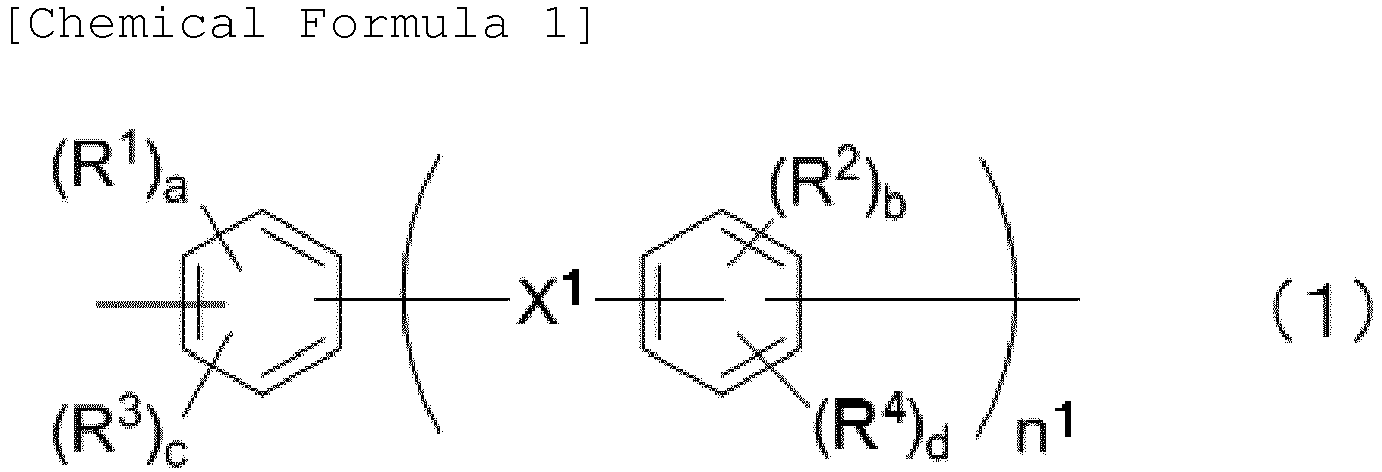
- The nonaqueous electrolyte battery separator according to claim 1, wherein the water-soluble polymer contains a polymer selected from polyimide, polyamide and polyamideimide.
- The nonaqueous electrolyte battery separator according to claim 1 or 2, wherein the water-soluble polymer contains a structural unit selected from a structural unit represented by the following general formula (2), and a structural unit represented by the following general formula (3):


- The nonaqueous electrolyte battery separator according to claim 3, wherein R6 in the general formula (2) and/or R8 in the general formula (3) has an aliphatic skeleton.
- The nonaqueous electrolyte battery separator according to any one of claims 1 to 4, wherein 50 mol% or more of R5 and R7 contained in the water-soluble polymer have a structure represented by the general formula (1).
- The nonaqueous electrolyte battery separator according to any one of claims 1 to 5, wherein the water-soluble polymer has a weight average molecular weight of 20,000 or more.
- The nonaqueous electrolyte battery separator according to any one of claims 1 to 6, wherein the basic compound is at least one compound selected from an alkali metal compound, a quaternary ammonium compound having 1 to 20 carbon atoms, and an amine compound having 1 to 20 carbon atoms.
- The nonaqueous electrolyte battery separator according to any one of claims 1 to 7, wherein the content of the basic compound is 0.2 to 4 mole equivalents based on the acidic groups of the water-soluble polymer.
- The nonaqueous electrolyte battery separator according to any one of claims 1 to 8, wherein the porous layer (II) contains the water-soluble polymer in an amount of 0.4 to 5.0 parts by mass based on 100 parts by mass of the inorganic filler.
- The nonaqueous electrolyte battery separator according to any one of claims 1 to 9, wherein the porous layer (II) contains the water-insoluble polymer in an amount of 0.5 to 5.0 parts by mass based on 100 parts by mass of the inorganic filler.
- A nonaqueous electrolyte battery in which a positive electrode and a negative electrode are laminated with a separator interposed therebetween, the separator being the nonaqueous electrolyte battery separator according to any one of claims 1 to 10.
Applications Claiming Priority (2)
| Application Number | Priority Date | Filing Date | Title |
|---|---|---|---|
| JP2016211471 | 2016-10-28 | ||
| PCT/JP2017/038161 WO2018079474A1 (en) | 2016-10-28 | 2017-10-23 | Separator for nonaqueous-electrolyte cell, and nonaqueous-electrolyte cell |
Publications (2)
| Publication Number | Publication Date |
|---|---|
| EP3534431A1 true EP3534431A1 (en) | 2019-09-04 |
| EP3534431A4 EP3534431A4 (en) | 2020-03-11 |
Family
ID=62023511
Family Applications (1)
| Application Number | Title | Priority Date | Filing Date |
|---|---|---|---|
| EP17864241.9A Withdrawn EP3534431A4 (en) | 2016-10-28 | 2017-10-23 | Separator for nonaqueous-electrolyte cell, and nonaqueous-electrolyte cell |
Country Status (7)
| Country | Link |
|---|---|
| US (1) | US10992009B2 (en) |
| EP (1) | EP3534431A4 (en) |
| JP (1) | JP6597796B2 (en) |
| KR (1) | KR102407590B1 (en) |
| CN (1) | CN109792019B (en) |
| TW (1) | TW201830754A (en) |
| WO (1) | WO2018079474A1 (en) |
Cited By (1)
| Publication number | Priority date | Publication date | Assignee | Title |
|---|---|---|---|---|
| WO2021001300A1 (en) * | 2019-07-01 | 2021-01-07 | Solvay Specialty Polymers Italy S.P.A. | Process for preparing a coated battery separator |
Families Citing this family (8)
| Publication number | Priority date | Publication date | Assignee | Title |
|---|---|---|---|---|
| CN114008846A (en) * | 2019-07-01 | 2022-02-01 | 索尔维特殊聚合物意大利有限公司 | Battery separator coating |
| CN117937055A (en) * | 2019-07-10 | 2024-04-26 | 旭化成株式会社 | Multilayer porous film |
| JP7532756B2 (en) * | 2019-09-18 | 2024-08-14 | 富士フイルムビジネスイノベーション株式会社 | Polyimide precursor solution, method for producing polyimide film, and method for producing separator for lithium ion secondary battery |
| US20230029282A1 (en) | 2019-12-27 | 2023-01-26 | Panasonic Intellectual Property Management Co., Ltd. | Separator for nonaqueous electrolyte secondary batteries, nonaqueous electrolyte secondary battery, and method for producing separator for nonaqueous electrolyte secondary batteries |
| JP7664744B2 (en) * | 2020-04-27 | 2025-04-18 | 住友化学株式会社 | Laminated separator for non-aqueous electrolyte secondary battery and manufacturing method thereof |
| CN117242634A (en) * | 2021-06-30 | 2023-12-15 | 三井化学株式会社 | Raw materials for coating materials for secondary battery separators, coating materials for secondary battery separators, secondary battery separators, methods for manufacturing secondary battery separators, and secondary batteries |
| KR20240123400A (en) * | 2022-01-05 | 2024-08-13 | 가부시키가이샤 가네카 | Resin compositions, molded articles and films |
| KR20250089722A (en) * | 2023-12-12 | 2025-06-19 | 코오롱인더스트리 주식회사 | Polyimide binder for negative- electrode material for secondary battery |
Family Cites Families (22)
| Publication number | Priority date | Publication date | Assignee | Title |
|---|---|---|---|---|
| JP3175730B2 (en) | 1998-04-27 | 2001-06-11 | 住友化学工業株式会社 | Non-aqueous electrolyte battery separator and lithium secondary battery |
| WO2007013552A1 (en) * | 2005-07-29 | 2007-02-01 | Toyo Boseki Kabushiki Kaisha | Polyamide imide fiber, non-woven fabric composed of the fiber, process for manufacture of the non-woven fabric, and separator for electronic component |
| JP5158678B2 (en) | 2006-10-16 | 2013-03-06 | 日立マクセル株式会社 | Nonaqueous electrolyte battery separator and nonaqueous electrolyte battery |
| JP5062526B2 (en) | 2007-09-27 | 2012-10-31 | 三洋電機株式会社 | Nonaqueous electrolyte battery separator and nonaqueous electrolyte battery |
| JP5170018B2 (en) | 2009-07-08 | 2013-03-27 | 住友化学株式会社 | Nonaqueous electrolyte secondary battery separator |
| JP5375597B2 (en) * | 2009-12-28 | 2013-12-25 | 東レ株式会社 | Polyimide resin aqueous solution, polyimide resin aqueous solution, polyazole resin aqueous solution |
| KR101243931B1 (en) * | 2010-06-14 | 2013-03-14 | 한양대학교 산학협력단 | Separator for lithium secondary battery and method of manufacturing the same |
| JP6189011B2 (en) * | 2010-08-06 | 2017-08-30 | 住友化学株式会社 | Separator and non-aqueous electrolyte secondary battery having the separator |
| JP5834930B2 (en) * | 2011-09-09 | 2015-12-24 | 宇部興産株式会社 | Polyimide precursor aqueous solution composition and method for producing polyimide precursor aqueous solution composition |
| WO2013042610A1 (en) * | 2011-09-22 | 2013-03-28 | 日本電気株式会社 | Lithium-ion secondary battery |
| JP2015028840A (en) | 2011-11-29 | 2015-02-12 | 日立マクセル株式会社 | Nonaqueous electrolyte battery separator and nonaqueous electrolyte battery |
| KR101712645B1 (en) * | 2012-03-12 | 2017-03-06 | 주식회사 엘지화학 | Slurry for coating separator, separator using the slurry and electrochemical device including the separator |
| US10096810B2 (en) * | 2012-05-10 | 2018-10-09 | Samsung Sdi Co., Ltd. | Separator and method of manufacturing the same and rechargeable lithium battery including the same |
| KR101627734B1 (en) * | 2012-08-01 | 2016-06-07 | 제일모직주식회사 | Composition for coating separator, separator formed by using the coating agent composition, and battery using the separator |
| JP6345915B2 (en) * | 2012-09-07 | 2018-06-20 | 旭化成株式会社 | Nonaqueous electrolyte secondary battery separator and nonaqueous electrolyte secondary battery |
| JP2014173016A (en) * | 2013-03-11 | 2014-09-22 | Takemoto Oil & Fat Co Ltd | Organic silicone fine particle, method of producing organic silicone fine particle, modified polyolefin microporous film, method of producing modified polyolefin microporous film and separator for nonaqueous electrolyte electric cell |
| WO2014148577A1 (en) | 2013-03-21 | 2014-09-25 | 日本ゼオン株式会社 | Slurry for lithium ion secondary battery porous film, production method therefor, separator for lithium ion secondary battery, and lithium ion secondary battery |
| CN103904276B (en) * | 2014-03-28 | 2017-09-19 | 东莞新能源科技有限公司 | Composite porous isolating membrane and electrochemical appliance |
| JP2015204133A (en) * | 2014-04-10 | 2015-11-16 | 株式会社カネカ | Aqueous binder composition |
| CN105273444B (en) | 2014-07-23 | 2017-11-14 | 乐凯胶片股份有限公司 | A kind of paste compound and the lithium ion battery separator comprising the paste compound |
| CN104183806B (en) | 2014-08-13 | 2017-01-25 | 江苏安瑞达新材料有限公司 | Composite lithium battery diaphragm and preparation method thereof |
| WO2016056480A1 (en) | 2014-10-10 | 2016-04-14 | 東レ株式会社 | Polyimide solution, heat-resistant non-woven fabric, and method for manufacturing same |
-
2017
- 2017-10-23 KR KR1020197009024A patent/KR102407590B1/en not_active Expired - Fee Related
- 2017-10-23 CN CN201780061033.9A patent/CN109792019B/en not_active Expired - Fee Related
- 2017-10-23 US US16/338,035 patent/US10992009B2/en not_active Expired - Fee Related
- 2017-10-23 EP EP17864241.9A patent/EP3534431A4/en not_active Withdrawn
- 2017-10-23 JP JP2017556269A patent/JP6597796B2/en not_active Expired - Fee Related
- 2017-10-23 WO PCT/JP2017/038161 patent/WO2018079474A1/en not_active Ceased
- 2017-10-26 TW TW106136922A patent/TW201830754A/en unknown
Cited By (1)
| Publication number | Priority date | Publication date | Assignee | Title |
|---|---|---|---|---|
| WO2021001300A1 (en) * | 2019-07-01 | 2021-01-07 | Solvay Specialty Polymers Italy S.P.A. | Process for preparing a coated battery separator |
Also Published As
| Publication number | Publication date |
|---|---|
| TW201830754A (en) | 2018-08-16 |
| WO2018079474A1 (en) | 2018-05-03 |
| US20200028138A1 (en) | 2020-01-23 |
| EP3534431A4 (en) | 2020-03-11 |
| CN109792019B (en) | 2021-12-03 |
| CN109792019A (en) | 2019-05-21 |
| KR102407590B1 (en) | 2022-06-10 |
| JP6597796B2 (en) | 2019-10-30 |
| KR20190070322A (en) | 2019-06-20 |
| JPWO2018079474A1 (en) | 2019-06-24 |
| US10992009B2 (en) | 2021-04-27 |
Similar Documents
| Publication | Publication Date | Title |
|---|---|---|
| US10992009B2 (en) | Nonaqueous electrolyte battery separator and nonaqueous electrolyte battery | |
| TWI484011B (en) | An adhesive resin composition for an electrode, an electrode mixture, and an electrode | |
| JP6596196B2 (en) | Method for producing varnish for producing porous membrane | |
| JP6218931B2 (en) | Laminated porous film and method for producing the same | |
| TW201214849A (en) | Electrolyte materials for use in electrochemical cells | |
| JP6404028B2 (en) | Method for producing porous polyimide film, method for producing separator, and varnish | |
| TW201629123A (en) | Porous polyimide film and production method thereof | |
| US11211670B2 (en) | All-solid-state battery | |
| KR20170047281A (en) | Varnish for porous polyimide film production and method for producing porous polyimide film using same | |
| KR102443793B1 (en) | Electrode manufacturing method | |
| WO2017110710A1 (en) | Resin composition | |
| JP6241213B2 (en) | Binder resin composition for electrode, electrode mixture paste, and electrode | |
| JP2021144868A (en) | Slurry, method for manufacturing the same, separator for nonaqueous electrolyte battery, and nonaqueous electrolyte battery | |
| KR102797584B1 (en) | Secondary battery and porous separator for secondary battery | |
| JP2016079310A (en) | Varnish for producing porous film, method for producing porous film using the same and hole forming agent for producing porous film | |
| TWI797220B (en) | Porous polyimide film original fabric (original fabric), its production method and composition | |
| JP2013206560A (en) | Nonaqueous secondary battery separator | |
| JP2021050269A (en) | Polyimide precursor solution, method for producing polyimide film, and method for producing separator for lithium ion secondary battery | |
| JP2021042287A (en) | Polyimide precursor solution, method for producing polyimide film, and method for producing separator for lithium ion secondary battery | |
| JP7673406B2 (en) | Resin composition, laminate and method for producing same, electrode, secondary battery, and electric double layer capacitor | |
| JP2008056934A (en) | Polyimide porous membrane composite and proton conducting membrane |
Legal Events
| Date | Code | Title | Description |
|---|---|---|---|
| STAA | Information on the status of an ep patent application or granted ep patent |
Free format text: STATUS: THE INTERNATIONAL PUBLICATION HAS BEEN MADE |
|
| PUAI | Public reference made under article 153(3) epc to a published international application that has entered the european phase |
Free format text: ORIGINAL CODE: 0009012 |
|
| STAA | Information on the status of an ep patent application or granted ep patent |
Free format text: STATUS: REQUEST FOR EXAMINATION WAS MADE |
|
| 17P | Request for examination filed |
Effective date: 20190220 |
|
| AK | Designated contracting states |
Kind code of ref document: A1 Designated state(s): AL AT BE BG CH CY CZ DE DK EE ES FI FR GB GR HR HU IE IS IT LI LT LU LV MC MK MT NL NO PL PT RO RS SE SI SK SM TR |
|
| AX | Request for extension of the european patent |
Extension state: BA ME |
|
| DAV | Request for validation of the european patent (deleted) | ||
| DAX | Request for extension of the european patent (deleted) | ||
| A4 | Supplementary search report drawn up and despatched |
Effective date: 20200206 |
|
| RIC1 | Information provided on ipc code assigned before grant |
Ipc: H01M 2/16 20060101AFI20200131BHEP Ipc: H01M 10/0525 20100101ALI20200131BHEP |
|
| REG | Reference to a national code |
Ref country code: DE Ref legal event code: R079 Free format text: PREVIOUS MAIN CLASS: H01M0002160000 Ipc: H01M0050446000 |
|
| GRAP | Despatch of communication of intention to grant a patent |
Free format text: ORIGINAL CODE: EPIDOSNIGR1 |
|
| STAA | Information on the status of an ep patent application or granted ep patent |
Free format text: STATUS: GRANT OF PATENT IS INTENDED |
|
| RIC1 | Information provided on ipc code assigned before grant |
Ipc: H01M 50/451 20210101ALI20230316BHEP Ipc: H01M 50/423 20210101ALI20230316BHEP Ipc: H01M 50/417 20210101ALI20230316BHEP Ipc: H01M 50/414 20210101ALI20230316BHEP Ipc: H01M 10/0525 20100101ALI20230316BHEP Ipc: H01M 50/446 20210101AFI20230316BHEP |
|
| INTG | Intention to grant announced |
Effective date: 20230330 |
|
| STAA | Information on the status of an ep patent application or granted ep patent |
Free format text: STATUS: THE APPLICATION IS DEEMED TO BE WITHDRAWN |
|
| 18D | Application deemed to be withdrawn |
Effective date: 20230810 |