EP3534294B1 - Computer implemented method for processing a frame sequence, digital frame processing device computer program product and monitoring system - Google Patents
Computer implemented method for processing a frame sequence, digital frame processing device computer program product and monitoring system Download PDFInfo
- Publication number
- EP3534294B1 EP3534294B1 EP18159762.6A EP18159762A EP3534294B1 EP 3534294 B1 EP3534294 B1 EP 3534294B1 EP 18159762 A EP18159762 A EP 18159762A EP 3534294 B1 EP3534294 B1 EP 3534294B1
- Authority
- EP
- European Patent Office
- Prior art keywords
- frame
- sub
- processing device
- frames
- probability
- Prior art date
- Legal status (The legal status is an assumption and is not a legal conclusion. Google has not performed a legal analysis and makes no representation as to the accuracy of the status listed.)
- Active
Links
Images



Classifications
-
- G—PHYSICS
- G06—COMPUTING OR CALCULATING; COUNTING
- G06V—IMAGE OR VIDEO RECOGNITION OR UNDERSTANDING
- G06V10/00—Arrangements for image or video recognition or understanding
- G06V10/40—Extraction of image or video features
- G06V10/44—Local feature extraction by analysis of parts of the pattern, e.g. by detecting edges, contours, loops, corners, strokes or intersections; Connectivity analysis, e.g. of connected components
- G06V10/443—Local feature extraction by analysis of parts of the pattern, e.g. by detecting edges, contours, loops, corners, strokes or intersections; Connectivity analysis, e.g. of connected components by matching or filtering
- G06V10/449—Biologically inspired filters, e.g. difference of Gaussians [DoG] or Gabor filters
- G06V10/451—Biologically inspired filters, e.g. difference of Gaussians [DoG] or Gabor filters with interaction between the filter responses, e.g. cortical complex cells
- G06V10/454—Integrating the filters into a hierarchical structure, e.g. convolutional neural networks [CNN]
-
- G—PHYSICS
- G06—COMPUTING OR CALCULATING; COUNTING
- G06V—IMAGE OR VIDEO RECOGNITION OR UNDERSTANDING
- G06V10/00—Arrangements for image or video recognition or understanding
- G06V10/70—Arrangements for image or video recognition or understanding using pattern recognition or machine learning
- G06V10/764—Arrangements for image or video recognition or understanding using pattern recognition or machine learning using classification, e.g. of video objects
-
- G—PHYSICS
- G06—COMPUTING OR CALCULATING; COUNTING
- G06V—IMAGE OR VIDEO RECOGNITION OR UNDERSTANDING
- G06V10/00—Arrangements for image or video recognition or understanding
- G06V10/70—Arrangements for image or video recognition or understanding using pattern recognition or machine learning
- G06V10/82—Arrangements for image or video recognition or understanding using pattern recognition or machine learning using neural networks
-
- G—PHYSICS
- G06—COMPUTING OR CALCULATING; COUNTING
- G06V—IMAGE OR VIDEO RECOGNITION OR UNDERSTANDING
- G06V20/00—Scenes; Scene-specific elements
- G06V20/50—Context or environment of the image
- G06V20/52—Surveillance or monitoring of activities, e.g. for recognising suspicious objects
Definitions
- the invention concerns a computer implemented method for processing a frame sequence to detect a dangerous object, a digital frame processing device therefore, a computer program product and monitoring system with automatic enhancement of detection of events involving use of dangerous objects.
- Dangerous object can be understand as gun, axe, knife, riffle or any other potentially dangerous tool not used normally within a monitored facility.
- US patent no US6028626 discloses a surveillance system having at least one primary video camera for translating real images of a zone into electronic video signals at a first level of resolution.
- the system includes means for sampling movements of an individual or individuals located within the zone from the video signal output from at least one video camera.
- Video signals of sampled movements of the individual is electronically compared with known characteristics of movements which, are indicative of individuals having a criminal intent.
- the level of criminal intent of the individual or individuals is then determined and an appropriate alarm signal is produced.
- False alarms on the other hand tend to "train" people using surveillance system not to react to the situations identified as dangerous.
- US patent no US9524426 discloses a human monitoring system that includes a plurality of cameras and a visual processor.
- the plurality of cameras are disposed about a workspace area, where each camera is configured to capture a video feed that includes a plurality of image frames, and the plurality of image frames are time-synchronized between the respective cameras.
- the visual processor is configured to receive the plurality of image frames from the plurality of vision-based imaging devices and detect the presence of a human from at least one of the plurality of image frames using pattern matching performed on an input image.
- the input image to the pattern matching is a sliding window portion of the image frame that is aligned with a rectified coordinate system such that a vertical axis in the workspace area is aligned with a vertical axis of the input image.
- Publication WO2008046662 A1 of international patent application discloses a method for the surveillance of danger zones, especially platforms in stations, that is based on a specific detection geometry dividing the supervision area in pairs of trapezoids, using one trapezoid for detection and the other trapezoid for qualification of detections.
- the detection geometry is combined with sensitive detection and qualification steps based on video image analysis.
- pixel grey value changes had been grouped into specific sub-matrices of N-by-N pixels. After experimentation of a larger variation of matrix lengths N the analysis showed that the results remain insensitive to stochastic changes above 5 pixels.
- An aim of the invention is to provide reliable automatic means aiding a human supervisor in detection of dangerous situations involving dangerous objects enhancing his reaction time.
- This aim is obtained with a computer implemented method for processing a frame sequence to generate an alarm when a dangerous object is being used, including a frame acquisition step, a division into sub-regions step, object identification step and decision making step, in which alert generation step is executed, if decision made in decision making step is positive.
- Division into sub-regions step includes division of the frame into sub-regions that overlap and have at least 100x100 pixels - neural network recognition of dangerous objects is more reliable above this value. Use of overlapping sub-regions reduces a risk of object located on the border of sub-regions not being detected.
- Object identification step is executed in sub-region by sub-region manner and includes processing a frame with a deep neural network trained to detect the dangerous object and returns probability of detection for sub-regions of the frame formed into probability map corresponding to the processed frame.
- Application of deep neural network enables efficient detection and robust training.
- Decision made in decision making step depends on at least a first criterion and a second criterion applying to the subsequent frames and corresponding probability maps.
- the first criterion includes probability of detection within a predefined number N of subsequent frames being above predefined value of p min .
- the second criterion includes the minimal distance between sub-regions in which probability of detection above predefined value of p min was observed in subsequent frames being lower than given value d max .
- the value of d max is predetermined in system calibration or is a result of Kalman filtering of probability map.
- the frames and the corresponding probability maps are stored into database. Storing the frames and probability maps enable adaptation of the neural network training for specific situations.
- Frame acquisition advantageously includes background detection and removal which saves computational power and further reduces number of false alarms.
- Probability map is advantageously subjected to high pass filtration prior to being used in decision making step. Consequently only dynamic situations are detected and false alarms are further avoided while system remains sensitive to typical dangerous situations.
- the method according to the invention advantageously further includes a load balancing step, in which computational load of particular step is determined and if needed some of the input frames are dropped.
- the aim of the invention is further obtained by providing a digital frame processing device having a memory and adapted to receive a frame sequence and means to generate an alarm according to the invention is adapted to execute a method according to the invention.
- the device is advantageously adapted to receive at least two frame sequences in parallel and process them in parallel.
- the aim of the invention is further obtained by providing a computer program product comprising a set of instructions causing a frame processing device execute a method according to the invention.
- the aim of the invention is also obtained by providing a monitoring system having at least one camera delivering frames via communication means to console having a display in monitoring center, in which frames from camera are processed with a digital frame processing device according to the invention executing a method according to invention.
- system size is not limited by computing power even when high number of cameras are used.
- the monitoring system advantageously has at least two cameras.
- each of the at least two cameras is connected to an individual digital frame processing device.
- both of the at least two cameras are connected to the same digital frame processing device.
- Communication means advantageously are telecommunication network.
- Use of tcpip network makes system very flexible and easy to install in typical facilities.
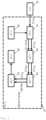
- FIG. 1 A block diagram of an embodiment of the method according to the invention is shown in Fig. 1 .
- the method is running on a digital processing device with implemented modules performing particular steps.
- the method comprises a frame acquisition 11 in which a frame is received from external imaging device, a CCD camera. In this step the frame is preprocessed. Subsequently a step of division into sub-regions 12 is executed.
- the frame is divided into a number of overlapping subregions preferably rectangles having a lower dimension of at least 100 pixels.
- These sub-regions 32 are used in object identification 13.
- Each sub-region 32 is independently processed using deep neural network trained to detect the dangerous object - a hand carrying a gun.
- the output of neural network is a probability of detection for every sub-region.
- the probabilities form a probability map which is used in subsequent decision making step.
- the decision is based on a results of detection in 8 subsequent frames.
- Two criterions are applied.
- the first criterion includes probability of detection within a predefined number 8 of subsequent frames being above predefined threshold value of p min .
- Threshold value of p min is selected from a range 0.8 ⁇ 1 depending on the object to be recognized. Value optimal for handgun falls between 0.95 and 0.98. Good results were obtained for 0.96.
- the second criterion depends on the minimal distance between sub-regions in which probability of detection above predefined value of p min was observed in subsequent frames being lower than given value d max which preferably is in a range of 0.3 to 1 of the sub-region lower dimendion.
- d max is estimated using genetic algorithm according to Mitchell, Melanie (1996). An Introduction to Genetic Algorithms. Cambridge, MA: MIT Press. ISBN 9780585030944 .
- the algorithm's fitness function is based on following factors: maximization of True Positive (TP) rate, maximization of TP frames for each detected event and minimization of False Positive detections.
- the sub-optimal value of d max is chosen according to Pareto meaning.
- alert generation 16 step is executed. It is a sound alarm, visual alarm, email, text messages (SMS), video messages, voice messages (Calls), on-screen alert, API to existing on-site alarm installations, API to remote alarm installations or law enforcement services or any combination of the above.
- FIG. 2 A block diagram of digital frame processing device according to the invention is shown in Fig. 2 .
- the above method steps are executed by respective software modules implemented in FPGA matrix (Virtex 7) or GPU (GeForce GTX 970, 4GB).
- H_CORE module 27 is the main module of the system responsible for managing the other modules. It is setting up the configuration which is loaded from the configuration files.
- the configuration file includes following parameters in Windows .ini format:
- H_CORE module 27 starts others modules and establishes communication between them using data queues. H_CORE module 27 manages other modules, each module can be restarted in case of failure. Stop signal received by H_CORE is broadcasted to other modules in order to stop the whole system in case of the fatal system failure or if system shutdown is required by the maintenance which is triggered by the user.
- H_AQ module 21 acquires a frame 31 from the data source such as a video stream from a camera 72, URL or offline file. Data sources can be interchanged during the normal operation without a need of restarting. In an absence of an input image the H_AQ module 21 waits for the input. The acquired frame is checked in order to match the required dimensions in pixels. If that test is failed the acquired frame is dropped from further processing. In order to save computational power only non-repeating frames are processed. To select such frames the Gaussian Mixture Model (GMM) [ Zoran Zivkovic. 2004. Improved Adaptive Gaussian Mixture Model for Background Subtraction. In Proceedings of the Pattern Recognition, 17th International Conference on (ICPR'04) Volume 2 - Volume 02 (ICPR '04), Vol. 2.
- GMM Gaussian Mixture Model
- the frame 31 from the frame acquisition H_AQ module 21 is processed in the object detection module H_NN 23 which firstly divides the frame into overlapping square sub-regions having the lower dimension not less than 100 px.
- the stride of the sub-region must be less than a half of it lower dimension.
- Each sub-region is afterwards processed by a deep convolutional neural network trained to output probability of dangerous object in the given sub-region.
- the network consists of a bank of trained digital filters producing image features and the fully connected multilayer perceptron for the final classification. This results in a probability map corresponding to the frame, filled with probabilities corresponding to the particular sub-regions within a frame.
- a relation between a frame and probability matrix is shown schematically in Fig. 3a and b. In Fig.
- a frame 31 is shown with a person carrying a dangerous object 33.
- Frame 31 is divided into sub-regions 32.
- a corresponding probability map 34 is shown in Fig. 3b .
- Maximal value 35 in the probability map corresponds to the sub-region containing dangerous object 33.
- Frame sequence of real life scenario and corresponding probability maps with probabilities represented as intensity is shown in Fig. 4 .
- Fig. 5 Processing of a sub-region in H_NN module 23 is shown in Fig. 5 .
- the input sub-region 32 of a full frame 31 is fed to convolutional neural network that consists of 5 subsequent convolutional blocks 56.
- Each of these blocks contains two convolutional layers.
- One layer has learnable filters of size 3x3 52, and a set of learnable filters of size 1x1 53.
- the other layer is max pooling layer 54.
- the output of convolutional blocks is then passed to fully connected layer 55 which outputs the probability that the input frame 51 contains a dangerous tool.
- the neural network is trained using standard backpropagation algorithm to recognize, the probability map is filtered by a high pass digital temporal filter.
- the final output of the object detection H_NN module 23 is the coordinates of the sub-region of the highest value of u(t).
- step 61 results are received from the H_NN module 23.
- the H_DM module 24 in step 62 takes a preconfigured number of N, where N is in range of 6-10 depending on the kind of dangerous tool, subsequent frames to provide reliable alert in case of gun being used and avoid false detections. According to test with the human supervisors, only one false detection daily is acceptable so that supervisors were not biased that detections are likely false. For detection of handgun 8 proved to be the best choice.
- step 63 it is tested weather in all 8 subsequent frames the maximal probability of detection exceed a threshold of value.
- step 64 For a handgun threshold of 0.96 was identified as best choice. If the probability is above the threshold for all 8 consecutive frames step 64 is executed otherwise step 62 is executed again. In step 64 it is tested if the distances between consecutive detections (maximal probabilities) is lower than d max . If so alarm is raised in step 65. Otherwise step 62 is executed again.
- the second approach is based on a distance calculated between positions of consecutive detections. If the distance is smaller than the configured threshold value d max , the detection is classified as belonging to the same event. The distance is calculated according to the Euclidian measure in pixels. Threshold value d max is 0.3 ⁇ 1 of the sub-region dimension.
- the alarm is raised by user notification H_NT module 26 when the event lasts longer than configured number of frames. 8 was typically used but 6 ⁇ 10 proved to be a range in which maximal number of false detections daily was reachable. Increasing the value limits the sensitivity of the system while decreasing the value increases the sensitivity of the system. Increased sensitivity results in higher detection probability at a cost of higher false alarm probability. Decreased sensitivity yields the revered effect.
- the frame and information about raised alarm is put into data queue between H_DM module 24 and H_DB module 26.
- H_DB module 26 Frame and output from decision making H_DM module 24 are send to H_DB module 26 where the data is stored in the database.
- the H_DB module 26 saves all the alarms and video sequences which caused those alarms.
- H_DB module 26 aggregates frames for a given period of time to buffer video in the database and in case of the event being detected and alarm raised to store permanently a frame sequence which starts before the event and ends after the event.
- the final stored video starts N seconds before the event and ends N seconds after.
- the N value is set by a user, typical value is 15. Increasing the value results storing wider context of an detected event in database, when decreasing the value results reducing amount of data stored in database.
- H_DB module 26 provides also real time visualization. The frames with marked detected objects and alarms are displayed on the screen to the users.
- User notification module H_NT 25 uses data stored in database and provides a user notification service.
- the system uses nine types of notifications: sound alarm, visual alarm, email, text messages (SMS), video messages, voice messages (Calls), on-screen alert, API to existing on-site alarm installations, API to remote alarm installations or law enforcement services or any combination of the above.
- Notification process uses a scheduled address book in order to notify different users depending on the current time.
- the API allows to integrate the system with third party software.
- the frame processing device is a key element of the monitoring system according to the invention.
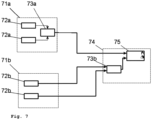
- Exemplary block diagram of the system is shown in Fig. 7 .
- cameras are connected with monitoring center 74 via telecommunication network.
- Frames from camera are processed with frame processing devices according to the invention before those frames are delivered to the monitoring center 74 and shown to the human supervisor on a screen of a console 75.
- Alerts generated by the frame processing devices are shown to the supervisor simultaneously with a dangerous object.
- Information regarding sub-region containing dangerous object is used to draw attention of the human supervisor to particular part of the frame. It is highlighted or encircled in the displayed frame sequence.
- Frame processing devices can cooperate with single camera individually or be fed with a multiple streams of frames from multiple cameras processed in parallel. This property enables easier scaling of the monitoring system by additional cameras.
- FIG. 7 A block diagram of an embodiment shown in Fig. 7 corresponds to an example of such system.
- each remote surveillance system 71a, 71b has two cameras 72a, 72b.
- two cameras 72a are connected directly via cable to the same digital frame processing device 73a located in the same facility as the remote surveillance system 71a.
- two cameras 72b are connected via digital communication network to a digital frame processing device 73b located in the monitoring center 74 with console 75 having a screen and operated by human supervisor.
- Monitoring system is modular. Any elements can be connected by cable, optical fibres, wired or wireless telecommunication networks including WiFi, LTE, Ethernet and others. Use of multiples frame processing devices enables easy growth of the system size not limited by the human operated console 75 computational power. Any common or industrial cameras can be used in the system routinely by a person skilled in the art.
- Frame processing device can be used within an existing system, connected with or more cameras and the monitoring center.
- the later connection is particularly easy with existing telecommunication networks that are usually provided in monitored facilities. Also radio mobile telecommunication networks can be used for such purpose.
- the invention may be implemented in a computer program including at least code portions for performing steps of a method according to the invention when run on a programmable frame processing device, such as a computer system, signal processing, FPGA matrix or enabling said frame processing device to perform functions of a device according to the invention.
- a programmable frame processing device such as a computer system, signal processing, FPGA matrix or enabling said frame processing device to perform functions of a device according to the invention.
- the computer program may for instance include one or more of: a subroutine, a function, a procedure, an object method, an object implementation, an executable application, an applet, a servlet, a source code, an object code, a shared library/dynamic load library and/or other sequence of instructions designed for execution on a computer system.
- the computer program may be provided on a data carrier, such as an optical disc, a hard disk, magnetic disk or solid state disk, stored with data loadable in a memory of a computer system, the data representing the computer program.
- the data carrier may thus be a tangible data carrier.
- the data carrier may be a data connection, such as a telephone cable or a network cable.
Landscapes
- Engineering & Computer Science (AREA)
- Theoretical Computer Science (AREA)
- Physics & Mathematics (AREA)
- Evolutionary Computation (AREA)
- Multimedia (AREA)
- General Physics & Mathematics (AREA)
- Computer Vision & Pattern Recognition (AREA)
- General Health & Medical Sciences (AREA)
- Health & Medical Sciences (AREA)
- Artificial Intelligence (AREA)
- Databases & Information Systems (AREA)
- Computing Systems (AREA)
- Medical Informatics (AREA)
- Software Systems (AREA)
- Life Sciences & Earth Sciences (AREA)
- Molecular Biology (AREA)
- Biomedical Technology (AREA)
- Biodiversity & Conservation Biology (AREA)
- Image Analysis (AREA)
Priority Applications (2)
| Application Number | Priority Date | Filing Date | Title |
|---|---|---|---|
| EP18159762.6A EP3534294B1 (en) | 2018-03-02 | 2018-03-02 | Computer implemented method for processing a frame sequence, digital frame processing device computer program product and monitoring system |
| PL18159762.6T PL3534294T3 (pl) | 2018-03-02 | 2018-03-02 | Realizowany komputerowo sposób przetwarzania sekwencji klatek, urządzenie do cyfrowego przetwarzania klatek, produkt w postaci programu komputerowego i system monitorowania |
Applications Claiming Priority (1)
| Application Number | Priority Date | Filing Date | Title |
|---|---|---|---|
| EP18159762.6A EP3534294B1 (en) | 2018-03-02 | 2018-03-02 | Computer implemented method for processing a frame sequence, digital frame processing device computer program product and monitoring system |
Publications (3)
| Publication Number | Publication Date |
|---|---|
| EP3534294A1 EP3534294A1 (en) | 2019-09-04 |
| EP3534294B1 true EP3534294B1 (en) | 2023-09-06 |
| EP3534294C0 EP3534294C0 (en) | 2023-09-06 |
Family
ID=61569076
Family Applications (1)
| Application Number | Title | Priority Date | Filing Date |
|---|---|---|---|
| EP18159762.6A Active EP3534294B1 (en) | 2018-03-02 | 2018-03-02 | Computer implemented method for processing a frame sequence, digital frame processing device computer program product and monitoring system |
Country Status (2)
| Country | Link |
|---|---|
| EP (1) | EP3534294B1 (pl) |
| PL (1) | PL3534294T3 (pl) |
Families Citing this family (1)
| Publication number | Priority date | Publication date | Assignee | Title |
|---|---|---|---|---|
| EP4189174B1 (en) * | 2020-07-29 | 2024-07-17 | Soilmec S.P.A. | Foundation machine equiped with a system for the recognition of a human figure |
Family Cites Families (6)
| Publication number | Priority date | Publication date | Assignee | Title |
|---|---|---|---|---|
| US6028626A (en) | 1995-01-03 | 2000-02-22 | Arc Incorporated | Abnormality detection and surveillance system |
| KR100421221B1 (ko) * | 2001-11-05 | 2004-03-02 | 삼성전자주식회사 | 조명에 강인한 객체 추적 방법 및 이를 응용한 영상 편집장치 |
| US7127083B2 (en) * | 2003-11-17 | 2006-10-24 | Vidient Systems, Inc. | Video surveillance system with object detection and probability scoring based on object class |
| ATE431951T1 (de) * | 2006-10-16 | 2009-06-15 | Joerg Schuette | Videobild-gleisüberwachungssystem |
| US9524426B2 (en) | 2014-03-19 | 2016-12-20 | GM Global Technology Operations LLC | Multi-view human detection using semi-exhaustive search |
| US10007854B2 (en) * | 2016-07-07 | 2018-06-26 | Ants Technology (Hk) Limited | Computer vision based driver assistance devices, systems, methods and associated computer executable code |
-
2018
- 2018-03-02 PL PL18159762.6T patent/PL3534294T3/pl unknown
- 2018-03-02 EP EP18159762.6A patent/EP3534294B1/en active Active
Also Published As
| Publication number | Publication date |
|---|---|
| EP3534294A1 (en) | 2019-09-04 |
| EP3534294C0 (en) | 2023-09-06 |
| PL3534294T3 (pl) | 2024-01-15 |
Similar Documents
| Publication | Publication Date | Title |
|---|---|---|
| US8368754B2 (en) | Video pattern recognition for automating emergency service incident awareness and response | |
| KR102315371B1 (ko) | 스마트 cctv 관제 및 경보 시스템 | |
| US9769435B2 (en) | Monitoring systems and methods | |
| US11935303B2 (en) | System and method for mitigating crowd panic detection | |
| CN100538756C (zh) | 一种映像识别报警系统装置及报警方法 | |
| AU2009210794A1 (en) | Video sensor and alarm system and method with object and event classification | |
| KR102174784B1 (ko) | 딥 러닝과 멀티 에이전트를 활용한 대규모 개체 식별 및 추적 방법 | |
| US12177758B2 (en) | Systems and methods for identifying blockages of emergency exists in a building | |
| EP2000998B1 (en) | Flame detecting method and device | |
| CN119131698B (zh) | 基于云计算的安防监控大数据处理方法及系统 | |
| US20230386212A1 (en) | Method and system for monitoring activities and events in real-time through self-adaptive ai | |
| CN109543650A (zh) | 仓库智能监控方法和系统 | |
| KR20220000226A (ko) | 엣지 컴퓨팅 기반 지능형 보안 감시 서비스 제공 시스템 | |
| KR101466004B1 (ko) | 지능형 방범, 방재 및 사후처리 통합 트리플렉스 시스템 및 그 제어 방법 | |
| US20190347366A1 (en) | Computer-aided design and analysis method for physical protection systems | |
| CA2394926C (en) | Image data processing | |
| CN105957285A (zh) | 一种图像监控报警方法 | |
| KR101581162B1 (ko) | 실시간 영상 기반의 화염, 연기 및 물체 움직임 자동 감지 방법, 장치 및 시스템 | |
| EP3534294A1 (en) | Computer implemented method for processing a frame sequence, digital frame processing device computer program product and monitoring system | |
| Karthi et al. | Forest fire detection: a comparative analysis of deep learning algorithms | |
| KR20220000221A (ko) | 엣지 컴퓨팅 기반 지능형 보안 감시 카메라 장치 | |
| US20210375454A1 (en) | Automated operators in human remote caregiving monitoring system | |
| Verma et al. | Real-Time Human Scream Detection for Enhanced Public Safety | |
| CN116958903B (zh) | 多联动安全管控机制下的智慧工厂安全监管方法 | |
| KR20220000181A (ko) | 엣지 컴퓨팅 기반 지능형 보안 감시 서비스 제공 장치의 동작프로그램 |
Legal Events
| Date | Code | Title | Description |
|---|---|---|---|
| PUAI | Public reference made under article 153(3) epc to a published international application that has entered the european phase |
Free format text: ORIGINAL CODE: 0009012 |
|
| STAA | Information on the status of an ep patent application or granted ep patent |
Free format text: STATUS: REQUEST FOR EXAMINATION WAS MADE |
|
| 17P | Request for examination filed |
Effective date: 20180302 |
|
| AK | Designated contracting states |
Kind code of ref document: A1 Designated state(s): AL AT BE BG CH CY CZ DE DK EE ES FI FR GB GR HR HU IE IS IT LI LT LU LV MC MK MT NL NO PL PT RO RS SE SI SK SM TR |
|
| AX | Request for extension of the european patent |
Extension state: BA ME |
|
| STAA | Information on the status of an ep patent application or granted ep patent |
Free format text: STATUS: EXAMINATION IS IN PROGRESS |
|
| 17Q | First examination report despatched |
Effective date: 20210510 |
|
| REG | Reference to a national code |
Ref country code: DE Ref legal event code: R079 Free format text: PREVIOUS MAIN CLASS: G06K0009000000 Ipc: G06V0020520000 Ref country code: DE Ref legal event code: R079 Ref document number: 602018056823 Country of ref document: DE Free format text: PREVIOUS MAIN CLASS: G06K0009000000 Ipc: G06V0020520000 |
|
| RIC1 | Information provided on ipc code assigned before grant |
Ipc: G06V 10/764 20220101ALI20230220BHEP Ipc: G06V 10/44 20220101ALI20230220BHEP Ipc: G06V 10/82 20220101ALI20230220BHEP Ipc: G06V 20/52 20220101AFI20230220BHEP |
|
| GRAP | Despatch of communication of intention to grant a patent |
Free format text: ORIGINAL CODE: EPIDOSNIGR1 |
|
| STAA | Information on the status of an ep patent application or granted ep patent |
Free format text: STATUS: GRANT OF PATENT IS INTENDED |
|
| INTG | Intention to grant announced |
Effective date: 20230417 |
|
| GRAJ | Information related to disapproval of communication of intention to grant by the applicant or resumption of examination proceedings by the epo deleted |
Free format text: ORIGINAL CODE: EPIDOSDIGR1 |
|
| STAA | Information on the status of an ep patent application or granted ep patent |
Free format text: STATUS: EXAMINATION IS IN PROGRESS |
|
| GRAP | Despatch of communication of intention to grant a patent |
Free format text: ORIGINAL CODE: EPIDOSNIGR1 |
|
| STAA | Information on the status of an ep patent application or granted ep patent |
Free format text: STATUS: GRANT OF PATENT IS INTENDED |
|
| GRAS | Grant fee paid |
Free format text: ORIGINAL CODE: EPIDOSNIGR3 |
|
| INTC | Intention to grant announced (deleted) | ||
| GRAA | (expected) grant |
Free format text: ORIGINAL CODE: 0009210 |
|
| STAA | Information on the status of an ep patent application or granted ep patent |
Free format text: STATUS: THE PATENT HAS BEEN GRANTED |
|
| INTG | Intention to grant announced |
Effective date: 20230721 |
|
| AK | Designated contracting states |
Kind code of ref document: B1 Designated state(s): AL AT BE BG CH CY CZ DE DK EE ES FI FR GB GR HR HU IE IS IT LI LT LU LV MC MK MT NL NO PL PT RO RS SE SI SK SM TR |
|
| REG | Reference to a national code |
Ref country code: GB Ref legal event code: FG4D |
|
| REG | Reference to a national code |
Ref country code: CH Ref legal event code: EP |
|
| REG | Reference to a national code |
Ref country code: DE Ref legal event code: R096 Ref document number: 602018056823 Country of ref document: DE |
|
| REG | Reference to a national code |
Ref country code: IE Ref legal event code: FG4D |
|
| U01 | Request for unitary effect filed |
Effective date: 20231002 |
|
| U07 | Unitary effect registered |
Designated state(s): AT BE BG DE DK EE FI FR IT LT LU LV MT NL PT SE SI Effective date: 20231012 |
|
| PG25 | Lapsed in a contracting state [announced via postgrant information from national office to epo] |
Ref country code: GR Free format text: LAPSE BECAUSE OF FAILURE TO SUBMIT A TRANSLATION OF THE DESCRIPTION OR TO PAY THE FEE WITHIN THE PRESCRIBED TIME-LIMIT Effective date: 20231207 |
|
| PG25 | Lapsed in a contracting state [announced via postgrant information from national office to epo] |
Ref country code: RS Free format text: LAPSE BECAUSE OF FAILURE TO SUBMIT A TRANSLATION OF THE DESCRIPTION OR TO PAY THE FEE WITHIN THE PRESCRIBED TIME-LIMIT Effective date: 20230906 Ref country code: NO Free format text: LAPSE BECAUSE OF FAILURE TO SUBMIT A TRANSLATION OF THE DESCRIPTION OR TO PAY THE FEE WITHIN THE PRESCRIBED TIME-LIMIT Effective date: 20231206 Ref country code: HR Free format text: LAPSE BECAUSE OF FAILURE TO SUBMIT A TRANSLATION OF THE DESCRIPTION OR TO PAY THE FEE WITHIN THE PRESCRIBED TIME-LIMIT Effective date: 20230906 Ref country code: GR Free format text: LAPSE BECAUSE OF FAILURE TO SUBMIT A TRANSLATION OF THE DESCRIPTION OR TO PAY THE FEE WITHIN THE PRESCRIBED TIME-LIMIT Effective date: 20231207 |
|
| U20 | Renewal fee for the european patent with unitary effect paid |
Year of fee payment: 7 Effective date: 20240130 |
|
| PG25 | Lapsed in a contracting state [announced via postgrant information from national office to epo] |
Ref country code: IS Free format text: LAPSE BECAUSE OF FAILURE TO SUBMIT A TRANSLATION OF THE DESCRIPTION OR TO PAY THE FEE WITHIN THE PRESCRIBED TIME-LIMIT Effective date: 20240106 |
|
| PG25 | Lapsed in a contracting state [announced via postgrant information from national office to epo] |
Ref country code: ES Free format text: LAPSE BECAUSE OF FAILURE TO SUBMIT A TRANSLATION OF THE DESCRIPTION OR TO PAY THE FEE WITHIN THE PRESCRIBED TIME-LIMIT Effective date: 20230906 |
|
| PG25 | Lapsed in a contracting state [announced via postgrant information from national office to epo] |
Ref country code: SM Free format text: LAPSE BECAUSE OF FAILURE TO SUBMIT A TRANSLATION OF THE DESCRIPTION OR TO PAY THE FEE WITHIN THE PRESCRIBED TIME-LIMIT Effective date: 20230906 Ref country code: RO Free format text: LAPSE BECAUSE OF FAILURE TO SUBMIT A TRANSLATION OF THE DESCRIPTION OR TO PAY THE FEE WITHIN THE PRESCRIBED TIME-LIMIT Effective date: 20230906 Ref country code: IS Free format text: LAPSE BECAUSE OF FAILURE TO SUBMIT A TRANSLATION OF THE DESCRIPTION OR TO PAY THE FEE WITHIN THE PRESCRIBED TIME-LIMIT Effective date: 20240106 Ref country code: ES Free format text: LAPSE BECAUSE OF FAILURE TO SUBMIT A TRANSLATION OF THE DESCRIPTION OR TO PAY THE FEE WITHIN THE PRESCRIBED TIME-LIMIT Effective date: 20230906 Ref country code: CZ Free format text: LAPSE BECAUSE OF FAILURE TO SUBMIT A TRANSLATION OF THE DESCRIPTION OR TO PAY THE FEE WITHIN THE PRESCRIBED TIME-LIMIT Effective date: 20230906 Ref country code: SK Free format text: LAPSE BECAUSE OF FAILURE TO SUBMIT A TRANSLATION OF THE DESCRIPTION OR TO PAY THE FEE WITHIN THE PRESCRIBED TIME-LIMIT Effective date: 20230906 |
|
| REG | Reference to a national code |
Ref country code: DE Ref legal event code: R097 Ref document number: 602018056823 Country of ref document: DE |
|
| PLBE | No opposition filed within time limit |
Free format text: ORIGINAL CODE: 0009261 |
|
| STAA | Information on the status of an ep patent application or granted ep patent |
Free format text: STATUS: NO OPPOSITION FILED WITHIN TIME LIMIT |
|
| 26N | No opposition filed |
Effective date: 20240607 |
|
| REG | Reference to a national code |
Ref country code: CH Ref legal event code: PL |
|
| PG25 | Lapsed in a contracting state [announced via postgrant information from national office to epo] |
Ref country code: MC Free format text: LAPSE BECAUSE OF FAILURE TO SUBMIT A TRANSLATION OF THE DESCRIPTION OR TO PAY THE FEE WITHIN THE PRESCRIBED TIME-LIMIT Effective date: 20230906 |
|
| PG25 | Lapsed in a contracting state [announced via postgrant information from national office to epo] |
Ref country code: MC Free format text: LAPSE BECAUSE OF FAILURE TO SUBMIT A TRANSLATION OF THE DESCRIPTION OR TO PAY THE FEE WITHIN THE PRESCRIBED TIME-LIMIT Effective date: 20230906 |
|
| PG25 | Lapsed in a contracting state [announced via postgrant information from national office to epo] |
Ref country code: IE Free format text: LAPSE BECAUSE OF NON-PAYMENT OF DUE FEES Effective date: 20240302 |
|
| PG25 | Lapsed in a contracting state [announced via postgrant information from national office to epo] |
Ref country code: IE Free format text: LAPSE BECAUSE OF NON-PAYMENT OF DUE FEES Effective date: 20240302 Ref country code: CH Free format text: LAPSE BECAUSE OF NON-PAYMENT OF DUE FEES Effective date: 20240331 |
|
| U20 | Renewal fee for the european patent with unitary effect paid |
Year of fee payment: 8 Effective date: 20250211 |
|
| PG25 | Lapsed in a contracting state [announced via postgrant information from national office to epo] |
Ref country code: CY Free format text: LAPSE BECAUSE OF FAILURE TO SUBMIT A TRANSLATION OF THE DESCRIPTION OR TO PAY THE FEE WITHIN THE PRESCRIBED TIME-LIMIT; INVALID AB INITIO Effective date: 20180302 |
|
| PG25 | Lapsed in a contracting state [announced via postgrant information from national office to epo] |
Ref country code: HU Free format text: LAPSE BECAUSE OF FAILURE TO SUBMIT A TRANSLATION OF THE DESCRIPTION OR TO PAY THE FEE WITHIN THE PRESCRIBED TIME-LIMIT; INVALID AB INITIO Effective date: 20180302 |
|
| PG25 | Lapsed in a contracting state [announced via postgrant information from national office to epo] |
Ref country code: TR Free format text: LAPSE BECAUSE OF FAILURE TO SUBMIT A TRANSLATION OF THE DESCRIPTION OR TO PAY THE FEE WITHIN THE PRESCRIBED TIME-LIMIT Effective date: 20230906 |
|
| U20 | Renewal fee for the european patent with unitary effect paid |
Year of fee payment: 9 Effective date: 20260217 |
|
| PGFP | Annual fee paid to national office [announced via postgrant information from national office to epo] |
Ref country code: GB Payment date: 20260217 Year of fee payment: 9 |
|
| PGFP | Annual fee paid to national office [announced via postgrant information from national office to epo] |
Ref country code: PL Payment date: 20260220 Year of fee payment: 9 |