EP3534144A2 - Method for predicting rubber reinforcement effect of organic-inorganic composite for rubber reinforcement - Google Patents
Method for predicting rubber reinforcement effect of organic-inorganic composite for rubber reinforcement Download PDFInfo
- Publication number
- EP3534144A2 EP3534144A2 EP18777622.4A EP18777622A EP3534144A2 EP 3534144 A2 EP3534144 A2 EP 3534144A2 EP 18777622 A EP18777622 A EP 18777622A EP 3534144 A2 EP3534144 A2 EP 3534144A2
- Authority
- EP
- European Patent Office
- Prior art keywords
- bis
- organic
- inorganic composite
- rubber
- tetrasulfide
- Prior art date
- Legal status (The legal status is an assumption and is not a legal conclusion. Google has not performed a legal analysis and makes no representation as to the accuracy of the status listed.)
- Granted
Links
Images

Classifications
-
- G—PHYSICS
- G01—MEASURING; TESTING
- G01N—INVESTIGATING OR ANALYSING MATERIALS BY DETERMINING THEIR CHEMICAL OR PHYSICAL PROPERTIES
- G01N5/00—Analysing materials by weighing, e.g. weighing small particles separated from a gas or liquid
- G01N5/02—Analysing materials by weighing, e.g. weighing small particles separated from a gas or liquid by absorbing or adsorbing components of a material and determining change of weight of the adsorbent, e.g. determining moisture content
-
- C—CHEMISTRY; METALLURGY
- C08—ORGANIC MACROMOLECULAR COMPOUNDS; THEIR PREPARATION OR CHEMICAL WORKING-UP; COMPOSITIONS BASED THEREON
- C08K—Use of inorganic or non-macromolecular organic substances as compounding ingredients
- C08K3/00—Use of inorganic substances as compounding ingredients
- C08K3/10—Metal compounds
- C08K3/12—Hydrides
-
- C—CHEMISTRY; METALLURGY
- C08—ORGANIC MACROMOLECULAR COMPOUNDS; THEIR PREPARATION OR CHEMICAL WORKING-UP; COMPOSITIONS BASED THEREON
- C08K—Use of inorganic or non-macromolecular organic substances as compounding ingredients
- C08K3/00—Use of inorganic substances as compounding ingredients
- C08K3/34—Silicon-containing compounds
-
- C—CHEMISTRY; METALLURGY
- C08—ORGANIC MACROMOLECULAR COMPOUNDS; THEIR PREPARATION OR CHEMICAL WORKING-UP; COMPOSITIONS BASED THEREON
- C08K—Use of inorganic or non-macromolecular organic substances as compounding ingredients
- C08K9/00—Use of pretreated ingredients
- C08K9/04—Ingredients treated with organic substances
- C08K9/06—Ingredients treated with organic substances with silicon-containing compounds
-
- G—PHYSICS
- G01—MEASURING; TESTING
- G01N—INVESTIGATING OR ANALYSING MATERIALS BY DETERMINING THEIR CHEMICAL OR PHYSICAL PROPERTIES
- G01N15/00—Investigating characteristics of particles; Investigating permeability, pore-volume or surface-area of porous materials
- G01N15/04—Investigating sedimentation of particle suspensions
-
- G—PHYSICS
- G01—MEASURING; TESTING
- G01N—INVESTIGATING OR ANALYSING MATERIALS BY DETERMINING THEIR CHEMICAL OR PHYSICAL PROPERTIES
- G01N25/00—Investigating or analyzing materials by the use of thermal means
-
- G—PHYSICS
- G01—MEASURING; TESTING
- G01N—INVESTIGATING OR ANALYSING MATERIALS BY DETERMINING THEIR CHEMICAL OR PHYSICAL PROPERTIES
- G01N25/00—Investigating or analyzing materials by the use of thermal means
- G01N25/20—Investigating or analyzing materials by the use of thermal means by investigating the development of heat, i.e. calorimetry, e.g. by measuring specific heat, by measuring thermal conductivity
-
- G—PHYSICS
- G01—MEASURING; TESTING
- G01N—INVESTIGATING OR ANALYSING MATERIALS BY DETERMINING THEIR CHEMICAL OR PHYSICAL PROPERTIES
- G01N5/00—Analysing materials by weighing, e.g. weighing small particles separated from a gas or liquid
-
- G—PHYSICS
- G01—MEASURING; TESTING
- G01N—INVESTIGATING OR ANALYSING MATERIALS BY DETERMINING THEIR CHEMICAL OR PHYSICAL PROPERTIES
- G01N5/00—Analysing materials by weighing, e.g. weighing small particles separated from a gas or liquid
- G01N5/04—Analysing materials by weighing, e.g. weighing small particles separated from a gas or liquid by removing a component, e.g. by evaporation, and weighing the remainder
-
- C—CHEMISTRY; METALLURGY
- C08—ORGANIC MACROMOLECULAR COMPOUNDS; THEIR PREPARATION OR CHEMICAL WORKING-UP; COMPOSITIONS BASED THEREON
- C08K—Use of inorganic or non-macromolecular organic substances as compounding ingredients
- C08K2201/00—Specific properties of additives
- C08K2201/002—Physical properties
- C08K2201/003—Additives being defined by their diameter
-
- C—CHEMISTRY; METALLURGY
- C08—ORGANIC MACROMOLECULAR COMPOUNDS; THEIR PREPARATION OR CHEMICAL WORKING-UP; COMPOSITIONS BASED THEREON
- C08K—Use of inorganic or non-macromolecular organic substances as compounding ingredients
- C08K3/00—Use of inorganic substances as compounding ingredients
- C08K3/34—Silicon-containing compounds
- C08K3/346—Clay
-
- C—CHEMISTRY; METALLURGY
- C08—ORGANIC MACROMOLECULAR COMPOUNDS; THEIR PREPARATION OR CHEMICAL WORKING-UP; COMPOSITIONS BASED THEREON
- C08K—Use of inorganic or non-macromolecular organic substances as compounding ingredients
- C08K3/00—Use of inorganic substances as compounding ingredients
- C08K3/34—Silicon-containing compounds
- C08K3/36—Silica
-
- C—CHEMISTRY; METALLURGY
- C08—ORGANIC MACROMOLECULAR COMPOUNDS; THEIR PREPARATION OR CHEMICAL WORKING-UP; COMPOSITIONS BASED THEREON
- C08K—Use of inorganic or non-macromolecular organic substances as compounding ingredients
- C08K5/00—Use of organic ingredients
- C08K5/54—Silicon-containing compounds
- C08K5/548—Silicon-containing compounds containing sulfur
-
- C—CHEMISTRY; METALLURGY
- C08—ORGANIC MACROMOLECULAR COMPOUNDS; THEIR PREPARATION OR CHEMICAL WORKING-UP; COMPOSITIONS BASED THEREON
- C08L—COMPOSITIONS OF MACROMOLECULAR COMPOUNDS
- C08L9/00—Compositions of homopolymers or copolymers of conjugated diene hydrocarbons
- C08L9/06—Copolymers with styrene
Definitions
- the present disclosure relates to a method for predicting a rubber reinforcing effect of an organic-inorganic composite for rubber reinforcement.
- Eco-friendly tires are tires that can reduce rolling resistance of rubber to achieve high efficiency and high fuel efficiency, resulting in a reduction in carbon emissions.
- Modified rubber materials and rubber reinforcing white additives have been mainly used for manufacturing such eco-friendly tires.
- silica materials have a problem that dispersibility in the rubber composition is low so that abrasion resistance is deteriorated.
- a highly dispersed precipitated silica having specific conditions can be used together with a silane coupling agent to make a material for eco-friendly tires having good abrasion resistance.
- additives such as the highly dispersed precipitated silica which may have good conflicting properties (mechanical strength such as rolling resistance and abrasion resistance). It is known that even when alumina, clay, kaolin, or the like is applied as the rubber reinforcing white additive, it can be used as an eco-friendly tire material by lowering rolling resistance. However, the rubber reinforcing white additive has a problem that the dispersibility decreases due to formation of a strong aggregate and the like, resulting in problems such as deterioration of mechanical strength.
- the present disclosure is to provide a method for predicting a rubber reinforcing effect of an organic-inorganic composite for rubber reinforcement without mixing with a rubber composition.
- a method for predicting a rubber reinforcing effect of an organic-inorganic composite includes a step of performing thermogravimetric analysis (TGA) of an organic-inorganic composite for rubber reinforcement to confirm whether the following Equation 1 is satisfied: Da ⁇ 3.0 wherein, in Equation 1, Da is an area of a region where an x-axis value [temperature (°C)] is 300 to 500 °C and a y-axis value [reduction rate of weight (%/°C)] is zero (0) or more, in a derivative thermogravimetric curve (dm/dt) obtained by thermogravimetric analysis (TGA) of the organic-inorganic composite.
- TGA thermogravimetric analysis
- Singular expressions of the present disclosure may include plural expressions unless that is differently expressed contextually.
- the degree of bonding formed between the inorganic filler and the coupling agent is closely related to the rubber reinforcing effect that the organic-inorganic composite can exhibit in the rubber composition.
- thermogravimetric analysis TGA
- An embodiment of the present disclosure provides a method for predicting rubber reinforcing effect of an organic-inorganic composite, including a step of performing thermogravimetric analysis (TGA) of an organic-inorganic composite for rubber reinforcement to confirm whether the following Equation 1 is satisfied: Da ⁇ 3.0 wherein, in Equation 1, Da is an area of a region where an x-axis value [temperature (°C)] is 300 to 500 °C and a y-axis value [reduction rate of weight (%/°C)] is zero (0) or more, in a derivative thermogravimetric curve (dm/dt) obtained by thermogravimetric analysis (TGA) of the organic-inorganic composite.
- TGA thermogravimetric analysis
- the organic-inorganic composite for rubber reinforcement preferably includes an inorganic filler and a coupling agent bonded to at least a part of a surface of the inorganic filler.
- the kind of the inorganic filler is not particularly limited, and conventional particles known to be applicable to rubber compositions (especially for tires) can be used.
- the inorganic filler may be at least one particle selected from the group consisting of silica, crystalline aluminosilicate, amorphous aluminosilicate, kaolin, clay, and aluminum hydrate.
- the particle diameter of the inorganic filler is not particularly limited, but it may be advantageous for the average particle diameter of all particles to be 10 to 100 nm to satisfy Equation 1.
- the coupling agent may be a well-known binder for providing chemical or physical bonding between an elastomer contained in the rubber composition and the inorganic filler.
- the coupling agent is at least bifunctional, and includes a functional group binding to the inorganic filler and a functional group binding to the elastomer.
- the kind of the coupling agent is not particularly limited, and conventional compounds known to be applicable to rubber compositions (particularly for tires) can be used.
- the coupling agent may be a silane-based coupling agent.
- the coupling agent may be at least one compound selected from the group consisting of bis(3-triethoxysilylpropyl) tetrasulfide, bis(2-triethoxysilylethyl) tetrasulfide, bis(4-triethoxysilylbutyl) tetrasulfide, bis(3-trimethoxysilylpropyl) tetrasulfide, bis(2-trimethoxysilylethyl) tetrasulfide, bis(4-trimethoxysilylbutyl) tetrasulfide, bis(3-triethoxysilylpropyl) trisulfide, bis(2-triethoxysilylethyl) trisulfide, bis(4-triethoxysilylbutyl) trisulfide, bis(3-trimethoxysilylpropyl) trisulfide, bis(2-trimethoxysilylpropy
- thermogravimetric analysis TGA
- the Da value of Equation 1 derived therefrom is 3.0 or more
- the composite can be preferably applied as a rubber reinforcing material to a rubber composition for tires.
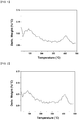
- FIG. 1 is a graph showing a derivative thermogravimetric curve (hereinafter referred to as a "DTG curve”) obtained by thermogravimetric analysis (TGA) of the organic-inorganic composite of Example 1 according to the present disclosure.
- TGA thermogravimetric analysis
- the DTG curve can be obtained by converting data measured by thermogravimetric analysis.
- the x-axis value is a temperature (°C) and the y-axis value is a reduction rate of weight with temperature (%/°C).
- a desorption temperature and a desorption amount can be determined by confirming the position and area of a peak appearing when intrinsic moisture contained in the inorganic filler and the coupling agent are desorbed from the inorganic filler.
- peaks appearing in a region where the x-axis value is 50 to 200 °C are shown while the intrinsic moisture contained in the inorganic filler is desorbed from the inorganic filler, and peaks appearing in a range of 300 to 500 °C are shown while the coupling agent is desorbed from the inorganic filler.
- Da is an area of a region where the x-axis value [temperature (°C)] is 300 to 500 °C and the y-axis value [reduction rate of weight (%/°C)] is zero (0) or more, in a derivative thermogravimetric curve (dm/dt) obtained by thermogravimetric analysis (TGA) of the organic-inorganic composite.
- the Da value is 3.0 or more, 3.5 or more, 3.7 or more, 3.8 or more, 3.85 or more, 3.88 or more, 4.0 or more, or 4.2 or more, it may be applied as a rubber reinforcing material to a rubber composition for tires.
- the organic-inorganic composite (A) for rubber reinforcement including aluminosilicate particles having a composition of the following Chemical Formula 1 and a silane-based coupling agent bonded to at least a part of a surface of aluminosilicate particles may advantageously satisfy the above Equation 1: [Chemical Formula 1] M x/n [(AlO 2 ) x ,(SiO 2 ) y ] ⁇ m(H 2 O) wherein, in Chemical Formula 1,
- amorphous may refer to a full width at half maximum (FWHM) in a 2 ⁇ range of 20° to 37° in a data plot obtained by X-ray diffraction (XRD) of 3° to 8.5°.
- the full width at half maximum is 3° or more, 3.5° or more, 4.0° or more, 4.5° or more, 5.0° or more, 5.5° or more, or 6.0° or more.
- the FWHM is 8.5° or less, 8.0° or less, 7.5° or less, or 7.0° or less.
- the full width at half maximum is a numerical value of a peak width at half of the maximum peak intensity in the 2 ⁇ range of 20° to 37° obtained by X-ray diffraction of the aluminosilicate particles.
- FWHM full width at half maximum
- the amorphous aluminosilicate particles according to the embodiment of the present disclosure are characterized in that a maximum peak intensity (I max ) is in a 2 ⁇ range of 26° to 31° in a data plot obtained by X-ray diffraction (XRD).
- the maximum peak intensity (I max ) is in a 2 ⁇ range of 26° or more, 27° or more, or 28° or more.
- the maximum peak intensity (Imax) is in a 2 ⁇ range of 31° or less, 30.5° or less, or 30° or less.
- amorphous silica shows I max in a 2 ⁇ range of 20° to 25° and amorphous alumina shows I max in a 2 ⁇ range of 30° to 40°.
- the aluminosilicate particles contain an alkali metal or an ion thereof as a metal element (M) or an ion thereof, and in particular, satisfy a composition of 1.0 ⁇ y/x ⁇ 10.0 and 0.01 ⁇ x/n ⁇ 1.2.
- y/x is 1.0 or more, 1.15 or more, 1.3 or more, or 1.45 or more; and is 10.0 or less, 7.5 or less, 5.0 or less, 4.5 or less, 4.0 or less, 3.5 or less, 3.0 or less, 2.5 or less, or 2.0 or less, which may be advantageous for satisfying the above Equation 1.
- x/n is 0.01 or more, 0.05 or more, 0.1 or more, 0.5 or more, 0.55 or more, 0.6 or more, 0.65 or more, 0.7 or more, 0.75 or more, or 0.8 or more; and is 1.2 or less, or 1.15 or less, which may be advantageous for satisfying the above Equation 1.
- the amorphous aluminosilicate particles having a composition of Chemical Formula 1 may be prepared by a method including the steps of:
- the organic-inorganic composite (A) may be prepared by preparing amorphous aluminosilicate particles having a composition represented by the Chemical Formula 1, a silane-based coupling agent, and an organic solvent having a boiling point of 150 °C or higher and which is not reactive therewith; heating the amorphous aluminosilicate particles and the organic solvent to 130 to 150 °C while mixing them; adding the silane-based coupling agent to the heated mixture and stirring for 10 to 60 minutes to form an organic-inorganic composite having the silane-based coupling agent bound to at least a part of a surface of the amorphous aluminosilicate particles; and washing and drying the organic-inorganic composite.
- a method for indirectly predicting a rubber reinforcing effect of an organic-inorganic composite for rubber reinforcement by thermogravimetric analysis without mixing with a rubber composition is provided.
- the cured solid product was added into distilled water at 90 °C, stirred for 12 hours, and centrifuged to wash it to about pH 7.
- the washed solid product was dried in an oven at 70 °C for 24 hours to finally obtain aluminosilicate particles (primary particle diameter of 30 nm).
- the cured product was added into distilled water at 90 °C, stirred for 12 hours, and centrifuged to wash it to about pH 7.
- the washed solid product was dried in an oven at 70 °C for 24 hours to finally obtain aluminosilicate particles (primary particle diameter of 150 nm).
- the measured range of 2 ⁇ was 10° to 90°, and it was scanned at an interval of 0.05°.
- a full width at half maximum (FWHM) at a peak of about 29° which is the maximum peak in the 2 ⁇ range of 20° to 37° was calculated in the data plot obtained by X-ray diffraction (XRD).
- the aluminosilicate particles of Synthesis Example 2 had a FAU (faujasite) crystal structure, so the FWHM measurement was not performed.
- An organic-inorganic composite was obtained in the same manner as in Example 1, except that the amorphous aluminosilicate obtained in Synthesis Example 1 was pulverized to have a primary particle diameter of 20 nm or less.
- An organic-inorganic composite was obtained in the same manner as in Example 1, except that the crystalline aluminosilicate particles obtained in Synthesis Example 2 were used instead of the amorphous aluminosilicate particles obtained in Synthesis Example 1.
- An organic-inorganic composite was obtained in the same manner as in Example 1, except that kaolin clay (product name: Kaolin, manufactured by Sigma-Aldrich) was added instead of the amorphous aluminosilicate particles obtained in Synthesis Example 1.
- kaolin clay product name: Kaolin, manufactured by Sigma-Aldrich
- An organic-inorganic composite was obtained in the same manner as in Example 1, except that silica particles (product name: 7000GR, manufactured by Evonik) was added instead of the amorphous aluminosilicate particles obtained in Synthesis Example 1.
- silica particles product name: 7000GR, manufactured by Evonik
- thermogravimetric analysis using a thermogravimetric analyzer (STA 449 F3 Jupiter, NETZSCH) as follows.
- the base value is set by performing three times thermogravimetric analysis at a heating rate of 5 °C/min in the range of 30 to 500 °C under an argon gas atmosphere. 10 to 20 mg of the above-mentioned organic-inorganic composite in a powder form was loaded into a special crucible and subjected to thermogravimetric analysis under the same experimental conditions.
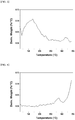
- thermogravimetric curves converted from data obtained by the above analysis were obtained from the thermogravimetric analyzer, and are shown in FIG. 1 (Example 1), FIG. 2 (Example 2), FIG. 3 (Example 3), FIG. 4 (Example 4), and FIG. 5 (Example 5), respectively.
- the peak position (°C) at which the silane coupling agent is desorbed from the organic-inorganic composite is shown in Table 3 below.
- thermogravimetric curve an area (Da) of a region where the x-axis value is 300 to 500 °C and the y-axis value is zero (0) or more was obtained by the thermogravimetric analyzer, and is shown in Table 3 below.
- 737.24 g of a diene elastomer mixture (SSBR 2550, LG Chemical) and 375.32 g of the organic-inorganic composite according to Example 1 as a reinforcing material were added to a closed mixer. After mixing them at 150 °C for 5 minutes, 78.66 g of other additives (antioxidant, emulsifier, vulcanization accelerator, wax, etc.) were added thereto and mixed for 90 seconds.
- additives antioxidant, emulsifier, vulcanization accelerator, wax, etc.
- the resulting mixture was extruded in the form of a sheet having a thickness of 2 to 3 mm, and vulcanized at 160 °C to obtain a rubber molded product.
- the vulcanization time was controlled referring to data obtained by measuring the above mixture at 160 °C using a moving die rheometer (MDR).
- a rubber molded product was obtained in the same manner as in Preparation Example 1, except that the organic-inorganic composite according to Example 2 was added as a reinforcing material.
- a rubber molded product was obtained in the same manner as in Preparation Example 1, except that the organic-inorganic composite according to Example 3 was added as a reinforcing material.
- a rubber molded product was obtained in the same manner as in Preparation Example 1, except that the organic-inorganic composite according to Example 4 was added as a reinforcing material.
- a rubber molded product was obtained in the same manner as in Preparation Example 1, except that the organic-inorganic composite according to Example 5 was added as a reinforcing material.
- the relative volume loss index was measured according to DIN ISO 4649 using an abrasion tester (Bareiss GmbH) for the rubber molded products according to Preparation Examples 1 to 5.
- the relative volume loss index was calculated by the following equation for the rubber molded products of Preparation Examples 1 to 4, after determining the rubber molded product of Preparation Example 5 including the organic-inorganic composite of a control example as a reference material.
- the relative volume loss index ⁇ [(the relative volume loss of Preparation Example 5) - (the relative volume loss of the corresponding Preparation Example)] / [the relative volume loss of Preparation Example 5) X 100] ⁇ + 100 [Table 4] Relative volume loss index (%) Preparation Example 1 86 Preparation Example 2 89 Preparation Example 3 37 Preparation Example 4 24 Preparation Example 5 100
Landscapes
- Chemical & Material Sciences (AREA)
- Health & Medical Sciences (AREA)
- Organic Chemistry (AREA)
- Chemical Kinetics & Catalysis (AREA)
- Medicinal Chemistry (AREA)
- Polymers & Plastics (AREA)
- Life Sciences & Earth Sciences (AREA)
- Physics & Mathematics (AREA)
- Analytical Chemistry (AREA)
- Biochemistry (AREA)
- General Health & Medical Sciences (AREA)
- General Physics & Mathematics (AREA)
- Immunology (AREA)
- Pathology (AREA)
- Dispersion Chemistry (AREA)
- Compositions Of Macromolecular Compounds (AREA)
- Investigating Or Analyzing Materials Using Thermal Means (AREA)
- Silicon Compounds (AREA)
- Silicates, Zeolites, And Molecular Sieves (AREA)
Abstract
Description
- This application claims the benefits of Korean Patent Application No.
10-2017-0038553 filed on March 27, 2017 - The present disclosure relates to a method for predicting a rubber reinforcing effect of an organic-inorganic composite for rubber reinforcement.
- As concerns about global warming and environmental problems spread, environment-friendly concepts for increasing energy efficiency and reducing carbon emissions have attracted attention in various fields. These environment-friendly concepts are becoming evident in the tire industry by developing highly efficient eco-friendly tires and recycling waste tires.
- Eco-friendly tires (or green tires) are tires that can reduce rolling resistance of rubber to achieve high efficiency and high fuel efficiency, resulting in a reduction in carbon emissions. Modified rubber materials and rubber reinforcing white additives (for example, precipitated silica) have been mainly used for manufacturing such eco-friendly tires.
- Generally, silica materials have a problem that dispersibility in the rubber composition is low so that abrasion resistance is deteriorated. In order to compensate for this, it is known that a highly dispersed precipitated silica having specific conditions can be used together with a silane coupling agent to make a material for eco-friendly tires having good abrasion resistance.
- On the other hand, there is also a high interest in additives such as the highly dispersed precipitated silica which may have good conflicting properties (mechanical strength such as rolling resistance and abrasion resistance). It is known that even when alumina, clay, kaolin, or the like is applied as the rubber reinforcing white additive, it can be used as an eco-friendly tire material by lowering rolling resistance. However, the rubber reinforcing white additive has a problem that the dispersibility decreases due to formation of a strong aggregate and the like, resulting in problems such as deterioration of mechanical strength.
- In developing an inorganic material or a new material for rubber reinforcement, it is necessary to test and compare various physical properties by mixing the material with a rubber composition in order to confirm a rubber reinforcing effect of the materials. However, such a test procedure has a problem that a development period of the rubber reinforcing material is lengthened, making it difficult to develop a rubber reinforcing material adapted to a latest trend, and also causing an excessive cost.
- The present disclosure is to provide a method for predicting a rubber reinforcing effect of an organic-inorganic composite for rubber reinforcement without mixing with a rubber composition.
- According to the present disclosure, a method for predicting a rubber reinforcing effect of an organic-inorganic composite is provided, wherein the method includes a step of performing thermogravimetric analysis (TGA) of an organic-inorganic composite for rubber reinforcement to confirm whether the following Equation 1 is satisfied:

Da is an area of a region where an x-axis value [temperature (°C)] is 300 to 500 °C and a y-axis value [reduction rate of weight (%/°C)] is zero (0) or more, in a derivative thermogravimetric curve (dm/dt) obtained by thermogravimetric analysis (TGA) of the organic-inorganic composite. - Hereinafter, the method for predicting a rubber reinforcing effect of an organic-inorganic composite for a rubber reinforcement according to the exemplary embodiments of the present disclosure will be described in more detail.
- In this specification, the terms are used merely to refer to specific embodiments, and are not intended to restrict the present disclosure unless that is explicitly expressed.
- Singular expressions of the present disclosure may include plural expressions unless that is differently expressed contextually.
- The terms "include", "comprise", and the like of the present disclosure are used to specify certain features, regions, integers, steps, operations, elements, and/or components, and these do not exclude the existence or the addition of other certain features, regions, integers, steps, operations, elements, and/or components.
- As a result of studies by the present inventors, it was confirmed that in the organic-inorganic composite for rubber reinforcement including an inorganic filler and a coupling agent bonded to at least a part of a surface of the inorganic filler, the degree of bonding formed between the inorganic filler and the coupling agent is closely related to the rubber reinforcing effect that the organic-inorganic composite can exhibit in the rubber composition.
- According to the present disclosure, by evaluating the degree of bonding between the inorganic filler and the coupling agent through thermogravimetric analysis (TGA) of the organic-inorganic composite for rubber reinforcement, it is possible to indirectly and reliably predict the rubber reinforcing effect of the organic-inorganic composite for rubber reinforcement without mixing with a rubber composition.
- An embodiment of the present disclosure provides a method for predicting rubber reinforcing effect of an organic-inorganic composite, including a step of performing thermogravimetric analysis (TGA) of an organic-inorganic composite for rubber reinforcement to confirm whether the following Equation 1 is satisfied:

Da is an area of a region where an x-axis value [temperature (°C)] is 300 to 500 °C and a y-axis value [reduction rate of weight (%/°C)] is zero (0) or more, in a derivative thermogravimetric curve (dm/dt) obtained by thermogravimetric analysis (TGA) of the organic-inorganic composite. - In the method for predicting the rubber reinforcing effect of an organic-inorganic composite according to the present disclosure, the organic-inorganic composite for rubber reinforcement preferably includes an inorganic filler and a coupling agent bonded to at least a part of a surface of the inorganic filler.
- In the present disclosure, the kind of the inorganic filler is not particularly limited, and conventional particles known to be applicable to rubber compositions (especially for tires) can be used. For example, the inorganic filler may be at least one particle selected from the group consisting of silica, crystalline aluminosilicate, amorphous aluminosilicate, kaolin, clay, and aluminum hydrate.
- The particle diameter of the inorganic filler is not particularly limited, but it may be advantageous for the average particle diameter of all particles to be 10 to 100 nm to satisfy Equation 1.
- The coupling agent may be a well-known binder for providing chemical or physical bonding between an elastomer contained in the rubber composition and the inorganic filler. The coupling agent is at least bifunctional, and includes a functional group binding to the inorganic filler and a functional group binding to the elastomer.
- In the present disclosure, the kind of the coupling agent is not particularly limited, and conventional compounds known to be applicable to rubber compositions (particularly for tires) can be used. For example, the coupling agent may be a silane-based coupling agent.
- As a non-limiting example, the coupling agent may be at least one compound selected from the group consisting of bis(3-triethoxysilylpropyl) tetrasulfide, bis(2-triethoxysilylethyl) tetrasulfide, bis(4-triethoxysilylbutyl) tetrasulfide, bis(3-trimethoxysilylpropyl) tetrasulfide, bis(2-trimethoxysilylethyl) tetrasulfide, bis(4-trimethoxysilylbutyl) tetrasulfide, bis(3-triethoxysilylpropyl) trisulfide, bis(2-triethoxysilylethyl) trisulfide, bis(4-triethoxysilylbutyl) trisulfide, bis(3-trimethoxysilylpropyl) trisulfide, bis(2-trimethoxysilylethyl) trisulfide, bis(4-trimethoxysilylbutyl) trisulfide, bis(3-triethoxysilylpropyl) disulfide, bis(2-triethoxysilylethyl) disulfide, bis(4-triethoxysilylbutyl) disulfide, bis(3-trimethoxysilylpropyl) disulfide, bis(2-trimethoxysilylethyl) disulfide, bis(4-trimethoxysilylbutyl) disulfide, 3-trimethoxysilylpropyl-N,N-dimethylthiocarbamoyltetrasulfide, 3-triethoxysilylpropyl-N,N-dimethylthiocarbamoyltetrasulfide, 2-triethoxysilylethyl-N,N-dimethylthiocarbamoyltetrasulfide, 2-trimethoxysilylethyl-N,N-dimethylthiocarbamoyltetrasulfide, 3-trimethoxysilylpropylbenzothiazolyltetrasulfide, 3-triethoxysilylpropyl benzothiazole tetrasulfide, 3-trimethoxysilylpropyl methacrylate monosulfide, and 3-trimethoxysilylpropyl methacrylate monosulfide.
- Meanwhile, according to the present disclosure, when the thermogravimetric analysis (TGA) is performed on any organic-inorganic composite for rubber reinforcement having the above-mentioned composition, and the Da value of Equation 1 derived therefrom is 3.0 or more, it can be predicted that the composite can be preferably applied as a rubber reinforcing material to a rubber composition for tires.
- For example,
FIG. 1 is a graph showing a derivative thermogravimetric curve (hereinafter referred to as a "DTG curve") obtained by thermogravimetric analysis (TGA) of the organic-inorganic composite of Example 1 according to the present disclosure. - The DTG curve can be obtained by converting data measured by thermogravimetric analysis. The x-axis value is a temperature (°C) and the y-axis value is a reduction rate of weight with temperature (%/°C).
- In the DTG curve of the organic-inorganic composite, a desorption temperature and a desorption amount can be determined by confirming the position and area of a peak appearing when intrinsic moisture contained in the inorganic filler and the coupling agent are desorbed from the inorganic filler.
- For example, in
FIG. 1 , peaks appearing in a region where the x-axis value is 50 to 200 °C are shown while the intrinsic moisture contained in the inorganic filler is desorbed from the inorganic filler, and peaks appearing in a range of 300 to 500 °C are shown while the coupling agent is desorbed from the inorganic filler. - In Equation 1, Da is an area of a region where the x-axis value [temperature (°C)] is 300 to 500 °C and the y-axis value [reduction rate of weight (%/°C)] is zero (0) or more, in a derivative thermogravimetric curve (dm/dt) obtained by thermogravimetric analysis (TGA) of the organic-inorganic composite.
- Preferably, when the Da value is 3.0 or more, 3.5 or more, 3.7 or more, 3.8 or more, 3.85 or more, 3.88 or more, 4.0 or more, or 4.2 or more, it may be applied as a rubber reinforcing material to a rubber composition for tires.
- When the Da value is less than 3.0, physical properties (in particular, abrasion resistance of rubber molded products) required as the rubber reinforcing material for the organic-inorganic composite cannot be achieved, so it is difficult to apply the same to the rubber composition for tires.
- As a non-limiting example, the organic-inorganic composite (A) for rubber reinforcement including aluminosilicate particles having a composition of the following Chemical Formula 1 and a silane-based coupling agent bonded to at least a part of a surface of aluminosilicate particles may advantageously satisfy the above Equation 1:
[Chemical Formula 1] Mx/n[(AlO2)x,(SiO2)y]·m(H2O)
wherein, in Chemical Formula 1, - M is an element selected from the group consisting of Li, Na, K, Rb, Cs, Be, and Fr, or an ion thereof;
- x > 0, y > 0, n > 0, and m ≥ 0;
- 1.0 ≤ y/x ≤ 10.0; and
- 0.01 ≤ x/n ≤ 1.2.
- In the organic-inorganic composite (A), "amorphous" may refer to a full width at half maximum (FWHM) in a 2θ range of 20° to 37° in a data plot obtained by X-ray diffraction (XRD) of 3° to 8.5°.
- Preferably, the full width at half maximum (FWHM) is 3° or more, 3.5° or more, 4.0° or more, 4.5° or more, 5.0° or more, 5.5° or more, or 6.0° or more. In addition, preferably, the FWHM is 8.5° or less, 8.0° or less, 7.5° or less, or 7.0° or less.
- The full width at half maximum (FWHM) is a numerical value of a peak width at half of the maximum peak intensity in the 2θ range of 20° to 37° obtained by X-ray diffraction of the aluminosilicate particles.
- The unit of the full width at half maximum (FWHM) can be expressed in degrees (°) which is the unit of 2θ. Compounds having high crystallinity may have a small FWHM value.
- In the organic-inorganic composite (A), the amorphous aluminosilicate particles according to the embodiment of the present disclosure are characterized in that a maximum peak intensity (Imax) is in a 2θ range of 26° to 31° in a data plot obtained by X-ray diffraction (XRD).
- Preferably, the maximum peak intensity (Imax) is in a 2θ range of 26° or more, 27° or more, or 28° or more. In addition, preferably, the maximum peak intensity (Imax) is in a 2θ range of 31° or less, 30.5° or less, or 30° or less.
- For reference, amorphous silica shows Imax in a 2θ range of 20° to 25° and amorphous alumina shows Imax in a 2θ range of 30° to 40°.
- In Chemical Formula 1, the aluminosilicate particles contain an alkali metal or an ion thereof as a metal element (M) or an ion thereof, and in particular, satisfy a composition of 1.0 ≤ y/x ≤ 10.0 and 0.01 ≤ x/n ≤ 1.2.
- Specifically, in Chemical Formula 1, y/x is 1.0 or more, 1.15 or more, 1.3 or more, or 1.45 or more; and is 10.0 or less, 7.5 or less, 5.0 or less, 4.5 or less, 4.0 or less, 3.5 or less, 3.0 or less, 2.5 or less, or 2.0 or less, which may be advantageous for satisfying the above Equation 1.
- Specifically, in Chemical Formula 1, x/n is 0.01 or more, 0.05 or more, 0.1 or more, 0.5 or more, 0.55 or more, 0.6 or more, 0.65 or more, 0.7 or more, 0.75 or more, or 0.8 or more; and is 1.2 or less, or 1.15 or less, which may be advantageous for satisfying the above Equation 1.
- The amorphous aluminosilicate particles having a composition of Chemical Formula 1 may be prepared by a method including the steps of:
- [i] adding silicon sources, aluminum sources, and water to a basic or alkaline solution (for example, a sodium hydroxide solution) and stirring to form an Al-O-Si structure of a monomer unit satisfying a specific metal atomic ratio;
- [ii] curing the aluminosilicate monomer at a low temperature (for example, from room temperature to 90 °C) and atmospheric pressure for 3 to 24 hours to cause an Al-O-Si polymerization reaction;
- [iii] washing and drying the polymerized aluminosilicate particles; and
- [iv] crushing the dried aluminosilicate particles to control particle size distribution.
- In addition, the organic-inorganic composite (A) may be prepared by preparing amorphous aluminosilicate particles having a composition represented by the Chemical Formula 1, a silane-based coupling agent, and an organic solvent having a boiling point of 150 °C or higher and which is not reactive therewith; heating the amorphous aluminosilicate particles and the organic solvent to 130 to 150 °C while mixing them; adding the silane-based coupling agent to the heated mixture and stirring for 10 to 60 minutes to form an organic-inorganic composite having the silane-based coupling agent bound to at least a part of a surface of the amorphous aluminosilicate particles; and washing and drying the organic-inorganic composite.
- According to the present disclosure, a method for indirectly predicting a rubber reinforcing effect of an organic-inorganic composite for rubber reinforcement by thermogravimetric analysis without mixing with a rubber composition is provided.
-
-
FIG. 1 is a graph showing a derivative thermogravimetric curve obtained by thermogravimetric analysis (TGA) of the organic-inorganic composite of Example 1. -
FIG. 2 is a graph showing a derivative thermogravimetric curve obtained by thermogravimetric analysis (TGA) of the organic-inorganic composite of Example 2. -
FIG. 3 is a graph showing a derivative thermogravimetric curve obtained by thermogravimetric analysis (TGA) of the organic-inorganic composite of Example 3. -
FIG. 4 is a graph showing a derivative thermogravimetric curve obtained by thermogravimetric analysis (TGA) of the organic-inorganic composite of Example 4. -
FIG. 5 is a graph showing a derivative thermogravimetric curve obtained by thermogravimetric analysis (TGA) of the organic-inorganic composite of Example 5. - Hereinafter, preferred examples are provided for better understanding. However, these examples are for illustrative purposes only, and the invention is not intended to be limited by these examples.
- 23 g of KOH (Daejung Chemicals & Metals) and 27 g of colloidal silica (Ludox HS 30 wt%, Sigma-Aldrich) were completely dissolved in 22 ml of distilled water (DW). 15 g of metakaolin (Al2Si2O7, Aldrich) was added to the solution, followed by mixing at 600 rpm for 40 minutes using an overhead stirrer.
- This was cured at a temperature of about 70 °C for 4 hours.
- The cured solid product was added into distilled water at 90 °C, stirred for 12 hours, and centrifuged to wash it to about pH 7.
- The washed solid product was dried in an oven at 70 °C for 24 hours to finally obtain aluminosilicate particles (primary particle diameter of 30 nm).
- 12 g of NaOH (Daejung Chemicals & Metals) and 31 g of a Na2SiO5 solution (Aldrich) were completely dissolved in 22 ml of distilled water (DW). 15 g of metakaolin (Al2Si2O7, Aldrich) was added to the solution, followed by mixing at 800 rpm for 40 minutes using an overhead stirrer.
- This was cured at room temperature of about 25 °C for 24 hours.
- The cured product was added into distilled water at 90 °C, stirred for 12 hours, and centrifuged to wash it to about pH 7.
- The washed solid product was dried in an oven at 70 °C for 24 hours to finally obtain aluminosilicate particles (primary particle diameter of 150 nm).
-
- (1) The average particle diameter and composition of the aluminosilicate particles according to Synthesis Examples 1 and 2 were confirmed using scanning electron microscopy (SEM) and energy dispersive X-ray spectroscopy (EDS).
As a result, it was confirmed that the aluminosilicate particles of Synthesis Example 1 had a composition of y/x = 1.6 and x/n = 1.12 in Chemical Formula 1. Also, it was confirmed that the aluminosilicate particles of Synthesis Example 2 had a composition of y/x = 1.31 and x/n = 0.91 in Chemical Formula 1. - (2) The nitrogen adsorption/desorption Brunauer-Emmett-Teller surface area (SBET) and the external specific surface area (SEXT) were measured for the particles according to Examples 1 and 2 using a specific surface area analyzer (BEL Japan Inc., BELSORP_MAX). Then, the volume of micropores (Vmicro) having a pore size of less than 2 nm was calculated from the SBET by a t-plot method.
- X-ray diffraction analysis for the aluminosilicate particles according to Synthesis Examples 1 and 2 was carried out using an X-ray diffractometer (Bruker AXS D4-Endeavor XRD) under an applied voltage of 40 kV and an applied current of 40 mA. The results are shown in Table 2 below.
- The measured range of 2θ was 10° to 90°, and it was scanned at an interval of 0.05°. Herein, a variable divergence slit of 6 mm was used as a slit, and a large PMMA holder (diameter = 20 mm) was used to eliminate background noise due to the PMMA holder. Further, a full width at half maximum (FWHM) at a peak of about 29° which is the maximum peak in the 2θ range of 20° to 37° was calculated in the data plot obtained by X-ray diffraction (XRD).
[Table 2] FWHM (°) Imax (°) Crystal form Synthesis Example 1 6.745 29.2 amorphous Synthesis Example 2 - - FAU-type - The aluminosilicate particles of Synthesis Example 2 had a FAU (faujasite) crystal structure, so the FWHM measurement was not performed.
- 1.0 g of the amorphous aluminosilicate particles obtained in Synthesis Example 1 was added to 20 ml of mesitylene, and heated to 150 °C while stirring at 500 rpm. 0.08 g of bis(3-triethoxysilylpropyl)tetrasulfide (in 1.5 ml of mesitylene) was added thereto, and the mixture was stirred at 150 °C for 20 minutes.
- After completion of the stirring, solids were washed four times by centrifugation using toluene, and dried in an oven at 105 °C for 24 hours to obtain an organic-inorganic composite.
- An organic-inorganic composite was obtained in the same manner as in Example 1, except that the amorphous aluminosilicate obtained in Synthesis Example 1 was pulverized to have a primary particle diameter of 20 nm or less.
- An organic-inorganic composite was obtained in the same manner as in Example 1, except that the crystalline aluminosilicate particles obtained in Synthesis Example 2 were used instead of the amorphous aluminosilicate particles obtained in Synthesis Example 1.
- An organic-inorganic composite was obtained in the same manner as in Example 1, except that kaolin clay (product name: Kaolin, manufactured by Sigma-Aldrich) was added instead of the amorphous aluminosilicate particles obtained in Synthesis Example 1.
- An organic-inorganic composite was obtained in the same manner as in Example 1, except that silica particles (product name: 7000GR, manufactured by Evonik) was added instead of the amorphous aluminosilicate particles obtained in Synthesis Example 1.
- The organic-inorganic composites according to Examples 1 to 5 were subjected to thermogravimetric analysis using a thermogravimetric analyzer (STA 449 F3 Jupiter, NETZSCH) as follows.
- The base value is set by performing three times thermogravimetric analysis at a heating rate of 5 °C/min in the range of 30 to 500 °C under an argon gas atmosphere. 10 to 20 mg of the above-mentioned organic-inorganic composite in a powder form was loaded into a special crucible and subjected to thermogravimetric analysis under the same experimental conditions.
- Derivative thermogravimetric curves converted from data obtained by the above analysis were obtained from the thermogravimetric analyzer, and are shown in
FIG. 1 (Example 1),FIG. 2 (Example 2),FIG. 3 (Example 3),FIG. 4 (Example 4), andFIG. 5 (Example 5), respectively. - The peak position (°C) at which the silane coupling agent is desorbed from the organic-inorganic composite is shown in Table 3 below.
- Further, in the derivative thermogravimetric curve, an area (Da) of a region where the x-axis value is 300 to 500 °C and the y-axis value is zero (0) or more was obtained by the thermogravimetric analyzer, and is shown in Table 3 below.
- However, in case of kaolin clay, weight loss due to hydroxyl groups on a particle surface occurs at 400 °C or higher. Therefore, the Da value for the organic-inorganic composite of Example 4 to which kaolin clay was applied was limited to a temperature range of 300 to 400 °C.
[Table 3] Peak position (°C) Da Example 1 409.7 3.88 Example 2 413.1 4.21 Example 3 432.4 2.66 Example 4 372.4 2.47 Example 5 409.4 4.50 - Referring to Table 3, the organic-inorganic composites of Examples 1, 2, and 5 had a Da value of 3.0 or more, and satisfied Equation 1.
- On the other hand, the organic-inorganic composites of Examples 3 and 4 had a Da value of less than 3.0, and thus did not satisfy Equation 1.
- 737.24 g of a diene elastomer mixture (SSBR 2550, LG Chemical) and 375.32 g of the organic-inorganic composite according to Example 1 as a reinforcing material were added to a closed mixer. After mixing them at 150 °C for 5 minutes, 78.66 g of other additives (antioxidant, emulsifier, vulcanization accelerator, wax, etc.) were added thereto and mixed for 90 seconds.
- The resulting mixture was extruded in the form of a sheet having a thickness of 2 to 3 mm, and vulcanized at 160 °C to obtain a rubber molded product. At this time, the vulcanization time was controlled referring to data obtained by measuring the above mixture at 160 °C using a moving die rheometer (MDR).
- A rubber molded product was obtained in the same manner as in Preparation Example 1, except that the organic-inorganic composite according to Example 2 was added as a reinforcing material.
- A rubber molded product was obtained in the same manner as in Preparation Example 1, except that the organic-inorganic composite according to Example 3 was added as a reinforcing material.
- A rubber molded product was obtained in the same manner as in Preparation Example 1, except that the organic-inorganic composite according to Example 4 was added as a reinforcing material.
- A rubber molded product was obtained in the same manner as in Preparation Example 1, except that the organic-inorganic composite according to Example 5 was added as a reinforcing material.
- The relative volume loss index was measured according to DIN ISO 4649 using an abrasion tester (Bareiss GmbH) for the rubber molded products according to Preparation Examples 1 to 5.
- The relative volume loss index was calculated by the following equation for the rubber molded products of Preparation Examples 1 to 4, after determining the rubber molded product of Preparation Example 5 including the organic-inorganic composite of a control example as a reference material.
- The relative volume loss index = {[(the relative volume loss of Preparation Example 5) - (the relative volume loss of the corresponding Preparation Example)] / [the relative volume loss of Preparation Example 5) X 100]} + 100
[Table 4] Relative volume loss index (%) Preparation Example 1 86 Preparation Example 2 89 Preparation Example 3 37 Preparation Example 4 24 Preparation Example 5 100 - Referring to Table 4, it was confirmed that the rubber molded products of Preparation Examples 1, 2, and 5 to which the organic-inorganic composite of Example 1, 2, or 5 was applied exhibited excellent abrasion resistance of twice or more as compared with the rubber molded products of Preparation Examples 3 and 4 to which the organic-inorganic composite of Example 3 or 4 was applied.
- As a result, it was confirmed that the above Equation 1 according to the present disclosure reliably predicts the rubber reinforcing effect of the organic-inorganic composite for rubber reinforcement.
| Primary particle diameter (nm) | SBET (m2/g) | SEXT (m2/g) | SEXT/SBET | Vmicro (cm3/g) | |
| Synthesis Example 1 | 30 | 104 | 89 | 0.86 | 0.007 |
| Synthesis Example 2 | 150 | 520 | 190 | 0.37 | 0.130 |
Claims (4)
- A method for predicting a rubber reinforcing effect of an organic-inorganic composite, comprising a step of
performing thermogravimetric analysis (TGA) of an organic-inorganic composite for rubber reinforcement to confirm whether the following Equation 1 is satisfied:
Da is an area of a region where an x-axis value [temperature (°C)] is 300 to 500 °C and a y-axis value [reduction rate of weight (%/°C)] is zero (0) or more, in a derivative thermogravimetric curve (dm/dt) obtained by thermogravimetric analysis (TGA) of the organic-inorganic composite. - The method for predicting a rubber reinforcing effect of an organic-inorganic composite of Claim 1,
wherein the organic-inorganic composite for rubber reinforcement comprises an inorganic filler and a coupling agent bonded to at least a part of a surface of the inorganic filler. - The method for predicting rubber reinforcing effect of an organic-inorganic composite of Claim 2,
wherein the inorganic filler is at least one particle selected from the group consisting of silica, crystalline aluminosilicate, amorphous aluminosilicate, kaolin, clay, and aluminum hydrate. - The method for predicting a rubber reinforcing effect of an organic-inorganic composite of Claim 2,
wherein the coupling agent is at least one compound selected from the group consisting of bis(3-triethoxysilylpropyl) tetrasulfide, bis(2-triethoxysilylethyl) tetrasulfide, bis(4-triethoxysilylbutyl) tetrasulfide, bis(3-trimethoxysilylpropyl) tetrasulfide, bis(2-trimethoxysilylethyl) tetrasulfide, bis(4-trimethoxysilylbutyl) tetrasulfide, bis(3-triethoxysilylpropyl) trisulfide, bis(2-triethoxysilylethyl) trisulfide, bis(4-triethoxysilylbutyl) trisulfide, bis(3-trimethoxysilylpropyl) trisulfide, bis(2-trimethoxysilylethyl) trisulfide, bis(4-trimethoxysilylbutyl) trisulfide, bis(3-triethoxysilylpropyl) disulfide, bis(2-triethoxysilylethyl) disulfide, bis(4-triethoxysilylbutyl) disulfide, bis(3-trimethoxysilylpropyl) disulfide, bis(2-trimethoxysilylethyl) disulfide, bis(4-trimethoxysilylbutyl) disulfide, 3-trimethoxysilylpropyl-N,N-dimethylthiocarbamoyltetrasulfide, 3-triethoxysilylpropyl-N,N-dimethylthiocarbamoyltetrasulfide, 2-triethoxysilylethyl-N,N-dimethylthiocarbamoyltetrasulfide, 2-trimethoxysilylethyl-N,N-dimethylthiocarbamoyltetrasulfide, 3-trimethoxysilylpropylbenzothiazolyltetrasulfide, 3-triethoxysilylpropyl benzothiazole tetrasulfide, 3-trimethoxysilylpropyl methacrylate monosulfide, and 3-trimethoxysilylpropyl methacrylate monosulfide.
Applications Claiming Priority (2)
| Application Number | Priority Date | Filing Date | Title |
|---|---|---|---|
| KR1020170038553A KR102028018B1 (en) | 2017-03-27 | 2017-03-27 | Method for predicting the rubber reinforcement effect of organic-inorganic composite for rubber reinforcement |
| PCT/KR2018/000272 WO2018182148A2 (en) | 2017-03-27 | 2018-01-05 | Method for predicting rubber reinforcement effect of organic-inorganic composite for rubber reinforcement |
Publications (3)
| Publication Number | Publication Date |
|---|---|
| EP3534144A2 true EP3534144A2 (en) | 2019-09-04 |
| EP3534144A4 EP3534144A4 (en) | 2020-02-12 |
| EP3534144B1 EP3534144B1 (en) | 2021-12-22 |
Family
ID=63676671
Family Applications (1)
| Application Number | Title | Priority Date | Filing Date |
|---|---|---|---|
| EP18777622.4A Active EP3534144B1 (en) | 2017-03-27 | 2018-01-05 | Method for predicting rubber reinforcement effect of organic-inorganic composite for rubber reinforcement |
Country Status (6)
| Country | Link |
|---|---|
| US (1) | US11852647B2 (en) |
| EP (1) | EP3534144B1 (en) |
| JP (1) | JP6843995B2 (en) |
| KR (1) | KR102028018B1 (en) |
| CN (1) | CN110199187B (en) |
| WO (1) | WO2018182148A2 (en) |
Families Citing this family (1)
| Publication number | Priority date | Publication date | Assignee | Title |
|---|---|---|---|---|
| JP2025152852A (en) * | 2024-03-28 | 2025-10-10 | Nok株式会社 | Thermal degradation determination method, thermal history estimation method, thermal degradation determination device, thermal history estimation device |
Family Cites Families (24)
| Publication number | Priority date | Publication date | Assignee | Title |
|---|---|---|---|---|
| US4076550A (en) * | 1971-08-17 | 1978-02-28 | Deutsche Gold- Und Silber-Scheideanstalt Vormals Roessler | Reinforcing additive |
| US5534599A (en) | 1995-03-10 | 1996-07-09 | The Goodyear Tire & Rubber Company | Tire with silica reinforced rubber tread |
| US7294666B2 (en) * | 2001-03-16 | 2007-11-13 | The Goodyear Tire & Rubber Company | Tire with component of rubber composition comprised of silica reinforcement and emulsion polymerization derived terpolymer rubber of diene/vinyl aromatic compound which contains pendant hydroxyl groups |
| US20030069332A1 (en) | 2001-09-14 | 2003-04-10 | Giorgio Agostini | Prepared elastomer/reinforcing filler composite and tire having component thereof |
| AU2003293806A1 (en) | 2002-12-19 | 2004-07-14 | Michelin Recherche Et Techniqhe S.A. | Rubber composition for tyres, based on reinforcing aluminosilicate |
| US7288323B2 (en) | 2003-11-13 | 2007-10-30 | Fisher Controls International, Llc | Vulcanized rubber composition and articles manufactured therefrom |
| CN101014660A (en) | 2004-09-10 | 2007-08-08 | 横滨橡胶株式会社 | Rubber composition for tires |
| WO2006028254A1 (en) * | 2004-09-10 | 2006-03-16 | The Yokohama Rubber Co., Ltd. | Rubber composition for tires |
| JP2006096906A (en) | 2004-09-30 | 2006-04-13 | Nippon Zeon Co Ltd | Reinforcing particles, polymer composition, production method thereof, and vulcanizable rubber composition |
| JP2006199899A (en) | 2005-01-24 | 2006-08-03 | Toyo Tire & Rubber Co Ltd | Anti-vibration rubber composition and anti-vibration rubber |
| CN101679571B (en) | 2007-03-15 | 2012-02-01 | Jsr株式会社 | Conjugated diene copolymer rubber, method for producing same, rubber composition, and tire |
| KR100910256B1 (en) | 2007-12-24 | 2009-07-31 | 금호석유화학 주식회사 | Organosilica master batch elastomer for tires filled with organosilicated silica and method for preparing same |
| JP4603082B2 (en) | 2009-02-03 | 2010-12-22 | 株式会社ブリヂストン | Rubber material deformation behavior prediction apparatus and rubber material deformation behavior prediction method |
| BRPI1009385A2 (en) | 2009-03-16 | 2016-10-11 | Asahi Carbon | process for the production of a wet rubber base mixture, rubber composition and tire |
| KR101178708B1 (en) * | 2009-08-10 | 2012-08-30 | 주식회사 엘지화학 | A rubber reinforced thermoplastic resin composition having high impact strength and good colorability |
| KR20110080419A (en) * | 2010-01-05 | 2011-07-13 | 도레이첨단소재 주식회사 | Resin composition for insulating film, insulating film using the same, and manufacturing method of the insulating film |
| KR20130100200A (en) | 2010-12-14 | 2013-09-09 | 캐보트 코포레이션 | Methods to control electrical resistivity in filler-polymer compositions and products related thereto |
| JP2013056984A (en) | 2011-09-07 | 2013-03-28 | Bridgestone Corp | Rubber composition and pneumatic tire using the same |
| JP5881059B2 (en) | 2012-04-02 | 2016-03-09 | 東洋ゴム工業株式会社 | Reinforcing agent for rubber or plastic, rubber composition, and method for producing plastic composition |
| CN104220447B (en) | 2012-04-02 | 2017-09-01 | 东洋橡胶工业株式会社 | Silicon compound and its manufacture method and its application |
| KR101448375B1 (en) | 2013-02-26 | 2014-10-07 | 인하대학교 산학협력단 | Cryogenic Materials Laboratory Devices |
| JP6292839B2 (en) | 2013-11-22 | 2018-03-14 | 千代田化工建設株式会社 | Resin evaluation method |
| JP6423322B2 (en) | 2015-06-30 | 2018-11-14 | 株式会社クラレ | Rubber composition and tire |
| KR102179474B1 (en) * | 2017-03-27 | 2020-11-16 | 주식회사 엘지화학 | Organic-inorganic composite for rubber reinforcement, method for producing the same, and rubber composition for tires comprising the same |
-
2017
- 2017-03-27 KR KR1020170038553A patent/KR102028018B1/en active Active
-
2018
- 2018-01-05 EP EP18777622.4A patent/EP3534144B1/en active Active
- 2018-01-05 WO PCT/KR2018/000272 patent/WO2018182148A2/en not_active Ceased
- 2018-01-05 CN CN201880007256.1A patent/CN110199187B/en active Active
- 2018-01-05 US US16/466,891 patent/US11852647B2/en active Active
- 2018-01-05 JP JP2019528482A patent/JP6843995B2/en active Active
Also Published As
| Publication number | Publication date |
|---|---|
| KR102028018B1 (en) | 2019-10-02 |
| KR20180109244A (en) | 2018-10-08 |
| US20190310176A1 (en) | 2019-10-10 |
| JP2020513550A (en) | 2020-05-14 |
| EP3534144A4 (en) | 2020-02-12 |
| WO2018182148A3 (en) | 2018-12-13 |
| JP6843995B2 (en) | 2021-03-17 |
| WO2018182148A2 (en) | 2018-10-04 |
| EP3534144B1 (en) | 2021-12-22 |
| CN110199187B (en) | 2022-02-11 |
| US11852647B2 (en) | 2023-12-26 |
| CN110199187A (en) | 2019-09-03 |
Similar Documents
| Publication | Publication Date | Title |
|---|---|---|
| EP3533825B1 (en) | Organic-inorganic composite for reinforcing rubber, preparation method therefor, and tire rubber composition comprising same | |
| EP3401359B1 (en) | Rubber reinforcement comprising aluminosilicate particles, and tire rubber composition containing same | |
| EP3572457B1 (en) | Inorganic composite for rubber reinforcement, method for preparing the same, and rubber composition for tires comprising the same | |
| KR102157789B1 (en) | Method for preparing aluminosilicate particles, a reinforcing materials for rubber comprising the aluminosilicate particles, and rubber composition for tires comprising the reinforcing materials | |
| EP3421427A1 (en) | Method for manufacturing aluminosilicate particles having excellent dispersibility, rubber-reinforcing member comprising aluminosilicate particles, and rubber composition comprising same for tire | |
| KR102151066B1 (en) | A reinforcing materials for rubber comprising aluminosilicate particles and rubber composition for tires comprising the same | |
| KR102361619B1 (en) | Aluminosilicate nanoparticles for rubber reinforcement, a method for preparing the aluminosilicate nanoparticles, and a rubber composition for a tire including the aluminosilicate nanoparticles | |
| EP3534144B1 (en) | Method for predicting rubber reinforcement effect of organic-inorganic composite for rubber reinforcement | |
| KR102348152B1 (en) | A reinforcing materials for rubber comprising aluminosilicate particles and rubber composition for tires comprising the same | |
| EP3395880B1 (en) | Rubber reinforcing material comprising aluminosilicate particles, and rubber composition for tire, comprising same | |
| KR102567067B1 (en) | Method for preparing aluminosilicate nanoparticles having excellent dispersion, a reinforcing materials for rubber comprising the aluminosilicate nanoparticles, and rubber composition for tires comprising the reinforcing materials | |
| KR102123011B1 (en) | Method for preparing aluminosilicate particles having excellent dispersion, a reinforcing materials for rubber comprising the aluminosilicate particles, and rubber composition for tires comprising the reinforcing materials | |
| WO2019164154A1 (en) | Rubber reinforcer comprising aluminosilicate particles, and tire rubber composition comprising same |
Legal Events
| Date | Code | Title | Description |
|---|---|---|---|
| STAA | Information on the status of an ep patent application or granted ep patent |
Free format text: STATUS: THE INTERNATIONAL PUBLICATION HAS BEEN MADE |
|
| PUAI | Public reference made under article 153(3) epc to a published international application that has entered the european phase |
Free format text: ORIGINAL CODE: 0009012 |
|
| STAA | Information on the status of an ep patent application or granted ep patent |
Free format text: STATUS: REQUEST FOR EXAMINATION WAS MADE |
|
| 17P | Request for examination filed |
Effective date: 20190528 |
|
| AK | Designated contracting states |
Kind code of ref document: A2 Designated state(s): AL AT BE BG CH CY CZ DE DK EE ES FI FR GB GR HR HU IE IS IT LI LT LU LV MC MK MT NL NO PL PT RO RS SE SI SK SM TR |
|
| AX | Request for extension of the european patent |
Extension state: BA ME |
|
| RIC1 | Information provided on ipc code assigned before grant |
Ipc: C08K 3/36 20060101ALI20191220BHEP Ipc: C08K 3/12 20060101ALI20191220BHEP Ipc: C08K 9/06 20060101ALI20191220BHEP Ipc: C08K 3/34 20060101ALI20191220BHEP Ipc: G01N 15/04 20060101AFI20191220BHEP |
|
| A4 | Supplementary search report drawn up and despatched |
Effective date: 20200114 |
|
| DAV | Request for validation of the european patent (deleted) | ||
| DAX | Request for extension of the european patent (deleted) | ||
| GRAP | Despatch of communication of intention to grant a patent |
Free format text: ORIGINAL CODE: EPIDOSNIGR1 |
|
| STAA | Information on the status of an ep patent application or granted ep patent |
Free format text: STATUS: GRANT OF PATENT IS INTENDED |
|
| INTG | Intention to grant announced |
Effective date: 20210923 |
|
| GRAS | Grant fee paid |
Free format text: ORIGINAL CODE: EPIDOSNIGR3 |
|
| GRAA | (expected) grant |
Free format text: ORIGINAL CODE: 0009210 |
|
| STAA | Information on the status of an ep patent application or granted ep patent |
Free format text: STATUS: THE PATENT HAS BEEN GRANTED |
|
| AK | Designated contracting states |
Kind code of ref document: B1 Designated state(s): AL AT BE BG CH CY CZ DE DK EE ES FI FR GB GR HR HU IE IS IT LI LT LU LV MC MK MT NL NO PL PT RO RS SE SI SK SM TR |
|
| REG | Reference to a national code |
Ref country code: GB Ref legal event code: FG4D |
|
| REG | Reference to a national code |
Ref country code: CH Ref legal event code: EP |
|
| REG | Reference to a national code |
Ref country code: DE Ref legal event code: R096 Ref document number: 602018028573 Country of ref document: DE |
|
| REG | Reference to a national code |
Ref country code: AT Ref legal event code: REF Ref document number: 1457375 Country of ref document: AT Kind code of ref document: T Effective date: 20220115 |
|
| REG | Reference to a national code |
Ref country code: IE Ref legal event code: FG4D |
|
| REG | Reference to a national code |
Ref country code: LT Ref legal event code: MG9D |
|
| PG25 | Lapsed in a contracting state [announced via postgrant information from national office to epo] |
Ref country code: RS Free format text: LAPSE BECAUSE OF FAILURE TO SUBMIT A TRANSLATION OF THE DESCRIPTION OR TO PAY THE FEE WITHIN THE PRESCRIBED TIME-LIMIT Effective date: 20211222 Ref country code: LT Free format text: LAPSE BECAUSE OF FAILURE TO SUBMIT A TRANSLATION OF THE DESCRIPTION OR TO PAY THE FEE WITHIN THE PRESCRIBED TIME-LIMIT Effective date: 20211222 Ref country code: FI Free format text: LAPSE BECAUSE OF FAILURE TO SUBMIT A TRANSLATION OF THE DESCRIPTION OR TO PAY THE FEE WITHIN THE PRESCRIBED TIME-LIMIT Effective date: 20211222 Ref country code: BG Free format text: LAPSE BECAUSE OF FAILURE TO SUBMIT A TRANSLATION OF THE DESCRIPTION OR TO PAY THE FEE WITHIN THE PRESCRIBED TIME-LIMIT Effective date: 20220322 |
|
| REG | Reference to a national code |
Ref country code: NL Ref legal event code: MP Effective date: 20211222 |
|
| REG | Reference to a national code |
Ref country code: AT Ref legal event code: MK05 Ref document number: 1457375 Country of ref document: AT Kind code of ref document: T Effective date: 20211222 |
|
| PG25 | Lapsed in a contracting state [announced via postgrant information from national office to epo] |
Ref country code: SE Free format text: LAPSE BECAUSE OF FAILURE TO SUBMIT A TRANSLATION OF THE DESCRIPTION OR TO PAY THE FEE WITHIN THE PRESCRIBED TIME-LIMIT Effective date: 20211222 Ref country code: NO Free format text: LAPSE BECAUSE OF FAILURE TO SUBMIT A TRANSLATION OF THE DESCRIPTION OR TO PAY THE FEE WITHIN THE PRESCRIBED TIME-LIMIT Effective date: 20220322 Ref country code: LV Free format text: LAPSE BECAUSE OF FAILURE TO SUBMIT A TRANSLATION OF THE DESCRIPTION OR TO PAY THE FEE WITHIN THE PRESCRIBED TIME-LIMIT Effective date: 20211222 Ref country code: HR Free format text: LAPSE BECAUSE OF FAILURE TO SUBMIT A TRANSLATION OF THE DESCRIPTION OR TO PAY THE FEE WITHIN THE PRESCRIBED TIME-LIMIT Effective date: 20211222 Ref country code: GR Free format text: LAPSE BECAUSE OF FAILURE TO SUBMIT A TRANSLATION OF THE DESCRIPTION OR TO PAY THE FEE WITHIN THE PRESCRIBED TIME-LIMIT Effective date: 20220323 |
|
| PG25 | Lapsed in a contracting state [announced via postgrant information from national office to epo] |
Ref country code: NL Free format text: LAPSE BECAUSE OF FAILURE TO SUBMIT A TRANSLATION OF THE DESCRIPTION OR TO PAY THE FEE WITHIN THE PRESCRIBED TIME-LIMIT Effective date: 20211222 |
|
| PG25 | Lapsed in a contracting state [announced via postgrant information from national office to epo] |
Ref country code: SM Free format text: LAPSE BECAUSE OF FAILURE TO SUBMIT A TRANSLATION OF THE DESCRIPTION OR TO PAY THE FEE WITHIN THE PRESCRIBED TIME-LIMIT Effective date: 20211222 Ref country code: SK Free format text: LAPSE BECAUSE OF FAILURE TO SUBMIT A TRANSLATION OF THE DESCRIPTION OR TO PAY THE FEE WITHIN THE PRESCRIBED TIME-LIMIT Effective date: 20211222 Ref country code: RO Free format text: LAPSE BECAUSE OF FAILURE TO SUBMIT A TRANSLATION OF THE DESCRIPTION OR TO PAY THE FEE WITHIN THE PRESCRIBED TIME-LIMIT Effective date: 20211222 Ref country code: PT Free format text: LAPSE BECAUSE OF FAILURE TO SUBMIT A TRANSLATION OF THE DESCRIPTION OR TO PAY THE FEE WITHIN THE PRESCRIBED TIME-LIMIT Effective date: 20220422 Ref country code: ES Free format text: LAPSE BECAUSE OF FAILURE TO SUBMIT A TRANSLATION OF THE DESCRIPTION OR TO PAY THE FEE WITHIN THE PRESCRIBED TIME-LIMIT Effective date: 20211222 Ref country code: EE Free format text: LAPSE BECAUSE OF FAILURE TO SUBMIT A TRANSLATION OF THE DESCRIPTION OR TO PAY THE FEE WITHIN THE PRESCRIBED TIME-LIMIT Effective date: 20211222 Ref country code: CZ Free format text: LAPSE BECAUSE OF FAILURE TO SUBMIT A TRANSLATION OF THE DESCRIPTION OR TO PAY THE FEE WITHIN THE PRESCRIBED TIME-LIMIT Effective date: 20211222 |
|
| PG25 | Lapsed in a contracting state [announced via postgrant information from national office to epo] |
Ref country code: PL Free format text: LAPSE BECAUSE OF FAILURE TO SUBMIT A TRANSLATION OF THE DESCRIPTION OR TO PAY THE FEE WITHIN THE PRESCRIBED TIME-LIMIT Effective date: 20211222 Ref country code: AT Free format text: LAPSE BECAUSE OF FAILURE TO SUBMIT A TRANSLATION OF THE DESCRIPTION OR TO PAY THE FEE WITHIN THE PRESCRIBED TIME-LIMIT Effective date: 20211222 |
|
| REG | Reference to a national code |
Ref country code: CH Ref legal event code: PL |
|
| REG | Reference to a national code |
Ref country code: DE Ref legal event code: R097 Ref document number: 602018028573 Country of ref document: DE |
|
| PG25 | Lapsed in a contracting state [announced via postgrant information from national office to epo] |
Ref country code: MC Free format text: LAPSE BECAUSE OF FAILURE TO SUBMIT A TRANSLATION OF THE DESCRIPTION OR TO PAY THE FEE WITHIN THE PRESCRIBED TIME-LIMIT Effective date: 20211222 Ref country code: IS Free format text: LAPSE BECAUSE OF FAILURE TO SUBMIT A TRANSLATION OF THE DESCRIPTION OR TO PAY THE FEE WITHIN THE PRESCRIBED TIME-LIMIT Effective date: 20220422 |
|
| REG | Reference to a national code |
Ref country code: BE Ref legal event code: MM Effective date: 20220131 |
|
| PLBE | No opposition filed within time limit |
Free format text: ORIGINAL CODE: 0009261 |
|
| STAA | Information on the status of an ep patent application or granted ep patent |
Free format text: STATUS: NO OPPOSITION FILED WITHIN TIME LIMIT |
|
| PG25 | Lapsed in a contracting state [announced via postgrant information from national office to epo] |
Ref country code: LU Free format text: LAPSE BECAUSE OF NON-PAYMENT OF DUE FEES Effective date: 20220105 Ref country code: DK Free format text: LAPSE BECAUSE OF FAILURE TO SUBMIT A TRANSLATION OF THE DESCRIPTION OR TO PAY THE FEE WITHIN THE PRESCRIBED TIME-LIMIT Effective date: 20211222 Ref country code: AL Free format text: LAPSE BECAUSE OF FAILURE TO SUBMIT A TRANSLATION OF THE DESCRIPTION OR TO PAY THE FEE WITHIN THE PRESCRIBED TIME-LIMIT Effective date: 20211222 |
|
| GBPC | Gb: european patent ceased through non-payment of renewal fee |
Effective date: 20220322 |
|
| 26N | No opposition filed |
Effective date: 20220923 |
|
| PG25 | Lapsed in a contracting state [announced via postgrant information from national office to epo] |
Ref country code: BE Free format text: LAPSE BECAUSE OF NON-PAYMENT OF DUE FEES Effective date: 20220131 |
|
| PG25 | Lapsed in a contracting state [announced via postgrant information from national office to epo] |
Ref country code: LI Free format text: LAPSE BECAUSE OF NON-PAYMENT OF DUE FEES Effective date: 20220131 Ref country code: CH Free format text: LAPSE BECAUSE OF NON-PAYMENT OF DUE FEES Effective date: 20220131 |
|
| PG25 | Lapsed in a contracting state [announced via postgrant information from national office to epo] |
Ref country code: IE Free format text: LAPSE BECAUSE OF NON-PAYMENT OF DUE FEES Effective date: 20220105 Ref country code: GB Free format text: LAPSE BECAUSE OF NON-PAYMENT OF DUE FEES Effective date: 20220322 |
|
| PG25 | Lapsed in a contracting state [announced via postgrant information from national office to epo] |
Ref country code: SI Free format text: LAPSE BECAUSE OF FAILURE TO SUBMIT A TRANSLATION OF THE DESCRIPTION OR TO PAY THE FEE WITHIN THE PRESCRIBED TIME-LIMIT Effective date: 20211222 |
|
| PG25 | Lapsed in a contracting state [announced via postgrant information from national office to epo] |
Ref country code: IT Free format text: LAPSE BECAUSE OF FAILURE TO SUBMIT A TRANSLATION OF THE DESCRIPTION OR TO PAY THE FEE WITHIN THE PRESCRIBED TIME-LIMIT Effective date: 20211222 |
|
| PG25 | Lapsed in a contracting state [announced via postgrant information from national office to epo] |
Ref country code: MK Free format text: LAPSE BECAUSE OF FAILURE TO SUBMIT A TRANSLATION OF THE DESCRIPTION OR TO PAY THE FEE WITHIN THE PRESCRIBED TIME-LIMIT Effective date: 20211222 Ref country code: CY Free format text: LAPSE BECAUSE OF FAILURE TO SUBMIT A TRANSLATION OF THE DESCRIPTION OR TO PAY THE FEE WITHIN THE PRESCRIBED TIME-LIMIT Effective date: 20211222 |
|
| PG25 | Lapsed in a contracting state [announced via postgrant information from national office to epo] |
Ref country code: HU Free format text: LAPSE BECAUSE OF FAILURE TO SUBMIT A TRANSLATION OF THE DESCRIPTION OR TO PAY THE FEE WITHIN THE PRESCRIBED TIME-LIMIT; INVALID AB INITIO Effective date: 20180105 |
|
| PG25 | Lapsed in a contracting state [announced via postgrant information from national office to epo] |
Ref country code: MT Free format text: LAPSE BECAUSE OF FAILURE TO SUBMIT A TRANSLATION OF THE DESCRIPTION OR TO PAY THE FEE WITHIN THE PRESCRIBED TIME-LIMIT Effective date: 20211222 |
|
| PG25 | Lapsed in a contracting state [announced via postgrant information from national office to epo] |
Ref country code: TR Free format text: LAPSE BECAUSE OF FAILURE TO SUBMIT A TRANSLATION OF THE DESCRIPTION OR TO PAY THE FEE WITHIN THE PRESCRIBED TIME-LIMIT Effective date: 20211222 |
|
| PGFP | Annual fee paid to national office [announced via postgrant information from national office to epo] |
Ref country code: FR Payment date: 20251223 Year of fee payment: 9 |
|
| PGFP | Annual fee paid to national office [announced via postgrant information from national office to epo] |
Ref country code: DE Payment date: 20251222 Year of fee payment: 9 |