EP3533786A1 - Thioether precursors for fragrant ketones and aldehydes - Google Patents
Thioether precursors for fragrant ketones and aldehydes Download PDFInfo
- Publication number
- EP3533786A1 EP3533786A1 EP18159756.8A EP18159756A EP3533786A1 EP 3533786 A1 EP3533786 A1 EP 3533786A1 EP 18159756 A EP18159756 A EP 18159756A EP 3533786 A1 EP3533786 A1 EP 3533786A1
- Authority
- EP
- European Patent Office
- Prior art keywords
- formula
- compound
- fragrance
- alkyl
- methyl
- Prior art date
- Legal status (The legal status is an assumption and is not a legal conclusion. Google has not performed a legal analysis and makes no representation as to the accuracy of the status listed.)
- Withdrawn
Links
- 239000002243 precursor Substances 0.000 title claims description 58
- 150000001299 aldehydes Chemical class 0.000 title description 4
- 150000002576 ketones Chemical class 0.000 title description 3
- 150000003568 thioethers Chemical class 0.000 title 1
- 239000003205 fragrance Substances 0.000 claims abstract description 136
- 150000001875 compounds Chemical class 0.000 claims abstract description 104
- 239000004615 ingredient Substances 0.000 claims abstract description 32
- 239000000203 mixture Substances 0.000 claims abstract description 26
- MKOKMEBMDFZFSA-UHFFFAOYSA-N 4-dodecylsulfanyl-4-methylpentan-2-one Chemical compound CCCCCCCCCCCCSC(C)(C)CC(C)=O MKOKMEBMDFZFSA-UHFFFAOYSA-N 0.000 claims description 32
- 125000004432 carbon atom Chemical group C* 0.000 claims description 32
- 125000002496 methyl group Chemical group [H]C([H])([H])* 0.000 claims description 25
- 125000006527 (C1-C5) alkyl group Chemical group 0.000 claims description 18
- 125000004178 (C1-C4) alkyl group Chemical group 0.000 claims description 11
- 238000006243 chemical reaction Methods 0.000 claims description 10
- 125000004169 (C1-C6) alkyl group Chemical group 0.000 claims description 6
- GBDYJOADINHVRA-UHFFFAOYSA-N 4-decylsulfanyl-4-methylpentan-2-one Chemical compound CC(CC(C)=O)(C)SCCCCCCCCCC GBDYJOADINHVRA-UHFFFAOYSA-N 0.000 claims description 6
- RBFYSUKJVKQLAO-UHFFFAOYSA-N 4-methyl-4-tetradecylsulfanylpentan-2-one Chemical compound CC(CC(C)=O)(C)SCCCCCCCCCCCCCC RBFYSUKJVKQLAO-UHFFFAOYSA-N 0.000 claims description 6
- 125000002948 undecyl group Chemical group [H]C([*])([H])C([H])([H])C([H])([H])C([H])([H])C([H])([H])C([H])([H])C([H])([H])C([H])([H])C([H])([H])C([H])([H])C([H])([H])[H] 0.000 claims description 5
- NVMPKYAVXRGKGC-UHFFFAOYSA-N 3-dodecylsulfanyl-3-methylbutanal Chemical compound C(CCCCCCCCCCC)SC(CC=O)(C)C NVMPKYAVXRGKGC-UHFFFAOYSA-N 0.000 claims description 4
- YUAAJXSWNHVLAM-UHFFFAOYSA-N 3-dodecylsulfanyl-3-methylcyclohexan-1-one Chemical compound C(CCCCCCCCCCC)SC1(CC(CCC1)=O)C YUAAJXSWNHVLAM-UHFFFAOYSA-N 0.000 claims description 4
- TXHVOHGGMJFBEW-UHFFFAOYSA-N 3-dodecylsulfanyl-3-methylcyclopentan-1-one Chemical compound C(CCCCCCCCCCC)SC1(CC(CC1)=O)C TXHVOHGGMJFBEW-UHFFFAOYSA-N 0.000 claims description 4
- XTSRYDAPVOQIDD-UHFFFAOYSA-N 4-dodecylsulfanyl-3-methylpentan-2-one Chemical compound C(CCCCCCCCCCC)SC(C(C(C)=O)C)C XTSRYDAPVOQIDD-UHFFFAOYSA-N 0.000 claims description 4
- 125000003342 alkenyl group Chemical group 0.000 claims description 4
- 125000000217 alkyl group Chemical group 0.000 claims description 4
- 238000004519 manufacturing process Methods 0.000 claims description 4
- 125000003118 aryl group Chemical group 0.000 claims description 3
- BAGJFMAAFYASQO-UHFFFAOYSA-N 3-decylsulfanylbutanal Chemical compound C(CCCCCCCCC)SC(CC=O)C BAGJFMAAFYASQO-UHFFFAOYSA-N 0.000 claims description 2
- YGEJUVMXILWFOT-UHFFFAOYSA-N 3-dodecylsulfanylbutanal Chemical compound CCCCCCCCCCCCSC(C)CC=O YGEJUVMXILWFOT-UHFFFAOYSA-N 0.000 claims description 2
- MMEYJCJHUCMCCV-UHFFFAOYSA-N 3-octylsulfanylbutanal Chemical compound C(CCCCCCC)SC(CC=O)C MMEYJCJHUCMCCV-UHFFFAOYSA-N 0.000 claims description 2
- JKVLDVWHITVQLQ-UHFFFAOYSA-N 3-tetradecylsulfanylbutanal Chemical compound C(CCCCCCCCCCCCC)SC(CC=O)C JKVLDVWHITVQLQ-UHFFFAOYSA-N 0.000 claims description 2
- YKKNNSXKHJIXEL-UHFFFAOYSA-N 4-dodecylsulfanylpentan-2-one Chemical compound C(CCCCCCCCCCC)SC(CC(C)=O)C YKKNNSXKHJIXEL-UHFFFAOYSA-N 0.000 claims description 2
- OOSMZKUVTIYYFL-UHFFFAOYSA-N 4-methyl-4-octylsulfanylpentan-2-one Chemical compound CC(CC(C)=O)(C)SCCCCCCCC OOSMZKUVTIYYFL-UHFFFAOYSA-N 0.000 claims description 2
- 150000004292 cyclic ethers Chemical class 0.000 claims description 2
- 150000002596 lactones Chemical class 0.000 claims description 2
- 125000002960 margaryl group Chemical group [H]C([*])([H])C([H])([H])C([H])([H])C([H])([H])C([H])([H])C([H])([H])C([H])([H])C([H])([H])C([H])([H])C([H])([H])C([H])([H])C([H])([H])C([H])([H])C([H])([H])C([H])([H])C([H])([H])C([H])([H])[H] 0.000 claims description 2
- 125000002347 octyl group Chemical group [H]C([*])([H])C([H])([H])C([H])([H])C([H])([H])C([H])([H])C([H])([H])C([H])([H])C([H])([H])[H] 0.000 claims description 2
- 125000001183 hydrocarbyl group Chemical group 0.000 claims 3
- HEDRZPFGACZZDS-MICDWDOJSA-N Trichloro(2H)methane Chemical compound [2H]C(Cl)(Cl)Cl HEDRZPFGACZZDS-MICDWDOJSA-N 0.000 description 60
- VLKZOEOYAKHREP-UHFFFAOYSA-N n-Hexane Chemical compound CCCCCC VLKZOEOYAKHREP-UHFFFAOYSA-N 0.000 description 51
- LFQSCWFLJHTTHZ-UHFFFAOYSA-N Ethanol Chemical compound CCO LFQSCWFLJHTTHZ-UHFFFAOYSA-N 0.000 description 50
- 239000000047 product Substances 0.000 description 43
- 239000004744 fabric Substances 0.000 description 39
- SHOJXDKTYKFBRD-UHFFFAOYSA-N 4-Methyl-3-penten-2-one, 9CI Chemical compound CC(C)=CC(C)=O SHOJXDKTYKFBRD-UHFFFAOYSA-N 0.000 description 27
- WYURNTSHIVDZCO-UHFFFAOYSA-N Tetrahydrofuran Chemical compound C1CCOC1 WYURNTSHIVDZCO-UHFFFAOYSA-N 0.000 description 26
- BZLVMXJERCGZMT-UHFFFAOYSA-N Methyl tert-butyl ether Chemical compound COC(C)(C)C BZLVMXJERCGZMT-UHFFFAOYSA-N 0.000 description 23
- 239000007788 liquid Substances 0.000 description 20
- 238000000034 method Methods 0.000 description 19
- 235000001466 Ribes nigrum Nutrition 0.000 description 18
- GQHTUMJGOHRCHB-UHFFFAOYSA-N 2,3,4,6,7,8,9,10-octahydropyrimido[1,2-a]azepine Chemical compound C1CCCCN2CCCN=C21 GQHTUMJGOHRCHB-UHFFFAOYSA-N 0.000 description 16
- 238000001644 13C nuclear magnetic resonance spectroscopy Methods 0.000 description 15
- 238000005160 1H NMR spectroscopy Methods 0.000 description 15
- RTZKZFJDLAIYFH-UHFFFAOYSA-N Diethyl ether Chemical compound CCOCC RTZKZFJDLAIYFH-UHFFFAOYSA-N 0.000 description 13
- 239000012043 crude product Substances 0.000 description 13
- 241001312569 Ribes nigrum Species 0.000 description 12
- 239000000243 solution Substances 0.000 description 11
- OZXIZRZFGJZWBF-UHFFFAOYSA-N 1,3,5-trimethyl-2-(2,4,6-trimethylphenoxy)benzene Chemical compound CC1=CC(C)=CC(C)=C1OC1=C(C)C=C(C)C=C1C OZXIZRZFGJZWBF-UHFFFAOYSA-N 0.000 description 9
- OKKJLVBELUTLKV-UHFFFAOYSA-N Methanol Chemical compound OC OKKJLVBELUTLKV-UHFFFAOYSA-N 0.000 description 9
- APEJMQOBVMLION-UHFFFAOYSA-N cinnamic acid amide Natural products NC(=O)C=CC1=CC=CC=C1 APEJMQOBVMLION-UHFFFAOYSA-N 0.000 description 9
- 239000002904 solvent Substances 0.000 description 9
- CSNNHWWHGAXBCP-UHFFFAOYSA-L Magnesium sulfate Chemical compound [Mg+2].[O-][S+2]([O-])([O-])[O-] CSNNHWWHGAXBCP-UHFFFAOYSA-L 0.000 description 8
- 230000008901 benefit Effects 0.000 description 8
- 238000003776 cleavage reaction Methods 0.000 description 7
- 239000003599 detergent Substances 0.000 description 7
- 150000003573 thiols Chemical class 0.000 description 7
- 239000003039 volatile agent Substances 0.000 description 7
- XLYOFNOQVPJJNP-UHFFFAOYSA-N water Substances O XLYOFNOQVPJJNP-UHFFFAOYSA-N 0.000 description 7
- VUVTZRVURRJYJJ-UHFFFAOYSA-N 3-[3-(4-tert-butylphenyl)propylsulfanyl]butanal Chemical compound C(C)(C)(C)C1=CC=C(C=C1)CCCSC(CC=O)C VUVTZRVURRJYJJ-UHFFFAOYSA-N 0.000 description 6
- 244000288157 Passiflora edulis Species 0.000 description 6
- 235000000370 Passiflora edulis Nutrition 0.000 description 6
- 240000001890 Ribes hudsonianum Species 0.000 description 6
- 235000016954 Ribes hudsonianum Nutrition 0.000 description 6
- WNAHIZMDSQCWRP-UHFFFAOYSA-N dodecane-1-thiol Chemical compound CCCCCCCCCCCCS WNAHIZMDSQCWRP-UHFFFAOYSA-N 0.000 description 6
- 239000003921 oil Substances 0.000 description 6
- 239000002304 perfume Substances 0.000 description 6
- 230000001953 sensory effect Effects 0.000 description 6
- AMBFMWIXIFBHEF-UHFFFAOYSA-N 4-[3-(4-tert-butylphenyl)propylsulfanyl]-4-methylpentan-2-one Chemical compound C(C)(C)(C)C1=CC=C(C=C1)CCCSC(CC(C)=O)(C)C AMBFMWIXIFBHEF-UHFFFAOYSA-N 0.000 description 5
- 239000012267 brine Substances 0.000 description 5
- HPALAKNZSZLMCH-UHFFFAOYSA-M sodium;chloride;hydrate Chemical compound O.[Na+].[Cl-] HPALAKNZSZLMCH-UHFFFAOYSA-M 0.000 description 5
- UBJUFELKHXETEM-UHFFFAOYSA-N 4-[1-(3,3-dimethylcyclohexyl)ethylsulfanyl]-4-methylpentan-2-one Chemical compound CC1(CC(CCC1)C(C)SC(CC(C)=O)(C)C)C UBJUFELKHXETEM-UHFFFAOYSA-N 0.000 description 4
- QRNZMFDCKKEPSX-UHFFFAOYSA-N 4-mercapto-4-methylpentan-2-one Chemical compound CC(=O)CC(C)(C)S QRNZMFDCKKEPSX-UHFFFAOYSA-N 0.000 description 4
- 241000207199 Citrus Species 0.000 description 4
- KFZMGEQAYNKOFK-UHFFFAOYSA-N Isopropanol Chemical compound CC(C)O KFZMGEQAYNKOFK-UHFFFAOYSA-N 0.000 description 4
- LRHPLDYGYMQRHN-UHFFFAOYSA-N N-Butanol Chemical compound CCCCO LRHPLDYGYMQRHN-UHFFFAOYSA-N 0.000 description 4
- DKGAVHZHDRPRBM-UHFFFAOYSA-N Tert-Butanol Chemical compound CC(C)(C)O DKGAVHZHDRPRBM-UHFFFAOYSA-N 0.000 description 4
- BTANRVKWQNVYAZ-UHFFFAOYSA-N butan-2-ol Chemical compound CCC(C)O BTANRVKWQNVYAZ-UHFFFAOYSA-N 0.000 description 4
- 150000001728 carbonyl compounds Chemical class 0.000 description 4
- 235000020971 citrus fruits Nutrition 0.000 description 4
- FLKPEMZONWLCSK-UHFFFAOYSA-N diethyl phthalate Chemical compound CCOC(=O)C1=CC=CC=C1C(=O)OCC FLKPEMZONWLCSK-UHFFFAOYSA-N 0.000 description 4
- SZXQTJUDPRGNJN-UHFFFAOYSA-N dipropylene glycol Chemical compound OCCCOCCCO SZXQTJUDPRGNJN-UHFFFAOYSA-N 0.000 description 4
- 125000001495 ethyl group Chemical group [H]C([H])([H])C([H])([H])* 0.000 description 4
- 150000002430 hydrocarbons Chemical group 0.000 description 4
- 125000001449 isopropyl group Chemical group [H]C([H])([H])C([H])(*)C([H])([H])[H] 0.000 description 4
- 229910052943 magnesium sulfate Inorganic materials 0.000 description 4
- 239000000463 material Substances 0.000 description 4
- 125000004108 n-butyl group Chemical group [H]C([H])([H])C([H])([H])C([H])([H])C([H])([H])* 0.000 description 4
- 125000004123 n-propyl group Chemical group [H]C([H])([H])C([H])([H])C([H])([H])* 0.000 description 4
- 239000012044 organic layer Substances 0.000 description 4
- 125000001147 pentyl group Chemical group C(CCCC)* 0.000 description 4
- 238000002360 preparation method Methods 0.000 description 4
- BDERNNFJNOPAEC-UHFFFAOYSA-N propan-1-ol Chemical compound CCCO BDERNNFJNOPAEC-UHFFFAOYSA-N 0.000 description 4
- 239000000523 sample Substances 0.000 description 4
- 125000002914 sec-butyl group Chemical group [H]C([H])([H])C([H])([H])C([H])(*)C([H])([H])[H] 0.000 description 4
- 239000000725 suspension Substances 0.000 description 4
- 125000000999 tert-butyl group Chemical group [H]C([H])([H])C(*)(C([H])([H])[H])C([H])([H])[H] 0.000 description 4
- GETQZCLCWQTVFV-UHFFFAOYSA-N trimethylamine Chemical compound CN(C)C GETQZCLCWQTVFV-UHFFFAOYSA-N 0.000 description 4
- 238000005406 washing Methods 0.000 description 4
- WQWQJJBMNYBUMI-UHFFFAOYSA-N 3-(4-tert-butylphenyl)propane-1-thiol Chemical compound CC(C)(C)C1=CC=C(CCCS)C=C1 WQWQJJBMNYBUMI-UHFFFAOYSA-N 0.000 description 3
- VZBHLABWIPJVKJ-SREVYHEPSA-N 4-[(Z)-hex-3-enyl]sulfanyl-4-methylpentan-2-one Chemical compound C(C\C=C/CC)SC(CC(C)=O)(C)C VZBHLABWIPJVKJ-SREVYHEPSA-N 0.000 description 3
- HIQIXEFWDLTDED-UHFFFAOYSA-N 4-hydroxy-1-piperidin-4-ylpyrrolidin-2-one Chemical compound O=C1CC(O)CN1C1CCNCC1 HIQIXEFWDLTDED-UHFFFAOYSA-N 0.000 description 3
- HHCBSZSCFIKPOH-UHFFFAOYSA-N 4-methyl-4-(2-phenylethylsulfanyl)pentan-2-one Chemical compound CC(CC(C)=O)(C)SCCC1=CC=CC=C1 HHCBSZSCFIKPOH-UHFFFAOYSA-N 0.000 description 3
- DOOTYTYQINUNNV-UHFFFAOYSA-N Triethyl citrate Chemical compound CCOC(=O)CC(O)(C(=O)OCC)CC(=O)OCC DOOTYTYQINUNNV-UHFFFAOYSA-N 0.000 description 3
- QUKGYYKBILRGFE-UHFFFAOYSA-N benzyl acetate Chemical compound CC(=O)OCC1=CC=CC=C1 QUKGYYKBILRGFE-UHFFFAOYSA-N 0.000 description 3
- 125000002915 carbonyl group Chemical group [*:2]C([*:1])=O 0.000 description 3
- 238000011156 evaluation Methods 0.000 description 3
- 239000011521 glass Substances 0.000 description 3
- CDOSHBSSFJOMGT-UHFFFAOYSA-N linalool Chemical compound CC(C)=CCCC(C)(O)C=C CDOSHBSSFJOMGT-UHFFFAOYSA-N 0.000 description 3
- 230000002035 prolonged effect Effects 0.000 description 3
- 238000000746 purification Methods 0.000 description 3
- 239000013074 reference sample Substances 0.000 description 3
- 238000012360 testing method Methods 0.000 description 3
- 239000001069 triethyl citrate Substances 0.000 description 3
- VMYFZRTXGLUXMZ-UHFFFAOYSA-N triethyl citrate Natural products CCOC(=O)C(O)(C(=O)OCC)C(=O)OCC VMYFZRTXGLUXMZ-UHFFFAOYSA-N 0.000 description 3
- 235000013769 triethyl citrate Nutrition 0.000 description 3
- RNFDOYQBZWVSFY-ARJAWSKDSA-N (Z)-non-6-ene-1-thiol Chemical compound C(CCCC\C=C/CC)S RNFDOYQBZWVSFY-ARJAWSKDSA-N 0.000 description 2
- XEJGJTYRUWUFFD-FNORWQNLSA-N (e)-1-(2,6,6-trimethyl-1-cyclohex-3-enyl)but-2-en-1-one Chemical compound C\C=C\C(=O)C1C(C)C=CCC1(C)C XEJGJTYRUWUFFD-FNORWQNLSA-N 0.000 description 2
- ROLNNHGYLSXDRV-ARJAWSKDSA-N (z)-hex-3-ene-1-thiol Chemical compound CC\C=C/CCS ROLNNHGYLSXDRV-ARJAWSKDSA-N 0.000 description 2
- LMWDLQCLCDNHKQ-UHFFFAOYSA-N 1-(3,3-dimethylcyclohexyl)ethanethiol Chemical compound CC1(CC(CCC1)C(C)S)C LMWDLQCLCDNHKQ-UHFFFAOYSA-N 0.000 description 2
- RQXTZKGDMNIWJF-UHFFFAOYSA-N 2-butan-2-ylcyclohexan-1-one Chemical compound CCC(C)C1CCCCC1=O RQXTZKGDMNIWJF-UHFFFAOYSA-N 0.000 description 2
- OHRBQTOZYGEWCJ-UHFFFAOYSA-N 3-(3-propan-2-ylphenyl)butanal Chemical compound CC(C)C1=CC=CC(C(C)CC=O)=C1 OHRBQTOZYGEWCJ-UHFFFAOYSA-N 0.000 description 2
- IITQJMYAYSNIMI-UHFFFAOYSA-N 3-Methyl-2-cyclohexen-1-one Chemical compound CC1=CC(=O)CCC1 IITQJMYAYSNIMI-UHFFFAOYSA-N 0.000 description 2
- CHCCBPDEADMNCI-UHFFFAOYSA-N 3-Methyl-2-cyclopenten-1-one Chemical compound CC1=CC(=O)CC1 CHCCBPDEADMNCI-UHFFFAOYSA-N 0.000 description 2
- DHANVOSHQILVNQ-UHFFFAOYSA-N 4-Methyl-4-(methylthio)-2-pentanone Chemical compound CSC(C)(C)CC(C)=O DHANVOSHQILVNQ-UHFFFAOYSA-N 0.000 description 2
- JPGINFNCKHGURO-UHFFFAOYSA-N 4-methyl-4-(2-methylundecylsulfanyl)pentan-2-one Chemical compound CC(CC(C)=O)(C)SCC(CCCCCCCCC)C JPGINFNCKHGURO-UHFFFAOYSA-N 0.000 description 2
- YYROPELSRYBVMQ-UHFFFAOYSA-N 4-toluenesulfonyl chloride Chemical compound CC1=CC=C(S(Cl)(=O)=O)C=C1 YYROPELSRYBVMQ-UHFFFAOYSA-N 0.000 description 2
- IFWVNCWIHFXTMT-UHFFFAOYSA-N 5-dodecylsulfanyl-5-methylhexan-3-one Chemical compound C(CCCCCCCCCCC)SC(CC(CC)=O)(C)C IFWVNCWIHFXTMT-UHFFFAOYSA-N 0.000 description 2
- BWJMAXUUBRFWGV-UHFFFAOYSA-N 5-tert-butyl-2-methyl-5-propyl-2h-furan Chemical compound CCCC1(C(C)(C)C)OC(C)C=C1 BWJMAXUUBRFWGV-UHFFFAOYSA-N 0.000 description 2
- HZPKNSYIDSNZKW-UHFFFAOYSA-N Ethyl 2-methylpentanoate Chemical compound CCCC(C)C(=O)OCC HZPKNSYIDSNZKW-UHFFFAOYSA-N 0.000 description 2
- 244000166124 Eucalyptus globulus Species 0.000 description 2
- MEJYWDUBOCZFFS-FENWIEIGSA-N Labienoxime Chemical compound CC(C)C(=N\O)\C(C)(C)C\C=C(/C)C=C MEJYWDUBOCZFFS-FENWIEIGSA-N 0.000 description 2
- JGFZNNIVVJXRND-UHFFFAOYSA-N N,N-Diisopropylethylamine (DIPEA) Chemical compound CCN(C(C)C)C(C)C JGFZNNIVVJXRND-UHFFFAOYSA-N 0.000 description 2
- JUJWROOIHBZHMG-UHFFFAOYSA-N Pyridine Chemical compound C1=CC=NC=C1 JUJWROOIHBZHMG-UHFFFAOYSA-N 0.000 description 2
- GPMLJOOQCIHFET-UHFFFAOYSA-N Rhubafuran Chemical compound C1OC(C)CC1(C)C1=CC=CC=C1 GPMLJOOQCIHFET-UHFFFAOYSA-N 0.000 description 2
- BGKAKRUFBSTALK-UHFFFAOYSA-N Vanillin isobutyrate Chemical compound COC1=CC(C=O)=CC=C1OC(=O)C(C)C BGKAKRUFBSTALK-UHFFFAOYSA-N 0.000 description 2
- GUUHFMWKWLOQMM-NTCAYCPXSA-N alpha-hexylcinnamaldehyde Chemical compound CCCCCC\C(C=O)=C/C1=CC=CC=C1 GUUHFMWKWLOQMM-NTCAYCPXSA-N 0.000 description 2
- 238000004458 analytical method Methods 0.000 description 2
- 230000009286 beneficial effect Effects 0.000 description 2
- FZJUFJKVIYFBSY-UHFFFAOYSA-N bourgeonal Chemical compound CC(C)(C)C1=CC=C(CCC=O)C=C1 FZJUFJKVIYFBSY-UHFFFAOYSA-N 0.000 description 2
- BRPQOXSCLDDYGP-UHFFFAOYSA-N calcium oxide Chemical compound [O-2].[Ca+2] BRPQOXSCLDDYGP-UHFFFAOYSA-N 0.000 description 2
- 229910052799 carbon Inorganic materials 0.000 description 2
- QMVPMAAFGQKVCJ-UHFFFAOYSA-N citronellol Chemical compound OCCC(C)CCC=C(C)C QMVPMAAFGQKVCJ-UHFFFAOYSA-N 0.000 description 2
- 239000002537 cosmetic Substances 0.000 description 2
- KSMVZQYAVGTKIV-UHFFFAOYSA-N decanal Chemical compound CCCCCCCCCC=O KSMVZQYAVGTKIV-UHFFFAOYSA-N 0.000 description 2
- XSNQECSCDATQEL-UHFFFAOYSA-N dihydromyrcenol Chemical compound C=CC(C)CCCC(C)(C)O XSNQECSCDATQEL-UHFFFAOYSA-N 0.000 description 2
- 238000004821 distillation Methods 0.000 description 2
- HFJRKMMYBMWEAD-UHFFFAOYSA-N dodecanal Chemical compound CCCCCCCCCCCC=O HFJRKMMYBMWEAD-UHFFFAOYSA-N 0.000 description 2
- 230000000694 effects Effects 0.000 description 2
- 238000001704 evaporation Methods 0.000 description 2
- 230000008020 evaporation Effects 0.000 description 2
- 238000002474 experimental method Methods 0.000 description 2
- 229960004592 isopropanol Drugs 0.000 description 2
- 125000001400 nonyl group Chemical group [H]C([*])([H])C([H])([H])C([H])([H])C([H])([H])C([H])([H])C([H])([H])C([H])([H])C([H])([H])C([H])([H])[H] 0.000 description 2
- 125000004430 oxygen atom Chemical group O* 0.000 description 2
- 230000002688 persistence Effects 0.000 description 2
- 230000007017 scission Effects 0.000 description 2
- 238000003756 stirring Methods 0.000 description 2
- 229910052717 sulfur Inorganic materials 0.000 description 2
- 125000004434 sulfur atom Chemical group 0.000 description 2
- 238000012549 training Methods 0.000 description 2
- 125000002889 tridecyl group Chemical group [H]C([*])([H])C([H])([H])C([H])([H])C([H])([H])C([H])([H])C([H])([H])C([H])([H])C([H])([H])C([H])([H])C([H])([H])C([H])([H])C([H])([H])C([H])([H])[H] 0.000 description 2
- 239000001490 (3R)-3,7-dimethylocta-1,6-dien-3-ol Substances 0.000 description 1
- QMVPMAAFGQKVCJ-SNVBAGLBSA-N (R)-(+)-citronellol Natural products OCC[C@H](C)CCC=C(C)C QMVPMAAFGQKVCJ-SNVBAGLBSA-N 0.000 description 1
- CDOSHBSSFJOMGT-JTQLQIEISA-N (R)-linalool Natural products CC(C)=CCC[C@@](C)(O)C=C CDOSHBSSFJOMGT-JTQLQIEISA-N 0.000 description 1
- 239000000267 (Z)-hex-3-en-1-ol Substances 0.000 description 1
- XJHRZBIBSSVCEL-ARJAWSKDSA-N (Z)-non-6-en-1-ol Chemical compound CC\C=C/CCCCCO XJHRZBIBSSVCEL-ARJAWSKDSA-N 0.000 description 1
- ZAMCMCQRTZKGDX-SNAWJCMRSA-N (e)-3-methylpent-3-en-2-one Chemical compound C\C=C(/C)C(C)=O ZAMCMCQRTZKGDX-SNAWJCMRSA-N 0.000 description 1
- UDVPQRRWUGKGQY-XQHVRGAUSA-N (e)-but-2-enal Chemical compound C\C=C\C=O.C\C=C\C=O UDVPQRRWUGKGQY-XQHVRGAUSA-N 0.000 description 1
- CWRKZMLUDFBPAO-VOTSOKGWSA-N (e)-dec-4-enal Chemical compound CCCCC\C=C\CCC=O CWRKZMLUDFBPAO-VOTSOKGWSA-N 0.000 description 1
- KVDORLFQOZGRPI-CHNJZELVSA-N (z)-hex-3-en-1-ol Chemical compound CC\C=C/CCO.CC\C=C/CCO KVDORLFQOZGRPI-CHNJZELVSA-N 0.000 description 1
- FVUGZKDGWGKCFE-UHFFFAOYSA-N 1-(2,3,8,8-tetramethyl-1,3,4,5,6,7-hexahydronaphthalen-2-yl)ethanone Chemical compound CC1(C)CCCC2=C1CC(C(C)=O)(C)C(C)C2 FVUGZKDGWGKCFE-UHFFFAOYSA-N 0.000 description 1
- BVUYQSFBRKUJNK-UHFFFAOYSA-N 1-(3,3-dimethylcyclohexyl)ethanol Chemical compound CC(O)C1CCCC(C)(C)C1 BVUYQSFBRKUJNK-UHFFFAOYSA-N 0.000 description 1
- DURPTKYDGMDSBL-UHFFFAOYSA-N 1-butoxybutane Chemical compound CCCCOCCCC DURPTKYDGMDSBL-UHFFFAOYSA-N 0.000 description 1
- JYWKEVKEKOTYEX-UHFFFAOYSA-N 2,6-dibromo-4-chloroiminocyclohexa-2,5-dien-1-one Chemical group ClN=C1C=C(Br)C(=O)C(Br)=C1 JYWKEVKEKOTYEX-UHFFFAOYSA-N 0.000 description 1
- JWUJQDFVADABEY-UHFFFAOYSA-N 2-methyltetrahydrofuran Chemical compound CC1CCCO1 JWUJQDFVADABEY-UHFFFAOYSA-N 0.000 description 1
- PKXXWIRFDGFEQD-UHFFFAOYSA-N 2-methylundecane-1-thiol Chemical compound CCCCCCCCCC(C)CS PKXXWIRFDGFEQD-UHFFFAOYSA-N 0.000 description 1
- ZMRFRBHYXOQLDK-UHFFFAOYSA-N 2-phenylethanethiol Chemical compound SCCC1=CC=CC=C1 ZMRFRBHYXOQLDK-UHFFFAOYSA-N 0.000 description 1
- ZHDQGHCZWWDMRS-UHFFFAOYSA-N 3,5-dimethylcyclohex-3-ene-1-carbaldehyde Chemical compound CC1CC(C=O)CC(C)=C1 ZHDQGHCZWWDMRS-UHFFFAOYSA-N 0.000 description 1
- DHJVLXVXNFUSMU-UHFFFAOYSA-N 3,7-dimethylnona-2,6-dienenitrile Chemical compound CCC(C)=CCCC(C)=CC#N DHJVLXVXNFUSMU-UHFFFAOYSA-N 0.000 description 1
- JFTSYAALCNQOKO-UHFFFAOYSA-N 3-(4-ethylphenyl)-2,2-dimethylpropanal Chemical compound CCC1=CC=C(CC(C)(C)C=O)C=C1 JFTSYAALCNQOKO-UHFFFAOYSA-N 0.000 description 1
- QFIGRGCEUZQJNG-UHFFFAOYSA-N 3-(4-tert-butylphenyl)propan-1-ol Chemical compound CC(C)(C)C1=CC=C(CCCO)C=C1 QFIGRGCEUZQJNG-UHFFFAOYSA-N 0.000 description 1
- SEPQTYODOKLVSB-UHFFFAOYSA-N 3-methylbut-2-enal Chemical compound CC(C)=CC=O SEPQTYODOKLVSB-UHFFFAOYSA-N 0.000 description 1
- ZNIHNXCTGYCSCM-SREVYHEPSA-N 4-methyl-4-[(Z)-non-6-enyl]sulfanylpentan-2-one Chemical compound CC(CC(C)=O)(C)SCCCCC\C=C/CC ZNIHNXCTGYCSCM-SREVYHEPSA-N 0.000 description 1
- IYMGSKVIGMEPRJ-UHFFFAOYSA-N 4-methylpent-3-en-2-one Chemical compound CC(C)=CC(C)=O.CC(C)=CC(C)=O IYMGSKVIGMEPRJ-UHFFFAOYSA-N 0.000 description 1
- WNZISGSGRPIJFX-UHFFFAOYSA-N 5-methylhex-4-en-3-one Chemical compound CCC(=O)C=C(C)C WNZISGSGRPIJFX-UHFFFAOYSA-N 0.000 description 1
- WDYVUKGVKRZQNM-UHFFFAOYSA-N 6-phosphonohexylphosphonic acid Chemical compound OP(O)(=O)CCCCCCP(O)(O)=O WDYVUKGVKRZQNM-UHFFFAOYSA-N 0.000 description 1
- QTBSBXVTEAMEQO-UHFFFAOYSA-M Acetate Chemical compound CC([O-])=O QTBSBXVTEAMEQO-UHFFFAOYSA-M 0.000 description 1
- NLXLAEXVIDQMFP-UHFFFAOYSA-N Ammonia chloride Chemical compound [NH4+].[Cl-] NLXLAEXVIDQMFP-UHFFFAOYSA-N 0.000 description 1
- 241000167854 Bourreria succulenta Species 0.000 description 1
- 235000004936 Bromus mango Nutrition 0.000 description 1
- DDXQLIRZSPUSDU-WLYNEOFISA-N C[C@@H]1OCC[C@@H](S1)CCC.O1CCCCC1 Chemical compound C[C@@H]1OCC[C@@H](S1)CCC.O1CCCCC1 DDXQLIRZSPUSDU-WLYNEOFISA-N 0.000 description 1
- 229920000742 Cotton Polymers 0.000 description 1
- ZAFNJMIOTHYJRJ-UHFFFAOYSA-N Diisopropyl ether Chemical compound CC(C)OC(C)C ZAFNJMIOTHYJRJ-UHFFFAOYSA-N 0.000 description 1
- UFHFLCQGNIYNRP-UHFFFAOYSA-N Hydrogen Chemical compound [H][H] UFHFLCQGNIYNRP-UHFFFAOYSA-N 0.000 description 1
- 244000178870 Lavandula angustifolia Species 0.000 description 1
- 235000010663 Lavandula angustifolia Nutrition 0.000 description 1
- 229910010084 LiAlH4 Inorganic materials 0.000 description 1
- 235000007688 Lycopersicon esculentum Nutrition 0.000 description 1
- 240000007228 Mangifera indica Species 0.000 description 1
- 235000014826 Mangifera indica Nutrition 0.000 description 1
- 240000003768 Solanum lycopersicum Species 0.000 description 1
- 235000009184 Spondias indica Nutrition 0.000 description 1
- NINIDFKCEFEMDL-UHFFFAOYSA-N Sulfur Chemical compound [S] NINIDFKCEFEMDL-UHFFFAOYSA-N 0.000 description 1
- 239000005864 Sulphur Substances 0.000 description 1
- 239000004809 Teflon Substances 0.000 description 1
- 229920006362 Teflon® Polymers 0.000 description 1
- 229940022663 acetate Drugs 0.000 description 1
- 238000007259 addition reaction Methods 0.000 description 1
- 150000001356 alkyl thiols Chemical class 0.000 description 1
- GUUHFMWKWLOQMM-UHFFFAOYSA-N alpha-n-hexylcinnamic aldehyde Natural products CCCCCCC(C=O)=CC1=CC=CC=C1 GUUHFMWKWLOQMM-UHFFFAOYSA-N 0.000 description 1
- 230000001166 anti-perspirative effect Effects 0.000 description 1
- 239000003213 antiperspirant Substances 0.000 description 1
- 235000013871 bee wax Nutrition 0.000 description 1
- 229940092738 beeswax Drugs 0.000 description 1
- 229940007550 benzyl acetate Drugs 0.000 description 1
- JGQFVRIQXUFPAH-UHFFFAOYSA-N beta-citronellol Natural products OCCC(C)CCCC(C)=C JGQFVRIQXUFPAH-UHFFFAOYSA-N 0.000 description 1
- 239000003610 charcoal Substances 0.000 description 1
- 235000019693 cherries Nutrition 0.000 description 1
- 238000004587 chromatography analysis Methods 0.000 description 1
- 235000000484 citronellol Nutrition 0.000 description 1
- 238000004140 cleaning Methods 0.000 description 1
- 239000012230 colorless oil Substances 0.000 description 1
- 230000000052 comparative effect Effects 0.000 description 1
- 230000001143 conditioned effect Effects 0.000 description 1
- 238000001816 cooling Methods 0.000 description 1
- 125000004122 cyclic group Chemical group 0.000 description 1
- VTXVGVNLYGSIAR-UHFFFAOYSA-N decane-1-thiol Chemical compound CCCCCCCCCCS VTXVGVNLYGSIAR-UHFFFAOYSA-N 0.000 description 1
- 238000000354 decomposition reaction Methods 0.000 description 1
- 239000002781 deodorant agent Substances 0.000 description 1
- 229930008394 dihydromyrcenol Natural products 0.000 description 1
- 239000003085 diluting agent Substances 0.000 description 1
- 238000010790 dilution Methods 0.000 description 1
- 239000012895 dilution Substances 0.000 description 1
- 238000001035 drying Methods 0.000 description 1
- 229920001971 elastomer Polymers 0.000 description 1
- 125000004185 ester group Chemical group 0.000 description 1
- 239000002979 fabric softener Substances 0.000 description 1
- 238000002290 gas chromatography-mass spectrometry Methods 0.000 description 1
- 239000000499 gel Substances 0.000 description 1
- 125000005842 heteroatom Chemical group 0.000 description 1
- UFLHIIWVXFIJGU-UHFFFAOYSA-N hex-3-en-1-ol Natural products CCC=CCCO UFLHIIWVXFIJGU-UHFFFAOYSA-N 0.000 description 1
- VKYKSIONXSXAKP-UHFFFAOYSA-N hexamethylenetetramine Chemical compound C1N(C2)CN3CN1CN2C3 VKYKSIONXSXAKP-UHFFFAOYSA-N 0.000 description 1
- 125000004051 hexyl group Chemical group [H]C([H])([H])C([H])([H])C([H])([H])C([H])([H])C([H])([H])C([H])([H])* 0.000 description 1
- 229910052739 hydrogen Inorganic materials 0.000 description 1
- 239000001257 hydrogen Substances 0.000 description 1
- 239000001102 lavandula vera Substances 0.000 description 1
- 235000018219 lavender Nutrition 0.000 description 1
- 239000010410 layer Substances 0.000 description 1
- 229930007744 linalool Natural products 0.000 description 1
- 239000012280 lithium aluminium hydride Substances 0.000 description 1
- 238000010534 nucleophilic substitution reaction Methods 0.000 description 1
- 230000009965 odorless effect Effects 0.000 description 1
- 230000037361 pathway Effects 0.000 description 1
- 230000008447 perception Effects 0.000 description 1
- 230000002572 peristaltic effect Effects 0.000 description 1
- 239000004033 plastic Substances 0.000 description 1
- AFNBMGLGYSGFEZ-UHFFFAOYSA-M potassium;ethanethioate Chemical compound [K+].CC([S-])=O AFNBMGLGYSGFEZ-UHFFFAOYSA-M 0.000 description 1
- 239000002244 precipitate Substances 0.000 description 1
- 239000003586 protic polar solvent Substances 0.000 description 1
- UMJSCPRVCHMLSP-UHFFFAOYSA-N pyridine Natural products COC1=CC=CN=C1 UMJSCPRVCHMLSP-UHFFFAOYSA-N 0.000 description 1
- 230000009257 reactivity Effects 0.000 description 1
- -1 rinse conditioners Substances 0.000 description 1
- 238000002390 rotary evaporation Methods 0.000 description 1
- 229920006395 saturated elastomer Polymers 0.000 description 1
- 239000002453 shampoo Substances 0.000 description 1
- 238000007086 side reaction Methods 0.000 description 1
- 239000002002 slurry Substances 0.000 description 1
- 150000003384 small molecules Chemical class 0.000 description 1
- KWVISVAMQJWJSZ-VKROHFNGSA-N solasodine Chemical compound O([C@@H]1[C@@H]([C@]2(CC[C@@H]3[C@@]4(C)CC[C@H](O)CC4=CC[C@H]3[C@@H]2C1)C)[C@@H]1C)[C@]11CC[C@@H](C)CN1 KWVISVAMQJWJSZ-VKROHFNGSA-N 0.000 description 1
- 238000009987 spinning Methods 0.000 description 1
- 229910001220 stainless steel Inorganic materials 0.000 description 1
- 239000010935 stainless steel Substances 0.000 description 1
- 150000003505 terpenes Chemical class 0.000 description 1
- 235000007586 terpenes Nutrition 0.000 description 1
- 125000001443 terpenyl group Chemical group 0.000 description 1
- GEKDEMKPCKTKEC-UHFFFAOYSA-N tetradecane-1-thiol Chemical compound CCCCCCCCCCCCCCS GEKDEMKPCKTKEC-UHFFFAOYSA-N 0.000 description 1
- YLQBMQCUIZJEEH-UHFFFAOYSA-N tetrahydrofuran Natural products C=1C=COC=1 YLQBMQCUIZJEEH-UHFFFAOYSA-N 0.000 description 1
- 239000004753 textile Substances 0.000 description 1
- 150000007970 thio esters Chemical class 0.000 description 1
- JOXIMZWYDAKGHI-UHFFFAOYSA-N toluene-4-sulfonic acid Chemical compound CC1=CC=C(S(O)(=O)=O)C=C1 JOXIMZWYDAKGHI-UHFFFAOYSA-N 0.000 description 1
- 238000007070 tosylation reaction Methods 0.000 description 1
- 238000001291 vacuum drying Methods 0.000 description 1
Images


Classifications
-
- C—CHEMISTRY; METALLURGY
- C07—ORGANIC CHEMISTRY
- C07C—ACYCLIC OR CARBOCYCLIC COMPOUNDS
- C07C323/00—Thiols, sulfides, hydropolysulfides or polysulfides substituted by halogen, oxygen or nitrogen atoms, or by sulfur atoms not being part of thio groups
- C07C323/22—Thiols, sulfides, hydropolysulfides or polysulfides substituted by halogen, oxygen or nitrogen atoms, or by sulfur atoms not being part of thio groups containing thio groups and doubly-bound oxygen atoms bound to the same carbon skeleton
-
- C—CHEMISTRY; METALLURGY
- C07—ORGANIC CHEMISTRY
- C07C—ACYCLIC OR CARBOCYCLIC COMPOUNDS
- C07C319/00—Preparation of thiols, sulfides, hydropolysulfides or polysulfides
- C07C319/02—Preparation of thiols, sulfides, hydropolysulfides or polysulfides of thiols
- C07C319/06—Preparation of thiols, sulfides, hydropolysulfides or polysulfides of thiols from sulfides, hydropolysulfides or polysulfides
-
- C—CHEMISTRY; METALLURGY
- C07—ORGANIC CHEMISTRY
- C07C—ACYCLIC OR CARBOCYCLIC COMPOUNDS
- C07C45/00—Preparation of compounds having >C = O groups bound only to carbon or hydrogen atoms; Preparation of chelates of such compounds
- C07C45/61—Preparation of compounds having >C = O groups bound only to carbon or hydrogen atoms; Preparation of chelates of such compounds by reactions not involving the formation of >C = O groups
- C07C45/65—Preparation of compounds having >C = O groups bound only to carbon or hydrogen atoms; Preparation of chelates of such compounds by reactions not involving the formation of >C = O groups by splitting-off hydrogen atoms or functional groups; by hydrogenolysis of functional groups
-
- C—CHEMISTRY; METALLURGY
- C11—ANIMAL OR VEGETABLE OILS, FATS, FATTY SUBSTANCES OR WAXES; FATTY ACIDS THEREFROM; DETERGENTS; CANDLES
- C11B—PRODUCING, e.g. BY PRESSING RAW MATERIALS OR BY EXTRACTION FROM WASTE MATERIALS, REFINING OR PRESERVING FATS, FATTY SUBSTANCES, e.g. LANOLIN, FATTY OILS OR WAXES; ESSENTIAL OILS; PERFUMES
- C11B9/00—Essential oils; Perfumes
- C11B9/0007—Aliphatic compounds
- C11B9/0011—Aliphatic compounds containing S
-
- C—CHEMISTRY; METALLURGY
- C11—ANIMAL OR VEGETABLE OILS, FATS, FATTY SUBSTANCES OR WAXES; FATTY ACIDS THEREFROM; DETERGENTS; CANDLES
- C11B—PRODUCING, e.g. BY PRESSING RAW MATERIALS OR BY EXTRACTION FROM WASTE MATERIALS, REFINING OR PRESERVING FATS, FATTY SUBSTANCES, e.g. LANOLIN, FATTY OILS OR WAXES; ESSENTIAL OILS; PERFUMES
- C11B9/00—Essential oils; Perfumes
- C11B9/0026—Essential oils; Perfumes compounds containing an alicyclic ring not condensed with another ring
- C11B9/003—Essential oils; Perfumes compounds containing an alicyclic ring not condensed with another ring the ring containing less than six carbon atoms
-
- C—CHEMISTRY; METALLURGY
- C11—ANIMAL OR VEGETABLE OILS, FATS, FATTY SUBSTANCES OR WAXES; FATTY ACIDS THEREFROM; DETERGENTS; CANDLES
- C11B—PRODUCING, e.g. BY PRESSING RAW MATERIALS OR BY EXTRACTION FROM WASTE MATERIALS, REFINING OR PRESERVING FATS, FATTY SUBSTANCES, e.g. LANOLIN, FATTY OILS OR WAXES; ESSENTIAL OILS; PERFUMES
- C11B9/00—Essential oils; Perfumes
- C11B9/0026—Essential oils; Perfumes compounds containing an alicyclic ring not condensed with another ring
- C11B9/0034—Essential oils; Perfumes compounds containing an alicyclic ring not condensed with another ring the ring containing six carbon atoms
-
- C—CHEMISTRY; METALLURGY
- C11—ANIMAL OR VEGETABLE OILS, FATS, FATTY SUBSTANCES OR WAXES; FATTY ACIDS THEREFROM; DETERGENTS; CANDLES
- C11B—PRODUCING, e.g. BY PRESSING RAW MATERIALS OR BY EXTRACTION FROM WASTE MATERIALS, REFINING OR PRESERVING FATS, FATTY SUBSTANCES, e.g. LANOLIN, FATTY OILS OR WAXES; ESSENTIAL OILS; PERFUMES
- C11B9/00—Essential oils; Perfumes
- C11B9/0061—Essential oils; Perfumes compounds containing a six-membered aromatic ring not condensed with another ring
-
- C—CHEMISTRY; METALLURGY
- C11—ANIMAL OR VEGETABLE OILS, FATS, FATTY SUBSTANCES OR WAXES; FATTY ACIDS THEREFROM; DETERGENTS; CANDLES
- C11D—DETERGENT COMPOSITIONS; USE OF SINGLE SUBSTANCES AS DETERGENTS; SOAP OR SOAP-MAKING; RESIN SOAPS; RECOVERY OF GLYCEROL
- C11D3/00—Other compounding ingredients of detergent compositions covered in group C11D1/00
- C11D3/50—Perfumes
-
- C—CHEMISTRY; METALLURGY
- C11—ANIMAL OR VEGETABLE OILS, FATS, FATTY SUBSTANCES OR WAXES; FATTY ACIDS THEREFROM; DETERGENTS; CANDLES
- C11D—DETERGENT COMPOSITIONS; USE OF SINGLE SUBSTANCES AS DETERGENTS; SOAP OR SOAP-MAKING; RESIN SOAPS; RECOVERY OF GLYCEROL
- C11D3/00—Other compounding ingredients of detergent compositions covered in group C11D1/00
- C11D3/50—Perfumes
- C11D3/502—Protected perfumes
- C11D3/507—Compounds releasing perfumes by thermal or chemical activation
-
- C—CHEMISTRY; METALLURGY
- C07—ORGANIC CHEMISTRY
- C07C—ACYCLIC OR CARBOCYCLIC COMPOUNDS
- C07C2601/00—Systems containing only non-condensed rings
- C07C2601/06—Systems containing only non-condensed rings with a five-membered ring
- C07C2601/08—Systems containing only non-condensed rings with a five-membered ring the ring being saturated
-
- C—CHEMISTRY; METALLURGY
- C07—ORGANIC CHEMISTRY
- C07C—ACYCLIC OR CARBOCYCLIC COMPOUNDS
- C07C2601/00—Systems containing only non-condensed rings
- C07C2601/12—Systems containing only non-condensed rings with a six-membered ring
- C07C2601/14—The ring being saturated
-
- C—CHEMISTRY; METALLURGY
- C07—ORGANIC CHEMISTRY
- C07C—ACYCLIC OR CARBOCYCLIC COMPOUNDS
- C07C2601/00—Systems containing only non-condensed rings
- C07C2601/12—Systems containing only non-condensed rings with a six-membered ring
- C07C2601/16—Systems containing only non-condensed rings with a six-membered ring the ring being unsaturated
Definitions
- the present invention relates to a use of a compound of formula (I), to a composition of matter comprising a compound of formula (I), to a fragrance ingredient comprising a compound of formula (I) and to a method for producing a fragrance ingredient comprising a compound of formula (I) according to the independent claims.
- Fruity, exotic, blackcurrant or passionfruit notes are popular in perfumery and constitute attractive alternatives to hesperidic-citrus, lavender or aldehydic scents. They are not only used in fine fragrances but also in other applications, such as cosmetic, laundry and cleaning products.
- Representative examples of this kind of fragrance ingredient include Corps Cassis (4-(methylthio)-4-methyl-2-pentanone), Oxane ((2R, 4S)-2-methyl-4-propyl-1,3-oxathiane) and Cassyrane (5-tert-butyl-2-methyl-5-propyl-2H-furan).
- blackcurrant notes are top notes that consist of small molecules with a relatively low molecular weight that evaporate quickly. Since they are perceived immediately after application of a perfume, top notes are important for the initial impression thereof.
- top notes also have a relatively low persistence and are often perceived only over a short period of time.
- High volatility and poor substantivity can be a problem, when a prolonged effect of a fragrance is required, both in fine and functional perfumery.
- laundry applications require continuous effectiveness of a perfume over a certain period of time after washing and drying of the textiles.
- a prolonged effectiveness of perfumes can be required.
- R 1 is H or C 1-5 -alkyl
- R 2 is H or C 1-5 -alkyl
- R 3 is H or C 1-5 -alkyl
- R 4 is C 1-6 -alkyl
- ⁇ -Thiocarbonyl compounds are known in the prior art as precursors for the generation of fragrance molecules, as for instance described in WO 2003/049666 A2 .
- y-cleavage only cleavage of the bond between the sulfur atom and the carbon atom in ⁇ -position to the carbonyl group (herein referred to as "y-cleavage") has been reported in the literature. This reaction pathway generally leads to the liberation of a corresponding ⁇ , ⁇ -unsaturated carbonyl compound (not shown here).
- ⁇ -cleavage some ⁇ -thiocaronyl compounds undergo cleavage of the bond between the sulfur atom and the carbon atom in ⁇ -position to the carbonyl group (herein referred to as " ⁇ -cleavage").
- Another aspect of the present invention relates to the discovery that with compounds of formula (I) also carbonyl compounds of formula (III) are generated.
- This allows for use of a compound of formula (I) as a precursor for generating a compound of formula (III), in particular an aldehyde or a ketone. Since many perfume ingredients comprising a carbonyl group are known in the prior art, depending on the structure of residues R 5 and R 6 , the odor properties of the compound of formula (III) can be adapted according to a specific application.
- the compound of formula (I) can therefore also be used as a precursor for a carbonyl compound of formula (III).
- the compound of formula (I) can also be used as a precursor for compounds of formulas (II) and (III).
- such a precursor is referred to as a "bifragrant precursor”.
- residues R 1 to R 6 plays an important role with respect to the kinetics for the release of the compounds of formula (II) and/or formula (III).
- the compound of formula (I) may additionally undergo ⁇ -cleavage.
- Another aspect of the present invention relates to a method for generating a compound of formula (II) and/or a compound of formula (III) by decomposition of a compound of formula (I).
- the compounds of formula (I), (II) and (III) have the structures as defined herein above.
- a further aspect of the present invention refers to a composition of matter comprising a compound of formula (I) and a compound of formula (A).
- R 1 is H or C 1-5 -alkyl
- R 2 is H or C 1-5 -alkyl
- R 3 is H or C 1-5 -alkyl
- R 4 is C 1-6 -alkyl
- curly bond (cf. R 3 in formula (A)) means that the configuration at a given center is undefined.
- the double bond in formula (A) may thus be either (E) or (Z).
- R 1 , R 2 , R 3 , R 4 , R 5 and R 6 can be the same for both of the compound of formula (I) and the compound of formula (A), or they can be different. Preferably, they are the same.
- compositions of matter as specified herein above it has been found that the occurrence of thiol off-odors is suppressed when a compound of formula (A) is present. Consequently, beneficial olfactory properties can be achieved.
- the amount of the compound of formula (A) in relation to the total amount of the compound of formula (I) and the compound of formula (A) is 0.1-3.0 wt.-%, preferably 0.3-1.2 wt.-%, even more preferably 0.6-1.0 wt.-%.
- the present invention refers to a fragrance ingredient comprising a compound of formula (I).
- R 1 is H or C 1-5 -alkyl
- R 2 is H or C 1-5 -alkyl
- R 3 is H or C 1-5 -alkyl
- R 4 is C 1-6 -alkyl
- R 1 and R 4 together with the carbon atoms to which they and R 2 are attached form a 5, 6 or 7 membered ring, preferably a hydrocarbon ring, a lactone or a cyclic ether
- R 2 is H or C 1-4 -alkyl
- R 3 is H or C 1-4 -alkyl
- R 5 is H or a residue comprising 1 to 20 carbon atoms; and R 6 is a residue comprising 6 to 20 carbon atoms.
- the total combined number of carbon atoms of R 1 , R 2 , R 3 and R 4 is 1 to 6, preferably 1 to 5, more preferably 1 to 4, even more preferably 1 to 3, if R 5 is H and R 6 is selected from a group consisting of octyl, undecyl and heptadecyl.
- the total combined number of carbon atoms of R 1 , R 2 , R 3 and R 4 can also be 1 to 6, preferably 1 to 5, more preferably 1 to 4, even more preferably 1 to 3, irrespective of the nature of R 5 and R 6 .
- R 1 , R 2 , R 3 and R 4 can have the following structures, either alone or in combination:
- R 5 and R 6 can have the following structural features, either alone or in combination:
- the alkyl or alkenyl residues can be linear, cyclic or branched. They can be hydrocarbon residues. However, they can also have one or more heteroatoms, in particular one, two or three oxygen atoms. The oxygen atoms can be part of ether and ester groups.
- the compound of formula (I) can be selected from the group consisting of 3-(octylthio)butanal, 4-methyl-4-(octylthio)pentan-2-one, 3-(decylthio)butanal, 4-(decylthio)-4-methylpentan-2-one, 4-(dodecylthio)pentan-2-one, 4-(dodecylthio)-4-methylpentan-2-one, 4-(dodecylthio)-3-methylpentan-2-one, 3-(dodecylthio)-3-methylbutanal, 3-(dodecylthio)butanal, 3-(dodecylthio)butanal, 3-(dodecylthio)-3-methylcyclohex
- the present invention also refers to a fragrance ingredient comprising a compound of formula (I) or a composition of matter comprising a compound of formula (I) and a compound of formula (A) as herein specified.
- a fragrance oil or a fragrance composition comprising any kind of fragrance ingredient as herein defined.
- fragrance oil is to be understood as a mixture of fragrance ingredients.
- a "fragrance composition” is to be understood as a fragrance ingredient or a fragrance oil that has been mixed with a base material.
- the base material can comprise a diluent, such as diethyl phthalate (DEP), dipropylene glycol (DPG), isopropyl myristate (IPM), triethyl citrate (TEC) or an alcohol, for instance ethanol.
- DEP diethyl phthalate
- DPG dipropylene glycol
- IPM isopropyl myristate
- TEC triethyl citrate
- alcohol for instance ethanol
- the present invention also relates to a consumer product comprising a fragrance as specified herein above.
- the concentration of the compound of formula (I) can be 0.1 to 10 wt.-%, preferably 0.2 to 5 wt.-%, even more preferably 0.5 to 3 wt.-%.
- the consumer product can be a personal care product, a laundry care product or a household care product. Examples of such products include cosmetics, shampoos, shower gels, deodorants, antiperspirants, laundry detergents, rinse conditioners, fabric softeners, detergents for dishwashers, surface cleaners, in particular for hard and soft surfaces and air care products.
- a further aspect of the present invention refers to a method for producing a fragrance ingredient comprising a compound of formula (I) by reaction of a compound of formula (A) with a compound of formula (B).
- the above-mentioned method can comprise the step of forming a mixture of the compound of formula (A) with the compound of formula (B) in a solvent, wherein the solvent is preferably an alcohol or an ether, in particular selected from the group consisting of methanol, ethanol, n-propanol, iso-propanol, n-butanol, sec-butanol, tert-butanol, diethyl ether, diisopropyl ether, di-n-butyl ether, methyl tert-butyl ether, tetrahydrofuran and 2-methyl tetrahydrofuran.
- the solvent is preferably an alcohol or an ether, in particular selected from the group consisting of methanol, ethanol, n-propanol, iso-propanol, n-butanol, sec-butanol, tert-butanol, diethyl ether, diisopropyl ether, di
- reaction of a compound of formula (A) with a compound of formula (B) can also be conducted in the substantial absence of a solvent.
- the reaction of a compound of formula (A) with a compound of formula (B) can be conducted in the presence of a base, preferably selected from the group consisting of DBU (1,8-diazabicyclo(5.4.0)undec-7-ene), trimethylamine, trimethylamine, N,N-diisopropylethylamine and urotropine.
- a base preferably selected from the group consisting of DBU (1,8-diazabicyclo(5.4.0)undec-7-ene), trimethylamine, trimethylamine, N,N-diisopropylethylamine and urotropine.
- R 1 is H
- a protic solvent preferably an alcohol, in particular selected from the group consisting of methanol, ethanol, n-propanol, iso-propanol, n-butanol, sec-butanol, tert-butanol.
- the molar ratio of the compound of formula (A) and the compound of formula (B) can be between 5:1 and 1:1, preferably between 2:1 and 1.05:1. This has the advantage that removal of a large excess of the compound of formula (B) is avoided.
- the above-mentioned method can further comprise the step of purifying the compound of formula (I) obtained, preferably by distillation, in particular wiped film distillation, or chromatography.
- Example 2 The procedure described in Example 1 was repeated with 2-methylundecane-1-thiol (preparation see B. Hache, Y. Gareau, Tetrahedron Lett. 1994, 35(12), 1837 ), (8.0 g, 39.5 mmol, 1 equiv.), 4-methylpent-3-en-2-one (7.76 g, 2 equiv.) and DBU (6.0 g, 1 equiv.) in THF (80 mL). The crude product was purified by FC with hexane/MTBE 96:4 to yield 4-methyl-4-((2-methylundecyl)thio)pentan-2-one as a colorless liquid (5.95 g, 50%).
- This thiol was prepared by tosylation of the corresponding alcohol, nucleophilic substitution with potassium thioacetate and reduction of the thioester to the free thiol as described in the following: 3-(4-(tert-Butyl)phenyl)propan-1-ol (32.7 g, 170 mmol) was dissolved in MTBE (100 mL) and tosyl chloride (33.5 g, 1 equiv.) was added. The solution was cooled to 5°C, then pyridine (29.0 g, 2.1 equiv.) was added dropwise over 15 min. The cooling bath was removed and the solution was heated to 60°C for 6 h under stirring. The solution was diluted with water and extracted with MTBE.
- the combined organic layers were washed with 0.5 N HCI, then with water and brine and dried over MgSO 4 .
- the solvents were removed by rotary evaporation, and the residue was dried at room temperature at 0.08 mbar.
- the tosylate a slightly yellow, viscous oil, was dissolved in DMF (170 mL) and potassium ethanethioate (39.2 g, 2.0 equiv.) was added and the resulting brown suspension was heated to 80°C for 2 h, cooled to room temperature and left stirring for 16 h.
- the suspension was then diluted with MTBE/hexane 1 : 1 and washed with brine/water 1:1, then with brine.
- the organic layer was separated and dried over MgSO 4 .
- the slurry was diluted with MTBE and water and the aqueous layer was further extracted with MTBE.
- the combined organic layers were washed with brine and dried over MgSO 4 .
- the crude light brown oil (25.3 g) with strong sulfury smell obtained after removal of the solvent was used directly for the preparation of the subsequent 1,4-addition reactions.
- Example 2 The procedure described in Example 1 was repeated with 3-(4-(tert-butyl)phenyl)propane-1-thiol (prepared in example 3a) (2.12 g, 10.2 mmol, 1 equiv.), 4-methylpent-3-en-2-one (1.0 g, 1 equiv.) and DBU (1.54 g, 1 equiv.) in ethanol (5 mL).
- the crude product was purified by FC with hexane/MTBE 19:1 to yield 4-((3-(4-(tert-butyl)phenyl)propyl)thio)-4-methylpentan-2-one as a colorless liquid (2.22 g, 71%).
- Example 2 The procedure described in Example 1 was repeated with 2-phenylethane-1-thiol (5.0 g, 36.2 mmol, 1 equiv.), 4-methylpent-3-en-2-one (5.5 g, 1 equiv.) and DBU (7.1 g, 2 equiv.) in THF (60 mL). The crude product was purified by FC with hexane/MTBE 96:4 to yield 4-methyl-4-(phenethylthio)pentan-2-one as a colorless liquid (6.33 g, 74%).
- Odor 1% wt/vol in EtOH on blotter after 24 h: bee's wax, fruity, cassis 1 H-NMR (CDCl 3 , 400MHz): 7.31 - 7.36 (m, 2 H), 7.22 - 7.28 (m, 3 H), 2.79 - 2.92 (m, 4 H), 2.71 (s, 2 H), 2.19 (s, 3 H), 1.46 (s, 6 H).
- 13 C-NMR (CDCl 3 , 101MHz): 206.8 (s), 140.7 (s), 128.5 (2d), 128.5 (2d), 126.4 (d), 54.6 (t), 43.7 (s), 36.0 (t), 32.3 (q), 29.9 (t), 28.5 (2q).
- This thiol was prepared according to the procedure described in example 3a) from 1-(3,3-dimethylcyclo-hexyl)ethanol and used without purification for the subsequent reaction described in Example 6b) below.
- Example 2 The procedure described in Example 1 was repeated with 1-(3,3-dimethylcyclohexyl)ethane-1-thiol (6.9 g, 40 mmol, 1 equiv.), 4-methylpent-3-en-2-one (7.86 g, 2 equiv.) and DBU (6.1 g, 1 equiv.) in THF (80 mL).
- the crude product was purified by FC with hexane/MTBE 96:4 to yield 4-((1-(3,3-dimethylcyclohexyl)ethyl)thio)-4-methylpentan-2-one as a colorless liquid (6.06 g, 56%, mixture of 2 diastereomers 96:4).
- Example 2 The procedure described in Example 1 was repeated with (Z)-non-6-ene-1-thiol (6.2 g, 39.2 mmol, 1 equiv.), 4-methylpent-3-en-2-one (7.69 g, 2 equiv.) and DBU (5.96 g, 1 equiv.) in THF (80 mL).
- the crude product was purified by FC with hexane/MTBE 96:4 to yield 4-((1-(3,3-dimethylcyclohexyl)ethyl)thio)-4-methylpentan-2-one as a colorless liquid (6.12 g, 61%).
- Example 2 The procedure described in Example 1 was repeated with (Z)-Hex-3-ene-1-thiol (2.8 g, 24.1 mmol, 1 equiv.), 4-methylpent-3-en-2-one (4.73 g, 2 equiv.) and DBU (3.67 g, 1 equiv.) in THF (60 mL).
- the crude product was purified by FC with hexane/MTBE 96:4 to yield (Z)-4-(hex-3-en-1-ylthio)-4-methylpentan-2-one as a slightly yellow liquid (2.23 g, 43%).
- Example 2 The procedure described in Example 1 was repeated with 1-dodecanethiol (7.0 g, 34.6 mmol, 1 equiv.), (E)-3-methylpent-3-en-2-one (6.79 g, 2 equiv.) and DBU (5.27 g, 1 equiv.) in THF (60 mL).
- the crude product was purified by FC with hexane/MTBE 95:5 to yield 4-(dodecylthio)-3-methylpentan-2-one as a colorless liquid (9.4 g, 90%).
- Example 2 The procedure described in Example 1 was repeated with 1-dodecanethiol (24.1 g, 119 mmol, 1 equiv.), 3-methylbut-2-enal (10.0 g, 1 equiv.) and DBU (18.1 g, 1 equiv.) without solvent.
- the crude product was purified by FC with hexane/MTBE 95:5 to yield 3-(dodecylthio)-3-methylbutanal as a colorless liquid (7.0 g, 21%).
- Example 2 The procedure described in Example 1 was repeated with 1-dodecanethiol (7.7 g, 38.0 mmol, 1 equiv.), 3-methyl-2-cyclohexen-1-one (5.03 g, 1.2 equiv.) and DBU (5.79 g, 1 equiv.) in THF (60 mL) during 4 days at room temperature.
- the crude product was purified by FC with hexane to hexane/MTBE 9:1 to yield 3-(dodecylthio)-3-methylcyclohexan-1-one as a colorless liquid (3.09 g, 26%).
- Example 2 The procedure described in Example 1 was repeated with 1-dodecanethiol (8.7 g, 43.0 mmol, 1 equiv.), 3-methylcyclopent-2-enone (4.96 g, 1.2 equiv.) and DBU (6.54 g, 1 equiv.) in THF (60 mL) during 4 days at room temperature.
- the crude product was purified by FC with hexane to hexane/MTBE 9:1 to yield 3-(dodecylthio)-3-methylcyclopentan-1-one as a colourless liquid (0.68 g, 5%).
- Example 2 The procedure described in Example 1 was repeated with 1-dodecanethiol (4.9 g, 24.2 mmol, 1 equiv.), 5-methylhex-4-en-3-one (5.43 g, 48.4 mmol, 2 equiv.) and DBU (3.69 g, 24.2 mmol, 1 equiv.) in THF (80 mL) during 20 h at room temperature.
- the crude product was purified by FC with hexane/MTBE 96:4 to yield 5-(dodecylthio)-5-methylhexan-3-one as a colourless liquid (3.45 g, 46%).
- Example 2 The procedure described in Example 1 was repeated with 1-decanethiol (10.0 g, 57.4 mmol, 1 equiv.), 4-methylpent-3-en-2-one (11.26 g, 114.8 mmol, 2 equiv.) and DBU (8.73 g, 57.4 mmol, 1 equiv.) in THF (80 mL) during 24 h at room temperature.
- the crude product was purified by FC with hexane/MTBE 95:5 to yield 4-(decylthio)-4-methylpentan-2-one as a colourless liquid (14.12 g, 90%).
- Odor 1% wt/vol in EtOH on blotter after 24 h: fruity, sulfury, slightly aldehydic.
- Example 2 The procedure described in Example 1 was repeated with 1-tetradecanethiol (4.16 g, 18.1 mmol, 1 equiv.), 4-methylpent-3-en-2-one (3.54 g, 36.2 mmol, 2 equiv.) and DBU (2.75 g, 18.1 mmol, 1 equiv.) in THF (50 mL) during 24 h at room temperature.
- the crude product was purified by FC with hexane/MTBE 95:5 to yield 4-methyl-4-(tetradecylthio)pentan-2-one as a colourless liquid (3.21 g, 54%).
- Odor 1% wt/vol in EtOH on blotter after 24 h: fruity, sulfury, slightly aldehydic.
- the trapped volatiles were desorbed with 100 ⁇ L of MTBE and the liquid sample was analysed by GC/MS and GC-sniff. As shown in Fig. 1 , the presence of the odorants 4-mercapto-4-methylpentan-2-one and dodecanal was detected among the volatiles released from 4-(dodecylthio)-4-methylpentan-2-one.
- Example 17 Release of odoriferous volatiles from 3-((3-(4-(tert-butyl)phenyl)propyl) thio)butanal
- Example 13 was repeated with 3-((3-(4-(tert-butyl)phenyl)propyl)thio)butanal.
- the presence of the odorant 3-(4-(tert-butyl)phenyl)propanal was detected among the volatiles released from 3-((3-(4-(tert-butyl)phenyl)propyl)thio)butanal ( Fig. 2 ).
- Example 18 Release of odoriferous volatiles from 4-((3-(4-(tert-butyl)phenyl)propyl) thio)-4-methylpentan-2-one
- Example 13 was repeated with 4-((3-(4-(tert-butyl)phenyl)propyl)thio)-4-methylpentan-2-one.
- the presence of the odorants 4-mercapto-4-methylpentan-2-one and 3-(4-(tert-butyl)phenyl)propanal was detected among the volatiles released from 4-((3-(4-(tert-butyl)phenyl)propyl)thio)-4-methylpentan-2-one ( Fig. 3 ).
- Example 19 A fresh clean citrus fragrance for an all-purpose cleaner
- fragrance accord has been created for an all-purpose cleaner and is to be assessed at 0.3% in the unperfumed product base.
- Ingredient name Amount parts wt/wt 140-11-4 Benzyl acetate 15 80-26-2 Terpenyl Acetate 60 101-86-0 alpha Hexyl Cinnamic Aldehyde 30 112-31-2 Decanal 18 67634-00-8 Allyl amyl glycolate 3 1092785-58-4 CassyraneTM (Givaudan) 0.5 106-22-9 Citronellol 20 68039-49-6 Cyclal C 5 57378-68-4 delta Damascone 1 65405-70-1 4-E-Decenal 0.2 18479-58-8 Dihydro Myrcenol 60 8000-48-4 Eucalyptus Essence 10 67634-14-4 Floralozone 3 125109-85-5 Florhydral 2 14765-30-1 Freskomenthe 5 54464-57-2 Iso E Super 20 20665-85-4 I
- the olfactory character imparted to the product by the reference accord is citrus and fresh floral aldehydic, with a watery facette.
- Example 20 Olfacive evaluation of compound according to Example 1 and mixtures thereof with mesityl oxide
- liquid detergent samples 34 g each were prepared by adding 0.2 wt.-% of the following precursors according to the present invention to a non fragranced heavy duty liquid detergent base (pH 8.4): 4-(decylthio)-4-methylpentan-2-one (Example 14), 4-(dodecylthio)-4-methylpentan-2-one (Example 1) and 4-methyl-4-(tetradecylthio)pentan-2-one (Example 15).
- the samples were used to wash a load of 5 cotton terry towels (ca. 200 g dry weight each, 1.1 kg total load) in a standard frontloading washing machine.
- the wash cycle was carried out at 40°C, followed by two cold rinse cycles and spinning at 1000 rpm.
- the washed towels were assessed blind by a panel of 6 experienced evaluators for fragrance intensity on wet towel and after 24 h line dry at room temperature. The intensity was indicated on a scale from 0 (odorless) to 5 (very strong).
- Ingredient Fragrance intensity on wet towel Fragrance intensity on dry towel (24 h line dry) 4-(decylthio)-4-methylpentan-2-one 1.5 0.8 4-(dodecylthio)-4-methylpentan-2-one 1.2 2.1 4-methyl-4-(tetradecylthio)pentan-2-one 1.0 1.3
- Example 1 (4-(dodecylthio)-4-methylpentan-2-one) was tested with two fragrances A and B, which had different olfactive profiles. The products were assessed on wet cloth and on 1 day, 3 days and 7 days dried cloth.
- the members of a sensory analysis panel were selected on a basis of their olfactory sensory acuity and then trained for several months. Their training enabled them to identify individual odor characteristics and score their perceived intensity against given standards in a consistent manner.
- the fabrics were washed in European washing machines (40°C - 1,000 spin/min) with one unit dose per wash load.
- European washing machines 40°C - 1,000 spin/min
- the cloths were placed into 500 mL wide necked glass jars ready for assessment.
- the cloth was lined-dried and left overnight in a perfume free room at 25 °C. Cloths washed with fragrance A were used as the control.
- the overall perceived intensity was assessed by the trained sensory panel using a 0-100 linear scale. All overall perceived intensities were scaled against a reference sample A, for which the overall perceived intensity was set at 35 for wet cloth assessment and 10 for the dry cloth assessments where the reference sample was a 1 day dry cloth.
- the reference sample A was presented in the same format as the test samples for the wet cloth and dry cloth assessment.
- each sample was assessed twice by 20 panellists, thus giving 40 assessments per product.
- each sample was assessed twice by 14 panellists, thus giving 28 assessments per product.
- the estimated product means are reported on the next pages, together with any statistically significant differences between products.
- fragrance ingredients according to the present invention show intensity benefits in all purpose cleaners (APCs).
- APIs all purpose cleaners
- the compound of Example 1 (4-(dodecylthio)-4-methylpentan-2-one) was tested with two fragrances A and B, which had different olfactive profiles.
- the products were assessed in booths on the floor at fresh (time 0) and after 1 hour, 2 hours and 4 hours application.
- the members of a sensory analysis panel were selected on a basis of their olfactory sensory acuity and then trained for several months. Their training enabled them to identify individual odor characteristics and score their perceived intensity against given standards in a consistent manner.
- the testing was carried out in small booths (10 m 3 booths, 21 °C, 50% RH) specifically designed. The booths were closed during testing, with the doors sealed.
- the APC products were diluted at 1.2% in warm water (45°C +/- 2°C). 60 mL of the diluted product was applied directly to the booth floor. It was evenly spread using a gloved hand, over an area of 65 cm x 65 cm.
- the system was assessed through a porthole in the door of the booth.
- the overall perceived intensity was assessed by the trained sensory panel using a 0-100 line scale.
- the order of samples assessed by the panelists was pre-determined using.
- the dilution assessment was conducted over four sessions.
- the Fresh (time 0), 1 hour and 4 hour stages were assessed by 16 panelists, thus giving 32 assessments per product.
- the 2 hour stage was assessed by 17 panelists, thus giving 34 assessments per product.
- the estimated product means are reported on the next pages, together with any statistically significant differences between products.
- Fragrance B + 4% precursor was comparable in terms of strength to Fragrance B at the fresh, 1 hour and 2 hour assessments, but was perceived to be significantly stronger than Fragrance B when assessed 4 hours after application.
- Fragrance A + 5% precursor and Fragrance B + 8% precursor were comparable in terms of strength when assessed at all time points (0, 1, 2 and 4 hours).
Landscapes
- Chemical & Material Sciences (AREA)
- Organic Chemistry (AREA)
- Chemical Kinetics & Catalysis (AREA)
- Life Sciences & Earth Sciences (AREA)
- Engineering & Computer Science (AREA)
- Oil, Petroleum & Natural Gas (AREA)
- Wood Science & Technology (AREA)
- Fats And Perfumes (AREA)
- Organic Low-Molecular-Weight Compounds And Preparation Thereof (AREA)
- Treatments For Attaching Organic Compounds To Fibrous Goods (AREA)
- Cosmetics (AREA)
- Detergent Compositions (AREA)
Abstract
Disclosed is a use of a compound of formula (I), a composition of matter comprising a compound of formula (I) and a fragrance ingredient comprising a compound of formula (I).
Description
- The present invention relates to a use of a compound of formula (I), to a composition of matter comprising a compound of formula (I), to a fragrance ingredient comprising a compound of formula (I) and to a method for producing a fragrance ingredient comprising a compound of formula (I) according to the independent claims.

- Fruity, exotic, blackcurrant or passionfruit notes are popular in perfumery and constitute attractive alternatives to hesperidic-citrus, lavender or aldehydic scents. They are not only used in fine fragrances but also in other applications, such as cosmetic, laundry and cleaning products. Representative examples of this kind of fragrance ingredient include Corps Cassis (4-(methylthio)-4-methyl-2-pentanone), Oxane ((2R, 4S)-2-methyl-4-propyl-1,3-oxathiane) and Cassyrane (5-tert-butyl-2-methyl-5-propyl-2H-furan). Generally, blackcurrant notes are top notes that consist of small molecules with a relatively low molecular weight that evaporate quickly. Since they are perceived immediately after application of a perfume, top notes are important for the initial impression thereof.
- However, top notes also have a relatively low persistence and are often perceived only over a short period of time. High volatility and poor substantivity can be a problem, when a prolonged effect of a fragrance is required, both in fine and functional perfumery. By way of example, laundry applications require continuous effectiveness of a perfume over a certain period of time after washing and drying of the textiles. Also in household care applications a prolonged effectiveness of perfumes can be required.
- It is therefore a problem underlying the present invention to overcome these drawbacks in the prior art. In particular, it is a problem underlying the present invention to provide blackcurrant or passionfruit notes for fragrances that have an increased persistence and can be perceived over a prolonged period of time. Additionally these notes should be versatile in application and inexpensive in production.
- These problems are solved by use of a compound of formula (I) according to claim 1. Specifically, the compound of formula (I) is used as a precursor for generating a compound of formula (II) and/or a compound of formula (III).

- In the above formulas (I), (II) and (III), R1 is H or C1-5-alkyl; R2 is H or C1-5-alkyl; R3 is H or C1-5-alkyl; and R4 is C1-6-alkyl; or
- R1 and R4 together with the carbon atoms to which they and R2 are attached form a 5, 6 or 7 membered ring, preferably a hydrocarbon ring; R2 is H or C1-4-alkyl; and R3 is H or C1-4-alkyl; and wherein
- R5 is H or a residue comprising 1 to 20 carbon atoms; and R6 is a residue comprising 3 to 20 carbon atoms.
- β-Thiocarbonyl compounds are known in the prior art as precursors for the generation of fragrance molecules, as for instance described in
WO 2003/049666 A2 . However, only cleavage of the bond between the sulfur atom and the carbon atom in β-position to the carbonyl group (herein referred to as "y-cleavage") has been reported in the literature. This reaction pathway generally leads to the liberation of a corresponding α,β-unsaturated carbonyl compound (not shown here). - It has now been found that some β-thiocaronyl compounds undergo cleavage of the bond between the sulfur atom and the carbon atom in δ-position to the carbonyl group (herein referred to as "δ-cleavage").

- This newly discovered reactivity allows for use of a compound of formula (I) as a precursor for generating a compound of formula (II), namely a β-thiocarbonyl compound. This is particularly useful for release of fragrance notes with an exotic, fruity, blackcurrant or passionfruit character, as discussed in further detail herein below. Depending on the structure of residues R1 to R4, the odor properties of the compound of formula (II) can be adapted according to a specific application.

- Another aspect of the present invention relates to the discovery that with compounds of formula (I) also carbonyl compounds of formula (III) are generated. This allows for use of a compound of formula (I) as a precursor for generating a compound of formula (III), in particular an aldehyde or a ketone. Since many perfume ingredients comprising a carbonyl group are known in the prior art, depending on the structure of residues R5 and R6, the odor properties of the compound of formula (III) can be adapted according to a specific application.

- The compound of formula (I) can therefore also be used as a precursor for a carbonyl compound of formula (III). In a particularly useful embodiment, the compound of formula (I) can also be used as a precursor for compounds of formulas (II) and (III). In the present context, such a precursor is referred to as a "bifragrant precursor".
- The structure of residues R1 to R6 plays an important role with respect to the kinetics for the release of the compounds of formula (II) and/or formula (III). In the context of the present invention, the compound of formula (I) may additionally undergo γ-cleavage. By careful choice of the residues R1 to R6, it is possible to tune the fragrance release properties of a compound of formula (I).
- Another aspect of the present invention relates to a method for generating a compound of formula (II) and/or a compound of formula (III) by decomposition of a compound of formula (I). The compounds of formula (I), (II) and (III) have the structures as defined herein above.
- A further aspect of the present invention refers to a composition of matter comprising a compound of formula (I) and a compound of formula (A).

- In the above formulas (I) and (A), R1 is H or C1-5-alkyl; R2 is H or C1-5-alkyl; R3 is H or C1-5-alkyl; and R4 is C1-6-alkyl; or
- R1 and R4 together with the carbon atoms to which they and R2 are attached form a 5, 6 or 7 membered ring, preferably a hydrocarbon ring; R2 is H or C1-4-alkyl; and R3 is H or C1-4-alkyl; and wherein
- R5 is H or a residue comprising 1 to 20 carbon atoms; and R6 is a residue comprising 3 to 20 carbon atoms.
- In the context of the present application, a curly bond (cf. R3 in formula (A)) means that the configuration at a given center is undefined. The double bond in formula (A) may thus be either (E) or (Z).
- In a composition of matter as specified herein above, R1, R2, R3, R4, R5 and R6 can be the same for both of the compound of formula (I) and the compound of formula (A), or they can be different. Preferably, they are the same.
- In compositions of matter as specified herein above, it has been found that the occurrence of thiol off-odors is suppressed when a compound of formula (A) is present. Consequently, beneficial olfactory properties can be achieved.
- In case the proportion of the compound of formula (A) is increased over a certain level, its odor can become prevalent and disturb the overall olfactory appearance of the composition. Thus, in a preferred embodiment, the amount of the compound of formula (A) in relation to the total amount of the compound of formula (I) and the compound of formula (A) is 0.1-3.0 wt.-%, preferably 0.3-1.2 wt.-%, even more preferably 0.6-1.0 wt.-%.
- In yet another aspect, the present invention refers to a fragrance ingredient comprising a compound of formula (I).

- In the above formula (I), R1 is H or C1-5-alkyl; R2 is H or C1-5-alkyl; R3 is H or C1-5-alkyl; and R4 is C1-6-alkyl; or
R1 and R4 together with the carbon atoms to which they and R2 are attached form a 5, 6 or 7 membered ring, preferably a hydrocarbon ring, a lactone or a cyclic ether; R2 is H or C1-4-alkyl; and R3 is H or C1-4-alkyl; and wherein - Furthermore, R5 is H or a residue comprising 1 to 20 carbon atoms; and R6 is a residue comprising 6 to 20 carbon atoms.
- The total combined number of carbon atoms of R1, R2, R3 and R4 is 1 to 6, preferably 1 to 5, more preferably 1 to 4, even more preferably 1 to 3, if R5 is H and R6 is selected from a group consisting of octyl, undecyl and heptadecyl.
- In a use of a compound of formula (I), in a composition of matter comprising a compound of formula (I) and a compound of formula (A), and/or in a fragrance ingredient comprising a compound of formula (I) as specified herein above, the total combined number of carbon atoms of R1, R2, R3 and R4 can also be 1 to 6, preferably 1 to 5, more preferably 1 to 4, even more preferably 1 to 3, irrespective of the nature of R5 and R6.
- This selection of residues R1, R2, R3 and R4 has the advantage that compounds of formula (II) generated, due to their low molecular weight, generally have a high vapor pressure which leads to an increased perception of their odor. This is particularly useful when strong fruity, blackcurrant notes are to be generated.
- In a use of a compound of formula (I), in a composition of matter comprising a compound of formula (I) and a compound of formula (A), and/or in a fragrance ingredient comprising a compound of formula (I) as described herein above, R1, R2, R3 and R4 can have the following structures, either alone or in combination:
- R1 can be selected from the group consisting of methyl, ethyl, n-propyl, isopropyl, n-butyl, sec-butyl, tert-butyl and pentyl;
- R2 can be selected from the group consisting of methyl, ethyl, n-propyl, isopropyl, n-butyl, sec-butyl, tert-butyl and pentyl;
- R3 can be selected from the group consisting of methyl, ethyl, n-propyl, isopropyl, n-butyl, sec-butyl, tert-butyl and pentyl;
- R4 can be selected from the group consisting of methyl, ethyl, n-propyl, isopropyl, n-butyl, sec-butyl, tert-butyl, pentyl and hexyl.
- In a use of a compound of formula (I), in a composition of matter comprising a compound of formula (I) and a compound of formula (A), and/or in a fragrance ingredient comprising a compound of formula (I) as described herein above, the following combinations of R1 and R4 are particularly preferred:
- R1 is H and R4 is H;
- R1 is H and R4 is methyl;
- R1 is methyl and R4 is H;
- R1 is methyl and R4 is methyl.
- In a use of a compound of formula (I), in a composition of matter comprising a compound of formula (I) and a compound of formula (A), and/or in a fragrance ingredient comprising a compound of formula (I) as described herein above, the following combination of R1, R2, R3 and R4 is particularly preferred:
- R1 is H; R2 is H; R3 is H; and R4 is methyl
- R1 is H; R2 is H; R3 is methyl; and R4 is methyl;
- R1 is methyl; R2 is H; R3 is H; and R4 is methyl;
- R1 is methyl; R2 is H; R3 is methyl; and R4 is methyl.
- These compounds show a preferred release profile for ketones and aldehydes, which have proven to be useful in perfumery due their beneficial organoleptic properties. The fourth combination of residues leads to the generation of the fruity, exotic, blackcurrant and passionfruit fragrance note 4-mercapto-4-methyl-2-pentanone when δ-cleavage occurs.
- In a use of a compound of formula (I), in a composition of matter comprising a compound of formula (I) and a compound of formula (A), and/or in a fragrance ingredient comprising a compound of formula (I) as specified herein above, R5 and R6 can have the following structural features, either alone or in combination:
- R5 can be a residue comprising 4 to 18 carbon atoms, preferably 6 to 16 carbon atoms;
- R5 can be an alkyl, alkenyl or aromatic residue;
- R6 can be a residue comprising 7 to 16 carbon atoms, preferably 8 to 14 carbon atoms, even more preferably 9 to 13 carbon atoms;
- R6 can be an alkyl, alkenyl or aromatic residue.
- In R5 and/or R6, the alkyl or alkenyl residues can be linear, cyclic or branched. They can be hydrocarbon residues. However, they can also have one or more heteroatoms, in particular one, two or three oxygen atoms. The oxygen atoms can be part of ether and ester groups.
- In a use of a compound of formula (I), in a composition of matter comprising a compound of formula (I) and a compound of formula (A), and/or in a fragrance ingredient comprising a compound of formula (I) according to the present invention, the compound of formula (I) can be selected from the group consisting of 3-(octylthio)butanal, 4-methyl-4-(octylthio)pentan-2-one, 3-(decylthio)butanal, 4-(decylthio)-4-methylpentan-2-one, 4-(dodecylthio)pentan-2-one, 4-(dodecylthio)-4-methylpentan-2-one, 4-(dodecylthio)-3-methylpentan-2-one, 3-(dodecylthio)-3-methylbutanal, 3-(dodecylthio)butanal, 3-(dodecylthio)-3-methylcyclohexan-1-one, 3-(dodecylthio)-3-methylcyclopentan-1-one, 3-(tetradecylthio)butanal and 4-methyl-4-(tetradecylthio)pentan-2-one.
- These compounds can be prepared in an efficient and inexpensive manner by 1,4-addition of a linear alkylthiol to an α,β-unsaturated carbonyl compound, as will be discussed in more detail herein below. When γ-cleavage occurs as a side reaction, the thiols generated have a low vapor pressure and are therefore not perceived as a disturbing off-odor. Furthermore, the aldehydes of formula (III) that can be concomitantly generated have by themselves an odor profile that is useful in perfumery. By means of simultaneous release, a particular impression of freshness can be achieved.
- The present invention also refers to a fragrance ingredient comprising a compound of formula (I) or a composition of matter comprising a compound of formula (I) and a compound of formula (A) as herein specified. Yet another aspect of the present invention refers to a fragrance oil or a fragrance composition comprising any kind of fragrance ingredient as herein defined.
- In the context of the present invention, the term "fragrance oil" is to be understood as a mixture of fragrance ingredients.
- In the context of the present invention, a "fragrance composition" is to be understood as a fragrance ingredient or a fragrance oil that has been mixed with a base material. The base material can comprise a diluent, such as diethyl phthalate (DEP), dipropylene glycol (DPG), isopropyl myristate (IPM), triethyl citrate (TEC) or an alcohol, for instance ethanol.
- The present invention also relates to a consumer product comprising a fragrance as specified herein above. In such a consumer product, the concentration of the compound of formula (I) can be 0.1 to 10 wt.-%, preferably 0.2 to 5 wt.-%, even more preferably 0.5 to 3 wt.-%. The consumer product can be a personal care product, a laundry care product or a household care product. Examples of such products include cosmetics, shampoos, shower gels, deodorants, antiperspirants, laundry detergents, rinse conditioners, fabric softeners, detergents for dishwashers, surface cleaners, in particular for hard and soft surfaces and air care products.
- A further aspect of the present invention refers to a method for producing a fragrance ingredient comprising a compound of formula (I) by reaction of a compound of formula (A) with a compound of formula (B).

- The above-mentioned method can comprise the step of forming a mixture of the compound of formula (A) with the compound of formula (B) in a solvent, wherein the solvent is preferably an alcohol or an ether, in particular selected from the group consisting of methanol, ethanol, n-propanol, iso-propanol, n-butanol, sec-butanol, tert-butanol, diethyl ether, diisopropyl ether, di-n-butyl ether, methyl tert-butyl ether, tetrahydrofuran and 2-methyl tetrahydrofuran.
- On the other hand, reaction of a compound of formula (A) with a compound of formula (B) can also be conducted in the substantial absence of a solvent.
- The reaction of a compound of formula (A) with a compound of formula (B) can be conducted in the presence of a base, preferably selected from the group consisting of DBU (1,8-diazabicyclo(5.4.0)undec-7-ene), trimethylamine, trimethylamine, N,N-diisopropylethylamine and urotropine.
- When R1 is H, it is preferred to conduct the reaction in the substantial absence of any base and in a protic solvent, preferably an alcohol, in particular selected from the group consisting of methanol, ethanol, n-propanol, iso-propanol, n-butanol, sec-butanol, tert-butanol.
- In the reaction of the compound of formula (A) with the compound of formula (B), the molar ratio of the compound of formula (A) and the compound of formula (B) can be between 5:1 and 1:1, preferably between 2:1 and 1.05:1. This has the advantage that removal of a large excess of the compound of formula (B) is avoided.
- The above-mentioned method can further comprise the step of purifying the compound of formula (I) obtained, preferably by distillation, in particular wiped film distillation, or chromatography.
- Further advantages and particular features of the present invention become apparent form the following discussion of several examples and from the figures.
-

- 1-Dodecanethiol (30.0 g, 148 mmol), 4-methylpent-3-en-2-one (29.1 g, 2 equiv.) and DBU (22.6 g, 1 equiv.) were dissolved in THF (200 mL) and the solution was stirred for 24 h at room temperature, after which it was diluted with hexane (200 mL) and poured on 2M aqueous HCI-solution (400 mL). The organic layer was separated, washed with water and brine (pH 6), dried over MgSO4, filtered by suction and evaporated in a rotatory evaporator. The resulting liquid was further dried under high vacuum at 60°C/0.08 mbar to yield 4-(dodecylthio)-4-methylpentan-2-one as a clear, yellow liquid (44.5 g, 100%).
- Odor (1% wt/vol in EtOH on blotter after 24 h): cassis, mango, passionfruit, juicy, lindenblossom
1H-NMR (CDCl3, 400MHz): 2.69 (s, 2H), 2.54 (t, J=7.3 Hz, 2H), 2.20 (s, 3H), 1.51-1.62 (m, 2H), 1.42 (s, 6H), 1.34-1.23 (m, 18H), 0.88 (t, J=6.6 Hz, 3H).
13C-NMR (CDCl3, 101MHz): 206.9 (s), 54.7 (t), 43.3 (s), 32.3 (q), 31.9 (t), 29.6 (3 t), 29.5 (2 t), 29.4 (t), 29.3 (2 t), 28.5 (2 q), 28.1 (t), 22.7 (t), 14.1 (q).
MS (EI, 70 eV): 300 (2, M+), 98 (15), 83 (34), 69 (16), 57 (15), 56 (15), 55 (41), 43 (100), 41 (36), 39 (16), 29 (23). -

- The procedure described in Example 1 was repeated with 2-methylundecane-1-thiol (preparation see B. Hache, Y. Gareau, Tetrahedron Lett. 1994, 35(12), 1837), (8.0 g, 39.5 mmol, 1 equiv.), 4-methylpent-3-en-2-one (7.76 g, 2 equiv.) and DBU (6.0 g, 1 equiv.) in THF (80 mL). The crude product was purified by FC with hexane/MTBE 96:4 to yield 4-methyl-4-((2-methylundecyl)thio)pentan-2-one as a colorless liquid (5.95 g, 50%).
Odor (1% wt/vol in EtOH on blotter after 24 h): green, tomato leaves, cassis
1H-NMR (CDCl3, 400MHz): 2.69 (s, 2 H), 2.53 (dd, J=11.4, 5.7 Hz, 1 H), 2.38 (dd, J=11.2, 7.3 Hz, 1 H), 2.20 (br s, 3 H), 1.56 - 1.71 (m, 1 H), 1.42 (br s, 6 H), 1.24 - 1.30 (m, 16 H), 0.98 (d, J=6.6 Hz, 3 H), 0.89 (t, J=6.6 Hz, 3 H).
13C-NMR (CDCl3, 101 MHz): 207.0 (s), 54.7 (t), 43.1 (s), 36.5 (t), 35.4 (t), 33.5 (d), 32.4 (q), 31.9 (t), 29.8 (t), 29.6 (t), 29.6 (t), 29.3 (t), 28.5 (2q), 27.0 (t), 22.7 (t), 19.7 (q), 14.1 (q).
MS (EI, 70 eV): 300 (2, M+), 201(16), 99 (22), 83 (29), 69 (15), 57 (26), 56 (15), 55 (31), 43 (100), 41 (33), 29 (19). -

- This thiol was prepared by tosylation of the corresponding alcohol, nucleophilic substitution with potassium thioacetate and reduction of the thioester to the free thiol as described in the following:
3-(4-(tert-Butyl)phenyl)propan-1-ol (32.7 g, 170 mmol) was dissolved in MTBE (100 mL) and tosyl chloride (33.5 g, 1 equiv.) was added. The solution was cooled to 5°C, then pyridine (29.0 g, 2.1 equiv.) was added dropwise over 15 min. The cooling bath was removed and the solution was heated to 60°C for 6 h under stirring. The solution was diluted with water and extracted with MTBE. The combined organic layers were washed with 0.5 N HCI, then with water and brine and dried over MgSO4. The solvents were removed by rotary evaporation, and the residue was dried at room temperature at 0.08 mbar. The tosylate, a slightly yellow, viscous oil, was dissolved in DMF (170 mL) and potassium ethanethioate (39.2 g, 2.0 equiv.) was added and the resulting brown suspension was heated to 80°C for 2 h, cooled to room temperature and left stirring for 16 h. The suspension was then diluted with MTBE/hexane 1 : 1 and washed with brine/water 1:1, then with brine. The organic layer was separated and dried over MgSO4. After evaporation of the solvent, a dark red-brown oil was obtained (36 g) with intense sulfury smell. This product was dissolved in diethyl ether (200 mL) and added dropwise to the cooled (-10°C) suspension of LiAlH4 (5.46 g, 144 mmol) in diethyl ether (100 mL) during 20 min. The temperature rose to 5°C. The resulting suspension was further stirred for 2 h at 5°C, then cooled to -5°C. Saturated aqueous NH4Cl solution (50 mL) was added dropwise, which caused a strong hydrogen evolution. Upon the addition of 2 N aqueous HCI solution (80 mL), a voluminous precipitate was formed. The slurry was diluted with MTBE and water and the aqueous layer was further extracted with MTBE. The combined organic layers were washed with brine and dried over MgSO4. The crude light brown oil (25.3 g) with strong sulfury smell obtained after removal of the solvent was used directly for the preparation of the subsequent 1,4-addition reactions. - 3-(4-(tert-Butyl)phenyl)propane-1-thiol (2.14 g, 10.2 mmol, 1 equiv.) was dissolved in EtOH (5 mL) and the solution of (E)-but-2-enal (0.9 g, 1.2 equiv.) in EtOH (3 mL) was added dropwise. The resulting solution was stirred for 3 days at room temperature, then concentrated in a rotatory evaporator under reduced pressure and the residue was purified by FC using hexane/MTBE 9:1 to yield 3-((3-(4-(tert-butyl)phenyl) propyl)thio)butanal (2.15 g, 75%) as a colorless oil.
Odor (1% wt/vol in EtOH on blotter after 24 h): aldehydic, fruity, cassis
1H-NMR (CDCl3, 400MHz): 9.79 (t, J=1.9 Hz, 1 H), 7.33 - 7.39 (m, 2 H), 7.14 - 7.19 (m, 2 H), 3.31 (sxt, J=6.9 Hz, 1 H), 2.57 - 2.77 (m, 6 H), 1.95 (quin, J=7.5 Hz, 2 H), 1.38 (d, J=6.8 Hz, 3 H), 1.36 (s, 9 H).
13C-NMR (CDCl3, 101MHz): 201.0 (s), 149.2 (s), 138.7 (s), 128.5 (2d), 125.7 (2d), 50.9 (t), 34.8 (s), 34.7 (t), 34.5 (d), 31.9 (3q), 31.6 (t), 30.5 (t), 22.2 (q).
MS (EI, 70 eV): 278 (2, M+), 208 (27), 193 (100), 159 (62), 131 (43), 117 (49), 115 (25), 91 (31), 57 (18), 41 (30), 39 (17). -

- The procedure described in Example 1 was repeated with 3-(4-(tert-butyl)phenyl)propane-1-thiol (prepared in example 3a) (2.12 g, 10.2 mmol, 1 equiv.), 4-methylpent-3-en-2-one (1.0 g, 1 equiv.) and DBU (1.54 g, 1 equiv.) in ethanol (5 mL). The crude product was purified by FC with hexane/MTBE 19:1 to yield 4-((3-(4-(tert-butyl)phenyl)propyl)thio)-4-methylpentan-2-one as a colorless liquid (2.22 g, 71%).
Odor (1% wt/vol in EtOH on blotter after 24 h): fruity, cassis
1H-NMR (CDCl3, 400MHz): 7.31 - 7.37 (m, 2 H), 7.13 - 7.19 (m, 2 H), 2.69 - 2.76 (m, 4 H), 2.60 (t, J=7.3 Hz, 2 H), 2.20 (s, 3 H), 1.92 (quin, J=7.3 Hz, 2 H), 1.44 (s, 6 H), 1.34 (s, 9 H).
13C-NMR (CDCl3, 101MHz): 207.3 (s), 149.1 (s), 138.8 (s), 128.5 (2d), 125.7 (2d), 55.1 (t), 43.9 (s), 35.0 (t), 34.8 (s), 32.8 (q), 31.8 (3q), 31.5 (t), 28.9 (2q), 28.0 (t).
MS (EI, 70 eV): 306 (3, M+), 208 (30), 193 (100), 159 (81), 131 (42), 117 (68), 91 (39), 83 (32), 57 (42), 55 (34), 43 (75). -

- The procedure described in Example 1 was repeated with 2-phenylethane-1-thiol (5.0 g, 36.2 mmol, 1 equiv.), 4-methylpent-3-en-2-one (5.5 g, 1 equiv.) and DBU (7.1 g, 2 equiv.) in THF (60 mL). The crude product was purified by FC with hexane/MTBE 96:4 to yield 4-methyl-4-(phenethylthio)pentan-2-one as a colorless liquid (6.33 g, 74%).
Odor (1% wt/vol in EtOH on blotter after 24 h): bee's wax, fruity, cassis
1H-NMR (CDCl3, 400MHz): 7.31 - 7.36 (m, 2 H), 7.22 - 7.28 (m, 3 H), 2.79 - 2.92 (m, 4 H), 2.71 (s, 2 H), 2.19 (s, 3 H), 1.46 (s, 6 H).
13C-NMR (CDCl3, 101MHz): 206.8 (s), 140.7 (s), 128.5 (2d), 128.5 (2d), 126.4 (d), 54.6 (t), 43.7 (s), 36.0 (t), 32.3 (q), 29.9 (t), 28.5 (2q).
MS (EI, 70 eV): 236 (4, M+), 145 (18), 138 (16), 105 (31), 104 (47), 103 (12), 99 (30), 91 (65), 83 (11), 77 (14), 43 (100). -

- This thiol was prepared according to the procedure described in example 3a) from 1-(3,3-dimethylcyclo-hexyl)ethanol and used without purification for the subsequent reaction described in Example 6b) below.
- The procedure described in Example 1 was repeated with 1-(3,3-dimethylcyclohexyl)ethane-1-thiol (6.9 g, 40 mmol, 1 equiv.), 4-methylpent-3-en-2-one (7.86 g, 2 equiv.) and DBU (6.1 g, 1 equiv.) in THF (80 mL). The crude product was purified by FC with hexane/MTBE 96:4 to yield 4-((1-(3,3-dimethylcyclohexyl)ethyl)thio)-4-methylpentan-2-one as a colorless liquid (6.06 g, 56%, mixture of 2 diastereomers 96:4).
Odor (1% wt/vol in EtOH on blotter after 24 h): fruity, cassis, passionfruit
1H-NMR (CDCl3, 400MHz): (major diastereomer) 2.71 (s, 2 H), 2.57 - 2.65 (m, 1 H), 2.18 (s, 3 H), 1.54 - 1.81 (m, 3 H), 1.43 (2s, together 6 H), 1.31 - 1.40 (m, 3 H), 1.29 (d, J=7.1 Hz, 3 H), 0.93 - 1.13 (m, 3 H), 0.90 (d, J=12.2 Hz, 6 H).
13C-NMR (CDCl3, 101MHz): 206.9 (s), 55.4 (t), 44.3 (s), 43.2 (d), 42.4 (t), 40.2 (d), 39.2 (t), 33.5 (q), 32.4 (q), 30.8 (s), 29.8 (t), 28.9 (2q), 24.8 (q), 22.4 (t), 21.5 (q).
MS (EI, 70 eV): 270 (3, M+), 171 (18), 138 (17), 123 (18), 99 (50), 95 (20), 83 (36), 69 (44), 55 (31), 43 (100), 41 (27). -

- This thiol was prepared according to the procedure described in example 3a) from (Z)-non-6-en-1-ol and used without purification for the subsequent reaction described in Example 7b) below.
- The procedure described in Example 1 was repeated with (Z)-non-6-ene-1-thiol (6.2 g, 39.2 mmol, 1 equiv.), 4-methylpent-3-en-2-one (7.69 g, 2 equiv.) and DBU (5.96 g, 1 equiv.) in THF (80 mL). The crude product was purified by FC with hexane/MTBE 96:4 to yield 4-((1-(3,3-dimethylcyclohexyl)ethyl)thio)-4-methylpentan-2-one as a colorless liquid (6.12 g, 61%).
Odor (1% wt/vol in EtOH on blotter after 24 h): green, fruity, cassis
1H-NMR (CDCl3, 400MHz): 5.25 - 5.45 (m, 2 H), 2.69 (s, 2 H), 2.54 (t, J=7.6 Hz, 2 H), 2.20 (s, 3 H), 1.97 - 2.10 (m, 4 H), 1.52 - 1.64 (m, 2 H), 1.42 (s, 6 H), 1.34 - 1.45 (m, 4 H), 0.96 (t, J=7.5 Hz, 3 H).
13C-NMR (CDCl3, 101MHz): 206.9 (s), 131.8 (d), 128.9 (d), 54.7 (t), 43.3 (s), 32.3 (q), 29.4 (t), 29.4 (t), 28.9 (t), 28.5 (2q), 28.1 (t), 26.9 (t), 20.5 (t), 14.4 (q).
MS (EI, 70 eV): 157 (31), 101 (16), 99 (22), 87 (20), 83 (17), 67 (16), 55 (27), 43 (100), 41 (30), 39 (15). -

- This thiol was prepared according to the procedure described in example 3a) from (Z)-hex-3-en-1-ol and used without purification for the subsequent reaction described in Example 8b) below.
- The procedure described in Example 1 was repeated with (Z)-Hex-3-ene-1-thiol (2.8 g, 24.1 mmol, 1 equiv.), 4-methylpent-3-en-2-one (4.73 g, 2 equiv.) and DBU (3.67 g, 1 equiv.) in THF (60 mL). The crude product was purified by FC with hexane/MTBE 96:4 to yield (Z)-4-(hex-3-en-1-ylthio)-4-methylpentan-2-one as a slightly yellow liquid (2.23 g, 43%).
Odor (1% wt/vol in EtOH on blotter after 24 h): fresh green, fruity, cassis
1H-NMR (CDCl3, 400MHz): 5.31 - 5.50 (m, 2 H), 2.70 (s, 2 H), 2.55 - 2.59 (m, 2 H), 2.26 - 2.34 (m, 2 H), 2.19 (s, 3 H), 2.00 - 2.10 (m, 2 H), 1.43 (s, 6 H), 0.97 (t, J=7.5 Hz, 3 H).
13C-NMR (CDCl3, 101MHz): 206.8 (s), 133.2 (d), 126.9 (d), 54.6 (t), 43.4 (s), 32.3 (q), 28.5 (2q), 28.2 (t), 27.2 (t), 20.6 (t), 14.2 (q).
MS (EI, 70 eV): 115 (48), 99 (31), 87 (10), 83 (8), 82 (9), 67 (11), 55 (14), 43 (100), 41 (22), 39 (12). -

- The procedure described in Example 1 was repeated with 1-dodecanethiol (7.0 g, 34.6 mmol, 1 equiv.), (E)-3-methylpent-3-en-2-one (6.79 g, 2 equiv.) and DBU (5.27 g, 1 equiv.) in THF (60 mL). The crude product was purified by FC with hexane/MTBE 95:5 to yield 4-(dodecylthio)-3-methylpentan-2-one as a colorless liquid (9.4 g, 90%).
Odor (1% wt/vol in EtOH on blotter after 24 h): fruity, cassis
1H-NMR (CDCl3, 400MHz): (mixture of 2 diastereomers 48:52) 2.96 - 3.13 (m, 1 H), 2.57 - 2.73 (m, 1 H), 2.53 (t, J=7.5 Hz, 2 H), 2.22 (s, 1.5H), 2.21 (s, 1.5H), 1.53 - 1.63 (m, 2 H), 1.30 (d, J=6.8 Hz, 1.5 H), 1.25-1.40 (m, 18 H), 1.23 (d, J=7.0, 1.5 H), 1.22 (d, J=7.0, 1.5 H), 1.13 (d, J=6.8 Hz, 1.5 H), 0.87 - 0.92 (m, 3 H).
13C-NMR (CDCl3, 101MHz): (mixture of 2 diastereomers 48:52) 211.1 (s), 210.7 (s), 52.5 (d), 51.9 (d), 42.6 (d), 41.1 (d), 31.9 (t), 31.4 (t), 31.0 (t), 29.8 (t), 29.7 (t), 29.7 (t), 29.6 (t), 29.6 (t), 29.5 (t), 29.3 (t), 29.2 (t), 29.0 (t), 22.7 (t), 20.5 (q), 18.0 (q), 14.4 (q), 14.1 (q), 12.8 (q).
MS (EI, 70 eV): 300 (5, M+), 229 (20), 99 (40), 98 (24), 83 (29), 69 (25), 57 (19), 55 (51), 43 (100), 41 (40), 29 (24). -
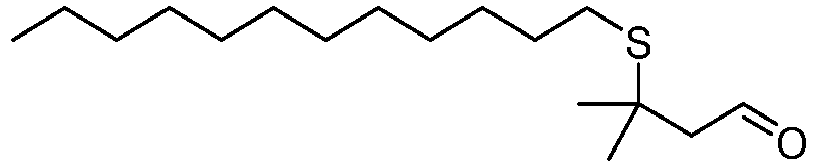
- The procedure described in Example 1 was repeated with 1-dodecanethiol (24.1 g, 119 mmol, 1 equiv.), 3-methylbut-2-enal (10.0 g, 1 equiv.) and DBU (18.1 g, 1 equiv.) without solvent. The crude product was purified by FC with hexane/MTBE 95:5 to yield 3-(dodecylthio)-3-methylbutanal as a colorless liquid (7.0 g, 21%).
Odor (1% wt/vol in EtOH on blotter after 24 h): cassis, sulfury
1H-NMR (CDCl3, 400MHz): 9.87 (t, J=2.9 Hz, 1 H), 2.53 - 2.58 (m, 4 H), 1.52 - 1.63 (m, 2 H), 1.45 (s, 6 H), 1.28-1.41 (m, 18 H), 0.90 (t, J=6.8 Hz, 3 H).
13C-NMR (CDCl3, 101MHz): 202.0 (d), 54.6 (t), 42.7 (s), 32.3 (t), 30.0 (t), 30.0 (t), 30.0 (t), 29.9 (t), 29.8 (t), 29.7 (2q), 29.6 (2t), 29.6 (s), 28.4 (t), 23.1 (t), 14.5 (q).
MS (EI, 70 eV): 286 (2, M+), 97 (35), 84 (50), 83 (54), 70 (32), 69 (47), 57 (89), 56 (73), 55 (100), 43 (53), 41 (77). -

- The procedure described in Example 1 was repeated with 1-dodecanethiol (7.7 g, 38.0 mmol, 1 equiv.), 3-methyl-2-cyclohexen-1-one (5.03 g, 1.2 equiv.) and DBU (5.79 g, 1 equiv.) in THF (60 mL) during 4 days at room temperature. The crude product was purified by FC with hexane to hexane/MTBE 9:1 to yield 3-(dodecylthio)-3-methylcyclohexan-1-one as a colorless liquid (3.09 g, 26%).
Odor (1% wt/vol in EtOH on blotter after 24 h): aldehydic, floral, green, slightly sulfury
1H-NMR (CDCl3, 400MHz): 2.53 - 2.58 (m, 1 H), 2.44 - 2.52 (m, 2 H), 2.34 - 2.43 (m, 2 H), 2.08 - 2.30 (m, 2 H), 1.77 - 2.01 (m, 3 H), 1.51 - 1.61 (m, 2 H), 1.40 (s, 3 H), 1.27-1.42 (m, 18 H), 0.89 (t, J=6.8 Hz, 3 H).
13C-NMR (CDCl3, 101MHz): 208.9 (s), 53.5 (t), 48.3 (s), 40.3 (t), 36.8 (t), 31.9 (t), 29.6 (t), 29.6 (t), 29.6 (t), 29.5 (t), 29.4 (t), 29.3 (t), 29.2 (t), 29.2 (t), 28.8 (q), 27.4 (t), 22.7 (t), 22.1 (t), 14.1 (q).
MS (EI, 70 eV): 312 (1, M+), 112 (21), 111 (100), 110 (36), 83 (30), 82 (56), 69 (29), 55 (78), 43 (32), 41 (42), 39 (22). -

- The procedure described in Example 1 was repeated with 1-dodecanethiol (8.7 g, 43.0 mmol, 1 equiv.), 3-methylcyclopent-2-enone (4.96 g, 1.2 equiv.) and DBU (6.54 g, 1 equiv.) in THF (60 mL) during 4 days at room temperature. The crude product was purified by FC with hexane to hexane/MTBE 9:1 to yield 3-(dodecylthio)-3-methylcyclopentan-1-one as a colourless liquid (0.68 g, 5%).
Odor (1% wt/vol in EtOH on blotter after 24 h): fruity, sulfury
1H-NMR (CDCl3, 400MHz): 2.44 - 2.63 (m, 4 H), 2.16 - 2.37 (m, 3 H), 1.93 - 2.05 (m, 1 H), 1.56 (s, 3 H), 1.54-1.63 (m, 2 H), 1.28-1.38 (m, 18 H), 0.90 (t, J=6.6 Hz, 3 H). 13C-NMR (CDCl3, 101MHz): 216.9 (s), 52.7 (t), 49.1 (s), 36.9 (t), 36.1 (t), 31.9 (t), 29.6 (t), 29.6 (t), 29.6 (t), 29.5 (t), 29.3 (t), 29.2 (t), 29.2 (t), 28.8 (t), 28.3 (q), 22.7 (t), 14.1 (q).
MS (EI, 70 eV): 298 (4, M+), 201 (19), 97 (100), 96 (41), 83 (19), 69 (52), 67 (19), 55 (35), 43 (32), 41 (48), 39 (18). -

- The procedure described in Example 1 was repeated with 1-dodecanethiol (4.9 g, 24.2 mmol, 1 equiv.), 5-methylhex-4-en-3-one (5.43 g, 48.4 mmol, 2 equiv.) and DBU (3.69 g, 24.2 mmol, 1 equiv.) in THF (80 mL) during 20 h at room temperature. The crude product was purified by FC with hexane/MTBE 96:4 to yield 5-(dodecylthio)-5-methylhexan-3-one as a colourless liquid (3.45 g, 46%).
Odor (1% wt/vol in EtOH on blotter after 24 h): fruity, sulfury, slightly aldehydic
1H-NMR (CDCl3, 400MHz): 2.68 (s, 2 H), 2.54 (t, J=7.3 Hz, 2 H), 2.50 (q, J=7.3 Hz, 2 H), 1.52 - 1.62 (m, 2 H), 1.43 (s, 6 H), 1.27 (1.42-1.20, m, 18 H), 1.05 (t, J=7.2 Hz, 3 H), 0.89 (t, J=6.6 Hz, 3 H).
13C-NMR (CDCl3, 101MHz): 209.5 (s), 53.6 (t), 43.5 (s), 38.2 (t), 31.9 (t), 29.7 (t), 29.6 (t), 29.6 (t), 29.6 (t), 29.5 (t), 29.3 (t), 29.3 (2t), 28.6 (2q), 28.2 (t), 22.7 (t), 14.1 (q), 7.6 (q).
MS (EI, 70 eV): 314 (3, M+), 257 (3), 243 (7), 201 (8), 113 (11), 97 (13), 83 (57), 69 (17), 57 (100), 43 (31), 29 (29). -

- The procedure described in Example 1 was repeated with 1-decanethiol (10.0 g, 57.4 mmol, 1 equiv.), 4-methylpent-3-en-2-one (11.26 g, 114.8 mmol, 2 equiv.) and DBU (8.73 g, 57.4 mmol, 1 equiv.) in THF (80 mL) during 24 h at room temperature. The crude product was purified by FC with hexane/MTBE 95:5 to yield 4-(decylthio)-4-methylpentan-2-one as a colourless liquid (14.12 g, 90%).
Odor (1% wt/vol in EtOH on blotter after 24 h): fruity, sulfury, slightly aldehydic.
1H-NMR (CDCl3, 400MHz): 2.70 (s, 2 H), 2.54 (t, J=7.8 Hz, 2 H), 2.20 (s, 3 H), 1.52 - 1.62 (m, 2 H), 1.43 (s, 6 H), 1.27 (1.43 - 1.23, m, 14 H), 0.89 (t, J=6.6 Hz, 3 H).
13C-NMR (CDCl3, 101MHz): 206.9 (s), 54.7 (t), 43.3 (s), 32.4 (q), 31.9 (t), 29.5 (t), 29.5 (t), 29.5 (t), 29.3 (t), 29.3 (t), 29.3 (t), 28.5 (2q), 28.1 (t), 22.7 (t), 14.1 (q).
MS (EI, 70 eV): 272 (6, M+), 173 (17), 140 (4), 99 (26), 83 (24), 69 (9), 55 (23), 43 (100), 29 (11). -

- The procedure described in Example 1 was repeated with 1-tetradecanethiol (4.16 g, 18.1 mmol, 1 equiv.), 4-methylpent-3-en-2-one (3.54 g, 36.2 mmol, 2 equiv.) and DBU (2.75 g, 18.1 mmol, 1 equiv.) in THF (50 mL) during 24 h at room temperature. The crude product was purified by FC with hexane/MTBE 95:5 to yield 4-methyl-4-(tetradecylthio)pentan-2-one as a colourless liquid (3.21 g, 54%).
Odor (1% wt/vol in EtOH on blotter after 24 h): fruity, sulfury, slightly aldehydic.
1H-NMR (CDCl3, 400MHz): 2.70 (s, 2 H), 2.54 (t, J=7.6 Hz, 2 H), 2.21 (s, 3 H), 1.53 - 1.62 (m, 2 H), 1.43 (s, 6 H), 1.25 - 1.42 (m, 22 H), 0.89 (t, J=6.8 Hz, 3 H).
13C-NMR (CDCl3, 101MHz): 206.9 (s), 54.7 (t), 43.3 (s), 32.4 (q), 31.9 (t), 29.7 (t), 29.7 (t), 29.7 (2t), 29.6 (t), 29.5 (t), 29.5 (t), 29.4 (t), 29.3 (2t), 28.5 (2q), 28.1 (t), 22.7 (t), 14.1 (q).
MS (EI, 70 eV): 328 (3, M+), 285 (4), 271 (3), 229 (11), 168 (2), 111 (8), 99 (27), 83 (46), 69 (21), 55 (39), 43 (100), 29 (15). - A 10% wt/wt solution of 4-(dodecylthio)-4-methylpentan-2-one (prepared according to Example 1) in MTBE (200 µl, 16.3 mg) was applied on a paper blotter (4x1.2 cm2, conditioned by rinsing with MeOH and vacuum drying). After 5 min evaporation of the solvent in open air, the blotter was placed at the bottom of a 2 L glass jar closed with a lid containing two openings which were sealed with Parafilm. The glass jar was left for 48 h at 25°C in a cabinet lit with a fluorescent UV A/B-light source (ca. 0.8 mW/cm2).
- Then a stainless steel tube (length 25 cm, i.d. 0.8 mm) with a Porapak Q filter (cf. R. Kaiser, "Meaningful Scents around the World", Helvetica Chimica Acta, Zürich 2006, chapter 1.3.) attached to its tip with shrinking tube and secured with Parafilm, was introduced into the jar through one of the openings, to which it was attached by an airtight Teflon joint. The tube was attached to a peristaltic pump with a thin rubber hose and the other opening of the jar (the air inlet) was equipped with a charcoal filter. An air volume of 2 L was drawn through the filter with a flow of 10 mL/min. The trapped volatiles were desorbed with 100 µL of MTBE and the liquid sample was analysed by GC/MS and GC-sniff. As shown in
Fig. 1 , the presence of the odorants 4-mercapto-4-methylpentan-2-one and dodecanal was detected among the volatiles released from 4-(dodecylthio)-4-methylpentan-2-one. - Example 13 was repeated with 3-((3-(4-(tert-butyl)phenyl)propyl)thio)butanal. The presence of the odorant 3-(4-(tert-butyl)phenyl)propanal was detected among the volatiles released from 3-((3-(4-(tert-butyl)phenyl)propyl)thio)butanal (
Fig. 2 ). - Example 13 was repeated with 4-((3-(4-(tert-butyl)phenyl)propyl)thio)-4-methylpentan-2-one. The presence of the odorants 4-mercapto-4-methylpentan-2-one and 3-(4-(tert-butyl)phenyl)propanal was detected among the volatiles released from 4-((3-(4-(tert-butyl)phenyl)propyl)thio)-4-methylpentan-2-one (
Fig. 3 ). - The following fragrance accord has been created for an all-purpose cleaner and is to be assessed at 0.3% in the unperfumed product base.
CAS number Ingredient name Amount parts wt/wt 140-11-4 Benzyl acetate 15 80-26-2 Terpenyl Acetate 60 101-86-0 alpha Hexyl Cinnamic Aldehyde 30 112-31-2 Decanal 18 67634-00-8 Allyl amyl glycolate 3 1092785-58-4 Cassyrane™ (Givaudan) 0.5 106-22-9 Citronellol 20 68039-49-6 Cyclal C 5 57378-68-4 delta Damascone 1 65405-70-1 4-E-Decenal 0.2 18479-58-8 Dihydro Myrcenol 60 8000-48-4 Eucalyptus Essence 10 67634-14-4 Floralozone 3 125109-85-5 Florhydral 2 14765-30-1 Freskomenthe 5 54464-57-2 Iso E Super 20 20665-85-4 Isobutavan 0.2 1335-46-2 Isoraldeine 70 10 198404-98-7 Javanol 1 81783-01-9 Labienoxime 1% in TEC/IPM 3 61792-11-8 Lemonile 35 73018-51-6 Lime Oxide 20 78-70-6 Linalool 90 39255-32-8 Manzanate 2 37677-14-8 Myraldene 10 1637294-12-2 Nympheal 8 68647-72-3 Orange Terpenes 300 916887-53-1 Petalia™ (Givaudan) 7 313973-37-4 Pharaone™ (Givaudan) 10% in DPG 4 82461-14-1 Rhubafuran 0.5 1655500-83-6 Rosyfolia™ (Givaudan) 3 16510-27-3 Toscanol™ (Givaudan) 1 Reference Accord Accord A Accord B 4-(dodecylthio)-4-methylpentan-2-one (Example 1) 0 2 10 25265-71-8 Dipropylene Glycol 252.6 250.6 242.6 Total parts wt/wt 1000 1000 1000 - The olfactory character imparted to the product by the reference accord is citrus and fresh floral aldehydic, with a watery facette.
- Addition of 0.2% of 4-(dodecylthio)-4-methylpentan-2-one (Example 1) enhances the citrus odor aspect, while addition of 1% renders the accord more intense citrus and enhances the juicy aspect. After 24 hours application on a floor tile, the perfume is slightly more intense with the addition of 0.2% 4-(dodecylthio)-4-methylpentan-2-one and clearly more intense, fresher and juicier than the reference with 1%.
- Mixtures of the compound according to Example 1 (4-(dodecylthio)-4-methylpentan-2-one) with mesityl oxide were prepared in different ratios and subjected to olfactive evaluation. All samples were assessed as 10% solutions in ethanol on a fresh blotter.
Sample Olfacive evaluation 4-(dodecylthio)-4-methylpentan-2-one cassis, sulphur, eucalyptus bud, overall sulphurous impression is dominant, polarizing 4-(dodecylthio)-4-methylpentan-2-one, spiked with 0.01 wt.-% or 0.03 wt.-% mesityl oxide effect is minor, and olfactive profile still very close to pure material 4-(dodecylthio)-4-methylpentan-2-one, spiked with 0.1 wt.-% mesityl oxide combination starts to bring a positive olfactive benefit 4-(dodecylthio)-4-methylpentan-2-one, spiked with 0.3 wt.-% mesityl oxide combination brings a positive olfactive benefit, more juicy, more pleasant 4-(dodecylthio)-4-methylpentan-2-one, containing 0.8% mesityl oxide fruity juicy cassis, juicy, pleasant 4-(dodecylthio)-4-methylpentan-2-one, spiked with 1.0 wt.-% mesityl oxide combination brings a positive olfactive benefit, more juicy 4-(dodecylthio)-4-methylpentan-2-one, spiked with 3.0 wt.-% mesityl oxide mesityl oxide starts to dominate, and brings an additional green and technical facet mesityl oxide green, solvent, plastic like, then fruity, almondy, cherry - The above results show that there is an optimum ratio between 4-(dodecylthio)-4-methylpentan-2-one and mesityl oxide, in which the mixture shows superior olfactive properties.
- Three samples of liquid detergent samples (34 g each) were prepared by adding 0.2 wt.-% of the following precursors according to the present invention to a non fragranced heavy duty liquid detergent base (pH 8.4): 4-(decylthio)-4-methylpentan-2-one (Example 14), 4-(dodecylthio)-4-methylpentan-2-one (Example 1) and 4-methyl-4-(tetradecylthio)pentan-2-one (Example 15). The samples were used to wash a load of 5 cotton terry towels (ca. 200 g dry weight each, 1.1 kg total load) in a standard frontloading washing machine. The wash cycle was carried out at 40°C, followed by two cold rinse cycles and spinning at 1000 rpm. The washed towels were assessed blind by a panel of 6 experienced evaluators for fragrance intensity on wet towel and after 24 h line dry at room temperature. The intensity was indicated on a scale from 0 (odorless) to 5 (very strong).
Ingredient Fragrance intensity on wet towel Fragrance intensity on dry towel (24 h line dry) 4-(decylthio)-4-methylpentan-2-one 1.5 0.8 4-(dodecylthio)-4-methylpentan-2-one 1.2 2.1 4-methyl-4-(tetradecylthio)pentan-2-one 1.0 1.3 - As can be seen from the results provided in the table above, the comparative study of three precursors according to the present invention with R1 = R3 = R4 = methyl, R2 = R5 = H and R6 = nonyl, undecyl or tridecyl, the strongest precursor effect was observed with R6 = undecyl. The observed differencies between R6 = undecyl and R6 = nonyl or R6 = tridecyl were significant at confidence levels of 99.8% and 96%, respectively.
- Due to the high volatility and water solubility of the released odorant 4-mercapto-4-methyl-2- pentanone (clogP = 1.0, as compared to clogP = 7.2 for 4-(dodecylthio)-4-methylpentan-2-one), it would not have been technically possible to deposit a sufficient amount of the material on fabric to trigger a fragrance impact.
- As series of experiments was conducted in order to determine whether fragrance ingredients according to the present invention show intensity benefits in fabric detergents. The compound of Example 1 (4-(dodecylthio)-4-methylpentan-2-one) was tested with two fragrances A and B, which had different olfactive profiles. The products were assessed on wet cloth and on 1 day, 3 days and 7 days dried cloth.
- The members of a sensory analysis panel were selected on a basis of their olfactory sensory acuity and then trained for several months. Their training enabled them to identify individual odor characteristics and score their perceived intensity against given standards in a consistent manner.
- The fabrics were washed in European washing machines (40°C - 1,000 spin/min) with one unit dose per wash load. For the wet stage, after washing, the cloths were placed into 500 mL wide necked glass jars ready for assessment. For the dry cloth assessment, the cloth was lined-dried and left overnight in a perfume free room at 25 °C. Cloths washed with fragrance A were used as the control.
- For all stages the overall perceived intensity was assessed by the trained sensory panel using a 0-100 linear scale. All overall perceived intensities were scaled against a reference sample A, for which the overall perceived intensity was set at 35 for wet cloth assessment and 10 for the dry cloth assessments where the reference sample was a 1 day dry cloth. The reference sample A was presented in the same format as the test samples for the wet cloth and dry cloth assessment.
- For the wet cloth assessment, each sample was assessed twice by 20 panellists, thus giving 40 assessments per product. For the 1 day, 3 days and 7 days dry cloth assessments, each sample was assessed twice by 14 panellists, thus giving 28 assessments per product.
- The estimated product means are reported on the next pages, together with any statistically significant differences between products.
-
Product Overall Perceived Intensity Significance of Differences Fragrance A 35.7 A Fragrance A + 2% Precursor 35.8 A Fragrance B 44.6 B Fragrance B + 2% Precursor 45.2 B - Where the same letter is shown in the "significance of differences" column there are no statistically significant differences between the relevant figures.
- When assessed from wet cloth, cloth washed with Fragrance B or Fragrance B + 2% precursor were not perceived to be significantly different, but were perceived to be significantly stronger than cloth washed with Fragrance A or Fragrance A + 2% precursor, which were also not perceived to be significantly different to each other.
-
Product Overall Perceived Intensity Significance of Differences Fragrance A 10.9 A Fragrance A + 2% Precursor 23.4 B Fragrance B 12.3 A Fragrance B + 2% Precursor 27.3 C - Where the same letter is shown in the "significance of differences" column there are no statistically significant differences between the relevant figures.
- When assessed from 1 day dry cloth, cloth washed with Fragrance A + precursor was perceived to be significantly stronger than cloth washed with Fragrance A. Cloth washed with Fragrance B was perceived to be significantly weaker than cloth washed with Fragrance B + precursor.
-
Product Overall Perceived Intensity Significance of Differences Fragrance A 11.1 A Fragrance A + 2% Precursor 22.9 C Fragrance B 16.0 B Fragrance B + 2% Precursor 26.1 D - Where the same letter is shown in the "significance of differences" column there are no statistically significant differences between the relevant figures.
- When assessed from 3 day dry cloth, cloth washed with Fragrance B + 2% precursor was perceived to be significantly stronger than cloth washed with any of the other products. Whereas, cloth washed with Fragrance A was perceived to be significantly weaker than cloth washed with any of the other products.
-
Product Overall Perceived Intensity Significance of Differences Fragrance A 14.1 A Fragrance A + 2% Precursor 23.1 B Fragrance B 15.6 A Fragrance B + 2% Precursor 25.2 B - Where the same letter is shown in the "significance of differences" column there are no statistically significant differences between the relevant figures.
- When assessed from 7 day dry cloth, cloth washed with Fragrance A + 2% precursor or Fragrance B + 2% precursor were not perceived to be significantly different, but were perceived to be significantly stronger than cloth washed Fragrance A or Fragrance B which were also not perceived to be significantly different to each other.
- When assessed from wet cloth, for both Fragrance A and Fragrance B, the cloth washed with product containing the precursor was comparable in terms of strength to cloth washed with product not containing the precursor. When assessed from 1 day, 3 day and 7 day dry cloth, for both Fragrance A and Fragrance B, the cloth washed with product containing the precursor was perceived to be significantly stronger than the same fragrance without the precursor.
- As series of experiments was conducted in order to determine whether fragrance ingredients according to the present invention show intensity benefits in all purpose cleaners (APCs). The compound of Example 1 (4-(dodecylthio)-4-methylpentan-2-one) was tested with two fragrances A and B, which had different olfactive profiles. The products were assessed in booths on the floor at fresh (time 0) and after 1 hour, 2 hours and 4 hours application.
- The members of a sensory analysis panel were selected on a basis of their olfactory sensory acuity and then trained for several months. Their training enabled them to identify individual odor characteristics and score their perceived intensity against given standards in a consistent manner.
- The testing was carried out in small booths (10 m3 booths, 21 °C, 50% RH) specifically designed. The booths were closed during testing, with the doors sealed. The APC products were diluted at 1.2% in warm water (45°C +/- 2°C). 60 mL of the diluted product was applied directly to the booth floor. It was evenly spread using a gloved hand, over an area of 65 cm x 65 cm.
- The system was assessed through a porthole in the door of the booth. The overall perceived intensity was assessed by the trained sensory panel using a 0-100 line scale. The order of samples assessed by the panelists was pre-determined using. The dilution assessment was conducted over four sessions. The Fresh (time 0), 1 hour and 4 hour stages were assessed by 16 panelists, thus giving 32 assessments per product. The 2 hour stage was assessed by 17 panelists, thus giving 34 assessments per product.
- The estimated product means are reported on the next pages, together with any statistically significant differences between products.
-
Product Overall Perceived Intensity Significance of Differences Fragrance A 33.8 A Fragrance A + 5% Precursor 33.7 A Fragrance B 36.5 A Fragrance B + 4% Precursor 37.8 A Fragrance B + 8% Precursor 36.5 A - Where the same letter is shown in the "significance of differences" column there are no statistically significant differences between the relevant figures.
- When the products were assessed fresh (time = 0), there was no perceived significant difference between the booths containing any of the five products tested.
-
Product Overall Perceived Intensity Significance of Differences Fragrance A 28.8 A Fragrance A + 5% Precursor 37.9 C Fragrance B 33.1 B Fragrance B + 4% Precursor 35.4 BC Fragrance B + 8% Precursor 37.0 C - Where the same letter is shown in the "significance of differences" column there are no statistically significant differences between the relevant figures.
- When the products were assessed after 1 hour application, booths containing Fragrance B + 8% precursor or Fragrance A + 5% precursor were not perceived to be significantly different to booths containing Fragrance B + 4% precursor, but were perceived to be significantly stronger than booths containing Fragrance A or Fragrance B.
-
Product Overall Perceived Intensity Significance of Differences Fragrance A 21.6 A Fragrance A + 5% Precursor 29.2 B Fragrance B 18.2 A Fragrance B + 4% Precursor 19.5 A Fragrance B + 8% Precursor 31.1 B - Where the same letter is shown in the "significance of differences" column there are no statistically significant differences between the relevant figures.
- When the products were assessed after 2 hours application, the booths containing Fragrance A + 5% precursor or Fragrance B + 8% precursor, which were not perceived to be significantly different, were perceived to be significantly stronger than the booths containing Fragrance A, Fragrance B or Fragrance B + 4% precursor, which were also not perceived to be significantly different to each other.
-
Product Overall Perceived Intensity Significance of Differences Fragrance A 20.4 B Fragrance A + 5% Precursor 28.6 C Fragrance B 10.8 A Fragrance B + 4% Precursor 20.8 B Fragrance B + 8% Precursor 27.2 C - Where the same letter is shown in the "significance of differences" column there are no statistically significant differences between the relevant figures.
- When the products were assessed after 4 hours application, the booths containing Fragrance B + 8% precursor or Fragrance A + 5% precursor, which were not perceived to be significantly different, were perceived to be significantly stronger than booths containing Fragrance A or Fragrance B + 4% precursor, which were also not perceived to be significantly different to each other. Furthermore, booths containing Fragrance B were perceived to be significantly weaker than the booths containing any of the other four products tested.
- Fragrance A + 5% precursor was comparable in terms of strength to Fragrance A at fresh (time = 0), but was perceived to be significantly stronger than Fragrance A when assessed 1 hour, 2 hours and 4 hours after application.
- The Fragrance B + 8% precursor was comparable in terms of strength to Fragrance B at fresh (time = 0) but was perceived to be significantly stronger than Fragrance B when assessed 1 hour, 2 hours and 4 hours after application. Whereas Fragrance B + 4% precursor was comparable in terms of strength to Fragrance B at the fresh, 1 hour and 2 hour assessments, but was perceived to be significantly stronger than Fragrance B when assessed 4 hours after application.
- Furthermore, Fragrance A + 5% precursor and Fragrance B + 8% precursor were comparable in terms of strength when assessed at all time points (0, 1, 2 and 4 hours).
Claims (15)
- Use of a compound of formula (I) as a precursor for generating a compound of formula (II) and/or a compound of formula (III).
 wherein R1 is H or C1-5-alkyl; R2 is H or C1-5-alkyl; R3 is H or C1-5-alkyl; and R4 is C1-6-alkyl; orR1 and R4 together with the carbon atoms to which they and R2 are attached form a 5, 6 or 7 membered ring, preferably a hydrocarbon ring; R2 is H or 61-4-alkyl; and R3 is H or C1-4-alkyl; and whereinR5 is H or a residue comprising 1 to 20 carbon atoms; and R6 is a residue comprising 3 to 20 carbon atoms.
 - A composition of matter comprising a compound of formula (I) and a compound of formula (A)
 wherein R1 is H or C1-5-alkyl; R2 is H or C1-5-alkyl; R3 is H or C1-5-alkyl; and R4 is C1-6-alkyl; orR1 and R4 together with the carbon atoms to which they and R2 are attached form a 5, 6 or 7 membered ring, preferably a hydrocarbon ring; R2 is H or C1-4-alkyl; and R3 is H or C1-4-alkyl; and whereinR5 is H or a residue comprising 1 to 20 carbon atoms; and R6 is a residue comprising 3 to 20 carbon atoms.
 - A composition of matter according to claim 2, wherein the amount of the compound of formula (A) in relation to the total amount of the compound of formula (I) and the compound of formula (A) is 0.1 to 3.0 wt.-%, preferably 0.3 to 1.2 wt.-%, even more preferably 0.6 to 1.0 wt.-%.
- A fragrance ingredient comprising a compound of formula (I)
 wherein R1 is H or C1-5-alkyl; R2 is H or C1-5-alkyl; R3 is H or C1-5-alkyl; and R4 is C1-6-alkyl; orR1 and R4 together with the carbon atoms to which they and R2 are attached form a 5, 6 or 7 membered ring, preferably a hydrocarbon ring, a lactone or a cyclic ether; R2 is H or C1-4-alkyl; and R3 is H or C1-4-alkyl; and whereinR5 is H or a residue comprising 1 to 20 carbon atoms; and R6 is a residue comprising 6 to 20 carbon atoms;wherein the total combined number of carbon atoms of R1, R2, R3 and R4 is 1 to 6, preferably 1 to 5, more preferably 1 to 4, even more preferably 1 to 3, if R5 is H and R6 is selected from a group consisting of octyl, undecyl and heptadecyl.
 - A fragrance ingredient according to claim 4, wherein the total combined number of carbon atoms of R1, R2, R3 and R4 is 1 to 6, preferably 1 to 5, more preferably 1 to 4, even more preferably 1 to 3.
- A fragrance ingredient according to one of claims 4 or 5, wherein R1 is H; R2 is H; R3 is H; and R4 is methyl.
- A fragrance ingredient according to one of claims 4 or 5, wherein R1 is H; R2 is H; R3 is methyl; and R4 is methyl.
- A fragrance ingredient according to one of claims 4 or 5, wherein R1 is methyl; R2 is H; R3 is H; and R4 is methyl.
- A fragrance ingredient according to one of claims 4 or 5, wherein R1 is methyl; R2 is H; R3 is methyl; and R4 is methyl.
- A fragrance ingredient according to one of claims 4 to 9, wherein R6 is a residue comprising 7 to 16 carbon atoms, preferably 8 to 14 carbon atoms, even more preferably 9 to 13 carbon atoms.
- A fragrance ingredient according to one of claims 4 to 10, wherein R6 is an alkyl, alkenyl or aromatic residue.
- A fragrance ingredient according to claim 4, wherein the compound of formula (I) is selected from the group consisting of 3-(octylthio)butanal, 4-methyl-4-(octylthio)pentan-2-one, 3-(decylthio)butanal, 4-(decylthio)-4-methylpentan-2-one, 4-(dodecylthio)pentan-2-one, 4-(dodecylthio)-4-methylpentan-2-one, 4-(dodecylthio)-3-methylpentan-2-one, 3-(dodecylthio)-3-methylbutanal, 3-(dodecylthio)butanal, 3-(dodecylthio)-3-methylcyclohexan-1-one, 3-(dodecylthio)-3-methylcyclopentan-1-one, 3-(tetradecylthio)butanal and 4-methyl-4-(tetradecylthio)pentan-2-one.
- A consumer product comprising a composition of matter according to one of claims 2 or 3 or a fragrance ingredient according to one of claims 4 to 12.
- A consumer product according to claim 13, wherein the concentration of the compound of formula (I) is 0.1% to 10%, preferably 0.2% to 5%, even more preferably 0.5% to 3%.
- A method for producing a fragrance ingredient comprising a compound of formula (I) according to one of claims 4 to 12 by reaction of a compound of formula (A) with a compound of formula (B).

Priority Applications (9)
| Application Number | Priority Date | Filing Date | Title |
|---|---|---|---|
| EP18159756.8A EP3533786A1 (en) | 2018-03-02 | 2018-03-02 | Thioether precursors for fragrant ketones and aldehydes |
| PCT/EP2019/054296 WO2019166315A1 (en) | 2018-03-02 | 2019-02-21 | Thioether precursors for fragrant ketones and aldehydes |
| EP19706275.5A EP3759069A1 (en) | 2018-03-02 | 2019-02-21 | Thioether precursors for fragrant ketones and aldehydes |
| US16/966,720 US11359161B2 (en) | 2018-03-02 | 2019-02-21 | Thioether precursors for fragrant ketones and aldehydes |
| SG11202007637XA SG11202007637XA (en) | 2018-03-02 | 2019-02-21 | Thioether precursors for fragrant ketones and aldehydes |
| CN201980016099.5A CN111788180A (en) | 2018-03-02 | 2019-02-21 | Thioether precursors of aromatic ketones and aldehydes |
| MX2020008025A MX2020008025A (en) | 2018-03-02 | 2019-02-21 | Thioether precursors for fragrant ketones and aldehydes. |
| JP2020545620A JP7412342B2 (en) | 2018-03-02 | 2019-02-21 | Thioether precursors for aromatic ketones and aldehydes |
| BR112020016580-8A BR112020016580B1 (en) | 2018-03-02 | 2019-02-21 | USE OF THIOETHER PRECURSORS FOR SCENT KETONES AND ALDEHYDES, COMPOSITION AND CONSUMER PRODUCT |
Applications Claiming Priority (1)
| Application Number | Priority Date | Filing Date | Title |
|---|---|---|---|
| EP18159756.8A EP3533786A1 (en) | 2018-03-02 | 2018-03-02 | Thioether precursors for fragrant ketones and aldehydes |
Publications (1)
| Publication Number | Publication Date |
|---|---|
| EP3533786A1 true EP3533786A1 (en) | 2019-09-04 |
Family
ID=61563193
Family Applications (2)
| Application Number | Title | Priority Date | Filing Date |
|---|---|---|---|
| EP18159756.8A Withdrawn EP3533786A1 (en) | 2018-03-02 | 2018-03-02 | Thioether precursors for fragrant ketones and aldehydes |
| EP19706275.5A Pending EP3759069A1 (en) | 2018-03-02 | 2019-02-21 | Thioether precursors for fragrant ketones and aldehydes |
Family Applications After (1)
| Application Number | Title | Priority Date | Filing Date |
|---|---|---|---|
| EP19706275.5A Pending EP3759069A1 (en) | 2018-03-02 | 2019-02-21 | Thioether precursors for fragrant ketones and aldehydes |
Country Status (8)
| Country | Link |
|---|---|
| US (1) | US11359161B2 (en) |
| EP (2) | EP3533786A1 (en) |
| JP (1) | JP7412342B2 (en) |
| CN (1) | CN111788180A (en) |
| BR (1) | BR112020016580B1 (en) |
| MX (1) | MX2020008025A (en) |
| SG (1) | SG11202007637XA (en) |
| WO (1) | WO2019166315A1 (en) |
Cited By (2)
| Publication number | Priority date | Publication date | Assignee | Title |
|---|---|---|---|---|
| WO2021122997A1 (en) * | 2019-12-19 | 2021-06-24 | Firmenich Sa | Compounds for providing a long-lasting floral and fruity odor |
| WO2023213922A1 (en) * | 2022-05-04 | 2023-11-09 | Symrise Ag | PRECURSORS FOR THE CONTROLLED RELEASE OF α,β-UNSATURATED ALDEHYDES OR KETONES AND OTHER HIGH IMPACT FRAGRANCE SUBSTANCES |
Families Citing this family (6)
| Publication number | Priority date | Publication date | Assignee | Title |
|---|---|---|---|---|
| CN111971371B (en) * | 2018-06-21 | 2026-01-27 | 弗门尼舍有限公司 | Compounds providing persistent strawberry odour |
| JP7818402B2 (en) | 2018-12-17 | 2026-02-20 | ジボダン エス エー | Fragrance Process |
| US20240390246A1 (en) * | 2021-10-20 | 2024-11-28 | Firmenich Sa | Improved perfume compositions comprising sulfur-containing pro-fragrance compounds |
| JP2026523575A (en) | 2023-06-21 | 2026-07-14 | ジボダン エス エー | new compound |
| GB202404060D0 (en) | 2024-03-21 | 2024-05-08 | Givaudan Sa | Fragrance compositions exhibiting enhanced intensity |
| WO2025196224A1 (en) | 2024-03-21 | 2025-09-25 | Givaudan Sa | Fragrance compositions exhibiting enhanced intensity |
Citations (7)
| Publication number | Priority date | Publication date | Assignee | Title |
|---|---|---|---|---|
| GB1457089A (en) * | 1974-09-16 | 1976-12-01 | Ciba Geigy Ag | Alkylindene-bisphenols containing sulphur and their use as stabilisers |
| US4560799A (en) * | 1984-02-03 | 1985-12-24 | Ciba-Geigy Corporation | Tri- and Tetra-(substituted hydroxyphenylthio) alkane and cycloalkane stabilizers and stabilized compositions |
| WO2003049666A2 (en) | 2001-12-13 | 2003-06-19 | Firmenich Sa | Compounds for a controlled release of active molecules |
| WO2004105713A1 (en) * | 2003-06-02 | 2004-12-09 | Firmenich Sa | Compounds for a controlled release of active molecules |
| WO2012113746A1 (en) * | 2011-02-21 | 2012-08-30 | Firmenich Sa | Consumer products containing pro-fragrances |
| WO2013139766A1 (en) * | 2012-03-20 | 2013-09-26 | Firmenich Sa | Compounds for a controlled release of active perfuming molecules |
| US20140323383A1 (en) * | 2013-04-26 | 2014-10-30 | The Procter & Gamble Company | Pouch comprising a liquid detergent composition |
Family Cites Families (39)
| Publication number | Priority date | Publication date | Assignee | Title |
|---|---|---|---|---|
| US2794050A (en) * | 1953-11-17 | 1957-05-28 | Universal Oil Prod Co | Dithia-dioxo-hydrocarbons |
| US4618440A (en) * | 1983-10-21 | 1986-10-21 | Ciba-Geigy Corporation | Substituted 4-hydroxybenzylthio aldehyde and ketone stabilizers |
| DE19622745A1 (en) * | 1996-06-07 | 1997-12-11 | Haarmann & Reimer Gmbh | Furfurylthioalkanes, process for their preparation and their use |
| EP0936211B1 (en) | 1998-02-13 | 2010-07-07 | Givaudan SA | Aryl-acrylic acid esters useful as precursors for organoleptic compounds |
| WO2006079480A1 (en) | 2005-01-26 | 2006-08-03 | Merial Ltd. | Pesticidal substituted thioethers |
| CN1709867A (en) | 2005-07-07 | 2005-12-21 | 北京工商大学 | 4-methyl-4-alkyl sulfenyl-2-pentanone compound and its preparing method |
| GB0611770D0 (en) | 2006-06-15 | 2006-07-26 | Givaudan Sa | Compounds |
| SG139587A1 (en) * | 2006-07-28 | 2008-02-29 | Givaudan Sa | Method of using organic compounds |
| US20100098650A1 (en) | 2007-01-30 | 2010-04-22 | Andreas Herrmann | Controlled release of active aldehydes and ketones from equilibrated dynamic mixtures |
| JP5595267B2 (en) | 2007-05-22 | 2014-09-24 | フイルメニツヒ ソシエテ アノニム | 3-7 membered 1,3-diaza-4-oxo-heterocyclic derivatives capable of releasing active aldehydes or ketones |
| DE102008016327A1 (en) | 2008-03-28 | 2009-10-01 | Henkel Ag & Co. Kgaa | Photolabile fragrance storage materials |
| EP2318100B1 (en) | 2008-08-22 | 2011-12-21 | Firmenich S.A. | Equilibrated dynamic mixtures containing stabilized hemiacetals for the controlled release of active alcohols |
| WO2010029462A1 (en) | 2008-09-12 | 2010-03-18 | Firmenich Sa | Divinyl ether derivatives capable of releasing active aldehydes and ketones and methods of use for perfuming surfaces |
| DE102008060886A1 (en) | 2008-12-09 | 2010-06-10 | Henkel Ag & Co. Kgaa | Photolabile fragrance storage materials |
| WO2010094356A1 (en) | 2009-02-18 | 2010-08-26 | Henkel Ag & Co. Kgaa | Pro-fragrance copolymeric compounds |
| DE102009010110B4 (en) | 2009-02-21 | 2014-08-28 | MTU Aero Engines AG | Erosion protection coating system for gas turbine components |
| DE102009001570A1 (en) | 2009-03-16 | 2010-09-23 | Henkel Ag & Co. Kgaa | Lilial surrogate |
| DE102009001569A1 (en) | 2009-03-16 | 2010-09-23 | Henkel Ag & Co. Kgaa | Lilial substitute |
| DE102010002006A1 (en) | 2010-02-17 | 2011-08-18 | Henkel AG & Co. KGaA, 40589 | Photolabile fragrance storage materials |
| DE102010002007A1 (en) | 2010-02-17 | 2011-08-18 | Henkel AG & Co. KGaA, 40589 | Photolabile fragrance storage materials |
| GB201021864D0 (en) | 2010-12-23 | 2011-02-02 | Givaudan Sa | Organic compounds |
| DE102011005947A1 (en) | 2011-03-23 | 2012-09-27 | Henkel Ag & Co. Kgaa | Diels-Alder adducts as thermally cleavable fragrance precursors |
| DE102011006314A1 (en) | 2011-03-29 | 2012-10-04 | Henkel Ag & Co. Kgaa | Fragrance composition with allyl ethers as a fragrance precursor |
| US9212335B2 (en) | 2011-04-13 | 2015-12-15 | Firmenich Sa | Equilibrated dynamic mixtures to control the release of perfuming aldehydes and ketones |
| CN103073454A (en) | 2011-10-25 | 2013-05-01 | 中国科学院兰州化学物理研究所 | Synthetic method for beta-aminocarbonyl compound, beta-mercapto ketone and beta-alkoxy ketone |
| CN110746277B (en) | 2013-05-08 | 2023-06-09 | 弗门尼舍有限公司 | Pre-flavor compounds |
| WO2014180782A1 (en) | 2013-05-08 | 2014-11-13 | Firmenich Sa | Pro-fragrance compounds |
| GB201308248D0 (en) | 2013-05-08 | 2013-06-12 | Givaudan Sa | Improvements in or relating to organic compounds |
| EP3044295B1 (en) | 2013-09-09 | 2018-05-02 | Firmenich SA | Thioether derivatives as precursors for a controlled release of active molecules |
| WO2015093572A1 (en) | 2013-12-19 | 2015-06-25 | 花王株式会社 | Perfuming method |
| CN107074732B (en) | 2014-11-10 | 2020-08-18 | 奇华顿股份有限公司 | Improvements in or related to organic compounds |
| JP6487042B2 (en) | 2014-11-10 | 2019-03-20 | ジボダン エス エー | Improvements in or related to organic compounds |
| GB201421838D0 (en) | 2014-12-09 | 2015-01-21 | Givaudan Sa | Improvements in or relating to organic compounds |
| GB201421872D0 (en) | 2014-12-09 | 2015-01-21 | Givaudan Sa | Improvements in or relating to organic compounds |
| DE102014226196A1 (en) | 2014-12-17 | 2016-06-23 | Henkel Ag & Co. Kgaa | Photolabile perfume precursor compound |
| DE102014226194A1 (en) | 2014-12-17 | 2016-06-23 | Henkel Ag & Co. Kgaa | Orthoformic acid ester as a perfume precursor |
| JP6713474B2 (en) | 2015-01-21 | 2020-06-24 | フイルメニツヒ ソシエテ アノニムFirmenich Sa | Photolabile acetal and ketal compounds for controlled release of active volatile carbonyl compounds |
| WO2016135193A1 (en) | 2015-02-25 | 2016-09-01 | Firmenich Sa | A synergistic perfuming composition |
| GB201620044D0 (en) | 2016-11-28 | 2017-01-11 | Givaudan Sa | Improvements in or relating to organic compounds |
-
2018
- 2018-03-02 EP EP18159756.8A patent/EP3533786A1/en not_active Withdrawn
-
2019
- 2019-02-21 US US16/966,720 patent/US11359161B2/en active Active
- 2019-02-21 SG SG11202007637XA patent/SG11202007637XA/en unknown
- 2019-02-21 EP EP19706275.5A patent/EP3759069A1/en active Pending
- 2019-02-21 CN CN201980016099.5A patent/CN111788180A/en active Pending
- 2019-02-21 WO PCT/EP2019/054296 patent/WO2019166315A1/en not_active Ceased
- 2019-02-21 BR BR112020016580-8A patent/BR112020016580B1/en active IP Right Grant
- 2019-02-21 JP JP2020545620A patent/JP7412342B2/en active Active
- 2019-02-21 MX MX2020008025A patent/MX2020008025A/en unknown
Patent Citations (7)
| Publication number | Priority date | Publication date | Assignee | Title |
|---|---|---|---|---|
| GB1457089A (en) * | 1974-09-16 | 1976-12-01 | Ciba Geigy Ag | Alkylindene-bisphenols containing sulphur and their use as stabilisers |
| US4560799A (en) * | 1984-02-03 | 1985-12-24 | Ciba-Geigy Corporation | Tri- and Tetra-(substituted hydroxyphenylthio) alkane and cycloalkane stabilizers and stabilized compositions |
| WO2003049666A2 (en) | 2001-12-13 | 2003-06-19 | Firmenich Sa | Compounds for a controlled release of active molecules |
| WO2004105713A1 (en) * | 2003-06-02 | 2004-12-09 | Firmenich Sa | Compounds for a controlled release of active molecules |
| WO2012113746A1 (en) * | 2011-02-21 | 2012-08-30 | Firmenich Sa | Consumer products containing pro-fragrances |
| WO2013139766A1 (en) * | 2012-03-20 | 2013-09-26 | Firmenich Sa | Compounds for a controlled release of active perfuming molecules |
| US20140323383A1 (en) * | 2013-04-26 | 2014-10-30 | The Procter & Gamble Company | Pouch comprising a liquid detergent composition |
Non-Patent Citations (15)
| Title |
|---|
| B. HACHE; Y. GAREAU, TETRAHEDRON LETT., vol. 35, no. 12, 1994, pages 1837 |
| CATCH, J.R. ET AL.: "320. Syntheses of some amino-acids, including methionine", JOURNAL OF THE CHEMICAL SOCIETY (RESUMED), 1947, pages 1609 - 1613, XP055085742, ISSN: 0368-1769, DOI: 10.1039/jr9470001609 * |
| CIGANEK, ENGELBERT: "Electrophilic amination of carbanions, enolates, and their surrogates", ORGANIC REACTIONS (HOBOKEN, NJ, UNITED STATES) , 72, 1-366 CODEN: ORHNBA, 2008, DOI: 10.1002/0471264180.OR072.01 10.1002/0471264180.OR072.01 * |
| DATABASE CAPLUS [online] CHEMICAL ABSTRACTS SERVICE, COLUMBUS, OHIO, US; 2013, CIGANEK, ENGELBERT: "Electrophilic amination of carbanions, enolates, and their surrogates", XP002784204, retrieved from STN Database accession no. 2013:1704840 * |
| EMORI, E. ET AL.: "A Catalytic Michael Addition of Thiols to [alpha],[beta]-Unsaturated Carbonyl Compounds: Asymmetric Michael Additions and Asymmetric Protonations", JOURNAL OF THE AMERICAN CHEMICAL SOCIETY, vol. 120, no. 16, 1998, pages 4043 - 4044, XP055501712, ISSN: 0002-7863, DOI: 10.1021/ja980397v * |
| GARG, S.K. ET AL.: "Copper(II) tetrafluoroborate as a novel and highly efficient catalyst for Michael addition of mercaptans to alpha,beta-unsaturated carbonyl compounds", TETRAHEDRON LETTERS, vol. 46, no. 10, 2005, pages 1721 - 1724, XP027862306, ISSN: 0040-4039, [retrieved on 20050307] * |
| MADDALENA, U. ET AL.: "Thioether Profragrances: Parameters Influencing the Performance of Precursor-Based Fragrance Delivery in Functional Perfumery", CHEMISTRY & BIODIVERSITY, vol. 11, no. 11, 2014, pages 1700 - 1733, XP055502263, ISSN: 1612-1872, DOI: 10.1002/cbdv.201400023 * |
| MATSUO, J.-I. ET AL.: "Asymmetric reduction of aliphatic ketones and acyl silanes using chiral anti-pentane-2,4-diol and a catalytic amount of 2,4-dinitrobenzenesulfonic acid", TETRAHEDRON, vol. 66, no. 32, 2010, pages 6062 - 6069, XP027142126, ISSN: 0040-4020, [retrieved on 20100610] * |
| MATSUO, J.-I. ET AL.: "Brønsted Acid Catalyzed Asymmetric Reduction of Ketones and Acyl Silanes Using Chiral anti -Pentane-2,4-diol", ORGANIC LETTERS, vol. 12, no. 10, 2010, pages 2294 - 2297, XP055502012, ISSN: 1523-7060, DOI: 10.1021/ol1006532 * |
| OHASHI, S. ET AL.: "Asymmetric addition catalyzed by optically active polymers. III.", DIE MAKROMOLECULARE CHEMIE, vol. 160, no. 1, 1972, pages 69 - 81, XP055502387, ISSN: 0025-116X, DOI: 10.1002/macp.1972.021600105 * |
| PENG, A. ET AL.: "Conjugate addition of unactivated thiols to alpha,beta-unsaturated ketones catalyzed by a bifunctional rhenium(V)-oxo complex", TETRAHEDRON LETTERS, vol. 53, no. 22, 2012, pages 2712 - 2714, XP028419281, ISSN: 0040-4039, [retrieved on 20120326], DOI: 10.1016/J.TETLET.2012.03.075 * |
| RAMACHARY, D.B. ET AL.: "Direct organocatalytic hydroalkoxylation of alpha,beta-unsaturated ketones", TETRAHEDRON LETTERS, vol. 47, no. 44, 2006, pages 7689 - 7693, XP025003078, ISSN: 0040-4039, [retrieved on 20061030], DOI: 10.1016/J.TETLET.2006.08.134 * |
| SIROTANOVIC, K.D. ET AL.: "ADDITION OF MERCAPTANS TO UNSATURATED ALDEHYDES. III. PREPARATION OF BISURETHANES AND BISAMIDES OF [beta]-ALKYLMERCAPTO-ALDEHYDES AND [beta]-ARYLMERCAPTO-ALDEHYDES", GLASNIK HEMIJSKOG DRUSTVA BEOGRAD, vol. 31, no. 7-8, 1966, pages 49 (339) - 58 (349), XP009507636, ISSN: 0017-0941 * |
| WABNITZ, T.C. ET AL.: "A General, Brønsted Acid-Catalyzed Hetero-Michael Addition of Nitrogen, Oxygen, and Sulfur Nucleophiles", ORGANIC LETTERS, vol. 5, no. 12, 2003, pages 2141 - 2144, XP055501960, ISSN: 1523-7060, DOI: 10.1021/ol034596h * |
| ZDANSKY, G. ET AL.: "5-(Benzylthioalkyl)- and 5-(benzylselenoalkyl)-substituted hydantoins. Some notes on the hydantoin synthesis for the preparation of selenoamino acids", ARKIV FOER KEMI, vol. 29, no. 4, 1968, pages 47 - 56, XP009507637, ISSN: 0365-6128 * |
Cited By (3)
| Publication number | Priority date | Publication date | Assignee | Title |
|---|---|---|---|---|
| WO2021122997A1 (en) * | 2019-12-19 | 2021-06-24 | Firmenich Sa | Compounds for providing a long-lasting floral and fruity odor |
| US12291689B2 (en) | 2019-12-19 | 2025-05-06 | Firmenich Sa | Compounds for providing a long-lasting floral and fruity odor |
| WO2023213922A1 (en) * | 2022-05-04 | 2023-11-09 | Symrise Ag | PRECURSORS FOR THE CONTROLLED RELEASE OF α,β-UNSATURATED ALDEHYDES OR KETONES AND OTHER HIGH IMPACT FRAGRANCE SUBSTANCES |
Also Published As
| Publication number | Publication date |
|---|---|
| US20210032562A1 (en) | 2021-02-04 |
| JP7412342B2 (en) | 2024-01-12 |
| WO2019166315A1 (en) | 2019-09-06 |
| BR112020016580B1 (en) | 2023-11-28 |
| US11359161B2 (en) | 2022-06-14 |
| BR112020016580A2 (en) | 2020-12-15 |
| JP2021515009A (en) | 2021-06-17 |
| MX2020008025A (en) | 2020-09-14 |
| CN111788180A (en) | 2020-10-16 |
| SG11202007637XA (en) | 2020-09-29 |
| EP3759069A1 (en) | 2021-01-06 |
Similar Documents
| Publication | Publication Date | Title |
|---|---|---|
| US11359161B2 (en) | Thioether precursors for fragrant ketones and aldehydes | |
| JP5409457B2 (en) | Compounds for controlled release of active molecules | |
| CN105518116B (en) | Thioether derivatives as precursors for the controlled release of active molecules | |
| WO2019166314A1 (en) | Thioether precursors for fragrant ketones and aldehydes | |
| JP7405868B2 (en) | organic compound | |
| US7589055B2 (en) | Compounds for a controlled release of active molecules | |
| CN113025426B (en) | 1-Isopropoxy-1-oxopropan-2-yl pivalate as a perfuming ingredient | |
| CN102596890B (en) | Esters as perfuming ingredients | |
| JP2010522797A (en) | Scented nitrile | |
| CN115651762B (en) | Alcohol with floral aroma | |
| JP4008645B2 (en) | Method for imparting, improving, enhancing or modifying scent properties, fragrance compositions, scented products, and novel aliphatic esters | |
| JP5227310B2 (en) | 1-oxaspiro (4,5) dec-3-ene derivatives as aromatic components | |
| ES2339594T3 (en) | DERIVED FROM NAFTALENONE WITH ODORS OF THE IONONA PULVERULENT TYPE. | |
| JP4280655B2 (en) | Novel 3,4-epoxyalkanoic acid esters, fragrance ingredients, fragrance products containing them and use of these compounds | |
| JP2002080886A (en) | Fragrance composition comprising nitrile mixture | |
| EP4373805B1 (en) | Precursors for the controlled release of alpha, beta-unsaturated aldehydes or ketones and other high impact fragrance substances | |
| JP5150627B2 (en) | Oxathian derivatives as aromatic components | |
| CN103717723B (en) | Violet Leaf Flavor Enhancer | |
| CN115052859B (en) | Selenide derivatives of flavor compounds |
Legal Events
| Date | Code | Title | Description |
|---|---|---|---|
| PUAI | Public reference made under article 153(3) epc to a published international application that has entered the european phase |
Free format text: ORIGINAL CODE: 0009012 |
|
| AK | Designated contracting states |
Kind code of ref document: A1 Designated state(s): AL AT BE BG CH CY CZ DE DK EE ES FI FR GB GR HR HU IE IS IT LI LT LU LV MC MK MT NL NO PL PT RO RS SE SI SK SM TR |
|
| AX | Request for extension of the european patent |
Extension state: BA ME |
|
| STAA | Information on the status of an ep patent application or granted ep patent |
Free format text: STATUS: THE APPLICATION IS DEEMED TO BE WITHDRAWN |
|
| 18D | Application deemed to be withdrawn |
Effective date: 20200305 |