EP3533343A1 - Oligosaccharide syrup having improved stability - Google Patents
Oligosaccharide syrup having improved stability Download PDFInfo
- Publication number
- EP3533343A1 EP3533343A1 EP17865107.1A EP17865107A EP3533343A1 EP 3533343 A1 EP3533343 A1 EP 3533343A1 EP 17865107 A EP17865107 A EP 17865107A EP 3533343 A1 EP3533343 A1 EP 3533343A1
- Authority
- EP
- European Patent Office
- Prior art keywords
- oligosaccharide
- allulose
- saccharide
- saccharide syrup
- content
- Prior art date
- Legal status (The legal status is an assumption and is not a legal conclusion. Google has not performed a legal analysis and makes no representation as to the accuracy of the status listed.)
- Granted
Links
Images
Classifications
-
- A—HUMAN NECESSITIES
- A23—FOODS OR FOODSTUFFS; TREATMENT THEREOF, NOT COVERED BY OTHER CLASSES
- A23L—FOODS, FOODSTUFFS OR NON-ALCOHOLIC BEVERAGES, NOT OTHERWISE PROVIDED FOR; PREPARATION OR TREATMENT THEREOF
- A23L29/00—Foods or foodstuffs containing additives; Preparation or treatment thereof
- A23L29/30—Foods or foodstuffs containing additives; Preparation or treatment thereof containing carbohydrate syrups; containing sugars; containing sugar alcohols, e.g. xylitol; containing starch hydrolysates, e.g. dextrin
-
- A—HUMAN NECESSITIES
- A23—FOODS OR FOODSTUFFS; TREATMENT THEREOF, NOT COVERED BY OTHER CLASSES
- A23L—FOODS, FOODSTUFFS OR NON-ALCOHOLIC BEVERAGES, NOT OTHERWISE PROVIDED FOR; PREPARATION OR TREATMENT THEREOF
- A23L33/00—Modifying nutritive qualities of foods; Dietetic products; Preparation or treatment thereof
- A23L33/10—Modifying nutritive qualities of foods; Dietetic products; Preparation or treatment thereof using additives
- A23L33/125—Modifying nutritive qualities of foods; Dietetic products; Preparation or treatment thereof using additives containing carbohydrate syrups; containing sugars; containing sugar alcohols; containing starch hydrolysates
-
- A—HUMAN NECESSITIES
- A23—FOODS OR FOODSTUFFS; TREATMENT THEREOF, NOT COVERED BY OTHER CLASSES
- A23B—PRESERVATION OF FOODS, FOODSTUFFS OR NON-ALCOHOLIC BEVERAGES; CHEMICAL RIPENING OF FRUIT OR VEGETABLES
- A23B2/00—Preservation of foods or foodstuffs, in general
- A23B2/70—Preservation of foods or foodstuffs, in general by treatment with chemicals
- A23B2/725—Preservation of foods or foodstuffs, in general by treatment with chemicals in the form of liquids or solids
- A23B2/729—Organic compounds; Microorganisms; Enzymes
- A23B2/742—Organic compounds containing oxygen
- A23B2/754—Organic compounds containing oxygen containing carboxyl groups
-
- A—HUMAN NECESSITIES
- A23—FOODS OR FOODSTUFFS; TREATMENT THEREOF, NOT COVERED BY OTHER CLASSES
- A23L—FOODS, FOODSTUFFS OR NON-ALCOHOLIC BEVERAGES, NOT OTHERWISE PROVIDED FOR; PREPARATION OR TREATMENT THEREOF
- A23L2/00—Non-alcoholic beverages; Dry compositions or concentrates therefor; Preparation or treatment thereof
- A23L2/52—Adding ingredients
- A23L2/60—Sweeteners
-
- A—HUMAN NECESSITIES
- A23—FOODS OR FOODSTUFFS; TREATMENT THEREOF, NOT COVERED BY OTHER CLASSES
- A23L—FOODS, FOODSTUFFS OR NON-ALCOHOLIC BEVERAGES, NOT OTHERWISE PROVIDED FOR; PREPARATION OR TREATMENT THEREOF
- A23L29/00—Foods or foodstuffs containing additives; Preparation or treatment thereof
- A23L29/03—Organic compounds
- A23L29/035—Organic compounds containing oxygen as heteroatom
-
- A—HUMAN NECESSITIES
- A23—FOODS OR FOODSTUFFS; TREATMENT THEREOF, NOT COVERED BY OTHER CLASSES
- A23L—FOODS, FOODSTUFFS OR NON-ALCOHOLIC BEVERAGES, NOT OTHERWISE PROVIDED FOR; PREPARATION OR TREATMENT THEREOF
- A23L33/00—Modifying nutritive qualities of foods; Dietetic products; Preparation or treatment thereof
- A23L33/10—Modifying nutritive qualities of foods; Dietetic products; Preparation or treatment thereof using additives
- A23L33/15—Vitamins
- A23L33/155—Vitamins A or D
-
- A—HUMAN NECESSITIES
- A23—FOODS OR FOODSTUFFS; TREATMENT THEREOF, NOT COVERED BY OTHER CLASSES
- A23V—INDEXING SCHEME RELATING TO FOODS, FOODSTUFFS OR NON-ALCOHOLIC BEVERAGES AND LACTIC OR PROPIONIC ACID BACTERIA USED IN FOODSTUFFS OR FOOD PREPARATION
- A23V2002/00—Food compositions, function of food ingredients or processes for food or foodstuffs
-
- A—HUMAN NECESSITIES
- A23—FOODS OR FOODSTUFFS; TREATMENT THEREOF, NOT COVERED BY OTHER CLASSES
- A23V—INDEXING SCHEME RELATING TO FOODS, FOODSTUFFS OR NON-ALCOHOLIC BEVERAGES AND LACTIC OR PROPIONIC ACID BACTERIA USED IN FOODSTUFFS OR FOOD PREPARATION
- A23V2250/00—Food ingredients
- A23V2250/02—Acid
- A23V2250/032—Citric acid
-
- A—HUMAN NECESSITIES
- A23—FOODS OR FOODSTUFFS; TREATMENT THEREOF, NOT COVERED BY OTHER CLASSES
- A23V—INDEXING SCHEME RELATING TO FOODS, FOODSTUFFS OR NON-ALCOHOLIC BEVERAGES AND LACTIC OR PROPIONIC ACID BACTERIA USED IN FOODSTUFFS OR FOOD PREPARATION
- A23V2250/00—Food ingredients
- A23V2250/02—Acid
- A23V2250/042—Lactic acid
-
- A—HUMAN NECESSITIES
- A23—FOODS OR FOODSTUFFS; TREATMENT THEREOF, NOT COVERED BY OTHER CLASSES
- A23V—INDEXING SCHEME RELATING TO FOODS, FOODSTUFFS OR NON-ALCOHOLIC BEVERAGES AND LACTIC OR PROPIONIC ACID BACTERIA USED IN FOODSTUFFS OR FOOD PREPARATION
- A23V2250/00—Food ingredients
- A23V2250/28—Oligosaccharides
- A23V2250/284—Oligosaccharides, non digestible
-
- A—HUMAN NECESSITIES
- A23—FOODS OR FOODSTUFFS; TREATMENT THEREOF, NOT COVERED BY OTHER CLASSES
- A23V—INDEXING SCHEME RELATING TO FOODS, FOODSTUFFS OR NON-ALCOHOLIC BEVERAGES AND LACTIC OR PROPIONIC ACID BACTERIA USED IN FOODSTUFFS OR FOOD PREPARATION
- A23V2250/00—Food ingredients
- A23V2250/60—Sugars, e.g. mono-, di-, tri-, tetra-saccharides
-
- A—HUMAN NECESSITIES
- A23—FOODS OR FOODSTUFFS; TREATMENT THEREOF, NOT COVERED BY OTHER CLASSES
- A23V—INDEXING SCHEME RELATING TO FOODS, FOODSTUFFS OR NON-ALCOHOLIC BEVERAGES AND LACTIC OR PROPIONIC ACID BACTERIA USED IN FOODSTUFFS OR FOOD PREPARATION
- A23V2250/00—Food ingredients
- A23V2250/70—Vitamins
- A23V2250/708—Vitamin C
Definitions
- the present invention relates to a saccharide syrup composition comprising an organic acid or its salt and an oligosaccharide, and more specifically, is a saccharide syrup composition comprising an organic acid, which prevents decomposition of an oligosaccharide comprised in the saccharide syrup composition, or its salt and an oligosaccharide, and the saccharide syrup composition may comprise allulose.
- Sweeteners have been used as additives in foods and the like for a long time, and natural sugars such as sugars, fructose and glucose are widely used in beverage, food, pharmaceutical and oral hygiene/cosmetic industries due to their good tastes.
- sugar is widely used because it gives a desirable taste to consumers.
- Sugar has excellent sweetness, and therefore it has been considered as the most preferable sweetener to enhance the taste of food and increase the taste by being added to various foods and processed foods, etc. from the past.
- a problem has been raised as the harmfulness of sugar continues to be revealed.
- saccharide reduction means that the content of monosaccharides such as glucose, fructose, sucrose, etc. and disaccharides which are known to increase the risk of occurrence of obesity, diabetes, cardiovascular diseases, other various adult diseases when overdosed is lowered, and in this case, the "saccharide” does not include rare saccharides such as allulose and the like.
- Allulose is an epimer of carbon number 3 in fructose, and has sweetness equivalent to 70% of fructose and it is functional sugar which controls blood sugar, prevents cavities and inhibits lipogenesis in liver.
- Sugar alcohols which are widely used as a substitute sweetener for sugar, have side effects such as causing diarrhea when consumed over a certain amount, but allulose have no known side effects. Therefore, the interest of allulose as a sweetener has been increased.
- oligosaccharides As another saccharide, a large number of oligosaccharides (functional oligosaccharides) have been used in food since various functionalities have been recognized.
- the oligosaccharide means a component showing the functionality not to be decomposed by digestive enzymes but to function similar to dietary fiber and to go down into the large intestine to become a nutrient source of intestinal beneficial bacteria, and to improve the colonic environment, among oligosaccharides in a form in which 3 to 10 monosaccharides are linked together.
- An object of the present invention is to provide a saccharide syrup composition comprising an organic acid or its salt and an oligosaccharide, which prevents or reduces oligosaccharide decomposition to maintain the content of the oligosaccharide present in the saccharide syrup during a storage period and a method for preparing thereof.
- Another object of the present invention is to provide a method for preventing decomposition of an oligosaccharide present in saccharide syrup by adding an organic acid or its salt to saccharide syrup.
- An additional object of the present invention is to provide raw material saccharide syrup comprising an organic acid or its salt, oligosaccharides and allulose, and food, food additives, beverage or beverage additives, functional foods applying it.
- One embodiment of the present invention relates to a saccharide syrup composition for preventing oligosaccharide decomposition, comprising an organic acid or its salt and an oligosaccharide, and the organic acid or its salt may be comprised at a concentration of 0.001 to 1.0 wt%.
- the organic acid or its salt may be lactic acid, citric acid or ascorbic acid or salts thereof.
- Another embodiment of the present invention relates to a method for preventing decomposition of the oligosaccharide, by adding an organic acid or its salt of 0.001 to 1.0 wt%, to a saccharide syrup composition comprising an oligosaccharide.
- the saccharide syrup composition according to the present invention may comprise the oligosaccharide content of 80% or more, based on 100% of the initial content of the oligosaccharide under a storage condition of a temperature of 45°C during a period of 6 weeks (42 days).
- the saccharide syrup composition according to the present invention may has an 100 to 1000 ⁇ S/cm of electrical conductivity, 0.005 to 0.2 of a color value represented as absorbance measured at 420 nm wavelength with a spectrometer, or pH of 5.0 to 8.0.
- the saccharide syrup composition according to the present invention may comprise the oligosaccharide content of 20 to 90 wt%, based on 100 wt% of the saccharide syrup composition, and it may comprise the oligosaccharide content of 80% or more, based on 100% of the initial content of the oligosaccharide under a storage condition of a temperature of 45°C during a period of 6 weeks (42 days).
- the present invention is a saccharide syrup composition which maintains the oligosaccharide content in saccharide syrup at a certain content or more and prevents decomposition of the oligosaccharide, by adjusting an organic acid or its salt at a specific concentration in a saccharide syrup composition comprising an oligosaccharide.
- the property of maintaining the oligosaccharide content in saccharide syrup at a certain content or more and preventing decomposition of the oligosaccharide may comprise the content of the oligosaccharide of 80% or more, preferably, 83% or more, 85% or more, 87% or more, or 90% or more, based on 100% of the initial content of the oligosaccharide under a storage condition of a temperature of 45°C during a period of 6 weeks (42 days). It is preferable to set the lower limit of the oligosaccharide content to 80%, in consideration of the allowable error of food labeling standards being 80%. Therefore, as the saccharide syrup in which an organic acid or its salt is added satisfies the condition of the oligosaccharide content for a long time, there is an effect of prolonged storage period.
- the saccharide syrup composition according to the present invention may have an electrical conductivity of 100 to 1000 ⁇ S/cm, preferably 100 to 700 ⁇ S/cm, more preferably 100 to 500 ⁇ S/cm, and may have a color value represented by absorbance measured at 420nm wavelength by a spectrometer of 0.005 to 0.2, preferably 0.01 to 0.1, or may have pH 5.0 to 8.0, preferably pH 5.5 to 6.5, pH 5.5 to 8.0, pH 5.5 to 7.5, pH 6.0 to 8.0, pH 6.0 to 7.5, pH 6.0 to 7.0, or pH 6.0 to 6.5.
- oligosaccharide content was gradually reduced as the storage period passed in the experimental group in which an organic acid or its salt was not added and the experimental group in which an inorganic acid (NaOH) was added, as saccharide syrup adjusted to the same pH condition.
- Oligosaccharides tends to be decomposed intensively at pH 5 or lower, and it can be seen that the above result is attributed to the fact that the acidity regulator inputted additionally increases the initial pH and inhibits pH decrease during the storage period.
- the oligosaccharide composition does not depend on the pH condition of the saccharide syrup only by such a result.
- an electrical conductivity is 100 to 200 ⁇ S/cm, and there is an effect of preventing pH changes because of a high electrical conductivity.
- the organic acid or its salt can prevent decomposition of an oligosaccharide by not only regulating the acidity but also further providing a pH buffer function which can minimize pH changes during the storage period.
- the organic acid or its salt usable for the present invention may be an organic acid of one or more kinds selected from the group consisting of lactic acid, citric acid and ascorbic acid, and salt thereof.
- the organic acid salt may be sodium, potassium, calcium or magnesium of the organic acid.
- the organic acid or its salt may be comprised at a concentration of 0.001 to 1.0 wt%, preferably 0.005 to 0.5wt% or 0.01 to 0.1 wt%.
- the saccharide syrup composition according to the present invention may comprise an oligosaccharide, and as the oligosaccharides applicable for the present invention, one or more kinds selected from the group consisting of fructo-oligosaccharide (FOS), isomalto-oligosaccharide (IMO), galacto-oligosaccharide (GOS), xylo-oligosaccharide (XOS), chitooligosaccharide, cello-oligosaccharide and soy oligosaccharide may be selected.
- FOS fructo-oligosaccharide
- IMO isomalto-oligosaccharide
- GOS galacto-oligosaccharide
- XOS xylo-oligosaccharide
- chitooligosaccharide cello-oligosaccharide and soy oligosaccharide
- the fructo-oligosaccharide belongs to a compound known as inulin.
- Inulin is a generic term for a carbohydrate substance consisting mainly of fructose residues linked via a fructosyl-fructose bond of ⁇ (2 ⁇ 1) type, randomly having a starting residue of glucose.
- Commercially available FOS is a multi-dispersion having a number-average polymerization degree of typically about 2 to 4. In fact, FOS is also referred to as oligo-fructose.
- the fructo-oligosaccharide is a raw material prepared by transferring fructose to sugar using an invertase ( ⁇ -fructofuranosidase), or by partially hydrolyzing inulin to inulinase (EC 3.2.1.7), and functional components are GF2 (kestose), GF3 (nystose) and GF4 (fructofuranosylnystose).
- the syrup composition according to the present invention may comprise an oligosaccharide of 20 to 90 wt%, preferably 25 to 65wt% or 25 to 75wt%, based on 100wt% of the total syrup composition, and may comprise syrup of various saccharides, preferably allulose syrup as other saccharides.
- the allulose syrup may be comprised as 10wt% or more, 15wt% or more, 25wt% or more, 35wt% or more, or 50wt% or more, based on 100wt% of the total syrup composition, and for example, it may be 10 to 80 wt%, preferably 35 to 80 wt%, or 25 to 75 wt%.
- the raw material saccharide syrup comprises allulose syrup and oligosaccharides
- allulose of 10 to 80 wt% and oligosaccharides of 20 to 90 wt% based on 100wt% of the raw material saccharide syrup may be comprised.
- the raw material saccharide syrup may comprise a solid content of 60 to 80 Brix.
- the allulose syrup may comprise glucose, fructose and saccharides of disaccharides or more in addition to allulose.
- the allulose syrup may be prepared by various methods, and preferably, it may be prepared by a biological method, for example, microbial enzyme reaction.
- the allulose syrup may be allulose-containing mixed sugar or be obtained therefrom
- the mixed sugar may be mixed sugar prepared by reacting one or more kinds selected from the group consisting of an allulose epimerase, a microbial cell of a strain producing the epimerase, a culture of the strain, a lysate of the strain, and an extract of the lysate or culture with a fructose-containing raw material, or be obtained therefrom.
- the mixed saccharide syrup may be mixed sugar comprising allulose 2 to 55 parts by weight, fructose 30 to 50 parts by weight, glucose 2 to 60 parts by weight and oligosaccharide 0 to 15 parts by weight, and the allulose syrup may be obtained via separation, purification and concentration processes from the mixed sugar.
- the allulose syrup passing through separation and purification processes may be allulose syrup which has an electrical conductivity of 1 to 50 ⁇ S/cm, and is colorless or light-yellow liquid having sweetness and comprises allulose of 10 wt% or more.
- an expression system capable of producing a psicose epimerase with high expression rate and stability, a GRAS (Generally recognized as safe) microorganism using the same, and a method for preparation of psicose comprising a microorganism and an enzyme using the expression system, etc. are described in Korean Patent Nos. 10-1318422 and 10-1656063 , etc. in detail.
- the viscosity of the saccharide syrup composition according to the present invention may be adjusted in an appropriate range in consideration of a method of use and convenience, and preferably, the viscosity measured at a temperature of 25 °C may be 5 to 100 mPa • s, preferably 10 to 30 mPa • s, 15 to 25 mPa • s or 18-20 mPa • s.
- a viscosity regulator may be used, and preferably, the viscosity regulator may increase the viscosity of saccharide syrup.
- the viscosity regulator may have a low degree of dispersion and solubility in allulose syrup and a dispersing agent to solve this may be further added.
- the viscosity regulator according to the present invention is a component to be added for viscosity regulation of the saccharide syrup composition, and a specific example may be one or more kinds selected from the group consisting of thickening polysaccharides (hydrogel), and for example, it may be pectin or carrageenan. Carrageenan may be added in a relatively small amount, as the viscosity increase degree is higher than pectin.
- the content of the viscosity regulator according to one example of the present invention may be 0.01 to 5 wt%, for example, 0.05 to 1 wt%, based on 100 wt% of the saccharide syrup composition.
- the dispersing agent according to the present invention is added in order to improve the low degree of dispersion and solubility of the viscosity regulator.
- a specific example of the dispersing agent may be one or more kinds selected from the group consisting of disaccharides, sugar alcohols and oligosaccharides, and preferably, may be oligosaccharides. It is preferable to add the dispersing agent in a powder form.
- the content of the dispersing agent according to an embodiment of the present invention may be 10 to 3,000 parts by weight, for example, 50 to 2,000 parts by weight, or 100 to 1,000 parts by weight, based on 100 parts by weight of the viscosity regulator.
- the saccharide syrup composition may have a chromaticity of 100 to 500 IU.
- the numerical value range of the chromaticity may be adjusted by the saccharide syrup itself, or may be adjusted by adding one or more kinds of chromaticity regulators selected from the group consisting of raw sugar extracts, caramel syrup and artificial dyes.
- the content of the chromaticity regulator to be added may be an appropriate content in consideration of chromaticity (IU) which each chromaticity regulator has, and for example, the content of the chromaticity regulator may comprise the content of 0.0001 to 1 wt% based on 100 wt% of the saccharide syrup composition.
- the saccharide syrup composition may further comprise one or more kinds of sweetener materials selected from the group consisting of sucralose, rebaudioside and stevia for regulation of sweetness.
- the content of the sweetener materials to be added may be comprised in an appropriate content in consideration of sweetness of each material compared to sugar, and for example, it may be comprised in a content of 0.00001 to 5wt% based on 100 wt% of the saccharide syrup composition.
- the saccharide syrup comprising an organic acid or its salt, oligosaccharides and allulose according to the present invention may be commercialized as itself and the present invention relates to food, food additives, beverage or beverage additives and functional food.
- the saccharide syrup composition according to the present invention can prevent decomposition of an oligosaccharide present in syrup using an organic acid or its salt and maintain the content in a certain level or more, thereby having effects of preservation of physical properties of the saccharide syrup, preservation of the content of the oligosaccharide, and extension of a storage period.
- the obtained allulose syrup was treated by flowing through a column at a room temperature filled with cation exchange resin, anion exchange resin and resin in which cation and anion exchange resins were mixed, in order to remove impurities such as colored and ion components and the like. Then, using chromatography filled with calcium (Ca 2+ ) type of ion exchange resin, a high purity of allulose fractions were obtained. The allulose fractions were ion purified and concentrated, thereby preparing the allulose syrup consisting of allulose 95 wt% and fructose 5 wt%, based on 100 wt% of the solid content of the saccharide syrup composition.
- fructo-oligosaccharide 40wt% was added, thereby preparing the allulose saccharide syrup containing an oligosaccharide.
- the fructo-oligosaccharide used was product of Samyang corporation.
- the pH, color value and electrical conductivity of the allulose syrup having allulose content of 95 wt% and the allulose saccharide syrup containing the oligosaccharide were measured and shown in the following Table 1.
- the raw saccharide syrup contains the allulose syrup of 60wt% and fructo-oligosaccharide of 40wt%.
- Table 1 Classification Allulose syrup with 95% of allulose Raw saccharide syrup pH 4.41 4.51 color value (absorbance, 420nm) 0.039 0.064 Electrical conductivity ( ⁇ S/cm) 15.13 50.94
- saccharide syrup containing 60wt% of the allulose syrup having allulose content of 95 wt% and 40wt% of fructo-oligosaccharide (FOS) prepared in 1-1 was stored at a temperature of 25°C, 35°C, and 45°C for 7 weeks, the pH, color value, allulose content and oligosaccharide content depending on the storage period were measured. Specific measurement of physical properties was performed as the following method.
- the allulose syrup was diluted to 30BX, and using a spectrophotometer, the absorbance at 420nm wavelength was measured. Measuring the color value as the absorbance at 420nm wavelength using a spectrophotometer is to confirm the degree of browning as yellow to brown were absorbed at 420nm and to calculate IU (Icumsa Unit) for determining the degree of browning or color darkness of liquid saccharides using the absorbance value measured at the wavelength.
- IU Icumsa Unit
- the allulose syrup was analyzed by using high speed liquid chromatography (HPLC) equipped with carbohydrate analysis column Bio-rad Aminex HPX-87C under the following analysis conditions.
- the allulose syrup was diluted to 10Bx, and using a pH measuring instrument (SCHOTT Lab850), the pH of the saccharide syrup was analyzed.
- SCHOTT Lab850 a pH measuring instrument
- the electrical conductivity was measured by using InLab 731 ISM electrode in SevenExcellence equipment of METTLER TOLEDO.
- the allulose syrup containing an oligosaccharide (containing 60 wt% of the allulose syrup with 95 wt% of allulose content and 40 wt% of oligosaccharide) was prepared by the substantially same method as Comparative example 1, and the aqueous solution having the concentration of lactic acid sodium salt of 40 wt% was added so that concentration of the lactic acid sodium salt was 0.02 wt%, thereby preparing the allulose syrup containing an oligosaccharide.
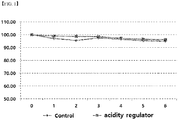
- the reference value was set in which the initial allulose content in the saccharide syrup of 56.27 wt% was set to 100, and the allulose content (wt%) depending on the storage period (week order) was represented by a relative allulose content to the initial allulose content in the syrup and shown in FIG. 1 .
- the allulose content change during the storage period tended to be slightly reduced as time passed, but there was no significant difference between Comparative example 1 and Example 1 in which the organic acid salt as an acidity regulator was added.
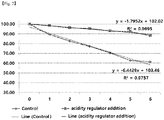
- the relative oligosaccharide content (wt%) depending on the storage period (week order) was represented and shown in FIG. 2 .
- the oligosaccharide content change during the storage period tended to be reduced as time passed.
- the lower limit of the oligosaccharide content was set to 80% in consideration that the allowable error of food labeling standards was 80%, and the result of the oligosaccharide content change depending on the storage period was analyzed.
- the allulose syrup containing an oligosaccharide (60 wt% of allulose syrup having allulose content of 95 wt% and 40 wt% of oligosaccharide) was prepared by the substantially same method as Comparative example 1, and the allulose syrup containing an oligosaccharide was prepared by adding the aqueous solution in which the concentration of citric acid sodium salt was 40 wt% so that the citric acid sodium salt was 0.02 wt%.
- the pH and color value, and allulose and oligosaccharide contents of the prepared saccharide syrup were measured by the same method as Comparative example 1. The measured result was shown in the following Table 4.
- Example 4 As substantially same as Example 2 except for not adding the citric acid salt, the allulose saccharide syrup containing an oligosaccharide was prepared and the pH was adjusted to 4.3 by adding acid. The pH-adjusted syrup was stored under the 45°C storage condition for 2 weeks, and then the pH and color value, and allulose and oligosaccharide contents of the allulose syrup were measured by the same method as Comparative example 1. The measured result was shown in the following Table 4.
- Example 2 As substantially same as Example 2 except for adding NaOH (sodium hydroxide) in an amount of 0.005 wt% instead of the citric acid salt of Example 2, the allulose syrup was prepared. When the pH of the prepared syrup was higher than 5.5, hydrochloric acid was added to adjust the pH to 5.5. The pH-adjusted syrup was stored at 45°C, and then the pH and color value, and allulose and oligosaccharide contents of the allulose syrup were measured by the same method as Comparative example 1. The measured result was shown in the following Table 4.
Landscapes
- Life Sciences & Earth Sciences (AREA)
- Engineering & Computer Science (AREA)
- Health & Medical Sciences (AREA)
- Chemical & Material Sciences (AREA)
- Food Science & Technology (AREA)
- Polymers & Plastics (AREA)
- Nutrition Science (AREA)
- Molecular Biology (AREA)
- Zoology (AREA)
- Wood Science & Technology (AREA)
- Mycology (AREA)
- Jellies, Jams, And Syrups (AREA)
- Preparation Of Compounds By Using Micro-Organisms (AREA)
- Pharmaceuticals Containing Other Organic And Inorganic Compounds (AREA)
- Seasonings (AREA)
Abstract
Description
- The present invention relates to a saccharide syrup composition comprising an organic acid or its salt and an oligosaccharide, and more specifically, is a saccharide syrup composition comprising an organic acid, which prevents decomposition of an oligosaccharide comprised in the saccharide syrup composition, or its salt and an oligosaccharide, and the saccharide syrup composition may comprise allulose.
- Sweeteners have been used as additives in foods and the like for a long time, and natural sugars such as sugars, fructose and glucose are widely used in beverage, food, pharmaceutical and oral hygiene/cosmetic industries due to their good tastes. In particular, sugar is widely used because it gives a desirable taste to consumers.
- Sugar has excellent sweetness, and therefore it has been considered as the most preferable sweetener to enhance the taste of food and increase the taste by being added to various foods and processed foods, etc. from the past. However, recently, a problem has been raised as the harmfulness of sugar continues to be revealed.
- As one of solutions to solve adult diseases, obesity, etc. which have become a problem in the world recently, various policies for reducing sugar consumption of their own nation in many countries including Korea have been implemented. Herein, unless otherwise stated, the term "saccharide reduction" means that the content of monosaccharides such as glucose, fructose, sucrose, etc. and disaccharides which are known to increase the risk of occurrence of obesity, diabetes, cardiovascular diseases, other various adult diseases when overdosed is lowered, and in this case, the "saccharide" does not include rare saccharides such as allulose and the like.
- Specifically, as excessive intake of sugar is pointed out as a major cause of various lifestyle diseases such as obesity, diabetes as well as cavities, etc., the necessity of development of sweeteners which can replace it has been emerging all over the world. Recently, various sweetener materials have been developed.
- Allulose is an epimer of
carbon number 3 in fructose, and has sweetness equivalent to 70% of fructose and it is functional sugar which controls blood sugar, prevents cavities and inhibits lipogenesis in liver. Sugar alcohols, which are widely used as a substitute sweetener for sugar, have side effects such as causing diarrhea when consumed over a certain amount, but allulose have no known side effects. Therefore, the interest of allulose as a sweetener has been increased. - As another saccharide, a large number of oligosaccharides (functional oligosaccharides) have been used in food since various functionalities have been recognized. The oligosaccharide means a component showing the functionality not to be decomposed by digestive enzymes but to function similar to dietary fiber and to go down into the large intestine to become a nutrient source of intestinal beneficial bacteria, and to improve the colonic environment, among oligosaccharides in a form in which 3 to 10 monosaccharides are linked together.
- In recent years, many products applying oligosaccharides, etc. have been introduced, but these oligosaccharides have a property of being easily decomposed by heating conditions, etc., and thus a method for preventing decomposition and maintaining the initial content is needed.
- An object of the present invention is to provide a saccharide syrup composition comprising an organic acid or its salt and an oligosaccharide, which prevents or reduces oligosaccharide decomposition to maintain the content of the oligosaccharide present in the saccharide syrup during a storage period and a method for preparing thereof.
- Another object of the present invention is to provide a method for preventing decomposition of an oligosaccharide present in saccharide syrup by adding an organic acid or its salt to saccharide syrup.
- An additional object of the present invention is to provide raw material saccharide syrup comprising an organic acid or its salt, oligosaccharides and allulose, and food, food additives, beverage or beverage additives, functional foods applying it.
- One embodiment of the present invention relates to a saccharide syrup composition for preventing oligosaccharide decomposition, comprising an organic acid or its salt and an oligosaccharide, and the organic acid or its salt may be comprised at a concentration of 0.001 to 1.0 wt%. The organic acid or its salt may be lactic acid, citric acid or ascorbic acid or salts thereof.
- Another embodiment of the present invention relates to a method for preventing decomposition of the oligosaccharide, by adding an organic acid or its salt of 0.001 to 1.0 wt%, to a saccharide syrup composition comprising an oligosaccharide.
- The saccharide syrup composition according to the present invention may comprise the oligosaccharide content of 80% or more, based on 100% of the initial content of the oligosaccharide under a storage condition of a temperature of 45°C during a period of 6 weeks (42 days).
- The saccharide syrup composition according to the present invention may has an 100 to 1000 µS/cm of electrical conductivity, 0.005 to 0.2 of a color value represented as absorbance measured at 420 nm wavelength with a spectrometer, or pH of 5.0 to 8.0.
- The saccharide syrup composition according to the present invention may comprise the oligosaccharide content of 20 to 90 wt%, based on 100 wt% of the saccharide syrup composition, and it may comprise the oligosaccharide content of 80% or more, based on 100% of the initial content of the oligosaccharide under a storage condition of a temperature of 45°C during a period of 6 weeks (42 days).
- Hereinafter, the present invention will be described in more detail.
- The present invention is a saccharide syrup composition which maintains the oligosaccharide content in saccharide syrup at a certain content or more and prevents decomposition of the oligosaccharide, by adjusting an organic acid or its salt at a specific concentration in a saccharide syrup composition comprising an oligosaccharide.
- The property of maintaining the oligosaccharide content in saccharide syrup at a certain content or more and preventing decomposition of the oligosaccharide may comprise the content of the oligosaccharide of 80% or more, preferably, 83% or more, 85% or more, 87% or more, or 90% or more, based on 100% of the initial content of the oligosaccharide under a storage condition of a temperature of 45°C during a period of 6 weeks (42 days). It is preferable to set the lower limit of the oligosaccharide content to 80%, in consideration of the allowable error of food labeling standards being 80%. Therefore, as the saccharide syrup in which an organic acid or its salt is added satisfies the condition of the oligosaccharide content for a long time, there is an effect of prolonged storage period.
- The saccharide syrup composition according to the present invention may have an electrical conductivity of 100 to 1000 µS/cm, preferably 100 to 700 µS/cm, more preferably 100 to 500 µS/cm, and may have a color value represented by absorbance measured at 420nm wavelength by a spectrometer of 0.005 to 0.2, preferably 0.01 to 0.1, or may have pH 5.0 to 8.0, preferably pH 5.5 to 6.5, pH 5.5 to 8.0, pH 5.5 to 7.5, pH 6.0 to 8.0, pH 6.0 to 7.5, pH 6.0 to 7.0, or pH 6.0 to 6.5.
- In a specific example of the present invention, it was confirmed that the oligosaccharide content was gradually reduced as the storage period passed in the experimental group in which an organic acid or its salt was not added and the experimental group in which an inorganic acid (NaOH) was added, as saccharide syrup adjusted to the same pH condition. Oligosaccharides tends to be decomposed intensively at
pH 5 or lower, and it can be seen that the above result is attributed to the fact that the acidity regulator inputted additionally increases the initial pH and inhibits pH decrease during the storage period. However, it can be seen that the oligosaccharide composition does not depend on the pH condition of the saccharide syrup only by such a result. - In addition, when using an organic acid or its salt, different from an inorganic acid, an electrical conductivity is 100 to 200 µS/cm, and there is an effect of preventing pH changes because of a high electrical conductivity. The organic acid or its salt can prevent decomposition of an oligosaccharide by not only regulating the acidity but also further providing a pH buffer function which can minimize pH changes during the storage period.
- The organic acid or its salt usable for the present invention may be an organic acid of one or more kinds selected from the group consisting of lactic acid, citric acid and ascorbic acid, and salt thereof. The organic acid salt may be sodium, potassium, calcium or magnesium of the organic acid.
- The organic acid or its salt may be comprised at a concentration of 0.001 to 1.0 wt%, preferably 0.005 to 0.5wt% or 0.01 to 0.1 wt%.
- The saccharide syrup composition according to the present invention may comprise an oligosaccharide, and as the oligosaccharides applicable for the present invention, one or more kinds selected from the group consisting of fructo-oligosaccharide (FOS), isomalto-oligosaccharide (IMO), galacto-oligosaccharide (GOS), xylo-oligosaccharide (XOS), chitooligosaccharide, cello-oligosaccharide and soy oligosaccharide may be selected.
- The fructo-oligosaccharide belongs to a compound known as inulin. Inulin is a generic term for a carbohydrate substance consisting mainly of fructose residues linked via a fructosyl-fructose bond of β (2 → 1) type, randomly having a starting residue of glucose. Commercially available FOS is a multi-dispersion having a number-average polymerization degree of typically about 2 to 4. In fact, FOS is also referred to as oligo-fructose. The fructo-oligosaccharide is a raw material prepared by transferring fructose to sugar using an invertase (β-fructofuranosidase), or by partially hydrolyzing inulin to inulinase (EC 3.2.1.7), and functional components are GF2 (kestose), GF3 (nystose) and GF4 (fructofuranosylnystose).
- The syrup composition according to the present invention may comprise an oligosaccharide of 20 to 90 wt%, preferably 25 to 65wt% or 25 to 75wt%, based on 100wt% of the total syrup composition, and may comprise syrup of various saccharides, preferably allulose syrup as other saccharides.
- The allulose syrup may be comprised as 10wt% or more, 15wt% or more, 25wt% or more, 35wt% or more, or 50wt% or more, based on 100wt% of the total syrup composition, and for example, it may be 10 to 80 wt%, preferably 35 to 80 wt%, or 25 to 75 wt%.
- In one example of the present invention, when the raw material saccharide syrup comprises allulose syrup and oligosaccharides, allulose of 10 to 80 wt% and oligosaccharides of 20 to 90 wt% based on 100wt% of the raw material saccharide syrup may be comprised. The raw material saccharide syrup may comprise a solid content of 60 to 80 Brix.
- The allulose syrup may comprise glucose, fructose and saccharides of disaccharides or more in addition to allulose. The allulose syrup may be prepared by various methods, and preferably, it may be prepared by a biological method, for example, microbial enzyme reaction.
- For example, the allulose syrup may be allulose-containing mixed sugar or be obtained therefrom, and the mixed sugar may be mixed sugar prepared by reacting one or more kinds selected from the group consisting of an allulose epimerase, a microbial cell of a strain producing the epimerase, a culture of the strain, a lysate of the strain, and an extract of the lysate or culture with a fructose-containing raw material, or be obtained therefrom. The mixed saccharide syrup may be mixed
sugar comprising allulose 2 to 55 parts by weight, fructose 30 to 50 parts by weight,glucose 2 to 60 parts by weight andoligosaccharide 0 to 15 parts by weight, and the allulose syrup may be obtained via separation, purification and concentration processes from the mixed sugar. In one example of the present invention, the allulose syrup passing through separation and purification processes may be allulose syrup which has an electrical conductivity of 1 to 50µS/cm, and is colorless or light-yellow liquid having sweetness and comprises allulose of 10 wt% or more. - As one embodiment for preparation of allulose according to the present invention, an expression system capable of producing a psicose epimerase with high expression rate and stability, a GRAS (Generally recognized as safe) microorganism using the same, and a method for preparation of psicose comprising a microorganism and an enzyme using the expression system, etc. are described in Korean Patent Nos.
10-1318422 10-1656063 - The viscosity of the saccharide syrup composition according to the present invention may be adjusted in an appropriate range in consideration of a method of use and convenience, and preferably, the viscosity measured at a temperature of 25 °C may be 5 to 100 mPa • s, preferably 10 to 30 mPa • s, 15 to 25 mPa • s or 18-20 mPa • s. To adjust the viscosity of the saccharide syrup, a viscosity regulator may be used, and preferably, the viscosity regulator may increase the viscosity of saccharide syrup. The viscosity regulator may have a low degree of dispersion and solubility in allulose syrup and a dispersing agent to solve this may be further added.
- The viscosity regulator according to the present invention is a component to be added for viscosity regulation of the saccharide syrup composition, and a specific example may be one or more kinds selected from the group consisting of thickening polysaccharides (hydrogel), and for example, it may be pectin or carrageenan. Carrageenan may be added in a relatively small amount, as the viscosity increase degree is higher than pectin. The content of the viscosity regulator according to one example of the present invention may be 0.01 to 5 wt%, for example, 0.05 to 1 wt%, based on 100 wt% of the saccharide syrup composition.
- The dispersing agent according to the present invention is added in order to improve the low degree of dispersion and solubility of the viscosity regulator. A specific example of the dispersing agent may be one or more kinds selected from the group consisting of disaccharides, sugar alcohols and oligosaccharides, and preferably, may be oligosaccharides. It is preferable to add the dispersing agent in a powder form. The content of the dispersing agent according to an embodiment of the present invention may be 10 to 3,000 parts by weight, for example, 50 to 2,000 parts by weight, or 100 to 1,000 parts by weight, based on 100 parts by weight of the viscosity regulator.
- In one example of the present invention, the saccharide syrup composition may have a chromaticity of 100 to 500 IU. The numerical value range of the chromaticity may be adjusted by the saccharide syrup itself, or may be adjusted by adding one or more kinds of chromaticity regulators selected from the group consisting of raw sugar extracts, caramel syrup and artificial dyes. The content of the chromaticity regulator to be added may be an appropriate content in consideration of chromaticity (IU) which each chromaticity regulator has, and for example, the content of the chromaticity regulator may comprise the content of 0.0001 to 1 wt% based on 100 wt% of the saccharide syrup composition.
- In one example of the present invention, the saccharide syrup composition may further comprise one or more kinds of sweetener materials selected from the group consisting of sucralose, rebaudioside and stevia for regulation of sweetness. The content of the sweetener materials to be added may be comprised in an appropriate content in consideration of sweetness of each material compared to sugar, and for example, it may be comprised in a content of 0.00001 to 5wt% based on 100 wt% of the saccharide syrup composition.
- The saccharide syrup comprising an organic acid or its salt, oligosaccharides and allulose according to the present invention may be commercialized as itself and the present invention relates to food, food additives, beverage or beverage additives and functional food.
- The saccharide syrup composition according to the present invention can prevent decomposition of an oligosaccharide present in syrup using an organic acid or its salt and maintain the content in a certain level or more, thereby having effects of preservation of physical properties of the saccharide syrup, preservation of the content of the oligosaccharide, and extension of a storage period.
-
-
FIG. 1 is a graph showing the content changes of allulose with the storage period passage during storage of allulose syrup containing an oligosaccharide according to Example 1. -
FIG. 2 is a graph showing the content changes of the oligosaccharide with the storage period passage during storage of allulose containing an oligosaccharide according to Example 1. - The present invention will be described in more detail with the following examples, but the following examples are provided as an exemplary meaning of the present invention only and are not intended to limit the scope of the present invention.
- The allulose syrup used for the following examples was prepared according to the method disclosed in Korean Patent No.
10-1318422 - The obtained allulose syrup was treated by flowing through a column at a room temperature filled with cation exchange resin, anion exchange resin and resin in which cation and anion exchange resins were mixed, in order to remove impurities such as colored and ion components and the like. Then, using chromatography filled with calcium (Ca2+) type of ion exchange resin, a high purity of allulose fractions were obtained. The allulose fractions were ion purified and concentrated, thereby preparing the allulose syrup consisting of allulose 95 wt% and
fructose 5 wt%, based on 100 wt% of the solid content of the saccharide syrup composition. - To 60wt% of the prepared allulose syrup, fructo-oligosaccharide 40wt% was added, thereby preparing the allulose saccharide syrup containing an oligosaccharide. The fructo-oligosaccharide used was product of Samyang corporation.
- The pH, color value and electrical conductivity of the allulose syrup having allulose content of 95 wt% and the allulose saccharide syrup containing the oligosaccharide were measured and shown in the following Table 1. In the following Table 1, the raw saccharide syrup contains the allulose syrup of 60wt% and fructo-oligosaccharide of 40wt%.
[Table 1] Classification Allulose syrup with 95% of allulose Raw saccharide syrup pH 4.41 4.51 color value (absorbance, 420nm) 0.039 0.064 Electrical conductivity (µS/cm) 15.13 50.94 - While the saccharide syrup containing 60wt% of the allulose syrup having allulose content of 95 wt% and 40wt% of fructo-oligosaccharide (FOS) prepared in 1-1 was stored at a temperature of 25°C, 35°C, and 45°C for 7 weeks, the pH, color value, allulose content and oligosaccharide content depending on the storage period were measured. Specific measurement of physical properties was performed as the following method.
- The allulose syrup was diluted to 30BX, and using a spectrophotometer, the absorbance at 420nm wavelength was measured. Measuring the color value as the absorbance at 420nm wavelength using a spectrophotometer is to confirm the degree of browning as yellow to brown were absorbed at 420nm and to calculate IU (Icumsa Unit) for determining the degree of browning or color darkness of liquid saccharides using the absorbance value measured at the wavelength.
- The allulose syrup was analyzed by using high speed liquid chromatography (HPLC) equipped with carbohydrate analysis column Bio-rad Aminex HPX-87C under the following analysis conditions.
-
- Injection amount: 10µℓ
- Column temperature: 80 °C
- Flow rate: 0.6 ml/min
- Mobile phase: distilled water
- The allulose syrup was diluted to 10Bx, and using a pH measuring instrument (SCHOTT Lab850), the pH of the saccharide syrup was analyzed.
- The electrical conductivity was measured by using InLab 731 ISM electrode in SevenExcellence equipment of METTLER TOLEDO.
- The result of evaluation of physical properties measured was shown in the following Table 2.
[Table 2]] Storage week order Classification 25°C 35°C 45° C 0 pH 4.51 4.51 4.51 color value 0.064 0.064 0.064 Allulose 56.27 56.27 56.27 Oligosaccharide 23.98 23.98 23.98 1 pH 3.48 3.43 3.52 color value 0.062 0.066 0.07 Allulose 55.3 55.5 54.6 Oligosaccharide 23.5 22.5 21.4 2 pH 3.91 3.74 3.61 color value 0.066 0.073 0.091 Allulose 55.4 54.96 53.71 Oligosaccharide 23.42 21.89 19.79 3 pH 4.46 4.12 3.9 color value 0.071 0.084 0.1 Allulose 55.68 55.89 54.8 Oligosaccharide 23.1 21.77 18.53 4 pH 4.36 4.17 3.97 color value 0.067 0.106 0.122 Allulose 56.48 55.61 54.21 Oligosaccharide 22.75 21.1 16.9 5 pH 4.46 4.32 4.16 color value 0.064 0.111 0.139 Allulose 56.21 55.54 53.59 Oligosaccharide 23.65 21.27 15.03 6 pH 4.45 4.33 4.12 color value 0.069 0.116 0.148 Allulose 55.94 55.1 53.41 Oligosaccharide 23.55 21.19 14.77 7 PH 4.33 4.2 4.03 color value 0.071 0.116 0.146 Allulose 55.58 55.25 54.22 Oligosaccharide 18.73 16.45 9.38 - The allulose syrup containing an oligosaccharide (containing 60 wt% of the allulose syrup with 95 wt% of allulose content and 40 wt% of oligosaccharide) was prepared by the substantially same method as Comparative example 1, and the aqueous solution having the concentration of lactic acid sodium salt of 40 wt% was added so that concentration of the lactic acid sodium salt was 0.02 wt%, thereby preparing the allulose syrup containing an oligosaccharide.
- The pH and vhromaticitye, and allulose and oligosaccharide contents of the prepared allulose syrup were measured by the same method as Comparative example 1. The measured result was shown in the following Table 3.
[Table 3] Storage week order Classification 25°C 35°C 45° C 0 pH 5.5 5.5 5.5 color value 0.059 0.059 0.059 Allulose 58.1 58.1 58.1 Oligosaccharide 22.7 22.7 22.7 1 pH 5.6 5.52 5.49 color value 0.053 0.061 0.083 Allulose 58 58.11 57.49 Oligosaccharide 22.69 22.62 22.33 2 pH 5.51 5.45 5.41 color value y 0.055 0.07 0.103 Allulose 57.91 57.5 57.33 Oligosaccharide 22.39 22.34 21.84 3 pH 5.48 5.31 5.1 color value 0.065 0.091 0.105 Allulose 57.94 57.46 57.19 Oligosaccharide 22.4 22.19 21.69 4 pH 5.42 5.11 4.98 color value 0.073 0.11 0.128 Allulose 57.96 56.99 56.5 Oligosaccharide 22.41 21.94 21.15 5 pH 5.39 5.2 4.72 color value 0.077 0.121 0.151 Allulose 57.95 56.91 56.01 Oligosaccharide 22.39 21.91 20.93 6 pH 5.33 5.1 4.7 color value 0.081 0.119 0.166 Allulose 57.84 56.59 55.86 Oligosaccharide 22.27 21.84 20.06 7 pH 5.29 5.08 4.54 color value 0.08 0.13 0.176 Allulose 57.88 56.33 55.29 Oligosaccharide 22.31 21.57 19.64 - In the table, the reference value was set in which the initial allulose content in the saccharide syrup of 56.27 wt% was set to 100, and the allulose content (wt%) depending on the storage period (week order) was represented by a relative allulose content to the initial allulose content in the syrup and shown in
FIG. 1 . As shown inFIG. 1 , the allulose content change during the storage period tended to be slightly reduced as time passed, but there was no significant difference between Comparative example 1 and Example 1 in which the organic acid salt as an acidity regulator was added. - As the initial oligosaccharide content in the saccharide syrup of 23.98 wt% was set to 100, the relative oligosaccharide content (wt%) depending on the storage period (week order) was represented and shown in
FIG. 2 . As shown inFIG. 2 , the oligosaccharide content change during the storage period tended to be reduced as time passed. The lower limit of the oligosaccharide content was set to 80% in consideration that the allowable error of food labeling standards was 80%, and the result of the oligosaccharide content change depending on the storage period was analyzed. Specifically, when stored under the severe condition of 45°C, it was confirmed that the slope of the decrease line of the oligosaccharide content in the group to which the organic acid salt was added was lowered about 3.5 times, compared to the control group of Comparative example 1. In addition, when the lower limit of the oligosaccharide content was set to 80%, the non-added group (without the organic acid salt) of Comparative example 1 went off the reference value in three weeks, but the organic acid salt-added group, of Example 1 maintained the reference value for 12 weeks, which had an effect to extend the quality maintenance period to 4 times. - As shown in the results of Table 2 and Table 3, in case of Comparative example 1, the oligosaccharide content change under the 35°C storage condition was decreased by 7.5% for 7 weeks, but in the syrup of Example 1 in which the acidity regulator was added, it was shown lower as 1.13%. Oligosaccharides tend to be decomposed intensively under
pH 5 or lower, and this result is because the additionally inputted acidity regulator increased the initial pH and inhibited the pH decrease during the storage period. - The allulose syrup containing an oligosaccharide (60 wt% of allulose syrup having allulose content of 95 wt% and 40 wt% of oligosaccharide) was prepared by the substantially same method as Comparative example 1, and the allulose syrup containing an oligosaccharide was prepared by adding the aqueous solution in which the concentration of citric acid sodium salt was 40 wt% so that the citric acid sodium salt was 0.02 wt%. The pH and color value, and allulose and oligosaccharide contents of the prepared saccharide syrup were measured by the same method as Comparative example 1. The measured result was shown in the following Table 4.
- To perform the severe experiment of the prepared saccharide syrup, acid was added to each experimental group to adjust the pH to 5.5. The pH-adjusted syrup was stored under the storage condition at 45°C for 2 weeks, and then pH, color value, and allulose and oligosaccharide contents of the saccharide syrup were measured by the same method as Comparative example 1. The measured result was shown in the following Table 4.
- As substantially same as Example 2 except for not adding the citric acid salt, the allulose saccharide syrup containing an oligosaccharide was prepared and the pH was adjusted to 4.3 by adding acid. The pH-adjusted syrup was stored under the 45°C storage condition for 2 weeks, and then the pH and color value, and allulose and oligosaccharide contents of the allulose syrup were measured by the same method as Comparative example 1. The measured result was shown in the following Table 4.
- As substantially same as Example 2 except for adding NaOH (sodium hydroxide) in an amount of 0.005 wt% instead of the citric acid salt of Example 2, the allulose syrup was prepared. When the pH of the prepared syrup was higher than 5.5, hydrochloric acid was added to adjust the pH to 5.5. The pH-adjusted syrup was stored at 45°C, and then the pH and color value, and allulose and oligosaccharide contents of the allulose syrup were measured by the same method as Comparative example 1. The measured result was shown in the following Table 4.
[Table 4] Storage week order Classification Example 2 Comparative example 1 Comparative example 2 initial pH 5.5 4.3 5.5 color value 0.064 0.039 0.072 Allulose 56.55 56.61 56.63 Oligosaccharide 24.26 24.19 24.3 Electrical conductivity (µS/cm) 172.6 50.3 83.2 1 week later pH 5.3 3.9 4.9 color value 0.071 0.053 0.111 Allulose 56.52 56.59 56.54 Oligosaccharide 24.1 21.88 23.64 Relative oligosaccharide content compared to the initial content 99.34% 90.45% 97.28% Electrical conductivity (µS/cm) 180.4 68.2 90.6 2 weeks later pH 5.1 3.5 4.2 color value 0.090 0.066 0.126 Allulose 56.50 5.59 56.52 Oligosaccharide 23.94 18.31 21.77 Relative oligosaccharide content compared to the initial content 98.68% 75.69% 89.59% Electrical conductivity (µS/cm) 181.2 74.5 93.3 - It was confirmed that in case of the non-added group of Comparative example 1, the initial pH was low and decomposition of the oligosaccharide was progressed by the pH decrease as the storage time passed. It was confirmed that in case of Comparative example 2 in which the pH was adjusted by using NaOH, the pH was dramatically decreased under the severe experimental condition, and it was interpreted that strong acids and strong bases (inorganic salts) are effective for adjustment of the initial pH, but have no buffering effect.
- As shown in Table 4, comparing Example 2 to which the citric acid salt was added to Comparative example 1 which is the non-added group and Comparative example 2 to which the inorganic salt was added, it seems to perform a function to prevent pH change as the electrical conductivity of the saccharide syrup of Example 2, to which the citric acid salt, was added was high. The allulose syrup used in the present invention performed a role for preventing the pH decrease and maintaining the oligosaccharide content, since pH change was severe as ionic substances were removed through purification and addition of the citric acid salt had a pH buffering effect.
Claims (20)
- A saccharide syrup composition for preventing oligosaccharide decomposition, comprising an oligosaccharide; and an organic acid or its salt.
- The saccharide syrup composition according to claim 1, wherein the saccharide syrup has an electrical conductivity of 100 to 1000 µS/cm.
- The saccharide syrup composition according to claim 1, wherein pH is 5.0 to 8.0.
- The saccharide syrup composition according to claim 1, wherein the color value of the saccharide syrup composition is 0.005 to 0.2.
- The saccharide syrup composition according to claim 1, wherein the preventing oligosaccharide decomposition is to have a content of the oligosaccharide of 80% or more, based on 100% of the initial content of the oligosaccharide, under storage conditions of a temperature of 45°C and 42 days.
- The saccharide syrup composition according to claim 1, wherein the organic acid is one or more selected from the group consisting of lactic acid, citric acid and ascorbic acid.
- The saccharide syrup composition according to claim 1, wherein the organic acid or its salt is contained in an amount of 0.001 to 1.0 wt%.
- The saccharide syrup composition according to claim 1, wherein the oligosaccharide content is 20 to 90 wt%, based on 100 wt% of the saccharide syrup composition.
- The saccharide syrup composition according to claim 1, wherein the saccharide syrup composition further comprises allulose.
- The saccharide syrup composition according to claim 9, wherein the oligosaccharide content is 20 to 90 wt% and the allulose content is 10 to 80 wt%, based on 100 wt% of the saccharide syrup composition.
- The saccharide syrup composition according to claim 1, wherein the oligosaccharide is one or more selected from the group consisting of galacto-oligosaccharide, malto-oligosaccharide, isomalto-oligosaccharide, fructo-oligosaccharide and soy oligosaccharide.
- The saccharide syrup composition according to claim 9, wherein the saccharide syrup composition comprises allulose syrup or powder, and wherein the allulose is provided with a mixed saccharide containing allulose or the allulose is obtained from the mixed saccharide and the mixed saccharide is prepared by reacting a fructose-containing raw material with a composition for producing allulose comprising one or more selected from the group consisting of an allulose epimerase, a microbial cell of a strain producing the allulose epimerase, a culture of the strain, a lysate of the strain, and an extract of the lysate or the culture.
- The saccharide syrup composition according to claim 12, wherein the allulose syrup is obtained from separation and concentration processes from mixed sugar comprising allulose 2 to 55 parts by weight, fructose 30 to 80 parts by weight, glucose 2 to 60 parts by weight and oligosaccharide 0 to 15 parts by weight.
- The composition according to claim 8, wherein the allulose is allulose syrup having an electrical conductivity of 1 to 50 µS/cm.
- The composition according to claim 9, wherein the allulose is colorless or light yellow allulose syrup comprising an allulose content of 10 wt% or more based on 100 wt% of the allulose syrup.
- A method for preventing oligosaccharide decomposition, by adding an organic acid or its salt of 0.001 to 1.0 wt% to a saccharide syrup composition comprising the oligosaccharide.
- The method according to claim 16, wherein the organic acid is one or more selected from the group consisting of lactic acid, citric acid and ascorbic acid.
- The method according to claim 16, wherein the oligosaccharide content is 20 to 90 wt%, based on 100wt% of the saccharide syrup composition.
- The method according to claim 16, wherein the oligosaccharide content is 20 to 90 wt% and the allulose content is 10 to 80 wt%, based on 100 wt% of the saccharide syrup composition.
- The method according to claim 16, wherein the oligosaccharide is one or more kinds selected from the group consisting of galacto-oligosaccharide, malto-oligosaccharide, isomalto-oligosaccharide, fructo-oligosaccharide and soy oligosaccharide.
Applications Claiming Priority (2)
| Application Number | Priority Date | Filing Date | Title |
|---|---|---|---|
| KR1020160142247A KR101766430B1 (en) | 2016-10-28 | 2016-10-28 | Allulose syrup including oligosaccharide and method of preparing the same |
| PCT/KR2017/012019 WO2018080240A1 (en) | 2016-10-28 | 2017-10-27 | Oligosaccharide syrup having improved stability |
Publications (4)
| Publication Number | Publication Date |
|---|---|
| EP3533343A1 true EP3533343A1 (en) | 2019-09-04 |
| EP3533343A4 EP3533343A4 (en) | 2020-07-01 |
| EP3533343C0 EP3533343C0 (en) | 2024-09-04 |
| EP3533343B1 EP3533343B1 (en) | 2024-09-04 |
Family
ID=59652930
Family Applications (1)
| Application Number | Title | Priority Date | Filing Date |
|---|---|---|---|
| EP17865107.1A Active EP3533343B1 (en) | 2016-10-28 | 2017-10-27 | Oligosaccharide syrup having improved stability |
Country Status (6)
| Country | Link |
|---|---|
| US (2) | US11191292B2 (en) |
| EP (1) | EP3533343B1 (en) |
| JP (1) | JP6870084B2 (en) |
| KR (1) | KR101766430B1 (en) |
| CN (1) | CN109922670A (en) |
| WO (1) | WO2018080240A1 (en) |
Cited By (2)
| Publication number | Priority date | Publication date | Assignee | Title |
|---|---|---|---|---|
| WO2022058460A1 (en) * | 2020-09-17 | 2022-03-24 | Beneo-Orafti Sa | Method for producing a stable fructooligosaccharide composition, fructooligosaccharide composition, and use thereof |
| WO2022219194A1 (en) * | 2021-04-17 | 2022-10-20 | Cambridge Glycoscience Ltd | Oligosaccharide compositions having sucrose-like characteristics and related methods |
Families Citing this family (16)
| Publication number | Priority date | Publication date | Assignee | Title |
|---|---|---|---|---|
| KR101766430B1 (en) | 2016-10-28 | 2017-08-08 | 주식회사 삼양사 | Allulose syrup including oligosaccharide and method of preparing the same |
| WO2019045378A1 (en) * | 2017-08-31 | 2019-03-07 | 주식회사 삼양사 | FERMENTED SOY COMPOSITION AND METHOD FOR PRODUCING SAME |
| JP6992175B2 (en) * | 2017-10-27 | 2022-01-13 | サムヤン コーポレイション | Allose syrup and its manufacturing method |
| KR102215445B1 (en) * | 2017-10-31 | 2021-02-17 | 씨제이제일제당 주식회사 | Syrup comprising saccharide comprising allulose and citrus extract and method for preparation thereof |
| KR102246960B1 (en) | 2017-11-24 | 2021-04-30 | 주식회사 삼양사 | Hot source with low calory |
| KR102326587B1 (en) * | 2018-06-28 | 2021-11-15 | 주식회사 삼양사 | Low calorie soy milk with reduced soybean odor |
| WO2020005021A1 (en) * | 2018-06-28 | 2020-01-02 | 주식회사 삼양사 | Sweetener powder composition and preparation method therefor |
| CN112638176A (en) * | 2018-06-28 | 2021-04-09 | 株式会社三养社 | Mixed sugar compositions comprising malto-oligosaccharides |
| KR102335056B1 (en) * | 2018-07-06 | 2021-12-03 | 주식회사 삼양사 | Saccharide syrup composition |
| CN112566500A (en) * | 2018-08-10 | 2021-03-26 | 株式会社三养社 | Coffee milk beverage composition |
| KR102414674B1 (en) * | 2018-08-10 | 2022-06-29 | 주식회사 삼양사 | Sweetener powder composition and method of preparing the same |
| KR102814713B1 (en) * | 2019-03-26 | 2025-05-29 | 주식회사 삼양사 | Fruit juice powder containing malto-oligosaccharides and method of preparing the same |
| CN114269167A (en) * | 2019-07-24 | 2022-04-01 | 株式会社三养社 | Syrup composition |
| US20210045406A1 (en) * | 2019-08-12 | 2021-02-18 | Paragon Flavors, Inc. | Whole grain syrups and flours |
| JP7423236B2 (en) * | 2019-09-30 | 2024-01-29 | 旭化成株式会社 | Raw material liquid concentration system and food manufacturing method |
| KR102860681B1 (en) * | 2020-12-30 | 2025-09-16 | 주식회사 삼양사 | Allulose with improved stability |
Family Cites Families (25)
| Publication number | Priority date | Publication date | Assignee | Title |
|---|---|---|---|---|
| IE81127B1 (en) * | 1989-02-07 | 2000-03-22 | Dimminaco Ag | Effervescent composition for oral rehydration |
| JP3605129B2 (en) * | 1993-12-15 | 2004-12-22 | 株式会社林原生物化学研究所 | Non-reducing oligosaccharide having neotrehalose structure, method for producing the same and use thereof |
| KR950016598A (en) | 1993-12-30 | 1995-07-20 | 김정순 | Composition of sports drink using soy oligosaccharide |
| JP4273277B2 (en) | 1999-06-30 | 2009-06-03 | 大塚製薬株式会社 | Oligosaccharide supplement composition |
| CA2490092A1 (en) * | 2002-06-21 | 2003-12-31 | Grain Processing Corporation | Dextrinized, saccharide-derivatized oligosaccharides |
| US7608436B2 (en) * | 2006-01-25 | 2009-10-27 | Tate & Lyle Ingredients Americas, Inc. | Process for producing saccharide oligomers |
| WO2009133835A1 (en) | 2008-05-02 | 2009-11-05 | 株式会社林原生物化学研究所 | METHOD OF INHIBITING COLORING OF A SYRUP-LIKE SWEETENER CONTAINING A NON-REDUCING OLIGOSACCHARIDE HAVING A β-FRUCTOFURANOSIDE BOND AND A REDUCING SUGAR, AND USE THEREOF |
| JP2011520452A (en) * | 2008-05-15 | 2011-07-21 | ザ・コカ−コーラ・カンパニー | Natural and / or synthetic high-intensity sweetener compositions having improved aging profiles and / or flavor profiles, methods of formulation and use thereof |
| KR101670092B1 (en) | 2008-06-12 | 2016-10-27 | 티엔세 수이케라피나데리예 엔.브이. | Fructooligosaccharide composition, process for its production and use |
| CN102613294A (en) * | 2011-01-31 | 2012-08-01 | 内蒙古蒙牛乳业(集团)股份有限公司 | Oligosaccharide milk |
| KR101332350B1 (en) * | 2011-11-14 | 2013-11-22 | 주식회사 삼양제넥스 | Method for preventing decomposition of fructooligosaccharide in a product during a heating procedure for its production |
| BR112014023234B1 (en) | 2012-03-23 | 2020-12-08 | Advanced Bionutrition Corporation | dry stabilization composition in an amorphous glassy state for a bioactive material, a method to produce the said composition and products prepared with the same |
| KR101454196B1 (en) * | 2013-02-12 | 2014-11-03 | 주식회사 건풍바이오 | A new method for manufacturing a composition comprising chitosan oligosaccharides and a mixture of chitosan oligosaccharides manufactured therefrom |
| KR101318422B1 (en) | 2013-04-09 | 2013-10-15 | 주식회사 삼양제넥스 | D-psicose epimerase and method for producing psicose using the same |
| GB201315559D0 (en) * | 2013-08-02 | 2013-10-16 | Tate & Lyle Ingredients | Sweetener compositions |
| KR20130125745A (en) * | 2013-11-05 | 2013-11-19 | 한국과학기술연구원 | Composition containing esculin |
| MX2016006684A (en) * | 2013-11-22 | 2016-09-08 | Tate & Lyle Ingredients Americas Llc | Food and beverage products comprising allulose (psicose). |
| JP6568678B2 (en) | 2014-07-01 | 2019-08-28 | 味の素株式会社 | Liquid sweetener composition |
| KR101656063B1 (en) | 2015-05-22 | 2016-09-08 | 주식회사 삼양사 | Expression system for psicose epimerase and production for psicose using the same |
| KR101731063B1 (en) * | 2014-12-31 | 2017-04-27 | 주식회사 삼양사 | Composition for soaking syrup and use of the same |
| WO2017155345A1 (en) * | 2016-03-09 | 2017-09-14 | 씨제이제일제당(주) | Sweetener having increased acid resistance of oligosaccharides, food containing same, and method for increasing acid resistance of oligosaccharides |
| KR101766430B1 (en) | 2016-10-28 | 2017-08-08 | 주식회사 삼양사 | Allulose syrup including oligosaccharide and method of preparing the same |
| KR101874928B1 (en) * | 2016-11-01 | 2018-07-05 | 주식회사 삼양사 | Low Calorie Coffee Drink Composition |
| KR102092398B1 (en) * | 2017-02-28 | 2020-03-23 | 주식회사 삼양사 | Syrup composition comprising high content of fructooligosacchride |
| JP7203976B2 (en) * | 2018-08-10 | 2023-01-13 | サムヤン コーポレイション | Nutrition Drink |
-
2016
- 2016-10-28 KR KR1020160142247A patent/KR101766430B1/en not_active Ceased
-
2017
- 2017-10-27 US US16/344,059 patent/US11191292B2/en active Active
- 2017-10-27 WO PCT/KR2017/012019 patent/WO2018080240A1/en not_active Ceased
- 2017-10-27 EP EP17865107.1A patent/EP3533343B1/en active Active
- 2017-10-27 CN CN201780067057.5A patent/CN109922670A/en active Pending
- 2017-10-27 JP JP2019523556A patent/JP6870084B2/en active Active
-
2021
- 2021-11-04 US US17/518,703 patent/US11871774B2/en active Active
Cited By (2)
| Publication number | Priority date | Publication date | Assignee | Title |
|---|---|---|---|---|
| WO2022058460A1 (en) * | 2020-09-17 | 2022-03-24 | Beneo-Orafti Sa | Method for producing a stable fructooligosaccharide composition, fructooligosaccharide composition, and use thereof |
| WO2022219194A1 (en) * | 2021-04-17 | 2022-10-20 | Cambridge Glycoscience Ltd | Oligosaccharide compositions having sucrose-like characteristics and related methods |
Also Published As
| Publication number | Publication date |
|---|---|
| US11871774B2 (en) | 2024-01-16 |
| US20220053810A1 (en) | 2022-02-24 |
| EP3533343A4 (en) | 2020-07-01 |
| CN109922670A (en) | 2019-06-21 |
| US11191292B2 (en) | 2021-12-07 |
| EP3533343C0 (en) | 2024-09-04 |
| EP3533343B1 (en) | 2024-09-04 |
| KR101766430B1 (en) | 2017-08-08 |
| US20190254323A1 (en) | 2019-08-22 |
| JP6870084B2 (en) | 2021-05-12 |
| JP2019533467A (en) | 2019-11-21 |
| WO2018080240A1 (en) | 2018-05-03 |
Similar Documents
| Publication | Publication Date | Title |
|---|---|---|
| US11871774B2 (en) | Oligosaccharide syrup having improved stability | |
| KR102494545B1 (en) | Allulose syrup including oligosaccharide and method of preparing the same | |
| US10912322B2 (en) | Allulose-containing syrup composition and food containing same | |
| KR102106161B1 (en) | Sweetener composition with high color stability | |
| EP1856270B1 (en) | Methods of making syrups | |
| KR101898221B1 (en) | Allulose syrup and method of preparing the same | |
| US20150181919A1 (en) | Bottled drink containing indigestible dextrin and method for producing the same | |
| EP2286674A1 (en) | Method of inhibiting coloring of a syrup-like sweetener containing a non-reducing oligosaccharide having a -fructofuranoside bond and a reducing sugar, and use thereof | |
| US20230389587A1 (en) | Allulose syrup and method for manufacturing same | |
| KR20190007112A (en) | Fruit-vegetable drink | |
| KR20180047895A (en) | Low Calorie Coffee Drink Composition | |
| Piedrabuena et al. | Exploring the transferase activity of Ffase from Schwanniomyces occidentalis, a β-fructofuranosidase showing high fructosyl-acceptor promiscuity | |
| KR101856751B1 (en) | Method for preparing a mixed saccharide composition comprising isomalto oligosaccharides | |
| KR20190082659A (en) | Method for preparing isomaltooligosaccharide composition | |
| KR20200005363A (en) | Saccharide syrup composition | |
| KR102789831B1 (en) | Allulose syrup including oligosaccharide and method of preparing the same | |
| KR20160142189A (en) | Method for preparing a mixed saccharide composition comprising isomalto oligosaccharides | |
| US20230037875A1 (en) | Saccharide fruit beverage having improved flavor and method for producing the same | |
| KR101228502B1 (en) | Isomalto-oligosaccharide powder composition with low hygroscopicity and high flowability, and manufacturing method thereof | |
| KR102092398B1 (en) | Syrup composition comprising high content of fructooligosacchride | |
| KR102020027B1 (en) | Allulose syrup and method of preparing the same | |
| EP4005403B1 (en) | Sugar syrup composition | |
| EP3701805B1 (en) | Use of solubilization promoter for pyrroloquinoline quinone and method for promoting solubilization | |
| KR101964115B1 (en) | Method for producing oligosaccharide-rich molasses, oligosaccharide-rich molasses produced by the same and use thereof | |
| KR20180076246A (en) | Syrup composition comprising fructooligosaccharides and method for preparing the same |
Legal Events
| Date | Code | Title | Description |
|---|---|---|---|
| STAA | Information on the status of an ep patent application or granted ep patent |
Free format text: STATUS: THE INTERNATIONAL PUBLICATION HAS BEEN MADE |
|
| TPAC | Observations filed by third parties |
Free format text: ORIGINAL CODE: EPIDOSNTIPA |
|
| PUAI | Public reference made under article 153(3) epc to a published international application that has entered the european phase |
Free format text: ORIGINAL CODE: 0009012 |
|
| STAA | Information on the status of an ep patent application or granted ep patent |
Free format text: STATUS: REQUEST FOR EXAMINATION WAS MADE |
|
| 17P | Request for examination filed |
Effective date: 20190528 |
|
| AK | Designated contracting states |
Kind code of ref document: A1 Designated state(s): AL AT BE BG CH CY CZ DE DK EE ES FI FR GB GR HR HU IE IS IT LI LT LU LV MC MK MT NL NO PL PT RO RS SE SI SK SM TR |
|
| AX | Request for extension of the european patent |
Extension state: BA ME |
|
| DAV | Request for validation of the european patent (deleted) | ||
| DAX | Request for extension of the european patent (deleted) | ||
| A4 | Supplementary search report drawn up and despatched |
Effective date: 20200603 |
|
| RIC1 | Information provided on ipc code assigned before grant |
Ipc: A23L 29/00 20160101ALI20200527BHEP Ipc: C07H 3/06 20060101ALI20200527BHEP Ipc: A23L 2/60 20060101ALI20200527BHEP Ipc: A23L 29/30 20160101AFI20200527BHEP Ipc: A23L 33/155 20160101ALI20200527BHEP Ipc: A23L 3/3508 20060101ALI20200527BHEP Ipc: A23L 33/125 20160101ALI20200527BHEP |
|
| GRAP | Despatch of communication of intention to grant a patent |
Free format text: ORIGINAL CODE: EPIDOSNIGR1 |
|
| STAA | Information on the status of an ep patent application or granted ep patent |
Free format text: STATUS: GRANT OF PATENT IS INTENDED |
|
| INTG | Intention to grant announced |
Effective date: 20240405 |
|
| GRAS | Grant fee paid |
Free format text: ORIGINAL CODE: EPIDOSNIGR3 |
|
| GRAA | (expected) grant |
Free format text: ORIGINAL CODE: 0009210 |
|
| STAA | Information on the status of an ep patent application or granted ep patent |
Free format text: STATUS: THE PATENT HAS BEEN GRANTED |
|
| AK | Designated contracting states |
Kind code of ref document: B1 Designated state(s): AL AT BE BG CH CY CZ DE DK EE ES FI FR GB GR HR HU IE IS IT LI LT LU LV MC MK MT NL NO PL PT RO RS SE SI SK SM TR |
|
| REG | Reference to a national code |
Ref country code: GB Ref legal event code: FG4D |
|
| REG | Reference to a national code |
Ref country code: CH Ref legal event code: EP |
|
| REG | Reference to a national code |
Ref country code: IE Ref legal event code: FG4D |
|
| REG | Reference to a national code |
Ref country code: DE Ref legal event code: R096 Ref document number: 602017084708 Country of ref document: DE |
|
| U01 | Request for unitary effect filed |
Effective date: 20240910 |
|
| U07 | Unitary effect registered |
Designated state(s): AT BE BG DE DK EE FI FR IT LT LU LV MT NL PT RO SE SI Effective date: 20240925 |
|
| U20 | Renewal fee for the european patent with unitary effect paid |
Year of fee payment: 8 Effective date: 20241126 |
|
| PG25 | Lapsed in a contracting state [announced via postgrant information from national office to epo] |
Ref country code: NO Free format text: LAPSE BECAUSE OF FAILURE TO SUBMIT A TRANSLATION OF THE DESCRIPTION OR TO PAY THE FEE WITHIN THE PRESCRIBED TIME-LIMIT Effective date: 20241204 |
|
| PG25 | Lapsed in a contracting state [announced via postgrant information from national office to epo] |
Ref country code: GR Free format text: LAPSE BECAUSE OF FAILURE TO SUBMIT A TRANSLATION OF THE DESCRIPTION OR TO PAY THE FEE WITHIN THE PRESCRIBED TIME-LIMIT Effective date: 20241205 Ref country code: PL Free format text: LAPSE BECAUSE OF FAILURE TO SUBMIT A TRANSLATION OF THE DESCRIPTION OR TO PAY THE FEE WITHIN THE PRESCRIBED TIME-LIMIT Effective date: 20240904 |
|
| PG25 | Lapsed in a contracting state [announced via postgrant information from national office to epo] |
Ref country code: HR Free format text: LAPSE BECAUSE OF FAILURE TO SUBMIT A TRANSLATION OF THE DESCRIPTION OR TO PAY THE FEE WITHIN THE PRESCRIBED TIME-LIMIT Effective date: 20240904 |
|
| PG25 | Lapsed in a contracting state [announced via postgrant information from national office to epo] |
Ref country code: ES Free format text: LAPSE BECAUSE OF FAILURE TO SUBMIT A TRANSLATION OF THE DESCRIPTION OR TO PAY THE FEE WITHIN THE PRESCRIBED TIME-LIMIT Effective date: 20240904 Ref country code: RS Free format text: LAPSE BECAUSE OF FAILURE TO SUBMIT A TRANSLATION OF THE DESCRIPTION OR TO PAY THE FEE WITHIN THE PRESCRIBED TIME-LIMIT Effective date: 20241204 |
|
| PG25 | Lapsed in a contracting state [announced via postgrant information from national office to epo] |
Ref country code: RS Free format text: LAPSE BECAUSE OF FAILURE TO SUBMIT A TRANSLATION OF THE DESCRIPTION OR TO PAY THE FEE WITHIN THE PRESCRIBED TIME-LIMIT Effective date: 20241204 Ref country code: PL Free format text: LAPSE BECAUSE OF FAILURE TO SUBMIT A TRANSLATION OF THE DESCRIPTION OR TO PAY THE FEE WITHIN THE PRESCRIBED TIME-LIMIT Effective date: 20240904 Ref country code: NO Free format text: LAPSE BECAUSE OF FAILURE TO SUBMIT A TRANSLATION OF THE DESCRIPTION OR TO PAY THE FEE WITHIN THE PRESCRIBED TIME-LIMIT Effective date: 20241204 Ref country code: HR Free format text: LAPSE BECAUSE OF FAILURE TO SUBMIT A TRANSLATION OF THE DESCRIPTION OR TO PAY THE FEE WITHIN THE PRESCRIBED TIME-LIMIT Effective date: 20240904 Ref country code: GR Free format text: LAPSE BECAUSE OF FAILURE TO SUBMIT A TRANSLATION OF THE DESCRIPTION OR TO PAY THE FEE WITHIN THE PRESCRIBED TIME-LIMIT Effective date: 20241205 Ref country code: ES Free format text: LAPSE BECAUSE OF FAILURE TO SUBMIT A TRANSLATION OF THE DESCRIPTION OR TO PAY THE FEE WITHIN THE PRESCRIBED TIME-LIMIT Effective date: 20240904 |
|
| PG25 | Lapsed in a contracting state [announced via postgrant information from national office to epo] |
Ref country code: IS Free format text: LAPSE BECAUSE OF FAILURE TO SUBMIT A TRANSLATION OF THE DESCRIPTION OR TO PAY THE FEE WITHIN THE PRESCRIBED TIME-LIMIT Effective date: 20250104 |
|
| PG25 | Lapsed in a contracting state [announced via postgrant information from national office to epo] |
Ref country code: SM Free format text: LAPSE BECAUSE OF FAILURE TO SUBMIT A TRANSLATION OF THE DESCRIPTION OR TO PAY THE FEE WITHIN THE PRESCRIBED TIME-LIMIT Effective date: 20240904 |
|
| PG25 | Lapsed in a contracting state [announced via postgrant information from national office to epo] |
Ref country code: CZ Free format text: LAPSE BECAUSE OF FAILURE TO SUBMIT A TRANSLATION OF THE DESCRIPTION OR TO PAY THE FEE WITHIN THE PRESCRIBED TIME-LIMIT Effective date: 20240904 |
|
| PG25 | Lapsed in a contracting state [announced via postgrant information from national office to epo] |
Ref country code: SK Free format text: LAPSE BECAUSE OF FAILURE TO SUBMIT A TRANSLATION OF THE DESCRIPTION OR TO PAY THE FEE WITHIN THE PRESCRIBED TIME-LIMIT Effective date: 20240904 |
|
| REG | Reference to a national code |
Ref country code: CH Ref legal event code: PL |
|
| PG25 | Lapsed in a contracting state [announced via postgrant information from national office to epo] |
Ref country code: MC Free format text: LAPSE BECAUSE OF FAILURE TO SUBMIT A TRANSLATION OF THE DESCRIPTION OR TO PAY THE FEE WITHIN THE PRESCRIBED TIME-LIMIT Effective date: 20240904 |
|
| PLBE | No opposition filed within time limit |
Free format text: ORIGINAL CODE: 0009261 |
|
| STAA | Information on the status of an ep patent application or granted ep patent |
Free format text: STATUS: NO OPPOSITION FILED WITHIN TIME LIMIT |
|
| PG25 | Lapsed in a contracting state [announced via postgrant information from national office to epo] |
Ref country code: CH Free format text: LAPSE BECAUSE OF NON-PAYMENT OF DUE FEES Effective date: 20241031 |
|
| 26N | No opposition filed |
Effective date: 20250605 |
|
| GBPC | Gb: european patent ceased through non-payment of renewal fee |
Effective date: 20241204 |
|
| PG25 | Lapsed in a contracting state [announced via postgrant information from national office to epo] |
Ref country code: GB Free format text: LAPSE BECAUSE OF NON-PAYMENT OF DUE FEES Effective date: 20241204 |
|
| PG25 | Lapsed in a contracting state [announced via postgrant information from national office to epo] |
Ref country code: IE Free format text: LAPSE BECAUSE OF NON-PAYMENT OF DUE FEES Effective date: 20241027 |
|
| U20 | Renewal fee for the european patent with unitary effect paid |
Year of fee payment: 9 Effective date: 20251022 |
|
| PG25 | Lapsed in a contracting state [announced via postgrant information from national office to epo] |
Ref country code: CY Free format text: LAPSE BECAUSE OF FAILURE TO SUBMIT A TRANSLATION OF THE DESCRIPTION OR TO PAY THE FEE WITHIN THE PRESCRIBED TIME-LIMIT; INVALID AB INITIO Effective date: 20171027 |
|
| PG25 | Lapsed in a contracting state [announced via postgrant information from national office to epo] |
Ref country code: HU Free format text: LAPSE BECAUSE OF FAILURE TO SUBMIT A TRANSLATION OF THE DESCRIPTION OR TO PAY THE FEE WITHIN THE PRESCRIBED TIME-LIMIT; INVALID AB INITIO Effective date: 20171027 |