EP3531885B1 - System zur verbesserung der handhygiene - Google Patents
System zur verbesserung der handhygiene Download PDFInfo
- Publication number
- EP3531885B1 EP3531885B1 EP17784968.4A EP17784968A EP3531885B1 EP 3531885 B1 EP3531885 B1 EP 3531885B1 EP 17784968 A EP17784968 A EP 17784968A EP 3531885 B1 EP3531885 B1 EP 3531885B1
- Authority
- EP
- European Patent Office
- Prior art keywords
- sanitary
- area
- person
- user area
- dispenser
- Prior art date
- Legal status (The legal status is an assumption and is not a legal conclusion. Google has not performed a legal analysis and makes no representation as to the accuracy of the status listed.)
- Active
Links
Images


Classifications
-
- A—HUMAN NECESSITIES
- A47—FURNITURE; DOMESTIC ARTICLES OR APPLIANCES; COFFEE MILLS; SPICE MILLS; SUCTION CLEANERS IN GENERAL
- A47K—SANITARY EQUIPMENT NOT OTHERWISE PROVIDED FOR; TOILET ACCESSORIES
- A47K5/00—Holders or dispensers for soap, toothpaste, or the like
- A47K5/06—Dispensers for soap
- A47K5/12—Dispensers for soap for liquid or pasty soap
- A47K5/1217—Electrical control means for the dispensing mechanism
-
- G—PHYSICS
- G08—SIGNALLING
- G08B—SIGNALLING OR CALLING SYSTEMS; ORDER TELEGRAPHS; ALARM SYSTEMS
- G08B21/00—Alarms responsive to a single specified undesired or abnormal condition and not otherwise provided for
- G08B21/18—Status alarms
- G08B21/24—Reminder alarms, e.g. anti-loss alarms
- G08B21/245—Reminder of hygiene compliance policies, e.g. of washing hands
Definitions
- the disclosure relates generally to method and a system for enhancing a person's hand hygiene during a visit to a user area.
- the disclosure relates to a method and a system for automated issuance of one or more prompting signals that may increase the frequency of handwashing.
- Handwashing and/or hand disinfection is the linchpin of infection control. Failure to conduct handwashing and/or hand disinfection after toileting or prior to contact with a patient places patients and health care workers at great risk for the development of nosocomial infections. While health care workers play a powerful role in reducing nosocomial infections, they have also been implicated in contributing to their increase by failing to perform handwashing prior to contact with a patient and after handling contaminated materials. Although health care workers are required to participate in annual infection control in service inspections, there is a discrepancy between classroom knowledge and applied knowledge of infection control. This discrepancy suggests that innovative strategies in infection control must be created in order to reduce the rate of nosocomial infections.
- US 6,975,231 discloses a method and apparatus that systematically prompts staff, patients and visitors at care facilities to perform handwashing at critical time periods, for example after touching a toilet flush handle or upon entering or leaving a patient's room.
- a plurality of detectors are used to sense whether a person has entered an area and to determine whether the person has cleansed their hands within a predetermined period of time before entering the area or leaving the area. If it is determined that the person has cleansed their hands within the predetermined period of time, no prompting message is generated. If it is determined that the person has not cleansed their hands within the predetermined period of time, an audio/visual warning message is generated.
- US 2004/0090333 discloses a hygiene monitoring system, which monitors location of persons, such as caregivers, in a facility comprising contamination zones, such as patient's rooms, and monitors activities performed by persons in the facility. For each contamination zone, the monitoring system has defined an Exposure Time, which is a predetermined amount of time that a caregiver can remain in a particular contamination zone without causing an Exposure Event. The system monitors the movements of a caregiver as a function of time, and detects a point in time, when a caregiver is detected to enter at contamination zone, and if the caregiver is still within the contamination zone when the Exposure Time has lapsed, an Exposure event is determined for that caregiver, and a "Contaminated" signal is issued to the caregiver.
- Exposure Time is a predetermined amount of time that a caregiver can remain in a particular contamination zone without causing an Exposure Event.
- the system monitors the movements of a caregiver as a function of time, and detects a point in time, when a caregiver is detected to enter at contamination
- the "Contamination” signal may cause a badge worn by the caregiver to blink yellow. If the caregiver is monitored to have left the contamination zone, before lapse of the Exposure Time, there is no issue of the "Contaminated” signal. When the monitoring system issues the "Contaminated” signal, this signal is issued when the caregiver is still within the contamination zone, which may be very disturbing or stressful for the caregiver when working with a patient in a patient's room.
- EP 2478502 discloses a system and a method for motivating and/or prompting persons to wash hands.
- the system comprises a sensor for detecting use of a toilet or a urinal, which sensor creates a first signal indicative of that use have been detected.
- the system comprises a signalling means for in response to the first signal issuing at least one second signal reminding and/or prompting to use a cleansing agent dispenser.
- a system for enhancing a person's hand hygiene after a visit to a user area, wherein the user area is separate from a sanitary area comprising:
- a cleaning agent dispenser is provided within the sanitary area.
- the cleaning agent dispenser holds said one or more motion sensors.
- the cleaning agent dispenser holds said processing circuitry.
- system further comprises a dispenser use sensor for detecting use of the cleaning agent dispenser.
- the cleaning agent dispenser holds the dispenser use sensor.
- the processor circuitry is further configured to determine based on inputs from the dispenser use sensor whether the cleaning agent dispenser is used following the second point in time of said successive detection of a person leaving the user area while at the same time a person enters the sanitary area; and terminate the first sanitary remind signal when use of the cleaning agent dispenser is detected after the second point in time of said successive detection of a person leaving the user are and a person entering the sanitary area.
- the processor circuitry is further configured to determine whether the cleaning agent dispenser is used within a predetermined sanitary-period following the second point in time based on inputs from the dispenser use sensor; and issue a second sanitary remind signal when there is no detection of use of the cleaning agent dispenser within the predetermined sanitary-period.
- the one or more motion sensors comprise a first motion sensor configured to detect whether a person is in the user area, and a second motion sensor configured to detect whether a person is in the sanitary area.
- the one or more motion sensors comprise a first motion sensor configured to detect whether a person is in a combined area comprising the user area and the sanitary area, and a second motion sensor configured to detect whether a person is in the sanitary area.
- the processing circuitry is configured to determine when a person enters and leaves the user area based on inputs from both the first and second motion sensors, and to determine when a person enters and leaves the sanitary area based on inputs from the second motion sensor.
- the sanitary area is adjacent to the user area.
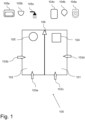
- Fig. 1 shows a combination of a user area 101 and a sanitary area 102 according to an example embodiment.
- the user area 101 and the sanitary area 102 may together form an enclosure or a combined area 100 having one or more entry points or doors 103a,b,c,d for entering/leaving the combined area 100.
- the combined area 100 may be a single room, which may have a single entry point or door 103a,b,c,d for entering/leaving the area 100.
- the area 100 may be divided into the user area 101 and the sanitary area 102 by one or more detection ranges of one or more motion sensors 106, where the motions sensors 106 are configured for detecting whether a person is within the user area 101, and whether a person is within the sanitary area 102.
- the sanitary area 102 is adjacent to the user area 101. Based on signals from the motion sensors 106, it can be determined when a person leaves the user area 101 and when a person enters the sanitary area 102, and it can also be determined, when a person leaves the sanitary area 102 and when a person enters the user area 101.
- the entry points or doors 103a,b,c,d for entering/leaving the area 100 can be placed in different places, such as at an end-wall of the sanitary area 102, see entry point or door 103a, or at a sidewall of the sanitary area 102, see entry point or door 103b.
- An entry point or door may also be placed at an end-wall of the user area 101, see entry point or door 103c, or at a sidewall of the user area 101, see entry point or door 103d.
- entry point or door arrangement it can be determined based on the signals from the motion sensors 106, if a person enters the combined area 100, is within the user area 101, is within the sanitary area 102, and it can also be determined when a person leaves the combined area 102.
- the user area 101 holds one or more user devices 104, which can be used by a person visiting the user area 101, and the sanitary area 102 holds one or more sanitary devices 105, which should be used when a person has used a user device 104 in the user area 101.
- the user device 104 can for example be a toilet 104a or a urinal 14b, but the user device 104 can also be a bed 104c and the user area 101 may be part of a patient's room.
- the sanitary devices 105 can be a sink 105a for washing hands and a cleaning agent dispenser 105b, but a shower 105c may also be provided within the sanitary area 102. It is preferred that at least a cleaning agent dispenser 105b is provided within the sanitary area 102 in order for a person to perform a cleaning of hands, which may be a washing of hands and/or a disinfection of hands.
- both a sink 105a and a cleaning agent dispenser 105b are provided within the sanitary area 102.
- the disclosure also covers an embodiment in which the sanitary area 102 comprises a shower 105c and a cleaning agent dispenser 105b. If a person is to take a shower in the sanitary area 102, the person may use a cleaning agent from the cleaning agent dispenser 105b and perform a body wash, which will also include a hand washing.
- motion sensors 106 may be used, including passive infrared (PIR) based motion detectors (PIR-based motion detectors), infrared array sensors such as the Panasonic Infrared Array Sensor Grid-EYE, and radar based motion detectors.
- PIR passive infrared
- the motion sensors 106 may also include a combination of these different motion sensors.
- two motions sensors 106 with different detection areas may be provided. This is illustrated in Figs. 2a and 2b , where in Fig. 2a the motion sensors 106a comprise a first motion sensor, which has a substantially 180° detection range illustrated by the dashed lines 201a and 201b, and a second sensor, which has a substantially 90° detection range illustrated by the dotted lines 202a and 202b.
- the first motion sensor covers both the user area 101 and the sanitary area 102
- the second motion sensor covers only the sanitary area. If a motion signal is received from both sensors, a person is in the sanitary area 102 or at least partly in the sanitary area 102, and if a motion signal is received from the first sensor only, a person is in the user area 101.
- the motion sensors 106b comprise a first motion sensor, which has a substantially 90° detection range illustrated by the dashed lines 203a and 203b, and a second sensor equal to the second sensor of Fig. 2a , which also has a substantially 90° detection range illustrated by the dotted lines 202a and 202b.
- the first motion sensor covers the user area 101 only, while the second motion sensor covers the sanitary area 102 only. If a motion signal is received from the first sensor only, a person is in the user area 101, and if a motion signal is received from the second sensor only, a person is in the sanitary area 102. If a motion signal is received from both the first and second sensors, a person may be standing partly in the user area 101 and partly in the sanitary area 102, and in this situation it may be determined that the person is in the sanitary area 102.
- first and second motion sensors are configured with other detection range angles than illustrated in Figs. 2a and 2b .
- the first and second motion sensors 106a are configured to have detection ranges 201a, 201b and 202a, 202b as illustrated in Fig. 2a , and a person is determined to be in the user area 101 when a motion signal is received from the first motion sensor only, while a person is determined to be in the sanitary area 102 when a motion signal is received from both the first and the second motion sensors.
- a processor or processing circuitry is provided to handle the motion signals.
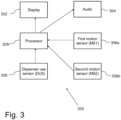
- FIG. 3 shows a block diagram of a processing system or motion detection system 300 for issuing sanitary remind signals according to an example embodiment.
- the system 300 comprises a first motion sensor, MS1, 306a and a second motion sensor, MS2, 306b, which may be configured to have detection ranges as illustrated in Fig. 2a , and processor or processing circuitry 309 receiving motion signal inputs from the motion sensors MS1 and MS2, 306a and 306b.
- a cleaning agent dispenser 105b is provided within the sanitary area 102, and the system 300 also holds a dispenser use sensor, DUS, 308, configured for detecting when the cleaning agent dispenser 105b is activated.
- the processor 309 receives input signals from the dispenser use sensor 308.
- the system 300 further comprises a display unit 302 for visual display of a first sanitary remind signal 303 (see Fig. 4 ) and an audio unit 304 for issuance of an audible second sanitary remind signal 305 (see Fig. 4 ).
- the processor or processing circuitry 309 determines whether a first sanitary remind signal shall be issued by the display unit 302, and whether a second sanitary remind signal shall be issued by the audio unit 304.
- the processing system 300 of Fig. 3 may be integrated into the cleaning agent dispenser 105b.
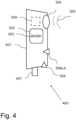
- Fig. 4 shows a cleaning agent dispenser system 400 according to an example embodiment.
- the dispenser system 400 holds a cleaning agent dispenser 401 having a dispenser output 407 and a processing system corresponding to the system 300 of Fig. 3 , with a dispenser use sensor 308 placed to detect activation of the dispenser output 407, and with first and second motion sensors 306a, 306b placed on a front wall of the dispenser 401.
- the processor 309 is placed inside the dispenser 401, and the display unit 302 is placed on side or front wall of the dispenser 401 for making the visual signal 303 visible.
- the audio unit 304 is placed in any convenient place within or at the dispenser 401 for issuance of the audible signal 305.
- the dispenser system 400 may be arranged within the combined area 100 of Fig. 1 so as to replace the one more motion sensors 106, whereby the dispenser system 400 will be placed with the first and second motion sensors arranged for covering the user area 101 and the sanitary area 102. With this arrangement of the dispenser system 400, then when a person activates the cleaning agent dispenser 401, at least part of the person will be sensed to be within the sanitary area 102, and the processor 309 will determine the person to be within the sanitary area 102.
- the first step, 501 is to determine a first point in time t1, when a person enters the user area 101. This can be determined based on inputs from the first and second motion sensors 306a and 306b.
- the next step, 502 is to determine a second point in time t2, following the first point in time t1, when a person leaves the user area 101 while at the same time a person enters the sanitary area 102. This can also be determined based on inputs from the first and second motion sensors 306a and 306b.
- step 503 it is now determined if a first detection time period, which is the period of time between the first detection point in time t1 and the second detection point in time t2 and equal to t2-t1, is equal to or larger than a predetermined minimum use-period of time, Tmin,use. If t2-t1 is less than Tmin, use, then no sanitary remind signal is issued, step 504, while if t2-t1 is equal to or larger than Tmin, use, then a first sanitary remind signal is issued, step 505.
- step 506 it is determined whether the cleaning agent dispenser 105b is used within a predetermined sanitary-period of time, Td,use, starting from t2, step 506. This can be determined based on inputs from the dispenser use sensor 308. If an input from the dispenser use sensor 308 has be detected at a time t3 equal to (Td,use +t2), then no sanitary remind signals, neither a first nor a second sanitary remind signal, is issued, step 507. If no input from the dispenser use sensor 308 has be detected at the time t3 equal to (Td,use +t2), then a second sanitary remind signal is issued, step 508.
- step 509 it is still determined whether a signal is received from the dispenser use sensor 308 indicating that the cleaning agent dispenser 105b is used, step 509. If a dispenser use signal is received within at maximum lapse period of time, Ts, max, following the time t3, then no sanitary remind signals, neither a first nor a second sanitary remind signal, is no longer issued, step 510. If no dispenser use signal is received within the maximum lapse period, Ts, max, i.e. at time t4 equal to (t3+Ts,max), step 511, also then no sanitary remind signals, neither a first nor a second sanitary remind signal, is no longer issued, step 510.
- the value of the predetermined minimum use-period of time, Tmin, use should be selected in accordance with the intended use of the user area 101.
- the value of Tmin, use may be set in the range of 40-80 seconds, such as about 60 seconds
- the value of the predetermined sanitary-period of time, Td,use may be set in the range of 20-60 seconds, such as about 40 seconds.
- the maximum lapse period Ts,max may be set in the range of 10-40 seconds, such as about 20 seconds.
- the person entering the user area 101 may be a health care worker taking care of the patient's bed 104c, which should be followed by the health care worker cleaning hands in the sanitary area 102.
- the value of the predetermined minimum use-period of time, Tmin,use should be higher, and may be set in the range of 3-7 minutes, such as about 5 minutes, while the value of the predetermined sanitary-period of time, Td,use, may be still be set in the range of 20-60 seconds, such as about 40 seconds.
- the maximum lapse period Ts,max may also still be set in the range of 10-40 seconds, such as about 20 seconds.
- the first sanitary remind signal is a visual signal, which may be visualised by a flash light, a diode display, a liquid crystal display, and/or a video monitor, and the visual signal my be a flash signal, a still motion signal, and/or a video motion signal.
- the disclosure also covers embodiments in which the first sanitary remind signal is an audible signal.
- the second sanitary remind signal is an audible signal, such as a beep tone, a tune or melody, and/or a human voice signal, but the disclosure also covers embodiments in which the second sanitary remind signal is a visual signal.
- both the first and second remind signals are visual signals
- the signals may be displayed at different frequencies within a display 302, with the second remind signal having a higher display frequency than the first remind signal.
- both the first and second remind signals are audible sound signals
- the sound signals may be issued from an audio unit 304 with different time intervals between succeeding signals, with the sound signals of the second remind signal having shorter time intervals than the sound signals of the first remind signal.
Landscapes
- Health & Medical Sciences (AREA)
- Public Health (AREA)
- Epidemiology (AREA)
- General Health & Medical Sciences (AREA)
- Business, Economics & Management (AREA)
- Emergency Management (AREA)
- Physics & Mathematics (AREA)
- General Physics & Mathematics (AREA)
- Bidet-Like Cleaning Device And Other Flush Toilet Accessories (AREA)
Claims (10)
- System zum Verbessern der Handhygiene einer Person nach einem Besuch eines Benutzerbereichs (101), wobei der Benutzerbereich (101) von einem Sanitärbereich (102) getrennt ist, wobei das System umfasst:einen oder mehrere Bewegungssensoren (106, 106a, 106b, 306a, 306b), die konfiguriert sind, um zu erfassen, ob sich eine Person im Benutzerbereich (101) befindet, und um zu erfassen, ob sich eine Person im Sanitärbereich (102) befindet; undeine Verarbeitungsschaltung (309), die konfiguriert ist, umbasierend auf Erfassungssignalen von dem einen oder den mehreren Bewegungssensoren (106, 106a, 106b, 306a, 306b) zu bestimmen, wann eine Person in den Benutzerbereich (101) eintritt und diesen verlässt und wann eine Person in den Sanitärbereich (102) eintritt und diesen verlässt; wobei die Verarbeitungsschaltung ferner konfiguriert ist, umeinen ersten Erfassungszeitraum basierend auf einem ersten Zeitpunkt (t1) der Erfassung, dass eine Person in den Benutzerbereich (101) eintritt, und einem zweiten Zeitpunkt (t2) einer nachfolgenden Erfassung, dass eine Person den Benutzerbereich (101) verlässt, während gleichzeitig eine Person in den Sanitärbereich (102) eintritt, zu bestimmen;zu bestimmen, ob der erste Erfassungszeitraum gleich oder größer als ein vorbestimmter Mindestnutzungszeitraum ist; undein erstes Sanitärerinnerungssignal auszugeben, wenn der erste Erfassungszeitraum gleich oder größer als der vorbestimmte Mindestnutzungszeitraum ist.
- System nach Anspruch 1, wobei ein Reinigungsmittelspender (105b, 401), der einen Spendernutzungssensor (308) zum Erfassen der Nutzung des Reinigungsmittelspenders (105b, 401) umfasst, innerhalb des Sanitärbereichs (102) bereitgestellt ist.
- System nach Anspruch 2, wobei der Reinigungsmittelspender (105b, 401) die Verarbeitungsschaltung (309) hält.
- System nach Anspruch 2 oder 3, wobei die Verarbeitungsschaltung (309) ferner konfiguriert ist, umbasierend auf Eingaben von dem Spendernutzungssensor (308) zu bestimmen, ob der Reinigungsmittelspender (105b, 401) nach dem zweiten Zeitpunkt (t2) der nachfolgenden Erfassung, dass eine Person den Benutzerbereich (101) verlässt, während gleichzeitig eine Person in den Sanitärbereich (102) eintritt, genutzt wird; unddas erste Sanitärerinnerungssignal zu beenden, wenn die Nutzung des Reinigungsmittelspenders (105b, 401) nach dem zweiten Zeitpunkt (t2) der nachfolgenden Erfassung, dass eine Person den Benutzerbereich (101) verlässt und eine Person in den Sanitärbereich (102) eintritt, erfasst wird.
- System nach einem der Ansprüche 2 bis 4, wobei die Verarbeitungsschaltung (309) ferner konfiguriert ist, umbasierend auf Eingaben von dem Spendernutzungssensor (308) zu bestimmen, ob der Reinigungsmittelspender (105b, 401) innerhalb eines vorbestimmten Sanitärzeitraums nach dem zweiten Zeitpunkt (t2) genutzt wird; undein zweites Sanitärerinnerungssignal auszugeben, wenn keine Erfassung der Nutzung des Reinigungsmittelspenders (105b, 401) innerhalb des vorbestimmten Sanitärzeitraums vorliegt.
- System nach einem der Ansprüche 2 bis 5, wobei der Reinigungsmittelspender (105b, 401) den einen oder die mehreren Bewegungssensoren (106, 106a, 106b, 306a, 306b) hält.
- System nach einem der Ansprüche 1 bis 6, wobei der eine oder die mehreren Bewegungssensoren (106b) umfasseneinen ersten Bewegungssensor, der konfiguriert ist, um zu erfassen, ob sich eine Person im Benutzerbereich (101) befindet, undeinen zweiten Bewegungssensor, der konfiguriert ist, um zu erfassen, ob sich eine Person im Sanitärbereich (102) befindet.
- System nach einem der Ansprüche 1 bis 6, wobei der eine oder die mehreren Bewegungssensoren (106a) umfasseneinen ersten Bewegungssensor, der konfiguriert ist, um zu erfassen, ob sich eine Person in einem kombinierten Bereich befindet, der den Benutzerbereich (101) und den Sanitärbereich (102) umfasst, undeinen zweiten Bewegungssensor, der konfiguriert ist, um zu erfassen, ob sich eine Person im Sanitärbereich (102) befindet.
- System nach Anspruch 8, wobei die Verarbeitungsschaltung (309) konfiguriert ist, um basierend auf Eingaben von sowohl dem ersten als auch dem zweiten Bewegungssensor (106a) zu bestimmen, wann eine Person in den Benutzerbereich (101) eintritt und diesen verlässt, und basierend auf Eingaben von dem zweiten Bewegungssensor zu bestimmen, wann eine Person in den Sanitärbereich (102) eintritt und diesen verlässt.
- System nach einem der Ansprüche 1 bis 9, wobei der Sanitärbereich (102) an den Benutzerbereich (101) angrenzt.
Applications Claiming Priority (2)
| Application Number | Priority Date | Filing Date | Title |
|---|---|---|---|
| DKPA201670835 | 2016-10-25 | ||
| PCT/EP2017/076611 WO2018077697A1 (en) | 2016-10-25 | 2017-10-18 | A method and a system for enhancing hand hygiene |
Publications (3)
| Publication Number | Publication Date |
|---|---|
| EP3531885A1 EP3531885A1 (de) | 2019-09-04 |
| EP3531885C0 EP3531885C0 (de) | 2023-06-07 |
| EP3531885B1 true EP3531885B1 (de) | 2023-06-07 |
Family
ID=60120073
Family Applications (1)
| Application Number | Title | Priority Date | Filing Date |
|---|---|---|---|
| EP17784968.4A Active EP3531885B1 (de) | 2016-10-25 | 2017-10-18 | System zur verbesserung der handhygiene |
Country Status (2)
| Country | Link |
|---|---|
| EP (1) | EP3531885B1 (de) |
| WO (1) | WO2018077697A1 (de) |
Family Cites Families (3)
| Publication number | Priority date | Publication date | Assignee | Title |
|---|---|---|---|---|
| US6727818B1 (en) * | 1999-10-29 | 2004-04-27 | Hill-Rom Services, Inc. | Hygiene monitoring system |
| US6323773B1 (en) * | 2000-06-16 | 2001-11-27 | Battelle Memorial Institute | Alerting device and method for reminding a person of a risk |
| DE102012110405B4 (de) * | 2012-10-30 | 2015-07-02 | Joachim Götz | Dosierspendevorrichtung für Handreinigungsmittel und Verfahren zur Verbesserung des Hygieneverhaltens in Toiletten |
-
2017
- 2017-10-18 EP EP17784968.4A patent/EP3531885B1/de active Active
- 2017-10-18 WO PCT/EP2017/076611 patent/WO2018077697A1/en not_active Ceased
Also Published As
| Publication number | Publication date |
|---|---|
| WO2018077697A1 (en) | 2018-05-03 |
| EP3531885A1 (de) | 2019-09-04 |
| EP3531885C0 (de) | 2023-06-07 |
Similar Documents
| Publication | Publication Date | Title |
|---|---|---|
| US9940819B2 (en) | Systems and methods for encouraging hand washing compliance | |
| JP3976787B2 (ja) | 手の清潔さを向上させる方法及びシステム | |
| AU2010322439B2 (en) | Real-time method and system for monitoring hygiene compliance within a tracking environment | |
| US9911312B2 (en) | Hygiene monitoring system | |
| US6426701B1 (en) | Handwash monitoring system | |
| US5670945A (en) | Self-monitoring hand-sanitizing station | |
| US20140180713A1 (en) | Real-time method and system for monitoring hygiene compliance within a tracking environment utilizing various timers | |
| US20060272361A1 (en) | Handwash monitoring system | |
| US11670158B2 (en) | Hygiene compliance and monitoring system | |
| JP2000105281A (ja) | 状態検知システム | |
| EP1245016A1 (de) | Hygieneüberwachungssytem | |
| CN104854634A (zh) | 监测系统和方法 | |
| WO2015117112A1 (en) | Real-time method and system for monitoring hygiene compliance within a tracking environment utilizing various timers | |
| EP3531885B1 (de) | System zur verbesserung der handhygiene | |
| EP4014213B1 (de) | Benachrichtungsvorrichtung | |
| JPH11215261A (ja) | 異常検知装置 |
Legal Events
| Date | Code | Title | Description |
|---|---|---|---|
| STAA | Information on the status of an ep patent application or granted ep patent |
Free format text: STATUS: UNKNOWN |
|
| STAA | Information on the status of an ep patent application or granted ep patent |
Free format text: STATUS: THE INTERNATIONAL PUBLICATION HAS BEEN MADE |
|
| PUAI | Public reference made under article 153(3) epc to a published international application that has entered the european phase |
Free format text: ORIGINAL CODE: 0009012 |
|
| STAA | Information on the status of an ep patent application or granted ep patent |
Free format text: STATUS: REQUEST FOR EXAMINATION WAS MADE |
|
| 17P | Request for examination filed |
Effective date: 20190527 |
|
| AK | Designated contracting states |
Kind code of ref document: A1 Designated state(s): AL AT BE BG CH CY CZ DE DK EE ES FI FR GB GR HR HU IE IS IT LI LT LU LV MC MK MT NL NO PL PT RO RS SE SI SK SM TR |
|
| AX | Request for extension of the european patent |
Extension state: BA ME |
|
| DAV | Request for validation of the european patent (deleted) | ||
| DAX | Request for extension of the european patent (deleted) | ||
| STAA | Information on the status of an ep patent application or granted ep patent |
Free format text: STATUS: EXAMINATION IS IN PROGRESS |
|
| 17Q | First examination report despatched |
Effective date: 20200302 |
|
| GRAP | Despatch of communication of intention to grant a patent |
Free format text: ORIGINAL CODE: EPIDOSNIGR1 |
|
| STAA | Information on the status of an ep patent application or granted ep patent |
Free format text: STATUS: GRANT OF PATENT IS INTENDED |
|
| INTG | Intention to grant announced |
Effective date: 20221104 |
|
| GRAS | Grant fee paid |
Free format text: ORIGINAL CODE: EPIDOSNIGR3 |
|
| GRAA | (expected) grant |
Free format text: ORIGINAL CODE: 0009210 |
|
| STAA | Information on the status of an ep patent application or granted ep patent |
Free format text: STATUS: THE PATENT HAS BEEN GRANTED |
|
| RAP1 | Party data changed (applicant data changed or rights of an application transferred) |
Owner name: NOBAK TECHNOLOGY APS |
|
| AK | Designated contracting states |
Kind code of ref document: B1 Designated state(s): AL AT BE BG CH CY CZ DE DK EE ES FI FR GB GR HR HU IE IS IT LI LT LU LV MC MK MT NL NO PL PT RO RS SE SI SK SM TR |
|
| REG | Reference to a national code |
Ref country code: GB Ref legal event code: FG4D |
|
| REG | Reference to a national code |
Ref country code: CH Ref legal event code: EP Ref country code: AT Ref legal event code: REF Ref document number: 1572231 Country of ref document: AT Kind code of ref document: T Effective date: 20230615 |
|
| REG | Reference to a national code |
Ref country code: DE Ref legal event code: R096 Ref document number: 602017069713 Country of ref document: DE |
|
| U01 | Request for unitary effect filed |
Effective date: 20230706 |
|
| U07 | Unitary effect registered |
Designated state(s): AT BE BG DE DK EE FI FR IT LT LU LV MT NL PT SE SI Effective date: 20230719 |
|
| REG | Reference to a national code |
Ref country code: LT Ref legal event code: MG9D |
|
| PG25 | Lapsed in a contracting state [announced via postgrant information from national office to epo] |
Ref country code: NO Free format text: LAPSE BECAUSE OF FAILURE TO SUBMIT A TRANSLATION OF THE DESCRIPTION OR TO PAY THE FEE WITHIN THE PRESCRIBED TIME-LIMIT Effective date: 20230907 Ref country code: ES Free format text: LAPSE BECAUSE OF FAILURE TO SUBMIT A TRANSLATION OF THE DESCRIPTION OR TO PAY THE FEE WITHIN THE PRESCRIBED TIME-LIMIT Effective date: 20230607 |
|
| U20 | Renewal fee for the european patent with unitary effect paid |
Year of fee payment: 7 Effective date: 20231012 |
|
| PG25 | Lapsed in a contracting state [announced via postgrant information from national office to epo] |
Ref country code: RS Free format text: LAPSE BECAUSE OF FAILURE TO SUBMIT A TRANSLATION OF THE DESCRIPTION OR TO PAY THE FEE WITHIN THE PRESCRIBED TIME-LIMIT Effective date: 20230607 Ref country code: HR Free format text: LAPSE BECAUSE OF FAILURE TO SUBMIT A TRANSLATION OF THE DESCRIPTION OR TO PAY THE FEE WITHIN THE PRESCRIBED TIME-LIMIT Effective date: 20230607 Ref country code: GR Free format text: LAPSE BECAUSE OF FAILURE TO SUBMIT A TRANSLATION OF THE DESCRIPTION OR TO PAY THE FEE WITHIN THE PRESCRIBED TIME-LIMIT Effective date: 20230908 |
|
| PG25 | Lapsed in a contracting state [announced via postgrant information from national office to epo] |
Ref country code: SK Free format text: LAPSE BECAUSE OF FAILURE TO SUBMIT A TRANSLATION OF THE DESCRIPTION OR TO PAY THE FEE WITHIN THE PRESCRIBED TIME-LIMIT Effective date: 20230607 |
|
| PG25 | Lapsed in a contracting state [announced via postgrant information from national office to epo] |
Ref country code: IS Free format text: LAPSE BECAUSE OF FAILURE TO SUBMIT A TRANSLATION OF THE DESCRIPTION OR TO PAY THE FEE WITHIN THE PRESCRIBED TIME-LIMIT Effective date: 20231007 |
|
| PG25 | Lapsed in a contracting state [announced via postgrant information from national office to epo] |
Ref country code: SM Free format text: LAPSE BECAUSE OF FAILURE TO SUBMIT A TRANSLATION OF THE DESCRIPTION OR TO PAY THE FEE WITHIN THE PRESCRIBED TIME-LIMIT Effective date: 20230607 Ref country code: SK Free format text: LAPSE BECAUSE OF FAILURE TO SUBMIT A TRANSLATION OF THE DESCRIPTION OR TO PAY THE FEE WITHIN THE PRESCRIBED TIME-LIMIT Effective date: 20230607 Ref country code: RO Free format text: LAPSE BECAUSE OF FAILURE TO SUBMIT A TRANSLATION OF THE DESCRIPTION OR TO PAY THE FEE WITHIN THE PRESCRIBED TIME-LIMIT Effective date: 20230607 Ref country code: IS Free format text: LAPSE BECAUSE OF FAILURE TO SUBMIT A TRANSLATION OF THE DESCRIPTION OR TO PAY THE FEE WITHIN THE PRESCRIBED TIME-LIMIT Effective date: 20231007 Ref country code: CZ Free format text: LAPSE BECAUSE OF FAILURE TO SUBMIT A TRANSLATION OF THE DESCRIPTION OR TO PAY THE FEE WITHIN THE PRESCRIBED TIME-LIMIT Effective date: 20230607 |
|
| PG25 | Lapsed in a contracting state [announced via postgrant information from national office to epo] |
Ref country code: PL Free format text: LAPSE BECAUSE OF FAILURE TO SUBMIT A TRANSLATION OF THE DESCRIPTION OR TO PAY THE FEE WITHIN THE PRESCRIBED TIME-LIMIT Effective date: 20230607 |
|
| REG | Reference to a national code |
Ref country code: DE Ref legal event code: R097 Ref document number: 602017069713 Country of ref document: DE |
|
| PLBE | No opposition filed within time limit |
Free format text: ORIGINAL CODE: 0009261 |
|
| STAA | Information on the status of an ep patent application or granted ep patent |
Free format text: STATUS: NO OPPOSITION FILED WITHIN TIME LIMIT |
|
| 26N | No opposition filed |
Effective date: 20240308 |
|
| PG25 | Lapsed in a contracting state [announced via postgrant information from national office to epo] |
Ref country code: MC Free format text: LAPSE BECAUSE OF FAILURE TO SUBMIT A TRANSLATION OF THE DESCRIPTION OR TO PAY THE FEE WITHIN THE PRESCRIBED TIME-LIMIT Effective date: 20230607 |
|
| REG | Reference to a national code |
Ref country code: CH Ref legal event code: PL |
|
| PG25 | Lapsed in a contracting state [announced via postgrant information from national office to epo] |
Ref country code: CH Free format text: LAPSE BECAUSE OF NON-PAYMENT OF DUE FEES Effective date: 20231031 |
|
| PG25 | Lapsed in a contracting state [announced via postgrant information from national office to epo] |
Ref country code: CH Free format text: LAPSE BECAUSE OF NON-PAYMENT OF DUE FEES Effective date: 20231031 |
|
| PG25 | Lapsed in a contracting state [announced via postgrant information from national office to epo] |
Ref country code: IE Free format text: LAPSE BECAUSE OF NON-PAYMENT OF DUE FEES Effective date: 20231018 |
|
| PG25 | Lapsed in a contracting state [announced via postgrant information from national office to epo] |
Ref country code: IE Free format text: LAPSE BECAUSE OF NON-PAYMENT OF DUE FEES Effective date: 20231018 |
|
| U20 | Renewal fee for the european patent with unitary effect paid |
Year of fee payment: 8 Effective date: 20241031 |
|
| PGFP | Annual fee paid to national office [announced via postgrant information from national office to epo] |
Ref country code: GB Payment date: 20241017 Year of fee payment: 8 |
|
| PG25 | Lapsed in a contracting state [announced via postgrant information from national office to epo] |
Ref country code: CY Free format text: LAPSE BECAUSE OF FAILURE TO SUBMIT A TRANSLATION OF THE DESCRIPTION OR TO PAY THE FEE WITHIN THE PRESCRIBED TIME-LIMIT; INVALID AB INITIO Effective date: 20171018 |
|
| PG25 | Lapsed in a contracting state [announced via postgrant information from national office to epo] |
Ref country code: HU Free format text: LAPSE BECAUSE OF FAILURE TO SUBMIT A TRANSLATION OF THE DESCRIPTION OR TO PAY THE FEE WITHIN THE PRESCRIBED TIME-LIMIT; INVALID AB INITIO Effective date: 20171018 |
|
| PG25 | Lapsed in a contracting state [announced via postgrant information from national office to epo] |
Ref country code: TR Free format text: LAPSE BECAUSE OF FAILURE TO SUBMIT A TRANSLATION OF THE DESCRIPTION OR TO PAY THE FEE WITHIN THE PRESCRIBED TIME-LIMIT Effective date: 20230607 |