EP3531701A1 - Verfahren und vorrichtung für generalisierte überlagerte blockbewegungskompensation - Google Patents
Verfahren und vorrichtung für generalisierte überlagerte blockbewegungskompensation Download PDFInfo
- Publication number
- EP3531701A1 EP3531701A1 EP18305196.0A EP18305196A EP3531701A1 EP 3531701 A1 EP3531701 A1 EP 3531701A1 EP 18305196 A EP18305196 A EP 18305196A EP 3531701 A1 EP3531701 A1 EP 3531701A1
- Authority
- EP
- European Patent Office
- Prior art keywords
- block
- sub
- prediction
- filtered
- pixels
- Prior art date
- Legal status (The legal status is an assumption and is not a legal conclusion. Google has not performed a legal analysis and makes no representation as to the accuracy of the status listed.)
- Withdrawn
Links
Images






Classifications
-
- H—ELECTRICITY
- H04—ELECTRIC COMMUNICATION TECHNIQUE
- H04N—PICTORIAL COMMUNICATION, e.g. TELEVISION
- H04N19/00—Methods or arrangements for coding, decoding, compressing or decompressing digital video signals
- H04N19/50—Methods or arrangements for coding, decoding, compressing or decompressing digital video signals using predictive coding
- H04N19/503—Methods or arrangements for coding, decoding, compressing or decompressing digital video signals using predictive coding involving temporal prediction
- H04N19/51—Motion estimation or motion compensation
- H04N19/583—Motion compensation with overlapping blocks
-
- H—ELECTRICITY
- H04—ELECTRIC COMMUNICATION TECHNIQUE
- H04N—PICTORIAL COMMUNICATION, e.g. TELEVISION
- H04N19/00—Methods or arrangements for coding, decoding, compressing or decompressing digital video signals
- H04N19/10—Methods or arrangements for coding, decoding, compressing or decompressing digital video signals using adaptive coding
- H04N19/102—Methods or arrangements for coding, decoding, compressing or decompressing digital video signals using adaptive coding characterised by the element, parameter or selection affected or controlled by the adaptive coding
- H04N19/117—Filters, e.g. for pre-processing or post-processing
-
- H—ELECTRICITY
- H04—ELECTRIC COMMUNICATION TECHNIQUE
- H04N—PICTORIAL COMMUNICATION, e.g. TELEVISION
- H04N19/00—Methods or arrangements for coding, decoding, compressing or decompressing digital video signals
- H04N19/10—Methods or arrangements for coding, decoding, compressing or decompressing digital video signals using adaptive coding
- H04N19/134—Methods or arrangements for coding, decoding, compressing or decompressing digital video signals using adaptive coding characterised by the element, parameter or criterion affecting or controlling the adaptive coding
- H04N19/157—Assigned coding mode, i.e. the coding mode being predefined or preselected to be further used for selection of another element or parameter
-
- H—ELECTRICITY
- H04—ELECTRIC COMMUNICATION TECHNIQUE
- H04N—PICTORIAL COMMUNICATION, e.g. TELEVISION
- H04N19/00—Methods or arrangements for coding, decoding, compressing or decompressing digital video signals
- H04N19/10—Methods or arrangements for coding, decoding, compressing or decompressing digital video signals using adaptive coding
- H04N19/169—Methods or arrangements for coding, decoding, compressing or decompressing digital video signals using adaptive coding characterised by the coding unit, i.e. the structural portion or semantic portion of the video signal being the object or the subject of the adaptive coding
- H04N19/17—Methods or arrangements for coding, decoding, compressing or decompressing digital video signals using adaptive coding characterised by the coding unit, i.e. the structural portion or semantic portion of the video signal being the object or the subject of the adaptive coding the unit being an image region, e.g. an object
- H04N19/176—Methods or arrangements for coding, decoding, compressing or decompressing digital video signals using adaptive coding characterised by the coding unit, i.e. the structural portion or semantic portion of the video signal being the object or the subject of the adaptive coding the unit being an image region, e.g. an object the region being a block, e.g. a macroblock
Definitions
- the present principles relate to the field of video compression.
- CTU Coding Tree Unit
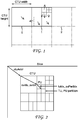
- Each CTU is represented by a Coding Tree in the compressed domain. This is a quad-tree division of the CTU, where each leaf is called a Coding Unit (CU), as shown in Figure 1 .
- CU Coding Unit
- Each CU is then given some Intra or Inter prediction parameters (Prediction Info). To do so, it is spatially partitioned into one or more Prediction Units (PUs), each PU being assigned some prediction information.
- the Intra or Inter coding mode is assigned on the CU level, see Figure 2 .
- Coding Units are also divided into so-called transform units, in a recursive way, following a "transform tree".
- a transform tree is a quad-tree division of a coding unit, and transform units are the leaf of the transform tree.
- a transform unit encapsulates the square transform blocks of each picture component corresponding to a considered square spatial area.
- a transform block is a square block of samples in a single component, where the same transform is applied.
- New emerging video compression tools include a Coding Tree Unit representation in the compressed domain, proposed in order to represent picture data in a more flexible way in the compressed domain.
- the advantage of this flexible representation of the coding tree is that it provides increased compression efficiency compared to the CU/PU/TU arrangement of the HEVC standard.
- a method for coding a block of video data comprises comparing horizontal and vertical pairs of motion vectors around a sub-block of a video coding block, respectively, with a current motion vector for the sub-block to check for differences; filtering a pixel of a prediction of said sub-block using pixels from at least one neighboring sub-block prediction with different motion vectors and a prediction using said current motion vector to generate a prediction for the sub-block; and, encoding said sub-block using said filtered prediction.
- An approach is described for improved entropy coding efficiency of video signals.
- OBMC Overlapped Block Motion Compensation
- motion compensated temporal prediction is employed to exploit the redundancy that exists between successive pictures of a video.
- Each CTU is represented by a Coding Tree in the compressed domain. This is a quad-tree division of the CTU, where each leaf is called a Coding Unit (CU), see Figure 1 .
- CU Coding Unit
- Each CU is then given some Intra or Inter prediction parameters (Prediction Info). To do so, it is spatially partitioned into one or more Prediction Units (PUs), each PU being assigned some prediction information.
- the Intra or Inter coding mode is assigned on the CU level, see Figure 2 .
- Exactly one motion vector is assigned to each PU in HEVC. This motion vector is used for motion compensated temporal prediction of the considered PU.
- JEM Joint Exploration Model
- the motion compensation step is followed, for all Inter CUs whatever their coding mode, by a process called OBMC for Overlapped Block Motion Compensation that aims at attenuating the motion transitions between CUs (somehow like the deblocking filter with the blocking artifacts). But, depending on the CU coding mode, the OBMC method applied is not the same. Two distinct processes exist, one for CUs that are divided into smaller parts (affine, FRUC, %), and one for the other CUs (entire ones).
- the present approach proposes to generalize the process of the OBMC tool which is performed at the encoder and decoder side right after the motion compensation inter prediction process.
- the problem solved by the approach is how to generalize the OBMC process for all CUs, to simplify the design and increase the overall compression performance of the considered video codec.
- the basic idea of the proposed approach is to generalize for all CUs the OBMC process performed after the motion compensation inter prediction.
- OBMC Overlapped Block Motion Compensation
- OBMC operates at a sub-block level of size 4x4 pixels.
- the full block is a coding unit (CU) and the small squares are 4x4 sub-blocks.
- the process constructs two predictions, Pc and Pn, where a prediction is the corresponding sub-block compensated (with the motion compensation, i.e. a sub-block picked from a reference picture using a motion vector) with the current CU motion vector (Pc) and the motion vector from a neighboring sub-block (Pn).
- a prediction is the corresponding sub-block compensated (with the motion compensation, i.e. a sub-block picked from a reference picture using a motion vector) with the current CU motion vector (Pc) and the motion vector from a neighboring sub-block (Pn).
- the current prediction (Pc) is smoothed using the other prediction (Pn), to give the new current prediction.
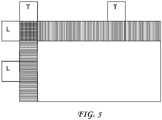
- the striped lines correspond to the direction of the smoothing. If they fill the 4x4 sub-block, it means that 4 lines/columns are filtered, if they only fill half of the sub-block, it means that only 2 lines/columns are filtered.
- the stripes themselves do not represent the number of lines/columns of pixels.
- One main difference between the prior art OBMC and the generalized OBMC process is in the way the number of lines/columns of pixels to be filtered is defined.
- this number can be different for each direction and for each sub-block. It is defined from two opposite neighbors, if both are available with a different motion vector than the one for the current sub-block, then 2 lines/columns are filtered from each neighbor, if only one is available, then 4 lines/columns are filtered from this available neighbor.
- OBMC if the area of the current CU is less than 64 (4x4, 8x4, 4x8), it forces the number of pixels to be filtered to 2.
- This restriction limits the filtering when the coding unit is not large. For example, for a 4x4 CU, there is only one sub-block, and without this criterion, all lines and columns will be filtered from left then top, which can be a bit too much. With this criterion, only two lines and columns will be filtered.
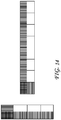
- some CU with a larger area than 64 can have a size of 4 pixels in a direction (4x16, 16x4, 4x32, 32x4, ...), as in the proposed generalized OBMC, the number of pixels to be filtered can be set differently for each direction, and it is possible to modify this area criterion to be a size criterion depending on the direction. If a CU has a size smaller than 8 in a direction, then the number of pixels to be smoothed in this direction can be forced to be 2, and in the other direction it can be 4, as shown on figure 14 .
- Figure 15 shows the prior art with too much filtering.
- the proposed embodiments include, among other.
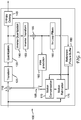
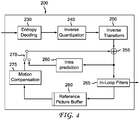
- the impacted codec modules are the motion compensation 170 and the motion estimation 175 of Figure 3 and 275 of Figure 4 .
- OBMC Overlapped Block Motion Compensation
- the first step of the OBMC process consists in detecting the kind of CU to filter, either entire or divided into sub-blocks.
- the incoming CU is considered as entire.
- CU divided into sub-blocks are coded using: merge mode with ATMVP/STMVP predictor, FRUC merge mode or Affine mode.
- the current prediction P c is then filtered using the available predictions P n to smooth the motion transition.
- the 4 lines and/or columns of pixels of P n are added to the current prediction P c using the weighting factors ⁇ 1/4, 1/8, 1/16, 1/32 ⁇ for P n and ⁇ 3/4, 7/8, 15/16, 31/32 ⁇ for P c .
- P n can be obtained from 4 different neighbors, top (T), left (L), bottom (B) and right (R) neighboring sub-blocks, if available (from a causal CU or from the current CU, and with a motion vector different from the current one).
- the current prediction P c is then filtered using all the available predictions P n to smooth the motion transitions.
- the 2 first lines or columns of pixels of each sub-block are the weighted sum of the current prediction P c and P n from top or left neighboring sub-blocks respectively.
- the 2 last lines or columns of pixels of each sub-block use P n from the bottom or right neighboring sub-block respectively.
- the weighting factors used here are ⁇ 1/4, 1/8 ⁇ for P n and ⁇ 3/4, 7/8 ⁇ for P c .
- the main limitation of this tool is that it need to detect if the CU to process is divided into sub-blocks or not, and consider it, by default, as entire.
- OBMC has to be modified to correctly classify the CU, otherwise it will go to a sub-optimal process.
- the proposed solution does not need to classify the CU for the same result as the state-of-the-art OBMC, and it is not limited by the area of the CU.
- the proposed approach is based on the state-of-the-art OBMC process for CUs divided into sub-blocks where all the surrounding neighbors are considered.
- the four neighboring sub-blocks are checked by pairs, left-right and top-bottom, i.e. horizontal and vertical, but are still used sequentially to smooth the current prediction.
- both neighboring motion vectors are retrieved if available, i.e. if they exist with a different motion vector as the one for the current sub-block.
- the number of pixels to be filtered along this tested direction is set to 2. That is, the first two lines or columns will be filtered with the first neighbor, and the last two lines or columns with the second neighbor. And if only one neighboring motion vector is available, it is set to 4 pixels. That is, 4 lines/columns will be filtered with this neighbor. If none are available, OBMC is still not applicable.
- the sub-block is then smoothed sequentially using the available neighboring motion vectors and its(their) associated P n and the same weighted factors as for the state-of-the-art OBMC ( ⁇ 1/4, 1/8, 1/16, 1/32 ⁇ for P n and ⁇ 3/4, 7/8, 15/16, 31/32 ⁇ for P c ). These weights are applied from the tested neighbor to its opposite; for left, from left to right and for top, from top to bottom, for right, from right to left.
- the neighbors are studied by directional pairs, left-right and top-bottom. This allows selecting the number of lines or columns of pixels to be smoothed as 2 or 4 instead of setting this number, a priori, depending on the CU coding mode.
- the OBMC process smooths the motion transition by filtering the current prediction, so the proposed solution described here slightly modifies the current prediction of each sub-block of the coding unit.
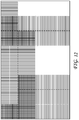
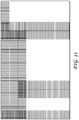
- the 8x16 partition on the right side is exactly smoothed as if it is an independent CU with the generalized OBMC process while this is not the case with the state-of-the-art OBMC.
- the output of the generalized OBMC process is the same as with the state-of-the-art OBMC, for entire CUs as presented in Figure 5 , and for CUs fully divided into sub-blocks (Affine, FRUC) as presented in Figure 7 .
- This concept can also be generalized in the new proposed OBMC process.
- This generalized criterion also allows a better fitting to the motion transitions compared to the state-of-the-art OBMC that filters only 2 pixels for CUs smaller than 64 (4x4, 8x4 and 4x8) and 4 pixels for larger ones (4x16, 16x4, 4x32, 32x4, ...) where the full width or height is smoothed as presented in Figure 15 .
- the complexity of the proposed generalized OBMC is higher than the prior art OBMC since it checks the 4 neighbors for all sub-blocks of all CUs while they are only checked for CUs divided into sub-blocks in the prior art OBMC.
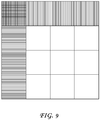
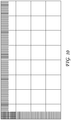
- the classification used here isolates the entire CUs (instead of the CUs divided into sub-blocks) and consider, by default, the incoming CU as divided into sub-blocks (instead of entire). This reversed classification limits the errors linked to bad detections since the error from Figure 9 still can be observed, but the one from Figure 10 cannot occur anymore. Moreover, when a new coding mode is added, it is considered, by default, as divided into sub-blocks and if it uses entire CUs, then it goes to the bad classification presented in Figure 10 that do not generate a different OBMC result here. So, when a coding mode goes from entire to divided, OBMC has to be modified, but when it goes from divided to entire or when a new coding mode is added, the OBMC result is the same, only the complexity can be reduced by informing OBMC.
- the three proposed improvements of OBMC are used: the generalized process with the generalized criterion for thin CUs and the simplified version for the entire CUs.
- OBMC Overlapped Block Motion Compensation
- the process constructs two predictions, Pc and Pn, where a prediction is the corresponding sub-block compensated (with the motion compensation, i.e. a sub-block picked from a reference picture using a motion vector) with the current CU motion vector (Pc) and the motion vector from a neighboring sub-block (Pn).
- a prediction is the corresponding sub-block compensated (with the motion compensation, i.e. a sub-block picked from a reference picture using a motion vector) with the current CU motion vector (Pc) and the motion vector from a neighboring sub-block (Pn).
- the current prediction (Pc) is smoothed using the other prediction (Pn), to give the new current prediction.
- One main difference between the prior art OBMC and the generalized OBMC process is in the way the number of lines/columns of pixels to be filtered is defined.
- this number can be different for each direction and for each sub-block. It is defined from two opposite neighbors, if both are available with a different motion vector than the one for the current sub-block, then 2 lines/columns are filtered from each neighbor, if only one is available, then 4 lines/columns are filtered from this available neighbor.
- OBMC if the area of the current CU is less than 64 (4x4, 8x4, 4x8), it forces the number of pixels to be filtered to 2.
- This restriction limits the filtering when the coding unit is not large. For example, for a 4x4 CU, there is only one sub-block, and without this criterion, all lines and columns will be filtered from left then top, which can be a bit too much. With this criterion, only two lines and columns will be filtered.
- some CU with a larger area than 64 can have a size of 4 pixels in a direction (4x16, 16x4, 4x32, 32x4, ...), as in the proposed generalized OBMC, the number of pixels to be filtered can be set differently for each direction, and it is possible to modify this area criterion to be a size criterion depending on the direction. If a CU has a size smaller than 8 in a direction, then the number of pixels to be smoothed in this direction is forced to be 2, and in the other direction it can be 4, as shown on figure 14 .
- Figure 15 shows the prior art with too much filtering.
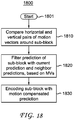
- Figure 18 shows one embodiment of a method 1800 for coding a block of video data.
- the method commences at Start block 1801 and proceeds to block 1810 for comparing horizontal and vertical pairs of motion vectors around a sub-block.
- the sub-block can be part of a larger block to be encoded.
- the method compares the motion vectors of neighboring sub-blocks to the current motion vector for the sub-block.
- Control proceeds from block 1810 to block 1820 for filtering a prediction of the sub-block using the current prediction for the sub-block with neighboring predictions of sub-blocks with motion vectors that are different than the current motion vector for the sub-block to generate a smoothed prediction of the current sub-block.
- Control proceeds from block 1820 to block 1830 for encoding the sub-block using the smoothed prediction for the sub-block.
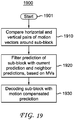
- Figure 19 shows one embodiment of a method 1900 for coding a block of video data.
- the method commences at Start block 1901 and proceeds to block 1910 for comparing horizontal and vertical pairs of motion vectors around a sub-block.
- the sub-block can be part of a larger block to be decoded.
- the method compares the motion vectors of neighboring sub-blocks to the current motion vector for the sub-block.
- Control proceeds from block 1910 to block 1920 for filtering a prediction of the sub-block using the current prediction for the sub-block with neighboring predictions of sub-blocks with motion vectors that are different than the current motion vector for the sub-block to generate a smoothed prediction of the current sub-block.
- Control proceeds from block 1920 to block 1930 for decoding the sub-block using the smoothed prediction for the sub-block.
- Figure 20 shows one embodiment of an apparatus 2000 for coding or decoding a block of video data.
- the apparatus comprises Processor 2010 which has input and output ports and is in signal connectivity with Memory 2020, also having input and output ports.
- the apparatus can execute either of the aforementioned method embodiments, or any variations thereof.
- processor or “controller” should not be construed to refer exclusively to hardware capable of executing software, and can implicitly include, without limitation, digital signal processor ("DSP") hardware, read-only memory (“ROM”) for storing software, random access memory (“RAM”), and non-volatile storage.
- DSP digital signal processor
- ROM read-only memory
- RAM random access memory
- any switches shown in the figures are conceptual only. Their function can be carried out through the operation of program logic, through dedicated logic, through the interaction of program control and dedicated logic, or even manually, the particular technique being selectable by the implementer as more specifically understood from the context.
- any element expressed as a means for performing a specified function is intended to encompass any way of performing that function including, for example, a) a combination of circuit elements that performs that function or b) software in any form, including, therefore, firmware, microcode or the like, combined with appropriate circuitry for executing that software to perform the function.
- the present principles as defined by such claims reside in the fact that the functionalities provided by the various recited means are combined and brought together in the manner which the claims call for. It is thus regarded that any means that can provide those functionalities are equivalent to those shown herein.
- a method for decoding a block of video data comprises comparing horizontal and vertical pairs of motion vectors around a sub-block of a video coding block, respectively, with a current motion vector for the sub-block to check for differences; filtering a pixel of a prediction of said sub-block using pixels from at least one neighboring sub-block prediction with different motion vectors and a prediction using said current motion vector to generate a prediction for the sub-block; and decoding said sub-block using said filtered prediction.
- an apparatus for coding a block of video data comprises a memory, and a processor, configured to compare horizontal and vertical pairs of motion vectors around a sub-block of a video coding block, respectively, with a current motion vector for the sub-block to check for differences; filter a pixel of a prediction of said sub-block using pixels from at least one neighboring sub-block prediction with different motion vectors and a prediction using said current motion vector to generate a prediction for the sub-block; and, encode said sub-block using said filtered prediction.
- an apparatus for coding a block of video data comprises a memory, and a processor, configured to compare horizontal and vertical pairs of motion vectors around a sub-block of a video coding block, respectively, with a current motion vector for the sub-block to check for differences; filter a pixel of a prediction of said sub-block using pixels from at least one neighboring sub-block prediction with different motion vectors and a prediction using said current motion vector to generate a prediction for the sub-block; and, decode said sub-block using said filtered prediction.
- a nontransitory computer readable storage medium containing data content generated according to the method of any one of the described method embodiments, or by the apparatus of any one of the described apparatus embodiments for playback using a processor.
- a signal comprising video data generated according to the method of any one of the described method embodiments for coding a block of video data, or by the apparatus of any one of the described apparatus embodiments for coding a block of video data, for playback using a processor.
- a computer program product comprising instructions which, when the program is executed by a computer, cause the computer to carry out the method of any one of the described method embodiments.
Landscapes
- Engineering & Computer Science (AREA)
- Multimedia (AREA)
- Signal Processing (AREA)
- Compression Or Coding Systems Of Tv Signals (AREA)
Priority Applications (6)
| Application Number | Priority Date | Filing Date | Title |
|---|---|---|---|
| EP18305196.0A EP3531701A1 (de) | 2018-02-26 | 2018-02-26 | Verfahren und vorrichtung für generalisierte überlagerte blockbewegungskompensation |
| EP19708010.4A EP3759919B1 (de) | 2018-02-26 | 2019-02-22 | Verfahren und vorrichtung für generalisierte überlagerte blockbewegungskompensation |
| PCT/US2019/019073 WO2019165162A1 (en) | 2018-02-26 | 2019-02-22 | Method and apparatus for generalized obmc |
| US16/975,836 US11563970B2 (en) | 2018-02-26 | 2019-02-22 | Method and apparatus for generalized OBMC |
| CN201980015256.0A CN111989926B (zh) | 2018-02-26 | 2019-02-22 | 用于通用obmc的方法和装置 |
| KR1020207024139A KR20200123787A (ko) | 2018-02-26 | 2019-02-22 | 일반화된 obmc를 위한 방법 및 장치 |
Applications Claiming Priority (1)
| Application Number | Priority Date | Filing Date | Title |
|---|---|---|---|
| EP18305196.0A EP3531701A1 (de) | 2018-02-26 | 2018-02-26 | Verfahren und vorrichtung für generalisierte überlagerte blockbewegungskompensation |
Publications (1)
| Publication Number | Publication Date |
|---|---|
| EP3531701A1 true EP3531701A1 (de) | 2019-08-28 |
Family
ID=61563323
Family Applications (1)
| Application Number | Title | Priority Date | Filing Date |
|---|---|---|---|
| EP18305196.0A Withdrawn EP3531701A1 (de) | 2018-02-26 | 2018-02-26 | Verfahren und vorrichtung für generalisierte überlagerte blockbewegungskompensation |
Country Status (1)
| Country | Link |
|---|---|
| EP (1) | EP3531701A1 (de) |
Cited By (2)
| Publication number | Priority date | Publication date | Assignee | Title |
|---|---|---|---|---|
| CN114303371A (zh) * | 2019-08-30 | 2022-04-08 | 高通股份有限公司 | 带有协调运动场存储和运动补偿的几何分割模式 |
| CN116320428A (zh) * | 2021-12-20 | 2023-06-23 | 维沃移动通信有限公司 | 帧间预测方法及终端 |
-
2018
- 2018-02-26 EP EP18305196.0A patent/EP3531701A1/de not_active Withdrawn
Non-Patent Citations (4)
| Title |
|---|
| "Algorithm description of Joint Exploration Test Model 7 (JEM7)", 119. MPEG MEETING;17-7-2017 - 21-7-2017; TORINO; (MOTION PICTURE EXPERT GROUP OR ISO/IEC JTC1/SC29/WG11),, no. N17055, 6 October 2017 (2017-10-06), XP030023716 * |
| CHEN YUE ET AL: "Variable block-size overlapped block motion compensation in the next generation open-source video codec", 2017 IEEE INTERNATIONAL CONFERENCE ON IMAGE PROCESSING (ICIP), IEEE, 17 September 2017 (2017-09-17), pages 938 - 942, XP033322713, DOI: 10.1109/ICIP.2017.8296419 * |
| GRECOS CHRISTOS ED - SZCZEPANSKI PAWEL ET AL: "Beyond the High Efficiency Video Coding standard: an overview", PROCEEDINGS OPTICAL DIAGNOSTICS OF LIVING CELLS II, SPIE, US, vol. 10223, 1 May 2017 (2017-05-01), pages 102230F - 102230F, XP060089254, ISSN: 0277-786X, ISBN: 978-1-5106-1723-0, DOI: 10.1117/12.2261109 * |
| SPIE, PO BOX 10 BELLINGHAM WA 98227-0010 USA, 31 May 2006 (2006-05-31), XP040214388 * |
Cited By (2)
| Publication number | Priority date | Publication date | Assignee | Title |
|---|---|---|---|---|
| CN114303371A (zh) * | 2019-08-30 | 2022-04-08 | 高通股份有限公司 | 带有协调运动场存储和运动补偿的几何分割模式 |
| CN116320428A (zh) * | 2021-12-20 | 2023-06-23 | 维沃移动通信有限公司 | 帧间预测方法及终端 |
Similar Documents
| Publication | Publication Date | Title |
|---|---|---|
| US12382034B2 (en) | Apparatus and method for applying artificial neural network to image encoding or decoding | |
| US12563227B2 (en) | Method and apparatus for intra prediction with multiple weighted references | |
| KR102833083B1 (ko) | 모드-인식 딥 러닝을 갖는 필터링을 위한 방법 및 장치 | |
| US20250168338A1 (en) | Deep learning based image partitioning for video compression | |
| US20200195956A1 (en) | Motion compensation at a finer precision than motion vector differential | |
| EP3714600A1 (de) | Verfahren und vorrichtung zur bidirektionalen intraprädiktion mit geringer komplexität in der videocodierung und -decodierung | |
| WO2018206396A1 (en) | Method and apparatus for intra prediction in video encoding and decoding | |
| CN110832854B (zh) | 利用插值进行帧内预测的方法和装置 | |
| CN111052745B (zh) | 编码单元的内部子块的细化 | |
| EP3759919B1 (de) | Verfahren und vorrichtung für generalisierte überlagerte blockbewegungskompensation | |
| EP3531701A1 (de) | Verfahren und vorrichtung für generalisierte überlagerte blockbewegungskompensation | |
| EP3499890A1 (de) | Tieflernbasierte bildpartitionierung zur videokompression | |
| EP3422718A1 (de) | Verfahren und vorrichtung zur intraprädiktion mit mehreren gewichteten referenzen |
Legal Events
| Date | Code | Title | Description |
|---|---|---|---|
| PUAI | Public reference made under article 153(3) epc to a published international application that has entered the european phase |
Free format text: ORIGINAL CODE: 0009012 |
|
| AK | Designated contracting states |
Kind code of ref document: A1 Designated state(s): AL AT BE BG CH CY CZ DE DK EE ES FI FR GB GR HR HU IE IS IT LI LT LU LV MC MK MT NL NO PL PT RO RS SE SI SK SM TR |
|
| AX | Request for extension of the european patent |
Extension state: BA ME |
|
| RAP1 | Party data changed (applicant data changed or rights of an application transferred) |
Owner name: INTERDIGITAL VC HOLDINGS, INC. |
|
| STAA | Information on the status of an ep patent application or granted ep patent |
Free format text: STATUS: THE APPLICATION HAS BEEN WITHDRAWN |
|
| 17P | Request for examination filed |
Effective date: 20200221 |
|
| RBV | Designated contracting states (corrected) |
Designated state(s): AL AT BE BG CH CY CZ DE DK EE ES FI FR GB GR HR HU IE IS IT LI LT LU LV MC MK MT NL NO PL PT RO RS SE SI SK SM TR |
|
| 18W | Application withdrawn |
Effective date: 20200312 |