EP3531493A1 - Power supply device and load monitor - Google Patents
Power supply device and load monitor Download PDFInfo
- Publication number
- EP3531493A1 EP3531493A1 EP17861233.9A EP17861233A EP3531493A1 EP 3531493 A1 EP3531493 A1 EP 3531493A1 EP 17861233 A EP17861233 A EP 17861233A EP 3531493 A1 EP3531493 A1 EP 3531493A1
- Authority
- EP
- European Patent Office
- Prior art keywords
- battery
- inverter
- power supply
- switch
- supply device
- Prior art date
- Legal status (The legal status is an assumption and is not a legal conclusion. Google has not performed a legal analysis and makes no representation as to the accuracy of the status listed.)
- Granted
Links
Images



Classifications
-
- H—ELECTRICITY
- H02—GENERATION; CONVERSION OR DISTRIBUTION OF ELECTRIC POWER
- H02J—ELECTRIC POWER NETWORKS; CIRCUIT ARRANGEMENTS OR SYSTEMS FOR SUPPLYING OR DISTRIBUTING ELECTRIC POWER; SYSTEMS FOR STORING ELECTRIC ENERGY
- H02J7/00—Circuit arrangements for charging or discharging batteries or for supplying loads from batteries
- H02J7/70—Circuit arrangements for charging or discharging batteries or for supplying loads from batteries characterised by the mechanical construction
-
- H—ELECTRICITY
- H02—GENERATION; CONVERSION OR DISTRIBUTION OF ELECTRIC POWER
- H02J—ELECTRIC POWER NETWORKS; CIRCUIT ARRANGEMENTS OR SYSTEMS FOR SUPPLYING OR DISTRIBUTING ELECTRIC POWER; SYSTEMS FOR STORING ELECTRIC ENERGY
- H02J7/00—Circuit arrangements for charging or discharging batteries or for supplying loads from batteries
- H02J7/80—Circuit arrangements for charging or discharging batteries or for supplying loads from batteries including monitoring or indicating arrangements
- H02J7/82—Control of state of charge [SOC]
-
- G—PHYSICS
- G01—MEASURING; TESTING
- G01R—MEASURING ELECTRIC VARIABLES; MEASURING MAGNETIC VARIABLES
- G01R19/00—Arrangements for measuring currents or voltages or for indicating presence or sign thereof
- G01R19/145—Indicating the presence of current or voltage
- G01R19/15—Indicating the presence of current
-
- H—ELECTRICITY
- H01—ELECTRIC ELEMENTS
- H01M—PROCESSES OR MEANS, e.g. BATTERIES, FOR THE DIRECT CONVERSION OF CHEMICAL ENERGY INTO ELECTRICAL ENERGY
- H01M10/00—Secondary cells; Manufacture thereof
- H01M10/42—Methods or arrangements for servicing or maintenance of secondary cells or secondary half-cells
- H01M10/425—Structural combination with electronic components, e.g. electronic circuits integrated to the outside of the casing
-
- H—ELECTRICITY
- H01—ELECTRIC ELEMENTS
- H01M—PROCESSES OR MEANS, e.g. BATTERIES, FOR THE DIRECT CONVERSION OF CHEMICAL ENERGY INTO ELECTRICAL ENERGY
- H01M10/00—Secondary cells; Manufacture thereof
- H01M10/42—Methods or arrangements for servicing or maintenance of secondary cells or secondary half-cells
- H01M10/48—Accumulators combined with arrangements for measuring, testing or indicating the condition of cells, e.g. the level or density of the electrolyte
-
- H—ELECTRICITY
- H01—ELECTRIC ELEMENTS
- H01M—PROCESSES OR MEANS, e.g. BATTERIES, FOR THE DIRECT CONVERSION OF CHEMICAL ENERGY INTO ELECTRICAL ENERGY
- H01M10/00—Secondary cells; Manufacture thereof
- H01M10/42—Methods or arrangements for servicing or maintenance of secondary cells or secondary half-cells
- H01M10/48—Accumulators combined with arrangements for measuring, testing or indicating the condition of cells, e.g. the level or density of the electrolyte
- H01M10/486—Accumulators combined with arrangements for measuring, testing or indicating the condition of cells, e.g. the level or density of the electrolyte for measuring temperature
-
- H—ELECTRICITY
- H01—ELECTRIC ELEMENTS
- H01M—PROCESSES OR MEANS, e.g. BATTERIES, FOR THE DIRECT CONVERSION OF CHEMICAL ENERGY INTO ELECTRICAL ENERGY
- H01M10/00—Secondary cells; Manufacture thereof
- H01M10/60—Heating or cooling; Temperature control
- H01M10/61—Types of temperature control
- H01M10/613—Cooling or keeping cold
-
- H—ELECTRICITY
- H01—ELECTRIC ELEMENTS
- H01M—PROCESSES OR MEANS, e.g. BATTERIES, FOR THE DIRECT CONVERSION OF CHEMICAL ENERGY INTO ELECTRICAL ENERGY
- H01M10/00—Secondary cells; Manufacture thereof
- H01M10/60—Heating or cooling; Temperature control
- H01M10/65—Means for temperature control structurally associated with the cells
- H01M10/656—Means for temperature control structurally associated with the cells characterised by the type of heat-exchange fluid
- H01M10/6561—Gases
- H01M10/6563—Gases with forced flow, e.g. by blowers
-
- H—ELECTRICITY
- H01—ELECTRIC ELEMENTS
- H01M—PROCESSES OR MEANS, e.g. BATTERIES, FOR THE DIRECT CONVERSION OF CHEMICAL ENERGY INTO ELECTRICAL ENERGY
- H01M50/00—Constructional details or processes of manufacture of the non-active parts of electrochemical cells other than fuel cells, e.g. hybrid cells
- H01M50/20—Mountings; Secondary casings or frames; Racks, modules or packs; Suspension devices; Shock absorbers; Transport or carrying devices; Holders
- H01M50/256—Carrying devices, e.g. belts
-
- H—ELECTRICITY
- H02—GENERATION; CONVERSION OR DISTRIBUTION OF ELECTRIC POWER
- H02J—ELECTRIC POWER NETWORKS; CIRCUIT ARRANGEMENTS OR SYSTEMS FOR SUPPLYING OR DISTRIBUTING ELECTRIC POWER; SYSTEMS FOR STORING ELECTRIC ENERGY
- H02J7/00—Circuit arrangements for charging or discharging batteries or for supplying loads from batteries
- H02J7/855—Circuit arrangements for charging or discharging batteries or for supplying loads from batteries with circuits adapted for supplying loads from the battery
-
- H—ELECTRICITY
- H02—GENERATION; CONVERSION OR DISTRIBUTION OF ELECTRIC POWER
- H02J—ELECTRIC POWER NETWORKS; CIRCUIT ARRANGEMENTS OR SYSTEMS FOR SUPPLYING OR DISTRIBUTING ELECTRIC POWER; SYSTEMS FOR STORING ELECTRIC ENERGY
- H02J9/00—Circuit arrangements for emergency or stand-by power supply, e.g. for emergency lighting
- H02J9/04—Circuit arrangements for emergency or stand-by power supply, e.g. for emergency lighting in which the distribution system is disconnected from the normal source and connected to a standby source
- H02J9/06—Circuit arrangements for emergency or stand-by power supply, e.g. for emergency lighting in which the distribution system is disconnected from the normal source and connected to a standby source with automatic change-over, e.g. UPS systems
-
- H—ELECTRICITY
- H01—ELECTRIC ELEMENTS
- H01M—PROCESSES OR MEANS, e.g. BATTERIES, FOR THE DIRECT CONVERSION OF CHEMICAL ENERGY INTO ELECTRICAL ENERGY
- H01M10/00—Secondary cells; Manufacture thereof
- H01M10/42—Methods or arrangements for servicing or maintenance of secondary cells or secondary half-cells
- H01M10/425—Structural combination with electronic components, e.g. electronic circuits integrated to the outside of the casing
- H01M2010/4278—Systems for data transfer from batteries, e.g. transfer of battery parameters to a controller, data transferred between battery controller and main controller
-
- H—ELECTRICITY
- H01—ELECTRIC ELEMENTS
- H01M—PROCESSES OR MEANS, e.g. BATTERIES, FOR THE DIRECT CONVERSION OF CHEMICAL ENERGY INTO ELECTRICAL ENERGY
- H01M2220/00—Batteries for particular applications
- H01M2220/10—Batteries in stationary systems, e.g. emergency power source in plant
-
- H—ELECTRICITY
- H01—ELECTRIC ELEMENTS
- H01M—PROCESSES OR MEANS, e.g. BATTERIES, FOR THE DIRECT CONVERSION OF CHEMICAL ENERGY INTO ELECTRICAL ENERGY
- H01M50/00—Constructional details or processes of manufacture of the non-active parts of electrochemical cells other than fuel cells, e.g. hybrid cells
- H01M50/20—Mountings; Secondary casings or frames; Racks, modules or packs; Suspension devices; Shock absorbers; Transport or carrying devices; Holders
- H01M50/218—Mountings; Secondary casings or frames; Racks, modules or packs; Suspension devices; Shock absorbers; Transport or carrying devices; Holders characterised by the material
- H01M50/22—Mountings; Secondary casings or frames; Racks, modules or packs; Suspension devices; Shock absorbers; Transport or carrying devices; Holders characterised by the material of the casings or racks
- H01M50/222—Inorganic material
- H01M50/224—Metals
-
- H—ELECTRICITY
- H01—ELECTRIC ELEMENTS
- H01M—PROCESSES OR MEANS, e.g. BATTERIES, FOR THE DIRECT CONVERSION OF CHEMICAL ENERGY INTO ELECTRICAL ENERGY
- H01M50/00—Constructional details or processes of manufacture of the non-active parts of electrochemical cells other than fuel cells, e.g. hybrid cells
- H01M50/20—Mountings; Secondary casings or frames; Racks, modules or packs; Suspension devices; Shock absorbers; Transport or carrying devices; Holders
- H01M50/271—Lids or covers for the racks or secondary casings
-
- H—ELECTRICITY
- H02—GENERATION; CONVERSION OR DISTRIBUTION OF ELECTRIC POWER
- H02J—ELECTRIC POWER NETWORKS; CIRCUIT ARRANGEMENTS OR SYSTEMS FOR SUPPLYING OR DISTRIBUTING ELECTRIC POWER; SYSTEMS FOR STORING ELECTRIC ENERGY
- H02J2101/00—Supply or distribution of decentralised, dispersed or local electric power generation
- H02J2101/20—Dispersed power generation using renewable energy sources
- H02J2101/22—Solar energy
- H02J2101/24—Photovoltaics
- H02J2101/25—Photovoltaics involving maximum power point tracking control for photovoltaic sources
-
- H—ELECTRICITY
- H02—GENERATION; CONVERSION OR DISTRIBUTION OF ELECTRIC POWER
- H02J—ELECTRIC POWER NETWORKS; CIRCUIT ARRANGEMENTS OR SYSTEMS FOR SUPPLYING OR DISTRIBUTING ELECTRIC POWER; SYSTEMS FOR STORING ELECTRIC ENERGY
- H02J3/00—Circuit arrangements for AC mains or AC distribution networks
- H02J3/38—Arrangements for feeding a single network from two or more generators or sources in parallel; Arrangements for feeding already energised networks from additional generators or sources in parallel
- H02J3/381—Dispersed generators
-
- H—ELECTRICITY
- H02—GENERATION; CONVERSION OR DISTRIBUTION OF ELECTRIC POWER
- H02J—ELECTRIC POWER NETWORKS; CIRCUIT ARRANGEMENTS OR SYSTEMS FOR SUPPLYING OR DISTRIBUTING ELECTRIC POWER; SYSTEMS FOR STORING ELECTRIC ENERGY
- H02J7/00—Circuit arrangements for charging or discharging batteries or for supplying loads from batteries
- H02J7/34—Parallel operation in networks using both storage and other DC sources, e.g. providing buffering
- H02J7/35—Parallel operation in networks using both storage and other DC sources, e.g. providing buffering with light sensitive cells
-
- Y—GENERAL TAGGING OF NEW TECHNOLOGICAL DEVELOPMENTS; GENERAL TAGGING OF CROSS-SECTIONAL TECHNOLOGIES SPANNING OVER SEVERAL SECTIONS OF THE IPC; TECHNICAL SUBJECTS COVERED BY FORMER USPC CROSS-REFERENCE ART COLLECTIONS [XRACs] AND DIGESTS
- Y02—TECHNOLOGIES OR APPLICATIONS FOR MITIGATION OR ADAPTATION AGAINST CLIMATE CHANGE
- Y02B—CLIMATE CHANGE MITIGATION TECHNOLOGIES RELATED TO BUILDINGS, e.g. HOUSING, HOUSE APPLIANCES OR RELATED END-USER APPLICATIONS
- Y02B10/00—Integration of renewable energy sources in buildings
- Y02B10/70—Hybrid systems, e.g. uninterruptible or back-up power supplies integrating renewable energies
-
- Y—GENERAL TAGGING OF NEW TECHNOLOGICAL DEVELOPMENTS; GENERAL TAGGING OF CROSS-SECTIONAL TECHNOLOGIES SPANNING OVER SEVERAL SECTIONS OF THE IPC; TECHNICAL SUBJECTS COVERED BY FORMER USPC CROSS-REFERENCE ART COLLECTIONS [XRACs] AND DIGESTS
- Y02—TECHNOLOGIES OR APPLICATIONS FOR MITIGATION OR ADAPTATION AGAINST CLIMATE CHANGE
- Y02E—REDUCTION OF GREENHOUSE GAS [GHG] EMISSIONS, RELATED TO ENERGY GENERATION, TRANSMISSION OR DISTRIBUTION
- Y02E10/00—Energy generation through renewable energy sources
- Y02E10/50—Photovoltaic [PV] energy
- Y02E10/56—Power conversion systems, e.g. maximum power point trackers
Definitions
- the present invention relates to a power supply device and a load monitor.
- a generator may be used.
- Some generators are driven by an engine of the like that operates with gasoline or the like.
- some generators are equipped with wheels to be movable.
- Patent Document 1 Japanese Patent Application Publication 2016-115323
- an object of the present invention is to make it easy to move the power supply device using a large capacity battery.
- a power supply device comprising: a carriage having wheels; an inverter supported by the carriage; a battery having a power output terminal at a lower part thereof; and a battery mounting portion to which the battery can be mounted and detached by moving vertically, having a power input terminal connected to the inverter and contact with the output terminal when the battery is mounted.
- a power supply device comprising: a carriage having wheels; an inverter supported by the carriage; and a battery mounting portion to which a battery can be mounted and detached by moving vertically, having a power input terminal connected to the inverter and contact with the output terminal when the battery is mounted, the battery having a power output terminal at a lower part thereof.
- a load monitor comprising: a first switch provided between an outlet connected to a load and the inverter; a DC power supply connected to the outlet in parallel with the inverter; a second switch provide between the DC power supply and the outlet; a first sensor detecting a current flowing between the outlet and the inverter; a second sensor detecting a current flowing between the outlet and the DC power supply; and a controller making the first switch ON, the second switch off and stop an operation of the inverter when the current detected by the first sensor is smaller than a first threshold for a predetermined period, and making the first switch OFF, the second switch ON and start an operation of the inverter when the current detected by the second sensor exceeds a second threshold.
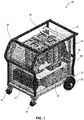
- Figure 1 is a perspective view of a power supply device according to an embodiment of the present invention.
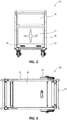
- Figure 2 is a front view of a power supply device according to the embodiment.
- Figure 3 is a top view of a power supply device according to the embodiment.
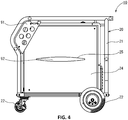
- Figure 4 is a side view of a power supply device according to the embodiment.
- Figure 5 is a rear view of a power supply device according to the embodiment.
- the power supply device 10 includes a carriage 20, an inverter 30, a battery attachment portion40 and a battery 50.
- the carriage 20 has a bottom plate 23, a frame 21, wheels 22 and a cover.
- the bottom plate 23 is a flat plate.
- the bottom plate 23 is made of stainless steel for example.
- the frame 21 is formed of aluminum pipes for example.
- the frame 21 consists of a upper frame which is substantially rectangular and is disposed above and parallel to the bottom plate 23, and pillar portions extending from the bottom plate 23 toward the upper frame.
- the number of the wheels is four for example. Two wheels are attached to each of sides at the rear of the bottom of the frame 21. Two wheels 22 are attached at the front of the bottom of the frame 21. The wheels 22 attached to the front of the bottom of the frame 21 are attached to wheel fixtures which can rotate horizontally.
- the wheel 22 is made of stainless steel at a central region and rubber at a peripheral region.
- the wheels 22 may have a stopper at front and/or rear wheel. The stopper may be operable by a handle of the carriage 20. It may be configured that it becomes unmovable if the handle of the carriage is released.
- Side plates 24 are attached to the left and right side of the carriage 20.
- a slit 25 is formed in the side plate 24.
- the side plate 24 is made of stainless steel for example.
- a reinforcing side plate 92 may be attached to the inside of the side plate 24.
- reinforcing plates 91 may be attached to the left and right of the front upper portion of the carriage 20 and the like.
- a front plate 26 is attached to the lower part of the front of the carriage 20.
- a slit 27 is formed in the front plate 26.
- An inclined plate 28 is attached to the upper part of the front of the carriage 20.
- the front plate 26 and the inclined plate 28 are made of stainless steel for example.
- An LED lighting 93 is attached to the lower part of the front plate 26.
- two LED lightings 93 are provided on the left and right.
- Each of the LED lightings 93 has, for example, a plurality of LEDs.
- the LED lighting 93 emits light in parallel as much as possible with the ground, that is, in the horizontal direction. As a result, unevenness on the ground can be easily recognized. In the LED lighting 93, it is preferable that the unevenness in intensity of luminance when viewed in a plane be small.
- a suction panel 70 is attached to the lower portion of the rear of the carriage 20.
- a suction port 71 opened downward is formed in the suction panel 70.
- the suction panel 70 is made of, for example, stainless steel.
- the inner side surface of the suction panel 70 may be provided with a filter for suppressing the entry of dust or the like.
- a fan is provided close to the front of the carriage 20 so as to form an air flow from the suction panel 70 toward the front of the carriage 20.
- An operation panel 80 is attached to the upper part of the rear of the carriage 20.
- the operation panel 80 has a main switch 84, an AC outlet 97, and an LCD display 83.
- the operation panel 80 may be provided with a USB terminal, an AC input terminal, an input unit of a solar panel, and the like.
- An upper plate 29 is attached to the top of the carriage 20.
- a hinge is attached to, for example, the rear end of the upper plate 29, and the upper plate 29 can be opened and closed.
- the upper plate 29 is made of, for example, stainless steel. When used in a place where there is no risk of getting wet, the upper plate 29 may not be provided. Alternatively, punching metal or the like may be used.
- the inverter 30 is mounted on the upper surface of the bottom plate 23.
- the inverter 30 may be fixed to the bottom plate 23.
- the possibility of movement of the inverter 30 due to vibration while transporting or the like is reduced.
- a partitioning plate 60 is provided above the inverter 30.
- the partitioning plate 60 is disposed in parallel to the bottom plate 23.
- the partitioning plate 60 is fixed directly or indirectly to the carriage 20.
- a battery mounting portion 40 is provided on the upper surface of the partitioning plate 60. There are three battery attachment portions 40, for example.
- a battery 50 is mounted to each of the battery attachment portions 40.
- the battery 50 has a substantially rectangular parallelepiped case and a plurality of storage batteries contained in the case. At the lower portion of the battery 50, a terminal portion is provided. At the top of the battery 50, a handle is attached. At the upper surface of the battery 50, an indicator for displaying the residual electricity quantity of the battery 50 may be provided.
- the battery 50 is, for example, a lithium ion battery.
- Other types of batteries may be used as long as they are lightweight and have a large capacity.
- the battery capacity can be nominally about 30,000 mAh even in the case of about 22 cm ⁇ about 16 cm ⁇ about 40 cm.
- the mass of the battery 50 is, for example, about 12 kg.
- the output voltage of battery 50 is, for example, about 43V.
- the output current is, for example, at a momentary maximum of about 100 A.
- the voltage at the time of charge is, for example, about 50V.
- the current at the time of charging is, for example, 24A.
- Figure 6 is a partially enlarged cross sectional view of a battery of a power supply device according to the embodiment.
- a power output terminal 51 and a communication terminal 52 are provided.
- the power output terminal 51 and the communication terminal 52 are protected by a cover 53 formed integrally with the case.
- a cover 53 is formed as a columnar with a hole 54 for example, and the power output terminal 51 and the communication terminal 52 is provided in the middle of the holes 54.
- a stem 55 having the same height as the cover 53 may be provided.
- the battery 50 is provided with a temperature sensor.
- the temperature measured by the temperature sensor is output from the communication terminal 52.
- the battery 50 may include a current sensor and a voltage sensor.
- the battery 50 may have a memory to store history data such as the number of charge and discharge times in the past.
- case of the battery 50 may be rotationally asymmetric with respect to the portion facing the battery mounting portion 40 so that the battery 50 cannot be mounted in the reverse direction.
- Figure 7 is a cross sectional view of a battery mounting portion of a power supply device according to the embodiment.
- the battery mounting portion 40 has a frame structure 41, a power input terminal 42 and a communication terminal 43.
- the frame structure 41 comprises a bottom portion and a side portion of which shape is a rectangular slightly larger than the size of the battery 50 extending upwardly from the bottom of the frame structure 41.
- the power input terminal 42 extends upward from the bottom of the frame structure 41.
- the communication terminal 43 extends upward from the bottom of the frame structure 41.
- the power input terminal 42 is connected to the inverter 30.
- the power input terminal 42 contacts the power output terminal 51 when the battery 50 is mounted to the battery mounting portion 40.
- There are six communication terminals 43 per one battery mounting portion 40 for example.
- the battery mounting portion 40 may include a buffer plate 44.
- the buffer plate 44 is supported by, for example, a hydraulic suspension 45 extending obliquely from above.
- the central portion of the buffer plate 44 is formed with an opening larger than the size of a cover that protects at least the power output terminal 51 and the communication terminal 52 of the battery 50. Even if the user releases the battery 50 while mounting the battery 50, the battery 50 is temporarily received by the buffer plate 44. Thereafter, with the extension of the hydraulic suspension 45 due to the weight of the battery 50, the buffer plate 44 descends slowly. Since the buffer plate 44 is slowly lowered, possibility that the battery 50 collides at a high speed to the power input terminal 42 and the communication terminal 43 is reduced. As a result, the possibility of the battery 50 and the battery mounting portion 40 being damaged by the falling of the battery is reduced.
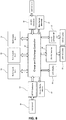
- Figure 8 is a block diagram of a power supply device according to the embodiment.
- the power supply device 10 of the present embodiment has a charge/discharge controller 89, an AC/DC converter 81, an MTTP controller 82, an LCD display 83, a main switch 84, a DC/DC converter 85, and a status indicator 87.
- the charge/discharge controller 89 is connected to the battery 50, the inverter 30, the AC/DC converter 81, the MTTP controller 82, the LCD display 83, the main switch 84 and the DC/DC converter 85.
- the inverter 30 converts the direct current of the battery 50 to alternating current of 100 V.
- the alternating current converted by the inverter 30 is output from an AC outlet 97 of 100V.
- the AC/DC converter 81 converts, for example, a 100 V alternating current supplied from the commercial power grid into a direct current.
- the DC current converted by the AC/DC converter 81 is supplied to the battery 50 via the charge/discharge controller 89 and is used to charge the battery 50.
- the MTTP controller 82 is a maximum power point tracking controller.
- a solar panel 99 can be connected via the MTTP controller 82.
- the LCD display 83 displays the status of the power supply 10.
- the LCD display 83 may be a touch-panel-type display and the power supply 10 may be operated via the LCD display 83.
- the main switch 84 is a master switch of the power supply device 10.
- the DC/DC converter 85 converts the voltage of the direct current of the battery 50.
- the output voltage of the battery 50 is, for example, 43 V.
- the output voltage of the DC/DC converter 85 is 5V.
- the output of the DC/DC converter 85 is supplied to an external device from, for example, a USB terminal.
- the charge/discharge controller 89 has a function of load monitor. This load monitor monitors whether an external device (load) connected to the inverter 30 is operating.
- the status indicator 87 displays the status of the power supply 10, in particular, the remaining charge amount of the battery 50.
- the status indicator 87 has a light disposed inside the side plate 24 close to the slit 25 formed on the side plate 24 of the carriage 20.
- Figure 9 is a circuit diagram of a power monitor of a power supply device according to the embodiment.
- the load monitor 86 includes a first sensor 68, a second sensor 69, a controller 67, a first switch 64 and a second switch 65.
- the first switch 64 is provided between the AC outlet 97 and the inverter 30.
- the DC/DC converter 85 and the AC outlet 97 are connected such that the DC/DC converter 85 and the inverter 30 are in parallel.
- the second switch 65 is provided between the DC/DC converter 85 and the AC outlet 97.
- the first switch 64 and the second switch 65 are interlocked, and only one of them can be closed (ON).
- the first sensor 68 measures the current that the inverter 30 outputs and flows through the load.
- the second sensor 69 measures the current that the DC/DC converter 85 outputs and flows through the load 98 via the AC outlet 97.
- the controller 67 of the load monitor 86 receives the current value measured by the first sensor 68 and monitors whether the current is supplied to the load 98 from the inverter 30. While the current is supplied to the load 98, it closes the first switch 64. At this time, the second switch 65 is in the open state.
- the controller 67 opens the first switch 64. At this time, the second switch 65 becomes closed.
- the threshold value of the current may be a value that can guarantee that the load 98 is not substantially imposed.
- the predetermined time is determined in consideration of the power consumption when the inverter 30 is booted.
- the main switch 84 is turned ON to activate the power supply device 10.
- the power supply 10 may have an auxiliary battery so as to be operated without the battery 50.
- charge/discharge controller 89 charges the battery 50, based on the information on the remaining charge of the battery 50, if necessary, by controlling the AC/DC converter 81.
- MTTP controller 67 charges to battery 50 efficiently as the voltage of the solar panel 99.
- the battery 50 is mounted to the battery mounting portion 40 if the battery 50 is removed. Since the battery 50 becomes heavy as the charge and discharge capacity increases, removing and mounting the battery 50 needs power and is dangerous.
- the battery 50 is removed from and mounted to the battery mounting portion 40 by moving in the vertical direction. Therefore, when the battery 50 is mounted, the user only needs to move the battery 50 down gently after moving and positioning the battery 50 horizontally.
- the battery is mounted by moving it in the horizontal direction, it is necessary to move the battery while positioning it in the vertical direction while lifting or pushing up. Because of this, if the battery is heavy, it is very difficult. Further, if the battery is mounted by moving it in the horizontal direction, it is necessary to support it to avoid the battery fallen downwardly at the moment when no longer support such as carriage while removing the battery.
- an AC current of 100 V is supplied from the AC outlet 97 to the load 98.
- power may be supplied from all of the batteries 50 to the inverter 30, or power may be supplied from one by one.
- the specific temperature range is, for example, about 0 degree C. to 60 degree C. More preferably, the specific temperature range is about 20 degree C to 25 degree C.
- the outside air temperature merely exceeds the operating temperature specification of the battery 50, that the outside air temperature may often be below the operating temperature specification of the battery 50. For example, when a disaster occurs in a cold district, the outside air temperature may be considerably low in case that the power supply 10 has to be used outside a building.
- the battery 50 is disposed above the inverter 30.
- the inverter 30 loses energy to some extent and generates heat.
- the heat generated by the inverter 30 is transmitted to the battery 50 located above the inverter 30.
- the temperature of the battery 50 rises. Therefore, when the battery 50 starts discharging and a certain amount of time passes, the temperature of the battery 50 rises, and it becomes possible to discharge in a state where the residual charge is difficult to discharge at a low temperature state. That is, in the present embodiment, the charge and discharge performance of the battery 50 can be further exhibited.
- the inverter 30 is housed in the area surrounded by the side plate 24 and the like. Therefore, the possibility of the user being burned by the heat of the inverter 30 is suppressed. Also, if the auxiliary plate 92 is provided inside of the side plate 24, an air layer is formed between the side plates 24 and the auxiliary side plate 92 and it improves the heat insulating property and the possibility of the user being burned is further suppressed.
- the temperature of the inverter 30 is reduced by rotating the fan to suck outside air from the suction panel 70 and discharging it from the front, and as a result, the temperature of the battery 50 can also be reduced. Since the flow of air by the fan is from the rear to the front, even when the user is operating the operation panel 80 , the exhaust does not go to the user.
- charge/discharge controller 89 stops the supply of electric power from such battery 50 to the inverter 30 and switches so that electric power is supplied to the inverter 30 from the other battery 50. As a result, even when the power supply device 10 is in operation, the battery 50 whose remaining charge amount is exhausted can be removed from the battery mounting portion 40.
- the status indicator 87 displays the status by light leaked from the slits 25 formed in the side plates 24 and the slit 27 formed in the front plate 26. Furthermore, the status indicator 87 may provide with a light on the bottom surface of the bottom plate to indicate the status using light projected onto the ground.
- the state is, for example, the remaining charge amount of the battery 50. It expresses that the remaining charge amount of the battery 50 is sufficient, medium, insufficient, or the like by the blinking speed, the color and/or the like.
- the status indicator 87 displays as emission intensity varies with 1/f fluctuation.
- the emission intensity By setting the emission intensity to vary with 1/f fluctuation, the user who saw it feels a sense of security. Therefore, it is possible to recognize that there is no problem in the power supply device 10 without reading the instruction manual etc.
- the user can roughly grasp the state of the power supply 10. Only when there is a problem such as a insufficient remaining charge amount, it is only necessary to approach the power supply 10 and take appropriate measures. Therefore, if there is no particular problem, the user may be located away from the power supply 10. As a result, the situation in which the user's work such as disaster recovery has to be interrupted is reduced.
Landscapes
- Engineering & Computer Science (AREA)
- General Chemical & Material Sciences (AREA)
- Chemical & Material Sciences (AREA)
- Chemical Kinetics & Catalysis (AREA)
- Electrochemistry (AREA)
- Manufacturing & Machinery (AREA)
- Power Engineering (AREA)
- Emergency Management (AREA)
- Business, Economics & Management (AREA)
- Microelectronics & Electronic Packaging (AREA)
- Physics & Mathematics (AREA)
- General Physics & Mathematics (AREA)
- Charge And Discharge Circuits For Batteries Or The Like (AREA)
- Stand-By Power Supply Arrangements (AREA)
- Secondary Cells (AREA)
Abstract
Description
- The present invention relates to a power supply device and a load monitor.
- When a disaster occurs, it often happens that electric power is not supplied from the commercial power grid. On the other hand, devices driven by electric power are often used for the work for disaster recovery.
- Therefore, a generator may be used. Some generators are driven by an engine of the like that operates with gasoline or the like. In addition, some generators are equipped with wheels to be movable.
- [Patent Document 1] Japanese Patent Application Publication
2016-115323 - Generators equipped with an engine often have a large mass, and they are difficult to move even if they have wheels. Since the battery has a large mass in accordance with the charge/discharge capacity, it is difficult to move the large-capacity battery or battery system required for the restoration work and the like.
- Therefore, an object of the present invention is to make it easy to move the power supply device using a large capacity battery.
- According to an aspect of the present invention, there is provided a power supply device comprising: a carriage having wheels; an inverter supported by the carriage; a battery having a power output terminal at a lower part thereof; and a battery mounting portion to which the battery can be mounted and detached by moving vertically, having a power input terminal connected to the inverter and contact with the output terminal when the battery is mounted.
- According to another aspect of the present invention, there is provided a power supply device comprising: a carriage having wheels; an inverter supported by the carriage; and a battery mounting portion to which a battery can be mounted and detached by moving vertically, having a power input terminal connected to the inverter and contact with the output terminal when the battery is mounted, the battery having a power output terminal at a lower part thereof.
- According to another aspect of the present invention, there is provided a load monitor comprising: a first switch provided between an outlet connected to a load and the inverter; a DC power supply connected to the outlet in parallel with the inverter; a second switch provide between the DC power supply and the outlet; a first sensor detecting a current flowing between the outlet and the inverter; a second sensor detecting a current flowing between the outlet and the DC power supply; and a controller making the first switch ON, the second switch off and stop an operation of the inverter when the current detected by the first sensor is smaller than a first threshold for a predetermined period, and making the first switch OFF, the second switch ON and start an operation of the inverter when the current detected by the second sensor exceeds a second threshold.
- According to the present invention, it is possible to make it easy to move the power supply device using a large capacity battery.
-
-
Figure 1 is a perspective view of a power supply device according to an embodiment of the present invention. -
Figure 2 is a front view of a power supply device according to an embodiment of the present invention. -
Figure 3 is a top view of a power supply device according to an embodiment of the present invention. -
Figure 4 is a side view of a power supply device according to an embodiment of the present invention. -
Figure 5 is a rear view of a power supply device according to an embodiment of the present invention. -
Figure 6 is a partially enlarged cross sectional view of a battery of a power supply device according to an embodiment of the present invention. -
Figure 7 is a cross sectional view of a battery mounting portion of a power supply device according to an embodiment of the present invention. -
Figure 8 is a block diagram of a power supply device according to an embodiment of the present invention. -
Figure 9 is a circuit diagram of a power monitor of a power supply device according to an embodiment of the present invention. - An embodiment of the present invention will be described by referring to the drawings. This embodiment is only an example and the present invention is by no means limited to this embodiment. The same symbols are given to same or similar configurations, and duplicated descriptions may be omitted.
-
Figure 1 is a perspective view of a power supply device according to an embodiment of the present invention.Figure 2 is a front view of a power supply device according to the embodiment.Figure 3 is a top view of a power supply device according to the embodiment.Figure 4 is a side view of a power supply device according to the embodiment.Figure 5 is a rear view of a power supply device according to the embodiment. - The
power supply device 10 according to the present embodiment includes acarriage 20, aninverter 30, a battery attachment portion40 and abattery 50. - The
carriage 20 has abottom plate 23, aframe 21,wheels 22 and a cover. Thebottom plate 23 is a flat plate. Thebottom plate 23 is made of stainless steel for example. - The
frame 21 is formed of aluminum pipes for example. Theframe 21 consists of a upper frame which is substantially rectangular and is disposed above and parallel to thebottom plate 23, and pillar portions extending from thebottom plate 23 toward the upper frame. - The number of the wheels is four for example. Two wheels are attached to each of sides at the rear of the bottom of the
frame 21. Twowheels 22 are attached at the front of the bottom of theframe 21. Thewheels 22 attached to the front of the bottom of theframe 21 are attached to wheel fixtures which can rotate horizontally. Thewheel 22 is made of stainless steel at a central region and rubber at a peripheral region. Thewheels 22 may have a stopper at front and/or rear wheel. The stopper may be operable by a handle of thecarriage 20. It may be configured that it becomes unmovable if the handle of the carriage is released. -
Side plates 24 are attached to the left and right side of thecarriage 20. Aslit 25 is formed in theside plate 24. Theside plate 24 is made of stainless steel for example. A reinforcingside plate 92 may be attached to the inside of theside plate 24. In addition, reinforcingplates 91 may be attached to the left and right of the front upper portion of thecarriage 20 and the like. - A
front plate 26 is attached to the lower part of the front of thecarriage 20. Aslit 27 is formed in thefront plate 26. Aninclined plate 28 is attached to the upper part of the front of thecarriage 20. Thefront plate 26 and theinclined plate 28 are made of stainless steel for example. AnLED lighting 93 is attached to the lower part of thefront plate 26. For example, twoLED lightings 93 are provided on the left and right. Each of theLED lightings 93 has, for example, a plurality of LEDs. TheLED lighting 93 emits light in parallel as much as possible with the ground, that is, in the horizontal direction. As a result, unevenness on the ground can be easily recognized. In theLED lighting 93, it is preferable that the unevenness in intensity of luminance when viewed in a plane be small. - A
suction panel 70 is attached to the lower portion of the rear of thecarriage 20. Asuction port 71 opened downward is formed in thesuction panel 70. Thesuction panel 70 is made of, for example, stainless steel. The inner side surface of thesuction panel 70 may be provided with a filter for suppressing the entry of dust or the like. A fan is provided close to the front of thecarriage 20 so as to form an air flow from thesuction panel 70 toward the front of thecarriage 20. - An
operation panel 80 is attached to the upper part of the rear of thecarriage 20. Theoperation panel 80 has amain switch 84, anAC outlet 97, and anLCD display 83. Theoperation panel 80 may be provided with a USB terminal, an AC input terminal, an input unit of a solar panel, and the like. - An
upper plate 29 is attached to the top of thecarriage 20. A hinge is attached to, for example, the rear end of theupper plate 29, and theupper plate 29 can be opened and closed. Theupper plate 29 is made of, for example, stainless steel. When used in a place where there is no risk of getting wet, theupper plate 29 may not be provided. Alternatively, punching metal or the like may be used. - The
inverter 30 is mounted on the upper surface of thebottom plate 23. Theinverter 30 may be fixed to thebottom plate 23. When theinverter 30 is fixed to thebottom plate 23, the possibility of movement of theinverter 30 due to vibration while transporting or the like is reduced. - A
partitioning plate 60 is provided above theinverter 30. Thepartitioning plate 60 is disposed in parallel to thebottom plate 23. Thepartitioning plate 60 is fixed directly or indirectly to thecarriage 20. - A
battery mounting portion 40 is provided on the upper surface of thepartitioning plate 60. There are threebattery attachment portions 40, for example. - A
battery 50 is mounted to each of thebattery attachment portions 40. Thebattery 50 has a substantially rectangular parallelepiped case and a plurality of storage batteries contained in the case. At the lower portion of thebattery 50, a terminal portion is provided. At the top of thebattery 50, a handle is attached. At the upper surface of thebattery 50, an indicator for displaying the residual electricity quantity of thebattery 50 may be provided. - The
battery 50 is, for example, a lithium ion battery. Other types of batteries may be used as long as they are lightweight and have a large capacity. In the case of a Li-ion battery, the battery capacity can be nominally about 30,000 mAh even in the case of about 22 cm × about 16 cm × about 40 cm. In the case of this size, the mass of thebattery 50 is, for example, about 12 kg. - The output voltage of
battery 50 is, for example, about 43V. The output current is, for example, at a momentary maximum of about 100 A. The voltage at the time of charge is, for example, about 50V. The current at the time of charging is, for example, 24A. -
Figure 6 is a partially enlarged cross sectional view of a battery of a power supply device according to the embodiment. - At the bottom of the
battery 50, apower output terminal 51 and acommunication terminal 52 are provided. Thepower output terminal 51 and thecommunication terminal 52 are protected by acover 53 formed integrally with the case. Acover 53 is formed as a columnar with ahole 54 for example, and thepower output terminal 51 and thecommunication terminal 52 is provided in the middle of theholes 54. At the bottom of thebattery 50, astem 55 having the same height as thecover 53 may be provided. - The
battery 50 is provided with a temperature sensor. The temperature measured by the temperature sensor is output from thecommunication terminal 52. Thebattery 50 may include a current sensor and a voltage sensor. In addition, thebattery 50 may have a memory to store history data such as the number of charge and discharge times in the past. - In addition, the case of the
battery 50 may be rotationally asymmetric with respect to the portion facing thebattery mounting portion 40 so that thebattery 50 cannot be mounted in the reverse direction. -
Figure 7 is a cross sectional view of a battery mounting portion of a power supply device according to the embodiment. - The
battery mounting portion 40 has aframe structure 41, apower input terminal 42 and acommunication terminal 43. Theframe structure 41 comprises a bottom portion and a side portion of which shape is a rectangular slightly larger than the size of thebattery 50 extending upwardly from the bottom of theframe structure 41. Thepower input terminal 42 extends upward from the bottom of theframe structure 41. There are twopower input terminals 42 per one battery mounting portion. Thecommunication terminal 43 extends upward from the bottom of theframe structure 41. Thepower input terminal 42 is connected to theinverter 30. Thepower input terminal 42 contacts thepower output terminal 51 when thebattery 50 is mounted to thebattery mounting portion 40. There are sixcommunication terminals 43 per onebattery mounting portion 40, for example. - The
battery mounting portion 40 may include abuffer plate 44. Thebuffer plate 44 is supported by, for example, ahydraulic suspension 45 extending obliquely from above. The central portion of thebuffer plate 44 is formed with an opening larger than the size of a cover that protects at least thepower output terminal 51 and thecommunication terminal 52 of thebattery 50. Even if the user releases thebattery 50 while mounting thebattery 50, thebattery 50 is temporarily received by thebuffer plate 44. Thereafter, with the extension of thehydraulic suspension 45 due to the weight of thebattery 50, thebuffer plate 44 descends slowly. Since thebuffer plate 44 is slowly lowered, possibility that thebattery 50 collides at a high speed to thepower input terminal 42 and thecommunication terminal 43 is reduced. As a result, the possibility of thebattery 50 and thebattery mounting portion 40 being damaged by the falling of the battery is reduced. -
Figure 8 is a block diagram of a power supply device according to the embodiment. - The
power supply device 10 of the present embodiment has a charge/discharge controller 89, an AC/DC converter 81, anMTTP controller 82, anLCD display 83, amain switch 84, a DC/DC converter 85, and astatus indicator 87. The charge/discharge controller 89 is connected to thebattery 50, theinverter 30, the AC/DC converter 81, theMTTP controller 82, theLCD display 83, themain switch 84 and the DC/DC converter 85. - The
inverter 30 converts the direct current of thebattery 50 to alternating current of 100 V. The alternating current converted by theinverter 30 is output from anAC outlet 97 of 100V. - The AC/
DC converter 81 converts, for example, a 100 V alternating current supplied from the commercial power grid into a direct current. The DC current converted by the AC/DC converter 81 is supplied to thebattery 50 via the charge/discharge controller 89 and is used to charge thebattery 50. - The
MTTP controller 82 is a maximum power point tracking controller. Asolar panel 99 can be connected via theMTTP controller 82. - The
LCD display 83 displays the status of thepower supply 10. TheLCD display 83 may be a touch-panel-type display and thepower supply 10 may be operated via theLCD display 83. - The
main switch 84 is a master switch of thepower supply device 10. - The DC/
DC converter 85 converts the voltage of the direct current of thebattery 50. The output voltage of thebattery 50 is, for example, 43 V. The output voltage of the DC/DC converter 85 is 5V. The output of the DC/DC converter 85 is supplied to an external device from, for example, a USB terminal. - The charge/
discharge controller 89 has a function of load monitor. This load monitor monitors whether an external device (load) connected to theinverter 30 is operating. - The
status indicator 87 displays the status of thepower supply 10, in particular, the remaining charge amount of thebattery 50. Thestatus indicator 87 has a light disposed inside theside plate 24 close to theslit 25 formed on theside plate 24 of thecarriage 20. -
Figure 9 is a circuit diagram of a power monitor of a power supply device according to the embodiment. - The load monitor 86 includes a
first sensor 68, asecond sensor 69, acontroller 67, afirst switch 64 and asecond switch 65. Thefirst switch 64 is provided between theAC outlet 97 and theinverter 30. - The DC/
DC converter 85 and theAC outlet 97 are connected such that the DC/DC converter 85 and theinverter 30 are in parallel. Thesecond switch 65 is provided between the DC/DC converter 85 and theAC outlet 97. Thefirst switch 64 and thesecond switch 65 are interlocked, and only one of them can be closed (ON). - The
first sensor 68 measures the current that theinverter 30 outputs and flows through the load. Thesecond sensor 69 measures the current that the DC/DC converter 85 outputs and flows through theload 98 via theAC outlet 97. - The
controller 67 of the load monitor 86 receives the current value measured by thefirst sensor 68 and monitors whether the current is supplied to theload 98 from theinverter 30. While the current is supplied to theload 98, it closes thefirst switch 64. At this time, thesecond switch 65 is in the open state. - When the
load 98 is not imposed for a predetermined period, i.e., the current value measured by thefirst sensor 68 is equal to or less than a predetermined threshold value, and, remain so for the predetermined time, thecontroller 67 opens thefirst switch 64. At this time, thesecond switch 65 becomes closed. The threshold value of the current may be a value that can guarantee that theload 98 is not substantially imposed. The predetermined time is determined in consideration of the power consumption when theinverter 30 is booted. - Next, the operation of the
power supply device 10 according to the present embodiment will be described. - First, the
main switch 84 is turned ON to activate thepower supply device 10. Thepower supply 10 may have an auxiliary battery so as to be operated without thebattery 50. - Connecting the AC/
DC converter 81 to the commercial power system, charge/discharge controller 89 charges thebattery 50, based on the information on the remaining charge of thebattery 50, if necessary, by controlling the AC/DC converter 81. - Connecting the
solar panels 99 to thepower supply 10,MTTP controller 67 charges tobattery 50 efficiently as the voltage of thesolar panel 99. - In case of emergency, the
power supply device 10 is moved to a position where electric power is required, for example, by pushing thecarriage 20 by a person. While moving of thepower unit 10 to uphill for example, unmounting thebattery 50 from thecarriage 20 reduces the weight of thecarriage 20 and makes it easy to move. Thebattery 50 is separated from thecarriage 20 and transported as lifted by gripping and pulling the up the handle provided at the top of thebattery 50. - After the
power supply 10 reaches to a position where power is required, thebattery 50 is mounted to thebattery mounting portion 40 if thebattery 50 is removed. Since thebattery 50 becomes heavy as the charge and discharge capacity increases, removing and mounting thebattery 50 needs power and is dangerous. - In this embodiment of the
power supply device 10, thebattery 50 is removed from and mounted to thebattery mounting portion 40 by moving in the vertical direction. Therefore, when thebattery 50 is mounted, the user only needs to move thebattery 50 down gently after moving and positioning thebattery 50 horizontally. - For example, if the battery is mounted by moving it in the horizontal direction, it is necessary to move the battery while positioning it in the vertical direction while lifting or pushing up. Because of this, if the battery is heavy, it is very difficult. Further, if the battery is mounted by moving it in the horizontal direction, it is necessary to support it to avoid the battery fallen downwardly at the moment when no longer support such as carriage while removing the battery.
- However, in this embodiment, while attaching and detaching the
battery 50, it is only necessary to move thebattery 50 up and down. Therefore, thebattery 50 can be easily attached and detached, and the risk of injury to the user or damage to the device due to falling of thebattery 50 during the attachment or detachment can be reduced. - When at least one
battery 50 is mounted to thepower supply 10 and theinverter 30 is activated, an AC current of 100 V is supplied from theAC outlet 97 to theload 98. When the plurality ofbatteries 50 are mounted to thebattery mounting portion 40, power may be supplied from all of thebatteries 50 to theinverter 30, or power may be supplied from one by one. - When the temperature of the
battery 50 is out of the specific temperature range, the discharge performance is degraded. The specific temperature range is, for example, about 0 degree C. to 60 degree C. More preferably, the specific temperature range is about 20 degree C to 25 degree C. While the outside air temperature merely exceeds the operating temperature specification of thebattery 50, that the outside air temperature may often be below the operating temperature specification of thebattery 50. For example, when a disaster occurs in a cold district, the outside air temperature may be considerably low in case that thepower supply 10 has to be used outside a building. - However, in the present embodiment, the
battery 50 is disposed above theinverter 30. During the power conversion, theinverter 30 loses energy to some extent and generates heat. The heat generated by theinverter 30 is transmitted to thebattery 50 located above theinverter 30. As a result, when power is supplied from thebattery 50 to the outside through theinverter 30, the temperature of thebattery 50 rises. Therefore, when thebattery 50 starts discharging and a certain amount of time passes, the temperature of thebattery 50 rises, and it becomes possible to discharge in a state where the residual charge is difficult to discharge at a low temperature state. That is, in the present embodiment, the charge and discharge performance of thebattery 50 can be further exhibited. - Further, in the present embodiment, the
inverter 30 is housed in the area surrounded by theside plate 24 and the like. Therefore, the possibility of the user being burned by the heat of theinverter 30 is suppressed. Also, if theauxiliary plate 92 is provided inside of theside plate 24, an air layer is formed between theside plates 24 and theauxiliary side plate 92 and it improves the heat insulating property and the possibility of the user being burned is further suppressed. - If the temperature of the
battery 50 is likely to be excessively high, the temperature of theinverter 30 is reduced by rotating the fan to suck outside air from thesuction panel 70 and discharging it from the front, and as a result, the temperature of thebattery 50 can also be reduced. Since the flow of air by the fan is from the rear to the front, even when the user is operating theoperation panel 80 , the exhaust does not go to the user. - When the heat radiation performance is important, for example, when used in a hot place, a heat radiation fin may be provided on the lower portion of the
bottom plate 23 of thecarriage 20. The heat dissipating fins may be removable. - When the remaining charge of the
battery charge 50 is substantially eliminated, i.e., is less than a predetermined remaining amount of charge, charge/discharge controller 89 stops the supply of electric power fromsuch battery 50 to theinverter 30 and switches so that electric power is supplied to theinverter 30 from theother battery 50. As a result, even when thepower supply device 10 is in operation, thebattery 50 whose remaining charge amount is exhausted can be removed from thebattery mounting portion 40. - The
status indicator 87 displays the status by light leaked from theslits 25 formed in theside plates 24 and theslit 27 formed in thefront plate 26. Furthermore, thestatus indicator 87 may provide with a light on the bottom surface of the bottom plate to indicate the status using light projected onto the ground. Here, the state is, for example, the remaining charge amount of thebattery 50. It expresses that the remaining charge amount of thebattery 50 is sufficient, medium, insufficient, or the like by the blinking speed, the color and/or the like. - For example, when the remaining
battery charge 50 is sufficient, thestatus indicator 87 displays as emission intensity varies with 1/f fluctuation. By setting the emission intensity to vary with 1/f fluctuation, the user who saw it feels a sense of security. Therefore, it is possible to recognize that there is no problem in thepower supply device 10 without reading the instruction manual etc. - On the other hand, except when the remaining charge amount of the
battery 50 is sufficient, by making the change of the light emission intensity deviate from the 1/f fluctuation, it is possible that the user who saw it recognize some problem. For example, when the remaining charge amount of thebattery 50 is almost exhausted, the user can sense that a problem has occurred by repeating blinking at a relatively early cycle. - As a result, even if the user is away from the
power supply 10, the user can roughly grasp the state of thepower supply 10. Only when there is a problem such as a insufficient remaining charge amount, it is only necessary to approach thepower supply 10 and take appropriate measures. Therefore, if there is no particular problem, the user may be located away from thepower supply 10. As a result, the situation in which the user's work such as disaster recovery has to be interrupted is reduced. - Further, the load monitor 86 is provided and the operation of the
inverter 30 ceases when it continues for a certain period that theload 98 is not operating. Therefore, the user can suppress the consumption of thebattery 50 without turning ON/OFF the operation of theinverter 30. As a result, even when working at a position away from thepower supply 10, thebattery 50 can be used for a longer time. - 10: power supply device, 20: carriage, 21: frame, 22: wheel, 23: bottom plate, 24: side plate, 25: slit, 26: front plate, 27: slit, 28: inclined plate, 29: upper plate, 30: inverter, 40: battery mounting portion, 41: frame structure, 42: power input terminal, 43: communication terminal, 44: buffer plate, 45: hydraulic suspension, 50: battery, 51: power output terminal, 52 communication terminal, 53: cover, 54: hole, 55: stem, 60: partitioning plate, 64: first switch, 65: second switch, 67: controller, 68: first sensor, 69: second sensor, 70: suction panel, 71: suction port, 80: operation panel, 81: AC/DC converter, 82: MTTP controller, 83: LCD display, 84: main switch, 85: DC/DC converter, 86: load monitor, 87: status indicator, 89: charge/discharge controller, 91: reinforcing plate, 92: reinforcing side plate, 93: LED lighting, 97: AC outlet, 93: load, 99 solar panel
Claims (7)
- A power supply device comprising:a carriage having wheels;an inverter supported by the carriage;a battery having a power output terminal at a lower part thereof; anda battery mounting portion to which the battery can be mounted and detached by moving vertically, having a power input terminal connected to the inverter and contact with the output terminal when the battery is mounted.
- A power supply device according to claim 1, wherein the battery mounting portion is disposed above the inverter.
- A power supply device according to claim 1 or claim 2, further comprising;
a load monitor having
a first switch provided between an outlet connected to a load and the inverter;
a DC power supply connected to the outlet in parallel with the inverter;
a second switch provide between the DC power supply and the outlet;
a first sensor detecting a current flowing between the outlet and the inverter;
a second sensor detecting a current flowing between the outlet and the DC power supply; and
a controller making the first switch ON, the second switch off and stop an operation of the inverter when the current detected by the first sensor is smaller than a first threshold for a predetermined period, and making the first switch OFF, the second switch ON and start an operation of the inverter when the current detected by the second sensor exceeds a second threshold. - A power supply device according to one of claim 1 through claim 3,
wherein the battery has a sensor detecting a temperature and a communication terminal outputting information on a temperature detected by the sensor, and
further comprising:a fan cooling the inverter; anda control device controlling a rotation speed of the fan depending on the temperature of the battery. - The power supply device according to one of claim 1 through claim 4, further comprising:a lighting; anda control device controlling a light emission intensity to fluctuate with 1/f fluctuation when remaining charge of the battery is equal to or more than a predetermined threshold and controlling a light emission intensity to fluctuate as deviating from 1/f fluctuation.
- A power supply device comprising:a carriage having wheels;an inverter supported by the carriage; anda battery mounting portion to which a battery can be mounted and detached by moving vertically, having a power input terminal connected to the inverter and contact with the output terminal when the battery is mounted, the battery having a power output terminal at a lower part thereof
- A load monitor comprising:a first switch provided between an outlet connected to a load and the inverter;a DC power supply connected to the outlet in parallel with the inverter;a second switch provide between the DC power supply and the outlet;a first sensor detecting a current flowing between the outlet and the inverter;a second sensor detecting a current flowing between the outlet and the DC power supply; anda controller making the first switch ON, the second switch off and stop an operation of the inverter when the current detected by the first sensor is smaller than a first threshold for a predetermined period, and making the first switch OFF, the second switch ON and start an operation of the inverter when the current detected by the second sensor exceeds a second threshold.
Applications Claiming Priority (2)
| Application Number | Priority Date | Filing Date | Title |
|---|---|---|---|
| JP2016204094 | 2016-10-18 | ||
| PCT/JP2017/037463 WO2018074446A1 (en) | 2016-10-18 | 2017-10-17 | Power supply device and load monitor |
Publications (4)
| Publication Number | Publication Date |
|---|---|
| EP3531493A1 true EP3531493A1 (en) | 2019-08-28 |
| EP3531493A4 EP3531493A4 (en) | 2019-10-16 |
| EP3531493B1 EP3531493B1 (en) | 2023-09-06 |
| EP3531493C0 EP3531493C0 (en) | 2023-09-06 |
Family
ID=62019474
Family Applications (1)
| Application Number | Title | Priority Date | Filing Date |
|---|---|---|---|
| EP17861233.9A Active EP3531493B1 (en) | 2016-10-18 | 2017-10-17 | Power supply device comprising load monitor |
Country Status (5)
| Country | Link |
|---|---|
| US (1) | US11387514B2 (en) |
| EP (1) | EP3531493B1 (en) |
| JP (1) | JP6955837B2 (en) |
| CN (1) | CN109923727B (en) |
| WO (1) | WO2018074446A1 (en) |
Families Citing this family (9)
| Publication number | Priority date | Publication date | Assignee | Title |
|---|---|---|---|---|
| JP2020010580A (en) | 2018-07-12 | 2020-01-16 | 株式会社マキタ | Charge / discharge device |
| EP3679958A1 (en) * | 2019-01-09 | 2020-07-15 | Medela Holding AG | Suction pump with visual status indicator |
| TWI730593B (en) * | 2020-01-16 | 2021-06-11 | 旭隼科技股份有限公司 | Displaying various states power device and method thereof |
| US20220226180A1 (en) * | 2021-01-20 | 2022-07-21 | Carr Innovations, LLC | Cart for Medical Equipment with Built-In Power Supply |
| JP7734500B2 (en) * | 2021-03-30 | 2025-09-05 | Tdk株式会社 | Power conversion device and power storage system |
| US20250210768A1 (en) * | 2022-03-31 | 2025-06-26 | Honda Motor Co., Ltd. | Accommodation device |
| USD1091456S1 (en) * | 2022-07-25 | 2025-09-02 | ABB E-mobility B.V. | Mobile electric vehicle charger |
| JP7833378B2 (en) * | 2022-09-09 | 2026-03-19 | 九州電力株式会社 | Power supply unit and power supply system |
| CN223928119U (en) * | 2023-11-10 | 2026-02-17 | 广东澳运科技有限公司 | Energy storage power supply |
Family Cites Families (19)
| Publication number | Priority date | Publication date | Assignee | Title |
|---|---|---|---|---|
| US20050078834A1 (en) * | 2003-10-14 | 2005-04-14 | Credo Technology Corporation | Portable battery charging and audio unit |
| DE102005013351B4 (en) * | 2005-03-23 | 2007-12-20 | Diehl Aerospace Gmbh | Device for emergency power supply |
| JP4613676B2 (en) * | 2005-04-12 | 2011-01-19 | 株式会社トヨトミ | Small household power supply |
| US7511451B2 (en) * | 2005-07-07 | 2009-03-31 | Gerald Pierce | Electrical energy source |
| JP2007115477A (en) * | 2005-10-19 | 2007-05-10 | Silver Seiko Ltd | Battery housing mechanism |
| CA2694960A1 (en) * | 2008-07-21 | 2010-01-28 | Dion Friesen | Portable power supply device |
| KR101821837B1 (en) * | 2010-04-08 | 2018-01-24 | 액세스 비지니스 그룹 인터내셔날 엘엘씨 | Point of sale inductive systems and methods |
| EP2535963B1 (en) * | 2011-06-14 | 2018-05-16 | Makita Corporation | Battery devices |
| JP2013089317A (en) * | 2011-10-13 | 2013-05-13 | Sanyo Electric Co Ltd | Storage battery unit, display system |
| CN102364717A (en) * | 2011-11-02 | 2012-02-29 | 无锡东南车辆科技有限公司 | Buffer structure for mounting battery box for electric bicycle |
| JP2014003846A (en) * | 2012-06-20 | 2014-01-09 | Cotac Co Ltd | Portable power supply system and portable power supply unit |
| JP5547355B1 (en) * | 2012-08-24 | 2014-07-09 | パナソニック株式会社 | Portable power supply |
| JP5948280B2 (en) * | 2013-05-30 | 2016-07-06 | 日東工器株式会社 | Battery drilling machine |
| EP3204995B1 (en) * | 2014-10-06 | 2022-01-05 | Black & Decker, Inc. | Portable power supply |
| JP2016115323A (en) | 2014-12-16 | 2016-06-23 | 有限会社 飯島製作所 | Portable power supply device |
| JP6531267B2 (en) * | 2015-03-19 | 2019-06-19 | 株式会社エンビジョンAescジャパン | Portable power supply |
| CN204991791U (en) * | 2015-07-24 | 2016-01-20 | 深圳市硕腾科技有限公司 | Suspension type battery protection architecture that shocks resistance |
| CN105489808B (en) * | 2016-01-13 | 2019-03-08 | 安百拓(南京)建筑矿山设备有限公司 | A kind of battery component for engineering truck |
| CN105977424A (en) * | 2016-07-04 | 2016-09-28 | 天津中科先进技术研究院有限公司 | Battery pack fixing frame for electric vehicle |
-
2017
- 2017-10-17 US US16/342,798 patent/US11387514B2/en active Active
- 2017-10-17 WO PCT/JP2017/037463 patent/WO2018074446A1/en not_active Ceased
- 2017-10-17 JP JP2018546343A patent/JP6955837B2/en active Active
- 2017-10-17 EP EP17861233.9A patent/EP3531493B1/en active Active
- 2017-10-17 CN CN201780064599.7A patent/CN109923727B/en active Active
Also Published As
| Publication number | Publication date |
|---|---|
| WO2018074446A1 (en) | 2018-04-26 |
| JPWO2018074446A1 (en) | 2019-10-10 |
| EP3531493A4 (en) | 2019-10-16 |
| EP3531493B1 (en) | 2023-09-06 |
| EP3531493C0 (en) | 2023-09-06 |
| JP6955837B2 (en) | 2021-10-27 |
| US20200185670A1 (en) | 2020-06-11 |
| CN109923727A (en) | 2019-06-21 |
| CN109923727B (en) | 2022-09-16 |
| US11387514B2 (en) | 2022-07-12 |
Similar Documents
| Publication | Publication Date | Title |
|---|---|---|
| EP3531493B1 (en) | Power supply device comprising load monitor | |
| CN202997003U (en) | Power storage unit, power generation system and charging and discharging system | |
| ES2549126T3 (en) | Load disconnection on demand in an elevator | |
| JP6146820B2 (en) | Power storage device | |
| US20150210185A1 (en) | Forklift Fuel Cell Supply System | |
| JP5787383B2 (en) | Battery container, power storage device, and power storage system | |
| JP6796722B2 (en) | Rechargeable battery pack | |
| CN104508936B (en) | Charging device | |
| EP3530324A1 (en) | Storage battery device for storage-battery electric railcar, and storage-battery electric railcar | |
| US20190081488A1 (en) | Apparatus And Method For Charging Batteries | |
| JP5233050B2 (en) | Battery charger for industrial vehicles | |
| CN105449559A (en) | Capacitor start module accommodating box capable of cooling automatically | |
| CN205530406U (en) | Pure electric drive wireless remote control obstacles removing car | |
| CN217264049U (en) | Elevator energy-saving inverter power supply control device | |
| RU140037U1 (en) | HEAT PROTECTED LITHIUM-ION BATTERY | |
| KR101279600B1 (en) | Regeneration system for environmentally friendly elevator | |
| CN205355613U (en) | Can automatic capacitive start module containing box who cools down | |
| RU2558657C2 (en) | Thermally protected lithium-ion storage battery | |
| CN222727833U (en) | Charging pile | |
| CN110401251A (en) | A kind of adjustable charging cabinet of 60 tunnel temperature | |
| CN112054142A (en) | Intelligent high-performance battery pack of mining robot | |
| CN205583812U (en) | A intelligent control ware for solar photovoltaic power generation system | |
| CN104068797A (en) | Direct current charging type automatic dust collector | |
| CN223150168U (en) | jack | |
| CN214565302U (en) | Self-walking power device of locomotive in non-contact state |
Legal Events
| Date | Code | Title | Description |
|---|---|---|---|
| STAA | Information on the status of an ep patent application or granted ep patent |
Free format text: STATUS: THE INTERNATIONAL PUBLICATION HAS BEEN MADE |
|
| PUAI | Public reference made under article 153(3) epc to a published international application that has entered the european phase |
Free format text: ORIGINAL CODE: 0009012 |
|
| STAA | Information on the status of an ep patent application or granted ep patent |
Free format text: STATUS: REQUEST FOR EXAMINATION WAS MADE |
|
| 17P | Request for examination filed |
Effective date: 20190516 |
|
| AK | Designated contracting states |
Kind code of ref document: A1 Designated state(s): AL AT BE BG CH CY CZ DE DK EE ES FI FR GB GR HR HU IE IS IT LI LT LU LV MC MK MT NL NO PL PT RO RS SE SI SK SM TR |
|
| AX | Request for extension of the european patent |
Extension state: BA ME |
|
| A4 | Supplementary search report drawn up and despatched |
Effective date: 20190912 |
|
| RIC1 | Information provided on ipc code assigned before grant |
Ipc: H01M 10/613 20140101ALI20190906BHEP Ipc: H02J 9/06 20060101ALI20190906BHEP Ipc: H01M 10/6551 20140101ALI20190906BHEP Ipc: H01M 10/48 20060101ALI20190906BHEP Ipc: H02J 7/00 20060101ALI20190906BHEP Ipc: H01M 10/42 20060101AFI20190906BHEP Ipc: H01M 10/44 20060101ALI20190906BHEP Ipc: H01M 2/10 20060101ALI20190906BHEP Ipc: H01M 10/6563 20140101ALI20190906BHEP |
|
| DAV | Request for validation of the european patent (deleted) | ||
| DAX | Request for extension of the european patent (deleted) | ||
| STAA | Information on the status of an ep patent application or granted ep patent |
Free format text: STATUS: EXAMINATION IS IN PROGRESS |
|
| 17Q | First examination report despatched |
Effective date: 20211117 |
|
| REG | Reference to a national code |
Ref country code: DE Ref legal event code: R079 Ref document number: 602017073942 Country of ref document: DE Free format text: PREVIOUS MAIN CLASS: H01M0010420000 Ipc: H01M0050256000 Ref country code: DE Ref legal event code: R079 Free format text: PREVIOUS MAIN CLASS: H01M0010420000 Ipc: H01M0050256000 |
|
| RIC1 | Information provided on ipc code assigned before grant |
Ipc: H02J 7/00 20060101ALI20230118BHEP Ipc: H01M 10/42 20060101ALI20230118BHEP Ipc: H02J 9/06 20060101ALI20230118BHEP Ipc: H01M 10/6563 20140101ALI20230118BHEP Ipc: H01M 10/613 20140101ALI20230118BHEP Ipc: H01M 10/48 20060101ALI20230118BHEP Ipc: H02J 7/35 20060101ALI20230118BHEP Ipc: H01M 50/256 20210101AFI20230118BHEP |
|
| GRAP | Despatch of communication of intention to grant a patent |
Free format text: ORIGINAL CODE: EPIDOSNIGR1 |
|
| STAA | Information on the status of an ep patent application or granted ep patent |
Free format text: STATUS: GRANT OF PATENT IS INTENDED |
|
| INTG | Intention to grant announced |
Effective date: 20230411 |
|
| GRAS | Grant fee paid |
Free format text: ORIGINAL CODE: EPIDOSNIGR3 |
|
| GRAA | (expected) grant |
Free format text: ORIGINAL CODE: 0009210 |
|
| STAA | Information on the status of an ep patent application or granted ep patent |
Free format text: STATUS: THE PATENT HAS BEEN GRANTED |
|
| AK | Designated contracting states |
Kind code of ref document: B1 Designated state(s): AL AT BE BG CH CY CZ DE DK EE ES FI FR GB GR HR HU IE IS IT LI LT LU LV MC MK MT NL NO PL PT RO RS SE SI SK SM TR |
|
| REG | Reference to a national code |
Ref country code: GB Ref legal event code: FG4D |
|
| REG | Reference to a national code |
Ref country code: CH Ref legal event code: EP |
|
| REG | Reference to a national code |
Ref country code: IE Ref legal event code: FG4D |
|
| REG | Reference to a national code |
Ref country code: DE Ref legal event code: R096 Ref document number: 602017073942 Country of ref document: DE |
|
| U01 | Request for unitary effect filed |
Effective date: 20230906 |
|
| U07 | Unitary effect registered |
Designated state(s): AT BE BG DE DK EE FI FR IT LT LU LV MT NL PT SE SI Effective date: 20230912 |
|
| U20 | Renewal fee for the european patent with unitary effect paid |
Year of fee payment: 7 Effective date: 20231010 |
|
| PG25 | Lapsed in a contracting state [announced via postgrant information from national office to epo] |
Ref country code: GR Free format text: LAPSE BECAUSE OF FAILURE TO SUBMIT A TRANSLATION OF THE DESCRIPTION OR TO PAY THE FEE WITHIN THE PRESCRIBED TIME-LIMIT Effective date: 20231207 |
|
| PG25 | Lapsed in a contracting state [announced via postgrant information from national office to epo] |
Ref country code: RS Free format text: LAPSE BECAUSE OF FAILURE TO SUBMIT A TRANSLATION OF THE DESCRIPTION OR TO PAY THE FEE WITHIN THE PRESCRIBED TIME-LIMIT Effective date: 20230906 Ref country code: NO Free format text: LAPSE BECAUSE OF FAILURE TO SUBMIT A TRANSLATION OF THE DESCRIPTION OR TO PAY THE FEE WITHIN THE PRESCRIBED TIME-LIMIT Effective date: 20231206 Ref country code: HR Free format text: LAPSE BECAUSE OF FAILURE TO SUBMIT A TRANSLATION OF THE DESCRIPTION OR TO PAY THE FEE WITHIN THE PRESCRIBED TIME-LIMIT Effective date: 20230906 Ref country code: GR Free format text: LAPSE BECAUSE OF FAILURE TO SUBMIT A TRANSLATION OF THE DESCRIPTION OR TO PAY THE FEE WITHIN THE PRESCRIBED TIME-LIMIT Effective date: 20231207 |
|
| PG25 | Lapsed in a contracting state [announced via postgrant information from national office to epo] |
Ref country code: IS Free format text: LAPSE BECAUSE OF FAILURE TO SUBMIT A TRANSLATION OF THE DESCRIPTION OR TO PAY THE FEE WITHIN THE PRESCRIBED TIME-LIMIT Effective date: 20240106 |
|
| PG25 | Lapsed in a contracting state [announced via postgrant information from national office to epo] |
Ref country code: ES Free format text: LAPSE BECAUSE OF FAILURE TO SUBMIT A TRANSLATION OF THE DESCRIPTION OR TO PAY THE FEE WITHIN THE PRESCRIBED TIME-LIMIT Effective date: 20230906 |
|
| PG25 | Lapsed in a contracting state [announced via postgrant information from national office to epo] |
Ref country code: SM Free format text: LAPSE BECAUSE OF FAILURE TO SUBMIT A TRANSLATION OF THE DESCRIPTION OR TO PAY THE FEE WITHIN THE PRESCRIBED TIME-LIMIT Effective date: 20230906 Ref country code: RO Free format text: LAPSE BECAUSE OF FAILURE TO SUBMIT A TRANSLATION OF THE DESCRIPTION OR TO PAY THE FEE WITHIN THE PRESCRIBED TIME-LIMIT Effective date: 20230906 Ref country code: IS Free format text: LAPSE BECAUSE OF FAILURE TO SUBMIT A TRANSLATION OF THE DESCRIPTION OR TO PAY THE FEE WITHIN THE PRESCRIBED TIME-LIMIT Effective date: 20240106 Ref country code: ES Free format text: LAPSE BECAUSE OF FAILURE TO SUBMIT A TRANSLATION OF THE DESCRIPTION OR TO PAY THE FEE WITHIN THE PRESCRIBED TIME-LIMIT Effective date: 20230906 Ref country code: CZ Free format text: LAPSE BECAUSE OF FAILURE TO SUBMIT A TRANSLATION OF THE DESCRIPTION OR TO PAY THE FEE WITHIN THE PRESCRIBED TIME-LIMIT Effective date: 20230906 Ref country code: SK Free format text: LAPSE BECAUSE OF FAILURE TO SUBMIT A TRANSLATION OF THE DESCRIPTION OR TO PAY THE FEE WITHIN THE PRESCRIBED TIME-LIMIT Effective date: 20230906 |
|
| PG25 | Lapsed in a contracting state [announced via postgrant information from national office to epo] |
Ref country code: PL Free format text: LAPSE BECAUSE OF FAILURE TO SUBMIT A TRANSLATION OF THE DESCRIPTION OR TO PAY THE FEE WITHIN THE PRESCRIBED TIME-LIMIT Effective date: 20230906 |
|
| REG | Reference to a national code |
Ref country code: CH Ref legal event code: PL |
|
| REG | Reference to a national code |
Ref country code: DE Ref legal event code: R097 Ref document number: 602017073942 Country of ref document: DE |
|
| PG25 | Lapsed in a contracting state [announced via postgrant information from national office to epo] |
Ref country code: MC Free format text: LAPSE BECAUSE OF FAILURE TO SUBMIT A TRANSLATION OF THE DESCRIPTION OR TO PAY THE FEE WITHIN THE PRESCRIBED TIME-LIMIT Effective date: 20230906 |
|
| PLBE | No opposition filed within time limit |
Free format text: ORIGINAL CODE: 0009261 |
|
| STAA | Information on the status of an ep patent application or granted ep patent |
Free format text: STATUS: NO OPPOSITION FILED WITHIN TIME LIMIT |
|
| PG25 | Lapsed in a contracting state [announced via postgrant information from national office to epo] |
Ref country code: CH Free format text: LAPSE BECAUSE OF NON-PAYMENT OF DUE FEES Effective date: 20231031 |
|
| PG25 | Lapsed in a contracting state [announced via postgrant information from national office to epo] |
Ref country code: MC Free format text: LAPSE BECAUSE OF FAILURE TO SUBMIT A TRANSLATION OF THE DESCRIPTION OR TO PAY THE FEE WITHIN THE PRESCRIBED TIME-LIMIT Effective date: 20230906 Ref country code: CH Free format text: LAPSE BECAUSE OF NON-PAYMENT OF DUE FEES Effective date: 20231031 |
|
| 26N | No opposition filed |
Effective date: 20240607 |
|
| GBPC | Gb: european patent ceased through non-payment of renewal fee |
Effective date: 20231206 |
|
| PG25 | Lapsed in a contracting state [announced via postgrant information from national office to epo] |
Ref country code: IE Free format text: LAPSE BECAUSE OF NON-PAYMENT OF DUE FEES Effective date: 20231017 |
|
| PG25 | Lapsed in a contracting state [announced via postgrant information from national office to epo] |
Ref country code: GB Free format text: LAPSE BECAUSE OF NON-PAYMENT OF DUE FEES Effective date: 20231206 |
|
| PG25 | Lapsed in a contracting state [announced via postgrant information from national office to epo] |
Ref country code: IE Free format text: LAPSE BECAUSE OF NON-PAYMENT OF DUE FEES Effective date: 20231017 Ref country code: GB Free format text: LAPSE BECAUSE OF NON-PAYMENT OF DUE FEES Effective date: 20231206 |
|
| U20 | Renewal fee for the european patent with unitary effect paid |
Year of fee payment: 8 Effective date: 20241028 |
|
| PG25 | Lapsed in a contracting state [announced via postgrant information from national office to epo] |
Ref country code: CY Free format text: LAPSE BECAUSE OF FAILURE TO SUBMIT A TRANSLATION OF THE DESCRIPTION OR TO PAY THE FEE WITHIN THE PRESCRIBED TIME-LIMIT; INVALID AB INITIO Effective date: 20171017 |
|
| PG25 | Lapsed in a contracting state [announced via postgrant information from national office to epo] |
Ref country code: HU Free format text: LAPSE BECAUSE OF FAILURE TO SUBMIT A TRANSLATION OF THE DESCRIPTION OR TO PAY THE FEE WITHIN THE PRESCRIBED TIME-LIMIT; INVALID AB INITIO Effective date: 20171017 |
|
| U20 | Renewal fee for the european patent with unitary effect paid |
Year of fee payment: 9 Effective date: 20251027 |
|
| PG25 | Lapsed in a contracting state [announced via postgrant information from national office to epo] |
Ref country code: TR Free format text: LAPSE BECAUSE OF FAILURE TO SUBMIT A TRANSLATION OF THE DESCRIPTION OR TO PAY THE FEE WITHIN THE PRESCRIBED TIME-LIMIT Effective date: 20230906 |