EP3531228A1 - Circuit de commande d'interrupteurs de puissance - Google Patents
Circuit de commande d'interrupteurs de puissance Download PDFInfo
- Publication number
- EP3531228A1 EP3531228A1 EP19159837.4A EP19159837A EP3531228A1 EP 3531228 A1 EP3531228 A1 EP 3531228A1 EP 19159837 A EP19159837 A EP 19159837A EP 3531228 A1 EP3531228 A1 EP 3531228A1
- Authority
- EP
- European Patent Office
- Prior art keywords
- circuit
- transistors
- transistor
- corrector
- stages
- Prior art date
- Legal status (The legal status is an assumption and is not a legal conclusion. Google has not performed a legal analysis and makes no representation as to the accuracy of the status listed.)
- Granted
Links
Images


Classifications
-
- G—PHYSICS
- G05—CONTROLLING; REGULATING
- G05F—SYSTEMS FOR REGULATING ELECTRIC OR MAGNETIC VARIABLES
- G05F1/00—Automatic systems in which deviations of an electric quantity from one or more predetermined values are detected at the output of the system and fed back to a device within the system to restore the detected quantity to its predetermined value or values, i.e. retroactive systems
- G05F1/10—Regulating voltage or current
- G05F1/46—Regulating voltage or current wherein the variable actually regulated by the final control device is DC
- G05F1/618—Regulating voltage or current wherein the variable actually regulated by the final control device is DC using semiconductor devices in series and in parallel with the load as final control devices
-
- G—PHYSICS
- G01—MEASURING; TESTING
- G01R—MEASURING ELECTRIC VARIABLES; MEASURING MAGNETIC VARIABLES
- G01R19/00—Arrangements for measuring currents or voltages or for indicating presence or sign thereof
- G01R19/165—Indicating that current or voltage is either above or below a predetermined value or within or outside a predetermined range of values
- G01R19/16528—Indicating that current or voltage is either above or below a predetermined value or within or outside a predetermined range of values using digital techniques or performing arithmetic operations
-
- G—PHYSICS
- G05—CONTROLLING; REGULATING
- G05B—CONTROL OR REGULATING SYSTEMS IN GENERAL; FUNCTIONAL ELEMENTS OF SUCH SYSTEMS; MONITORING OR TESTING ARRANGEMENTS FOR SUCH SYSTEMS OR ELEMENTS
- G05B11/00—Automatic controllers
- G05B11/01—Automatic controllers electric
- G05B11/36—Automatic controllers electric with provision for obtaining particular characteristics, e.g. proportional, integral, differential
- G05B11/42—Automatic controllers electric with provision for obtaining particular characteristics, e.g. proportional, integral, differential for obtaining a characteristic which is both proportional and time-dependent, e.g. P. I., P. I. D.
-
- G—PHYSICS
- G05—CONTROLLING; REGULATING
- G05F—SYSTEMS FOR REGULATING ELECTRIC OR MAGNETIC VARIABLES
- G05F1/00—Automatic systems in which deviations of an electric quantity from one or more predetermined values are detected at the output of the system and fed back to a device within the system to restore the detected quantity to its predetermined value or values, i.e. retroactive systems
- G05F1/10—Regulating voltage or current
- G05F1/46—Regulating voltage or current wherein the variable actually regulated by the final control device is DC
- G05F1/56—Regulating voltage or current wherein the variable actually regulated by the final control device is DC using semiconductor devices in series with the load as final control devices
- G05F1/561—Voltage to current converters
-
- H—ELECTRICITY
- H02—GENERATION; CONVERSION OR DISTRIBUTION OF ELECTRIC POWER
- H02J—ELECTRIC POWER NETWORKS; CIRCUIT ARRANGEMENTS OR SYSTEMS FOR SUPPLYING OR DISTRIBUTING ELECTRIC POWER; SYSTEMS FOR STORING ELECTRIC ENERGY
- H02J7/00—Circuit arrangements for charging or discharging batteries or for supplying loads from batteries
- H02J7/34—Parallel operation in networks using both storage and other DC sources, e.g. providing buffering
-
- H—ELECTRICITY
- H02—GENERATION; CONVERSION OR DISTRIBUTION OF ELECTRIC POWER
- H02M—APPARATUS FOR CONVERSION BETWEEN AC AND AC, BETWEEN AC AND DC, OR BETWEEN DC AND DC, AND FOR USE WITH MAINS OR SIMILAR POWER SUPPLY SYSTEMS; CONVERSION OF DC OR AC INPUT POWER INTO SURGE OUTPUT POWER; CONTROL OR REGULATION THEREOF
- H02M7/00—Conversion of AC power input into DC power output; Conversion of DC power input into AC power output
- H02M7/42—Conversion of DC power input into AC power output without possibility of reversal
- H02M7/44—Conversion of DC power input into AC power output without possibility of reversal by static converters
- H02M7/48—Conversion of DC power input into AC power output without possibility of reversal by static converters using discharge tubes with control electrode or semiconductor devices with control electrode
- H02M7/493—Conversion of DC power input into AC power output without possibility of reversal by static converters using discharge tubes with control electrode or semiconductor devices with control electrode the static converters being arranged for operation in parallel
-
- H—ELECTRICITY
- H03—ELECTRONIC CIRCUITRY
- H03K—PULSE TECHNIQUE
- H03K17/00—Electronic switching or gating, i.e. not by contact-making and –breaking
- H03K17/51—Electronic switching or gating, i.e. not by contact-making and –breaking characterised by the components used
- H03K17/56—Electronic switching or gating, i.e. not by contact-making and –breaking characterised by the components used by the use, as active elements, of semiconductor devices
- H03K17/687—Electronic switching or gating, i.e. not by contact-making and –breaking characterised by the components used by the use, as active elements, of semiconductor devices the devices being field-effect transistors
- H03K17/6871—Electronic switching or gating, i.e. not by contact-making and –breaking characterised by the components used by the use, as active elements, of semiconductor devices the devices being field-effect transistors the output circuit comprising more than one controlled field-effect transistor
Definitions
- the present description relates to the field of control circuits and more particularly to the control circuits of power switches connected in parallel.
- An H bridge is an electronic structure used to control the polarity across a dipole, constituting the load and representing the branch of the bridge.
- the bridge is composed of four switching elements. More specifically, a first terminal of the load is coupled to a first terminal for applying a potential by a first switch and to a second terminal for applying a potential by a second switch. Similarly, the second terminal of the dipole is coupled to the first terminal by a third switch and the second terminal by a fourth switch.
- This structure is found in many applications of power electronics including control of motors, converters and choppers, inverters, etc.
- One embodiment provides a control circuit for at least two sets of transistors each comprising a first transistor and a second transistor connected in series between first and second supply terminals, the mid-point current of each set of series transistors being regulated according to the difference between the sum of values representative of the currents of the midpoints of all the sets and the sum of set values assigned to the sets.
- the currents of the midpoints are regulated to be substantially identical.
- the gates of each set of transistors are connected to a stage comprising an adder and a device for measuring a value representative of the current of the mid-point of the corresponding set of transistors.
- one of the stages comprises a corrector receiving as input said difference.
- the corrector is an integral proportional corrector.
- the output of the corrector receiving said difference is supplied to the gate of at least one of the transistors of each set of transistors.
- the other transistor of the set is controlled to have the opposite state.
- control circuit is an integrated circuit.
- At least a portion of the parallel transistors are part of the integrated circuit.
- each transistor is part of an H-bridge.
- transistors of each H-bridge are external to the integrated circuit.
- the instructions of the stages are identical.
- the circuit comprises between two and six stages.
- Another embodiment provides a chip comprising at least one control circuit according to any one of claims 1 to 13.
- control circuits comprise various elements, for example logic circuits, a microprocessor, etc., which will not be detailed.
- the terms “approximately”, “substantially”, and “of the order of” mean within 10%, preferably within 5%.
- the figure 1 illustrates, schematically, a dipole constituting a load 10.
- the load 10 for example a motor, comprises a terminal 12 and a terminal 14.
- the load 10 is located in the branch of three bridges H in parallel.
- Each H-bridge comprises a first (1A, 1B or 1C) and a second (2A, 2B and 2C) switch connected in series between a first (15) and a second (17) voltage application terminal. power supply, the potential of the first terminal 15 being greater than that of the second terminal 17.
- Each pair, or pair of first and second switches of an H bridge constitutes a set 16A, 16B or 16C.
- the three bridges further include third 3 and fourth 4 switches, constituting a set 16D common to all three bridges.
- the third and fourth switches are connected in series between the terminals 15 and 17.
- the first and third switches are connected to the first terminal 15 and the second and fourth switches are connected to the second terminal 17.
- terminals 15 and 17 are positive voltage referenced to ground (terminal 17).
- the voltage it is possible, for example, for the voltage to be a negative voltage referenced to ground (terminal 15).
- the terminal 12 of the load 10 is coupled to the middle points of the first and second switches of the three bridges in H.
- the terminal 14 of the load 10 is coupled to the midpoint of the third 3 and 4 4 switches common to all H bridges in parallel.
- each switch of each set 16A, 16B, 16C and 16D is a transistor.
- the transistors of each set 16A, 16B, 16C or 16D are respectively controlled by a stage 18A, 18B, 18C or 18D.
- the stages 18A, 18B, 18C output a control signal to the transistor 1A, 1B or 1C, connected to the terminal 15, and the transistor 2A, 2B or 2C, connected to the terminal 17.
- the two transistors of the same 16A, 16B or 16C are configured to be in reverse states. Thus, when one of them is passing, the other is blocking.
- stage 18D outputs a control signal to transistor 3, connected to terminal 15, and transistor 4, connected to terminal 17.
- the transistors of the assemblies 16A, 16B and 16C can be controlled in various known ways, for example pulse width modulation (PWM), or frequency modulation (PFM), or linear gate voltage modulation.
- PWM pulse width modulation
- PFM frequency modulation
- linear gate voltage modulation for example pulse width modulation (PWM), or frequency modulation (PFM), or linear gate voltage modulation.
- Such a structure makes it possible to increase the current supplied to the load while minimizing the heat dissipation and the resistance equivalent to the on state in the switch.
- the controls of the transistors having similar functions in the three bridges are identical, that is to say for example that the outputs of the stages 18A, 18B and 18C are identical. If at least one of the control signals is sufficiently high, the limit of temperature or overcurrent of one of the bridges can be reached and the system can stop while the limit on all the transistors is not reached, the other signals having a sufficiently low value. Such a difference between the control signals of two transistors is for example caused by variations of certain characteristics (threshold voltage, gain, intrinsic capacitances, resistance to the state switching, operating temperature, individual protection current, etc.) of the control circuit components.
- the figure 2 illustrates, schematically and partially, an embodiment of a control circuit controlling the sets 16A, 16B and 16C.
- Each stage 18A, 18B and 18C comprises a feedback loop whose output is the midpoint of the transistors of the set 16A, 16B or 16C corresponding.
- Each of the currents IoutA, IoutB, IoutC is measured by a measuring device 21A, 21B or 21C which supplies a value representative of the current IoutA, IoutB, or corresponding IoutC. This value is then subtracted, by an adder 23A, 23B or 23C, to a setpoint value (IinA, IinB, IinC) assigned to this set of transistors so as to obtain the error eA, eB or eC of the stage.
- Errors eA, eB and eC are then summed by summators 25, for example located in stage 18A, so as to obtain a total error E.
- This error E is supplied to a corrector of one of the stages.
- this corrector is a corrector 24A of stage 18A.
- the corrector 24A is for example a proportional-integral corrector or a proportional-integral-derivative corrector.
- the output of the corrector 24A directly supplies the control signal of the sets 16A, 16B and 16C.
- the transistors of the sets 16A, 16B and 16C substantially identical, therefore receive the same signal input.
- one of the transistors of each set 16A, 16B and 16C can receive the control signal through a circuit configured so that the transistor has the opposite state of the other transistor of the same set.
- Currents IoutA, IoutB and IoutC are thus substantially identical. This therefore makes it possible to avoid imbalances in terms of the power dissipated in each of the sets of transistors 16A, 16B and 16C. It also has the advantage of preventing a floor from approaching the temperature threshold or overcurrent from which the system shuts down. Thus, the sum of the currents supplied to the load can be greater. Indeed, there is no need to maintain such a large margin between the values of the currents and the threshold.
- the stages 18B and 18C may also include correctors 24B and 24C, shown in dotted lines, which may be similar to the corrector 24A.
- the stages 18A, 18B and 18C may also comprise switches, not shown, between the correctors 24B and 24C and the summators 23B and 23C and between the stages 18B and 18C, on the one hand and 18A on the other hand.
- the figure 3 illustrates, schematically and partially, another embodiment of a control circuit.
- the figure 3 represents stages 18A, 18B and 18C.
- Each stage 18A, 18B and 18C comprises, as in figure 2 , a feedback loop in which a value representative of the current IoutA, IoutB or IoutC of the midpoint of the transistors of the set 16A, 16B or 16C can be subtracted from a set value IinA, IinB or IinC.
- Each stage 18A, 18B and 18C thus comprises the measuring device 21A, 21B or 21C measuring the representative value of the current IoutA, IoutB or IoutC, the adder 23A, 23B or 23C, and the corrector 24A, 24B or 24C.
- the values of the instructions of the stages 18A, 18B and 18C are summed by summators 27 so as to obtain a value E +.
- the representative values of the current IoutA, IoutB or IoutC measured at each stage are summed by summators 29 so as to obtain a value E-.
- the result obtained in this way is the total error E.
- This error E corresponds to the error E of the figure 2 .
- This error E is supplied to the corrector 24A of the stage 18A, whose output is the control of the sets 16A, 16B and 16C.
- the currents IoutA, IoutB and IoutC are thus regulated, according to the total error E, so as to be substantially identical.
- control circuit may comprise switches, not shown, between the different stages of the circuit and between the correctors 24B and 24C, on the one hand, and the summers 23B and 23C on the other hand.
- the different stages may act independently of each other, or to be all regulated according to the output of the corrector 24A.
- the setpoints of the stages of a control circuit may be substantially identical.
- the instructions of the stages of a control circuit may be different from each other. Their sum is however equal to the sum of the values of currents IoutA, IoutB, and IoutC, substantially identical, desired.
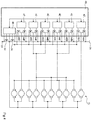
- the figure 4 is an example of application of the control circuit embodiments of figures 2 and 3 .
- the figure 4 represents an integrated circuit chip 40 and motors 51.
- the engines are for example car engines for opening and closing windows, doors or trunk, etc.
- the chip 40 comprises six stages 42 each providing the control signal of a transistor 44 (44A, 44B, 44C, 44D, 44E, 44F) and a transistor 46 (46A, 46B, 46C, 46D, 46E, 46F).
- Transistors 44 and 46 constitute the first and second H-bridge switches. Each pair of transistors 44 and 46 is connected in series between a first (56) and a second (57) terminal for applying a supply voltage. , as has been described in connection with the figure 1 .
- the chip 40 furthermore comprises a stage 48 supplying the control signal of a transistor 50 and a transistor 54.
- the transistors 52 and 54 constitute the third and fourth switches common to all the H-bridges.
- transistors 50 and 54 are connected in series between a first (56) and a second (57) terminals for applying a supply voltage, as has been described in connection with the figure 1 .
- Transistors 44 and 46 are transistors in the integrated circuit.
- Transistors 50 and 54 are transistors external to the integrated circuit. Indeed, the transistors 50 and 54 being common to all the H bridges, they must dissipate more heat than each set of two transistors 44 and 46. Transistors external to the integrated circuit can more easily dissipate the heat of all the H. bridges.
- the H-bridge comprising the transistors 44A and 46A and the one comprising the transistors 44F and 46F are in parallel with no other bridge and their respective load is a single motor.
- the node between the transistors 44B and 46B, and that between the transistors 44C and 46C, are connected and the two corresponding H bridges are in parallel.
- the common load of these two bridges in parallel comprises five motors.
- H bridges including transistors 44D, 46D, 44E and 46E are also in parallel and their common load comprises three motors.
- An advantage of the embodiments described above is that the risk of reaching the temperature limit or overcurrent of one of the bridges and thus to stop the system is lower.
- figures 2 and 3 represent control circuits comprising three stages, the number of stages, and therefore sets of transistors controlled by the control circuit, may be other than three.
- the number of floors is preferably greater than two.
- the number of stages can be between two and six.
- control circuits described control transistors constituting H bridges are nevertheless adaptable to circuits controlling any structure of parallel transistors internal or external to the integrated circuit.
- An embodiment in which terminal 14 ( figure 1 ) is connected to ground, to a power source or to another circuit is also possible.
Landscapes
- Engineering & Computer Science (AREA)
- Physics & Mathematics (AREA)
- General Physics & Mathematics (AREA)
- Automation & Control Theory (AREA)
- Electromagnetism (AREA)
- Radar, Positioning & Navigation (AREA)
- Power Engineering (AREA)
- Amplifiers (AREA)
- Electronic Switches (AREA)
- Continuous-Control Power Sources That Use Transistors (AREA)
- Control Of Direct Current Motors (AREA)
Abstract
Description
- La présente description concerne le domaine des circuits de commande et plus particulièrement les circuits de commande d'interrupteurs de puissance connectés en parallèle.
- Un pont en H est une structure électronique servant à commander la polarité aux bornes d'un dipôle, constituant la charge et représentant la branche du pont. Le pont est composé de quatre éléments de commutation. Plus précisément, une première borne de la charge est couplée à une première borne d'application d'un potentiel par un premier interrupteur et à une seconde borne d'application d'un potentiel par un deuxième interrupteur. Similairement, la seconde borne du dipôle est couplée à la première borne par un troisième interrupteur et à la seconde borne par un quatrième interrupteur.
- Cette structure se retrouve dans de nombreuses applications de l'électronique de puissance incluant la commande des moteurs, les convertisseurs et hacheurs, les onduleurs, etc.
- Un mode de réalisation prévoit un circuit de commande d'au moins deux ensembles de transistors comprenant chacun un premier transistor et un deuxième transistor reliés en série entre des première et deuxième bornes d'alimentation, le courant du point milieu de chaque ensemble de transistors en série étant régulé selon la différence entre la somme de valeurs représentatives des courants des points milieu de tous les ensembles et la somme de valeurs de consigne affectées aux ensembles.
- Selon la revendication, les courants des points milieu sont régulés de manière à être sensiblement identiques.
- Selon la revendication, les grilles de chaque ensemble de transistors sont reliées à un étage comprenant un sommateur et un dispositif de mesure d'une valeur représentative du courant du point milieu de l'ensemble de transistors correspondant.
- Selon la revendication, un des étages comprend un correcteur recevant en entrée ladite différence.
- Selon la revendication, le correcteur est un correcteur proportionnel intégral.
- Selon la revendication, la sortie du correcteur recevant ladite différence est fournie à la grille d'au moins un des transistors de chaque ensemble de transistors.
- Selon la revendication, l'autre transistor de l'ensemble est commandé pour avoir l'état inverse.
- Selon la revendication, le circuit de commande est un circuit intégré.
- Selon la revendication, au moins une partie des transistors en parallèle fait partie du circuit intégré.
- Selon la revendication, chaque transistor fait partie d'un pont en H.
- Selon la revendication, des transistors de chaque pont en H sont externes au circuit intégré.
- Selon la revendication, les consignes des étages sont identiques.
- Selon la revendication, le circuit comprend entre deux et six étages.
- Un autre mode de réalisation prévoit une puce comprenant au moins un circuit de commande selon l'une quelconque des revendications 1 à 13.
- Ces caractéristiques et avantages, ainsi que d'autres, seront exposés en détail dans la description suivante de modes de réalisation particuliers faite à titre non limitatif en relation avec les figures jointes parmi lesquelles :
- la
figure 1 illustre, schématiquement, une charge connectée dans la branche de trois ponts en H en parallèle ; - la
figure 2 illustre, schématiquement et partiellement, un mode de réalisation d'un circuit de commande d'un étage des ponts de lafigure 1 ; - la
figure 3 illustre, schématiquement et partiellement, un autre mode de réalisation d'un circuit de commande d'un étage des ponts de lafigure 1 ; et - la
figure 4 illustre un exemple d'application des modes de réalisation desfigures 2 et3 . - De mêmes éléments ont été désignés par de mêmes références dans les différentes figures. Par souci de clarté, seuls les éléments utiles à la compréhension des modes de réalisation décrits ont été représentés et sont détaillés. En particulier, les circuits de commande comprennent divers éléments, par exemple des circuits logiques, un microprocesseur, etc., qui ne seront pas détaillés.
- Dans la description qui suit, lorsque l'on fait référence à des qualificatifs de position absolue, tels que les termes "avant", "arrière", "haut", "bas", "gauche", "droite", etc., ou relative, tels que les termes "dessus", "dessous", "supérieur", "inférieur", etc., ou à des qualificatifs d'orientation, tels que les termes "horizontal", "vertical", etc., il est fait référence à l'orientation des éléments concernés dans les figures.
- Sauf précision contraire, les expressions "approximativement", "sensiblement", et "de l'ordre de" signifient à 10 % près, de préférence à 5 % près.
- Sauf précision contraire, lorsque l'on fait référence à deux éléments connectés entre eux, cela signifie que ces éléments sont directement connectés sans élément intermédiaire autre que des conducteurs, et lorsque l'on fait référence à deux éléments reliés ou couplés entre eux, cela signifie que ces deux éléments peuvent être directement reliés (connectés) ou reliés par l'intermédiaire d'un ou plusieurs autres éléments.
- La
figure 1 illustre, schématiquement, un dipôle constituant une charge 10. La charge 10, par exemple un moteur, comprend une borne 12 et une borne 14. La charge 10 est située dans la branche de trois ponts en H en parallèle. - Chaque pont en H comprend un premier (1A, 1B ou 1C) et un deuxième (2A, 2B et 2C) interrupteurs connectés en série entre une première (15) et une seconde (17) bornes d'application d'une tension d'alimentation, le potentiel de la première borne 15 étant supérieur à celui de la deuxième borne 17. Chaque couple, ou paire de premier et deuxième interrupteurs d'un pont en H constitue un ensemble 16A, 16B ou 16C. Les trois ponts comprennent, de plus, des troisième 3 et quatrième 4 interrupteurs, constituant un ensemble 16D, commun aux trois ponts. Les troisième et quatrième interrupteurs sont connectés en série entre les bornes 15 et 17. Les premiers et troisième interrupteurs sont connectés à la première borne 15 et les deuxièmes et quatrième interrupteurs sont connectés à la seconde borne 17.
- Dans la présente description, on considère que la tension entre les bornes 15 et 17 est une tension positive référencée à la masse (borne 17). Cependant, il est par exemple possible que la tension soit une tension négative référencée à la masse (borne 15).
- La borne 12 de la charge 10 est couplée aux points milieu des premiers et deuxièmes interrupteurs des trois ponts en H. La borne 14 de la charge 10 est couplée au point milieu des troisième 3 et quatrième 4 interrupteurs communs à tous les ponts en H en parallèle.
- Dans l'exemple de la
figure 1 , chaque interrupteur de chaque ensemble 16A, 16B, 16C et 16D est un transistor. - Les transistors de chaque ensemble 16A, 16B, 16C ou 16D sont respectivement commandés par un étage 18A, 18B, 18C ou 18D. Les étages 18A, 18B, 18C fournissent en sortie un signal de commande au transistor 1A, 1B ou 1C, connecté à la borne 15, et au transistor 2A, 2B ou 2C, connecté à la borne 17. Les deux transistors d'un même ensemble 16A, 16B ou 16C sont configurés de manière à être dans des états inverses. Ainsi, lorsque l'un des deux est passant, l'autre est bloquant. De même, l'étage 18D fournit en sortie un signal de commande au transistor 3, connecté à la borne 15, et au transistor 4, connecté à la borne 17.
- Les transistors des ensembles 16A, 16B et 16C peuvent être commandés de diverses manières connues, par exemple en modulation de largeur d'impulsion (PWM), ou en modulation de fréquence (PFM), ou en modulation linéaire de tension de grille.
- Une telle structure permet d'augmenter le courant fourni à la charge 10 tout en minimisant la dissipation de chaleur et la résistance équivalente à l'état passant dans le commutateur.
- Cependant, il est préférable que les commandes des transistors ayant des fonctions similaires dans les trois ponts, par exemple les transistors 1A, 1B et 1C ou les transistors 2A, 2B et 2C, soient identiques, c'est-à-dire par exemple que les sorties des étages 18A, 18B et 18C soient identiques. Si au moins un des signaux de commande est suffisamment élevé, la limite de température ou de surintensité de courant de l'un des ponts peut être atteinte et le système peut s'arrêter alors que la limite sur l'ensemble des transistors n'est pas atteinte, les autres signaux ayant une valeur suffisamment faible. Une telle différence entre les signaux de commande de deux transistors est par exemple causée par des variations de certaines caractéristiques (tension de seuil, gain, capacités intrinsèques, résistance à l'état passant, température de fonctionnement, courant individuel de protection, etc.) des composants du circuit de commande.
- La
figure 2 illustre, schématiquement et partiellement, un mode de réalisation d'un circuit de commande commandant les ensembles 16A, 16B et 16C. - Chaque étage 18A, 18B et 18C comprend une boucle de rétroaction dont la sortie est le point milieu des transistors de l'ensemble 16A, 16B ou 16C correspondant.
- Chacun des courants IoutA, IoutB, IoutC, c'est-à-dire les courants des points milieu des ensembles 16A, 16B et 16C, est mesuré par un dispositif de mesure 21A, 21B ou 21C qui fournit une valeur représentative du courant IoutA, IoutB, ou IoutC correspondant. Cette valeur est ensuite soustraite, par un sommateur 23A, 23B ou 23C, à une valeur de consigne (IinA, IinB, IinC) affectée à cet ensemble de transistors de manière à obtenir l'erreur eA, eB ou eC de l'étage.
- Les erreurs eA, eB et eC sont ensuite additionnées, par des sommateurs 25, par exemple situé dans l'étage 18A, de manière à obtenir une erreur totale E. Cette erreur E est fournie à un correcteur de l'un des étages. Dans l'exemple de la
figure 2 , ce correcteur est un correcteur 24A de l'étage 18A. Le correcteur 24A est par exemple un correcteur proportionnel-intégral ou un correcteur proportionnel-intégral-dérivé. - La sortie du correcteur 24A fournit directement le signal de commande des ensembles 16A, 16B et 16C. Les transistors des ensembles 16A, 16B et 16C, sensiblement identiques, reçoivent donc en entrée le même signal. Eventuellement, un des transistors de chaque ensemble 16A, 16B et 16C peut recevoir le signal de commande par l'intermédiaire d'un circuit configuré pour que ce transistor ait l'état inverse de l'autre transistor du même ensemble. Les courants IoutA, IoutB et IoutC sont ainsi sensiblement identiques. Cela permet donc d'éviter les déséquilibres en termes de puissance dissipée dans chacun des ensembles de transistors 16A, 16B et 16C. Cela a aussi pour avantage d'éviter qu'un étage s'approche du seuil de température ou de surintensité à partir duquel le système s'éteint. Ainsi, la somme des courants fournie à la charge peut être supérieure. En effet, il n'est pas besoin de maintenir une aussi grande marge entre les valeurs des courants et le seuil.
- Additionnellement, les étages 18B et 18C peuvent aussi comprendre des correcteurs 24B et 24C, représentés en pointillés, pouvant être similaires au correcteur 24A. Les étages 18A, 18B et 18C peuvent aussi comprendre des interrupteurs, non représentés, entre les correcteurs 24B et 24C et les sommateurs 23B et 23C et entre les étages 18B et 18C, d'une part et 18A d'autre part. Ainsi, il est possible de choisir si l'on souhaite que les étages 18A, 18B et 18C régulent chacun le courant du point milieu de l'ensemble de transistors correspondant de manière indépendante selon la sortie de leur propre correcteur recevant en entrée une erreur eA, eB ou eC ou que lesdits courants soient régulées ensemble selon la sortie d'un unique correcteur recevant en entrée l'erreur totale E. Il est aussi possible de choisir de réguler certains étages indépendamment et d'en réguler d'autres ensemble.
- La
figure 3 illustre, schématiquement et partiellement, un autre mode de réalisation d'un circuit de commande. Comme lafigure 2 , lafigure 3 représente les étages 18A, 18B et 18C. Chaque étage 18A, 18B et 18C comprend, comme enfigure 2 , une boucle rétroactive dans laquelle une valeur représentative du courant IoutA, IoutB ou IoutC du point milieu des transistors de l'ensemble 16A, 16B ou 16C peut être soustraite à une valeur de consigne IinA, IinB ou IinC. Chaque étage 18A, 18B et 18C comprend donc le dispositif de mesure 21A, 21B ou 21C mesurant la valeur représentative du courant IoutA, IoutB ou IoutC, le sommateur 23A, 23B ou 23C, et le correcteur 24A, 24B ou 24C. - Les valeurs des consignes des étages 18A, 18B et 18C sont additionnées, par des sommateurs 27, de manière à obtenir une valeur E+. Les valeurs représentatives du courant IoutA, IoutB ou IoutC mesuré à chaque étage sont additionnées par des sommateurs 29 de manière à obtenir une valeur E-. On soustrait, par le sommateur 23A, la valeur E- à la valeur E+. Le résultat obtenu de cette manière est l'erreur totale E. Cette erreur E correspond à l'erreur E de la
figure 2 . Cette erreur E est fournie au correcteur 24A de l'étage 18A, dont la sortie est la commande des ensembles 16A, 16B et 16C. Les courants IoutA, IoutB et IoutC sont ainsi régulés, selon l'erreur totale E, de manière à être sensiblement identiques. - De même que précédemment, le circuit de commande peut comprendre des interrupteurs, non représentés, entre les différents étages du circuit et entre les correcteurs 24B et 24C, d'une part, et les sommateurs 23B et 23C d'autre part. Ainsi, comme cela est décrit en relation avec la
figure 2 , il est possible pour les différents étages d'agir indépendamment les uns des autres, ou d'être tous régulés selon la sortie du correcteur 24A. - Dans le mode de réalisation de la
figure 2 ou celui de lafigure 3 , les consignes des étages d'un circuit de commande peuvent être sensiblement identiques. A titre de variante, les consignes des étages d'un circuit de commande peuvent être différentes les unes des autres. Leur somme est cependant égale à la somme des valeurs des courants IoutA, IoutB, et IoutC, sensiblement identiques, voulue. - La
figure 4 est un exemple d'application des modes de réalisation de circuits de commande desfigures 2 et3 . - La
figure 4 représente une puce de circuit intégré 40 et des moteurs 51. Les moteurs sont par exemple des moteurs de voiture permettant l'ouverture et la fermeture des fenêtres, des portes ou du coffre, etc. - La puce 40 comprend six étages 42 fournissant chacun le signal de commande d'un transistor 44 (44A, 44B, 44C, 44D, 44E, 44F) et d'un transistor 46 (46A, 46B, 46C, 46D, 46E, 46F). Les transistors 44 et 46 constituent les premiers et deuxièmes interrupteurs de ponts en H. Chaque couple de transistors 44 et 46 est connecté en série entre une première (56) et une seconde (57) bornes d'application d'une tension d'alimentation, comme cela a été décrit en relation avec la
figure 1 . - La puce 40 comprend, de plus, un étage 48 fournissant le signal de commande d'un transistor 50 et d'un transistor 54. Les transistors 52 et 54 constituent les troisième et quatrième interrupteurs communs à l'ensemble des ponts en H. Les transistors 50 et 54 sont connectés en série entre une première (56) et une seconde (57) bornes d'application d'une tension d'alimentation, comme cela a été décrit en relation avec la
figure 1 . - Les transistors 44 et 46 sont des transistors situés dans le circuit intégré. Les transistors 50 et 54 sont des transistors externes au circuit intégré. En effet, les transistors 50 et 54 étant communs à tous les ponts en H, ils doivent dissiper plus de chaleur que chaque ensemble de deux transistors 44 et 46. Des transistors externes au circuit intégré peuvent plus facilement dissiper la chaleur de l'ensemble des ponts en H.
- Le pont en H comprenant les transistors 44A et 46A et celui comprenant les transistors 44F et 46F ne sont en parallèle avec aucun autre pont et leur charge respective est un unique moteur.
- Le noeud entre les transistors 44B et 46B, et celui entre les transistors 44C et 46C, sont connectés et les deux ponts en H correspondants sont en parallèle. La charge commune de ces deux ponts en parallèle comprend cinq moteurs.
- Les ponts en H comprenant les transistors 44D, 46D, 44E et 46E sont aussi en parallèle et leur charge commune comprend trois moteurs.
- Un avantage des modes de réalisation décrits précédemment est que le risque d'atteindre la limite de température ou de surintensité de courant de l'un des ponts et donc d'arrêter le système est moindre.
- Des modes de réalisation particuliers ont été décrits. Diverses variantes et modifications apparaîtront à l'homme de l'art. En particulier, bien que les
figures 2 et3 représentent des circuits de commande comprenant trois étages, le nombre d'étages, et donc d'ensembles de transistors commandés par le circuit de commande, peut être autre que trois. Le nombre d'étages est de préférence supérieur à deux. Par exemple, le nombre d'étages peut être compris entre deux et six. - De plus, bien que les circuits de commande décrits commandent des transistors constituant des ponts en H, les modes de réalisation décrits sont néanmoins adaptables à des circuits commandant n'importe quelle structure de transistors en parallèle interne ou externe au circuit intégré. Un mode de réalisation dans lequel la borne 14 (
figure 1 ) est reliée à la masse, à une source d'alimentation ou à un autre circuit est également possible. - Divers modes de réalisation avec diverses variantes ont été décrits ci-dessus. On notera que l'homme de l'art pourra combiner divers éléments de ces divers modes de réalisation et variantes sans faire preuve d'activité inventive.
Claims (14)
- Circuit de commande d'au moins deux ensembles (16A, 16B, 16C) de transistors comprenant chacun un premier transistor (1A, 1B, 1C) et un deuxième transistor (2A, 2B, 2C) reliés en série entre des première (15, 56) et deuxième (17, 57) bornes d'alimentation, le courant du point milieu (IoutA, IoutB, IoutC) de chaque ensemble de transistors en série étant régulé selon la différence entre la somme des valeurs représentatives des courants des points milieu de tous les ensembles et la somme de valeurs de consigne (IinA, IinB, IinC) affectées aux ensembles.
- Circuit selon la revendication 1, dans lequel les courants des points milieu sont régulés de manière à être sensiblement identiques.
- Circuit selon la revendication 1 ou 2, dans lequel les grilles de chaque ensemble de transistors sont reliées à un étage comprenant un sommateur (23) et un dispositif de mesure (21) d'une valeur représentative du courant du point milieu de l'ensemble de transistors correspondant.
- Circuit selon la revendication 3, dans lequel un des étages comprend un correcteur (24A) recevant en entrée ladite différence.
- Circuit selon la revendication 4, dans lequel le correcteur est un correcteur proportionnel intégral.
- Circuit selon la revendication 4 ou 5, dans lequel la sortie du correcteur recevant ladite différence est fournie à la grille d'au moins un des transistors de chaque ensemble de transistors.
- Circuit selon la revendication 6, dans lequel l'autre transistor de l'ensemble est commandé pour avoir l'état inverse.
- Circuit selon l'une quelconque des revendications 1 à 7, dans lequel le circuit de commande est un circuit intégré.
- Circuit selon la revendication 8, dans lequel au moins une partie des transistors en parallèle fait partie du circuit intégré.
- Circuit selon l'une quelconque des revendications 1 à 9, dans lequel chaque transistor fait partie d'un pont en H.
- Circuit selon la revendication 10, dans lequel des transistors de chaque pont en H sont externes au circuit intégré.
- Circuit selon l'une quelconque des revendications 1 à 11, dans lequel les consignes des étages sont identiques.
- Circuit selon l'une quelconque des revendications 1 à 12, dans lequel le circuit comprend entre deux et six étages.
- Puce comprenant au moins un circuit de commande selon l'une quelconque des revendications 1 à 13.
Applications Claiming Priority (1)
| Application Number | Priority Date | Filing Date | Title |
|---|---|---|---|
| FR1851699A FR3078415B1 (fr) | 2018-02-27 | 2018-02-27 | Circuit de commande d'interrupteurs de puissance |
Publications (2)
| Publication Number | Publication Date |
|---|---|
| EP3531228A1 true EP3531228A1 (fr) | 2019-08-28 |
| EP3531228B1 EP3531228B1 (fr) | 2024-03-27 |
Family
ID=62222933
Family Applications (1)
| Application Number | Title | Priority Date | Filing Date |
|---|---|---|---|
| EP19159837.4A Active EP3531228B1 (fr) | 2018-02-27 | 2019-02-27 | Circuit de commande d'interrupteurs de puissance |
Country Status (3)
| Country | Link |
|---|---|
| US (2) | US10560092B2 (fr) |
| EP (1) | EP3531228B1 (fr) |
| FR (1) | FR3078415B1 (fr) |
Cited By (1)
| Publication number | Priority date | Publication date | Assignee | Title |
|---|---|---|---|---|
| CN111722527A (zh) * | 2020-07-07 | 2020-09-29 | 电子科技大学 | 一种基于模糊自适应pid的通用可配置数字控制芯片 |
Families Citing this family (2)
| Publication number | Priority date | Publication date | Assignee | Title |
|---|---|---|---|---|
| FR3078415B1 (fr) | 2018-02-27 | 2021-09-17 | St Microelectronics Srl | Circuit de commande d'interrupteurs de puissance |
| US10917086B2 (en) * | 2019-05-13 | 2021-02-09 | Stmicroelectronics (Shenzhen) R&D Co. Ltd. | Back-to-back power switch controller |
Citations (1)
| Publication number | Priority date | Publication date | Assignee | Title |
|---|---|---|---|---|
| US20140346864A1 (en) * | 2011-12-22 | 2014-11-27 | Valeo Equipements Electriques Moteur | Device for maintaining voltage during startup for a motor vehicle |
Family Cites Families (9)
| Publication number | Priority date | Publication date | Assignee | Title |
|---|---|---|---|---|
| US6256215B1 (en) * | 2000-08-10 | 2001-07-03 | Delphi Technologies, Inc. | Multiple output bootstrapped gate drive circuit |
| US8680895B2 (en) * | 2010-10-08 | 2014-03-25 | Texas Instruments Incorporated | Controlling power chain with same controller in either of two different applications |
| JP5344264B2 (ja) * | 2011-08-09 | 2013-11-20 | 株式会社デンソー | 電力変換装置 |
| JP5500191B2 (ja) * | 2012-03-05 | 2014-05-21 | 株式会社デンソー | スイッチング素子の駆動装置 |
| US9509300B2 (en) * | 2013-05-24 | 2016-11-29 | Dialog Semiconductor Gmbh | Anti-shoot-through automatic multiple feedback gate drive control circuit |
| KR101983158B1 (ko) * | 2013-11-26 | 2019-05-28 | 삼성전기주식회사 | 게이트 구동 장치 및 이를 갖는 인버터 |
| KR102307925B1 (ko) * | 2014-06-25 | 2021-09-30 | 온세미컨덕터코리아 주식회사 | 온도 센서를 포함하는 양방향 송수신기 및 이를 포함하는 구동 회로 |
| JP6282331B1 (ja) * | 2016-10-31 | 2018-02-21 | 三菱電機株式会社 | 電力変換装置 |
| FR3078415B1 (fr) | 2018-02-27 | 2021-09-17 | St Microelectronics Srl | Circuit de commande d'interrupteurs de puissance |
-
2018
- 2018-02-27 FR FR1851699A patent/FR3078415B1/fr active Active
-
2019
- 2019-02-13 US US16/274,844 patent/US10560092B2/en active Active
- 2019-02-27 EP EP19159837.4A patent/EP3531228B1/fr active Active
- 2019-12-18 US US16/719,053 patent/US10917087B2/en active Active
Patent Citations (1)
| Publication number | Priority date | Publication date | Assignee | Title |
|---|---|---|---|---|
| US20140346864A1 (en) * | 2011-12-22 | 2014-11-27 | Valeo Equipements Electriques Moteur | Device for maintaining voltage during startup for a motor vehicle |
Cited By (2)
| Publication number | Priority date | Publication date | Assignee | Title |
|---|---|---|---|---|
| CN111722527A (zh) * | 2020-07-07 | 2020-09-29 | 电子科技大学 | 一种基于模糊自适应pid的通用可配置数字控制芯片 |
| CN111722527B (zh) * | 2020-07-07 | 2021-12-10 | 电子科技大学 | 一种基于模糊自适应pid的通用可配置数字控制芯片 |
Also Published As
| Publication number | Publication date |
|---|---|
| FR3078415A1 (fr) | 2019-08-30 |
| EP3531228B1 (fr) | 2024-03-27 |
| US10917087B2 (en) | 2021-02-09 |
| US10560092B2 (en) | 2020-02-11 |
| US20190267991A1 (en) | 2019-08-29 |
| US20200127660A1 (en) | 2020-04-23 |
| FR3078415B1 (fr) | 2021-09-17 |
Similar Documents
| Publication | Publication Date | Title |
|---|---|---|
| EP3531228B1 (fr) | Circuit de commande d'interrupteurs de puissance | |
| EP2870686B1 (fr) | Convertisseurs statiques modulaires à architecture parallèle ou série et à commande modulaire decentralisée | |
| EP2092643B1 (fr) | Element de pont redresseur synchrone, pont redresseur synchrone correspondant et utilisation | |
| EP3072208B1 (fr) | Equilibrage d'une batterie a deux branches avec mise en parallele de nombres differentiels d'elements de stockage | |
| WO2009156654A2 (fr) | Dispositif et procede de couplage de deux parties d'un reseau a courant continu notamment dans un aeronef | |
| EP3298686A1 (fr) | Système et procéd'e de dissipation de l'énergie électrique régénerée par des actionneurs | |
| EP3726731B1 (fr) | Circuit de commande de transistors | |
| FR3074976A1 (fr) | Batterie a accumulateurs commutes | |
| WO2017137692A1 (fr) | Dispositif et procede de commutation symetrique de charge dans un pont en h | |
| EP4358126A1 (fr) | Dispositif electronique | |
| EP4358125A1 (fr) | Transistor de puissance | |
| EP3086437B1 (fr) | Chargeur de batterie, installation électrique comportant un tel chargeur de batterie et véhicule automobile comportant une telle installation électrique | |
| EP3648134B1 (fr) | Dispositif d'interconnexion d'appareils de coupure d'un courant électrique | |
| EP3608960A1 (fr) | Circuit de commande de bras d'onduleur | |
| EP4517473B1 (fr) | Régulateur de tension | |
| FR3157986A1 (fr) | Systeme de conversion electrique modulaire et engin de mobilite comportant un tel systeme | |
| EP3888217B1 (fr) | Système intégrant une solution de reconfiguration de connexion d'un dispositif de contrôle de flux de puissance dans un réseau maillé | |
| EP3961924A1 (fr) | Dispositif de commande d'une diode oft | |
| WO2018065927A1 (fr) | Circuit de decharge d'un système electrique haute tension | |
| WO2025022351A1 (fr) | Système et procédé d'alimentation pour moteur électrique multi-phasé | |
| EP4358406A2 (fr) | Circuit de protection contre les surchauffes | |
| EP4068601A1 (fr) | Convertisseur de tension isolé | |
| FR3069988A1 (fr) | Element redresseur et convertisseur de tension comprenant un tel element | |
| FR3069987A1 (fr) | Element redresseur et convertisseur de tension comprenant un tel element | |
| FR3156615A1 (fr) | Convertisseur statique de puissance configuré pour mesurer une valeur d’une inductance de filtrage |
Legal Events
| Date | Code | Title | Description |
|---|---|---|---|
| PUAI | Public reference made under article 153(3) epc to a published international application that has entered the european phase |
Free format text: ORIGINAL CODE: 0009012 |
|
| STAA | Information on the status of an ep patent application or granted ep patent |
Free format text: STATUS: REQUEST FOR EXAMINATION WAS MADE |
|
| 17P | Request for examination filed |
Effective date: 20190227 |
|
| AK | Designated contracting states |
Kind code of ref document: A1 Designated state(s): AL AT BE BG CH CY CZ DE DK EE ES FI FR GB GR HR HU IE IS IT LI LT LU LV MC MK MT NL NO PL PT RO RS SE SI SK SM TR |
|
| AX | Request for extension of the european patent |
Extension state: BA ME |
|
| STAA | Information on the status of an ep patent application or granted ep patent |
Free format text: STATUS: EXAMINATION IS IN PROGRESS |
|
| 17Q | First examination report despatched |
Effective date: 20211201 |
|
| RIC1 | Information provided on ipc code assigned before grant |
Ipc: H02M 7/493 20070101ALI20230626BHEP Ipc: G05F 1/618 20060101ALI20230626BHEP Ipc: G05F 1/56 20060101AFI20230626BHEP |
|
| GRAP | Despatch of communication of intention to grant a patent |
Free format text: ORIGINAL CODE: EPIDOSNIGR1 |
|
| STAA | Information on the status of an ep patent application or granted ep patent |
Free format text: STATUS: GRANT OF PATENT IS INTENDED |
|
| INTG | Intention to grant announced |
Effective date: 20231122 |
|
| GRAS | Grant fee paid |
Free format text: ORIGINAL CODE: EPIDOSNIGR3 |
|
| GRAA | (expected) grant |
Free format text: ORIGINAL CODE: 0009210 |
|
| STAA | Information on the status of an ep patent application or granted ep patent |
Free format text: STATUS: THE PATENT HAS BEEN GRANTED |
|
| AK | Designated contracting states |
Kind code of ref document: B1 Designated state(s): AL AT BE BG CH CY CZ DE DK EE ES FI FR GB GR HR HU IE IS IT LI LT LU LV MC MK MT NL NO PL PT RO RS SE SI SK SM TR |
|
| REG | Reference to a national code |
Ref country code: GB Ref legal event code: FG4D Free format text: NOT ENGLISH |
|
| REG | Reference to a national code |
Ref country code: CH Ref legal event code: EP |
|
| REG | Reference to a national code |
Ref country code: DE Ref legal event code: R096 Ref document number: 602019048878 Country of ref document: DE |
|
| REG | Reference to a national code |
Ref country code: IE Ref legal event code: FG4D Free format text: LANGUAGE OF EP DOCUMENT: FRENCH |
|
| PG25 | Lapsed in a contracting state [announced via postgrant information from national office to epo] |
Ref country code: LT Free format text: LAPSE BECAUSE OF FAILURE TO SUBMIT A TRANSLATION OF THE DESCRIPTION OR TO PAY THE FEE WITHIN THE PRESCRIBED TIME-LIMIT Effective date: 20240327 |
|
| REG | Reference to a national code |
Ref country code: LT Ref legal event code: MG9D |
|
| PG25 | Lapsed in a contracting state [announced via postgrant information from national office to epo] |
Ref country code: GR Free format text: LAPSE BECAUSE OF FAILURE TO SUBMIT A TRANSLATION OF THE DESCRIPTION OR TO PAY THE FEE WITHIN THE PRESCRIBED TIME-LIMIT Effective date: 20240628 |
|
| PG25 | Lapsed in a contracting state [announced via postgrant information from national office to epo] |
Ref country code: RS Free format text: LAPSE BECAUSE OF FAILURE TO SUBMIT A TRANSLATION OF THE DESCRIPTION OR TO PAY THE FEE WITHIN THE PRESCRIBED TIME-LIMIT Effective date: 20240627 Ref country code: HR Free format text: LAPSE BECAUSE OF FAILURE TO SUBMIT A TRANSLATION OF THE DESCRIPTION OR TO PAY THE FEE WITHIN THE PRESCRIBED TIME-LIMIT Effective date: 20240327 |
|
| PG25 | Lapsed in a contracting state [announced via postgrant information from national office to epo] |
Ref country code: RS Free format text: LAPSE BECAUSE OF FAILURE TO SUBMIT A TRANSLATION OF THE DESCRIPTION OR TO PAY THE FEE WITHIN THE PRESCRIBED TIME-LIMIT Effective date: 20240627 Ref country code: NO Free format text: LAPSE BECAUSE OF FAILURE TO SUBMIT A TRANSLATION OF THE DESCRIPTION OR TO PAY THE FEE WITHIN THE PRESCRIBED TIME-LIMIT Effective date: 20240627 Ref country code: LT Free format text: LAPSE BECAUSE OF FAILURE TO SUBMIT A TRANSLATION OF THE DESCRIPTION OR TO PAY THE FEE WITHIN THE PRESCRIBED TIME-LIMIT Effective date: 20240327 Ref country code: HR Free format text: LAPSE BECAUSE OF FAILURE TO SUBMIT A TRANSLATION OF THE DESCRIPTION OR TO PAY THE FEE WITHIN THE PRESCRIBED TIME-LIMIT Effective date: 20240327 Ref country code: GR Free format text: LAPSE BECAUSE OF FAILURE TO SUBMIT A TRANSLATION OF THE DESCRIPTION OR TO PAY THE FEE WITHIN THE PRESCRIBED TIME-LIMIT Effective date: 20240628 Ref country code: FI Free format text: LAPSE BECAUSE OF FAILURE TO SUBMIT A TRANSLATION OF THE DESCRIPTION OR TO PAY THE FEE WITHIN THE PRESCRIBED TIME-LIMIT Effective date: 20240327 Ref country code: BG Free format text: LAPSE BECAUSE OF FAILURE TO SUBMIT A TRANSLATION OF THE DESCRIPTION OR TO PAY THE FEE WITHIN THE PRESCRIBED TIME-LIMIT Effective date: 20240327 |
|
| REG | Reference to a national code |
Ref country code: NL Ref legal event code: MP Effective date: 20240327 |
|
| PG25 | Lapsed in a contracting state [announced via postgrant information from national office to epo] |
Ref country code: SE Free format text: LAPSE BECAUSE OF FAILURE TO SUBMIT A TRANSLATION OF THE DESCRIPTION OR TO PAY THE FEE WITHIN THE PRESCRIBED TIME-LIMIT Effective date: 20240327 Ref country code: LV Free format text: LAPSE BECAUSE OF FAILURE TO SUBMIT A TRANSLATION OF THE DESCRIPTION OR TO PAY THE FEE WITHIN THE PRESCRIBED TIME-LIMIT Effective date: 20240327 |
|
| PG25 | Lapsed in a contracting state [announced via postgrant information from national office to epo] |
Ref country code: NL Free format text: LAPSE BECAUSE OF FAILURE TO SUBMIT A TRANSLATION OF THE DESCRIPTION OR TO PAY THE FEE WITHIN THE PRESCRIBED TIME-LIMIT Effective date: 20240327 |
|
| REG | Reference to a national code |
Ref country code: AT Ref legal event code: MK05 Ref document number: 1670518 Country of ref document: AT Kind code of ref document: T Effective date: 20240327 |
|
| PG25 | Lapsed in a contracting state [announced via postgrant information from national office to epo] |
Ref country code: NL Free format text: LAPSE BECAUSE OF FAILURE TO SUBMIT A TRANSLATION OF THE DESCRIPTION OR TO PAY THE FEE WITHIN THE PRESCRIBED TIME-LIMIT Effective date: 20240327 |
|
| PG25 | Lapsed in a contracting state [announced via postgrant information from national office to epo] |
Ref country code: IS Free format text: LAPSE BECAUSE OF FAILURE TO SUBMIT A TRANSLATION OF THE DESCRIPTION OR TO PAY THE FEE WITHIN THE PRESCRIBED TIME-LIMIT Effective date: 20240727 |
|
| PG25 | Lapsed in a contracting state [announced via postgrant information from national office to epo] |
Ref country code: SM Free format text: LAPSE BECAUSE OF FAILURE TO SUBMIT A TRANSLATION OF THE DESCRIPTION OR TO PAY THE FEE WITHIN THE PRESCRIBED TIME-LIMIT Effective date: 20240327 Ref country code: PT Free format text: LAPSE BECAUSE OF FAILURE TO SUBMIT A TRANSLATION OF THE DESCRIPTION OR TO PAY THE FEE WITHIN THE PRESCRIBED TIME-LIMIT Effective date: 20240729 |
|
| PG25 | Lapsed in a contracting state [announced via postgrant information from national office to epo] |
Ref country code: ES Free format text: LAPSE BECAUSE OF FAILURE TO SUBMIT A TRANSLATION OF THE DESCRIPTION OR TO PAY THE FEE WITHIN THE PRESCRIBED TIME-LIMIT Effective date: 20240327 |
|
| PG25 | Lapsed in a contracting state [announced via postgrant information from national office to epo] |
Ref country code: CZ Free format text: LAPSE BECAUSE OF FAILURE TO SUBMIT A TRANSLATION OF THE DESCRIPTION OR TO PAY THE FEE WITHIN THE PRESCRIBED TIME-LIMIT Effective date: 20240327 Ref country code: EE Free format text: LAPSE BECAUSE OF FAILURE TO SUBMIT A TRANSLATION OF THE DESCRIPTION OR TO PAY THE FEE WITHIN THE PRESCRIBED TIME-LIMIT Effective date: 20240327 |
|
| PG25 | Lapsed in a contracting state [announced via postgrant information from national office to epo] |
Ref country code: AT Free format text: LAPSE BECAUSE OF FAILURE TO SUBMIT A TRANSLATION OF THE DESCRIPTION OR TO PAY THE FEE WITHIN THE PRESCRIBED TIME-LIMIT Effective date: 20240327 |
|
| PG25 | Lapsed in a contracting state [announced via postgrant information from national office to epo] |
Ref country code: PL Free format text: LAPSE BECAUSE OF FAILURE TO SUBMIT A TRANSLATION OF THE DESCRIPTION OR TO PAY THE FEE WITHIN THE PRESCRIBED TIME-LIMIT Effective date: 20240327 |
|
| PG25 | Lapsed in a contracting state [announced via postgrant information from national office to epo] |
Ref country code: SK Free format text: LAPSE BECAUSE OF FAILURE TO SUBMIT A TRANSLATION OF THE DESCRIPTION OR TO PAY THE FEE WITHIN THE PRESCRIBED TIME-LIMIT Effective date: 20240327 |
|
| PG25 | Lapsed in a contracting state [announced via postgrant information from national office to epo] |
Ref country code: SM Free format text: LAPSE BECAUSE OF FAILURE TO SUBMIT A TRANSLATION OF THE DESCRIPTION OR TO PAY THE FEE WITHIN THE PRESCRIBED TIME-LIMIT Effective date: 20240327 Ref country code: SK Free format text: LAPSE BECAUSE OF FAILURE TO SUBMIT A TRANSLATION OF THE DESCRIPTION OR TO PAY THE FEE WITHIN THE PRESCRIBED TIME-LIMIT Effective date: 20240327 Ref country code: RO Free format text: LAPSE BECAUSE OF FAILURE TO SUBMIT A TRANSLATION OF THE DESCRIPTION OR TO PAY THE FEE WITHIN THE PRESCRIBED TIME-LIMIT Effective date: 20240327 Ref country code: PT Free format text: LAPSE BECAUSE OF FAILURE TO SUBMIT A TRANSLATION OF THE DESCRIPTION OR TO PAY THE FEE WITHIN THE PRESCRIBED TIME-LIMIT Effective date: 20240729 Ref country code: PL Free format text: LAPSE BECAUSE OF FAILURE TO SUBMIT A TRANSLATION OF THE DESCRIPTION OR TO PAY THE FEE WITHIN THE PRESCRIBED TIME-LIMIT Effective date: 20240327 Ref country code: IS Free format text: LAPSE BECAUSE OF FAILURE TO SUBMIT A TRANSLATION OF THE DESCRIPTION OR TO PAY THE FEE WITHIN THE PRESCRIBED TIME-LIMIT Effective date: 20240727 Ref country code: ES Free format text: LAPSE BECAUSE OF FAILURE TO SUBMIT A TRANSLATION OF THE DESCRIPTION OR TO PAY THE FEE WITHIN THE PRESCRIBED TIME-LIMIT Effective date: 20240327 Ref country code: EE Free format text: LAPSE BECAUSE OF FAILURE TO SUBMIT A TRANSLATION OF THE DESCRIPTION OR TO PAY THE FEE WITHIN THE PRESCRIBED TIME-LIMIT Effective date: 20240327 Ref country code: CZ Free format text: LAPSE BECAUSE OF FAILURE TO SUBMIT A TRANSLATION OF THE DESCRIPTION OR TO PAY THE FEE WITHIN THE PRESCRIBED TIME-LIMIT Effective date: 20240327 Ref country code: AT Free format text: LAPSE BECAUSE OF FAILURE TO SUBMIT A TRANSLATION OF THE DESCRIPTION OR TO PAY THE FEE WITHIN THE PRESCRIBED TIME-LIMIT Effective date: 20240327 |
|
| PG25 | Lapsed in a contracting state [announced via postgrant information from national office to epo] |
Ref country code: IT Free format text: LAPSE BECAUSE OF FAILURE TO SUBMIT A TRANSLATION OF THE DESCRIPTION OR TO PAY THE FEE WITHIN THE PRESCRIBED TIME-LIMIT Effective date: 20240327 |
|
| PG25 | Lapsed in a contracting state [announced via postgrant information from national office to epo] |
Ref country code: IT Free format text: LAPSE BECAUSE OF FAILURE TO SUBMIT A TRANSLATION OF THE DESCRIPTION OR TO PAY THE FEE WITHIN THE PRESCRIBED TIME-LIMIT Effective date: 20240327 |
|
| REG | Reference to a national code |
Ref country code: DE Ref legal event code: R097 Ref document number: 602019048878 Country of ref document: DE |
|
| PG25 | Lapsed in a contracting state [announced via postgrant information from national office to epo] |
Ref country code: DK Free format text: LAPSE BECAUSE OF FAILURE TO SUBMIT A TRANSLATION OF THE DESCRIPTION OR TO PAY THE FEE WITHIN THE PRESCRIBED TIME-LIMIT Effective date: 20240327 |
|
| PG25 | Lapsed in a contracting state [announced via postgrant information from national office to epo] |
Ref country code: DK Free format text: LAPSE BECAUSE OF FAILURE TO SUBMIT A TRANSLATION OF THE DESCRIPTION OR TO PAY THE FEE WITHIN THE PRESCRIBED TIME-LIMIT Effective date: 20240327 |
|
| PLBE | No opposition filed within time limit |
Free format text: ORIGINAL CODE: 0009261 |
|
| STAA | Information on the status of an ep patent application or granted ep patent |
Free format text: STATUS: NO OPPOSITION FILED WITHIN TIME LIMIT |
|
| 26N | No opposition filed |
Effective date: 20250103 |
|
| PG25 | Lapsed in a contracting state [announced via postgrant information from national office to epo] |
Ref country code: SI Free format text: LAPSE BECAUSE OF FAILURE TO SUBMIT A TRANSLATION OF THE DESCRIPTION OR TO PAY THE FEE WITHIN THE PRESCRIBED TIME-LIMIT Effective date: 20240327 |
|
| PG25 | Lapsed in a contracting state [announced via postgrant information from national office to epo] |
Ref country code: MC Free format text: LAPSE BECAUSE OF FAILURE TO SUBMIT A TRANSLATION OF THE DESCRIPTION OR TO PAY THE FEE WITHIN THE PRESCRIBED TIME-LIMIT Effective date: 20240327 |
|
| REG | Reference to a national code |
Ref country code: CH Ref legal event code: PL |
|
| PG25 | Lapsed in a contracting state [announced via postgrant information from national office to epo] |
Ref country code: LU Free format text: LAPSE BECAUSE OF NON-PAYMENT OF DUE FEES Effective date: 20250227 |
|
| PG25 | Lapsed in a contracting state [announced via postgrant information from national office to epo] |
Ref country code: CH Free format text: LAPSE BECAUSE OF NON-PAYMENT OF DUE FEES Effective date: 20250228 |
|
| GBPC | Gb: european patent ceased through non-payment of renewal fee |
Effective date: 20250227 |
|
| REG | Reference to a national code |
Ref country code: BE Ref legal event code: MM Effective date: 20250228 |
|
| PG25 | Lapsed in a contracting state [announced via postgrant information from national office to epo] |
Ref country code: GB Free format text: LAPSE BECAUSE OF NON-PAYMENT OF DUE FEES Effective date: 20250227 |
|
| PG25 | Lapsed in a contracting state [announced via postgrant information from national office to epo] |
Ref country code: FR Free format text: LAPSE BECAUSE OF NON-PAYMENT OF DUE FEES Effective date: 20250228 |
|
| PG25 | Lapsed in a contracting state [announced via postgrant information from national office to epo] |
Ref country code: BE Free format text: LAPSE BECAUSE OF NON-PAYMENT OF DUE FEES Effective date: 20250228 |
|
| PG25 | Lapsed in a contracting state [announced via postgrant information from national office to epo] |
Ref country code: IE Free format text: LAPSE BECAUSE OF NON-PAYMENT OF DUE FEES Effective date: 20250227 |
|
| PGFP | Annual fee paid to national office [announced via postgrant information from national office to epo] |
Ref country code: DE Payment date: 20260121 Year of fee payment: 8 |