EP3530771A1 - Ultra-high-strength steel sheet having excellent hole expandability and yield ratio and method for preparing same - Google Patents
Ultra-high-strength steel sheet having excellent hole expandability and yield ratio and method for preparing same Download PDFInfo
- Publication number
- EP3530771A1 EP3530771A1 EP17865881.1A EP17865881A EP3530771A1 EP 3530771 A1 EP3530771 A1 EP 3530771A1 EP 17865881 A EP17865881 A EP 17865881A EP 3530771 A1 EP3530771 A1 EP 3530771A1
- Authority
- EP
- European Patent Office
- Prior art keywords
- less
- excluding
- steel sheet
- ultra
- yield ratio
- Prior art date
- Legal status (The legal status is an assumption and is not a legal conclusion. Google has not performed a legal analysis and makes no representation as to the accuracy of the status listed.)
- Granted
Links
Images


Classifications
-
- C—CHEMISTRY; METALLURGY
- C21—METALLURGY OF IRON
- C21D—MODIFYING THE PHYSICAL STRUCTURE OF FERROUS METALS; GENERAL DEVICES FOR HEAT TREATMENT OF FERROUS OR NON-FERROUS METALS OR ALLOYS; MAKING METAL MALLEABLE, e.g. BY DECARBURISATION OR TEMPERING
- C21D8/00—Modifying the physical properties of ferrous metals or ferrous alloys by deformation combined with, or followed by, heat treatment
- C21D8/02—Modifying the physical properties of ferrous metals or ferrous alloys by deformation combined with, or followed by, heat treatment during manufacturing of plates or strips
- C21D8/0247—Modifying the physical properties of ferrous metals or ferrous alloys by deformation combined with, or followed by, heat treatment during manufacturing of plates or strips characterised by the heat treatment
-
- C—CHEMISTRY; METALLURGY
- C21—METALLURGY OF IRON
- C21D—MODIFYING THE PHYSICAL STRUCTURE OF FERROUS METALS; GENERAL DEVICES FOR HEAT TREATMENT OF FERROUS OR NON-FERROUS METALS OR ALLOYS; MAKING METAL MALLEABLE, e.g. BY DECARBURISATION OR TEMPERING
- C21D6/00—Heat treatment of ferrous alloys
- C21D6/005—Heat treatment of ferrous alloys containing Mn
-
- C—CHEMISTRY; METALLURGY
- C21—METALLURGY OF IRON
- C21D—MODIFYING THE PHYSICAL STRUCTURE OF FERROUS METALS; GENERAL DEVICES FOR HEAT TREATMENT OF FERROUS OR NON-FERROUS METALS OR ALLOYS; MAKING METAL MALLEABLE, e.g. BY DECARBURISATION OR TEMPERING
- C21D8/00—Modifying the physical properties of ferrous metals or ferrous alloys by deformation combined with, or followed by, heat treatment
- C21D8/02—Modifying the physical properties of ferrous metals or ferrous alloys by deformation combined with, or followed by, heat treatment during manufacturing of plates or strips
-
- C—CHEMISTRY; METALLURGY
- C21—METALLURGY OF IRON
- C21D—MODIFYING THE PHYSICAL STRUCTURE OF FERROUS METALS; GENERAL DEVICES FOR HEAT TREATMENT OF FERROUS OR NON-FERROUS METALS OR ALLOYS; MAKING METAL MALLEABLE, e.g. BY DECARBURISATION OR TEMPERING
- C21D8/00—Modifying the physical properties of ferrous metals or ferrous alloys by deformation combined with, or followed by, heat treatment
- C21D8/02—Modifying the physical properties of ferrous metals or ferrous alloys by deformation combined with, or followed by, heat treatment during manufacturing of plates or strips
- C21D8/0221—Modifying the physical properties of ferrous metals or ferrous alloys by deformation combined with, or followed by, heat treatment during manufacturing of plates or strips characterised by the working steps
- C21D8/0226—Hot rolling
-
- C—CHEMISTRY; METALLURGY
- C21—METALLURGY OF IRON
- C21D—MODIFYING THE PHYSICAL STRUCTURE OF FERROUS METALS; GENERAL DEVICES FOR HEAT TREATMENT OF FERROUS OR NON-FERROUS METALS OR ALLOYS; MAKING METAL MALLEABLE, e.g. BY DECARBURISATION OR TEMPERING
- C21D8/00—Modifying the physical properties of ferrous metals or ferrous alloys by deformation combined with, or followed by, heat treatment
- C21D8/02—Modifying the physical properties of ferrous metals or ferrous alloys by deformation combined with, or followed by, heat treatment during manufacturing of plates or strips
- C21D8/0247—Modifying the physical properties of ferrous metals or ferrous alloys by deformation combined with, or followed by, heat treatment during manufacturing of plates or strips characterised by the heat treatment
- C21D8/0263—Modifying the physical properties of ferrous metals or ferrous alloys by deformation combined with, or followed by, heat treatment during manufacturing of plates or strips characterised by the heat treatment following hot rolling
-
- C—CHEMISTRY; METALLURGY
- C22—METALLURGY; FERROUS OR NON-FERROUS ALLOYS; TREATMENT OF ALLOYS OR NON-FERROUS METALS
- C22C—ALLOYS
- C22C38/00—Ferrous alloys, e.g. steel alloys
- C22C38/001—Ferrous alloys, e.g. steel alloys containing N
-
- C—CHEMISTRY; METALLURGY
- C22—METALLURGY; FERROUS OR NON-FERROUS ALLOYS; TREATMENT OF ALLOYS OR NON-FERROUS METALS
- C22C—ALLOYS
- C22C38/00—Ferrous alloys, e.g. steel alloys
- C22C38/02—Ferrous alloys, e.g. steel alloys containing silicon
-
- C—CHEMISTRY; METALLURGY
- C22—METALLURGY; FERROUS OR NON-FERROUS ALLOYS; TREATMENT OF ALLOYS OR NON-FERROUS METALS
- C22C—ALLOYS
- C22C38/00—Ferrous alloys, e.g. steel alloys
- C22C38/04—Ferrous alloys, e.g. steel alloys containing manganese
-
- C—CHEMISTRY; METALLURGY
- C22—METALLURGY; FERROUS OR NON-FERROUS ALLOYS; TREATMENT OF ALLOYS OR NON-FERROUS METALS
- C22C—ALLOYS
- C22C38/00—Ferrous alloys, e.g. steel alloys
- C22C38/06—Ferrous alloys, e.g. steel alloys containing aluminium
-
- C—CHEMISTRY; METALLURGY
- C22—METALLURGY; FERROUS OR NON-FERROUS ALLOYS; TREATMENT OF ALLOYS OR NON-FERROUS METALS
- C22C—ALLOYS
- C22C38/00—Ferrous alloys, e.g. steel alloys
- C22C38/12—Ferrous alloys, e.g. steel alloys containing tungsten, tantalum, molybdenum, vanadium, or niobium
-
- C—CHEMISTRY; METALLURGY
- C22—METALLURGY; FERROUS OR NON-FERROUS ALLOYS; TREATMENT OF ALLOYS OR NON-FERROUS METALS
- C22C—ALLOYS
- C22C38/00—Ferrous alloys, e.g. steel alloys
- C22C38/14—Ferrous alloys, e.g. steel alloys containing titanium or zirconium
-
- C—CHEMISTRY; METALLURGY
- C22—METALLURGY; FERROUS OR NON-FERROUS ALLOYS; TREATMENT OF ALLOYS OR NON-FERROUS METALS
- C22C—ALLOYS
- C22C38/00—Ferrous alloys, e.g. steel alloys
- C22C38/60—Ferrous alloys, e.g. steel alloys containing lead, selenium, tellurium, or antimony, or more than 0.04% by weight of sulfur
-
- C—CHEMISTRY; METALLURGY
- C23—COATING METALLIC MATERIAL; COATING MATERIAL WITH METALLIC MATERIAL; CHEMICAL SURFACE TREATMENT; DIFFUSION TREATMENT OF METALLIC MATERIAL; COATING BY VACUUM EVAPORATION, BY SPUTTERING, BY ION IMPLANTATION OR BY CHEMICAL VAPOUR DEPOSITION, IN GENERAL; INHIBITING CORROSION OF METALLIC MATERIAL OR INCRUSTATION IN GENERAL
- C23C—COATING METALLIC MATERIAL; COATING MATERIAL WITH METALLIC MATERIAL; SURFACE TREATMENT OF METALLIC MATERIAL BY DIFFUSION INTO THE SURFACE, BY CHEMICAL CONVERSION OR SUBSTITUTION; COATING BY VACUUM EVAPORATION, BY SPUTTERING, BY ION IMPLANTATION OR BY CHEMICAL VAPOUR DEPOSITION, IN GENERAL
- C23C2/00—Hot-dipping or immersion processes for applying the coating material in the molten state without affecting the shape; Apparatus therefor
- C23C2/02—Pretreatment of the material to be coated, e.g. for coating on selected surface areas
-
- C—CHEMISTRY; METALLURGY
- C23—COATING METALLIC MATERIAL; COATING MATERIAL WITH METALLIC MATERIAL; CHEMICAL SURFACE TREATMENT; DIFFUSION TREATMENT OF METALLIC MATERIAL; COATING BY VACUUM EVAPORATION, BY SPUTTERING, BY ION IMPLANTATION OR BY CHEMICAL VAPOUR DEPOSITION, IN GENERAL; INHIBITING CORROSION OF METALLIC MATERIAL OR INCRUSTATION IN GENERAL
- C23C—COATING METALLIC MATERIAL; COATING MATERIAL WITH METALLIC MATERIAL; SURFACE TREATMENT OF METALLIC MATERIAL BY DIFFUSION INTO THE SURFACE, BY CHEMICAL CONVERSION OR SUBSTITUTION; COATING BY VACUUM EVAPORATION, BY SPUTTERING, BY ION IMPLANTATION OR BY CHEMICAL VAPOUR DEPOSITION, IN GENERAL
- C23C2/00—Hot-dipping or immersion processes for applying the coating material in the molten state without affecting the shape; Apparatus therefor
- C23C2/02—Pretreatment of the material to be coated, e.g. for coating on selected surface areas
- C23C2/022—Pretreatment of the material to be coated, e.g. for coating on selected surface areas by heating
- C23C2/0224—Two or more thermal pretreatments
-
- C—CHEMISTRY; METALLURGY
- C21—METALLURGY OF IRON
- C21D—MODIFYING THE PHYSICAL STRUCTURE OF FERROUS METALS; GENERAL DEVICES FOR HEAT TREATMENT OF FERROUS OR NON-FERROUS METALS OR ALLOYS; MAKING METAL MALLEABLE, e.g. BY DECARBURISATION OR TEMPERING
- C21D2211/00—Microstructure comprising significant phases
- C21D2211/001—Austenite
-
- C—CHEMISTRY; METALLURGY
- C21—METALLURGY OF IRON
- C21D—MODIFYING THE PHYSICAL STRUCTURE OF FERROUS METALS; GENERAL DEVICES FOR HEAT TREATMENT OF FERROUS OR NON-FERROUS METALS OR ALLOYS; MAKING METAL MALLEABLE, e.g. BY DECARBURISATION OR TEMPERING
- C21D2211/00—Microstructure comprising significant phases
- C21D2211/003—Cementite
-
- C—CHEMISTRY; METALLURGY
- C21—METALLURGY OF IRON
- C21D—MODIFYING THE PHYSICAL STRUCTURE OF FERROUS METALS; GENERAL DEVICES FOR HEAT TREATMENT OF FERROUS OR NON-FERROUS METALS OR ALLOYS; MAKING METAL MALLEABLE, e.g. BY DECARBURISATION OR TEMPERING
- C21D2211/00—Microstructure comprising significant phases
- C21D2211/008—Martensite
-
- C—CHEMISTRY; METALLURGY
- C23—COATING METALLIC MATERIAL; COATING MATERIAL WITH METALLIC MATERIAL; CHEMICAL SURFACE TREATMENT; DIFFUSION TREATMENT OF METALLIC MATERIAL; COATING BY VACUUM EVAPORATION, BY SPUTTERING, BY ION IMPLANTATION OR BY CHEMICAL VAPOUR DEPOSITION, IN GENERAL; INHIBITING CORROSION OF METALLIC MATERIAL OR INCRUSTATION IN GENERAL
- C23C—COATING METALLIC MATERIAL; COATING MATERIAL WITH METALLIC MATERIAL; SURFACE TREATMENT OF METALLIC MATERIAL BY DIFFUSION INTO THE SURFACE, BY CHEMICAL CONVERSION OR SUBSTITUTION; COATING BY VACUUM EVAPORATION, BY SPUTTERING, BY ION IMPLANTATION OR BY CHEMICAL VAPOUR DEPOSITION, IN GENERAL
- C23C2/00—Hot-dipping or immersion processes for applying the coating material in the molten state without affecting the shape; Apparatus therefor
- C23C2/04—Hot-dipping or immersion processes for applying the coating material in the molten state without affecting the shape; Apparatus therefor characterised by the coating material
- C23C2/06—Zinc or cadmium or alloys based thereon
-
- C—CHEMISTRY; METALLURGY
- C23—COATING METALLIC MATERIAL; COATING MATERIAL WITH METALLIC MATERIAL; CHEMICAL SURFACE TREATMENT; DIFFUSION TREATMENT OF METALLIC MATERIAL; COATING BY VACUUM EVAPORATION, BY SPUTTERING, BY ION IMPLANTATION OR BY CHEMICAL VAPOUR DEPOSITION, IN GENERAL; INHIBITING CORROSION OF METALLIC MATERIAL OR INCRUSTATION IN GENERAL
- C23C—COATING METALLIC MATERIAL; COATING MATERIAL WITH METALLIC MATERIAL; SURFACE TREATMENT OF METALLIC MATERIAL BY DIFFUSION INTO THE SURFACE, BY CHEMICAL CONVERSION OR SUBSTITUTION; COATING BY VACUUM EVAPORATION, BY SPUTTERING, BY ION IMPLANTATION OR BY CHEMICAL VAPOUR DEPOSITION, IN GENERAL
- C23C2/00—Hot-dipping or immersion processes for applying the coating material in the molten state without affecting the shape; Apparatus therefor
- C23C2/34—Hot-dipping or immersion processes for applying the coating material in the molten state without affecting the shape; Apparatus therefor characterised by the shape of the material to be treated
- C23C2/36—Elongated material
- C23C2/40—Plates; Strips
Definitions
- the present disclosure relates to an ultra-high-strength steel sheet having excellent hole expandability and yield ratio, which may be suitably applied to automotive structural members, and a method of manufacturing the same.
- Safety regulations with respect to motor vehicles, for securing the safety of passengers in the event of a collision, and becoming stricter, and to this end, it is necessary to improve the strength of steel sheets for motor vehicles or to increase the thicknesses thereof. Also, since there has been continuously increasing demand for weight reduction of car bodies, in order to comply with regulations for CO 2 emissions of automobiles, and to improve energy efficiency, it is necessary for steel sheets for motor vehicles to possess high strength.
- Korean Laid-Open Patent Publication No. 1996-0023167 proposes an ultra-high-strength steel sheet exhibiting a tensile strength of 900 MPa and an extremely desirable ductility around 20-30% by including 0.05-0.15% of carbon (C) and 5.0-10.0% of manganese (Mn).
- C carbon
- Mn manganese
- the proposed ultra high-strength steel sheet may exhibit inferior collision characteristics as automotive structural members, and for the lack of consideration of hole expansion ratio, may suffer crack formation in front edge portions during cold-press forming performed to replace hot-press forming.
- Korean Laid-Open Patent Publication No. 2008-0060982 proposes a steel sheet with excellent processability and collision characteristics, which exhibits a tensile strength of 1,000 MPa or higher, a yield strength of 750 MPa or higher, and a percent elongation of 20% or higher by including 0.2-1.5% of carbon (C) and 10-25% of manganese (Mn).
- excellent yield strength is secured by re-rolling (cold rolling) after hot rolling, and thus, anisotropic properties may arise due to a final rolling process while the manufacturing costs increase due to an addition of a large quantity of manganese (Mn) and an additional rolling process.
- An aspect of the present disclosure is to provide an ultra-high-strength steel sheet having an excellent hole expandability and yield ratio which may be suitably applied to automotive structural members, and a method of manufacturing the same.
- An aspect of the present disclosure provides an ultra-high-strength steel sheet having an excellent hole expandability and yield ratio, comprising, in wt%, 0.05-0.2% of carbon (C), 2.0% or less of silicon (Si), 4.1-9.0% of manganese (Mn), 0.05% or less (excluding 0%) of phosphorus (P), 0.02% or less (excluding 0%) of sulfur (S), 0.5% or less (excluding 0%) of aluminum (Al), 0.02% or less (excluding 0%) of nitrogen (N), and a balance of iron (Fe) and other inevitable impurities,
- the ultra-high-strength steel sheet further comprises at least one selected from 0.1% or less (excluding 0%) of titanium (Ti), 0.1% or less (excluding 0%) of niobium (Nb), 0.2% or less (excluding 0%) of vanadium (V), and 0.5% or less (excluding 0%) of molybdenum (Mo), and satisfies the following Equations 1,
- microstructure thereof includes, in volume percent, 10-30% of retained austenite, 50% or more of annealed martensite, and 20% or less of other phases including alpha martensite and epsilon martensite.
- each element symbol represents a value of the content of each element, expressed in wt%.
- another aspect of the present disclosure provides a method of manufacturing an ultra-high-strength steel sheet having excellent hole expandability and yield ratio, comprising: an operation of heating a slab satisfying the above-described alloy composition to 1,050-1,300°C;
- an annealing heat treatment operation of heating the cooled hot-rolled steel sheet to a temperature within a range of 590-690°C, maintaining the same for 40 seconds or more, and cooling the same.
- an ultra-high-strength steel sheet having excellent hole expandability and yield ratio which can be cold-pressed without a rerolling process after hot rolling, and a method of manufacturing the same.
- the ultra-high-strength steel sheet of the present disclosure due to excellent strength and elongation ratio, satisfies bendability and collision safety required of automotive steel sheets; and due to excellent yield ratio, hole expandability, and elongation ratio, may be alternative to existing hot-pressed steel sheets, thus reducing manufacturing costs.
- An ultra-high-strength steel sheet having having an excellent hole expandability and yield ratio comprises, in wt%, 0.05-0.2% of carbon (C), 2.0% or less of silicon (Si), 4.1-9.0% of manganese (Mn), 0.05% or less (excluding 0%) of phosphorus (P), 0.02% or less (excluding 0%) of sulfur (S), 0.5% or less (excluding 0%) of aluminum (Al), 0.02% or less (excluding 0%) of nitrogen (N), and a balance of iron (Fe) and other inevitable impurities,
- the ultra-high-strength steel sheet further comprises at least one selected from 0.1% or less (excluding 0%) of titanium (Ti), 0.1% or less (excluding 0%) of niobium (Nb), 0.2% or less (excluding 0%) of vanadium (V), and 0.5% or less (excluding 0%) of molybdenum (Mo), and satisfies the following Equation 1,
- a microstructure thereof includes, in volume percent, 10-30% of retained austenite, 50% or more of annealed martensite, and 20% or less of other phases including alpha martensite and epsilon martensite.
- each element symbol represents a value of the content of each element, expressed in wt%.
- Carbon (C) is an element effective for strengthening steel, and in the present disclosure, is a crucial element added to control stability of austenite and to secure strength.
- the content of carbon (C) is less than 0.05%, the above-described effects may be insufficient, and if the content of carbon (C) is greater than 0.2%, hole expandability and spot weldability may be undesirably degraded due to an increase in hardness differences among the microstructures.
- the content of carbon (C) is preferably in the range of 0.05-0.2%. More preferably, the content of carbon (C) is in the range of 0.1-0.2%, and even more preferably, is in the range of 0.13-0.2%.
- Silicon (Si) is an element suppressing the precipitation of carbides in ferrite and promoting carbon in ferrite to diffuse into austenite, thus contributing to the stabilization of retained austenite.
- the content of silicon (Si) exceeding 2% may severely degrade hot rolling properties and cold rolling properties, and may degrade hot dip galvanizability by forming silicon (Si) oxides on steel surfaces, the content of silicon (Si) is preferably limited to 2% or less.
- 0% of silicon can be included.
- the stability of retained austenite can be easily secured without the addition of silicon (Si).
- the content of silicon (Si) is 1.5% or less, and even more preferably, the content of silicon (Si) is 1.1% or less.
- Manganese (Mn) is an element effective for suppressing the transformation of ferrite and for formation and stabilization of retained austenite.
- the content of manganese (Mn) less than 4.1% causes insufficient stability of retained austenite, and thus causes degradation in mechanical properties due to a decrease in an elongation ratio.
- the content of manganese (Mn) exceeding 9.0% causes an undesirable increase in manufacturing costs and a degradation of spot weldability.
- the content of manganese (Mn) is preferably in the range of 4.1-9.0%, more preferably in the range of 5-9%, and more preferably, in the range of 5-8%.
- Phosphorus (P) is an element for solid-solution strengthening. Since the content of phosphorus (P) exceeding 0.05% degrades weldability and increases the risk of brittleness in steel, it may be preferable to limit the upper limit thereof to 0.05%, and more preferably, to 0.02% or less.
- S Sulfur
- S is an impurity element inevitably included in steel, and is an element that decreases ductility and weldability of a steel sheet. Since the content of sulfur (S) exceeding 0.02% increases the possibility of degrading the ductility and weldability of a steel sheet, it may be preferable to limit the upper limit thereof to 0.02%.
- Aluminum (Al) is an element typically added for acid removal of steel.
- the content of aluminum (Al) exceeding 0.5% causes a decrease in tensile strength of steel, complicates the manufacturing of a decent slab through a reaction with mold plus during casting, and forms surface oxides, thus degrading coatability. Accordingly, it may be preferable to limit the content of aluminum (Al) to 0.5% or less, excluding 0%, in the present disclosure.
- Nitrogen (N) is a solid-solution strengthening element.
- the content of nitrogen (N) exceeding 0.02% has a high risk of causing brittleness and may bind with aluminum (Al) to give rise to excessive precipitation of aluminum nitride (AlN), degrading the quality of continuous casting. Therefore, it may be preferable to limit the upper limit of the content of nitrogen (N) to 0.02% in the present disclosure.
- At least one selected from the following may be included: 0.1% or less (excluding 0%) of titanium (Ti); 0.1% or less (excluding 0%) of niobium (Nb); 0.2% or less (excluding 0%) of vanadium (V); and 0.5% or less (excluding 0%) of molybdenum (Mo).
- Titanium (Ti) is a micro carbide forming element which contributes to securing yield strength and tensile strength.
- titanium (Ti) is a nitride forming element having the effect of precipitating nitrogen (N) in steel as titanium nitride (TiN), thereby suppressing aluminum nitride (AlN) precipitation, and may advantageously reduce the risk of crack formation during continuous casting.
- Ti titanium
- Contents of titanium (Ti) exceeding 0.1% may give rise to precipitation of coarse carbides, may reduces strength and elongation ratio due to a decreased carbon content in steel, and may cause clogging of nozzles during continuous casting.
- Nb 0.1% or less (excluding 0%)
- Niobium is an element which segregates to austenite grain boundaries to suppress coarsening of austenite grains during annealing heat treatment, and contributes to an increase in strength by forming micro-carbides.
- niobium (Nb) exceeding 0.1% may give rise to precipitation of coarse carbides, may cause a decrease in strength and elongation ratio due to decreased carbon content in steel, and may undesirably increase manufacturing costs.
- V 0.2% or less (excluding 0%)
- Vanadium (V) is an element which reacts with carbon or nitrogen to form carbides or nitrides. In the present disclosure, vanadium (V) plays an important role in increasing the yield strength of steel by forming micro precipitates at low temperature.
- V vanadium
- the content of vanadium (V) exceeding 0.2% may give rise to precipitation of coarse carbides, may cause a decrease in strength and elongation ratio due to a decreased carbon content in steel, and may undesirably increase manufacturing costs.
- Molybdenum (Mo) is a carbide forming element which, when added in combination with carbide or nitride forming elements such as titanium (Ti), niobium (Nb), and vanadium (V), plays a role in maintaining the size of precipitates to be small and thus improving yield strength and tensile strength.
- the content of molybdenum (Mo) exceeding 0.5% may saturate the above-described effects and may rather increase manufacturing costs.
- the remaining component of the present disclosure is iron (Fe).
- Fe iron
- impurities since unintended impurities may be inevitably introduced from raw materials or the surrounding environment during conventional manufacturing processes, such impurities should not be excluded. Since such impurities are well known to those skilled in the conventional manufacturing processes, they will not be further described in the present description.
- the alloy composition of the present disclosure should satisfy the above-described content of each element while satisfying the following Equation 1.
- each element symbol represents a value of the content of each element, expressed in wt%.
- Equation 1 is derived to study the effect of elements influencing steel properties through formation of micro precipitates of complex carbonitrides, such as carbon (C), titanium (Ti), niobium (Ni), and molybdenum (Mo).
- complex carbonitrides such as carbon (C), titanium (Ti), niobium (Ni), and molybdenum (Mo).
- At least one selected among 1% or less (excluding 0%) of nickel (Ni), 0.5% or less (excluding 0%) of copper (Cu), 1% or less (excluding 0%) of chromium (Cr), and 0.01-0.1% of antimony (Sb) may be additionally included.
- Nickel (Ni), copper (Cu) and chromium (Cr) are the elements contributing to stabilization of retained austenite, and contribute to austenite stabilization through complexing actions with the above-described copper (C), silicon (Si), manganese (Mn), aluminum (Al), and the like.
- nickel (Ni) and chromium (Cr) contents each higher than 1%, and copper (Cu) contents higher than 0.5% may excessively increase manufacturing costs.
- copper (Cu) may cause brittleness during hot rolling, when copper (Cu) is added, nickel (Ni) may be added in combination therewith.
- Antimony (Sb) has an effect of suppressing internal oxidation after hot rolling by suppressing migration of oxidizing elements and surface segregation of silicon (Si), aluminum (Al), and the like through segregation at grain boundaries; and for the same reason, has an effect of improving plating surface quality by suppressing oxidation due to surface segregation of silicon (Si), aluminum (Al), and the like, during annealing.
- antimony (Sb) contents lower than 0.01% may produce unsatisfactory effects of suppressing internal oxidation layers, whereas antimony (Sb) contents greater than 0.1% may cause an undesirable delay in alloying of zinc alloy layers.
- microstructure of a steel sheet of the present disclosure includes, in volume percent, 10-30% of retained austenite, 50% or more of annealed martensite, and 20% or less of other phases including alpha martensite and epsilon martensite.
- the steel sheets of the present disclosure may include 10 ⁇ (13) ea/m ⁇ 2 or more of precipitates having a size of 30 nm or less, wherein the precipitates may be carbides, nitrides, or complex carbonitrides, including at least one of titanium (Ti), niobium (Nb), vanadium (V), and molybdenum (Mo).
- the precipitates may be carbides, nitrides, or complex carbonitrides, including at least one of titanium (Ti), niobium (Nb), vanadium (V), and molybdenum (Mo).
- the retained austenite and the annealed martensite show a relatively superior hole expandability when formed in acicular shapes, they may have a ratio of the short axis to the long axis of 0.5 or less.
- the hole expandability may be 15% or more
- the yield ratio may be 0.65 or more
- the tensile strength may be 900 MPa or more
- the product of the tensile strength and the elongation rate may be 23,000 MPa% or more.
- the steel sheet of the present disclosure may include a plating layer formed additionally formed on the surface thereof.
- the plating layer may be a zinc plating layer or an aluminum plating layer.
- the steel sheet of the present disclosure may include an alloyed plating layer additionally formed on the surface thereof.
- the alloyed plating layer may be an alloyed zinc plating layer or an alloyed aluminum plating layer.
- a method of manufacturing an ultra-high-strength steel sheet having an excellent hole expandability and yield ratio includes: an operation of heating a slab satisfying the above-described alloying composition to 1,050-1,300°C; an operation of finish hot rolling the heated slab in a temperature range of 800-1,000°C to obtain a hot-rolled steel sheet; an operation of coiling the hot-rolled steel sheet at 750°C or less and cooling the same; and an annealing operation of heating the cooled hot-rolled steel sheet to a temperature within a range of 590-690°C, maintaining the same for 40 seconds or more, and cooling the same.
- a slab satisfying the above-described alloying composition is heated to 1,050-1,300°C. This is for having the slab homogenized prior to hot rolling.
- Slab heating temperatures less than 1,050°C may cause an undesirable sharp increase of load during a subsequent hot rolling, whereas slab heating temperatures exceeding 1,300°C may not only increase energy cost but also increase the amount of surface scales, leading to loss of materials, and may retain liquid when manganese (Mn) is contained in a large quantity.
- the heated slab is subjected to finish hot rolling in the temperature range of 800-1,000°C to produce a hot-rolled steel sheet.
- Finish hot rolling temperatures less than 800 ⁇ may cause an undesirable significant increase in rolling load, whereas finish hot rolling temperatures exceeding 1,000 ⁇ may reduce the lifespan of rolling rolls and may cause surface defects due to scales.
- the hot-rolled steel sheet is coiled at 750°C or less, and then cooled.
- Coiling temperatures higher than 750°C may give rise to excessive scale formation on the surface of a steel sheet, causing defects, and this may be a factor contributing to degradation of pickling performance and coatability.
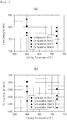
- FIG. 1 is a graph illustrating changes in (a) yield strength and (b) tensile strength of the hot-rolled steel sheets of Comparative Steels 1-4 according to coiling temperature, the lower the coiling temperature, the higher the yield strength and tensile strength increase, providing advantages in securing the strength of the final annealed material.
- the cooled hot-rolled steel sheet is heated to a temperature within a range of 590-690°C, maintained for 40 seconds or more, and then cooled, thereby carrying out an annealing heat treatment.
- an operation of plating the annealed heat-treated hot-rolled steel sheet to produce a plated steel sheet may be additionally included.
- the plating may be conducted according to conditions known in the relevant art by using an electroplating method, a hot-dip coating method, or the like.
- the annealed hot-rolled steel sheet may be deposited in a galvanizing bath to produce a galvanized steel sheet.
- an operation of alloying the plated steel sheet to produce an alloyed plated steel sheet may be further included.
- YS yield strength
- TS tensile strength
- El percent elongation
- YR yield ratio (YS/TS)
- HER hole expansion ratio
- Inventive Examples 1-17 satisfying both the alloy composition and the manufacturing conditions proposed in the present disclosure, are of ultra-high strength having a tensile strength of 900 MPa or more, have an yield ratio of 0.65 or more, and have excellent elongation rate that a product of tensile strength x elongation rate is 23,000 MPa% or higher. Further, it could be confirmed that Inventive Examples 1-17, due to having a hole expansion ratio of 15% or more, would be extremely advantageous as a cold-pressed steel sheet that can replace existing hot-pressed steel sheets.
- FIG. 2 which is photographs of microstructures of a hot-rolled steel sheet of Inventive Example 12 having undergone a final annealing heat treatment, captured by (a) scanning electron microscopy (SEM) and (b) electron backscatter diffraction (EBSD), it could be confirmed that grain sizes of retained austenite and annealed martensite, which are main phases, were fine, and an average ratio of the short axis to the long axis of a corresponding phase was found to be 0.5 or less. Further, superior yield strength and ratio, elongation ratio, and hole expansion ratio of the present Inventive Steel could be secured through the above structure composition and configuration control.
- dark grey indicates annealed martensite, and light grey indicates austenite.
- FIG. 3 a photograph of microstructures of a hot-rolled steel sheet of Inventive Example 12 having undergone a final annealing heat treatment, captured by transmission electron microscopy (TEM), micro precipitates were utilized for improving strength and hole expansion ratio, and precipitates having a size of 30 nm or less were included in an amount of 6 * 10 ⁇ (14) ea./m ⁇ 2.
- TEM transmission electron microscopy
- the fraction of retained austenite was 8% and 35% respectively, and it could be confirmed that to secure target tensile properties and hole expansion ratio of the present disclosure, the fraction of retained austenite should be controlled to 10-30%.
- Equation 1 when Equation 1 was not satisfied due to insufficient additions of micro precipitating elements such as titanium (Ti), niobium (Nb), vanadium (V), and molybdenum (Mo), it could be confirmed that, since such micro precipitates contribute little to strength as described above, it was difficult to secure tensile strength and yield ratio.
- micro precipitating elements such as titanium (Ti), niobium (Nb), vanadium (V), and molybdenum (Mo)
Landscapes
- Chemical & Material Sciences (AREA)
- Engineering & Computer Science (AREA)
- Mechanical Engineering (AREA)
- Materials Engineering (AREA)
- Metallurgy (AREA)
- Organic Chemistry (AREA)
- Physics & Mathematics (AREA)
- Thermal Sciences (AREA)
- Crystallography & Structural Chemistry (AREA)
- Chemical Kinetics & Catalysis (AREA)
- Heat Treatment Of Sheet Steel (AREA)
Abstract
Description
- The present disclosure relates to an ultra-high-strength steel sheet having excellent hole expandability and yield ratio, which may be suitably applied to automotive structural members, and a method of manufacturing the same.
- Safety regulations, with respect to motor vehicles, for securing the safety of passengers in the event of a collision, and becoming stricter, and to this end, it is necessary to improve the strength of steel sheets for motor vehicles or to increase the thicknesses thereof. Also, since there has been continuously increasing demand for weight reduction of car bodies, in order to comply with regulations for CO2 emissions of automobiles, and to improve energy efficiency, it is necessary for steel sheets for motor vehicles to possess high strength.
- However, increasing the strength of steel sheets for motor vehicles tends to decrease the ductility thereof, and thus, in the case of ultra-high-strength steels, such a technique may be limited for parts that require bendability.
- To overcome such disadvantages of ultra-high-strength steels, there have been developed hot press-formed steels, wherein parts are formed at high temperature, while having sufficient bendability, and are then quenched to room temperature, to secure low-temperature structures and thereby achieve high ultimate yield strength and tensile strength.
- However, such solutions may cause the costs of automotive parts to inevitably increase, due to increases in processing costs and facility costs associated with newly installed hot press forming facilities for automotive parts manufacturers.
- In the above context, continuous research has been focused on steel materials that exhibit excellent elongation ratios as well as high strength, and are capable of cold-press forming.
- For example, Korean Laid-Open Patent Publication No.
1996-0023167 1996-0023167 - In addition, Korean Laid-Open Patent Publication No.
2008-0060982 2008-0060982 - Accordingly, it is necessary to develop an ultra-high-strength steel sheet that has excellent hole expansion ratio and yield ratio, and thus can be cold-press formed without an additional re-rolling (cold rolling) process after hot rolling, and a method of manufacturing the same.
- An aspect of the present disclosure is to provide an ultra-high-strength steel sheet having an excellent hole expandability and yield ratio which may be suitably applied to automotive structural members, and a method of manufacturing the same.
- However, it should be understood that the objects of the present disclosure are not limited to the above-mentioned objects, and other objects will be clearly understood from the following description by those skilled in the relevant art without excessive difficulties.
- An aspect of the present disclosure provides an ultra-high-strength steel sheet having an excellent hole expandability and yield ratio, comprising, in wt%, 0.05-0.2% of carbon (C), 2.0% or less of silicon (Si), 4.1-9.0% of manganese (Mn), 0.05% or less (excluding 0%) of phosphorus (P), 0.02% or less (excluding 0%) of sulfur (S), 0.5% or less (excluding 0%) of aluminum (Al), 0.02% or less (excluding 0%) of nitrogen (N), and a balance of iron (Fe) and other inevitable impurities,
- wherein the ultra-high-strength steel sheet further comprises at least one selected from 0.1% or less (excluding 0%) of titanium (Ti), 0.1% or less (excluding 0%) of niobium (Nb), 0.2% or less (excluding 0%) of vanadium (V), and 0.5% or less (excluding 0%) of molybdenum (Mo), and satisfies the
following Equations 1, - and wherein the microstructure thereof includes, in volume percent, 10-30% of retained austenite, 50% or more of annealed martensite, and 20% or less of other phases including alpha martensite and epsilon martensite.

- (In
Equation 1, each element symbol represents a value of the content of each element, expressed in wt%.) - In addition, another aspect of the present disclosure provides a method of manufacturing an ultra-high-strength steel sheet having excellent hole expandability and yield ratio, comprising: an operation of heating a slab satisfying the above-described alloy composition to 1,050-1,300°C;
- an operation of finish hot rolling the heated slab in a temperature range of 800-1,000°C to produce a hot-rolled steel sheet;
- an operation of coiling the hot-rolled steel sheet at 750°C or less and cooling the same;
- and an annealing heat treatment operation of heating the cooled hot-rolled steel sheet to a temperature within a range of 590-690°C, maintaining the same for 40 seconds or more, and cooling the same.
- Not all features of the present disclosure are listed in the above-described technical solution to the problem. Various features and advantages, and effects resulted therefrom will be more easily understood through description of exemplary embodiments below.
- According to the present disclosure, there may be provided an ultra-high-strength steel sheet having excellent hole expandability and yield ratio, which can be cold-pressed without a rerolling process after hot rolling, and a method of manufacturing the same.
- In addition, the ultra-high-strength steel sheet of the present disclosure, due to excellent strength and elongation ratio, satisfies bendability and collision safety required of automotive steel sheets; and due to excellent yield ratio, hole expandability, and elongation ratio, may be alternative to existing hot-pressed steel sheets, thus reducing manufacturing costs.
-
-
FIG. 1 is graph illustrating changes in (a) yield strength and (b) tensile strength according to the coiling temperature of hot-rolled steel sheets of Comparative Steels 1-4. -
FIG. 2 are photographs of the microstructure of a hot-rolled steel sheet of the Inventive Example having undergone a finish annealing heat treatment, captured by (a) scanning electron microscope (SEM) and (b) electron backscatter diffraction (EBSD).FIG. 2 is for observing the sizes and shapes of grains in the final annealed structures, wherein in (b), dark grey indicates annealed martensite and light grey indicates austenite. -
FIG. 3 is a photograph of the microstructure of a hot-rolled steel sheet of Inventive Example 12, having undergone a finish annealing heat treatment, the photograph captured by transmission electron microscopy (TEM).FIG. 3 is for observing the sizes and number of micro precipitates. - Hereinbelow, exemplary embodiments of the present disclosure are described. However, the exemplary embodiments of the present disclosure may be modified in various other forms, and the scope of the present disclosure should not be construed as to being limited to the embodiments discussed hereinbelow. Also, the embodiments of the present disclosure are provided to provide a more complete understanding to those skilled in the art.
- Ultra-High-Strength Steel Sheet Having an Excellent Hole Expandability and Yield Ratio.
- Hereinbelow, an ultra-high-strength steel sheet having an excellent hole expandability and yield ratio according to an aspect of the present disclosure is described in detail.
- An ultra-high-strength steel sheet having having an excellent hole expandability and yield ratio according to an aspect of the present disclosure comprises, in wt%, 0.05-0.2% of carbon (C), 2.0% or less of silicon (Si), 4.1-9.0% of manganese (Mn), 0.05% or less (excluding 0%) of phosphorus (P), 0.02% or less (excluding 0%) of sulfur (S), 0.5% or less (excluding 0%) of aluminum (Al), 0.02% or less (excluding 0%) of nitrogen (N), and a balance of iron (Fe) and other inevitable impurities,
- wherein the ultra-high-strength steel sheet further comprises at least one selected from 0.1% or less (excluding 0%) of titanium (Ti), 0.1% or less (excluding 0%) of niobium (Nb), 0.2% or less (excluding 0%) of vanadium (V), and 0.5% or less (excluding 0%) of molybdenum (Mo), and satisfies the
following Equation 1, - wherein a microstructure thereof includes, in volume percent, 10-30% of retained austenite, 50% or more of annealed martensite, and 20% or less of other phases including alpha martensite and epsilon martensite.

- (In
Equation 1, each element symbol represents a value of the content of each element, expressed in wt%.) - First, an alloy composition of the present disclosure will be described in greater detail. The content of each element is provided in wt%, unless otherwise specified.
- Carbon (C) is an element effective for strengthening steel, and in the present disclosure, is a crucial element added to control stability of austenite and to secure strength.
- If the content of carbon (C) is less than 0.05%, the above-described effects may be insufficient, and if the content of carbon (C) is greater than 0.2%, hole expandability and spot weldability may be undesirably degraded due to an increase in hardness differences among the microstructures.
- Accordingly, the content of carbon (C) is preferably in the range of 0.05-0.2%. More preferably, the content of carbon (C) is in the range of 0.1-0.2%, and even more preferably, is in the range of 0.13-0.2%.
- Silicon (Si) is an element suppressing the precipitation of carbides in ferrite and promoting carbon in ferrite to diffuse into austenite, thus contributing to the stabilization of retained austenite.
- Since the content of silicon (Si) exceeding 2% may severely degrade hot rolling properties and cold rolling properties, and may degrade hot dip galvanizability by forming silicon (Si) oxides on steel surfaces, the content of silicon (Si) is preferably limited to 2% or less.
- Meanwhile, in the present disclosure, 0% of silicon can be included. As will be described later, due to containing a large quantity of manganese (Mn), the stability of retained austenite can be easily secured without the addition of silicon (Si). More preferably, the content of silicon (Si) is 1.5% or less, and even more preferably, the content of silicon (Si) is 1.1% or less.
- Manganese (Mn) is an element effective for suppressing the transformation of ferrite and for formation and stabilization of retained austenite.
- The content of manganese (Mn) less than 4.1% causes insufficient stability of retained austenite, and thus causes degradation in mechanical properties due to a decrease in an elongation ratio. On the other hand, the content of manganese (Mn) exceeding 9.0% causes an undesirable increase in manufacturing costs and a degradation of spot weldability.
- Accordingly, the content of manganese (Mn) is preferably in the range of 4.1-9.0%, more preferably in the range of 5-9%, and more preferably, in the range of 5-8%.
- Phosphorus (P) is an element for solid-solution strengthening. Since the content of phosphorus (P) exceeding 0.05% degrades weldability and increases the risk of brittleness in steel, it may be preferable to limit the upper limit thereof to 0.05%, and more preferably, to 0.02% or less.
- Sulfur (S) is an impurity element inevitably included in steel, and is an element that decreases ductility and weldability of a steel sheet. Since the content of sulfur (S) exceeding 0.02% increases the possibility of degrading the ductility and weldability of a steel sheet, it may be preferable to limit the upper limit thereof to 0.02%.
- Aluminum (Al) is an element typically added for acid removal of steel. The content of aluminum (Al) exceeding 0.5% causes a decrease in tensile strength of steel, complicates the manufacturing of a decent slab through a reaction with mold plus during casting, and forms surface oxides, thus degrading coatability. Accordingly, it may be preferable to limit the content of aluminum (Al) to 0.5% or less, excluding 0%, in the present disclosure.
- Nitrogen (N) is a solid-solution strengthening element. However, the content of nitrogen (N) exceeding 0.02% has a high risk of causing brittleness and may bind with aluminum (Al) to give rise to excessive precipitation of aluminum nitride (AlN), degrading the quality of continuous casting. Therefore, it may be preferable to limit the upper limit of the content of nitrogen (N) to 0.02% in the present disclosure.
- Other than the above-described alloying elements, at least one selected from the following may be included: 0.1% or less (excluding 0%) of titanium (Ti); 0.1% or less (excluding 0%) of niobium (Nb); 0.2% or less (excluding 0%) of vanadium (V); and 0.5% or less (excluding 0%) of molybdenum (Mo).
- Titanium (Ti) is a micro carbide forming element which contributes to securing yield strength and tensile strength.
- In addition, titanium (Ti) is a nitride forming element having the effect of precipitating nitrogen (N) in steel as titanium nitride (TiN), thereby suppressing aluminum nitride (AlN) precipitation, and may advantageously reduce the risk of crack formation during continuous casting.
- Contents of titanium (Ti) exceeding 0.1% may give rise to precipitation of coarse carbides, may reduces strength and elongation ratio due to a decreased carbon content in steel, and may cause clogging of nozzles during continuous casting.
- Niobium (Nb) is an element which segregates to austenite grain boundaries to suppress coarsening of austenite grains during annealing heat treatment, and contributes to an increase in strength by forming micro-carbides.
- The content of niobium (Nb) exceeding 0.1% may give rise to precipitation of coarse carbides, may cause a decrease in strength and elongation ratio due to decreased carbon content in steel, and may undesirably increase manufacturing costs.
- Vanadium (V) is an element which reacts with carbon or nitrogen to form carbides or nitrides. In the present disclosure, vanadium (V) plays an important role in increasing the yield strength of steel by forming micro precipitates at low temperature.
- The content of vanadium (V) exceeding 0.2% may give rise to precipitation of coarse carbides, may cause a decrease in strength and elongation ratio due to a decreased carbon content in steel, and may undesirably increase manufacturing costs.
- Molybdenum (Mo) is a carbide forming element which, when added in combination with carbide or nitride forming elements such as titanium (Ti), niobium (Nb), and vanadium (V), plays a role in maintaining the size of precipitates to be small and thus improving yield strength and tensile strength.
- The content of molybdenum (Mo) exceeding 0.5% may saturate the above-described effects and may rather increase manufacturing costs.
- The remaining component of the present disclosure is iron (Fe). However, since unintended impurities may be inevitably introduced from raw materials or the surrounding environment during conventional manufacturing processes, such impurities should not be excluded. Since such impurities are well known to those skilled in the conventional manufacturing processes, they will not be further described in the present description.
- Here, the alloy composition of the present disclosure should satisfy the above-described content of each element while satisfying the
following Equation 1.
- (In
Equation 1, each element symbol represents a value of the content of each element, expressed in wt%.) - In the present disclosure, the
Equation 1 is derived to study the effect of elements influencing steel properties through formation of micro precipitates of complex carbonitrides, such as carbon (C), titanium (Ti), niobium (Ni), and molybdenum (Mo). In particular, within the ranges that satisfy the above-described content of each element, most of the complex carbonitrides bind in 1 : 1 atomic ratios, and therefore, when the sum of values produced by dividing an added amount of each of the following elements, carbon (C), titanium (Ti), niobium (Nb), vanadium (V), and molybdenum (Mo), by the atomic mass of the corresponding element, which are 12, 48, 93, 51, and 96, respectively, is greater than 0.015, tensile strength and yield ratio may be secured. - Meanwhile, other than the above-described components, at least one selected among 1% or less (excluding 0%) of nickel (Ni), 0.5% or less (excluding 0%) of copper (Cu), 1% or less (excluding 0%) of chromium (Cr), and 0.01-0.1% of antimony (Sb) may be additionally included.
- Nickel (Ni), copper (Cu) and chromium (Cr) are the elements contributing to stabilization of retained austenite, and contribute to austenite stabilization through complexing actions with the above-described copper (C), silicon (Si), manganese (Mn), aluminum (Al), and the like. However, nickel (Ni) and chromium (Cr) contents each higher than 1%, and copper (Cu) contents higher than 0.5% may excessively increase manufacturing costs. In addition, since copper (Cu) may cause brittleness during hot rolling, when copper (Cu) is added, nickel (Ni) may be added in combination therewith.
- Antimony (Sb) has an effect of suppressing internal oxidation after hot rolling by suppressing migration of oxidizing elements and surface segregation of silicon (Si), aluminum (Al), and the like through segregation at grain boundaries; and for the same reason, has an effect of improving plating surface quality by suppressing oxidation due to surface segregation of silicon (Si), aluminum (Al), and the like, during annealing. However, antimony (Sb) contents lower than 0.01% may produce unsatisfactory effects of suppressing internal oxidation layers, whereas antimony (Sb) contents greater than 0.1% may cause an undesirable delay in alloying of zinc alloy layers.
- In addition, the microstructure of a steel sheet of the present disclosure includes, in volume percent, 10-30% of retained austenite, 50% or more of annealed martensite, and 20% or less of other phases including alpha martensite and epsilon martensite.
- When retained austenite is greater than 30%, the stability of austenite decreases, so the elongation ratio decreases, and the amount of plasticity-induced transformed martensite increases, thus undesirably degrading hole expandability; however, when retained austenite is less than 10%, retained austenite is too stable and has too small a fraction, contributing too little to the elongation ratio. Moreover, the case where annealed martensite is less than 50%, or other phases including alpha martensite and epsilon martensite are greater than 20% are not preferable, because these cases also mean a decrease of retained austenite stability, drastically decreases elongation ratio.
- Here, to effectively secure hole expansion ratio and strength improvement due to precipitates, the steel sheets of the present disclosure may include 10^(13) ea/m^2 or more of precipitates having a size of 30 nm or less, wherein the precipitates may be carbides, nitrides, or complex carbonitrides, including at least one of titanium (Ti), niobium (Nb), vanadium (V), and molybdenum (Mo).
- In addition, since the retained austenite and the annealed martensite show a relatively superior hole expandability when formed in acicular shapes, they may have a ratio of the short axis to the long axis of 0.5 or less.
- However, as of the steel sheet of the present disclosure, the hole expandability may be 15% or more, the yield ratio may be 0.65 or more, the tensile strength may be 900 MPa or more, and the product of the tensile strength and the elongation rate may be 23,000 MPa% or more. By satisfying these properties, the steel sheet does not suffer crack formation in front edge portions even when cold forming, and thus may replace hot press forming, and may satisfy moldability and collision safety required of automotive steel sheets.
- In addition, the steel sheet of the present disclosure may include a plating layer formed additionally formed on the surface thereof.
- For example, the plating layer may be a zinc plating layer or an aluminum plating layer.
- Also, the steel sheet of the present disclosure may include an alloyed plating layer additionally formed on the surface thereof. For example, the alloyed plating layer may be an alloyed zinc plating layer or an alloyed aluminum plating layer.
- Method of Manufacturing Ultra-High-Strength Steel Sheet Having An Excellent Hole Expandability and Yield Ratio.
- Hereinbelow, a method of manufacturing an ultra-high-strength steel sheet having an excellent hole expandability and yield ratio according to another aspect of the present disclosure will be described in greater detail.
- A method of manufacturing an ultra-high-strength steel sheet having an excellent hole expandability and yield ratio according to another aspect of the present disclosure includes: an operation of heating a slab satisfying the above-described alloying composition to 1,050-1,300°C; an operation of finish hot rolling the heated slab in a temperature range of 800-1,000°C to obtain a hot-rolled steel sheet; an operation of coiling the hot-rolled steel sheet at 750°C or less and cooling the same; and an annealing operation of heating the cooled hot-rolled steel sheet to a temperature within a range of 590-690°C, maintaining the same for 40 seconds or more, and cooling the same.
- A slab satisfying the above-described alloying composition is heated to 1,050-1,300°C. This is for having the slab homogenized prior to hot rolling.
- Slab heating temperatures less than 1,050°C may cause an undesirable sharp increase of load during a subsequent hot rolling, whereas slab heating temperatures exceeding 1,300°C may not only increase energy cost but also increase the amount of surface scales, leading to loss of materials, and may retain liquid when manganese (Mn) is contained in a large quantity.
- The heated slab is subjected to finish hot rolling in the temperature range of 800-1,000°C to produce a hot-rolled steel sheet.
- Finish hot rolling temperatures less than 800□ may cause an undesirable significant increase in rolling load, whereas finish hot rolling temperatures exceeding 1,000□ may reduce the lifespan of rolling rolls and may cause surface defects due to scales.
- The hot-rolled steel sheet is coiled at 750°C or less, and then cooled.
- Coiling temperatures higher than 750°C may give rise to excessive scale formation on the surface of a steel sheet, causing defects, and this may be a factor contributing to degradation of pickling performance and coatability.
- In detail, in the case where manganese (Mn) is included in 4.1% or more of the steel composition, hardenability increases, so even when air-cooled to room temperature after coiling, most microstructures transform to martensitic structures without transformation of ferrite; however, as confirmed in
FIG. 1 , which is a graph illustrating changes in (a) yield strength and (b) tensile strength of the hot-rolled steel sheets of Comparative Steels 1-4 according to coiling temperature, the lower the coiling temperature, the higher the yield strength and tensile strength increase, providing advantages in securing the strength of the final annealed material. Thus, it may be more preferable to lower the coiling temperature by water cooling after hot rolling. - The cooled hot-rolled steel sheet is heated to a temperature within a range of 590-690°C, maintained for 40 seconds or more, and then cooled, thereby carrying out an annealing heat treatment.
- Here, an operation of plating the annealed heat-treated hot-rolled steel sheet to produce a plated steel sheet may be additionally included. There is no need to particularly limit plating conditions, and the plating may be conducted according to conditions known in the relevant art by using an electroplating method, a hot-dip coating method, or the like. For example, the annealed hot-rolled steel sheet may be deposited in a galvanizing bath to produce a galvanized steel sheet.
- In addition, an operation of alloying the plated steel sheet to produce an alloyed plated steel sheet may be further included.
- Hereinbelow, the present disclosure will be described in greater detail with reference to exemplary embodiments. However, these embodiments should be regarded as illustrative rather than restrictive, and the present disclosure should not be construed as being limited to particular embodiments discussed, since the scope of the present disclosure is defined by the appended claims and equivalents thereof.
- Steels having compositions shown in Table 1 were vacuum melted into 30 Kg ingots, which were heated to 1,200°C and maintained for one hour. Thereafter, these ingots were subjected to finish hot rolling at 900°C to produce hot-rolled steel sheets, and the hot-rolled steel sheets were cooled to coiling temperatures shown in Table 2, placed in a furnace preheated to a corresponding temperature, maintained for one hour, and then furnace-cooled to mimic hot coiling. Next, each sample was cooled to room temperature and subjected to an annealed heat treatment under the conditions shown in Table 2. Then, the microstructures and mechanical properties of each sample were measured, and the results are presented in Table 3.
- In Table 3, yield strength, tensile strength, elongation ratio, and yield ratio were measured by using a universal testing machine. A hole expansion ratios (HER) was measured and evaluated using the same standard across all samples.
[Table 1] Steel Type Composition (wt%) Equation 1 C Si Mn A1 Ti Nb V Mo P S N IS 1* 0.14 1 5 0.015 0.06 0.04 0 0.25 0.01 0.006 0.005 0.0160 IS 2 0.158 1.1 5. 1 0.02 0 0 0.11 0 0.009 0.004. 0.006 0.0153 IS 3 0.14 1 6 0.017 0.06 0.04 0 0.25 0.008 0.005 0.005 0.0160 IS 4 0.161 1.1 6. 2 0.018 0 0 0.117 0 0.009 0.006 0.006 0.0157 IS 5 0.14 1 7 0.019 0.06 0.04 0 0.25 0.007 0.008 0.007 0.0160 IS 6 0.19 0.5 7 0.02 0.03 0 0.1 0 0.009 0.009 0.009 0.0184 IS 7 0.14 1 8 0.021 0.06 0.04 0 0.25 0.008 0.009 0.004 0.0160 CS 1**0.14 0.5 7 0.015 0.03 0.04 0 0 0.008 0.008 0.009 0.0127 CS 20.14 0.1 7 0.019 0.06 0.04 0 0 0.009 0.009 0.004 0.0133 CS 30.12 0.1 7 0.022 0.06 0 0 0.25 0.01 0.005 0.007 0.0139 CS 40.14 0.5 7 0.023 0.03 0 0 0 0.006 0.007 0.006 0.0123 CS 5 0.16 0.1 6 0.017 0.02 0.01 0 0 0.008 0.006 0.005 0.0139 CS 6 0.136 0.1 6 0.019 0. 02 0.01 0 0.1 0.007 0.009 0.009 0.0120 CS 7 0.157 1 4 0.018 0 0 0.1 0 0.005 0.008 0.004 0.0150 CS 8 0.14 1 10 0.018 0. 06 0.04 0 0.25 0.01 0.004 0.005 0.0160 CS 9 0.1 1 10 0.02 0. 06 0.04 0 0.25 0.012 0.006 0.006 0.0126 CS 10 0.06 1 10 0.02 0. 06 0.04 0 0.25 0.008 0.007 0.005 0.0093 * IS: Inventive Steel
** CS: Comparative Steel[Table 2] Category Coiling temp (°C) Annealing condirions Temp Time (°C) (S) IS 1* IE 1*** 600 640 72000 IS 2 IE 2 600 640 108000 IS 3 IE 3 600 620 72000 IE 4 600 640 72000 IS 4 IE 5 600 600 108000 IE 6 600 620 108000 IS 5 CE 1**** 600 0 0 CE 2 600 550 108000 CE 3 600 580 54000 IE 7 600 600 18000 IE 8 600 600 36000 IE 9 600 600 72000 IE 10 600 600 108000 IE 11 600 610 54000 IE 12 600 630 54000 IE 13 600 650 54000 IE 14 600 660 71 CE 4 600 660 35 CE 5 600 700 35 IS 6 CE 6 600 550 36000 IE 15 600 600 36000 IS 7 CE 7 600 550 72000 IE 16 600 600 32400 IE 17 600 600 72000 CS 1** CE 8 720 - - CE 9 600 - - CS 2 CE 10 720 - - CE 11 600 - - CS 3 CE 12 720 - - CE 13 600 - - CS 4 CE 14 720 - - CE 15 600 - - CS 5 CE 16 600 600 72000 CE 17 600 640 72000 CS 6 CE 18 600 600 72000 CE 19 600 660 72000 CS 7 CE 20 600 600 108000 CE 21 600 640 108000 CS 8 CE 22 600 550 72000 CE 23 600 600 72000 CS 9 CE 24 600 550 72000 CE 25 600 600 72000 CS 10 CE 26 600 550 72000 CE 27 600 600 72000 * IS: Inventive Steel
** CS: Comparative Steel
*** IE: Inventive Example
**** CE: Comparative Example[Table 3] Category Microstructure (vol%) Number of precipitates (/m2) YS (MPa ) TS (MPa ) El (%) TS*El (MPa%) YR HER (%) Annealed martensite Retained austenite Other phase IS 1* IE 1*** 77 20 3 1×10¹⁴ 947 1054 22 23188 0.9 21 IS 2 IE 2 75 22 3 1×10¹⁴ 629 940 27 25380 0.67 22 IS 3 IE 3 74 23 3 9×10¹³ 983 1129 28 31612 0.87 18 IE 4 72 24 4 3×10¹⁴ 961 1144 27.4 31346 0.84 16 IS 4 IE 5 74 24 2 8×10¹³ 793 954 26 24804 0.83 23 IE 6 73 25 2 2×10¹⁴ 712 966 36 34776 0.74 21 CE 1**** 0 7 93 5×10⁶ 885 1580 10.3 16274 0.56 7 CE 2 84 14 2 5×10⁹ 983 1264 14.3 18075 0.78 17 CE 3 83 15 2 2×10¹² 948 1228 16.5 20262 0.77 16 IE 7 77 21 2 6×10¹³ 914 1217 24.8 30182 0.75 19 IE 8 77 22 1 8×10¹³ 944 1199 24.2 29016 0.79 21 IE 9 73 24 3 1×10¹⁴ 947 1184 22.2 26285 0.8 21 IS 5 IE 10 72 25 3 2×10¹⁴ 893 1191 27.9 33229 0.75 21 IE 11 75 21 4 1×10¹⁴ 926 1196 20.1 24040 0.77 25 IE 12 72 22 6 6×10¹⁴ 870 1184 28.1 33270 0.73 20 IE 13 68 25 7 7×10¹³ 858 1188 27.6 32789 0.72 23 IE 14 72 26 2 2×10¹³ 1007 1361 21.3 28989 0.74 16 CE 4 81 17 2 - 991 1342 15.7 21067 0.74 14 CE 5 68 25 7 - 418 1619 16.9 27425 0.26 3 IS 6 CE 6 83 13 4 - 885 1205 12.6 15183 0.73 18 IE 15 77 19 4 5×10¹³ 753 1139 20.5 23350 0.66 21 IS 7 CE 7 89 10 1 - 1049 1328 12.7 16866 0.79 16 IE 16 80 18 2 5×10¹³ 972 1275 18.3 23333 0.76 19 IE 17 74 23 3 3×10¹⁴ 985 1261 23.8 30012 0.78 17 CS 1** CE 8 0 5 95 - 783 1554 9 13861 0.5 - CE 9 0 6 94 - 804 1603 9 13674 0.5 - CS 2 CE 10 0 5 95 - 759 1482 9 13201 0.51 - CE 11 0 7 93 - 776 1537 8 12525 0.51 - CS 3 CE 12 0 6 94 - 800 1425 9 13455 0.56 - CE 13 0 6 94 - 833 1473 8 11723 0.57 - CS 4 CE 14 0 7 93 - 730 1509 9 13925 0.48 - CE 15 0 5 95 - 766 1573 9 14113 0.49 - CS 5 CE 16 79 19 2 - 633 797 23 18331 0.79 - CE 17 64 31 5 - 568 885 40 35400 0.64 - CS 6 CE 18 79 19 2 - 579 732 34.1 24961 0.79 - CE 19 73 24 3 - 455 904 16.1 14554 0.5 - CS 7 CE 20 86 13 1 - 728 798 17 13566 0.91 - CE 21 77 21 2 - 573 805 23 18515 0.71 - CS 8 CE 22 71 23 6 - 461 1638 18.1 29648 0.28 - CE 23 62 27 11 - 403 1617 19.9 32178 0.25 - CS 9 CE 24 79 16 5 - 475 1474 15.9 23437 0.32 - CE 25 77 19 4 - 429 1472 17.1 25171 0.29 - CS 10 CE 26 83 13 4 - 612 1341 14.2 19042 0.46 - CE 27 81 16 3 - 525 1246 15.3 19064 0.42 - * IS: Inventive Steel
** CS: Comparative Steel
*** IE: Inventive Example
**** CE: Comparative Example - In Table 3, YS: yield strength, TS: tensile strength, El: percent elongation, YR: yield ratio (YS/TS), and HER: hole expansion ratio.
- It could be confirmed that Inventive Examples 1-17, satisfying both the alloy composition and the manufacturing conditions proposed in the present disclosure, are of ultra-high strength having a tensile strength of 900 MPa or more, have an yield ratio of 0.65 or more, and have excellent elongation rate that a product of tensile strength x elongation rate is 23,000 MPa% or higher. Further, it could be confirmed that Inventive Examples 1-17, due to having a hole expansion ratio of 15% or more, would be extremely advantageous as a cold-pressed steel sheet that can replace existing hot-pressed steel sheets.
- The result of analysis of the microstructure of Inventive Example 12 showed that in volume percentage, 22% of retained austenite, 72% of annealed martensite, and 6% of epsilon martensite.
- In
FIG. 2 , which is photographs of microstructures of a hot-rolled steel sheet of Inventive Example 12 having undergone a final annealing heat treatment, captured by (a) scanning electron microscopy (SEM) and (b) electron backscatter diffraction (EBSD), it could be confirmed that grain sizes of retained austenite and annealed martensite, which are main phases, were fine, and an average ratio of the short axis to the long axis of a corresponding phase was found to be 0.5 or less. Further, superior yield strength and ratio, elongation ratio, and hole expansion ratio of the present Inventive Steel could be secured through the above structure composition and configuration control. In (b) ofFIG. 2 , dark grey indicates annealed martensite, and light grey indicates austenite. - Further, as can be seen in
FIG. 3 , a photograph of microstructures of a hot-rolled steel sheet of Inventive Example 12 having undergone a final annealing heat treatment, captured by transmission electron microscopy (TEM), micro precipitates were utilized for improving strength and hole expansion ratio, and precipitates having a size of 30 nm or less were included in an amount of 6 * 10^(14) ea./m^2. - However, if manufacturing conditions (an annealing heat treatment process) did not satisfy the present disclosure, it was difficult to secure desired mechanical properties even when the composition of the present disclosure was satisfied.
- Among these cases, in an example that did not undergo a final annealing heat treatment (Comparative Example 1), examples where the annealing temperature was less than 590°C (Comparative Examples 2, 3, 6, and 7), or an example where the annealing time was less than 40 seconds, the fraction of intercritical austenite decreased, and thus, it was difficult to secure percent elongation.
- Also, in an example where an annealing temperature exceeded 690°C (Comparative Example 5), the fraction of intercritical austenite drastically increased, and thus, yield strength and hole expansion ratio were unsatisfactory when the stability of retained austenite decreased.
- As the result of analyses of microstructures of Comparative Example 4 and Comparative Example 5 by XRD, the fraction of retained austenite was 8% and 35% respectively, and it could be confirmed that to secure target tensile properties and hole expansion ratio of the present disclosure, the fraction of retained austenite should be controlled to 10-30%.
- In addition, it could be confirmed that even when the manufacturing conditions proposed in the present disclosure were satisfied, if the alloy compositions proposed in the present disclosure were not satisfied, it is difficult to secure mechanical properties.
- As seen in Comparative Examples 16-19, when
Equation 1 was not satisfied due to insufficient additions of micro precipitating elements such as titanium (Ti), niobium (Nb), vanadium (V), and molybdenum (Mo), it could be confirmed that, since such micro precipitates contribute little to strength as described above, it was difficult to secure tensile strength and yield ratio. - Also, in the case of manganese (Mn) contents lower than 4.1% (Comparative Examples 20 and 21), it was difficult to secure tensile strength, whereas in the case of manganese (Mn) contents exceeding 9% (Comparative Examples 22-27), yield ratio was low.
- While the present disclosure has been shown and described in connection with the exemplary embodiments, it will be apparent to those skilled in the art that modifications and variations can be made without departing the scope of the spirit and scope of the present disclosure as defined by the appended claims.
Claims (11)
- An ultra-high-strength steel sheet having an excellent hole expandability and yield ratio, comprising, in terms of wt%: 0.05-0.2% of carbon (C); 2.0% or less of silicon (Si); 4.1-9.0% of manganese (Mn); 0.05% or less (excluding 0%) of phosphorus (P); 0.02% or less (excluding 0%) of sulfur (S); 0.5% or less (excluding 0%) of aluminum (Al); 0.02% or less (excluding 0%) of nitrogen (N); and a balance of iron (Fe) and other inevitable impurities,
and further comprising at least one selected among 0.1% or less (excluding 0%) of titanium (Ti), 0.1% or less (excluding 0%) of niobium (Nb), 0.2% or less (excluding 0%) of vanadium (V), and 0.5% or less (excluding 0%) of molybdenum (Mo),
wherein the following Equation 1 is satisfied, and
wherein microstructures includes, in volume percentage, 10-30% or retained austenite, 50% or more of annealed martensite, and 20% or less of other phases including alpha martensite and epsilon martensite.
- The ultra-high-strength steel sheet having an excellent hole expandability and yield ratio of claim 1, wherein the steel sheet further comprises at least one selected among 1% or less (excluding 0%) of nickel (Ni), 0.5% or less (excluding 0%) of copper (Cu), 1% or less (excluding 0%) of chromium (Cr), and 0.01-0.1% of antimony (Sb).
- The ultra-high-strength steel sheet having an excellent hole expandability and yield ratio of claim 1, wherein the steel sheet includes precipitates having a size of 30 nm or less in an amount of 10^13 ea./m^2, wherein the precipitates are carbides, nitrides, or complex carbonitrides including at least one among titanium (Ti), niobium (Nb), vanadium (V), and molybdenum (Mo).
- The ultra-high-strength steel sheet having an excellent hole expandability and yield ratio of claim 1, wherein the retained austenite and the annealed martensite are acicular structure having a ratio of short axis to long axis of 0.5 or less.
- The ultra-high-strength steel sheet having an excellent hole expandability and yield ratio of claim 1, wherein the steel sheet has a hole expansion ratio of 15% or more, a yield ratio of 0.65 or more, and a tensile strength of 900 MPa or more, wherein a product of the tensile strength and the elongation ratio is 23,000 MPa% or more.
- The ultra-high-strength steel sheet having an excellent hole expandability and yield ratio of claim 1, wherein the steel sheet includes a plating layer additionally formed on a surface thereof.
- The ultra-high-strength steel sheet having an excellent hole expandability and yield ratio of claim 1, wherein the steel sheet includes an alloyed plating layer additionally formed on a surface thereof.
- A method of manufacturing an ultra-high-strength steel sheet having an excellent hole expandability and yield ratio, comprising:an operation of heating a slab to 1,050-1,300°C;an operation of finish hot rolling the heated slab in a temperature range of 800-1,000°C to obtain a hot-rolled steel sheet;an operation of coiling the hot-rolled steel sheet at 750°C or less and cooling the same; andan annealing operation of heating the cooled hot-rolled steel sheet to a temperature range of 590-690°C, maintaining the same for 40 seconds or more, and cooling the same,wherein the slab comprises, in wt%, 0.05-0.2% of carbon (C), 2.0% or less of silicon (Si), 4.1-9.0% of manganese (Mn), 0.05% or less (excluding 0%) of phosphorus (P), 0.02% or less (excluding 0%) of sulfur (S), 0.5% or less (excluding 0%) of aluminum (Al), 0.02% or less (excluding 0%) of nitrogen (N), and a balance of iron (Fe) and other inevitable impurities,and further comprising at least one selected among 0.1% or less (excluding 0%) of titanium (Ti), 0.1% or less (excluding 0%) of niobium (Nb), 0.2% or less (excluding 0%) of vanadium (V), and 0.5% or less (excluding 0%) of molybdenum (Mo),wherein the following Equation 1 is satisfied.
 (In Equation 1, each element symbol represents a value of the content of each element, expressed in wt%.)
 - The method of manufacturing an ultra-high-strength steel sheet having an excellent hole expandability and yield ratio of claim 8, wherein the slab further comprises, in wt%, at least one selected among 1% or less (excluding 0%) of nickel (Ni), 0.5% or less (excluding 0%) of copper (Cu), 1% or less (excluding 0%) of chromium (Cr), and 0.01-0.1% (excluding 0%) of antimony (Sb).
- The method of manufacturing an ultra-high-strength steel sheet having an excellent hole expandability and yield ratio of claim 8, further comprising an operation of plating the annealed heat-treated hot-rolled steel sheet to obtain a coated steel sheet.
- The method of manufacturing an ultra-high-strength steel sheet having an excellent hole expandability and yield ratio of claim 10, further comprising an operation of subjecting the plated steel sheet to an alloying treatment to obtain a plated steel sheet.
Applications Claiming Priority (2)
| Application Number | Priority Date | Filing Date | Title |
|---|---|---|---|
| KR1020160138386A KR101839235B1 (en) | 2016-10-24 | 2016-10-24 | Ultra high strength steel sheet having excellent hole expansion ratio and yield ratio, and method for manufacturing the same |
| PCT/KR2017/011765 WO2018080133A1 (en) | 2016-10-24 | 2017-10-24 | Ultra-high-strength steel sheet having excellent hole expandability and yield ratio and method for preparing same |
Publications (3)
| Publication Number | Publication Date |
|---|---|
| EP3530771A4 EP3530771A4 (en) | 2019-08-28 |
| EP3530771A1 true EP3530771A1 (en) | 2019-08-28 |
| EP3530771B1 EP3530771B1 (en) | 2021-06-16 |
Family
ID=61910352
Family Applications (1)
| Application Number | Title | Priority Date | Filing Date |
|---|---|---|---|
| EP17865881.1A Active EP3530771B1 (en) | 2016-10-24 | 2017-10-24 | Ultra-high-strength steel sheet having excellent hole expandability and yield ratio and method for preparing same |
Country Status (6)
| Country | Link |
|---|---|
| US (1) | US11453922B2 (en) |
| EP (1) | EP3530771B1 (en) |
| JP (1) | JP6858253B2 (en) |
| KR (1) | KR101839235B1 (en) |
| CN (1) | CN109923235B (en) |
| WO (1) | WO2018080133A1 (en) |
Cited By (1)
| Publication number | Priority date | Publication date | Assignee | Title |
|---|---|---|---|---|
| EP3708691A4 (en) * | 2017-11-08 | 2020-09-16 | Posco | ULTRA HIGH STRENGTH STEEL SHEET WITH HIGH DUCTILITY AND EXCELLENT YIELD RATIO AND MANUFACTURING PROCESS FOR IT |
Families Citing this family (8)
| Publication number | Priority date | Publication date | Assignee | Title |
|---|---|---|---|---|
| JP7192554B2 (en) * | 2019-02-14 | 2022-12-20 | 日本製鉄株式会社 | Wear-resistant thick steel plate |
| CN110714173A (en) * | 2019-07-25 | 2020-01-21 | 东莞材料基因高等理工研究院 | A kind of low carbon medium manganese steel plate containing ε martensite and preparation method thereof |
| CN110846577A (en) * | 2019-11-20 | 2020-02-28 | 南京钢铁股份有限公司 | 690 MPa-grade high-strength low-yield-ratio medium-thickness manganese steel and manufacturing method thereof |
| WO2021123877A1 (en) | 2019-12-17 | 2021-06-24 | Arcelormittal | Hot rolled steel sheet and method of manufacturing thereof |
| WO2022018497A1 (en) * | 2020-07-24 | 2022-01-27 | Arcelormittal | Cold rolled and annealed steel sheet and method of manufacturing the same |
| JP2022136977A (en) * | 2021-03-08 | 2022-09-21 | 株式会社神戸製鋼所 | Hot-dip galvanizing steel sheet, hot-dip galvanized steel sheet and alloyed hot-dip galvanized steel sheet |
| KR102918244B1 (en) | 2021-03-08 | 2026-01-26 | 가부시키가이샤 고베 세이코쇼 | Steel sheets for hot-dip galvanizing, hot-dip galvanized steel sheets and alloyed hot-dip galvanized steel sheets |
| CN117488206A (en) * | 2023-11-06 | 2024-02-02 | 攀钢集团攀枝花钢铁研究院有限公司 | A 1200MPa grade hot-rolled ultra-high-strength steel plate and its preparation method |
Family Cites Families (23)
| Publication number | Priority date | Publication date | Assignee | Title |
|---|---|---|---|---|
| JP2876968B2 (en) | 1993-12-27 | 1999-03-31 | 日本鋼管株式会社 | High-strength steel sheet having high ductility and method for producing the same |
| KR970009089B1 (en) | 1994-12-06 | 1997-06-05 | 포항종합제철 주식회사 | High ductility high strength hot rolled steel sheet containing a large amount of residual austenite and its manufacturing method |
| JP3857939B2 (en) * | 2001-08-20 | 2006-12-13 | 株式会社神戸製鋼所 | High strength and high ductility steel and steel plate excellent in local ductility and method for producing the steel plate |
| US20060162824A1 (en) * | 2005-01-27 | 2006-07-27 | United States Steel Corporation | Method for producing high strength, high ductility steel strip |
| JP4964488B2 (en) * | 2006-04-20 | 2012-06-27 | 新日本製鐵株式会社 | High strength high Young's modulus steel plate having good press formability, hot dip galvanized steel plate, alloyed hot dip galvanized steel plate and steel pipe, and production method thereof |
| KR100851158B1 (en) | 2006-12-27 | 2008-08-08 | 주식회사 포스코 | High manganese high strength steel plate with excellent impact characteristics and its manufacturing method |
| JP5365216B2 (en) * | 2008-01-31 | 2013-12-11 | Jfeスチール株式会社 | High-strength steel sheet and its manufacturing method |
| BRPI0924410B1 (en) | 2009-05-11 | 2018-07-17 | Nippon Steel & Sumitomo Metal Corp | hot rolled steel sheet having excellent drilling work capacity and fatigue properties, hot dip galvanized steel sheet, and production methods thereof |
| BRPI1010678A2 (en) | 2009-05-27 | 2016-03-15 | Nippon Steel Corp | high strength steel plate, hot-plated steel plate and hot-alloy alloy steel plate which have excellent fatigue, elongation and collision characteristics, and manufacturing method for said steel plates |
| JP5883211B2 (en) * | 2010-01-29 | 2016-03-09 | 株式会社神戸製鋼所 | High-strength cold-rolled steel sheet with excellent workability and method for producing the same |
| WO2013061545A1 (en) | 2011-10-24 | 2013-05-02 | Jfeスチール株式会社 | Method for producing high-strength steel sheet having superior workability |
| KR101382981B1 (en) | 2011-11-07 | 2014-04-09 | 주식회사 포스코 | Steel sheet for warm press forming, warm press formed parts and method for manufacturing thereof |
| KR101406634B1 (en) | 2012-06-08 | 2014-06-11 | 주식회사 포스코 | Ultra-high strength steel sheet with excellent coating property and crashworthiness, and method for manufacturing the same |
| JP5857905B2 (en) * | 2012-07-25 | 2016-02-10 | 新日鐵住金株式会社 | Steel material and manufacturing method thereof |
| CN102912219A (en) * | 2012-10-23 | 2013-02-06 | 鞍钢股份有限公司 | TRIP steel plate with high product of strength and elongation and preparation method thereof |
| EP2940176B1 (en) | 2013-03-04 | 2019-03-27 | JFE Steel Corporation | High-strength steel sheet, method for manufacturing same, high-strength molten-zinc-plated steel sheet, and method for manufacturing same |
| JP6048423B2 (en) | 2014-02-05 | 2016-12-21 | Jfeスチール株式会社 | High strength thin steel sheet with excellent toughness and method for producing the same |
| WO2016001699A1 (en) | 2014-07-03 | 2016-01-07 | Arcelormittal | Method for manufacturing a high strength steel sheet having improved formability and sheet obtained |
| WO2016001703A1 (en) * | 2014-07-03 | 2016-01-07 | Arcelormittal | Method for manufacturing a high strength steel sheet and sheet obtained by the method |
| MX2017005569A (en) | 2014-10-30 | 2017-06-23 | Jfe Steel Corp | HIGH RESISTANCE STEEL SHEET AND METHOD FOR THE SAME MANUFACTURE. |
| KR101639919B1 (en) | 2014-12-24 | 2016-07-15 | 주식회사 포스코 | Hot rolled steel sheet having superior yield strength and formability, and method for manufacturing the same |
| KR101677396B1 (en) | 2015-11-02 | 2016-11-18 | 주식회사 포스코 | Ultra high strength steel sheet having excellent formability and expandability, and method for manufacturing the same |
| CN109790601B (en) | 2016-09-21 | 2021-06-15 | 日本制铁株式会社 | Steel plate |
-
2016
- 2016-10-24 KR KR1020160138386A patent/KR101839235B1/en active Active
-
2017
- 2017-10-24 EP EP17865881.1A patent/EP3530771B1/en active Active
- 2017-10-24 US US16/333,778 patent/US11453922B2/en active Active
- 2017-10-24 WO PCT/KR2017/011765 patent/WO2018080133A1/en not_active Ceased
- 2017-10-24 JP JP2019521405A patent/JP6858253B2/en active Active
- 2017-10-24 CN CN201780063962.3A patent/CN109923235B/en active Active
Cited By (1)
| Publication number | Priority date | Publication date | Assignee | Title |
|---|---|---|---|---|
| EP3708691A4 (en) * | 2017-11-08 | 2020-09-16 | Posco | ULTRA HIGH STRENGTH STEEL SHEET WITH HIGH DUCTILITY AND EXCELLENT YIELD RATIO AND MANUFACTURING PROCESS FOR IT |
Also Published As
| Publication number | Publication date |
|---|---|
| JP6858253B2 (en) | 2021-04-14 |
| CN109923235A (en) | 2019-06-21 |
| CN109923235B (en) | 2021-04-20 |
| WO2018080133A1 (en) | 2018-05-03 |
| EP3530771A4 (en) | 2019-08-28 |
| US11453922B2 (en) | 2022-09-27 |
| US20190233910A1 (en) | 2019-08-01 |
| KR101839235B1 (en) | 2018-03-16 |
| JP2019535895A (en) | 2019-12-12 |
| EP3530771B1 (en) | 2021-06-16 |
Similar Documents
| Publication | Publication Date | Title |
|---|---|---|
| EP3530771B1 (en) | Ultra-high-strength steel sheet having excellent hole expandability and yield ratio and method for preparing same | |
| EP2554699B1 (en) | Steel sheet with high tensile strength and superior ductility and method for producing same | |
| CN109154051B (en) | TWIP steel sheet with austenitic matrix | |
| EP3372703A1 (en) | Ultra-high strength steel plate having excellent formability and hole-expandability, and method for manufacturing same | |
| CN109154048B (en) | Method for manufacturing TWIP steel sheet having austenitic microstructure | |
| KR20130050138A (en) | Steel sheet for warm press forming, warm press formed parts and method for manufacturing thereof | |
| CN109154050B (en) | Method for manufacturing TWIP steel sheet with austenitic matrix | |
| CN119082610A (en) | Heat-treated and cold-rolled steel sheet, manufacturing method and use thereof, and vehicle | |
| EP3848479A1 (en) | Ultra high strength and high ductility steel sheet having excellent yield ratio and manufacturing method for same | |
| CN114761584B (en) | Heat-treated cold-rolled steel sheet and method for producing the same | |
| CN109154046B (en) | TWIP steel sheet with austenitic matrix | |
| CN116648523A (en) | High-strength steel sheet excellent in workability and manufacturing method thereof | |
| KR20190085025A (en) | Hot stamping steel plate | |
| CN115698365B (en) | Heat-treated cold-rolled steel sheet and method for manufacturing same | |
| EP4265771A1 (en) | High strength steel sheet having excellent workability and method for manufacturing same | |
| EP3556893B1 (en) | High tensile strength steel having excellent bendability and stretch-flangeability and manufacturing method thereof | |
| CN115698346A (en) | Heat-treated cold-rolled steel sheet and manufacturing method thereof | |
| CN121472705A (en) | High-strength steel plates with excellent machinability and their manufacturing methods | |
| KR101639914B1 (en) | High strength cold steel sheet with good phosphating property and method for manufacturing the same | |
| EP4578986A1 (en) | Cold rolled steel sheet for hot-press forming having excellent surface quality, hot-press-formed member, and method for manufacturing same | |
| EP3708691B1 (en) | Manufacturing method for ultrahigh-strength and high-ductility steel sheet having excellent cold formability | |
| JP4833698B2 (en) | High strength steel plate for die quench | |
| KR20250093735A (en) | Steel sheet and method for manufacturing thereof | |
| EP4079902B1 (en) | High-strength steel sheet having superior workability, and manufacturing method therefor | |
| CN120693419A (en) | High-strength steel plate and method for manufacturing the same |
Legal Events
| Date | Code | Title | Description |
|---|---|---|---|
| STAA | Information on the status of an ep patent application or granted ep patent |
Free format text: STATUS: THE INTERNATIONAL PUBLICATION HAS BEEN MADE |
|
| PUAI | Public reference made under article 153(3) epc to a published international application that has entered the european phase |
Free format text: ORIGINAL CODE: 0009012 |
|
| STAA | Information on the status of an ep patent application or granted ep patent |
Free format text: STATUS: REQUEST FOR EXAMINATION WAS MADE |
|
| 17P | Request for examination filed |
Effective date: 20190517 |
|
| A4 | Supplementary search report drawn up and despatched |
Effective date: 20190724 |
|
| AK | Designated contracting states |
Kind code of ref document: A1 Designated state(s): AL AT BE BG CH CY CZ DE DK EE ES FI FR GB GR HR HU IE IS IT LI LT LU LV MC MK MT NL NO PL PT RO RS SE SI SK SM TR |
|
| AX | Request for extension of the european patent |
Extension state: BA ME |
|
| DAV | Request for validation of the european patent (deleted) | ||
| DAX | Request for extension of the european patent (deleted) | ||
| STAA | Information on the status of an ep patent application or granted ep patent |
Free format text: STATUS: EXAMINATION IS IN PROGRESS |
|
| 17Q | First examination report despatched |
Effective date: 20200720 |
|
| GRAP | Despatch of communication of intention to grant a patent |
Free format text: ORIGINAL CODE: EPIDOSNIGR1 |
|
| STAA | Information on the status of an ep patent application or granted ep patent |
Free format text: STATUS: GRANT OF PATENT IS INTENDED |
|
| INTG | Intention to grant announced |
Effective date: 20201223 |
|
| GRAS | Grant fee paid |
Free format text: ORIGINAL CODE: EPIDOSNIGR3 |
|
| GRAA | (expected) grant |
Free format text: ORIGINAL CODE: 0009210 |
|
| STAA | Information on the status of an ep patent application or granted ep patent |
Free format text: STATUS: THE PATENT HAS BEEN GRANTED |
|
| AK | Designated contracting states |
Kind code of ref document: B1 Designated state(s): AL AT BE BG CH CY CZ DE DK EE ES FI FR GB GR HR HU IE IS IT LI LT LU LV MC MK MT NL NO PL PT RO RS SE SI SK SM TR |
|
| REG | Reference to a national code |
Ref country code: GB Ref legal event code: FG4D |
|
| REG | Reference to a national code |
Ref country code: CH Ref legal event code: EP |
|
| REG | Reference to a national code |
Ref country code: DE Ref legal event code: R096 Ref document number: 602017040564 Country of ref document: DE |
|
| REG | Reference to a national code |
Ref country code: AT Ref legal event code: REF Ref document number: 1402398 Country of ref document: AT Kind code of ref document: T Effective date: 20210715 |
|
| REG | Reference to a national code |
Ref country code: IE Ref legal event code: FG4D |
|
| REG | Reference to a national code |
Ref country code: LT Ref legal event code: MG9D |
|
| PG25 | Lapsed in a contracting state [announced via postgrant information from national office to epo] |
Ref country code: BG Free format text: LAPSE BECAUSE OF FAILURE TO SUBMIT A TRANSLATION OF THE DESCRIPTION OR TO PAY THE FEE WITHIN THE PRESCRIBED TIME-LIMIT Effective date: 20210916 Ref country code: HR Free format text: LAPSE BECAUSE OF FAILURE TO SUBMIT A TRANSLATION OF THE DESCRIPTION OR TO PAY THE FEE WITHIN THE PRESCRIBED TIME-LIMIT Effective date: 20210616 Ref country code: FI Free format text: LAPSE BECAUSE OF FAILURE TO SUBMIT A TRANSLATION OF THE DESCRIPTION OR TO PAY THE FEE WITHIN THE PRESCRIBED TIME-LIMIT Effective date: 20210616 Ref country code: LT Free format text: LAPSE BECAUSE OF FAILURE TO SUBMIT A TRANSLATION OF THE DESCRIPTION OR TO PAY THE FEE WITHIN THE PRESCRIBED TIME-LIMIT Effective date: 20210616 |
|
| REG | Reference to a national code |
Ref country code: AT Ref legal event code: MK05 Ref document number: 1402398 Country of ref document: AT Kind code of ref document: T Effective date: 20210616 |
|
| REG | Reference to a national code |
Ref country code: NL Ref legal event code: MP Effective date: 20210616 |
|
| PG25 | Lapsed in a contracting state [announced via postgrant information from national office to epo] |
Ref country code: GR Free format text: LAPSE BECAUSE OF FAILURE TO SUBMIT A TRANSLATION OF THE DESCRIPTION OR TO PAY THE FEE WITHIN THE PRESCRIBED TIME-LIMIT Effective date: 20210917 Ref country code: SE Free format text: LAPSE BECAUSE OF FAILURE TO SUBMIT A TRANSLATION OF THE DESCRIPTION OR TO PAY THE FEE WITHIN THE PRESCRIBED TIME-LIMIT Effective date: 20210616 Ref country code: RS Free format text: LAPSE BECAUSE OF FAILURE TO SUBMIT A TRANSLATION OF THE DESCRIPTION OR TO PAY THE FEE WITHIN THE PRESCRIBED TIME-LIMIT Effective date: 20210616 Ref country code: LV Free format text: LAPSE BECAUSE OF FAILURE TO SUBMIT A TRANSLATION OF THE DESCRIPTION OR TO PAY THE FEE WITHIN THE PRESCRIBED TIME-LIMIT Effective date: 20210616 Ref country code: NO Free format text: LAPSE BECAUSE OF FAILURE TO SUBMIT A TRANSLATION OF THE DESCRIPTION OR TO PAY THE FEE WITHIN THE PRESCRIBED TIME-LIMIT Effective date: 20210916 |
|
| PG25 | Lapsed in a contracting state [announced via postgrant information from national office to epo] |
Ref country code: SK Free format text: LAPSE BECAUSE OF FAILURE TO SUBMIT A TRANSLATION OF THE DESCRIPTION OR TO PAY THE FEE WITHIN THE PRESCRIBED TIME-LIMIT Effective date: 20210616 Ref country code: SM Free format text: LAPSE BECAUSE OF FAILURE TO SUBMIT A TRANSLATION OF THE DESCRIPTION OR TO PAY THE FEE WITHIN THE PRESCRIBED TIME-LIMIT Effective date: 20210616 Ref country code: ES Free format text: LAPSE BECAUSE OF FAILURE TO SUBMIT A TRANSLATION OF THE DESCRIPTION OR TO PAY THE FEE WITHIN THE PRESCRIBED TIME-LIMIT Effective date: 20210616 Ref country code: EE Free format text: LAPSE BECAUSE OF FAILURE TO SUBMIT A TRANSLATION OF THE DESCRIPTION OR TO PAY THE FEE WITHIN THE PRESCRIBED TIME-LIMIT Effective date: 20210616 Ref country code: AT Free format text: LAPSE BECAUSE OF FAILURE TO SUBMIT A TRANSLATION OF THE DESCRIPTION OR TO PAY THE FEE WITHIN THE PRESCRIBED TIME-LIMIT Effective date: 20210616 Ref country code: CZ Free format text: LAPSE BECAUSE OF FAILURE TO SUBMIT A TRANSLATION OF THE DESCRIPTION OR TO PAY THE FEE WITHIN THE PRESCRIBED TIME-LIMIT Effective date: 20210616 Ref country code: RO Free format text: LAPSE BECAUSE OF FAILURE TO SUBMIT A TRANSLATION OF THE DESCRIPTION OR TO PAY THE FEE WITHIN THE PRESCRIBED TIME-LIMIT Effective date: 20210616 Ref country code: NL Free format text: LAPSE BECAUSE OF FAILURE TO SUBMIT A TRANSLATION OF THE DESCRIPTION OR TO PAY THE FEE WITHIN THE PRESCRIBED TIME-LIMIT Effective date: 20210616 Ref country code: PT Free format text: LAPSE BECAUSE OF FAILURE TO SUBMIT A TRANSLATION OF THE DESCRIPTION OR TO PAY THE FEE WITHIN THE PRESCRIBED TIME-LIMIT Effective date: 20211018 |
|
| PG25 | Lapsed in a contracting state [announced via postgrant information from national office to epo] |
Ref country code: PL Free format text: LAPSE BECAUSE OF FAILURE TO SUBMIT A TRANSLATION OF THE DESCRIPTION OR TO PAY THE FEE WITHIN THE PRESCRIBED TIME-LIMIT Effective date: 20210616 |
|
| REG | Reference to a national code |
Ref country code: DE Ref legal event code: R097 Ref document number: 602017040564 Country of ref document: DE |
|
| PLBE | No opposition filed within time limit |
Free format text: ORIGINAL CODE: 0009261 |
|
| STAA | Information on the status of an ep patent application or granted ep patent |
Free format text: STATUS: NO OPPOSITION FILED WITHIN TIME LIMIT |
|
| PG25 | Lapsed in a contracting state [announced via postgrant information from national office to epo] |
Ref country code: DK Free format text: LAPSE BECAUSE OF FAILURE TO SUBMIT A TRANSLATION OF THE DESCRIPTION OR TO PAY THE FEE WITHIN THE PRESCRIBED TIME-LIMIT Effective date: 20210616 |
|
| 26N | No opposition filed |
Effective date: 20220317 |
|
| PG25 | Lapsed in a contracting state [announced via postgrant information from national office to epo] |
Ref country code: AL Free format text: LAPSE BECAUSE OF FAILURE TO SUBMIT A TRANSLATION OF THE DESCRIPTION OR TO PAY THE FEE WITHIN THE PRESCRIBED TIME-LIMIT Effective date: 20210616 |
|
| REG | Reference to a national code |
Ref country code: CH Ref legal event code: PL |
|
| REG | Reference to a national code |
Ref country code: BE Ref legal event code: MM Effective date: 20211031 |
|
| PG25 | Lapsed in a contracting state [announced via postgrant information from national office to epo] |
Ref country code: MC Free format text: LAPSE BECAUSE OF FAILURE TO SUBMIT A TRANSLATION OF THE DESCRIPTION OR TO PAY THE FEE WITHIN THE PRESCRIBED TIME-LIMIT Effective date: 20210616 |
|
| PG25 | Lapsed in a contracting state [announced via postgrant information from national office to epo] |
Ref country code: LU Free format text: LAPSE BECAUSE OF NON-PAYMENT OF DUE FEES Effective date: 20211024 Ref country code: IT Free format text: LAPSE BECAUSE OF FAILURE TO SUBMIT A TRANSLATION OF THE DESCRIPTION OR TO PAY THE FEE WITHIN THE PRESCRIBED TIME-LIMIT Effective date: 20210616 Ref country code: BE Free format text: LAPSE BECAUSE OF NON-PAYMENT OF DUE FEES Effective date: 20211031 |
|
| PG25 | Lapsed in a contracting state [announced via postgrant information from national office to epo] |
Ref country code: LI Free format text: LAPSE BECAUSE OF NON-PAYMENT OF DUE FEES Effective date: 20211031 Ref country code: CH Free format text: LAPSE BECAUSE OF NON-PAYMENT OF DUE FEES Effective date: 20211031 |
|
| REG | Reference to a national code |
Ref country code: DE Ref legal event code: R081 Ref document number: 602017040564 Country of ref document: DE Owner name: POSCO CO., LTD, POHANG-SI, KR Free format text: FORMER OWNER: POSCO, POHANG-SI, GYEONGSANGBUK-DO, KR Ref country code: DE Ref legal event code: R081 Ref document number: 602017040564 Country of ref document: DE Owner name: POSCO CO., LTD, POHANG- SI, KR Free format text: FORMER OWNER: POSCO, POHANG-SI, GYEONGSANGBUK-DO, KR Ref country code: DE Ref legal event code: R081 Ref document number: 602017040564 Country of ref document: DE Owner name: POSCO HOLDINGS INC., KR Free format text: FORMER OWNER: POSCO, POHANG-SI, GYEONGSANGBUK-DO, KR |
|
| PG25 | Lapsed in a contracting state [announced via postgrant information from national office to epo] |
Ref country code: IE Free format text: LAPSE BECAUSE OF NON-PAYMENT OF DUE FEES Effective date: 20211024 |
|
| REG | Reference to a national code |
Ref country code: GB Ref legal event code: 732E Free format text: REGISTERED BETWEEN 20221027 AND 20221102 |
|
| REG | Reference to a national code |
Ref country code: DE Ref legal event code: R081 Ref document number: 602017040564 Country of ref document: DE Owner name: POSCO CO., LTD, POHANG-SI, KR Free format text: FORMER OWNER: POSCO HOLDINGS INC., SEOUL, KR Ref country code: DE Ref legal event code: R081 Ref document number: 602017040564 Country of ref document: DE Owner name: POSCO CO., LTD, POHANG- SI, KR Free format text: FORMER OWNER: POSCO HOLDINGS INC., SEOUL, KR |
|
| PG25 | Lapsed in a contracting state [announced via postgrant information from national office to epo] |
Ref country code: CY Free format text: LAPSE BECAUSE OF FAILURE TO SUBMIT A TRANSLATION OF THE DESCRIPTION OR TO PAY THE FEE WITHIN THE PRESCRIBED TIME-LIMIT Effective date: 20210616 |
|
| PG25 | Lapsed in a contracting state [announced via postgrant information from national office to epo] |
Ref country code: HU Free format text: LAPSE BECAUSE OF FAILURE TO SUBMIT A TRANSLATION OF THE DESCRIPTION OR TO PAY THE FEE WITHIN THE PRESCRIBED TIME-LIMIT; INVALID AB INITIO Effective date: 20171024 |
|
| PG25 | Lapsed in a contracting state [announced via postgrant information from national office to epo] |
Ref country code: MK Free format text: LAPSE BECAUSE OF FAILURE TO SUBMIT A TRANSLATION OF THE DESCRIPTION OR TO PAY THE FEE WITHIN THE PRESCRIBED TIME-LIMIT Effective date: 20210616 |
|
| PG25 | Lapsed in a contracting state [announced via postgrant information from national office to epo] |
Ref country code: MT Free format text: LAPSE BECAUSE OF FAILURE TO SUBMIT A TRANSLATION OF THE DESCRIPTION OR TO PAY THE FEE WITHIN THE PRESCRIBED TIME-LIMIT Effective date: 20210616 |
|
| PG25 | Lapsed in a contracting state [announced via postgrant information from national office to epo] |
Ref country code: TR Free format text: LAPSE BECAUSE OF FAILURE TO SUBMIT A TRANSLATION OF THE DESCRIPTION OR TO PAY THE FEE WITHIN THE PRESCRIBED TIME-LIMIT Effective date: 20210616 |
|
| PGFP | Annual fee paid to national office [announced via postgrant information from national office to epo] |
Ref country code: DE Payment date: 20251002 Year of fee payment: 9 |
|
| PGFP | Annual fee paid to national office [announced via postgrant information from national office to epo] |
Ref country code: GB Payment date: 20251001 Year of fee payment: 9 |
|
| PGFP | Annual fee paid to national office [announced via postgrant information from national office to epo] |
Ref country code: FR Payment date: 20251001 Year of fee payment: 9 |