EP3530657A1 - 2-polysubstituted aromatic ring-pyrimidine derivative and preparation and medical use - Google Patents
2-polysubstituted aromatic ring-pyrimidine derivative and preparation and medical use Download PDFInfo
- Publication number
- EP3530657A1 EP3530657A1 EP17870509.1A EP17870509A EP3530657A1 EP 3530657 A1 EP3530657 A1 EP 3530657A1 EP 17870509 A EP17870509 A EP 17870509A EP 3530657 A1 EP3530657 A1 EP 3530657A1
- Authority
- EP
- European Patent Office
- Prior art keywords
- alkyl
- methyl
- cyano
- halogenated
- group
- Prior art date
- Legal status (The legal status is an assumption and is not a legal conclusion. Google has not performed a legal analysis and makes no representation as to the accuracy of the status listed.)
- Granted
Links
- 0 CN(C)C(N(C)*)=O Chemical compound CN(C)C(N(C)*)=O 0.000 description 4
- PWQLFIKTGRINFF-UHFFFAOYSA-N CC(C)(C)OC(N(CC1)CCC1O)=O Chemical compound CC(C)(C)OC(N(CC1)CCC1O)=O PWQLFIKTGRINFF-UHFFFAOYSA-N 0.000 description 1
- LAEUNAXQASXCNX-UHFFFAOYSA-N CC(C)(C)OC(N(CC1)CCC1Oc([s]1)ncc1Br)=O Chemical compound CC(C)(C)OC(N(CC1)CCC1Oc([s]1)ncc1Br)=O LAEUNAXQASXCNX-UHFFFAOYSA-N 0.000 description 1
- IATLYNFECWXQCI-UHFFFAOYSA-N CC(C)(C)OC(N(CC1)CCC1Oc1nc(Br)c[n]1C)=O Chemical compound CC(C)(C)OC(N(CC1)CCC1Oc1nc(Br)c[n]1C)=O IATLYNFECWXQCI-UHFFFAOYSA-N 0.000 description 1
- COSWCAGTKRUTQV-UHFFFAOYSA-N CNC(N(C)C)=O Chemical compound CNC(N(C)C)=O COSWCAGTKRUTQV-UHFFFAOYSA-N 0.000 description 1
- JKQMHZKUDMSMIW-UHFFFAOYSA-N CNS(OC)(=O)=O Chemical compound CNS(OC)(=O)=O JKQMHZKUDMSMIW-UHFFFAOYSA-N 0.000 description 1
- XVMVGYHCRVDCPP-UHFFFAOYSA-N CNc1nc(N)ncc1-c1c[n](C)nc1 Chemical compound CNc1nc(N)ncc1-c1c[n](C)nc1 XVMVGYHCRVDCPP-UHFFFAOYSA-N 0.000 description 1
- SUYVTQLOWLCBBF-UHFFFAOYSA-N COc1cccc(-c2cnc(N)nc2)c1 Chemical compound COc1cccc(-c2cnc(N)nc2)c1 SUYVTQLOWLCBBF-UHFFFAOYSA-N 0.000 description 1
- OKFZXGDGGIWVJB-UHFFFAOYSA-N COc1nc(N)ncc1-c1cc(F)ccc1 Chemical compound COc1nc(N)ncc1-c1cc(F)ccc1 OKFZXGDGGIWVJB-UHFFFAOYSA-N 0.000 description 1
- JSBYDLKQWOUNMQ-UHFFFAOYSA-N C[n]1c([N+]([O-])=O)nc(Br)c1 Chemical compound C[n]1c([N+]([O-])=O)nc(Br)c1 JSBYDLKQWOUNMQ-UHFFFAOYSA-N 0.000 description 1
- IZTJVGYGOAULLV-UHFFFAOYSA-N Cc1c[s]c(-c2c(NC)nc(Nc3cc(CC4CNCCC4)c(C#N)nc3)nc2)n1 Chemical compound Cc1c[s]c(-c2c(NC)nc(Nc3cc(CC4CNCCC4)c(C#N)nc3)nc2)n1 IZTJVGYGOAULLV-UHFFFAOYSA-N 0.000 description 1
- JTHNQOYOKKXVMD-UHFFFAOYSA-N N#Cc(ncc(Nc(nc1)ncc1-c(cc1)ccc1F)c1)c1OC1CNCCC1 Chemical compound N#Cc(ncc(Nc(nc1)ncc1-c(cc1)ccc1F)c1)c1OC1CNCCC1 JTHNQOYOKKXVMD-UHFFFAOYSA-N 0.000 description 1
- ZBVCVRDYFKWLKM-UHFFFAOYSA-N Nc(nc1)ncc1-c(cc1)ccc1F Chemical compound Nc(nc1)ncc1-c(cc1)ccc1F ZBVCVRDYFKWLKM-UHFFFAOYSA-N 0.000 description 1
Images
Classifications
-
- C—CHEMISTRY; METALLURGY
- C07—ORGANIC CHEMISTRY
- C07D—HETEROCYCLIC COMPOUNDS
- C07D401/00—Heterocyclic compounds containing two or more hetero rings, having nitrogen atoms as the only ring hetero atoms, at least one ring being a six-membered ring with only one nitrogen atom
- C07D401/14—Heterocyclic compounds containing two or more hetero rings, having nitrogen atoms as the only ring hetero atoms, at least one ring being a six-membered ring with only one nitrogen atom containing three or more hetero rings
-
- A—HUMAN NECESSITIES
- A61—MEDICAL OR VETERINARY SCIENCE; HYGIENE
- A61P—SPECIFIC THERAPEUTIC ACTIVITY OF CHEMICAL COMPOUNDS OR MEDICINAL PREPARATIONS
- A61P35/00—Antineoplastic agents
-
- A—HUMAN NECESSITIES
- A61—MEDICAL OR VETERINARY SCIENCE; HYGIENE
- A61P—SPECIFIC THERAPEUTIC ACTIVITY OF CHEMICAL COMPOUNDS OR MEDICINAL PREPARATIONS
- A61P35/00—Antineoplastic agents
- A61P35/02—Antineoplastic agents specific for leukemia
-
- C—CHEMISTRY; METALLURGY
- C07—ORGANIC CHEMISTRY
- C07D—HETEROCYCLIC COMPOUNDS
- C07D405/00—Heterocyclic compounds containing both one or more hetero rings having oxygen atoms as the only ring hetero atoms, and one or more rings having nitrogen as the only ring hetero atom
- C07D405/14—Heterocyclic compounds containing both one or more hetero rings having oxygen atoms as the only ring hetero atoms, and one or more rings having nitrogen as the only ring hetero atom containing three or more hetero rings
-
- C—CHEMISTRY; METALLURGY
- C07—ORGANIC CHEMISTRY
- C07D—HETEROCYCLIC COMPOUNDS
- C07D409/00—Heterocyclic compounds containing two or more hetero rings, at least one ring having sulfur atoms as the only ring hetero atoms
- C07D409/14—Heterocyclic compounds containing two or more hetero rings, at least one ring having sulfur atoms as the only ring hetero atoms containing three or more hetero rings
-
- C—CHEMISTRY; METALLURGY
- C07—ORGANIC CHEMISTRY
- C07D—HETEROCYCLIC COMPOUNDS
- C07D413/00—Heterocyclic compounds containing two or more hetero rings, at least one ring having nitrogen and oxygen atoms as the only ring hetero atoms
- C07D413/14—Heterocyclic compounds containing two or more hetero rings, at least one ring having nitrogen and oxygen atoms as the only ring hetero atoms containing three or more hetero rings
-
- C—CHEMISTRY; METALLURGY
- C07—ORGANIC CHEMISTRY
- C07D—HETEROCYCLIC COMPOUNDS
- C07D417/00—Heterocyclic compounds containing two or more hetero rings, at least one ring having nitrogen and sulfur atoms as the only ring hetero atoms, not provided for by group C07D415/00
- C07D417/14—Heterocyclic compounds containing two or more hetero rings, at least one ring having nitrogen and sulfur atoms as the only ring hetero atoms, not provided for by group C07D415/00 containing three or more hetero rings
Definitions
- the present invention relates to the field of medicine, and more particularly to a 2-polysubstituted aromatic ring-pyrimidine derivative and an optical isomer thereof, or a pharmaceutically acceptable salt or solvate thereof, a pharmaceutical composition therewith and the same in the field of antitumor applications.
- DNA-damaging drugs due to its poor selectivity, it can cause a variety of toxic side effects, and it will produce significant drug resistance during the treatment. Therefore, according to the action characteristics of DNA-damaging drugs, drugs with low toxicity are developed to be combined with DNA-damaging drugs, which can reduce the therapeutic effect of DNA-damaging drugs while reducing the toxic side effects and more risk of drug resistance. Among them, the development of cell cycle-related drugs and their strategies in combination with DNA-damaging drugs have attracted great interest and attention from drug researchers in recent years.
- Eukaryotic cells have their own regulatory mechanisms. When exposed to external stimuli such as radiotherapy or chemotherapy, it can be temporarily blocked in the G1, S or G2/M phase for DNA repair, and after completion of the repair, it will enter the next phase.
- a large number of protein kinases in cells interact with the same or different signaling pathways, forming an intricate signal network that regulates cell growth, proliferation, angiogenesis, metastasis, apoptosis and other life activities.
- the tumor gene suppressor protein p53 is mainly responsible for the regulation of the G1 checkpoint, while the S and G2/M phases are mainly regulated by the cell cycle checkpoint kinase 1 (Checkpoint kinase 1).
- Chkl inhibitor can be used as an adjuvant therapy to selectively enhance the sensitivity of tumor cells to radiotherapy or chemotherapy and improve the therapeutic effect.
- Chkl inhibitors can also be used alone, killing tumor cells through a "synthetic lethal" mechanism to achieve therapeutic purpose. Based on this therapeutic strategy, Chkl inhibitors can be used alone in the treatment of B-cell lymphoma, leukemia, neuroblastoma, and some sensitive tumors with high expression of proto-oncogenes such as breast and lung cancer.
- Chkl inhibitors small molecular compounds of different structural types have been discovered as Chkl inhibitors, and these compounds have shown strong anti-tumor effects in preclinical evaluation.
- 11 small molecule Chkl inhibitors have entered clinical research, which proves the correctness of Chkl as a tumor treatment target.
- An object of the present invention is to provide a 2-polysubstituted aromatic ring-pyrimidine derivative and an optical isomer thereof, or a pharmaceutically acceptable salt or solvate thereof. It is a novel 2-polysubstituted aromatic ring-pyrimidine derivative with strong anticancer activity and Chkl inhibition.
- the 2-polysubstituted aromatic ring-pyrimidine derivatives provided by the present invention comprise the structure of the general formula (I):
- the 2-polysubstituted aromatic ring-pyrimidine derivative comprises a structure of formula II:
- the 2-polysubstituted aromatic ring-pyrimidine derivative comprises a structure of formula III:
- the 2-polysubstituted aromatic ring-pyrimidine derivative comprises a structure of formula IV: and an optical isomer thereof or a pharmaceutically acceptable salt or solvate thereof, wherein:
- the compound is selected from the group consisting of:
- the 2-polysubstituted aromatic ring-pyrimidine derivative comprises a structure of formula V: and an optical isomer thereof or a pharmaceutically acceptable salt or solvate thereof, wherein:
- the compound is selected from the group consisting of:
- the invention adopts a method familiar to technicians in this field to prepare salt of 2-pyrimidine derivatives described in the invention.
- the salt may be an organic acid salt, a mineral acid salt and so on, and the organic acid salt includes a citrate, a fumarate, an oxalate, a malate, a L-malate, and a D-malate, lactate, camphorsulfonate, p-toluenesulfonate, methanesulfonate, benzoate, etc.; the inorganic acid salt includes a hydrohalide, a sulfate, a phosphate, a nitrate, and so on.
- a lower alkylsulfonic acid such as methanesulfonic acid, trifluoromethanesulfonic acid or the like may form a mesylate salt, a triflate salt; and an arylsulfonic acid such as benzenesulfonic acid or p-toluenesulfonic acid; with organic carboxylic acids such as acetic acid, fumaric acid, tartrate, L-tartaric acid, D-tartaric acid, oxalic acid, maleic acid, malate, L-malic acid, D-malic acid, succinic acid or citric acid and so on may form corresponding salts; and with an amino acid such as glutamic acid or aspartic acid may form a glutamate or an aspartate.
- organic carboxylic acids such as acetic acid, fumaric acid, tartrate, L-tartaric acid, D-tartaric acid, oxalic acid, maleic acid, malate, L-malic acid, D
- Corresponding salts may also be formed with inorganic acids such as hydrohalic acids (e.g., hydrofluoric acid, hydrobromic acid, hydroiodic acid, hydrochloric acid), nitric acid, carbonic acid, sulfuric acid or phosphoric acid.
- hydrohalic acids e.g., hydrofluoric acid, hydrobromic acid, hydroiodic acid, hydrochloric acid
- nitric acid e.g., carbonic acid, sulfuric acid or phosphoric acid.
- the second purpose of the invention is to provide a pharmaceutical composition
- a pharmaceutical composition comprising at least one active ingredient together with one or more pharmaceutically acceptable carriers or excipients, said active ingredient it may be a 2-substituted pyrimidine compound of the present invention, an optical isomer of the compound, a solvate of the compound or an optical isomer thereof in a pharmaceutically acceptable salt, the compound or an optical isomer thereof Any one or any of a variety of them.
- the carrier includes conventional diluents, excipients, fillers, binders, wetting agents, disintegrating agents, absorption enhancers, surfactants, adsorption carriers, lubricants, etc. in the pharmaceutical field, etc. and fragrances, sweetener may also be added if necessary.
- the medicament of the present invention can be prepared into various forms such as tablets, powders, granules, capsules, oral liquids and injectable preparations, and the medicaments of the above respective dosage forms can be prepared according to a conventional method in the pharmaceutical field.
- the present invention also provides a compound of the formula (I) to the formula (V), and an optical isomer thereof, or a pharmaceutically acceptable salt or solvate thereof, and an optical isomer thereof, or a pharmaceutically acceptable compound thereof.
- accepted salts or solvates alone and/or in combination with radiation therapy, other drugs, in the preparation of Chkl inhibitors, particularly in the preparation of therapeutically proliferative diseases.
- the cell proliferative diseases include tumors, and the tumors are breast cancer, ovarian cancer , narcoma, lung cancer, prostate cancer, colon cancer, rectal cancer, renal cancer, pancreatic cancer, blood cancer, lymphoma, neuroblastoma, and glioma, head cancer, neck cancer, thyroid cancer, liver cancer, vulvar cancer, cervical cancer, endometrial cancer, testicular cancer, bladder cancer, esophageal cancer, stomach cancer, nasopharyngeal cancer, buccal cancer, oral cancer, gastrointestinal stromal tumor, skin cancer, multiple myeloma.
- the antitumor agent which can be used in combination with the compound provided by the present invention or a pharmaceutically acceptable salt intended includes, but is not limited to, at least one of the following classes: antimetabolite (gemcitabine, 5-fluorouracil, hydroxyurea, pemetrexed); bioalkylatingagengts (eg cisplatin, carboplatin); topoisomerase inhibitors (irinotecan, doxorubicin); small molecule inhibitors (MEK inhibitors, PARP inhibitors, Scr kinase inhibitors, mTOR inhibitors, farnesyltransferase inhibitors, etc .).
- antimetabolite eg cisplatin, carboplatin
- topoisomerase inhibitors irinotecan, doxorubicin
- small molecule inhibitors MEK inhibitors, PARP inhibitors, Scr kinase inhibitors, mTOR inhibitors, farnesyltransferase inhibitors, etc .
- Another object of the present invention is to provide a process for the preparation of the above target compound by the following steps:
- Compound 7-16 was prepared according to the following synthetic route:
- the inventors of the present invention have experimentally confirmed that most of the compounds of the present invention have moderate to strong Chkl kinase inhibitory activity and are useful for the treatment of solid tumors or blood cancers associated with cell proliferation in humans or animals.
- a series of novel small molecule Chkl inhibitors were designed and synthesized by using 2-aminopyrimidine as a lead compound obtained through structure-based virtual screening, and Chkl kinase inhibitory activity of these compounds was tested. The results showed that most of the compounds exhibited moderate to strong Chkl inhibitory activity and were promising Chkl inhibitors, providing new drugs for cancer therapy.
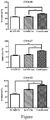
- the Figure is a diagram showing activity of CHK1 inhibitor combining with other drugs on MV 4-11 cell line.
- Step 1 synthesis of N -tert-butoxycarbonyl-4-((3-bromo-1-methyl-1 H -pyrazol-5-yl) oxy) piperidin (Intermediate 1- 2 )
- N -tert-Butyloxycarbonyl-4-hydroxypiperidine (460 mg, 2.29 mmol) was dissolved into anhydrous THF (7.2 mL), cooling in ice bath, adding 60% sodium hydride (108mg, 4.5mmol) portionwise and stirring at room temperature for 10 min; The mixture was heated to 35°C and stirred for 10min; Subsequently, the above sodium solution was added dropwise slowly(completed in about 20 min) to the solution of 3-bromo-1-methyl-5-nitropyrazole (360 mg, 1.75 mmol) in anhydrous THF 4.8 mL in a three-necked flask under protection of nitrogen and stirred at room temperature for 1 h.
- 5-Bromo-2,4-dichloropyrimidine 500 mg, 2.194 mmol was dissolved in anhydrous methanol (5 mL), and sodium methoxide (sodium 56 mg, 2.42 mmol) in methanol (1.85 mL) was added to the above solution under nitrogen. The mixture was stirred at room temperature overnight. The reaction was quenched by the addition of saturated ammonium chloride solution and was evaporated at reduced pressure to remove the solvent. Then CH 2 Cl 2 (30 mL) was added and was washed with water (30 mL). The organic layer was separated and evaporated under a reduced pressure to remove the solvent.
- the synthetic method of compound 30 is as follows:
- Step 1 Synthesis of lithium trisisopropyl(4-methylthiazol-2-yl)borate (intermediate 2-44)
- Step 2 Synthesis of N 4 -methyl-5-bromo-N 2 -(2-cyano-3-(N-tert-butoxycarbonylpiperidin-3-yloxy)pyridin-5-yl)-2,4-diaminopyrimidine (intermediate 2-45)
- the Chkl enzyme inhibitory activity (IC 50 ) was evaluated using the ADP-Glo kit.
- the compound acts on Chkl protein kinase and inhibits its phosphorylation substrate Cdc25C.
- the phosphorylation process consumes ATP.
- ADP-GloTM Reagent consumes the remaining ATP.
- the ADP produced during the reaction can be transformed by ADP-Glo Detection Reagent.
- ATP acts as a substrate for the Ultra-GloTM luciferase catalytic reaction, producing an optical signal.
- test compound was dissolved in DMSO to make a 10 mM stock solution and diluted to 12 different concentrations in a certain ratio for testing.
- DMSO fetal sulfate
- 384-well plate add 1 ⁇ L of the test compound to each well, 2 ⁇ L of 2.5X Chkl kinase, add 2 ⁇ L of 1X buffer to the control group, incubate for 10 min at room temperature, and add 2 ⁇ L of 2.5X substrate at 37 ° C. Incubate for 1 h, stop the reaction by adding 5 ⁇ L of ADP-GloTM Reagent, and incubate for 1 h at 37 °C.
- Chkl inhibitory activity of 24 compounds is comparable to that of the positive compound Staurosporine, and the 5 compounds are superior to the positive control Staurosporine. Therefore, the 2-substituted pyrimidine derivatives used as Chkl inhibitors of the present invention have broad antitumor application prospects.
- Cell lines human multiple myeloma cells RPMI 8226, human mantle cell lymphoma cells Mino, Jeko-1, human lymphoma cells Romas, human acute monocytic leukemia cells MV-4-11, human breast cancer cells MCF-7 Human lung cancer cell A549, human prostate cancer cell LnCAP, human gastric cancer cell BGC-823, human colon cancer cell HCT116, Colo205, human ovarian cancer cell OVCAR-8
- Experimental method MTS assay for in vitro proliferation of compounds against different tumor cell lines Inhibitory activity (IC 50 ).
- the cells in the logarithmic growth phase were trypsinized, counted, and seeded at a density of 1 ⁇ 10 4 cells/well in a 96-well plate at 100 ⁇ L per well in a 37 ° C incubator containing 5% CO 2 overnight.
- For the culture six concentration gradients were set for each compound, and three sets of duplicate wells were set for each concentration.
- the cells were cultured for 72 hours, and 20 ⁇ L of MTS was added. After incubating for 2 hours at 37 ° C, the absorbance at 490 nm (L1) was measured with a SpectraMAX 340 microplate reader.
- the reference wavelength was 690 nm (L2), and the (L1-L2) value was plotted against the different concentrations of the inhibitor. , half of the inhibitory concentration IC 50 was fitted by the formula. Table 3-1 Inhibition of proliferative of compounds on each tumor cell line Cpd.
- IC 50 ( ⁇ M) a MCF-7 A549 LnCAP BGC-823 HCT116 OVCAR-8 Colo205 9 1.234 3.714 9.145 > 10 5.217 0.513 2.843 12 2.541 2.962 7.860 9.10.2 4.110 0.274 3.741 13 NT b 1.843 6.779 8.130 4.556 0.662 0.947 16 NT b 3.474 8.776 > 10 3.990 1.527 2.013 17 NT b 4.238 > 10 > 10 1.896 0.220 0.878 18 NT b 3.172 6.998 7.113 1.774 2.136 1.009 29 2.178 2.183 > 10 > 10 1.225 0.329 0.624 32 NT b 5.170 5.996 7.642 4.183 NT b NT b 33 NT b 3.165 5.102 6.183 2.845 NT b NT b 34 NT b 3.192 4.628 > 10 1.779 2.110 3.760 35 1.008 2.162 2.173 4.810 0.980 0.7
- the activity of the compound disclosed in the present invention in combination with other drugs MV 4-11 cells were seeded at 5000/well into 96-well plates.
- the drug is determined according to the ratio of IC 50 of the two drugs.
- the concentration range of each drug is IC 20 ⁇ IC 80 (or 1/8, 1/4, 1/2, 1, 2 and 4 of IC 50 ).
- cell viability was measured by the addition of MTS reagent, and the inhibition rate Fa was calculated as 100% of the unmedicated group.
- the Chou-Talalay method was used to analyze the inhibition rate Fa and the corresponding drug concentration into CompuSyn software, and the CI value and Fa-CI curve of single concentration drug were obtained.
- the drug concentration at X, DA and DB are the concentrations of the two drugs when the growth inhibition rate reaches X when the two drugs are combined. The results are shown in Figure 1 .
- CHK1 inhibitor 35
- FLT3 inhibitor Crenolanib Cre
- Quizartinib Q
- Akt inhibitor GSK2141795 GSK
- CI combination index, according to the judgment method of Soriano et al, 0.9 ⁇ CI ⁇ 1.1 Superposition effect, 0.8 ⁇ CI ⁇ 0.9 is a low degree synergy, 0.6 ⁇ CI ⁇ 0.8 is a moderate synergy, 0.4 ⁇ CI ⁇ 0.6 is a highly synergistic effect, and 0.2 ⁇ CI ⁇ 0.4 is a strong synergistic effect.
Landscapes
- Chemical & Material Sciences (AREA)
- Organic Chemistry (AREA)
- Health & Medical Sciences (AREA)
- General Health & Medical Sciences (AREA)
- Life Sciences & Earth Sciences (AREA)
- Chemical Kinetics & Catalysis (AREA)
- General Chemical & Material Sciences (AREA)
- Medicinal Chemistry (AREA)
- Nuclear Medicine, Radiotherapy & Molecular Imaging (AREA)
- Pharmacology & Pharmacy (AREA)
- Veterinary Medicine (AREA)
- Animal Behavior & Ethology (AREA)
- Public Health (AREA)
- Hematology (AREA)
- Oncology (AREA)
- Pharmaceuticals Containing Other Organic And Inorganic Compounds (AREA)
- Plural Heterocyclic Compounds (AREA)
- Low-Molecular Organic Synthesis Reactions Using Catalysts (AREA)
Abstract
Description
- The present invention relates to the field of medicine, and more particularly to a 2-polysubstituted aromatic ring-pyrimidine derivative and an optical isomer thereof, or a pharmaceutically acceptable salt or solvate thereof, a pharmaceutical composition therewith and the same in the field of antitumor applications.
- With the changes in human living environment and the aging of the population, malignant tumors are seriously threatening human life. In China, malignant tumors have become the first deadly disease. Traditional cancer treatment methods include surgery, radiation therapy and drug chemotherapy, among which drug chemotherapy is the most important. In recent years, as tumor molecular targets have been gradually explained, many targeted anti-tumor drugs have entered clinical applications, but due to the complexity of the tumors and genetic diversity, single-targeted drugs are not enough to cure tumors. Traditional chemotherapeutic drugs are mostly DNA-damaging drugs, which induce tumor cell apoptosis by directly interfering with DNA synthesis of tumor cells, regulating DNA transcription and repair, and prolonging the survival of cancer patients. However, due to its poor selectivity, it can cause a variety of toxic side effects, and it will produce significant drug resistance during the treatment. Therefore, according to the action characteristics of DNA-damaging drugs, drugs with low toxicity are developed to be combined with DNA-damaging drugs, which can reduce the therapeutic effect of DNA-damaging drugs while reducing the toxic side effects and more risk of drug resistance. Among them, the development of cell cycle-related drugs and their strategies in combination with DNA-damaging drugs have attracted great interest and attention from drug researchers in recent years.
- Eukaryotic cells have their own regulatory mechanisms. When exposed to external stimuli such as radiotherapy or chemotherapy, it can be temporarily blocked in the G1, S or G2/M phase for DNA repair, and after completion of the repair, it will enter the next phase. A large number of protein kinases in cells interact with the same or different signaling pathways, forming an intricate signal network that regulates cell growth, proliferation, angiogenesis, metastasis, apoptosis and other life activities. Among them, the tumor gene suppressor protein p53 is mainly responsible for the regulation of the G1 checkpoint, while the S and G2/M phases are mainly regulated by the cell cycle checkpoint kinase 1 (Checkpoint kinase 1). Most tumor cells rely more on S or G2/M phase arrest due to the loss of p53 function as a defense mechanism for DNA damage-induced apoptosis. In the p53-deficient tumor cells, inhibition of Chkl protein can abrogate cell cycle arrest and directly induce tumor cell apoptosis, while normal cells are temporarily blocked in G1 phase due to the existence of intact p53 regulatory mechanism. Therefore, Chkl inhibitor can be used as an adjuvant therapy to selectively enhance the sensitivity of tumor cells to radiotherapy or chemotherapy and improve the therapeutic effect.
- In addition, in the context of specific genetic defects, such as the inherent DNA damage is too high to cause large replication pressure, Chkl inhibitors can also be used alone, killing tumor cells through a "synthetic lethal" mechanism to achieve therapeutic purpose. Based on this therapeutic strategy, Chkl inhibitors can be used alone in the treatment of B-cell lymphoma, leukemia, neuroblastoma, and some sensitive tumors with high expression of proto-oncogenes such as breast and lung cancer.
- In the past two decades, small molecular compounds of different structural types have been discovered as Chkl inhibitors, and these compounds have shown strong anti-tumor effects in preclinical evaluation. At present, 11 small molecule Chkl inhibitors have entered clinical research, which proves the correctness of Chkl as a tumor treatment target.
- An object of the present invention is to provide a 2-polysubstituted aromatic ring-pyrimidine derivative and an optical isomer thereof, or a pharmaceutically acceptable salt or solvate thereof. It is a novel 2-polysubstituted aromatic ring-pyrimidine derivative with strong anticancer activity and Chkl inhibition.
- The 2-polysubstituted aromatic ring-pyrimidine derivatives provided by the present invention comprise the structure of the general formula (I):

- and an optical isomer thereof or a pharmaceutically acceptable salt or solvate thereof;
- wherein ring A is selected from substituted or unsubstituted five- or six-membered aryl groups, and contains from 1 to 3 five- or six-membered heterocyclic aryl groups selected from O, N and S, the substituted substituents being selected from


- B is selected from -NH,

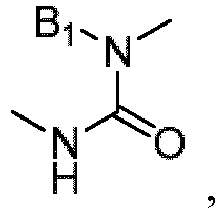
- R1 is selected from a halogen atom, a C1-6 alkyl group, a halogenated C1-6 alkyl group, a C3-6 cycloalkyl group, a halogenated C3-6 cycloalkyl group, a C1-6 alkoxy group, halogenated C1-6 alkoxy, C2-6 alkenyl, C2-6 hydroxy substituted alkenyl, C2-6 alkynyl, C2-6 hydroxy substituted alkynyl, unsubstituted or substituted 5- or 6-membered aromatic or aromatic heterocyclic ring, said aromatic heterocyclic ring comprising 1 to 3 hetero atoms selected from O, N, and S, the substitution being a mono-, di- or tri-substitution, said substituent being selected from the group consisting of Ra; The aryl or heterocyclic aryl group is preferably selected from the group consisting of a benzene ring, a furan, a thiophene, a pyrazole, a thiazole, and a pyrimidine;
- Ra is selected from H, halogen, nitro, cyano, C1-3 alkyl, halogenated C1-3 alkyl,-C(=O)ORb, -C(=O)NHRb, -NHRb, -ORb -NHCORb; Rb is selected from H, C1-3 alkyl, halogenated C1-3 alkyl, C1-3 alkoxy, halogenated C1-3 alkoxy, C1-7 alkylamine;
- R2 is selected from the group consisting of H, -NHRc, -N(Rc)2, -ORc, -SRc; Rc is selected from the group consisting of C1-7 alkyl, halogenated C1-7 alkyl, C1-7 hydroxyalkyl, C1-7 aminoalkyl;
- R3 is selected from the group consisting of halogen, nitro, cyano, C1-3 alkyl, halogenated C1-3 alkyl, C1-3 alkoxy, halogenated C1-3 alkoxy, C1-3 alkylamino, halogenated C1-3 alkylamino group;
- L1 is selected from O, S, NH or a deletion;
- m=0∼2;
- R4 is selected from C1-7 alkyl, halogenated C1-7 alkyl, hydroxy substituted C1-7 alkyl, C1-7 alkylamino, halogenated C1-7 alkylamino, C1-7 alkoxy, halogenated C1-7 alkoxy group, five- to eight-membered nitrogen-containing aliphatic heterocyclic ring;
- R5 is selected from the group consisting of halogen, nitro, cyano, trifluoromethyl, C1-3 alkyl, C1-3 alkoxy, amide and substituted alkyl amide.
- Preferably, the 2-polysubstituted aromatic ring-pyrimidine derivative comprises a structure of formula II:

- and an optical isomer thereof or a pharmaceutically acceptable salt or solvate thereof, wherein: W, X, Y and Z are identical or different and are independently selected from N, C and O;
- B is selected from -NH,


- R1 is selected from halogen atom, C1-6 alkyl group, halogenated C1-6 alkyl group, C3-6 cycloalkyl group, halogenated C3-6 cycloalkyl group, C1-6 alkoxy group, halogenated C1-6 alkoxy, C2-6 alkenyl, C2-6 hydroxy substituted alkenyl, C2-6 alkynyl, C2-6 hydroxy substituted alkynyl, unsubstituted or substituted 5- or 6-membered aromatic or aromatic heterocyclic ring, said aromatic heterocyclic ring comprising 1 to 3 hetero atoms selected from O, N and S, the substitution being a mono-, di- or tri-substitution, said substituent being selected from the group consisting of Ra;
- Ra is selected from H, halogen, nitro, cyano, C1-3 alkyl, halogenated C1-3 alkyl,-C(=O)ORb, -C(=O)NHRb, -NHRb, -ORb -NHCORb; Rb is selected from H, C1-3 alkyl, halogenated C1-3 alkyl, C1-3 alkoxy, halogenated C1-3 alkoxy, C1-7 alkylamine;
- R2 is selected from the group consisting of H, -NHRc, -N(Rc)2, -ORc, -SRc; Rc is selected from the group consisting of C1-7 alkyl, halogenated C1-7 alkyl, C1-7 hydroxyalkyl, C1-7 alkylamino group, C1-7 alkoxy group;
- R3 is selected from the group consisting of halogen, nitro, cyano, C1-3 alkyl, halogenated C1-3 alkyl, C1-3 alkoxy, halogenated C1-3 alkoxy, C1-3 alkylamino, halogenated C1-3 alkylamino group;
- L1 is selected from O, S, NH or a deletion;
- m=0∼2;
- R4 is selected from the group consisting of H, C1-7 alkyl, halogenated C1-7 alkyl, hydroxy substituted C1-7 alkyl, C1-7 alkylamino, halogenated C1-7 alkylamino, C1-7 alkoxy group, halogenated C1-7 alkoxy group, and five- to eight-membered nitrogen-containing aliphatic heterocyclic ring;
- R5 is selected from the group consisting of halogen, nitro, cyano, trifluoromethyl, C1-3 alkyl, C1-3 alkoxy, amide, substituted alkyl amide.
- Preferably, the 2-polysubstituted aromatic ring-pyrimidine derivative, comprises a structure of formula III:

- and an optical isomer thereof or a pharmaceutically acceptable salt or solvate thereof;
- wherein W, X, Y and Z are the same or different and are each independently selected from N or C;
- B is selected from -NH,

- R1 is selected from halogen atom, C1-6 alkyl group, halogenated C1-6 alkyl group, C3-6 cycloalkyl group, halogenated C3-6 cycloalkyl group, C1-6 alkoxy group, halogenated C1-6 alkoxy, C2-6 alkenyl, C2-6 hydroxy substituted alkenyl, C2-6 alkynyl, C2-6 hydroxy substituted alkynyl, unsubstituted or substituted 5- or 6-membered aromatic or aromatic heterocyclic ring, said aromatic heterocyclic ring comprising 1 to 3 hetero atoms selected from O, N and S, the substitution being a mono-, di- or tri-substitution, said substituent being selected from the group consisting of Ra;
- Ra is selected from H, halogen, nitro, cyano, C1-3 alkyl, halogenated C1-3 alkyl,-C(=O)ORb, -C(=O)NHRb, -NHRb, -ORb -NHCORb; Rb is selected from H, C1-3 alkyl, halogenated C1-3 alkyl, C1-3 alkoxy, halogenated C1-3 alkoxy, C1-7 alkylamine;
- R2 is selected from the group consisting of H, -NHRc, -N(Rc)2, -ORc, -SRc; Rc is selected from the group consisting of C1-7 alkyl, halogenated C1-7 alkyl, C1-7 hydroxyalkyl, C1-7 alkylamine group, C1-7 alkoxy group;
- R3 is selected from the group consisting of halogen, nitro, cyano, C1-3 alkyl, halogenated C1-3 alkyl, C1-3 alkoxy, halogenated C1-3 alkoxy, C1-3 alkylamino, halogenated C1-3 alkylamino group;
- L1 is selected from O, S, NH or a deletion;
- m=0∼2;
- R4 is selected from the group consisting of H, C1-7 alkyl, halogenated C1-7 alkyl, hydroxy substituted C1-7 alkyl, C1-7 alkylamino, halogenated C1-7 alkylamino, C1-7 alkoxy group, halogenated C1-7 alkoxy group, and five- to eight-membered nitrogen-containing aliphatic heterocyclic ring;
- R5 is selected from the group consisting of halogen, nitro, cyano, trifluoromethyl, C1-3 alkyl, C1-3 alkoxy, amide, substituted alkyl amide.
- Preferably, the 2-polysubstituted aromatic ring-pyrimidine derivative comprises a structure of formula IV:


- W, X, Y and Z are the same or different and are independently selected from N, C and O;
- R1 is selected from halogen atom, C1-6 alkyl group, halogenated C1-6 alkyl group, C3-6 cycloalkyl group, halogenated C3-6 cycloalkyl group, C1-6 alkoxy group, halogenated C1-6 alkoxy, C2-6 alkenyl, C2-6 hydroxy substituted alkenyl, C2-6 alkynyl, C2-6 hydroxy substituted alkynyl, unsubstituted or substituted 5- or 6-membered aromatic or aromatic heterocyclic ring, said aromatic heterocyclic ring comprising 1 to 3 hetero atoms selected from O, N and S, the substitution being a mono-, di- or tri-substitution, said substituent being selected from the group consisting of Ra;
- Ra is selected from H, halogen, nitro, cyano, C1-3 alkyl, halogenated C1-3 alkyl,-C(=O)ORb, -C(=O)NHRb, -NHRb, -ORb -NHCORb; Rb is selected from H, C1-3 alkyl, halogenated C1-3 alkyl, C1-3 alkoxy, halogenated C1-3 alkoxy, C1-7 alkylamine;
- R2 is selected from the group consisting of H, -NHRc, -N(Rc)2, -ORc, -SRc; Rc is selected from the group consisting of C1-7 alkyl, halogenated C1-7 alkyl, C1-7 hydroxyalkyl, C1-7 alkylamino group, C1-7 alkoxy group;
- R3 is selected from the group consisting of halogen, nitro, cyano, C1-3 alkyl, halogenated C1-3 alkyl, C1-3 alkoxy, halogenated C1-3 alkoxy, C1-3 alkylamino, halogenated C1-3 alkylamino group;
- L1 is selected from O, S, NH or a deletion;
- m=0-2;
- R4 is selected from the group consisting of H, C1-7 alkyl, halogenated C1-7 alkyl, hydroxy substituted C1-7 alkyl, C1-7 alkylamino, halogenated C1-7 alkylamino, C1-7 alkoxy group, halogenated C1-7 alkoxy group, and five- to eight-membered nitrogen-containing aliphatic heterocyclic ring;
- R5 is selected from the group consisting of halogen, nitro, cyano, trifluoromethyl, C1-3 alkyl, C1-3 alkoxy, amide, substituted alkyl amide.
- Preferably, in the 2-polysubstituted aromatic ring-pyrimidine derivative, the compound is selected from the group consisting of:
- N4-methyl-5-(1-methyl-1H-pyrazol-4-yl)-N2-(1-methyl-5-(piperidin-4-yloxy)pyrazol-3-yl)-2,4-diaminopyrimidine;
- N4-methyl-5-(1-methyl-1H-pyrazol-4-yl)-N2-(3-(piperidin-4-yloxy)isoxazol-5-yl)-2,4-diaminopyrimidine;
- N4-methyl-5-(1-methyl-1H-pyrazol-4-yl)-N2-(1-methyl-2-(piperidin-4-yloxy)imidazol-4-yl)-2,4-diaminopyrimidine;
- N4-methyl-5-(1-methyl-1H-pyrazol-4-yl)-N2-(2-(piperidin-4-yloxy)isothiazol-5-yl)-2,4-diaminopyrimidine;
- N4-methyl-5-(1-methyl-1H-pyrazol-4-yl)-N2-(2-(piperidin-4-yloxy)-4,5-2H-oxazoline-5-yl)-2,4-diaminopyrimidine; and
- N4-methyl-5-(1-methyl-1H-pyrazol-4-yl)-N2-(2-(piperidin-4-yloxy)thiazol-5-yl)-2,4-diaminopyrimidine.
- Preferably, the 2-polysubstituted aromatic ring-pyrimidine derivative, comprises a structure of formula V:

- W, X, Y and Z are the same or different and are each independently selected from N or C;
- R1 is selected from halogen atom, C1-6 alkyl group, halogenated C1-6 alkyl group, C3-6 cycloalkyl group, halogenated C3-6 cycloalkyl group, C1-6 alkoxy group, halogenated C1-6 alkoxy, C2-6 alkenyl, C2-6 hydroxy substituted alkenyl, C2-6 alkynyl, C2-6 hydroxy substituted alkynyl, unsubstituted or substituted 5- or 6-membered aromatic or aromatic heterocyclic ring, said aromatic heterocyclic ring comprising 1 to 3 hetero atoms selected from O, N and S, the substitution being a mono-, di- or tri-substitution, said substituent being selected from the group consisting of Ra;
- Ra is selected from H, halogen, nitro, cyano, C1-3 alkyl, halogenated C1-3 alkyl,-C(=O)ORb, -C(=O)NHRb, -NHRb, -ORb -NHCORb; Rb is selected from H, C1-3 alkyl, halogenated C1-3 alkyl, C1-3 alkoxy, halogenated C1-3 alkoxy, C1-7 alkylamine;
- R2 is selected from the group consisting of H, -NHRc, -N(Rc)2, -ORc, -SRc; Rc is selected from the group consisting of C1-7 alkyl, halogenated C1-7 alkyl, C1-7 hydroxyalkyl, C1-7 alkane Amino group, C1-7 alkoxy group;
- R3 is selected from the group consisting of halogen, nitro, cyano, C1-3 alkyl, halogenated C1-3 alkyl, C1-3 alkoxy, halogenated C1-3 alkoxy, C1-3 alkylamino, halogenated C1-3 alkylamino group;
- L1 is selected from O, S, NH or a deletion;
- m=0∼2;
- R4 is selected from the group consisting of H, C1-7 alkyl, halogenated C1-7 alkyl, hydroxy substituted C1-7 alkyl, C1-7 alkylamino, halogenated C1-7 alkylamino, C1-7 alkoxy group, halogenated C1-7 alkoxy group, and five- to eight-membered nitrogen-containing aliphatic heterocyclic ring;
- R5 is selected from the group consisting of halogen, nitro, cyano, trifluoromethyl, C1-3 alkyl, C1-3 alkoxy, amide, substituted alkyl amide.
- In the 2-polysubstituted aromatic ring-pyrimidine derivative, the compound is selected from the group consisting of:
- 5-phenyl-N-(2-cyano-3-(piperidin-3-oxy)pyridin-5-yl)-2-aminopyrimidine;
- 5-(3-fluorophenyl)-N-(2-cyano-3-(piperidin-3-yloxy)pyridin-5-yl)-2-aminopyrimidine;
- 5-(4-fluorophenyl)-N-(2-cyano-3-(piperidin-3-yloxy)pyridin-5-yl)-2-aminopyrimidine;
- 5-(3-methoxyphenyl)-N-(2-cyano-3-(piperidin-3-yloxy)pyridin-5-yl)-2-aminopyrimidine;
- 5-(4-methoxyphenyl)-N-(2-cyano-3-(piperidin-3-yloxy)pyridin-5-yl)-2-aminopyrimidine;
- 5-(pyridin-3-yl)-N-(2-cyano-3-(piperidin-3-oxy)pyridin-5-yl)-2-aminopyrimidine;
- 5-(pyridin-4-yl)-N-(2-cyano-3-(piperidin-3-yloxy)pyridin-5-yl)-2-aminopyrimidine;
- 5-(thien-2-yl)-N-(2-cyano-3-(piperidin-3-yloxy)pyridin-5-yl)-2-aminopyrimidine;
- 5-(furan-2-yl)-N-(2-cyano-3-(piperidin-3-yloxy)pyridin-5-yl)-2-aminopyrimidine;
- 5-trifluoromethyl-N-(2-cyano-3-(piperidin-3-oxy)pyridin-5-yl)-2-aminopyrimidine;
- (R)-5-(1-methyl-1H-pyrazol-4-yl)-N-(2-cyano-3-(piperidin-3-yloxy)pyridin-5-yl)-2-aminopyrimidine;
- (S)-5-(1-methyl-1H-pyrazol-4-yl)-N-(2-cyano-3-(piperidin-3-yloxy)pyridin-5-yl)-2-aminopyrimidine;
- 4-methoxy-5-(3-fluorophenyl)-N-(2-cyano-3-(piperidin-4-methyl)oxypyridin-5-yl)-2-aminopyrimidine;
- 4-methoxy-5-(1-methyl-1H-pyrazol-4-yl)-N-(2-cyano-3-(piperidin-4-methyl)oxypyridin-5-yl)2-aminopyrimidine;
- 4-methoxy-5-(3-fluorophenyl)-N-(2-cyano-3-(2-dimethylaminoethoxy)pyridin-5-yl)-2-aminopyrimidine;
- 4-methoxy-5-(1-methyl-1H-pyrazol-4-yl)-N-(2-cyano-3-(2-dimethylaminoethoxy)pyridine-5-yl) 2-aminopyrimidine;
- 4-methoxy-5-trifluoromethyl-N-(2-cyano-3-(piperidin-4-methyl)oxypyridin-5-yl)-2-aminopyrimidine;
- N4-methyl-5-phenyl-N2-(2-cyano-3-(piperidin-3-oxy)pyridin-5-yl)-2,4-diaminopyrimidine;
- N4-methyl-5-(3-fluorophenyl)-N2-(2-cyano-3-(piperidin-3-yloxy)pyridin-5-yl)-2,4-diaminopyrimidine;
- N4-methyl-5-(4-fluorophenyl)-N2-(2-cyano-3-(piperidin-3-yloxy)pyridin-5-yl)-2,4-diaminopyrimidine;
- N4-methyl-5-(2-fluorophenyl)-N2-(2-cyano-3-(piperidin-3-oxy)pyridin-5-yl)-2,4-diaminopyrimidine;
- N4-methyl-5-(3-methoxyphenyl)-N2-(2-cyano-3-(piperidin-3-yloxy)pyridin-5-yl)-2,4-diaminopyrimidine;
- N4-methyl-5-(4-methoxyphenyl)-N2-(2-cyano-3-(piperidin-3-yloxy)pyridin-5-yl)-2,4-diaminopyrimidine;
- N4-methyl-5-(2,4-dimethoxyphenyl)-N2-(2-cyano-3-(piperidin-3-yloxy)pyridin-5-yl)-2,4-diaminopyrimidine;
- N4-methyl-5-(pyridin-3-yl)-N2-(2-cyano-3-(piperidin-3-yloxy)pyridin-5-yl)-2,4-diaminopyrimidine;
- N4-methyl-5-(pyridin-4-yl)-N2-(2-cyano-3-(piperidin-3-yloxy)pyridin-5-yl)-2,4-diaminopyrimidine;
- N4-methyl-5-(thiophen-2-yl)-N2-(2-cyano-3-(piperidin-3-oxy)pyridin-5-yl)-2,4-diaminopyrimidine;
- N4-methyl-5-(furan-2-yl)-N2-(2-cyano-3-(piperidin-3-yloxy)pyridin-5-yl)-2,4-diaminopyrimidine;
- N4-methyl-5-(5-chloro-furan-2-yl)-N2-(2-cyano-3-(piperidin-3-yloxy)pyridin-5-yl)-2,4-diaminopyrimidine;
- N4-methyl-5-(5-methoxycarbonylthiophen-2-yl)-N2-(2-cyano-3-(piperidin-3-yloxy)pyridin-5-yl)-2,4-diaminopyrimidine;
- N4-methyl-5-(1-methyl-1H-pyrazol-4-yl)-N2-(2-cyano-3-(piperidin-3-yloxy)pyridin-5-yl)-2,4-diaminopyrimidine;
- N4-methyl-5-(1-methyl-1H-pyrazol-5-yl)-N2-(2-cyano-3-(piperidin-3-yloxy)pyridin-5-yl)-2,4-diaminopyrimidine;
- N4-methyl-5-trifluoromethyl-N2-(2-cyano-3-(piperidin-3-oxy)pyridin-5-yl)-2,4-diaminopyrimidine;
- N4-methyl-5-(1-methyl-1H-pyrazol-4-yl)-N2-(2-cyano-3-(piperidin-4-methyl)oxypyridin-5-yl) -2,4-diaminopyrimidine;
- (R)-N4-methyl-5-(1-methyl-1H-pyrazol-4-yl)-N2-(2-cyano-3-(piperidin-3-yloxy)pyridine-5-yl)-2,4-diaminopyrimidine;
- (S)-N4-methyl-5-(1-methyl-1H-pyrazol-4-yl)-N2-(2-cyano-3-(piperidin-3-yloxy)pyridine-5-yl)-2,4-diaminopyrimidine;
- (R)-N4-methyl-5-trifluoromethyl-N2-(2-cyano-3-(piperidin-3-oxy)pyridin-5-yl)-2,4-diaminopyrimidine;
- (S)-N4-methyl-5-trifluoromethyl-N2-(2-cyano-3-(piperidin-3-oxy)pyridin-5-yl)-2,4-diaminopyrimidine;
- (R)-N4-methyl-5-(1-methyl-1H-pyrazol-4-yl)-N2-(2-cyano-3-(pyrrole-3-oxy)pyridin-5-yl)-2,4-diaminopyrimidine;
- (S)-N4-methyl-5-(1-methyl-1H-pyrazol-4-yl)-N2-(2-cyano-3-(pyrrole-3-oxy)pyridin-5-yl)-2,4-diaminopyrimidine;
- N4-methyl-5-(1-methyl-1H-pyrazol-4-yl)-N2-(2-cyano-3-(piperidin-4-yloxy)pyridin-5-yl)-2,4-diaminopyrimidine;
- N4-methyl-5-(1-methyl-1H-pyrazol-4-yl)-N2-(2-cyano-3-(2-dimethylaminoethoxy)pyridin-5-yl)-2,4-diaminopyrimidine;
- (R)-N4-methyl-5-(1-methyl-1H-pyrazol-4-yl)-N2-(2-cyano-3-(1-dimethylaminopropyl-2-oxy) pyridin-5-yl)-2,4-diaminopyrimidine;
- (S)-N4-methyl-5-(1-methyl-1H-pyrazol-4-yl)-N2-(2-cyano-3-(1-dimethylaminopropyl-2-oxy) pyridin-5-yl)-2,4-diaminopyrimidine;
- N4-methyl-5-(1-methyl-1H-pyrazol-4-yl)-N2-(2-cyano-3-(N-methylpiperidin-4-yloxy)pyridine-5-yl)2,4-diaminopyrimidine;
- N4-methyl-5-trifluoromethyl-N2-(2-cyano-3-(N-methylpiperidin-4-yloxy)pyridin-5-yl)-2,4-diaminopyrimidine;
- N4-methyl-5-(4-methylthiazol-2-yl)-N2-(2-cyano-3-(piperidin-3-yloxy)pyridin-5-yl)-2,4-diaminopyrimidine;
- and a pharmaceutically acceptable salt or solvate thereof.
- The invention adopts a method familiar to technicians in this field to prepare salt of 2-pyrimidine derivatives described in the invention. The salt may be an organic acid salt, a mineral acid salt and so on, and the organic acid salt includes a citrate, a fumarate, an oxalate, a malate, a L-malate, and a D-malate, lactate, camphorsulfonate, p-toluenesulfonate, methanesulfonate, benzoate, etc.; the inorganic acid salt includes a hydrohalide, a sulfate, a phosphate, a nitrate, and so on. For example, with a lower alkylsulfonic acid such as methanesulfonic acid, trifluoromethanesulfonic acid or the like may form a mesylate salt, a triflate salt; and an arylsulfonic acid such as benzenesulfonic acid or p-toluenesulfonic acid; with organic carboxylic acids such as acetic acid, fumaric acid, tartrate, L-tartaric acid, D-tartaric acid, oxalic acid, maleic acid, malate, L-malic acid, D-malic acid, succinic acid or citric acid and so on may form corresponding salts; and with an amino acid such as glutamic acid or aspartic acid may form a glutamate or an aspartate. Corresponding salts may also be formed with inorganic acids such as hydrohalic acids (e.g., hydrofluoric acid, hydrobromic acid, hydroiodic acid, hydrochloric acid), nitric acid, carbonic acid, sulfuric acid or phosphoric acid.
- The second purpose of the invention is to provide a pharmaceutical composition comprising at least one active ingredient together with one or more pharmaceutically acceptable carriers or excipients, said active ingredient it may be a 2-substituted pyrimidine compound of the present invention, an optical isomer of the compound, a solvate of the compound or an optical isomer thereof in a pharmaceutically acceptable salt, the compound or an optical isomer thereof Any one or any of a variety of them.
- The carrier includes conventional diluents, excipients, fillers, binders, wetting agents, disintegrating agents, absorption enhancers, surfactants, adsorption carriers, lubricants, etc. in the pharmaceutical field, etc. and fragrances, sweetener may also be added if necessary. The medicament of the present invention can be prepared into various forms such as tablets, powders, granules, capsules, oral liquids and injectable preparations, and the medicaments of the above respective dosage forms can be prepared according to a conventional method in the pharmaceutical field.
- The present invention also provides a compound of the formula (I) to the formula (V), and an optical isomer thereof, or a pharmaceutically acceptable salt or solvate thereof, and an optical isomer thereof, or a pharmaceutically acceptable compound thereof. The use of accepted salts or solvates, alone and/or in combination with radiation therapy, other drugs, in the preparation of Chkl inhibitors, particularly in the preparation of therapeutically proliferative diseases. The cell proliferative diseases include tumors, and the tumors are breast cancer, ovarian cancer , narcoma, lung cancer, prostate cancer, colon cancer, rectal cancer, renal cancer, pancreatic cancer, blood cancer, lymphoma, neuroblastoma, and glioma, head cancer, neck cancer, thyroid cancer, liver cancer, vulvar cancer, cervical cancer, endometrial cancer, testicular cancer, bladder cancer, esophageal cancer, stomach cancer, nasopharyngeal cancer, buccal cancer, oral cancer, gastrointestinal stromal tumor, skin cancer, multiple myeloma. The antitumor agent which can be used in combination with the compound provided by the present invention or a pharmaceutically acceptable salt intended includes, but is not limited to, at least one of the following classes: antimetabolite (gemcitabine, 5-fluorouracil, hydroxyurea, pemetrexed); bioalkylatingagengts (eg cisplatin, carboplatin); topoisomerase inhibitors (irinotecan, doxorubicin); small molecule inhibitors (MEK inhibitors, PARP inhibitors, Scr kinase inhibitors, mTOR inhibitors, farnesyltransferase inhibitors, etc .).
- Another object of the present invention is to provide a process for the preparation of the above target compound by the following steps:
-
- (1) 5-Bromo-2-substituted-3-nitropyridine (or 5-bromo-2-cyano-3-nitropyridine) was reacted with different fatty alcohols under basic conditions (in the presence of NaH) to obtain different substituted pyridine fragments;
- (2) Starting with 5-bromo-2,4-dichloropyrimidine, followed by methyl etherification or methylamination to give 5-bromo-2-chloro-4-substituted pyrimidine then was ammoniated to get 5-bromo-N4-methylpyrimidine-2,4-diamine or 5-bromo-4-methoxypyrimidin-2-amine. 2-Aminopyrimidine was brominated to obtain 5-bromo-2-aminopyrimidine. The Suzuki-Miyaura coupling reaction was occurred between 5-bromo-N4-methylpyrimidine-2,4-diamine or 5-bromo-4-methoxypyrimidin-2-amine or 5-bromo-2-aminopyrimidine and corresponding borate or boric acid and then Buchwald-Hartwig cross-coupling was occurred between the product of the Suzuki-Miyaura coupling reaction and the substituted pyridine fragment from the first step, followed by acidic deprotection to obtain the target compound; or 5-bromo-N4-methylpyrimidine-2,4-diamine was firstly carried out Buchwald-Hartwig cross-coupling with the substituted pyridine fragment from the first step, then followed by Suzuki-Miyaura coupling reaction with corresponding borate or boric acid, and then deprotection under acidic conditions to obtain the target compound; Compound 1-6 was prepared according to the following synthetic route:

- Compound 7-16 was prepared according to the following synthetic route:

- Compound 17-43 was prepared according to the following synthetic route:

- Compound 44 was prepared according to the following synthetic route:

-
- (1) 5-Bromo-2-cyano-3-nitropyridine was reacted with different fatty alcohols under basic conditions (conditions of NaH) to obtain different substituted pyridine fragments;
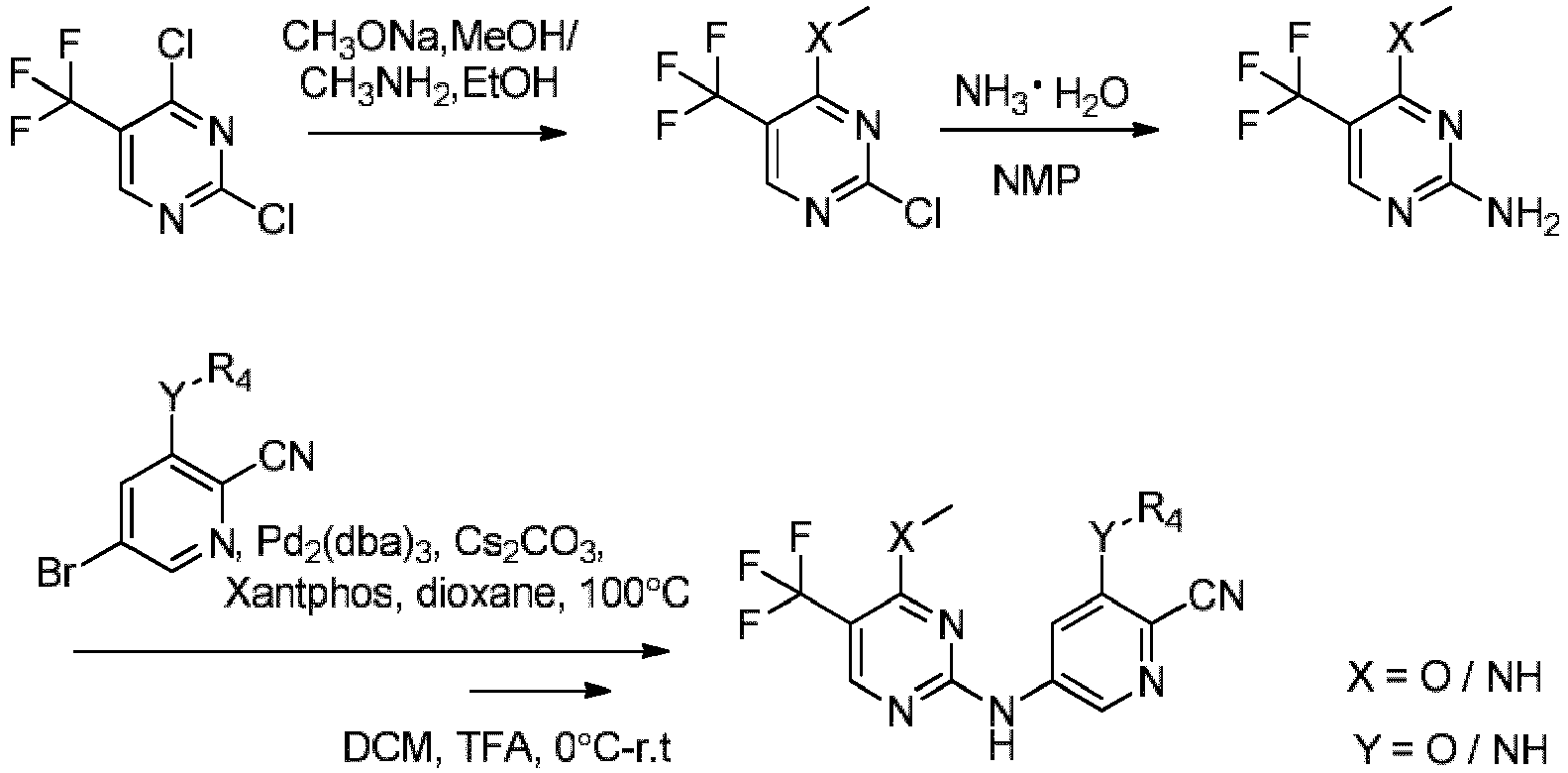
- (2) 2,4-Dichloro-5-trifluoromethylpyrimidine as starting material, followed by methyl etherification or methylamination, then ammoniation to obtain 2,4-disubstituted-5-trifluoromethylpyrimidine. 2-Chloro-5-trifluoromethylpyrimidine was ammoniated to get 2-amino-5-trifluoromethylpyrimidine. Buchwal-Hartwig cross-coupling was carried out between 2,4-disubstituted-5-trifluoromethylpyrimidine or 2-amino-5-trifluoromethylpyrimidine with the substituted pyridine fragment from the first step, and finally removing the Boc protecting group to obtain the target compound.

- The synthetic route of compound 46-50 is as follows:
- The inventors of the present invention have experimentally confirmed that most of the compounds of the present invention have moderate to strong Chkl kinase inhibitory activity and are useful for the treatment of solid tumors or blood cancers associated with cell proliferation in humans or animals. A series of novel small molecule Chkl inhibitors were designed and synthesized by using 2-aminopyrimidine as a lead compound obtained through structure-based virtual screening, and Chkl kinase inhibitory activity of these compounds was tested. The results showed that most of the compounds exhibited moderate to strong Chkl inhibitory activity and were promising Chkl inhibitors, providing new drugs for cancer therapy.
- The Figure is a diagram showing activity of CHK1 inhibitor combining with other drugs on MV 4-11 cell line.
- Further description of the present invention was illustrated combining with the preferred embodiments. The embodiments below are exemplary only and not intended to be limiting.
-

-

- N-tert-Butyloxycarbonyl-4-hydroxypiperidine (460 mg, 2.29 mmol) was dissolved into anhydrous THF (7.2 mL), cooling in ice bath, adding 60% sodium hydride (108mg, 4.5mmol) portionwise and stirring at room temperature for 10 min; The mixture was heated to 35°C and stirred for 10min; Subsequently, the above sodium solution was added dropwise slowly(completed in about 20 min) to the solution of 3-bromo-1-methyl-5-nitropyrazole (360 mg, 1.75 mmol) in anhydrous THF 4.8 mL in a three-necked flask under protection of nitrogen and stirred at room temperature for 1 h. The reaction was quenched by the addition of a saturated ammonium chloride solution, and the solvent was evaporated under reduced pressure. The resultant product was purified by silica gel column chromatography eluting PE: EtOAc (50:9) to give a yellow liquid. Yield: 79%; LCMS: m/z = 361 [M+1]+.
-

- To a solution of 5-bromo-2,4-dichloropyrimidine (5 g, 22 mmol) in methanol (42 mL), 33% methylamine alcohol solution (6.75 mL) was added dropwise under an ice water bath, and the reaction mixture was stirred at room temperature 30 min. The solvent was evaporated under reduced pressure and the crude product was purified by column chromatography (eluent PE:EtOAc=5:1) to give a white solid. Yield: 88%; mp: 139-141 °C; 1H NMR (500 MHz, DMSO-d6): δ 8.85 (s, Ar-H, 1H), 7.75 (br, NH, 1H), 2.85 (d, J = 3.9 Hz, CH3, 3H); ESI-MS: m/z = 222 [M+1]+.
-

- Compound 1-4 (275 mg, 1.23 mmol) was placed in a sealed tube, and a solution of ammonia-saturated ethanol (20 mL) was added and the reaction mixture was stirred at 100 °C for 24 h. After cooling to room temperature, the solvent was removed by evaporation. The residue was purified by silica gel column chromatography(eluent PE:EtOAc=2:1) to give a white solid. Yield: 78%; 1H NMR (500 MHz, CDCl3): δ 7.86 (s, Ar-H, 1H), 5.22 (br, NH, 1H), 4.85 (br, NH2, 2H), 2.99 (d, J = 6.0 Hz, CH3, 3H); ESI-MS: m/z = 204 [M+1]+.
-

- Compound 1-5 (290 mg, 1.43 mmol), 1-methyl-1H-pyrazole-4-boronic acid pinacol ester (358 mg, 1.72 mmol) and Pd(dppf)Cl2 (54 mg, 0.07mmol) were placed in reaction flask. Then ethylene glycol dimethyl ether (14 mL) and IN aqueous Na2CO3 solution were added. The reaction was carried out under refluxing overnight. After cooling, the solvent was removed under reduced pressure. The residue was purified by column chromatography on silica gel (eluent CH2Cl2:EtOH=25:1) to give a white solid. Yield: 75%; mp: 226-228°C; 1H NMR (500 MHz, DMSO-d6): δ 7.88 (s, Ar-H, 1H), 7.49 (s, Ar-H, 1H), 7.35 (s, Ar-H, 1H), 6.22 (br, NH2, 2H), 5.96 (q, J = 4.5 Hz, NH, 1H), 3.51 (s, CH3, 3H), 2.86 (d, J = 4.5 Hz, CH3, 3H); ESI-MS: m/z = 205 [M+1]+.
-

- A mixture of compound 1-6 (169 mg, 0.986 mmol), compound 1-2 (376 mg, 0.986 mmol), tris(dibenzylideneacetone)dipalladium (9 mg, 0.00986 mmol), 4,5-bisdiphenylphosphine-9,9-dimethyloxanium (15 mg, 0.026 mmol, Cs2CO3 (450mg, 1.38 mmol) in dry dioxane (6 mL) was heated to reflux overnight under nitrogen. The cooled reaction mixture was filtered and the filtrate was removed by evaporation. The obtained residue was purified by column chromatography on silica gel (eluent CH2Cl2:EtOH=30:1) to give a white solid. Removal of the Boc protecting group with trifluoroacetic acid gave a white solid. Yield: 65%; LCMS: m/z = 385 [M+1]+.
-

-

- Synthetic Procedure Reference Example 1, Step 1. Compounds 1-8 were prepared from (Compound 1-7) according to the same procedure as Compound 1-2. Yield: 63%; LCMS: m/z = 348 [M+1]+.
-

- The synthetic procedure was carried out according to the same procedure as in PREPARATIVE EXAMPLE 1, Step 5. Compound 2 was prepared by a synthetic method similar to Compound 1, using Intermediates 1-8 and 1-6 as starting materials. Yield: 65%; LCMS: m/z = 371 [M+1]+.
-

-

- Synthetic Procedure Reference Example 1, Step 1. Compound 1-10 was prepared from 4-bromo-1-methyl-2-nitroimidazole (Compound 1-9) according to the same procedure as Compound 1-2. Yield: 67%; LCMS: m/z = 361 [M+1]+.
-

- The synthetic procedure was carried out according to the same procedure as in PREPARATIVE EXAMPLE 1, Step 5. Compound 3 was prepared by a synthetic method similar to Compound 1, using Intermediates 1-10 and 1-6 as starting materials. Yield: 65%; LCMS: m/z = 384 [M+1]+.
-

-

- Synthetic procedure Reference to Example 1, Step 1. Compound 1-12 was prepared from 5-bromo-3-nitroisothiazole (Compound 1-11) according to the same procedure as Compound 1-2. Yield: 66%; LCMS: m/z = 364[M+1]+.
-

- The synthetic procedure was carried out according to the same procedure as in PREPARATIVE EXAMPLE 1, Step 5. Compound 4 was prepared by a synthetic method similar to Compound 1, using Intermediates 1-12 and 1-6 as starting materials. Yield: 65%; LCMS: m/z = 387 [M+1]+.
-

-

- Synthetic Procedure Reference Example 1, Step 1. Compound 1-14 was prepared from 5-bromo-2-nitro-4,5-2H-oxazoline (compound 1-13) according to the same procedure ascompound 1-2. Yield: 67%; LCMS: m/z = 361 [M+1]+.
-

- The synthetic procedure was carried out according to the same procedure as in PREPARATIVE EXAMPLE 1, Step 5. Compound 5 was prepared by a synthetic method similar to Compound 1, using Intermediates 1-14 and 1-6 as starting materials. Yield: 65%; LCMS: m/z = 373 [M+1]+.
-

-

- Synthetic Procedure Reference Example 1, Step 1. Compound 1-16 was prepared from 5-bromo-2-nitrothiazole (Compound 1-15) according to the same procedure as Compound 1-2. Yield: 63%; LCMS: m/z = 364 [M+1]+.
-

- The synthetic procedure was carried out according to the same procedure as in PREPARATIVE EXAMPLE 1, Step 5. Compound 6 was prepared by a synthetic method similar to Compound 1, using Intermediates 1-16 and 1-6 as starting materials. Yield: 65%; LCMS: m/z = 387 [M+1]+.
-

-

- Synthetic Procedure Reference to Example 1, Step 1. Compound 2-2 was prepared according to the same procedure as Compound 1-2, using 5-bromo-3-nitro-2-cyanopyridine (Compound 2-1) and N-tert-butoxycarbonyl-3-hydroxypiperidine as starting materials. Yield: 79%; 1H NMR (500 MHz, DMSO-d6): δ 8.26 (s, Ar-H, 1H), 7.53 (s, Ar-H, 1H), 4.38 (br, CH, 1H), 3.63 (br, CH, 1H), 3.51 (br, CH, 1H), 3.38 (br, CH, 2H), 1.98-1.96 (m, CH, 1H), 1.91-1.85 (m, CH, 2H), 1.51 (br, CH, 1H), 1.36 (s, CH3×3, 9H); ESI-MS: m/z = 382 [M+1]+.
-

- 2-Aminopyrimidine (2.5 g, 26.29 mmol) was dissolved in acetonitrile (25 mL). Then N-bromosuccinimide (4.6 g, 27.9 mmol) was added in ice-bath. The reaction mixture was stirred at room temperature overnight. The mixture was evaporated under reduced pressure, and the resultant product was washed with water (100 mL) and filtered with suction. The obtained product was dried in vacuum to get a white solid. Yield: 97%; mp: 241-243 °C.
-

- Synthetic Procedure Reference Example 1, Step 4. Compound 2-5 was prepared by using intermediate 2-4 and phenylboronic acid as starting materials. Yield: 86%; mp: 159-161 °C; 1H NMR (400 MHz, DMSO-d6): δ 8.57 (s, Ar-H, 2H), 7.62 (d, J = 7.6 Hz, Ar-H, 2H), 7.45 (t, J = 7.2 Hz, Ar-H, 2H), 7.34 (t, J = 7.2 Hz, Ar-H, 1H), 6.77 (s, NH2, 2H); ESI-MS: m/z = 172 [M+1]+.
-

- Synthetic Procedure Reference Example 1, Step 5. Compound 7 was prepared using Intermediates 2-5 and 2-2 as starting materials. Yield: 65%; mp: 84-86° C; 1H NMR (500 MHz, DMSO-d 6): δ 10.55 (s, NH, 1H), 8.99 (s, Ar-H, 2H), 8.65 (d, J = 2.0 Hz, Ar-H, 1H), 8.39 (d, J = 2.0 Hz, Ar-H, 1H), 7.78 (d, J = 7.0 Hz, Ar-H, 2H), 7.52 (t, J = 7.5 Hz, Ar-H, 2H), 7.43 (t, J = 7.0 Hz, Ar-H, 1H), 4.42-4.37 (m, CH, 1H), 3.19 (d, J = 12.0 Hz, 2.0 Hz, CH2, 1H), 2.81-2.77 (m, CH2, 1H), 2.66-2.62 (m, CH2, 1H), 2.56-2.53 (m, CH2, 1H), 2.14-2.11 (m, CH2, 1H), 1.76-1.71 (m, CH2, 1H), 1.65-1.58 (m, CH2, 1H), 1.54-1.46 (m, CH2, 1H); 13C NMR(100 MHz, DMSO-d 6): δ 160.22, 158.43, 157.73, 153.05, 142.82, 137.60, 133.83, 129.37, 116.42, 113.77, 111.72, 106.92, 104.53, 86.99, 57.06, 45.54, 38.63, 28.17; ESI-MS: m/z = 373 [M+1]+.
-
-

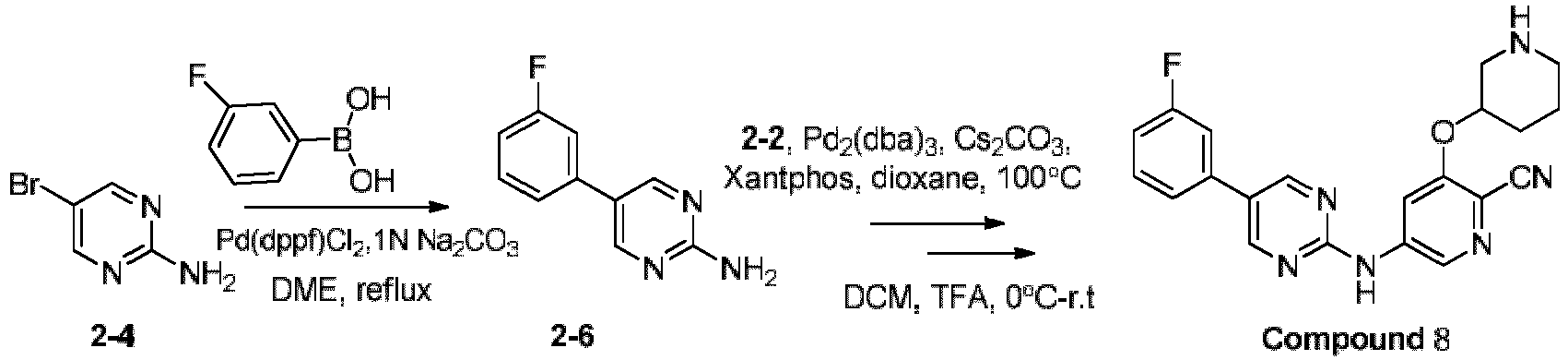
- Synthetic Procedure Reference Example 1, Step 4. Compound 2-6 was prepared from Intermediate 2-4 and 3-fluorophenylboronic acid to give a white solid. Yield: 83% ; mp: 168-170° C; 1H NMR (400 MHz, DMSO-d 6): δ 8.62 (s, Ar-H, 2H), 7.53-7.43 (m, Ar-H, 3H), 7.16-7.11 (m, Ar-H, 1H), 6.86 (s, NH2, 2H); ESI-MS: m/z = 190 [M+1]+.
-

- Synthetic Procedure Reference Example 1, Step 5. Compound 8 was prepared from Intermediates 2-6 and 2-2 to give a white solid. Yield: 72%; mp: 107-109° C; 1H NMR (500 MHz, DMSO-d 6): δ 10.59 (br, NH, 1H), 9.03 (s, Ar-H, 2H), 8.65 (d, J = 1.5 Hz, Ar-H, 1H), 8.37 (s, Ar-H, 1H), 7.70 (d, J = 10.5 Hz, Ar-H, 1H), 7.65 (d, J = 8.0 Hz, Ar-H, 1H), 7.56 (dd, J = 14.0 Hz, 8.0 Hz, Ar-H, 1H), 7.26 (td, J = 8.5 Hz, 2.5 Hz, Ar-H, 1H), 4.42-4.37 (m, CH, 1H), 3.19 (dd, J = 12.0 Hz, 2.0 Hz, CH2, 1H), 2.82-2.78 (m, CH2, 1H), 2.67-2.63 (m, CH2, 1H), 2.57-2.52 (m, CH2, 1H), 2.14-2.11 (m, CH2, 1H), 1.77-1.71 (m, CH2, 1H), 1.66-1.59 (m, CH2, 1H), 1.54-1.47 (m, CH2, 1H); ESI-MS: m/z = 391 [M+1]+.
-

-

- Synthetic Procedure Reference Example 1, Step 4. Compound 2-7 was prepared from the intermediate 2-4 and 4-fluorophenylboronic acid to give a white solid. Yield: 85%; mp: 172-174° C; 1H NMR (400 MHz, DMSO-d 6): δ 8.58 (s, Ar-H, 2H), 7.68-7.64 (m, Ar-H, 2H), 7.29 (t, J = 8.8 Hz, Ar-H, 2H), 6.78 (s, NH2, 2H); ESI-MS: m/z = 190 [M+1]+.
-

- Synthetic Procedure Reference Example 1, Step 5. Compound 9 was prepared from intermediates 2-7 and 2-2 to give a white solid. Yield: 78%; mp: 182-184° C; 1H NMR (500 MHz, DMSO-d 6): δ 10.54 (br, NH, 1H), 8.96 (s, Ar-H, 2H), 8.65 (d, J = 2.0 Hz, Ar-H, 1H), 8.36 (s, Ar-H, 1H), 7.83 (dd, J = 8.5 Hz, 5.5 Hz, Ar-H, 2H), 7.35 (t, J = 8.0 Hz, Ar-H, 2H), 4.41-4.36 (m, CH, 1H), 3.20 (dd, J = 12.0 Hz, 2.5 Hz, CH2, 1H), 2.82-2.78 (m, CH2, 1H), 2.67-2.63 (m, CH2, 1H), 2.57-2.52 (m, CH2, 1H), 2.14-2.11 (m, CH2, 1H), 1.77-1.71 (m, CH2, 1H), 1.65-1.58 (m, CH2, 1H), 1.54-1.46 (m, CH2, 1H); 13C NMR(100 MHz, DMSO-d 6): δ 163.09, 161.14, 158.27, 157.25, 155.90, 141.82, 134.15, 130.59, 128.17, 128.11, 125.15, 116.21, 116.08, 115.91, 113.84, 109.21, 74.69, 49.65, 45.28, 29.82, 24.27; ESI-MS: m/z = 391 [M+1]+.
-

-

- Synthetic Procedure Reference Example 1, Step 4. Compound 2-8 was prepared from intermediate 2-4 and 3-methoxyphenylboronic acid to give a white solid. Yield: 87%; mp: 133-135° C; 1H NMR (400 MHz, DMSO-d 6): δ 8.58 (s, Ar-H, 2H), 7.36 (t, J = 8.0 Hz, Ar-H, 1H), 7.18 (d, J = 7.6 Hz, Ar-H, 2H), 6.90 (dd, J = 8.4 Hz, 1.6 Hz, Ar-H, 1H), 6.78 (s, NH2, 2H), 3.81 (s, CH3, 3H); ESI-MS: m/z = 202 [M+1]+.
-

- Synthetic Procedure Reference Example 1, Step 5. Compound 10 was prepared from intermediates 2-8 and 2-2 to give a white solid. Yield: 74%; mp: 102-104° C; 1H NMR (500 MHz, DMSO-d 6): δ 10.54 (br, NH, 1H), 8.98 (s, Ar-H, 2H), 8.65 (d, J = 2.0 Hz, Ar-H, 1H), 8.37 (d, J = 2.0 Hz, Ar-H, 1H), 7.42 (t, J = 8.0 Hz, Ar-H, 1H), 7.33-7.32 (m, Ar-H, 2H), 6.99-6.97 (m, Ar-H, 1H), 4.42-4.37 (m, CH, 1H), 3.85 (s, CH3, 3H), 3.20 (dd, J = 12.0 Hz, 2.0 Hz, CH2, 1H), 2.82-2.78 (m, CH2, 1H), 2.68-2.64 (m, CH2, 1H), 2.57-2.53 (m, CH2, 1H), 2.14-2.11 (m, CH2, 1H), 1.77-1.71 (m, CH2, 1H), 1.66-1.59 (m, CH2, 1H), 1.55-1.47 (m, CH2, 1H); 13C NMR(100 MHz, DMSO-d 6): δ 159.92, 158.41, 157.25, 156.03, 141.83, 135.43, 134.18, 130.23, 125.86, 118.19, 116.23, 113.84, 113.65, 111.37, 109.21, 74.66, 55.22, 49.63, 45.29, 29.81, 24.24; ESI-MS: m/z = 403 [M+1]+.
-

-

- Synthetic Procedure Reference Example 1, Step 4. Compound 2-9 was prepared from intermediate 2-4 and 4-methoxyphenylboronic acid to give a white solid. Yield: 82%; mp: 165-167° C; 1H NMR (400 MHz, DMSO-d 6): δ 8.51 (s, Ar-H, 2H), 7.55 (d, J = 8.8 Hz, Ar-H, 2H), 7.01 (d, J = 8.8 Hz, Ar-H, 2H), 6.67 (s, NH2, 2H), 3.78 (s, CH3, 3H); ESI-MS: m/z = 202 [M+1]+.
-

- Synthetic Procedure Reference Example 1, Step 5. Compound 11 was prepared from intermediates 2-9 and 2-2 to give a white solid. Yield: 75%; mp: 218-220° C; 1H NMR (400 MHz, DMSO-d 6): δ 10.47 (s, NH, 1H), 8.91 (s, Ar-H, 2H), 8.64 (s, Ar-H, 1H), 8.36 (s, Ar-H, 1H), 7.71 (d, J = 8.8 Hz, Ar-H, 2H), 7.06 (d, J = 8.8 Hz, Ar-H, 2H), 4.40-4.36 (m, CH, 1H), 3.81 (s, CH3, 3H), 3.20 (d, J = 12.0 Hz, CH2, 1H), 2.81-2.78 (m, CH2, 1H), 2.67-2.62 (m, CH2, 1H), 2.56-2.51 (m, CH2, 1H), 2.14-2.12 (m, CH2, 1H), 1.76-1.72 (m, CH2, 1H), 1.66-1.57 (m, CH2, 1H), 1.54-1.46 (m, CH2, 1H); 13C NMR(100 MHz, DMSO-d 6): δ 159.25, 157.86, 157.26, 155.34, 141.92, 134.08, 127.20, 126.29, 125.85, 116.24, 114.61, 113.65, 109.00, 74.69, 55.20, 49.69, 45.31, 29.84,24.31; ESI-MS: m/z = 403 [M+1]+.
-

-

- Synthetic Procedure Reference Example 1, Step 4. Compound 2-10 was prepared from intermediate 2-4 and pyridine-3-boronic acid to give a white solid. Yield: 79%; mp: 183-185° C; 1H NMR (400 MHz, DMSO-d 6): δ 8.87 (s, Ar-H, 1H), 8.64 (s, Ar-H, 2H), 8.53 (br, Ar-H, 1H), 8.05 (d, J = 7.6 Hz, Ar-H, 1H), 7.46 (d, J = 4.0 Hz, Ar-H, 1H), 6.89 (s, NH2, 2H); ESI-MS: m/z = 173 [M+1]+.
-

- Synthetic Procedure Reference Example 1, Step 5. Compound 12 was prepared from intermediates 2-10 and 2-2 to give a white solid. Yield: 75%; mp: 221-223° C ; 1H NMR (500 MHz, DMSO-d 6): δ 10.61 (br, NH, 1H), 9.06 (s, Ar-H, 2H), 9.00 (d, J = 2.5 Hz, Ar-H, 1H), 8.67 (d, J = 1.5 Hz, Ar-H, 1H), 8.62 (dd, J = 4.5 Hz, 1.5 Hz, Ar-H, 1H), 8.37 (d, J = 2.0 Hz, Ar-H, 1H), 8.21 (td, J = 8.0 Hz, 2.0 Hz, Ar-H, 1H), 7.54 (dd, J = 8.0 Hz, 4.0 Hz, Ar-H, 1H), 4.43-4.39 (m, CH, 1H), 3.20 (dd, J = 12.0 Hz, 2.0 Hz, CH2, 1H), 2.83-2.78 (m, CH2, 1H), 2.69-2.65 (m, CH2, 1H), 2.59-2.54 (m, CH2, 1H), 2.15-2.12 (m, CH2, 1H), 1.78-1.72 (m, CH2, 1H), 1.67-1.60 (m, CH2, 1H), 1.55-1.47 (m, CH2, 1H) ; ESI-MS: m/z = 374 [M+1]+.
-

-

- Synthetic Procedure Reference Example 1, Step 4. Compound 2-11 was prepared from intermediate 2-4 and thienyl-2-boronic acid to give a white solid. Yield: 84%; mp : 156-158° C; 1H NMR (400 MHz, DMSO-d6): δ 8.53 (s, Ar-H, 2H), 7.49 (d, J = 4.8 Hz, Ar-H, 1H), 7.38 (d, J = 2.8 Hz, Ar-H, 1H), 7.12 (t, J = 4.4 Hz, Ar-H, 1H), 6.87 (s, NH2, 2H): ESI-MS: m/z = 178 [M+1]+.
-

- Synthetic Procedure Reference Example 1, Step 5. Compound 13 was prepared from intermediates 2-11 and 2-2 to give a white solid. Yield: 74%; mp: 212-214° C ; 1H NMR (500 MHz, DMSO-d 6): δ 10.58 (br, NH, 1H), 8.93 (s, Ar-H, 2H), 8.61 (d, J = 2.0 Hz, Ar-H, 1H), 8.35 (d, J = 2.0 Hz, Ar-H, 1H), 7.63-7.61 (m, Ar-H, 2H), 7.20 (dd, J = 5.0 Hz, 3.5 Hz, Ar-H, 1H), 4.42-4.37 (m, CH, 1H), 3.19 (dd, J = 12.0 Hz, 2.0 Hz, CH2, 1H), 2.82-2.78 (m, CH2, 1H), 2.67-2.63 (m, CH2, 1H), 2.57-2.52 (m, CH2, 1H), 2.14-2.10 (m, CH2, 1H), 1.77-1.71 (m, CH2, 1H), 1.66-1.59 (m, CH2, 1H), 1.54-1.46 (m, CH2, 1H) ; 13C NMR(100 MHz, DMSO-d 6): δ 158.00, 157.25, 154.63, 141.67, 136.46, 134.18, 128.55, 126.15, 124.27, 121.13, 116.20, 113.91, 109.24, 74.64, 49.63, 45.30, 29.81, 24.26 ; ESI-MS: m/z = 379 [M+1]+.
-

-

- Synthetic Procedure Reference Example 1, Step 4. Compound 2-12 was prepared from intermediate 2-4 and furan-2-boronic acid to give a white solid. Yield: 83%; mp: 156-158° C; 1H NMR (400 MHz, DMSO-d 6): δ 8.57 (s, Ar-H, 2H), 7.69 (s, Ar-H, 1H), 6.88 (s, NH, 2H), 6.78 (d, J = 2.0 Hz, Ar-H, 1H), 6.56 (s, Ar-H, 1H); ESI-MS: m/z = 162 [M+1]+
-

- Synthetic Procedure Reference Example 1, Step 5. Compound 14 was prepared from intermediates 2-12 and 2-2 to give a white solid. Yield: 70%; mp: 200-202° C ; 1H NMR (400 MHz, DMSO-d 6): δ 10.58 (br, NH, 1H), 8.95 (s, Ar-H, 2H), 8.59 (d, J = 1.2 Hz, Ar-H, 1H), 8.36 (s, Ar-H, 1H), 7.81 (s, Ar-H, 1H), 7.05 (d, J = 2.8 Hz, Ar-H, 1H), 6.65 (t, J = 1.6 Hz, Ar-H, 1H), 4.41-4.37 (m, CH, 1H), 3.20 (d, J = 12 Hz, CH2, 1H), 2.82-2.79 (m, CH2, 1H), 2.67-2.62 (m, CH2, 1H), 2.57-2.55 (m, CH2, 1H), 2.14-2.12 (m, CH2, 1H), 1.76-1.73 (m, CH2, 1H), 1.67-1.58 (m, CH2, 1H), 1.54-1.49 (m, CH2, 1H); 13C NMR (100 MHz, DMSO-d 6): δ 157.76, 157.23, 153.18, 148.23, 143.35, 141.62, 134.17, 117.90, 116.19, 113.89, 112.08, 109.23, 106.19, 74.66, 49.63, 45.30, 29.81, 24.27 ; ESI-MS: m/z = 363 [M+1]+
-

-

- Synthetic Procedure Reference Example 1, Step 1. Compound 2-13 was prepared from 5-bromo-3-nitro-2-cyanopyridine (Compound 2-1) and (R)-N-tert-butyloxycarbonyl-3-hydroxypiperidine as starting materials according to the same procedure as Compound 1-2, and a yellow oil. Yield: 76%; 1H NMR (500 MHz, DMSO-d 6): δ 8.26 (s, Ar-H, 1H), 7.53 (s, Ar-H, 1H), 4.38 (br, CH, 1H), 3.63 (br, CH, 1H), 3.51 (br, CH, 1H), 3.38 (br, CH, 2H), 1.98-1.96 (m, CH, 1H), 1.91-1.85 (m, CH, 2H), 1.51 (br, CH, 1H), 1.36 (s, CH3×3, 9H); ESI-MS: m/z = 382 [M+1]+.
-

- Synthetic Procedure Reference Example 1, Step 4. Compound 2-14 was prepared from intermediate 2-4 and 1-methylpyrazol-4-boronic acid pinacol ester as a white solid. Yield: 85%; mp: 174-176° C; 1H NMR (400 MHz, DMSO-d 6): δ 8.46 (s, Ar-H, 2H), 8.03 (s, Ar-H, 1H), 7.78 (s, Ar-H, 1H), 6.57 (s, NH2, 2H), 3.84 (s, CH3, 3H); ESI-MS: m/z = 176 [M+1]+.
-

- Synthetic Procedure Reference Example 1, Step 5. Compound 15 was prepared from intermediates 2-14 and 2-13 to give a white solid. Yield : 73% ; mp : 230° C(decomposition); 1H NMR (500 MHz, DMSO-d 6): δ 10.42 (br, NH, 1H), 8.87 (s, Ar-H, 2H), 8.59 (d, J = 1.5 Hz, Ar-H, 1H), 8.35 (d, J = 2.0 Hz, Ar-H, 1H), 8.23 (s, Ar-H, 1H), 7.97 (s, Ar-H, 1H), 4.41-4.36 (m, CH, 1H), 3.89 (s, CH3, 3H), 3.19 (dd, J= 12.0 Hz, 2.0 Hz, CH2, 1H), 2.82-2.78 (m, CH2, 1H), 2.68-2.64 (m, CH2, 1H), 2.58-2.53 (m, CH2, 1H), 2.14-2.11 (m, CH2, 1H), 1.78-1.72 (m, CH2, 1H), 1.65-1.58 (m, CH2, 1H), 1.54-1.46 (m, CH2, 1H); 13C NMR (125 MHz, DMSO-d 6): δ 157.28, 154.26, 141.98, 135.75, 134.02, 127.58, 119.77, 116.28, 115.46, 113.46, 108.76, 74.59, 49.62, 45.27, 38.74,29.78,24.19; ESI-MS: m/z = 377 [M+1]+.
-

-
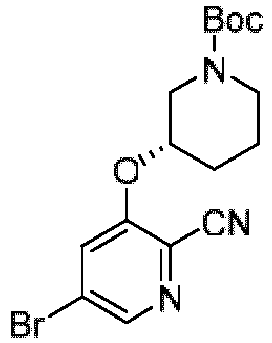
- Synthetic Procedure Reference Example 1, Step 1. Compound 2-15 was prepared from 5-bromo-3-nitro-2-cyanopyridine (Compound 2-1) and (S)-N-tert-butoxycarbonyl-3-hydroxypiperidine as starting materials according to the same procedure as Compound 1-2, a yellow oil. Yield: 78%; 1H NMR (500 MHz, DMSO-d 6) : δ 8.26 (s, Ar-H, 1H), 7.53 (s, Ar-H, 1H), 4.38 (br, CH, 1H), 3.63 (br, CH, 1H), 3.51 (br, CH, 1H), 3.38 (br, CH, 2H), 1.98-1.96 (m, CH, 1H), 1.91-1.85 (m, CH, 2H), 1.51 (br, CH, 1H), 1.36 (s, CH3×3, 9H); ESI-MS: m/z = 382 [M+1]+.
-
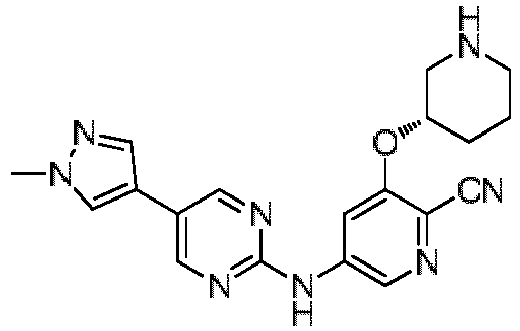
- Synthetic Procedure Reference Example 1, Step 5. Compound 16 was prepared from intermediates 2-14 and 2-15 to give a white solid. Yield : 72% ; mp : 230° C(decomposition); 1H NMR (500 MHz, DMSO-d 6): δ 10.42 (br, NH, 1H), 8.87 (s, Ar-H, 2H), 8.59 (d, J = 1.5 Hz, Ar-H, 1H), 8.35 (d, J = 2.0 Hz, Ar-H, 1H), 8.23 (s, Ar-H, 1H), 7.97 (s, Ar-H, 1H), 4.41-4.36 (m, CH, 1H), 3.89 (s, CH3, 3H), 3.19 (dd, J= 12.0 Hz, 2.0 Hz, CH2, 1H), 2.82-2.78 (m, CH2, 1H), 2.68-2.64 (m, CH2, 1H), 2.58-2.53 (m, CH2, 1H), 2.14-2.11 (m, CH2, 1H), 1.78-1.72 (m, CH2, 1H), 1.65-1.58 (m, CH2, 1H), 1.54-1.46 (m, CH2, 1H); 13C NMR (125 MHz, DMSO-d 6): δ 157.28, 154.26, 141.98, 135.75, 134.02, 127.58, 119.77, 116.28, 115.46, 113.46, 108.76, 74.59, 49.62, 45.27, 38.74,29.78,24.19; ESI-MS: m/z = 377 [M+1]+.
-

-

- Synthetic Procedure Reference Example 1, Step 1. Compound 2-16 was prepared from 5-bromo-3-nitro-2-cyanopyridine (Compound 2-1) and N-tert-butoxycarbonylpiperidin-4-methanol as starting materials according to the same procedure as Compound 1-2. Yield: 80%; 1H NMR (500 MHz, CDCl3): δ 8.34 (s, Ar-H, 1H), 7.51 (s, Ar-H, 1H), 4.20 (d, J = 11.5 Hz, CH2, 2H), 3.95 (br, CH2, 2H), 2.80 (br, CH2, 2H), 2.14-2.05 (m, CH, 1H), 1.89 (br, CH2, 2H), 1.47 (s, CH3×3, 9H), 1.33-1.26 (m, CH2, 2H); ESI-MS: m/z = 206 [M+1]+.
-

- 5-Bromo-2,4-dichloropyrimidine (500 mg, 2.194 mmol) was dissolved in anhydrous methanol (5 mL), and sodium methoxide (sodium 56 mg, 2.42 mmol) in methanol (1.85 mL) was added to the above solution under nitrogen. The mixture was stirred at room temperature overnight. The reaction was quenched by the addition of saturated ammonium chloride solution and was evaporated at reduced pressure to remove the solvent. Then CH2Cl2 (30 mL) was added and was washed with water (30 mL). The organic layer was separated and evaporated under a reduced pressure to remove the solvent. The crude product was purified by silica gel column chromatography (eluent PE:EtOAc=4:1) to give a white solid. Yield: 90%; 1H NMR (400 MHz, CDCl3): δ 8.44 (s, Ar-H, 1H), 4.11 (s, CH3, 3H); ESI-MS: m/z = 223 [M+1]+.
-

- Synthetic Procedure Reference Example 1, Step 3. Compound 2-18 was prepared from intermediate 2-17 as a starting material according to the same procedure as Compound 1-5, a white solid. Yield: 75%; 1H NMR (500 MHz, CDCl3): δ 8.13 (s, Ar-H, 1H), 5.41 (s, NH2, 2H), 3.91 (s, CH3, 3H); ESI-MS: m/ z = 205 [M+1]+.
-

- Synthetic Procedure Reference Example 1, Step 4. Compound 2-19, a white solid, was prepared from intermediate 2-18 and 3-fluorophenylboronic acid as starting materials. Yield: 88%; mp: 127-128°C; 1H NMR (500 MHz, CDCl3): δ 7.98 (s, Ar-H, 1H), 7.46-7.42 (m, Ar-H, 1H), 7.18 (d, J = 7.5 Hz, Ar-H, 1H), 7.12-7.08 (m, Ar-H, 2H), 5.19 (s, NH2, 2H), 4.10 (s, NH2, 2H), 3.96 (s, CH3, 3H); ESI-MS: m/z = 220 [M+1]+.
-

- Synthetic Procedure Reference Example 1, Step 5. Compound 17, a white solid, was prepared from intermediates 2-16 and 2-19. Yield: 79%; mp: 139-141° C; 1H NMR (500 MHz, CDCl3): δ 8.36 (d, J = 2.0 Hz, Ar-H, 1H), 8.18 (s, Ar-H, 1H), 8.08 (d, J = 2.0 Hz, Ar-H, 1H), 7.58-7.54 (m, Ar-H, 1H), 7.24-7.21 (m, Ar-H, 2H), 7.15-7.12 (m, Ar-H, 1H), 7.04 (br, NH, 1H), 4.05 (s, CH3, 3H), 3.97 (d, J = 6.5 Hz, CH2, 2H), 3.20-3.18 (m, CH2, 2H), 2.73-2.72 (m, CH2, 2H), 2.13-2.06 (m, CH, 1H), 1.93-1.91 (m, CH2, 2H), 1.40-1.32 (m, CH2, 2H) ; 13C NMR (125 MHz, DMSO-d 6): δ 163.85, 163.46, 161.52, 158.92, 158.03, 157.93, 141.22, 136.25, 135.99, 135.92, 131.07, 131.01, 125.40, 116.22, 116.05, 115.84, 114.98, 114.82, 114.64, 114.14, 111.54, 72.92, 55.50, 44.11, 34.25, 27.19; ESI-MS: m/z = 435 [M+1]+.
-

-

- Synthetic Procedure Reference Example 1, Step 4. Compound 2-20, a white solid, was prepared from intermediate 2-18 and 1-methylpyrazol-4-boronic acid pinacol ester. Yield: 85%; 1H NMR (500 MHz, CDCl3): δ 7.96 (s, Ar-H, 1H), 7.58 (s, Ar-H, 1H), 7.47 (s, Ar-H, 1H), 5.18 (s, NH2, 2H), 3.97 (s, CH3, 3H), 3.94 (s, CH3, 3H); ESI-MS: m/z = 206 [M+1]+.
-

- Synthetic Procedure Reference Example 1, Step 5. Compound 18, a white solid, was prepared from intermediates 2-16 and 2-20. Yield: 82%; mp: 213-215° C; 1H NMR (500 MHz, DMSO-d 6): δ 9.02 (s, Ar-H, 1H), 8.69 (d, J = 2.0 Hz, Ar-H, 1H), 8.25 (s, Ar-H, 1H), 8.24 (d, J = 2.0 Hz, Ar-H, 1H), 8.05 (s, NH, 1H), 7.70 (s, Ar-H, 1H), 5.33 (s, NH, 1H), 4.05 (d, J = 6.5 Hz, CH2, 2H), 3.92 (s, CH3, 3H), 3.91 (s, CH3, 3H), 3.31-3.28 (m, CH2, 2H), 2.93-2.87 (m, CH2, 2H), 2.19-2.11 (m, CH, 1H), 1.93-1.91 (m, CH2, 2H), 1.55-1.47 (m, CH2, 2H); ESI-MS: m/z = 421 [M+1]+.
-

- The synthetic procedure was described as Example 1, Step 4. Compounds 2-21∼2-33 were prepared from the intermediate 1-5 and the corresponding boronic acid to obtain white solid.
- The synthetic procedure was described as Example 1, Step 5. Compounds 19-31 were prepared from the intermediates 2-21 to 2-33 and 2-2 to give white solids.
- The synthetic method of compound 30 is as follows:

- Synthetic Procedure Reference Example 1, Step 5. Intermediates for compound 30 was prepared from intermediates 2-31 and 2-2, and the Boc protected intermediate (100 mg, 0.203 mmol) was dissolved in DMF/THF (1:1) mixed solution (2 mL), N-chlorosuccinimide (27 mg, 0.203 mmol) was added dropwise, and stirred at 60 ° C for 5 hours. The solvent was evaporated under reduced pressure. AcOEt was added, washed with water. The organic layer was combined, dried over anhydrous sodium sulfate and evaporated under reduced pressure to get resultant product, then the Boc protected group was removed with trifluoroacetic acid to afford yellow solid.
-

-

- Synthetic Procedure Reference Example 1, Step 5. Compound 32 was prepared from intermediates 1-6 and 2-2 to give a white solid. Yield: 79%; mp: 207-209° C; 1H NMR (500 MHz, DMSO-d 6): δ 9.92 (s, NH, 1H), 8.51 (s, Ar-H, 2H), 7.91 (s, Ar-H, 1H), 7.90 (s, Ar-H, 1H), 7.61 (s, Ar-H, 1H), 6.74 (q, J = 4.5 Hz, NH, 1H), 4.40-4.35 (m, CH, 1H), 3.89 (s, CH3, 3H), 3.15 (dd, J = 12.0 Hz, 2.0 Hz, CH2, 1H), 2.94 (d, J = 5.0 Hz, CH3, 3H), 2.79-2.74 (m, CH2, 1H), 2.63-2.59 (m, CH2, 1H), 2.54-2.48 (m, CH2, 1H), 2.11-2.07 (m, CH2, 1H), 1.74-1.68 (m, CH2, 1H), 1.62-1.55 (m, CH2, 1H), 1.45-1.37 (m, CH2, 1H); ESI-MS: m/z = 406 [M+1]+.
-
-

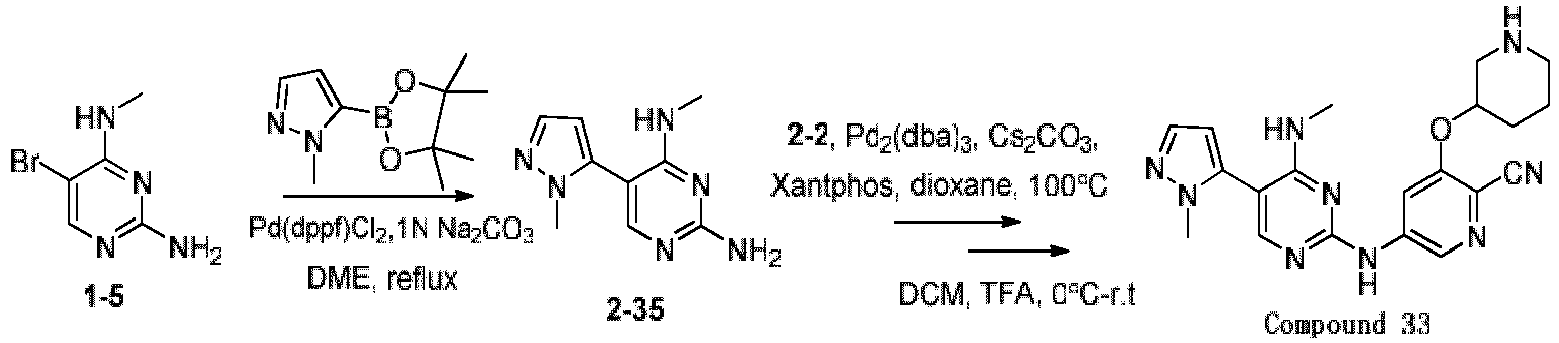
- Synthetic Procedure Reference Example 1, Step 4. Compound 2-35 was prepared from intermediate 1-5 and 1-methyl-1H-pyrazole-5-boronic acid pinacol ester as a white solid. Yield: 65%; 1H NMR (500 MHz, DMSO-d 6): δ 7.54 (s, Ar-H, 1H), 7.47 (d, J = 1.5 Hz, Ar-H, 1H), 6.24 (br, NH2, 2H), 6.20 (d, J = 1.5 Hz, Ar-H, 1H), 6.07 (q, J = 4.5 Hz, NH, 1H), 3.61 (s, CH3, 3H), 2.75 (d, J = 4.5 Hz, CH3, 3H); ESI-MS: m/z = 205 [M+1]+.
-

- Synthetic Procedure Reference Example 1, Step 5. Compound 33 was prepared from intermediates 2-35 and 2-2 to give a white solid. Yield: 74%; 1H NMR (400 MHz, DMSO-d 6): δ 10.07 (br, NH, 1H), 8.55 (s, Ar-H, 1H), 8.51 (s, Ar-H, 1H), 7.87 (s, Ar-H, 1H), 7.54 (d, J = 1.6 Hz, Ar-H, 1H), 6.78 (q, J = 4.0 Hz, NH, 1H), 6.32 (d, J = 1.6 Hz, Ar-H, 1H), 4.41-4.36 (m, CH, 1H), 3.67 (s, CH3, 3H), 3.16 (dd, J = 9.6 Hz, 2.0 Hz, CH2, 1H), 2.93 (d, J = 3.6 Hz, CH3, 3H), 2.79-2.75 (m, CH2, 1H), 2.64-2.59 (m, CH2, 1H), 2.54-2.49 (m, CH2, 1H), 2.11-2.07 (m, CH2, 1H), 1.74-1.68 (m, CH2, 1H), 1.63-1.56 (m, CH2, 1H), 1.45-1.37 (m, CH2, 1H); 13C NMR (100 MHz, DMSO-d 6): δ 160.55, 159.15, 157.30, 155.63, 142.41, 138.23, 135.67, 134.32, 116.34, 113.22, 108.60, 107.38, 101.53, 74.30, 49.78, 45.27, 36.50, 29.89, 28.14, 24.20; ESI-MS: m/z = 406 [M+1]+.
-

- Synthetic Procedure Reference Example 1, Step 1. Intermediates 2-36∼2-42 were prepared by using 5-bromo-3-nitro-2-cyanopyridine (compound 2-1) and the corresponding alcohol as starting materials through a synthetic method similar to compound 1-2.
- Synthetic Procedure Reference Example 1, Step 5. Compounds 34-43 were prepared from 2-13, 2-15, 2-16, 2-36∼2-42 and intermediate 2-34, respectively, to give white solids.
-

-

- 4-Methylthiazole (1 g, 10.09 mmol), triisopropyl borate (2.35 mL, 10.09 mmol) was dissolved in a mixture of anhydrous toluene and THF (32 mL, v/v, 4:1) under nitrogen. Cooled to -78 ° C, n-butyl lithium (3.83 mL, 2.5 mol/ L, 9.58 mmol) was added slowly within 85 min, and the reaction was stirred for 135 min. Slowly warmed to 0 ° C (about 1.5 h), isopropanol (2.84 mL) was added and stirred overnight. The solvent was evaporated under reduced pressure, and anhydrous acetone (17mL) was added, then evaporated. The mixture was filtered under a nitrogen atmosphere, washed with acetonitrile of 55° C, dried over vacuum to obtain a white solid, which was to be used directly in the next step without further purification..
-

- The syntheic procedure was described as Example 1, Step 5. The intermediate 2-45 was prepared from intermediates 1-5 and 2-2 to give a white solid. Yield: 70%; 1H NMR (400 MHz, DMSO-d 6): δ 10.05 (s, NH, 1H), 8.46 (s, Ar-H, 1H), 8.41 (s, Ar-H, 1H), 8.13 (s, Ar-H, 1H), 7.32 (q, J = 4.5 Hz, NH, 1H), 4.59 (br, CH, 1H), 3.96-3.93 (m, CH2, 1H), 3.77-3.70 (m, CH2, 1H), 3.54-3.43 (m, CH2, 1H), 3.07-2.96 (m, CH2, 1H), 2.93 (d, J = 4.5 Hz, CH3, 3H), 1.94 (br, CH2, 2H), 1.85-1.80 (m, CH2, 1H), 1.48-1.46 (m, CH2, 1H), 1.38 (s, CH3×3, 9H); ESI-MS: m/z = 504 [M+1]+.
-

- Anhydrous DMF (10 mL) was added to a mixture of the compounds 2-45 (85.3 mg, 0.211 mmol), 2-44 (124 mg, 0.422 mmol), Pd(dppf)Cl2 (7.7 mg, 0.011 mmol), CuCl (2.1 mg, 0.021 mmol), ZnCl2 (28.8mg, 0.211 mmol), Cs2CO3 (137.5 mg, 0.422 mmol) under nitrogen atmosphere. The reaction was heated to 100 ° C and stirred overnight. After suction filtration, the solvent was removed under reduced pressure to give a residue, which was purified by column chromatography on silica gel (eluent CH2Cl2:EtOH=30:1) to afford a white solid. The obtained white solid was dissolved in dichloromethane (3 mL), trifluoroacetic acid (3 mL) was added dropwise, and the mixture was stirred for 30 minutes at ice-baththen stirred at room temperature for 4.5 hours. The mixture was neutralized to pH 9 with saturated sodium hydrogen carbonate solution. Ethyl acetate (40 mL) was added, and the organic layer was washed with saturated sodium chloride solution and dried over anhydrous sodium sulfate. The organic layer was evaporated under reduced pressure and the residue was purified by silica gel column chromatography, using CH2Cl2/EtOH(NH3) (100:3) as eluent to give a white solid. Yield: 40%; 1H NMR (400 MHz, DMSO-d 6): δ 10.05 (s, NH, 1H), 8.46 (s, Ar-H, 1H), 8.41 (s, Ar-H, 1H), 8.13 (s, Ar-H, 1H), 7.32 (q, J = 4.5 Hz, NH, 1H), 4.59 (br, CH, 1H), 3.96-3.93 (m, CH2, 1H), 3.77-3.70 (m, CH2, 1H), 3.54-3.43 (m, CH2, 1H), 3.07-2.96 (m, CH2, 1H), 2.93 (d, J = 4.5 Hz, CH3, 3H), 1.94 (br, CH2, 2H), 1.85-1.80 (m, CH2, 1H), 1.48-1.46 (m, CH2, 1H), 1.38 (s, CH3×3, 9H); ESI-MS: m/z = 504 [M+1]+.
-

-

- Compound 2-46 (225 mg, 1.23 mmol) was placed in a sealed tube, ammonium hydroxide (10 mL) and N-methylpyrrolidone (10 mL) were added, and the mixture was stirred at 120 ° C for 24 h. After cooling to room temperature, the solvent was removed under reduced pressure to give a residue. Purified by silica gel column chromatography (eluent PE:EtOAc=2:1) to give a white solid. LC-MS: m/z = 164 [M+1]+.
-

- Synthetic Procedure Reference Example 1, Step 5. Compound 45 was prepared from intermediates 2-47 and 2-2 to give a white solid. LC-MS: m/z = 365 [M+1]+.
-

- The synthetic steps were carried out according to the same procedure as in Example 17, Step 2, and Example 1, Step 2, respectively, to obtain the compounds 2-49/2-51, and the mass spectral data were LC-MS: m/z = 194 [M+1]+ and LC-MS: m/z = 193 [M+1]+, respectively.
- The synthetic steps were carried out according to the same procedure as in Example 24, Step 1. Compound 2-50/2-52 was prepared from 2-49/2-51, respectively, to give a white solid. The mass spectral data were LC-MS: m/z = 194 [M+1]+ and LC-MS: m/z = 193 [M+1]+, respectively.
- The procedure of synthesis was described as that of Example 5, Step 5. Compound 46-50 were prepared from 2-16, 2-13, 2-35, 2-44 and intermediate 2-50/2-52, respectively, to give white solids. The mass spectral data were LC-MS: m/z = 409 [M+1]+, LC-MS: m/z = 394 [M+1]+, LC-MS: m/z = 394 [M+1]+, LC-MS: m/z = 394 [M+1]+, and LC-MS: m/z = 393 [M+1]+, respectively.
- The NMR and MS data of the intermediates 2-21∼2-33, 2-36∼2-42, compounds 19-31, and 34-43 are shown in Table 1-1, 1-2, 1-3, 1-4.
Table 1-1 Compounds Number Name of the Compounds Nuclear magnetic resonance and mass spectrometry data Intermediate 2-21 5-phenyl-N 4-methyl-2,4-diaminopyrimidine 1H NMR (500 MHz, CDCl3): δ 7.69 (br, Ar-H, 1H), 7.49 (d, J= 5.5 Hz, Ar-H, 2H), 7.13-7.09 (m, Ar-H, 3H), 6.43 (q, J = 4.5 Hz, NH, 1H), 6.25 (br, NH2, 2H), 2.85 (d, J = 4.5 Hz, CH3, 3H); ESI-MS: m/z = 201 [M+1]+ Intermediate 2-22 5-(3-fluorophenyl)-N 4-methyl-2,4-diaminopyrimidine 1H NMR (500 MHz, CDCl3): δ 7.60 (br, Ar-H, 1H), 7.47-7.43 (m, Ar-H, 1H), 7.16-7.11 (m, Ar-H, 3H), 6.36 (q, J = 4.5 Hz, NH, 1H), 6.21 (br, NH2, 2H), 2.79 (d, J = 4.5 Hz, CH3, 3H); ESI-MS: m/z = 219 [M+1]+ Intermediate 2-23 5-(4-fluorophenyl)-N 4-methyl-2,4-diaminopyrimidine 1H NMR (500 MHz, CDCl3): δ 7.57 (s, Ar-H, 1H), 7.31 (d, J = 8.5 Hz, Ar-H, 2H), 7.07 (d, J = 8.5 Hz, Ar-H, 2H), 6.17 (q, J = 4.5 Hz, NH, 1H), 6.11 (br, NH2, 2H), 2.85 (d, J = 4.5 Hz, CH3, 3H); ESI-MS: m/z = 219 [M+1]+ Intermediate 2-24 5-(2-fluorophenyl)-N 4-methyl-2,4-diaminopyrimidine 1H NMR (500 MHz, CDCl3): δ 7.49 (s, Ar-H, 1H), 7.41-7.37 (m, Ar-H, 1H), 7.30- 7.27 (m, Ar-H, 1H), 7.25-7.22 (m, Ar-H, 2H), 6.08 (br, NH2, 2H), 6.04 (q, J = 4.5 Hz, NH), 2.75 (d, J = 4.5 Hz, CH3, 3H); ESI-MS: m/z = 219 [M+1]+ Intermediate 2-25 5-(3-methoxyphenyl)-N 4-methyl-2,4-diaminopyrimidine 1H NMR (500 MHz, DMSO-d 6): δ 7.55 (s, Ar-H, 1H), 7.34-7.30 (m, Ar-H, 1H), 6.88-6.86 (m, Ar-H, 2H), 6.84 (s, Ar-H, 1H), 6.15 (q, J = 4.5 Hz, NH), 6.01 (br, NH2, 2H), 3.78 (s, CH3, 3H), 2.77 (d, J = 4.5 Hz, CH3, 3H); ESI-MS: m/z = 231 [M+1]+ Intermediate 2-26 5-(4-methoxyphenyl)-N 4-methyl-2,4-diaminopyrimidine 1H NMR (500 MHz, CDCl3): δ 7.47 (s, Ar-H, 1H), 7.22 (d, J = 8.5 Hz, Ar-H, 2H), 6.99 (d, J = 8.5 Hz, Ar-H, 2H), 6.09 (q, J = 4.5 Hz, NH, 1H), 6.03 (br, NH2, 2H), 3.77 (s, CH3, 3H), 2.76 (d, J = 4.5 Hz, CH3, 3H); ESI-MS: m/z = 231 [M+1]+. Intermediate 2-27 5-(2,4-dimethoxyphenyl)-N 4-methyl-2,4-diaminopyrimidine 1H NMR (400 MHz, CDCl3): δ 7.35 (br, Ar-H, 1H), 6.99 (d, J = 8.0 Hz, Ar-H, 1H), 6.61 (s, Ar-H, 1H), 6.57 (d, J = 8.0 Hz, Ar-H, 1H), 5.87 (br, NH2, 2H), 5.62 (br, NH, 1H), 3.79 (s, CH3, 3H), 3.71 (s, CH3, 3H), 2.72 (d, J = 4.5 Hz, CH3, 3H); ESI-MS: m/z = 261 [M+1]+ Intermediate 2-28 5-(pyridin-3-yl)-N 4-methyl-2,4-diaminopyrimidine 1H NMR (500 MHz, DMSO-d 6): δ 8.50 (br, Ar-H, 2H), 7.72 (d, J = 8.0 Hz, Ar-H, 1H), 7.56 (s, Ar-H,1H), 7.43-7.40 (m, Ar-H, 1H), 6.35 (q, J = 4.5 Hz, NH, 1H), 6.14 (br, NH2, 2H), 2.76 (d, J = 4.5 Hz, CH3, 3H); ESI-MS: m/z = 202 [M+1]+ Intermediate 2-29 5-(pyridin-4-yl)-N 4-methyl--2,4-diaminopyrimidine 1H NMR (500 MHz, DMSO-d 6): δ 8.43 (br, Ar-H, 1H), 7.31 (d, J = 8.5 Hz, Ar-H, 2H), 7.08 (d, J = 8.5 Hz, Ar-H, 2H), 6.18 (q, J = 4.5 Hz, NH, 1H), 6.17 (br, NH2, 2H), 2.82 (d, J = 4.5 Hz, CH3, 3H); ESI-MS: m/z = 202 [M+1]+ Intermediate 2-30 5-(thien-2-yl)-N 4-methyl-2,4-diaminopyrimidine 1H NMR (500 MHz, DMSO-d 6): δ 7.66 (s, Ar-H, 1H), 7.51 (d, J = 4.5 Hz, Ar-H, 1H), 7.13-7.11 (m, Ar-H, 1H), 7.06 (d, J = 2.5 Hz, Ar-H, 1H), 6.30 (q, J = 4.5 Hz, NH, 1H), 6.21 (br, NH2, 2H), 2.80 (d, J = 4.5 Hz, CH3, 3H): ESI-MS: m/z = 207 [M+1]+ Intermediate 2-31 5-(furan-2-yl)-N 4-methyl-2,4-diaminopyrimidine 1H NMR (500 MHz, DMSO-d 6): δ 7.64 (s, Ar-H, 1H), 7.57-7.48 (m, Ar-H, 1H), 6.54 (br, Ar-H, 2H), 6.44 (q, J = 3.5 Hz, NH, 1H), 6.22 (br, NH2, 2H), 2.86 (d, J = 4.5 Hz, CH3, 3H); ESI-MS: m/z = 191 [M+1]+ Intermediate 2-33 5-(5-methoxycarbonylthien-2-yl)-N 4-methyl-2,4-diaminopyrimidine 1H NMR (500 MHz, DMSO-d 6): δ 7.78 (d, J = 4.0 Hz, Ar-H, 1H), 7.77 (s, Ar-H, 1H), 7.16 (d, J = 4.0 Hz, Ar-H, 1H), 6.56 (q, J = 4.5 Hz, NH, 1H), 6.40 (br, NH2, 2H), 3.82 (s, CH3, 3H), 2.80 (d, J = 4.5 Hz, CH3, 3H); ESI-MS: m/z = 265 [M+1]+ Table 1-2 Compounds Number Name of the Compounds Nuclear magnetic resonance and mass spectrometry data Compound 19 N 4-methyl-5-phenyl-N 2-(2-cyano-3-(piperidin-3-oxy)pyridin-5-yl)-2,4-diaminopyrimidine 1H NMR (500 MHz, DMSO-d 6): δ 9.96 (br, NH, 1H), 8.54 (s, Ar-H, 1H), 8.53 (s, Ar-H, 1H), 7.82 (s, Ar-H, 1H), 7.50-7.47 (m, Ar-H, 2H), 7.42-7.40 (m, Ar-H, 3H), 6.77 (q, J = 4.5 Hz, NH, 1H), 4.41-4.36 (m, CH, 1H), 3.16 (dd, J = 12.0 Hz, 2.0 Hz, CH2, 1H), 2.93 (d, J = 4.5 Hz, CH3, 3H), 2.79-2.75 (m, CH2, 1H), 2.64-2.60 (m, CH2, 1H), 2.54-2.49 (m, CH2, 1H), 2.11-2.08 (m, CH2, 1H), 1.75-1.69 (m, CH2, 1H), 1.63-1.56 (m, CH2, 1H), 1.46-1.38 (m, CH2, 1H); 13C NMR (125 MHz, DMSO-d 6): δ 160.20, 158.17, 157.35, 153.93, 142.67, 134.67, 134.19, 129.02, 128.78, 127.46, 116.43, 112.85, 112.77, 108.20, 74.26, 49.78, 45.27, 29.89, 28.28, 24.19; ESI-MS: m/z = 402 [M+1]+ Compound 20 N 4-methyl-5-(3-fluorophenyl)-N 2-(2-cyano-3-(piperidin-3-yloxy)pyridin-5-yl)-2,4-diaminopyrimidine 1H NMR (500 MHz, DMSO-d 6): δ 10.03 (s, NH, 1H), 8.53 (d, J= 4.0 Hz, Ar-H, 2H), 7.86 (s, Ar-H, 1H), 7.54 (q, J = 6.5 Hz, Ar-H, 1H), 7.26-7.21 (m, Ar-H, 3H), 6.92 (q, J = 4.0 Hz, NH, 1H), 4.41-4.38 (m, CH, 1H), 3.16 (d, J = 10.5 Hz, CH2, 1H), 2.92 (d, J = 4.5 Hz, CH3, 3H), 2.78-2.76 (m, CH2, 1H), 2.65-2.61 (m, CH2, 1H), 2.55-2.53 (m, CH2, 1H), 2.09 (br, CH2, 1H), 1.73-1.71 (m, CH2, 1H), 1.63-1.56 (m, CH2, 1H), 1.45-1.39 (m, CH2, 1H); 13C NMR (125 MHz, DMSO-d 6) : δ 163.39, 161.45, 160.05, 158.36, 157.29, 154.18, 142.58, 137.13, 137.07, 134.25, 130.95, 130.88, 124.97, 116.40, 115.74, 115.57, 114.34, 114.17, 112.99, 111.62, 108.32, 74.07, 49.50, 45.13, 29.71, 28.26, 23.88; ESI-MS: m/z = 420 [M+1]+ Compound 21 N 4-methyl-5-(4-fluorophenyl)-N 2-(2-cyano-3-(piperidin-3-yloxy)pyridin-5-yl)-2,4-diaminopyrimidine 1H NMR (400 MHz, DMSO-d 6): δ 9.96 (br, NH, 1H), 8.53 (s, Ar-H, 1H), 8.52 (s, Ar-H, 1H), 7.80 (s, Ar-H, 1H), 7.44-7.41 (m, Ar-H, 2H), 7.31-7.28 (m, Ar-H, 2H), 6.77 (q, J = 4.6 Hz, NH, 1H), 4.40-4.35 (m, CH, 1H), 3.15 (dd, J = 12.0 Hz, 2.0 Hz, CH2, 1H), 2.92 (d, J = 3.6 Hz, CH3, 3H), 2.78-2.74 (m, CH2, 1H), 2.63-2.59 (m, CH2, 1H), 2.54-2.49 (m, CH2, 1H), 2.11-2.07 (m, CH2, 1H), 1.74-1.68 (m, CH2, 1H), 1.63-1.56 (m, CH2, 1H), 1.45-1.37 (m, CH2, 1H); 13C NMR (100 MHz, DMSO-d 6): δ 162.64, 160.70, 160.32, 158.24, 157.34, 153.92, 142.64, 134.18, 131.08, 131.02, 116.41, 115.89, 115.72, 112.87, 111.90, 108.22, 74.28, 49.80, 45.28, 29.89, 28.22, 24.21; ESI-MS: m/z = 420 [M+1]+ Compound 22 N 4-methyl-5-(2-fluorophenyl)-N 2-(2-cyano-3-(piperidin-3-oxy)pyridin-5-yl)-2,4-diaminopyrimidine 1H NMR (400 MHz, DMSO-d 6) δ 9.99 (br, NH, 1H), 8.55 (s, Ar-H, 1H), 8.53 (s, Ar-H, 1H), 7.82 (s, Ar-H, 1H), 7.50-7.45 (m, Ar-H, 1H), 7.40-7.37 (m, Ar-H, 1H), 7.33-7.29 (m, Ar-H, 2H), 6.73 (q, J = 3.6 Hz, NH, 1H), 4.42-4.37 (m, CH, 1H), 3.16 (dd, J = 9.6 Hz, 2.0 Hz, CH2, 1H), 2.92 (d, J = 3.6 Hz, CH3, 3H), 2.78-2.74 (m, CH2, 1H), 2.64-2.60 (m, CH2, 1H), 2.54-2.49 (m, CH2, 1H), 2.11-2.08 (m, CH2, 1H), 1.73-1.70 (m, CH2, 1H), 1.64-1.57 (m, CH2, 1H), 1.46-1.38 (m, CH2, 1H); 13C NMR (100 MHz, DMSO-d 6): δ 160.92, 160.29, 158.97, 158.69, 157.33, 154.77, 142.58, 134.24, 132.09, 130.10, 130.03, 124.92, 122.03, 121.90, 116.38, 116.08, 115.91, 112.99, 108.40, 106.78, 74.30, 49.79, 45.28, 29.88, 28.15, 24.20; ESI-MS: m/z = 420 [M+1]+ Compound 23 N 4-methyl-5-(3-methoxyphenyl)-N 2-(2-cyano-3-(piperidin-3-yloxy)pyridin-5-yl)-2,4-diaminopyrimidine 1H NMR (400 MHz, DMSO-d 6): δ 9.96 (br, NH, 1H), 8.54 (s, Ar-H, 1H), 8.53 (s, Ar-H, 1H), 7.84 (s, Ar-H, 1H), 7.40-7.37 (m, Ar-H, 1H), 6.97-6.95 (m, Ar-H, 3H), 6.79 (q, J = 3.6 Hz, NH, 1H), 4.40-4.35 (m, CH, 1H), 3.81 (s, CH3, 3H), 3.16 (dd, J = 9.6 Hz, 1.6 Hz, CH2, 1H), 2.94 (d, J = 3.6 Hz, CH3, 3H), 2.79-2.74 (m, CH2, 1H), 2.63-2.59 (m, CH2, 1H), 2.54 (dd, J = 17.6 Hz, 2.4 Hz, CH2, 1H), 2.11-2.08 (m, CH2, 1H), 1.74-1.68 (m, CH2, 1H), 1.63-1.56 (m, CH2, 1H), 1.46-1.37 (m, CH2, 1H); 13C NMR (100 MHz, DMSO-d 6) : δ 160.14, 159.60, 158.16, 157.34, 153.81, 142.65, 135.97, 134.17, 130.06, 120.92, 116.41, 114.06, 113.33, 112.85, 112.66, 108.19, 74.29, 55.01, 49.82, 45.29, 29.91, 28.26, 24.23; ESI-MS: m/z = 432 [M+1]+ Compound 24 N 4-methyl-5-(4-methoxyphenyl)-N 2-(2-cyano-3-(piperidin-3-yloxy)pyridin-5-yl)-2,4-diaminopyrimidine 1H NMR (400 MHz, DMSO-d 6): δ 9.92 (s, NH, 1H), 8.53 (s, Ar-H, 2H), 7.77 (s, Ar-H, 1H), 7.32 (d, J = 7.2 Hz, Ar-H, 2H), 7.05 (d, J = 7.2 Hz, Ar-H, 2H), 6.68 (q, J = 3.6 Hz, NH, 1H), 4.40-4.35 (m, CH, 1H), 3.80 (s, CH3, 3H), 3.15 (dd, J = 9.6 Hz, 1.6 Hz, CH2, 1H), 2.92 (d, J = 3.6 Hz, CH3, 3H), 2.78-2.74 (m, CH2, 1H), 2.63-2.59 (m, CH2, 1H), 2.54-2.49 (m, CH2, 1H), 2.11-2.07 (m, CH2, 1H), 1.74-1.68 (m, CH2, 1H), 1.63-1.56 (m, CH2, 1H), 1.45-1.37 (m, CH2, 1H) ; 13C NMR (100 MHz, DMSO-d 6): δ 160.44, 158.74, 157.97, 157.35, 153.56, 142.72, 134.14, 130.07, 126.64, 116.64, 114.48, 112.74, 112.59, 108.09, 74.27, 55.15, 49.82, 45.29, 29.90, 28.25, 24.22; ESI-MS: m/z = 432 [M+1]+ Compound 25 N 4-methyl-5-(2,4-dimethoxyphenyl)-N 2-(2-cyano-3-(piperidin-3-yloxy)pyridin-5-yl)-2,4-diaminopyrimidine 1H NMR (400 MHz, DMSO-d 6): δ 9.88 (s, NH, 1H), 8.55 (s, Ar-H, 1H), 8.53 (s, Ar-H, 1H), 7.66 (s, Ar-H, 1H), 7.09 (d, J = 6.8 Hz, Ar-H, 1H), 6.67 (s, Ar-H, 1H), 6.62 (d, J = 6.8 Hz, Ar-H, 1H), 6.33 (q, J = 3.6 Hz, NH, 1H), 4.41-4.36 (m, CH, 1H), 3.82 (s, CH3, 3H), 3.75 (s, CH3, 3H), 3.16 (dd, J = 9.6 Hz, 1.6 Hz, CH2, 1H), 2.90 (d, J = 3.6 Hz, CH3, 3H), 2.79-2.74 (m, CH2, 1H), 2.64-2.60 (m, CH2, 1H), 2.54-2.50 (m, CH2, 1H), 2.11-2.08 (m, CH2, 1H), 1.73-1.70 (m, CH2, 1H), 1.63-1.56 (m, CH2, 1H), 1.45-1.37 (m, CH2, 1H); 13C NMR (100 MHz, DMSO-d 6) : δ 160.74, 160.71, 158.25, 158.11, 157.37, 154.11, 142.85, 134.14, 131.90, 116.48, 115.27, 112.61, 109.92, 108.01, 105.31, 98.90, 74.20, 55.36, 55.27, 49.76, 45.25, 29.87, 28.16, 24.15; ESI-MS: m/z = 462 [M+1]+ Compound 26 N 4-methyl-5-(pyridin-3-yl)-N 2-(2-cyano-3-(piperidin-3-yloxy)pyridin-5-yl)-2,4-diaminopyrimidine 1H NMR (400 MHz, DMSO-d 6): δ 10.00 (br, NH, 1H), 8.60-8.58 (m, Ar-H, 2H), 8.55 (s, Ar-H, 1H), 8.52 (s, Ar-H, 1H), 7.86 (s, Ar-H, 1H), 7.83-7.81 (m, Ar-H, 1H), 7.50-7.47 (m, Ar-H, 1H), 6.98 (q, J = 3.6 Hz, NH, 1H), 4.40-4.35 (m, CH, 1H), 3.16 (dd, J = 9.6 Hz, 2.0 Hz, CH2, 1H), 2.92 (d, J = 3.6 Hz, CH3, 3H), 2.79-2.75 (m, CH2, 1H), 2.64-2.60 (m, CH2, 1H), 2.54-2.49 (m, CH2, 1H), 2.11-2.08 (m, CH2, 1H), 1.75-1.69 (m, CH2, 1H), 1.63-1.56 (m, CH2, 1H), 1.46-1.38 (m, CH2, 1H); 13C NMR(100 MHz, DMSO-d 6) : δ 160.37, 158.58, 157.32, 154.50, 149.46, 148.44, 142.54, 136.55, 134.22, 130.70, 123.84, 116.37, 113.01, 109.51, 108.36, 74.31, 49.81, 45.29, 29.90, 28.20, 24.22; ESI-MS: m/z = 403 [M+1]+ Compound 27 N 4-methyl-5-(pyridin-4-yl)-N 2-(2-cyano-3-(piperidin- 3-yloxy)pyridin-5-yl)-2,4-diaminopyrimidine 1H NMR (400 MHz, DMSO-d 6): δ 10.06 (br, NH, 1H), 8.64 (d, J = 4.8 Hz, Ar-H, 2H), 8.55 (s, Ar-H, 1H), 8.50 (s, Ar-H, 1H), 7.94 (s, Ar-H, 1H), 7.46 (d, J = 4.8 Hz, Ar-H, 2H), 7.06 (q, J = 3.6 Hz, NH, 1H), 4.41-4.36 (m, CH, 1H), 3.16 (dd, J = 9.6 Hz, 2.0 Hz, CH2, 1H), 2.94 (d, J = 3.6 Hz, CH3, 3H), 2.79-2.75 (m, CH2, 1H), 2.64-2.60 (m, CH2, 1H), 2.55-2.51 (m, CH2, 1H), 2.11-2.08 (m, CH2, 1H), 1.73-1.71 (m, CH2, 1H), 1.63-1.56 (m, CH2, 1H), 1.46-1.39 (m, CH2, 1H) ; 13C NMR (100 MHz, DMSO-d 6): δ 160.30, 159.20, 157.80, 155.17, 150.59, 143.14, 142.91, 134.78, 123.90, 116.85, 113.68, 110.59, 109.00, 74.78, 50.26, 45.77, 30.37, 28.76, 24.68; ESI-MS: m/z = 403 [M+1]+ Compound 28 N 4-methyl-5-(thien-2-yl)-N 2-(2-cyano-3-(piperidin-3-oxy)pyridin-5-yl)-2,4-diaminopyrimidine 1H NMR (400 MHz, DMSO-d 6): δ 10.05 (br, NH, 1H), 8.53 (s, Ar-H, 1H), 8.51 (s, Ar-H, 1H), 7.96 (s, Ar-H, 1H), 7.63 (d, J = 4.0 Hz, Ar-H, 1H), 7.22-7.19 (m, Ar-H, 2H), 6.95 (q, J = 3.6 Hz, NH, 1H), 4.41-4.37 (m, CH, 1H), 3.16 (dd, J = 9.6 Hz, 2.0 Hz, CH2, 1H), 2.97 (d, J = 3.6 Hz, CH3, 3H), 2.79-2.75 (m, CH2, 1H), 2.63-2.59 (m, CH2, 1H), 2.54-2.49 (m, CH2, 1H), 2.11-2.08 (m, CH2, 1H), 1.73-1.70 (m, CH2, 1H), 1.63-1.56 (m, CH2, 1H), 1.46-1.38 (m, CH2, 1H); 13C NMR (100 MHz, DMSO-d 6): δ 160.12, 158.32, 157.34, 154.46, 142.45, 135.46, 134.25, 128.11, 126.62, 126.02, 116.40, 113.09, 108.40, 105.78, 74.29, 49.83, 45.32, 29.93, 28.39, 24.26; ESI-MS: m/z = 408 [M+1]+ Compound 29 N 4-methyl-5-(furan-2-yl)-N 2-(2-cyano-3-(piperidin- 3-yloxy)pyridin-5-yl)-2,4-diaminopyrimidine 1H NMR (400 MHz, DMSO-d 6): δ 10.07 (br, NH, 1H), 8.53 (d, J = 1.6 Hz, Ar-H, 1H), 8.48 (d, J = 1.6 Hz, Ar-H, 1H), 8.25 (s, Ar-H, 1H), 7.75 (s, Ar-H, 1H), 7.07 (q, J = 3.6 Hz, NH, 1H), 6.77 (d, J= 2.8 Hz, Ar-H, 1H), 6.63-6.62 (m, Ar-H, 1H), 4.41-4.37 (m, CH, 1H), 3.16 (dd, J = 9.6 Hz, 2.0 Hz, CH2, 1H), 3.04 (d, J = 3.6 Hz, CH3, 3H), 2.80-2.76 (m, CH2, 1H), 2.64-2.60 (m, CH2, 1H), 2.55-2.53 (m, CH2, 1H), 2.11-2.08 (m, CH2, 1H), 1.75-1.69 (m, CH2, 1H), 1.64-1.57 (m, CH2, 1H), 1.47-1.39 (m, CH2, 1H); ESI-MS : m/z = 392 [M+1]+ Compound 30 N 4-methyl-5-(5-chloro-furan-2-yl)-N 2-(2-cyano-3-(piperidin-3-yloxy)pyridin-5-yl)-2,4-diaminopyrimidine 1H NMR (400 MHz, DMSO-d 6): δ 10.07 (br, NH, 1H), 8.53 (d, J = 1.6 Hz, Ar-H, 1H), 8.48 (d, J = 1.6 Hz, Ar-H, 1H), 8.25 (s, Ar-H, 1H), 7.75 (s, Ar-H, 1H), 7.07 (q, J = 3.6 Hz, NH, 1H), 6.77 (d, J = 2.8 Hz, Ar-H, 1H), 6.63-6.62 (m, Ar-H, 1H), 4.41-4.37 (m, CH, 1H), 3.16 (dd, J = 9.6 Hz, 2.0 Hz, CH2, 1H), 3.04 (d, J = 3.6 Hz, CH3, 3H), 2.80-2.76 (m, CH2, 1H), 2.64-2.60 (m, CH2, 1H), 2.55-2.53 (m, CH2, 1H), 2.11-2.08 (m, CH2, 1H), 1.75-1.69 (m, CH2, 1H), 1.64-1.57 (m, CH2, 1H), 1.47-1.39 (m, CH2, 1H); ESI-MS : m/z = 426 [M+1]+ Compound 31 N 4-methyl-5-(5-methoxycarbonylthien-2-yl)-N 2-(2-cyano-3-(piperidin- 3-yloxy)pyridin-5-yl)-2,4-diaminopyrimidine 1H NMR (400 MHz, DMSO-d 6): δ 10.10 (br, NH, 1H), 8.53 (s, Ar-H, 1H), 8.46 (s, Ar-H, 1H), 8.03 (s, Ar-H, 1H), 7.83 (d, J = 3.2 Hz, Ar-H, 1H), 7.29 (d, J = 2.8 Hz, Ar-H, 1H), 7.12 (q, J = 3.2 Hz, NH, 1H), 4.39-4.36 (m, CH, 1H), 3.86 (s, CH3, 3H), 3.17 (dd, J = 9.6 Hz, 1.6 Hz, CH2, 2H), 2.97 (d, J = 3.2 Hz, CH3, 3H), 2.80-2.77 (m, CH2, 1H), 2.65-2.61 (m, CH2, 1H), 2.10-2.08 (m, CH2, 1H), 1.74-1.71 (m, CH2, 1H), 1.64-1.57 (m, CH2, 1H), 1.47-1.39 (m, CH2, 1H); 13C NMR (100 MHz, DMSO-d 6): δ 161.67, 159.83, 158.71, 157.26, 155.02, 143.51, 142.20, 134.40, 131.32, 127.40, 116.34, 113.37, 108.61, 104.83, 74.25, 52.23, 49.76, 45.30, 29.88, 28.40, 24.17. ESI-MS: m/z = 466 [M+1]+ Table 1-3 Compounds Number Name of the Compounds Nuclear magnetic resonance and mass spectrometry data Intermediate 2-36 (R)-2-cyano-5-bromo-3-(N-tert-butoxycarbonylpyrrole-3-yloxy)pyridine 1H NMR (500 MHz, DMSO-d 6): δ 8.48 (d, J = 2.0 Hz, Ar-H, 1H), 8.29 (s, Ar-H, 1H), 5.32 (br, CH, 1H), 3.62-3.55 (m, CH, 1H), 3.49-3.44 (m, CH2, 2H), 3.39-3.33 (m, CH2, 1H), 2.21-2.16 (m, CH2, 1H), 2.13-2.09 (m, CH2, 1H), 1.41 (s, CH3×3, 9H); ESI-MS : m/z = 368 [M+1]+ Intermediate 2-37 (S)-2-cyano-5-bromo-3-(N-tert-butoxycarbonylpyrrole-3-yloxy)pyridine 1H NMR (500 MHz, DMSO-d 6): δ 8.48 (d, J = 2.0 Hz, Ar-H, 1H), 8.29 (s, Ar-H, 1H), 5.32 (br, CH, 1H), 3.62-3.55 (m, CH, 1H), 3.49-3.44 (m, CH2, 2H), 3.39-3.33 (m, CH2, 1H), 2.21-2.16 (m, CH2, 1H), 2.13-2.09 (m, CH2, 1H), 1.41 (s, CH3×3, 9H); ESI-MS : m/z = 368 [M+1]+ Intermediate 2-38 2-cyano-5-bromo-3-(N-tert-butoxycarbonylpiperidin-4-yloxy)pyridine 1H NMR (500 MHz, CDCl3): δ 8.34 (s, Ar-H, 1H), 7.51 (s, Ar-H, 1H), 4.66-4.62 (m, CH, 1H), 3.69-3.63 (m, CH2, 2H), 3.52-3.46 (m, CH2, 2H), 1.99-1.92 (m, CH2, 2H), 1.90-1.82 (m, CH2, 2H), 1.47 (s, CH3×3, 9H); ESI-MS: m/z = 382 [M+1]+ Intermediate 2-39 2-cyano-5-bromo-3-(2-dimethylamino)ethoxypyrid ine 1H NMR (500 MHz, CDCl3): δ 8.27 (s, Ar-H, 1H), 7.49 (s, Ar-H, 1H), 4.16 (t, J = 7.0 Hz, CH2, 2H), 2.78 (t, J = 7.0 Hz, CH2, 2H), 2.31 (s, CH3×2, 6H); ESI-MS: m/z = 270 [M+1]+ Intermediate 2-40 (R)-2-cyano-5-bromo-3-(1-(dimethylamino)propyl-2-oxy)pyridine 1H NMR (500 MHz, CDCl3): δ 8.31 (s, Ar-H, 1H), 7.62 (s, Ar-H, 1H), 4.62-4.55 (m, CH, 1H), 2.76-2.71 (m, CH2, 1H), 2.54-2.49 (m, CH2, 1H), 2.31 (s, CH3×2, 6H), 1.40 (d, J = 8.0 Hz, CH3, 3H); ESI-MS: m/z = 284 [M+1]+ Intermediate 2-41 (S)-2-cyano-5-bromo-3-(1-(dimethylamino)propyl-2-oxy)pyridine 1H NMR (500 MHz, CDCl3): δ 8.31 (s, Ar-H, 1H), 7.62 (s, Ar-H, 1H), 4.62-4.55 (m, CH, 1H), 2.76-2.71 (m, CH2, 1H), 2.54-2.49 (m, CH2, 1H), 2.31 (s, CH3×2, 6H), 1.40 (d, J = 8.0 Hz, CH3, 3H); ESI-MS: m/z = 284 [M+1]+ Table 1-4 Compounds Number Name of the Compounds Nuclear magnetic resonance and mass spectrometry data Compound 34 N 4-methyl-5-(1-methyl-1H-pyrazol-4-yl)-N 2-(2-cyano-3-(piperidin-4-methyl)oxypyridin-5-yl)-2,4-diaminopyrimidine 1H NMR (400 MHz, DMSO-d 6): δ 9.96 (br, NH, 1H), 8.60 (s, Ar-H, 1H), 8.42 (s, Ar-H, 1H), 7.90 (s, Ar-H, 1H), 7.89 (s, Ar-H, 1H), 7.62 (s, Ar-H, 1H), 6.71 (q, J = 4.4 Hz, NH, 1H), 3.95 (d, J= 6.4 Hz, CH2, 2H), 3.89 (s, CH3, 3H), 2.99-2.96 (m, CH2, 2H), 2.94 (d, J = 4.4 Hz, CH3, 3H), 2.52-2.47 (m, CH2, 2H), 1.89-1.86 (m, CH, 1H), 1.71-1.68 (m, CH2, 2H), 1.22-1.12 (m, CH2, 2H) ; ESI-MS: m/z = 420 [M+1]+ Compound 35 (R)-N 4-methyl-5-(1-methyl-1H-pyrazol-4-yl)-N 2-(2-cyano-3-(piperidin-3-yloxy)pyridin-5-yl)-2,4-diaminopyrimidine 1H NMR (400 MHz, DMSO-d 6): δ 9.91 (s, NH, 1H), 8.52 (s, Ar-H, 1H), 8.51 (s, Ar-H, 1H), 7.91 (s, Ar-H, 1H), 7.90 (s, Ar-H, 1H), 7.61 (s, Ar-H, 1H), 6.73 (q, J = 4.0 Hz, NH, 1H), 4.40-4.35 (m, CH, 1H), 3.89 (s, CH3, 3H), 3.15 (dd, J = 9.6 Hz, 2.0 Hz, CH2, 1H), 2.95 (d, J = 3.6 Hz, CH3, 3H), 2.79-2.75 (m, CH2, 1H), 2.64-2.60 (m, CH2, 1H), 2.54-2.51 (m, CH2, 1H), 2.11-2.07 (m, CH2, 1H), 1.75-1.69 (m, CH2, 1H), 1.63-1.56 (m, CH2, 1H), 1.46-1.38 (m, CH2, 1H) ; 13C NMR (100 MHz, DMSO-d 6): δ 160.27, 157.75, 157.37, 153.08, 142.73, 137.65, 134.13, 129.42, 116.48, 113.78, 112.70, 108.03, 104.51, 74.25, 49.80, 45.30, 38.65, 29.90, 28.28, 24.20; ESI-MS: m/z = 406 [M+1]+ Compound36 (S)-N 4-methyl-5-(1-methyl-1H-pyrazol-4-yl)-N 2-(2-cyano-3-(piperidin-3-yloxy)pyridin-5-yl)-2,4-diaminopyrimidine 1H NMR (400 MHz, DMSO-d 6): δ 9.91 (s, NH, 1H), 8.52 (s, Ar-H, 1H), 8.51 (s, Ar-H, 1H), 7.91 (s, Ar-H, 1H), 7.90 (s, Ar-H, 1H), 7.61 (s, Ar-H, 1H), 6.73 (q, J = 4.0 Hz, NH, 1H), 4.40-4.35 (m, CH, 1H), 3.89 (s, CH3, 3H), 3.15 (dd, J = 9.6 Hz, 2.0 Hz, CH2, 1H), 2.95 (d, J = 3.6 Hz, CH3, 3H), 2.79-2.75 (m, CH2, 1H), 2.64-2.60 (m, CH2, 1H), 2.54-2.51 (m, CH2, 1H), 2.11-2.07 (m, CH2, 1H), 1.75-1.69 (m, CH2, 1H), 1.63-1.56 (m, CH2, 1H), 1.46-1.38 (m, CH2, 1H) ; 13C NMR (100 MHz, DMSO-d 6): δ 160.27, 157.75, 157.37, 153.08, 142.73, 137.65, 134.13, 129.42, 116.48, 113.78, 112.70, 108.03, 104.51, 74.25, 49.80, 45.30, 38.65, 29.90, 28.28, 24.20; ESI-MS: m/z = 406 [M+1]+ Compound37 (R)-N 4 -methyl-5-(1-methyl-1H-pyrazol-4-yl)-N 2-(2-cyano-3-(pyrrole-3-oxy)pyridin-5-yl)-2,4-diaminopyrimidine 1H NMR (400 MHz, DMSO-d 6): δ 9.92 (br, NH, 1H), 8.60 (s, Ar-H, 1H), 8.39 (s, Ar-H, 1H), 7.91 (s, Ar-H, 2H), 7.62 (s, Ar-H, 1H), 6.72 (q, J = 4.4 Hz, NH, 1H), 4.96 (br, CH, 1H), 3.89 (s, CH3, 3H), 3.16 (dd, J = 12.4 Hz, 5.2 Hz, CH2, 1H), 2.94-2.93 (m, CH2, 2H), 2.92 (d, J = 4.4 Hz, CH3, 3H), 2.83-2.79 (m, CH2, 1H), 2.10-2.02 (m, CH2, 1H), 1.87-1.84 (m, CH2, 1H); 13C NMR (100 MHz, DMSO-d 6): δ 160.28, 157.72, 157.58, 152.97, 142.66, 137.65, 133.79, 129.43, 116.48, 113.76, 112.41, 107.91, 104.64, 80.01, 52.80, 45.48, 38.66, 33.25, 28.15; ESI-MS: m/z = 392 [M+1]+ Compound 38 (S)-N 4-methyl-5-(1-methyl-1H-pyrazol-4-yl)-N 2-(2-cyano-3-(pyrrole-3-oxy)pyridin-5-yl)-2,4-diaminopyrimidine 1H NMR (400 MHz, DMSO-d 6): δ 9.92 (br, NH, 1H), 8.60 (s, Ar-H, 1H), 8.39 (s, Ar-H, 1H), 7.91 (s, Ar-H, 2H), 7.62 (s, Ar-H, 1H), 6.72 (q, J = 4.4 Hz, NH, 1H), 4.96 (br, CH, 1H), 3.89 (s, CH3, 3H), 3.16 (dd, J = 12.4 Hz, 5.2 Hz, CH2, 1H), 2.94-2.93 (m, CH2, 2H), 2.92 (d, J = 4.4 Hz, CH3, 3H), 2.83-2.79 (m, CH2, 1H), 2.10-2.02 (m, CH2, 1H), 1.87-1.84 (m, CH2, 1H); ESI-MS: m/z = 392 [M+1]+ Compound39 N 4-methyl-5-(1-methyl-1H-pyrazol-4-yl)-N 2-(2-cyano-3-(piperidin-4-yloxy)pyridin-5-yl)-2,4-diaminopyrimidine 1H NMR (400 MHz, DMSO-d 6): δ 9.90 (s, NH, 1H), 8.53 (s, Ar-H, 1H), 8.47 (s, Ar-H, 1H), 7.91 (s, Ar-H, 1H), 7.90 (s, Ar-H, 1H), 7.61 (s, Ar-H, 1H), 6.73 (q, J = 4.8 Hz, NH, 1H), 4.58-4.54 (m, CH, 1H), 3.88 (s, CH3, 3H), 3.00-2.96 (m, CH2, 2H), 2.94 (d, J = 4.8 Hz, CH3, 3H), 2.58-2.53 (m, CH2, 2H), 1.96-1.92 (m, CH2, 2H), 1.61-1.53 (m, CH2, 2H); ESI-MS: m/z = 406 [M+1]+ Compound40 N 4-methyl-5-(1-methyl-1H-pyrazol-4-yl)-N 2-(2-cyano-3-(2-dimethylaminoethoxy)pyri din-5-yl)-2,4-diaminopyrimidine 1H NMR (400 MHz, DMSO-d 6): δ 9.96 (s, NH, 1H), 8.56 (s, Ar-H, 1H), 8.48 (s, Ar-H, 1H), 7.91 (s, Ar-H, 1H), 7.90 (s, Ar-H, 1H), 7.61 (s, Ar-H, 1H), 6.73 (q, J = 4.4 Hz, NH, 1H), 4.24 (t, J = 5.6 Hz, CH2, 2H), 3.88 (s, CH3, 3H), 2.94 (d, J = 4.8 Hz, CH3, 3H), 2.72 (t, J = 5.6 Hz, CH2, 2H), 2.25 (s, CH3×2, 6H) ; 13C NMR(100 MHz, DMSO-d 6): δ 160.22, 158.43, 157.73, 153.05, 142.82, 137.60, 133.83, 129.37, 116.42, 113.77, 111.72, 106.92, 104.53, 66.99, 57.06, 45.54, 38.63, 28.17; ESI-MS : m/z = 394 [M+1]+ Compound 41 (R)-N 4-methyl-5-(1-methyl-1H-pyrazol-4-yl)-N 2-(2-cyano-3-(1-dimethylaminopropyl-2-oxy)pyridin-5-yl)-2,4-diaminopyrimidine 1H NMR (400 MHz, DMSO-d 6): δ 9.94 (s, NH, 1H), 8.54 (s, Ar-H, 2H), 7.92 (s, Ar-H, 1H), 7.91 (s, Ar-H, 1H), 7.63 (s, Ar-H, 1H), 6.74 (q, J = 4.4 Hz, NH, 1H), 4.69-4.65 (m, CH, 1H), 3.91 (s, CH3, 3H), 2.96 (d, J = 4.4 Hz, CH3, 3H), 2.63-2.58 (m, CH2, 1H), 2.53-2.48 (m, CH2, 1H), 2.24 (s, CH3×2, 6H), 1.35 (d, J = 6.0 Hz, CH3, 3H) ; ESI-MS: m/z = 408 [M+1]+ Compound42 (S)-N 4-methyl-5-(1-methyl-1H-pyrazol-4-yl)-N 2-(2-cyano-3-(1-dimethylaminopropyl-2-oxy) pyridin-5-yl)-2,4-diaminopyrimidine 1H NMR (400 MHz, DMSO-d 6): δ 9.94 (s, NH, 1H), 8.54 (s, Ar-H, 2H), 7.92 (s, Ar-H, 1H), 7.90 (s, Ar-H, 1H), 7.63 (s, Ar-H, 1H), 6.73 (q, J = 4.4 Hz, NH, 1H), 4.69-4.65 (m, CH, 1H), 3.90 (s, CH3, 3H), 2.95 (d, J = 4.4 Hz, CH3, 3H), 2.62-2.58 (m, CH2, 1H), 2.51-2.48 (m, CH2, 1H), 2.24 (s, CH3×2, 6H), 1.35 (d, J = 6.0 Hz, CH3, 3H) ; ESI-MS: m/z = 408 [M+1]+ Compound43 N 4-methyl-5-(1-methyl-1H-pyrazol-4-yl)-N 2-(2-cyano-3-(N-methylpiperidin-4-yloxy)pyridin-5-yl-2,4-diaminopyrimidine 1H NMR (400 MHz, DMSO-d 6): δ 9.91 (s, NH, 1H), 8.53 (s, Ar-H, 1H), 8.47 (s, Ar-H, 1H), 7.91 (s, Ar-H, 1H), 7.90 (s, Ar-H, 1H), 7.62 (s, Ar-H, 1H), 6.73 (q, J = 4.4 Hz, NH, 1H), 4.54 (br, CH, 1H), 3.89 (s, CH3, 3H), 2.94 (d, J = 4.0 Hz, CH3, 3H), 2.58 (br, CH2, 2H), 2.22 (br, CH2, 2H), 2.19 (s, CH3, 3H), 1.97 (br, CH2, 2H), 1.77 (br, CH2, 2H) ; ESI-MS: m/z = 420 [M+1]+ - With the Saurosporine as a positive control, the Chkl enzyme inhibitory activity (IC50) was evaluated using the ADP-Glo kit. The compound acts on Chkl protein kinase and inhibits its phosphorylation substrate Cdc25C. The phosphorylation process consumes ATP. After the reaction, ADP-GloTM Reagent consumes the remaining ATP. The ADP produced during the reaction can be transformed by ADP-Glo Detection Reagent. For ATP, ATP acts as a substrate for the Ultra-GloTM luciferase catalytic reaction, producing an optical signal. The test compound was dissolved in DMSO to make a 10 mM stock solution and diluted to 12 different concentrations in a certain ratio for testing. In a 384-well plate, add 1 µL of the test compound to each well, 2 µL of 2.5X Chkl kinase, add 2 µL of 1X buffer to the control group, incubate for 10 min at room temperature, and add 2 µL of 2.5X substrate at 37 ° C. Incubate for 1 h, stop the reaction by adding 5 µL of ADP-GloTM Reagent, and incubate for 1 h at 37 °C. 10 µL of ADP-Glo Detection Reagent was added, incubated at 37 ° C for 30 min, and three parallel wells were set for each sample. Absorbance was measured by luminescence fluorescence microplate reader, and data were calculated using GraphPad Prism 5 software to calculate IC50 values.
- Inhibitory activity of the compounds disclosed in the present invention on Chkl kinase
Table 2 IC50 (µM) of compounds against Chkl kinase Compd. Chk1 (IC50, nM) Compd. Chk1 (IC50, µM) 1 >10µM 24 6 2 >10µM 25 12 3 >10µM 26 9.5 4 >10µM 27 78.5 5 >10µM 28 9.2 6 >10µM 29 4.7 7 >10µM 30 387.7 8 >10µM 31 14.2 9 4.7 32 6.9 10 16 33 4.8 11 14 34 0.6 12 7.8 35 6.8 13 5.1 36 5.3 14 49 37 1.0 15 25 38 893.8 16 1.9 39 17.0 17 8.8 40 0.4 18 1.8 41 8.6 19 50 42 1.1 20 >10µM 43 12 21 >10µM 44 0.7 22 >10µM 45 <1µM 23 >10µM 46 <1µM 47 <1µM 48 <1µM 49 <1µM 50 <1µM Staurosporine 1.2 - As can be seen from the data in the table, most of the compounds are potent inhibitors of Chkl protein kinase. The Chkl inhibitory activity of 24 compounds is comparable to that of the positive compound Staurosporine, and the 5 compounds are superior to the positive control Staurosporine. Therefore, the 2-substituted pyrimidine derivatives used as Chkl inhibitors of the present invention have broad antitumor application prospects.
- Proliferative inhibitory activity of the compounds disclosed in the present invention on various tumor cells
- Cell lines: human multiple myeloma cells RPMI 8226, human mantle cell lymphoma cells Mino, Jeko-1, human lymphoma cells Romas, human acute monocytic leukemia cells MV-4-11, human breast cancer cells MCF-7 Human lung cancer cell A549, human prostate cancer cell LnCAP, human gastric cancer cell BGC-823, human colon cancer cell HCT116, Colo205, human ovarian cancer cell OVCAR-8 Experimental method: MTS assay for in vitro proliferation of compounds against different tumor cell lines Inhibitory activity (IC50).
- The cells in the logarithmic growth phase were trypsinized, counted, and seeded at a density of 1 × 10⁴ cells/well in a 96-well plate at 100 µL per well in a 37 ° C incubator containing 5% CO2 overnight. For the culture, six concentration gradients were set for each compound, and three sets of duplicate wells were set for each concentration. After the addition, the cells were cultured for 72 hours, and 20 µL of MTS was added. After incubating for 2 hours at 37 ° C, the absorbance at 490 nm (L1) was measured with a SpectraMAX 340 microplate reader. The reference wavelength was 690 nm (L2), and the (L1-L2) value was plotted against the different concentrations of the inhibitor. , half of the inhibitory concentration IC50 was fitted by the formula.
Table 3-1 Inhibition of proliferative of compounds on each tumor cell line Cpd. IC50(µM)a RPMI8226 Mino Romas Jeko-1 MV-4-11 9 3.339 0.708 0.536 0.342 0.044 12 3.597 0.608 0.401 0.253 0.035 13 NTb NTb NTb NTb 0.035 16 NTb NTb NTb NTb 0.107 17 3.290 0.495 0.348 0.117 0.050 18 NTb NTb NTb NTb 0.036 29 2.543 0.157 0.126 0.039 0.039 32 8.175 0.859 0.789 0.189 0.064 33 NTb NTb NTb NTb 0.040 34 NTb NTb NTb NTb 0.044 35 1.273 0.647 0.356 0.339 0.053 36 2.493 0.956 0.649 0.548 0.072 37 1.578 0.419 0.292 0.103 0.022 40 3.781 0.923 0.874 0.309 0.101 41 0.945 0.473 0.119 0.094 0.034 42 0.814 0.227 0.218 0.137 0.092 44 0.448 0.128 0.117 0.084 0.023 Table 3-2 Cpd. IC50(µM)a MCF-7 A549 LnCAP BGC-823 HCT116 OVCAR-8 Colo205 9 1.234 3.714 9.145 > 10 5.217 0.513 2.843 12 2.541 2.962 7.860 9.10.2 4.110 0.274 3.741 13 NTb 1.843 6.779 8.130 4.556 0.662 0.947 16 NTb 3.474 8.776 > 10 3.990 1.527 2.013 17 NTb 4.238 > 10 > 10 1.896 0.220 0.878 18 NTb 3.172 6.998 7.113 1.774 2.136 1.009 29 2.178 2.183 > 10 > 10 1.225 0.329 0.624 32 NTb 5.170 5.996 7.642 4.183 NTb NTb 33 NTb 3.165 5.102 6.183 2.845 NTb NTb 34 NTb 3.192 4.628 > 10 1.779 2.110 3.760 35 1.008 2.162 2.173 4.810 0.980 0.789 0.663 36 NTb 5.741 4.892 NTb 2.547 4.178 2.180 37 0.945 1.784 0.921 3.175 0.884 1.230 3.147 40 NTb 3.512 7.164 NTb 2.184 2.942 5.160 41 1.009 2.173 2.620 5.170 1.312 1.187 0.993 42 NTb > 10 5.742 NTb 4.189 2.174 1.032 44 1.134 3.761 2.146 3.569 1.208 5.784 2.177 a IC50: average of three experiments; b not tested. - The activity of the compound disclosed in the present invention in combination with other drugs
MV 4-11 cells were seeded at 5000/well into 96-well plates. When used in combination, the drug is determined according to the ratio of IC50 of the two drugs. The concentration range of each drug is IC20∼IC80 (or 1/8, 1/4, 1/2, 1, 2 and 4 of IC50). After 72 hours, cell viability was measured by the addition of MTS reagent, and the inhibition rate Fa was calculated as 100% of the unmedicated group. The Chou-Talalay method was used to analyze the inhibition rate Fa and the corresponding drug concentration into CompuSyn software, and the CI value and Fa-CI curve of single concentration drug were obtained. CI (combination index) is calculated as CI=DA/ICX, A+DB/ICX, B (A, B stands for two different drugs, ICX, A and ICX, B is the growth inhibition rate when the two drugs are used alone. The drug concentration at X, DA and DB are the concentrations of the two drugs when the growth inhibition rate reaches X when the two drugs are combined. The results are shown inFigure 1 . In the figure: CHK1 inhibitor (35); FLT3 inhibitor Crenolanib (Cre), Quizartinib (Qui); Akt inhibitor GSK2141795 (GSK); CI = combination index, according to the judgment method of Soriano et al, 0.9 ≤ CI ≤ 1.1 Superposition effect, 0.8≤CI<0.9 is a low degree synergy, 0.6≤CI<0.8 is a moderate synergy, 0.4 ≤ CI<0.6 is a highly synergistic effect, and 0.2 ≤ CI<0.4 is a strong synergistic effect.
Claims (10)
- A 2-polysubstituted aromatic ring-pyrimidine derivative, which is characterized by having the structure of formula I:
 an optical isomer thereof or a pharmaceutically acceptable salt or solvate thereof;wherein ring A is selected from substituted or un-substituted 5- or 6-membered heterocyclic aryl groups containing from 1 to 3 selected from O, N and S, wherein a substituted substituent is selected from
 wherein B is selected from -NH,
 R1 is selected from halogen atom, C1-6 alkyl group, halogenated C1-6 alkyl group, C3-6 cycloalkyl group, halogenated C3-6 cycloalkyl group, C1-6 alkoxy group, halogenated C1-6 alkoxy, C2-6 alkenyl, C2-6 hydroxy substituted alkenyl, C2-6 alkynyl, C2-6 hydroxy substituted alkynyl, unsubstituted or substituted 5- or 6-membered aromatic or aromatic heterocyclic ring, said aromatic heterocyclic ring comprises 1 to 3 hetero atoms selected from O, N and S, the substitution is a mono-, di- or tri-substitution, said substituent is selected from the group consisting of Ra group;Ra is selected from H, halogen, nitro, cyano, C1-3 alkyl, halogenated C1-3 alkyl,-C(=O)ORb, -C(=O)NHRb, -NHRb, -ORb -NHCORb; wherein Rb is selected from H, C1-3 alkyl, halogenated C1-3 alkyl, C1-3 alkoxy, halogenated C1-3 alkoxy, C1-7 alkylamine;R2 is selected from the group consisting of H, -NHRc, -N(Rc)2, -ORc, -SRc; Rc is selected from the group consisting of C1-7 alkyl, halogenated C1-7 alkyl, C1-7 hydroxyalkyl, and C1-7 amino alkyl;R3 is selected from the group consisting of halogen, nitro, cyano, C1-3 alkyl, halogenated C1-3 alkyl, C1-3 alkoxy, halogenated C1-3 alkoxy, C1-3 alkylamino, halogenated C1-3 alkylamino group;L1 is selected from O, S, NH or a deletion;m=0-2;R4 is selected from C1-7 alkyl, halogenated C1-7 alkyl, hydroxy substituted C1-7 alkyl, C1-7 alkylamino, halogenated C1-7 alkylamino, C1-7 alkoxy, halogenated C1-7 alkoxy group, 5- to 8-membered nitrogen-containing aliphatic heterocyclic ring; andR5 is selected from the group consisting of halogen, nitro, cyano, trifluoromethyl, C1-3 alkyl, C1-3 alkoxy, amide group, substituted alkyl amide.
 - The 2-polysubstituted aromatic ring-pyrimidine derivative, as recited in claim 1, comprising a structure of formula II:
 and an optical isomer thereof or a pharmaceutically acceptable salt or solvate thereof, wherein: W, X, Y and Z are identical or different and are independently selected from N, C and O;B is selected from -NH,
 R1 is selected from halogen atom, C1-6 alkyl group, halogenated C1-6 alkyl group, C3-6 cycloalkyl group, halogenated C3-6 cycloalkyl group, C1-6 alkoxy group, halogenated C1-6 alkoxy, C2-6 alkenyl, C2-6 hydroxy substituted alkenyl, C alkynyl, C2-6 hydroxy substituted alkynyl, unsubstituted or substituted 5- or 6-membered aromatic or aromatic heterocyclic ring, said aromatic heterocyclic ring comprises 1 to 3 hetero atoms selected from O, N and S, the substitution being a mono-, di- or tri-substitution, said substituent being selected from the group consisting of Ra;Ra is selected from H, halogen, nitro, cyano, C1-3 alkyl, halogenated C1-3 alkyl,-C(=O)ORb, -C(=O)NHRb, -NHRb, -ORb -NHCORb; Rb is selected from H, C1-3 alkyl, halogenated C1-3 alkyl, C1-3 alkoxy, halogenated C1-3 alkoxy, C1-7 alkylamine;R2 is selected from the group consisting of H, -NHRc, -N(Rc)2, -ORc, -SRc; Rc is selected from the group consisting of C1-7 alkyl, halogenated C1-7 alkyl, C1-7 hydroxyalkyl, C1-7 alkylamino group, C1-7 alkoxy group;R3 is selected from the group consisting of halogen, nitro, cyano, C1-3 alkyl, halogenated C1-3 alkyl, C1-3 alkoxy, halogenated C1-3 alkoxy, C1-3 alkylamino, halogenated C1-3 alkylamino group;L1 is selected from O, S, NH or a deletion;m=0-2;R4 is selected from the group consisting of H, C1-7 alkyl, halogenated C1-7 alkyl, hydroxy substituted C1-7 alkyl, C1-7 alkylamino, halogenated C1-7 alkylamino, C1-7 alkoxy group, halogenated C1-7 alkoxy group, and 5- to 8-membered nitrogen-containing aliphatic heterocyclic ring;R5 is selected from the group consisting of halogen, nitro, cyano, trifluoromethyl, C1-3 alkyl, C1-3 alkoxy, amide, substituted alkyl amide.
 - The 2-polysubstituted aromatic ring-pyrimidine derivative, as recited in claim 1, comprising a structure of formula III:
 and an optical isomer thereof or a pharmaceutically acceptable salt or solvate thereof;wherein W, X, Y and Z are the same or different and are each independently selected from N or C;B is selected from - NH,
 R1 is selected from halogen atom, C1-6 alkyl group, halogenated C1-6 alkyl group, C3-6 cycloalkyl group, halogenated C3-6 cycloalkyl group, C1-6 alkoxy group, halogenated C1-6 alkoxy, C2-6 alkenyl, C2-6 hydroxy substituted alkenyl, C2-6 alkynyl, C2-6 hydroxy substituted alkynyl, unsubstituted or substituted 5- or 6-membered aromatic or aromatic heterocyclic ring, said aromatic heterocyclic ring comprises 1 to 3 hetero atoms selected from O, N and S, the substitution is a mono-, di- or tri-substitution, said substituent is selected from the group consisting of Ra;Ra is selected from H, halogen, nitro, cyano, C1-3 alkyl, halogenated C1-3 alkyl, - C(=O)ORb, -C(=O)NHRb, -NHRb, -ORb -NHCORb; Rb is selected from H, C1-3 alkyl, halogenated C1-3 alkyl, C1-3 alkoxy, halogenated C1-3 alkoxy, C1-7 alkylamine;R2 is selected from the group consisting of H, -NHRc, -N(Rc)2, -ORc, -SRc; Rc is selected from the group consisting of C1-7 alkyl, halogenated C1-7 alkyl, C1-7 hydroxyalkyl, C1-7 alkylamino group, C1-7 alkoxy group;R3 is selected from the group consisting of halogen, nitro, cyano, C1-3 alkyl, halogenated C1-3 alkyl, C1-3 alkoxy, halogenated C1-3 alkoxy, C1-3 alkylamino, and halogenated C1-3 alkylamino group;L1 is selected from O, S, NH or a deletion;m=0-2;R4 is selected from the group consisting of H, C1-7 alkyl, halogenated C1-7 alkyl, hydroxy substituted C1-7 alkyl, C1-7 alkylamino, halogenated C1-7 alkylamino, C1-7 alkoxy group, a halogenated C1-7 alkoxy group, and a 5- to 8-membered nitrogen-containing aliphatic heterocyclic ring;R5 is selected from the group consisting of halogen, nitro, cyano, trifluoromethyl, C1-3 alkyl, C1-3 alkoxy, amide, substituted alkyl amide.
 - The 2-polysubstituted aromatic ring-pyrimidine derivative, as recited in claim 1, comprising a structure of formula IV:
 W, X, Y and Z are the same or different and are independently selected from N, C and O;R1 is selected from halogen atom, C1-6 alkyl group, halogenated C1-6 alkyl group, C3-6 cycloalkyl group, halogenated C3-6 cycloalkyl group, C1-6 alkoxy group, halogenated C1-6 alkoxy, C2-6 alkenyl, C2-6 hydroxy substituted alkenyl, C2-6 alkynyl, C2-6 hydroxy substituted alkynyl, unsubstituted or substituted 5- or 6-membered aromatic or aromatic heterocyclic ring, said aromatic heterocyclic ring comprises 1 to 3 hetero atoms selected from O, N and S, the substitution being a mono-, di- or tri-substitution, said substituent is selected from the group consisting of Ra;Ra is selected from H, halogen, nitro, cyano, C1-3 alkyl, halogenated C1-3 alkyl, - C(=O)ORb, -C(=O)NHRb, -NHRb, -ORb -NHCORb; Rb is selected from H, C1-3 alkyl, halogenated C1-3 alkyl, C1-3 alkoxy, halogenated C1-3 alkoxy, C1-7 alkylamine;R2 is selected from the group consisting of H, -NHRc, -N(Rc)2, -ORc, -SRc; Rc is selected from the group consisting of C1-7 alkyl, halogenated C1-7 alkyl, C1-7 hydroxyalkyl, C1-7 alkylamino group, C1-7 alkoxy group;R3 is selected from the group consisting of halogen, nitro, cyano, C1-3 alkyl, halogenated C1-3 alkyl, C1-3 alkoxy, halogenated C1-3 alkoxy, C1-3 alkylamino, halogenated C1-3 alkylamino group;L1 is selected from O, S, NH or a deletion;m=0-2;R4 is selected from the group consisting of H, C1-7 alkyl, halogenated C1-7 alkyl, hydroxy substituted C1-7 alkyl, C1-7 alkylamino, halogenated C1-7 alkylamino, C1-7 alkoxy group, halogenated C1-7 alkoxy group, and 5- to 8-membered nitrogen-containing aliphatic heterocyclic ring;R5 is selected from the group consisting of halogen, nitro, cyano, trifluoromethyl, C1-3 alkyl, C1-3 alkoxy, amide, substituted alkyl amide.
 - The 2-polysubstituted aromatic ring-pyrimidine derivative, as recited in claim 4, wherein the compound is selected from the group consisting of:N 4-methyl-5-(1-methyl-1H-pyrazol-4-yl)-N 2-(1-methyl-5-(piperidin-4-yloxy)pyrazol-3-yl)-2,4-diaminopyrimidine;N 4-methyl-5-(1-methyl-1H-pyrazol-4-yl)-N 2-(3-(piperidin-4-yloxy)isoxazol-5-yl)-2,4-diaminopyrimidine;N 4-methyl-5-(1-methyl-1H-pyrazol-4-yl)-N 2-(1-methyl-2-(piperidin-4-yloxy)imidazol-4-yl)-2,4-diaminopyrimidine;N 4-methyl-5-(1-methyl-1H-pyrazol-4-yl)-N 2-(2-(piperidin-4-yloxy)isothiazol-5-yl)-2,4-diaminopyrimidine;N 4-methyl-5-(1-methyl-1H-pyrazol-4-yl)-N 2-(2-(piperidin-4-yloxy)-4,5-2H-oxazoline-5-yl-2,4-diaminopyrimidine; andN 4-methyl-5-(1-methyl-1H-pyrazol-4-yl)-N 2-(2-(piperidin-4-yloxy)thiazol-5-yl)-2,4-diaminopyrimidine.
- The 2-polysubstituted aromatic ring-pyrimidine derivative, as recited in claim 1, comprising a structure of formula V:
 W, X, Y and Z are the same or different and are each independently selected from N or C;R1 is selected from halogen atom, C1-6 alkyl group, halogenated C1-6 alkyl group, C3-6 cycloalkyl group, halogenated C3-6 cycloalkyl group, C1-6 alkoxy group, halogenated C1-6 alkoxy, C2-6 alkenyl, C2-6 hydroxy substituted alkenyl, C2-6 alkynyl, C2-6 hydroxy substituted alkynyl, unsubstituted or substituted 5- or 6-membered aromatic or aromatic heterocyclic ring, said aromatic heterocyclic ring comprising 1 to 3 hetero atoms selected from O, N and S, the substitution being a mono-, di- or tri-substitution, said substituent being selected from the group consisting of Ra;Ra is selected from H, halogen, nitro, cyano, C1-3 alkyl, halogenated C1-3 alkyl,-C(=O)ORb, -C(=O)NHRb, -NHRb, -ORb -NHCORb; Rb is selected from H, C1-3 alkyl, halogenated C1-3 alkyl, C1-3 alkoxy, halogenated C1-3 alkoxy, C1-7 alkylamine;R2 is selected from the group consisting of H, -NHRc, -N(Rc)2, -ORc, -SRc; Rc is selected from the group consisting of C1-7 alkyl, halogenated C1-7 alkyl, C1-7 hydroxyalkyl, C1-7 alkylamino group, C1-7 alkoxy group;R3 is selected from the group consisting of halogen, nitro, cyano, C1-3 alkyl, halogenated C1-3 alkyl, C1-3 alkoxy, halogenated C1-3 alkoxy, C1-3 alkylamino, halogenated C1-3 alkylamino group;L1 is selected from O, S, NH or a deletion;m=0-2;R4 is selected from the group consisting of H, C1-7 alkyl, halogenated C1-7 alkyl, hydroxy substituted C1-7 alkyl, C1-7 alkylamino, halogenated C1-7 alkylamino, C1-7 alkoxy group, halogenated C1-7 alkoxy group, and 5- to 8-membered nitrogen-containing aliphatic heterocyclic ring;R5 is selected from the group consisting of halogen, nitro, cyano, trifluoromethyl, C1-3 alkyl, C1-3 alkoxy, amide, substituted alkyl amide.
 - The 2-polysubstituted aromatic ring-pyrimidine derivative, as recited in claim 6, wherein the compound is selected from the group consisting of:5-phenyl-N-(2-cyano-3-(piperidin-3-oxy)pyridin-5-yl)-2-aminopyrimidine;5-(3-fluorophenyl)-N-(2-cyano-3-(piperidin-3-yloxy)pyridin-5-yl)-2-aminopyrimidine;5-(4-fluorophenyl)-N-(2-cyano-3-(piperidin-3-yloxy)pyridin-5-yl)-2-aminopyrimidine;5-(3-methoxyphenyl)-N-(2-cyano-3-(piperidin-3-yloxy)pyridin-5-yl)-2-aminopyrimidine;5-(4-methoxyphenyl)-N-(2-cyano-3-(piperidin-3-yloxy)pyridin-5-yl)-2-aminopyrimidine;5-(pyridin-3-yl)-N-(2-cyano-3-(piperidin-3-oxy)pyridin-5-yl)-2-aminopyrimidine;5-(pyridin-4-yl)-N-(2-cyano-3-(piperidin-3-yloxy)pyridin-5-yl)-2-aminopyrimidine;5-(thien-2-yl)-N-(2-cyano-3-(piperidin-3-yloxy)pyridin-5-yl)-2-aminopyrimidine;5-(furan-2-yl)-N-(2-cyano-3-(piperidin-3-yloxy)pyridin-5-yl)-2-aminopyrimidine;5-trifluoromethyl-N-(2-cyano-3-(piperidin-3-oxy)pyridin-5-yl)-2-aminopyrimidine;(R)-5-(1-methyl-1H-pyrazol-4-yl)-N-(2-cyano-3-(piperidin-3-yloxy)pyridin-5-yl)-2-aminopyrimidine;(S)-5-(1-Methyl-1H-pyrazol-4-yl)-N-(2-cyano-3-(piperidin-3-yloxy)pyridin-5-yl)-2-aminopyrimidine;4-methoxy-5-(3-fluorophenyl)-N-(2-cyano-3-(piperidin-4-methyl)oxypyridin-5-yl)-2-aminopyrimidine;4-methoxy-5-(1-methyl-1H-pyrazol-4-yl)-N-(2-cyano-3-(piperidin-4-methyl)oxypyridin-5-yl-2-aminopyrimidine;4-methoxy-5-(3-fluorophenyl)-N-(2-cyano-3-(2-dimethylaminoethoxy)pyridin-5-yl)-2-aminopyrimidine;4-methoxy-5-(1-methyl-1H-pyrazol-4-yl)-N-(2-cyano-3-(2-dimethylaminoethoxy)pyridine-5-yl)-2-aminopyrimidine;4-methoxy-5-trifluoromethyl-N-(2-cyano-3-(piperidin-4-methyl)oxypyridin-5-yl)-2-aminopyrimidine;N 4-methyl-5-phenyl-N 2-(2-cyano-3-(piperidin-3-oxy)pyridin-5-yl)-2,4-diaminopyrimidine;N 4-methyl-5-(3-fluorophenyl)-N 2-(2-cyano-3-(piperidin-3-yloxy)pyridin-5-yl)-2,4-diaminopyrimidine;N 4-methyl-5-(4-fluorophenyl)-N 2-(2-cyano-3-(piperidin-3-yloxy)pyridin-5-yl)-2,4-diaminopyrimidine;N 4-methyl-5-(2-fluorophenyl)-N 2-(2-cyano-3-(piperidin-3-oxy)pyridin-5-yl)-2,4-diaminopyrimidine;N 4-methyl-5-(3-methoxyphenyl)-N 2-(2-cyano-3-(piperidin-3-yloxy)pyridin-5-yl)-2,4-diaminopyrimidine;N 4-methyl-5-(4-methoxyphenyl)-N 2-(2-cyano-3-(piperidin-3-yloxy)pyridin-5-yl)-2,4-diaminopyrimidine;N 4-methyl-5-(2,4-dimethoxyphenyl)-N 2-(2-cyano-3-(piperidin-3-yloxy)pyridin-5-yl)-2,4-diaminopyrimidine;N 4-methyl-5-(pyridin-3-yl)-N 2-(2-cyano-3-(piperidin-3-yloxy)pyridin-5-yl)-2,4-diaminopyrimidine;N 4-methyl-5-(pyridin-4-yl)-N 2-(2-cyano-3-(piperidin-3-yloxy)pyridin-5-yl)-2,4-diaminopyrimidine;N 4-methyl-5-(thien-2-yl)-N 2-(2-cyano-3-(piperidin-3-oxy)pyridin-5-yl)-2,4-diaminopyrimidine;N 4-methyl-5-(furan-2-yl)-N 2-(2-cyano-3-(piperidin-3-yloxy)pyridin-5-yl)-2,4-diaminopyrimidine;N 4-methyl-5-(5-chloro-furan-2-yl)-N 2-(2-cyano-3-(piperidin-3-yloxy)pyridin-5-yl)-2,4-diaminopyrimidine;N 4-methyl-5-(5-methoxycarbonylthien-2-yl)-N 2-(2-cyano-3-(piperidin-3-yloxy)pyridin-5-yl)-2,4-diaminopyrimidine;N 4-methyl-5-(1-methyl-1H-pyrazol-4-yl)-N 2-(2-cyano-3-(piperidin-3-yloxy)pyridin-5-yl)-2 4-diaminopyrimidine;N 4-methyl-5-(1-methyl-1H-pyrazol-5-yl)-N 2-(2-cyano-3-(piperidin-3-yloxy)pyridin-5-yl)-2,4-diaminopyrimidine;N 4-methyl-5-trifluoromethyl-N 2-(2-cyano-3-(piperidin-3-oxy)pyridin-5-yl)-2,4-diaminopyrimidine;N 4-methyl-5-(1-methyl-1H-pyrazol-4-yl)-N 2-(2-cyano-3-(piperidin-4-methyl)oxypyridin-5-yl)-2,4-diaminopyrimidine;(R)-N 4-methyl-5-(1-methyl-1H-pyrazol-4-yl)-N 2-(2-cyano-3-(piperidin-3-yloxy)pyridine-5-2,4-diaminopyrimidine;(S)-N 4-methyl-5-(1-methyl-1H-pyrazol-4-yl)-N 2-(2-cyano-3-(piperidin-3-yloxy)pyridine-5-yl)-2,4-diaminopyrimidine;(R)-N 4-methyl-5-trifluoromethyl-N 2-(2-cyano-3-(piperidin-3-oxy)pyridin-5-yl)-2,4-diaminopyrimidine;(S)-N 4-methyl-5-trifluoromethyl-N 2-(2-cyano-3-(piperidin-3-oxy)pyridin-5-yl)-2,4-diaminopyrimidine;(R)-N 4-methyl-5-(1-methyl-1H-pyrazol-4-yl)-N 2-(2-cyano-3-(pyrrole-3-oxy)pyridin-5-yl)-2,4-diaminopyrimidine;(S)-N 4-methyl-5-(1-methyl-1H-pyrazol-4-yl)-N 2-(2-cyano-3-(pyrrole-3-oxy)pyridin-5-yl)-2,4-diaminopyrimidine;N 4-methyl-5-(1-methyl-1H-pyrazol-4-yl)-N 2-(2-cyano-3-(piperidin-4-yloxy)pyridin-5-yl)-2,4-diaminopyrimidine;N 4-methyl-5-(1-methyl-1H-pyrazol-4-yl)-N 2-(2-cyano-3-(2-dimethylaminoethoxy)pyridine-5-yl)-2,4-diaminopyrimidine;(R)-N 4-methyl-5-(1-methyl-1H-pyrazol-4-yl)-N 2-(2-cyano-3-(1-dimethylaminopropyl-2-oxy)-pyridin-5-yl)-2,4-diaminopyrimidine;(S)-N 4-methyl-5-(1-methyl-1H-pyrazol-4-yl)-N 2-(2-cyano-3-(1-dimethylaminopropyl-2-oxy)-pyridin-5-yl)-2,4-diaminopyrimidine;N 4-methyl-5-(1-methyl-1H-pyrazol-4-yl)-N 2-(2-cyano-3-(N-methylpiperidin-4-yloxy)pyridine-5-yl)-2,4-diaminopyrimidine;N 4-methyl-5-trifluoromethyl-N 2-(2-cyano-3-(N-methylpiperidin-4-yloxy)pyridin-5-yl)-2,4-diaminopyrimidine;N 4-methyl-5-(4-methylthiazol-2-yl)-N 2-(2-cyano-3-(piperidin-3-yloxy)pyridin-5-yl)-2,4-diaminopyrimidine;and a pharmaceutically acceptable salt or solvate thereof.
- A method for manufacturing the 2-polysubstituted aromatic ring-pyrimidine derivative as recited in any of the claims 1-7, comprising steps of:first method:(1) 5-Bromo-2-substituted-3-nitropyridine (or 5-bromo-2-cyano-3-nitropyridine) was reacted with different fatty alcohols under basic conditions (in the presence of NaH) to obtain different substituted pyridine fragments;(2) starting with 5-bromo-2,4-dichloropyrimidine, followed by methyl etherification or methylamination to give 5-bromo-2-chloro-4-substituted pyrimidine then ammoniated to get 5-bromo-N4-methylpyrimidine-2,4-diamine or 5-bromo-4-methoxypyrimidin-2-amine, 2-Aminopyrimidine was brominated to obtain 5-bromo-2-aminopyrimidine, the Suzuki-Miyaura coupling reaction was occurred between 5-bromo-N4-methylpyrimidine-2,4-diamine or 5-bromo-4-methoxypyrimidin-2-amine or 5-bromo-2-aminopyrimidine and corresponding borate or boric acid, then Buchwald-Hartwig cross-coupling is occurred between the product of the Suzuki-Miyaura coupling reaction and the substituted pyridine fragment from the first step, followed by acidic deprotection to obtain the target compound; or 5-bromo-N4-methylpyrimidine-2,4-diamine was firstly carried out Buchwald-Hartwig cross-coupling with the substituted pyridine fragment from the first step, then followed by Suzuki-Miyaura coupling reaction with corresponding borate or boric acid, then deprotection under acidic conditions to obtain the target compound;second method:(1) 5-Bromo-2-cyano-3-nitropyridine was reacted with different fatty alcohols under basic conditions (conditions of NaH) to obtain different substituted pyridine fragments;(2) 2,4-Dichloro-5-trifluoromethylpyrimidine as starting material, followed by methyl etherification or methylamination, then ammoniation to obtain 2,4-disubstituted-5-trifluoromethylpyrimidine, 2-Chloro-5-trifluoromethylpyrimidine was ammoniated to get 2-amino-5-trifluoromethylpyrimidine, Buchwal-Hartwig cross-coupling was carried out between 2,4-disubstituted-5-trifluoromethylpyrimidine or 2-amino-5-trifluoromethylpyrimidine with the substituted pyridine fragment from the first step, and finally removing the Boc protecting group to obtain the target compound.
- Application of the 2-polysubstituted aromatic ring-pyrimidine derivative as recited in any one of claims 1-7 for the preparation of an antitumor drug, which is characterized in that the tumor is breast cancer, lung cancer, prostate cancer or gastric cancer, colon cancer, rectal cancer, kidney cancer, pancreatic cancer, leukemia, neuroblastoma, glioma, head and neck cancer, ovarian cancer, myeloma, melanoma, non-Hodgkin's lymphoma; The polysubstituted aromatic ring-pyrimidine derivative includes an optical isomer thereof or a pharmaceutically acceptable salt or solvate thereof.
- Application of the 2-polysubstituted aromatic ring-pyrimidine derivative as recited in any one of claims 1 to 7 for the preparation of a medicament for diseases mediated by Chkl, characterized in that the drug is composed of 2-polysubstituted aromatic ring-pyrimidine derivative alone and/or in combination with other radiotherapeutic agents, said polysubstituted aromatic ring-pyrimidine derivative including the optical isomers thereof or pharmaceutically acceptable salts or solvates thereof.
Applications Claiming Priority (2)
| Application Number | Priority Date | Filing Date | Title |
|---|---|---|---|
| CN201610988036.4A CN106588884B (en) | 2016-11-10 | 2016-11-10 | 2-polysubstituted aromatic ring-pyrimidine derivatives and their preparation and medicinal use |
| PCT/CN2017/110029 WO2018086546A1 (en) | 2016-11-10 | 2017-11-08 | 2-polysubstituted aromatic ring-pyrimidine derivative and preparation and medical use |
Publications (3)
| Publication Number | Publication Date |
|---|---|
| EP3530657A1 true EP3530657A1 (en) | 2019-08-28 |
| EP3530657A4 EP3530657A4 (en) | 2019-10-16 |
| EP3530657B1 EP3530657B1 (en) | 2022-04-13 |
Family
ID=58590796
Family Applications (1)
| Application Number | Title | Priority Date | Filing Date |
|---|---|---|---|
| EP17870509.1A Active EP3530657B1 (en) | 2016-11-10 | 2017-11-08 | 2-polysubstituted aromatic ring-pyrimidine derivative and preparation and medical use |
Country Status (5)
| Country | Link |
|---|---|
| US (1) | US11591325B2 (en) |
| EP (1) | EP3530657B1 (en) |
| JP (1) | JP6954566B2 (en) |
| CN (1) | CN106588884B (en) |
| WO (1) | WO2018086546A1 (en) |
Cited By (1)
| Publication number | Priority date | Publication date | Assignee | Title |
|---|---|---|---|---|
| US11053225B2 (en) | 2017-05-02 | 2021-07-06 | Korea Research Institute Of Chemical Technology | Pyrimidine derivative compound, optical isomer thereof, or pharmaceutically acceptable salt thereof, and composition for preventing or treating Tyro 3 related disease comprising same as active ingredient |
Families Citing this family (6)
| Publication number | Priority date | Publication date | Assignee | Title |
|---|---|---|---|---|
| KR102440296B1 (en) * | 2017-09-07 | 2022-09-06 | 한국화학연구원 | Pyrazole substituted pyrimidine derivative, optical isomer thereof, or pharmaceutically acceptable salts thereof, and composition comprising its same for preventing or treating of cancer |
| CN114728949B (en) | 2019-08-01 | 2024-11-12 | 曙方医药 | Heterocyclic compounds as kinase inhibitors and their use |
| CN111253370B (en) * | 2020-03-24 | 2021-08-03 | 浙江大学 | N-polysubstituted pyridine-2-aminopyrimidine derivatives and their uses |
| CN112920124B (en) * | 2021-01-29 | 2024-03-01 | 安徽医科大学 | A kind of pyrimidine-2,4-diamine compound and its preparation method and application |
| EP4298095A4 (en) * | 2021-01-30 | 2025-08-27 | Sperogenix Therapeutics Ltd | HETEROCYCLIC COMPOUNDS AS KINASE INHIBITORS AND USES THEREOF |
| CN117924277A (en) * | 2023-06-06 | 2024-04-26 | 中国药科大学 | Oxime ether compound and preparation method, pharmaceutical composition and application thereof |
Family Cites Families (12)
| Publication number | Priority date | Publication date | Assignee | Title |
|---|---|---|---|---|
| EP2195302B1 (en) * | 2007-10-09 | 2015-02-18 | Dow AgroSciences LLC | Insecticidal substituted azinyl derivatives |
| WO2010025851A1 (en) * | 2008-09-03 | 2010-03-11 | Bayer Cropscience Ag | Thienylamino pyrimidines for use as fungicides |
| PA8852901A1 (en) * | 2008-12-22 | 2010-07-27 | Lilly Co Eli | PROTEIN CINASE INHIBITORS |
| SI2638031T1 (en) * | 2010-11-10 | 2018-02-28 | Genentech, Inc. | Pyrazole aminopyrimidine derivatives as lrrk2 modulators |
| BR112014012822A8 (en) * | 2011-11-30 | 2017-07-11 | Hoffmann La Roche | FLUORINE-18 AND CARBON-11 LABELED RADIOLIGANTS FOR POSITRON EMISSION TOMOGRAPHY (PET) IMAGING FOR LRRK2 |
| PT2840080T (en) * | 2012-04-17 | 2018-02-06 | Fujifilm Corp | HETEROCYCLIC COMPOUND CONTAINING NITROGEN OR SALT THEREOF |
| WO2013164321A1 (en) * | 2012-05-03 | 2013-11-07 | F. Hoffmann-La Roche Ag | Pyrazole aminopyrimidine derivatives as lrrk2 modulators |
| WO2014176210A1 (en) * | 2013-04-26 | 2014-10-30 | Merck Sharp & Dohme Corp. | Thiazole-substituted aminoheteroaryls as spleen tyrosine kinase inhibitors |
| US10004751B2 (en) * | 2014-07-10 | 2018-06-26 | The J. David Gladstone Institutes | Compositions and methods for treating Dengue virus infection |
| ES2806206T3 (en) * | 2015-03-11 | 2021-02-16 | Chia Tai Tianqing Pharmaceutical Group Co Ltd | 2-hydrogen substituted pyrazole derivative that serves as an anticancer drug |
| WO2017019804A2 (en) * | 2015-07-28 | 2017-02-02 | Plexxikon Inc. | Compounds and methods for kinase modulation, and indications therefor |
| US10457669B2 (en) * | 2015-10-21 | 2019-10-29 | Otsuka Pharmaceutical Co., Ltd. | Benzolactam compounds as protein kinase inhibitors |
-
2016
- 2016-11-10 CN CN201610988036.4A patent/CN106588884B/en active Active
-
2017
- 2017-11-08 JP JP2019523735A patent/JP6954566B2/en active Active
- 2017-11-08 US US16/348,499 patent/US11591325B2/en active Active
- 2017-11-08 EP EP17870509.1A patent/EP3530657B1/en active Active
- 2017-11-08 WO PCT/CN2017/110029 patent/WO2018086546A1/en not_active Ceased
Cited By (1)
| Publication number | Priority date | Publication date | Assignee | Title |
|---|---|---|---|---|
| US11053225B2 (en) | 2017-05-02 | 2021-07-06 | Korea Research Institute Of Chemical Technology | Pyrimidine derivative compound, optical isomer thereof, or pharmaceutically acceptable salt thereof, and composition for preventing or treating Tyro 3 related disease comprising same as active ingredient |
Also Published As
| Publication number | Publication date |
|---|---|
| EP3530657A4 (en) | 2019-10-16 |
| US11591325B2 (en) | 2023-02-28 |
| JP6954566B2 (en) | 2021-10-27 |
| CN106588884B (en) | 2019-04-09 |
| CN106588884A (en) | 2017-04-26 |
| WO2018086546A1 (en) | 2018-05-17 |
| EP3530657B1 (en) | 2022-04-13 |
| JP2019537598A (en) | 2019-12-26 |
| CA3043519A1 (en) | 2018-05-17 |
| US20210284625A1 (en) | 2021-09-16 |
Similar Documents
| Publication | Publication Date | Title |
|---|---|---|
| EP3530657B1 (en) | 2-polysubstituted aromatic ring-pyrimidine derivative and preparation and medical use | |
| EP3530656B1 (en) | 2-substituted aromatic ring-pyrimidine derivative, and preparation and application thereof | |
| EP0802914B1 (en) | Aryl- and heteroaryl- purine and pyridopyrimidine derivatives | |
| CA3254816A1 (en) | Pyridine checkpoint kinase 1 (chk1) inhibitors and uses thereof | |
| CA3180623A1 (en) | Pyrimidine compound as axl inhibitor | |
| EP3181560A1 (en) | Pyridine amidopyrimidine derivative, preparation method and use thereof | |
| JP7050093B2 (en) | Substituted 5- and 6-membered heterocyclic compounds, methods of preparation thereof, combinations of agents and their use | |
| AU2019316858B2 (en) | Smad3 inhibitors | |
| Jiang et al. | Synthesis and biological evaluation of novel 2-(2-arylmethylene) hydrazinyl-4-aminoquinazoline derivatives as potent antitumor agents | |
| EP4617261A1 (en) | 2,4,5-trisubstituted pyrimidine compound, preparation method therefor, and use thereof | |
| CA3174865A1 (en) | Quinazoline compound and preparation method, application, and pharmaceutical composition thereof | |
| US10501466B2 (en) | WDR5 inhibitors and modulators | |
| Yan et al. | Discovery of novel 2, 4-diarylaminopyrimidine derivatives as potent and selective epidermal growth factor receptor (EGFR) inhibitors against L858R/T790M resistance mutation | |
| CN109384788A (en) | Purine series derivates and its preparation method and application | |
| US20230295144A1 (en) | 2-polysubstituted aromatic ring-pyrimidine derivatives, preparation and medical application thereof | |
| CA3043519C (en) | 2-polysubstituted aromatic ring-pyrimidine derivative, preparation and medical application thereof | |
| EP3558964B1 (en) | 4-amino-2-pyrido-bicyclic pyrimidines and use thereof as topoisomerase ii inhibitors | |
| CN111253370A (en) | N-polysubstituted pyridine-2-aminopyrimidine derivatives and their uses | |
| CN117800953A (en) | A kind of 2-aromatic aminopyrimidine compound and its preparation method and application | |
| CN113226321B (en) | Pyrazolyl compounds and methods of use thereof | |
| KR101646962B1 (en) | Phenothiazine derivatives having CaM inhibitory activity | |
| Gao et al. | Synthesis and Antitumor Activity Evaluation of Novel 2-Amino-5-Ethylpyrimidine Derivatives | |
| WO2026068857A1 (en) | N-substituted 9-aminoacridines and their use in the treatment of cancer | |
| CN120842202A (en) | CDK kinase selective inhibitors | |
| CN118930543A (en) | Tricyclic compounds and pharmaceutical compositions and uses thereof |
Legal Events
| Date | Code | Title | Description |
|---|---|---|---|
| STAA | Information on the status of an ep patent application or granted ep patent |
Free format text: STATUS: THE INTERNATIONAL PUBLICATION HAS BEEN MADE |
|
| PUAI | Public reference made under article 153(3) epc to a published international application that has entered the european phase |
Free format text: ORIGINAL CODE: 0009012 |
|
| STAA | Information on the status of an ep patent application or granted ep patent |
Free format text: STATUS: REQUEST FOR EXAMINATION WAS MADE |
|
| 17P | Request for examination filed |
Effective date: 20190520 |
|
| AK | Designated contracting states |
Kind code of ref document: A1 Designated state(s): AL AT BE BG CH CY CZ DE DK EE ES FI FR GB GR HR HU IE IS IT LI LT LU LV MC MK MT NL NO PL PT RO RS SE SI SK SM TR |
|
| AX | Request for extension of the european patent |
Extension state: BA ME |
|
| A4 | Supplementary search report drawn up and despatched |
Effective date: 20190918 |
|
| RIC1 | Information provided on ipc code assigned before grant |
Ipc: A61P 35/00 20060101ALI20190912BHEP Ipc: C07D 405/14 20060101ALI20190912BHEP Ipc: C07D 417/14 20060101ALI20190912BHEP Ipc: C07D 409/14 20060101ALI20190912BHEP Ipc: C07D 401/14 20060101AFI20190912BHEP Ipc: A61K 31/506 20060101ALI20190912BHEP Ipc: C07D 413/14 20060101ALI20190912BHEP |
|
| DAV | Request for validation of the european patent (deleted) | ||
| DAX | Request for extension of the european patent (deleted) | ||
| STAA | Information on the status of an ep patent application or granted ep patent |
Free format text: STATUS: EXAMINATION IS IN PROGRESS |
|
| 17Q | First examination report despatched |
Effective date: 20200720 |
|
| GRAP | Despatch of communication of intention to grant a patent |
Free format text: ORIGINAL CODE: EPIDOSNIGR1 |
|
| STAA | Information on the status of an ep patent application or granted ep patent |
Free format text: STATUS: GRANT OF PATENT IS INTENDED |
|
| INTG | Intention to grant announced |
Effective date: 20211105 |
|
| GRAS | Grant fee paid |
Free format text: ORIGINAL CODE: EPIDOSNIGR3 |
|
| GRAA | (expected) grant |
Free format text: ORIGINAL CODE: 0009210 |
|
| STAA | Information on the status of an ep patent application or granted ep patent |
Free format text: STATUS: THE PATENT HAS BEEN GRANTED |
|
| AK | Designated contracting states |
Kind code of ref document: B1 Designated state(s): AL AT BE BG CH CY CZ DE DK EE ES FI FR GB GR HR HU IE IS IT LI LT LU LV MC MK MT NL NO PL PT RO RS SE SI SK SM TR |
|
| REG | Reference to a national code |
Ref country code: GB Ref legal event code: FG4D |
|
| REG | Reference to a national code |
Ref country code: CH Ref legal event code: EP |
|
| REG | Reference to a national code |
Ref country code: DE Ref legal event code: R096 Ref document number: 602017056069 Country of ref document: DE |
|
| REG | Reference to a national code |
Ref country code: IE Ref legal event code: FG4D |
|
| REG | Reference to a national code |
Ref country code: AT Ref legal event code: REF Ref document number: 1483335 Country of ref document: AT Kind code of ref document: T Effective date: 20220515 |
|
| REG | Reference to a national code |
Ref country code: LT Ref legal event code: MG9D |
|
| REG | Reference to a national code |
Ref country code: NL Ref legal event code: MP Effective date: 20220413 |
|
| REG | Reference to a national code |
Ref country code: AT Ref legal event code: MK05 Ref document number: 1483335 Country of ref document: AT Kind code of ref document: T Effective date: 20220413 |
|
| PG25 | Lapsed in a contracting state [announced via postgrant information from national office to epo] |
Ref country code: NL Free format text: LAPSE BECAUSE OF FAILURE TO SUBMIT A TRANSLATION OF THE DESCRIPTION OR TO PAY THE FEE WITHIN THE PRESCRIBED TIME-LIMIT Effective date: 20220413 |
|
| PG25 | Lapsed in a contracting state [announced via postgrant information from national office to epo] |
Ref country code: SE Free format text: LAPSE BECAUSE OF FAILURE TO SUBMIT A TRANSLATION OF THE DESCRIPTION OR TO PAY THE FEE WITHIN THE PRESCRIBED TIME-LIMIT Effective date: 20220413 Ref country code: PT Free format text: LAPSE BECAUSE OF FAILURE TO SUBMIT A TRANSLATION OF THE DESCRIPTION OR TO PAY THE FEE WITHIN THE PRESCRIBED TIME-LIMIT Effective date: 20220816 Ref country code: NO Free format text: LAPSE BECAUSE OF FAILURE TO SUBMIT A TRANSLATION OF THE DESCRIPTION OR TO PAY THE FEE WITHIN THE PRESCRIBED TIME-LIMIT Effective date: 20220713 Ref country code: LT Free format text: LAPSE BECAUSE OF FAILURE TO SUBMIT A TRANSLATION OF THE DESCRIPTION OR TO PAY THE FEE WITHIN THE PRESCRIBED TIME-LIMIT Effective date: 20220413 Ref country code: HR Free format text: LAPSE BECAUSE OF FAILURE TO SUBMIT A TRANSLATION OF THE DESCRIPTION OR TO PAY THE FEE WITHIN THE PRESCRIBED TIME-LIMIT Effective date: 20220413 Ref country code: GR Free format text: LAPSE BECAUSE OF FAILURE TO SUBMIT A TRANSLATION OF THE DESCRIPTION OR TO PAY THE FEE WITHIN THE PRESCRIBED TIME-LIMIT Effective date: 20220714 Ref country code: FI Free format text: LAPSE BECAUSE OF FAILURE TO SUBMIT A TRANSLATION OF THE DESCRIPTION OR TO PAY THE FEE WITHIN THE PRESCRIBED TIME-LIMIT Effective date: 20220413 Ref country code: ES Free format text: LAPSE BECAUSE OF FAILURE TO SUBMIT A TRANSLATION OF THE DESCRIPTION OR TO PAY THE FEE WITHIN THE PRESCRIBED TIME-LIMIT Effective date: 20220413 Ref country code: BG Free format text: LAPSE BECAUSE OF FAILURE TO SUBMIT A TRANSLATION OF THE DESCRIPTION OR TO PAY THE FEE WITHIN THE PRESCRIBED TIME-LIMIT Effective date: 20220713 Ref country code: AT Free format text: LAPSE BECAUSE OF FAILURE TO SUBMIT A TRANSLATION OF THE DESCRIPTION OR TO PAY THE FEE WITHIN THE PRESCRIBED TIME-LIMIT Effective date: 20220413 |
|
| PG25 | Lapsed in a contracting state [announced via postgrant information from national office to epo] |
Ref country code: RS Free format text: LAPSE BECAUSE OF FAILURE TO SUBMIT A TRANSLATION OF THE DESCRIPTION OR TO PAY THE FEE WITHIN THE PRESCRIBED TIME-LIMIT Effective date: 20220413 Ref country code: PL Free format text: LAPSE BECAUSE OF FAILURE TO SUBMIT A TRANSLATION OF THE DESCRIPTION OR TO PAY THE FEE WITHIN THE PRESCRIBED TIME-LIMIT Effective date: 20220413 Ref country code: LV Free format text: LAPSE BECAUSE OF FAILURE TO SUBMIT A TRANSLATION OF THE DESCRIPTION OR TO PAY THE FEE WITHIN THE PRESCRIBED TIME-LIMIT Effective date: 20220413 Ref country code: IS Free format text: LAPSE BECAUSE OF FAILURE TO SUBMIT A TRANSLATION OF THE DESCRIPTION OR TO PAY THE FEE WITHIN THE PRESCRIBED TIME-LIMIT Effective date: 20220813 |
|
| REG | Reference to a national code |
Ref country code: DE Ref legal event code: R097 Ref document number: 602017056069 Country of ref document: DE |
|
| PG25 | Lapsed in a contracting state [announced via postgrant information from national office to epo] |
Ref country code: SM Free format text: LAPSE BECAUSE OF FAILURE TO SUBMIT A TRANSLATION OF THE DESCRIPTION OR TO PAY THE FEE WITHIN THE PRESCRIBED TIME-LIMIT Effective date: 20220413 Ref country code: SK Free format text: LAPSE BECAUSE OF FAILURE TO SUBMIT A TRANSLATION OF THE DESCRIPTION OR TO PAY THE FEE WITHIN THE PRESCRIBED TIME-LIMIT Effective date: 20220413 Ref country code: RO Free format text: LAPSE BECAUSE OF FAILURE TO SUBMIT A TRANSLATION OF THE DESCRIPTION OR TO PAY THE FEE WITHIN THE PRESCRIBED TIME-LIMIT Effective date: 20220413 Ref country code: EE Free format text: LAPSE BECAUSE OF FAILURE TO SUBMIT A TRANSLATION OF THE DESCRIPTION OR TO PAY THE FEE WITHIN THE PRESCRIBED TIME-LIMIT Effective date: 20220413 Ref country code: DK Free format text: LAPSE BECAUSE OF FAILURE TO SUBMIT A TRANSLATION OF THE DESCRIPTION OR TO PAY THE FEE WITHIN THE PRESCRIBED TIME-LIMIT Effective date: 20220413 Ref country code: CZ Free format text: LAPSE BECAUSE OF FAILURE TO SUBMIT A TRANSLATION OF THE DESCRIPTION OR TO PAY THE FEE WITHIN THE PRESCRIBED TIME-LIMIT Effective date: 20220413 |
|
| PLBE | No opposition filed within time limit |
Free format text: ORIGINAL CODE: 0009261 |
|
| STAA | Information on the status of an ep patent application or granted ep patent |
Free format text: STATUS: NO OPPOSITION FILED WITHIN TIME LIMIT |
|
| 26N | No opposition filed |
Effective date: 20230116 |
|
| PG25 | Lapsed in a contracting state [announced via postgrant information from national office to epo] |
Ref country code: AL Free format text: LAPSE BECAUSE OF FAILURE TO SUBMIT A TRANSLATION OF THE DESCRIPTION OR TO PAY THE FEE WITHIN THE PRESCRIBED TIME-LIMIT Effective date: 20220413 |
|
| PG25 | Lapsed in a contracting state [announced via postgrant information from national office to epo] |
Ref country code: SI Free format text: LAPSE BECAUSE OF FAILURE TO SUBMIT A TRANSLATION OF THE DESCRIPTION OR TO PAY THE FEE WITHIN THE PRESCRIBED TIME-LIMIT Effective date: 20220413 |
|
| PG25 | Lapsed in a contracting state [announced via postgrant information from national office to epo] |
Ref country code: MC Free format text: LAPSE BECAUSE OF FAILURE TO SUBMIT A TRANSLATION OF THE DESCRIPTION OR TO PAY THE FEE WITHIN THE PRESCRIBED TIME-LIMIT Effective date: 20220413 |
|
| REG | Reference to a national code |
Ref country code: CH Ref legal event code: PL |
|
| REG | Reference to a national code |
Ref country code: BE Ref legal event code: MM Effective date: 20221130 |
|
| PG25 | Lapsed in a contracting state [announced via postgrant information from national office to epo] |
Ref country code: LI Free format text: LAPSE BECAUSE OF NON-PAYMENT OF DUE FEES Effective date: 20221130 Ref country code: CH Free format text: LAPSE BECAUSE OF NON-PAYMENT OF DUE FEES Effective date: 20221130 |
|
| PG25 | Lapsed in a contracting state [announced via postgrant information from national office to epo] |
Ref country code: LU Free format text: LAPSE BECAUSE OF NON-PAYMENT OF DUE FEES Effective date: 20221108 |
|
| PG25 | Lapsed in a contracting state [announced via postgrant information from national office to epo] |
Ref country code: IE Free format text: LAPSE BECAUSE OF NON-PAYMENT OF DUE FEES Effective date: 20221108 |
|
| PG25 | Lapsed in a contracting state [announced via postgrant information from national office to epo] |
Ref country code: BE Free format text: LAPSE BECAUSE OF NON-PAYMENT OF DUE FEES Effective date: 20221130 |
|
| PG25 | Lapsed in a contracting state [announced via postgrant information from national office to epo] |
Ref country code: IT Free format text: LAPSE BECAUSE OF FAILURE TO SUBMIT A TRANSLATION OF THE DESCRIPTION OR TO PAY THE FEE WITHIN THE PRESCRIBED TIME-LIMIT Effective date: 20220413 |
|
| PG25 | Lapsed in a contracting state [announced via postgrant information from national office to epo] |
Ref country code: HU Free format text: LAPSE BECAUSE OF FAILURE TO SUBMIT A TRANSLATION OF THE DESCRIPTION OR TO PAY THE FEE WITHIN THE PRESCRIBED TIME-LIMIT; INVALID AB INITIO Effective date: 20171108 |
|
| PG25 | Lapsed in a contracting state [announced via postgrant information from national office to epo] |
Ref country code: CY Free format text: LAPSE BECAUSE OF FAILURE TO SUBMIT A TRANSLATION OF THE DESCRIPTION OR TO PAY THE FEE WITHIN THE PRESCRIBED TIME-LIMIT Effective date: 20220413 |
|
| PG25 | Lapsed in a contracting state [announced via postgrant information from national office to epo] |
Ref country code: MK Free format text: LAPSE BECAUSE OF FAILURE TO SUBMIT A TRANSLATION OF THE DESCRIPTION OR TO PAY THE FEE WITHIN THE PRESCRIBED TIME-LIMIT Effective date: 20220413 |
|
| PG25 | Lapsed in a contracting state [announced via postgrant information from national office to epo] |
Ref country code: MT Free format text: LAPSE BECAUSE OF FAILURE TO SUBMIT A TRANSLATION OF THE DESCRIPTION OR TO PAY THE FEE WITHIN THE PRESCRIBED TIME-LIMIT Effective date: 20220413 |
|
| PG25 | Lapsed in a contracting state [announced via postgrant information from national office to epo] |
Ref country code: BG Free format text: LAPSE BECAUSE OF FAILURE TO SUBMIT A TRANSLATION OF THE DESCRIPTION OR TO PAY THE FEE WITHIN THE PRESCRIBED TIME-LIMIT Effective date: 20220413 |
|
| PG25 | Lapsed in a contracting state [announced via postgrant information from national office to epo] |
Ref country code: BG Free format text: LAPSE BECAUSE OF FAILURE TO SUBMIT A TRANSLATION OF THE DESCRIPTION OR TO PAY THE FEE WITHIN THE PRESCRIBED TIME-LIMIT Effective date: 20220413 |
|
| PG25 | Lapsed in a contracting state [announced via postgrant information from national office to epo] |
Ref country code: TR Free format text: LAPSE BECAUSE OF FAILURE TO SUBMIT A TRANSLATION OF THE DESCRIPTION OR TO PAY THE FEE WITHIN THE PRESCRIBED TIME-LIMIT Effective date: 20220413 |
|
| PGFP | Annual fee paid to national office [announced via postgrant information from national office to epo] |
Ref country code: DE Payment date: 20251117 Year of fee payment: 9 |
|
| PGFP | Annual fee paid to national office [announced via postgrant information from national office to epo] |
Ref country code: GB Payment date: 20251126 Year of fee payment: 9 |
|
| PGFP | Annual fee paid to national office [announced via postgrant information from national office to epo] |
Ref country code: FR Payment date: 20251128 Year of fee payment: 9 |