EP3528349A1 - Electrical connector - Google Patents
Electrical connector Download PDFInfo
- Publication number
- EP3528349A1 EP3528349A1 EP18156945.0A EP18156945A EP3528349A1 EP 3528349 A1 EP3528349 A1 EP 3528349A1 EP 18156945 A EP18156945 A EP 18156945A EP 3528349 A1 EP3528349 A1 EP 3528349A1
- Authority
- EP
- European Patent Office
- Prior art keywords
- elongated
- heat transfer
- transfer member
- electrical power
- power terminal
- Prior art date
- Legal status (The legal status is an assumption and is not a legal conclusion. Google has not performed a legal analysis and makes no representation as to the accuracy of the status listed.)
- Granted
Links
Images


Classifications
-
- H—ELECTRICITY
- H01—ELECTRIC ELEMENTS
- H01R—ELECTRICALLY-CONDUCTIVE CONNECTIONS; STRUCTURAL ASSOCIATIONS OF A PLURALITY OF MUTUALLY-INSULATED ELECTRICAL CONNECTING ELEMENTS; COUPLING DEVICES; CURRENT COLLECTORS
- H01R13/00—Details of coupling devices of the kinds covered by groups H01R12/70 or H01R24/00 - H01R33/00
- H01R13/66—Structural association with built-in electrical component
- H01R13/665—Structural association with built-in electrical component with built-in electronic circuit
- H01R13/6683—Structural association with built-in electrical component with built-in electronic circuit with built-in sensor
-
- H—ELECTRICITY
- H01—ELECTRIC ELEMENTS
- H01R—ELECTRICALLY-CONDUCTIVE CONNECTIONS; STRUCTURAL ASSOCIATIONS OF A PLURALITY OF MUTUALLY-INSULATED ELECTRICAL CONNECTING ELEMENTS; COUPLING DEVICES; CURRENT COLLECTORS
- H01R24/00—Two-part coupling devices, or either of their cooperating parts, characterised by their overall structure
- H01R24/28—Coupling parts carrying pins, blades or analogous contacts and secured only to wire or cable
-
- H—ELECTRICITY
- H01—ELECTRIC ELEMENTS
- H01R—ELECTRICALLY-CONDUCTIVE CONNECTIONS; STRUCTURAL ASSOCIATIONS OF A PLURALITY OF MUTUALLY-INSULATED ELECTRICAL CONNECTING ELEMENTS; COUPLING DEVICES; CURRENT COLLECTORS
- H01R13/00—Details of coupling devices of the kinds covered by groups H01R12/70 or H01R24/00 - H01R33/00
- H01R13/66—Structural association with built-in electrical component
- H01R13/70—Structural association with built-in electrical component with built-in switch
- H01R13/713—Structural association with built-in electrical component with built-in switch the switch being a safety switch
- H01R13/7137—Structural association with built-in electrical component with built-in switch the switch being a safety switch with thermal interrupter
-
- H—ELECTRICITY
- H01—ELECTRIC ELEMENTS
- H01R—ELECTRICALLY-CONDUCTIVE CONNECTIONS; STRUCTURAL ASSOCIATIONS OF A PLURALITY OF MUTUALLY-INSULATED ELECTRICAL CONNECTING ELEMENTS; COUPLING DEVICES; CURRENT COLLECTORS
- H01R2103/00—Two poles
Definitions
- the invention relates to an electrical connector for an electrical power cord for usage in high current charging application like electrical driven vehicles or hybrid vehicles.
- power cords are used that comprise plug connectors having at least one temperature sensor for detecting the temperature of the plug, and a shut-off device for stopping the power supply to a load from the plug when an abnormal temperature rise is detected by the temperature sensor.
- a shut-off device for stopping the power supply to a load from the plug when an abnormal temperature rise is detected by the temperature sensor.
- the document discloses a power cord including: a plug having a plurality of plug pins and a plurality of PTC (Positive Temperature Coefficient) thermistors, at least one of which is provided for each of the plug pins to detect a temperature of the corresponding plug pin.
- the PTC thermistors form one series circuit.
- Each thermal sensor includes a temperature detection element, and a metal-made holder that holds the temperature detection element.
- the holder has the same structure as well-known lug terminal, as a whole.
- the holder includes a fixed portion that has an annular shape and is to be fixed to a corresponding plug pin by a screw and a body portion that houses the temperature detection element therein.
- each thermal sensor is fixed on one surface of the corresponding plug pin, which faces outside in a horizontal direction.
- the plug pins in the disclosed power cord have to have openings for the screw that are screwed in to hold thermal sensor close to the plug pin, that may weaken the plug pin and support corrosion when different metals are used.
- the plug housing has to be designed to provide space for thermal sensor adjacent to the plug pins that limits the freedom to the design the plug housing.
- thermal sensors have to be screwed to the plug pins before the plug pins are mounted into the plug housing. That limits the opportunities that are given by preassembly in various locations while production of the power cord.
- An electrical connector for an electrical power cord according claim 1 solve these and other objects, which become apparent upon reading the following description.
- the present application relates to an electrical connector for a power cord comprising: a plug housing having at least one elongated electrical power terminal arranged inside a cavity of the plug housing, at least one thermal sensor and at least one elongated heat transfer member.
- the heat transfer member comprises first coupling means for mechanically and thermally connecting the electrical power terminal to the elongated heat transfer member on a first end.
- the elongated heat transfer member comprises second coupling means for mechanically and thermally connecting thermal sensor to the elongated heat transfer member on a second end.
- the disclosed invention provides an electrical connector employing an elongated heat transfer member for transferring a portion of the heat generated in the electrical connector while charging.
- the elongated heat transfer member transfers the heat from a contact region to a sensor region where a thermal sensor is attachable to sense the temperature of the elongated heat transfer member.
- the first end of the elongated heat transfer member is located inside the terminal cavity and the second end is located outside the terminal cavity. That makes the assembly process easier because the second end is easy accessible to attach the thermal sensor.
- there is no need to seal the heat transfer member or the thermal sensor because there are located in the wet area of the electrical connector.
- the thermal sensor senses the temperature and a computing device calculates, starting from that value, the temperature of the electrical power terminal. The value is important to control the charging process.
- the design provides fast und exact measure values because the elongated heat transfer member is in direct contact the electrical power terminal.
- the cavity comprises a cavity opening arranged parallel in relation to a terminal surface of the elongated electrical power terminal.
- the first coupling means comprises a circular curved area defining the first end of the elongated heat transfer member.
- the circular curved area is arranged inside the cavity surrounding the elongated electrical power terminal.
- the second coupling means comprises two straight portions, each starting from an end of the circular curved area, protruding trough the cavity opening to outside the cavity.
- the circular curved area is adapted to the outer shape of the elongated electrical power terminal that has a round cross section in this embodiment. This makes sure that the elongated heat transfer member is in close contact to the elongated electrical power terminal to enable improved heat transfer.
- the heat is transferred further from the curved area by the two straight portions.
- the two straight portions connect the inside of the cavity to the outside of the cavity. That makes it easy to attach the thermal sensor, outside the cavity, to the heat transfer member while assembly of the electrical connector.
- the two straight portions are arranged having an angle in between each other and wherein an inner diameter of the circular curved area is bigger than an outer diameter of the elongated electrical power terminal that is surrounded, when thermal sensor is not connected to the two straight portions.
- This design makes it possible to preassemble the heat transfer member to the plug housing.
- the heat transfer member can be assembled without the electrical power terminal or before the electrical power terminal is inserted into the plug housing. After insertion of the electrical power terminal the two straight portions are moved towards each other to reduce the inner diameter and bring the circular curved area in contact to the electrical power terminal.
- the usage of flexible material, for example spring steel, for making the heat transfer member is recommended.
- the preassembled electrical connector may be shipped to a distant production plant for finally assembly. That makes the production of the electrical connector more flexible.
- the two straight portions are parallel and in contact to each other and the inner diameter of the circular curved area is the same as the outer diameter of the elongated electrical power terminal that is surrounded, when thermal sensor is mechanically and thermally connected to the two straight portions.
- This design provides a robust heat transfer phat to the thermal sensor.
- the cavity comprises a support surface arranged opposite to a terminal surface of the elongated electrical power terminal.
- the first coupling means comprises a first flat straight tongue defining the first end of the elongated heat transfer member.
- the first flat straight tongue is arranged in between the support surface and the terminal surface of the elongated electrical power terminal thereby mechanically and thermally connecting the elongated heat transfer member to the electrical power terminal.
- the cavity comprises a cavity opening to outside the cavity.
- the second coupling means comprises a second flat straight tongue, protruding trough the cavity opening to outside the cavity.
- the first and second flat straight tongues have not to be strictly straight but can also be bend, e.g. the first flat tongue can be arc shaped to follow the shape of the electrical power terminal. This Increases the contact area between the first flat tongue and the elongated electrical power terminal. This design also provides the opportunity of easy adaptation to a verity of different electrical power terminals.
- the elongated heat transfer member comprises at least one layer of material with high thermal conductivity.
- a layer of material with high thermal conductivity improves the thermal resistance of the elongated heat transfer member. That results in a faster transfer of the heat to the sensor and the opportunity to improve the charging process.
- the elongated heat transfer member comprises at least one layer of highly oriented pyrolytic graphite.
- the layer of highly oriented pyrolytic graphite provides increased heat transfer properties. This material is offered on the market.
- the elongated heat transfer member comprises a flat flexible structure, wherein the flat flexible structure comprises highly oriented pyrolytic graphite.
- a metal part, a plastic part, or a foil, coated with highly oriented pyrolytic graphite can define the flexible structure.
- the layer of highly oriented pyrolytic graphite does the heat transfer.
- a foil defines the elongated heat transfer member, another layer of the foil can provide or improve the mechanical properties that are necessary to define the elongated heat transfer member.
- the foil is in contact with the elongated electrical power terminal.
- the foil can be e.g. wrapped around, or glued or clamped to the elongated electrical power terminal.
- the first end of the elongated heat transfer member is defined by a part of the flat flexible structure.
- the elongated heat transfer member can comprise flexible and rigid portions.
- the first end is arranged in a plane, perpendicular to an extension axis of the elongated electrical power terminal. This design allows ab easy alignment of the first end.
- the first end comprises an opening that receives the elongated electrical power terminal.
- the dimension of the opening is designed to tightly surround the elongated electrical power terminal.
- the opening is smaller than the diameter of the elongated electrical power terminal.
- the opening is defined by cross shaped cuts in the flat flexible structure.
- the opening can easy be provided by cross shaped cuts in the foil.
- the cuts provide areas that are able to fold away from the plane of the not cut foil.
- the elongated electrical power terminal is inserted into the opening, the parts of the foil, separated by the cuts, fold away from the plane of the not cut foil.
- the folded parts of the foil surround the elongated electrical power terminal and increase the thermal contact area.
- the first end and the second end are arranged in different planes.
- the ends have to be in different planes.
- the flexibility of the elongated heat transfer member solves this requirement.
- the first end is attached to a sleeve shaped carrier, wherein the sleeve shaped carrier is located inside the cavity, thereby radially surrounding the elongated electrical power terminal.
- the flexible first end needs mechanical support the sleeve shaped carrier can provide it.
- the sleeve shaped carrier can be an interface for mechanically adapting different cavity sizes to the size of the first end of the elongated heat transfer member.
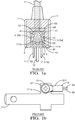
- FIG 1a and figure 1b shows a power cord known from prior art.
- the power cord comprises a plug 1, male connectors 11 and thermal sensors 5.
- the thermal sensors 5 being configured to detect a temperature of a corresponding male connector.
- Each thermal sensor 5 is provided to be in contact with the corresponding male connector 11 in one-to one.
- the thermal sensors 5 are screwed directly to the male connectors 11.
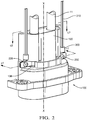
- FIG. 2 shows a perspective, view to an electrical power cord 10 comprising the inventive electrical connector 100.
- Two high power cables 11 protrude out of a plug housing 120.
- the plug housing 120 having two elongated electrical power terminals 160 arranged inside a cavity 130 of the plug housing 120 (not shown here).and two thermal sensors 300 and two elongated heat transfer members 200.
- the two thermal sensors 300 are electrically connected to a control device by electrical wires 310.
- the electrical connector 100 has a mating axis X to mate to a counter connector along.
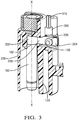
- FIG. 3 shows a cut view of the electrical connector 100.
- the heat transfer member 200 comprises first coupling means for mechanically and thermally connecting the electrical power terminal 160 to the elongated heat transfer member 200 on a first end 202 and the elongated heat transfer member 200 comprises second coupling means for mechanically and thermally connecting thermal sensor 300 to the elongated heat transfer member 200 on a second end 204.
- the cavity 130 comprises a cavity opening 138 arranged parallel in relation to a terminal surface 162 of the elongated electrical power terminal 160.
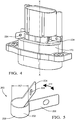
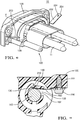
- Figure 4 shows a perspective, view to a preassembled connector 100 with in to the plug housing 120 inserted elongated heat transfer member 200
- FIG. 5 shows a perspective, view to an elongated heat transfer member 200 according the first embodiment of the invention.
- the first coupling means comprises a circular curved area 206 defining the first end 202 of the elongated heat transfer member 200.
- the circular curved area 206 is adapted to be arranged inside the cavity 130 surrounding the elongated electrical power terminal 160.
- the second coupling means comprises two straight portions 208, each starting from an end of the circular curved area 206, adapted to protrude trough the cavity opening 139 to outside the cavity 130.
- the two straight portions 208 are arranged having an angle 210 in between each other and wherein an inner diameter 207 of the circular curved area 206 is bigger than an outer diameter 164 of the elongated electrical power terminal 160 that is surrounded, when thermal sensor 300 is not connected to the two straight portions 208.
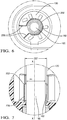
- Figure 6 shows a perspective, view to the connector face, in a preassembled state.
- the two straight portions 208 are arranged having an angle 210 in between each other and the inner diameter 207 of the circular curved area 206 is bigger than an outer diameter 164 of the elongated electrical power terminal 160 that is surrounded, when thermal sensor 300 is not connected to the two straight portions 208.
- Figure 7 shows a cut view to the cavity 130 in a preassembled state. The cut is carried out along a mating axis X.
- the inner diameter 207 of the circular curved area 206 is bigger than an outer diameter 164 of the elongated electrical power terminal 160 that is surrounded.
- the circular curved area 206 is not fully in touch with the elongated electrical power terminal 160 when thermal sensor 300 is not connected to the two straight portions 208.
- Figure 8 shows a perspective, view to the connector face, in a finally assembled state.
- the two straight portions 208 are parallel and in contact to each other and the inner diameter 207 of the circular curved area 206 is the same as the outer diameter 164 of the elongated electrical power terminal 160 that is surrounded, when the thermal sensor 300 is mechanically and thermally connected to the two straight portions 208.
- Figure 9 shows a cut view to the cavity 130 in a finally assembled state, wherein the cut is carried out along the mating axis X.
- the inner diameter 207 of the circular curved area 206 is the same as the outer diameter 164 of the elongated electrical power terminal 160 that is surrounded, when the thermal sensor 300 is mechanically and thermally connected to the two straight portions 208.
- Figure 10 shows a perspective, view to a preassembled connector 100 with pre aligned elongated heat transfer member 200.
- the elongated heat transfer member 200 in a second embodiment of the invention has first coupling means that comprises a first flat straight tongue 210 defining the first end 202 of the elongated heat transfer member 200 and the second coupling means comprises a second flat straight tongue 212.
- Figure 11 shows a cut view to the cavity 13 in an assembled state, wherein the cut is carried out perpendicular to the mating axis along cut line C2.
- the cavity 130 comprises a support surface 140 arranged opposite to a terminal surface 162 of the elongated electrical power terminal 160.
- the first coupling means comprises a first flat straight tongue 210 defining the first end 202 of the elongated heat transfer member 200.
- the first flat straight tongue 210 is arranged in between the support surface 140 and the terminal surface 162 of the elongated electrical power terminal 160 thereby mechanically and thermally connecting the elongated heat transfer member 200 to the electrical power terminal 160.
- the cavity comprises a cavity opening 138 to outside the cavity 130.
- the second coupling means comprises a second flat straight tongue 212, protruding trough the cavity opening 138 to outside the cavity 130.
- the second flat straight tongue 210 comprises an opening 224 to attach the thermal sensor 300 to the elongated heat transfer member 200.
- the second flat straight tongue 210 and the thermal sensor are fixed by a screw 226 to the housing 120 thereby attaching the elongated heat transfer member 200 to the thermal sensor 300.
- FIG 12 shows a perspective, view to a flexible elongated heat transfer member 200 and the elongated electrical power terminal 160 aligned to each other, in a preassembled state.
- the elongated heat transfer member 200 comprises a flat flexible structure 220, wherein the flat flexible structure 220 comprises highly oriented pyrolytic graphite.
- the first end 202 of the elongated heat transfer member 200 is defined by a part of the flat flexible structure 220.
- the first end 202 is arranged in a plane, perpendicular to an extension axis X of the elongated electrical power terminal 160.
- the first end 202 comprises an opening 222 that receives the elongated electrical power terminal 160.
- the opening 222 is defined by cross shaped cuts 222 in the flat flexible structure 220.
- Figure 13 shows a perspective, view to a flexible structure 220 and the elongated electrical power terminal 160 aligned to each other, in a fully assembled state.
- the elongated electrical power terminal 160 protrudes through the opening 222 in the first end 202.
- the first end 202 surrounds the elongated electrical power terminal 160 tightly.
- Figure 14 shows a perspective, view to a flexible structure 220 attached to a carrier 400.
- the first end 202 is attached to the sleeve shaped carrier 400.
- the sleeve shaped carrier 400 is adapted to be located inside the cavity 130, thereby radially surrounding the elongated electrical power terminal 160.
- the first end 202 is attached to the sleeve shaped carrier 400 in a way to keep it in a plane perpendicular to the mating axis X.
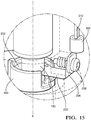
- Figure 15 shows a perspective, view to a flexible elongated heat transfer member 220 and the elongated electrical power terminal 160 inserted in the plug housing 120, in a fully assembled state.
- the first end 202 and the second end 204 are arranged in different planes.
Landscapes
- Engineering & Computer Science (AREA)
- Microelectronics & Electronic Packaging (AREA)
- Details Of Connecting Devices For Male And Female Coupling (AREA)
Abstract
Description
- The invention relates to an electrical connector for an electrical power cord for usage in high current charging application like electrical driven vehicles or hybrid vehicles.
- In high current application usually power cords are used that comprise plug connectors having at least one temperature sensor for detecting the temperature of the plug, and a shut-off device for stopping the power supply to a load from the plug when an abnormal temperature rise is detected by the temperature sensor. According to the power cord of this type, even when abnormal heat generation occurs because of a contact failure of the plug pins of the plug at the power socket, fire or damage to the plug due to the heat can be prevented by stopping the power supply.
- In a case where only one temperature sensor is provided, a correlation between the output of the temperature sensor and the temperature of the plug pin farthest from the temperature sensor among the plurality of plug pins becomes relatively low. Accordingly, response to the temperature rise at the corresponding plug pin becomes slow, and safety may be reduced. On the other hand, in a case where a plurality of temperature sensors is provided and the output of each temperature sensor is monitored individually, it may cause an increase in the number of parts and/or complication of a wiring. Document
EP2884611 discloses an improved power cord cable that improves safety and avoiding an increase in the number of parts and complication of a wiring. - The document discloses a power cord including: a plug having a plurality of plug pins and a plurality of PTC (Positive Temperature Coefficient) thermistors, at least one of which is provided for each of the plug pins to detect a temperature of the corresponding plug pin. The PTC thermistors form one series circuit. Each thermal sensor includes a temperature detection element, and a metal-made holder that holds the temperature detection element. The holder has the same structure as well-known lug terminal, as a whole. The holder includes a fixed portion that has an annular shape and is to be fixed to a corresponding plug pin by a screw and a body portion that houses the temperature detection element therein. The fixed portion of each thermal sensor is fixed on one surface of the corresponding plug pin, which faces outside in a horizontal direction. Unfortunately, the plug pins in the disclosed power cord have to have openings for the screw that are screwed in to hold thermal sensor close to the plug pin, that may weaken the plug pin and support corrosion when different metals are used. Furthermore, the plug housing has to be designed to provide space for thermal sensor adjacent to the plug pins that limits the freedom to the design the plug housing. Finally, thermal sensors have to be screwed to the plug pins before the plug pins are mounted into the plug housing. That limits the opportunities that are given by preassembly in various locations while production of the power cord.
- There is a need in the art to provide an electrical connector for a high current power cord, that provide means to reliable detect abnormal heat generation at the electrical pins and is flexible to manufacture.
- An electrical connector for an electrical power cord according claim 1 solve these and other objects, which become apparent upon reading the following description.
- The present application relates to an electrical connector for a power cord comprising: a plug housing having at least one elongated electrical power terminal arranged inside a cavity of the plug housing, at least one thermal sensor and at least one elongated heat transfer member. The heat transfer member comprises first coupling means for mechanically and thermally connecting the electrical power terminal to the elongated heat transfer member on a first end. The elongated heat transfer member comprises second coupling means for mechanically and thermally connecting thermal sensor to the elongated heat transfer member on a second end.
- The disclosed invention provides an electrical connector employing an elongated heat transfer member for transferring a portion of the heat generated in the electrical connector while charging. The elongated heat transfer member transfers the heat from a contact region to a sensor region where a thermal sensor is attachable to sense the temperature of the elongated heat transfer member. The first end of the elongated heat transfer member is located inside the terminal cavity and the second end is located outside the terminal cavity. That makes the assembly process easier because the second end is easy accessible to attach the thermal sensor. Furthermore, there is no need to seal the heat transfer member or the thermal sensor because there are located in the wet area of the electrical connector. The thermal sensor senses the temperature and a computing device calculates, starting from that value, the temperature of the electrical power terminal. The value is important to control the charging process. The design provides fast und exact measure values because the elongated heat transfer member is in direct contact the electrical power terminal.
- According to a preferred embodiment, the cavity comprises a cavity opening arranged parallel in relation to a terminal surface of the elongated electrical power terminal. The first coupling means comprises a circular curved area defining the first end of the elongated heat transfer member. The circular curved area is arranged inside the cavity surrounding the elongated electrical power terminal The second coupling means comprises two straight portions, each starting from an end of the circular curved area, protruding trough the cavity opening to outside the cavity. The circular curved area is adapted to the outer shape of the elongated electrical power terminal that has a round cross section in this embodiment. This makes sure that the elongated heat transfer member is in close contact to the elongated electrical power terminal to enable improved heat transfer. The heat is transferred further from the curved area by the two straight portions. The two straight portions connect the inside of the cavity to the outside of the cavity. That makes it easy to attach the thermal sensor, outside the cavity, to the heat transfer member while assembly of the electrical connector.
- Preferably, the two straight portions are arranged having an angle in between each other and wherein an inner diameter of the circular curved area is bigger than an outer diameter of the elongated electrical power terminal that is surrounded, when thermal sensor is not connected to the two straight portions. This design makes it possible to preassemble the heat transfer member to the plug housing. The heat transfer member can be assembled without the electrical power terminal or before the electrical power terminal is inserted into the plug housing. After insertion of the electrical power terminal the two straight portions are moved towards each other to reduce the inner diameter and bring the circular curved area in contact to the electrical power terminal. In this embodiment the usage of flexible material, for example spring steel, for making the heat transfer member is recommended. The preassembled electrical connector may be shipped to a distant production plant for finally assembly. That makes the production of the electrical connector more flexible.
- Advantageously, the two straight portions are parallel and in contact to each other and the inner diameter of the circular curved area is the same as the outer diameter of the elongated electrical power terminal that is surrounded, when thermal sensor is mechanically and thermally connected to the two straight portions. This design provides a robust heat transfer phat to the thermal sensor.
- According to another preferred embodiment, the cavity comprises a support surface arranged opposite to a terminal surface of the elongated electrical power terminal. The first coupling means comprises a first flat straight tongue defining the first end of the elongated heat transfer member. The first flat straight tongue is arranged in between the support surface and the terminal surface of the elongated electrical power terminal thereby mechanically and thermally connecting the elongated heat transfer member to the electrical power terminal. The cavity comprises a cavity opening to outside the cavity. The second coupling means comprises a second flat straight tongue, protruding trough the cavity opening to outside the cavity. This embodiment provides an even simpler assembly because the elongated heat transfer member can be stickled through the cavity opening, while assembly the electrical connector, as one of the final production step in the production processes. In applications where small contact areas are sufficient, this embodiment is recommended. The first and second flat straight tongues have not to be strictly straight but can also be bend, e.g. the first flat tongue can be arc shaped to follow the shape of the electrical power terminal. This Increases the contact area between the first flat tongue and the elongated
electrical power terminal. This design also provides the opportunity of easy adaptation to a verity of different electrical power terminals. - Preferably, the elongated heat transfer member comprises at least one layer of material with high thermal conductivity. A layer of material with high thermal conductivity improves the thermal resistance of the elongated heat transfer member. That results in a faster transfer of the heat to the sensor and the opportunity to improve the charging process.
- Advantageously, the elongated heat transfer member comprises at least one layer of highly oriented pyrolytic graphite. The layer of highly oriented pyrolytic graphite provides increased heat transfer properties. This material is offered on the market.
- According to another preferred embodiment, the elongated heat transfer member comprises a flat flexible structure, wherein the flat flexible structure comprises highly oriented pyrolytic graphite. A metal part, a plastic part, or a foil, coated with highly oriented pyrolytic graphite can define the flexible structure. The layer of highly oriented pyrolytic graphite does the heat transfer. If a foil defines the elongated heat transfer member, another layer of the foil can provide or improve the mechanical properties that are necessary to define the elongated heat transfer member. The foil is in contact with the elongated electrical power terminal. The foil can be e.g. wrapped around, or glued or clamped to the elongated electrical power terminal.
- Preferably, the first end of the elongated heat transfer member is defined by a part of the flat flexible structure. Dependent on the application the elongated heat transfer member can comprise flexible and rigid portions.
- Advantageously, the first end is arranged in a plane, perpendicular to an extension axis of the elongated electrical power terminal. This design allows ab easy alignment of the first end.
- Preferably, the first end comprises an opening that receives the elongated electrical power terminal. The dimension of the opening is designed to tightly surround the elongated electrical power terminal. The opening is smaller than the diameter of the elongated electrical power terminal. When the elongated electrical power terminal is inserted into the opening the opening is widened to flexible enclose the elongated electrical power terminal.
- Advantageously, the opening is defined by cross shaped cuts in the flat flexible structure. When a foil defines the flat flexible structure, the opening can easy be provided by cross shaped cuts in the foil. The cuts provide areas that are able to fold away from the plane of the not cut foil. When the elongated electrical power terminal is inserted into the opening, the parts of the foil, separated by the cuts, fold away from the plane of the not cut foil. The folded parts of the foil surround the elongated electrical power terminal and increase the thermal contact area.
- Preferably, the first end and the second end are arranged in different planes. Dependent on the application the ends have to be in different planes. The flexibility of the elongated heat transfer member solves this requirement.
- Preferably, the first end is attached to a sleeve shaped carrier, wherein the sleeve shaped carrier is located inside the cavity, thereby radially surrounding the elongated electrical power terminal. In case, the flexible first end needs mechanical support the sleeve shaped carrier can provide it. A further advantage is that the sleeve shaped carrier can be an interface for mechanically adapting different cavity sizes to the size of the first end of the elongated heat transfer member.
- In the following, the invention is described exemplarily with reference to the enclosed figures, in which
- Fig. 1a and 1b
- show an electrical power cord disclosed in prior art;
- Fig. 2
- shows a perspective, view to an electrical power cord comprising the inventive electrical connector;
- Fig. 3
- shows a cut view of the electrical connector;
- Fig. 4
- shows a perspective, view to a preassembled connector with inserted elongated heat transfer member;
- Fig. 5
- shows a perspective, view to an elongated heat transfer member according the first embodiment of the invention;
- Fig. 6
- shows a perspective, view to the connector face, in a preassembled state;
- Fig. 7
- shows a cut view to the cavity in a preassembled state, wherein the cut is carried out along a mating axis;
- Fig. 8
- shows a perspective, view to the cavity to the connector face, in a finally assembled state;
- Fig. 9
- shows a cut view to the cavity in a finally assembled state, wherein the cut is carried out along the mating axis,
- Fig. 10
- shows a perspective, view to a preassembled connector with pre aligned elongated heat transfer member;
- Fig. 11
- shows a cut view to the cavity in an assembled state, wherein the cut is carried out perpendicular to the mating axis along cut line C2;
- Fig. 12
- shows a perspective, view to a flexible elongated heat transfer member and the elongated electrical power terminal aligned to each other, in a preassembled state;
- Fig. 13
- shows a perspective, view to a flexible elongated heat transfer member and the elongated electrical power terminal aligned to each other, in a fully assembled state;
- Fig. 14
- shows a perspective, view to a flexible elongated heat transfer member attached to a carrier;
- Fig. 15
- shows a perspective, view to a flexible elongated heat transfer member and the elongated electrical power terminal inserted in the plug housing, in a fully assembled state;
-
Figure 1a and figure 1b shows a power cord known from prior art. The power cord comprises a plug 1,male connectors 11 andthermal sensors 5. Thethermal sensors 5 being configured to detect a temperature of a corresponding male connector. Eachthermal sensor 5 is provided to be in contact with the correspondingmale connector 11 in one-to one. Thethermal sensors 5 are screwed directly to themale connectors 11. -
Figure 2 shows a perspective, view to anelectrical power cord 10 comprising the inventiveelectrical connector 100. Twohigh power cables 11 protrude out of aplug housing 120. Theplug housing 120 having two elongatedelectrical power terminals 160 arranged inside acavity 130 of the plug housing 120 (not shown here).and twothermal sensors 300 and two elongatedheat transfer members 200. The twothermal sensors 300 are electrically connected to a control device byelectrical wires 310. Theelectrical connector 100 has a mating axis X to mate to a counter connector along. -
Figure 3 shows a cut view of theelectrical connector 100. Theheat transfer member 200 comprises first coupling means for mechanically and thermally connecting theelectrical power terminal 160 to the elongatedheat transfer member 200 on afirst end 202 and the elongatedheat transfer member 200 comprises second coupling means for mechanically and thermally connectingthermal sensor 300 to the elongatedheat transfer member 200 on asecond end 204. Thecavity 130 comprises acavity opening 138 arranged parallel in relation to aterminal surface 162 of the elongatedelectrical power terminal 160. -
Figure 4 shows a perspective, view to apreassembled connector 100 with in to theplug housing 120 inserted elongatedheat transfer member 200 -
Figure 5 shows a perspective, view to an elongatedheat transfer member 200 according the first embodiment of the invention. The first coupling means comprises a circularcurved area 206 defining thefirst end 202 of the elongatedheat transfer member 200. The circularcurved area 206 is adapted to be arranged inside thecavity 130 surrounding the elongatedelectrical power terminal 160. The second coupling means comprises twostraight portions 208, each starting from an end of the circularcurved area 206, adapted to protrude trough the cavity opening 139 to outside thecavity 130. The twostraight portions 208 are arranged having anangle 210 in between each other and wherein aninner diameter 207 of the circularcurved area 206 is bigger than anouter diameter 164 of the elongatedelectrical power terminal 160 that is surrounded, whenthermal sensor 300 is not connected to the twostraight portions 208. -
Figure 6 shows a perspective, view to the connector face, in a preassembled state. The twostraight portions 208 are arranged having anangle 210 in between each other and theinner diameter 207 of the circularcurved area 206 is bigger than anouter diameter 164 of the elongatedelectrical power terminal 160 that is surrounded, whenthermal sensor 300 is not connected to the twostraight portions 208. -
Figure 7 shows a cut view to thecavity 130 in a preassembled state. The cut is carried out along a mating axis X. Theinner diameter 207 of the circularcurved area 206 is bigger than anouter diameter 164 of the elongatedelectrical power terminal 160 that is surrounded. The circularcurved area 206 is not fully in touch with the elongatedelectrical power terminal 160 whenthermal sensor 300 is not connected to the twostraight portions 208. -
Figure 8 shows a perspective, view to the connector face, in a finally assembled state. The twostraight portions 208 are parallel and in contact to each other and theinner diameter 207 of the circularcurved area 206 is the same as theouter diameter 164 of the elongatedelectrical power terminal 160 that is surrounded, when thethermal sensor 300 is mechanically and thermally connected to the twostraight portions 208. -
Figure 9 shows a cut view to thecavity 130 in a finally assembled state, wherein the cut is carried out along the mating axis X. Theinner diameter 207 of the circularcurved area 206 is the same as theouter diameter 164 of the elongatedelectrical power terminal 160 that is surrounded, when thethermal sensor 300 is mechanically and thermally connected to the twostraight portions 208. -
Figure 10 shows a perspective, view to apreassembled connector 100 with pre aligned elongatedheat transfer member 200. The elongatedheat transfer member 200 in a second embodiment of the invention has first coupling means that comprises a first flatstraight tongue 210 defining thefirst end 202 of the elongatedheat transfer member 200 and the second coupling means comprises a second flat straight tongue 212. -
Figure 11 shows a cut view to the cavity 13 in an assembled state, wherein the cut is carried out perpendicular to the mating axis along cut line C2. Thecavity 130 comprises asupport surface 140 arranged opposite to aterminal surface 162 of the elongatedelectrical power terminal 160. The first coupling means comprises a first flatstraight tongue 210 defining thefirst end 202 of the elongatedheat transfer member 200. The first flatstraight tongue 210 is arranged in between thesupport surface 140 and theterminal surface 162 of the elongatedelectrical power terminal 160 thereby mechanically and thermally connecting the elongatedheat transfer member 200 to theelectrical power terminal 160. The cavity comprises acavity opening 138 to outside thecavity 130. The second coupling means comprises a second flat straight tongue 212, protruding trough thecavity opening 138 to outside thecavity 130. The second flatstraight tongue 210 comprises anopening 224 to attach thethermal sensor 300 to the elongatedheat transfer member 200. In this embodiment the second flatstraight tongue 210 and the thermal sensor are fixed by ascrew 226 to thehousing 120 thereby attaching the elongatedheat transfer member 200 to thethermal sensor 300. -
Figure 12 shows a perspective, view to a flexible elongatedheat transfer member 200 and the elongatedelectrical power terminal 160 aligned to each other, in a preassembled state. The elongatedheat transfer member 200 comprises a flatflexible structure 220, wherein the flatflexible structure 220 comprises highly oriented pyrolytic graphite. Thefirst end 202 of the elongatedheat transfer member 200 is defined by a part of the flatflexible structure 220. Thefirst end 202 is arranged in a plane, perpendicular to an extension axis X of the elongatedelectrical power terminal 160. Thefirst end 202 comprises anopening 222 that receives the elongatedelectrical power terminal 160. Theopening 222 is defined by cross shapedcuts 222 in the flatflexible structure 220. -
Figure 13 shows a perspective, view to aflexible structure 220 and the elongatedelectrical power terminal 160 aligned to each other, in a fully assembled state. The elongatedelectrical power terminal 160 protrudes through theopening 222 in thefirst end 202. Thefirst end 202 surrounds the elongatedelectrical power terminal 160 tightly. -
Figure 14 shows a perspective, view to aflexible structure 220 attached to acarrier 400. Thefirst end 202 is attached to the sleeve shapedcarrier 400. The sleeve shapedcarrier 400 is adapted to be located inside thecavity 130, thereby radially surrounding the elongatedelectrical power terminal 160. Thefirst end 202 is attached to the sleeve shapedcarrier 400 in a way to keep it in a plane perpendicular to the mating axis X. -
Figure 15 shows a perspective, view to a flexible elongatedheat transfer member 220 and the elongatedelectrical power terminal 160 inserted in theplug housing 120, in a fully assembled state. Thefirst end 202 and thesecond end 204 are arranged in different planes.
Claims (14)
- An electrical connector (100) for a power cord comprising: a plug housing (120) having at least one elongated electrical power terminal (160) arranged inside a cavity (130) of the plug housing (120), at least one thermal sensor (300) and at least one elongated heat transfer member (200), wherein the heat transfer member (200) comprises first coupling means for mechanically and thermally connecting the electrical power terminal (160) to the elongated heat transfer member (200) on a first end (202) and wherein the elongated heat transfer member (200) comprises second coupling means for mechanically and thermally connecting thermal sensor (300) to the elongated heat transfer member (200) on a second end (204).
- An electrical connector (100) according to claim 1, wherein the cavity (130) comprises a cavity opening (138) arranged parallel in relation to a terminal surface (162) of the elongated electrical power terminal (160), wherein the first coupling means comprises a circular curved area (206) defining the first end (202) of the elongated heat transfer member (200), wherein the circular curved area (206) is arranged inside the cavity (130) surrounding the elongated electrical power terminal (160) and wherein the second coupling means comprises two straight portions (208), each starting from an end of the circular curved area (206), protruding trough the cavity opening (139) to outside the cavity (130).
- An electrical connector (100) according to the preceding claim, wherein the two straight portions (208) are arranged having an angle (210) in between each other and wherein an inner diameter (207) of the circular curved area (206) is bigger than an outer diameter (164) of the elongated electrical power terminal (160) that is surrounded, when thermal sensor (300) is not connected to the two straight portions (208).
- An electrical connector (100) according to the preceding claim, wherein the two straight portions (208) are parallel and in contact to each other and the inner diameter (207) of the circular curved area (206) is the same as the outer diameter (164) of the elongated electrical power terminal (160) that is surrounded, when thermal sensor (300) is mechanically and thermally connected to the two straight portions (208).
- An electrical connector (100) according to claim 1, wherein the cavity (130) comprises a support surface (140) arranged opposite to a terminal surface (162) of the elongated electrical power terminal (160), wherein the first coupling means comprises a first flat straight tongue (210) defining the first end (202) of the elongated heat transfer member (200), wherein the first flat straight tongue (210) is arranged in between the support surface (140) and the terminal surface (162) of the elongated electrical power terminal (160) thereby mechanically and thermally connecting the elongated heat transfer member (200) to the electrical power terminal (160), wherein the cavity comprises an cavity opening (138) to outside the cavity (130) and wherein the second coupling means comprises a second flat straight tongue (212), protruding trough the cavity opening (138) to outside the cavity (130).
- An electrical connector (100) according to any preceding claim, wherein the elongated heat transfer member (200) comprises at least one layer of material with high thermal conductivity.
- An electrical connector (100) according to any preceding claim, wherein the elongated heat transfer member (200) comprises at least one layer of highly oriented pyrolytic graphite.
- An electrical connector (100) according to claim 1, wherein the elongated heat transfer member (200) comprises a flat flexible structure (220), wherein the flat flexible structure (220) comprises highly oriented pyrolytic graphite.
- An electrical connector (100) according to the preceding claim, wherein the first end (202) of the elongated heat transfer member (200) is defined by a part of the flat flexible structure (220).
- An electrical connector (100) according to the preceding claim, wherein the first end (202) is arranged in a plane, perpendicular to an extension axis (X) of the elongated electrical power terminal (160).
- An electrical connector (100) according to any of claims 8 to 10, wherein the first end (202) comprises an opening (222) that receives the elongated electrical power terminal (160).
- An electrical connector (100) according to the preceding claim, wherein the opening (222) is defined by cross shaped cuts in the flat flexible structure (220).
- An electrical connector (100) according to any of claims 9 to 13, wherein the first end (202) and the second end (204) are arranged in different planes.
- An electrical connector (100) according to any of claims 8 to 13, wherein the first end (202) is attached to a sleeve shaped carrier (400), wherein the sleeve shaped carrier (400) is located inside the cavity (130), thereby radially surrounding the elongated electrical power terminal (160).
Priority Applications (1)
| Application Number | Priority Date | Filing Date | Title |
|---|---|---|---|
| EP18156945.0A EP3528349B1 (en) | 2018-02-15 | 2018-02-15 | Electrical connector |
Applications Claiming Priority (1)
| Application Number | Priority Date | Filing Date | Title |
|---|---|---|---|
| EP18156945.0A EP3528349B1 (en) | 2018-02-15 | 2018-02-15 | Electrical connector |
Publications (2)
| Publication Number | Publication Date |
|---|---|
| EP3528349A1 true EP3528349A1 (en) | 2019-08-21 |
| EP3528349B1 EP3528349B1 (en) | 2021-04-07 |
Family
ID=61226479
Family Applications (1)
| Application Number | Title | Priority Date | Filing Date |
|---|---|---|---|
| EP18156945.0A Active EP3528349B1 (en) | 2018-02-15 | 2018-02-15 | Electrical connector |
Country Status (1)
| Country | Link |
|---|---|
| EP (1) | EP3528349B1 (en) |
Cited By (4)
| Publication number | Priority date | Publication date | Assignee | Title |
|---|---|---|---|---|
| EP3846294A1 (en) * | 2020-01-02 | 2021-07-07 | Aptiv Technologies Limited | Terminal assembly for a charging connector including an improved thermal monitoring |
| EP3848235A1 (en) * | 2020-01-10 | 2021-07-14 | Toyota Jidosha Kabushiki Kaisha | Evaluation jig |
| DE102020108507A1 (en) | 2020-03-27 | 2021-09-30 | ALAC Elektrik - Mechanik - Vertrieb GmbH | Electrical connection device and method for assembling an electrical connection device |
| WO2022073782A1 (en) * | 2020-10-07 | 2022-04-14 | Phoenix Contact E-Mobility Gmbh | Temperature detection device for a plug connector part |
Citations (5)
| Publication number | Priority date | Publication date | Assignee | Title |
|---|---|---|---|---|
| EP2884611A1 (en) | 2013-12-13 | 2015-06-17 | Panasonic Intellectual Property Management Co., Ltd. | Power cord |
| EP2884600A1 (en) * | 2013-12-13 | 2015-06-17 | Panasonic Intellectual Property Management Co., Ltd. | Power cord |
| DE102014111185A1 (en) * | 2014-08-06 | 2016-02-11 | Phoenix Contact E-Mobility Gmbh | Connector part with a temperature sensor device |
| US20160344144A1 (en) * | 2015-05-22 | 2016-11-24 | Foxconn Interconnect Technology Limited | Power cable connector assembly |
| US20180034197A1 (en) * | 2016-08-01 | 2018-02-01 | Te Connectivity Corporation | Arcless power connector |
-
2018
- 2018-02-15 EP EP18156945.0A patent/EP3528349B1/en active Active
Patent Citations (5)
| Publication number | Priority date | Publication date | Assignee | Title |
|---|---|---|---|---|
| EP2884611A1 (en) | 2013-12-13 | 2015-06-17 | Panasonic Intellectual Property Management Co., Ltd. | Power cord |
| EP2884600A1 (en) * | 2013-12-13 | 2015-06-17 | Panasonic Intellectual Property Management Co., Ltd. | Power cord |
| DE102014111185A1 (en) * | 2014-08-06 | 2016-02-11 | Phoenix Contact E-Mobility Gmbh | Connector part with a temperature sensor device |
| US20160344144A1 (en) * | 2015-05-22 | 2016-11-24 | Foxconn Interconnect Technology Limited | Power cable connector assembly |
| US20180034197A1 (en) * | 2016-08-01 | 2018-02-01 | Te Connectivity Corporation | Arcless power connector |
Cited By (8)
| Publication number | Priority date | Publication date | Assignee | Title |
|---|---|---|---|---|
| EP3846294A1 (en) * | 2020-01-02 | 2021-07-07 | Aptiv Technologies Limited | Terminal assembly for a charging connector including an improved thermal monitoring |
| EP3848235A1 (en) * | 2020-01-10 | 2021-07-14 | Toyota Jidosha Kabushiki Kaisha | Evaluation jig |
| DE102020108507A1 (en) | 2020-03-27 | 2021-09-30 | ALAC Elektrik - Mechanik - Vertrieb GmbH | Electrical connection device and method for assembling an electrical connection device |
| WO2021191061A1 (en) * | 2020-03-27 | 2021-09-30 | ALAC Elektrik - Mechanik - Vertrieb GmbH | Electrical connection device and method for mounting an electrical connection device |
| US12100917B2 (en) | 2020-03-27 | 2024-09-24 | Alac Elektrik Mech Vertrieb Gmbh | Electrical connection device and method for mounting an electrical connection device |
| WO2022073782A1 (en) * | 2020-10-07 | 2022-04-14 | Phoenix Contact E-Mobility Gmbh | Temperature detection device for a plug connector part |
| BE1028678B1 (en) * | 2020-10-07 | 2022-05-09 | Phoenix Contact E Mobility Gmbh | Temperature detection device for a connector part |
| CN116323300A (en) * | 2020-10-07 | 2023-06-23 | 菲尼克斯电动交通有限公司 | Temperature detection device for plug-in connector components |
Also Published As
| Publication number | Publication date |
|---|---|
| EP3528349B1 (en) | 2021-04-07 |
Similar Documents
| Publication | Publication Date | Title |
|---|---|---|
| CN109414996B (en) | Electrical connection device for thermal coupling of circuit boards with temperature sensors | |
| EP3528349B1 (en) | Electrical connector | |
| JP6130244B2 (en) | Terminal and charging connector | |
| EP2487758B1 (en) | Electrical connector for high-temperature environments | |
| CN111406348B (en) | Temperature sensing electrical device | |
| US8109786B2 (en) | Connector for coaxial cable | |
| KR102231028B1 (en) | Electrical apparatus comprising a temperature sensor housed in a support element | |
| CN106575842B (en) | Plug-in connector with temperature sensor | |
| KR101647169B1 (en) | Sensor lead sealing and strain relief | |
| CN104204745B (en) | Temperature sensor | |
| EP3190396B1 (en) | Terminal-thermistor assembly | |
| US20240372304A1 (en) | Connector | |
| US8597065B2 (en) | Sleeve for electrical connectors and method of assembling | |
| CN217215186U (en) | Terminal with protection function | |
| JP2012073223A (en) | Temperature sensor | |
| EP3093926B1 (en) | Power plug including temperature sensors | |
| US8574007B2 (en) | Electrical connector having a shielding adapter to radially compress a shielding ferrule onto a cable | |
| EP2802042B1 (en) | Thermocouple connector adapted for being connected to a safety gas valve, and thermocouple | |
| CN219937529U (en) | Electrical connection components, connectors and connector components | |
| CN219998640U (en) | Electrical connection assembly, connector and connector assembly | |
| JP7334301B2 (en) | A temperature sensor unit used to be mounted within the terminal body | |
| CN207019811U (en) | Temperature sensor | |
| CN119108862A (en) | Connectors and Connector Assemblies | |
| CN208173915U (en) | Connection terminal component and connector | |
| CN223052521U (en) | Connector with temperature sensing mechanism |
Legal Events
| Date | Code | Title | Description |
|---|---|---|---|
| PUAI | Public reference made under article 153(3) epc to a published international application that has entered the european phase |
Free format text: ORIGINAL CODE: 0009012 |
|
| STAA | Information on the status of an ep patent application or granted ep patent |
Free format text: STATUS: THE APPLICATION HAS BEEN PUBLISHED |
|
| AK | Designated contracting states |
Kind code of ref document: A1 Designated state(s): AL AT BE BG CH CY CZ DE DK EE ES FI FR GB GR HR HU IE IS IT LI LT LU LV MC MK MT NL NO PL PT RO RS SE SI SK SM TR |
|
| AX | Request for extension of the european patent |
Extension state: BA ME |
|
| STAA | Information on the status of an ep patent application or granted ep patent |
Free format text: STATUS: REQUEST FOR EXAMINATION WAS MADE |
|
| 17P | Request for examination filed |
Effective date: 20200218 |
|
| RBV | Designated contracting states (corrected) |
Designated state(s): AL AT BE BG CH CY CZ DE DK EE ES FI FR GB GR HR HU IE IS IT LI LT LU LV MC MK MT NL NO PL PT RO RS SE SI SK SM TR |
|
| GRAP | Despatch of communication of intention to grant a patent |
Free format text: ORIGINAL CODE: EPIDOSNIGR1 |
|
| STAA | Information on the status of an ep patent application or granted ep patent |
Free format text: STATUS: GRANT OF PATENT IS INTENDED |
|
| INTG | Intention to grant announced |
Effective date: 20201028 |
|
| GRAS | Grant fee paid |
Free format text: ORIGINAL CODE: EPIDOSNIGR3 |
|
| GRAA | (expected) grant |
Free format text: ORIGINAL CODE: 0009210 |
|
| STAA | Information on the status of an ep patent application or granted ep patent |
Free format text: STATUS: THE PATENT HAS BEEN GRANTED |
|
| AK | Designated contracting states |
Kind code of ref document: B1 Designated state(s): AL AT BE BG CH CY CZ DE DK EE ES FI FR GB GR HR HU IE IS IT LI LT LU LV MC MK MT NL NO PL PT RO RS SE SI SK SM TR |
|
| REG | Reference to a national code |
Ref country code: GB Ref legal event code: FG4D |
|
| REG | Reference to a national code |
Ref country code: AT Ref legal event code: REF Ref document number: 1380900 Country of ref document: AT Kind code of ref document: T Effective date: 20210415 Ref country code: CH Ref legal event code: EP |
|
| REG | Reference to a national code |
Ref country code: DE Ref legal event code: R096 Ref document number: 602018014964 Country of ref document: DE |
|
| REG | Reference to a national code |
Ref country code: IE Ref legal event code: FG4D |
|
| REG | Reference to a national code |
Ref country code: LT Ref legal event code: MG9D |
|
| REG | Reference to a national code |
Ref country code: NL Ref legal event code: MP Effective date: 20210407 Ref country code: AT Ref legal event code: MK05 Ref document number: 1380900 Country of ref document: AT Kind code of ref document: T Effective date: 20210407 |
|
| PG25 | Lapsed in a contracting state [announced via postgrant information from national office to epo] |
Ref country code: NL Free format text: LAPSE BECAUSE OF FAILURE TO SUBMIT A TRANSLATION OF THE DESCRIPTION OR TO PAY THE FEE WITHIN THE PRESCRIBED TIME-LIMIT Effective date: 20210407 Ref country code: HR Free format text: LAPSE BECAUSE OF FAILURE TO SUBMIT A TRANSLATION OF THE DESCRIPTION OR TO PAY THE FEE WITHIN THE PRESCRIBED TIME-LIMIT Effective date: 20210407 Ref country code: BG Free format text: LAPSE BECAUSE OF FAILURE TO SUBMIT A TRANSLATION OF THE DESCRIPTION OR TO PAY THE FEE WITHIN THE PRESCRIBED TIME-LIMIT Effective date: 20210707 Ref country code: AT Free format text: LAPSE BECAUSE OF FAILURE TO SUBMIT A TRANSLATION OF THE DESCRIPTION OR TO PAY THE FEE WITHIN THE PRESCRIBED TIME-LIMIT Effective date: 20210407 Ref country code: LT Free format text: LAPSE BECAUSE OF FAILURE TO SUBMIT A TRANSLATION OF THE DESCRIPTION OR TO PAY THE FEE WITHIN THE PRESCRIBED TIME-LIMIT Effective date: 20210407 Ref country code: FI Free format text: LAPSE BECAUSE OF FAILURE TO SUBMIT A TRANSLATION OF THE DESCRIPTION OR TO PAY THE FEE WITHIN THE PRESCRIBED TIME-LIMIT Effective date: 20210407 |
|
| PG25 | Lapsed in a contracting state [announced via postgrant information from national office to epo] |
Ref country code: SE Free format text: LAPSE BECAUSE OF FAILURE TO SUBMIT A TRANSLATION OF THE DESCRIPTION OR TO PAY THE FEE WITHIN THE PRESCRIBED TIME-LIMIT Effective date: 20210407 Ref country code: RS Free format text: LAPSE BECAUSE OF FAILURE TO SUBMIT A TRANSLATION OF THE DESCRIPTION OR TO PAY THE FEE WITHIN THE PRESCRIBED TIME-LIMIT Effective date: 20210407 Ref country code: PL Free format text: LAPSE BECAUSE OF FAILURE TO SUBMIT A TRANSLATION OF THE DESCRIPTION OR TO PAY THE FEE WITHIN THE PRESCRIBED TIME-LIMIT Effective date: 20210407 Ref country code: LV Free format text: LAPSE BECAUSE OF FAILURE TO SUBMIT A TRANSLATION OF THE DESCRIPTION OR TO PAY THE FEE WITHIN THE PRESCRIBED TIME-LIMIT Effective date: 20210407 Ref country code: PT Free format text: LAPSE BECAUSE OF FAILURE TO SUBMIT A TRANSLATION OF THE DESCRIPTION OR TO PAY THE FEE WITHIN THE PRESCRIBED TIME-LIMIT Effective date: 20210809 Ref country code: NO Free format text: LAPSE BECAUSE OF FAILURE TO SUBMIT A TRANSLATION OF THE DESCRIPTION OR TO PAY THE FEE WITHIN THE PRESCRIBED TIME-LIMIT Effective date: 20210707 Ref country code: GR Free format text: LAPSE BECAUSE OF FAILURE TO SUBMIT A TRANSLATION OF THE DESCRIPTION OR TO PAY THE FEE WITHIN THE PRESCRIBED TIME-LIMIT Effective date: 20210708 Ref country code: IS Free format text: LAPSE BECAUSE OF FAILURE TO SUBMIT A TRANSLATION OF THE DESCRIPTION OR TO PAY THE FEE WITHIN THE PRESCRIBED TIME-LIMIT Effective date: 20210807 |
|
| REG | Reference to a national code |
Ref country code: DE Ref legal event code: R097 Ref document number: 602018014964 Country of ref document: DE |
|
| PG25 | Lapsed in a contracting state [announced via postgrant information from national office to epo] |
Ref country code: RO Free format text: LAPSE BECAUSE OF FAILURE TO SUBMIT A TRANSLATION OF THE DESCRIPTION OR TO PAY THE FEE WITHIN THE PRESCRIBED TIME-LIMIT Effective date: 20210407 Ref country code: DK Free format text: LAPSE BECAUSE OF FAILURE TO SUBMIT A TRANSLATION OF THE DESCRIPTION OR TO PAY THE FEE WITHIN THE PRESCRIBED TIME-LIMIT Effective date: 20210407 Ref country code: CZ Free format text: LAPSE BECAUSE OF FAILURE TO SUBMIT A TRANSLATION OF THE DESCRIPTION OR TO PAY THE FEE WITHIN THE PRESCRIBED TIME-LIMIT Effective date: 20210407 Ref country code: SK Free format text: LAPSE BECAUSE OF FAILURE TO SUBMIT A TRANSLATION OF THE DESCRIPTION OR TO PAY THE FEE WITHIN THE PRESCRIBED TIME-LIMIT Effective date: 20210407 Ref country code: SM Free format text: LAPSE BECAUSE OF FAILURE TO SUBMIT A TRANSLATION OF THE DESCRIPTION OR TO PAY THE FEE WITHIN THE PRESCRIBED TIME-LIMIT Effective date: 20210407 Ref country code: ES Free format text: LAPSE BECAUSE OF FAILURE TO SUBMIT A TRANSLATION OF THE DESCRIPTION OR TO PAY THE FEE WITHIN THE PRESCRIBED TIME-LIMIT Effective date: 20210407 Ref country code: EE Free format text: LAPSE BECAUSE OF FAILURE TO SUBMIT A TRANSLATION OF THE DESCRIPTION OR TO PAY THE FEE WITHIN THE PRESCRIBED TIME-LIMIT Effective date: 20210407 |
|
| PLBE | No opposition filed within time limit |
Free format text: ORIGINAL CODE: 0009261 |
|
| STAA | Information on the status of an ep patent application or granted ep patent |
Free format text: STATUS: NO OPPOSITION FILED WITHIN TIME LIMIT |
|
| 26N | No opposition filed |
Effective date: 20220110 |
|
| PG25 | Lapsed in a contracting state [announced via postgrant information from national office to epo] |
Ref country code: IS Free format text: LAPSE BECAUSE OF FAILURE TO SUBMIT A TRANSLATION OF THE DESCRIPTION OR TO PAY THE FEE WITHIN THE PRESCRIBED TIME-LIMIT Effective date: 20210807 Ref country code: AL Free format text: LAPSE BECAUSE OF FAILURE TO SUBMIT A TRANSLATION OF THE DESCRIPTION OR TO PAY THE FEE WITHIN THE PRESCRIBED TIME-LIMIT Effective date: 20210407 |
|
| PG25 | Lapsed in a contracting state [announced via postgrant information from national office to epo] |
Ref country code: IT Free format text: LAPSE BECAUSE OF FAILURE TO SUBMIT A TRANSLATION OF THE DESCRIPTION OR TO PAY THE FEE WITHIN THE PRESCRIBED TIME-LIMIT Effective date: 20210407 |
|
| PG25 | Lapsed in a contracting state [announced via postgrant information from national office to epo] |
Ref country code: MC Free format text: LAPSE BECAUSE OF FAILURE TO SUBMIT A TRANSLATION OF THE DESCRIPTION OR TO PAY THE FEE WITHIN THE PRESCRIBED TIME-LIMIT Effective date: 20210407 |
|
| REG | Reference to a national code |
Ref country code: CH Ref legal event code: PL |
|
| REG | Reference to a national code |
Ref country code: BE Ref legal event code: MM Effective date: 20220228 |
|
| PG25 | Lapsed in a contracting state [announced via postgrant information from national office to epo] |
Ref country code: LU Free format text: LAPSE BECAUSE OF NON-PAYMENT OF DUE FEES Effective date: 20220215 |
|
| PG25 | Lapsed in a contracting state [announced via postgrant information from national office to epo] |
Ref country code: LI Free format text: LAPSE BECAUSE OF NON-PAYMENT OF DUE FEES Effective date: 20220228 Ref country code: IE Free format text: LAPSE BECAUSE OF NON-PAYMENT OF DUE FEES Effective date: 20220215 Ref country code: CH Free format text: LAPSE BECAUSE OF NON-PAYMENT OF DUE FEES Effective date: 20220228 |
|
| PG25 | Lapsed in a contracting state [announced via postgrant information from national office to epo] |
Ref country code: BE Free format text: LAPSE BECAUSE OF NON-PAYMENT OF DUE FEES Effective date: 20220228 |
|
| P01 | Opt-out of the competence of the unified patent court (upc) registered |
Effective date: 20230424 |
|
| PG25 | Lapsed in a contracting state [announced via postgrant information from national office to epo] |
Ref country code: MK Free format text: LAPSE BECAUSE OF FAILURE TO SUBMIT A TRANSLATION OF THE DESCRIPTION OR TO PAY THE FEE WITHIN THE PRESCRIBED TIME-LIMIT Effective date: 20210407 Ref country code: CY Free format text: LAPSE BECAUSE OF FAILURE TO SUBMIT A TRANSLATION OF THE DESCRIPTION OR TO PAY THE FEE WITHIN THE PRESCRIBED TIME-LIMIT Effective date: 20210407 |
|
| PG25 | Lapsed in a contracting state [announced via postgrant information from national office to epo] |
Ref country code: HU Free format text: LAPSE BECAUSE OF FAILURE TO SUBMIT A TRANSLATION OF THE DESCRIPTION OR TO PAY THE FEE WITHIN THE PRESCRIBED TIME-LIMIT; INVALID AB INITIO Effective date: 20180215 |
|
| PG25 | Lapsed in a contracting state [announced via postgrant information from national office to epo] |
Ref country code: TR Free format text: LAPSE BECAUSE OF FAILURE TO SUBMIT A TRANSLATION OF THE DESCRIPTION OR TO PAY THE FEE WITHIN THE PRESCRIBED TIME-LIMIT Effective date: 20210407 |
|
| PG25 | Lapsed in a contracting state [announced via postgrant information from national office to epo] |
Ref country code: MT Free format text: LAPSE BECAUSE OF FAILURE TO SUBMIT A TRANSLATION OF THE DESCRIPTION OR TO PAY THE FEE WITHIN THE PRESCRIBED TIME-LIMIT Effective date: 20210407 |
|
| REG | Reference to a national code |
Ref country code: DE Ref legal event code: R081 Ref document number: 602018014964 Country of ref document: DE Owner name: APTIV TECHNOLOGIES AG, CH Free format text: FORMER OWNER: APTIV TECHNOLOGIES LIMITED, ST. MICHAEL, BB |
|
| PGFP | Annual fee paid to national office [announced via postgrant information from national office to epo] |
Ref country code: GB Payment date: 20260113 Year of fee payment: 9 |
|
| PGFP | Annual fee paid to national office [announced via postgrant information from national office to epo] |
Ref country code: DE Payment date: 20260121 Year of fee payment: 9 |
|
| PGFP | Annual fee paid to national office [announced via postgrant information from national office to epo] |
Ref country code: FR Payment date: 20260108 Year of fee payment: 9 |