EP3527675A1 - Chromium enhanced tanning process - Google Patents
Chromium enhanced tanning process Download PDFInfo
- Publication number
- EP3527675A1 EP3527675A1 EP19156703.1A EP19156703A EP3527675A1 EP 3527675 A1 EP3527675 A1 EP 3527675A1 EP 19156703 A EP19156703 A EP 19156703A EP 3527675 A1 EP3527675 A1 EP 3527675A1
- Authority
- EP
- European Patent Office
- Prior art keywords
- hide
- tanning
- process according
- agent
- electric field
- Prior art date
- Legal status (The legal status is an assumption and is not a legal conclusion. Google has not performed a legal analysis and makes no representation as to the accuracy of the status listed.)
- Granted
Links
Images

Classifications
-
- C—CHEMISTRY; METALLURGY
- C14—SKINS; HIDES; PELTS; LEATHER
- C14C—CHEMICAL TREATMENT OF HIDES, SKINS OR LEATHER, e.g. TANNING, IMPREGNATING, FINISHING; APPARATUS THEREFOR; COMPOSITIONS FOR TANNING
- C14C3/00—Tanning; Compositions for tanning
- C14C3/02—Chemical tanning
- C14C3/08—Chemical tanning by organic agents
- C14C3/16—Chemical tanning by organic agents using aliphatic aldehydes
-
- C—CHEMISTRY; METALLURGY
- C14—SKINS; HIDES; PELTS; LEATHER
- C14C—CHEMICAL TREATMENT OF HIDES, SKINS OR LEATHER, e.g. TANNING, IMPREGNATING, FINISHING; APPARATUS THEREFOR; COMPOSITIONS FOR TANNING
- C14C15/00—Apparatus for chemical treatment or washing of hides, skins, or leather
-
- C—CHEMISTRY; METALLURGY
- C14—SKINS; HIDES; PELTS; LEATHER
- C14C—CHEMICAL TREATMENT OF HIDES, SKINS OR LEATHER, e.g. TANNING, IMPREGNATING, FINISHING; APPARATUS THEREFOR; COMPOSITIONS FOR TANNING
- C14C3/00—Tanning; Compositions for tanning
- C14C3/02—Chemical tanning
- C14C3/04—Mineral tanning
-
- C—CHEMISTRY; METALLURGY
- C14—SKINS; HIDES; PELTS; LEATHER
- C14C—CHEMICAL TREATMENT OF HIDES, SKINS OR LEATHER, e.g. TANNING, IMPREGNATING, FINISHING; APPARATUS THEREFOR; COMPOSITIONS FOR TANNING
- C14C3/00—Tanning; Compositions for tanning
- C14C3/02—Chemical tanning
- C14C3/04—Mineral tanning
- C14C3/06—Mineral tanning using chromium compounds
-
- C—CHEMISTRY; METALLURGY
- C14—SKINS; HIDES; PELTS; LEATHER
- C14C—CHEMICAL TREATMENT OF HIDES, SKINS OR LEATHER, e.g. TANNING, IMPREGNATING, FINISHING; APPARATUS THEREFOR; COMPOSITIONS FOR TANNING
- C14C3/00—Tanning; Compositions for tanning
- C14C3/02—Chemical tanning
- C14C3/08—Chemical tanning by organic agents
- C14C3/10—Vegetable tanning
-
- C—CHEMISTRY; METALLURGY
- C14—SKINS; HIDES; PELTS; LEATHER
- C14C—CHEMICAL TREATMENT OF HIDES, SKINS OR LEATHER, e.g. TANNING, IMPREGNATING, FINISHING; APPARATUS THEREFOR; COMPOSITIONS FOR TANNING
- C14C3/00—Tanning; Compositions for tanning
- C14C3/02—Chemical tanning
- C14C3/30—Chemical tanning using physical means combined with chemical means
Definitions
- the present invention is related to an enhanced process of tanning hide to obtain leather, reducing significantly the time necessary to produce the final leather, while reducing the volume of bath and increasing the possibility to use different chemicals as olating agents with respect to the metal salts, leading consequently to a reduced environmental impact.
- Hide tanning is a process in which the collagen protein present therein reacts with tanning agents, originating leather.
- the tanning process is therefore one of the essential steps in leather production process. It is a very old process, whose purpose is to avoid hide degradation and putrefaction, by means of a protein crosslinking phenomenon caused by the action of the used tanning agent.
- Olation reaction is the process by which metal ions form polymeric oxides in aqueous solution and the resulting polymeric clusters are active in cross-linking of the collagen subunits.
- the process according to the present invention results to be very versatile as it can be used not only with h the chromium salts, but also with other salts like for example the zirconium, titanium, aluminium salts and also with organic olating agents like, for example vegetal or synthetic tannin, or glutaraldehydes.
- process time is considerably reduced as well as the volume of the bath in which the hide is dipped.
- N i uC i ⁇ D i ⁇ C i ⁇ ⁇ i z i C i F ⁇ V
- u the fluid velocity
- ⁇ V the gradient of electric potential
- F the Faraday constant
- C i , D i , z i and ⁇ i are the concentration, the diffusivity, the electric charge and electric mobility of the ion, respectively.
- step b) it may be advantageous to apply an electric field not only in step b) but also in at least one of the steps a) and c) of the process of the invention.
- the process of the invention encompasses that also in the step a), c) or both an electric field is produced, by placing the hide between the two electrically powered electrodes.
- this electric field increases the diffusions flux of the active ions throughout the hide and in the specific the difference of potential between the two electrodes can exceed that necessary for the water split in hydrogen and oxygen thereby leading to the formation of positive hydrogen ions at the anode.
- These ions can be then used to generate the acid conditions directly inside the bath during the pickling step.
- Figure 1A being the metal ions adopted for the tanning positively charged in the process conditions, their natural diffusion sustained by the electric field has the direction from the anode to the cathode
- Figure 1B discloses the diagram of the concentration of the hydrogen ions in the cell. They are produced at the anode by the water electrolysis. Then they diffuse forward to the cathode where they are reduced to H2. Thus the concentration of the hydrogen ions has is maximum value at the anode and its minimum one at the cathode. Accordingly, in terms of pH, the minimum value (i.e. the greater acidity) is at the anode and the maximum one is at the cathode (i.e. where the solution approaches the neutrality).
- this phenomenon can be used to speed up the tanning step (b) even two-fold or more with respect the pure diffusive conditions.
- the enhancement factor is controlled by the applied electric potential difference between the two electrodes. Being the process time determined by the full and uniform penetration of the olation agent through the hide, obviously doubling the penetration speed the process time halves.
- a membrane can be introduced in between the two electrodes to create an anodic and a cathodic compartment.
- the selected membrane is an anionic membrane, that is a membrane that inhibits the permeation of positive ions while admits the migration of the negative ones, the following effects can be produced during the process:
- the H + ions generated at the anode can be used to neutralize the initial basicity of the hide and to induce its transformation in an acid hide.
- Figure 4 shows that the use of an anionic membrane has a positive effect also during the tanning step (b) because the positively charged olating agent is kept in the same anodic compartment containing the hide to be tanned and these ions do not migrate in the cathodic compartment of the cell.
- the difference of potential to be applied to the two electrodes is a function of the distance between them and of the thickness of the hide to be tanned. Accordingly, it is of interest to reduce the energy consumption, to reduce the space between the electrodes. This produces the positive effect to significantly reduce the volume of the bath.
- this electrochemically enhanced tanning process has the advantage of using very small solution / hide volume ratio.
- the applied electric potential can be adopted to produce a very high utilization of the chemicals of the bath.
- the electric potential can be also adjusted throughout the process, being the potential increase able to compensate the concentration reduction in the bath to keep almost constant the mass flux.
- Example no. 1 Electrochemical enhancement of the tanning step using chrome (III) salts
- a difference of potential of 10 V is applied to the electrodes. After 20 min the hide is extracted and rinsed.
- the chemical analysis revealed a uniform concentration of 2% Cr through all the thickness. The same experiment is repeated without applying the potential differences to the electrodes; at the same time the hide appears not uniformly penetrated by Cr ions evidencing a significant part of its section not still reached by Cr.
- Example no. 2 Electrochemical enhancement of the tanning step using other chrome (III) salts
- a difference of potential is applied to the electrodes and after 30 min the hide is extracted and rinsed. The same experiment is repeated without applying the potential difference to the electrodes.
- the application of the potential differences is related to a uniform concentration through the whole thickness, while in the other case without current the hide appears not uniformly penetrated by Cr ions.
- Example no. 3 Electrochemical enhancement of the pickling step
- a hide of about 25 cm 2 area is placed in the anodic compartment of an electrochemical cell created by an anionic membrane placed in between the two electrodes.
- a difference of potential of 10 V is applied to the electrodes. After 20 min the hide is extracted and rinsed. Then the leather is analyzed by titration evidencing its full acidification.
- the initial acidic pH of the cathodic compartment solution raises from pH ⁇ 2 to pH ⁇ 4.5 in 2 hours, avoiding the use of alkalinizing agents for the basification step.
- Example no. 5 Electrochemical enhancement of the tanning step using Titanium (IV) salts
- a hide of about 11.5 cm 2 area, already acidified by a pickling step, is placed in an electrochemical cell filled with a solution of 1% titanyl sulphate at a pH 2 and a temperature of 25 °C. A difference of potential is applied to the electrodes and after 30 min the hide is extracted and rinsed. The same experiment is repeated without applying the potential difference to the electrodes. Chemical analyses revealed a uniform concentration of 1.5% titanium on the whole thickness for the process with the application of the voltage, while in the other case (without current) a non-uniform penetration of titanium ions is detected.
- Example no. 6 Electrochemical enhancement of the tanning step using tannin
- a hide of about 11.5 cm 2 area, already acidified by a pickling step, is placed in an electrochemical cell filled with a solution of 18% tara tannins at a pH 2 and a temperature of 25 °C.
- a difference of potential is applied to the electrodes and after 120 min the hide is extracted and rinsed. The same experiment is repeated without applying the potential difference to the electrodes.
- Chemical analyses revealed a uniform concentration of 1% tannin on the whole thickness for the process with the application of the voltage, while in the other case (without current) a non-uniform penetration of tannin ions is detected.
- Example no. 7 Electrochemical enhancement of the tanning step using iron (II) salts
- a hide of about 11.5 cm 2 area, already acidified by pickling step, is placed in an electrochemical cell with a solution of 25% iron sulphate and 12% of complexing agent at a pH 2 and a temperature of 25°C, Figure 6.
- a potential difference is applied to the electrodes and after 30 min the hide is extracted and rinsed. The same experiment is repeated without applying the potential difference to the electrodes.
- Chemical analyses revealed that the concentration of iron through all the thickness is uniform and about 2 times higher than the case without the application of the potential (here the iron ions distribution is not uniform and not the whole thickness is reached by them). Hence, the application of the voltage is twice more efficient than the process without the potential difference.
Landscapes
- Chemical & Material Sciences (AREA)
- Chemical Kinetics & Catalysis (AREA)
- General Chemical & Material Sciences (AREA)
- Organic Chemistry (AREA)
- Treatment And Processing Of Natural Fur Or Leather (AREA)
- Paper (AREA)
- Stringed Musical Instruments (AREA)
- Table Devices Or Equipment (AREA)
Abstract
a) a pickling step with acid and salt,
b) a tanning step with an olation agent
c) a basification step,
wherein in step b) an electric field is produced, by placing the hide between the two electrically powered electrodes.
Description
- The present invention is related to an enhanced process of tanning hide to obtain leather, reducing significantly the time necessary to produce the final leather, while reducing the volume of bath and increasing the possibility to use different chemicals as olating agents with respect to the metal salts, leading consequently to a reduced environmental impact.
- Hide tanning is a process in which the collagen protein present therein reacts with tanning agents, originating leather. The tanning process is therefore one of the essential steps in leather production process. It is a very old process, whose purpose is to avoid hide degradation and putrefaction, by means of a protein crosslinking phenomenon caused by the action of the used tanning agent.
- Today the most used process is based on chromium (III) salts (e.g., sulphate or basic sulphate, chloride). That process produces the intermediate product to be then finished, usually called "wet blue". Less used today are processes based on salts of other metals like iron (III), zirconium (IV), titanium (IV), aluminium (III) or a combination of thereof. Those processes produce the intermediate product called "wet white" because of the lighter colour with respect the pale blue of the hide tanned with chromium salts. Other processes do not use metals. There the tanning agent is an organic molecule. The most adopted are tannin (of synthetic or vegetal origin) or different aldehydes (e.g. glutaraldehyde).
- General references about the tanning chemistry can be found in A.F. Holleman, E. Wiberg, "Inorganic Chemistry", Academic Press, (2001); K.H Gustavson, "The Chemistry of Tanning Processes", Academic Press, (1956); A. Covington, Modern Tanning Chemistry, Chem. Soc. Rev., (1997) vol. 26, pp. 111-126.
- Concisely, all the tanning agents reacts with the carboxyl moiety of collagen through a reaction called "olation reaction". Olation is the process by which metal ions form polymeric oxides in aqueous solution and the resulting polymeric clusters are active in cross-linking of the collagen subunits.
- In practice, all the tanning process include three main steps:
- (a) a pickling step where the pH of the hide is reduced to low values, generally below 3. This step is necessary because the hides entering the process have been previously treated in alkaline media and the acid conditions are necessary to favor the diffusion of the tanning agent inside the collagen constituting the hide. The pickling step is usually performed by soaking the hide in acid solutions, optionally containing salts able to dissociate and to react with water generating acid conditions.
- (b) the proper tanning process where the hide is immerged in an acid solution containing the tanning agent. The step produces a hide containing about 3-5% of metal tanning agent on dry basis, being that content necessary to obtaining a final leather with the desired mechanical properties. Because the diffusion of the olation agent is slow, often other molecules are added to the recipe to speed up the process. In most recipes the addition of these agents induce successive environmental problem during the wastewater treatment. It is very important to maintain significantly acid conditions during this tanning step to avoid the olation reaction that practically stops the diffusion process.
- (c) the basification step where the pH of the hide is raised above a critical level in order to promote the olation reaction and consequently stabilize the cross-linking among the collagen and the olation agent. This step is performed by adding basic salts able to neutralize the residual free acidity.
- Overall, the duration of the entire procedure approaches the duration of a day. Several dozens of hides are loaded into a rotating drum, usually heated through steam, and placed in contact with the above described three different solutions. Because of the thermodynamic limitations in the diffusion of the chemicals throughout the hide, a large amount of the used chemicals remains in the exhaust baths. Consequently, successive post treatment processes are necessary for their partial recovery.
- The need is felt of a tanning process overcoming the afore stated technical problems.
- The applicant has found that it is possible to overcome the above and further technical problem with the process according to the present invention, comprising the following steps.
- a) a pickling step comprising immerging the hides in a bath with an acid and a salt, wherein the pH of the hide is reduced to values lower than 3
- b) tanning step comprising immerging the hide in a bath containing the olating agent,
- c) a basification step comprising immerging the hide in a bath with a basic pH,
- The process according to the present invention results to be very versatile as it can be used not only with h the chromium salts, but also with other salts like for example the zirconium, titanium, aluminium salts and also with organic olating agents like, for example vegetal or synthetic tannin, or glutaraldehydes.
- In addition with the process of the invention process time is considerably reduced as well as the volume of the bath in which the hide is dipped.
-
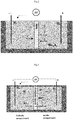
- Fig-1A discloses the behavior during electrolysis in water bath of metal ions of a metal salt dissolved in said water bath. This metal salt can be used as olating agent in step b) of the process according to the present invention involving electrolysis. These metal ions, like the hydrogen ions are positively charged in the process conditions of step b) their natural diffusion sustained by the electric field has the direction from the anode to the cathode.
-
Figure 1B discloses the diagram of the concentration of the hydrogen ions in the cell. They are produced at the anode by the water electrolysis. Then they diffuse forward to the cathode where they are reduced to H2. Thus the concentration of the hydrogen ions has is maximum value at the anode and its minimum one at the cathode. Accordingly, in terms of pH, the minimum value (i.e. the greater acidity) is at the anode and the maximum one is at the cathode (i.e. where the solution approaches the neutrality).. -
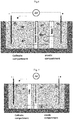
Figure 2 represents the application of the mechanism reported inFigure 1 , in step b) of the process according to the present invention, wherein 1 indicates Me n+ diffusive flux, 2 indicates Me n+ electrolytic migration flux, 3 indicates H+ electrolytic migration flux, 4 indicates A m- electrolytic migration flux. -
Figure 3 represents during electrolysis in water bath the behavior of metal ions of a metal salt used as olating agent dissolved in said water bath in the presence of an anionic membrane. -
Figure 4 represents the application of the behavior of the metal ion of a metal salt used as olating agent during electrolysis in the presence of an anionic membrane, if the hide is placed in the anodic compartment during the pickling step (a), the H+ ions generated at the anode can be used to neutralize the initial basicity of the hide and to induce its transformation in an acid hide.Figure 4 shows that the use of an anionic membrane has a positive effect also during the tanning step (b) because the positively charged olating agent is kept in the same anodic compartment containing the hide to be tanned and these ions do not migrate in the cathodic compartment of the cell. -
Figure 5 represents the application of the behavior of the metal ion and hydrogen ion in the presence of an anionic membrane, when the hide is placed in the cathodic compartment during the basification step (c), H+ ions are consumed leading to a pH increase of the hide above the critical value necessary for the olation reaction. - For the purposes of the present invention the definition "comprising" before component(s)/step(s) etc. does not exclude the presence of further element(s)/ step(s), besides those expressly listed, in contrast with the definition "consisting of' after element(s)/step(s) excluding the presence of further elements/ steps besides those expressly mentioned.
- It is well known from the theory of mass transport for electrolytes (see for general references J.M. Bockris, A.K.N. Reddy, "Modern Electrochemistry", Kluwer, (2004)) that the ion flux of an electrolytic specie can be expressed as:


- It appears clearly by the exam of equation (2) that the penetration of the ions into the hide can be significantly enhanced by the application of the electric field. Without being bound by any theory it is believed that the electrolytic migration could be the mechanism quantitatively responsible for the penetration of the ions inside the hide.
- In view of the foregoing, it may be advantageous to apply an electric field not only in step b) but also in at least one of the steps a) and c) of the process of the invention.
- According to an aspect of the present invention the process of the invention encompasses that also in the step a), c) or both an electric field is produced, by placing the hide between the two electrically powered electrodes.
- When used in the pickling step a) this electric field increases the diffusions flux of the active ions throughout the hide and in the specific the difference of potential between the two electrodes can exceed that necessary for the water split in hydrogen and oxygen thereby leading to the formation of positive hydrogen ions at the anode. These ions can be then used to generate the acid conditions directly inside the bath during the pickling step.
- For the same reason, positive hydrogen ions can be reduced at the cathode. Accordingly, the consumption of these hydrogen ions leads to a natural pH increase and then this phenomenon can be used in the basification step.
- As previously reported the
figures 1 and3 report the mechanism of action of water electrolysis carried out in a water bath containing ion metals respectively without and in the presence of anionic membranes. WhereasFigures 2 ,4 and 5 represent preferred embodiments of the process of the invention involving the application of the electrolysis concepts inFigure 1 and3 . - As illustrated in
Figure 1A being the metal ions adopted for the tanning positively charged in the process conditions, their natural diffusion sustained by the electric field has the direction from the anode to the cathodeFigure 1B discloses the diagram of the concentration of the hydrogen ions in the cell. They are produced at the anode by the water electrolysis. Then they diffuse forward to the cathode where they are reduced to H2. Thus the concentration of the hydrogen ions has is maximum value at the anode and its minimum one at the cathode. Accordingly, in terms of pH, the minimum value (i.e. the greater acidity) is at the anode and the maximum one is at the cathode (i.e. where the solution approaches the neutrality). - As illustrated in
Figure 2 , this phenomenon can be used to speed up the tanning step (b) even two-fold or more with respect the pure diffusive conditions. The enhancement factor is controlled by the applied electric potential difference between the two electrodes. Being the process time determined by the full and uniform penetration of the olation agent through the hide, obviously doubling the penetration speed the process time halves. - It is naturally to think that process can be applied when the tanning is obtained through metal ions like chrome (III), iron (III), aluminum (III), titanium (VI) and zirconium (VI). However, when considering that in acid media also most of the organic molecules adopted for this scope, like tannin, are hydrolyzed, it is clear that the electrochemical enhancement can be adopted also in these cases.
- As in all the electrochemistry processes, also in the process according to the present invention a membrane can be introduced in between the two electrodes to create an anodic and a cathodic compartment. With reference to
Figure 3 . if the selected membrane is an anionic membrane, that is a membrane that inhibits the permeation of positive ions while admits the migration of the negative ones, the following effects can be produced during the process: - a decrease of the pH value in the anodic compartment;
- an increase of the pH value in the cathodic compartment.
- Accordingly, as illustrated in
Figure 4 , if the hide is placed in the anodic compartment during the pickling step (a), the H+ ions generated at the anode can be used to neutralize the initial basicity of the hide and to induce its transformation in an acid hide. - On the contrary, as illustrated in
Figure 5 , placing the hide in the cathodic compartment during the basification step (c), H+ ions are consumed leading to a pH increase of the hide above the critical value necessary for the olation reaction. -
Figure 4 shows that the use of an anionic membrane has a positive effect also during the tanning step (b) because the positively charged olating agent is kept in the same anodic compartment containing the hide to be tanned and these ions do not migrate in the cathodic compartment of the cell. - The difference of potential to be applied to the two electrodes is a function of the distance between them and of the thickness of the hide to be tanned. Accordingly, it is of interest to reduce the energy consumption, to reduce the space between the electrodes. This produces the positive effect to significantly reduce the volume of the bath. Thus, this electrochemically enhanced tanning process has the advantage of using very small solution / hide volume ratio.
- Moreover, because the diffusion of the tanning agent into the hide is only slightly dependent from the concentration gradient, the applied electric potential can be adopted to produce a very high utilization of the chemicals of the bath. The electric potential can be also adjusted throughout the process, being the potential increase able to compensate the concentration reduction in the bath to keep almost constant the mass flux.
- The following examples are reported for illustrative but not limitative purposes.
- A hide of about 25 cm2 area, already acidified by a pickling step is placed in an electrochemical cell filled with a solution of 10% CrSO4 at pH=2 and a temperature up to 60°C. A difference of potential of 10 V is applied to the electrodes. After 20 min the hide is extracted and rinsed. The chemical analysis revealed a uniform concentration of 2% Cr through all the thickness. The same experiment is repeated without applying the potential differences to the electrodes; at the same time the hide appears not uniformly penetrated by Cr ions evidencing a significant part of its section not still reached by Cr.
- A hide of about 11.5 cm2 area, already acidified by pickling step is placed in an electrochemical cell filled with a solution of 13% CrCl3 and 3% of complexing agent at pH = 2 and a temperature of 25 °C. A difference of potential is applied to the electrodes and after 30 min the hide is extracted and rinsed. The same experiment is repeated without applying the potential difference to the electrodes. Chemical analyses revealed that the concentration of chromium is about 2 times higher in the process with the application of the voltage: hence, the process is two times faster than the normal conditions. The application of the potential differences is related to a uniform concentration through the whole thickness, while in the other case without current the hide appears not uniformly penetrated by Cr ions.
- A hide of about 25 cm2 area, is placed in the anodic compartment of an electrochemical cell created by an anionic membrane placed in between the two electrodes. The cell is filled with a solution H2SO4 at pH=2 and a temperature up to 60°C. A difference of potential of 10 V is applied to the electrodes. After 20 min the hide is extracted and rinsed. Then the leather is analyzed by titration evidencing its full acidification.
- A hide of about 20 cm2 area, already pickled and tanned according to procedure described in Example 2, has been soaked in the cathodic compartment of
Figure 5 . A difference potential of 30 V has been applied to the electrodes, where the cathode is made of platinized titanium mesh. The initial acidic pH of the cathodic compartment solution raises from pH ∼ 2 to pH ∼ 4.5 in 2 hours, avoiding the use of alkalinizing agents for the basification step. - A hide of about 11.5 cm2 area, already acidified by a pickling step, is placed in an electrochemical cell filled with a solution of 1% titanyl sulphate at a pH = 2 and a temperature of 25 °C. A difference of potential is applied to the electrodes and after 30 min the hide is extracted and rinsed. The same experiment is repeated without applying the potential difference to the electrodes. Chemical analyses revealed a uniform concentration of 1.5% titanium on the whole thickness for the process with the application of the voltage, while in the other case (without current) a non-uniform penetration of titanium ions is detected.
- A hide of about 11.5 cm2 area, already acidified by a pickling step, is placed in an electrochemical cell filled with a solution of 18% tara tannins at a pH = 2 and a temperature of 25 °C. A difference of potential is applied to the electrodes and after 120 min the hide is extracted and rinsed. The same experiment is repeated without applying the potential difference to the electrodes. Chemical analyses revealed a uniform concentration of 1% tannin on the whole thickness for the process with the application of the voltage, while in the other case (without current) a non-uniform penetration of tannin ions is detected.
- A hide of about 11.5 cm2 area, already acidified by pickling step, is placed in an electrochemical cell with a solution of 25% iron sulphate and 12% of complexing agent at a pH = 2 and a temperature of 25°C, Figure 6. A potential difference is applied to the electrodes and after 30 min the hide is extracted and rinsed. The same experiment is repeated without applying the potential difference to the electrodes. Chemical analyses revealed that the concentration of iron through all the thickness is uniform and about 2 times higher than the case without the application of the potential (here the iron ions distribution is not uniform and not the whole thickness is reached by them). Hence, the application of the voltage is twice more efficient than the process without the potential difference.
Claims (8)
- A process for tanning hide comprising the following steps:a) a pickling step comprising immerging the hides in a bath with an acid and a salt, wherein the pH of the hide is reduced to values lower than 3b) tanning step comprising immerging the hide in a bath containing the olation agent,c) a basification step comprising immerging the hide in a bath with a basic pH,wherein in step b) an electric field is produced, by placing the hide between the two electrically powered electrodes.
- The process according to claim 1, wherein also in the step a), c) or both an electric field is produced, by placing the hide between two electrically powered electrodes.
- The process according to any one of claims 1-2, wherein an anionic membrane separates the anionic compartment from the cathodic compartment and the hide is placed in the anodic compartment.
- The process according to claim 3, wherein also in step a) an electric field is produced, by placing the hide between the two electrically powered electrodes.
- The process according to anyone of claims 1 or 2 wherein an anionic membrane separates the anionic from the cathodic compartment and the hide is placed in the cathodic compartment.
- The process according to claim 5, wherein also in step c) an electric field is produced, by placing the hide between the two electrically powered electrodes.
- The process according to anyone of claims 1-6, wherein the olating agent is selected from chromium, zirconium, titanium, aluminium salts or organic olating agents.
- The process according to claim 7, wherein the organic olating agent is selected from vegetal or synthetic tannin or glutaraldehyde.
Applications Claiming Priority (1)
| Application Number | Priority Date | Filing Date | Title |
|---|---|---|---|
| IT102018000002822A IT201800002822A1 (en) | 2018-02-19 | 2018-02-19 | Intensified chrome tanning process |
Publications (2)
| Publication Number | Publication Date |
|---|---|
| EP3527675A1 true EP3527675A1 (en) | 2019-08-21 |
| EP3527675B1 EP3527675B1 (en) | 2023-11-29 |
Family
ID=62089978
Family Applications (1)
| Application Number | Title | Priority Date | Filing Date |
|---|---|---|---|
| EP19156703.1A Active EP3527675B1 (en) | 2018-02-19 | 2019-02-12 | Chromium enhanced tanning process |
Country Status (3)
| Country | Link |
|---|---|
| EP (1) | EP3527675B1 (en) |
| ES (1) | ES2974020T3 (en) |
| IT (1) | IT201800002822A1 (en) |
Cited By (1)
| Publication number | Priority date | Publication date | Assignee | Title |
|---|---|---|---|---|
| WO2022128033A1 (en) * | 2020-12-14 | 2022-06-23 | Ecco Sko A/S | A process of tanning animal hides |
Citations (4)
| Publication number | Priority date | Publication date | Assignee | Title |
|---|---|---|---|---|
| GB143921A (en) * | 1918-11-30 | 1921-04-07 | Elektro Osmose Ag | An improved process for tanning or impregnating materials |
| SU1624026A1 (en) * | 1988-12-29 | 1991-01-30 | Курское научно-производственное кожевенно-обувное объединение | Process for tanning of leather semiproduct |
| DE102013019755A1 (en) * | 2013-11-25 | 2015-05-28 | Johannes Häusler | Method and device for processing animal hides in the electric field |
| US20160244853A1 (en) * | 2013-09-30 | 2016-08-25 | Rhodia Poliamida E Especialidades Ltda | Chrome tanning process |
-
2018
- 2018-02-19 IT IT102018000002822A patent/IT201800002822A1/en unknown
-
2019
- 2019-02-12 EP EP19156703.1A patent/EP3527675B1/en active Active
- 2019-02-12 ES ES19156703T patent/ES2974020T3/en active Active
Patent Citations (4)
| Publication number | Priority date | Publication date | Assignee | Title |
|---|---|---|---|---|
| GB143921A (en) * | 1918-11-30 | 1921-04-07 | Elektro Osmose Ag | An improved process for tanning or impregnating materials |
| SU1624026A1 (en) * | 1988-12-29 | 1991-01-30 | Курское научно-производственное кожевенно-обувное объединение | Process for tanning of leather semiproduct |
| US20160244853A1 (en) * | 2013-09-30 | 2016-08-25 | Rhodia Poliamida E Especialidades Ltda | Chrome tanning process |
| DE102013019755A1 (en) * | 2013-11-25 | 2015-05-28 | Johannes Häusler | Method and device for processing animal hides in the electric field |
Non-Patent Citations (5)
| Title |
|---|
| A. COVINGTON, MODERN TANNING CHEMISTRY, CHEM. SOC. REV., vol. 26, 1997, pages 111 - 126 |
| A.F. HOLLEMAN; E. WIBERG: "Inorganic Chemistry", 2001, ACADEMIC PRESS |
| DATABASE WPI Week 199141, Derwent World Patents Index; AN 1991-301567, XP002785810 * |
| J.M. BOCKRIS; A.K.N. REDDY: "Modern Electrochemistry", 2004, KLUWER |
| K.H GUSTAVSON: "The Chemistry of Tanning Processes", 1956, ACADEMIC PRESS |
Cited By (2)
| Publication number | Priority date | Publication date | Assignee | Title |
|---|---|---|---|---|
| WO2022128033A1 (en) * | 2020-12-14 | 2022-06-23 | Ecco Sko A/S | A process of tanning animal hides |
| CN116829738A (en) * | 2020-12-14 | 2023-09-29 | 伊科斯克有限公司 | The process of tanning animal hides and skins |
Also Published As
| Publication number | Publication date |
|---|---|
| IT201800002822A1 (en) | 2019-08-19 |
| ES2974020T3 (en) | 2024-06-25 |
| EP3527675B1 (en) | 2023-11-29 |
Similar Documents
| Publication | Publication Date | Title |
|---|---|---|
| Rojas-Montes et al. | Selenium reaction mechanism in manganese electrodeposition process | |
| EP3527675B1 (en) | Chromium enhanced tanning process | |
| Pelé et al. | Iron removal from waterlogged wood: Extraction by electrophoresis and chemical treatments | |
| Dalard et al. | Chloride removal from archaeological cast iron by pulsating current | |
| US3804730A (en) | Control of electrolytic coloring of chromium-containing alloys | |
| Watson et al. | The role of chromium II catalysed olation reactions in the sustained deposition of chromium and its alloys from environmentally acceptable chromium III electrolytes | |
| Carrillo-Abad et al. | Treatment of spent pickling baths coming from hot dip galvanizing by means of an electrochemical membrane reactor | |
| Ichiba et al. | Effects of test conditions on corrosion reactions and hydrogen absorption in hydrogen embrittlement tests using an ammonium thiocyanate solution | |
| Britton | Electrochemical assessment of chromium in passivation films on tinplate | |
| ATE374267T1 (en) | METHOD FOR DEPOSITING ZINC OR ZINC ALLOYS | |
| US3832292A (en) | Catalytic cathodic hardening of oxide films | |
| GB223994A (en) | Improved process of protecting surfaces of aluminium of aluminium alloys | |
| Vetlugin et al. | Influence of water-soluble monomers on the corrosion protection ability of chromium coatings obtained from Cr (III)-based solutions | |
| Nicol et al. | The effects of thiosulfate ions on the deposition of cobalt and nickel from sulfate solutions | |
| RU2559610C1 (en) | Method of electrochemical blackening of steel | |
| Kireev et al. | Electrodeposition of zinc plating from zincate electrolyte using galvanostatic mode of pulse electrolysis | |
| US5116469A (en) | Method for treatment of high-strength metal against hydrogen embrittlement | |
| Kolesnikov et al. | Condensed Matter and Interphases | |
| Lazarevic et al. | The study of corrosion stability of organic epoxy protective coatings on aluminium and modified aluminium surfaces | |
| Monev | Effect of the pH value of the hydrogenation solution upon the phase transformation of nickel into nickel hydride | |
| Cabot et al. | Potentiodynamic behaviour of aluminium in propanedioic acid solutions | |
| SU1437401A1 (en) | Method of treating fur pelts | |
| RU2720269C1 (en) | Method of producing corrosion-resistant electrochemical zinc-nickel-cobalt coating | |
| Evreinova et al. | Electrodeposition of iron from sulfate solutions in the presence of aminoacetic acid | |
| Török et al. | Direct cathodic deposition of copper on steel wires from pyrophosphate baths |
Legal Events
| Date | Code | Title | Description |
|---|---|---|---|
| PUAI | Public reference made under article 153(3) epc to a published international application that has entered the european phase |
Free format text: ORIGINAL CODE: 0009012 |
|
| STAA | Information on the status of an ep patent application or granted ep patent |
Free format text: STATUS: THE APPLICATION HAS BEEN PUBLISHED |
|
| AK | Designated contracting states |
Kind code of ref document: A1 Designated state(s): AL AT BE BG CH CY CZ DE DK EE ES FI FR GB GR HR HU IE IS IT LI LT LU LV MC MK MT NL NO PL PT RO RS SE SI SK SM TR |
|
| AX | Request for extension of the european patent |
Extension state: BA ME |
|
| STAA | Information on the status of an ep patent application or granted ep patent |
Free format text: STATUS: REQUEST FOR EXAMINATION WAS MADE |
|
| 17P | Request for examination filed |
Effective date: 20200219 |
|
| RBV | Designated contracting states (corrected) |
Designated state(s): AL AT BE BG CH CY CZ DE DK EE ES FI FR GB GR HR HU IE IS IT LI LT LU LV MC MK MT NL NO PL PT RO RS SE SI SK SM TR |
|
| STAA | Information on the status of an ep patent application or granted ep patent |
Free format text: STATUS: EXAMINATION IS IN PROGRESS |
|
| 17Q | First examination report despatched |
Effective date: 20201127 |
|
| GRAP | Despatch of communication of intention to grant a patent |
Free format text: ORIGINAL CODE: EPIDOSNIGR1 |
|
| STAA | Information on the status of an ep patent application or granted ep patent |
Free format text: STATUS: GRANT OF PATENT IS INTENDED |
|
| INTG | Intention to grant announced |
Effective date: 20230621 |
|
| GRAS | Grant fee paid |
Free format text: ORIGINAL CODE: EPIDOSNIGR3 |
|
| GRAA | (expected) grant |
Free format text: ORIGINAL CODE: 0009210 |
|
| STAA | Information on the status of an ep patent application or granted ep patent |
Free format text: STATUS: THE PATENT HAS BEEN GRANTED |
|
| AK | Designated contracting states |
Kind code of ref document: B1 Designated state(s): AL AT BE BG CH CY CZ DE DK EE ES FI FR GB GR HR HU IE IS IT LI LT LU LV MC MK MT NL NO PL PT RO RS SE SI SK SM TR |
|
| REG | Reference to a national code |
Ref country code: GB Ref legal event code: FG4D |
|
| REG | Reference to a national code |
Ref country code: CH Ref legal event code: EP |
|
| REG | Reference to a national code |
Ref country code: DE Ref legal event code: R096 Ref document number: 602019042183 Country of ref document: DE |
|
| REG | Reference to a national code |
Ref country code: IE Ref legal event code: FG4D |
|
| REG | Reference to a national code |
Ref country code: LT Ref legal event code: MG9D |
|
| REG | Reference to a national code |
Ref country code: NL Ref legal event code: MP Effective date: 20231129 |
|
| PG25 | Lapsed in a contracting state [announced via postgrant information from national office to epo] |
Ref country code: GR Free format text: LAPSE BECAUSE OF FAILURE TO SUBMIT A TRANSLATION OF THE DESCRIPTION OR TO PAY THE FEE WITHIN THE PRESCRIBED TIME-LIMIT Effective date: 20240301 |
|
| PG25 | Lapsed in a contracting state [announced via postgrant information from national office to epo] |
Ref country code: IS Free format text: LAPSE BECAUSE OF FAILURE TO SUBMIT A TRANSLATION OF THE DESCRIPTION OR TO PAY THE FEE WITHIN THE PRESCRIBED TIME-LIMIT Effective date: 20240329 |
|
| PG25 | Lapsed in a contracting state [announced via postgrant information from national office to epo] |
Ref country code: LT Free format text: LAPSE BECAUSE OF FAILURE TO SUBMIT A TRANSLATION OF THE DESCRIPTION OR TO PAY THE FEE WITHIN THE PRESCRIBED TIME-LIMIT Effective date: 20231129 |
|
| PG25 | Lapsed in a contracting state [announced via postgrant information from national office to epo] |
Ref country code: LT Free format text: LAPSE BECAUSE OF FAILURE TO SUBMIT A TRANSLATION OF THE DESCRIPTION OR TO PAY THE FEE WITHIN THE PRESCRIBED TIME-LIMIT Effective date: 20231129 Ref country code: IS Free format text: LAPSE BECAUSE OF FAILURE TO SUBMIT A TRANSLATION OF THE DESCRIPTION OR TO PAY THE FEE WITHIN THE PRESCRIBED TIME-LIMIT Effective date: 20240329 Ref country code: GR Free format text: LAPSE BECAUSE OF FAILURE TO SUBMIT A TRANSLATION OF THE DESCRIPTION OR TO PAY THE FEE WITHIN THE PRESCRIBED TIME-LIMIT Effective date: 20240301 Ref country code: BG Free format text: LAPSE BECAUSE OF FAILURE TO SUBMIT A TRANSLATION OF THE DESCRIPTION OR TO PAY THE FEE WITHIN THE PRESCRIBED TIME-LIMIT Effective date: 20240229 |
|
| REG | Reference to a national code |
Ref country code: AT Ref legal event code: MK05 Ref document number: 1636179 Country of ref document: AT Kind code of ref document: T Effective date: 20231129 |
|
| PG25 | Lapsed in a contracting state [announced via postgrant information from national office to epo] |
Ref country code: NL Free format text: LAPSE BECAUSE OF FAILURE TO SUBMIT A TRANSLATION OF THE DESCRIPTION OR TO PAY THE FEE WITHIN THE PRESCRIBED TIME-LIMIT Effective date: 20231129 |
|
| PG25 | Lapsed in a contracting state [announced via postgrant information from national office to epo] |
Ref country code: SE Free format text: LAPSE BECAUSE OF FAILURE TO SUBMIT A TRANSLATION OF THE DESCRIPTION OR TO PAY THE FEE WITHIN THE PRESCRIBED TIME-LIMIT Effective date: 20231129 Ref country code: RS Free format text: LAPSE BECAUSE OF FAILURE TO SUBMIT A TRANSLATION OF THE DESCRIPTION OR TO PAY THE FEE WITHIN THE PRESCRIBED TIME-LIMIT Effective date: 20231129 Ref country code: PL Free format text: LAPSE BECAUSE OF FAILURE TO SUBMIT A TRANSLATION OF THE DESCRIPTION OR TO PAY THE FEE WITHIN THE PRESCRIBED TIME-LIMIT Effective date: 20231129 Ref country code: NO Free format text: LAPSE BECAUSE OF FAILURE TO SUBMIT A TRANSLATION OF THE DESCRIPTION OR TO PAY THE FEE WITHIN THE PRESCRIBED TIME-LIMIT Effective date: 20240229 Ref country code: NL Free format text: LAPSE BECAUSE OF FAILURE TO SUBMIT A TRANSLATION OF THE DESCRIPTION OR TO PAY THE FEE WITHIN THE PRESCRIBED TIME-LIMIT Effective date: 20231129 Ref country code: LV Free format text: LAPSE BECAUSE OF FAILURE TO SUBMIT A TRANSLATION OF THE DESCRIPTION OR TO PAY THE FEE WITHIN THE PRESCRIBED TIME-LIMIT Effective date: 20231129 Ref country code: HR Free format text: LAPSE BECAUSE OF FAILURE TO SUBMIT A TRANSLATION OF THE DESCRIPTION OR TO PAY THE FEE WITHIN THE PRESCRIBED TIME-LIMIT Effective date: 20231129 |
|
| REG | Reference to a national code |
Ref country code: ES Ref legal event code: FG2A Ref document number: 2974020 Country of ref document: ES Kind code of ref document: T3 Effective date: 20240625 |
|
| PG25 | Lapsed in a contracting state [announced via postgrant information from national office to epo] |
Ref country code: DK Free format text: LAPSE BECAUSE OF FAILURE TO SUBMIT A TRANSLATION OF THE DESCRIPTION OR TO PAY THE FEE WITHIN THE PRESCRIBED TIME-LIMIT Effective date: 20231129 |
|
| PG25 | Lapsed in a contracting state [announced via postgrant information from national office to epo] |
Ref country code: AT Free format text: LAPSE BECAUSE OF FAILURE TO SUBMIT A TRANSLATION OF THE DESCRIPTION OR TO PAY THE FEE WITHIN THE PRESCRIBED TIME-LIMIT Effective date: 20231129 Ref country code: CZ Free format text: LAPSE BECAUSE OF FAILURE TO SUBMIT A TRANSLATION OF THE DESCRIPTION OR TO PAY THE FEE WITHIN THE PRESCRIBED TIME-LIMIT Effective date: 20231129 |
|
| PG25 | Lapsed in a contracting state [announced via postgrant information from national office to epo] |
Ref country code: SK Free format text: LAPSE BECAUSE OF FAILURE TO SUBMIT A TRANSLATION OF THE DESCRIPTION OR TO PAY THE FEE WITHIN THE PRESCRIBED TIME-LIMIT Effective date: 20231129 |
|
| PG25 | Lapsed in a contracting state [announced via postgrant information from national office to epo] |
Ref country code: SM Free format text: LAPSE BECAUSE OF FAILURE TO SUBMIT A TRANSLATION OF THE DESCRIPTION OR TO PAY THE FEE WITHIN THE PRESCRIBED TIME-LIMIT Effective date: 20231129 Ref country code: SK Free format text: LAPSE BECAUSE OF FAILURE TO SUBMIT A TRANSLATION OF THE DESCRIPTION OR TO PAY THE FEE WITHIN THE PRESCRIBED TIME-LIMIT Effective date: 20231129 Ref country code: RO Free format text: LAPSE BECAUSE OF FAILURE TO SUBMIT A TRANSLATION OF THE DESCRIPTION OR TO PAY THE FEE WITHIN THE PRESCRIBED TIME-LIMIT Effective date: 20231129 Ref country code: EE Free format text: LAPSE BECAUSE OF FAILURE TO SUBMIT A TRANSLATION OF THE DESCRIPTION OR TO PAY THE FEE WITHIN THE PRESCRIBED TIME-LIMIT Effective date: 20231129 Ref country code: DK Free format text: LAPSE BECAUSE OF FAILURE TO SUBMIT A TRANSLATION OF THE DESCRIPTION OR TO PAY THE FEE WITHIN THE PRESCRIBED TIME-LIMIT Effective date: 20231129 Ref country code: CZ Free format text: LAPSE BECAUSE OF FAILURE TO SUBMIT A TRANSLATION OF THE DESCRIPTION OR TO PAY THE FEE WITHIN THE PRESCRIBED TIME-LIMIT Effective date: 20231129 Ref country code: AT Free format text: LAPSE BECAUSE OF FAILURE TO SUBMIT A TRANSLATION OF THE DESCRIPTION OR TO PAY THE FEE WITHIN THE PRESCRIBED TIME-LIMIT Effective date: 20231129 |
|
| PG25 | Lapsed in a contracting state [announced via postgrant information from national office to epo] |
Ref country code: PT Free format text: LAPSE BECAUSE OF FAILURE TO SUBMIT A TRANSLATION OF THE DESCRIPTION OR TO PAY THE FEE WITHIN THE PRESCRIBED TIME-LIMIT Effective date: 20240401 |
|
| PG25 | Lapsed in a contracting state [announced via postgrant information from national office to epo] |
Ref country code: PT Free format text: LAPSE BECAUSE OF FAILURE TO SUBMIT A TRANSLATION OF THE DESCRIPTION OR TO PAY THE FEE WITHIN THE PRESCRIBED TIME-LIMIT Effective date: 20240401 |
|
| REG | Reference to a national code |
Ref country code: DE Ref legal event code: R097 Ref document number: 602019042183 Country of ref document: DE |
|
| PG25 | Lapsed in a contracting state [announced via postgrant information from national office to epo] |
Ref country code: MC Free format text: LAPSE BECAUSE OF FAILURE TO SUBMIT A TRANSLATION OF THE DESCRIPTION OR TO PAY THE FEE WITHIN THE PRESCRIBED TIME-LIMIT Effective date: 20231129 |
|
| REG | Reference to a national code |
Ref country code: CH Ref legal event code: PL |
|
| PLBE | No opposition filed within time limit |
Free format text: ORIGINAL CODE: 0009261 |
|
| STAA | Information on the status of an ep patent application or granted ep patent |
Free format text: STATUS: NO OPPOSITION FILED WITHIN TIME LIMIT |
|
| PG25 | Lapsed in a contracting state [announced via postgrant information from national office to epo] |
Ref country code: LU Free format text: LAPSE BECAUSE OF NON-PAYMENT OF DUE FEES Effective date: 20240212 |
|
| PG25 | Lapsed in a contracting state [announced via postgrant information from national office to epo] |
Ref country code: CH Free format text: LAPSE BECAUSE OF NON-PAYMENT OF DUE FEES Effective date: 20240229 |
|
| PG25 | Lapsed in a contracting state [announced via postgrant information from national office to epo] |
Ref country code: SI Free format text: LAPSE BECAUSE OF FAILURE TO SUBMIT A TRANSLATION OF THE DESCRIPTION OR TO PAY THE FEE WITHIN THE PRESCRIBED TIME-LIMIT Effective date: 20231129 |
|
| PG25 | Lapsed in a contracting state [announced via postgrant information from national office to epo] |
Ref country code: SI Free format text: LAPSE BECAUSE OF FAILURE TO SUBMIT A TRANSLATION OF THE DESCRIPTION OR TO PAY THE FEE WITHIN THE PRESCRIBED TIME-LIMIT Effective date: 20231129 Ref country code: LU Free format text: LAPSE BECAUSE OF NON-PAYMENT OF DUE FEES Effective date: 20240212 Ref country code: CH Free format text: LAPSE BECAUSE OF NON-PAYMENT OF DUE FEES Effective date: 20240229 |
|
| 26N | No opposition filed |
Effective date: 20240830 |
|
| REG | Reference to a national code |
Ref country code: BE Ref legal event code: MM Effective date: 20240229 |
|
| PG25 | Lapsed in a contracting state [announced via postgrant information from national office to epo] |
Ref country code: BE Free format text: LAPSE BECAUSE OF NON-PAYMENT OF DUE FEES Effective date: 20240229 |
|
| PG25 | Lapsed in a contracting state [announced via postgrant information from national office to epo] |
Ref country code: IE Free format text: LAPSE BECAUSE OF NON-PAYMENT OF DUE FEES Effective date: 20240212 |
|
| PG25 | Lapsed in a contracting state [announced via postgrant information from national office to epo] |
Ref country code: IE Free format text: LAPSE BECAUSE OF NON-PAYMENT OF DUE FEES Effective date: 20240212 Ref country code: BE Free format text: LAPSE BECAUSE OF NON-PAYMENT OF DUE FEES Effective date: 20240229 |
|
| PGFP | Annual fee paid to national office [announced via postgrant information from national office to epo] |
Ref country code: ES Payment date: 20250331 Year of fee payment: 7 |
|
| PG25 | Lapsed in a contracting state [announced via postgrant information from national office to epo] |
Ref country code: CY Free format text: LAPSE BECAUSE OF FAILURE TO SUBMIT A TRANSLATION OF THE DESCRIPTION OR TO PAY THE FEE WITHIN THE PRESCRIBED TIME-LIMIT; INVALID AB INITIO Effective date: 20190212 |
|
| PG25 | Lapsed in a contracting state [announced via postgrant information from national office to epo] |
Ref country code: HU Free format text: LAPSE BECAUSE OF FAILURE TO SUBMIT A TRANSLATION OF THE DESCRIPTION OR TO PAY THE FEE WITHIN THE PRESCRIBED TIME-LIMIT; INVALID AB INITIO Effective date: 20190212 |
|
| PG25 | Lapsed in a contracting state [announced via postgrant information from national office to epo] |
Ref country code: FI Free format text: LAPSE BECAUSE OF FAILURE TO SUBMIT A TRANSLATION OF THE DESCRIPTION OR TO PAY THE FEE WITHIN THE PRESCRIBED TIME-LIMIT Effective date: 20231129 |
|
| PG25 | Lapsed in a contracting state [announced via postgrant information from national office to epo] |
Ref country code: TR Free format text: LAPSE BECAUSE OF FAILURE TO SUBMIT A TRANSLATION OF THE DESCRIPTION OR TO PAY THE FEE WITHIN THE PRESCRIBED TIME-LIMIT Effective date: 20231129 |
|
| PGFP | Annual fee paid to national office [announced via postgrant information from national office to epo] |
Ref country code: GB Payment date: 20260219 Year of fee payment: 8 |
|
| PGFP | Annual fee paid to national office [announced via postgrant information from national office to epo] |
Ref country code: DE Payment date: 20260218 Year of fee payment: 8 |
|
| PGFP | Annual fee paid to national office [announced via postgrant information from national office to epo] |
Ref country code: IT Payment date: 20260218 Year of fee payment: 8 |
|
| PGFP | Annual fee paid to national office [announced via postgrant information from national office to epo] |
Ref country code: FR Payment date: 20260218 Year of fee payment: 8 |