EP3526951B1 - Netzwerk-authentifizierungsverfahren, -vorrichtung und -system - Google Patents
Netzwerk-authentifizierungsverfahren, -vorrichtung und -system Download PDFInfo
- Publication number
- EP3526951B1 EP3526951B1 EP17905035.6A EP17905035A EP3526951B1 EP 3526951 B1 EP3526951 B1 EP 3526951B1 EP 17905035 A EP17905035 A EP 17905035A EP 3526951 B1 EP3526951 B1 EP 3526951B1
- Authority
- EP
- European Patent Office
- Prior art keywords
- xres
- hash
- user response
- network
- res
- Prior art date
- Legal status (The legal status is an assumption and is not a legal conclusion. Google has not performed a legal analysis and makes no representation as to the accuracy of the status listed.)
- Active
Links
Images


Classifications
-
- H—ELECTRICITY
- H04—ELECTRIC COMMUNICATION TECHNIQUE
- H04L—TRANSMISSION OF DIGITAL INFORMATION, e.g. TELEGRAPHIC COMMUNICATION
- H04L63/00—Network architectures or network communication protocols for network security
- H04L63/08—Network architectures or network communication protocols for network security for authentication of entities
- H04L63/0876—Network architectures or network communication protocols for network security for authentication of entities based on the identity of the terminal or configuration, e.g. MAC address, hardware or software configuration or device fingerprint
-
- H—ELECTRICITY
- H04—ELECTRIC COMMUNICATION TECHNIQUE
- H04W—WIRELESS COMMUNICATION NETWORKS
- H04W12/00—Security arrangements; Authentication; Protecting privacy or anonymity
- H04W12/12—Detection or prevention of fraud
- H04W12/121—Wireless intrusion detection systems [WIDS]; Wireless intrusion prevention systems [WIPS]
- H04W12/122—Counter-measures against attacks; Protection against rogue devices
-
- H—ELECTRICITY
- H04—ELECTRIC COMMUNICATION TECHNIQUE
- H04L—TRANSMISSION OF DIGITAL INFORMATION, e.g. TELEGRAPHIC COMMUNICATION
- H04L63/00—Network architectures or network communication protocols for network security
-
- H—ELECTRICITY
- H04—ELECTRIC COMMUNICATION TECHNIQUE
- H04L—TRANSMISSION OF DIGITAL INFORMATION, e.g. TELEGRAPHIC COMMUNICATION
- H04L63/00—Network architectures or network communication protocols for network security
- H04L63/14—Network architectures or network communication protocols for network security for detecting or protecting against malicious traffic
- H04L63/1441—Countermeasures against malicious traffic
-
- H—ELECTRICITY
- H04—ELECTRIC COMMUNICATION TECHNIQUE
- H04L—TRANSMISSION OF DIGITAL INFORMATION, e.g. TELEGRAPHIC COMMUNICATION
- H04L9/00—Cryptographic mechanisms or cryptographic arrangements for secret or secure communications; Network security protocols
- H04L9/08—Key distribution or management, e.g. generation, sharing or updating, of cryptographic keys or passwords
- H04L9/0816—Key establishment, i.e. cryptographic processes or cryptographic protocols whereby a shared secret becomes available to two or more parties, for subsequent use
- H04L9/0819—Key transport or distribution, i.e. key establishment techniques where one party creates or otherwise obtains a secret value, and securely transfers it to the other(s)
- H04L9/0825—Key transport or distribution, i.e. key establishment techniques where one party creates or otherwise obtains a secret value, and securely transfers it to the other(s) using asymmetric-key encryption or public key infrastructure [PKI], e.g. key signature or public key certificates
-
- H—ELECTRICITY
- H04—ELECTRIC COMMUNICATION TECHNIQUE
- H04L—TRANSMISSION OF DIGITAL INFORMATION, e.g. TELEGRAPHIC COMMUNICATION
- H04L9/00—Cryptographic mechanisms or cryptographic arrangements for secret or secure communications; Network security protocols
- H04L9/08—Key distribution or management, e.g. generation, sharing or updating, of cryptographic keys or passwords
- H04L9/0861—Generation of secret information including derivation or calculation of cryptographic keys or passwords
- H04L9/0863—Generation of secret information including derivation or calculation of cryptographic keys or passwords involving passwords or one-time passwords
-
- H—ELECTRICITY
- H04—ELECTRIC COMMUNICATION TECHNIQUE
- H04L—TRANSMISSION OF DIGITAL INFORMATION, e.g. TELEGRAPHIC COMMUNICATION
- H04L9/00—Cryptographic mechanisms or cryptographic arrangements for secret or secure communications; Network security protocols
- H04L9/08—Key distribution or management, e.g. generation, sharing or updating, of cryptographic keys or passwords
- H04L9/0861—Generation of secret information including derivation or calculation of cryptographic keys or passwords
- H04L9/0869—Generation of secret information including derivation or calculation of cryptographic keys or passwords involving random numbers or seeds
-
- H—ELECTRICITY
- H04—ELECTRIC COMMUNICATION TECHNIQUE
- H04L—TRANSMISSION OF DIGITAL INFORMATION, e.g. TELEGRAPHIC COMMUNICATION
- H04L9/00—Cryptographic mechanisms or cryptographic arrangements for secret or secure communications; Network security protocols
- H04L9/32—Cryptographic mechanisms or cryptographic arrangements for secret or secure communications; Network security protocols including means for verifying the identity or authority of a user of the system or for message authentication, e.g. authorization, entity authentication, data integrity or data verification, non-repudiation, key authentication or verification of credentials
- H04L9/3236—Cryptographic mechanisms or cryptographic arrangements for secret or secure communications; Network security protocols including means for verifying the identity or authority of a user of the system or for message authentication, e.g. authorization, entity authentication, data integrity or data verification, non-repudiation, key authentication or verification of credentials using cryptographic hash functions
-
- H—ELECTRICITY
- H04—ELECTRIC COMMUNICATION TECHNIQUE
- H04L—TRANSMISSION OF DIGITAL INFORMATION, e.g. TELEGRAPHIC COMMUNICATION
- H04L9/00—Cryptographic mechanisms or cryptographic arrangements for secret or secure communications; Network security protocols
- H04L9/32—Cryptographic mechanisms or cryptographic arrangements for secret or secure communications; Network security protocols including means for verifying the identity or authority of a user of the system or for message authentication, e.g. authorization, entity authentication, data integrity or data verification, non-repudiation, key authentication or verification of credentials
- H04L9/3247—Cryptographic mechanisms or cryptographic arrangements for secret or secure communications; Network security protocols including means for verifying the identity or authority of a user of the system or for message authentication, e.g. authorization, entity authentication, data integrity or data verification, non-repudiation, key authentication or verification of credentials involving digital signatures
- H04L9/3252—Cryptographic mechanisms or cryptographic arrangements for secret or secure communications; Network security protocols including means for verifying the identity or authority of a user of the system or for message authentication, e.g. authorization, entity authentication, data integrity or data verification, non-repudiation, key authentication or verification of credentials involving digital signatures using DSA or related signature schemes, e.g. elliptic based signatures, ElGamal or Schnorr schemes
-
- H—ELECTRICITY
- H04—ELECTRIC COMMUNICATION TECHNIQUE
- H04L—TRANSMISSION OF DIGITAL INFORMATION, e.g. TELEGRAPHIC COMMUNICATION
- H04L9/00—Cryptographic mechanisms or cryptographic arrangements for secret or secure communications; Network security protocols
- H04L9/32—Cryptographic mechanisms or cryptographic arrangements for secret or secure communications; Network security protocols including means for verifying the identity or authority of a user of the system or for message authentication, e.g. authorization, entity authentication, data integrity or data verification, non-repudiation, key authentication or verification of credentials
- H04L9/3271—Cryptographic mechanisms or cryptographic arrangements for secret or secure communications; Network security protocols including means for verifying the identity or authority of a user of the system or for message authentication, e.g. authorization, entity authentication, data integrity or data verification, non-repudiation, key authentication or verification of credentials using challenge-response
-
- H—ELECTRICITY
- H04—ELECTRIC COMMUNICATION TECHNIQUE
- H04W—WIRELESS COMMUNICATION NETWORKS
- H04W12/00—Security arrangements; Authentication; Protecting privacy or anonymity
- H04W12/06—Authentication
-
- H—ELECTRICITY
- H04—ELECTRIC COMMUNICATION TECHNIQUE
- H04W—WIRELESS COMMUNICATION NETWORKS
- H04W12/00—Security arrangements; Authentication; Protecting privacy or anonymity
- H04W12/10—Integrity
-
- H—ELECTRICITY
- H04—ELECTRIC COMMUNICATION TECHNIQUE
- H04W—WIRELESS COMMUNICATION NETWORKS
- H04W12/00—Security arrangements; Authentication; Protecting privacy or anonymity
- H04W12/12—Detection or prevention of fraud
-
- H—ELECTRICITY
- H04—ELECTRIC COMMUNICATION TECHNIQUE
- H04W—WIRELESS COMMUNICATION NETWORKS
- H04W12/00—Security arrangements; Authentication; Protecting privacy or anonymity
- H04W12/40—Security arrangements using identity modules
-
- H—ELECTRICITY
- H04—ELECTRIC COMMUNICATION TECHNIQUE
- H04L—TRANSMISSION OF DIGITAL INFORMATION, e.g. TELEGRAPHIC COMMUNICATION
- H04L2209/00—Additional information or applications relating to cryptographic mechanisms or cryptographic arrangements for secret or secure communication H04L9/00
- H04L2209/04—Masking or blinding
Definitions
- the present invention relates to the communications field, and in particular, to a security countermeasures for attack on EPS AKA*.
- a SN rejects Attach Request from a User Equipment (UE), and then sends Update Location message for the International Mobile Subscriber Identity (IMSI) in that UE to the home network (HN). Afterwards, the visited SN sends to the HN a charging record for subscriber having that IMSI, even though it did not provide any service to the roaming subscriber.
- IMSI International Mobile Subscriber Identity
- EPS AKA Evolved Packet System AKA*
- Fig.1 describes an EPS AKA* procedure.
- the RAND is network challenge random number
- AUTN is a network Authentication Token
- AV is authentication vector, which consists of 4 elements: a) a network challenge RAND, b) an expected user response XRES, c) a key (e.g. Kasme, or two keys CK and IK) and d) a network authentication token AUTN.
- An expected response XRES f2 K (RAND), where f2 is a (possibly truncated) message authentication function and the root key K that could be determined by the identifier of UE (e.g. IMSI), denotes the shared key between UE and HN.
- RES is user response, which is generated using the function f2 K (RAND) by UE, and wherein The RES size can be between 32 bit and 64 bit, we will assume that the size of RES is an even number and denote it by 2n.
- the MILENAGE function f2 can support RES lengths from 32 to 64 bit.
- TUAK function f2 can support RES of 32, 64, 128 or 256 bits, the latter only if the size of master key K is 256 bit.).
- the HN includes only half of expected user response (XRES) in the authentication vector that it sends to the SN in Authentication Information Answer message.
- the SN compares half of the user response (RES) that it has received on the radio interface from UE in response to the random challenge RAND, with the part of the XRES that it has earlier received from HN. If the two parts match, then SN considers EPS AKA* procedure run successful; and it forwards the (whole) response RES to the HN in Authentication Confirmation message.
- the HN compares the RES received from SN with the (whole) expected response XRES. If they do not match then the SN is suspected of fraud.
- the authentication vector (AV*) of EPS AKA* received by the visited SN from HN, includes only the lower part (the n less significant bits) of XRES.
- an attacker's UE contains a valid, untampered Universal Subscriber Identity Module (USIM), but the Mobile Equipment (ME) part of the UE has been modified by the attacker.
- Attacker's ME takes the (correct) 2 n bit RES from the USIM, modifies some bits in the upper part (the n most significant digits) of RES and sends this modified RES to the SN in Authentication Reply message on the radio interface.
- the SN Since the lower part of XRES received by SN matches the lower part of RES, this modification will go unnoticed by the SN.
- the SN will consider the authentication successful; after establishing a security context with the UE, the SN will include the RES into Authentication Confirmation message and send that message to the HN. Note that the contents of RES parameter do not affect the security context.
- the modification in RES is transparent to the SN and also to the subscriber, because his UE gets the normal service from SN. But when the HN receives the Authentication Confirmation message (that contains RES) it will notice a mismatch in the upper part of RES with the corresponding part of XRES. This makes the SN suspect of fraud in the eyes of HN.
- the HN may then generate another authentication vector AV* and request from the SN an additional authentication of the UE.
- the attacker's ME may either (i) leave the RES intact, with the end result of extra work for the SN and HN (because they do two authentications instead of one); or, (ii) it may choose to modify RES again, making SN doubly suspicious in the eyes of HN. In the latter case, the HN may request a yet another (third) authentication, giving the attacker's ME again these two choices.
- US 2003/0233546 discloses a challenge-response authentication procedure including masking of the expected response (XRES) generated by an authentication center by means of a masking function (f), and transmission of the masked expected response (XRES'), instead of the expected response itself, to an intermediate party at which the actual user authentication takes place.
- XRES expected response
- f masking function
- XRES' masked expected response
- Embodiments of the present invention provide security countermeasures and systems for attack on EPS AKA*.
- a first aspect of the embodiments of the present invention discloses a network authentication system, wherein the system comprises a user equipment (UE), a service network (SN) and a home network (HN);
- the HN is configured to generate an expected user response (XRES) based on an identifier of the UE and generate an indicator; the identifier is from the SN or from the UE, and the identifier may be an International Mobile Subscriber Identity (IMSI);
- IMSI International Mobile Subscriber Identity
- the HN is configured to send the part of XRES and the indicator to the SN;
- the SN is configured to receive the part of XRES and indicator;
- the SN is configured to receive a user response (RES) from the UE;
- the SN is configured to compare the RES with the XRES base on the indicator;
- the SN is configured to send a confirmation message to the HN when the comparison succeeds.
- the indicator is a random value R
- the step of sending the part of XRES and the indicator to the SN comprises: Sending the lower part of XRES and the R to the SN when the R is equal to the zero
- the step of comparing the RES with the XRES base on the indicator comprise: Determining the lower part of the RES when the R is equal to zero; and comparing the lower part of the RES with the received XRES.
- the indicator is a random value R; wherein the step of sending the part of XRES and the indicator to the SN comprises:
- the indicator is a random value R; wherein the step of sending the part of XRES and the indicator to the SN comprises:
- the indicator is a random value R; wherein the step of sending the part of XRES and the indicator to the SN comprises: Sending the upper part of XRES and the R to the SN when the R is equal to the zero;
- the step of comparing the RES with the XRES base on the indicator comprise: Determining the upper part of the RES when the R is equal to zero; and comparing the upper part of the RES with the received XRES.
- the indicator is a mask of 2 n bits (the size of XRES); wherein the step of sending the XRES and the indicator to the SN comprises:
- a second aspect of the embodiments of the present invention discloses a network authentication system, wherein the system comprises a user equipment (UE), a service network (SN) and a home network (HN);
- the HN is configured to generate an expected user response (XRES) based on an identifier of the UE and generate a mask of 2n bits (the size of XRES);
- the HN is configured to send the XRES and the a mask of 2n bits to the SN;
- the SN is configured to receive the XRES and a mask of 2 n bits;
- the SN is configured to receive a user response (RES) from the UE;
- the SN is configured to determine target location of the XRES based on the mask of 2n bits, by selecting the bits corresponding to the part of the XRES that the SN needs check against RES are set to one in the mask of 2n bits; and comparing the target location of XRES with the corresponding location of the RES;
- the SN is configured to send
- a third aspect of the embodiments of the present invention discloses a network authentication system, wherein the system comprises a user equipment (UE), a service network (SN) and a home network (HN);
- the SN is configured to receive a request from the UE, wherein the request include an International Mobile Subscriber Identity (IMSI);
- IMSI International Mobile Subscriber Identity
- the SN is configured to send the IMSI to the HN;
- the HN is configured to generate an expected user response (XRES) based on the IMSI; and compute a message authentication code (MAC) value for XRES by a key K;
- the HN is configured to send the MAC and the K to the SN;
- the SN is configured to receive the XRES and K;
- the SN is configured to receive a user response (RES) from the UE;
- the SN is configured to compute MAC1 based on the K and RES;
- the SN is configured to compare the MAC with the MAC1 to determine whether the
- the K is a one-time key between HN and SN; or the K is a shared key between HN and SN; or the K is derived from shared key(s) between HN and SN; or the K is negotiated between HN and SN based on public key or certificates.
- confirmation message include the RES
- the HN is configured to compare the RES with the XRES to determine whether the RES is equal to the XRES.
- a fourth aspect of the embodiments of the present invention discloses a network authentication system, wherein the system comprises a user equipment (UE), a service network (SN) and a home network (HN);
- UE user equipment
- SN service network
- HN home network
- the SN is configured to receive a request from the UE, wherein the request include an International Mobile Subscriber Identity (IMSI);
- IMSI International Mobile Subscriber Identity
- the SN is configured to send the IMSI to the HN;
- the HN is configured to generate an expected user response (XRES) based on the IMSI; and compute a digital signature value X based on the XRES and a private key (SK);
- the HN is configured to send the X to the SN;
- the SN is configured to receive a user response (RES) from the UE;
- SN is configured to verify the digital signature X based on public key (PK) and RES; and the PK is pre-stored or received from the HN.
- PK public key
- the SN is configured to send a confirmation message to the HN when the X is successfully verified.
- a fourth aspect of the embodiments of the present invention discloses the structure of the UE, SN and HN referred in the foregoing aspects.
- the UE comprises processor, memory, network interface, bus, transceiver.
- the memory comprises a non-transitory media which could be readable by the processor, the non-transitory media storing instructions that when executed by the processor, cause the processor to execute the method described in the foregoing aspects.
- the SN comprises processor, memory, network interface, bus, transceiver.
- the memory comprises a non-transitory media which could be readable by the processor, the non-transitory media storing instructions that when executed by the processor, cause the processor to execute the method described in the foregoing aspects.
- the HN comprises processor, memory, network interface, bus, transceiver.
- the memory comprises a non-transitory media which could be readable by the processor, the non-transitory media storing instructions that when executed by the processor, cause the processor to execute the method described in the foregoing aspects.
- the attacker's UE changes the part of RES which SN (service network) cannot check against XRES (expected user response). To do that, the attacker's UE has to know what part of XRES the SN has received from HN (home network). Thus, in order to mitigate the attack, the UE should be unaware which part of XRES is known to the SN. It is clear that a static setting of this part can be eventually discovered by an attacker; the setting should be dynamic and hard to predict. This implies that HN shall choose at random the part of XRES that it sends to SN.
- the HN could include in the AV* the value of r; or, instead of the value of r, it could include a mask of 2 n bits (the size of XRES), where the bits corresponding to the part of the XRES that the SN needs check against RES are set to one, and all other bits are set to zero.
- the HN should include in Authentication Information Reply message a field which indicates to the SN which part of XRES the SN should check against RES, and / or which part it should not.
- FIG. 2 is a diagram of generating selected bits of XRES according to an embodiment of the present invention.
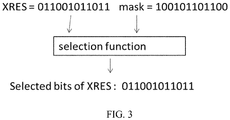
- One possible example of mask Using XRES and mask as input parameters of a selection function, and the output of the selection function could be the selected bits of XRES.
- the bits corresponding to the part of the XRES that the SN needs check against RES are set to one, and all other bits are set to zero, and output would be the selected bits of XRES, where the bit with value of 1 in the mask would be the bit selected in XRES.
- the other option is that the bit with value of 0 in the mask would be the bit selected in XRES.
- FIG. 3 is a diagram of generating selected bits of XRES according to an embodiment of the present invention.
- m the number of bits in the part of RES that is not checked by the SN against the corresponding part of XRES. If the attacker's ME flips one, randomly chosen bit of RES before sending the modified RES to the SN, then the probability p that the the bit chosen by the attacker will be one of those m bits is m /(2 n ) .
- the probability p the attacker's probability to pass the SN check
- the indicator field in Authentication Information Reply message from HN to SN could be an integer which points to the position of the (single) bit in XRES that the SN should not check against RES.
- the attacker may be SN, rather than the UE.
- the probability that the attacker SN succeeds in guessing that part of XRES that it does not know is 1 - p : as we decrease the chances of attacker UE (by decreasing p ), we increase the chances of attacker SN, and vice versa.
- p of one to three percent is rather large.
- HN does not send any parts of XRES explicitly to SN but instead HN sends an n -bit check value X for checking the UE's response RES.
- the check value X is derived from the 2 n -bit XRES by a suitable hash-type function f.
- the HN also indicates to the SN what the function is.
- the value X could be a message authentication code (MAC) value computed for XRES by a one-time key that is sent by HN to SN together with X.
- MAC message authentication code
- Another possibility is to encrypt XRES with a block cipher whose block length is 2n.
- the check value X would now be the lower part of the encrypted XRES. Again, the one-time key used for encryption is sent together with X.
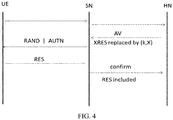
- SN When SN receives RES from the UE, it first applies the hash-type function f to the received RES and checks whether the result matches X. For the additional check by the HN, the SN sends whole RES to HN in Authentication Confirmation message.
- FIG. 4 is a diagram of authentication process according to an embodiment of the present invention. solutions to calculate X:
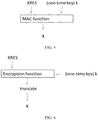
- K and XRES as inputs of a MAC function, and the output of the MAC function is X.
- the K could be a one time key.
- the K is a shared key between HN and SN.
- K is derived from shared key(s) between HN and SN.
- K is negotiated between HN and SN based on public key or certificates.
- FIG. 5 is a diagram of generating MAC according to an embodiment of the present invention.
- K and XRES as inputs of an encryption function, and the output of the encryption function is X.
- the K could be a one time key.
- the K is a shared key between HN and SN.
- K is derived from shared key(s) between HN and SN.
- K is negotiated between HN and SN based on public key or certification.
- FIG. 6 is a diagram of encryption according to an embodiment of the present invention.
- the SN knows the key and it knows the value X but without executing the authentication with the (valid) UE it does not know RES: With the key and the value X, it is possible (although cumbersome) for SN to compute (many) values of RES that would lead to X. But the cheating SN has no way to find out which of the many RES-values would be the correct one. Again, the success chance is (at least in average) 1 out of 2 n .
- the function to compute X does not need to be based on either encryption or hash-type function. To protect against cheating UE, it is sufficient that the choice of different functions is large enough to guarantee that the UE cannot find an alternative parameter RES' that could be sent instead of RES and still get accepted by SN with big enough probability. To protect against cheating SNs, it is sufficient that there are sufficiently many parameters RES' that could be received instead of RES and still get accepted by SN.
- HN does not send any parts of XRES explicitly to SN but instead HN sends an k-bit check value X for checking the UE's response RES.
- the check value X is derived from the 2n-bit XRES by a suitable digital signature function f .
- the HN also indicates to the SN what the function is.
- the value X could be a digital signature value computed for XRES by a private key (SK) that is managed by HN. And, HN sents public key (PK) and X to SN, where SK and PK are a pair of asymmetric cryptography keys.
- SK private key
- PK public key
- SN When SN receives RES from the UE, it first applies the digital signature verification algorithm to the PK, X and received RES, and checks whether the X is correct. If the verification is correct, SN considers the authentication successful. If not the SEAF rejects the authentication. For the additional check by the HN, the SN sends whole RES to HN in Authentication Confirmation message.
- the SN only knows the public key PK and it knows the value X but without executing the authentication with the (valid) UE it does not know RES: With the key PK and the value X, it is not possible (although cumbersome) for SN to compute a correct X for any RES. Therefore, the cheating SN has no way to find out which of the many RES-values would be the correct one. The success chance is (at least in average) 1 out of 2 n .
- X is computed based on part of XRES (e.g., the upper part). Therefore, SN verifies the X based on this part of RES (e.g., the upper part) and PK. HN and SN may negotiate that which part will be used for verification. Or, HN may dynamically select the verification part, and notify the SN the verification part via a parameter (e.g., mask as described in method 1, or one bit r for upper and lower part clarification, etc).
- a parameter e.g., mask as described in method 1, or one bit r for upper and lower part clarification, etc.
- the HN may generate the PK and SK by itself.
- the PK and SK may be preconfigured within the HN, or distributed to HN.
- the above asymmetric cryptography keys PK and SK could be generated dynamically for every authentication procedure, or the fixed keys for the SN and HN pair.
- the above asymmetric cryptography denotes the general signature algorithms, including but not limited to the Digital Signature Algorithm, Schnnor signature algorithm, identity-based signature algorithm, elliptic curve digital signature algorithm, etc.
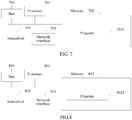
- FIG. 7 is a diagram of the UE according to an embodiment of the present invention.
- the UE comprises processor 701, memory 702, network interface 703, bus 704, transceiver 705.
- FIG. 8 is a diagram of the SN according to an embodiment of the present invention.
- the SN comprises processor 801, memory 802, network interface 803, bus 804, transceiver 805.
- FIG. 9 is a diagram of the HN according to an embodiment of the present invention.
- the HN comprises processor 901, memory 902, network interface 903, bus 904, transceiver 905.
- the program may be stored in a computer-readable storage medium. When the program runs, the processes of the methods in the embodiments are performed.
- the storage medium may be a magnetic disk, an optical disc, a read-only memory (ROM: Read-Only Memory), a RAM, or the like.
Landscapes
- Engineering & Computer Science (AREA)
- Computer Security & Cryptography (AREA)
- Computer Networks & Wireless Communication (AREA)
- Signal Processing (AREA)
- Computer Hardware Design (AREA)
- Computing Systems (AREA)
- General Engineering & Computer Science (AREA)
- Power Engineering (AREA)
- Mobile Radio Communication Systems (AREA)
Claims (18)
- Netzauthentifizierungssystem, wobei das System ein Dienstnetz und ein Heimnetz umfasst; das Heimnetz konfiguriert ist, um einen Prüfwert X an das Dienstnetz zu senden, wobei der Prüfwert X aus einer erwarteten Benutzerantwort (expected user response -XRES) und einem Schlüssel K durch eine Hash-artige Funktion abgeleitet wird, wobei der Prüfwert X ein Nachrichtenauthentifizierungscode(message authentication code - MAC)-Wert ist, wobei die Hash-artige Funktion eine MAC-Funktion ist; das Dienstnetz konfiguriert ist, um den Prüfwert X zu empfangen; das Dienstnetz konfiguriert ist, um eine Benutzerantwort von einer Benutzereinrichtung zu empfangen; das Dienstnetz konfiguriert ist, um die Hash-artige Funktion auf die Benutzerantwort anzuwenden und zu prüfen, ob das Ergebnis mit dem Prüfwert X übereinstimmt.
- Netzauthentifizierungssystem nach Anspruch 1, wobei das Dienstnetz ferner konfiguriert ist, um die Benutzerantwort an das Heimnetz zu senden; das Heimnetz ferner konfiguriert ist, um die Benutzerantwort zu prüfen.
- Netzauthentifizierungssystem nach Anspruch 1 oder 2, wobei das Heimnetz ferner konfiguriert ist, um eine Anzeige an das Dienstnetz zu senden, wobei die Anzeige verwendet wird, um anzuzeigen, was die Hash-artige Funktion ist.
- Netzauthentifizierungssystem nach einem der Ansprüche 1 bis 3, wobei die XRES basierend auf einer internationalen Mobilfunkteilnehmerkennung (international mobile subscriber identity - IMSI) einer Benutzereinrichtung erzeugt wird.
- Verfahren für eine Authentifizierung, das Folgendes umfasst: Empfangen, durch ein Dienstnetz, eines Prüfwerts X von einem Heimnetz; wobei der Prüfwert X aus einer erwarteten Benutzerantwort (XRES) und einem Schlüssel K durch eine Hash-artige Funktion abgeleitet wird, wobei der Prüfwert X ein Nachrichtenauthentifizierungscode(MAC)-Wert ist, wobei die Hash-artige Funktion eine MAC-Funktion ist; Empfangen, durch das Dienstnetz, einer Benutzerantwort von der Benutzereinrichtung; Anwenden, durch das Dienstnetz, der Hash-artigen Funktion auf die Benutzerantwort und Prüfen, ob das Ergebnis mit dem Prüfwert X übereinstimmt.
- Verfahren nach Anspruch 5, das ferner Folgendes umfasst: Senden, durch das Dienstnetz, der Benutzerantwort an das Heimnetz derart, dass die Benutzerantwort durch das Heimnetz geprüft wird.
- Verfahren nach Anspruch 5 oder 6, wobei: Empfangen, durch das Dienstnetz, einer Anzeige von dem Heimnetz, wobei die Anzeige verwendet wird, um anzuzeigen, was die Hash-artige Funktion ist.
- Verfahren nach einem der Ansprüche 5 bis 7, wobei die XRES basierend auf einer internationalen Mobilfunkteilnehmerkennung (IMSI) einer Benutzereinrichtung erzeugt wird.
- Verfahren für die Authentifizierung, das Folgendes umfasst: Senden, durch ein Heimnetz, eines Prüfwerts X an ein Dienstnetz, wobei der Prüfwert X aus einer erwarteten Benutzerantwort (XRES) und einem Schlüssel K durch eine Hash-artige Funktion abgeleitet wird, wobei der Prüfwert X ein Nachrichtenauthentifizierungscode(MAC)-Wert ist, wobei die Hash-artige Funktion eine MAC-Funktion ist; Empfangen, durch das Heimnetz, einer Benutzerantwort von dem Dienstnetz; und Prüfen, durch das Heimnetz, der Benutzerantwort.
- Verfahren nach Anspruch 9, das ferner Folgendes umfasst: Senden, durch das Heimnetz, einer Anzeige an das Dienstnetz, wobei die Anzeige verwendet wird, um anzuzeigen, was die Hash-artige Funktion ist.
- Verfahren nach Anspruch 9 oder 10, wobei die XRES basierend auf einer internationalen Mobilfunkteilnehmerkennung (IMSI) einer Benutzereinrichtung erzeugt wird.
- Vorrichtung für die Authentifizierung, die Folgendes umfasst: einen Prozessor (701); und ein nicht flüchtiges Medium, das durch den Prozessor (701) lesbar ist, wobei das Medium Anweisungen speichert, die, wenn sie durch den Prozessor (701) ausgeführt werden, den Prozessor (701) zu Folgendem veranlassen: Empfangen eines Prüfwerts X von einem Heimnetz; wobei der Prüfwert X aus einer erwarteten Benutzerantwort (XRES) und einem Schlüssel K durch eine Hash-artige Funktion abgeleitet wird, wobei der Prüfwert X ein Nachrichtenauthentifizierungscode(MAC)-Wert ist, wobei die Hash-artige Funktion eine MAC-Funktion ist; Empfangen einer Benutzerantwort von der Benutzereinrichtung; Anwenden der Hash-artigen Funktion auf die Benutzerantwort und Prüfen, ob das Ergebnis mit dem Prüfwert X übereinstimmt.
- Vorrichtung nach Anspruch 12, Anweisungen zum Lenken des Prozessors, um Folgendes zu tun: Senden der Benutzerantwort an das Heimnetz derart, dass die Benutzerantwort durch das Heimnetz geprüft wird.
- Vorrichtung nach Anspruch 12 oder 13, wobei Anweisungen zum Lenken des Prozessors (701), um Folgendes zu tun: Empfangen einer Anzeige von dem Heimnetz, wobei die Anzeige verwendet wird, um anzuzeigen, was die Hash-artige Funktion ist.
- Vorrichtung nach einem der Ansprüche 12 bis 14, wobei die XRES basierend auf einer internationalen Mobilfunkteilnehmerkennung (IMSI) einer Benutzereinrichtung erzeugt wird.
- Vorrichtung für die Authentifizierung, die Folgendes umfasst: einen Prozessor (702); und ein nicht flüchtiges Medium, das durch den Prozessor (702) lesbar ist, wobei das Medium Anweisungen speichert, die, wenn sie durch den Prozessor (702) ausgeführt werden, den Prozessor zu Folgendem veranlassen: Senden eines Prüfwerts X an ein Dienstnetz, wobei der Prüfwert X aus einer erwarteten Benutzerantwort (XRES) und einem Schlüssel K durch eine Hash-artige Funktion abgeleitet wird, wobei der Prüfwert X ein Nachrichtenauthentifizierungscode(MAC)-Wert ist, wobei die Hash-artige Funktion eine MAC-Funktion ist; Empfangen einer Benutzerantwort von dem Dienstnetz; und Prüfen der Benutzerantwort.
- Vorrichtung nach Anspruch 16, wobei Anweisungen zum Lenken des Prozessors, um Folgendes zu tun: Senden einer Anzeige an das Dienstnetzwerk, wobei die Anzeige verwendet wird, um anzuzeigen, was die Hash-artige Funktion ist.
- Vorrichtung nach Anspruch 16 oder 17, wobei die XRES basierend auf einer internationalen Mobilfunkteilnehmerkennung (IMSI) einer Benutzereinrichtung erzeugt wird.
Applications Claiming Priority (1)
| Application Number | Priority Date | Filing Date | Title |
|---|---|---|---|
| PCT/CN2017/080099 WO2018187937A1 (en) | 2017-04-11 | 2017-04-11 | Network authentication method, device, and system |
Publications (3)
| Publication Number | Publication Date |
|---|---|
| EP3526951A1 EP3526951A1 (de) | 2019-08-21 |
| EP3526951A4 EP3526951A4 (de) | 2019-09-18 |
| EP3526951B1 true EP3526951B1 (de) | 2021-06-02 |
Family
ID=63792228
Family Applications (1)
| Application Number | Title | Priority Date | Filing Date |
|---|---|---|---|
| EP17905035.6A Active EP3526951B1 (de) | 2017-04-11 | 2017-04-11 | Netzwerk-authentifizierungsverfahren, -vorrichtung und -system |
Country Status (9)
| Country | Link |
|---|---|
| US (1) | US11223954B2 (de) |
| EP (1) | EP3526951B1 (de) |
| JP (1) | JP6745403B2 (de) |
| KR (1) | KR20190034657A (de) |
| CN (1) | CN109314699A (de) |
| AU (1) | AU2017408843A1 (de) |
| BR (1) | BR112019004143A2 (de) |
| RU (1) | RU2733828C1 (de) |
| WO (1) | WO2018187937A1 (de) |
Families Citing this family (5)
| Publication number | Priority date | Publication date | Assignee | Title |
|---|---|---|---|---|
| US12107950B2 (en) | 2019-01-11 | 2024-10-01 | Nec Corporation | Method and a device for enabling key re-usage in a communication network |
| US10673637B1 (en) * | 2019-11-19 | 2020-06-02 | Quantum Information Security, LLC | Polymorphic digital security and methods of use thereof |
| CN114760046A (zh) | 2020-12-26 | 2022-07-15 | 西安西电捷通无线网络通信股份有限公司 | 一种身份鉴别方法和装置 |
| CN114696999A (zh) | 2020-12-26 | 2022-07-01 | 西安西电捷通无线网络通信股份有限公司 | 一种身份鉴别方法和装置 |
| CN114760039A (zh) | 2020-12-26 | 2022-07-15 | 西安西电捷通无线网络通信股份有限公司 | 一种身份鉴别方法和装置 |
Family Cites Families (40)
| Publication number | Priority date | Publication date | Assignee | Title |
|---|---|---|---|---|
| JP3864401B2 (ja) * | 1997-04-23 | 2006-12-27 | ソニー株式会社 | 認証システム、電子機器、認証方法、および記録媒体 |
| US7131006B1 (en) * | 1999-11-15 | 2006-10-31 | Verizon Laboratories Inc. | Cryptographic techniques for a communications network |
| EA004379B1 (ru) * | 2000-04-20 | 2004-04-29 | Ютака Ясукура | Способ запроса электронной информации |
| US7194765B2 (en) * | 2002-06-12 | 2007-03-20 | Telefonaktiebolaget Lm Ericsson (Publ) | Challenge-response user authentication |
| GB2403880B (en) | 2002-06-12 | 2005-11-09 | Ericsson Telefon Ab L M | Non-repudiation of service agreements |
| ATE306776T1 (de) | 2002-10-22 | 2005-10-15 | Verfahren und system zur authentifizierung von benutzern in einem telekommunikationssystem | |
| US8260259B2 (en) | 2004-09-08 | 2012-09-04 | Qualcomm Incorporated | Mutual authentication with modified message authentication code |
| WO2006064359A1 (en) * | 2004-12-17 | 2006-06-22 | Telefonaktiebolaget Lm Ericsson (Publ) | Clone-resistant mutual authentication in a radio communication network |
| FI20050491A0 (fi) * | 2005-05-09 | 2005-05-09 | Nokia Corp | Järjestelmä varmenteiden toimittamiseksi viestintäjärjestelmässä |
| US8763081B2 (en) | 2006-04-03 | 2014-06-24 | Bridgeport Networks, Inc. | Network based authentication |
| CN101197673B (zh) * | 2006-12-05 | 2011-08-10 | 中兴通讯股份有限公司 | 固定网络接入ims双向认证及密钥分发方法 |
| CN101272251B (zh) * | 2007-03-22 | 2012-04-18 | 华为技术有限公司 | 鉴权和密钥协商方法、认证方法、系统及设备 |
| US8265593B2 (en) | 2007-08-27 | 2012-09-11 | Alcatel Lucent | Method and system of communication using extended sequence number |
| US7957533B2 (en) * | 2007-10-02 | 2011-06-07 | Alcatel-Lucent Usa Inc. | Method of establishing authentication keys and secure wireless communication |
| CN103746794B (zh) * | 2008-06-06 | 2017-06-23 | 艾利森电话股份有限公司 | 加密密钥生成方法及装置 |
| US8965338B2 (en) * | 2008-06-09 | 2015-02-24 | Apple Inc | Network access control methods and apparatus |
| US8245039B2 (en) * | 2008-07-18 | 2012-08-14 | Bridgewater Systems Corp. | Extensible authentication protocol authentication and key agreement (EAP-AKA) optimization |
| KR101038096B1 (ko) * | 2010-01-04 | 2011-06-01 | 전자부품연구원 | 바이너리 cdma에서 키 인증 방법 |
| US8296836B2 (en) | 2010-01-06 | 2012-10-23 | Alcatel Lucent | Secure multi-user identity module key exchange |
| US8666368B2 (en) * | 2010-05-03 | 2014-03-04 | Apple Inc. | Wireless network authentication apparatus and methods |
| EP3493571A1 (de) * | 2010-06-14 | 2019-06-05 | Koninklijke KPN N.V. | Authentifizierungsprüfung für authentifizierungsnachrichten |
| CN101931955B (zh) | 2010-09-03 | 2015-01-28 | 中兴通讯股份有限公司 | 认证方法、装置及系统 |
| US20120142315A1 (en) * | 2010-12-06 | 2012-06-07 | Jong-Moon Chung | Method for authentication and key establishment in a mobile communication system and method of operating a mobile station and a visitor location register |
| CN102137397B (zh) * | 2011-03-10 | 2014-04-02 | 西安电子科技大学 | 机器类型通信中基于共享群密钥的认证方法 |
| KR20130073728A (ko) * | 2011-12-23 | 2013-07-03 | 주식회사 케이티 | 엘티이(lte) 시스템에서의 인증 장치 및 방법 |
| US8971851B2 (en) | 2012-06-28 | 2015-03-03 | Certicom Corp. | Key agreement for wireless communication |
| CN102905265B (zh) * | 2012-10-11 | 2016-02-10 | 大唐移动通信设备有限公司 | 一种实现移动设备附着的方法及装置 |
| US9727720B2 (en) | 2012-11-30 | 2017-08-08 | Certicom Corp. | Challenge-response authentication using a masked response value |
| US20140153722A1 (en) * | 2012-12-03 | 2014-06-05 | Semyon Mizikovsky | Restricting use of mobile subscriptions to authorized mobile devices |
| CN103856288B (zh) | 2012-12-04 | 2017-06-06 | 北汽福田汽车股份有限公司 | 用于汽车的can通讯信号校验与传输方法和系统 |
| DE102014209846A1 (de) | 2013-12-20 | 2015-06-25 | Johnson Controls Gmbh | Schaumteil für eine Fahrzeugsitz und Fahrzeugsitz |
| CN104735037B (zh) | 2013-12-24 | 2018-11-23 | 中国移动通信集团公司 | 一种网络认证方法、装置及系统 |
| BR112017018428A2 (pt) * | 2015-02-27 | 2018-04-17 | Telefonaktiebolaget Lm Ericsson | comunicação entre um dispositivo de comunicação e um dispositivo de rede |
| US9755837B2 (en) * | 2015-03-17 | 2017-09-05 | Qualcomm Incorporated | Apparatus and method for sponsored connectivity to wireless networks using application-specific network access credentials |
| KR101675088B1 (ko) * | 2015-04-30 | 2016-11-10 | 성균관대학교산학협력단 | Mtc에서의 네트워크와의 상호 인증 방법 및 시스템 |
| US10382206B2 (en) * | 2016-03-10 | 2019-08-13 | Futurewei Technologies, Inc. | Authentication mechanism for 5G technologies |
| US10873464B2 (en) * | 2016-03-10 | 2020-12-22 | Futurewei Technologies, Inc. | Authentication mechanism for 5G technologies |
| FR3057132A1 (fr) * | 2016-10-04 | 2018-04-06 | Orange | Procede d'authentification mutuelle entre un equipement utilisateur et un reseau de communication |
| CN106790053B (zh) | 2016-12-20 | 2019-08-27 | 江苏大学 | 一种can总线中ecu安全通信的方法 |
| US20190182654A1 (en) * | 2017-12-08 | 2019-06-13 | Nokia Technologies Oy | Preventing covert channel between user equipment and home network in communication system |
-
2017
- 2017-04-11 EP EP17905035.6A patent/EP3526951B1/de active Active
- 2017-04-11 RU RU2019110683A patent/RU2733828C1/ru not_active IP Right Cessation
- 2017-04-11 KR KR1020197006634A patent/KR20190034657A/ko not_active Abandoned
- 2017-04-11 BR BR112019004143A patent/BR112019004143A2/pt not_active IP Right Cessation
- 2017-04-11 AU AU2017408843A patent/AU2017408843A1/en not_active Abandoned
- 2017-04-11 CN CN201780023335.7A patent/CN109314699A/zh active Pending
- 2017-04-11 JP JP2019517893A patent/JP6745403B2/ja not_active Expired - Fee Related
- 2017-04-11 WO PCT/CN2017/080099 patent/WO2018187937A1/en not_active Ceased
-
2019
- 2019-10-10 US US16/598,981 patent/US11223954B2/en active Active
Non-Patent Citations (1)
| Title |
|---|
| None * |
Also Published As
| Publication number | Publication date |
|---|---|
| WO2018187937A1 (en) | 2018-10-18 |
| CN109314699A (zh) | 2019-02-05 |
| BR112019004143A2 (pt) | 2019-12-31 |
| JP6745403B2 (ja) | 2020-08-26 |
| EP3526951A4 (de) | 2019-09-18 |
| US20200045553A1 (en) | 2020-02-06 |
| EP3526951A1 (de) | 2019-08-21 |
| RU2733828C1 (ru) | 2020-10-07 |
| KR20190034657A (ko) | 2019-04-02 |
| US11223954B2 (en) | 2022-01-11 |
| AU2017408843A1 (en) | 2019-03-14 |
| JP2019531658A (ja) | 2019-10-31 |
Similar Documents
| Publication | Publication Date | Title |
|---|---|---|
| EP1698141B1 (de) | System und Verfahren zur Provisionierung und Authentifizierung über ein Netzwerk | |
| US11223954B2 (en) | Network authentication method, device, and system | |
| JP7335342B2 (ja) | 電気通信ネットワークにおける端末内の移動体装置と協働するセキュアエレメントを認証する方法 | |
| RU2480925C2 (ru) | Генерация криптографического ключа | |
| EP2905719B1 (de) | Vorrichtung und Verfahrenszertifikaterzeugung | |
| JP5579872B2 (ja) | 安全な複数uim認証および鍵交換 | |
| US11159940B2 (en) | Method for mutual authentication between user equipment and a communication network | |
| US11997078B2 (en) | Secured authenticated communication between an initiator and a responder | |
| CN101194529A (zh) | 用于协商至少一个第一通信用户和第二通信用户之间的安全密钥以保护通信连接的安全的方法 | |
| US20240171402A1 (en) | Authentication methods using zero-knowledge proof algorithms for user equipment and nodes implementing the authentication methods | |
| Noh et al. | Secure authentication and four-way handshake scheme for protected individual communication in public wi-fi networks | |
| US10700854B2 (en) | Resource management in a cellular network | |
| CN117915322A (zh) | 一种基于密钥完整性检测的切片二次认证方法及系统 | |
| EP3319289A1 (de) | Vorrichtungen und verfahren zur bereitstellung der authentifizierung von client-vorrichtungen | |
| WO2022183427A1 (en) | Method, device, and system for protecting sequence number in wireless network | |
| CN109246701B (zh) | 网络认证方法、设备和系统 | |
| EP2249593A1 (de) | Verfahren und System zur Authentifizierung einer mobilen Vorrichtung | |
| US12500747B1 (en) | Multi-factor authentication with device and carrier validation | |
| Abdelkader et al. | A novel advanced identity management scheme for seamless handoff in 4G wireless networks | |
| US20240283794A1 (en) | Digest Access Authentication for a Client Device | |
| US20240340164A1 (en) | Establishment of forward secrecy during digest authentication | |
| KR20130062965A (ko) | 무선 네트워크 접속 인증 방법 및 그 시스템 |
Legal Events
| Date | Code | Title | Description |
|---|---|---|---|
| STAA | Information on the status of an ep patent application or granted ep patent |
Free format text: STATUS: THE INTERNATIONAL PUBLICATION HAS BEEN MADE |
|
| PUAI | Public reference made under article 153(3) epc to a published international application that has entered the european phase |
Free format text: ORIGINAL CODE: 0009012 |
|
| STAA | Information on the status of an ep patent application or granted ep patent |
Free format text: STATUS: REQUEST FOR EXAMINATION WAS MADE |
|
| 17P | Request for examination filed |
Effective date: 20190517 |
|
| AK | Designated contracting states |
Kind code of ref document: A1 Designated state(s): AL AT BE BG CH CY CZ DE DK EE ES FI FR GB GR HR HU IE IS IT LI LT LU LV MC MK MT NL NO PL PT RO RS SE SI SK SM TR |
|
| AX | Request for extension of the european patent |
Extension state: BA ME |
|
| A4 | Supplementary search report drawn up and despatched |
Effective date: 20190819 |
|
| RIC1 | Information provided on ipc code assigned before grant |
Ipc: H04L 29/06 20060101AFI20190812BHEP Ipc: H04L 9/32 20060101ALI20190812BHEP Ipc: H04W 12/10 20090101ALI20190812BHEP |
|
| STAA | Information on the status of an ep patent application or granted ep patent |
Free format text: STATUS: EXAMINATION IS IN PROGRESS |
|
| 17Q | First examination report despatched |
Effective date: 20200609 |
|
| DAV | Request for validation of the european patent (deleted) | ||
| DAX | Request for extension of the european patent (deleted) | ||
| REG | Reference to a national code |
Ref country code: DE Ref legal event code: R079 Ref document number: 602017039880 Country of ref document: DE Free format text: PREVIOUS MAIN CLASS: H04L0029060000 Ipc: H04W0012060000 |
|
| GRAP | Despatch of communication of intention to grant a patent |
Free format text: ORIGINAL CODE: EPIDOSNIGR1 |
|
| STAA | Information on the status of an ep patent application or granted ep patent |
Free format text: STATUS: GRANT OF PATENT IS INTENDED |
|
| RIC1 | Information provided on ipc code assigned before grant |
Ipc: H04W 12/06 20090101AFI20201013BHEP Ipc: H04W 12/12 20090101ALI20201013BHEP Ipc: H04W 12/10 20090101ALI20201013BHEP Ipc: H04L 29/06 20060101ALI20201013BHEP Ipc: H04L 9/32 20060101ALI20201013BHEP |
|
| INTG | Intention to grant announced |
Effective date: 20201116 |
|
| GRAS | Grant fee paid |
Free format text: ORIGINAL CODE: EPIDOSNIGR3 |
|
| GRAA | (expected) grant |
Free format text: ORIGINAL CODE: 0009210 |
|
| STAA | Information on the status of an ep patent application or granted ep patent |
Free format text: STATUS: THE PATENT HAS BEEN GRANTED |
|
| REG | Reference to a national code |
Ref country code: CH Ref legal event code: EP |
|
| AK | Designated contracting states |
Kind code of ref document: B1 Designated state(s): AL AT BE BG CH CY CZ DE DK EE ES FI FR GB GR HR HU IE IS IT LI LT LU LV MC MK MT NL NO PL PT RO RS SE SI SK SM TR |
|
| REG | Reference to a national code |
Ref country code: GB Ref legal event code: FG4D |
|
| REG | Reference to a national code |
Ref country code: AT Ref legal event code: REF Ref document number: 1399601 Country of ref document: AT Kind code of ref document: T Effective date: 20210615 |
|
| REG | Reference to a national code |
Ref country code: IE Ref legal event code: FG4D |
|
| REG | Reference to a national code |
Ref country code: DE Ref legal event code: R096 Ref document number: 602017039880 Country of ref document: DE |
|
| REG | Reference to a national code |
Ref country code: LT Ref legal event code: MG9D |
|
| PG25 | Lapsed in a contracting state [announced via postgrant information from national office to epo] |
Ref country code: HR Free format text: LAPSE BECAUSE OF FAILURE TO SUBMIT A TRANSLATION OF THE DESCRIPTION OR TO PAY THE FEE WITHIN THE PRESCRIBED TIME-LIMIT Effective date: 20210602 Ref country code: BG Free format text: LAPSE BECAUSE OF FAILURE TO SUBMIT A TRANSLATION OF THE DESCRIPTION OR TO PAY THE FEE WITHIN THE PRESCRIBED TIME-LIMIT Effective date: 20210902 Ref country code: LT Free format text: LAPSE BECAUSE OF FAILURE TO SUBMIT A TRANSLATION OF THE DESCRIPTION OR TO PAY THE FEE WITHIN THE PRESCRIBED TIME-LIMIT Effective date: 20210602 Ref country code: FI Free format text: LAPSE BECAUSE OF FAILURE TO SUBMIT A TRANSLATION OF THE DESCRIPTION OR TO PAY THE FEE WITHIN THE PRESCRIBED TIME-LIMIT Effective date: 20210602 |
|
| REG | Reference to a national code |
Ref country code: NL Ref legal event code: MP Effective date: 20210602 |
|
| REG | Reference to a national code |
Ref country code: AT Ref legal event code: MK05 Ref document number: 1399601 Country of ref document: AT Kind code of ref document: T Effective date: 20210602 |
|
| PG25 | Lapsed in a contracting state [announced via postgrant information from national office to epo] |
Ref country code: SE Free format text: LAPSE BECAUSE OF FAILURE TO SUBMIT A TRANSLATION OF THE DESCRIPTION OR TO PAY THE FEE WITHIN THE PRESCRIBED TIME-LIMIT Effective date: 20210602 Ref country code: RS Free format text: LAPSE BECAUSE OF FAILURE TO SUBMIT A TRANSLATION OF THE DESCRIPTION OR TO PAY THE FEE WITHIN THE PRESCRIBED TIME-LIMIT Effective date: 20210602 Ref country code: LV Free format text: LAPSE BECAUSE OF FAILURE TO SUBMIT A TRANSLATION OF THE DESCRIPTION OR TO PAY THE FEE WITHIN THE PRESCRIBED TIME-LIMIT Effective date: 20210602 Ref country code: PL Free format text: LAPSE BECAUSE OF FAILURE TO SUBMIT A TRANSLATION OF THE DESCRIPTION OR TO PAY THE FEE WITHIN THE PRESCRIBED TIME-LIMIT Effective date: 20210602 Ref country code: NO Free format text: LAPSE BECAUSE OF FAILURE TO SUBMIT A TRANSLATION OF THE DESCRIPTION OR TO PAY THE FEE WITHIN THE PRESCRIBED TIME-LIMIT Effective date: 20210902 Ref country code: GR Free format text: LAPSE BECAUSE OF FAILURE TO SUBMIT A TRANSLATION OF THE DESCRIPTION OR TO PAY THE FEE WITHIN THE PRESCRIBED TIME-LIMIT Effective date: 20210903 |
|
| PG25 | Lapsed in a contracting state [announced via postgrant information from national office to epo] |
Ref country code: CZ Free format text: LAPSE BECAUSE OF FAILURE TO SUBMIT A TRANSLATION OF THE DESCRIPTION OR TO PAY THE FEE WITHIN THE PRESCRIBED TIME-LIMIT Effective date: 20210602 Ref country code: AT Free format text: LAPSE BECAUSE OF FAILURE TO SUBMIT A TRANSLATION OF THE DESCRIPTION OR TO PAY THE FEE WITHIN THE PRESCRIBED TIME-LIMIT Effective date: 20210602 Ref country code: PT Free format text: LAPSE BECAUSE OF FAILURE TO SUBMIT A TRANSLATION OF THE DESCRIPTION OR TO PAY THE FEE WITHIN THE PRESCRIBED TIME-LIMIT Effective date: 20211004 Ref country code: NL Free format text: LAPSE BECAUSE OF FAILURE TO SUBMIT A TRANSLATION OF THE DESCRIPTION OR TO PAY THE FEE WITHIN THE PRESCRIBED TIME-LIMIT Effective date: 20210602 Ref country code: RO Free format text: LAPSE BECAUSE OF FAILURE TO SUBMIT A TRANSLATION OF THE DESCRIPTION OR TO PAY THE FEE WITHIN THE PRESCRIBED TIME-LIMIT Effective date: 20210602 Ref country code: ES Free format text: LAPSE BECAUSE OF FAILURE TO SUBMIT A TRANSLATION OF THE DESCRIPTION OR TO PAY THE FEE WITHIN THE PRESCRIBED TIME-LIMIT Effective date: 20210602 Ref country code: EE Free format text: LAPSE BECAUSE OF FAILURE TO SUBMIT A TRANSLATION OF THE DESCRIPTION OR TO PAY THE FEE WITHIN THE PRESCRIBED TIME-LIMIT Effective date: 20210602 Ref country code: SK Free format text: LAPSE BECAUSE OF FAILURE TO SUBMIT A TRANSLATION OF THE DESCRIPTION OR TO PAY THE FEE WITHIN THE PRESCRIBED TIME-LIMIT Effective date: 20210602 Ref country code: SM Free format text: LAPSE BECAUSE OF FAILURE TO SUBMIT A TRANSLATION OF THE DESCRIPTION OR TO PAY THE FEE WITHIN THE PRESCRIBED TIME-LIMIT Effective date: 20210602 |
|
| REG | Reference to a national code |
Ref country code: DE Ref legal event code: R097 Ref document number: 602017039880 Country of ref document: DE |
|
| PLBE | No opposition filed within time limit |
Free format text: ORIGINAL CODE: 0009261 |
|
| STAA | Information on the status of an ep patent application or granted ep patent |
Free format text: STATUS: NO OPPOSITION FILED WITHIN TIME LIMIT |
|
| PG25 | Lapsed in a contracting state [announced via postgrant information from national office to epo] |
Ref country code: DK Free format text: LAPSE BECAUSE OF FAILURE TO SUBMIT A TRANSLATION OF THE DESCRIPTION OR TO PAY THE FEE WITHIN THE PRESCRIBED TIME-LIMIT Effective date: 20210602 |
|
| 26N | No opposition filed |
Effective date: 20220303 |
|
| PG25 | Lapsed in a contracting state [announced via postgrant information from national office to epo] |
Ref country code: AL Free format text: LAPSE BECAUSE OF FAILURE TO SUBMIT A TRANSLATION OF THE DESCRIPTION OR TO PAY THE FEE WITHIN THE PRESCRIBED TIME-LIMIT Effective date: 20210602 |
|
| PG25 | Lapsed in a contracting state [announced via postgrant information from national office to epo] |
Ref country code: IT Free format text: LAPSE BECAUSE OF FAILURE TO SUBMIT A TRANSLATION OF THE DESCRIPTION OR TO PAY THE FEE WITHIN THE PRESCRIBED TIME-LIMIT Effective date: 20210602 |
|
| REG | Reference to a national code |
Ref country code: CH Ref legal event code: PL |
|
| REG | Reference to a national code |
Ref country code: BE Ref legal event code: MM Effective date: 20220430 |
|
| PG25 | Lapsed in a contracting state [announced via postgrant information from national office to epo] |
Ref country code: MC Free format text: LAPSE BECAUSE OF FAILURE TO SUBMIT A TRANSLATION OF THE DESCRIPTION OR TO PAY THE FEE WITHIN THE PRESCRIBED TIME-LIMIT Effective date: 20210602 Ref country code: LU Free format text: LAPSE BECAUSE OF NON-PAYMENT OF DUE FEES Effective date: 20220411 Ref country code: LI Free format text: LAPSE BECAUSE OF NON-PAYMENT OF DUE FEES Effective date: 20220430 Ref country code: FR Free format text: LAPSE BECAUSE OF NON-PAYMENT OF DUE FEES Effective date: 20220430 Ref country code: CH Free format text: LAPSE BECAUSE OF NON-PAYMENT OF DUE FEES Effective date: 20220430 |
|
| PG25 | Lapsed in a contracting state [announced via postgrant information from national office to epo] |
Ref country code: BE Free format text: LAPSE BECAUSE OF NON-PAYMENT OF DUE FEES Effective date: 20220430 |
|
| PG25 | Lapsed in a contracting state [announced via postgrant information from national office to epo] |
Ref country code: IE Free format text: LAPSE BECAUSE OF NON-PAYMENT OF DUE FEES Effective date: 20220411 |
|
| P01 | Opt-out of the competence of the unified patent court (upc) registered |
Effective date: 20230524 |
|
| PG25 | Lapsed in a contracting state [announced via postgrant information from national office to epo] |
Ref country code: HU Free format text: LAPSE BECAUSE OF FAILURE TO SUBMIT A TRANSLATION OF THE DESCRIPTION OR TO PAY THE FEE WITHIN THE PRESCRIBED TIME-LIMIT; INVALID AB INITIO Effective date: 20170411 |
|
| PG25 | Lapsed in a contracting state [announced via postgrant information from national office to epo] |
Ref country code: MK Free format text: LAPSE BECAUSE OF FAILURE TO SUBMIT A TRANSLATION OF THE DESCRIPTION OR TO PAY THE FEE WITHIN THE PRESCRIBED TIME-LIMIT Effective date: 20210602 Ref country code: CY Free format text: LAPSE BECAUSE OF FAILURE TO SUBMIT A TRANSLATION OF THE DESCRIPTION OR TO PAY THE FEE WITHIN THE PRESCRIBED TIME-LIMIT Effective date: 20210602 |
|
| PG25 | Lapsed in a contracting state [announced via postgrant information from national office to epo] |
Ref country code: TR Free format text: LAPSE BECAUSE OF FAILURE TO SUBMIT A TRANSLATION OF THE DESCRIPTION OR TO PAY THE FEE WITHIN THE PRESCRIBED TIME-LIMIT Effective date: 20210602 |
|
| PG25 | Lapsed in a contracting state [announced via postgrant information from national office to epo] |
Ref country code: MT Free format text: LAPSE BECAUSE OF FAILURE TO SUBMIT A TRANSLATION OF THE DESCRIPTION OR TO PAY THE FEE WITHIN THE PRESCRIBED TIME-LIMIT Effective date: 20210602 |
|
| PGFP | Annual fee paid to national office [announced via postgrant information from national office to epo] |
Ref country code: GB Payment date: 20250306 Year of fee payment: 9 |
|
| PGFP | Annual fee paid to national office [announced via postgrant information from national office to epo] |
Ref country code: DE Payment date: 20250305 Year of fee payment: 9 |