EP3525231A1 - High-voltage power source device - Google Patents
High-voltage power source device Download PDFInfo
- Publication number
- EP3525231A1 EP3525231A1 EP16918264.9A EP16918264A EP3525231A1 EP 3525231 A1 EP3525231 A1 EP 3525231A1 EP 16918264 A EP16918264 A EP 16918264A EP 3525231 A1 EP3525231 A1 EP 3525231A1
- Authority
- EP
- European Patent Office
- Prior art keywords
- voltage
- positive
- power supply
- negative
- current
- Prior art date
- Legal status (The legal status is an assumption and is not a legal conclusion. Google has not performed a legal analysis and makes no representation as to the accuracy of the status listed.)
- Withdrawn
Links
Images



Classifications
-
- H—ELECTRICITY
- H01—ELECTRIC ELEMENTS
- H01J—ELECTRIC DISCHARGE TUBES OR DISCHARGE LAMPS
- H01J49/00—Particle spectrometers or separator tubes
- H01J49/02—Details
- H01J49/022—Circuit arrangements, e.g. for generating deviation currents or voltages ; Components associated with high voltage supply
-
- H—ELECTRICITY
- H02—GENERATION; CONVERSION OR DISTRIBUTION OF ELECTRIC POWER
- H02J—ELECTRIC POWER NETWORKS; CIRCUIT ARRANGEMENTS OR SYSTEMS FOR SUPPLYING OR DISTRIBUTING ELECTRIC POWER; SYSTEMS FOR STORING ELECTRIC ENERGY
- H02J1/00—Circuit arrangements for DC mains or DC distribution networks
- H02J1/08—Three-wire DC power distribution systems; Systems having more than three wires
- H02J1/082—DC supplies with two or more different DC voltage levels
-
- H—ELECTRICITY
- H02—GENERATION; CONVERSION OR DISTRIBUTION OF ELECTRIC POWER
- H02J—ELECTRIC POWER NETWORKS; CIRCUIT ARRANGEMENTS OR SYSTEMS FOR SUPPLYING OR DISTRIBUTING ELECTRIC POWER; SYSTEMS FOR STORING ELECTRIC ENERGY
- H02J1/00—Circuit arrangements for DC mains or DC distribution networks
- H02J1/08—Three-wire DC power distribution systems; Systems having more than three wires
- H02J1/084—Three-wire DC power distribution systems; Systems having more than three wires for selectively connecting the load or loads to one or several among a plurality of power lines or power sources
-
- H—ELECTRICITY
- H02—GENERATION; CONVERSION OR DISTRIBUTION OF ELECTRIC POWER
- H02J—ELECTRIC POWER NETWORKS; CIRCUIT ARRANGEMENTS OR SYSTEMS FOR SUPPLYING OR DISTRIBUTING ELECTRIC POWER; SYSTEMS FOR STORING ELECTRIC ENERGY
- H02J1/00—Circuit arrangements for DC mains or DC distribution networks
- H02J1/10—Parallel operation of DC sources
- H02J1/102—Parallel operation of DC sources being switching converters
-
- H—ELECTRICITY
- H02—GENERATION; CONVERSION OR DISTRIBUTION OF ELECTRIC POWER
- H02J—ELECTRIC POWER NETWORKS; CIRCUIT ARRANGEMENTS OR SYSTEMS FOR SUPPLYING OR DISTRIBUTING ELECTRIC POWER; SYSTEMS FOR STORING ELECTRIC ENERGY
- H02J7/00—Circuit arrangements for charging or discharging batteries or for supplying loads from batteries
- H02J7/34—Parallel operation in networks using both storage and other DC sources, e.g. providing buffering
- H02J7/342—The other DC source being a battery actively interacting with the first one, i.e. battery to battery charging
-
- H—ELECTRICITY
- H02—GENERATION; CONVERSION OR DISTRIBUTION OF ELECTRIC POWER
- H02J—ELECTRIC POWER NETWORKS; CIRCUIT ARRANGEMENTS OR SYSTEMS FOR SUPPLYING OR DISTRIBUTING ELECTRIC POWER; SYSTEMS FOR STORING ELECTRIC ENERGY
- H02J7/00—Circuit arrangements for charging or discharging batteries or for supplying loads from batteries
- H02J7/34—Parallel operation in networks using both storage and other DC sources, e.g. providing buffering
- H02J7/345—Parallel operation in networks using both storage and other DC sources, e.g. providing buffering using capacitors as storage or buffering devices
-
- H—ELECTRICITY
- H02—GENERATION; CONVERSION OR DISTRIBUTION OF ELECTRIC POWER
- H02J—ELECTRIC POWER NETWORKS; CIRCUIT ARRANGEMENTS OR SYSTEMS FOR SUPPLYING OR DISTRIBUTING ELECTRIC POWER; SYSTEMS FOR STORING ELECTRIC ENERGY
- H02J7/00—Circuit arrangements for charging or discharging batteries or for supplying loads from batteries
- H02J7/50—Circuit arrangements for charging or discharging batteries or for supplying loads from batteries acting upon multiple batteries simultaneously or sequentially
- H02J7/575—Parallel/serial switching of connection of batteries to charge or load circuit
-
- H—ELECTRICITY
- H02—GENERATION; CONVERSION OR DISTRIBUTION OF ELECTRIC POWER
- H02M—APPARATUS FOR CONVERSION BETWEEN AC AND AC, BETWEEN AC AND DC, OR BETWEEN DC AND DC, AND FOR USE WITH MAINS OR SIMILAR POWER SUPPLY SYSTEMS; CONVERSION OF DC OR AC INPUT POWER INTO SURGE OUTPUT POWER; CONTROL OR REGULATION THEREOF
- H02M3/00—Conversion of DC power input into DC power output
- H02M3/02—Conversion of DC power input into DC power output without intermediate conversion into AC
- H02M3/04—Conversion of DC power input into DC power output without intermediate conversion into AC by static converters
- H02M3/06—Conversion of DC power input into DC power output without intermediate conversion into AC by static converters using resistors or capacitors, e.g. potential divider
- H02M3/07—Conversion of DC power input into DC power output without intermediate conversion into AC by static converters using resistors or capacitors, e.g. potential divider using capacitors charged and discharged alternately by semiconductor devices with control electrode, e.g. charge pumps
-
- H—ELECTRICITY
- H01—ELECTRIC ELEMENTS
- H01J—ELECTRIC DISCHARGE TUBES OR DISCHARGE LAMPS
- H01J49/00—Particle spectrometers or separator tubes
- H01J49/26—Mass spectrometers or separator tubes
- H01J49/34—Dynamic spectrometers
- H01J49/40—Time-of-flight spectrometers
-
- H—ELECTRICITY
- H02—GENERATION; CONVERSION OR DISTRIBUTION OF ELECTRIC POWER
- H02M—APPARATUS FOR CONVERSION BETWEEN AC AND AC, BETWEEN AC AND DC, OR BETWEEN DC AND DC, AND FOR USE WITH MAINS OR SIMILAR POWER SUPPLY SYSTEMS; CONVERSION OF DC OR AC INPUT POWER INTO SURGE OUTPUT POWER; CONTROL OR REGULATION THEREOF
- H02M7/00—Conversion of AC power input into DC power output; Conversion of DC power input into AC power output
- H02M7/42—Conversion of DC power input into AC power output without possibility of reversal
- H02M7/44—Conversion of DC power input into AC power output without possibility of reversal by static converters
- H02M7/48—Conversion of DC power input into AC power output without possibility of reversal by static converters using discharge tubes with control electrode or semiconductor devices with control electrode
- H02M7/483—Converters with outputs that each can have more than two voltages levels
Definitions
- the present invention relates to a high-voltage power supply device, and more particularly to a high-voltage power supply device suitable for applying a direct-current high voltage to a capacitive load having a relatively high capacitance, such as a flight tube of a time-of-flight mass spectrometer.
- a time-of-flight mass spectrometer measures a time-of-flight required for various ions derived from a sample to fly in a flight space formed in a flight tube from when the ions have been emitted from an ion emitting unit. Since flying ions have a speed depending on their mass-to-charge ratio m/z, the above-described time-of-flight depends on respective mass-to-charge ratios of the ions, thus a mass-to-charge ratio can be found from a time-of-flight of each ion.
- a flight tube is applied with a direct-current high voltage of about a few to a dozen kilovolts, whose polarity differs depending on the polarity of an ion to be analyzed, from a high-voltage power supply device capable of switching and outputting direct-current high voltage of both positive and negative polarities. If the potential of the flight tube changes during execution of analysis, the flight time of the ion varies, which may decrease the mass accuracy and the mass resolution.
- the potential of the flight tube serves as a reference potential of the reflectron, which forms a reflection electric field for reflecting ions; in such a case, the influence of a change in the potential of the flight tube during execution of analysis on the mass accuracy is even greater.
- the above-described high-voltage power supply device is required to output a direct-current high voltage of about a few to a dozen kilovolts at high stability with a voltage fluctuation of about a few parts per million or less. Furthermore, in a TOFMS capable of repeatedly and alternately conducting a measurement of positive ions and a measurement of negative ions, switching of the polarity of an output voltage from a high-voltage power supply device needs to be performed within a short period; therefore, it is also required to decrease the time as much as possible to stabilize the voltage when the polarity of the output voltage is switched.
- Fig. 6 is a schematic configuration of a conventional, general high-voltage power supply device for a flight tube and an explanatory diagram of its operation.
- this high-voltage power supply device includes a positive voltage generating unit 1 that outputs a positive-polarity direct-current high voltage with a voltage value of H [V], a negative voltage generating unit 2 that outputs a negative-polarity direct-current high voltage with a voltage value of -H [V], a positive-side switch circuit 3 provided on a line electrically connecting the positive voltage generating unit 1 and a flight tube 5, which is a load, and a negative-side switch circuit 4 provided on a line electrically connecting the negative voltage generating unit 2 and the flight tube 5.
- the switch circuits 3 and 4 each include one or more MOSFETs as a semiconductor switching device.
- the positive voltage generating unit 1 and the negative voltage generating unit 2 a booster circuit having voltage doubler rectifier circuits, such as Cockcroft-Walton circuits, connected in multiple stages is used in many cases.
- the voltage value ⁇ H of the direct-current high voltage is generally about ⁇ 5 to ⁇ 10 [kV].
- the flight tube 5 is a metallic, substantially cylindrical tube with a length of about 1 to 2 [m], and is a capacitive load having a capacitance of Ca [F].
- the positive-side switch circuit 3 and the negative-side switch circuit 4 are alternately turned ON and OFF.
- these switch circuits 3 and 4 are generally controlled so that after one of the switch circuits (for example, the positive-side switch circuit 3) is switched from ON state to OFF state, the other switch circuit (for example, the negative-side switch circuit 4) is switched from OFF state to ON state.
- the positive-side switch circuit 3 is turned ON from a state where both of the switch circuits 3 and 4 are OFF, a current i1 flows from the positive voltage generating unit 1 to the flight tube 5 through the positive-side switch circuit 3, and the capacitance of the flight tube 5 is charged (see Fig. 6A ).
- the capacitance is fully charged, the potential of a voltage-applied-side end 5a of the flight tube 5 becomes stable at +H [V], and in that state, a measurement is conducted (see Fig. 6B ). After the measurement ends, in order to switch so that a negative high voltage is applied to the flight tube 5, first, the positive-side switch circuit 3 is turned OFF, and then the negative-side switch circuit 4 is turned ON.
- a current i2 based on the charge previously accumulated in the capacitance of the flight tube 5 flows from the flight tube 5 to the negative voltage generating unit 2 through the negative-side switch circuit 4. And then, the capacitance is charged to the opposite polarity (see Fig. 6C ). When the capacitance is fully charged to the opposite polarity, the potential of the voltage-applied-side end 5a of the flight tube 5 becomes stable at -H [V], and in that state, a measurement is conducted (see Fig. 6D ).
- a stabilization time ts required for the potential of the voltage-applied-side end 5a of the flight tube 5 to be stabilized depends on the current supply capacity of the voltage generating unit 1 or 2 and its responsiveness to a change in the load, where the stabilization time ts is the time from a point of time at which the switch circuits 3 and 4 are switched to ON state to a point of time when the potential of the voltage-applied-side end 5a of the flight tube 5 is stabilized in a positive direction or a negative direction.
- the stabilization time ts is shortened. But the larger the current supply capacity is increased, the higher the cost of the voltage generating unit 1 or 2 becomes. Furthermore, if the responsiveness of the voltage generating unit 1 or 2 to a change in the load is increased, the stabilization time ts is shortened, but the stability in a direct-current voltage may decrease. Due to such restraints, there are limitations to increase the current supply capacity of the voltage generating unit 1 or 2 and its responsiveness to a change in the load.
- the stabilization time ts in a conventional high-voltage power supply device is about a few hundreds of milliseconds, and this length of time is a significant restraint on shortening the time to switch the polarity of an applied voltage to the flight tube 5, i.e., shortening a measurement period with which a measurement of positive ions and a measurement of negative ions are alternately conducted.
- Patent Literature 1 JP 2006-80031 A
- the present invention has been made to solve the above-described problems, and is mainly intended, in a high-voltage power supply device that applies a stable high voltage to a capacitive load, to shorten the time of voltage rise when an application of the voltage is started from a halted state or when the polarity of the applied voltage is switched while suppressing the increase in device cost.
- the present invention made to solve the above-described problems is a high-voltage power supply device that applies a direct-current high voltage to a load, and includes:
- the switch unit being in an open state when the switch unit being in an open state is closed, the main voltage generating unit and the load are connected through the switch unit, and the direct-current high voltage generated by the main voltage generating unit is applied to the load.
- the auxiliary power supply unit supplies the load with a larger current than a current being able to be supplied by the main voltage generating unit immediately before or immediately after the switch unit is closed for a short time.
- the auxiliary power supply unit In a case where the direct-current high voltage applied to the load is positive, the auxiliary power supply unit should supply the load with a positive current (i.e., cause the current to flow into the load); on the other hand, in a case where the direct-current high voltage applied to the load is negative, the auxiliary power supply unit should supply the load with a negative current (i.e., draw out the current from the load).
- the capacitance of the load is rapidly charged with this current supplied from the auxiliary power supply unit, thus charge of the capacitance by current supply from the main voltage generating unit to the load becomes unnecessary or reduced, and the potential of the load is settled to an intended value in a short time after the switch unit is closed.
- the current supply capacity of the main voltage generating unit is subjected to restraints because of cost factors, etc.
- the auxiliary power supply unit is mainly intended to charge the capacitance of the load at the time of voltage rise alone, thus may be configured to be able to supply a large current only for a short time.
- the auxiliary power supply unit may be configured to include a capacitor, a charge power supply unit configured to charge the capacitor, and a first auxiliary switch unit configured to open and close a line connecting the capacitor and the load.
- the capacitor is charged by the charge power supply unit in advance. Then, by closing the first auxiliary switch unit for a short time, for example, immediately before the switch unit is switched from an open state to a closed state, a current generated by the charge accumulated in the capacitor is supplied to the load through the first auxiliary switch unit to charge the capacitance of the load. After the first auxiliary switch unit is again opened, and the capacitor is separated from the load, the switch unit is closed, and the direct-current high voltage generated by the main voltage generating unit is applied to the load.
- the charge accumulated in the capacitor is discharged, and a large current can be supplied to the load though briefly. Accordingly, the potential of the load can be increased in a short time, and, after the main voltage generating unit is connected to the load, can be quickly stabilized at the direct-current high voltage generated by the main voltage generating unit.
- the auxiliary power supply unit can be configured to further include a second auxiliary switch unit configured to open and close a line connecting the charge power supply unit and the capacitor, and is closed during a period in which the first auxiliary switch unit is open and is opened when the first auxiliary switch unit is closed.
- the auxiliary power supply unit can be configured to further include a resistance unit that is provided on a line connecting the charge power supply unit and the capacitor, and limits the current from the charge power supply unit through the first auxiliary switch unit when the first auxiliary switch unit is closed.
- the second auxiliary switch unit in the above-described aspect is replaced with the resistance unit.
- the capacitor and the charge power supply unit are connected through the resistance unit.
- a resistance value of the resistance unit is set at a relatively large value, a current is less likely to flow from the charge power supply unit to the load through the resistance unit; therefore, when the first auxiliary switch unit is closed, a large current based on the charge accumulated in the capacitor can be supplied to the load.
- the high-voltage power supply device may be a single-polarity power supply device that applies a direct-current high voltage of either positive or negative polarity, but is also applicable to a positive/negative-polarity switchable power supply device that can selectively apply a direct-current high voltage of positive polarity and a direct-current high voltage of negative polarity to the load.
- the high-voltage power supply device can be configured in such a way that the main voltage generating unit includes a positive-side main voltage generating unit configured to generate a direct-current high voltage of positive polarity and a negative-side main voltage generating unit configured to generate a direct-current high voltage of negative polarity;
- the switch unit includes a positive-side switch unit configured to open and close a line connecting a voltage output terminal of the positive-side main voltage generating unit and the load and a negative-side switch unit configured to open and close a line connecting a voltage output terminal of the negative-side main voltage generating unit and the load;
- the auxiliary power supply unit includes a positive-side auxiliary power supply unit configured to charge the capacitance of the load to positive polarity by supplying the load with a larger current than a current being able to be supplied by the positive-side main voltage generating unit before or immediately after the positive-side switch unit is closed when application of the direct-current high voltage to the load by the positive-side main voltage generating unit
- the capacitance of the load can be quickly charged to a polarity opposite to the previous polarity, thus a voltage after the switching can be quickly stabilized.
- a measurement needs to be conducted after the potential of a flight tube whose polarity is switched in accordance with the polarity of an ion to be analyzed is sufficiently stabilized; however, by using the high-voltage power supply device according to the present invention as a power supply device, switching of the potential of the flight tube is quickly performed, thus it is possible to shorten a measurement period with which a measurement of positive ions and a measurement of negative ions are alternately executed.
- a dedicated auxiliary power supply unit which is different from a main voltage generating unit having high stability in an output voltage, quickly charges the capacitance of a load when application of the voltage is started from a halted state or when the polarity of the applied voltage is switched; therefore, even if a restraint is imposed on the output current of the main voltage generating unit, the potential of the load can be statically determined to an intended stable value quickly. Accordingly, the output current of the main voltage generating unit having the high voltage stability can be suppressed, thus the increase in cost can be suppressed. Furthermore, it is not necessary to increase the responsiveness to a load change more than is necessary; therefore, it is possible to apply a stable direct-current high voltage to the load.
- Fig. 1 is a schematic configuration diagram of the high-voltage power supply device according to the first embodiment.
- Fig. 2 is an explanatory diagram of an operation of the high-voltage power supply device according to the first embodiment when switching the polarity of an output voltage.
- a component identical or equivalent to the conventional high-voltage power supply device shown in Fig. 6 is assigned the same reference numeral.
- the positive voltage generating unit 1, the negative voltage generating unit 2, the positive-side switch circuit 3, the negative-side switch circuit 4, and the flight tube 5, which is a load are exactly the same as the conventional high-voltage power supply device shown in Fig. 6 ; besides these, an auxiliary power supply unit 10 is further added.
- the auxiliary power supply unit 10 includes an auxiliary positive voltage generating unit 11 that outputs a positive-polarity direct-current high voltage with a voltage value of +(H+ ⁇ ) [V], an auxiliary negative voltage generating unit 12 that outputs a negative-polarity direct-current high voltage with a voltage value of -(H+ ⁇ ) [V], a first capacitor 13 whose one end is grounded, and a second capacitor 14 whose one end is grounded, a positive-side second auxiliary switch circuit 15 provided on a line electrically connecting the auxiliary positive voltage generating unit 11 and the other end of the first capacitor 13, a positive-side first auxiliary switch circuit 17 provided on a line electrically connecting the other end of the first capacitor 13 and the flight tube 5, a negative-side second auxiliary switch circuit 16 provided on a line electrically connecting the auxiliary negative voltage generating unit 12 and the other end of the second capacitor 14, and a negative-side first auxiliary switch circuit 18 provided on a line electrically connecting the other end of the second capacitor 14 and the flight tube 5.
- All of the switch circuits 15 to 18 in the auxiliary power supply unit 10 can include one or more semiconductor switching devices such as MOSFETs, as with the switch circuits 2 and 4. Furthermore, other than semiconductor switching device(s), for example, electromagnetic relay(s) or the like can also be used. Moreover, a control unit 20 controls respective on (closed) and off (open) operations of the switch circuits 3, 4, and 15 to 18, and generally includes mainly a microcomputer containing a microprocessor, a ROM, a RAM, etc.
- the voltage value +(H+ ⁇ ) [V] of the direct-current high voltage that is an output of the auxiliary positive voltage generating unit 11 is higher by ⁇ [V] than the voltage value H [V] of the direct-current high voltage that is an output of the positive voltage generating unit 1.
- the voltage value -(H+ ⁇ ) [V] of the direct-current high voltage that is an output of the auxiliary negative voltage generating unit 12 is higher in the absolute value by ⁇ [V] than the voltage value H [V] of the direct-current high voltage that is an output of the negative voltage generating unit 2.
- ⁇ [V] is appropriately determined in accordance with respective capacities of the first and second capacitors 13 and 14, a capacitance value Ca of the capacitance of the flight tube 5, etc.
- this high-voltage power supply device when switching the polarity of an applied voltage to the flight tube 5 is described with reference to Fig. 2 .
- the potential of the voltage-applied-side end 5a of the flight tube 5 is assumed to be stable at -H [V].
- the positive-side second auxiliary switch circuit 15 is in ON state, and the first capacitor 13 is charged with the output voltage +(H+ ⁇ ) [V] of the auxiliary positive voltage generating unit 11 (see Fig. 2A ).
- a voltage between both ends of the first capacitor 13 becomes +(H+ ⁇ ) [V].
- a voltage H' [V] at the voltage-applied-side end 5a, a capacity Cb [F] of the first capacitor 13, a capacitance value Ca [F] of the capacitance of the flight tube 5, and ⁇ [V] are in the following relationship.
- ⁇ 2 Ca / Cb H ′ V
- the positive-side first auxiliary switch circuit 17 is turned OFF, and the positive-side switch circuit 3 and the positive-side second auxiliary switch circuit 15 are turned ON. Accordingly, the positive voltage generating unit 1 is connected to the flight tube 5, thus a stable direct-current voltage with a voltage value of H [V] is applied to the flight tube 5 (see Fig. 2C ). Meanwhile, although the charging voltage is reduced by discharge of the first capacitor 13, the positive-side second auxiliary switch circuit 15 is turned ON, and therefore the first capacitor 13 and the auxiliary positive voltage generating unit 11 are connected again, and the first capacitor 13 is charged until a voltage between its both ends becomes +(H+ ⁇ ) [V].
- a measurement is conducted in a state where a stable direct-current voltage from the positive voltage generating unit 1 is applied to the flight tube 5 (see Fig. 2D ).
- the negative-side second auxiliary switch circuit 16 is put into ON state, thus the second capacitor 14 is charged with the output voltage -(H+ ⁇ ) [V] of the auxiliary negative voltage generating unit 12, and a voltage between both ends of the second capacitor 14 becomes -(H+ ⁇ ) [V].
- the control unit 20 puts the positive-side switch circuit 3 and the negative-side second auxiliary switch circuit 16 into OFF state, and turns the negative-side first auxiliary switch circuit 18 ON. Then, the second capacitor 14 and the flight tube 5 are connected through the negative-side first auxiliary switch circuit 18, and a current based on the charge accumulated in the second capacitor 14 flows from the flight tube 5 to the second capacitor 14 (see Fig. 2E ). Until immediately before this, the capacitance of the flight tube 5 has been charged so that the voltage-applied-side end 5a has the positive polarity; however, it is rapidly charged to the negative polarity by the outflow of the current.
- the control unit 20 turns the negative-side first auxiliary switch circuit 18 OFF, and turns the positive-side switch circuit 3 and the negative-side second auxiliary switch circuit 16 ON. Accordingly, the negative voltage generating unit 2 is connected to the flight tube 5, thus a stable negative direct-current voltage is applied to the flight tube 5 (see Fig. 2F ). Meanwhile, although the charging voltage is reduced by discharge of the second capacitor 14, the negative-side second auxiliary switch circuit 16 is turned ON, and therefore the second capacitor 14 and the auxiliary negative voltage generating unit 12 are connected again, and the second capacitor 14 is charged until a voltage between its both ends becomes -(H+ ⁇ ) [V]. A measurement is conducted in a state where a stable direct-current voltage from the negative voltage generating unit 2 is applied to the flight tube 5 (see Fig. 2A ).
- the auxiliary power supply unit 10 when the voltage applied to the flight tube 5 is switched from the positive polarity to the negative polarity or vice versa, in the auxiliary power supply unit 10, a current based on the charge accumulated in the first capacitor 13 or the second capacitor 14 in advance is supplied to the flight tube 5, and the capacitance of the flight tube 5 is charged to a value around the direct-current high voltage of a polarity intended to be switched to.
- the current supplied from the first capacitor 13 or the second capacitor 14 does not have restraints like those put on the current supplied from the voltage generating unit 1 or 2, and, basically, a large current determined in accordance with a resistance value of an internal resistance (or in a case where a protective resistance or the like is connected in series to the internal resistance, a series resistance value to the resistance) of the first auxiliary switch circuit 17 or 18 flows. Accordingly, charge of the capacitance of the flight tube 5 is performed quickly, and therefore the time (the stabilization time) to become a stable direct-current voltage when the polarity is switched also becomes shorter than a case where there is no auxiliary power supply unit 10.
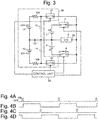
- FIG. 3 is a schematic configuration diagram of the high-voltage power supply device according to the second embodiment.
- Fig. 4 is a timing chart of a control signal when the polarity of an output voltage is switched in the high-voltage power supply device according to the second embodiment.
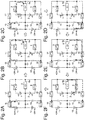
- Fig. 5 is an explanatory diagram of an operation of the high-voltage power supply device according to the second embodiment when switching the polarity of the output voltage.
- a component identical or equivalent to the high-voltage power supply device according to the first embodiment shown in Fig. 1 is assigned the same reference numeral.
- Figs. 5A to 5F correspond to Figs. 2A to 2F , respectively.
- the two second auxiliary switch circuits 15 and 16 in the high-voltage power supply device according to the first embodiment are replaced with resistors 105 and 106, respectively.
- These resistors 105 and 106 have a high resistance value of about a few hundreds of kilo-ohms to a few mega-ohms. That is, in the high-voltage power supply device according to the second embodiment, the auxiliary positive voltage generating unit 11 and the first capacitor 13 are constantly connected through the resistor 105, and the auxiliary negative voltage generating unit 12 and the second capacitor 14 are constantly connected through the resistor 106.
- the first capacitor 13 and the flight tube 5 are connected through the positive-side first auxiliary switch circuit 17, and a current based on the charge accumulated in the first capacitor 13 flows into the flight tube 5 (see Fig. 5B ).
- the capacitance of the flight tube 5 has been charged so that the voltage-applied-side end 5a has the negative polarity; however, it is rapidly charged to the positive polarity by the inflow of the current.
- the positive-side first auxiliary switch circuit 17 When the positive-side first auxiliary switch circuit 17 is ON, it is also connected to the auxiliary positive voltage generating unit 11 and the flight tube 5 through the resistor 105; however, the resistance value of the resistor 105 is high, thus, by making a time in which the positive-side first auxiliary switch circuit 17 is ON sufficiently short as compared with a below-described ON time of the positive-side switch circuit 3, a current flowing from the auxiliary positive voltage generating unit 11 to the flight tube 5 can be mostly ignored.
- the control unit 20 turns the positive-side first auxiliary switch circuit 17 OFF, and gives the positive-side switch circuit 3 a control signal shown in Fig. 4B to turn it ON.
- This ON time is 24 ms in the present example, and, as described above, is sufficiently long as compared with the ON time of the positive-side first auxiliary switch circuit 17. Accordingly, the positive voltage generating unit 1 is connected to the flight tube 5, thus a stable direct-current voltage with a voltage value of H [V] is applied to the flight tube 5 (see Fig. 5C ).
- the charging voltage is reduced by discharge of the first capacitor 13, the first capacitor 13 and the auxiliary positive voltage generating unit 11 are connected through the resistor 105; therefore, after the discharge, the first capacitor 13 is started being charged, and is charged until a voltage between its both ends becomes +(H+ ⁇ ) [V].
- a measurement is conducted in a state where a stable direct-current voltage from the positive voltage generating unit 1 is applied to the flight tube 5 (see Fig. 5D ). Meanwhile, in a state where the negative-side first auxiliary switch circuit 18 is OFF, a voltage between both ends of the second capacitor 14 is charged to -(H+ ⁇ ) [V] by the auxiliary negative voltage generating unit 12.
- the control unit 20 puts the positive-side switch circuit 3 into OFF state, and turns the negative-side first auxiliary switch circuit 18 ON only for a short time (in this example, 1 ms). Then, the second capacitor 14 and the flight tube 5 are connected through the negative-side first auxiliary switch circuit 18, and a current based on the charge accumulated in the second capacitor 14 flows from the flight tube 5 to the second capacitor 14 (see Fig. 5E ). Until immediately before this, the capacitance of the flight tube 5 has been charged so that the voltage-applied-side end 5a has the positive polarity; however, it is rapidly charged to the negative polarity by the outflow of the current.
- the control unit 20 turns the negative-side first auxiliary switch circuit 18 OFF, and turns the positive-side switch circuit 3 ON. Accordingly, the negative voltage generating unit 2 is connected to the flight tube 5, thus a stable negative direct-current voltage is applied to the flight tube 5 (see Fig. 5F ). Meanwhile, although the charging voltage is reduced by discharge of the second capacitor 14, when the negative-side first auxiliary switch circuit 18 is turned OFF, the second capacitor 14 is again charged until a voltage between its both ends becomes -(H+ ⁇ ) [V]. A measurement is conducted in a state where a stable direct-current voltage from the negative voltage generating unit 2 is applied to the flight tube 5 (see Fig. 5A ).
- the auxiliary power supply unit 10 is used when polarity of a voltage applied to the flight tube 5 is switched; needless to say, rising of the voltage can be speeded up by using the auxiliary power supply unit 10 also when application of a positive or negative high voltage is started from a state where no voltage has been applied.
- the high-voltage power supply device not only can be used for a purpose of applying a high voltage to a flight tube of a TOFMS, but also can be used for various purposes and apparatuses that require switching of a high voltage of about ⁇ several [kV] at high speed.
Landscapes
- Engineering & Computer Science (AREA)
- Power Engineering (AREA)
- Chemical & Material Sciences (AREA)
- Analytical Chemistry (AREA)
- Dc-Dc Converters (AREA)
- Charge And Discharge Circuits For Batteries Or The Like (AREA)
- Electron Tubes For Measurement (AREA)
- Physics & Mathematics (AREA)
- Nonlinear Science (AREA)
- Electromagnetism (AREA)
- General Physics & Mathematics (AREA)
- Radar, Positioning & Navigation (AREA)
- Automation & Control Theory (AREA)
Abstract
Description
- The present invention relates to a high-voltage power supply device, and more particularly to a high-voltage power supply device suitable for applying a direct-current high voltage to a capacitive load having a relatively high capacitance, such as a flight tube of a time-of-flight mass spectrometer.
- A time-of-flight mass spectrometer (hereinafter, referred to as "TOFMS" in accordance with the common usage) measures a time-of-flight required for various ions derived from a sample to fly in a flight space formed in a flight tube from when the ions have been emitted from an ion emitting unit. Since flying ions have a speed depending on their mass-to-charge ratio m/z, the above-described time-of-flight depends on respective mass-to-charge ratios of the ions, thus a mass-to-charge ratio can be found from a time-of-flight of each ion.
- As disclosed in
Patent Literature 1, for example, in a TOFMS, a flight tube is applied with a direct-current high voltage of about a few to a dozen kilovolts, whose polarity differs depending on the polarity of an ion to be analyzed, from a high-voltage power supply device capable of switching and outputting direct-current high voltage of both positive and negative polarities. If the potential of the flight tube changes during execution of analysis, the flight time of the ion varies, which may decrease the mass accuracy and the mass resolution. Furthermore, in some reflectron TOFMSs, the potential of the flight tube serves as a reference potential of the reflectron, which forms a reflection electric field for reflecting ions; in such a case, the influence of a change in the potential of the flight tube during execution of analysis on the mass accuracy is even greater. - Accordingly, the above-described high-voltage power supply device is required to output a direct-current high voltage of about a few to a dozen kilovolts at high stability with a voltage fluctuation of about a few parts per million or less. Furthermore, in a TOFMS capable of repeatedly and alternately conducting a measurement of positive ions and a measurement of negative ions, switching of the polarity of an output voltage from a high-voltage power supply device needs to be performed within a short period; therefore, it is also required to decrease the time as much as possible to stabilize the voltage when the polarity of the output voltage is switched.
-
Fig. 6 is a schematic configuration of a conventional, general high-voltage power supply device for a flight tube and an explanatory diagram of its operation. - As shown in
Fig. 6A , this high-voltage power supply device includes a positivevoltage generating unit 1 that outputs a positive-polarity direct-current high voltage with a voltage value of H [V], a negativevoltage generating unit 2 that outputs a negative-polarity direct-current high voltage with a voltage value of -H [V], a positive-side switch circuit 3 provided on a line electrically connecting the positivevoltage generating unit 1 and aflight tube 5, which is a load, and a negative-side switch circuit 4 provided on a line electrically connecting the negativevoltage generating unit 2 and theflight tube 5. In general, theswitch circuits unit 1 and the negative voltage generatingunit 2, a booster circuit having voltage doubler rectifier circuits, such as Cockcroft-Walton circuits, connected in multiple stages is used in many cases. The voltage value ±H of the direct-current high voltage is generally about ±5 to ±10 [kV]. Theflight tube 5 is a metallic, substantially cylindrical tube with a length of about 1 to 2 [m], and is a capacitive load having a capacitance of Ca [F]. - In a TOFMS, when a high voltage applied to the
flight tube 5 is alternately switched between positive and negative to alternately perform a measurement of positive ions and a measurement of negative ions, the positive-side switch circuit 3 and the negative-side switch circuit 4 are alternately turned ON and OFF. However, in order to prevent turning both of theswitch circuits switch circuits - Now, if the positive-
side switch circuit 3 is turned ON from a state where both of theswitch circuits unit 1 to theflight tube 5 through the positive-side switch circuit 3, and the capacitance of theflight tube 5 is charged (seeFig. 6A ). When the capacitance is fully charged, the potential of a voltage-applied-side end 5a of theflight tube 5 becomes stable at +H [V], and in that state, a measurement is conducted (seeFig. 6B ). After the measurement ends, in order to switch so that a negative high voltage is applied to theflight tube 5, first, the positive-side switch circuit 3 is turned OFF, and then the negative-side switch circuit 4 is turned ON. Then, a current i2 based on the charge previously accumulated in the capacitance of theflight tube 5 flows from theflight tube 5 to the negative voltage generatingunit 2 through the negative-side switch circuit 4. And then, the capacitance is charged to the opposite polarity (seeFig. 6C ). When the capacitance is fully charged to the opposite polarity, the potential of the voltage-applied-side end 5a of theflight tube 5 becomes stable at -H [V], and in that state, a measurement is conducted (seeFig. 6D ). - Although the capacitance of the
flight tube 5 depends on its size, etc., it is generally about a few hundreds of picofarads to a few nanofarads. A stabilization time ts required for the potential of the voltage-applied-side end 5a of theflight tube 5 to be stabilized depends on the current supply capacity of the voltage generatingunit switch circuits side end 5a of theflight tube 5 is stabilized in a positive direction or a negative direction. If the current supply capacity is increased (i.e., if the current i1 or i2 is increased), the stabilization time ts is shortened. But the larger the current supply capacity is increased, the higher the cost of the voltage generatingunit unit unit flight tube 5 is about a few nanofarads, the stabilization time ts in a conventional high-voltage power supply device is about a few hundreds of milliseconds, and this length of time is a significant restraint on shortening the time to switch the polarity of an applied voltage to theflight tube 5, i.e., shortening a measurement period with which a measurement of positive ions and a measurement of negative ions are alternately conducted. - Furthermore, such problems occur not only when the polarity of an output voltage is switched between positive and negative, but also when application of the voltage is started from a state where application of the voltage is at a stop, i.e., when an applied voltage is risen from zero to +H [V] or -H [V].
- Moreover, not only a high-voltage power supply device that applies a high voltage to the
flight tube 5, but also a high-voltage power supply device that applies a stable direct-current high voltage to a load (a capacitive load) having a relatively large capacitance has similar problems. - Patent Literature 1:
JP 2006-80031 A - The present invention has been made to solve the above-described problems, and is mainly intended, in a high-voltage power supply device that applies a stable high voltage to a capacitive load, to shorten the time of voltage rise when an application of the voltage is started from a halted state or when the polarity of the applied voltage is switched while suppressing the increase in device cost.
- The present invention made to solve the above-described problems is a high-voltage power supply device that applies a direct-current high voltage to a load, and includes:
- a) a main voltage generating unit configured to generate a predetermined direct-current high voltage;
- b) a switch unit configured to open and close a line connecting a voltage output terminal of the main voltage generating unit and the load; and
- c) an auxiliary power supply unit configured to charge a capacitance of the load by supplying the load with a larger current than a current being able to be supplied by the main voltage generating unit before or immediately after the switch unit is closed when application of the direct-current high voltage to the load by the main voltage generating unit is started by closing the switch unit being in an open state.
- In the high-voltage power supply device according to the present invention, when the switch unit being in an open state is closed, the main voltage generating unit and the load are connected through the switch unit, and the direct-current high voltage generated by the main voltage generating unit is applied to the load. At this time, the auxiliary power supply unit supplies the load with a larger current than a current being able to be supplied by the main voltage generating unit immediately before or immediately after the switch unit is closed for a short time. In a case where the direct-current high voltage applied to the load is positive, the auxiliary power supply unit should supply the load with a positive current (i.e., cause the current to flow into the load); on the other hand, in a case where the direct-current high voltage applied to the load is negative, the auxiliary power supply unit should supply the load with a negative current (i.e., draw out the current from the load). The capacitance of the load is rapidly charged with this current supplied from the auxiliary power supply unit, thus charge of the capacitance by current supply from the main voltage generating unit to the load becomes unnecessary or reduced, and the potential of the load is settled to an intended value in a short time after the switch unit is closed.
- In a case where a less-fluctuating, stable direct-current high voltage is applied to the load, as described above, the current supply capacity of the main voltage generating unit is subjected to restraints because of cost factors, etc. On the other hand, the auxiliary power supply unit is mainly intended to charge the capacitance of the load at the time of voltage rise alone, thus may be configured to be able to supply a large current only for a short time.
- Accordingly, in the high-voltage power supply device according to the present invention, the auxiliary power supply unit may be configured to include a capacitor, a charge power supply unit configured to charge the capacitor, and a first auxiliary switch unit configured to open and close a line connecting the capacitor and the load.
- In this configuration, before application of the direct-current high voltage to the load by the main voltage generating unit is started by switching the switch unit from an open state to a closed state, the capacitor is charged by the charge power supply unit in advance. Then, by closing the first auxiliary switch unit for a short time, for example, immediately before the switch unit is switched from an open state to a closed state, a current generated by the charge accumulated in the capacitor is supplied to the load through the first auxiliary switch unit to charge the capacitance of the load. After the first auxiliary switch unit is again opened, and the capacitor is separated from the load, the switch unit is closed, and the direct-current high voltage generated by the main voltage generating unit is applied to the load. By opening the first auxiliary switch unit, the charge accumulated in the capacitor is discharged, and a large current can be supplied to the load though briefly. Accordingly, the potential of the load can be increased in a short time, and, after the main voltage generating unit is connected to the load, can be quickly stabilized at the direct-current high voltage generated by the main voltage generating unit.
- According to an aspect of the high-voltage power supply device having the above-described configuration, the auxiliary power supply unit can be configured to further include a second auxiliary switch unit configured to open and close a line connecting the charge power supply unit and the capacitor, and is closed during a period in which the first auxiliary switch unit is open and is opened when the first auxiliary switch unit is closed.
- In this configuration, when the first auxiliary switch unit is closed, the second auxiliary switch unit is open, and the charge power supply unit is separated from the capacitor, thus a large current based on the charge accumulated in the capacitor immediately before this can be supplied to the load.
- According to another aspect of the high-voltage power supply device having the above-described configuration, the auxiliary power supply unit can be configured to further include a resistance unit that is provided on a line connecting the charge power supply unit and the capacitor, and limits the current from the charge power supply unit through the first auxiliary switch unit when the first auxiliary switch unit is closed.
- That is, in this aspect, the second auxiliary switch unit in the above-described aspect is replaced with the resistance unit. In this configuration, when the first auxiliary switch unit is closed, the capacitor and the charge power supply unit are connected through the resistance unit. However, if a resistance value of the resistance unit is set at a relatively large value, a current is less likely to flow from the charge power supply unit to the load through the resistance unit; therefore, when the first auxiliary switch unit is closed, a large current based on the charge accumulated in the capacitor can be supplied to the load.
- The high-voltage power supply device according to the present invention may be a single-polarity power supply device that applies a direct-current high voltage of either positive or negative polarity, but is also applicable to a positive/negative-polarity switchable power supply device that can selectively apply a direct-current high voltage of positive polarity and a direct-current high voltage of negative polarity to the load.
- That is, the high-voltage power supply device according to the present invention can be configured in such a way that the main voltage generating unit includes a positive-side main voltage generating unit configured to generate a direct-current high voltage of positive polarity and a negative-side main voltage generating unit configured to generate a direct-current high voltage of negative polarity; the switch unit includes a positive-side switch unit configured to open and close a line connecting a voltage output terminal of the positive-side main voltage generating unit and the load and a negative-side switch unit configured to open and close a line connecting a voltage output terminal of the negative-side main voltage generating unit and the load; and the auxiliary power supply unit includes a positive-side auxiliary power supply unit configured to charge the capacitance of the load to positive polarity by supplying the load with a larger current than a current being able to be supplied by the positive-side main voltage generating unit before or immediately after the positive-side switch unit is closed when application of the direct-current high voltage to the load by the positive-side main voltage generating unit is started by closing the positive-side switch unit being in an open state, and a negative-side auxiliary power supply unit configured to charge the capacitance of the load to negative polarity by supplying the load with a larger current than a current being able to be supplied by the negative-side main voltage generating unit before or immediately after the negative-side switch unit is closed when application of the direct-current high voltage to the load by the negative-side main voltage generating unit is started by closing the negative-side switch unit being in an open state.
- According to this configuration, not only when a positive or negative voltage is started being applied to the load with no voltage applied, but also when the polarity of the direct-current high voltage applied to the load is switched from positive to negative or vice versa, the capacitance of the load can be quickly charged to a polarity opposite to the previous polarity, thus a voltage after the switching can be quickly stabilized.
- For example, in a TOFMS, a measurement needs to be conducted after the potential of a flight tube whose polarity is switched in accordance with the polarity of an ion to be analyzed is sufficiently stabilized; however, by using the high-voltage power supply device according to the present invention as a power supply device, switching of the potential of the flight tube is quickly performed, thus it is possible to shorten a measurement period with which a measurement of positive ions and a measurement of negative ions are alternately executed.
- In the high-voltage power supply device according to the present invention, a dedicated auxiliary power supply unit, which is different from a main voltage generating unit having high stability in an output voltage, quickly charges the capacitance of a load when application of the voltage is started from a halted state or when the polarity of the applied voltage is switched; therefore, even if a restraint is imposed on the output current of the main voltage generating unit, the potential of the load can be statically determined to an intended stable value quickly. Accordingly, the output current of the main voltage generating unit having the high voltage stability can be suppressed, thus the increase in cost can be suppressed. Furthermore, it is not necessary to increase the responsiveness to a load change more than is necessary; therefore, it is possible to apply a stable direct-current high voltage to the load.
-
-
Fig. 1 is a schematic configuration diagram of a high-voltage power supply device according to a first embodiment of the present invention. -
Fig. 2 is an explanatory diagram of an operation of the high-voltage power supply device according to the first embodiment when switching the polarity of an output voltage. -
Fig. 3 is a schematic configuration diagram of a high-voltage power supply device according to a second embodiment of the present invention. -
Fig. 4 is a timing chart of a control signal when the polarity of an output voltage is switched in the high-voltage power supply device according to the second embodiment. -
Fig. 5 is an explanatory diagram of an operation of the high-voltage power supply device according to the second embodiment when switching the polarity of the output voltage. -
Fig. 6 is a schematic configuration of a conventional high-voltage power supply device and an explanatory diagram of its operation. - In the following, a first embodiment of a high-voltage power supply device according to the present invention is described with reference to accompanying drawings.
Fig. 1 is a schematic configuration diagram of the high-voltage power supply device according to the first embodiment.Fig. 2 is an explanatory diagram of an operation of the high-voltage power supply device according to the first embodiment when switching the polarity of an output voltage. InFig. 1 , a component identical or equivalent to the conventional high-voltage power supply device shown inFig. 6 is assigned the same reference numeral. - In the high-voltage power supply device according to the present embodiment, the positive
voltage generating unit 1, the negativevoltage generating unit 2, the positive-side switch circuit 3, the negative-side switch circuit 4, and theflight tube 5, which is a load, are exactly the same as the conventional high-voltage power supply device shown inFig. 6 ; besides these, an auxiliarypower supply unit 10 is further added. - The auxiliary
power supply unit 10 includes an auxiliary positivevoltage generating unit 11 that outputs a positive-polarity direct-current high voltage with a voltage value of +(H+α) [V], an auxiliary negativevoltage generating unit 12 that outputs a negative-polarity direct-current high voltage with a voltage value of -(H+α) [V], afirst capacitor 13 whose one end is grounded, and asecond capacitor 14 whose one end is grounded, a positive-side secondauxiliary switch circuit 15 provided on a line electrically connecting the auxiliary positivevoltage generating unit 11 and the other end of thefirst capacitor 13, a positive-side firstauxiliary switch circuit 17 provided on a line electrically connecting the other end of thefirst capacitor 13 and theflight tube 5, a negative-side secondauxiliary switch circuit 16 provided on a line electrically connecting the auxiliary negativevoltage generating unit 12 and the other end of thesecond capacitor 14, and a negative-side firstauxiliary switch circuit 18 provided on a line electrically connecting the other end of thesecond capacitor 14 and theflight tube 5. - All of the
switch circuits 15 to 18 in the auxiliarypower supply unit 10 can include one or more semiconductor switching devices such as MOSFETs, as with theswitch circuits control unit 20 controls respective on (closed) and off (open) operations of theswitch circuits - The voltage value +(H+α) [V] of the direct-current high voltage that is an output of the auxiliary positive
voltage generating unit 11 is higher by α [V] than the voltage value H [V] of the direct-current high voltage that is an output of the positivevoltage generating unit 1. Likewise, the voltage value -(H+α) [V] of the direct-current high voltage that is an output of the auxiliary negativevoltage generating unit 12 is higher in the absolute value by α [V] than the voltage value H [V] of the direct-current high voltage that is an output of the negativevoltage generating unit 2. As will be described later, α [V] is appropriately determined in accordance with respective capacities of the first andsecond capacitors flight tube 5, etc. - The operation of this high-voltage power supply device when switching the polarity of an applied voltage to the
flight tube 5 is described with reference toFig. 2 . - Now, with the negative-
side switch circuit 4 in ON state, the positive-side switch circuit 3 in OFF state, and the firstauxiliary switch circuits side end 5a of theflight tube 5 is assumed to be stable at -H [V]. At this time, the positive-side secondauxiliary switch circuit 15 is in ON state, and thefirst capacitor 13 is charged with the output voltage +(H+α) [V] of the auxiliary positive voltage generating unit 11 (seeFig. 2A ). When fully charged, a voltage between both ends of thefirst capacitor 13 becomes +(H+α) [V]. - When the applied voltage to the
flight tube 5 is switched from the negative polarity to the positive polarity, first, the negative-side switch circuit 4 and the positive-side secondauxiliary switch circuit 15 are put into OFF state, and the positive-side firstauxiliary switch circuit 17 is turned ON. Then, thefirst capacitor 13 and theflight tube 5 are connected through the positive-side firstauxiliary switch circuit 17, and a current based on the charge accumulated in thefirst capacitor 13 flows into the flight tube 5 (seeFig. 2B ). Until immediately before this, the capacitance of theflight tube 5 has been charged so that the voltage-applied-side end 5a has the negative polarity; however, it is rapidly charged to the positive polarity by the inflow of the current. - At this time, a voltage H' [V] at the voltage-applied-
side end 5a, a capacity Cb [F] of thefirst capacitor 13, a capacitance value Ca [F] of the capacitance of theflight tube 5, and α [V] are in the following relationship.
- Therefore, if Ca and Cb are already known, α [V] that allows H' [V] to be H [V] is found. For example, if Ca = 1 [nF], Cb = 7 [nF], and H [V] = ±7 [kV], α = (2/7) × 7 = 2 [kV]. That is, the output voltage of the auxiliary positive
voltage generating unit 11 may be 9 [kV]. - After the capacitance of the
flight tube 5 has been charged with the current supplied from thefirst capacitor 13, the positive-side firstauxiliary switch circuit 17 is turned OFF, and the positive-side switch circuit 3 and the positive-side secondauxiliary switch circuit 15 are turned ON. Accordingly, the positivevoltage generating unit 1 is connected to theflight tube 5, thus a stable direct-current voltage with a voltage value of H [V] is applied to the flight tube 5 (seeFig. 2C ). Meanwhile, although the charging voltage is reduced by discharge of thefirst capacitor 13, the positive-side secondauxiliary switch circuit 15 is turned ON, and therefore thefirst capacitor 13 and the auxiliary positivevoltage generating unit 11 are connected again, and thefirst capacitor 13 is charged until a voltage between its both ends becomes +(H+α) [V]. A measurement is conducted in a state where a stable direct-current voltage from the positivevoltage generating unit 1 is applied to the flight tube 5 (seeFig. 2D ). At the time of execution of the measurement, the negative-side secondauxiliary switch circuit 16 is put into ON state, thus thesecond capacitor 14 is charged with the output voltage -(H+α) [V] of the auxiliary negativevoltage generating unit 12, and a voltage between both ends of thesecond capacitor 14 becomes -(H+α) [V]. - When the measurement is finished, to switch the applied voltage to the
flight tube 5 from the positive polarity to the negative polarity, thecontrol unit 20 puts the positive-side switch circuit 3 and the negative-side secondauxiliary switch circuit 16 into OFF state, and turns the negative-side firstauxiliary switch circuit 18 ON. Then, thesecond capacitor 14 and theflight tube 5 are connected through the negative-side firstauxiliary switch circuit 18, and a current based on the charge accumulated in thesecond capacitor 14 flows from theflight tube 5 to the second capacitor 14 (seeFig. 2E ). Until immediately before this, the capacitance of theflight tube 5 has been charged so that the voltage-applied-side end 5a has the positive polarity; however, it is rapidly charged to the negative polarity by the outflow of the current. - After the capacitance of the
flight tube 5 has been charged to the negative polarity by drawing out of the current by thesecond capacitor 14, thecontrol unit 20 turns the negative-side firstauxiliary switch circuit 18 OFF, and turns the positive-side switch circuit 3 and the negative-side secondauxiliary switch circuit 16 ON. Accordingly, the negativevoltage generating unit 2 is connected to theflight tube 5, thus a stable negative direct-current voltage is applied to the flight tube 5 (seeFig. 2F ). Meanwhile, although the charging voltage is reduced by discharge of thesecond capacitor 14, the negative-side secondauxiliary switch circuit 16 is turned ON, and therefore thesecond capacitor 14 and the auxiliary negativevoltage generating unit 12 are connected again, and thesecond capacitor 14 is charged until a voltage between its both ends becomes -(H+α) [V]. A measurement is conducted in a state where a stable direct-current voltage from the negativevoltage generating unit 2 is applied to the flight tube 5 (seeFig. 2A ). - As described above, in the high-voltage power supply device according to the first embodiment, when the voltage applied to the
flight tube 5 is switched from the positive polarity to the negative polarity or vice versa, in the auxiliarypower supply unit 10, a current based on the charge accumulated in thefirst capacitor 13 or thesecond capacitor 14 in advance is supplied to theflight tube 5, and the capacitance of theflight tube 5 is charged to a value around the direct-current high voltage of a polarity intended to be switched to. The current supplied from thefirst capacitor 13 or thesecond capacitor 14 does not have restraints like those put on the current supplied from thevoltage generating unit auxiliary switch circuit flight tube 5 is performed quickly, and therefore the time (the stabilization time) to become a stable direct-current voltage when the polarity is switched also becomes shorter than a case where there is no auxiliarypower supply unit 10. - A second embodiment of a high-voltage power supply device according to the present invention is described with reference to
Figs. 3 to 5 .Fig. 3 is a schematic configuration diagram of the high-voltage power supply device according to the second embodiment.Fig. 4 is a timing chart of a control signal when the polarity of an output voltage is switched in the high-voltage power supply device according to the second embodiment.Fig. 5 is an explanatory diagram of an operation of the high-voltage power supply device according to the second embodiment when switching the polarity of the output voltage. InFig. 3 , a component identical or equivalent to the high-voltage power supply device according to the first embodiment shown inFig. 1 is assigned the same reference numeral. Furthermore,Figs. 5A to 5F correspond toFigs. 2A to 2F , respectively. - In the high-voltage power supply device according to the second embodiment, the two second
auxiliary switch circuits resistors resistors voltage generating unit 11 and thefirst capacitor 13 are constantly connected through theresistor 105, and the auxiliary negativevoltage generating unit 12 and thesecond capacitor 14 are constantly connected through theresistor 106. - As shown in
Fig. 5A , with the negative-side switch circuit 4 in ON state, the positive-side switch circuit 3 in OFF state, and the firstauxiliary switch circuits side end 5a of theflight tube 5 is stable at -H [V], a voltage between both ends of thefirst capacitor 13 connected to the auxiliary positivevoltage generating unit 11 through theresistor 105 is charged with +(H+α) [V]. After that, when the applied voltage to theflight tube 5 is switched from the negative polarity to the positive polarity, the negative-side switch circuit 4 is put into OFF state, and thecontrol unit 20 gives the positive-side first auxiliary switch circuit 17 a control signal shown inFig. 4A to turn it on only for a short time (in the present example, 1 ms). Then, thefirst capacitor 13 and theflight tube 5 are connected through the positive-side firstauxiliary switch circuit 17, and a current based on the charge accumulated in thefirst capacitor 13 flows into the flight tube 5 (seeFig. 5B ). Until immediately before this, the capacitance of theflight tube 5 has been charged so that the voltage-applied-side end 5a has the negative polarity; however, it is rapidly charged to the positive polarity by the inflow of the current. When the positive-side firstauxiliary switch circuit 17 is ON, it is also connected to the auxiliary positivevoltage generating unit 11 and theflight tube 5 through theresistor 105; however, the resistance value of theresistor 105 is high, thus, by making a time in which the positive-side firstauxiliary switch circuit 17 is ON sufficiently short as compared with a below-described ON time of the positive-side switch circuit 3, a current flowing from the auxiliary positivevoltage generating unit 11 to theflight tube 5 can be mostly ignored. - After the capacitance of the
flight tube 5 has been charged with the current supplied from thefirst capacitor 13, thecontrol unit 20 turns the positive-side firstauxiliary switch circuit 17 OFF, and gives the positive-side switch circuit 3 a control signal shown inFig. 4B to turn it ON. This ON time is 24 ms in the present example, and, as described above, is sufficiently long as compared with the ON time of the positive-side firstauxiliary switch circuit 17. Accordingly, the positivevoltage generating unit 1 is connected to theflight tube 5, thus a stable direct-current voltage with a voltage value of H [V] is applied to the flight tube 5 (seeFig. 5C ). Meanwhile, although the charging voltage is reduced by discharge of thefirst capacitor 13, thefirst capacitor 13 and the auxiliary positivevoltage generating unit 11 are connected through theresistor 105; therefore, after the discharge, thefirst capacitor 13 is started being charged, and is charged until a voltage between its both ends becomes +(H+α) [V]. A measurement is conducted in a state where a stable direct-current voltage from the positivevoltage generating unit 1 is applied to the flight tube 5 (seeFig. 5D ). Meanwhile, in a state where the negative-side firstauxiliary switch circuit 18 is OFF, a voltage between both ends of thesecond capacitor 14 is charged to -(H+α) [V] by the auxiliary negativevoltage generating unit 12. - When the measurement is finished, to switch the applied voltage to the
flight tube 5 from the positive polarity to the negative polarity, thecontrol unit 20 puts the positive-side switch circuit 3 into OFF state, and turns the negative-side firstauxiliary switch circuit 18 ON only for a short time (in this example, 1 ms). Then, thesecond capacitor 14 and theflight tube 5 are connected through the negative-side firstauxiliary switch circuit 18, and a current based on the charge accumulated in thesecond capacitor 14 flows from theflight tube 5 to the second capacitor 14 (seeFig. 5E ). Until immediately before this, the capacitance of theflight tube 5 has been charged so that the voltage-applied-side end 5a has the positive polarity; however, it is rapidly charged to the negative polarity by the outflow of the current. - After the capacitance of the
flight tube 5 has been charged to the negative polarity by drawing out of the current by thesecond capacitor 14, thecontrol unit 20 turns the negative-side firstauxiliary switch circuit 18 OFF, and turns the positive-side switch circuit 3 ON. Accordingly, the negativevoltage generating unit 2 is connected to theflight tube 5, thus a stable negative direct-current voltage is applied to the flight tube 5 (seeFig. 5F ). Meanwhile, although the charging voltage is reduced by discharge of thesecond capacitor 14, when the negative-side firstauxiliary switch circuit 18 is turned OFF, thesecond capacitor 14 is again charged until a voltage between its both ends becomes -(H+α) [V]. A measurement is conducted in a state where a stable direct-current voltage from the negativevoltage generating unit 2 is applied to the flight tube 5 (seeFig. 5A ). - As described above, in the high-voltage power supply device according to the second embodiment, by making respective ON times of the first
auxiliary switch circuits switch circuits - It is to be noted that in the above description, the auxiliary
power supply unit 10 is used when polarity of a voltage applied to theflight tube 5 is switched; needless to say, rising of the voltage can be speeded up by using the auxiliarypower supply unit 10 also when application of a positive or negative high voltage is started from a state where no voltage has been applied. - Furthermore, the above-described configuration of the high-voltage power supply device is merely an example of the present invention, and it is a matter of course that any modifications, additions, and alterations made appropriately within the gist of the present invention are also embraced in the scope of the claims of the present application.
- Moreover, it is obvious that the high-voltage power supply device according to the present invention not only can be used for a purpose of applying a high voltage to a flight tube of a TOFMS, but also can be used for various purposes and apparatuses that require switching of a high voltage of about ± several [kV] at high speed.
-
- 1...
- Positive Voltage Generating Unit
- 2...
- Negative Voltage Generating Unit
- 3...
- Positive-Side Switch Circuit
- 4...
- Negative-Side Switch Circuit
- 5...
- Flight Tube
- 5a...
- Voltage-Applied-Side End
- 10...
- Auxiliary Power Supply Unit
- 11...
- Auxiliary Positive Voltage Generating Unit
- 12...
- Auxiliary Negative Voltage Generating Unit
- 13...
- First Capacitor
- 14...
- Second Capacitor
- 15...
- Positive-Side Second Auxiliary Switch Circuit
- 16...
- Negative-Side Second Auxiliary Switch Circuit
- 17...
- Positive-Side First Auxiliary Switch Circuit
- 18...
- Negative-Side First Auxiliary Switch Circuit
- 105, 106...
- Resistor
- 20...
- Control Unit
Claims (5)
- A high-voltage power supply device that applies a direct-current high voltage to a load, the high-voltage power supply device comprising:a) a main voltage generating unit configured to generate a predetermined direct-current high voltage;b) a switch unit configured to open and close a line connecting a voltage output terminal of the main voltage generating unit and the load; andc) an auxiliary power supply unit configured to charge a capacitance of the load by supplying the load with a larger current than a current being able to be supplied by the main voltage generating unit before or immediately after the switch unit is closed when application of the direct-current high voltage to the load by the main voltage generating unit is started by closing the switch unit being in an open state.
- The high-voltage power supply device according to claim 1, wherein the auxiliary power supply unit includes: a capacitor; a charge power supply unit configured to charge the capacitor; and a first auxiliary switch unit configured to open and close a line connecting the capacitor and the load.
- The high-voltage power supply device according to claim 2, wherein the auxiliary power supply unit further includes a second auxiliary switch unit configured to open and close a line connecting the charge power supply unit and the capacitor, and is closed during a period in which the first auxiliary switch unit is open, and is opened when the first auxiliary switch unit is closed.
- The high-voltage power supply device according to claim 2, wherein the auxiliary power supply unit further includes a resistance unit that is provided on a line connecting the charge power supply unit and the capacitor, and limits a current from the charge power supply unit through the first auxiliary switch unit when the first auxiliary switch unit is closed.
- The high-voltage power supply device according to any one of claims 1 to 4, wherein
the main voltage generating unit includes a positive-side main voltage generating unit configured to generate a direct-current high voltage of positive polarity, and a negative-side main voltage generating unit configured to generate a direct-current high voltage of negative polarity,
the switch unit includes a positive-side switch unit configured to open and close a line connecting a voltage output terminal of the positive-side main voltage generating unit and the load, and a negative-side switch unit configured to open and close a line connecting a voltage output terminal of the negative-side main voltage generating unit and the load, and
the auxiliary power supply unit includes a positive-side auxiliary power supply unit configured to charge the capacitance of the load to positive polarity by supplying the load with a larger current than a current being able to be supplied by the positive-side main voltage generating unit before or immediately after the positive-side switch unit is closed when application of the direct-current high voltage to the load by the positive-side main voltage generating unit is started by closing the positive-side switch unit being in an open state, and a negative-side auxiliary power supply unit configured to charge the capacitance of the load to negative polarity by supplying the load with a larger current than a current being able to be supplied by the negative-side main voltage generating unit before or immediately after the negative-side switch unit is closed when application of the direct-current high voltage to the load by the negative-side main voltage generating unit is started by closing the negative-side switch unit being in an open state.
Applications Claiming Priority (1)
| Application Number | Priority Date | Filing Date | Title |
|---|---|---|---|
| PCT/JP2016/079491 WO2018066064A1 (en) | 2016-10-04 | 2016-10-04 | High-voltage power source device |
Publications (2)
| Publication Number | Publication Date |
|---|---|
| EP3525231A1 true EP3525231A1 (en) | 2019-08-14 |
| EP3525231A4 EP3525231A4 (en) | 2020-05-20 |
Family
ID=61831712
Family Applications (1)
| Application Number | Title | Priority Date | Filing Date |
|---|---|---|---|
| EP16918264.9A Withdrawn EP3525231A4 (en) | 2016-10-04 | 2016-10-04 | HIGH VOLTAGE POWER SUPPLY DEVICE |
Country Status (5)
| Country | Link |
|---|---|
| US (1) | US10984997B2 (en) |
| EP (1) | EP3525231A4 (en) |
| JP (1) | JP6658904B2 (en) |
| CN (1) | CN109791869B (en) |
| WO (1) | WO2018066064A1 (en) |
Families Citing this family (5)
| Publication number | Priority date | Publication date | Assignee | Title |
|---|---|---|---|---|
| JP6725080B2 (en) * | 2017-09-04 | 2020-07-15 | 株式会社島津製作所 | Mass spectrometer |
| WO2020017121A1 (en) | 2018-07-20 | 2020-01-23 | 株式会社島津製作所 | Power-supply device, mass spectroscopy device, and power-supply device manufacturing method |
| JP7059945B2 (en) * | 2019-01-23 | 2022-04-26 | 株式会社デンソー | Power system |
| EP4056995A4 (en) * | 2019-11-06 | 2023-12-20 | Shimadzu Corporation | Time-of-flight mass spectrometer and analysis method |
| US20240242957A1 (en) | 2021-06-09 | 2024-07-18 | Shimadzu Corporation | Time-of-flight mass spectrometer and time-of-flight mass spectrometry method |
Family Cites Families (22)
| Publication number | Priority date | Publication date | Assignee | Title |
|---|---|---|---|---|
| US5256875A (en) * | 1992-05-14 | 1993-10-26 | Teledyne Mec | Method for generating filtered noise signal and broadband signal having reduced dynamic range for use in mass spectrometry |
| JPH09285005A (en) * | 1996-04-09 | 1997-10-31 | Mitsubishi Heavy Ind Ltd | Dc-dc converter |
| JPH11330925A (en) * | 1998-05-19 | 1999-11-30 | Maw:Kk | Current pulse generating device |
| US6911650B1 (en) * | 1999-08-13 | 2005-06-28 | Bruker Daltonics, Inc. | Method and apparatus for multiple frequency multipole |
| JP3655589B2 (en) * | 2000-03-31 | 2005-06-02 | シマヅ リサーチ ラボラトリー(ヨーロッパ)リミティド | Radio frequency resonator |
| EP1360090B1 (en) * | 2001-02-16 | 2005-01-12 | Siemens Aktiengesellschaft | Motor vehicle electric system |
| EP1363386B1 (en) * | 2002-05-13 | 2005-01-05 | Luxon Energy Devices Corporation | High current pulse generator |
| JP3800178B2 (en) * | 2003-01-07 | 2006-07-26 | 株式会社島津製作所 | Mass spectrometer and mass spectrometry method |
| GB2415541B (en) * | 2004-06-21 | 2009-09-23 | Thermo Finnigan Llc | RF power supply for a mass spectrometer |
| KR100680704B1 (en) | 2004-07-29 | 2007-02-08 | 엘지전자 주식회사 | Sustain drive device of plasma display panel |
| KR100577763B1 (en) | 2004-09-08 | 2006-05-10 | 엘지전자 주식회사 | A driving device of a plasma display panel |
| US20060022904A1 (en) | 2004-07-29 | 2006-02-02 | Lg Electronics Inc. | Plasma display apparatus applying sustain pulse and driving method thereof |
| JP4333533B2 (en) * | 2004-09-13 | 2009-09-16 | 株式会社島津製作所 | Mass spectrometer |
| JP2008282594A (en) * | 2007-05-09 | 2008-11-20 | Shimadzu Corp | Ion trap mass spectrometer |
| GB0809950D0 (en) * | 2008-05-30 | 2008-07-09 | Thermo Fisher Scient Bremen | Mass spectrometer |
| JP2010249981A (en) * | 2009-04-14 | 2010-11-04 | Toyo Univ | Capacitive load driving circuit and display device |
| US9431226B2 (en) * | 2012-11-05 | 2016-08-30 | Shimadzu Corporation | High-voltage power unit and mass spectrometer using the power unit |
| US9689366B2 (en) * | 2013-06-13 | 2017-06-27 | Unison Industries, Llc | Method to decouple battery from high level cranking currents of diesel engines |
| JP6167934B2 (en) * | 2014-02-25 | 2017-07-26 | 株式会社島津製作所 | Mass spectrometer |
| JP2016029874A (en) * | 2014-07-22 | 2016-03-03 | トヨタ自動車株式会社 | Power supply system |
| JP6368928B2 (en) * | 2014-09-11 | 2018-08-08 | 京都電機器株式会社 | Power supply for DC sputtering equipment |
| US11482878B2 (en) * | 2016-04-15 | 2022-10-25 | Ucap Power, Inc. | Parallel string voltage support |
-
2016
- 2016-10-04 EP EP16918264.9A patent/EP3525231A4/en not_active Withdrawn
- 2016-10-04 CN CN201680089873.1A patent/CN109791869B/en active Active
- 2016-10-04 US US16/339,194 patent/US10984997B2/en active Active
- 2016-10-04 JP JP2018543511A patent/JP6658904B2/en active Active
- 2016-10-04 WO PCT/JP2016/079491 patent/WO2018066064A1/en not_active Ceased
Also Published As
| Publication number | Publication date |
|---|---|
| US20190311893A1 (en) | 2019-10-10 |
| JPWO2018066064A1 (en) | 2019-06-24 |
| EP3525231A4 (en) | 2020-05-20 |
| CN109791869A (en) | 2019-05-21 |
| WO2018066064A1 (en) | 2018-04-12 |
| US10984997B2 (en) | 2021-04-20 |
| JP6658904B2 (en) | 2020-03-04 |
| CN109791869B (en) | 2021-07-13 |
Similar Documents
| Publication | Publication Date | Title |
|---|---|---|
| EP3525231A1 (en) | High-voltage power source device | |
| US10229822B2 (en) | Mass spectrometer with high-voltage power source | |
| CN104769830B (en) | High voltage power supply apparatus and mass spectrometer using same | |
| EP3404695B1 (en) | Time-of-flight mass spectrometer | |
| US7855355B2 (en) | High-voltage power unit and mass spectrometer using the power unit | |
| DE102012100830B4 (en) | LEAK CURRENT DETECTION DEVICE | |
| US10505382B2 (en) | Switch apparatus | |
| JPWO2017145380A1 (en) | DC high-voltage power supply | |
| KR850002326A (en) | Electrostatic breakdown test method and apparatus for semiconductor devices | |
| CN105409106B (en) | High-voltage power supply device and the quality analysis apparatus using the device | |
| US11373851B2 (en) | High-voltage power supply device | |
| US20190157058A1 (en) | Time-of-flight mass spectrometer | |
| US11101127B2 (en) | Time-of-flight mass spectrometer | |
| JP2015159051A5 (en) | ||
| JP2015159051A (en) | High voltage power supply device and mass spectroscope using the same | |
| KR102003834B1 (en) | Method for voltage balancing of series-connected capacitors | |
| US11443935B2 (en) | Time-of-flight mass spectrometer | |
| KR101727330B1 (en) | Neutralization apparatus | |
| KR200472695Y1 (en) | Capacitor tester | |
| DE102016008053A1 (en) | Precharging a DC link capacitance of a DC intermediate circuit | |
| JPH0627190A (en) | Electrostatic destruction testing apparatus |
Legal Events
| Date | Code | Title | Description |
|---|---|---|---|
| PUAI | Public reference made under article 153(3) epc to a published international application that has entered the european phase |
Free format text: ORIGINAL CODE: 0009012 |
|
| 17P | Request for examination filed |
Effective date: 20190411 |
|
| AK | Designated contracting states |
Kind code of ref document: A1 Designated state(s): AL AT BE BG CH CY CZ DE DK EE ES FI FR GB GR HR HU IE IS IT LI LT LU LV MC MK MT NL NO PL PT RO RS SE SI SK SM TR |
|
| AX | Request for extension of the european patent |
Extension state: BA ME |
|
| DAV | Request for validation of the european patent (deleted) | ||
| DAX | Request for extension of the european patent (deleted) | ||
| A4 | Supplementary search report drawn up and despatched |
Effective date: 20200420 |
|
| RIC1 | Information provided on ipc code assigned before grant |
Ipc: H02J 7/34 20060101ALI20200414BHEP Ipc: H02M 3/156 20060101ALN20200414BHEP Ipc: H01J 49/40 20060101ALN20200414BHEP Ipc: H02J 1/00 20060101ALI20200414BHEP Ipc: H01J 49/02 20060101AFI20200414BHEP |
|
| STAA | Information on the status of an ep patent application or granted ep patent |
Free format text: STATUS: THE APPLICATION HAS BEEN WITHDRAWN |
|
| 18W | Application withdrawn |
Effective date: 20200611 |