EP3524424A1 - Stain disappearing laminate, and image display device and automobile component using said stain disappearing laminate - Google Patents
Stain disappearing laminate, and image display device and automobile component using said stain disappearing laminate Download PDFInfo
- Publication number
- EP3524424A1 EP3524424A1 EP16918338.1A EP16918338A EP3524424A1 EP 3524424 A1 EP3524424 A1 EP 3524424A1 EP 16918338 A EP16918338 A EP 16918338A EP 3524424 A1 EP3524424 A1 EP 3524424A1
- Authority
- EP
- European Patent Office
- Prior art keywords
- sebum
- stain
- disappearing laminate
- absorption
- diffusion layer
- Prior art date
- Legal status (The legal status is an assumption and is not a legal conclusion. Google has not performed a legal analysis and makes no representation as to the accuracy of the status listed.)
- Granted
Links
Images


Classifications
-
- C—CHEMISTRY; METALLURGY
- C09—DYES; PAINTS; POLISHES; NATURAL RESINS; ADHESIVES; COMPOSITIONS NOT OTHERWISE PROVIDED FOR; APPLICATIONS OF MATERIALS NOT OTHERWISE PROVIDED FOR
- C09D—COATING COMPOSITIONS, e.g. PAINTS, VARNISHES OR LACQUERS; FILLING PASTES; CHEMICAL PAINT OR INK REMOVERS; INKS; CORRECTING FLUIDS; WOODSTAINS; PASTES OR SOLIDS FOR COLOURING OR PRINTING; USE OF MATERIALS THEREFOR
- C09D5/00—Coating compositions, e.g. paints, varnishes or lacquers, characterised by their physical nature or the effects produced; Filling pastes
-
- B—PERFORMING OPERATIONS; TRANSPORTING
- B32—LAYERED PRODUCTS
- B32B—LAYERED PRODUCTS, i.e. PRODUCTS BUILT-UP OF STRATA OF FLAT OR NON-FLAT, e.g. CELLULAR OR HONEYCOMB, FORM
- B32B7/00—Layered products characterised by the relation between layers; Layered products characterised by the relative orientation of features between layers, or by the relative values of a measurable parameter between layers, i.e. products comprising layers having different physical, chemical or physicochemical properties; Layered products characterised by the interconnection of layers
- B32B7/02—Physical, chemical or physicochemical properties
-
- C—CHEMISTRY; METALLURGY
- C03—GLASS; MINERAL OR SLAG WOOL
- C03C—CHEMICAL COMPOSITION OF GLASSES, GLAZES OR VITREOUS ENAMELS; SURFACE TREATMENT OF GLASS; SURFACE TREATMENT OF FIBRES OR FILAMENTS MADE FROM GLASS, MINERALS OR SLAGS; JOINING GLASS TO GLASS OR OTHER MATERIALS
- C03C17/00—Surface treatment of glass, not in the form of fibres or filaments, by coating
- C03C17/34—Surface treatment of glass, not in the form of fibres or filaments, by coating with at least two coatings having different compositions
- C03C17/3405—Surface treatment of glass, not in the form of fibres or filaments, by coating with at least two coatings having different compositions with at least two coatings of organic materials
-
- C—CHEMISTRY; METALLURGY
- C09—DYES; PAINTS; POLISHES; NATURAL RESINS; ADHESIVES; COMPOSITIONS NOT OTHERWISE PROVIDED FOR; APPLICATIONS OF MATERIALS NOT OTHERWISE PROVIDED FOR
- C09D—COATING COMPOSITIONS, e.g. PAINTS, VARNISHES OR LACQUERS; FILLING PASTES; CHEMICAL PAINT OR INK REMOVERS; INKS; CORRECTING FLUIDS; WOODSTAINS; PASTES OR SOLIDS FOR COLOURING OR PRINTING; USE OF MATERIALS THEREFOR
- C09D133/00—Coating compositions based on homopolymers or copolymers of compounds having one or more unsaturated aliphatic radicals, each having only one carbon-to-carbon double bond, and at least one being terminated by only one carboxyl radical, or of salts, anhydrides, esters, amides, imides, or nitriles thereof; Coating compositions based on derivatives of such polymers
- C09D133/04—Homopolymers or copolymers of esters
- C09D133/06—Homopolymers or copolymers of esters of esters containing only carbon, hydrogen and oxygen, the oxygen atom being present only as part of the carboxyl radical
- C09D133/10—Homopolymers or copolymers of methacrylic acid esters
- C09D133/12—Homopolymers or copolymers of methyl methacrylate
-
- C—CHEMISTRY; METALLURGY
- C09—DYES; PAINTS; POLISHES; NATURAL RESINS; ADHESIVES; COMPOSITIONS NOT OTHERWISE PROVIDED FOR; APPLICATIONS OF MATERIALS NOT OTHERWISE PROVIDED FOR
- C09D—COATING COMPOSITIONS, e.g. PAINTS, VARNISHES OR LACQUERS; FILLING PASTES; CHEMICAL PAINT OR INK REMOVERS; INKS; CORRECTING FLUIDS; WOODSTAINS; PASTES OR SOLIDS FOR COLOURING OR PRINTING; USE OF MATERIALS THEREFOR
- C09D171/00—Coating compositions based on polyethers obtained by reactions forming an ether link in the main chain; Coating compositions based on derivatives of such polymers
-
- C—CHEMISTRY; METALLURGY
- C09—DYES; PAINTS; POLISHES; NATURAL RESINS; ADHESIVES; COMPOSITIONS NOT OTHERWISE PROVIDED FOR; APPLICATIONS OF MATERIALS NOT OTHERWISE PROVIDED FOR
- C09D—COATING COMPOSITIONS, e.g. PAINTS, VARNISHES OR LACQUERS; FILLING PASTES; CHEMICAL PAINT OR INK REMOVERS; INKS; CORRECTING FLUIDS; WOODSTAINS; PASTES OR SOLIDS FOR COLOURING OR PRINTING; USE OF MATERIALS THEREFOR
- C09D183/00—Coating compositions based on macromolecular compounds obtained by reactions forming in the main chain of the macromolecule a linkage containing silicon, with or without sulfur, nitrogen, oxygen, or carbon only; Coating compositions based on derivatives of such polymers
- C09D183/04—Polysiloxanes
-
- C—CHEMISTRY; METALLURGY
- C09—DYES; PAINTS; POLISHES; NATURAL RESINS; ADHESIVES; COMPOSITIONS NOT OTHERWISE PROVIDED FOR; APPLICATIONS OF MATERIALS NOT OTHERWISE PROVIDED FOR
- C09D—COATING COMPOSITIONS, e.g. PAINTS, VARNISHES OR LACQUERS; FILLING PASTES; CHEMICAL PAINT OR INK REMOVERS; INKS; CORRECTING FLUIDS; WOODSTAINS; PASTES OR SOLIDS FOR COLOURING OR PRINTING; USE OF MATERIALS THEREFOR
- C09D183/00—Coating compositions based on macromolecular compounds obtained by reactions forming in the main chain of the macromolecule a linkage containing silicon, with or without sulfur, nitrogen, oxygen, or carbon only; Coating compositions based on derivatives of such polymers
- C09D183/10—Block or graft copolymers containing polysiloxane sequences
-
- C—CHEMISTRY; METALLURGY
- C03—GLASS; MINERAL OR SLAG WOOL
- C03C—CHEMICAL COMPOSITION OF GLASSES, GLAZES OR VITREOUS ENAMELS; SURFACE TREATMENT OF GLASS; SURFACE TREATMENT OF FIBRES OR FILAMENTS MADE FROM GLASS, MINERALS OR SLAGS; JOINING GLASS TO GLASS OR OTHER MATERIALS
- C03C2217/00—Coatings on glass
- C03C2217/70—Properties of coatings
- C03C2217/76—Hydrophobic and oleophobic coatings
-
- C—CHEMISTRY; METALLURGY
- C03—GLASS; MINERAL OR SLAG WOOL
- C03C—CHEMICAL COMPOSITION OF GLASSES, GLAZES OR VITREOUS ENAMELS; SURFACE TREATMENT OF GLASS; SURFACE TREATMENT OF FIBRES OR FILAMENTS MADE FROM GLASS, MINERALS OR SLAGS; JOINING GLASS TO GLASS OR OTHER MATERIALS
- C03C2217/00—Coatings on glass
- C03C2217/70—Properties of coatings
- C03C2217/77—Coatings having a rough surface
-
- C—CHEMISTRY; METALLURGY
- C08—ORGANIC MACROMOLECULAR COMPOUNDS; THEIR PREPARATION OR CHEMICAL WORKING-UP; COMPOSITIONS BASED THEREON
- C08G—MACROMOLECULAR COMPOUNDS OBTAINED OTHERWISE THAN BY REACTIONS ONLY INVOLVING UNSATURATED CARBON-TO-CARBON BONDS
- C08G77/00—Macromolecular compounds obtained by reactions forming a linkage containing silicon with or without sulfur, nitrogen, oxygen or carbon in the main chain of the macromolecule
- C08G77/04—Polysiloxanes
-
- C—CHEMISTRY; METALLURGY
- C08—ORGANIC MACROMOLECULAR COMPOUNDS; THEIR PREPARATION OR CHEMICAL WORKING-UP; COMPOSITIONS BASED THEREON
- C08G—MACROMOLECULAR COMPOUNDS OBTAINED OTHERWISE THAN BY REACTIONS ONLY INVOLVING UNSATURATED CARBON-TO-CARBON BONDS
- C08G77/00—Macromolecular compounds obtained by reactions forming a linkage containing silicon with or without sulfur, nitrogen, oxygen or carbon in the main chain of the macromolecule
- C08G77/42—Block-or graft-polymers containing polysiloxane sequences
- C08G77/442—Block-or graft-polymers containing polysiloxane sequences containing vinyl polymer sequences
Definitions
- the present invention relates to a stain disappearing laminate, and an image display device and an automobile component using the stain disappearing laminate. More specifically, the present invention relates to a stain disappearing laminate that can eliminate light scattering caused by sebum, such as fingerprints, that is attached to a surface, to improve visibility.
- sebum stains are easily conspicuous, when sebum such as fingerprints and stains such as fingermarks are attached thereto, which cause light scattering.
- a method is conventionally known of forming a coating film on the surface, which film has low water-repellent / oil-repellent properties with low surface free energy.
- the attachment of sebum could not be completely inhibited even with the coating film with water-repellent / oil-repellent properties.
- a contact angle of a slight amount of the sebum attached increases and light is scattered, thus causing a problem that the sebum stain stands out even more.
- Patent Document 1 discloses a sebum absorption and diffusion film that makes sebum hardly noticeable by reducing the amount of the sebum on the film surface through absorption of sebum attached to a film surface into that film and diffusion of the sebum within the film.
- Patent Document 1 WO2008/120505A
- Patent Document 1 has high affinity for sebum.
- the amount of sebum attached to the film will increase, which will require time to make the sebum attached to the film surface absorbed and unnoticeable.
- the sebum absorbable within the sebum absorption and diffusion film may easily saturate, and this makes it difficult to absorb and diffuse sebum for a long term.
- the present invention is accomplished in view of such problems with the prior art, and an object of the present invention is to provide a stain disappearing laminate that can rapidly reduce scattering of light caused by sebum stains, and improve its visibility and aesthetic properties by reducing the scattering of light for a long term.
- the present inventors found that the object can be achieved by providing, on a surface, a sebum attachment inhibition layer that repels sebum and reduces the attachment of sebum as well as allows a slight amount of sebum attached to pass through to a sebum absorption and diffusion layer side, and accomplished the present invention.
- the stain disappearing laminate of the present invention has a sebum absorption and diffusion layer and a sebum attachment inhibition layer laminated on a base material in this order.
- the present invention is further characterized in that the sebum attachment inhibition layer repels sebum and reduces the attachment of the sebum, as well as allows the sebum attached to pass through to the sebum attachment inhibition layer side, and the sebum absorption and diffusion layer absorbs the sebum passed through the sebum attachment inhibition layer and diffuses it within the sebum absorption and diffusion layer itself.
- an image display device of the present invention is characterized in that it comprises the stain disappearing laminate on its surface.
- an automobile component of the present invention is characterized in that it comprises the stain disappearing laminate on its surface.
- the sebum attachment inhibition layer that reduces the attachment of sebum as well as allows a slight amount of sebum attached to pass through to the sebum absorption and diffusion layer side is provided on the surface. This makes it possible to provide a stain disappearing laminate that can rapidly reduce scattering of light caused by sebum stains, and can reduce the scattering of light for a long term to recover visibility and aesthetic properties.
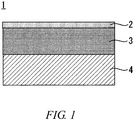
- the stain disappearing laminate 1 is a laminate that has a sebum absorption and diffusion layer 3 and a sebum attachment inhibition layer 2 laminated on a base material in this order, as shown in Fig. 1 .
- the sebum attachment inhibition layer 2 repels most of sebum 5 and reduces attachment of sebum 5 onto the stain disappearing laminate 1, while it also allows a slight portion of the sebum 5, that is not repelled and attached to the stain disappearing laminate 1, to pass through to the sebum absorption and diffusion layer 3 side.
- an amount of sebum attaching to the stain disappearing laminate can be reduced and scattering of light caused by sebum stains can be reduced rapidly and prevented for a long term. Therefore, it is possible to recover visibility and aesthetic properties. Furthermore, it is possible to maintain slipperiness at the time of touching the stain disappearing laminate, and thus to improve operability and an operational feeling of a touch panel that employs the stain disappearing laminate.
- the surface free energy of the sebum attachment inhibition layer is preferably 12 to 20 mJ/m 2 . Since the surface free energy of sebum is around 30 mJ/m 2 , the repellency and affinity for the sebum will be well-balanced by having the surface free energy of the sebum attachment inhibition layer in the above range. Therefore, not only attachment of sebum is reduced, but also sebum attached is passed through to the sebum absorption and diffusion layer side.
- the surface free energy of the sebum attachment inhibition layer can be adjusted, for example, by material described later that configures the sebum attachment inhibition layer, and by minute unevenness on the surface of the sebum attachment inhibition layer.
- the surface free energy of the sebum attachment inhibition layer can be determined by measuring contact angles with three or more types of liquid agents whose surface free energy are known, and calculating the critical surface free energy with Zisman plot.
- the sebum attachment inhibition layer can be formed with material containing a fluorine-containing compound.
- a material that configures the sebum absorption and diffusion layer or a compound that can link to oil-absorbing fine particles described later can be used as the fluorine-containing compound.
- the fluorine-containing compound includes, for example, a conventionally known silane coupling agent containing fluorine, such as alkoxysilane having a fluoride functional group perfluoropolyether structure.
- the sebum attachment inhibition layer 2 may be one in which an entire plane of the sebum absorption and diffusion layer is coated with a film derived from the fluorine-containing compound with a film thickness allowing generation of defects, or one in which a film derived from the fluorine-containing compound has grooves and / or holes, and a portion of the sebum absorption and diffusion layer 3 is exposed from a gap in the film derived from the fluorine-containing compound.
- Fig. 3 shows an example of a sebum attachment inhibition layer having grooves formed thereon.
- the sebum attachment inhibition layer 2 has a gap 21
- the sebum attached to the sebum attachment inhibition layer is repelled by the sebum attachment inhibition layer and passes through to the sebum attachment inhibition layer side through the gap 21, since the sebum cannot stay on the sebum attachment inhibition layer. Therefore, scattering of light caused by the sebum is suppressed.
- the sebum attachment inhibition layer 2 is preferably one that protrudes from the sebum absorption and diffusion layer, as shown in Fig. 4 . Since the sebum attachment inhibition layer 2 protrudes from the sebum absorption and diffusion layer 3 and has an inclined plane toward the sebum absorption and diffusion layer 3, an area for sebum 5 to be attached is reduced, and the sebum attached to the sebum attachment inhibition layer 2 can easily move to the gap 21, thereby scattering of light is rapidly reduced.
- the sebum attachment inhibition layer with a gap may be formed, for example, by a method of forming a gap by drawing with a laser or burning with ultraviolet ray after protecting with a photo mask, after forming a film of the sebum attachment inhibition layer, or by a method of depositing droplets sprayed by spray coating in a dotted manner.
- the sebum attachment inhibition layer protruded from the sebum absorption and diffusion layer may be formed by a method of forming a film of the sebum attachment inhibition layer with a large thickness and forming the gap, or by dispersing oil absorbing fine particles coated with the fluorine-containing compound into coating liquid of the sebum absorption and diffusion layer, and exposing the fine particles on the surface of the coated film of the sebum absorption and diffusion layer by making use of the repellency of the fluorine-containing compound.
- the film derived from the fluorine-containing compound has a film thickness of preferably 15 nm or less, and is preferably a monomolecular film.
- a film thickness of the film derived from the fluorine-containing compound is 15 nm or less, a molecular level defect is generated and the sebum is gradually taken into the sebum absorption and diffusion layer.
- the attached sebum rapidly passes through to the sebum absorption and diffusion layer side.
- the monomolecular film of the fluorine-containing compound can be formed by vapor deposition. When the film thickness of the sebum attachment inhibition layer is 20 nm or more, sebum cannot pass through, it is necessary to physically make a defect portion.
- the film thickness of the sebum absorption and diffusion layer can be determined with fluorine element concentration detected in a depth direction, by performing X-ray element analysis with ion drilling (XPS).
- XPS X-ray element analysis with ion drilling
- the sebum absorption and diffusion layer 3 has affinity for sebum, and absorbs and diffuses the sebum within the layer itself.
- the layer contains polymer material having a three-dimensional network structure, and may have oil absorbing fine particles if necessary.
- the polymer material has affinity for sebum.
- Fig. 5 shows an enlarged view of the sebum absorption and diffusion layer. As shown in Fig. 5 , the polymer material allows the sebum enter a micropore between molecular chains of the three-dimensional network structure, and absorbs and diffuses the sebum to hold it. Since the polymer material of the three-dimensional network structure has a point of crosslinking, it is not dissolved even when the sebum enters the micropore.
- Silicone elastomer can be used as the polymer material, including, for example, polydimethylsiloxane (PDMS), methyl vinyl silicone elastomer, methyl phenyl silicone elastomer, fluorosilicone elastomer, or copolymer thereof or methyl methacrylate - polydimethylsiloxane copolymer.
- PDMS polydimethylsiloxane
- methyl vinyl silicone elastomer methyl phenyl silicone elastomer
- fluorosilicone elastomer or copolymer thereof or methyl methacrylate - polydimethylsiloxane copolymer.
- One type of these material may be used alone, or two or more types may be used in combination.
- the surface free energy of the sebum absorption and diffusion layer is preferably greater than the surface free energy of the sebum attachment inhibition layer. With the surface free energy being closer to the sebum than the sebum attachment inhibition layer, the sebum absorption and diffusion layer has higher affinity for the sebum than the sebum attachment inhibition layer, and thus the sebum attached to the sebum attachment inhibition layer moves to the sebum absorption and diffusion layer more easily.
- the surface free energy of the sebum absorption and diffusion layer is preferably 18 to 50 mJ/m 2 , and more preferably 30 to 50 mJ/m 2 .
- the surface free energy of the sebum is around 30 mJ/m 2 , and with the surface free energy of the sebum absorption and diffusion layer being within the above range, the layer will have high affinity for sebum, which will facilitate absorption and diffusion and increase the absorption speed of the sebum.
- the surface free energy of the sebum absorption and diffusion layer can be measured as with the surface free energy of the sebum attachment inhibition layer, by peeling off the sebum attachment inhibition layer formed on the surface of the sebum absorption and diffusion layer to expose the sebum absorption and diffusion layer.
- oil absorbing fine particles examples include inorganic porous fine particles, such as silica, magnesium carbonate, calcium carbonate and calcium phosphate.
- the content of the oil absorbing fine particles in the sebum absorption and diffusion layer is not particularly limited, however since a haze value may increase with a large content of the oil absorbing fine particles, the content is preferably 10 mass% or less, if transparency is required.
- the base material 4 is not particularly limited, and conventionally known glass, resins, metals and the like may be used.
- Transparent base material can be suitably used for optical components such as image display devices and touch panels.
- the stain disappearing laminate preferably has a surface roughness (Ra) of 10 to 200 nm, more preferably 15 nm or more.
- the surface roughness (Ra) of 10 nm or more With the surface roughness (Ra) of 10 nm or more, the amount of sebum that attaches to the sebum attachment inhibition layer decreases, and with the surface roughness being 200 nm or less, scattering of light due to the surface roughness is prevented, and thus visibility is improved.
- the surface roughness (Ra) of the stain disappearing laminate can be adjusted, for example, by the oil absorbing fine particles added to the sebum absorption and diffusion layer, and by the gaps in the sebum attachment inhibition layer.
- the surface roughness (Ra) of the stain disappearing laminate can be measured by an atomic force microscope (AFM).
- the stain disappearing laminate preferably has a haze value (Hz) of 3% or less. With the haze value being within the above range, the stain disappearing laminate satisfies a transparency required for automobile components and optical components such as image display devices.
- the haze value can be measured according to JIS K7136 with a haze / transmittance meter (Murakami Color Research Laboratory).
- An image display device of the present invention comprises the stain disappearing laminate.
- the image display device comprising the stain disappearing laminate, it is possible to prevent sebum stains such as fingerprints for a long term, and restore visibility.
- Examples of the image display device include a mobile phone, a personal computer, a ticket vending machine, a bank terminal, a touch panel, an electronic blackboard and the like.
- the automobile component of the present invention comprises the stain disappearing laminate.
- the automobile component comprising the antifouling structure, it is possible to prevent sebum stains such as fingerprints for a long term, and restore visibility / aesthetic properties.
- Examples of the automobile component include transparent components such as a touch panel for a car navigation system, a camera lens, a mirror, a glass window, a meter panel and a window panel, as well as opaque components using a decorative panel, such as a console panel and a door panel, whose aesthetic property deteriorates due to sebum stains.
- Liquid A and Liquid B of polydimethylsiloxane (Shin-Etsu Silicone: Two-components type silicone rubber: KE-109E) were homogenously mixed to prepare a sebum absorption and diffusion layer coating liquid.
- the sebum absorption and diffusion layer coating liquid was applied on a transparent glass base material by using a bar coater so that a dried film thickness of 10 ⁇ m is obtained, and was heated to dry for one hour at 150° C to form a sebum absorption and diffusion layer.
- Alkoxysilane having a perfluoropolyether structure (manufactured by Daikin Industries: OPTOOL DSX) was deposited on a surface of the sebum absorption and diffusion layer under a condition, in which a film thickness of 5 nm is obtained, by vacuum deposition, to form a sebum attachment inhibition layer made of a monomolecular film of a fluorine-containing compound, thus obtaining a stain disappearing laminate.
- Liquid A and Liquid B of methyl methacrylate - polydimethylsiloxane copolymer (manufactured by Taisei Fine Chemical) were homogenously mixed to prepare a sebum absorption and diffusion layer coating liquid.
- the stain disappearing laminate was obtained as with Example 1, except that the sebum absorption and diffusion layer coating liquid was applied on a transparent glass base material by using a bar coater so that a dried film thickness of 10 ⁇ m is obtained, and was heated to dry for one hour at 150° C to form a sebum absorption and diffusion layer.
- Alkoxysilane having a perfluoropolyether structure (manufactured by Daikin Industries: OPTOOL DSX) was deposited on the surface of the sebum absorption and diffusion layer under a condition, in which a film thickness of 10 nm is obtained, by vacuum deposition, to form a sebum attachment inhibition layer made of a fluorine-containing compound, thus obtaining a stain disappearing laminate.
- Liquid A and Liquid B of methyl methacrylate - polydimethylsiloxane copolymer (manufactured by Taisei Fine Chemical) were homogenously mixed, and 3 mass% of colloidal silica (average particle size 50 nm; manufactured by Nissan Chemical: SNOWTEX: ST-50) with respect to a solid content of the methyl methacrylate - polydimethylsiloxane copolymer was kneaded and dispersed to prepare a sebum absorption and diffusion layer coating liquid.
- the stain disappearing laminate was obtained as with Example 1, except that the sebum absorption and diffusion layer coating liquid was applied on a transparent glass base material by using a bar coater so that a dried film thickness of 10 ⁇ m is obtained, and was heated to dry for one hour at 150° C to form a sebum absorption and diffusion layer.
- a surface of colloidal silica (average particle size 50 nm; manufactured by Nissan Chemical: SNOWTEX: ST-50) was treated with perfluorosilane, to obtain hydrophobic colloidal silica.
- Liquid A and Liquid B of methyl methacrylate - polydimethylsiloxane copolymer (manufactured by Taisei Fine Chemical) were homogenously mixed, and 6 mass% of the hydrophobic colloidal silica with respect to a solid content of the methyl methacrylate - polydimethylsiloxane copolymer was kneaded and dispersed to prepare coating liquid.
- the coating liquid was applied on a transparent glass base material by using a bar coater so that a dried film thickness of 10 ⁇ m is obtained, and after exposing the hydrophobic colloidal silica on the surface by leaving for 15 minutes, this was heated to dry for one hour at 150° C, to obtain a stain disappearing laminate having a sebum attachment inhibition layer of hydrophobic colloidal silica formed on the sebum absorption and diffusion layer.
- Liquid A and Liquid B of polydimethylsiloxane (Shin-Etsu Silicone: Two-components type silicone rubber: KE-109E) were homogenously mixed, and 4 mass% of the hydrophobic colloidal silica with respect to a solid content of the polydimethylsiloxane was kneaded and dispersed to prepare coating liquid.
- the coating liquid was applied on a transparent glass base material by using a bar coater so that a dried film thickness of 10 ⁇ m is obtained, and after exposing the hydrophobic colloidal silica on the surface by leaving for 15 minutes, this was heated to dry for one hour at 150°C, to obtain a stain disappearing laminate having a sebum attachment inhibition layer of hydrophobic colloidal silica formed on the sebum absorption and diffusion layer.
- a stain disappearing laminate was obtained as with Example 6 in which a sebum attachment inhibition layer of hydrophobic colloidal silica is formed on a sebum absorption and diffusion layer, except that the added amount of the hydrophobic colloidal silica is 3 mass%.
- a stain disappearing laminate was obtained as with Example 6 in which a sebum attachment inhibition layer of hydrophobic colloidal silica is formed on a sebum absorption and diffusion layer, except that the added amount of the hydrophobic colloidal silica is 8 mass%.
- the surface of the stain disappearing laminate prepared in Example 1 was covered by a photomask with a pitch of 2 mm and a line width of 1.5 mm, vacuum ultraviolet ray (wavelength 180 nm: Eximer lamp unit manufactured by Ushio Inc.) was irradiated inside a vacuum chamber of 50 Torr or less for 20 minutes, to obtain a stain disappearing laminate having a sebum attachment inhibition layer with 0.5 mm grooves at 1.5 mm intervals.
- vacuum ultraviolet ray wavelength 180 nm: Eximer lamp unit manufactured by Ushio Inc.
- a stain disappearing laminate was obtained as with Example 2, except that no sebum attachment inhibition layer was formed.
- Alkoxysilane having a perfluoropolyether structure (manufactured by Daikin Industries: OPTOOL DSX) was deposited on the surface of a transparent glass base material under a condition, in which a film thickness of 20 nm is obtained, by vacuum deposition, to form a sebum attachment inhibition layer made of a fluorine-containing compound, thus obtaining a stain disappearing laminate.
- nitric acid 0.1 mass% was added to a 1 mass% solution of decyltriethoxysilane in ethanol, this was stirred for one hour and then directly applied on a transparent glass base material. Then, dried for one hour at 100°C, and an excess amount was washed out with ethanol to form a sebum attachment inhibition layer, thus obtaining a stain disappearing laminate.
- Fingerprints were attached to the stain disappearing laminates of Examples 1 to 9 and Comparative Examples 1 to 3, and changes over time were evaluated by visual observation based on the following criteria. The evaluation results are shown in Table 1 together with the configuration of the stain disappearing laminates.
- Example 2 required a shorter time than Comparative Example 1 for the fingerprints to disappear, and the effect of the sebum attachment inhibition layer could be confirmed. Moreover, Examples 4 to 8 having a surface roughness (Ra) of not less than 15 nm had a fewer amount of sebum attached than Examples 1 to 3, and their visibility was improved. Furthermore, Examples 2 to 5 with the surface free energy of the sebum absorption and diffusion layer being 30 to 50 mJ/m 2 had high affinity for sebum, and the absorption rate of sebum was fast. In Example 9, which has gaps formed on the sebum attachment inhibition layer by patterning, moving of sebum to the sebum absorption and diffusion layer was facilitated.
- Ra surface roughness
Landscapes
- Chemical & Material Sciences (AREA)
- Life Sciences & Earth Sciences (AREA)
- Engineering & Computer Science (AREA)
- Materials Engineering (AREA)
- Organic Chemistry (AREA)
- Wood Science & Technology (AREA)
- Chemical Kinetics & Catalysis (AREA)
- General Chemical & Material Sciences (AREA)
- Geochemistry & Mineralogy (AREA)
- Laminated Bodies (AREA)
- Surface Treatment Of Optical Elements (AREA)
Abstract
Description
- The present invention relates to a stain disappearing laminate, and an image display device and an automobile component using the stain disappearing laminate. More specifically, the present invention relates to a stain disappearing laminate that can eliminate light scattering caused by sebum, such as fingerprints, that is attached to a surface, to improve visibility.
- On parts such as touch panels and displays of mobile phones that are directly touched by people as well as parts provided with aesthetic properties such as decorative panels, sebum stains are easily conspicuous, when sebum such as fingerprints and stains such as fingermarks are attached thereto, which cause light scattering.
- Against the sebum stains on the touch panels or the like, a method is conventionally known of forming a coating film on the surface, which film has low water-repellent / oil-repellent properties with low surface free energy.
However, the attachment of sebum could not be completely inhibited even with the coating film with water-repellent / oil-repellent properties. Moreover, a contact angle of a slight amount of the sebum attached increases and light is scattered, thus causing a problem that the sebum stain stands out even more. -
Patent Document 1 discloses a sebum absorption and diffusion film that makes sebum hardly noticeable by reducing the amount of the sebum on the film surface through absorption of sebum attached to a film surface into that film and diffusion of the sebum within the film. - Patent Document 1:
WO2008/120505A - However, the item disclosed in
Patent Document 1 has high affinity for sebum. Thus, the amount of sebum attached to the film will increase, which will require time to make the sebum attached to the film surface absorbed and unnoticeable.
Moreover, since the amount of sebum attached is large, the sebum absorbable within the sebum absorption and diffusion film may easily saturate, and this makes it difficult to absorb and diffuse sebum for a long term. - The present invention is accomplished in view of such problems with the prior art, and an object of the present invention is to provide a stain disappearing laminate that can rapidly reduce scattering of light caused by sebum stains, and improve its visibility and aesthetic properties by reducing the scattering of light for a long term.
- The present inventors, as a result of diligent study to achieve the above object, found that the object can be achieved by providing, on a surface, a sebum attachment inhibition layer that repels sebum and reduces the attachment of sebum as well as allows a slight amount of sebum attached to pass through to a sebum absorption and diffusion layer side, and accomplished the present invention.
- Namely, the stain disappearing laminate of the present invention has a sebum absorption and diffusion layer and a sebum attachment inhibition layer laminated on a base material in this order.
The present invention is further characterized in that the sebum attachment inhibition layer repels sebum and reduces the attachment of the sebum, as well as allows the sebum attached to pass through to the sebum attachment inhibition layer side, and
the sebum absorption and diffusion layer absorbs the sebum passed through the sebum attachment inhibition layer and diffuses it within the sebum absorption and diffusion layer itself. - Moreover, an image display device of the present invention is characterized in that it comprises the stain disappearing laminate on its surface.
- Furthermore, an automobile component of the present invention is characterized in that it comprises the stain disappearing laminate on its surface.
- According to the present invention, the sebum attachment inhibition layer that reduces the attachment of sebum as well as allows a slight amount of sebum attached to pass through to the sebum absorption and diffusion layer side is provided on the surface. This makes it possible to provide a stain disappearing laminate that can rapidly reduce scattering of light caused by sebum stains, and can reduce the scattering of light for a long term to recover visibility and aesthetic properties.
-
-
FIG. 1 is a cross sectional view showing an example of a stain disappearing laminate of the present invention. -
FIG. 2 is a diagram describing an effect of the stain disappearing laminate of the present invention. -
FIG. 3 is a plan view showing an example of a sebum attachment inhibition layer with grooves formed thereon. -
FIG. 4 is a cross sectional view showing another example of a stain disappearing laminate of the present invention. -
FIG. 5 is a diagram describing an effect of a polymer material of a sebum absorption and diffusion layer. - A stain disappearing laminate of the present invention will be described in detail. The
stain disappearing laminate 1 is a laminate that has a sebum absorption anddiffusion layer 3 and a sebumattachment inhibition layer 2 laminated on a base material in this order, as shown inFig. 1 . - The sebum
attachment inhibition layer 2, as shown inFig. 2 , repels most ofsebum 5 and reduces attachment ofsebum 5 onto thestain disappearing laminate 1, while it also allows a slight portion of thesebum 5, that is not repelled and attached to thestain disappearing laminate 1, to pass through to the sebum absorption anddiffusion layer 3 side. - Due to the sebum attachment inhibition layer, an amount of sebum attaching to the stain disappearing laminate can be reduced and scattering of light caused by sebum stains can be reduced rapidly and prevented for a long term. Therefore, it is possible to recover visibility and aesthetic properties.
Furthermore, it is possible to maintain slipperiness at the time of touching the stain disappearing laminate, and thus to improve operability and an operational feeling of a touch panel that employs the stain disappearing laminate. - The surface free energy of the sebum attachment inhibition layer is preferably 12 to 20 mJ/m2. Since the surface free energy of sebum is around 30 mJ/m2, the repellency and affinity for the sebum will be well-balanced by having the surface free energy of the sebum attachment inhibition layer in the above range. Therefore, not only attachment of sebum is reduced, but also sebum attached is passed through to the sebum absorption and diffusion layer side.
- Namely, if the repellency of the sebum attachment inhibition layer for sebum is too high, sebum will not pass through and the sebum will tend to remain on the surface of the sebum attachment inhibition layer, and, on the other hand, if the affinity of the sebum attachment inhibition layer for sebum is too high, an amount of sebum attached increases.
- The surface free energy of the sebum attachment inhibition layer can be adjusted, for example, by material described later that configures the sebum attachment inhibition layer, and by minute unevenness on the surface of the sebum attachment inhibition layer.
- The surface free energy of the sebum attachment inhibition layer can be determined by measuring contact angles with three or more types of liquid agents whose surface free energy are known, and calculating the critical surface free energy with Zisman plot.
- The sebum attachment inhibition layer can be formed with material containing a fluorine-containing compound.
A material that configures the sebum absorption and diffusion layer or a compound that can link to oil-absorbing fine particles described later can be used as the fluorine-containing compound. The fluorine-containing compound includes, for example, a conventionally known silane coupling agent containing fluorine, such as alkoxysilane having a fluoride functional group perfluoropolyether structure. - The sebum
attachment inhibition layer 2 may be one in which an entire plane of the sebum absorption and diffusion layer is coated with a film derived from the fluorine-containing compound with a film thickness allowing generation of defects, or one in which a film derived from the fluorine-containing compound has grooves and / or holes, and a portion of the sebum absorption anddiffusion layer 3 is exposed from a gap in the film derived from the fluorine-containing compound.
Fig. 3 shows an example of a sebum attachment inhibition layer having grooves formed thereon. - Moreover, in case the sebum
attachment inhibition layer 2 has agap 21, the sebum attached to the sebum attachment inhibition layer is repelled by the sebum attachment inhibition layer and passes through to the sebum attachment inhibition layer side through thegap 21, since the sebum cannot stay on the sebum attachment inhibition layer. Therefore, scattering of light caused by the sebum is suppressed. - Furthermore, the sebum
attachment inhibition layer 2 is preferably one that protrudes from the sebum absorption and diffusion layer, as shown inFig. 4 .
Since the sebumattachment inhibition layer 2 protrudes from the sebum absorption anddiffusion layer 3 and has an inclined plane toward the sebum absorption anddiffusion layer 3, an area forsebum 5 to be attached is reduced, and the sebum attached to the sebumattachment inhibition layer 2 can easily move to thegap 21, thereby scattering of light is rapidly reduced. - The sebum attachment inhibition layer with a gap may be formed, for example, by a method of forming a gap by drawing with a laser or burning with ultraviolet ray after protecting with a photo mask, after forming a film of the sebum attachment inhibition layer, or by a method of depositing droplets sprayed by spray coating in a dotted manner.
- Moreover, the sebum attachment inhibition layer protruded from the sebum absorption and diffusion layer may be formed by a method of forming a film of the sebum attachment inhibition layer with a large thickness and forming the gap, or by dispersing oil absorbing fine particles coated with the fluorine-containing compound into coating liquid of the sebum absorption and diffusion layer, and exposing the fine particles on the surface of the coated film of the sebum absorption and diffusion layer by making use of the repellency of the fluorine-containing compound.
- The film derived from the fluorine-containing compound has a film thickness of preferably 15 nm or less, and is preferably a monomolecular film. With the film thickness of the film derived from the fluorine-containing compound being 15 nm or less, a molecular level defect is generated and the sebum is gradually taken into the sebum absorption and diffusion layer. Moreover, together with the surface free energy in the above range, the attached sebum rapidly passes through to the sebum absorption and diffusion layer side. The monomolecular film of the fluorine-containing compound can be formed by vapor deposition.
When the film thickness of the sebum attachment inhibition layer is 20 nm or more, sebum cannot pass through, it is necessary to physically make a defect portion. - The film thickness of the sebum absorption and diffusion layer can be determined with fluorine element concentration detected in a depth direction, by performing X-ray element analysis with ion drilling (XPS).
- The sebum absorption and
diffusion layer 3 has affinity for sebum, and absorbs and diffuses the sebum within the layer itself. The layer contains polymer material having a three-dimensional network structure, and may have oil absorbing fine particles if necessary. - The polymer material has affinity for sebum.
Fig. 5 shows an enlarged view of the sebum absorption and diffusion layer. As shown inFig. 5 , the polymer material allows the sebum enter a micropore between molecular chains of the three-dimensional network structure, and absorbs and diffuses the sebum to hold it. Since the polymer material of the three-dimensional network structure has a point of crosslinking, it is not dissolved even when the sebum enters the micropore. - Silicone elastomer can be used as the polymer material, including, for example, polydimethylsiloxane (PDMS), methyl vinyl silicone elastomer, methyl phenyl silicone elastomer, fluorosilicone elastomer, or copolymer thereof or methyl methacrylate - polydimethylsiloxane copolymer.
One type of these material may be used alone, or two or more types may be used in combination. - The surface free energy of the sebum absorption and diffusion layer is preferably greater than the surface free energy of the sebum attachment inhibition layer. With the surface free energy being closer to the sebum than the sebum attachment inhibition layer, the sebum absorption and diffusion layer has higher affinity for the sebum than the sebum attachment inhibition layer, and thus the sebum attached to the sebum attachment inhibition layer moves to the sebum absorption and diffusion layer more easily.
- More specifically, the surface free energy of the sebum absorption and diffusion layer is preferably 18 to 50 mJ/m2, and more preferably 30 to 50 mJ/m2.
- As described above, the surface free energy of the sebum is around 30 mJ/m2, and with the surface free energy of the sebum absorption and diffusion layer being within the above range, the layer will have high affinity for sebum, which will facilitate absorption and diffusion and increase the absorption speed of the sebum.
- The surface free energy of the sebum absorption and diffusion layer can be measured as with the surface free energy of the sebum attachment inhibition layer, by peeling off the sebum attachment inhibition layer formed on the surface of the sebum absorption and diffusion layer to expose the sebum absorption and diffusion layer.
- Examples of the oil absorbing fine particles include inorganic porous fine particles, such as silica, magnesium carbonate, calcium carbonate and calcium phosphate.
- The content of the oil absorbing fine particles in the sebum absorption and diffusion layer is not particularly limited, however since a haze value may increase with a large content of the oil absorbing fine particles, the content is preferably 10 mass% or less, if transparency is required.
- The
base material 4 is not particularly limited, and conventionally known glass, resins, metals and the like may be used. Transparent base material can be suitably used for optical components such as image display devices and touch panels. - The stain disappearing laminate preferably has a surface roughness (Ra) of 10 to 200 nm, more preferably 15 nm or more.
- With the surface roughness (Ra) of 10 nm or more, the amount of sebum that attaches to the sebum attachment inhibition layer decreases, and with the surface roughness being 200 nm or less, scattering of light due to the surface roughness is prevented, and thus visibility is improved.
- The surface roughness (Ra) of the stain disappearing laminate can be adjusted, for example, by the oil absorbing fine particles added to the sebum absorption and diffusion layer, and by the gaps in the sebum attachment inhibition layer.
- The surface roughness (Ra) of the stain disappearing laminate can be measured by an atomic force microscope (AFM).
- Moreover, the stain disappearing laminate preferably has a haze value (Hz) of 3% or less. With the haze value being within the above range, the stain disappearing laminate satisfies a transparency required for automobile components and optical components such as image display devices.
- The haze value can be measured according to JIS K7136 with a haze / transmittance meter (Murakami Color Research Laboratory).
- An image display device of the present invention comprises the stain disappearing laminate. With the image display device comprising the stain disappearing laminate, it is possible to prevent sebum stains such as fingerprints for a long term, and restore visibility.
- Examples of the image display device include a mobile phone, a personal computer, a ticket vending machine, a bank terminal, a touch panel, an electronic blackboard and the like.
- The automobile component of the present invention comprises the stain disappearing laminate. With the automobile component comprising the antifouling structure, it is possible to prevent sebum stains such as fingerprints for a long term, and restore visibility / aesthetic properties.
- Examples of the automobile component include transparent components such as a touch panel for a car navigation system, a camera lens, a mirror, a glass window, a meter panel and a window panel, as well as opaque components using a decorative panel, such as a console panel and a door panel, whose aesthetic property deteriorates due to sebum stains.
- Hereinafter, the present invention will be described in more detail with examples. However, the present invention is not limited to the following examples.
- Liquid A and Liquid B of polydimethylsiloxane (Shin-Etsu Silicone: Two-components type silicone rubber: KE-109E) were homogenously mixed to prepare a sebum absorption and diffusion layer coating liquid.
- The sebum absorption and diffusion layer coating liquid was applied on a transparent glass base material by using a bar coater so that a dried film thickness of 10 µm is obtained, and was heated to dry for one hour at 150° C to form a sebum absorption and diffusion layer.
- Alkoxysilane having a perfluoropolyether structure (manufactured by Daikin Industries: OPTOOL DSX) was deposited on a surface of the sebum absorption and diffusion layer under a condition, in which a film thickness of 5 nm is obtained, by vacuum deposition, to form a sebum attachment inhibition layer made of a monomolecular film of a fluorine-containing compound, thus obtaining a stain disappearing laminate.
- Liquid A and Liquid B of methyl methacrylate - polydimethylsiloxane copolymer (manufactured by Taisei Fine Chemical) were homogenously mixed to prepare a sebum absorption and diffusion layer coating liquid.
- The stain disappearing laminate was obtained as with Example 1, except that the sebum absorption and diffusion layer coating liquid was applied on a transparent glass base material by using a bar coater so that a dried film thickness of 10 µm is obtained, and was heated to dry for one hour at 150° C to form a sebum absorption and diffusion layer.
- Alkoxysilane having a perfluoropolyether structure (manufactured by Daikin Industries: OPTOOL DSX) was deposited on the surface of the sebum absorption and diffusion layer under a condition, in which a film thickness of 10 nm is obtained, by vacuum deposition, to form a sebum attachment inhibition layer made of a fluorine-containing compound, thus obtaining a stain disappearing laminate.
- Liquid A and Liquid B of methyl methacrylate - polydimethylsiloxane copolymer (manufactured by Taisei Fine Chemical) were homogenously mixed, and 3 mass% of colloidal silica (average particle size 50 nm; manufactured by Nissan Chemical: SNOWTEX: ST-50) with respect to a solid content of the methyl methacrylate - polydimethylsiloxane copolymer was kneaded and dispersed to prepare a sebum absorption and diffusion layer coating liquid.
- The stain disappearing laminate was obtained as with Example 1, except that the sebum absorption and diffusion layer coating liquid was applied on a transparent glass base material by using a bar coater so that a dried film thickness of 10 µm is obtained, and was heated to dry for one hour at 150° C to form a sebum absorption and diffusion layer.
- A surface of colloidal silica (average particle size 50 nm; manufactured by Nissan Chemical: SNOWTEX: ST-50) was treated with perfluorosilane, to obtain hydrophobic colloidal silica.
- Liquid A and Liquid B of methyl methacrylate - polydimethylsiloxane copolymer (manufactured by Taisei Fine Chemical) were homogenously mixed, and 6 mass% of the hydrophobic colloidal silica with respect to a solid content of the methyl methacrylate - polydimethylsiloxane copolymer was kneaded and dispersed to prepare coating liquid.
- The coating liquid was applied on a transparent glass base material by using a bar coater so that a dried film thickness of 10 µm is obtained, and after exposing the hydrophobic colloidal silica on the surface by leaving for 15 minutes, this was heated to dry for one hour at 150° C, to obtain a stain disappearing laminate having a sebum attachment inhibition layer of hydrophobic colloidal silica formed on the sebum absorption and diffusion layer.
- Liquid A and Liquid B of polydimethylsiloxane (Shin-Etsu Silicone: Two-components type silicone rubber: KE-109E) were homogenously mixed, and 4 mass% of the hydrophobic colloidal silica with respect to a solid content of the polydimethylsiloxane was kneaded and dispersed to prepare coating liquid.
- The coating liquid was applied on a transparent glass base material by using a bar coater so that a dried film thickness of 10 µm is obtained, and after exposing the hydrophobic colloidal silica on the surface by leaving for 15 minutes, this was heated to dry for one hour at 150°C, to obtain a stain disappearing laminate having a sebum attachment inhibition layer of hydrophobic colloidal silica formed on the sebum absorption and diffusion layer.
- A stain disappearing laminate was obtained as with Example 6 in which a sebum attachment inhibition layer of hydrophobic colloidal silica is formed on a sebum absorption and diffusion layer, except that the added amount of the hydrophobic colloidal silica is 3 mass%.
- A stain disappearing laminate was obtained as with Example 6 in which a sebum attachment inhibition layer of hydrophobic colloidal silica is formed on a sebum absorption and diffusion layer, except that the added amount of the hydrophobic colloidal silica is 8 mass%.
- The surface of the stain disappearing laminate prepared in Example 1 was covered by a photomask with a pitch of 2 mm and a line width of 1.5 mm, vacuum ultraviolet ray (wavelength 180 nm: Eximer lamp unit manufactured by Ushio Inc.) was irradiated inside a vacuum chamber of 50 Torr or less for 20 minutes, to obtain a stain disappearing laminate having a sebum attachment inhibition layer with 0.5 mm grooves at 1.5 mm intervals.
- A stain disappearing laminate was obtained as with Example 2, except that no sebum attachment inhibition layer was formed.
- Alkoxysilane having a perfluoropolyether structure (manufactured by Daikin Industries: OPTOOL DSX) was deposited on the surface of a transparent glass base material under a condition, in which a film thickness of 20 nm is obtained, by vacuum deposition, to form a sebum attachment inhibition layer made of a fluorine-containing compound, thus obtaining a stain disappearing laminate.
- 0.1 mass% of nitric acid was added to a 1 mass% solution of decyltriethoxysilane in ethanol, this was stirred for one hour and then directly applied on a transparent glass base material. Then, dried for one hour at 100°C, and an excess amount was washed out with ethanol to form a sebum attachment inhibition layer, thus obtaining a stain disappearing laminate.
- Fingerprints were attached to the stain disappearing laminates of Examples 1 to 9 and Comparative Examples 1 to 3, and changes over time were evaluated by visual observation based on the following criteria. The evaluation results are shown in Table 1 together with the configuration of the stain disappearing laminates.
- 4: Fingerprints stand out (Fingerprint shapes are maintained);
- 3: Fingerprint marks stand out (Fingerprint shapes are unclear);
- 2: Attached objects stand out depending on viewed angle;
- 1: Attached objects can be recognized if viewed carefully;
- 0: No mark of the attached objects can be recognized.
- Example 2 required a shorter time than Comparative Example 1 for the fingerprints to disappear, and the effect of the sebum attachment inhibition layer could be confirmed.
Moreover, Examples 4 to 8 having a surface roughness (Ra) of not less than 15 nm had a fewer amount of sebum attached than Examples 1 to 3, and their visibility was improved.
Furthermore, Examples 2 to 5 with the surface free energy of the sebum absorption and diffusion layer being 30 to 50 mJ/m2 had high affinity for sebum, and the absorption rate of sebum was fast.
In Example 9, which has gaps formed on the sebum attachment inhibition layer by patterning, moving of sebum to the sebum absorption and diffusion layer was facilitated. -
- 1
- Stain disappearing laminate
- 2
- Sebum attachment inhibition layer
- 21
- Gap
- 3
- Sebum absorption and diffusion layer
- 31
- Polymer chain
- 4
- Base material
- 5
- Sebum


Claims (13)
- A stain disappearing laminate having a sebum absorption and diffusion layer and a sebum attachment inhibition layer laminated on a base material in this order,wherein the sebum attachment inhibition layer repels sebum and reduces attachment of the sebum, as well as allows attached sebum to pass through to a sebum attachment inhibition layer side, andwherein the sebum absorption and diffusion layer absorbs the sebum passed through the sebum attachment inhibition layer and diffuses the sebum within the sebum absorption and diffusion layer itself.
- The stain disappearing laminate according to claim 1, wherein a surface free energy of the sebum attachment inhibition layer is preferably 12 to 20 mJ/m2.
- The stain disappearing laminate according to claim 1 or 2, wherein the sebum attachment inhibition layer comprises a film having a gap, and
a portion of the sebum absorption and diffusion layer is exposed from the gap. - The stain disappearing laminate according to any one of claims 1 to 3, wherein the sebum attachment inhibition layer has a shape, in which the sebum attachment inhibition layer protrudes from the sebum absorption and diffusion layer.
- The stain disappearing laminate according to any one of claims 1 to 4, wherein the sebum attachment inhibition layer is a monomolecular film derived from a fluorine-containing compound.
- The stain disappearing laminate according to any one of claims 1 to 6, wherein
the sebum absorption and diffusion layer contains at least one type of polymer material having a three-dimensional network structure. - The stain disappearing laminate according to any one of claims 1 to 7, wherein a surface free energy of the sebum absorption and diffusion layer is greater than a surface free energy of the sebum attachment inhibition layer.
- The stain disappearing laminate according to claim 8, wherein a surface free energy of the sebum absorption and diffusion layer is in a range of 18 to 50 mJ/m2.
- The stain disappearing laminate according to any one of claims 1 to 9, wherein the base material is transparent.
- The stain disappearing laminate according to any one of claims 1 to 5, wherein a surface roughness (Ra) is in a range of 10 to 200 nm.
- The stain disappearing laminate according to any one of claims 1 to 10, wherein the haze value (Hz) is 3% or less.
- An image display device comprising a stain disappearing laminate on a surface of the image display device, wherein the stain disappearing laminate is the stain disappearing laminate according to any one of claims 1 to 11.
- An automobile component comprising a stain disappearing laminate on a surface of the automobile component, wherein the stain disappearing laminate is the stain disappearing laminate according to any one of claims 1 to 11.
Applications Claiming Priority (1)
| Application Number | Priority Date | Filing Date | Title |
|---|---|---|---|
| PCT/JP2016/080024 WO2018066142A1 (en) | 2016-10-07 | 2016-10-07 | Stain disappearing laminate, and image display device and automobile component using said stain disappearing laminate |
Publications (3)
| Publication Number | Publication Date |
|---|---|
| EP3524424A1 true EP3524424A1 (en) | 2019-08-14 |
| EP3524424A4 EP3524424A4 (en) | 2020-01-22 |
| EP3524424B1 EP3524424B1 (en) | 2020-12-09 |
Family
ID=61830910
Family Applications (1)
| Application Number | Title | Priority Date | Filing Date |
|---|---|---|---|
| EP16918338.1A Active EP3524424B1 (en) | 2016-10-07 | 2016-10-07 | Stain disappearing laminate, and image display device and automobile component using said stain disappearing laminate |
Country Status (5)
| Country | Link |
|---|---|
| US (1) | US10815382B2 (en) |
| EP (1) | EP3524424B1 (en) |
| JP (1) | JP6730694B2 (en) |
| CN (1) | CN109803821B (en) |
| WO (1) | WO2018066142A1 (en) |
Family Cites Families (24)
| Publication number | Priority date | Publication date | Assignee | Title |
|---|---|---|---|---|
| EP0484746B1 (en) * | 1990-10-25 | 1996-09-18 | Matsushita Electric Industrial Co., Ltd. | Chemically adsorbed monomolecular lamination film and method of manufacturing the same |
| JP2637869B2 (en) * | 1990-12-10 | 1997-08-06 | 松下電器産業株式会社 | Adsorbed monomolecular film and method for producing the same |
| DE69129145T2 (en) * | 1990-12-25 | 1998-07-16 | Matsushita Electric Ind Co Ltd | Transparent substrate with applied monomolecular film and process for its production |
| US6503567B2 (en) * | 1990-12-25 | 2003-01-07 | Matsushita Electric Industrial Co., Ltd. | Transparent substrate and method of manufacturing the same |
| DE69218811T2 (en) * | 1991-01-23 | 1997-07-17 | Matsushita Electric Industrial Co., Ltd., Kadoma, Osaka | Water and oil repellent adsorbed film and process for its manufacture |
| KR20000016116A (en) * | 1996-05-31 | 2000-03-25 | 시게후치 마사토시 | Antifouling member and antifouling coating composition |
| KR100701259B1 (en) * | 2006-02-23 | 2007-03-29 | 주식회사 효성 | Carpet construction material with antifouling functional layer |
| JP4761057B2 (en) * | 2006-05-01 | 2011-08-31 | 信越化学工業株式会社 | SUBSTRATE HAVING COMPOSITE HARD COAT LAYER WITH ANTIFOIDING COATING AGENT FIXED TO HARD COATING LAYER |
| JP2008188925A (en) * | 2007-02-07 | 2008-08-21 | Toyobo Co Ltd | Protective material and protective clothes |
| JPWO2008120505A1 (en) * | 2007-03-29 | 2010-07-15 | コニカミノルタホールディングス株式会社 | Water repellent articles, architectural window glass and vehicle window glass |
| US20090041984A1 (en) * | 2007-08-10 | 2009-02-12 | Nano Terra Inc. | Structured Smudge-Resistant Coatings and Methods of Making and Using the Same |
| CN102316996B (en) * | 2009-02-13 | 2014-01-08 | 三菱电机株式会社 | Coating method and coated article |
| JP2010244016A (en) * | 2009-03-18 | 2010-10-28 | Toppan Printing Co Ltd | Antiglare film, polarizing plate, transmissive liquid crystal display |
| CN102472835B (en) | 2009-07-31 | 2015-04-22 | 住友电木株式会社 | Layered resin product and image display panel |
| KR101576689B1 (en) * | 2010-11-24 | 2015-12-10 | (주)엘지하우시스 | Pressure-sensitive adhesive composition for touch panel, pressure-sensitive adhesive film and touch panel |
| JP2012166521A (en) * | 2011-02-16 | 2012-09-06 | Sumitomo Bakelite Co Ltd | Resin laminate, and portable product having resin laminate |
| JP2013058154A (en) * | 2011-09-09 | 2013-03-28 | Alps Electric Co Ltd | Tactile stimulation generation device |
| JPWO2013099824A1 (en) | 2011-12-28 | 2015-05-07 | 旭硝子株式会社 | Base with antifouling film and method for producing the same |
| JP2014047299A (en) * | 2012-08-31 | 2014-03-17 | Dexerials Corp | Antifouling body, display device, input device, electronic equipment and antifouling article |
| JP2014052432A (en) * | 2012-09-05 | 2014-03-20 | Dexerials Corp | Antifouling body, display device, input device, and electric device |
| JP6049474B2 (en) * | 2013-01-25 | 2016-12-21 | 株式会社ニトムズ | Sebum-absorbing diffusion film |
| JP2015217578A (en) | 2014-05-16 | 2015-12-07 | 日産自動車株式会社 | Fingerprint prevention film and automobile component using the same |
| WO2015190526A1 (en) | 2014-06-11 | 2015-12-17 | 日産化学工業株式会社 | Curable composition containing perfluoropolyether having silyl group |
| CN105411336A (en) | 2015-05-21 | 2016-03-23 | 湖北福登地毯有限公司 | Anti-microbial negative-ion health-care carpet |
-
2016
- 2016-10-07 JP JP2018543572A patent/JP6730694B2/en active Active
- 2016-10-07 EP EP16918338.1A patent/EP3524424B1/en active Active
- 2016-10-07 CN CN201680089854.9A patent/CN109803821B/en active Active
- 2016-10-07 US US16/339,618 patent/US10815382B2/en active Active
- 2016-10-07 WO PCT/JP2016/080024 patent/WO2018066142A1/en not_active Ceased
Also Published As
| Publication number | Publication date |
|---|---|
| CN109803821B (en) | 2021-02-02 |
| EP3524424A4 (en) | 2020-01-22 |
| JP6730694B2 (en) | 2020-07-29 |
| WO2018066142A1 (en) | 2018-04-12 |
| US20190233657A1 (en) | 2019-08-01 |
| US10815382B2 (en) | 2020-10-27 |
| EP3524424B1 (en) | 2020-12-09 |
| JPWO2018066142A1 (en) | 2019-07-11 |
| CN109803821A (en) | 2019-05-24 |
Similar Documents
| Publication | Publication Date | Title |
|---|---|---|
| EP3909764B1 (en) | Antireflective member, and polarizing plate, image display device and antireflective article each equipped with same | |
| US9297934B2 (en) | Optical film, polarizing plate, liquid crystal panel, and image display apparatus | |
| EP3209841B1 (en) | Insulated glazing units and microoptical layer comprising microstructured diffuser and methods | |
| Aytug et al. | Monolithic graded-refractive-index glass-based antireflective coatings: broadband/omnidirectional light harvesting and self-cleaning characteristics | |
| TWI628457B (en) | Anti-glare film, polarizing plate, liquid crystal panel, and image display device | |
| KR101751192B1 (en) | Anti-glare film, polarizer, liquid-crystal panel, and image display device | |
| CN106030348B (en) | Textured Surfaces for Display Applications | |
| KR101816981B1 (en) | Hard coat film and hard coat film roll | |
| DE112015001752B4 (en) | Optical element and method for forming an optical element | |
| Aytug et al. | Optically transparent, mechanically durable, nanostructured superhydrophobic surfaces enabled by spinodally phase-separated glass thin films | |
| JP2016001318A (en) | Optical film, polarizing plate, liquid crystal panel, and image display device | |
| Yun et al. | Superhydrophobic, antireflective, flexible hard coatings with mechanically ultra-resilient moth-eye structure for foldable displays | |
| JPWO2004046230A1 (en) | Fingerprint erasable film | |
| Cheng et al. | Imparting superhydrophobicity with a hierarchical block copolymer coating | |
| TWI719851B (en) | Optical film and display device with touch panel | |
| WO2010101250A1 (en) | Fine structure, process for producing the fine structure, and automotive component comprising the fine structure | |
| WO2020203759A1 (en) | Transfer sheet and manufacturing method for same, method for manufacturing molded body using said transfer sheet and molded body, and front plate using said molded body and image display device | |
| BR112014031059B1 (en) | method for delaying dew formation on the surface of an article and coating structure of silica nanoparticles obtainable by said method | |
| Maechler et al. | Anti-fog layer deposition onto polymer materials: a multi-step approach | |
| TW201302650A (en) | Fingerprint stain-resistant substrate | |
| JP6435681B2 (en) | Optical laminate | |
| Tokuda et al. | Highly water repellent but highly adhesive surface with segregation of poly (ethylene oxide) side chains | |
| EP3524424B1 (en) | Stain disappearing laminate, and image display device and automobile component using said stain disappearing laminate | |
| Syafiq et al. | Self-cleaning and weather resistance of nano-SnO2/modified silicone oil coating for photovoltaic (PV) glass applications | |
| WO2022071422A1 (en) | Sensor, goods, method for manufacturing sensor, and conductor |
Legal Events
| Date | Code | Title | Description |
|---|---|---|---|
| STAA | Information on the status of an ep patent application or granted ep patent |
Free format text: STATUS: THE INTERNATIONAL PUBLICATION HAS BEEN MADE |
|
| PUAI | Public reference made under article 153(3) epc to a published international application that has entered the european phase |
Free format text: ORIGINAL CODE: 0009012 |
|
| STAA | Information on the status of an ep patent application or granted ep patent |
Free format text: STATUS: REQUEST FOR EXAMINATION WAS MADE |
|
| 17P | Request for examination filed |
Effective date: 20190320 |
|
| AK | Designated contracting states |
Kind code of ref document: A1 Designated state(s): AL AT BE BG CH CY CZ DE DK EE ES FI FR GB GR HR HU IE IS IT LI LT LU LV MC MK MT NL NO PL PT RO RS SE SI SK SM TR |
|
| AX | Request for extension of the european patent |
Extension state: BA ME |
|
| DAV | Request for validation of the european patent (deleted) | ||
| DAX | Request for extension of the european patent (deleted) | ||
| A4 | Supplementary search report drawn up and despatched |
Effective date: 20200103 |
|
| RIC1 | Information provided on ipc code assigned before grant |
Ipc: C03C 17/30 20060101ALI20191218BHEP Ipc: B32B 7/02 20190101AFI20191218BHEP Ipc: C09D 5/16 20060101ALI20191218BHEP Ipc: C09D 183/10 20060101ALI20191218BHEP |
|
| RIC1 | Information provided on ipc code assigned before grant |
Ipc: B32B 7/02 20190101AFI20200706BHEP Ipc: C09D 5/16 20060101ALI20200706BHEP Ipc: C09D 183/10 20060101ALI20200706BHEP Ipc: C03C 17/30 20060101ALI20200706BHEP |
|
| GRAP | Despatch of communication of intention to grant a patent |
Free format text: ORIGINAL CODE: EPIDOSNIGR1 |
|
| STAA | Information on the status of an ep patent application or granted ep patent |
Free format text: STATUS: GRANT OF PATENT IS INTENDED |
|
| INTG | Intention to grant announced |
Effective date: 20200814 |
|
| GRAS | Grant fee paid |
Free format text: ORIGINAL CODE: EPIDOSNIGR3 |
|
| GRAA | (expected) grant |
Free format text: ORIGINAL CODE: 0009210 |
|
| STAA | Information on the status of an ep patent application or granted ep patent |
Free format text: STATUS: THE PATENT HAS BEEN GRANTED |
|
| AK | Designated contracting states |
Kind code of ref document: B1 Designated state(s): AL AT BE BG CH CY CZ DE DK EE ES FI FR GB GR HR HU IE IS IT LI LT LU LV MC MK MT NL NO PL PT RO RS SE SI SK SM TR |
|
| REG | Reference to a national code |
Ref country code: GB Ref legal event code: FG4D |
|
| REG | Reference to a national code |
Ref country code: AT Ref legal event code: REF Ref document number: 1342991 Country of ref document: AT Kind code of ref document: T Effective date: 20201215 Ref country code: CH Ref legal event code: EP |
|
| REG | Reference to a national code |
Ref country code: DE Ref legal event code: R096 Ref document number: 602016049693 Country of ref document: DE |
|
| REG | Reference to a national code |
Ref country code: IE Ref legal event code: FG4D |
|
| PG25 | Lapsed in a contracting state [announced via postgrant information from national office to epo] |
Ref country code: FI Free format text: LAPSE BECAUSE OF FAILURE TO SUBMIT A TRANSLATION OF THE DESCRIPTION OR TO PAY THE FEE WITHIN THE PRESCRIBED TIME-LIMIT Effective date: 20201209 Ref country code: GR Free format text: LAPSE BECAUSE OF FAILURE TO SUBMIT A TRANSLATION OF THE DESCRIPTION OR TO PAY THE FEE WITHIN THE PRESCRIBED TIME-LIMIT Effective date: 20210310 Ref country code: NO Free format text: LAPSE BECAUSE OF FAILURE TO SUBMIT A TRANSLATION OF THE DESCRIPTION OR TO PAY THE FEE WITHIN THE PRESCRIBED TIME-LIMIT Effective date: 20210309 Ref country code: RS Free format text: LAPSE BECAUSE OF FAILURE TO SUBMIT A TRANSLATION OF THE DESCRIPTION OR TO PAY THE FEE WITHIN THE PRESCRIBED TIME-LIMIT Effective date: 20201209 |
|
| REG | Reference to a national code |
Ref country code: AT Ref legal event code: MK05 Ref document number: 1342991 Country of ref document: AT Kind code of ref document: T Effective date: 20201209 |
|
| PG25 | Lapsed in a contracting state [announced via postgrant information from national office to epo] |
Ref country code: SE Free format text: LAPSE BECAUSE OF FAILURE TO SUBMIT A TRANSLATION OF THE DESCRIPTION OR TO PAY THE FEE WITHIN THE PRESCRIBED TIME-LIMIT Effective date: 20201209 Ref country code: BG Free format text: LAPSE BECAUSE OF FAILURE TO SUBMIT A TRANSLATION OF THE DESCRIPTION OR TO PAY THE FEE WITHIN THE PRESCRIBED TIME-LIMIT Effective date: 20210309 Ref country code: LV Free format text: LAPSE BECAUSE OF FAILURE TO SUBMIT A TRANSLATION OF THE DESCRIPTION OR TO PAY THE FEE WITHIN THE PRESCRIBED TIME-LIMIT Effective date: 20201209 |
|
| REG | Reference to a national code |
Ref country code: NL Ref legal event code: MP Effective date: 20201209 |
|
| PG25 | Lapsed in a contracting state [announced via postgrant information from national office to epo] |
Ref country code: HR Free format text: LAPSE BECAUSE OF FAILURE TO SUBMIT A TRANSLATION OF THE DESCRIPTION OR TO PAY THE FEE WITHIN THE PRESCRIBED TIME-LIMIT Effective date: 20201209 Ref country code: NL Free format text: LAPSE BECAUSE OF FAILURE TO SUBMIT A TRANSLATION OF THE DESCRIPTION OR TO PAY THE FEE WITHIN THE PRESCRIBED TIME-LIMIT Effective date: 20201209 |
|
| REG | Reference to a national code |
Ref country code: LT Ref legal event code: MG9D |
|
| PG25 | Lapsed in a contracting state [announced via postgrant information from national office to epo] |
Ref country code: PT Free format text: LAPSE BECAUSE OF FAILURE TO SUBMIT A TRANSLATION OF THE DESCRIPTION OR TO PAY THE FEE WITHIN THE PRESCRIBED TIME-LIMIT Effective date: 20210409 Ref country code: SK Free format text: LAPSE BECAUSE OF FAILURE TO SUBMIT A TRANSLATION OF THE DESCRIPTION OR TO PAY THE FEE WITHIN THE PRESCRIBED TIME-LIMIT Effective date: 20201209 Ref country code: RO Free format text: LAPSE BECAUSE OF FAILURE TO SUBMIT A TRANSLATION OF THE DESCRIPTION OR TO PAY THE FEE WITHIN THE PRESCRIBED TIME-LIMIT Effective date: 20201209 Ref country code: EE Free format text: LAPSE BECAUSE OF FAILURE TO SUBMIT A TRANSLATION OF THE DESCRIPTION OR TO PAY THE FEE WITHIN THE PRESCRIBED TIME-LIMIT Effective date: 20201209 Ref country code: CZ Free format text: LAPSE BECAUSE OF FAILURE TO SUBMIT A TRANSLATION OF THE DESCRIPTION OR TO PAY THE FEE WITHIN THE PRESCRIBED TIME-LIMIT Effective date: 20201209 Ref country code: SM Free format text: LAPSE BECAUSE OF FAILURE TO SUBMIT A TRANSLATION OF THE DESCRIPTION OR TO PAY THE FEE WITHIN THE PRESCRIBED TIME-LIMIT Effective date: 20201209 Ref country code: LT Free format text: LAPSE BECAUSE OF FAILURE TO SUBMIT A TRANSLATION OF THE DESCRIPTION OR TO PAY THE FEE WITHIN THE PRESCRIBED TIME-LIMIT Effective date: 20201209 |
|
| PG25 | Lapsed in a contracting state [announced via postgrant information from national office to epo] |
Ref country code: PL Free format text: LAPSE BECAUSE OF FAILURE TO SUBMIT A TRANSLATION OF THE DESCRIPTION OR TO PAY THE FEE WITHIN THE PRESCRIBED TIME-LIMIT Effective date: 20201209 Ref country code: AT Free format text: LAPSE BECAUSE OF FAILURE TO SUBMIT A TRANSLATION OF THE DESCRIPTION OR TO PAY THE FEE WITHIN THE PRESCRIBED TIME-LIMIT Effective date: 20201209 |
|
| REG | Reference to a national code |
Ref country code: DE Ref legal event code: R097 Ref document number: 602016049693 Country of ref document: DE |
|
| PG25 | Lapsed in a contracting state [announced via postgrant information from national office to epo] |
Ref country code: IS Free format text: LAPSE BECAUSE OF FAILURE TO SUBMIT A TRANSLATION OF THE DESCRIPTION OR TO PAY THE FEE WITHIN THE PRESCRIBED TIME-LIMIT Effective date: 20210409 |
|
| PLBE | No opposition filed within time limit |
Free format text: ORIGINAL CODE: 0009261 |
|
| STAA | Information on the status of an ep patent application or granted ep patent |
Free format text: STATUS: NO OPPOSITION FILED WITHIN TIME LIMIT |
|
| PG25 | Lapsed in a contracting state [announced via postgrant information from national office to epo] |
Ref country code: IT Free format text: LAPSE BECAUSE OF FAILURE TO SUBMIT A TRANSLATION OF THE DESCRIPTION OR TO PAY THE FEE WITHIN THE PRESCRIBED TIME-LIMIT Effective date: 20201209 Ref country code: AL Free format text: LAPSE BECAUSE OF FAILURE TO SUBMIT A TRANSLATION OF THE DESCRIPTION OR TO PAY THE FEE WITHIN THE PRESCRIBED TIME-LIMIT Effective date: 20201209 |
|
| 26N | No opposition filed |
Effective date: 20210910 |
|
| PG25 | Lapsed in a contracting state [announced via postgrant information from national office to epo] |
Ref country code: DK Free format text: LAPSE BECAUSE OF FAILURE TO SUBMIT A TRANSLATION OF THE DESCRIPTION OR TO PAY THE FEE WITHIN THE PRESCRIBED TIME-LIMIT Effective date: 20201209 Ref country code: SI Free format text: LAPSE BECAUSE OF FAILURE TO SUBMIT A TRANSLATION OF THE DESCRIPTION OR TO PAY THE FEE WITHIN THE PRESCRIBED TIME-LIMIT Effective date: 20201209 |
|
| PG25 | Lapsed in a contracting state [announced via postgrant information from national office to epo] |
Ref country code: ES Free format text: LAPSE BECAUSE OF FAILURE TO SUBMIT A TRANSLATION OF THE DESCRIPTION OR TO PAY THE FEE WITHIN THE PRESCRIBED TIME-LIMIT Effective date: 20201209 |
|
| REG | Reference to a national code |
Ref country code: CH Ref legal event code: PL |
|
| PG25 | Lapsed in a contracting state [announced via postgrant information from national office to epo] |
Ref country code: IS Free format text: LAPSE BECAUSE OF FAILURE TO SUBMIT A TRANSLATION OF THE DESCRIPTION OR TO PAY THE FEE WITHIN THE PRESCRIBED TIME-LIMIT Effective date: 20210409 |
|
| REG | Reference to a national code |
Ref country code: BE Ref legal event code: MM Effective date: 20211031 |
|
| PG25 | Lapsed in a contracting state [announced via postgrant information from national office to epo] |
Ref country code: MC Free format text: LAPSE BECAUSE OF FAILURE TO SUBMIT A TRANSLATION OF THE DESCRIPTION OR TO PAY THE FEE WITHIN THE PRESCRIBED TIME-LIMIT Effective date: 20201209 |
|
| PG25 | Lapsed in a contracting state [announced via postgrant information from national office to epo] |
Ref country code: LU Free format text: LAPSE BECAUSE OF NON-PAYMENT OF DUE FEES Effective date: 20211007 Ref country code: BE Free format text: LAPSE BECAUSE OF NON-PAYMENT OF DUE FEES Effective date: 20211031 |
|
| PG25 | Lapsed in a contracting state [announced via postgrant information from national office to epo] |
Ref country code: LI Free format text: LAPSE BECAUSE OF NON-PAYMENT OF DUE FEES Effective date: 20211031 Ref country code: CH Free format text: LAPSE BECAUSE OF NON-PAYMENT OF DUE FEES Effective date: 20211031 |
|
| PG25 | Lapsed in a contracting state [announced via postgrant information from national office to epo] |
Ref country code: IE Free format text: LAPSE BECAUSE OF NON-PAYMENT OF DUE FEES Effective date: 20211007 |
|
| PG25 | Lapsed in a contracting state [announced via postgrant information from national office to epo] |
Ref country code: CY Free format text: LAPSE BECAUSE OF FAILURE TO SUBMIT A TRANSLATION OF THE DESCRIPTION OR TO PAY THE FEE WITHIN THE PRESCRIBED TIME-LIMIT Effective date: 20201209 |
|
| PG25 | Lapsed in a contracting state [announced via postgrant information from national office to epo] |
Ref country code: HU Free format text: LAPSE BECAUSE OF FAILURE TO SUBMIT A TRANSLATION OF THE DESCRIPTION OR TO PAY THE FEE WITHIN THE PRESCRIBED TIME-LIMIT; INVALID AB INITIO Effective date: 20161007 |
|
| REG | Reference to a national code |
Ref country code: DE Ref legal event code: R084 Ref document number: 602016049693 Country of ref document: DE |
|
| REG | Reference to a national code |
Ref country code: GB Ref legal event code: 746 Effective date: 20230922 |
|
| PG25 | Lapsed in a contracting state [announced via postgrant information from national office to epo] |
Ref country code: MK Free format text: LAPSE BECAUSE OF FAILURE TO SUBMIT A TRANSLATION OF THE DESCRIPTION OR TO PAY THE FEE WITHIN THE PRESCRIBED TIME-LIMIT Effective date: 20201209 |
|
| PG25 | Lapsed in a contracting state [announced via postgrant information from national office to epo] |
Ref country code: TR Free format text: LAPSE BECAUSE OF FAILURE TO SUBMIT A TRANSLATION OF THE DESCRIPTION OR TO PAY THE FEE WITHIN THE PRESCRIBED TIME-LIMIT Effective date: 20201209 |
|
| PG25 | Lapsed in a contracting state [announced via postgrant information from national office to epo] |
Ref country code: MT Free format text: LAPSE BECAUSE OF FAILURE TO SUBMIT A TRANSLATION OF THE DESCRIPTION OR TO PAY THE FEE WITHIN THE PRESCRIBED TIME-LIMIT Effective date: 20201209 |
|
| PGFP | Annual fee paid to national office [announced via postgrant information from national office to epo] |
Ref country code: GB Payment date: 20250923 Year of fee payment: 10 |
|
| PGFP | Annual fee paid to national office [announced via postgrant information from national office to epo] |
Ref country code: FR Payment date: 20250924 Year of fee payment: 10 |
|
| PGFP | Annual fee paid to national office [announced via postgrant information from national office to epo] |
Ref country code: DE Payment date: 20250923 Year of fee payment: 10 |