EP3524276B1 - Biocompatible magnetic materials - Google Patents
Biocompatible magnetic materials Download PDFInfo
- Publication number
- EP3524276B1 EP3524276B1 EP19156555.5A EP19156555A EP3524276B1 EP 3524276 B1 EP3524276 B1 EP 3524276B1 EP 19156555 A EP19156555 A EP 19156555A EP 3524276 B1 EP3524276 B1 EP 3524276B1
- Authority
- EP
- European Patent Office
- Prior art keywords
- iron oxide
- solution
- biocompatible
- magnetic material
- organic acid
- Prior art date
- Legal status (The legal status is an assumption and is not a legal conclusion. Google has not performed a legal analysis and makes no representation as to the accuracy of the status listed.)
- Active
Links
- 0 CCC1=*2C1[C@@](C)C*2 Chemical compound CCC1=*2C1[C@@](C)C*2 0.000 description 2
Images
Classifications
-
- A—HUMAN NECESSITIES
- A61—MEDICAL OR VETERINARY SCIENCE; HYGIENE
- A61K—PREPARATIONS FOR MEDICAL, DENTAL OR TOILETRY PURPOSES
- A61K49/00—Preparations for testing in vivo
- A61K49/06—Nuclear magnetic resonance [NMR] contrast preparations; Magnetic resonance imaging [MRI] contrast preparations
- A61K49/08—Nuclear magnetic resonance [NMR] contrast preparations; Magnetic resonance imaging [MRI] contrast preparations characterised by the carrier
- A61K49/085—Nuclear magnetic resonance [NMR] contrast preparations; Magnetic resonance imaging [MRI] contrast preparations characterised by the carrier conjugated systems
-
- A—HUMAN NECESSITIES
- A61—MEDICAL OR VETERINARY SCIENCE; HYGIENE
- A61K—PREPARATIONS FOR MEDICAL, DENTAL OR TOILETRY PURPOSES
- A61K49/00—Preparations for testing in vivo
- A61K49/06—Nuclear magnetic resonance [NMR] contrast preparations; Magnetic resonance imaging [MRI] contrast preparations
- A61K49/08—Nuclear magnetic resonance [NMR] contrast preparations; Magnetic resonance imaging [MRI] contrast preparations characterised by the carrier
- A61K49/10—Organic compounds
- A61K49/12—Macromolecular compounds
- A61K49/122—Macromolecular compounds dimers of complexes or complex-forming compounds
-
- A—HUMAN NECESSITIES
- A61—MEDICAL OR VETERINARY SCIENCE; HYGIENE
- A61K—PREPARATIONS FOR MEDICAL, DENTAL OR TOILETRY PURPOSES
- A61K49/00—Preparations for testing in vivo
- A61K49/06—Nuclear magnetic resonance [NMR] contrast preparations; Magnetic resonance imaging [MRI] contrast preparations
- A61K49/08—Nuclear magnetic resonance [NMR] contrast preparations; Magnetic resonance imaging [MRI] contrast preparations characterised by the carrier
- A61K49/10—Organic compounds
- A61K49/12—Macromolecular compounds
- A61K49/126—Linear polymers, e.g. dextran, inulin, PEG
-
- A—HUMAN NECESSITIES
- A61—MEDICAL OR VETERINARY SCIENCE; HYGIENE
- A61K—PREPARATIONS FOR MEDICAL, DENTAL OR TOILETRY PURPOSES
- A61K49/00—Preparations for testing in vivo
- A61K49/06—Nuclear magnetic resonance [NMR] contrast preparations; Magnetic resonance imaging [MRI] contrast preparations
- A61K49/08—Nuclear magnetic resonance [NMR] contrast preparations; Magnetic resonance imaging [MRI] contrast preparations characterised by the carrier
- A61K49/10—Organic compounds
- A61K49/14—Peptides, e.g. proteins
- A61K49/16—Antibodies; Immunoglobulins; Fragments thereof
-
- A—HUMAN NECESSITIES
- A61—MEDICAL OR VETERINARY SCIENCE; HYGIENE
- A61K—PREPARATIONS FOR MEDICAL, DENTAL OR TOILETRY PURPOSES
- A61K49/00—Preparations for testing in vivo
- A61K49/06—Nuclear magnetic resonance [NMR] contrast preparations; Magnetic resonance imaging [MRI] contrast preparations
- A61K49/18—Nuclear magnetic resonance [NMR] contrast preparations; Magnetic resonance imaging [MRI] contrast preparations characterised by a special physical form, e.g. emulsions, microcapsules, liposomes
- A61K49/1818—Nuclear magnetic resonance [NMR] contrast preparations; Magnetic resonance imaging [MRI] contrast preparations characterised by a special physical form, e.g. emulsions, microcapsules, liposomes particles, e.g. uncoated or non-functionalised microparticles or nanoparticles
- A61K49/1821—Nuclear magnetic resonance [NMR] contrast preparations; Magnetic resonance imaging [MRI] contrast preparations characterised by a special physical form, e.g. emulsions, microcapsules, liposomes particles, e.g. uncoated or non-functionalised microparticles or nanoparticles coated or functionalised microparticles or nanoparticles
- A61K49/1824—Nuclear magnetic resonance [NMR] contrast preparations; Magnetic resonance imaging [MRI] contrast preparations characterised by a special physical form, e.g. emulsions, microcapsules, liposomes particles, e.g. uncoated or non-functionalised microparticles or nanoparticles coated or functionalised microparticles or nanoparticles coated or functionalised nanoparticles
-
- A—HUMAN NECESSITIES
- A61—MEDICAL OR VETERINARY SCIENCE; HYGIENE
- A61K—PREPARATIONS FOR MEDICAL, DENTAL OR TOILETRY PURPOSES
- A61K49/00—Preparations for testing in vivo
- A61K49/06—Nuclear magnetic resonance [NMR] contrast preparations; Magnetic resonance imaging [MRI] contrast preparations
- A61K49/18—Nuclear magnetic resonance [NMR] contrast preparations; Magnetic resonance imaging [MRI] contrast preparations characterised by a special physical form, e.g. emulsions, microcapsules, liposomes
- A61K49/1818—Nuclear magnetic resonance [NMR] contrast preparations; Magnetic resonance imaging [MRI] contrast preparations characterised by a special physical form, e.g. emulsions, microcapsules, liposomes particles, e.g. uncoated or non-functionalised microparticles or nanoparticles
- A61K49/1821—Nuclear magnetic resonance [NMR] contrast preparations; Magnetic resonance imaging [MRI] contrast preparations characterised by a special physical form, e.g. emulsions, microcapsules, liposomes particles, e.g. uncoated or non-functionalised microparticles or nanoparticles coated or functionalised microparticles or nanoparticles
- A61K49/1824—Nuclear magnetic resonance [NMR] contrast preparations; Magnetic resonance imaging [MRI] contrast preparations characterised by a special physical form, e.g. emulsions, microcapsules, liposomes particles, e.g. uncoated or non-functionalised microparticles or nanoparticles coated or functionalised microparticles or nanoparticles coated or functionalised nanoparticles
- A61K49/1827—Nuclear magnetic resonance [NMR] contrast preparations; Magnetic resonance imaging [MRI] contrast preparations characterised by a special physical form, e.g. emulsions, microcapsules, liposomes particles, e.g. uncoated or non-functionalised microparticles or nanoparticles coated or functionalised microparticles or nanoparticles coated or functionalised nanoparticles having a (super)(para)magnetic core, being a solid MRI-active material, e.g. magnetite, or composed of a plurality of MRI-active, organic agents, e.g. Gd-chelates, or nuclei, e.g. Eu3+, encapsulated or entrapped in the core of the coated or functionalised nanoparticle
- A61K49/1833—Nuclear magnetic resonance [NMR] contrast preparations; Magnetic resonance imaging [MRI] contrast preparations characterised by a special physical form, e.g. emulsions, microcapsules, liposomes particles, e.g. uncoated or non-functionalised microparticles or nanoparticles coated or functionalised microparticles or nanoparticles coated or functionalised nanoparticles having a (super)(para)magnetic core, being a solid MRI-active material, e.g. magnetite, or composed of a plurality of MRI-active, organic agents, e.g. Gd-chelates, or nuclei, e.g. Eu3+, encapsulated or entrapped in the core of the coated or functionalised nanoparticle having a (super)(para)magnetic core coated or functionalised with a small organic molecule
- A61K49/1839—Nuclear magnetic resonance [NMR] contrast preparations; Magnetic resonance imaging [MRI] contrast preparations characterised by a special physical form, e.g. emulsions, microcapsules, liposomes particles, e.g. uncoated or non-functionalised microparticles or nanoparticles coated or functionalised microparticles or nanoparticles coated or functionalised nanoparticles having a (super)(para)magnetic core, being a solid MRI-active material, e.g. magnetite, or composed of a plurality of MRI-active, organic agents, e.g. Gd-chelates, or nuclei, e.g. Eu3+, encapsulated or entrapped in the core of the coated or functionalised nanoparticle having a (super)(para)magnetic core coated or functionalised with a small organic molecule the small organic molecule being a lipid, a fatty acid having 8 or more carbon atoms in the main chain, or a phospholipid
-
- A—HUMAN NECESSITIES
- A61—MEDICAL OR VETERINARY SCIENCE; HYGIENE
- A61K—PREPARATIONS FOR MEDICAL, DENTAL OR TOILETRY PURPOSES
- A61K49/00—Preparations for testing in vivo
- A61K49/06—Nuclear magnetic resonance [NMR] contrast preparations; Magnetic resonance imaging [MRI] contrast preparations
- A61K49/18—Nuclear magnetic resonance [NMR] contrast preparations; Magnetic resonance imaging [MRI] contrast preparations characterised by a special physical form, e.g. emulsions, microcapsules, liposomes
- A61K49/1818—Nuclear magnetic resonance [NMR] contrast preparations; Magnetic resonance imaging [MRI] contrast preparations characterised by a special physical form, e.g. emulsions, microcapsules, liposomes particles, e.g. uncoated or non-functionalised microparticles or nanoparticles
- A61K49/1821—Nuclear magnetic resonance [NMR] contrast preparations; Magnetic resonance imaging [MRI] contrast preparations characterised by a special physical form, e.g. emulsions, microcapsules, liposomes particles, e.g. uncoated or non-functionalised microparticles or nanoparticles coated or functionalised microparticles or nanoparticles
- A61K49/1824—Nuclear magnetic resonance [NMR] contrast preparations; Magnetic resonance imaging [MRI] contrast preparations characterised by a special physical form, e.g. emulsions, microcapsules, liposomes particles, e.g. uncoated or non-functionalised microparticles or nanoparticles coated or functionalised microparticles or nanoparticles coated or functionalised nanoparticles
- A61K49/1827—Nuclear magnetic resonance [NMR] contrast preparations; Magnetic resonance imaging [MRI] contrast preparations characterised by a special physical form, e.g. emulsions, microcapsules, liposomes particles, e.g. uncoated or non-functionalised microparticles or nanoparticles coated or functionalised microparticles or nanoparticles coated or functionalised nanoparticles having a (super)(para)magnetic core, being a solid MRI-active material, e.g. magnetite, or composed of a plurality of MRI-active, organic agents, e.g. Gd-chelates, or nuclei, e.g. Eu3+, encapsulated or entrapped in the core of the coated or functionalised nanoparticle
- A61K49/1851—Nuclear magnetic resonance [NMR] contrast preparations; Magnetic resonance imaging [MRI] contrast preparations characterised by a special physical form, e.g. emulsions, microcapsules, liposomes particles, e.g. uncoated or non-functionalised microparticles or nanoparticles coated or functionalised microparticles or nanoparticles coated or functionalised nanoparticles having a (super)(para)magnetic core, being a solid MRI-active material, e.g. magnetite, or composed of a plurality of MRI-active, organic agents, e.g. Gd-chelates, or nuclei, e.g. Eu3+, encapsulated or entrapped in the core of the coated or functionalised nanoparticle having a (super)(para)magnetic core coated or functionalised with an organic macromolecular compound, i.e. oligomeric, polymeric, dendrimeric organic molecule
- A61K49/1857—Nuclear magnetic resonance [NMR] contrast preparations; Magnetic resonance imaging [MRI] contrast preparations characterised by a special physical form, e.g. emulsions, microcapsules, liposomes particles, e.g. uncoated or non-functionalised microparticles or nanoparticles coated or functionalised microparticles or nanoparticles coated or functionalised nanoparticles having a (super)(para)magnetic core, being a solid MRI-active material, e.g. magnetite, or composed of a plurality of MRI-active, organic agents, e.g. Gd-chelates, or nuclei, e.g. Eu3+, encapsulated or entrapped in the core of the coated or functionalised nanoparticle having a (super)(para)magnetic core coated or functionalised with an organic macromolecular compound, i.e. oligomeric, polymeric, dendrimeric organic molecule the organic macromolecular compound being obtained otherwise than by reactions only involving carbon-to-carbon unsaturated bonds, e.g. PLGA
- A61K49/186—Nuclear magnetic resonance [NMR] contrast preparations; Magnetic resonance imaging [MRI] contrast preparations characterised by a special physical form, e.g. emulsions, microcapsules, liposomes particles, e.g. uncoated or non-functionalised microparticles or nanoparticles coated or functionalised microparticles or nanoparticles coated or functionalised nanoparticles having a (super)(para)magnetic core, being a solid MRI-active material, e.g. magnetite, or composed of a plurality of MRI-active, organic agents, e.g. Gd-chelates, or nuclei, e.g. Eu3+, encapsulated or entrapped in the core of the coated or functionalised nanoparticle having a (super)(para)magnetic core coated or functionalised with an organic macromolecular compound, i.e. oligomeric, polymeric, dendrimeric organic molecule the organic macromolecular compound being obtained otherwise than by reactions only involving carbon-to-carbon unsaturated bonds, e.g. PLGA the organic macromolecular compound being polyethyleneglycol [PEG]
-
- A—HUMAN NECESSITIES
- A61—MEDICAL OR VETERINARY SCIENCE; HYGIENE
- A61K—PREPARATIONS FOR MEDICAL, DENTAL OR TOILETRY PURPOSES
- A61K49/00—Preparations for testing in vivo
- A61K49/06—Nuclear magnetic resonance [NMR] contrast preparations; Magnetic resonance imaging [MRI] contrast preparations
- A61K49/18—Nuclear magnetic resonance [NMR] contrast preparations; Magnetic resonance imaging [MRI] contrast preparations characterised by a special physical form, e.g. emulsions, microcapsules, liposomes
- A61K49/1818—Nuclear magnetic resonance [NMR] contrast preparations; Magnetic resonance imaging [MRI] contrast preparations characterised by a special physical form, e.g. emulsions, microcapsules, liposomes particles, e.g. uncoated or non-functionalised microparticles or nanoparticles
- A61K49/1821—Nuclear magnetic resonance [NMR] contrast preparations; Magnetic resonance imaging [MRI] contrast preparations characterised by a special physical form, e.g. emulsions, microcapsules, liposomes particles, e.g. uncoated or non-functionalised microparticles or nanoparticles coated or functionalised microparticles or nanoparticles
- A61K49/1824—Nuclear magnetic resonance [NMR] contrast preparations; Magnetic resonance imaging [MRI] contrast preparations characterised by a special physical form, e.g. emulsions, microcapsules, liposomes particles, e.g. uncoated or non-functionalised microparticles or nanoparticles coated or functionalised microparticles or nanoparticles coated or functionalised nanoparticles
- A61K49/1827—Nuclear magnetic resonance [NMR] contrast preparations; Magnetic resonance imaging [MRI] contrast preparations characterised by a special physical form, e.g. emulsions, microcapsules, liposomes particles, e.g. uncoated or non-functionalised microparticles or nanoparticles coated or functionalised microparticles or nanoparticles coated or functionalised nanoparticles having a (super)(para)magnetic core, being a solid MRI-active material, e.g. magnetite, or composed of a plurality of MRI-active, organic agents, e.g. Gd-chelates, or nuclei, e.g. Eu3+, encapsulated or entrapped in the core of the coated or functionalised nanoparticle
- A61K49/1875—Nuclear magnetic resonance [NMR] contrast preparations; Magnetic resonance imaging [MRI] contrast preparations characterised by a special physical form, e.g. emulsions, microcapsules, liposomes particles, e.g. uncoated or non-functionalised microparticles or nanoparticles coated or functionalised microparticles or nanoparticles coated or functionalised nanoparticles having a (super)(para)magnetic core, being a solid MRI-active material, e.g. magnetite, or composed of a plurality of MRI-active, organic agents, e.g. Gd-chelates, or nuclei, e.g. Eu3+, encapsulated or entrapped in the core of the coated or functionalised nanoparticle coated or functionalised with an antibody
-
- C—CHEMISTRY; METALLURGY
- C08—ORGANIC MACROMOLECULAR COMPOUNDS; THEIR PREPARATION OR CHEMICAL WORKING-UP; COMPOSITIONS BASED THEREON
- C08G—MACROMOLECULAR COMPOUNDS OBTAINED OTHERWISE THAN BY REACTIONS ONLY INVOLVING UNSATURATED CARBON-TO-CARBON BONDS
- C08G83/00—Macromolecular compounds not provided for in groups C08G2/00 - C08G81/00
- C08G83/001—Macromolecular compounds containing organic and inorganic sequences, e.g. organic polymers grafted onto silica
-
- A—HUMAN NECESSITIES
- A61—MEDICAL OR VETERINARY SCIENCE; HYGIENE
- A61K—PREPARATIONS FOR MEDICAL, DENTAL OR TOILETRY PURPOSES
- A61K2123/00—Preparations for testing in vivo
Definitions
- Iron oxide nanoparticles are useful as contrast agents for magnetic resonance imaging (MRI) because of their chemical stability and suitable magnetization.
- Magnetite (Fe 3 O 4 ) and maghemite ( ⁇ -Fe 2 O 3 ) are two examples of superparamagnetic iron oxide nanoparticles.
- iron oxide nanoparticles are capable of conjugating with biocompatible polymers to form biocompatible magnetic materials, e.g., MRI contrast agents.
- Fe 3 O 4 magnetic nanoparticles are synthesized by using a mixture of Fe(II) and Fe(III) salts.
- Fe 3 O 4 magnetic nanoparticles contain about 33% Fe(II) ions relative to the total iron ions.
- ⁇ -Fe 2 O 3 magnetic nanoparticles contain 0% Fe(II) ions.
- Fe 3 O 4 provides stronger T 2 shortening effect, i.e., higher relaxivity r2, than ⁇ -Fe 2 O 3 .
- Fe 3 O 4 nanoparticles are significantly more effective in producing hydroxyl radicals than ⁇ -Fe 2 O 3 nanoparticles and, as a result, Fe 3 O 4 may induce higher toxicity compared to ⁇ -Fe 2 O 3 in clinical applications. See, e.g., Park et al., Arch Toxicol., 2014, 88(8):1607-1618 ; and Wu et al., Journal of Food and Drug Analysis, 2014, 22, 86-94 .
- EP 2974745 A1 , EP 2965754 A1 and WO 2009/129649 A1 each describe a biocompatible magnetic material comprising an iron oxide nanoparticle and one or more biocompatible polymers, with 4-15% Fe(II) ion content relative to the total iron ions.
- the present invention relates to certain biocompatible magnetic materials that can be used as MRI contrast agents with high relaxivity and low toxicity.
- biocompatible magnetic materials as set out in the appended claims, that contain an iron oxide nanoparticle and one or more biocompatible polymers, each having formula (I) below, covalently bonded to the iron oxide nanoparticle:
- R is H, C 1 -C 6 alkyl, C2-C6 alkenyl, C 2 -C 6 alkynyl, C 3 -C 10 cycloalkyl, C 1 -C 10 heterocycloalkyl, aryl, heteroaryl, a C 1 -C 10 carbonyl group, or a C 1 -C 10 amine group;
- L is a linker; x is 1 to 10; and y is 5 to 1000.
- the biocompatible magnetic materials each contain 4-10% Fe(II) ions relative to the total iron ions.
- the iron oxide nanoparticle can have a Fe(II) content the same as or different from that contained in a biocompatible magnetic material.
- Iron oxide nanoparticle can contain 4-15% (e.g., 4-10% and 4-8%) Fe(II) ions relative to the total iron ions in it.
- the linker L can be O, S, Si, C 1 -C 6 alkylene, a carbonyl moiety containing two carbonyl groups and 2-20 carbon atoms, or a group having one of the following formulas: in which each of m, n, p, q, and t, independently, is 1-6; W is O, S, or NR b ; each of L 1 , L 3 , L 5 , L 7 , and L 9 , independently, is a bond, O, S, or NR c ; each of L 2 , L 4 , L 6 , L 8 , and L 10 , independently, is a bond, O, S, or NR d ; and V is OR e , SR f , or NR g R h , each of R a , R b , R c , R d , R e , R f , R g , and R h , independently,
- alkyl herein refers to a saturated, linear or branched hydrocarbon moiety, such as methyl, ethyl, propyl, butyl, pentyl, and hexyl.
- alkynyl refers to a linear or branched hydrocarbon moiety that contains at least one triple bond, such as -C ⁇ C-CH 3 and -C ⁇ C-CH 2 -.
- cycloalkyl refers to a saturated, cyclic hydrocarbon moiety, such as cyclohexyl and cyclohexylene.
- heterocycloalkyl refers to a saturated, cyclic hydrocarbon moiety containing at least one heteroatom selected from N, O, P, B, S, Si, Sb, Al, Sn, As, Se, and Ge, such as piperazinyl and piperidinyl.
- heteroalkyl refers to an aliphatic moiety containing at least one heteroatom selected from N, O, P, B, S, Si, Sb, Al, Sn, As, Se, and Ge.
- heteroalkyl include methoxymethyl and methylaminoethyl.
- aryl herein refers to a C 6 monocyclic, C 10 bicyclic, C 14 tricyclic, C 20 tetracyclic, or C 24 pentacyclic aromatic ring system.
- aryl groups include phenyl, phenylene, naphthyl, naphthylene, anthracenyl, anthrcenylene, pyrenyl, and pyrenylene.
- heteroaryl herein refers to an aromatic 5-8 membered monocyclic, 8-12 membered bicyclic, 11-14 membered tricyclic, and 15-20 membered tetracyclic ring system having one or more heteroatoms (such as O, N, S, or Se).
- heteroaryl groups include furyl, furylene, fluorenyl, fluorenylene, pyrrolyl, pyrrolylene, thienyl, thienylene, oxazolyl, oxazolylene, imidazolyl, imidazolylene, benzimidazolyl, benzimidazolylene, thiazolyl, thiazolylene, pyridyl, pyridylene, pyrimidinyl, pyrimidinylene, quinazolinyl, quinazolinylene, quinolinyl, quinolinylene, isoquinolyl, isoquinolylene, indolyl, and indolylene.
- alkyl, alkenyl, alkynyl, cycloalkyl, heterocycloalkyl, heteroalkyl, aryl, and heteroaryl mentioned herein include both substituted and unsubstituted moieties.
- cycloalkyl, cycloalkylene, cycloalkenyl, cycloalkenylene, cycloalkynyl, cycloalkynylene, heterocycloalkyl, heterocycloalkylene, heterocycloalkenyl, heterocycloalkenylene, aryl, and heteroaryl include, but are not limited to, C 1 -C 10 alkyl, C 2 -C 10 alkenyl, C 2 -C 10 alkynyl, C 3 -C 20 cycloalkyl, C 3 -C 20 cycloalkenyl, C 3 -C 20 heterocycloalkyl, C 3 -C 20 heterocycloalkenyl, C 1 -C 10 alkoxy, aryl, aryloxy, heteroaryl, heteroaryloxy, amino, C 1 -C 10 alkylamino, C 2 -C 20 dialkylamino, arylamino, diarylamino, C 1 -
- substituents on aliphatic, heteroaliphatic, oxyaliphatic, alkyl, alkylene, alkenyl, alkenylene, alkynyl, and alkynylene include all of the above-recited substituents except C 1 -C 10 alkyl.
- Cycloalkyl, cycloalkylene, cycloalkenyl, cycloalkenylene, heterocycloalkyl, heterocycloalkylene, heterocycloalkenyl, heterocycloalkenylene, aryl, and heteroaryl can also be fused with each other.
- the method includes four steps: (i) providing a first solution that contains an iron oxide nanoparticle in a first organic solvent, the iron oxide nanoparticle containing 4-15% Fe(II) ions relative to the total iron ions; (ii) providing a second solution that contains a biocompatible polymer of formula (I) in a second organic solvent; (iii) mixing the first solution and the second solution to afford a mixed solution; and (iv) adding water to the mixed solution and stirring the resulting solution for at least 20 hours to obtain a biocompatible magnetic material.
- the iron oxide nanoparticle is formed by mixing a hydroxide solution with an iron solution that contains a Fe(II) salt under an inert gas atmosphere; the iron solution containing a Fe(II) salt and a Fe(III) salt, in which the mole ratio of Fe(III)/Fe(II) is 1.70 or higher; and wherein the iron oxide-organic acid nanoparticle is formed by adding oleic acid in an amount of 100 mL or less per mole iron.
- a biocompatible magnetic material that contains an iron oxide nanoparticle and one or more biocompatible polymers covalently bonded to the iron oxide nanoparticle.
- the iron oxide nanoparticle can be a superparamagnetic core having a particle size of 1 to 100 nm (e.g., 2 to 50 nm and 5 to 25 nm). Preparation of a superparamagnetic core is well known in the art. See Laurent et al., Chem. Rev., 2008, 108, 2064-2110 .
- the iron oxide nanoparticle is typically formed of an organic acid or a salt thereof.
- organic acid or salt include, but are not limited to, oleic acid and a salt thereof.
- the iron oxide nanoparticle preferably contains 4-10% Fe(II) ions relative to the total iron ions in it.
- Another exemplary iron oxide nanoparticle contains 4-8% Fe(II) ions relative to the total iron ions.
- the content of Fe(II) ions in an iron oxide nanoparticle is important for a biocompatible magnetic material to exert high relaxivity and low toxicity. More specifically, a low Fe(II) content, e.g., less than 4% Fe(II) ions relative to the total iron ions, typically exhibits low relaxivity.
- a high Fe(II) content e.g., greater than 15% Fe(II) ions relative to the total iron ions, can cause high toxicity.
- the biocompatible magnetic material also contains one or more biocompatible polymers to enhance its biocompatibility.
- Each of the biocompatible polymers has formula (I) below: in which variables R, L, x, and y are defined in the SUMMARY section.
- the iron oxide nanoparticle is covalently bonded to one or more biocompatible polymers each having the following formula: in which R 1 is H, C 1 -C 6 alkyl, C 2 -C 6 alkenyl, C 2 -C 6 alkynyl, C 3 -C 10 cycloalkyl, C 1 -C 10 heterocycloalkyl, aryl, heteroaryl, a C 1 -C 10 carbonyl group, or a C 1 -C 10 amine group; R 2 is H, C 1 -C 6 alkyl, C 2 -C 6 alkenyl, C 2 -C 6 alkynyl, C 3 -C 10 cycloalkyl, C 1 -C 10 heterocycloalkyl, aryl, or heteroaryl; x is 1 to 10; and y is 5 to 1000.
- R 1 is C 1 -C 6 alkyl, a C 1 -C 10 carbonyl group, or a C 1 -C 10 amine group
- R 2 is H or C 1 -C 6 alkyl.
- R 1 is methyl (-CH3), carboxyl (-COOH), or amino (-NH2)
- R 2 is H.
- the carboxyl-terminated or amine-terminated biocompatible polymer can be coupled with a biological molecule, e.g., folic acid.
- folic acid allows coupling with an amine-terminated biocompatible polymer by forming a -CONH- linkage.
- the biocompatible magnetic material of this invention can be coupled to a specific targeting agent for biological applications.
- a specific targeting agent include, but art not limited to, an antibody, a protein, a peptide, an enzyme, a carbohydrate, a glycoprotein, a nucleotide, and a lipid.
- R 1 is coupled to an antibody (e.g., My10).
- the method includes the following steps: providing a first solution that contains an iron oxide nanoparticle in a first organic solvent, in which the iron oxide nanoparticle contains 4-15% Fe(II) ions relative to the total iron ions; providing a second solution that contains biocompatible polymers of formula (I) in a second organic solvent; mixing the first solution and the second solution to afford a mixed solution; and adding water to the mixed solution and stirring the resulting solution for at least 20 hours to obtain a biocompatible magnetic material.
- the iron oxide nanoparticle used in the method is formed by mixing a hydroxide solution with an iron solution that contains a Fe(II) salt under an inert gas atmosphere.
- An exemplary iron solution contains a Fe(II) salt (e.g., FeCl 2 ) and a Fe(III) salt (e.g., FeCl 3 ), in which the mole ratio of Fe(III)/Fe(II) is 1.70 or higher (e.g., 1.75 or higher, 1.80 or higher, and 1.90 or higher).
- the hydroxide solution can be a sodium hydroxide solution having a concentration of 2 N or lower (e.g., 1.5 N or lower and 1 N or lower).
- inert gas examples include, but are not limited to, nitrogen and argon.
- the iron oxide nanoparticle can be formed of an organic acid or a salt thereof.
- An exemplary organic acid or salt is oleic acid or a salt thereof.
- oleic acid When oleic acid is used, it can be present in an amount of 100 mL or less (e.g., 90 mL or less, 70 mL or less, and 50 mL or less) per mole iron.
- the iron oxide nanoparticle is formed from oleic acid and an iron solution containing FeCl 2 and FeCl 3 , affording an iron oxide-oleic acid nanoparticle or IO-OA.
- This exemplary iron oxide nanoparticle can be prepared as follows: mixing FeCl 2 and FeCl 3 in a solvent (e.g., water), adding a sodium hydroxide solution (e.g., 1 N) under nitrogen to the above mixture, and treating the solution thus obtained with oleic acid to form an IO-OA nanoparticle.
- the iron oxide nanoparticle is preferably collected, after the treatment with an organic acid or a salt thereof, by removing water, dissolving it in toluene, and centrifuging the liquid thus obtained to eliminate certain large particles.
- biocompatible polymers used in the method include the polymers themselves, as well as their salts and solvates, if applicable.
- a salt for example, can be formed between an anion and a positively charged group (e.g., amino) on a polymer.
- Suitable anions include chloride, bromide, iodide, sulfate, nitrate, phosphate, citrate, methanesulfonate, trifluoroacetate, acetate, malate, tosylate, tartrate, fumurate, glutamate, glucuronate, lactate, glutarate, and maleate.
- a salt can also be formed between a cation and a negatively charged group (e.g., carboxylate) on a polymer.
- Suitable cations include sodium ion, potassium ion, magnesium ion, calcium ion, and an ammonium cation such as tetramethylammonium ion.
- the polymers also include those salts containing quaternary nitrogen atoms.
- a solvate refers to a complex formed between a polymer and a pharmaceutically acceptable solvent. Examples of a pharmaceutically acceptable solvent include water, ethanol, isopropanol, ethyl acetate, acetic acid, and ethanolamine.
- Scheme (I) below shows a process of preparing an exemplary silane-containing biocompatible polymer.
- alkoxyl-polyethylene glycol (molecular weight 2000) reacts with succinic anhydride in the presence of a base (e.g., dimethylaminopyridine) to form mPEG-COOH, which is subsequently converted to mPEG-COCl using thionyl chloride.
- a base e.g., dimethylaminopyridine
- a first solution containing the above-described iron oxide nanoparticle is formed in a first organic solvent, and a second solution containing the above-described biocompatible polymers is provided in a second organic solvent.
- Each of the first organic solvent and the second organic solvent can be toluene, aliphatic hydrocarbon, tetrahydrofuran, ketone, alcohol, alkyl ester, or a combination thereof.
- both organic solvents are toluene.
- the iron oxide nanoparticle used in the method contains 4-15% Fe(II) ions relative to the total iron ions in it.
- a biocompatible magnetic material thus obtained typically contains 4-15% Fe(II) ions relative to the total iron ions.
- the biocompatible polymer synthesized in Scheme (I) above is useful in that it can chemically modify the surface of the iron oxide nanoparticle to increase biocompatibility.
- the biocompatible polymer is useful in that it can label particles (e.g., nanoparticles, magnetic particles, magnetic nanoparticles, and superparamagnetic particles), to render the particles to be further reactive toward one or more targeting, fluorescent, therapeutic, or diagnostic agents.
- the targeting agent is preferably coupled to the biocompatible polymer via covalent bonds.
- targeting agents include an antibody, a protein, a peptide, an enzyme, a carbohydrate, a glycoprotein, a nucleotide, and a lipid.
- the biocompatible magnetic material may have a diameter of about 3-500 nm after coupling with the targeting agent.
- folic acid can be used to specify breast cancer cells with a folate receptor.
- the structure of the folic acid allows coupling with an amine-terminated or carboxy-terminated biocompatible polymer.
- the folic acid allows coupling with the amine-terminated biocompatible polymer by forming a -CONH- linkage.
- the water was removed after the pH of the water solution was adjusted to a pH value of 1 to 2 with hydrochloric acid (3 N). 12 L toluene was then added to the remaining dark paste to suspend crude IO-OA nanoparticles in the toluene solution. The crude IO-OA nanoparticles in toluene were centrifuged at 6000 rpm for 15 minutes to obtain IO-OA nanoparticles in toluene.
- a biocompatible polymer mPEG-silane-750 was prepared as follows. A mixture of 300 g (0.4 moles) of methoxy-PEG (mPEG, molecular weight 750), succinic anhydride (48 g; 0.48 moles) and 4-dimethylamino-pyridine (DMAP; 19.5 g; 0.159 moles) were allowed to sit in a 1000-mL round bottom flask under vacuum (20 Torrs) for 2 hours. 600 mL of toluene was added to the mixture, which was then stirred at 30°C for one day to form mPEG-COOH.
- DMAP 4-dimethylamino-pyridine
- a solid product was collected by filtration, re-dissolved in 500 mL of toluene, and centrifuged at 5000 rpm for 5 minutes to collect a supernatant, to which was added 9 L of isopropyl ether.
- a brown oily liquid was separated from the isopropyl ether and dried under vacuum to obtain the biocompatible polymer mPEG-silane-750.
- a biocompatible polymer mPEG-silane-2000 was prepared as follows. Methoxy-PEG (mPEG, molecular weight 2000) (3 kg) was added to a 20L reaction vessel, equipped with a Dean-Stark Trap. 15L toluene was added to the reaction vessel and the reaction mixture was stirred at 150 ⁇ 20 rpm with a mechanical stirrer. The reaction was conducted at 120 °C and refluxed for 60 minute. Succinic anhydride (SA, 180 g) and 4-Dimethylaminopyridine (DMAP, 70g) were then added to the reaction vessel and the reaction was continued for 20 hours at 65 °C to form mPEG-COOH.
- SA Succinic anhydride
- DMAP 4-Dimethylaminopyridine
- a biocompatible polymer COOH-mPEG-silane-2000 was prepared following the same procedure described above using a mixture of 800 g (0.4 moles) of PEG (PEG, molecular weight 2000), succinic anhydride (88 g; 0.88 moles), and 4-dimethylamino-pyridine (DMAP; 19.5 g; 0.16 moles).
- a biocompatible magnetic material was prepared by conjugating mPEG-silane-2000 with an iron oxide nanoparticle, i.e., IO-OA nanoparticle, in toluene as follows.
- a toluene solution of IO-OA nanoparticle (6 mg Fe/mL, 700 mL) and a toluene solution of mPEG-silane-2000 (160 mg/mL, 500 mL) were mixed in a 2 L round bottom flask with water being added to the resulting solution. After 24 hours reaction, mPEG-silane-2000 conjugated iron oxide nanoparticles were extracted by water, and filtration to remove large particles to afford an clear aqueous solution. The resulting aqueous solution was purified and concentrated with an ultra-filtration device to obtain a biocompatible magnetic material labeled as IO-OA/mPEG-silane-2000.
- Fe(II)/Fe(III) ion ratios of iron oxide nanoparticles and biocompatible magnetic materials were measured by Iron Test kit (Spectroquant 1.00796.0001, Merck).
- the reagent in the test kit i.e., 1,10-plenanthroline, was sensitive for Fe(II) ion but not Fe(III) ion.
- the Fe(II) ions reacted with 1,10-plenanthroline to form a red complex that was determined photometrically.
- the test iron oxide nanoparticles or biocompatible magnetic materials were first degraded to iron ions by adding sulfur acid and the pH of the resulting solution was adjusted to 2 to 8 by using 0.8 M NaHCO 3 .
- biocompatible magnetic materials of this invention unexpectedly exhibited a much higher Fe(II) content as compared to Feraheme.
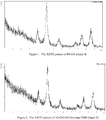
- test samples were dried to provide powder forms for XRPD measurements.
- the following figures, i.e., Figures 1-2 show the XRPD patterns for IO-OA (batch 4) and IO-OA/mPEG-silane-2000 (batch 2).
- Iron oxide solutions were prepared at various concentrations (0.1, 0.2, 0.3, 0.4, and 0.5 mM).
- T2 relaxation time of each solution was measured by Minispec mq 20 from the Bruker Corporation.
- a linear relationship was established between the reciprocal of the relaxation time as the ordinate axis and the concentration of the solution as the abscissa axis.
- the slope of the linear relationship was determined as the r2 relaxivity. Results are shown in Table 2 below. Table 2.
- biocompatible magnetic materials of this invention unexpectedly exhibited much higher r2 relaxivity as compared to Feraheme.
- Described below are protocols for coupling a biocompatible magnetic material of this invention with a specific targeting agent.
- IO-OA/COOH-PEG-silane-2000 (4.48 mg Fe/mL) was mixed with 5 mL of cold deionized water and kept on ice-bath.
- 1-Ethyl-3-(3-dimethylaminopropyl)carbodiimide (10 -6 mole) was added to the solution and stirred for 30 minutes.
- N-hydroxysuccinimide (10 -6 mole) was then added to the mixture and stirred for another 30 minutes.
- Antibody My10 (1mL, 2 ⁇ g/mL) was added to the resulting mixture and reacted for 2 hours.
- the solution thus obtained was purified by passing through a magnetic sorting device to obtain a biocompatible magnetic material coupled with an antibody, i.e., My10-conjugated IO-OA/COOH-PEG-silane-2000.
Landscapes
- Health & Medical Sciences (AREA)
- Chemical & Material Sciences (AREA)
- Nanotechnology (AREA)
- Engineering & Computer Science (AREA)
- Nuclear Medicine, Radiotherapy & Molecular Imaging (AREA)
- Life Sciences & Earth Sciences (AREA)
- Veterinary Medicine (AREA)
- Animal Behavior & Ethology (AREA)
- General Health & Medical Sciences (AREA)
- Public Health (AREA)
- Epidemiology (AREA)
- Radiology & Medical Imaging (AREA)
- Medicinal Chemistry (AREA)
- Immunology (AREA)
- Molecular Biology (AREA)
- Polymers & Plastics (AREA)
- Organic Chemistry (AREA)
- Chemical Kinetics & Catalysis (AREA)
- Inorganic Chemistry (AREA)
- Medicines Containing Antibodies Or Antigens For Use As Internal Diagnostic Agents (AREA)
- Medicinal Preparation (AREA)
- Magnetic Treatment Devices (AREA)
- Materials For Medical Uses (AREA)
Description
- Iron oxide nanoparticles are useful as contrast agents for magnetic resonance imaging (MRI) because of their chemical stability and suitable magnetization. Magnetite (Fe3O4) and maghemite (γ-Fe2O3) are two examples of superparamagnetic iron oxide nanoparticles.
- These iron oxide nanoparticles are capable of conjugating with biocompatible polymers to form biocompatible magnetic materials, e.g., MRI contrast agents.
- Conventionally, Fe3O4 magnetic nanoparticles are synthesized by using a mixture of Fe(II) and Fe(III) salts. In theory, Fe3O4 magnetic nanoparticles contain about 33% Fe(II) ions relative to the total iron ions. Differently, γ-Fe2O3 magnetic nanoparticles contain 0% Fe(II) ions.
- Fe3O4 provides stronger T 2 shortening effect, i.e., higher relaxivity r2, than γ-Fe2O3. See, e.g., Basti et al., J Colloid Interface Sci., 2010, 341: 248-254; and Li et al., Theranostics, 2013, 3(8): 595-615. On the other hand, Fe3O4 nanoparticles are significantly more effective in producing hydroxyl radicals than γ-Fe2O3 nanoparticles and, as a result, Fe3O4 may induce higher toxicity compared to γ-Fe2O3 in clinical applications. See, e.g., Park et al., Arch Toxicol., 2014, 88(8):1607-1618; and Wu et al., Journal of Food and Drug Analysis, 2014, 22, 86-94.
-
EP 2974745 A1 ,EP 2965754 A1 andWO 2009/129649 A1 each describe a biocompatible magnetic material comprising an iron oxide nanoparticle and one or more biocompatible polymers, with 4-15% Fe(II) ion content relative to the total iron ions. - There is a need to develop a new biocompatible magnetic material that has high relaxivity and low toxicity.
- The present invention relates to certain biocompatible magnetic materials that can be used as MRI contrast agents with high relaxivity and low toxicity.
- In one aspect of this invention, it covers biocompatible magnetic materials, as set out in the appended claims, that contain an iron oxide nanoparticle and one or more biocompatible polymers, each having formula (I) below, covalently bonded to the iron oxide nanoparticle:

- In this formula, R is H, C1-C6 alkyl, C2-C6 alkenyl, C2-C6 alkynyl, C3-C10 cycloalkyl, C1-C10 heterocycloalkyl, aryl, heteroaryl, a C1-C10 carbonyl group, or a C1-C10 amine group; L is a linker; x is 1 to 10; and y is 5 to 1000.
- Notably, the biocompatible magnetic materials each contain 4-10% Fe(II) ions relative to the total iron ions.
- The iron oxide nanoparticle can have a Fe(II) content the same as or different from that contained in a biocompatible magnetic material. Iron oxide nanoparticle can contain 4-15% (e.g., 4-10% and 4-8%) Fe(II) ions relative to the total iron ions in it.
- Referring to formula (I) above, the linker L can be O, S, Si, C1-C6 alkylene, a carbonyl moiety containing two carbonyl groups and 2-20 carbon atoms, or a group having one of the following formulas:

- The term "alkyl" herein refers to a saturated, linear or branched hydrocarbon moiety, such as methyl, ethyl, propyl, butyl, pentyl, and hexyl. The term "alkenyl" refers to a linear or branched hydrocarbon moiety that contains at least one double bond, such as -CH=CH-CH3 and -CH=CH-CH2-. The term "alkynyl" refers to a linear or branched hydrocarbon moiety that contains at least one triple bond, such as -C≡C-CH3 and -C≡C-CH2-. The term "cycloalkyl" refers to a saturated, cyclic hydrocarbon moiety, such as cyclohexyl and cyclohexylene. The term "heterocycloalkyl" refers to a saturated, cyclic hydrocarbon moiety containing at least one heteroatom selected from N, O, P, B, S, Si, Sb, Al, Sn, As, Se, and Ge, such as piperazinyl and piperidinyl.
- The term "heteroalkyl" herein refers to an aliphatic moiety containing at least one heteroatom selected from N, O, P, B, S, Si, Sb, Al, Sn, As, Se, and Ge. Examples of heteroalkyl include methoxymethyl and methylaminoethyl.
- The term "aryl" herein refers to a C6 monocyclic, C10 bicyclic, C14 tricyclic, C20 tetracyclic, or C24 pentacyclic aromatic ring system. Examples of aryl groups include phenyl, phenylene, naphthyl, naphthylene, anthracenyl, anthrcenylene, pyrenyl, and pyrenylene. The term "heteroaryl" herein refers to an aromatic 5-8 membered monocyclic, 8-12 membered bicyclic, 11-14 membered tricyclic, and 15-20 membered tetracyclic ring system having one or more heteroatoms (such as O, N, S, or Se). Examples of heteroaryl groups include furyl, furylene, fluorenyl, fluorenylene, pyrrolyl, pyrrolylene, thienyl, thienylene, oxazolyl, oxazolylene, imidazolyl, imidazolylene, benzimidazolyl, benzimidazolylene, thiazolyl, thiazolylene, pyridyl, pyridylene, pyrimidinyl, pyrimidinylene, quinazolinyl, quinazolinylene, quinolinyl, quinolinylene, isoquinolyl, isoquinolylene, indolyl, and indolylene.
- Unless specified otherwise, alkyl, alkenyl, alkynyl, cycloalkyl, heterocycloalkyl, heteroalkyl, aryl, and heteroaryl mentioned herein include both substituted and unsubstituted moieties. Possible substituents on cycloalkyl, cycloalkylene, cycloalkenyl, cycloalkenylene, cycloalkynyl, cycloalkynylene, heterocycloalkyl, heterocycloalkylene, heterocycloalkenyl, heterocycloalkenylene, aryl, and heteroaryl include, but are not limited to, C1-C10 alkyl, C2-C10 alkenyl, C2-C10 alkynyl, C3-C20 cycloalkyl, C3-C20 cycloalkenyl, C3-C20 heterocycloalkyl, C3-C20 heterocycloalkenyl, C1-C10 alkoxy, aryl, aryloxy, heteroaryl, heteroaryloxy, amino, C1-C10 alkylamino, C2-C20 dialkylamino, arylamino, diarylamino, C1-C10 alkylsulfonamino, arylsulfonamino, C1-C10 alkylimino, arylimino, C1-C10 alkylsulfonimino, arylsulfonimino, hydroxyl, halo, thio, C1-C10 alkylthio, arylthio, C1-C10 alkylsulfonyl, arylsulfonyl, acylamino, aminoacyl, aminothioacyl, amido, amidino, guanidine, ureido, thioureido, cyano, nitro, nitroso, azido, acyl, thioacyl, acyloxy, carboxyl, and carboxylic ester. On the other hand, possible substituents on aliphatic, heteroaliphatic, oxyaliphatic, alkyl, alkylene, alkenyl, alkenylene, alkynyl, and alkynylene include all of the above-recited substituents except C1-C10 alkyl. Cycloalkyl, cycloalkylene, cycloalkenyl, cycloalkenylene, heterocycloalkyl, heterocycloalkylene, heterocycloalkenyl, heterocycloalkenylene, aryl, and heteroaryl can also be fused with each other.
- Further covered by this invention is a method for preparing a biocompatible magnetic material described above, as set out in the appended claims.
- The method includes four steps: (i) providing a first solution that contains an iron oxide nanoparticle in a first organic solvent, the iron oxide nanoparticle containing 4-15% Fe(II) ions relative to the total iron ions; (ii) providing a second solution that contains a biocompatible polymer of formula (I) in a second organic solvent; (iii) mixing the first solution and the second solution to afford a mixed solution; and (iv) adding water to the mixed solution and stirring the resulting solution for at least 20 hours to obtain a biocompatible magnetic material.
- The iron oxide nanoparticle is formed by mixing a hydroxide solution with an iron solution that contains a Fe(II) salt under an inert gas atmosphere; the iron solution containing a Fe(II) salt and a Fe(III) salt, in which the mole ratio of Fe(III)/Fe(II) is 1.70 or higher; and wherein the iron oxide-organic acid nanoparticle is formed by adding oleic acid in an amount of 100 mL or less per mole iron.
- Other features, objects, and advantages of the embodiments will be apparent from the description and the claims.
- Disclosed in detail herein is a biocompatible magnetic material that contains an iron oxide nanoparticle and one or more biocompatible polymers covalently bonded to the iron oxide nanoparticle.
- The iron oxide nanoparticle can be a superparamagnetic core having a particle size of 1 to 100 nm (e.g., 2 to 50 nm and 5 to 25 nm). Preparation of a superparamagnetic core is well known in the art. See Laurent et al., Chem. Rev., 2008, 108, 2064-2110.
- The iron oxide nanoparticle is typically formed of an organic acid or a salt thereof. Examples of the organic acid or salt include, but are not limited to, oleic acid and a salt thereof.
- Of note, the iron oxide nanoparticle preferably contains 4-10% Fe(II) ions relative to the total iron ions in it. Another exemplary iron oxide nanoparticle contains 4-8% Fe(II) ions relative to the total iron ions. The content of Fe(II) ions in an iron oxide nanoparticle is important for a biocompatible magnetic material to exert high relaxivity and low toxicity. More specifically, a low Fe(II) content, e.g., less than 4% Fe(II) ions relative to the total iron ions, typically exhibits low relaxivity. On the other hand, a high Fe(II) content, e.g., greater than 15% Fe(II) ions relative to the total iron ions, can cause high toxicity.
- The biocompatible magnetic material also contains one or more biocompatible polymers to enhance its biocompatibility. Each of the biocompatible polymers has formula (I) below:

- In one aspect, the iron oxide nanoparticle is covalently bonded to one or more biocompatible polymers each having the following formula:

- Preferably, R1 is C1-C6 alkyl, a C1-C10 carbonyl group, or a C1-C10 amine group, and R2 is H or C1-C6 alkyl. For example, R1 is methyl (-CH3), carboxyl (-COOH), or amino (-NH2), and R2 is H.
- When R1 is carboxyl (-COOH) or amino (-NH2), the carboxyl-terminated or amine-terminated biocompatible polymer can be coupled with a biological molecule, e.g., folic acid. For example, the folic acid allows coupling with an amine-terminated biocompatible polymer by forming a -CONH- linkage.
- The biocompatible magnetic material of this invention can be coupled to a specific targeting agent for biological applications. Examples of a specific targeting agent include, but art not limited to, an antibody, a protein, a peptide, an enzyme, a carbohydrate, a glycoprotein, a nucleotide, and a lipid. In an exemplary biocompatible magnetic material, R1 is coupled to an antibody (e.g., My10).
- Still within the scope of this invention is a method for preparing the above-described biocompatible magnetic material.
- Again, the method includes the following steps: providing a first solution that contains an iron oxide nanoparticle in a first organic solvent, in which the iron oxide nanoparticle contains 4-15% Fe(II) ions relative to the total iron ions; providing a second solution that contains biocompatible polymers of formula (I) in a second organic solvent; mixing the first solution and the second solution to afford a mixed solution; and adding water to the mixed solution and stirring the resulting solution for at least 20 hours to obtain a biocompatible magnetic material.
- The iron oxide nanoparticle used in the method is formed by mixing a hydroxide solution with an iron solution that contains a Fe(II) salt under an inert gas atmosphere.
- An exemplary iron solution contains a Fe(II) salt (e.g., FeCl2) and a Fe(III) salt (e.g., FeCl3), in which the mole ratio of Fe(III)/Fe(II) is 1.70 or higher (e.g., 1.75 or higher, 1.80 or higher, and 1.90 or higher).
- The hydroxide solution can be a sodium hydroxide solution having a concentration of 2 N or lower (e.g., 1.5 N or lower and 1 N or lower).
- Examples of the inert gas include, but are not limited to, nitrogen and argon.
- To reiterate, the iron oxide nanoparticle can be formed of an organic acid or a salt thereof. An exemplary organic acid or salt is oleic acid or a salt thereof. When oleic acid is used, it can be present in an amount of 100 mL or less (e.g., 90 mL or less, 70 mL or less, and 50 mL or less) per mole iron.
- In one example, the iron oxide nanoparticle is formed from oleic acid and an iron solution containing FeCl2 and FeCl3, affording an iron oxide-oleic acid nanoparticle or IO-OA. This exemplary iron oxide nanoparticle can be prepared as follows: mixing FeCl2 and FeCl3 in a solvent (e.g., water), adding a sodium hydroxide solution (e.g., 1 N) under nitrogen to the above mixture, and treating the solution thus obtained with oleic acid to form an IO-OA nanoparticle.
- The iron oxide nanoparticle is preferably collected, after the treatment with an organic acid or a salt thereof, by removing water, dissolving it in toluene, and centrifuging the liquid thus obtained to eliminate certain large particles.
- Turning to the biocompatible polymers used in the method, they include the polymers themselves, as well as their salts and solvates, if applicable. A salt, for example, can be formed between an anion and a positively charged group (e.g., amino) on a polymer. Suitable anions include chloride, bromide, iodide, sulfate, nitrate, phosphate, citrate, methanesulfonate, trifluoroacetate, acetate, malate, tosylate, tartrate, fumurate, glutamate, glucuronate, lactate, glutarate, and maleate. Likewise, a salt can also be formed between a cation and a negatively charged group (e.g., carboxylate) on a polymer. Suitable cations include sodium ion, potassium ion, magnesium ion, calcium ion, and an ammonium cation such as tetramethylammonium ion. The polymers also include those salts containing quaternary nitrogen atoms. A solvate refers to a complex formed between a polymer and a pharmaceutically acceptable solvent. Examples of a pharmaceutically acceptable solvent include water, ethanol, isopropanol, ethyl acetate, acetic acid, and ethanolamine.
- Scheme (I) below shows a process of preparing an exemplary silane-containing biocompatible polymer.

- As shown in the scheme above, alkoxyl-polyethylene glycol (molecular weight 2000) reacts with succinic anhydride in the presence of a base (e.g., dimethylaminopyridine) to form mPEG-COOH, which is subsequently converted to mPEG-COCl using thionyl chloride. Mixing mPEG-COCl with (3-aminopropyl)-triethoxysilane yields mPEG-silane.
- A skilled person in the art can modify the process shown in Scheme (I) to prepare biocompatible polymers using well-known methods. See R. Larock, Comprehensive Organic Transformations (VCH Publishers 1989); T. W. Greene and P. G. M. Wuts, Protective Groups in Organic Synthesis (3rd Ed., John Wiley and Sons 1999); L. Fieser and M. Fieser, Fieser and Fieser's Reagents for Organic Synthesis (John Wiley and Sons 1994); and L. Paquette, ed., Encyclopedia of Reagents for Organic Synthesis (John Wiley and Sons 1995) and subsequent editions thereof. Specific routes that can be used to synthesize the biocompatible polymers can be found in: (a) Rist et al., Molecules 2005, 10, 1169-1178, (b) Koheler et al., JACS, 2004, 126, 7206-7211; and (c) Zhang et al., Biom mircod 2004, 6:1 33-40.
- To perform the method for preparing a biocompatible magnetic material, a first solution containing the above-described iron oxide nanoparticle is formed in a first organic solvent, and a second solution containing the above-described biocompatible polymers is provided in a second organic solvent.
- Each of the first organic solvent and the second organic solvent, independently, can be toluene, aliphatic hydrocarbon, tetrahydrofuran, ketone, alcohol, alkyl ester, or a combination thereof. Preferably, both organic solvents are toluene.
- Upon mixing the first solution and the second solution to afford a mixed solution, it is important to perform the step of adding water as a catalyst to the mixed solution and stirring the resulting solution for at least 20 hours to afford a biocompatible magnetic material.
- As described above, the iron oxide nanoparticle used in the method contains 4-15% Fe(II) ions relative to the total iron ions in it. After performing the method, a biocompatible magnetic material thus obtained typically contains 4-15% Fe(II) ions relative to the total iron ions.
- The biocompatible polymer synthesized in Scheme (I) above is useful in that it can chemically modify the surface of the iron oxide nanoparticle to increase biocompatibility. In addition, the biocompatible polymer is useful in that it can label particles (e.g., nanoparticles, magnetic particles, magnetic nanoparticles, and superparamagnetic particles), to render the particles to be further reactive toward one or more targeting, fluorescent, therapeutic, or diagnostic agents.
- The targeting agent is preferably coupled to the biocompatible polymer via covalent bonds. Commonly used targeting agents include an antibody, a protein, a peptide, an enzyme, a carbohydrate, a glycoprotein, a nucleotide, and a lipid. The biocompatible magnetic material may have a diameter of about 3-500 nm after coupling with the targeting agent. Those skilled in the art can attach any suitable targeting agents on the nanoparticle to give specificity thereto. For example, folic acid can be used to specify breast cancer cells with a folate receptor. The structure of the folic acid allows coupling with an amine-terminated or carboxy-terminated biocompatible polymer. For example, the folic acid allows coupling with the amine-terminated biocompatible polymer by forming a -CONH- linkage.
- Without further elaboration, it is believed that one skilled in the art can, based on the description herein, utilize the present embodiments to their fullest extent.
- Two biocompatible magnetic materials were prepared following the procedures described below.
- A mixture of FeCl2·4H2O (900 g; 4.53 mole), FeCl3·4H2O (1327 g; 8.18 mole), and water (23.6 L) was stirred at 150-200 rpm in a 100 L glass reactor at 25 °C. A sodium hydroxide solution (1 N) was added under nitrogen to the reactor at a rate of 0.2-0.3 kg/min, resulting in a pH value of 11-12. Subsequently, oleic acid (800 mL; 63 mL per mole iron) was added and the resulting mixture was stirred for additional 60 minutes, thereby forming IO-OA nanoparticles as a dark paste in an aqueous solution. The water was removed after the pH of the water solution was adjusted to a pH value of 1 to 2 with hydrochloric acid (3 N). 12 L toluene was then added to the remaining dark paste to suspend crude IO-OA nanoparticles in the toluene solution. The crude IO-OA nanoparticles in toluene were centrifuged at 6000 rpm for 15 minutes to obtain IO-OA nanoparticles in toluene.
- A biocompatible polymer mPEG-silane-750 was prepared as follows. A mixture of 300 g (0.4 moles) of methoxy-PEG (mPEG, molecular weight 750), succinic anhydride (48 g; 0.48 moles) and 4-dimethylamino-pyridine (DMAP; 19.5 g; 0.159 moles) were allowed to sit in a 1000-mL round bottom flask under vacuum (20 Torrs) for 2 hours. 600 mL of toluene was added to the mixture, which was then stirred at 30°C for one day to form mPEG-COOH. Subsequently, 36 mL (0.48 moles) of thionyl chloride was added at a rate of 1 mL/min and the mixture was stirred for 2-3 hours. Thereafter, 333.8 mL (2.4 moles) of triethylamine was added at a rate of 1 mL/min to obtain pH around 6-7. After cooling to room temperature, the mixture containing mPEG-COCl was reacted with 94.5 mL (0.4 moles) of 3-aminopropyl triethoxysilane at room temperature for at least 8 hours to yield crude mPEG-silane-750. The crude mPEG-silane-750 was precipitated after 9 L of isopropyl ether was added to the reaction mixture. A solid product was collected by filtration, re-dissolved in 500 mL of toluene, and centrifuged at 5000 rpm for 5 minutes to collect a supernatant, to which was added 9 L of isopropyl ether. A brown oily liquid was separated from the isopropyl ether and dried under vacuum to obtain the biocompatible polymer mPEG-silane-750.
- A biocompatible polymer mPEG-silane-2000 was prepared as follows. Methoxy-PEG (mPEG, molecular weight 2000) (3 kg) was added to a 20L reaction vessel, equipped with a Dean-Stark Trap. 15L toluene was added to the reaction vessel and the reaction mixture was stirred at 150 ± 20 rpm with a mechanical stirrer. The reaction was conducted at 120 °C and refluxed for 60 minute. Succinic anhydride (SA, 180 g) and 4-Dimethylaminopyridine (DMAP, 70g) were then added to the reaction vessel and the reaction was continued for 20 hours at 65 °C to form mPEG-COOH. Subsequently, 170 g of thionyl chloride (SOCl2) was added to the reaction vessel, with N2 gas blanket over reaction and reaction continued for 3 hours. Thereafter, triethylamine (TEA, 436 g) was added to the reaction vessel and stirred at 250 rpm. After cooling to room temperature, the mixture containing mPEG-COCl was reacted with 300 g of 3-aminopropyl triethoxysilane at room temperature for at least 8 hours to yield crude mPEG-silane-2000. The crude material thus obtained was then filtered to remove salts and give a clear brown solution as mPEG-silane-2000.
- 300 g (0.4 mole) of PEG (molecular weight: 750) and 600 mL of N-methyl-2-pyrrolidone were placed in a 1000 mL round bottom flask and heated to 60 °C under vacuum (20 Torr) for more than 2 hours. 88 g (0.88 mole) of succinic anhydride and 19.5 g (0.16 mole) of 4-dimethylamino-pyridine (DMAP) were added for reaction at 30 °C for two days, thus obtaining dicarboxy-terminated PEG (COOH-PEG).
- 36ml (0.48mole) of thionyl chloride was added at a rate of 1 mL/min and stirred for 2-3 hours. Subsequently, 133.8 mL (0.96mole) of triethylamine was added at a rate of 1 mL/min. 94.5 mL (0.4mole) of 3-aminopropyl triethoxysilane was then added to the reaction for at least 12 hours. The reaction mixture was added to 9L of cold isopropyl ether for re-precipitation, and the resulting precipitates were collected, re-dissolved in 100 mL of dichloromethane. The mixture thus obtained was again added to 9L of cold isopropyl ether for re-precipitation. An off-white precipitate was collected and dried under vacuum for 2 days, thus obtaining a biocompatible polymer, i.e., COOH-PEG-silane-750.
- A biocompatible polymer COOH-mPEG-silane-2000 was prepared following the same procedure described above using a mixture of 800 g (0.4 moles) of PEG (PEG, molecular weight 2000), succinic anhydride (88 g; 0.88 moles), and 4-dimethylamino-pyridine (DMAP; 19.5 g; 0.16 moles).
- A biocompatible magnetic material was prepared by conjugating mPEG-silane-2000 with an iron oxide nanoparticle, i.e., IO-OA nanoparticle, in toluene as follows.
- A toluene solution of IO-OA nanoparticle (6 mg Fe/mL, 700 mL) and a toluene solution of mPEG-silane-2000 (160 mg/mL, 500 mL) were mixed in a 2 L round bottom flask with water being added to the resulting solution. After 24 hours reaction, mPEG-silane-2000 conjugated iron oxide nanoparticles were extracted by water, and filtration to remove large particles to afford an clear aqueous solution. The resulting aqueous solution was purified and concentrated with an ultra-filtration device to obtain a biocompatible magnetic material labeled as IO-OA/mPEG-silane-2000.
- 250g of COOH-mPEG-silane-2000 was added to 1-1.2 L of a toluene solution containing 10 g Fe of IO-OA nanoparticle. The resulting mixture was sonicated for 2-3 hours. After addition of 1.5 L of deionized water, the mixture was purified by an ultra-filtration device and concentrated to 100 mL to obtain a biocompatible magnetic material labeled as IO-OA/COOH-PEG-silane-2000.
- A study was performed to characterize a biocompatible magnetic material prepared in EXAMPLE 1, as well as certain iron oxide nanoparticles, as follows.
- Fe(II)/Fe(III) ion ratios of iron oxide nanoparticles and biocompatible magnetic materials were measured by Iron Test kit (Spectroquant 1.00796.0001, Merck). The reagent in the test kit, i.e., 1,10-plenanthroline, was sensitive for Fe(II) ion but not Fe(III) ion. In a buffered medium, the Fe(II) ions reacted with 1,10-plenanthroline to form a red complex that was determined photometrically. The test iron oxide nanoparticles or biocompatible magnetic materials were first degraded to iron ions by adding sulfur acid and the pH of the resulting solution was adjusted to 2 to 8 by using 0.8 M NaHCO3. It was observed that the Fe(II) ions were not converted to Fe(III) ions during the process. Without addition of ascorbic acid, the content of only Fe(II) ions was measured. The total iron ions were further measured by adding ascorbic acid to convert all iron ions to Fe(II) irons. The content of Fe(II) ions was determined to be about 4-15 % relative to the total iron ions. Detailed results are shown in Table 1 below. Note that this table also includes the Fe(II) content of 1.26% for Feraheme, a commercial agent.
Table 1. Measurement of Fe(II) contents Test sample Fe (II) % IO-OA (batch 1) 4.32 IO-OA (batch 2) 5.78 IO-OA (batch 3) 4.19 IO-OA (batch 4) 10.88 IO-OA (batch 5) 6.84 IO-OA (batch 6) 8.55 IO-OA (batch 7) 6.53 IO-OA (batch 8) 9.64 IO-OA/mPEG-silane-2000 (batch 1) 5.90 IO-OA/mPEG-silane-2000 (batch 2) 6.29 IO-OA/mPEG-silane-2000 (batch 3) 7.35 IO-OA/mPEG-silane-2000 (batch 4) 8.44 IO-OA/mPEG-silane-2000 (batch 5) 6.87 Feraheme 1.26 - These results indicate that biocompatible magnetic materials of this invention unexpectedly exhibited a much higher Fe(II) content as compared to Feraheme.
- The structures of certain iron oxide nanoparticles and biocompatible magnetic materials were investigated by XRPD as follows.
- The test samples were dried to provide powder forms for XRPD measurements. The following figures, i.e.,
Figures 1-2 , show the XRPD patterns for IO-OA (batch 4) and IO-OA/mPEG-silane-2000 (batch 2).

- As the differences between γ-Fe2O3 and Fe3O4 in XRPD are not discernable, these figures show that the crystalline structures of IO-OA (batch 4) and IO-OA/mPEG-silane-2000 (batch 2) could be Fe3O4, γ-Fe2O3, or the mixture of Fe3O4 and γ-Fe2O3.
- A study was performed to measure the relaxivity of a biocompatible magnetic material prepared in EXAMPLE 1, as well as that for Feraheme, as follows.
- Iron oxide solutions were prepared at various concentrations (0.1, 0.2, 0.3, 0.4, and 0.5 mM). T2 relaxation time of each solution was measured by Minispec mq 20 from the Bruker Corporation. A linear relationship was established between the reciprocal of the relaxation time as the ordinate axis and the concentration of the solution as the abscissa axis. The slope of the linear relationship was determined as the r2 relaxivity. Results are shown in Table 2 below.
Table 2. Measurement of r2 relaxivity Test sample r2 relaxivity (mM·s)-1 IO-OA/mPEG-silane-2000 (batch 2) 173 Feraheme 69 - Unexpectedly, as shown in Table 2 above, IO-OA/mPEG-silane-2000 (batch 2), which contains 6.29% Fe(II) ions relative to the total irons, exhibited a r2 relaxivity value of 173 (mM·s)-1. By sharp contrast, Feraheme, which contains 1.26% Fe(II) ions relative to the total irons, exhibited a r2 relaxivity value of 69 (mM·s)-1.
- These results indicate that biocompatible magnetic materials of this invention unexpectedly exhibited much higher r2 relaxivity as compared to Feraheme.
- Described below are protocols for coupling a biocompatible magnetic material of this invention with a specific targeting agent.
- 226 µl of folate solution (folate/dimethyl sulfoxide: 10 mg/mL) was placed in a 50 mL brownish round bottom flask. 5 mL of dimethyl sulfoxide (DMSO) and 176.5 µL of dicyclohexyl carbodiimide solution (dicyclohexyl carbodiimide/DMSO: 5 mg/mL) was added to the solution and stirred for one hour. Thereafter, 98.5µl of NHS solution (N-hydroxysuccinimide/DMSO: 5 mg/mL) was added and stirred for additional one hour. 289 µL of ethylenediamine was then added to give a solution A.
- 1 mL of IO-OA/COOH-PEG-silane-2000 (4.48mg Fe/mL) and 10ml of DMSO were placed in a 50 mL round bottom flask under vacuum. 176.5µl of dicyclohexyl carbodiimide solution (dicyclohexyl carbodiimide/ DMSO: 5 mg/mL) was added to the solution and stirred for one hour. Thereafter, 98.5µl of NHS solution (N-hydroxysuccinimide/DMSO: 5 mg/mL) was added and stirred for additional one hour to give a solution B.
- 289 µL of solution A was added to solution B and the resulting solution was stirred for 8 hours. The resulting solution was added to a dialysis membrane (Mw: 3000) and distilled water was used for dialysis. The resulting solution was then concentrated to 2 mL by an ultra-filtration device to obtain a biocompatible magnetic material coupled with a targeting agent, i.e., folate-conjugated IO-OA/COOH-PEG-silane-2000.
- IO-OA/COOH-PEG-silane-2000 (4.48 mg Fe/mL) was mixed with 5 mL of cold deionized water and kept on ice-bath. 1-Ethyl-3-(3-dimethylaminopropyl)carbodiimide (10-6 mole) was added to the solution and stirred for 30 minutes. N-hydroxysuccinimide (10-6 mole) was then added to the mixture and stirred for another 30 minutes. Antibody My10 (1mL, 2µg/mL) was added to the resulting mixture and reacted for 2 hours. The solution thus obtained was purified by passing through a magnetic sorting device to obtain a biocompatible magnetic material coupled with an antibody, i.e., My10-conjugated IO-OA/COOH-PEG-silane-2000.
- All of the features disclosed in this specification may be combined in any combination.
Claims (10)
- A biocompatible magnetic material comprising:an iron oxide-organic acid nanoparticle; andone or more biocompatible polymers, each having formula (I) below, covalently bonded to the iron oxide-organic acid nanoparticle:
 R is H, C1-C6 alkyl, C2-C6 alkenyl, C2-C6 alkynyl, C3-C10 cycloalkyl, C1-C10 heterocycloalkyl, aryl, heteroaryl, a C1-C10 carbonyl group, or a C1-C10 amine group;L is a linker;x is 1 to 10; andy is 5 to 1000,wherein the iron oxide-organic acid contains 4-10 % Fe(II) ions relative to the total iron ions.
 - The biocompatible magnetic material of claim 1, wherein the iron oxide-organic acid nanoparticle contains 4-8 % Fe(II) ions relative to the total iron ions.
- The biocompatible magnetic material of claim 1, wherein the iron oxide-organic acid nanoparticle is an iron oxide-oleic acid nanoparticle.
- The biocompatible magnetic material of claim 1, wherein the linker is O, S, Si, C1-C6 alkylene, a carbonyl moiety containing two carbonyl groups and 2-20 carbon atoms, or a group having one of the following formulas:

- The biocompatible magnetic material of claim 1, wherein the iron oxide-organic acid nanoparticle is covalently bonded to one or more biocompatible polymers each having the following formula:
 R1 is H, C1-C6 alkyl, C2-C6 alkenyl, C2-C6 alkynyl, C3-C10 cycloalkyl, C1-C10 heterocycloalkyl, aryl, heteroaryl, a C1-C10 carbonyl group, or a C1-C10 amine group;R2 is H, C1-C6 alkyl, C2-C6 alkenyl, C2-C6 alkynyl, C3-C10 cycloalkyl, C1-C10 heterocycloalkyl, aryl, or heteroaryl;x is 1 to 10; andy is 5 to 1000.
 - The biocompatible magnetic material of claim 5, wherein R1 is C1-C6 alkyl, a C1-C10 carbonyl group, or a C1-C10 amine group, and R2 is H or C1-C6 alkyl; and wherein R1 is optionally methyl, carboxyl, or amino, and R2 is optionally H.
- The biocompatible magnetic material of claim 5, wherein R1 is coupled to a specific targeting agent selected from the group consisting of an antibody, a protein, a peptide, an enzyme, a carbohydrate, a glycoprotein, a nucleotide, and a lipid; and wherein the specific targeting agent is optionally an antibody.
- The biocompatible magnetic material of claim 1, wherein the iron oxide-organic acid nanoparticle is covalently bonded to one or more biocompatible polymers each having the following formula:

- A method of preparing a biocompatible magnetic material of claim 1, the method comprising:providing a first solution that contains an iron oxide-organic acid nanoparticle in a first organic solvent, the iron oxide-organic acid nanoparticle containing 4-10 % Fe(II) ions relative to the total iron ions;providing a second solution that contains a biocompatible polymer of formula (I) in a second organic solvent;mixing the first solution and the second solution to afford a mixed solution; andadding water to the mixed solution and stirring the resulting solution for at least 20 hours to obtain a biocompatible magnetic material; wherein the iron oxide-organic acid nanoparticle is formed by mixing a hydroxide solution with an iron solution that contains a Fe(II) salt under an inert gas atmosphere; the iron solution containing a Fe(II) salt and a Fe(III) salt, in which the mole ratio of Fe(III)/Fe(II) is 1.70 or higher; and wherein the iron oxide-organic acid nanoparticle is formed by adding oleic acid in an amount of 100 mL or less per mole iron.
- The method of claim 9, wherein each of the first organic solvent and the second organic solvent, independently, is toluene, aliphatic hydrocarbon, tetrahydrofuran, ketone, alcohol, alkyl ester, or a combination thereof; and wherein the inert gas is optionally nitrogen or argon.
Applications Claiming Priority (1)
| Application Number | Priority Date | Filing Date | Title |
|---|---|---|---|
| CN201810145800.0A CN110157000B (en) | 2018-02-12 | 2018-02-12 | Biocompatible magnetic material |
Publications (2)
| Publication Number | Publication Date |
|---|---|
| EP3524276A1 EP3524276A1 (en) | 2019-08-14 |
| EP3524276B1 true EP3524276B1 (en) | 2021-09-22 |
Family
ID=65529243
Family Applications (1)
| Application Number | Title | Priority Date | Filing Date |
|---|---|---|---|
| EP19156555.5A Active EP3524276B1 (en) | 2018-02-12 | 2019-02-11 | Biocompatible magnetic materials |
Country Status (10)
| Country | Link |
|---|---|
| US (2) | US20190247522A1 (en) |
| EP (1) | EP3524276B1 (en) |
| JP (1) | JP7335472B2 (en) |
| KR (1) | KR102782693B1 (en) |
| CN (1) | CN110157000B (en) |
| AU (1) | AU2019200753B2 (en) |
| CA (1) | CA3032985A1 (en) |
| DK (1) | DK3524276T3 (en) |
| ES (1) | ES2903387T3 (en) |
| TW (1) | TWI811297B (en) |
Families Citing this family (3)
| Publication number | Priority date | Publication date | Assignee | Title |
|---|---|---|---|---|
| CN107999037B (en) * | 2017-12-18 | 2020-07-31 | 南京大学 | Magnetic polymer adsorption material, preparation method and application |
| JP7788100B2 (en) * | 2020-09-11 | 2025-12-18 | Jsr株式会社 | Conjugates and Photoimmunotherapy |
| CN115520907A (en) * | 2022-04-14 | 2022-12-27 | 西安超磁纳米生物科技有限公司 | Ultra-small ferrite nano-particles with active groups, and preparation and application thereof |
Family Cites Families (11)
| Publication number | Priority date | Publication date | Assignee | Title |
|---|---|---|---|---|
| JP5031979B2 (en) * | 2004-07-12 | 2012-09-26 | 戸田工業株式会社 | Medicinal drug substance containing magnetic particles |
| JP2009531302A (en) * | 2006-02-28 | 2009-09-03 | メディカル リサーチ カウンシル | Targeted iron oxide nanoparticles |
| JP4894332B2 (en) * | 2006-04-05 | 2012-03-14 | 三洋化成工業株式会社 | Contrast agent for magnetic resonance imaging |
| EP2285423B1 (en) * | 2008-04-22 | 2020-03-18 | MegaPro Biomedical Co., Ltd. | Biocompatible polymer and magnetic nanoparticle with biocompatibility |
| GB0808086D0 (en) | 2008-05-02 | 2008-06-11 | Iti Scotland Ltd | Magnetic proteins for in vivo imaging |
| EP2502882B1 (en) * | 2009-11-20 | 2018-05-23 | Toda Kogyo Corp. | Process for production of magnetic iron oxide microparticle powder and an aqueous dispersion containing the magnetic particles |
| CN102552945B (en) * | 2012-01-19 | 2013-09-11 | 青岛科技大学 | Surface modification method of magnetic iron oxide nano-particles |
| CN103405789B (en) * | 2013-08-06 | 2015-02-11 | 哈尔滨工业大学 | Preparation method of biomembrane modified ferriferrous oxide nanoparticle |
| TWI689310B (en) * | 2014-07-11 | 2020-04-01 | 巨生生醫股份有限公司 | Method of treating iron deficiency |
| TWI745272B (en) * | 2014-07-14 | 2021-11-11 | 巨生生醫股份有限公司 | Method for immune cell tracking |
| WO2016073313A1 (en) * | 2014-11-04 | 2016-05-12 | University Of Washington | Iron oxide nanoparticles and their synthesis by controlled oxidation |
-
2018
- 2018-02-12 CN CN201810145800.0A patent/CN110157000B/en active Active
- 2018-11-29 US US16/204,510 patent/US20190247522A1/en not_active Abandoned
-
2019
- 2019-01-25 JP JP2019011014A patent/JP7335472B2/en active Active
- 2019-02-01 TW TW108104248A patent/TWI811297B/en active
- 2019-02-05 AU AU2019200753A patent/AU2019200753B2/en active Active
- 2019-02-07 CA CA3032985A patent/CA3032985A1/en active Pending
- 2019-02-11 EP EP19156555.5A patent/EP3524276B1/en active Active
- 2019-02-11 KR KR1020190015657A patent/KR102782693B1/en active Active
- 2019-02-11 ES ES19156555T patent/ES2903387T3/en active Active
- 2019-02-11 DK DK19156555.5T patent/DK3524276T3/en active
-
2021
- 2021-11-24 US US17/535,168 patent/US12268756B2/en active Active
Also Published As
| Publication number | Publication date |
|---|---|
| AU2019200753B2 (en) | 2024-03-07 |
| CN110157000A (en) | 2019-08-23 |
| AU2019200753A1 (en) | 2019-08-29 |
| EP3524276A1 (en) | 2019-08-14 |
| CA3032985A1 (en) | 2019-08-12 |
| KR102782693B1 (en) | 2025-03-18 |
| KR20190098064A (en) | 2019-08-21 |
| US20220080057A1 (en) | 2022-03-17 |
| US12268756B2 (en) | 2025-04-08 |
| DK3524276T3 (en) | 2021-12-13 |
| JP2019137674A (en) | 2019-08-22 |
| CN110157000B (en) | 2022-05-31 |
| JP7335472B2 (en) | 2023-08-30 |
| TWI811297B (en) | 2023-08-11 |
| ES2903387T3 (en) | 2022-04-01 |
| TW201936212A (en) | 2019-09-16 |
| US20190247522A1 (en) | 2019-08-15 |
Similar Documents
| Publication | Publication Date | Title |
|---|---|---|
| US12268756B2 (en) | Biocompatible magnetic materials | |
| CN111228520B (en) | Cell membrane coated ultra-small ferroferric oxide nanocluster and preparation and application thereof | |
| Pozo-Torres et al. | Clickable iron oxide NPs based on catechol derived ligands: Synthesis and characterization | |
| Zhu et al. | A novel host-guest complex based on biotin functionalized polyamine-β-cyclodextrin for tumor targeted delivery of luteolin | |
| US20240000978A1 (en) | Method for immune cell tracking | |
| CN112390786A (en) | Amphiphilic molecule with AIE characteristic and capable of simultaneously enhancing fluorescence and magnetic resonance contrast signals, nano-particle, preparation method and application | |
| WO2017049821A1 (en) | Water-soluble docetaxel anticancer drug compound and preparation method and use thereof | |
| Lin et al. | Host–guest systems based on pH-sensitive acyclic cucurbit [n] urils for controlled release of camptothecin | |
| CN115212185A (en) | Albumin nanoparticles of pH-sensitive adriamycin-fatty acid prodrug | |
| CN107073035B (en) | Ways to treat iron deficiency | |
| CN117229336A (en) | An anti-tumor compound, composition and application thereof | |
| CN115093434A (en) | Gambogic acid nanometer preparation and preparation method thereof | |
| CN113750255B (en) | Environmentally responsive hyaluronic acid-podophyllotoxin prodrug micelles and preparation methods and applications thereof | |
| EP4400099B1 (en) | Glucosamine derivative nanoparticle and preparation method and use thereof | |
| US20230338586A1 (en) | Multifunctional contrast agents, compositions, and methods | |
| CN119504905A (en) | A glycosylated quercetin amphiphilic prodrug, preparation method and application thereof | |
| KR20150001693A (en) | Water souble Heparin-DTX-TCA conjugates improved targeting and preparing method for the same | |
| CN117298045A (en) | Idebenone-based bioactive nanomicelles and their preparation methods and applications | |
| CN119504866A (en) | Antitumor compound, self-assembled nano drug delivery system of antitumor compound and preparation method thereof | |
| CN117919437A (en) | Dendrimer drug-loaded compound, preparation method and application thereof, pharmaceutical composition and application thereof |
Legal Events
| Date | Code | Title | Description |
|---|---|---|---|
| STAA | Information on the status of an ep patent application or granted ep patent |
Free format text: STATUS: UNKNOWN |
|
| PUAI | Public reference made under article 153(3) epc to a published international application that has entered the european phase |
Free format text: ORIGINAL CODE: 0009012 |
|
| STAA | Information on the status of an ep patent application or granted ep patent |
Free format text: STATUS: THE APPLICATION HAS BEEN PUBLISHED |
|
| AK | Designated contracting states |
Kind code of ref document: A1 Designated state(s): AL AT BE BG CH CY CZ DE DK EE ES FI FR GB GR HR HU IE IS IT LI LT LU LV MC MK MT NL NO PL PT RO RS SE SI SK SM TR |
|
| AX | Request for extension of the european patent |
Extension state: BA ME |
|
| STAA | Information on the status of an ep patent application or granted ep patent |
Free format text: STATUS: REQUEST FOR EXAMINATION WAS MADE |
|
| 17P | Request for examination filed |
Effective date: 20200214 |
|
| RBV | Designated contracting states (corrected) |
Designated state(s): AL AT BE BG CH CY CZ DE DK EE ES FI FR GB GR HR HU IE IS IT LI LT LU LV MC MK MT NL NO PL PT RO RS SE SI SK SM TR |
|
| STAA | Information on the status of an ep patent application or granted ep patent |
Free format text: STATUS: EXAMINATION IS IN PROGRESS |
|
| 17Q | First examination report despatched |
Effective date: 20200729 |
|
| RIN1 | Information on inventor provided before grant (corrected) |
Inventor name: HUANG, CHIA-WEN Inventor name: HSU, YUAN-HUNG Inventor name: WEI, MING-CHENG Inventor name: CHEN, CHIH-LUNG Inventor name: WANG, SHIAN-JY Inventor name: HSIEH, WEN-YUAN |
|
| GRAP | Despatch of communication of intention to grant a patent |
Free format text: ORIGINAL CODE: EPIDOSNIGR1 |
|
| STAA | Information on the status of an ep patent application or granted ep patent |
Free format text: STATUS: GRANT OF PATENT IS INTENDED |
|
| INTG | Intention to grant announced |
Effective date: 20210413 |
|
| GRAS | Grant fee paid |
Free format text: ORIGINAL CODE: EPIDOSNIGR3 |
|
| GRAA | (expected) grant |
Free format text: ORIGINAL CODE: 0009210 |
|
| STAA | Information on the status of an ep patent application or granted ep patent |
Free format text: STATUS: THE PATENT HAS BEEN GRANTED |
|
| AK | Designated contracting states |
Kind code of ref document: B1 Designated state(s): AL AT BE BG CH CY CZ DE DK EE ES FI FR GB GR HR HU IE IS IT LI LT LU LV MC MK MT NL NO PL PT RO RS SE SI SK SM TR |
|
| REG | Reference to a national code |
Ref country code: GB Ref legal event code: FG4D |
|
| RIN1 | Information on inventor provided before grant (corrected) |
Inventor name: WANG, SHIAN-JY Inventor name: CHEN, CHIH-LUNG Inventor name: WEI, MING-CHENG Inventor name: HUANG, CHIA-WEN Inventor name: HSU, YUAN-HUNG Inventor name: HSIEH, WEN-YUAN |
|
| REG | Reference to a national code |
Ref country code: IE Ref legal event code: FG4D |
|
| REG | Reference to a national code |
Ref country code: DE Ref legal event code: R096 Ref document number: 602019007764 Country of ref document: DE |
|
| REG | Reference to a national code |
Ref country code: CH Ref legal event code: EP Ref country code: AT Ref legal event code: REF Ref document number: 1431795 Country of ref document: AT Kind code of ref document: T Effective date: 20211015 |
|
| REG | Reference to a national code |
Ref country code: DK Ref legal event code: T3 Effective date: 20211210 |
|
| REG | Reference to a national code |
Ref country code: FI Ref legal event code: FGE |
|
| REG | Reference to a national code |
Ref country code: SE Ref legal event code: TRGR |
|
| REG | Reference to a national code |
Ref country code: LT Ref legal event code: MG9D |
|
| REG | Reference to a national code |
Ref country code: NL Ref legal event code: FP |
|
| PG25 | Lapsed in a contracting state [announced via postgrant information from national office to epo] |
Ref country code: HR Free format text: LAPSE BECAUSE OF FAILURE TO SUBMIT A TRANSLATION OF THE DESCRIPTION OR TO PAY THE FEE WITHIN THE PRESCRIBED TIME-LIMIT Effective date: 20210922 Ref country code: BG Free format text: LAPSE BECAUSE OF FAILURE TO SUBMIT A TRANSLATION OF THE DESCRIPTION OR TO PAY THE FEE WITHIN THE PRESCRIBED TIME-LIMIT Effective date: 20211222 Ref country code: LT Free format text: LAPSE BECAUSE OF FAILURE TO SUBMIT A TRANSLATION OF THE DESCRIPTION OR TO PAY THE FEE WITHIN THE PRESCRIBED TIME-LIMIT Effective date: 20210922 Ref country code: RS Free format text: LAPSE BECAUSE OF FAILURE TO SUBMIT A TRANSLATION OF THE DESCRIPTION OR TO PAY THE FEE WITHIN THE PRESCRIBED TIME-LIMIT Effective date: 20210922 |
|
| REG | Reference to a national code |
Ref country code: NO Ref legal event code: T2 Effective date: 20210922 |
|
| PG25 | Lapsed in a contracting state [announced via postgrant information from national office to epo] |
Ref country code: LV Free format text: LAPSE BECAUSE OF FAILURE TO SUBMIT A TRANSLATION OF THE DESCRIPTION OR TO PAY THE FEE WITHIN THE PRESCRIBED TIME-LIMIT Effective date: 20210922 Ref country code: GR Free format text: LAPSE BECAUSE OF FAILURE TO SUBMIT A TRANSLATION OF THE DESCRIPTION OR TO PAY THE FEE WITHIN THE PRESCRIBED TIME-LIMIT Effective date: 20211223 |
|
| REG | Reference to a national code |
Ref country code: ES Ref legal event code: FG2A Ref document number: 2903387 Country of ref document: ES Kind code of ref document: T3 Effective date: 20220401 |
|
| PG25 | Lapsed in a contracting state [announced via postgrant information from national office to epo] |
Ref country code: IS Free format text: LAPSE BECAUSE OF FAILURE TO SUBMIT A TRANSLATION OF THE DESCRIPTION OR TO PAY THE FEE WITHIN THE PRESCRIBED TIME-LIMIT Effective date: 20220122 Ref country code: SK Free format text: LAPSE BECAUSE OF FAILURE TO SUBMIT A TRANSLATION OF THE DESCRIPTION OR TO PAY THE FEE WITHIN THE PRESCRIBED TIME-LIMIT Effective date: 20210922 Ref country code: PT Free format text: LAPSE BECAUSE OF FAILURE TO SUBMIT A TRANSLATION OF THE DESCRIPTION OR TO PAY THE FEE WITHIN THE PRESCRIBED TIME-LIMIT Effective date: 20220124 Ref country code: PL Free format text: LAPSE BECAUSE OF FAILURE TO SUBMIT A TRANSLATION OF THE DESCRIPTION OR TO PAY THE FEE WITHIN THE PRESCRIBED TIME-LIMIT Effective date: 20210922 Ref country code: EE Free format text: LAPSE BECAUSE OF FAILURE TO SUBMIT A TRANSLATION OF THE DESCRIPTION OR TO PAY THE FEE WITHIN THE PRESCRIBED TIME-LIMIT Effective date: 20210922 Ref country code: CZ Free format text: LAPSE BECAUSE OF FAILURE TO SUBMIT A TRANSLATION OF THE DESCRIPTION OR TO PAY THE FEE WITHIN THE PRESCRIBED TIME-LIMIT Effective date: 20210922 Ref country code: AL Free format text: LAPSE BECAUSE OF FAILURE TO SUBMIT A TRANSLATION OF THE DESCRIPTION OR TO PAY THE FEE WITHIN THE PRESCRIBED TIME-LIMIT Effective date: 20210922 |
|
| REG | Reference to a national code |
Ref country code: DE Ref legal event code: R097 Ref document number: 602019007764 Country of ref document: DE |
|
| PLBE | No opposition filed within time limit |
Free format text: ORIGINAL CODE: 0009261 |
|
| STAA | Information on the status of an ep patent application or granted ep patent |
Free format text: STATUS: NO OPPOSITION FILED WITHIN TIME LIMIT |
|
| 26N | No opposition filed |
Effective date: 20220623 |
|
| PG25 | Lapsed in a contracting state [announced via postgrant information from national office to epo] |
Ref country code: MC Free format text: LAPSE BECAUSE OF FAILURE TO SUBMIT A TRANSLATION OF THE DESCRIPTION OR TO PAY THE FEE WITHIN THE PRESCRIBED TIME-LIMIT Effective date: 20210922 |
|
| PG25 | Lapsed in a contracting state [announced via postgrant information from national office to epo] |
Ref country code: LU Free format text: LAPSE BECAUSE OF NON-PAYMENT OF DUE FEES Effective date: 20220211 |
|
| PG25 | Lapsed in a contracting state [announced via postgrant information from national office to epo] |
Ref country code: SI Free format text: LAPSE BECAUSE OF FAILURE TO SUBMIT A TRANSLATION OF THE DESCRIPTION OR TO PAY THE FEE WITHIN THE PRESCRIBED TIME-LIMIT Effective date: 20210922 |
|
| P01 | Opt-out of the competence of the unified patent court (upc) registered |
Effective date: 20230523 |
|
| PG25 | Lapsed in a contracting state [announced via postgrant information from national office to epo] |
Ref country code: SM Free format text: LAPSE BECAUSE OF FAILURE TO SUBMIT A TRANSLATION OF THE DESCRIPTION OR TO PAY THE FEE WITHIN THE PRESCRIBED TIME-LIMIT Effective date: 20210922 Ref country code: MK Free format text: LAPSE BECAUSE OF FAILURE TO SUBMIT A TRANSLATION OF THE DESCRIPTION OR TO PAY THE FEE WITHIN THE PRESCRIBED TIME-LIMIT Effective date: 20210922 Ref country code: CY Free format text: LAPSE BECAUSE OF FAILURE TO SUBMIT A TRANSLATION OF THE DESCRIPTION OR TO PAY THE FEE WITHIN THE PRESCRIBED TIME-LIMIT Effective date: 20210922 |
|
| PG25 | Lapsed in a contracting state [announced via postgrant information from national office to epo] |
Ref country code: HU Free format text: LAPSE BECAUSE OF FAILURE TO SUBMIT A TRANSLATION OF THE DESCRIPTION OR TO PAY THE FEE WITHIN THE PRESCRIBED TIME-LIMIT; INVALID AB INITIO Effective date: 20190211 |
|
| PG25 | Lapsed in a contracting state [announced via postgrant information from national office to epo] |
Ref country code: TR Free format text: LAPSE BECAUSE OF FAILURE TO SUBMIT A TRANSLATION OF THE DESCRIPTION OR TO PAY THE FEE WITHIN THE PRESCRIBED TIME-LIMIT Effective date: 20210922 |
|
| PG25 | Lapsed in a contracting state [announced via postgrant information from national office to epo] |
Ref country code: MT Free format text: LAPSE BECAUSE OF FAILURE TO SUBMIT A TRANSLATION OF THE DESCRIPTION OR TO PAY THE FEE WITHIN THE PRESCRIBED TIME-LIMIT Effective date: 20210922 |
|
| REG | Reference to a national code |
Ref country code: AT Ref legal event code: MM01 Ref document number: 1431795 Country of ref document: AT Kind code of ref document: T Effective date: 20240211 |
|
| PG25 | Lapsed in a contracting state [announced via postgrant information from national office to epo] |
Ref country code: AT Free format text: LAPSE BECAUSE OF NON-PAYMENT OF DUE FEES Effective date: 20240211 |
|
| PGFP | Annual fee paid to national office [announced via postgrant information from national office to epo] |
Ref country code: ES Payment date: 20250331 Year of fee payment: 7 |
|
| REG | Reference to a national code |
Ref country code: CH Ref legal event code: U11 Free format text: ST27 STATUS EVENT CODE: U-0-0-U10-U11 (AS PROVIDED BY THE NATIONAL OFFICE) Effective date: 20260301 |
|
| PGFP | Annual fee paid to national office [announced via postgrant information from national office to epo] |
Ref country code: NL Payment date: 20260218 Year of fee payment: 8 |
|
| PGFP | Annual fee paid to national office [announced via postgrant information from national office to epo] |
Ref country code: SE Payment date: 20260218 Year of fee payment: 8 |
|
| PGFP | Annual fee paid to national office [announced via postgrant information from national office to epo] |
Ref country code: GB Payment date: 20260219 Year of fee payment: 8 |
|
| PGFP | Annual fee paid to national office [announced via postgrant information from national office to epo] |
Ref country code: DE Payment date: 20251204 Year of fee payment: 8 Ref country code: DK Payment date: 20260220 Year of fee payment: 8 Ref country code: NO Payment date: 20260220 Year of fee payment: 8 Ref country code: IE Payment date: 20260218 Year of fee payment: 8 |
|
| PGFP | Annual fee paid to national office [announced via postgrant information from national office to epo] |
Ref country code: AT Payment date: 20260410 Year of fee payment: 5 |
|
| PGFP | Annual fee paid to national office [announced via postgrant information from national office to epo] |
Ref country code: RO Payment date: 20260203 Year of fee payment: 8 Ref country code: FI Payment date: 20260226 Year of fee payment: 8 Ref country code: IT Payment date: 20260224 Year of fee payment: 8 Ref country code: BE Payment date: 20260218 Year of fee payment: 8 |
|
| PGFP | Annual fee paid to national office [announced via postgrant information from national office to epo] |
Ref country code: FR Payment date: 20260218 Year of fee payment: 8 |
|
| PGFP | Annual fee paid to national office [announced via postgrant information from national office to epo] |
Ref country code: CH Payment date: 20260301 Year of fee payment: 8 |