EP3522276A1 - Carbon-based material, electrode provided with same and microbial fuel cell - Google Patents
Carbon-based material, electrode provided with same and microbial fuel cell Download PDFInfo
- Publication number
- EP3522276A1 EP3522276A1 EP16917617.9A EP16917617A EP3522276A1 EP 3522276 A1 EP3522276 A1 EP 3522276A1 EP 16917617 A EP16917617 A EP 16917617A EP 3522276 A1 EP3522276 A1 EP 3522276A1
- Authority
- EP
- European Patent Office
- Prior art keywords
- expanded graphite
- carbon
- atoms
- nonmetal
- based material
- Prior art date
- Legal status (The legal status is an assumption and is not a legal conclusion. Google has not performed a legal analysis and makes no representation as to the accuracy of the status listed.)
- Withdrawn
Links
- 239000003575 carbonaceous material Substances 0.000 title claims abstract description 138
- 239000000446 fuel Substances 0.000 title claims abstract description 59
- 230000000813 microbial effect Effects 0.000 title claims abstract description 23
- OKTJSMMVPCPJKN-UHFFFAOYSA-N Carbon Chemical compound [C] OKTJSMMVPCPJKN-UHFFFAOYSA-N 0.000 claims abstract description 235
- 229910002804 graphite Inorganic materials 0.000 claims abstract description 205
- 239000010439 graphite Substances 0.000 claims abstract description 205
- 229910052755 nonmetal Inorganic materials 0.000 claims abstract description 164
- 229910052751 metal Inorganic materials 0.000 claims abstract description 114
- 239000002184 metal Substances 0.000 claims abstract description 102
- 229910021645 metal ion Inorganic materials 0.000 claims abstract description 82
- 150000002500 ions Chemical class 0.000 claims abstract description 80
- IJGRMHOSHXDMSA-UHFFFAOYSA-N Atomic nitrogen Chemical compound N#N IJGRMHOSHXDMSA-UHFFFAOYSA-N 0.000 claims abstract description 54
- 229910052757 nitrogen Inorganic materials 0.000 claims abstract description 28
- NINIDFKCEFEMDL-UHFFFAOYSA-N Sulfur Chemical compound [S] NINIDFKCEFEMDL-UHFFFAOYSA-N 0.000 claims abstract description 11
- 229910052717 sulfur Inorganic materials 0.000 claims abstract description 11
- 239000011593 sulfur Substances 0.000 claims abstract description 11
- 230000000737 periodic effect Effects 0.000 claims abstract description 9
- 125000004429 atom Chemical group 0.000 claims description 189
- 150000001875 compounds Chemical class 0.000 claims description 40
- XEEYBQQBJWHFJM-UHFFFAOYSA-N Iron Chemical group [Fe] XEEYBQQBJWHFJM-UHFFFAOYSA-N 0.000 claims description 29
- -1 nitrogen ions Chemical class 0.000 claims description 18
- 229910052742 iron Inorganic materials 0.000 claims description 15
- 125000004433 nitrogen atom Chemical group N* 0.000 claims description 4
- 239000000243 solution Substances 0.000 description 59
- 239000007789 gas Substances 0.000 description 58
- 238000009792 diffusion process Methods 0.000 description 43
- 229910052760 oxygen Inorganic materials 0.000 description 26
- 239000001301 oxygen Substances 0.000 description 26
- QVGXLLKOCUKJST-UHFFFAOYSA-N atomic oxygen Chemical compound [O] QVGXLLKOCUKJST-UHFFFAOYSA-N 0.000 description 25
- 230000000052 comparative effect Effects 0.000 description 19
- QAOWNCQODCNURD-UHFFFAOYSA-N Sulfuric acid Chemical compound OS(O)(=O)=O QAOWNCQODCNURD-UHFFFAOYSA-N 0.000 description 18
- 229910052799 carbon Inorganic materials 0.000 description 18
- 239000003054 catalyst Substances 0.000 description 18
- 238000005259 measurement Methods 0.000 description 16
- 238000005868 electrolysis reaction Methods 0.000 description 15
- 239000005871 repellent Substances 0.000 description 15
- 230000003197 catalytic effect Effects 0.000 description 14
- 238000004502 linear sweep voltammetry Methods 0.000 description 14
- BASFCYQUMIYNBI-UHFFFAOYSA-N platinum Chemical compound [Pt] BASFCYQUMIYNBI-UHFFFAOYSA-N 0.000 description 14
- XLYOFNOQVPJJNP-UHFFFAOYSA-N water Substances O XLYOFNOQVPJJNP-UHFFFAOYSA-N 0.000 description 14
- 238000010521 absorption reaction Methods 0.000 description 13
- 238000001228 spectrum Methods 0.000 description 13
- 239000000463 material Substances 0.000 description 11
- 230000035699 permeability Effects 0.000 description 11
- 238000006722 reduction reaction Methods 0.000 description 10
- 239000002253 acid Substances 0.000 description 9
- 238000005315 distribution function Methods 0.000 description 9
- 238000006243 chemical reaction Methods 0.000 description 8
- 238000000034 method Methods 0.000 description 8
- 244000005700 microbiome Species 0.000 description 8
- 239000004745 nonwoven fabric Substances 0.000 description 8
- 229910052697 platinum Inorganic materials 0.000 description 8
- 239000002904 solvent Substances 0.000 description 8
- 239000000126 substance Substances 0.000 description 8
- 239000012298 atmosphere Substances 0.000 description 7
- 239000011261 inert gas Substances 0.000 description 7
- 238000004519 manufacturing process Methods 0.000 description 7
- LFQSCWFLJHTTHZ-UHFFFAOYSA-N Ethanol Chemical compound CCO LFQSCWFLJHTTHZ-UHFFFAOYSA-N 0.000 description 6
- 230000010757 Reduction Activity Effects 0.000 description 6
- 229910003481 amorphous carbon Inorganic materials 0.000 description 6
- 230000006866 deterioration Effects 0.000 description 6
- 229910021389 graphene Inorganic materials 0.000 description 6
- 239000011357 graphitized carbon fiber Substances 0.000 description 6
- 238000010248 power generation Methods 0.000 description 6
- UFHFLCQGNIYNRP-UHFFFAOYSA-N Hydrogen Chemical compound [H][H] UFHFLCQGNIYNRP-UHFFFAOYSA-N 0.000 description 5
- NBIIXXVUZAFLBC-UHFFFAOYSA-N Phosphoric acid Chemical compound OP(O)(O)=O NBIIXXVUZAFLBC-UHFFFAOYSA-N 0.000 description 5
- 239000004698 Polyethylene Substances 0.000 description 5
- 239000000853 adhesive Substances 0.000 description 5
- 230000001070 adhesive effect Effects 0.000 description 5
- 239000011230 binding agent Substances 0.000 description 5
- 239000010949 copper Substances 0.000 description 5
- 230000003247 decreasing effect Effects 0.000 description 5
- 239000006185 dispersion Substances 0.000 description 5
- 229910052739 hydrogen Inorganic materials 0.000 description 5
- 239000001257 hydrogen Substances 0.000 description 5
- 239000012535 impurity Substances 0.000 description 5
- 229910052741 iridium Inorganic materials 0.000 description 5
- 229920000573 polyethylene Polymers 0.000 description 5
- CURLTUGMZLYLDI-UHFFFAOYSA-N Carbon dioxide Chemical compound O=C=O CURLTUGMZLYLDI-UHFFFAOYSA-N 0.000 description 4
- 238000004364 calculation method Methods 0.000 description 4
- 239000006229 carbon black Substances 0.000 description 4
- 229920001343 polytetrafluoroethylene Polymers 0.000 description 4
- 239000004810 polytetrafluoroethylene Substances 0.000 description 4
- 229950003776 protoporphyrin Drugs 0.000 description 4
- AXGHEBPWQYJRPR-UHFFFAOYSA-N (benzyldisulfanyl)methylbenzene copper Chemical compound [Cu].C(C1=CC=CC=C1)SSCC1=CC=CC=C1 AXGHEBPWQYJRPR-UHFFFAOYSA-N 0.000 description 3
- RYGMFSIKBFXOCR-UHFFFAOYSA-N Copper Chemical compound [Cu] RYGMFSIKBFXOCR-UHFFFAOYSA-N 0.000 description 3
- 238000003775 Density Functional Theory Methods 0.000 description 3
- OKKJLVBELUTLKV-UHFFFAOYSA-N Methanol Chemical compound OC OKKJLVBELUTLKV-UHFFFAOYSA-N 0.000 description 3
- ZMXDDKWLCZADIW-UHFFFAOYSA-N N,N-Dimethylformamide Chemical compound CN(C)C=O ZMXDDKWLCZADIW-UHFFFAOYSA-N 0.000 description 3
- 239000004743 Polypropylene Substances 0.000 description 3
- 238000004998 X ray absorption near edge structure spectroscopy Methods 0.000 description 3
- 238000004833 X-ray photoelectron spectroscopy Methods 0.000 description 3
- 229910052802 copper Inorganic materials 0.000 description 3
- 238000003411 electrode reaction Methods 0.000 description 3
- 239000002001 electrolyte material Substances 0.000 description 3
- 239000012299 nitrogen atmosphere Substances 0.000 description 3
- 239000005416 organic matter Substances 0.000 description 3
- 229910052762 osmium Inorganic materials 0.000 description 3
- 229920000642 polymer Polymers 0.000 description 3
- 229920001155 polypropylene Polymers 0.000 description 3
- 239000013464 silicone adhesive Substances 0.000 description 3
- NWUYHJFMYQTDRP-UHFFFAOYSA-N 1,2-bis(ethenyl)benzene;1-ethenyl-2-ethylbenzene;styrene Chemical compound C=CC1=CC=CC=C1.CCC1=CC=CC=C1C=C.C=CC1=CC=CC=C1C=C NWUYHJFMYQTDRP-UHFFFAOYSA-N 0.000 description 2
- AQTFKGDWFRRIHR-UHFFFAOYSA-L 3-[18-(2-carboxylatoethyl)-8,13-bis(ethenyl)-3,7,12,17-tetramethylporphyrin-21,24-diid-2-yl]propanoate;cobalt(2+);hydron Chemical compound [Co+2].[N-]1C(C=C2C(=C(C)C(C=C3C(=C(C)C(=C4)[N-]3)C=C)=N2)C=C)=C(C)C(CCC(O)=O)=C1C=C1C(CCC(O)=O)=C(C)C4=N1 AQTFKGDWFRRIHR-UHFFFAOYSA-L 0.000 description 2
- XMWRBQBLMFGWIX-UHFFFAOYSA-N C60 fullerene Chemical compound C12=C3C(C4=C56)=C7C8=C5C5=C9C%10=C6C6=C4C1=C1C4=C6C6=C%10C%10=C9C9=C%11C5=C8C5=C8C7=C3C3=C7C2=C1C1=C2C4=C6C4=C%10C6=C9C9=C%11C5=C5C8=C3C3=C7C1=C1C2=C4C6=C2C9=C5C3=C12 XMWRBQBLMFGWIX-UHFFFAOYSA-N 0.000 description 2
- 229920000049 Carbon (fiber) Polymers 0.000 description 2
- YCKRFDGAMUMZLT-UHFFFAOYSA-N Fluorine atom Chemical compound [F] YCKRFDGAMUMZLT-UHFFFAOYSA-N 0.000 description 2
- PXHVJJICTQNCMI-UHFFFAOYSA-N Nickel Chemical compound [Ni] PXHVJJICTQNCMI-UHFFFAOYSA-N 0.000 description 2
- 239000002033 PVDF binder Substances 0.000 description 2
- KDLHZDBZIXYQEI-UHFFFAOYSA-N Palladium Chemical compound [Pd] KDLHZDBZIXYQEI-UHFFFAOYSA-N 0.000 description 2
- 238000001069 Raman spectroscopy Methods 0.000 description 2
- 238000000862 absorption spectrum Methods 0.000 description 2
- 229910000147 aluminium phosphate Inorganic materials 0.000 description 2
- 238000005452 bending Methods 0.000 description 2
- 239000012267 brine Substances 0.000 description 2
- 239000001569 carbon dioxide Substances 0.000 description 2
- 229910002092 carbon dioxide Inorganic materials 0.000 description 2
- 239000004917 carbon fiber Substances 0.000 description 2
- 229910021393 carbon nanotube Inorganic materials 0.000 description 2
- 239000002041 carbon nanotube Substances 0.000 description 2
- 230000015556 catabolic process Effects 0.000 description 2
- 229910017052 cobalt Inorganic materials 0.000 description 2
- 239000010941 cobalt Substances 0.000 description 2
- GUTLYIVDDKVIGB-UHFFFAOYSA-N cobalt atom Chemical compound [Co] GUTLYIVDDKVIGB-UHFFFAOYSA-N 0.000 description 2
- 230000007423 decrease Effects 0.000 description 2
- 238000006731 degradation reaction Methods 0.000 description 2
- 239000004205 dimethyl polysiloxane Substances 0.000 description 2
- 239000002270 dispersing agent Substances 0.000 description 2
- 230000000694 effects Effects 0.000 description 2
- 230000005611 electricity Effects 0.000 description 2
- 239000011737 fluorine Substances 0.000 description 2
- 229910052731 fluorine Inorganic materials 0.000 description 2
- 229910003472 fullerene Inorganic materials 0.000 description 2
- 238000010438 heat treatment Methods 0.000 description 2
- XLYOFNOQVPJJNP-ZSJDYOACSA-N heavy water Substances [2H]O[2H] XLYOFNOQVPJJNP-ZSJDYOACSA-N 0.000 description 2
- 239000003456 ion exchange resin Substances 0.000 description 2
- 229920003303 ion-exchange polymer Polymers 0.000 description 2
- VNWKTOKETHGBQD-UHFFFAOYSA-N methane Chemical compound C VNWKTOKETHGBQD-UHFFFAOYSA-N 0.000 description 2
- 238000000465 moulding Methods 0.000 description 2
- 239000002070 nanowire Substances 0.000 description 2
- 239000002245 particle Substances 0.000 description 2
- 229920000435 poly(dimethylsiloxane) Polymers 0.000 description 2
- 239000005518 polymer electrolyte Substances 0.000 description 2
- 229920002981 polyvinylidene fluoride Polymers 0.000 description 2
- 239000011148 porous material Substances 0.000 description 2
- 230000009467 reduction Effects 0.000 description 2
- 239000000523 sample Substances 0.000 description 2
- HPALAKNZSZLMCH-UHFFFAOYSA-M sodium;chloride;hydrate Chemical compound O.[Na+].[Cl-] HPALAKNZSZLMCH-UHFFFAOYSA-M 0.000 description 2
- 239000007787 solid Substances 0.000 description 2
- MIINHRNQLVVCEW-UHFFFAOYSA-N 132-16-1 Chemical compound [Fe+2].C12=CC=CC=C2C(N=C2[N-]C(C3=CC=CC=C32)=N2)=NC1=NC([C]1C=CC=CC1=1)=NC=1N=C1[C]3C=CC=CC3=C2[N-]1 MIINHRNQLVVCEW-UHFFFAOYSA-N 0.000 description 1
- 241000607534 Aeromonas Species 0.000 description 1
- 241000894006 Bacteria Species 0.000 description 1
- BVKZGUZCCUSVTD-UHFFFAOYSA-L Carbonate Chemical compound [O-]C([O-])=O BVKZGUZCCUSVTD-UHFFFAOYSA-L 0.000 description 1
- 229920002134 Carboxymethyl cellulose Polymers 0.000 description 1
- MYMOFIZGZYHOMD-UHFFFAOYSA-N Dioxygen Chemical compound O=O MYMOFIZGZYHOMD-UHFFFAOYSA-N 0.000 description 1
- 241001135750 Geobacter Species 0.000 description 1
- 241000168717 Geothrix Species 0.000 description 1
- 244000043261 Hevea brasiliensis Species 0.000 description 1
- GRYLNZFGIOXLOG-UHFFFAOYSA-N Nitric acid Chemical compound O[N+]([O-])=O GRYLNZFGIOXLOG-UHFFFAOYSA-N 0.000 description 1
- 239000004793 Polystyrene Substances 0.000 description 1
- 238000001237 Raman spectrum Methods 0.000 description 1
- KJTLSVCANCCWHF-UHFFFAOYSA-N Ruthenium Chemical compound [Ru] KJTLSVCANCCWHF-UHFFFAOYSA-N 0.000 description 1
- 241000235070 Saccharomyces Species 0.000 description 1
- 241000863430 Shewanella Species 0.000 description 1
- BQCADISMDOOEFD-UHFFFAOYSA-N Silver Chemical compound [Ag] BQCADISMDOOEFD-UHFFFAOYSA-N 0.000 description 1
- 239000004775 Tyvek Substances 0.000 description 1
- 229920000690 Tyvek Polymers 0.000 description 1
- 238000002835 absorbance Methods 0.000 description 1
- 230000002378 acidificating effect Effects 0.000 description 1
- 239000000956 alloy Substances 0.000 description 1
- 229910045601 alloy Inorganic materials 0.000 description 1
- 239000007864 aqueous solution Substances 0.000 description 1
- 230000005587 bubbling Effects 0.000 description 1
- 239000007853 buffer solution Substances 0.000 description 1
- 125000004432 carbon atom Chemical group C* 0.000 description 1
- 238000006555 catalytic reaction Methods 0.000 description 1
- 229920001577 copolymer Polymers 0.000 description 1
- 238000000354 decomposition reaction Methods 0.000 description 1
- 230000007547 defect Effects 0.000 description 1
- HTXDPTMKBJXEOW-UHFFFAOYSA-N dioxoiridium Chemical compound O=[Ir]=O HTXDPTMKBJXEOW-UHFFFAOYSA-N 0.000 description 1
- 229910001882 dioxygen Inorganic materials 0.000 description 1
- 238000007599 discharging Methods 0.000 description 1
- 239000002019 doping agent Substances 0.000 description 1
- 238000003487 electrochemical reaction Methods 0.000 description 1
- 239000003792 electrolyte Substances 0.000 description 1
- 238000005516 engineering process Methods 0.000 description 1
- 238000011156 evaluation Methods 0.000 description 1
- 239000004744 fabric Substances 0.000 description 1
- PCHJSUWPFVWCPO-UHFFFAOYSA-N gold Chemical compound [Au] PCHJSUWPFVWCPO-UHFFFAOYSA-N 0.000 description 1
- 229910052737 gold Inorganic materials 0.000 description 1
- 239000010931 gold Substances 0.000 description 1
- 125000004435 hydrogen atom Chemical group [H]* 0.000 description 1
- 239000003014 ion exchange membrane Substances 0.000 description 1
- GKOZUEZYRPOHIO-UHFFFAOYSA-N iridium atom Chemical compound [Ir] GKOZUEZYRPOHIO-UHFFFAOYSA-N 0.000 description 1
- 229910000457 iridium oxide Inorganic materials 0.000 description 1
- FBAFATDZDUQKNH-UHFFFAOYSA-M iron chloride Chemical compound [Cl-].[Fe] FBAFATDZDUQKNH-UHFFFAOYSA-M 0.000 description 1
- 229920001684 low density polyethylene Polymers 0.000 description 1
- 239000004702 low-density polyethylene Substances 0.000 description 1
- 239000011159 matrix material Substances 0.000 description 1
- 230000007246 mechanism Effects 0.000 description 1
- 230000004060 metabolic process Effects 0.000 description 1
- 239000007769 metal material Substances 0.000 description 1
- 238000012986 modification Methods 0.000 description 1
- 230000004048 modification Effects 0.000 description 1
- LSHROXHEILXKHM-UHFFFAOYSA-N n'-[2-[2-[2-(2-aminoethylamino)ethylamino]ethylamino]ethyl]ethane-1,2-diamine Chemical compound NCCNCCNCCNCCNCCN LSHROXHEILXKHM-UHFFFAOYSA-N 0.000 description 1
- 229920003052 natural elastomer Polymers 0.000 description 1
- 229910021382 natural graphite Inorganic materials 0.000 description 1
- 229920001194 natural rubber Polymers 0.000 description 1
- 229910052759 nickel Inorganic materials 0.000 description 1
- 229910017604 nitric acid Inorganic materials 0.000 description 1
- 229910000510 noble metal Inorganic materials 0.000 description 1
- SYQBFIAQOQZEGI-UHFFFAOYSA-N osmium atom Chemical compound [Os] SYQBFIAQOQZEGI-UHFFFAOYSA-N 0.000 description 1
- 239000007800 oxidant agent Substances 0.000 description 1
- 238000007254 oxidation reaction Methods 0.000 description 1
- 229910052763 palladium Inorganic materials 0.000 description 1
- 230000010363 phase shift Effects 0.000 description 1
- IEQIEDJGQAUEQZ-UHFFFAOYSA-N phthalocyanine Chemical group N1C(N=C2C3=CC=CC=C3C(N=C3C4=CC=CC=C4C(=N4)N3)=N2)=C(C=CC=C2)C2=C1N=C1C2=CC=CC=C2C4=N1 IEQIEDJGQAUEQZ-UHFFFAOYSA-N 0.000 description 1
- 229920000515 polycarbonate Polymers 0.000 description 1
- 239000004417 polycarbonate Substances 0.000 description 1
- 229920001296 polysiloxane Polymers 0.000 description 1
- 229920002223 polystyrene Polymers 0.000 description 1
- 229920002689 polyvinyl acetate Polymers 0.000 description 1
- 239000011118 polyvinyl acetate Substances 0.000 description 1
- 150000004032 porphyrins Chemical group 0.000 description 1
- 239000000843 powder Substances 0.000 description 1
- 230000008569 process Effects 0.000 description 1
- 238000011160 research Methods 0.000 description 1
- 230000027756 respiratory electron transport chain Effects 0.000 description 1
- 229910052703 rhodium Inorganic materials 0.000 description 1
- 239000010948 rhodium Substances 0.000 description 1
- MHOVAHRLVXNVSD-UHFFFAOYSA-N rhodium atom Chemical compound [Rh] MHOVAHRLVXNVSD-UHFFFAOYSA-N 0.000 description 1
- 230000000630 rising effect Effects 0.000 description 1
- 229910052707 ruthenium Inorganic materials 0.000 description 1
- 229910001925 ruthenium oxide Inorganic materials 0.000 description 1
- WOCIAKWEIIZHES-UHFFFAOYSA-N ruthenium(iv) oxide Chemical compound O=[Ru]=O WOCIAKWEIIZHES-UHFFFAOYSA-N 0.000 description 1
- 229920002050 silicone resin Polymers 0.000 description 1
- 229910052709 silver Inorganic materials 0.000 description 1
- 239000004332 silver Substances 0.000 description 1
- 230000001629 suppression Effects 0.000 description 1
- 238000005979 thermal decomposition reaction Methods 0.000 description 1
Images



Classifications
-
- H—ELECTRICITY
- H01—ELECTRIC ELEMENTS
- H01M—PROCESSES OR MEANS, e.g. BATTERIES, FOR THE DIRECT CONVERSION OF CHEMICAL ENERGY INTO ELECTRICAL ENERGY
- H01M4/00—Electrodes
- H01M4/86—Inert electrodes with catalytic activity, e.g. for fuel cells
- H01M4/96—Carbon-based electrodes
-
- H—ELECTRICITY
- H01—ELECTRIC ELEMENTS
- H01M—PROCESSES OR MEANS, e.g. BATTERIES, FOR THE DIRECT CONVERSION OF CHEMICAL ENERGY INTO ELECTRICAL ENERGY
- H01M4/00—Electrodes
- H01M4/86—Inert electrodes with catalytic activity, e.g. for fuel cells
- H01M4/90—Selection of catalytic material
- H01M4/9016—Oxides, hydroxides or oxygenated metallic salts
- H01M4/9025—Oxides specially used in fuel cell operating at high temperature, e.g. SOFC
- H01M4/9033—Complex oxides, optionally doped, of the type M1MeO3, M1 being an alkaline earth metal or a rare earth, Me being a metal, e.g. perovskites
-
- H—ELECTRICITY
- H01—ELECTRIC ELEMENTS
- H01M—PROCESSES OR MEANS, e.g. BATTERIES, FOR THE DIRECT CONVERSION OF CHEMICAL ENERGY INTO ELECTRICAL ENERGY
- H01M4/00—Electrodes
- H01M4/86—Inert electrodes with catalytic activity, e.g. for fuel cells
- H01M4/90—Selection of catalytic material
- H01M4/9075—Catalytic material supported on carriers, e.g. powder carriers
- H01M4/9083—Catalytic material supported on carriers, e.g. powder carriers on carbon or graphite
-
- H—ELECTRICITY
- H01—ELECTRIC ELEMENTS
- H01M—PROCESSES OR MEANS, e.g. BATTERIES, FOR THE DIRECT CONVERSION OF CHEMICAL ENERGY INTO ELECTRICAL ENERGY
- H01M8/00—Fuel cells; Manufacture thereof
- H01M8/16—Biochemical fuel cells, i.e. cells in which microorganisms function as catalysts
-
- H—ELECTRICITY
- H01—ELECTRIC ELEMENTS
- H01M—PROCESSES OR MEANS, e.g. BATTERIES, FOR THE DIRECT CONVERSION OF CHEMICAL ENERGY INTO ELECTRICAL ENERGY
- H01M4/00—Electrodes
- H01M4/86—Inert electrodes with catalytic activity, e.g. for fuel cells
- H01M2004/8678—Inert electrodes with catalytic activity, e.g. for fuel cells characterised by the polarity
- H01M2004/8689—Positive electrodes
-
- Y—GENERAL TAGGING OF NEW TECHNOLOGICAL DEVELOPMENTS; GENERAL TAGGING OF CROSS-SECTIONAL TECHNOLOGIES SPANNING OVER SEVERAL SECTIONS OF THE IPC; TECHNICAL SUBJECTS COVERED BY FORMER USPC CROSS-REFERENCE ART COLLECTIONS [XRACs] AND DIGESTS
- Y02—TECHNOLOGIES OR APPLICATIONS FOR MITIGATION OR ADAPTATION AGAINST CLIMATE CHANGE
- Y02E—REDUCTION OF GREENHOUSE GAS [GHG] EMISSIONS, RELATED TO ENERGY GENERATION, TRANSMISSION OR DISTRIBUTION
- Y02E60/00—Enabling technologies; Technologies with a potential or indirect contribution to GHG emissions mitigation
- Y02E60/30—Hydrogen technology
- Y02E60/50—Fuel cells
-
- Y—GENERAL TAGGING OF NEW TECHNOLOGICAL DEVELOPMENTS; GENERAL TAGGING OF CROSS-SECTIONAL TECHNOLOGIES SPANNING OVER SEVERAL SECTIONS OF THE IPC; TECHNICAL SUBJECTS COVERED BY FORMER USPC CROSS-REFERENCE ART COLLECTIONS [XRACs] AND DIGESTS
- Y02—TECHNOLOGIES OR APPLICATIONS FOR MITIGATION OR ADAPTATION AGAINST CLIMATE CHANGE
- Y02P—CLIMATE CHANGE MITIGATION TECHNOLOGIES IN THE PRODUCTION OR PROCESSING OF GOODS
- Y02P70/00—Climate change mitigation technologies in the production process for final industrial or consumer products
- Y02P70/50—Manufacturing or production processes characterised by the final manufactured product
Definitions
- the present invention relates to a carbon-based material, and an electrode and a microbial fuel cell including the carbon-based material. More particularly, the present invention relates to a carbon-based material having high catalytic activity that is easy to manufacture, and an electrode and a microbial fuel cell including the carbon-based material.
- An oxygen reduction reaction shown below is a positive electrode reaction induced in H 2 /O 2 fuel cells and brine electrolysis, for example, and plays an important role in electrochemical energy conversion devices and the like.
- Patent Literature 1 discloses a method of manufacturing a polymer electrolyte fuel cell using a metal-supporting catalyst supporting particles of metal selected from the group consisting of platinum group metal and a platinum group alloy on a carbon black support. Patent Literature 1 also discloses that a solid matter including the catalyst and fluorine-containing ion-exchange resin is pulverized, and the powder thus obtained is fixed to a gas diffusion layer formed of carbon cloth, for example.
- Patent Literature 1 Japanese Unexamined Patent Application Publication No. 2002-184414
- Patent Literature 1 When the catalyst is in a particle state, as disclosed in Patent Literature 1, an additional step of fixing the catalyst to the gas diffusion layer, for example, is inevitably required.
- a binder such as fluorine-containing ion-exchange resin is also necessary.
- the binder is gradually degraded by oxygen radical species generated by an electrode reaction, for example, when a gas diffusion electrode is used for a long period of time. Accordingly, the degradation leads to deterioration of the gas diffusion electrode with the passage of time.
- An object of the present invention is to provide a carbon-based material having high catalytic activity that is easy to manufacture with time-course deterioration suppressed, and an electrode and a microbial fuel cell including the carbon-based material.
- a carbon-based material includes an expanded graphite sheet including expanded graphite grains.
- the carbon-based material also includes nonmetal atoms or nonmetal ions of a nonmetallic element of either nitrogen or sulfur, and surfaces of the expanded graphite grains are doped with the nonmetal atoms or the nonmetal ions.
- the carbon-based material also includes metal atoms or metal ions of at least one metallic element selected from the element group of group 8 to group 11 of the periodic table, and the surfaces of the expanded graphite grains are doped with the metal atoms or the metal ions.
- a carbon-based material includes an expanded graphite sheet including expanded graphite grains.
- the carbon-based material also includes a compound including nonmetal atoms or nonmetal ions of a nonmetallic element of either nitrogen or sulfur, and metal atoms or metal ions of at least one metallic element selected from the element group of group 8 to group 11 of the periodic table. The compound is supported on surfaces of the expanded graphite grains.
- An electrode according to a third aspect of the present invention includes the carbon-based material.
- a microbial fuel cell according to a fourth aspect of the present invention includes the electrode.
- a carbon-based material 10 includes an expanded graphite sheet 1 composed of expanded graphite grains 2, as shown in Fig. 1 .
- the carbon-based material 10 also includes nonmetal atoms or nonmetal ions of a nonmetallic element of either nitrogen or sulfur, and metal atoms or metal ions of at least one metallic element selected from the element group of group 8 to group 11 of the periodic table, the nonmetal atoms or the nonmetal ions and the metal atoms or the metal ions being present on surfaces of the expanded graphite grains 2.
- the nonmetal atoms or the nonmetal ions and the metal atoms or the metal ions, which are present on the surfaces of the expanded graphite grains 2 form active layers 3 which promote an oxygen reduction reaction, for example.
- the expanded graphite sheet is obtained as follows, for example. First, natural graphite is subjected to chemical treatment with acid so as to provide inserts between graphene layers of the graphite. Subsequently, the graphene layers provided with the inserts are rapidly heated at a high temperature, so as to obtain expanded graphite in which gaps between the graphene layers are expanded by gas pressure due to thermal decomposition of the inserts between the graphene layers. Thereafter, the expanded graphite is pressed and rolled, so as to obtain the expanded graphite sheet. As shown in Fig. 1 , the expanded graphite sheet thus obtained has a structure in which the flat expanded graphite grains 2 are arranged in a plane direction of the expanded graphite sheet 1.
- the expanded graphite sheet 1 Since electrical conductivity in the plane direction of the expanded graphite sheet 1 is high, the electrical conductivity between the carbon-based material and an external circuit is also improved, so as to enhance efficiency of a battery reaction.
- the expanded graphite sheet 1 has flexibility due to voids provided between layers of the expanded graphite grains 2.
- the expanded graphite sheet 1 preferably has electrical resistance as low as possible. As described below, when the carbon-based material 10 is used for an electrode, ohmic loss can be decreased as the electrical resistance of the expanded graphite sheet 1 is smaller.
- the expanded graphite sheet 1 preferably has electrical resistivity of 10 m ⁇ cm or less in the plane direction and 10 ⁇ cm or less in the thickness direction. The electrical resistivity may be measured by a four-point probe method, for example.
- the expanded graphite sheet 1 preferably has a density in a range of 0.05 g/cm 3 to 10 g/cm 3 .
- the expanded graphite sheet 1 having a density outside the above range may also achieve the effects of the present embodiment.
- the density of the expanded graphite sheet 1 is less than 0.05 g/cm 3 , the flexibility is decreased exceedingly, which may prevent the shape of the sheet from remaining as it is.
- gas permeability of the expanded graphite sheet 1 decreases in the thickness direction, which may decrease the catalytic activity of the carbon-based material.
- the active layers 3 present on the surfaces of the expanded graphite grains 2 may be provided along the entire circumference of the expanded graphite grains 2 included in the expanded graphite sheet 1, or may be provided on part of the surfaces of the expanded graphite grains 2. Alternatively, the active layers 3 may be provided only at surface exposed portions 2a of the expanded graphite grains 2 present on the outermost surface of the expanded graphite sheet 1.
- the surfaces of the expanded graphite grains 2 included in the carbon-based material 10 are preferably doped with the nonmetal atoms or the nonmetal ions and the metal atoms or the metal ions.
- the active layers 3 are thus preferably formed such that the surfaces of the expanded graphite grains 2 are doped with the nonmetal atoms or the nonmetal ions and the metal atoms or the metal ions.
- the expression "the surfaces of the expanded graphite grains are doped with the nonmetal atoms or the nonmetal ions” refers to a state in which atoms constituting the expanded graphite grains are chemically bonded with the nonmetal atoms or the nonmetal ions.
- the nonmetal atoms or the nonmetal ions are preferably inserted into a carbon lattice in the expanded graphite grains. More particular, at least one carbon in the carbon lattice obtained such that sp 2 carbon is sequentially bonded is preferably replaced with dopant atoms consisting of a nonmetallic element (nonmetal atoms or nonmetal ions).
- the active layers 3 may be provided along the entire circumference of the expanded graphite grains 2, or may be provided on part of the surfaces of the expanded graphite grains 2. Alternatively, the active layers 3 may be provided only at the surface exposed portions 2a of the expanded graphite grains 2. Namely, according to the present embodiment, part of the expanded graphite grains 2 present on the outermost surface of the expanded graphite sheet 1 may be doped with the nonmetal atoms or the nonmetal ions and the metal atoms or the metal ions, or the entire surfaces of the expanded graphite grains 2 included in the expanded graphite sheet 1 may be doped with the nonmetal atoms or the nonmetal ions and the metal atoms or the metal ions.
- the catalytic activity due to the active layers 3 can be optimized when the expanded graphite sheet 1 is doped, at appropriate portions, with the nonmetal atoms or the nonmetal ions and the metal atoms or the metal ions forming the active layers 3.
- the doping of the expanded graphite grains 2 with the nonmetal atoms or the nonmetal ions can be confirmed by Raman spectroscopy, for example.
- a peak of a G band derived from a bond by an sp2 orbital of carbon in a Raman spectrum obtained by the Raman spectroscopy and a peak of a D band derived from defect of the bond by the sp2 orbital of carbon are confirmed in the carbon-based material.
- a ratio (Id/Ig) of the intensity of the peak of the D band (Id) to the intensity of the peak of the G band (Ig) increases when the carbon-based material is doped with a different element.
- the carbon-based material can be determined to be doped with a different element when the ratio of the intensities (Id/Ig) is large, as compared with a case in which the carbon-based material is not doped with the nonmetal atoms or the nonmetal ions.
- the doping of the expanded graphite grains 2 with the nonmetal atoms or the nonmetal ions can also be confirmed by X-ray photoelectron spectroscopy (XPS).
- XPS X-ray photoelectron spectroscopy
- the carbon-based material can be determined to be doped with a different element according to a peak position derived from the nonmetal atoms or the nonmetal ions with which the carbon-based material is doped, in a binding energy spectrum obtained by the XPS.
- a peak position used may be a peak position derived from 1s orbital electrons of nitrogen atoms, for example.
- the nonmetal atoms are nitrogen, the presence of nitrogen inserted in the carbon lattice can be confirmed when the peak derived from the 1s orbital electrons of nitrogen in the binding energy spectrum is located at 399.9 eV.
- the expression "the surfaces of the expanded graphite grains are doped with the metal atoms or the metal ions” refers to a state in which atoms constituting the expanded graphite grains are chemically bonded with the metal atoms or the metal ions.
- the metal atoms or the metal ions are preferably bonded, by coordinate bonding or ion bonding, to the nonmetal atoms or the nonmetal ions with which the expanded graphite grains are doped.
- the metal atoms or the metal ions with which the expanded graphite grains are doped are not necessarily bonded directly to the carbon atoms constituting the expanded graphite grains.
- the doping of the expanded graphite grains 2 with the metal atoms or the metal ions can be confirmed by a K-edge extended X-ray absorption fine structure (EXAFS), for example.
- EXAFS K-edge extended X-ray absorption fine structure
- a peak is determined whether to appear around a distance of coordinate bonding (or ion bonding) between the metal atoms and the nonmetal atoms in a radial distribution function obtained such that the EXAFS of the metal atoms or the metal ions of metal excluding Pt, Ir, and Os is subjected to Fourier transform.
- a peak is determined whether to appear around a distance of coordinate bonding (or ion bonding) between the metal atoms and the nonmetal atoms in a radial distribution function obtained such that an LIII-edge EXAFS of the metal atoms or the metal ions is subjected to Fourier transform.
- the presence of the coordinate bonding or the ion bonding between the nonmetal atoms or the nonmetal ions and the metal atoms or the metal ions can be confirmed when such a peak appears.
- the EXAFS is described below.
- the EXAFS is a fine structure of a spectrum which appears on the higher energy side by approximately 100 eV or greater than an X-ray absorption edge in an X-ray absorption fine structure (XAFS) spectrum.
- An absorption near edge structure in the XAFS spectrum is called an X-ray absorption near edge structure (XANES).
- a vibrational component of the EXAFS (vibrational intensity of an absorption spectrum vibrating with a wave number k of X-ray electrons) ⁇ (k) is represented by the following formula.
- ⁇ k ⁇ i A i R i exp ⁇ 2 k 2 ⁇ i 2 exp ⁇ 2 R i / ⁇ sin 2 kR i + ⁇ i f i ⁇
- Ri represents a distance from absorption atoms to the i-th scattering atoms
- Ai represents the number of the i -th scattering atoms
- ⁇ i represents a mean square amplitude in thermal vibration in the i -th scattering atoms.
- ⁇ represents a mean free path of photoelectrons
- ⁇ i represents a phase shift by scattering in the i -th scattering atoms
- fi ( ⁇ ) represents an atomic scattering factor backscattered at a scattering angle of 180° in the i -th scattering atoms.
- the radial distribution function can be obtained such that the component ⁇ (k) is subjected to Fourier transform.
- the object to be measured is only the carbon-based material 10.
- the method of obtaining the EXAFS and the radial distribution function is described in more detail below.
- the XAFS spectrum is measured by permeametry by use of an ion chamber detector, for example.
- the measurement of the spectrum requires preliminary calibration of an energy axis per measurement.
- the calibration of the energy axis is implemented, for example, such that a value of a local maximum at the first peak is set to 8980.3 eV in a graph in which energy is defined as the X axis and absorbance is defined as the Y axis with regard to a Cu K-edge XANES of Cu metal.
- the radial distribution function is led from the XAFS spectrum data by the following method.
- background noise is deducted from the XAFS spectrum data by a common method.
- a baseline is determined at which an intensity axis is zero such that a mean intensity in the range of -150 eV to -30 eV results in zero on the basis of absorption edge energy (E0).
- a baseline is determined at which an intensity axis is one such that a mean intensity in the range of +150 eV to +550 eV results in one.
- the two baselines are determined such that the absorption edge energy (E0) is located in the middle of the two baselines on a rising spectrum adjacent to the absorption edge energy (E0).
- the spectrum obtained by the operations described above is multiplied by the cube of k, and is then subjected to Fourier transform.
- the range of k subjected to Fourier transform is set to 2.5 to 11.5 (1/ ⁇ ). Accordingly, the radial distribution function is obtained in which the intensity is defined as the Y axis and the distance Ri between the atoms is defined as the X axis.
- the presence of the coordinate bonding or the ion bonding between the nonmetal atoms or the nonmetal ions and the metal atoms or the metal ions can be confirmed from the peak appearing around the distance of the coordinate bonding (or the ion bonding) between the metal atoms and the nonmetal atoms in the radial distribution function.
- the intensity at the maximum peak appearing around the distance of the metal bonding between the metal atoms or the metal ions in the radial distribution function obtained such that the EXAFS of the metal atoms or the metal ions is subjected to Fourier transform is defined as intensity B.
- the intensity at the maximum peak appearing around the distance of the coordinate bonding (or the ion bonding) between the metal atoms or the metal ions and the nonmetal atoms or the nonmetal ions, is defined as intensity A.
- a ratio A/B of the intensity A to the intensity B is preferably 4.0 or greater. When the ratio A/B of the intensity A to the intensity B is 4.0 or greater, a proportion of a compound corresponding to impurities such as metal carbide is decreased, so as to enhance the catalytic activity of the electrode without impairing the catalytic reaction.
- the intensity at the maximum peak appearing around the distance of the metal bonding between the metal atoms or the metal ions in the radial distribution function obtained such that the LIII-edge EXAFS of the metal atoms or the metal ions is subjected to Fourier transform is defined as intensity B.
- the intensity at the maximum peak appearing around the distance of the coordinate bonding (or the ion bonding) between the metal atoms or the metal ions and the nonmetal atoms or the nonmetal ions, is defined as intensity A.
- a ratio A/B of the intensity A to the intensity B is preferably 4.0 or greater. As in the case described above, when the ratio A/B of the intensity A to the intensity B is 4.0 or greater, a proportion of a compound corresponding to impurities such as metal carbide is decreased, so as to enhance the catalytic activity of the electrode.
- the doping of the expanded graphite grains 2 with the metal atoms or the metal ions can also be confirmed by an X-ray absorption spectrum (XAS).
- XAS X-ray absorption spectrum
- a position is measured at an absorption peak derived from exciting, to an unoccupied orbital, inner-shell electrons (for example, 1s orbital electrons in the case of nitrogen atoms) of the nonmetal atoms or the nonmetal ions in the XAS obtained for the carbon-based material.
- a position is measured at an absorption peak derived from exciting, to an unoccupied orbital, inner-shell electrons (for example, 2p orbital electrons in the case of iron atoms) of the metal atoms or the metal ions.
- each position at the absorption peak is determined whether to be shifted from a peak position at which no coordinate bonding or ion bonding is present, and the respective positions are determined whether to be shifted in different directions. Accordingly, the presence of the coordinate bonding or the ion bonding of the nonmetal atoms or the nonmetal ions and the metal atoms or the metal ions can be confirmed when each position is shifted from the peak position and the respective positions are shifted in different directions.
- the electron density of one of the nonmetal atoms and the metal atoms is increased as compared with the electron density of the other atoms due to the coordinate bonding or the ion bonding of the nonmetal atoms or the nonmetal ions and the metal atoms or the metal ions. Namely, it is because the peak of absorption energy derived from either the nonmetal atoms or the metal atoms having the higher electron density is shifted to the low-energy side, and the peak of absorption energy derived from the other atoms having the lower electron density is shifted to the high-energy side.
- the carbon-based material 10 includes the nonmetal atoms or the nonmetal ions and the metal atoms or the metal ions present on the surfaces of the expanded graphite grains 2.
- the surfaces of the expanded graphite grains 2 are preferably doped with the nonmetal atoms or the nonmetal ions and the metal atoms or the metal ions.
- the present embodiment is not limited to this mode, and a compound including the nonmetal atoms or the nonmetal ions and the metal atoms or the metal ions may be supported on the surfaces of the expanded graphite grains 2.
- the active layers 3 may be formed such that a compound including the nonmetal atoms or the nonmetal ions and the metal atoms or the metal ions is supported on the surfaces of the expanded graphite grains 2.
- the expression "a compound including the nonmetal atoms or the nonmetal ions and the metal atoms or the metal ions is supported on the surfaces of the expanded graphite grains” refers to a state in which a compound including the nonmetal atoms or the nonmetal ions and the metal atoms or the metal ions adheres to the surfaces of the expanded graphite grains.
- the nonmetal atoms or the nonmetal ions and the metal atoms or the metal ions may adhere to the expanded graphite grains 2 via another carbon material.
- a carbon material may first be doped with the nonmetal atoms or the nonmetal ions and the metal atoms or the metal ions, and a compound of the carbon material thus obtained then may be caused to adhere to the surfaces of the expanded graphite grains.
- the nonmetal atoms or the nonmetal ions and the metal atoms or the metal ions supported via the other carbon material can also promote the oxygen reduction reaction.
- the carbon material is preferably, but not limited to, at least one material selected from the group consisting of carbon black, activated carbon, fullerene, carbon nanotube, carbon nanowire, graphene, and carbon fiber.
- the active layers 3 may be provided along the entire circumference of the expanded graphite grains 2, or may be provided on part of the surfaces of the expanded graphite grains 2. Alternatively, the active layers 3 may be provided only at the surface exposed portions 2a of the expanded graphite grains 2. Namely, according to the present embodiment, a compound including the nonmetal atoms or the nonmetal ions and the metal atoms or the metal ions may be supported on part of the expanded graphite grains 2 present on the outermost surface of the expanded graphite sheet 1. Alternatively, a compound including the nonmetal atoms or the nonmetal ions and the metal atoms or the metal ions may be supported on the entire surfaces of the expanded graphite grains 2 included in the expanded graphite sheet 1. Supporting the compound including the nonmetal atoms or the nonmetal ions and the metal atoms or the metal ions on appropriate portions of the expanded graphite sheet 1 can optimize the catalytic activity of the active layers 3.
- the carbon-based material 10 includes the nonmetal atoms or the nonmetal ions of the nonmetallic element of either nitrogen or sulfur, and the metal atoms or the metal ions of at least one metallic element selected from the element group of group 8 to group 11 of the periodic table.
- the metallic element may be selected from the group consisting of iron, cobalt, nickel, copper, ruthenium, rhodium, palladium, silver, osmium, iridium, platinum, and gold.
- the carbon-based material 10 preferably includes nitrogen atoms or nitrogen ions and iron atoms or iron ions. Namely, the carbon-based material 10 preferably includes nitrogen as a nonmetallic element and iron as a metallic element. Nitrogen and iron are easy to dope the surfaces of the expanded graphite grains, and can easily enhance the catalytic activity when nitrogen and iron are present on the surfaces of the expanded graphite grains.
- the method of manufacturing the carbon-based material according to the present embodiment may be any method which can cause the nonmetal atoms or the nonmetal ions and the metal atoms or the metal ions to be present on the surfaces of the expanded graphite grains 2 included in the expanded graphite sheet 1.
- the carbon-based material in which the surfaces of the expanded graphite grains 2 are doped with the nonmetal atoms or the nonmetal ions and the metal atoms or the metal ions, may be manufactured as follows. First, a dispersion solution or a complex solution including at least one of nonmetal atoms or nonmetal ions and at least one of metal atoms or metal ions is prepared, and the solution thus prepared is applied to the surface of the expanded graphite sheet 1.
- the expanded graphite sheet 1, to which the solution is applied, is then baked at a high temperature in a range of 800 °C to 1000 °C for a short period of time in a range of several tens of seconds to several minutes in an inert gas atmosphere, and is washed with an acid solution such as sulfuric acid. Accordingly, the surfaces of the expanded graphite grains 2 can be doped with the nonmetal atoms or the nonmetal ions and the metal atoms or the metal ions.
- the dispersion solution or the complex solution may include a compound including nonmetal atoms and metal atoms coordinated with the nonmetal atoms, and in particular preferably includes a complex including nonmetal atoms and metal atoms coordinated with the nonmetal atoms.
- the compound preferably further includes at least either a porphyrin ring or a phthalocyanine ring. Examples of such compounds include an iron-protoporphyrin IX complex, a cobalt-protoporphyrin IX complex, a benzyl disulfide-copper complex, a phthalocyanine iron(II) complex, and an iron-pentaethylenehexamine complex solution.
- the carbon-based material in which part of the expanded graphite grains 2 present on the outermost surface of the expanded graphite sheet 1 is doped with the nonmetal atoms or the nonmetal ions and the metal atoms or the metal ions, may be manufactured as follows. First, a dispersion solution or a complex solution including at least one of nonmetal atoms and nonmetal ions and at least one of metal atoms and metal ions is prepared such that the viscosity of the solution is set to 10,000 mPa ⁇ s or greater. The solution thus obtained is applied to the surface of the expanded graphite sheet 1.
- the expanded graphite sheet 1 to which the solution is applied is then baked at a high temperature in a range of 800 °C to 1000 °C for a short period of time in a range of several tens of seconds to several minutes in an inert gas atmosphere, and is washed with an acid solution such as sulfuric acid. Accordingly, the surface exposed portions 2a of the expanded graphite grains 2 present on the outermost surface of the expanded graphite sheet 1 can be doped with the nonmetal atoms or the nonmetal ions and the metal atoms or the metal ions.
- the carbon-based material in which the entire surfaces of the expanded graphite grains 2 included in the expanded graphite sheet 1 are doped with the nonmetal atoms or the nonmetal ions and the metal atoms or the metal ions, may be manufactured as follows. First, a dispersion solution or a complex solution including at least one of nonmetal atoms and nonmetal ions and at least one of metal atoms and metal ions is prepared such that the viscosity of the solution is set to 100 mPa ⁇ s or lower. The expanded graphite sheet 1 is then soaked in and impregnated with the solution thus prepared.
- the solvent is removed so that at least one of the nonmetal atoms or the nonmetal ions and at least one of the metal atoms or the metal ions adhere to the surfaces of the expanded graphite grains.
- the expanded graphite sheet to which these atoms or the ions adhere is then baked at a high temperature in a range of 800 °C to 1000 °C for a short period of time in a range of several tens of seconds to several minutes in an inert gas atmosphere, and is washed with an acid solution such as sulfuric acid. Accordingly, the entire surfaces of the expanded graphite grains 2 can be doped with the nonmetal atoms or the nonmetal ions and the metal atoms or the metal ions.
- the carbon-based material in which a compound including the nonmetal atoms or the nonmetal ions and the metal atoms or the metal ions is supported on the surfaces of the expanded graphite grains 2, may be manufactured as follows. First, a polymer solution including at least one of nonmetal atoms or nonmetal ions and at least one of metal atoms or metal ions is prepared, and the solution thus prepared is applied to the surface of the expanded graphite sheet 1. The expanded graphite sheet 1 to which the solution is applied is then baked at a temperature in a range of 600 °C to 1000 °C for 30 minutes to several hours in an inert gas atmosphere, and is washed with an acid solution such as sulfuric acid. Accordingly, the compound including the nonmetal atoms or the nonmetal ions and the metal atoms or the metal ions can be supported on the surfaces of the expanded graphite grains 2.
- the carbon-based material in which a compound including the nonmetal atoms or the nonmetal ions and the metal atoms or the metal ions is supported on part of the expanded graphite grains 2 present on the outermost surface of the expanded graphite sheet 1, may be manufactured as follows. First, a polymer solution including at least one of nonmetal atoms or nonmetal ions and at least one of metal atoms or metal ions is prepared such that the viscosity of the solution is set to 10,000 mPa ⁇ s or greater. The solution thus obtained is applied to the surface of the expanded graphite sheet 1.
- the expanded graphite sheet 1, to which the solution is applied, is then baked at a temperature in a range of 600 °C to 1000 °C for 30 minutes to several hours in an inert gas atmosphere, and is washed with an acid solution such as sulfuric acid. Accordingly, the compound including the nonmetal atoms or the nonmetal ions and the metal atoms or the metal ions can be supported on the expanded graphite grains 2 present on the outermost surface of the expanded graphite sheet 1.
- the carbon-based material in which a compound including the nonmetal atoms or the nonmetal ions and the metal atoms or the metal ions is supported on the entire surfaces of the expanded graphite grains 2 included in the expanded graphite sheet 1, may be manufactured as follows. First, a polymer solution including at least one of nonmetal atoms or nonmetal ions and at least one of metal atoms or metal ions is prepared such that the viscosity of the solution is set to 100 mPa ⁇ s or lower. The expanded graphite sheet 1 is then soaked in and impregnated with the solution thus prepared.
- the solvent is removed so that at least one of the nonmetal atoms or the nonmetal ions and at least one of the metal atoms or the metal ions adhere to the surfaces of the expanded graphite grains.
- the expanded graphite sheet to which these atoms or the ions adhere is then baked at a temperature in a range of 600 °C to 1000 °C for 30 minutes to several hours in an inert gas atmosphere, and is washed with an acid solution such as sulfuric acid. Accordingly, the compound including the nonmetal atoms or the nonmetal ions and the metal atoms or the metal ions can be supported on the entire surfaces of the expanded graphite grains 2 included in the expanded graphite sheet 1.
- the carbon-based material in which a compound of a carbon material doped with the nonmetal atoms or the nonmetal ions and the metal atoms or the metal ions is supported on the surfaces of the expanded graphite grains 2 included in the expanded graphite sheet 1, may be manufactured as follows. First, a dispersion solution or a complex solution including at least one of nonmetal atoms or nonmetal ions and at least one of metal atoms or metal ions is prepared, and the solution thus prepared is applied to the surface of the carbon material.
- the carbon material is preferably at least one material selected from the group consisting of carbon black, activated carbon, fullerene, carbon nanotube, carbon nanowire, graphene, and carbon fiber.
- the carbon material to which the solution is applied is then baked at a high temperature in a range of 800 °C to 1000 °C for a short period of time in a range of several tens of seconds to several minutes in an inert gas atmosphere, and is washed with an acid solution such as sulfuric acid.
- an acid solution such as sulfuric acid.
- the compound of the carbon material thus obtained is mixed with the expanded graphite grains 2.
- the compound of the carbon material and the expanded graphite grains 2 may be mixed together by any method.
- At least one of a solvent, a binding agent, and a dispersant may be used during mixing of the compound of the carbon material and the expanded graphite grains 2.
- the solvent may be, but not limited to, at least one of water and ethanol.
- the binding agent may be, but not limited to, at least one material selected from the group consisting of polytetrafluoroethylene (PTFE), polyvinylidene fluoride (PVDF), and an ethylene-propylene-diene copolymer (EPDM).
- the dispersant may be, but not limited to, carboxymethyl cellulose (CMC).
- the compound of the carbon material may be mixed with the expanded graphite grains 2 at any timing.
- graphite grains after being subjected to chemical treatment with acid, but before expansion treatment may be mixed with the compound, and the graphite grains then may be heated rapidly and molded by pressure.
- expanded graphite grains obtained such that graphite grains subjected to chemical treatment are heated rapidly may be mixed with the compound.
- the expanded graphite grains may be mixed with the compound during molding by pressure.
- the expanded graphite grains preliminarily mixed with the compound of the carbon material may be added during a conventional process of manufacturing an expanded graphite sheet and then molded by pressure.
- the expanded graphite sheet after molding by pressure may be impregnated with the compound of the carbon material so that the compound is mixed with the expanded graphite grains.
- the carbon-based material 10 includes the expanded graphite sheet 1 including the expanded graphite grains 2.
- the carbon-based material 10 further includes the nonmetal atoms or the nonmetal ions of the nonmetallic element of either nitrogen or sulfur with which the surfaces of the expanded graphite grains 2 are doped.
- the carbon-based material 10 further includes the metal atoms or the metal ions of at least one metallic element selected from the element group of group 8 to group 11 of the periodic table, with which the surfaces of the expanded graphite grains 2 are doped.
- the carbon-based material 10 includes the expanded graphite sheet 1 including the expanded graphite grains 2.
- the carbon-based material 10 further includes the compound including the nonmetal atoms or the nonmetal ions of the nonmetallic element of either nitrogen or sulfur and the metal atoms or the metal ions of at least one metallic element selected from the element group of group 8 to group 11 of the periodic table.
- the compound is supported on the surfaces of the expanded graphite grains 2.
- the carbon-based material 10 according to the present embodiment does not need to include a catalyst having a granular shape supported thereon due to the expanded graphite sheet 1 and the expanded graphite grains 2, each having a surface with high catalytic activity. Since deterioration of electrode performance derived from degradation of a binder can be suppressed, the electrode can have high durability.
- the expanded graphite sheet 1 has high gas permeability while barely allowing water to pass therethrough.
- the carbon-based material 10 according to the present embodiment thus can be used for a gas diffusion electrode, such as an electrode for a microbial fuel cell impregnated with water, without including a water-repellent layer described below.
- the expanded graphite sheet 1 can improve power generation performance of the fuel cell when used for the gas diffusion electrode because of high electrical conductivity in the plane direction.
- the carbon-based material 10 can also be deformed into any shape, such as a shape with high resistance to water pressure, since the expanded graphite sheet 1 has high flexibility.
- the electrode according to the present embodiment includes the carbon-based material described above, and the microbial fuel cell includes the electrode.
- Fig. 2 is a cross-sectional view illustrating a configuration of a fuel cell 20 according to the present embodiment.
- Fig. 2 also illustrates an external circuit 30 to which an electric current is supplied when the external circuit 30 is connected to the fuel cell 20.
- the fuel cell 20 includes the carbon-based material 10 used as an electrode.
- the fuel cell 20 is a primary battery capable of discharging electricity, and examples thereof include a hydrogen fuel cell such as a polymer electrolyte fuel cell (PEFC) and a phosphoric acid fuel cell (PAFC), and a microbial fuel cell (MFC).
- PEFC polymer electrolyte fuel cell
- PAFC phosphoric acid fuel cell
- MFC microbial fuel cell
- a hydrogen fuel cell obtains electric energy from hydrogen and oxygen through a reverse reaction of electrolysis of water.
- a fuel cell is known as a PEFC, a PAFC, an alkaline fuel cell (AFC), a molten carbonate fuel cell (MCFC), and a solid oxide fuel cell (SOFC), for example.
- the fuel cell 20 according to the present embodiment is preferably the PEFC or the PAFC.
- the PEFC is a fuel cell including a proton-conducting ion-exchange membrane as an electrolyte material
- the PAFC is a fuel cell including a matrix layer impregnated with phosphoric acid (H 3 PO 4 ) used as an electrolyte material.
- the fuel cell 20 includes an electrolysis solution 21 (an electrolyte material), for example.
- the fuel cell 20 further includes a negative electrode 22 (a fuel electrode) and a positive electrode 23 (an air electrode).
- the negative electrode 22 discharges electrons to the external circuit 30 through an oxygen evolution reaction.
- the positive electrode 23 receives electrons flowing from the external circuit 30 through an oxygen reduction reaction.
- the positive electrode 23 is configured as a gas diffusion electrode, and includes the carbon-based material 10 as described above.
- the carbon-based material 10 according to the present embodiment is included in the positive electrode 23 as a gas diffusion layer and an electrode catalyst.
- a gas diffusion electrode may preferably be used as an electrode for a hydrogen fuel cell and an MFC, for example.
- the fuel cell 20 according to the present embodiment may have a known configuration and is only required to include the positive electrode 23 serving as a gas diffusion electrode including an electrode catalyst including the carbon-based material 10.
- the fuel cell 20 may have a configuration described in " Fuel cell Technology"; The Institute of Electrical Engineers of Japan , Special Research Committee for Next-Generation Fuel cell Power Generation System, Ohmsha, Ltd., August, 2002 .
- the fuel cell 20 may also have a configuration described in Watanabe, K., Journal of Bioscience and Bioengineering, 2008, 106: 528-536 .
- the present embodiment has been illustrated with the case in which the positive electrode 23 is configured as the gas diffusion electrode and includes the carbon-based material 10, but is not limited to this case.
- the gas diffusion electrode may be used as either the negative electrode 22 or the positive electrode 23.
- the gas diffusion electrode including the electrode catalyst that includes the carbon-based material 10 may be used for the negative electrode 22.
- the electrode catalyst included in the negative electrode 22 promotes an oxidation reaction of hydrogen gas serving as fuel (H 2 ⁇ 2H + + 2e - ), so as to donate electrons to the negative electrode 22.
- the gas diffusion electrode including the electrode catalyst that includes the carbon-based material 10 may also be used for the positive electrode 23.
- the electrode catalyst included in the positive electrode 23 promotes a reduction reaction of oxygen gas serving as an oxidizing agent (1/2O 2 + 2H + + 2e - ⁇ H 2 O).
- the electrode including the electrode catalyst such as the gas diffusion electrode, is used as a positive electrode for a fuel cell, a positive electrode for a carbon dioxide permeation device, or a positive electrode for a device for brine electrolysis, for example.
- the electrode including the electrode catalyst is used as a negative electrode for a device for water electrolysis or as a negative electrode for a metal-air battery, for example.
- the carbon-based material 10 uses the expanded graphite sheet having high gas permeability while barely allowing water to pass therethrough. Therefore, the carbon-based material 10 itself can be used for the gas diffusion electrode. To further enhance the durability of the electrode, a water-repellent layer having gas permeability may be used with the carbon-based material 10 bonded thereto.
- the carbon-based material 10 is arranged on the side in contact with, for example, an electrolysis solution and an electrolyte film, and the water-repellent layer is arranged on the side in contact with gas such as air.
- the water-repellent layer may be arranged inside the sheet of the carbon-based material 10, may be arranged outside the sheet, or may be arranged both on the inside and the outside of the sheet.
- the water-repellent layer is preferably closer to the sheet-like carbon-based material, and more preferably in contact with the carbon-based material.
- the water-repellent layer is preferably a porous material.
- the water-repellent layer can have both water repellency and high gas permeability when a porous material is used.
- materials used for the water-repellent layer include polytetrafluoroethylene (PTFE), polydimethylsiloxane (PDMS), polyethylene (PE), and polypropylene (PP).
- PTFE polytetrafluoroethylene
- PDMS polydimethylsiloxane
- PE polyethylene
- PP polypropylene
- the water-repellent layer and the carbon-based material may be directly bonded together or may be bonded via an adhesive.
- the adhesive preferably has high oxygen permeability.
- the adhesive is only required to fulfill at least one of a material having voids after curing and a material having high oxygen permeability.
- materials used for the adhesive include silicone resin, natural rubber, low-density polyethylene, polystyrene, polypropylene, polycarbonate, and polyvinyl acetate.
- the adhesive is not limited to the material described above, and may be any material that can fix the water-repellent layer and the carbon-based material together.
- the carbon-based material 10 uses the expanded graphite sheet 1 having high gas permeability while barely allowing water to pass therethrough.
- the carbon-based material 10 is preferably used particularly for a gas diffusion electrode which is impregnated with water, such as an electrode for a microbial fuel cell.
- the fuel cell (the microbial fuel cell) 20 includes the negative electrode 22 and the positive electrode 23.
- the fuel cell 20 has a structure in which the negative electrode 22 is impregnated with the electrolysis solution 21, and the positive electrode 23 on one surface is exposed to a gas phase.
- the negative electrode 22 has a thin-plate shape, and a material thereof is preferably at least one of carbon and platinum, for example.
- the negative electrode 22 holds anaerobic microorganisms.
- a biofilm including anaerobic microorganisms is placed and fixed onto a surface of the negative electrode 22 so that the anaerobic microorganisms are held by the negative electrode 22.
- a typical biofilm has a three-dimensional structure including a microbial population and an extracellular polymeric substance (EPS) that the microbial population produces.
- EPS extracellular polymeric substance
- the anaerobic microorganisms held by the negative electrode 22 are preferably electricity-producing bacteria having, for example, an extracellular electron transfer mechanism.
- Specific examples of anaerobic microorganisms include Geobacter, Shewanella, Aeromonas, Geothrix, and Saccharomyces.
- the positive electrode 23 may be the gas diffusion electrode including the carbon-based material 10 described above.
- the carbon-based material 10 includes the expanded graphite sheet and thus has high gas permeability while barely allowing water to pass therethrough.
- the nonmetal atoms or the nonmetal ions and the metal atoms or the metal ions present on the expanded graphite grains 2 included in the carbon-based material 10 have high oxygen reduction activity.
- the use of the carbon-based material 10 used for the positive electrode 23 can achieve high power generation performance.
- the water-repellent layer is preferably arranged on the gas phase side so that the water-repellent layer is exposed to the gas phase, and the carbon-based material 10 is preferably arranged on the electrolysis solution 21 side.
- the fuel cell 20 having the configuration described above is in a closed circuit state when the electrolysis solution 21 is supplied, and when the negative electrode 22 and the positive electrode 23 are connected to the external circuit 30.
- An organic matter in the electrolysis solution 21 is decomposed due to the metabolism of anaerobic microorganisms, so that electrons, protons, and carbon dioxide are produced in the negative electrode 22.
- the produced electrons flow to the external circuit from the negative electrode 22, and the protons reach the positive electrode 23 through the electrolysis solution 21.
- Oxygen supplied to the positive electrode 23 from the gas phase is reduced by the reaction with the protons and electrons due to the effect of the active layers 3 of the carbon-based material 10, so as to produce water.
- This electrochemical reaction produces electromotive force between the positive electrode 23 and the negative electrode 22, and decomposes the organic matter in the electrolysis solution 21. Accordingly, both of the power generation and the decomposition treatment of the organic matter in the electrolysis solution 21 can be achieved.
- the carbon-based material 10 according to the present embodiment having high catalytic activity, gas permeability, and water repellency can preferably be used for the gas diffusion electrode in the microbial fuel cell.
- the carbon-based material 10 is particularly preferable when used for the gas diffusion electrode in the microbial fuel cell because the carbon-based material is barely corroded, as compared with a metal material which is easily corroded, under the presence of microorganisms. Further, since the carbon-based material 10 can suppress time-course deterioration, the microbial fuel cell can keep high power generation performance for a long period of time.
- a complex solution was prepared in which an iron-protoporphyrin IX complex was dissolved in N,N-dimethylformamide. The concentration of the complex solution was adjusted to 0.1 M. The complex solution was applied to the surface of the expanded graphite sheet having a density of 0.2 g/cm 3 under a heating condition of 110 °C so that the iron-protoporphyrin IX complex was 0.70 mg/cm 2 .
- the expanded graphite sheet was heated at 900 °C for 90 seconds in a nitrogen atmosphere.
- the expanded graphite sheet was soaked in 5% of sulfuric acid for six hours and stirred to remove impurities.
- the expanded graphite sheet was washed and then dried sufficiently, so as to obtain the expanded graphite sheet doped with iron and nitrogen.
- the gas diffusion electrode thus obtained was used as a working electrode so as to measure a relationship between an electric potential and a current density by linear sweep voltammetry (LSV).
- An electrolysis solution which was a 1.0 M Trizma-HCI buffer solution of pH 8.0, was subjected to nitrogen bubbling so as to degas oxygen in the solution.
- a platinum mesh was used for a counter electrode.
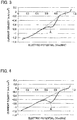
- a sweep rate was set to 1 mV/sec. The measurement result is shown in Fig. 3 .
- a gas diffusion electrode of this example was prepared in the same manner as Example 1, except that a cobalt-protoporphyrin IX complex was used instead of the iron-protoporphyrin IX complex.
- a relationship between an electric potential and a current density in the gas diffusion electrode was measured by linear sweep voltammetry in the same manner as Example 1. The measurement result is shown in Fig. 4 .
- a solution was prepared in which a benzyl disulfide-copper complex was dissolved in methanol at 60 °C.
- the concentration of the complex solution was adjusted to 0.1 M.
- the complex solution was applied to the surface of the expanded graphite sheet having a density of 0.2 g/cm 3 under a heating condition of 60 °C so that the benzyl disulfide-copper complex was 0.70 mg/cm 2 .
- the expanded graphite sheet was heated at 1050 °C for 10 minutes in a nitrogen atmosphere.
- the expanded graphite sheet was soaked in 5% of nitric acid at 50 °C for six hours and stirred to remove impurities.
- the expanded graphite sheet was washed and then dried sufficiently, so as to obtain the expanded graphite sheet doped with copper and sulfur.
- the obtained expanded graphite sheet and the polyethylene nonwoven fabric were joined together using the silicone adhesive so as to obtain a gas diffusion electrode in the same manner as Example 1.
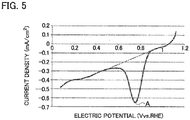
- a relationship between an electric potential and a current density in the gas diffusion electrode was measured by linear sweep voltammetry in the same manner as Example 1. The measurement result is shown in Fig. 5 .
- iron chloride 2.5 g was dissolved in 200 mL of ethanol, and 12 mL of pentaethylenehexamine was further added thereto to prepare an iron-pentaethylenehexamine complex solution.
- the ethanol as a solvent in the complex solution was removed by a rotary evaporator, so as to lead the prepared iron-pentaethylenehexamine complex solution to have the viscosity as high as about 15,000 mPa ⁇ s.
- the iron-pentaethylenehexamine complex solution having high viscosity thus obtained was applied to the surface of the expanded graphite sheet having a density of 0.2 g/cm 3 so that the complex solution was 6 ⁇ L/cm 2 .
- the expanded graphite sheet was heated at 900 °C for 90 seconds in a nitrogen atmosphere.
- the expanded graphite sheet was soaked in 5% of sulfuric acid for six hours and stirred to remove impurities.
- the expanded graphite sheet was washed and then dried sufficiently, so as to obtain the expanded graphite sheet doped with iron and nitrogen.
- the obtained expanded graphite sheet and the polyethylene nonwoven fabric were joined together using the silicone adhesive so as to obtain a gas diffusion electrode in the same manner as Example 1.
- a relationship between an electric potential and a current density in the gas diffusion electrode was measured by linear sweep voltammetry in the same manner as Example 1. The measurement result is shown in Fig. 6 .
- a gas diffusion electrode of this example was prepared in the same manner as Example 1, except that the carbon paper composed of graphitized carbon fiber (electrode base material for fuel cell TGP-H-120, available from Toray Industries, Inc.) was used instead of the expanded graphite sheet.
- a relationship between an electric potential and a current density in the gas diffusion electrode was measured by linear sweep voltammetry in the same manner as Example 1. The measurement result is shown in Fig. 7 .
- a gas diffusion electrode of this example was prepared in the same manner as Example 1, except that the nonwoven fabric composed of amorphous carbon (DONACARBO (registered trademark) Felt LFP-105, available from Osaka Gas Chemicals Co., Ltd.) was used instead of the expanded graphite sheet.
- DONACARBO registered trademark
- Felt LFP-105 available from Osaka Gas Chemicals Co., Ltd.
- a relationship between an electric potential and a current density in the gas diffusion electrode was measured by linear sweep voltammetry in the same manner as Example 1. The measurement result is shown in Fig. 8 .
- Fig. 9 is a graph showing the measurement results by the linear sweep voltammetry overlapping each other in the gas diffusion electrodes prepared in Example 1, Comparative Example 1, and Comparative Example 2.
- a section indicated by "A" in which the current density is decreased appears in a range of 0.6 to 0.8 V vs. RHE.
- the section A has no relationship with the evaluation of each carbon-based material, and the respective carbon-based materials are therefore evaluated in accordance with the values indicated by the dashed-dotted lines in the range of 0.6 to 0.8 V vs. RHE.
- Table 1 summarizes the electrical resistivity and the flexibility of each of the expanded graphite sheet used in Example 1, the carbon paper composed of graphitized carbon fiber used in Comparative Example 1, and the nonwoven fabric composed of amorphous carbon used in Comparative Example 2.
- the electrical resistivity obtained was measured in the plane direction of each sheet by a four-point probe method.
- the flexibility indicates the number of times of bending when each sheet was repeatedly bent at 180 degrees until the sheet was split up.
- the expanded graphite sheet used in Example 1 has lower electrical resistivity than the carbon paper used in Comparative Example 1 and the nonwoven fabric composed of amorphous carbon used in Comparative Example 2.
- the expanded graphite sheet used in Example 1 has higher flexibility than the carbon paper used in Comparative Example 1.
- the results revealed that the carbon-based material of Example 1 using the expanded graphite sheet has the catalytic activity as high as the carbon-based material of Comparative Example 1 using the carbon paper composed of graphitized carbon fiber, and further has the flexibility that the carbon paper composed of graphitized carbon fiber cannot ensure.
- the carbon-based material according to the present embodiment thus can achieve high catalytic activity due to low ohmic loss, and can also achieve high durability and facilitation of an increase in size due to a high tolerance for bending.
- Examples 1 to 4 have been illustrated with the case in which the surface of the expanded graphite sheet is doped with the nonmetal atoms or the nonmetal ions and the metal atoms or the metal ions.
- the expanded graphite sheet which supports, on the surface, a compound including the nonmetal atoms or the nonmetal ions and the metal atoms or the metal ions can also exhibit high oxygen reduction activity, as in the case of Examples 1 to 4.
- a carbon material in which a surface of carbon black composed of amorphous carbon was doped with nitrogen and iron, was prepared in this example. Thereafter, the carbon material was mixed and kneaded with expanded graphite grains, and then molded and pressurized. Accordingly, a carbon-based material was obtained in which the carbon material doped with nitrogen and iron was supported on the surfaces of the expanded graphite grains.
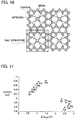
- a model structure as shown in Fig. 10 was measured to calculate oxygen reduction activity by density functional theory (DFT).
- DFT density functional theory
- the calculation was executed in accordance with Federico Calle-Vallejo, Jose Ignacio Martinezac, and Jan Rossmeisl, Physical Chemistry Chemical Physics, 2011, 13, 15639-15643 .
- the catalytic activity in the case of using nitrogen and various kinds of metal atoms can be estimated by this calculation.
- the calculation results are shown in Fig. 11 . According to the results shown in Fig. 11 , all of the metallic elements of group 8 to group 11 were presumed to effectively function as a catalyst with regard to the oxygen reduction reaction.
- the present invention can provide a carbon-based material having high catalytic activity that is easy to manufacture with time-course deterioration suppressed.
- An electrode and a microbial fuel cell including the carbon-based material can keep high power-generation performance for a long period of time due to the suppression of the time-course deterioration.
Landscapes
- Chemical & Material Sciences (AREA)
- Chemical Kinetics & Catalysis (AREA)
- Electrochemistry (AREA)
- General Chemical & Material Sciences (AREA)
- Engineering & Computer Science (AREA)
- Materials Engineering (AREA)
- Life Sciences & Earth Sciences (AREA)
- Microbiology (AREA)
- Manufacturing & Machinery (AREA)
- Sustainable Development (AREA)
- Sustainable Energy (AREA)
- Biochemistry (AREA)
- Inert Electrodes (AREA)
- Catalysts (AREA)
- Fuel Cell (AREA)
Abstract
Description
- The present invention relates to a carbon-based material, and an electrode and a microbial fuel cell including the carbon-based material. More particularly, the present invention relates to a carbon-based material having high catalytic activity that is easy to manufacture, and an electrode and a microbial fuel cell including the carbon-based material.
- An oxygen reduction reaction shown below is a positive electrode reaction induced in H2/O2 fuel cells and brine electrolysis, for example, and plays an important role in electrochemical energy conversion devices and the like.
O2 + 4H+ + 4e- → 2H2O
- An oxygen evolution reaction shown below, which is a reverse reaction of the oxygen reduction reaction, plays an important role as a negative electrode reaction induced in water electrolysis and the like.
2H2O → O2 + 4H+ + 4e-
- In order to promote the oxygen reduction reaction or the oxygen evolution reaction in various kinds of devices, noble metal such as platinum, ruthenium oxide, and iridium oxide has been widely and commonly used as a catalyst. For example,
Patent Literature 1 discloses a method of manufacturing a polymer electrolyte fuel cell using a metal-supporting catalyst supporting particles of metal selected from the group consisting of platinum group metal and a platinum group alloy on a carbon black support.Patent Literature 1 also discloses that a solid matter including the catalyst and fluorine-containing ion-exchange resin is pulverized, and the powder thus obtained is fixed to a gas diffusion layer formed of carbon cloth, for example. - Patent Literature 1: Japanese Unexamined Patent Application Publication No.
2002-184414 - When the catalyst is in a particle state, as disclosed in
Patent Literature 1, an additional step of fixing the catalyst to the gas diffusion layer, for example, is inevitably required. To fix the catalyst to a member such as the gas diffusion layer, a binder such as fluorine-containing ion-exchange resin is also necessary. However, the binder is gradually degraded by oxygen radical species generated by an electrode reaction, for example, when a gas diffusion electrode is used for a long period of time. Accordingly, the degradation leads to deterioration of the gas diffusion electrode with the passage of time. - The present invention has been made in view of the above-described conventional problems. An object of the present invention is to provide a carbon-based material having high catalytic activity that is easy to manufacture with time-course deterioration suppressed, and an electrode and a microbial fuel cell including the carbon-based material.
- In order to solve the problems described above, a carbon-based material according to a first aspect of the present invention includes an expanded graphite sheet including expanded graphite grains. The carbon-based material also includes nonmetal atoms or nonmetal ions of a nonmetallic element of either nitrogen or sulfur, and surfaces of the expanded graphite grains are doped with the nonmetal atoms or the nonmetal ions. The carbon-based material also includes metal atoms or metal ions of at least one metallic element selected from the element group of group 8 to group 11 of the periodic table, and the surfaces of the expanded graphite grains are doped with the metal atoms or the metal ions.
- A carbon-based material according to a second aspect of the present invention includes an expanded graphite sheet including expanded graphite grains. The carbon-based material also includes a compound including nonmetal atoms or nonmetal ions of a nonmetallic element of either nitrogen or sulfur, and metal atoms or metal ions of at least one metallic element selected from the element group of group 8 to group 11 of the periodic table. The compound is supported on surfaces of the expanded graphite grains.
- An electrode according to a third aspect of the present invention includes the carbon-based material.
- A microbial fuel cell according to a fourth aspect of the present invention includes the electrode.
-
-
Fig. 1 is a schematic cross-sectional view showing a carbon-based material according to an embodiment of the present invention. -
Fig. 2 is a schematic view showing a fuel cell according to the embodiment of the present invention. -
Fig. 3 is a graph showing a measurement result by linear sweep voltammetry in a gas diffusion electrode of Example 1. -
Fig. 4 is a graph showing a measurement result by linear sweep voltammetry in a gas diffusion electrode of Example 2. -
Fig. 5 is a graph showing a measurement result by linear sweep voltammetry in a gas diffusion electrode of Example 3. -
Fig. 6 is a graph showing a measurement result by linear sweep voltammetry in a gas diffusion electrode of Example 4. -
Fig. 7 is a graph showing a measurement result by linear sweep voltammetry in a gas diffusion electrode of Comparative Example 1. -
Fig. 8 is a graph showing a measurement result by linear sweep voltammetry in a gas diffusion electrode of Comparative Example 2. -
Fig. 9 is a graph showing measurement results by linear sweep voltammetry in the gas diffusion electrodes of Example 1, Comparative Example 1, and Comparative Example 2. -
Fig. 10 is a view showing a model structure used for calculating oxygen reduction activity by density functional theory. -
Fig. 11 is a graph showing results of calculation using the model structure shown inFig. 10 . - Hereinafter, a carbon-based material, and an electrode and a microbial fuel cell including the carbon-based material according to the present embodiment will be described with reference to the drawings. The dimensions of elements in the drawings may be exaggerated for illustration purposes, and are not necessarily drawn to scale.
- A carbon-based
material 10 according to the present embodiment includes an expandedgraphite sheet 1 composed of expandedgraphite grains 2, as shown inFig. 1 . The carbon-basedmaterial 10 also includes nonmetal atoms or nonmetal ions of a nonmetallic element of either nitrogen or sulfur, and metal atoms or metal ions of at least one metallic element selected from the element group of group 8 to group 11 of the periodic table, the nonmetal atoms or the nonmetal ions and the metal atoms or the metal ions being present on surfaces of the expandedgraphite grains 2. The nonmetal atoms or the nonmetal ions and the metal atoms or the metal ions, which are present on the surfaces of the expandedgraphite grains 2, formactive layers 3 which promote an oxygen reduction reaction, for example. - The expanded graphite sheet is obtained as follows, for example. First, natural graphite is subjected to chemical treatment with acid so as to provide inserts between graphene layers of the graphite. Subsequently, the graphene layers provided with the inserts are rapidly heated at a high temperature, so as to obtain expanded graphite in which gaps between the graphene layers are expanded by gas pressure due to thermal decomposition of the inserts between the graphene layers. Thereafter, the expanded graphite is pressed and rolled, so as to obtain the expanded graphite sheet. As shown in
Fig. 1 , the expanded graphite sheet thus obtained has a structure in which the flat expandedgraphite grains 2 are arranged in a plane direction of the expandedgraphite sheet 1. Since electrical conductivity in the plane direction of the expandedgraphite sheet 1 is high, the electrical conductivity between the carbon-based material and an external circuit is also improved, so as to enhance efficiency of a battery reaction. The expandedgraphite sheet 1 has flexibility due to voids provided between layers of the expandedgraphite grains 2. - The expanded
graphite sheet 1 preferably has electrical resistance as low as possible. As described below, when the carbon-basedmaterial 10 is used for an electrode, ohmic loss can be decreased as the electrical resistance of the expandedgraphite sheet 1 is smaller. The expandedgraphite sheet 1 preferably has electrical resistivity of 10 mΩ·cm or less in the plane direction and 10 Ω·cm or less in the thickness direction. The electrical resistivity may be measured by a four-point probe method, for example. - The expanded
graphite sheet 1 preferably has a density in a range of 0.05 g/cm3 to 10 g/cm3. The expandedgraphite sheet 1 having a density outside the above range may also achieve the effects of the present embodiment. However, when the density of the expandedgraphite sheet 1 is less than 0.05 g/cm3, the flexibility is decreased exceedingly, which may prevent the shape of the sheet from remaining as it is. When the density of the expandedgraphite sheet 1 exceeds 10 g/cm3, gas permeability of the expandedgraphite sheet 1 decreases in the thickness direction, which may decrease the catalytic activity of the carbon-based material. - The
active layers 3 present on the surfaces of the expandedgraphite grains 2 may be provided along the entire circumference of the expandedgraphite grains 2 included in the expandedgraphite sheet 1, or may be provided on part of the surfaces of the expandedgraphite grains 2. Alternatively, theactive layers 3 may be provided only at surface exposedportions 2a of the expandedgraphite grains 2 present on the outermost surface of the expandedgraphite sheet 1. - The surfaces of the expanded
graphite grains 2 included in the carbon-basedmaterial 10 are preferably doped with the nonmetal atoms or the nonmetal ions and the metal atoms or the metal ions. Theactive layers 3 are thus preferably formed such that the surfaces of the expandedgraphite grains 2 are doped with the nonmetal atoms or the nonmetal ions and the metal atoms or the metal ions. - As used herein, the expression "the surfaces of the expanded graphite grains are doped with the nonmetal atoms or the nonmetal ions" refers to a state in which atoms constituting the expanded graphite grains are chemically bonded with the nonmetal atoms or the nonmetal ions. In particular, the nonmetal atoms or the nonmetal ions are preferably inserted into a carbon lattice in the expanded graphite grains. More particular, at least one carbon in the carbon lattice obtained such that sp2 carbon is sequentially bonded is preferably replaced with dopant atoms consisting of a nonmetallic element (nonmetal atoms or nonmetal ions).
- As described above, the
active layers 3 may be provided along the entire circumference of the expandedgraphite grains 2, or may be provided on part of the surfaces of the expandedgraphite grains 2. Alternatively, theactive layers 3 may be provided only at the surface exposedportions 2a of the expandedgraphite grains 2. Namely, according to the present embodiment, part of the expandedgraphite grains 2 present on the outermost surface of the expandedgraphite sheet 1 may be doped with the nonmetal atoms or the nonmetal ions and the metal atoms or the metal ions, or the entire surfaces of the expandedgraphite grains 2 included in the expandedgraphite sheet 1 may be doped with the nonmetal atoms or the nonmetal ions and the metal atoms or the metal ions. The catalytic activity due to theactive layers 3 can be optimized when the expandedgraphite sheet 1 is doped, at appropriate portions, with the nonmetal atoms or the nonmetal ions and the metal atoms or the metal ions forming theactive layers 3. - The doping of the expanded
graphite grains 2 with the nonmetal atoms or the nonmetal ions can be confirmed by Raman spectroscopy, for example. In particular, a peak of a G band derived from a bond by an sp2 orbital of carbon in a Raman spectrum obtained by the Raman spectroscopy and a peak of a D band derived from defect of the bond by the sp2 orbital of carbon are confirmed in the carbon-based material. A ratio (Id/Ig) of the intensity of the peak of the D band (Id) to the intensity of the peak of the G band (Ig) increases when the carbon-based material is doped with a different element. Therefore, the carbon-based material can be determined to be doped with a different element when the ratio of the intensities (Id/Ig) is large, as compared with a case in which the carbon-based material is not doped with the nonmetal atoms or the nonmetal ions. - The doping of the expanded
graphite grains 2 with the nonmetal atoms or the nonmetal ions can also be confirmed by X-ray photoelectron spectroscopy (XPS). In particular, the carbon-based material can be determined to be doped with a different element according to a peak position derived from the nonmetal atoms or the nonmetal ions with which the carbon-based material is doped, in a binding energy spectrum obtained by the XPS. Such a peak position used may be a peak position derived from 1s orbital electrons of nitrogen atoms, for example. When the nonmetal atoms are nitrogen, the presence of nitrogen inserted in the carbon lattice can be confirmed when the peak derived from the 1s orbital electrons of nitrogen in the binding energy spectrum is located at 399.9 eV. - As used herein, the expression "the surfaces of the expanded graphite grains are doped with the metal atoms or the metal ions" refers to a state in which atoms constituting the expanded graphite grains are chemically bonded with the metal atoms or the metal ions. In particular, the metal atoms or the metal ions are preferably bonded, by coordinate bonding or ion bonding, to the nonmetal atoms or the nonmetal ions with which the expanded graphite grains are doped. The metal atoms or the metal ions with which the expanded graphite grains are doped are not necessarily bonded directly to the carbon atoms constituting the expanded graphite grains.
- The doping of the expanded
graphite grains 2 with the metal atoms or the metal ions can be confirmed by a K-edge extended X-ray absorption fine structure (EXAFS), for example. In particular, with regard to the carbon-based material, a peak is determined whether to appear around a distance of coordinate bonding (or ion bonding) between the metal atoms and the nonmetal atoms in a radial distribution function obtained such that the EXAFS of the metal atoms or the metal ions of metal excluding Pt, Ir, and Os is subjected to Fourier transform. The presence of the coordinate bonding or the ion bonding between the nonmetal atoms or the nonmetal ions and the metal atoms or the metal ions can be confirmed when such a peak appears. With regard to Pt, Ir, or Os, a peak is determined whether to appear around a distance of coordinate bonding (or ion bonding) between the metal atoms and the nonmetal atoms in a radial distribution function obtained such that an LIII-edge EXAFS of the metal atoms or the metal ions is subjected to Fourier transform. The presence of the coordinate bonding or the ion bonding between the nonmetal atoms or the nonmetal ions and the metal atoms or the metal ions can be confirmed when such a peak appears. - The EXAFS is described below. The EXAFS is a fine structure of a spectrum which appears on the higher energy side by approximately 100 eV or greater than an X-ray absorption edge in an X-ray absorption fine structure (XAFS) spectrum. An absorption near edge structure in the XAFS spectrum is called an X-ray absorption near edge structure (XANES).
- Typically, a vibrational component of the EXAFS (vibrational intensity of an absorption spectrum vibrating with a wave number k of X-ray electrons) χ(k) is represented by the following formula.

- In the formula, Ri represents a distance from absorption atoms to the i-th scattering atoms, Ai represents the number of the i-th scattering atoms, and σi represents a mean square amplitude in thermal vibration in the i-th scattering atoms. Further, λ represents a mean free path of photoelectrons, δi represents a phase shift by scattering in the i-th scattering atoms, and fi(π) represents an atomic scattering factor backscattered at a scattering angle of 180° in the i-th scattering atoms. The radial distribution function can be obtained such that the component χ(k) is subjected to Fourier transform.
- When the K-edge EXAFS spectrum is measured with regard to the metal atoms of the carbon-based
material 10, the object to be measured is only the carbon-basedmaterial 10. Other substances present independently of the carbon-basedmaterial 10, such as substances mixed in or adhering to the carbon-basedmaterial 10, are excluded from the object to be measured. Therefore, the content of substances present independently of the carbon-basedmaterial 10 is required to sufficiently be reduced such that the carbon-basedmaterial 10 is preliminarily washed with an acidic aqueous solution when the K-edge EXAFS spectrum is measured with regard to the metal atoms of the carbon-basedmaterial 10. - The method of obtaining the EXAFS and the radial distribution function is described in more detail below. The XAFS spectrum is measured by permeametry by use of an ion chamber detector, for example. The measurement of the spectrum requires preliminary calibration of an energy axis per measurement. The calibration of the energy axis is implemented, for example, such that a value of a local maximum at the first peak is set to 8980.3 eV in a graph in which energy is defined as the X axis and absorbance is defined as the Y axis with regard to a Cu K-edge XANES of Cu metal.
- The radial distribution function is led from the XAFS spectrum data by the following method. First, background noise is deducted from the XAFS spectrum data by a common method. Next, a baseline is determined at which an intensity axis is zero such that a mean intensity in the range of -150 eV to -30 eV results in zero on the basis of absorption edge energy (E0). In addition, a baseline is determined at which an intensity axis is one such that a mean intensity in the range of +150 eV to +550 eV results in one. The two baselines are determined such that the absorption edge energy (E0) is located in the middle of the two baselines on a rising spectrum adjacent to the absorption edge energy (E0). Subsequently, the two baselines are replaced by straight lines to adjust the waveforms. These operations cause the energy (unit: eV) axis to be replaced with a wave number (k, unit: 1/Å) axis, so as to extract the vibration component χ(k) of the EXAFS represented by the formula described above.
- Thereafter, the spectrum obtained by the operations described above is multiplied by the cube of k, and is then subjected to Fourier transform. The range of k subjected to Fourier transform is set to 2.5 to 11.5 (1/Å). Accordingly, the radial distribution function is obtained in which the intensity is defined as the Y axis and the distance Ri between the atoms is defined as the X axis. The presence of the coordinate bonding or the ion bonding between the nonmetal atoms or the nonmetal ions and the metal atoms or the metal ions can be confirmed from the peak appearing around the distance of the coordinate bonding (or the ion bonding) between the metal atoms and the nonmetal atoms in the radial distribution function.
- When the metal atoms or the metal ions are metal excluding Pt, Ir, and Os, the intensity at the maximum peak appearing around the distance of the metal bonding between the metal atoms or the metal ions in the radial distribution function obtained such that the EXAFS of the metal atoms or the metal ions is subjected to Fourier transform, is defined as intensity B. The intensity at the maximum peak appearing around the distance of the coordinate bonding (or the ion bonding) between the metal atoms or the metal ions and the nonmetal atoms or the nonmetal ions, is defined as intensity A. A ratio A/B of the intensity A to the intensity B is preferably 4.0 or greater. When the ratio A/B of the intensity A to the intensity B is 4.0 or greater, a proportion of a compound corresponding to impurities such as metal carbide is decreased, so as to enhance the catalytic activity of the electrode without impairing the catalytic reaction.
- When the metal atoms or the metal ions are metal of Pt, Ir, or Os, the intensity at the maximum peak appearing around the distance of the metal bonding between the metal atoms or the metal ions in the radial distribution function obtained such that the LIII-edge EXAFS of the metal atoms or the metal ions is subjected to Fourier transform, is defined as intensity B. The intensity at the maximum peak appearing around the distance of the coordinate bonding (or the ion bonding) between the metal atoms or the metal ions and the nonmetal atoms or the nonmetal ions, is defined as intensity A. A ratio A/B of the intensity A to the intensity B is preferably 4.0 or greater. As in the case described above, when the ratio A/B of the intensity A to the intensity B is 4.0 or greater, a proportion of a compound corresponding to impurities such as metal carbide is decreased, so as to enhance the catalytic activity of the electrode.
- The doping of the expanded
graphite grains 2 with the metal atoms or the metal ions can also be confirmed by an X-ray absorption spectrum (XAS). In particular, a position is measured at an absorption peak derived from exciting, to an unoccupied orbital, inner-shell electrons (for example, 1s orbital electrons in the case of nitrogen atoms) of the nonmetal atoms or the nonmetal ions in the XAS obtained for the carbon-based material. In addition, a position is measured at an absorption peak derived from exciting, to an unoccupied orbital, inner-shell electrons (for example, 2p orbital electrons in the case of iron atoms) of the metal atoms or the metal ions. Subsequently, each position at the absorption peak is determined whether to be shifted from a peak position at which no coordinate bonding or ion bonding is present, and the respective positions are determined whether to be shifted in different directions. Accordingly, the presence of the coordinate bonding or the ion bonding of the nonmetal atoms or the nonmetal ions and the metal atoms or the metal ions can be confirmed when each position is shifted from the peak position and the respective positions are shifted in different directions. This is because the electron density of one of the nonmetal atoms and the metal atoms is increased as compared with the electron density of the other atoms due to the coordinate bonding or the ion bonding of the nonmetal atoms or the nonmetal ions and the metal atoms or the metal ions. Namely, it is because the peak of absorption energy derived from either the nonmetal atoms or the metal atoms having the higher electron density is shifted to the low-energy side, and the peak of absorption energy derived from the other atoms having the lower electron density is shifted to the high-energy side. - As described above, the carbon-based
material 10 according to the present embodiment includes the nonmetal atoms or the nonmetal ions and the metal atoms or the metal ions present on the surfaces of the expandedgraphite grains 2. The surfaces of the expandedgraphite grains 2 are preferably doped with the nonmetal atoms or the nonmetal ions and the metal atoms or the metal ions. However, the present embodiment is not limited to this mode, and a compound including the nonmetal atoms or the nonmetal ions and the metal atoms or the metal ions may be supported on the surfaces of the expandedgraphite grains 2. Namely, theactive layers 3 may be formed such that a compound including the nonmetal atoms or the nonmetal ions and the metal atoms or the metal ions is supported on the surfaces of the expandedgraphite grains 2. - As used herein, the expression "a compound including the nonmetal atoms or the nonmetal ions and the metal atoms or the metal ions is supported on the surfaces of the expanded graphite grains" refers to a state in which a compound including the nonmetal atoms or the nonmetal ions and the metal atoms or the metal ions adheres to the surfaces of the expanded graphite grains.
- The nonmetal atoms or the nonmetal ions and the metal atoms or the metal ions may adhere to the expanded
graphite grains 2 via another carbon material. For example, a carbon material may first be doped with the nonmetal atoms or the nonmetal ions and the metal atoms or the metal ions, and a compound of the carbon material thus obtained then may be caused to adhere to the surfaces of the expanded graphite grains. The nonmetal atoms or the nonmetal ions and the metal atoms or the metal ions supported via the other carbon material can also promote the oxygen reduction reaction. The carbon material is preferably, but not limited to, at least one material selected from the group consisting of carbon black, activated carbon, fullerene, carbon nanotube, carbon nanowire, graphene, and carbon fiber. - As described above, the
active layers 3 may be provided along the entire circumference of the expandedgraphite grains 2, or may be provided on part of the surfaces of the expandedgraphite grains 2. Alternatively, theactive layers 3 may be provided only at the surface exposedportions 2a of the expandedgraphite grains 2. Namely, according to the present embodiment, a compound including the nonmetal atoms or the nonmetal ions and the metal atoms or the metal ions may be supported on part of the expandedgraphite grains 2 present on the outermost surface of the expandedgraphite sheet 1. Alternatively, a compound including the nonmetal atoms or the nonmetal ions and the metal atoms or the metal ions may be supported on the entire surfaces of the expandedgraphite grains 2 included in the expandedgraphite sheet 1. Supporting the compound including the nonmetal atoms or the nonmetal ions and the metal atoms or the metal ions on appropriate portions of the expandedgraphite sheet 1 can optimize the catalytic activity of theactive layers 3. - As described above, the carbon-based
material 10 according to the present embodiment includes the nonmetal atoms or the nonmetal ions of the nonmetallic element of either nitrogen or sulfur, and the metal atoms or the metal ions of at least one metallic element selected from the element group of group 8 to group 11 of the periodic table. The metallic element may be selected from the group consisting of iron, cobalt, nickel, copper, ruthenium, rhodium, palladium, silver, osmium, iridium, platinum, and gold. The carbon-basedmaterial 10 preferably includes nitrogen atoms or nitrogen ions and iron atoms or iron ions. Namely, the carbon-basedmaterial 10 preferably includes nitrogen as a nonmetallic element and iron as a metallic element. Nitrogen and iron are easy to dope the surfaces of the expanded graphite grains, and can easily enhance the catalytic activity when nitrogen and iron are present on the surfaces of the expanded graphite grains. - Next, a method of manufacturing the carbon-based material according to the present embodiment is described below. The method of manufacturing the carbon-based material according to the present embodiment may be any method which can cause the nonmetal atoms or the nonmetal ions and the metal atoms or the metal ions to be present on the surfaces of the expanded
graphite grains 2 included in the expandedgraphite sheet 1. - The carbon-based material, in which the surfaces of the expanded
graphite grains 2 are doped with the nonmetal atoms or the nonmetal ions and the metal atoms or the metal ions, may be manufactured as follows. First, a dispersion solution or a complex solution including at least one of nonmetal atoms or nonmetal ions and at least one of metal atoms or metal ions is prepared, and the solution thus prepared is applied to the surface of the expandedgraphite sheet 1. The expandedgraphite sheet 1, to which the solution is applied, is then baked at a high temperature in a range of 800 °C to 1000 °C for a short period of time in a range of several tens of seconds to several minutes in an inert gas atmosphere, and is washed with an acid solution such as sulfuric acid. Accordingly, the surfaces of the expandedgraphite grains 2 can be doped with the nonmetal atoms or the nonmetal ions and the metal atoms or the metal ions. - The dispersion solution or the complex solution may include a compound including nonmetal atoms and metal atoms coordinated with the nonmetal atoms, and in particular preferably includes a complex including nonmetal atoms and metal atoms coordinated with the nonmetal atoms. The compound preferably further includes at least either a porphyrin ring or a phthalocyanine ring. Examples of such compounds include an iron-protoporphyrin IX complex, a cobalt-protoporphyrin IX complex, a benzyl disulfide-copper complex, a phthalocyanine iron(II) complex, and an iron-pentaethylenehexamine complex solution.
- The carbon-based material, in which part of the expanded
graphite grains 2 present on the outermost surface of the expandedgraphite sheet 1 is doped with the nonmetal atoms or the nonmetal ions and the metal atoms or the metal ions, may be manufactured as follows. First, a dispersion solution or a complex solution including at least one of nonmetal atoms and nonmetal ions and at least one of metal atoms and metal ions is prepared such that the viscosity of the solution is set to 10,000 mPa·s or greater. The solution thus obtained is applied to the surface of the expandedgraphite sheet 1. The expandedgraphite sheet 1 to which the solution is applied is then baked at a high temperature in a range of 800 °C to 1000 °C for a short period of time in a range of several tens of seconds to several minutes in an inert gas atmosphere, and is washed with an acid solution such as sulfuric acid. Accordingly, the surface exposedportions 2a of the expandedgraphite grains 2 present on the outermost surface of the expandedgraphite sheet 1 can be doped with the nonmetal atoms or the nonmetal ions and the metal atoms or the metal ions. - The carbon-based material, in which the entire surfaces of the expanded
graphite grains 2 included in the expandedgraphite sheet 1 are doped with the nonmetal atoms or the nonmetal ions and the metal atoms or the metal ions, may be manufactured as follows. First, a dispersion solution or a complex solution including at least one of nonmetal atoms and nonmetal ions and at least one of metal atoms and metal ions is prepared such that the viscosity of the solution is set to 100 mPa·s or lower. The expandedgraphite sheet 1 is then soaked in and impregnated with the solution thus prepared. Subsequently, the solvent is removed so that at least one of the nonmetal atoms or the nonmetal ions and at least one of the metal atoms or the metal ions adhere to the surfaces of the expanded graphite grains. The expanded graphite sheet to which these atoms or the ions adhere is then baked at a high temperature in a range of 800 °C to 1000 °C for a short period of time in a range of several tens of seconds to several minutes in an inert gas atmosphere, and is washed with an acid solution such as sulfuric acid. Accordingly, the entire surfaces of the expandedgraphite grains 2 can be doped with the nonmetal atoms or the nonmetal ions and the metal atoms or the metal ions. - The carbon-based material, in which a compound including the nonmetal atoms or the nonmetal ions and the metal atoms or the metal ions is supported on the surfaces of the expanded
graphite grains 2, may be manufactured as follows. First, a polymer solution including at least one of nonmetal atoms or nonmetal ions and at least one of metal atoms or metal ions is prepared, and the solution thus prepared is applied to the surface of the expandedgraphite sheet 1. The expandedgraphite sheet 1 to which the solution is applied is then baked at a temperature in a range of 600 °C to 1000 °C for 30 minutes to several hours in an inert gas atmosphere, and is washed with an acid solution such as sulfuric acid. Accordingly, the compound including the nonmetal atoms or the nonmetal ions and the metal atoms or the metal ions can be supported on the surfaces of the expandedgraphite grains 2. - The carbon-based material, in which a compound including the nonmetal atoms or the nonmetal ions and the metal atoms or the metal ions is supported on part of the expanded
graphite grains 2 present on the outermost surface of the expandedgraphite sheet 1, may be manufactured as follows. First, a polymer solution including at least one of nonmetal atoms or nonmetal ions and at least one of metal atoms or metal ions is prepared such that the viscosity of the solution is set to 10,000 mPa·s or greater. The solution thus obtained is applied to the surface of the expandedgraphite sheet 1. The expandedgraphite sheet 1, to which the solution is applied, is then baked at a temperature in a range of 600 °C to 1000 °C for 30 minutes to several hours in an inert gas atmosphere, and is washed with an acid solution such as sulfuric acid. Accordingly, the compound including the nonmetal atoms or the nonmetal ions and the metal atoms or the metal ions can be supported on the expandedgraphite grains 2 present on the outermost surface of the expandedgraphite sheet 1. - The carbon-based material, in which a compound including the nonmetal atoms or the nonmetal ions and the metal atoms or the metal ions is supported on the entire surfaces of the expanded
graphite grains 2 included in the expandedgraphite sheet 1, may be manufactured as follows. First, a polymer solution including at least one of nonmetal atoms or nonmetal ions and at least one of metal atoms or metal ions is prepared such that the viscosity of the solution is set to 100 mPa·s or lower. The expandedgraphite sheet 1 is then soaked in and impregnated with the solution thus prepared. Subsequently, the solvent is removed so that at least one of the nonmetal atoms or the nonmetal ions and at least one of the metal atoms or the metal ions adhere to the surfaces of the expanded graphite grains. The expanded graphite sheet to which these atoms or the ions adhere is then baked at a temperature in a range of 600 °C to 1000 °C for 30 minutes to several hours in an inert gas atmosphere, and is washed with an acid solution such as sulfuric acid. Accordingly, the compound including the nonmetal atoms or the nonmetal ions and the metal atoms or the metal ions can be supported on the entire surfaces of the expandedgraphite grains 2 included in the expandedgraphite sheet 1. - The carbon-based material, in which a compound of a carbon material doped with the nonmetal atoms or the nonmetal ions and the metal atoms or the metal ions is supported on the surfaces of the expanded
graphite grains 2 included in the expandedgraphite sheet 1, may be manufactured as follows. First, a dispersion solution or a complex solution including at least one of nonmetal atoms or nonmetal ions and at least one of metal atoms or metal ions is prepared, and the solution thus prepared is applied to the surface of the carbon material. As described above, the carbon material is preferably at least one material selected from the group consisting of carbon black, activated carbon, fullerene, carbon nanotube, carbon nanowire, graphene, and carbon fiber. The carbon material to which the solution is applied is then baked at a high temperature in a range of 800 °C to 1000 °C for a short period of time in a range of several tens of seconds to several minutes in an inert gas atmosphere, and is washed with an acid solution such as sulfuric acid. The compound of the carbon material doped with the nonmetal atoms or the nonmetal ions and the metal atoms or the metal ions thus can be obtained. - Thereafter, the compound of the carbon material thus obtained is mixed with the expanded
graphite grains 2. The compound of the carbon material and the expandedgraphite grains 2 may be mixed together by any method. At least one of a solvent, a binding agent, and a dispersant may be used during mixing of the compound of the carbon material and the expandedgraphite grains 2. The solvent may be, but not limited to, at least one of water and ethanol. The binding agent may be, but not limited to, at least one material selected from the group consisting of polytetrafluoroethylene (PTFE), polyvinylidene fluoride (PVDF), and an ethylene-propylene-diene copolymer (EPDM). The dispersant may be, but not limited to, carboxymethyl cellulose (CMC). - The compound of the carbon material may be mixed with the expanded
graphite grains 2 at any timing. For example, graphite grains after being subjected to chemical treatment with acid, but before expansion treatment, may be mixed with the compound, and the graphite grains then may be heated rapidly and molded by pressure. Alternatively, expanded graphite grains obtained such that graphite grains subjected to chemical treatment are heated rapidly may be mixed with the compound. Alternatively, the expanded graphite grains may be mixed with the compound during molding by pressure. Alternatively, the expanded graphite grains preliminarily mixed with the compound of the carbon material may be added during a conventional process of manufacturing an expanded graphite sheet and then molded by pressure. Alternatively, the expanded graphite sheet after molding by pressure may be impregnated with the compound of the carbon material so that the compound is mixed with the expanded graphite grains. - As described above, the carbon-based
material 10 according to the present embodiment includes the expandedgraphite sheet 1 including the expandedgraphite grains 2. The carbon-basedmaterial 10 further includes the nonmetal atoms or the nonmetal ions of the nonmetallic element of either nitrogen or sulfur with which the surfaces of the expandedgraphite grains 2 are doped. The carbon-basedmaterial 10 further includes the metal atoms or the metal ions of at least one metallic element selected from the element group of group 8 to group 11 of the periodic table, with which the surfaces of the expandedgraphite grains 2 are doped. - The carbon-based
material 10 according to the present embodiment includes the expandedgraphite sheet 1 including the expandedgraphite grains 2. The carbon-basedmaterial 10 further includes the compound including the nonmetal atoms or the nonmetal ions of the nonmetallic element of either nitrogen or sulfur and the metal atoms or the metal ions of at least one metallic element selected from the element group of group 8 to group 11 of the periodic table. The compound is supported on the surfaces of the expandedgraphite grains 2. - The carbon-based
material 10 according to the present embodiment does not need to include a catalyst having a granular shape supported thereon due to the expandedgraphite sheet 1 and the expandedgraphite grains 2, each having a surface with high catalytic activity. Since deterioration of electrode performance derived from degradation of a binder can be suppressed, the electrode can have high durability. - The expanded
graphite sheet 1 has high gas permeability while barely allowing water to pass therethrough. The carbon-basedmaterial 10 according to the present embodiment thus can be used for a gas diffusion electrode, such as an electrode for a microbial fuel cell impregnated with water, without including a water-repellent layer described below. The expandedgraphite sheet 1 can improve power generation performance of the fuel cell when used for the gas diffusion electrode because of high electrical conductivity in the plane direction. The carbon-basedmaterial 10 can also be deformed into any shape, such as a shape with high resistance to water pressure, since the expandedgraphite sheet 1 has high flexibility. - Next, an electrode and a microbial fuel cell according to the present embodiment are described below. The electrode according to the present embodiment includes the carbon-based material described above, and the microbial fuel cell includes the electrode.
-
Fig. 2 is a cross-sectional view illustrating a configuration of afuel cell 20 according to the present embodiment.Fig. 2 also illustrates anexternal circuit 30 to which an electric current is supplied when theexternal circuit 30 is connected to thefuel cell 20. Thefuel cell 20 includes the carbon-basedmaterial 10 used as an electrode. Thefuel cell 20 is a primary battery capable of discharging electricity, and examples thereof include a hydrogen fuel cell such as a polymer electrolyte fuel cell (PEFC) and a phosphoric acid fuel cell (PAFC), and a microbial fuel cell (MFC). - A hydrogen fuel cell obtains electric energy from hydrogen and oxygen through a reverse reaction of electrolysis of water. Such a fuel cell is known as a PEFC, a PAFC, an alkaline fuel cell (AFC), a molten carbonate fuel cell (MCFC), and a solid oxide fuel cell (SOFC), for example. The
fuel cell 20 according to the present embodiment is preferably the PEFC or the PAFC. The PEFC is a fuel cell including a proton-conducting ion-exchange membrane as an electrolyte material, and the PAFC is a fuel cell including a matrix layer impregnated with phosphoric acid (H3PO4) used as an electrolyte material. - As shown in
Fig. 2 , thefuel cell 20 includes an electrolysis solution 21 (an electrolyte material), for example. Thefuel cell 20 further includes a negative electrode 22 (a fuel electrode) and a positive electrode 23 (an air electrode). Thenegative electrode 22 discharges electrons to theexternal circuit 30 through an oxygen evolution reaction. Thepositive electrode 23 receives electrons flowing from theexternal circuit 30 through an oxygen reduction reaction. - According to the present embodiment, the
positive electrode 23 is configured as a gas diffusion electrode, and includes the carbon-basedmaterial 10 as described above. In particular, the carbon-basedmaterial 10 according to the present embodiment is included in thepositive electrode 23 as a gas diffusion layer and an electrode catalyst. - A gas diffusion electrode may preferably be used as an electrode for a hydrogen fuel cell and an MFC, for example. The
fuel cell 20 according to the present embodiment may have a known configuration and is only required to include thepositive electrode 23 serving as a gas diffusion electrode including an electrode catalyst including the carbon-basedmaterial 10. For example, thefuel cell 20 may have a configuration described in "Fuel cell Technology"; The Institute of Electrical Engineers of Japan, Special Research Committee for Next-Generation Fuel cell Power Generation System, Ohmsha, Ltd., August, 2002. Thefuel cell 20 may also have a configuration described in Watanabe, K., Journal of Bioscience and Bioengineering, 2008, 106: 528-536. - The present embodiment has been illustrated with the case in which the
positive electrode 23 is configured as the gas diffusion electrode and includes the carbon-basedmaterial 10, but is not limited to this case. In thefuel cell 20 according to the present embodiment, the gas diffusion electrode may be used as either thenegative electrode 22 or thepositive electrode 23. - For example, when the
fuel cell 20 according to the present embodiment is a hydrogen fuel cell, the gas diffusion electrode including the electrode catalyst that includes the carbon-basedmaterial 10 may be used for thenegative electrode 22. The electrode catalyst included in thenegative electrode 22 promotes an oxidation reaction of hydrogen gas serving as fuel (H2 → 2H+ + 2e-), so as to donate electrons to thenegative electrode 22. The gas diffusion electrode including the electrode catalyst that includes the carbon-basedmaterial 10 may also be used for thepositive electrode 23. The electrode catalyst included in thepositive electrode 23 promotes a reduction reaction of oxygen gas serving as an oxidizing agent (1/2O2 + 2H+ + 2e- → H2O). - When the carbon-based
material 10 is used for an oxygen reduction electrode catalyst, the electrode including the electrode catalyst, such as the gas diffusion electrode, is used as a positive electrode for a fuel cell, a positive electrode for a carbon dioxide permeation device, or a positive electrode for a device for brine electrolysis, for example. When the carbon-basedmaterial 10 is used for an oxygen evolution electrode catalyst, the electrode including the electrode catalyst is used as a negative electrode for a device for water electrolysis or as a negative electrode for a metal-air battery, for example. - As described above, the carbon-based
material 10 according to the present embodiment uses the expanded graphite sheet having high gas permeability while barely allowing water to pass therethrough. Therefore, the carbon-basedmaterial 10 itself can be used for the gas diffusion electrode. To further enhance the durability of the electrode, a water-repellent layer having gas permeability may be used with the carbon-basedmaterial 10 bonded thereto. - When the water-repellent layer is used, the carbon-based
material 10 is arranged on the side in contact with, for example, an electrolysis solution and an electrolyte film, and the water-repellent layer is arranged on the side in contact with gas such as air. The water-repellent layer may be arranged inside the sheet of the carbon-basedmaterial 10, may be arranged outside the sheet, or may be arranged both on the inside and the outside of the sheet. When the water-repellent layer is arranged outside the sheet, the water-repellent layer is preferably closer to the sheet-like carbon-based material, and more preferably in contact with the carbon-based material. - The water-repellent layer is preferably a porous material. The water-repellent layer can have both water repellency and high gas permeability when a porous material is used. Examples of materials used for the water-repellent layer include polytetrafluoroethylene (PTFE), polydimethylsiloxane (PDMS), polyethylene (PE), and polypropylene (PP). The water-repellent layer and the carbon-based material may be directly bonded together or may be bonded via an adhesive.
- The adhesive preferably has high oxygen permeability. To have high oxygen permeability, the adhesive is only required to fulfill at least one of a material having voids after curing and a material having high oxygen permeability. Preferred examples of materials used for the adhesive include silicone resin, natural rubber, low-density polyethylene, polystyrene, polypropylene, polycarbonate, and polyvinyl acetate. The adhesive is not limited to the material described above, and may be any material that can fix the water-repellent layer and the carbon-based material together.
- As described above, the carbon-based
material 10 uses the expandedgraphite sheet 1 having high gas permeability while barely allowing water to pass therethrough. Thus, the carbon-basedmaterial 10 is preferably used particularly for a gas diffusion electrode which is impregnated with water, such as an electrode for a microbial fuel cell. - A case in which the carbon-based
material 10 according to the present embodiment is used for thepositive electrode 23 in the microbial fuel cell is described below. As shown inFig. 2 , the fuel cell (the microbial fuel cell) 20 includes thenegative electrode 22 and thepositive electrode 23. Thefuel cell 20 has a structure in which thenegative electrode 22 is impregnated with theelectrolysis solution 21, and thepositive electrode 23 on one surface is exposed to a gas phase. - The
negative electrode 22 has a thin-plate shape, and a material thereof is preferably at least one of carbon and platinum, for example. Thenegative electrode 22 holds anaerobic microorganisms. In particular, a biofilm including anaerobic microorganisms is placed and fixed onto a surface of thenegative electrode 22 so that the anaerobic microorganisms are held by thenegative electrode 22. A typical biofilm has a three-dimensional structure including a microbial population and an extracellular polymeric substance (EPS) that the microbial population produces. The anaerobic microorganisms are not necessarily held by thenegative electrode 22 via the biofilm. - The anaerobic microorganisms held by the
negative electrode 22 are preferably electricity-producing bacteria having, for example, an extracellular electron transfer mechanism. Specific examples of anaerobic microorganisms include Geobacter, Shewanella, Aeromonas, Geothrix, and Saccharomyces. - The
positive electrode 23 may be the gas diffusion electrode including the carbon-basedmaterial 10 described above. The carbon-basedmaterial 10 includes the expanded graphite sheet and thus has high gas permeability while barely allowing water to pass therethrough. In addition, the nonmetal atoms or the nonmetal ions and the metal atoms or the metal ions present on the expandedgraphite grains 2 included in the carbon-basedmaterial 10 have high oxygen reduction activity. The use of the carbon-basedmaterial 10 used for thepositive electrode 23 can achieve high power generation performance. - When the carbon-based
material 10 has the water-repellent layer on the surface, the water-repellent layer is preferably arranged on the gas phase side so that the water-repellent layer is exposed to the gas phase, and the carbon-basedmaterial 10 is preferably arranged on theelectrolysis solution 21 side. - The
fuel cell 20 having the configuration described above is in a closed circuit state when theelectrolysis solution 21 is supplied, and when thenegative electrode 22 and thepositive electrode 23 are connected to theexternal circuit 30. An organic matter in theelectrolysis solution 21 is decomposed due to the metabolism of anaerobic microorganisms, so that electrons, protons, and carbon dioxide are produced in thenegative electrode 22. The produced electrons flow to the external circuit from thenegative electrode 22, and the protons reach thepositive electrode 23 through theelectrolysis solution 21. Oxygen supplied to thepositive electrode 23 from the gas phase is reduced by the reaction with the protons and electrons due to the effect of theactive layers 3 of the carbon-basedmaterial 10, so as to produce water. This electrochemical reaction produces electromotive force between thepositive electrode 23 and thenegative electrode 22, and decomposes the organic matter in theelectrolysis solution 21. Accordingly, both of the power generation and the decomposition treatment of the organic matter in theelectrolysis solution 21 can be achieved. - As described above, the carbon-based
material 10 according to the present embodiment having high catalytic activity, gas permeability, and water repellency can preferably be used for the gas diffusion electrode in the microbial fuel cell. The carbon-basedmaterial 10 is particularly preferable when used for the gas diffusion electrode in the microbial fuel cell because the carbon-based material is barely corroded, as compared with a metal material which is easily corroded, under the presence of microorganisms. Further, since the carbon-basedmaterial 10 can suppress time-course deterioration, the microbial fuel cell can keep high power generation performance for a long period of time. - Hereinafter, the present embodiment will be described in more detail with reference to Examples and Comparative Examples, but is not intended to be limited to these examples.
- A carbon-based material including an expanded graphite sheet composed of expanded graphite grains and doped with nitrogen and iron on the surfaces of the expanded graphite grains, was prepared in this example.
- First, a complex solution was prepared in which an iron-protoporphyrin IX complex was dissolved in N,N-dimethylformamide. The concentration of the complex solution was adjusted to 0.1 M. The complex solution was applied to the surface of the expanded graphite sheet having a density of 0.2 g/cm3 under a heating condition of 110 °C so that the iron-protoporphyrin IX complex was 0.70 mg/cm2.
- After the solvent was sufficiently evaporated, the expanded graphite sheet was heated at 900 °C for 90 seconds in a nitrogen atmosphere. The expanded graphite sheet was soaked in 5% of sulfuric acid for six hours and stirred to remove impurities. The expanded graphite sheet was washed and then dried sufficiently, so as to obtain the expanded graphite sheet doped with iron and nitrogen.
- The obtained expanded graphite sheet and polyethylene nonwoven fabric (Tyvek (registered trademark) 1073B, available from DuPont Company) were joined together using a silicone adhesive (Shin-Etsu silicone (registered trademark) KE-3475-T, available from Shin-Etsu Chemical Co., Ltd.), so as to obtain a gas diffusion electrode.
- The gas diffusion electrode thus obtained was used as a working electrode so as to measure a relationship between an electric potential and a current density by linear sweep voltammetry (LSV). An electrolysis solution, which was a 1.0 M Trizma-HCI buffer solution of pH 8.0, was subjected to nitrogen bubbling so as to degas oxygen in the solution. A platinum mesh was used for a counter electrode. A sweep rate was set to 1 mV/sec. The measurement result is shown in
Fig. 3 . - A carbon-based material including an expanded graphite sheet composed of expanded graphite grains and doped with nitrogen and cobalt on the surfaces of the expanded graphite grains, was prepared in this example.
- In particular, a gas diffusion electrode of this example was prepared in the same manner as Example 1, except that a cobalt-protoporphyrin IX complex was used instead of the iron-protoporphyrin IX complex. A relationship between an electric potential and a current density in the gas diffusion electrode was measured by linear sweep voltammetry in the same manner as Example 1. The measurement result is shown in
Fig. 4 . - A carbon-based material including an expanded graphite sheet composed of expanded graphite grains and doped with sulfur and copper on the surfaces of the expanded graphite grains, was prepared in this example.
- First, a solution was prepared in which a benzyl disulfide-copper complex was dissolved in methanol at 60 °C. The concentration of the complex solution was adjusted to 0.1 M. The complex solution was applied to the surface of the expanded graphite sheet having a density of 0.2 g/cm3 under a heating condition of 60 °C so that the benzyl disulfide-copper complex was 0.70 mg/cm2.
- After the solvent was sufficiently evaporated, the expanded graphite sheet was heated at 1050 °C for 10 minutes in a nitrogen atmosphere. The expanded graphite sheet was soaked in 5% of nitric acid at 50 °C for six hours and stirred to remove impurities. The expanded graphite sheet was washed and then dried sufficiently, so as to obtain the expanded graphite sheet doped with copper and sulfur.
- The obtained expanded graphite sheet and the polyethylene nonwoven fabric were joined together using the silicone adhesive so as to obtain a gas diffusion electrode in the same manner as Example 1. A relationship between an electric potential and a current density in the gas diffusion electrode was measured by linear sweep voltammetry in the same manner as Example 1. The measurement result is shown in
Fig. 5 . - A carbon-based material including an expanded graphite sheet composed of expanded graphite grains and doped with nitrogen and iron on part of the expanded graphite grains present on the outermost surface of the expanded graphite sheet, was prepared in this example.
- First, 2.5 g of iron chloride was dissolved in 200 mL of ethanol, and 12 mL of pentaethylenehexamine was further added thereto to prepare an iron-pentaethylenehexamine complex solution. Subsequently, the ethanol as a solvent in the complex solution was removed by a rotary evaporator, so as to lead the prepared iron-pentaethylenehexamine complex solution to have the viscosity as high as about 15,000 mPa·s. The iron-pentaethylenehexamine complex solution having high viscosity thus obtained was applied to the surface of the expanded graphite sheet having a density of 0.2 g/cm3 so that the complex solution was 6 µL/cm2.
- After the solvent was sufficiently evaporated, the expanded graphite sheet was heated at 900 °C for 90 seconds in a nitrogen atmosphere. The expanded graphite sheet was soaked in 5% of sulfuric acid for six hours and stirred to remove impurities. The expanded graphite sheet was washed and then dried sufficiently, so as to obtain the expanded graphite sheet doped with iron and nitrogen.
- The obtained expanded graphite sheet and the polyethylene nonwoven fabric were joined together using the silicone adhesive so as to obtain a gas diffusion electrode in the same manner as Example 1. A relationship between an electric potential and a current density in the gas diffusion electrode was measured by linear sweep voltammetry in the same manner as Example 1. The measurement result is shown in
Fig. 6 . - A carbon-based material in which a surface of a carbon paper composed of graphitized carbon fiber was doped with nitrogen and iron, was prepared in this example.
- In particular, a gas diffusion electrode of this example was prepared in the same manner as Example 1, except that the carbon paper composed of graphitized carbon fiber (electrode base material for fuel cell TGP-H-120, available from Toray Industries, Inc.) was used instead of the expanded graphite sheet. A relationship between an electric potential and a current density in the gas diffusion electrode was measured by linear sweep voltammetry in the same manner as Example 1. The measurement result is shown in
Fig. 7 . - A carbon-based material in which a surface of nonwoven fabric composed of amorphous carbon was doped with nitrogen and iron, was prepared in this example.
- In particular, a gas diffusion electrode of this example was prepared in the same manner as Example 1, except that the nonwoven fabric composed of amorphous carbon (DONACARBO (registered trademark) Felt LFP-105, available from Osaka Gas Chemicals Co., Ltd.) was used instead of the expanded graphite sheet. A relationship between an electric potential and a current density in the gas diffusion electrode was measured by linear sweep voltammetry in the same manner as Example 1. The measurement result is shown in
Fig. 8 . -
Fig. 9 is a graph showing the measurement results by the linear sweep voltammetry overlapping each other in the gas diffusion electrodes prepared in Example 1, Comparative Example 1, and Comparative Example 2. In each ofFig. 3 to Fig. 5 andFig. 7 to Fig. 9 , a section indicated by "A", in which the current density is decreased appears in a range of 0.6 to 0.8 V vs. RHE. However, the section A has no relationship with the evaluation of each carbon-based material, and the respective carbon-based materials are therefore evaluated in accordance with the values indicated by the dashed-dotted lines in the range of 0.6 to 0.8 V vs. RHE. - It is clearly shown in
Fig. 9 that the absolute value of the current density of the electric potential in the range of 0.6 to 0.75 V vs. RHE is greater in Example 1 and Comparative Example 1 than in Comparative Example 2. The results revealed that the gas diffusion electrodes of Example 1 and Comparative Example 1 have high oxygen reduction activity because the oxygen reduction performance increases as the absolute value of the current density is greater. - Table 1 summarizes the electrical resistivity and the flexibility of each of the expanded graphite sheet used in Example 1, the carbon paper composed of graphitized carbon fiber used in Comparative Example 1, and the nonwoven fabric composed of amorphous carbon used in Comparative Example 2. The electrical resistivity obtained was measured in the plane direction of each sheet by a four-point probe method. The flexibility indicates the number of times of bending when each sheet was repeatedly bent at 180 degrees until the sheet was split up.
[Table 1] Expanded Graphite Sheet Graphitized Carbon Fiber Paper Amorphous Carbon Nonwoven Fabric Electrical Resistivity (plane direction) [µΩ·m] 7 47 200 Flexibility [The number of times] 20 0 >100 - As shown in Table 1, the expanded graphite sheet used in Example 1 has lower electrical resistivity than the carbon paper used in Comparative Example 1 and the nonwoven fabric composed of amorphous carbon used in Comparative Example 2. In addition, the expanded graphite sheet used in Example 1 has higher flexibility than the carbon paper used in Comparative Example 1. The results revealed that the carbon-based material of Example 1 using the expanded graphite sheet has the catalytic activity as high as the carbon-based material of Comparative Example 1 using the carbon paper composed of graphitized carbon fiber, and further has the flexibility that the carbon paper composed of graphitized carbon fiber cannot ensure. The carbon-based material according to the present embodiment thus can achieve high catalytic activity due to low ohmic loss, and can also achieve high durability and facilitation of an increase in size due to a high tolerance for bending.
- The results also revealed that the gas diffusion electrodes of Examples 2 to 4 are preferable due to high oxygen reduction activity, as shown in
Fig. 4 to Fig. 6 . Examples 1 to 4 have been illustrated with the case in which the surface of the expanded graphite sheet is doped with the nonmetal atoms or the nonmetal ions and the metal atoms or the metal ions. The expanded graphite sheet which supports, on the surface, a compound including the nonmetal atoms or the nonmetal ions and the metal atoms or the metal ions can also exhibit high oxygen reduction activity, as in the case of Examples 1 to 4. - First, a carbon material, in which a surface of carbon black composed of amorphous carbon was doped with nitrogen and iron, was prepared in this example. Thereafter, the carbon material was mixed and kneaded with expanded graphite grains, and then molded and pressurized. Accordingly, a carbon-based material was obtained in which the carbon material doped with nitrogen and iron was supported on the surfaces of the expanded graphite grains.
- A model structure as shown in
Fig. 10 was measured to calculate oxygen reduction activity by density functional theory (DFT). The calculation was executed in accordance with Federico Calle-Vallejo, Jose Ignacio Martinezac, and Jan Rossmeisl, Physical Chemistry Chemical Physics, 2011, 13, 15639-15643. The catalytic activity in the case of using nitrogen and various kinds of metal atoms can be estimated by this calculation. The calculation results are shown inFig. 11 . According to the results shown inFig. 11 , all of the metallic elements of group 8 to group 11 were presumed to effectively function as a catalyst with regard to the oxygen reduction reaction. - The entire content of Japanese Patent Application No.
P2015-174466 (filed on September 4, 2015 - While the present embodiment has been described above by reference to the examples and the comparative examples, the present embodiment is not intended to be limited to the descriptions thereof, and various modifications will be apparent to those skilled in the art within the scope of the present embodiment.
- The present invention can provide a carbon-based material having high catalytic activity that is easy to manufacture with time-course deterioration suppressed. An electrode and a microbial fuel cell including the carbon-based material can keep high power-generation performance for a long period of time due to the suppression of the time-course deterioration.
-
- 1
- EXPANDED GRAPHITE SHEET
- 2
- EXPANDED GRAPHITE GRAINS
- 10
- CARBON-BASED MATERIAL
- 20
- FUEL CELL (MICROBIAL FUEL CELL)
- 23
- POSITIVE ELECTRODE (ELECTRODE)
Claims (9)
- A carbon-based material comprising:an expanded graphite sheet including expanded graphite grains;nonmetal atoms or nonmetal ions of a nonmetallic element of either nitrogen or sulfur, surfaces of the expanded graphite grains being doped with the nonmetal atoms or the nonmetal ions; andmetal atoms or metal ions of at least one metallic element selected from the element group of group 8 to group 11 of a periodic table, the surfaces of the expanded graphite grains being doped with the metal atoms or the metal ions.
- The carbon-based material according to claim 1, wherein part of the expanded graphite grains present on an outermost surface of the expanded graphite sheet is doped with the nonmetal atoms or the nonmetal ions and the metal atoms or the metal ions.
- The carbon-based material according to claim 1, wherein the entire surfaces of the expanded graphite grains included in the expanded graphite sheet are doped with the nonmetal atoms or the nonmetal ions and the metal atoms or the metal ions.
- A carbon-based material comprising:an expanded graphite sheet including expanded graphite grains; anda compound including nonmetal atoms or nonmetal ions of a nonmetallic element of either nitrogen or sulfur, and metal atoms or metal ions of at least one metallic element selected from the element group of group 8 to group 11 of a periodic table, the compound being supported on surfaces of the expanded graphite grains.
- The carbon-based material according to claim 4, wherein the compound is supported on part of the expanded graphite grains present on an outermost surface of the expanded graphite sheet.
- The carbon-based material according to claim 4, wherein the compound is supported on the entire surfaces of the expanded graphite grains included in the expanded graphite sheet.
- The carbon-based material according to any one of claims 1 to 6, comprising nitrogen atoms or nitrogen ions, and iron atoms or iron ions.
- An electrode comprising the carbon-based material according to any one of claims 1 to 7.
- A microbial fuel cell comprising the electrode according to claim 8.
Applications Claiming Priority (1)
| Application Number | Priority Date | Filing Date | Title |
|---|---|---|---|
| PCT/JP2016/004430 WO2018061063A1 (en) | 2016-09-30 | 2016-09-30 | Carbon-based material, electrode provided with same and microbial fuel cell |
Publications (2)
| Publication Number | Publication Date |
|---|---|
| EP3522276A1 true EP3522276A1 (en) | 2019-08-07 |
| EP3522276A4 EP3522276A4 (en) | 2019-10-02 |
Family
ID=61762605
Family Applications (1)
| Application Number | Title | Priority Date | Filing Date |
|---|---|---|---|
| EP16917617.9A Withdrawn EP3522276A4 (en) | 2016-09-30 | 2016-09-30 | CARBON MATERIAL, ELECTRODE COMPRISING SAME, AND MICROBIAL FUEL CELL |
Country Status (4)
| Country | Link |
|---|---|
| US (1) | US20190296368A1 (en) |
| EP (1) | EP3522276A4 (en) |
| CN (1) | CN109792061A (en) |
| WO (1) | WO2018061063A1 (en) |
Families Citing this family (1)
| Publication number | Priority date | Publication date | Assignee | Title |
|---|---|---|---|---|
| DE102015212417B4 (en) * | 2015-07-02 | 2020-02-20 | Sgl Carbon Se | Use of thin carbon fiber fleeces produced by a horizontal splitting process |
Family Cites Families (6)
| Publication number | Priority date | Publication date | Assignee | Title |
|---|---|---|---|---|
| CN102918697B (en) * | 2010-03-19 | 2015-09-30 | 陶氏环球技术有限责任公司 | Microbial fuel cell |
| EP2871154A4 (en) * | 2012-07-06 | 2015-12-23 | Panasonic Ip Man Co Ltd | CARBON MATERIAL, ELECTRODE CATALYST, ELECTRODE, GAS DIFFUSION ELECTRODE, ELECTROCHEMICAL DEVICE, FUEL BATTERY, AND PROCESS FOR PRODUCING CARBON MATERIAL |
| DE102013217882A1 (en) * | 2013-09-06 | 2015-03-12 | Sgl Carbon Se | Electrode substrate made of carbon fibers |
| US20160351937A1 (en) * | 2014-02-13 | 2016-12-01 | Panasonic Corporation | Microbial fuel cell, microbial fuel cell system, and method for using microbial fuel cell |
| JP6166485B2 (en) * | 2014-10-20 | 2017-07-19 | パナソニック株式会社 | Electrode, fuel cell and water treatment device |
| CN107431214A (en) * | 2015-04-13 | 2017-12-01 | 松下电器产业株式会社 | Electrode assembly and microbiological fuel cell |
-
2016
- 2016-09-30 US US16/334,019 patent/US20190296368A1/en not_active Abandoned
- 2016-09-30 EP EP16917617.9A patent/EP3522276A4/en not_active Withdrawn
- 2016-09-30 WO PCT/JP2016/004430 patent/WO2018061063A1/en not_active Ceased
- 2016-09-30 CN CN201680089721.1A patent/CN109792061A/en active Pending
Also Published As
| Publication number | Publication date |
|---|---|
| US20190296368A1 (en) | 2019-09-26 |
| EP3522276A4 (en) | 2019-10-02 |
| CN109792061A (en) | 2019-05-21 |
| WO2018061063A1 (en) | 2018-04-05 |
Similar Documents
| Publication | Publication Date | Title |
|---|---|---|
| Sebastián et al. | Performance, methanol tolerance and stability of Fe-aminobenzimidazole derived catalyst for direct methanol fuel cells | |
| US8709295B2 (en) | Nitrogen-doped carbon-supported cobalt-iron oxygen reduction catalyst | |
| US7175930B2 (en) | Conducting polymer-grafted carbon material for fuel cell applications | |
| EP3159958B1 (en) | Carbon-based material, electrode catalyst, electrode, electrochemical device, fuel cell, and method for manufacturing carbon-based material | |
| US7459103B2 (en) | Conducting polymer-grafted carbon material for fuel cell applications | |
| EP3285318A1 (en) | Electrode structure and microbial fuel cell | |
| US7195834B2 (en) | Metallized conducting polymer-grafted carbon material and method for making | |
| WO2010126119A1 (en) | Anode-side catalyst composition for fuel cell and membrane electrode assembly (mea) for solid polymer-type fuel cell | |
| Cano et al. | New interpretation of the performance of nickel-based air electrodes for rechargeable zinc–air batteries | |
| EP2595225B1 (en) | Method for producing fuel cell catalyst, fuel cell catalyst, and uses thereof | |
| Giordano et al. | Boosting DMFC power output by adding sulfuric acid as a supporting electrolyte: Effect on cell performance equipped with platinum and platinum group metal-free cathodes | |
| JP5755833B2 (en) | Anode catalyst layer for fuel cells | |
| Wan et al. | Mitigating ethanol crossover in DEFC: A composite anode with a thin layer of Pt50–Sn50 nanoparticles directly deposited into Nafion® membrane surface | |
| EP3522276A1 (en) | Carbon-based material, electrode provided with same and microbial fuel cell | |
| WO2004107359A1 (en) | Metallized conducting polymer-grafted carbon material and method for making | |
| Shyu et al. | Performance of passive direct formate fuel cells with foamed metal anode | |
| Mahmoodi et al. | The effects of the core material (M= Co, Ni) and catalyst support (N= MWCNTs and rGO) on the performance of M@ Pd/N core–shell electrocatalysts for formate oxidation and direct formate-hydrogen peroxide fuel cells | |
| WO2015045217A1 (en) | Carbon-containing material, electrode, fuel cell, and method for producing carbon-containing material | |
| JP2017048094A (en) | Carbon-based material, and electrode and microbial fuel cell including the same | |
| JP4162469B2 (en) | Electrode structure for polymer electrolyte fuel cell | |
| JP6098003B2 (en) | Method for producing carbon-based material | |
| EP3522278A1 (en) | Microbial fuel cell and waste liquid treatment system | |
| US12199291B2 (en) | Electrochemical cell with bilayer electrocatalyst structure | |
| Nguyen | Investigation of Environmental-Friendly, Membraneless Hydrogen Peroxide Fuel Cells | |
| JP2007134159A (en) | Fuel cell |
Legal Events
| Date | Code | Title | Description |
|---|---|---|---|
| PUAI | Public reference made under article 153(3) epc to a published international application that has entered the european phase |
Free format text: ORIGINAL CODE: 0009012 |
|
| 17P | Request for examination filed |
Effective date: 20190328 |
|
| AK | Designated contracting states |
Kind code of ref document: A1 Designated state(s): AL AT BE BG CH CY CZ DE DK EE ES FI FR GB GR HR HU IE IS IT LI LT LU LV MC MK MT NL NO PL PT RO RS SE SI SK SM TR |
|
| AX | Request for extension of the european patent |
Extension state: BA ME |
|
| RIC1 | Information provided on ipc code assigned before grant |
Ipc: H01M 8/16 20060101ALI20190822BHEP Ipc: H01M 4/90 20060101ALI20190822BHEP Ipc: H01M 4/96 20060101AFI20190822BHEP |
|
| A4 | Supplementary search report drawn up and despatched |
Effective date: 20190830 |
|
| DAV | Request for validation of the european patent (deleted) | ||
| DAX | Request for extension of the european patent (deleted) | ||
| STAA | Information on the status of an ep patent application or granted ep patent |
Free format text: STATUS: THE APPLICATION IS DEEMED TO BE WITHDRAWN |
|
| 18D | Application deemed to be withdrawn |
Effective date: 20200603 |