EP3521369A1 - Crosslinkable rubber composition, crosslinked rubber, and electro-conductive member - Google Patents
Crosslinkable rubber composition, crosslinked rubber, and electro-conductive member Download PDFInfo
- Publication number
- EP3521369A1 EP3521369A1 EP17855819.3A EP17855819A EP3521369A1 EP 3521369 A1 EP3521369 A1 EP 3521369A1 EP 17855819 A EP17855819 A EP 17855819A EP 3521369 A1 EP3521369 A1 EP 3521369A1
- Authority
- EP
- European Patent Office
- Prior art keywords
- cross
- rubber
- general formula
- polyether rubber
- polyether
- Prior art date
- Legal status (The legal status is an assumption and is not a legal conclusion. Google has not performed a legal analysis and makes no representation as to the accuracy of the status listed.)
- Withdrawn
Links
- 229920001971 elastomer Polymers 0.000 title claims abstract description 230
- 239000005060 rubber Substances 0.000 title claims abstract description 230
- 239000000203 mixture Substances 0.000 title claims abstract description 60
- 239000004721 Polyphenylene oxide Substances 0.000 claims abstract description 124
- 229920000570 polyether Polymers 0.000 claims abstract description 124
- 239000000178 monomer Substances 0.000 claims abstract description 89
- DLINORNFHVEIFE-UHFFFAOYSA-N hydrogen peroxide;zinc Chemical compound [Zn].OO DLINORNFHVEIFE-UHFFFAOYSA-N 0.000 claims abstract description 39
- 229940105296 zinc peroxide Drugs 0.000 claims abstract description 38
- 239000003431 cross linking reagent Substances 0.000 claims abstract description 23
- 125000004433 nitrogen atom Chemical group N* 0.000 claims abstract description 14
- 229910052799 carbon Inorganic materials 0.000 claims abstract description 11
- 125000004432 carbon atom Chemical group C* 0.000 claims abstract description 8
- 238000004132 cross linking Methods 0.000 claims description 50
- 229910052717 sulfur Inorganic materials 0.000 claims description 20
- NINIDFKCEFEMDL-UHFFFAOYSA-N Sulfur Chemical group [S] NINIDFKCEFEMDL-UHFFFAOYSA-N 0.000 claims description 19
- 150000001875 compounds Chemical class 0.000 claims description 19
- 239000011593 sulfur Substances 0.000 claims description 17
- IAYPIBMASNFSPL-UHFFFAOYSA-N Ethylene oxide Chemical compound C1CO1 IAYPIBMASNFSPL-UHFFFAOYSA-N 0.000 claims description 16
- 150000001450 anions Chemical class 0.000 claims description 10
- 125000004435 hydrogen atom Chemical group [H]* 0.000 claims description 3
- 125000001183 hydrocarbyl group Chemical group 0.000 claims 1
- 238000000034 method Methods 0.000 description 41
- 238000006243 chemical reaction Methods 0.000 description 38
- 150000004010 onium ions Chemical class 0.000 description 35
- 239000003795 chemical substances by application Substances 0.000 description 32
- -1 cyclic secondary amines Chemical class 0.000 description 28
- 239000002904 solvent Substances 0.000 description 26
- YXFVVABEGXRONW-UHFFFAOYSA-N Toluene Chemical compound CC1=CC=CC=C1 YXFVVABEGXRONW-UHFFFAOYSA-N 0.000 description 24
- XLOMVQKBTHCTTD-UHFFFAOYSA-N Zinc monoxide Chemical compound [Zn]=O XLOMVQKBTHCTTD-UHFFFAOYSA-N 0.000 description 19
- 238000002156 mixing Methods 0.000 description 17
- 235000001508 sulfur Nutrition 0.000 description 17
- 241001441571 Hiodontidae Species 0.000 description 16
- 125000005843 halogen group Chemical group 0.000 description 14
- 125000002947 alkylene group Chemical group 0.000 description 11
- 239000003054 catalyst Substances 0.000 description 11
- 238000004898 kneading Methods 0.000 description 11
- 229910052757 nitrogen Inorganic materials 0.000 description 11
- 238000010438 heat treatment Methods 0.000 description 10
- 239000000463 material Substances 0.000 description 10
- 235000014692 zinc oxide Nutrition 0.000 description 10
- 230000001133 acceleration Effects 0.000 description 9
- 230000000052 comparative effect Effects 0.000 description 9
- 125000000623 heterocyclic group Chemical group 0.000 description 9
- 238000004519 manufacturing process Methods 0.000 description 9
- 229920000642 polymer Polymers 0.000 description 9
- 239000011787 zinc oxide Substances 0.000 description 9
- NBIIXXVUZAFLBC-UHFFFAOYSA-N Phosphoric acid Chemical compound OP(O)(O)=O NBIIXXVUZAFLBC-UHFFFAOYSA-N 0.000 description 8
- 239000000126 substance Substances 0.000 description 8
- 229920002725 thermoplastic elastomer Polymers 0.000 description 8
- 150000001721 carbon Chemical group 0.000 description 7
- 150000008040 ionic compounds Chemical class 0.000 description 7
- XLYOFNOQVPJJNP-UHFFFAOYSA-N water Substances O XLYOFNOQVPJJNP-UHFFFAOYSA-N 0.000 description 7
- HLBZWYXLQJQBKU-UHFFFAOYSA-N 4-(morpholin-4-yldisulfanyl)morpholine Chemical compound C1COCCN1SSN1CCOCC1 HLBZWYXLQJQBKU-UHFFFAOYSA-N 0.000 description 6
- UHOVQNZJYSORNB-UHFFFAOYSA-N Benzene Chemical compound C1=CC=CC=C1 UHOVQNZJYSORNB-UHFFFAOYSA-N 0.000 description 6
- RTZKZFJDLAIYFH-UHFFFAOYSA-N Diethyl ether Chemical compound CCOCC RTZKZFJDLAIYFH-UHFFFAOYSA-N 0.000 description 6
- 239000000654 additive Substances 0.000 description 6
- 125000000217 alkyl group Chemical group 0.000 description 6
- AUZONCFQVSMFAP-UHFFFAOYSA-N disulfiram Chemical compound CCN(CC)C(=S)SSC(=S)N(CC)CC AUZONCFQVSMFAP-UHFFFAOYSA-N 0.000 description 6
- 230000000694 effects Effects 0.000 description 6
- 239000000945 filler Substances 0.000 description 6
- 238000006116 polymerization reaction Methods 0.000 description 6
- 230000035484 reaction time Effects 0.000 description 6
- 239000011347 resin Substances 0.000 description 6
- 238000006467 substitution reaction Methods 0.000 description 6
- 238000012360 testing method Methods 0.000 description 6
- 238000005160 1H NMR spectroscopy Methods 0.000 description 5
- STMDPCBYJCIZOD-UHFFFAOYSA-N 2-(2,4-dinitroanilino)-4-methylpentanoic acid Chemical compound CC(C)CC(C(O)=O)NC1=CC=C([N+]([O-])=O)C=C1[N+]([O-])=O STMDPCBYJCIZOD-UHFFFAOYSA-N 0.000 description 5
- OKTJSMMVPCPJKN-UHFFFAOYSA-N Carbon Chemical compound [C] OKTJSMMVPCPJKN-UHFFFAOYSA-N 0.000 description 5
- BRLQWZUYTZBJKN-UHFFFAOYSA-N Epichlorohydrin Chemical compound ClCC1CO1 BRLQWZUYTZBJKN-UHFFFAOYSA-N 0.000 description 5
- 239000006229 carbon black Substances 0.000 description 5
- 238000013329 compounding Methods 0.000 description 5
- 150000002391 heterocyclic compounds Chemical class 0.000 description 5
- 238000005259 measurement Methods 0.000 description 5
- JAEZSIYNWDWMMN-UHFFFAOYSA-N 1,1,3-trimethylthiourea Chemical compound CNC(=S)N(C)C JAEZSIYNWDWMMN-UHFFFAOYSA-N 0.000 description 4
- MCTWTZJPVLRJOU-UHFFFAOYSA-N 1-methyl-1H-imidazole Chemical compound CN1C=CN=C1 MCTWTZJPVLRJOU-UHFFFAOYSA-N 0.000 description 4
- RGSFGYAAUTVSQA-UHFFFAOYSA-N Cyclopentane Chemical compound C1CCCC1 RGSFGYAAUTVSQA-UHFFFAOYSA-N 0.000 description 4
- IAZDPXIOMUYVGZ-UHFFFAOYSA-N Dimethylsulphoxide Chemical compound CS(C)=O IAZDPXIOMUYVGZ-UHFFFAOYSA-N 0.000 description 4
- OKKJLVBELUTLKV-UHFFFAOYSA-N Methanol Chemical compound OC OKKJLVBELUTLKV-UHFFFAOYSA-N 0.000 description 4
- OFBQJSOFQDEBGM-UHFFFAOYSA-N Pentane Chemical compound CCCCC OFBQJSOFQDEBGM-UHFFFAOYSA-N 0.000 description 4
- KAESVJOAVNADME-UHFFFAOYSA-N Pyrrole Chemical compound C=1C=CNC=1 KAESVJOAVNADME-UHFFFAOYSA-N 0.000 description 4
- FZWLAAWBMGSTSO-UHFFFAOYSA-N Thiazole Chemical group C1=CSC=N1 FZWLAAWBMGSTSO-UHFFFAOYSA-N 0.000 description 4
- 229910000147 aluminium phosphate Inorganic materials 0.000 description 4
- 238000005349 anion exchange Methods 0.000 description 4
- 239000011521 glass Substances 0.000 description 4
- VLKZOEOYAKHREP-UHFFFAOYSA-N n-Hexane Chemical compound CCCCCC VLKZOEOYAKHREP-UHFFFAOYSA-N 0.000 description 4
- 239000000047 product Substances 0.000 description 4
- 229920005989 resin Polymers 0.000 description 4
- 229930195734 saturated hydrocarbon Natural products 0.000 description 4
- 125000001424 substituent group Chemical group 0.000 description 4
- 150000003585 thioureas Chemical class 0.000 description 4
- KUAZQDVKQLNFPE-UHFFFAOYSA-N thiram Chemical compound CN(C)C(=S)SSC(=S)N(C)C KUAZQDVKQLNFPE-UHFFFAOYSA-N 0.000 description 4
- 229960002447 thiram Drugs 0.000 description 4
- MCULRUJILOGHCJ-UHFFFAOYSA-N triisobutylaluminium Chemical compound CC(C)C[Al](CC(C)C)CC(C)C MCULRUJILOGHCJ-UHFFFAOYSA-N 0.000 description 4
- OISVCGZHLKNMSJ-UHFFFAOYSA-N 2,6-dimethylpyridine Chemical compound CC1=CC=CC(C)=N1 OISVCGZHLKNMSJ-UHFFFAOYSA-N 0.000 description 3
- KDCGOANMDULRCW-UHFFFAOYSA-N 7H-purine Chemical group N1=CNC2=NC=NC2=C1 KDCGOANMDULRCW-UHFFFAOYSA-N 0.000 description 3
- WEVYAHXRMPXWCK-UHFFFAOYSA-N Acetonitrile Chemical compound CC#N WEVYAHXRMPXWCK-UHFFFAOYSA-N 0.000 description 3
- XEKOWRVHYACXOJ-UHFFFAOYSA-N Ethyl acetate Chemical compound CCOC(C)=O XEKOWRVHYACXOJ-UHFFFAOYSA-N 0.000 description 3
- ZMXDDKWLCZADIW-UHFFFAOYSA-N N,N-Dimethylformamide Chemical compound CN(C)C=O ZMXDDKWLCZADIW-UHFFFAOYSA-N 0.000 description 3
- 229920000459 Nitrile rubber Polymers 0.000 description 3
- JUJWROOIHBZHMG-UHFFFAOYSA-N Pyridine Chemical group C1=CC=NC=C1 JUJWROOIHBZHMG-UHFFFAOYSA-N 0.000 description 3
- 235000021355 Stearic acid Nutrition 0.000 description 3
- ZMANZCXQSJIPKH-UHFFFAOYSA-N Triethylamine Chemical compound CCN(CC)CC ZMANZCXQSJIPKH-UHFFFAOYSA-N 0.000 description 3
- 125000006615 aromatic heterocyclic group Chemical group 0.000 description 3
- 150000004945 aromatic hydrocarbons Chemical class 0.000 description 3
- 125000003118 aryl group Chemical group 0.000 description 3
- 230000006835 compression Effects 0.000 description 3
- 238000007906 compression Methods 0.000 description 3
- 238000001035 drying Methods 0.000 description 3
- RAXXELZNTBOGNW-UHFFFAOYSA-N imidazole Natural products C1=CNC=N1 RAXXELZNTBOGNW-UHFFFAOYSA-N 0.000 description 3
- 150000002780 morpholines Chemical class 0.000 description 3
- QIQXTHQIDYTFRH-UHFFFAOYSA-N octadecanoic acid Chemical compound CCCCCCCCCCCCCCCCCC(O)=O QIQXTHQIDYTFRH-UHFFFAOYSA-N 0.000 description 3
- OQCDKBAXFALNLD-UHFFFAOYSA-N octadecanoic acid Natural products CCCCCCCC(C)CCCCCCCCC(O)=O OQCDKBAXFALNLD-UHFFFAOYSA-N 0.000 description 3
- 239000002798 polar solvent Substances 0.000 description 3
- 239000002685 polymerization catalyst Substances 0.000 description 3
- 239000005077 polysulfide Substances 0.000 description 3
- 229920001021 polysulfide Polymers 0.000 description 3
- 150000008117 polysulfides Polymers 0.000 description 3
- 239000008117 stearic acid Substances 0.000 description 3
- 125000004434 sulfur atom Chemical group 0.000 description 3
- JYEUMXHLPRZUAT-UHFFFAOYSA-N 1,2,3-triazine Chemical group C1=CN=NN=C1 JYEUMXHLPRZUAT-UHFFFAOYSA-N 0.000 description 2
- KTZQTRPPVKQPFO-UHFFFAOYSA-N 1,2-benzoxazole Chemical group C1=CC=C2C=NOC2=C1 KTZQTRPPVKQPFO-UHFFFAOYSA-N 0.000 description 2
- YXIWHUQXZSMYRE-UHFFFAOYSA-N 1,3-benzothiazole-2-thiol Chemical compound C1=CC=C2SC(S)=NC2=C1 YXIWHUQXZSMYRE-UHFFFAOYSA-N 0.000 description 2
- BCMCBBGGLRIHSE-UHFFFAOYSA-N 1,3-benzoxazole Chemical group C1=CC=C2OC=NC2=C1 BCMCBBGGLRIHSE-UHFFFAOYSA-N 0.000 description 2
- AZQWKYJCGOJGHM-UHFFFAOYSA-N 1,4-benzoquinone Chemical compound O=C1C=CC(=O)C=C1 AZQWKYJCGOJGHM-UHFFFAOYSA-N 0.000 description 2
- LGBYJXBCVZKJBL-UHFFFAOYSA-N 1-[(2-oxoazepan-1-yl)disulfanyl]azepan-2-one Chemical compound O=C1CCCCCN1SSN1C(=O)CCCCC1 LGBYJXBCVZKJBL-UHFFFAOYSA-N 0.000 description 2
- IANQTJSKSUMEQM-UHFFFAOYSA-N 1-benzofuran Chemical compound C1=CC=C2OC=CC2=C1 IANQTJSKSUMEQM-UHFFFAOYSA-N 0.000 description 2
- CSCPPACGZOOCGX-UHFFFAOYSA-N Acetone Chemical compound CC(C)=O CSCPPACGZOOCGX-UHFFFAOYSA-N 0.000 description 2
- KWOLFJPFCHCOCG-UHFFFAOYSA-N Acetophenone Chemical compound CC(=O)C1=CC=CC=C1 KWOLFJPFCHCOCG-UHFFFAOYSA-N 0.000 description 2
- IJGRMHOSHXDMSA-UHFFFAOYSA-N Atomic nitrogen Chemical compound N#N IJGRMHOSHXDMSA-UHFFFAOYSA-N 0.000 description 2
- XDTMQSROBMDMFD-UHFFFAOYSA-N Cyclohexane Chemical compound C1CCCCC1 XDTMQSROBMDMFD-UHFFFAOYSA-N 0.000 description 2
- LFQSCWFLJHTTHZ-UHFFFAOYSA-N Ethanol Chemical compound CCO LFQSCWFLJHTTHZ-UHFFFAOYSA-N 0.000 description 2
- SIKJAQJRHWYJAI-UHFFFAOYSA-N Indole Chemical compound C1=CC=C2NC=CC2=C1 SIKJAQJRHWYJAI-UHFFFAOYSA-N 0.000 description 2
- FCSHMCFRCYZTRQ-UHFFFAOYSA-N N,N'-diphenylthiourea Chemical compound C=1C=CC=CC=1NC(=S)NC1=CC=CC=C1 FCSHMCFRCYZTRQ-UHFFFAOYSA-N 0.000 description 2
- OAICVXFJPJFONN-UHFFFAOYSA-N Phosphorus Chemical compound [P] OAICVXFJPJFONN-UHFFFAOYSA-N 0.000 description 2
- GOOHAUXETOMSMM-UHFFFAOYSA-N Propylene oxide Chemical compound CC1CO1 GOOHAUXETOMSMM-UHFFFAOYSA-N 0.000 description 2
- KYQCOXFCLRTKLS-UHFFFAOYSA-N Pyrazine Chemical compound C1=CN=CC=N1 KYQCOXFCLRTKLS-UHFFFAOYSA-N 0.000 description 2
- SMWDFEZZVXVKRB-UHFFFAOYSA-N Quinoline Chemical compound N1=CC=CC2=CC=CC=C21 SMWDFEZZVXVKRB-UHFFFAOYSA-N 0.000 description 2
- VYPSYNLAJGMNEJ-UHFFFAOYSA-N Silicium dioxide Chemical compound O=[Si]=O VYPSYNLAJGMNEJ-UHFFFAOYSA-N 0.000 description 2
- PPBRXRYQALVLMV-UHFFFAOYSA-N Styrene Chemical compound C=CC1=CC=CC=C1 PPBRXRYQALVLMV-UHFFFAOYSA-N 0.000 description 2
- WYURNTSHIVDZCO-UHFFFAOYSA-N Tetrahydrofuran Chemical compound C1CCOC1 WYURNTSHIVDZCO-UHFFFAOYSA-N 0.000 description 2
- YRKCREAYFQTBPV-UHFFFAOYSA-N acetylacetone Chemical compound CC(=O)CC(C)=O YRKCREAYFQTBPV-UHFFFAOYSA-N 0.000 description 2
- 229910052782 aluminium Inorganic materials 0.000 description 2
- RDOXTESZEPMUJZ-UHFFFAOYSA-N anisole Chemical compound COC1=CC=CC=C1 RDOXTESZEPMUJZ-UHFFFAOYSA-N 0.000 description 2
- 239000003963 antioxidant agent Substances 0.000 description 2
- 125000004429 atom Chemical group 0.000 description 2
- IOJUPLGTWVMSFF-UHFFFAOYSA-N benzothiazole Chemical compound C1=CC=C2SC=NC2=C1 IOJUPLGTWVMSFF-UHFFFAOYSA-N 0.000 description 2
- DKVNPHBNOWQYFE-UHFFFAOYSA-N carbamodithioic acid Chemical compound NC(S)=S DKVNPHBNOWQYFE-UHFFFAOYSA-N 0.000 description 2
- CREMABGTGYGIQB-UHFFFAOYSA-N carbon carbon Chemical group C.C CREMABGTGYGIQB-UHFFFAOYSA-N 0.000 description 2
- 239000011203 carbon fibre reinforced carbon Substances 0.000 description 2
- 239000002041 carbon nanotube Substances 0.000 description 2
- 229910021393 carbon nanotube Inorganic materials 0.000 description 2
- 239000007795 chemical reaction product Substances 0.000 description 2
- 238000005345 coagulation Methods 0.000 description 2
- 230000015271 coagulation Effects 0.000 description 2
- 230000007547 defect Effects 0.000 description 2
- 229920003244 diene elastomer Polymers 0.000 description 2
- LMBWSYZSUOEYSN-UHFFFAOYSA-N diethyldithiocarbamic acid Chemical compound CCN(CC)C(S)=S LMBWSYZSUOEYSN-UHFFFAOYSA-N 0.000 description 2
- GYZLOYUZLJXAJU-UHFFFAOYSA-N diglycidyl ether Chemical class C1OC1COCC1CO1 GYZLOYUZLJXAJU-UHFFFAOYSA-N 0.000 description 2
- PXJJSXABGXMUSU-UHFFFAOYSA-N disulfur dichloride Chemical compound ClSSCl PXJJSXABGXMUSU-UHFFFAOYSA-N 0.000 description 2
- 239000012990 dithiocarbamate Substances 0.000 description 2
- MTZQAGJQAFMTAQ-UHFFFAOYSA-N ethyl benzoate Chemical compound CCOC(=O)C1=CC=CC=C1 MTZQAGJQAFMTAQ-UHFFFAOYSA-N 0.000 description 2
- 238000001125 extrusion Methods 0.000 description 2
- 238000010528 free radical solution polymerization reaction Methods 0.000 description 2
- 229910021389 graphene Inorganic materials 0.000 description 2
- DMEGYFMYUHOHGS-UHFFFAOYSA-N heptamethylene Natural products C1CCCCCC1 DMEGYFMYUHOHGS-UHFFFAOYSA-N 0.000 description 2
- 150000002430 hydrocarbons Chemical group 0.000 description 2
- 125000002883 imidazolyl group Chemical group 0.000 description 2
- AWJUIBRHMBBTKR-UHFFFAOYSA-N isoquinoline Chemical compound C1=NC=CC2=CC=CC=C21 AWJUIBRHMBBTKR-UHFFFAOYSA-N 0.000 description 2
- CTAPFRYPJLPFDF-UHFFFAOYSA-N isoxazole Chemical group C=1C=NOC=1 CTAPFRYPJLPFDF-UHFFFAOYSA-N 0.000 description 2
- 239000012454 non-polar solvent Substances 0.000 description 2
- 229910052698 phosphorus Inorganic materials 0.000 description 2
- 239000011574 phosphorus Substances 0.000 description 2
- PBMFSQRYOILNGV-UHFFFAOYSA-N pyridazine Chemical group C1=CC=NN=C1 PBMFSQRYOILNGV-UHFFFAOYSA-N 0.000 description 2
- XSCHRSMBECNVNS-UHFFFAOYSA-N quinoxaline Chemical compound N1=CC=NC2=CC=CC=C21 XSCHRSMBECNVNS-UHFFFAOYSA-N 0.000 description 2
- 238000007151 ring opening polymerisation reaction Methods 0.000 description 2
- 239000002002 slurry Substances 0.000 description 2
- 238000003756 stirring Methods 0.000 description 2
- QAZLUNIWYYOJPC-UHFFFAOYSA-M sulfenamide Chemical compound [Cl-].COC1=C(C)C=[N+]2C3=NC4=CC=C(OC)C=C4N3SCC2=C1C QAZLUNIWYYOJPC-UHFFFAOYSA-M 0.000 description 2
- FWMUJAIKEJWSSY-UHFFFAOYSA-N sulfur dichloride Chemical compound ClSCl FWMUJAIKEJWSSY-UHFFFAOYSA-N 0.000 description 2
- 229920005992 thermoplastic resin Polymers 0.000 description 2
- UMGDCJDMYOKAJW-UHFFFAOYSA-N thiourea Chemical compound NC(N)=S UMGDCJDMYOKAJW-UHFFFAOYSA-N 0.000 description 2
- 150000003752 zinc compounds Chemical class 0.000 description 2
- GJEZBVHHZQAEDB-SYDPRGILSA-N (1s,5r)-6-oxabicyclo[3.1.0]hexane Chemical compound C1CC[C@H]2O[C@H]21 GJEZBVHHZQAEDB-SYDPRGILSA-N 0.000 description 1
- RBACIKXCRWGCBB-UHFFFAOYSA-N 1,2-Epoxybutane Chemical compound CCC1CO1 RBACIKXCRWGCBB-UHFFFAOYSA-N 0.000 description 1
- UDWCKMMKPOGURO-UHFFFAOYSA-N 1,2-dihydropyrazolo[3,4-b]pyridin-4-one Chemical compound O=C1C=CNC2=C1C=NN2 UDWCKMMKPOGURO-UHFFFAOYSA-N 0.000 description 1
- WZRRRFSJFQTGGB-UHFFFAOYSA-N 1,3,5-triazinane-2,4,6-trithione Chemical compound S=C1NC(=S)NC(=S)N1 WZRRRFSJFQTGGB-UHFFFAOYSA-N 0.000 description 1
- NWFVONWTBGQHGT-UHFFFAOYSA-N 1,3-didodecylthiourea Chemical compound CCCCCCCCCCCCNC(=S)NCCCCCCCCCCCC NWFVONWTBGQHGT-UHFFFAOYSA-N 0.000 description 1
- UWFRVQVNYNPBEF-UHFFFAOYSA-N 1-(2,4-dimethylphenyl)propan-1-one Chemical compound CCC(=O)C1=CC=C(C)C=C1C UWFRVQVNYNPBEF-UHFFFAOYSA-N 0.000 description 1
- OXHNLMTVIGZXSG-UHFFFAOYSA-N 1-Methylpyrrole Chemical compound CN1C=CC=C1 OXHNLMTVIGZXSG-UHFFFAOYSA-N 0.000 description 1
- GPRYVSOUOYKCHJ-UHFFFAOYSA-N 1-[chloro(fluoro)methoxy]-1,1,2,3,3,3-hexafluoropropane Chemical compound FC(Cl)OC(F)(F)C(F)C(F)(F)F GPRYVSOUOYKCHJ-UHFFFAOYSA-N 0.000 description 1
- VLJLXEKIAALSJE-UHFFFAOYSA-N 13-oxabicyclo[10.1.0]tridecane Chemical compound C1CCCCCCCCCC2OC21 VLJLXEKIAALSJE-UHFFFAOYSA-N 0.000 description 1
- HYZJCKYKOHLVJF-UHFFFAOYSA-N 1H-benzimidazole Chemical compound C1=CC=C2NC=NC2=C1 HYZJCKYKOHLVJF-UHFFFAOYSA-N 0.000 description 1
- VILCJCGEZXAXTO-UHFFFAOYSA-N 2,2,2-tetramine Chemical compound NCCNCCNCCN VILCJCGEZXAXTO-UHFFFAOYSA-N 0.000 description 1
- GELKGHVAFRCJNA-UHFFFAOYSA-N 2,2-Dimethyloxirane Chemical compound CC1(C)CO1 GELKGHVAFRCJNA-UHFFFAOYSA-N 0.000 description 1
- XSQHUYDRSDBCHN-UHFFFAOYSA-N 2,3-dimethyl-2-propan-2-ylbutanenitrile Chemical compound CC(C)C(C)(C#N)C(C)C XSQHUYDRSDBCHN-UHFFFAOYSA-N 0.000 description 1
- GSFSVEDCYBDIGW-UHFFFAOYSA-N 2-(1,3-benzothiazol-2-yl)-6-chlorophenol Chemical compound OC1=C(Cl)C=CC=C1C1=NC2=CC=CC=C2S1 GSFSVEDCYBDIGW-UHFFFAOYSA-N 0.000 description 1
- YZFIZRKTQPDVAY-UHFFFAOYSA-N 2-(2,3-dinitrophenyl)sulfanyl-1,3-benzothiazole Chemical compound [O-][N+](=O)C1=CC=CC(SC=2SC3=CC=CC=C3N=2)=C1[N+]([O-])=O YZFIZRKTQPDVAY-UHFFFAOYSA-N 0.000 description 1
- WCTHOKDETSAKMI-UHFFFAOYSA-N 2-(2-chloropropyl)oxirane Chemical compound CC(Cl)CC1CO1 WCTHOKDETSAKMI-UHFFFAOYSA-N 0.000 description 1
- BBBUAWSVILPJLL-UHFFFAOYSA-N 2-(2-ethylhexoxymethyl)oxirane Chemical compound CCCCC(CC)COCC1CO1 BBBUAWSVILPJLL-UHFFFAOYSA-N 0.000 description 1
- SNGZGCFWZHOVOS-UHFFFAOYSA-N 2-(2-methyloctoxymethyl)oxirane Chemical compound CCCCCCC(C)COCC1CO1 SNGZGCFWZHOVOS-UHFFFAOYSA-N 0.000 description 1
- XMNIXWIUMCBBBL-UHFFFAOYSA-N 2-(2-phenylpropan-2-ylperoxy)propan-2-ylbenzene Chemical compound C=1C=CC=CC=1C(C)(C)OOC(C)(C)C1=CC=CC=C1 XMNIXWIUMCBBBL-UHFFFAOYSA-N 0.000 description 1
- YSUQLAYJZDEMOT-UHFFFAOYSA-N 2-(butoxymethyl)oxirane Chemical compound CCCCOCC1CO1 YSUQLAYJZDEMOT-UHFFFAOYSA-N 0.000 description 1
- NPKKFQUHBHQTSH-UHFFFAOYSA-N 2-(decoxymethyl)oxirane Chemical compound CCCCCCCCCCOCC1CO1 NPKKFQUHBHQTSH-UHFFFAOYSA-N 0.000 description 1
- OIFAHDAXIUURLN-UHFFFAOYSA-N 2-(fluoromethyl)oxirane Chemical compound FCC1CO1 OIFAHDAXIUURLN-UHFFFAOYSA-N 0.000 description 1
- AGIBHMPYXXPGAX-UHFFFAOYSA-N 2-(iodomethyl)oxirane Chemical compound ICC1CO1 AGIBHMPYXXPGAX-UHFFFAOYSA-N 0.000 description 1
- ZXJBWUAALADCRI-UHFFFAOYSA-N 2-(octadecoxymethyl)oxirane Chemical compound CCCCCCCCCCCCCCCCCCOCC1CO1 ZXJBWUAALADCRI-UHFFFAOYSA-N 0.000 description 1
- ZWEHNKRNPOVVGH-UHFFFAOYSA-N 2-Butanone Chemical compound CCC(C)=O ZWEHNKRNPOVVGH-UHFFFAOYSA-N 0.000 description 1
- AOBIOSPNXBMOAT-UHFFFAOYSA-N 2-[2-(oxiran-2-ylmethoxy)ethoxymethyl]oxirane Chemical compound C1OC1COCCOCC1CO1 AOBIOSPNXBMOAT-UHFFFAOYSA-N 0.000 description 1
- SEFYJVFBMNOLBK-UHFFFAOYSA-N 2-[2-[2-(oxiran-2-ylmethoxy)ethoxy]ethoxymethyl]oxirane Chemical compound C1OC1COCCOCCOCC1CO1 SEFYJVFBMNOLBK-UHFFFAOYSA-N 0.000 description 1
- KUAUJXBLDYVELT-UHFFFAOYSA-N 2-[[2,2-dimethyl-3-(oxiran-2-ylmethoxy)propoxy]methyl]oxirane Chemical compound C1OC1COCC(C)(C)COCC1CO1 KUAUJXBLDYVELT-UHFFFAOYSA-N 0.000 description 1
- MUUOUUYKIVSIAR-UHFFFAOYSA-N 2-but-3-enyloxirane Chemical compound C=CCCC1CO1 MUUOUUYKIVSIAR-UHFFFAOYSA-N 0.000 description 1
- WHNBDXQTMPYBAT-UHFFFAOYSA-N 2-butyloxirane Chemical compound CCCCC1CO1 WHNBDXQTMPYBAT-UHFFFAOYSA-N 0.000 description 1
- QBJWYMFTMJFGOL-UHFFFAOYSA-N 2-hexadecyloxirane Chemical compound CCCCCCCCCCCCCCCCC1CO1 QBJWYMFTMJFGOL-UHFFFAOYSA-N 0.000 description 1
- NJWSNNWLBMSXQR-UHFFFAOYSA-N 2-hexyloxirane Chemical compound CCCCCCC1CO1 NJWSNNWLBMSXQR-UHFFFAOYSA-N 0.000 description 1
- XWKFPIODWVPXLX-UHFFFAOYSA-N 2-methyl-5-methylpyridine Natural products CC1=CC=C(C)N=C1 XWKFPIODWVPXLX-UHFFFAOYSA-N 0.000 description 1
- FCZHJHKCOZGQJZ-UHFFFAOYSA-N 2-oct-7-enyloxirane Chemical compound C=CCCCCCCC1CO1 FCZHJHKCOZGQJZ-UHFFFAOYSA-N 0.000 description 1
- BHZBVWCLMYQFQX-UHFFFAOYSA-N 2-octadecyloxirane Chemical compound CCCCCCCCCCCCCCCCCCC1CO1 BHZBVWCLMYQFQX-UHFFFAOYSA-N 0.000 description 1
- AAMHBRRZYSORSH-UHFFFAOYSA-N 2-octyloxirane Chemical compound CCCCCCCCC1CO1 AAMHBRRZYSORSH-UHFFFAOYSA-N 0.000 description 1
- HXIQYSLFEXIOAV-UHFFFAOYSA-N 2-tert-butyl-4-(5-tert-butyl-4-hydroxy-2-methylphenyl)sulfanyl-5-methylphenol Chemical compound CC1=CC(O)=C(C(C)(C)C)C=C1SC1=CC(C(C)(C)C)=C(O)C=C1C HXIQYSLFEXIOAV-UHFFFAOYSA-N 0.000 description 1
- VHMICKWLTGFITH-UHFFFAOYSA-N 2H-isoindole Chemical compound C1=CC=CC2=CNC=C21 VHMICKWLTGFITH-UHFFFAOYSA-N 0.000 description 1
- WADSJYLPJPTMLN-UHFFFAOYSA-N 3-(cycloundecen-1-yl)-1,2-diazacycloundec-2-ene Chemical compound C1CCCCCCCCC=C1C1=NNCCCCCCCC1 WADSJYLPJPTMLN-UHFFFAOYSA-N 0.000 description 1
- CPGFMWPQXUXQRX-UHFFFAOYSA-N 3-amino-3-(4-fluorophenyl)propanoic acid Chemical compound OC(=O)CC(N)C1=CC=C(F)C=C1 CPGFMWPQXUXQRX-UHFFFAOYSA-N 0.000 description 1
- BUZICZZQJDLXJN-UHFFFAOYSA-N 3-azaniumyl-4-hydroxybutanoate Chemical compound OCC(N)CC(O)=O BUZICZZQJDLXJN-UHFFFAOYSA-N 0.000 description 1
- GIUBHMDTOCBOPA-UHFFFAOYSA-N 3h-1,3-benzothiazole-2-thione;zinc Chemical compound [Zn].C1=CC=C2SC(S)=NC2=C1 GIUBHMDTOCBOPA-UHFFFAOYSA-N 0.000 description 1
- YBYVZXAEQRHBPY-UHFFFAOYSA-N 4-(morpholin-4-yltetrasulfanyl)morpholine Chemical compound C1COCCN1SSSSN1CCOCC1 YBYVZXAEQRHBPY-UHFFFAOYSA-N 0.000 description 1
- QTBSBXVTEAMEQO-UHFFFAOYSA-M Acetate Chemical compound CC([O-])=O QTBSBXVTEAMEQO-UHFFFAOYSA-M 0.000 description 1
- CPELXLSAUQHCOX-UHFFFAOYSA-M Bromide Chemical compound [Br-] CPELXLSAUQHCOX-UHFFFAOYSA-M 0.000 description 1
- BVKZGUZCCUSVTD-UHFFFAOYSA-L Carbonate Chemical compound [O-]C([O-])=O BVKZGUZCCUSVTD-UHFFFAOYSA-L 0.000 description 1
- VEXZGXHMUGYJMC-UHFFFAOYSA-M Chloride anion Chemical compound [Cl-] VEXZGXHMUGYJMC-UHFFFAOYSA-M 0.000 description 1
- GXBYFVGCMPJVJX-UHFFFAOYSA-N Epoxybutene Chemical compound C=CC1CO1 GXBYFVGCMPJVJX-UHFFFAOYSA-N 0.000 description 1
- 229920000181 Ethylene propylene rubber Polymers 0.000 description 1
- PDQAZBWRQCGBEV-UHFFFAOYSA-N Ethylenethiourea Chemical compound S=C1NCCN1 PDQAZBWRQCGBEV-UHFFFAOYSA-N 0.000 description 1
- 244000043261 Hevea brasiliensis Species 0.000 description 1
- HXKCUQDTMDYZJD-UHFFFAOYSA-N Methyl selenac Chemical compound CN(C)C(=S)S[Se](SC(=S)N(C)C)(SC(=S)N(C)C)SC(=S)N(C)C HXKCUQDTMDYZJD-UHFFFAOYSA-N 0.000 description 1
- YNAVUWVOSKDBBP-UHFFFAOYSA-N Morpholine Natural products C1COCCN1 YNAVUWVOSKDBBP-UHFFFAOYSA-N 0.000 description 1
- KFFQABQEJATQAT-UHFFFAOYSA-N N,N'-dibutylthiourea Chemical compound CCCCNC(=S)NCCCC KFFQABQEJATQAT-UHFFFAOYSA-N 0.000 description 1
- FLVIGYVXZHLUHP-UHFFFAOYSA-N N,N'-diethylthiourea Chemical compound CCNC(=S)NCC FLVIGYVXZHLUHP-UHFFFAOYSA-N 0.000 description 1
- AFCARXCZXQIEQB-UHFFFAOYSA-N N-[3-oxo-3-(2,4,6,7-tetrahydrotriazolo[4,5-c]pyridin-5-yl)propyl]-2-[[3-(trifluoromethoxy)phenyl]methylamino]pyrimidine-5-carboxamide Chemical compound O=C(CCNC(=O)C=1C=NC(=NC=1)NCC1=CC(=CC=C1)OC(F)(F)F)N1CC2=C(CC1)NN=N2 AFCARXCZXQIEQB-UHFFFAOYSA-N 0.000 description 1
- 238000005481 NMR spectroscopy Methods 0.000 description 1
- 229910002651 NO3 Inorganic materials 0.000 description 1
- ZCQWOFVYLHDMMC-UHFFFAOYSA-N Oxazole Chemical compound C1=COC=N1 ZCQWOFVYLHDMMC-UHFFFAOYSA-N 0.000 description 1
- PCNDJXKNXGMECE-UHFFFAOYSA-N Phenazine Natural products C1=CC=CC2=NC3=CC=CC=C3N=C21 PCNDJXKNXGMECE-UHFFFAOYSA-N 0.000 description 1
- FQYUMYWMJTYZTK-UHFFFAOYSA-N Phenyl glycidyl ether Chemical compound C1OC1COC1=CC=CC=C1 FQYUMYWMJTYZTK-UHFFFAOYSA-N 0.000 description 1
- 229920003171 Poly (ethylene oxide) Polymers 0.000 description 1
- 239000005062 Polybutadiene Substances 0.000 description 1
- 239000002202 Polyethylene glycol Substances 0.000 description 1
- WTKZEGDFNFYCGP-UHFFFAOYSA-N Pyrazole Chemical compound C=1C=NNC=1 WTKZEGDFNFYCGP-UHFFFAOYSA-N 0.000 description 1
- CZPWVGJYEJSRLH-UHFFFAOYSA-N Pyrimidine Chemical compound C1=CN=CN=C1 CZPWVGJYEJSRLH-UHFFFAOYSA-N 0.000 description 1
- AWMVMTVKBNGEAK-UHFFFAOYSA-N Styrene oxide Chemical compound C1OC1C1=CC=CC=C1 AWMVMTVKBNGEAK-UHFFFAOYSA-N 0.000 description 1
- QAOWNCQODCNURD-UHFFFAOYSA-L Sulfate Chemical compound [O-]S([O-])(=O)=O QAOWNCQODCNURD-UHFFFAOYSA-L 0.000 description 1
- GCTFWCDSFPMHHS-UHFFFAOYSA-M Tributyltin chloride Chemical compound CCCC[Sn](Cl)(CCCC)CCCC GCTFWCDSFPMHHS-UHFFFAOYSA-M 0.000 description 1
- XSQUKJJJFZCRTK-UHFFFAOYSA-N Urea Natural products NC(N)=O XSQUKJJJFZCRTK-UHFFFAOYSA-N 0.000 description 1
- BZHJMEDXRYGGRV-UHFFFAOYSA-N Vinyl chloride Chemical compound ClC=C BZHJMEDXRYGGRV-UHFFFAOYSA-N 0.000 description 1
- HCHKCACWOHOZIP-UHFFFAOYSA-N Zinc Chemical compound [Zn] HCHKCACWOHOZIP-UHFFFAOYSA-N 0.000 description 1
- WMVSVUVZSYRWIY-UHFFFAOYSA-N [(4-benzoyloxyiminocyclohexa-2,5-dien-1-ylidene)amino] benzoate Chemical compound C=1C=CC=CC=1C(=O)ON=C(C=C1)C=CC1=NOC(=O)C1=CC=CC=C1 WMVSVUVZSYRWIY-UHFFFAOYSA-N 0.000 description 1
- 239000006096 absorbing agent Substances 0.000 description 1
- 239000000370 acceptor Substances 0.000 description 1
- 239000002253 acid Substances 0.000 description 1
- 229920000800 acrylic rubber Polymers 0.000 description 1
- 230000032683 aging Effects 0.000 description 1
- 125000002723 alicyclic group Chemical group 0.000 description 1
- 150000001336 alkenes Chemical class 0.000 description 1
- 125000003342 alkenyl group Chemical group 0.000 description 1
- 125000004183 alkoxy alkyl group Chemical group 0.000 description 1
- 125000003545 alkoxy group Chemical group 0.000 description 1
- 125000004453 alkoxycarbonyl group Chemical group 0.000 description 1
- 125000002877 alkyl aryl group Chemical group 0.000 description 1
- 125000005103 alkyl silyl group Chemical group 0.000 description 1
- XAGFODPZIPBFFR-UHFFFAOYSA-N aluminium Chemical compound [Al] XAGFODPZIPBFFR-UHFFFAOYSA-N 0.000 description 1
- 125000003277 amino group Chemical group 0.000 description 1
- 230000003078 antioxidant effect Effects 0.000 description 1
- 239000002216 antistatic agent Substances 0.000 description 1
- 125000003710 aryl alkyl group Chemical group 0.000 description 1
- 125000004104 aryloxy group Chemical group 0.000 description 1
- 125000003785 benzimidazolyl group Chemical group N1=C(NC2=C1C=CC=C2)* 0.000 description 1
- USBHFGNOYVOTON-UHFFFAOYSA-K bis(dimethylcarbamothioylsulfanyl)bismuthanyl n,n-dimethylcarbamodithioate Chemical compound [Bi+3].CN(C)C([S-])=S.CN(C)C([S-])=S.CN(C)C([S-])=S USBHFGNOYVOTON-UHFFFAOYSA-K 0.000 description 1
- KDQZPXCKTHKGQM-UHFFFAOYSA-L bis(dipentylcarbamothioylsulfanyl)lead Chemical compound [Pb+2].CCCCCN(C([S-])=S)CCCCC.CCCCCN(C([S-])=S)CCCCC KDQZPXCKTHKGQM-UHFFFAOYSA-L 0.000 description 1
- 238000012661 block copolymerization Methods 0.000 description 1
- 229920005549 butyl rubber Polymers 0.000 description 1
- 125000002915 carbonyl group Chemical group [*:2]C([*:1])=O 0.000 description 1
- WCZVZNOTHYJIEI-UHFFFAOYSA-N cinnoline Chemical compound N1=NC=CC2=CC=CC=C21 WCZVZNOTHYJIEI-UHFFFAOYSA-N 0.000 description 1
- 125000000259 cinnolinyl group Chemical group N1=NC(=CC2=CC=CC=C12)* 0.000 description 1
- 230000001112 coagulating effect Effects 0.000 description 1
- 239000003086 colorant Substances 0.000 description 1
- 239000011231 conductive filler Substances 0.000 description 1
- 238000011109 contamination Methods 0.000 description 1
- 229920001577 copolymer Polymers 0.000 description 1
- 238000007334 copolymerization reaction Methods 0.000 description 1
- ZOUQIAGHKFLHIA-UHFFFAOYSA-L copper;n,n-dimethylcarbamodithioate Chemical compound [Cu+2].CN(C)C([S-])=S.CN(C)C([S-])=S ZOUQIAGHKFLHIA-UHFFFAOYSA-L 0.000 description 1
- 125000004122 cyclic group Chemical group 0.000 description 1
- 125000000753 cycloalkyl group Chemical group 0.000 description 1
- ZWAJLVLEBYIOTI-UHFFFAOYSA-N cyclohexene oxide Chemical compound C1CCCC2OC21 ZWAJLVLEBYIOTI-UHFFFAOYSA-N 0.000 description 1
- 238000000354 decomposition reaction Methods 0.000 description 1
- 230000018044 dehydration Effects 0.000 description 1
- 238000006297 dehydration reaction Methods 0.000 description 1
- LSXWFXONGKSEMY-UHFFFAOYSA-N di-tert-butyl peroxide Chemical compound CC(C)(C)OOC(C)(C)C LSXWFXONGKSEMY-UHFFFAOYSA-N 0.000 description 1
- AFZSMODLJJCVPP-UHFFFAOYSA-N dibenzothiazol-2-yl disulfide Chemical compound C1=CC=C2SC(SSC=3SC4=CC=CC=C4N=3)=NC2=C1 AFZSMODLJJCVPP-UHFFFAOYSA-N 0.000 description 1
- PGAXJQVAHDTGBB-UHFFFAOYSA-N dibutylcarbamothioylsulfanyl n,n-dibutylcarbamodithioate Chemical compound CCCCN(CCCC)C(=S)SSC(=S)N(CCCC)CCCC PGAXJQVAHDTGBB-UHFFFAOYSA-N 0.000 description 1
- RLULIUSIDLLCSW-UHFFFAOYSA-N diethylcarbamothioylsulfanylselanyl n,n-diethylcarbamodithioate Chemical compound CCN(CC)C(=S)S[Se]SC(=S)N(CC)CC RLULIUSIDLLCSW-UHFFFAOYSA-N 0.000 description 1
- 229940116901 diethyldithiocarbamate Drugs 0.000 description 1
- UVOFGKIRTCCNKG-UHFFFAOYSA-N dimethylazanium;n,n-dimethylcarbamodithioate Chemical compound C[NH2+]C.CN(C)C([S-])=S UVOFGKIRTCCNKG-UHFFFAOYSA-N 0.000 description 1
- 229950004394 ditiocarb Drugs 0.000 description 1
- 239000000975 dye Substances 0.000 description 1
- 239000002001 electrolyte material Substances 0.000 description 1
- 238000005516 engineering process Methods 0.000 description 1
- 230000007613 environmental effect Effects 0.000 description 1
- GKIPXFAANLTWBM-UHFFFAOYSA-N epibromohydrin Chemical compound BrCC1CO1 GKIPXFAANLTWBM-UHFFFAOYSA-N 0.000 description 1
- 125000003700 epoxy group Chemical group 0.000 description 1
- 150000002148 esters Chemical class 0.000 description 1
- 150000002170 ethers Chemical class 0.000 description 1
- 238000011156 evaluation Methods 0.000 description 1
- 235000012438 extruded product Nutrition 0.000 description 1
- 238000001914 filtration Methods 0.000 description 1
- 239000003063 flame retardant Substances 0.000 description 1
- NBVXSUQYWXRMNV-UHFFFAOYSA-N fluoromethane Chemical compound FC NBVXSUQYWXRMNV-UHFFFAOYSA-N 0.000 description 1
- 239000007789 gas Substances 0.000 description 1
- 238000001879 gelation Methods 0.000 description 1
- 125000005842 heteroatom Chemical group 0.000 description 1
- 239000000413 hydrolysate Substances 0.000 description 1
- 125000002887 hydroxy group Chemical group [H]O* 0.000 description 1
- 125000001841 imino group Chemical group [H]N=* 0.000 description 1
- PZOUSPYUWWUPPK-UHFFFAOYSA-N indole Natural products CC1=CC=CC2=C1C=CN2 PZOUSPYUWWUPPK-UHFFFAOYSA-N 0.000 description 1
- RKJUIXBNRJVNHR-UHFFFAOYSA-N indolenine Natural products C1=CC=C2CC=NC2=C1 RKJUIXBNRJVNHR-UHFFFAOYSA-N 0.000 description 1
- 125000001041 indolyl group Chemical group 0.000 description 1
- 238000005342 ion exchange Methods 0.000 description 1
- 125000000904 isoindolyl group Chemical group C=1(NC=C2C=CC=CC12)* 0.000 description 1
- 229920003049 isoprene rubber Polymers 0.000 description 1
- 125000002183 isoquinolinyl group Chemical group C1(=NC=CC2=CC=CC=C12)* 0.000 description 1
- 150000002576 ketones Chemical class 0.000 description 1
- 239000004611 light stabiliser Substances 0.000 description 1
- 238000000691 measurement method Methods 0.000 description 1
- 230000007246 mechanism Effects 0.000 description 1
- UZKWTJUDCOPSNM-UHFFFAOYSA-N methoxybenzene Substances CCCCOC=C UZKWTJUDCOPSNM-UHFFFAOYSA-N 0.000 description 1
- 125000002496 methyl group Chemical group [H]C([H])([H])* 0.000 description 1
- 239000012046 mixed solvent Substances 0.000 description 1
- HOEFWOBLOGZQIQ-UHFFFAOYSA-N morpholin-4-yl morpholine-4-carbodithioate Chemical compound C1COCCN1C(=S)SN1CCOCC1 HOEFWOBLOGZQIQ-UHFFFAOYSA-N 0.000 description 1
- AZHYTXUTACODCW-UHFFFAOYSA-L n,n-dimethylcarbamodithioate;iron(2+) Chemical compound [Fe+2].CN(C)C([S-])=S.CN(C)C([S-])=S AZHYTXUTACODCW-UHFFFAOYSA-L 0.000 description 1
- QGTHALAWFUFVCU-UHFFFAOYSA-L n,n-dimethylcarbamodithioate;lead(2+) Chemical compound [Pb+2].CN(C)C([S-])=S.CN(C)C([S-])=S QGTHALAWFUFVCU-UHFFFAOYSA-L 0.000 description 1
- GQWNEBHACPGBIG-UHFFFAOYSA-N n-(1,3-benzothiazol-2-ylsulfanyl)-2-[2-(1,3-benzothiazol-2-ylsulfanylamino)ethoxy]ethanamine Chemical compound C1=CC=C2SC(SNCCOCCNSC=3SC4=CC=CC=C4N=3)=NC2=C1 GQWNEBHACPGBIG-UHFFFAOYSA-N 0.000 description 1
- DEQZTKGFXNUBJL-UHFFFAOYSA-N n-(1,3-benzothiazol-2-ylsulfanyl)cyclohexanamine Chemical compound C1CCCCC1NSC1=NC2=CC=CC=C2S1 DEQZTKGFXNUBJL-UHFFFAOYSA-N 0.000 description 1
- DZCCLNYLUGNUKQ-UHFFFAOYSA-N n-(4-nitrosophenyl)hydroxylamine Chemical compound ONC1=CC=C(N=O)C=C1 DZCCLNYLUGNUKQ-UHFFFAOYSA-N 0.000 description 1
- 229920003052 natural elastomer Polymers 0.000 description 1
- 229920001194 natural rubber Polymers 0.000 description 1
- 125000002560 nitrile group Chemical group 0.000 description 1
- 239000012299 nitrogen atmosphere Substances 0.000 description 1
- JRZJOMJEPLMPRA-UHFFFAOYSA-N olefin Natural products CCCCCCCC=C JRZJOMJEPLMPRA-UHFFFAOYSA-N 0.000 description 1
- 150000001451 organic peroxides Chemical class 0.000 description 1
- 239000003960 organic solvent Substances 0.000 description 1
- 125000002971 oxazolyl group Chemical group 0.000 description 1
- 125000006353 oxyethylene group Chemical group 0.000 description 1
- 125000004430 oxygen atom Chemical group O* 0.000 description 1
- 238000012856 packing Methods 0.000 description 1
- VLTRZXGMWDSKGL-UHFFFAOYSA-M perchlorate Chemical compound [O-]Cl(=O)(=O)=O VLTRZXGMWDSKGL-UHFFFAOYSA-M 0.000 description 1
- 150000002978 peroxides Chemical class 0.000 description 1
- 239000005011 phenolic resin Substances 0.000 description 1
- NBIIXXVUZAFLBC-UHFFFAOYSA-K phosphate Chemical compound [O-]P([O-])([O-])=O NBIIXXVUZAFLBC-UHFFFAOYSA-K 0.000 description 1
- 230000000704 physical effect Effects 0.000 description 1
- 239000000049 pigment Substances 0.000 description 1
- 229920001084 poly(chloroprene) Polymers 0.000 description 1
- 229920000058 polyacrylate Polymers 0.000 description 1
- 229920002857 polybutadiene Polymers 0.000 description 1
- 125000003367 polycyclic group Chemical group 0.000 description 1
- 229920000728 polyester Polymers 0.000 description 1
- 229920001223 polyethylene glycol Polymers 0.000 description 1
- 239000004814 polyurethane Substances 0.000 description 1
- 239000004800 polyvinyl chloride Substances 0.000 description 1
- 229920000915 polyvinyl chloride Polymers 0.000 description 1
- 238000001556 precipitation Methods 0.000 description 1
- 238000002360 preparation method Methods 0.000 description 1
- 238000003825 pressing Methods 0.000 description 1
- OVARTBFNCCXQKS-UHFFFAOYSA-N propan-2-one;hydrate Chemical compound O.CC(C)=O OVARTBFNCCXQKS-UHFFFAOYSA-N 0.000 description 1
- 239000003586 protic polar solvent Substances 0.000 description 1
- 125000003373 pyrazinyl group Chemical group 0.000 description 1
- 125000003226 pyrazolyl group Chemical group 0.000 description 1
- UMJSCPRVCHMLSP-UHFFFAOYSA-N pyridine Natural products COC1=CC=CN=C1 UMJSCPRVCHMLSP-UHFFFAOYSA-N 0.000 description 1
- 125000000714 pyrimidinyl group Chemical group 0.000 description 1
- 125000000168 pyrrolyl group Chemical group 0.000 description 1
- JWVCLYRUEFBMGU-UHFFFAOYSA-N quinazoline Chemical compound N1=CN=CC2=CC=CC=C21 JWVCLYRUEFBMGU-UHFFFAOYSA-N 0.000 description 1
- 125000002294 quinazolinyl group Chemical group N1=C(N=CC2=CC=CC=C12)* 0.000 description 1
- 125000002943 quinolinyl group Chemical group N1=C(C=CC2=CC=CC=C12)* 0.000 description 1
- 125000001567 quinoxalinyl group Chemical group N1=C(C=NC2=CC=CC=C12)* 0.000 description 1
- 229920005604 random copolymer Polymers 0.000 description 1
- 239000011541 reaction mixture Substances 0.000 description 1
- 239000012744 reinforcing agent Substances 0.000 description 1
- 238000011160 research Methods 0.000 description 1
- 238000013040 rubber vulcanization Methods 0.000 description 1
- 239000000377 silicon dioxide Substances 0.000 description 1
- 229920002379 silicone rubber Polymers 0.000 description 1
- 239000004945 silicone rubber Substances 0.000 description 1
- HUMLQUKVJARKRN-UHFFFAOYSA-M sodium;n,n-dibutylcarbamodithioate Chemical compound [Na+].CCCCN(C([S-])=S)CCCC HUMLQUKVJARKRN-UHFFFAOYSA-M 0.000 description 1
- 241000894007 species Species 0.000 description 1
- 229920003048 styrene butadiene rubber Polymers 0.000 description 1
- 150000005846 sugar alcohols Polymers 0.000 description 1
- LSNNMFCWUKXFEE-UHFFFAOYSA-L sulfite Chemical compound [O-]S([O-])=O LSNNMFCWUKXFEE-UHFFFAOYSA-L 0.000 description 1
- 229940052367 sulfur,colloidal Drugs 0.000 description 1
- 239000006228 supernatant Substances 0.000 description 1
- 239000004094 surface-active agent Substances 0.000 description 1
- 229910052714 tellurium Inorganic materials 0.000 description 1
- PORWMNRCUJJQNO-UHFFFAOYSA-N tellurium atom Chemical compound [Te] PORWMNRCUJJQNO-UHFFFAOYSA-N 0.000 description 1
- YLQBMQCUIZJEEH-UHFFFAOYSA-N tetrahydrofuran Natural products C=1C=COC=1 YLQBMQCUIZJEEH-UHFFFAOYSA-N 0.000 description 1
- 229920006345 thermoplastic polyamide Polymers 0.000 description 1
- 229920002803 thermoplastic polyurethane Polymers 0.000 description 1
- 150000003568 thioethers Chemical class 0.000 description 1
- 150000003918 triazines Chemical class 0.000 description 1
- STCOOQWBFONSKY-UHFFFAOYSA-N tributyl phosphate Chemical compound CCCCOP(=O)(OCCCC)OCCCC STCOOQWBFONSKY-UHFFFAOYSA-N 0.000 description 1
- 229960001124 trientine Drugs 0.000 description 1
- XPDWGBQVDMORPB-UHFFFAOYSA-N trifluoromethane acid Natural products FC(F)F XPDWGBQVDMORPB-UHFFFAOYSA-N 0.000 description 1
- 239000011701 zinc Substances 0.000 description 1
- 229910052725 zinc Inorganic materials 0.000 description 1
- BOXSVZNGTQTENJ-UHFFFAOYSA-L zinc dibutyldithiocarbamate Chemical compound [Zn+2].CCCCN(C([S-])=S)CCCC.CCCCN(C([S-])=S)CCCC BOXSVZNGTQTENJ-UHFFFAOYSA-L 0.000 description 1
- RKQOSDAEEGPRER-UHFFFAOYSA-L zinc diethyldithiocarbamate Chemical compound [Zn+2].CCN(CC)C([S-])=S.CCN(CC)C([S-])=S RKQOSDAEEGPRER-UHFFFAOYSA-L 0.000 description 1
- AUMBZPPBWALQRO-UHFFFAOYSA-L zinc;n,n-dibenzylcarbamodithioate Chemical compound [Zn+2].C=1C=CC=CC=1CN(C(=S)[S-])CC1=CC=CC=C1.C=1C=CC=CC=1CN(C(=S)[S-])CC1=CC=CC=C1 AUMBZPPBWALQRO-UHFFFAOYSA-L 0.000 description 1
- JGSUMMPGKPITGK-UHFFFAOYSA-L zinc;n,n-dipentylcarbamodithioate Chemical compound [Zn+2].CCCCCN(C([S-])=S)CCCCC.CCCCCN(C([S-])=S)CCCCC JGSUMMPGKPITGK-UHFFFAOYSA-L 0.000 description 1
- KMNUDJAXRXUZQS-UHFFFAOYSA-L zinc;n-ethyl-n-phenylcarbamodithioate Chemical compound [Zn+2].CCN(C([S-])=S)C1=CC=CC=C1.CCN(C([S-])=S)C1=CC=CC=C1 KMNUDJAXRXUZQS-UHFFFAOYSA-L 0.000 description 1
- RNWHGQJWIACOKP-UHFFFAOYSA-N zinc;oxygen(2-) Chemical class [O-2].[Zn+2] RNWHGQJWIACOKP-UHFFFAOYSA-N 0.000 description 1
- YBKBEKGVHFHCRI-UHFFFAOYSA-L zinc;piperidine-1-carbodithioate Chemical compound [Zn+2].[S-]C(=S)N1CCCCC1.[S-]C(=S)N1CCCCC1 YBKBEKGVHFHCRI-UHFFFAOYSA-L 0.000 description 1
- DUBNHZYBDBBJHD-UHFFFAOYSA-L ziram Chemical compound [Zn+2].CN(C)C([S-])=S.CN(C)C([S-])=S DUBNHZYBDBBJHD-UHFFFAOYSA-L 0.000 description 1
Classifications
-
- C—CHEMISTRY; METALLURGY
- C08—ORGANIC MACROMOLECULAR COMPOUNDS; THEIR PREPARATION OR CHEMICAL WORKING-UP; COMPOSITIONS BASED THEREON
- C08L—COMPOSITIONS OF MACROMOLECULAR COMPOUNDS
- C08L71/00—Compositions of polyethers obtained by reactions forming an ether link in the main chain; Compositions of derivatives of such polymers
- C08L71/02—Polyalkylene oxides
- C08L71/03—Polyepihalohydrins
-
- C—CHEMISTRY; METALLURGY
- C08—ORGANIC MACROMOLECULAR COMPOUNDS; THEIR PREPARATION OR CHEMICAL WORKING-UP; COMPOSITIONS BASED THEREON
- C08G—MACROMOLECULAR COMPOUNDS OBTAINED OTHERWISE THAN BY REACTIONS ONLY INVOLVING UNSATURATED CARBON-TO-CARBON BONDS
- C08G65/00—Macromolecular compounds obtained by reactions forming an ether link in the main chain of the macromolecule
- C08G65/02—Macromolecular compounds obtained by reactions forming an ether link in the main chain of the macromolecule from cyclic ethers by opening of the heterocyclic ring
- C08G65/04—Macromolecular compounds obtained by reactions forming an ether link in the main chain of the macromolecule from cyclic ethers by opening of the heterocyclic ring from cyclic ethers only
- C08G65/06—Cyclic ethers having no atoms other than carbon and hydrogen outside the ring
- C08G65/08—Saturated oxiranes
-
- C—CHEMISTRY; METALLURGY
- C08—ORGANIC MACROMOLECULAR COMPOUNDS; THEIR PREPARATION OR CHEMICAL WORKING-UP; COMPOSITIONS BASED THEREON
- C08G—MACROMOLECULAR COMPOUNDS OBTAINED OTHERWISE THAN BY REACTIONS ONLY INVOLVING UNSATURATED CARBON-TO-CARBON BONDS
- C08G65/00—Macromolecular compounds obtained by reactions forming an ether link in the main chain of the macromolecule
- C08G65/02—Macromolecular compounds obtained by reactions forming an ether link in the main chain of the macromolecule from cyclic ethers by opening of the heterocyclic ring
- C08G65/04—Macromolecular compounds obtained by reactions forming an ether link in the main chain of the macromolecule from cyclic ethers by opening of the heterocyclic ring from cyclic ethers only
- C08G65/22—Cyclic ethers having at least one atom other than carbon and hydrogen outside the ring
- C08G65/24—Epihalohydrins
-
- C—CHEMISTRY; METALLURGY
- C08—ORGANIC MACROMOLECULAR COMPOUNDS; THEIR PREPARATION OR CHEMICAL WORKING-UP; COMPOSITIONS BASED THEREON
- C08G—MACROMOLECULAR COMPOUNDS OBTAINED OTHERWISE THAN BY REACTIONS ONLY INVOLVING UNSATURATED CARBON-TO-CARBON BONDS
- C08G65/00—Macromolecular compounds obtained by reactions forming an ether link in the main chain of the macromolecule
- C08G65/02—Macromolecular compounds obtained by reactions forming an ether link in the main chain of the macromolecule from cyclic ethers by opening of the heterocyclic ring
- C08G65/26—Macromolecular compounds obtained by reactions forming an ether link in the main chain of the macromolecule from cyclic ethers by opening of the heterocyclic ring from cyclic ethers and other compounds
- C08G65/2618—Macromolecular compounds obtained by reactions forming an ether link in the main chain of the macromolecule from cyclic ethers by opening of the heterocyclic ring from cyclic ethers and other compounds the other compounds containing nitrogen
- C08G65/2621—Macromolecular compounds obtained by reactions forming an ether link in the main chain of the macromolecule from cyclic ethers by opening of the heterocyclic ring from cyclic ethers and other compounds the other compounds containing nitrogen containing amine groups
- C08G65/263—Macromolecular compounds obtained by reactions forming an ether link in the main chain of the macromolecule from cyclic ethers by opening of the heterocyclic ring from cyclic ethers and other compounds the other compounds containing nitrogen containing amine groups containing heterocyclic amine groups
-
- C—CHEMISTRY; METALLURGY
- C08—ORGANIC MACROMOLECULAR COMPOUNDS; THEIR PREPARATION OR CHEMICAL WORKING-UP; COMPOSITIONS BASED THEREON
- C08G—MACROMOLECULAR COMPOUNDS OBTAINED OTHERWISE THAN BY REACTIONS ONLY INVOLVING UNSATURATED CARBON-TO-CARBON BONDS
- C08G65/00—Macromolecular compounds obtained by reactions forming an ether link in the main chain of the macromolecule
- C08G65/02—Macromolecular compounds obtained by reactions forming an ether link in the main chain of the macromolecule from cyclic ethers by opening of the heterocyclic ring
- C08G65/32—Polymers modified by chemical after-treatment
- C08G65/329—Polymers modified by chemical after-treatment with organic compounds
- C08G65/333—Polymers modified by chemical after-treatment with organic compounds containing nitrogen
-
- C—CHEMISTRY; METALLURGY
- C08—ORGANIC MACROMOLECULAR COMPOUNDS; THEIR PREPARATION OR CHEMICAL WORKING-UP; COMPOSITIONS BASED THEREON
- C08K—Use of inorganic or non-macromolecular organic substances as compounding ingredients
- C08K3/00—Use of inorganic substances as compounding ingredients
- C08K3/18—Oxygen-containing compounds, e.g. metal carbonyls
-
- C—CHEMISTRY; METALLURGY
- C08—ORGANIC MACROMOLECULAR COMPOUNDS; THEIR PREPARATION OR CHEMICAL WORKING-UP; COMPOSITIONS BASED THEREON
- C08K—Use of inorganic or non-macromolecular organic substances as compounding ingredients
- C08K3/00—Use of inorganic substances as compounding ingredients
- C08K3/18—Oxygen-containing compounds, e.g. metal carbonyls
- C08K3/20—Oxides; Hydroxides
- C08K3/22—Oxides; Hydroxides of metals
-
- C—CHEMISTRY; METALLURGY
- C08—ORGANIC MACROMOLECULAR COMPOUNDS; THEIR PREPARATION OR CHEMICAL WORKING-UP; COMPOSITIONS BASED THEREON
- C08K—Use of inorganic or non-macromolecular organic substances as compounding ingredients
- C08K5/00—Use of organic ingredients
- C08K5/36—Sulfur-, selenium-, or tellurium-containing compounds
-
- H—ELECTRICITY
- H01—ELECTRIC ELEMENTS
- H01B—CABLES; CONDUCTORS; INSULATORS; SELECTION OF MATERIALS FOR THEIR CONDUCTIVE, INSULATING OR DIELECTRIC PROPERTIES
- H01B1/00—Conductors or conductive bodies characterised by the conductive materials; Selection of materials as conductors
- H01B1/06—Conductors or conductive bodies characterised by the conductive materials; Selection of materials as conductors mainly consisting of other non-metallic substances
- H01B1/12—Conductors or conductive bodies characterised by the conductive materials; Selection of materials as conductors mainly consisting of other non-metallic substances organic substances
-
- H—ELECTRICITY
- H01—ELECTRIC ELEMENTS
- H01B—CABLES; CONDUCTORS; INSULATORS; SELECTION OF MATERIALS FOR THEIR CONDUCTIVE, INSULATING OR DIELECTRIC PROPERTIES
- H01B1/00—Conductors or conductive bodies characterised by the conductive materials; Selection of materials as conductors
- H01B1/06—Conductors or conductive bodies characterised by the conductive materials; Selection of materials as conductors mainly consisting of other non-metallic substances
- H01B1/12—Conductors or conductive bodies characterised by the conductive materials; Selection of materials as conductors mainly consisting of other non-metallic substances organic substances
- H01B1/124—Intrinsically conductive polymers
- H01B1/127—Intrinsically conductive polymers comprising five-membered aromatic rings in the main chain, e.g. polypyrroles, polythiophenes
-
- C—CHEMISTRY; METALLURGY
- C08—ORGANIC MACROMOLECULAR COMPOUNDS; THEIR PREPARATION OR CHEMICAL WORKING-UP; COMPOSITIONS BASED THEREON
- C08K—Use of inorganic or non-macromolecular organic substances as compounding ingredients
- C08K3/00—Use of inorganic substances as compounding ingredients
- C08K3/18—Oxygen-containing compounds, e.g. metal carbonyls
- C08K3/20—Oxides; Hydroxides
- C08K3/22—Oxides; Hydroxides of metals
- C08K2003/2296—Oxides; Hydroxides of metals of zinc
-
- C—CHEMISTRY; METALLURGY
- C08—ORGANIC MACROMOLECULAR COMPOUNDS; THEIR PREPARATION OR CHEMICAL WORKING-UP; COMPOSITIONS BASED THEREON
- C08K—Use of inorganic or non-macromolecular organic substances as compounding ingredients
- C08K2201/00—Specific properties of additives
- C08K2201/001—Conductive additives
-
- C—CHEMISTRY; METALLURGY
- C08—ORGANIC MACROMOLECULAR COMPOUNDS; THEIR PREPARATION OR CHEMICAL WORKING-UP; COMPOSITIONS BASED THEREON
- C08K—Use of inorganic or non-macromolecular organic substances as compounding ingredients
- C08K3/00—Use of inorganic substances as compounding ingredients
- C08K3/02—Elements
- C08K3/04—Carbon
-
- C—CHEMISTRY; METALLURGY
- C08—ORGANIC MACROMOLECULAR COMPOUNDS; THEIR PREPARATION OR CHEMICAL WORKING-UP; COMPOSITIONS BASED THEREON
- C08L—COMPOSITIONS OF MACROMOLECULAR COMPOUNDS
- C08L2312/00—Crosslinking
-
- H—ELECTRICITY
- H01—ELECTRIC ELEMENTS
- H01B—CABLES; CONDUCTORS; INSULATORS; SELECTION OF MATERIALS FOR THEIR CONDUCTIVE, INSULATING OR DIELECTRIC PROPERTIES
- H01B1/00—Conductors or conductive bodies characterised by the conductive materials; Selection of materials as conductors
- H01B1/20—Conductive material dispersed in non-conductive organic material
- H01B1/24—Conductive material dispersed in non-conductive organic material the conductive material comprising carbon-silicon compounds, carbon or silicon
Definitions
- the present invention relates to a cross-linkable rubber composition, a cross-linked rubber prepared by cross-linking the cross-linkable rubber composition, and a conductive member comprising the cross-linked rubber.
- conductive members such as a conductive roll, a conductive blade, and a conductive belt have been used in the mechanisms where semiconductivity is required.
- Patent Document 1 discloses a technique of containing a unit of a monomer having onium ions introduced into a polyether rubber using a nitrogen atom-containing aromatic heterocyclic compound such as 1-methylimidazole as an onium-forming agent.
- Patent Document 1 Japanese Patent Application Laid-Open No. 2014-70137
- the polyether rubber according to Patent Document 1 can reduce the electrical resistance value of the resulting cross-linked rubber in the case where a cross-linking agent is added to the polyether rubber to prepare a cross-linkable rubber composition, and the cross-linkable rubber composition is cross-linked into a cross-linked rubber.
- a cross-linking agent is added to the polyether rubber to prepare a cross-linkable rubber composition
- the cross-linkable rubber composition is cross-linked into a cross-linked rubber.
- scorching more readily occurs than with the polyether rubber conventionally used. For this reason, an improvement in scorching stability has been desired from the viewpoint of process workability.
- An object of the present invention is to provide a cross-linkable rubber composition which has high scorching stability and sufficient cross-linkability, and can provide a cross-linked rubber having a reduced electrical resistance value.
- Another object of the present invention is to provide a cross-linked rubber and a conductive member which can be prepared using such a cross-linkable rubber composition.
- a cross-linkable rubber composition comprising a polyether rubber, a cross-linking agent, and zinc peroxide, the polyether rubber comprising a specific unit having a group containing a cationic nitrogen-containing aromatic heterocyclic ring and an unsaturated oxide monomer unit in a specific proportion, and thus have completed the present invention.
- the present invention provides a cross-linkable rubber composition
- a polyether rubber comprising a polyether rubber, a cross-linking agent, and zinc peroxide
- the polyether rubber comprising 0.1 to 30 mol% of a unit represented by the following general formula (1) and 1 to 15 mol% of an unsaturated oxide monomer unit: wherein A + is a group containing a cationic nitrogen-containing aromatic heterocyclic ring; the group containing a cationic nitrogen-containing aromatic heterocyclic ring bonds to a carbon atom at a position "2" shown in the above general formula (1) through one of nitrogen atoms constituting the cationic nitrogen-containing aromatic heterocyclic ring; and X - is any counter anion.
- the group containing a cationic nitrogen-containing aromatic heterocyclic ring represented by A + in the above general formula (1) is a group represented by the following general formula (2): wherein N- shown in the general formula (2) bonds to the carbon atom at the position "2" shown in the above general formula (1); and R shown in the above general formula (2) represents a hydrogen atom or a hydrocarbon group having 1 to 20 carbon atoms.
- the polyether rubber further comprises an epihalohydrin monomer unit.
- the polyether rubber further comprises an ethylene oxide monomer unit.
- the cross-linking agent is a sulfur-containing compound.
- the content of the zinc peroxide is 0.01 to 30 parts by weight with respect to 100 parts by weight of the polyether rubber.
- the present invention also provides a cross-linked rubber prepared by cross-linking the cross-linkable rubber composition.
- the present invention provides a conductive member comprising the cross-linked rubber.
- the present invention can provide a cross-linkable rubber composition which has high scorching stability and sufficient cross-linkability, and can provide a cross-linked rubber having a reduced electrical resistance value, and a cross-linked rubber and a conductive member prepared using the cross-linkable rubber composition.
- the cross-linkable rubber composition according to the present invention comprises a polyether rubber comprising 0.1 to 30 mol% of a unit represented by the general formula (1), which is described later, and 1 to 15 mol% of an unsaturated oxide monomer unit; a cross-linking agent; and zinc peroxide.
- the polyether rubber used in the present invention comprises at least 0.1 to 30 mol% of a unit represented by the general formula (1), and 1 to 15 mol% of an unsaturated oxide monomer unit: wherein A + is a group containing a cationic nitrogen-containing aromatic heterocyclic ring; the group containing a cationic nitrogen-containing aromatic heterocyclic ring bonds to a carbon atom at the position "2" shown in the above general formula (1) through one of nitrogen atoms constituting the cationic nitrogen-containing aromatic heterocyclic ring; and X - is any counter anion.
- a + is a group containing a cationic nitrogen-containing aromatic heterocyclic ring.
- This group containing a cationic nitrogen-containing aromatic heterocyclic ring bonds to the carbon atom at the position "2" shown in the above general formula (1) through one of the nitrogen atoms constituting the cationic nitrogen-containing aromatic heterocyclic ring.
- Any nitrogen-containing aromatic heterocyclic ring having a nitrogen atom in its ring and having an aromatic nature can be used in the cationic nitrogen-containing aromatic heterocyclic ring in the group containing a cationic nitrogen-containing aromatic heterocyclic ring without limitation.
- the heterocyclic ring may have a nitrogen atom other than the nitrogen atom bonding to the carbon atom at the position "2" shown in the above general formula (1), may have a heteroatom other than the nitrogen atom, such as an oxygen atom or a sulfur atom, or may have the constitutional atoms of the heterocyclic ring partially substituted by a substituent.
- the heterocyclic ring may have a polycyclic structure of two or more rings condensed.
- Examples of such a structure of the nitrogen-containing aromatic heterocyclic ring include five-membered heterocyclic rings such as an imidazole ring, a pyrrole ring, a thiazole ring, an oxazole ring, a pyrazole ring, and an isooxazole ring; six-membered heterocyclic rings such as a pyridine ring, a pyrazine ring, a pyrimidine ring, a pyridazin ring, and a triazine ring; condensed heterocyclic rings such as a quinoline ring, an isoquinoline ring, a quinoxaline ring, a quinazoline ring, a cinnoline ring, a purine ring, an indole ring, an isoindole ring, a benzimidazole ring, a benzooxazole ring, and a benzoisooxazo
- heterocyclic rings five-membered heterocyclic rings and six-membered heterocyclic rings are preferred, and an imidazole ring is more preferred.
- the groups represented by A + in the unit represented by the general formula (1) each are independent. Two or more groups containing a cationic nitrogen-containing aromatic heterocyclic ring may be presented in the polyether rubber.
- the nitrogen-containing aromatic heterocyclic ring can have any substituent without limitation.
- substituents include an alkyl group; a cycloalkyl group; an alkenyl group; an aryl group; an arylalkyl group; an alkylaryl group; an alkoxyl group; an alkoxyalkyl group; an aryloxygroup; an alkanol group; a hydroxyl group; a carbonyl group; an alkoxycarbonyl group; an amino group; an imino group; a nitrile group; an alkylsilyl group; a halogen atom; and the like.
- the group containing a cationic nitrogen-containing aromatic heterocyclic ring represented by A + in the above general formula (1) is preferably a group represented by the following general formula (2): wherein N- shown in the above general formula (2) bonds to the carbon atom at the position "2" shown in the above general formula (1); and R shown in the general formula (2) represents a hydrogen atom or a hydrocarbon group having 1 to 20 carbon atoms.
- R shown in the general formula (2) is preferably an alkyl group having 1 to 10 carbon atoms, more preferably a methyl group.
- the content proportion of the unit represented by the above general formula (1) contained in the polyether rubber used in the present invention is 0.1 to 30 mol%, preferably 0.5 to 25 mol%, more preferably 0.7 to 12 mol% of the total monomer units.
- a content proportion of the unit represented by the above general formula (1) within this range attains a polyether rubber which can provide a cross-linked rubber having a small compression set and a low electrical resistance value.
- an excessively low content proportion of the unit represented by the above general formula (1) may increase the volume resistivity value of the resulting cross-linked rubber.
- An excessively high content proportion of the unit represented by the above general formula (1) may harden the polyether rubber, losing the characteristics of a rubber elastic body in some cases.
- the unit represented by the above general formula (1) is usually obtained by replacing at least part of the halogen atoms constituting the epihalohydrin monomer unit in the polyether rubber containing the epihalohydrin monomer unit with the group containing a cationic nitrogen-containing aromatic heterocyclic ring.
- Examples of the epihalohydrin monomer constituting the epihalohydrin monomer unit include, but are not particularly limited to, epichlorohydrin, epibromohydrin, epiiodohydrin, epifluorohydrin, and the like. Among these epihalohydrin monomers, epichlorohydrin is preferred.
- the epihalohydrin monomers may be used singly, or two or more thereof may be used together.
- the epihalohydrin monomer unit is formed into the unit represented by the above general formula (1) by replacing at least part of the halogen atom with the group containing a cationic nitrogen-containing aromatic heterocyclic ring. The remaining part may be left without being replaced with the group containing a cationic nitrogen-containing aromatic heterocyclic ring.
- any nitrogen atom-containing aromatic heterocyclic compound can be used as the compound (hereinafter, referred to as "onium-forming agent") for replacing at least part of the halogen atom constituting the epihalohydrin monomer unit in the polyether rubber with the group containing a cationic nitrogen-containing aromatic heterocyclic ring without limitation.
- Examples thereof can include five-membered heterocyclic compounds such as imidazole, 1-methylimidazole, pyrrole, 1-methylpyrrole, thiazole, oxazole, pyrazole, and isooxazole; six-membered heterocyclic compounds such as pyridine, pyrazine, pyrimidine, pyridazin, triazine, and 2,6-lutidine; condensed heterocyclic compounds such as quinoline, isoquinoline, quinoxaline, quinazoline, cinnoline, purine, indole, isoindole, benzimidazole, benzooxazole, and benzoisooxazole; and the like.
- five-membered heterocyclic compounds and six-membered heterocyclic compounds are preferred, and 1-methylimidazole is more preferred from the viewpoint of the substance stability after the reaction.
- the method of replacing at least part of the halogen atom constituting the epihalohydrin monomer unit in the polyether rubber with the group containing a cationic nitrogen-containing aromatic heterocyclic ring (hereinafter, referred to as "onium ion-containing group" in some cases) is the application of a known onium-forming reaction.
- a known onium-forming reaction is disclosed in Japanese Patent Laid-Open No. 50-33271 , Japanese Patent Laid-Open No. 51-69434 , and Japanese Patent Laid-Open No. 52-42481 and the like.
- Examples of the method of replacing at least part of the halogen atom constituting the epihalohydrin monomer unit in the polyether rubber with the group containing a cationic nitrogen-containing aromatic heterocyclic ring with the onium ion-containing group include a method of performing such replacement by mixing the onium-forming agent described above with the polyether rubber containing the epihalohydrin monomer unit to react the onium-forming agent with the epihalohydrin monomer unit; and the like.
- the onium-forming agent can be mixed with the polyether rubber by any mixing method. Examples thereof include a method of mixing these materials through a solvent using the solvent, and a method of mixing these materials substantially through no solvent, and the like. Among these methods, preferred is the method of mixing these materials substantially through no solvent because the onium-forming reaction can readily progress to shorten the reaction time.
- Examples of such a method of mixing these materials substantially through no solvent include a method of kneading and reacting a polyether rubber containing an epihalohydrin monomer unit with an onium-forming agent substantially through no solvent, and the like. It should be noted that in this specification, "onium-forming reaction is performed substantially through no solvent" indicates that a solvent may be used to an extent that the polyether rubber containing the epihalohydrin monomer unit can be mixed with the onium-forming agent, rather than that the onium-forming reaction is performed without using any solvent at all.
- the polyether rubber containing the epihalohydrin monomer unit can be kneaded with the onium-forming agent by any method.
- the materials are homogeneously mixed by one or a combination of any dry kneaders such as kneaders, Banburies, open roll mills, calender rolls, and twin screw kneaders.
- the onium-forming reaction between the polyether rubber containing the epihalohydrin monomer unit and the onium-forming agent may be performed simultaneously with the kneading, or may be separately performed after the kneading. If the reaction is separately performed, any dry kneader described above may be continuously used as it is, or the reaction may be performed using a heater such as an oven or a press forming machine.
- the reaction temperature is 40 to 200°C, preferably 60 to 190°C, more preferably 80 to 180°C.
- the substitution reaction would not progress.
- the polyether rubber might decompose or the onium-forming agent might volatilize.
- the reaction time is not limited in particular, and is usually 1 minute to 10 days, preferably 5 minutes to 1 day. An excessively short reaction time might cause an imperfect substitution reaction. In contrast, an excessively long reaction time might cause the decomposition of the polyether rubber.
- the polyether rubber containing the epihalohydrin monomer unit can be mixed with the onium-forming agent by any method.
- a method of adding and mixing the onium-forming agent to and with a solution prepared by dissolving the polyether rubber in a solvent a method of adding and mixing the polyether rubber to and with a solution prepared by dissolving the onium-forming agent in a solvent, a method of dissolving both the onium-forming agent and the polyether rubber in solvents to prepare solutions, respectively, and mixing the solutions with each other, and the like.
- the polyether rubber and the onium-forming agent may be dispersed in the solvents.
- the polyether rubber and the onium-forming agent may be dissolved or dispersed in the solvents.
- Inactive solvents are suitably used as the solvent, and may be nonpolar or polar solvents.
- nonpolar solvents include aromatic hydrocarbons such as benzene and toluene; linear saturated hydrocarbons such as n-pentane and n-hexane; alicyclic saturated hydrocarbons such as cyclopentane and cyclohexane; and the like.
- polar solvents examples include ethers such as tetrahydrofuran, anisole, and diethyl ether; esters such as ethyl acetate and ethyl benzoate; ketones such as acetone, 2-butanone, and acetophenone; aprotic polar solvents such as acetonitrile, dimethylformamide, and dimethyl sulfoxide; protic polar solvents such as ethanol, methanol, and water; and the like. Mixed solvents of these solvents are suitably used.
- the solvent can be used in any amount. The amount thereof is used in such an amount that the concentration of the polyether rubber containing the epihalohydrin monomer unit is preferably 1 to 50% by weight, more preferably 3 to 40% by weight.
- the reaction temperature is preferably 20 to 170°C, and the reaction time is preferably 1 minute to 500 hours.
- the onium-forming agent can be used in any amount.
- the amount thereof may be determined according to the structures of the onium-forming agent and the polyether rubber to be used, the rate of replacement with the onium ion-containing group in the target polyether rubber, and the like.
- the amount of the onium-forming agent to be used is in the range of usually 0.01 to 100 moles, preferably 0.02 to 50 moles, more preferably 0.03 to 10 moles, still more preferably 0.05 to 2 moles with respect to 1 mole of halogen atom constituting the epihalohydrin monomer unit to be used.
- an excessively small amount of the onium-forming agent might delay the substitution reaction, and a polyether rubber comprising a desired composition and having an onium ion-containing group (hereinafter, also referred to as "cationized polyether rubber”) might not be obtained.
- An excessively large amount of the onium-forming agent might lead to difficulties in removing an unreacted onium-forming agent from the resulting cationized polyether rubber.
- cyclic secondary amines such as pyrrole (in the present invention, the cyclic secondary amines indicate nitrogen atom-containing aromatic heterocyclic compounds in which one hydrogen atom bonds to a nitrogen atom in the ring.
- the amount of the onium-forming agent to be used is in the range of usually 0.01 to 2 moles, preferably 0.02 to 1.5 moles, more preferably 0.03 to 1 mole with respect to 1 mole of halogen atom constituting the epihalohydrin monomer unit to be used.
- An excessively small amount of cyclic secondary amines might delay the substitution reaction, and a cationized polyether rubber comprising a desired composition might not be obtained.
- the hydrogen atom bonding to the nitrogen atom in the ring bonding to the carbon atom at the position "2" shown in the above general formula (1) can also be replaced with a desired group when necessary.
- a desired substituent can be introduced by reacting the polyether rubber with the cyclic secondary amines, mixing a base with the reaction product to remove the proton bonding to the nitrogen atom, and then mixing a halogenated alkyl, for example, to add the halogenated alkyl to the reaction product as shown in the following general formula (3) wherein R' represents an alkyl group having 1 to 10 carbon atoms, and X' represents a halogen atom.
- Any counter anion represented by X - in the above general formula (1) is a compound or atom which bonds to A + through an ionic bond and has negative charge. Such a counter anion is not particularly limited except that it has negative charge. Because the counter anion bonds through an ionizing ionic bond, at least part thereof can be anion-exchanged for any counter anion through a known ion exchange reaction.
- X in the above general formula (1) is a halogen atom at the state where the onium-forming agent is mixed with the polyether rubber containing the epihalohydrin monomer unit and the reaction is completed.
- the halide ion which is the counter anion of A + , may be subjected to a known anion exchange reaction.
- the anion exchange reaction can be performed by mixing an ionic compound having ionizing properties with the polyether rubber having the onium ion-containing group.
- the anion exchange reaction can be performed on any condition. The condition may be determined according to the structures of the ionic compound and the polyether rubber to be used, the rate to replace the counter anion of A + , and the like.
- the reaction may be performed using only the ionic compound and the polyether rubber having an onium ion-containing group, or may be performed using other compounds such as an organic solvent in addition thereto.
- the ionic compound can be used in any amount.
- the amount is in the range of usually 0.01 to 100 moles, preferably 0.02 to 50 moles, more preferably 0.03 to 10 moles with respect to 1 mole of halogen atom constituting the epihalohydrin monomer unit to be used.
- An excessively small amount of the ionic compound might cause difficulties in progression of the substitution reaction.
- an excessively large amount of the ionic compound might cause difficulties in removal of the ionic compound.
- the pressure during the anion exchange reaction is usually 0.1 to 50 MPa, preferably 0.1 to 10 MPa, more preferably 0.1 to 5 MPa.
- the reaction temperature is usually -30 to 200°C, preferably -15 to 180°C, more preferably 0 to 150°C.
- the reaction time is usually 1 minute to 1000 hours, preferably 3 minutes to 100 hours, more preferably 5 minutes to 10 hours, still more preferably 5 minutes to 3 hours.
- any anion species in the counter anion can be used.
- examples thereof include halide ions such as fluoride ions, chloride ions, bromide ions, and iodide ions; sulfate ions; sulfite ions; hydroxide ions; carbonate ions; hydrogencarbonate ions; nitrate ions; acetate ions; perchlorate ions; phosphate ions; alkyloxyions; trifluoromethanesulfonate ions; bis(trifluoromethane sulfone)imide ions; hexafluorophosphate ions; tetrafluoroborate ions; and the like.
- the content proportion of the unit represented by the above general formula (1) contained in the polyether rubber used in the present invention (hereinafter, also referred to as "content ratio of the onium ion unit”) can be determined by a known method.
- the polyether rubber used in the present invention is subjected to 1 H-NMR measurement. Thereby, the content of the onium ion-containing group can be quantitated.
- the molar amount B1 of the total monomer unit (including the onium ion unit) in the polymer is first calculated from the integrated value of the protons derived from the polyether chain, which is the main chain of the cationized polyether rubber.
- the molar amount B2 of the introduced onium ion unit (the unit represented by the above general formula (1)) is calculated from the integrated value of the protons derived from the onium ion-containing group.
- the molar amount of the consumed onium-forming agent is equal to the molar amount of the halogen atom replaced with the onium ion-containing group.
- the content ratio of the onium ion unit can be also calculated from the following expression as follows:
- the molar amount of the consumed onium-forming agent is calculated by subtracting the molar amount A2 of the remaining onium-forming agent after the end of the reaction from the molar amount Al thereof before the start of the reaction, and is divided by the molar amount P of the total monomer units in the polyether rubber before the reaction with the onium-forming agent (hereinafter, also referred to as "base polyether rubber”):
- Content ratio of onium ion unit mol % 100 ⁇ A 1 ⁇ A 2 / P
- the molar amount of the consumed onium-forming agent may be measured by a known measurement method.
- the reaction rate can be measured with a gas chromatograph (GC) provided with a capillary column and a flame ionization detector (FID).
- GC gas chromatograph
- FID flame ionization detector
- the polyether rubber used in the present invention comprises an unsaturated oxide monomer unit in addition to the unit represented by the above general formula (1).
- the unsaturated oxide monomer unit acts mainly as a cross-linkable monomer unit.
- the unsaturated oxide monomer forming the unsaturated oxide monomer unit can be any compound containing at least one carbon-carbon unsaturated bond (excluding an aromatic carbon-carbon unsaturated bond) and at least one epoxy group in the molecule.
- examples thereof include alkenyl glycidyl ethers such as allyl glycidyl ether and butenyl glycidyl ether; alkenyl epoxides such as 3,4-epoxy-1-butene, 1,2-epoxy-5-hexene, and 1,2-epoxy-9-decene; and the like.
- alkenyl glycidyl ethers are preferred, and allyl glycidyl ether is more preferred.
- the unsaturated oxide monomers may be used singly, or two or more thereof may be used together.
- the content proportion of the unsaturated oxide monomer unit contained in the polyether rubber is 1 to 15 mol%, preferably 1 to 12 mol%, more preferably 2 to 10 mol%.
- An excessively low content proportion of the unsaturated oxide monomer unit may cause insufficient cross-linking, reducing the mechanical properties of the resulting cross-linked rubber.
- An excessively high content proportion of the unsaturated oxide monomer unit may readily cause gelation reaction (three-dimensional cross-linking reaction) in the polymer molecule or between polymer molecules during the polymerization reaction, reducing the formability.
- the unit represented by the above general formula (1) is introduced in the polyether rubber used in the present invention usually by replacing at least part of the halogen atom constituting the epihalohydrin monomer unit in the polyether rubber comprising the epihalohydrin monomer unit by the group containing a cationic nitrogen-containing aromatic heterocyclic ring.
- part of the epihalohydrin monomer unit may be left as it is without being replaced with the group containing a cationic nitrogen-containing aromatic heterocyclic ring.
- the content proportion of the epihalohydrin monomer unit contained in this case is preferably 0 to 98.9 mol%, more preferably 10 to 78.5 mol%, particularly preferably 15 to 57.3 mol% in the total monomer units.
- a content proportion of the epihalohydrin monomer unit within this range can more appropriately reduce the volume resistivity value.
- the polyether rubber used in the present invention comprises an ethylene oxide monomer unit in addition to the monomer units described above from the viewpoint of low electrical resistance.
- the ethylene oxide monomer unit is a unit formed of an ethylene oxide monomer.
- the content proportion of the ethylene oxide monomer unit in the polyether rubber used in the present invention is preferably 0 to 90 mol%, more preferably 20 to 80 mol%, particularly preferably 40 to 75 mol%.
- a content proportion of the ethylene oxide monomer unit in the polyether rubber within this range can provide a polyether rubber having lower electrical resistance.
- the polyether rubber used in the present invention may be a copolymer comprising units of other monomers copolymerizable with the monomers which form the monomer units described above, as needed.
- these units of other monomers preferred are alkylene oxide monomer units excluding ethylene oxide.
- alkylene oxide monomers which form alkylene oxide monomer units, excluding ethylene oxide, include, but are not particularly limited to, linear or branched alkylene oxides such as propylene oxide, 1,2-epoxybutane, 1,2-epoxy-4-chloropentane, 1,2-epoxyhexane, 1,2-epoxyoctane, 1,2-epoxydecane, 1,2-epoxyoctadecane, 1,2-epoxyeicosane, 1,2-epoxyisobutane, and 2,3-epoxyisobutane; cyclic alkylene oxides such as 1,2-epoxycyclopentane, 1,2-epoxycyclohexane, and 1,2-epoxycyclododecane; glycidyl ethers having a linear or branched alkyl chain such as butyl glycidyl ether, 2-ethylhexyl glycidyl ether, 2-methyloc
- alkylene oxide monomers linear alkylene oxides are preferred, and propylene oxide is more preferred. These alkylene oxide monomers may be used singly, or two or more thereof may be used together.
- the content proportion of the alkylene oxide monomer units excluding ethylene oxide in the polyether rubber is preferably 30 mol% or less, more preferably 20 mol% or less, still more preferably 10 mol% or less in the total monomer units.
- An excessively high content proportion of the alkylene oxide monomer units excluding ethylene oxide in the polyether rubber might increase the volume resistivity value of the resulting cross-linked rubber.
- Examples of other copolymerizable monomers excluding the alkylene oxide monomers include, but are not particularly limited to, aryl epoxides such as styrene oxide and phenyl glycidyl ether; and the like.
- the content proportion of the other copolymerizable monomer units excluding the alkylene oxide monomers in the polyether rubber used in the present invention is preferably 20 mol% or less, more preferably 10 mol% or less, still more preferably 5 mol% or less in the total monomer units.
- the base polyether rubber can be prepared by solution polymerization or solvent slurry polymerization through ring-opening polymerization of the monomers.
- any standard catalyst for polyether rubber polymerization can be used as the polymerization catalyst without limitation.
- the polymerization catalyst include a catalyst prepared by reacting water and acetylacetone with organic aluminum (Japanese Patent Publication No. 35-15797 ); a catalyst prepared by reacting phosphoric acid and triethylamine with triisobutylaluminum (Japanese Patent Publication No. 46-27534 ); a catalyst prepared by reacting an organic acid salt of diazabicycloundecene and phosphoric acid with triisobutylaluminum (Japanese Patent Publication No.
- a catalyst composed of a partial hydrolysate of aluminum alkoxide and an organic zinc compound Japanese Patent Publication No. 43-2945 ); a catalyst composed of an organic zinc compound and polyhydric alcohol (Japanese Patent Publication No. 45-7751 ); a catalyst composed of dialkyl zinc and water (Japanese Patent Publication No. 36-3394 ); a catalyst composed of tributyltin chloride and tributyl phosphate (Japanese Patent No. 3223978 ); and the like.
- Any inactive solvent can be used as a polymerization solvent without limitation.
- aromatic hydrocarbons such as benzene and toluene; linear saturated hydrocarbons such as n-pentane and n-hexane; cyclic saturated hydrocarbons such as cyclopentane and cyclohexane; and the like are used.
- aromatic hydrocarbons is preferred, and toluene is more preferred in the case of ring-opening polymerization by solution polymerization from the viewpoint of the solubility of the base polyether rubber.
- the polymerization reaction temperature is preferably 20 to 150°C, more preferably 50 to 130°C.
- the polymerization can be performed in any mode such as a batch mode, a semi-batch mode, or a continuous mode.
- the base polyether rubber may be of any copoymerization type, i.e., a block copolymerization rubber or a random copolymerization rubber.
- a copoymerization type i.e., a block copolymerization rubber or a random copolymerization rubber.
- the random copolymer is preferred because it reduces the crystallinity of polyethylene oxide and barely impairs the rubber elasticity.
- the base polyether rubber can be recovered from the solvent by any method, such as an appropriate combination of methods such as coagulation, filtration, dehydration, and drying.
- a method of coagulating the base polyether rubber from the solution in which the base polyether rubber is dissolved steam stripping as a normal method or precipitation using a poor solvent can be used for example.
- Examples of the method of filtrating the base polyether rubber from a slurry containing the base polyether rubber include a method using a sieve such as a rotary screen or a vibration screen as needed.
- examples of the method of dehydrating the base polyether rubber can include a method of dehydrating the base polyether rubber using a centrifuge; a roll, or a compression type dehydrator such as a Banbury type dehydrator, or a screw extruder type dehydrator.
- examples of the method of drying the base polyether rubber can include a method of using a dryer such as a kneader type dryer, an expander dryer, a hot air dryer, or a reduced pressure dryer; and the like. These methods and apparatuses may be each used either singly or in combinations of two or more.
- the polyether rubber used in the present invention has a weight average molecular weight of preferably 200000 to 2000000, more preferably 400000 to 1500000.
- An excessively high weight average molecular weight might increase the Mooney viscosity, resulting in difficulties in forming.
- an excessively low weight average molecular weight might reduce the compression set of the resulting cross-linked rubber.
- the polyether rubber used in the present invention preferably has a Mooney viscosity of 10 to 120 (polymer Mooney viscosity ⁇ ML1+4, 100°C).
- Mooney viscosity 10 to 120 (polymer Mooney viscosity ⁇ ML1+4, 100°C).
- An excessively high Mooney viscosity results in poor formability, and thus difficulties in forming in the application to the conductive member.
- swell the diameter of the extruded product becomes larger than that of the die during extrusion forming
- an excessively low Mooney viscosity might reduce the mechanical strength of the resulting cross-linked rubber.
- cross-linking agent which can cross-linking the polyether rubber described above can be used in the present invention without limitation.
- Such a cross-linking agent examples include sulfurs such as powdered sulfur, precipitated sulfur, colloidal sulfur, insoluble sulfur, and highly dispersible sulfur; sulfur-containing compounds such as sulfur monochloride, sulfur dichloride, sulfur-containing morpholine compounds (such as 4,4'-dithiodimorpholine, 4,4'-tetrathiodimorpholine, and 4-morpholinyl morpholinodithioformate), thiourea compounds (such as trimethylthiourea, diethylthiourea, dibutylthiourea, dilaurylthiourea, diphenylthiourea, ethylenethiourea, and thiocarbanilide), 1,1'-dithiobis(hexahydro-2H-azepin-2-one), phosphorus-containing polysulfide, polymer polysulfides, and triazine compounds (such as s-triazine-2,4,6-trithiol); organic peroxid
- sulfur and sulfur-containing compounds are preferred because the scorching stability can be increased.
- Sulfur-containing compounds are more preferred.
- Sulfur monochloride, sulfur dichloride, sulfur-containing morpholine compounds, thiourea compounds, 1,1'-dithiobis(hexahydro-2H-azepin-2-one), phosphorus-containing polysulfides, and polymer sulfides are more preferred.
- Sulfur-containing morpholine compounds and thiourea compounds are still more preferred, and thiourea compounds are particularly preferred.
- These cross-linking agents may be each used either singly or in combinations of two or more.
- the content of the cross-linking agent in the cross-linkable rubber composition according to the present invention is preferably 0.1 to 10 parts by weight, more preferably 0.2 to 7 parts by weight, still more preferably 0.3 to 5 parts by weight with respect to 100 parts by weight of the polyether rubber used in the present invention.
- a content of the cross-linking agent within this range can provide a cross-linked rubber having appropriate hardness while the cross-linked rubber can be obtained at a sufficient cross-linking rate.
- the cross-linkable rubber composition according to the present invention comprises zinc peroxide in addition to the polyether rubber and the cross-linking agent described above.
- zinc peroxide ZnO 2
- use of zinc peroxide can provide a cross-linkable rubber composition which has high scorching stability while having sufficient cross-linkability, and additionally can reduce the electrical resistance value of the resulting cross-linked rubber.
- the content of zinc peroxide in cross-linkable rubber composition according to the present invention is preferably 0.01 to 30 parts by weight, more preferably 0.1 to 15 parts by weight, still more preferably 0.5 to 10 parts by weight, particularly preferably 0.5 to 5 parts by weight with respect to 100 parts by weight of the polyether rubber used in the present invention.
- a content of zinc peroxide within this range can enhance the scorching stability more appropriately while providing a cross-linkable rubber composition having sufficient cross-linkability.
- zinc peroxide with the cross-linking agent is compounded with the polyether rubber described above to prepare the cross-linkable rubber composition according to the present invention.
- zinc peroxide can be added by any method. Zinc peroxide may be directly added, a mixture of zinc peroxide and rubber may be added, or a mixture of zinc peroxide and a resin may be added.
- the cross-linkable rubber composition according to the present invention may contain a compound which acts as a cross-linking accelerator or a cross-linking acceleration aid, other than zinc peroxide.
- a compound which acts as a cross-linking accelerator or a cross-linking acceleration aid other than zinc peroxide.
- examples thereof include sulfur cross-linking accelerators containing a sulfur atom in the chemical structure, zinc oxide, stearic acid, and the like.
- An excessively large content of zinc oxide (ZnO) reduces the scorching stability.
- the content of zinc oxide in the cross-linkable rubber composition according to the present invention is limited to the range of preferably 0.01 to 15 parts by weight, more preferably 0.1 to 10 parts by weight, particularly preferably 0.5 to 5 parts by weight with respect to 100 parts by weight of the polyether rubber used in the present invention.
- the content of zinc oxide is preferably 2-fold or less than the content of zinc peroxide, more preferably 1.5-fold or less than the content of zinc peroxide, particularly preferably 1-fold
- sulfur cross-linking accelerator containing a sulfur atom in the chemical structure examples include thiuram cross-linking accelerators, thiazole cross-linking accelerators, sulfenamide cross-linking accelerators, dithiocarbamate cross-linking accelerators, and the like.
- thiuram cross-linking accelerators include tetramethylthiuram monosulfide, tetramethylthiuram disulfide, tetraethylthiuram disulfide, tetrabutylthiuram disulfide, dipentamethylenethiuram tetrasulfide, and the like.
- thiazole cross-linking accelerators include 2-mercaptobenzothiazole, di-2-benzothiazolyl disulfide, zinc 2-mercaptobenzothiazole, (dinitrophenyl)mercaptobenzothiazole, (N,N-diethyldithiocarbamoyl)benzothiazole, and the like.
- sulfenamide cross-linking accelerators include N-ethyl-2-benzothiazylsulfenamide, N-t-butyl-2-benzothiazylsulfenamide, N-oxydiethylene-2-benzothiazolylsulfenamide, N-cyclohexyl-2-benzothiazylsulfenamide, N,N-diisopropyl-2-benzothiazylsulfenamide, N,N-dicyclohexyl-2-benzothiazylsulfenamide, and the like.
- dithiocarbamate cross-linking accelerators include lead dimethyldithiocarbamate, lead diamyldithiocarbamate, zinc dimethyldithiocarbamate, zinc diamyldithiocarbamate, zinc diethyldithiocarbamate, zinc dibutyldithiocarbamate, zinc dibenzyldithiocarbamate, zinc pentamethylenedithiocarbamate, zinc ethylphenyldithiocarbamate, sodium dimethyldithiocarbamate, sodium diethyldithiocarbamate, sodium dibutyldithiocarbamate, selenium dimethyldithiocarbamate, selenium diethyldithiocarbamate, tellurium diethyldithiocarbamate, cadmium diethyldithiocarbamate, copper dimethyldithiocarbamate, iron dimethyldithiocarbamate, bismuth
- the content of the compound which acts as a cross-linking accelerator or a cross-linking acceleration aid other than zinc peroxide and zinc oxide in the cross-linkable rubber composition according to the present invention is preferably 0.01 to 15 parts by weight, more preferably 0.1 to 5 parts by weight, still more preferably 0.5 to 3 parts by weight with respect to 100 parts by weight of the polyether rubber used in the present invention. If the content of the compound which acts as a cross-linking accelerator or a cross-linking acceleration aid other than zinc peroxide and zinc oxide is controlled to be within this range, the cross-linkability of the cross-linkable rubber composition can be more significantly enhanced while a sufficient effect of improving the scorching stability is provided.
- the cross-linkable rubber composition according to the present invention may further comprise a filler in addition to the components described above.
- a filler can be used without limitation. Examples thereof include carbon black, silica, carbon nanotubes, graphene, and the like. These fillers may be each used either singly or in combinations of two or more.
- the filler can be compounded in any proportion. The proportion is preferably 0.01 to 150 parts by weight, more preferably 0.1 to 100 parts by weight, particularly preferably 1 to 60 parts by weight with respect to 100 parts by weight of the polyether rubber used in the present invention.
- the compounding proportion is preferably 0.01 to 60 parts by weight, more preferably 0.1 to 40 parts by weight, particularly preferably 1 to 30 parts by weight with respect to 100 parts by weight of the polyether rubber used in the present invention.
- the cross-linkable rubber composition according to the present invention may contain the followings in the range not impairing the effects of the present invention: diene rubbers such as butadiene rubber, styrene butadiene rubber, chloroprene rubber, isoprene rubber, natural rubber, acrylonitrile butadiene rubber, butyl rubber, and partially hydrogenated products of these rubbers (such as hydrogenated nitrile rubber); rubbers other than the diene rubbers such as ethylene propylene rubber, acrylic rubber, polyether rubber (excluding the polyether rubbers described above), fluorocarbon rubber, and silicone rubber; thermoplastic elastomers such as olefin thermoplastic elastomer, styrene thermoplastic elastomer, vinyl chloride thermoplastic elastomer, polyester thermoplastic elastomer, polyamide thermoplastic elastomer, and polyurethane thermoplastic elastomer; resins such as polyvinyl chloride, coumarone resin, phenol resin;
- thermoplastic elastomers, and resins may be used either singly or in combinations of two or more.
- the total content thereof is preferably 100 parts by weight or less, more preferably 70 parts by weight or less, particularly preferably 50 parts by weight or less with respect to 100 parts by weight of the polyether rubber used in the present invention.
- thermoplastic elastomers, and resins, acrylonitrile butadiene rubber is preferably contained because it can enhance the processability during preparation of the cross-linkable rubber composition, particularly, the processability during roll kneading.
- the cross-linkable rubber composition according to the present invention may contain known other additives usually compounded in rubber in addition to the additives described above.
- additives include, but are not particularly limited to, acid acceptors; reinforcing agents; antioxidants; UV absorbing agents; light stabilizers; tackifiers; surfactants; conductivity imparting materials; electrolyte materials; colorants (dyes and pigments); flame retardants; anti-static agents; and the like.
- the cross-linkable rubber composition according to the present invention can be prepared by mixing and kneading the cross-linking agent, zinc peroxide, and the additives used when necessary with the polyether rubber by a desired method.
- the additives added when necessary other than the cross-linking agent, zinc peroxide, and the compound which acts as a cross-linking accelerator other than zinc peroxide or a cross-linking acceleration aid are kneaded with the polyether rubber.
- the mixture is then mixed with cross-linking agent, zinc peroxide, and the compound other than zinc peroxide which is added, as needed, to act as a cross-linking accelerator or a cross-linking acceleration aid.
- the cross-linkable rubber composition according to the present invention can be attained.
- kneading forming may be performed using one or a combination of any kneading forming machines such as a kneader, a Banbury, an open roll mill, a calender roll, and an extruder.
- the kneading temperature for kneading the additives other than the cross-linking agent, zinc peroxide, and the compound other than zinc peroxide which is added, as needed, to act as a cross-linking accelerator or a cross-linking acceleration aid with the polyether rubber is preferably 20 to 200°C, more preferably 20 to 150°C.
- the kneading time is preferably 30 seconds to 30 minutes.
- the mixing temperature for mixing the kneaded product with the cross-linking agent, zinc peroxide, and the compound other than zinc peroxide which is added as needed to act as a cross-linking accelerator or a cross-linking acceleration aid is preferably 100°C or less, more preferably 0 to 80°C.
- the cross-linked rubber according to the present invention is prepared by cross-linking the cross-linkable rubber composition according to the present invention described above.
- the cross-linkable rubber composition according to the present invention can be cross-linked by any method.
- the cross-linkable rubber may be cross-linked and simultaneously formed, or may be cross-linked after forming.
- the forming temperature is preferably 20 to 200°C, more preferably 40 to 180°C.
- the heating temperature during cross-linking is preferably 130 to 200°C, more preferably 140 to 200°C.
- An excessively low temperature during cross-linking might require a longer cross-linking time, or might reduce the cross-linking density of the cross-linked rubber. In contrast, an excessively high temperature during cross-linking might cause forming defects.
- the cross-linking time is preferably in the range of 1 minute or more and 5 hours or less from the viewpoint of the cross-linking density and the production efficiency, although it depends on the cross-linking method, the cross-linking temperature, the shape, and the like.
- the heating method may be appropriately from methods such as press heating, oven heating, steam heating, hot air heating, and microwave heating.
- Secondary cross-linking may be performed by further heating depending on the shape, the size, and the like of the cross-linked rubber because the inside of the cross-linked rubber is not sufficiently cross-linked in some cases even if the surface there is cross-linked.
- the heating temperature for performing the secondary cross-linking is preferably 100 to 220°C, more preferably 130 to 210°C.
- the heating time is preferably 30 minutes to 5 hours.
- the volume resistivity value of the cross-linked rubber according to the present invention is defined as a value measured 30 seconds after the start of the application of voltage in an environment at a temperature of 23°C, a humidity of 50%, and two applied voltages, i.e., 100 V and 250 V.
- the volume resistivity value is usually 1 ⁇ 10 5.0 to 1 ⁇ 10 9.5 ⁇ cm, preferably 1 ⁇ 10 5.2 to 1 ⁇ 10 8.0 ⁇ cm, more preferably 1 ⁇ 10 5.5 to 1 ⁇ 10 7.5 ⁇ cm.
- a cross-linked rubber having a volume resistivity value within this range produces a conductive member having lower electrical resistance.
- an excessively high volume resistivity value of the cross-linked rubber is not suitable for the conductive member because a higher voltage should be applied to cause the same amount of current to flow, and thus the power consumption should be increased.
- An excessively low volume resistivity value of the cross-linked rubber might cause the current to flow in an unintended direction other than the direction of the applied voltage, impairing the function as the conductive member.
- the cross-linked rubber according to the present invention thus prepared has low electrical resistance value and can be suitably used in a variety of conductive applications because it is prepared from the cross-linkable rubber composition according to the present invention.
- the conductive member according to the present invention comprises the cross-linked rubber according to the present invention.
- the cross-linked rubber according to the present invention is useful as a material for a variety of industrial rubber products, and can be used in conductive members, such as conductive rolls, conductive blades, and conductive belts, used in copiers and printers; materials for shoe soles and hoses; materials for belts such as conveyor belts and hand rails for escalators; materials for seals and packings; and the like, for example.
- the cross-linked rubber according to the present invention can be suitably used in conductive members, and particularly, conductive rolls used in copiers and printer because it has low electrical resistance value.
- the content ratio of the onium ion unit in Examples was measured using a nuclear magnetic resonance apparatus ( 1 H-NMR) as follows. After the onium-forming reaction, coagulation and drying were performed to prepare a cationized polyether rubber, and 30 mg of the cationized polyether rubber was added to 1.0 ml of dimethyl sulfoxide, and was shaken for one hour to be homogeneously dissolved. This solution was subjected to 1 H-NMR measurement, and the content ratio of the onium ion unit was calculated.
- 1 H-NMR nuclear magnetic resonance apparatus
- the molar amount B1 of the total monomer units (including the onium ion unit) in the polymer was calculated from the integrated value of the protons derived from the polyether chain, which was the main chain of the cationized polyether rubber.
- the molar amount B2 of the introduced onium ion unit was calculated from the integrated value of the protons derived from the onium ion-containing group.
- the Mooney scorching times (t 5 and t 35 ) of the cross-linkable rubber composition were measured at 125°C using an L-shaped rotor according to JIS K6300.
- the Mooney scorching time (t 5 ) is the time during which the Mooney viscosity increases from the minimum value by 5 points
- the Mooney scorching time (t 35 ) is the time during the Mooney viscosity increases from the minimum value by 35 points. Higher values of the Mooney scorching times (t 5 and t 35 ) indicate higher scorching stability.
- the cross-linkable rubber composition was subjected to a cross-linkability test using a rubber vulcanization tester (Moving Die Rheometer MDR, manufactured by Alpha Technologies Company) on the condition at 170°C for 20 minutes. From the result of the cross-linkability test, the minimum torque "ML” (unit: dN ⁇ m), the maximum torque "MH” (unit: dN ⁇ m), T 10 (unit: min.) and T 90 (unit: min.) were measured. T 10 and T 90 indicate the time needed for the torque to 10% increase from the minimum torque ML and the time needed for the torque to 90% increase from the minimum torque ML, respectively, where "maximum torque MH-minimum torque ML" is 100%. It can be determined that a smaller value of T 90 indicates a higher cross-linking rate.
- the cross-linkable rubber composition was formed by pressing at a temperature of 170°C for 20 minutes, and cross-linked to yield a sheet-shaped cross-linked rubber (sheet-shaped test piece) having a length of 15 cm, a width of 10 cm, and a thickness of 2 mm.
- the resulting sheet-shaped cross-linked rubber was used to measure the volume resistivity value.
- the volume resistivity value was measured according to K6271 by a guarded-electrode system on the measurement condition at a temperature of 23°C, a humidity of 50%, and two applied voltages 100 V and 250 V. The value 30 seconds after the start of the application of the voltage was measured. A smaller numeric value of the volume resistivity value indicates higher conductivity.
- a pressure-resistant glass container was tightly closed, and was purged with nitrogen. 200 parts of toluene and 60 parts of triisobutylaluminum were fed. The glass container was immersed in iced water to be cooled. 230 parts of diethyl ether were added and stirred. In the next step, while the glass contained was being cooled with iced water, 13.6 parts of phosphoric acid were added, followed by further stirring. At this time, the glass container was appropriately depressurized because the internal pressure of the container was increased due to the reaction between triisobutylaluminum and phosphoric acid. The resulting reaction mixture was then subjected to an aging reaction in a hot water bath at 60°C for one hour to prepare a catalyst solution.
- polyether rubber had the following monomer compositional ratio: the epichlorohydrin monomer unit: 40 mol%, the ethylene oxide monomer unit: 56 mol%, and allyl glycidyl ether monomer unit: 4 mol%.
- the resulting polyether rubber had a Mooney viscosity of 60 [ML1+4,100°C].
- the resulting cationized polyether rubber had the following monomer compositional ratio: the epichlorohydrin monomer unit: 38.8 mol%, the ethylene oxide monomer unit: 56 mol%, onium ion unit (unit represented by the general formula (1)): 1.2 mol%, and allyl glycidyl ether monomer unit: 4 mol%.
- the resulting cationized polyether rubber had a Mooney viscosity of 54 [ML1+4,100°C].
- a cross-linkable rubber composition was yielded in the same manner as in Example 1 except that 4,4'-dithiodimorpholine was not used, and was evaluated in the same manner as in Example 1. The results are shown in Table 1.
- a cross-linkable rubber composition was yielded in the same manner as in Example 1 except that 5 parts of zinc oxide (two zinc oxides, manufactured by Seido Chemical Industry Co., Ltd.) was used instead of 1 part of zinc peroxide, and was evaluated in the same manner as in Example 1. The results are shown in Table 1.
- a cross-linkable rubber composition was yielded in the same manner as in Comparative Example 1 except that 0.5 parts of sulfur (trade name "SULFAX PMC, manufactured by Tsurumi Chemical Industry Co., Ltd.” and 1 part of tetraethylthiuramdisulfide (trade name "NOCCELER TET", manufactured by Ouchi Shinko Chemical Industrial Co., Ltd., thiuram cross-linking accelerators) were used instead of 1 part of 4,4'-dithiodimorpholine and 1 part of trimethylthiourea, and was evaluated in the same manner as in Comprehensive Example 1. The results are shown in Table 1.
- a cross-linkable rubber composition was yielded in the same manner as in Comparative Example 2 except that the compounding amount of zinc oxide was changed from 5 parts to 2.5 parts, and was evaluated in the same manner as in Comparative Example 2. The results are shown in Table 1.
- the cross-linkable rubber compositions comprising the cross-linking agent and zinc peroxide compounded with the polyether rubber comprising the specific unit having the group containing a cationic nitrogen-containing aromatic heterocyclic ring and the unsaturated oxide monomer unit in a specific proportion had a longer Mooney scorching time (t 5 ) and Mooney scorching time (t 35 ), had higher scorching stability, and had sufficient cross-linkability.
- the resulting cross-linked rubbers had a reduced electrical resistance value (Examples 1 and 2).
- an advantageous effect of preventing forming defects in die forming, extrusion forming, or the like can be attained by increasing the Mooney scorching time (t 5 ), and an advantageous effect of reducing cross-linking unevenness of articles after cross-linking can be attained by increasing the Mooney scorching time (t 35 ).
Landscapes
- Chemical & Material Sciences (AREA)
- Health & Medical Sciences (AREA)
- Chemical Kinetics & Catalysis (AREA)
- Medicinal Chemistry (AREA)
- Polymers & Plastics (AREA)
- Organic Chemistry (AREA)
- Physics & Mathematics (AREA)
- Spectroscopy & Molecular Physics (AREA)
- General Chemical & Material Sciences (AREA)
- Polyethers (AREA)
- Compositions Of Macromolecular Compounds (AREA)
Abstract

Description
- The present invention relates to a cross-linkable rubber composition, a cross-linked rubber prepared by cross-linking the cross-linkable rubber composition, and a conductive member comprising the cross-linked rubber.
- In image-forming apparatuses such as printers, electronic photocopiers, and facsimile apparatuses, conductive members such as a conductive roll, a conductive blade, and a conductive belt have been used in the mechanisms where semiconductivity is required.
- Various performances such as electroconductivity (electrical resistance and its variation, environmental dependency, and voltage dependency) within a desired range, contamination resistance, low hardness, and dimensional stability are required for such conductive members according to their applications.
- Polyether rubber and the like where the rubber itself has semiconductivity have been used as a rubber constituting part of such conductive members. However, in recent years, higher speed has been demanded for the image-forming apparatus. Further lower electrical resistance has been desired for the conductive members, particularly the conductive rolls.
- In regard to this, for example, Patent Document 1 discloses a technique of containing a unit of a monomer having onium ions introduced into a polyether rubber using a nitrogen atom-containing aromatic heterocyclic compound such as 1-methylimidazole as an onium-forming agent.
- Patent Document 1: Japanese Patent Application Laid-Open No.
2014-70137 - The polyether rubber according to Patent Document 1 can reduce the electrical resistance value of the resulting cross-linked rubber in the case where a cross-linking agent is added to the polyether rubber to prepare a cross-linkable rubber composition, and the cross-linkable rubber composition is cross-linked into a cross-linked rubber. In the case where the cross-linkable rubber composition is prepared by the technique according to Patent Document 1, however, scorching more readily occurs than with the polyether rubber conventionally used. For this reason, an improvement in scorching stability has been desired from the viewpoint of process workability.
- The present invention has been made in consideration of such circumstances. An object of the present invention is to provide a cross-linkable rubber composition which has high scorching stability and sufficient cross-linkability, and can provide a cross-linked rubber having a reduced electrical resistance value. Another object of the present invention is to provide a cross-linked rubber and a conductive member which can be prepared using such a cross-linkable rubber composition.
- The present inventors, who have conducted extensive research to solve the problems above, have found that the above-mentioned objects can be achieved by a cross-linkable rubber composition comprising a polyether rubber, a cross-linking agent, and zinc peroxide, the polyether rubber comprising a specific unit having a group containing a cationic nitrogen-containing aromatic heterocyclic ring and an unsaturated oxide monomer unit in a specific proportion, and thus have completed the present invention.
- That is, the present invention provides a cross-linkable rubber composition comprising a polyether rubber, a cross-linking agent, and zinc peroxide, the polyether rubber comprising 0.1 to 30 mol% of a unit represented by the following general formula (1) and 1 to 15 mol% of an unsaturated oxide monomer unit:

- Preferably, the group containing a cationic nitrogen-containing aromatic heterocyclic ring represented by A+ in the above general formula (1) is a group represented by the following general formula (2):

- Preferably, the polyether rubber further comprises an epihalohydrin monomer unit.
- Preferably, the polyether rubber further comprises an ethylene oxide monomer unit.
- Preferably, the cross-linking agent is a sulfur-containing compound.
- Preferably, the content of the zinc peroxide is 0.01 to 30 parts by weight with respect to 100 parts by weight of the polyether rubber.
- The present invention also provides a cross-linked rubber prepared by cross-linking the cross-linkable rubber composition.
- Furthermore, the present invention provides a conductive member comprising the cross-linked rubber.
- The present invention can provide a cross-linkable rubber composition which has high scorching stability and sufficient cross-linkability, and can provide a cross-linked rubber having a reduced electrical resistance value, and a cross-linked rubber and a conductive member prepared using the cross-linkable rubber composition.
- The cross-linkable rubber composition according to the present invention comprises a polyether rubber comprising 0.1 to 30 mol% of a unit represented by the general formula (1), which is described later, and 1 to 15 mol% of an unsaturated oxide monomer unit; a cross-linking agent; and zinc peroxide.
- The polyether rubber used in the present invention comprises at least 0.1 to 30 mol% of a unit represented by the general formula (1), and 1 to 15 mol% of an unsaturated oxide monomer unit:

- In the unit represented by the above general formula (1), A+ is a group containing a cationic nitrogen-containing aromatic heterocyclic ring. This group containing a cationic nitrogen-containing aromatic heterocyclic ring bonds to the carbon atom at the position "2" shown in the above general formula (1) through one of the nitrogen atoms constituting the cationic nitrogen-containing aromatic heterocyclic ring. Any nitrogen-containing aromatic heterocyclic ring having a nitrogen atom in its ring and having an aromatic nature can be used in the cationic nitrogen-containing aromatic heterocyclic ring in the group containing a cationic nitrogen-containing aromatic heterocyclic ring without limitation. For example, the heterocyclic ring may have a nitrogen atom other than the nitrogen atom bonding to the carbon atom at the position "2" shown in the above general formula (1), may have a heteroatom other than the nitrogen atom, such as an oxygen atom or a sulfur atom, or may have the constitutional atoms of the heterocyclic ring partially substituted by a substituent. Alternatively, the heterocyclic ring may have a polycyclic structure of two or more rings condensed. Examples of such a structure of the nitrogen-containing aromatic heterocyclic ring include five-membered heterocyclic rings such as an imidazole ring, a pyrrole ring, a thiazole ring, an oxazole ring, a pyrazole ring, and an isooxazole ring; six-membered heterocyclic rings such as a pyridine ring, a pyrazine ring, a pyrimidine ring, a pyridazin ring, and a triazine ring; condensed heterocyclic rings such as a quinoline ring, an isoquinoline ring, a quinoxaline ring, a quinazoline ring, a cinnoline ring, a purine ring, an indole ring, an isoindole ring, a benzimidazole ring, a benzooxazole ring, and a benzoisooxazole ring; and the like. Among these heterocyclic rings, five-membered heterocyclic rings and six-membered heterocyclic rings are preferred, and an imidazole ring is more preferred. In the polyether rubber, the groups represented by A+ in the unit represented by the general formula (1) each are independent. Two or more groups containing a cationic nitrogen-containing aromatic heterocyclic ring may be presented in the polyether rubber.
- The nitrogen-containing aromatic heterocyclic ring can have any substituent without limitation. Examples of the substituent include an alkyl group; a cycloalkyl group; an alkenyl group; an aryl group; an arylalkyl group; an alkylaryl group; an alkoxyl group; an alkoxyalkyl group; an aryloxygroup; an alkanol group; a hydroxyl group; a carbonyl group; an alkoxycarbonyl group; an amino group; an imino group; a nitrile group; an alkylsilyl group; a halogen atom; and the like.
- In the present invention, the group containing a cationic nitrogen-containing aromatic heterocyclic ring represented by A+ in the above general formula (1) is preferably a group represented by the following general formula (2):

- R shown in the general formula (2) is preferably an alkyl group having 1 to 10 carbon atoms, more preferably a methyl group.
- The content proportion of the unit represented by the above general formula (1) contained in the polyether rubber used in the present invention is 0.1 to 30 mol%, preferably 0.5 to 25 mol%, more preferably 0.7 to 12 mol% of the total monomer units. A content proportion of the unit represented by the above general formula (1) within this range attains a polyether rubber which can provide a cross-linked rubber having a small compression set and a low electrical resistance value. In contrast, an excessively low content proportion of the unit represented by the above general formula (1) may increase the volume resistivity value of the resulting cross-linked rubber. An excessively high content proportion of the unit represented by the above general formula (1) may harden the polyether rubber, losing the characteristics of a rubber elastic body in some cases.
- The unit represented by the above general formula (1) is usually obtained by replacing at least part of the halogen atoms constituting the epihalohydrin monomer unit in the polyether rubber containing the epihalohydrin monomer unit with the group containing a cationic nitrogen-containing aromatic heterocyclic ring.
- Examples of the epihalohydrin monomer constituting the epihalohydrin monomer unit include, but are not particularly limited to, epichlorohydrin, epibromohydrin, epiiodohydrin, epifluorohydrin, and the like. Among these epihalohydrin monomers, epichlorohydrin is preferred. The epihalohydrin monomers may be used singly, or two or more thereof may be used together. The epihalohydrin monomer unit is formed into the unit represented by the above general formula (1) by replacing at least part of the halogen atom with the group containing a cationic nitrogen-containing aromatic heterocyclic ring. The remaining part may be left without being replaced with the group containing a cationic nitrogen-containing aromatic heterocyclic ring.
- Any nitrogen atom-containing aromatic heterocyclic compound can be used as the compound (hereinafter, referred to as "onium-forming agent") for replacing at least part of the halogen atom constituting the epihalohydrin monomer unit in the polyether rubber with the group containing a cationic nitrogen-containing aromatic heterocyclic ring without limitation. Examples thereof can include five-membered heterocyclic compounds such as imidazole, 1-methylimidazole, pyrrole, 1-methylpyrrole, thiazole, oxazole, pyrazole, and isooxazole; six-membered heterocyclic compounds such as pyridine, pyrazine, pyrimidine, pyridazin, triazine, and 2,6-lutidine; condensed heterocyclic compounds such as quinoline, isoquinoline, quinoxaline, quinazoline, cinnoline, purine, indole, isoindole, benzimidazole, benzooxazole, and benzoisooxazole; and the like. Among these compounds, five-membered heterocyclic compounds and six-membered heterocyclic compounds are preferred, and 1-methylimidazole is more preferred from the viewpoint of the substance stability after the reaction.
- The method of replacing at least part of the halogen atom constituting the epihalohydrin monomer unit in the polyether rubber with the group containing a cationic nitrogen-containing aromatic heterocyclic ring (hereinafter, referred to as "onium ion-containing group" in some cases) is the application of a known onium-forming reaction. Such a known onium-forming reaction is disclosed in Japanese Patent Laid-Open No.
50-33271 51-69434 52-42481 - Examples of the method of replacing at least part of the halogen atom constituting the epihalohydrin monomer unit in the polyether rubber with the group containing a cationic nitrogen-containing aromatic heterocyclic ring with the onium ion-containing group include a method of performing such replacement by mixing the onium-forming agent described above with the polyether rubber containing the epihalohydrin monomer unit to react the onium-forming agent with the epihalohydrin monomer unit; and the like. The onium-forming agent can be mixed with the polyether rubber by any mixing method. Examples thereof include a method of mixing these materials through a solvent using the solvent, and a method of mixing these materials substantially through no solvent, and the like. Among these methods, preferred is the method of mixing these materials substantially through no solvent because the onium-forming reaction can readily progress to shorten the reaction time.
- Examples of such a method of mixing these materials substantially through no solvent include a method of kneading and reacting a polyether rubber containing an epihalohydrin monomer unit with an onium-forming agent substantially through no solvent, and the like. It should be noted that in this specification, "onium-forming reaction is performed substantially through no solvent" indicates that a solvent may be used to an extent that the polyether rubber containing the epihalohydrin monomer unit can be mixed with the onium-forming agent, rather than that the onium-forming reaction is performed without using any solvent at all.
- The polyether rubber containing the epihalohydrin monomer unit can be kneaded with the onium-forming agent by any method. Preferably, the materials are homogeneously mixed by one or a combination of any dry kneaders such as kneaders, Banburies, open roll mills, calender rolls, and twin screw kneaders.
- Furthermore, the onium-forming reaction between the polyether rubber containing the epihalohydrin monomer unit and the onium-forming agent may be performed simultaneously with the kneading, or may be separately performed after the kneading. If the reaction is separately performed, any dry kneader described above may be continuously used as it is, or the reaction may be performed using a heater such as an oven or a press forming machine.
- The reaction temperature is 40 to 200°C, preferably 60 to 190°C, more preferably 80 to 180°C. At an excessively low reaction temperature, the substitution reaction would not progress. In contrast, at an excessively high reaction temperature, the polyether rubber might decompose or the onium-forming agent might volatilize. The reaction time is not limited in particular, and is usually 1 minute to 10 days, preferably 5 minutes to 1 day. An excessively short reaction time might cause an imperfect substitution reaction. In contrast, an excessively long reaction time might cause the decomposition of the polyether rubber.
- On the other hand, in the method of mixing using the solvent, the polyether rubber containing the epihalohydrin monomer unit can be mixed with the onium-forming agent by any method. Examples of such a method include a method of adding and mixing the onium-forming agent to and with a solution prepared by dissolving the polyether rubber in a solvent, a method of adding and mixing the polyether rubber to and with a solution prepared by dissolving the onium-forming agent in a solvent, a method of dissolving both the onium-forming agent and the polyether rubber in solvents to prepare solutions, respectively, and mixing the solutions with each other, and the like. The polyether rubber and the onium-forming agent may be dispersed in the solvents. The polyether rubber and the onium-forming agent may be dissolved or dispersed in the solvents.
- Inactive solvents are suitably used as the solvent, and may be nonpolar or polar solvents. Examples of nonpolar solvents include aromatic hydrocarbons such as benzene and toluene; linear saturated hydrocarbons such as n-pentane and n-hexane; alicyclic saturated hydrocarbons such as cyclopentane and cyclohexane; and the like. Examples of polar solvents include ethers such as tetrahydrofuran, anisole, and diethyl ether; esters such as ethyl acetate and ethyl benzoate; ketones such as acetone, 2-butanone, and acetophenone; aprotic polar solvents such as acetonitrile, dimethylformamide, and dimethyl sulfoxide; protic polar solvents such as ethanol, methanol, and water; and the like. Mixed solvents of these solvents are suitably used. The solvent can be used in any amount. The amount thereof is used in such an amount that the concentration of the polyether rubber containing the epihalohydrin monomer unit is preferably 1 to 50% by weight, more preferably 3 to 40% by weight.
- If the solvent is used, the reaction temperature is preferably 20 to 170°C, and the reaction time is preferably 1 minute to 500 hours.
- The onium-forming agent can be used in any amount. The amount thereof may be determined according to the structures of the onium-forming agent and the polyether rubber to be used, the rate of replacement with the onium ion-containing group in the target polyether rubber, and the like. Specifically, the amount of the onium-forming agent to be used is in the range of usually 0.01 to 100 moles, preferably 0.02 to 50 moles, more preferably 0.03 to 10 moles, still more preferably 0.05 to 2 moles with respect to 1 mole of halogen atom constituting the epihalohydrin monomer unit to be used. An excessively small amount of the onium-forming agent might delay the substitution reaction, and a polyether rubber comprising a desired composition and having an onium ion-containing group (hereinafter, also referred to as "cationized polyether rubber") might not be obtained. An excessively large amount of the onium-forming agent might lead to difficulties in removing an unreacted onium-forming agent from the resulting cationized polyether rubber.
- If cyclic secondary amines such as pyrrole (in the present invention, the cyclic secondary amines indicate nitrogen atom-containing aromatic heterocyclic compounds in which one hydrogen atom bonds to a nitrogen atom in the ring. The same is true below.) are used as the onium-forming agent, the amount of the onium-forming agent to be used is in the range of usually 0.01 to 2 moles, preferably 0.02 to 1.5 moles, more preferably 0.03 to 1 mole with respect to 1 mole of halogen atom constituting the epihalohydrin monomer unit to be used. An excessively small amount of cyclic secondary amines might delay the substitution reaction, and a cationized polyether rubber comprising a desired composition might not be obtained. In contrast, an excessively large amount of cyclic secondary amines might cause difficulties in control of the rate of replacement with the onium ion-containing group in the cationized polyether rubber due to influences by unreacted cyclic secondary amines which are used in an excess amount to the halogen atom.
- Subsequently, the hydrogen atom bonding to the nitrogen atom in the ring bonding to the carbon atom at the position "2" shown in the above general formula (1) can also be replaced with a desired group when necessary. A desired substituent can be introduced by reacting the polyether rubber with the cyclic secondary amines, mixing a base with the reaction product to remove the proton bonding to the nitrogen atom, and then mixing a halogenated alkyl, for example, to add the halogenated alkyl to the reaction product as shown in the following general formula (3)

- Any counter anion represented by X- in the above general formula (1) is a compound or atom which bonds to A+ through an ionic bond and has negative charge. Such a counter anion is not particularly limited except that it has negative charge. Because the counter anion bonds through an ionizing ionic bond, at least part thereof can be anion-exchanged for any counter anion through a known ion exchange reaction. X in the above general formula (1) is a halogen atom at the state where the onium-forming agent is mixed with the polyether rubber containing the epihalohydrin monomer unit and the reaction is completed. Here, the halide ion, which is the counter anion of A+, may be subjected to a known anion exchange reaction. The anion exchange reaction can be performed by mixing an ionic compound having ionizing properties with the polyether rubber having the onium ion-containing group. The anion exchange reaction can be performed on any condition. The condition may be determined according to the structures of the ionic compound and the polyether rubber to be used, the rate to replace the counter anion of A+, and the like. The reaction may be performed using only the ionic compound and the polyether rubber having an onium ion-containing group, or may be performed using other compounds such as an organic solvent in addition thereto. The ionic compound can be used in any amount. The amount is in the range of usually 0.01 to 100 moles, preferably 0.02 to 50 moles, more preferably 0.03 to 10 moles with respect to 1 mole of halogen atom constituting the epihalohydrin monomer unit to be used. An excessively small amount of the ionic compound might cause difficulties in progression of the substitution reaction. In contrast, an excessively large amount of the ionic compound might cause difficulties in removal of the ionic compound.
- The pressure during the anion exchange reaction is usually 0.1 to 50 MPa, preferably 0.1 to 10 MPa, more preferably 0.1 to 5 MPa. The reaction temperature is usually -30 to 200°C, preferably -15 to 180°C, more preferably 0 to 150°C. The reaction time is usually 1 minute to 1000 hours, preferably 3 minutes to 100 hours, more preferably 5 minutes to 10 hours, still more preferably 5 minutes to 3 hours.
- Any anion species in the counter anion can be used. Examples thereof include halide ions such as fluoride ions, chloride ions, bromide ions, and iodide ions; sulfate ions; sulfite ions; hydroxide ions; carbonate ions; hydrogencarbonate ions; nitrate ions; acetate ions; perchlorate ions; phosphate ions; alkyloxyions; trifluoromethanesulfonate ions; bis(trifluoromethane sulfone)imide ions; hexafluorophosphate ions; tetrafluoroborate ions; and the like.
- The content proportion of the unit represented by the above general formula (1) contained in the polyether rubber used in the present invention (hereinafter, also referred to as "content ratio of the onium ion unit") can be determined by a known method. To simply and quantitatively determine the content ratio of the onium ion unit, the polyether rubber used in the present invention is subjected to 1H-NMR measurement. Thereby, the content of the onium ion-containing group can be quantitated. Specifically, the molar amount B1 of the total monomer unit (including the onium ion unit) in the polymer is first calculated from the integrated value of the protons derived from the polyether chain, which is the main chain of the cationized polyether rubber. Next, the molar amount B2 of the introduced onium ion unit (the unit represented by the above general formula (1)) is calculated from the integrated value of the protons derived from the onium ion-containing group. The content ratio of the onium ion unit can be calculated from the following expression by dividing the molar amount B2 of the introduced onium ion unit (unit represented by the above general formula (1)) by the molar amount B1 of the total monomer units (including the onium ion unit) in the polymer:

- If the onium-forming agent to be used is not consumed in any reaction other than the substitution reaction of the onium ion-containing group on the reaction condition described above, the molar amount of the consumed onium-forming agent is equal to the molar amount of the halogen atom replaced with the onium ion-containing group. For this reason, the content ratio of the onium ion unit can be also calculated from the following expression as follows: The molar amount of the consumed onium-forming agent is calculated by subtracting the molar amount A2 of the remaining onium-forming agent after the end of the reaction from the molar amount Al thereof before the start of the reaction, and is divided by the molar amount P of the total monomer units in the polyether rubber before the reaction with the onium-forming agent (hereinafter, also referred to as "base polyether rubber"):

- The molar amount of the consumed onium-forming agent may be measured by a known measurement method. For example, the reaction rate can be measured with a gas chromatograph (GC) provided with a capillary column and a flame ionization detector (FID).
- The polyether rubber used in the present invention comprises an unsaturated oxide monomer unit in addition to the unit represented by the above general formula (1). The unsaturated oxide monomer unit acts mainly as a cross-linkable monomer unit.
- The unsaturated oxide monomer forming the unsaturated oxide monomer unit can be any compound containing at least one carbon-carbon unsaturated bond (excluding an aromatic carbon-carbon unsaturated bond) and at least one epoxy group in the molecule. Examples thereof include alkenyl glycidyl ethers such as allyl glycidyl ether and butenyl glycidyl ether; alkenyl epoxides such as 3,4-epoxy-1-butene, 1,2-epoxy-5-hexene, and 1,2-epoxy-9-decene; and the like. Among these compounds, alkenyl glycidyl ethers are preferred, and allyl glycidyl ether is more preferred. These unsaturated oxide monomers may be used singly, or two or more thereof may be used together. The content proportion of the unsaturated oxide monomer unit contained in the polyether rubber is 1 to 15 mol%, preferably 1 to 12 mol%, more preferably 2 to 10 mol%. An excessively low content proportion of the unsaturated oxide monomer unit may cause insufficient cross-linking, reducing the mechanical properties of the resulting cross-linked rubber. An excessively high content proportion of the unsaturated oxide monomer unit may readily cause gelation reaction (three-dimensional cross-linking reaction) in the polymer molecule or between polymer molecules during the polymerization reaction, reducing the formability.
- As described above, the unit represented by the above general formula (1) is introduced in the polyether rubber used in the present invention usually by replacing at least part of the halogen atom constituting the epihalohydrin monomer unit in the polyether rubber comprising the epihalohydrin monomer unit by the group containing a cationic nitrogen-containing aromatic heterocyclic ring. In this case, part of the epihalohydrin monomer unit may be left as it is without being replaced with the group containing a cationic nitrogen-containing aromatic heterocyclic ring. The content proportion of the epihalohydrin monomer unit contained in this case is preferably 0 to 98.9 mol%, more preferably 10 to 78.5 mol%, particularly preferably 15 to 57.3 mol% in the total monomer units. A content proportion of the epihalohydrin monomer unit within this range can more appropriately reduce the volume resistivity value.
- Preferably, the polyether rubber used in the present invention comprises an ethylene oxide monomer unit in addition to the monomer units described above from the viewpoint of low electrical resistance. The ethylene oxide monomer unit is a unit formed of an ethylene oxide monomer. The content proportion of the ethylene oxide monomer unit in the polyether rubber used in the present invention is preferably 0 to 90 mol%, more preferably 20 to 80 mol%, particularly preferably 40 to 75 mol%. A content proportion of the ethylene oxide monomer unit in the polyether rubber within this range can provide a polyether rubber having lower electrical resistance.
- The polyether rubber used in the present invention may be a copolymer comprising units of other monomers copolymerizable with the monomers which form the monomer units described above, as needed. Among these units of other monomers, preferred are alkylene oxide monomer units excluding ethylene oxide. Examples of alkylene oxide monomers which form alkylene oxide monomer units, excluding ethylene oxide, include, but are not particularly limited to, linear or branched alkylene oxides such as propylene oxide, 1,2-epoxybutane, 1,2-epoxy-4-chloropentane, 1,2-epoxyhexane, 1,2-epoxyoctane, 1,2-epoxydecane, 1,2-epoxyoctadecane, 1,2-epoxyeicosane, 1,2-epoxyisobutane, and 2,3-epoxyisobutane; cyclic alkylene oxides such as 1,2-epoxycyclopentane, 1,2-epoxycyclohexane, and 1,2-epoxycyclododecane; glycidyl ethers having a linear or branched alkyl chain such as butyl glycidyl ether, 2-ethylhexyl glycidyl ether, 2-methyloctyl glycidyl ether, neopentyl glycol diglycidyl ether, decyl glycidyl ether, and stearyl glycidyl ether; glycidyl ethers having an oxyethylene side chain such as ethylene glycol diglycidyl ether, diethylene glycol diglycidyl ether, and polyethylene glycol diglycidyl ether; and the like. Among these alkylene oxide monomers, linear alkylene oxides are preferred, and propylene oxide is more preferred. These alkylene oxide monomers may be used singly, or two or more thereof may be used together. The content proportion of the alkylene oxide monomer units excluding ethylene oxide in the polyether rubber is preferably 30 mol% or less, more preferably 20 mol% or less, still more preferably 10 mol% or less in the total monomer units. An excessively high content proportion of the alkylene oxide monomer units excluding ethylene oxide in the polyether rubber might increase the volume resistivity value of the resulting cross-linked rubber.
- Examples of other copolymerizable monomers excluding the alkylene oxide monomers include, but are not particularly limited to, aryl epoxides such as styrene oxide and phenyl glycidyl ether; and the like. The content proportion of the other copolymerizable monomer units excluding the alkylene oxide monomers in the polyether rubber used in the present invention is preferably 20 mol% or less, more preferably 10 mol% or less, still more preferably 5 mol% or less in the total monomer units.
- The base polyether rubber can be prepared by solution polymerization or solvent slurry polymerization through ring-opening polymerization of the monomers.
- Any standard catalyst for polyether rubber polymerization can be used as the polymerization catalyst without limitation. Examples of the polymerization catalyst include a catalyst prepared by reacting water and acetylacetone with organic aluminum (Japanese Patent Publication No.
35-15797 46-27534 56-51171 43-2945 45-7751 36-3394 3223978 - Any inactive solvent can be used as a polymerization solvent without limitation. For example, aromatic hydrocarbons such as benzene and toluene; linear saturated hydrocarbons such as n-pentane and n-hexane; cyclic saturated hydrocarbons such as cyclopentane and cyclohexane; and the like are used. Among these solvents, use of aromatic hydrocarbons is preferred, and toluene is more preferred in the case of ring-opening polymerization by solution polymerization from the viewpoint of the solubility of the base polyether rubber.
- The polymerization reaction temperature is preferably 20 to 150°C, more preferably 50 to 130°C. The polymerization can be performed in any mode such as a batch mode, a semi-batch mode, or a continuous mode.
- The base polyether rubber may be of any copoymerization type, i.e., a block copolymerization rubber or a random copolymerization rubber. In particular, if ethylene oxide is used as the monomer, the random copolymer is preferred because it reduces the crystallinity of polyethylene oxide and barely impairs the rubber elasticity.
- The base polyether rubber can be recovered from the solvent by any method, such as an appropriate combination of methods such as coagulation, filtration, dehydration, and drying. As a method of coagulating the base polyether rubber from the solution in which the base polyether rubber is dissolved, steam stripping as a normal method or precipitation using a poor solvent can be used for example. Examples of the method of filtrating the base polyether rubber from a slurry containing the base polyether rubber include a method using a sieve such as a rotary screen or a vibration screen as needed. Furthermore, examples of the method of dehydrating the base polyether rubber can include a method of dehydrating the base polyether rubber using a centrifuge; a roll, or a compression type dehydrator such as a Banbury type dehydrator, or a screw extruder type dehydrator. Furthermore, examples of the method of drying the base polyether rubber can include a method of using a dryer such as a kneader type dryer, an expander dryer, a hot air dryer, or a reduced pressure dryer; and the like. These methods and apparatuses may be each used either singly or in combinations of two or more.
- The polyether rubber used in the present invention has a weight average molecular weight of preferably 200000 to 2000000, more preferably 400000 to 1500000. An excessively high weight average molecular weight might increase the Mooney viscosity, resulting in difficulties in forming. In contrast, an excessively low weight average molecular weight might reduce the compression set of the resulting cross-linked rubber.
- The polyether rubber used in the present invention preferably has a Mooney viscosity of 10 to 120 (polymer Mooney viscosity·ML1+4, 100°C). An excessively high Mooney viscosity results in poor formability, and thus difficulties in forming in the application to the conductive member. Furthermore, swell (the diameter of the extruded product becomes larger than that of the die during extrusion forming) might occur, reducing the dimensional stability. In contrast, an excessively low Mooney viscosity might reduce the mechanical strength of the resulting cross-linked rubber.
- Any cross-linking agent which can cross-linking the polyether rubber described above can be used in the present invention without limitation.
- Examples of such a cross-linking agent include sulfurs such as powdered sulfur, precipitated sulfur, colloidal sulfur, insoluble sulfur, and highly dispersible sulfur; sulfur-containing compounds such as sulfur monochloride, sulfur dichloride, sulfur-containing morpholine compounds (such as 4,4'-dithiodimorpholine, 4,4'-tetrathiodimorpholine, and 4-morpholinyl morpholinodithioformate), thiourea compounds (such as trimethylthiourea, diethylthiourea, dibutylthiourea, dilaurylthiourea, diphenylthiourea, ethylenethiourea, and thiocarbanilide), 1,1'-dithiobis(hexahydro-2H-azepin-2-one), phosphorus-containing polysulfide, polymer polysulfides, and triazine compounds (such as s-triazine-2,4,6-trithiol); organic peroxides such as dicumyl peroxide and ditertiary butyl peroxide; quinone dioximes such as p-quinone dioxime and p,p'-dibenzoylquinone dioxime; organic polyvalent amine compounds such as triethylene tetramine, hexamethylenediamine carbamate, and 4,4'-methylene bis-o-chloroaniline; alkylphenol resins having a methylol group; and the like. Among these compounds, sulfur and sulfur-containing compounds are preferred because the scorching stability can be increased. Sulfur-containing compounds are more preferred. Sulfur monochloride, sulfur dichloride, sulfur-containing morpholine compounds, thiourea compounds, 1,1'-dithiobis(hexahydro-2H-azepin-2-one), phosphorus-containing polysulfides, and polymer sulfides are more preferred. Sulfur-containing morpholine compounds and thiourea compounds are still more preferred, and thiourea compounds are particularly preferred. These cross-linking agents may be each used either singly or in combinations of two or more.
- The content of the cross-linking agent in the cross-linkable rubber composition according to the present invention is preferably 0.1 to 10 parts by weight, more preferably 0.2 to 7 parts by weight, still more preferably 0.3 to 5 parts by weight with respect to 100 parts by weight of the polyether rubber used in the present invention. A content of the cross-linking agent within this range can provide a cross-linked rubber having appropriate hardness while the cross-linked rubber can be obtained at a sufficient cross-linking rate.
- The cross-linkable rubber composition according to the present invention comprises zinc peroxide in addition to the polyether rubber and the cross-linking agent described above. In the cross-linkable rubber composition according to the present invention, zinc peroxide (ZnO2) acts as a cross-linking accelerator or a cross-linking acceleration aid. In the present invention, use of zinc peroxide can provide a cross-linkable rubber composition which has high scorching stability while having sufficient cross-linkability, and additionally can reduce the electrical resistance value of the resulting cross-linked rubber.
- The content of zinc peroxide in cross-linkable rubber composition according to the present invention is preferably 0.01 to 30 parts by weight, more preferably 0.1 to 15 parts by weight, still more preferably 0.5 to 10 parts by weight, particularly preferably 0.5 to 5 parts by weight with respect to 100 parts by weight of the polyether rubber used in the present invention. A content of zinc peroxide within this range can enhance the scorching stability more appropriately while providing a cross-linkable rubber composition having sufficient cross-linkability.
- In the present invention, zinc peroxide with the cross-linking agent is compounded with the polyether rubber described above to prepare the cross-linkable rubber composition according to the present invention. At this time, zinc peroxide can be added by any method. Zinc peroxide may be directly added, a mixture of zinc peroxide and rubber may be added, or a mixture of zinc peroxide and a resin may be added.
- The cross-linkable rubber composition according to the present invention may contain a compound which acts as a cross-linking accelerator or a cross-linking acceleration aid, other than zinc peroxide. Examples thereof include sulfur cross-linking accelerators containing a sulfur atom in the chemical structure, zinc oxide, stearic acid, and the like. An excessively large content of zinc oxide (ZnO) reduces the scorching stability. For this reason, in the present invention, the content of zinc oxide in the cross-linkable rubber composition according to the present invention is limited to the range of preferably 0.01 to 15 parts by weight, more preferably 0.1 to 10 parts by weight, particularly preferably 0.5 to 5 parts by weight with respect to 100 parts by weight of the polyether rubber used in the present invention. The content of zinc oxide is preferably 2-fold or less than the content of zinc peroxide, more preferably 1.5-fold or less than the content of zinc peroxide, particularly preferably 1-fold or less than the content of zinc peroxide.
- Examples of the sulfur cross-linking accelerator containing a sulfur atom in the chemical structure include thiuram cross-linking accelerators, thiazole cross-linking accelerators, sulfenamide cross-linking accelerators, dithiocarbamate cross-linking accelerators, and the like.
- Specific examples of the thiuram cross-linking accelerators include tetramethylthiuram monosulfide, tetramethylthiuram disulfide, tetraethylthiuram disulfide, tetrabutylthiuram disulfide, dipentamethylenethiuram tetrasulfide, and the like.
- Specific examples of thiazole cross-linking accelerators include 2-mercaptobenzothiazole, di-2-benzothiazolyl disulfide, zinc 2-mercaptobenzothiazole, (dinitrophenyl)mercaptobenzothiazole, (N,N-diethyldithiocarbamoyl)benzothiazole, and the like.
- Specific examples of the sulfenamide cross-linking accelerators include N-ethyl-2-benzothiazylsulfenamide, N-t-butyl-2-benzothiazylsulfenamide, N-oxydiethylene-2-benzothiazolylsulfenamide, N-cyclohexyl-2-benzothiazylsulfenamide, N,N-diisopropyl-2-benzothiazylsulfenamide, N,N-dicyclohexyl-2-benzothiazylsulfenamide, and the like.
- Specific examples of the dithiocarbamate cross-linking accelerators include lead dimethyldithiocarbamate, lead diamyldithiocarbamate, zinc dimethyldithiocarbamate, zinc diamyldithiocarbamate, zinc diethyldithiocarbamate, zinc dibutyldithiocarbamate, zinc dibenzyldithiocarbamate, zinc pentamethylenedithiocarbamate, zinc ethylphenyldithiocarbamate, sodium dimethyldithiocarbamate, sodium diethyldithiocarbamate, sodium dibutyldithiocarbamate, selenium dimethyldithiocarbamate, selenium diethyldithiocarbamate, tellurium diethyldithiocarbamate, cadmium diethyldithiocarbamate, copper dimethyldithiocarbamate, iron dimethyldithiocarbamate, bismuth dimethyldithiocarbamate, dimethylammonium dimethyldithiocarbamate, piperidine pentamethylenedithiocarbamate, pipecoline methylpentamethylenedithiocarbamate, and the like.
- The content of the compound which acts as a cross-linking accelerator or a cross-linking acceleration aid other than zinc peroxide and zinc oxide in the cross-linkable rubber composition according to the present invention is preferably 0.01 to 15 parts by weight, more preferably 0.1 to 5 parts by weight, still more preferably 0.5 to 3 parts by weight with respect to 100 parts by weight of the polyether rubber used in the present invention. If the content of the compound which acts as a cross-linking accelerator or a cross-linking acceleration aid other than zinc peroxide and zinc oxide is controlled to be within this range, the cross-linkability of the cross-linkable rubber composition can be more significantly enhanced while a sufficient effect of improving the scorching stability is provided.
- The cross-linkable rubber composition according to the present invention may further comprise a filler in addition to the components described above. Any filler can be used without limitation. Examples thereof include carbon black, silica, carbon nanotubes, graphene, and the like. These fillers may be each used either singly or in combinations of two or more. The filler can be compounded in any proportion. The proportion is preferably 0.01 to 150 parts by weight, more preferably 0.1 to 100 parts by weight, particularly preferably 1 to 60 parts by weight with respect to 100 parts by weight of the polyether rubber used in the present invention. Among these fillers, if a conductive filler such as carbon black, carbon nanotubes, or graphene is used, the compounding proportion is preferably 0.01 to 60 parts by weight, more preferably 0.1 to 40 parts by weight, particularly preferably 1 to 30 parts by weight with respect to 100 parts by weight of the polyether rubber used in the present invention.
- The cross-linkable rubber composition according to the present invention may contain the followings in the range not impairing the effects of the present invention: diene rubbers such as butadiene rubber, styrene butadiene rubber, chloroprene rubber, isoprene rubber, natural rubber, acrylonitrile butadiene rubber, butyl rubber, and partially hydrogenated products of these rubbers (such as hydrogenated nitrile rubber); rubbers other than the diene rubbers such as ethylene propylene rubber, acrylic rubber, polyether rubber (excluding the polyether rubbers described above), fluorocarbon rubber, and silicone rubber; thermoplastic elastomers such as olefin thermoplastic elastomer, styrene thermoplastic elastomer, vinyl chloride thermoplastic elastomer, polyester thermoplastic elastomer, polyamide thermoplastic elastomer, and polyurethane thermoplastic elastomer; resins such as polyvinyl chloride, coumarone resin, phenol resin; and the like. These rubbers, thermoplastic elastomers, and resins may be used either singly or in combinations of two or more. The total content thereof is preferably 100 parts by weight or less, more preferably 70 parts by weight or less, particularly preferably 50 parts by weight or less with respect to 100 parts by weight of the polyether rubber used in the present invention. Among these rubbers, thermoplastic elastomers, and resins, acrylonitrile butadiene rubber is preferably contained because it can enhance the processability during preparation of the cross-linkable rubber composition, particularly, the processability during roll kneading.
- Furthermore, the cross-linkable rubber composition according to the present invention may contain known other additives usually compounded in rubber in addition to the additives described above. Examples of such additives include, but are not particularly limited to, acid acceptors; reinforcing agents; antioxidants; UV absorbing agents; light stabilizers; tackifiers; surfactants; conductivity imparting materials; electrolyte materials; colorants (dyes and pigments); flame retardants; anti-static agents; and the like.
- The cross-linkable rubber composition according to the present invention can be prepared by mixing and kneading the cross-linking agent, zinc peroxide, and the additives used when necessary with the polyether rubber by a desired method. For example, the additives added when necessary other than the cross-linking agent, zinc peroxide, and the compound which acts as a cross-linking accelerator other than zinc peroxide or a cross-linking acceleration aid are kneaded with the polyether rubber. The mixture is then mixed with cross-linking agent, zinc peroxide, and the compound other than zinc peroxide which is added, as needed, to act as a cross-linking accelerator or a cross-linking acceleration aid. Thereby, the cross-linkable rubber composition according to the present invention can be attained. In the mixing and kneading, kneading forming may be performed using one or a combination of any kneading forming machines such as a kneader, a Banbury, an open roll mill, a calender roll, and an extruder. The kneading temperature for kneading the additives other than the cross-linking agent, zinc peroxide, and the compound other than zinc peroxide which is added, as needed, to act as a cross-linking accelerator or a cross-linking acceleration aid with the polyether rubber is preferably 20 to 200°C, more preferably 20 to 150°C. The kneading time is preferably 30 seconds to 30 minutes. The mixing temperature for mixing the kneaded product with the cross-linking agent, zinc peroxide, and the compound other than zinc peroxide which is added as needed to act as a cross-linking accelerator or a cross-linking acceleration aid is preferably 100°C or less, more preferably 0 to 80°C.
- The cross-linked rubber according to the present invention is prepared by cross-linking the cross-linkable rubber composition according to the present invention described above.
- The cross-linkable rubber composition according to the present invention can be cross-linked by any method. The cross-linkable rubber may be cross-linked and simultaneously formed, or may be cross-linked after forming. The forming temperature is preferably 20 to 200°C, more preferably 40 to 180°C. The heating temperature during cross-linking is preferably 130 to 200°C, more preferably 140 to 200°C. An excessively low temperature during cross-linking might require a longer cross-linking time, or might reduce the cross-linking density of the cross-linked rubber. In contrast, an excessively high temperature during cross-linking might cause forming defects. The cross-linking time is preferably in the range of 1 minute or more and 5 hours or less from the viewpoint of the cross-linking density and the production efficiency, although it depends on the cross-linking method, the cross-linking temperature, the shape, and the like. The heating method may be appropriately from methods such as press heating, oven heating, steam heating, hot air heating, and microwave heating.
- Secondary cross-linking may be performed by further heating depending on the shape, the size, and the like of the cross-linked rubber because the inside of the cross-linked rubber is not sufficiently cross-linked in some cases even if the surface there is cross-linked. The heating temperature for performing the secondary cross-linking is preferably 100 to 220°C, more preferably 130 to 210°C. The heating time is preferably 30 minutes to 5 hours.
- The volume resistivity value of the cross-linked rubber according to the present invention is defined as a value measured 30 seconds after the start of the application of voltage in an environment at a temperature of 23°C, a humidity of 50%, and two applied voltages, i.e., 100 V and 250 V. The volume resistivity value is usually 1 × 105.0 to 1 × 109.5 Ω·cm, preferably 1 × 105.2 to 1 × 108.0 Ω·cm, more preferably 1 × 105.5 to 1 × 107.5 Ω·cm. A cross-linked rubber having a volume resistivity value within this range produces a conductive member having lower electrical resistance. In contrast, an excessively high volume resistivity value of the cross-linked rubber is not suitable for the conductive member because a higher voltage should be applied to cause the same amount of current to flow, and thus the power consumption should be increased. An excessively low volume resistivity value of the cross-linked rubber might cause the current to flow in an unintended direction other than the direction of the applied voltage, impairing the function as the conductive member.
- The cross-linked rubber according to the present invention thus prepared has low electrical resistance value and can be suitably used in a variety of conductive applications because it is prepared from the cross-linkable rubber composition according to the present invention.
- The conductive member according to the present invention comprises the cross-linked rubber according to the present invention.
- Utilizing the properties, the cross-linked rubber according to the present invention is useful as a material for a variety of industrial rubber products, and can be used in conductive members, such as conductive rolls, conductive blades, and conductive belts, used in copiers and printers; materials for shoe soles and hoses; materials for belts such as conveyor belts and hand rails for escalators; materials for seals and packings; and the like, for example. In particular, the cross-linked rubber according to the present invention can be suitably used in conductive members, and particularly, conductive rolls used in copiers and printer because it has low electrical resistance value.
- The present invention will now be more specifically described by way of Examples and Comparative Examples. In Examples, "parts" is in terms of weight unless otherwise specified.
- A variety of physical properties were evaluated according to the following methods.
- The content ratio of the onium ion unit in Examples was measured using a nuclear magnetic resonance apparatus (1H-NMR) as follows. After the onium-forming reaction, coagulation and drying were performed to prepare a cationized polyether rubber, and 30 mg of the cationized polyether rubber was added to 1.0 ml of dimethyl sulfoxide, and was shaken for one hour to be homogeneously dissolved. This solution was subjected to 1H-NMR measurement, and the content ratio of the onium ion unit was calculated. First, the molar amount B1 of the total monomer units (including the onium ion unit) in the polymer was calculated from the integrated value of the protons derived from the polyether chain, which was the main chain of the cationized polyether rubber. Next, the molar amount B2 of the introduced onium ion unit (unit represented by the above general formula (1)) was calculated from the integrated value of the protons derived from the onium ion-containing group. The content ratio of the onium ion unit was then calculated from the following expression by dividing the molar amount B2 of the introduced onium ion unit (unit represented by the above general formula (1)) by the molar amount B1 of the total monomer units (including the onium ion unit) in the polymer:

- The Mooney scorching times (t5 and t35) of the cross-linkable rubber composition were measured at 125°C using an L-shaped rotor according to JIS K6300. The Mooney scorching time (t5) is the time during which the Mooney viscosity increases from the minimum value by 5 points, and the Mooney scorching time (t35) is the time during the Mooney viscosity increases from the minimum value by 35 points. Higher values of the Mooney scorching times (t5 and t35) indicate higher scorching stability.
- The cross-linkable rubber composition was subjected to a cross-linkability test using a rubber vulcanization tester (Moving Die Rheometer MDR, manufactured by Alpha Technologies Company) on the condition at 170°C for 20 minutes. From the result of the cross-linkability test, the minimum torque "ML" (unit: dN·m), the maximum torque "MH" (unit: dN·m), T10 (unit: min.) and T90 (unit: min.) were measured. T10 and T90 indicate the time needed for the torque to 10% increase from the minimum torque ML and the time needed for the torque to 90% increase from the minimum torque ML, respectively, where "maximum torque MH-minimum torque ML" is 100%. It can be determined that a smaller value of T90 indicates a higher cross-linking rate.
- The cross-linkable rubber composition was formed by pressing at a temperature of 170°C for 20 minutes, and cross-linked to yield a sheet-shaped cross-linked rubber (sheet-shaped test piece) having a length of 15 cm, a width of 10 cm, and a thickness of 2 mm. The resulting sheet-shaped cross-linked rubber was used to measure the volume resistivity value. The volume resistivity value was measured according to K6271 by a guarded-electrode system on the measurement condition at a temperature of 23°C, a humidity of 50%, and two applied voltages 100 V and 250 V. The value 30 seconds after the start of the application of the voltage was measured. A smaller numeric value of the volume resistivity value indicates higher conductivity.
- A pressure-resistant glass container was tightly closed, and was purged with nitrogen. 200 parts of toluene and 60 parts of triisobutylaluminum were fed. The glass container was immersed in iced water to be cooled. 230 parts of diethyl ether were added and stirred. In the next step, while the glass contained was being cooled with iced water, 13.6 parts of phosphoric acid were added, followed by further stirring. At this time, the glass container was appropriately depressurized because the internal pressure of the container was increased due to the reaction between triisobutylaluminum and phosphoric acid. The resulting reaction mixture was then subjected to an aging reaction in a hot water bath at 60°C for one hour to prepare a catalyst solution.
- 223.5 parts of epichlorohydrin, 27.5 parts of allyl glycidyl ether, 19.7 parts of ethylene oxide and 2585 parts of toluene were placed into an autoclave, and the solution was heated to 50°C under a nitrogen atmosphere with stirring. 11.6 parts of the catalyst solution prepared above were added to initiate the reaction. In the next step, 129.3 parts of a solution of ethylene oxide dissolved in 302 parts of toluene were continuously added at an equal rate over 5 hours from the start of the reaction. 6.2 parts of the catalyst solution were added every 30 minutes after the start of the reaction over 5 hours. 15 parts of water were then added, and was stirred to complete the reaction. 45 parts of a 5% solution of 4,4'-thiobis-(6-tert-butyl-3-methylphenol) in toluene as an antioxidant were further added thereto, and stirred. Steam stripping was performed to remove toluene, and the supernatant was removed. The product was vacuum dried at 60°C to yield 400 parts of a polyether rubber. The result of 1H-NMR measurement showed that polyether rubber had the following monomer compositional ratio: the epichlorohydrin monomer unit: 40 mol%, the ethylene oxide monomer unit: 56 mol%, and allyl glycidyl ether monomer unit: 4 mol%. The resulting polyether rubber had a Mooney viscosity of 60 [ML1+4,100°C].
- 100 parts of the polyether rubber yielded in Production Example 2 and 1.5 parts of 1-methylimidazole were placed into an open roll mill at 25°C, and were kneaded for 5 minutes. The mixture was heated to 100°C, and was set on a pressurized forming machine to perform a reaction for 24 hours. Subsequently, the cationized polyether rubber (yield: 101.5 parts) yielded by the reaction was recovered from the oven. The resulting cationized polyether rubber was subjected to 1H-NMR measurement according to the method described above, and the content ratio of the onium ion unit was calculated. The content ratio of the onium ion unit in the resulting cationized polyether rubber was 1.2 mol%. Namely, the resulting cationized polyether rubber had the following monomer compositional ratio: the epichlorohydrin monomer unit: 38.8 mol%, the ethylene oxide monomer unit: 56 mol%, onium ion unit (unit represented by the general formula (1)): 1.2 mol%, and allyl glycidyl ether monomer unit: 4 mol%. The resulting cationized polyether rubber had a Mooney viscosity of 54 [ML1+4,100°C].
- 100 parts of the resulting cationized polyether rubber yielded in Production Example 3, 1 part of 4,4'-dithiodimorpholine (trade name "VULNOC R", manufactured by Ouchi Shinko Chemical Industrial Co., Ltd., sulfur-containing morpholine compound), 1 part of trimethylthiourea (trade name "NOCCELER TMU", manufactured by Ouchi Shinko Chemical Industrial Co., Ltd., thiourea cross-linking agent), 1 part of zinc peroxide (manufactured by HakusuiTech Co., Ltd.), 20 parts of carbon black (trade name "Thermax N990", manufactured by Tokai Carbon Co., Ltd., MT carbon black, filler), and 1 part of stearic acid (cross-linking acceleration aid) were placed into an open roll mill at 40°C, and kneaded for 10 minutes to prepare a cross-linkable rubber composition. The resulting cross-linkable rubber composition was used to measure and evaluate the Mooney scorching times (t5 and t35), the cross-linkability test, and the volume resistivity value according to the methods described above. The results are shown in Table 1.
- A cross-linkable rubber composition was yielded in the same manner as in Example 1 except that 4,4'-dithiodimorpholine was not used, and was evaluated in the same manner as in Example 1. The results are shown in Table 1.
- A cross-linkable rubber composition was yielded in the same manner as in Example 1 except that 5 parts of zinc oxide (two zinc oxides, manufactured by Seido Chemical Industry Co., Ltd.) was used instead of 1 part of zinc peroxide, and was evaluated in the same manner as in Example 1. The results are shown in Table 1.
- A cross-linkable rubber composition was yielded in the same manner as in Comparative Example 1 except that 0.5 parts of sulfur (trade name "SULFAX PMC, manufactured by Tsurumi Chemical Industry Co., Ltd." and 1 part of tetraethylthiuramdisulfide (trade name "NOCCELER TET", manufactured by Ouchi Shinko Chemical Industrial Co., Ltd., thiuram cross-linking accelerators) were used instead of 1 part of 4,4'-dithiodimorpholine and 1 part of trimethylthiourea, and was evaluated in the same manner as in Comprehensive Example 1. The results are shown in Table 1.
- A cross-linkable rubber composition was yielded in the same manner as in Comparative Example 2 except that the compounding amount of zinc oxide was changed from 5 parts to 2.5 parts, and was evaluated in the same manner as in Comparative Example 2. The results are shown in Table 1.
-
Table 1 Example Comparative Example 1 2 1 2 3 Compounding of cross-linkable rubber composition Cationized polyether rubber (parts) 100 100 100 100 100 Carbon black (parts) 20 20 20 20 20 Znc peroxide (parts) 1 1 Zinc oxide (parts) 5 5 2.5 Stearic acid (parts) 1 1 1 1 1 4,4'-Dithiodimorpholine (parts) 1 1 Trimethylthiourea (parts) 1 1 1 Sulfur (parts) 0.5 0.5 Tetraethylthiuramdisulfide (parts) 1 1 Results of evaluation Scorching stability Mooney scorching time t5 (min.) 8.8 8.6 5.8 4.1 4.2 Mooney scorching time t35 (min.) 29.6 22.1 11.8 6.3 6.9 Cross-linkability test Mnimum torque ML (dN·m) 0.82 0.97 1.05 1.27 1.27 Maximum torque MH (dN·m) 7.53 7.33 11.17 14.1 13.9 T10 (min.) 1.59 1.3 1.17 0.92 0.94 T90 (min.) 8.15 7.33 13.39 13.87 13.92 MH-ML (dN·m) 6.7 6.4 10.1 12.8 12.6 T90-T10 (min.) 6.6 6.0 12.2 13.0 13.0 Volume resistivity log10 (volume resistivity value) at 100 V 6.9 6.9 6.9 6.7 6.8 log10 (volume resistivity value) at 250 V 6.9 6.8 6.9 6.8 6.9 - As shown in Table 1, the cross-linkable rubber compositions comprising the cross-linking agent and zinc peroxide compounded with the polyether rubber comprising the specific unit having the group containing a cationic nitrogen-containing aromatic heterocyclic ring and the unsaturated oxide monomer unit in a specific proportion had a longer Mooney scorching time (t5) and Mooney scorching time (t35), had higher scorching stability, and had sufficient cross-linkability. The resulting cross-linked rubbers had a reduced electrical resistance value (Examples 1 and 2).
- In contrast, if zinc oxide was used instead of zinc peroxide, both of the Mooney scorching time (t5) and the Mooney scorching time (t35) were short, and the scorching stability was inferior (Comparative Example 1).
- From the results above, it can be verified that the effects of increasing the Mooney scorching time (t5) and the Mooney scorching time (t35) while providing sufficient cross-linkability, and reducing the electrical resistance value of the resulting cross-linked rubber have been achieved by compounding zinc peroxide with the polyether rubber comprising the specific unit having the group containing a cationic nitrogen-containing aromatic heterocyclic ring and the unsaturated oxide monomer unit in a specific proportion for the very first time. According to the cross-linkable rubber composition according to the present invention, an advantageous effect of preventing forming defects in die forming, extrusion forming, or the like can be attained by increasing the Mooney scorching time (t5), and an advantageous effect of reducing cross-linking unevenness of articles after cross-linking can be attained by increasing the Mooney scorching time (t35).
Claims (8)
- A cross-linkable rubber composition comprising a polyether rubber, a cross-linking agent, and zinc peroxide, the polyether rubber comprising 0.1 to 30 mol% of a unit represented by the following general formula (1) and 1 to 15 mol% of an unsaturated oxide monomer unit:

- The cross-linkable rubber composition according to claim 1, wherein the group containing a cationic nitrogen-containing aromatic heterocyclic ring represented by A+ in the above general formula (1) is a group represented by the following general formula (2):
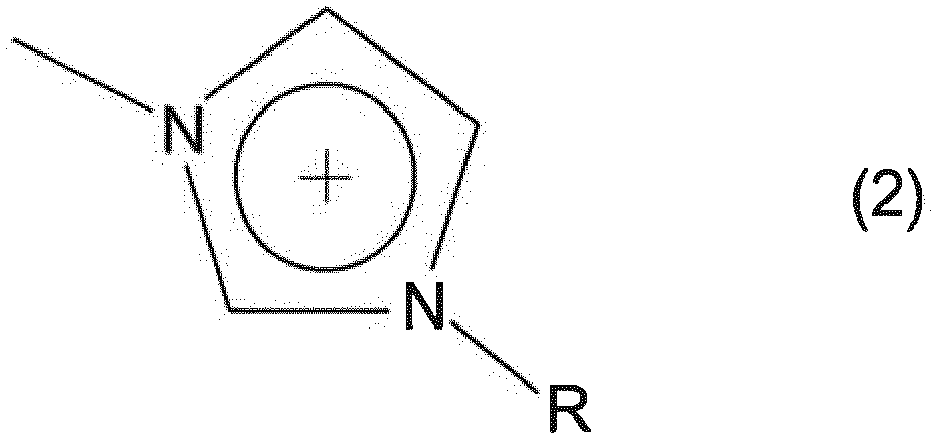
- The cross-linkable rubber composition according to claim 1 or 2, wherein the polyether rubber further comprises an epihalohydrin monomer unit.
- The cross-linkable rubber composition according to any one of claims 1 to 3, wherein the polyether rubber further comprises an ethylene oxide monomer unit.
- The cross-linkable rubber composition according to any one of claims 1 to 4, wherein the cross-linking agent is a sulfur-containing compound.
- The cross-linkable rubber composition according to any one of claims 1 to 5, wherein a content of the zinc peroxide is 0.01 to 30 parts by weight with respect to 100 parts by weight of the polyether rubber.
- A cross-linked rubber prepared by cross-linking the cross-linkable rubber composition according to any one of claims 1 to 6.
- A conductive member comprising the cross-linked rubber according to claim 7.
Applications Claiming Priority (2)
| Application Number | Priority Date | Filing Date | Title |
|---|---|---|---|
| JP2016189626 | 2016-09-28 | ||
| PCT/JP2017/033710 WO2018061864A1 (en) | 2016-09-28 | 2017-09-19 | Crosslinkable rubber composition, crosslinked rubber, and electro-conductive member |
Publications (2)
| Publication Number | Publication Date |
|---|---|
| EP3521369A1 true EP3521369A1 (en) | 2019-08-07 |
| EP3521369A4 EP3521369A4 (en) | 2020-05-27 |
Family
ID=61759702
Family Applications (1)
| Application Number | Title | Priority Date | Filing Date |
|---|---|---|---|
| EP17855819.3A Withdrawn EP3521369A4 (en) | 2016-09-28 | 2017-09-19 | Crosslinkable rubber composition, crosslinked rubber, and electro-conductive member |
Country Status (6)
| Country | Link |
|---|---|
| US (1) | US20190264026A1 (en) |
| EP (1) | EP3521369A4 (en) |
| JP (1) | JP6981420B2 (en) |
| KR (1) | KR20190058576A (en) |
| CN (1) | CN109642074A (en) |
| WO (1) | WO2018061864A1 (en) |
Family Cites Families (8)
| Publication number | Priority date | Publication date | Assignee | Title |
|---|---|---|---|---|
| GB8613158D0 (en) * | 1986-05-30 | 1986-07-02 | Hercules Inc | Polymers |
| CA2292158A1 (en) * | 1999-12-15 | 2001-06-15 | Bayer Inc. | Improved polymer composition and process for producing vulcanizates thereof |
| JP2003120824A (en) * | 2001-07-23 | 2003-04-23 | Nsk Ltd | sticker |
| JP5776494B2 (en) * | 2010-10-29 | 2015-09-09 | 日本ゼオン株式会社 | Method for producing polyether rubber |
| WO2013146648A1 (en) * | 2012-03-27 | 2013-10-03 | 日本ゼオン株式会社 | Method for producing rubber crosslinked product |
| JP5971062B2 (en) | 2012-09-28 | 2016-08-17 | 日本ゼオン株式会社 | Rubber composition, rubber cross-linked product, and conductive member |
| JP6083228B2 (en) * | 2012-12-14 | 2017-02-22 | 日本ゼオン株式会社 | Crosslinkable rubber composition, rubber cross-linked product, and conductive member |
| US10266628B2 (en) * | 2014-03-26 | 2019-04-23 | Zeon Corporation | Nitrile copolymer rubber composition |
-
2017
- 2017-09-19 JP JP2018542420A patent/JP6981420B2/en active Active
- 2017-09-19 WO PCT/JP2017/033710 patent/WO2018061864A1/en not_active Ceased
- 2017-09-19 CN CN201780054085.3A patent/CN109642074A/en active Pending
- 2017-09-19 US US16/334,700 patent/US20190264026A1/en not_active Abandoned
- 2017-09-19 EP EP17855819.3A patent/EP3521369A4/en not_active Withdrawn
- 2017-09-19 KR KR1020197011846A patent/KR20190058576A/en not_active Withdrawn
Also Published As
| Publication number | Publication date |
|---|---|
| CN109642074A (en) | 2019-04-16 |
| US20190264026A1 (en) | 2019-08-29 |
| EP3521369A4 (en) | 2020-05-27 |
| WO2018061864A1 (en) | 2018-04-05 |
| JP6981420B2 (en) | 2021-12-15 |
| KR20190058576A (en) | 2019-05-29 |
| JPWO2018061864A1 (en) | 2019-07-04 |
Similar Documents
| Publication | Publication Date | Title |
|---|---|---|
| JP5776494B2 (en) | Method for producing polyether rubber | |
| KR101765522B1 (en) | Polyether rubber, rubber composition, cross-linked rubber, and conductive member | |
| KR101927242B1 (en) | Method for producing rubber crosslinked product | |
| JP6083228B2 (en) | Crosslinkable rubber composition, rubber cross-linked product, and conductive member | |
| EP3088439B1 (en) | Method for producing polyether rubber | |
| JP6171267B2 (en) | Rubber cross-linked product and conductive member | |
| JP5971062B2 (en) | Rubber composition, rubber cross-linked product, and conductive member | |
| EP3521370A1 (en) | Crosslinkable rubber composition, crosslinked rubber, and electroconductive member | |
| JP2018016700A (en) | Crosslinkable rubber composition, rubber crosslinked product, and conductive member | |
| EP3521369A1 (en) | Crosslinkable rubber composition, crosslinked rubber, and electro-conductive member |
Legal Events
| Date | Code | Title | Description |
|---|---|---|---|
| STAA | Information on the status of an ep patent application or granted ep patent |
Free format text: STATUS: THE INTERNATIONAL PUBLICATION HAS BEEN MADE |
|
| PUAI | Public reference made under article 153(3) epc to a published international application that has entered the european phase |
Free format text: ORIGINAL CODE: 0009012 |
|
| STAA | Information on the status of an ep patent application or granted ep patent |
Free format text: STATUS: REQUEST FOR EXAMINATION WAS MADE |
|
| 17P | Request for examination filed |
Effective date: 20190320 |
|
| AK | Designated contracting states |
Kind code of ref document: A1 Designated state(s): AL AT BE BG CH CY CZ DE DK EE ES FI FR GB GR HR HU IE IS IT LI LT LU LV MC MK MT NL NO PL PT RO RS SE SI SK SM TR |
|
| AX | Request for extension of the european patent |
Extension state: BA ME |
|
| DAV | Request for validation of the european patent (deleted) | ||
| DAX | Request for extension of the european patent (deleted) | ||
| A4 | Supplementary search report drawn up and despatched |
Effective date: 20200429 |
|
| RIC1 | Information provided on ipc code assigned before grant |
Ipc: C08G 65/333 20060101ALI20200422BHEP Ipc: C08K 5/36 20060101ALI20200422BHEP Ipc: C08K 3/18 20060101ALI20200422BHEP Ipc: H01B 1/12 20060101ALI20200422BHEP Ipc: C08L 71/03 20060101AFI20200422BHEP Ipc: C08G 65/24 20060101ALI20200422BHEP |
|
| GRAP | Despatch of communication of intention to grant a patent |
Free format text: ORIGINAL CODE: EPIDOSNIGR1 |
|
| STAA | Information on the status of an ep patent application or granted ep patent |
Free format text: STATUS: GRANT OF PATENT IS INTENDED |
|
| RIC1 | Information provided on ipc code assigned before grant |
Ipc: C08L 71/03 20060101AFI20201130BHEP Ipc: C08G 65/24 20060101ALI20201130BHEP Ipc: C08K 3/18 20060101ALI20201130BHEP Ipc: C08G 65/333 20060101ALI20201130BHEP Ipc: H01B 1/12 20060101ALI20201130BHEP Ipc: C08K 5/36 20060101ALI20201130BHEP |
|
| INTG | Intention to grant announced |
Effective date: 20201215 |
|
| STAA | Information on the status of an ep patent application or granted ep patent |
Free format text: STATUS: THE APPLICATION IS DEEMED TO BE WITHDRAWN |
|
| 18D | Application deemed to be withdrawn |
Effective date: 20210427 |