EP3519986B1 - Direkte tabellenassoziation in speicherinternen datenbanken - Google Patents
Direkte tabellenassoziation in speicherinternen datenbanken Download PDFInfo
- Publication number
- EP3519986B1 EP3519986B1 EP17778098.8A EP17778098A EP3519986B1 EP 3519986 B1 EP3519986 B1 EP 3519986B1 EP 17778098 A EP17778098 A EP 17778098A EP 3519986 B1 EP3519986 B1 EP 3519986B1
- Authority
- EP
- European Patent Office
- Prior art keywords
- primary key
- row
- rows
- version element
- address pointer
- Prior art date
- Legal status (The legal status is an assumption and is not a legal conclusion. Google has not performed a legal analysis and makes no representation as to the accuracy of the status listed.)
- Active
Links
Images





Classifications
-
- G—PHYSICS
- G06—COMPUTING OR CALCULATING; COUNTING
- G06F—ELECTRIC DIGITAL DATA PROCESSING
- G06F16/00—Information retrieval; Database structures therefor; File system structures therefor
- G06F16/20—Information retrieval; Database structures therefor; File system structures therefor of structured data, e.g. relational data
- G06F16/24—Querying
- G06F16/245—Query processing
- G06F16/2455—Query execution
- G06F16/24553—Query execution of query operations
- G06F16/24558—Binary matching operations
- G06F16/2456—Join operations
-
- G—PHYSICS
- G06—COMPUTING OR CALCULATING; COUNTING
- G06F—ELECTRIC DIGITAL DATA PROCESSING
- G06F16/00—Information retrieval; Database structures therefor; File system structures therefor
- G06F16/20—Information retrieval; Database structures therefor; File system structures therefor of structured data, e.g. relational data
- G06F16/24—Querying
- G06F16/245—Query processing
- G06F16/2453—Query optimisation
- G06F16/24534—Query rewriting; Transformation
- G06F16/24537—Query rewriting; Transformation of operators
-
- G—PHYSICS
- G06—COMPUTING OR CALCULATING; COUNTING
- G06F—ELECTRIC DIGITAL DATA PROCESSING
- G06F16/00—Information retrieval; Database structures therefor; File system structures therefor
- G06F16/20—Information retrieval; Database structures therefor; File system structures therefor of structured data, e.g. relational data
- G06F16/22—Indexing; Data structures therefor; Storage structures
-
- G—PHYSICS
- G06—COMPUTING OR CALCULATING; COUNTING
- G06F—ELECTRIC DIGITAL DATA PROCESSING
- G06F16/00—Information retrieval; Database structures therefor; File system structures therefor
- G06F16/20—Information retrieval; Database structures therefor; File system structures therefor of structured data, e.g. relational data
- G06F16/22—Indexing; Data structures therefor; Storage structures
- G06F16/2282—Tablespace storage structures; Management thereof
-
- G—PHYSICS
- G06—COMPUTING OR CALCULATING; COUNTING
- G06F—ELECTRIC DIGITAL DATA PROCESSING
- G06F16/00—Information retrieval; Database structures therefor; File system structures therefor
- G06F16/20—Information retrieval; Database structures therefor; File system structures therefor of structured data, e.g. relational data
- G06F16/23—Updating
- G06F16/2308—Concurrency control
- G06F16/2315—Optimistic concurrency control
- G06F16/2322—Optimistic concurrency control using timestamps
-
- G—PHYSICS
- G06—COMPUTING OR CALCULATING; COUNTING
- G06F—ELECTRIC DIGITAL DATA PROCESSING
- G06F16/00—Information retrieval; Database structures therefor; File system structures therefor
- G06F16/20—Information retrieval; Database structures therefor; File system structures therefor of structured data, e.g. relational data
- G06F16/24—Querying
- G06F16/245—Query processing
- G06F16/2455—Query execution
- G06F16/24553—Query execution of query operations
- G06F16/24562—Pointer or reference processing operations
Definitions
- Computerized databases are widely used to store and organize data.
- One area of recent application of computerized databases is processing of online transactions in real time.
- relational databases are used to handle such transactions.
- database developers face a challenge in developing such relational database systems that achieve low latency and can perform well in high concurrency conditions.
- Tobin J Lehman et al "Query Processing in Main Memory Database Management Systems", Management of Data, ACM, 2 Penn Plaza, Suite 701, New York, NY 10121-0701 USA, pages 239-250 , addresses query processing issues for memory resident relational databases.
- An architecture for a main memory DBMS is presented.
- the ways in which a memory resident database differs from a disk-based database are presented.
- the computerized database management system 10 includes a computing device 12 configured to communicate with an HTTP server 14 via a wide area network (WAN) 16, such as the Internet.
- WAN wide area network
- the HTTP server 14 is configured to communicate with a database server 18 via a local area network (LAN) 20.
- LAN local area network
- the HTTP server 14 and database server 18 may communicate across a WAN.
- the application program 22 on the computing device 12 may connect directly to the database program 50.
- a user may use an application program 22 executed by the computing device 12, to shop for a particular product.
- the application program 22 downloads and displays a website, with a search interface that enables the user to conduct searches for information about a product, such as size, price, or available colors.
- the search queries are sent as HTTP requests 24 from the application program 22 to the HTTP server 14.
- the HTTP server 14 sends a database query 26 to the back end database server 18, via local area network 20.
- the database server 18 processes the database query 26 and sends a query result 28 to the HTTP server 14, which processes the query result 28 and returns an HTTP response 30 to the user, which is displayed on the computing device 12.
- the database server 18 includes a processor 32, non-volatile memory 34, and random access memory 36.
- the processor 32 is configured to include a first table 40 of a plurality of cells organized into logical rows and logical columns and a second table 42 of a plurality of cells organized into logical rows and logical columns, each of the cells having an associated memory address within the random access memory 36.
- the processor 32 is further configured to establish a direct table association 44 between a memory address of an origin cell 46 of the plurality of cells in the first table 40 and a memory address of a target cell 48 of the plurality of cells in the second table 42. It will be appreciated that the origin cell 46 is
- the non-volatile memory 34 in the database server 18 is configured to include a database program 50 that executes an in-memory database management module 52.
- the in-memory database management module 52 further includes various functional software modules programmed to perform specific functions relating to in-memory database management, including a join module 54, an insert module 56, a delete module 58, and an update module 60. It will be appreciated that the functionality of one or more of these software modules may be implemented in dedicated hardware such as an application specific integrated circuit (ASIC) or firmware, for example.
- ASIC application specific integrated circuit
- the HTTP server 14 processes the request according to application logic on the HTTP server 14.
- the application logic may generate a database query 26 that is sent to the database server 18.
- the HTTP request 24 may be to add a product to a shopping cart
- the shopping cart application may be executed by the HTTP server 14.
- the shopping cart application in turn may communicate with the back end database server 18 to verify that the desired product is in inventory, decrement inventory, obtain related pricing, discounts, and tax information, etc. During these communications, various database queries are sent between the HTTP server 14 and the database server 18.
- the HTTP server 14 may send and database server 18 may receive a database query 26 to perform a join database operation of the first table 40 on the second table 42 to verify that the desired color of a product is available in the desired size.
- the join module 54 stored in the non-volatile memory 34 and executed by the processor 32 contains the program logic to implement the join database operation, according to the process described below.
- the subject disclosure presents a new strategy for efficiently performing join database operations in a relational database that is an efficient alternative to current approaches that commonly include recurrent scan procedures.
- a conventional system to retrieve data from each table in a join operation, the conventional system traverses every row of a table or index to find a row containing the desired data. A scan is performed each time a join database operation is executed, regardless of previous joins on the same data sets. Because the efficiency of conventional join operations depends greatly upon the speed of scanning, latency is an ongoing concern for join operation performance.
- only an initial scan of the second table 42 is utilized to create the direct table association 44, rather than scanning an entire table for each join operation.
- the direct table association 44 for the origin cell 46 in the first table 40 is dereferenced in a dereference operation 62 to obtain a value of the target cell 48 stored at the memory address for the target cell 48 in the second table 42.
- the configuration and provisioning of the direct table associations 44 and their use is described in detail below.
- the direct table association 44 includes a physical memory address pointer 64 between the data sets.
- a physical memory address pointer is a memory address pointer associated with at least one physical memory address stored on physical hardware.
- These pointers 64 are added to the first table 40 during the initial scan and enable subsequent join database operations to traverse the direct table association 44 to the second table 42 to find desired data in a row containing the target cell 48.
- the established direct table association 44 decreases latency, thereby improving the online transaction experience in view of current conventional systems. It will be appreciated that join operations are ubiquitous in online transaction processing, and thus when latency of an online transaction is exacerbated due to inefficient scanning during a join database operation, a user may not be motivated to complete the online transaction and may abandon their shopping cart. Accordingly, in one non-limiting example of the subject embodiments' potential utility, the techniques described may decrease latency, thereby improving user satisfaction, increasing the conversion rate of the online transactions, and generally improve the economic performance of an online shopping web site.
- the processor 32 receives a request to perform a join database operation of one or more rows or columns of the first table 40 including the origin cell 46 on one or more rows or columns of the second table 42 including the target cell 48.
- the direct table association 44 is dereferenced to obtain a value of the target cell 48, and the join database operation is executed using the value to produce a joined table 66 including the value stored at a new location in the random access memory 36.
- a data bus 68 transports the resulting data to the non-volatile memory 34 where it is sent as a query result 28 to the HTTP server 14 and translated to an HTTP response 30 to the application program 22 within the computing device 12 that issued the original HTTP request 24.
- the query result 28 may be transmitted directly to the application program 22 from the random access memory 36.
- the user may view the request and response by way of a user display 70, which may be formed separately as illustrated, or may be formed integrally with computing device 12.
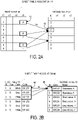
- FIG. 2A an example of a join database operation on a many-to-one relationship between the first table 40 and the second table 42 is shown.
- the direct table association 44 between the first table 40 and the second table 42 includes a physical memory address pointer 64 within the row containing the origin cell 46 in the first table 40 that points to the memory address of the target cell 48 in the second table 42.
- FIG. 2B the user may want to know how many colors of a product are available in a specific size. Specifically, the user may be looking for a sleeveless round-neck shirt in size small.
- a join database operation is executed on a many-to-one relationship between the first and second tables 40, 42 in the database server, using a physical memory address pointer 64 within the row containing the origin cell 46 in the first table 40 to join on the row containing the target cell 48 in the second table 42.
- the Code column in the first table 40 contains the foreign key
- the ID column in the second table 42 is the primary key
- the join is performed on the Code column in the second table 42 that contains unique values.
- This direct table association 44 maintains a physical memory address pointer 64 from a row in the first table 40 to a referenced row in the second table 42, thereby greatly increasing the efficiency of accessing rows in the second table 42 over the conventional method of scanning a table for the requested data.
- FIG. 3A an example of a join database operation on a many-to-many relationship between the first table 40 and the second table 42 is shown.
- An intermediate table 72 which is comprised of a plurality of cells organized into logical rows and logical columns, transforms the many-to-many relationship into two many-to-one relationships.
- a first physical memory address pointer 64a forms a direct table association 44 between the first table 40 and the intermediate table 72
- a second physical memory address pointer 64b forms a direct table association between the second table 42 and the intermediate table 72.
- the first table 40 and second table 42 can be efficiently joined with two pointer hops, as indicated by the dashed lines.
- exemplary pointers are included in the illustration, and not every pointer is shown.
- FIG. 3B and continuing with the example of an online shopping transaction, a merchant user may desire to correlate customers with their orders based on order dates. Rather than scanning the entire second table 42 to retrieve the desired data, the same result may be achieved with an intermediate table and two pointer hops.
- the ID column in each of the first or second table 40, 42 identifies the rows containing the target cells 48, i.e., primary key
- the intermediate table 72 is comprised of origin cells, i.e., foreign keys, and the join is performed on the Date column.
- the first physical memory address pointer 64a is included within at least one origin cell 46 of the plurality of cells of the intermediate table 72 and points to a memory address within random access memory 36 that corresponds to a target cell 48 of the plurality of cells in the first table 40, such as a product number.
- the second physical memory address pointer 64b is included within at least one origin cell 46 of the plurality of cells of the intermediate table 72 and points to a memory address within random access memory 36 that corresponds to at least one target cell 48 of the plurality of cells of the second table 42, such as a product number.
- a database query 26 for information contained within both the first and second tables 40, 42 in the database server 18 results in a join database operation between the first and second tables 40, 42.
- the intermediate table 72 comprising origin cells 46 with physical memory address pointers 64 to target cells 48 in the first and second tables 40, 42, serves to transform the many-to-many relationship to two many-to-one relationships that can be traversed with two pointer hops, as indicated by the dashed lines. It will be appreciated that exemplary pointers are included in the illustration, and not every pointer is shown.
- FIG. 4A an example of a version element is shown.
- new data does not overwrite old data; instead, old data is marked as stale, and the new version of the data is added.
- each version of the data is labeled with a timestamp.
- Read transactions use the timestamp to identify which version of the data to read, and write transactions create a newer version. In this way, read and write functions may occur simultaneously. Versioning allows for the synchronization of data sets in multiuser situations, such as concurrent online shopping transactions.
- a primary key version element 74 maintains the direct table association 44 of data tables by updating associated physical memory address pointers 64 with each new version. Additionally, each version in the list can be identified by a time stamp. In this configuration, the row or column containing the origin cell 46 in the first table 40 contains a foreign key 76, and the row or column containing the target cell 48 in the second table contains a primary key 78.
- the processor 32 defines a primary key version element 74 that is configured to include a physical memory address pointer 64 directed to the beginning of a list of primary key row versions, as well as a reference count 80 (as illustrated in FIG 5 ).
- a row of the plurality of rows in the first table 40 that contains the origin cell 46 is configured to include a physical memory address pointer 64 directed to the primary key version element 74
- a row of the plurality of rows in the second table 42 that contains the target cell 48 is configured to include a physical memory address pointer 64 directed to the primary key version element 74.
- a reference count 80 is maintained to determine how many rows from the second table are referencing the primary key version element 74 at a point in time.
- Each primary key row has an associated pointer to the location in memory where the corresponding version is stored.
- the primary key version element 74 will be traversed until the appropriate (e.g., valid based on timestamp) primary key row version is found, and then a physical memory address pointer 64 corresponding to the appropriate primary key version will be selected.
- FIG. 4B provides an example of a version element that maintains a direct table association 44 between primary and foreign key rows 78, 76 during an online shopping transaction. Versioning is particularly advantageous in such situations because they allows multiple concurrent users to efficiently utilize the same database while providing current (relative to the transaction) and accurate versions of data, such as merchandise inventory.
- a reference count 80 determines how many primary key rows 82 are referencing the primary key version element 74 at a point in time.
- a physical memory address pointer, pFK-PKElement 64c is included in a foreign key row 86 and is directed to the primary key version element 74.
- Additional physical memory address pointers, pPKElement 64d are included in each primary key row 82 in a list of primary key row versions 84 and are each directed to the primary key version element 74.
- Physical memory address pointer pHead 64e is included in the primary key version element 74 and is directed to a list of primary key row versions 84.
- Physical memory address pointers pNext 64f are included in each primary key row 82 and point to a subsequent row in the list of primary key row versions 84, and the last primary key row 82 in the list includes physical memory address pointer pNull 64g, which is the tail of the list of primary key row versions 84.
- the join module 54 in the in-memory database management system module 52 in FIG. 1 executes a join database operation 100 on a foreign key row 86 containing the foreign key 76 in the first table 40, and the foreign key 76 references the physical memory address pointer 64c to the primary key version element 74 to obtain a value of the primary key 78 stored in a primary key row 82 in the list of primary key rows 84 in the second table 42.
- FIG. 6 an example of a primary key insertion operation 200 on a primary key version element 74 is shown.
- the processor 32 receives a request to perform an insertion database operation to insert one or more primary key rows 82 into the second table 42.
- the insert module 56 in the in-memory database management system module 52 in FIG. 1 is executed, and the second table 42 is scanned to locate an appropriate location for the insert database operation.
- random access memory 36 is allocated for a new primary key row 82, and a primary key version element 74 is allocated.
- the database operation is performed, including updating physical memory address pointers pPKElement 64d and pHead 64e.
- Pointer pPKElement 64d is included in the primary key row 82 and is directed to the primary key version element 74
- pHead 64e is included in the primary key version element 74 directed to the beginning of a list of primary key row versions 84, as shown in FIG. 6 .
- a third physical memory address pointer, pNull 64g is included in the primary key row 82 and is the tail of the list.
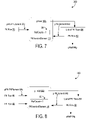
- FIG. 7 provides an example of a foreign key insertion operation 300 on a primary key version element 74.
- the processor 32 receives a request to perform an insertion database operation to insert one or more foreign key rows 86 into the first table 40.
- the insert module 56 in the in-memory database management system module 52 in FIG. 1 is executed, and the first table 40 is scanned to locate an appropriate location for the insertion database operation.
- random access memory 36 is allocated to support implementation of a physical memory address pointer 64.
- the database operation is performed, including the creation of the physical memory address pointer, pFK-PKElement 64c, which is directed to the primary key version element 74, as shown in FIG. 7 .
- Insertion of the foreign key row 86 is validated by scanning the second table 42 for the corresponding primary key row 82, and a physical memory address pointer 64d from the corresponding primary key row 82 is referenced to initialize the foreign key row 86 to point to the primary key version element 74.
- FIG. 8 an example of a primary key deletion operation 400 from the second table on a primary key version element 74 is shown.
- Logical deletions are achieved by way of timestamps in that stale data can be identified by an outdated timestamp and is then excluded from subsequent join functions, yet it remains in the database since it can be valid for prior transactions.
- the processor 32 receives a request to perform a deletion database operation to delete one or more rows of primary keys 82 in the second table 42.
- the delete module 58 in the in-memory database management system module 52 in FIG. 1 is executed, and the second table 42 is scanned to identify a primary key row or rows 82 that is subject for deletion.
- the first table 40 is scanned to determine that no foreign key rows 86 are referencing the primary key row 82 that is subject to deletion.
- the primary key row 82 with an outdated timestamp is then marked as deleted.
- an oldest transaction in the database management system is younger than a timestamp of the logically deleted primary key row 82, it may be desirable to physically delete the primary key row 82 to clean up memory.
- the deleted primary key row 82 is removed from the list of primary key rows 84, memory space associated with the deleted primary key row 82 is released, and the reference count 80 in the associated primary key version element 74 is decremented by one.
- reference count 80 of the primary key version element 74 associated with the deleted primary key row 82 is zero, the primary key version element 74 is deleted, and memory associated with the deleted primary key version element 74 is released.
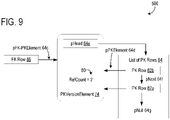
- FIG. 9 an example of a primary key update operation 500 on a primary key version element 74 is shown.
- the processor 32 receives a request to perform an update database operation to update one or more rows of primary keys 82a into the second table 42.
- the update module 60 in the in-memory database management system module 52 in FIG. 1 is executed, and the second table 42 is scanned to determine which primary key row or rows 82 is stale.
- the new primary key row 82b is inserted into the list of primary key row versions 84, the physical memory address pointer, pPKElement 64d, included in the new primary key row 82b is updated to point to the primary key version element 74, the physical memory address pointer, pHead 64e, is included in the primary key version element 74 is updated to point to the new primary key row 82b, and the reference count 80 is incremented by one.
- FIG. 10 shows an example method 800.
- Method 800 may be implemented on the computer system 10 described above or on other suitable computer hardware.
- the method 800 may include configuring an in-memory database stored in random access memory to have tables consisting of cells organized into logical rows and logical columns. As described above, each of the cells is configured to have an associated memory address within the random access memory.
- the method may include establishing a direct table association between a memory address of an origin cell and a memory address of a target cell.
- An initial scan of the second table containing the target cell is utilized to create the direct table association, which may include a direct physical memory address pointer between the data sets as shown in substep 806. These pointers are added to the tables during the initial scan and enable subsequent database operations to traverse the direct table association to the second table rather than require a full scan of the second table to find desired data.
- the direct table association may include a pointer from a first table to a second table in the context of a many-to-one relationship.
- direct table association may be created for a many-to-many relationship and may include an intermediate table with a first physical memory address pointer to a first table and a second physical memory address pointer to a second table.
- the established direct table association decreases latency and improves online transaction experiences.
- the method may include receiving a request to perform a join database operation of one or more rows or columns of the first table on one or more rows or columns of the second table.
- a user may issue a command on a computing device to make a purchase of an item of clothing from an online store.
- a join module stored in the nonvolatile memory and executed by the processor contains the program logic to implement the join database operation.
- the method may include dereferencing the direct table association for the origin cell to obtain a value of the target cell stored at the memory address.
- a dereference operation is executed on the physical memory address pointer between the first and second tables.
- the method may include executing the join database operation to produce a joined table.
- a join module within the in-memory database management module may be executed to join data from the row containing the origin cell in the first table on the row containing the target cell in the second table.
- a joined table is created, containing the desired data from the first and second tables.
- the joined table may include information about a product, i.e., an item of clothing, such as color, size, price, or inventory.
- the method may include storing the joined table in random access memory. Once stored, the data is available for the processor to send as a query result back to an HTTP server, allowing an end user to receive a response containing the requested information. It will be appreciated that the data may be sent in a streaming fashion to avoid latency.
- the data contained in the joined table may be the sizes and colors of a desired item of clothing that would enable the user to complete their online shopping transaction.
- the methods and processes described herein may be tied to a computing system of one or more computing devices.
- such methods and processes may be implemented as a computer-application program or service, an application-programming interface (API), a library, and/or other computer-program product.
- API application-programming interface
- FIG. 11 schematically shows a non-limiting embodiment of a computing system 900 that can enact one or more of the methods and processes described above.
- Computing system 900 is shown in simplified form.
- Computing system 900 may embody the computing device 12 or database server 18 of system 10, for example.
- Computing system 900 may take the form of one or more personal computers, server computers, tablet computers, home-entertainment computers, network computing devices, gaming devices, mobile computing devices, mobile communication devices (e.g., smart phone), and/or other computing devices, and wearable computing devices such as smart wristwatches and head mounted augmented reality devices.
- Computing system 900 includes a logic processor 902 volatile memory 903, and a non-volatile storage device 904.
- Computing system 900 may optionally include a display subsystem 906, input subsystem 908, communication subsystem 1000, and/or other components not shown in FIG. 11 .
- Logic processor 902 includes one or more physical devices configured to execute instructions.
- the logic processor may be configured to execute instructions that are part of one or more applications, programs, routines, libraries, objects, components, data structures, or other logical constructs. Such instructions may be implemented to perform a task, implement a data type, transform the state of one or more components, achieve a technical effect, or otherwise arrive at a desired result.
- the logic processor may include one or more physical processors (hardware) configured to execute software instructions. Additionally or alternatively, the logic processor may include one or more hardware logic circuits or firmware devices configured to execute hardware-implemented logic or firmware instructions. Processors of the logic processor 902 may be single-core or multi-core, and the instructions executed thereon may be configured for sequential, parallel, and/or distributed processing. Individual components of the logic processor optionally may be distributed among two or more separate devices, which may be remotely located and/or configured for coordinated processing. Aspects of the logic processor may be virtualized and executed by remotely accessible, networked computing devices configured in a cloud-computing configuration. In such a case, these virtualized aspects are run on different physical logic processors of various different machines, it will be understood.
- Non-volatile storage device 904 includes one or more physical devices configured to hold instructions executable by the logic processors to implement the methods and processes described herein. When such methods and processes are implemented, the state of non-volatile storage device 94 may be transformed-e.g., to hold different data.
- Non-volatile storage device 904 may include physical devices that are removable and/or built-in.
- Non-volatile storage device 94 may include optical memory (e.g., CD, DVD, HD-DVD, Blu-Ray Disc, etc.), semiconductor memory (e.g., ROM, EPROM, EEPROM, FLASH memory, etc.), and/or magnetic memory (e.g., hard-disk drive, floppydisk drive, tape drive, MRAM, etc.), or other mass storage device technology.
- Non-volatile storage device 904 may include nonvolatile, dynamic, static, read/write, read-only, sequential-access, location-addressable, file-addressable, and/or content-addressable devices. It will be appreciated that non-volatile storage device 904 is configured to hold instructions even when power is cut to the non-volatile storage device 904.
- Volatile memory 903 may include physical devices that include random access memory. It will be appreciated that random access memory may also be provided in non-volatile memory. Volatile memory 903 is typically utilized by logic processor 902 to temporarily store information during processing of software instructions. It will be appreciated that volatile memory 903 typically does not continue to store instructions when power is cut to the volatile memory 903.
- logic processor 902, volatile memory 903, and non-volatile storage device 904 may be integrated together into one or more hardware-logic components.
- Such hardware-logic components may include field-programmable gate arrays (FPGAs), program- and application-specific integrated circuits (PASIC / ASICs), program- and application-specific standard products (PSSP / ASSPs), system-on-a-chip (SOC), and complex programmable logic devices (CPLDs), for example.
- FPGAs field-programmable gate arrays
- PASIC / ASICs program- and application-specific integrated circuits
- PSSP / ASSPs program- and application-specific standard products
- SOC system-on-a-chip
- CPLDs complex programmable logic devices
- module may be used to describe an aspect of computing system 900 typically implemented in software by a processor to perform a particular function using portions of volatile memory, which function involves transformative processing that specially configures the processor to perform the function.
- a module, program, or engine may be instantiated via logic processor 902 executing instructions held by non-volatile storage device 904, using portions of volatile memory 903.
- modules, programs, and/or engines may be instantiated from the same application, service, code block, object, library, routine, API, function, etc.
- the same module, program, and/or engine may be instantiated by different applications, services, code blocks, objects, routines, APIs, functions, etc.
- the terms “module,” “program,” and “engine” may encompass individual or groups of executable files, data files, libraries, drivers, scripts, database records, etc.
- display subsystem 906 may be used to present a visual representation of data held by non-volatile storage device 904.
- the visual representation may take the form of a graphical user interface (GUI).
- GUI graphical user interface
- the state of display subsystem 906 may likewise be transformed to visually represent changes in the underlying data.
- Display subsystem 906 may include one or more display devices utilizing virtually any type of technology. Such display devices may be combined with logic processor 902, volatile memory 903, and/or non-volatile storage device 904 in a shared enclosure, or such display devices may be peripheral display devices.
- input subsystem 908 may comprise or interface with one or more user-input devices such as a keyboard, mouse, touch screen, microphone, camera, or game controller.
- communication subsystem 1000 may be configured to communicatively couple various computing devices described herein with each other, and with other devices.
- Communication subsystem 1000 may include wired and/or wireless communication devices compatible with one or more different communication protocols.
- the communication subsystem may be configured for communication via a wireless telephone network, or a wired or wireless local- or wide-area network.
- the communication subsystem may allow computing system 900 to send and/or receive messages to and/or from other devices via a network such as the Internet.
- One aspect provides a computerized database management system comprising a database server including a processor and associated random access memory.
- the processor may be configured to configure an in-memory database in the random access memory to have a first table of a plurality of cells organized into logical rows and logical columns and a second table of a plurality of cells organized into logical rows and logical columns, each of the cells of each of the tables having an associated memory address within the random access memory, establish a direct table association between a memory address of an origin cell of the plurality of cells of the first table and a memory address of a target cell of the plurality of cells of the second table, receive a request to perform a join database operation of one or more rows or columns of the first table including the origin cell on one or more rows or columns of the second table including the target cell, dereference the direct table association for the origin cell to obtain a value of the target cell stored at the memory address for the target cell, execute the join database operation using the value, to thereby produce
- the join database operation may be a join database operation on a many-to-one relationship between the first table and second table
- the direct table association may include a physical memory address pointer that may be included within a row containing the origin cell and which may point to the memory address of the target cell.
- the join database operation may be a join database operation on a many-to-many relationship between the first table and the second table
- the direct table association may include an intermediate table, a first physical memory address pointer, and a second physical memory address pointer
- the intermediate table may comprise a plurality of cells organized into logical rows and logical columns
- the first physical memory address pointer may be included within at least one cell of the plurality of cells of the intermediate table and may point to a memory address within random access memory corresponding to a target cell of the plurality of cells of the first table
- the second physical memory address pointer may be included within at least one cell of the plurality of cells of the intermediate table and may point to a memory address within random access memory corresponding to at least one target cell of the plurality of cells of the second table.
- the row or column containing the origin cell may contain a foreign key and the row or column containing the target cell may contain a primary key
- the processor may be further configured to define a primary key version element which may be configured to include a physical memory address pointer directed to a beginning of a list of primary key row versions, wherein a row of the plurality of rows that contains the origin cell may be configured to include a physical memory address pointer directed to the primary key version element, a row of the plurality of rows that contains the target cell may be configured to include a physical memory address pointer directed to the primary key version element, and a reference count may determine how many primary rows are referencing the primary key version element at a point in time.
- the processor may be further configured to execute the join database operation on the row containing the foreign key of the first table wherein the foreign key may reference the physical memory address pointer to the primary key version element to obtain the primary key value stored in the second table.
- the processor may be further configured to receive a request to perform an insertion database operation to insert one or more rows of primary keys into the second table, scan the second table to locate an appropriate location for the insertion database operation, allocate random access memory for addition of a new primary key row, allocate a primary key version element, perform the insertion database operation, update a physical memory address pointer in the primary key version element directed to the list of primary key row versions, update a physical memory address pointer in the primary key row version directed to primary key version element, and include a physical memory address pointer in the primary key row version directed to the subsequent row in the list of primary key row versions.
- the processor may be further configured to receive a request to perform a database operation to insert one or more rows of foreign keys into the first table, scan the first table to locate an appropriate location for the insertion database operation, allocate memory for supporting physical memory address pointer implementation, perform the insertion database operation, create a physical memory address pointer in the foreign key row to be directed to the primary key version element, validate insertion of the foreign key row by scanning the second table for the corresponding primary key row version, and reference a physical memory address pointer from the corresponding primary key row version to initialize the foreign key row to point to the primary key version element.
- the processor may be further configured to receive a request to perform a database operation to delete one or more primary key rows in the second table, scan the primary key rows to identify the primary key row that is subject for deletion, scan the foreign key rows in the first table to determine that no foreign key rows are referencing the primary key row to be deleted, mark the primary key row as deleted, and when an oldest transaction in the computerized database management system is younger than a timestamp of the deleted primary key row, remove the deleted primary key row from the list of primary key rows, release memory space associated with the deleted primary key row, decrement the reference count in the primary key version element by one, determine that the reference count of the primary key version element associated with the deleted primary key row is zero, and in response to the determination, delete the primary key version element and release memory space associated with the deleted primary key version element.
- the processor may be further configured to receive a request to perform a database operation to update one or more rows in the second table, scan the second table to determine which primary key row or rows is stale, insert the new primary key row into the list of primary key row versions, update the physical memory address pointer included in the new primary key row to point to the primary key version element, update the physical memory address pointer included in the primary key version element to point to the new primary key row, and increment the reference count by one.
- the random access memory may be non-volatile random access memory.
- Another aspect provides a method for a database server, a processor, and associated random access memory, comprising configuring an in-memory database in the random access memory to have a first table of a plurality of cells organized into logical rows and logical columns and a second table of a plurality of cells organized into logical rows and logical columns, each of the cells of each of the tables having an associated memory address within the random access memory, establishing a direct table association between a memory address of an origin cell of the plurality of cells of the first table and a memory address of a target cell of the plurality of cells of the second table, receiving a request to perform a join database operation of one or more rows or columns of the first table including the origin cell on one or more rows or columns of the second table including the target cell, dereferencing the direct table association for the origin cell to obtain a value of the target cell stored at the memory address for the target cell, executing the join database operation using the value, to thereby produce a joined table including the value, and storing the joined table at a new location in
- the join database operation may be a join database operation on a many-to-one relationship between the first table and second table
- the direct table association may include a physical memory address pointer that may be included within the origin cell and which may point to the memory address of the target cell.
- the join database operation may be a join database operation on a many-to-many relationship between the first table and the second table
- the direct table association may include an intermediate table, a first physical memory address pointer, and a second physical memory address pointer
- the intermediate table may consist of a plurality of cells organized into logical rows and logical columns
- the first physical memory address pointer may be included within at least one cell of the plurality of cells of the intermediate table and may point to a memory address within random access memory corresponding to a target cell of the plurality of cells of the first table
- the second physical memory address pointer may be included within at least one cell of the plurality of cells of the intermediate table and may point to a memory address within random access memory corresponding to at least one target cell of the plurality of cells of the second table.
- the row or column containing the origin cell may contain a foreign key and the row or column containing the target cell may contain a primary key
- the method may further comprise defining a primary key version element which may be configured to include a physical memory address pointer directed to a beginning of a list of primary key row versions, wherein a row of the plurality of rows that contains the target cell may be configured to include a physical memory address pointer directed to the primary key version element, and a row of the plurality rows that contains the origin cell may be configured to include a physical memory address pointer directed to the primary key version element, maintaining a reference count to determine how many rows are referencing the primary key version element at a point in time, and executing a join operation on the column containing the foreign key of the first table wherein the foreign key may reference the physical memory address pointer to the primary key version element to obtain the primary key value stored in the second table.
- the method may further comprise receiving a request to perform an insertion database operation to insert one or more rows of primary keys into the second table, scanning the second table to locate an appropriate location for the insertion database operation, allocating random access memory for addition of a new primary key row, allocating a primary key version element, performing the insertion database operation, updating a physical memory address pointer in the primary key version element directed to the list of primary key row versions, updating a physical memory address pointer in the primary key row version directed to primary key version element, and including a physical memory address pointer in the primary key row version directed to the subsequent row in the list of primary key row versions.
- the method may further comprise receiving a request to perform a database operation to insert one or more rows of foreign keys into the first table, scanning the first table to locate an appropriate location for the insertion database operation, allocating memory for supporting physical memory address pointer implementation, performing the insertion database operation, creating a physical memory address pointer in the foreign key row directed to the primary key version element, validating insertion of the foreign key row by scanning the second table for the corresponding primary key row version, and referencing a physical memory address pointer from the corresponding primary key row version to initialize the foreign key row to point to the primary key version element.
- the method may further comprise receiving a request to perform a database operation to delete one or more primary key rows in the second table, scanning the primary key rows to identify the primary key row that is subject for deletion, scanning the foreign key rows in the first table to determine that no foreign key rows are referencing the primary key row to be deleted, marking the primary key row as deleted, and when an oldest transaction in the computerized database management system is younger than a timestamp of the deleted primary key row, removing the deleted primary key row from the list of primary key rows, releasing memory space associated with the deleted primary key row, and decrementing the reference count in the primary key version element by one, determining that the reference count of the primary key version element associated with the deleted primary key row is zero, and in response to the determination, deleting the primary key version element and releasing memory space associated with the deleted primary key version element.
- the method may further comprise receiving a request to perform a database operation to update one or more rows in the second table, scanning the second table to determine which primary key row or rows is stale, inserting the new primary key row into the list of primary key row versions, updating the physical memory address pointer included in the new primary key row to point to the primary key version element, updating the physical memory address pointer included in the primary key version element to point to the new primary key row, and incrementing the reference count by one.
- the random access memory may be non-volatile random access memory.
- a computerized database management system comprising a database server including a processor and associated random access memory.
- the processor may be configured to configure an in-memory database in the random access memory to have a first table of a plurality of cells organized into logical rows and logical columns and a second table of a plurality of cells organized into logical rows and logical columns, each of the cells of each of the tables having an associated memory address within the random access memory, establish a direct table association between a memory address of an origin cell of the plurality of cells of the first table and a memory address of a target cell of the plurality of cells of the second table, wherein the direct table association includes a physical memory address pointer, and wherein the physical memory address pointer is a foreign key, receive a request to perform a database operation, dereference the direct table association for the origin cell to obtain a value of the target cell stored at the memory address for the target cell, execute the database operation using the value, to thereby produce a result table including the value, and store the result table at a new
Landscapes
- Engineering & Computer Science (AREA)
- Theoretical Computer Science (AREA)
- Data Mining & Analysis (AREA)
- Databases & Information Systems (AREA)
- Physics & Mathematics (AREA)
- General Engineering & Computer Science (AREA)
- General Physics & Mathematics (AREA)
- Computational Linguistics (AREA)
- Software Systems (AREA)
- Information Retrieval, Db Structures And Fs Structures Therefor (AREA)
Claims (12)
- Computerisiertes Datenbankmanagementsystem, umfassend:einen Datenbankserver (18), der einen Prozessor (32) und zugehörigen Direktzugriffsspeicher (36) beinhaltet, wobei der Prozessor konfiguriert ist zum: Konfigurieren (802) einer speicherinternen Datenbank in dem Direktzugriffsspeicher, eine erste Tabelle einer Vielzahl von Zellen, die in logischen Reihen und logischen Spalten organisiert sind, und eine zweite Tabelle einer Vielzahl von Zellen, die in logischen Reihen und logischen Spalten organisiert sind, aufzuweisen, wobei jede der Zellen jeder der Tabellen eine Speicheradresse innerhalb des Direktzugriffsspeichers aufweist;Definieren eines primären Schlüsselversionselements, das konfiguriert ist, einen physischen Speicheradressenzeiger, der auf einen Anfang einer Liste primärer Schlüsselreihenversionen gerichtet ist, und eine Referenzzählung, um zu ermitteln, wie viele Reihen aus der zweiten Tabelle das primäre Schlüsselversionselement zu einem Zeitpunkt referenzieren, zu beinhalten, wobei eine Reihe der Vielzahl von Reihen in der ersten Tabelle, die eine Ursprungszelle enthält, konfiguriert ist, einen physischen Adressenzeiger zu beinhalten, der auf das primäre Schlüsselversionselement, gerichtet ist, und wobei eine Reihe der Vielzahl von Reihen in der zweiten Tabelle, die eine Zielzelle enthält, konfiguriert ist, einen physischen Speicheradressenzeiger zu beinhalten, der auf das primäre Schlüsselversionselement, gerichtet ist, wobei die Ursprungszelle ein fremder Schlüssel ist und die Zielzelle ein primärer Schlüssel ist;Empfangen (812) einer Anfrage, eine gemeinsame Datenbankoperation einer oder mehrerer Reihen oder Spalten der ersten Tabelle, die die Ursprungszelle beinhaltet, an einer oder mehreren Reihen oder Spalten der zweiten Tabelle, die die Zielzelle beinhaltet, durchzuführen;Ausführen der gemeinsamen Datenbankoperation an der Reihe, die den fremden Schlüssel in der ersten Tabelle enthält, und Verwenden des fremden Schlüssels, um den physischen Adressenzeiger auf das primäre Schlüsselversionselement zu referenzieren, um einen Wert des primären Schlüssels zu erhalten, der in einer primären Schlüsselreihe in der Liste primärer Schlüsselreihen in der zweiten Tabelle gespeichert ist;Ausführen (816) der gemeinsamen Datenbankoperation unter Verwendung des Werts, um dadurch eine gemeinsame Tabelle zu erstellen, die den Wert beinhaltet; undSpeichern (818) der gemeinsamen Tabelle an einer neuen Stelle in dem Direktzugriffsspeicher.
- Computerisiertes Datenbankmanagementsystem nach Anspruch 1, wobei der Prozessor weiter konfiguriert ist zum:Empfangen einer Anfrage, eine Datenbank-Einsetzoperation durchzuführen, um eine oder mehrere Reihen primärer Schlüssel in die zweite Tabelle einzusetzen;Abtasten der zweiten Tabelle, um eine passende Stelle für die Datenbank-Einsetzoperation zu finden;Zuordnen des Direktzugriffsspeichers zum Hinzufügen einer neuen primären Schlüsselreihe;Zuordnen eines primären Schlüsselversionselements;Durchführen der Datenbank-Einsetzoperation;Aktualisieren eines physischen Speicheradressenzeigers in dem primären Schlüsselversionselement, der auf die Liste primärer Schlüsselreihenversionen gerichtet ist;Aktualisieren eines physischen Speicheradressenzeigers in der primären Schlüsselreihe, der auf das primäre Schlüsselversionselement gerichtet ist; undAufnehmen eines physischen Speicheradressenzeigers in der primären Schlüsselreihe, der auf die anschließende Reihe in der Liste primärer Schlüsselreihenversionen gerichtet ist.
- Computerisiertes Datenbankmanagementsystem nach Anspruch 1, wobei der Prozessor weiter konfiguriert ist zum:Empfangen einer Anfrage, eine Datenbankoperation durchzuführen, um eine oder mehrere Reihen fremder Schlüssel in die erste Tabelle einzusetzen;Abtasten der ersten Tabelle, um eine passende Stelle für die Datenbank-Einsetzoperation zu finden;Zuordnen von Speicher zum Unterstützen einer physischen Speicheradressenzeigerimplementierung;Durchführen der Datenbank-Einsetzoperation;Erzeugen eines physischen Speicheradressenzeigers in der fremden Schlüsselreihe, der auf das primäre Schlüsselversionselement zu richten ist;Validieren des Einsetzens der fremden Schlüsselreihe durch Abtasten der zweiten Tabelle nach der entsprechenden primären Schlüsselreihe; undReferenzieren eines physischen Speicheradressenzeigers aus der entsprechenden primären Schlüsselreihe, um die fremde Schlüsselreihe zu initialisieren, auf das primäre Schlüsselversionselement zu zeigen.
- Computerisiertes Datenbankmanagementsystem nach Anspruch 1, wobei der Prozessor weiter konfiguriert ist zum:Empfangen einer Anfrage, eine Datenbankoperation durchzuführen, um eine oder mehrere primäre Schlüsselreihen in der zweiten Tabelle zu löschen;Abtasten der primären Schlüsselreihen, um die primäre Schlüsselreihe zu identifizieren, die einer Löschung unterzogen wird;Abtasten der fremden Schlüsselreihen in der ersten Tabelle, um zu ermitteln, dass keine fremden Schlüsselreihen die zu löschende primäre Schlüsselreihe referenzieren;Markieren der primären Schlüsselreihe als gelöscht; undwenn eine älteste Transaktion im computerisierten Datenbankmanagementsystem jünger als ein Zeitstempel der gelöschten primären Schlüsselreihe ist,Entfernen der gelöschten primären Schlüsselreihe aus der Liste primärer Schlüsselreihen, Freigeben von Speicherraum, der zu der gelöschten primären Schlüsselreihe gehört, und Senken der Referenzzählung in dem primären Schlüsselversionselement um eins;Ermitteln, dass die Referenzzählung des primären Schlüsselversionselements, das zu der gelöschten primären Schlüsselreihe gehört, null ist; undin Reaktion auf das Ermitteln, Löschen des primären Schlüsselversionselements und Freigeben von Speicherraum, der zu dem gelöschten primären Schlüsselversionselement gehört.
- Computerisiertes Datenbankmanagementsystem nach Anspruch 1, wobei der Prozessor weiter konfiguriert ist zum:Empfangen einer Anfrage, eine Datenbankoperation durchzuführen, um eine oder mehrere Reihen in der zweiten Tabelle zu aktualisieren;Abtasten der zweiten Tabelle um zu ermitteln, welche primäre Schlüsselreihe oder -reihen veraltet sind;Einsetzen der neuen primären Schlüsselreihe in die Liste primärer Schlüsselreihenversionen;Aktualisieren des physischen Speicheradressenzeigers, der in der neuen primären Schlüsselreihe beinhaltet ist, um auf das primäre Schlüsselversionselement zu zeigen;Aktualisieren des physischen Speicheradressenzeigers, der in dem primären Schlüsselversionselement beinhaltet ist, um auf die neue primäre Schlüsselreihe zu zeigen; undErhöhen der Referenzzählung um eins.
- Computerisiertes Datenbankmanagementsystem nach Anspruch 1, wobei der Direktzugriffsspeicher ein nicht flüchtiger Direktzugriffsspeicher ist.
- Verfahren für einen Datenbankserver (18), eine Prozessor (32) und zugehörigen Direktzugriffsspeicher (36), das Verfahren umfassend:Konfigurieren (802) einer speicherinternen Datenbank in dem Direktzugriffsspeicher, eine erste Tabelle einer Vielzahl von Zellen, die in logischen Reihen und logischen Spalten organisiert sind, und eine zweite Tabelle einer Vielzahl von Zellen, die in logischen Reihen und logischen Spalten organisiert sind, aufzuweisen, wobei jede der Zellen jeder der Tabellen eine Speicheradresse innerhalb des Direktzugriffsspeichers aufweist;Definieren eines primären Schlüsselversionselements, das konfiguriert ist, einen physischen Speicheradressenzeiger, der auf einen Anfang einer Liste primärer Schlüsselreihenversionen gerichtet ist, und eine Referenzzählung, um zu ermitteln, wie viele Reihen aus der zweiten Tabelle auf das primäre Schlüsselversionselement zu einem Zeitpunkt verweisen, zu beinhalten, wobei eine Reihe der Vielzahl von Reihen in der ersten Tabelle, die eine Ursprungszelle enthält, konfiguriert ist, einen physischen Adressenzeiger zu beinhalten, der auf das primäre Schlüsselversionselement gerichtet ist, und wobei eine Reihe der Vielzahl von Reihen in der zweiten Tabelle, die eine Zielzelle enthält, konfiguriert ist, einen physischen Speicheradressenzeiger zu beinhalten, der auf das primäre Schlüsselversionselement, gerichtet ist, wobei die Ursprungszelle ein fremder Schlüssel ist und die Zielzelle ein primärer Schlüssel ist;Empfangen (812) einer Anfrage, eine gemeinsame Datenbankoperation einer oder mehrerer Reihen oder Spalten der ersten Tabelle, die die Ursprungszelle beinhaltet, an einer oder mehreren Reihen oder Spalten der zweiten Tabelle, die die Zielzelle beinhaltet, durchzuführen;Ausführen der gemeinsamen Datenbankoperation an der Reihe, die den fremden Schlüssel in der ersten Tabelle enthält, und Verwenden des fremden Schlüssels, um den physischen Adressenzeiger auf das primäre Schlüsselversionselement zu referenzieren, um einen Wert des primären Schlüssels zu erhalten, der in einer primären Schlüsselreihe in der Liste primärer Schlüsselreihen in der zweiten Tabelle gespeichert ist;Ausführen (816) der gemeinsamen Datenbankoperation unter Verwendung des Werts, um dadurch eine gemeinsame Tabelle zu erstellen, die den Wert beinhaltet; undSpeichern (818) der gemeinsamen Tabelle an einer neuen Stelle in dem Direktzugriffsspeicher.
- Verfahren für den Datenbankserver, Prozessor und zugehörigen Direktzugriffsspeicher nach Anspruch 7, wobei der Direktzugriffsspeicher ein nicht flüchtiger Direktzugriffsspeicher ist.
- Verfahren für den Datenbankserver, Prozessor und zugehörigen Direktzugriffsspeicher nach Anspruch 7, weiter umfassend:Empfangen einer Anfrage, eine Datenbank-Einsetzoperation durchzuführen, um eine oder mehrere Reihen primärer Schlüssel in die zweite Tabelle einzusetzen;Abtasten der zweiten Tabelle, um eine passende Stelle für die Datenbank-Einsetzoperation zu finden;Zuordnen des Direktzugriffsspeichers zum Hinzufügen einer neuen primären Schlüsselreihe;Zuordnen eines primären Schlüsselversionselements;Durchführen der Datenbank-Einsetzoperation;Aktualisieren eines physischen Speicheradressenzeigers in dem primären Schlüsselversionselement, der auf die Liste primärer Schlüsselreihenversionen gerichtet ist;Aktualisieren eines physischen Speicheradressenzeigers in der primären Schlüsselreihe, der auf das primäre Schlüsselversionselement gerichtet ist; undAufnehmen eines physischen Speicheradressenzeigers in der primären Schlüsselreihe, der auf die anschließende Reihe in der Liste primärer Schlüsselreihenversionen gerichtet ist.
- Verfahren für den Datenbankserver, Prozessor und zugehörigen Direktzugriffsspeicher nach Anspruch 7, weiter umfassend:Empfangen einer Anfrage, eine Datenbankoperation durchzuführen, eine oder mehrere Reihen fremder Schlüssel in die erste Tabelle einzusetzen;Abtasten der ersten Tabelle, um eine passende Stelle für die Datenbank-Einsetzoperation zu finden;Zuordnen von Speicher zum Unterstützen einer physischen Speicheradressenzeigerimplementierung;Durchführen der Datenbank-Einsetzoperation;Erzeugen eines physischen Speicheradressenzeigers in der fremden Schlüsselreihe, der auf das primäre Schlüsselversionselement zu richten ist;Validieren des Einsetzens der fremden Schlüsselreihe durch Abtasten der zweiten Tabelle nach der entsprechenden primären Schlüsselreihe; undReferenzieren eines physischen Speicheradressenzeigers aus der entsprechenden primären Schlüsselreihe, um die fremde Schlüsselreihe zu initialisieren, auf das primäre Schlüsselversionselement zu zeigen.
- Verfahren für den Datenbankserver, Prozessor und zugehörigen Direktzugriffsspeicher nach Anspruch 7, weiter umfassend:Empfangen einer Anfrage, eine Datenbankoperation durchzuführen, um eine oder mehrere primäre Schlüsselreihen in der zweiten Tabelle zu löschen;Abtasten der primären Schlüsselreihen, um die primäre Schlüsselreihe zu identifizieren, die einer Löschung unterzogen wird;Abtasten der fremden Schlüsselreihen in der ersten Tabelle, um zu ermitteln, dass keine fremden Schlüsselreihen die zu löschende primäre Schlüsselreihe referenzieren;Markieren der primären Schlüsselreihe als gelöscht; undwenn eine älteste Transaktion im computerisierten Datenbankmanagementsystem jünger als ein Zeitstempel der gelöschten primären Schlüsselreihe ist,Entfernen der gelöschten primären Schlüsselreihe aus der Liste primärer Schlüsselreihen, Freigeben von Speicherraum, der zu der gelöschten primären Schlüsselreihe gehört, und Senken der Referenzzählung in dem primären Schlüsselversionselement um eins;Ermitteln, dass die Referenzzählung des primären Schlüsselversionselements, das zu der gelöschten primären Schlüsselreihe gehört, null ist; undin Reaktion auf das Ermitteln, Löschen des primären Schlüsselversionselements und Freigeben von Speicherraum, der zu dem gelöschten primären Schlüsselversionselement gehört.
- Verfahren für den Datenbankserver, Prozessor und zugehörigen Direktzugriffsspeicher nach Anspruch 7, weiter umfassend:Empfangen einer Anfrage, eine Datenbankoperation durchzuführen, um eine oder mehrere Reihen in der zweiten Tabelle zu aktualisieren;Abtasten der zweiten Tabelle um zu ermitteln, welche primäre Schlüsselreihe oder -reihen veraltet sind;Einsetzen der neuen primären Schlüsselreihe in die Liste primärer Schlüsselreihenversionen;Aktualisieren des physischen Speicheradressenzeigers, der in der neuen primären Schlüsselreihe beinhaltet ist, um auf das primäre Schlüsselversionselement zu zeigen;Aktualisieren des physischen Speicheradressenzeigers, der in dem primären Schlüsselversionselement beinhaltet ist, um auf die neue primäre Schlüsselreihe zu zeigen; undErhöhen der Referenzzählung um eins.
Applications Claiming Priority (2)
| Application Number | Priority Date | Filing Date | Title |
|---|---|---|---|
| US15/279,015 US10853364B2 (en) | 2016-09-28 | 2016-09-28 | Direct table association in in-memory databases |
| PCT/US2017/052600 WO2018063897A1 (en) | 2016-09-28 | 2017-09-21 | Direct table association in in-memory databases |
Publications (2)
| Publication Number | Publication Date |
|---|---|
| EP3519986A1 EP3519986A1 (de) | 2019-08-07 |
| EP3519986B1 true EP3519986B1 (de) | 2022-09-28 |
Family
ID=60002085
Family Applications (1)
| Application Number | Title | Priority Date | Filing Date |
|---|---|---|---|
| EP17778098.8A Active EP3519986B1 (de) | 2016-09-28 | 2017-09-21 | Direkte tabellenassoziation in speicherinternen datenbanken |
Country Status (4)
| Country | Link |
|---|---|
| US (1) | US10853364B2 (de) |
| EP (1) | EP3519986B1 (de) |
| CN (1) | CN109716324B (de) |
| WO (1) | WO2018063897A1 (de) |
Families Citing this family (14)
| Publication number | Priority date | Publication date | Assignee | Title |
|---|---|---|---|---|
| KR102657586B1 (ko) * | 2016-10-28 | 2024-04-15 | 삼성전자주식회사 | 그래픽스 데이터를 관리하는 방법 및 장치 |
| US11221956B2 (en) * | 2017-05-31 | 2022-01-11 | Seagate Technology Llc | Hybrid storage device with three-level memory mapping |
| US20190044809A1 (en) * | 2017-08-30 | 2019-02-07 | Intel Corporation | Technologies for managing a flexible host interface of a network interface controller |
| US10908826B2 (en) * | 2018-09-24 | 2021-02-02 | Salesforce.Com, Inc. | Controlling access to memory cells |
| US10977268B2 (en) | 2019-05-31 | 2021-04-13 | Snowflake Inc. | Data exchange |
| CN110659517A (zh) * | 2019-08-30 | 2020-01-07 | 深圳壹账通智能科技有限公司 | 数据验证方法、装置、计算机设备和存储介质 |
| CN111427885B (zh) * | 2020-03-03 | 2023-06-09 | 中科驭数(北京)科技有限公司 | 基于查找表的数据库管理方法和装置 |
| US11455288B2 (en) * | 2020-03-20 | 2022-09-27 | Sap Se | Version table scheme for fast version space access |
| US12001427B2 (en) | 2020-12-28 | 2024-06-04 | Samsung Electronics Co., Ltd. | Systems, methods, and devices for acceleration of merge join operations |
| CN112817920A (zh) * | 2021-03-03 | 2021-05-18 | 深圳市知小兵科技有限公司 | 分布式大数据的清理方法 |
| CN113742314A (zh) * | 2021-08-06 | 2021-12-03 | 紫金诚征信有限公司 | 数据倾斜矫正方法、装置、计算机设备和存储介质 |
| CN114168606B (zh) * | 2021-12-10 | 2024-12-20 | 中国建设银行股份有限公司 | 主键id生成方法、装置、电子设备及存储介质 |
| CN115221163A (zh) * | 2022-05-12 | 2022-10-21 | 北京人大金仓信息技术股份有限公司 | 数据同步方法、装置、设备以及存储介质 |
| US20240289818A1 (en) * | 2023-02-28 | 2024-08-29 | Microsoft Technology Licensing, Llc | Feature store data preparation optimization |
Family Cites Families (28)
| Publication number | Priority date | Publication date | Assignee | Title |
|---|---|---|---|---|
| JPH07104871B2 (ja) | 1989-08-31 | 1995-11-13 | 三菱電機株式会社 | リレーショナル・データベースにおけるジョイン処理方式 |
| US5666525A (en) | 1995-09-21 | 1997-09-09 | The Trustees Of Columbia University In The City Of New York | System and method for performing an efficient join operation on large tables with a small main memory |
| US5809495A (en) * | 1996-06-04 | 1998-09-15 | Oracle Corporation | Method for obtaining information regarding the current activity of a database management system from a viritual table in a memory of the database management system |
| US6167399A (en) | 1998-05-05 | 2000-12-26 | Ncr Corporation | Join index for relational databases |
| US20020091677A1 (en) * | 2000-03-20 | 2002-07-11 | Sridhar Mandayam Andampikai | Content dereferencing in website development |
| US6615206B1 (en) | 2001-09-28 | 2003-09-02 | Oracle International Corporation | Techniques for eliminating database table joins based on a join index |
| US7356549B1 (en) * | 2005-04-11 | 2008-04-08 | Unisys Corporation | System and method for cross-reference linking of local partitioned B-trees |
| US20060235820A1 (en) * | 2005-04-14 | 2006-10-19 | International Business Machines Corporation | Relational query of a hierarchical database |
| US7702619B2 (en) | 2005-09-23 | 2010-04-20 | Alan El-Sabbagh | Methods and systems for joining database tables using indexing data structures |
| JP5484470B2 (ja) * | 2008-09-19 | 2014-05-07 | オラクル・インターナショナル・コーポレイション | オフロードされたブルームフィルタを伴うインテリジェントストレージにおける協調並列フィルタ処理を用いるハッシュジョイン |
| US9122724B2 (en) | 2008-10-28 | 2015-09-01 | Hewlett-Packard Development Company, L.P. | Combined join |
| US9176860B2 (en) * | 2009-02-12 | 2015-11-03 | Hewlett-Packard Development Company, L.P. | Database join optimized for flash storage |
| US8868510B2 (en) * | 2009-12-03 | 2014-10-21 | Sybase, Inc. | Managing data storage as an in-memory database in a database management system |
| US8189283B2 (en) * | 2010-02-04 | 2012-05-29 | Apple Inc. | Disk drive with state-information data buffer |
| US9251214B2 (en) * | 2010-04-08 | 2016-02-02 | Microsoft Technology Licensing, Llc | In-memory database system |
| US8332433B2 (en) * | 2010-10-18 | 2012-12-11 | Verisign, Inc. | Database synchronization and validation |
| US8732159B2 (en) | 2011-12-22 | 2014-05-20 | Sap Ag | Generic outer join across database borders |
| US9165010B2 (en) * | 2012-04-30 | 2015-10-20 | Sap Se | Logless atomic data movement |
| US9311359B2 (en) * | 2013-01-30 | 2016-04-12 | International Business Machines Corporation | Join operation partitioning |
| US9875054B2 (en) * | 2013-03-06 | 2018-01-23 | Ab Initio Technology Llc | Managing operations on stored data units |
| US10268639B2 (en) * | 2013-03-15 | 2019-04-23 | Inpixon | Joining large database tables |
| US20150019528A1 (en) * | 2013-07-12 | 2015-01-15 | Sap Ag | Prioritization of data from in-memory databases |
| US9483516B2 (en) * | 2014-03-14 | 2016-11-01 | Sap Se | Multi-version concurrency control across row store and column store |
| US20160125022A1 (en) * | 2014-10-31 | 2016-05-05 | Microsoft Corporation | Efficient maintenance of column store indexes on memory-optimized tables |
| KR101640733B1 (ko) * | 2015-01-23 | 2016-07-20 | 주식회사 리얼타임테크 | 인-메모리 데이터베이스 기반의 데이터 관리 시스템 및 그 방법 |
| CN104866608B (zh) * | 2015-06-05 | 2018-01-09 | 中国人民大学 | 一种数据仓库中基于连接索引的查询优化方法 |
| US10360233B2 (en) * | 2015-11-19 | 2019-07-23 | Oracle International Corporation | In-memory key-value store for a multi-model database |
| CN105653609B (zh) * | 2015-12-24 | 2019-08-09 | 中国建设银行股份有限公司 | 基于内存的数据处理方法及装置 |
-
2016
- 2016-09-28 US US15/279,015 patent/US10853364B2/en active Active
-
2017
- 2017-09-21 EP EP17778098.8A patent/EP3519986B1/de active Active
- 2017-09-21 CN CN201780057968.XA patent/CN109716324B/zh active Active
- 2017-09-21 WO PCT/US2017/052600 patent/WO2018063897A1/en not_active Ceased
Also Published As
| Publication number | Publication date |
|---|---|
| WO2018063897A1 (en) | 2018-04-05 |
| US20180089266A1 (en) | 2018-03-29 |
| EP3519986A1 (de) | 2019-08-07 |
| US10853364B2 (en) | 2020-12-01 |
| CN109716324A (zh) | 2019-05-03 |
| CN109716324B (zh) | 2023-07-11 |
Similar Documents
| Publication | Publication Date | Title |
|---|---|---|
| EP3519986B1 (de) | Direkte tabellenassoziation in speicherinternen datenbanken | |
| US12072854B2 (en) | Moving data between partitions | |
| CN105630863B (zh) | 用于多版本并发提交状态的事务控制块 | |
| US9904706B2 (en) | Deferring data record changes using query rewriting | |
| US9798759B2 (en) | Delegation of database post-commit processing | |
| US9632944B2 (en) | Enhanced transactional cache | |
| US9171027B2 (en) | Managing a multi-version database | |
| US20160147786A1 (en) | Efficient Database Undo / Redo Logging | |
| US10896177B2 (en) | Database statistics based on transaction state | |
| US20160147809A1 (en) | Exporting and Importing Database Tables in a Multi-User Database Environment | |
| US10474697B2 (en) | Updating a partitioning column | |
| US8832022B2 (en) | Transaction processing device, transaction processing method and transaction processing program | |
| CN105630862A (zh) | 面向集合的可见性状态检索方案 | |
| US20220283723A1 (en) | System and methods for providing a memory slice data structure for use with diverse memory and storage media | |
| US11599504B2 (en) | Executing a conditional command on an object stored in a storage system | |
| US20180060362A1 (en) | Method and system for implementing distributed lobs | |
| CN104854587A (zh) | 主动数据库查询的维护 | |
| Cruz et al. | A scalable file based data store for forensic analysis | |
| US20210373893A1 (en) | Parallel load of mapping containers for database system start and restart operations | |
| US20230237035A1 (en) | Fast Skip-List Scan and Insert | |
| US12332912B2 (en) | Performant dropping of snapshots by linking converter streams | |
| US20250103613A1 (en) | Efficient synchronization mechanisms for graph databases | |
| US11657046B1 (en) | Performant dropping of snapshots by converter branch pruning | |
| US20240419645A1 (en) | Large object data in a database system | |
| Kang et al. | A Read-Optimized Index Structure for Distributed Log-Structured Key-Value Store |
Legal Events
| Date | Code | Title | Description |
|---|---|---|---|
| STAA | Information on the status of an ep patent application or granted ep patent |
Free format text: STATUS: UNKNOWN |
|
| STAA | Information on the status of an ep patent application or granted ep patent |
Free format text: STATUS: THE INTERNATIONAL PUBLICATION HAS BEEN MADE |
|
| PUAI | Public reference made under article 153(3) epc to a published international application that has entered the european phase |
Free format text: ORIGINAL CODE: 0009012 |
|
| STAA | Information on the status of an ep patent application or granted ep patent |
Free format text: STATUS: REQUEST FOR EXAMINATION WAS MADE |
|
| 17P | Request for examination filed |
Effective date: 20190320 |
|
| AK | Designated contracting states |
Kind code of ref document: A1 Designated state(s): AL AT BE BG CH CY CZ DE DK EE ES FI FR GB GR HR HU IE IS IT LI LT LU LV MC MK MT NL NO PL PT RO RS SE SI SK SM TR |
|
| AX | Request for extension of the european patent |
Extension state: BA ME |
|
| DAV | Request for validation of the european patent (deleted) | ||
| DAX | Request for extension of the european patent (deleted) | ||
| STAA | Information on the status of an ep patent application or granted ep patent |
Free format text: STATUS: EXAMINATION IS IN PROGRESS |
|
| 17Q | First examination report despatched |
Effective date: 20210208 |
|
| RAP3 | Party data changed (applicant data changed or rights of an application transferred) |
Owner name: MICROSOFT TECHNOLOGY LICENSING, LLC |
|
| REG | Reference to a national code |
Ref country code: DE Ref legal event code: R079 Ref document number: 602017062181 Country of ref document: DE Free format text: PREVIOUS MAIN CLASS: G06F0017300000 Ipc: G06F0016220000 |
|
| GRAP | Despatch of communication of intention to grant a patent |
Free format text: ORIGINAL CODE: EPIDOSNIGR1 |
|
| STAA | Information on the status of an ep patent application or granted ep patent |
Free format text: STATUS: GRANT OF PATENT IS INTENDED |
|
| RIC1 | Information provided on ipc code assigned before grant |
Ipc: G06F 16/23 20190101ALI20220217BHEP Ipc: G06F 16/22 20190101AFI20220217BHEP |
|
| INTG | Intention to grant announced |
Effective date: 20220317 |
|
| GRAJ | Information related to disapproval of communication of intention to grant by the applicant or resumption of examination proceedings by the epo deleted |
Free format text: ORIGINAL CODE: EPIDOSDIGR1 |
|
| STAA | Information on the status of an ep patent application or granted ep patent |
Free format text: STATUS: EXAMINATION IS IN PROGRESS |
|
| GRAP | Despatch of communication of intention to grant a patent |
Free format text: ORIGINAL CODE: EPIDOSNIGR1 |
|
| STAA | Information on the status of an ep patent application or granted ep patent |
Free format text: STATUS: GRANT OF PATENT IS INTENDED |
|
| INTC | Intention to grant announced (deleted) | ||
| INTG | Intention to grant announced |
Effective date: 20220608 |
|
| RIN1 | Information on inventor provided before grant (corrected) |
Inventor name: VUJIC, ALEKSANDAR Inventor name: VUJIC, NIKOLA |
|
| GRAS | Grant fee paid |
Free format text: ORIGINAL CODE: EPIDOSNIGR3 |
|
| GRAA | (expected) grant |
Free format text: ORIGINAL CODE: 0009210 |
|
| STAA | Information on the status of an ep patent application or granted ep patent |
Free format text: STATUS: THE PATENT HAS BEEN GRANTED |
|
| AK | Designated contracting states |
Kind code of ref document: B1 Designated state(s): AL AT BE BG CH CY CZ DE DK EE ES FI FR GB GR HR HU IE IS IT LI LT LU LV MC MK MT NL NO PL PT RO RS SE SI SK SM TR |
|
| REG | Reference to a national code |
Ref country code: GB Ref legal event code: FG4D |
|
| REG | Reference to a national code |
Ref country code: CH Ref legal event code: EP |
|
| REG | Reference to a national code |
Ref country code: AT Ref legal event code: REF Ref document number: 1521703 Country of ref document: AT Kind code of ref document: T Effective date: 20221015 |
|
| REG | Reference to a national code |
Ref country code: DE Ref legal event code: R096 Ref document number: 602017062181 Country of ref document: DE |
|
| REG | Reference to a national code |
Ref country code: IE Ref legal event code: FG4D |
|
| REG | Reference to a national code |
Ref country code: LT Ref legal event code: MG9D |
|
| PG25 | Lapsed in a contracting state [announced via postgrant information from national office to epo] |
Ref country code: SE Free format text: LAPSE BECAUSE OF FAILURE TO SUBMIT A TRANSLATION OF THE DESCRIPTION OR TO PAY THE FEE WITHIN THE PRESCRIBED TIME-LIMIT Effective date: 20220928 Ref country code: RS Free format text: LAPSE BECAUSE OF FAILURE TO SUBMIT A TRANSLATION OF THE DESCRIPTION OR TO PAY THE FEE WITHIN THE PRESCRIBED TIME-LIMIT Effective date: 20220928 Ref country code: NO Free format text: LAPSE BECAUSE OF FAILURE TO SUBMIT A TRANSLATION OF THE DESCRIPTION OR TO PAY THE FEE WITHIN THE PRESCRIBED TIME-LIMIT Effective date: 20221228 Ref country code: LV Free format text: LAPSE BECAUSE OF FAILURE TO SUBMIT A TRANSLATION OF THE DESCRIPTION OR TO PAY THE FEE WITHIN THE PRESCRIBED TIME-LIMIT Effective date: 20220928 Ref country code: LT Free format text: LAPSE BECAUSE OF FAILURE TO SUBMIT A TRANSLATION OF THE DESCRIPTION OR TO PAY THE FEE WITHIN THE PRESCRIBED TIME-LIMIT Effective date: 20220928 Ref country code: FI Free format text: LAPSE BECAUSE OF FAILURE TO SUBMIT A TRANSLATION OF THE DESCRIPTION OR TO PAY THE FEE WITHIN THE PRESCRIBED TIME-LIMIT Effective date: 20220928 |
|
| REG | Reference to a national code |
Ref country code: NL Ref legal event code: MP Effective date: 20220928 |
|
| REG | Reference to a national code |
Ref country code: AT Ref legal event code: MK05 Ref document number: 1521703 Country of ref document: AT Kind code of ref document: T Effective date: 20220928 |
|
| PG25 | Lapsed in a contracting state [announced via postgrant information from national office to epo] |
Ref country code: HR Free format text: LAPSE BECAUSE OF FAILURE TO SUBMIT A TRANSLATION OF THE DESCRIPTION OR TO PAY THE FEE WITHIN THE PRESCRIBED TIME-LIMIT Effective date: 20220928 Ref country code: GR Free format text: LAPSE BECAUSE OF FAILURE TO SUBMIT A TRANSLATION OF THE DESCRIPTION OR TO PAY THE FEE WITHIN THE PRESCRIBED TIME-LIMIT Effective date: 20221229 |
|
| PG25 | Lapsed in a contracting state [announced via postgrant information from national office to epo] |
Ref country code: SM Free format text: LAPSE BECAUSE OF FAILURE TO SUBMIT A TRANSLATION OF THE DESCRIPTION OR TO PAY THE FEE WITHIN THE PRESCRIBED TIME-LIMIT Effective date: 20220928 Ref country code: RO Free format text: LAPSE BECAUSE OF FAILURE TO SUBMIT A TRANSLATION OF THE DESCRIPTION OR TO PAY THE FEE WITHIN THE PRESCRIBED TIME-LIMIT Effective date: 20220928 Ref country code: PT Free format text: LAPSE BECAUSE OF FAILURE TO SUBMIT A TRANSLATION OF THE DESCRIPTION OR TO PAY THE FEE WITHIN THE PRESCRIBED TIME-LIMIT Effective date: 20230130 Ref country code: ES Free format text: LAPSE BECAUSE OF FAILURE TO SUBMIT A TRANSLATION OF THE DESCRIPTION OR TO PAY THE FEE WITHIN THE PRESCRIBED TIME-LIMIT Effective date: 20220928 Ref country code: CZ Free format text: LAPSE BECAUSE OF FAILURE TO SUBMIT A TRANSLATION OF THE DESCRIPTION OR TO PAY THE FEE WITHIN THE PRESCRIBED TIME-LIMIT Effective date: 20220928 Ref country code: AT Free format text: LAPSE BECAUSE OF FAILURE TO SUBMIT A TRANSLATION OF THE DESCRIPTION OR TO PAY THE FEE WITHIN THE PRESCRIBED TIME-LIMIT Effective date: 20220928 |
|
| PG25 | Lapsed in a contracting state [announced via postgrant information from national office to epo] |
Ref country code: SK Free format text: LAPSE BECAUSE OF FAILURE TO SUBMIT A TRANSLATION OF THE DESCRIPTION OR TO PAY THE FEE WITHIN THE PRESCRIBED TIME-LIMIT Effective date: 20220928 Ref country code: PL Free format text: LAPSE BECAUSE OF FAILURE TO SUBMIT A TRANSLATION OF THE DESCRIPTION OR TO PAY THE FEE WITHIN THE PRESCRIBED TIME-LIMIT Effective date: 20220928 Ref country code: IS Free format text: LAPSE BECAUSE OF FAILURE TO SUBMIT A TRANSLATION OF THE DESCRIPTION OR TO PAY THE FEE WITHIN THE PRESCRIBED TIME-LIMIT Effective date: 20230128 Ref country code: EE Free format text: LAPSE BECAUSE OF FAILURE TO SUBMIT A TRANSLATION OF THE DESCRIPTION OR TO PAY THE FEE WITHIN THE PRESCRIBED TIME-LIMIT Effective date: 20220928 |
|
| P01 | Opt-out of the competence of the unified patent court (upc) registered |
Effective date: 20230505 |
|
| REG | Reference to a national code |
Ref country code: DE Ref legal event code: R097 Ref document number: 602017062181 Country of ref document: DE |
|
| PG25 | Lapsed in a contracting state [announced via postgrant information from national office to epo] |
Ref country code: NL Free format text: LAPSE BECAUSE OF FAILURE TO SUBMIT A TRANSLATION OF THE DESCRIPTION OR TO PAY THE FEE WITHIN THE PRESCRIBED TIME-LIMIT Effective date: 20220928 Ref country code: AL Free format text: LAPSE BECAUSE OF FAILURE TO SUBMIT A TRANSLATION OF THE DESCRIPTION OR TO PAY THE FEE WITHIN THE PRESCRIBED TIME-LIMIT Effective date: 20220928 |
|
| PG25 | Lapsed in a contracting state [announced via postgrant information from national office to epo] |
Ref country code: DK Free format text: LAPSE BECAUSE OF FAILURE TO SUBMIT A TRANSLATION OF THE DESCRIPTION OR TO PAY THE FEE WITHIN THE PRESCRIBED TIME-LIMIT Effective date: 20220928 |
|
| PLBE | No opposition filed within time limit |
Free format text: ORIGINAL CODE: 0009261 |
|
| STAA | Information on the status of an ep patent application or granted ep patent |
Free format text: STATUS: NO OPPOSITION FILED WITHIN TIME LIMIT |
|
| 26N | No opposition filed |
Effective date: 20230629 |
|
| PG25 | Lapsed in a contracting state [announced via postgrant information from national office to epo] |
Ref country code: SI Free format text: LAPSE BECAUSE OF FAILURE TO SUBMIT A TRANSLATION OF THE DESCRIPTION OR TO PAY THE FEE WITHIN THE PRESCRIBED TIME-LIMIT Effective date: 20220928 |
|
| REG | Reference to a national code |
Ref country code: CH Ref legal event code: PL |
|
| PG25 | Lapsed in a contracting state [announced via postgrant information from national office to epo] |
Ref country code: LU Free format text: LAPSE BECAUSE OF NON-PAYMENT OF DUE FEES Effective date: 20230921 |
|
| REG | Reference to a national code |
Ref country code: BE Ref legal event code: MM Effective date: 20230930 |
|
| PG25 | Lapsed in a contracting state [announced via postgrant information from national office to epo] |
Ref country code: LU Free format text: LAPSE BECAUSE OF NON-PAYMENT OF DUE FEES Effective date: 20230921 Ref country code: IT Free format text: LAPSE BECAUSE OF FAILURE TO SUBMIT A TRANSLATION OF THE DESCRIPTION OR TO PAY THE FEE WITHIN THE PRESCRIBED TIME-LIMIT Effective date: 20220928 Ref country code: MC Free format text: LAPSE BECAUSE OF FAILURE TO SUBMIT A TRANSLATION OF THE DESCRIPTION OR TO PAY THE FEE WITHIN THE PRESCRIBED TIME-LIMIT Effective date: 20220928 |
|
| REG | Reference to a national code |
Ref country code: IE Ref legal event code: MM4A |
|
| PG25 | Lapsed in a contracting state [announced via postgrant information from national office to epo] |
Ref country code: IE Free format text: LAPSE BECAUSE OF NON-PAYMENT OF DUE FEES Effective date: 20230921 |
|
| PG25 | Lapsed in a contracting state [announced via postgrant information from national office to epo] |
Ref country code: CH Free format text: LAPSE BECAUSE OF NON-PAYMENT OF DUE FEES Effective date: 20230930 |
|
| PG25 | Lapsed in a contracting state [announced via postgrant information from national office to epo] |
Ref country code: IE Free format text: LAPSE BECAUSE OF NON-PAYMENT OF DUE FEES Effective date: 20230921 Ref country code: CH Free format text: LAPSE BECAUSE OF NON-PAYMENT OF DUE FEES Effective date: 20230930 |
|
| PG25 | Lapsed in a contracting state [announced via postgrant information from national office to epo] |
Ref country code: BE Free format text: LAPSE BECAUSE OF NON-PAYMENT OF DUE FEES Effective date: 20230930 |
|
| PG25 | Lapsed in a contracting state [announced via postgrant information from national office to epo] |
Ref country code: BG Free format text: LAPSE BECAUSE OF FAILURE TO SUBMIT A TRANSLATION OF THE DESCRIPTION OR TO PAY THE FEE WITHIN THE PRESCRIBED TIME-LIMIT Effective date: 20220928 |
|
| PG25 | Lapsed in a contracting state [announced via postgrant information from national office to epo] |
Ref country code: BG Free format text: LAPSE BECAUSE OF FAILURE TO SUBMIT A TRANSLATION OF THE DESCRIPTION OR TO PAY THE FEE WITHIN THE PRESCRIBED TIME-LIMIT Effective date: 20220928 |
|
| PG25 | Lapsed in a contracting state [announced via postgrant information from national office to epo] |
Ref country code: CY Free format text: LAPSE BECAUSE OF FAILURE TO SUBMIT A TRANSLATION OF THE DESCRIPTION OR TO PAY THE FEE WITHIN THE PRESCRIBED TIME-LIMIT; INVALID AB INITIO Effective date: 20170921 |
|
| PG25 | Lapsed in a contracting state [announced via postgrant information from national office to epo] |
Ref country code: HU Free format text: LAPSE BECAUSE OF FAILURE TO SUBMIT A TRANSLATION OF THE DESCRIPTION OR TO PAY THE FEE WITHIN THE PRESCRIBED TIME-LIMIT; INVALID AB INITIO Effective date: 20170921 |
|
| PGFP | Annual fee paid to national office [announced via postgrant information from national office to epo] |
Ref country code: DE Payment date: 20250820 Year of fee payment: 9 |
|
| PGFP | Annual fee paid to national office [announced via postgrant information from national office to epo] |
Ref country code: GB Payment date: 20250822 Year of fee payment: 9 |
|
| PGFP | Annual fee paid to national office [announced via postgrant information from national office to epo] |
Ref country code: FR Payment date: 20250820 Year of fee payment: 9 |
|
| PG25 | Lapsed in a contracting state [announced via postgrant information from national office to epo] |
Ref country code: TR Free format text: LAPSE BECAUSE OF FAILURE TO SUBMIT A TRANSLATION OF THE DESCRIPTION OR TO PAY THE FEE WITHIN THE PRESCRIBED TIME-LIMIT Effective date: 20220928 |