EP3519387B1 - Tetrahydropyridine derivatives and their use as antibacterial agents - Google Patents
Tetrahydropyridine derivatives and their use as antibacterial agents Download PDFInfo
- Publication number
- EP3519387B1 EP3519387B1 EP17856810.1A EP17856810A EP3519387B1 EP 3519387 B1 EP3519387 B1 EP 3519387B1 EP 17856810 A EP17856810 A EP 17856810A EP 3519387 B1 EP3519387 B1 EP 3519387B1
- Authority
- EP
- European Patent Office
- Prior art keywords
- methyl
- methylsulfonyl
- dihydropyridin
- hydroxy
- butanamide
- Prior art date
- Legal status (The legal status is an assumption and is not a legal conclusion. Google has not performed a legal analysis and makes no representation as to the accuracy of the status listed.)
- Active
Links
- 0 CCCC=NCC[C@@](C)(COCO)*(C)=* Chemical compound CCCC=NCC[C@@](C)(COCO)*(C)=* 0.000 description 4
- TYJDBOAIQGYNCM-AWNIVKPZSA-N C/C(/C#Cc(cc1)ccc1N(C)C)=C\C=C Chemical compound C/C(/C#Cc(cc1)ccc1N(C)C)=C\C=C TYJDBOAIQGYNCM-AWNIVKPZSA-N 0.000 description 2
- GQNHEZATAAEWAS-UHFFFAOYSA-N CC(CCN(CC1)CC=C1c(cc1)cc(F)c1C#CCN(C)C)(C(NO)=O)S(C)(=O)=O Chemical compound CC(CCN(CC1)CC=C1c(cc1)cc(F)c1C#CCN(C)C)(C(NO)=O)S(C)(=O)=O GQNHEZATAAEWAS-UHFFFAOYSA-N 0.000 description 1
- UMOIEDWKBSTUEF-UHFFFAOYSA-N CC(CCN(CC1)CC=C1c(cc1)ccc1-c1ccc(C)cc1)(C(NO)=O)S(C)(=O)=O Chemical compound CC(CCN(CC1)CC=C1c(cc1)ccc1-c1ccc(C)cc1)(C(NO)=O)S(C)(=O)=O UMOIEDWKBSTUEF-UHFFFAOYSA-N 0.000 description 1
- AOCZJIZRZPWDKK-UHFFFAOYSA-N CC(CCN(CC1)CC=C1c(cc1)ccc1C#CC1CN(C)C1)(C(N)=O)S(C)(=O)=O Chemical compound CC(CCN(CC1)CC=C1c(cc1)ccc1C#CC1CN(C)C1)(C(N)=O)S(C)(=O)=O AOCZJIZRZPWDKK-UHFFFAOYSA-N 0.000 description 1
- VIFALILTOVHITF-YMPIPDKKSA-N CC(CCNCC[C@](C)([C@H]1C#CC2CC2)C(C)=CC1F)(C(NO)=O)S(C)(=O)=O Chemical compound CC(CCNCC[C@](C)([C@H]1C#CC2CC2)C(C)=CC1F)(C(NO)=O)S(C)(=O)=O VIFALILTOVHITF-YMPIPDKKSA-N 0.000 description 1
- WWAJODFRFZPOHE-UHFFFAOYSA-O CC(CC[NH+](CC1)CC=C1c(cc1)ccc1C#CCCCOC)(C(N)=O)S(C)(=O)=O Chemical compound CC(CC[NH+](CC1)CC=C1c(cc1)ccc1C#CCCCOC)(C(N)=O)S(C)(=O)=O WWAJODFRFZPOHE-UHFFFAOYSA-O 0.000 description 1
- SWBIFQNCARZLFK-UHFFFAOYSA-N CCCNCCC(C)(C(N)=O)/S=[O]/C Chemical compound CCCNCCC(C)(C(N)=O)/S=[O]/C SWBIFQNCARZLFK-UHFFFAOYSA-N 0.000 description 1
- NLXXVSKHVGDQAT-UHFFFAOYSA-N NOC1OCCCC1 Chemical compound NOC1OCCCC1 NLXXVSKHVGDQAT-UHFFFAOYSA-N 0.000 description 1
- CELWCAITJAEQNL-UHFFFAOYSA-N OC1OCCCC1 Chemical compound OC1OCCCC1 CELWCAITJAEQNL-UHFFFAOYSA-N 0.000 description 1
Classifications
-
- C—CHEMISTRY; METALLURGY
- C07—ORGANIC CHEMISTRY
- C07D—HETEROCYCLIC COMPOUNDS
- C07D211/00—Heterocyclic compounds containing hydrogenated pyridine rings, not condensed with other rings
- C07D211/04—Heterocyclic compounds containing hydrogenated pyridine rings, not condensed with other rings with only hydrogen or carbon atoms directly attached to the ring nitrogen atom
- C07D211/68—Heterocyclic compounds containing hydrogenated pyridine rings, not condensed with other rings with only hydrogen or carbon atoms directly attached to the ring nitrogen atom having one double bond between ring members or between a ring member and a non-ring member
- C07D211/70—Heterocyclic compounds containing hydrogenated pyridine rings, not condensed with other rings with only hydrogen or carbon atoms directly attached to the ring nitrogen atom having one double bond between ring members or between a ring member and a non-ring member with only hydrogen atoms, hydrocarbon or substituted hydrocarbon radicals, directly attached to ring carbon atoms
-
- A—HUMAN NECESSITIES
- A61—MEDICAL OR VETERINARY SCIENCE; HYGIENE
- A61K—PREPARATIONS FOR MEDICAL, DENTAL OR TOILETRY PURPOSES
- A61K31/00—Medicinal preparations containing organic active ingredients
- A61K31/33—Heterocyclic compounds
- A61K31/395—Heterocyclic compounds having nitrogen as a ring hetero atom, e.g. guanethidine or rifamycins
- A61K31/435—Heterocyclic compounds having nitrogen as a ring hetero atom, e.g. guanethidine or rifamycins having six-membered rings with one nitrogen as the only ring hetero atom
- A61K31/44—Non condensed pyridines; Hydrogenated derivatives thereof
- A61K31/4418—Non condensed pyridines; Hydrogenated derivatives thereof having a carbocyclic group directly attached to the heterocyclic ring, e.g. cyproheptadine
-
- A—HUMAN NECESSITIES
- A61—MEDICAL OR VETERINARY SCIENCE; HYGIENE
- A61P—SPECIFIC THERAPEUTIC ACTIVITY OF CHEMICAL COMPOUNDS OR MEDICINAL PREPARATIONS
- A61P13/00—Drugs for disorders of the urinary system
- A61P13/02—Drugs for disorders of the urinary system of urine or of the urinary tract, e.g. urine acidifiers
-
- A—HUMAN NECESSITIES
- A61—MEDICAL OR VETERINARY SCIENCE; HYGIENE
- A61P—SPECIFIC THERAPEUTIC ACTIVITY OF CHEMICAL COMPOUNDS OR MEDICINAL PREPARATIONS
- A61P17/00—Drugs for dermatological disorders
-
- A—HUMAN NECESSITIES
- A61—MEDICAL OR VETERINARY SCIENCE; HYGIENE
- A61P—SPECIFIC THERAPEUTIC ACTIVITY OF CHEMICAL COMPOUNDS OR MEDICINAL PREPARATIONS
- A61P31/00—Antiinfectives, i.e. antibiotics, antiseptics, chemotherapeutics
- A61P31/04—Antibacterial agents
-
- A—HUMAN NECESSITIES
- A61—MEDICAL OR VETERINARY SCIENCE; HYGIENE
- A61P—SPECIFIC THERAPEUTIC ACTIVITY OF CHEMICAL COMPOUNDS OR MEDICINAL PREPARATIONS
- A61P43/00—Drugs for specific purposes, not provided for in groups A61P1/00-A61P41/00
-
- C—CHEMISTRY; METALLURGY
- C07—ORGANIC CHEMISTRY
- C07D—HETEROCYCLIC COMPOUNDS
- C07D401/00—Heterocyclic compounds containing two or more hetero rings, having nitrogen atoms as the only ring hetero atoms, at least one ring being a six-membered ring with only one nitrogen atom
- C07D401/02—Heterocyclic compounds containing two or more hetero rings, having nitrogen atoms as the only ring hetero atoms, at least one ring being a six-membered ring with only one nitrogen atom containing two hetero rings
- C07D401/04—Heterocyclic compounds containing two or more hetero rings, having nitrogen atoms as the only ring hetero atoms, at least one ring being a six-membered ring with only one nitrogen atom containing two hetero rings directly linked by a ring-member-to-ring-member bond
-
- C—CHEMISTRY; METALLURGY
- C07—ORGANIC CHEMISTRY
- C07D—HETEROCYCLIC COMPOUNDS
- C07D401/00—Heterocyclic compounds containing two or more hetero rings, having nitrogen atoms as the only ring hetero atoms, at least one ring being a six-membered ring with only one nitrogen atom
- C07D401/02—Heterocyclic compounds containing two or more hetero rings, having nitrogen atoms as the only ring hetero atoms, at least one ring being a six-membered ring with only one nitrogen atom containing two hetero rings
- C07D401/06—Heterocyclic compounds containing two or more hetero rings, having nitrogen atoms as the only ring hetero atoms, at least one ring being a six-membered ring with only one nitrogen atom containing two hetero rings linked by a carbon chain containing only aliphatic carbon atoms
-
- C—CHEMISTRY; METALLURGY
- C07—ORGANIC CHEMISTRY
- C07D—HETEROCYCLIC COMPOUNDS
- C07D401/00—Heterocyclic compounds containing two or more hetero rings, having nitrogen atoms as the only ring hetero atoms, at least one ring being a six-membered ring with only one nitrogen atom
- C07D401/02—Heterocyclic compounds containing two or more hetero rings, having nitrogen atoms as the only ring hetero atoms, at least one ring being a six-membered ring with only one nitrogen atom containing two hetero rings
- C07D401/10—Heterocyclic compounds containing two or more hetero rings, having nitrogen atoms as the only ring hetero atoms, at least one ring being a six-membered ring with only one nitrogen atom containing two hetero rings linked by a carbon chain containing aromatic rings
-
- C—CHEMISTRY; METALLURGY
- C07—ORGANIC CHEMISTRY
- C07D—HETEROCYCLIC COMPOUNDS
- C07D405/00—Heterocyclic compounds containing both one or more hetero rings having oxygen atoms as the only ring hetero atoms, and one or more rings having nitrogen as the only ring hetero atom
- C07D405/02—Heterocyclic compounds containing both one or more hetero rings having oxygen atoms as the only ring hetero atoms, and one or more rings having nitrogen as the only ring hetero atom containing two hetero rings
- C07D405/10—Heterocyclic compounds containing both one or more hetero rings having oxygen atoms as the only ring hetero atoms, and one or more rings having nitrogen as the only ring hetero atom containing two hetero rings linked by a carbon chain containing aromatic rings
-
- C—CHEMISTRY; METALLURGY
- C07—ORGANIC CHEMISTRY
- C07D—HETEROCYCLIC COMPOUNDS
- C07D409/00—Heterocyclic compounds containing two or more hetero rings, at least one ring having sulfur atoms as the only ring hetero atoms
- C07D409/02—Heterocyclic compounds containing two or more hetero rings, at least one ring having sulfur atoms as the only ring hetero atoms containing two hetero rings
- C07D409/10—Heterocyclic compounds containing two or more hetero rings, at least one ring having sulfur atoms as the only ring hetero atoms containing two hetero rings linked by a carbon chain containing aromatic rings
-
- C—CHEMISTRY; METALLURGY
- C07—ORGANIC CHEMISTRY
- C07D—HETEROCYCLIC COMPOUNDS
- C07D413/00—Heterocyclic compounds containing two or more hetero rings, at least one ring having nitrogen and oxygen atoms as the only ring hetero atoms
- C07D413/02—Heterocyclic compounds containing two or more hetero rings, at least one ring having nitrogen and oxygen atoms as the only ring hetero atoms containing two hetero rings
- C07D413/10—Heterocyclic compounds containing two or more hetero rings, at least one ring having nitrogen and oxygen atoms as the only ring hetero atoms containing two hetero rings linked by a carbon chain containing aromatic rings
-
- Y—GENERAL TAGGING OF NEW TECHNOLOGICAL DEVELOPMENTS; GENERAL TAGGING OF CROSS-SECTIONAL TECHNOLOGIES SPANNING OVER SEVERAL SECTIONS OF THE IPC; TECHNICAL SUBJECTS COVERED BY FORMER USPC CROSS-REFERENCE ART COLLECTIONS [XRACs] AND DIGESTS
- Y02—TECHNOLOGIES OR APPLICATIONS FOR MITIGATION OR ADAPTATION AGAINST CLIMATE CHANGE
- Y02A—TECHNOLOGIES FOR ADAPTATION TO CLIMATE CHANGE
- Y02A50/00—TECHNOLOGIES FOR ADAPTATION TO CLIMATE CHANGE in human health protection, e.g. against extreme weather
- Y02A50/30—Against vector-borne diseases, e.g. mosquito-borne, fly-borne, tick-borne or waterborne diseases whose impact is exacerbated by climate change
Definitions
- the present disclosure relates to novel tetrahydropyridine derivatives that are useful for the treatment of bacterial infections, especially Gram-negative infections.
- the present disclosure also relates to methods of using such compounds in the treatment of bacterial infections in mammals, to use thereof for the preparation of medicaments for treating bacterial infections, and to pharmaceutical compositions containing such compounds.
- Gram-negative bacteria are unique in that their outer membrane contains lipopolysaccharide (LPS), which is crucial for maintaining membrane integrity, and is essential for bacterial viability ( Rev. Biochem 76: 295-329, 2007 ).
- LPS lipopolysaccharide
- the major lipid component of LPS is Lipid A and inhibition of Lipid A biosynthesis is lethal to bacteria.
- Lipid A synthesized on the cytoplasmic surface of the bacterial inner membrane via a pathway that consists of nine different enzymes. These enzymes are highly conserved in most Gram-negative bacteria.
- LpxC is the enzyme that catalyzes the first committed step in the Lipid A biosynthetic pathway, the removal of the N-acetyl group of UDP-3-O-(R-3-hydroxymyristoyl)-N-acetylglucosamine.
- LpxC is a Zn 2+ dependent enzyme that has no mammalian homologue, making it a good target for the development of novel antibiotics.
- Another object of the present disclosure is to provide methods for preparing the compounds.
- Still another object of the present disclosure is to provide methods for inhibiting UDP-3-O-(R-3-hydroxymyristoyl)-N-acetylglucosamine deacetylase (LpxC), which comprise administering a therapeutically effective amount of the compounds.
- LpxC UDP-3-O-(R-3-hydroxymyristoyl)-N-acetylglucosamine deacetylase
- Still another object of the present disclosure is to provide methods for treating Gram-negative bacterial infections, which comprise administering a therapeutically effective amount of the compounds.
- Still another object of the present disclosure is to provide the use of the compounds for the preparation of therapeutic medicaments for treating Gram-negative bacterial infections.
- Still another object of the present disclosure is to provide pharmaceutical compositions for prevention or treatment of Gram-negative bacterial infections, which contain the compounds.
- the present disclosure provides a tetrahydropyridine derivative compound represented by the following formula I, a stereoisomer thereof, or a pharmaceutically acceptable salt thereof:
- n is 1 or 2;
- R 1 is C1-C6 alkyl;
- R 2 is C1-C6 alkyl;
- R 3 is hydrogen;
- L is aryl, heteroaryl or null, wherein at least one H of aryl or heteroaryl may be substituted with halogen, C1-C6 alkyl or C1-C6 haloalkyl;
- D is C ⁇ C or null;
- E is C ⁇ C or null;
- n is 1 or 2;
- R 1 is C1-C6 alkyl;
- R 2 is C1-C6 alkyl;
- R 3 is hydrogen;
- L is phenyl, pyridinyl or null, wherein at least one H of phenyl or pyridinyl may be substituted with halogen, C1-C6 alkyl or C1-C6 haloalkyl;
- D is C ⁇ C or null;
- E is C ⁇ C or null;
- G is C1-C6 alkyl, C3-C6 cycloalkyl, 4-6 membered heterocycloalkyl, phenyl, pyridinyl, furanyl, thiophenyl or imidazolyl, wherein at least one H of C1-C6 alkyl may be substituted with halogen, -NR A R B , -OH or -OR C , at least one H of 4-6 membered heterocycloalky
- alkyl refers to a branched or straight chained hydrocarbon containing from 1 to 10 carbon atoms unless otherwide specified.
- Representative examples of alkyl include, but are not limited to, methyl, ethyl, n-propyl, iso-propyl, n-butyl, sec-butyl, iso-butyl, tert-butyl, n-pentyl, isopentyl, neopentyl, n-hexyl, 3-methylhexyl, 2,2-dimethylpentyl, 2,3-dimethylpentyl, n-heptyl, n-octyl, n-nonyl or n-decyl.
- alkoxy refer to hydrogen atom of a hydroxyl group is substituted with alkyl.
- Representative examples of alkoxy include, but are not limited to, methoxy, ethoxy, propoxy, isopropoxy, butoxy, isobutoxy, tert-butoxy, pentyloxy, neopentyloxy or isopentyloxy.
- alkynyl refers to straight chain hydrocarbon group containing from 2 to 10 carbon atoms and containing at least one carbon-carbon triple bond.
- Representative examples of alkynyl include, but are not limited to, acetylene, propynyl, butynyl, pentynyl, hexynyl or heptynyl.
- aryl refer to mono-, bi- or other multicarbocyclic aromatic ring system. Representative examples of aryl include, but are not limited to, phenyl, biphenyl, naphthyl, as well as benzo-fused carbocyclic moieties.
- heteroaryl refer to mono-, bi or other multicarbocyclic aromatic ring system containing one or more heteroatoms selected from O, N, or S.
- Representative examples of heteroaryl include, but are not limited to, pyrrolyl, imidazolyl, pyrazolyl, triazolyl, tetrazolyl, furyl, furanyl, thiophenyl, pyridinyl, pyrimidinyl, oxazolyl, oxadiazolyl, isoxazolyl, indolyl, quinolyl, isoquinolyl, benzimidazolyl, benzothienyl or benzofuryl.
- cycloalkyl refer to a saturated cyclic hydrocarbon ring of 3 to 8 carbon atoms.
- Representative examples of cycloalkyl include, but are not limited to, cyclopropyl, cyclobutyl, cyclopentyl or cyclohexyl.
- heterocyclic refer to a cyclic group containing one or more heteroatoms selected from O, N, or S.
- Representative examples of heterocyclic include, but are not limited to, azetidinyl, tetrahydrofuranyl, imidazolidinyl, pyrrolidinyl, piperidinyl, piperazinyl, oxazolidinyl, thiazolidinyl, pyrazolidinyl, morpholinyl, thio-morpholinyl, oxazinyl or tetrahydropyridinyl.
- pharmaceutically acceptable means the substance or composition must be compatible chemically and/or toxicologically, with the other ingredients comprising a formulation, and/or the mammal being treated therewith.
- stereoisomer means compounds that possess one or more chiral centers and each center may exist in the R or S configuration. Stereoisomers include all diastereomeric, enantiomeric and epimeric forms as well as racemates and mixtures thereof.
- novel tetrahydropyridine derivatives selective from the group consisting of the following compounds:
- the pharmaceutically acceptable salts are preferably acid addition salts formed with pharmaceutically acceptable free acids.
- Free acids that may be used in the present disclosure include organic acids and inorganic acids.
- the inorganic acids include hydrochloric acid, hydrobromic acid, sulfuric acid, phosphoric acid, etc
- the organic acids include citric acid, oxalic acid, acetic acid, lactic acid, maleic acid, coumaric acid, gluconic acid, methanesulfonic acid, glycolic acid, succinic acid, 4-toluenesulfonic acid, trifluoroacetic acid, glutamic acid, aspartic acid, etc.
- the compounds of formula I or pharmaceutically acceptable salts thereof can show polymorphism, and can also exist as solvates (e.g., hydrates, etc.). Furthermore, the compounds of the present disclosure can also exist as individual stereoisomer or mixtures of stereoisomers.
- the present disclosure provides methods for the preparation of the tetrahydropyridine derivative compounds presented by formula I, stereoisomers thereof, or pharmaceutically acceptable salts thereof.
- the compounds of the present disclosure can be prepared in accordance with one or more of schemes discussed below.
- Suitable synthetic sequence are readily selected per specific structures of this disclosure, but within the art known to individuals practicing organic synthesis, such as method summarized in available chemistry data bases, as in CAS Scifinder and Elesvier Reaxys. Based on these general methods, the enablement for making the compounds of the present disclosure is straightforward and can be practiced within a common professional knowledge.
- the present disclosure provides a pharmaceutical composition for preventing or treating bacterial infections, which contains a pharmaceutically acceptable carrier and, as an active ingredient, a compound represented by the following formula I, a stereoisomer thereof or a pharmaceutically acceptable salt thereof: wherein formula I is as defined above.
- Gram-negative bacteria examples include Acinetobacter baumannii, Acinetobacter spp., Achromobacter spp., Aeromonas spp., Bacteroides spp., Bordetella spp., Borrelia spp., Brucella spp., Campylobacter spp., Chlamydia spp., Citrobacter spp., Enterobacter aerogenes, Enterobacter cloacae, Escherichia coli, Francisella tularensis, Fusobacterium spp., Haemophilus influenza (beta-lactamase positive and negative), Helicobacter pylori, Klebsiella oxytoca, Klebsiella pneumoniae (including those encoding extended-spectrum beta-lactamases (hereinafter "ESBLs”)), Legionella pneumophila, Moraxella catarrhalis (beta-lactamase positive and negative), Morganella morg
- aeruginosa carbapenem-resistant P. aeruginosa or quinolone-resistant P. aeruginosa
- Pseudomonas spp. Salmonella spp., Shigella spp., Serratia marcescenes, Treponema spp., Burkholderia cepacia, Vibrio spp., Yersinia spp., and Stenotrophomonas maltophilia.
- examples of such Gram-negative bacteria include Acinetobacter baumannii, Acinetobacter spp., Enterobacter aerogenes, Enterobacter cloacae, Escherichia coli, Klebsiella oxytoca, Klebsiella pneumoniae, Serratia marcescens, Pseudomonas aeruginosa and members of the Enterobacteriaceae and Pseudomonas that express ESBLs, KPSs, CTX-M, metallo-beta-lactamases, and AmpC-type beta-lactamases that confer resistance to currently available cephalosporins, cephamycins, carbapenems, and betalactam/beta-lactamase inhibitor combinations.
- the compounds of formula I according to the present disclosure or the stereoisomers, or the pharmaceutically acceptable salts thereof may therefore be used for the prevention or treatment of bacterial infection selected from nosocomial pneumonia, urinary tract infections, systemic infections (such as bacteraemia and sepsis), skin and soft tissue infections, surgical infections, intraabdominal infections, lung infections (including those in patients with cystic fibrosis), endocarditis, diabetic foot infection, osteomyelitis, and central nervous system infections.
- bacterial infection selected from nosocomial pneumonia, urinary tract infections, systemic infections (such as bacteraemia and sepsis), skin and soft tissue infections, surgical infections, intraabdominal infections, lung infections (including those in patients with cystic fibrosis), endocarditis, diabetic foot infection, osteomyelitis, and central nervous system infections.
- the compounds of formula I according to the present disclosure or the stereoisomers display intrinsic antibacterial properties and have the ability to improve permeability of the outer membrane of Gram-negative bacteria to other antibacterial agents. Their use in combination with another antibacterial agent might offer some further advantages such as lowered side-effects of drugs due to lower doses used or shorter time of treatment, more rapid cure of infection shortening hospital stays, increasing spectrum of pathogens controlled, and decreasing incidence of development of resistance to antibiotics.
- the antibacterial agent for use in combination with a compound of formula I according to the present disclosure will be selected from the group consisting a penicillin antibiotic (such as ampicillin, piperacillin, penicillin G, amoxicillin, or tetracillin), a cephalosporin antibiotic (such as ceftriaxone, ceftazidime, cefepime, cefotaxime), a carbapenem antibiotic (such as imipenem, or meropenem), a monobactam antibiotic (such as aztreonam), a fluoroquinolone antibiotic (such as ciprofloxacin, moxifloxacin or levofloxacin), a macrolide antibiotics (such as erythromycin or azithromycin), an aminoglycoside antibiotic (such as amikacin, gentamycin or tobramycin), a glycopeptide antibiotic (such as vancomycin or teicoplanin), a tetracycline antibiotics (such as tetracycline),
- the compounds need to be administered in a therapeutically effective amount.
- a “therapeutically effective amount” is meant to describe a sufficient quantity of the compound to treat the infection, at a reasonable benefit/risk ratio applicable to any such medical treatment. It will be understood, however, that the attending physician, within the scope of sound medical judgment, will decide the total daily dosage of the compound.
- the specific therapeutically effective dose level for any particular patient will depend upon a variety of factors including the disorder being treated and the severity of the disorders; the activity of the specific compound employed; the specific composition employed; the age, body weight, general health, sex and diet of the patient; the time of administration; the duration of the treatment; drugs used in combination or coincidental with the specific compound employed; and like factors well known in the medical arts.
- the total daily dose will typically range from about 0.1mg/kg/day to about 5,000mg/kg/day in single or in divided doses.
- dosages for humans will range from about 10mg to about 3,000mg per day, in a single or multiple doses.
- Parenteral administrations include injections to generate a systemic effect or injections directly into the afflicted area. Examples of parenteral administrations are subcutaneous, intravenous, intramuscular, intradermal, intrathecal, and intraocular, intranasal, intravetricular injections or infusions techniques.
- Topical administrations include the treatment of areas readily accessible by local application, such as, for example, eyes, ears including external and middle ear infections, vaginal, open wound, skin including the surface skin and the underneath dermal structures, or other lower intestinal tract.
- Transmucosal administration includes nasal aerosol or inhalation applications.
- the present disclosure also provides a method of inhibiting UDP-3-0-(R-3-hydroxymyristoyl)-N-acetylglucosamine deacetylase (LpxC), comprising administering to a patient in need thereof a therapeutically effective amount of the compound represented by formula I, stereoisomer thereof or pharmaceutically acceptable salt thereof according to the present disclosure.
- LpxC UDP-3-0-(R-3-hydroxymyristoyl)-N-acetylglucosamine deacetylase
- the present disclosure provides a method of inhibiting UDP-3-0-(R-3-hydroxymyristoyl)-N-acetylglucosamine deacetylase (LpxC), comprising contact a cell (e.g., in vivo or in vitro) with a therapeutically effective amount of the compound represented by formula I, stereoisomer thereof or pharmaceutically acceptable salt thereof according to the present disclosure.
- a cell e.g., in vivo or in vitro
- a therapeutically effective amount of the compound represented by formula I, stereoisomer thereof or pharmaceutically acceptable salt thereof according to the present disclosure comprising contact a cell (e.g., in vivo or in vitro) with a therapeutically effective amount of the compound represented by formula I, stereoisomer thereof or pharmaceutically acceptable salt thereof according to the present disclosure.
- the present disclosure also provides a method for treating bacterial infections, comprising administering to a patient in need thereof a therapeutically effective amount of the compound represented by formula I, stereoisomer thereof or pharmaceutically acceptable salt thereof according to the present disclosure.
- the present disclosure also provides the use of the compound represented by formula I, stereoisomer thereof or pharmaceutically acceptable salt thereof according to the present disclosure in preparation of a medicament for treating bacterial infections.
- the compounds represented by formula I, stereoisomers thereof or pharmaceutically acceptable salts thereof according to the present disclosure can exhibit excellent effects on the treatment bacterial infections.
- Flash column chromatography means silica gel chromatography unless specified otherwise, which was performed on Teledyne Combiflash-RF-200 system.
- 1 H NMR spectra ( ⁇ ,ppm) are recorded on 400MHz or 600MHz instrument. Mass spectroscopy data for a positive ionization method are provided.
- Step 2 Synthesis of methyl 4-bromo-2-methyl-2-(methylsulfonyl)butanoate
- Step 1 Synthesis of 4-(4-(4-iodophenyl)-3,6-dihydropyridin-1(2H)-yl)-2-methyl-2-(methylsulfonyl)butanoic acid
- Step 2 Synthesis of 4-(4-(4-iodophenyl)-3,6-dihydropyridin-1(2H)-yl)-2-methyl-2-(methylsulfonyl)-N-((tetrahydro-2H-pyran-2-yl)oxy)butanamide
- Step 1 Synthesis of methyl 4-(4-(4-((4-(dimethylamino)phenyl)ethynyl)phenyl)-3,6-dihydropyridin-1(2H)-yl)-2-methyl-2-(methylsulfonyl)butanoate
- Step 2 Synthesis of 4-(4-(4-((4-(dimethylamino)phenyl)ethynyl)phenyl)-3,6-dihydropyridin-1(2H)-yl)-2-methyl-2-(methylsulfonyl)butanoic acid
- Step 3 Synthesis of 4-(4-(4-((4-(dimethylamino)phenyl)ethynyl)phenyl)-3,6-dihydropyridin-1(2H)-yl)-2-methyl-2-(methylsulfonyl)-N-((tetrahydro-2H-pyran-2-yl)oxy)butanamide
- Step 4 Synthesis of 4-(4-(4-((4-(dimethylamino)phenyl)ethynyl)phenyl)-3,6-dihydropyridin-1(2H)-yl)-N-hydroxy-2-methyl-2-(methylsulfonyl)butanamide
- Terminal acetylene 2 (N-hydroxy-2-methyl-2-(methylsulfonyl)-4-(4-(4-(phenylethynyl)phenyl)-3 , 6-dihydropyridin-1(2H)-yl)butanamide) 1 H NMR (600MHz, DMSO-d6); ⁇ 11.00 (bs, 1H), 9.09 (bs, 1H), 7.52-7.39 (m, 9H), 6.23 (s, 1H), 3.34-3.28 (m, 6H), 3.09-3.03 (m, 2H), 3.03 (s, 3H), 2.63-2.57 (m, 2H), 1.44 (s, 3H).
- Step 2 Synthesis of N-hydroxy-2-methyl-2-(methylsulfonyl)-4-(4-(4-(3-(pyrrolidin-1-yl)prop-1-yn-1-yl)phenyl)-3,6-dihydropyridin-1(2H)-yl)butanamide
- Step 2 Synthesis of 4-(4-(4-(3-(diethylamino)prop-1-yn-1-yl)phenyl)-3,6-dihydropyridin-1(2H)-yl)-N-hydroxy-2-methyl-2-(methylsulfonyl)butanamide
- Step 2 Synthesis of N-hydroxy-4-(4-(4-(3-((S)-2-(hydroxymethyl)pyrrolidin-1-yl)prop-1-yn-1-yl)phenyl)-3,6-dihydropyridin-1(2H)-yl)-2-methyl-2-(methylsulfonyl)butanamide
- Step 1 Synthesis of methyl 4-(4-(4-(5-hydroxypent-1-yn-1-yl)phenyl)-3,6-dihydropyridin-1(2H)-yl)-2-methyl-2-(methylsulfonyl)butanoate
- Step 2 - 4 Synthesis of N-hydroxy-4-(4-(4-(5-hydroxypent-1-yn-1-yl)phenyl)-3,6-dihydropyridin-1(2H)-yl)-2-methyl-2-(methylsulfonyl)butanamide
- Step 1 Synthesis of methyl 2-methyl-2-(methylsulfonyl)-4-(4-(4-(5-((methylsulfonyl)oxy)pent-1-yn-1-yl)phenyl)-3,6-dihydropyridin-1(2H)-yl)butanoate
- Step 2 Synthesis of 2-methyl-2-(methylsulfonyl)-4-(4-(4-(5-((methylsulfonyl)oxy)pent-1-yn-1-yl)phenyl)-3,6-dihydropyridin-1(2H)-yl)butanoic acid
- Step 3 Synthesis of 5-(4-(1-(3-methyl-3-(methylsulfonyl)-4-oxo-4-(((tetrahydro-2H-pyran-2-yl)oxy)amino)butyl)-1,2,3,6-tetrahydropyridin-4-yl)phenyl)pent-4-yn-1-yl methanesulfonate
- Step 4 Synthesis of 5-(4-(1-(4-(hydroxyamino)-3-methyl-3-(methylsulfonyl)-4-oxobutyl)-1,2,3,6-tetrahydropyridin-4-yl)phenyl)pent-4-yn-1-yl methanesulfonate
- Example 1 The title compound was prepared the procedures described for the synthesis of Example 1, step 4 from 5-(4-(1-(3-methyl-3-(methylsulfonyl)-4-oxo-4-(((tetrahydro-2H-pyran-2-yl)oxy)amino)butyl)-1,2,3,6-tetrahydropyridin-4-yl)phenyl)pent-4-yn-1-yl methanesulfonate.
- Step 1 Synthesis of 4-(4-(4-(5-aminopent-1-yn-1-yl)phenyl)-3,6-dihydropyridin-1(2H)-yl)-2-methyl-2-(methylsulfonyl)-N-((tetrahydro-2H-pyran-2-yl)oxy)butanamide
- Step 2 Synthesis of 4-(4-(4-(5-aminopent-1-yn-1-yl)phenyl)-3,6-dihydropyridin-1(2H)-yl)-N-hydroxy-2-methyl-2-(methylsulfonyl)butanamide
- Step 1 Synthesis of methyl 4-(4-(4-(3-hydroxyprop-1-yn-1-yl)phenyl)-3,6-dihydropyridin-1(2H)-yl)-2-methyl-2-(methylsulfonyl)butanoate
- Step 2 - 4 Synthesis of N-hydroxy-4-(4-(4-(3-hydroxyprop-1-yn-1-yl)phenyl)-3,6-dihydropyridin-1(2H)-yl)-2-methyl-2-(methylsulfonyl)butanamide
- Step 1 Synthesis of methyl 4-(4-(4-(3-methoxyprop-1-yn-1-yl)phenyl)-3,6-dihydropyridin-1(2H)-yl)-2-methyl-2-(methylsulfonyl)butanoate
- Step 2 Sythesis of N-hydroxy-4-(4-(4-(3-methoxyprop-1-yn-1-yl)phenyl)-3,6-dihydropyridin-1(2H)-yl)-2-methyl-2-(methylsulfonyl)butanamide
- Step 1 Synthesis of methyl 4-(4-(4-(3-(3-hydroxypropoxy)prop-1-yn-1-yl)phenyl)-3,6-dihydropyridin-1(2H)-yl)-2-methyl-2-(methylsulfonyl)butanoate
- Step 2 Synthesis of N-hydroxy-4-(4-(4-(3-(3-hydroxypropoxy)prop-1-yn-1-yl)phenyl)-3,6-dihydropyridin-1(2H)-yl)-2-methyl-2-(methylsulfonyl)butanamide
- Step 1 Synthesis of methyl 2-methyl-2-(methylsulfonyl)-4-(4-(4-(3-morpholinoprop-1-yn-1-yl)phenyl)-3,6-dihydropyridin-1(2H)-yl)butanoate
- Step 2 Synthesis of N-hydroxy-2-methyl-2-(methylsulfonyl)-4-(4-(4-(3-morpholinoprop-1-yn-1-yl)phenyl)-3,6-dihydropyridin-1(2H)-yl)butanamide
- Step 1 Synthesis of 3-(4-(1-(3-methyl-3-(methylsulfonyl)-4-oxo-4-(((tetrahydro-2H-pyran-2-yl)oxy)amino)butyl)-1,2,3,6-tetrahydropyridin-4-yl)phenyl)prop-2-yn-1-yl carbamate
- Step 2 Synthesis of 3-(4-(1-(4-(hydroxyamino)-3-methyl-3-(methylsulfonyl)-4-oxobutyl)-1,2,3,6-tetrahydropyridin-4-yl)phenyl)prop-2-yn-1-yl carbamate
- the title compound was prepared the procedures described for the synthesis of Example 1, step 4 using 3-(4-(1-(3-methyl-3-(methylsulfonyl)-4-oxo-4-(((tetrahydro-2H-pyran-2-yl)oxy)amino)butyl)-1,2,3,6-tetrahydropyridin-4-yl)phenyl)prop-2-yn-1-yl carbamate.
- Step 1 Synthesis of 5-(4-(1-(3-methyl-3-(methylsulfonyl)-4-oxo-4-(((tetrahydro-2H-pyran-2-yl)oxy)amino)butyl)-1,2,3,6-tetrahydropyridin-4-yl)phenyl)pent-4-yn-1-yl carbamate
- Step 2 Synthesis of 5-(4-(1-(4-(hydroxyamino)-3-methyl-3-(methylsulfonyl)-4-oxobutyl)-1,2,3,6-tetrahydropyridin-4-yl)phenyl)pent-4-yn-1-yl carbamate
- Example 18 The title compound was prepared the procedures described for the synthesis of Example 23 from methyl 4-(4-(4-(5-hydroxypent-1-yn-1-yl)phenyl)-3,6-dihydropyridin-1(2H)-yl)-2-methyl-2-(methylsulfonyl)butanoate (Example 18, Step 1).
- Step 1 Synthesis of methyl 4-(4-(4-(6-hydroxyhex-1-yn-1-yl)phenyl)-3,6-dihydropyridin-1(2H)-yl)-2-methyl-2-(methylsulfonyl)butanoate
- Step 2 - 4 Synthesis of N-hydroxy-4-(4-(4-(6-hydroxyhex-1-yn-1-yl)phenyl)-3,6-dihydropyridin-1(2H)-yl)-2-methyl-2-(methylsulfonyl)butanamide
- Example 29, Step 1 The title compound was prepared the procedures described for the synthesis of Example 25 using methyl 4-(4-(4-(6-hydroxyhex-1-yn-1-yl)phenyl)-3,6-dihydropyridin-1(2H)-yl)-2-methyl-2-(methylsulfonyl)butanoate (Example 29, Step 1).
- Example 31 Syntheisis of 4-(4-(4-(3-(dimethylamino)prop-1-yn-1-yl)-3-fluorophenyl)-3,6-dihydropyridin-1(2H)-yl)-N-hydroxy-2-methyl-2-(methylsulfonyl)butanamide
- Step 1 Synthesis of 3-(4-bromo-2-fluorophenyl)-N,N-dimethylprop-2-yn-1-amine
- Step 2 Synthesis of tert-butyl 4-(4-(3-(dimethylamino)prop-1-yn-1-yl)-3-fluorophenyl)-3,6-dihydropyridine-1(2H)-carboxylate
- Step 3 Synthesis of 3-(2-fluoro-4-(1,2,3,6-tetrahydropyridin-4-yl)phenyl)-N,N-dimethylprop-2-yn-1-amine hydrochloride
- Step 4 Synthesis of methyl 4-(4-(4-(3-(dimethylamino)prop-1-yn-1-yl)-3-fluorophenyl)-3,6-dihydropyridin-1(2H)-yl)-2-methyl-2-(methylsulfonyl)butanoate
- Step 5 Synthesis of 4-(4-(4-(3-(dimethylamino)prop-1-yn-1-yl)-3-fluorophenyl)-3,6-dihydropyridin-1(2H)-yl)-2-methyl-2-(methylsulfonyl)butanoic acid
- Step 6 Synthesis of 4-(4-(4-(3-(dimethylamino)prop-1-yn-1-yl)-3-fluorophenyl)-3,6-dihydropyridin-1(2H)-yl)-2-methyl-2-(methylsulfonyl)-N-((tetrahydro-2H-pyran-2-yl)oxy)butanamide
- Step 7 4-(4-(4-(3-(dimethylamino)prop-1-yn-1-yl)-3-fluorophenyl)-3,6-dihydropyridin-1(2H)-yl)-N-hydroxy-2-methyl-2-(methylsulfonyl)butanamide
- Example 32 Syntheisis of 4-(4-(4-(3-(dimethylamino)prop-1-yn-1-yl)-3,5-difluorophenyl)-3,6-dihydropyridin-1(2H)-yl)-N-hydroxy-2-methyl-2-(methylsulfonyl)butanamide
- Example 33 Syntheisis of 4-(4-(4-(3-(dimethylamino)prop-1-yn-1-yl)-2-fluorophenyl)-3,6-dihydropyridin-1(2H)-yl)-N-hydroxy-2-methyl-2-(methylsulfonyl)butanamide
- Step 1 Synthesis of 2-methyl-2-(methylsulfonyl)-N-((tetrahydro-2H-pyran-2-yl)oxy)-4-(4-(4-(thiophen-2-ylethynyl)phenyl)-3,6-dihydropyridin-1(2H)-yl)butanamide
- Step 2 Synthesis of N-hydroxy-2-methyl-2-(methylsulfonyl)-4-(4-(4-(thiophen-2-ylethynyl)phenyl)-3,6-dihydropyridin-1(2H)-yl )butanamide
- Terminal acetylene 35 (N-hydroxy-2-methyl-2-(methylsulfonyl)-4-(4-(4-((4-nitrophenyl)ethynyl)phenyl)-3,6-dihydropyridin-1(2H)-yl)butanamide) 1 H NMR (600MHz, DMSO-d6); ⁇ 11.01 (bs, 1H), 9.06 (bs, 1H), 8.25-8.23 (m, 2H), 7.80-7.78 (m, 2H), 7.57-7.55 (m, 2H), 7.51-7.49 (m, 2H), 6.28 (s, 1H), 3.11-3.98 (m, 2H), 3.04 (s, 3H), 2.63-2.58 (m, 4H), 2.44-2.32 (m, 4H), 1.45 (s, 3H) .
- Step 2 Synthesis of N-hydroxy-2-methyl-4-(4-(4-((1-methyl-1H-imidazol-4-yl)ethynyl)phenyl)-3,6-dihydropyridin-1(2H)-yl)-2-(methylsulfonyl)butanamide
- Step 1 Synthesis of tert-butyl 3-ethynylazetidine-1-carboxylate
- Step 2 Synthesis of tert-butyl 3-((4-(1-(4-methoxy-3-methyl-3-(methylsulfonyl)-4-oxobutyl)-1,2,3,6-tetrahydropyridin-4-yl)phenyl)ethynyl)azetidine-1-carboxylate
- Step 3 Synthesis of methyl 4-(4-(4-(azetidin-3-ylethynyl)phenyl)-3,6-dihydropyridin-1(2H)-yl)-2-methyl-2-(methylsulfonyl)butanoate dihydrochloride
- Step 1 Synthesis of methyl 2-methyl-4-(4-(4-((1-methylazetidin-3-yl)ethynyl)phenyl)-3,6-dihydropyridin-1(2H)-yl)-2-(methylsulfonyl)butanoate
- Step 2 - 4 N-hydroxy-2-methyl-4-(4-(4-((1-methylazetidin-3-yl)ethynyl)phenyl)-3,6-dihydropyridin-1(2H)-yl)-2-(methylsulfonyl)butanamide
- Step 1 Synthesis of methyl 4-(4-(4-((1-acetylazetidin-3-yl)ethynyl)phenyl)-3,6-dihydropyridin-1(2H)-yl)-2-methyl-2-(methylsulfonyl)butanoate
- Step 2 - 4 Synthesis of 4-(4-(4-((1-acetylazetidin-3-yl)ethynyl)phenyl)-3,6-dihydropyridin-1(2H)-yl)-N-hydroxy-2-methyl-2-(methylsulfonyl)butanamide
- Step 1 Synthesis of methyl 2-methyl-2-(methylsulfonyl)-4-(4-(4-((1-(methylsulfonyl)azetidin-3-yl)ethynyl)phenyl)-3,6-dihydropyridin-1(2H)-yl)butanoate
- Step 2 - 4 Synthesis of N-hydroxy-2-methyl-2-(methylsulfonyl)-4-(4-(4-((1-(methylsulfonyl)azetidin-3-yl)ethynyl)phenyl)-3,6-dihydropyridin-1(2H)-yl)butanamide
- Step 1 Synthesis of tert-butyl 4-(3-fluoro-4-formylphenyl)-3,6-dihydropyridine-1(2H)-carboxylate
- Step 2 Syntheis of tert-butyl 4-(4-(2,2-dibromovinyl)-3-fluorophenyl)-3,6-dihydropyridine-1(2H)-carboxylate
- Step 1 Synthesis of tert-butyl 4-(3-fluoro-4-(7-hydroxyhepta-1,3-diyn-1-yl)phenyl)-3,6-dihydropyridine-1(2H)-carboxylate
- Step 2 Synthesis of 7-(2-fluoro-4-(1,2,3,6-tetrahydropyridin-4-yl)phenyl)hepta-4,6-diyn-1-ol hydrochloride
- Step 3 Synthesis of methyl 4-(4-(3-fluoro-4-(7-hydroxyhepta-1,3-diyn-1-yl)phenyl)-3,6-dihydropyridin-1(2H)-yl)-2-methyl-2-(methylsulfonyl)butanoate
- Step 4 Synthesis of 4-(4-(3-fluoro-4-(7-hydroxyhepta-1,3-diyn-1-yl)phenyl)-3,6-dihydropyridin-1(2H)-yl)-2-methyl-2-(methylsulfonyl)butanoic acid
- Step 5 Synthesis of 4-(4-(3-fluoro-4-(7-hydroxyhepta-1,3-diyn-1-yl)phenyl)-3,6-dihydropyridin-1(2H)-yl)-2-methyl-2-(methylsulfonyl)-N-((tetrahydro-2H-pyran-2-yl)oxy)butanamide
- Step 6 Synthesis of 4-(4-(3-fluoro-4-(7-hydroxyhepta-1,3-diyn-1-yl)phenyl)-3,6-dihydropyridin-1(2H)-yl)-N-hydroxy-2-methyl-2-(methylsulfonyl)butanamide
- Terminal acetylene 43 (4-(4-(3-fluoro-4-(6-hydroxyhexa-1,3-diyn-1-yl)phenyl)-3, 6-dihydropyridin-1 (2H)-yl)-N-hydroxy-2-methyl-2-(methylsulfonyl)butanamide)
- 1 H NMR 600MHz, DMSO-d6); ⁇ 10.99 (bs, 1H), 9.11 (bs, 1H), 7.56-7.53 (m, 1H), 7.39-7.37 (m, 1H), 7.31-7.29 (m, 1H), 6.36 (s, 1H), 3.57-3.55 (m, 2H), 3.17-3.10 (m, 2H), 3.06 (s, 3H), 2.65-2.29 (m, 10H), 1.45 (s, 3H) .
- Example Structure (Name) Terminal acetylene 46 N-hydroxy-4-(4-(4-(7-hydroxyhepta-1,3-diyn-1-yl)phenyl)-3,6-dihydropyridin-1(2H)-yl)-2-methyl-2-(methylsulfonyl)butanamide) 1 H NMR (600MHz, DMSO-d6);5 11.01 (bs, 1H), 9.10 (bs, 1H), 7.49-7.43 (m, 4H), 6.26 (s, 1H), 4.60-4.57 (m, 2H), 3.49-3.44 (m, 2H), 3.16-3.06 (m, 5H), 2.66-2.56 (m, 2H), 2.47-2.30 (m, 6H), 1.67-1.61 (m, 2H), 1.46 (s, 3H).
- Step 1 Synthesis of tert-butyl 4-hydroxy-4-((trimethylsilyl)ethynyl)piperidine-1-carboxylate
- Step 2 Synthesis of tert-butyl 4-((trimethylsilyl)ethynyl)-3,6-dihydropyridine-1(2H)-carboxylate
- Step 3 Synthesis of tert-butyl 4-ethynyl-3,6-dihydropyridine-1(2H)-carboxylate
- Step 1 Synthesis of tert-butyl 4-(pyridin-4-ylethynyl)-3,6-dihydropyridine-1(2H)-carboxylate
- Step 3 Synthesis of methyl 2-methyl-2-(methylsulfonyl)-4-(4-(pyridin-4-ylethynyl)-3,6-dihydropyridin-1(2H)-yl)butanoate
- Step 4 - 6 Synthesis of N-hydroxy-2-methyl-2-(methylsulfonyl)-4-(4-(pyridin-4-ylethynyl)-3,6-dihydropyridin-1(2H)-yl)butanamide
- Step 1 Synthesis of tert-butyl 4-(7-hydroxyhepta-1,3-diyn-1-yl)-3,6-dihydropyridine-1(2H)-carboxylate
- Step 2 Synthesis of 7-(1,2,3,6-tetrahydropyridin-4-yl)hepta-4,6-diyn-1-ol hydrochloride
- Step 3 Synthesis of methyl 4-(4-(7-hydroxyhepta-1,3-diyn-1-yl)-3,6-dihydropyridin-1(2H)-yl)-2-methyl-2-(methylsulfonyl)butanoate
- Step 4 - 6 Synthesis of N-hydroxy-4-(4-(7-hydroxyhepta-1,3-diyn-1-yl)-3,6-dihydropyridin-1(2H)-yl)-2-methyl-2-(methylsulfonyl)butanamide
- Step 1 Synthesis of methyl 2-methyl-2-(methylsulfonyl)-4-(4-(4-(pyridin-4-yl)phenyl)-3,6-dihydropyridin-1(2H)-yl)butanoate
- Step 2 Synthesis of 2-methyl-2-(methylsulfonyl)-4-(4-(4-(pyridin-4-yl)phenyl)-3,6-dihydropyridin-1(2H)-yl)butanoic acid
- Step 3 Synthesis of 2-methyl-2-(methylsulfonyl)-4-(4-(4-(pyridin-4-yl)phenyl)-3,6-dihydropyridin-1(2H)-yl)-N-((tetrahydro-2H-pyran-2-yl)oxy)butanamide
- Step 4 Synthesis of N-hydroxy-2-methyl-2-(methylsulfonyl)-4-(4-(4-(pyridin-4-yl)phenyl)-3,6-dihydropyridin-1(2H)-yl)butanamide
- Step 1 Synthesis of methyl 4-(4-(4'-formyl-[1,1'-biphenyl]-4-yl)-3,6-dihydropyridin-1(2H)-yl)-2-methyl-2-(methylsulfonyl)butanoate
- Step 2 Synthesis of methyl 2-methyl-2-(methylsulfonyl)-4-(4-(4'-(morpholinomethyl)-[1,1'-biphenyl]-4-yl)-3,6-dihydropyridin-1(2H)-yl)butanoate
- Step 3 - 5 Synthesis of N-hydroxy-2-methyl-2-(methylsulfonyl)-4-(4-(4'-(morpholinomethyl)-[1,1'-biphenyl]-4-yl)-3,6-dihydropyridin-1(2H)-yl)butanamide
- Step 2 Synthesis of tert-butyl 6-(3-methoxyprop-1-yn-1-yl)-3' ,6'-dihydro-[3,4'-bipyridine]-1'(2'H)-carboxylate
- Step 3 Synthesis of 6-(3-methoxyprop-1-yn-1-yl)-1',2',3',6'-tetrahydro-3,4'-bipyridine 2,2,2-trifluoroacetate
- Step 4 Synthesis of methyl 4-(6-(3-methoxyprop-1-yn-1-yl)-3' ,6'-dihydro-[3,4'-bipyridin]-1'(2'H)-yl)-2-methyl-2-(methylsulfonyl)butanoate
- Step 5 - 7 Synthesis of N-hydroxy-4-(6-(3-methoxyprop-1-yn-1-yl)-3',6'-dihydro-[3,4'-bipyridin]-1'(2'H)-yl)-2-methyl-2-(methylsulfonyl)butanamide
- Step 1 Synthesis of tert-butyl 4-([1,1-biphenyl]-4-yl)-3,6- dihydropyridine-1(2H)-carboxylate
- Step 2 Synthesis of 4-([1,1'-biphenyl]-4-yl)-1,2,3,6-tetrahydropyridine 2,2,2-trifluoroacetate
- Step 3 Synthesis of methyl 3-(4-([1,1'-biphenyl]-4-yl)-3,6-dihydropyridin-1(2H)-yl)-2-methyl-2-(methylsulfonyl)propanoate
- Step 4 Synthesis of 3-(4-([1,1'-biphenyl]-4-yl)-3,6-dihydropyridin-1(2H)-yl)-2-methyl-2-(methylsulfonyl)propanoic acid
- Step 5 Synthesis of 3-(4-([1,1'-biphenyl]-4-yl)-3,6-dihydropyridin-1(2H)-yl)-2-methyl-2-(methylsulfonyl)-N-((tetrahydro-2H-pyran-2-yl)oxy)propanamide
- Step 6 Synthesis of 3-(4-([1,1'-biphenyl]-4-yl)-3,6-dihydropyridin-1(2H)-yl)-N-hydroxy-2-methyl-2-(methylsulfonyl)propanamide
- Example 77 Syntheisis of 4-(4-(4-(3-(dimethylamino)prop-1-yn-1-yl)-3-methylphenyl)-3,6-dihydropyr idin-l(2H)-yl)-N-hydroxy-2-methyl-2-(methylsulfonyl)butanamide
- Example 78 Syntheisis of 4-(4-(4-(3-(dimethylamino)prop-1-yn-1-yl)-3-(trifluoromethyl)phenyl)-3,6-dihydropyridin-1(2H)-yl)-N-hydroxy-2-methyl-2-(methylsulfonyl)butanamide
- antibiotic activity test in vitro was performed by agar dilution method using Mueller-Hinton agar according to the NCCLS ( National Committee for Clinical Laboratory Standards. 2000. Methods for dilution antimicrobial susceptibility tests for bacteria that grow aerobiocally. Approved standard, NCCLS document M7-M5, 5thed, vol 20, no 2. National Committee for Clinical Laboratory Standards, Wayne, PA .).
- the test strain was Escherichia coli (ATCC 25922), Klebsiella pneumoniae (ATCC 29665) and Pseudomonas aeruginosa (PA01). Their Minimum Inhibitory Concentration (MIC, ug/ml) are summarized in Table 1.
Landscapes
- Chemical & Material Sciences (AREA)
- Organic Chemistry (AREA)
- Health & Medical Sciences (AREA)
- Veterinary Medicine (AREA)
- Medicinal Chemistry (AREA)
- Pharmacology & Pharmacy (AREA)
- Life Sciences & Earth Sciences (AREA)
- Animal Behavior & Ethology (AREA)
- General Health & Medical Sciences (AREA)
- Public Health (AREA)
- Nuclear Medicine, Radiotherapy & Molecular Imaging (AREA)
- Chemical Kinetics & Catalysis (AREA)
- General Chemical & Material Sciences (AREA)
- Engineering & Computer Science (AREA)
- Bioinformatics & Cheminformatics (AREA)
- Epidemiology (AREA)
- Communicable Diseases (AREA)
- Oncology (AREA)
- Urology & Nephrology (AREA)
- Dermatology (AREA)
- Pharmaceuticals Containing Other Organic And Inorganic Compounds (AREA)
- Hydrogenated Pyridines (AREA)
- Plural Heterocyclic Compounds (AREA)
Description
- The present disclosure relates to novel tetrahydropyridine derivatives that are useful for the treatment of bacterial infections, especially Gram-negative infections. The present disclosure also relates to methods of using such compounds in the treatment of bacterial infections in mammals, to use thereof for the preparation of medicaments for treating bacterial infections, and to pharmaceutical compositions containing such compounds.
- Infection by Gram-negative bacteria such as Extended Spectrum β-lactamase producing (ESBL) Enterobacteriaceae, Pseudomonas aeruginosa, and Acinetobacter baumannii is a major health problem, especially in the case of hospital-acquired infections. In addition, there is an increasing level of resistance to current antibiotic therapies, which severely limits treatment options.
- Gram-negative bacteria are unique in that their outer membrane contains lipopolysaccharide (LPS), which is crucial for maintaining membrane integrity, and is essential for bacterial viability (Rev. Biochem 76: 295-329, 2007). The major lipid component of LPS is Lipid A and inhibition of Lipid A biosynthesis is lethal to bacteria. Lipid A synthesized on the cytoplasmic surface of the bacterial inner membrane via a pathway that consists of nine different enzymes. These enzymes are highly conserved in most Gram-negative bacteria. LpxC is the enzyme that catalyzes the first committed step in the Lipid A biosynthetic pathway, the removal of the N-acetyl group of UDP-3-O-(R-3-hydroxymyristoyl)-N-acetylglucosamine. LpxC is a Zn2+ dependent enzyme that has no mammalian homologue, making it a good target for the development of novel antibiotics.
- The present invention is as defined in the claims. This and other facets of the disclosure may be more fully understood by reference to the following description.
- It is an object of the present disclosure to provide tetrahydropyridine derivatives capable of inhibiting UDP-3-O-(R-3-hydroxymyristoyl)-N-acetylglucosamine deacetylase (LpxC) and treating Gram-negative bacterial infections, stereoisomers thereof, or pharmaceutically acceptable salts thereof.
- Another object of the present disclosure is to provide methods for preparing the compounds.
- Still another object of the present disclosure is to provide methods for inhibiting UDP-3-O-(R-3-hydroxymyristoyl)-N-acetylglucosamine deacetylase (LpxC), which comprise administering a therapeutically effective amount of the compounds.
- Still another object of the present disclosure is to provide methods for treating Gram-negative bacterial infections, which comprise administering a therapeutically effective amount of the compounds.
- Still another object of the present disclosure is to provide the use of the compounds for the preparation of therapeutic medicaments for treating Gram-negative bacterial infections.
- Still another object of the present disclosure is to provide pharmaceutical compositions for prevention or treatment of Gram-negative bacterial infections, which contain the compounds.
- The present authors have discovered novel tetrahydropyridine derivatives, which have UDP-3-O-(R-3-hydroxymyristoyl)-N-acetylglucosamine deacetylase (LpxC) inhibitory activity, and have found that these compounds can be used for treating Gram-negative bacterial infections, thereby completing the present disclosure.
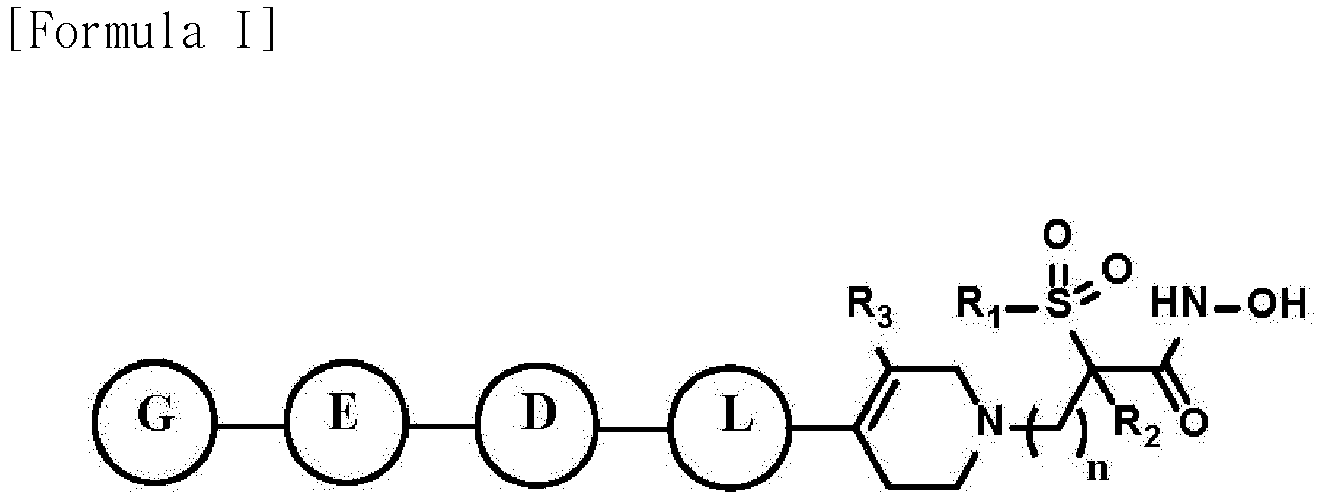
- To achieve the above objects, the present disclosure provides a tetrahydropyridine derivative compound represented by the following formula I, a stereoisomer thereof, or a pharmaceutically acceptable salt thereof:


- n is 1, 2 or 3;
- R1 is C1-C6 alkyl or C1-C6 haloalkyl;
- R2 is hydrogen or C1-C6 alkyl;
- R3 is hydrogen, C1-C6 alkyl, C1-C6 alkoxy, -OH or halogen;
- L is C3-C7 cycloalkyl, aryl, heteroaryl or null, wherein at least one H of C3-C7 cycloalkyl, aryl or heteroaryl may be substituted with halogen, C1-C6 alkyl, C1-C6 haloalkyl, -NRARB or -OH;
- D is C≡C, C3-C7 cycloalkyl, aryl, heteroaryl or null, wherein at least one H of C3-C7 cycloalkyl, aryl or heteroaryl may be substituted with halogen, C1-C6 alkyl, C1-C6 haloalkyl, -NRARB or -OH;
- E is C≡C, C3-C7 cycloalkyl, aryl, heteroaryl or null, wherein at least one H of C3-C7 cycloalkyl, aryl or heteroaryl may be substituted with halogen, C1-C6 alkyl, C1-C6 haloalkyl, -NRARB or -OH;
- G is C1-C6 alkyl, C3-C7 cycloalkyl, 4-6 membered heterocycloalkyl, aryl or heteroaryl,
- wherein at least one H of C1-C6 alkyl may be substituted with halogen, -NRARB, -OH or -ORC,
- at least one H of C3-C7 cycloalkyl or 4-6 membered heterocycloalkyl may be substituted with C1-C6 alkyl, C1-C6 alkyl-NRARB, C1-C6 hydroxyalkyl, C1-C6 haloalkyl, C1-C6 alkoxy, C1-C6 alkyl-ORc, - NRARB, -OH, -(C=O)-C1-C6 alkyl or -S(=O)2-C1-C6 alkyl,
- at least one H of aryl or heteroaryl may be substituted with C1-C6 alkyl, C1-C6 hydroxyalkyl, C1-C6 alkyl-NRARB, halogen, nitro, cyano, -NRARB, -OH, -ORC, -S(=O)2-C1-C6 alkyl, -S(=O)2-NRARB or -N-S(=O)2-C1-C6 alkyl;
- RA and RB are each independently hydrogen or C1-C6 alkyl, or RA and RB may be linked together to form 4-6 membered ring, wherein the 4-6 membered ring may have 0 or S atom and at least one H of the 4-6 membered ring may be substituted with halogen, -OH or C1-C6 hydroxyalkyl;
- RC is C1-C6 alkyl, C1-C6 hydroxyalkyl, -(C=O)-NRDRE or -S(=O)2-C1-C6 alkyl; and
- RD and RE are each independently hydrogen or C1-C6 alkyl.
- In one case,
n is 1 or 2;
R1 is C1-C6 alkyl;
R2 is C1-C6 alkyl;
R3 is hydrogen;
L is aryl, heteroaryl or null, wherein at least one H of aryl or heteroaryl may be substituted with halogen, C1-C6 alkyl or C1-C6 haloalkyl;
D is C≡C or null;
E is C≡C or null;
G is C1-C6 alkyl, C3-C7 cycloalkyl, 4-6 membered heterocycloalkyl, aryl or heteroaryl,
wherein at least one H of C1-C6 alkyl may be substituted with halogen, -NRARB, -OH or -ORc,
at least one H of 4-6 membered heterocycloalkyl may be substituted with C1-C6 alkyl, -(C=O)-C1-C6 alkyl or -S(=O)2-C1-C6 alkyl,
at least one H of aryl or heteroaryl may be substituted with C1-C6 alkyl, C1-C6 hydroxyalkyl, C1-C6 alkyl-NRARB, halogen, nitro, cyano, -NRARB, -OH, -ORC, -S(=O)2-C1-C6 alkyl or -S(=O)2-NRARB;
RA and RB are each independently hydrogen or C1-C6 alkyl, or RA and RB may be linked together to form 4-6 membered ring, wherein the 4-6 membered ring may have 0 atom and at least one H of the 4-6 membered ring may be substituted with C1-C6 hydroxyalkyl;
RC is C1-C6 alkyl, C1-C6 hydroxyalkyl, -(C=O)-NRDRE or -S(=O)2-C1-C6 alkyl; and
RD and RE are each independently hydrogen. - In another case,
n is 1 or 2;
R1 is C1-C6 alkyl;
R2 is C1-C6 alkyl;
R3 is hydrogen;
L is phenyl, pyridinyl or null, wherein at least one H of phenyl or pyridinyl may be substituted with halogen, C1-C6 alkyl or C1-C6 haloalkyl;
D is C≡C or null;
E is C≡C or null;
G is C1-C6 alkyl, C3-C6 cycloalkyl, 4-6 membered heterocycloalkyl, phenyl, pyridinyl, furanyl, thiophenyl or imidazolyl,
wherein at least one H of C1-C6 alkyl may be substituted with halogen, -NRARB, -OH or -ORC,
at least one H of 4-6 membered heterocycloalkyl may be substituted with C1-C6 alkyl, -(C=O)-C1-C6 alkyl or -S(=O)2-C1-C6 alkyl,
at least one H of phenyl, pyridinyl, furanyl, thiophenyl or imidazolyl may be substituted with C1-C6 alkyl, C1-C6 hydroxyalkyl, C1-C6 alkyl-NRARB, halogen, nitro, cyano, -NRARB, -OH, -ORC, -S(=O)2-C1-C6 alkyl or -S(=O)2-NRARB;
RA and RB are each independently hydrogen or C1-C6 alkyl, or RA and RB may be linked together to form 4-6 membered ring, wherein the 4-6 membered ring may have 0 atom and at least one H of the 4-6 membered ring may be substituted with C1-C6 hydroxyalkyl;
RC is C1-C6 alkyl, C1-C6 hydroxyalkyl, -(C=O)-NRDRE or -S(=O)2-C1-C6 alkyl; and
RD and RE are each independently hydrogen. - As used herein, including the claims, the following terms have the meaning defined below, unless specifically indicated otherwise.
- The term "alkyl" refers to a branched or straight chained hydrocarbon containing from 1 to 10 carbon atoms unless otherwide specified. Representative examples of alkyl include, but are not limited to, methyl, ethyl, n-propyl, iso-propyl, n-butyl, sec-butyl, iso-butyl, tert-butyl, n-pentyl, isopentyl, neopentyl, n-hexyl, 3-methylhexyl, 2,2-dimethylpentyl, 2,3-dimethylpentyl, n-heptyl, n-octyl, n-nonyl or n-decyl.
- The term "alkoxy" refer to hydrogen atom of a hydroxyl group is substituted with alkyl. Representative examples of alkoxy include, but are not limited to, methoxy, ethoxy, propoxy, isopropoxy, butoxy, isobutoxy, tert-butoxy, pentyloxy, neopentyloxy or isopentyloxy.
- The term "alkynyl" refers to straight chain hydrocarbon group containing from 2 to 10 carbon atoms and containing at least one carbon-carbon triple bond. Representative examples of alkynyl include, but are not limited to, acetylene, propynyl, butynyl, pentynyl, hexynyl or heptynyl.
- The term "aryl" refer to mono-, bi- or other multicarbocyclic aromatic ring system. Representative examples of aryl include, but are not limited to, phenyl, biphenyl, naphthyl, as well as benzo-fused carbocyclic moieties.
- The term "heteroaryl" refer to mono-, bi or other multicarbocyclic aromatic ring system containing one or more heteroatoms selected from O, N, or S. Representative examples of heteroaryl include, but are not limited to, pyrrolyl, imidazolyl, pyrazolyl, triazolyl, tetrazolyl, furyl, furanyl, thiophenyl, pyridinyl, pyrimidinyl, oxazolyl, oxadiazolyl, isoxazolyl, indolyl, quinolyl, isoquinolyl, benzimidazolyl, benzothienyl or benzofuryl.
- The term "cycloalkyl" refer to a saturated cyclic hydrocarbon ring of 3 to 8 carbon atoms. Representative examples of cycloalkyl include, but are not limited to, cyclopropyl, cyclobutyl, cyclopentyl or cyclohexyl.
- The term "heterocyclic" refer to a cyclic group containing one or more heteroatoms selected from O, N, or S. Representative examples of heterocyclic include, but are not limited to, azetidinyl, tetrahydrofuranyl, imidazolidinyl, pyrrolidinyl, piperidinyl, piperazinyl, oxazolidinyl, thiazolidinyl, pyrazolidinyl, morpholinyl, thio-morpholinyl, oxazinyl or tetrahydropyridinyl.
- The term "pharmaceutically acceptable" means the substance or composition must be compatible chemically and/or toxicologically, with the other ingredients comprising a formulation, and/or the mammal being treated therewith.
- The term "stereoisomer" means compounds that possess one or more chiral centers and each center may exist in the R or S configuration. Stereoisomers include all diastereomeric, enantiomeric and epimeric forms as well as racemates and mixtures thereof.
- In some cases, the novel tetrahydropyridine derivatives selective from the group consisting of the following compounds:
- 1) 4-(4-(4-((4-(dimethylamino)phenyl)ethynyl)phenyl)-3,6-dihydropyridin-1(2H)-yl)-N-hydroxy-2-methyl-2-(methylsulfonyl)butanamide;
- 2) N-hydroxy-2-methyl-2-(methylsulfonyl)-4-(4-(4-(phenylethynyl)phenyl)-3,6-dihydropyridin-1(2H)-yl)butanamide;
- 3) N-hydroxy-4-(4-(4-((4-methoxyphenyl)ethynyl)phenyl)-3,6-dihydropyridin-1(2H)-yl)-2-methyl-2-(methylsulfonyl)butanamide;
- 4) 4-(4-(4-(cyclopropylethynyl)phenyl)-3,6-dihydropyridin-1(2H)-yl)-N-hydroxy-2-methyl-2-(methylsulfonyl)butanamide;
- 5) N-hydroxy-4-(4-(4-(4-hydroxybut-1-yn-1-yl)phenyl)-3,6-dihydropyridin-1(2H)-yl)-2-methyl-2-(methylsulfonyl)butanamide;
- 6) 4-(4-(4-(hex-1-yn-1-yl)phenyl)-3,6-dihydropyridin-1(2H)-yl)-N-hydroxy-2-methyl-2-(methylsulfonyl)butanamide;
- 7) 4-(4-(4-(3-(dimethylamino)prop-1-yn-1-yl)phenyl)-3,6-dihydropyridin-1(2H)-yl)-N-hydroxy-2-methyl-2-(methylsulfonyl)butanamide;
- 8) N-hydroxy-4-(4-(4-(3-hydroxybut-1-yn-1-yl)phenyl)-3,6-dihydropyridin-1(2H)-yl)-2-methyl-2-(methylsulfonyl)butanamide;
- 9) 4-(4-(4-(cyclopentylethynyl)phenyl)-3,6-dihydropyridin-1(2H)-yl)-N-hydroxy-2-methyl-2-(methylsulfonyl)butanamide;
- 10) 4-(4-(4-(cyclohexylethynyl)phenyl)-3,6-dihydropyridin-1(2H)-yl)-N-hydroxy-2-methyl-2-(methylsulfonyl)butanamide;
- 11) N-hydroxy-2-methyl-2-(methylsulfonyl)-4-(4-(4-(pent-1-yn-1-yl)phenyl)-3,6-dihydropyridin-1(2H)-yl)butanamide;
- 12) 4-(4-(4-(3-cyclohexylprop-1-yn-1-yl)phenyl)-3,6-dihydropyridin-1(2H)-yl)-N-hydroxy-2-methyl-2-(methylsulfonyl)butanamide;
- 13) N-hydroxy-2-methyl-4-(4-(4-(4-methylpent-1-yn-1-yl)phenyl)-3,6-dihydropyridin-1(2H)-yl)-2-(methylsulfonyl)butanamide;
- 14) 4-(4-(4-(5-chloropent-1-yn-1-yl)phenyl)-3,6-dihydropyridin-1(2H)-yl)-N-hydroxy-2-methyl-2-(methylsulfonyl)butanamide;
- 15) N-hydroxy-2-methyl-2-(methylsulfonyl)-4-(4-(4-(3-(pyrrolidin-1-yl)prop-1-yn-1-yl)phenyl)-3,6-dihydropyridin-1(2H)-yl)butanamide;
- 16) 4-(4-(4-(3-(diethylamino)prop-1-yn-1-yl)phenyl)-3,6-dihydropyridin-1(2H)-yl)-N-hydroxy-2-methyl-2-(methylsulfonyl)butanamide;
- 17) N-hydroxy-4-(4-(4-(3-((S)-2-(hydroxymethyl)pyrrolidin-1-yl)prop-1-yn-1-yl)phenyl)-3,6-dihydropyridin-1(2H)-yl)-2-methyl-2-(methylsulfonyl)butanamide;
- 18) N-hydroxy-4-(4-(4-(5-hydroxypent-1-yn-1-yl)phenyl)-3,6-dihydropyridin-1(2H)-yl)-2-methyl-2-(methylsulfonyl)butanamide;
- 19) 5-(4-(1-(4-(hydroxyamino)-3-methyl-3-(methylsulfonyl)-4-oxobutyl)-1,2,3,6-tetrahydropyridin-4-yl)phenyl)pent-4-yn-1-yl methanesulfonate;
- 20) 4-(4-(4-(5-(dimethylamino)pent-1-yn-1-yl)phenyl)-3,6-dihydropyridin-1(2H)-yl)-N-hydroxy-2-methyl-2-(methylsulfonyl)butanamide;
- 21) 4-(4-(4-(5-aminopent-1-yn-1-yl)phenyl)-3,6-dihydropyridin-1(2H)-yl)-N-hydroxy-2-methyl-2-(methylsulfonyl)butanamide;
- 22) N-hydroxy-4-(4-(4-(3-hydroxyprop-1-yn-1-yl)phenyl)-3,6-dihydropyridin-1(2H)-yl)-2-methyl-2-(methylsulfonyl)butanamide;
- 23) N-hydroxy-4-(4-(4-(3-methoxyprop-1-yn-1-yl)phenyl)-3,6-dihydropyridin-1(2H)-yl)-2-methyl-2-(methylsulfonyl)butanamide;
- 24) N-hydroxy-4-(4-(4-(3-(3-hydroxypropoxy)prop-1-yn-1-yl)phenyl)-3,6-dihydropyridin-1(2H)-yl)-2-methyl-2-(methylsulfonyl)butanamide;
- 25) N-hydroxy-2-methyl-2-(methylsulfonyl)-4-(4-(4-(3-morpholinoprop-1-yn-1-yl)phenyl)-3,6-dihydropyridin-1(2H)-yl)butanamide;
- 26) 3-(4-(1-(4-(hydroxyamino)-3-methyl-3-(methylsulfonyl)-4-oxobutyl)-1,2,3,6-tetrahydropyridin-4-yl)phenyl)prop-2-yn-1-yl carbamate;
- 27) 5-(4-(1-(4-(hydroxyamino)-3-methyl-3-(methylsulfonyl)-4-oxobutyl)-1,2,3,6-tetrahydropyridin-4-yl)phenyl)pent-4-yn-1-yl carbamate;
- 28) N-hydroxy-4-(4-(4-(5-methoxypent-1-yn-1-yl)phenyl)-3,6-dihydropyridin-1(2H)-yl)-2-methyl-2-(methylsulfonyl)butanamide;
- 29) N-hydroxy-4-(4-(4-(6-hydroxyhex-1-yn-1-yl)phenyl)-3,6-dihydropyridin-1(2H)-yl)-2-methyl-2-(methylsulfonyl)butanamide;
- 30) N-hydroxy-2-methyl-2-(methylsulfonyl)-4-(4-(4-(6-morpholinohex-1-yn-1-yl)phenyl)-3,6-dihydropyridin-1(2H)-yl)butanamide;
- 31) 4-(4-(4-(3-(dimethylamino)prop-1-yn-1-yl)-3-fluorophenyl)-3,6-dihydropyridin-1(2H)-yl)-N-hydroxy-2-methyl-2-(methylsulfonyl)butanamide;
- 32) 4-(4-(4-(3-(dimethylamino)prop-1-yn-1-yl)-3,5-difluorophenyl)-3,6-dihydropyridin-1(2H)-yl)-N-hydroxy-2-methyl-2-(methylsulfonyl)butanamide;
- 33) 4-(4-(4-(3-(dimethylamino)prop-1-yn-1-yl)-2-fluorophenyl)-3,6-dihydropyridin-1(2H)-yl)-N-hydroxy-2-methyl-2-(methylsulfonyl)butanamide;
- 34) N-hydroxy-2-methyl-2-(methylsulfonyl)-4-(4-(4-(thiophen-2-ylethynyl)phenyl)-3,6-dihydropyridin-1(2H)-yl)butanamide;
- 35) N-hydroxy-2-methyl-2-(methylsulfonyl)-4-(4-(4-((4-nitrophenyl)ethynyl)phenyl)-3,6-dihydropyridin-1(2H)-yl)butanamide;
- 36) N-hydroxy-2-methyl-2-(methylsulfonyl)-4-(4-(4-(pyridin-3-ylethynyl)phenyl)-3,6-dihydropyridin-1(2H)-yl)butanamide;
- 37) N-hydroxy-4-(4-(4-((4-hydroxyphenyl)ethynyl)phenyl)-3,6-dihydropyridin-1(2H)-yl)-2-methyl-2-(methylsulfonyl)butanamide;
- 38) N-hydroxy-2-methyl-4-(4-(4-((1-methyl-1H-imidazol-4-yl)ethynyl)phenyl)-3,6-dihydropyridin-1(2H)-yl)-2-(methylsulfonyl)butanamide;
- 39) N-hydroxy-2-methyl-4-(4-(4-((1-methylazetidin-3-yl)ethynyl)phenyl)-3,6-dihydropyridin-1(2H)-yl)-2-(methylsulfonyl)butanamide;
- 40) 4-(4-(4-((1-acetylazetidin-3-yl)ethynyl)phenyl)-3,6-dihydropyridin-1(2H)-yl)-N-hydroxy-2-methyl-2-(methylsulfonyl)butanamide;
- 41) N-hydroxy-2-methyl-2-(methylsulfonyl)-4-(4-(4-((1-(methylsulfonyl)azetidin-3-yl)ethynyl)phenyl)-3,6-dihydropyridin-1(2H)-yl)butanamide;
- 42) 4-(4-(3-fluoro-4-(7-hydroxyhepta-1,3-diyn-1-yl)phenyl)-3,6-dihydropyridin-1(2H)-yl)-N-hydroxy-2-methyl-2-(methylsulfonyl)butanamide;
- 43) 4-(4-(3-fluoro-4-(6-hydroxyhexa-1,3-diyn-1-yl)phenyl)-3,6-dihydropyridin-1(2H)-yl)-N-hydroxy-2-methyl-2-(methylsulfonyl)butanamide;
- 44) 4-(4-(4-(cyclopropylbuta-1,3-diyn-1-yl)-3-fluorophenyl)-3,6-dihydropyridin-1(2H)-yl)-N-hydroxy-2-methyl-2-(methylsulfonyl)butanamide;
- 45) 4-(4-(4-(5-(dimethylamino)penta-1,3-diyn-1-yl)-3-fluorophenyl)-3,6-dihydropyridin-1(2H)-yl)-N-hydroxy-2-methyl-2-(methylsulfonyl)butanamide;
- 46) N-hydroxy-4-(4-(4-(7-hydroxyhepta-1,3-diyn-1-yl)phenyl)-3,6-dihydropyridin-1(2H)-yl)-2-methyl-2-(methylsulfonyl)butanamide;
- 47) N-hydroxy-4-(4-(4-(6-hydroxyhexa-1,3-diyn-1-yl)phenyl)-3,6-dihydropyridin-1(2H)-yl)-2-methyl-2-(methylsulfonyl)butanamide;
- 48) N-hydroxy-4-(4-(4-(5-hydroxypenta-1,3-diyn-1-yl)phenyl)-3,6-dihydropyridin-1(2H)-yl)-2-methyl-2-(methylsulfonyl)butanamide;
- 49) 4-(4-(4-(5-(dimethylamino)penta-1,3-diyn-1-yl)phenyl)-3,6-dihydropyridin-1(2H)-yl)-N-hydroxy-2-methyl-2-(methylsulfonyl)butanamide;
- 50) N-hydroxy-4-(4-(4-(5-methoxypenta-1,3-diyn-1-yl)phenyl)-3,6-dihydropyridin-1(2H)-yl)-2-methyl-2-(methylsulfonyl)butanamide;
- 51) N-hydroxy-2-methyl-2-(methylsulfonyl)-4-(4-(4-(phenylbuta-1,3-diyn-1-yl)phenyl)-3,6-dihydropyridin-1(2H)-yl)butanamide;
- 52) N-hydroxy-2-methyl-2-(methylsulfonyl)-4-(4-(pyridin-4-ylethynyl)-3,6-dihydropyridin-1(2H)-yl)butanamide;
- 53) 4-(4-((4-bromophenyl)ethynyl)-3,6-dihydropyridin-1(2H)-yl)-N-hydroxy-2-methyl-2-(methylsulfonyl)butanamide;
- 54) N-hydroxy-4-(4-(7-hydroxyhepta-1,3-diyn-1-yl)-3,6-dihydropyridin-1(2H)-yl)-2-methyl-2-(methylsulfonyl)butanamide;
- 55) N-hydroxy-2-methyl-2-(methylsulfonyl)-4-(4-(4-(pyridin-4-yl)phenyl)-3,6-dihydropyridin-1(2H)-yl)butanamide;
- 56) 4-(4-([1,1'-biphenyl]-4-yl)-3,6-dihydropyridin-1(2H)-yl)-N-hydroxy-2-methyl-2-(methylsulfonyl)butanamide;
- 57) 4-(4-(4'-chloro-[1,1'-biphenyl]-4-yl)-3,6-dihydropyridin-1(2H)-yl)-N-hydroxy-2-methyl-2-(methylsulfonyl)butanamide;
- 58) 4-(4-(4'-fluoro-[1,1'-biphenyl]-4-yl)-3,6-dihydropyridin-1(2H)-yl)-N-hydroxy-2-methyl-2-(methylsulfonyl)butanamide;
- 59) N-hydroxy-4-(4-(4'-hydroxy-[1,1'-biphenyl]-4-yl)-3,6-dihydropyridin-1(2H)-yl)-2-methyl-2-(methylsulfonyl)butanamide;
- 60) 4-(4-(3'-fluoro-4'-methoxy-[1,1'-biphenyl]-4-yl)-3,6-dihydropyridin-1(2H)-yl)-N-hydroxy-2-methyl-2-(methylsulfonyl)butanamide;
- 61) N-hydroxy-2-methyl-2-(methylsulfonyl)-4-(4-(4-(pyridin-3-yl)phenyl)-3,6-dihydropyridin-1(2H)-yl)butanamide;
- 62) 4-(4-(4-(6-fluoropyridin-3-yl)phenyl)-3,6-dihydropyridin-1(2H)-yl)-N-hydroxy-2-methyl-2-(methylsulfonyl)butanamide;
- 63) 4-(4-(4-(furan-3-yl)phenyl)-3,6-dihydropyridin-1(2H)-yl)-N-hydroxy-2-methyl-2-(methylsulfonyl)butanamide;
- 64) N-hydroxy-2-methyl-2-(methylsulfonyl)-4-(4-(4'-(methylsulfonyl)-[1,1'-biphenyl]-4-yl)-3,6-dihydropyridin-1(2H)-yl)butanamide;
- 65) N-hydroxy-4-(4-(4'-(hydroxymethyl)-[1,1'-biphenyl]-4-yl)-3,6-dihydropyridin-1(2H)-yl)-2-methyl-2-(methylsulfonyl)butanamide;
- 66) 4-(4-(4'-cyano-[1,1'-biphenyl]-4-yl)-3,6-dihydropyridin-1(2H)-yl)-N-hydroxy-2-methyl-2-(methylsulfonyl)butanamide;
- 67) N-hydroxy-2-methyl-2-(methylsulfonyl)-4-(4-(4'-pentyl-[1,1'-biphenyl]-4-yl)-3,6-dihydropyridin-1(2H)-yl)butanamide;
- 68) 4-(4-(4'-(azetidin-1-ylsulfonyl)-[1,1'-biphenyl]-4-yl)-3,6-dihydropyridin-1(2H)-yl)-N-hydroxy-2-methyl-2-(methylsulfonyl)butanamide;
- 69) 4'-(1-(4-(hydroxyamino)-3-methyl-3-(methylsulfonyl)-4-oxobutyl)-1,2,3,6-tetrahydropyridin-4-yl)-[1,1'-biphenyl]-4-yl methanesulfonate;
- 70) N-hydroxy-2-methyl-2-(methylsulfonyl)-4-(4-(4-(thiophen-3-yl)phenyl)-3,6-dihydropyridin-1(2H)-yl)butanamide;
- 71) N-hydroxy-4-(4-(4-(3-methoxythiophen-2-yl)phenyl)-3,6-dihydropyridin-1(2H)-yl)-2-methyl-2-(methylsulfonyl)butanamide;
- 72) N-hydroxy-2-methyl-2-(methylsulfonyl)-4-(4-(4-(4-methylthiophen-2-yl)phenyl)-3,6-dihydropyridin-1(2H)-yl)butanamide;
- 73) 4-(4-(4'-(ethylsulfonyl)-[1,1'-biphenyl]-4-yl)-3,6-dihydropyridin-1(2H)-yl)-N-hydroxy-2-methyl-2-(methylsulfonyl)butanamide;
- 74) N-hydroxy-2-methyl-2-(methylsulfonyl)-4-(4-(4'-(morpholinomethyl)-[1,1'-biphenyl]-4-yl)-3,6-dihydropyridin-1(2H)-yl)butanamide;
- 75) N-hydroxy-4-(6-(3-methoxyprop-1-yn-1-yl)-3',6'-dihydro-[3,4'-bipyridin]-1'(2'H)-yl)-2-methyl-2-(methylsulfonyl)butanamide;
- 76) 3-(4-([1,1'-biphenyl]-4-yl)-3,6-dihydropyridin-1(2H)-yl)-N-hydroxy-2-methyl-2-(methylsulfonyl)propanamide;
- 77) 4-(4-(4-(3-(dimethylamino)prop-1-yn-1-yl)-3-methylphenyl)-3,6-dihydropyridin-1(2H)-yl)-N-hydroxy-2-methyl-2-(methylsulfonyl)butanamide; and
- 78) 4-(4-(4-(3-(dimethylamino)prop-1-yn-1-yl)-3-(trifluoromethyl)phenyl)-3,6-dihydropyridin-1(2H)-yl)-N-hydroxy-2-methyl-2-(methylsulfonyl)butanamide.
- In the present disclosure, the pharmaceutically acceptable salts are preferably acid addition salts formed with pharmaceutically acceptable free acids. Free acids that may be used in the present disclosure include organic acids and inorganic acids. The inorganic acids include hydrochloric acid, hydrobromic acid, sulfuric acid, phosphoric acid, etc, and the organic acids include citric acid, oxalic acid, acetic acid, lactic acid, maleic acid, coumaric acid, gluconic acid, methanesulfonic acid, glycolic acid, succinic acid, 4-toluenesulfonic acid, trifluoroacetic acid, glutamic acid, aspartic acid, etc.
- In addition, the compounds of formula I or pharmaceutically acceptable salts thereof can show polymorphism, and can also exist as solvates (e.g., hydrates, etc.). Furthermore, the compounds of the present disclosure can also exist as individual stereoisomer or mixtures of stereoisomers.
- The present disclosure provides methods for the preparation of the tetrahydropyridine derivative compounds presented by formula I, stereoisomers thereof, or pharmaceutically acceptable salts thereof.
- The compounds of the present disclosure can be prepared in accordance with one or more of schemes discussed below.
- These methods can be used either directly or with obvious variations to trained chemists to prepare key intermediates and certain compounds of this disclosure.
- Suitable synthetic sequence are readily selected per specific structures of this disclosure, but within the art known to individuals practicing organic synthesis, such as method summarized in available chemistry data bases, as in CAS Scifinder and Elesvier Reaxys. Based on these general methods, the enablement for making the compounds of the present disclosure is straightforward and can be practiced within a common professional knowledge.
- Some general synthetic methods to prepare the compounds of the present disclosure are illustrated below.


- The present disclosure provides a pharmaceutical composition for preventing or treating bacterial infections, which contains a pharmaceutically acceptable carrier and, as an active ingredient, a compound represented by the following formula I, a stereoisomer thereof or a pharmaceutically acceptable salt thereof:
- The compounds of formula I according to the present disclosure, the stereoisomers thereof, or the pharmaceutically acceptable salts thereof, exhibit antibacterial activity, especially against Gram-negative organisms and are therefore suitable to treat bacterial infections in mammals, especially humans. They may therefore be used for the prevention or treatment of bacterial infection caused by Gram-negative bacteria, especially those caused by susceptible and multidrug resistant Gram-negative bacteria. Examples of such Gram-negative bacteria include Acinetobacter baumannii, Acinetobacter spp., Achromobacter spp., Aeromonas spp., Bacteroides spp., Bordetella spp., Borrelia spp., Brucella spp., Campylobacter spp., Chlamydia spp., Citrobacter spp., Enterobacter aerogenes, Enterobacter cloacae, Escherichia coli, Francisella tularensis, Fusobacterium spp., Haemophilus influenza (beta-lactamase positive and negative), Helicobacter pylori, Klebsiella oxytoca, Klebsiella pneumoniae (including those encoding extended-spectrum beta-lactamases (hereinafter "ESBLs")), Legionella pneumophila, Moraxella catarrhalis (beta-lactamase positive and negative), Morganella morganii, Neisseria gonorrhoeae, Neisseria meningitides, Proteus vulgaris, Porphyromonas spp., Prevotella spp., members of the Enterobacteriaceae that express ESBLs KPCs, CTX-M, metallo-beta-lactamase, and AmpC-type beta-lactamases that confer resistance to currently available cephalosporins, cephamycins, carbapenems, and beta-lactam/beta-lactamase inhibitor combination, Mannheimia haemolyticus, Pasteurella spp., Proteus mirabilis, Providencia spp., Pseudomonas aeruginosa (including ceftazidime-, cefpirome- and cefepime-resistant P. aeruginosa, carbapenem-resistant P. aeruginosa or quinolone-resistant P. aeruginosa), Pseudomonas spp., Salmonella spp., Shigella spp., Serratia marcescenes, Treponema spp., Burkholderia cepacia, Vibrio spp., Yersinia spp., and Stenotrophomonas maltophilia.
- In a more specific instance, examples of such Gram-negative bacteria include Acinetobacter baumannii, Acinetobacter spp., Enterobacter aerogenes, Enterobacter cloacae, Escherichia coli, Klebsiella oxytoca, Klebsiella pneumoniae, Serratia marcescens, Pseudomonas aeruginosa and members of the Enterobacteriaceae and Pseudomonas that express ESBLs, KPSs, CTX-M, metallo-beta-lactamases, and AmpC-type beta-lactamases that confer resistance to currently available cephalosporins, cephamycins, carbapenems, and betalactam/beta-lactamase inhibitor combinations.
- The compounds of formula I according to the present disclosure or the stereoisomers, or the pharmaceutically acceptable salts thereof, may therefore be used for the prevention or treatment of bacterial infection selected from nosocomial pneumonia, urinary tract infections, systemic infections (such as bacteraemia and sepsis), skin and soft tissue infections, surgical infections, intraabdominal infections, lung infections (including those in patients with cystic fibrosis), endocarditis, diabetic foot infection, osteomyelitis, and central nervous system infections.
- The compounds of formula I according to the present disclosure or the stereoisomers display intrinsic antibacterial properties and have the ability to improve permeability of the outer membrane of Gram-negative bacteria to other antibacterial agents. Their use in combination with another antibacterial agent might offer some further advantages such as lowered side-effects of drugs due to lower doses used or shorter time of treatment, more rapid cure of infection shortening hospital stays, increasing spectrum of pathogens controlled, and decreasing incidence of development of resistance to antibiotics. The antibacterial agent for use in combination with a compound of formula I according to the present disclosure will be selected from the group consisting a penicillin antibiotic (such as ampicillin, piperacillin, penicillin G, amoxicillin, or tetracillin), a cephalosporin antibiotic (such as ceftriaxone, ceftazidime, cefepime, cefotaxime), a carbapenem antibiotic (such as imipenem, or meropenem), a monobactam antibiotic (such as aztreonam), a fluoroquinolone antibiotic (such as ciprofloxacin, moxifloxacin or levofloxacin), a macrolide antibiotics (such as erythromycin or azithromycin), an aminoglycoside antibiotic (such as amikacin, gentamycin or tobramycin), a glycopeptide antibiotic (such as vancomycin or teicoplanin), a tetracycline antibiotics (such as tetracycline), and linezolid, clindamycin, telavancin, daptomycin, novobiocin, rifampicin and polymyxin.
- In order to exhibit this antibacterial activity, the compounds need to be administered in a therapeutically effective amount. A "therapeutically effective amount" is meant to describe a sufficient quantity of the compound to treat the infection, at a reasonable benefit/risk ratio applicable to any such medical treatment. It will be understood, however, that the attending physician, within the scope of sound medical judgment, will decide the total daily dosage of the compound. The specific therapeutically effective dose level for any particular patient will depend upon a variety of factors including the disorder being treated and the severity of the disorders; the activity of the specific compound employed; the specific composition employed; the age, body weight, general health, sex and diet of the patient; the time of administration; the duration of the treatment; drugs used in combination or coincidental with the specific compound employed; and like factors well known in the medical arts. As a general guideline however, the total daily dose will typically range from about 0.1mg/kg/day to about 5,000mg/kg/day in single or in divided doses. Typically, dosages for humans will range from about 10mg to about 3,000mg per day, in a single or multiple doses.
- Any route typically used to treat infectious illness, including oral, parenteral, topical, rectal, transmucosal, and intestinal, can be used to administer the compounds. Parenteral administrations include injections to generate a systemic effect or injections directly into the afflicted area. Examples of parenteral administrations are subcutaneous, intravenous, intramuscular, intradermal, intrathecal, and intraocular, intranasal, intravetricular injections or infusions techniques. Topical administrations include the treatment of areas readily accessible by local application, such as, for example, eyes, ears including external and middle ear infections, vaginal, open wound, skin including the surface skin and the underneath dermal structures, or other lower intestinal tract. Transmucosal administration includes nasal aerosol or inhalation applications.
- The present disclosure also provides a method of inhibiting UDP-3-0-(R-3-hydroxymyristoyl)-N-acetylglucosamine deacetylase (LpxC), comprising administering to a patient in need thereof a therapeutically effective amount of the compound represented by formula I, stereoisomer thereof or pharmaceutically acceptable salt thereof according to the present disclosure. In some instances, the present disclosure provides a method of inhibiting UDP-3-0-(R-3-hydroxymyristoyl)-N-acetylglucosamine deacetylase (LpxC), comprising contact a cell (e.g., in vivo or in vitro) with a therapeutically effective amount of the compound represented by formula I, stereoisomer thereof or pharmaceutically acceptable salt thereof according to the present disclosure.
- The present disclosure also provides a method for treating bacterial infections, comprising administering to a patient in need thereof a therapeutically effective amount of the compound represented by formula I, stereoisomer thereof or pharmaceutically acceptable salt thereof according to the present disclosure.
- The present disclosure also provides the use of the compound represented by formula I, stereoisomer thereof or pharmaceutically acceptable salt thereof according to the present disclosure in preparation of a medicament for treating bacterial infections.
- The compounds represented by formula I, stereoisomers thereof or pharmaceutically acceptable salts thereof according to the present disclosure can exhibit excellent effects on the treatment bacterial infections.
- Instances of the present disclosure are described in the following examples. Common abbreviations well known to those with ordinary skills in the synthetic used throughout.
- All chemical reagents were commercially available. Flash column chromatography means silica gel chromatography unless specified otherwise, which was performed on Teledyne Combiflash-RF-200 system. 1H NMR spectra (δ,ppm) are recorded on 400MHz or 600MHz instrument. Mass spectroscopy data for a positive ionization method are provided.
-

- To a solution of methyl 2-chloropropionate (150g, 1eq) in MeOH (500ml) was added with sodium methanesulfinate (162g, 1.3eq) and stirred for 20hr at 77°C. The mixture was cooled down to room temperature and precipitated solid was filtered off through celite. The filtrate was concentrated in vacuo and the residue was suspended in ethyl acetate (100ml) / hexane (500ml). After then, the precipitated solid was filtered off and the filtrate was concentrated in vacuo to prepare the title compound (162g, 80%).
1H NMR (600 MHz, CDCl3-d1);δ3.90 (q, J=7.2Hz, 1H), 3.82 (s, 3H), 3.03 (s, 3H), 1.66 (d, J=6.6Hz, 3H). - To a suspended solution of sodium hydride (60%, 33.7g, 2eq) in DMF (300ml) was dropwised with methyl 2-(methylsulfonyl)propanoate (70g, 1eq) in DMF (100ml) at 0°C and stirred for 30min. After then, the mixture was added with 1,2-dibromoethane (158g, 2eq) and stirred for 6hr at room temperature. The mixture was quenched with sat. aq. NH4Cl, extracted with ethyl acetate and water. The organic layer was washed with brine, dried over anhydrous MgSO4 and concentrated in vacuo. The residue was purified with column chromatography to prepare the title compound (225mg, 43%).
1H NMR (600 MHz, CDCl3-d1);δ3.81 (s, 3H), 3.49-3.45(m, 1H), 3.35-3.31 (m, 1H), 3.01 (s, 3H). 2.78-2.73 (m, 1H), 2.53-2.48 (m, 1H), 1.62 (s, 3H) -

- To a solution of 4-(4-iodophenyl)-1,2,3,6-tetrahydropyridine hydrochloride (10g, 1eq) in a mixture of DMF (100ml) / MeOH (50ml) was added with methyl 4-bromo-2-methyl-2-(methylsulfonyl)butanoate (12.74g, 1.5eq), N,N-diisopropylethylamine (16.3ml, 3eq) and stirred for 24hr at 60°C. The mixture was cooled down to room temperature, extracted with ethyl acetate and water. The organic layer was washed with brine, dried over anhydrous MgSO4 and concentrated in vacuo. The residue was purified with column chromatography to prepare the title compound (11g, 74%).
1H NMR (600 MHz, CDCl3-d1);δ7.68 (d, J=7.8 Hz, 2H), 7.10 (d, J=8.4 Hz, 2H), 5.98 (s, 1H), 4.20-4.14 (m, 1H), 3.88 (d, J=6.0 Hz, 3H), 3.72-3.66 (m, 1H), 3.62-3.48 (m, 2H), 3.46-3.36 (m, 1H), 3.30-3.14 (m, 2H), 3.13 (d, J=6.6 Hz, 3H), 2.94-2.84 (m, 1H), 2.80-2.65 (m, 2H), 1.76 (d, J=6.6 Hz, 3H). -
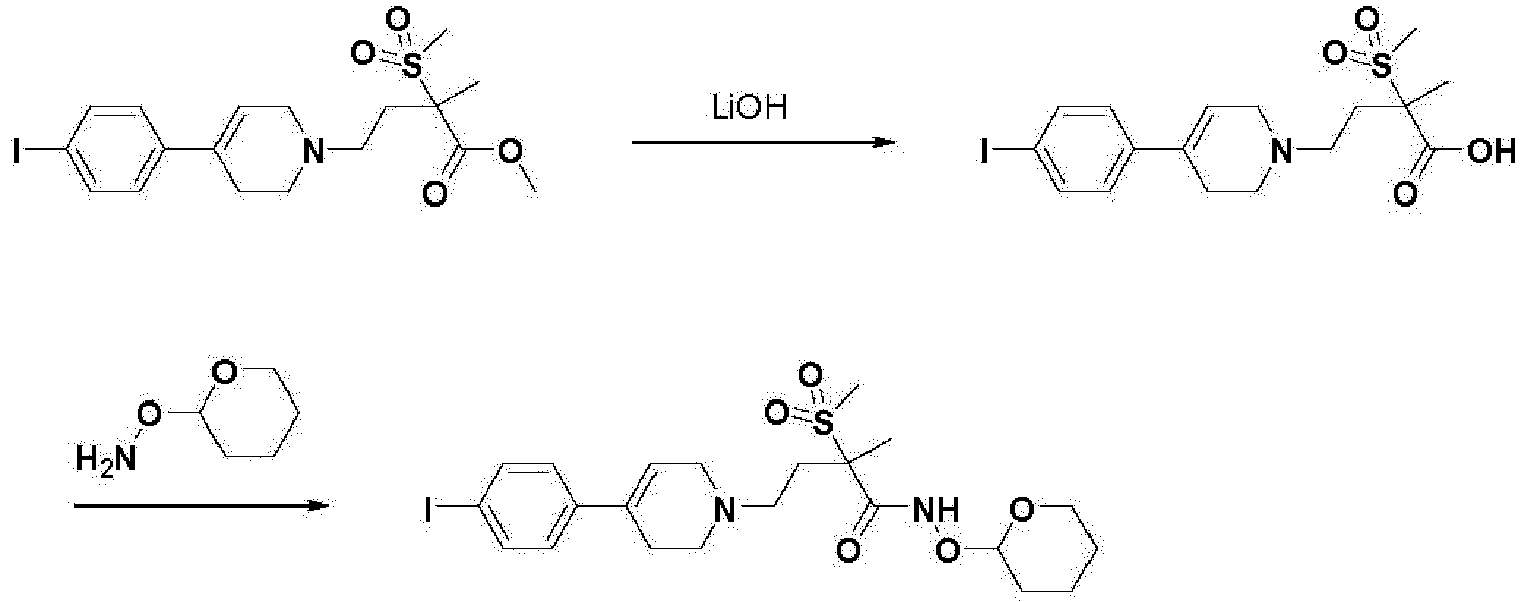
- To a solution of methyl 4-(4-(4-iodophenyl)-3,6-dihydropyridin-1(2H)-yl)-2-methyl-2-(methylsulfonyl)butanoate (2g, 1eq) in a mixture of THF (8ml) / MeOH (2ml) was added with 2N-LiOH (12.6mL, 3eq) solution and stirred for 2hr at room temperature. The solvent was removed under reduced pressure and the residue was diluted with water (10ml), adjusted the pH to 4.0. The water was concentrated in vacuo and the residue was column chromatography to prepare the title compound (1.76g, 91%).
1H NMR (600MHz, DMSO-d6):δ 7.72-7.70 (m, 2H), 7.28-7.26 (m, 2H), 6.21 (s, 1H), 3.68-3.64 (m, 2H), 3.25-3.01 (m, 4H), 2.65-2.62 (m, 2H), 2.29-2.19 (m, 2H), 1.45 (s, 3H). - To a solution of 4-(4-(4-iodophenyl)-3,6-dihydropyridin-1(2H)-yl)-2-methyl-2-(methylsulfonyl)butanoic acid (1.76g, 1eq) in DMF (10ml) was added with HATU (1-[Bis(dimethylamino)methylene]-1H-1,2,3-triazolo[4,5-b]pyridinium 3-oxid hexafluorophosphate) (2.02g, 1.4eq), HOBT (Hydroxybenzotriazole) (0.81g, 1.4eq), Et3N (1.6ml, 3eq), 0-(tetrahydro-2H-pyran-2-yl)hydroxylamine hydrochloride (1.17g, 2eq) and stirred for 1hr at room temperature. The mixture was extracted with ethyl acetate and water. The organic layer was washed with brine, dried over anhydrous MgSO4 and concentrated in vacuo. The residue was purified with column chromatography to prepare the title compound (0.6g, 28%).
1H NMR (600MHz, DMSO-d6):δ11.58 (bs, 1H), 7.66-7.64 (m, 2H), 7.22-7.20 (m, 2H), 6.17 (s, 1H), 4.85-4.81 (m, 1H), 3.31-3.04 (m, 5H), 2.60-2.59 (m, 2H), 2.47-2.39 (m, 6H), 1.85-1.62 (m, 2H), 1.47-1.41 (s, 7H). -

-

- To a solution of methyl 4-(4-(4-iodophenyl)-3,6-dihydropyridin-1(2H)-yl)-2-methyl-2-(methylsulfonyl)butanoate (Intermediate 2) (500mg, 1eq) in a mixture of THF (10ml)/toluene (10ml) was added with CuI (20mg, 0.1eq), Pd(PPh3)2Cl2 (74mg, 0.1eq), Et3N (0.442ml, 3eq) and 4-ethynyl-N,N-dimethylaniline (228mg, 1.5eq) and stirred for 12hr at room temperature. The mixture was extracted with ethyl acetate and water. The organic layer was washed with brine, dried over anhydrous MgSO4 and concentrated in vacuo. The residue was purified with column chromatography to prepare the title compound (225mg, 43%).
1H NMR (600MHz, CDCl3-d1);δ7.43 (d, J=8.4Hz, 2H), 7.39 (d, J=9Hz, 2H), 7.32 (d, J=9Hz, 2H), 6.65 (d, J=8.4Hz, 2H), 6.08 (s, 1H), 3.87 (s, 3H), 3.24-3.22 (m, 1H), 3.07-3.05 (m, 1H), 3.04 (s, 3H), 2.98 (s, 6H), 2.82-2.76 (m, 1H), 2.67-2.56 (m, 4H), 2.62-2.58 (m, 2H), 2.03-2.00 (m, 1H), 1.63 (s, 3H).
MS (ESI, m/z): 495.3 [M+H]+. -

- To a solution of methyl 4-(4-(4-((4-(dimethylamino)phenyl)ethynyl)phenyl)-3,6-dihydropyridin-1(2H)-yl)-2-methyl-2-(methylsulfonyl)butanoate (225mg, 1eq) in a mixture of THF (8ml)/ MeOH (2ml) was added with 2N-LiOH (0.68mL, 3eq) solution and stirred for 2hr at room temperature. The solvent was removed under reduced pressure and the residue was diluted with water (6ml), adjusted the pH to 4.0. The precipitated solid was filtered off to prepare the title compound (190mg, 87%), which was used for next step without further purification.
MS (ESI, m/z): 481.2 [M+H]+. -

- To a solution of 4-(4-(4-((4-(dimethylamino)phenyl)ethynyl)phenyl)-3,6-dihydropyridin-1(2H)-yl)-2-methyl-2-(methylsulfonyl)butanoic acid (190mg, 1eq) in DMF (10ml) was added with HATU (210mg, 1.4eq), HOBT (85mg, 1.4eq), Et3N (0.17ml, 3eq), 0-(tetrahydro-2H-pyran-2-yl)hydroxylamine hydrochloride (121mg, 2eq) and stirred for 1hr at room temperature. The mixture was extracted with ethyl acetate and water. The organic layer was washed with brine, dried over anhydrous MgSO4 and concentrated in vacuo. The residue was purified with column chromatography to prepare the title compound (200mg, 87%).
MS (ESI, m/z): 580.3 [M+H]+. -

- To a solution of 4-(4-(4-((4-(dimethylamino)phenyl)ethynyl)phenyl)-3,6-dihydropyridin-1(2H)-yl)-2-methyl-2-(methylsulfonyl)-N-((tetrahydro-2H-pyran-2-yl)oxy)butanamide (200mg, 1eq) in MeOH (6ml) was added with HCl solution in MeOH (1.25N, 0.83ml, 3eq) and stirred for 2hr at room temperature. The solvent was removed under reduced pressure and the residue was diluted with water (6ml), adjusted the pH to 7.0. The water was concentrated in vacuo and the resulting residue was purified with column chromatography to prepare the title compound (40mg, 24%).
1H NMR (600MHz, DMSO-d6):δ11.02 (bs, 1H), 9.08 (bs, 1H), 7.42-7.39 (m, 4H), 7.32 (d, J=8.4Hz, 2H), 6.68 (d, J=9Hz, 2H), 6.21 (s, 1H), 3.12-3.08 (m, 2H), 3.04 (s, 3H), 2.92 (s, 6H), 2.67-2.56 (m, 2H), 2.47-2.39 (m, 4H), 2.36-2.28 (m, 1H), 1.85-1.80 (m, 1H), 1.44 (s, 3H).
MS (ESI, m/z): 496.2 [M+H]+. - The terminal acetylenes listed in the following table were used to prepare compounds of Examples 2-14 in the same manner as Example 1.
Example Structure (Name) Terminal acetylene 2 

(N-hydroxy-2-methyl-2-(methylsulfonyl)-4-(4-(4-(phenylethynyl)phenyl)-3,6-dihydropyridin-1(2H)-yl)butanamide) 1H NMR (600MHz, DMSO-d6); δ 11.00 (bs, 1H), 9.09 (bs, 1H), 7.52-7.39 (m, 9H), 6.23 (s, 1H), 3.34-3.28 (m, 6H), 3.09-3.03 (m, 2H), 3.03 (s, 3H), 2.63-2.57 (m, 2H), 1.44 (s, 3H). MS (ESI, m/z): 453.2 [M+H]+. 3 

(N-hydroxy-4-(4-(4-((4-methoxyphenyl)ethynyl)phenyl)-3,6-dihydropyridin-1(2H)-yl)-2-methyl-2-(methylsulfonyl)butanamide) 1H NMR (600MHz, DMSO-d6); δ 11.01 (bs, 1H), 9.10 (bs, 1H), 7.47-7.43 (m, 6H), 6.99-6.95 (m, 2H), 6.23 (s, 1H), 3.76 (s, 3H), 3.13-3.06 (m, 2H), 3.04 (s, 3H), 2.65-2.54 (m, 2H), 2.46-2.40 (m, 4H) 2.36-2.28 (m, 1H), 1.85-1.81 (m, 1H), 1.44 (s, 3H). MS (ESI, m/z): 483.2 [M+H]+. 4 

(4-(4-(4-(cyclopropylethynyl)phenyl)-3,6-dihydropyridin-1(2H)-yl)-N-hydroxy-2-methyl-2-(methylsulfonyl)butanamide) 1H NMR (600MHz, DMSO-d6); δ 11.01 (bs, 1H), 9.09 (bs, 1H), 7.36-7.35 (m, 2H), 7.28-7.27 (m, 2H), 6.17 (s, 1H), 3.10-3.04 (m, 2H), 3.03 (s, 3H), 2.63-2.54 (m, 2H), 2.46-2.39 (m, 4H), 2.31-2.26 (m, 1H), 1.83-1.77 (m, 1H), 1.53-1.47 (m, 1H), 1.44 (s, 3H), 0.86-0.82 (m, 2H), 0.70-0.65 (m, 2H). MS (ESI, m/z): 417.1 [M+H]+. 5 

(N-hydroxy-4-(4-(4-(4-hydroxybut-1-yn-1-yl)phenyl)-3,6-dihydropyridin-1(2H)-yl)-2-methyl-2-(methylsulfonyl)butanamide) 1H NMR (600MHz, DMSO-d6); δ 11.03 (bs, 1H), 9.13 (bs, 1H), 7.41-7.39 (m, 2H), 7.34-7.33 (m, 2H), 6.21 (s, 1H), 4.91 (m, 1H), 3.59-3.54 (m, 2H), 3.18-3.11 (m, 2H), 3.06 (s, 3H), 2.80-2.74 (m, 4H), 2.56-2.54 (m, 2H), 2.48-2.42 (m, 2H), 2.38-2.33 (m, 1H), 1.86-1.83 (m, 1H), 1.47 (s, 3H). MS (ESI, m/z): 421.2 [M+H]+. 6 

(4-(4-(4-(hex-1-yn-1-yl)phenyl)-3,6-dihydropyridin-1(2H)-yl)-N-hydroxy-2-methyl-2-(methylsulfonyl)butanamide) 1H NMR (600MHz, DMSO-d6); δ 11.00 (bs, 1H), 9.08 (bs, 1H), 7.39-7.35 (m, 2H), 7.29-7.28 (m, 2H), 6.17 (s, 1H), 3.34-3.31 (m, 2H), 3.10-3.01 (m, 5H), 2.60-2.35 (m, 2H), 2.48-2.06 (m, 6H), 1.48-1.29 (m, 7H), 0.97-0.88 (m, 3H). MS (ESI, m/z): 433.2 [M+H]+. 7 

(4-(4-(4-(3-(dimethylamino)prop-1-yn-1-yl)phenyl)-3,6-dihydropyridin-1(2H)-yl)-N-hydroxy-2-methyl-2-(methylsulfonyl)butanamide) 1H NMR (600MHz, DMSO-d6); δ 11.03 (bs, 1H), 9.13 (bs, 1H), 7.43-7.42 (m, 2H), 7.39-7.37 (m, 2H), 6.21 (s, 1H), 3.45-3.43 (m, 2H), 3.14-3.09 (m, 2H), 3.06 (s, 3H), 2.67-2.57 (m, 2H), 2.49-2.40 (m, 4H), 2.34-2.26 (m, 2H), 2.23 (s, 6H), 1.46 (s, 3H). MS (ESI, m/z): 434.2 [M+H]+. 8 

(N-hydroxy-4-(4-(4-(3-hydroxybut-1-yn-1-yl)phenyl)-3,6-dihydropyridin-1(2H)-yl)-2-methyl-2-(methylsulfonyl)butanamide) 1H NMR (600MHz, DMSO-d6); δ 11.03 (bs, 1H), 9.12 (bs, 1H), 7.43 (d, J=7.8Hz, 2H), 7.35 (d, J=9.0Hz, 2H), 6.22 (s, 1H), 5.46 (d, J=5.4Hz, 1H), 4.58 (m, 1H), 3.50 (s, 2H), 3.15-3.07 (m, 2H),3.06 (s, 3H),2.67-2.57 (m, 2H),2.48-2.42 (m, 4H),2.36-2.32 (m, 1H),1.84-1.80 (m, 1H), 1.46 (s, 3H), 1.37 (d, J=6.0Hz, 3H). MS (ESI, m/z): 421.10 [M+H]+. 9 

(4-(4-(4-(cyclopentylethynyl)phenyl)-3,6-dihydropyridin-1(2H)-yl)-N-hydroxy-2-methyl-2-(methylsulfonyl)butanamide) 1H NMR (600MHz, DMSO-d6); δ 11.03 (bs, 1H), 9.13 (bs, 1H), 7.39 (d, J=8Hz, 2H), 7.31 (d, J=8.8Hz, 2H), 6.19 (s, 1H), 3.85-3.83 (m, 2H), 3.07-3.04 (m, 4H), 2.81-2.79 (m, 1H), 2.61-2.58 (m, 2H), 2.47-2.44 (m, 3H), 2.00-1.95 (m, 2H), 1.84-1.81 (m, 2H), 1.76-1.74 (m, 2H), 1.62-1.52 (m, 4H), 1.46 (s, 3H). MS (ESI, m/z): 445.1 [M+H]+. 10 
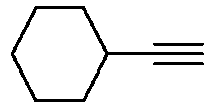
(4-(4-(4-(cyclohexylethynyl)phenyl)-3,6-dihydropyridin-1(2H)-yl)-N-hydroxy-2-methyl-2-(methylsulfonyl)butanamide) 1H NMR (600MHz, DMSO-d6) ; δ 11.01 (bs, 1H), 9.09 (bs, 1H), 7.37 (d, J=8.4Hz, 2H), 7.29 (d, J=7.8Hz, 2H), 6.17 (s, 1H), 3.10-3.01 (m, 5H), 2.66-2.54 (m, 3H), 2.46-2.39 (m, 5H), 2.31-2.28 (m, 1H), 1.81-1.78 (m, 3H), 1.67-1.64 (m, 2H), 1.48-1.41 (m, 5H), 1.33-1.28 (m, 3H). MS (ESI, m/z): 459.2 [M+H]+. 11 

(N-hydroxy-2-methyl-2-(methylsulfonyl)-4-(4-(4-(pent-1-yn-1-yl)phenyl)-3,6-dihydropyridin-1(2H)-yl)butanamide) 1H NMR (600MHz, DMSO-d6); δ 11.01 (bs, 1H), 9.09 (bs 1H), 7.37-7.36 (m, 2H), 7.31-7.29 (m, 2H), 6.17 (s, 1H), 3.10-3.04 (m, 2H), 3.03 (s, 3H), 2.63-2.54 (m, 2H), 2.51-2.49 (m, 1H), 2.45-2.39 (m, 3H), 2.36 (t, J=6.9Hz 2H), 2.31-2.28 (m, 1H), 1.83-1.78 (m, 1H), 1.53-1.49 (m, 2H), 1.43 (s, 3H), 0.96 (t, J=7.8 Hz, 3H). MS (ESI, m/z): 419.1 [M+H]+. 12 

(4-(4-(4-(3-cyclohexylprop-1-yn-1-yl)phenyl)-3,6-dihydropyridin-1(2H)-yl)-N-hydroxy-2-methyl-2-(methylsulfonyl)butanamide) 1H NMR (600MHz, DMSO-d6); δ 11.01 (bs, 1H), 9.11 (bs, 1H), 7.38-7.36 (m, 2H), 7.31-7.29 (m, 2H), 6.19 (s, 1H), 3.18-3.03 (m, 5H), 2.65-2.48 (m, 2H), 2.51-2.43 (m, 2H), 2.32-2.31 (m, 2H), 1.79-1.61 (m, 6H), 1.59-1.40 (m, 4H), 1.24-1.18 (m, 2H), 1.13-1.06 (m, 2H), 1.04-0.98 (m, 2H). MS (ESI, m/z): 473.2 [M+H]+. 13 

(N-hydroxy-2-methyl-4-(4-(4-(4-methylpent-1-yn-1-yl)phenyl)-3,6-dihydropyridin-1(2H)-yl)-2-(methylsulfonyl)butanamide) 1H NMR (600MHz, DMSO-d6) δ:11.01 (bs, 1H), 9.10 (bs, 1H), 7.38-7.37 (m, 2H), 7.32-7.31 (m, 2H), 6.17 (s, 1H), 3.09-3.04 (m, 5H), 2.62-2.57 (m, 2H), 2.46-2.44 (m, 2H), 2.31-2.98 (m, 2H), 1.85-1.81 (m, 2H), 1.44 (s, 3H), 1.23-1.21 (m, 2 H), 0.99-0.96 (m, 6H). MS (ESI, m/z): 433.2 [M+H]+. 14 

(4-(4-(4-(5-chloropent-1-yn-1-yl)phenyl)-3,6-dihydropyridin-1(2H)-yl)-N-hydroxy-2-methyl-2-(methylsulfonyl)butanamide) 1H NMR (600MHz, DMSO-d6); δ 11.0 (bs, 1H), 9.15 (bs, 1H), 7.38-7.37 (m, 2H), 7.33-7.32 (m, 2H), 6.18 (s, 1H), 3.78 (t, J=7.2 Hz, 2H), 3.12-3.06 (m, 2H), 3.04 (s, 3H), 2.68-2.56 (m, 4H), 2.46-2.40 (m, 5H), 1.98-1.90 (m, 2H), 1.82-1.79 (m, 1H), 1.44 (s, 3H). MS (ESI, m/z): 453.2 [M+H]+. -

-

- To a solution of pyrrolidine (1.5ml, 1eq) in toluene (30ml) was added with K2CO3 (4.97g, 2eq) and 3-bromoprop-1-yne (2.4ml, 1.5eq). The mixture was stirred for 15hr at room temperature and filtered off, and the filtrate was concentrated in vacuo. The resulting residue was purified with column chromatography to prepare the title compound (0.32g, 16%).
MS (ESI, m/z): 110.1 [M+H]+. - The title compound was prepared the procedures described for the synthesis of Example 1 using 1-(prop-2-yn-1-yl)pyrrolidine.
1H NMR (600MHz, DMSO-d6):δ11.03 (bs, 1H), 9.14 (bs, 1H), 7.45-7.36 (m, 4H), 6.22 (s, 1H), 3.63 (s, 2H), 3.18-3.04 (m, 5H), 2.70-2.56 (m, 6H), 2.48-2.41 (m, 4H), 2.37-2.31 (m, 1H), 1.87-1.80 (m, 1H), 1.77-1.68 (m, 4H), 1.46 (s, 3H).
MS (ESI, m/z): 460.2 [M+H]+. -

-

- To a solution of diethylamine (0.46ml, 1eq) in toluene (10ml) was added with K2CO3 (1.23g, 2eq) and 3-bromoprop-1-yne (0.56ml, 1.5eq). The mixture was stirred for 15hr at room temperature and filtered off, and the filtrate was concentrated in vacuo. The resulting residue was purified with column chromatography to prepare the title compound (0.46g, 94%).
MS (ESI, m/z): 112.1 [M+H]+. - The title compound was prepared the procedures described for the synthesis of Example 1 using N,N-diethylprop-2-yn-1-amine.
1H NMR (600MHz, DMSO-d6);δ11.02 (bs, 1H), 9.15 (bs, 1H), 7.43-7.37 (m, 4H), 6.22 (s, 1H), 3.70-3.62 (m, 2H), 3.32-3.08 (m, 2H), 3.05 (s, 3H), 2.84-2.78 (m, 6H), 2.74-2.58 (m, 5H), 1.89-1.85 (m, 1H), 1.45 (s, 3H), 1.11-0.96 (m, 6H).
MS (ESI, m/z): 462.2 [M+H]+. -

-

- To a solution of 3-bromoprop-1-yne (3g, 1eq) in toluene (30ml) was added with (R)-pyrrolidin-2-ylmethanol (3.73ml, 1.5eq) and K2CO3 (6.97g, 2eq). The mixture was stirred for 15hr at room temperature and extracted with ethyl acetate and water. The organic layer was dried over anhydrous MgSO4 and concentrated in vacuo. The residue was purified with column chromatography to prepare the title compound (2g, 57%).
1H NMR (600MHz, CDCl3-d1);δ 3.65-3.51 (m, 2H), 3.45-3.41 (m, 2H), 3.04-3.01 (m, 1H), 2.87-2.84 (m, 1H), 2.71-2.67 (m, 1H), 2.20-2.19 (m, 1H), 1.93-1.72 (m, 4H). - The title compound was prepared the procedures described for the synthesis of Example 1 using (R)-(1-(prop-2-yn-1-yl)pyrrolidin-2-yl)methanol.
1H NMR (600MHz, DMSO-d6):δ11.04 (bs, 1H), 9.21 (bs, 1H), 7.48-7.40 (m, 4H), 6.26 (s, 1H), 3.55-3.52 (m, 2H), 3.36-3.33 (m, 4H), 3.09-3.08 (m, 4H), 2.89 (s, 3H), 2.69-2.58 (m, 4H), 1.95-1.87 (m, 1H), 1.79-1.62 (m, 6H), 1.49 (s, 3H).
MS (ESI, m/z): 490.2[M+H]+. -

- To a solution of methyl 4-(4-(4-iodophenyl)-3,6-dihydropyridin-1(2H)-yl)-2-methyl-2-(methylsulfonyl)butanoate (Intermediate 2) (2g, 1eq) in a mixture of THF (20ml)/toluene (20ml) was added with CuI (79.8mg, 0.1eq), Pd(PPh3)2Cl2 (295mg, 0.1eq), Et3N (1.75ml, 3eq) and pent-4-yn-1-ol (705mg, 2eq). The mixture was stirred for 12hr at room temperature and extracted with ethyl acetate and water. The organic layer was washed with brine, dried over anhydrous MgSO4 and concentrated in vacuo. The residue was purified with column chromatography to prepare the title compound (1.5g, 83%).
1H NMR (600MHz, CDCl3-d1);δ7.33-7.32 (m, 2H), 7.28-7.27 (m, 2H), 6.05 (s, 1H), 3.82-3.79 (m, 2H), 3.75-3.72 (m, 3H), 3.69 (s, 3H), 3.05 (s, 3H), 2.70-2.62 (m, 1H), 2.53 (t, J=7.2 Hz, 3H), 2.38 (t, J=6.0 Hz, 3H), 1.78-1.64 (m, 4H), 1.64 (s, 3H). -

- The title compound was prepared the procedures described for the synthesis of Example 1, step 2 - 4 (Synthesis of Hydroxamate) from methyl 4-(4-(4-(5-hydroxypent-1-yn-1-yl)phenyl)-3,6-dihydropyridin-1(2H)-yl)-2-methyl-2-(methylsulfonyl)butanoate.
1H NMR (600MHz, CD3OD-d4):δ11.04 (bs, 1H), 9.13 (bs, 1H), 7.43-7.38 (m, 2H), 7.33-7.28 (m, 2H), 6.19 (s, 1H), 4.52 (bs, 1H), 3.54-3.50 (m, 2H), 3.17-3.15 (m, 2H), 3.06 (s, 3H), 2.64-2.54 (m, 2H), 2.48-2.38 (m, 4H), 1.90-1.84 (m, 2H), 1.69-1.57 (m, 4H), 1.46 (s, 3H).
MS (ESI, m/z): 435.0 [M+H]+. -

-

- To a solution of methyl 4-(4-(4-(5-hydroxypent-1-yn-1-yl)phenyl)-3,6-dihydropyridin-1(2H)-yl)-2-methyl-2-(methylsulfonyl)butanoate (1.5g, 1eq) in dichloromethane (17.3ml) was added with Et3N (0.964ml, 2eq) and methanesulfonyl chloride (0.793ml, 2eq). The mixture was stirred for 2hr at room temperature and extracted with dichloromethane and water. The organic layer was washed with brine, dried over anhydrous MgSO4 and concentrated in vacuo. The residue was purified with column chromatography to prepare the title compound (0.9g, 51%).
1H NMR (600MHz, CDCl3):δ7.34-7.32 (m, 2H), 7.29-7.27 (m, 2H), 6.04 (s, 1H), 4.40 (t, J=6.0 Hz, 2H), 3.72-3.70 (m, 3H), 3.13 (s, 6H), 3.06 (s, 3H), 3.03 (s, 3H), 2.70-2.62 (m, 1H), 2.59-2.56 (m, 3H), 2.05-2.01 (m, 3H), 1.71-1.62 (m, 4H).
MS (ESI, m/z): 512.2 [M+H]+. -

- The title compound was prepared the procedures described for the synthesis of Example 1, step 2 from methyl 2-methyl-2-(methylsulfonyl)-4-(4-(4-(5-((methylsulfonyl)oxy)pent-1-yn-1-yl)phenyl)-3,6-dihydropyridin-1(2H)-yl)butanoate.
MS (ESI, m/z): 498.2 [M+H]+. -

- The title compound was prepared the procedures described for the synthesis of Example 1, step 3 from 2-methyl-2-(methylsulfonyl)-4-(4-(4-(5-((methylsulfonyl)oxy)pent-1-yn-1-yl)phenyl)-3,6-dihydropyridin-1(2H)-yl)butanoic acid.
MS (ESI, m/z): 597.2 [M+H]+. -

- The title compound was prepared the procedures described for the synthesis of Example 1, step 4 from 5-(4-(1-(3-methyl-3-(methylsulfonyl)-4-oxo-4-(((tetrahydro-2H-pyran-2-yl)oxy)amino)butyl)-1,2,3,6-tetrahydropyridin-4-yl)phenyl)pent-4-yn-1-yl methanesulfonate.
1H NMR (600MHz, DMSO-d6):δ11.01 (bs, 1H), 9.10 (bs, 1H), 7.47-7.32 (m, 4H), 6.25 (s, 1H), 4.38-4.31 (m, 2H), 3.19 (s, 3H), 3.10-3.09 (m, 2H), 3.06 (s, 3H), 2.66-2.56 (m, 2H), 2.54-2.94 (m, 8H), 1.98-1.85 (m, 2H), 1.46 (s, 3H).
MS (ESI, m/z): 513.1 [M+H]+. -
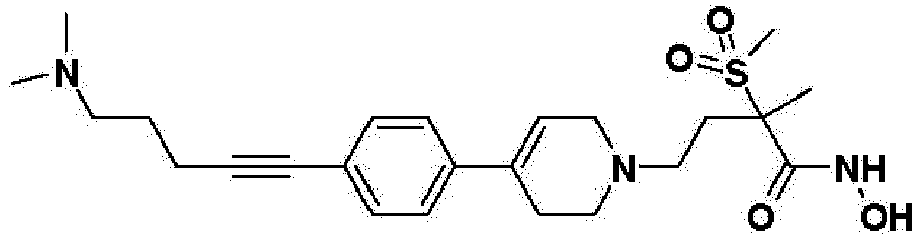
- To a solution of 5-(4-(1-(4-(hydroxyamino)-3-methyl-3-(methylsulfonyl)-4-oxobutyl)-1,2,3,6-tetrahydropyridin-4-yl)phenyl)pent-4-yn-1-yl methanesulfonate (Example 19) (120mg, 1eq) in THF (3ml) was added with dimethylamine (1M in THF, 7ml, 30eq). The mixture was refluxed for 4hr and cooled room temperature, and the solvent was concentrated in vacuo. The residue was purified with column chromatography to prepare the title compound (38mg, 35%).
1H NMR (600MHz, DMSO-d6):δ10.6 (bs, 1H), 9.2 (bs, 1H), 7.38-7.37 (m, 2H), 7.31-7.30 (m, 2H), 6.18 (s, 1H), 3.12-3.06 (m, 2H), 3.04 (s, 3H), 2.63-2.56 (m, 2H), 2.46-2.40 (m, 6H), 2.32-2.26 (m, 3H), 2.11 (s, 6H), 1.82-1.79 (m, 1H), 1.66-1.61 (m, 2H), 1.44 (s, 3H).
MS (ESI, m/z): 462.2 [M+H]+. -

-

- To a solution of 5-(4-(1-(3-methyl-3-(methylsulfonyl)-4-oxo-4-(((tetrahydro-2H-pyran-2-yl)oxy)amino)butyl)-1,2,3,6-tetrahydropyridin-4-yl)phenyl)pent-4-yn-1-yl methanesulfonate (Example 19, step 3) (200mg, 1eq) in 1,4-dioxane (0.67ml) was added with ammonia (0.5M in 1,4-dioxane, 6.7ml, 10eq). The mixture was refluxed for 12hr and cooled room temperature, and the solvent was concentrated in vacuo. The residue was purified with column chromatography to prepare the title compound (80mg, 46%).
MS (ESI, m/z): 518.3 [M+H]+. -

- The title compound was prepared the procedures described for the synthesis of Example 1, step 4 from 4-(4-(4-(5-aminopent-1-yn-1-yl)phenyl)-3,6-dihydropyridin-1(2H)-yl)-2-methyl-2-(methylsulfonyl)-N-((tetrahydro-2H-pyran-2-yl)oxy)butanamide.
1H NMR (600MHz, DMSO-d6):δ7.38-7.36 (m, 2H), 7.32-7.31 (m, 2H), 6.18 (s, 1H), 3.09-3.06 (m, 2H), 3.04 (s, 3H), 2.82 (t, J=7.2 Hz, 2H), 2.62-2.56 (m, 3H), 2.45-2.42 (m, 6H), 2.38-2.32 (m, 1H), 1.98-1.95 (m, 1H), 1.74-1.71 (m, 3H), 1.44 (s, 3H).
MS (ESI, m/z): 434.2 [M+H]+. -

-

- The title compound was prepared the procedures described for the synthesis of Example 1, step 1 using prop-2-yn-1-ol.
1H NMR (600MHz, CDCl3-d1) δ:7.38-7.36 (m, 2H), 7.31-7.29 (m, 2H), 6.05 (s, 1H), 4.49 (s, 2H), 3.80-3.70 (m, 4H), 3.48-3.30 (m, 2H), 3.07-3.02 (m, 5H), 2.68-2.56 (m, 4H), 1.70-1.64 (m, 4H).
MS (ESI, m/z): 406.1[M+H]+. - The title compound was prepared the procedures described for the synthesis of Example 1, step 2 - 4 (Synthesis of Hydroxamate) from methyl 4-(4-(4-(3-hydroxyprop-1-yn-1-yl)phenyl)-3,6-dihydropyridin-1(2H)-yl)-2-methyl-2-(methylsulfonyl)butanoate.
1H NMR (600MHz, DMSO-d6):δ11.00 (bs, 1H), 9.12 (bs, 1H), 7.40-7.35 (m, 4H), 6.16 (s, 1H), 5.31 (s, 1H), 4.37 (s, 2H), 3.40-3.34 (m, 2H), 3.07 (s, 3H), 2.95-2.92 (m, 2H), 2.86-2.85 (m, 2H), 2.64-2.56 (m, 4H), 2.14-2.10 (m, 2H), 1.59 (s, 3H).
MS (ESI, m/z): 407.0 [M+H]+. -

- To a solution of methyl 4-(4-(4-(3-hydroxyprop-1-yn-1-yl)phenyl)-3,6-dihydropyridin-1(2H)-yl)-2-methyl-2-(methylsulfonyl)butanoate (Example 22, Step 1) (500mg, 1eq) in dichloromethane (10ml) was added with Et3N (0.34ml, 2eq) and methanesulfonyl chloride (0.19ml, 2eq). The mixture was and stirred for 2hr at room temperature. Sodium methoxide (25% solution in MeOH, 1.06g, 4eq) was added and stirred for 3hr at 60°C. The mixture was cooled down to room temperature, extracted with dichloromethane and water. The organic layer was washed with brine, dried over anhydrous MgSO4 and concentrated in vacuo. The residue was purified with column chromatography to prepare the title compound (250mg, 48%).
1H NMR (600MHz, CDCl3-d1);δ7.42-7.41 (m, 2H), 7.32-7.30 (m, 2H), 6.02 (s, 1H), 4.31 (s, 2H), 3.90-3.79 (m, 3H), 3.48-3.42 (m, 4H), 3.14-3.08 (m, 5H), 2.70-2.62 (m, 3H), 1.78-1.68 (m, 3H), 1.64-1.52 (m, 4H).
MS (ESI, m/z): 420.1 [M+H]+. - The title compound was prepared the procedures described for the synthesis of Example 1, step 2 - 4 (Synthesis of Hydroxamate) from methyl 4-(4-(4-(3-methoxyprop-1-yn-1-yl)phenyl)-3,6-dihydropyridin-1(2H)-yl)-2-methyl-2-(methylsulfonyl)butanoate.
1H NMR (600MHz, DMSO-d6);δ10.99 (bs, 1H), 9.10 (bs, 1H), 7.42-7.38 (m, 4H), 6.21 (s, 1H), 4.29 (s, 2H), 3.28-3.24 (m, 3H), 3.10-3.04 (m, 5H), 2.62-2.54 (m, 2H), 2.45-2.29 (m, 4H), 1.41 (s, 3H), 1.22-1.20 (m, 2H).
MS (ESI, m/z): 421.1 [M+H]+. -

- To a solution of methyl 4-(4-(4-(3-hydroxyprop-1-yn-1-yl)phenyl)-3,6-dihydropyridin-1(2H)-yl)-2-methyl-2-(methylsulfonyl)butanoate (Example 22, Step 1) (280mg, 1eq) in DMF (15ml) was added with NaH (47mg, 1.7eq, 60wt%) and 3-bromopropan-1-ol (125mg, 1.3eq). The mixture was stirred for 4hr at room temperature and extracted with ethyl acetate and water. The organic layer was dried over anhydrous MgSO4 and concentrated in vacuo. The residue was purified with column chromatography to prepare the title compound (130g, 51%).
MS (ESI, m/z): 464.1 [M+H]+. - The title compound was prepared the procedures described for the synthesis of Example 1, step 2 - 4 (Synthesis of Hydroxamate) from methyl 4-(4-(4-(3-(3-hydroxypropoxy)prop-1-yn-1-yl)phenyl)-3,6-dihydropyridin-1(2H)-yl)-2-methyl-2-(methylsulfonyl)butanoate.
1H NMR (600MHz, DMSO-d6);δ11.03 (bs, 1H), 9.13 (bs, 1H), 7.45-7.39 (m, 4H), 6.23 (s, 1H), 3.59-3.57 (m, 2H), 3.44-3.41 (m, 2H), 3.18-3.09 (m, 2H), 3.06 (s, 3H),2.65-2.57 (m, 2H),2.47-2.38 (m, 4H),1.70-1.62 (m, 2H),1.44 (s, 3H), 1.42-1.35 (m, 2H). - MS (ESI, m/z): 465.1 [M+H]+.
-

- To a solution of methyl 4-(4-(4-(3-hydroxyprop-1-yn-1-yl)phenyl)-3,6-dihydropyridin-1(2H)-yl)-2-methyl-2-(methylsulfonyl)butanoate (Example 22, Step 1) (500mg, 1eq) in dichloromethane (10ml) was added with Et3N (0.34ml, 2eq) and methanesulfonyl chloride (0.19ml, 2eq), and the mixture was stirred for 2hr at room temperature. Morpholine (0.22ml, 2eq) was added and stirred for 3hr at 60°C. The mixture was cooled room temperature and extracted with dichloromethane and water. The organic layer was washed with brine, dried over anhydrous MgSO4 and concentrated in vacuo. The residue was purified with column chromatography to prepare the title compound (450mg, 77%).
1H NMR (600MHz, CDCl3-d1);δ7.38-7.36 (m, 2H), 7.31-7.29 (m, 2H), 6.06 (s, 1H), 4.49 (s, 2H), 3.78-3.74 (m, 6H), 3.70-3.64 (m, 2H), 3.54-3.44 (m, 2H), 3.22-3.18 (m, 2H), 3.05 (s, 3H), 2.78 (s, 3H), 2.72-2.62 (m, 6H), 2.58-2.48 (m, 2H), 1.72-1.62 (m, 4H).
MS (ESI, m/z): 475.2 [M+H]+. - The title compound was prepared the procedures described for the synthesis of Example 1, step 2 - 4 (Synthesis of Hydroxamate) from methyl 2-methyl-2-(methylsulfonyl)-4-(4-(4-(3-morpholinoprop-1-yn-1-yl)phenyl)-3,6-dihydropyridin-1(2H)-yl)butanoate.
1H NMR (600MHz, DMSO-d6);δ11.00 (bs, 1H), 9.10 (bs, 1H), 7.41-7.39 (m, 2H), 7.37-7.35 (m, 2H), 6.19 (s, 1H), 3.62-3.56 (m, 4H), 3.48 (s, 2H), 3.14-3.07 (m, 2H), 3.06 (s, 3H), 2.64-2.52 (m, 4H), 2.46-2.38 (m, 5H), 2.32-2.26 (m, 1H), 2.00-1.96 (m, 1H), 1.82-1.76 (m, 1H), 1.44 (s, 3H).
MS (ESI, m/z): 476.2 [M+H]+. -

-

- To a solution of 4-(4-(4-(3-hydroxyprop-1-yn-1-yl)phenyl)-3,6-dihydropyridin-1(2H)-yl)-2-methyl-2-(methylsulfonyl)-N-((tetrahydro-2H-pyran-2-yl)oxy)butanamide (200mg, 1eq) in THF (10ml) was added with CDI (500mg, 8eq) and Et3N (0,16ml, 3eq), and the mixture was stirred for 4hr at room temperature. NH4OH (0.15ml, 10eq) was added and stirred for 2hr at 0°C. The mixture was extracted with ethyl acetate and water. The organic layer was dried over anhydrous MgSO4 and concentrated in vacuo. The residue was purified with column chromatography to prepare the title compound (50mg, 23%).
-

- The title compound was prepared the procedures described for the synthesis of Example 1, step 4 using 3-(4-(1-(3-methyl-3-(methylsulfonyl)-4-oxo-4-(((tetrahydro-2H-pyran-2-yl)oxy)amino)butyl)-1,2,3,6-tetrahydropyridin-4-yl)phenyl)prop-2-yn-1-yl carbamate.
1H NMR (600MHz, DMSO-d6):δ11.01 (bs, 1H), 9.09 (bs, 1H), 7.44-7.37 (m, 4H), 6.22 (s, 1H), 4.80 (s, 2H), 3.10-3.88 (m, 2H), 3.04 (s, 3H), 2.65-2.53 (m, 2H), 2.47-2.43 (m, 2H), 1.97-1.80 (m, 2H), 1.44 (s, 3H).
MS (ESI, m/z): 450.1 [M+H]+. -

-

- The title compound was prepared the procedures described for the synthesis of Example 26, step 1 using 4-(4-(4-(5-hydroxypent-1-yn-1-yl)phenyl)-3,6-dihydropyridin-1(2H)-yl)-2-methyl-2-(methylsulfonyl)-N-((tetrahydro-2H-pyran-2-yl)oxy)butanamide.
-

- The title compound was prepared the procedures described for the synthesis of Example 1, step 4 using of 5-(4-(1-(3-methyl-3-(methylsulfonyl)-4-oxo-4-(((tetrahydro-2H-pyran-2-yl)oxy)amino)butyl)-1,2,3,6-tetrahydropyridin-4-yl)phenyl)pent-4-yn-1-yl carbamate
1H NMR (600MHz, DMSO-d6):δ11.01 (bs, 1H), 9.11 (bs, 1H), 7.38-7.37 (m, 2H), 7.32-7.31 (m, 2H), 6.18 (s, 1H), 3.98-3.97 (m, 2H), 3.09-3.04 (m, 5H), 2.62-2.57 (m, 2H), 2.48-2.46 (m, 2H), 2.30-2.28 (m, 2H), 1.81-1.78 (m, 4H), 1.44 (s, 3H), 1.23-1.21 (m, 2H).
MS (ESI, m/z): 478.2 [M+H]+. -

- The title compound was prepared the procedures described for the synthesis of Example 23 from methyl 4-(4-(4-(5-hydroxypent-1-yn-1-yl)phenyl)-3,6-dihydropyridin-1(2H)-yl)-2-methyl-2-(methylsulfonyl)butanoate (Example 18, Step 1).
1H NMR (600MHz, DMSO-d6);δ11.02 (bs, 1H), 9.12 (bs, 1H), 7.41-7.38 (m, 2H), 7.34-7.32 (m, 2H), 6.19 (s, 1H), 3.75-3.41 (m, 2H), 3.25 (s, 2H), 3.17-3.10 (m, 2H), 3.06 (s, 3H), 2.67-2.54 (m, 2H),2.45-2.28 (m, 6H),1.78-1.72 (m, 2H),1.46 (s, 3H).
MS (ESI, m/z): 449.2 [M+H]+. -

- Example 29: Synthesis of N-hydroxy-4-(4-(4-(6-hydroxyhex-1-yn-1-yl)phenyl)-3,6-dihydropyridin-1(2H)-yl)-2-methyl-2-(methylsulfonyl)butanamide

- The title compound was prepared the procedures described for the synthesis of Example 1, step 1 using hex-5-yn-1-ol.
1H NMR (600MHz, CDCl3-d1);δ7.33-7.31 (m, 2H), 7.28-7.26 (m, 2H), 6.05 (s, 1H), 3.72-3.62 (m, 5H), 3.18-3.10 (m, 2H), 3.04 (s, 3H), 2.72-2.58 (m, 3H), 2.52-2.40 (m, 5H), 1.78-1.65 (m, 6H), 1.63 (s, 3H). - The title compound was prepared the procedures described for the synthesis of Example 1, step 2 - 4 (Synthesis of Hydroxamate) from methyl 4-(4-(4-(6-hydroxyhex-1-yn-1-yl)phenyl)-3,6-dihydropyridin-1(2H)-yl)-2-methyl-2-(methylsulfonyl)butanoate.
1H NMR (600MHz, DMSO-d6);δ11.04 (bs, 1H), 9.10 (bs, 1H), 7.37-7.36 (m, 2H), 7.30-7.28 (m, 2H), 6.17 (s, 1H), 4.43-4.28 (m, 2H), 3.40-3.5 (m, 4H), 3.09-3.05 (m, 2H), 3.04 (s, 3H), 2.6-2.58 (m, 2H), 2.43-2.39 (m, 4H), 1.47 (s, 3H), 1.41-1.38 (m, 4H).
MS (ESI, m/z): 449.1 [M+H]+. -

- The title compound was prepared the procedures described for the synthesis of Example 25 using methyl 4-(4-(4-(6-hydroxyhex-1-yn-1-yl)phenyl)-3,6-dihydropyridin-1(2H)-yl)-2-methyl-2-(methylsulfonyl)butanoate (Example 29, Step 1).
1H NMR (600MHz, DMSO-d6);δ11.06 (bs, 1H), 9.15 (bs, 1H), 7.43-7.41 (m, 2H), 7.35-7.33 (m, 2H), 6.22 (s, 1H), 3.62-3.56 (m, 4H), 3.18-3.10 (m, 2H), 3.08 (s, 3H), 2.72-2.58 (m, 3H), 2.48-2.40 (m, 5H), 2.40-2.28 (m, 6H), 2.05-1.98 (m, 1H), 1.82-1.70 (m, 1H), 1.62-1.56 (m, 4H), 1.48 (s, 3H).
MS (ESI, m/z): 518.3 [M+H]+. -

-

- To a solution of 4-bromo-2-fluoro-1-iodobenzene (3g, 1eq) in a mixture of THF (10ml)/ toluene(10ml) was added with CuI (0.19g, 0.1eq), Pd(PPh3)2Cl2 (0.7g, 0.1eq), Et3N (4.2ml, 3eq) and N,N-dimethylprop-2-yn-1-amine (1.61ml, 1.5eq). The mixture was stirred for 12hr at room temperature and extracted with ethyl acetate and water. The organic layer was washed with brine, dried over anhydrous MgSO4 and concentrated in vacuo. The residue was purified with column chromatography to prepare the title compound (1.87g, 73%).
1H NMR (600MHz, CDCl3-d1);δ7.29-7.22 (m, 3H), 3.49 (s, 2H), 2.36 (s, 6H). -

- To a solution of 3-(4-bromo-2-fluorophenyl)-N,N-dimethylprop-2-yn-1-amine (1.87g, 1eq) in a mixture of 1.4-dioxane (16ml)/water (4ml) was added with Pd(PPh3)2Cl2(0.51g, 0.1eq), K2CO3 (3.03g, 3eq), tert-butyl 4-(4,4,5,5-tetramethyl-1,3,2-dioxaborolan-2-yl)-3,6-dihydropyridine-1(2H)-carboxylate (2.71g, 1.2eq). The mixture was stirred for 2hr at 110°C and cooled down to room temperature, and extracted with ethyl acetate and water. The organic layer was washed with brine, dried over anhydrous MgSO4 and concentrated in vacuo. The residue was purified with column chromatography to prepare the title compound (2g, 76%).
1H NMR (600MHz, CDCl3-d1);δ7.36 (t, J=7.2Hz, 1H), 7.25-7.07 (m, 2H), 6.07 (s, 1H), 4.11-4.07 (m, 2H), 3.64-3.59 (m, 2H), 3.47 (s, 2H), 2.49-2.45 (m, 2H), 2.36 (s, 6H), 1.58 (s, 9H).
MS (ESI, m/z): 359.2 [M+H]+. -

- To a solution of tert-butyl 4-(4-(3-(dimethylamino)prop-1-yn-1-yl)-3-fluorophenyl)-3,6-dihydropyridine-1(2H)-carboxylate (2g, 1eq) in MeOH (16ml) was added with acetyl chloride (3.97ml, 10eq). The mixture was stirred for 3hr at 60°C and cooled down to room temperature, and the solvent was concentrated in vacuo to prepare the title compound (1.6g, 97%).
1H NMR (600MHz, DMSO-d6;) δ11.52 (bs, 1H), 9.56 (bs, 2H), 7.61 (t, J=8.4Hz, 1H), 7.48, (dd, J=11.4Hz, 1.8Hz, 1H), 7.38 (dd, J=8.4Hz, 1.8Hz, 1H), 6.39 (bs, 1H), 4.36 (s, 2H), 3.72-3.70 (m, 2H), 3.27-3.23 (m, 2H), 2.78 (s, 6H), 2.68-2.64 (m, 2H).
MS (ESI, m/z): 259.2 [M+H]+. -

- To a solution of 3-(2-fluoro-4-(1,2,3,6-tetrahydropyridin-4-yl)phenyl)-N,N-dimethylprop-2-yn-1-amine hydrochloride (600mg, 1eq) in DMF (10ml) was added with N,N-diisopropylethylamine (1.42ml, 4eq) and methyl 4-bromo-2-methyl-2-(methylsulfonyl)butanoate (Intermediate 1) (778mg, 1.4eq). The mixture was stirred for 12hr at 60°C, cooled down to room temperature, and extracted with ethyl acetate and water. The organic layer was washed with brine, dried over anhydrous MgSO4 and concentrated in vacuo. The residue was purified with column chromatography to prepare the title compound (280mg, 28%).
1H NMR (600MHz, CDCl3-d1);δ 7.35 (t, J=8.4Hz, 1H), 7.10-7.05 (m, 2H), 6.11 (bs, 1H), 3.66 (s, 3H), 3.54 (s, 2H), 3.23-3.18 (m, 1H), 3.04 (s, 3H), 3.03-3.00 (m, 1H), 2.79-2.75 (1H), 2.67-2.60 (m, 2H), 2.58-2.54 (m, 2H), 2.46-2.42 (m, 2H), 2.36 (s, 6H), 2.00-1.97 (m, 1H), 1.62 (s, 3H).
MS (ESI, m/z): 451.2 [M+H]+. -

- To a solution of methyl 4-(4-(4-(3-(dimethylamino)prop-1-yn-1-yl)-3-fluorophenyl)-3,6-dihydropyridin-1(2H)-yl)-2-methyl-2-(methylsulfonyl)butanoate (230mg, 1eq) in a mixture of THF (8ml)/MeOH (2ml) was added with 2N-LiOH (0.77ml, 3eq) solution, and the mixture was stirred for 2hr at room temperature. The solvent was removed under reduced pressure. The residue was diluted with water (10ml) and adjusted the pH to 4.0. The precipitated solid was filtered off to prepare the title compound (200mg, 90%), which was used for next step without further purification.
-

- To a solution of 4-(4-(4-(3-(dimethylamino)prop-1-yn-1-yl)-3-fluorophenyl)-3,6-dihydropyridin-1(2H)-yl)-2-methyl-2-(methylsulfonyl)butanoic acid (200mg, 1eq) in DMF (10ml) was added with HATU (244mg, 1.4eq), HOBT (98mg, 1.4eq), Et3N (0.19ml, 3eq) and 0-(tetrahydro-2H-pyran-2-yl)hydroxylamine hydrochloride (141mg, 2eq). The mixture was stirred for 1hr at room temperature and extracted with ethyl acetate and water. The organic layer was washed with brine, dried over anhydrous MgSO4 and concentrated in vacuo. The residue was purified with column chromatography to prepare the title compound (166mg, 68%).
MS (ESI, m/z): 536.2 [M+H]+. -

- To a solution of 4-(4-(4-(3-(dimethylamino)prop-1-yn-1-yl)-3-fluorophenyl)-3,6-dihydropyridin-1(2H)-yl)-2-methyl-2-(methylsulfonyl)-N-((tetrahydro-2H-pyran-2-yl)oxy)butanamide (160mg, 1eq) in MeOH (6ml) was added with HCl solution in MeOH (1.25N, 0.72ml, 3eq), and the mixture was stirred for 2hr at room temperature. The solvent was removed under reduced pressure. The residue was diluted with water (6ml) and adjusted the pH to 7.0. The water was concentrated and the resulting residue was purified with column chromatography to prepare the title compound (89mg, 57%).
1H NMR (600MHz, DMSO-d6);δ 10.98 (bs, 1H), 9.11 (bs, 1H), 7.44-7.41 (m, 1H), 7.33-7.71 (m, 1H), 7.26-7.25 (m, 1H), 6.30 (s, 1H), 3.48 (s, 2H), 3.13-3.06 (m, 2H), 3.04 (s, 3H), 2.64-2.61 (m, 1H), 2.59-2.55 (m, 1H), 2.47-2.38 (m, 4H), 2.33-2.29 (m, 1H), 2.22 (s, 6H), 1.84-1.79 (m, 1H), 1.44 (s, 3H).
MS (ESI, m/z): 452.2 [M+H]+. - Example 32: Syntheisis of 4-(4-(4-(3-(dimethylamino)prop-1-yn-1-yl)-3,5-difluorophenyl)-3,6-dihydropyridin-1(2H)-yl)-N-hydroxy-2-methyl-2-(methylsulfonyl)butanamide

- The title compound was prepared the procedures described for the synthesis of Example 31 using 5-bromo-1,3-difluoro-2-iodobenzene as a starting material.
MS (ESI, m/z): 470.2 [M+H]+.
Example 33: Syntheisis of 4-(4-(4-(3-(dimethylamino)prop-1-yn-1-yl)-2-fluorophenyl)-3,6-dihydropyridin-1(2H)-yl)-N-hydroxy-2-methyl-2-(methylsulfonyl)butanamide
- The title compound was prepared the procedures described for the synthesis of Example 31 using 1-bromo-2-fluoro-4-iodobenzene as a starting material.
MS (ESI, m/z): 452.2 [M+H]+. -
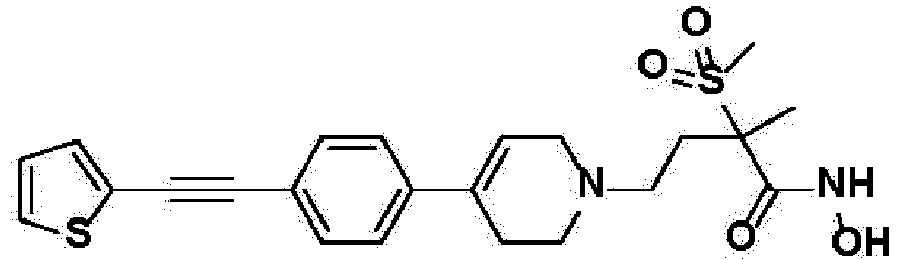
- To a solution of 4-(4-(4-iodophenyl)-3,6-dihydropyridin-1(2H)-yl)-2-methyl-2-(methylsulfonyl)-N-((tetrahydro-2H-pyran-2-yl)oxy)butanamide (Intermediate 3) (220mg, 1eq) in THF (4ml)/ toluene(4ml) was added with CuI (7.5mg, 0.1eq), Pd(PPh3)2Cl2 (27.4mg, 0.1eq), Et3N (0.165ml, 3eq) and 2-ethynylthiophene (64mg, 1.5eq). The mixture was stirred for 12hr at room temperature, and extracted with ethyl acetate and water. The organic layer was washed with brine, dried over anhydrous MgSO4 and concentrated in vacuo. The residue was purified with column chromatography to prepare the title compound (60mg, 28%)
1H NMR (600MHz, CDCl3-d1);δ 7.67-7.64 (m, 1H), 7.45-7.43 (m, 2H), 7.35-7.34 (m, 2H), 7.28-7.26 (m, 1H), 7.01-6.99 (m, 1H), 6.12 (s, 1H), 4.92-4.90 (m, 1H), 3.43-3.29 (m, 4H), 3.11 (s, 3H), 2.90-2.83 (m, 4H), 2.72-2.65 (m, 4H), 1.80-1.57 (m, 7H), 1.52-1.45 (s, 2 H).).
MS (ESI, m/z): 543.2 [M+H]+. - To a solution of 2-methyl-2-(methylsulfonyl)-N-((tetrahydro-2H-pyran-2-yl)oxy)-4-(4-(4-(thiophen-2-ylethynyl)phenyl)-3,6-dihydropyridin-1(2H)-yl)butanamide (60mg, 1eq) in MeOH (2ml) was added with HCl solution in MeOH (1.25N, 0.27ml, 3eq), and the mixture was stirred for 2hr at room temperature. The solvent was removed under reduced pressure. The residue was diluted with water (4ml) and adjusted the pH to 7.0. The water was concentrated and the resulting residue was purified with column chromatography to prepare the title compound (7.7mg, 15%).
1H NMR (600MHz, DMSO-d6):δ11.00 (bs, 1H), 9.08 (bs, 1H), 7.65-7.64 (m, 1H), 7.48-7.45 (m, 4H), 7.40-7.39 (m, 1H), 7.11-7.10 (m, 1H), 6.25 (s, 1H), 3.11-3.06 (m, 2H), 3.04 (s, 3H), 2.63-2.58 (m, 2H), 2.46-2.31 (m, 2H), 2.00-1.80 (m, 2H), 1.45 (s, 3H), 1.23-1.20 (m, 2 H).
MS (ESI, m/z): 454.2 [M+H]+. - The terminal acetylenes listed in the following table were used to prepare compounds of Examples 35-37 in the same manner as Example 34.
Example Structure (Name) Terminal acetylene 35 

(N-hydroxy-2-methyl-2-(methylsulfonyl)-4-(4-(4-((4-nitrophenyl)ethynyl)phenyl)-3,6-dihydropyridin-1(2H)-yl)butanamide) 1H NMR (600MHz, DMSO-d6); δ11.01 (bs, 1H), 9.06 (bs, 1H), 8.25-8.23 (m, 2H), 7.80-7.78 (m, 2H), 7.57-7.55 (m, 2H), 7.51-7.49 (m, 2H), 6.28 (s, 1H), 3.11-3.98 (m, 2H), 3.04 (s, 3H), 2.63-2.58 (m, 4H), 2.44-2.32 (m, 4H), 1.45 (s, 3H) . MS (ESI, m/z): 498.2 [M+H]+. 36 

(N-hydroxy-2-methyl-2-(methylsulfonyl)-4-(4-(4-(pyridin-3-ylethynyl)phenyl)-3,6-dihydropyridin-1(2H)-yl)butanamide) 1H NMR (600MHz, DMSO-d6) δ ; 11.01 (bs, 1H), 9.10 (bs, 1H), 8.75-8.74 (m, 1H), 8.57-8.56 (m, 1H), 7.97-7.95 (m, 1H), 7.59-7.39 (m, 5H), 6.27 (s, 1H), 3.15-3.11 (m, 2H), 3.05 (s, 3H), 2.65-2.59 (m, 2H), 2.42-2.31 (m, 2H), 1.85-1.83 (m, 2H), 1.45 (s, 3H), 1.21-1.17 (m, 2H). MS (ESI, m/z): 454.2 [M+H]+. 37 
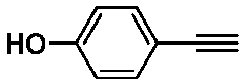
(N-hydroxy-4-(4-(4-((4-hydroxyphenyl)ethynyl)phenyl)-3,6-dihydropyridin-1(2H)-yl)-2-methyl-2-(methylsulfonyl)butanamide) 1H NMR (600MHz, DMSO-d6) ; δ11.02 (bs, 1H), 10.16 (s, 1H), 9.07 (bs, 1H), 7.44-7.41 (m, 4H), 7.34-7.32 (m, 2H), 6.78-6.76 (m, 2H), 6.21 (s, 1H), 3.15-3.06 (m, 2H), 3.03 (s, 3H), 2.68-2.54 (m, 3H), 2.44-2.30 (m, 4H), 1.86-1.80 (m, 1H), 1.45 (s, 3H). MS (ESI, m/z): 469.2 [M+H]+. -

-

- A solution of 1-methyl-1H-imidazole-4-carbaldehyde (2g, 1eq) in MeOH (180ml) was cooled at 0°C. K2CO3 (5.02g, 2eq) and dimethyl (1-diazo-2-oxopropyl)phosphonate (7.7 g, 2.2eq) was added. The mixture was stirred for 4hr at 0°C, and extracted with dichloromethane and water. The organic layer was washed with sat. aq. NH4Cl, dried over anhydrous MgSO4 and concentrated in vacuo. The residue was purified with column chromatography to prepare the title compound (1.2g, 62%).
1H NMR (600MHz, CDCl3-d1);δ7.60 (s, 1H), 7.32 (m, 1H), 3.37 (s, 3H), 3.48 (s, 1H).
MS (ESI, m/z): 107.1 [M+H]+. - The title compound was prepared the procedures described for the synthesis of Example 1 (Synthesis of Hydroxamate) using 4-ethynyl-1-methyl-1H-imidazole.
1H NMR (600MHz, DMSO-d6);δ11.02 (bs, 1H), 9.14 (bs, 1H), 7.76 (s, 1H), 7.52-7.48 (m, 4H), 7.29 (s, 1H), 6.26 (s, 1H), 3.69 (s, 3H), 3.16-3.04 (m, 5H), 2.66-2.56 (m, 3H), 2.46-2.38 (m, 4H), 1.86-1.76 (m, 1H), 1.44 (s, 3H).
MS (ESI, m/z): 457.2 [M+H]+. -

- Preparation 4: Synthesis of Intermediate 4 {methyl 4-(4-(4-(azetidin-3-ylethynyl)phenyl)-3,6-dihydropyridin-1(2H)-yl)-2-methyl-2-(methylsulfonyl)butanoate dihydrochloride}

- A solution of tert-butyl 3-formylazetidine-1-carboxylate (7g, 1eq) in MeOH (378ml) was cooled at 0°C. K2CO3 (10.5g, 2eq), dimethyl (1-diazo-2-oxopropyl)phosphonate (15.8g, 2.2eq) was added. The mixture was stirred for 4hr at 0°C, and extracted with dichloromethane and water. The organic layer was washed with sat. aq. NH4Cl, dried over anhydrous MgSO4 and concentrated in vacuo. The residue was purified with column chromatography to prepare the title compound (5.95g, 87%).
1H NMR (600MHz, CDCl3-d1);δ4.10-4.07 (m, 2H), 3.90-3.87 (m, 2H), 3.27-3.24 (m, 1H), 2.26-2.25 (m, 1H), 1.39 (s, 9H). - To a solution of methyl 4-(4-(4-iodophenyl)-3,6-dihydropyridin-1(2H)-yl)-2-methyl-2-(methylsulfonyl)butanoate (Intermediate 2) (7g, 1eq) in a mixture of THF (30ml)/toluene (30ml) was added with CuI (0.28g, 0.1eq), Pd(PPh3)2Cl2 (1.03g, 0.1eq), Et3N (6.18ml, 3eq) and tert-butyl 3-ethynylazetidine-1-carboxylate (3.99g, 1.5eq). The mixture was stirred for 12hr at room temperature, and extracted with ethyl acetate and water. The organic layer was washed with brine, dried over anhydrous MgSO4 and concentrated in vacuo. The residue was purified with column chromatography to prepare the title compound (5g, 64%).
1H NMR (600MHz, CDCl3-d1);δ7.35-7.25 (m, 4H), 6.07 (s, 1H), 4.30 (s, 2H), 4.21-4.17 (m, 2H), 4.02-4.00 (m, 2H), 3.67 (s, 3H), 3.54-3.50 (m, 2H), 3.04 (s, 3H), 2.77-2.49 (m, 8H), 1.63 (s, 3H), 1.44 (s, 9H).
MS (ESI, m/z): 531.3 [M+H]+. - To a solution of tert-butyl 3-((4-(1-(4-methoxy-3-methyl-3-(methylsulfonyl)-4-oxobutyl)-1,2,3,6-tetrahydropyridin-4-yl)phenyl)ethynyl)azetidine-1-carboxylate (5g, 1eq) in dichloromethane (100ml) was added with HCl solution (4N in cyclopentyl methyl ether, 24ml, 10eq). The mixture was stirred for 3hr at room temperature. After then, the solvent was concentrated in vacuo to prepare the title compound (4.2g, 89%).
1H NMR (600MHz, CD3OD-d4); δ7.50-7.45 (m, 4H), 6.21 (s, 1H), 4.36-4.34 (m, 2H), 4.19-4.15 (m, 2H), 4.10-4.06 (m, 2H), 3.88-3.87 (m, 5H), 3.62-3.59 (m, 1H), 3.41-3.39 (m, 2H), 3.17 (s, 3H), 2.98-2.84 (m, 2H), 2.71-2.49 (m, 2H), 1.70 (s, 3H).
MS (ESI, m/z): 431.2 [M+H]+. -

- To a solution of methyl 4-(4-(4-(azetidin-3-ylethynyl)phenyl)-3,6-dihydropyridin-1(2H)-yl)-2-methyl-2-(methylsulfonyl)butanoate dihydrochloride (Intermediate 4) (1.5g, 1eq) in dichloromethane (30ml) was added with formaldehyde (37wt%, 0.89ml, 4eq) and sodium triacetoxyborohydride (2.53g, 4eq). The mixture was stirred for 5hr at room temperature, and extracted with ethyl acetate and water. The organic layer was washed with sat. aq. NaHCO3, dried over anhydrous MgSO4 and concentrated in vacuo. The residue was purified with column chromatography to prepare the title compound (0.9g, 68%).
1H NMR (600MHz, CDCl3-d1): δ7.34-7.32 (m, 2H), 7.29-7.28 (m, 2H), 6.07 (s, 1H), 3.76-3.74 (m, 2H), 3.66 (s, 3H), 3.46-3.45 (m, 1H), 3.22-3.19 (m, 3H), 3.02-2.99 (m, 4H), 2.78-2.76 (m, 1H), 2.65-2.53 (m, 4H), 2.47-2.46 (m, 2H), 2.38 (s, 3H), 1.97-1.96 (m, 1H), 1.62 (s, 3H).
MS (ESI, m/z): 445.2 [M+H]+. - The title compound was prepared the procedures described for the synthesis of Example 1, step 2 - 4 (Synthesis of Hydroxamate) from methyl 2-methyl-4-(4-(4-((1-methylazetidin-3-yl)ethynyl)phenyl)-3,6-dihydropyridin-1(2H)-yl)-2-(methylsulfonyl)butanoate.
1H NMR (600MHz, DMSO-d6):811.22-11.04 (m, 3H), 9.35 (bs, 1H), 7.52-7.50 (m, 2H), 7.47-7.44 (m, 2H), 6.28 (s, 1H), 4.38-4.00 (m, 4H), 3.83-3.77 (m, 2H), 3.36-3.34 (m, 2H), 3.11 (s, 3H), 3.08-2.82 (m, 5H), 2.73-2.69 (m, 2H), 2.23-2.21 (m, 1H), 1.51 (s, 3H).
MS (ESI, m/z): 446.2 [M+H]+. -

- To a solution of methyl 4-(4-(4-(azetidin-3-ylethynyl)phenyl)-3,6-dihydropyridin-1(2H)-yl)-2-methyl-2-(methylsulfonyl)butanoate dihydrochloride (Intermediate 4) (800mg, 1eq) in dichloromethane (15ml) was added with Et3N (0.89ml, 4eq) and acetyl chloride (0.17ml, 1.5eq). The mixture was stirred for 2hr at 0°C, and extracted with dichloromethane and water. The organic layer was washed with brine, dried over anhydrous MgSO4 and concentrated in vacuo. The residue was purified with column chromatography to prepare the title compound (560mg, 75%).
1H NMR (600MHz, CDCl3-d1);δ7.35-7.32 (m, 4H), 6.06 (s, 1H), 4.41-4.29 (m, 2H), 4.20-4.07 (m, 2H), 3.87-3.61 (m, 7H), 3.14-3.07 (m, 5H), 2.77-2.59 (m, 4H), 2.04-2.03 (m, 1H), 1.88 (s, 3H), 1.67 (s, 3H).
MS (ESI, m/z): 473.2 [M+H]+. - The title compound was prepared the procedures described for the synthesis of Example 1, step 2 - 4 (Synthesis of Hydroxamate) from methyl 4-(4-(4-((1-acetylazetidin-3-yl)ethynyl)phenyl)-3,6-dihydropyridin-1(2H)-yl)-2-methyl-2-(methylsulfonyl)butanoate.
1H NMR (600MHz, DMSO-d6):δ11.0 (bs, 1H), 9.11 (bs, 1H), 7.42-7.40 (m, 2H), 7.38-7.36 (m, 2H), 6.20 (s, 1H), 4.41-4.38 (m, 2H), 4.13-4.10 (m, 2H), 3.78-3.67 (m, 2H), 3.15-3.14 (m, 2H), 3.04 (s, 3H), 2.62-2.56 (m, 2H), 2.49-2.43 (m, 4H), 2.32-2.30 (m, 1H), 1.74 (s, 3H), 1.44 (s, 3H).
MS (ESI, m/z): 474.1 [M+H]+. -

- To a solution of methyl 4-(4-(4-(azetidin-3-ylethynyl)phenyl)-3,6-dihydropyridin-1(2H)-yl)-2-methyl-2-(methylsulfonyl)butanoate dihydrochloride (Intermediate 4) (600mg, 1eq) in DMF (15ml) was added with N,N-diisopropylethylamine (0.83ml, 4eq) and methanesulfonyl chloride (0.14ml, 1.5eq). The mixture was stirred for 2hr at 0°C, and extracted with ethyl acetate and water. The organic layer was washed with brine, dried over anhydrous MgSO4 and concentrated in vacuo. The residue was purified with column chromatography to prepare the title compound (220mg, 36%).
1H NMR (600MHz, CDCl3-d1);δ7.37-7.36 (m, 2H), 7.31-7.30 (m, 2H), 6.03 (s, 1H), 4.19-4.02 (m, 6H), 3.63-3.60 (m, 2H), 3.13-3.02 (m, 5H), 2.94-2.87 (m, 2H), 2.75-2.69 (m, 1H), 2.26-2.20 (m, 2H), 2.03 (s, 3H), 1.23 (s, 3H).
MS (ESI, m/z): 509.2 [M+H]+. - The title compound was prepared the procedures described for the synthesis of Example 1, step 2 - 4 (Synthesis of Hydroxamate) from methyl 2-methyl-2-(methylsulfonyl)-4-(4-(4-((1-(methylsulfonyl)azetidin-3-yl)ethynyl)phenyl)-3,6-dihydropyridin-1(2H)-yl)butanoate.
1H NMR (600MHz, CD3OD-d4):δ7.41-7.36 (m, 4H), 6.17 (s, 1H), 4.19-4.16 (m, 2H), 3.98-3.95 (m, 2H), 3.13 (s, 3H), 2.97 (s, 3H), 2.88-2.84 (m, 2H), 2.61-2.54 (m, 4H), 2.23-2.21 (m, 1H), 1.59 (s, 3H).
MS (ESI, m/z): 510.2 [M+H]+. -

-

- To a solution of 4-bromo-2-fluorobenzaldehyde (6g, 1eq) in a mixture of 1,4-dioxane (100ml)/ water (20ml) was added with Pd(PPh3)2Cl2 (2.07g, 0.1eq), K2CO3 (12.25g, 3eq) and tert-butyl 4-(4,4,5,5-tetramethyl-1,3,2-dioxaborolan-2-yl)-3,6-dihydropyridine-1(2H)-carboxylate (10.97g, 1.2eq). The mixture was stirred for 4hr at 110°C, cooled down to room temperature and extracted with ethyl acetate and water. The organic layer was washed with brine, dried over anhydrous MgSO4 and concentrated in vacuo. The residue was purified with column chromatography to prepare the title compound (7.8g, 86%).
1H NMR (600MHz, CDCl3-d1);δ10.32 (s, 1H), 7.84-7.82 (m, 1H), 7.29-7.26 (m, 1H), 7.16-7.14 (m, 1H), 6.24 (bs, 1H), 4.14-4.10 (m, 2H), 3.66-3.64 (m, 2H), 2.54-2.50 (m, 2H), 1.49 (s, 9H). -

- To a solution of tert-butyl 4-(3-fluoro-4-formylphenyl)-3,6-dihydropyridine-1(2H)-carboxylate (3g, 1eq) in dichloromethane (50ml) was added with carbon tetrabromide (4.89g, 1.5eq) and triphenylphosphine (7.73g, 3eq). The mixture was stirred for 1hr at 0°C, and extracted with dichloromethane and water. The organic layer was washed with brine, dried over anhydrous MgSO4 and concentrated in vacuo. The residue was purified with column chromatography to prepare the title compound (4.13g, 91%).
1H NMR (600MHz, CDCl3-d1);δ7.78-7.76 (m, 1H), 7.54 (s, 1H), 7.18-7.16 (m, 1H), 7.08-7.06 (m, 1H), 6.11 (bs, 1H), 4.11-4.09 (m, 2H), 3.65-3.60 (m, 2H), 2.51-2.47 (m, 2H), 1.49 (s, 9H). -

-

- To a solution of tert-butyl 4-(4-(2,2-dibromovinyl)-3-fluorophenyl)-3,6-dihydropyridine-1(2H)-carboxylate (Intermediate 5) (2.29g, 1eq) in DMF was added with Pd(PPh3)2Cl2 (0.35g, 0.1eq), triphenylphosphine (0.13g, 0.1eq), Et3N (2.1ml, 3eq) and pent-4-yn-1-ol (0.93ml, 2eq). The mixture was stirred for 2hr at 80°C, cooled down to room temperature, and extracted with ethyl acetate and water. The organic layer was washed with brine, dried over anhydrous MgSO4 and concentrated in vacuo. The residue was purified with column chromatography to prepare the title compound (790mg, 42%).
1H NMR (600MHz, CDCl3-d1);δ7.41-7.38 (m, 1H), 7.11-7.09 (m, 1H), 7.07-7.06 (m, 1H), 6.10 (bs, 1H), 4.10-4.06 (m, 2H), 3.78 (t, J=6Hz, 2H), 3.64-3.60 (m, 2H), 2.52 (t, J=6.6Hz, 2H), 2.49-2.45 (m, 2H), 1.86-1.81 (m, 2H), 1.48 (s, 9H). -

- To a solution of tert-butyl 4-(3-fluoro-4-(7-hydroxyhepta-1,3-diyn-1-yl)phenyl)-3,6-dihydropyridine-1(2H)-carboxylate (790mg, 1eq) in MeOH was added with conc-HCl (1.7ml, 10eq). The mixture was stirred for 1hr at 110°C, cooled down to room temperature, and concentrated in vacuo. The residue was diluted in MeOH (2ml) and poured into diethyl ether (50ml). The precipitated solid was filtered off to prepare the title compound (576mg, 87%).
1H NMR (600MHz, DMSO-d6):δ9.34 (bs, 2H), 7.63-7.60 (m, 1H), 7.49-7.47 (m, 1H), 7.37-7.36 (m, 1H), 6.41 (s, 1H), 3.78-3.74 (m, 2H), 3.47 (t, J=5.4Hz, 2H), 3.30-3.26 (m, 2H), 2.69-2.65 (m, 2H), 2.50-2.47 (m, 2H), 1.68-1.63 (m, 2H). -

- To a solution of 7-(2-fluoro-4-(1,2,3,6-tetrahydropyridin-4-yl)phenyl)hepta-4,6-diyn-1-ol hydrochloride (570mg, 1eq) in DMF (12ml)was added with N,N-diisopropylethylamine (0.93ml, 3eq) and methyl 4-bromo-2-methyl-2-(methylsulfonyl)butanoate (Intermediate 1) (584mg, 1.2eq). The mixture was stirred for 12hr at 60°C, cooled down to room temperature, and extracted with ethyl acetate and water. The organic layer was washed with brine, dried over anhydrous MgSO4 and concentrated in vacuo. The residue was purified with column chromatography to prepare the title compound (230mg, 27%).
1H NMR (600MHz, CDCl3-d1);δ7.39-7.37 (m, 1H), 7.11-7.09 (m, 1H), 7.07-7.05 (m, 1H), 6.13 (s, 1H), 3.78 (t, J=6Hz, 2H), 3.67 (s, 3H), 3.24-3.21 (m, 1H), 3.05 (s, 3H), 3.04-3.01 (1H), 2.79-2.76 (m, 1H), 2.67-2.53 (m, 4H), 2.51 (t, J=6.6Hz, 2H), 2.45-2.42 (m, 2H), 2.00-1.98 (m, 1H), 1.85-1.81 (m, 2H), 1.63 (s, 3H). -

- To a solution of methyl 4-(4-(3-fluoro-4-(7-hydroxyhepta-1,3-diyn-1-yl)phenyl)-3,6-dihydropyridin-1(2H)-yl)-2-methyl-2-(methylsulfonyl)butanoate (230mg, 1eq) in a mixture of THF (8ml)/MeOH (2ml) was added with 2N-LiOH (0.73mL, 3eq) solution. The mixture was stirred for 2hr at room temperature. The solvent was removed under reduced pressure. The residue was diluted with water (10ml) and adjusted the pH to 4.0. The precipitated solid was filtered off to prepare the title compound (119mg, 53%), which was used for next step without further purification.
MS (ESI, m/z): 462.1 [M+H]+. -

- To a solution of 4-(4-(3-fluoro-4-(7-hydroxyhepta-1,3-diyn-1-yl)phenyl)-3,6-dihydropyridin-1(2H)-yl)-2-methyl-2-(methylsulfonyl)butanoic acid (119mg, 1eq) in DMF (10ml) was added with HATU (137mg, 1.4eq), HOBT (55mg, 1.4eq), Et3N (0.11ml, 3eq) and 0-(tetrahydro-2H-pyran-2-yl)hydroxylamine hydrochloride (60mg, 2eq). The mixture was stirred for 1hr at room temperature, and extracted with ethyl acetate and water. The organic layer was washed with brine, dried over anhydrous MgSO4 and concentrated in vacuo. The residue was purified with column chromatography to prepare the title compound (127mg, 88%).
MS (ESI, m/z): 561.2 [M+H]+. -

- To a solution of 4-(4-(3-fluoro-4-(7-hydroxyhepta-1,3-diyn-1-yl)phenyl)-3,6-dihydropyridin-1(2H)-yl)-2-methyl-2-(methylsulfonyl)-N-((tetrahydro-2H-pyran-2-yl)oxy)butanamide (127mg, 1eq) in MeOH (6ml) was added with HCl solution in MeOH (1.25N, 0.54ml, 3eq). The mixture was stirred for 2hr at room temperature. The solvent was removed under reduced pressure. The residue was diluted with water (6ml) and adjusted the pH to 7.0. The water was concentrated in vacuo and the resulting residue was purified with column chromatography to prepare the title compound (40mg, 37%).
1H NMR (600MHz, DMSO-d6);δ 10.99 (bs, 1H), 9.12 (bs, 1H), 7.56-7.54 (m, 1H), 7.39-7.36 (m, 1H), 7.31-7.28 (m, 1H), 6.37 (s, 1H), 4.60-4.58 (m, 1H), 3.48-3.45 (m, 2H), 3.35-3.33 (m, 2H), 3.13-3.08 (m, 2H), 3.06 (s, 3H), 2.64-2.58 (m, 2H), 2.51-2.43 (m, 4H), 2.37-2.29 (m, 1H), 1.85-1.78 (m, 1H), 1.66-1.62 (m, 2H), 1.46 (s, 3H).
MS (ESI, m/z): 477.2 [M+H]+. - The terminal acetylenes listed in the following table were used to prepare compounds of Examples 43-45 in the same manner as Example 42.
Example Structure (Name) Terminal acetylene 43 

(4-(4-(3-fluoro-4-(6-hydroxyhexa-1,3-diyn-1-yl)phenyl)-3, 6-dihydropyridin-1 (2H)-yl)-N-hydroxy-2-methyl-2-(methylsulfonyl)butanamide) 1H NMR (600MHz, DMSO-d6);δ 10.99 (bs, 1H), 9.11 (bs, 1H), 7.56-7.53 (m, 1H), 7.39-7.37 (m, 1H), 7.31-7.29 (m, 1H), 6.36 (s, 1H), 3.57-3.55 (m, 2H), 3.17-3.10 (m, 2H), 3.06 (s, 3H), 2.65-2.29 (m, 10H), 1.45 (s, 3H) . MS (ESI, m/z): 463.2 [M+H]+. 44 

(4-(4-(4-(cyclopropylbuta-1,3-diyn-1-yl)-3-fluorophenyl)-3, 6-dihydropyridin-1(2H)-yl)-N-hydroxy-2-methyl-2-(methylsulfonyl)butanamide) 1H NMR (600MHz, DMSO-d6) ; δ 10.99 (bs, 1H), 9.12 (bs, 1H), 7.54-7.52 (m, 1H), 7.38-7.36 (m, 1H), 7.30-7.28 (m, 1H), 6.36 (s, 1H), 3.15-3.07 (m, 2H), 3.06 (s, 3H), 2.66-2.56 (m, 2H), 2.48-2.31 (m, 6H), 1.61-1.59 (m, 1H), 1.46 (s, 3H), 0.95-0.91 (m, 2H), 0.82-0.79 (m, 2H). MS (ESI, m/z): 463.2 [M+H]+. 45 

(4-(4-(4-(5-(dimethylamino)penta-1,3-diyn-1-yl)-3-fluorophenyl)-3, 6-dihydropyridin-1 (2H)-yl)-N-hydroxy-2-methyl-2-(methylsulfonyl)butanamide) 1H NMR (600MHz, DMSO-d6) ; δ 10.97 (bs, 1H), 9.11 (bs, 1H), 7.58-7.56 (m, 1H), 7.39-7.37 (m, 1H), 7.31-7.29 (m, 1H), 6.36 (s, 1H), 3.48 (s, 2H), 3.16-3.08 (2H), 3.04 (s, 3H), 2.66-2.56 (m, 3H), 2.48-2.38 (m, 3H), 2.36-2.28 (m, 1H), 2.19 (s, 6H), 1.86-1.76 (m, 1H), 1.44 (s, 3H) . MS (ESI, m/z): 476.2 [M+H]+. -

- The title compound was prepared the procedures described for the Preparation 5 using 4-bromobenzaldehyde.
1H NMR (600MHz, CDCl3-d1);δ7.52 (d, J=9Hz, 2H), 7.46 (s, 1H), 7.37 (d, J=8.4Hz, 2H), 6.09 (bs, 1H), 4.09-4.06 (m, 2H), 3.66- 3.61 (m, 2H), 2.55-2.49 (m, 2H), 1.49 (s, 9H). - The Intermediate 6 as a starting material and the terminal acetylenes listed in the following table were used to prepare compounds of Example 46-51 in the same manner as Example 42.
Example Structure (Name) Terminal acetylene 46 

(N-hydroxy-4-(4-(4-(7-hydroxyhepta-1,3-diyn-1-yl)phenyl)-3,6-dihydropyridin-1(2H)-yl)-2-methyl-2-(methylsulfonyl)butanamide) 1H NMR (600MHz, DMSO-d6);5 11.01 (bs, 1H), 9.10 (bs, 1H), 7.49-7.43 (m, 4H), 6.26 (s, 1H), 4.60-4.57 (m, 2H), 3.49-3.44 (m, 2H), 3.16-3.06 (m, 5H), 2.66-2.56 (m, 2H), 2.47-2.30 (m, 6H), 1.67-1.61 (m, 2H), 1.46 (s, 3H). MS (ESI, m/z): 431.0 [M+H]+. 47 

(N-hydroxy-4-(4-(4-(6-hydroxyhexa-1,3-diyn-1-yl)phenyl)-3,6-dihydropyridin-1(2H)-yl)-2-methyl-2-(methylsulfonyl)butanamide) 1H NMR (600MHz, DMSO-d6) ; δ11.00 (bs, 1H), 9.11 (bs, 1H), 7.48-7.46 (m, 2H), 7.44-7.43 (m, 2H), 6.24 (s, 1H), 4.96 (t, J=6.0 Hz, 1H), 3.54-3.51 (m, 2H), 3.14-3.06 (m, 2H), 3.04 (s, 3H), 2.66-2.56 (m, 2H), 2.52 (t, J=6.0 Hz, 2H), 2.48-2.38 (m, 4H), 2.34-2.26 (m, 1H), 1.84-1.76 (m, 1H), 1.44 (s, 3H). MS (ESI, m/z): 445.2 [M+H]+. 48 

(N-hydroxy-4-(4-(4-(5-hydroxypenta-1,3-diyn-1-yl)phenyl)-3,6-dihydropyridin-1(2H)-yl)-2-methyl-2-(methylsulfonyl)butanamide) 1H NMR (600MHz, DMSO-d6) ; δ10.99 (bs, 1H), 9.10 (bs, 1H), 7.49-7.48 (m, 2H), 7.45-7.43 (m, 2H), 6.25 (s, 1H), 5.45 (t, J=6.0 Hz, 1H), 4.23 (d, J=6.0 Hz, 2H), 3.14-3.08 (m, 2H), 3.03 (s, 3H), 2.66-2.56 (m, 2H), 2.48-2.38 (m, 4H), 2.42-2.38 (m, 1H), 1.86-1.76 (m, 1H), 1.44 (s, 3H). MS (ESI, m/z): 431.0 [M+H]+. 49 

(4-(4-(4-(5-(dimethylamino)penta-1,3-diyn-1-yl)phenyl)-3,6-dihydropyridin-1(2H)-yl)-N-hydroxy-2-methyl-2-(methylsulfonyl)butanamide) 1H NMR (600MHz, DMSO-d6);δ 11.01 (bs, 1H), 9.13 (bs, 1H), 7.53-7.46 (m, 4H), 6.28 (s, 1H), 3.49-3.48 (m, 2H), 3.10-3.09 (m, 2H), 3.06 (s, 3H), 2.61-2.60 (m, 2H), 2.47-2.34 (m, 6H), 2.22 (s, 6H), 1.46 (s, 3H). MS (ESI, m/z): 458.2 [M+H]+. 50 

(N-hydroxy-4-(4-(4-(5-methoxypenta-1,3-diyn-1-yl)phenyl)-3,6-dihydropyridin-1(2H)-yl)-2-methyl-2-(methylsulfonyl)butanamide) 1H NMR (600MHz, DMSO-d6) δ; 11.02 (bs, 1H), 9.08 (bs, 1H), 7.54-7.47 (m, 4H), 6.29 (s, 1H), 4.31 (s, 2H), 3.33 (s, 3H), 3.18-3.10 (m, 2H),3.06 (s, 3H),2.65-2.57 (m, 2H),2.48-2.42 (m, 4H),2.36-2.30 (m, 1H),1.88-1.80 (m, 1H), 1.45 (s, 3H). MS (ESI, m/z): 445.2 [M+H]+. 51 

(N-hydroxy-2-methyl-2-(methylsulfonyl)-4-(4-(4-(phenylbuta-1,3-diyn-1-yl)phenyl)-3,6-dihydropyridin-1(2H)-yl)butanamide) 1H NMR (600MHz, DMSO-d6) ; δ 10.99 (bs, 1H), 9.10 (bs, 1H), 7.59-7.57 (m, 2H), 7.55-7.53 (m, 2H), 7.48-7.46 (m, 2H), 7.43-7.41 (m, 2H), 6.27 (s, 1H), 3.18-3.08 (m, 2H), 3.04 (s, 3H), 2.66-2.56 (m, 3H), 2.48-2.38 (m, 3H), 2.36-2.28 (m, 1H), 1.86-1.76 (m, 1H), 1.44 (s, 3H). MS (ESI, m/z): 477.2 [M+H]+. -

-

- To a solution of tert-butyl 4-oxopiperidine-1-carboxylate (20g, 1eq) in THF (335ml) was added with n-BuLi (2.5M, 64ml, 1.6eq) at -78°C. The mixture was stirred for 1hr. A solution of ethynyltrimethylsilane (14.8g, 1.5eq) in THF (335ml) was slowly added at -78°C and stirred for 12hr at room temperature. The mixture was quenched with water and extracted with ethyl acetate. The organic layer was washed with brine, dried over anhydrous MgSO4 and concentrated in vacuo. The residue was purified with column chromatography to prepare the title compound (9g, 30%).
1H NMR (600MHz, CDCl3-d1);δ 3.82-3.76 (m, 2H), 3.22-3.18 (m, 2H), 2.08 (bs, 1H), 1.88-1.80 (m, 2H), 1.68-1.62 (m, 2H), 1.44 (s, 9H), 0.16 (s, 9H). -

- To a solution of tert-butyl 4-hydroxy-4-((trimethylsilyl)ethynyl)piperidine-1-carboxylate (5.8g, 1eq) in dichloromethane (195ml) was added with Et3N (5.44ml, 2eq) and methanesulfonyl chloride (3.04ml, 2eq) at -10°C. The mixture was stirred for 12hr at room temperature and then extracted with dichloromethane and water. The organic layer was washed with brine, dried over anhydrous MgSO4 and concentrated in vacuo. The residue was purified with column chromatography to prepare the title compound (3.3g, 61%).
1H NMR (600MHz, CDCl3-d1);δ 6.04 (s, 1H), 3.96-3.90 (m, 2H), 3.50-3.42 (m, 2H), 2.28-2.18 (m, 2H), 1.45 (s, 9H), 0.17 (s, 9H). -

- To a solution of tert-butyl 4-((trimethylsilyl)ethynyl)-3,6-dihydropyridine-1(2H)-carboxylate (3.3g, 1eq) in MeOH (100ml) was added with K2CO3 (2.45g, 1.5eq). The mixture was stirred for 4hr at room temperature, and extracted with ethyl acetate and water. The organic layer was dried over anhydrous MgSO4 and concentrated in vacuo. The residue was purified with column chromatography to prepare the title compound (2.38g, 97%).
1H NMR (600MHz, CDCl3-d1);δ 6.08 (s, 1H), 3.96-3.90 (m, 2H), 3.50-3.42 (m, 2H), 2.88 (s, 1H), 2.28-2.18 (m, 2H), 1.45 (s, 9H). -

- To a solution of tert-butyl 4-ethynyl-3,6-dihydropyridine-1(2H)-carboxylate (Intermediate 7) (900mg, 1eq) in THF (10ml) was added with CuI (83mg, 0.1eq), Pd(PPh3)2Cl2 (152mg, 0.05eq), Et3N (2.4ml, 4eq) and 4-iodopyridine (890mg, 1eq). The mixture was stirred for 2days at room temperature, and extracted with ethyl acetate and water. The organic layer was dried over anhydrous MgSO4 and concentrated in vacuo. The residue was purified with column chromatography to prepare the title compound (500mg, 41%).
1H NMR (600MHz, CDCl3-d1);δ 8.90-8.56 (m, 2H), 7.58-7.34 (m, 2H), 6.20 (s, 1H), 4.08-4.00 (m, 2H), 3.56-3.50 (m, 2H), 2.48-2.40 (m, 2H), 1.47 (s, 9H). - To a solution of tert-butyl 4-(pyridin-4-ylethynyl)-3,6-dihydropyridine-1(2H)-carboxylate (500mg, 1eq) in MeOH (10ml) was added with acetyl chloride (1.25ml, 10eq). The mixture was stirred for 4hr at 60°C, cooled down to room temperature and concentrated in vacuo to prepare the title compound (380mg, 98%).
1H NMR (600MHz, CD3OD-d4);δ 8.84-8.82 (m, 2H), 8.08-8.07 (m, 2H), 6.52 (m, 1H), 3.90-3.88 (m, 2H), 3.43-3.41 (m, 2H), 2.68-2.66 (m, 2H). - To a solution of 4-((1,2,3,6-tetrahydropyridin-4-yl)ethynyl)pyridine hydrochloride (380mg, 1eq) in DMF (10ml) wad added with N,N-diisopropylethylamine (1.2ml, 4eq) and methyl 4-bromo-2-methyl-2-(methylsulfonyl)butanoate (Intermediate 1) (940mg, 2eq). The mixture was stirred for 12hr at 60°C, cooled down to room temperature, and extracted with ethyl acetate and water. The organic layer was washed with brine, dried over anhydrous MgSO4 and concentrated in vacuo. The residue was purified with column chromatgraphy to prepare the title compound (85mg, 13%).
1H NMR (600MHz, CDCl3-d1);δ 8.54-8.53 (m, 2H), 7.26-7.25 (m, 2H), 6.16 (s, 1H), 3.74 (s, 3H), 3.18-3.14 (m, 1H), 3.03 (s, 3H), 2.98-2.94 (m, 1H), 2.72-2.46 (m, 4H), 2.32-2.28 (m, 2H), 1.88-1.82 (m, 1H), 1.61 (s, 3H), 1.29-1.24 (m, 1H).
MS (ESI, m/z): 377.1 [M+H]+. - The title compound was prepared the procedures described for the synthesis of Example 1, step 2 - 4 (Synthesis of Hydroxamate) from methyl 2-methyl-2-(methylsulfonyl)-4-(4-(pyridin-4-ylethynyl)-3,6-dihydropyridin-1(2H)-yl)butanoate.
1H NMR (600MHz, DMSO-d6):δ10.93 (bs, 1H), 9.10 (bs, 1H), 8.55-8.53 (m, 2H), 7.37-7.36 (m, 2H), 6.23 (s, 1H), 3.10-3.04 (m, 2H), 3.03 (s, 3H), 2.60-2.54 (m, 2H), 2.48-2.42 (m, 2H), 2.36-2.18 (m, 3H), 1.82-1.76 (m, 1H), 1.43 (s, 3H).
MS (ESI, m/z): 378.1 [M+H]+. -

- The title compound was prepared the procedures described for the synthesis of Example 52 using 1-bromo-4-iodobenzene.
1H NMR (600MHz, DMSO-d6):δ10.94 (bs, 1H), 9.10 (bs, 1H), 7.55-7.54 (m, 2H), 7.35-7.34 (m, 2H), 6.14 (s, 1H), 3.06-2.98 (m, 5H), 2.58-2.43 (m, 4H), 2.32-2.16 (m, 3H), 1.80-1.72 (m, 1H), 1.48 (s, 3H).
MS (ESI, m/z): 454.9 [M+H]+. -

- To a solution of tert-butyl 4-ethynyl-3,6-dihydropyridine-1(2H)-carboxylate (5g, 1eq) in a mixture of MeOH (60ml) / pyridine (60ml) was added with Copper (II) acetate (8.76g, 2eq) and pent-4-yn-1-ol (8.12g, 4eq). The mixture was stirred for 24hr at room temperature, and extracted with ethyl acetate and water. The organic layer was dried over anhydrous MgSO4 and concentrated in vacuo. The residue was purified with column chromatography to prepare the title compound (1.8g, 26%).
1H NMR (600MHz, CDCl3-d1);δ 6.12 (s, 1H), 3.96-3.94 (m, 2H), 3.76-3.73 (m, 2H), 3.48-3.44 (m, 2H), 2.47-2.44 (m, 2H), 2.22-2.20 (m, 2H), 1.82-1.76 (m, 2H), 1.45 (s, 9H). - To a solution of tert-butyl 4-(7-hydroxyhepta-1,3-diyn-1-yl)-3,6-dihydropyridine-1(2H)-carboxylate (1.8g, 1eq) in MeOH (30ml) was added with acetyl chloride (4.42ml, 10eq). The mixture was stirred for 4hr at 60°C, cooled down to room temperature and diluted in diethyl ether. The precipitated solid was filtered off to prepare the title compound (1g, 71%).
1H NMR (600MHz, CDCl3-d1);δ 6.17 (m, 1H), 3.76-3.74 (m, 2H), 3.62-3.59 (m, 2H), 3.33-3.29 (m, 2H), 2.48-2.46 (m, 2H), 2.44-2.42 (m, 2H), 1.75-1.70 (m, 2H). - To a solution of 7-(1,2,3,6-tetrahydropyridin-4-yl)hepta-4,6-diyn-1-ol hydrochloride (900mg, 1eq) in DMF (20ml) wad added with N,N-diisopropylethylamine (2.79ml, 4eq) and methyl 4-bromo-2-methyl-2-(methylsulfonyl)butanoate (Intermediate 1) (2.18g, 2eq). The mixture was stirred for 12hr at 60°C, cooled down to room temperature, and extracted with ethyl acetate and water. The organic layer was washed with brine, dried over anhydrous MgSO4 and concentrated in vacuo. The residue was purified with column chromatography to prepare the title compound (300mg, 19.8%).
MS (ESI, m/z): 382.2 [M+H]+. - The title compound was prepared the procedures described for the synthesis of Example 1, step 2 - 4 (Synthesis of Hydroxamate) from methyl 4-(4-(7-hydroxyhepta-1,3-diyn-1-yl)-3,6-dihydropyridin-1(2H)-yl)-2-methyl-2-(methylsulfonyl)butanoate.
1H NMR (600MHz, DMSO-d6);δ10.90 (bs, 1H), 9.09 (bs, 1H), 6.19 (s, 1H), 4.53 (t, J=5.4Hz, 1H), 3.43-3.40 (m, 2H), 3.02 (s, 3H), 2.93-2.99 (m, 2H), 2.52-2.50 (m, 1H), 2.44-2.36 (m, 5H), 2.27-2.24 (m, 1H), 2.16-2.07 (m, 2H), 1.77-1.73 (m, 1H), 1.61-1.56 (m, 2H), 1.41 (s, 3H).
MS (ESI, m/z): 383.1 [M+H]+. -

- To a solution of methyl 4-(4-(4-iodophenyl)-3,6-dihydropyridin-1(2H)-yl)-2-methyl-2-(methylsulfonyl)butanoate (Intermediate 2) (1.27g. 1eq) in a mixture of 1,4-dioxane (12ml)/water (3ml) was added with Pd(PPh3)2Cl2 (0.21g, 0.1eq), K2CO3 (1.27g, 3eq) and pyridin-4-ylboronic acid (0.75g, 2eq). The mixture was stirred for 2hr at 110°C, cooled down to room temperature, and extracted with ethyl acetate and water. The organic layer was washed with brine, dried over anhydrous MgSO4 and concentrated in vacuo. The residue was purified with column chromatography to prepare the title compound (536mg, 41%).
1H NMR (600MHz, CDCl3-d1):88.65 (d, J=6Hz, 2H), 7.61 (d, J=8.4Hz, 2H), 7.51-7.49 (m, 4H), 6.16 (s, 1H), 3.70 (s, 3H), 3.28-3.25 (m, 1H), 3.09-3.07 (m, 1H), 3.06 (s, 3H), 2,84-2.82 (m, 1H), 2.70-2.55 (m, 6H), 2.04-2.02 (m, 1H), 2.65 (s, 3H).
MS (ESI, m/z): 429.1 [M+H]+. - To a solution of methyl 2-methyl-2-(methylsulfonyl)-4-(4-(4-(pyridin-4-yl)phenyl)-3,6-dihydropyridin-1(2H)-yl)butanoate (536mg, 1eq) in a mixture of THF (8ml)/MeOH (2ml) was added with 2N-LiOH (1.88mL, 3eq) solution. The mixture was stirred for 2hr at room temperature. The solvent was removed under reduced pressure. The residue was diluted with water (10ml) and adjusted the pH to 4.0. The precipitated solid was filtered off to prepare the title compound (476mg, 92%), which was used for next step without further purification.
MS (ESI, m/z): 415.2 [M+H]+. - To a solution of 2-methyl-2-(methylsulfonyl)-4-(4-(4-(pyridin-4-yl)phenyl)-3,6-dihydropyridin-1(2H)-yl)butanoic acid (476mg, 1eq) in DMF (10ml) was added with HATU (611mg, 1.4eq), HOBT (246mg, 1.4eq), Et3N (0.48ml, 3eq) and 0-(tetrahydro-2H-pyran-2-yl)hydroxylamine hydrochloride (353mg, 2eq). The mixture was stirred for 1hr at room temperature, and extracted with ethyl acetate and water. The organic layer was washed with brine, dried over anhydrous MgSO4 and concentrated in vacuo. The residue was purified with column chromatography to prepare the title compound (400mg, 68%).
MS (ESI, m/z): 514.3 [M+H]+. - To a solution of 2-methyl-2-(methylsulfonyl)-4-(4-(4-(pyridin-4-yl)phenyl)-3,6-dihydropyridin-1(2H)-yl)-N-((tetrahydro-2H-pyran-2-yl)oxy)butanamide (400mg, 1eq) in MeOH (10ml) was added with HCl solution in MeOH (1.25N, 1.87ml, 3eq). The mixture was stirred for 2hr at room temperature. The solvent was removed under reduced pressure. The residue was diluted with water (6ml) and adjusted the pH to 7.0. The water was concentrated in vacuo and the resulting residue was purified with column chromatography to prepare the title compound (91mg, 27%).
1H NMR (600MHz, DMSO-d6);δ 11.02 (bs, 1H), 9.11 (bs, 1H), 8.59 (d, J=6Hz, 2H), 7.76 (d, J=8.4Hz, 2H), 7.69 (dd, J=4.8Hz, 1.8Hz, 2H), 7.55 (d, J=7.8Hz, 2H), 6.26 (s, 1H), 3.14-3.09 (m, 2H), 3.05 (s, 3H), 2.67-2.58 (m, 2H), 2.52-2.44 (m, 4H), 2.36-2.30 (m, 1H), 1.84-1.80 (m, 1H), 1.45 (s, 3H).
MS (ESI, m/z): 430.1 [M+H]+. - The Intermediate 2 as a starting material and boronic acid derivatives listed in the following table were used to prepare compounds of Examples 56-73 in the same manner as Example 55.
Example Structure (Name) Boronic acid 56 

(4-(4-([1,1'-biphenyl]-4-yl)-3,6-dihydropyridin-1 (2H)-yl)-N-hydroxy-2-methyl-2-(methylsulfonyl)butanamide) 1H NMR (600MHz, DMSO-d6) ; δ 11.02 (bs, 1H), 9.10 (bs, 1H), 7.68-7.60 (m, 4H), 7.50-7.48 (m, 2H), 7.45-7.41 (m, 2H), 7.33-7.31 (m, 1H), 6.19 (s, 1H), 3.34-3.28 (m, 6H), 3.15-3.07 (m, 2H), 3.04 (s, 3H), 2.64-2.58 (m, 2H), 1.45 (s, 3H). MS (ESI, m/z): 429.2 [M+H]+. 57 

(4-(4-(4'-chloro-[1,1'-biphenyl]-4-yl)-3,6-dihydropyridin-1(2H)-yl)-N-hydroxy-2-methyl-2-(methylsulfonyl)butanamide) 1H NMR (600MHz, DMSO-d6) ; δ 11.02 (bs, 1H), 9.10 (bs, 2H), 7.69-7.66 (m, 2H), 7.62-7.59 (m, 2H), 7.50-7.46 (m, 4H), 6.20 (s, 1H), 3.11-3.08 (m, 2H), 3.04 (s, 3H), 2.65-2.58 (m, 3H), 2.53-2.42 (m, 3H), 2.32-2.28 (m, 1H), 1.85-1.81 (m, 1H), 1.44 (s, 3H). MS (ESI, m/z): 463.1 [M+H]+. 58 

(4-(4-(4'-fluoro-[1,1'-biphenyl]-4-yl)-3,6-dihydropyridin-1(2H)-yl)-N-hydroxy-2-methyl-2-(methylsulfonyl)butanamide) 1H NMR (600MHz, DMSO-d6); δ 11.01 (bs, 1H), 9.10 (bs, 1H), 7.70-7.67 (m, 2H), 7.59-7.58 (m, 2H), 7.49-7.48 (m, 2H), 7.27-7.23 (m, 2H), 6.19 (s, 1H), 3.13-3.05 (m, 2H), 3.04 (s, 3H), 2.66-2.58 (m, 2H), 2.53-2.42 (m, 4H), 2.35-2.28 (m, 2H), 1.45 (s, 3H). MS (ESI, m/z): 447.0 [M+H]+. 59 

(N-hydroxy-4-(4-(4'-hydroxy-[1,1'-biphenyl]-4-yl)-3,6-dihydropyridin-1(2H)-yl)-2-methyl-2-(methylsulfonyl)butanamide) 1H NMR (600MHz, DMSO-d6); δ11.04 (bs, 1H), 10.8 (bs, 1H), 7.60-7.48 (m, 6H), 6.84-6.82 (m, 2H), 6.21 (s, 1H), 4.10-4.00 (m, 2H), 3.99-3.63 (m, 2H), 3.10 (s, 3H), 2.66-2.64 (m, 4H), 2.29-2.21 (m, 2H), 1.53 (s, 3H). MS (ESI, m/z): 445.1 [M+H]+. 60 

(4-(4-(3'-fluoro-4'-methoxy-[1,1'-biphenyl]-4-yl)-3,6-dihydropyridin-1(2H)-yl)-N-hydroxy-2-methyl-2-(methylsulfonyl)butanamide) 1H NMR (600MHz, DMSO-d6); δ 11.03 (bs, 1H), 9.10 (bs, 1H), 7.60-7.44 (m, 6H), 7.22-7.19 (m, 1H), 6.18 (s, 1H), 3.84 (s, 3H), 3.10-3.08 (m, 2H), 3.04 (s, 3H), 2.66-2.57 (m, 2H), 2.50-2.42 (m, 4H), 2.34-2.30 (m, 1H), 1.84-1.80 (m, 1H), 1.45 (s, 3H). MS (ESI, m/z): 477.2 [M+H]+. 61 

(N-hydroxy-2-methyl-2-(methylsulfonyl)-4-(4-(4-(pyridin-3-yl)phenyl)-3,6-dihydropyridin-1(2H)-yl)butanamide) 1H NMR (600MHz, DMSO-d6) ; δ 11.00 (bs, 1H), 9.12 (bs, 1H), 8.87 (s, 1H), 8.53-8.52 (m, 1H), 8.05-8.04 (m, 1H), 7.68-7.67 (m, 2H), 7.45-7.44 (m, 2H), 7.45-7.44 (m, 1H), 6.22 (s, 1H), 3.10-3.08 (m, 4H), 3.05 (s, 3H), 2.72-2.69 (m, 2H), 2.58-2.35 (m, 4H), 1.45 (s, 3H). MS (ESI, m/z): 430.1 [M+H]+. 62 

(4-(4-(4-(6-fluoropyridin-3-yl)phenyl)-3,6-dihydropyridin-1(2H)-yl)-N-hydroxy-2-methyl-2-(methylsulfonyl)butanamide) 1H NMR (600MHz, DMSO-d6); δ 11.00 (bs, 1H), 9.11 (bs, 1H), 8.54-8.53 (m, 1H), 8.29 (m, 1H), 7.68-7.66 (m, 2H), 7.54-7.50 (m, 2H), 7.27-7.24 (m, 1H), 6.23 (s, 1H), 3.27-3.26 (m, 4H), 3.16-3.09 (m, 2H), 3.05 (s, 3H), 2.67-2.57 (m, 2H), 2.35-2.30 (m, 2H), 1.45 (s, 3H). MS (ESI, m/z): 448.0 [M+H]+. 63 

(4-(4-(4-(furan-3-yl)phenyl)-3,6-dihydropyridin-1(2H)-yl)-N-hydroxy-2-methyl-2-(methylsulfonyl)butanamide) 1H NMR (600MHz, DMSO-d6) δ:11.02 (bs, 1H), 9.08 (bs, 1H), 8.15 (s, 1H), 7.71-7.70 (m, 1H), 7.53-7.51 (m, 2H), 7.42-7.40 (m, 2H), 6.93 (s, 1H), 6.16 (s, 1H), 3.15-3.06 (m, 2H), 3.04 (s, 3H), 2.68-2.54 (m, 3H), 2.44-2.30 (m, 4H), 1.86-1.80 (m, 1H), 1.45 (s, 3H). MS (ESI, m/z): 419.2 [M+H]+. 64 

(N-hydroxy-2-methyl-2-(methylsulfonyl)-4-(4-(4'-(methylsulfonyl)-[1,1'-biphenyl]-4-yl)-3,6-dihydropyridin-1(2H)-yl)butanamide) 1H NMR (600MHz, DMSO-d6); δ 11.01 (bs, 1H), 9.10 (bs, 1H), 7.98-7.93 (m, 4H), 7.72-7.70 (m, 2H), 7.55-7.54 (m, 2H), 6.24 (s, 1H), 3.25 (s, 3H), 3.07-3.06 (m, 4H), 3.04 (s, 3H), 2.66-2.59 (m, 4H), 2.35-2.31 (m, 2H), 1.45 (s, 3H). MS (ESI, m/z): 506.9 [M+H]+. 65 

(N-hydroxy-4-(4-(4'-(hydroxymethyl)-[1,1'-biphenyl]-4-yl)-3,6-dihydropyridin-1(2H)-yl)-2-methyl-2-(methylsulfonyl)butanamide) 1H NMR (600MHz, DMSO-d6); δ 11.03 (bs, 1H), 9.12 (bs, 1H), 7.61-7.60 (m, 4H), 7.49-7.48 (m, 2H), 7.37-7.36 (m, 2H), 6.19 (s, 1H), 5.20-5.18 (m, 1H), 4.51-4.50 (m, 2H), 3.16-3.06 (m, 2H), 3.05 (s, 3H), 2.74-2.52 (m, 3H), 2.48-2.38 (m, 4H), 1.86-1.80 (m, 1H), 1.46 (s, 3H). MS (ESI, m/z): 459.2 [M+H]+. 66 

(4-(4-(4'-cyano-[1,1'-biphenyl]-4-yl)-3,6-dihydropyridin-1(2H)-yl)-N-hydroxy-2-methyl-2-(methylsulfonyl)butanamide) 1H NMR (600MHz, DMSO-d6); δ 11.02 (bs, 1H), 9.12 (bs, 1H), 7.92-7.86 (m, 4H), 7.71 (d, J=14.4Hz, 2H), 7.54 (d, J=8.4Hz, 2H), 6.25 (s, 1H), 3.16-3.06 (m, 2H), 3.05 (s, 3H), 2.66-2.57 (m, 2H), 2.54-2.46 (m, 4H), 2.36-2.33 (m, 1H), 1.87-1.83 (m, 1H), 1.45 (s, 3H). MS (ESI, m/z): 454.1 [M+H]+. 67 

(N-hydroxy-2-methyl-2-(methylsulfonyl)-4-(4-(4'-pentyl-[1,1'-biphenyl]-4-yl)-3,6-dihydropyridin-1(2H)-yl)butanamide) 1H NMR (600MHz, DMSO-d6);δ 11.03 (bs, 1H), 9.12 (bs, 1H), 7.58 (d, J=9.0Hz, 2H), 7.54 (d, J=8.4Hz, 2H), 7.46 (d, J=9.0Hz, 2H), 7.23 (d, J=7.2Hz, 2H), 6.18 (s, 1H), 3.10-3.07 (m, 2H), 3.04 (s 3H), 2.65-2.53 (m, 4H), 2.46-2.42 (m, 2H), 2.35-2.28 (m, 1H), 1.87-1.80 (m, 1H), 1.58-1.53 (m, 3H), 1.44 (s, 3H), 1.31-1.18 (m, 5H), 0.85-0.81 (m, 3H). MS (ESI, m/z): 499.2 [M+H]+. 68 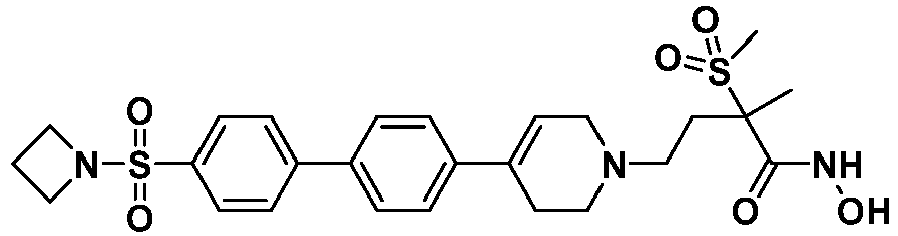

(4-(4-(4'-(azetidin-1-ylsulfonyl)-[1,1'-biphenyl]-4-yl)-3,6-dihydropyridin-1(2H)-yl)-N-hydroxy-2-methyl-2-(methylsulfonyl)butanamide) 1H NMR (600MHz, DMSO-d6); δ 11.03 (bs, 1H), 9.12 (bs, 1H), 7.98-7.97 (m, 2H), 7.84-7.83 (m, 2H), 7.75-7.74 (m, 2H), 7.57-7.56 (m, 2H), 6.26 (s, 1H), 3.68-3.66 (m, 4H), 3.31-3.30 (m, 2H), 3.13-3.11 (m, 2H), 3.05 (s, 3H), 2.65-2.59 (m, 2H), 2.36-2.32 (m, 2H), 2.01-1.96 (m, 2H), 1.84-1.82 (m, 2H), 1.45 (s, 3H). MS (ESI, m/z): 548.2 [M+H]+. 69 

(4'-(1-(4-(hydroxyamino)-3-methyl-3-(methylsulfonyl)-4-oxobutyl)-1,2,3,6-tetrahydropyridin-4-yl)-[1,1'-biphenyl]-4-yl methanesulfonate) 1H NMR (600MHz, DMSO-d6); δ 11.02 (bs, 1H), 9.11 (bs, 1H), 7.97-7.92 (m, 4H), 7.22-7.71 (m, 2H), 7.56-7.54 (m, 2H), 6.25 (s, 1H), 3.28 (s, 3H), 3.13-3.09 (m, 4H), 3.05 (s, 3H), 2.66-2.59 (m, 2H), 2.45-2.31 (m, 2H), 1.85-1.82 (m, 2H), 1.45 (s, 3H). MS (ESI, m/z): 506.9 [M+H]+. 70 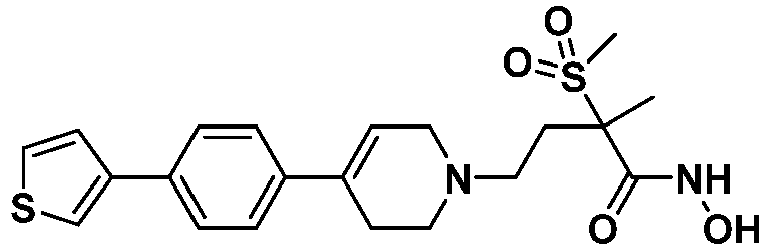

(N-hydroxy-2-methyl-2-(methylsulfonyl)-4-(4-(4-(thiophen-3-yl)phenyl)-3,6-dihydropyridin-1(2H)-yl)butanamide) 1H NMR (600MHz, DMSO-d6); δ 11.05 (bs, 1H), 9.13 (bs, 1H), 7.87 (s, 1H), 7.68-7.67 (m, 2H), 7.63-7.62 (m, 1H), 7.56-7.55 (m, 1H), 7.46-7.45 (m, 2H), 6.20 (s, 1H), 3.15-3.08 (m, 2H), 3.01 (s, 3H), 2.64-2.60 (m, 2H), 2.49-2.32 (m, 5H), 1.85-1.83 (m, 1H), 1.47 (s, 3H). MS (ESI, m/z): 435.2 [M+H]+. 71 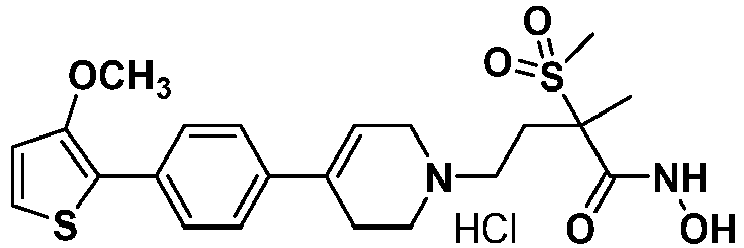

(N-hydroxy-4-(4-(4-(3-methoxythiophen-2-yl)phenyl)-3,6-dihydropyridin-1(2H)-yl)-2-methyl-2-(methylsulfonyl)butanamide hydrochloride) 1H NMR (600MHz, DMSO-d6); δ 11.06 (bs, 1H), 11.11-11.00 (m, 1H), 9.13 (bs, 1H), 7.68-7.67 (m, 2H), 7.51-7.49 (m, 3H), 7.15-7.14 (m, 1H), 6.22 (s, 1H), 4.03-3.97 (m, 2H), 3.90 (s, 3H), 3.77-3.74 (m, 2H), 3.35-3.31 (m, 2H), 3.12 (s, 3H), 3.02-2.85 (m, 2H), 2.74-2.69 (m, 2H), 1.53-1.52 (m, 3H) . MS (ESI, m/z): 465.1 [M+H]+. 72 

(N-hydroxy-2-methyl-2-(methylsulfonyl)-4-(4-(4-(4-methylthiophen-2-yl)phenyl)-3,6-dihydropyridin-1(2H)-yl)butanamide hydrochloride) 1H NMR (600MHz, DMSO-d6); δ 11.06 (bs, 1H), 10.45-10.40 (m, 1H), 9.15 (bs, 1H), 7.63-7.62 (m, 2H), 7.53-7.52 (m, 2H), 7.38 (s, 1H), 7.13 (s, 1H), 6.26 (s, 1H), 4.23-3.70 (m, 2H), 3.42-3.31 (m, 5H), 3.11 (s, 3H), 3.01-2.69 (m, 3H), 2.23 (s, 3H), 1.53-1.52 (m, 3H) MS (ESI, m/z): 449.1 [M+H]+. 73 
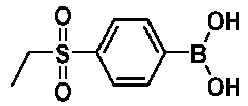
(4-(4-(4'-(ethylsulfonyl)-[1,1'-biphenyl]-4-yl)-3,6-dihydropyridin-1(2H)-yl)-N-hydroxy-2-methyl-2-(methylsulfonyl)butanamide hydrochloride) 1H NMR (600MHz, DMSO-d6); δ 11.06 (m, 1H), 10.06 (bs, 1H), 9.31 (s, 1H), 7.99-7.95 (m, 4H), 7.82 (d, J=7.8Hz, 2H), 7.66 (d, J=7.8Hz, 2H), 6.34 (s, 1H), 4.18-4.06 (m, 1H), 3.92-3.70 (m, 2H), 3.11 (s, 3H), 3.08-3.02 (m, 1H), 2.86-2.82 (m, 2H), 2.72-2.54 (m, 2H), 2.22-2.14 (m, 2H), 2.02-1.98 (m, 2H), 1.52 (s, 3H), 1.12 (t, J=7.2Hz, 3H) . MS (ESI, m/z): 521.1 [M+H]+. -

- To a solution of methyl 4-(4-(4-iodophenyl)-3,6-dihydropyridin-1(2H)-yl)-2-methyl-2-(methylsulfonyl)butanoate (Intermediate 2) (1.5g. 1eq) in a mixture of 1,4-dioxane (12ml)/ water (3ml) was added with Pd(PPh3)2Cl2 (0.37g, 0.1eq), K2CO3 (1.34g, 3eq) and (4-formylphenyl)boronic acid (0.97g, 2eq). The mixture was stirred for 2hr at 110°C, cooled down to room temperature, and extracted with ethyl acetate and water. The organic layer was washed with brine, dried over anhydrous MgSO4 and concentrated in vacuo. The residue was purified with column chromatography to prepare the title compound (1g, 68%).
1H NMR (600MHz, CDCl3-d1):δ10.04 (S, 1H), 7.94-7.92 (m, 2H), 7.74-7.71 (m, 2H), 7.63-7.60 (m, 2H), 7.49-7.45 (m, 2H), 6.08 (s, 1H), 3.87 (s, 3H), 3.79-76 (m, 2H), 3.66-3.56 (m, 2H), 3.42-3.26 (m, 2H), 3.13 (s, 3H), 2.92-2.72 (m, 4H), 1.74 (s, 3H).
MS (ESI, m/z): 456.2 [M+H]+. - To a solution of methyl 4-(4-(4'-formyl-[1,1'-biphenyl]-4-yl)-3,6-dihydropyridin-1(2H)-yl)-2-methyl-2-(methylsulfonyl)butanoate (500mg, 1eq) in THF (11ml) was added with morpholine (0.19ml, 2eq) and sodium triacetoxyborohydride (930mg, 4eq). The mixture was stirred for 2hr at room temperature, quenched with sat. aq. NaHCO3, and extracted with dichloromethane and water. The organic layer was dried over anhydrous MgSO4 and concentrated in vacuo. The residue was purified with column chromatography to prepare the title compound (450mg, 78%).
1H NMR (600MHz, CDCl3-d1);δ 7.55-7.53 (m, 4H), 7.44-7.43 (m, 2H), 7.40-7.38 (m, 2H), 6.11-6.10 (m, 1H), 3.74-3.72 (m, 4H), 3.69 (s, 3H), 3.55 (s, 2H), 3.28-3.24 (m, 1H), 3.10-3.02 (m, 1H), 3.05 (s, 3H), 2.86-2.78 (m, 1H), 2.68-2.58 (m, 4H), 2.56-2.46 (m, 6H), 2.06-1.98 (m, 1H), 1.64 (s, 3H). - The title compound was prepared the procedures described for the synthesis of Example 1, step 2 - 4 from methyl 2-methyl-2-(methylsulfonyl)-4-(4-(4'-(morpholinomethyl)-[1,1'-biphenyl]-4-yl)-3,6-dihydropyridin-1(2H)-yl)butanoate.
1H NMR (600MHz, DMSO-d6);δ11.01 (s, 1H), 9.12 (s, 1H), 7.61-7.60 (m, 4H), 7.50-7.48 (m, 2H), 7.37-7.35 (m, 2H), 6.20 (s, 1H), 3.56-3.55 (m, 4H), 3.10-3.08 (m, 2H), 3.05 (s, 3H), 2.66-2.59 (m, 2H), 2.51-2.43 (m, 4H), 2.37-2.30 (m, 5H), 1.84-1.80 (m, 1H), 1.45 (s, 3H).
MS (ESI, m/z): 528.25 [M+H]+. -

- To a solution of 2,5-dibromopyridine (5g, 1eq) in toluene (60ml) was added with CuI (80mg, 0.02eq), Pd(PPh3)2Cl2 (150mg, 0.01eq), Et3N (5.96ml, 2eq) and 3-methoxyprop-1-yne (1.6g, 1.05eq). The mixture was stirred for 24hr at room temperature, and extracted with ethyl acetate and water. The organic layer was washed with brine, dried over anhydrous MgSO4 and concentrated in vacuo. The residue was purified with column chromatography to prepare the title compound (4.3g, 90%).
1H NMR (600MHz, CDCl3-d1) δ;8.62 (s, 1H), 7.78 (m, 1H), 7.73 (d, 1H), 4.32 (s, 2H), 3.45(s, 3H). MS (ESI, m/z) : 228.0 [M+H]+. - To a solution of 5-bromo-2-(3-methoxyprop-1-yn-1-yl)pyridine (4.3g, 1eq) in a mixture of 1.4-dioxane (80ml) / water (20ml) was added with Pd(PPh3)2Cl2 (1.3g, 0.1eq), K2CO3 (5.3g, 2eq) and tert-butyl 4-(4,4,5,5-tetramethyl-1,3,2-dioxaborolan-2-yl)-3,6-dihydropyridine-1(2H)-carboxylate (7.7g, 1.3eq). The mixture was stirred for 2hr at 110°C, cooled down to room temperature, and extracted with ethyl acetate and water. The organic layer was washed with brine, dried over anhydrous MgSO4 and concentrated in vacuo. The residue was purified with column chromatography to prepare the title compound (2g, 32%).
1H NMR (600MHz, CDCl3-d1);δ7.64 (dd, 1H), 7.52 (m, 1H), 7.47 (m, 1H), 4.36 (s, 2H), 4.02(m, 2H), 3.46-3.45,(m, 2H), 2.82(m, 1H), 1.26(s, 9H).
MS (ESI, m/z): 329.1 [M+H]+. - To a solution of tert-butyl 6-(3-methoxyprop-1-yn-1-yl)-3',6'-dihydro-[3,4'-bipyridine]-1'(2'H)-carboxylate (2g, 1eq) in dichloromethane (90ml) was added with trifluoroacetic acid (50ml, excess) at 0°C. The mixture was stirred for 2hr at room temperature and concentrated in vacuo to prepare the title compound (2g, 96%).
MS (ESI, m/z): 229.1 [M+H]+. - To a solution of 6-(3-methoxyprop-1-yn-1-yl)-1',2',3',6'-tetrahydro-3,4'-bipyridine 2,2,2-trifluoroacetate (1g, 1eq) in DMF (15ml) was added with Et3N (1.23ml, 3eq) and methyl 4-bromo-2-methyl-2-(methylsulfonyl)butanoate (Intermediate 1) (957mg, 1.2eq). The mixture was stirred for 12hr at 60°C, cooled room temperature, and extracted with ethyl acetate and water. The organic layer was washed with brine, dried over anhydrous MgSO4 and concentrated in vacuo. The residue was purified with column chromatography to prepare the title compound (1.1g, 89%).
1H NMR (600MHz, CDCl3-d1);δ7.62 (m, 1H), 7.95 (m, 1 H), 7.66 (m, 1 H), 6.15 (s, 1H), 4.33(s, 2H), 3.67,(s, 3H), 3.45(s, 3H), 3.25(m, 1H), 3.07(m, 1H), 3.03(s, 3H), 2.81(m, 1H) 2.63-2.57(m, 3H), 2.57(m, 2H), 1.62(s, 3H).
MS (ESI, m/z): 421.2 [M+H]+. - The title compound was prepared the procedures described for the synthesis of Example 1, step 2 - 4 (Synthesis of Hydroxamate) from methyl 4-(6-(3-methoxyprop-1-yn-1-yl)-3',6'-dihydro-[3,4'-bipyridin]-1'(2'H)-yl)-2-methyl-2-(methylsulfonyl)butanoate.
1H NMR (600MHz, DMSO-d6);δ11.01 (bs, 1H), 8.72 (bs, 1 H), 7.93 (dd, 1 H), 7.57 (d, 1H), 6.41(s, 2H), 4.35,(s, 2H), 4.13(m, 1H), 4.01(m, 1H), 3.84(m, 1H), 3.76(m, 1H), 3.27(m, 1H), 3.19(m, 1H), 3.14(s, 3H), 2.98(m, 1H,) 2.87(m, 1H) 2.68(m, 1H), 2.25(m, 1H), 1.50(s, 3H).
MS (ESI, m/z): 415.1 [M+H]+. -
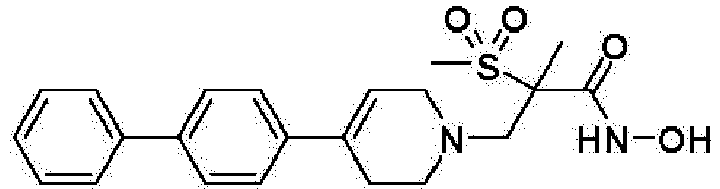
-

- To a solution of 4-bromo-1,1'-biphenyl (2g, 1eq) in a mixture of 1,4-dioxane (24ml) / water (6ml) was added with Pd(PPh3)2Cl2 (0.6g, 0.1eq), K2CO3 (2.37g, 2eq) and tert-butyl 4-(4,4,5,5-tetramethyl-1,3,2-dioxaborolan-2-yl)-3,6-dihydropyridine-1(2H)-carboxylate (3.45g, 1.3eq). The mixture was stirred for 2hr at 110°C, cooled down to room temperature, and extracted with ethyl acetate and water. The organic layer was washed with brine, dried over anhydrous MgSO4 and concentrated in vacuo. The residue was purified with column chromatography to prepare the title compound (1.65g, 57%).
1H NMR (600MHz, DMSO-d6);δ 7.40-7.37 (m, 4H), 7.26-7.16 (m, 4H), 7.08-7.05 (m, 1H), 6.15 (s, 1H), 4.11 (s, 2H), 3.62 (s, 2H), 2.50 (s, 2H), 1.49(s, 9H).
MS (ESI, m/z): 336.3 [M+H]+. -

- To a solution of tert-butyl 4-([1,1'-biphenyl]-4-yl)-3,6-dihydropyridine-1(2H)-carboxylate (1.1g, 1eq) in dichloromethane (10ml) was added with trifluoroacetic acid (2ml, 8eq). The mixture was stirred for 1hr at room temperature and concentrated in vacuo. The residue was diluted with dichloromethane and poured into excess diethyl ether. The precipitated solid was filtered off to prepare the title compound (1.08g, 94%).
1H NMR (600MHz, DMSO-d6);δ8.68 (brs, 2H), 7.52-7.48 (m, 4H), 7.43-7.39 (m, 4H), 7.08-7.05 (m, 1H), 6.15 (s, 1H), 3.76 (s, 2H), 3.25 (s, 2H), 2.65 (s, 2H).
MS (ESI, m/z): 236.1 [M+H]+. -

- To a solution of 4-([1,1'-biphenyl]-4-yl)-1,2,3,6-tetrahydropyridine 2,2,2-trifluoroacetate (1g, 1eq) in a mixture of MeOH (30ml) / THF (10ml) was added with Et3N (2ml, 5eq), formaldehyde (37% in water, 0.5ml, 2.2eq) and methyl 2-(methylsulfonyl)propanoate (0.95g, 2eq). The mixture was stirred for 24hr at room temperature and concentrated in vacuo. The residue was extracted with ethyl acetate and water. The organic layer was washed with brine, dried over anhydrous MgSO4 and concentrated in vacuo. The residue was purified with column chromatography to prepare the title compound (0.25g, 21%).
1H NMR (600MHz, CDCl3-d1);δ7.70-7.65 (m, 4H), 7.61-7.58 (m, 2H), 7.48-7.42 (m, 2H), 7.40-7.35 (m, 1H) 6.03 (s, 1H), 3.85 (s, 3H), 3.31 (d, 1H, J=14.4 Hz), 3.26 (s, 2H), 3.18 (s, 3H), 3.05 (d, 1H, J=13.8 Hz), 2.81 (t, 2H, J=6.0Hz), 2.58-2.46 (m, 2H), 1.69(s, 3H).
MS (ESI, m/z): 413.2 [M+H]+. -

- To a solution of methyl 3-(4-([1,1'-biphenyl]-4-yl)-3,6-dihydropyridin-1(2H)-yl)-2-methyl-2-(methylsulfonyl)propanoate (200mg, 1eq) in THF (10ml) was added with 1N-LiOH in MeOH (5ml, 8.3eq). The mixture was stirred for 3hr at room temperature. The solvent was removed under reduced pressure. The residue was acidified with 2N-HCl and extracted ethyl acetate. The organic layer was washed with brine, dried over anhydrous MgSO4 and concentrated in vacuo to prepare the title compound (200mg, 83%).
-

- To a solution of methyl 3-(4-([1,1'-biphenyl]-4-yl)-3,6-dihydropyridin-1(2H)-yl)-2-methyl-2-(methylsulfonyl)propanoate (50mg, 1eq) in DMF (2ml) was added with HATU (67mg, 1.4eq), HOBT (24mg, 1.4eq), Et3N (0.053ml, 3eq) and 0-(tetrahydro-2H-pyran-2-yl)hydroxylamine hydrochloride (29mg, 2eq). The mixture was stirred for 1hr at room temperature and extracted with ethyl acetate and water. The organic layer was washed with brine, dried over anhydrous MgSO4 and concentrated in vacuo. The residue was purified with column chromatography to prepare the title compound (50mg, 80%).
MS (ESI, m/z): 499.2 [M+H]+. -

- To a solution of 3-(4-([1,1'-biphenyl]-4-yl)-3,6-dihydropyridin-1(2H)-yl)-2-methyl-2-(methylsulfonyl)-N-((tetrahydro-2H-pyran-2-yl)oxy)propanamide (30mg, 1eq) in MeOH (1.5ml) was added with HCl solution in MeOH (1.25N, 0.1ml, 2eq). The mixture was stirred for 2hr at room temperature. The solvent was removed under reduced pressure. The residue was diluted with water (6ml) and adjusted the pH to 7.0. The water was concentrated and the resulting residue was purified with column chromatography to prepare the title compound (10mg, 40%).
1H NMR (600MHz, DMSO-d6);δ 11.3 (bs, 1H), 9.51 (bs, 1H), 7.70-7.65 (m, 4H), 7.61-7.58 (m, 2H), 7.48-7.42 (m, 2H), 7.40-7.35 (m, 1H) 6.25 (s, 1H), 4.18-3.91 (m, 2H), 3.61-3.49 (m, 4H), 3.15 (s, 3H), 2.47-2.40 (m, 2H), 1.48 (s, 3H).
MS (ESI, m/z): 415.1 [M+H]+. -

- The title compound was prepared the procedures described for the synthesis of Example 31 using 4-bromo-1-iodo-2-methylbenzene as a starting material.
1H NMR (600MHz, DMSO-d6);δ 11.03 (bs, 1H), 9.13 (bs, 1H), 7.34-7.33 (m, 2H), 7.24-7.23 (m, 1H), 6.20 (s, 1H), 3.50 (s, 2H), 3.12-3.10 (m, 2H), 3.07 (s, 3H), 2.66-2.63 (m, 2H), 2.48-2.44 (m, 4H), 2.39 (s, 3H), 2.25 (s, 6H), 1.84-1.82 (m, 2H), 1.43 (s, 3H).
MS (ESI, m/z): 448.2 [M+H]+. -

- The title compound was prepared the procedures described for the synthesis of Example 31 using 4-bromo-1-iodo-2-(trifluoromethyl)benzene as a starting material.
1H NMR (600MHz, DMSO-d6);δ 11.03 (bs, 1H), 9.11 (bs, 1H), 7.71-7.69 (m, 2H), 7.63-7.62 (m, 1H), 6.36 (s, 1H), 3.50 (s, 2H), 3.32 (s, 3H), 3.17-3.16 (m, 2H), 2.66-2.57 (m, 2H), 2.46-2.32 (m, 4H), 2.23 (s, 6H), 1.83-1.80 (m, 2H), 1.45 (s, 3H).
MS (ESI, m/z): 502.2 [M+H]+. - To measure the antibiotic activity of the compounds prepared by Examples, antibiotic activity test in vitro was performed by agar dilution method using Mueller-Hinton agar according to the NCCLS (National Committee for Clinical Laboratory Standards. 2000. Methods for dilution antimicrobial susceptibility tests for bacteria that grow aerobiocally. Approved standard, NCCLS document M7-M5, 5thed, vol 20, no 2. National Committee for Clinical Laboratory Standards, Wayne, PA.). The test strain was Escherichia coli (ATCC 25922), Klebsiella pneumoniae (ATCC 29665) and Pseudomonas aeruginosa (PA01). Their Minimum Inhibitory Concentration (MIC, ug/ml) are summarized in Table 1.
<Table 1> Example MIC for E.coli ATCC 25922 MIC for K.pneumoniae ATCC 29665 MIC for P.aeruginosa PAO1 1 D D D 2 A B B 3 D B D 4 A A B 5 B C B 6 A B C 7 B B B 8 D D D 9 A B D 10 B C C 11 A B B 12 C c D 13 A B C 14 A B B 15 B C B 16 B B B 17 D C B 18 A B B 19 A B B 20 B C C 21 C D D 22 B D B 23 A B B 24 B B B 25 B B B 26 B C B 27 A B B 28 A A B 29 A B B 30 A B B 31 A B B 32 A B B 33 B C B 34 A B B 35 D D D 36 A B B 37 A D D 38 A B B 39 C C C 40 B B B 41 B C C 42 A B B 43 A B B 44 A B B 45 A B B 46 A B B 47 A B A 48 A B A 49 A B A 50 A B A 51 D D D 52 C D D 53 B B D 54 C D D 55 B B B 56 A A C 57 B D D 58 A B D 59 A C C 60 A C D 61 B D B 62 A B B 63 A A C 64 A B B 65 A C D 66 A B D 67 C D D 68 A B B 69 A A C 70 A A D 71 A A D 72 A A D 73 A B B 74 A A B 75 D D D 76 D D D - MIC key:
- A = MIC's of 1.0 µg/mL or less
- B = MIC's of greater than 1.0 µg/mL to 8.0 µg/mL
- C = MIC's of greater than 8.0 µg/mL to 16.0 µg/mL
- D = MIC's of greater than 16 µg/mL
Claims (9)
- A tetrahydropyridine compound represented by the following formula I, a stereoisomer thereof or a pharmaceutically acceptable salt thereof:
 n is 1, 2 or 3;R1 is C1-C6 alkyl or C1-C6 haloalkyl;R2 is hydrogen or C1-C6 alkyl;R3 is hydrogen, C1-C6 alkyl, C1-C6 alkoxy, -OH or halogen;L is C3-C7 cycloalkyl, aryl, heteroaryl or null, wherein at least one H of C3-C7 cycloalkyl, aryl or heteroaryl may be substituted with halogen, C1-C6 alkyl, C1-C6 haloalkyl, - NRARB or -OH;D is C=C, C3-C7 cycloalkyl, aryl, heteroaryl or null, wherein at least one H of C3-C7 cycloalkyl, aryl or heteroaryl may be substituted with halogen, C1-C6 alkyl, C1-C6 haloalkyl, - NRARB or -OH;E is C=C, C3-C7 cycloalkyl, aryl, heteroaryl or null, wherein at least one H of C3-C7 cycloalkyl, aryl or heteroaryl may be substituted with halogen, C1-C6 alkyl, C1-C6 haloalkyl, - NRARB or -OH;G is C1-C6 alkyl, C3-C7 cycloalkyl, 4-6 membered heterocycloalkyl, aryl or heteroaryl,wherein at least one H of C1-C6 alkyl may be substituted with halogen, -NRARB, -OH or -ORc,at least one H of C3-C7 cycloalkyl or 4-6 membered heterocycloalkyl may be substituted with C1-C6 alkyl, C1-C6 alkyl-NRARB, C1-C6 hydroxyalkyl, C1-C6 haloalkyl, C1-C6 alkoxy, C1-C6 alkyl-ORC, -NRARB, -OH, -(C=O)-C1-C6 alkyl or -S(=O)2-C1-C6 alkyl,at least one H of aryl or heteroaryl may be substituted with C1-C6 alkyl, C1-C6 hydroxyalkyl, C1-C6 alkyl-NRARB, halogen, nitro, cyano, -NRARB, -OH, -ORC, -S(=O)2-C1-C6 alkyl, -S(=O)2-NRARB or -N-S(=O)2-C1-C6 alkyl;RA and RB are each independently hydrogen or C1-C6 alkyl, or RA and RB may be linked together to form 4-6 membered ring, wherein the 4-6 membered ring may have O or S atom and at least one H of the 4-6 membered ring may be substituted with halogen, -OH or C1-C6 hydroxy alkyl;RC is C1-C6 alkyl, C1-C6 hydroxyalkyl, -(C=O)-NRDRE or -S(=O)2-C1-C6 alkyl; andRD and RE are each independently hydrogen or C1-C6 alkyl.
 - The tetrahydropyridine compound, a stereoisomer thereof or a pharmaceutically acceptable salt thereof according to claim 1:wherein,n is 1 or 2;R1 is C1-C6 alkyl;R2 is C1-C6 alkyl;R3 is hydrogen;L is aryl, heteroaryl or null, wherein at least one H of aryl or heteroaryl may be substituted with halogen, C1-C6 alkyl or C1-C6 haloalkyl;D is C=C or null;E is C=C or null;G is C1-C6 alkyl, C3-C7 cycloalkyl, 4-6 membered heterocycloalkyl, aryl or heteroaryl,wherein at least one H of C1-C6 alkyl may be substituted with halogen, -NRARB, -OH or -ORC,at least one H of 4-6 membered heterocycloalkyl may be substituted with C1-C6 alkyl, - (C=O)-C1-C6 alkyl or -S(=O)2-C1-C6 alkyl,at least one H of aryl or heteroaryl may be substituted with C1-C6 alkyl, C1-C6 hydroxyalkyl, C1-C6 alkyl-NRARB, halogen, nitro, cyano, -NRARB, -OH, -ORC, -S(=O)2-C1-C6 alkyl or -S(=O)2-NRARB;RA and RB are each independently hydrogen or C1-C6 alkyl, or RA and RB may be linked together to form 4-6 membered ring, wherein the 4-6 membered ring may have O atom and at least one H of the 4-6 membered ring may be substituted with C1-C6 hydroxyalkyl;RC is C1-C6 alkyl, C1-C6 hydroxyalkyl, -(C=O)-NRDRE or -S(=O)2-C1-C6 alkyl; andRD and RE are each independently hydrogen.
- The tetrahydropyridine compound, a stereoisomer thereof or a pharmaceutically acceptable salt thereof according to claim 2:wherein,n is 1 or 2;R1 is C1-C6 alkyl;R2 is C1-C6 alkyl;R3 is hydrogen;L is phenyl, pyridinyl or null, wherein at least one H of phenyl or pyridinyl may be substituted with halogen, C1-C6 alkyl or C1-C6 haloalkyl;D is C=C or null;E is C=C or null;G is C1-C6 alkyl, C3-C6 cycloalkyl, 4-6 membered heterocycloalkyl, phenyl, pyridinyl, furanyl, thiophenyl or imidazolyl,wherein at least one H of C1-C6 alkyl may be substituted with halogen, -NRARB, -OH or -ORC,at least one H of 4-6 membered heterocycloalkyl may be substituted with C1-C6 alkyl, - (C=O)-C1-C6 alkyl or -S(=O)2-C1-C6 alkyl,at least one H of phenyl, pyridinyl, furanyl, thiophenyl or imidazolyl may be substituted with C1-C6 alkyl, C1-C6 hydroxyalkyl, C1-C6 alkyl-NRARB, halogen, nitro, cyano, -NRARB, - OH, -ORC, -S(=O)2-C1-C6 alkyl or -S(=O)2-NRARB;RA and RB are each independently hydrogen or C1-C6 alkyl, or RA and RB may be linked together to form 4-6 membered ring, wherein the 4-6 membered ring may have O atom and at least one H of the 4-6 membered ring may be substituted with C1-C6 hydroxyalkyl;RC is C1-C6 alkyl, C1-C6 hydroxyalkyl, -(C=O)-NRDRE or -S(=O)2-C1-C6 alkyl; andRD and RE are each independently hydrogen.
- The tetrahydropyridine compound, a stereoisomer thereof or a pharmaceutically acceptable salt thereof according to claim 3, wherein the compound is selected from the group consisting of compounds described in the following table:1) 4-(4-(4-((4-(dimethylamino)phenyl)ethynyl)phenyl)-3,6-dihydropyridin-l(2H)-yl)-N-hydroxy-2-methyl-2-(methylsulfonyl)butanamide;2) N-hydroxy-2-methyl-2-(methylsulfonyl)-4-(4-(4-(phenylethynyl)phenyl)-3,6-dihydropyridin-1(2H)-yl)butanamide;3) N-hydroxy-4-(4-(4-((4-methoxyphenyl)ethynyl)phenyl)-3,6-dihydropyridin-1(2H)-yl)-2-methyl-2-(methylsulfonyl)butanamide;4) 4-(4-(4-(cyclopropylethynyl)phenyl)-3,6-dihydropyridin-1(2H)-yl)-N-hydroxy-2-methyl-2-(methylsulfonyl)butanamide;5) N-hydroxy-4-(4-(4-(4-hydroxybut-1-yn-1-yl)phenyl)-3,6-dihydropyridin-1(2H)-yl)-2-methyl-2-(methylsulfonyl)butanamide;6) 4-(4-(4-(hex-1-yn-1-yl)phenyl)-3,6-dihydropyridin-1(2H)-yl)-N-hydroxy-2-methyl-2-(methylsulfonyl)butanamide;7) 4-(4-(4-(3 -(dimethylamino)prop-1-yn-1-yl)phenyl)-3,6-dihydropyridin-1(2H)-yl)-N-hydroxy-2-methyl-2-(methylsulfonyl)butanamide;8) N-hydroxy-4-(4-(4-(3-hydroxybut-1-yn-1-yl)phenyl)-3,6-dihydropyridin-1(2H)-yl)-2-methyl-2-(methylsulfonyl)butanamide;9) 4-(4-(4-(cyclopentylethynyl)phenyl)-3,6-dihydropyridin-l(2H)-yl)-N-hydroxy-2-methyl-2-(methylsulfonyl)butanamide;10) 4-(4-(4-(cyclohexylethynyl)phenyl)-3,6-dihydropyridin-1(2H)-yl)-N-hydroxy-2-methyl-2-(methylsulfonyl)butanamide;11) N-hydroxy-2-methyl-2-(methylsulfonyl)-4-(4-(4-(pent-1-yn-1-yl)phenyl)-3,6-dihydropyridin-1(2H)-yl)butanamide;12) N-hydroxy-2-methyl-4-(4-(4-(4-methylpent-1-yn-1-yl)phenyl)-3,6-dihydropyridin-1(2H)-yl)-2-(methylsulfonyl)butanamide;13) 4-(4-(4-(5-chloropent-1-yn-1-yl)phenyl)-3,6-dihydropyridin-1(2H)-yl)-N-hydroxy-2-methyl-2-(methylsulfonyl)butanamide;14) N-hydroxy-2-methyl-2-(methyl sulfonyl)-4-(4-(4-(3 -(pyrrolidin-1-yl)prop-1-yn-1-yl)phenyl)-3,6-dihydropyridin-l(2H)-yl)butanamide;15) 4-(4-(4-(3-(diethylamino)prop-1-yn-1-yl)phenyl)-3,6-dihydropyridin-1(2H)-yl)-N-hydroxy-2-methyl-2-(methylsulfonyl)butanamide;16) N-hydroxy-4-(4-(4-(3-((S)-2-(hydroxymethyl)pyrrolidin-1-yl)prop-1-yn-1-yl)phenyl)-3,6-dihydropyridin-1(2H)-yl)-2-methyl-2-(methylsulfonyl)butanamide;17) N-hydroxy-4-(4-(4-(5-hydroxypent-1-yn-1-yl)phenyl)-3,6-dihydropyridin-1(2H)-yl)-2-methyl-2-(methylsulfonyl)butanamide;18) 5-(4-(1-(4-(hydroxyamino)-3-methyl-3-(methylsulfonyl)-4-oxobutyl)-1,2,3,6-tetrahydropyridin-4-yl)phenyl)pent-4-yn-1-yl methanesulfonate;19) 4-(4-(4-(5-(dimethylamino)pent-1-yn-1-yl)phenyl)-3,6-dihydropyridin-1(2H)-yl)-N-hydroxy-2-methyl-2-(methylsulfonyl)butanamide;20) 4-(4-(4-(5-aminopent-1-yn-1-yl)phenyl)-3,6-dihydropyridin-1(2H)-yl)-N-hydroxy-2-methyl-2-(methylsulfonyl)butanamide;21) N-hydroxy-4-(4-(4-(3-hydroxyprop-1-yn-1-yl)phenyl)-3,6-dihydropyridin-1(2H)-yl)-2-methyl-2-(methylsulfonyl)butanamide;22) N-hydroxy-4-(4-(4-(3-methoxyprop-1-yn-1-yl)phenyl)-3,6-dihydropyridin-1(2H)-yl)-2-methyl-2-(methylsulfonyl)butanamide;23) N-hydroxy-4-(4-(4-(3-(3-hydroxypropoxy)prop-1-yn-1-yl)phenyl)-3,6-dihydropyridin-l(2H)-yl)-2-methyl-2-(methylsulfonyl)butanamide;24) N-hydroxy-2-methyl-2-(methylsulfonyl)-4-(4-(4-(3-morpholinoprop-1-yn-1-yl)phenyl)-3,6-dihydropyridin-1(2H)-yl)butanamide;25) 3-(4-(1-(4-(hydroxyamino)-3-methyl-3-(methylsulfonyl)-4-oxobutyl)-1,2,3,6-tetrahydropyiidin-4-yl)phenyl)prop-2-yn-1-yl carbamate;26) 5-(4-(1-(4-(hydroxyamino)-3-methyl-3-(methylsulfonyl)-4-oxobutyl)-1,2,3,6-tetrahydropyridin-4-yl)phenyl)pent-4-yn-1-yl carbamate;27) N-hydroxy-4-(4-(4-(5-methoxypent-1-yn-1-yl)phenyl)-3,6-dihydropyridin-1(2H)-yl)-2-methyl-2-(methylsulfonyl)butanamide;28) N-hydroxy-4-(4-(4-(6-hydroxyhex-1-yn-1-yl)phenyl)-3,6-dihydropyridin-1(2H)-yl)-2-methyl-2-(methylsulfonyl)butanamide;29) N-hydroxy-2-methyl-2-(methylsulfonyl)-4-(4-(4-(6-morpholinohex-1-yn-1-yl)phenyl)-3,6-dihydropyridin-1(2H)-yl)butanamide;30) 4-(4-(4-(3-(dimethylamino)prop-1-yn-1-yl)-3 -fluorophenyl)-3,6-dihydropyridin-1(2H)-yl)-N-hydroxy-2-methyl-2-(methylsulfonyl)butanamide;31) 4-(4-(4-(3-(dimethylamino)prop-1-yn-1-yl)-3,5-difluorophenyl)-3,6-dihydropyridin-1(2H)-yl)-N-hydroxy-2-methyl-2-(methylsulfonyl)butanamide;32) 4-(4-(4-(3-(dimethylamino)prop-1-yn-1-yl)-2-fluorophenyl)-3,6-dihydropyridin-1(2H)-yl)-N-hydroxy-2-methyl-2-(methylsulfonyl)butanamide;33) N-hydroxy-2-methyl-2-(methylsulfonyl)-4-(4-(4-(thiophen-2-ylethynyl)phenyl)-3,6-dihydropyridin-1(2H)-yl)butanamide;34) N-hydroxy-2-methyl-2-(methylsulfonyl)-4-(4-(4-((4-nitrophenyl)ethynyl)phenyl)-3,6-dihydropyridin-1(2H)-yl)butanamide;35) N-hydroxy-2-methyl-2-(methylsulfonyl)-4-(4-(4-(pyridin-3-ylethynyl)phenyl)-3,6-dihydropyridin-1(2H)-yl)butanamide;36) N-hydroxy-4-(4-(4-((4-hydroxyphenyl)ethynyl)phenyl)-3,6-dihydropyridin-1(2H)-yl)-2-methyl-2-(methylsulfonyl)butanamide;37) N-hydroxy-2-methyl-4-(4-(4-((1-methyl-1H-imidazol-4-yl)ethynyl)phenyl)-3,6-dihydropyridin-1(2H)-yl)-2-(methylsulfonyl)butanamide;38) N-hydroxy-2-methyl-4-(4-(4-((1-methylazetidin-3-yl)ethynyl)phenyl)-3,6-dihydropyridin-1(2H)-yl)-2-(methylsulfonyl)butanamide;39) 4-(4-(4-((1-acetylazetidin-3-yl)ethynyl)phenyl)-3,6-dihydropyridin-1(2H)-yl)-N-hydroxy-2-methyl-2-(methylsulfonyl)butanamide;40) N-hydroxy-2-methyl-2-(methylsulfonyl)-4-(4-(4-((1-(methylsulfonyl)azetidin-3-yl)ethynyl)phenyl)-3,6-dihydropyridin-1(2H)-yl)butanamide;41) 4-(4-(3-fluoro-4-(7-hydroxyhepta-1,3-diyn-1-yl)phenyl)-3,6-dihydropyridin-1(2H)-yl)-N-hydroxy-2-methyl-2-(methylsulfonyl)butanamide;42) 4-(4-(3-fluoro-4-(6-hydroxyhexa-1,3-diyn-1-yl)phenyl)-3,6-dihydropyridin-1(2H)-yl)-N-hydroxy-2-methyl-2-(methylsulfonyl)butanamide;43) 4-(4-(4-(cyclopropylbuta-1,3-diyn-1-yl)-3-fluorophenyl)-3,6-dihydropyridin-1(2H)-yl)-N-hydroxy-2-methyl-2-(methylsulfonyl)butanamide;44) 4-(4-(4-(5-(dimethylamino)penta-1,3-diyn-l-yl)-3-fluorophenyl)-3,6-dihydropyridin-1(2H)-yl)-N-hydroxy-2-methyl-2-(methylsulfonyl)butanamide;45) N-hydroxy-4-(4-(4-(7-hydroxyhepta-1,3-diyn-1-yl)phenyl)-3,6-dihydropyridin-1(2H)-yl)-2-methyl-2-(methylsulfonyl)butanamide;46) N-hydroxy-4-(4-(4-(6-hydroxyhexa-1,3-diyn-1-yl)phenyl)-3,6-dihydropyridin-1(2H)-yl)-2-methyl-2-(methylsulfonyl)butanamide;47) N-hydroxy-4-(4-(4-(5-hydroxypenta-11,3-diyn-1-yl)phenyl)-3,6-dihydropyridin-1(2H)-yl)-2-methyl-2-(methylsulfonyl)butanamide;48) 4-(4-(4-(5-(dimethylamino)penta-1,3-diyn-1-yl)phenyl)-3,6-dihydropyridin-1(2H)-yl)-N-hydroxy-2-methyl-2-(methylsulfonyl)butanamide;49) N-hydroxy-4-(4-(4-(5-methoxypenta-1,3-diyn-1-yl)phenyl)-3,6-dihydropyridin-1(2H)-yl)-2-methyl-2-(methylsulfonyl)butanamide;50) N-hydroxy-2-methyl-2-(methylsulfonyl)-4-(4-(4-(phenylbuta-1,3-diyn-1-yl)phenyl)-3,6-dihydropyridin-1(2H)-yl)butanamide;51) N-hydroxy-2-methyl-2-(methylsulfonyl)-4-(4-(pyridin-4-ylethynyl)-3,6-dihydropyridin-1(2H)-yl)butanamide;52) 4-(4-((4-bromophenyl)ethynyl)-3,6-dihydropyridin-1(2H)-yl)-N-hydroxy-2-methyl-2-(methylsulfonyl)butanamide;53) N-hydroxy-4-(4-(7-hydroxyhepta-1,3-diyn-1-yl)-3,6-dihydropyridin-1(2H)-yl)-2-methyl-2-(methylsulfonyl)butanamide;54) N-hydroxy-2-methyl-2-(methylsulfonyl)-4-(4-(4-(pyridin-4-yl)phenyl)-3,6-dihydropyridin-1(2H)-yl)butanamide;55) 4-(4-([1,1'-biphenyl]-4-yl)-3,6-dihydropyridin-1(2H)-yl)-N-hydroxy-2-methyl-2-(methylsulfonyl)butanamide;56) 4-(4-(4'-chloro-[1,1'-biphenyl]-4-yl)-3,6-dihydropyridin-1(2H)-yl)-N-hydroxy-2-methyl-2-(methylsulfonyl)butanamide;57) 4-(4-(4'-fluoro-[1,1'-biphenyl]-4-yl)-3,6-dihydropyridin-1(2H)-yl)-N-hydroxy-2-methyl-2-(methylsulfonyl)butanamide;58) N-hydroxy-4-(4-(4'-hydroxy-[1,1'-biphenyl]-4-yl)-3,6-dihydropyridin-1(2H)-yl)-2-methyl-2-(methylsulfonyl)butanamide;59) 4-(4-(3'-fluoro-4'-methoxy-[1,1'-biphenyl]-4-yl)-3,6-dihydropyridin-1(2H)-yl)-N-hydroxy-2-methyl-2-(methylsulfonyl)butanamide;60) N-hydroxy-2-methyl-2-(methylsulfonyl)-4-(4-(4-(pyridin-3-yl)phenyl)-3,6-dihydropyridin-1(2H)-yl)butanamide;61) 4-(4-(4-(6-fluoropyridin-3 -yl)phenyl)-3,6-dihydropyridin-1(2H)-yl)-N-hydroxy-2-methyl-2-(methylsulfonyl)butanamide;62) 4-(4-(4-(furan-3-yl)phenyl)-3,6-dihydropyridin-1(2H)-yl)-N-hydroxy-2-methyl-2-(methylsulfonyl)butanamide;63) N-hydroxy-2-methyl-2-(methylsulfonyl)-4-(4-(4'-(methylsulfonyl)-[1,1'-biphenyl]-4-yl)-3,6-dihydropyridin-1(2H)-yl)butanamide;64) N-hydroxy-4-(4-(4'-(hydroxymethyl)-[1,1'-biphenyl]-4-yl)-3,6-dihydropyridin-1(2H)-yl)-2-methyl-2-(methylsulfonyl)butanamide;65) 4-(4-(4'-cyano-[1,1'-biphenyl]-4-yl)-3,6-dihydropyridin-1(2H)-yl)-N-hydroxy-2-methyl-2-(methylsulfonyl)butanamide;66) N-hydroxy-2-methyl-2-(methylsulfonyl)-4-(4-(4'-pentyl-[1,1'-biphenyl]-4-yl)-3,6-dihydropyridin-1(2H)-yl)butanamide;67)4-(4-(4'-(azetidin-1-ylsulfonyl)-[1,1'-biphenyl]-4-yl)-3,6-dihydropyridin-1(2H)-yl)-N-hydroxy-2-methyl-2-(methylsulfonyl)butanamide;68) 4'-(1-(4-(hydroxyamino)-3-methyl-3-(methylsulfonyl)-4-oxobutyl)-1,2,3,6-tetrahydropyridin-4-yl)-[1,1'-biphenyl]-4-yl methanesulfonate;69) N-hydroxy-2-methyl-2-(methylsulfonyl)-4-(4-(4-(thiophen-3-yl)phenyl)-3,6-dihydropyridin-1(2H)-yl)butanamide;70) N-hydroxy-4-(4-(4-(3-methoxythiophen-2-yl)phenyl)-3,6-dihydropyridin-1(2H)-yl)-2-methyl-2-(methylsulfonyl)butanamide;71) N-hydroxy-2-methyl-2-(methylsulfonyl)-4-(4-(4-(4-methylthiophen-2-yl)phenyl)-3,6-dihydropyridin-1(2H)-yl)butanamide;72) 4-(4-(4'-(ethylsulfonyl)-[1,1'-biphenyl]-4-yl)-3,6-dihydropyridin-1(2H)-yl)-N-hydroxy-2-methyl-2-(methylsulfonyl)butanamide;73) N-hydroxy-2-methyl-2-(methylsulfonyl)-4-(4-(4'-(morpholinomethyl)-[1,1'-biphenyl]-4-yl)-3,6-dihydropyridin-1(2H)-yl)butanamide;74) N-hydroxy-4-(6-(3-methoxyprop-1-yn-1-yl)-3',6'-dihydro-[3,4'-bipyridin]-1'(2'H)-yl)-2-methyl-2-(methylsulfonyl)butanamide;75) 3-(4-([1,1'-biphenyl]-4-yl)-3,6-dihydropyridin-1(2H)-yl)-N-hydroxy-2-methyl-2-(methylsulfonyl)propanamide;76) 4-(4-(4-(3 -(dimethylamino)prop-1-yn-1-yl)-3 -methylphenyl)-3,6-dihydropyridin-1(2H)-yl)-N-hydroxy-2-methyl-2-(methylsulfonyl)butanamide; and77) 4-(4-(4-(3-(dimethylamino)prop-1-yn-1-yl)-3-(trifluoromethyl)phenyl)-3,6-dihydropyridin-1(2H)-yl)-N-hydroxy-2-methyl-2-(methylsulfonyl)butanamide.
- The compound represented by formula I, stereoisomer thereof or pharmaceutically acceptable salt thereof according to claim 1 for use in inhibiting UDP-3-O-(R-3-hydroxymyristoyl)-N-acetylglucosamine deacetylase (LpxC).
- The compound represented by formula I, stereoisomer thereof or pharmaceutically acceptable salt thereof according to claim 1 for use in treating bacterial infections.
- The compound for use according to claim 6, wherein the bacterial infections are caused by Gram-negative bacteria.
- The compound for use according to claim 7, wherein the bacterial infections are selected from the group consisting of nosocomial pneumonia, urinary tract infections, systemic infections, skin and soft tissue infections, surgical infections, intraabdominal infections, lung infections, endocarditis, diabetic foot infection, osteomyelitis, and central nervous system infections.
- A pharmaceutical composition for use in preventing or treating bacterial infections, comprising, as an active ingredient, the compound represented by formula I, stereoisomer thereof or pharmaceutically acceptable salt thereof according to any one of claims 1 to 4.
Priority Applications (1)
| Application Number | Priority Date | Filing Date | Title |
|---|---|---|---|
| PL17856810T PL3519387T3 (en) | 2016-09-28 | 2017-09-28 | Tetrahydropyridine derivatives and their use as antibacterial agents |
Applications Claiming Priority (2)
| Application Number | Priority Date | Filing Date | Title |
|---|---|---|---|
| US201662400694P | 2016-09-28 | 2016-09-28 | |
| PCT/KR2017/010896 WO2018062924A1 (en) | 2016-09-28 | 2017-09-28 | Tetrahydropyridine derivatives and their use as antibacterial agents |
Publications (3)
| Publication Number | Publication Date |
|---|---|
| EP3519387A1 EP3519387A1 (en) | 2019-08-07 |
| EP3519387A4 EP3519387A4 (en) | 2020-05-13 |
| EP3519387B1 true EP3519387B1 (en) | 2021-08-11 |
Family
ID=61687790
Family Applications (1)
| Application Number | Title | Priority Date | Filing Date |
|---|---|---|---|
| EP17856810.1A Active EP3519387B1 (en) | 2016-09-28 | 2017-09-28 | Tetrahydropyridine derivatives and their use as antibacterial agents |
Country Status (14)
| Country | Link |
|---|---|
| US (1) | US10160724B2 (en) |
| EP (1) | EP3519387B1 (en) |
| JP (1) | JP6812542B2 (en) |
| KR (1) | KR102264248B1 (en) |
| CN (1) | CN110088087B (en) |
| AU (1) | AU2017337946B2 (en) |
| CA (1) | CA3037118C (en) |
| ES (1) | ES2891025T3 (en) |
| MX (1) | MX379690B (en) |
| PL (1) | PL3519387T3 (en) |
| PT (1) | PT3519387T (en) |
| RU (1) | RU2722594C1 (en) |
| WO (1) | WO2018062924A1 (en) |
| ZA (1) | ZA201901945B (en) |
Families Citing this family (2)
| Publication number | Priority date | Publication date | Assignee | Title |
|---|---|---|---|---|
| MD3762368T2 (en) | 2018-03-08 | 2022-07-31 | Incyte Corp | Aminopyrazine diol compounds as pi3k-y inhibitors |
| US11046658B2 (en) | 2018-07-02 | 2021-06-29 | Incyte Corporation | Aminopyrazine derivatives as PI3K-γ inhibitors |
Family Cites Families (9)
| Publication number | Priority date | Publication date | Assignee | Title |
|---|---|---|---|---|
| GB0311201D0 (en) * | 2003-05-15 | 2003-06-18 | Merck Sharp & Dohme | Therapeutic agents |
| US7879911B2 (en) * | 2007-02-01 | 2011-02-01 | Johnson Alan T | Hydroxamic acid derivatives of phenoxy-acetic acids and analogs useful as therapeutic agents for treating anthrax poisoning |
| CA2774250C (en) * | 2009-10-13 | 2013-12-17 | Pfizer Inc. | C-linked hydroxamic acid derivatives useful as antibacterial agents |
| EP2694481B1 (en) * | 2011-04-08 | 2015-12-30 | Pfizer Inc | Imidazole, pyrazole, and triazole derivatives useful as antibacterial agents |
| EP2694488B1 (en) * | 2011-04-08 | 2014-11-12 | Pfizer Inc | Isoxazole derivatives useful as antibacterial agents |
| EP2847168A1 (en) * | 2012-05-10 | 2015-03-18 | Achaogen, Inc. | Antibacterial agents |
| EP3134401B1 (en) * | 2014-04-22 | 2018-06-13 | Novartis AG | Isoxazoline hydroxamic acid derivatives as lpxc inhibitors |
| EP3143007B1 (en) * | 2014-05-16 | 2018-07-11 | Idorsia Pharmaceuticals Ltd | Antibacterial quinazoline-4(3h)-one derivatives |
| RU2018124788A (en) * | 2015-12-08 | 2020-01-15 | Глэксосмитклайн Интеллекчуал Проперти Дивелопмент Лимитед | SUBSTITUTED BENZAZINONES AS ANTIBACTERIAL COMPOUNDS |
-
2017
- 2017-09-28 WO PCT/KR2017/010896 patent/WO2018062924A1/en not_active Ceased
- 2017-09-28 EP EP17856810.1A patent/EP3519387B1/en active Active
- 2017-09-28 CA CA3037118A patent/CA3037118C/en active Active
- 2017-09-28 PL PL17856810T patent/PL3519387T3/en unknown
- 2017-09-28 US US15/718,474 patent/US10160724B2/en active Active
- 2017-09-28 MX MX2019003585A patent/MX379690B/en unknown
- 2017-09-28 AU AU2017337946A patent/AU2017337946B2/en active Active
- 2017-09-28 JP JP2019516938A patent/JP6812542B2/en active Active
- 2017-09-28 PT PT178568101T patent/PT3519387T/en unknown
- 2017-09-28 ES ES17856810T patent/ES2891025T3/en active Active
- 2017-09-28 KR KR1020197012063A patent/KR102264248B1/en active Active
- 2017-09-28 CN CN201780059711.8A patent/CN110088087B/en active Active
- 2017-09-28 RU RU2019112881A patent/RU2722594C1/en active
-
2019
- 2019-03-28 ZA ZA2019/01945A patent/ZA201901945B/en unknown
Also Published As
| Publication number | Publication date |
|---|---|
| ES2891025T3 (en) | 2022-01-25 |
| PL3519387T3 (en) | 2022-02-07 |
| BR112019006129A2 (en) | 2019-06-18 |
| JP6812542B2 (en) | 2021-01-13 |
| NZ751511A (en) | 2020-11-27 |
| RU2722594C1 (en) | 2020-06-02 |
| PT3519387T (en) | 2021-09-28 |
| AU2017337946B2 (en) | 2020-05-07 |
| CN110088087B (en) | 2022-08-09 |
| US10160724B2 (en) | 2018-12-25 |
| CA3037118C (en) | 2021-12-14 |
| JP2019534252A (en) | 2019-11-28 |
| KR20190047127A (en) | 2019-05-07 |
| CA3037118A1 (en) | 2018-04-05 |
| MX2019003585A (en) | 2019-06-10 |
| EP3519387A1 (en) | 2019-08-07 |
| CN110088087A (en) | 2019-08-02 |
| ZA201901945B (en) | 2022-07-27 |
| AU2017337946A1 (en) | 2019-04-04 |
| WO2018062924A1 (en) | 2018-04-05 |
| MX379690B (en) | 2025-03-11 |
| KR102264248B1 (en) | 2021-06-14 |
| EP3519387A4 (en) | 2020-05-13 |
| US20180086709A1 (en) | 2018-03-29 |
Similar Documents
| Publication | Publication Date | Title |
|---|---|---|
| JP5227304B2 (en) | Novel hydroxamic acid derivatives | |
| EP3344630B1 (en) | Substituted 1,2-dihydro-3h-pyrrolo[1,2-c]imidazol-3-one antibacterial compounds | |
| TW201204346A (en) | Novel hydroxamic acid derivative | |
| CN105531264B (en) | Antibacterial 2H‑Indazole Derivatives | |
| CN112074507B (en) | Compounds as Antibiotics | |
| EP3134401B1 (en) | Isoxazoline hydroxamic acid derivatives as lpxc inhibitors | |
| KR102428718B1 (en) | Novel compounds, preparation method thereof, and antibiotic composition comprising the same | |
| KR20210093884A (en) | Novel imidazole derivatives | |
| EP3307725A1 (en) | Efflux-pump inhibitors and therapeutic uses thereof | |
| CN115803025A (en) | Non-lysosomal glucosylceramidase inhibitors and uses thereof | |
| CN119907795A (en) | Antibacterial compounds | |
| AU2017337946B2 (en) | Tetrahydropyridine derivatives and their use as antibacterial agents | |
| CN107001300A (en) | Antibacterial benzothiazole derivatives | |
| NZ751511B2 (en) | Tetrahydropyridine derivatives and their use as antibacterial agents | |
| HK40005862A (en) | Tetrahydropyridine derivatives and their use as antibacterial agents | |
| HK40005862B (en) | Tetrahydropyridine derivatives and their use as antibacterial agents | |
| KR100529815B1 (en) | Pyridobenzoxazine derivatives and antibacterial agent comprising the same | |
| BR112019006129B1 (en) | TETRAHYDROPYRIDINE DERIVATIVES AND THEIR USE AS ANTIBACTERIAL AGENTS | |
| JP7826312B2 (en) | Novel compound, its production method and antibiotic composition containing the same | |
| CN111196808A (en) | Diazabicyclo compounds and their use | |
| US20240166612A1 (en) | Arylthioether acetamide and related compounds and their use in treating medical conditions | |
| KR19980702027A (en) | Heterocyclic Spiro Derivatives | |
| HK1090061A1 (en) | Novel lincomycin derivatives possessing antimicrobial activity |
Legal Events
| Date | Code | Title | Description |
|---|---|---|---|
| STAA | Information on the status of an ep patent application or granted ep patent |
Free format text: STATUS: THE INTERNATIONAL PUBLICATION HAS BEEN MADE |
|
| PUAI | Public reference made under article 153(3) epc to a published international application that has entered the european phase |
Free format text: ORIGINAL CODE: 0009012 |
|
| STAA | Information on the status of an ep patent application or granted ep patent |
Free format text: STATUS: REQUEST FOR EXAMINATION WAS MADE |
|
| 17P | Request for examination filed |
Effective date: 20190404 |
|
| AK | Designated contracting states |
Kind code of ref document: A1 Designated state(s): AL AT BE BG CH CY CZ DE DK EE ES FI FR GB GR HR HU IE IS IT LI LT LU LV MC MK MT NL NO PL PT RO RS SE SI SK SM TR |
|
| AX | Request for extension of the european patent |
Extension state: BA ME |
|
| DAV | Request for validation of the european patent (deleted) | ||
| DAX | Request for extension of the european patent (deleted) | ||
| A4 | Supplementary search report drawn up and despatched |
Effective date: 20200417 |
|
| RIC1 | Information provided on ipc code assigned before grant |
Ipc: C07D 401/04 20060101ALI20200408BHEP Ipc: C07D 409/10 20060101ALI20200408BHEP Ipc: C07D 401/06 20060101ALI20200408BHEP Ipc: C07D 413/10 20060101ALI20200408BHEP Ipc: C07D 405/10 20060101ALI20200408BHEP Ipc: C07D 401/10 20060101ALI20200408BHEP Ipc: A61P 31/04 20060101ALI20200408BHEP Ipc: C07D 211/70 20060101AFI20200408BHEP Ipc: A61K 31/4418 20060101ALI20200408BHEP |
|
| GRAP | Despatch of communication of intention to grant a patent |
Free format text: ORIGINAL CODE: EPIDOSNIGR1 |
|
| STAA | Information on the status of an ep patent application or granted ep patent |
Free format text: STATUS: GRANT OF PATENT IS INTENDED |
|
| INTG | Intention to grant announced |
Effective date: 20210414 |
|
| GRAS | Grant fee paid |
Free format text: ORIGINAL CODE: EPIDOSNIGR3 |
|
| GRAA | (expected) grant |
Free format text: ORIGINAL CODE: 0009210 |
|
| STAA | Information on the status of an ep patent application or granted ep patent |
Free format text: STATUS: THE PATENT HAS BEEN GRANTED |
|
| AK | Designated contracting states |
Kind code of ref document: B1 Designated state(s): AL AT BE BG CH CY CZ DE DK EE ES FI FR GB GR HR HU IE IS IT LI LT LU LV MC MK MT NL NO PL PT RO RS SE SI SK SM TR |
|
| REG | Reference to a national code |
Ref country code: CH Ref legal event code: EP |
|
| REG | Reference to a national code |
Ref country code: DE Ref legal event code: R096 Ref document number: 602017044016 Country of ref document: DE |
|
| REG | Reference to a national code |
Ref country code: RO Ref legal event code: EPE |
|
| REG | Reference to a national code |
Ref country code: IE Ref legal event code: FG4D Ref country code: AT Ref legal event code: REF Ref document number: 1419260 Country of ref document: AT Kind code of ref document: T Effective date: 20210915 |
|
| REG | Reference to a national code |
Ref country code: PT Ref legal event code: SC4A Ref document number: 3519387 Country of ref document: PT Date of ref document: 20210928 Kind code of ref document: T Free format text: AVAILABILITY OF NATIONAL TRANSLATION Effective date: 20210921 |
|
| REG | Reference to a national code |
Ref country code: NL Ref legal event code: FP |
|
| REG | Reference to a national code |
Ref country code: LT Ref legal event code: MG9D |
|
| REG | Reference to a national code |
Ref country code: GR Ref legal event code: EP Ref document number: 20210402818 Country of ref document: GR Effective date: 20211209 |
|
| REG | Reference to a national code |
Ref country code: ES Ref legal event code: FG2A Ref document number: 2891025 Country of ref document: ES Kind code of ref document: T3 Effective date: 20220125 |
|
| PG25 | Lapsed in a contracting state [announced via postgrant information from national office to epo] |
Ref country code: NO Free format text: LAPSE BECAUSE OF FAILURE TO SUBMIT A TRANSLATION OF THE DESCRIPTION OR TO PAY THE FEE WITHIN THE PRESCRIBED TIME-LIMIT Effective date: 20211111 Ref country code: LT Free format text: LAPSE BECAUSE OF FAILURE TO SUBMIT A TRANSLATION OF THE DESCRIPTION OR TO PAY THE FEE WITHIN THE PRESCRIBED TIME-LIMIT Effective date: 20210811 Ref country code: BG Free format text: LAPSE BECAUSE OF FAILURE TO SUBMIT A TRANSLATION OF THE DESCRIPTION OR TO PAY THE FEE WITHIN THE PRESCRIBED TIME-LIMIT Effective date: 20211111 Ref country code: SE Free format text: LAPSE BECAUSE OF FAILURE TO SUBMIT A TRANSLATION OF THE DESCRIPTION OR TO PAY THE FEE WITHIN THE PRESCRIBED TIME-LIMIT Effective date: 20210811 Ref country code: RS Free format text: LAPSE BECAUSE OF FAILURE TO SUBMIT A TRANSLATION OF THE DESCRIPTION OR TO PAY THE FEE WITHIN THE PRESCRIBED TIME-LIMIT Effective date: 20210811 Ref country code: HR Free format text: LAPSE BECAUSE OF FAILURE TO SUBMIT A TRANSLATION OF THE DESCRIPTION OR TO PAY THE FEE WITHIN THE PRESCRIBED TIME-LIMIT Effective date: 20210811 Ref country code: FI Free format text: LAPSE BECAUSE OF FAILURE TO SUBMIT A TRANSLATION OF THE DESCRIPTION OR TO PAY THE FEE WITHIN THE PRESCRIBED TIME-LIMIT Effective date: 20210811 |
|
| PG25 | Lapsed in a contracting state [announced via postgrant information from national office to epo] |
Ref country code: LV Free format text: LAPSE BECAUSE OF FAILURE TO SUBMIT A TRANSLATION OF THE DESCRIPTION OR TO PAY THE FEE WITHIN THE PRESCRIBED TIME-LIMIT Effective date: 20210811 |
|
| REG | Reference to a national code |
Ref country code: AT Ref legal event code: UEP Ref document number: 1419260 Country of ref document: AT Kind code of ref document: T Effective date: 20210811 |
|
| PG25 | Lapsed in a contracting state [announced via postgrant information from national office to epo] |
Ref country code: DK Free format text: LAPSE BECAUSE OF FAILURE TO SUBMIT A TRANSLATION OF THE DESCRIPTION OR TO PAY THE FEE WITHIN THE PRESCRIBED TIME-LIMIT Effective date: 20210811 |
|
| REG | Reference to a national code |
Ref country code: DE Ref legal event code: R097 Ref document number: 602017044016 Country of ref document: DE |
|
| PG25 | Lapsed in a contracting state [announced via postgrant information from national office to epo] |
Ref country code: SM Free format text: LAPSE BECAUSE OF FAILURE TO SUBMIT A TRANSLATION OF THE DESCRIPTION OR TO PAY THE FEE WITHIN THE PRESCRIBED TIME-LIMIT Effective date: 20210811 Ref country code: SK Free format text: LAPSE BECAUSE OF FAILURE TO SUBMIT A TRANSLATION OF THE DESCRIPTION OR TO PAY THE FEE WITHIN THE PRESCRIBED TIME-LIMIT Effective date: 20210811 Ref country code: MC Free format text: LAPSE BECAUSE OF FAILURE TO SUBMIT A TRANSLATION OF THE DESCRIPTION OR TO PAY THE FEE WITHIN THE PRESCRIBED TIME-LIMIT Effective date: 20210811 Ref country code: EE Free format text: LAPSE BECAUSE OF FAILURE TO SUBMIT A TRANSLATION OF THE DESCRIPTION OR TO PAY THE FEE WITHIN THE PRESCRIBED TIME-LIMIT Effective date: 20210811 Ref country code: CZ Free format text: LAPSE BECAUSE OF FAILURE TO SUBMIT A TRANSLATION OF THE DESCRIPTION OR TO PAY THE FEE WITHIN THE PRESCRIBED TIME-LIMIT Effective date: 20210811 Ref country code: AL Free format text: LAPSE BECAUSE OF FAILURE TO SUBMIT A TRANSLATION OF THE DESCRIPTION OR TO PAY THE FEE WITHIN THE PRESCRIBED TIME-LIMIT Effective date: 20210811 |
|
| PLBE | No opposition filed within time limit |
Free format text: ORIGINAL CODE: 0009261 |
|
| STAA | Information on the status of an ep patent application or granted ep patent |
Free format text: STATUS: NO OPPOSITION FILED WITHIN TIME LIMIT |
|
| 26N | No opposition filed |
Effective date: 20220512 |
|
| PG25 | Lapsed in a contracting state [announced via postgrant information from national office to epo] |
Ref country code: LU Free format text: LAPSE BECAUSE OF NON-PAYMENT OF DUE FEES Effective date: 20210928 |
|
| PG25 | Lapsed in a contracting state [announced via postgrant information from national office to epo] |
Ref country code: SI Free format text: LAPSE BECAUSE OF FAILURE TO SUBMIT A TRANSLATION OF THE DESCRIPTION OR TO PAY THE FEE WITHIN THE PRESCRIBED TIME-LIMIT Effective date: 20210811 |
|
| PG25 | Lapsed in a contracting state [announced via postgrant information from national office to epo] |
Ref country code: CY Free format text: LAPSE BECAUSE OF FAILURE TO SUBMIT A TRANSLATION OF THE DESCRIPTION OR TO PAY THE FEE WITHIN THE PRESCRIBED TIME-LIMIT Effective date: 20210811 |
|
| PG25 | Lapsed in a contracting state [announced via postgrant information from national office to epo] |
Ref country code: HU Free format text: LAPSE BECAUSE OF FAILURE TO SUBMIT A TRANSLATION OF THE DESCRIPTION OR TO PAY THE FEE WITHIN THE PRESCRIBED TIME-LIMIT; INVALID AB INITIO Effective date: 20170928 |
|
| PG25 | Lapsed in a contracting state [announced via postgrant information from national office to epo] |
Ref country code: MK Free format text: LAPSE BECAUSE OF FAILURE TO SUBMIT A TRANSLATION OF THE DESCRIPTION OR TO PAY THE FEE WITHIN THE PRESCRIBED TIME-LIMIT Effective date: 20210811 |
|
| PG25 | Lapsed in a contracting state [announced via postgrant information from national office to epo] |
Ref country code: MT Free format text: LAPSE BECAUSE OF FAILURE TO SUBMIT A TRANSLATION OF THE DESCRIPTION OR TO PAY THE FEE WITHIN THE PRESCRIBED TIME-LIMIT Effective date: 20210811 |
|
| REG | Reference to a national code |
Ref country code: CH Ref legal event code: U11 Free format text: ST27 STATUS EVENT CODE: U-0-0-U10-U11 (AS PROVIDED BY THE NATIONAL OFFICE) Effective date: 20251001 |
|
| PGFP | Annual fee paid to national office [announced via postgrant information from national office to epo] |
Ref country code: PT Payment date: 20250902 Year of fee payment: 9 |
|
| PGFP | Annual fee paid to national office [announced via postgrant information from national office to epo] |
Ref country code: DE Payment date: 20250924 Year of fee payment: 9 |
|
| PGFP | Annual fee paid to national office [announced via postgrant information from national office to epo] |
Ref country code: GR Payment date: 20250822 Year of fee payment: 9 |
|
| PGFP | Annual fee paid to national office [announced via postgrant information from national office to epo] |
Ref country code: PL Payment date: 20250821 Year of fee payment: 9 Ref country code: IT Payment date: 20250929 Year of fee payment: 9 Ref country code: NL Payment date: 20250924 Year of fee payment: 9 Ref country code: TR Payment date: 20250825 Year of fee payment: 9 |
|
| PGFP | Annual fee paid to national office [announced via postgrant information from national office to epo] |
Ref country code: BE Payment date: 20250827 Year of fee payment: 9 Ref country code: GB Payment date: 20250924 Year of fee payment: 9 |
|
| PGFP | Annual fee paid to national office [announced via postgrant information from national office to epo] |
Ref country code: FR Payment date: 20250923 Year of fee payment: 9 Ref country code: AT Payment date: 20250828 Year of fee payment: 9 |
|
| PGFP | Annual fee paid to national office [announced via postgrant information from national office to epo] |
Ref country code: RO Payment date: 20250905 Year of fee payment: 9 |
|
| PGFP | Annual fee paid to national office [announced via postgrant information from national office to epo] |
Ref country code: CH Payment date: 20251001 Year of fee payment: 9 |
|
| PGFP | Annual fee paid to national office [announced via postgrant information from national office to epo] |
Ref country code: IE Payment date: 20251110 Year of fee payment: 9 |
|
| PGFP | Annual fee paid to national office [announced via postgrant information from national office to epo] |
Ref country code: ES Payment date: 20251001 Year of fee payment: 9 |