EP3519205B1 - Carbon fiber composite strips as belt in pneumatic radial tires - Google Patents
Carbon fiber composite strips as belt in pneumatic radial tires Download PDFInfo
- Publication number
- EP3519205B1 EP3519205B1 EP16801880.2A EP16801880A EP3519205B1 EP 3519205 B1 EP3519205 B1 EP 3519205B1 EP 16801880 A EP16801880 A EP 16801880A EP 3519205 B1 EP3519205 B1 EP 3519205B1
- Authority
- EP
- European Patent Office
- Prior art keywords
- carcass layer
- cross
- cut
- pneumatic radial
- belt
- Prior art date
- Legal status (The legal status is an assumption and is not a legal conclusion. Google has not performed a legal analysis and makes no representation as to the accuracy of the status listed.)
- Active
Links
- 239000002131 composite material Substances 0.000 title claims description 34
- 229920000049 Carbon (fiber) Polymers 0.000 title claims description 33
- 239000004917 carbon fiber Substances 0.000 title claims description 33
- VNWKTOKETHGBQD-UHFFFAOYSA-N methane Chemical compound C VNWKTOKETHGBQD-UHFFFAOYSA-N 0.000 title description 28
- 239000011347 resin Substances 0.000 claims description 10
- 229920005989 resin Polymers 0.000 claims description 10
- 239000011159 matrix material Substances 0.000 claims description 7
- 230000002787 reinforcement Effects 0.000 claims description 7
- 229920005992 thermoplastic resin Polymers 0.000 claims description 6
- 230000008018 melting Effects 0.000 claims description 3
- 238000002844 melting Methods 0.000 claims description 3
- 229920002302 Nylon 6,6 Polymers 0.000 claims description 2
- 239000000805 composite resin Substances 0.000 description 16
- 229910000831 Steel Inorganic materials 0.000 description 7
- 239000010959 steel Substances 0.000 description 7
- 238000005096 rolling process Methods 0.000 description 5
- 239000004760 aramid Substances 0.000 description 3
- 238000005452 bending Methods 0.000 description 3
- 229920001169 thermoplastic Polymers 0.000 description 3
- 239000004416 thermosoftening plastic Substances 0.000 description 3
- OKTJSMMVPCPJKN-UHFFFAOYSA-N Carbon Chemical compound [C] OKTJSMMVPCPJKN-UHFFFAOYSA-N 0.000 description 2
- 229920006231 aramid fiber Polymers 0.000 description 2
- 239000000835 fiber Substances 0.000 description 2
- 230000003014 reinforcing effect Effects 0.000 description 2
- 239000004953 Aliphatic polyamide Substances 0.000 description 1
- ZOXJGFHDIHLPTG-UHFFFAOYSA-N Boron Chemical compound [B] ZOXJGFHDIHLPTG-UHFFFAOYSA-N 0.000 description 1
- 229910001369 Brass Inorganic materials 0.000 description 1
- 239000004593 Epoxy Substances 0.000 description 1
- 239000004677 Nylon Substances 0.000 description 1
- 239000004642 Polyimide Substances 0.000 description 1
- 239000004734 Polyphenylene sulfide Substances 0.000 description 1
- 239000000853 adhesive Substances 0.000 description 1
- 230000001070 adhesive effect Effects 0.000 description 1
- 229920003231 aliphatic polyamide Polymers 0.000 description 1
- 229920003235 aromatic polyamide Polymers 0.000 description 1
- 229910052796 boron Inorganic materials 0.000 description 1
- 239000010951 brass Substances 0.000 description 1
- 229910052799 carbon Inorganic materials 0.000 description 1
- 239000011248 coating agent Substances 0.000 description 1
- 238000000576 coating method Methods 0.000 description 1
- 230000006835 compression Effects 0.000 description 1
- 238000007906 compression Methods 0.000 description 1
- 238000010276 construction Methods 0.000 description 1
- 230000007797 corrosion Effects 0.000 description 1
- 238000005260 corrosion Methods 0.000 description 1
- 230000007423 decrease Effects 0.000 description 1
- 230000003247 decreasing effect Effects 0.000 description 1
- 238000006073 displacement reaction Methods 0.000 description 1
- 239000004744 fabric Substances 0.000 description 1
- 239000000446 fuel Substances 0.000 description 1
- 229910002804 graphite Inorganic materials 0.000 description 1
- 239000010439 graphite Substances 0.000 description 1
- 238000010348 incorporation Methods 0.000 description 1
- 230000000977 initiatory effect Effects 0.000 description 1
- 239000002184 metal Substances 0.000 description 1
- 229920001778 nylon Polymers 0.000 description 1
- 230000035515 penetration Effects 0.000 description 1
- 229920001721 polyimide Polymers 0.000 description 1
- 229920000069 polyphenylene sulfide Polymers 0.000 description 1
- 238000000926 separation method Methods 0.000 description 1
- 239000000126 substance Substances 0.000 description 1
- 239000004753 textile Substances 0.000 description 1
- 229920001187 thermosetting polymer Polymers 0.000 description 1
Images




Classifications
-
- B—PERFORMING OPERATIONS; TRANSPORTING
- B60—VEHICLES IN GENERAL
- B60C—VEHICLE TYRES; TYRE INFLATION; TYRE CHANGING; CONNECTING VALVES TO INFLATABLE ELASTIC BODIES IN GENERAL; DEVICES OR ARRANGEMENTS RELATED TO TYRES
- B60C9/00—Reinforcements or ply arrangement of pneumatic tyres
- B60C9/0028—Reinforcements comprising mineral fibres, e.g. glass or carbon fibres
-
- B—PERFORMING OPERATIONS; TRANSPORTING
- B60—VEHICLES IN GENERAL
- B60C—VEHICLE TYRES; TYRE INFLATION; TYRE CHANGING; CONNECTING VALVES TO INFLATABLE ELASTIC BODIES IN GENERAL; DEVICES OR ARRANGEMENTS RELATED TO TYRES
- B60C9/00—Reinforcements or ply arrangement of pneumatic tyres
- B60C9/0042—Reinforcements made of synthetic materials
-
- B—PERFORMING OPERATIONS; TRANSPORTING
- B60—VEHICLES IN GENERAL
- B60C—VEHICLE TYRES; TYRE INFLATION; TYRE CHANGING; CONNECTING VALVES TO INFLATABLE ELASTIC BODIES IN GENERAL; DEVICES OR ARRANGEMENTS RELATED TO TYRES
- B60C9/00—Reinforcements or ply arrangement of pneumatic tyres
- B60C9/005—Reinforcements made of different materials, e.g. hybrid or composite cords
-
- B—PERFORMING OPERATIONS; TRANSPORTING
- B60—VEHICLES IN GENERAL
- B60C—VEHICLE TYRES; TYRE INFLATION; TYRE CHANGING; CONNECTING VALVES TO INFLATABLE ELASTIC BODIES IN GENERAL; DEVICES OR ARRANGEMENTS RELATED TO TYRES
- B60C9/00—Reinforcements or ply arrangement of pneumatic tyres
- B60C9/0057—Reinforcements comprising preshaped elements, e.g. undulated or zig-zag filaments
-
- B—PERFORMING OPERATIONS; TRANSPORTING
- B60—VEHICLES IN GENERAL
- B60C—VEHICLE TYRES; TYRE INFLATION; TYRE CHANGING; CONNECTING VALVES TO INFLATABLE ELASTIC BODIES IN GENERAL; DEVICES OR ARRANGEMENTS RELATED TO TYRES
- B60C9/00—Reinforcements or ply arrangement of pneumatic tyres
- B60C9/18—Structure or arrangement of belts or breakers, crown-reinforcing or cushioning layers
- B60C9/20—Structure or arrangement of belts or breakers, crown-reinforcing or cushioning layers built-up from rubberised plies each having all cords arranged substantially parallel
- B60C9/2003—Structure or arrangement of belts or breakers, crown-reinforcing or cushioning layers built-up from rubberised plies each having all cords arranged substantially parallel characterised by the materials of the belt cords
-
- B—PERFORMING OPERATIONS; TRANSPORTING
- B29—WORKING OF PLASTICS; WORKING OF SUBSTANCES IN A PLASTIC STATE IN GENERAL
- B29D—PRODUCING PARTICULAR ARTICLES FROM PLASTICS OR FROM SUBSTANCES IN A PLASTIC STATE
- B29D30/00—Producing pneumatic or solid tyres or parts thereof
- B29D30/06—Pneumatic tyres or parts thereof (e.g. produced by casting, moulding, compression moulding, injection moulding, centrifugal casting)
- B29D30/38—Textile inserts, e.g. cord or canvas layers, for tyres; Treatment of inserts prior to building the tyre
Definitions
- This invention relates to a tire which is provided with flight weight cross belt layers.
- the present invention relates to a tire which is provided with light weight composite carbon fiber belt strips, said belt contributing in decreasing the overall tire weight and improving high speed durability.
- the pneumatic radial tires with cross-ply belt layers made of steel cords have excellent steering stability and wear resistance due to its high belt package rigidity.
- such tires have four major drawbacks.
- the heavy belt package made of steel cords increases the tire weight which leads to increased rolling resistance and fuel consumption.
- the second drawback under high speed conditions, the centrifugal forces generated by heavy steel cord belt package increase the pantographic movements of belt edge cords which increases the potential risk of belt edge separation.
- the third drawback, the cut ends of steel cord filaments at belt edges are without brass coating and no chemical bonding with rubber matrix which tend to initiate crack initiations at cut-ends.
- the steel cords are not corrosion resistant in case of contact with moisture.
- a pneumatic radial tire comprises a belt comprised of plural belt layers, in which at least one belt layer is formed by arranging particular twisted cords, which are obtained by twisting particular filament-resin composite bodies, at a particular end count.
- the weight is light, the rolling resistance and steering stability as well as the resistances to bending of belt cord in the running on bad road are considerably excellent.
- the belt reinforcement elements are twisted strands or cords.
- a pneumatic radial tire including one or more belt layers, wherein cords are used as reinforcing element in at least one belt layer.
- These cords are formed by impregnating and attaching a resin having a modulus in tension of not more than 150 kg/mm 2 to bundles of cord-like Aramid fibers composed of a number of filaments having a tensile strength of not less than 15 g/d and finess of 1-15 deniers, an impregnated and attached amount of the filaments being in a range of 30% to 70 wt % relative to a weight of the filaments, and each of the cords has an elliptical or rectangular cross-section shape having an aspect ratio of a major axis(b)/a minor axis(a) being 1.5 to 5.
- Each of the bundles of the fibers are not twisted.
- a pneumatic tire with carbon fiber cord reinforcement wherein the carbon fiber cords have a round cross-sectional shape and twist per inch(TPI) of 1.2 to 1.6 turns per inch(TPI) is provided.
- the carbon fiber cords are coated with an RFL or epoxy/RFL adhesive.
- carbon fiber cords having an S twist and carbon fiber cords having a Z twist be used in the same reinforcing plies in the tire.
- Especially preferred is the incorporation of carbon fiber cords in a folded belt.
- the composites of high melting point thermoplastics such as polyphenylene sulfide or polyimide and high modulus fibers such as carbon, graphite, or boron can be bonded to rubber using a primer such as a metal primer.
- the composite desirably has a modulus of elasticity of at least 750,000 psi and can be used as belt in non-flat tire.
- EP0237599 , EP1108740 , and EP2765333 are also known from the prior art.
- the objective of the invention is to provide a pneumatic radial tire with reduced weight, low rolling resistance and sufficient steering stability and high speed durability by using composite strips (tapes) made of carbon fiber as reinforcement and thermoplastic aliphatic polyamide resins as matrix in cross-ply belt layers with cut-ends.
- the further objective of the invention is to enhance the compressibility of the carbon fiber/resin composite strips with crimped strip construction, and to prevent compression induced strip breakages
- At least one of the objectives is solved by a pneumatic radial tire according to claim 1.
- the weight and rolling resistance of a pneumatic radial tire can be reduced by replacing (partially or totally) heavy belt layers made of steel cords with ultra high modulus textile reinforcements like aramid and carbon fibers.
- volumetric carbon fiber content of the composite strip is higher than 40% and less than 70%.
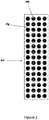
- the carbon fiber content of less than 40% is not effective to provide sufficient tensile stiffness, and higher than 70% is not suitable for belt package durability under high speed conditions ( Figure-1).
- the thickness of the carbon fiber/resin composite strip higher than 0.5 mm and less than 1.5 mm. If strip thickness less than 0.5 mm, the strength and tensile stiffness is not sufficient and puncture resistance is very low. In case higher thickness than 1.5 mm, rubber gauge will be too high to reduce rolling resistance.
- the width of the carbon fiber/thermoplastic resin composite strip is higher than 2.0 mm and less than 10 mm. Preferably, higher than 3.0 mm and less than 6.0 mm. If the strip width is less than 2.0 mm, the lateral bending stiffness (in-plane bending stiffness) will not be high enough. In case of higher strip width than 10 mm, the lateral stability will be too low depending on the aspect ratio of the strip cross-section ( Figure-2).
- the each spacing (S) between the composite strips is minimum 2 maximum 5 mm. This spacing range provides sufficient rubber penetration for dynamic durability and stiffness of belt package rigidity (Figure-3).
- the first layer L1 is equal to the second layer L2, or the first layer L1 is longer than the second layer L2 ( Figures 4a and 4b ).
- the reinforcement strips comprising untwisted (uniaxial) carbon fibers in thermoplastic resins matrix like nylon 6.6 have been crimped (wavy structure) to enable them to absorb the compressive forces in axial direction (in xz plane), and used as cross-ply belt reinforcement in pneumatic radial tires (Figure-5).
- the crimp frequency is minimum 20 and maximum 60 crimp/meter.
- the lower frequency than 20 does not provide the needed compressibility, and the higher frequency than 60 decreases tensile modulus of the strip in axial direction (x).
- the crimps of the composite strips are in horizontal plane (xy plane) in lateral direction or in vertical (xz) plane in longitudinal direction.
- the crimp height is minimum 0.3 and maximum 1.0 mm.
- the crimp height less than 0.3 mm is not effective in providing axial compressibility, and crimp height higher than 1.0 mm gives too thick strip ( Figures 5 and 6 ).
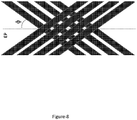
- the angle of the cross-ply belt strips to equatorial plane is minimum 15° and maximum 25°. In case of the lower angles than 15°, the lateral (transverse) in-plane stiffness becomes too low, and if the angle is higher than 25°, the tensile stiffness in circumferential direction becomes too low ( Figures 7 and 8 ). According to the invention cut-ends of the strips in belt have 90° cut angle ( Figure-7).
- cut-ends of the strips in belt have the same cut angle as belt angle ( Figure-8).
- the resin matrix in composite strips is a thermoplastic resin which has a melting point temperature between 200 °C and 300°C.
- thermoplastic resin in composite strips is nylon 6,6.
Landscapes
- Engineering & Computer Science (AREA)
- Mechanical Engineering (AREA)
- Tires In General (AREA)
Description
- This invention relates to a tire which is provided with flight weight cross belt layers. In particular, the present invention relates to a tire which is provided with light weight composite carbon fiber belt strips, said belt contributing in decreasing the overall tire weight and improving high speed durability.
- The pneumatic radial tires with cross-ply belt layers made of steel cords have excellent steering stability and wear resistance due to its high belt package rigidity. But on the other hand, such tires have four major drawbacks. First, the heavy belt package made of steel cords increases the tire weight which leads to increased rolling resistance and fuel consumption. The second drawback, under high speed conditions, the centrifugal forces generated by heavy steel cord belt package increase the pantographic movements of belt edge cords which increases the potential risk of belt edge separation. The third drawback, the cut ends of steel cord filaments at belt edges, are without brass coating and no chemical bonding with rubber matrix which tend to initiate crack initiations at cut-ends. The fourth drawback, the steel cords are not corrosion resistant in case of contact with moisture.
- According to
US 5,246,051 a pneumatic radial tire comprises a belt comprised of plural belt layers, in which at least one belt layer is formed by arranging particular twisted cords, which are obtained by twisting particular filament-resin composite bodies, at a particular end count. In this tire, the weight is light, the rolling resistance and steering stability as well as the resistances to bending of belt cord in the running on bad road are considerably excellent. In those applications, the belt reinforcement elements are twisted strands or cords. - According to
US 5,291,930 a pneumatic radial tire including one or more belt layers, wherein cords are used as reinforcing element in at least one belt layer. These cords are formed by impregnating and attaching a resin having a modulus in tension of not more than 150 kg/mm2 to bundles of cord-like Aramid fibers composed of a number of filaments having a tensile strength of not less than 15 g/d and finess of 1-15 deniers, an impregnated and attached amount of the filaments being in a range of 30% to 70 wt % relative to a weight of the filaments, and each of the cords has an elliptical or rectangular cross-section shape having an aspect ratio of a major axis(b)/a minor axis(a) being 1.5 to 5. Each of the bundles of the fibers are not twisted. - According to
US 5,323,829 a pneumatic tire with carbon fiber cord reinforcement wherein the carbon fiber cords have a round cross-sectional shape and twist per inch(TPI) of 1.2 to 1.6 turns per inch(TPI) is provided. Preferably, the carbon fiber cords are coated with an RFL or epoxy/RFL adhesive. It is also preferred that carbon fiber cords having an S twist and carbon fiber cords having a Z twist be used in the same reinforcing plies in the tire. Especially preferred is the incorporation of carbon fiber cords in a folded belt. - According to
US 6,361,860 the composites of high melting point thermoplastics such as polyphenylene sulfide or polyimide and high modulus fibers such as carbon, graphite, or boron can be bonded to rubber using a primer such as a metal primer. The composite desirably has a modulus of elasticity of at least 750,000 psi and can be used as belt in non-flat tire. -
- The objective of the invention is to provide a pneumatic radial tire with reduced weight, low rolling resistance and sufficient steering stability and high speed durability by using composite strips (tapes) made of carbon fiber as reinforcement and thermoplastic aliphatic polyamide resins as matrix in cross-ply belt layers with cut-ends.
- The further objective of the invention is to enhance the compressibility of the carbon fiber/resin composite strips with crimped strip construction, and to prevent compression induced strip breakages
- At least one of the objectives is solved by a pneumatic radial tire according to
claim 1. -
- Belt: A rubber coated steel or fabric layer that runs circumferentially around a tire between the tread and the plies and is usually oriented at opposite angle to another belt.
- Belt angle : Angle between belt strips and equatorial plane.
- Crimp : Waviness of the strip.
- Crimp frequency: Number of crimp per 1000 mm(1000mm/crimp length).
- Crimp height (ampliture) : The height of the displacement of the strip from its uncrimped condition.
- Equatorial plane (EP) : Plane passing through the circumferential center line in a tire.
- Spacing(s) : Distance between composite strips within the same belt layer.
- Thermoplastic resin : Resin that softens when heated and hardens again when cooled.
-
- Figure-1 is a cross-sectional view of a carbon fiber/resin composite strip, wherein
1 is composite strip
2 is resin matrix
3 is carbon fiber - Figure-2 is a cross-sectional view of a carbon fiber/resin composite strip, wherein
h is the thickness of the composite strip
w is the width of the composite strip - Figure-3 shows the carbon fiber/resin composite strips in belt ply, wherein,
1 is composite strip
s is spacing(rivet area) between the composite strips - Figure-4a is the cross-sectional view of two-layer belt made of carbon fiber/resin composite strips wherein,
L1 is the width of the first belt layer 5
L2 is the width of thesecond belt layer 6, and the widths L1 and L2 are equal to each other - Figure-4b is the cross-sectional view of two-layer belt made of carbon fiber/resin composite strips wherein,
5 is first belt layer
6 is second belt layer
L1 is the width of the first belt layer 5,
L2 is the width of thesecond belt layer 6, and L1 > L2 - Figure-5a shows the view of the crimped carbon fiber/resin composite strip in xz plane and 5b shows the crimped carbon fiber/resin composite strip in xy plane.
8 is the lateral view of the crimped carbon fiber/resin composite strip
9 is the top view of the crimped carbon fiber/resin composite strip
10 is the three dimensional view of the crimped carbon fiber/resin composite strip
x is longitudinal axis of the composite strip
y is lateral(transverse) axis of the composite strip
z is vertical axis to the xy plane
xy is horizontal plane in which the flat composite strips are placed on the belt package
xz is vertical plane to belt package surface - Figure-6 is a lateral view of the crimp, wherein,
x is the crimp length
y is the crimp height - Figure-7 is a cross-ply belt made of carbon fiber/resin composite strips with 90° cut ends
wherein,
EP is equatorial plane
Φ is belt angle - Figure-8 is a cross-ply belt made of carbon fiber/resin composite strips with narrow angle cut ends wherein,
EP is equatorial plane
Φ is belt angle - The weight and rolling resistance of a pneumatic radial tire can be reduced by replacing (partially or totally) heavy belt layers made of steel cords with ultra high modulus textile reinforcements like aramid and carbon fibers.
- In case of carbon fibers having much higher modulus than that of aramid, it has a drawback of high strength and modulus loss after twisting which is necessary for compressibility without breaking. On the other hand, the composite uniaxial (untwisted) carbon fiber strips in thermoplastic or thermosetting resin matrix are subjected to the buckling when exposed to the compressive forces in footprint, which leads to breakages.
- In a preferable embodiment of the present invention, volumetric carbon fiber content of the composite strip is higher than 40% and less than 70%. The carbon fiber content of less than 40% is not effective to provide sufficient tensile stiffness, and higher than 70% is not suitable for belt package durability under high speed conditions (Figure-1).
- In a preferable embodiment of the present invention, the thickness of the carbon fiber/resin composite strip higher than 0.5 mm and less than 1.5 mm. If strip thickness less than 0.5 mm, the strength and tensile stiffness is not sufficient and puncture resistance is very low. In case higher thickness than 1.5 mm, rubber gauge will be too high to reduce rolling resistance.
- In a preferable embodiment of the invention, the width of the carbon fiber/thermoplastic resin composite strip is higher than 2.0 mm and less than 10 mm. Preferably, higher than 3.0 mm and less than 6.0 mm. If the strip width is less than 2.0 mm, the lateral bending stiffness (in-plane bending stiffness) will not be high enough. In case of higher strip width than 10 mm, the lateral stability will be too low depending on the aspect ratio of the strip cross-section (Figure-2).
- In a preferable embodiment of the invention, the each spacing (S) between the composite strips is minimum 2 maximum 5 mm. This spacing range provides sufficient rubber penetration for dynamic durability and stiffness of belt package rigidity (Figure-3).
- In a preferable embodiment of the invention, the first layer L1 is equal to the second layer L2, or the first layer L1 is longer than the second layer L2 (
Figures 4a and 4b ). - In a preferable embodiment of the invention, the reinforcement strips comprising untwisted (uniaxial) carbon fibers in thermoplastic resins matrix like nylon 6.6 have been crimped (wavy structure) to enable them to absorb the compressive forces in axial direction (in xz plane), and used as cross-ply belt reinforcement in pneumatic radial tires (Figure-5).
- In a preferable embodiment of the invention, the crimp frequency is minimum 20 and maximum 60 crimp/meter. The lower frequency than 20 does not provide the needed compressibility, and the higher frequency than 60 decreases tensile modulus of the strip in axial direction (x).
- According to the invention, the crimps of the composite strips are in horizontal plane (xy plane) in lateral direction or in vertical (xz) plane in longitudinal direction.
- In a preferable embodiment of the invention the crimp height is minimum 0.3 and maximum 1.0 mm. The crimp height less than 0.3 mm is not effective in providing axial compressibility, and crimp height higher than 1.0 mm gives too thick strip (
Figures 5 and6 ). - In a preferable embodiment of the invention, the angle of the cross-ply belt strips to equatorial plane is minimum 15° and maximum 25°. In case of the lower angles than 15°, the lateral (transverse) in-plane stiffness becomes too low, and if the angle is higher than 25°, the tensile stiffness in circumferential direction becomes too low (
Figures 7 and8 ). According to the invention cut-ends of the strips in belt have 90° cut angle (Figure-7). - In a preferable embodiment of the invention cut-ends of the strips in belt have the same cut angle as belt angle (Figure-8).
- In a preferable embodiment of the invention, the resin matrix in composite strips is a thermoplastic resin which has a melting point temperature between 200 °C and 300°C.
- In a preferable embodiment of the present invention, the thermoplastic resin in composite strips is
nylon
Claims (14)
- A pneumatic radial tire comprising a carcass layer and a cross-ply belt package with cut-ends which is disposed over the said carcass layer, said cross-ply belt package having at least two layers (5, 6), comprising composite strips (1) as reinforcement elements which is characterized in that, the said strips are made of uniaxial carbon fibers (3) in a resin matrix (2) and crimps of the said strips are in longitudinal direction in xz plane or in lateral direction in xy plane, wherein x is the longitudinal axis of the composite strip, y is the lateral axis of the composite strip and z perpendicular to the xy plane.
- The pneumatic radial tire comprising a carcass layer and a cross-ply belt package with cut-ends which is disposed over the said carcass layer according to claim 1, the volume content of said carbon fibers (3) in said composite strips (1) is between 40% and 70%.
- The pneumatic radial tire comprising a carcass layer and a cross-ply belt package with cut-ends which is disposed over the said carcass layer according to claim 1, the thickness of the said composite strips (1) is higher than 0.5 mm and less than 1.5 mm.
- The pneumatic radial tire comprising a carcass layer and a cross-ply belt package with cut-ends which is disposed over the said carcass layer according to claim 1, the width of the said composite strips (1) is higher than 2.0 mm and less than 10 mm.
- The pneumatic radial tire comprising a carcass layer and a cross-ply belt package with cut-ends which is disposed over the said carcass layer according to claim 1, the width of the said composite strips (1) is higher than 3.0 mm and less than 6.0 mm.
- The pneumatic radial tire comprising a carcass layer and a cross-ply belt package with cut-ends which is disposed over the said carcass layer according to claim 1, the width of the first belt layer L1 (5) of the cross-ply belt package is equal to the width of the second belt layer L2 (6).
- The pneumatic radial tire comprising a carcass layer and a cross-ply belt package with cut-ends which is disposed over the said carcass layer according to claim 1, the width of the first belt layer L1 (5) of the cross-ply belt package is greater than the width of the second belt layer L2 (6).
- The pneumatic radial tire comprising a carcass layer and a cross-ply belt package with cut-ends which is disposed over the said carcass layer according to claim 1, the crimp frequency of the said composite strips (1) is at least 20 crimp/meter and maximum 60 crimp/meter.
- The pneumatic radial tire comprising a carcass layer and a cross-ply belt package with cut-ends which is disposed over the said carcass layer according to claim 1, the crimp height of the said composite strips (1) is at least 0.3 mm and maximum 1.0 mm.
- The pneumatic radial tire comprising a carcass layer and a cross-ply belt package with cut-ends which is disposed over the said carcass layer according to claim 1, the belt angle of the said composite strips (1) to the equatorial plane is 15 to 25° having cut-ends with 90° cut angle.
- The pneumatic radial tire comprising a carcass layer and a cross-ply belt package with cut-ends which is disposed over the said carcass layer according to claim 1, the belt angle of the said composite strips (1) to the equatorial plane is 15 to 25° having cut-ends with the same angle as belt angle.
- The pneumatic radial tire comprising a carcass layer and a cross-ply belt package with cut-ends which is disposed over the said carcass layer according to claim 1, the melting point temperature of the said resins (2) in said composite strips (1) is minimum 200 °C and maximum 300°C.
- The pneumatic radial tire comprising a carcass layer and a cross-ply belt package with cut-ends which is disposed over the said carcass layer according to claim 1, the said resin (2) in said composite strips (2) is a thermoplastic resin.
- The pneumatic radial tire comprising a carcass layer and a cross-ply belt package with cut-ends which is disposed over the said carcass layer according to claim 1, the said resin (2) in said composite strips (2) is nylon 6,6.
Applications Claiming Priority (1)
| Application Number | Priority Date | Filing Date | Title |
|---|---|---|---|
| PCT/TR2016/050360 WO2018063109A1 (en) | 2016-09-30 | 2016-09-30 | Carbon fiber composite strips as belt in pneumatic radial tires |
Publications (2)
| Publication Number | Publication Date |
|---|---|
| EP3519205A1 EP3519205A1 (en) | 2019-08-07 |
| EP3519205B1 true EP3519205B1 (en) | 2021-03-17 |
Family
ID=57406314
Family Applications (1)
| Application Number | Title | Priority Date | Filing Date |
|---|---|---|---|
| EP16801880.2A Active EP3519205B1 (en) | 2016-09-30 | 2016-09-30 | Carbon fiber composite strips as belt in pneumatic radial tires |
Country Status (2)
| Country | Link |
|---|---|
| EP (1) | EP3519205B1 (en) |
| WO (1) | WO2018063109A1 (en) |
Family Cites Families (7)
| Publication number | Priority date | Publication date | Assignee | Title |
|---|---|---|---|---|
| JPS6181804A (en) * | 1984-09-29 | 1986-04-25 | Yokohama Rubber Co Ltd:The | Pneumatic radial tire for passenger car |
| US5246051A (en) | 1990-09-11 | 1993-09-21 | Bridgestone Corporation | Pneumatic radial tires including belt cords with filament resin composite bodies |
| US5291930A (en) | 1990-09-12 | 1994-03-08 | Bridgestone Corporation | Pneumatic radial tires including fiber/resin belt cords having elliptical or rectangular cross-sectional shape |
| US5323829A (en) | 1992-12-28 | 1994-06-28 | The Goodyear Tire & Rubber Company | Tire with carbon fiber reinforcement |
| US6012498A (en) | 1998-04-08 | 2000-01-11 | Bridgestone Corporation | Tires having belts of high modulus composites |
| ATE272670T1 (en) * | 1999-12-15 | 2004-08-15 | Toray Industries | ROPE FOR REINFORCEMENT OF RUBBER ARTICLES AND FIBER REINFORCED MATERIAL |
| DE102013101252A1 (en) * | 2013-02-08 | 2014-08-14 | Continental Reifen Deutschland Gmbh | Reinforcement layer for pneumatic vehicle tires and drive belts |
-
2016
- 2016-09-30 WO PCT/TR2016/050360 patent/WO2018063109A1/en not_active Ceased
- 2016-09-30 EP EP16801880.2A patent/EP3519205B1/en active Active
Non-Patent Citations (1)
| Title |
|---|
| None * |
Also Published As
| Publication number | Publication date |
|---|---|
| EP3519205A1 (en) | 2019-08-07 |
| WO2018063109A1 (en) | 2018-04-05 |
Similar Documents
| Publication | Publication Date | Title |
|---|---|---|
| CN101535061B (en) | Tires with lightweight belt construction | |
| JP2527801B2 (en) | Belt-shaped laminated reinforcement and pneumatic tire | |
| US5323828A (en) | Reinforced composite structure | |
| ITMI961026A1 (en) | PAIR OF HIGH TRANSVERSAL CURVATURE TIRES PARTICULARLY FOR TWO-WHEELED VEHICLES AND METHOD FOR BEHAVIORAL CONTROL | |
| US20150283858A1 (en) | Tire cord fabric | |
| US6436215B1 (en) | Band element for pneumatic tire and method of making same | |
| US20100024946A1 (en) | Pneumatic tire | |
| EP2380754A2 (en) | Hybrid cord in a belt ply for a pneumatic tire | |
| JP6704332B2 (en) | Rubber-cord composite, tire reinforcing member, and tire using the same | |
| EP0965463B1 (en) | Belt reinforcing structure for a pneumatic tire | |
| CN102407736A (en) | Pneumatic tire and method of manufacturing pneumatic tire | |
| EP1344864B1 (en) | Steel cord, method of making the same and pneumatic tire including the same | |
| US20120085474A1 (en) | Pneumatic tire with a woven metallic reinforcement | |
| JP4842117B2 (en) | Pneumatic tire | |
| EP3519205B1 (en) | Carbon fiber composite strips as belt in pneumatic radial tires | |
| CN104936794B (en) | Reinforcement belt bag for meridian vehicle tyre | |
| CN104995038A (en) | Tire cord fabric | |
| WO2017048208A1 (en) | A plied twisted cap ply reinforcement hybrid yarn | |
| EP3835084B1 (en) | Shear belt package for a tire and method of manufacturing | |
| EP3429871B1 (en) | Pneumatic tire comprising a cap ply strip with nylon 6,6 and pet cords | |
| WO2022082135A1 (en) | Non-pneumatic tire having reinforced support structure and method of making same | |
| JP4393653B2 (en) | Pneumatic radial tire | |
| US5061557A (en) | Reinforced composite structure | |
| EP3835083A1 (en) | Shear belt package for a tire and method of manufacturing | |
| WO2014126543A1 (en) | A hybrid cord |
Legal Events
| Date | Code | Title | Description |
|---|---|---|---|
| STAA | Information on the status of an ep patent application or granted ep patent |
Free format text: STATUS: UNKNOWN |
|
| STAA | Information on the status of an ep patent application or granted ep patent |
Free format text: STATUS: THE INTERNATIONAL PUBLICATION HAS BEEN MADE |
|
| PUAI | Public reference made under article 153(3) epc to a published international application that has entered the european phase |
Free format text: ORIGINAL CODE: 0009012 |
|
| STAA | Information on the status of an ep patent application or granted ep patent |
Free format text: STATUS: REQUEST FOR EXAMINATION WAS MADE |
|
| 17P | Request for examination filed |
Effective date: 20190329 |
|
| AK | Designated contracting states |
Kind code of ref document: A1 Designated state(s): AL AT BE BG CH CY CZ DE DK EE ES FI FR GB GR HR HU IE IS IT LI LT LU LV MC MK MT NL NO PL PT RO RS SE SI SK SM TR |
|
| AX | Request for extension of the european patent |
Extension state: BA ME |
|
| DAV | Request for validation of the european patent (deleted) | ||
| DAX | Request for extension of the european patent (deleted) | ||
| GRAP | Despatch of communication of intention to grant a patent |
Free format text: ORIGINAL CODE: EPIDOSNIGR1 |
|
| STAA | Information on the status of an ep patent application or granted ep patent |
Free format text: STATUS: GRANT OF PATENT IS INTENDED |
|
| INTG | Intention to grant announced |
Effective date: 20201009 |
|
| RAP1 | Party data changed (applicant data changed or rights of an application transferred) |
Owner name: KORDSA TEKNIK TEKSTIL ANONIM SIRKETI |
|
| GRAS | Grant fee paid |
Free format text: ORIGINAL CODE: EPIDOSNIGR3 |
|
| GRAA | (expected) grant |
Free format text: ORIGINAL CODE: 0009210 |
|
| STAA | Information on the status of an ep patent application or granted ep patent |
Free format text: STATUS: THE PATENT HAS BEEN GRANTED |
|
| AK | Designated contracting states |
Kind code of ref document: B1 Designated state(s): AL AT BE BG CH CY CZ DE DK EE ES FI FR GB GR HR HU IE IS IT LI LT LU LV MC MK MT NL NO PL PT RO RS SE SI SK SM TR |
|
| REG | Reference to a national code |
Ref country code: GB Ref legal event code: FG4D |
|
| REG | Reference to a national code |
Ref country code: CH Ref legal event code: EP |
|
| REG | Reference to a national code |
Ref country code: DE Ref legal event code: R096 Ref document number: 602016054512 Country of ref document: DE |
|
| REG | Reference to a national code |
Ref country code: IE Ref legal event code: FG4D |
|
| REG | Reference to a national code |
Ref country code: AT Ref legal event code: REF Ref document number: 1371886 Country of ref document: AT Kind code of ref document: T Effective date: 20210415 |
|
| REG | Reference to a national code |
Ref country code: LT Ref legal event code: MG9D |
|
| PG25 | Lapsed in a contracting state [announced via postgrant information from national office to epo] |
Ref country code: BG Free format text: LAPSE BECAUSE OF FAILURE TO SUBMIT A TRANSLATION OF THE DESCRIPTION OR TO PAY THE FEE WITHIN THE PRESCRIBED TIME-LIMIT Effective date: 20210617 Ref country code: NO Free format text: LAPSE BECAUSE OF FAILURE TO SUBMIT A TRANSLATION OF THE DESCRIPTION OR TO PAY THE FEE WITHIN THE PRESCRIBED TIME-LIMIT Effective date: 20210617 Ref country code: GR Free format text: LAPSE BECAUSE OF FAILURE TO SUBMIT A TRANSLATION OF THE DESCRIPTION OR TO PAY THE FEE WITHIN THE PRESCRIBED TIME-LIMIT Effective date: 20210618 Ref country code: HR Free format text: LAPSE BECAUSE OF FAILURE TO SUBMIT A TRANSLATION OF THE DESCRIPTION OR TO PAY THE FEE WITHIN THE PRESCRIBED TIME-LIMIT Effective date: 20210317 Ref country code: FI Free format text: LAPSE BECAUSE OF FAILURE TO SUBMIT A TRANSLATION OF THE DESCRIPTION OR TO PAY THE FEE WITHIN THE PRESCRIBED TIME-LIMIT Effective date: 20210317 |
|
| REG | Reference to a national code |
Ref country code: AT Ref legal event code: MK05 Ref document number: 1371886 Country of ref document: AT Kind code of ref document: T Effective date: 20210317 |
|
| REG | Reference to a national code |
Ref country code: NL Ref legal event code: MP Effective date: 20210317 |
|
| PG25 | Lapsed in a contracting state [announced via postgrant information from national office to epo] |
Ref country code: RS Free format text: LAPSE BECAUSE OF FAILURE TO SUBMIT A TRANSLATION OF THE DESCRIPTION OR TO PAY THE FEE WITHIN THE PRESCRIBED TIME-LIMIT Effective date: 20210317 Ref country code: LV Free format text: LAPSE BECAUSE OF FAILURE TO SUBMIT A TRANSLATION OF THE DESCRIPTION OR TO PAY THE FEE WITHIN THE PRESCRIBED TIME-LIMIT Effective date: 20210317 Ref country code: SE Free format text: LAPSE BECAUSE OF FAILURE TO SUBMIT A TRANSLATION OF THE DESCRIPTION OR TO PAY THE FEE WITHIN THE PRESCRIBED TIME-LIMIT Effective date: 20210317 |
|
| PG25 | Lapsed in a contracting state [announced via postgrant information from national office to epo] |
Ref country code: NL Free format text: LAPSE BECAUSE OF FAILURE TO SUBMIT A TRANSLATION OF THE DESCRIPTION OR TO PAY THE FEE WITHIN THE PRESCRIBED TIME-LIMIT Effective date: 20210317 |
|
| PG25 | Lapsed in a contracting state [announced via postgrant information from national office to epo] |
Ref country code: CZ Free format text: LAPSE BECAUSE OF FAILURE TO SUBMIT A TRANSLATION OF THE DESCRIPTION OR TO PAY THE FEE WITHIN THE PRESCRIBED TIME-LIMIT Effective date: 20210317 Ref country code: EE Free format text: LAPSE BECAUSE OF FAILURE TO SUBMIT A TRANSLATION OF THE DESCRIPTION OR TO PAY THE FEE WITHIN THE PRESCRIBED TIME-LIMIT Effective date: 20210317 Ref country code: LT Free format text: LAPSE BECAUSE OF FAILURE TO SUBMIT A TRANSLATION OF THE DESCRIPTION OR TO PAY THE FEE WITHIN THE PRESCRIBED TIME-LIMIT Effective date: 20210317 Ref country code: SM Free format text: LAPSE BECAUSE OF FAILURE TO SUBMIT A TRANSLATION OF THE DESCRIPTION OR TO PAY THE FEE WITHIN THE PRESCRIBED TIME-LIMIT Effective date: 20210317 Ref country code: AT Free format text: LAPSE BECAUSE OF FAILURE TO SUBMIT A TRANSLATION OF THE DESCRIPTION OR TO PAY THE FEE WITHIN THE PRESCRIBED TIME-LIMIT Effective date: 20210317 |
|
| PGFP | Annual fee paid to national office [announced via postgrant information from national office to epo] |
Ref country code: FR Payment date: 20210930 Year of fee payment: 6 |
|
| PG25 | Lapsed in a contracting state [announced via postgrant information from national office to epo] |
Ref country code: PL Free format text: LAPSE BECAUSE OF FAILURE TO SUBMIT A TRANSLATION OF THE DESCRIPTION OR TO PAY THE FEE WITHIN THE PRESCRIBED TIME-LIMIT Effective date: 20210317 Ref country code: PT Free format text: LAPSE BECAUSE OF FAILURE TO SUBMIT A TRANSLATION OF THE DESCRIPTION OR TO PAY THE FEE WITHIN THE PRESCRIBED TIME-LIMIT Effective date: 20210719 Ref country code: RO Free format text: LAPSE BECAUSE OF FAILURE TO SUBMIT A TRANSLATION OF THE DESCRIPTION OR TO PAY THE FEE WITHIN THE PRESCRIBED TIME-LIMIT Effective date: 20210317 Ref country code: SK Free format text: LAPSE BECAUSE OF FAILURE TO SUBMIT A TRANSLATION OF THE DESCRIPTION OR TO PAY THE FEE WITHIN THE PRESCRIBED TIME-LIMIT Effective date: 20210317 Ref country code: IS Free format text: LAPSE BECAUSE OF FAILURE TO SUBMIT A TRANSLATION OF THE DESCRIPTION OR TO PAY THE FEE WITHIN THE PRESCRIBED TIME-LIMIT Effective date: 20210717 |
|
| REG | Reference to a national code |
Ref country code: DE Ref legal event code: R097 Ref document number: 602016054512 Country of ref document: DE |
|
| PLBE | No opposition filed within time limit |
Free format text: ORIGINAL CODE: 0009261 |
|
| STAA | Information on the status of an ep patent application or granted ep patent |
Free format text: STATUS: NO OPPOSITION FILED WITHIN TIME LIMIT |
|
| PG25 | Lapsed in a contracting state [announced via postgrant information from national office to epo] |
Ref country code: DK Free format text: LAPSE BECAUSE OF FAILURE TO SUBMIT A TRANSLATION OF THE DESCRIPTION OR TO PAY THE FEE WITHIN THE PRESCRIBED TIME-LIMIT Effective date: 20210317 Ref country code: AL Free format text: LAPSE BECAUSE OF FAILURE TO SUBMIT A TRANSLATION OF THE DESCRIPTION OR TO PAY THE FEE WITHIN THE PRESCRIBED TIME-LIMIT Effective date: 20210317 Ref country code: ES Free format text: LAPSE BECAUSE OF FAILURE TO SUBMIT A TRANSLATION OF THE DESCRIPTION OR TO PAY THE FEE WITHIN THE PRESCRIBED TIME-LIMIT Effective date: 20210317 |
|
| PGFP | Annual fee paid to national office [announced via postgrant information from national office to epo] |
Ref country code: DE Payment date: 20211126 Year of fee payment: 6 |
|
| 26N | No opposition filed |
Effective date: 20211220 |
|
| PG25 | Lapsed in a contracting state [announced via postgrant information from national office to epo] |
Ref country code: SI Free format text: LAPSE BECAUSE OF FAILURE TO SUBMIT A TRANSLATION OF THE DESCRIPTION OR TO PAY THE FEE WITHIN THE PRESCRIBED TIME-LIMIT Effective date: 20210317 |
|
| PG25 | Lapsed in a contracting state [announced via postgrant information from national office to epo] |
Ref country code: IT Free format text: LAPSE BECAUSE OF FAILURE TO SUBMIT A TRANSLATION OF THE DESCRIPTION OR TO PAY THE FEE WITHIN THE PRESCRIBED TIME-LIMIT Effective date: 20210317 |
|
| REG | Reference to a national code |
Ref country code: CH Ref legal event code: PL |
|
| REG | Reference to a national code |
Ref country code: BE Ref legal event code: MM Effective date: 20210930 |
|
| GBPC | Gb: european patent ceased through non-payment of renewal fee |
Effective date: 20210930 |
|
| PG25 | Lapsed in a contracting state [announced via postgrant information from national office to epo] |
Ref country code: IS Free format text: LAPSE BECAUSE OF FAILURE TO SUBMIT A TRANSLATION OF THE DESCRIPTION OR TO PAY THE FEE WITHIN THE PRESCRIBED TIME-LIMIT Effective date: 20210717 Ref country code: MC Free format text: LAPSE BECAUSE OF FAILURE TO SUBMIT A TRANSLATION OF THE DESCRIPTION OR TO PAY THE FEE WITHIN THE PRESCRIBED TIME-LIMIT Effective date: 20210317 |
|
| PG25 | Lapsed in a contracting state [announced via postgrant information from national office to epo] |
Ref country code: LU Free format text: LAPSE BECAUSE OF NON-PAYMENT OF DUE FEES Effective date: 20210930 Ref country code: IE Free format text: LAPSE BECAUSE OF NON-PAYMENT OF DUE FEES Effective date: 20210930 Ref country code: GB Free format text: LAPSE BECAUSE OF NON-PAYMENT OF DUE FEES Effective date: 20210930 Ref country code: BE Free format text: LAPSE BECAUSE OF NON-PAYMENT OF DUE FEES Effective date: 20210930 |
|
| PG25 | Lapsed in a contracting state [announced via postgrant information from national office to epo] |
Ref country code: LI Free format text: LAPSE BECAUSE OF NON-PAYMENT OF DUE FEES Effective date: 20210930 Ref country code: CH Free format text: LAPSE BECAUSE OF NON-PAYMENT OF DUE FEES Effective date: 20210930 |
|
| REG | Reference to a national code |
Ref country code: DE Ref legal event code: R119 Ref document number: 602016054512 Country of ref document: DE |
|
| PG25 | Lapsed in a contracting state [announced via postgrant information from national office to epo] |
Ref country code: CY Free format text: LAPSE BECAUSE OF FAILURE TO SUBMIT A TRANSLATION OF THE DESCRIPTION OR TO PAY THE FEE WITHIN THE PRESCRIBED TIME-LIMIT Effective date: 20210317 |
|
| PG25 | Lapsed in a contracting state [announced via postgrant information from national office to epo] |
Ref country code: HU Free format text: LAPSE BECAUSE OF FAILURE TO SUBMIT A TRANSLATION OF THE DESCRIPTION OR TO PAY THE FEE WITHIN THE PRESCRIBED TIME-LIMIT; INVALID AB INITIO Effective date: 20160930 Ref country code: FR Free format text: LAPSE BECAUSE OF NON-PAYMENT OF DUE FEES Effective date: 20220930 Ref country code: DE Free format text: LAPSE BECAUSE OF NON-PAYMENT OF DUE FEES Effective date: 20230401 |
|
| PGFP | Annual fee paid to national office [announced via postgrant information from national office to epo] |
Ref country code: TR Payment date: 20230707 Year of fee payment: 8 |
|
| PG25 | Lapsed in a contracting state [announced via postgrant information from national office to epo] |
Ref country code: MK Free format text: LAPSE BECAUSE OF FAILURE TO SUBMIT A TRANSLATION OF THE DESCRIPTION OR TO PAY THE FEE WITHIN THE PRESCRIBED TIME-LIMIT Effective date: 20210317 |
|
| PG25 | Lapsed in a contracting state [announced via postgrant information from national office to epo] |
Ref country code: MT Free format text: LAPSE BECAUSE OF FAILURE TO SUBMIT A TRANSLATION OF THE DESCRIPTION OR TO PAY THE FEE WITHIN THE PRESCRIBED TIME-LIMIT Effective date: 20210317 |