EP3519003B1 - Protection of electronics in negative pressure wound therapy systems - Google Patents
Protection of electronics in negative pressure wound therapy systems Download PDFInfo
- Publication number
- EP3519003B1 EP3519003B1 EP17781296.3A EP17781296A EP3519003B1 EP 3519003 B1 EP3519003 B1 EP 3519003B1 EP 17781296 A EP17781296 A EP 17781296A EP 3519003 B1 EP3519003 B1 EP 3519003B1
- Authority
- EP
- European Patent Office
- Prior art keywords
- pump system
- negative pressure
- circuit board
- conductive pathway
- components
- Prior art date
- Legal status (The legal status is an assumption and is not a legal conclusion. Google has not performed a legal analysis and makes no representation as to the accuracy of the status listed.)
- Active
Links
Images








Classifications
-
- H—ELECTRICITY
- H05—ELECTRIC TECHNIQUES NOT OTHERWISE PROVIDED FOR
- H05K—PRINTED CIRCUITS; CASINGS OR CONSTRUCTIONAL DETAILS OF ELECTRIC APPARATUS; MANUFACTURE OF ASSEMBLAGES OF ELECTRICAL COMPONENTS
- H05K1/00—Printed circuits
- H05K1/02—Details
- H05K1/0213—Electrical arrangements not otherwise provided for
- H05K1/0254—High voltage adaptations; Electrical insulation details; Overvoltage or electrostatic discharge protection ; Arrangements for regulating voltages or for using plural voltages
- H05K1/0257—Overvoltage protection
-
- A—HUMAN NECESSITIES
- A61—MEDICAL OR VETERINARY SCIENCE; HYGIENE
- A61M—DEVICES FOR INTRODUCING MEDIA INTO, OR ONTO, THE BODY; DEVICES FOR TRANSDUCING BODY MEDIA OR FOR TAKING MEDIA FROM THE BODY; DEVICES FOR PRODUCING OR ENDING SLEEP OR STUPOR
- A61M1/00—Suction or pumping devices for medical purposes; Devices for carrying-off, for treatment of, or for carrying-over, body-liquids; Drainage systems
- A61M1/71—Suction drainage systems
- A61M1/74—Suction control
-
- A—HUMAN NECESSITIES
- A61—MEDICAL OR VETERINARY SCIENCE; HYGIENE
- A61M—DEVICES FOR INTRODUCING MEDIA INTO, OR ONTO, THE BODY; DEVICES FOR TRANSDUCING BODY MEDIA OR FOR TAKING MEDIA FROM THE BODY; DEVICES FOR PRODUCING OR ENDING SLEEP OR STUPOR
- A61M1/00—Suction or pumping devices for medical purposes; Devices for carrying-off, for treatment of, or for carrying-over, body-liquids; Drainage systems
- A61M1/80—Suction pumps
-
- A—HUMAN NECESSITIES
- A61—MEDICAL OR VETERINARY SCIENCE; HYGIENE
- A61M—DEVICES FOR INTRODUCING MEDIA INTO, OR ONTO, THE BODY; DEVICES FOR TRANSDUCING BODY MEDIA OR FOR TAKING MEDIA FROM THE BODY; DEVICES FOR PRODUCING OR ENDING SLEEP OR STUPOR
- A61M1/00—Suction or pumping devices for medical purposes; Devices for carrying-off, for treatment of, or for carrying-over, body-liquids; Drainage systems
- A61M1/84—Drainage tubes; Aspiration tips
-
- A—HUMAN NECESSITIES
- A61—MEDICAL OR VETERINARY SCIENCE; HYGIENE
- A61M—DEVICES FOR INTRODUCING MEDIA INTO, OR ONTO, THE BODY; DEVICES FOR TRANSDUCING BODY MEDIA OR FOR TAKING MEDIA FROM THE BODY; DEVICES FOR PRODUCING OR ENDING SLEEP OR STUPOR
- A61M1/00—Suction or pumping devices for medical purposes; Devices for carrying-off, for treatment of, or for carrying-over, body-liquids; Drainage systems
- A61M1/90—Negative pressure wound therapy devices, i.e. devices for applying suction to a wound to promote healing, e.g. including a vacuum dressing
-
- A—HUMAN NECESSITIES
- A61—MEDICAL OR VETERINARY SCIENCE; HYGIENE
- A61M—DEVICES FOR INTRODUCING MEDIA INTO, OR ONTO, THE BODY; DEVICES FOR TRANSDUCING BODY MEDIA OR FOR TAKING MEDIA FROM THE BODY; DEVICES FOR PRODUCING OR ENDING SLEEP OR STUPOR
- A61M1/00—Suction or pumping devices for medical purposes; Devices for carrying-off, for treatment of, or for carrying-over, body-liquids; Drainage systems
- A61M1/90—Negative pressure wound therapy devices, i.e. devices for applying suction to a wound to promote healing, e.g. including a vacuum dressing
- A61M1/96—Suction control thereof
-
- A—HUMAN NECESSITIES
- A61—MEDICAL OR VETERINARY SCIENCE; HYGIENE
- A61M—DEVICES FOR INTRODUCING MEDIA INTO, OR ONTO, THE BODY; DEVICES FOR TRANSDUCING BODY MEDIA OR FOR TAKING MEDIA FROM THE BODY; DEVICES FOR PRODUCING OR ENDING SLEEP OR STUPOR
- A61M1/00—Suction or pumping devices for medical purposes; Devices for carrying-off, for treatment of, or for carrying-over, body-liquids; Drainage systems
- A61M1/90—Negative pressure wound therapy devices, i.e. devices for applying suction to a wound to promote healing, e.g. including a vacuum dressing
- A61M1/98—Containers specifically adapted for negative pressure wound therapy
- A61M1/984—Containers specifically adapted for negative pressure wound therapy portable on the body
-
- H—ELECTRICITY
- H05—ELECTRIC TECHNIQUES NOT OTHERWISE PROVIDED FOR
- H05K—PRINTED CIRCUITS; CASINGS OR CONSTRUCTIONAL DETAILS OF ELECTRIC APPARATUS; MANUFACTURE OF ASSEMBLAGES OF ELECTRICAL COMPONENTS
- H05K1/00—Printed circuits
- H05K1/02—Details
- H05K1/0213—Electrical arrangements not otherwise provided for
- H05K1/0254—High voltage adaptations; Electrical insulation details; Overvoltage or electrostatic discharge protection ; Arrangements for regulating voltages or for using plural voltages
- H05K1/0257—Overvoltage protection
- H05K1/0259—Electrostatic discharge [ESD] protection
-
- H—ELECTRICITY
- H05—ELECTRIC TECHNIQUES NOT OTHERWISE PROVIDED FOR
- H05K—PRINTED CIRCUITS; CASINGS OR CONSTRUCTIONAL DETAILS OF ELECTRIC APPARATUS; MANUFACTURE OF ASSEMBLAGES OF ELECTRICAL COMPONENTS
- H05K1/00—Printed circuits
- H05K1/02—Details
- H05K1/11—Printed elements for providing electric connections to or between printed circuits
- H05K1/115—Via connections; Lands around holes or via connections
-
- H—ELECTRICITY
- H05—ELECTRIC TECHNIQUES NOT OTHERWISE PROVIDED FOR
- H05K—PRINTED CIRCUITS; CASINGS OR CONSTRUCTIONAL DETAILS OF ELECTRIC APPARATUS; MANUFACTURE OF ASSEMBLAGES OF ELECTRICAL COMPONENTS
- H05K1/00—Printed circuits
- H05K1/18—Printed circuits structurally associated with non-printed electric components
- H05K1/181—Printed circuits structurally associated with non-printed electric components associated with surface mounted components
-
- H—ELECTRICITY
- H05—ELECTRIC TECHNIQUES NOT OTHERWISE PROVIDED FOR
- H05K—PRINTED CIRCUITS; CASINGS OR CONSTRUCTIONAL DETAILS OF ELECTRIC APPARATUS; MANUFACTURE OF ASSEMBLAGES OF ELECTRICAL COMPONENTS
- H05K9/00—Screening of apparatus or components against electric or magnetic fields
- H05K9/0067—Devices for protecting against damage from electrostatic discharge
-
- A—HUMAN NECESSITIES
- A61—MEDICAL OR VETERINARY SCIENCE; HYGIENE
- A61M—DEVICES FOR INTRODUCING MEDIA INTO, OR ONTO, THE BODY; DEVICES FOR TRANSDUCING BODY MEDIA OR FOR TAKING MEDIA FROM THE BODY; DEVICES FOR PRODUCING OR ENDING SLEEP OR STUPOR
- A61M1/00—Suction or pumping devices for medical purposes; Devices for carrying-off, for treatment of, or for carrying-over, body-liquids; Drainage systems
- A61M1/71—Suction drainage systems
- A61M1/78—Means for preventing overflow or contamination of the pumping systems
-
- A—HUMAN NECESSITIES
- A61—MEDICAL OR VETERINARY SCIENCE; HYGIENE
- A61M—DEVICES FOR INTRODUCING MEDIA INTO, OR ONTO, THE BODY; DEVICES FOR TRANSDUCING BODY MEDIA OR FOR TAKING MEDIA FROM THE BODY; DEVICES FOR PRODUCING OR ENDING SLEEP OR STUPOR
- A61M1/00—Suction or pumping devices for medical purposes; Devices for carrying-off, for treatment of, or for carrying-over, body-liquids; Drainage systems
- A61M1/90—Negative pressure wound therapy devices, i.e. devices for applying suction to a wound to promote healing, e.g. including a vacuum dressing
- A61M1/96—Suction control thereof
- A61M1/962—Suction control thereof having pumping means on the suction site, e.g. miniature pump on dressing or dressing capable of exerting suction
-
- A—HUMAN NECESSITIES
- A61—MEDICAL OR VETERINARY SCIENCE; HYGIENE
- A61M—DEVICES FOR INTRODUCING MEDIA INTO, OR ONTO, THE BODY; DEVICES FOR TRANSDUCING BODY MEDIA OR FOR TAKING MEDIA FROM THE BODY; DEVICES FOR PRODUCING OR ENDING SLEEP OR STUPOR
- A61M1/00—Suction or pumping devices for medical purposes; Devices for carrying-off, for treatment of, or for carrying-over, body-liquids; Drainage systems
- A61M1/90—Negative pressure wound therapy devices, i.e. devices for applying suction to a wound to promote healing, e.g. including a vacuum dressing
- A61M1/98—Containers specifically adapted for negative pressure wound therapy
- A61M1/982—Containers specifically adapted for negative pressure wound therapy with means for detecting level of collected exudate
-
- A—HUMAN NECESSITIES
- A61—MEDICAL OR VETERINARY SCIENCE; HYGIENE
- A61M—DEVICES FOR INTRODUCING MEDIA INTO, OR ONTO, THE BODY; DEVICES FOR TRANSDUCING BODY MEDIA OR FOR TAKING MEDIA FROM THE BODY; DEVICES FOR PRODUCING OR ENDING SLEEP OR STUPOR
- A61M1/00—Suction or pumping devices for medical purposes; Devices for carrying-off, for treatment of, or for carrying-over, body-liquids; Drainage systems
- A61M1/90—Negative pressure wound therapy devices, i.e. devices for applying suction to a wound to promote healing, e.g. including a vacuum dressing
- A61M1/98—Containers specifically adapted for negative pressure wound therapy
- A61M1/984—Containers specifically adapted for negative pressure wound therapy portable on the body
- A61M1/985—Containers specifically adapted for negative pressure wound therapy portable on the body the dressing itself forming the collection container
-
- A—HUMAN NECESSITIES
- A61—MEDICAL OR VETERINARY SCIENCE; HYGIENE
- A61M—DEVICES FOR INTRODUCING MEDIA INTO, OR ONTO, THE BODY; DEVICES FOR TRANSDUCING BODY MEDIA OR FOR TAKING MEDIA FROM THE BODY; DEVICES FOR PRODUCING OR ENDING SLEEP OR STUPOR
- A61M2205/00—General characteristics of the apparatus
- A61M2205/02—General characteristics of the apparatus characterised by a particular materials
- A61M2205/0233—Conductive materials, e.g. antistatic coatings for spark prevention
-
- A—HUMAN NECESSITIES
- A61—MEDICAL OR VETERINARY SCIENCE; HYGIENE
- A61M—DEVICES FOR INTRODUCING MEDIA INTO, OR ONTO, THE BODY; DEVICES FOR TRANSDUCING BODY MEDIA OR FOR TAKING MEDIA FROM THE BODY; DEVICES FOR PRODUCING OR ENDING SLEEP OR STUPOR
- A61M2205/00—General characteristics of the apparatus
- A61M2205/15—Detection of leaks
-
- A—HUMAN NECESSITIES
- A61—MEDICAL OR VETERINARY SCIENCE; HYGIENE
- A61M—DEVICES FOR INTRODUCING MEDIA INTO, OR ONTO, THE BODY; DEVICES FOR TRANSDUCING BODY MEDIA OR FOR TAKING MEDIA FROM THE BODY; DEVICES FOR PRODUCING OR ENDING SLEEP OR STUPOR
- A61M2205/00—General characteristics of the apparatus
- A61M2205/18—General characteristics of the apparatus with alarm
-
- A—HUMAN NECESSITIES
- A61—MEDICAL OR VETERINARY SCIENCE; HYGIENE
- A61M—DEVICES FOR INTRODUCING MEDIA INTO, OR ONTO, THE BODY; DEVICES FOR TRANSDUCING BODY MEDIA OR FOR TAKING MEDIA FROM THE BODY; DEVICES FOR PRODUCING OR ENDING SLEEP OR STUPOR
- A61M2205/00—General characteristics of the apparatus
- A61M2205/50—General characteristics of the apparatus with microprocessors or computers
- A61M2205/502—User interfaces, e.g. screens or keyboards
-
- A—HUMAN NECESSITIES
- A61—MEDICAL OR VETERINARY SCIENCE; HYGIENE
- A61M—DEVICES FOR INTRODUCING MEDIA INTO, OR ONTO, THE BODY; DEVICES FOR TRANSDUCING BODY MEDIA OR FOR TAKING MEDIA FROM THE BODY; DEVICES FOR PRODUCING OR ENDING SLEEP OR STUPOR
- A61M2205/00—General characteristics of the apparatus
- A61M2205/82—Internal energy supply devices
- A61M2205/8206—Internal energy supply devices battery-operated
-
- A—HUMAN NECESSITIES
- A61—MEDICAL OR VETERINARY SCIENCE; HYGIENE
- A61M—DEVICES FOR INTRODUCING MEDIA INTO, OR ONTO, THE BODY; DEVICES FOR TRANSDUCING BODY MEDIA OR FOR TAKING MEDIA FROM THE BODY; DEVICES FOR PRODUCING OR ENDING SLEEP OR STUPOR
- A61M2209/00—Ancillary equipment
- A61M2209/08—Supports for equipment
- A61M2209/088—Supports for equipment on the body
-
- H—ELECTRICITY
- H05—ELECTRIC TECHNIQUES NOT OTHERWISE PROVIDED FOR
- H05K—PRINTED CIRCUITS; CASINGS OR CONSTRUCTIONAL DETAILS OF ELECTRIC APPARATUS; MANUFACTURE OF ASSEMBLAGES OF ELECTRICAL COMPONENTS
- H05K2201/00—Indexing scheme relating to printed circuits covered by H05K1/00
- H05K2201/09—Shape and layout
- H05K2201/09209—Shape and layout details of conductors
- H05K2201/0929—Conductive planes
- H05K2201/093—Layout of power planes, ground planes or power supply conductors, e.g. having special clearance holes therein
-
- H—ELECTRICITY
- H05—ELECTRIC TECHNIQUES NOT OTHERWISE PROVIDED FOR
- H05K—PRINTED CIRCUITS; CASINGS OR CONSTRUCTIONAL DETAILS OF ELECTRIC APPARATUS; MANUFACTURE OF ASSEMBLAGES OF ELECTRICAL COMPONENTS
- H05K2201/00—Indexing scheme relating to printed circuits covered by H05K1/00
- H05K2201/09—Shape and layout
- H05K2201/09209—Shape and layout details of conductors
- H05K2201/0929—Conductive planes
- H05K2201/09354—Ground conductor along edge of main surface
-
- H—ELECTRICITY
- H05—ELECTRIC TECHNIQUES NOT OTHERWISE PROVIDED FOR
- H05K—PRINTED CIRCUITS; CASINGS OR CONSTRUCTIONAL DETAILS OF ELECTRIC APPARATUS; MANUFACTURE OF ASSEMBLAGES OF ELECTRICAL COMPONENTS
- H05K2201/00—Indexing scheme relating to printed circuits covered by H05K1/00
- H05K2201/09—Shape and layout
- H05K2201/09209—Shape and layout details of conductors
- H05K2201/095—Conductive through-holes or vias
- H05K2201/09618—Via fence, i.e. one-dimensional array of vias
Definitions
- Embodiments of the present disclosure relate to methods and apparatuses for dressing and treating a wound with negative or reduced pressure therapy or topical negative pressure (TNP) therapy.
- embodiments disclosed herein relate to negative pressure therapy devices, methods for controlling the operation of TNP systems, and methods of using TNP systems.
- a prior art device is disclosed in WO2016/107775 A2 .
- the invention is defined by the appended claims.
- the present disclosure relates to methods and apparatuses for dressing and treating a wound with reduced pressure therapy or topical negative pressure (TNP) therapy.
- TNP topical negative pressure
- the apparatuses and components comprising the wound overlay and packing materials, if any, are sometimes collectively referred to herein as wound dressings.
- TNP therapy sometimes referred to as vacuum assisted closure, negative pressure wound therapy, or reduced pressure wound therapy, can be a beneficial mechanism for improving the healing rate of a wound.
- Such therapy is applicable to a broad range of wounds such as incisional wounds, open wounds and abdominal wounds or the like.
- TNP therapy can assist in the closure and healing of wounds by reducing tissue oedema, encouraging blood flow, stimulating the formation of granulation tissue, removing excess exudates, and reducing bacterial load and thus, infection to the wound. Furthermore, TNP therapy can permit less outside disturbance of the wound and promote more rapid healing.
- reduced or negative pressure levels represent pressure levels that are below atmospheric pressure, which typically corresponds to 760 mmHg (or 1 atm, 29.93 inHg, 101.325 kPa, 14.696 psi, etc.).
- a negative pressure value of -X mmHg reflects pressure that is X mmHg below atmospheric pressure, such as a pressure of (760-X) mmHg.
- negative pressure that is "less” or "smaller” than -X mmHg corresponds to pressure that is closer to atmospheric pressure (for example, -40 mmHg is less than -60 mmHg).
- Negative pressure that is "more” or “greater” than -X mmHg corresponds to pressure that is further from atmospheric pressure (for example, -80 mmHg is more than -60 mmHg).
- the operating negative pressure range can be between approximately -20 mmHg and approximately -200 mmHg, between approximately - 50 mmHg and approximately -150 mmHg, between approximately -70 mmHg and - 90 mmHg, any subrange within these ranges, or any other range as desired. In some instances, an operating negative pressure range of up to -70 mmHg, up to -80 mmHg, up to -90 mmHg, up to -100 mmHg, up to -110 mmHg, or up to any other pressure as desired can be used.
- the pump system can maintain negative pressure wound therapy at -80 mmHg (nominal) +/- 20 mmHg to a wound dressing or to a wound surface.
- Other details regarding the operation of the pump system are set forth in U.S. Publication Nos. 2011/0282309 , 2013/0110058 , and 2013/0331823 as well as International Patent Publication No. 2013/171585 , and all embodiments, configurations, details, and illustrations of these publications are hereby referred to.
- any of the embodiments disclosed herein can include a pump with or without a dressing kit.
- the pump systems and embodiments of the present disclosure are not limited to use with a wound dressing or for wound therapy.
- Any of the pump embodiments disclosed herein can be used independently of the wound dressing components disclosed herein.
- any of the embodiments disclosed herein can be used, or can be adapted for use, for other purposes outside of negative pressure wound therapy.
- any of the embodiments disclosed herein can be used, or can be adapted for use in systems for moving fluids (gaseous or liquid). Any of the embodiments disclosed herein can be used on an exuding wound.
- the pump or kit can be used on wounds where the level of exudate is low (for example, 0.6g (nominal) of liquid exudate/cm2 of wound area per 24 hours), or on wounds where the level of exudate is moderate (for example, 1.1g (nominal) of liquid exudate/cm2 of wound area per 24 hours).
- Exudate from the wound can be managed by the wound dressings disclosed herein through a combination of absorption in the wound dressing and an evaporation of moisture through the wound dressing.
- occlusive materials positioned over the wound dressing area can impair evaporation.
- Pump systems for performing TNP therapy can include one or more features that improve the tolerance of the pump system to environmental conditions, such as electromagnetic radiation or electrostatic discharge (ESD).
- the improved tolerance of the TNP apparatus can, for example, enable the TNP apparatus to function despite non-ideal environmental conditions or function more safely in the presence of certain environmental conditions.
- a pump assembly of the pump system can have a diameter (for example, equivalent diameter) or lateral size between 15 mm and 35 mm, less than 15 mm, less than 25 mm, less than 35 mm, or less than 50 mm.
- the pump system can have a diameter or lateral size of 10 mm, 23 mm, or 40 mm, or can have a diameter or lateral size in the range of approximately 26 mm to approximately 27 mm, between approximately 22 mm or smaller and approximately 28 mm.
- the pump assembly can have a thickness or height of approximately 8 mm, between approximately 6 mm and approximately 10 mm, or a thickness or height of less than 20 mm.
- the thickness or height of the pump assembly can be 5 mm, 12 mm, or 20 mm
- the pump assembly can have a volume of approximately 6.2 cubic centimeters, between approximately 5.0 cubic centimeters or less to approximately 7.0 cubic centimeters, or a volume of less than 10.0 cubic centimeters.
- the volume of the pump assembly can be 4.0 cubic centimeters, 6.0 cubic centimeters, or 8.0 cubic centimeters.
- the housing of can have a lateral size of approximately 60.0 mm, between approximately 40.0 mm and approximately 80.0 mm, or a lateral size of less than 90 mm, and a height of approximately 15.0 mm, between approximately 10.0 mm and approximately 20.0 mm, or a height of less than 30 mm.
- the housing can have a Length x Width x Height dimension of 72 mm x 66 mm x 21 mm, approximately 72 mm x 66 mm x 21 mm, 70-73 mm x 64-67 mm x 20-22 mm, or a Length x Width x Height dimension of less than 90 mm x less than 90 mm x less than 30 mm.
- the Length x Width x Height dimension of the housing can be 68 mm x 62 mm x 18 mm, 65 mm x 78 mm x 21 mm, 65 mm x 79 mm x 21 mm, or 80 mm x 74 mm x 25 mm.
- the pump system can have a mass of 150 grams, approximately 150 grams, between 100-150 grams, or a mass of less than 200 grams, or a mass of less than 300 grams.
- the mass of the pump system can be 90 grams, 125 grams, 150 grams, or 220 grams.
- the pump system can be any miniaturized size and have any mass and volume that is manufacturable, and the overall power output and efficiency meet the needed requirements for the desired application, within or outside of wound therapy.
- efficiency can be defined as (fluid power out) / (electrical power in).
- the pump system can be produced for a low cost and can operate at high efficiencies, making it beneficial for portable, disposable, or single use applications.
- This pump can optionally be used in an ultra-portable single-use negative-pressure wound therapy device.
- the pump system can run for 10 days on a small primary cell without the need for battery replacement or recharging.
- the pump system can run up to 10 days on a 3V, 2000mAh cell (for example, with the pump working for about 20% of the time) and can be powered by two 1.5 volt, 2500-3000 mAh batteries connected in series.
- the pump system can run for a week on a small primary cell such as one or more batteries having a total capacity of 3000 mAh at 3V without the need for battery replacement or recharging. Additionally, the pump system can be subjected to X-ray scans during its use without interfering with its function. In some embodiments, the pump system can be worn during computed tomography (CT) scans, computerized axial tomography (CAT) scans, and the like.
- CT computed tomography
- CAT computerized axial tomography
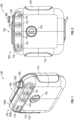
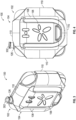
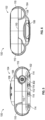
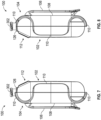
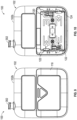
- Figures 1-8 illustrate multiple views of a pump system 100 having an outer housing 102 and a mounting component 104 according to some embodiments.
- the pump system 100 can include an outer housing 102 for containing or supporting components of the pump system 100.
- the outer housing 102 can be formed from one or more portions, such as a front portion 102a and a rear portion 102b as shown in Figure 1 , which can be removably attached to form the outer housing 102.
- the pump system 100 can optionally include a mounting component 104 which can be designed to allow the pump system 100 to be mounted on another object such as, but not limited to, a user's person.
- the mounting component 104 can include a clip 106 (as shown in Figures 3-8 ) designed to retain the mounting component 104 on a user's outerwear, such as on a user's pocket, a pouch, a belt, a flap, or otherwise.
- the clip 106 can be integrally formed with the base 108 of the mounting component 104 such that the clip 106 can provide a clamping force via resiliency of the material used to form the clip 106.
- the clip 106 can be a separate component from the base 108 and can include a biasing component, such as a coil spring, bent spring or the like, to provide a clamping force to retain the clip 106 on the user's person.
- the clamping force can be low enough that a user can open the housing from the clamped position, but strong enough so that it will remain clamped about the pocket, flap, or other material.
- the mounting component 104 can be removably attached to the outer housing 102 such that the pump system 100 can be used with or without the mounting component 104.
- Figures 1-8 illustrate the pump system 100 with the optional mounting component 104. This can beneficially give the user the option to reduce the overall form factor of the pump system 100 should the user decide to forego use of the optional mounting component 104. Moreover, this can advantageously allow a user to more easily replace one mounting component with another mounting component should the user decide to do so.
- the mounting component 104 can include one or more retention features, such as clasps 110 extending from the periphery of the base 108, to retain the mounting component 104 on portions of the outer housing 102.
- the mounting component 104 can be retained on the pump system 100 in a snap fit manner via use of the clasps 110.
- the retention features can be mechanical fasteners such as screws, nuts, bolts, snap-fit connectors, or the like.
- the outer housing 102 can include a display 112 which can be designed to provide a user with information (for example, information regarding an operational status of the pump system 100).
- the display 112 can include one or more indicators, such as icons 114, which can alert the user to one or more operating or failure conditions of the pump system 100.
- the indicators can include icons for alerting the user to normal or proper operating conditions, pump failure, power failure, the condition or voltage level of the batteries, the condition or capacity of a wound dressing, detection of a leak within the wound dressing or fluid flow pathway between the wound dressing and the pump assembly, suction blockage, or any other similar or suitable conditions or combinations thereof.
- An example set of icons 114 is illustrated in Figure 1 which, from left to right, can include an "OK" indicator which can indicate normal operation of the pump system 100, a “leak” indicator which can indicate the existence of a leak in the pump system 100 or components attached thereto, a "dressing full” indicator which can indicate that a wound dressing is at or near capacity, and a "battery critical” indicator which can indicate that the battery is at or near a critical level.
- the icons 114 can have a green or orange color, or can be illuminated with a green or orange light (for example, colored LEDs).
- one or more icons 114 can be printed directly on the display 112 of the outer housing 102.
- one or more of the icons 114 can be provided on a label attached to a portion of the outer housing 102.
- One or more of the icons 114 can be illuminated when the status corresponding to that icon exists in the system.
- one or more illumination components such as LEDs, can be positioned within the outer housing 102 to illuminate the icons 114.
- portions of the outer housing 102 proximate or underlying one or more of the icons 114 can be reduced in thickness to increase the translucency of the outer housing 102 proximate or underlying the icons 114.
- portions of the outer housing 102 proximate or underlying one or more of the icons 114 can be made from a transparent material.
- the display 112 of the outer housing 102 can comprise an illumination panel that is thinned or made of transparent or translucent material. Thinning portions of the outer housing 102 or making portions of the outer housing 102 from a transparent or translucent material can allow light from the illumination components to pass through the housing 102 and illuminate the icons 114.
- the potential for leakage around the icons 114 is eliminated or at least significantly reduced.
- the pump system 100 can include one or more user input features, such as button 116, designed to receive an input from the user for controlling the operation of the pump system 100.
- a single button is present which can be used to activate and deactivate the pump system 100 or control other operating parameters of the pump system 100.
- the button 116 can be used to activate the pump system 100, pause the pump system 100, clear indicators such as icons 114, or be used for any other suitable purpose for controlling an operation of the pump system 100 (for example, by sequentially pushing on the button 116).
- the button can be a push style button that can be positioned on an outside, front surface of the housing.
- multiple input features for example, multiple buttons
- the button 116 can be designed to eliminate or at least reduce the potential for leakage around the button 116.
- a peripheral portion of the button 116 can be placed in an interference fit with a surrounding lip of the outer housing 102.
- the entirety or portions of the button 116 can be formed of a deformable material capable of forming a relatively hermetic seal when abutted against a surface, such as rubber, silicon, or any other suitable material.
- the pump system 100 can include a connector 302 for connecting a tube or conduit to the pump system 100.
- the connector 302 can be used to connect the pump system 100 to a dressing 950.
- the wound dressing 950 can include a port 952 for receiving an end of the conduit 954.
- the port 952 can include a connector portion 953 for receiving the conduit 954.
- the conduit 954 can be connected directly to the connector 302 of the pump system 100.
- an intermediate conduit 956 can be used and attached to conduit 954 via a connector, such as a quick release connector 958, 960.
- the pump system can be configured to operate in a canisterless system, in which the wound dressing, such as wound dressing 950, retains exudate aspirated from the wound.
- a dressing can include a filter, such as a hydrophobic filter, that prevents passage of liquids downstream of the wound dressing (toward the pump system).
- the pump system can be configured to operate in a system having a canister for storing at least part of exudate aspirated from the wound.
- Such canister can include a filter, such as a hydrophobic filter, that prevents passage of liquids downstream of the wound dressing (toward the pump system).
- both the wound dressing and the canister can include filters that prevent passage of liquids downstream of the wound dressing and the canister.
- FIGS 9 and 10 illustrate rear elevation views of the pump system 100 without the optional mounting component 104 attached to the outer housing 102 according to some embodiments.
- the rear portion 102b of the outer housing 102 can include a removable cover 118 for placement over a cavity 120.
- the cavity 120 can include one or more recesses 122 designed to receive one or more power sources, such as batteries, for powering the device.
- an outer periphery 124 of the cavity 120 can include features which can cooperate with respective features of the cover 118 to reduce the likelihood that moisture will enter the cavity 120.
- the outer periphery 124 can include a rib along the bottom periphery, a side periphery, a top periphery, or a combination of one or more peripheries to reduce the likelihood of moisture ingress into the cavity 120.
- the outer periphery 124 can include a recess along the bottom periphery, a side periphery, a top periphery, or a combination of one or more peripheries to redirect moisture, such as water droplets, away from the cavity 120.
- Figures 11 and 12 illustrate perspective views of a pump system 100 with portions of the outer housing 102 removed to expose an embodiment of a circuit board 200, an intake manifold 300, and a source of negative pressure such as a pump assembly 400 according to some embodiments.
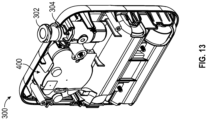
- Figure 13 illustrates a perspective view of an embodiment of pump system 100 with a front portion of the outer housing 102 removed as well as the circuit board 200 to expose the intake manifold 300 and pump assembly 400.
- the circuit board 200, the intake manifold 300, or the pump assembly 400 can be positioned within or supported by the outer housing 102.
- the control board 200 can be designed to control the function of the pump system 100 such as the pump assembly 400.
- the control board 200 can be designed to mechanically support and electrically connect various electrical/electronic components of the pump system 100.
- the control board 200 can connect one or more batteries 202 to the pump assembly 400 to provide power to operate the pump assembly 400.
- the control board 200 can include a pressure monitor 204.
- the pressure monitor 204 can be supported by the control board 200 and can be designed to monitor a level of pressure in a fluid flow passageway.
- the control board 200, in conjunction with the pressure monitor 204 can be designed to protect the pump assembly 400 from exceeding a predefined threshold pressure or can be designed to maintain a target pressure at the wound.
- the control board may be a printed circuit board assembly (PCBA), which can be a PCB having one or more electronic components electrically coupled to the PCB.
- PCBA printed circuit board assembly
- the circuit board 200 can be designed to cut power to the pump assembly 400 if the pressure reading reaches a predetermined value, and be designed to resume when the pressure level drops below the predetermined value or a second predetermined value that can be higher or lower than the first predetermined value. Additionally, the control board 200 can be programmed to prevent such over-pressurization.
- the control board 200 can include indicator lights, audible alarms, or a combination of such features.
- the control board 200 can include indicator lights in the form of one or more LEDs 206.
- the one or more LEDs 206 can be used to illuminate one or more icons 114 of the display 112 on the outer housing 102.
- each LED 206 can correspond to one or more icons 114.
- the control board 200 can have one or more features 208 (for example, pressure sensitive switch(es)) to receive an input from the control button 116.
- Figure 13 illustrates a front perspective view of a pump system 100 with a front portion of the outer housing 102 removed as well as the control board 200, to expose the intake manifold 300 and the pump assembly 400.
- the manifold 300 and the pump assembly 400 can be positioned within or supported by one or more portions of the outer housing 102.
- control board 200 can be a flexible circuit board or can have one or more flexible components.
- a flexible circuit board is generally a patterned arrangement of printed circuitry and components that utilizes flexible based material with or without flexible overlay. These flexible electronic assemblies can be fabricated using the same components used for rigid printed circuit boards, but allowing the board to conform to a desired shape (flex) during its application.
- flexible circuits are PCBs made of materials that allow for a non-planar positioning within the end product. Typical materials a polyimide-based, and can go under trade names such as Kapton (DuPont). Additionally, any of the control boards or controllers disclosed herein can have a combination of flexible and rigid substrates laminated into a single package.
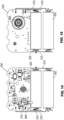
- Figures 14 and 15 are various views illustrating wiring of the pump system 100 within the outer housing 102 according to some embodiments.
- the pump system 100 can include terminals 210 for connecting the circuit board 200 to a power source, such as batteries 202.
- the circuit board 200 can route power from the power source to a coil via an electrical conduit 604 attached to a connector 212 of the circuit board 200.
- the electrical conduit 604 can be a flexible printed circuit (FPC) to facilitate assembly.
- the electrical conduit 604 can be connected directly to the coil.
- the ends of the FPC corresponding to a positive and negative terminal can be attached, such as via soldering or via adhesives, to ends or terminals of the coil.
- the coil can have two terminals that can be soldered to two corresponding solder pads of the FPC.
- the wire used to manufacture the coil can be protected by an insulation layer and a self-bonding coating layer that can make manual soldering difficult or unreliable since manual soldering can expose the FPC to temperatures of 400 degrees Celsius for too long a time, which can damage the FPC substrate.
- a micro welding process can be used to electrically connect the FPC to the two terminals of the coil. In micro welding, a high current spike can be generated for a few milliseconds between the terminals of the coil and the pads of the FPC.
- the current spike can result in a localized temperature spike that can vaporize the insulating and self-bonding layers of the wire so that the wire of the coil can be bonded to the pads of the FPC.
- the temperature spike can be 400 degrees Celsius or higher.
- the temperature spike is limited to a few milliseconds using the micro welding process, the FPC substrate is not damaged.
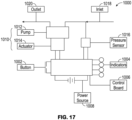
- Figure 17 illustrates a schematic of a pump system 1000 according to some embodiments.
- the pump system 1000 can have any of the same or similar components, features, materials, sizes, configurations, and other details of any other pump system embodiments disclosed or incorporated by reference herein, including the embodiment of the pump system 100 described above.
- the pump system 1000 can be miniaturized and portable, although larger conventional portable or non-portable (for example, wall suction) pumps can also be used.
- the pump system 1000 can include a switch or a button 1002, one or more indicators 1004, and a control board 1006.
- the button 1002 or the one or more indicators 1004 can be in electrical communication with the control board 1006.
- the button 1002 can be used for any suitable purpose for controlling an operation of the pump system 1000.
- button 1002 can be used to activate the pump system 1000, pause the pump system 1000, clear system indicators 1004, or be used for any other suitable purpose for controlling an operation of the pump system 1000.
- Button 1002 can by any type of switch or button, such as a touchpad, touch screen, keyboard, and so on.
- the button 1002 can be a press button.
- the button 1002 can be similar to button 116 of pump system 100.
- the one or more indicators 1004 can indicate one or more operating or failure conditions of the pump system 1000. In some embodiments, each of the one or more indicators 1004 can provide an indication regarding a different operating or failure condition.
- an active (for example, lit) indicator 1004 can represent normal operation.
- Another indicator 1004, for example a dressing indicator can provide an indication as to presence of leaks in the system.
- an active (for example, lit) dressing indicator can represent a leak.
- Another indicator 1004, for example a dressing capacity indicator can provide an indication as to the remaining fluid capacity of a wound dressing.
- an active (for example, lit) dressing capacity indicator can represent that the wound dressing is at or nearing capacity.
- Another indicator 1004 can provide an indication as to remaining capacity or life of a power source, such as batteries.
- a power source such as batteries.
- an active (for example, lit) battery indicator can represent a low capacity.
- an indicator 1004 can represent a combination of the above operating or failure conditions of the pump system 1000 or other operating or failure conditions.
- the one or more indicators 1004 can be icons.
- the one or more indicators 1004 can be similar to the icons 114 of pump system 1004 and can be activated (for example, lit) via an illumination source such as LEDs 206 of pump system 100.
- the one or more indicators 1004 can be of a different color, two different colors (for example, two indicators can share the same color), or the same color.
- the pump system 1000 can include four icons and a push play/pause button, other configurations, locations, and types of indicators, alarms, and switches can alternatively be used.
- the pump system 1000 can include visual, audible, tactile, and other types of indicators or alarms configured to signal to the user various operating conditions. Such conditions include system on/off, standby, pause, normal operation, dressing problem, leak, error, and the like.
- the indicators can include speakers, displays, light sources, etc., or combinations thereof.
- the pump system 1000 can be powered by a power source 1008 such as a battery power cell.
- the pump system 1000 can also include a source of negative pressure 1010, such as a pump assembly having a pump 1012 powered by an electric motor 1014, and a pressure sensor 1016, such as pressure monitor 204 of pump system 100.
- the pump system 1000 can include an inlet 1018 to connect the pump system 1000 to a wound dressing.
- the inlet 1018 can be a connector for connecting the inlet 1018 to a conduit which is in fluid communication with a wound dressing.
- the connector can be similar to connector 302 of pump system 100.
- the pump 1012 can be connected to an outlet 1020.
- the outlet 1020 can vent air to the atmosphere.
- a filter (not shown) can be interposed between the outlet and the atmosphere. The filter can provide filtration of the air prior to venting to the atmosphere.
- the filter can be a bacterial filter, odor filter, etc. or any combination thereof.
- a dampening component (not shown), such as a noise dampening component, can be interposed between the outlet and the atmosphere. The dampening component can reduce the noise generated by the pump system 1000 during operation. In some embodiments, the dampening component can be similar to dampening component 902 of pump system 100.
- the pump system 1000 can include a valve (not shown), such as a one-way valve, in a flow passage between the wound dressing and an inlet of the pump 1012.
- the valve can help maintain a level of negative pressure when the pump 1012 is not active.
- the valve can help avoid leaks.
- the valve can also help prevent fluids or exudate aspirated or removed from the wound from entering the pump system 1000.
- Figure 18 illustrates an electrical component schematic of a pump system 1100 according to some embodiments.
- the pump system 1100 can have any of the same or similar components, features, materials, sizes, configurations, and other details of any other pump system embodiments disclosed or incorporated by reference herein, including the embodiment of the pump system 100, 1000 described above.
- Pump system 1100 can include one or more buttons 1102, one or more indicators 1104, one or more pressure sensors 1106, power source 1108, a source of negative pressure 1109, or a module 1110.
- the one or more buttons 1102, one or more indicators 1104, one or more pressure sensors 1106, power source 1108, or source of negative pressure 1109 can be similar to button 1002, indicators 1004, pressure sensor 1016, power source 1008, or source of negative pressure 1010 of pump system 1000.
- Module 1110 which can be a control board (for example, PCBA), can include an input/output (I/O) module 1112, controller 1114, and memory 1116.
- module 1110 can include additional electric/electronic components, for example, fuse or fuses, or external memory (such as flash-memory).
- the controller 1114 can be a microcontroller, processor, microprocessor, etc. or any combination thereof.
- the controller 1114 can be of the STM8L MCU family type from ST Microelectronics, such as STM8L 151 G4U6 or STM8L 151K6U6TR, or of MC9S08QE4/8 series type from Freescale, such as MC9S08QE4CWJ.
- the controller 1114 is a low power or ultra low power device, but other types of devices can alternatively be used.
- Memory 1116 can include one or more of volatile or nonvolatile memory modules, such as one or more of read-only memory (ROM), write once read many memory (WORM), random access memory (for example., SRAM,. DRAM. SDRAM, DDR, etc.), solid-state memory, flash memory, Magnetoresistive random-access memory (MRAM), magnetic storage, etc. or any combination thereof.
- ROM read-only memory
- WORM write once read many memory
- MRAM Magnetoresistive random-access memory
- Memory 1116 can be configured to store program code or instructions (executed by the controller), system parameters, operational data, user data, etc. or any combination thereof.
- one or more components of the pump system 1100 can form part of a monolithic unit.
- the memory 1116 can be 16 megabits, 32 megabits, or of another suitable size depending on the amount of data configured to be logged during operation of the pump system 1100.
- the logged data can be stored to advantageously gather information that is relevant to clinical trial(s).
- one or more components of the pump system 1100 can be removable from other components.
- memory 1116 can be removable flash memory.
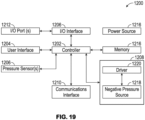
- Figure 19 illustrates an electrical component schematic of a pump system 1200 according to some embodiments.
- the pump system 1200 can have any of the same or similar components, features, materials, sizes, configurations, and other details of any other pump system embodiments disclosed or incorporated by reference herein, including the embodiments of the pump systems 100, 1000, 1100.
- Electrical components can operate to accept user input, provide output to the user, operate the pump system and the source of negative pressure, provide network connectivity, and so on. Electrical components can be mounted on one or more PCBs (not shown).
- the pump system can include a controller or processor 1202.
- the controller 1202 can be a general purpose processor, such as a low-power processor. In other embodiments, the controller 1202 can be an application specific processor.
- the controller 1202 can be configured as a "central" processor in the electronic architecture of the pump system, and the controller 1202 can coordinate the activity of other controllers, such as a user interface controller 1204, I/O interface controller 1206, negative pressure control module 1208, communications interface controller 1210, and the like.
- the pump system 1200 can also include a user interface controller or processor 1204 which can operate one or more components for accepting user input and providing output to the user, such as buttons, indicators (for example, LEDs), displays, etc.
- a user interface controller or processor 1204 which can operate one or more components for accepting user input and providing output to the user, such as buttons, indicators (for example, LEDs), displays, etc.
- Input to the pump system 1200 and output from the pump system 1200 can be controlled via one or more input/output (I/O) ports 1212 controlled by a I/O interface module or controller 1206.
- the I/O module 1206 can receive data from one or more I/O ports 1212, such as serial, parallel, hybrid ports, expansion ports, and the like.
- I/O ports 1212 include one or more of USB ports, SD ports, Compact Disc (CD) drives, DVD drives, FireWire ports, Thunderbolt ports, PCI Express ports, and the like.
- the controller 1202 along with other controller or processors, can store data in one or more memory modules 1214, which can be internal or external to the system 1200. Any suitable type of memory can be used, including volatile or non-volatile memory, such as RAM, ROM, WORM, magnetic memory, solid-state memory, MRAM, and the like or any combination thereof.
- the pump system 1200 can be powered by a power source 1216, which can comprise one or more disposable or rechargeable batteries, power from mains, etc.
- the power source 1216 can be internal or external to the system 1200.
- a negative pressure or pump control module 1208 can be configured to control the operation of a negative pressure source 1218.
- the negative pressure source 1218 can be a voice coil pump.
- Other suitable pumps include diaphragm pumps, peristaltic pumps, rotary pumps, rotary vane pumps, scroll pumps, screw pumps, liquid ring pumps, pumps operated by a piezoelectric transducer, and the like.
- the pump control module 1208 can include a driver module 1220 configured to control the operation of the negative pressure source 1218.
- the driver module 1220 can provide power to the negative pressure source 1218. Power can be provided in a form of a voltage or current signal.
- the driver module 1220 can control the negative pressure source 1218 using pulse-width modulation (PWM).
- PWM pulse-width modulation
- a control signal for driving the negative pressure source 1218 (or pump drive signal) can be a 0-100% duty cycle PWM signal.
- the drive module 1220 can control the negative pressure source 1218 using any other suitable control, such as proportional-integral-derivative (PID).
- PID proportional-integral-derivative
- the controller 1202 can receive information from one or more sensors, such as pressure sensors 1206, placed in a suitable location in a fluid flow path, such as pressure monitor 204 placed within intake manifold 300 of pump system 100.
- the controller 1202 can measure pressure in the fluid flow path, using data received from one or more pressure sensors 1206, calculate the rate of fluid flow, and control the negative pressure source 1218 so that desired level of negative pressure is achieved in a wound cavity or under the wound dressing.
- the desired level of negative pressure can be pressure set or selected by a user.
- Pressure measured by the one or more sensors can be provided to the controller 1202 so that the controller can determine and adjust the pump drive signal to achieve the desired negative pressure level.
- the tasks associated with controlling the negative pressure source 1218 can be offloaded to the pump control module 1208, which can include one or more controllers or processors.
- a first processor can be responsible for user activity and a second processor can be responsible for controlling the negative pressure source. This way, the activity of controlling the negative pressure source, which may necessitate a higher level of responsiveness, can be offloaded to a dedicated processor and, thereby, will not be interrupted by user interface tasks, which may take longer to complete because of interactions with the user.
- a communications interface controller or processor 1210 can be configured to provide wired or wireless connectivity.
- the communications processor 1210 can utilize one or more antennas (not shown) for sending and receiving data.
- the communications processor 1210 can provide one or more of the following types of connections: Global Positioning System (GPS) technology, cellular or other connectivity, such as 2G, 3G, LTE, 4G, WiFi, Internet connectivity, Bluetooth, zigbee, RFID, and the like.
- GPS Global Positioning System
- cellular or other connectivity such as 2G, 3G, LTE, 4G, WiFi, Internet connectivity, Bluetooth, zigbee, RFID, and the like.
- any embodiments disclosed herein can be configured to synchronize, upload, or download data to or from the pump apparatus to or from a portable data device, such as a tablet, smart phone, or other similar devices.
- Connectivity can be used for various activities, such as pump system location tracking, asset tracking, compliance monitoring, remote selection, uploading of logs, alarms, and other operational data, and adjustment of therapy settings, upgrading of software or firmware, and the like.
- the communications processor 1210 can provide dual GPS/cellular functionality. Cellular functionality can, for example, be 3G or 4G functionality. In such cases, if the GPS module is not be able to establish satellite connection due to various factors including atmospheric conditions, building or terrain interference, satellite geometry, and so on, the device location can be determined using the 3G or 4G network connection, such as by using cell identification, triangulation, forward link timing, and the like.
- the pump system 1200 can include a SIM card, and SIM-based positional information can be obtained.
- the electronics of a pump system can be constructed and positioned to improve the tolerance of the pump system to environmental conditions.
- the pump system desirably can operate electrically or mechanically properly or safely in various non-controlled environments like home healthcare, airborne, automobile, boats, train, metal detectors, active implantable device, and the like.
- the pump system can be configured to withstand high levels of ESD and in multiples steps, such as contact: ⁇ 2 kV, ⁇ 4 kV, ⁇ 6 kV, ⁇ 8 kV or higher, and air: ⁇ 2 kV, ⁇ 4 kV, ⁇ 6 kV, ⁇ 8 kV ⁇ 15 kV, ⁇ 30 kV or higher.
- the pump system can additionally or alternatively be configured to have high levels of magnetic immunity like with respect to 100 A/m, 150 A/m, 200 A/m, 400 A/m or higher, as well as high levels of RF immunity like with respect to 10 V/m, 20 V / m and higher. Additionally or alternatively, the pump system can withstand high levels of mechanical strain (for example, shock, vibration, drop, or the like) and high altitude environments (for example, airborne mechanical).
- mechanical strain for example, shock, vibration, drop, or the like
- high altitude environments for example, airborne mechanical
- the pump system can, in some implementations, be defibrillation-proof (for instance, defibrillation-proof as an entire applied part), such as is defined under the IEC 60601-1 standard, another standard, or other industry-accepted criteria.
- the pump system can, for example, continue normal operation when monophasic or biphasic defibrillation shock is applied. The pump system may not change its performance or present false alarms under such conditions.
- Such a defibrillation-proof construction can be desirable because the pump system can then survive an external defibrillation shock in case a patient using the pump system goes into cardiac arrest.
- the pump system can be defibrillator-proof while retaining usability (for example, not having a metal case, which may for instance, add too much weight to the device).
- One or more of the features described herein can enable the pump system to withstand high levels of ESD, have magnetic immunity or RF immunity, withstand high levels of mechanical strain, withstand high altitude environment, or be defibrillation-proof.
- the pump system can include one or more PCBAs, which may each include a PCB that mechanically supports and electrically connects electronic components. Components, such as capacitors, resistors, or active devices, can be soldered on PCBs or embedded in substrate.
- PCBAs can be single-sided (one copper layer), double-sided (two copper layers) or multi-layer (outer and inner layers). Conductors on different layers are connected with vias. Multi-layer PCBAs allow for much higher component density.
- the pump system can include a PCBA having one or two layers.
- the pump system can include a PCBA having three or more layers, such as six layers.
- the pump system can be constructed to electrically isolate certain internal device components and provide electromagnetic interference shielding (EMI) shielding and other forms of electrical isolation.
- EMI electromagnetic interference shielding
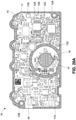
- Figure 20A illustrates an example front of a PCBA 10 usable as part of a pump system, like one of the pump systems 100, 1000, 1100, or 1200.
- the PCBA 10 can, for instance, be an implementation of the circuit board 200.
- the PCBA 10 can differ from the circuit board 200 at least in that the PCBA 10 can include a conductive pathway 11, vias 12A, 12B, and 12C, portions 13A, 13B, and 13C, a conductive pathway 21, and vias 22A, 22B, and 22C.
- the conductive pathway 11 can extend around all or part (for instance, 20%, 25%, 30%, 35%, 40%, 45%, 50%, 55%, 60%, 65%, 70%, 75%, 80%, 85%, 90%, or 95% of a length) of a perimeter or an edge of at least one side of the PCBA 10, is connected to ground of the pump system (for instance, to a negative voltage of a power supply), and serves to protect the PCBA 10 when the PCBA 10 is exposed to ESD by providing a discharge path.
- the conductive pathway 11 can include multiple vias, including the vias 12A, 12B, and 12C.
- the vias of the conductive pathway 11 can be pathways through the PCBA 10 that electrically link the conductive pathway 11 to a surface on an opposite side of the PCBA 10 through the layers of the PCBA 10.
- the vias of the conductive pathway 11 can be manufactured by drilling through the PCBA 10 and coating the inside of the drilled hole with a column of conductive material.
- the vias of the conductive pathway 11 can be spaced apart from one another between around 1 mm to 10 mm, such as around 2.5 mm, but can be spaced apart a lesser or greater spacing in some implementations.
- the conductive pathway 11 can include the portions 13A and 13B that follow a path around holes in the PCBA 10 usable for inserting fasteners to secure the PCBA 10 to another component, such as a housing of the pump assembly.
- the conductive pathway 11 can include the portion 13C that follows a contact path 14 around an interface element, such as a button (for example, which can be an elastomer) responsive to user inputs, on the PCBA 10.
- the fasteners or the interface element can be nominally insulating, but at high voltages can become conductive. If an electrical discharge is applied through the fasteners or the interface element, then the electrical discharge can be desirably grounded to the portions 13A, 13B, and 13C.
- the conductive pathway 11 can be separated from one or more components mounted to the PCBA 10 or conductive elements by insulating portions 15 and 16.
- the conductive pathway 11 may not extend around some holes in the PCBA 10, such as holes 17A and 17B that may be used for guiding the PCBA 10 into place rather than securing the PCBA 10 or usable for inserting fasteners that have relatively high breakdown voltages.
- the conductive pathway 11 can extend around the perimeter of the front of the PCBA 10 other than at an area 18 of the insulating portion 15, which may be near where a positive voltage of a power supply provides power to the PCBA 10.
- every layer of the PCBA 10 may be electrically grounded.
- Figure 20B illustrates an example back of the PCBA 10 with the conductive pathway 21 that includes multiple vias, such as the vias 22A, 22B, and 22C.
- the structure of the conductive pathway 21 and its vias can be similar to the structure of the conductive pathway 11 and its vias.
- the conductive pathway 21 can, moreover, be electrically connected to the conductive pathway 11 through the vias of the conductive pathways 11 and 21.
- the conductive pathway 21 can be separated from one or more components mounted to the PCBA 10 or conductive elements by an insulating portion 23.
- the conductive pathway 21 can extend around the perimeter of the back of the PCBA 10 other than at an area 24 of the insulating portion 23, which may be near where a positive voltage of a power supply provides power to the PCBA 10.
- the PCBA 10 may have a conductive pathway on one side of the PCBA 10 but not on the opposite side.
- Figure 21A illustrates example art film of a first layer 30A of the PCBA 10.
- the first layer 30A can be a top layer of the PCBA 10.
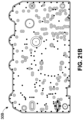
- Figure 21B illustrates example art film of a second layer 30B of the PCBA 10.
- Figure 21C illustrates example art film of a third layer 30C of the PCBA 10.
- Figure 21D illustrates example art film of a fourth layer 30D of the PCBA 10.
- the fourth layer 30D can be a bottom layer of the PCBA 10.
- Figure 22A illustrates an example solder mask for a top side 40A of the PCBA
- Figure 22B illustrates an example solder mask for a bottom side 40B of the PCBA 10.
- the first layer 30A, the second layer 30B, the third layer 30C, the fourth layer 30D, the top side 40A, and the bottom side 40B may better illustrate certain features of the PCBA 10, including the multiple vias.
- the PCBA 10 can, for instance, have dimensions of around 57 mm by around 32 mm.
- the first layer 30A, the second layer 30B, the third layer 30C, and the fourth layer 30D can at least partly be composed of copper in some implementations.
- Figure 23 illustrates example art film of a top side assembly 50 of the PCBA 10.
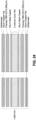
- Figure 24 illustrates example layer constructions of the PCBA 10.
- the example layers construction can include the following features:
- the minimum conductor thickness outer layers after processing can be around 0.0334 mm.
- the minimum conductor thickness inner layers after processing can be around 0.0249.
- the finished board thickness overall can be around 1 mm.
- the solder resist thickness can be around 0.01 mm.
- the insulation coating can have a breakdown voltage of around 500 VDC.
- the solder resist type can be LPI on one or both sides.
- the surface finishing can be ENIG (Electroless Ni/Au [Ni 2,54um MIN-Au 0,05um MIN]).
- the logic track can be around 0.15 mm.
- the minimum insulation can be around 0.15 mm.
- the vias can be around 0.2 mm or 0.6 mm in diameter and plated.
- the PCBA 10 can include around 245 vias.
- the logic track tolerance can be around 0.0254 mm or 0.04 mm.
- the via tolerance can be around 0.076 mm.
- the plated hole tolerance can be around 0.076 mm.
- the non-plated hole tolerance can be around 0.05 mm.
- the plated slot tolerance can be around 0.127 mm.
- the non-plated slot tolerance can be around 0.1 mm.
- the pump system can include a PCBA, such as the PCBA 10, that has a track (for example, a grounding track) around a perimeter of a contact for a button.
- the button can be partly or entirely an elastomer.
- the button while potentially being a partial isolator, may present an air gap via which a current may be conducted under certain circumstances.
- the track can be used to short an electrical discharge through the button and thus increase immunity of the pump system to electrical discharges.
- the pump system can include a software input-output bus that is configured to be cognizant, including with respect to analog inputs.
- the pump system can include an EMI shield on top of one or more components such as a microcontroller or memory.
- the pump system can include one or more nylon screws rather than metal screens to provide additional ESD protection for the pump system.
- a nylon screw can, for example, be used under a filter of the pump system.
- the pump system can include one or more internal gaskets to provide additional ESD protection for the pump system.
- the pump system may also include no exposed metal or a minimal amount of exposed metal by covering metal parts, which may help prevent arcing. For instance, a plug for a charging cable can be electrically isolated from other components of the pump system and ears for connecting a clamp the pump system can be electrically isolated from other components of the pump system.
- the pump system can include a capacitor electrically coupled to one or more individual connectors (for example, a USB connector or an antenna connector) and an ESD clamp.
- the pump system can include conformal coating, relatively short cable assemblies, relatively short layout traces, or encapsulate specific layout traces between planes.
- the pump system can also include planes and traces from a perimeter of a PCB, such as the PCBA 10, or grounded metal shielding.
- the pump system can include no gap or change of material which could be an electrical channel to a PCBA, such as the PCBA 10, at energy and current levels experienced under defibrillation conditions.
- a PCBA such as the PCBA 10
- One or more light-emitting diodes (LEDs) of the pump system can be behind a solid, unbroken, translucent, front cover rather than having a light-pipe, lens, or other means to transmit the light.
- the pump system may not protect against overvacuum in the event of an electrical short because the pump system may have alternative capabilities to handle the electrical short.
- the pump system can include electrical isolation to isolate water, urine, or blood ingress from short circuiting the pump system.
- the pump system can, in some instances, use a tuned receiver for communication and perform shorting and capacitor protection of the receiver. Interference outside of a frequency of interest can be shorted to ground.
- the pump system may still have some vulnerability at the frequency of interest, but the vulnerability may notably be acceptable if the frequency is different from the spectrum of interference.
- Pump system to protect against electrical discharge can desirably further protect the pump system from damage or malfunction or protect a patient or clinician from being shocked.
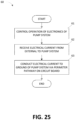
- Fig. 25 illustrates a method 60 for protecting a pump system from electrical discharge according to some embodiments.
- the method 60 can be performed by a pump system, such as the pump systems 100, 1000, 1100, or 1200, that includes a circuit board, such as the PCBA 10.
- a pump system such as the pump systems 100, 1000, 1100, or 1200
- a circuit board such as the PCBA 10.
- the method 60 is explained in the context of the pump systems described herein, but may instead be implemented in other systems not shown.
- the method 60 can advantageously, in certain embodiments, enable a pump system to be protected from electrical discharge that would traditionally have damaged the pump system.
- the method 60 can control operation of electronics of the pump system.
- one or more controllers of the pump system like the controllers 1114 and 1202 or other components of the pump system control the electronics to perform various functions, such as activating or deactivating supply of negative pressure, detecting operating conditions such as leaks or blockages when supplying negative pressure, alarming based on operating conditions, or transmitting or receiving data from other electronics devices or users.
- the one or more controllers or other components can be mounted on a circuit board (such as, the PCBA 10) that has a conductive pathway (such, the conductive pathway 11 or 21) electrically coupled to an electrical ground for the circuit board.
- the circuit board can be positioned inside a housing of the pump system.
- the method 60 can receive an electrical current from external to the pump system.
- the pump system can receive an electrical discharge from external to the housing of the pump system, such as via a user interface (such as, a button) or a fastener (such as, a screw) used to stabilize the structure of the housing.
- a user interface such as, a button
- a fastener such as, a screw
- the method 60 can conduct the electrical current to ground of the pump system via a perimeter pathway on the circuit board.
- the perimeter pathway can be a conductive pathway that extends around all or part (for instance, 20%, 25%, 30%, 35%, 40%, 45%, 50%, 55%, 60%, 65%, 70%, 75%, 80%, 85%, 90%, or 95% of a length) of a perimeter of a side of the circuit board or a perimeter of one or more elements on or holes in the circuit board.
- the perimeter pathway can include the conductive pathway 11 or 12 or the portions 13A, 13B, and 13C. The perimeter pathway can desirably thus be used to dissipate the electrical current without damaging the one or more controllers or other components can be mounted on the circuit board.
- any value of a threshold, limit, duration, etc. provided herein is not intended to be absolute and, thereby, can be approximate.
- any threshold, limit, duration, etc. provided herein can be fixed or varied either automatically or by a user.
- relative terminology such as exceeds, greater than, less than, etc. in relation to a reference value is intended to also encompass being equal to the reference value. For example, exceeding a reference value that is positive can encompass being equal to or greater than the reference value.
- relative terminology such as exceeds, greater than, less than, etc. in relation to a reference value is intended to also encompass an inverse of the disclosed relationship, such as below, less than, greater than, etc. in relations to the reference value.
- blocks of the various processes may be described in terms of determining whether a value meets or does not meet a particular threshold, the blocks can be similarly understood, for example, in terms of a value (i) being below or above a threshold or (ii) satisfying or not satisfying a threshold.
- the various components illustrated in the figures may be implemented as software or firmware on a processor, controller, ASIC, FPGA, or dedicated hardware.
- Hardware components such as processors, ASICs, FPGAs, and the like, can include logic circuitry.
- User interface screens illustrated and described herein can include additional or alternative components. These components can include menus, lists, buttons, text boxes, labels, radio buttons, scroll bars, sliders, checkboxes, combo boxes, status bars, dialog boxes, windows, and the like. User interface screens can include additional or alternative information. Components can be arranged, grouped, displayed in any suitable order.
- the term "or” is used in its inclusive sense (and not in its exclusive sense) so that when used, for example, to connect a list of elements, the term “or” means one, some, or all of the elements in the list.
- the term “each,” as used herein, in addition to having its ordinary meaning, can mean any subset of a set of elements to which the term “each” is applied.
- the terms “generally parallel” and “substantially parallel” refer to a value, amount, or characteristic that departs from exactly parallel by less than or equal to 15 degrees, 10 degrees, 5 degrees, 3 degrees, 1 degree, or 0.1 degree.
Landscapes
- Health & Medical Sciences (AREA)
- Heart & Thoracic Surgery (AREA)
- Engineering & Computer Science (AREA)
- Animal Behavior & Ethology (AREA)
- Public Health (AREA)
- Biomedical Technology (AREA)
- Hematology (AREA)
- Life Sciences & Earth Sciences (AREA)
- Vascular Medicine (AREA)
- General Health & Medical Sciences (AREA)
- Anesthesiology (AREA)
- Veterinary Medicine (AREA)
- Microelectronics & Electronic Packaging (AREA)
- Surgery (AREA)
- External Artificial Organs (AREA)
- Media Introduction/Drainage Providing Device (AREA)
- Structure Of Printed Boards (AREA)
- Elimination Of Static Electricity (AREA)
Applications Claiming Priority (3)
| Application Number | Priority Date | Filing Date | Title |
|---|---|---|---|
| US201662401727P | 2016-09-29 | 2016-09-29 | |
| US201762469718P | 2017-03-10 | 2017-03-10 | |
| PCT/US2017/053562 WO2018064079A1 (en) | 2016-09-29 | 2017-09-26 | Protection of electronics in negative pressure wound therapy systems |
Publications (2)
| Publication Number | Publication Date |
|---|---|
| EP3519003A1 EP3519003A1 (en) | 2019-08-07 |
| EP3519003B1 true EP3519003B1 (en) | 2025-03-19 |
Family
ID=60043345
Family Applications (1)
| Application Number | Title | Priority Date | Filing Date |
|---|---|---|---|
| EP17781296.3A Active EP3519003B1 (en) | 2016-09-29 | 2017-09-26 | Protection of electronics in negative pressure wound therapy systems |
Country Status (8)
| Country | Link |
|---|---|
| US (4) | US11511021B2 (enExample) |
| EP (1) | EP3519003B1 (enExample) |
| JP (1) | JP7167008B2 (enExample) |
| CN (1) | CN109715228A (enExample) |
| AU (1) | AU2017335637B2 (enExample) |
| CA (1) | CA3038282A1 (enExample) |
| WO (1) | WO2018064079A1 (enExample) |
| ZA (1) | ZA201901594B (enExample) |
Families Citing this family (47)
| Publication number | Priority date | Publication date | Assignee | Title |
|---|---|---|---|---|
| CA3023772A1 (en) | 2016-05-13 | 2017-11-16 | Smith & Nephew Plc | Sensor enabled wound monitoring and therapy apparatus |
| US12263294B2 (en) | 2016-09-28 | 2025-04-01 | T.J.Smith And Nephew, Limited | Systems and methods for operating negative pressure wound therapy devices |
| US11511021B2 (en) | 2016-09-29 | 2022-11-29 | Smith & Nephew Plc | Protection of electronics in negative pressure wound therapy systems |
| EP3592230A1 (en) | 2017-03-09 | 2020-01-15 | Smith & Nephew PLC | Apparatus and method for imaging blood in a target region of tissue |
| EP3592219B1 (en) | 2017-03-09 | 2023-05-10 | Smith & Nephew plc | Device and apparatus of determining skin perfusion pressure |
| US11690570B2 (en) | 2017-03-09 | 2023-07-04 | Smith & Nephew Plc | Wound dressing, patch member and method of sensing one or more wound parameters |
| JP7235673B2 (ja) | 2017-04-11 | 2023-03-08 | スミス アンド ネフュー ピーエルシー | センサ対応型創傷被覆材のための構成要素配置および応力緩和 |
| JP7272962B2 (ja) | 2017-05-15 | 2023-05-12 | スミス アンド ネフュー ピーエルシー | 創傷分析装置 |
| US12033738B2 (en) | 2017-05-15 | 2024-07-09 | Smith & Nephew Plc | Negative pressure wound therapy system using eulerian video magnification |
| EP3641627B1 (en) | 2017-06-23 | 2023-05-31 | Smith & Nephew PLC | Positioning of sensors for sensor enabled wound monitoring or therapy |
| GB201809007D0 (en) | 2018-06-01 | 2018-07-18 | Smith & Nephew | Restriction of sensor-monitored region for sensor-enabled wound dressings |
| GB201804502D0 (en) | 2018-03-21 | 2018-05-02 | Smith & Nephew | Biocompatible encapsulation and component stress relief for sensor enabled negative pressure wound therapy dressings |
| US11925735B2 (en) | 2017-08-10 | 2024-03-12 | Smith & Nephew Plc | Positioning of sensors for sensor enabled wound monitoring or therapy |
| GB201804971D0 (en) | 2018-03-28 | 2018-05-09 | Smith & Nephew | Electrostatic discharge protection for sensors in wound therapy |
| US11759144B2 (en) | 2017-09-10 | 2023-09-19 | Smith & Nephew Plc | Systems and methods for inspection of encapsulation and components in sensor equipped wound dressings |
| GB201718870D0 (en) | 2017-11-15 | 2017-12-27 | Smith & Nephew Inc | Sensor enabled wound therapy dressings and systems |
| GB201718859D0 (en) | 2017-11-15 | 2017-12-27 | Smith & Nephew | Sensor positioning for sensor enabled wound therapy dressings and systems |
| EP3687380A1 (en) | 2017-09-27 | 2020-08-05 | Smith & Nephew plc | Ph sensing for sensor enabled negative pressure wound monitoring and therapy apparatuses |
| EP3687396B1 (en) | 2017-09-28 | 2025-08-20 | Smith & Nephew plc | Neurostimulation and monitoring using sensor enabled wound monitoring and therapy apparatus |
| EP3709943B1 (en) | 2017-11-15 | 2024-07-24 | Smith & Nephew PLC | Integrated sensor enabled wound monitoring and/or therapy dressings and systems |
| US12161792B2 (en) | 2017-11-16 | 2024-12-10 | Convatec Limited | Fluid collection apparatus |
| US10624794B2 (en) | 2018-02-12 | 2020-04-21 | Healyx Labs, Inc. | Negative pressure wound therapy systems, devices, and methods |
| GB201814011D0 (en) | 2018-08-29 | 2018-10-10 | Smith & Nephew | Componet positioning and encapsulation for sensor enabled wound dressings |
| GB2592508B (en) | 2018-09-12 | 2022-08-31 | Smith & Nephew | Device, apparatus and method of determining skin perfusion pressure |
| EP3856104B1 (en) | 2018-09-28 | 2025-08-06 | T.J.Smith And Nephew, Limited | Optical fibers for optically sensing through wound dressings |
| GB201816838D0 (en) | 2018-10-16 | 2018-11-28 | Smith & Nephew | Systems and method for applying biocompatible encapsulation to sensor enabled wound monitoring and therapy dressings |
| GB201820927D0 (en) | 2018-12-21 | 2019-02-06 | Smith & Nephew | Wound therapy systems and methods with supercapacitors |
| JP7528097B2 (ja) | 2019-01-30 | 2024-08-05 | スミス アンド ネフュー ピーエルシー | センサ一体型被覆材及びシステム |
| WO2020187851A1 (en) | 2019-03-18 | 2020-09-24 | Smith & Nephew Plc | Design rules for sensor integrated substrates |
| US12478279B2 (en) | 2019-03-19 | 2025-11-25 | Smith & Nephew Plc | Systems and methods for measuring tissue impedance |
| GB201904686D0 (en) * | 2019-04-03 | 2019-05-15 | Smith & Nephew | Data recorder in wound therapy systems |
| GB201914427D0 (en) | 2019-10-07 | 2019-11-20 | Smith & Nephew | Negative pressure wound therapy systems and methods with multiple negative pressure sources |
| GB201914443D0 (en) | 2019-10-07 | 2019-11-20 | Smith & Nephew | Sensor enabled negative pressure wound monitoring apparatus with different impedances inks |
| GB201918593D0 (en) * | 2019-12-17 | 2020-01-29 | Smith & Nephew | Systems and methods for operating a wound therapy device in stealth mode |
| GB202001212D0 (en) | 2020-01-29 | 2020-03-11 | Smith & Nephew | Systems and methods for measuring and tracking wound volume |
| EP4139904A1 (en) | 2020-04-21 | 2023-03-01 | T.J. Smith and Nephew, Limited | Wound treatment management using augmented reality overlay |
| GB202005928D0 (en) | 2020-04-23 | 2020-06-10 | Smith & Nephew | Dual mode negative pressure source operation for provision of negative pressure wound therapy |
| GB202007391D0 (en) | 2020-05-19 | 2020-07-01 | Smith & Nephew | Patient protection from unsafe electric current in sensor integrated dressings and systems |
| GB202015790D0 (en) | 2020-10-06 | 2020-11-18 | Smith & Nephew | Control circuitry for negative pressure wound treatment apparatuses |
| JP7577312B2 (ja) * | 2020-12-08 | 2024-11-05 | 株式会社川本製作所 | 遠距離無線通信開通システム |
| CN113966163A (zh) * | 2021-06-11 | 2022-01-21 | 天津市顺博医疗设备有限公司 | 一种医疗器械主机电磁兼容结构设计方法 |
| US12464608B2 (en) * | 2021-12-06 | 2025-11-04 | Whirlpool Corporation | Combined inductor shielding system |
| USD1084288S1 (en) * | 2021-12-15 | 2025-07-15 | International Medical Research Pty Ldt | Wound drainage collection vessel |
| USD1077201S1 (en) * | 2021-12-15 | 2025-05-27 | International Medical Research Pty Ltd | Wound drainage device |
| US20250032697A1 (en) | 2021-12-21 | 2025-01-30 | T.J.Smith And Nephew,Limited | Systems and methods for controlling pressure delivery by negative pressure wound therapy devices |
| US20250058036A1 (en) | 2022-01-14 | 2025-02-20 | T.J.Smith And Nephew,Limited | Self-calibration with dynamic therapy performance for negative pressure wound therapy devices |
| WO2025195973A1 (en) | 2024-03-20 | 2025-09-25 | T.J.Smith And Nephew, Limited | Negative and/or positive pressure therapy devices and methods with natural language interfaces |
Family Cites Families (31)
| Publication number | Priority date | Publication date | Assignee | Title |
|---|---|---|---|---|
| US4456800A (en) * | 1983-05-25 | 1984-06-26 | Allen-Bradley Company | Planar contact array switch having improved ground path for dissipating electrostatic discharges |
| DE68924396D1 (de) | 1988-11-14 | 1995-11-02 | Omron Tateisi Electronics Co | Anzeigevorrichtung mit verbessertem Anzeigeelementrahmen. |
| US6493198B1 (en) * | 2000-02-22 | 2002-12-10 | Motorola, Inc. | Electrostatic discharge protection device for a high density printed circuit board |
| JP2004158605A (ja) | 2002-11-06 | 2004-06-03 | Konica Minolta Holdings Inc | プリント配線基板、及びプリント配線基板の導電性筐体への取付方法 |
| TWI220787B (en) * | 2003-10-24 | 2004-09-01 | Asustek Comp Inc | Electric device with electrostatic discharge protection structure thereof |
| CN100518439C (zh) | 2004-12-24 | 2009-07-22 | 鸿富锦精密工业(深圳)有限公司 | 防止静电放电的印刷电路板 |
| EP2127690B2 (en) | 2005-07-24 | 2017-06-14 | M.E.A.C. Engineering Ltd. | Wound closure and drainage system |
| AU2006292891A1 (en) * | 2005-09-20 | 2007-03-29 | David Norris Kenwright | Apparatus and method for proximity-responsive display materials |
| JP2008153179A (ja) | 2006-12-20 | 2008-07-03 | Pioneer Electronic Corp | 電子機器 |
| AU2008248261A1 (en) | 2007-05-01 | 2008-11-13 | The Brigham And Women's Hospital, Inc. | Wound healing device |
| US8366692B2 (en) | 2008-01-08 | 2013-02-05 | Richard Scott Weston | Sustained variable negative pressure wound treatment and method of controlling same |
| US20100022990A1 (en) | 2008-07-25 | 2010-01-28 | Boehringer Technologies, L.P. | Pump system for negative pressure wound therapy and improvements thereon |
| EP2400886A4 (en) | 2009-02-26 | 2014-07-02 | Abbott Diabetes Care Inc | IMPROVED ANALYTICAL SENSORS AND METHOD FOR THEIR MANUFACTURE AND USE |
| US9061095B2 (en) | 2010-04-27 | 2015-06-23 | Smith & Nephew Plc | Wound dressing and method of use |
| AU2012271333B2 (en) | 2011-06-17 | 2016-05-19 | Abbott Diabetes Care Inc. | Connectors for making connections between analyte sensors and other devices |
| EP2731564B1 (en) | 2011-07-14 | 2019-04-24 | Smith & Nephew PLC | Wound dressing and method of treatment |
| US9084845B2 (en) | 2011-11-02 | 2015-07-21 | Smith & Nephew Plc | Reduced pressure therapy apparatuses and methods of using same |
| DE102011055782A1 (de) * | 2011-11-28 | 2013-05-29 | Birgit Riesinger | Wundpflegevorrichtung zur behandlung von wunden mittels atmosphärischem unterdruck |
| US10226212B2 (en) | 2012-04-12 | 2019-03-12 | Elwha Llc | Appurtenances to cavity wound dressings |
| US9427505B2 (en) | 2012-05-15 | 2016-08-30 | Smith & Nephew Plc | Negative pressure wound therapy apparatus |
| AU2013280335B2 (en) | 2012-06-28 | 2017-06-29 | Kci Licensing, Inc. | Wound connection pad with RFID and integrated strain gauge pressure sensor |
| JP2016517290A (ja) | 2013-03-14 | 2016-06-16 | スミス アンド ネフュー ピーエルシーSmith & Nephew Public Limited Company | 陰圧で創傷を治療する際に使用する圧縮性創傷充填材およびシステムおよび方法 |
| EP2968706B1 (en) | 2013-03-14 | 2022-12-07 | Smith & Nephew, Inc. | Systems and methods for applying reduced pressure therapy |
| JP6725528B2 (ja) | 2014-12-22 | 2020-07-22 | スミス アンド ネフュー ピーエルシーSmith & Nephew Public Limited Company | 陰圧閉鎖療法の装置および方法 |
| CN107106741B (zh) | 2014-12-29 | 2021-03-16 | 史密夫及内修公开有限公司 | 负压伤口治疗装置和操作该装置的方法 |
| KR102350499B1 (ko) * | 2015-02-17 | 2022-01-14 | 삼성전자주식회사 | 전자장치용 전자기 쉴드 구조 |
| CA3023772A1 (en) | 2016-05-13 | 2017-11-16 | Smith & Nephew Plc | Sensor enabled wound monitoring and therapy apparatus |
| US11511021B2 (en) * | 2016-09-29 | 2022-11-29 | Smith & Nephew Plc | Protection of electronics in negative pressure wound therapy systems |
| EP3519001B1 (en) * | 2016-09-30 | 2025-05-21 | Smith & Nephew plc | Negative pressure wound treatment apparatuses and methods with integrated electronics |
| WO2018169734A1 (en) | 2017-03-15 | 2018-09-20 | California Institute Of Technology | Smart bandage |
| GB201804971D0 (en) | 2018-03-28 | 2018-05-09 | Smith & Nephew | Electrostatic discharge protection for sensors in wound therapy |
-
2017
- 2017-09-26 US US16/334,124 patent/US11511021B2/en active Active
- 2017-09-26 EP EP17781296.3A patent/EP3519003B1/en active Active
- 2017-09-26 AU AU2017335637A patent/AU2017335637B2/en active Active
- 2017-09-26 CA CA3038282A patent/CA3038282A1/en active Pending
- 2017-09-26 JP JP2019515916A patent/JP7167008B2/ja active Active
- 2017-09-26 CN CN201780057829.7A patent/CN109715228A/zh active Pending
- 2017-09-26 WO PCT/US2017/053562 patent/WO2018064079A1/en not_active Ceased
-
2019
- 2019-03-14 ZA ZA2019/01594A patent/ZA201901594B/en unknown
-
2022
- 2022-11-22 US US17/992,161 patent/US11800638B2/en active Active
-
2023
- 2023-10-20 US US18/382,450 patent/US12127333B2/en active Active
-
2024
- 2024-09-30 US US18/902,501 patent/US20250024590A1/en active Pending
Also Published As
| Publication number | Publication date |
|---|---|
| US11800638B2 (en) | 2023-10-24 |
| US20190231939A1 (en) | 2019-08-01 |
| US20230164910A1 (en) | 2023-05-25 |
| WO2018064079A1 (en) | 2018-04-05 |
| JP2020501621A (ja) | 2020-01-23 |
| US20240080969A1 (en) | 2024-03-07 |
| US11511021B2 (en) | 2022-11-29 |
| CN109715228A (zh) | 2019-05-03 |
| US12127333B2 (en) | 2024-10-22 |
| JP7167008B2 (ja) | 2022-11-08 |
| AU2017335637A1 (en) | 2019-04-11 |
| AU2017335637B2 (en) | 2023-01-19 |
| US20250024590A1 (en) | 2025-01-16 |
| EP3519003A1 (en) | 2019-08-07 |
| ZA201901594B (en) | 2022-05-25 |
| CA3038282A1 (en) | 2018-04-05 |
Similar Documents
| Publication | Publication Date | Title |
|---|---|---|
| US12127333B2 (en) | Protection of electronics in negative pressure wound therapy systems | |
| EP3656408B1 (en) | Negative pressure wound therapy apparatus | |
| JP7063912B2 (ja) | アンテナを含む減圧療法システム及び方法 | |
| US12420006B2 (en) | Construction and protection of components in negative pressure wound therapy systems | |
| AU2015370584A1 (en) | Negative pressure wound therapy apparatus and methods | |
| CA3222678A1 (en) | Liquid ingress protection and design of electronic circutry for negative pressure wound therapy systems | |
| US20250375563A1 (en) | Construction and protection of components in negative pressure wound therapy systems |
Legal Events
| Date | Code | Title | Description |
|---|---|---|---|
| STAA | Information on the status of an ep patent application or granted ep patent |
Free format text: STATUS: UNKNOWN |
|
| STAA | Information on the status of an ep patent application or granted ep patent |
Free format text: STATUS: THE INTERNATIONAL PUBLICATION HAS BEEN MADE |
|
| PUAI | Public reference made under article 153(3) epc to a published international application that has entered the european phase |
Free format text: ORIGINAL CODE: 0009012 |
|
| STAA | Information on the status of an ep patent application or granted ep patent |
Free format text: STATUS: REQUEST FOR EXAMINATION WAS MADE |
|
| 17P | Request for examination filed |
Effective date: 20190429 |
|
| AK | Designated contracting states |
Kind code of ref document: A1 Designated state(s): AL AT BE BG CH CY CZ DE DK EE ES FI FR GB GR HR HU IE IS IT LI LT LU LV MC MK MT NL NO PL PT RO RS SE SI SK SM TR |
|
| AX | Request for extension of the european patent |
Extension state: BA ME |
|
| RAP1 | Party data changed (applicant data changed or rights of an application transferred) |
Owner name: SMITH & NEPHEW PLC |
|
| DAV | Request for validation of the european patent (deleted) | ||
| DAX | Request for extension of the european patent (deleted) | ||
| STAA | Information on the status of an ep patent application or granted ep patent |
Free format text: STATUS: EXAMINATION IS IN PROGRESS |
|
| 17Q | First examination report despatched |
Effective date: 20221121 |
|
| GRAP | Despatch of communication of intention to grant a patent |
Free format text: ORIGINAL CODE: EPIDOSNIGR1 |
|
| STAA | Information on the status of an ep patent application or granted ep patent |
Free format text: STATUS: GRANT OF PATENT IS INTENDED |
|
| INTG | Intention to grant announced |
Effective date: 20241011 |
|
| GRAS | Grant fee paid |
Free format text: ORIGINAL CODE: EPIDOSNIGR3 |
|
| GRAA | (expected) grant |
Free format text: ORIGINAL CODE: 0009210 |
|
| STAA | Information on the status of an ep patent application or granted ep patent |
Free format text: STATUS: THE PATENT HAS BEEN GRANTED |
|
| AK | Designated contracting states |
Kind code of ref document: B1 Designated state(s): AL AT BE BG CH CY CZ DE DK EE ES FI FR GB GR HR HU IE IS IT LI LT LU LV MC MK MT NL NO PL PT RO RS SE SI SK SM TR |
|
| P01 | Opt-out of the competence of the unified patent court (upc) registered |
Free format text: CASE NUMBER: APP_7330/2025 Effective date: 20250212 |
|
| REG | Reference to a national code |
Ref country code: GB Ref legal event code: FG4D |
|
| REG | Reference to a national code |
Ref country code: CH Ref legal event code: EP |
|
| REG | Reference to a national code |
Ref country code: IE Ref legal event code: FG4D |
|
| REG | Reference to a national code |
Ref country code: DE Ref legal event code: R096 Ref document number: 602017088406 Country of ref document: DE |
|
| REG | Reference to a national code |
Ref country code: SE Ref legal event code: TRGR |
|
| PG25 | Lapsed in a contracting state [announced via postgrant information from national office to epo] |
Ref country code: RS Free format text: LAPSE BECAUSE OF FAILURE TO SUBMIT A TRANSLATION OF THE DESCRIPTION OR TO PAY THE FEE WITHIN THE PRESCRIBED TIME-LIMIT Effective date: 20250619 |
|
| PG25 | Lapsed in a contracting state [announced via postgrant information from national office to epo] |
Ref country code: FI Free format text: LAPSE BECAUSE OF FAILURE TO SUBMIT A TRANSLATION OF THE DESCRIPTION OR TO PAY THE FEE WITHIN THE PRESCRIBED TIME-LIMIT Effective date: 20250319 |
|
| REG | Reference to a national code |
Ref country code: LT Ref legal event code: MG9D |
|
| PG25 | Lapsed in a contracting state [announced via postgrant information from national office to epo] |
Ref country code: NO Free format text: LAPSE BECAUSE OF FAILURE TO SUBMIT A TRANSLATION OF THE DESCRIPTION OR TO PAY THE FEE WITHIN THE PRESCRIBED TIME-LIMIT Effective date: 20250619 |
|
| PG25 | Lapsed in a contracting state [announced via postgrant information from national office to epo] |
Ref country code: HR Free format text: LAPSE BECAUSE OF FAILURE TO SUBMIT A TRANSLATION OF THE DESCRIPTION OR TO PAY THE FEE WITHIN THE PRESCRIBED TIME-LIMIT Effective date: 20250319 |
|
| PG25 | Lapsed in a contracting state [announced via postgrant information from national office to epo] |
Ref country code: LV Free format text: LAPSE BECAUSE OF FAILURE TO SUBMIT A TRANSLATION OF THE DESCRIPTION OR TO PAY THE FEE WITHIN THE PRESCRIBED TIME-LIMIT Effective date: 20250319 |
|
| PG25 | Lapsed in a contracting state [announced via postgrant information from national office to epo] |
Ref country code: BG Free format text: LAPSE BECAUSE OF FAILURE TO SUBMIT A TRANSLATION OF THE DESCRIPTION OR TO PAY THE FEE WITHIN THE PRESCRIBED TIME-LIMIT Effective date: 20250319 Ref country code: GR Free format text: LAPSE BECAUSE OF FAILURE TO SUBMIT A TRANSLATION OF THE DESCRIPTION OR TO PAY THE FEE WITHIN THE PRESCRIBED TIME-LIMIT Effective date: 20250620 |
|
| REG | Reference to a national code |
Ref country code: NL Ref legal event code: MP Effective date: 20250319 |
|
| REG | Reference to a national code |
Ref country code: AT Ref legal event code: MK05 Ref document number: 1776424 Country of ref document: AT Kind code of ref document: T Effective date: 20250319 |
|
| PG25 | Lapsed in a contracting state [announced via postgrant information from national office to epo] |
Ref country code: NL Free format text: LAPSE BECAUSE OF FAILURE TO SUBMIT A TRANSLATION OF THE DESCRIPTION OR TO PAY THE FEE WITHIN THE PRESCRIBED TIME-LIMIT Effective date: 20250319 |
|
| PG25 | Lapsed in a contracting state [announced via postgrant information from national office to epo] |
Ref country code: SM Free format text: LAPSE BECAUSE OF FAILURE TO SUBMIT A TRANSLATION OF THE DESCRIPTION OR TO PAY THE FEE WITHIN THE PRESCRIBED TIME-LIMIT Effective date: 20250319 |
|
| PG25 | Lapsed in a contracting state [announced via postgrant information from national office to epo] |
Ref country code: PT Free format text: LAPSE BECAUSE OF FAILURE TO SUBMIT A TRANSLATION OF THE DESCRIPTION OR TO PAY THE FEE WITHIN THE PRESCRIBED TIME-LIMIT Effective date: 20250721 Ref country code: ES Free format text: LAPSE BECAUSE OF FAILURE TO SUBMIT A TRANSLATION OF THE DESCRIPTION OR TO PAY THE FEE WITHIN THE PRESCRIBED TIME-LIMIT Effective date: 20250319 |
|
| PGFP | Annual fee paid to national office [announced via postgrant information from national office to epo] |
Ref country code: DE Payment date: 20250702 Year of fee payment: 9 |
|
| PG25 | Lapsed in a contracting state [announced via postgrant information from national office to epo] |
Ref country code: PL Free format text: LAPSE BECAUSE OF FAILURE TO SUBMIT A TRANSLATION OF THE DESCRIPTION OR TO PAY THE FEE WITHIN THE PRESCRIBED TIME-LIMIT Effective date: 20250319 Ref country code: IT Free format text: LAPSE BECAUSE OF FAILURE TO SUBMIT A TRANSLATION OF THE DESCRIPTION OR TO PAY THE FEE WITHIN THE PRESCRIBED TIME-LIMIT Effective date: 20250319 |
|
| PGFP | Annual fee paid to national office [announced via postgrant information from national office to epo] |
Ref country code: GB Payment date: 20250703 Year of fee payment: 9 |
|
| PG25 | Lapsed in a contracting state [announced via postgrant information from national office to epo] |
Ref country code: AT Free format text: LAPSE BECAUSE OF FAILURE TO SUBMIT A TRANSLATION OF THE DESCRIPTION OR TO PAY THE FEE WITHIN THE PRESCRIBED TIME-LIMIT Effective date: 20250319 |
|
| PGFP | Annual fee paid to national office [announced via postgrant information from national office to epo] |
Ref country code: FR Payment date: 20250808 Year of fee payment: 9 |
|
| PGFP | Annual fee paid to national office [announced via postgrant information from national office to epo] |
Ref country code: SE Payment date: 20250702 Year of fee payment: 9 |
|
| PG25 | Lapsed in a contracting state [announced via postgrant information from national office to epo] |
Ref country code: EE Free format text: LAPSE BECAUSE OF FAILURE TO SUBMIT A TRANSLATION OF THE DESCRIPTION OR TO PAY THE FEE WITHIN THE PRESCRIBED TIME-LIMIT Effective date: 20250319 Ref country code: CZ Free format text: LAPSE BECAUSE OF FAILURE TO SUBMIT A TRANSLATION OF THE DESCRIPTION OR TO PAY THE FEE WITHIN THE PRESCRIBED TIME-LIMIT Effective date: 20250319 |
|
| PG25 | Lapsed in a contracting state [announced via postgrant information from national office to epo] |
Ref country code: RO Free format text: LAPSE BECAUSE OF FAILURE TO SUBMIT A TRANSLATION OF THE DESCRIPTION OR TO PAY THE FEE WITHIN THE PRESCRIBED TIME-LIMIT Effective date: 20250319 |
|
| PG25 | Lapsed in a contracting state [announced via postgrant information from national office to epo] |
Ref country code: SK Free format text: LAPSE BECAUSE OF FAILURE TO SUBMIT A TRANSLATION OF THE DESCRIPTION OR TO PAY THE FEE WITHIN THE PRESCRIBED TIME-LIMIT Effective date: 20250319 |
|
| PG25 | Lapsed in a contracting state [announced via postgrant information from national office to epo] |
Ref country code: IS Free format text: LAPSE BECAUSE OF FAILURE TO SUBMIT A TRANSLATION OF THE DESCRIPTION OR TO PAY THE FEE WITHIN THE PRESCRIBED TIME-LIMIT Effective date: 20250719 |