EP3518191A1 - Rapid landmark-based media recognition - Google Patents
Rapid landmark-based media recognition Download PDFInfo
- Publication number
- EP3518191A1 EP3518191A1 EP18215245.4A EP18215245A EP3518191A1 EP 3518191 A1 EP3518191 A1 EP 3518191A1 EP 18215245 A EP18215245 A EP 18215245A EP 3518191 A1 EP3518191 A1 EP 3518191A1
- Authority
- EP
- European Patent Office
- Prior art keywords
- document
- image
- document image
- pixels
- classification group
- Prior art date
- Legal status (The legal status is an assumption and is not a legal conclusion. Google has not performed a legal analysis and makes no representation as to the accuracy of the status listed.)
- Granted
Links
Images

Classifications
-
- G—PHYSICS
- G06—COMPUTING OR CALCULATING; COUNTING
- G06V—IMAGE OR VIDEO RECOGNITION OR UNDERSTANDING
- G06V30/00—Character recognition; Recognising digital ink; Document-oriented image-based pattern recognition
- G06V30/40—Document-oriented image-based pattern recognition
- G06V30/41—Analysis of document content
- G06V30/413—Classification of content, e.g. text, photographs or tables
-
- G—PHYSICS
- G07—CHECKING-DEVICES
- G07D—HANDLING OF COINS OR VALUABLE PAPERS, e.g. TESTING, SORTING BY DENOMINATIONS, COUNTING, DISPENSING, CHANGING OR DEPOSITING
- G07D7/00—Testing specially adapted to determine the identity or genuineness of valuable papers or for segregating those which are unacceptable, e.g. banknotes that are alien to a currency
- G07D7/20—Testing patterns thereon
- G07D7/202—Testing patterns thereon using pattern matching
- G07D7/206—Matching template patterns
-
- G—PHYSICS
- G06—COMPUTING OR CALCULATING; COUNTING
- G06V—IMAGE OR VIDEO RECOGNITION OR UNDERSTANDING
- G06V30/00—Character recognition; Recognising digital ink; Document-oriented image-based pattern recognition
- G06V30/40—Document-oriented image-based pattern recognition
- G06V30/41—Analysis of document content
- G06V30/414—Extracting the geometrical structure, e.g. layout tree; Block segmentation, e.g. bounding boxes for graphics or text
-
- G—PHYSICS
- G07—CHECKING-DEVICES
- G07F—COIN-FREED OR LIKE APPARATUS
- G07F19/00—Complete banking systems; Coded card-freed arrangements adapted for dispensing or receiving monies or the like and posting such transactions to existing accounts, e.g. automatic teller machines
- G07F19/20—Automatic teller machines [ATMs]
- G07F19/206—Software aspects at ATMs
-
- G—PHYSICS
- G07—CHECKING-DEVICES
- G07D—HANDLING OF COINS OR VALUABLE PAPERS, e.g. TESTING, SORTING BY DENOMINATIONS, COUNTING, DISPENSING, CHANGING OR DEPOSITING
- G07D7/00—Testing specially adapted to determine the identity or genuineness of valuable papers or for segregating those which are unacceptable, e.g. banknotes that are alien to a currency
- G07D7/20—Testing patterns thereon
- G07D7/202—Testing patterns thereon using pattern matching
Definitions
- Self-service kiosk terminals include automated teller machines, self-service checkout terminals, immigration entry terminals at airports and rail stations, and others.
- Customer satisfaction is key to solutions including such media input devices. To achieve customer satisfaction, not only is accuracy essential, but also quick throughput.
- Media input devices once an image has been obtained, include two sequential steps. These steps include media class recognition and authenticity validation.
- the recognition step is applied first to determine which class an item belongs to, such as denomination, print version, and insert direction.
- the validation step follows to assess the item's authenticity by examining security features of that specific class.
- Various embodiment herein each include at least one of systems, devices, methods, and software for rapid landmark-based media recognition.
- One such embodiment in the form of a method includes receiving a document image comprising pixels and processing to document image to identify a document type based first on document template classification groups and then document classification templates associated with a selected document template classification group.
- a document type classification group may be selected based on simple criteria such as a size document represented in the image, based on more complex processing of the pixels of the document image to identify landmarks present therein, other properties of an image or a presented document (e.g., determined material upon which the document is printed such as paper, plastic, and other possible materials) and other methods based on other factors and combinations thereof.
- Some such embodiment may select a document template classification group based on the landmarks identified within the document image and compares the document image to document templates of the selected document template classification group to classify a document type of the received image. Some embodiments of the method further include forwarding the document image and the document type classification to a document type validation process.
- Another method embodiment includes storing a plurality of document template classification groups each including data defining landmarks present within a respective group of document classification templates that are applied to classify a received document image as a particular document type to select a document validation process to validate a presented document of the received document image.
- This method also includes receiving a document image comprising pixels, processing the pixels of the document image to identify landmarks present therein, and selecting a document template classification group based on the landmarks identified within the document image.
- a further embodiment is in the form of a device.
- the device includes an imaging device, a data processor, and a memory storing instructions executable by the data processor to perform data processing activities.
- the data processing activities may include receiving a document image comprising pixels from the imaging device and processing the pixels of the document image to identify landmarks present therein.
- the data processing activities may also include selecting a document template classification group based on the landmarks identified within the document image.
- Various embodiment herein each include at least one of systems, devices, methods, and software for rapid landmark-based media recognition.
- media input devices such as currency and check acceptors, passport scanners, and the like are becoming more common at self-service kiosk terminals.
- Self-service kiosk terminals include automated teller machines, self-service checkout terminals, immigration entry terminals at airports and rail stations, and others.
- Customer satisfaction is key to solutions including such media input devices. To achieve customer satisfaction, not only is accuracy essential, but also quick throughput.
- Media input devices once an image has been obtained, include two sequential steps. These steps include media class recognition and authenticity validation.
- the recognition step is applied first to determine which class an item belongs to, such as denomination, print version, and insert direction.
- the validation step follows to assess the item's authenticity by examining security features of that specific class.
- This re-organizing includes defining an anchor point descriptor over documents templates that characterizes one or more meta features, such as cross-template similarities, the media size (e.g., length and width), and the like.
- the reorganizing may further include clustering the descriptor and selecting a complete set of representatives as 'Landmarks.
- ' Document templates may then be grouped according to their similarity to those landmarks.
- Landmarks may be single document properties but may also be combinations of several properties.
- a landmark may be a property identified based on image processing, such as determined material.
- the document template search space is limited to a small group of templates affiliated with a Landmark (LM), which is just a fraction of the whole collection of document templates.
- LM Landmark
- An anchor descriptor is defined over a document template collection to characterize a meta-feature, such as cross-template similarity, the media size, etc. For example, for US dollar notes different denominations within one series have shown clustering phenomena in a cross-template similarity matrix. For British pounds, defining note size as an anchor descriptor may be a good choice while with other document types may have other similar features may individually or in combination provide a highly-indicative anchor descriptor.
- clustering of the document templates may then be performed according their anchor value or values and anchors or combinations thereof may be declared as landmarks that are indicative of a cluster of document templates.
- Each document template of a cluster in some embodiments is then assigned into a group according to its similarity to the landmarks.
- a template may not fit exactly or solely into a single document template classification group.
- the document template may be linked to all possible groups to which it may fit.
- groups are allowed to have overlap on their member document templates. This is key in some embodiments to avoid misleading in recognition.
- document template classification groups Once document template classification groups have been formed, the groups are then added into a document template classification model.
- the document template classification model may then be deployed to devices or processes where the document classification is performed, such as media input devices (e.g., document validation modules, currency bill validators, passport scanners, ATMs, etc.).
- media input devices e.g., document validation modules, currency bill validators, passport scanners, ATMs, etc.
- templates groups and templates therein may be ordered based on likelihood of occurrence of a document-type or document-types within document template classification groups.
- embodiments herein assure a boost to recognition speed, while not imposing any change on the recognition function.
- Experiments on US dollar and British pound currency notes affirmed the advantages of these embodiments showing identical accuracy but doing so two to ten times faster.
- This savings in recognition time is beneficial to allow greater throughput of currency notes, checks, and other documents, depending on the terminal or other kiosk-type of a particular embodiment and reclaims processing time and delay in customer experiences for validation functions to more thoroughly ensure items presented are in fact valid and otherwise non-fraudulent.
- the functions or algorithms described herein are implemented in hardware, software or a combination of software and hardware in one embodiment.
- the software comprises computer executable instructions stored on computer readable media such as memory or other type of storage devices. Further, described functions may correspond to modules, which may be software, hardware, firmware, or any combination thereof. Multiple functions are performed in one or more modules as desired, and the embodiments described are merely examples.
- the software is executed on a digital signal processor, ASIC, microprocessor, or other type of processor operating on a system, such as a personal computer, server, a router, or other device capable of processing data including network interconnection devices.
- Some embodiments implement the functions in two or more specific interconnected hardware modules or devices with related control and data signals communicated between and through the modules, or as portions of an application-specific integrated circuit.
- the exemplary process flow is applicable to software, firmware, and hardware implementations.
- FIG. 1 is a logical block diagram of a terminal 100, according to an example embodiment.
- the terminal 100 is a simple example of a terminal on which some embodiments may be implemented.
- the terminal may be an ATM, a self-service checkout, an immigration terminal at an airport, an airline check-in kiosk, and the like.
- the terminal 100 includes a controller or computer 104 that controls operation thereof.
- the terminal 100 also includes a media input device 102 which can be of various types, such as a currency note acceptor/validator module, a passport scanner, or other imaging device that captures images of presented documents and either processes those images thereon, presents them to a process that executes on the terminal controller/computer 104, or over a computer network to be processed remotely by a web service or other process.
- a document template classification model is deployed to the device or process that performs the image processing.
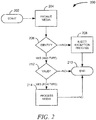
- FIG. 2 is a logical flow diagram of a method 200, according to an example embodiment.
- the method 200 is an example of a method that utilizes a document template classification model.
- the method 200 may be performed, in some embodiments on a media input device 102 or a terminal controller/computer 104 of FIG. 1 , a networked server, or on another device.
- the method 200 starts 202 by receiving 204 media, such as an image of a document presented to a media input device (e.g., currency note validation device, document imager/scanner, etc.).
- the method 200 attempts to identify the media, such as by comparing the received media with a document template classification model, as discussed above, and then document classification templates associated with an identified document classification template group.
- the method 200 may eject or reject a presented item from which the received 204 media was generated (e.g., currency note, passport, check, etc.), perform exception processing 208, if any, and end 210 the method 200 execution.
- the received 204 media is identified 206, the method 200 them performs validation 212 on the received 204 media.
- the method 200 may, in some embodiments, eject or reject the presented item from which the received 204 media was generated (e.g., currency note, passport, check, etc.), perform exception processing 208, if any, and end 210 or just simply end 210. If the received 204 media is validated 212, the media may then be processed 214 (e.g., adding currency to an ATM or self-service checkout deposit or payment transaction) and the method 200 may then end 210.
- the presented item from which the received 204 media was generated e.g., currency note, passport, check, etc.
- exception processing 208 e.g., if any, and end 210 or just simply end 210.
- end 210 e.g., adding currency to an ATM or self-service checkout deposit or payment transaction
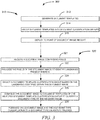
- FIG. 3 is a block flow diagram of a method 300, according to an example embodiment.
- the method 300 includes two portions 310, 320.
- the first portion 310 is performed to generate a document template classification model, as discussed above.
- the second portion 320 is performed to classify received media, or document, images based on the document template classification model. To select a selected group of document templates from which to classify the received media.
- the second portion 320 of the method 300 may be performed many times for each time the first portion 310 is performed.
- the first portion 310 of the method 300 includes generating document templates 312, grouping 314 document templates into document classification groups, and deploying 316 those document template classification groupings, in the form of a document template classification model, to a data processing location where document images are received for processing.
- the second portion 320 of the method 300 includes receiving 321 a document image comprising pixels and processing 322 the pixels of the document image to identify landmarks present therein.
- the second portion 320 further includes selecting 324 a document template classification group, of the deployed 316 document template classification model, based on the landmarks identified within the document image and comparing 326 the document image to document templates of the selected document template classification group to classify a document type of the received 321 image.
- the second portion 320 of the method 300 may then forward 328 the document image and the document type classification to a document type validation process.
- the received 321 document image is of a negotiable document such as a currency note or a check.
- the document image may be received from a document validation module of a self-service terminal.
- the self-service terminal may be an ATM, self-service checkout terminal, or other terminal.
- the document image may be received 321 from a mobile device such as a smartphone, tablet, laptop computer, or other similar device.
- a document template classification group is representative of a plurality of document templates, each document template classification group including at least one landmark, each landmark defined by properties of pixels, relations between pixel properties, and classification values that are utilized to perform the selection of the document classification group.
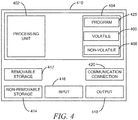
- FIG. 4 is a block diagram of a computing device, according to an example embodiment.
- multiple such computer systems are utilized in a distributed network to implement multiple components in a transaction-based environment.
- An object-oriented, service-oriented, or other architecture may be used to implement such functions and communicate between the multiple systems and components.
- One example computing device in the form of a computer 410 may include a processing unit 402, memory 404, removable storage 412, and non-removable storage 414.
- the example computing device is illustrated and described as computer 410, the computing device may be in different forms in different embodiments.
- the computing device may instead be a smartphone, a tablet, smartwatch, or other computing device including the same or similar elements as illustrated and described with regard to FIG. 4 .
- Devices such as smartphones, tablets, and smartwatches are generally collectively referred to as mobile devices.
- the various data storage elements are illustrated as part of the computer 410, the storage may also or alternatively include cloud-based storage accessible via a network, such as the Internet.
- the respective computing device may be deployed, implemented, or otherwise utilized as, or in conjunction with, a terminal as described elsewhere above.
- memory 404 may include volatile memory 406 and non-volatile memory 408.
- Computer 410 may include - or have access to a computing environment that includes a variety of computer-readable media, such as volatile memory 406 and non-volatile memory 408, removable storage 412 and non-removable storage 414.
- Computer storage includes random access memory (RAM), read only memory (ROM), erasable programmable read-only memory (EPROM) and electrically erasable programmable read-only memory (EEPROM), flash memory or other memory technologies, compact disc read-only memory (CD ROM), Digital Versatile Disks (DVD) or other optical disk storage, magnetic cassettes, magnetic tape, magnetic disk storage or other magnetic storage devices, or any other medium capable of storing computer-readable instructions.
- RAM random access memory
- ROM read only memory
- EPROM erasable programmable read-only memory
- EEPROM electrically erasable programmable read-only memory
- flash memory or other memory technologies
- compact disc read-only memory (CD ROM) compact disc read-only memory
- DVD Digital Versatile Disks
- magnetic cassettes magnetic tape
- magnetic disk storage or other magnetic storage devices, or any other medium capable of storing computer-readable instructions.
- Computer 410 may include or have access to a computing environment that includes input 416, output 418, and a communication connection 420.
- the input 416 may include one or more of a media input device 102 of FIG. 1 (e.g., currency acceptor, check acceptor, passport scanner), a touchscreen, touchpad, mouse, keyboard, camera, one or more device-specific buttons, one or more sensors integrated within or coupled via wired or wireless data connections to the computer 410, and other input devices.
- the computer 410 may operate in a networked environment using a communication connection 420 to connect to one or more remote computers, such as database servers, web servers, and other computing device.
- An example remote computer may include a personal computer (PC), server, router, network PC, a peer device or other common network node, or the like.
- the communication connection 420 may be a network interface device such as one or both of an Ethernet card and a wireless card or circuit that may be connected to a network.
- the network may include one or more of a Local Area Network (LAN), a Wide Area Network (WAN), the Internet, and other networks.
- the communication connection 420 may also or alternatively include a transceiver device, such as a BLUETOOTH® device that enables the computer 410 to wirelessly receive data from and transmit data to other BLUETOOTH® devices.
- Computer-readable instructions stored on a computer-readable medium are executable by the processing unit 402 of the computer 410.
- a hard drive magnetic disk or solid state
- CD-ROM compact disc or solid state
- RAM random access memory
- various computer programs 425 or apps such as one or more applications and modules implementing one or more of the methods illustrated and described herein or an app or application that executes on a mobile device or is accessible via a web browser, may be stored on a non-transitory computer-readable medium.
- Example 1 discloses a method comprising: receiving a document image comprising pixels; processing the pixels of the document image to identify landmarks present therein; selecting a document template classification group based on the landmarks identified within the document image; comparing the document image to document templates of the selected document template classification group to classify a document type of the received image; and forwarding the document image and the document type classification to a document type validation process.
- Example 2 discloses the method of Example 1, wherein the document image is of a negotiable document.
- Example 3 discloses the method of Example 2, wherein the negotiable document is a currency note.
- Example 4 discloses the method of Example 1, wherein the document image is received from a document validation module device.
- Example 5 discloses the method of Example 4, wherein the document validation module device is a component of a self-service terminal.
- Example 6 discloses the method of Example 5, wherein the self-service terminal is an automated teller machine.
- Example 7 discloses the method of Example 1, wherein the document image is received from an imaging device of mobile device on which the method is executed.
- Example 8 discloses the method of Example 1, wherein a document template classification group is representative of a plurality of document templates, each document template classification group including at least one landmark, each landmark defined by properties of pixels, relations between pixel properties, and classification values that are utilized to perform the selection of the document classification group.
- Example 9 discloses a method comprising: storing a plurality of document template classification groups each including data defining landmarks present within a respective group of document classification templates that are applied to classify a received document image as a particular document type to select a document validation process to validate a presented document of the received document image; receiving a document image comprising pixels; processing the pixels of the document image to identify landmarks present therein; and selecting a document template classification group based on the landmarks identified within the document image.
- Example 10 discloses the method of Example 9, further comprising: comparing the document image to document templates of the selected document template classification group to classify a document type of the received image; and forwarding the document image and the document type classification to a document type validation process.
- Example 11 discloses the method of Example 9, wherein the document image is of a negotiable document.
- Example 12 discloses the method of Example 11, wherein the negotiable document is a currency note.
- Example 13 discloses the method of Example 9, wherein the document image is received from a document validation module device.
- Example 14 discloses the method of Example 13, wherein the document validation module device is a component of a self-service terminal.
- Example 15 discloses the method of Example 14, wherein the self-service terminal is a self-service point-of-sale terminal.
- Example 16 discloses the method of Example 9, wherein the document image is received from an imaging device of mobile device on which the method is executed.
- Example 17 discloses the method of Example 9, wherein the plurality of document template classification groups are each defined around a statistical centroid of a combination of the landmarks present within the respective group of document classification templates.
- Example 18 discloses a device comprising: an imaging device; a data processor; a memory storing instructions executable by the data processor to perform data processing activities comprising: receiving a document image comprising pixels from the imaging device; processing the pixels of the document image to identify landmarks present therein; and selecting a document template classification group based on the landmarks identified within the document image.
- Example 19 discloses the device of Example 18, further comprising: comparing the document image to document templates of the selected document template classification group to classify a document type of the received image; and forwarding the document image and the document type classification to a document type validation process.
- Example 20 discloses the device of Example 19, further comprising: a network interface device; and wherein processing the pixels of the document image and selecting a document template classification group include transmitting the document image via the network interface device for the processing and selecting to be performed remotely and receiving the selection via the network interface in response thereto.
Landscapes
- Engineering & Computer Science (AREA)
- Physics & Mathematics (AREA)
- General Physics & Mathematics (AREA)
- Computer Vision & Pattern Recognition (AREA)
- Finance (AREA)
- Accounting & Taxation (AREA)
- Business, Economics & Management (AREA)
- Artificial Intelligence (AREA)
- Multimedia (AREA)
- Theoretical Computer Science (AREA)
- Computer Graphics (AREA)
- Geometry (AREA)
- Character Input (AREA)
- Financial Or Insurance-Related Operations Such As Payment And Settlement (AREA)
- Image Analysis (AREA)
Abstract
Description
- Media input devices, such as currency and check acceptors, passport scanners, and the like are becoming more common at self-service kiosk terminals. Self-service kiosk terminals include automated teller machines, self-service checkout terminals, immigration entry terminals at airports and rail stations, and others. Customer satisfaction is key to solutions including such media input devices. To achieve customer satisfaction, not only is accuracy essential, but also quick throughput.
- Media input devices, once an image has been obtained, include two sequential steps. These steps include media class recognition and authenticity validation. The recognition step is applied first to determine which class an item belongs to, such as denomination, print version, and insert direction. The validation step follows to assess the item's authenticity by examining security features of that specific class.
- Various embodiment herein each include at least one of systems, devices, methods, and software for rapid landmark-based media recognition. One such embodiment, in the form of a method includes receiving a document image comprising pixels and processing to document image to identify a document type based first on document template classification groups and then document classification templates associated with a selected document template classification group. A document type classification group may be selected based on simple criteria such as a size document represented in the image, based on more complex processing of the pixels of the document image to identify landmarks present therein, other properties of an image or a presented document (e.g., determined material upon which the document is printed such as paper, plastic, and other possible materials) and other methods based on other factors and combinations thereof. Some such embodiment may select a document template classification group based on the landmarks identified within the document image and compares the document image to document templates of the selected document template classification group to classify a document type of the received image. Some embodiments of the method further include forwarding the document image and the document type classification to a document type validation process.
- Another method embodiment includes storing a plurality of document template classification groups each including data defining landmarks present within a respective group of document classification templates that are applied to classify a received document image as a particular document type to select a document validation process to validate a presented document of the received document image. This method also includes receiving a document image comprising pixels, processing the pixels of the document image to identify landmarks present therein, and selecting a document template classification group based on the landmarks identified within the document image.
- A further embodiment is in the form of a device. The device includes an imaging device, a data processor, and a memory storing instructions executable by the data processor to perform data processing activities. The data processing activities may include receiving a document image comprising pixels from the imaging device and processing the pixels of the document image to identify landmarks present therein. The data processing activities may also include selecting a document template classification group based on the landmarks identified within the document image.
- These and other embodiments are described in greater detail in the drawings, in which:
-
FIG. 1 is a logical block diagram of a terminal, according to an example embodiment. -
FIG. 2 is a logical flow diagram of a method, according to an example embodiment. -
FIG. 3 is a block flow diagram of a method, according to an example embodiment. -
FIG. 4 is a block diagram of a computing device, according to an example embodiment. - Various embodiment herein each include at least one of systems, devices, methods, and software for rapid landmark-based media recognition. As mentioned above, media input devices, such as currency and check acceptors, passport scanners, and the like are becoming more common at self-service kiosk terminals. Self-service kiosk terminals include automated teller machines, self-service checkout terminals, immigration entry terminals at airports and rail stations, and others. Customer satisfaction is key to solutions including such media input devices. To achieve customer satisfaction, not only is accuracy essential, but also quick throughput.
- Media input devices, once an image has been obtained, include two sequential steps. These steps include media class recognition and authenticity validation. The recognition step is applied first to determine which class an item belongs to, such as denomination, print version, and insert direction. The validation step follows to assess the item's authenticity by examining security features of that specific class.
- Great success has been achieved through implementation of media input device recognition with very high recognition accuracies. However, the recognition routine running-time is a bottleneck confounding high-throughput. This confound is due to the exhaustive document template comparison strategy that compares media images received as input with all templates in a collection and then selecting the best match. This processing, while logically correct, is inevitably inefficient. The various embodiments herein focus on the recognition step to advance its computational efficiency to increase throughput while not diminishing accuracy.
- Instead of linearly scanning all possible templates to recognize a media item, some embodiments take a novel approach to accelerate the recognition process by re-organizing document templates. This re-organizing, in some embodiments, includes defining an anchor point descriptor over documents templates that characterizes one or more meta features, such as cross-template similarities, the media size (e.g., length and width), and the like. The reorganizing may further include clustering the descriptor and selecting a complete set of representatives as 'Landmarks.' Document templates may then be grouped according to their similarity to those landmarks. Landmarks may be single document properties but may also be combinations of several properties. A landmark may be a property identified based on image processing, such as determined material. To this end, in recognizing an item on-the-fly, the document template search space is limited to a small group of templates affiliated with a Landmark (LM), which is just a fraction of the whole collection of document templates.
- An anchor descriptor, as mentioned, is defined over a document template collection to characterize a meta-feature, such as cross-template similarity, the media size, etc. For example, for US dollar notes different denominations within one series have shown clustering phenomena in a cross-template similarity matrix. For British pounds, defining note size as an anchor descriptor may be a good choice while with other document types may have other similar features may individually or in combination provide a highly-indicative anchor descriptor.
- From anchor descriptors of document templates, clustering of the document templates may then be performed according their anchor value or values and anchors or combinations thereof may be declared as landmarks that are indicative of a cluster of document templates.
- Each document template of a cluster in some embodiments is then assigned into a group according to its similarity to the landmarks. In some instances, a template may not fit exactly or solely into a single document template classification group. In such instances, the document template may be linked to all possible groups to which it may fit. In such embodiments, groups are allowed to have overlap on their member document templates. This is key in some embodiments to avoid misleading in recognition.
- Once document template classification groups have been formed, the groups are then added into a document template classification model. The document template classification model may then be deployed to devices or processes where the document classification is performed, such as media input devices (e.g., document validation modules, currency bill validators, passport scanners, ATMs, etc.). However, within the document template model and within document template classification groups, templates groups and templates therein may be ordered based on likelihood of occurrence of a document-type or document-types within document template classification groups.
- For example, some currency notes or other documents are much more common than others in actual circulation or use. For example, in United States the $20 currency note of a particular series takes nearly half of all US dollars in Automated Teller Machine (ATM) transactions. Another example is the British Pound, where the region bias can be asserted, e.g., in Scotland Scottish currency notes are more common than currency notes issued by Northern Ireland banks. With this popularity or frequency information, further sort the grouped templates by the frequency at which they are presented and increasing the likelihood that a document is classified with a document classification template group earlier in the process.
- Once a document classification template group is identified, more detailed matching is then performed just as in prior efforts, although limited to just the identified document classification template group.
- Combined with a document template classification early stop, or selection of a document template classification group, mechanism, embodiments herein assure a boost to recognition speed, while not imposing any change on the recognition function. Experiments on US dollar and British pound currency notes affirmed the advantages of these embodiments showing identical accuracy but doing so two to ten times faster. This savings in recognition time is beneficial to allow greater throughput of currency notes, checks, and other documents, depending on the terminal or other kiosk-type of a particular embodiment and reclaims processing time and delay in customer experiences for validation functions to more thoroughly ensure items presented are in fact valid and otherwise non-fraudulent.
- These and other embodiments are described below with reference to the figures.
- In the following detailed description, reference is made to the accompanying drawings that form a part hereof, and in which is shown by way of illustration specific embodiments in which the inventive subject matter may be practiced. These embodiments are described in sufficient detail to enable those skilled in the art to practice them, and it is to be understood that other embodiments may be utilized and that structural, logical, and electrical changes may be made without departing from the scope of the inventive subject matter. Such embodiments of the inventive subject matter may be referred to, individually and/or collectively, herein by the term "invention" merely for convenience and without intending to voluntarily limit the scope of this application to any single invention or inventive concept if more than one is in fact disclosed.
- The following description is, therefore, not to be taken in a limited sense, and the scope of the inventive subject matter is defined by the appended claims.
- The functions or algorithms described herein are implemented in hardware, software or a combination of software and hardware in one embodiment. The software comprises computer executable instructions stored on computer readable media such as memory or other type of storage devices. Further, described functions may correspond to modules, which may be software, hardware, firmware, or any combination thereof. Multiple functions are performed in one or more modules as desired, and the embodiments described are merely examples. The software is executed on a digital signal processor, ASIC, microprocessor, or other type of processor operating on a system, such as a personal computer, server, a router, or other device capable of processing data including network interconnection devices.
- Some embodiments implement the functions in two or more specific interconnected hardware modules or devices with related control and data signals communicated between and through the modules, or as portions of an application-specific integrated circuit. Thus, the exemplary process flow is applicable to software, firmware, and hardware implementations.
-
FIG. 1 is a logical block diagram of a terminal 100, according to an example embodiment. The terminal 100 is a simple example of a terminal on which some embodiments may be implemented. The terminal may be an ATM, a self-service checkout, an immigration terminal at an airport, an airline check-in kiosk, and the like. - The terminal 100 includes a controller or
computer 104 that controls operation thereof. The terminal 100 also includes amedia input device 102 which can be of various types, such as a currency note acceptor/validator module, a passport scanner, or other imaging device that captures images of presented documents and either processes those images thereon, presents them to a process that executes on the terminal controller/computer 104, or over a computer network to be processed remotely by a web service or other process. In some embodiments, a document template classification model is deployed to the device or process that performs the image processing. -
FIG. 2 is a logical flow diagram of amethod 200, according to an example embodiment. Themethod 200 is an example of a method that utilizes a document template classification model. Themethod 200 may be performed, in some embodiments on amedia input device 102 or a terminal controller/computer 104 ofFIG. 1 , a networked server, or on another device. - The
method 200 starts 202 by receiving 204 media, such as an image of a document presented to a media input device (e.g., currency note validation device, document imager/scanner, etc.). Themethod 200 then attempts to identify the media, such as by comparing the received media with a document template classification model, as discussed above, and then document classification templates associated with an identified document classification template group. When anidentification 206 cannot be made, themethod 200 may eject or reject a presented item from which the received 204 media was generated (e.g., currency note, passport, check, etc.), performexception processing 208, if any, and end 210 themethod 200 execution. However, if the received 204 media is identified 206, themethod 200 them performsvalidation 212 on the received 204 media. If not validated 212, themethod 200 may, in some embodiments, eject or reject the presented item from which the received 204 media was generated (e.g., currency note, passport, check, etc.), performexception processing 208, if any, and end 210 or just simply end 210. If the received 204 media is validated 212, the media may then be processed 214 (e.g., adding currency to an ATM or self-service checkout deposit or payment transaction) and themethod 200 may then end 210. -
FIG. 3 is a block flow diagram of amethod 300, according to an example embodiment. Themethod 300 includes twoportions first portion 310 is performed to generate a document template classification model, as discussed above. Thesecond portion 320 is performed to classify received media, or document, images based on the document template classification model. To select a selected group of document templates from which to classify the received media. Thesecond portion 320 of themethod 300 may be performed many times for each time thefirst portion 310 is performed. - The
first portion 310 of themethod 300 includes generatingdocument templates 312, grouping 314 document templates into document classification groups, and deploying 316 those document template classification groupings, in the form of a document template classification model, to a data processing location where document images are received for processing. - The
second portion 320 of themethod 300 includes receiving 321 a document image comprising pixels and processing 322 the pixels of the document image to identify landmarks present therein. Thesecond portion 320 further includes selecting 324 a document template classification group, of the deployed 316 document template classification model, based on the landmarks identified within the document image and comparing 326 the document image to document templates of the selected document template classification group to classify a document type of the received 321 image. Thesecond portion 320 of themethod 300 may then forward 328 the document image and the document type classification to a document type validation process. - In some embodiments of the
method 300, the received 321 document image is of a negotiable document such as a currency note or a check. The document image may be received from a document validation module of a self-service terminal. The self-service terminal may be an ATM, self-service checkout terminal, or other terminal. In some other embodiments, the document image may be received 321 from a mobile device such as a smartphone, tablet, laptop computer, or other similar device. - In some embodiments, a document template classification group is representative of a plurality of document templates, each document template classification group including at least one landmark, each landmark defined by properties of pixels, relations between pixel properties, and classification values that are utilized to perform the selection of the document classification group.
-
FIG. 4 is a block diagram of a computing device, according to an example embodiment. In one embodiment, multiple such computer systems are utilized in a distributed network to implement multiple components in a transaction-based environment. An object-oriented, service-oriented, or other architecture may be used to implement such functions and communicate between the multiple systems and components. One example computing device in the form of acomputer 410, may include aprocessing unit 402,memory 404,removable storage 412, andnon-removable storage 414. Although the example computing device is illustrated and described ascomputer 410, the computing device may be in different forms in different embodiments. For example, the computing device may instead be a smartphone, a tablet, smartwatch, or other computing device including the same or similar elements as illustrated and described with regard toFIG. 4 . Devices such as smartphones, tablets, and smartwatches are generally collectively referred to as mobile devices. Further, although the various data storage elements are illustrated as part of thecomputer 410, the storage may also or alternatively include cloud-based storage accessible via a network, such as the Internet. Regardless of the type of computing device of the particular embodiment, the respective computing device may be deployed, implemented, or otherwise utilized as, or in conjunction with, a terminal as described elsewhere above. - Returning to the
computer 410,memory 404 may includevolatile memory 406 andnon-volatile memory 408.Computer 410 may include - or have access to a computing environment that includes a variety of computer-readable media, such asvolatile memory 406 andnon-volatile memory 408,removable storage 412 andnon-removable storage 414. Computer storage includes random access memory (RAM), read only memory (ROM), erasable programmable read-only memory (EPROM) and electrically erasable programmable read-only memory (EEPROM), flash memory or other memory technologies, compact disc read-only memory (CD ROM), Digital Versatile Disks (DVD) or other optical disk storage, magnetic cassettes, magnetic tape, magnetic disk storage or other magnetic storage devices, or any other medium capable of storing computer-readable instructions. -
Computer 410 may include or have access to a computing environment that includesinput 416,output 418, and acommunication connection 420. Theinput 416 may include one or more of amedia input device 102 ofFIG. 1 (e.g., currency acceptor, check acceptor, passport scanner), a touchscreen, touchpad, mouse, keyboard, camera, one or more device-specific buttons, one or more sensors integrated within or coupled via wired or wireless data connections to thecomputer 410, and other input devices. Thecomputer 410 may operate in a networked environment using acommunication connection 420 to connect to one or more remote computers, such as database servers, web servers, and other computing device. An example remote computer may include a personal computer (PC), server, router, network PC, a peer device or other common network node, or the like. Thecommunication connection 420 may be a network interface device such as one or both of an Ethernet card and a wireless card or circuit that may be connected to a network. The network may include one or more of a Local Area Network (LAN), a Wide Area Network (WAN), the Internet, and other networks. In some embodiments, thecommunication connection 420 may also or alternatively include a transceiver device, such as a BLUETOOTH® device that enables thecomputer 410 to wirelessly receive data from and transmit data to other BLUETOOTH® devices. - Computer-readable instructions stored on a computer-readable medium are executable by the
processing unit 402 of thecomputer 410. A hard drive (magnetic disk or solid state), CD-ROM, and RAM are some examples of articles including a non-transitory computer-readable medium. For example,various computer programs 425 or apps, such as one or more applications and modules implementing one or more of the methods illustrated and described herein or an app or application that executes on a mobile device or is accessible via a web browser, may be stored on a non-transitory computer-readable medium. - It will be readily understood to those skilled in the art that various other changes in the details, material, and arrangements of the parts and method stages which have been described and illustrated in order to explain the nature of the inventive subject matter may be made without departing from the principles and scope of the inventive subject matter as expressed in the subjoined claims.
- Example 1 discloses a method comprising: receiving a document image comprising pixels; processing the pixels of the document image to identify landmarks present therein; selecting a document template classification group based on the landmarks identified within the document image; comparing the document image to document templates of the selected document template classification group to classify a document type of the received image; and forwarding the document image and the document type classification to a document type validation process.
- Example 2 discloses the method of Example 1, wherein the document image is of a negotiable document.
- Example 3 discloses the method of Example 2, wherein the negotiable document is a currency note.
- Example 4 discloses the method of Example 1, wherein the document image is received from a document validation module device.
- Example 5 discloses the method of Example 4, wherein the document validation module device is a component of a self-service terminal.
- Example 6 discloses the method of Example 5, wherein the self-service terminal is an automated teller machine.
- Example 7 discloses the method of Example 1, wherein the document image is received from an imaging device of mobile device on which the method is executed.
- Example 8 discloses the method of Example 1, wherein a document template classification group is representative of a plurality of document templates, each document template classification group including at least one landmark, each landmark defined by properties of pixels, relations between pixel properties, and classification values that are utilized to perform the selection of the document classification group.
- Example 9 discloses a method comprising: storing a plurality of document template classification groups each including data defining landmarks present within a respective group of document classification templates that are applied to classify a received document image as a particular document type to select a document validation process to validate a presented document of the received document image; receiving a document image comprising pixels; processing the pixels of the document image to identify landmarks present therein; and selecting a document template classification group based on the landmarks identified within the document image.
- Example 10 discloses the method of Example 9, further comprising: comparing the document image to document templates of the selected document template classification group to classify a document type of the received image; and forwarding the document image and the document type classification to a document type validation process.
- Example 11 discloses the method of Example 9, wherein the document image is of a negotiable document.
- Example 12 discloses the method of Example 11, wherein the negotiable document is a currency note.
- Example 13 discloses the method of Example 9, wherein the document image is received from a document validation module device.
- Example 14 discloses the method of Example 13, wherein the document validation module device is a component of a self-service terminal.
- Example 15 discloses the method of Example 14, wherein the self-service terminal is a self-service point-of-sale terminal.
- Example 16 discloses the method of Example 9, wherein the document image is received from an imaging device of mobile device on which the method is executed.
- Example 17 discloses the method of Example 9, wherein the plurality of document template classification groups are each defined around a statistical centroid of a combination of the landmarks present within the respective group of document classification templates.
- Example 18 discloses a device comprising: an imaging device; a data processor; a memory storing instructions executable by the data processor to perform data processing activities comprising: receiving a document image comprising pixels from the imaging device; processing the pixels of the document image to identify landmarks present therein; and selecting a document template classification group based on the landmarks identified within the document image.
- Example 19 discloses the device of Example 18, further comprising: comparing the document image to document templates of the selected document template classification group to classify a document type of the received image; and forwarding the document image and the document type classification to a document type validation process.
- Example 20 discloses the device of Example 19, further comprising: a network interface device; and wherein processing the pixels of the document image and selecting a document template classification group include transmitting the document image via the network interface device for the processing and selecting to be performed remotely and receiving the selection via the network interface in response thereto.
Claims (11)
- A method comprising:receiving (321) a document image comprising pixels;processing (322) the pixels of the document image to identify landmarks present therein;selecting (324) a document template classification group based on the landmarks identified within the document image;comparing (326) the document image to document templates of the selected document template classification group to classify a document type of the received image; andforwarding (328) the document image and the document type classification to a document type validation process.
- The method of claim 1, wherein the document image is of a negotiable document.
- The method of any of the preceding claims, wherein the negotiable document is a currency note.
- The method of any of the preceding claims, wherein the document image is received from a document validation module device.
- The method of any of the preceding claims, wherein the document validation module device is a component of a self-service terminal.
- The method of any of the preceding claims, wherein the self-service terminal is an automated teller machine.
- The method of any of the preceding claims, wherein the document image is received from an imaging device of mobile device on which the method is executed.
- The method of any of the preceding claims, wherein a document template classification group is representative of a plurality of document templates, each document template classification group including at least one landmark, each landmark defined by properties of pixels, relations between pixel properties, and classification values that are utilized to perform the selection of the document classification group.
- A device comprising:an imaging device;a data processor (402);a memory (404) storing instructions executable by the data processor to perform data processing activities comprising:receiving (321) a document image comprising pixels from the imaging device;processing (322) the pixels of the document image to identify landmarks present therein; andselecting (324) a document template classification group based on the landmarks identified within the document image.
- The device of claim 9, further comprising:comparing (326) the document image to document templates of the selected document template classification group to classify a document type of the received image; andforwarding (328) the document image and the document type classification to a document type validation process.
- The device of claim 10, further comprising:a network interface device; andwherein processing the pixels of the document image and selecting a document template classification group include transmitting the document image via the network interface device for the processing and selecting to be performed remotely and receiving the selection via the network interface in response thereto.
Applications Claiming Priority (1)
| Application Number | Priority Date | Filing Date | Title |
|---|---|---|---|
| US15/883,256 US20190236348A1 (en) | 2018-01-30 | 2018-01-30 | Rapid landmark-based media recognition |
Publications (2)
| Publication Number | Publication Date |
|---|---|
| EP3518191A1 true EP3518191A1 (en) | 2019-07-31 |
| EP3518191B1 EP3518191B1 (en) | 2025-10-01 |
Family
ID=65011743
Family Applications (1)
| Application Number | Title | Priority Date | Filing Date |
|---|---|---|---|
| EP18215245.4A Active EP3518191B1 (en) | 2018-01-30 | 2018-12-21 | Rapid landmark-based media recognition |
Country Status (2)
| Country | Link |
|---|---|
| US (1) | US20190236348A1 (en) |
| EP (1) | EP3518191B1 (en) |
Families Citing this family (6)
| Publication number | Priority date | Publication date | Assignee | Title |
|---|---|---|---|---|
| US11893065B2 (en) | 2020-06-10 | 2024-02-06 | Aon Risk Services, Inc. Of Maryland | Document analysis architecture |
| US11893505B1 (en) | 2020-06-10 | 2024-02-06 | Aon Risk Services, Inc. Of Maryland | Document analysis architecture |
| US11373424B1 (en) * | 2020-06-10 | 2022-06-28 | Aon Risk Services, Inc. Of Maryland | Document analysis architecture |
| US11776291B1 (en) | 2020-06-10 | 2023-10-03 | Aon Risk Services, Inc. Of Maryland | Document analysis architecture |
| US11379665B1 (en) * | 2020-06-10 | 2022-07-05 | Aon Risk Services, Inc. Of Maryland | Document analysis architecture |
| US11574492B2 (en) * | 2020-09-02 | 2023-02-07 | Smart Engines Service, LLC | Efficient location and identification of documents in images |
Citations (4)
| Publication number | Priority date | Publication date | Assignee | Title |
|---|---|---|---|---|
| US20090152357A1 (en) * | 2007-12-12 | 2009-06-18 | 3M Innovative Properties Company | Document verification using dynamic document identification framework |
| US20120235785A1 (en) * | 2011-03-17 | 2012-09-20 | Motorola Mobility, Inc. | Wireless communication device and method with intelligent authentication |
| US20140279516A1 (en) * | 2013-03-14 | 2014-09-18 | Nicholas Rellas | Authenticating a physical device |
| US20170132866A1 (en) * | 2014-06-20 | 2017-05-11 | Theodore Kuklinski | A self-learning system and methods for automatic document recognition, authentication, and information extraction |
Family Cites Families (17)
| Publication number | Priority date | Publication date | Assignee | Title |
|---|---|---|---|---|
| US4611347A (en) * | 1984-09-24 | 1986-09-09 | At&T Bell Laboratories | Video recognition system |
| US5926568A (en) * | 1997-06-30 | 1999-07-20 | The University Of North Carolina At Chapel Hill | Image object matching using core analysis and deformable shape loci |
| US6580814B1 (en) * | 1998-07-31 | 2003-06-17 | International Business Machines Corporation | System and method for compressing biometric models |
| AU3001500A (en) * | 1999-02-19 | 2000-09-04 | Bioreason, Inc. | Method and system for artificial intelligence directed lead discovery through multi-domain clustering |
| JP4639033B2 (en) * | 2003-01-29 | 2011-02-23 | キヤノン株式会社 | Authentication apparatus, authentication method, and authentication program |
| US8078963B1 (en) * | 2005-01-09 | 2011-12-13 | Apple Inc. | Efficient creation of documents |
| CN101208694A (en) * | 2005-04-25 | 2008-06-25 | 株式会社Ipb | Information analysis report automatic generation device, information analysis report automatic generation program, and information analysis report automatic generation method |
| US7873584B2 (en) * | 2005-12-22 | 2011-01-18 | Oren Asher | Method and system for classifying users of a computer network |
| WO2007141788A2 (en) * | 2006-06-06 | 2007-12-13 | Xceed Imaging Ltd. | Optical system and method for multi-range and dual-range imaging |
| US8606013B2 (en) * | 2006-08-31 | 2013-12-10 | Glory Ltd. | Paper sheet identification device and paper sheet identification method |
| US8194933B2 (en) * | 2007-12-12 | 2012-06-05 | 3M Innovative Properties Company | Identification and verification of an unknown document according to an eigen image process |
| EP2827306B1 (en) * | 2012-03-15 | 2022-01-12 | Glory Ltd. | Valuable media processing device |
| US20140046954A1 (en) * | 2012-08-07 | 2014-02-13 | 3M Innovative Properties Company And A Completed | Software tool for creation and management of document reference templates |
| CA2925325C (en) * | 2013-09-26 | 2020-06-09 | Dragnet Solutions, Inc. | Document authentication based on expected wear |
| EP2962969B1 (en) * | 2014-07-01 | 2017-10-25 | Wincor Nixdorf International GmbH | Device for separating sheet goods |
| US9430718B1 (en) * | 2015-02-09 | 2016-08-30 | Sony Corporation | Efficient local feature descriptor filtering |
| JP2018121146A (en) * | 2017-01-24 | 2018-08-02 | ブラザー工業株式会社 | Image reading device |
-
2018
- 2018-01-30 US US15/883,256 patent/US20190236348A1/en not_active Abandoned
- 2018-12-21 EP EP18215245.4A patent/EP3518191B1/en active Active
Patent Citations (4)
| Publication number | Priority date | Publication date | Assignee | Title |
|---|---|---|---|---|
| US20090152357A1 (en) * | 2007-12-12 | 2009-06-18 | 3M Innovative Properties Company | Document verification using dynamic document identification framework |
| US20120235785A1 (en) * | 2011-03-17 | 2012-09-20 | Motorola Mobility, Inc. | Wireless communication device and method with intelligent authentication |
| US20140279516A1 (en) * | 2013-03-14 | 2014-09-18 | Nicholas Rellas | Authenticating a physical device |
| US20170132866A1 (en) * | 2014-06-20 | 2017-05-11 | Theodore Kuklinski | A self-learning system and methods for automatic document recognition, authentication, and information extraction |
Also Published As
| Publication number | Publication date |
|---|---|
| EP3518191B1 (en) | 2025-10-01 |
| US20190236348A1 (en) | 2019-08-01 |
Similar Documents
| Publication | Publication Date | Title |
|---|---|---|
| EP3518191B1 (en) | Rapid landmark-based media recognition | |
| US11151369B2 (en) | Systems and methods for classifying payment documents during mobile image processing | |
| Aseffa et al. | Ethiopian banknote recognition using convolutional neural network and its prototype development using embedded platform | |
| KR101238292B1 (en) | Paper sheet management apparatus, paper sheet management method, and computer readable recording medium with paper sheet management program | |
| EP3961501B1 (en) | Computer vision transaction monitoring | |
| US20170132866A1 (en) | A self-learning system and methods for automatic document recognition, authentication, and information extraction | |
| US12307851B2 (en) | Systems and methods for ATM deposit jammed item imaging and transaction completion | |
| US9460345B2 (en) | Apparatus and method for recognizing media, financial device | |
| US10679050B2 (en) | Invalidation recognition and fraud prevention | |
| Kodati et al. | Detection of fake currency using machine learning models | |
| EP3590085B1 (en) | AUTOMATED TRANSACTION SYSTEM AND PROCEDURES | |
| US12536534B2 (en) | Identity verification systems and methods | |
| US10846676B2 (en) | Financial device and control method and system thereof | |
| KR102213666B1 (en) | Paper sheet discrimination device, and paper sheet discrimination system | |
| Kumar et al. | Classification and detection of banknotes using machine learning | |
| JP2019016323A (en) | Paper sheet handling system | |
| Nair et al. | Verinote-Fake Currency Detection Using Convolutional Neural Network | |
| KR101857186B1 (en) | Media processing apparatus and media processing method | |
| US20210042713A1 (en) | Intelligent attribute spatial scanning system | |
| CN107016775B (en) | Medium identification device, medium identification method, and financial device | |
| CN108470404A (en) | Gate control method, device, finance device and storage medium for card reader | |
| US12437573B2 (en) | Counterfeit detection using image analysis | |
| US12014576B2 (en) | Systems and methods for capturing electronic signatures | |
| US20250225525A1 (en) | Systems and methods for a user interface overlay for fraud detection across accounts | |
| US20260024066A1 (en) | Systems and methods for accessing an atm with a mobile application |
Legal Events
| Date | Code | Title | Description |
|---|---|---|---|
| PUAI | Public reference made under article 153(3) epc to a published international application that has entered the european phase |
Free format text: ORIGINAL CODE: 0009012 |
|
| STAA | Information on the status of an ep patent application or granted ep patent |
Free format text: STATUS: THE APPLICATION HAS BEEN PUBLISHED |
|
| AK | Designated contracting states |
Kind code of ref document: A1 Designated state(s): AL AT BE BG CH CY CZ DE DK EE ES FI FR GB GR HR HU IE IS IT LI LT LU LV MC MK MT NL NO PL PT RO RS SE SI SK SM TR |
|
| AX | Request for extension of the european patent |
Extension state: BA ME |
|
| STAA | Information on the status of an ep patent application or granted ep patent |
Free format text: STATUS: REQUEST FOR EXAMINATION WAS MADE |
|
| 17P | Request for examination filed |
Effective date: 20200131 |
|
| RBV | Designated contracting states (corrected) |
Designated state(s): AL AT BE BG CH CY CZ DE DK EE ES FI FR GB GR HR HU IE IS IT LI LT LU LV MC MK MT NL NO PL PT RO RS SE SI SK SM TR |
|
| STAA | Information on the status of an ep patent application or granted ep patent |
Free format text: STATUS: EXAMINATION IS IN PROGRESS |
|
| 17Q | First examination report despatched |
Effective date: 20220912 |
|
| P01 | Opt-out of the competence of the unified patent court (upc) registered |
Effective date: 20230506 |
|
| RAP3 | Party data changed (applicant data changed or rights of an application transferred) |
Owner name: NCR VOYIX CORPORATION |
|
| REG | Reference to a national code |
Ref country code: DE Ref legal event code: R079 Free format text: PREVIOUS MAIN CLASS: G07D0007206000 Ipc: G07F0019000000 Ref document number: 602018085981 Country of ref document: DE |
|
| RIC1 | Information provided on ipc code assigned before grant |
Ipc: G07D 7/206 20160101ALI20250408BHEP Ipc: G07F 19/00 20060101AFI20250408BHEP |
|
| GRAP | Despatch of communication of intention to grant a patent |
Free format text: ORIGINAL CODE: EPIDOSNIGR1 |
|
| STAA | Information on the status of an ep patent application or granted ep patent |
Free format text: STATUS: GRANT OF PATENT IS INTENDED |
|
| INTG | Intention to grant announced |
Effective date: 20250521 |
|
| GRAS | Grant fee paid |
Free format text: ORIGINAL CODE: EPIDOSNIGR3 |
|
| GRAA | (expected) grant |
Free format text: ORIGINAL CODE: 0009210 |
|
| STAA | Information on the status of an ep patent application or granted ep patent |
Free format text: STATUS: THE PATENT HAS BEEN GRANTED |
|
| AK | Designated contracting states |
Kind code of ref document: B1 Designated state(s): AL AT BE BG CH CY CZ DE DK EE ES FI FR GB GR HR HU IE IS IT LI LT LU LV MC MK MT NL NO PL PT RO RS SE SI SK SM TR |
|
| REG | Reference to a national code |
Ref country code: GB Ref legal event code: FG4D Ref country code: CH Ref legal event code: F10 Free format text: ST27 STATUS EVENT CODE: U-0-0-F10-F00 (AS PROVIDED BY THE NATIONAL OFFICE) Effective date: 20251001 |
|
| REG | Reference to a national code |
Ref country code: IE Ref legal event code: FG4D |
|
| REG | Reference to a national code |
Ref country code: DE Ref legal event code: R096 Ref document number: 602018085981 Country of ref document: DE |
|
| PGFP | Annual fee paid to national office [announced via postgrant information from national office to epo] |
Ref country code: GB Payment date: 20251229 Year of fee payment: 8 |
|
| PGFP | Annual fee paid to national office [announced via postgrant information from national office to epo] |
Ref country code: FR Payment date: 20251118 Year of fee payment: 8 |
|
| REG | Reference to a national code |
Ref country code: NL Ref legal event code: MP Effective date: 20251001 |
|
| REG | Reference to a national code |
Ref country code: AT Ref legal event code: MK05 Ref document number: 1843360 Country of ref document: AT Kind code of ref document: T Effective date: 20251001 |
|
| PG25 | Lapsed in a contracting state [announced via postgrant information from national office to epo] |
Ref country code: NL Free format text: LAPSE BECAUSE OF FAILURE TO SUBMIT A TRANSLATION OF THE DESCRIPTION OR TO PAY THE FEE WITHIN THE PRESCRIBED TIME-LIMIT Effective date: 20251001 |
|
| PG25 | Lapsed in a contracting state [announced via postgrant information from national office to epo] |
Ref country code: ES Free format text: LAPSE BECAUSE OF FAILURE TO SUBMIT A TRANSLATION OF THE DESCRIPTION OR TO PAY THE FEE WITHIN THE PRESCRIBED TIME-LIMIT Effective date: 20251001 |
|
| REG | Reference to a national code |
Ref country code: LT Ref legal event code: MG9D |
|
| PG25 | Lapsed in a contracting state [announced via postgrant information from national office to epo] |
Ref country code: NO Free format text: LAPSE BECAUSE OF FAILURE TO SUBMIT A TRANSLATION OF THE DESCRIPTION OR TO PAY THE FEE WITHIN THE PRESCRIBED TIME-LIMIT Effective date: 20260101 |
|
| PGFP | Annual fee paid to national office [announced via postgrant information from national office to epo] |
Ref country code: DE Payment date: 20251229 Year of fee payment: 8 |
|
| PG25 | Lapsed in a contracting state [announced via postgrant information from national office to epo] |
Ref country code: HR Free format text: LAPSE BECAUSE OF FAILURE TO SUBMIT A TRANSLATION OF THE DESCRIPTION OR TO PAY THE FEE WITHIN THE PRESCRIBED TIME-LIMIT Effective date: 20251001 Ref country code: AT Free format text: LAPSE BECAUSE OF FAILURE TO SUBMIT A TRANSLATION OF THE DESCRIPTION OR TO PAY THE FEE WITHIN THE PRESCRIBED TIME-LIMIT Effective date: 20251001 Ref country code: FI Free format text: LAPSE BECAUSE OF FAILURE TO SUBMIT A TRANSLATION OF THE DESCRIPTION OR TO PAY THE FEE WITHIN THE PRESCRIBED TIME-LIMIT Effective date: 20251001 |
|
| PG25 | Lapsed in a contracting state [announced via postgrant information from national office to epo] |
Ref country code: RS Free format text: LAPSE BECAUSE OF FAILURE TO SUBMIT A TRANSLATION OF THE DESCRIPTION OR TO PAY THE FEE WITHIN THE PRESCRIBED TIME-LIMIT Effective date: 20260101 |
|
| PG25 | Lapsed in a contracting state [announced via postgrant information from national office to epo] |
Ref country code: IS Free format text: LAPSE BECAUSE OF FAILURE TO SUBMIT A TRANSLATION OF THE DESCRIPTION OR TO PAY THE FEE WITHIN THE PRESCRIBED TIME-LIMIT Effective date: 20260201 |
|
| PG25 | Lapsed in a contracting state [announced via postgrant information from national office to epo] |
Ref country code: CZ Free format text: LAPSE BECAUSE OF FAILURE TO SUBMIT A TRANSLATION OF THE DESCRIPTION OR TO PAY THE FEE WITHIN THE PRESCRIBED TIME-LIMIT Effective date: 20251001 Ref country code: PT Free format text: LAPSE BECAUSE OF FAILURE TO SUBMIT A TRANSLATION OF THE DESCRIPTION OR TO PAY THE FEE WITHIN THE PRESCRIBED TIME-LIMIT Effective date: 20260202 |
|
| PG25 | Lapsed in a contracting state [announced via postgrant information from national office to epo] |
Ref country code: PL Free format text: LAPSE BECAUSE OF FAILURE TO SUBMIT A TRANSLATION OF THE DESCRIPTION OR TO PAY THE FEE WITHIN THE PRESCRIBED TIME-LIMIT Effective date: 20251001 |
|
| PG25 | Lapsed in a contracting state [announced via postgrant information from national office to epo] |
Ref country code: LV Free format text: LAPSE BECAUSE OF FAILURE TO SUBMIT A TRANSLATION OF THE DESCRIPTION OR TO PAY THE FEE WITHIN THE PRESCRIBED TIME-LIMIT Effective date: 20251001 |
|
| PG25 | Lapsed in a contracting state [announced via postgrant information from national office to epo] |
Ref country code: BG Free format text: LAPSE BECAUSE OF FAILURE TO SUBMIT A TRANSLATION OF THE DESCRIPTION OR TO PAY THE FEE WITHIN THE PRESCRIBED TIME-LIMIT Effective date: 20251001 |