EP3517949A1 - Quantitative analysis method for high molecular weight antioxidant - Google Patents
Quantitative analysis method for high molecular weight antioxidant Download PDFInfo
- Publication number
- EP3517949A1 EP3517949A1 EP18856898.4A EP18856898A EP3517949A1 EP 3517949 A1 EP3517949 A1 EP 3517949A1 EP 18856898 A EP18856898 A EP 18856898A EP 3517949 A1 EP3517949 A1 EP 3517949A1
- Authority
- EP
- European Patent Office
- Prior art keywords
- antioxidant
- cable
- semiconducting material
- quantitative analysis
- semiconducting
- Prior art date
- Legal status (The legal status is an assumption and is not a legal conclusion. Google has not performed a legal analysis and makes no representation as to the accuracy of the status listed.)
- Granted
Links
Images

Classifications
-
- G—PHYSICS
- G01—MEASURING; TESTING
- G01N—INVESTIGATING OR ANALYSING MATERIALS BY DETERMINING THEIR CHEMICAL OR PHYSICAL PROPERTIES
- G01N30/00—Investigating or analysing materials by separation into components using adsorption, absorption or similar phenomena or using ion-exchange, e.g. chromatography or field flow fractionation
- G01N30/02—Column chromatography
- G01N30/88—Integrated analysis systems specially adapted therefor, not covered by a single one of the groups G01N30/04 - G01N30/86
-
- C—CHEMISTRY; METALLURGY
- C08—ORGANIC MACROMOLECULAR COMPOUNDS; THEIR PREPARATION OR CHEMICAL WORKING-UP; COMPOSITIONS BASED THEREON
- C08K—Use of inorganic or non-macromolecular organic substances as compounding ingredients
- C08K5/00—Use of organic ingredients
- C08K5/0008—Organic ingredients according to more than one of the "one dot" groups of C08K5/01 - C08K5/59
- C08K5/005—Stabilisers against oxidation, heat, light, ozone
-
- C—CHEMISTRY; METALLURGY
- C08—ORGANIC MACROMOLECULAR COMPOUNDS; THEIR PREPARATION OR CHEMICAL WORKING-UP; COMPOSITIONS BASED THEREON
- C08K—Use of inorganic or non-macromolecular organic substances as compounding ingredients
- C08K5/00—Use of organic ingredients
- C08K5/16—Nitrogen-containing compounds
- C08K5/34—Heterocyclic compounds having nitrogen in the ring
- C08K5/3412—Heterocyclic compounds having nitrogen in the ring having one nitrogen atom in the ring
- C08K5/3432—Six-membered rings
- C08K5/3437—Six-membered rings condensed with carbocyclic rings
-
- C—CHEMISTRY; METALLURGY
- C08—ORGANIC MACROMOLECULAR COMPOUNDS; THEIR PREPARATION OR CHEMICAL WORKING-UP; COMPOSITIONS BASED THEREON
- C08L—COMPOSITIONS OF MACROMOLECULAR COMPOUNDS
- C08L23/00—Compositions of homopolymers or copolymers of unsaturated aliphatic hydrocarbons having only one carbon-to-carbon double bond; Compositions of derivatives of such polymers
- C08L23/02—Compositions of homopolymers or copolymers of unsaturated aliphatic hydrocarbons having only one carbon-to-carbon double bond; Compositions of derivatives of such polymers not modified by chemical after-treatment
- C08L23/04—Homopolymers or copolymers of ethene
- C08L23/08—Copolymers of ethene
- C08L23/0846—Copolymers of ethene with unsaturated hydrocarbons containing atoms other than carbon or hydrogen
- C08L23/0853—Ethylene vinyl acetate copolymers
-
- G—PHYSICS
- G01—MEASURING; TESTING
- G01N—INVESTIGATING OR ANALYSING MATERIALS BY DETERMINING THEIR CHEMICAL OR PHYSICAL PROPERTIES
- G01N1/00—Sampling; Preparing specimens for investigation
- G01N1/28—Preparing specimens for investigation including physical details of (bio-)chemical methods covered elsewhere, e.g. G01N33/50, C12Q
- G01N1/38—Diluting, dispersing or mixing samples
-
- G—PHYSICS
- G01—MEASURING; TESTING
- G01N—INVESTIGATING OR ANALYSING MATERIALS BY DETERMINING THEIR CHEMICAL OR PHYSICAL PROPERTIES
- G01N30/00—Investigating or analysing materials by separation into components using adsorption, absorption or similar phenomena or using ion-exchange, e.g. chromatography or field flow fractionation
- G01N30/02—Column chromatography
- G01N30/62—Detectors specially adapted therefor
- G01N30/64—Electrical detectors
- G01N30/68—Flame ionisation detectors
-
- C—CHEMISTRY; METALLURGY
- C08—ORGANIC MACROMOLECULAR COMPOUNDS; THEIR PREPARATION OR CHEMICAL WORKING-UP; COMPOSITIONS BASED THEREON
- C08L—COMPOSITIONS OF MACROMOLECULAR COMPOUNDS
- C08L2203/00—Applications
- C08L2203/20—Applications use in electrical or conductive gadgets
-
- C—CHEMISTRY; METALLURGY
- C08—ORGANIC MACROMOLECULAR COMPOUNDS; THEIR PREPARATION OR CHEMICAL WORKING-UP; COMPOSITIONS BASED THEREON
- C08L—COMPOSITIONS OF MACROMOLECULAR COMPOUNDS
- C08L2312/00—Crosslinking
-
- G—PHYSICS
- G01—MEASURING; TESTING
- G01N—INVESTIGATING OR ANALYSING MATERIALS BY DETERMINING THEIR CHEMICAL OR PHYSICAL PROPERTIES
- G01N1/00—Sampling; Preparing specimens for investigation
- G01N1/28—Preparing specimens for investigation including physical details of (bio-)chemical methods covered elsewhere, e.g. G01N33/50, C12Q
- G01N1/38—Diluting, dispersing or mixing samples
- G01N2001/386—Other diluting or mixing processes
-
- G—PHYSICS
- G01—MEASURING; TESTING
- G01N—INVESTIGATING OR ANALYSING MATERIALS BY DETERMINING THEIR CHEMICAL OR PHYSICAL PROPERTIES
- G01N30/00—Investigating or analysing materials by separation into components using adsorption, absorption or similar phenomena or using ion-exchange, e.g. chromatography or field flow fractionation
- G01N30/02—Column chromatography
- G01N2030/022—Column chromatography characterised by the kind of separation mechanism
- G01N2030/025—Gas chromatography
-
- G—PHYSICS
- G01—MEASURING; TESTING
- G01N—INVESTIGATING OR ANALYSING MATERIALS BY DETERMINING THEIR CHEMICAL OR PHYSICAL PROPERTIES
- G01N30/00—Investigating or analysing materials by separation into components using adsorption, absorption or similar phenomena or using ion-exchange, e.g. chromatography or field flow fractionation
- G01N30/02—Column chromatography
- G01N30/88—Integrated analysis systems specially adapted therefor, not covered by a single one of the groups G01N30/04 - G01N30/86
- G01N2030/8809—Integrated analysis systems specially adapted therefor, not covered by a single one of the groups G01N30/04 - G01N30/86 analysis specially adapted for the sample
- G01N2030/884—Integrated analysis systems specially adapted therefor, not covered by a single one of the groups G01N30/04 - G01N30/86 analysis specially adapted for the sample organic compounds
-
- G—PHYSICS
- G01—MEASURING; TESTING
- G01N—INVESTIGATING OR ANALYSING MATERIALS BY DETERMINING THEIR CHEMICAL OR PHYSICAL PROPERTIES
- G01N33/00—Investigating or analysing materials by specific methods not covered by groups G01N1/00 - G01N31/00
- G01N33/0095—Semiconductive materials
Definitions
- the present invention relates to a method for quantitative analysis of high molecular weight antioxidants and, more particularly, to a method for analyzing content of an antioxidant contained in a semiconducting material for a cable, wherein the antioxidant is an amine-based antioxidant.
- Semiconducting products for insulated power cables for ultra-high voltage or power cables used in power equipment are based on polymer materials. Semiconducting products used in power cables and power equipment should have excellent electrical conductivity due to their usage characteristics, and should not reduce their electrical properties or mechanical properties and should not cause deterioration even after long-term use.
- Semiconducting products for cables are produced from a semiconducting composition which is prepared by mixing an ethylene-based copolymer resin, in particular an ethylene-vinyl acetate (EVA) resin, an ethylene-ethyl acrylate (EEA) resin or an ethylene-butyl acrylate (EBA) resin which is used alone or in combination thereof as a matrix resin with carbon black, an antioxidant, a crosslinking agent, a crosslinking aid, a processable lubricant, and the like.
- EVA ethylene-vinyl acetate
- ESA ethylene-ethyl acrylate
- EBA ethylene-butyl acrylate
- Semiconducting products are subject to a gradual oxidation process due to the effects of temperature, light, and transition metals, if they are not kept in a specific storage condition. Such oxidation typically leads to aging of the polymeric material.
- the aging of the polymeric material can be significantly reduced by adding an antioxidant.
- Naugard Super Q is often used as an antioxidant to improve electrical properties of semiconducting products for cables.
- Naugard Super Q polymerized 1,2-dihydro-2,2,4-trimethylquinoline is an amine-based antioxidant with molecular weight 874 and has the following formula:
- Naugard Super Q Since Naugard Super Q has a polymeric form, it is not detected as a single component in the quantitative analysis by chromatography. It causes a difficulty in the analysis and thus it is necessary to establish an analysis method in order to solve the problem.
- the present inventors developed a method for quantitative analysis of the content of Naugard Super Q contained in semiconducting products for cables, by extracting the semiconducting products with an acetone solvent and then analyzing them by gas chromatography (GC)/flame ionization detector (FID).
- GC gas chromatography
- FID flame ionization detector
- Naugard Super Q has a polymeric form, which has been found to be detected not as a single component but as multiple peaks in quantitative analysis with gas chromatography (GC)/mass spectrometry (MS). The same peaks were also detected in analysis with gas chromatography (GC). It is possible to quantify based on the peak of molecular weight (MW) of 362 corresponding to the dimer (dimeric form of monomers having methyl group bonded thereto) consisting of monomers for Naugard Super Q.
- MW molecular weight
- the present invention provides a method for quantitatively analyzing a semiconducting material for a cable containing Naugard Super Q as an antioxidant by GC/FID.
- the matrix resin comprises an ethylene-vinyl acetate (EVA) resin.
- EVA ethylene-vinyl acetate
- XLPE cable cross-linked polyethylene insulated cable
- EVA, EEA or EBA resin is used as a basic resin
- LD or LLD wax may be mixed thereto in consideration of properties and workability.
- the matrix resin may be used in an amount of 50 to 60 wt% based on the weight of the semiconducting material for a cable. If the resin content is lower than the lower limit, it is interpreted that the amount of carbon black is relatively increased. In this case, the resistance value of the semiconducting resin becomes higher. Generally, the resistance value of the semiconducting material is controlled to be not more than a specific value (for example, it is controlled to be not more than 1000 ⁇ ⁇ cm at 90 °C). If the resistance value of the semiconducting material is increased, a workability problem such as an increase in the processing load is generally occurred. On the other hand, if the content of the resin is higher than the upper limit, it is interpreted that the amount of carbon black is relatively decreased.
- the antioxidant comprises Naugard Super Q, an amine-based antioxidant. In one embodiment, the antioxidant is quantifiable in dimeric form of the monomer.
- the semiconducting material for a cable may comprise 50 to 60 wt% of a matrix resin, 0.1 to 1 wt% of an antioxidant, 33 to 40 wt% of carbon black, and 0.3 to 2 wt% of a crosslinking agent.
- the semiconducting material for a cable may further comprise additives such as a crosslinking aid and a processing auxiliary, in addition to the above-mentioned components.
- the solution of the semiconducting material for a cable and acetone may be heated to from 50 °C to 60 °C.
- the semiconducting material for a cable has a specific resistivity of 500 to 1000 ⁇ cm at room temperature and at high temperature (100 °C) in terms of electrical characteristics.
- acetylene black or furnace black may be used as the carbon black.
- the range of 33 to 40% by weight of the content of the carbon black is such that the workability and mechanical strength are not lowered.
- the crosslinking agent may be at least one selected from the group consisting of dicumyl peroxide (DCP), perbutyl peroxide (PBP), di-tert-butyl peroxydiisopropylbenzene and 1,1-bis(tert-butylperoxy)-3,3,5-trimethyl-cyclohexanol.
- DCP dicumyl peroxide
- PBP perbutyl peroxide
- TAIC triallyl isocyanurate
- the semiconducting material for a cable may further comprise the crosslinking aid such as ethylene glycol dimethacrylate, 1,3-butylene glycol dimethacrylate or trimethylolpropane trimethacrylate.
- the crosslinking aid such as ethylene glycol dimethacrylate, 1,3-butylene glycol dimethacrylate or trimethylolpropane trimethacrylate.
- the quantitative analysis value of the antioxidant in the semiconducting material for a cable may be 80% or more relative to the actually used amount.
- the apparatus used for the GC/FID analysis is not particularly limited as long as it is commonly used in the art.
- an Agilent 5890B GC system of Agilent Technologies (USA) may be used.
- the quantitative analysis method of the present invention it is possible to quantitatively analyze a content of a high molecular weight antioxidant by dissolving semiconducting materials for a cable containing a high molecular weight antioxidant in an acetone solvent and analyzing it by GC/FID.
- An object of the present invention is to provide a method for quantitative analysis of a high molecular weight antioxidant used in semiconducting products, for example Naugard Super Q, for which accurate quantitative analysis was difficult by conventional GC/MS analysis.
- the matrix resin is an ethylene-vinyl acetate (EVA) resin.
- EVA ethylene-vinyl acetate
- EEA EEA
- EBA ethylene-vinyl acetate
- LD or LLD wax may be mixed thereto in consideration of properties and workability.
- the matrix resin may be used in an amount of 50 to 60 wt% based on the weight of the semiconducting material for a cable. If the resin content is lower than the lower limit, the amount of carbon black is relatively increased and in this case the resistance value of the semiconducting material becomes higher. If the resistance value of the semiconducting material is increased, a workability problem such as an increase in the processing load is occurred. On the other hand, when the content of the resin is higher than the upper limit, it is interpreted that the amount of carbon black is relatively decreased. It may result in lower mechanical properties and lower productivity of the semiconducting product. In addition, since the amount of carbon black is reduced, the role of electric relaxation may be reduced. Therefore, the ratio of carbon black to matrix resin serves as a factor affecting the workability, electrical characteristics, appearance and productivity of semiconducting products.
- the antioxidant comprises Naugard Super Q as an amine-based antioxidant.
- the semiconducting material for a cable may comprise 50 to 60 wt% of a matrix resin, 0.1 to 1 wt% of an antioxidant, 33 to 40 wt% of carbon black, and 0.3 to 2 wt% of a crosslinking agent.
- the semiconducting material for a cable may further comprise additives such as a crosslinking aid and a processing auxiliary, in addition to the above-mentioned components.
- the solution of the semiconducting material for a cable and acetone may be heated to from 50 °C to 60 °C.
- the semiconducting material for a cable has a resistivity of 500 to 1000 ⁇ cm at room temperature and at high temperature (100 °C) in terms of electrical characteristics.
- acetylene black or furnace black may be used as the carbon black.
- the range of 33 to 40% by weight of the content of the carbon black is such that the workability and mechanical strength are not lowered.
- the crosslinking agent may be at least one selected from the group consisting of dicumyl peroxide (DCP), perbutyl peroxide (PBP), di-tert-butyl peroxydiisopropylbenzene and 1,1-bis(tert-butylperoxy)-3,3,5-trimethyl-cyclohexanol.
- DCP dicumyl peroxide
- PBP perbutyl peroxide
- TAIC triallyl isocyanurate
- the semiconducting material for a cable may further comprise the crosslinking aid such as ethylene glycol dimethacrylate, 1,3-butylene glycol dimethacrylate or trimethylolpropane trimethacrylate.
- the crosslinking aid such as ethylene glycol dimethacrylate, 1,3-butylene glycol dimethacrylate or trimethylolpropane trimethacrylate.
- the quantitative analysis value of the antioxidant in the semiconducting material for the cable may be 80% or more relative to the actually used amount.
- the apparatus used for the GC/FID analysis is not particularly limited as long as it is commonly used in the art.
- an Agilent 5890B GC system of Agilent Technologies (USA) may be used.
- the column was HP-5.
- the GC oven temperature was maintained at 100 °C for 3 minutes. Then, the temperature was raised to 320 °C at a rate of 15 °C/min and then maintained for 20 minutes at the same temperature to obtain a chromatogram (total operation time: 38 minutes).
- the detailed analysis condition is as follows.
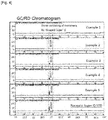
- the Naugard Super Q standard solution was detected as several peaks, and the retention time of the dimer was 16.9 minutes as shown in Fig. 2 .
- the purpose is to perform quantitative analysis of different contents of Naugard Super Q contained in semiconducting materials (to confirm the accuracy of quantitation by checking the difference between the prescription value (the actually used amount) and the measurement value).
- the results of measurement of the content of Naugard Super Q in each of the semiconducting materials of Examples 1 to 5 were analyzed with an average recovery rate of 90% to the prescription values (the actually used amount).
- the prescription values and the measurement values of the content of Naugard Super Q are shown in Table 1 below.
- the GC/FID chromatogram for each of the samples of Examples 1 to 5 is shown in Fig. 4 . From Fig. 4 , it can be seen that the retention time of the dimeric form of monomers for Naugard Super Q for each of the samples of Examples 1 to 5 is 16.9 minutes which is similar to that in the GC/FID chromatogram for the Naugard Super Q standard of Fig.
Landscapes
- Chemical & Material Sciences (AREA)
- Health & Medical Sciences (AREA)
- General Health & Medical Sciences (AREA)
- Life Sciences & Earth Sciences (AREA)
- Analytical Chemistry (AREA)
- Biochemistry (AREA)
- Physics & Mathematics (AREA)
- General Physics & Mathematics (AREA)
- Immunology (AREA)
- Pathology (AREA)
- Chemical Kinetics & Catalysis (AREA)
- Medicinal Chemistry (AREA)
- Polymers & Plastics (AREA)
- Organic Chemistry (AREA)
- Compositions Of Macromolecular Compounds (AREA)
Abstract
Description
- This application claims the benefit of priority to Korean Patent Application No.
10-2017-0116612, filed on September 12, 2017 - The present invention relates to a method for quantitative analysis of high molecular weight antioxidants and, more particularly, to a method for analyzing content of an antioxidant contained in a semiconducting material for a cable, wherein the antioxidant is an amine-based antioxidant.
- Semiconducting products for insulated power cables for ultra-high voltage or power cables used in power equipment are based on polymer materials. Semiconducting products used in power cables and power equipment should have excellent electrical conductivity due to their usage characteristics, and should not reduce their electrical properties or mechanical properties and should not cause deterioration even after long-term use.
- Semiconducting products for cables are produced from a semiconducting composition which is prepared by mixing an ethylene-based copolymer resin, in particular an ethylene-vinyl acetate (EVA) resin, an ethylene-ethyl acrylate (EEA) resin or an ethylene-butyl acrylate (EBA) resin which is used alone or in combination thereof as a matrix resin with carbon black, an antioxidant, a crosslinking agent, a crosslinking aid, a processable lubricant, and the like.
- Semiconducting products are subject to a gradual oxidation process due to the effects of temperature, light, and transition metals, if they are not kept in a specific storage condition. Such oxidation typically leads to aging of the polymeric material. The aging of the polymeric material can be significantly reduced by adding an antioxidant.
- Naugard Super Q is often used as an antioxidant to improve electrical properties of semiconducting products for cables.
- Naugard Super Q (polymerized 1,2-dihydro-2,2,4-trimethylquinoline) is an amine-based antioxidant with molecular weight 874 and has the following formula:

- It is an effective long-term heat stabilizer for a variety of application areas in LDPE (low density polyethylene), LLDPE (linear low density polyethylene), HDPE (high density polyethylene) and ethylene-propylene copolymers. It is used in carbon black-filled systems, such as wires and cables. Therefore, it is required to establish quantitative analysis method of Naugard Super Q. Since Naugard Super Q has a polymeric form, it is not detected as a single component in the quantitative analysis by chromatography. It causes a difficulty in the analysis and thus it is necessary to establish an analysis method in order to solve the problem.
- The present inventors developed a method for quantitative analysis of the content of Naugard Super Q contained in semiconducting products for cables, by extracting the semiconducting products with an acetone solvent and then analyzing them by gas chromatography (GC)/flame ionization detector (FID).
- It is an object of the present invention to provide a method for accurately analyzing the content of an antioxidant, specifically Naugard Super Q, added to semiconducting products for cables.
- Naugard Super Q has a polymeric form, which has been found to be detected not as a single component but as multiple peaks in quantitative analysis with gas chromatography (GC)/mass spectrometry (MS). The same peaks were also detected in analysis with gas chromatography (GC). It is possible to quantify based on the peak of molecular weight (MW) of 362 corresponding to the dimer (dimeric form of monomers having methyl group bonded thereto) consisting of monomers for Naugard Super Q.
- In order to achieve the above object, the present invention provides a method for quantitatively analyzing a semiconducting material for a cable containing Naugard Super Q as an antioxidant by GC/FID.
- Specifically, the present invention provides a method for quantitatively analyzing a high molecular weight antioxidant in a semiconducting material for a cable, the method comprising the steps of: weighing a semiconducting material for a cable comprising a matrix resin, a high molecular weight antioxidant, carbon black and a crosslinking agent, dissolving the material in an acetone solvent, heating the solution, extracting the solution overnight, cooling the solution to room temperature, filtering it, analyzing filtrate by GC/FID and calculating the content of the antioxidant by using
Equation 1 below:
- In one embodiment, the matrix resin comprises an ethylene-vinyl acetate (EVA) resin. In case of a semiconducting material for XLPE cable (cross-linked polyethylene insulated cable), EVA, EEA or EBA resin is used as a basic resin, and LD or LLD wax may be mixed thereto in consideration of properties and workability.
- In one embodiment, the matrix resin may be used in an amount of 50 to 60 wt% based on the weight of the semiconducting material for a cable. If the resin content is lower than the lower limit, it is interpreted that the amount of carbon black is relatively increased. In this case, the resistance value of the semiconducting resin becomes higher. Generally, the resistance value of the semiconducting material is controlled to be not more than a specific value (for example, it is controlled to be not more than 1000 Ω · cm at 90 °C). If the resistance value of the semiconducting material is increased, a workability problem such as an increase in the processing load is generally occurred. On the other hand, if the content of the resin is higher than the upper limit, it is interpreted that the amount of carbon black is relatively decreased. It may result in lower mechanical properties and lower productivity of the semiconducting product. In addition, since the amount of carbon black is reduced, the role of electric relaxation may be reduced. Therefore, the ratio of carbon black to matrix resin can be a factor affecting the workability, electrical characteristics, appearance and productivity of semiconducting products.
- In one embodiment, the antioxidant comprises Naugard Super Q, an amine-based antioxidant. In one embodiment, the antioxidant is quantifiable in dimeric form of the monomer.
- In one embodiment, the semiconducting material for a cable may comprise 50 to 60 wt% of a matrix resin, 0.1 to 1 wt% of an antioxidant, 33 to 40 wt% of carbon black, and 0.3 to 2 wt% of a crosslinking agent. In another embodiment, the semiconducting material for a cable may further comprise additives such as a crosslinking aid and a processing auxiliary, in addition to the above-mentioned components.
- In one embodiment, the solution of the semiconducting material for a cable and acetone may be heated to from 50 °C to 60 °C.
- In one embodiment, the semiconducting material for a cable has a specific resistivity of 500 to 1000 Ω·cm at room temperature and at high temperature (100 °C) in terms of electrical characteristics.
- In one embodiment, acetylene black or furnace black may be used as the carbon black. The range of 33 to 40% by weight of the content of the carbon black is such that the workability and mechanical strength are not lowered.
- In one embodiment, the crosslinking agent may be at least one selected from the group consisting of dicumyl peroxide (DCP), perbutyl peroxide (PBP), di-tert-butyl peroxydiisopropylbenzene and 1,1-bis(tert-butylperoxy)-3,3,5-trimethyl-cyclohexanol. In another embodiment, triallyl isocyanurate (TAIC) may be used as the crosslinking aid.
- In one embodiment, the semiconducting material for a cable may further comprise the crosslinking aid such as ethylene glycol dimethacrylate, 1,3-butylene glycol dimethacrylate or trimethylolpropane trimethacrylate.
- In one embodiment, the quantitative analysis value of the antioxidant in the semiconducting material for a cable may be 80% or more relative to the actually used amount.
- In one embodiment, the apparatus used for the GC/FID analysis is not particularly limited as long as it is commonly used in the art. For example, an Agilent 5890B GC system of Agilent Technologies (USA) may be used.
- According to the quantitative analysis method of the present invention, it is possible to quantitatively analyze a content of a high molecular weight antioxidant by dissolving semiconducting materials for a cable containing a high molecular weight antioxidant in an acetone solvent and analyzing it by GC/FID.
-
-
Fig. 1 shows that quantification is possible based on the peak of molecular weight (MW) of 362 (② M.W. peak) corresponding to the dimer (dimeric form of monomers having methyl group bonded thereto) consisting of monomers for Naugard Super Q. -
Fig. 2 shows GC/FID chromatograms for Naugard Super Q standard and Naugard Super Q in the semiconducting material for a cable according to one embodiment of the present invention. -
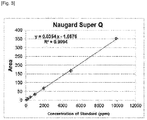
Fig. 3 shows a calibration curve plotted with the concentration of the Naugard Super Q standard and the peak area of the GC/FID chromatogram for the Naugard Super Q. -
Fig. 4 shows GC/FID chromatograms for Naugard Super Q standard and Naugard Super Q in each of Examples 1 to 5. - Hereinafter, the present invention will be described in more detail.
- The terms and words used in the present specification and claims should not be construed as limited to ordinary or dictionary meanings and should be interpreted with the meaning and concept consistent with the technical idea of the present invention based on the principle that the inventor can appropriately define the concept of the term in order to explain his invention in the best way.
- An object of the present invention is to provide a method for quantitative analysis of a high molecular weight antioxidant used in semiconducting products, for example Naugard Super Q, for which accurate quantitative analysis was difficult by conventional GC/MS analysis.
- In order to achieve the above object, the present invention provides a method for quantitatively analyzing a high molecular weight antioxidant in a semiconducting material for a cable, the method comprising the steps of: weighing a semiconducting material for a cable comprising a matrix resin, a high molecular weight antioxidant, carbon black and a crosslinking agent, dissolving the material in an acetone solvent, heating the solution, extracting the solution overnight, cooling the solution to room temperature, filtering it, analyzing the filtrate by GC/FID and calculating the content of the antioxidant by using
Equation 1 below:
- In one embodiment, the matrix resin is an ethylene-vinyl acetate (EVA) resin. In case of a semiconducting material for XLPE cable, EVA, EEA or EBA resin is used as a base resin, and LD or LLD wax may be mixed thereto in consideration of properties and workability.
- In one embodiment, the matrix resin may be used in an amount of 50 to 60 wt% based on the weight of the semiconducting material for a cable. If the resin content is lower than the lower limit, the amount of carbon black is relatively increased and in this case the resistance value of the semiconducting material becomes higher. If the resistance value of the semiconducting material is increased, a workability problem such as an increase in the processing load is occurred. On the other hand, when the content of the resin is higher than the upper limit, it is interpreted that the amount of carbon black is relatively decreased. It may result in lower mechanical properties and lower productivity of the semiconducting product. In addition, since the amount of carbon black is reduced, the role of electric relaxation may be reduced. Therefore, the ratio of carbon black to matrix resin serves as a factor affecting the workability, electrical characteristics, appearance and productivity of semiconducting products.
- In one embodiment, the antioxidant comprises Naugard Super Q as an amine-based antioxidant.
- In one embodiment, the semiconducting material for a cable may comprise 50 to 60 wt% of a matrix resin, 0.1 to 1 wt% of an antioxidant, 33 to 40 wt% of carbon black, and 0.3 to 2 wt% of a crosslinking agent. In another embodiment, the semiconducting material for a cable may further comprise additives such as a crosslinking aid and a processing auxiliary, in addition to the above-mentioned components.
- In one embodiment, the solution of the semiconducting material for a cable and acetone may be heated to from 50 °C to 60 °C.
- In one embodiment, the semiconducting material for a cable has a resistivity of 500 to 1000 Ω·cm at room temperature and at high temperature (100 °C) in terms of electrical characteristics.
- In one embodiment, as the carbon black, acetylene black or furnace black may be used. The range of 33 to 40% by weight of the content of the carbon black is such that the workability and mechanical strength are not lowered.
- In one embodiment, the crosslinking agent may be at least one selected from the group consisting of dicumyl peroxide (DCP), perbutyl peroxide (PBP), di-tert-butyl peroxydiisopropylbenzene and 1,1-bis(tert-butylperoxy)-3,3,5-trimethyl-cyclohexanol. In another embodiment, triallyl isocyanurate (TAIC) may be used as the crosslinking aid.
- In one embodiment, the semiconducting material for a cable may further comprise the crosslinking aid such as ethylene glycol dimethacrylate, 1,3-butylene glycol dimethacrylate or trimethylolpropane trimethacrylate.
- In one embodiment, the quantitative analysis value of the antioxidant in the semiconducting material for the cable may be 80% or more relative to the actually used amount.
- In one embodiment, the apparatus used for the GC/FID analysis is not particularly limited as long as it is commonly used in the art. For example, an Agilent 5890B GC system of Agilent Technologies (USA) may be used.
- Hereinafter, embodiments of the present invention will be described in detail so that those skilled in the art can easily carry out the present invention. The present invention may, however, be embodied in many different forms and should not be construed as limited to the embodiments set forth herein.
-
- 1) 1 g of semiconducting pellets (including EVA resin) for a cable were precisely weighed into 15 ml vials, added 10 ml of acetone thereto and extracted the solution overnight at 60 °C.
- 2) The solution obtained from 1) above was cooled to room temperature, filtered the solution, and analyzed the filtrate by GC/FID.
- An Agilent 5890B GC system from Agilent Technologies, Inc. was used for GC/FID analysis.
- The column was HP-5. The GC oven temperature was maintained at 100 °C for 3 minutes. Then, the temperature was raised to 320 °C at a rate of 15 °C/min and then maintained for 20 minutes at the same temperature to obtain a chromatogram (total operation time: 38 minutes). The detailed analysis condition is as follows.
- Column: HP-5 (30m L. x 0.32mm I.D., 0.25µm d.f. capillary)
- Gas flow rate: Column (He): 1 mL/min
- Oven temperature: 100 °C, 3 min → 15 °C/min → 320 °C, 20 min
- Injection volume: 1.0 µL
- Injector Split ratio: 20/1
- The Naugard Super Q standard solution was detected as several peaks, and the retention time of the dimer was 16.9 minutes as shown in
Fig. 2 . -
- (1) Peaks on the GC/FID chromatogram for Naugard Super Q standard solution were identified and the areas of the peaks were calculated. The calibration curve was obtained by plotting the concentration of the standard solution and the calculated peak area. The correlation coefficient (R2) should be not less than 0.995. The calibration curve is shown in
Fig. 3 . - (2) Peaks on the chromatogram for the sample solution were identified and the areas of the peaks were calculated. Then the concentration was obtained by using the calibration curve. The concentration of Naugard Super Q in the sample was calculated according to
Equation 1 below:
- In this experiment, the volume of acetone solvent was 10 ml. That is, the sample was extracted by using 10 ml of acetone as a pretreatment solvent (Vsample = 10 ml).
- The purpose is to perform quantitative analysis of different contents of Naugard Super Q contained in semiconducting materials (to confirm the accuracy of quantitation by checking the difference between the prescription value (the actually used amount) and the measurement value).
- Five samples (corresponding to Examples 1 to 5, respectively) were prepared as described in the "1. Preparation of sample" above by using semi-conductive pellets for a cable having different contents of Naugard Super Q, and then analyzed the samples by GC/FID. Then, the contents of Naugard Super Q in the samples were determined three times for each sample by using
Equation 1 above to obtain an average value of the measurement values. - The results of measurement of the content of Naugard Super Q in each of the semiconducting materials of Examples 1 to 5 were analyzed with an average recovery rate of 90% to the prescription values (the actually used amount). The prescription values and the measurement values of the content of Naugard Super Q are shown in Table 1 below. The GC/FID chromatogram for each of the samples of Examples 1 to 5 is shown in
Fig. 4 . FromFig. 4 , it can be seen that the retention time of the dimeric form of monomers for Naugard Super Q for each of the samples of Examples 1 to 5 is 16.9 minutes which is similar to that in the GC/FID chromatogram for the Naugard Super Q standard ofFig. 2 [Table 1] Sample of semiconducting material Prescription value (wt%) Measurement value (wt%) Ratio of Measurement value to Prescription value (%) Average ratio of Measurement value to Prescription value (%) Example 1 N/A - - 90.0 Example 2 0.1 0.08 80.0 Example 3 0.3 0.28 93.3 Example 4 0.5 0.45 90.0 Example 5 1.0 0.96 96.0 - Based on the results shown in Table 1, it can be seen that according to the present invention it is possible to accurately measure the content of the high molecular weight antioxidant in the semiconducting material with respect to the actually used amount.
- While the present invention has been particularly shown and described with reference to specific embodiments thereof, it will be apparent to those skilled in the art that this specific description is merely a preferred embodiment and that the scope of the invention is not limited thereby. It is therefore intended that the scope of the invention be defined by the claims appended hereto and their equivalents.
Claims (7)
- A method for quantitative analysis of an antioxidant in a semiconducting material for a cable, the method comprising the steps of: weighing a semiconducting material for a cable comprising a matrix resin, a high molecular weight antioxidant, carbon black and a crosslinking agent, dissolving the material in an acetone solvent, heating the solution, extracting the solution overnight, cooling the solution to room temperature, filtering it, analyzing the filtrate by gas chromatography (GC)/flame ionization detector (FID) and calculating the content of the antioxidant by using Equation 1 below:

- The method for quantitative analysis of an antioxidant in a semiconducting material for a cable according to claim 1, wherein the semiconducting material for a cable comprises 50 to 60 wt% of the matrix resin, 0.1 to 1 wt% of the antioxidant, 33 to 40 wt% of the carbon black, and 0.3 to 2 wt% of the crosslinking agent.
- The method for quantitative analysis of an antioxidant in a semiconducting material for a cable according to claim 1, wherein the matrix resin comprises an ethylene-vinyl acetate (EVA) resin.
- The method for quantitative analysis of an antioxidant in a semiconducting material for a cable according to claim 1, wherein the antioxidant is an amine-based antioxidant, Naugard Super Q (polymerized 1,2-dihydro-2,2,4-trimethylquinoline).
- The method for quantitative analysis of an antioxidant in a semiconducting material for a cable according to claim 1, wherein the solution of the semiconducting material for a cable and acetone is heated to from 50 °C to 60 °C.
- The method for quantitative analysis of an antioxidant in a semiconducting material for a cable according to claim 1, wherein the quantitative analysis value of the antioxidant in the semiconducting material for the cable is 80% or more relative to the actually used amount.
- The method for quantitative analysis of an antioxidant in a semiconducting material for a cable according to claim 1, wherein the crosslinking agent is at least one selected from dicumyl peroxide (DCP), perbutyl peroxide (PBP), di-tert-butyl peroxydiisopropylbenzene and 1,1-bis(tert-butylperoxy)-3,3,5-trimethyl-cyclohexanol.
Applications Claiming Priority (2)
| Application Number | Priority Date | Filing Date | Title |
|---|---|---|---|
| KR1020170116612A KR102118774B1 (en) | 2017-09-12 | 2017-09-12 | Quantitative analysis method of high molecular weight antioxidant |
| PCT/KR2018/008259 WO2019054623A1 (en) | 2017-09-12 | 2018-07-23 | Quantitative analysis method for high molecular weight antioxidant |
Publications (3)
| Publication Number | Publication Date |
|---|---|
| EP3517949A1 true EP3517949A1 (en) | 2019-07-31 |
| EP3517949A4 EP3517949A4 (en) | 2020-01-01 |
| EP3517949B1 EP3517949B1 (en) | 2021-10-20 |
Family
ID=65724018
Family Applications (1)
| Application Number | Title | Priority Date | Filing Date |
|---|---|---|---|
| EP18856898.4A Active EP3517949B1 (en) | 2017-09-12 | 2018-07-23 | Quantitative analysis method for high molecular weight antioxidant |
Country Status (6)
| Country | Link |
|---|---|
| US (1) | US11360063B2 (en) |
| EP (1) | EP3517949B1 (en) |
| JP (1) | JP6805467B2 (en) |
| KR (1) | KR102118774B1 (en) |
| CN (1) | CN109937361B (en) |
| WO (1) | WO2019054623A1 (en) |
Family Cites Families (20)
| Publication number | Priority date | Publication date | Assignee | Title |
|---|---|---|---|---|
| KR940004666B1 (en) | 1990-12-31 | 1994-05-27 | 포항종합제철 주식회사 | Concentration Analysis Method of Amine Additive in Electroplating Solution |
| JPH06279319A (en) | 1993-03-29 | 1994-10-04 | Japan Energy Corp | Extraction method of organic additives in olefin polymer |
| JPH0831241A (en) | 1994-07-20 | 1996-02-02 | Furukawa Electric Co Ltd:The | Power cable |
| JP3446346B2 (en) | 1994-11-10 | 2003-09-16 | 住友化学工業株式会社 | Rubber composition with excellent processability |
| KR100286531B1 (en) | 1998-06-23 | 2001-04-16 | 권문구 | High pressure heat resistant power distribution line |
| JP2003315323A (en) | 2002-04-18 | 2003-11-06 | Sumitomo Wiring Syst Ltd | Method for simultaneously quantifying copper inhibitor and antioxidant |
| ATE511191T1 (en) | 2004-06-11 | 2011-06-15 | Borealis Tech Oy | INSULATION MIXTURE FOR ELECTRICAL POWER CABLE |
| KR20070109317A (en) | 2006-05-10 | 2007-11-15 | 현대자동차주식회사 | Separation and analysis method of plasticizer contained in polyvinyl chloride |
| RU2453564C2 (en) | 2007-05-24 | 2012-06-20 | Кемтура Корпорейшн | Stabilisation of polymers with styrenated p-cresols |
| JP5596327B2 (en) | 2009-01-28 | 2014-09-24 | 株式会社Adeka | Polyolefin resin composition for food, medical and water pipes |
| KR101126679B1 (en) * | 2009-08-24 | 2012-03-29 | 주식회사 엘지화학 | Method for analyzing polyester-based resins |
| US8388868B2 (en) | 2010-02-01 | 2013-03-05 | General Cable Technologies Corporation | Vulcanizable copolymer semiconductive shield compositions |
| US8287770B2 (en) | 2010-03-05 | 2012-10-16 | General Cable Technologies Corporation | Semiconducting composition |
| KR101113645B1 (en) | 2010-07-27 | 2012-02-14 | 현대자동차주식회사 | Method for Quantitative Analysis of Acrylonitrile and Additives in Acrylonitrile-Butadiene Rubber Compositions |
| WO2014040237A1 (en) | 2012-09-12 | 2014-03-20 | Dow Global Technologies Llc | Cross-linkable polymeric compositions, methods for making the same, and articles made therefrom |
| KR102157916B1 (en) | 2012-12-21 | 2020-09-18 | 다우 글로벌 테크놀로지스 엘엘씨 | Hdpe-based buffer tubes with improved excess fiber length in fiber optic cables |
| JP6288763B2 (en) | 2014-01-28 | 2018-03-07 | 住友ゴム工業株式会社 | Quantification method of anti-aging agent |
| KR20160032741A (en) * | 2014-09-16 | 2016-03-25 | 현대모비스 주식회사 | Analyzing method for rubber and additives in rubber composition |
| CN104409178A (en) | 2014-12-05 | 2015-03-11 | 江苏戴普科技有限公司 | Method for preparing corrosion-resisting cable |
| JP2016173328A (en) * | 2015-03-17 | 2016-09-29 | 日本ポリプロ株式会社 | Method for quantitative analysis of additives contained in polyolefins |
-
2017
- 2017-09-12 KR KR1020170116612A patent/KR102118774B1/en active Active
-
2018
- 2018-07-23 JP JP2019523583A patent/JP6805467B2/en active Active
- 2018-07-23 WO PCT/KR2018/008259 patent/WO2019054623A1/en not_active Ceased
- 2018-07-23 CN CN201880004355.4A patent/CN109937361B/en active Active
- 2018-07-23 US US16/346,945 patent/US11360063B2/en active Active
- 2018-07-23 EP EP18856898.4A patent/EP3517949B1/en active Active
Also Published As
| Publication number | Publication date |
|---|---|
| JP2019536017A (en) | 2019-12-12 |
| JP6805467B2 (en) | 2020-12-23 |
| US20200057035A1 (en) | 2020-02-20 |
| EP3517949A4 (en) | 2020-01-01 |
| US11360063B2 (en) | 2022-06-14 |
| KR20190029261A (en) | 2019-03-20 |
| WO2019054623A1 (en) | 2019-03-21 |
| KR102118774B1 (en) | 2020-06-03 |
| EP3517949B1 (en) | 2021-10-20 |
| CN109937361A (en) | 2019-06-25 |
| CN109937361B (en) | 2021-05-25 |
Similar Documents
| Publication | Publication Date | Title |
|---|---|---|
| EP3098244B1 (en) | Crosslinkable polymer composition and cable with advantageous electrical properties | |
| EP2499197B1 (en) | A cable and production process thereof | |
| US20200161019A1 (en) | Polymer composition and a power cable comprising the polymer composition | |
| EP3083796B1 (en) | A new crosslinked polymer composition, power cable insulation and power cable | |
| EP2705079B1 (en) | Polymer composition for electrical devices | |
| JP6895900B2 (en) | A method for producing a crosslinked cable insulator using a high melt strength ethylene polymer produced in a tubular reactor and optionally modified with a branching agent. | |
| EP2794674B1 (en) | Interpolymer compositions and methods for making same | |
| WO2011113686A1 (en) | Polymer composition for w&c application with advantageous electrical properties | |
| EP3591670A1 (en) | A polymer composition and a power cable comprising the polymer composition | |
| EP3083797B1 (en) | A new low mfr polymer composition, power cable insulation and power cable | |
| EP3569648A1 (en) | Power cable | |
| EP3083798B1 (en) | A new crosslinked low mfr polymer composition, power cable insulation and power cable | |
| EP3517949B1 (en) | Quantitative analysis method for high molecular weight antioxidant | |
| EP3643741A1 (en) | Coated conductor with voltage-stabilized inner layer | |
| EP3261094A1 (en) | Cable with advantageous electrical properties | |
| KR20250099755A (en) | Crosslinked stabilized polymer composition | |
| EP1290700B1 (en) | High performance power cable shield | |
| Plazek et al. | Comparison of similar narrow molecular weight polystyrenes | |
| KR20240127372A (en) | Method for manufacturing a cable having an insulating layer | |
| KR102551056B1 (en) | Method for analyzing change in structure of oxidized polymers | |
| WO2025149484A1 (en) | Polymer composition | |
| Sekii et al. | Influence of antioxidants on polyethylene chemical crosslinking reaction | |
| CA3196985A1 (en) | Polyaminosiloxane water tree repellant for electrical insulation | |
| Katia et al. | Effects of antioxidants on the DC conductivity of ethylene propylene rubber | |
| Mat | Mohammed NEDAR", Ahmed BouAkEUR", Abderrahmane BÉRoUAL". Mohamed BoURNANE |
Legal Events
| Date | Code | Title | Description |
|---|---|---|---|
| STAA | Information on the status of an ep patent application or granted ep patent |
Free format text: STATUS: THE INTERNATIONAL PUBLICATION HAS BEEN MADE |
|
| PUAI | Public reference made under article 153(3) epc to a published international application that has entered the european phase |
Free format text: ORIGINAL CODE: 0009012 |
|
| STAA | Information on the status of an ep patent application or granted ep patent |
Free format text: STATUS: REQUEST FOR EXAMINATION WAS MADE |
|
| 17P | Request for examination filed |
Effective date: 20190425 |
|
| AK | Designated contracting states |
Kind code of ref document: A1 Designated state(s): AL AT BE BG CH CY CZ DE DK EE ES FI FR GB GR HR HU IE IS IT LI LT LU LV MC MK MT NL NO PL PT RO RS SE SI SK SM TR |
|
| AX | Request for extension of the european patent |
Extension state: BA ME |
|
| A4 | Supplementary search report drawn up and despatched |
Effective date: 20191202 |
|
| RIC1 | Information provided on ipc code assigned before grant |
Ipc: G01N 30/68 20060101AFI20191126BHEP Ipc: G01N 30/02 20060101ALI20191126BHEP Ipc: G01N 30/88 20060101ALI20191126BHEP |
|
| DAV | Request for validation of the european patent (deleted) | ||
| DAX | Request for extension of the european patent (deleted) | ||
| GRAP | Despatch of communication of intention to grant a patent |
Free format text: ORIGINAL CODE: EPIDOSNIGR1 |
|
| STAA | Information on the status of an ep patent application or granted ep patent |
Free format text: STATUS: GRANT OF PATENT IS INTENDED |
|
| INTG | Intention to grant announced |
Effective date: 20210721 |
|
| GRAS | Grant fee paid |
Free format text: ORIGINAL CODE: EPIDOSNIGR3 |
|
| GRAA | (expected) grant |
Free format text: ORIGINAL CODE: 0009210 |
|
| STAA | Information on the status of an ep patent application or granted ep patent |
Free format text: STATUS: THE PATENT HAS BEEN GRANTED |
|
| AK | Designated contracting states |
Kind code of ref document: B1 Designated state(s): AL AT BE BG CH CY CZ DE DK EE ES FI FR GB GR HR HU IE IS IT LI LT LU LV MC MK MT NL NO PL PT RO RS SE SI SK SM TR |
|
| REG | Reference to a national code |
Ref country code: GB Ref legal event code: FG4D |
|
| REG | Reference to a national code |
Ref country code: CH Ref legal event code: EP |
|
| REG | Reference to a national code |
Ref country code: DE Ref legal event code: R096 Ref document number: 602018025497 Country of ref document: DE |
|
| REG | Reference to a national code |
Ref country code: IE Ref legal event code: FG4D |
|
| REG | Reference to a national code |
Ref country code: AT Ref legal event code: REF Ref document number: 1440351 Country of ref document: AT Kind code of ref document: T Effective date: 20211115 |
|
| REG | Reference to a national code |
Ref country code: LT Ref legal event code: MG9D |
|
| REG | Reference to a national code |
Ref country code: NL Ref legal event code: MP Effective date: 20211020 |
|
| REG | Reference to a national code |
Ref country code: AT Ref legal event code: MK05 Ref document number: 1440351 Country of ref document: AT Kind code of ref document: T Effective date: 20211020 |
|
| PG25 | Lapsed in a contracting state [announced via postgrant information from national office to epo] |
Ref country code: RS Free format text: LAPSE BECAUSE OF FAILURE TO SUBMIT A TRANSLATION OF THE DESCRIPTION OR TO PAY THE FEE WITHIN THE PRESCRIBED TIME-LIMIT Effective date: 20211020 Ref country code: LT Free format text: LAPSE BECAUSE OF FAILURE TO SUBMIT A TRANSLATION OF THE DESCRIPTION OR TO PAY THE FEE WITHIN THE PRESCRIBED TIME-LIMIT Effective date: 20211020 Ref country code: FI Free format text: LAPSE BECAUSE OF FAILURE TO SUBMIT A TRANSLATION OF THE DESCRIPTION OR TO PAY THE FEE WITHIN THE PRESCRIBED TIME-LIMIT Effective date: 20211020 Ref country code: BG Free format text: LAPSE BECAUSE OF FAILURE TO SUBMIT A TRANSLATION OF THE DESCRIPTION OR TO PAY THE FEE WITHIN THE PRESCRIBED TIME-LIMIT Effective date: 20220120 Ref country code: AT Free format text: LAPSE BECAUSE OF FAILURE TO SUBMIT A TRANSLATION OF THE DESCRIPTION OR TO PAY THE FEE WITHIN THE PRESCRIBED TIME-LIMIT Effective date: 20211020 |
|
| PG25 | Lapsed in a contracting state [announced via postgrant information from national office to epo] |
Ref country code: IS Free format text: LAPSE BECAUSE OF FAILURE TO SUBMIT A TRANSLATION OF THE DESCRIPTION OR TO PAY THE FEE WITHIN THE PRESCRIBED TIME-LIMIT Effective date: 20220220 Ref country code: SE Free format text: LAPSE BECAUSE OF FAILURE TO SUBMIT A TRANSLATION OF THE DESCRIPTION OR TO PAY THE FEE WITHIN THE PRESCRIBED TIME-LIMIT Effective date: 20211020 Ref country code: PT Free format text: LAPSE BECAUSE OF FAILURE TO SUBMIT A TRANSLATION OF THE DESCRIPTION OR TO PAY THE FEE WITHIN THE PRESCRIBED TIME-LIMIT Effective date: 20220221 Ref country code: PL Free format text: LAPSE BECAUSE OF FAILURE TO SUBMIT A TRANSLATION OF THE DESCRIPTION OR TO PAY THE FEE WITHIN THE PRESCRIBED TIME-LIMIT Effective date: 20211020 Ref country code: NO Free format text: LAPSE BECAUSE OF FAILURE TO SUBMIT A TRANSLATION OF THE DESCRIPTION OR TO PAY THE FEE WITHIN THE PRESCRIBED TIME-LIMIT Effective date: 20220120 Ref country code: NL Free format text: LAPSE BECAUSE OF FAILURE TO SUBMIT A TRANSLATION OF THE DESCRIPTION OR TO PAY THE FEE WITHIN THE PRESCRIBED TIME-LIMIT Effective date: 20211020 Ref country code: LV Free format text: LAPSE BECAUSE OF FAILURE TO SUBMIT A TRANSLATION OF THE DESCRIPTION OR TO PAY THE FEE WITHIN THE PRESCRIBED TIME-LIMIT Effective date: 20211020 Ref country code: HR Free format text: LAPSE BECAUSE OF FAILURE TO SUBMIT A TRANSLATION OF THE DESCRIPTION OR TO PAY THE FEE WITHIN THE PRESCRIBED TIME-LIMIT Effective date: 20211020 Ref country code: GR Free format text: LAPSE BECAUSE OF FAILURE TO SUBMIT A TRANSLATION OF THE DESCRIPTION OR TO PAY THE FEE WITHIN THE PRESCRIBED TIME-LIMIT Effective date: 20220121 Ref country code: ES Free format text: LAPSE BECAUSE OF FAILURE TO SUBMIT A TRANSLATION OF THE DESCRIPTION OR TO PAY THE FEE WITHIN THE PRESCRIBED TIME-LIMIT Effective date: 20211020 |
|
| REG | Reference to a national code |
Ref country code: DE Ref legal event code: R097 Ref document number: 602018025497 Country of ref document: DE |
|
| PG25 | Lapsed in a contracting state [announced via postgrant information from national office to epo] |
Ref country code: SM Free format text: LAPSE BECAUSE OF FAILURE TO SUBMIT A TRANSLATION OF THE DESCRIPTION OR TO PAY THE FEE WITHIN THE PRESCRIBED TIME-LIMIT Effective date: 20211020 Ref country code: SK Free format text: LAPSE BECAUSE OF FAILURE TO SUBMIT A TRANSLATION OF THE DESCRIPTION OR TO PAY THE FEE WITHIN THE PRESCRIBED TIME-LIMIT Effective date: 20211020 Ref country code: RO Free format text: LAPSE BECAUSE OF FAILURE TO SUBMIT A TRANSLATION OF THE DESCRIPTION OR TO PAY THE FEE WITHIN THE PRESCRIBED TIME-LIMIT Effective date: 20211020 Ref country code: EE Free format text: LAPSE BECAUSE OF FAILURE TO SUBMIT A TRANSLATION OF THE DESCRIPTION OR TO PAY THE FEE WITHIN THE PRESCRIBED TIME-LIMIT Effective date: 20211020 Ref country code: DK Free format text: LAPSE BECAUSE OF FAILURE TO SUBMIT A TRANSLATION OF THE DESCRIPTION OR TO PAY THE FEE WITHIN THE PRESCRIBED TIME-LIMIT Effective date: 20211020 Ref country code: CZ Free format text: LAPSE BECAUSE OF FAILURE TO SUBMIT A TRANSLATION OF THE DESCRIPTION OR TO PAY THE FEE WITHIN THE PRESCRIBED TIME-LIMIT Effective date: 20211020 |
|
| PLBE | No opposition filed within time limit |
Free format text: ORIGINAL CODE: 0009261 |
|
| STAA | Information on the status of an ep patent application or granted ep patent |
Free format text: STATUS: NO OPPOSITION FILED WITHIN TIME LIMIT |
|
| 26N | No opposition filed |
Effective date: 20220721 |
|
| PG25 | Lapsed in a contracting state [announced via postgrant information from national office to epo] |
Ref country code: AL Free format text: LAPSE BECAUSE OF FAILURE TO SUBMIT A TRANSLATION OF THE DESCRIPTION OR TO PAY THE FEE WITHIN THE PRESCRIBED TIME-LIMIT Effective date: 20211020 |
|
| PG25 | Lapsed in a contracting state [announced via postgrant information from national office to epo] |
Ref country code: SI Free format text: LAPSE BECAUSE OF FAILURE TO SUBMIT A TRANSLATION OF THE DESCRIPTION OR TO PAY THE FEE WITHIN THE PRESCRIBED TIME-LIMIT Effective date: 20211020 |
|
| PG25 | Lapsed in a contracting state [announced via postgrant information from national office to epo] |
Ref country code: MC Free format text: LAPSE BECAUSE OF FAILURE TO SUBMIT A TRANSLATION OF THE DESCRIPTION OR TO PAY THE FEE WITHIN THE PRESCRIBED TIME-LIMIT Effective date: 20211020 |
|
| REG | Reference to a national code |
Ref country code: CH Ref legal event code: PL |
|
| REG | Reference to a national code |
Ref country code: BE Ref legal event code: MM Effective date: 20220731 |
|
| PG25 | Lapsed in a contracting state [announced via postgrant information from national office to epo] |
Ref country code: LU Free format text: LAPSE BECAUSE OF NON-PAYMENT OF DUE FEES Effective date: 20220723 Ref country code: LI Free format text: LAPSE BECAUSE OF NON-PAYMENT OF DUE FEES Effective date: 20220731 Ref country code: CH Free format text: LAPSE BECAUSE OF NON-PAYMENT OF DUE FEES Effective date: 20220731 |
|
| PG25 | Lapsed in a contracting state [announced via postgrant information from national office to epo] |
Ref country code: IT Free format text: LAPSE BECAUSE OF FAILURE TO SUBMIT A TRANSLATION OF THE DESCRIPTION OR TO PAY THE FEE WITHIN THE PRESCRIBED TIME-LIMIT Effective date: 20211020 Ref country code: BE Free format text: LAPSE BECAUSE OF NON-PAYMENT OF DUE FEES Effective date: 20220731 |
|
| PG25 | Lapsed in a contracting state [announced via postgrant information from national office to epo] |
Ref country code: IE Free format text: LAPSE BECAUSE OF NON-PAYMENT OF DUE FEES Effective date: 20220723 |
|
| PG25 | Lapsed in a contracting state [announced via postgrant information from national office to epo] |
Ref country code: HU Free format text: LAPSE BECAUSE OF FAILURE TO SUBMIT A TRANSLATION OF THE DESCRIPTION OR TO PAY THE FEE WITHIN THE PRESCRIBED TIME-LIMIT; INVALID AB INITIO Effective date: 20180723 |
|
| PG25 | Lapsed in a contracting state [announced via postgrant information from national office to epo] |
Ref country code: MK Free format text: LAPSE BECAUSE OF FAILURE TO SUBMIT A TRANSLATION OF THE DESCRIPTION OR TO PAY THE FEE WITHIN THE PRESCRIBED TIME-LIMIT Effective date: 20211020 Ref country code: CY Free format text: LAPSE BECAUSE OF FAILURE TO SUBMIT A TRANSLATION OF THE DESCRIPTION OR TO PAY THE FEE WITHIN THE PRESCRIBED TIME-LIMIT Effective date: 20211020 |
|
| PG25 | Lapsed in a contracting state [announced via postgrant information from national office to epo] |
Ref country code: MT Free format text: LAPSE BECAUSE OF FAILURE TO SUBMIT A TRANSLATION OF THE DESCRIPTION OR TO PAY THE FEE WITHIN THE PRESCRIBED TIME-LIMIT Effective date: 20211020 |
|
| PGFP | Annual fee paid to national office [announced via postgrant information from national office to epo] |
Ref country code: GB Payment date: 20250624 Year of fee payment: 8 |
|
| PGFP | Annual fee paid to national office [announced via postgrant information from national office to epo] |
Ref country code: FR Payment date: 20250624 Year of fee payment: 8 |
|
| PGFP | Annual fee paid to national office [announced via postgrant information from national office to epo] |
Ref country code: DE Payment date: 20250624 Year of fee payment: 8 |
|
| PG25 | Lapsed in a contracting state [announced via postgrant information from national office to epo] |
Ref country code: TR Free format text: LAPSE BECAUSE OF FAILURE TO SUBMIT A TRANSLATION OF THE DESCRIPTION OR TO PAY THE FEE WITHIN THE PRESCRIBED TIME-LIMIT Effective date: 20211020 |