EP3517511A1 - Alkali aluminoborosilicate glass article - Google Patents
Alkali aluminoborosilicate glass article Download PDFInfo
- Publication number
- EP3517511A1 EP3517511A1 EP19155771.9A EP19155771A EP3517511A1 EP 3517511 A1 EP3517511 A1 EP 3517511A1 EP 19155771 A EP19155771 A EP 19155771A EP 3517511 A1 EP3517511 A1 EP 3517511A1
- Authority
- EP
- European Patent Office
- Prior art keywords
- glass
- layer
- mol
- cations
- glass article
- Prior art date
- Legal status (The legal status is an assumption and is not a legal conclusion. Google has not performed a legal analysis and makes no representation as to the accuracy of the status listed.)
- Granted
Links
Images
Classifications
-
- C—CHEMISTRY; METALLURGY
- C03—GLASS; MINERAL OR SLAG WOOL
- C03C—CHEMICAL COMPOSITION OF GLASSES, GLAZES OR VITREOUS ENAMELS; SURFACE TREATMENT OF GLASS; SURFACE TREATMENT OF FIBRES OR FILAMENTS MADE FROM GLASS, MINERALS OR SLAGS; JOINING GLASS TO GLASS OR OTHER MATERIALS
- C03C21/00—Treatment of glass, not in the form of fibres or filaments, by diffusing ions or metals in the surface
- C03C21/001—Treatment of glass, not in the form of fibres or filaments, by diffusing ions or metals in the surface in liquid phase, e.g. molten salts, solutions
- C03C21/002—Treatment of glass, not in the form of fibres or filaments, by diffusing ions or metals in the surface in liquid phase, e.g. molten salts, solutions to perform ion-exchange between alkali ions
-
- C—CHEMISTRY; METALLURGY
- C03—GLASS; MINERAL OR SLAG WOOL
- C03C—CHEMICAL COMPOSITION OF GLASSES, GLAZES OR VITREOUS ENAMELS; SURFACE TREATMENT OF GLASS; SURFACE TREATMENT OF FIBRES OR FILAMENTS MADE FROM GLASS, MINERALS OR SLAGS; JOINING GLASS TO GLASS OR OTHER MATERIALS
- C03C3/00—Glass compositions
- C03C3/04—Glass compositions containing silica
- C03C3/076—Glass compositions containing silica with 40% to 90% silica, by weight
- C03C3/089—Glass compositions containing silica with 40% to 90% silica, by weight containing boron
- C03C3/091—Glass compositions containing silica with 40% to 90% silica, by weight containing boron containing aluminium
-
- C—CHEMISTRY; METALLURGY
- C03—GLASS; MINERAL OR SLAG WOOL
- C03C—CHEMICAL COMPOSITION OF GLASSES, GLAZES OR VITREOUS ENAMELS; SURFACE TREATMENT OF GLASS; SURFACE TREATMENT OF FIBRES OR FILAMENTS MADE FROM GLASS, MINERALS OR SLAGS; JOINING GLASS TO GLASS OR OTHER MATERIALS
- C03C3/00—Glass compositions
- C03C3/04—Glass compositions containing silica
- C03C3/076—Glass compositions containing silica with 40% to 90% silica, by weight
- C03C3/095—Glass compositions containing silica with 40% to 90% silica, by weight containing rare earths
-
- C—CHEMISTRY; METALLURGY
- C03—GLASS; MINERAL OR SLAG WOOL
- C03C—CHEMICAL COMPOSITION OF GLASSES, GLAZES OR VITREOUS ENAMELS; SURFACE TREATMENT OF GLASS; SURFACE TREATMENT OF FIBRES OR FILAMENTS MADE FROM GLASS, MINERALS OR SLAGS; JOINING GLASS TO GLASS OR OTHER MATERIALS
- C03C3/00—Glass compositions
- C03C3/04—Glass compositions containing silica
- C03C3/076—Glass compositions containing silica with 40% to 90% silica, by weight
- C03C3/097—Glass compositions containing silica with 40% to 90% silica, by weight containing phosphorus, niobium or tantalum
-
- C—CHEMISTRY; METALLURGY
- C03—GLASS; MINERAL OR SLAG WOOL
- C03C—CHEMICAL COMPOSITION OF GLASSES, GLAZES OR VITREOUS ENAMELS; SURFACE TREATMENT OF GLASS; SURFACE TREATMENT OF FIBRES OR FILAMENTS MADE FROM GLASS, MINERALS OR SLAGS; JOINING GLASS TO GLASS OR OTHER MATERIALS
- C03C4/00—Compositions for glass with special properties
- C03C4/18—Compositions for glass with special properties for ion-sensitive glass
-
- C—CHEMISTRY; METALLURGY
- C03—GLASS; MINERAL OR SLAG WOOL
- C03C—CHEMICAL COMPOSITION OF GLASSES, GLAZES OR VITREOUS ENAMELS; SURFACE TREATMENT OF GLASS; SURFACE TREATMENT OF FIBRES OR FILAMENTS MADE FROM GLASS, MINERALS OR SLAGS; JOINING GLASS TO GLASS OR OTHER MATERIALS
- C03C2204/00—Glasses, glazes or enamels with special properties
-
- Y—GENERAL TAGGING OF NEW TECHNOLOGICAL DEVELOPMENTS; GENERAL TAGGING OF CROSS-SECTIONAL TECHNOLOGIES SPANNING OVER SEVERAL SECTIONS OF THE IPC; TECHNICAL SUBJECTS COVERED BY FORMER USPC CROSS-REFERENCE ART COLLECTIONS [XRACs] AND DIGESTS
- Y10—TECHNICAL SUBJECTS COVERED BY FORMER USPC
- Y10T—TECHNICAL SUBJECTS COVERED BY FORMER US CLASSIFICATION
- Y10T428/00—Stock material or miscellaneous articles
- Y10T428/24—Structurally defined web or sheet [e.g., overall dimension, etc.]
- Y10T428/24942—Structurally defined web or sheet [e.g., overall dimension, etc.] including components having same physical characteristic in differing degree
- Y10T428/2495—Thickness [relative or absolute]
-
- Y—GENERAL TAGGING OF NEW TECHNOLOGICAL DEVELOPMENTS; GENERAL TAGGING OF CROSS-SECTIONAL TECHNOLOGIES SPANNING OVER SEVERAL SECTIONS OF THE IPC; TECHNICAL SUBJECTS COVERED BY FORMER USPC CROSS-REFERENCE ART COLLECTIONS [XRACs] AND DIGESTS
- Y10—TECHNICAL SUBJECTS COVERED BY FORMER USPC
- Y10T—TECHNICAL SUBJECTS COVERED BY FORMER US CLASSIFICATION
- Y10T428/00—Stock material or miscellaneous articles
- Y10T428/31—Surface property or characteristic of web, sheet or block
- Y10T428/315—Surface modified glass [e.g., tempered, strengthened, etc.]
Definitions
- the disclosure relates to strengthened alkali aluminoborosilicate glasses. More particularly, the disclosure relates to a method of strengthening such glasses. Even more particularly, the disclosure relates to strengthening such glasses by ion exchange.
- the ion exchange process can be used to strengthen alkali-containing glasses by creating compressive stress layers in the surface region of the glass.
- lithium-containing aluminosilicate glasses are ion exchanged more readily than sodium-containing glasses and greater depths of compression can be obtained in lithium-containing aluminosilicate glasses at lower temperatures and shorter times.
- such lithium-containing aluminosilicate glasses tend to have lower strain and anneal points, and lower temperatures are required for treatment to avoid structural relaxation.
- the exchange of sodium for lithium in the glass results in lower surface compression - which translates into lower surface strength - when compared to the surface compression achieved with the exchange of potassium for sodium in the glass.
- a method of strengthening an alkali aluminoborosilicate glass is provided.
- a compressive layer extending from a surface of the glass to a depth of layer is formed by exchanging larger metal cations for smaller metal cations present in the glass.
- metal cations in the glass are exchanged for larger metal cations to a second depth that is less than the depth of layer.
- the second step increases the compressive stress of the compressive layer. For example, sodium cations are exchanged in the first step for lithium cations that are present in the glass to the depth of layer, and potassium cations are then exchanged in the second step for sodium cations and lithium cations in the glass to the second depth.
- the exchange of the potassium cations for sodium and lithium cations increases the compressive stress of the layer. Formation of the compressive layer and replacement of cations with larger cations can be achieved by a two-step ion exchange process.
- An alkali aluminoborosilicate glass having a compressive layer and a crack indentation threshold of at least 3000 gf is also provided.
- one aspect of the disclosure is to provide a method of strengthening an alkali aluminoborosilicate glass.
- the method comprises the steps of: providing an alkali aluminoborosilicate glass comprising alkali metal cations; forming a compressive layer extending from a surface of the glass to a depth of layer, wherein the compressive layer is under a compressive stress; and replacing at least a portion of the alkali metal cations with a larger alkali metal cation to a second depth that is less than the depth of layer, and wherein replacing the alkali metal cations with the larger alkali metal cation increases the compressive stress.
- a second aspect of the disclosure is to provide a method of strengthening an alkali aluminoborosilicate glass.
- the method comprises the steps of: providing the alkali aluminoborosilicate glass comprising lithium cations and sodium cations; replacing at least a portion of the lithium cations with sodium cations to form a compressive layer that extends from a surface of the glass to a depth of layer and is under compressive stress; and replacing at least a portion of the sodium cations and the lithium cations with potassium cations to a second depth that is less than the depth of layer, wherein the compressive layer is enriched in potassium cations to the second depth, and wherein replacing sodium cations and lithium cations with potassium cations increases the compressive stress of the compressive layer.
- a third aspect of the disclosure is to provide an alkali aluminoborosilicate glass.
- the glass comprises lithium cations, sodium cations, and potassium cations.
- the glass has a surface having a compressive layer extending from the surface to a depth of layer and is enriched in potassium cations to a second depth that is less than the depth of layer.
- the surface of the glass has a crack initiation threshold of at least 3000 gf upon indentation with a Vickers indenter.
- the term "enriched,” unless otherwise specified, means that the concentration of a specified element or ionic specie is greater than the average concentration of that element or ionic specie within the bulk of the glass.
- glass refers to alkali aluminoborosilicate glasses, unless otherwise specified.
- the method comprises the steps of: providing the alkali aluminoborosilicate glass; initially forming a compressive layer extending from a surface of the glass to a depth of layer; and replacing at least a portion of alkali metal cations with a larger alkali metal cation to a second depth that is less than the depth of layer. Replacing the alkali metal cations with the larger alkali metal cation increases the compressive stress in the compressive layer and increases the damage resistance of the surface of the glass.
- the compressive layer inhibits the introduction of flaws at the surface and prevents crack initiation and propagation through the depth of the layer.
- the method is carried out through the use of a two-step ion exchange process.
- an alkali aluminoborosilicate glass is provided.
- the glass is provided in the form of a sheet having a thickness of about 2 mm or less.
- Such sheets can be formed by down-draw methods known in the art such as slot-draw or fusion-draw processes, or by other methods known in the art.
- the glass in some embodiments, comprises monovalent lithium cations, and sodium cations.
- the glass can additionally include monovalent potassium cations.
- the presence of such alkali metal cations in the glass is typically represented by the oxide species Li 2 O, Na 2 O, and K 2 O.
- the alkali aluminoborosilicate glass comprises, consists essentially of, or consists of: 50-70 mol% SiO 2 ; 5-15 mol% Al 2 O 3 ; 5-20 mol% B 2 O 3 ; 2-15 mol% Li 2 O; 0-20 mol% Na 2 O; and 0-10 mol% K 2 O.
- the glass can further comprise at least one of: 0-10 mol% P 2 O 5 ; 0-5 mol% MgO; 0-1 mol% CeO 2 ; and 0-1 mol% SnO 2 .
- Non-limiting compositions and physical properties of representative glasses are listed in Table 1.
- Crack initiation thresholds which were determined by indentation with a Vickers indenter, are also listed for the compositions in Table 1.
- depths of layer (DOL) of the compressive layers formed by the ion exchange processes expressed
- the alkali aluminoborosilicate glass as provided has intrinsically high damage resistance; i.e., the glass has high damage resistance prior to - or without - any chemical or thermal strengthening or tempering. Such damage resistance is measured or characterized by the resistance of the glass to crack formation and/or crack propagation upon indentation with a Vickers indenter.
- the glass has a crack initiation threshold (i.e., the Vickers indenter load at which cracks are first observed) of at least about 1000 gf before strengthening and, in particular embodiments, in a range from about 1000 gf up to about 2000 gf, prior to strengthening. Examples of glass compositions that intrinsically have crack initiation thresholds in this range are listed in Table 2.
- soda-lime glasses have low damage tolerance, and form cracks when indented at loads as low as 100 gf. Even when ion-exchanged, soda-lime glass typically has a damage tolerance of less than 1000 gf. Table 2. Crack initiation thresholds for mixed alkali aluminoborosilicate glasses before strengthening. Composition (mol%) a b c d e f g h SiO 2 65.7 65.7 65.2.
- the formation of the compressive layer and increase damage resistance described herein can, in some embodiments, be achieved by a two-step ion exchange process.
- ions in the surface layer of the glass are replaced by - or exchanged with - larger ions having the same valence or oxidation state as the ions present in the glass.
- the exchange of metal cations is typically carried out in a molten salt bath, with larger cations from the bath typically replacing smaller cations within the glass.
- Ion exchange is limited to a region extending from the surface of the glass article to a depth (depth of layer, or "DOL") below the surface.
- ion exchange of alkali metal-containing glasses can be achieved by immersing the glass in at least one molten salt bath containing a salt such as, but not limited to, nitrates, sulfates, and chlorides of at least one alkali metal ion.
- a salt such as, but not limited to, nitrates, sulfates, and chlorides of at least one alkali metal ion.
- the temperature of such molten salt baths is typically in a range from about 380°C up to about 450°C, with immersion times ranging up to about 16 hours. However, temperatures and immersion times that are different from those described herein can also be used.
- the replacement or exchange of smaller cations within the glass with larger cations from the bath creates a compressive stress in the region near the surface of the glass to the depth of layer. The compressive stress near the surface gives rise to a central tension in an inner or central region of the glass so as to balance forces within the glass.
- the step of initially forming the compressive layer provides a compressive layer having an unusually deep depth of layer.
- the step of forming the compressive layer comprises replacing smaller alkali metal cations with larger alkali metal cations.
- this step comprises replacing lithium cations in the glass with sodium cations from, for example, a molten salt bath, by ion exchange to the depth of layer below the surface of the glass.
- the exchange of Na + ions for Li + ions achieves an advantageously deep depth of layer (e.g., d 1 , d 2 , in FIG. 1 ).
- the depth of layer is at least 50 ⁇ m, and can, in some embodiments, extend from the surface to a depth in a range from about 70 ⁇ m up to about 290 ⁇ m.
- the exchange of Na + ions for Li + ions can be achieved by immersing the glass in a first ion exchange bath comprising at least one molten sodium salt.
- the sodium salt is sodium nitrate (NaNO 3 ).
- the ion exchange bath contains only sodium salt; i.e., no other metal salts are intentionally added to the bath.
- the first ion exchange bath further includes salts of other alkali metals such as, but not limited to, potassium nitrate (KNO 3 ).
- the first ion exchange bath comprises 40% NaNO 3 and 60% KNO 3 by weight.
- the first ion exchange bath comprises 20% NaNO 3 and 80% KNO 3 by weight.
- the small alkali metal cations (e.g., Li + , Na + ) in the compressive layer are replaced by a single, larger alkali metal cation specie to a second depth (e.g., d 1 ', d 2 ', in FIG. 1 ) that is less than the depth of layer.
- this is achieved by exchanging potassium ions for at least one of sodium ions and lithium ions in the glass.
- the exchange of K+ ions for Na + ions and Li + to the second depth increases the surface compressive stress of the glass.
- the second depth extends from the surface to a depth in a range from about 5 ⁇ m up to about 20 ⁇ m.
- Such ion exchange is achieved by immersing the glass in a second ion exchange bath comprising a potassium sodium salt.
- the potassium salt is potassium nitrate (KNO 3 ).
- the glass After the glass has been strengthened by forming the deep compressive layer and replacing smaller ions with larger ions to a lesser depth using the two-step ion exchange process described hereinabove, the glass has a crack initiation threshold of at least 3000 gf when indented with a Vickers indenter, a compressive stress of at least 500 MPa, and a depth of layer of at least 50 ⁇ m.
- An alkali aluminoborosilicate glass comprising lithium cations, sodium cations, and potassium cations is also provided.
- the glass has a compressive stress layer extending from a surface of the glass to a depth of layer.
- the compressive layer of the glass is enriched in potassium cations to a second depth that is less than the depth of layer.
- the surface also has a crack initiation threshold of at least 3000 gf when indented with a Vickers indenter.
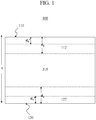
- strengthened glass sheet 100 has a thickness t , a first surface 110 and second surface 120 that are substantially parallel to each other, central portion 115.
- Compressive layers 112, 122 extend from first surface 110 and second surface 120, respectively, to depths of layer d 1 , d 2 , below each surface.
- Compressive layers 112, 122 are under a compressive stress, while central portion 115 is under a tensile stress, or in tension.
- the tensile stress in central portion 115 balances the compressive stresses in compressive layers 112, 122, thus maintaining equilibrium within strengthened glass sheet 100.
- Each of compressive layers 112, 122 of the glass is enriched in potassium cations to second depths d 1 ', d 2 ', respectively, wherein second depths d 1 ', d 2 ' are less than depths of layer d 1 , d 2 .
- a glass sheet having compressive layers 112, 122 extending from opposite surfaces 120, 120 is shown in FIG. 1
- the glass described herein can have a strengthened single surface, rather than multiple strengthened surfaces. This can be achieved, for example, by masking one of surfaces 110, 120 during the two-step ion exchange process, which is described herein and is used to strengthen glass sheet 100.
- the first depth of layer extends from the surface of the glass to a depth in a range from about 70 ⁇ m up to about 290 ⁇ m.
- the second depths d 1 ', d 2 ' extend from surfaces 112, 122 to a depth in a range from about 5 ⁇ m up to about 20 ⁇ m.
- the compressive layer is, in some embodiments, formed by the methods described hereinabove, such as, for example, the two-step ion exchange process described above.
- the method comprises the steps of: providing the alkali aluminoborosilicate glass; forming a compressive layer extending from a surface of the glass to a depth of layer ( d 1 , d 2 in FIG. 1 ); wherein the compressive layer is under a compressive stress; and replacing alkali metal cations in the compressive layer with a larger alkali metal cation to a second depth ( d 1 ', d 2 ' in FIG. 1 ) that is less the depth of layer.
- the replacement of the alkali metal cations with a larger alkali metal cationic specie increases the compressive stress in the compressive layer.
- the glass is in the form of a sheet having a thickness of about 2 mm or less. Such sheets can be formed by down-draw methods known in the art such as slot-draw or fusion-draw processes, or by other methods known in the art.
- the alkali aluminoborosilicate glass comprises, consists essentially of, or consists of: 50-70 mol% SiO 2 ; 5-15 mol% Al 2 O 3 ; 5-20 mol% B 2 O 3 ; 2-15 mol% Li 2 O; 0-20 mol% Na 2 O; and 0-10 mol% K 2 O.
- the glass can further comprise at least one of: 0-10 mol% P 2 O 5 ; 0-5 mol% MgO; 0-1 mol% CeO 2 ; and 0-1 mol% SnO 2 .
- Compositions and physical properties, and damage resistance of representative glasses are listed in Table 1.
- the glasses described herein intrinsically (i.e., prior to thermal or chemical strengthening (e.g., ion exchange)) possess high levels of damage resistance. Such damage resistance is measured or characterized by the resistance of the glass to crack formation and/or crack propagation upon indentation with a Vickers indenter.
- the glass has a crack initiation threshold (i.e., the Vickers indenter load at which cracks are first observed) of at least about 1000 gf before strengthening and, in particular embodiments, in a range from about 1000 gf up to about 2000 gf, prior to strengthening. Examples of glass compositions that intrinsically have crack initiation thresholds in this range are listed in Table 2.
- soda-lime glasses have low damage tolerance, and form cracks when indented at loads as low as 100 gf. Even when ion-exchanged, soda-lime glass typically has a damage tolerance of less than 1000 gf.
- the tolerance to damage and strength of the alkali aluminoborosilicate glasses having intrinsic damage resistance can be greatly enhanced by the use of a 2 step ion-exchange process.
- the two-step strengthening/ion exchange processes described hereinabove provide new opportunities for the use of such glasses in those consumer electronics applications where high strength and scratch resistance are desirable.
- Such applications include, but are not limited to, cover plates, display windows, display screens, touch screens, and the like for portable or hand-held electronic communication and entertainment devices.
- Glass samples having selected compositions were subjected to single-step ion exchange by immersion in a single molten salt bath.
- Different glass samples having these same compositions were subjected to two-step ion exchange in multiple salt baths, in accordance with the methods described hereinabove.
- the single-step ion exchange baths used were: a) a 390°C molten NaNO 3 salt bath; and b) a 390°C molten salt bath containing 60% KNO 3 and 40% NaNO 3 by weight.
- the glass samples that were ion exchanged in the pure NaNO 3 bath were immersed in the bath for 5 hours. Glass samples that were ion exchanged in the KNO 3 /NaNO 3 bath were immersed in the bath for 10 hours.
- the first set of multiple baths consisted of a first bath of molten NaNO 3 salt at 390°C, followed by a second bath of molten KNO 3 salt at 390°C. Glass samples were immersed in the first (NaNO 3 ) bath for 10 hours, and then immersed in the second (KNO 3 ) bath for 30 minutes.
- the second set of multiple baths consisted of a first bath of molten NaNO 3 salt at 410°C, followed by a second bath of molten KNO 3 salt at 410°C. Glass samples were immersed in the first (NaNO 3 ) bath for 10 hours, and then immersed in the second (KNO 3 ) bath for 10 minutes.
- crack initiation thresholds for soda lime glass were measured before ion exchange and after ion exchange in a 410°C KNO 3 bath for 8 hours.
- Table 3 lists depths of layer (DOL) and compressive stresses (CS) measured for 1 mm alkali aluminoborosilicate glass samples following different ion exchange (IX) procedures.
- compositions of the samples listed in Table 3 are: i) 65.7 mol% SiO 2 ; 12.3 mol% Al 2 O 3 ; 9.1 mol% B 2 O 3 ; 5 mol% Li 2 O; 6.6 mol% Na 2 O; 1.3 mol% K 2 O; 0.1 mol% SnO 2 ; and 0.15 CeO 2 ; ii) 65.7 mol% SiO 2 ; 10.3 mol% Al 2 O 3 ; 12.1 mol% B 2 O 3 ; 4.6 mol% Li 2 O; 6.2 mol% Na 2 O; 1.1 mol% K 2 O; 0.1 mol% SnO 2 ; and 0.15 CeO 2 ; and iii) 57.9 mol% SiO 2 ; 12.1 mol% Al 2 O 3 ; 18.1 mol% B 2 O 3 ; 4.6 mol% Li 2 O; 6.2 mol% Na 2 O; 1.1 mol% K 2 O; 0.1 mol% SnO 2 ; and 0.15
- One set of samples of each composition was ion exchanged in a single-step process by immersion in a 390°C molten salt bath containing 80 wt% KNO 3 and 20 wt% NaNO 3 for 5 hours.
- Two-step ion exchange consisted of immersion a 390°C molten salt bath containing 80 wt% KNO 3 and 20 wt% NaNO 3 for 5 hours followed by immersion in a 410°C KNO 3 molten salt bath for 1 hour.
- Immersion in the second ion exchange bath in accordance with the methods described hereinabove increased the compressive stress of all samples.
- a second set of samples of each composition was ion exchanged in a single-step process by immersion in a 390°C molten salt bath containing 60 wt% KNO 3 and 40 wt% NaNO 3 for 5 hours.
- Two-step ion exchange consisted of immersion a 390°C molten salt bath containing 60 wt% KNO 3 and 40 wt% NaNO 3 for 5 hours followed by immersion in a 410°C KNO 3 molten salt bath for 1 hour.
- Immersion in the second ion exchange bath in accordance with the methods described hereinabove increased the compressive stress of all samples. Table 3.
- the strengths of alkali aluminoborosilicate glass samples before ion exchange and after single-step and two-step ion exchange processes were also measured using ring-on-ring measurements performed on polished surfaces of 1 mm thick glass samples. All samples comprised 65.7 mol% SiO 2 ; 10.3 mol% Al 2 O 3 ; 12.1 mol% B 2 O 3 ; 4.6 mol% Li 2 O; 6.2 mol% Na 2 O; and 1.1 mol% K 2 O. The measured ring-on-ring strength of the sample before ion exchange was 131 ⁇ 45 MPa.
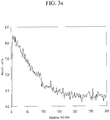
- FIG. 3a is a plot of the Na 2 O concentration profile determined by electron microprobe analysis following the first ion exchange step (immersion in a 390°C molten NaNO 3 salt bath for 5 hours).
- FIG. 3a is a plot of the Na 2 O concentration profile determined by electron microprobe analysis following the first ion exchange step (immersion in a 390°C molten NaNO 3 salt bath for 5 hours).
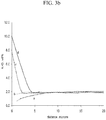
- 3b is a plot of the K 2 O concentration profile determined by electron microprobe analysis following the second ion exchange step (immersion in a 410°C molten KNO 3 salt bath for: a) 0 minutes (i.e., corresponding to single-step ion exchange); b) 10 minutes; c) 20 minutes; and d) 60 minutes.
- the concentrations of Na + and K + ions correspond to the Na 2 O and K 2 O concentrations, respectively, shown in FIGS. 3a and 3b .
- the K + and Na + concentrations on the glass surface relate to compressive stress, while the distance these ions diffuse into the glass relates to the depth of layer of the compressive layer.
- the first step of the two-step process FIG.
- FIG. 3a develops the deep depth of layer, while the second step ( FIG. 3b ) adds a shallow layer that provides the glass with a high compressive stress.
- the time for which the second step is allowed to proceed dictates the K + surface concentration and thus the compressive stress level that is ultimately achieved. For example, a surface compressive stress of 895 MPa was observed for sample d ( FIG. 3b ), which was ion exchanged in the second KNO 3 bath for 60 minutes
Landscapes
- Chemical & Material Sciences (AREA)
- Life Sciences & Earth Sciences (AREA)
- Engineering & Computer Science (AREA)
- Chemical Kinetics & Catalysis (AREA)
- General Chemical & Material Sciences (AREA)
- Geochemistry & Mineralogy (AREA)
- Materials Engineering (AREA)
- Organic Chemistry (AREA)
- Ceramic Engineering (AREA)
- Surface Treatment Of Glass (AREA)
- Glass Compositions (AREA)
Abstract
Description
- This application claims the benefit of priority under 35 U.S.C. § 119 of
U.S. Provisional Application Serial No. 61/377136 filed on August 26, 2010 - The disclosure relates to strengthened alkali aluminoborosilicate glasses. More particularly, the disclosure relates to a method of strengthening such glasses. Even more particularly, the disclosure relates to strengthening such glasses by ion exchange.
- The ion exchange process can be used to strengthen alkali-containing glasses by creating compressive stress layers in the surface region of the glass. In general, lithium-containing aluminosilicate glasses are ion exchanged more readily than sodium-containing glasses and greater depths of compression can be obtained in lithium-containing aluminosilicate glasses at lower temperatures and shorter times. However, such lithium-containing aluminosilicate glasses tend to have lower strain and anneal points, and lower temperatures are required for treatment to avoid structural relaxation. In addition, the exchange of sodium for lithium in the glass, results in lower surface compression - which translates into lower surface strength - when compared to the surface compression achieved with the exchange of potassium for sodium in the glass.
- A method of strengthening an alkali aluminoborosilicate glass is provided. A compressive layer extending from a surface of the glass to a depth of layer is formed by exchanging larger metal cations for smaller metal cations present in the glass. In a second step, metal cations in the glass are exchanged for larger metal cations to a second depth that is less than the depth of layer. The second step increases the compressive stress of the compressive layer. For example, sodium cations are exchanged in the first step for lithium cations that are present in the glass to the depth of layer, and potassium cations are then exchanged in the second step for sodium cations and lithium cations in the glass to the second depth. The exchange of the potassium cations for sodium and lithium cations increases the compressive stress of the layer. Formation of the compressive layer and replacement of cations with larger cations can be achieved by a two-step ion exchange process. An alkali aluminoborosilicate glass having a compressive layer and a crack indentation threshold of at least 3000 gf is also provided.
- Accordingly, one aspect of the disclosure is to provide a method of strengthening an alkali aluminoborosilicate glass. The method comprises the steps of: providing an alkali aluminoborosilicate glass comprising alkali metal cations; forming a compressive layer extending from a surface of the glass to a depth of layer, wherein the compressive layer is under a compressive stress; and replacing at least a portion of the alkali metal cations with a larger alkali metal cation to a second depth that is less than the depth of layer, and wherein replacing the alkali metal cations with the larger alkali metal cation increases the compressive stress.
- A second aspect of the disclosure is to provide a method of strengthening an alkali aluminoborosilicate glass. The method comprises the steps of: providing the alkali aluminoborosilicate glass comprising lithium cations and sodium cations; replacing at least a portion of the lithium cations with sodium cations to form a compressive layer that extends from a surface of the glass to a depth of layer and is under compressive stress; and replacing at least a portion of the sodium cations and the lithium cations with potassium cations to a second depth that is less than the depth of layer, wherein the compressive layer is enriched in potassium cations to the second depth, and wherein replacing sodium cations and lithium cations with potassium cations increases the compressive stress of the compressive layer.
- A third aspect of the disclosure is to provide an alkali aluminoborosilicate glass. The glass comprises lithium cations, sodium cations, and potassium cations. The glass has a surface having a compressive layer extending from the surface to a depth of layer and is enriched in potassium cations to a second depth that is less than the depth of layer. The surface of the glass has a crack initiation threshold of at least 3000 gf upon indentation with a Vickers indenter.
- These and other aspects, advantages, and salient features will become apparent from the following detailed description, the accompanying drawings, and the appended claims.
-
-
FIGURE 1 is a schematic cross-sectional view of a glass sheet, described herein, having strengthened surfaces; -
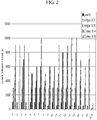
FIGURE 2 is a plot of crack initiation loads obtained for alkali aluminoborosilicate glasses measured before strengthening and following strengthening by ion exchange processes; -
FIGURE 3a is plot of Na2O concentration profile following the first step of a two-step ion exchange process; and -
FIGURE 3b is plot of K2O concentration profile following the second step of a two-step ion exchange process. - In the following description, like reference characters designate like or corresponding parts throughout the several views shown in the figures. It is also understood that, unless otherwise specified, terms such as "top," "bottom," "outward," "inward," and the like are words of convenience and are not to be construed as limiting terms. In addition, whenever a group is described as comprising at least one of a group of elements and combinations thereof, it is understood that the group may comprise, consist essentially of, or consist of any number of those elements recited, either individually or in combination with each other. Similarly, whenever a group is described as consisting of at least one of a group of elements or combinations thereof, it is understood that the group may consist of any number of those elements recited, either individually or in combination with each other. Unless otherwise specified, a range of values, when recited, includes both the upper and lower limits of the range. As used herein, the indefinite articles "a," "an," and the corresponding definite article "the" means "at least one" or "one or more," unless specified otherwise.
- Referring to the drawings in general and to
FIG. 1 in particular, it will be understood that the illustrations are for the purpose of describing particular embodiments and are not intended to limit the disclosure or appended claims thereto. The drawings are not necessarily to scale, and certain features and certain views of the drawings may be shown exaggerated in scale or in schematic in the interest of clarity and conciseness. - As used herein, the term "enriched," unless otherwise specified, means that the concentration of a specified element or ionic specie is greater than the average concentration of that element or ionic specie within the bulk of the glass. As used herein, the term "glass" refers to alkali aluminoborosilicate glasses, unless otherwise specified.
- Methods of strengthening alkali aluminosilicate glass are provided. in one embodiment, the method comprises the steps of: providing the alkali aluminoborosilicate glass; initially forming a compressive layer extending from a surface of the glass to a depth of layer; and replacing at least a portion of alkali metal cations with a larger alkali metal cation to a second depth that is less than the depth of layer. Replacing the alkali metal cations with the larger alkali metal cation increases the compressive stress in the compressive layer and increases the damage resistance of the surface of the glass. The compressive layer inhibits the introduction of flaws at the surface and prevents crack initiation and propagation through the depth of the layer. In some embodiments, the method is carried out through the use of a two-step ion exchange process.
- In the first step of the method, an alkali aluminoborosilicate glass is provided. In some embodiments, the glass is provided in the form of a sheet having a thickness of about 2 mm or less. Such sheets can be formed by down-draw methods known in the art such as slot-draw or fusion-draw processes, or by other methods known in the art. The glass, in some embodiments, comprises monovalent lithium cations, and sodium cations. The glass can additionally include monovalent potassium cations. The presence of such alkali metal cations in the glass is typically represented by the oxide species Li2O, Na2O, and K2O. In some embodiments, the alkali aluminoborosilicate glass comprises, consists essentially of, or consists of: 50-70 mol% SiO2; 5-15 mol% Al2O3; 5-20 mol% B2O3; 2-15 mol% Li2O; 0-20 mol% Na2O; and 0-10 mol% K2O. In some embodiments, the glass can further comprise at least one of: 0-10 mol% P2O5; 0-5 mol% MgO; 0-1 mol% CeO2; and 0-1 mol% SnO2.
- Non-limiting compositions and physical properties of representative glasses are listed in Table 1. Crack initiation thresholds, which were determined by indentation with a Vickers indenter, are also listed for the compositions in Table 1. Crack initiation thresholds, expressed in Kgf, were measured: 1) prior to ion exchange of the glass ("pre-IX" in Table 1); 2) following single-step ion exchange (IX) of the glass for 10 hours in a 390°C molten salt bath containing 60 % KNO3 and 40% NaNO3 by weight; 3) following single step ion exchange of the glass for 10 hours in a 390°C molten NaNO3 salt bath; and 4) following a two-step ion exchange process comprising ion exchange of the glass for 10 hours in a 390°C molten NaNO3 salt bath, followed by ion exchange for 30 minutes in a 390°C molten KNO3 salt bath. depths of layer (DOL) of the compressive layers formed by the ion exchange processes, expressed in microns (µm) are also listed in Table 1.


- The alkali aluminoborosilicate glass as provided has intrinsically high damage resistance; i.e., the glass has high damage resistance prior to - or without - any chemical or thermal strengthening or tempering. Such damage resistance is measured or characterized by the resistance of the glass to crack formation and/or crack propagation upon indentation with a Vickers indenter. In some embodiments, the glass has a crack initiation threshold (i.e., the Vickers indenter load at which cracks are first observed) of at least about 1000 gf before strengthening and, in particular embodiments, in a range from about 1000 gf up to about 2000 gf, prior to strengthening. Examples of glass compositions that intrinsically have crack initiation thresholds in this range are listed in Table 2. In comparison, soda-lime glasses have low damage tolerance, and form cracks when indented at loads as low as 100 gf. Even when ion-exchanged, soda-lime glass typically has a damage tolerance of less than 1000 gf.
Table 2. Crack initiation thresholds for mixed alkali aluminoborosilicate glasses before strengthening. Composition (mol%) a b c d e f g h SiO2 65.7 65.7 65.2. 65.7 65.7 64.7 65.7 63.7 Al2O3 12.3 12.3 11.1 11.3 10.8 11.3 10.3 11.3 B2O3 9.1 0.1 6.2 11.1 11.6 12.1 12.1 13.1 Li2O 5 7 8.3 4.6 4.6 4.6 4.6 4.6 Na2O 6.6 4.6 3.8 6.2 6.2 6.2 6.2 6.2 K2O 1.3 1.3 2.7 1.1 1.1 1.1 1.1 1.1 MgO 0 0 2.2 0 0 0 0 0 CaO 0 0 0.32 0 0 0 0 0 SnO 20 0 0.1 0 0 0 0 0 Crack Initiation Load (gf) 1000 1000 1000 2000 1000 1000 1000 1000 - The formation of the compressive layer and increase damage resistance described herein can, in some embodiments, be achieved by a two-step ion exchange process. In this process, ions in the surface layer of the glass are replaced by - or exchanged with - larger ions having the same valence or oxidation state as the ions present in the glass. The exchange of metal cations is typically carried out in a molten salt bath, with larger cations from the bath typically replacing smaller cations within the glass. Ion exchange is limited to a region extending from the surface of the glass article to a depth (depth of layer, or "DOL") below the surface. By way of example, ion exchange of alkali metal-containing glasses can be achieved by immersing the glass in at least one molten salt bath containing a salt such as, but not limited to, nitrates, sulfates, and chlorides of at least one alkali metal ion. The temperature of such molten salt baths is typically in a range from about 380°C up to about 450°C, with immersion times ranging up to about 16 hours. However, temperatures and immersion times that are different from those described herein can also be used. The replacement or exchange of smaller cations within the glass with larger cations from the bath creates a compressive stress in the region near the surface of the glass to the depth of layer. The compressive stress near the surface gives rise to a central tension in an inner or central region of the glass so as to balance forces within the glass.
- The step of initially forming the compressive layer provides a compressive layer having an unusually deep depth of layer. In some embodiments, the step of forming the compressive layer comprises replacing smaller alkali metal cations with larger alkali metal cations. In a particular embodiment, this step comprises replacing lithium cations in the glass with sodium cations from, for example, a molten salt bath, by ion exchange to the depth of layer below the surface of the glass. The exchange of Na+ ions for Li+ ions achieves an advantageously deep depth of layer (e.g., d1, d2, in
FIG. 1 ). In such embodiments, the depth of layer is at least 50 µm, and can, in some embodiments, extend from the surface to a depth in a range from about 70 µm up to about 290 µm. - The exchange of Na+ ions for Li+ ions can be achieved by immersing the glass in a first ion exchange bath comprising at least one molten sodium salt. In some embodiments, the sodium salt is sodium nitrate (NaNO3). In some embodiments, the ion exchange bath contains only sodium salt; i.e., no other metal salts are intentionally added to the bath. In other embodiments, however, the first ion exchange bath further includes salts of other alkali metals such as, but not limited to, potassium nitrate (KNO3). In one non-limiting example, the first ion exchange bath comprises 40% NaNO3 and 60% KNO3 by weight. In another non-limiting example, the first ion exchange bath comprises 20% NaNO3 and 80% KNO3 by weight.
- Following formation of the compressive layer, at least a portion of the small alkali metal cations (e.g., Li+, Na+) in the compressive layer are replaced by a single, larger alkali metal cation specie to a second depth (e.g., d1', d2', in
FIG. 1 ) that is less than the depth of layer. In some embodiments, this is achieved by exchanging potassium ions for at least one of sodium ions and lithium ions in the glass. The exchange of K+ ions for Na+ ions and Li+ to the second depth increases the surface compressive stress of the glass. In some embodiments, the second depth extends from the surface to a depth in a range from about 5 µm up to about 20 µm. Such ion exchange is achieved by immersing the glass in a second ion exchange bath comprising a potassium sodium salt. In some embodiments, the potassium salt is potassium nitrate (KNO3). - After the glass has been strengthened by forming the deep compressive layer and replacing smaller ions with larger ions to a lesser depth using the two-step ion exchange process described hereinabove, the glass has a crack initiation threshold of at least 3000 gf when indented with a Vickers indenter, a compressive stress of at least 500 MPa, and a depth of layer of at least 50 µm.
- An alkali aluminoborosilicate glass comprising lithium cations, sodium cations, and potassium cations is also provided. The glass has a compressive stress layer extending from a surface of the glass to a depth of layer. The compressive layer of the glass is enriched in potassium cations to a second depth that is less than the depth of layer. The surface also has a crack initiation threshold of at least 3000 gf when indented with a Vickers indenter.
- A cross-sectional view of an alkali aluminoborosilicate glass sheet strengthened by the methods described herein is schematically shown in
FIG.1 . In the non-limiting example shown inFIG. 1 , strengthenedglass sheet 100 has a thickness t, afirst surface 110 andsecond surface 120 that are substantially parallel to each other, central portion 115.Compressive layers first surface 110 andsecond surface 120, respectively, to depths of layer d1, d2, below each surface.Compressive layers compressive layers glass sheet 100. Each ofcompressive layers compressive layers opposite surfaces FIG. 1 , the glass described herein can have a strengthened single surface, rather than multiple strengthened surfaces. This can be achieved, for example, by masking one ofsurfaces glass sheet 100. - In some embodiments, the first depth of layer extends from the surface of the glass to a depth in a range from about 70 µm up to about 290 µm. In some embodiments, the second depths d1', d2' extend from
surfaces - The compressive layer is, in some embodiments, formed by the methods described hereinabove, such as, for example, the two-step ion exchange process described above. As previously described herein, the method comprises the steps of: providing the alkali aluminoborosilicate glass; forming a compressive layer extending from a surface of the glass to a depth of layer (d1, d2 in
FIG. 1 ); wherein the compressive layer is under a compressive stress; and replacing alkali metal cations in the compressive layer with a larger alkali metal cation to a second depth (d1', d2' inFIG. 1 ) that is less the depth of layer. The replacement of the alkali metal cations with a larger alkali metal cationic specie increases the compressive stress in the compressive layer. - In some embodiments, the glass is in the form of a sheet having a thickness of about 2 mm or less. Such sheets can be formed by down-draw methods known in the art such as slot-draw or fusion-draw processes, or by other methods known in the art. In some embodiments, the alkali aluminoborosilicate glass comprises, consists essentially of, or consists of: 50-70 mol% SiO2; 5-15 mol% Al2O3; 5-20 mol% B2O3; 2-15 mol% Li2O; 0-20 mol% Na2O; and 0-10 mol% K2O. In some embodiments, the glass can further comprise at least one of: 0-10 mol% P2O5; 0-5 mol% MgO; 0-1 mol% CeO2; and 0-1 mol% SnO2. Compositions and physical properties, and damage resistance of representative glasses are listed in Table 1.
- The glasses described herein intrinsically (i.e., prior to thermal or chemical strengthening (e.g., ion exchange)) possess high levels of damage resistance. Such damage resistance is measured or characterized by the resistance of the glass to crack formation and/or crack propagation upon indentation with a Vickers indenter. In some embodiments, the glass has a crack initiation threshold (i.e., the Vickers indenter load at which cracks are first observed) of at least about 1000 gf before strengthening and, in particular embodiments, in a range from about 1000 gf up to about 2000 gf, prior to strengthening. Examples of glass compositions that intrinsically have crack initiation thresholds in this range are listed in Table 2. In comparison, soda-lime glasses have low damage tolerance, and form cracks when indented at loads as low as 100 gf. Even when ion-exchanged, soda-lime glass typically has a damage tolerance of less than 1000 gf.
- The tolerance to damage and strength of the alkali aluminoborosilicate glasses having intrinsic damage resistance can be greatly enhanced by the use of a 2 step ion-exchange process. The two-step strengthening/ion exchange processes described hereinabove provide new opportunities for the use of such glasses in those consumer electronics applications where high strength and scratch resistance are desirable. Such applications include, but are not limited to, cover plates, display windows, display screens, touch screens, and the like for portable or hand-held electronic communication and entertainment devices.
- The following examples illustrate the features and advantages of the methods and glasses described herein and are in no way intended to limit the disclosure or appended claims thereto.
- Crack initiation thresholds were measured with a Vickers indenter for representative alkali aluminoborosilicate glass compositions before ion exchange and following ion exchange under different conditions.
- Glass samples having selected compositions were subjected to single-step ion exchange by immersion in a single molten salt bath. Different glass samples having these same compositions were subjected to two-step ion exchange in multiple salt baths, in accordance with the methods described hereinabove.
- The single-step ion exchange baths used were: a) a 390°C molten NaNO3 salt bath; and b) a 390°C molten salt bath containing 60% KNO3 and 40% NaNO3 by weight. The glass samples that were ion exchanged in the pure NaNO3 bath were immersed in the bath for 5 hours. Glass samples that were ion exchanged in the KNO3/NaNO3 bath were immersed in the bath for 10 hours.
- Two sets of two-step, multiple ion exchange baths were used. The first set of multiple baths consisted of a first bath of molten NaNO3 salt at 390°C, followed by a second bath of molten KNO3 salt at 390°C. Glass samples were immersed in the first (NaNO3) bath for 10 hours, and then immersed in the second (KNO3) bath for 30 minutes. The second set of multiple baths consisted of a first bath of molten NaNO3 salt at 410°C, followed by a second bath of molten KNO3 salt at 410°C. Glass samples were immersed in the first (NaNO3) bath for 10 hours, and then immersed in the second (KNO3) bath for 10 minutes.
- For comparison, crack initiation thresholds for soda lime glass were measured before ion exchange and after ion exchange in a 410°C KNO3 bath for 8 hours.
- Crack initiation thresholds were measured for different compositions before and after ion exchange and are plotted in
FIG. 2 . For comparison, crack initiation thresholds for soda lime glass (SLS inFIG. 2 ) were measured before ion exchange and following ion exchange in a 410°C KNO3 bath for 8 hours. Single-step ion exchange of the glasses provided approximately a three-fold improvement in damage resistance. The two-step ion exchange processes, as described hereinabove, allowed the use of loads as high as 10,000 gf before crack formation is observed. - The effect of the second ion exchange step is illustrated by the data shown in Table 3, which lists depths of layer (DOL) and compressive stresses (CS) measured for 1 mm alkali aluminoborosilicate glass samples following different ion exchange (IX) procedures. The compositions of the samples listed in Table 3 are: i) 65.7 mol% SiO2; 12.3 mol% Al2O3; 9.1 mol% B2O3; 5 mol% Li2O; 6.6 mol% Na2O; 1.3 mol% K2O; 0.1 mol% SnO2; and 0.15 CeO2; ii) 65.7 mol% SiO2; 10.3 mol% Al2O3; 12.1 mol% B2O3; 4.6 mol% Li2O; 6.2 mol% Na2O; 1.1 mol% K2O; 0.1 mol% SnO2; and 0.15 CeO2; and iii) 57.9 mol% SiO2; 12.1 mol% Al2O3; 18.1 mol% B2O3; 4.6 mol% Li2O; 6.2 mol% Na2O; 1.1 mol% K2O; 0.1 mol% SnO2; and 0.15 CeO2.
- One set of samples of each composition was ion exchanged in a single-step process by immersion in a 390°C molten salt bath containing 80 wt% KNO3 and 20 wt% NaNO3 for 5 hours. Two-step ion exchange consisted of immersion a 390°C molten salt bath containing 80 wt% KNO3 and 20 wt% NaNO3 for 5 hours followed by immersion in a 410°C KNO3 molten salt bath for 1 hour. Immersion in the second ion exchange bath in accordance with the methods described hereinabove increased the compressive stress of all samples.
- A second set of samples of each composition was ion exchanged in a single-step process by immersion in a 390°C molten salt bath containing 60 wt% KNO3 and 40 wt% NaNO3 for 5 hours. Two-step ion exchange consisted of immersion a 390°C molten salt bath containing 60 wt% KNO3 and 40 wt% NaNO3 for 5 hours followed by immersion in a 410°C KNO3 molten salt bath for 1 hour. Immersion in the second ion exchange bath in accordance with the methods described hereinabove increased the compressive stress of all samples.
Table 3. Depth of layer (DOL) and compressive stress (CS) of alkali aluminoborosilicate using different ion exchange (IX) conditions. IX procedure Sample (i) Sample (ii) Sample (iii) DOL (µm) CS (MPa) DOL (µm) CS (MPa) DOL (µm) CS (MPa) Single-step 195 577 195 540 107 562 80 wt%KNO3/20 wt%NaNO3; 5 hrs at 390°C Two-step 791 711 726 1) 80 wt%KNO3/20 wt%NaNO3; 5 hrs at 390°C; 2) KNO3; 1 hr at 410°C Single-step 195 516 146 494 88 490 60 wt%KNO3/40 wt%NaNO3; 5 hrs at 390°C Two-step 800 761 707 1) 60 wt%KNO3/40 wt%NaNO3; 5 hrs at 390°C; 2) KNO3; 1 hr at 410°C - The strengths of alkali aluminoborosilicate glass samples before ion exchange and after single-step and two-step ion exchange processes were also measured using ring-on-ring measurements performed on polished surfaces of 1 mm thick glass samples. All samples comprised 65.7 mol% SiO2; 10.3 mol% Al2O3; 12.1 mol% B2O3; 4.6 mol% Li2O; 6.2 mol% Na2O; and 1.1 mol% K2O. The measured ring-on-ring strength of the sample before ion exchange was 131 ± 45 MPa. Single-step ion exchange in a 390°C molten salt bath containing 60 wt% KNO3 and 40 wt% NaNO3 for 6 hours yielded a ring-on-ring strength of 491 ± 108 MPa. Two-step ion exchange consisted of immersion in a 390°C molten salt bath containing 60 wt% KNO3 and 40 wt% NaNO3 for 6 hours followed by immersion in a 410°C KNO3 molten salt bath for 1 hour yielded a ring-on-ring strength of 647 ± 215 MPa. The two-step ion exchange process, in accordance with the methods described hereinabove, thus resulted in an increase in ring-on-ring strength of about 30% over the single-step process.
- Electron microprobe analysis was used to investigate Na2O and K2O concentrations in alkali aluminoborosilicate samples following a two-step ion exchange process carried out in accordance with the methods described hereinabove.
FIG. 3a is a plot of the Na2O concentration profile determined by electron microprobe analysis following the first ion exchange step (immersion in a 390°C molten NaNO3 salt bath for 5 hours).FIG. 3b is a plot of the K2O concentration profile determined by electron microprobe analysis following the second ion exchange step (immersion in a 410°C molten KNO3 salt bath for: a) 0 minutes (i.e., corresponding to single-step ion exchange); b) 10 minutes; c) 20 minutes; and d) 60 minutes. The concentrations of Na+ and K+ ions correspond to the Na2O and K2O concentrations, respectively, shown inFIGS. 3a and3b . The K+ and Na+ concentrations on the glass surface relate to compressive stress, while the distance these ions diffuse into the glass relates to the depth of layer of the compressive layer. As previously described hereinabove, the first step of the two-step process (FIG. 3a ) develops the deep depth of layer, while the second step (FIG. 3b ) adds a shallow layer that provides the glass with a high compressive stress. The time for which the second step is allowed to proceed dictates the K+ surface concentration and thus the compressive stress level that is ultimately achieved. For example, a surface compressive stress of 895 MPa was observed for sample d (FIG. 3b ), which was ion exchanged in the second KNO3 bath for 60 minutes - While typical embodiments have been set forth for the purpose of illustration, the foregoing description should not be deemed to be a limitation on the scope of the disclosure or appended claims. Accordingly, various modifications, adaptations, and alternatives may occur to one skilled in the art without departing from the spirit and scope of the present disclosure or appended claims.
Claims (15)
- An alkali aluminoborosilicate glass article, comprising 50-70 mol% SiO2; 5-15 mol% Al2O3; 5-20 mol% B2O3; 2-15 mol% Li2O; 0-20 mol% Na2O; and 0-10 mol% K2O, wherein the glass article has a surface having a compressive layer extending from the surface to a depth of layer and is enriched in potassium to a second depth that is less than the depth of layer, and wherein the surface of the glass article has a crack initiation threshold of at least 3000 gf upon indentation with a Vickers indenter.
- The glass article of Claim 1, wherein the depth of layer is at least 50 µm.
- The glass article of Claim 1 or 2, wherein the surface has a compressive stress of at least 500 MPa.
- The glass article of any one of Claims 1 to 3, wherein the surface has a compressive stress of at least 711 MPa.
- The glass article of any one of Claims 1 to 4, wherein the depth of layer is in a range from 70 µm up to 290 µm.
- The glass article of any one of Claims 1 to 5, wherein the second depth is in a range from 5 µm up to 20 µm.
- The glass article of any one of Claims 1 to 6, wherein the alkali aluminoborosilicate glass article further comprises at least one of: 0-10 mol% P2O5; 0-5 mol% MgO; 0-1 mol% CeO2; and 0-1 mol% SnO2.
- The glass article of any one of Claims 1 to 7, wherein the glass article is a sheet having a thickness of up to 2 mm.
- The glass article of any one of Claims 1 to 8, wherein the surface of the glass article has a crack initiation threshold of at least 6000 gf upon indentation with a Vickers indenter.
- The glass article of any one of Claims 1 to 9, wherein the surface of the glass article has a crack initiation threshold of at least 8000 gf upon indentation with a Vickers indenter.
- The glass article of any one of Claims 1 to 10, comprising 6.2-20 mol% B2O3.
- The glass article of any one of Claims 1 to 11, comprising 2-8.3 mol% Li2O.
- The glass article of any one of claims 1 to 12, the glass article being strengthened by the following steps:a. providing the alkali aluminoborosilicate glass, the glass comprising alkali metal cations;b. forming a compressive layer extending from a surface of the glass to a depth of layer, wherein the compressive layer is under a compressive stress; andc. replacing at least a portion of the alkali metal cations in the compressive layer with a larger alkali metal cation to a second depth that is less than the depth of layer, wherein replacing the alkali metal cations in the compressive layer with the larger alkali metal cation increases the compressive stress.
- The glass article of any one of claims 1 to 12, the glass article being strengthened by the following steps:a. providing the alkali aluminoborosilicate glass, the glass comprising lithium cations and sodium cations;b. replacing lithium cations with sodium cations to form a compressive layer extending from a surface of the glass to a depth of layer, wherein the compressive layer is under a compressive stress; andc. replacing sodium cations and lithium cations with potassium cations to a second depth that is less than the depth of layer, and wherein replacing the lithium cations and the sodium cations in the compressive layer with the potassium cations increases the compressive stress.
- The glass article of claim 14, wherein
the step of replacing the lithium cations with the sodium cations comprises immersing the glass in a first ion exchange bath, the first ion exchange bath comprising a sodium salt,
the step of replacing sodium cations and optionally lithium cations with potassium cations comprises immersing the glass in a second ion exchange bath, the second ion exchange bath comprising a potassium salt,
after replacing sodium cations and optionally lithium cations with potassium cations, the surface of the glass has a crack initiation layer threshold of at least 3000 gf upon indentation with a Vickers indenter.
Applications Claiming Priority (3)
| Application Number | Priority Date | Filing Date | Title |
|---|---|---|---|
| US37713610P | 2010-08-26 | 2010-08-26 | |
| EP11755480.8A EP2609047B1 (en) | 2010-08-26 | 2011-08-26 | Two-step method for strengthening glass |
| PCT/US2011/049329 WO2012027660A1 (en) | 2010-08-26 | 2011-08-26 | Two-step method for strengthening glass |
Related Parent Applications (2)
| Application Number | Title | Priority Date | Filing Date |
|---|---|---|---|
| EP11755480.8A Division-Into EP2609047B1 (en) | 2010-08-26 | 2011-08-26 | Two-step method for strengthening glass |
| EP11755480.8A Division EP2609047B1 (en) | 2010-08-26 | 2011-08-26 | Two-step method for strengthening glass |
Publications (2)
| Publication Number | Publication Date |
|---|---|
| EP3517511A1 true EP3517511A1 (en) | 2019-07-31 |
| EP3517511B1 EP3517511B1 (en) | 2024-07-24 |
Family
ID=44645795
Family Applications (2)
| Application Number | Title | Priority Date | Filing Date |
|---|---|---|---|
| EP11755480.8A Not-in-force EP2609047B1 (en) | 2010-08-26 | 2011-08-26 | Two-step method for strengthening glass |
| EP19155771.9A Active EP3517511B1 (en) | 2010-08-26 | 2011-08-26 | Alkali aluminoborosilicate glass article |
Family Applications Before (1)
| Application Number | Title | Priority Date | Filing Date |
|---|---|---|---|
| EP11755480.8A Not-in-force EP2609047B1 (en) | 2010-08-26 | 2011-08-26 | Two-step method for strengthening glass |
Country Status (7)
| Country | Link |
|---|---|
| US (3) | US20120052271A1 (en) |
| EP (2) | EP2609047B1 (en) |
| JP (4) | JP5890835B2 (en) |
| KR (3) | KR20190077605A (en) |
| CN (2) | CN103068759A (en) |
| TW (1) | TWI558675B (en) |
| WO (1) | WO2012027660A1 (en) |
Cited By (1)
| Publication number | Priority date | Publication date | Assignee | Title |
|---|---|---|---|---|
| EP3909923A1 (en) * | 2020-05-15 | 2021-11-17 | Corning Incorporated | Strengthened glass articles and methods of forming the same |
Families Citing this family (150)
| Publication number | Priority date | Publication date | Assignee | Title |
|---|---|---|---|---|
| JP2011505323A (en) | 2007-11-29 | 2011-02-24 | コーニング インコーポレイテッド | Glass with improved toughness and scratch resistance |
| DE102010009584B4 (en) | 2010-02-26 | 2015-01-08 | Schott Ag | Chemically toughened glass, process for its preparation and use thereof |
| CN103338926B (en) * | 2010-11-30 | 2016-03-02 | 康宁股份有限公司 | Surface and central area are in the glass of compressive state |
| US9346703B2 (en) | 2010-11-30 | 2016-05-24 | Corning Incorporated | Ion exchangable glass with deep compressive layer and high damage threshold |
| US8889575B2 (en) * | 2011-05-31 | 2014-11-18 | Corning Incorporated | Ion exchangeable alkali aluminosilicate glass articles |
| EP2762461B1 (en) * | 2011-09-29 | 2018-11-21 | Central Glass Company, Limited | Chemically strengthened glass and method for producing same |
| CN103842310B (en) * | 2011-09-29 | 2016-02-03 | 中央硝子株式会社 | Display unit cover-plate glass and manufacture method thereof |
| US9359251B2 (en) | 2012-02-29 | 2016-06-07 | Corning Incorporated | Ion exchanged glasses via non-error function compressive stress profiles |
| US9139469B2 (en) * | 2012-07-17 | 2015-09-22 | Corning Incorporated | Ion exchangeable Li-containing glass compositions for 3-D forming |
| US9308616B2 (en) | 2013-01-21 | 2016-04-12 | Innovative Finishes LLC | Refurbished component, electronic device including the same, and method of refurbishing a component of an electronic device |
| US9359261B2 (en) * | 2013-05-07 | 2016-06-07 | Corning Incorporated | Low-color scratch-resistant articles with a multilayer optical film |
| US9110230B2 (en) | 2013-05-07 | 2015-08-18 | Corning Incorporated | Scratch-resistant articles with retained optical properties |
| US9366784B2 (en) | 2013-05-07 | 2016-06-14 | Corning Incorporated | Low-color scratch-resistant articles with a multilayer optical film |
| US9512035B2 (en) | 2013-06-17 | 2016-12-06 | Corning Incorporated | Antimicrobial glass articles with improved strength and methods of making and using same |
| US9221715B2 (en) * | 2013-07-25 | 2015-12-29 | Apple Inc. | Chemical strengthening of anti-reflective coatings (ARC) |
| US11079309B2 (en) * | 2013-07-26 | 2021-08-03 | Corning Incorporated | Strengthened glass articles having improved survivability |
| CN113860730A (en) | 2013-08-27 | 2021-12-31 | 康宁股份有限公司 | Damage-resistant glass with high coefficient of thermal expansion |
| US9714188B2 (en) * | 2013-09-13 | 2017-07-25 | Corning Incorporated | Ion exchangeable glasses with high crack initiation threshold |
| US10442730B2 (en) | 2013-11-25 | 2019-10-15 | Corning Incorporated | Method for achieving a stress profile in a glass |
| JP2016537290A (en) * | 2013-11-26 | 2016-12-01 | コーニング インコーポレイテッド | High-speed ion exchange glass with high indentation threshold |
| CN106164004B (en) | 2014-02-13 | 2019-12-10 | 康宁股份有限公司 | Glass with enhanced strength and antimicrobial properties, and method of making same |
| WO2016191676A1 (en) * | 2015-05-28 | 2016-12-01 | Corning Incorporated | Strengthened glass with deep depth of compression |
| US10118858B2 (en) | 2014-02-24 | 2018-11-06 | Corning Incorporated | Strengthened glass with deep depth of compression |
| EP3110768B1 (en) * | 2014-02-26 | 2020-07-22 | Corning Incorporated | High strength antimicrobial glass |
| JP6630287B2 (en) | 2014-03-27 | 2020-01-15 | コーニング インコーポレイテッド | Glass goods |
| US9840438B2 (en) | 2014-04-25 | 2017-12-12 | Corning Incorporated | Antimicrobial article with functional coating and methods for making the antimicrobial article |
| US10144198B2 (en) | 2014-05-02 | 2018-12-04 | Corning Incorporated | Strengthened glass and compositions therefor |
| JP6697399B2 (en) | 2014-05-07 | 2020-05-20 | コーニング インコーポレイテッド | Laminated glass article and method for forming the same |
| US9335444B2 (en) | 2014-05-12 | 2016-05-10 | Corning Incorporated | Durable and scratch-resistant anti-reflective articles |
| US11267973B2 (en) | 2014-05-12 | 2022-03-08 | Corning Incorporated | Durable anti-reflective articles |
| TWI852054B (en) | 2014-06-19 | 2024-08-11 | 美商康寧公司 | Glasses having non-frangible stress profiles |
| WO2015195419A2 (en) * | 2014-06-19 | 2015-12-23 | Corning Incorporated | Strengthened glass with deep depth of compression |
| US9751798B2 (en) | 2014-06-30 | 2017-09-05 | Corning Incorporated | White, opaque,β-spodumene glass-ceramic articles with inherent damage resistance and methods for making the same |
| WO2016014937A1 (en) * | 2014-07-25 | 2016-01-28 | Corning Incorporated | Strengthened glass with deep depth of compression |
| US11097974B2 (en) | 2014-07-31 | 2021-08-24 | Corning Incorporated | Thermally strengthened consumer electronic glass and related systems and methods |
| US9790593B2 (en) | 2014-08-01 | 2017-10-17 | Corning Incorporated | Scratch-resistant materials and articles including the same |
| CN107001113B (en) * | 2014-09-25 | 2021-09-10 | 康宁股份有限公司 | UV blocking for glass with improved light transmission |
| KR102584492B1 (en) | 2014-10-08 | 2023-10-04 | 코닝 인코포레이티드 | Glasses and glass ceramics including a metal oxide concentration gradient |
| CN104402238A (en) * | 2014-10-27 | 2015-03-11 | 苏州安洁科技股份有限公司 | Processing method for ultrathin glass-protecting membrane |
| US10150698B2 (en) | 2014-10-31 | 2018-12-11 | Corning Incorporated | Strengthened glass with ultra deep depth of compression |
| EP4011843A3 (en) * | 2014-11-04 | 2022-06-29 | Corning Incorporated | Deep non-frangible stress profiles and methods of making |
| US10259745B2 (en) * | 2015-02-27 | 2019-04-16 | Corning Incorporated | Low temperature chemical strengthening process for glass |
| EP3286152B1 (en) * | 2015-04-21 | 2023-05-10 | Corning Incorporated | Edge and corner-strengthened articles and methods for making same |
| KR102360009B1 (en) * | 2015-05-04 | 2022-02-10 | 삼성디스플레이 주식회사 | Glass substrate, fabricating method of the same, and display device having the same |
| WO2016185934A1 (en) * | 2015-05-15 | 2016-11-24 | 旭硝子株式会社 | Chemically strengthened glass |
| US11613103B2 (en) | 2015-07-21 | 2023-03-28 | Corning Incorporated | Glass articles exhibiting improved fracture performance |
| US10579106B2 (en) * | 2015-07-21 | 2020-03-03 | Corning Incorporated | Glass articles exhibiting improved fracture performance |
| US12338159B2 (en) | 2015-07-30 | 2025-06-24 | Corning Incorporated | Thermally strengthened consumer electronic glass and related systems and methods |
| EP3770649A1 (en) | 2015-09-14 | 2021-01-27 | Corning Incorporated | High light transmission and scratch-resistant anti-reflective articles |
| TWI758263B (en) * | 2015-11-19 | 2022-03-21 | 美商康寧公司 | Display screen protector |
| CN108290781B (en) | 2015-11-20 | 2022-02-22 | 康宁股份有限公司 | Method for regenerating lithium-rich salt baths |
| JP6670462B2 (en) * | 2015-12-04 | 2020-03-25 | 日本電気硝子株式会社 | Tempered glass |
| DK3386930T3 (en) * | 2015-12-11 | 2021-07-26 | Corning Inc | FUSION-MOLDABLE, GLASS-BASED ARTICLES INCLUDING A METAL OXIDE CONCENTRATION GRADIENT |
| CN108367965A (en) | 2015-12-17 | 2018-08-03 | 康宁股份有限公司 | With rapid proliferating ion-exchangeable glass |
| US10131567B2 (en) * | 2016-01-08 | 2018-11-20 | Corning Incorporated | Chemically strengthenable lithium aluminosilicate glasses with inherent damage resistance |
| KR102492060B1 (en) | 2016-01-12 | 2023-01-26 | 코닝 인코포레이티드 | Thin thermally and chemically strengthened glass-based articles |
| KR20180103972A (en) * | 2016-01-13 | 2018-09-19 | 코닝 인코포레이티드 | Ultra-Thin, Non-Vulnerable Glass and Manufacturing Method Thereof |
| US9718728B1 (en) * | 2016-01-20 | 2017-08-01 | International Business Machines Corporation | Chemically strengthened glass and methods of making same |
| KR102205919B1 (en) * | 2016-01-21 | 2021-01-21 | 에이지씨 가부시키가이샤 | Chemically strengthened glass and method for manufacturing chemically strengthened glass |
| CN113800783A (en) * | 2016-01-21 | 2021-12-17 | Agc株式会社 | Chemically strengthened glass and glass for chemical strengthening |
| WO2017147853A1 (en) * | 2016-03-03 | 2017-09-08 | 深圳市力沣实业有限公司 | High-strength chemically strengthened glass and glass strengthening method |
| KR102486323B1 (en) * | 2016-03-30 | 2023-01-10 | 삼성디스플레이 주식회사 | Method for treating glass substrate |
| KR102962602B1 (en) * | 2016-04-08 | 2026-05-08 | 코닝 인코포레이티드 | Glass-based articles including a stress profile comprising two regions, and methods of making |
| EP3904302A1 (en) | 2016-04-08 | 2021-11-03 | Corning Incorporated | Glass-based articles including a metal oxide concentration gradient |
| US10206298B2 (en) * | 2016-04-21 | 2019-02-12 | Apple Inc. | Witness layers for glass articles |
| WO2017205605A1 (en) * | 2016-05-27 | 2017-11-30 | Corning Incorporated | Fracture and scratch resistant glass articles |
| CN108698923B (en) * | 2016-08-10 | 2021-05-07 | 康宁股份有限公司 | Methods to reduce surface defects |
| US11419231B1 (en) | 2016-09-22 | 2022-08-16 | Apple Inc. | Forming glass covers for electronic devices |
| US11535551B2 (en) | 2016-09-23 | 2022-12-27 | Apple Inc. | Thermoformed cover glass for an electronic device |
| US11565506B2 (en) | 2016-09-23 | 2023-01-31 | Apple Inc. | Thermoformed cover glass for an electronic device |
| US10800141B2 (en) | 2016-09-23 | 2020-10-13 | Apple Inc. | Electronic device having a glass component with crack hindering internal stress regions |
| WO2018074335A1 (en) | 2016-10-18 | 2018-04-26 | 旭硝子株式会社 | Glass for chemical strengthening, chemically strengthened glass and method for manufacturing chemically strengthened glass |
| US10065880B2 (en) | 2016-11-07 | 2018-09-04 | Corning Incorporated | Lithium containing glasses |
| CN121377530A (en) | 2016-11-07 | 2026-01-23 | 康宁股份有限公司 | Lithium-containing glass |
| CN108069624B (en) * | 2016-11-11 | 2020-07-28 | 蓝思科技股份有限公司 | Glass strengthening processing method |
| EP3548277B1 (en) * | 2016-11-30 | 2023-10-25 | Corning Incorporated | Fusion-formable automotive glass compositions, articles, and laminates |
| CN106630680B (en) * | 2016-12-29 | 2019-11-19 | 四川旭虹光电科技有限公司 | High alumina silicon cover glass and preparation method thereof |
| TWI749160B (en) * | 2017-01-31 | 2021-12-11 | 美商康寧公司 | Coated glass-based articles with engineered stress profiles and a consumer electonic product comprising the same |
| KR102710638B1 (en) * | 2017-02-02 | 2024-09-27 | 코닝 인코포레이티드 | Lithium-containing glass or glass-ceramic article having an altered K2O profile near the glass surface |
| CN115716715B (en) * | 2017-02-07 | 2024-09-17 | Agc株式会社 | Chemically strengthened glass |
| JP6794866B2 (en) * | 2017-02-15 | 2020-12-02 | Agc株式会社 | Chemically tempered glass and its manufacturing method |
| EP3589598B1 (en) * | 2017-03-02 | 2021-12-29 | Corning Incorporated | Asymmetric stress profiles for low warp and high damage resistance glass articles |
| US20200039877A1 (en) * | 2017-03-09 | 2020-02-06 | Corning Incorporated | Method of electrostatic charge reduction of glass by surface chemical treatment |
| CN110461795B (en) * | 2017-04-06 | 2022-05-31 | Agc株式会社 | Chemically strengthened glass |
| JP6897270B2 (en) * | 2017-04-20 | 2021-06-30 | Agc株式会社 | Chemically tempered glass |
| WO2018199045A1 (en) | 2017-04-26 | 2018-11-01 | Agc株式会社 | Chemically strengthened glass |
| KR102512668B1 (en) * | 2017-06-02 | 2023-03-21 | 쇼오트 글라스 테크놀로지스 (쑤저우) 코퍼레이션 리미티드. | High contact resistance flexible ultra-thin glass |
| JP7136096B2 (en) * | 2017-06-28 | 2022-09-13 | Agc株式会社 | Chemically strengthened glass, method for producing the same, and glass for chemical strengthening |
| US10899654B2 (en) * | 2017-07-13 | 2021-01-26 | Corning Incorporated | Glass-based articles with improved stress profiles |
| WO2019040818A2 (en) | 2017-08-24 | 2019-02-28 | Corning Incorporated | Glasses with improved tempering capabilities |
| TWI884903B (en) * | 2017-10-03 | 2025-06-01 | 美商康寧公司 | Glass-based articles having crack resistant stress profiles and method of making such glass-based articles |
| US10906834B2 (en) | 2017-11-29 | 2021-02-02 | Corning Incorporated | Ion-exchangeable mixed alkali aluminosilicate glasses |
| US10633279B2 (en) * | 2017-11-29 | 2020-04-28 | Corning Incorporated | Glasses with low excess modifier content |
| US11161782B2 (en) * | 2017-11-30 | 2021-11-02 | Corning Incorporated | Method of increasing IOX processability on glass articles with multiple thicknesses |
| TWI785156B (en) | 2017-11-30 | 2022-12-01 | 美商康寧公司 | Non-iox glasses with high coefficient of thermal expansion and preferential fracture behavior for thermal tempering |
| US11066322B2 (en) | 2017-12-01 | 2021-07-20 | Apple Inc. | Selectively heat-treated glass-ceramic for an electronic device |
| US10611666B2 (en) | 2017-12-01 | 2020-04-07 | Apple Inc. | Controlled crystallization of glass ceramics for electronic devices |
| JP2019123658A (en) * | 2018-01-19 | 2019-07-25 | Agc株式会社 | Manufacturing method of chemically reinforced glass, and chemically reinforced glass |
| US11591255B2 (en) | 2018-05-22 | 2023-02-28 | Corning Incorporated | Low temperature moldable sheet forming glass compositions |
| EP4279461A1 (en) | 2018-06-08 | 2023-11-22 | Corning Incorporated | Fracture resistant stress profiles in glasses |
| TWI825112B (en) * | 2018-07-02 | 2023-12-11 | 美商康寧公司 | Glass-based articles with improved stress profiles and methods of manufacturing the same |
| CN108585480B (en) * | 2018-07-10 | 2021-05-04 | 科立视材料科技有限公司 | Two-step chemically strengthened alkali aluminosilicate glass composition and preparation method thereof |
| CN108585481A (en) * | 2018-07-13 | 2018-09-28 | 科立视材料科技有限公司 | A lithium-containing aluminosilicate glass capable of rapid ion exchange |
| KR102591065B1 (en) | 2018-08-17 | 2023-10-19 | 코닝 인코포레이티드 | Inorganic oxide articles with thin, durable anti-reflective structures |
| US11420900B2 (en) | 2018-09-26 | 2022-08-23 | Apple Inc. | Localized control of bulk material properties |
| DE102018124785A1 (en) | 2018-10-08 | 2020-04-09 | Schott Ag | Glass with preferably increased storable tensile stress, chemically toughened glass article with preferably increased storable tensile stress, process for its production and its use |
| US12037282B2 (en) * | 2018-11-01 | 2024-07-16 | Corning Incorporated | Strengthened glass articles with reduced delayed breakage and methods of making the same |
| CN113039164B (en) * | 2018-11-14 | 2023-06-06 | 康宁股份有限公司 | Glass substrate with improved composition |
| CN109279787A (en) * | 2018-11-22 | 2019-01-29 | 科立视材料科技有限公司 | A kind of high alumina glass with fast ion exchange |
| JPWO2020121888A1 (en) | 2018-12-11 | 2021-10-28 | Agc株式会社 | Chemically tempered glass plate, and cover glass and electronic devices including chemically strengthened glass |
| WO2020123224A2 (en) * | 2018-12-12 | 2020-06-18 | Corning Incorporated | Ion-exchangeable lithium-containing aluminosilicate glasses |
| JP7400738B2 (en) | 2019-01-18 | 2023-12-19 | Agc株式会社 | Chemically strengthened glass and its manufacturing method |
| KR20210154825A (en) | 2019-04-23 | 2021-12-21 | 코닝 인코포레이티드 | Glass laminate with definite stress profile and method for manufacturing the same |
| JP7533456B2 (en) | 2019-06-03 | 2024-08-14 | Agc株式会社 | Glass, chemically strengthened glass and method for producing same |
| US11680010B2 (en) | 2019-07-09 | 2023-06-20 | Apple Inc. | Evaluation of transparent components for electronic devices |
| KR102812606B1 (en) * | 2019-07-17 | 2025-05-27 | 에이지씨 가부시키가이샤 | Glass, chemically strengthened glass and cover glass |
| CN120607365A (en) | 2019-08-05 | 2025-09-09 | 肖特股份有限公司 | Chemically toughened or chemically toughenable sheet glass product and method for producing the same |
| DE102019121144A1 (en) * | 2019-08-05 | 2021-02-11 | Schott Ag | Disc-shaped glass article, its manufacture and use |
| DE102019121146A1 (en) | 2019-08-05 | 2021-02-11 | Schott Ag | Heat-formed chemically toughenable glass article with a low crystal content, in particular disk-shaped chemically toughened glass article, as well as method and device for its production |
| DE102019121147A1 (en) | 2019-08-05 | 2021-02-11 | Schott Ag | Disc-shaped, chemically toughened glass articles and process for their manufacture |
| CN116811379B (en) | 2019-08-06 | 2026-01-02 | 康宁股份有限公司 | Glass laminate with embedded stress spikes for crack prevention and its manufacturing method |
| WO2021041031A1 (en) * | 2019-08-30 | 2021-03-04 | Corning Incorporated | Scratch resistant glass and method of making |
| CN110937824B (en) * | 2019-12-05 | 2022-04-19 | 四川虹科创新科技有限公司 | Chemically strengthened glass and preparation method and application thereof |
| JP7420152B2 (en) | 2020-01-14 | 2024-01-23 | Agc株式会社 | Chemically strengthened glass article and its manufacturing method |
| JP7684639B2 (en) * | 2020-02-25 | 2025-05-28 | 日本電気硝子株式会社 | Tempered glass sheets and glass sheets for tempering |
| TW202142515A (en) * | 2020-03-25 | 2021-11-16 | 日商安瀚視特控股股份有限公司 | Cover glass strengthening using double ion exchange |
| CN115955798A (en) | 2020-03-28 | 2023-04-11 | 苹果公司 | Glass cover member for housing of electronic equipment |
| US11460892B2 (en) | 2020-03-28 | 2022-10-04 | Apple Inc. | Glass cover member for an electronic device enclosure |
| JP7878054B2 (en) | 2020-04-30 | 2026-06-23 | Agc株式会社 | Glass, chemically strengthened glass, and electronic equipment |
| US11666273B2 (en) | 2020-05-20 | 2023-06-06 | Apple Inc. | Electronic device enclosure including a glass ceramic region |
| KR20220003694A (en) | 2020-07-01 | 2022-01-11 | 삼성디스플레이 주식회사 | Display apparatus and manufacturing the same |
| WO2022004892A1 (en) * | 2020-07-03 | 2022-01-06 | Agc株式会社 | Glass, crystallized glass and chemically strengthened glass |
| US12386101B2 (en) | 2020-07-09 | 2025-08-12 | Corning Incorporated | Textured region of a substrate to reduce specular reflectance incorporating surface features with an elliptical perimeter or segments thereof, and method of making the same |
| CN114057409B (en) * | 2020-07-31 | 2025-12-09 | Agc株式会社 | Chemically strengthened glass and method for producing same |
| KR102509484B1 (en) * | 2020-10-29 | 2023-03-13 | (주)유티아이 | Flexible Cover Window and Manufacturing Method of Flexible Cover Window thereby |
| EP4241301A2 (en) | 2020-11-08 | 2023-09-13 | Schott Ag | Hermetically connected arrangement, enclosure and method for the production thereof |
| WO2022133133A1 (en) | 2020-12-17 | 2022-06-23 | Apple Inc. | Forming of glass components for portable electronic devices |
| US12065372B2 (en) | 2020-12-17 | 2024-08-20 | Apple Inc. | Fluid forming a glass component for a portable electronic device |
| US11945048B2 (en) | 2020-12-23 | 2024-04-02 | Apple Inc. | Laser-based cutting of transparent components for an electronic device |
| CN116745247A (en) * | 2020-12-29 | 2023-09-12 | 日本电气硝子株式会社 | Reinforced glass plate and method for manufacturing same |
| CN114956577A (en) * | 2021-02-26 | 2022-08-30 | 常熟佳合显示科技有限公司 | High-strength transparent microcrystalline glass and preparation method thereof |
| US12371369B2 (en) | 2021-05-26 | 2025-07-29 | Corning Incorporated | Glass with modified surface regions on opposing sides and methods and apparatuses for forming the same via electro-thermal poling |
| TW202315848A (en) * | 2021-06-18 | 2023-04-16 | 美商康寧公司 | Colored glass articles having improved mechanical durability |
| US12565447B2 (en) | 2021-07-19 | 2026-03-03 | Corning Incorporated | Glass with nanoscale surface features from thermal poling and methods for forming the same |
| US12486198B2 (en) * | 2021-07-19 | 2025-12-02 | Corning Incorporated | Glass with modified surface regions and methods and apparatuses for forming the same via electro-thermal poling and field-assisted ion exchange |
| DE202021103861U1 (en) | 2021-07-20 | 2021-10-04 | Schott Ag | Disc-shaped, chemically toughened or chemically toughened glass articles |
| CN113683304B (en) * | 2021-08-31 | 2023-08-29 | 河南旭阳光电科技有限公司 | Scratch-resistant glass and testing device thereof |
| CN114133147A (en) * | 2022-01-06 | 2022-03-04 | 深圳市悦目光学器件有限公司 | Method for strengthening glass by ion replacement in two salt baths and strengthening glass |
| WO2023243574A1 (en) | 2022-06-15 | 2023-12-21 | Agc株式会社 | Glass for chemical strengthening, and glass |
| CN115572061B (en) * | 2022-09-28 | 2024-04-12 | 湖南旗滨电子玻璃股份有限公司 | Plain glass, chemically strengthened glass, preparation methods of plain glass and chemically strengthened glass, and cover plate glass |
Citations (5)
| Publication number | Priority date | Publication date | Assignee | Title |
|---|---|---|---|---|
| US3410673A (en) * | 1964-01-31 | 1968-11-12 | Corning Glass Works | Double ion exchange method for making glass article |
| US3751238A (en) * | 1970-02-25 | 1973-08-07 | Corning Glass Works | Method of chemically strengthening a silicate article containing soda |
| GB1346747A (en) * | 1971-07-28 | 1974-02-13 | Saint Gobain | Method for strengthening glass by ion exchange |
| US20040163414A1 (en) * | 2003-02-20 | 2004-08-26 | Hoya Corporation | Method of processing a glass substrate for a magnetic disk and method of manufacturing the glass substrate |
| US20100028607A1 (en) * | 2008-07-29 | 2010-02-04 | Christopher Morton Lee | Dual stage ion exchange for chemical strengthening of glass |
Family Cites Families (22)
| Publication number | Priority date | Publication date | Assignee | Title |
|---|---|---|---|---|
| US3433611A (en) * | 1965-09-09 | 1969-03-18 | Ppg Industries Inc | Strengthening glass by multiple alkali ion exchange |
| JPS467591Y1 (en) | 1968-04-10 | 1971-03-17 | ||
| JPH01239036A (en) * | 1988-03-16 | 1989-09-25 | F G K:Kk | High-strength glass |
| US5674790A (en) * | 1995-12-15 | 1997-10-07 | Corning Incorporated | Strengthening glass by ion exchange |
| US6430965B2 (en) * | 1996-12-30 | 2002-08-13 | Hoya Corporation | Process for producing glass substrate for information recording medium and process for producing recording medium using said glass substrate |
| JPH10194785A (en) | 1996-12-30 | 1998-07-28 | Hoya Corp | Production of glass substrate for information recording medium, and production of information recording medium |
| JPH11328601A (en) * | 1998-05-12 | 1999-11-30 | Asahi Techno Glass Corp | Glass substrate for recording medium, recording medium using glass substrate, and method of manufacturing glass substrate for recording medium |
| JP3995902B2 (en) * | 2001-05-31 | 2007-10-24 | Hoya株式会社 | Glass substrate for information recording medium and magnetic information recording medium using the same |
| JP2006083045A (en) * | 2004-09-17 | 2006-03-30 | Hitachi Ltd | Glass member |
| EP2075237B1 (en) | 2006-10-10 | 2019-02-27 | Nippon Electric Glass Co., Ltd. | Reinforced glass substrate |
| JP2008195602A (en) * | 2007-01-16 | 2008-08-28 | Nippon Electric Glass Co Ltd | Method for manufacturing tempered glass substrate and tempered glass substrate |
| US7666511B2 (en) * | 2007-05-18 | 2010-02-23 | Corning Incorporated | Down-drawable, chemically strengthened glass for cover plate |
| JP2011505323A (en) * | 2007-11-29 | 2011-02-24 | コーニング インコーポレイテッド | Glass with improved toughness and scratch resistance |
| EP2252558A4 (en) * | 2008-02-08 | 2014-08-27 | Corning Inc | Damage resistant, chemically-toughened protective cover glass |
| US8232218B2 (en) | 2008-02-29 | 2012-07-31 | Corning Incorporated | Ion exchanged, fast cooled glasses |
| WO2010005578A1 (en) | 2008-07-11 | 2010-01-14 | Corning Incorporated | Glass with compressive surface for consumer applications |
| WO2010016928A2 (en) * | 2008-08-08 | 2010-02-11 | Corning Incorporated | Strengthened glass articles and methods of making |
| US8187987B2 (en) * | 2008-08-21 | 2012-05-29 | Corning Incorporated | Durable glass housings/enclosures for electronic devices |
| JP5294150B2 (en) * | 2009-01-23 | 2013-09-18 | 日本電気硝子株式会社 | Method for producing tempered glass |
| US8341976B2 (en) | 2009-02-19 | 2013-01-01 | Corning Incorporated | Method of separating strengthened glass |
| DE102010009584B4 (en) | 2010-02-26 | 2015-01-08 | Schott Ag | Chemically toughened glass, process for its preparation and use thereof |
| US8778820B2 (en) | 2010-05-27 | 2014-07-15 | Corning Incorporated | Glasses having low softening temperatures and high toughness |
-
2011
- 2011-08-17 US US13/211,661 patent/US20120052271A1/en not_active Abandoned
- 2011-08-24 TW TW100130204A patent/TWI558675B/en active
- 2011-08-26 KR KR1020197018246A patent/KR20190077605A/en not_active Ceased
- 2011-08-26 WO PCT/US2011/049329 patent/WO2012027660A1/en not_active Ceased
- 2011-08-26 KR KR1020137007477A patent/KR101995081B1/en active Active
- 2011-08-26 CN CN2011800410994A patent/CN103068759A/en active Pending
- 2011-08-26 JP JP2013526171A patent/JP5890835B2/en active Active
- 2011-08-26 EP EP11755480.8A patent/EP2609047B1/en not_active Not-in-force
- 2011-08-26 EP EP19155771.9A patent/EP3517511B1/en active Active
- 2011-08-26 KR KR1020217004560A patent/KR102408475B1/en active Active
- 2011-08-26 CN CN202010940515.5A patent/CN111908806A/en active Pending
-
2014
- 2014-10-02 US US14/504,755 patent/US10227253B2/en active Active
-
2016
- 2016-02-19 JP JP2016029688A patent/JP6301984B2/en not_active Expired - Fee Related
-
2018
- 2018-03-01 JP JP2018036476A patent/JP6732823B2/en not_active Expired - Fee Related
-
2019
- 2019-03-07 US US16/295,685 patent/US11078106B2/en active Active
-
2020
- 2020-03-27 JP JP2020057326A patent/JP6883131B2/en not_active Expired - Fee Related
Patent Citations (5)
| Publication number | Priority date | Publication date | Assignee | Title |
|---|---|---|---|---|
| US3410673A (en) * | 1964-01-31 | 1968-11-12 | Corning Glass Works | Double ion exchange method for making glass article |
| US3751238A (en) * | 1970-02-25 | 1973-08-07 | Corning Glass Works | Method of chemically strengthening a silicate article containing soda |
| GB1346747A (en) * | 1971-07-28 | 1974-02-13 | Saint Gobain | Method for strengthening glass by ion exchange |
| US20040163414A1 (en) * | 2003-02-20 | 2004-08-26 | Hoya Corporation | Method of processing a glass substrate for a magnetic disk and method of manufacturing the glass substrate |
| US20100028607A1 (en) * | 2008-07-29 | 2010-02-04 | Christopher Morton Lee | Dual stage ion exchange for chemical strengthening of glass |
Cited By (3)
| Publication number | Priority date | Publication date | Assignee | Title |
|---|---|---|---|---|
| EP3909923A1 (en) * | 2020-05-15 | 2021-11-17 | Corning Incorporated | Strengthened glass articles and methods of forming the same |
| US11434167B2 (en) | 2020-05-15 | 2022-09-06 | Corning Incorporated | Strengthened glass articles and methods of forming the same |
| US11807573B2 (en) | 2020-05-15 | 2023-11-07 | Corning Incorporated | Strengthened glass articles and methods of forming the same |
Also Published As
| Publication number | Publication date |
|---|---|
| EP2609047B1 (en) | 2019-03-20 |
| KR20190077605A (en) | 2019-07-03 |
| KR20210021405A (en) | 2021-02-25 |
| KR102408475B1 (en) | 2022-06-14 |
| TWI558675B (en) | 2016-11-21 |
| CN111908806A (en) | 2020-11-10 |
| US10227253B2 (en) | 2019-03-12 |
| US20120052271A1 (en) | 2012-03-01 |
| US11078106B2 (en) | 2021-08-03 |
| JP2018104284A (en) | 2018-07-05 |
| KR101995081B1 (en) | 2019-07-01 |
| JP5890835B2 (en) | 2016-03-22 |
| WO2012027660A1 (en) | 2012-03-01 |
| JP2020100558A (en) | 2020-07-02 |
| EP3517511B1 (en) | 2024-07-24 |
| CN103068759A (en) | 2013-04-24 |
| EP2609047A1 (en) | 2013-07-03 |
| KR20130135841A (en) | 2013-12-11 |
| JP6732823B2 (en) | 2020-07-29 |
| JP6301984B2 (en) | 2018-03-28 |
| US20150030840A1 (en) | 2015-01-29 |
| US20190202730A1 (en) | 2019-07-04 |
| JP6883131B2 (en) | 2021-06-09 |
| JP2013536155A (en) | 2013-09-19 |
| TW201217283A (en) | 2012-05-01 |
| JP2016084282A (en) | 2016-05-19 |
Similar Documents
| Publication | Publication Date | Title |
|---|---|---|
| US11078106B2 (en) | Two-step method for strengthening glass | |
| US11492291B2 (en) | Ion exchanged glasses via non-error function compressive stress profiles | |
| EP3400202B1 (en) | Chemically strengthenable lithium aluminosilicate glasses with inherent damage resistance | |
| KR102322091B1 (en) | Scratch-resistant boroaluminosilicate glass | |
| EP3038982B1 (en) | Ion exchangeable glass containing boron and phosphorous | |
| EP2780291B1 (en) | Ion exchangeable glass with high crack initiation threshold | |
| EP3110768B1 (en) | High strength antimicrobial glass | |
| US20170320769A1 (en) | Glass compositions that retain high compressive stress after post-ion exchange heat treatment | |
| KR20160085839A (en) | Ion Exchangeable High Damage Resistance Glasses | |
| EP2576467A1 (en) | Glasses having low softening temperatures and high toughness | |
| EP3145884A1 (en) | Scratch resistant glass and method of making |
Legal Events
| Date | Code | Title | Description |
|---|---|---|---|
| PUAI | Public reference made under article 153(3) epc to a published international application that has entered the european phase |
Free format text: ORIGINAL CODE: 0009012 |
|
| STAA | Information on the status of an ep patent application or granted ep patent |
Free format text: STATUS: THE APPLICATION HAS BEEN PUBLISHED |
|
| AC | Divisional application: reference to earlier application |
Ref document number: 2609047 Country of ref document: EP Kind code of ref document: P |
|
| AK | Designated contracting states |
Kind code of ref document: A1 Designated state(s): AL AT BE BG CH CY CZ DE DK EE ES FI FR GB GR HR HU IE IS IT LI LT LU LV MC MK MT NL NO PL PT RO RS SE SI SK SM TR |
|
| AX | Request for extension of the european patent |
Extension state: BA ME |
|
| STAA | Information on the status of an ep patent application or granted ep patent |
Free format text: STATUS: REQUEST FOR EXAMINATION WAS MADE |
|
| 17P | Request for examination filed |
Effective date: 20200131 |
|
| RBV | Designated contracting states (corrected) |
Designated state(s): AL AT BE BG CH CY CZ DE DK EE ES FI FR GB GR HR HU IE IS IT LI LT LU LV MC MK MT NL NO PL PT RO RS SE SI SK SM TR |
|
| STAA | Information on the status of an ep patent application or granted ep patent |
Free format text: STATUS: EXAMINATION IS IN PROGRESS |
|
| 17Q | First examination report despatched |
Effective date: 20220411 |
|
| GRAP | Despatch of communication of intention to grant a patent |
Free format text: ORIGINAL CODE: EPIDOSNIGR1 |
|
| STAA | Information on the status of an ep patent application or granted ep patent |
Free format text: STATUS: GRANT OF PATENT IS INTENDED |
|
| INTG | Intention to grant announced |
Effective date: 20240215 |
|
| P01 | Opt-out of the competence of the unified patent court (upc) registered |
Effective date: 20240502 |
|
| GRAS | Grant fee paid |
Free format text: ORIGINAL CODE: EPIDOSNIGR3 |
|
| GRAA | (expected) grant |
Free format text: ORIGINAL CODE: 0009210 |
|
| STAA | Information on the status of an ep patent application or granted ep patent |
Free format text: STATUS: THE PATENT HAS BEEN GRANTED |
|
| AC | Divisional application: reference to earlier application |
Ref document number: 2609047 Country of ref document: EP Kind code of ref document: P |
|
| AK | Designated contracting states |
Kind code of ref document: B1 Designated state(s): AL AT BE BG CH CY CZ DE DK EE ES FI FR GB GR HR HU IE IS IT LI LT LU LV MC MK MT NL NO PL PT RO RS SE SI SK SM TR |
|
| REG | Reference to a national code |
Ref country code: GB Ref legal event code: FG4D |
|
| REG | Reference to a national code |
Ref country code: CH Ref legal event code: EP |
|
| REG | Reference to a national code |
Ref country code: DE Ref legal event code: R096 Ref document number: 602011074899 Country of ref document: DE |
|
| REG | Reference to a national code |
Ref country code: IE Ref legal event code: FG4D |
|
| REG | Reference to a national code |
Ref country code: LT Ref legal event code: MG9D |
|
| REG | Reference to a national code |
Ref country code: NL Ref legal event code: MP Effective date: 20240724 |
|
| PG25 | Lapsed in a contracting state [announced via postgrant information from national office to epo] |
Ref country code: PT Free format text: LAPSE BECAUSE OF FAILURE TO SUBMIT A TRANSLATION OF THE DESCRIPTION OR TO PAY THE FEE WITHIN THE PRESCRIBED TIME-LIMIT Effective date: 20241125 |
|
| REG | Reference to a national code |
Ref country code: AT Ref legal event code: MK05 Ref document number: 1706190 Country of ref document: AT Kind code of ref document: T Effective date: 20240724 |
|
| PG25 | Lapsed in a contracting state [announced via postgrant information from national office to epo] |
Ref country code: NL Free format text: LAPSE BECAUSE OF FAILURE TO SUBMIT A TRANSLATION OF THE DESCRIPTION OR TO PAY THE FEE WITHIN THE PRESCRIBED TIME-LIMIT Effective date: 20240724 |
|
| PG25 | Lapsed in a contracting state [announced via postgrant information from national office to epo] |
Ref country code: PT Free format text: LAPSE BECAUSE OF FAILURE TO SUBMIT A TRANSLATION OF THE DESCRIPTION OR TO PAY THE FEE WITHIN THE PRESCRIBED TIME-LIMIT Effective date: 20241125 Ref country code: NL Free format text: LAPSE BECAUSE OF FAILURE TO SUBMIT A TRANSLATION OF THE DESCRIPTION OR TO PAY THE FEE WITHIN THE PRESCRIBED TIME-LIMIT Effective date: 20240724 |
|
| PG25 | Lapsed in a contracting state [announced via postgrant information from national office to epo] |
Ref country code: NO Free format text: LAPSE BECAUSE OF FAILURE TO SUBMIT A TRANSLATION OF THE DESCRIPTION OR TO PAY THE FEE WITHIN THE PRESCRIBED TIME-LIMIT Effective date: 20241024 |
|
| PG25 | Lapsed in a contracting state [announced via postgrant information from national office to epo] |
Ref country code: FI Free format text: LAPSE BECAUSE OF FAILURE TO SUBMIT A TRANSLATION OF THE DESCRIPTION OR TO PAY THE FEE WITHIN THE PRESCRIBED TIME-LIMIT Effective date: 20240724 Ref country code: GR Free format text: LAPSE BECAUSE OF FAILURE TO SUBMIT A TRANSLATION OF THE DESCRIPTION OR TO PAY THE FEE WITHIN THE PRESCRIBED TIME-LIMIT Effective date: 20241025 Ref country code: PL Free format text: LAPSE BECAUSE OF FAILURE TO SUBMIT A TRANSLATION OF THE DESCRIPTION OR TO PAY THE FEE WITHIN THE PRESCRIBED TIME-LIMIT Effective date: 20240724 |
|
| PG25 | Lapsed in a contracting state [announced via postgrant information from national office to epo] |
Ref country code: BG Free format text: LAPSE BECAUSE OF FAILURE TO SUBMIT A TRANSLATION OF THE DESCRIPTION OR TO PAY THE FEE WITHIN THE PRESCRIBED TIME-LIMIT Effective date: 20240724 |
|
| PG25 | Lapsed in a contracting state [announced via postgrant information from national office to epo] |
Ref country code: LV Free format text: LAPSE BECAUSE OF FAILURE TO SUBMIT A TRANSLATION OF THE DESCRIPTION OR TO PAY THE FEE WITHIN THE PRESCRIBED TIME-LIMIT Effective date: 20240724 |
|
| PG25 | Lapsed in a contracting state [announced via postgrant information from national office to epo] |
Ref country code: AT Free format text: LAPSE BECAUSE OF FAILURE TO SUBMIT A TRANSLATION OF THE DESCRIPTION OR TO PAY THE FEE WITHIN THE PRESCRIBED TIME-LIMIT Effective date: 20240724 Ref country code: IS Free format text: LAPSE BECAUSE OF FAILURE TO SUBMIT A TRANSLATION OF THE DESCRIPTION OR TO PAY THE FEE WITHIN THE PRESCRIBED TIME-LIMIT Effective date: 20241124 |
|
| PG25 | Lapsed in a contracting state [announced via postgrant information from national office to epo] |
Ref country code: HR Free format text: LAPSE BECAUSE OF FAILURE TO SUBMIT A TRANSLATION OF THE DESCRIPTION OR TO PAY THE FEE WITHIN THE PRESCRIBED TIME-LIMIT Effective date: 20240724 |
|
| PG25 | Lapsed in a contracting state [announced via postgrant information from national office to epo] |
Ref country code: RS Free format text: LAPSE BECAUSE OF FAILURE TO SUBMIT A TRANSLATION OF THE DESCRIPTION OR TO PAY THE FEE WITHIN THE PRESCRIBED TIME-LIMIT Effective date: 20241024 Ref country code: ES Free format text: LAPSE BECAUSE OF FAILURE TO SUBMIT A TRANSLATION OF THE DESCRIPTION OR TO PAY THE FEE WITHIN THE PRESCRIBED TIME-LIMIT Effective date: 20240724 |
|
| PG25 | Lapsed in a contracting state [announced via postgrant information from national office to epo] |
Ref country code: RS Free format text: LAPSE BECAUSE OF FAILURE TO SUBMIT A TRANSLATION OF THE DESCRIPTION OR TO PAY THE FEE WITHIN THE PRESCRIBED TIME-LIMIT Effective date: 20241024 Ref country code: PL Free format text: LAPSE BECAUSE OF FAILURE TO SUBMIT A TRANSLATION OF THE DESCRIPTION OR TO PAY THE FEE WITHIN THE PRESCRIBED TIME-LIMIT Effective date: 20240724 Ref country code: NO Free format text: LAPSE BECAUSE OF FAILURE TO SUBMIT A TRANSLATION OF THE DESCRIPTION OR TO PAY THE FEE WITHIN THE PRESCRIBED TIME-LIMIT Effective date: 20241024 Ref country code: LV Free format text: LAPSE BECAUSE OF FAILURE TO SUBMIT A TRANSLATION OF THE DESCRIPTION OR TO PAY THE FEE WITHIN THE PRESCRIBED TIME-LIMIT Effective date: 20240724 Ref country code: IS Free format text: LAPSE BECAUSE OF FAILURE TO SUBMIT A TRANSLATION OF THE DESCRIPTION OR TO PAY THE FEE WITHIN THE PRESCRIBED TIME-LIMIT Effective date: 20241124 Ref country code: HR Free format text: LAPSE BECAUSE OF FAILURE TO SUBMIT A TRANSLATION OF THE DESCRIPTION OR TO PAY THE FEE WITHIN THE PRESCRIBED TIME-LIMIT Effective date: 20240724 Ref country code: GR Free format text: LAPSE BECAUSE OF FAILURE TO SUBMIT A TRANSLATION OF THE DESCRIPTION OR TO PAY THE FEE WITHIN THE PRESCRIBED TIME-LIMIT Effective date: 20241025 Ref country code: FI Free format text: LAPSE BECAUSE OF FAILURE TO SUBMIT A TRANSLATION OF THE DESCRIPTION OR TO PAY THE FEE WITHIN THE PRESCRIBED TIME-LIMIT Effective date: 20240724 Ref country code: ES Free format text: LAPSE BECAUSE OF FAILURE TO SUBMIT A TRANSLATION OF THE DESCRIPTION OR TO PAY THE FEE WITHIN THE PRESCRIBED TIME-LIMIT Effective date: 20240724 Ref country code: BG Free format text: LAPSE BECAUSE OF FAILURE TO SUBMIT A TRANSLATION OF THE DESCRIPTION OR TO PAY THE FEE WITHIN THE PRESCRIBED TIME-LIMIT Effective date: 20240724 Ref country code: AT Free format text: LAPSE BECAUSE OF FAILURE TO SUBMIT A TRANSLATION OF THE DESCRIPTION OR TO PAY THE FEE WITHIN THE PRESCRIBED TIME-LIMIT Effective date: 20240724 |
|
| REG | Reference to a national code |
Ref country code: CH Ref legal event code: PL |
|
| PG25 | Lapsed in a contracting state [announced via postgrant information from national office to epo] |
Ref country code: DK Free format text: LAPSE BECAUSE OF FAILURE TO SUBMIT A TRANSLATION OF THE DESCRIPTION OR TO PAY THE FEE WITHIN THE PRESCRIBED TIME-LIMIT Effective date: 20240724 Ref country code: SM Free format text: LAPSE BECAUSE OF FAILURE TO SUBMIT A TRANSLATION OF THE DESCRIPTION OR TO PAY THE FEE WITHIN THE PRESCRIBED TIME-LIMIT Effective date: 20240724 Ref country code: RO Free format text: LAPSE BECAUSE OF FAILURE TO SUBMIT A TRANSLATION OF THE DESCRIPTION OR TO PAY THE FEE WITHIN THE PRESCRIBED TIME-LIMIT Effective date: 20240724 |
|
| PG25 | Lapsed in a contracting state [announced via postgrant information from national office to epo] |
Ref country code: LU Free format text: LAPSE BECAUSE OF NON-PAYMENT OF DUE FEES Effective date: 20240826 |
|
| REG | Reference to a national code |
Ref country code: DE Ref legal event code: R026 Ref document number: 602011074899 Country of ref document: DE |
|
| PG25 | Lapsed in a contracting state [announced via postgrant information from national office to epo] |
Ref country code: CH Free format text: LAPSE BECAUSE OF NON-PAYMENT OF DUE FEES Effective date: 20240831 Ref country code: MC Free format text: LAPSE BECAUSE OF FAILURE TO SUBMIT A TRANSLATION OF THE DESCRIPTION OR TO PAY THE FEE WITHIN THE PRESCRIBED TIME-LIMIT Effective date: 20240724 Ref country code: EE Free format text: LAPSE BECAUSE OF FAILURE TO SUBMIT A TRANSLATION OF THE DESCRIPTION OR TO PAY THE FEE WITHIN THE PRESCRIBED TIME-LIMIT Effective date: 20240724 |
|
| PG25 | Lapsed in a contracting state [announced via postgrant information from national office to epo] |
Ref country code: CZ Free format text: LAPSE BECAUSE OF FAILURE TO SUBMIT A TRANSLATION OF THE DESCRIPTION OR TO PAY THE FEE WITHIN THE PRESCRIBED TIME-LIMIT Effective date: 20240724 |
|
| PLBI | Opposition filed |
Free format text: ORIGINAL CODE: 0009260 |
|
| PG25 | Lapsed in a contracting state [announced via postgrant information from national office to epo] |
Ref country code: IT Free format text: LAPSE BECAUSE OF FAILURE TO SUBMIT A TRANSLATION OF THE DESCRIPTION OR TO PAY THE FEE WITHIN THE PRESCRIBED TIME-LIMIT Effective date: 20240724 Ref country code: SK Free format text: LAPSE BECAUSE OF FAILURE TO SUBMIT A TRANSLATION OF THE DESCRIPTION OR TO PAY THE FEE WITHIN THE PRESCRIBED TIME-LIMIT Effective date: 20240724 |
|
| PLAX | Notice of opposition and request to file observation + time limit sent |
Free format text: ORIGINAL CODE: EPIDOSNOBS2 |
|
| 26 | Opposition filed |
Opponent name: SCHOTT AG / SCHOTT TECHNICAL GLASS SOLUTIONS GMBH Effective date: 20250423 |
|
| REG | Reference to a national code |
Ref country code: BE Ref legal event code: MM Effective date: 20240831 |
|
| PG25 | Lapsed in a contracting state [announced via postgrant information from national office to epo] |
Ref country code: BE Free format text: LAPSE BECAUSE OF NON-PAYMENT OF DUE FEES Effective date: 20240831 |
|
| PG25 | Lapsed in a contracting state [announced via postgrant information from national office to epo] |
Ref country code: IE Free format text: LAPSE BECAUSE OF NON-PAYMENT OF DUE FEES Effective date: 20240826 |
|
| PG25 | Lapsed in a contracting state [announced via postgrant information from national office to epo] |
Ref country code: SE Free format text: LAPSE BECAUSE OF FAILURE TO SUBMIT A TRANSLATION OF THE DESCRIPTION OR TO PAY THE FEE WITHIN THE PRESCRIBED TIME-LIMIT Effective date: 20240724 |
|
| PLBB | Reply of patent proprietor to notice(s) of opposition received |
Free format text: ORIGINAL CODE: EPIDOSNOBS3 |
|
| PGFP | Annual fee paid to national office [announced via postgrant information from national office to epo] |
Ref country code: DE Payment date: 20250709 Year of fee payment: 15 |
|
| PGFP | Annual fee paid to national office [announced via postgrant information from national office to epo] |
Ref country code: GB Payment date: 20250710 Year of fee payment: 15 |
|
| PGFP | Annual fee paid to national office [announced via postgrant information from national office to epo] |
Ref country code: FR Payment date: 20250709 Year of fee payment: 15 |
|
| PG25 | Lapsed in a contracting state [announced via postgrant information from national office to epo] |
Ref country code: CY Free format text: LAPSE BECAUSE OF FAILURE TO SUBMIT A TRANSLATION OF THE DESCRIPTION OR TO PAY THE FEE WITHIN THE PRESCRIBED TIME-LIMIT; INVALID AB INITIO Effective date: 20110826 |
|
| PG25 | Lapsed in a contracting state [announced via postgrant information from national office to epo] |
Ref country code: HU Free format text: LAPSE BECAUSE OF FAILURE TO SUBMIT A TRANSLATION OF THE DESCRIPTION OR TO PAY THE FEE WITHIN THE PRESCRIBED TIME-LIMIT; INVALID AB INITIO Effective date: 20110826 |
|
| PG25 | Lapsed in a contracting state [announced via postgrant information from national office to epo] |
Ref country code: TR Free format text: LAPSE BECAUSE OF FAILURE TO SUBMIT A TRANSLATION OF THE DESCRIPTION OR TO PAY THE FEE WITHIN THE PRESCRIBED TIME-LIMIT Effective date: 20240724 |
|
| PG25 | Lapsed in a contracting state [announced via postgrant information from national office to epo] |
Ref country code: SI Free format text: LAPSE BECAUSE OF FAILURE TO SUBMIT A TRANSLATION OF THE DESCRIPTION OR TO PAY THE FEE WITHIN THE PRESCRIBED TIME-LIMIT Effective date: 20240724 |
|
| PG25 | Lapsed in a contracting state [announced via postgrant information from national office to epo] |
Ref country code: LT Free format text: LAPSE BECAUSE OF FAILURE TO SUBMIT A TRANSLATION OF THE DESCRIPTION OR TO PAY THE FEE WITHIN THE PRESCRIBED TIME-LIMIT Effective date: 20240724 |
|
| PLCK | Communication despatched that opposition was rejected |
Free format text: ORIGINAL CODE: EPIDOSNREJ1 |