EP3517138A1 - Photobiomodulationsvorrichtung - Google Patents
Photobiomodulationsvorrichtung Download PDFInfo
- Publication number
- EP3517138A1 EP3517138A1 EP18305067.3A EP18305067A EP3517138A1 EP 3517138 A1 EP3517138 A1 EP 3517138A1 EP 18305067 A EP18305067 A EP 18305067A EP 3517138 A1 EP3517138 A1 EP 3517138A1
- Authority
- EP
- European Patent Office
- Prior art keywords
- light source
- light
- source device
- contaminating
- pathogenic agent
- Prior art date
- Legal status (The legal status is an assumption and is not a legal conclusion. Google has not performed a legal analysis and makes no representation as to the accuracy of the status listed.)
- Granted
Links
Images

Classifications
-
- A—HUMAN NECESSITIES
- A61—MEDICAL OR VETERINARY SCIENCE; HYGIENE
- A61L—METHODS OR APPARATUS FOR STERILISING MATERIALS OR OBJECTS IN GENERAL; DISINFECTION, STERILISATION OR DEODORISATION OF AIR; CHEMICAL ASPECTS OF BANDAGES, DRESSINGS, ABSORBENT PADS OR SURGICAL ARTICLES; MATERIALS FOR BANDAGES, DRESSINGS, ABSORBENT PADS OR SURGICAL ARTICLES
- A61L2/00—Disinfection or sterilisation of materials or objects, in general; Accessories therefor
- A61L2/26—Accessories
-
- A—HUMAN NECESSITIES
- A23—FOODS OR FOODSTUFFS; TREATMENT THEREOF, NOT COVERED BY OTHER CLASSES
- A23B—PRESERVATION OF FOODS, FOODSTUFFS OR NON-ALCOHOLIC BEVERAGES; CHEMICAL RIPENING OF FRUIT OR VEGETABLES
- A23B2/00—Preservation of foods or foodstuffs, in general
- A23B2/50—Preservation of foods or foodstuffs, in general by irradiation without heating
-
- A—HUMAN NECESSITIES
- A61—MEDICAL OR VETERINARY SCIENCE; HYGIENE
- A61L—METHODS OR APPARATUS FOR STERILISING MATERIALS OR OBJECTS IN GENERAL; DISINFECTION, STERILISATION OR DEODORISATION OF AIR; CHEMICAL ASPECTS OF BANDAGES, DRESSINGS, ABSORBENT PADS OR SURGICAL ARTICLES; MATERIALS FOR BANDAGES, DRESSINGS, ABSORBENT PADS OR SURGICAL ARTICLES
- A61L2/00—Disinfection or sterilisation of materials or objects, in general; Accessories therefor
- A61L2/02—Disinfection or sterilisation of materials or objects, in general; Accessories therefor using physical processes
- A61L2/08—Radiation
- A61L2/084—Visible light
-
- A—HUMAN NECESSITIES
- A61—MEDICAL OR VETERINARY SCIENCE; HYGIENE
- A61L—METHODS OR APPARATUS FOR STERILISING MATERIALS OR OBJECTS IN GENERAL; DISINFECTION, STERILISATION OR DEODORISATION OF AIR; CHEMICAL ASPECTS OF BANDAGES, DRESSINGS, ABSORBENT PADS OR SURGICAL ARTICLES; MATERIALS FOR BANDAGES, DRESSINGS, ABSORBENT PADS OR SURGICAL ARTICLES
- A61L9/00—Disinfection, sterilisation or deodorisation of air
- A61L9/16—Disinfection, sterilisation or deodorisation of air using physical phenomena
- A61L9/18—Radiation
-
- A—HUMAN NECESSITIES
- A61—MEDICAL OR VETERINARY SCIENCE; HYGIENE
- A61N—ELECTROTHERAPY; MAGNETOTHERAPY; RADIATION THERAPY; ULTRASOUND THERAPY
- A61N5/00—Radiation therapy
- A61N5/06—Radiation therapy using light
- A61N5/0613—Apparatus adapted for a specific treatment
- A61N5/0624—Apparatus adapted for a specific treatment for eliminating microbes, germs, bacteria on or in the body
-
- C—CHEMISTRY; METALLURGY
- C02—TREATMENT OF WATER, WASTE WATER, SEWAGE, OR SLUDGE
- C02F—TREATMENT OF WATER, WASTE WATER, SEWAGE, OR SLUDGE
- C02F1/00—Treatment of water, waste water, or sewage
- C02F1/30—Treatment of water, waste water, or sewage by irradiation
-
- A—HUMAN NECESSITIES
- A61—MEDICAL OR VETERINARY SCIENCE; HYGIENE
- A61L—METHODS OR APPARATUS FOR STERILISING MATERIALS OR OBJECTS IN GENERAL; DISINFECTION, STERILISATION OR DEODORISATION OF AIR; CHEMICAL ASPECTS OF BANDAGES, DRESSINGS, ABSORBENT PADS OR SURGICAL ARTICLES; MATERIALS FOR BANDAGES, DRESSINGS, ABSORBENT PADS OR SURGICAL ARTICLES
- A61L2103/00—Materials or objects being the target of disinfection or sterilisation
- A61L2103/05—Living organisms or biological materials
-
- A—HUMAN NECESSITIES
- A61—MEDICAL OR VETERINARY SCIENCE; HYGIENE
- A61L—METHODS OR APPARATUS FOR STERILISING MATERIALS OR OBJECTS IN GENERAL; DISINFECTION, STERILISATION OR DEODORISATION OF AIR; CHEMICAL ASPECTS OF BANDAGES, DRESSINGS, ABSORBENT PADS OR SURGICAL ARTICLES; MATERIALS FOR BANDAGES, DRESSINGS, ABSORBENT PADS OR SURGICAL ARTICLES
- A61L2202/00—Aspects relating to methods or apparatus for disinfecting or sterilising materials or objects
- A61L2202/10—Apparatus features
- A61L2202/11—Apparatus for generating biocidal substances, e.g. vaporisers, UV lamps
-
- A—HUMAN NECESSITIES
- A61—MEDICAL OR VETERINARY SCIENCE; HYGIENE
- A61L—METHODS OR APPARATUS FOR STERILISING MATERIALS OR OBJECTS IN GENERAL; DISINFECTION, STERILISATION OR DEODORISATION OF AIR; CHEMICAL ASPECTS OF BANDAGES, DRESSINGS, ABSORBENT PADS OR SURGICAL ARTICLES; MATERIALS FOR BANDAGES, DRESSINGS, ABSORBENT PADS OR SURGICAL ARTICLES
- A61L2209/00—Aspects relating to disinfection, sterilisation or deodorisation of air
- A61L2209/10—Apparatus features
- A61L2209/12—Lighting means
-
- A—HUMAN NECESSITIES
- A61—MEDICAL OR VETERINARY SCIENCE; HYGIENE
- A61N—ELECTROTHERAPY; MAGNETOTHERAPY; RADIATION THERAPY; ULTRASOUND THERAPY
- A61N5/00—Radiation therapy
- A61N5/06—Radiation therapy using light
- A61N2005/065—Light sources therefor
- A61N2005/0651—Diodes
- A61N2005/0652—Arrays of diodes
-
- A—HUMAN NECESSITIES
- A61—MEDICAL OR VETERINARY SCIENCE; HYGIENE
- A61N—ELECTROTHERAPY; MAGNETOTHERAPY; RADIATION THERAPY; ULTRASOUND THERAPY
- A61N5/00—Radiation therapy
- A61N5/06—Radiation therapy using light
- A61N2005/0658—Radiation therapy using light characterised by the wavelength of light used
- A61N2005/0662—Visible light
- A61N2005/0663—Coloured light
-
- C—CHEMISTRY; METALLURGY
- C02—TREATMENT OF WATER, WASTE WATER, SEWAGE, OR SLUDGE
- C02F—TREATMENT OF WATER, WASTE WATER, SEWAGE, OR SLUDGE
- C02F2303/00—Specific treatment goals
- C02F2303/04—Disinfection
Definitions
- This invention relates to a light source device able to reduce contaminating and/or pathogenic agents' growth and number, notably for the treatment of liquid or fluid medium (such as used waters) or for the decontamination or disinfection of various supports (including inert or biologic surfaces, for instance, wounds, skin or mucosa) preferably through a photobiomodulation mean.
- the invention also relates to a light source assembly comprising such a light source device.
- the disclosure relates to the use of visible light, in the wavelength ( ⁇ ) range of 435 to 520 nanometers (nm), in combination with highly specific fluence and power density to create a specific light, which can reduce the growth and the number of contaminating and/or pathogenic agents on any support or in any medium.
- Bacteria such as Pseudomonas aeruginosa, Staphylococcus aureus or Escherischia coli, or more generally, contaminating and/or pathogenic agents, are responsible for the development of various human and animal diseases or disturbances of their global Health and well-being. For example, the growth and the proliferation of these bacteria's species can lead to urinary, pulmonary, digestive or skin infections or disorders of the skin or wounds.
- Some specific wavelengths of visible light can be used for active reasons beyond general illumination.
- activation of fluorescent materials can be achieved with approximately 400 to approximately 420 nm range, similar to UVA, or a "black light”
- curing of plastics can be achieved with approximately 380 to approximately 420 nm light
- heat delivery can be achieved with near-infrared approximately 650 to approximately 700 nm light
- inactivation of bacteria can be achieved with near-infrared approximately 650 to approximately 700 nm light.
- inactivation of bacteria millions of hospital patients contract a hospital-acquired infection (HAI) from bacterial, viral, or fungal microorganisms.
- HAI hospital-acquired infection
- Environmental contamination in hospital environments is a key factor in the source of these HAIs, among others.
- Current methods of attacking environmental contamination range widely, from traditional mopping and surface cleaning to the use of burst ultraviolet (UV) and hydrogen peroxide vapor.
- UV burst ultraviolet
- HAI hydrogen peroxide vapor
- Controlled environments are required for many purposes, such as the preservation of food products, the aging of goods, such as wines, liquors, and tobacco products, general prevention of contamination during many industrial processes, or in medical treatments such as during wound healing process.
- Such environments are protected and controlled in many different manners, including in terms of air quality, temperature, humidity, and particle count.
- Perishable food is commonly stored in refrigerated enclosures to slow degradation of the food and to slow bacterial growth and proliferation that can cause food spoilage and food sickness. While refrigeration alone can extend food life and quality, compared with room temperature storage, bacteria and molds can still be common destroyers of food in these environments, in a home refrigerator just as in an industrial meat locker.
- preservatives can be poorly tolerated and may be considered potentially endocrine disruptors. Therefore, the prevention of the growth and proliferation of bacteria or fungi within cosmetic or dermatologic formulations without using preservatives would be of high value. This is even more important for customer or patient with highly reactive skin or atopic dermatitis who have to use formulations without any preservatives as they can cause skin irritation or even allergy.
- Humidors are humidity controlled environments, commonly associated with the storage or aging of cigars and tobacco products, that maintain moisture content at a set level for the items stored in the enclosure.
- Humidors are humidity controlled environments, commonly associated with the storage or aging of cigars and tobacco products, that maintain moisture content at a set level for the items stored in the enclosure.
- bacterial and mold spoilage of these goods can occur in the event of contamination, resulting in the loss of what is typically a high value product.
- bacteria, fungi, parasites and/or viruses pose issues of spoilage, pathogenic contamination, and infection, and can be a serious issue for the establishment.
- contamination issues can come from a large variety of sources in such an open environment: e.g., personnel, customers, raw materials, air systems, and water. While many cleaning practices have typically been implemented at these sites, contamination and infection outbreaks are still seen. Typically, these contamination issues are only noticed after the damage is done, when inventory is spoiled or customers are sick.
- Another interesting use of light is linked to the clothing items and the necessity to clean any cloth or shoe from any contaminating agent.
- UV light can be used for disinfection in an industrial or medical environment, but its reductive effects on any contaminating and/or pathogenic agents' growth and proliferation could still be further improved.
- UV light is known as being a human carcinogen and may cause DNA damages such as mutations.
- contaminating and/or pathogenic agents including microorganisms (such as bacteria, yeasts or fungi), organisms (such as parasites, dust mite, worm, and louse) and viruses) obtained with blue light could be significantly improved by irradiating said contaminating and/or pathogenic agents with a specific wavelength range light and under specific conditions.
- contaminating and/or pathogenic agents is preferably a microorganism such as bacteria, yeasts or fungi, preferably bacteria. More preferably, the contaminating and/or pathogenic agent is a bacteria, in particular a Gram-positive or Gram-negative bacteria, preferably chosen from S. aureus and P. aeruginosa.
- Blue light is generally known for its anti-proliferative effect, but the inventors demonstrated that the anti-contaminating and/or anti-infectious effects could be further significantly improved using a specific dominant emission wavelength, irradiance and fluence, leading to a significant growth and number reduction of contaminating and/or pathogenic agents with applications to the treatment of liquid or fluid medium such as used water, or of supports such as surface decontamination or disinfection of skin, wounds, mucosa, preferably through a photobiomodulation means.
- Photodynamic therapy is a method that uses a photosensitizer, or photosensitizing agent, which is disposed or injected near the treated medium or support, more specifically near the skin, mucosa or the wound and activated by a light at a specific wavelength.
- Photosensitizers have the ability to interact with contaminating and/or pathogenic agents when exposed to a light at a specific wavelength.
- Photodynamic therapy is thus an indirect phototherapy because the light is provided to the photosensitizer to treat a medium or support containing a contaminating and/or pathogenic agent, but the light is not directly provided to this medium or support.
- Photobiomodulation is a method to provide a biological effect on support or in a medium, preferably over the skin, mucosa or the wound, directly, which means without the need of providing any product or composition to transpose or potentialize the biological effect engendered by the light source.
- This method can be distinguished from the photodynamic therapy which needs absolutely and every time the intervention of an intermediate product (photosensitizer or a photosensitizing agent) between the light source and support or medium to potentialize the biological effect of the light on said support or medium.
- the present invention is preferably directed to photobiomodulation.
- a light source device comprising a light emitting element for emitting a light having a wavelength ranging from 435 to 520 nm, a power density greater than 20 mW/cm 2 , the light source device is configured to provide an effective fluence to any contaminating and/or pathogenic agent greater than 11 J/cm 2 .
- the dominant emission wavelength ranges from 440 to 490 nm, more particularly from 450 to 460 nm.
- the light source device provides an effective fluence to any contaminating and/or pathogenic agent greater than 40 J/cm 2 , preferably greater than 80 J/cm 2 .
- the light emitting element has a power density ranging from 20 to 150 mW/cm 2 and more particularly a power density ranging from 23 to 46 mW/cm 2 , especially for use in any device able to contact the skin, wound or mucosa.
- the ratio between the effective fluence and the power density of the light emitting element is greater than 1.7 preferably greater than 3.
- said light emitting element comprises at least one LED.
- the light source device comprises a power source providing electrical power to said light emitting element.
- said power source may be a battery, a solar cell, or anything that can produce a power source.
- the light source device comprises at least one among a microchip processor, a control unit, a communication unit, an external port and a sensor.
- It is another object of the invention to provide a light source assembly comprising a product adapted to be in contact with a support, in particular a surface, including the skin, mucosa or a wound and a light source device as described above connected to the product to provide light to at least one contaminating and/or pathogenic agent, preferably of the wound.
- the product is one among a dressing, a strip, a compression means, a band-aid, a patch, a gel, a film-forming composition and a rigid or flexible support (which could be inserted into body cavities like nose..), preferably a dressing.
- the invention is directed to the use of said light source device according or said light source assembly for reducing the contaminating and/or pathogenic agent's growth and number.
- the invention is directed to the use of said light source device according or said light source assembly for the treatment of fluid or liquid medium or surface decontamination, preferably through a photobiomodulation means.
- the invention is directed to the use of said light source device according or said light source assembly, for the disinfection of wounds, mucosa, and skin, preferably through a photobiomodulation means.
- Wavelength is the distance between two peaks of a wave.
- the symbol for wavelength is ⁇ (lambda) and the unit of measurement is nanometers (nm).
- Dominant emission wavelength is the wavelength or a narrow range of wavelengths the light source emits the majority of the time.
- power refers to the rate at which work is perform; the unit of power is Watt (W) and since the light output power is low it is expressed in milliwatts (mW).
- power density or "light intensity”, or “irradiance”, or “exitance” is the power divided by the area of the target being illuminated by the light and is expressed in mW/cm 2 .
- fluence or "energy density” or “dose” expressed in Joules per cm 2 (J/cm 2 ) is the product of power (mW) and time per spot size (cm 2 ).
- transmitted fluence is the fluence produced by the claimed light source
- effective fluence is the fluence actually received by the contaminating and/or pathogenic agent. Indeed, as will be further explained below, the effective fluence may be lower than the transmitted fluence depending, in particular, on the environment (medium or support) of the agent.
- photobiomodulation is the ability of the light source device to have a biological effect on cells, or on contaminating and/or pathogenic agents, directly, which means without the need of any provisional product or composition to transpose or potentialize any biological effect engendered by the light source. This term can be distinguished from the term of "photodynamic therapy” which needs absolutely and every time the intervention of an intermediate product between the light source and the cells or contaminating and/or pathogenic agent to potentialize the biological effect of the light.
- contaminating and/or pathogenic agent is intended to designate any microorganism such as bacteria, yeast or fungi, any virus or any organisms in contact with a skin, wound or mucosa such as parasite, louse, dust mite or worm.
- contaminating agent we intend to qualify any one of the «contaminating and/or pathogenic agent» listed above able to grow and proliferate on a specific support or in a specific medium (including an inert surface, a pharmaceuticals composition, a biological surface, more particularly a skin, a mucosa or a wound).
- pathogenic agent we intend to qualify any contaminating agent capable of inducing a disease or a biological trouble to an animal or a human being.
- support is intended to designate any substrate or surface on which a contaminating and/or pathogenic agent can grow and proliferate, including an inert surface, a biological surface more particularly a skin, a mucosa or a wound.
- medium is intended to designate any environment in which bacteria can grow and proliferate, including a pharmaceuticals composition, used waters, or the air.
- microorganism is intended to designate bacteria, yeasts, and fungi.
- growth and number reduction of contaminating and/or pathogenic agent means that microorganisms, parasites and viruses, preferably bacteria, growth and number can be limited. This ability can be characterized by a bacterial reduction of at least 0.1 log or 20%.
- a light source device 10 comprising a light emitting element 12 for emitting a light having a wavelength ranging from 435 to 520 nm is proposed.
- the light source device 10 is able to emit light at wavelengths within the range of 435 to 500 nm, preferably within a specific dominant emission wavelength of 440-490 nm and preferably within a specific dominant emission wavelength of 450-460 nm. More particularly, the chosen dominant emission wavelength may be 450 or 453 nm.
- the light source device 10 is configured to provide light to contaminating and/or pathogenic agent present on the support or medium C at irradiance and fluence (dose or energy density) able to at least inhibit this growth and number in said medium or support.
- the fluence at which light is provided to the contaminating and/or pathogenic agents present on the support or medium C corresponds to the specific conditions, particularly specific conditions of irradiance and exposure with a light source having a specific dominant emission wavelength ; allowing to obtain the unexpected technical effect with regard to the prior art. Indeed, it was observed that monitoring the irradiance of the provided light allows having a growth and number-reductive effect on irradiated contaminating and/or pathogenic agents.
- contaminating and/or pathogenic agents may be performed on any support or in any medium, ex vivo or in vivo. Indeed, contaminating and/or pathogenic agents may be present in liquid medium such as used waters or the air, on any inert surfaces or in human or animal tissues, in particular on wounds.
- the light source device 10 may be configured to provide light at a specific fluence and power density to any support or medium, and for example to human or animal skin tissue or to in vitro contaminating and/or pathogenic agents such as bacteria to provide the growth and number-reductive effect.
- this light source device 10 is more particularly useful in wound treatment.
- the light source device transmits the light onto the surface of a wound.
- the effective fluence of the light received by said agent may be lower than the fluence transmitted by the light emitting element. Indeed, it was also observed that a larger fluence has to be generally transmitted by the light emitting element 12 to provide a predetermined fluence of light to the contaminating and/or pathogenic agent on the support or medium C, i.e. an effective fluence of light adsorbed by the contaminating and/or pathogenic agent. Indeed, during the emission, a part of the light is adsorbed by other elements than the contaminating and/or pathogenic agent which induces a loss of light.
- the light source device 10 is configured to provide light at a transmitted fluence so that the contaminating and/or pathogenic agent receives a predetermined fluence (also called effective fluence).
- a predetermined fluence also called effective fluence
- the attenuation or absorption effect of the light may lead to an attenuation ranging from 20% to 60% or from 30% to 50% of the energy density, preferably around 45%.
- the irradiance or power density is of at least 20 mW/cm 2 , particularly in the range from 20 to 150 mW/cm 2 and more particularly in a range from 23 mW/cm 2 to 46 mW/cm 2 .
- the effective dose or fluence received by the contaminating and/or pathogenic agent may be of at least 11 J/cm 2 , and preferably from about 40 J/cm 2 to about 600 J/cm 2 , or about 41 J/cm 2 to about 590 J/cm 2 , or about 42 J/cm 2 to about 580 J/cm 2 , or about 45 J/ cm 2 to about 570 J/ cm 2 , about 50 J/ cm 2 to about 560 J/cm 2 , or about 55 J/cm 2 to about 550 J/cm 2 , or about 60 J/ cm 2 to about 540 J/cm 2 , or about 65 J/cm 2 to about 530 J/cm 2 , or about 70 J/ cm 2 to about 520 J/cm 2 , or about 75 J/cm 2 to about 510 J/cm 2 , or about 80 J/ cm 2 to about 500 J/cm 2 , or any
- the fluence (dose or energy density) notably depends on both irradiance (mW/cm 2 ) and time. Therefore, obtaining the predetermined fluence may be accomplished by using a higher power light source, which may provide the needed energy in a shorter period of time, or a lower power light source may be used for a longer period of time. Thus, a longer exposure to the light may allow a lower power light source to be used, while a higher power light source may allow the treatment to be done in a shorter time.
- the duration of radiation or light exposure administered to a medium or support containing the contaminating and/or pathogenic agent may also vary.
- the exposure ranges from at least 1 second, at least few seconds, or at least 30 minute, or at least 30, 31, 32, 33, 34, 35, 36, 37, 38, 39, 40, 41, 42, 43, 44, 45, 46, 47, 48 minutes; or up to about 5 hour, 4h, 3h, 2h, 1h or, for any amount of time in a range bounded by, or between, any of these values.
- the light source device is used in the growth and number reduction of contaminating and/or pathogenic agents under specific conditions.
- the growth and number-reductive effect occurs on contaminating and/or pathogenic agents when provided with an effective fluence greater than 11 J/cm 2 with a power density of about 20 mW/cm 2 during about 10 minutes to 2h.
- the growth and number-reductive effect occurs on contaminating and/or pathogenic agents when provided with an effective fluence greater than 40 J/cm 2 with a power density from about 23 mW/cm 2 to about 46 mW/cm 2 during about 30 minutes to 2h.
- the light source device is able to emit light continuously (for instance one time, providing specific fluence values), sequentially (for example many times, separated by defined latencies, providing specific fluence values) or by means of pulsations (for example one or many times, providing a specific fluence depending on opposite variations of irradiance and time of exposure values).
- the ratio between the effective fluence and the power density of the light source device of the invention is greater than 1.7 preferably greater than 3.
- the ratio between the effective fluence and the power density of the light source device characterizes the energy regarding the irradiance received by the contaminating and/or pathogenic agent, preferably the bacteria. It is an indicator qualifying the performance of the treatment.
- light source device may be configured to irradiate the contaminating and/or pathogenic agent either continuously or in pulses. Indeed, pulsed light irradiation will typically be preferred than continuous light if there are some thermal issues; indeed, light source provides heating.
- the decision whether to use constant irradiation of pulsed light irradiation depends on the exact application and on the total desired irradiation. When the light exposure depends on the duration of a pulsed light, the net light time may be determined by the sum of the duration of each pulse.
- the light emitting element 12 is a device able to perform photobiomodulation.
- An example of such a light emitting element 12 is a light-emitting diode (LED or OLED, preferably LED), a LASER, or a lamp (such as filament lamp, gaz lamp) which is able to emit light at wavelengths within the ranges of 435 to 520 nm and having preferably a dominant emission wavelength comprised between 450-460 nm, as well as at a dominant emission wavelength of 450 or 453 nm.
- the light emitting element 12 comprises three light-emitting diodes.
- the light emitting element 12 may comprise one or more light-emitting diode (or lamp) able to emit a blue light having a wavelength ranging from 435 to 520 nm, having preferably a dominant emission wavelength comprised between 450 to 460 nm or having a dominant emission wavelength of about 450 or 453 nm.
- the light source device 10 may comprise a power source connected to the light emitting element 12.
- the power source may comprise an electric cable to connect to a power grid or a battery scavenger.
- the power source may be a battery, or a solar cell, preferably a battery.
- the light source device 10 is compact and able to communicate with a smartphone or a tablet thanks to a wireless communication protocol (Bluetooth or Bluetooth smart or Bluetooth Low Energy, NFC, Wifi, Lifi, Lora, Zigbee, preferably Bluetooth Low Energy).
- the light source device 10 may comprise at least one among a LED Driver, a sensor, a microchip processor, a control unit, a communication unit and an external port, an antenna, a memory.
- a sensor may allow the light source device 10 to measure parameters of the contaminating and/or pathogenic agent. These parameters may be for example the temperature and the oxygenation level of the treated surface.
- the microchip processor or the control unit may allow the light source device 10 to monitor the supply of electricity to the light emitting element 12 to guarantee an optimum or desired light exposure.
- the microchip processor or the control unit may control whether the light exposure is continuous or in pulses as well as the frequency and the duration of the pulses depending on predetermined parameters or live parameters such as values measured by a sensor of the light source device 10.
- a communication unit may allow a user to recover data from or transmit data to the light source device 10.
- data may be transmitted to a smartphone or any other external device, notably an external device comprising a screen to display information useful to the user.
- the communication unit may be configured for wireless transmission or wired communication.
- the light source device 10 may comprise an external port connected to the communication unit for data transmission.
- the communication unit may be configured for both wireless and wired communication.
- the light source device 10 may be included in a light source assembly (not shown) which comprises a product adapted to be in contact with a surface to be treated, for example the skin or a wound formed on the skin.
- the light source device 10 is connected to the product for providing light to at least one contaminating and/or pathogenic agent of the skin or the wound.
- the light source assembly may be adapted to dispose the light emitting element 12 in a position wherein the light emitting element 12 is facing the support.
- the light source assembly is also adapted to place the light emitting element on the facing page of the support.
- the light source device 10 may be configured so that light is irradiated to the contaminating and/or pathogenic agent or to the support or medium through the product. In doing so, the light source device 10 can irradiate to the contaminating and/or pathogenic agent or to the support or medium, preferably the support without direct contact.
- the light source assembly may be configured to allow setting or predetermining of the distance between the light emitting element 12 and the support. Indeed, light intensity decreases with the square of the distance from the source of the light. For example, light 1 meter away from a source is four times as intense as light 2 meters from the same source. Therefore, setting the distance between the light emitting element 12 and the support allows monitoring the irradiance and thus the fluence provided to the said surface.
- the distance between the light emitting element 12 and the support may be predetermined from 0 to 50 mm, and preferably 0 to 20 mm in the case of a wound dressing for example.
- the distance between the light emitting element 12 and the support may be of several centimeters in the case of a lamp used alone for example.
- the dimension of the product may be chosen to predetermine or set the distance between the light emitting element 12 and the support or medium.
- the light source assembly may further comprise an adjustable element for adjusting the distance between the light emitting element 12 and the support.
- the light source device 10 may also be configured so that the light emitting element 12 may be selectively orientated to better target the contaminating and/or pathogenic agent to be irradiated. This orientation or homogenization of the light emitting element 12 allows the irradiation to be more adapted to the geometry and the characteristics of any contaminating and/or pathogenic agent or to the treated surface, support or medium. These advantages become even more significant when the light source device 10 comprises a plurality of light emitting elements 12. In this case, the light emitting elements 12 may be orientated independently from each other to widen the irradiated area.
- the light source device 10 may comprise a lens for focusing the light onto the target the support or medium to make the irradiation more precise.
- the product may be one among a dressing, a strip, a compression means, a Band-Aid, a patch, a gel and a rigid or flexible support, a film-forming composition or similar. Furthermore, in an embodiment of the light source assembly, the product may be arranged so that the light emitting element 12 is disposed on the interior of the product or in its inferior or superior surface. In this embodiment, the product adapted to contact the skin or a wound is preferably a dressing.
- the dressing may comprise at least a hydrocolloid or an adhesive layer in contact with the skin or the wound.
- the light source assembly may be of any size or shape.
- the assembly may be 8 ⁇ 8 cm (or more 20x20 cm for instance) in size.
- the assembly may be 4 ⁇ 4 cm in size.
- the product may comprise an interior layer comprising a mesh material and a tissue gel.
- the mesh material allows exudate from a wound to which the dressing is applied to be absorbed into the dressing whilst allowing the tissue gel to flow through it so that it can be absorbed by a wound being treated.
- the product may be disposable and interchangeable.
- the product may be configured to be separated from the light source device 10 so that a same light source device 10 can be used several times without the need of a cleanup. It also allows changing the electronic elements included in the light source device 10 for maintenance, for example for recharging the battery.
- a method for inhibiting growth and reducing number of contaminating and/or pathogenic agent, preferably bacteria is also proposed.
- the method may be performed by any light source device but preferably by the light source device 10 and the light source assembly described above.
- Contaminating and/or pathogenic agent or the support or medium are irradiated with a light at wavelengths comprised between 435 to 520 nm, and preferably having a dominant emission wavelength comprised between 450 and 460 nm. More particularly, the chosen dominant emission wavelength may be of 450 or 453 nm.
- the method may be performed in vivo or in vitro. Bacteria, and more generally contaminating and/or pathogenic agent may be in culture or directly from a human or animal tissue.
- contaminating and/or pathogenic agents may be irradiated to receive an effective fluence greater than 11 J/cm 2 , preferably greater than 40 J/cm 2 and more preferably greater than 80 J/cm 2 .
- light emitting source used in this method is greater than 20 mW/cm 2 and preferably comprised between 23 and 46 mW/cm 2 .
- the irradiation of light performed in this method may be set using all the different values of fluence, power intensity and time described above for the light source device 10 and the light source assembly.
- This method allows to benefit from the same effects as described above for the light source device 10 and the light source assembly. Particularly, the present method allows to obtain the unexpected technical effect of light consisting in at least inhibiting growth and reducing number of contaminating and/or pathogenic agent.
- the method according to the invention is very useful for reducing growth and number of contaminating and/or pathogenic agents, for the treatment of liquid medium such as used waters, for surface decontamination or disinfection of wounds, mucosa and skin, preferably through a photobiomodulation means. More specifically, the method according to the invention is very useful for reducing growth and number of contaminating and/or pathogenic agents of wound, skin or mucosa
- the present invention also describes a light source device for use for the in vivo growth and number reduction of microorganism and/or virus on a support or in a medium.
- the present invention also describes a light source assembly containing a light source device for use for the in vivo growth and number reduction of contaminating and/or pathogenic agent on a support or in a medium
- the invention is directed to the light source device or to the light source assembly described above, for use in reducing contaminating and/or pathogenic agent growth and number, and in particular for a use as a bactericide.
- the Petri dishes inoculated with the bacteria are treated by a blue light.
- OSRAM GD PSLR31.13 is used, with dominant emission wavelength of 450 nm (blue light). Dressings were directly irradiated with a power density of 23 or 46 mW/cm 2 .
- Bacterial enumeration was conducted before light treatment, and after exposure to light to observe the reductive effect of light treatment on bacterial growth and number.
- Table 1 bacterial growth and number reduction observed after irradiation of S.aureus cells in suspension in SWF Power density (mW/cm 2 ) Effective Fluence (J/cm 2 ) Time of exposure (min) Ratio (1) Bacterial reduction (Log) Bacterial reduction (%) 23 166 120 7.21 0,26 45 23 248 180 10.78 0,74 81 23 331 240 14.390 1,15 Superior to 90 23 414 300 18 1,5 Superior to 90 46 331 120 7.21 5,58 Superior to 99 (1) Ratio between the effective fluence and the power density
- P. aeruginosa (ATCC 15442) at a concentration of 1.5 to 5x10 7 CFU/ml were inoculated on the surface of pre-wetted dressings.
- the concentration of bacteria was about 5x10 6 CFU/dressing.
- the dressings inoculated with the bacteria are treated by a blue light.
- OSRAM GD PSLR31.13 is used, with dominant emission wavelength of 450 nm (blue light). Dressings were directly irradiated with a power density of 23 or 46 mW/cm 2 .
- Bacterial enumeration was conducted before light treatment, and after exposure to light to observe the reductive effect of light treatment on bacterial growth and number.
- Table 2 bacterial number and growth reduction observed after irradiation of inoculated dressings with P.aeruginosa power density (mW/cm 2 ) Effective Fluence (J/cm 2 ) Time of exposure (mins) Ratio (1) Bacterial reduction (Log) Bacterial reduction (%) 23 10 7,5 0.43 0.02 4 23 41 30 1.78 0,14 27 23 83 60 3.60 0,39 59 23 166 120 7.21 1,04 Superior to 90 23 414 300 18 4,56 Superior to 99 46 166 60 3.60 3,53 Superior to 99 46 414 150 9 4,74 Superior to 99 (1) Ratio between the effective fluence and the power density
- the results exhibit that the exposure of bacteria (whatever the considered specie, Gram-positive or Gram-negative) to blue light (specifically at 450 nm or 453 nm) with energy densities greater than 11 J/cm 2 , preferably greater than 40 J/cm 2 (more precisely, 41 J/cm 2 ), and irradiance values greater than 20 mW/cm 2 , significantly reduces the bacterial growth and number.
- Lumileds Luxeon Rebel LXML-PR01-0275 from Koninklijke Philips N.V. (Eindhoven/Netherlands) was used, with a dominant emission wavelength of 453 nm (blue light).
- Suspensions were directly irradiated with a power density of 10 or 23 mW/cm 2 .
- Bacterial enumeration was conducted before light treatment, and after incubation to observe the inhibitory effect of light treatment on bacterial growth and number.
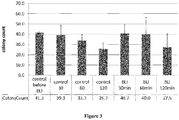
- Results are shown in figure 2 and 3 .
- Figure 2 represents a histogram comparing the effect on colony count of E. Coli in blue light irradiation conditions (453 nm, defined as BLI) Vs without irradiation (defined as control), and for irradicance values of 23 mW/cm 2 .
- Figure 3 represents a histogram comparing the effect on colony count of E. Coli in blue light irradiation conditions (453 nm, defined as BLI) Vs without irradiation (defined as control), and for irradicance values of 10 mW/cm 2 .
- examples 1 to 3 show that a device comprising a light emitting element for emitting a light having the following characteristics:
Landscapes
- Health & Medical Sciences (AREA)
- Life Sciences & Earth Sciences (AREA)
- Animal Behavior & Ethology (AREA)
- General Health & Medical Sciences (AREA)
- Public Health (AREA)
- Veterinary Medicine (AREA)
- Engineering & Computer Science (AREA)
- Epidemiology (AREA)
- Biomedical Technology (AREA)
- Chemical & Material Sciences (AREA)
- Hydrology & Water Resources (AREA)
- Toxicology (AREA)
- Organic Chemistry (AREA)
- Water Supply & Treatment (AREA)
- Pathology (AREA)
- Nuclear Medicine, Radiotherapy & Molecular Imaging (AREA)
- Radiology & Medical Imaging (AREA)
- Environmental & Geological Engineering (AREA)
- Wood Science & Technology (AREA)
- Food Science & Technology (AREA)
- Zoology (AREA)
- Polymers & Plastics (AREA)
- Apparatus For Disinfection Or Sterilisation (AREA)
- Radiation-Therapy Devices (AREA)
Priority Applications (5)
| Application Number | Priority Date | Filing Date | Title |
|---|---|---|---|
| EP18305067.3A EP3517138B1 (de) | 2018-01-26 | 2018-01-26 | Photobiomodulationsvorrichtung |
| CN201980009953.5A CN111787956B (zh) | 2018-01-26 | 2019-01-25 | 光生物调节设备 |
| EP19701242.0A EP3743117B1 (de) | 2018-01-26 | 2019-01-25 | Photobiomodulations-dekontaminationsverfahren |
| PCT/EP2019/051923 WO2019145519A1 (en) | 2018-01-26 | 2019-01-25 | Photobiomodulation device |
| US16/959,516 US20210052760A1 (en) | 2018-01-26 | 2019-01-25 | Photobiomodulation device |
Applications Claiming Priority (1)
| Application Number | Priority Date | Filing Date | Title |
|---|---|---|---|
| EP18305067.3A EP3517138B1 (de) | 2018-01-26 | 2018-01-26 | Photobiomodulationsvorrichtung |
Publications (2)
| Publication Number | Publication Date |
|---|---|
| EP3517138A1 true EP3517138A1 (de) | 2019-07-31 |
| EP3517138B1 EP3517138B1 (de) | 2022-04-27 |
Family
ID=61163627
Family Applications (2)
| Application Number | Title | Priority Date | Filing Date |
|---|---|---|---|
| EP18305067.3A Active EP3517138B1 (de) | 2018-01-26 | 2018-01-26 | Photobiomodulationsvorrichtung |
| EP19701242.0A Active EP3743117B1 (de) | 2018-01-26 | 2019-01-25 | Photobiomodulations-dekontaminationsverfahren |
Family Applications After (1)
| Application Number | Title | Priority Date | Filing Date |
|---|---|---|---|
| EP19701242.0A Active EP3743117B1 (de) | 2018-01-26 | 2019-01-25 | Photobiomodulations-dekontaminationsverfahren |
Country Status (4)
| Country | Link |
|---|---|
| US (1) | US20210052760A1 (de) |
| EP (2) | EP3517138B1 (de) |
| CN (1) | CN111787956B (de) |
| WO (1) | WO2019145519A1 (de) |
Cited By (3)
| Publication number | Priority date | Publication date | Assignee | Title |
|---|---|---|---|---|
| IT202000016864A1 (it) * | 2020-07-10 | 2022-01-10 | Emoled S R L | Metodo per la inattivazione di una colonia di patogeni in spazi, superfici o oggetti usando radiazione elettromagnetica |
| EP3939618A1 (de) | 2020-07-10 | 2022-01-19 | Emoled Srl | Verfahren zur inaktivierung von krankheitserregerkolonie in räumen, auf oberflächen und objekten mittels elektromagnetischer strahlung |
| TWI815618B (zh) * | 2022-08-19 | 2023-09-11 | 光磊先進顯示科技股份有限公司 | 燈具 |
Families Citing this family (14)
| Publication number | Priority date | Publication date | Assignee | Title |
|---|---|---|---|---|
| US10569097B2 (en) | 2015-07-28 | 2020-02-25 | Photonmd, Inc. | Systems and methods for phototherapeutic modulation of nitric oxide |
| US12109429B2 (en) | 2015-07-28 | 2024-10-08 | Know Bio, Llc | Phototherapeutic light for treatment of pathogens |
| EP3976109A4 (de) | 2019-05-24 | 2023-01-25 | KNOW Bio, LLC | Lichtaktivierte blutprodukte und verfahren und vorrichtung zur herstellung und verwendung derselben |
| US11147984B2 (en) | 2020-03-19 | 2021-10-19 | Know Bio, Llc | Illumination devices for inducing biological effects |
| US12011611B2 (en) | 2020-03-19 | 2024-06-18 | Know Bio, Llc | Illumination devices for inducing biological effects |
| US12447354B2 (en) | 2020-03-19 | 2025-10-21 | Know Bio, Llc | Illumination devices for inducing biological effects |
| US11986666B2 (en) | 2020-03-19 | 2024-05-21 | Know Bio, Llc | Illumination devices for inducing biological effects |
| US12347337B2 (en) | 2020-12-10 | 2025-07-01 | Know Bio, Llc | Enhanced testing and characterization techniques for phototherapeutic light treatments |
| US20240082440A1 (en) * | 2021-01-26 | 2024-03-14 | Signify Holding B.V. | System and method for disruption of macromolecules using mid- and far- infrared |
| US12115384B2 (en) | 2021-03-15 | 2024-10-15 | Know Bio, Llc | Devices and methods for illuminating tissue to induce biological effects |
| US11654294B2 (en) | 2021-03-15 | 2023-05-23 | Know Bio, Llc | Intranasal illumination devices |
| NO347482B1 (en) * | 2021-06-04 | 2023-11-20 | Beefutures Holding As | Method and system for photobiomodulation of pollinating insects in a hive |
| US11980774B2 (en) | 2021-08-05 | 2024-05-14 | Know Bio, Llc | Illumination devices and related methods for phototherapeutic light treatments in the presence of vitamins |
| CN115520931A (zh) * | 2022-10-20 | 2022-12-27 | 中国人民解放军军事科学院军事医学研究院 | 一种基于uva-led的微生物灭活方法 |
Citations (5)
| Publication number | Priority date | Publication date | Assignee | Title |
|---|---|---|---|---|
| WO2005034855A2 (en) * | 2003-09-05 | 2005-04-21 | The General Hospital Corporation | Photodynamic inactivation of bacterial spores |
| WO2007012875A1 (en) * | 2005-07-29 | 2007-02-01 | University Of Strathclyde | Inactivation of gram-positive bacteria |
| WO2009056838A1 (en) | 2007-10-31 | 2009-05-07 | University Of Strathclyde | Lighting device |
| US20140343478A1 (en) * | 2013-05-16 | 2014-11-20 | Excelitas Technologies Corp. | Visible Light Photo-Disinfection Patch |
| US20170080117A1 (en) * | 2014-07-16 | 2017-03-23 | LiteProducts LLC | System and method for inactivating pathogens using visible light and/or uv light |
Family Cites Families (6)
| Publication number | Priority date | Publication date | Assignee | Title |
|---|---|---|---|---|
| US7544204B2 (en) * | 2003-10-15 | 2009-06-09 | Valam Corporation | Control of halitosis-generating and other microorganisms in the non-dental upper respiratory tract |
| BR112012017753A2 (en) * | 2010-01-19 | 2018-07-31 | Biolitec Pharma Marketing Ltd. | device and method of photodynamic therapy and uses of photosensitizers. |
| EP2654806B1 (de) * | 2010-12-22 | 2019-05-22 | Ortner Cleanroom Engineering GmbH | Fotodynamische steuerung von mikrobiellem wachstum auf oberflächen |
| WO2017197149A1 (en) * | 2016-05-11 | 2017-11-16 | The Forsyth Institute | Animal phototherapeutic system |
| KR102289171B1 (ko) * | 2016-05-26 | 2021-08-12 | 샌 디에고 스테이트 유니버시티 리써치 파운데이션 | 펄스화된 보라색 또는 청색 광을 이용한 미생물의 광박멸을 위한 장치 및 방법 |
| US20180093107A1 (en) * | 2016-09-30 | 2018-04-05 | Gliese 623B, LLC | System and Method For Healing and/or Disinfecting Wounds and Burns |
-
2018
- 2018-01-26 EP EP18305067.3A patent/EP3517138B1/de active Active
-
2019
- 2019-01-25 CN CN201980009953.5A patent/CN111787956B/zh active Active
- 2019-01-25 EP EP19701242.0A patent/EP3743117B1/de active Active
- 2019-01-25 WO PCT/EP2019/051923 patent/WO2019145519A1/en not_active Ceased
- 2019-01-25 US US16/959,516 patent/US20210052760A1/en active Pending
Patent Citations (5)
| Publication number | Priority date | Publication date | Assignee | Title |
|---|---|---|---|---|
| WO2005034855A2 (en) * | 2003-09-05 | 2005-04-21 | The General Hospital Corporation | Photodynamic inactivation of bacterial spores |
| WO2007012875A1 (en) * | 2005-07-29 | 2007-02-01 | University Of Strathclyde | Inactivation of gram-positive bacteria |
| WO2009056838A1 (en) | 2007-10-31 | 2009-05-07 | University Of Strathclyde | Lighting device |
| US20140343478A1 (en) * | 2013-05-16 | 2014-11-20 | Excelitas Technologies Corp. | Visible Light Photo-Disinfection Patch |
| US20170080117A1 (en) * | 2014-07-16 | 2017-03-23 | LiteProducts LLC | System and method for inactivating pathogens using visible light and/or uv light |
Non-Patent Citations (1)
| Title |
|---|
| GUFFEY; WILBORN: "In Vitro Bactericidal Effects of 405-nm and 470-nm Blue Light", PHOTOMEDICINE AND LASER SURGERY, vol. 24, no. 6, 2006, pages 684 - 688 |
Cited By (3)
| Publication number | Priority date | Publication date | Assignee | Title |
|---|---|---|---|---|
| IT202000016864A1 (it) * | 2020-07-10 | 2022-01-10 | Emoled S R L | Metodo per la inattivazione di una colonia di patogeni in spazi, superfici o oggetti usando radiazione elettromagnetica |
| EP3939618A1 (de) | 2020-07-10 | 2022-01-19 | Emoled Srl | Verfahren zur inaktivierung von krankheitserregerkolonie in räumen, auf oberflächen und objekten mittels elektromagnetischer strahlung |
| TWI815618B (zh) * | 2022-08-19 | 2023-09-11 | 光磊先進顯示科技股份有限公司 | 燈具 |
Also Published As
| Publication number | Publication date |
|---|---|
| WO2019145519A1 (en) | 2019-08-01 |
| EP3743117A1 (de) | 2020-12-02 |
| US20210052760A1 (en) | 2021-02-25 |
| CN111787956A (zh) | 2020-10-16 |
| EP3517138B1 (de) | 2022-04-27 |
| CN111787956B (zh) | 2023-11-14 |
| EP3743117B1 (de) | 2024-03-27 |
| EP3743117C0 (de) | 2024-03-27 |
Similar Documents
| Publication | Publication Date | Title |
|---|---|---|
| EP3517138B1 (de) | Photobiomodulationsvorrichtung | |
| US20220133920A1 (en) | Method and apparatus for sterilizing and disinfecting air and surfaces and protecting a zone from external microbial contamination | |
| US11147650B2 (en) | Sterile site apparatus, system, and method of using the same | |
| EP2211914B1 (de) | Beleuchtungsvorrichtung | |
| Horton et al. | Spectrum of virucidal activity from ultraviolet to infrared radiation | |
| JP6025756B2 (ja) | 殺菌装置、及び、殺菌装置の作動方法 | |
| US20180339073A1 (en) | Light disinfection system and method | |
| EP3003375B1 (de) | Verfahren zum aufbringen einer zusammensetzung und pharmazeutische zusammensetzung mit einem schema zur verabreichung davon | |
| Arzanani et al. | A review on applications and safety of 222 nm far UVC light for surface and air disinfection | |
| KR20240024212A (ko) | Led 기반 발광 유닛 | |
| Yaqubi et al. | Effectiveness of purple led for inactivation of Bacillus subtilis and Escherichia coli bacteria in in vitro sterilizers | |
| Arkhipov et al. | The organization of pre-clinical studies of bactericidal and wound healing effects of the impulse photoherapy device “Zarya” | |
| Kong et al. | Minimizing Escherichia coli O157: H7 contamination in indoor farming: effects of cultivar type and ultra‐violet light quality | |
| CN109724177A (zh) | 一种空调器杀菌装置及其控制方法 | |
| Rosa et al. | Follow-up of pressure ulcer treatment with photodynamic therapy, low level laser therapy and cellulose membrane | |
| Boyce | Use of light for HAI reduction | |
| Tjampakasari et al. | The Effectiveness of The Disinfection Tools of Ultraviolet Radiation Method in Reducing Number of Airborne Microbial in Several Indoors in | |
| Jalbout et al. | Advancement study in skin bacteria protection using UV light | |
| Pinel et al. | The Potential of Blue Light as a Disinfection Strategy in Indoor Environments | |
| Rao | CEfficacy of Ozone in Combination with UV for Inactivation of Selective Foodborne Pathogens | |
| TR2024011774A2 (tr) | Gün işiği kullanarak dezenfeksi̇yon yapan lamba | |
| CN117545528A (zh) | 基于led的发光单元 | |
| Lang | Visible Light Disinfection | |
| Sabaa et al. | Effect of Gamma, Beta, Alpha irradiation and effect of Semiconductor laser on Serratia marcescens (in vitro) | |
| Burke et al. | New and emerging technologies |
Legal Events
| Date | Code | Title | Description |
|---|---|---|---|
| PUAI | Public reference made under article 153(3) epc to a published international application that has entered the european phase |
Free format text: ORIGINAL CODE: 0009012 |
|
| STAA | Information on the status of an ep patent application or granted ep patent |
Free format text: STATUS: THE APPLICATION HAS BEEN PUBLISHED |
|
| AK | Designated contracting states |
Kind code of ref document: A1 Designated state(s): AL AT BE BG CH CY CZ DE DK EE ES FI FR GB GR HR HU IE IS IT LI LT LU LV MC MK MT NL NO PL PT RO RS SE SI SK SM TR |
|
| AX | Request for extension of the european patent |
Extension state: BA ME |
|
| STAA | Information on the status of an ep patent application or granted ep patent |
Free format text: STATUS: REQUEST FOR EXAMINATION WAS MADE |
|
| 17P | Request for examination filed |
Effective date: 20200129 |
|
| RBV | Designated contracting states (corrected) |
Designated state(s): AL AT BE BG CH CY CZ DE DK EE ES FI FR GB GR HR HU IE IS IT LI LT LU LV MC MK MT NL NO PL PT RO RS SE SI SK SM TR |
|
| STAA | Information on the status of an ep patent application or granted ep patent |
Free format text: STATUS: EXAMINATION IS IN PROGRESS |
|
| 17Q | First examination report despatched |
Effective date: 20200421 |
|
| GRAP | Despatch of communication of intention to grant a patent |
Free format text: ORIGINAL CODE: EPIDOSNIGR1 |
|
| STAA | Information on the status of an ep patent application or granted ep patent |
Free format text: STATUS: GRANT OF PATENT IS INTENDED |
|
| INTG | Intention to grant announced |
Effective date: 20211125 |
|
| GRAS | Grant fee paid |
Free format text: ORIGINAL CODE: EPIDOSNIGR3 |
|
| GRAA | (expected) grant |
Free format text: ORIGINAL CODE: 0009210 |
|
| STAA | Information on the status of an ep patent application or granted ep patent |
Free format text: STATUS: THE PATENT HAS BEEN GRANTED |
|
| AK | Designated contracting states |
Kind code of ref document: B1 Designated state(s): AL AT BE BG CH CY CZ DE DK EE ES FI FR GB GR HR HU IE IS IT LI LT LU LV MC MK MT NL NO PL PT RO RS SE SI SK SM TR |
|
| REG | Reference to a national code |
Ref country code: GB Ref legal event code: FG4D |
|
| REG | Reference to a national code |
Ref country code: CH Ref legal event code: EP |
|
| REG | Reference to a national code |
Ref country code: AT Ref legal event code: REF Ref document number: 1486416 Country of ref document: AT Kind code of ref document: T Effective date: 20220515 |
|
| REG | Reference to a national code |
Ref country code: DE Ref legal event code: R096 Ref document number: 602018034472 Country of ref document: DE |
|
| REG | Reference to a national code |
Ref country code: IE Ref legal event code: FG4D |
|
| REG | Reference to a national code |
Ref country code: LT Ref legal event code: MG9D |
|
| REG | Reference to a national code |
Ref country code: NL Ref legal event code: MP Effective date: 20220427 |
|
| REG | Reference to a national code |
Ref country code: AT Ref legal event code: MK05 Ref document number: 1486416 Country of ref document: AT Kind code of ref document: T Effective date: 20220427 |
|
| PG25 | Lapsed in a contracting state [announced via postgrant information from national office to epo] |
Ref country code: NL Free format text: LAPSE BECAUSE OF FAILURE TO SUBMIT A TRANSLATION OF THE DESCRIPTION OR TO PAY THE FEE WITHIN THE PRESCRIBED TIME-LIMIT Effective date: 20220427 |
|
| PG25 | Lapsed in a contracting state [announced via postgrant information from national office to epo] |
Ref country code: SE Free format text: LAPSE BECAUSE OF FAILURE TO SUBMIT A TRANSLATION OF THE DESCRIPTION OR TO PAY THE FEE WITHIN THE PRESCRIBED TIME-LIMIT Effective date: 20220427 Ref country code: PT Free format text: LAPSE BECAUSE OF FAILURE TO SUBMIT A TRANSLATION OF THE DESCRIPTION OR TO PAY THE FEE WITHIN THE PRESCRIBED TIME-LIMIT Effective date: 20220829 Ref country code: NO Free format text: LAPSE BECAUSE OF FAILURE TO SUBMIT A TRANSLATION OF THE DESCRIPTION OR TO PAY THE FEE WITHIN THE PRESCRIBED TIME-LIMIT Effective date: 20220727 Ref country code: LT Free format text: LAPSE BECAUSE OF FAILURE TO SUBMIT A TRANSLATION OF THE DESCRIPTION OR TO PAY THE FEE WITHIN THE PRESCRIBED TIME-LIMIT Effective date: 20220427 Ref country code: HR Free format text: LAPSE BECAUSE OF FAILURE TO SUBMIT A TRANSLATION OF THE DESCRIPTION OR TO PAY THE FEE WITHIN THE PRESCRIBED TIME-LIMIT Effective date: 20220427 Ref country code: GR Free format text: LAPSE BECAUSE OF FAILURE TO SUBMIT A TRANSLATION OF THE DESCRIPTION OR TO PAY THE FEE WITHIN THE PRESCRIBED TIME-LIMIT Effective date: 20220728 Ref country code: FI Free format text: LAPSE BECAUSE OF FAILURE TO SUBMIT A TRANSLATION OF THE DESCRIPTION OR TO PAY THE FEE WITHIN THE PRESCRIBED TIME-LIMIT Effective date: 20220427 Ref country code: ES Free format text: LAPSE BECAUSE OF FAILURE TO SUBMIT A TRANSLATION OF THE DESCRIPTION OR TO PAY THE FEE WITHIN THE PRESCRIBED TIME-LIMIT Effective date: 20220427 Ref country code: BG Free format text: LAPSE BECAUSE OF FAILURE TO SUBMIT A TRANSLATION OF THE DESCRIPTION OR TO PAY THE FEE WITHIN THE PRESCRIBED TIME-LIMIT Effective date: 20220727 Ref country code: AT Free format text: LAPSE BECAUSE OF FAILURE TO SUBMIT A TRANSLATION OF THE DESCRIPTION OR TO PAY THE FEE WITHIN THE PRESCRIBED TIME-LIMIT Effective date: 20220427 |
|
| PG25 | Lapsed in a contracting state [announced via postgrant information from national office to epo] |
Ref country code: RS Free format text: LAPSE BECAUSE OF FAILURE TO SUBMIT A TRANSLATION OF THE DESCRIPTION OR TO PAY THE FEE WITHIN THE PRESCRIBED TIME-LIMIT Effective date: 20220427 Ref country code: PL Free format text: LAPSE BECAUSE OF FAILURE TO SUBMIT A TRANSLATION OF THE DESCRIPTION OR TO PAY THE FEE WITHIN THE PRESCRIBED TIME-LIMIT Effective date: 20220427 Ref country code: LV Free format text: LAPSE BECAUSE OF FAILURE TO SUBMIT A TRANSLATION OF THE DESCRIPTION OR TO PAY THE FEE WITHIN THE PRESCRIBED TIME-LIMIT Effective date: 20220427 Ref country code: IS Free format text: LAPSE BECAUSE OF FAILURE TO SUBMIT A TRANSLATION OF THE DESCRIPTION OR TO PAY THE FEE WITHIN THE PRESCRIBED TIME-LIMIT Effective date: 20220827 |
|
| REG | Reference to a national code |
Ref country code: DE Ref legal event code: R097 Ref document number: 602018034472 Country of ref document: DE |
|
| PG25 | Lapsed in a contracting state [announced via postgrant information from national office to epo] |
Ref country code: SM Free format text: LAPSE BECAUSE OF FAILURE TO SUBMIT A TRANSLATION OF THE DESCRIPTION OR TO PAY THE FEE WITHIN THE PRESCRIBED TIME-LIMIT Effective date: 20220427 Ref country code: SK Free format text: LAPSE BECAUSE OF FAILURE TO SUBMIT A TRANSLATION OF THE DESCRIPTION OR TO PAY THE FEE WITHIN THE PRESCRIBED TIME-LIMIT Effective date: 20220427 Ref country code: RO Free format text: LAPSE BECAUSE OF FAILURE TO SUBMIT A TRANSLATION OF THE DESCRIPTION OR TO PAY THE FEE WITHIN THE PRESCRIBED TIME-LIMIT Effective date: 20220427 Ref country code: EE Free format text: LAPSE BECAUSE OF FAILURE TO SUBMIT A TRANSLATION OF THE DESCRIPTION OR TO PAY THE FEE WITHIN THE PRESCRIBED TIME-LIMIT Effective date: 20220427 Ref country code: DK Free format text: LAPSE BECAUSE OF FAILURE TO SUBMIT A TRANSLATION OF THE DESCRIPTION OR TO PAY THE FEE WITHIN THE PRESCRIBED TIME-LIMIT Effective date: 20220427 Ref country code: CZ Free format text: LAPSE BECAUSE OF FAILURE TO SUBMIT A TRANSLATION OF THE DESCRIPTION OR TO PAY THE FEE WITHIN THE PRESCRIBED TIME-LIMIT Effective date: 20220427 |
|
| PLBE | No opposition filed within time limit |
Free format text: ORIGINAL CODE: 0009261 |
|
| STAA | Information on the status of an ep patent application or granted ep patent |
Free format text: STATUS: NO OPPOSITION FILED WITHIN TIME LIMIT |
|
| PG25 | Lapsed in a contracting state [announced via postgrant information from national office to epo] |
Ref country code: AL Free format text: LAPSE BECAUSE OF FAILURE TO SUBMIT A TRANSLATION OF THE DESCRIPTION OR TO PAY THE FEE WITHIN THE PRESCRIBED TIME-LIMIT Effective date: 20220427 |
|
| 26N | No opposition filed |
Effective date: 20230130 |
|
| PG25 | Lapsed in a contracting state [announced via postgrant information from national office to epo] |
Ref country code: SI Free format text: LAPSE BECAUSE OF FAILURE TO SUBMIT A TRANSLATION OF THE DESCRIPTION OR TO PAY THE FEE WITHIN THE PRESCRIBED TIME-LIMIT Effective date: 20220427 |
|
| P01 | Opt-out of the competence of the unified patent court (upc) registered |
Effective date: 20230522 |
|
| REG | Reference to a national code |
Ref country code: CH Ref legal event code: PL |
|
| PG25 | Lapsed in a contracting state [announced via postgrant information from national office to epo] |
Ref country code: LU Free format text: LAPSE BECAUSE OF NON-PAYMENT OF DUE FEES Effective date: 20230126 |
|
| REG | Reference to a national code |
Ref country code: BE Ref legal event code: MM Effective date: 20230131 |
|
| PG25 | Lapsed in a contracting state [announced via postgrant information from national office to epo] |
Ref country code: LI Free format text: LAPSE BECAUSE OF NON-PAYMENT OF DUE FEES Effective date: 20230131 Ref country code: CH Free format text: LAPSE BECAUSE OF NON-PAYMENT OF DUE FEES Effective date: 20230131 |
|
| PG25 | Lapsed in a contracting state [announced via postgrant information from national office to epo] |
Ref country code: BE Free format text: LAPSE BECAUSE OF NON-PAYMENT OF DUE FEES Effective date: 20230131 |
|
| PG25 | Lapsed in a contracting state [announced via postgrant information from national office to epo] |
Ref country code: IT Free format text: LAPSE BECAUSE OF FAILURE TO SUBMIT A TRANSLATION OF THE DESCRIPTION OR TO PAY THE FEE WITHIN THE PRESCRIBED TIME-LIMIT Effective date: 20220427 Ref country code: IE Free format text: LAPSE BECAUSE OF NON-PAYMENT OF DUE FEES Effective date: 20230126 |
|
| PG25 | Lapsed in a contracting state [announced via postgrant information from national office to epo] |
Ref country code: MC Free format text: LAPSE BECAUSE OF FAILURE TO SUBMIT A TRANSLATION OF THE DESCRIPTION OR TO PAY THE FEE WITHIN THE PRESCRIBED TIME-LIMIT Effective date: 20220427 |
|
| PG25 | Lapsed in a contracting state [announced via postgrant information from national office to epo] |
Ref country code: MC Free format text: LAPSE BECAUSE OF FAILURE TO SUBMIT A TRANSLATION OF THE DESCRIPTION OR TO PAY THE FEE WITHIN THE PRESCRIBED TIME-LIMIT Effective date: 20220427 |
|
| PG25 | Lapsed in a contracting state [announced via postgrant information from national office to epo] |
Ref country code: BG Free format text: LAPSE BECAUSE OF FAILURE TO SUBMIT A TRANSLATION OF THE DESCRIPTION OR TO PAY THE FEE WITHIN THE PRESCRIBED TIME-LIMIT Effective date: 20220427 |
|
| PG25 | Lapsed in a contracting state [announced via postgrant information from national office to epo] |
Ref country code: BG Free format text: LAPSE BECAUSE OF FAILURE TO SUBMIT A TRANSLATION OF THE DESCRIPTION OR TO PAY THE FEE WITHIN THE PRESCRIBED TIME-LIMIT Effective date: 20220427 |
|
| REG | Reference to a national code |
Ref country code: DE Ref legal event code: R082 Ref document number: 602018034472 Country of ref document: DE Representative=s name: PLASSERAUD IP GMBH, DE |
|
| PGFP | Annual fee paid to national office [announced via postgrant information from national office to epo] |
Ref country code: DE Payment date: 20250129 Year of fee payment: 8 |
|
| PGFP | Annual fee paid to national office [announced via postgrant information from national office to epo] |
Ref country code: FR Payment date: 20250127 Year of fee payment: 8 |
|
| PGFP | Annual fee paid to national office [announced via postgrant information from national office to epo] |
Ref country code: GB Payment date: 20250127 Year of fee payment: 8 |
|
| PG25 | Lapsed in a contracting state [announced via postgrant information from national office to epo] |
Ref country code: CY Free format text: LAPSE BECAUSE OF FAILURE TO SUBMIT A TRANSLATION OF THE DESCRIPTION OR TO PAY THE FEE WITHIN THE PRESCRIBED TIME-LIMIT; INVALID AB INITIO Effective date: 20180126 |
|
| PG25 | Lapsed in a contracting state [announced via postgrant information from national office to epo] |
Ref country code: HU Free format text: LAPSE BECAUSE OF FAILURE TO SUBMIT A TRANSLATION OF THE DESCRIPTION OR TO PAY THE FEE WITHIN THE PRESCRIBED TIME-LIMIT; INVALID AB INITIO Effective date: 20180126 |
|
| PG25 | Lapsed in a contracting state [announced via postgrant information from national office to epo] |
Ref country code: TR Free format text: LAPSE BECAUSE OF FAILURE TO SUBMIT A TRANSLATION OF THE DESCRIPTION OR TO PAY THE FEE WITHIN THE PRESCRIBED TIME-LIMIT Effective date: 20220427 |