EP3514883A1 - Electrolyte additive and lithium secondary battery electrolyte comprising same - Google Patents
Electrolyte additive and lithium secondary battery electrolyte comprising same Download PDFInfo
- Publication number
- EP3514883A1 EP3514883A1 EP18767604.4A EP18767604A EP3514883A1 EP 3514883 A1 EP3514883 A1 EP 3514883A1 EP 18767604 A EP18767604 A EP 18767604A EP 3514883 A1 EP3514883 A1 EP 3514883A1
- Authority
- EP
- European Patent Office
- Prior art keywords
- electrolyte
- compound
- lithium
- borate
- additive composition
- Prior art date
- Legal status (The legal status is an assumption and is not a legal conclusion. Google has not performed a legal analysis and makes no representation as to the accuracy of the status listed.)
- Granted
Links
Classifications
-
- H—ELECTRICITY
- H01—ELECTRIC ELEMENTS
- H01M—PROCESSES OR MEANS, e.g. BATTERIES, FOR THE DIRECT CONVERSION OF CHEMICAL ENERGY INTO ELECTRICAL ENERGY
- H01M10/00—Secondary cells; Manufacture thereof
- H01M10/05—Accumulators with non-aqueous electrolyte
- H01M10/056—Accumulators with non-aqueous electrolyte characterised by the materials used as electrolytes, e.g. mixed inorganic/organic electrolytes
- H01M10/0564—Accumulators with non-aqueous electrolyte characterised by the materials used as electrolytes, e.g. mixed inorganic/organic electrolytes the electrolyte being constituted of organic materials only
- H01M10/0566—Liquid materials
- H01M10/0567—Liquid materials characterised by the additives
-
- C—CHEMISTRY; METALLURGY
- C07—ORGANIC CHEMISTRY
- C07F—ACYCLIC, CARBOCYCLIC OR HETEROCYCLIC COMPOUNDS CONTAINING ELEMENTS OTHER THAN CARBON, HYDROGEN, HALOGEN, OXYGEN, NITROGEN, SULFUR, SELENIUM OR TELLURIUM
- C07F5/00—Compounds containing elements of Groups 3 or 13 of the Periodic Table
- C07F5/02—Boron compounds
-
- C—CHEMISTRY; METALLURGY
- C07—ORGANIC CHEMISTRY
- C07F—ACYCLIC, CARBOCYCLIC OR HETEROCYCLIC COMPOUNDS CONTAINING ELEMENTS OTHER THAN CARBON, HYDROGEN, HALOGEN, OXYGEN, NITROGEN, SULFUR, SELENIUM OR TELLURIUM
- C07F5/00—Compounds containing elements of Groups 3 or 13 of the Periodic Table
- C07F5/02—Boron compounds
- C07F5/022—Boron compounds without C-boron linkages
-
- H—ELECTRICITY
- H01—ELECTRIC ELEMENTS
- H01M—PROCESSES OR MEANS, e.g. BATTERIES, FOR THE DIRECT CONVERSION OF CHEMICAL ENERGY INTO ELECTRICAL ENERGY
- H01M10/00—Secondary cells; Manufacture thereof
- H01M10/05—Accumulators with non-aqueous electrolyte
- H01M10/052—Li-accumulators
-
- H—ELECTRICITY
- H01—ELECTRIC ELEMENTS
- H01M—PROCESSES OR MEANS, e.g. BATTERIES, FOR THE DIRECT CONVERSION OF CHEMICAL ENERGY INTO ELECTRICAL ENERGY
- H01M10/00—Secondary cells; Manufacture thereof
- H01M10/05—Accumulators with non-aqueous electrolyte
- H01M10/052—Li-accumulators
- H01M10/0525—Rocking-chair batteries, i.e. batteries with lithium insertion or intercalation in both electrodes; Lithium-ion batteries
-
- H—ELECTRICITY
- H01—ELECTRIC ELEMENTS
- H01M—PROCESSES OR MEANS, e.g. BATTERIES, FOR THE DIRECT CONVERSION OF CHEMICAL ENERGY INTO ELECTRICAL ENERGY
- H01M10/00—Secondary cells; Manufacture thereof
- H01M10/05—Accumulators with non-aqueous electrolyte
- H01M10/056—Accumulators with non-aqueous electrolyte characterised by the materials used as electrolytes, e.g. mixed inorganic/organic electrolytes
- H01M10/0564—Accumulators with non-aqueous electrolyte characterised by the materials used as electrolytes, e.g. mixed inorganic/organic electrolytes the electrolyte being constituted of organic materials only
- H01M10/0566—Liquid materials
- H01M10/0568—Liquid materials characterised by the solutes
-
- H—ELECTRICITY
- H01—ELECTRIC ELEMENTS
- H01M—PROCESSES OR MEANS, e.g. BATTERIES, FOR THE DIRECT CONVERSION OF CHEMICAL ENERGY INTO ELECTRICAL ENERGY
- H01M10/00—Secondary cells; Manufacture thereof
- H01M10/05—Accumulators with non-aqueous electrolyte
- H01M10/056—Accumulators with non-aqueous electrolyte characterised by the materials used as electrolytes, e.g. mixed inorganic/organic electrolytes
- H01M10/0564—Accumulators with non-aqueous electrolyte characterised by the materials used as electrolytes, e.g. mixed inorganic/organic electrolytes the electrolyte being constituted of organic materials only
- H01M10/0566—Liquid materials
- H01M10/0569—Liquid materials characterised by the solvents
-
- H—ELECTRICITY
- H01—ELECTRIC ELEMENTS
- H01M—PROCESSES OR MEANS, e.g. BATTERIES, FOR THE DIRECT CONVERSION OF CHEMICAL ENERGY INTO ELECTRICAL ENERGY
- H01M10/00—Secondary cells; Manufacture thereof
- H01M10/42—Methods or arrangements for servicing or maintenance of secondary cells or secondary half-cells
-
- H—ELECTRICITY
- H01—ELECTRIC ELEMENTS
- H01M—PROCESSES OR MEANS, e.g. BATTERIES, FOR THE DIRECT CONVERSION OF CHEMICAL ENERGY INTO ELECTRICAL ENERGY
- H01M10/00—Secondary cells; Manufacture thereof
- H01M10/42—Methods or arrangements for servicing or maintenance of secondary cells or secondary half-cells
- H01M10/4235—Safety or regulating additives or arrangements in electrodes, separators or electrolyte
-
- H—ELECTRICITY
- H01—ELECTRIC ELEMENTS
- H01M—PROCESSES OR MEANS, e.g. BATTERIES, FOR THE DIRECT CONVERSION OF CHEMICAL ENERGY INTO ELECTRICAL ENERGY
- H01M2300/00—Electrolytes
- H01M2300/0017—Non-aqueous electrolytes
- H01M2300/0025—Organic electrolyte
-
- H—ELECTRICITY
- H01—ELECTRIC ELEMENTS
- H01M—PROCESSES OR MEANS, e.g. BATTERIES, FOR THE DIRECT CONVERSION OF CHEMICAL ENERGY INTO ELECTRICAL ENERGY
- H01M2300/00—Electrolytes
- H01M2300/0017—Non-aqueous electrolytes
- H01M2300/0025—Organic electrolyte
- H01M2300/0028—Organic electrolyte characterised by the solvent
-
- Y—GENERAL TAGGING OF NEW TECHNOLOGICAL DEVELOPMENTS; GENERAL TAGGING OF CROSS-SECTIONAL TECHNOLOGIES SPANNING OVER SEVERAL SECTIONS OF THE IPC; TECHNICAL SUBJECTS COVERED BY FORMER USPC CROSS-REFERENCE ART COLLECTIONS [XRACs] AND DIGESTS
- Y02—TECHNOLOGIES OR APPLICATIONS FOR MITIGATION OR ADAPTATION AGAINST CLIMATE CHANGE
- Y02E—REDUCTION OF GREENHOUSE GAS [GHG] EMISSIONS, RELATED TO ENERGY GENERATION, TRANSMISSION OR DISTRIBUTION
- Y02E60/00—Enabling technologies; Technologies with a potential or indirect contribution to GHG emissions mitigation
- Y02E60/10—Energy storage using batteries
-
- Y—GENERAL TAGGING OF NEW TECHNOLOGICAL DEVELOPMENTS; GENERAL TAGGING OF CROSS-SECTIONAL TECHNOLOGIES SPANNING OVER SEVERAL SECTIONS OF THE IPC; TECHNICAL SUBJECTS COVERED BY FORMER USPC CROSS-REFERENCE ART COLLECTIONS [XRACs] AND DIGESTS
- Y02—TECHNOLOGIES OR APPLICATIONS FOR MITIGATION OR ADAPTATION AGAINST CLIMATE CHANGE
- Y02T—CLIMATE CHANGE MITIGATION TECHNOLOGIES RELATED TO TRANSPORTATION
- Y02T10/00—Road transport of goods or passengers
- Y02T10/60—Other road transportation technologies with climate change mitigation effect
- Y02T10/70—Energy storage systems for electromobility, e.g. batteries
Definitions
- the present invention relates to an electrolyte additive and a non-aqueous electrolyte for a lithium secondary battery including the same.
- the secondary battery includes a nickel-cadmium battery, a nickel-metal hydride battery, a nickel-hydrogen battery, and a lithium secondary battery, and, among these batteries, research into lithium secondary batteries, which not only exhibit a discharge voltage two times or more higher than a typical battery using an aqueous alkaline solution, but also have high energy density per unit weight and are rapidly chargeable, has been emerged.
- a lithium metal oxide is used as a positive electrode active material of a lithium secondary battery, and lithium metal, a lithium alloy, crystalline or amorphous carbon, or a carbon composite is used as a negative electrode active material.
- a current collector is coated with the active material of appropriate thickness and length or the active material itself is coated in the form of a film, and the resultant product is then wound or stacked with an insulating separator to prepare electrodes. Thereafter, the electrodes are put into a can or a container similar thereto, and a secondary battery is then prepared by injecting an electrolyte.
- Solid electrolyte interface SEI
- the SEI formed at an initial stage of charging may prevent a reaction of the lithium ions with the carbon negative electrode or other materials during charge and discharge.
- the SEI only passes the lithium ions by acting as an ion tunnel. The ion tunnel may prevent the collapse of a structure of the carbon negative electrode due to the co-intercalation of the carbon negative electrode and organic solvents of the electrolyte having a high molecular weight which solvates the lithium ions and moves therewith.
- the SEI may prevent the reaction of the lithium ions with the negative electrode or other materials during repeated charge and discharge caused by the subsequent use of the battery and may act as an ion tunnel that only passes the lithium ions between the electrolyte and the negative electrode.
- An aspect of the present invention provides a novel electrolyte additive capable of improving high-rate charge and discharge characteristics, suppressing an amount of gas generated during high-temperature storage, and improving life characteristics, and an electrolyte additive composition which may improve the above-described performance of a lithium secondary battery by including the novel electrolyte additive as well as an additive capable of having a synergistic effect on performance improvement when used together.
- an electrolyte additive composition including a borate-based lithium compound represented by Formula 1; and a nitrile-based compound represented by Formula 2, wherein the electrolyte additive composition does not include a phosphate-based compound.
- Y 1 to Y 4 are each independently oxygen (O) or sulfur (S).
- O oxygen
- S sulfur
- R 1 is an alkylene group having 1 to 5 carbon atoms.
- An electrolyte additive composition of the present invention may improve high-rate charge and discharge characteristics of a lithium secondary battery, may suppress an amount of gas generated during high-temperature storage, and may improve life characteristics at high temperature operation due to a synergistic effect of a novel electrolyte additive and a nitrile-based compound mixed therewith.
- a novel electrolyte additive composition includes a borate-based lithium compound represented by Formula 1; and a nitrile-based compound represented by Formula 2, wherein the electrolyte additive composition does not include a phosphate-based compound.
- Y 1 to Y 4 are each independently oxygen (O) or sulfur (S).
- O oxygen
- S sulfur
- R 1 is an alkylene group having 1 to 5 carbon atoms.
- a borate-based lithium compound represented by the following Formula 1 is included in the electrolyte additive composition.
- Y 1 to Y 4 are each independently O or S. Preferably, Y 1 to Y 4 may be equally O.
- the borate-based lithium compound may be included as an additive in an electrolyte, wherein the borate-based lithium compound forms uniform and thin films on a positive electrode and a negative electrode, and, particularly, the borate-based lithium compound may improve durability of a battery by mainly forming solid electrolyte interface (SEI) on a positive electrode to reduce a reaction between the positive electrode and other materials and thus forming a uniform and thin film. Also, the borate-based lithium compound may form a robust SEI on a surface of the negative electrode during the operation of the battery, and high-rate charge and discharge characteristics of the battery may be improved due to the interface robustly formed as described above.
- SEI solid electrolyte interface
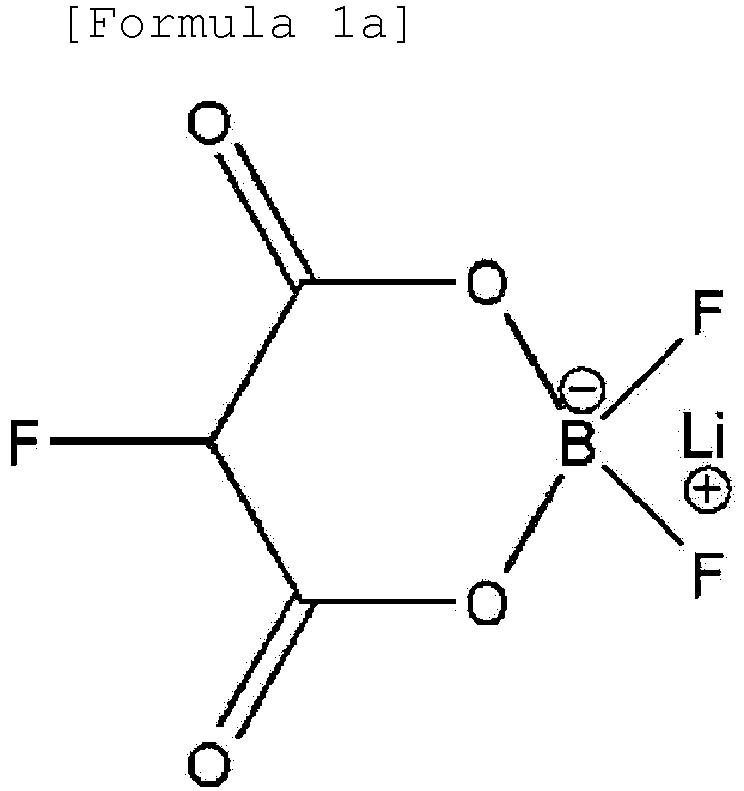
- the borate-based lithium compound as described above may include a compound represented by the following Formula 1a.
- the borate-based lithium compound may be appropriately used according to an amount of the electrolyte additive generally added to the electrolyte, and, for example, may be used in an amount of about 0.01 part by weight to about 2 parts by weight, preferably 0.01 part by weight to 0.5 part by weight or 0.1 part by weight to 2 parts by weight, and more preferably 0.5 part by weight to 1 part by weight based on 100 parts by weight of a total weight of the electrolyte.
- the borate-based lithium compound is used in an amount within the above range, a robust SEI may be stably formed on the negative electrode as described above, and the resulting effect may be obtained.
- a nitrile-based compound is included in the electrolyte additive composition.
- the nitrile-based compound is a compound represented by the following Formula 2.
- Formula 2 N ⁇ C-R 1 -C ⁇ N
- R 1 is an alkylene group having 1 to 5 carbon atoms.
- the nitrile-based compound is a compound containing two nitrile groups, wherein a linking group linking the two nitrile groups is an alkylene group and a carbon number may be in a range of 1 to 5, for example, 2 to 4.
- the nitrile-based compound in which the carbon number of the alkylene group, as a linking group, is in a range of 2 to 4, includes succinonitrile, glutaronitrile, or adiponitrile, and at least one of these compounds may be included as one component of the electrolyte additive composition. Among them, succinonitrile or adiponitrile may be preferably used.
- the nitrile-based compound is a compound capable of providing a synergistic effect with the borate-based lithium compound as described above on the improvement in performance of the lithium secondary battery, wherein the nitrile-based compound, as an additive generally used in a non-aqueous electrolyte of a lithium secondary battery, may have an effect such as suppression of the dissolution of positive electrode transition metals, and, when it is used with the borate-based lithium compound, an effect, such as improvement of high-temperature characteristics, may be expected due to the stabilization of the positive electrode/negative electrode films.
- the nitrile-based compound may play a complementary role in forming the negative electrode SEI in addition to the effect induced by the borate-based lithium compound, may play a role in suppressing the decomposition of a solvent in the electrolyte, and may play a role in improving mobility of lithium ions.
- the nitrile-based compound may be used in an amount of about 0.01 part by weight to about 10 parts by weight, preferably 0.01 part by weight to 5 parts by weight or 0.1 part by weight to 10 parts by weight, and more preferably 0.1 part by weight to 5 parts by weight based on 100 parts by weight of the total weight of the electrolyte.
- the borate-based lithium compound represented by Formula 1 forms uniform and thin films on the positive electrode and the negative electrode, and particularly, the borate-based lithium compound improves durability of the battery by mainly forming the positive electrode solid electrolyte interface (SEI) to reduce the positive electrode reaction of other materials and thus forming a uniform and thin film.
- SEI positive electrode solid electrolyte interface
- the borate-based lithium compound may first form the SEI of a negative electrode inorganic component to improve conductivity of lithium cation and form a film having excellent durability, but it is difficult to obtain the above-described effect by using a single material.
- an electrolyte additive composition is achieved by mixing the borate-based lithium compound represented by Formula 1 with the nitrile-based compound that may help to form the negative electrode film, the SEIs of the positive electrode and the negative electrode are stabilized to improve overall performance, such as high-rate charge and discharge characteristics, high-temperature storage characteristics, and life characteristics, of the lithium secondary battery.
- the film is stably formed as described above, a side reaction, for example, the decomposition of the solvent in the electrolyte around the electrode, may be suppressed, and, accordingly, an amount of gas generated may be significantly reduced even if the battery is stored in a high-temperature environment. Life performance may also be improved due to the improvement in storage characteristics.
- the borate-based lithium compound may be stable without being decomposed at high temperature, there is no side reaction, for example, decomposition of the surface of the positive electrode or oxidation of the electrolyte.
- an increase in irreversible capacity of the battery may be prevented, and accordingly, an effect of increasing reversible capacity may be obtained.
- the electrolyte additive composition according to the present specification does not include a phosphate-based compound.
- the phosphate-based compound may be a compound represented by Formula 3 below.
- the phosphate-based compound may include tris(trimethylsilyl)phosphate, tris(triethylsilyl) phosphate, tris(tripropylsilyl)phosphate, bis(trimethylsilyl)(triethylsilyl)phosphate, bis(triethylsilyl)(trimethylsilyl)phosphate, bis(tripropylsilyl)(trimethylsilyl)phosphate, and bis(tridimethylsilyl)(tripropylsilyl)phosphate.
- the phosphate-based compound as described above may have a significantly adverse effect on aging characteristics of the electrolyte itself, and there is a concern that it may interfere with the synergistic effect of the borate-based lithium compound and the nitrile-based compound in addition to the adverse effect on the aging characteristics.
- a weight ratio of the borate-based lithium compound to the nitrile-based compound may be in a range of 1:0.5 to 1:6, preferably 1:1 to 1:5, and more preferably 1:2 to 1:5.
- an improvement in high-temperature storage characteristics may be expected. That is, an electrolyte capable of satisfying both battery performance and storage characteristics at high temperature may be obtained by adjusting the weight ratio of the borate-based lithium compound to the nitrile-based compound, and obtainability may be higher as the ratio is within a preferred range among the above ranges.
- the electrolyte additive composition may further include a fluorocarbonate-based compound, and the fluorocarbonate-based compound, for example, may include fluoroethylene carbonate or difluoroethylene carbonate, and may particularly include fluoroethylene carbonate.
- the fluorocarbonate-based compound may be used in an amount of about 0.01 part by weight to about 10 parts by weight, preferably 0.01 part by weight to 5 parts by weight or 0.1 part by weight to 10 parts by weight, and more preferably 0.1 part by weight to 5 parts by weight based on 100 parts by weight of the total weight of the electrolyte.
- the fluorocarbonate-based compound may be included in a weight ratio of 1:0.5 to 1:6, for example, 1:1 to 1:4 with respect to the borate-based lithium compound within the above amount range.
- the fluorocarbonate-based compound particularly, fluoroethylene carbonate
- the electrolyte additive composition according to the present specification may further include other additives in addition to the borate-based lithium compound represented by Formula 1, the nitrile-based compound represented by Formula 2, and the fluorocarbonate-based compound.
- a carbonate-based compound, a borate-based compound, a sulfite-based compound, a sultone-based compound, a sulfone-based compound, or a fluorobenzene-based compound may be used, and, a mixture of two or more selected from these compounds may be used.
- the carbonate-based compound vinylene carbonate or vinyl ethylene carbonate, for example, may be used, and the compound may be substituted with a substituent such as an alkyl group having 1 to 3 carbon atoms.
- the fluorobenzene-based compound may be a benzene compound, which is substituted with fluorine instead of hydrogen, such as fluorobenzene, difluorobenzene, and trifluorobenzene.
- the borate-based compound may be represented by Formula 4 below.
- a 4 to A 6 are each independently - Si(R 2 ) m (R 3 ) 3-m , or a propynyl group (-C ⁇ C), wherein R 2 and R 3 are each independently an alkyl group having 1 to 4 carbon atoms, and m is an integer of 0 to 3.
- borate-based compound for example, tris(trimethylsilyl)borate, tris(triethylsilyl)borate, tris(tripropylsilyl)borate, bis(trimethylsilyl)(triethylsilyl)borate, bis(triethylsilyl)(trimethylsilyl)borate, bis(tripropylsilyl)(trimethylsilyl)borate, and bis(tridimethylsilyl)(tripropylsilyl)borate may be used, and the compound, in which alkyl groups of each silyl group are different from each other, may be used.
- dipropynyl ethyl borate or diethyl propynyl borate may be used as the borate-based compound.
- the borate-based compound may improve mobility of lithium ions, may reduce interfacial resistance of the SEI, and may dissociate a material, such as LiF, which may be formed during a battery reaction but is not well separated, and thus, a problem, such as generation of hydrofluoric acid gas, may be solved.
- the sulfite-based compound, the sultone-based compound, and the sulfone-based compound may be represented by Formula 5 below.
- Y 5 and Y 6 are each independently a direct bond, carbon (C), or O, R 5 and R 6 are each independently a substituted or unsubstituted alkyl group having 1 to 10 carbon atoms, a substituted or unsubstituted aryl group having 6 to 20 carbon atoms, or are linked together to form 4- to 7-membered rings, and n is 1 or 2.
- methylene sulfite, ethylene sulfite, trimethylene sulfite, tetramethylene sulfite, or a sulfite having a substituent bonded to these alkylene groups may be used as the sulfite-based sulfur-containing compound.
- dialkyl sulfone to which an alkyl group having 1 to 5 carbon atoms is bonded diaryl sulfone to which an aryl group having 6 to 12 carbon atoms is bonded, or sulfone having a substituent bonded to the dialkyl or diaryl may be used.
- sultone-based sulfur-containing compound 1,3-propane sultone, 1,3-propene sultone, 1,4-butane sultone, 1,5-pentane sultone, or sultone having a substituent bonded to these alkylene groups may be used.
- the sulfite-based, sultone-based, and sulfone-based compounds may generally play a role in complementing the formation of the SEI on the surface of the negative electrode, and the sulfite-based, sultone-based, and sulfone-based compounds may have an effect on high-temperature storage performance and high-rate charge and discharge characteristics by contributing the formation of stable SEI similar to the above-described borate-based lithium compound.
- an electrolyte for a lithium secondary battery including the above-described electrolyte additive composition; a lithium salt; and a non-aqueous organic solvent is provided.
- the electrolyte additive composition may be included in an amount of 0.1 wt% to 15 wt%, preferably 0.5 wt% to 10 wt%, and more preferably 1.0 wt% to 7.0 wt% based on the total weight of the electrolyte.
- each compound in order for the nitrile-based compound to complement the borate-based lithium compound and have a synergistic effect, each compound may be included in an amount of at least 0.1 wt% or more, and, in a case in which each compound is included in an amount of greater 15 wt%, since amounts of the organic solvent and the lithium salt may be relatively reduced, it may degrade basic performance of the battery beyond the role of the additive. Thus, it is necessary to appropriately adjust the amount within a range of 0.1 wt% to 15 wt%, if possible.
- the non-aqueous organic solvent may include any kind of organic solvent which may be used as a non-aqueous electrolyte during the preparation of a typical lithium secondary battery.
- the amount thereof may be appropriately changed within a normally usable range.
- the non-aqueous organic solvent may include conventional organic solvents, which may be used as a non-aqueous organic solvent of a lithium secondary battery, such as a cyclic carbonate solvent, a linear carbonate solvent, an ester solvent, or a ketone solvent, and one alone or a mixture of two or more thereof may be used.
- conventional organic solvents which may be used as a non-aqueous organic solvent of a lithium secondary battery, such as a cyclic carbonate solvent, a linear carbonate solvent, an ester solvent, or a ketone solvent, and one alone or a mixture of two or more thereof may be used.
- the cyclic carbonate solvent may include one selected from the group consisting of ethylene carbonate (EC), vinylene carbonate (VC), fluoroethylene carbonate (FEC), propylene carbonate (PC), and butylene carbonate (BC), or a mixed solution of two or more thereof.
- EC ethylene carbonate
- VC vinylene carbonate
- FEC fluoroethylene carbonate
- PC propylene carbonate
- BC butylene carbonate
- the linear carbonate solvent may include one selected from the group consisting of dimethyl carbonate (DMC), diethyl carbonate (DEC), dipropyl carbonate (DPC), ethylmethyl carbonate (EMC), methylpropyl carbonate (MPC), and ethylpropyl carbonate (EPC), or a mixed solution of two or more thereof.
- DMC dimethyl carbonate
- DEC diethyl carbonate
- DPC dipropyl carbonate
- EMC ethylmethyl carbonate
- MPC methylpropyl carbonate
- EPC ethylpropyl carbonate
- the ester solvent may include one selected from the group consisting of methyl acetate, ethyl acetate, propyl acetate, methyl propionate, ethyl propionate, ⁇ -butyrolactone, ⁇ -valerolactone, ⁇ -caprolactone, ⁇ -valerolactone, and ⁇ -caprolactone, or a mixed solution of two or more thereof.
- poly(methyl vinyl ketone) may be used as the ketone solvent.
- a mixed organic solvent in which 3 kinds of carbonate-based solvents are mixed, may be used as the non-aqueous organic solvent, and, it is more desirable to use a ternary non-aqueous organic solvent.
- the compound, which may be used in the mixing may be ethylene carbonate, propylene carbonate, butylene carbonate, dimethyl carbonate, diethyl carbonate, dipropyl carbonate, ethylmethyl carbonate, vinylene carbonate, fluoroethylene carbonate, methylpropyl carbonate, or ethylpropyl carbonate, and a mixed solvent, in which 3 kinds selected from the above carbonate compounds are mixed, may be used.
- Any lithium salt may be used without limitation as the lithium salt, which may be included in the electrolyte, as long as it may provide predetermined lithium ion conductivity and is typically used in an electrolyte for a lithium secondary battery, and, for example, at least one selected from the group consisting of F - , Cl - , Br - , I - , NO 3 - , N(CN) 2 - , BF 4 - , ClO 4 - , PF 6 - , (CF 3 ) 2 PF 4 - , (CF 3 ) 3 PF 3 - , (CF 3 ) 4 PF 2 - , (CF 3 ) 5 PF - , (CF 3 ) 6 P - , F 3 SO 3 - , CF 3 CF 2 SO 3 - , (CF 3 SO 2 ) 2 N - , (FSO 2 ) 2 N - , CF 3 CF 2 (CF 3 ) 2 CO - , (CF 3 SO
- a lithium secondary battery including the above-described electrolyte for a lithium secondary battery may be provided, and the lithium secondary battery includes a positive electrode including a positive electrode active material, a negative electrode including a negative electrode active material, a separator disposed between the positive electrode and the negative electrode, and the above-described electrolyte.
- the lithium secondary battery of the present invention may be prepared according to a typical method known in the art. For example, an electrolyte assembly is formed by sequentially stacking the positive electrode, the negative electrode, and the separator disposed between the positive electrode and the negative electrode, and the lithium secondary battery may be prepared by injecting an electrolyte in which a lithium salt is dissolved.
- the positive electrode may be prepared by a typical method known in the art. For example, a binder, a conductive agent, and a dispersant, if necessary, as well as a solvent are mixed with a positive electrode active material and stirred to prepare a slurry.
- the positive electrode may be prepared by coating a slurry on the metal current collector, pressing and then drying.
- the positive electrode is prepared by a process of coating the positive electrode collector with the positive electrode active material and then drying the coated positive electrode collector.
- an active material having a high content of a specific transition metal such as xLi 2 MO 3 (1-x)LiMeO 2 (where M is nickel (Ni), cobalt (Co), or manganese (Mn), Me is two or more transition metals selected from the group consisting of Ni, Co, Mn, chromium (Cr), iron (Fe), vanadium (V), aluminum (Al), magnesium (Mg), and titanium (Ti), and x satisfies 0 ⁇ x ⁇ 1), may be used.
- a specific transition metal such as xLi 2 MO 3 (1-x)LiMeO 2 (where M is nickel (Ni), cobalt (Co), or manganese (Mn), Me is two or more transition metals selected from the group consisting of Ni, Co, Mn, chromium (Cr), iron (Fe), vanadium (V), aluminum (Al), magnesium (Mg), and titanium (Ti), and x satisfies 0 ⁇ x ⁇ 1), may
- the lithium-containing transition metal oxide may be coated with a metal, such as aluminum (Al), or a metal oxide. Also, in addition to the lithium-containing transition metal oxide, a sulfide, a selenide, or a halide may be used.
- the positive electrode collector is generally formed to a thickness of 3 ⁇ m to 500 ⁇ m.
- the positive electrode collector is not particularly limited so long as it has conductivity without causing adverse chemical changes in the battery, and any metal may be used as long as it, as a metal with high conductivity as well as a metal to which the slurry of the positive electrode active material may be easily adhered, is not reactive in a voltage range of the battery.
- Non-limiting examples of the positive electrode collector may be aluminum, nickel, or a foil prepared by combination thereof.
- the solvent used for forming the positive electrode may include an organic solvent, such as N-methylpyrrolidone (NMP), dimethylformamide (DMF), acetone, and dimethylacetamide, or water, and these solvents may be used alone or in a mixture of two or more thereof.
- NMP N-methylpyrrolidone
- DMF dimethylformamide
- acetone acetone
- dimethylacetamide or water
- An amount of the solvent used may be sufficient if the solvent may dissolve and disperse the electrode active material, the binder, and the conductive agent in consideration of a coating thickness of the slurry and manufacturing yield.
- the conductive agent may be used without limitation as long as it may be generally used in the art, and, for example, artificial graphite, natural graphite, carbon black, acetylene black, Ketjen black, Denka black, thermal black, channel black, carbon fibers, metal fibers, aluminum, tin, bismuth, silicon, antimony, nickel, copper, titanium, vanadium, chromium, manganese, iron, cobalt, zinc, molybdenum, tungsten, silver, gold, lanthanum, ruthenium, platinum, iridium, titanium oxide, polyaniline, polythiophene, polyacetylene, polypyrrole, or a mixture thereof may be used.
- the binder may be used without limitation as long as it is generally used in the art, and, for example, polyvinylidene fluoride (PVDF), a polyvinylidene fluoride-hexafluoropropylene copolymer (PVDF/HFP), poly(vinyl acetate), polyvinyl alcohol, polyethylene oxide, polyvinylpyrrolidone, polyvinylpyridine, alkylated polyethylene oxide, polyvinyl ether, poly(methyl methacrylate), poly(ethyl acrylate), polytetrafluoroethylene (PTFE), polyvinyl chloride, polyacrylonitrile, a styrene-butadiene rubber, an acrylonitrile-butadiene rubber, a fluoro rubber, an ethylenepropylene-diene monomer (EPDM), a sulfonated ethylenepropylene-diene monomer, carboxymethylcellulose (CMC), regenerated cellulose, starch, hydroxyprop
- a filler may be further added to the mixture, if necessary.
- the filler as a component that suppresses the expansion of the positive electrode, is selectively used, wherein the filler is not particularly limited as long as it is fibrous material while not causing chemical changes in the battery, and, for example, an olefin-based polymer such as polyethylene and polypropylene; and a fibrous material, such as glass fibers and carbon fibers, are used.
- the negative electrode may be prepared by a typical method known in the art. For example, a binder, a conductive agent, and a dispersant, if necessary, as well as a solvent are mixed with a negative electrode active material and stirred to prepare a slurry, a metal current collector is then coated with the slurry and pressed, and the negative electrode may then be prepared by drying the coated metal current collector.
- amorphous carbon or crystalline carbon may be included, and, specifically, carbon such as non-graphitizable carbon and graphite-based carbon; a complex metal oxide such as Li x Fe 2 O 3 (0 ⁇ x ⁇ 1), Li x WO 2 (0 ⁇ x ⁇ 1), Sn x Me 1-x Me' y O z (Me: manganese (Mn), iron (Fe), lead (Pb), or germanium (Ge); Me': aluminum (Al), boron (B), phosphorus (P), silicon (Si), Groups I, II and III elements of the periodic table, or halogen; 0 ⁇ x ⁇ 1; 1 ⁇ y ⁇ 3; 1 ⁇ z ⁇ 8); a lithium metal; a lithium alloy; a silicon-based alloy; a tin-based alloy; a metal oxide such as SnO, SnO 2 , PbO, PbO 2 , Pb 2 O 3 , Pb 3 O 4 , Sb 2 O 3 , Sb
- Those used in the positive electrode may be equally used as the binder and the conductive agent included in the negative electrode.
- the negative electrode collector is generally formed to a thickness of 3 ⁇ m to 500 ⁇ m.
- the negative electrode collector is not particularly limited so long as it has conductivity without causing adverse chemical changes in the battery, and, for example, copper, stainless steel, aluminum, nickel, titanium, fired carbon, copper or stainless steel that is surface-treated with one of carbon, nickel, titanium, silver, or the like, an aluminum-cadmium alloy, or the like may be used.
- the negative electrode collector may have fine surface roughness to improve bonding strength with the negative electrode active material, and the negative electrode collector may be used in various shapes such as a film, a sheet, a foil, a net, a porous body, a foam body, a non-woven fabric body, and the like.
- Both of a polyolefin-based polymer typically used in the art and a composite separator having an organic-inorganic composite layer formed on an olefin-based substrate may be used as the separator disposing between the positive electrode and the negative electrode and insulating these electrodes, but the separator is not particularly limited thereto.
- the positive electrode, negative electrode, and separator which have the above-described structure, are accommodated in a pouch case, and a pouch type battery may then be prepared by injecting the non-aqueous electrolyte, but the present invention is not limited thereto.
- a shape of the lithium secondary battery according to the present specification is not particularly limited, but a cylindrical type using a can or a prismatic type may be used, and a coin type may be used.
- a battery module according to another embodiment of the present invention includes the above-described lithium secondary battery as a unit cell, and a battery pack according to another embodiment of the present invention includes the battery module.
- the lithium secondary battery according to the present invention may not only be used in a battery module that is used as a power source of a small device, but may also be used as a unit cell in a medium and large sized battery pack including a plurality of batteries. However, since oxidation stability is excellent, the lithium secondary battery according to the present invention may be preferably used as a high-voltage power source of a small device, and may be a more suitable electrolyte system rather than being used as a power source of a medium and large sized device.
- the borate-based lithium compound represented by the following Formula 1a and succinonitrile were mixed such that the borate-based lithium compound and the succinonitrile were respectively included in amounts of 1.0 wt% based on a total electrolyte, and an electrolyte additive composition, in which the borate-based lithium compound and the succinonitrile were mixed in a weight ratio of 1:1, was prepared in Example 1.
- the borate-based lithium compound and succinonitrile were mixed in weight ratios as listed in Table 1 to prepare electrolyte additive compositions of Examples 2 to 8.
- Electrolyte additive compositions of Examples 7 and 8 were respectively prepared by further mixing fluoroethylene carbonate in Example 3in weight ratios as listed in Table 1.
- Electrolyte additive compositions of Comparative Examples 1 to 7 were prepared by adjusting types and amounts of additives as listed in Table 1 below.
- Example 1 1.0 0.5 1:0.5 1.5
- Example 2 1.0 1:1 2
- Example 3 1.0 2.0 1:2 3
- Example 4 1.0 3.0 1:3 4
- Example 5 1.0 5.0 1:5 6
- Example 6 1.0 6.0 1:6 7
- Example 7 1.0 3.0 1.0 1:3:1 4
- Example 8 1.0 3.0 2.0 1:3:2 6 Comparative Example 1 1.0 0.5 1:0.5 1.5 Comparative Example 2 1.0 0.5 1:0.5 1.5 Comparative Example 3 1.0 3.0 0.5 1:3:0.5 4.5
- PC propylene carbonate
- EP ethyl propionate
- DMC dimethyl carbonate
- 89 wt% of a mixture of Li(Ni 0.33 Co 0.33 Mn 0.33 )O 2 as a positive electrode active material, 8 wt% of carbon black as a conductive agent, and 3 wt% of polyvinylidene fluoride (PVDF), as a binder, were added to N-methyl-2-pyrrolidone (NMP), as a solvent, to prepare a positive electrode mixture slurry.
- NMP N-methyl-2-pyrrolidone
- an electrode assembly was prepared by a typical method by stacking a polyolefin separator with the positive electrode and negative electrode thus prepared, and the electrolyte prepared in '(1)' was injected to complete the preparation of a lithium secondary battery.
- the lithium secondary batteries in which the electrolyte additive compositions of Examples 1 to 8 and Comparative Examples 1 to 7 were used, were charged at 1.0 C/4.45 V to 4.45 V/112 mA under a constant current/constant voltage (CC/CV) condition at 45°C and discharged at 1.0 C to a voltage of 3.0 V. This charge and discharge cycle was repeated 400 times and a capacity retention was calculated using Equation 1 below.
- Capacity retention % discharge capacity after 400 cycles / initial discharge capacity ⁇ 100
- the lithium secondary batteries in which the electrolyte additive compositions of Examples 1 to 8 and Comparative Examples 1 to 7 were used, were charged at 0.2 C/4.45 V to 4.45 V/112 mA under a constant current/constant voltage (CC/CV) condition at room temperature and discharged at 0.2 C to a voltage of 3.0 V to measure initial discharge capacity.
- CC/CV constant current/constant voltage
- the secondary batteries were charged at 0.2 C/4.45 V to 4.45 V/112 mA under a constant current/constant voltage (CC/CV) condition at room temperature and then stored at 60°C for 21 days. After the storage, the secondary batteries were charged at 0.2 C/4.45 V to 4.45 V/112 mA under a constant current/constant voltage (CC/CV) condition at room temperature and discharged at 0.2 C to a voltage of 3.0 V to measure discharge capacity after storage.
- Capacity retention % discharge capacity after 21 days storage mAh / initial discharge capacity mAh
- each battery was set to a state of charge (SOC) of 50% to measure a thickness, and the thickness was defined as an initial thickness.
- SOC state of charge
- Thickness increase rate % final thickness ⁇ initial thickness / initial thickness ⁇ 100 %
- Examples 1 to 8 in which the borate-based lithium compound and the nitrile-based compound (succinonitrile) were mixed in a ratio of 1:0.5 to 1:6, were evaluated as excellent in terms of both high-temperature life characteristics and high-temperature storage characteristics in comparison to Comparative Examples 1 to 7 in which the nitrile-based compound was not used or the phosphate-based compounds were further used.
Landscapes
- Chemical & Material Sciences (AREA)
- Engineering & Computer Science (AREA)
- General Chemical & Material Sciences (AREA)
- Manufacturing & Machinery (AREA)
- Chemical Kinetics & Catalysis (AREA)
- Electrochemistry (AREA)
- Organic Chemistry (AREA)
- Condensed Matter Physics & Semiconductors (AREA)
- Physics & Mathematics (AREA)
- General Physics & Mathematics (AREA)
- Inorganic Chemistry (AREA)
- Materials Engineering (AREA)
- Secondary Cells (AREA)
Abstract
Description
- This application claims the benefit of Korean Patent Application No.
2017-0034037, filed on March 17, 2017 - The present invention relates to an electrolyte additive and a non-aqueous electrolyte for a lithium secondary battery including the same.
- As the miniaturization and weight reduction of electronic devices are realized and the use of portable electronic devices is common, research into secondary batteries having high energy density, as power sources of these devices, has been actively conducted.
- The secondary battery includes a nickel-cadmium battery, a nickel-metal hydride battery, a nickel-hydrogen battery, and a lithium secondary battery, and, among these batteries, research into lithium secondary batteries, which not only exhibit a discharge voltage two times or more higher than a typical battery using an aqueous alkaline solution, but also have high energy density per unit weight and are rapidly chargeable, has been emerged.
- A lithium metal oxide is used as a positive electrode active material of a lithium secondary battery, and lithium metal, a lithium alloy, crystalline or amorphous carbon, or a carbon composite is used as a negative electrode active material. A current collector is coated with the active material of appropriate thickness and length or the active material itself is coated in the form of a film, and the resultant product is then wound or stacked with an insulating separator to prepare electrodes. Thereafter, the electrodes are put into a can or a container similar thereto, and a secondary battery is then prepared by injecting an electrolyte.
- Charge and discharge of the lithium secondary battery is performed while a process of intercalating and deintercalating lithium ions from a lithium metal oxide positive electrode into and out of a graphite negative electrode is repeated. In this case, since lithium is highly reactive, the lithium reacts with the carbon electrode to form Li2CO3, LiO, or LiOH, and thus, a film may be formed on the surface of the negative electrode. The film is referred to as "solid electrolyte interface (SEI)", wherein the SEI formed at an initial stage of charging may prevent a reaction of the lithium ions with the carbon negative electrode or other materials during charge and discharge. Also, the SEI only passes the lithium ions by acting as an ion tunnel. The ion tunnel may prevent the collapse of a structure of the carbon negative electrode due to the co-intercalation of the carbon negative electrode and organic solvents of the electrolyte having a high molecular weight which solvates the lithium ions and moves therewith.
- Thus, in order to improve high-temperature cycle characteristics and low-temperature output of the lithium secondary battery, a robust SEI must be formed on the negative electrode of the lithium secondary battery. Once the SEI is formed during initial charge, the SEI may prevent the reaction of the lithium ions with the negative electrode or other materials during repeated charge and discharge caused by the subsequent use of the battery and may act as an ion tunnel that only passes the lithium ions between the electrolyte and the negative electrode.
- Conventionally, with respect to an electrolyte which does not include an electrolyte additive or includes an electrolyte additive having poor characteristics, it was difficult to expect the improvement of low-temperature output characteristics due to the formation of a non-uniform SEI. Furthermore, even in a case in which the electrolyte additive is included, since the surface of the positive electrode is decomposed or the electrolyte causes an oxidation reaction during a high-temperature reaction due to the electrolyte additive when an amount of the electrolyte additive added may not be adjusted to the required amount, irreversible capacity of the secondary battery may ultimately be increased and output characteristics may be reduced.
- Thus, there is a need to develop a compound which may be used as an electrolyte additive for improving overall performance, such as high-rate charge and discharge characteristics, high-temperature performance characteristics, and life characteristics, of the battery by forming a robust SEI on the negative electrode.
- An aspect of the present invention provides a novel electrolyte additive capable of improving high-rate charge and discharge characteristics, suppressing an amount of gas generated during high-temperature storage, and improving life characteristics, and an electrolyte additive composition which may improve the above-described performance of a lithium secondary battery by including the novel electrolyte additive as well as an additive capable of having a synergistic effect on performance improvement when used together.
- According to an aspect of the present invention, there is provided an electrolyte additive composition including a borate-based lithium compound represented by Formula 1; and a nitrile-based compound represented by Formula 2, wherein the electrolyte additive composition does not include a phosphate-based compound.

- In Formula 1, Y1 to Y4 are each independently oxygen (O) or sulfur (S).
[Formula 2] N≡C-R1-C≡N
- In Formula 2, R1 is an alkylene group having 1 to 5 carbon atoms.
- An electrolyte additive composition of the present invention may improve high-rate charge and discharge characteristics of a lithium secondary battery, may suppress an amount of gas generated during high-temperature storage, and may improve life characteristics at high temperature operation due to a synergistic effect of a novel electrolyte additive and a nitrile-based compound mixed therewith.
- Hereinafter, preferred embodiments of the present invention will be described in more detail. It will be understood that words or terms used in the specification and claims should be interpreted as having a meaning that is consistent with their meaning in the context of the relevant art and the technical idea of the invention, based on the principle that an inventor may properly define the meaning of the words or terms to best explain the invention.
- Accordingly, since configurations illustrated in examples described in the specification are merely the most exemplary embodiments of the present invention and do not represent the entire technical idea of the present invention, it should be understood that there may be various equivalents and modifications capable of replacing them at the time of application.
- According to the present specification, a novel electrolyte additive composition is provided, and the electrolyte additive composition includes a borate-based lithium compound represented by Formula 1; and a nitrile-based compound represented by Formula 2, wherein the electrolyte additive composition does not include a phosphate-based compound.

- In Formula 1, Y1 to Y4 are each independently oxygen (O) or sulfur (S).
[Formula 2] N≡C-R1-C≡N
- In Formula 2, R1 is an alkylene group having 1 to 5 carbon atoms.
- According to the present specification, a borate-based lithium compound represented by the following Formula 1 is included in the electrolyte additive composition.

- In Formula 1, Y1 to Y4 are each independently O or S. Preferably, Y1 to Y4 may be equally O.
- The borate-based lithium compound may be included as an additive in an electrolyte, wherein the borate-based lithium compound forms uniform and thin films on a positive electrode and a negative electrode, and, particularly, the borate-based lithium compound may improve durability of a battery by mainly forming solid electrolyte interface (SEI) on a positive electrode to reduce a reaction between the positive electrode and other materials and thus forming a uniform and thin film. Also, the borate-based lithium compound may form a robust SEI on a surface of the negative electrode during the operation of the battery, and high-rate charge and discharge characteristics of the battery may be improved due to the interface robustly formed as described above.
- As a specific example, the borate-based lithium compound as described above may include a compound represented by the following Formula 1a.

- The borate-based lithium compound may be appropriately used according to an amount of the electrolyte additive generally added to the electrolyte, and, for example, may be used in an amount of about 0.01 part by weight to about 2 parts by weight, preferably 0.01 part by weight to 0.5 part by weight or 0.1 part by weight to 2 parts by weight, and more preferably 0.5 part by weight to 1 part by weight based on 100 parts by weight of a total weight of the electrolyte. In a case in which the borate-based lithium compound is used in an amount within the above range, a robust SEI may be stably formed on the negative electrode as described above, and the resulting effect may be obtained.
- According to the present specification, a nitrile-based compound is included in the electrolyte additive composition.
- The nitrile-based compound is a compound represented by the following Formula 2.
[Formula 2] N≡C-R1-C≡N
- In Formula 2, R1 is an alkylene group having 1 to 5 carbon atoms.
- The nitrile-based compound is a compound containing two nitrile groups, wherein a linking group linking the two nitrile groups is an alkylene group and a carbon number may be in a range of 1 to 5, for example, 2 to 4.
- The nitrile-based compound, in which the carbon number of the alkylene group, as a linking group, is in a range of 2 to 4, includes succinonitrile, glutaronitrile, or adiponitrile, and at least one of these compounds may be included as one component of the electrolyte additive composition. Among them, succinonitrile or adiponitrile may be preferably used.
- The nitrile-based compound is a compound capable of providing a synergistic effect with the borate-based lithium compound as described above on the improvement in performance of the lithium secondary battery, wherein the nitrile-based compound, as an additive generally used in a non-aqueous electrolyte of a lithium secondary battery, may have an effect such as suppression of the dissolution of positive electrode transition metals, and, when it is used with the borate-based lithium compound, an effect, such as improvement of high-temperature characteristics, may be expected due to the stabilization of the positive electrode/negative electrode films.
- That is, the nitrile-based compound may play a complementary role in forming the negative electrode SEI in addition to the effect induced by the borate-based lithium compound, may play a role in suppressing the decomposition of a solvent in the electrolyte, and may play a role in improving mobility of lithium ions.
- In a case in which the nitrile-based compound is included in the electrolyte, the nitrile-based compound may be used in an amount of about 0.01 part by weight to about 10 parts by weight, preferably 0.01 part by weight to 5 parts by weight or 0.1 part by weight to 10 parts by weight, and more preferably 0.1 part by weight to 5 parts by weight based on 100 parts by weight of the total weight of the electrolyte.
- As described above, the borate-based lithium compound represented by Formula 1 forms uniform and thin films on the positive electrode and the negative electrode, and particularly, the borate-based lithium compound improves durability of the battery by mainly forming the positive electrode solid electrolyte interface (SEI) to reduce the positive electrode reaction of other materials and thus forming a uniform and thin film.
- Upon activation, the borate-based lithium compound may first form the SEI of a negative electrode inorganic component to improve conductivity of lithium cation and form a film having excellent durability, but it is difficult to obtain the above-described effect by using a single material. Thus, since an electrolyte additive composition is achieved by mixing the borate-based lithium compound represented by Formula 1 with the nitrile-based compound that may help to form the negative electrode film, the SEIs of the positive electrode and the negative electrode are stabilized to improve overall performance, such as high-rate charge and discharge characteristics, high-temperature storage characteristics, and life characteristics, of the lithium secondary battery.
- Since the film is stably formed as described above, a side reaction, for example, the decomposition of the solvent in the electrolyte around the electrode, may be suppressed, and, accordingly, an amount of gas generated may be significantly reduced even if the battery is stored in a high-temperature environment. Life performance may also be improved due to the improvement in storage characteristics.
- Furthermore, since the borate-based lithium compound may be stable without being decomposed at high temperature, there is no side reaction, for example, decomposition of the surface of the positive electrode or oxidation of the electrolyte. Thus, an increase in irreversible capacity of the battery may be prevented, and accordingly, an effect of increasing reversible capacity may be obtained.
- The electrolyte additive composition according to the present specification does not include a phosphate-based compound. Specifically, the phosphate-based compound may be a compound represented by Formula 3 below.

- In Formula 3, A1 to A3 are each independently - Si(R2)n(R3)3-n, or a propynyl group (-C=C), wherein R2 and R3 are each independently an alkyl group having 1 to 4 carbon atoms, and n is an integer of 0 to 3.
- The phosphate-based compound, for example, may include tris(trimethylsilyl)phosphate, tris(triethylsilyl) phosphate, tris(tripropylsilyl)phosphate, bis(trimethylsilyl)(triethylsilyl)phosphate, bis(triethylsilyl)(trimethylsilyl)phosphate, bis(tripropylsilyl)(trimethylsilyl)phosphate, and bis(tridimethylsilyl)(tripropylsilyl)phosphate.
- The phosphate-based compound as described above may have a significantly adverse effect on aging characteristics of the electrolyte itself, and there is a concern that it may interfere with the synergistic effect of the borate-based lithium compound and the nitrile-based compound in addition to the adverse effect on the aging characteristics. Thus, it is desirable not to include the phosphate-based compound in terms of improving high-temperature performance of the battery, and, particularly, it is desirable not to include tributyl phosphate or tris(trimethylsilyl) phosphate.
- In the electrolyte additive composition according to the present specification, a weight ratio of the borate-based lithium compound to the nitrile-based compound may be in a range of 1:0.5 to 1:6, preferably 1:1 to 1:5, and more preferably 1:2 to 1:5.
- In a case in which the ratio satisfies the above range, since a capacity retention at high temperature is improved and the amount of gas generated during high-temperature storage is suppressed, an improvement in high-temperature storage characteristics may be expected. That is, an electrolyte capable of satisfying both battery performance and storage characteristics at high temperature may be obtained by adjusting the weight ratio of the borate-based lithium compound to the nitrile-based compound, and obtainability may be higher as the ratio is within a preferred range among the above ranges.
- Also, the electrolyte additive composition may further include a fluorocarbonate-based compound, and the fluorocarbonate-based compound, for example, may include fluoroethylene carbonate or difluoroethylene carbonate, and may particularly include fluoroethylene carbonate.
- In a case in which the fluorocarbonate-based compound is included in the electrolyte, the fluorocarbonate-based compound may be used in an amount of about 0.01 part by weight to about 10 parts by weight, preferably 0.01 part by weight to 5 parts by weight or 0.1 part by weight to 10 parts by weight, and more preferably 0.1 part by weight to 5 parts by weight based on 100 parts by weight of the total weight of the electrolyte. The fluorocarbonate-based compound may be included in a weight ratio of 1:0.5 to 1:6, for example, 1:1 to 1:4 with respect to the borate-based lithium compound within the above amount range.
- In a case in which the fluorocarbonate-based compound, particularly, fluoroethylene carbonate is included within the above range, it is advantageous in that an improvement in capacity retention at high temperature, that is, high-temperature performance characteristics may be additionally obtained.
- The electrolyte additive composition according to the present specification may further include other additives in addition to the borate-based lithium compound represented by Formula 1, the nitrile-based compound represented by Formula 2, and the fluorocarbonate-based compound.
- As the additives that may be further included, a carbonate-based compound, a borate-based compound, a sulfite-based compound, a sultone-based compound, a sulfone-based compound, or a fluorobenzene-based compound may be used, and, a mixture of two or more selected from these compounds may be used.
- As the carbonate-based compound, vinylene carbonate or vinyl ethylene carbonate, for example, may be used, and the compound may be substituted with a substituent such as an alkyl group having 1 to 3 carbon atoms. Also, the fluorobenzene-based compound may be a benzene compound, which is substituted with fluorine instead of hydrogen, such as fluorobenzene, difluorobenzene, and trifluorobenzene.
- The borate-based compound may be represented by Formula 4 below.

- In Formula 4, A4 to A6 are each independently - Si(R2)m(R3)3-m, or a propynyl group (-C≡C), wherein R2 and R3 are each independently an alkyl group having 1 to 4 carbon atoms, and m is an integer of 0 to 3.
- As the borate-based compound, for example, tris(trimethylsilyl)borate, tris(triethylsilyl)borate, tris(tripropylsilyl)borate, bis(trimethylsilyl)(triethylsilyl)borate, bis(triethylsilyl)(trimethylsilyl)borate, bis(tripropylsilyl)(trimethylsilyl)borate, and bis(tridimethylsilyl)(tripropylsilyl)borate may be used, and the compound, in which alkyl groups of each silyl group are different from each other, may be used.
- Also, as the borate-based compound, dipropynyl ethyl borate or diethyl propynyl borate may be used.
- Since the borate-based compound promotes ion-pair separation of a lithium salt, the borate-based compound may improve mobility of lithium ions, may reduce interfacial resistance of the SEI, and may dissociate a material, such as LiF, which may be formed during a battery reaction but is not well separated, and thus, a problem, such as generation of hydrofluoric acid gas, may be solved.
- The sulfite-based compound, the sultone-based compound, and the sulfone-based compound may be represented by Formula 5 below.

- In Formula 5, Y5 and Y6 are each independently a direct bond, carbon (C), or O, R5 and R6 are each independently a substituted or unsubstituted alkyl group having 1 to 10 carbon atoms, a substituted or unsubstituted aryl group having 6 to 20 carbon atoms, or are linked together to form 4- to 7-membered rings, and n is 1 or 2.
- In Formula 5, if n is 1, the number of S=O bonds is 1, R5 and R6 are linked together to form a ring, and simultaneously, when Y5 and Y6 are O, the compound may be a sulfite-based sulfur-containing compound. If n is 2, the number of S=O bonds is 2, R5 and R6 are linked together to form a ring, and simultaneously, when any one of Y5 and Y6 is carbon and the other is oxygen, the compound may be a sultone-based sulfur-containing compound. Also, if n is 2, the number of S=O bonds is 2 and, when R5 and R6 do not form a ring, the compound may be a sulfone-based compound.
- As a specific example, methylene sulfite, ethylene sulfite, trimethylene sulfite, tetramethylene sulfite, or a sulfite having a substituent bonded to these alkylene groups may be used as the sulfite-based sulfur-containing compound.
- Also, as the sulfone-based sulfur-containing compound, dialkyl sulfone to which an alkyl group having 1 to 5 carbon atoms is bonded, diaryl sulfone to which an aryl group having 6 to 12 carbon atoms is bonded, or sulfone having a substituent bonded to the dialkyl or diaryl may be used. And, as the sultone-based sulfur-containing compound, 1,3-propane sultone, 1,3-propene sultone, 1,4-butane sultone, 1,5-pentane sultone, or sultone having a substituent bonded to these alkylene groups may be used.
- The sulfite-based, sultone-based, and sulfone-based compounds may generally play a role in complementing the formation of the SEI on the surface of the negative electrode, and the sulfite-based, sultone-based, and sulfone-based compounds may have an effect on high-temperature storage performance and high-rate charge and discharge characteristics by contributing the formation of stable SEI similar to the above-described borate-based lithium compound.
- According to the present specification, an electrolyte for a lithium secondary battery including the above-described electrolyte additive composition; a lithium salt; and a non-aqueous organic solvent is provided.
- Since descriptions of the electrolyte additive composition overlap with those described above, the descriptions thereof will be omitted.
- However, with regard to the amount of the electrolyte additive composition, the electrolyte additive composition may be included in an amount of 0.1 wt% to 15 wt%, preferably 0.5 wt% to 10 wt%, and more preferably 1.0 wt% to 7.0 wt% based on the total weight of the electrolyte.
- That is, in order for the nitrile-based compound to complement the borate-based lithium compound and have a synergistic effect, each compound may be included in an amount of at least 0.1 wt% or more, and, in a case in which each compound is included in an amount of greater 15 wt%, since amounts of the organic solvent and the lithium salt may be relatively reduced, it may degrade basic performance of the battery beyond the role of the additive. Thus, it is necessary to appropriately adjust the amount within a range of 0.1 wt% to 15 wt%, if possible.
- In the electrolyte according to the present specification, the non-aqueous organic solvent may include any kind of organic solvent which may be used as a non-aqueous electrolyte during the preparation of a typical lithium secondary battery. In this case, the amount thereof may be appropriately changed within a normally usable range.
- Specifically, the non-aqueous organic solvent may include conventional organic solvents, which may be used as a non-aqueous organic solvent of a lithium secondary battery, such as a cyclic carbonate solvent, a linear carbonate solvent, an ester solvent, or a ketone solvent, and one alone or a mixture of two or more thereof may be used.
- The cyclic carbonate solvent may include one selected from the group consisting of ethylene carbonate (EC), vinylene carbonate (VC), fluoroethylene carbonate (FEC), propylene carbonate (PC), and butylene carbonate (BC), or a mixed solution of two or more thereof.
- Also, the linear carbonate solvent may include one selected from the group consisting of dimethyl carbonate (DMC), diethyl carbonate (DEC), dipropyl carbonate (DPC), ethylmethyl carbonate (EMC), methylpropyl carbonate (MPC), and ethylpropyl carbonate (EPC), or a mixed solution of two or more thereof.
- Furthermore, the ester solvent may include one selected from the group consisting of methyl acetate, ethyl acetate, propyl acetate, methyl propionate, ethyl propionate, γ-butyrolactone, γ-valerolactone, γ-caprolactone, δ-valerolactone, and ε-caprolactone, or a mixed solution of two or more thereof. Also, poly(methyl vinyl ketone) may be used as the ketone solvent.
- In addition, a mixed organic solvent, in which 3 kinds of carbonate-based solvents are mixed, may be used as the non-aqueous organic solvent, and, it is more desirable to use a ternary non-aqueous organic solvent. Examples of the compound, which may be used in the mixing, may be ethylene carbonate, propylene carbonate, butylene carbonate, dimethyl carbonate, diethyl carbonate, dipropyl carbonate, ethylmethyl carbonate, vinylene carbonate, fluoroethylene carbonate, methylpropyl carbonate, or ethylpropyl carbonate, and a mixed solvent, in which 3 kinds selected from the above carbonate compounds are mixed, may be used.
- Any lithium salt may be used without limitation as the lithium salt, which may be included in the electrolyte, as long as it may provide predetermined lithium ion conductivity and is typically used in an electrolyte for a lithium secondary battery, and, for example, at least one selected from the group consisting of F-, Cl-, Br-, I-, NO3 -, N(CN)2 -, BF4 -, ClO4 -, PF6 -, (CF3)2PF4 -, (CF3)3PF3 -, (CF3)4PF2 -, (CF3)5PF-, (CF3)6P-, F3SO3 -, CF3CF2SO3 -, (CF3SO2)2N-, (FSO2)2N-, CF3CF2(CF3)2CO-, (CF3SO2)2CH-, (SF5)3C-, (CF3SO2)3C-, CF3(CF2)7SO3 -, CF3CO2 -, CH3CO2 -, SCN-, and (CF3CF2SO2)2N- may be used as an anion of the lithium salt.
- According to the present specification, a lithium secondary battery including the above-described electrolyte for a lithium secondary battery may be provided, and the lithium secondary battery includes a positive electrode including a positive electrode active material, a negative electrode including a negative electrode active material, a separator disposed between the positive electrode and the negative electrode, and the above-described electrolyte.
- The lithium secondary battery of the present invention may be prepared according to a typical method known in the art. For example, an electrolyte assembly is formed by sequentially stacking the positive electrode, the negative electrode, and the separator disposed between the positive electrode and the negative electrode, and the lithium secondary battery may be prepared by injecting an electrolyte in which a lithium salt is dissolved.
- The positive electrode may be prepared by a typical method known in the art. For example, a binder, a conductive agent, and a dispersant, if necessary, as well as a solvent are mixed with a positive electrode active material and stirred to prepare a slurry. The positive electrode may be prepared by coating a slurry on the metal current collector, pressing and then drying.
- The positive electrode is prepared by a process of coating the positive electrode collector with the positive electrode active material and then drying the coated positive electrode collector. In this case, a lithium-containing transition metal oxide is preferably used as the positive electrode active material, and, for example, any one selected from the group consisting of LixCoO2(0.5<x<1.3), LixNiO2(0.5<x<1.3), LixMnO2(0.5<x<1.3), LixMn2O4(0.5<x<1.3), Lix(NiaCobMnc)O2(0.5<x<1.3, 0<a<1, 0<b<1, 0<c<1, a+b+c=1), LixNi1-yCoyO2(0.5<x<1.3, 0<y<1), LixCo1-yMnyO2(0.5<x<1.3, 0≤y<1), LixNi1-yMnyO2(0.5<x<1.3, O≤y<1), Lix(NiaCobMnc)O4(0.5<x<1.3, 0<a<2, 0<b<2, 0<c<2, a+b+c=2), LixMn2-zNizO4(0.5<x<1.3, 0<z<2), LixMn2-zCozO4(0.5<x<1.3, 0<z<2), LixCoPO4(0.5<x<1.3), and LixFePO4(0.5<x<1.3), or a mixture of two or more thereof may be used. Also, an active material having a high content of a specific transition metal, such as xLi2MO3(1-x)LiMeO2 (where M is nickel (Ni), cobalt (Co), or manganese (Mn), Me is two or more transition metals selected from the group consisting of Ni, Co, Mn, chromium (Cr), iron (Fe), vanadium (V), aluminum (Al), magnesium (Mg), and titanium (Ti), and x satisfies 0<x<1), may be used.
- The lithium-containing transition metal oxide may be coated with a metal, such as aluminum (Al), or a metal oxide. Also, in addition to the lithium-containing transition metal oxide, a sulfide, a selenide, or a halide may be used.
- The positive electrode collector is generally formed to a thickness of 3 µm to 500 µm. The positive electrode collector is not particularly limited so long as it has conductivity without causing adverse chemical changes in the battery, and any metal may be used as long as it, as a metal with high conductivity as well as a metal to which the slurry of the positive electrode active material may be easily adhered, is not reactive in a voltage range of the battery. Non-limiting examples of the positive electrode collector may be aluminum, nickel, or a foil prepared by combination thereof.
- The solvent used for forming the positive electrode may include an organic solvent, such as N-methylpyrrolidone (NMP), dimethylformamide (DMF), acetone, and dimethylacetamide, or water, and these solvents may be used alone or in a mixture of two or more thereof.
- An amount of the solvent used may be sufficient if the solvent may dissolve and disperse the electrode active material, the binder, and the conductive agent in consideration of a coating thickness of the slurry and manufacturing yield.
- The conductive agent may be used without limitation as long as it may be generally used in the art, and, for example, artificial graphite, natural graphite, carbon black, acetylene black, Ketjen black, Denka black, thermal black, channel black, carbon fibers, metal fibers, aluminum, tin, bismuth, silicon, antimony, nickel, copper, titanium, vanadium, chromium, manganese, iron, cobalt, zinc, molybdenum, tungsten, silver, gold, lanthanum, ruthenium, platinum, iridium, titanium oxide, polyaniline, polythiophene, polyacetylene, polypyrrole, or a mixture thereof may be used.
- The binder may be used without limitation as long as it is generally used in the art, and, for example, polyvinylidene fluoride (PVDF), a polyvinylidene fluoride-hexafluoropropylene copolymer (PVDF/HFP), poly(vinyl acetate), polyvinyl alcohol, polyethylene oxide, polyvinylpyrrolidone, polyvinylpyridine, alkylated polyethylene oxide, polyvinyl ether, poly(methyl methacrylate), poly(ethyl acrylate), polytetrafluoroethylene (PTFE), polyvinyl chloride, polyacrylonitrile, a styrene-butadiene rubber, an acrylonitrile-butadiene rubber, a fluoro rubber, an ethylenepropylene-diene monomer (EPDM), a sulfonated ethylenepropylene-diene monomer, carboxymethylcellulose (CMC), regenerated cellulose, starch, hydroxypropylcellulose, tetrafluoroethylene, or a mixture thereof may be used.
- In the positive electrode, a filler may be further added to the mixture, if necessary. The filler, as a component that suppresses the expansion of the positive electrode, is selectively used, wherein the filler is not particularly limited as long as it is fibrous material while not causing chemical changes in the battery, and, for example, an olefin-based polymer such as polyethylene and polypropylene; and a fibrous material, such as glass fibers and carbon fibers, are used.
- The negative electrode may be prepared by a typical method known in the art. For example, a binder, a conductive agent, and a dispersant, if necessary, as well as a solvent are mixed with a negative electrode active material and stirred to prepare a slurry, a metal current collector is then coated with the slurry and pressed, and the negative electrode may then be prepared by drying the coated metal current collector.
- As the negative electrode active material, amorphous carbon or crystalline carbon may be included, and, specifically, carbon such as non-graphitizable carbon and graphite-based carbon; a complex metal oxide such as LixFe2O3 (0≤x≤1), LixWO2(0≤x≤1), SnxMe1-xMe'yOz (Me: manganese (Mn), iron (Fe), lead (Pb), or germanium (Ge); Me': aluminum (Al), boron (B), phosphorus (P), silicon (Si), Groups I, II and III elements of the periodic table, or halogen; 0<x≤1; 1≤y≤3; 1 ≤z≤8); a lithium metal; a lithium alloy; a silicon-based alloy; a tin-based alloy; a metal oxide such as SnO, SnO2, PbO, PbO2, Pb2O3, Pb3O4, Sb2O3, Sb2O4, Sb2O5, GeO, GeO2, Bi2O3, Bi2O4, and Bi2O5; a conductive polymer such as polyacetylene; or a Li-Co-Ni-based material or a Li-Ti-O-based material may be used.
- Those used in the positive electrode may be equally used as the binder and the conductive agent included in the negative electrode.
- The negative electrode collector is generally formed to a thickness of 3 µm to 500 µm. The negative electrode collector is not particularly limited so long as it has conductivity without causing adverse chemical changes in the battery, and, for example, copper, stainless steel, aluminum, nickel, titanium, fired carbon, copper or stainless steel that is surface-treated with one of carbon, nickel, titanium, silver, or the like, an aluminum-cadmium alloy, or the like may be used. Also, similar to the positive electrode collector, the negative electrode collector may have fine surface roughness to improve bonding strength with the negative electrode active material, and the negative electrode collector may be used in various shapes such as a film, a sheet, a foil, a net, a porous body, a foam body, a non-woven fabric body, and the like.
- Both of a polyolefin-based polymer typically used in the art and a composite separator having an organic-inorganic composite layer formed on an olefin-based substrate may be used as the separator disposing between the positive electrode and the negative electrode and insulating these electrodes, but the separator is not particularly limited thereto.
- The positive electrode, negative electrode, and separator, which have the above-described structure, are accommodated in a pouch case, and a pouch type battery may then be prepared by injecting the non-aqueous electrolyte, but the present invention is not limited thereto. A shape of the lithium secondary battery according to the present specification is not particularly limited, but a cylindrical type using a can or a prismatic type may be used, and a coin type may be used.
- A battery module according to another embodiment of the present invention includes the above-described lithium secondary battery as a unit cell, and a battery pack according to another embodiment of the present invention includes the battery module.
- The lithium secondary battery according to the present invention may not only be used in a battery module that is used as a power source of a small device, but may also be used as a unit cell in a medium and large sized battery pack including a plurality of batteries. However, since oxidation stability is excellent, the lithium secondary battery according to the present invention may be preferably used as a high-voltage power source of a small device, and may be a more suitable electrolyte system rather than being used as a power source of a medium and large sized device.
- Hereinafter, the present invention will be described in more detail according to examples. However, the invention may be embodied in many different forms and should not be construed as being limited to the embodiments set forth herein. Rather, these example embodiments are provided so that this description will be thorough and complete, and will fully convey the scope of the present invention to those skilled in the art.
- The borate-based lithium compound represented by the following Formula 1a and succinonitrile were mixed such that the borate-based lithium compound and the succinonitrile were respectively included in amounts of 1.0 wt% based on a total electrolyte, and an electrolyte additive composition, in which the borate-based lithium compound and the succinonitrile were mixed in a weight ratio of 1:1, was prepared in Example 1. The borate-based lithium compound and succinonitrile were mixed in weight ratios as listed in Table 1 to prepare electrolyte additive compositions of Examples 2 to 8.
- Electrolyte additive compositions of Examples 7 and 8 were respectively prepared by further mixing fluoroethylene carbonate in Example 3in weight ratios as listed in Table 1.
- Electrolyte additive compositions of Comparative Examples 1 to 7 were prepared by adjusting types and amounts of additives as listed in Table 1 below.
[Table 1] Additive amount1) Additive weight ratio6) Total amount1) Formula 1a SN2) FEC3) TBP4) TMSP5) Example 1 1.0 0.5 1:0.5 1.5 Example 2 1.0 1.0 1:1 2 Example 3 1.0 2.0 1:2 3 Example 4 1.0 3.0 1:3 4 Example 5 1.0 5.0 1:5 6 Example 6 1.0 6.0 1:6 7 Example 7 1.0 3.0 1.0 1:3:1 4 Example 8 1.0 3.0 2.0 1:3:2 6 Comparative Example 1 1.0 0.5 1:0.5 1.5 Comparative Example 2 1.0 0.5 1:0.5 1.5 Comparative Example 3 1.0 3.0 0.5 1:3:0.5 4.5 Comparative Example 4 1.0 3.0 0.5 1:3:0.5 4.5 Comparative Example 5 3.0 - 3.0 Comparative Example 6 1.0 2.0 - 3.0 Comparative Example 7 1.0 0.5 - 1.5 1) weight% based on a total weight of the electrolyte
2) SN: succinonitrile
3) FEC: fluoroethylene carbonate
4) TBP: tributyl phosphate
5) TMSP: tris(trimethylsilyl) phosphate
6) weight ratios of additives based on the borate-based lithium compound of Formula 1a - 1 mole/ℓ of LiPF6 was added to a non-aqueous organic solvent having a composition, in which propylene carbonate (PC): ethyl propionate (EP): dimethyl carbonate (DMC) = 2:4:4 (weight ratio), based on a total amount of a non-aqueous electrolyte solution, and the electrolyte additive compositions of Examples 1 to 8 and Comparative Examples of 1 to 7 were added in amounts as listed in Table 1 to prepare electrolytes.
- 89 wt% of a mixture of Li(Ni0.33Co0.33Mn0.33)O2 as a positive electrode active material, 8 wt% of carbon black as a conductive agent, and 3 wt% of polyvinylidene fluoride (PVDF), as a binder, were added to N-methyl-2-pyrrolidone (NMP), as a solvent, to prepare a positive electrode mixture slurry. An about 20 µm thick aluminum (Al) thin film, as a positive electrode collector, was coated with the positive electrode mixture slurry, dried, and then roll-pressed to prepare a positive electrode.
- Also, 97 wt% of carbon powder as a negative electrode active material, 2 wt% of PVDF as a binder, and 1 wt% of carbon black, as a conductive agent, were added to NMP, as a solvent, to prepare a negative electrode mixture slurry. A 10 µm thick copper (Cu) thin film, as a negative electrode collector, was coated with the negative electrode mixture slurry, dried, and then roll-pressed to prepare a negative electrode.
- After an electrode assembly was prepared by a typical method by stacking a polyolefin separator with the positive electrode and negative electrode thus prepared, and the electrolyte prepared in '(1)' was injected to complete the preparation of a lithium secondary battery.
- Performance evaluation on the following items was performed on the lithium secondary batteries in which the electrolytes of Examples 1 to 8 and Comparative Examples of 1 to 7 were included as described above.
- The lithium secondary batteries, in which the electrolyte additive compositions of Examples 1 to 8 and Comparative Examples 1 to 7 were used, were charged at 1.0 C/4.45 V to 4.45 V/112 mA under a constant current/constant voltage (CC/CV) condition at 45°C and discharged at 1.0 C to a voltage of 3.0 V. This charge and discharge cycle was repeated 400 times and a capacity retention was calculated using Equation 1 below.

- The lithium secondary batteries, in which the electrolyte additive compositions of Examples 1 to 8 and Comparative Examples 1 to 7 were used, were charged at 0.2 C/4.45 V to 4.45 V/112 mA under a constant current/constant voltage (CC/CV) condition at room temperature and discharged at 0.2 C to a voltage of 3.0 V to measure initial discharge capacity.
- Thereafter, the secondary batteries were charged at 0.2 C/4.45 V to 4.45 V/112 mA under a constant current/constant voltage (CC/CV) condition at room temperature and then stored at 60°C for 21 days. After the storage, the secondary batteries were charged at 0.2 C/4.45 V to 4.45 V/112 mA under a constant current/constant voltage (CC/CV) condition at room temperature and discharged at 0.2 C to a voltage of 3.0 V to measure discharge capacity after storage.

- After the initial charge and discharge in experiment (a), each battery was set to a state of charge (SOC) of 50% to measure a thickness, and the thickness was defined as an initial thickness. A battery thickness, which was measured at 60°C after high-temperature storage at a SOC of 100%, was defined as a final thickness, and a thickness increase rate (%) of the battery was calculated using the following Equation 3.

- Performances of the lithium secondary batteries, in which the electrolyte additive compositions of Examples 1 to 8 and Comparative Examples 1 to 7 were used, were evaluated according to the above evaluation items, and the results thereof are presented in Table 2 below.
[Table 2] Capacity retention (%) Capacity retention (%) Thickness increase rate (%) 45°C, 400 cycle 60°C, 21 days 60°C, 21 days Example 1 79.4 76.3 15.2 Example 2 82.5 88.5 12.1 Example 3 84.7 90.7 11.2 Example 4 85.2 91.4 10.7 Example 5 83.4 85.9 10.3 Example 6 86.8 87.6 11.8 Example 7 88.0 86.4 12.6 Example 8 76.2 80.5 10.4 Comparative Example 1 70.1 63.2 25.8 Comparative Example 2 69.6 - Vent1) Comparative Example 3 74.8 68.9 19.9 Comparative Example 4 75.8 57.3 30.7 Comparative Example 5 62.5 75.1 10.2 Comparative Example 6 79.1 - Vent1) Comparative Example 7 72.5 59.8 33.1 1) vent: a state in which evaluation was not possible because an increase in thickness of the battery was severe due to the generation of excessive amount of gas - Referring to Table 2, it may be confirmed that Examples 1 to 8, in which the borate-based lithium compound and the nitrile-based compound (succinonitrile) were mixed in a ratio of 1:0.5 to 1:6, were evaluated as excellent in terms of both high-temperature life characteristics and high-temperature storage characteristics in comparison to Comparative Examples 1 to 7 in which the nitrile-based compound was not used or the phosphate-based compounds were further used.
- Specifically, with respect to Comparative Examples 1 and 2 in which the nitrile-based compound was not used, but the phosphate-based compounds were respectively used with the borate-based lithium compound of Formula 1a, it may be confirmed that both life characteristics and storage characteristics at high temperature were quite poor, and, particularly, with respect to Comparative Example 2, it may be confirmed that the battery was malfunctioned because the amount of gas generated was excessive.
- Also, capacity retentions of Comparative Examples 3 and 4, in which the nitrile-based compound was used, but the phosphate-based compounds were respectively further used, were relatively better than those of Comparative Examples 1 and 2, but these capacity retentions were also significantly lower than those of Examples, and, particularly, since capacity recovery rates and thickness increase rates were poor, it may be confirmed that high-temperature storage characteristics were poor. From these results, it was confirmed that the phosphate-based compounds were not suitable as an electrolyte additive.
- In addition, with respect to Comparative Example 5, in which the compound of Formula 1a was only used, and Comparative Examples 6 and 7 in which the compound of Formula 1a was not used, since cycle performances at high temperature were poor or amounts of gas generated during high-temperature storage were excessive, it may be confirmed that the batteries were vented or increases in thickness were severe.
- Furthermore, with respect to Examples 1 to 8 according to the present specification, their effects were obtained by using the borate-based lithium compound of Formula 1a and the nitrile-based compound in a ratio of 1:0.5 to 1:6 based on the above data, but it may be confirmed that it was more desirable when the borate-based lithium compound of Formula 1a and the nitrile-based compound were used in a ratio of 1:1 to 1:5, and it was confirmed that, in a case in which the fluoroethylene carbonate was further used, the high-temperature life characteristics and the high-temperature storage characteristics may be further improved.
Claims (10)
- An electrolyte additive composition comprising:a borate-based lithium compound represented by Formula 1; anda nitrile-based compound represented by Formula 2,wherein the electrolyte additive composition does not comprise a phosphate-based compound:

Y1 to Y4 are each independently oxygen (O) or sulfur (S), and
[Formula 2] N≡C-R1-C≡N
wherein, in Formula 2,
R1 is an alkylene group having 1 to 5 carbon atoms. - The electrolyte additive composition of claim 1, wherein the borate-based lithium compound comprises a compound represented by Formula 1a:

- The electrolyte additive composition of claim 1, wherein the nitrile-based compound comprises at least one selected from the group consisting of succinonitrile, glutaronitrile, and adiponitrile.
- The electrolyte additive composition of claim 1, further comprising fluoroethylene carbonate.
- The electrolyte additive composition of claim 1, wherein a weight ratio of the borate-based lithium compound to the nitrile-based compound is in a range of 1:0.5 to 1:6.
- The electrolyte additive composition of claim 1, wherein a weight ratio of the borate-based lithium compound to the nitrile-based compound is in a range of 1:1 to 1:5.
- The electrolyte additive composition of claim 1, wherein the phosphate-based compound comprises tributyl phosphate or tris(trimethylsilyl)phosphate.
- An electrolyte for a lithium secondary battery, the electrolyte comprising:the electrolyte additive composition of claim 1;a lithium salt; anda non-aqueous organic solvent.
- The electrolyte for a lithium secondary battery of claim 8, wherein the electrolyte additive composition is included in an amount of 0.1 wt% to 15 wt% based on a total weight of the electrolyte.
- A lithium secondary battery comprising the electrolyte of claim 8.
Priority Applications (1)
| Application Number | Priority Date | Filing Date | Title |
|---|---|---|---|
| PL18767604T PL3514883T3 (en) | 2017-03-17 | 2018-03-16 | Electrolyte additive and lithium secondary battery electrolyte comprising the same |
Applications Claiming Priority (2)
| Application Number | Priority Date | Filing Date | Title |
|---|---|---|---|
| KR20170034037 | 2017-03-17 | ||
| PCT/KR2018/003133 WO2018169368A1 (en) | 2017-03-17 | 2018-03-16 | Electrolyte additive and lithium secondary battery electrolyte comprising same |
Publications (3)
| Publication Number | Publication Date |
|---|---|
| EP3514883A1 true EP3514883A1 (en) | 2019-07-24 |
| EP3514883A4 EP3514883A4 (en) | 2019-11-27 |
| EP3514883B1 EP3514883B1 (en) | 2021-01-20 |
Family
ID=63522441
Family Applications (3)
| Application Number | Title | Priority Date | Filing Date |
|---|---|---|---|
| EP18768307.3A Active EP3512026B1 (en) | 2017-03-17 | 2018-03-16 | Electrolyte additive composition, as well as electrolyte and lithium secondary battery comprising the same |
| EP18767604.4A Active EP3514883B1 (en) | 2017-03-17 | 2018-03-16 | Electrolyte additive and lithium secondary battery electrolyte comprising the same |
| EP21177720.6A Active EP3893313B1 (en) | 2017-03-17 | 2018-03-16 | Electrolyte additive composition, as well as electrolyte and lithium secondary battery comprising the same |
Family Applications Before (1)
| Application Number | Title | Priority Date | Filing Date |
|---|---|---|---|
| EP18768307.3A Active EP3512026B1 (en) | 2017-03-17 | 2018-03-16 | Electrolyte additive composition, as well as electrolyte and lithium secondary battery comprising the same |
Family Applications After (1)
| Application Number | Title | Priority Date | Filing Date |
|---|---|---|---|
| EP21177720.6A Active EP3893313B1 (en) | 2017-03-17 | 2018-03-16 | Electrolyte additive composition, as well as electrolyte and lithium secondary battery comprising the same |
Country Status (6)
| Country | Link |
|---|---|
| US (2) | US11031628B2 (en) |
| EP (3) | EP3512026B1 (en) |
| KR (2) | KR102430424B1 (en) |
| CN (2) | CN109891655B (en) |
| PL (3) | PL3514883T3 (en) |
| WO (2) | WO2018169369A1 (en) |
Families Citing this family (17)
| Publication number | Priority date | Publication date | Assignee | Title |
|---|---|---|---|---|
| JP7116314B2 (en) * | 2017-12-06 | 2022-08-10 | セントラル硝子株式会社 | Electrolyte for non-aqueous electrolyte battery and non-aqueous electrolyte battery using the same |
| KR20200040375A (en) | 2018-10-10 | 2020-04-20 | 순천대학교 산학협력단 | A electrolyte for lithium ion battery and lithium ion battery |
| WO2020096411A1 (en) * | 2018-11-09 | 2020-05-14 | 주식회사 엘지화학 | Non-aqueous electrolyte for lithium secondary battery, and lithium secondary battering including same |
| KR102434070B1 (en) * | 2018-11-09 | 2022-08-22 | 주식회사 엘지에너지솔루션 | Non-aqueous electrolyte for lithium secondary battery and lithium secondary battery comprising the same |
| KR102289062B1 (en) | 2020-01-20 | 2021-08-11 | 한양대학교 에리카산학협력단 | Method for producing a secondary battery separator coating material, a separator comprising the coating material, and a secondary battery comprising the separator |
| KR102913787B1 (en) * | 2020-08-12 | 2026-01-15 | 주식회사 엘지에너지솔루션 | Degenerated cell manufacturing method and degenerated cell evaluation method |
| CN112467220B (en) * | 2020-12-03 | 2022-04-08 | 珠海冠宇电池股份有限公司 | Electrolyte suitable for silicon-carbon system lithium ion battery |
| CN112531212B (en) * | 2020-12-09 | 2021-12-07 | 远景动力技术(江苏)有限公司 | Non-aqueous electrolyte with high-temperature characteristic and low impedance, application thereof and lithium ion battery |
| CN115117443A (en) * | 2021-03-19 | 2022-09-27 | 恩力能源科技有限公司 | Electrolyte suitable for lithium metal negative electrode secondary battery |
| CN117296179A (en) * | 2021-06-04 | 2023-12-26 | 三井化学株式会社 | Non-aqueous electrolyte for batteries, lithium secondary battery precursor, lithium secondary battery manufacturing method, and lithium secondary battery |
| US20220399574A1 (en) * | 2021-06-15 | 2022-12-15 | GM Global Technology Operations LLC | Electrolyte for lithium metal batteries |
| CN113394457B (en) * | 2021-06-15 | 2023-02-24 | 杉杉新材料(衢州)有限公司 | Lithium ion battery electrolyte and lithium ion battery |
| CN114447435A (en) * | 2022-01-21 | 2022-05-06 | 恒实科技发展(南京)有限公司 | Non-aqueous electrolyte for lithium secondary battery and preparation method and application thereof |
| WO2023177078A1 (en) | 2022-03-17 | 2023-09-21 | 주식회사 엘지에너지솔루션 | Lithium secondary battery |
| KR102695943B1 (en) | 2022-03-17 | 2024-08-21 | 주식회사 엘지에너지솔루션 | Lithium secondary battery |
| CN116404257B (en) * | 2023-06-07 | 2023-10-20 | 宁德时代新能源科技股份有限公司 | Electrolyte, battery and electricity utilization device |
| CN117335008B (en) * | 2023-11-28 | 2024-06-11 | 宁德时代新能源科技股份有限公司 | Electrolyte, lithium secondary battery and electric device |
Family Cites Families (33)
| Publication number | Priority date | Publication date | Assignee | Title |
|---|---|---|---|---|
| EP1195834B1 (en) * | 2000-10-03 | 2010-09-15 | Central Glass Company, Limited | Electrolyte for electrochemical device |
| US7172834B1 (en) * | 2002-07-29 | 2007-02-06 | The United States Of America As Represented By The Secretary Of The Army | Additive for enhancing the performance of electrochemical cells |
| KR100726889B1 (en) | 2005-07-22 | 2007-06-14 | 한국과학기술원 | Non-aqueous electrolyte solution for lithium batteries and lithium secondary battery comprising same |
| KR100736909B1 (en) * | 2006-02-02 | 2007-07-10 | 한국과학기술원 | Non-aqueous electrolyte solution for lithium batteries and lithium secondary battery comprising same |
| CN101202359B (en) * | 2006-12-14 | 2010-05-19 | 上海比亚迪有限公司 | A kind of additive composition and electrolyte solution and lithium ion secondary battery containing the additive composition |
| KR100793010B1 (en) | 2007-02-16 | 2008-01-08 | 에스케이에너지 주식회사 | Manufacturing Method of Lithium Secondary Battery |
| KR100814827B1 (en) | 2007-04-05 | 2008-03-20 | 삼성에스디아이 주식회사 | Electrolyte for lithium secondary battery and lithium secondary battery comprising same |
| CA2686890C (en) | 2007-05-11 | 2015-10-20 | National Research Council Of Canada | Plastic crystal electrolyte with a broad potential window |
| KR101033697B1 (en) * | 2007-10-17 | 2011-05-09 | 주식회사 엘지화학 | Electrolyte Additive for Lithium Secondary Battery, Non-Aqueous Electrolyte and Lithium Secondary Battery Containing the Electrolyte Additive |
| JP5390131B2 (en) | 2008-06-26 | 2014-01-15 | 株式会社デンソー | Non-aqueous electrolyte secondary battery electrode binder, non-aqueous electrolyte secondary battery electrode and non-aqueous electrolyte secondary battery using the binder |
| JP5212037B2 (en) * | 2008-11-17 | 2013-06-19 | ソニー株式会社 | Secondary battery |
| EP2437340B1 (en) * | 2009-05-27 | 2016-03-23 | GS Yuasa International Ltd. | Non-aqueous electrolyte secondary battery and method for producing the same |
| EP2675010B1 (en) * | 2011-02-10 | 2019-03-27 | Mitsubishi Chemical Corporation | Non-aqueous electrolyte solution for secondary battery, and non-aqueous electrolyte secondary battery using same |
| CN102522590B (en) | 2011-12-26 | 2014-09-17 | 华为技术有限公司 | Non-aqueous organic electrolyte, lithium ion secondary battery containing non-aqueous organic electrolyte, preparation method of lithium ion secondary battery and terminal communication equipment |
| CN102709588B (en) * | 2012-01-12 | 2016-04-27 | 宁德新能源科技有限公司 | A kind of lithium ion battery and electrolyte thereof |
| KR101492686B1 (en) * | 2012-05-30 | 2015-02-12 | 주식회사 엘지화학 | Additive for non-aqueous liquid electrolyte, non-aqueous liquid electrolyte and lithium secondary cell comprising the same |
| KR20140024720A (en) * | 2012-08-21 | 2014-03-03 | 솔브레인 주식회사 | Electrolyte and lithium secondary battery with the same |
| US9300009B2 (en) * | 2012-10-22 | 2016-03-29 | Ut-Battelle, Llc | Electrolyte compositions for lithium ion batteries |
| KR101537848B1 (en) * | 2013-01-04 | 2015-07-17 | 주식회사 엘지화학 | Electrolyte solution for lithium secondary battery and lithium secondary battery comprising the same |
| KR101605935B1 (en) * | 2013-03-25 | 2016-03-23 | 주식회사 엘지화학 | Electrolyte solution for lithium secondary battery and lithium secondary battery comprising the same |
| KR20150014185A (en) | 2013-07-29 | 2015-02-06 | 주식회사 엘지화학 | Liquid Electrolyte for Secondary Battery and Lithium Secondary Battery Containing the Same |
| CN103682443B (en) | 2013-12-31 | 2016-03-16 | 东莞市杉杉电池材料有限公司 | A kind of lithium-ion battery electrolytes containing two fluorosulfonyl imine lithium |
| US9666906B2 (en) * | 2014-05-15 | 2017-05-30 | Nano And Advanced Materials Institute Limited | High voltage electrolyte and lithium ion battery |
| EP3146588B1 (en) | 2014-05-23 | 2018-07-25 | Solvay Sa | Nonaqueous electrolyte compositions comprising cyclic sulfates and lithium borates |
| KR101797271B1 (en) | 2014-09-26 | 2017-11-13 | 주식회사 엘지화학 | Non-aqueous liquid electrolyte and lithium secondary battery comprising the same |
| US10227288B2 (en) | 2015-02-03 | 2019-03-12 | Blue Current, Inc. | Functionalized fluoropolymers and electrolyte compositions |
| CN104600364B (en) * | 2015-02-06 | 2017-08-25 | 宁德新能源科技有限公司 | A kind of lithium ion battery of electrolyte and the application electrolyte |
| CN105119018B (en) * | 2015-08-19 | 2018-07-24 | 芜湖市汽车产业技术研究院有限公司 | A kind of electrolyte and lithium ion battery of lithium ion battery |
| KR101702406B1 (en) | 2015-09-18 | 2017-02-03 | 울산과학기술원 | Lithium rechargeable battery |
| CN105552439A (en) * | 2015-12-16 | 2016-05-04 | 东莞市杉杉电池材料有限公司 | A fast-charging lithium-ion battery electrolyte |
| CN106129456B (en) * | 2016-07-21 | 2019-04-23 | 中航锂电(洛阳)有限公司 | A kind of electrolyte functional additive, long circulating lithium-ion battery electrolytes and lithium ion battery |
| EP3501057B1 (en) | 2016-08-19 | 2020-09-09 | Solvay SA | Nonaqueous electrolyte compositions comprising silyl oxalates |
| CN108604709B (en) * | 2016-11-15 | 2021-03-02 | 株式会社Lg化学 | Non-aqueous electrolyte for lithium secondary battery and lithium secondary battery comprising same |
-
2018
- 2018-03-16 WO PCT/KR2018/003134 patent/WO2018169369A1/en not_active Ceased
- 2018-03-16 EP EP18768307.3A patent/EP3512026B1/en active Active
- 2018-03-16 KR KR1020180030983A patent/KR102430424B1/en active Active
- 2018-03-16 PL PL18767604T patent/PL3514883T3/en unknown
- 2018-03-16 WO PCT/KR2018/003133 patent/WO2018169368A1/en not_active Ceased
- 2018-03-16 PL PL21177720.6T patent/PL3893313T3/en unknown
- 2018-03-16 US US16/339,815 patent/US11031628B2/en active Active
- 2018-03-16 US US16/339,830 patent/US11476499B2/en active Active
- 2018-03-16 EP EP18767604.4A patent/EP3514883B1/en active Active
- 2018-03-16 CN CN201880004053.7A patent/CN109891655B/en active Active
- 2018-03-16 CN CN201880004054.1A patent/CN109863635B/en active Active
- 2018-03-16 PL PL18768307T patent/PL3512026T3/en unknown
- 2018-03-16 KR KR1020180030984A patent/KR102402107B1/en active Active
- 2018-03-16 EP EP21177720.6A patent/EP3893313B1/en active Active
Also Published As
| Publication number | Publication date |
|---|---|
| WO2018169369A1 (en) | 2018-09-20 |
| CN109891655B (en) | 2022-02-11 |
| WO2018169368A1 (en) | 2018-09-20 |
| US11031628B2 (en) | 2021-06-08 |
| EP3514883B1 (en) | 2021-01-20 |
| US20200052331A1 (en) | 2020-02-13 |
| US20190296397A1 (en) | 2019-09-26 |
| PL3893313T3 (en) | 2022-11-21 |
| CN109863635B (en) | 2021-12-24 |
| US11476499B2 (en) | 2022-10-18 |
| PL3514883T3 (en) | 2021-06-14 |
| EP3893313A1 (en) | 2021-10-13 |
| KR102402107B1 (en) | 2022-05-26 |
| CN109891655A (en) | 2019-06-14 |
| KR102430424B1 (en) | 2022-08-09 |
| KR20180106972A (en) | 2018-10-01 |
| EP3512026A4 (en) | 2020-02-12 |
| PL3512026T3 (en) | 2021-11-22 |
| EP3512026A1 (en) | 2019-07-17 |
| EP3893313B1 (en) | 2022-09-21 |
| EP3514883A4 (en) | 2019-11-27 |
| KR20180106973A (en) | 2018-10-01 |
| CN109863635A (en) | 2019-06-07 |
| EP3512026B1 (en) | 2021-07-28 |
Similar Documents
| Publication | Publication Date | Title |
|---|---|---|
| EP3514883B1 (en) | Electrolyte additive and lithium secondary battery electrolyte comprising the same | |
| EP3528332B1 (en) | Electrolyte for lithium secondary battery and lithium secondary battery comprising same | |
| EP3836277B1 (en) | Electrolyte additive composition, as well as electrolyte and lithium secondary battery comprising the same | |
| EP2302725B1 (en) | Lithium battery containing a non-aqueous electrolyte and an additive | |
| EP3605710A2 (en) | Non-aqueous electrolyte for lithium secondary battery and lithium secondary battery comprising same | |
| KR102264733B1 (en) | Non-aqueous electrolyte for lithium secondary battery and lithium secondary battery comprising the same | |
| KR101502832B1 (en) | Lithium Battery Having Higher Performance | |
| KR20170048915A (en) | Electrolyte solution and lithium secondary battery comprising the same | |
| WO2018169112A1 (en) | Electrolyte additive for lithium secondary battery and method for preparing same, electrolyte comprising additive and method for preparing same, and lithium secondary battery comprising additive | |
| KR20250032450A (en) | Electrolyte for lithium secondary battery and lithium secondary battery including the same | |
| EP4170772B1 (en) | Non-aqueous electrolyte for lithium secondary battery, and lithium secondary battery comprising same | |
| US20250201918A1 (en) | Electrolyte for lithium secondary batteries and lithium secondary batteries comprising the same | |
| KR20250152964A (en) | Electrolyte for rechargeable lithium battery and rechargeable lithium battery including the same | |
| CN121844427A (en) | Electrolyte additive for secondary battery, nonaqueous electrolyte for lithium secondary battery comprising same, and lithium secondary battery comprising same | |
| CN119366024A (en) | Nonaqueous electrolyte for lithium secondary battery and lithium secondary battery comprising same |
Legal Events
| Date | Code | Title | Description |
|---|---|---|---|
| STAA | Information on the status of an ep patent application or granted ep patent |
Free format text: STATUS: THE INTERNATIONAL PUBLICATION HAS BEEN MADE |
|
| PUAI | Public reference made under article 153(3) epc to a published international application that has entered the european phase |
Free format text: ORIGINAL CODE: 0009012 |
|
| STAA | Information on the status of an ep patent application or granted ep patent |
Free format text: STATUS: REQUEST FOR EXAMINATION WAS MADE |
|
| 17P | Request for examination filed |
Effective date: 20190415 |
|
| AK | Designated contracting states |
Kind code of ref document: A1 Designated state(s): AL AT BE BG CH CY CZ DE DK EE ES FI FR GB GR HR HU IE IS IT LI LT LU LV MC MK MT NL NO PL PT RO RS SE SI SK SM TR |
|
| AX | Request for extension of the european patent |
Extension state: BA ME |
|
| A4 | Supplementary search report drawn up and despatched |
Effective date: 20191029 |
|
| RIC1 | Information provided on ipc code assigned before grant |
Ipc: H01M 10/0567 20100101AFI20191023BHEP Ipc: H01M 10/0525 20100101ALI20191023BHEP |
|
| DAV | Request for validation of the european patent (deleted) | ||
| DAX | Request for extension of the european patent (deleted) | ||
| GRAP | Despatch of communication of intention to grant a patent |
Free format text: ORIGINAL CODE: EPIDOSNIGR1 |
|
| STAA | Information on the status of an ep patent application or granted ep patent |
Free format text: STATUS: GRANT OF PATENT IS INTENDED |
|
| RIC1 | Information provided on ipc code assigned before grant |
Ipc: H01M 10/0525 20100101ALI20200918BHEP Ipc: H01M 10/0567 20100101AFI20200918BHEP |
|
| INTG | Intention to grant announced |
Effective date: 20201007 |
|
| GRAS | Grant fee paid |
Free format text: ORIGINAL CODE: EPIDOSNIGR3 |
|
| GRAA | (expected) grant |
Free format text: ORIGINAL CODE: 0009210 |
|
| STAA | Information on the status of an ep patent application or granted ep patent |
Free format text: STATUS: THE PATENT HAS BEEN GRANTED |
|
| AK | Designated contracting states |
Kind code of ref document: B1 Designated state(s): AL AT BE BG CH CY CZ DE DK EE ES FI FR GB GR HR HU IE IS IT LI LT LU LV MC MK MT NL NO PL PT RO RS SE SI SK SM TR |
|
| REG | Reference to a national code |
Ref country code: GB Ref legal event code: FG4D |
|
| REG | Reference to a national code |
Ref country code: CH Ref legal event code: EP |
|
| REG | Reference to a national code |
Ref country code: DE Ref legal event code: R096 Ref document number: 602018012122 Country of ref document: DE |
|
| REG | Reference to a national code |
Ref country code: AT Ref legal event code: REF Ref document number: 1357157 Country of ref document: AT Kind code of ref document: T Effective date: 20210215 |
|
| REG | Reference to a national code |
Ref country code: IE Ref legal event code: FG4D |
|
| REG | Reference to a national code |
Ref country code: SE Ref legal event code: TRGR |
|
| REG | Reference to a national code |
Ref country code: NL Ref legal event code: MP Effective date: 20210120 |
|
| REG | Reference to a national code |
Ref country code: LT Ref legal event code: MG9D |
|
| REG | Reference to a national code |
Ref country code: AT Ref legal event code: MK05 Ref document number: 1357157 Country of ref document: AT Kind code of ref document: T Effective date: 20210120 |
|
| PG25 | Lapsed in a contracting state [announced via postgrant information from national office to epo] |
Ref country code: HR Free format text: LAPSE BECAUSE OF FAILURE TO SUBMIT A TRANSLATION OF THE DESCRIPTION OR TO PAY THE FEE WITHIN THE PRESCRIBED TIME-LIMIT Effective date: 20210120 Ref country code: FI Free format text: LAPSE BECAUSE OF FAILURE TO SUBMIT A TRANSLATION OF THE DESCRIPTION OR TO PAY THE FEE WITHIN THE PRESCRIBED TIME-LIMIT Effective date: 20210120 Ref country code: GR Free format text: LAPSE BECAUSE OF FAILURE TO SUBMIT A TRANSLATION OF THE DESCRIPTION OR TO PAY THE FEE WITHIN THE PRESCRIBED TIME-LIMIT Effective date: 20210421 Ref country code: BG Free format text: LAPSE BECAUSE OF FAILURE TO SUBMIT A TRANSLATION OF THE DESCRIPTION OR TO PAY THE FEE WITHIN THE PRESCRIBED TIME-LIMIT Effective date: 20210420 Ref country code: PT Free format text: LAPSE BECAUSE OF FAILURE TO SUBMIT A TRANSLATION OF THE DESCRIPTION OR TO PAY THE FEE WITHIN THE PRESCRIBED TIME-LIMIT Effective date: 20210520 Ref country code: NO Free format text: LAPSE BECAUSE OF FAILURE TO SUBMIT A TRANSLATION OF THE DESCRIPTION OR TO PAY THE FEE WITHIN THE PRESCRIBED TIME-LIMIT Effective date: 20210420 Ref country code: LT Free format text: LAPSE BECAUSE OF FAILURE TO SUBMIT A TRANSLATION OF THE DESCRIPTION OR TO PAY THE FEE WITHIN THE PRESCRIBED TIME-LIMIT Effective date: 20210120 |
|
| PG25 | Lapsed in a contracting state [announced via postgrant information from national office to epo] |
Ref country code: LV Free format text: LAPSE BECAUSE OF FAILURE TO SUBMIT A TRANSLATION OF THE DESCRIPTION OR TO PAY THE FEE WITHIN THE PRESCRIBED TIME-LIMIT Effective date: 20210120 Ref country code: RS Free format text: LAPSE BECAUSE OF FAILURE TO SUBMIT A TRANSLATION OF THE DESCRIPTION OR TO PAY THE FEE WITHIN THE PRESCRIBED TIME-LIMIT Effective date: 20210120 Ref country code: AT Free format text: LAPSE BECAUSE OF FAILURE TO SUBMIT A TRANSLATION OF THE DESCRIPTION OR TO PAY THE FEE WITHIN THE PRESCRIBED TIME-LIMIT Effective date: 20210120 |
|
| PG25 | Lapsed in a contracting state [announced via postgrant information from national office to epo] |
Ref country code: IS Free format text: LAPSE BECAUSE OF FAILURE TO SUBMIT A TRANSLATION OF THE DESCRIPTION OR TO PAY THE FEE WITHIN THE PRESCRIBED TIME-LIMIT Effective date: 20210520 |
|
| REG | Reference to a national code |
Ref country code: DE Ref legal event code: R097 Ref document number: 602018012122 Country of ref document: DE |
|
| PG25 | Lapsed in a contracting state [announced via postgrant information from national office to epo] |
Ref country code: SM Free format text: LAPSE BECAUSE OF FAILURE TO SUBMIT A TRANSLATION OF THE DESCRIPTION OR TO PAY THE FEE WITHIN THE PRESCRIBED TIME-LIMIT Effective date: 20210120 Ref country code: EE Free format text: LAPSE BECAUSE OF FAILURE TO SUBMIT A TRANSLATION OF THE DESCRIPTION OR TO PAY THE FEE WITHIN THE PRESCRIBED TIME-LIMIT Effective date: 20210120 Ref country code: CZ Free format text: LAPSE BECAUSE OF FAILURE TO SUBMIT A TRANSLATION OF THE DESCRIPTION OR TO PAY THE FEE WITHIN THE PRESCRIBED TIME-LIMIT Effective date: 20210120 Ref country code: MC Free format text: LAPSE BECAUSE OF FAILURE TO SUBMIT A TRANSLATION OF THE DESCRIPTION OR TO PAY THE FEE WITHIN THE PRESCRIBED TIME-LIMIT Effective date: 20210120 |
|
| REG | Reference to a national code |
Ref country code: CH Ref legal event code: PL |
|
| PLBE | No opposition filed within time limit |
Free format text: ORIGINAL CODE: 0009261 |
|
| STAA | Information on the status of an ep patent application or granted ep patent |
Free format text: STATUS: NO OPPOSITION FILED WITHIN TIME LIMIT |
|
| PG25 | Lapsed in a contracting state [announced via postgrant information from national office to epo] |
Ref country code: DK Free format text: LAPSE BECAUSE OF FAILURE TO SUBMIT A TRANSLATION OF THE DESCRIPTION OR TO PAY THE FEE WITHIN THE PRESCRIBED TIME-LIMIT Effective date: 20210120 Ref country code: RO Free format text: LAPSE BECAUSE OF FAILURE TO SUBMIT A TRANSLATION OF THE DESCRIPTION OR TO PAY THE FEE WITHIN THE PRESCRIBED TIME-LIMIT Effective date: 20210120 Ref country code: SK Free format text: LAPSE BECAUSE OF FAILURE TO SUBMIT A TRANSLATION OF THE DESCRIPTION OR TO PAY THE FEE WITHIN THE PRESCRIBED TIME-LIMIT Effective date: 20210120 |
|
| REG | Reference to a national code |
Ref country code: BE Ref legal event code: MM Effective date: 20210331 |
|
| 26N | No opposition filed |
Effective date: 20211021 |
|
| PG25 | Lapsed in a contracting state [announced via postgrant information from national office to epo] |
Ref country code: AL Free format text: LAPSE BECAUSE OF FAILURE TO SUBMIT A TRANSLATION OF THE DESCRIPTION OR TO PAY THE FEE WITHIN THE PRESCRIBED TIME-LIMIT Effective date: 20210120 Ref country code: CH Free format text: LAPSE BECAUSE OF NON-PAYMENT OF DUE FEES Effective date: 20210331 Ref country code: LU Free format text: LAPSE BECAUSE OF NON-PAYMENT OF DUE FEES Effective date: 20210316 Ref country code: IE Free format text: LAPSE BECAUSE OF NON-PAYMENT OF DUE FEES Effective date: 20210316 Ref country code: LI Free format text: LAPSE BECAUSE OF NON-PAYMENT OF DUE FEES Effective date: 20210331 Ref country code: ES Free format text: LAPSE BECAUSE OF FAILURE TO SUBMIT A TRANSLATION OF THE DESCRIPTION OR TO PAY THE FEE WITHIN THE PRESCRIBED TIME-LIMIT Effective date: 20210120 |
|
| PG25 | Lapsed in a contracting state [announced via postgrant information from national office to epo] |
Ref country code: SI Free format text: LAPSE BECAUSE OF FAILURE TO SUBMIT A TRANSLATION OF THE DESCRIPTION OR TO PAY THE FEE WITHIN THE PRESCRIBED TIME-LIMIT Effective date: 20210120 |
|
| PG25 | Lapsed in a contracting state [announced via postgrant information from national office to epo] |
Ref country code: IT Free format text: LAPSE BECAUSE OF FAILURE TO SUBMIT A TRANSLATION OF THE DESCRIPTION OR TO PAY THE FEE WITHIN THE PRESCRIBED TIME-LIMIT Effective date: 20210120 |
|
| PG25 | Lapsed in a contracting state [announced via postgrant information from national office to epo] |
Ref country code: IS Free format text: LAPSE BECAUSE OF FAILURE TO SUBMIT A TRANSLATION OF THE DESCRIPTION OR TO PAY THE FEE WITHIN THE PRESCRIBED TIME-LIMIT Effective date: 20210520 |
|
| PG25 | Lapsed in a contracting state [announced via postgrant information from national office to epo] |
Ref country code: BE Free format text: LAPSE BECAUSE OF NON-PAYMENT OF DUE FEES Effective date: 20210331 |
|
| REG | Reference to a national code |
Ref country code: DE Ref legal event code: R081 Ref document number: 602018012122 Country of ref document: DE Owner name: LG ENERGY SOLUTION, LTD., KR Free format text: FORMER OWNER: LG CHEM, LTD., SEOUL, KR |
|
| P01 | Opt-out of the competence of the unified patent court (upc) registered |
Effective date: 20230408 |
|
| PG25 | Lapsed in a contracting state [announced via postgrant information from national office to epo] |
Ref country code: NL Free format text: LAPSE BECAUSE OF NON-PAYMENT OF DUE FEES Effective date: 20210120 Ref country code: CY Free format text: LAPSE BECAUSE OF FAILURE TO SUBMIT A TRANSLATION OF THE DESCRIPTION OR TO PAY THE FEE WITHIN THE PRESCRIBED TIME-LIMIT Effective date: 20210120 |
|
| PG25 | Lapsed in a contracting state [announced via postgrant information from national office to epo] |
Ref country code: HU Free format text: LAPSE BECAUSE OF FAILURE TO SUBMIT A TRANSLATION OF THE DESCRIPTION OR TO PAY THE FEE WITHIN THE PRESCRIBED TIME-LIMIT; INVALID AB INITIO Effective date: 20180316 |
|
| REG | Reference to a national code |
Ref country code: GB Ref legal event code: 732E Free format text: REGISTERED BETWEEN 20230901 AND 20230906 |
|
| PG25 | Lapsed in a contracting state [announced via postgrant information from national office to epo] |
Ref country code: MK Free format text: LAPSE BECAUSE OF FAILURE TO SUBMIT A TRANSLATION OF THE DESCRIPTION OR TO PAY THE FEE WITHIN THE PRESCRIBED TIME-LIMIT Effective date: 20210120 |
|
| PG25 | Lapsed in a contracting state [announced via postgrant information from national office to epo] |
Ref country code: MT Free format text: LAPSE BECAUSE OF FAILURE TO SUBMIT A TRANSLATION OF THE DESCRIPTION OR TO PAY THE FEE WITHIN THE PRESCRIBED TIME-LIMIT Effective date: 20210120 |
|
| PG25 | Lapsed in a contracting state [announced via postgrant information from national office to epo] |
Ref country code: TR Free format text: LAPSE BECAUSE OF FAILURE TO SUBMIT A TRANSLATION OF THE DESCRIPTION OR TO PAY THE FEE WITHIN THE PRESCRIBED TIME-LIMIT Effective date: 20210120 |
|
| PGFP | Annual fee paid to national office [announced via postgrant information from national office to epo] |
Ref country code: SE Payment date: 20260223 Year of fee payment: 9 |
|
| PGFP | Annual fee paid to national office [announced via postgrant information from national office to epo] |
Ref country code: GB Payment date: 20260224 Year of fee payment: 9 |
|
| PGFP | Annual fee paid to national office [announced via postgrant information from national office to epo] |
Ref country code: DE Payment date: 20260220 Year of fee payment: 9 |
|
| PGFP | Annual fee paid to national office [announced via postgrant information from national office to epo] |
Ref country code: FR Payment date: 20260224 Year of fee payment: 9 |
|
| PGFP | Annual fee paid to national office [announced via postgrant information from national office to epo] |
Ref country code: PL Payment date: 20260223 Year of fee payment: 9 |