EP3514138A1 - Carboxylate salt or sulfonate salt, and surfactant - Google Patents
Carboxylate salt or sulfonate salt, and surfactant Download PDFInfo
- Publication number
- EP3514138A1 EP3514138A1 EP17856398.7A EP17856398A EP3514138A1 EP 3514138 A1 EP3514138 A1 EP 3514138A1 EP 17856398 A EP17856398 A EP 17856398A EP 3514138 A1 EP3514138 A1 EP 3514138A1
- Authority
- EP
- European Patent Office
- Prior art keywords
- group
- carbon atoms
- alkyl group
- optionally
- compound
- Prior art date
- Legal status (The legal status is an assumption and is not a legal conclusion. Google has not performed a legal analysis and makes no representation as to the accuracy of the status listed.)
- Granted
Links
- 0 CC*(C)[N+]([N+](*(C)CC)[O-])[O-] Chemical compound CC*(C)[N+]([N+](*(C)CC)[O-])[O-] 0.000 description 1
Classifications
-
- C—CHEMISTRY; METALLURGY
- C07—ORGANIC CHEMISTRY
- C07C—ACYCLIC OR CARBOCYCLIC COMPOUNDS
- C07C59/00—Compounds having carboxyl groups bound to acyclic carbon atoms and containing any of the groups OH, O—metal, —CHO, keto, ether, groups, groups, or groups
- C07C59/185—Saturated compounds having only one carboxyl group and containing keto groups
-
- C—CHEMISTRY; METALLURGY
- C07—ORGANIC CHEMISTRY
- C07C—ACYCLIC OR CARBOCYCLIC COMPOUNDS
- C07C303/00—Preparation of esters or amides of sulfuric acids; Preparation of sulfonic acids or of their esters, halides, anhydrides or amides
- C07C303/26—Preparation of esters or amides of sulfuric acids; Preparation of sulfonic acids or of their esters, halides, anhydrides or amides of esters of sulfonic acids
-
- C—CHEMISTRY; METALLURGY
- C09—DYES; PAINTS; POLISHES; NATURAL RESINS; ADHESIVES; COMPOSITIONS NOT OTHERWISE PROVIDED FOR; APPLICATIONS OF MATERIALS NOT OTHERWISE PROVIDED FOR
- C09K—MATERIALS FOR MISCELLANEOUS APPLICATIONS, NOT PROVIDED FOR ELSEWHERE
- C09K23/00—Use of substances as emulsifying, wetting, dispersing, or foam-producing agents
- C09K23/02—Alkyl sulfonates or sulfuric acid ester salts derived from monohydric alcohols
-
- C—CHEMISTRY; METALLURGY
- C09—DYES; PAINTS; POLISHES; NATURAL RESINS; ADHESIVES; COMPOSITIONS NOT OTHERWISE PROVIDED FOR; APPLICATIONS OF MATERIALS NOT OTHERWISE PROVIDED FOR
- C09K—MATERIALS FOR MISCELLANEOUS APPLICATIONS, NOT PROVIDED FOR ELSEWHERE
- C09K23/00—Use of substances as emulsifying, wetting, dispersing, or foam-producing agents
- C09K23/42—Ethers, e.g. polyglycol ethers of alcohols or phenols
-
- C—CHEMISTRY; METALLURGY
- C09—DYES; PAINTS; POLISHES; NATURAL RESINS; ADHESIVES; COMPOSITIONS NOT OTHERWISE PROVIDED FOR; APPLICATIONS OF MATERIALS NOT OTHERWISE PROVIDED FOR
- C09K—MATERIALS FOR MISCELLANEOUS APPLICATIONS, NOT PROVIDED FOR ELSEWHERE
- C09K3/00—Materials not provided for elsewhere
-
- C—CHEMISTRY; METALLURGY
- C11—ANIMAL OR VEGETABLE OILS, FATS, FATTY SUBSTANCES OR WAXES; FATTY ACIDS THEREFROM; DETERGENTS; CANDLES
- C11D—DETERGENT COMPOSITIONS; USE OF SINGLE SUBSTANCES AS DETERGENTS; SOAP OR SOAP-MAKING; RESIN SOAPS; RECOVERY OF GLYCEROL
- C11D1/00—Detergent compositions based essentially on surface-active compounds; Use of these compounds as a detergent
- C11D1/02—Anionic compounds
- C11D1/12—Sulfonic acids or sulfuric acid esters; Salts thereof
- C11D1/123—Sulfonic acids or sulfuric acid esters; Salts thereof derived from carboxylic acids, e.g. sulfosuccinates
Definitions
- the invention relates to carboxylic acid salts or sulfonic acid salts, and surfactants.
- Patent Literature 1 discloses a processing agent composition for silver halide photographic sensitive material containing a compound represented by the following formula [A]: wherein R is a hydrogen atom or a hydroxy group; A 1 to A 4 are each -CH 2 OH, -COOM 1 , or -PO 3 M 2 M 3 , where M 1 to M 3 are each a hydrogen atom, an alkali metal, or another cation; and n is an integer of 1 or 2.
- Patent Literature 1 JP 2003-5329 A
- the invention aims to provide a novel carboxylic acid salt or sulfonic acid salt containing a plurality of carbonyl groups, and a surfactant.
- the invention relates to a compound represented by the following formula: wherein
- R 2 and R 3 are each individually a single bond, a linear or branched alkylene group containing one or more carbon atoms, or a cyclic alkylene group containing three or more carbon atoms, with a hydrogen atom that binds to a carbon atom being optionally replaced by a hydroxy group or a monovalent organic group containing an ester bond.
- R 1 is preferably a C1-C8 linear or branched alkyl group containing no carbonyl group, a C3-C8 cyclic alkyl group containing no carbonyl group, a C2-C45 linear or branched alkyl group containing 1 to 10 carbonyl groups, a C3-C45 cyclic alkyl group containing a carbonyl group, or a C3-C45 alkyl group containing a monovalent or divalent heterocycle.
- R 1 is preferably a group represented by the following formula: wherein n11 is an integer of 0 to 10; R 11 is a C1-C5 linear or branched alkyl group or a C3-C5 cyclic alkyl group; and R 12 is a C0-C3 alkylene group, and when n11 is an integer of 2 to 10, R 12 s are the same as or different from each other.
- R 2 and R 3 are each individually a linear or branched alkylene group containing no carbonyl group and containing one or more carbon atoms.
- R 2 and R 3 are each individually a C1-C3 linear or branched alkylene group containing no carbonyl group.
- X is more preferably NH 4 .
- the invention also relates to a surfactant containing the above compound.
- the invention also relates to an aqueous dispersant containing the above compound.
- the compound of the invention is a compound exhibiting a surfactant effect, and can suitably be used for anionic surfactants and aqueous dispersants.
- organic group as used herein means a group containing one or more carbon atoms or a group obtainable by removing one hydrogen atom from an organic compound, unless otherwise mentioned.
- organic group examples include:
- the organic group is preferably an alkyl group optionally containing one or more substituents.
- substituteduent as used herein means a group which can replace another atom or a group, unless otherwise mentioned.
- substituent include an aliphatic group, an aromatic group, a heterocyclic group, an acyl group, an acyloxy group, an acylamino group, an aliphatic oxy group, an aromatic oxy group, a heterocyclic oxy group, an aliphatic oxycarbonyl group, an aromatic oxycarbonyl group, a heterocyclic oxycarbonyl group, a carbamoyl group, an aliphatic sulfonyl group, an aromatic sulfonyl group, a heterocyclic sulfonyl group, an aliphatic sulfonyloxy group, an aromatic sulfonyloxy group, a heterocyclic sulfonyloxy group, a sulfamoyl group, an aliphatic sulfonamide group,
- the aliphatic group may be either saturated or unsaturated, and may contain any of a hydroxy group, an aliphatic oxy group, a carbamoyl group, an aliphatic oxycarbonyl group, an aliphatic thio group, an amino group, an aliphatic amino group, an acylamino group, a carbamoylamino group, and the like.
- Examples of the aliphatic group include alkyl groups containing one to eight, preferably one to four carbon atoms in total, such as a methyl group, an ethyl group, a vinyl group, a cyclohexyl group, and a carbamoylmethyl group.
- the aromatic group may contain any of a nitro group, a halogen atom, an aliphatic oxy group, a carbamoyl group, an aliphatic oxycarbonyl group, an aliphatic thio group, an amino group, an aliphatic amino group, an acylamino group, a carbamoylamino group, and the like.
- the aromatic group include aryl groups containing six to twelve, preferably six to ten carbon atoms in total, such as a phenyl group, a 4-nitrophenyl group, a 4-acetylaminophenyl group, and a 4-methanesulfonylphenyl group.
- the heterocyclic group may contain any of a halogen atom, a hydroxy group, an aliphatic oxy group, a carbamoyl group, an aliphatic oxycarbonyl group, an aliphatic thio group, an amino group, an aliphatic amino group, an acylamino group, a carbamoylamino group, and the like.
- Examples of the heterocyclic group include 5- or 6-membered heterocyclic groups containing two to twelve, preferably two to ten carbon atoms in total, such as a 2-tetrahydrofuryl group and a 2-pyrimidyl group.
- the acyl group may contain any of an aliphatic carbonyl group, an arylcarbonyl group, a heterocyclic carbonyl group, a hydroxy group, a halogen atom, an aromatic group, an aliphatic oxy group, a carbamoyl group, an aliphatic oxycarbonyl group, an aliphatic thio group, an amino group, an aliphatic amino group, an acylamino group, a carbamoylamino group, and the like.
- acyl group examples include acyl groups containing two to eight, preferably two to four carbon atoms in total, such as an acetyl group, a propanoyl group, a benzoyl group, and a 3-pyridinecarbonyl group.
- the acylamino group may contain any of an aliphatic group, an aromatic group, a heterocyclic group, and the like, and may contain any of an acetylamino group, a benzoylamino group, a 2-pyridinecarbonylamino group, a propanoylamino group, and the like, for example.
- Examples of the acylamino group include acylamino groups containing two to twelve, preferably two to eight carbon atoms in total, and alkylcarbonylamino groups containing two to eight carbon atoms in total, such as an acetylamino group, a benzoylamino group, a 2-pyridinecarbonylamino group, and a propanoylamino group.
- the aliphatic oxycarbonyl group may be either saturated or unsaturated, and may contain any of a hydroxy group, an aliphatic oxy group, a carbamoyl group, an aliphatic oxycarbonyl group, an aliphatic thio group, an amino group, an aliphatic amino group, an acylamino group, a carbamoylamino group, and the like.
- Examples of the aliphatic oxycarbonyl group include alkoxycarbonyl groups containing two to eight, preferably two to four carbon atoms in total, such as a methoxycarbonyl group, an ethoxycarbonyl group, and a (t)-butoxycarbonyl group.
- the carbamoyl group may contain any of an aliphatic group, an aromatic group, a heterocyclic group, and the like.
- Examples of the carbamoyl group include an unsubstituted carbamoyl group and alkylcarbamoyl groups containing two to nine carbon atoms in total, preferably an unsubstituted carbamoyl group and alkylcarbamoyl groups containing two to five carbon atoms in total, such as a N-methylcarbamoyl group, a N,N-dimethylcarbamoyl group, and a N-phenylcarbamoyl group.
- the aliphatic sulfonyl group may be either saturated or unsaturated, and may contain any of a hydroxy group, an aromatic group, an aliphatic oxy group, a carbamoyl group, an aliphatic oxycarbonyl group, an aliphatic thio group, an amino group, an aliphatic amino group, an acylamino group, a carbamoylamino group, and the like.
- Examples of the aliphatic sulfonyl group include alkyl sulfonyl groups containing one to six, preferably one to four carbon atoms in total, such as a methanesulfonyl group.
- the aromatic sulfonyl group may contain any of a hydroxy group, an aliphatic group, an aliphatic oxy group, a carbamoyl group, an aliphatic oxycarbonyl group, an aliphatic thio group, an amino group, an aliphatic amino group, an acylamino group, a carbamoylamino group, and the like.
- the aromatic sulfonyl group include arylsulfonyl groups containing six to ten carbon atoms in total, such as a benzenesulfonyl group.
- the amino group may contain any of an aliphatic group, an aromatic group, a heterocyclic group, and the like.
- the acylamino group may contain any of an acetylamino group, a benzoylamino group, a 2-pyridinecarbonylamino group, a propanoylamino group, and the like.
- the acylamino group include acylamino groups containing two to twelve, preferably two to eight carbon atoms in total, more preferably alkylcarbonylamino groups containing two to eight carbon atoms in total, such as an acetylamino group, a benzoylamino group, a 2-pyridinecarbonylamino group, and a propanoylamino group.
- the aliphatic sulfonamide group, the aromatic sulfonamide group, and the heterocyclic sulfonamide group may respectively be a methanesulfonamide group, a benzene sulfonamide group, and a 2-pyridinesulfonamide group, for example.
- the sulfamoyl group may contain any of an aliphatic group, an aromatic group, a heterocyclic group, and the like.
- the sulfamoyl group include a sulfamoyl group, alkylsulfamoyl groups containing one to nine carbon atoms in total, dialkylsulfamoyl groups containing two to ten carbon atoms in total, arylsulfamoyl groups containing seven to thirteen carbon atoms in total, and heterocyclic sulfamoyl groups containing two to twelve carbon atoms in total, more preferably a sulfamoyl group, alkylsulfamoyl groups containing one to seven carbon atoms in total, dialkylsulfamoyl groups containing three to six carbon atoms in total, arylsulfamoyl groups containing six to eleven carbon atoms in total, and heterocyclic sulfamoyl groups
- the aliphatic oxy group may be either saturated or unsaturated, and may contain any of a methoxy group, an ethoxy group, an i-propyloxy group, a cyclohexyloxy group, a methoxyethoxy group, and the like.
- Examples of the aliphatic oxy group include alkoxy groups containing one to eight, preferably one to six carbon atoms in total, such as a methoxy group, an ethoxy group, an i-propyloxy group, a cyclohexyloxy group, and a methoxyethoxy group.
- the aromatic amino group and the heterocyclic amino group each may contain any of an aliphatic group, an aliphatic oxy group, a halogen atom, a carbamoyl group, a heterocyclic group ring-fused with the aryl group, and an aliphatic oxycarbonyl group, preferably any of an aliphatic group containing one to four carbon atoms in total, an aliphatic oxy group containing one to four carbon atoms in total, a halogen atom, a carbamoyl group containing one to four carbon atoms in total, a nitro group, and an aliphatic oxycarbonyl group containing two to four carbon atoms in total.
- the aliphatic thio group may be either saturated or unsaturated, and examples thereof include alkylthio groups containing one to eight, more preferably one to six carbon atoms in total, such as a methylthio group, an ethylthio group, a carbamoylmethylthio group, and a t-butylthio group.
- the carbamoylamino group may contain any of an aliphatic group, an aryl group, a heterocyclic group, and the like.
- Examples of the carbamoylamino group include a carbamoylamino group, alkylcarbamoylamino groups containing two to nine carbon atoms in total, dialkylcarbamoylamino groups containing three to ten carbon atoms in total, arylcarbamoylamino groups containing seven to thirteen carbon atoms in total, and heterocyclic carbamoylamino groups containing three to twelve carbon atoms in total, preferably a carbamoylamino group, alkylcarbamoylamino groups containing two to seven carbon atoms in total, dialkylcarbamoylamino groups containing three to six carbon atoms in total, arylcarbamoylamino groups containing seven to eleven carbon atoms in total, and heterocyclic carbamoylamin
- the invention relates to a compound represented by the following formula.
- R 1 is a linear or branched alkyl group containing one or more carbon atoms or a cyclic alkyl group containing three or more carbon atoms.
- the alkyl group when containing two or more carbon atoms, may optionally contain a carbonyl group at an end of the alkyl group.
- the alkyl group when containing three or more carbon atoms, may optionally contain a monovalent or divalent heterocycle, or may optionally be in a cyclized form.
- the heterocycle is preferably an unsaturated heterocycle, more preferably an oxygen-containing unsaturated heterocycle, and may be a furan ring, for example.
- the "number of carbon atoms" in the alkyl group herein includes the number of carbon atoms constituting the carbonyl groups and the number of carbon atoms constituting the heterocycles.
- the alkyl group for R 1 may optionally contain a substituent.
- the substituent which may be contained in the alkyl group for R 1 is preferably a halogen atom, a C1-C10 linear or branched alkyl group, a C3-C10 cyclic alkyl group, or a hydroxy group, particularly preferably a methyl group or an ethyl group.
- a hydrogen atom that binds to a carbon atom may optionally be replaced by a functional group such as a hydroxy group (-OH) or a monovalent organic group containing an ester bond. Still, it is preferably not replaced by any functional group.
- a functional group such as a hydroxy group (-OH) or a monovalent organic group containing an ester bond. Still, it is preferably not replaced by any functional group.
- R 2 and R 3 are each individually a single bond or a divalent linking group.
- R 2 and R 3 are each individually a single bond, a linear or branched alkylene group containing one or more carbon atoms, or a cyclic alkylene group containing three or more carbon atoms.
- the alkylene group constituting R 2 and R 3 preferably contains no carbonyl group.
- a hydrogen atom that binds to a carbon atom may optionally be replaced by a functional group such as a hydroxy group (-OH) or a monovalent organic group containing an ester bond. Still, it is preferably not replaced by any functional group.
- a functional group such as a hydroxy group (-OH) or a monovalent organic group containing an ester bond. Still, it is preferably not replaced by any functional group.
- alkylene group 75% or less of the hydrogen atoms binding to any carbon atom may be replaced by halogen atoms, 50% or less thereof may be replaced by halogen atoms, or 25% or less thereof may be replaced by halogen atoms.
- the alkylene group is preferably a non-halogenated alkylene group containing no halogen atoms such as fluorine atoms and chlorine atoms.
- R 1 , R 2 , and R 3 contain 5 or more carbon atoms in total.
- the total number of carbon atoms is preferably 7 or greater, more preferably 9 or greater, while preferably 20 or smaller, more preferably 18 or smaller, still more preferably 15 or smaller.
- R 1 , R 2 , and R 3 may optionally bind to each other to form a ring.
- A is -COOX or -SO 3 X, wherein X is H, a metal atom, NR 4 4 , imidazolium optionally containing a substituent, pyridinium optionally containing a substituent, or phosphonium optionally containing a substituent, wherein R 4 is H or an organic group, and the four R 4 s are the same as or different from each other.
- the compound of the invention is preferably a carboxylic acid salt or a sulfonic acid salt.
- metal atom examples include alkali metals (Group 1) and alkaline earth metals (Group 2), and Na, K, or Li is preferred.
- R 4 is preferably H or a C1-C10 organic group, more preferably H or a C1-C4 organic group.
- the metal atom include alkali metals (Group 1) and alkaline earth metals (Group 2), and Na, K, or Li is preferred.
- X is preferably H, a metal atom, or NR 4 4 , more preferably H, an alkali metal (Group 1), an alkaline earth metal (Group 2), or NR 4 4 , still more preferably H, Na, K, Li, or NH 4 , further more preferably Na, K, or NH 4 , particularly preferably Na or NH 4 , most preferably NH 4 .
- R 1 is preferably a C1-C8 linear or branched alkyl group containing no carbonyl group, a C3-C8 cyclic alkyl group containing no carbonyl group, a C2-C45 linear or branched alkyl group containing 1 to 10 carbonyl groups, a C3-C45 cyclic alkyl group containing a carbonyl group, or a C3-C45 alkyl group containing a monovalent or divalent heterocycle.
- R 1 is more preferably a group represented by the following formula: wherein n11 is an integer of 0 to 10; R 11 is a C1-C5 linear or branched alkyl group or a C3-C5 cyclic alkyl group; and R 12 is a C0-C3 alkylene group, and when n11 is an integer of 2 to 10, R 12 s may be the same as or different from each other.
- n11 is preferably an integer of 0 to 5, more preferably an integer of 0 to 3, still more preferably an integer of 1 to 3.
- the alkyl group for R 11 preferably contains no carbonyl group.
- a hydrogen atom that binds to a carbon atom may optionally be replaced by a functional group such as a hydroxy group (-OH) or a monovalent organic group containing an ester bond. Still, it is preferably not replaced by any functional group.
- a functional group such as a hydroxy group (-OH) or a monovalent organic group containing an ester bond. Still, it is preferably not replaced by any functional group.
- alkyl group for R 11 75% or less of the hydrogen atoms binding to any carbon atom may be replaced by halogen atoms, 50% or less thereof may be replaced by halogen atoms, or 25% or less thereof may be replaced by halogen atoms.
- the alkyl group is preferably a non-halogenated alkyl group containing no halogen atoms such as fluorine atoms and chlorine atoms.
- the alkyl group for R 11 may contain 1 to 20 carbon atoms.
- the number of carbon atoms is preferably 1 to 15, more preferably 1 to 12, still more preferably 1 to 10, further more preferably 1 to 8, still further more preferably 1 to 6, still much more preferably 1 to 3, particularly preferably 1 or 2, most preferably 1.
- the alkyl group for R 11 preferably consists only of any of primary carbons, secondary carbons, and tertiary carbons, particularly preferably consists of any of primary carbons and secondary carbons.
- R 11 is preferably a methyl group, an ethyl group, a n-propyl group, or an isopropyl group, most preferably a methyl group.
- R 11 is preferably a C1-C10 linear or branched alkyl group optionally containing a substituent or a C3-C10 cyclic alkyl group optionally containing a substituent, more preferably a C1-C10 linear or branched alkyl group containing no carbonyl group or a C3-C10 cyclic alkyl group containing no carbonyl group, still more preferably a C1-C10 linear or branched alkyl group containing no substituent, further more preferably a C1-C3 linear or branched alkyl group containing no substituent, particularly preferably a methyl group (-CH 3 ) or an ethyl group (-C 2 H 5 ), most preferably a methyl group (-CH 3 ).
- R 12 is a C0-C3 alkylene group.
- the number of carbon atoms is preferably 1 to 3.
- the alkylene group for R 12 may be either linear or branched.
- the alkylene group for R 12 preferably contains no carbonyl group.
- R 12 is more preferably an ethylene group (-C 2 H 4 -) or a propylene group (-C 3 H 6 -).
- a hydrogen atom that binds to a carbon atom may optionally be replaced by a functional group such as a hydroxy group (-OH) or a monovalent organic group containing an ester bond. Still, it is preferably not replaced by any functional group.
- a functional group such as a hydroxy group (-OH) or a monovalent organic group containing an ester bond. Still, it is preferably not replaced by any functional group.
- alkylene group for R 12 75% or less of the hydrogen atoms binding to any carbon atom may be replaced by halogen atoms, 50% or less thereof may be replaced by halogen atoms, or 25% or less thereof may be replaced by halogen atoms.
- the alkylene group is preferably a non-halogenated alkylene group containing no halogen atoms such as fluorine atoms and chlorine atoms.
- R 2 and R 3 are each individually a linear or branched alkylene group containing no carbonyl group and containing one or more carbon atoms, more preferably a C1-C3 linear or branched alkylene group containing no carbonyl group, still more preferably an ethylene group (-C 2 H 4 -) or a propylene group (-C 3 H 6 -).
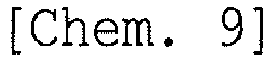
- Examples of the above compound include the following compounds.
- A is defined as mentioned above.
- the compound of the invention may favorably be produced by a production method including:
- the furan ring may be cleaved with an acid and converted into a dicarbonyl derivative, for example.
- the acid include acetic acid, hydrochloric acid, and p-toluenesulfonic acid. Acetic acid is preferred.
- the compound (11) is preferably obtained by reacting lithium and the chlorosilane compound in advance to provide a siloxylithium compound, and then reacting this siloxylithium compound and the compound (10).
- E represents a leaving group.
- the leaving group include a tert-butyldimethylsilyl (TBS) group, a triethylsilyl (TES) group, a triisopropylsilyl (TIPS) group, a tert-butyldiphenylsilyl (TBDPS) group, and a benzyl (Bn) group.
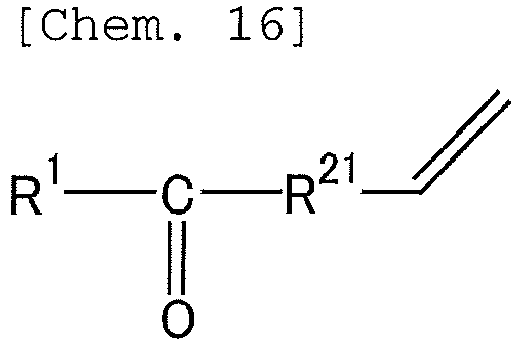
- R 21 is preferably a single bond or a linear or branched alkylene group containing one or more carbon atoms.
- chlorosilane compound examples include the following.
- any of the reactions in the step (11) may be performed in a solvent.
- the solvent is preferably an organic solvent, more preferably an aprotic polar solvent, still more preferably an ether.
- the ether include ethyl methyl ether, diethyl ether, monoglyme(ethylene glycol dimethyl ether), diglyme(diethylene glycol dimethyl ether), triglyme(triethylene glycol dimethyl ether), tetrahydrofuran, tetraglyme(tetraethylene glycol dimethyl ether), and crown ethers (e.g., 15-crown-5, 18-crown-6). Tetrahydrofuran and diethyl ether are preferred.
- the temperature of the reaction between lithium and the chlorosilane compound in the step (11) is preferably - 78°C to 150°C, more preferably -78°C to 100°C, still more preferably 0°C to 100°C, particularly preferably 10°C to 40°C.
- the temperature of the reaction between the siloxylithium compound and the compound (10) in the step (11) is preferably -100°C to 0°C, more preferably -80°C to -50°C, while preferably -100°C to 100°C, more preferably - 80°C to 50°C.
- the pressure of the reaction between lithium and the chlorosilane compound in the step (11) is preferably 0.1 to 5 MPa, more preferably 0.1 to 1 MPa.
- the pressure of the reaction between the siloxylithium compound and the compound (10) in the step (11) is preferably 0.1 to 5 MPa, more preferably 0.1 to 1 MPa.
- the duration of the reaction between lithium and the chlorosilane compound in the step (11) is preferably 0.1 to 72 hours, more preferably 1 to 48 hours, still more preferably 6 to 10 hours.
- the duration of the reaction between the siloxylithium compound and the compound (10) in the step (11) is preferably 0.1 to 72 hours, more preferably 1 to 48 hours, still more preferably 1 to 2 hours.
- the amount of the olefin is preferably 0.5 to 10 mol, more preferably 0.5 to 5.0 mol, still more preferably 1 to 2 mol, particularly preferably 1 to 1.1 mol, relative to 1 mol of the compound (11), so as to improve the yield and to reduce the waste.
- the reaction in the step (12) may be performed in a solvent in the presence of a thiazolium salt or a base.
- thiazolium salt examples include 3-ethyl-5-(2-hydroxyethyl)-4-methylthiazolium bromide and 3-benzyl-5-(2-hydroxyethyl)-4-methylthiazolium chloride.
- Examples of the base include 1,8-diazabicyclo[5.4.0]-7-undecene and triethylamine.
- the solvent is preferably an organic solvent, more preferably an aprotic polar solvent, still more preferably an alcohol or an ether.
- Examples of the alcohol include methanol, ethanol, 1-propanol, and isopropanol.
- ether examples include ethyl methyl ether, diethyl ether, monoglyme(ethylene glycol dimethyl ether), diglyme(diethylene glycol dimethyl ether), triglyme(triethylene glycol dimethyl ether), tetrahydrofuran, tetraglyme(tetraethylene glycol dimethyl ether), and crown ethers (e.g., 15-crown-5, 18-crown-6). Tetrahydrofuran and diethyl ether are preferred.
- the reaction temperature in the step (12) is preferably -78°C to 150°C, more preferably 0°C to 100°C, still more preferably 40°C to 60°C, particularly preferably 50°C to 55°C.
- the reaction pressure in the step (12) is preferably 0.1 to 5 MPa, more preferably 0.1 to 1 MPa.
- the reaction duration in the step (12) is preferably 0.1 to 72 hours, more preferably 1 to 48 hours, still more preferably 6 to 10 hours.
- the elimination reaction for the leaving group in the step (13) may be performed using a fluoride ion or an acid.
- methods of eliminating the leaving group include a method of using hydrofluoric acid; a method of using an amine complex of hydrogen fluoride such as pyridine-nHF or triethylamine-nHF; a method of using an inorganic salt such as cesium fluoride, potassium fluoride, lithium tetrafluoroborate (LiBF 4 ), or ammonium fluoride; and a method of using an organic salt such as tetrabutylammonium fluoride (TBAF).
- TBAF tetrabutylammonium fluoride
- the elimination reaction for the leaving group in the step (13) may be performed in a polar solvent.
- the solvent is preferably an organic solvent, more preferably an aprotic polar solvent, still more preferably an ether.
- ether examples include ethyl methyl ether, diethyl ether, monoglyme(ethylene glycol dimethyl ether), diglyme(diethylene glycol dimethyl ether), triglyme(triethylene glycol dimethyl ether), tetrahydrofuran, tetraglyme(tetraethylene glycol dimethyl ether), and crown ethers (e.g., 15-crown-5, 18-crown-6). Tetrahydrofuran and diethyl ether are preferred.
- the reaction temperature in the step (13) is preferably -78°C to 150°C, more preferably 0°C to 100°C, still more preferably 0°C to 40°C, particularly preferably 0°C to 20°C.
- the reaction pressure in the step (13) is preferably 0.1 to 5 MPa, more preferably 0.1 to 1 MPa.
- the reaction duration in the step (13) is preferably 0.1 to 72 hours, more preferably 1 to 48 hours, still more preferably 3 to 8 hours.
- the oxidation in the step (14) may be performed in a solvent in the presence of sodium chlorite.
- the solvent used may be any of alcohols such as methanol, ethanol, 1-propanol, isopropanol, 1-butanol, and tert-butyl.alcohol and water.
- a solution of disodium phosphate may be used as a buffer.
- Examples of the alkali used in the step (15) include sodium hydroxide, potassium hydroxide, lithium hydroxide, and ammonia. Ammonia solution is preferably used.
- the resulting compounds may be subjected to any of evaporation of a solvent or operations such as distillation and purification after the respective steps, whereby the purity of each compound may be increased.
- the compound of the invention may also favorably be produced by a production method including:
- R 1 contains a furan ring
- the furan ring may be cleaved with an acid and converted into a dicarbonyl Acetic acid is preferred.
- E represents a leaving group.
- the leaving group include a tert-butyldimethylsilyl (TBS) group, a triethylsilyl (TES) group, a triisopropylsilyl (TIPS) group, a tert-butyldiphenylsilyl (TBDPS) group, and a benzyl (Bn) group.
- R 22 is preferably a linear or branched alkyl group containing one or more carbon atoms, more preferably a methyl group.
- R 23 is preferably a linear or branched alkyl group containing one or more carbon atoms, more preferably a methyl group.
- R 24 is preferably a linear or branched alkylene group containing one or more carbon atoms, more preferably a methylene group (-CH 2 -).
- the reaction in the step (21) may be performed in a solvent in the presence of a base.
- Examples of the base include sodium amide, sodium hydride, sodium methoxide, and sodium ethoxide.
- the solvent is preferably an organic solvent, more preferably an aprotic polar solvent, still more preferably an alcohol or an ether.
- Examples of the alcohol include methanol, ethanol, 1-propanol, and isopropanol.
- ether examples include ethyl methyl ether, diethyl ether, monoglyme(ethylene glycol dimethyl ether), diglyme(diethylene glycol dimethyl ether), triglyme(triethylene glycol dimethyl ether), tetrahydrofuran, tetraglyme(tetraethylene glycol dimethyl ether), and crown ethers (e.g., 15-crown-5, 18-crown-6). Tetrahydrofuran and diethyl ether are preferred.
- the reaction temperature in the step (21) is preferably -78°C to 150°C, more preferably 0°C to 100°C, still more preferably 0°C to 40°C, particularly preferably 0°C to 20°C.
- the reaction pressure in the step (21) is preferably 0.1 to 5 MPa, more preferably 0.1 to 1 MPa.
- the reaction duration in the step (21) is preferably 0.1 to 72 hours, more preferably 1 to 48 hours, still more preferably 3 to 8 hours.
- the elimination reaction for the leaving group in the step (22) may be performed using a fluoride ion or an acid.
- methods of eliminating the leaving group include a method of using hydrofluoric acid; a method of using an amine complex of hydrogen fluoride such as pyridine-nHF or triethylamine-nHF; a method of using an inorganic salt such as cesium fluoride, potassium fluoride, lithium tetrafluoroborate (LiBF 4 ), or ammonium fluoride; and a method of using an organic salt such as tetrabutylammonium fluoride (TBAF).
- TBAF tetrabutylammonium fluoride
- the elimination reaction for the leaving group in the step (22) may be performed in a solvent.
- the solvent is preferably an organic solvent, more preferably an aprotic polar solvent, still more preferably an ether.
- ether examples include ethyl methyl ether, diethyl ether, monoglyme(ethylene glycol dimethyl ether), diglyme(diethylene glycol dimethyl ether), triglyme(triethylene glycol dimethyl ether), tetrahydrofuran, tetraglyme(tetraethylene glycol dimethyl ether), and crown ethers (e.g., 15-crown-5, 18-crown-6). Tetrahydrofuran and diethyl ether are preferred.
- the reaction temperature in the step (22) is preferably -78°C to 150°C, more preferably 0°C to 100°C, still more preferably 0°C to 40°C, particularly preferably 0°C to 20°C.
- the reaction pressure in the step (22) is preferably 0.1 to 5 MPa, more preferably 0.1 to 1 MPa.
- the reaction duration in the step (22) is preferably 0.1 to 72 hours, more preferably 1 to 48 hours, still more preferably 3 to 8 hours.
- the oxidation in the step (23) may be performed in a solvent in the presence of sodium chlorite.
- the solvent used may be any of alcohols and water.
- a solution of disodium phosphate may be used as a buffer.
- Examples of the alkali used in the step (24) include sodium hydroxide, potassium hydroxide, lithium hydroxide, and ammonia. Ammonia solution is preferably used.
- the resulting compounds may be subjected to any of evaporation of a solvent or operations such as distillation and purification after the respective steps, whereby the purity of each compound may be increased.
- the compound of the invention may also favorably be produced by a method including:
- the furan ring may be cleaved with an acid and converted into a dicarbonyl derivative, for example.
- the acid include acetic acid, hydrochloric acid, and p-toluenesulfonic acid. Acetic acid is preferred.
- E represents a leaving group.
- the leaving group include a tert-butyldimethylsilyl (TBS) group, a triethylsilyl (TES) group, a triisopropylsilyl (TIPS) group, a tert-butyldiphenylsilyl (TBDPS) group, and a benzyl (Bn) group.
- the amount of the lithium acetylide is preferably 0.5 to 10 mol, more preferably 0.6 to 5.0 mol, still more preferably 1 to 2 mol, particularly preferably 1 to 1.2 mol, relative to 1 mol of the alkyl halide, so as to improve the yield and to reduce the waste.
- the reaction in the step (31) may be performed in a solvent.
- the solvent is preferably hexane.
- the reaction temperature in the step (31) is preferably -100°C to -40°C, more preferably -80°C to -50°C, while preferably -100°C to 100°C, more preferably -80°C to 50°C.
- the reaction pressure in the step (31) is preferably 0.1 to 5 MPa, more preferably 0.1 to 1 MPa.
- the reaction duration in the step (31) is preferably 0.1 to 72 hours, more preferably 1 to 48 hours, still more preferably 6 to 10 hours.
- the oxidation in the step (32) may be performed in a nitrile solvent using a complex generated by treating [(Cn*)Ru III (CF 3 CO 2 ) 3 ] ⁇ H 2 O (wherein Cn* is 1,4,7-trimethyl-1,4,7-triazabicyclononane) with (NH 4 ) 2 Ce(NO 3 ) 6 and trifluoroacetic acid and then adding sodium perchlorate thereto.
- the product may be neutralized with an alkali, and then an organic solvent such as an ether may be used to extract the compound (32).
- the reaction temperature in the step (32) is preferably -78°C to 150°C, more preferably 0°C to 100°C, still more preferably 30°C to 100°C, particularly preferably 40°C to 90°C.
- the reaction pressure in the step (32) is preferably 0.1 to 5 MPa, more preferably 0.1 to 1 MPa.
- the reaction duration in the step (32) is preferably 0.1 to 72 hours, more preferably 1 to 48 hours, still more preferably 3 to 8 hours.
- the elimination reaction for the leaving group in the step (33) may be performed using a fluoride ion or an acid.
- methods of eliminating the leaving group include a method of using hydrofluoric acid; a method of using an amine complex of hydrogen fluoride such as pyridine-nHF or triethylamine-nHF; a method of using an inorganic salt such as cesium fluoride, potassium fluoride, lithium tetrafluoroborate (LiBF 4 ), or ammonium fluoride; and a method of using an organic salt such as tetrabutylammonium fluoride (TBAF).
- TBAF tetrabutylammonium fluoride
- the elimination reaction for the leaving group in the step (33) may be performed in a solvent.
- the solvent is preferably an organic solvent, more preferably an aprotic polar solvent, still more preferably an ether.
- ether examples include ethyl methyl ether, diethyl ether, monoglyme(ethylene glycol dimethyl ether), diglyme(diethylene glycol dimethyl ether), triglyme(triethylene glycol dimethyl ether), tetrahydrofuran, tetraglyme(tetraethylene glycol dimethyl ether), and crown ethers (e.g., 15-crown-5, 18-crown-6). Tetrahydrofuran and diethyl ether are preferred.
- the reaction temperature in the step (33) is preferably -78°C to 150°C, more preferably 0°C to 100°C, still more preferably 0°C to 40°C, particularly preferably 0°C to 20°C.
- the reaction pressure in the step (33) is preferably 0.1 to 5 MPa, more preferably 0.1 to 1 MPa.
- the reaction duration in the step (33) is preferably 0.1 to 72 hours, more preferably 1 to 48 hours, still more preferably 3 to 8 hours.
- the oxidation in the step (34) may be performed in a solvent in the presence of sodium chlorite.
- the solvent used may be any of alcohols and water.
- a solution of disodium phosphate may be used as a buffer.
- Examples of the alkali used in the step (35) include sodium hydroxide, potassium hydroxide, lithium hydroxide, and ammonia. Ammonia solution is preferably used.
- the resulting compounds may be subjected to any of evaporation of a solvent or operations such as distillation and purification after the respective steps, whereby the purity of each compound may be increased.
- the compound of the invention may also favorably be produced by a production method including:
- the amount of 2-methylfuran is preferably 0.5 to 10 mol, more preferably 0.6 to 5.0 mol, still more preferably 0.5 to 1 mol, particularly preferably 0.6 to 0.9 mol, relative to 1 mol of divinyl ketone, so as to improve the yield and to reduce the waste.
- the reaction in the step (51) is preferably performed in the presence of an acid.
- the acid include acetic acid, hydrochloric acid, and p-toluenesulfonic acid. Acetic acid is preferred.
- the amount of the acid used in the step (51) is preferably 0.1 to 2 mol, more preferably 0.1 to 1 mol, relative to 1 mol of divinyl ketone.
- the reaction in the step (51) may be performed in a polar solvent.
- the solvent is preferably water or acetonitrile.
- the reaction temperature in the step (51) is preferably -78°C to 150°C, more preferably 0°C to 100°C, still more preferably 20°C to 100°C, particularly preferably 40°C to 100°C.
- the reaction pressure in the step (51) is preferably 0.1 to 5 MPa, more preferably 0.1 to 1 MPa.
- the reaction duration in the step (51) is preferably 0.1 to 72 hours, more preferably 1 to 48 hours, still more preferably 4 to 8 hours.
- the amount of furan is preferably 0.5 to 10 mol, more preferably 0.6 to 5.0 mol, still more preferably 1 to 2 mol, particularly preferably 1 to 1.1 mol, relative to 1 mol of the compound (51), so as to improve the yield and to reduce the waste.
- the reaction in the step (52) is preferably performed in the presence of an acid.
- the acid include acetic acid, hydrochloric acid, and p-toluenesulfonic acid. Acetic acid is preferred.
- the amount of the acid used in the step (52) is preferably 0.1 to 2 mol, more preferably 0.1 to 1 mol, relative to 1 mol of the compound (51).
- the reaction in the step (52) may be performed in a polar solvent.
- the solvent is preferably water.
- the reaction temperature in the step (52) is preferably -78°C to 150°C, more preferably 0°C to 100°C, still more preferably 20°C to 100°C, particularly preferably 40°C to 100°C.
- the reaction pressure in the step (52) is preferably 0.1 to 5 MPa, more preferably 0.1 to 1 MPa.
- the reaction duration in the step (52) is preferably 0.1 to 72 hours, more preferably 1 to 48 hours, still more preferably 4 to 8 hours.
- the compound (52) is heated in the presence of an acid so that the furan rings are opened.
- the acid is preferably hydrochloric acid or sulfuric acid.
- the reaction in the step (53) may be performed in a polar solvent.
- the solvent is preferably water.
- the reaction temperature in the step (53) is preferably -78°C to 150°C, more preferably 0°C to 100°C, still more preferably 50°C to 100°C, particularly preferably 70°C to 100°C.
- the reaction pressure in the step (53) is preferably 0.1 to 5 MPa, more preferably 0.1 to 1 MPa.
- the reaction duration in the step (53) is preferably 0.1 to 72 hours, more preferably 1 to 48 hours, still more preferably 1 to 12 hours.
- the oxidation in the step (54) may be performed in a solvent in the presence of sodium chlorite.
- the solvent used may be any of tert-butyl alcohol and water.
- a solution of disodium phosphate may be used as a buffer.
- Examples of the alkali used in the step (55) include sodium hydroxide, potassium hydroxide, lithium hydroxide, and ammonia. Ammonia solution is preferably used.
- the resulting compounds may be subjected to any of evaporation of a solvent or operations such as distillation and purification after the respective steps, whereby the purity of each compound may be increased.
- the compound of the invention may also favorably be produced by a production method including:
- the furan ring may be cleaved with an acid and converted into a dicarbonyl derivative, for example.
- the acid include acetic acid, hydrochloric acid, and p-toluenesulfonic acid. Acetic acid is preferred.
- R 21 is preferably a single bond or a linear or branched alkylene group containing one or more carbon atoms.
- the amount of the alkene is preferably 0.5 to 2 mol, more preferably 0.6 to 1.2 mol, while preferably 0.5 to 10 mol, more preferably 0.6 to 5.0 mol, relative to 1 mol of the alkyne, so as to improve the yield and to reduce the waste.
- the reaction in the step (61) is preferably performed in the presence of a metal catalyst.
- a metal catalyst is ruthenium.
- the amount of the metal catalyst used in the step (61) is preferably 0.00001 to 0.4 mol, more preferably 0.00005 to 0.1 mol, still more preferably 0.01 to 0.4 mol, particularly preferably 0.05 to 0.1 mol, relative to 1 mol of the alkene.
- the reaction in the step (61) may be performed in a polar solvent.
- the solvent is preferably water, acetonitrile, dimethylacetamide, or dimethylformamide.
- the reaction temperature in the step (61) is preferably 20°C to 160°C, more preferably 40°C to 140°C.
- the reaction pressure in the step (61) is preferably 0.1 to 5 MPa, more preferably 0.1 to 1 MPa.
- the reaction duration in the step (61) is preferably 0.1 to 72 hours, more preferably 1 to 48 hours, still more preferably 4 to 8 hours.
- the amount of the alkali is preferably 0.5 to 10 mol, more preferably 0.6 to 5.0 mol, still more preferably 0.6 to 2 mol, particularly preferably 0.8 to 1.1 mol, relative to 1 mol of the compound (61), so as to improve the yield and to reduce the waste.
- the amount of the acid used in the step (62) is preferably 1.0 to 20.0 mol, more preferably 1.0 to 10.0 mol, relative to 1 mol of the compound (61).
- the reaction in the step (62) may be performed in a polar solvent.
- the solvent is preferably water.
- the reaction temperature in the step (62) is preferably 0°C to 100°C, more preferably 20°C to 100°C.
- the reaction pressure in the step (62) is preferably 0.1 to 5 MPa, more preferably 0.1 to 1 MPa.
- the reaction duration in the step (62) is preferably 0.1 to 72 hours, more preferably 1 to 48 hours, still more preferably 4 to 8 hours.
- Examples of the alkali used in the step (63) include sodium hydroxide, potassium hydroxide, lithium hydroxide, and ammonia. Ammonia solution is preferably used.
- the resulting compounds may be subjected to any of evaporation of a solvent or operations such as distillation and purification after the respective steps, whereby the purity of each compound may be increased.
- Divinyl ketone (7.4 g), 2-methylfuran (8.0 g), acetic acid (6 mL), and water (60 mL) were stirred at 40°C for four hours.
- the reaction solution was added to a saturated sodium hydrogen carbonate solution.
- the mixture was subjected to extraction with ethyl acetate.
- the extract was dried over sodium sulfate and the solvent was evaporated under reduced pressure.
- the compound of the invention can favorably reduce the surface tension of water.
- the compound of the invention can suitably be used as a surfactant.
- the compound of the invention can suitably be used as a surfactant promoter (in particular, a surfactant promoter for agents such as coating material, lacquer, and adhesive).
- a surfactant promoter for agents such as coating material, lacquer, and adhesive.
- the compound of the invention can suitably be used as a viscosity reducing agent, for example.
- the compound of the invention can suitably be used as a dispersant, in particular an aqueous dispersant, for example.
- the compound of the invention can suitably be used as an emulsifier, for example.
Landscapes
- Chemical & Material Sciences (AREA)
- Organic Chemistry (AREA)
- Engineering & Computer Science (AREA)
- Materials Engineering (AREA)
- Organic Low-Molecular-Weight Compounds And Preparation Thereof (AREA)
- Emulsifying, Dispersing, Foam-Producing Or Wetting Agents (AREA)
- Plural Heterocyclic Compounds (AREA)
- Secondary Cells (AREA)
Abstract
R1-C(=O)-R2-C(=O)-R3-A
wherein R1 is a linear or branched alkyl group containing one or more carbon atoms or a cyclic alkyl group containing three or more carbon atoms, with a hydrogen atom that binds to a carbon atom being optionally replaced by a hydroxy group or a monovalent organic group containing an ester bond, the alkyl group optionally containing a carbonyl group when containing two or more carbon atoms, and the alkyl group optionally containing a monovalent or divalent heterocycle or being optionally in a cyclized form when containing three or more carbon atoms; R2 and R3 are each individually a single bond or a divalent linking group; R1, R2, and R3 contain five or more carbon atoms in total; A is -COOX or -SO3X, wherein X is H, a metal atom, NR4 4, imidazolium optionally containing a substituent, pyridinium optionally containing a substituent, or phosphonium optionally containing a substituent, where R4s are each H or an organic group and are the same as or different from each other; and any two of R1, R2, and R3 optionally bind to each other to form a ring.
Description
- The invention relates to carboxylic acid salts or sulfonic acid salts, and surfactants.
- Patent Literature 1 discloses a processing agent composition for silver halide photographic sensitive material containing a compound represented by the following formula [A]:

- Patent Literature 1:
JP 2003-5329 A - The invention aims to provide a novel carboxylic acid salt or sulfonic acid salt containing a plurality of carbonyl groups, and a surfactant.
- The invention relates to a compound represented by the following formula:

- R1 is a linear or branched alkyl group containing one or more carbon atoms or a cyclic alkyl group containing three or more carbon atoms, with a hydrogen atom that binds to a carbon atom being optionally replaced by a hydroxy group or a monovalent organic group containing an ester bond, the alkyl group optionally containing a carbonyl group when containing two or more carbon atoms, and the alkyl group optionally containing a monovalent or divalent heterocycle or being optionally in a cyclized form when containing three or more carbon atoms;
- R2 and R3 are each individually a single bond or a divalent linking group;
- R1, R2, and R3 contain five or more carbon atoms in total;
- A is -COOX or -SO3X, wherein X is H, a metal atom, NR4 4, imidazolium optionally containing a substituent, pyridinium optionally containing a substituent, or phosphonium optionally containing a substituent, where R4s are each H or an organic group and are the same as or different from each other; and
- any two of R1, R2, and R3 optionally bind to each other to form a ring.
- In the formula, preferably, R2 and R3 are each individually a single bond, a linear or branched alkylene group containing one or more carbon atoms, or a cyclic alkylene group containing three or more carbon atoms, with a hydrogen atom that binds to a carbon atom being optionally replaced by a hydroxy group or a monovalent organic group containing an ester bond.
- In the formula, R1 is preferably a C1-C8 linear or branched alkyl group containing no carbonyl group, a C3-C8 cyclic alkyl group containing no carbonyl group, a C2-C45 linear or branched alkyl group containing 1 to 10 carbonyl groups, a C3-C45 cyclic alkyl group containing a carbonyl group, or a C3-C45 alkyl group containing a monovalent or divalent heterocycle.
- In the formula, R1 is preferably a group represented by the following formula:

- In the formula, preferably, R2 and R3 are each individually a linear or branched alkylene group containing no carbonyl group and containing one or more carbon atoms.
- In the formula, preferably, R2 and R3 are each individually a C1-C3 linear or branched alkylene group containing no carbonyl group.
- In the formula, X is more preferably NH4.
- The invention also relates to a surfactant containing the above compound.
- The invention also relates to an aqueous dispersant containing the above compound.
- The compound of the invention is a compound exhibiting a surfactant effect, and can suitably be used for anionic surfactants and aqueous dispersants.
- The invention will be specifically described hereinbelow.
- The term "organic group" as used herein means a group containing one or more carbon atoms or a group obtainable by removing one hydrogen atom from an organic compound, unless otherwise mentioned. Examples of the "organic group" include:
- an alkyl group optionally containing one or more substituents,
- an alkenyl group optionally containing one or more substituents,
- an alkynyl group optionally containing one or more substituents,
- a cycloalkyl group optionally containing one or more substituents,
- a cycloalkenyl group optionally containing one or more substituents,
- a cycloalkadienyl group optionally containing one or more substituents,
- an aryl group optionally containing one or more substituents,
- an aralkyl group optionally containing one or more substituents,
- a non-aromatic heterocyclic group optionally containing one or more substituents,
- a heteroaryl group optionally containing one or more substituents,
- a cyano group,
- a formyl group,
- RaO-,
- RaCO-,
- RaSO2-,
- RaCOO-,
- RaNRaCO-,
- RaCONRa-,
- RaSO2NRa-,
- RaNRaSO2-,
- RaOCO-, and
- RaOSO2-,
- wherein each Ra is independently
- an alkyl group optionally containing one or more substituents,
- an alkenyl group optionally containing one or more substituents,
- an alkynyl group optionally containing one or more substituents,
- a cycloalkyl group optionally containing one or more substituents,
- a cycloalkenyl group optionally containing one or more substituents,
- a cycloalkadienyl group optionally containing one or more substituents,
- an aryl group optionally containing one or more substituents,
- an aralkyl group optionally containing one or more substituents,
- a non-aromatic heterocyclic group optionally containing one or more substituents, or
- a heteroaryl group optionally containing one or more substituents.
- The organic group is preferably an alkyl group optionally containing one or more substituents.
- The term "substituent" as used herein means a group which can replace another atom or a group, unless otherwise mentioned. Examples of the "substituent" include an aliphatic group, an aromatic group, a heterocyclic group, an acyl group, an acyloxy group, an acylamino group, an aliphatic oxy group, an aromatic oxy group, a heterocyclic oxy group, an aliphatic oxycarbonyl group, an aromatic oxycarbonyl group, a heterocyclic oxycarbonyl group, a carbamoyl group, an aliphatic sulfonyl group, an aromatic sulfonyl group, a heterocyclic sulfonyl group, an aliphatic sulfonyloxy group, an aromatic sulfonyloxy group, a heterocyclic sulfonyloxy group, a sulfamoyl group, an aliphatic sulfonamide group, an aromatic sulfonamide group, a heterocyclic sulfonamide group, an amino group, an aliphatic amino group, an aromatic amino group, a heterocyclic amino group, an aliphatic oxycarbonylamino group, an aromatic oxycarbonylamino group, a heterocyclic oxycarbonylamino group, an aliphatic sulfinyl group, an aromatic sulfinyl group, an aliphatic thio group, an aromatic thio group, a hydroxy group, a cyano group, a sulfo group, a carboxy group, an aliphatic oxyamino group, an aromatic oxyamino group, a carbamoylamino group, a sulfamoyl amino group, a halogen atom, a sulfamoyl, and a diaromatic oxyphosphinyl group.
- The aliphatic group may be either saturated or unsaturated, and may contain any of a hydroxy group, an aliphatic oxy group, a carbamoyl group, an aliphatic oxycarbonyl group, an aliphatic thio group, an amino group, an aliphatic amino group, an acylamino group, a carbamoylamino group, and the like. Examples of the aliphatic group include alkyl groups containing one to eight, preferably one to four carbon atoms in total, such as a methyl group, an ethyl group, a vinyl group, a cyclohexyl group, and a carbamoylmethyl group.
- The aromatic group may contain any of a nitro group, a halogen atom, an aliphatic oxy group, a carbamoyl group, an aliphatic oxycarbonyl group, an aliphatic thio group, an amino group, an aliphatic amino group, an acylamino group, a carbamoylamino group, and the like. Examples of the aromatic group include aryl groups containing six to twelve, preferably six to ten carbon atoms in total, such as a phenyl group, a 4-nitrophenyl group, a 4-acetylaminophenyl group, and a 4-methanesulfonylphenyl group.
- The heterocyclic group may contain any of a halogen atom, a hydroxy group, an aliphatic oxy group, a carbamoyl group, an aliphatic oxycarbonyl group, an aliphatic thio group, an amino group, an aliphatic amino group, an acylamino group, a carbamoylamino group, and the like. Examples of the heterocyclic group include 5- or 6-membered heterocyclic groups containing two to twelve, preferably two to ten carbon atoms in total, such as a 2-tetrahydrofuryl group and a 2-pyrimidyl group.
- The acyl group may contain any of an aliphatic carbonyl group, an arylcarbonyl group, a heterocyclic carbonyl group, a hydroxy group, a halogen atom, an aromatic group, an aliphatic oxy group, a carbamoyl group, an aliphatic oxycarbonyl group, an aliphatic thio group, an amino group, an aliphatic amino group, an acylamino group, a carbamoylamino group, and the like. Examples of the acyl group include acyl groups containing two to eight, preferably two to four carbon atoms in total, such as an acetyl group, a propanoyl group, a benzoyl group, and a 3-pyridinecarbonyl group.
- The acylamino group may contain any of an aliphatic group, an aromatic group, a heterocyclic group, and the like, and may contain any of an acetylamino group, a benzoylamino group, a 2-pyridinecarbonylamino group, a propanoylamino group, and the like, for example. Examples of the acylamino group include acylamino groups containing two to twelve, preferably two to eight carbon atoms in total, and alkylcarbonylamino groups containing two to eight carbon atoms in total, such as an acetylamino group, a benzoylamino group, a 2-pyridinecarbonylamino group, and a propanoylamino group.
- The aliphatic oxycarbonyl group may be either saturated or unsaturated, and may contain any of a hydroxy group, an aliphatic oxy group, a carbamoyl group, an aliphatic oxycarbonyl group, an aliphatic thio group, an amino group, an aliphatic amino group, an acylamino group, a carbamoylamino group, and the like. Examples of the aliphatic oxycarbonyl group include alkoxycarbonyl groups containing two to eight, preferably two to four carbon atoms in total, such as a methoxycarbonyl group, an ethoxycarbonyl group, and a (t)-butoxycarbonyl group.
- The carbamoyl group may contain any of an aliphatic group, an aromatic group, a heterocyclic group, and the like. Examples of the carbamoyl group include an unsubstituted carbamoyl group and alkylcarbamoyl groups containing two to nine carbon atoms in total, preferably an unsubstituted carbamoyl group and alkylcarbamoyl groups containing two to five carbon atoms in total, such as a N-methylcarbamoyl group, a N,N-dimethylcarbamoyl group, and a N-phenylcarbamoyl group.
- The aliphatic sulfonyl group may be either saturated or unsaturated, and may contain any of a hydroxy group, an aromatic group, an aliphatic oxy group, a carbamoyl group, an aliphatic oxycarbonyl group, an aliphatic thio group, an amino group, an aliphatic amino group, an acylamino group, a carbamoylamino group, and the like. Examples of the aliphatic sulfonyl group include alkyl sulfonyl groups containing one to six, preferably one to four carbon atoms in total, such as a methanesulfonyl group.
- The aromatic sulfonyl group may contain any of a hydroxy group, an aliphatic group, an aliphatic oxy group, a carbamoyl group, an aliphatic oxycarbonyl group, an aliphatic thio group, an amino group, an aliphatic amino group, an acylamino group, a carbamoylamino group, and the like. Examples of the aromatic sulfonyl group include arylsulfonyl groups containing six to ten carbon atoms in total, such as a benzenesulfonyl group.
- The amino group may contain any of an aliphatic group, an aromatic group, a heterocyclic group, and the like.
- The acylamino group may contain any of an acetylamino group, a benzoylamino group, a 2-pyridinecarbonylamino group, a propanoylamino group, and the like. Examples of the acylamino group include acylamino groups containing two to twelve, preferably two to eight carbon atoms in total, more preferably alkylcarbonylamino groups containing two to eight carbon atoms in total, such as an acetylamino group, a benzoylamino group, a 2-pyridinecarbonylamino group, and a propanoylamino group.
- The aliphatic sulfonamide group, the aromatic sulfonamide group, and the heterocyclic sulfonamide group may respectively be a methanesulfonamide group, a benzene sulfonamide group, and a 2-pyridinesulfonamide group, for example.
- The sulfamoyl group may contain any of an aliphatic group, an aromatic group, a heterocyclic group, and the like. Examples of the sulfamoyl group include a sulfamoyl group, alkylsulfamoyl groups containing one to nine carbon atoms in total, dialkylsulfamoyl groups containing two to ten carbon atoms in total, arylsulfamoyl groups containing seven to thirteen carbon atoms in total, and heterocyclic sulfamoyl groups containing two to twelve carbon atoms in total, more preferably a sulfamoyl group, alkylsulfamoyl groups containing one to seven carbon atoms in total, dialkylsulfamoyl groups containing three to six carbon atoms in total, arylsulfamoyl groups containing six to eleven carbon atoms in total, and heterocyclic sulfamoyl groups containing two to ten carbon atoms in total, such as a sulfamoyl group, a methylsulfamoyl group, a N,N-dimethylsulfamoyl group, a phenylsulfamoyl group, and a 4-pyridinesulfamoyl group.
- The aliphatic oxy group may be either saturated or unsaturated, and may contain any of a methoxy group, an ethoxy group, an i-propyloxy group, a cyclohexyloxy group, a methoxyethoxy group, and the like. Examples of the aliphatic oxy group include alkoxy groups containing one to eight, preferably one to six carbon atoms in total, such as a methoxy group, an ethoxy group, an i-propyloxy group, a cyclohexyloxy group, and a methoxyethoxy group.
- The aromatic amino group and the heterocyclic amino group each may contain any of an aliphatic group, an aliphatic oxy group, a halogen atom, a carbamoyl group, a heterocyclic group ring-fused with the aryl group, and an aliphatic oxycarbonyl group, preferably any of an aliphatic group containing one to four carbon atoms in total, an aliphatic oxy group containing one to four carbon atoms in total, a halogen atom, a carbamoyl group containing one to four carbon atoms in total, a nitro group, and an aliphatic oxycarbonyl group containing two to four carbon atoms in total.
- The aliphatic thio group may be either saturated or unsaturated, and examples thereof include alkylthio groups containing one to eight, more preferably one to six carbon atoms in total, such as a methylthio group, an ethylthio group, a carbamoylmethylthio group, and a t-butylthio group.
- The carbamoylamino group may contain any of an aliphatic group, an aryl group, a heterocyclic group, and the like. Examples of the carbamoylamino group include a carbamoylamino group, alkylcarbamoylamino groups containing two to nine carbon atoms in total, dialkylcarbamoylamino groups containing three to ten carbon atoms in total, arylcarbamoylamino groups containing seven to thirteen carbon atoms in total, and heterocyclic carbamoylamino groups containing three to twelve carbon atoms in total, preferably a carbamoylamino group, alkylcarbamoylamino groups containing two to seven carbon atoms in total, dialkylcarbamoylamino groups containing three to six carbon atoms in total, arylcarbamoylamino groups containing seven to eleven carbon atoms in total, and heterocyclic carbamoylamino group containing three to ten carbon atoms in total, such as a carbamoylamino group, a methylcarbamoylamino group, a N,N-dimethylcarbamoylamino group, a phenylcarbamoylamino group, and a 4-pyridinecarbamoylamino group.
- The invention relates to a compound represented by the following formula.

- In the formula, R1 is a linear or branched alkyl group containing one or more carbon atoms or a cyclic alkyl group containing three or more carbon atoms.
- The alkyl group, when containing three or more carbon atoms, may optionally contain a carbonyl group (-C(=O)-) between two carbon atoms. The alkyl group, when containing two or more carbon atoms, may optionally contain a carbonyl group at an end of the alkyl group. In other words, acyl groups such as an acetyl group represented by CH3-C(=O)-are also included in the alkyl group.
- The alkyl group, when containing three or more carbon atoms, may optionally contain a monovalent or divalent heterocycle, or may optionally be in a cyclized form. The heterocycle is preferably an unsaturated heterocycle, more preferably an oxygen-containing unsaturated heterocycle, and may be a furan ring, for example. In R1, a divalent heterocycle may be inserted between two carbon atoms, or a divalent heterocycle may be present at an end and bind to - C(=O)-, or a monovalent heterocycle may be present at an end of the alkyl group.
- The "number of carbon atoms" in the alkyl group herein includes the number of carbon atoms constituting the carbonyl groups and the number of carbon atoms constituting the heterocycles. For example, the number of carbon atoms in the group represented by CH3-C(=O)-CH2- is 3, the number of carbon atoms in the group represented by CH3-C(=O)-C2H4-C(=O)-C2H4- is 7, and the number of carbon atoms in the group represented by CH3-C(=O)- is 2.
- The alkyl group for R1 may optionally contain a substituent. The substituent which may be contained in the alkyl group for R1 is preferably a halogen atom, a C1-C10 linear or branched alkyl group, a C3-C10 cyclic alkyl group, or a hydroxy group, particularly preferably a methyl group or an ethyl group.
- In the alkyl group, a hydrogen atom that binds to a carbon atom may optionally be replaced by a functional group such as a hydroxy group (-OH) or a monovalent organic group containing an ester bond. Still, it is preferably not replaced by any functional group.
- An example of the monovalent organic group containing an ester bond is a group represented by the formula: -O-C(=O)-R101, wherein R101 is an alkyl group.
- In the formula, R2 and R3 are each individually a single bond or a divalent linking group.
- Preferably, R2 and R3 are each individually a single bond, a linear or branched alkylene group containing one or more carbon atoms, or a cyclic alkylene group containing three or more carbon atoms.
- The alkylene group constituting R2 and R3 preferably contains no carbonyl group.
- In the alkylene group, a hydrogen atom that binds to a carbon atom may optionally be replaced by a functional group such as a hydroxy group (-OH) or a monovalent organic group containing an ester bond. Still, it is preferably not replaced by any functional group.
- An example of the monovalent organic group containing an ester bond is a group represented by the formula: -O-C(=O)-R102, wherein R102 is an alkyl group.
- In the alkylene group, 75% or less of the hydrogen atoms binding to any carbon atom may be replaced by halogen atoms, 50% or less thereof may be replaced by halogen atoms, or 25% or less thereof may be replaced by halogen atoms. The alkylene group is preferably a non-halogenated alkylene group containing no halogen atoms such as fluorine atoms and chlorine atoms.
- R1, R2, and R3 contain 5 or more carbon atoms in total. The total number of carbon atoms is preferably 7 or greater, more preferably 9 or greater, while preferably 20 or smaller, more preferably 18 or smaller, still more preferably 15 or smaller.
- Any two of R1, R2, and R3 may optionally bind to each other to form a ring.
- In the formula, A is -COOX or -SO3X, wherein X is H, a metal atom, NR4 4, imidazolium optionally containing a substituent, pyridinium optionally containing a substituent, or phosphonium optionally containing a substituent, wherein R4 is H or an organic group, and the four R4s are the same as or different from each other. The compound of the invention is preferably a carboxylic acid salt or a sulfonic acid salt.
- Examples of the metal atom include alkali metals (Group 1) and alkaline earth metals (Group 2), and Na, K, or Li is preferred.
- R4 is preferably H or a C1-C10 organic group, more preferably H or a C1-C4 organic group. Examples of the metal atom include alkali metals (Group 1) and alkaline earth metals (Group 2), and Na, K, or Li is preferred.
- X is preferably H, a metal atom, or NR4 4, more preferably H, an alkali metal (Group 1), an alkaline earth metal (Group 2), or NR4 4, still more preferably H, Na, K, Li, or NH4, further more preferably Na, K, or NH4, particularly preferably Na or NH4, most preferably NH4.
- In the formula, R1 is preferably a C1-C8 linear or branched alkyl group containing no carbonyl group, a C3-C8 cyclic alkyl group containing no carbonyl group, a C2-C45 linear or branched alkyl group containing 1 to 10 carbonyl groups, a C3-C45 cyclic alkyl group containing a carbonyl group, or a C3-C45 alkyl group containing a monovalent or divalent heterocycle.
- R1 is more preferably a group represented by the following formula:

- In the formula, n11 is preferably an integer of 0 to 5, more preferably an integer of 0 to 3, still more preferably an integer of 1 to 3.
- The alkyl group for R11 preferably contains no carbonyl group.
- In the alkyl group for R11, a hydrogen atom that binds to a carbon atom may optionally be replaced by a functional group such as a hydroxy group (-OH) or a monovalent organic group containing an ester bond. Still, it is preferably not replaced by any functional group.
- An example of the monovalent organic group containing an ester bond is a group represented by the formula: -O-C(=O)-R103, wherein R103 is an alkyl group.
- In the alkyl group for R11, 75% or less of the hydrogen atoms binding to any carbon atom may be replaced by halogen atoms, 50% or less thereof may be replaced by halogen atoms, or 25% or less thereof may be replaced by halogen atoms. The alkyl group is preferably a non-halogenated alkyl group containing no halogen atoms such as fluorine atoms and chlorine atoms. The alkyl group for R11 may contain 1 to 20 carbon atoms. The number of carbon atoms is preferably 1 to 15, more preferably 1 to 12, still more preferably 1 to 10, further more preferably 1 to 8, still further more preferably 1 to 6, still much more preferably 1 to 3, particularly preferably 1 or 2, most preferably 1. The alkyl group for R11 preferably consists only of any of primary carbons, secondary carbons, and tertiary carbons, particularly preferably consists of any of primary carbons and secondary carbons. In other words, R11 is preferably a methyl group, an ethyl group, a n-propyl group, or an isopropyl group, most preferably a methyl group.
- R11 is preferably a C1-C10 linear or branched alkyl group optionally containing a substituent or a C3-C10 cyclic alkyl group optionally containing a substituent, more preferably a C1-C10 linear or branched alkyl group containing no carbonyl group or a C3-C10 cyclic alkyl group containing no carbonyl group, still more preferably a C1-C10 linear or branched alkyl group containing no substituent, further more preferably a C1-C3 linear or branched alkyl group containing no substituent, particularly preferably a methyl group (-CH3) or an ethyl group (-C2H5), most preferably a methyl group (-CH3).
- R12 is a C0-C3 alkylene group. The number of carbon atoms is preferably 1 to 3.
- The alkylene group for R12 may be either linear or branched.
- The alkylene group for R12 preferably contains no carbonyl group. R12 is more preferably an ethylene group (-C2H4-) or a propylene group (-C3H6-).
- In the alkylene group for R12, a hydrogen atom that binds to a carbon atom may optionally be replaced by a functional group such as a hydroxy group (-OH) or a monovalent organic group containing an ester bond. Still, it is preferably not replaced by any functional group.
- An example of the monovalent organic group containing an ester bond is a group represented by the formula: -O-C(=O)-R104, wherein R104 is an alkyl group.
- In the alkylene group for R12, 75% or less of the hydrogen atoms binding to any carbon atom may be replaced by halogen atoms, 50% or less thereof may be replaced by halogen atoms, or 25% or less thereof may be replaced by halogen atoms. The alkylene group is preferably a non-halogenated alkylene group containing no halogen atoms such as fluorine atoms and chlorine atoms.
- Preferably, R2 and R3 are each individually a linear or branched alkylene group containing no carbonyl group and containing one or more carbon atoms, more preferably a C1-C3 linear or branched alkylene group containing no carbonyl group, still more preferably an ethylene group (-C2H4-) or a propylene group (-C3H6-).
- Examples of the above compound include the following compounds. In each formula, A is defined as mentioned above.




- The compound of the invention may favorably be produced by a production method including:
- a step (11) of reacting a compound (10) represented by the following formula:


- a step (12) of reacting the compound (11) and an olefin represented by the following formula:

- a step (13) of eliminating the leaving group contained in the compound (12) to provide a compound (13) represented by the following formula:

- a step (14) of oxidizing the compound (13) to provide a compound (14) represented by the following formula:

- a step (15) of bringing the compound (14) to be in contact with an alkali to provide a compound (15) represented by the following formula:

- When R1 contains a furan ring, the furan ring may be cleaved with an acid and converted into a dicarbonyl derivative, for example. Examples of the acid include acetic acid, hydrochloric acid, and p-toluenesulfonic acid. Acetic acid is preferred.
- In the step (11), the compound (11) is preferably obtained by reacting lithium and the chlorosilane compound in advance to provide a siloxylithium compound, and then reacting this siloxylithium compound and the compound (10).
- E represents a leaving group. Examples of the leaving group include a tert-butyldimethylsilyl (TBS) group, a triethylsilyl (TES) group, a triisopropylsilyl (TIPS) group, a tert-butyldiphenylsilyl (TBDPS) group, and a benzyl (Bn) group.
- R21 is preferably a single bond or a linear or branched alkylene group containing one or more carbon atoms.
- Examples of the chlorosilane compound include the following.


- Any of the reactions in the step (11) may be performed in a solvent. The solvent is preferably an organic solvent, more preferably an aprotic polar solvent, still more preferably an ether. Examples of the ether include ethyl methyl ether, diethyl ether, monoglyme(ethylene glycol dimethyl ether), diglyme(diethylene glycol dimethyl ether), triglyme(triethylene glycol dimethyl ether), tetrahydrofuran, tetraglyme(tetraethylene glycol dimethyl ether), and crown ethers (e.g., 15-crown-5, 18-crown-6). Tetrahydrofuran and diethyl ether are preferred.
- The temperature of the reaction between lithium and the chlorosilane compound in the step (11) is preferably - 78°C to 150°C, more preferably -78°C to 100°C, still more preferably 0°C to 100°C, particularly preferably 10°C to 40°C.
- The temperature of the reaction between the siloxylithium compound and the compound (10) in the step (11) is preferably -100°C to 0°C, more preferably -80°C to -50°C, while preferably -100°C to 100°C, more preferably - 80°C to 50°C.
- The pressure of the reaction between lithium and the chlorosilane compound in the step (11) is preferably 0.1 to 5 MPa, more preferably 0.1 to 1 MPa.
- The pressure of the reaction between the siloxylithium compound and the compound (10) in the step (11) is preferably 0.1 to 5 MPa, more preferably 0.1 to 1 MPa.
- The duration of the reaction between lithium and the chlorosilane compound in the step (11) is preferably 0.1 to 72 hours, more preferably 1 to 48 hours, still more preferably 6 to 10 hours.
- The duration of the reaction between the siloxylithium compound and the compound (10) in the step (11) is preferably 0.1 to 72 hours, more preferably 1 to 48 hours, still more preferably 1 to 2 hours.
- For the reaction ratio between the compound (11) and the olefin in the step (12), the amount of the olefin is preferably 0.5 to 10 mol, more preferably 0.5 to 5.0 mol, still more preferably 1 to 2 mol, particularly preferably 1 to 1.1 mol, relative to 1 mol of the compound (11), so as to improve the yield and to reduce the waste.
- The reaction in the step (12) may be performed in a solvent in the presence of a thiazolium salt or a base.
- Examples of the thiazolium salt include 3-ethyl-5-(2-hydroxyethyl)-4-methylthiazolium bromide and 3-benzyl-5-(2-hydroxyethyl)-4-methylthiazolium chloride.
- Examples of the base include 1,8-diazabicyclo[5.4.0]-7-undecene and triethylamine.
- The solvent is preferably an organic solvent, more preferably an aprotic polar solvent, still more preferably an alcohol or an ether.
- Examples of the alcohol include methanol, ethanol, 1-propanol, and isopropanol.
- Examples of the ether include ethyl methyl ether, diethyl ether, monoglyme(ethylene glycol dimethyl ether), diglyme(diethylene glycol dimethyl ether), triglyme(triethylene glycol dimethyl ether), tetrahydrofuran, tetraglyme(tetraethylene glycol dimethyl ether), and crown ethers (e.g., 15-crown-5, 18-crown-6). Tetrahydrofuran and diethyl ether are preferred.
- The reaction temperature in the step (12) is preferably -78°C to 150°C, more preferably 0°C to 100°C, still more preferably 40°C to 60°C, particularly preferably 50°C to 55°C.
- The reaction pressure in the step (12) is preferably 0.1 to 5 MPa, more preferably 0.1 to 1 MPa.
- The reaction duration in the step (12) is preferably 0.1 to 72 hours, more preferably 1 to 48 hours, still more preferably 6 to 10 hours.
- The elimination reaction for the leaving group in the step (13) may be performed using a fluoride ion or an acid. Examples of methods of eliminating the leaving group include a method of using hydrofluoric acid; a method of using an amine complex of hydrogen fluoride such as pyridine-nHF or triethylamine-nHF; a method of using an inorganic salt such as cesium fluoride, potassium fluoride, lithium tetrafluoroborate (LiBF4), or ammonium fluoride; and a method of using an organic salt such as tetrabutylammonium fluoride (TBAF).
- The elimination reaction for the leaving group in the step (13) may be performed in a polar solvent. The solvent is preferably an organic solvent, more preferably an aprotic polar solvent, still more preferably an ether.
- Examples of the ether include ethyl methyl ether, diethyl ether, monoglyme(ethylene glycol dimethyl ether), diglyme(diethylene glycol dimethyl ether), triglyme(triethylene glycol dimethyl ether), tetrahydrofuran, tetraglyme(tetraethylene glycol dimethyl ether), and crown ethers (e.g., 15-crown-5, 18-crown-6). Tetrahydrofuran and diethyl ether are preferred.
- The reaction temperature in the step (13) is preferably -78°C to 150°C, more preferably 0°C to 100°C, still more preferably 0°C to 40°C, particularly preferably 0°C to 20°C.
- The reaction pressure in the step (13) is preferably 0.1 to 5 MPa, more preferably 0.1 to 1 MPa.
- The reaction duration in the step (13) is preferably 0.1 to 72 hours, more preferably 1 to 48 hours, still more preferably 3 to 8 hours.
- The oxidation in the step (14) may be performed in a solvent in the presence of sodium chlorite.
- The solvent used may be any of alcohols such as methanol, ethanol, 1-propanol, isopropanol, 1-butanol, and tert-butyl.alcohol and water. A solution of disodium phosphate may be used as a buffer.
- Examples of the alkali used in the step (15) include sodium hydroxide, potassium hydroxide, lithium hydroxide, and ammonia. Ammonia solution is preferably used.
- The resulting compounds may be subjected to any of evaporation of a solvent or operations such as distillation and purification after the respective steps, whereby the purity of each compound may be increased.
- The compound of the invention may also favorably be produced by a production method including:
- a step (21) of reacting a ketone represented by the following formula:


- a step (22) of eliminating the leaving group in the compound (21) to provide a compound (22) represented by the following formula:

- a step (23) of oxidizing the compound (22) to provide a compound (23) represented by the following formula:

- a step (24) of bringing the compound (23) into contact with an alkali to provide a compound (24) represented by the following formula:

- When R1 contains a furan ring, the furan ring may be cleaved with an acid and converted into a dicarbonyl Acetic acid is preferred.
- E represents a leaving group. Examples of the leaving group include a tert-butyldimethylsilyl (TBS) group, a triethylsilyl (TES) group, a triisopropylsilyl (TIPS) group, a tert-butyldiphenylsilyl (TBDPS) group, and a benzyl (Bn) group.
- R22 is preferably a linear or branched alkyl group containing one or more carbon atoms, more preferably a methyl group.
- R23 is preferably a linear or branched alkyl group containing one or more carbon atoms, more preferably a methyl group.
- R24 is preferably a linear or branched alkylene group containing one or more carbon atoms, more preferably a methylene group (-CH2-).
- The reaction in the step (21) may be performed in a solvent in the presence of a base.
- Examples of the base include sodium amide, sodium hydride, sodium methoxide, and sodium ethoxide.
- The solvent is preferably an organic solvent, more preferably an aprotic polar solvent, still more preferably an alcohol or an ether.
- Examples of the alcohol include methanol, ethanol, 1-propanol, and isopropanol.
- Examples of the ether include ethyl methyl ether, diethyl ether, monoglyme(ethylene glycol dimethyl ether), diglyme(diethylene glycol dimethyl ether), triglyme(triethylene glycol dimethyl ether), tetrahydrofuran, tetraglyme(tetraethylene glycol dimethyl ether), and crown ethers (e.g., 15-crown-5, 18-crown-6). Tetrahydrofuran and diethyl ether are preferred.
- The reaction temperature in the step (21) is preferably -78°C to 150°C, more preferably 0°C to 100°C, still more preferably 0°C to 40°C, particularly preferably 0°C to 20°C.
- The reaction pressure in the step (21) is preferably 0.1 to 5 MPa, more preferably 0.1 to 1 MPa.
- The reaction duration in the step (21) is preferably 0.1 to 72 hours, more preferably 1 to 48 hours, still more preferably 3 to 8 hours.
- The elimination reaction for the leaving group in the step (22) may be performed using a fluoride ion or an acid. Examples of methods of eliminating the leaving group include a method of using hydrofluoric acid; a method of using an amine complex of hydrogen fluoride such as pyridine-nHF or triethylamine-nHF; a method of using an inorganic salt such as cesium fluoride, potassium fluoride, lithium tetrafluoroborate (LiBF4), or ammonium fluoride; and a method of using an organic salt such as tetrabutylammonium fluoride (TBAF).
- The elimination reaction for the leaving group in the step (22) may be performed in a solvent. The solvent is preferably an organic solvent, more preferably an aprotic polar solvent, still more preferably an ether.
- Examples of the ether include ethyl methyl ether, diethyl ether, monoglyme(ethylene glycol dimethyl ether), diglyme(diethylene glycol dimethyl ether), triglyme(triethylene glycol dimethyl ether), tetrahydrofuran, tetraglyme(tetraethylene glycol dimethyl ether), and crown ethers (e.g., 15-crown-5, 18-crown-6). Tetrahydrofuran and diethyl ether are preferred.
- The reaction temperature in the step (22) is preferably -78°C to 150°C, more preferably 0°C to 100°C, still more preferably 0°C to 40°C, particularly preferably 0°C to 20°C.
- The reaction pressure in the step (22) is preferably 0.1 to 5 MPa, more preferably 0.1 to 1 MPa.
- The reaction duration in the step (22) is preferably 0.1 to 72 hours, more preferably 1 to 48 hours, still more preferably 3 to 8 hours.
- The oxidation in the step (23) may be performed in a solvent in the presence of sodium chlorite.
- The solvent used may be any of alcohols and water. A solution of disodium phosphate may be used as a buffer.
- Examples of the alkali used in the step (24) include sodium hydroxide, potassium hydroxide, lithium hydroxide, and ammonia. Ammonia solution is preferably used.
- The resulting compounds may be subjected to any of evaporation of a solvent or operations such as distillation and purification after the respective steps, whereby the purity of each compound may be increased.
- The compound of the invention may also favorably be produced by a method including:
- a step (31) of reacting an alkyl halide represented by the following formula:
Y-R3-CH2-OE
(wherein R3 is defined as mentioned above; Y is a halogen atom; and E is a leaving group) and lithium acetylide represented by the following formula: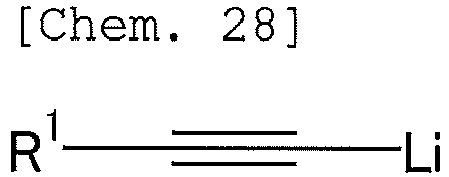

- a step (32) of oxidizing the compound (31) to provide a compound (32) represented by the following formula:

- a step (33) of eliminating the leaving group in the compound (32) to provide a compound (33) represented by the following formula:
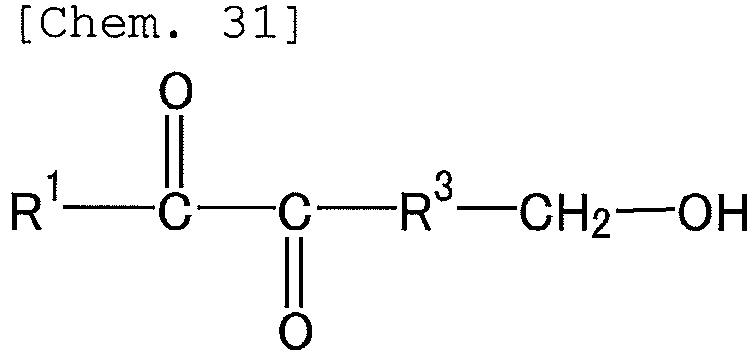
- a step (34) of oxidizing the compound (33) to provide a compound (34) represented by the following formula:


- a step (35) of bringing the compound (34) into contact with an alkali to provide a compound (35) represented by the following formula:

- When R1 contains a furan ring, the furan ring may be cleaved with an acid and converted into a dicarbonyl derivative, for example. Examples of the acid include acetic acid, hydrochloric acid, and p-toluenesulfonic acid. Acetic acid is preferred.
- E represents a leaving group. Examples of the leaving group include a tert-butyldimethylsilyl (TBS) group, a triethylsilyl (TES) group, a triisopropylsilyl (TIPS) group, a tert-butyldiphenylsilyl (TBDPS) group, and a benzyl (Bn) group.
- For the reaction ratio between the alkyl halide and the lithium acetylide in the step (31), the amount of the lithium acetylide is preferably 0.5 to 10 mol, more preferably 0.6 to 5.0 mol, still more preferably 1 to 2 mol, particularly preferably 1 to 1.2 mol, relative to 1 mol of the alkyl halide, so as to improve the yield and to reduce the waste.
- The reaction in the step (31) may be performed in a solvent. The solvent is preferably hexane.
- The reaction temperature in the step (31) is preferably -100°C to -40°C, more preferably -80°C to -50°C, while preferably -100°C to 100°C, more preferably -80°C to 50°C.
- The reaction pressure in the step (31) is preferably 0.1 to 5 MPa, more preferably 0.1 to 1 MPa.
- The reaction duration in the step (31) is preferably 0.1 to 72 hours, more preferably 1 to 48 hours, still more preferably 6 to 10 hours.
- The oxidation in the step (32) may be performed in a nitrile solvent using a complex generated by treating [(Cn*)RuIII(CF3CO2)3]·H2O (wherein Cn* is 1,4,7-trimethyl-1,4,7-triazabicyclononane) with (NH4)2Ce(NO3)6 and trifluoroacetic acid and then adding sodium perchlorate thereto.
- After the oxidation is completed, the product may be neutralized with an alkali, and then an organic solvent such as an ether may be used to extract the compound (32).
- The reaction temperature in the step (32) is preferably -78°C to 150°C, more preferably 0°C to 100°C, still more preferably 30°C to 100°C, particularly preferably 40°C to 90°C.
- The reaction pressure in the step (32) is preferably 0.1 to 5 MPa, more preferably 0.1 to 1 MPa.
- The reaction duration in the step (32) is preferably 0.1 to 72 hours, more preferably 1 to 48 hours, still more preferably 3 to 8 hours.
- The elimination reaction for the leaving group in the step (33) may be performed using a fluoride ion or an acid. Examples of methods of eliminating the leaving group include a method of using hydrofluoric acid; a method of using an amine complex of hydrogen fluoride such as pyridine-nHF or triethylamine-nHF; a method of using an inorganic salt such as cesium fluoride, potassium fluoride, lithium tetrafluoroborate (LiBF4), or ammonium fluoride; and a method of using an organic salt such as tetrabutylammonium fluoride (TBAF).
- The elimination reaction for the leaving group in the step (33) may be performed in a solvent. The solvent is preferably an organic solvent, more preferably an aprotic polar solvent, still more preferably an ether.
- Examples of the ether include ethyl methyl ether, diethyl ether, monoglyme(ethylene glycol dimethyl ether), diglyme(diethylene glycol dimethyl ether), triglyme(triethylene glycol dimethyl ether), tetrahydrofuran, tetraglyme(tetraethylene glycol dimethyl ether), and crown ethers (e.g., 15-crown-5, 18-crown-6). Tetrahydrofuran and diethyl ether are preferred.
- The reaction temperature in the step (33) is preferably -78°C to 150°C, more preferably 0°C to 100°C, still more preferably 0°C to 40°C, particularly preferably 0°C to 20°C.
- The reaction pressure in the step (33) is preferably 0.1 to 5 MPa, more preferably 0.1 to 1 MPa.
- The reaction duration in the step (33) is preferably 0.1 to 72 hours, more preferably 1 to 48 hours, still more preferably 3 to 8 hours.
- The oxidation in the step (34) may be performed in a solvent in the presence of sodium chlorite.
- The solvent used may be any of alcohols and water. A solution of disodium phosphate may be used as a buffer.
- Examples of the alkali used in the step (35) include sodium hydroxide, potassium hydroxide, lithium hydroxide, and ammonia. Ammonia solution is preferably used.
- The resulting compounds may be subjected to any of evaporation of a solvent or operations such as distillation and purification after the respective steps, whereby the purity of each compound may be increased.
- The compound of the invention may also favorably be produced by a production method including:
- a step (51) of reacting divinyl ketone represented by the following formula:


- a step (52) of reacting the compound (51) and furan represented by the following formula:


- a step (53) of heating the compound (52) in the presence of an acid to provide a compound (53) represented by the following formula:

- a step (54) of oxidizing the compound (53) to provide a compound (54) represented by the following formula:


- a step (55) of bringing the compound (54) into contact with an alkali to provide a compound (55) represented by the following formula:

- For the reaction ratio between divinyl ketone and 2-methylfuran in the step (51), the amount of 2-methylfuran is preferably 0.5 to 10 mol, more preferably 0.6 to 5.0 mol, still more preferably 0.5 to 1 mol, particularly preferably 0.6 to 0.9 mol, relative to 1 mol of divinyl ketone, so as to improve the yield and to reduce the waste.
- The reaction in the step (51) is preferably performed in the presence of an acid. Examples of the acid include acetic acid, hydrochloric acid, and p-toluenesulfonic acid. Acetic acid is preferred.
- In order to improve the yield and to reduce the waste, the amount of the acid used in the step (51) is preferably 0.1 to 2 mol, more preferably 0.1 to 1 mol, relative to 1 mol of divinyl ketone.
- The reaction in the step (51) may be performed in a polar solvent. The solvent is preferably water or acetonitrile.
- The reaction temperature in the step (51) is preferably -78°C to 150°C, more preferably 0°C to 100°C, still more preferably 20°C to 100°C, particularly preferably 40°C to 100°C.
- The reaction pressure in the step (51) is preferably 0.1 to 5 MPa, more preferably 0.1 to 1 MPa.
- The reaction duration in the step (51) is preferably 0.1 to 72 hours, more preferably 1 to 48 hours, still more preferably 4 to 8 hours.
- For the reaction ratio between the compound (51) and furan in the step (52), the amount of furan is preferably 0.5 to 10 mol, more preferably 0.6 to 5.0 mol, still more preferably 1 to 2 mol, particularly preferably 1 to 1.1 mol, relative to 1 mol of the compound (51), so as to improve the yield and to reduce the waste.
- The reaction in the step (52) is preferably performed in the presence of an acid. Examples of the acid include acetic acid, hydrochloric acid, and p-toluenesulfonic acid. Acetic acid is preferred.
- In order to improve the yield and to reduce the waste, the amount of the acid used in the step (52) is preferably 0.1 to 2 mol, more preferably 0.1 to 1 mol, relative to 1 mol of the compound (51).
- The reaction in the step (52) may be performed in a polar solvent. The solvent is preferably water.
- The reaction temperature in the step (52) is preferably -78°C to 150°C, more preferably 0°C to 100°C, still more preferably 20°C to 100°C, particularly preferably 40°C to 100°C.
- The reaction pressure in the step (52) is preferably 0.1 to 5 MPa, more preferably 0.1 to 1 MPa.
- The reaction duration in the step (52) is preferably 0.1 to 72 hours, more preferably 1 to 48 hours, still more preferably 4 to 8 hours.
- In the step (53), the compound (52) is heated in the presence of an acid so that the furan rings are opened.
- The acid is preferably hydrochloric acid or sulfuric acid.
- The reaction in the step (53) may be performed in a polar solvent. The solvent is preferably water.
- The reaction temperature in the step (53) is preferably -78°C to 150°C, more preferably 0°C to 100°C, still more preferably 50°C to 100°C, particularly preferably 70°C to 100°C.
- The reaction pressure in the step (53) is preferably 0.1 to 5 MPa, more preferably 0.1 to 1 MPa.
- The reaction duration in the step (53) is preferably 0.1 to 72 hours, more preferably 1 to 48 hours, still more preferably 1 to 12 hours.
- The oxidation in the step (54) may be performed in a solvent in the presence of sodium chlorite.
- The solvent used may be any of tert-butyl alcohol and water. A solution of disodium phosphate may be used as a buffer.
- Examples of the alkali used in the step (55) include sodium hydroxide, potassium hydroxide, lithium hydroxide, and ammonia. Ammonia solution is preferably used.
- The resulting compounds may be subjected to any of evaporation of a solvent or operations such as distillation and purification after the respective steps, whereby the purity of each compound may be increased.
- The compound of the invention may also favorably be produced by a production method including:
- a step (61) of reacting an alkene represented by the following formula:

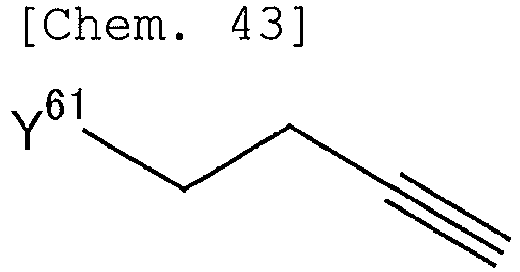


- a step (62) of treating the compound (61) with an alkali, and then with an acid to provide a compound (62) represented by the following formula:

- a step (63) of bringing the compound (62) into contact with an alkali to provide a compound (63) represented by the following formula:

- When R1 contains a furan ring, the furan ring may be cleaved with an acid and converted into a dicarbonyl derivative, for example. Examples of the acid include acetic acid, hydrochloric acid, and p-toluenesulfonic acid. Acetic acid is preferred.
- R21 is preferably a single bond or a linear or branched alkylene group containing one or more carbon atoms.
- For the reaction ratio between the alkene and the alkyne in the step (61), the amount of the alkene is preferably 0.5 to 2 mol, more preferably 0.6 to 1.2 mol, while preferably 0.5 to 10 mol, more preferably 0.6 to 5.0 mol, relative to 1 mol of the alkyne, so as to improve the yield and to reduce the waste.
- The reaction in the step (61) is preferably performed in the presence of a metal catalyst. An example of the metal is ruthenium.
- In order to improve the yield and to reduce the waste, the amount of the metal catalyst used in the step (61) is preferably 0.00001 to 0.4 mol, more preferably 0.00005 to 0.1 mol, still more preferably 0.01 to 0.4 mol, particularly preferably 0.05 to 0.1 mol, relative to 1 mol of the alkene.
- The reaction in the step (61) may be performed in a polar solvent. The solvent is preferably water, acetonitrile, dimethylacetamide, or dimethylformamide.
- The reaction temperature in the step (61) is preferably 20°C to 160°C, more preferably 40°C to 140°C.
- The reaction pressure in the step (61) is preferably 0.1 to 5 MPa, more preferably 0.1 to 1 MPa.
- The reaction duration in the step (61) is preferably 0.1 to 72 hours, more preferably 1 to 48 hours, still more preferably 4 to 8 hours.
- For the reaction ratio between the compound (61) and the alkali in the step (62), the amount of the alkali is preferably 0.5 to 10 mol, more preferably 0.6 to 5.0 mol, still more preferably 0.6 to 2 mol, particularly preferably 0.8 to 1.1 mol, relative to 1 mol of the compound (61), so as to improve the yield and to reduce the waste.
- In order to improve the yield and to reduce the waste, the amount of the acid used in the step (62) is preferably 1.0 to 20.0 mol, more preferably 1.0 to 10.0 mol, relative to 1 mol of the compound (61).
- The reaction in the step (62) may be performed in a polar solvent. The solvent is preferably water.
- The reaction temperature in the step (62) is preferably 0°C to 100°C, more preferably 20°C to 100°C.
- The reaction pressure in the step (62) is preferably 0.1 to 5 MPa, more preferably 0.1 to 1 MPa.
- The reaction duration in the step (62) is preferably 0.1 to 72 hours, more preferably 1 to 48 hours, still more preferably 4 to 8 hours.
- Examples of the alkali used in the step (63) include sodium hydroxide, potassium hydroxide, lithium hydroxide, and ammonia. Ammonia solution is preferably used.
- The resulting compounds may be subjected to any of evaporation of a solvent or operations such as distillation and purification after the respective steps, whereby the purity of each compound may be increased.
- The invention is described hereinbelow with reference to examples. Still, these examples are not intended to limit the invention.
- The parameters in the examples were determined by the following methods.
- A mixture of lithium (2.0 g), dimethylphenylchlorosilane (8.4 g), and tetrahydrofuran (120 mL) was stirred at room temperature for six hours. To the reaction solution was added 4-(tert-butyldimethylsiloxy)-1-morpholinobutan-1-one (10 g), and the mixture was stirred at -78°C for two hours. To the reaction solution was added a saturated ammonium chloride aqueous solution (300 mL). The mixture was subjected to extraction with ethyl acetate. The extract was dried over sodium sulfate and the solvent was evaporated under reduced pressure. The residue was then purified by silica gel column chromatography. Thereby, 4-(tert-butyldimethylsiloxy)-1-(dimethyl(phenyl)silyl)butan-1-one (6.4 g) was obtained.
1H-NMR (CDCl3) δppm: -0.01 (s, 6H), 0.49 (s, 6H), 0.85 (s, 9H), 1.61-1.71 (m, 2H), 2.66 (J = 7.0, t, 2H), 3.51 (J = 6.2, t, 2H), 7.38-7.40 (m, 3H), 7.53-7.57 (m, 2H) - A mixture of 4-(tert-butyldimethylsiloxy)-1-(dimethyl(phenyl)silyl)butan-1-one (6.4 g), 1-octen-3-one (2.41 g), 3-ethyl-5-(2-hydroxyethyl)-4-methylthiazolium bromide (1.42 g), 1,8-diazabicyclo[5.4.0]-7-undecene (0.86 g), isopropanol (3.17 g), and tetrahydrofuran (11.5 mL) was stirred at 75°C for eight hours. The solvent in the reaction solution was evaporated under reduced pressure, and the residue was then purified by silica gel column chromatography. Thereby, 1-tert-butyldimethylsiloxydodecane-4,7-dione (4.0 g) was obtained.
1H-NMR (CDCl3) δppm: 0.02 (s, 6H), 0.88 (s, 12H), 1.22-1.31 (m, 4H), 1.51-1.59 (m, 2H), 1.72-1.83 (m, 2H), 2.43 (J = 7.6, t, 2H), 2.55 (J = 7.6, t, 2H), 2.67 (s, 4H), 3.59 (J = 5.9, t, 2H) - A mixture of 1-tert-butyldimethylsiloxydodecane-4,7-dione (1.9 g), a 1 M solution (15 mL) of tetrabutylammonium fluoride in tetrahydrofuran, and tetrahydrofuran (17.5 mL) was stirred at 0°C for two hours. To the reaction solution was added a saturated ammonium chloride solution (100 mL). The mixture was subjected to extraction with ethyl acetate. The extract was dried over sodium sulfate and the solvent was evaporated under reduced pressure. The residue was then purified by silica gel column chromatography. Thereby, 1-hydroxydodecane-4,7-dione (2.0 g) was obtained.
1H-NMR (CDCl3) δppm: 0.89 (s, 3H), 1.24-1.33 (m, 4H), 1.52-1.58 (m, 2H), 1.81-1.90 (m, 2H), 2.45 (J = 7.6, t, 2H), 2.63 (J = 7.0, t, 2H), 2.76 (s, 4H), 3.65 (J = 5.9, t, 2H) - A mixture of 2,2,6,6-tetramethylpiperidine-1-oxyl, 1-hydroxydodexane-4,7-dione, potassium bromide, sodium hypochlorite, sodium hydrogen carbonate, sodium carbonate, and dichloromethane was stirred at 25°C for one hour. After the reaction, methanol was added thereto. The aqueous phase was extracted with dichloromethane (50 mL) three times. The extract was washed with saturated brine, and then the organic phase was dried. Thereby, 4,7-dioxododecanal was obtained.
- A solution mixture of 4,7-dioxododecanal, 2-methyl-2-butene, tBuOH, water, a Na2HPO4 solution, and NaClO2 was stirred at 25°C for one hour. Brine was added to the solution mixture, and the mixture was subjected to extraction with chloroform four times. The organic phase was dried over sodium sulfate and concentrated. The residue was then purified by silica gel column chromatography (hexane:ethyl acetate). Thereby, 4,7-dioxododecanoic acid was obtained.
- Then, 4,7-dioxododecanoic acid was added to 30% ammonia water and water was evaporated. Thereby, ammonium 4,7-dioxododecanoate was obtained.
- Divinyl ketone (7.4 g), 2-methylfuran (8.0 g), acetic acid (6 mL), and water (60 mL) were stirred at 40°C for four hours. The reaction solution was added to a saturated sodium hydrogen carbonate solution. The mixture was subjected to extraction with ethyl acetate. The extract was dried over sodium sulfate and the solvent was evaporated under reduced pressure. The residue was then purified by silica gel column chromatography (hexane:ethyl acetate = 25:1). Thereby, 1-(5-methyl-2-furanyl)-3-buten-2-one (7.4 g) was obtained.
1H-NMR (CDCl3) δppm: 5.88 (dd, J = 17.4, 10.6, 2H), 6.32 (dd, J = 17.4, 1.3, 2H), 5.88 (dd, J = 10.6, 1.3, 2H) - Then, 1-(5-methyl-2-furanyl)-3-buten-2-one (1.0 g), furan (4 g), acetic acid (0.4 mL), and water (4 mL) were stirred at 100°C for 24 hours. The reaction solution was added to a saturated sodium hydrogen carbonate solution and the mixture was subjected to extraction with ethyl acetate. The extract was dried over sodium sulfate and the solvent was evaporated under reduced pressure. The residue was then purified by silica gel column chromatography (hexane:ethyl acetate = 25:1). Thereby, 1-(furan-2-yl)-5-(5-methylfuran-2-yl)pentan-3-one (0.5 g) was obtained.
- A mixture of sodium 9-(5-methylfuran-2-yl)-4,7-dioxononyl)sulfate, water, and 1 M hydrochloric acid was stirred at 100°C for one hour. A 10% NaHCO3 aqueous solution was added to the reaction solution for neutralization. The neutralized solution was subjected to extraction with ethyl acetate. The extract was dried over sodium sulfate and the solvent was evaporated under reduced pressure. The residue was then purified by silica gel column chromatography (hexane:ethyl acetate = 1:1). Thereby, 4,7,10,13-tetraoxotetradecanal was obtained.
- A solution mixture of 4,7,10,13-tetraoxotetradecanal, 2-methyl-2-butene, tBuOH, water, a Na2HPO4 solution, and NaClO2 was stirred at 25°C for one hour. Brine was added to the solution mixture, and the mixture was subjected to extraction with chloroform four times. The organic phase was dried over sodium sulfate and concentrated. The residue was then purified by silica gel column chromatography (hexane:ethyl acetate). Thereby, 4,7,10,13-tetraoxotetradecanoic acid was obtained.
- Then, 4,7,10,13-tetraoxotetradecanoic acid was added to ammonia water and water was evaporated. Thereby, ammonium 4,7,10,13-tetraoxotetradecanoate was obtained.
- Each of the compounds obtained in Examples 1 and 2 was dissolved in water so as to give the concentration shown in Table 1, and the surface tension was determined by the Wilhelmy method at 20°C. The results are shown in Table 1.
[Table 1] Amount of compound relative to water (wt%) 0.01 0.1 1 Surface tension Example 1 72.1 62.6 43.4 (mN/m) Example 2 73.4 70.2 63 - The compound of the invention can favorably reduce the surface tension of water.
- The compound of the invention can suitably be used as a surfactant.
- The compound of the invention can suitably be used as a surfactant promoter (in particular, a surfactant promoter for agents such as coating material, lacquer, and adhesive).
- The compound of the invention can suitably be used as a viscosity reducing agent, for example.
- The compound of the invention can suitably be used as a dispersant, in particular an aqueous dispersant, for example.
- The compound of the invention can suitably be used as an emulsifier, for example.
Claims (9)
- A compound represented by the following formula:
 R1 is a linear or branched alkyl group containing one or more carbon atoms or a cyclic alkyl group containing three or more carbon atoms, with a hydrogen atom that binds to a carbon atom being optionally replaced by a hydroxy group or a monovalent organic group containing an ester bond, the alkyl group optionally containing a carbonyl group when containing two or more carbon atoms, and the alkyl group optionally containing a monovalent or divalent heterocycle or being optionally in a cyclized form when containing three or more carbon atoms;R2 and R3 are each individually a single bond or a divalent linking group;R1, R2, and R3 contain five or more carbon atoms in total;A is -COOX or -SO3X, wherein X is H, a metal atom, NR4 4, imidazolium optionally containing a substituent, pyridinium optionally containing a substituent, or phosphonium optionally containing a substituent, where R4s are each H or an organic group and are the same as or different from each other; andany two of R1, R2, and R3 optionally bind to each other to form a ring.
 - The compound according to claim 1,
wherein in the formula, R2 and R3 are each individually a single bond, a linear or branched alkylene group containing one or more carbon atoms, or a cyclic alkylene group containing three or more carbon atoms, with a hydrogen atom that binds to a carbon atom being optionally replaced by a hydroxy group or a monovalent organic group containing an ester bond. - The compound according to claim 1 or 2,
wherein in the formula, R1 is a C1-C8 linear or branched alkyl group containing no carbonyl group, a C3-C8 cyclic alkyl group containing no carbonyl group, a C2-C45 linear or branched alkyl group containing 1 to 10 carbonyl groups, a C3-C45 cyclic alkyl group containing a carbonyl group, or a C3-C45 alkyl group containing a monovalent or divalent heterocycle. - The compound according to claim 1, 2, or 3,
wherein in the formula, R1 is a group represented by the following formula:
- The compound according to claim 1, 2, 3, or 4,
wherein in the formula, R2 and R3 are each individually a linear or branched alkylene group containing no carbonyl group and containing one or more carbon atoms. - The compound according to claim 1, 2, 3, 4, or 5,
wherein in the formula, R2 and R3 are each individually a C1-C3 linear or branched alkylene group containing no carbonyl group. - The compound according to claim 1, 2, 3, 4, 5, or 6,
wherein in the formula, X is NH4. - A surfactant comprising the compound according to claim 1, 2, 3, 4, 5, 6, or 7.
- An aqueous dispersant comprising the compound according to claim 1, 2, 3, 4, 5, 6, or 7.
Applications Claiming Priority (2)
| Application Number | Priority Date | Filing Date | Title |
|---|---|---|---|
| JP2016195061 | 2016-09-30 | ||
| PCT/JP2017/035371 WO2018062449A1 (en) | 2016-09-30 | 2017-09-29 | Carboxylate salt or sulfonate salt, and surfactant |
Publications (3)
| Publication Number | Publication Date |
|---|---|
| EP3514138A1 true EP3514138A1 (en) | 2019-07-24 |
| EP3514138A4 EP3514138A4 (en) | 2020-06-10 |
| EP3514138B1 EP3514138B1 (en) | 2023-08-23 |
Family
ID=61760419
Family Applications (1)
| Application Number | Title | Priority Date | Filing Date |
|---|---|---|---|
| EP17856398.7A Active EP3514138B1 (en) | 2016-09-30 | 2017-09-29 | Carboxylate salt or sulfonate salt, and surfactant |
Country Status (5)
| Country | Link |
|---|---|
| US (2) | US10865178B2 (en) |
| EP (1) | EP3514138B1 (en) |
| JP (2) | JP6848978B2 (en) |
| CN (1) | CN109790100B (en) |
| WO (1) | WO2018062449A1 (en) |
Cited By (2)
| Publication number | Priority date | Publication date | Assignee | Title |
|---|---|---|---|---|
| EP3604350A4 (en) * | 2017-03-31 | 2021-06-09 | Daikin Industries, Ltd. | Production method for fluoropolymer, surfactant for polymerization, and use of surfactant |
| US11999681B2 (en) | 2017-03-31 | 2024-06-04 | Daikin Industries, Ltd. | Alkyl sulfate ester or salt of same |
Families Citing this family (5)
| Publication number | Priority date | Publication date | Assignee | Title |
|---|---|---|---|---|
| CN109790100B (en) | 2016-09-30 | 2023-02-17 | 大金工业株式会社 | Carboxylate or Sulfonate and Surfactants |
| WO2018181904A1 (en) * | 2017-03-31 | 2018-10-04 | ダイキン工業株式会社 | Production method for fluoropolymer, surfactant for polymerization, and use of surfactant |
| EP4001322B1 (en) | 2019-07-16 | 2025-12-24 | Daikin Industries, Ltd. | Method for producing fluorine-containing elastomer, and composition |
| CN111533655B (en) * | 2020-05-31 | 2022-09-02 | 广东工业大学 | Preparation method of long-carbon-chain keto dicarboxylic ester |
| WO2022196804A1 (en) | 2021-03-18 | 2022-09-22 | ダイキン工業株式会社 | Method for producing fluororesin, fluororesin, and aqueous dispersion liquid |
Family Cites Families (24)
| Publication number | Priority date | Publication date | Assignee | Title |
|---|---|---|---|---|
| US2781372A (en) * | 1956-02-10 | 1957-02-12 | Hans S Mannheimer | Detergent sulphonic acid and sulphate salts of certain amphoteric detergents |
| US2781353A (en) * | 1956-03-26 | 1957-02-12 | John J Mccabe Jr | Imidazoline derivatives and process |
| JPS3824871B1 (en) * | 1961-03-29 | 1963-11-22 | ||
| US3412116A (en) * | 1965-11-01 | 1968-11-19 | Akad Wissenschaften Ddr | Method of producing gamma-keto acids |
| GB1081234A (en) * | 1966-03-14 | 1967-08-31 | Akad Wissenschaften Ddr | Process for the production of keto carboxylic acids |
| FR2046949B1 (en) | 1969-06-20 | 1973-01-12 | Colgate Palmolive Co | |
| US3654326A (en) * | 1970-07-22 | 1972-04-04 | Hoffmann La Roche | 5 9-dioxodecanoic acids and methods for their preparation |
| US4179392A (en) * | 1970-12-21 | 1979-12-18 | Mobil Oil Corporation | Biodegradable hard water detergents |
| DE2740854A1 (en) * | 1977-09-10 | 1979-03-29 | Troponwerke Gmbh & Co Kg | Substd. 3-indole-acetoxy-alkane sulphonic acid salts - useful as antiphlogistic and anti-hypotonic agents |
| US5025104A (en) * | 1989-09-28 | 1991-06-18 | Atochem North America, Inc. | 2,4-pentanedione-1-sulfonic acid and method for preparing the same |
| GB9302130D0 (en) * | 1993-02-03 | 1993-03-24 | Unilever Plc | Cleasing composition |
| US5630999A (en) * | 1993-06-16 | 1997-05-20 | Colgate Palmolive Company | Oral composition containing anionic surfactants having reduced adverse reaction to oral tissue |
| JP3426413B2 (en) | 1995-05-11 | 2003-07-14 | カネボウ株式会社 | Cosmetics |
| JP2001172669A (en) * | 1999-12-21 | 2001-06-26 | Lion Corp | Detergent composition |
| JP3824871B2 (en) * | 2001-02-19 | 2006-09-20 | 三菱電機株式会社 | Automatic gain control device and demodulator |
| JP2003005329A (en) | 2001-06-21 | 2003-01-08 | Konica Corp | Processing agent composition for silver halide photographic sensitive material, color developing solution, bleaching solution, bleach fixing solution, stabilizing solution, fixing solution, amplifier solution and black-and-white developing solution |
| JP2005325035A (en) * | 2004-05-12 | 2005-11-24 | Nippon Shokubai Co Ltd | Method for producing carbonyl compound using molecular oxygen as oxidizing agent |
| DE102008010663A1 (en) * | 2008-02-22 | 2009-08-27 | Leibniz-Institut Für Neue Materialien Gemeinnützige Gmbh | Alkali metal and / or alkaline earth metal doped titanium oxide nanoparticles and process for their preparation |
| US20140039031A1 (en) | 2011-02-23 | 2014-02-06 | Dispersol Technologies. LLC | Pharmaceutical formulations of acetyl-11-keto-b-boswellic acid, diindolylmethane, and curcumin for pharmaceutical applications |
| US9242930B2 (en) * | 2011-04-13 | 2016-01-26 | Elc Management Llc | Mild anionic surfactants suitable for personal care compositions |
| CN103432091A (en) * | 2013-09-13 | 2013-12-11 | 钟术光 | Improved-performance tablet and preparation method thereof |
| CN103451666A (en) * | 2013-09-16 | 2013-12-18 | 杨震宇 | Metal cleaning agent |
| WO2015072814A1 (en) * | 2013-11-18 | 2015-05-21 | 주식회사 엘지화학 | Method for preparing polyalkylene carbonate resin |
| CN109790100B (en) | 2016-09-30 | 2023-02-17 | 大金工业株式会社 | Carboxylate or Sulfonate and Surfactants |
-
2017
- 2017-09-29 CN CN201780059614.9A patent/CN109790100B/en active Active
- 2017-09-29 EP EP17856398.7A patent/EP3514138B1/en active Active
- 2017-09-29 JP JP2018542898A patent/JP6848978B2/en active Active
- 2017-09-29 US US16/338,368 patent/US10865178B2/en active Active
- 2017-09-29 WO PCT/JP2017/035371 patent/WO2018062449A1/en not_active Ceased
-
2020
- 2020-10-01 US US17/061,453 patent/US20210070688A1/en not_active Abandoned
- 2020-11-30 JP JP2020198722A patent/JP7531375B2/en active Active
Cited By (4)
| Publication number | Priority date | Publication date | Assignee | Title |
|---|---|---|---|---|
| EP3604350A4 (en) * | 2017-03-31 | 2021-06-09 | Daikin Industries, Ltd. | Production method for fluoropolymer, surfactant for polymerization, and use of surfactant |
| US11279814B2 (en) | 2017-03-31 | 2022-03-22 | Daikin Industries, Ltd. | Production method for fluoropolymer, surfactant for polymerization, and use of surfactant |
| US11999681B2 (en) | 2017-03-31 | 2024-06-04 | Daikin Industries, Ltd. | Alkyl sulfate ester or salt of same |
| US12404387B2 (en) | 2017-03-31 | 2025-09-02 | Daikin Industries, Ltd. | Production method for fluoropolymer, surfactant for polymerization, and use of surfactant |
Also Published As
| Publication number | Publication date |
|---|---|
| EP3514138A4 (en) | 2020-06-10 |
| US20210070688A1 (en) | 2021-03-11 |
| WO2018062449A1 (en) | 2018-04-05 |
| CN109790100A (en) | 2019-05-21 |
| JP2021038264A (en) | 2021-03-11 |
| JP7531375B2 (en) | 2024-08-09 |
| US20200024219A1 (en) | 2020-01-23 |
| US10865178B2 (en) | 2020-12-15 |
| CN109790100B (en) | 2023-02-17 |
| EP3514138B1 (en) | 2023-08-23 |
| JP6848978B2 (en) | 2021-03-24 |
| JPWO2018062449A1 (en) | 2019-04-11 |
Similar Documents
| Publication | Publication Date | Title |
|---|---|---|
| EP3514138B1 (en) | Carboxylate salt or sulfonate salt, and surfactant | |
| EP3514142B1 (en) | Sulfuric acid ester or salt thereof, and surfactant | |
| US11198670B2 (en) | Hydrocarbon-containing carboxylic acid, hydrocarbon-containing sulfonic acid, hydrocarbon-containing sulfuric acid ester or salt thereof, and surfactant | |
| ES2290728T3 (en) | PROCESS FOR THE PREPARATION OF DERIVATIVES OF (4- (2,6-DIAMINO-9H-PURIN-9-IL) -1,3-DIOXOLAN-2-IL) METHANOL PROTECTED IN OH. | |
| WO2016142952A1 (en) | Process for preparation of vilazodone and its novel intermediates | |
| Kippo et al. | Radical vinylation of dioxolanes and N-acylpyrrolidines using vinyl bromides | |
| EP3590921A1 (en) | Alkyl sulfate ester or salt of same | |
| EP2913329B1 (en) | Method for manufacturing difluoro lactone compound | |
| Kobayashi et al. | Total synthesis of (−)-phaeosphaeride B by a biomimetic conversion from (−)-phaeosphaeride A | |
| LV12073B (en) | METHOD OF RECOVERY OF DIOOPINOCAMPHENYLHORBORANA | |
| JP4859461B2 (en) | Optically active halohydrin derivative and method for producing optically active epoxy alcohol derivative using the same | |
| AU2013306012A1 (en) | Process for the synthesis of substituted gamma lactams | |
| EP1471058B1 (en) | Process for producing 1,2,3-triazole compound | |
| Nagano et al. | Synthesis of unsymmetrically and highly substituted thiophenes utilizing regioselective ring-expansion of gem-dichlorocyclopropyl ketones with Lawesson’s reagent | |
| EP3604274A1 (en) | Sulfonic acid, carboxylic acid, and salts thereof | |
| JP4643474B2 (en) | Method for producing mono-substituted succinimide | |
| Bihelovic et al. | Synthesis of two novel C-19 analogues of (±)-alstoscholarisine A | |
| WO1992022546A1 (en) | Substituted 1,5-dihydro-3h-2,4-benzodioxepines as optically active glyderaldehydes or glycidaldehydes | |
| WO2013042693A1 (en) | Halo-ester derivative | |
| WO2003051862A1 (en) | Process for the preparation of pyranone derivatives | |
| JP2011074016A (en) | Method of manufacturing 3-mercapto-1-propanol | |
| CN119431227A (en) | A decarboxylation coupling method catalyzed by azacarbene |
Legal Events
| Date | Code | Title | Description |
|---|---|---|---|
| STAA | Information on the status of an ep patent application or granted ep patent |
Free format text: STATUS: THE INTERNATIONAL PUBLICATION HAS BEEN MADE |
|
| PUAI | Public reference made under article 153(3) epc to a published international application that has entered the european phase |
Free format text: ORIGINAL CODE: 0009012 |
|
| STAA | Information on the status of an ep patent application or granted ep patent |
Free format text: STATUS: REQUEST FOR EXAMINATION WAS MADE |
|
| 17P | Request for examination filed |
Effective date: 20190415 |
|
| AK | Designated contracting states |
Kind code of ref document: A1 Designated state(s): AL AT BE BG CH CY CZ DE DK EE ES FI FR GB GR HR HU IE IS IT LI LT LU LV MC MK MT NL NO PL PT RO RS SE SI SK SM TR |
|
| AX | Request for extension of the european patent |
Extension state: BA ME |
|
| DAV | Request for validation of the european patent (deleted) | ||
| DAX | Request for extension of the european patent (deleted) | ||
| A4 | Supplementary search report drawn up and despatched |
Effective date: 20200511 |
|
| RIC1 | Information provided on ipc code assigned before grant |
Ipc: C07C 59/185 20060101AFI20200504BHEP Ipc: B01F 17/00 20060101ALI20200504BHEP Ipc: C09K 3/00 20060101ALI20200504BHEP |
|
| STAA | Information on the status of an ep patent application or granted ep patent |
Free format text: STATUS: EXAMINATION IS IN PROGRESS |
|
| 17Q | First examination report despatched |
Effective date: 20211104 |
|
| RAP3 | Party data changed (applicant data changed or rights of an application transferred) |
Owner name: DAIKIN INDUSTRIES, LTD. |
|
| RIC1 | Information provided on ipc code assigned before grant |
Ipc: C09K 3/00 20060101ALI20230209BHEP Ipc: C07C 59/185 20060101AFI20230209BHEP |
|
| GRAP | Despatch of communication of intention to grant a patent |
Free format text: ORIGINAL CODE: EPIDOSNIGR1 |
|
| STAA | Information on the status of an ep patent application or granted ep patent |
Free format text: STATUS: GRANT OF PATENT IS INTENDED |
|
| INTG | Intention to grant announced |
Effective date: 20230322 |
|
| P01 | Opt-out of the competence of the unified patent court (upc) registered |
Effective date: 20230525 |
|
| GRAS | Grant fee paid |
Free format text: ORIGINAL CODE: EPIDOSNIGR3 |
|
| GRAA | (expected) grant |
Free format text: ORIGINAL CODE: 0009210 |
|
| STAA | Information on the status of an ep patent application or granted ep patent |
Free format text: STATUS: THE PATENT HAS BEEN GRANTED |
|
| AK | Designated contracting states |
Kind code of ref document: B1 Designated state(s): AL AT BE BG CH CY CZ DE DK EE ES FI FR GB GR HR HU IE IS IT LI LT LU LV MC MK MT NL NO PL PT RO RS SE SI SK SM TR |
|
| REG | Reference to a national code |
Ref country code: GB Ref legal event code: FG4D |
|
| REG | Reference to a national code |
Ref country code: CH Ref legal event code: EP |
|
| REG | Reference to a national code |
Ref country code: DE Ref legal event code: R096 Ref document number: 602017073234 Country of ref document: DE |
|
| REG | Reference to a national code |
Ref country code: IE Ref legal event code: FG4D |
|
| REG | Reference to a national code |
Ref country code: NL Ref legal event code: FP |
|
| REG | Reference to a national code |
Ref country code: LT Ref legal event code: MG9D |
|
| REG | Reference to a national code |
Ref country code: AT Ref legal event code: MK05 Ref document number: 1602457 Country of ref document: AT Kind code of ref document: T Effective date: 20230823 |
|
| PG25 | Lapsed in a contracting state [announced via postgrant information from national office to epo] |
Ref country code: GR Free format text: LAPSE BECAUSE OF FAILURE TO SUBMIT A TRANSLATION OF THE DESCRIPTION OR TO PAY THE FEE WITHIN THE PRESCRIBED TIME-LIMIT Effective date: 20231124 |
|
| PG25 | Lapsed in a contracting state [announced via postgrant information from national office to epo] |
Ref country code: IS Free format text: LAPSE BECAUSE OF FAILURE TO SUBMIT A TRANSLATION OF THE DESCRIPTION OR TO PAY THE FEE WITHIN THE PRESCRIBED TIME-LIMIT Effective date: 20231223 |
|
| PG25 | Lapsed in a contracting state [announced via postgrant information from national office to epo] |
Ref country code: SE Free format text: LAPSE BECAUSE OF FAILURE TO SUBMIT A TRANSLATION OF THE DESCRIPTION OR TO PAY THE FEE WITHIN THE PRESCRIBED TIME-LIMIT Effective date: 20230823 Ref country code: RS Free format text: LAPSE BECAUSE OF FAILURE TO SUBMIT A TRANSLATION OF THE DESCRIPTION OR TO PAY THE FEE WITHIN THE PRESCRIBED TIME-LIMIT Effective date: 20230823 Ref country code: PT Free format text: LAPSE BECAUSE OF FAILURE TO SUBMIT A TRANSLATION OF THE DESCRIPTION OR TO PAY THE FEE WITHIN THE PRESCRIBED TIME-LIMIT Effective date: 20231226 Ref country code: NO Free format text: LAPSE BECAUSE OF FAILURE TO SUBMIT A TRANSLATION OF THE DESCRIPTION OR TO PAY THE FEE WITHIN THE PRESCRIBED TIME-LIMIT Effective date: 20231123 Ref country code: LV Free format text: LAPSE BECAUSE OF FAILURE TO SUBMIT A TRANSLATION OF THE DESCRIPTION OR TO PAY THE FEE WITHIN THE PRESCRIBED TIME-LIMIT Effective date: 20230823 Ref country code: LT Free format text: LAPSE BECAUSE OF FAILURE TO SUBMIT A TRANSLATION OF THE DESCRIPTION OR TO PAY THE FEE WITHIN THE PRESCRIBED TIME-LIMIT Effective date: 20230823 Ref country code: IS Free format text: LAPSE BECAUSE OF FAILURE TO SUBMIT A TRANSLATION OF THE DESCRIPTION OR TO PAY THE FEE WITHIN THE PRESCRIBED TIME-LIMIT Effective date: 20231223 Ref country code: HR Free format text: LAPSE BECAUSE OF FAILURE TO SUBMIT A TRANSLATION OF THE DESCRIPTION OR TO PAY THE FEE WITHIN THE PRESCRIBED TIME-LIMIT Effective date: 20230823 Ref country code: GR Free format text: LAPSE BECAUSE OF FAILURE TO SUBMIT A TRANSLATION OF THE DESCRIPTION OR TO PAY THE FEE WITHIN THE PRESCRIBED TIME-LIMIT Effective date: 20231124 Ref country code: FI Free format text: LAPSE BECAUSE OF FAILURE TO SUBMIT A TRANSLATION OF THE DESCRIPTION OR TO PAY THE FEE WITHIN THE PRESCRIBED TIME-LIMIT Effective date: 20230823 Ref country code: AT Free format text: LAPSE BECAUSE OF FAILURE TO SUBMIT A TRANSLATION OF THE DESCRIPTION OR TO PAY THE FEE WITHIN THE PRESCRIBED TIME-LIMIT Effective date: 20230823 |
|
| PG25 | Lapsed in a contracting state [announced via postgrant information from national office to epo] |
Ref country code: PL Free format text: LAPSE BECAUSE OF FAILURE TO SUBMIT A TRANSLATION OF THE DESCRIPTION OR TO PAY THE FEE WITHIN THE PRESCRIBED TIME-LIMIT Effective date: 20230823 |
|
| PG25 | Lapsed in a contracting state [announced via postgrant information from national office to epo] |
Ref country code: ES Free format text: LAPSE BECAUSE OF FAILURE TO SUBMIT A TRANSLATION OF THE DESCRIPTION OR TO PAY THE FEE WITHIN THE PRESCRIBED TIME-LIMIT Effective date: 20230823 |
|
| PG25 | Lapsed in a contracting state [announced via postgrant information from national office to epo] |
Ref country code: SM Free format text: LAPSE BECAUSE OF FAILURE TO SUBMIT A TRANSLATION OF THE DESCRIPTION OR TO PAY THE FEE WITHIN THE PRESCRIBED TIME-LIMIT Effective date: 20230823 Ref country code: RO Free format text: LAPSE BECAUSE OF FAILURE TO SUBMIT A TRANSLATION OF THE DESCRIPTION OR TO PAY THE FEE WITHIN THE PRESCRIBED TIME-LIMIT Effective date: 20230823 Ref country code: ES Free format text: LAPSE BECAUSE OF FAILURE TO SUBMIT A TRANSLATION OF THE DESCRIPTION OR TO PAY THE FEE WITHIN THE PRESCRIBED TIME-LIMIT Effective date: 20230823 Ref country code: EE Free format text: LAPSE BECAUSE OF FAILURE TO SUBMIT A TRANSLATION OF THE DESCRIPTION OR TO PAY THE FEE WITHIN THE PRESCRIBED TIME-LIMIT Effective date: 20230823 Ref country code: DK Free format text: LAPSE BECAUSE OF FAILURE TO SUBMIT A TRANSLATION OF THE DESCRIPTION OR TO PAY THE FEE WITHIN THE PRESCRIBED TIME-LIMIT Effective date: 20230823 Ref country code: CZ Free format text: LAPSE BECAUSE OF FAILURE TO SUBMIT A TRANSLATION OF THE DESCRIPTION OR TO PAY THE FEE WITHIN THE PRESCRIBED TIME-LIMIT Effective date: 20230823 Ref country code: SK Free format text: LAPSE BECAUSE OF FAILURE TO SUBMIT A TRANSLATION OF THE DESCRIPTION OR TO PAY THE FEE WITHIN THE PRESCRIBED TIME-LIMIT Effective date: 20230823 |
|
| REG | Reference to a national code |
Ref country code: CH Ref legal event code: PL |
|
| PG25 | Lapsed in a contracting state [announced via postgrant information from national office to epo] |
Ref country code: LU Free format text: LAPSE BECAUSE OF NON-PAYMENT OF DUE FEES Effective date: 20230929 |
|
| REG | Reference to a national code |
Ref country code: DE Ref legal event code: R097 Ref document number: 602017073234 Country of ref document: DE |
|
| REG | Reference to a national code |
Ref country code: BE Ref legal event code: MM Effective date: 20230930 |
|
| PG25 | Lapsed in a contracting state [announced via postgrant information from national office to epo] |
Ref country code: LU Free format text: LAPSE BECAUSE OF NON-PAYMENT OF DUE FEES Effective date: 20230929 Ref country code: MC Free format text: LAPSE BECAUSE OF FAILURE TO SUBMIT A TRANSLATION OF THE DESCRIPTION OR TO PAY THE FEE WITHIN THE PRESCRIBED TIME-LIMIT Effective date: 20230823 |
|
| PLBE | No opposition filed within time limit |
Free format text: ORIGINAL CODE: 0009261 |
|
| STAA | Information on the status of an ep patent application or granted ep patent |
Free format text: STATUS: NO OPPOSITION FILED WITHIN TIME LIMIT |
|
| REG | Reference to a national code |
Ref country code: IE Ref legal event code: MM4A |
|
| PG25 | Lapsed in a contracting state [announced via postgrant information from national office to epo] |
Ref country code: IE Free format text: LAPSE BECAUSE OF NON-PAYMENT OF DUE FEES Effective date: 20230929 |
|
| PG25 | Lapsed in a contracting state [announced via postgrant information from national office to epo] |
Ref country code: CH Free format text: LAPSE BECAUSE OF NON-PAYMENT OF DUE FEES Effective date: 20230930 |
|
| 26N | No opposition filed |
Effective date: 20240524 |
|
| PG25 | Lapsed in a contracting state [announced via postgrant information from national office to epo] |
Ref country code: IE Free format text: LAPSE BECAUSE OF NON-PAYMENT OF DUE FEES Effective date: 20230929 Ref country code: CH Free format text: LAPSE BECAUSE OF NON-PAYMENT OF DUE FEES Effective date: 20230930 Ref country code: SI Free format text: LAPSE BECAUSE OF FAILURE TO SUBMIT A TRANSLATION OF THE DESCRIPTION OR TO PAY THE FEE WITHIN THE PRESCRIBED TIME-LIMIT Effective date: 20230823 |
|
| PG25 | Lapsed in a contracting state [announced via postgrant information from national office to epo] |
Ref country code: BE Free format text: LAPSE BECAUSE OF NON-PAYMENT OF DUE FEES Effective date: 20230930 |
|
| PG25 | Lapsed in a contracting state [announced via postgrant information from national office to epo] |
Ref country code: BG Free format text: LAPSE BECAUSE OF FAILURE TO SUBMIT A TRANSLATION OF THE DESCRIPTION OR TO PAY THE FEE WITHIN THE PRESCRIBED TIME-LIMIT Effective date: 20230823 |
|
| PG25 | Lapsed in a contracting state [announced via postgrant information from national office to epo] |
Ref country code: BG Free format text: LAPSE BECAUSE OF FAILURE TO SUBMIT A TRANSLATION OF THE DESCRIPTION OR TO PAY THE FEE WITHIN THE PRESCRIBED TIME-LIMIT Effective date: 20230823 |
|
| PG25 | Lapsed in a contracting state [announced via postgrant information from national office to epo] |
Ref country code: CY Free format text: LAPSE BECAUSE OF FAILURE TO SUBMIT A TRANSLATION OF THE DESCRIPTION OR TO PAY THE FEE WITHIN THE PRESCRIBED TIME-LIMIT; INVALID AB INITIO Effective date: 20170929 |
|
| PG25 | Lapsed in a contracting state [announced via postgrant information from national office to epo] |
Ref country code: HU Free format text: LAPSE BECAUSE OF FAILURE TO SUBMIT A TRANSLATION OF THE DESCRIPTION OR TO PAY THE FEE WITHIN THE PRESCRIBED TIME-LIMIT; INVALID AB INITIO Effective date: 20170929 |
|
| PGFP | Annual fee paid to national office [announced via postgrant information from national office to epo] |
Ref country code: DE Payment date: 20250919 Year of fee payment: 9 |
|
| PGFP | Annual fee paid to national office [announced via postgrant information from national office to epo] |
Ref country code: NL Payment date: 20250918 Year of fee payment: 9 Ref country code: IT Payment date: 20250923 Year of fee payment: 9 |
|
| PGFP | Annual fee paid to national office [announced via postgrant information from national office to epo] |
Ref country code: GB Payment date: 20250919 Year of fee payment: 9 |
|
| PGFP | Annual fee paid to national office [announced via postgrant information from national office to epo] |
Ref country code: FR Payment date: 20250922 Year of fee payment: 9 |
|
| PG25 | Lapsed in a contracting state [announced via postgrant information from national office to epo] |
Ref country code: TR Free format text: LAPSE BECAUSE OF FAILURE TO SUBMIT A TRANSLATION OF THE DESCRIPTION OR TO PAY THE FEE WITHIN THE PRESCRIBED TIME-LIMIT Effective date: 20230823 |