EP3512009B1 - Negative active material for rechargeable lithium battery, and negative electrode and rechargeable lithium battery including same - Google Patents
Negative active material for rechargeable lithium battery, and negative electrode and rechargeable lithium battery including same Download PDFInfo
- Publication number
- EP3512009B1 EP3512009B1 EP19158120.6A EP19158120A EP3512009B1 EP 3512009 B1 EP3512009 B1 EP 3512009B1 EP 19158120 A EP19158120 A EP 19158120A EP 3512009 B1 EP3512009 B1 EP 3512009B1
- Authority
- EP
- European Patent Office
- Prior art keywords
- active material
- sio
- negative active
- particles
- lithium battery
- Prior art date
- Legal status (The legal status is an assumption and is not a legal conclusion. Google has not performed a legal analysis and makes no representation as to the accuracy of the status listed.)
- Active
Links
Images

Classifications
-
- H—ELECTRICITY
- H01—ELECTRIC ELEMENTS
- H01M—PROCESSES OR MEANS, e.g. BATTERIES, FOR THE DIRECT CONVERSION OF CHEMICAL ENERGY INTO ELECTRICAL ENERGY
- H01M4/00—Electrodes
- H01M4/02—Electrodes composed of, or comprising, active material
- H01M4/36—Selection of substances as active materials, active masses, active liquids
- H01M4/48—Selection of substances as active materials, active masses, active liquids of inorganic oxides or hydroxides
- H01M4/485—Selection of substances as active materials, active masses, active liquids of inorganic oxides or hydroxides of mixed oxides or hydroxides for inserting or intercalating light metals, e.g. LiTi2O4 or LiTi2OxFy
-
- H—ELECTRICITY
- H01—ELECTRIC ELEMENTS
- H01M—PROCESSES OR MEANS, e.g. BATTERIES, FOR THE DIRECT CONVERSION OF CHEMICAL ENERGY INTO ELECTRICAL ENERGY
- H01M10/00—Secondary cells; Manufacture thereof
- H01M10/05—Accumulators with non-aqueous electrolyte
- H01M10/052—Li-accumulators
- H01M10/0525—Rocking-chair batteries, i.e. batteries with lithium insertion or intercalation in both electrodes; Lithium-ion batteries
-
- H—ELECTRICITY
- H01—ELECTRIC ELEMENTS
- H01M—PROCESSES OR MEANS, e.g. BATTERIES, FOR THE DIRECT CONVERSION OF CHEMICAL ENERGY INTO ELECTRICAL ENERGY
- H01M4/00—Electrodes
- H01M4/02—Electrodes composed of, or comprising, active material
- H01M4/04—Processes of manufacture in general
- H01M4/0471—Processes of manufacture in general involving thermal treatment, e.g. firing, sintering, backing particulate active material, thermal decomposition, pyrolysis
-
- H—ELECTRICITY
- H01—ELECTRIC ELEMENTS
- H01M—PROCESSES OR MEANS, e.g. BATTERIES, FOR THE DIRECT CONVERSION OF CHEMICAL ENERGY INTO ELECTRICAL ENERGY
- H01M4/00—Electrodes
- H01M4/02—Electrodes composed of, or comprising, active material
- H01M4/13—Electrodes for accumulators with non-aqueous electrolyte, e.g. for lithium-accumulators; Processes of manufacture thereof
- H01M4/131—Electrodes based on mixed oxides or hydroxides, or on mixtures of oxides or hydroxides, e.g. LiCoOx
-
- H—ELECTRICITY
- H01—ELECTRIC ELEMENTS
- H01M—PROCESSES OR MEANS, e.g. BATTERIES, FOR THE DIRECT CONVERSION OF CHEMICAL ENERGY INTO ELECTRICAL ENERGY
- H01M4/00—Electrodes
- H01M4/02—Electrodes composed of, or comprising, active material
- H01M4/13—Electrodes for accumulators with non-aqueous electrolyte, e.g. for lithium-accumulators; Processes of manufacture thereof
- H01M4/133—Electrodes based on carbonaceous material, e.g. graphite-intercalation compounds or CFx
-
- H—ELECTRICITY
- H01—ELECTRIC ELEMENTS
- H01M—PROCESSES OR MEANS, e.g. BATTERIES, FOR THE DIRECT CONVERSION OF CHEMICAL ENERGY INTO ELECTRICAL ENERGY
- H01M4/00—Electrodes
- H01M4/02—Electrodes composed of, or comprising, active material
- H01M4/13—Electrodes for accumulators with non-aqueous electrolyte, e.g. for lithium-accumulators; Processes of manufacture thereof
- H01M4/139—Processes of manufacture
- H01M4/1391—Processes of manufacture of electrodes based on mixed oxides or hydroxides, or on mixtures of oxides or hydroxides, e.g. LiCoOx
-
- H—ELECTRICITY
- H01—ELECTRIC ELEMENTS
- H01M—PROCESSES OR MEANS, e.g. BATTERIES, FOR THE DIRECT CONVERSION OF CHEMICAL ENERGY INTO ELECTRICAL ENERGY
- H01M4/00—Electrodes
- H01M4/02—Electrodes composed of, or comprising, active material
- H01M4/13—Electrodes for accumulators with non-aqueous electrolyte, e.g. for lithium-accumulators; Processes of manufacture thereof
- H01M4/139—Processes of manufacture
- H01M4/1393—Processes of manufacture of electrodes based on carbonaceous material, e.g. graphite-intercalation compounds or CFx
-
- H—ELECTRICITY
- H01—ELECTRIC ELEMENTS
- H01M—PROCESSES OR MEANS, e.g. BATTERIES, FOR THE DIRECT CONVERSION OF CHEMICAL ENERGY INTO ELECTRICAL ENERGY
- H01M4/00—Electrodes
- H01M4/02—Electrodes composed of, or comprising, active material
- H01M4/36—Selection of substances as active materials, active masses, active liquids
- H01M4/362—Composites
- H01M4/364—Composites as mixtures
-
- H—ELECTRICITY
- H01—ELECTRIC ELEMENTS
- H01M—PROCESSES OR MEANS, e.g. BATTERIES, FOR THE DIRECT CONVERSION OF CHEMICAL ENERGY INTO ELECTRICAL ENERGY
- H01M4/00—Electrodes
- H01M4/02—Electrodes composed of, or comprising, active material
- H01M4/36—Selection of substances as active materials, active masses, active liquids
- H01M4/362—Composites
- H01M4/366—Composites as layered products
-
- H—ELECTRICITY
- H01—ELECTRIC ELEMENTS
- H01M—PROCESSES OR MEANS, e.g. BATTERIES, FOR THE DIRECT CONVERSION OF CHEMICAL ENERGY INTO ELECTRICAL ENERGY
- H01M4/00—Electrodes
- H01M4/02—Electrodes composed of, or comprising, active material
- H01M4/36—Selection of substances as active materials, active masses, active liquids
- H01M4/58—Selection of substances as active materials, active masses, active liquids of inorganic compounds other than oxides or hydroxides, e.g. sulfides, selenides, tellurides, halogenides or LiCoFy; of polyanionic structures, e.g. phosphates, silicates or borates
- H01M4/583—Carbonaceous material, e.g. graphite-intercalation compounds or CFx
- H01M4/587—Carbonaceous material, e.g. graphite-intercalation compounds or CFx for inserting or intercalating light metals
-
- Y—GENERAL TAGGING OF NEW TECHNOLOGICAL DEVELOPMENTS; GENERAL TAGGING OF CROSS-SECTIONAL TECHNOLOGIES SPANNING OVER SEVERAL SECTIONS OF THE IPC; TECHNICAL SUBJECTS COVERED BY FORMER USPC CROSS-REFERENCE ART COLLECTIONS [XRACs] AND DIGESTS
- Y02—TECHNOLOGIES OR APPLICATIONS FOR MITIGATION OR ADAPTATION AGAINST CLIMATE CHANGE
- Y02E—REDUCTION OF GREENHOUSE GAS [GHG] EMISSIONS, RELATED TO ENERGY GENERATION, TRANSMISSION OR DISTRIBUTION
- Y02E60/00—Enabling technologies; Technologies with a potential or indirect contribution to GHG emissions mitigation
- Y02E60/10—Energy storage using batteries
-
- Y—GENERAL TAGGING OF NEW TECHNOLOGICAL DEVELOPMENTS; GENERAL TAGGING OF CROSS-SECTIONAL TECHNOLOGIES SPANNING OVER SEVERAL SECTIONS OF THE IPC; TECHNICAL SUBJECTS COVERED BY FORMER USPC CROSS-REFERENCE ART COLLECTIONS [XRACs] AND DIGESTS
- Y02—TECHNOLOGIES OR APPLICATIONS FOR MITIGATION OR ADAPTATION AGAINST CLIMATE CHANGE
- Y02P—CLIMATE CHANGE MITIGATION TECHNOLOGIES IN THE PRODUCTION OR PROCESSING OF GOODS
- Y02P70/00—Climate change mitigation technologies in the production process for final industrial or consumer products
- Y02P70/50—Manufacturing or production processes characterised by the final manufactured product
Definitions
- This disclosure relates to a negative active material for a rechargeable lithium battery, and a negative electrode and a rechargeable lithium battery including the same.
- Rechargeable lithium batteries have recently drawn attention as a power source for small portable electronic devices.
- Rechargeable lithium batteries use an organic electrolyte solution and thereby, have twice or more high discharge voltage than conventional batteries using an alkali aqueous solution and may have high energy density.
- a rechargeable lithium battery may include a positive electrode including a positive active material being capable of intercalating and deintercalating lithium and a negative electrode including a negative active material being capable of intercalating and deintercalating lithium in a battery cell and an electrolyte solution injected therein.
- various carbon-based materials such as artificial graphite, natural graphite, and hard carbon may be used.
- non-carbon-based negative active materials such as Si have been investigated to afford stability and high-capacity in rechargeable lithium batteries.
- EP2450986 discloses a negative active material for a rechargeable lithium battery includes a core including crystalline carbon, a metal nano particle and a MOx nano particle (where x is from 0.5 to 1.5, and M is Si, Sn, In, Al, or a combination thereof) disposed on the core surface, and a coating layer including an amorphous carbon surrounding the core surface, the metal nano particle and the MOx nano particle.
- Some embodiments provide a negative active material for a rechargeable lithium battery having excellent cycle-life characteristics. Some embodiments provide a negative electrode for a rechargeable lithium battery including the negative active material. Some embodiments provide a rechargeable lithium battery including the negative electrode.
- Some embodiments provide a negative active material for a rechargeable lithium battery that includes a silicon-based active material including a core; and a coating layer surrounding the core, wherein the core comprises crystalline carbon and SiO x (0.5 ⁇ 1.5) particles where the SiO X particles have an average particle diameter of about 0.3 ⁇ m to about 5 ⁇ m, and wherein the coating layer includes amorphous carbon.
- the SiO X particles may have an average particle diameter of about 0.5 ⁇ m to about 5 ⁇ m. In some embodiments, the SiO X particles may have an average particle diameter of about 1 ⁇ m to about 5 ⁇ m.
- the SiO X particles and the crystalline carbon may be included in a weight ratio of about 1:1.5 to about 1:19. In some embodiments, the SiO X particles and the crystalline carbon may be included in a weight ratio of about 1:5 to about 1:19.
- the SiO x particles may be amorphous.
- the SiO x particles may be included in an amount of about 5 wt% to about 40 wt% based on the total amount of the negative active material.
- the core may include crystalline carbon; and SiO X particles disposed on the surface of the crystalline carbon.
- the crystalline carbon may include pores, and the SiO x particles may be disposed on the surface of the crystalline carbon and reside in the pores of the crystalline carbon.
- the crystalline carbon may include pores.
- the SiO x particles may be disposed in the pores of the crystalline carbon.
- the core may include the crystalline carbon; and the SiO x particles dispersed between the crystalline carbon, the crystalline carbon may include pores, and the SiO X particles may be disposed between the crystalline carbon and reside in the pores of the crystalline carbon.
- the crystalline carbon may be included in an amount of about 45 wt% to about 94 wt% based on the total amount of the negative active material.
- the crystalline carbon may include at least one selected from natural graphite and artificial graphite.
- the core may further include a metal oxide disposed on the surface of the SiO x particles and represented by the following Chemical Formula 1.
- Chemical Formula 1 M y O z Chemical Formula 1 M y O z
- M may be at least one metal selected from aluminum (Al), titanium (Ti), cobalt (Co), magnesium (Mg), calcium (Ca), potassium (K), sodium (Na), boron (B), strontium (Sr), barium (Ba), manganese (Mn), nickel (Ni), vanadium (V), iron (Fe), copper (Cu), phosphorus (P), scandium (Sc), zirconium (Zr), niobium (Nb), chromium (Cr), and molybdenum (Mo), o ⁇ y ⁇ 5 and o ⁇ z ⁇ 20.
- metal aluminum (Al), titanium (Ti), cobalt (Co), magnesium (Mg), calcium (Ca), potassium (K), sodium (Na), boron (B), strontium (Sr), barium (Ba), manganese (Mn), nickel (Ni), vanadium (V), iron (Fe), copper (Cu), phosphorus (P), scandium (Sc), zirconium (Zr
- the coating layer may be included in an amount of about 1 wt% to about 20 wt% based on the total amount of the negative active material.
- the amorphous carbon may include at least one selected from soft carbon, hard carbon, a mesophase pitch carbonized product, and fired coke.
- the coating layer may have a thickness of about 100 nm to about 2000 nm.
- the negative active material may further include a carbon-based active material, and the silicon-based active material and carbon-based active material may be mixed at a weight ratio of about 2.5:97.5 to about 97.5 to 2.5.
- a negative electrode for a rechargeable lithium battery including the negative active material is provided.
- the negative electrode may further include a current collector.
- Some embodiments provide a rechargeable lithium battery including the negative electrode, a positive electrode, and an electrolyte solution.
- the silicon-based active material includes particles, the particles including the core, SiO x particles and coating layer.
- Some embodiments provide a rechargeable lithium battery having excellent cycle-life characteristics.
- Some embodiments provide a negative active material including a silicon-based active material including a core including crystalline carbon and SiO x (0.5 ⁇ x ⁇ 1.5) particles; and a coating layer surrounding the core and including amorphous carbon.
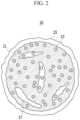
- the structure of the negative active material may be as depicted in FIGS. 1 and 2 .
- FIGS. 1 and 2 may show examples of the structure of the negative active material without limitation.
- FIG. 1 is a schematic view of a structure of a negative active material according to one embodiment
- FIG. 2 is a schematic view of a structure of a negative active material according to another embodiment.
- the negative active material 10 may include a core including crystalline carbon 11 and SiO x particles 13 and a coating layer 15 surrounding the core.
- the core may have a structure where the SiO x particle 13 is positioned on a surface of the crystalline carbon 11.
- the core comprises core particles.
- the crystalline carbon 11 may have one or more pores 17 therein. In the case that the crystalline carbon has one of more pores 17 therein, it may function of buffering for volume expansion of the SiO X particles during charge and discharge. In some embodiments, the SiO x particles 13 may be positioned on the surface of the crystalline carbon 11 and reside in the pores 17.
- the negative active material 20 may include a core including the crystalline carbon 21 and SiO x particles 23 and a coating layer 25 surrounding the core.
- the core may have a structure where the SiO x particles 23 are dispersed throughout the crystalline carbon 21.
- the crystalline carbon 21 may have one of more pores 27 therein. In the case that the crystalline carbon has one of more pores 27 therein, it may function of buffering for volume expansion of the SiO X particle during charge and discharge. In some embodiments, the SiO x particle 23 may be positioned on the surface of the crystalline carbon 21 and reside in the pores 27.
- the crystalline carbon may function of buffering for volume expansion of the SiO x particles during charge and discharge, and provide excellent electrical conductivity.
- the crystalline carbon may include at least one selected from natural graphite and artificial graphite.
- the crystalline carbon may be included in an amount of about 45 wt% to about 94 wt% based on the total amount of the negative active material including the core and the coating layer. In some embodiments, the crystalline carbon may be included in an amount of about 65 to about 85 wt% based on the total amount of the negative active material including the core and the coating layer.
- the crystalline carbon is include within any of the above ranges, buffering effect for volume expansion of the SiO X particle increases, and excellent electrical conductivity may be provided.
- the SiO x particles may be amorphous, or may be disproportionate SiO x including silicon crystal due to disproportionation reaction. When the SiO x particles are amorphous, it may show excellent cycle-life characteristics rather than the disproportionate SiO x .
- x ranges from about 0.5 to about 1.5 in the SiO x particles. When x is within the above range, a rechargeable lithium battery having improved cycle-life characteristics and a high capacity increase ratio of an active material per unit weight may be realized.
- the SiO X particles may have average particle diameter of about 0.3 ⁇ m to about 5 ⁇ m. In some embodiments, the SiO X particle may have average particle diameter of about 0.5 ⁇ m to about 5 ⁇ m. In some embodiments, the SiO X particle may have average particle diameter of about 1 ⁇ m to about 5 ⁇ m. When the SiO x particles have an average particle diameter within any of the above ranges, volume expansion may be suppressed during charge and discharge and cycle-life may be improved.
- the core may include the SiO X particles and the crystalline carbon in a weight ratio of about 1:1.5 to about 1:19. In some embodiments, the core may include the SiO X particles and the crystalline carbon in a weight ratio of about 1:5 to about 1:19. In some embodiments, the core may include the SiO X particles and the crystalline carbon in a weight ratio of about 1:8 to about 1:19. Within any of the above weight ratio ranges, a buffering effect for volume expansion of the SiO x particle may increase, excellent electrical conductivity may be provided, and cycle-life may be improved.
- the SiO X particles may be included in an amount of about 5 wt% to about 40 wt% based on the total amount of the negative active material including the core and the coating layer. In some embodiments, the SiO X particles may be included in an amount of about 5 wt% to about 30 wt% based on the total amount of the negative active material including the core and the coating layer.
- volume expansion may be suppressed during charge and discharge and cycle-life may be improved.
- the core may further include a metal oxide disposed on the surface of the SiO X particle and represented by the following Chemical Formula 1.
- Chemical Formula 1 M y O z Chemical Formula 1 M y O z
- M may be aluminum (Al), titanium (Ti), magnesium (Mg), zirconium (Zr), or a combination thereof.
- the coating layer may surround both the crystalline carbon and SiO x particle allowing the SiO x particles to be attached to the surface of the crystalline carbon strongly.
- the coating layer may have the function of buffering for volume expansion of the SiO X particle during charge and discharge along with the crystalline carbon, and thus improve cycle-life characteristics.
- the amorphous carbon of the coating layer may include at least one selected from soft carbon, hard carbon, a mesophase pitch carbonized product, and fired cokes.
- the coating layer may have a thickness of about 100 nm to about 2000 nm.
- excellent buffering for volume expansion of the SiO X particle may be provided.
- the coating layer may be included in an amount of about 1 wt% to about 20 wt% based on the total amount of the negative active material including the core and coating layer. In some embodiments, the coating layer may be included in an amount of about 5 to about 20 wt% based on the total amount of the negative active material including the core and coating layer. When the coating layer is included within any of the above ranges, excellent buffering for volume expansion of the SiO x particle may be provided.
- the negative active material having a structure of FIG. 1 may be prepared according to the following processes.
- the SiO x particles having average particle diameter of about 0.3 ⁇ m to about 5 ⁇ m, and about 45 wt% to about 94 wt% of the crystalline carbon are mixed in a solvent, and a structure where the SiO x particle is positioned on the surface of the crystalline carbon is obtained.
- the crystalline carbon may be obtained by spherically shaping.
- SiO x may be added to the spherically shaping of the crystalline carbon, and mixed therewith.
- the solvent may include at least one selected from benzene, ethanol, and methanol.
- the precursor of the amorphous carbon may include coal pitch, mesophase pitch, petroleum pitch, coal oil, petroleum heavy oil, and the like, or a polymer resin such as a phenolic resin, a furan resin, a polyimide resin, and the like.
- the solvent may include at least one selected from
- the amounts of the SiO X particle, the crystalline carbon, and the precursor of amorphous carbon are based on the total sum thereof.
- the heat treatment may be performed at about 600°C to about 1100°C. In some embodiments, the heat treatment may be performed at about 750 °C to about 850 °C, under an atmosphere such as N 2 or Ar, for about 0.5 hour to about 4 hours.
- amorphous SiO x may be maintained, or disproportionate SiO x particle may be formed wherein silicon crystal is formed through a disproportionation reaction. Such formation of a particle may be confirmed through a silicon (Si) peak of XRD.
- the precursor of the amorphous carbon may be carbonized converting into amorphous carbon, and both the crystalline carbon the SiO X particles may be surrounded to form a coating layer.
- a negative active material having a structure of FIG. 2 may be prepared by adding the SiO X particles during spherically shaping of the crystalline carbon.
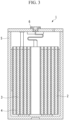
- FIG. 3 is an exploded perspective view of a rechargeable lithium battery according to one embodiment.
- the rechargeable lithium battery 1 may be a prismatic battery that includes an electrode assembly including a positive electrode 2, a negative electrode 3, and a separator 4 between the positive electrode 2 and negative electrode 3, in a battery case 5, and an electrolyte solution injected through an upper part of the battery case 5, and a cap plate 6 sealing them.
- the rechargeable lithium battery according to embodiments of the present invention are not limited to the prismatic battery.
- the a battery including the negative active material for a rechargeable lithium battery as disclosed herein may be a cylindrical, coin-type, pouch-type battery, and the like without limitation.
- the negative electrode may include a negative current collector and a negative active material layer disposed thereon, and the negative active material layer may include a negative active material.
- the negative active material may be included in an amount of about 80 wt% to about 99 wt% based on the total weight of the negative active material layer.
- the negative active material may be the above described negative active material, and specifically a silicon-based active material, or a mixture of the described silicon-based active material and a generally-used carbon-based active material that is generally in a rechargeable lithium battery.
- the silicon-based active material and the carbon-based active material may be mixed in a
- the carbon-based active material may be any generally-used carbon-based active material in a lithium ion rechargeable battery.
- the carbon-based active material include crystalline carbon, amorphous carbon, and mixtures thereof.
- the crystalline carbon may be non-shaped, or sheet, flake, spherical, or fiber shaped natural graphite or artificial graphite.
- the amorphous carbon may be a soft carbon, a hard carbon, a mesophase pitch carbonization product, fired coke, and the like.
- a carbon-based active material having less volume changes during charge and discharge for example graphite
- electrical conductive path due to volume changes of the SiO X particle volume in the silicon-based active material in an electrode during charge and discharge may be secured more advantageously.
- the negative active material layer may include a binder, and optionally a conductive material.
- the binder may be included in an amount of about 1 to about 5 wt% of a binder based on the total weight of the negative active material layer.
- the negative active material layer includes a conductive material, the negative active material layer includes about 90 wt% to about 98 wt% of the negative active material, about 1 wt% to about 5 wt% of the binder, and about 1 wt% to about 5 wt% of the conductive material.
- the binder may improve binding properties of negative active material particles with one another and with a current collector.
- the binder may include a non-water-soluble binder, a water-soluble binder, or a combination thereof.
- the non-water-soluble binder includes polyvinylchloride, carboxylated polyvinylchloride, polyvinylfluoride, an ethylene oxide-containing polymer, polyvinylpyrrolidone, polyurethane, polytetrafluoroethylene, polyvinylidene fluoride, polyethylene, polypropylene, polyamideimide, polyimide, or a combination thereof.
- the water-soluble binder includes a styrene-butadiene rubber, an acrylated styrene-butadiene rubber, polyvinyl alcohol, sodium polyacrylate, a copolymer of propylene and a C 2 to C8 olefin, a copolymer of (meth)acrylic acid and (meth)acrylic acid alkyl ester, or a combination thereof.
- a cellulose-based compound may be further used to provide viscosity.
- the cellulose-based compound includes one or more of carboxylmethyl cellulose, hydroxypropylmethyl cellulose, methyl cellulose, or alkali metal salts thereof.
- the alkali metal may be Na, K, or Li.
- the cellulose-based compound may be included in an amount of about 0.1 to about 50 parts by weight based on 100 parts by weight of the negative active material.
- the conductive material may be included to provide electrode conductivity. Any electrically conductive material may be used as a conductive material unless it causes a chemical change. Examples of the conductive material include carbon-based materials such as natural graphite, artificial graphite, carbon black, acetylene black, ketjen black, carbon fibers, and the like; metal-based materials of metal powder or metal fiber including copper, nickel, aluminum, silver, and the like; conductive polymers such as polyphenylene derivatives; or a mixture thereof.
- the current collector may include one selected from a copper foil, a nickel foil, a stainless steel foil, a titanium foil, nickel foam, copper foam, a polymer substrate coated with a conductive metal, and a combination thereof, but embodiments of the present invention are not limited thereto.
- the positive electrode includes a current collector and a positive active material layer disposed on the current collector.
- the positive active material may include a compound that reversibly intercalates and deintercalates lithium (a lithiated intercalation compound).
- a composite oxide of at least one of cobalt, manganese, nickel, or combination thereof, and lithium may be used. Examples may be compounds represented by the following chemical formulae: Li a A 1-b X b D 1 2 (0.90 ⁇ a ⁇ 1.8, 0 ⁇ b ⁇ 0.5); Li a A 1-b X b O 2-c D 1 c .
- A is selected from Ni, Co, Mn, and a combination thereof;
- X is selected from Al, Ni, Co, Mn, Cr, Fe, Mg, Sr, V, a rare earth element, and a combination thereof;
- D 1 is selected from O (oxygen), F (fluorine), S (sulfur), P (phosphorus), and a combination thereof;
- E is selected from Co, Mn, and a combination thereof;
- T is selected from F (fluorine), S (sulfur), P (phosphorus), and a combination thereof;
- G is selected from Al, Cr, Mn, Fe, Mg, La, Ce, Sr, V, and a combination thereof;
- Q is selected from Ti, Mo, Mn, and a combination thereof;
- Z is selected from Cr, V, Fe, Sc, Y, and a combination thereof;
- J is selected from V, Cr, Mn, Co, Ni, Cu, and a combination thereof.
- the compounds may have a coating layer on the surface, or may be mixed with another compound having a coating layer.
- the coating layer may include at least one coating element compound selected from the group consisting of an oxide of a coating element, a hydroxide of a coating element, an oxyhydroxide of a coating element, an oxycarbonate of a coating element, and a hydroxyl carbonate of a coating element.
- the compound for the coating layer may be amorphous or crystalline.
- the coating element included in the coating layer may include Mg, Al, Co, K, Na, Ca, Si, Ti, V, Sn, Ge, Ga, B, As, Zr, or a mixture thereof.
- the coating layer may be disposed in a method having no adverse influence on properties of a positive active material by using these elements in the compound.
- the method may include any coating method such as spray coating, dipping, and the like, but is not illustrated in more detail since it is well-known to those who work in the related field.
- the positive active material may be included in an amount of about 80 wt% to about 99 wt% based on the total weight of the positive active material layer.
- the positive active material layer includes a binder and a conductive material.
- the binder and conductive material are included in each amount of about 1 wt% to 5 wt% based on the total weight of the positive active material layer.
- the binder may improve binding properties of the positive active material particles to each other and to a current collector.
- the binder include polyvinylalcohol, carboxylmethylcellulose, hydroxypropylcellulose, diacetylcellulose, polyvinylchloride, carboxylated polyvinylchloride, polyvinylfluoride, an ethylene oxide-containing polymer, polyvinylpyrrolidone, polyurethane, polytetrafluoroethylene, polyvinylidene fluoride, polyethylene, polypropylene, a styrene-butadiene rubber, an acrylated styrene-butadiene rubber, an epoxy resin, nylon, and the like, but embodiments of the present invention are not limited thereto.
- the conductive material provides an electrode with conductivity. Any electrically conductive material may be used as a conductive material unless it causes a chemical change.
- the conductive material include a carbon-based material such as natural graphite, artificial graphite, carbon black, acetylene black, ketjen black, a carbon fiber, and the like; a metal-based material such as metal powder or metal fiber including copper, nickel, aluminum, silver, and the like; a conductive polymer such as polyphenylene derivative, or a mixture thereof.
- the current collector may be an Al foil, but embodiments of the present invention are not limited thereto.
- the negative electrode and positive electrode may be fabricated by a method including mixing an active material, a conductive material, and a binder in a solvent to prepare an active material composition, and coating the active material composition on a current collector, respectively.
- the solvent may include N-methylpyrrolidone, and the like, but embodiments of the present invention are not limited thereto.
- a solvent used for preparing the negative active material composition may be water.
- the electrolyte solution includes a non-aqueous organic solvent and a lithium salt.
- the non-aqueous organic solvent serves as a medium of transmitting ions taking part in the electrochemical reaction of the battery.
- the non-aqueous organic solvent may be selected from a carbonate-based, ester-based, ether-based, ketone-based, alcohol-based, or aprotic solvent.
- Examples of the carbonate-based solvent may include, for example dimethyl carbonate (DMC), diethyl carbonate (DEC), dipropyl carbonate (DPC), methylpropyl carbonate (MPC), ethylpropyl carbonate (EPC), methylethyl carbonate (MEC), ethylmethyl carbonate (EMC), ethylene carbonate (EC), propylene carbonate (PC), butylene carbonate (BC), or the like.
- DMC dimethyl carbonate
- DEC diethyl carbonate
- DPC dipropyl carbonate
- MPC methylpropyl carbonate
- EPC ethylpropyl carbonate
- MEC methylethyl carbonate
- EMC ethylmethyl carbonate
- EMC ethylmethyl carbonate
- EC ethylene carbonate
- PC propylene carbonate
- BC butylene carbonate
- a solvent having a high dielectric constant and low viscosity may be provided.
- the cyclic carbonate compound and chain carbonate compound may be mixed in a volume ratio of about 1:1 to about 1:9.
- ester-based solvent may include methyl acetate, ethyl acetate, n-propyl acetate, dimethylacetate, methylpropionate, ethylpropionate, ⁇ -butyrolactone, decanolide, valerolactone, mevalonolactone, caprolactone, and the like.
- ether-based solvent examples include dibutyl ether, tetraglyme, diglyme, dimethoxyethane, 2-methyltetrahydrofuran, tetrahydrofuran, and the like
- examples of the ketone-based solvent include cyclohexanone and the like.
- the alcohol-based solvent include ethyl alcohol, isopropyl alcohol, and the like.
- the non-aqueous organic solvent may be used singularly or in a mixture.
- the mixture ratio can be controlled in accordance with a desirable battery performance.
- non-aqueous organic solvent may further include an aromatic hydrocarbon-based solvent as well as the carbonate-based solvent.
- the carbonate-based solvents and aromatic hydrocarbon-based solvents may be mixed together in a volume ratio of about 1:1 to about 30:1.
- the aromatic hydrocarbon-based organic solvent may be an aromatic hydrocarbon-based compound represented by the following Chemical Formula 2.
- each R 1 to R 6 is independently hydrogen, a halogen, a C 1 to C 10 alkyl, or a C 1 to C 10 haloalkyl.
- the aromatic hydrocarbon-based organic solvent may include, but embodiments of the present invention are not limited to, at least one selected from benzene, fluorobenzene, 1,2-difluorobenzene, 1,3-difluorobenzene, 1,4-difluorobenzene, 1,2,3-trifluorobenzene, 1,2,4-trifluorobenzene, chlorobenzene, 1,2-dichlorobenzene, 1,3-dichlorobenzene, 1,4-dichlorobenzene, 1,2,3-trichlorobenzene, 1,2,4-trichlorobenzene, iodobenzene, 1,2-diiodobenzene, 1,3-diiodobenzene, 1,4-diiodobenzene, 1,2,3-triiodobenzene, 1,2,4-triiodobenzene, toluene, fluorotoluene, 2,
- the non-aqueous organic solvent may further include vinylene carbonate or an ethylene carbonate-based compound represented by the following Chemical Formula 3 to improve cycle life.
- R 7 and R 8 are the same or different and may be each independently hydrogen, a halogen, a cyano group (CN), a nitro group (NO 2 ), or a C 1 to C 5 fluoroalkyl group, provided that at least one of R 7 and R 8 is a halogen, a cyano group (CN), a nitro group (NO 2 ), or a C1 to C 5 fluoroalkyl group, and R 7 and R 8 are not simultaneously hydrogen.
- Examples of the ethylene carbonate-based compound include difluoroethylene carbonate, chloroethylene carbonate, dichloroethylene carbonate, bromoethylene carbonate, dibromoethylene carbonate, nitroethylene carbonate, cyanoethylene carbonate, fluoroethylene carbonate, and the like.
- the amount of the additive for improving cycle life may be flexibly used within an appropriate range.
- the lithium salt is dissolved in an organic solvent, and supplies a battery with lithium ions, basically operates the rechargeable lithium battery, and improves transportation of the lithium ions between positive and negative electrodes.
- lithium salt examples include at least one supporting salt selected from LiPF 6 , LiBF 4 , LiSbF 6 , LiAsF 6 , LiN(SO 2 C 2 F 5 ) 2 , Li(CF 3 SO 2 ) 2 N, LiN(SO 3 C 2 F 5 ) 2 , LiC 4 F 9 SO 3 , LiClO 4 , LiAlO 2 , LiAlCl 4 , LiN(C x F 2x+1 SO 2 )(C y F 2y+1 SO 2 ) (where x and y are natural numbers of 1 to 20, respectively), LiCl, LiI, and LiB(C 2 O 4 ) 2 (lithium bis(oxalato)borate).
- LiPF 6 LiBF 4 , LiSbF 6 , LiAsF 6 , LiN(SO 2 C 2 F 5 ) 2 , Li(CF 3 SO 2 ) 2 N, LiN(SO 3 C 2 F 5 ) 2 , LiC 4 F 9 SO 3 , LiCl
- the lithium salt may be used in a concentration ranging from about 0.1 M to about 2.0 M.
- an electrolyte may have optimal electrolyte conductivity and viscosity, and may thus have enhanced performance and effective lithium ion mobility.
- the separator may include any materials commonly used in the conventional lithium battery as long as separating a negative electrode from a positive electrode and providing a transporting passage of lithium ion. In other words, it may have a low resistance to ion transport and an excellent impregnation for electrolyte solution.
- it may be selected from glass fiber, polyester, polyethylene, polypropylene, polytetrafluoroethylene (PTFE), or a combination thereof.
- It may have a form of a non-woven fabric or a woven fabric.
- polyolefin-based polymer separator such as polyethylene, polypropylene or the like is mainly used.
- a coated separator including a ceramic component or a polymer material may be used.
- it may have a mono-layered or multi-layered structure.
- amorphous SiO particles having an average particle diameter of 0.3 ⁇ m and 75 wt% of natural graphite were mixed in ethanol and then the ethanol was removed affording a mixture having the SiO particles on the surface of the natural graphite.
- 15 wt% of coal pitch was added to the mixture.
- the resulting mixture was heattreated at 850°C under a N 2 atmosphere for 2hours, providing a negative active material.
- the negative active material has a structure of having the SiO particles on the surface of the natural graphite all surrounded with a coating layer made of amorphous carbon.
- a negative active material was prepared according to the same method as Example 1 except for using amorphous SiO particles with an average particle diameter of 0.5 ⁇ m.
- a negative active material was prepared according to the same method as Example 1 except for using amorphous SiO particles with an average particle diameter of 1 ⁇ m.
- a negative active material was prepared according to the same method as Example 1 except for using amorphous SiO particles with an average particle diameter of 5 ⁇ m.
- a negative active material was prepared according to the same method as Example 1 except for using amorphous SiO particles with an average particle diameter of 1 ⁇ m and performing the heat treatment at 1050°C.
- a negative active material was prepared according to the same method as Example 1 except for using 20 wt% of amorphous SiO particles having an average particle diameter of 1 ⁇ m, 65 wt% of natural graphite, and 15 wt% of coal pitch.
- a negative active material was prepared according to the same method as Example 1 except for using 15 wt% of amorphous SiO particles having an average particle diameter of 1 ⁇ m, 75 wt% of natural graphite, and 10 wt% of coal pitch.
- a negative active material was prepared according to the same method as Example 1 except for using 9 wt% of amorphous SiO particles having an average particle diameter of 1 ⁇ m, 81 wt% of natural graphite, and 10 wt% of coal pitch.
- a negative active material was prepared according to the same method as Example 1 except for using 5 wt% of amorphous SiO particles with an average particle diameter of 1 ⁇ m, 80 wt% of natural graphite, and 15 wt% of coal pitch.
- a negative active material was prepared according to the same method as Example 1 except for using 35 wt% of SiO particles with an average particle diameter of 1 ⁇ m, 35 wt% of natural graphite, and 30 wt% of coal pitch.
- a negative active material was prepared according to the same method as Example 1 except for using 4 wt% of SiO particles with an average particle diameter of 1 ⁇ m, 80 wt% of natural graphite, and 16 wt% of coal pitch.
- a negative active material was prepared according to the same method as Example 1 except for using Si particles with an average particle diameter of 1 ⁇ m.
- a negative active material was prepared according to the same method as Example 1 except for using SiO particles with an average particle diameter of 0.05 ⁇ m.
- a negative active material was prepared according to the same method as Example 1 except for using SiO particles with an average particle diameter of 0.1 ⁇ m.
- a negative active material was prepared according to the same method as Example 1 except for using SiO particles with an average particle diameter of 10 ⁇ m.
- a negative active material was prepared according to the same method as Example 1 except for using SiO particles with an average particle diameter of 15 ⁇ m.
- a positive electrode was fabricated by mixing 96 wt% of a LiCoO 2 positive active material, 2 wt% of a polyvinylidene fluoride binder, and 2 wt% of a carbon black conductive material in N-methyl pyrrolidone to prepare positive active material slurry and then, coating the slurry on an Al film current collector and drying and compressing it.
- the negative electrode, the positive electrode, and an electrolyte solution were used to fabricate a prismatic battery cell.
- the electrolyte solution was prepared by mixing ethylene carbonate (EC), fluoroethylene carbonate (FEC), ethylmethyl carbonate (EMC), and diethylcarbonate (DEC) in a volume ratio of 25:10:40:25 and dissolving 1.15M of LiPF 6 therein.
- the battery cells were charged with 1.5A up to 4.35V and then, with 50mA and discharged with 1.5A down to 2.75V.
- the rechargeable lithium battery cells fabricated using each negative active material including SiO x particles with an average particle diameter of about 0.3 ⁇ m to about 5 ⁇ m according to Examples 1 to 9 had excellent cycle-life characteristic compared with the rechargeable lithium battery cells fabricated using each negative active material including SiO x particles outside of the average particle diameter according to Comparative Examples 2 to 5.
- the rechargeable lithium battery cell using Si particles instead of the SiO x particles according to Comparative Example 1 had deteriorated cycle-life characteristic. Accordingly, a volume expansion due to the SiO x particles turned out to be effectively suppressed.
- Examples 3 and 6 to 9 using SiO x particles having the same average particle diameter had a bigger ratio difference between SiO x particles and crystalline carbon (natural graphite) within the weight ratio range of 1:1.5 to 1:19 and superior cycle-life characteristics.
- Examples 3 and 5 used SiO particles having the same average particle diameter, but Example 3 using amorphous SiO x particles had better cycle-life characteristic than Example 5 using SiO x particles having silicon crystals
- Example 10 included SiO x particles and crystalline carbon in a weight ratio of less than 1:1.5 and had a somewhat deteriorated cycle-life characteristic compared with Examples 3 and 6 to 9. The reason is that the crystalline carbon (natural graphite) did not effectively suppress expansion stress of the SiO x particles and maintain electric conductivity passage.
- Example 11 using the SiO x particles and the crystalline carbon in a weight ratio of greater than 1:19 maintained cycle-life.
- the amount of SiO x particles having higher capacity than the crystalline carbon is very small, thus the increases in the capacity using the SiO x particles cannot be expected.
Landscapes
- Chemical & Material Sciences (AREA)
- Chemical Kinetics & Catalysis (AREA)
- Electrochemistry (AREA)
- General Chemical & Material Sciences (AREA)
- Engineering & Computer Science (AREA)
- Composite Materials (AREA)
- Materials Engineering (AREA)
- Manufacturing & Machinery (AREA)
- Inorganic Chemistry (AREA)
- Battery Electrode And Active Subsutance (AREA)
- Secondary Cells (AREA)
Description
- This disclosure relates to a negative active material for a rechargeable lithium battery, and a negative electrode and a rechargeable lithium battery including the same. Rechargeable lithium batteries have recently drawn attention as a power source for small portable electronic devices. Rechargeable lithium batteries use an organic electrolyte solution and thereby, have twice or more high discharge voltage than conventional batteries using an alkali aqueous solution and may have high energy density.
- A rechargeable lithium battery may include a positive electrode including a positive active material being capable of intercalating and deintercalating lithium and a negative electrode including a negative active material being capable of intercalating and deintercalating lithium in a battery cell and an electrolyte solution injected therein.
- As for negative active materials of a rechargeable lithium battery, various carbon-based materials such as artificial graphite, natural graphite, and hard carbon may be used.
- Recently, non-carbon-based negative active materials such as Si have been investigated to afford stability and high-capacity in rechargeable lithium batteries.
-
EP2450986 discloses a negative active material for a rechargeable lithium battery includes a core including crystalline carbon, a metal nano particle and a MOx nano particle (where x is from 0.5 to 1.5, and M is Si, Sn, In, Al, or a combination thereof) disposed on the core surface, and a coating layer including an amorphous carbon surrounding the core surface, the metal nano particle and the MOx nano particle. - Some embodiments provide a negative active material for a rechargeable lithium battery having excellent cycle-life characteristics. Some embodiments provide a negative electrode for a rechargeable lithium battery including the negative active material. Some embodiments provide a rechargeable lithium battery including the negative electrode.
- Some embodiments provide a negative active material for a rechargeable lithium battery that includes a silicon-based active material including a core; and a coating layer surrounding the core, wherein the core comprises crystalline carbon and SiOx (0.5≤×≤1.5) particles where the SiOX particles have an average particle diameter of about 0.3 µm to about 5 µm, and wherein the coating layer includes amorphous carbon.
- In some embodiments, the SiOX particles may have an average particle diameter of about 0.5 µm to about 5 µm. In some embodiments, the SiOX particles may have an average particle diameter of about 1 µm to about 5 µm.
- In some embodiments, the SiOX particles and the crystalline carbon may be included in a weight ratio of about 1:1.5 to about 1:19. In some embodiments, the SiOX particles and the crystalline carbon may be included in a weight ratio of about 1:5 to about 1:19.
- In some embodiments, the SiOx particles may be amorphous.
- In some embodiments, the SiOx particles may be included in an amount of about 5 wt% to about 40 wt% based on the total amount of the negative active material.
- In some embodiments, the core may include crystalline carbon; and SiOX particles disposed on the surface of the crystalline carbon. In some embodiments, the crystalline carbon may include pores, and the SiOx particles may be disposed on the surface of the crystalline carbon and reside in the pores of the crystalline carbon.
- In some embodiments, the crystalline carbon may include pores. The SiOx particles may be disposed in the pores of the crystalline carbon.
- In some embodiments, the core may include the crystalline carbon; and the SiOx particles dispersed between the crystalline carbon, the crystalline carbon may include pores, and the SiOX particles may be disposed between the crystalline carbon and reside in the pores of the crystalline carbon.
- In some embodiments, the crystalline carbon may be included in an amount of about 45 wt% to about 94 wt% based on the total amount of the negative active material.
- In some embodiments, the crystalline carbon may include at least one selected from natural graphite and artificial graphite.
- In some embodiments, the core may further include a metal oxide disposed on the surface of the SiOx particles and represented by the following Chemical Formula 1.
Chemical Formula 1 M yOz
- In Chemical Formula 1, M may be at least one metal selected from aluminum (Al), titanium (Ti), cobalt (Co), magnesium (Mg), calcium (Ca), potassium (K), sodium (Na), boron (B), strontium (Sr), barium (Ba), manganese (Mn), nickel (Ni), vanadium (V), iron (Fe), copper (Cu), phosphorus (P), scandium (Sc), zirconium (Zr), niobium (Nb), chromium (Cr), and molybdenum (Mo), o<y<5 and o<z<20.
- In some embodiments, the coating layer may be included in an amount of about 1 wt% to about 20 wt% based on the total amount of the negative active material.
- In some embodiments, the amorphous carbon may include at least one selected from soft carbon, hard carbon, a mesophase pitch carbonized product, and fired coke.
- In some embodiments, the coating layer may have a thickness of about 100 nm to about 2000 nm.
- In some embodiments, the negative active material may further include a carbon-based active material, and the silicon-based active material and carbon-based active material may be mixed at a weight ratio of about 2.5:97.5 to about 97.5 to 2.5.
- According to another embodiment, a negative electrode for a rechargeable lithium battery including the negative active material is provided. The negative electrode may further include a current collector.
- Some embodiments provide a rechargeable lithium battery including the negative electrode, a positive electrode, and an electrolyte solution.
- According to an aspect of the invention, there is provided a negative active material for a rechargeable lithium battery according to claim 1. In some embodiments, the silicon-based active material includes particles, the particles including the core, SiOx particles and coating layer.
- Preferred features of this aspect are set out in
claims 2 to 12. - According to another aspect of the invention, there is provided a negative electrode as set out in
claim 13. - According to another aspect of the invention, there is provided a rechargeable lithium battery as set out in claim 14.
- Hereinafter, further embodiments will be described in the detailed description. Some embodiments provide a rechargeable lithium battery having excellent cycle-life characteristics.
-
FIG. 1 is a schematic view of a structure of a negative active material according to one embodiment. -
FIG. 2 is a schematic view of a structure of a negative active material according to another embodiment. -
FIG. 3 is an exploded perspective view of a rechargeable lithium battery according to one embodiment. - Exemplary embodiments will hereinafter be described in detail. However, these embodiments are only exemplary, and this disclosure is not limited thereto.
- Some embodiments provide a negative active material including a silicon-based active material including a core including crystalline carbon and SiOx (0.5≤x ≤1.5) particles; and a coating layer surrounding the core and including amorphous carbon.
- In some embodiments, the structure of the negative active material may be as depicted in
FIGS. 1 and2 .FIGS. 1 and2 may show examples of the structure of the negative active material without limitation. -
FIG. 1 is a schematic view of a structure of a negative active material according to one embodiment, andFIG. 2 is a schematic view of a structure of a negative active material according to another embodiment. - Referring to
FIG. 1 , the negativeactive material 10 may include a core includingcrystalline carbon 11 and SiOx particles 13 and acoating layer 15 surrounding the core. In some embodiments, the core may have a structure where the SiOx particle 13 is positioned on a surface of thecrystalline carbon 11. In this embodiment, the core comprises core particles. - In some embodiments, the
crystalline carbon 11 may have one ormore pores 17 therein. In the case that the crystalline carbon has one ofmore pores 17 therein, it may function of buffering for volume expansion of the SiOX particles during charge and discharge. In some embodiments, the SiOx particles 13 may be positioned on the surface of thecrystalline carbon 11 and reside in thepores 17. - Referring to
FIG. 2 , the negativeactive material 20 may include a core including thecrystalline carbon 21 and SiOx particles 23 and acoating layer 25 surrounding the core. In some embodiments, the core may have a structure where the SiOx particles 23 are dispersed throughout thecrystalline carbon 21. - In some embodiments, the
crystalline carbon 21 may have one ofmore pores 27 therein. In the case that the crystalline carbon has one ofmore pores 27 therein, it may function of buffering for volume expansion of the SiOX particle during charge and discharge. In some embodiments, the SiOx particle 23 may be positioned on the surface of thecrystalline carbon 21 and reside in thepores 27. - In some embodiments, the crystalline carbon may function of buffering for volume expansion of the SiOx particles during charge and discharge, and provide excellent electrical conductivity.
- In some embodiments, the crystalline carbon may include at least one selected from natural graphite and artificial graphite.
- In some embodiments, the crystalline carbon may be included in an amount of about 45 wt% to about 94 wt% based on the total amount of the negative active material including the core and the coating layer. In some embodiments, the crystalline carbon may be included in an amount of about 65 to about 85 wt% based on the total amount of the negative active material including the core and the coating layer. When the crystalline carbon is include within any of the above ranges, buffering effect for volume expansion of the SiOX particle increases, and excellent electrical conductivity may be provided.
- In some embodiments, the SiOx particles may be amorphous, or may be disproportionate SiOx including silicon crystal due to disproportionation reaction. When the SiOx particles are amorphous, it may show excellent cycle-life characteristics rather than the disproportionate SiOx.
- In some embodiments, x ranges from about 0.5 to about 1.5 in the SiOx particles. When x is within the above range, a rechargeable lithium battery having improved cycle-life characteristics and a high capacity increase ratio of an active material per unit weight may be realized.
- In some embodiments, the SiOX particles may have average particle diameter of about 0.3 µm to about 5 µm. In some embodiments, the SiOX particle may have average particle diameter of about 0.5 µm to about 5 µm. In some embodiments, the SiOX particle may have average particle diameter of about 1 µm to about 5 µm. When the SiOx particles have an average particle diameter within any of the above ranges, volume expansion may be suppressed during charge and discharge and cycle-life may be improved.
- In some embodiments, the core may include the SiOX particles and the crystalline carbon in a weight ratio of about 1:1.5 to about 1:19. In some embodiments, the core may include the SiOX particles and the crystalline carbon in a weight ratio of about 1:5 to about 1:19. In some embodiments, the core may include the SiOX particles and the crystalline carbon in a weight ratio of about 1:8 to about 1:19. Within any of the above weight ratio ranges, a buffering effect for volume expansion of the SiOx particle may increase, excellent electrical conductivity may be provided, and cycle-life may be improved.
- In some embodiments, the SiOX particles may be included in an amount of about 5 wt% to about 40 wt% based on the total amount of the negative active material including the core and the coating layer. In some embodiments, the SiOX particles may be included in an amount of about 5 wt% to about 30 wt% based on the total amount of the negative active material including the core and the coating layer. When the SiOx particle is included within any of the above ranges, volume expansion may be suppressed during charge and discharge and cycle-life may be improved.
- In some embodiments, the core may further include a metal oxide disposed on the surface of the SiOX particle and represented by the following Chemical Formula 1.
Chemical Formula 1 M yOz
- In Chemical Formula 1,
- M may be a metal including aluminum (Al), titanium (Ti), cobalt (Co), magnesium (Mg), calcium (Ca), potassium (K), sodium (Na), boron (B), strontium (Sr), barium (Ba), manganese (Mn), nickel (Ni), vanadium (V), iron (Fe), copper (Cu), phosphorus (P), scandium (Sc), zirconium (Zr), niobium (Nb), chromium (Cr), molybdenum (Mo), or a combination thereof,
- o<y<5 and o<z<20.
- When the metal oxide is disposed on the surface of the SiOx particle, thermal stability and cycle-life characteristics of a negative active material may be further improved. In some embodiments, M may be aluminum (Al), titanium (Ti), magnesium (Mg), zirconium (Zr), or a combination thereof.
- In some embodiments, the coating layer may surround both the crystalline carbon and SiOx particle allowing the SiOx particles to be attached to the surface of the crystalline carbon strongly. In some embodiments, the coating layer may have the function of buffering for volume expansion of the SiOX particle during charge and discharge along with the crystalline carbon, and thus improve cycle-life characteristics.
- In some embodiments, the amorphous carbon of the coating layer may include at least one selected from soft carbon, hard carbon, a mesophase pitch carbonized product, and fired cokes.
- In some embodiments, the coating layer may have a thickness of about 100 nm to about 2000 nm. When the coating layer has a thickness within the above range, excellent buffering for volume expansion of the SiOX particle may be provided.
- In some embodiments, the coating layer may be included in an amount of about 1 wt% to about 20 wt% based on the total amount of the negative active material including the core and coating layer. In some embodiments, the coating layer may be included in an amount of about 5 to about 20 wt% based on the total amount of the negative active material including the core and coating layer. When the coating layer is included within any of the above ranges, excellent buffering for volume expansion of the SiOx particle may be provided.
- In some embodiments, the negative active material having a structure of
FIG. 1 may be prepared according to the following processes. - First, about 5 wt% to about 40 wt% of the SiOx particles having average particle diameter of about 0.3 µm to about 5 µm, and about 45 wt% to about 94 wt% of the crystalline carbon are mixed in a solvent, and a structure where the SiOx particle is positioned on the surface of the crystalline carbon is obtained. In some embodiments, the crystalline carbon may be obtained by spherically shaping. Alternatively, SiOx may be added to the spherically shaping of the crystalline carbon, and mixed therewith. In some embodiments, the solvent may include at least one selected from benzene, ethanol, and methanol.
- Then, about 1 wt% to about 20 wt% of a precursor of the amorphous carbon is added to the resultant mixture in a solvent or without using a solvent and heat treatment is performed. In some embodiments, the precursor of the amorphous carbon may include coal pitch, mesophase pitch, petroleum pitch, coal oil, petroleum heavy oil, and the like, or a polymer resin such as a phenolic resin, a furan resin, a polyimide resin, and the like. In some embodiments, the solvent may include at least one selected from
- Herein, the amounts of the SiOX particle, the crystalline carbon, and the precursor of amorphous carbon are based on the total sum thereof.
- In some embodiments, the heat treatment may be performed at about 600°C to about 1100°C. In some embodiments, the heat treatment may be performed at about 750 °C to about 850 °C, under an atmosphere such as N2 or Ar, for about 0.5 hour to about 4 hours. Depending on the heat treatment temperature, amorphous SiOx may be maintained, or disproportionate SiOx particle may be formed wherein silicon crystal is formed through a disproportionation reaction. Such formation of a particle may be confirmed through a silicon (Si) peak of XRD. Depending on the heat treatment temperature and under the above conditions, the precursor of the amorphous carbon may be carbonized converting into amorphous carbon, and both the crystalline carbon the SiOX particles may be surrounded to form a coating layer.
- In some embodiments, a negative active material having a structure of
FIG. 2 may be prepared by adding the SiOX particles during spherically shaping of the crystalline carbon. - Hereinafter, a rechargeable lithium battery including the negative active material is described referring to
FIG. 3 . -
FIG. 3 is an exploded perspective view of a rechargeable lithium battery according to one embodiment. - Referring to
FIG. 3 , the rechargeable lithium battery 1 may be a prismatic battery that includes an electrode assembly including apositive electrode 2, anegative electrode 3, and aseparator 4 between thepositive electrode 2 andnegative electrode 3, in abattery case 5, and an electrolyte solution injected through an upper part of thebattery case 5, and acap plate 6 sealing them. The rechargeable lithium battery according to embodiments of the present invention are not limited to the prismatic battery. In some embodiments, the a battery including the negative active material for a rechargeable lithium battery as disclosed herein may be a cylindrical, coin-type, pouch-type battery, and the like without limitation. - In some embodiments, the negative electrode may include a negative current collector and a negative active material layer disposed thereon, and the negative active material layer may include a negative active material. In some embodiments, the negative active material may be included in an amount of about 80 wt% to about 99 wt% based on the total weight of the negative active material layer.
- In some embodiments, the negative active material may be the above described negative active material, and specifically a silicon-based active material, or a mixture of the described silicon-based active material and a generally-used carbon-based active material that is generally in a rechargeable lithium battery. In some embodiments, the silicon-based active material and the carbon-based active material may be mixed in a
- In some embodiments, the carbon-based active material may be any generally-used carbon-based active material in a lithium ion rechargeable battery. Examples of the carbon-based active material include crystalline carbon, amorphous carbon, and mixtures thereof. In some embodiments, the crystalline carbon may be non-shaped, or sheet, flake, spherical, or fiber shaped natural graphite or artificial graphite. In some embodiments, the amorphous carbon may be a soft carbon, a hard carbon, a mesophase pitch carbonization product, fired coke, and the like.
- When used as the carbon-based active material, a carbon-based active material having less volume changes during charge and discharge, for example graphite, electrical conductive path due to volume changes of the SiOX particle volume in the silicon-based active material in an electrode during charge and discharge may be secured more advantageously.
- In some embodiments, the negative active material layer may include a binder, and optionally a conductive material. The binder may be included in an amount of about 1 to about 5 wt% of a binder based on the total weight of the negative active material layer. When the negative active material layer includes a conductive material, the negative active material layer includes about 90 wt% to about 98 wt% of the negative active material, about 1 wt% to about 5 wt% of the binder, and about 1 wt% to about 5 wt% of the conductive material.
- In some embodiments, the binder may improve binding properties of negative active material particles with one another and with a current collector. In some embodiments, the binder may include a non-water-soluble binder, a water-soluble binder, or a combination thereof.
- In some embodiments, the non-water-soluble binder includes polyvinylchloride, carboxylated polyvinylchloride, polyvinylfluoride, an ethylene oxide-containing polymer, polyvinylpyrrolidone, polyurethane, polytetrafluoroethylene, polyvinylidene fluoride, polyethylene, polypropylene, polyamideimide, polyimide, or a combination thereof.
- In some embodiments, the water-soluble binder includes a styrene-butadiene rubber, an acrylated styrene-butadiene rubber, polyvinyl alcohol, sodium polyacrylate, a copolymer of propylene and a C2 to C8 olefin, a copolymer of (meth)acrylic acid and (meth)acrylic acid alkyl ester, or a combination thereof.
- When the water-soluble binder is used as a negative electrode binder, a cellulose-based compound may be further used to provide viscosity. In some embodiments, the cellulose-based compound includes one or more of carboxylmethyl cellulose, hydroxypropylmethyl cellulose, methyl cellulose, or alkali metal salts thereof. In some embodiments, the alkali metal may be Na, K, or Li. In some embodiments, the cellulose-based compound may be included in an amount of about 0.1 to about 50 parts by weight based on 100 parts by weight of the negative active material.
- In some embodiments, the conductive material may be included to provide electrode conductivity. Any electrically conductive material may be used as a conductive material unless it causes a chemical change. Examples of the conductive material include carbon-based materials such as natural graphite, artificial graphite, carbon black, acetylene black, ketjen black, carbon fibers, and the like; metal-based materials of metal powder or metal fiber including copper, nickel, aluminum, silver, and the like; conductive polymers such as polyphenylene derivatives; or a mixture thereof.
- In some embodiments, the current collector may include one selected from a copper foil, a nickel foil, a stainless steel foil, a titanium foil, nickel foam, copper foam, a polymer substrate coated with a conductive metal, and a combination thereof, but embodiments of the present invention are not limited thereto.
- In some embodiments, the positive electrode includes a current collector and a positive active material layer disposed on the current collector. In some embodiments, the positive active material may include a compound that reversibly intercalates and deintercalates lithium (a lithiated intercalation compound). Specifically, a composite oxide of at least one of cobalt, manganese, nickel, or combination thereof, and lithium may be used. Examples may be compounds represented by the following chemical formulae:
LiaA1-bXbD1 2 (0.90 ≤ a ≤ 1.8, 0 ≤ b ≤ 0.5);
Lia A 1-b X bO2-c D1 c. (0.90 ≤ a ≤ 1.8, 0 ≤ b ≤ 0.5, 0 ≤ c ≤ 0.05);
Lia E 1-b X bO2-c D 1 c. (0.90 ≤ a ≤ 1.8, 0 ≤ b ≤ 0.5, 0 ≤ c ≤ 0.05);
Lia E 2-b X bO4-c D 1 c (0.90 ≤ a ≤ 1.8, 0 ≤ b ≤ 0.5, 0 ≤ c ≤ 0.05);
LiaNi1-b-cCob X c D 1 a (0.90 ≤ a ≤ 1.8, 0 ≤ b ≤ 0.5, 0 ≤ c ≤ 0.05, 0 < α ≤ 2);
LiaNi1-b-cCob X cO2-α T α (0.90 ≤ a ≤ 1.8, 0 ≤ b ≤ 0.5, 0 ≤ c ≤ 0.05, 0 < α < 2);
LiaNi1-b-cCob X cO2-α T 2 (0.90 ≤ a ≤ 1.8, 0 ≤ b ≤ 0.5, 0 ≤ c ≤ 0.05, 0 < α < 2);
LiaNi1-b-cMnb X cD1 α (0.90 ≤ a ≤ 1.8, 0 ≤ b ≤ 0.5, 0 ≤ c ≤ 0.05, 0 < α ≤ 2);
LiaNi1-b-cMnb X cO2-α T α (0.90 ≤ a ≤ 1.8, 0 ≤ b ≤ 0.5, 0 ≤ c ≤ 0.05, 0 < α < 2);
LiaNi1-b-cMnb X cO2-α T 2 (0.90 ≤ a ≤ 1.8, 0 ≤ b ≤ 0.5, 0 ≤ c ≤ 0.05, 0 < α < 2);
LiaNib E c G dO2 (0.90 ≤ a ≤ 1.8, 0 ≤ b ≤ 0.9, 0 ≤ c ≤ 0.5, 0.001 ≤ d ≤ 0.1);
LiaNibCocMnd G eO2 (0.90 ≤ a ≤ 1.8, 0 ≤ b ≤ 0.9, 0 ≤ c ≤ 0.5, 0 ≤ d ≤0.5, 0.001 ≤ e ≤ 0.1);
LiaNiGbO2 (0.90 ≤ a ≤ 1.8, 0.001 ≤ b ≤ 0.1);
LiaCoGbO2 (0.90 ≤ a ≤ 1.8, 0.001 ≤ b ≤ 0.1);
LiaMn1-bGbO2 (0.90 ≤ a ≤ 1.8, 0.001 ≤ b ≤ 0.1);
LiaMn2GbO4 (0.90 ≤ a ≤ 1.8, 0.001 ≤ b ≤ 0.1);
LiaMn1-gGgPO4 (0.90 ≤a ≤ 1.8, 0 ≤ g ≤ 0.5);
QO2; QS2; LiQS2; V2O5; LiV2O5; LiZO2; LiNiVO4; Li(3-f)J2(PO4)3 (0 ≤ f ≤ 2); Li(3-f)Fe2(PO4)3 (0 ≤ f ≤ 2); and LiFePO4.
- In the above chemical formulae, A is selected from Ni, Co, Mn, and a combination thereof; X is selected from Al, Ni, Co, Mn, Cr, Fe, Mg, Sr, V, a rare earth element, and a combination thereof; D1 is selected from O (oxygen), F (fluorine), S (sulfur), P (phosphorus), and a combination thereof; E is selected from Co, Mn, and a combination thereof; T is selected from F (fluorine), S (sulfur), P (phosphorus), and a combination thereof; G is selected from Al, Cr, Mn, Fe, Mg, La, Ce, Sr, V, and a combination thereof; Q is selected from Ti, Mo, Mn, and a combination thereof; Z is selected from Cr, V, Fe, Sc, Y, and a combination thereof; and J is selected from V, Cr, Mn, Co, Ni, Cu, and a combination thereof.
- In some embodiments, the compounds may have a coating layer on the surface, or may be mixed with another compound having a coating layer. In some embodiments, the coating layer may include at least one coating element compound selected from the group consisting of an oxide of a coating element, a hydroxide of a coating element, an oxyhydroxide of a coating element, an oxycarbonate of a coating element, and a hydroxyl carbonate of a coating element. In some embodiments, the compound for the coating layer may be amorphous or crystalline. In some embodiments, the coating element included in the coating layer may include Mg, Al, Co, K, Na, Ca, Si, Ti, V, Sn, Ge, Ga, B, As, Zr, or a mixture thereof. In some embodiments, the coating layer may be disposed in a method having no adverse influence on properties of a positive active material by using these elements in the compound. For example, the method may include any coating method such as spray coating, dipping, and the like, but is not illustrated in more detail since it is well-known to those who work in the related field.
- In some embodiments, the positive active material may be included in an amount of about 80 wt% to about 99 wt% based on the total weight of the positive active material layer. The positive active material layer includes a binder and a conductive material. Herein, the binder and conductive material are included in each amount of about 1 wt% to 5 wt% based on the total weight of the positive active material layer.
- In some embodiments, the binder may improve binding properties of the positive active material particles to each other and to a current collector. Examples of the binder include polyvinylalcohol, carboxylmethylcellulose, hydroxypropylcellulose, diacetylcellulose, polyvinylchloride, carboxylated polyvinylchloride, polyvinylfluoride, an ethylene oxide-containing polymer, polyvinylpyrrolidone, polyurethane, polytetrafluoroethylene, polyvinylidene fluoride, polyethylene, polypropylene, a styrene-butadiene rubber, an acrylated styrene-butadiene rubber, an epoxy resin, nylon, and the like, but embodiments of the present invention are not limited thereto.
- In some embodiments, the conductive material provides an electrode with conductivity. Any electrically conductive material may be used as a conductive material unless it causes a chemical change. Examples of the conductive material include a carbon-based material such as natural graphite, artificial graphite, carbon black, acetylene black, ketjen black, a carbon fiber, and the like; a metal-based material such as metal powder or metal fiber including copper, nickel, aluminum, silver, and the like; a conductive polymer such as polyphenylene derivative, or a mixture thereof.
- In some embodiments, the current collector may be an Al foil, but embodiments of the present invention are not limited thereto.
- In some embodiments, the negative electrode and positive electrode may be fabricated by a method including mixing an active material, a conductive material, and a binder in a solvent to prepare an active material composition, and coating the active material composition on a current collector, respectively. In some embodiments, the solvent may include N-methylpyrrolidone, and the like, but embodiments of the present invention are not limited thereto. When the negative electrode includes a water-soluble binder, a solvent used for preparing the negative active material composition may be water.
- In some embodiments, the electrolyte solution includes a non-aqueous organic solvent and a lithium salt.
- In some embodiments, the non-aqueous organic solvent serves as a medium of transmitting ions taking part in the electrochemical reaction of the battery. In some embodiments, the non-aqueous organic solvent may be selected from a carbonate-based, ester-based, ether-based, ketone-based, alcohol-based, or aprotic solvent.
- Examples of the carbonate-based solvent may include, for example dimethyl carbonate (DMC), diethyl carbonate (DEC), dipropyl carbonate (DPC), methylpropyl carbonate (MPC), ethylpropyl carbonate (EPC), methylethyl carbonate (MEC), ethylmethyl carbonate (EMC), ethylene carbonate (EC), propylene carbonate (PC), butylene carbonate (BC), or the like.
- Particularly, when a chain carbonate compound and a cyclic carbonate compound are mixed, a solvent having a high dielectric constant and low viscosity may be provided. The cyclic carbonate compound and chain carbonate compound may be mixed in a volume ratio of about 1:1 to about 1:9.
- Examples of the ester-based solvent may include methyl acetate, ethyl acetate, n-propyl acetate, dimethylacetate, methylpropionate, ethylpropionate, γ-butyrolactone, decanolide, valerolactone, mevalonolactone, caprolactone, and the like. Examples of the ether-based solvent include dibutyl ether, tetraglyme, diglyme, dimethoxyethane, 2-methyltetrahydrofuran, tetrahydrofuran, and the like, and examples of the ketone-based solvent include cyclohexanone and the like. Examples of the alcohol-based solvent include ethyl alcohol, isopropyl alcohol, and the like.
- The non-aqueous organic solvent may be used singularly or in a mixture. When the organic solvent is used in a mixture, the mixture ratio can be controlled in accordance with a desirable battery performance.
- In addition, non-aqueous organic solvent may further include an aromatic hydrocarbon-based solvent as well as the carbonate-based solvent. The carbonate-based solvents and aromatic hydrocarbon-based solvents may be mixed together in a volume ratio of about 1:1 to about 30:1.
- In some embodiments, the aromatic hydrocarbon-based organic solvent may be an aromatic hydrocarbon-based compound represented by the following
Chemical Formula 2.
- In the
above Chemical Formula 2, each R1 to R6 is independently hydrogen, a halogen, a C1 to C10 alkyl, or a C1 to C10 haloalkyl. - In some embodiments, the aromatic hydrocarbon-based organic solvent may include, but embodiments of the present invention are not limited to, at least one selected from benzene, fluorobenzene, 1,2-difluorobenzene, 1,3-difluorobenzene, 1,4-difluorobenzene, 1,2,3-trifluorobenzene, 1,2,4-trifluorobenzene, chlorobenzene, 1,2-dichlorobenzene, 1,3-dichlorobenzene, 1,4-dichlorobenzene, 1,2,3-trichlorobenzene, 1,2,4-trichlorobenzene, iodobenzene, 1,2-diiodobenzene, 1,3-diiodobenzene, 1,4-diiodobenzene, 1,2,3-triiodobenzene, 1,2,4-triiodobenzene, toluene, fluorotoluene, 2,3-difluorotoluene, 2,4-difluorotoluene, 2,5-difluorotoluene, 2,3,4-trifluorotoluene, 2,3,5-trifluorotoluene, chlorotoluene, 2,3-dichlorotoluene, 2,4-dichlorotoluene, 2,5-dichlorotoluene, 2,3,4-trichlorotoluene, 2,3,5-trichlorotoluene, iodotoluene, 2,3-diiodotoluene, 2,4-diiodotoluene, 2,5-diiodotoluene, 2,3,4-triiodotoluene, 2,3,5-triiodotoluene, xylene, and a combination thereof.
- In some embodiments, the non-aqueous organic solvent may further include vinylene carbonate or an ethylene carbonate-based compound represented by the following
Chemical Formula 3 to improve cycle life.
- In
Chemical Formula 3, R7 and R8 are the same or different and may be each independently hydrogen, a halogen, a cyano group (CN), a nitro group (NO2), or a C1 to C5 fluoroalkyl group, provided that at least one of R7 and R8 is a halogen, a cyano group (CN), a nitro group (NO2), or a C1 to C5 fluoroalkyl group, and R7 and R8 are not simultaneously hydrogen. - Examples of the ethylene carbonate-based compound include difluoroethylene carbonate, chloroethylene carbonate, dichloroethylene carbonate, bromoethylene carbonate, dibromoethylene carbonate, nitroethylene carbonate, cyanoethylene carbonate, fluoroethylene carbonate, and the like. The amount of the additive for improving cycle life may be flexibly used within an appropriate range.
- In some embodiments, the lithium salt is dissolved in an organic solvent, and supplies a battery with lithium ions, basically operates the rechargeable lithium battery, and improves transportation of the lithium ions between positive and negative electrodes.
- Examples of the lithium salt include at least one supporting salt selected from LiPF6, LiBF4, LiSbF6, LiAsF6, LiN(SO2C2F5)2, Li(CF3SO2)2N, LiN(SO3C2F5)2, LiC4F9SO3, LiClO4, LiAlO2, LiAlCl4, LiN(CxF2x+1SO2)(CyF2y+1SO2) (where x and y are natural numbers of 1 to 20, respectively), LiCl, LiI, and LiB(C2O4)2 (lithium bis(oxalato)borate).
- In some embodiments, the lithium salt may be used in a concentration ranging from about 0.1 M to about 2.0 M. When the lithium salt is included at the above concentration range, an electrolyte may have optimal electrolyte conductivity and viscosity, and may thus have enhanced performance and effective lithium ion mobility. In some embodiments, the separator may include any materials commonly used in the conventional lithium battery as long as separating a negative electrode from a positive electrode and providing a transporting passage of lithium ion. In other words, it may have a low resistance to ion transport and an excellent impregnation for electrolyte solution. For example, it may be selected from glass fiber, polyester, polyethylene, polypropylene, polytetrafluoroethylene (PTFE), or a combination thereof. It may have a form of a non-woven fabric or a woven fabric. For example, for the lithium ion battery, polyolefin-based polymer separator such as polyethylene, polypropylene or the like is mainly used. In order to ensure the heat resistance or mechanical strength, a coated separator including a ceramic component or a polymer material may be used. Selectively, it may have a mono-layered or multi-layered structure.
- The following examples illustrate the present embodiments in more detail. These examples, however, should not in any sense be interpreted as limiting the scope of the present embodiments.
- 10 wt% of amorphous SiO particles having an average particle diameter of 0.3 µm and 75 wt% of natural graphite were mixed in ethanol and then the ethanol was removed affording a mixture having the SiO particles on the surface of the natural graphite. Next, 15 wt% of coal pitch was added to the mixture. The resulting mixture was heattreated at 850°C under a N2 atmosphere for 2hours, providing a negative active material. The negative active material has a structure of having the SiO particles on the surface of the natural graphite all surrounded with a coating layer made of amorphous carbon.
- A negative active material was prepared according to the same method as Example 1 except for using amorphous SiO particles with an average particle diameter of 0.5 µm.
- A negative active material was prepared according to the same method as Example 1 except for using amorphous SiO particles with an average particle diameter of 1 µm.
- A negative active material was prepared according to the same method as Example 1 except for using amorphous SiO particles with an average particle diameter of 5 µm.
- A negative active material was prepared according to the same method as Example 1 except for using amorphous SiO particles with an average particle diameter of 1 µm and performing the heat treatment at 1050°C.
- A negative active material was prepared according to the same method as Example 1 except for using 20 wt% of amorphous SiO particles having an average particle diameter of 1 µm, 65 wt% of natural graphite, and 15 wt% of coal pitch.
- A negative active material was prepared according to the same method as Example 1 except for using 15 wt% of amorphous SiO particles having an average particle diameter of 1 µm, 75 wt% of natural graphite, and 10 wt% of coal pitch.
- A negative active material was prepared according to the same method as Example 1 except for using 9 wt% of amorphous SiO particles having an average particle diameter of 1 µm, 81 wt% of natural graphite, and 10 wt% of coal pitch.
- A negative active material was prepared according to the same method as Example 1 except for using 5 wt% of amorphous SiO particles with an average particle diameter of 1 µm, 80 wt% of natural graphite, and 15 wt% of coal pitch.
- A negative active material was prepared according to the same method as Example 1 except for using 35 wt% of SiO particles with an average particle diameter of 1 µm, 35 wt% of natural graphite, and 30 wt% of coal pitch.
- A negative active material was prepared according to the same method as Example 1 except for using 4 wt% of SiO particles with an average particle diameter of 1 µm, 80 wt% of natural graphite, and 16 wt% of coal pitch.
- A negative active material was prepared according to the same method as Example 1 except for using Si particles with an average particle diameter of 1 µm.
- A negative active material was prepared according to the same method as Example 1 except for using SiO particles with an average particle diameter of 0.05 µm.
- A negative active material was prepared according to the same method as Example 1 except for using SiO particles with an average particle diameter of 0.1 µm.
- A negative active material was prepared according to the same method as Example 1 except for using SiO particles with an average particle diameter of 10 µm.
- A negative active material was prepared according to the same method as Example 1 except for using SiO particles with an average particle diameter of 15 µm.
- 97 wt% of each negative active material according to Examples 1 to 9, Comparative Examples 1 to 5, and Reference Examples 1 and 2, 1 wt% of carboxylmethyl cellulose, and 2 wt% of styrene butadiene rubber were mixed in distilled water, preparing slurry. The slurry was coated on a Cu film current collector, dried, and compressed, fabricating a negative electrode.
- Then, a positive electrode was fabricated by mixing 96 wt% of a LiCoO2 positive active material, 2 wt% of a polyvinylidene fluoride binder, and 2 wt% of a carbon black conductive material in N-methyl pyrrolidone to prepare positive active material slurry and then, coating the slurry on an Al film current collector and drying and compressing it.
- The negative electrode, the positive electrode, and an electrolyte solution were used to fabricate a prismatic battery cell. The electrolyte solution was prepared by mixing ethylene carbonate (EC), fluoroethylene carbonate (FEC), ethylmethyl carbonate (EMC), and diethylcarbonate (DEC) in a volume ratio of 25:10:40:25 and dissolving 1.15M of LiPF6 therein.
- Prismatic battery cells fabricated using each negative active material according to Examples 1 to 9, Comparative Examples 1 to 5, and Reference Examples 1 and 2 were charged and discharged under the following condition. The results are provided in the following Table 1.
- The battery cells were charged with 1.5A up to 4.35V and then, with 50mA and discharged with 1.5A down to 2.75V.
- In the following Table 1, capacity retention (%) was calculated as a percentage of discharge capacity at 500th cycle related to initial discharge capacity.
Table 1 Average particle diameter (µm) of SiO particles Weight ratio of SiO particles and natural graphite Capacity retention (%) Example 1 0.3 1:7.5 79 Example 2 0.5 1:7.5 81 Example 3 1 1:7.5 80 Example 4 5 1:7.5 83 Example 5 1 1:7.5 77 Example 6 1 1:3.25 70 Example 7 1 1:5 78 Example 8 1 1:9 85 Example 9 1 1:16 88 Example 10 1 1:1 67 Example 11 1 1:20 80 Comparative Example 1 1 (Average particle diameter (µm) of Si particles) 1:7.5 (Weight ratio of Si particles and natural graphite) 55 Comparative Example 2 0.05 1:7.5 60 Comparative Example 3 0.1 1:7.5 65 Comparative Example 4 10 1:7.5 60 Comparative Example 5 15 1:7.5 65 - Referring to Table 1, the rechargeable lithium battery cells fabricated using each negative active material including SiOx particles with an average particle diameter of about 0.3 µm to about 5 µm according to Examples 1 to 9 had excellent cycle-life characteristic compared with the rechargeable lithium battery cells fabricated using each negative active material including SiOx particles outside of the average particle diameter according to Comparative Examples 2 to 5. The rechargeable lithium battery cell using Si particles instead of the SiOx particles according to Comparative Example 1 had deteriorated cycle-life characteristic. Accordingly, a volume expansion due to the SiOx particles turned out to be effectively suppressed.
- In addition, Examples 3 and 6 to 9 using SiOx particles having the same average particle diameter had a bigger ratio difference between SiOx particles and crystalline carbon (natural graphite) within the weight ratio range of 1:1.5 to 1:19 and superior cycle-life characteristics.
- Furthermore, Examples 3 and 5 used SiO particles having the same average particle diameter, but Example 3 using amorphous SiOx particles had better cycle-life characteristic than Example 5 using SiOx particles having silicon crystals On the other hand, Example 10 included SiOx particles and crystalline carbon in a weight ratio of less than 1:1.5 and had a somewhat deteriorated cycle-life characteristic compared with Examples 3 and 6 to 9. The reason is that the crystalline carbon (natural graphite) did not effectively suppress expansion stress of the SiOx particles and maintain electric conductivity passage.
- In addition, Example 11 using the SiOx particles and the crystalline carbon in a weight ratio of greater than 1:19 maintained cycle-life. However, the amount of SiOx particles having higher capacity than the crystalline carbon is very small, thus the increases in the capacity using the SiOx particles cannot be expected.
- While this disclosure has been described in connection with what is presently considered to be practical exemplary embodiments, it is to be understood that the invention is not limited to the disclosed embodiments, but, on the contrary, is intended to cover various modifications included within the scope of the appended claims.
Claims (14)
- A negative active material for a rechargeable lithium battery, comprisinga silicon-based active material including a core; anda coating layer surrounding the core,wherein the core comprises crystalline carbon and amorphous SiOx particles (0.5≤ x ≤1.5) where the SiOx particles have an average particle diameter of about 0.3 µm to about 5 µm, andwherein the coating layer comprises amorphous carbon;wherein the crystalline carbon of the core comprises pores, andwherein the core is formed from crystalline carbon and amorphous SiOx particles.
- The negative active material for a rechargeable lithium battery of claim 1 wherein the SiOx particles have an average particle diameter of about 0.5 µm to about 5 µm, optionally wherein the SiOx particles have an average particle diameter of about 1 µm to about 5 µm.
- The negative active material for a rechargeable lithium battery of claim 1 or 2, wherein the SiOx particles to crystalline carbon weight ratio is from about 1:1.5 to about 1:19, optionally wherein the SiOx particles to crystalline carbon weight ratio is from about 1:5 to about 1:19.
- The negative active material for a rechargeable lithium battery of any one of claims 1 to 3, wherein the SiOx particles are included in an amount of about 5 wt% to about 40 wt% based on the total amount of the negative active material.
- The negative active material for a rechargeable lithium battery of any one of claims 1 to 4, wherein the SiOx particles are disposed on the surface of the crystalline carbon.
- The negative active material for a rechargeable lithium battery of any one of claims 1 to 5, wherein the crystalline carbon comprises pores, optionally wherein the SiOx particles are disposed in the pores of the crystalline carbon.
- The negative active material for a rechargeable lithium battery of any one of claims 1 to 6, wherein the crystalline carbon is included in an amount of about 45 wt% to about 94 wt% based on the total amount of the negative active material.
- The negative active material for a rechargeable lithium battery of any one of claims 1 to 7, further comprising a metal oxide disposed on the surface of the SiOx particles and represented by the following Chemical Formula 1.
[Chemical Formula 1] MyOz
wherein, in Chemical Formula 1,M is a metal including aluminum (Al), titanium (Ti), cobalt (Co), magnesium (Mg), calcium (Ca), potassium (K), sodium (Na), boron (B), strontium (Sr), barium (Ba), manganese (Mn), nickel (Ni), vanadium (V), iron (Fe), copper (Cu), phosphorus (P), scandium (Sc), zirconium (Zr), niobium (Nb), chromium (Cr), molybdenum (Mo), or a combination thereof,0<y<5 and 0<z<20. - The negative active material for a rechargeable lithium battery of any one of claims 1 to 8, wherein the coating layer is included in an amount of about 1 wt% to about 20 wt% based on the total amount of the negative active material.
- The negative active material for a rechargeable lithium battery of any one of claims 1 to 9, wherein the amorphous carbon is at least one selected from soft carbon, hard carbon, a mesophase pitch carbonized product, and fired coke; and/or the crystalline carbon comprise at least one selected from natural graphite and artificial graphite.
- The negative active material for a rechargeable lithium battery of any one of claims 1 to 10, wherein the coating layer has a thickness of about 100 nm to about 2000 nm.
- The negative active material for a rechargeable lithium battery of any one of claims 1 to 11, wherein the negative active material further comprises a carbon-based active material, and
the silicon-based active material and carbon-based active material are mixed at a weight ratio of about 2.5:97.5 to about 97.5:2.5. - A negative electrode for a rechargeable lithium battery comprising the negative active material of any one of claims 1 to 12; and a current collector.
- A rechargeable lithium battery, comprising:the negative electrode according to claim 13;a positive electrode; andan electrolyte solution.
Applications Claiming Priority (2)
| Application Number | Priority Date | Filing Date | Title |
|---|---|---|---|
| KR1020120089138A KR20140022682A (en) | 2012-08-14 | 2012-08-14 | Negative active material for rechargeable lithium battery, and negative electrode and rechargeable lithium battery including same |
| EP13170104.7A EP2698848A1 (en) | 2012-08-14 | 2013-05-31 | Negative active material for rechargeable lithium battery, and negative electrode and rechargeable lithium battery including same |
Related Parent Applications (1)
| Application Number | Title | Priority Date | Filing Date |
|---|---|---|---|
| EP13170104.7A Division EP2698848A1 (en) | 2012-08-14 | 2013-05-31 | Negative active material for rechargeable lithium battery, and negative electrode and rechargeable lithium battery including same |
Publications (2)
| Publication Number | Publication Date |
|---|---|
| EP3512009A1 EP3512009A1 (en) | 2019-07-17 |
| EP3512009B1 true EP3512009B1 (en) | 2024-04-10 |
Family
ID=48520840
Family Applications (2)
| Application Number | Title | Priority Date | Filing Date |
|---|---|---|---|
| EP19158120.6A Active EP3512009B1 (en) | 2012-08-14 | 2013-05-31 | Negative active material for rechargeable lithium battery, and negative electrode and rechargeable lithium battery including same |
| EP13170104.7A Ceased EP2698848A1 (en) | 2012-08-14 | 2013-05-31 | Negative active material for rechargeable lithium battery, and negative electrode and rechargeable lithium battery including same |
Family Applications After (1)
| Application Number | Title | Priority Date | Filing Date |
|---|---|---|---|
| EP13170104.7A Ceased EP2698848A1 (en) | 2012-08-14 | 2013-05-31 | Negative active material for rechargeable lithium battery, and negative electrode and rechargeable lithium battery including same |
Country Status (6)
| Country | Link |
|---|---|
| US (1) | US9905842B2 (en) |
| EP (2) | EP3512009B1 (en) |
| KR (1) | KR20140022682A (en) |
| CN (1) | CN103594677B (en) |
| HU (1) | HUE067637T2 (en) |
| PL (1) | PL3512009T3 (en) |
Families Citing this family (45)
| Publication number | Priority date | Publication date | Assignee | Title |
|---|---|---|---|---|
| JP5899442B2 (en) * | 2011-12-28 | 2016-04-06 | パナソニックIpマネジメント株式会社 | Anode for non-aqueous electrolyte secondary battery and non-aqueous electrolyte secondary battery using the same |
| EP2888778A1 (en) | 2012-08-21 | 2015-07-01 | Kratos LLC | Group iva functionalized particles and methods of use thereof |
| US9461309B2 (en) | 2012-08-21 | 2016-10-04 | Kratos LLC | Group IVA functionalized particles and methods of use thereof |
| KR102192087B1 (en) * | 2014-02-26 | 2020-12-16 | 삼성전자주식회사 | Anode active material, lithium battery comprising the same, and preparation method thereof |
| CN105280889B (en) * | 2014-06-19 | 2018-05-11 | 微宏动力系统(湖州)有限公司 | A kind of lithium ion battery silicon composite cathode material and preparation method thereof |
| CN105474449B (en) | 2014-06-26 | 2019-04-16 | 株式会社Lg 化学 | Lithium secondary battery |
| CN105762329B (en) * | 2014-12-16 | 2019-01-15 | 北京有色金属研究总院 | A kind of silicon substrate composite negative pole material and preparation method for lithium ion battery |
| CN106328887A (en) * | 2015-06-19 | 2017-01-11 | 宁德时代新能源科技股份有限公司 | Anode material of lithium ion battery and preparation method thereof |
| KR101665099B1 (en) * | 2015-07-16 | 2016-10-12 | (주)에스제이신소재 | Anode materials for lithium rechargeable batteries including natural graphite and metal and a preparation method thereof |
| WO2017026269A1 (en) * | 2015-08-10 | 2017-02-16 | ソニー株式会社 | Negative electrode for secondary battery and production method therefor, secondary battery and production method therefor, battery pack, electric vehicle, power storage system, electric tool and electronic device |
| KR101977931B1 (en) * | 2015-12-10 | 2019-05-13 | 주식회사 엘지화학 | Preparing Method of Negative Electrode Material For Lithium Secondary Battery And Lithium Secondary Battery Comprising Negative Electrode Material Formed Therefrom |
| DE102016202459A1 (en) | 2016-02-17 | 2017-08-17 | Wacker Chemie Ag | Core-shell composite particles |
| DE102016202458A1 (en) * | 2016-02-17 | 2017-08-17 | Wacker Chemie Ag | Process for producing Si / C composite particles |
| BR112019000112A2 (en) | 2016-07-05 | 2019-04-09 | Kratos LLC | passivated pre-lithiated micron and submicron group particles and methods for their preparation |
| KR102338842B1 (en) * | 2016-07-13 | 2021-12-10 | 삼성에스디아이 주식회사 | Negative active material for rechargeable lithium battery and rechargeable lithium battery including same |
| KR20180007618A (en) | 2016-07-13 | 2018-01-23 | 삼성에스디아이 주식회사 | Negative active material for rechargeable lithium battery and rechargeable lithium battery including same |
| KR102270155B1 (en) * | 2016-07-21 | 2021-06-28 | 삼성에스디아이 주식회사 | Negative active material for rechargeable lithium battery, method of preparing same, and rechargeable lithium battery including same |
| KR102751125B1 (en) * | 2016-12-21 | 2025-01-06 | 울산과학기술원 | Negative active material for lithium secondary battery, method of manufacturing the same, and lithium secondary battery including the same |
| EP3580797B1 (en) * | 2017-02-07 | 2022-05-18 | Wacker Chemie AG | Core-shell composite particle for anode materials of lithium-ion batteries |
| KR102157183B1 (en) * | 2017-03-07 | 2020-09-18 | 주식회사 엘지화학 | Anode active material, anode comprising the anode active material and lithium secondarty battery comprising the anode |
| CN108666566B (en) | 2017-03-31 | 2021-08-31 | 华为技术有限公司 | Method for preparing electrode material, electrode material and battery |
| WO2018183909A1 (en) | 2017-03-31 | 2018-10-04 | Kratos LLC | Precharged negative electrode material for secondary battery |
| CN107180958B (en) * | 2017-06-05 | 2020-06-09 | 三峡大学 | Anthracite/silicon monoxide/amorphous carbon negative electrode material and preparation method thereof |
| US10985370B2 (en) | 2017-07-28 | 2021-04-20 | Unist(Ulsan National Institute Of Science And Technology) | Composite anode active material, method of preparing the same, and lithium secondary battery including anode including composite anode active material |
| KR102139736B1 (en) * | 2017-07-28 | 2020-07-31 | 울산과학기술원 | Composite anode active material, a method of preparing the composite anode material, and Lithium secondary battery comprising the composite anode active material |
| KR102559218B1 (en) * | 2017-12-07 | 2023-07-25 | 에스케이온 주식회사 | Negative active material for lithium secondary battery, method of manufacturing the same, and lithium secondary battery including the same |
| KR102321502B1 (en) | 2017-12-19 | 2021-11-02 | 주식회사 엘지에너지솔루션 | Anode active material for lithium secondary battery, Method of making the same and Lithium secondary battery comprising the same |
| CN112805849B (en) * | 2018-10-17 | 2024-09-10 | 株式会社村田制作所 | Negative electrode for lithium ion secondary battery and lithium ion secondary battery |
| KR102013826B1 (en) * | 2018-11-19 | 2019-08-23 | 울산과학기술원 | Negative active material for lithium secondary battery, and lithium secondary battery including the same |
| CN109713280B (en) * | 2018-12-29 | 2021-08-20 | 蜂巢能源科技有限公司 | Silicon carbon anode material and preparation method, lithium ion battery |
| CN111816849A (en) * | 2019-04-10 | 2020-10-23 | 宝武炭材料科技有限公司 | Preparation method of silicon-containing lithium ion battery negative electrode material |
| KR20210035634A (en) * | 2019-09-24 | 2021-04-01 | 한국과학기술연구원 | Porous silicon composite comprising a carbon coating layer, preparation of the same and lithium secondary battery using the same |
| KR102473144B1 (en) * | 2019-10-25 | 2022-11-30 | 삼성에스디아이 주식회사 | Electrolyte for rechargeable lithium battery and rechargeable lithium battery |
| KR20210061008A (en) | 2019-11-19 | 2021-05-27 | 삼성에스디아이 주식회사 | Negative active material for rechargeable lithium battery, and rechargeable lithium battery including same |
| CN115763803B (en) * | 2019-11-30 | 2025-05-02 | 华为技术有限公司 | Negative electrode material and preparation method thereof, battery and terminal |
| CN111048756A (en) * | 2019-12-04 | 2020-04-21 | 兰溪致德新能源材料有限公司 | High-conductivity silica negative electrode material and application thereof |
| WO2021134197A1 (en) * | 2019-12-30 | 2021-07-08 | 上海杉杉科技有限公司 | Silicon-based negative electrode material and preparation method therefor, and lithium ion battery |
| CN111276677B (en) * | 2020-01-13 | 2022-09-20 | 湖州金灿新能源科技有限公司 | Preparation method of carbon nano material/amorphous carbon/silicon monoxide composite material |
| CN111463423B (en) * | 2020-04-07 | 2021-09-28 | 山东斯艾诺德新材料科技有限公司 | Preparation method of negative electrode material of silicon oxide lithium ion battery and preparation method of negative electrode piece of battery |
| CN114843456B (en) * | 2021-02-02 | 2024-03-01 | 孚能科技(赣州)股份有限公司 | Negative electrode material, preparation method thereof and prepared battery |
| CN113258043A (en) * | 2021-04-22 | 2021-08-13 | 湖南镕锂新材料科技有限公司 | Silicon-based negative electrode material and preparation method and application thereof |
| KR102413184B1 (en) * | 2021-10-08 | 2022-06-24 | 에스케이온 주식회사 | Anode actibe material for lithium secondary battery and lithium secondary battery including the same |
| KR102632547B1 (en) * | 2021-12-30 | 2024-01-31 | 에스케이온 주식회사 | Anode for lithium secondary battery and lithium secondary battery including the same |
| KR20240084364A (en) * | 2022-12-06 | 2024-06-13 | 삼성에스디아이 주식회사 | Negative electrode for rechargeable lithium battery and rechargeable lithium battery including same |
| KR102627427B1 (en) * | 2023-05-16 | 2024-01-19 | 에스케이온 주식회사 | Anode active material composition for lithium secondary battery and anode electroed and lithium secondary battery including the same |
Family Cites Families (18)
| Publication number | Priority date | Publication date | Assignee | Title |
|---|---|---|---|---|
| JP4187347B2 (en) * | 1998-04-02 | 2008-11-26 | 三星エスディアイ株式会社 | Method for producing negative electrode active material for lithium ion battery |
| JP4137350B2 (en) * | 2000-06-16 | 2008-08-20 | 三星エスディアイ株式会社 | Negative electrode material for lithium secondary battery, electrode for lithium secondary battery, lithium secondary battery, and method for producing negative electrode material for lithium secondary battery |
| JP2004063433A (en) * | 2001-12-26 | 2004-02-26 | Shin Etsu Chem Co Ltd | Conductive silicon oxide powder, method for producing the same, and negative electrode material for non-aqueous electrolyte secondary battery using the powder |
| CN100414743C (en) | 2002-05-08 | 2008-08-27 | 株式会社杰士汤浅 | A non-aqueous electrolyte secondary battery |
| US20050074672A1 (en) * | 2003-10-01 | 2005-04-07 | Keiko Matsubara | Negative active material for rechargeable lithium battery, method of preparing same and rechargeable lithium battery using same |
| JP4530647B2 (en) | 2003-11-17 | 2010-08-25 | 日本コークス工業株式会社 | Negative electrode material for lithium secondary battery, method for producing the same, and lithium secondary battery |
| JP4401984B2 (en) * | 2004-03-08 | 2010-01-20 | 三星エスディアイ株式会社 | Negative electrode active material for lithium secondary battery, negative electrode active material for lithium secondary battery, and lithium secondary battery |
| KR100540181B1 (en) | 2004-06-03 | 2006-01-12 | 한국과학기술연구원 | Carbon composite for electrode active material of secondary battery and manufacturing method thereof, secondary battery using same |
| KR20080074157A (en) | 2005-12-02 | 2008-08-12 | 마쯔시다덴기산교 가부시키가이샤 | Anode active material, anode and lithium ion secondary battery using same |
| US7776473B2 (en) * | 2006-03-27 | 2010-08-17 | Shin-Etsu Chemical Co., Ltd. | Silicon-silicon oxide-lithium composite, making method, and non-aqueous electrolyte secondary cell negative electrode material |
| KR100899551B1 (en) | 2007-10-02 | 2009-05-26 | 한국전기연구원 | High efficiency long life lithium secondary battery negative electrode, electrode manufacturing method and lithium secondary battery |
| US8105718B2 (en) | 2008-03-17 | 2012-01-31 | Shin-Etsu Chemical Co., Ltd. | Non-aqueous electrolyte secondary battery, negative electrode material, and making method |
| KR101002539B1 (en) | 2008-04-29 | 2010-12-17 | 삼성에스디아이 주식회사 | Anode active material for lithium secondary battery and lithium secondary battery comprising same |
| WO2010041907A2 (en) | 2008-10-10 | 2010-04-15 | Knu-Industry Cooperation Foundation | Negative active material for rechargeable lithium battery, method of preparing the same, and rechargeable lithium battery comprising the same |
| KR101131937B1 (en) | 2008-10-10 | 2012-04-03 | 강원대학교산학협력단 | Negative active material for lithium rechargeable battery, method of preparing the same, and lithium rechargeable battery comprising the same |
| KR101084077B1 (en) | 2009-10-14 | 2011-11-16 | 삼성에스디아이 주식회사 | Anode active material for lithium secondary battery, manufacturing method thereof and lithium secondary battery comprising same |
| US9876221B2 (en) | 2010-05-14 | 2018-01-23 | Samsung Sdi Co., Ltd. | Negative active material for rechargeable lithium battery and rechargeable lithium battery including same |
| KR101126202B1 (en) | 2010-11-04 | 2012-03-22 | 삼성에스디아이 주식회사 | Negative active material for rechargeable lithium battery and rechargeable lithium battery comprising same |
-
2012
- 2012-08-14 KR KR1020120089138A patent/KR20140022682A/en not_active Ceased
-
2013
- 2013-03-13 US US13/800,382 patent/US9905842B2/en active Active
- 2013-05-31 PL PL19158120.6T patent/PL3512009T3/en unknown
- 2013-05-31 EP EP19158120.6A patent/EP3512009B1/en active Active
- 2013-05-31 EP EP13170104.7A patent/EP2698848A1/en not_active Ceased
- 2013-05-31 HU HUE19158120A patent/HUE067637T2/en unknown
- 2013-07-26 CN CN201310318395.5A patent/CN103594677B/en active Active
Also Published As
| Publication number | Publication date |
|---|---|
| PL3512009T3 (en) | 2024-06-10 |
| HUE067637T2 (en) | 2024-11-28 |
| KR20140022682A (en) | 2014-02-25 |
| EP2698848A1 (en) | 2014-02-19 |
| CN103594677B (en) | 2018-03-20 |
| EP3512009A1 (en) | 2019-07-17 |
| CN103594677A (en) | 2014-02-19 |
| US9905842B2 (en) | 2018-02-27 |
| US20140050983A1 (en) | 2014-02-20 |
Similar Documents
| Publication | Publication Date | Title |
|---|---|---|
| US12444767B2 (en) | Negative active material for rechargeable lithium battery, method of preparing the same and rechargeable lithium battery including the same | |
| EP3512009B1 (en) | Negative active material for rechargeable lithium battery, and negative electrode and rechargeable lithium battery including same | |
| US11276859B2 (en) | Negative active material for rechargeable lithium battery, method for preparing same, negative electrode including the same and rechargeable lithium battery including same | |
| EP2450986B1 (en) | Negative active material for rechargeable lithium battery and rechargeable lithium battery including same | |
| US9853291B2 (en) | Negative electrode for rechargeable lithium battery, method of preparing same and rechargeable lithium battery including same | |
| US11581540B2 (en) | Negative electrode active material for rechargeable lithium battery, method for preparing the same, and negative electrode and rechargeable lithium battery including same | |
| EP3249721A1 (en) | Positive electrode for rechargeable lithium battery and rechargeable lithium battery including same | |
| KR101693296B1 (en) | Cathode active material and method of manufacturing the same and lithium secondary battery including the same | |
| KR101775539B1 (en) | Negative active material for rechargeable lithium battery, and negative electrode and rechargeable lithium battery including same | |
| CN103367805A (en) | Rechargeable lithium battery | |
| US10193140B2 (en) | Positive active material for rechargeable lithium battery and rechargeable lithium battery | |
| US9905848B2 (en) | Negative active material for rechargeable lithium battery, negative electrode for rechargeable lithium battery including same and rechargeable lithium battery including same | |
| US9496548B2 (en) | Negative active material for rechargeable lithium battery, method for preparing same, and rechargeable lithium battery including same | |
| US9419272B2 (en) | Negative active material for rechargeable lithium battery, method of preparing same, and rechargeable lithium battery including same | |
| EP3940813B1 (en) | Negative active material for rechargeable lithium battery and rechargeable lithium battery including same |
Legal Events
| Date | Code | Title | Description |
|---|---|---|---|
| PUAI | Public reference made under article 153(3) epc to a published international application that has entered the european phase |
Free format text: ORIGINAL CODE: 0009012 |
|
| STAA | Information on the status of an ep patent application or granted ep patent |
Free format text: STATUS: THE APPLICATION HAS BEEN PUBLISHED |
|
| AC | Divisional application: reference to earlier application |
Ref document number: 2698848 Country of ref document: EP Kind code of ref document: P |
|
| AK | Designated contracting states |
Kind code of ref document: A1 Designated state(s): AL AT BE BG CH CY CZ DE DK EE ES FI FR GB GR HR HU IE IS IT LI LT LU LV MC MK MT NL NO PL PT RO RS SE SI SK SM TR |
|
| STAA | Information on the status of an ep patent application or granted ep patent |
Free format text: STATUS: REQUEST FOR EXAMINATION WAS MADE |
|
| 17P | Request for examination filed |
Effective date: 20191011 |
|
| RBV | Designated contracting states (corrected) |
Designated state(s): AL AT BE BG CH CY CZ DE DK EE ES FI FR GB GR HR HU IE IS IT LI LT LU LV MC MK MT NL NO PL PT RO RS SE SI SK SM TR |
|
| STAA | Information on the status of an ep patent application or granted ep patent |
Free format text: STATUS: EXAMINATION IS IN PROGRESS |
|
| 17Q | First examination report despatched |
Effective date: 20220722 |
|
| GRAP | Despatch of communication of intention to grant a patent |
Free format text: ORIGINAL CODE: EPIDOSNIGR1 |
|
| STAA | Information on the status of an ep patent application or granted ep patent |
Free format text: STATUS: GRANT OF PATENT IS INTENDED |
|
| INTG | Intention to grant announced |
Effective date: 20240112 |
|
| GRAS | Grant fee paid |
Free format text: ORIGINAL CODE: EPIDOSNIGR3 |
|
| GRAA | (expected) grant |
Free format text: ORIGINAL CODE: 0009210 |
|
| STAA | Information on the status of an ep patent application or granted ep patent |
Free format text: STATUS: THE PATENT HAS BEEN GRANTED |
|
| AC | Divisional application: reference to earlier application |
Ref document number: 2698848 Country of ref document: EP Kind code of ref document: P |
|
| AK | Designated contracting states |
Kind code of ref document: B1 Designated state(s): AL AT BE BG CH CY CZ DE DK EE ES FI FR GB GR HR HU IE IS IT LI LT LU LV MC MK MT NL NO PL PT RO RS SE SI SK SM TR |
|
| REG | Reference to a national code |
Ref country code: GB Ref legal event code: FG4D |
|
| REG | Reference to a national code |
Ref country code: CH Ref legal event code: EP |
|
| REG | Reference to a national code |
Ref country code: DE Ref legal event code: R096 Ref document number: 602013085567 Country of ref document: DE |
|
| REG | Reference to a national code |
Ref country code: IE Ref legal event code: FG4D |
|
| REG | Reference to a national code |
Ref country code: SE Ref legal event code: TRGR |
|
| REG | Reference to a national code |
Ref country code: LT Ref legal event code: MG9D |
|
| REG | Reference to a national code |
Ref country code: NL Ref legal event code: MP Effective date: 20240410 |
|
| REG | Reference to a national code |
Ref country code: AT Ref legal event code: MK05 Ref document number: 1675836 Country of ref document: AT Kind code of ref document: T Effective date: 20240410 |
|
| PG25 | Lapsed in a contracting state [announced via postgrant information from national office to epo] |
Ref country code: NL Free format text: LAPSE BECAUSE OF FAILURE TO SUBMIT A TRANSLATION OF THE DESCRIPTION OR TO PAY THE FEE WITHIN THE PRESCRIBED TIME-LIMIT Effective date: 20240410 |
|
| PG25 | Lapsed in a contracting state [announced via postgrant information from national office to epo] |
Ref country code: NL Free format text: LAPSE BECAUSE OF FAILURE TO SUBMIT A TRANSLATION OF THE DESCRIPTION OR TO PAY THE FEE WITHIN THE PRESCRIBED TIME-LIMIT Effective date: 20240410 |
|
| PG25 | Lapsed in a contracting state [announced via postgrant information from national office to epo] |
Ref country code: IS Free format text: LAPSE BECAUSE OF FAILURE TO SUBMIT A TRANSLATION OF THE DESCRIPTION OR TO PAY THE FEE WITHIN THE PRESCRIBED TIME-LIMIT Effective date: 20240810 |
|
| PG25 | Lapsed in a contracting state [announced via postgrant information from national office to epo] |
Ref country code: BG Free format text: LAPSE BECAUSE OF FAILURE TO SUBMIT A TRANSLATION OF THE DESCRIPTION OR TO PAY THE FEE WITHIN THE PRESCRIBED TIME-LIMIT Effective date: 20240410 |
|
| PG25 | Lapsed in a contracting state [announced via postgrant information from national office to epo] |
Ref country code: FI Free format text: LAPSE BECAUSE OF FAILURE TO SUBMIT A TRANSLATION OF THE DESCRIPTION OR TO PAY THE FEE WITHIN THE PRESCRIBED TIME-LIMIT Effective date: 20240410 Ref country code: HR Free format text: LAPSE BECAUSE OF FAILURE TO SUBMIT A TRANSLATION OF THE DESCRIPTION OR TO PAY THE FEE WITHIN THE PRESCRIBED TIME-LIMIT Effective date: 20240410 |
|
| PG25 | Lapsed in a contracting state [announced via postgrant information from national office to epo] |
Ref country code: GR Free format text: LAPSE BECAUSE OF FAILURE TO SUBMIT A TRANSLATION OF THE DESCRIPTION OR TO PAY THE FEE WITHIN THE PRESCRIBED TIME-LIMIT Effective date: 20240711 |
|
| PG25 | Lapsed in a contracting state [announced via postgrant information from national office to epo] |
Ref country code: PT Free format text: LAPSE BECAUSE OF FAILURE TO SUBMIT A TRANSLATION OF THE DESCRIPTION OR TO PAY THE FEE WITHIN THE PRESCRIBED TIME-LIMIT Effective date: 20240812 |
|
| PG25 | Lapsed in a contracting state [announced via postgrant information from national office to epo] |
Ref country code: ES Free format text: LAPSE BECAUSE OF FAILURE TO SUBMIT A TRANSLATION OF THE DESCRIPTION OR TO PAY THE FEE WITHIN THE PRESCRIBED TIME-LIMIT Effective date: 20240410 |
|
| PG25 | Lapsed in a contracting state [announced via postgrant information from national office to epo] |
Ref country code: AT Free format text: LAPSE BECAUSE OF FAILURE TO SUBMIT A TRANSLATION OF THE DESCRIPTION OR TO PAY THE FEE WITHIN THE PRESCRIBED TIME-LIMIT Effective date: 20240410 |
|
| PG25 | Lapsed in a contracting state [announced via postgrant information from national office to epo] |
Ref country code: LV Free format text: LAPSE BECAUSE OF FAILURE TO SUBMIT A TRANSLATION OF THE DESCRIPTION OR TO PAY THE FEE WITHIN THE PRESCRIBED TIME-LIMIT Effective date: 20240410 |
|
| PG25 | Lapsed in a contracting state [announced via postgrant information from national office to epo] |
Ref country code: PT Free format text: LAPSE BECAUSE OF FAILURE TO SUBMIT A TRANSLATION OF THE DESCRIPTION OR TO PAY THE FEE WITHIN THE PRESCRIBED TIME-LIMIT Effective date: 20240812 Ref country code: NO Free format text: LAPSE BECAUSE OF FAILURE TO SUBMIT A TRANSLATION OF THE DESCRIPTION OR TO PAY THE FEE WITHIN THE PRESCRIBED TIME-LIMIT Effective date: 20240710 Ref country code: LV Free format text: LAPSE BECAUSE OF FAILURE TO SUBMIT A TRANSLATION OF THE DESCRIPTION OR TO PAY THE FEE WITHIN THE PRESCRIBED TIME-LIMIT Effective date: 20240410 Ref country code: IS Free format text: LAPSE BECAUSE OF FAILURE TO SUBMIT A TRANSLATION OF THE DESCRIPTION OR TO PAY THE FEE WITHIN THE PRESCRIBED TIME-LIMIT Effective date: 20240810 Ref country code: HR Free format text: LAPSE BECAUSE OF FAILURE TO SUBMIT A TRANSLATION OF THE DESCRIPTION OR TO PAY THE FEE WITHIN THE PRESCRIBED TIME-LIMIT Effective date: 20240410 Ref country code: GR Free format text: LAPSE BECAUSE OF FAILURE TO SUBMIT A TRANSLATION OF THE DESCRIPTION OR TO PAY THE FEE WITHIN THE PRESCRIBED TIME-LIMIT Effective date: 20240711 Ref country code: FI Free format text: LAPSE BECAUSE OF FAILURE TO SUBMIT A TRANSLATION OF THE DESCRIPTION OR TO PAY THE FEE WITHIN THE PRESCRIBED TIME-LIMIT Effective date: 20240410 Ref country code: ES Free format text: LAPSE BECAUSE OF FAILURE TO SUBMIT A TRANSLATION OF THE DESCRIPTION OR TO PAY THE FEE WITHIN THE PRESCRIBED TIME-LIMIT Effective date: 20240410 Ref country code: BG Free format text: LAPSE BECAUSE OF FAILURE TO SUBMIT A TRANSLATION OF THE DESCRIPTION OR TO PAY THE FEE WITHIN THE PRESCRIBED TIME-LIMIT Effective date: 20240410 Ref country code: AT Free format text: LAPSE BECAUSE OF FAILURE TO SUBMIT A TRANSLATION OF THE DESCRIPTION OR TO PAY THE FEE WITHIN THE PRESCRIBED TIME-LIMIT Effective date: 20240410 Ref country code: RS Free format text: LAPSE BECAUSE OF FAILURE TO SUBMIT A TRANSLATION OF THE DESCRIPTION OR TO PAY THE FEE WITHIN THE PRESCRIBED TIME-LIMIT Effective date: 20240710 |
|
| REG | Reference to a national code |
Ref country code: HU Ref legal event code: AG4A Ref document number: E067637 Country of ref document: HU |
|
| REG | Reference to a national code |
Ref country code: CH Ref legal event code: PL |
|
| REG | Reference to a national code |
Ref country code: DE Ref legal event code: R097 Ref document number: 602013085567 Country of ref document: DE |
|
| PG25 | Lapsed in a contracting state [announced via postgrant information from national office to epo] |
Ref country code: DK Free format text: LAPSE BECAUSE OF FAILURE TO SUBMIT A TRANSLATION OF THE DESCRIPTION OR TO PAY THE FEE WITHIN THE PRESCRIBED TIME-LIMIT Effective date: 20240410 |
|
| PG25 | Lapsed in a contracting state [announced via postgrant information from national office to epo] |
Ref country code: LU Free format text: LAPSE BECAUSE OF NON-PAYMENT OF DUE FEES Effective date: 20240531 |
|
| PG25 | Lapsed in a contracting state [announced via postgrant information from national office to epo] |
Ref country code: EE Free format text: LAPSE BECAUSE OF FAILURE TO SUBMIT A TRANSLATION OF THE DESCRIPTION OR TO PAY THE FEE WITHIN THE PRESCRIBED TIME-LIMIT Effective date: 20240410 |
|
| PG25 | Lapsed in a contracting state [announced via postgrant information from national office to epo] |
Ref country code: CZ Free format text: LAPSE BECAUSE OF FAILURE TO SUBMIT A TRANSLATION OF THE DESCRIPTION OR TO PAY THE FEE WITHIN THE PRESCRIBED TIME-LIMIT Effective date: 20240410 |
|
| PG25 | Lapsed in a contracting state [announced via postgrant information from national office to epo] |
Ref country code: SK Free format text: LAPSE BECAUSE OF FAILURE TO SUBMIT A TRANSLATION OF THE DESCRIPTION OR TO PAY THE FEE WITHIN THE PRESCRIBED TIME-LIMIT Effective date: 20240410 Ref country code: RO Free format text: LAPSE BECAUSE OF FAILURE TO SUBMIT A TRANSLATION OF THE DESCRIPTION OR TO PAY THE FEE WITHIN THE PRESCRIBED TIME-LIMIT Effective date: 20240410 |
|
| PG25 | Lapsed in a contracting state [announced via postgrant information from national office to epo] |
Ref country code: SM Free format text: LAPSE BECAUSE OF FAILURE TO SUBMIT A TRANSLATION OF THE DESCRIPTION OR TO PAY THE FEE WITHIN THE PRESCRIBED TIME-LIMIT Effective date: 20240410 |
|
| PG25 | Lapsed in a contracting state [announced via postgrant information from national office to epo] |
Ref country code: SM Free format text: LAPSE BECAUSE OF FAILURE TO SUBMIT A TRANSLATION OF THE DESCRIPTION OR TO PAY THE FEE WITHIN THE PRESCRIBED TIME-LIMIT Effective date: 20240410 Ref country code: SK Free format text: LAPSE BECAUSE OF FAILURE TO SUBMIT A TRANSLATION OF THE DESCRIPTION OR TO PAY THE FEE WITHIN THE PRESCRIBED TIME-LIMIT Effective date: 20240410 Ref country code: RO Free format text: LAPSE BECAUSE OF FAILURE TO SUBMIT A TRANSLATION OF THE DESCRIPTION OR TO PAY THE FEE WITHIN THE PRESCRIBED TIME-LIMIT Effective date: 20240410 Ref country code: LU Free format text: LAPSE BECAUSE OF NON-PAYMENT OF DUE FEES Effective date: 20240531 Ref country code: EE Free format text: LAPSE BECAUSE OF FAILURE TO SUBMIT A TRANSLATION OF THE DESCRIPTION OR TO PAY THE FEE WITHIN THE PRESCRIBED TIME-LIMIT Effective date: 20240410 Ref country code: DK Free format text: LAPSE BECAUSE OF FAILURE TO SUBMIT A TRANSLATION OF THE DESCRIPTION OR TO PAY THE FEE WITHIN THE PRESCRIBED TIME-LIMIT Effective date: 20240410 Ref country code: CZ Free format text: LAPSE BECAUSE OF FAILURE TO SUBMIT A TRANSLATION OF THE DESCRIPTION OR TO PAY THE FEE WITHIN THE PRESCRIBED TIME-LIMIT Effective date: 20240410 Ref country code: CH Free format text: LAPSE BECAUSE OF NON-PAYMENT OF DUE FEES Effective date: 20240531 Ref country code: MC Free format text: LAPSE BECAUSE OF FAILURE TO SUBMIT A TRANSLATION OF THE DESCRIPTION OR TO PAY THE FEE WITHIN THE PRESCRIBED TIME-LIMIT Effective date: 20240410 |
|
| PG25 | Lapsed in a contracting state [announced via postgrant information from national office to epo] |
Ref country code: IT Free format text: LAPSE BECAUSE OF FAILURE TO SUBMIT A TRANSLATION OF THE DESCRIPTION OR TO PAY THE FEE WITHIN THE PRESCRIBED TIME-LIMIT Effective date: 20240410 |
|
| PLBE | No opposition filed within time limit |
Free format text: ORIGINAL CODE: 0009261 |
|
| STAA | Information on the status of an ep patent application or granted ep patent |
Free format text: STATUS: NO OPPOSITION FILED WITHIN TIME LIMIT |
|
| REG | Reference to a national code |
Ref country code: BE Ref legal event code: MM Effective date: 20240531 |
|
| 26N | No opposition filed |
Effective date: 20250113 |
|
| PG25 | Lapsed in a contracting state [announced via postgrant information from national office to epo] |
Ref country code: IE Free format text: LAPSE BECAUSE OF NON-PAYMENT OF DUE FEES Effective date: 20240531 |
|
| PG25 | Lapsed in a contracting state [announced via postgrant information from national office to epo] |
Ref country code: BE Free format text: LAPSE BECAUSE OF NON-PAYMENT OF DUE FEES Effective date: 20240531 Ref country code: SI Free format text: LAPSE BECAUSE OF FAILURE TO SUBMIT A TRANSLATION OF THE DESCRIPTION OR TO PAY THE FEE WITHIN THE PRESCRIBED TIME-LIMIT Effective date: 20240410 |
|
| PGFP | Annual fee paid to national office [announced via postgrant information from national office to epo] |
Ref country code: PL Payment date: 20250502 Year of fee payment: 13 Ref country code: DE Payment date: 20250429 Year of fee payment: 13 |
|
| PGFP | Annual fee paid to national office [announced via postgrant information from national office to epo] |
Ref country code: GB Payment date: 20250501 Year of fee payment: 13 |
|
| PGFP | Annual fee paid to national office [announced via postgrant information from national office to epo] |
Ref country code: HU Payment date: 20250529 Year of fee payment: 13 |
|
| PGFP | Annual fee paid to national office [announced via postgrant information from national office to epo] |
Ref country code: FR Payment date: 20250508 Year of fee payment: 13 |
|
| PGFP | Annual fee paid to national office [announced via postgrant information from national office to epo] |
Ref country code: SE Payment date: 20250429 Year of fee payment: 13 |
|
| PG25 | Lapsed in a contracting state [announced via postgrant information from national office to epo] |
Ref country code: CY Free format text: LAPSE BECAUSE OF FAILURE TO SUBMIT A TRANSLATION OF THE DESCRIPTION OR TO PAY THE FEE WITHIN THE PRESCRIBED TIME-LIMIT; INVALID AB INITIO Effective date: 20130531 |