EP3510871A1 - Concentrating fermented dairy products - Google Patents
Concentrating fermented dairy products Download PDFInfo
- Publication number
- EP3510871A1 EP3510871A1 EP18213600.2A EP18213600A EP3510871A1 EP 3510871 A1 EP3510871 A1 EP 3510871A1 EP 18213600 A EP18213600 A EP 18213600A EP 3510871 A1 EP3510871 A1 EP 3510871A1
- Authority
- EP
- European Patent Office
- Prior art keywords
- fermented dairy
- light phase
- dairy product
- separator
- phase
- Prior art date
- Legal status (The legal status is an assumption and is not a legal conclusion. Google has not performed a legal analysis and makes no representation as to the accuracy of the status listed.)
- Granted
Links
Images

Classifications
-
- A—HUMAN NECESSITIES
- A23—FOODS OR FOODSTUFFS; TREATMENT THEREOF, NOT COVERED BY OTHER CLASSES
- A23C—DAIRY PRODUCTS, e.g. MILK, BUTTER OR CHEESE; MILK OR CHEESE SUBSTITUTES; PREPARATION THEREOF
- A23C9/00—Milk preparations; Milk powder or milk powder preparations
- A23C9/12—Fermented milk preparations; Treatment using microorganisms or enzymes
- A23C9/123—Fermented milk preparations; Treatment using microorganisms or enzymes using only microorganisms of the genus lactobacteriaceae; Yoghurt
-
- A—HUMAN NECESSITIES
- A01—AGRICULTURE; FORESTRY; ANIMAL HUSBANDRY; HUNTING; TRAPPING; FISHING
- A01J—MANUFACTURE OF DAIRY PRODUCTS
- A01J25/00—Cheese-making
- A01J25/11—Separating whey from curds; Washing the curds
-
- A—HUMAN NECESSITIES
- A23—FOODS OR FOODSTUFFS; TREATMENT THEREOF, NOT COVERED BY OTHER CLASSES
- A23C—DAIRY PRODUCTS, e.g. MILK, BUTTER OR CHEESE; MILK OR CHEESE SUBSTITUTES; PREPARATION THEREOF
- A23C1/00—Concentration, evaporation or drying
- A23C1/14—Concentration, evaporation or drying combined with other treatment
-
- A—HUMAN NECESSITIES
- A23—FOODS OR FOODSTUFFS; TREATMENT THEREOF, NOT COVERED BY OTHER CLASSES
- A23C—DAIRY PRODUCTS, e.g. MILK, BUTTER OR CHEESE; MILK OR CHEESE SUBSTITUTES; PREPARATION THEREOF
- A23C19/00—Cheese; Cheese preparations; Making thereof
- A23C19/06—Treating cheese curd after whey separation; Products obtained thereby
- A23C19/068—Particular types of cheese
- A23C19/076—Soft unripened cheese, e.g. cottage or cream cheese
-
- A—HUMAN NECESSITIES
- A23—FOODS OR FOODSTUFFS; TREATMENT THEREOF, NOT COVERED BY OTHER CLASSES
- A23C—DAIRY PRODUCTS, e.g. MILK, BUTTER OR CHEESE; MILK OR CHEESE SUBSTITUTES; PREPARATION THEREOF
- A23C9/00—Milk preparations; Milk powder or milk powder preparations
- A23C9/12—Fermented milk preparations; Treatment using microorganisms or enzymes
- A23C9/122—Apparatus for preparing or treating fermented milk products
-
- A—HUMAN NECESSITIES
- A23—FOODS OR FOODSTUFFS; TREATMENT THEREOF, NOT COVERED BY OTHER CLASSES
- A23C—DAIRY PRODUCTS, e.g. MILK, BUTTER OR CHEESE; MILK OR CHEESE SUBSTITUTES; PREPARATION THEREOF
- A23C2210/00—Physical treatment of dairy products
- A23C2210/25—Separating and blending
- A23C2210/252—Separating a milk product in at least two fractions followed by treatment of at least one of the fractions and remixing at least part of the two fractions
-
- A—HUMAN NECESSITIES
- A23—FOODS OR FOODSTUFFS; TREATMENT THEREOF, NOT COVERED BY OTHER CLASSES
- A23C—DAIRY PRODUCTS, e.g. MILK, BUTTER OR CHEESE; MILK OR CHEESE SUBSTITUTES; PREPARATION THEREOF
- A23C2260/00—Particular aspects or types of dairy products
- A23C2260/05—Concentrated yoghurt products, e.g. labneh, yoghurt cheese, non-dried non-frozen solid or semi-solid yoghurt products other than spreads; Strained yoghurt; Removal of whey from yoghurt
Definitions
- the invention relates to processing fermented dairy products.
- it relates to concentrating fermented dairy products.
- dairy products Today many different processing methods are used for producing a large variety of dairy products.
- One variety of dairy products are fermented dairy products such as yoghurt, quark and skyr.
- Some types of fermented dairy products have been strained to give the products a relatively higher content of solids (proteins, milk sugars and minerals).
- the product has a generally thick texture due to the high content of solids and is often referred to as a "strained" or "concentrated” fermented dairy product.
- the concentration may be achieved by concentrating the milk by filtration to remove a portion of the water before addition of fermentation cultures.
- the fermented product may be centrifuged and/or membrane-filtered to remove whey and thereby increase the concentration.
- a method for processing a fermented dairy product comprises: feeding, via a product feed conduit connected to a centrifugal separator, fermented dairy product into the separator; separating, with the centrifugal separator, the fermented dairy product into a heavy phase and a light phase; receiving, in a first light phase conduit, a first part of the separated light phase; receiving, in a second light phase conduit, a second part of the separated light phase; receiving, in a heavy phase conduit, the separated heavy phase.
- the second part of the light phase is returned to the product feed conduit, such that the second part of the light phase is mixed with fermented dairy product that is fed into the separator.
- the first light phase is thereby removed from fermented dairy product that is fed into the separator, such that the heavy phase forms a concentrated, fermented dairy product.
- the method operates to dilute the flow of un-separated fermented dairy product with a part of the light phase (whey) that is separated out from fermented dairy product that earlier passed through the separator.
- the method is advantageous in that the infeed to the separator, which is the combination of un-separated, fermented dairy product and the returned, second part of the light phase, becomes more viscous than the un-separated, fermented dairy product alone. It has been seen that this decreases fouling inside the separator, as it enables easier flow of liquids to separation outlets in the separator, i.e. less or even no heavy phase is "over concentrated" and stuck inside the separator as more or less solid product cakes.
- a system that is configured to process a fermented dairy product.
- the system comprises: a centrifugal separator that is arranged to separate fermented dairy product into a heavy phase and a light phase; a product feed conduit connected to the separator for feeding fermented dairy product into the separator; a first light phase conduit that is arranged to receive a first part of the light phase separated by the separator; a second light phase conduit that is arranged to receive a second part of the light phase separated by the separator; and a heavy phase conduit arranged to receive the heavy phase separated by the separator.
- the second phase conduit is arranged to return the second part of the light phase to the product feed conduit, such that the second part of the light phase is mixed with fermented dairy product that is fed into the separator.
- the first light phase is thereby removed from fermented dairy product fed into the separator, such that the heavy phase forms a concentrated, fermented dairy product.
- the system 1 has a tank 10 that holds the fermented dairy product DP.
- the fermented dairy product DP may per se be produced by using any conventional technique, such as those commonly used for producing yoghurt, quark and skyr.
- the fermented dairy product DP is introduced into the tank 10 in any suitable and commonly used way. This may include filling the tank with 10 standardized, homogenized and pasteurized milk and a fermentation culture, and allowing the culture to ferment the milk until a fermented dairy product DP is formed.
- a product feed conduit 22 is connected to the tank 10 for feeding the fermented dairy product DP to a centrifugal separator 12.
- a conventional pump 33 is arranged in the product feed conduit 22 for pumping the fermented dairy product DP from the tank 10 to a feed inlet 121 of the separator 12.
- a stack of separation disks are arranged inside the separator 12 and are rotated to separate the fermented dairy product DP into a heavy phase DP' and a light phase W.
- the heavy phase DP' is then more concentrated than the fermented dairy product DP, i.e. it becomes a concentrated, fermented dairy product DP'.
- the light phase W is primarily whey, which has a higher viscosity than the fermented dairy product DP that is introduced into the separator 12.
- the heavy phase DP' leaves the separator via a heavy phase outlet 122 that is connected to a cyclone 14 that receives and decelerates the heavy phase DP'.
- the heavy phase DP' is then received in a heavy phase conduit 24, that is connected to the cyclone 14.
- a pump 34 in the heavy phase conduit 24 pumps the heavy phase DP' to a cooling unit 17 that reduces the temperature of the heavy phase DP'.
- the cooled heavy phase DP' is next fed to ta holding tank 18 that holds the heavy phase DP' before it is filled into packages 20 by a packaging machine 19.
- a pump 35 feeds the heavy phase DP' from the holding tank 18 to the packaging machine 19.
- the heavy phase DP' is sold to consumers as concentrated, fermented dairy product, such as high protein yogurts, quarks, skyrs or any as any other dairy based product that has been strained (concentrated).
- the light phase W leaves the separator 12 via a light phase outlet 123 in the separator 12. It passes a valve 45 that regulates the pressure in the separator 12, and a first part W1 of the separated light phase W is conveyed into a first light phase conduit 25, while a second part W2 of the separated light phase W is conveyed into a second light phase conduit 26.
- the first light phase conduit 25 may be directly connected to the light phase outlet 123 and the second light phase conduit 26 may branch off from the first light phase conduit 25. Other arrangements for dividing the light phase into the streams are conceivable.
- a valve 47 in the first light phase conduit 25 and a valve 46 in the second light phase conduit 26 may be arranged to control how much of the light phase W shall be transferred to first light phase conduit 25 respectively to the second light phase conduit 26.
- the second light phase conduit 26 is connected to the product feed conduit 22 at a connection point 27 in the product feed conduit 22, to thereby return the second part W2 of the light phase W to the product feed conduit 22. This decreases the viscosity of fermented dairy product DP that is fed into the separator 12.
- the connection point 27 may be a simple three-way branch.
- the pressure is the second light phase conduit 26 is, due to the separator 12, so much higher than the pressure in the product feed conduit 22 that no fermented dairy product DP will flow from the product feed conduit 22 into the second light phase conduit 26.
- the second light phase conduit 26 thereby provides for that the second part W2 of the light phase W is mixed with fermented dairy product DP that is fed from the tank 10 and into the separator 12.
- the first part W1 of the light phase W is removed from fermented dairy product DP fed into the separator 12, and can be used for other purpose. Since the first light phase W1 is removed, there is a net removal or whey from fermented dairy product DP that is fed into the separator 12.
- the heavy phase DP' thereby forms a concentrated, fermented dairy product.
- the second part W2 is mixed with the fermented dairy product DP, the light phase W is then removed from the combination (mixture) of the fermented dairy product DP and the second part W2.
- the first part W1 is permanently removed from the fermented dairy product DP, there is a net removal of light phase from the fermented dairy product DP, so that a concentrated fermented dairy product DP' is formed.
- a mixing unit 16 may be arranged in the product feed conduit 22 for mixing the fermented dairy product DP and the returned second part W2 of the light phase.
- the mixing unit 16 is then, obviously, arranged downstream the connection point 27, and may be a static mixer.
- the connection point 27 is part of the mixing unit 16.
- a static mixer may be any mixer where the energy needed for accomplishing the mixing of fluids comes from a loss in pressure when the fluids flow through the mixer.
- a conventional system controller 18 is used for controlling the various components in the system 1 and for implementing a method for processing the fermented dairy product DP into the concentrated, fermented dairy product DP'.
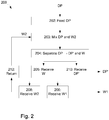
- FIG. 2 a flow chart illustrating a method 200 for processing a fermented dairy product DP into a concentrated, fermented dairy product DP' is illustrated. The method may be performed on, for example, the system 1 described in connection with Fig. 1 .
- the method comprise feeding 202, via the product feed conduit 22, fermented dairy product DP into the separator 12.
- the fermented dairy product DP is separated 204 into a heavy phase DP' and a light phase W.
- the light phase W is received 205 from the separator 12 where a first part W1 of the separated light phase W is received 206 in the first light phase conduit 24, while a second part W2 of the separated light phase W is received 208 in the second light phase conduit 26.
- the first part W1 of the light phase W is conveyed to be discarded or used as appropriate for some other purpose.
- the separated heavy phase DP' is received 210 in a heavy phase conduit 24.
- the heavy phase DP' is thereafter cooled in a cooling unit 17, held in a buffer tank 10 and finally filled into packages 20 by a packaging machine 19, so that it can be sold to consumers as a concentrated, fermented dairy product DP'.
- the second part W2 of the light phase W is returned 212 to the product feed conduit 22, such that the second part W2 of the light phase W is mixed 203 with fermented dairy product DP that is fed into the separator 12.
- the first light phase W1 is removed from fermented dairy product that is fed into the separator 12, while the second part W2 increases the viscosity of fermented dairy product DP that is fed into the separator 12. As explained, this reduces the tendency of product agglomerations in the separator. This increases production time.
- commercially available separators that are offered by the company Tetra Pak® for concentrating fermented dairy products are capable of, when using the described method 200, continuous operation for more than 6 hours before cleaning of the separator is needed. Even longer running times such separators are possible, such as at least 8 hours, or even more than 10 hours before cleaning is needed. Using the method 200 described herein may of course be used for other separators than those offered by Tetra Pak®.
- the method 200 may be performed so that the flow rate of the second part W2 of the light phase W that is returned 212 constitutes 30% to 50%, or even 35% to 45%, of the combined flow rate of the dairy product DP and the returned light phase W2.
- the mixture of the fermented dairy product DP and the returned part W2 of the light phase W may comprise at least 30% to 50% light phase.
- the remaining part is then fermented dairy product DP.
- a valve (not shown) may also be arranged in the product feed conduit 22, upstream the connection point 27.
- the pump 33 may be controlled to give the fermented dairy product DP a flow rate that accomplishes the mixing relationship between the fermented dairy product DP and the returned part W2 of the light phase W.
- the method may include controlling the flow the first part W1 of the light phase W such that the retention time in the separator 12 is, due to the returning 212 of the second part W2 of the light phase W, 30% to 50%, or even 35% to 45%, shorter as compared to not returning said second part W2 of the light phase W.
- Such control may be accomplished in the same way as the control that accomplishes the above described flow rate of the second part W2 of the light phase W.
- the retention time is the time it takes for a liquid to pass through the separator 12.
- the fermented dairy product DP may comprises 8,2 wt% to 9,2 wt%, or even 8,5 wt% to 9,0 wt% solids.
- wt% refers to weight percentage.
- the mixture of the fermented dairy product DP and the returned 212 second part W2 of the light phase typically comprises 5,5 wt% to 6,2 wt%, or even 5,8 wt% to 6,0 wt% solids.
- a flow rate through the separator 12 when testing the method was 5000 liters per hour.
- the light phase W may then, for example, form about two thirds of output from the separator while the heavy phase DP' forms the rest.
Landscapes
- Life Sciences & Earth Sciences (AREA)
- Chemical & Material Sciences (AREA)
- Engineering & Computer Science (AREA)
- Food Science & Technology (AREA)
- Polymers & Plastics (AREA)
- Microbiology (AREA)
- Animal Husbandry (AREA)
- Environmental Sciences (AREA)
- Dairy Products (AREA)
Abstract
Description
- The invention relates to processing fermented dairy products. In particular, it relates to concentrating fermented dairy products.
- Today many different processing methods are used for producing a large variety of dairy products. One variety of dairy products are fermented dairy products such as yoghurt, quark and skyr. Some types of fermented dairy products have been strained to give the products a relatively higher content of solids (proteins, milk sugars and minerals). The product has a generally thick texture due to the high content of solids and is often referred to as a "strained" or "concentrated" fermented dairy product. The concentration may be achieved by concentrating the milk by filtration to remove a portion of the water before addition of fermentation cultures. Alternatively, after fermentation of milk, the fermented product may be centrifuged and/or membrane-filtered to remove whey and thereby increase the concentration.
- The prior art is successfully used for large scale production of concentrated, fermented dairy products. However, when using centrifugal separators for concentrating the product by removing whey, which is the lighter phase, there might be a tendency that the concentrated product, which is the heavy phase, causes fouling in the separator. Fouling generally always occur in various grades in equipment that are used for processing dairy products. However, it is desired that fouling is reduced to the largest extent possible, since this reduces the required cleaning as well as increases production time and efficiency.
- It is an object of the invention to at least partly overcome one or more limitations of the prior art. In particular, it is an object to efficiently concentrate a fermented dairy product while still assuring that long operational times can be accomplished.
- In one aspect of the invention, this is achieved by a method for processing a fermented dairy product, which method comprises: feeding, via a product feed conduit connected to a centrifugal separator, fermented dairy product into the separator; separating, with the centrifugal separator, the fermented dairy product into a heavy phase and a light phase; receiving, in a first light phase conduit, a first part of the separated light phase; receiving, in a second light phase conduit, a second part of the separated light phase; receiving, in a heavy phase conduit, the separated heavy phase. The second part of the light phase is returned to the product feed conduit, such that the second part of the light phase is mixed with fermented dairy product that is fed into the separator. The first light phase is thereby removed from fermented dairy product that is fed into the separator, such that the heavy phase forms a concentrated, fermented dairy product.
- Basically, the method operates to dilute the flow of un-separated fermented dairy product with a part of the light phase (whey) that is separated out from fermented dairy product that earlier passed through the separator.
- The method is advantageous in that the infeed to the separator, which is the combination of un-separated, fermented dairy product and the returned, second part of the light phase, becomes more viscous than the un-separated, fermented dairy product alone. It has been seen that this decreases fouling inside the separator, as it enables easier flow of liquids to separation outlets in the separator, i.e. less or even no heavy phase is "over concentrated" and stuck inside the separator as more or less solid product cakes.
- In another aspect, the above objects are achieved by a system that is configured to process a fermented dairy product. The system comprises: a centrifugal separator that is arranged to separate fermented dairy product into a heavy phase and a light phase; a product feed conduit connected to the separator for feeding fermented dairy product into the separator; a first light phase conduit that is arranged to receive a first part of the light phase separated by the separator; a second light phase conduit that is arranged to receive a second part of the light phase separated by the separator; and a heavy phase conduit arranged to receive the heavy phase separated by the separator. The second phase conduit is arranged to return the second part of the light phase to the product feed conduit, such that the second part of the light phase is mixed with fermented dairy product that is fed into the separator. The first light phase is thereby removed from fermented dairy product fed into the separator, such that the heavy phase forms a concentrated, fermented dairy product.
- All features and embodiments described herein in connection with the method may be implemented for the system, and vice versa.
- Still other objectives, features, aspects and advantages of the invention will appear from the following detailed description as well as from the drawings.
- Embodiments of the invention will now be described, by way of example, with reference to the accompanying schematic drawings.
-
Fig. 1 is a schematic view of a system for processing a fermented dairy product, and -
Fig. 2 is a flow chart illustrating a method for processing a fermented dairy product. - Embodiments of the invention will now be described more fully hereinafter with reference to the accompanying drawings, in which some, but not all, embodiments of the invention are shown. The invention may be embodied in many different forms and should not be construed as limited to the embodiments set forth herein.
- With reference to
Fig. 1 , an exemplary system 1 for processing a fermented dairy product DP is illustrated. The system 1 has atank 10 that holds the fermented dairy product DP. The fermented dairy product DP may per se be produced by using any conventional technique, such as those commonly used for producing yoghurt, quark and skyr. The fermented dairy product DP is introduced into thetank 10 in any suitable and commonly used way. This may include filling the tank with 10 standardized, homogenized and pasteurized milk and a fermentation culture, and allowing the culture to ferment the milk until a fermented dairy product DP is formed. - A
product feed conduit 22 is connected to thetank 10 for feeding the fermented dairy product DP to acentrifugal separator 12. Aconventional pump 33 is arranged in theproduct feed conduit 22 for pumping the fermented dairy product DP from thetank 10 to afeed inlet 121 of theseparator 12. - A stack of separation disks are arranged inside the
separator 12 and are rotated to separate the fermented dairy product DP into a heavy phase DP' and a light phase W. The heavy phase DP' is then more concentrated than the fermented dairy product DP, i.e. it becomes a concentrated, fermented dairy product DP'. The light phase W is primarily whey, which has a higher viscosity than the fermented dairy product DP that is introduced into theseparator 12. - The heavy phase DP' leaves the separator via a
heavy phase outlet 122 that is connected to acyclone 14 that receives and decelerates the heavy phase DP'. The heavy phase DP' is then received in aheavy phase conduit 24, that is connected to thecyclone 14. Apump 34 in theheavy phase conduit 24 pumps the heavy phase DP' to acooling unit 17 that reduces the temperature of the heavy phase DP'. The cooled heavy phase DP' is next fed to ta holdingtank 18 that holds the heavy phase DP' before it is filled intopackages 20 by apackaging machine 19. Apump 35 feeds the heavy phase DP' from theholding tank 18 to thepackaging machine 19. The heavy phase DP' is sold to consumers as concentrated, fermented dairy product, such as high protein yogurts, quarks, skyrs or any as any other dairy based product that has been strained (concentrated). - The light phase W leaves the
separator 12 via alight phase outlet 123 in theseparator 12. It passes avalve 45 that regulates the pressure in theseparator 12, and a first part W1 of the separated light phase W is conveyed into a firstlight phase conduit 25, while a second part W2 of the separated light phase W is conveyed into a secondlight phase conduit 26. The firstlight phase conduit 25 may be directly connected to thelight phase outlet 123 and the secondlight phase conduit 26 may branch off from the firstlight phase conduit 25. Other arrangements for dividing the light phase into the streams are conceivable. - A
valve 47 in the firstlight phase conduit 25 and avalve 46 in the secondlight phase conduit 26 may be arranged to control how much of the light phase W shall be transferred to firstlight phase conduit 25 respectively to the secondlight phase conduit 26. - The second
light phase conduit 26 is connected to theproduct feed conduit 22 at aconnection point 27 in theproduct feed conduit 22, to thereby return the second part W2 of the light phase W to theproduct feed conduit 22. This decreases the viscosity of fermented dairy product DP that is fed into theseparator 12. Theconnection point 27 may be a simple three-way branch. The pressure is the secondlight phase conduit 26 is, due to theseparator 12, so much higher than the pressure in theproduct feed conduit 22 that no fermented dairy product DP will flow from theproduct feed conduit 22 into the secondlight phase conduit 26. - The second
light phase conduit 26 thereby provides for that the second part W2 of the light phase W is mixed with fermented dairy product DP that is fed from thetank 10 and into theseparator 12. The first part W1 of the light phase W, on the other hand, is removed from fermented dairy product DP fed into theseparator 12, and can be used for other purpose. Since the first light phase W1 is removed, there is a net removal or whey from fermented dairy product DP that is fed into theseparator 12. The heavy phase DP' thereby forms a concentrated, fermented dairy product. Of course, since the second part W2 is mixed with the fermented dairy product DP, the light phase W is then removed from the combination (mixture) of the fermented dairy product DP and the second part W2. Still, since the first part W1 is permanently removed from the fermented dairy product DP, there is a net removal of light phase from the fermented dairy product DP, so that a concentrated fermented dairy product DP' is formed. - A mixing
unit 16 may be arranged in theproduct feed conduit 22 for mixing the fermented dairy product DP and the returned second part W2 of the light phase. The mixingunit 16 is then, obviously, arranged downstream theconnection point 27, and may be a static mixer. Alternatively, theconnection point 27 is part of the mixingunit 16. In this context, a static mixer may be any mixer where the energy needed for accomplishing the mixing of fluids comes from a loss in pressure when the fluids flow through the mixer. - A
conventional system controller 18 is used for controlling the various components in the system 1 and for implementing a method for processing the fermented dairy product DP into the concentrated, fermented dairy product DP'. - With reference to
Fig. 2 , a flow chart illustrating amethod 200 for processing a fermented dairy product DP into a concentrated, fermented dairy product DP' is illustrated. The method may be performed on, for example, the system 1 described in connection withFig. 1 . - The method comprise feeding 202, via the
product feed conduit 22, fermented dairy product DP into theseparator 12. - In the
separator 12 the fermented dairy product DP is separated 204 into a heavy phase DP' and a light phase W. The light phase W is received 205 from theseparator 12 where a first part W1 of the separated light phase W is received 206 in the firstlight phase conduit 24, while a second part W2 of the separated light phase W is received 208 in the secondlight phase conduit 26. The first part W1 of the light phase W is conveyed to be discarded or used as appropriate for some other purpose. - The separated heavy phase DP' is received 210 in a
heavy phase conduit 24. The heavy phase DP' is thereafter cooled in acooling unit 17, held in abuffer tank 10 and finally filled intopackages 20 by apackaging machine 19, so that it can be sold to consumers as a concentrated, fermented dairy product DP'. - The second part W2 of the light phase W is returned 212 to the
product feed conduit 22, such that the second part W2 of the light phase W is mixed 203 with fermented dairy product DP that is fed into theseparator 12. The first light phase W1 is removed from fermented dairy product that is fed into theseparator 12, while the second part W2 increases the viscosity of fermented dairy product DP that is fed into theseparator 12. As explained, this reduces the tendency of product agglomerations in the separator. This increases production time. For example, commercially available separators that are offered by the company Tetra Pak® for concentrating fermented dairy products are capable of, when using the describedmethod 200, continuous operation for more than 6 hours before cleaning of the separator is needed. Even longer running times such separators are possible, such as at least 8 hours, or even more than 10 hours before cleaning is needed. Using themethod 200 described herein may of course be used for other separators than those offered by Tetra Pak®. - The
method 200 may be performed so that the flow rate of the second part W2 of the light phase W that is returned 212 constitutes 30% to 50%, or even 35% to 45%, of the combined flow rate of the dairy product DP and the returned light phase W2. In other words, the mixture of the fermented dairy product DP and the returned part W2 of the light phase W may comprise at least 30% to 50% light phase. The remaining part is then fermented dairy product DP. This is readily accomplished by, for example, appropriate regulation ofvalve 46 and/orvalve 47. Additionally, for controlling the mixing relationship between the fermented dairy product DP and the returned light phase W2, a valve (not shown) may also be arranged in theproduct feed conduit 22, upstream theconnection point 27. Alternatively, thepump 33 may be controlled to give the fermented dairy product DP a flow rate that accomplishes the mixing relationship between the fermented dairy product DP and the returned part W2 of the light phase W. - The method may include controlling the flow the first part W1 of the light phase W such that the retention time in the
separator 12 is, due to the returning 212 of the second part W2 of the light phase W, 30% to 50%, or even 35% to 45%, shorter as compared to not returning said second part W2 of the light phase W. Such control may be accomplished in the same way as the control that accomplishes the above described flow rate of the second part W2 of the light phase W. The retention time is the time it takes for a liquid to pass through theseparator 12. - The fermented dairy product DP may comprises 8,2 wt% to 9,2 wt%, or even 8,5 wt% to 9,0 wt% solids. Herein, wt% refers to weight percentage. By adjusting how much of the light phase W is retuned via the second
light phase conduit 26, it possible to obtain a heavy phase DP' (concentrated, fermented dairy product) that comprises 15,5 wt% to 20,0 wt%, or even 15,5 wt% to 16,5 wt% solids. The mixture of the fermented dairy product DP and the returned 212 second part W2 of the light phase typically comprises 5,5 wt% to 6,2 wt%, or even 5,8 wt% to 6,0 wt% solids. A flow rate through theseparator 12 when testing the method was 5000 liters per hour. The light phase W, may then, for example, form about two thirds of output from the separator while the heavy phase DP' forms the rest. - From the description above follows that, although various embodiments of the invention have been described and shown, the invention is not restricted thereto, but may also be embodied in other ways within the scope of the subject-matter defined in the following claims.
Claims (11)
- A method for processing a fermented dairy product (DP), the method comprising
feeding (202), via a product feed conduit (22) connected to a centrifugal separator (12), fermented dairy product (DP) into the separator (12),
separating (204), with the centrifugal separator (12), the fermented dairy product (DP) into a heavy phase (DP') and a light phase (W),
receiving (206), in a first light phase conduit (25), a first part (W1) of the separated light phase (W),
receiving (208), in a second light phase conduit (26), a second part (W2) of the separated light phase (W), and
receiving (210), in a heavy phase conduit (24), the separated heavy phase (DP'), and
returning (212) the second part (W2) of the light phase (W) to the product feed conduit (22), such that the second part (W2) of the light phase (W) is mixed with fermented dairy product (DP) that is fed into the separator (12),
the first light phase (W1) thereby being removed from fermented dairy product fed into the separator (12), such that the heavy phase (DP') forms a concentrated, fermented dairy product. - A method according to claim 1,wherein the second part (W2) of the light phase (W) is returned at a flow rate that is 30 to 50% of the combined flow rate of the dairy product (DP) and the second part (W2) of the light phase (W) that is fed into the separator (12).
- A method according to any proceeding claim, wherein the retention time in the separator (12) is, due to the returning (212) the second part (W2) of the light phase (W), 30 to 50% shorter as compared to not returning said second part (W2) of the light phase (W).
- A method according to any proceeding claim, wherein the fermented dairy product (DP) comprises 8,2 to 9,2 wt% solids.
- A method according to any proceeding claim, wherein the mixture of the fermented dairy product (DP) and the returned (212) second part (W2) of the light phase (W) comprises 5,5 to 6,2 wt% solids.
- A method according to any proceeding claim, wherein the heavy phase (DP') that forms the concentrated, fermented dairy product comprises 15,5 to 20,0 wt% solids.
- A method according to any proceeding claim, comprising mixing (203) the fermented dairy product (DP) and the returned (212) second part (W2) of the light phase in a mixer unit (16).
- A method according to any proceeding claim, wherein the fermented dairy product (DP) is yogurt or quark.
- A method according to any proceeding claim, comprising running the separator (12) for at least 6 hours before cleaning the separator (12).
- A system configured to process a fermented dairy product (DP), the system comprising
a centrifugal separator (12) configured to separate fermented dairy product (DP) into a heavy phase (DP') and a light phase (W),
a product feed conduit (22) connected to the separator (12) for feeding fermented dairy product (DP) into the separator (12),
a first light phase conduit (25) arranged to receive a first part (W1) of the light phase (W) separated by the separator (12),
a second light phase conduit (26) arranged to receive a second part (W2) of the light phase (W) separated by the separator (12), and
a heavy phase conduit (24) arranged to receive the heavy phase (DP') separated by the separator (12), wherein
the second phase conduit (26) is arranged to return the second part (W2) of the light phase (W) to the product feed conduit (22), such that the second part (W2) of the light phase (W) is mixed with fermented dairy product (DP) that is fed into the separator (12),
the first light phase (W1) thereby being removed from fermented dairy product fed into the separator (12), such that the heavy phase (DP') forms a concentrated, fermented dairy product. - A system according to claim 10, wherein
the second phase conduit (26) is connected to the product feed conduit (22) at a connection point (27) in the product feed conduit (22), and
a mixer unit (16) is arranged in the product feed conduit (22), at a position downstream the connection point (27), for providing mixing (203) of the fermented dairy product (DP) and the returned (212) second part (W2) of the light phase.
Applications Claiming Priority (1)
| Application Number | Priority Date | Filing Date | Title |
|---|---|---|---|
| EP17210762 | 2017-12-27 |
Publications (2)
| Publication Number | Publication Date |
|---|---|
| EP3510871A1 true EP3510871A1 (en) | 2019-07-17 |
| EP3510871B1 EP3510871B1 (en) | 2020-08-12 |
Family
ID=60813700
Family Applications (1)
| Application Number | Title | Priority Date | Filing Date |
|---|---|---|---|
| EP18213600.2A Active EP3510871B1 (en) | 2017-12-27 | 2018-12-18 | Concentrating fermented dairy products |
Country Status (4)
| Country | Link |
|---|---|
| US (1) | US11311021B2 (en) |
| EP (1) | EP3510871B1 (en) |
| CN (1) | CN111511213B (en) |
| WO (1) | WO2019129545A1 (en) |
Families Citing this family (1)
| Publication number | Priority date | Publication date | Assignee | Title |
|---|---|---|---|---|
| CN120731865B (en) * | 2025-08-15 | 2025-12-26 | 上海乐芙娜食品科技有限公司 | Cheese production equipment and production process based on automatic separation and impurity removal of cow milk |
Citations (6)
| Publication number | Priority date | Publication date | Assignee | Title |
|---|---|---|---|---|
| US4828865A (en) * | 1986-06-19 | 1989-05-09 | Westfalia Separator Ag | Method of for producing citrus juices with low final percentages of pulp |
| US5167807A (en) * | 1991-10-24 | 1992-12-01 | Dec International, Inc. | Apparatus for in-line recovery of particles from a flowing fluid |
| SE529821C2 (en) * | 2007-12-04 | Tetra Laval Holdings &Amp Finance Sa Avenue Général Guisan 70 1009 Pully | ||
| DE202011051733U1 (en) * | 2011-05-23 | 2011-11-07 | Polabske Mlekarny A.S. | Device for the production of cottage cheese |
| US20110293789A1 (en) * | 2006-11-17 | 2011-12-01 | Ieme Blondeel | Cocoa composition |
| WO2015008099A2 (en) * | 2013-07-18 | 2015-01-22 | Delta S.A. Industrial And Commercial Company Of Food Products | System for the production of multi-strained yogurt |
Family Cites Families (4)
| Publication number | Priority date | Publication date | Assignee | Title |
|---|---|---|---|---|
| US2838481A (en) * | 1956-06-29 | 1958-06-10 | Laval Separator Co De | Method for continuous processing of tall oil and the like |
| US4434184A (en) * | 1982-12-13 | 1984-02-28 | Kharrazi N Michael | Yogurt spread resembling cream cheese |
| DK410284A (en) * | 1984-08-28 | 1986-03-01 | Alfa Laval Zeta As | PROCEDURE FOR MANAGING THE INTERFACE BETWEEN OIL AND WATER BY SLAM DRAINAGE FROM A Centrifuge for Separating Oil and Water and Sludge |
| PT1429627E (en) * | 2001-09-19 | 2008-07-09 | Conagra Grocery Prod Co | Method for producing tomato paste by fractionation and concentration |
-
2018
- 2018-12-18 EP EP18213600.2A patent/EP3510871B1/en active Active
- 2018-12-18 US US16/957,302 patent/US11311021B2/en active Active
- 2018-12-18 WO PCT/EP2018/085589 patent/WO2019129545A1/en not_active Ceased
- 2018-12-18 CN CN201880083657.5A patent/CN111511213B/en active Active
Patent Citations (6)
| Publication number | Priority date | Publication date | Assignee | Title |
|---|---|---|---|---|
| SE529821C2 (en) * | 2007-12-04 | Tetra Laval Holdings &Amp Finance Sa Avenue Général Guisan 70 1009 Pully | ||
| US4828865A (en) * | 1986-06-19 | 1989-05-09 | Westfalia Separator Ag | Method of for producing citrus juices with low final percentages of pulp |
| US5167807A (en) * | 1991-10-24 | 1992-12-01 | Dec International, Inc. | Apparatus for in-line recovery of particles from a flowing fluid |
| US20110293789A1 (en) * | 2006-11-17 | 2011-12-01 | Ieme Blondeel | Cocoa composition |
| DE202011051733U1 (en) * | 2011-05-23 | 2011-11-07 | Polabske Mlekarny A.S. | Device for the production of cottage cheese |
| WO2015008099A2 (en) * | 2013-07-18 | 2015-01-22 | Delta S.A. Industrial And Commercial Company Of Food Products | System for the production of multi-strained yogurt |
Also Published As
| Publication number | Publication date |
|---|---|
| CN111511213B (en) | 2023-09-26 |
| US11311021B2 (en) | 2022-04-26 |
| EP3510871B1 (en) | 2020-08-12 |
| WO2019129545A1 (en) | 2019-07-04 |
| CN111511213A (en) | 2020-08-07 |
| US20200383344A1 (en) | 2020-12-10 |
Similar Documents
| Publication | Publication Date | Title |
|---|---|---|
| AU770623B2 (en) | Method and plant for treating milk | |
| US11771103B2 (en) | Production and separation of milk fractions with forward osmosis | |
| US20250143333A1 (en) | Production and separation of milk fractions with diafiltration | |
| EP3510871B1 (en) | Concentrating fermented dairy products | |
| US20240090521A1 (en) | Dairy processing systems and methods | |
| WO2015008099A3 (en) | System for the production of multi-strained yogurt | |
| US20140106044A1 (en) | Process for Obtaining a Constituent from Whey Protein Concentrate | |
| US20040116679A1 (en) | Method and a plant for the separation of fat from proteins in whey materials | |
| EP3639671A1 (en) | Production of yoghurt milk and yoghurt | |
| DK2161984T3 (en) | PROCEDURE FOR IMPROVING THE EFFICIENCY OF FAT SAFETY BY SEPARATING A FLUID FOOD PRODUCT | |
| US8273391B2 (en) | Method for producing cheese | |
| US12016346B2 (en) | Method for producing fat standardized milk products and a system thereof | |
| US20110293780A1 (en) | System and method of manufacturing a food product | |
| DUSHKOVA et al. | INVESTIGATION OF PROCESS CHARACTERISTICS DURING DIAFILTRATION OF ULTRAFILTRATION WHEY RETENTATE FROM KASHKAVAL PRODUCTION | |
| Marella et al. | Whey Protein Fractionation Using a Multistage Ultrafiltration System | |
| NZ615224B2 (en) | Process for obtaining a constituent from whey protein concentrate |
Legal Events
| Date | Code | Title | Description |
|---|---|---|---|
| STAA | Information on the status of an ep patent application or granted ep patent |
Free format text: STATUS: UNKNOWN |
|
| PUAI | Public reference made under article 153(3) epc to a published international application that has entered the european phase |
Free format text: ORIGINAL CODE: 0009012 |
|
| STAA | Information on the status of an ep patent application or granted ep patent |
Free format text: STATUS: THE APPLICATION HAS BEEN PUBLISHED |
|
| AK | Designated contracting states |
Kind code of ref document: A1 Designated state(s): AL AT BE BG CH CY CZ DE DK EE ES FI FR GB GR HR HU IE IS IT LI LT LU LV MC MK MT NL NO PL PT RO RS SE SI SK SM TR |
|
| AX | Request for extension of the european patent |
Extension state: BA ME |
|
| STAA | Information on the status of an ep patent application or granted ep patent |
Free format text: STATUS: REQUEST FOR EXAMINATION WAS MADE |
|
| 17P | Request for examination filed |
Effective date: 20200117 |
|
| RBV | Designated contracting states (corrected) |
Designated state(s): AL AT BE BG CH CY CZ DE DK EE ES FI FR GB GR HR HU IE IS IT LI LT LU LV MC MK MT NL NO PL PT RO RS SE SI SK SM TR |
|
| RIC1 | Information provided on ipc code assigned before grant |
Ipc: A23C 1/14 20060101ALI20200206BHEP Ipc: A01J 25/11 20060101ALI20200206BHEP Ipc: A23C 9/123 20060101AFI20200206BHEP Ipc: A23C 19/076 20060101ALI20200206BHEP |
|
| GRAP | Despatch of communication of intention to grant a patent |
Free format text: ORIGINAL CODE: EPIDOSNIGR1 |
|
| STAA | Information on the status of an ep patent application or granted ep patent |
Free format text: STATUS: GRANT OF PATENT IS INTENDED |
|
| INTG | Intention to grant announced |
Effective date: 20200313 |
|
| GRAS | Grant fee paid |
Free format text: ORIGINAL CODE: EPIDOSNIGR3 |
|
| GRAA | (expected) grant |
Free format text: ORIGINAL CODE: 0009210 |
|
| STAA | Information on the status of an ep patent application or granted ep patent |
Free format text: STATUS: THE PATENT HAS BEEN GRANTED |
|
| RIN1 | Information on inventor provided before grant (corrected) |
Inventor name: KEMPPAINEN, AULIKKI Inventor name: KASCHMIEDER, ERWIN |
|
| AK | Designated contracting states |
Kind code of ref document: B1 Designated state(s): AL AT BE BG CH CY CZ DE DK EE ES FI FR GB GR HR HU IE IS IT LI LT LU LV MC MK MT NL NO PL PT RO RS SE SI SK SM TR |
|
| REG | Reference to a national code |
Ref country code: CH Ref legal event code: EP |
|
| REG | Reference to a national code |
Ref country code: IE Ref legal event code: FG4D |
|
| REG | Reference to a national code |
Ref country code: DE Ref legal event code: R096 Ref document number: 602018006891 Country of ref document: DE |
|
| REG | Reference to a national code |
Ref country code: AT Ref legal event code: REF Ref document number: 1300630 Country of ref document: AT Kind code of ref document: T Effective date: 20200915 |
|
| REG | Reference to a national code |
Ref country code: NL Ref legal event code: FP |
|
| REG | Reference to a national code |
Ref country code: LT Ref legal event code: MG4D |
|
| PG25 | Lapsed in a contracting state [announced via postgrant information from national office to epo] |
Ref country code: SE Free format text: LAPSE BECAUSE OF FAILURE TO SUBMIT A TRANSLATION OF THE DESCRIPTION OR TO PAY THE FEE WITHIN THE PRESCRIBED TIME-LIMIT Effective date: 20200812 Ref country code: FI Free format text: LAPSE BECAUSE OF FAILURE TO SUBMIT A TRANSLATION OF THE DESCRIPTION OR TO PAY THE FEE WITHIN THE PRESCRIBED TIME-LIMIT Effective date: 20200812 Ref country code: BG Free format text: LAPSE BECAUSE OF FAILURE TO SUBMIT A TRANSLATION OF THE DESCRIPTION OR TO PAY THE FEE WITHIN THE PRESCRIBED TIME-LIMIT Effective date: 20201112 Ref country code: GR Free format text: LAPSE BECAUSE OF FAILURE TO SUBMIT A TRANSLATION OF THE DESCRIPTION OR TO PAY THE FEE WITHIN THE PRESCRIBED TIME-LIMIT Effective date: 20201113 Ref country code: NO Free format text: LAPSE BECAUSE OF FAILURE TO SUBMIT A TRANSLATION OF THE DESCRIPTION OR TO PAY THE FEE WITHIN THE PRESCRIBED TIME-LIMIT Effective date: 20201112 Ref country code: LT Free format text: LAPSE BECAUSE OF FAILURE TO SUBMIT A TRANSLATION OF THE DESCRIPTION OR TO PAY THE FEE WITHIN THE PRESCRIBED TIME-LIMIT Effective date: 20200812 Ref country code: HR Free format text: LAPSE BECAUSE OF FAILURE TO SUBMIT A TRANSLATION OF THE DESCRIPTION OR TO PAY THE FEE WITHIN THE PRESCRIBED TIME-LIMIT Effective date: 20200812 |
|
| REG | Reference to a national code |
Ref country code: AT Ref legal event code: MK05 Ref document number: 1300630 Country of ref document: AT Kind code of ref document: T Effective date: 20200812 |
|
| PG25 | Lapsed in a contracting state [announced via postgrant information from national office to epo] |
Ref country code: IS Free format text: LAPSE BECAUSE OF FAILURE TO SUBMIT A TRANSLATION OF THE DESCRIPTION OR TO PAY THE FEE WITHIN THE PRESCRIBED TIME-LIMIT Effective date: 20201212 Ref country code: RS Free format text: LAPSE BECAUSE OF FAILURE TO SUBMIT A TRANSLATION OF THE DESCRIPTION OR TO PAY THE FEE WITHIN THE PRESCRIBED TIME-LIMIT Effective date: 20200812 Ref country code: PL Free format text: LAPSE BECAUSE OF FAILURE TO SUBMIT A TRANSLATION OF THE DESCRIPTION OR TO PAY THE FEE WITHIN THE PRESCRIBED TIME-LIMIT Effective date: 20200812 Ref country code: LV Free format text: LAPSE BECAUSE OF FAILURE TO SUBMIT A TRANSLATION OF THE DESCRIPTION OR TO PAY THE FEE WITHIN THE PRESCRIBED TIME-LIMIT Effective date: 20200812 |
|
| PG25 | Lapsed in a contracting state [announced via postgrant information from national office to epo] |
Ref country code: SM Free format text: LAPSE BECAUSE OF FAILURE TO SUBMIT A TRANSLATION OF THE DESCRIPTION OR TO PAY THE FEE WITHIN THE PRESCRIBED TIME-LIMIT Effective date: 20200812 Ref country code: EE Free format text: LAPSE BECAUSE OF FAILURE TO SUBMIT A TRANSLATION OF THE DESCRIPTION OR TO PAY THE FEE WITHIN THE PRESCRIBED TIME-LIMIT Effective date: 20200812 Ref country code: CZ Free format text: LAPSE BECAUSE OF FAILURE TO SUBMIT A TRANSLATION OF THE DESCRIPTION OR TO PAY THE FEE WITHIN THE PRESCRIBED TIME-LIMIT Effective date: 20200812 Ref country code: DK Free format text: LAPSE BECAUSE OF FAILURE TO SUBMIT A TRANSLATION OF THE DESCRIPTION OR TO PAY THE FEE WITHIN THE PRESCRIBED TIME-LIMIT Effective date: 20200812 Ref country code: RO Free format text: LAPSE BECAUSE OF FAILURE TO SUBMIT A TRANSLATION OF THE DESCRIPTION OR TO PAY THE FEE WITHIN THE PRESCRIBED TIME-LIMIT Effective date: 20200812 |
|
| REG | Reference to a national code |
Ref country code: DE Ref legal event code: R097 Ref document number: 602018006891 Country of ref document: DE |
|
| PG25 | Lapsed in a contracting state [announced via postgrant information from national office to epo] |
Ref country code: ES Free format text: LAPSE BECAUSE OF FAILURE TO SUBMIT A TRANSLATION OF THE DESCRIPTION OR TO PAY THE FEE WITHIN THE PRESCRIBED TIME-LIMIT Effective date: 20200812 Ref country code: AT Free format text: LAPSE BECAUSE OF FAILURE TO SUBMIT A TRANSLATION OF THE DESCRIPTION OR TO PAY THE FEE WITHIN THE PRESCRIBED TIME-LIMIT Effective date: 20200812 Ref country code: AL Free format text: LAPSE BECAUSE OF FAILURE TO SUBMIT A TRANSLATION OF THE DESCRIPTION OR TO PAY THE FEE WITHIN THE PRESCRIBED TIME-LIMIT Effective date: 20200812 |
|
| PLBE | No opposition filed within time limit |
Free format text: ORIGINAL CODE: 0009261 |
|
| STAA | Information on the status of an ep patent application or granted ep patent |
Free format text: STATUS: NO OPPOSITION FILED WITHIN TIME LIMIT |
|
| PG25 | Lapsed in a contracting state [announced via postgrant information from national office to epo] |
Ref country code: SK Free format text: LAPSE BECAUSE OF FAILURE TO SUBMIT A TRANSLATION OF THE DESCRIPTION OR TO PAY THE FEE WITHIN THE PRESCRIBED TIME-LIMIT Effective date: 20200812 |
|
| 26N | No opposition filed |
Effective date: 20210514 |
|
| PG25 | Lapsed in a contracting state [announced via postgrant information from national office to epo] |
Ref country code: IT Free format text: LAPSE BECAUSE OF FAILURE TO SUBMIT A TRANSLATION OF THE DESCRIPTION OR TO PAY THE FEE WITHIN THE PRESCRIBED TIME-LIMIT Effective date: 20200812 |
|
| PG25 | Lapsed in a contracting state [announced via postgrant information from national office to epo] |
Ref country code: MC Free format text: LAPSE BECAUSE OF FAILURE TO SUBMIT A TRANSLATION OF THE DESCRIPTION OR TO PAY THE FEE WITHIN THE PRESCRIBED TIME-LIMIT Effective date: 20200812 Ref country code: SI Free format text: LAPSE BECAUSE OF FAILURE TO SUBMIT A TRANSLATION OF THE DESCRIPTION OR TO PAY THE FEE WITHIN THE PRESCRIBED TIME-LIMIT Effective date: 20200812 |
|
| REG | Reference to a national code |
Ref country code: BE Ref legal event code: MM Effective date: 20201231 |
|
| PG25 | Lapsed in a contracting state [announced via postgrant information from national office to epo] |
Ref country code: FR Free format text: LAPSE BECAUSE OF NON-PAYMENT OF DUE FEES Effective date: 20201231 Ref country code: IE Free format text: LAPSE BECAUSE OF NON-PAYMENT OF DUE FEES Effective date: 20201218 Ref country code: LU Free format text: LAPSE BECAUSE OF NON-PAYMENT OF DUE FEES Effective date: 20201218 |
|
| PG25 | Lapsed in a contracting state [announced via postgrant information from national office to epo] |
Ref country code: TR Free format text: LAPSE BECAUSE OF FAILURE TO SUBMIT A TRANSLATION OF THE DESCRIPTION OR TO PAY THE FEE WITHIN THE PRESCRIBED TIME-LIMIT Effective date: 20200812 Ref country code: MT Free format text: LAPSE BECAUSE OF FAILURE TO SUBMIT A TRANSLATION OF THE DESCRIPTION OR TO PAY THE FEE WITHIN THE PRESCRIBED TIME-LIMIT Effective date: 20200812 Ref country code: CY Free format text: LAPSE BECAUSE OF FAILURE TO SUBMIT A TRANSLATION OF THE DESCRIPTION OR TO PAY THE FEE WITHIN THE PRESCRIBED TIME-LIMIT Effective date: 20200812 |
|
| PG25 | Lapsed in a contracting state [announced via postgrant information from national office to epo] |
Ref country code: MK Free format text: LAPSE BECAUSE OF FAILURE TO SUBMIT A TRANSLATION OF THE DESCRIPTION OR TO PAY THE FEE WITHIN THE PRESCRIBED TIME-LIMIT Effective date: 20200812 |
|
| PG25 | Lapsed in a contracting state [announced via postgrant information from national office to epo] |
Ref country code: PT Free format text: LAPSE BECAUSE OF FAILURE TO SUBMIT A TRANSLATION OF THE DESCRIPTION OR TO PAY THE FEE WITHIN THE PRESCRIBED TIME-LIMIT Effective date: 20200812 Ref country code: BE Free format text: LAPSE BECAUSE OF NON-PAYMENT OF DUE FEES Effective date: 20201231 |
|
| REG | Reference to a national code |
Ref country code: CH Ref legal event code: PL |
|
| PG25 | Lapsed in a contracting state [announced via postgrant information from national office to epo] |
Ref country code: LI Free format text: LAPSE BECAUSE OF NON-PAYMENT OF DUE FEES Effective date: 20211231 Ref country code: CH Free format text: LAPSE BECAUSE OF NON-PAYMENT OF DUE FEES Effective date: 20211231 |
|
| P01 | Opt-out of the competence of the unified patent court (upc) registered |
Effective date: 20230426 |
|
| GBPC | Gb: european patent ceased through non-payment of renewal fee |
Effective date: 20221218 |
|
| PG25 | Lapsed in a contracting state [announced via postgrant information from national office to epo] |
Ref country code: GB Free format text: LAPSE BECAUSE OF NON-PAYMENT OF DUE FEES Effective date: 20221218 |
|
| PGFP | Annual fee paid to national office [announced via postgrant information from national office to epo] |
Ref country code: NL Payment date: 20251222 Year of fee payment: 8 |
|
| PGFP | Annual fee paid to national office [announced via postgrant information from national office to epo] |
Ref country code: DE Payment date: 20251229 Year of fee payment: 8 |