EP3508489A1 - A process for the preparation of acylphosphanes - Google Patents
A process for the preparation of acylphosphanes Download PDFInfo
- Publication number
- EP3508489A1 EP3508489A1 EP19151535.2A EP19151535A EP3508489A1 EP 3508489 A1 EP3508489 A1 EP 3508489A1 EP 19151535 A EP19151535 A EP 19151535A EP 3508489 A1 EP3508489 A1 EP 3508489A1
- Authority
- EP
- European Patent Office
- Prior art keywords
- formula
- group
- twice
- hydrogen
- substituents
- Prior art date
- Legal status (The legal status is an assumption and is not a legal conclusion. Google has not performed a legal analysis and makes no representation as to the accuracy of the status listed.)
- Granted
Links
Classifications
-
- C—CHEMISTRY; METALLURGY
- C07—ORGANIC CHEMISTRY
- C07F—ACYCLIC, CARBOCYCLIC OR HETEROCYCLIC COMPOUNDS CONTAINING ELEMENTS OTHER THAN CARBON, HYDROGEN, HALOGEN, OXYGEN, NITROGEN, SULFUR, SELENIUM OR TELLURIUM
- C07F9/00—Compounds containing elements of Groups 5 or 15 of the Periodic Table
- C07F9/02—Phosphorus compounds
- C07F9/28—Phosphorus compounds with one or more P—C bonds
- C07F9/50—Organo-phosphines
- C07F9/53—Organo-phosphine oxides; Organo-phosphine thioxides
- C07F9/5337—Phosphine oxides or thioxides containing the structure -C(=X)-P(=X) or NC-P(=X) (X = O, S, Se)
-
- C—CHEMISTRY; METALLURGY
- C07—ORGANIC CHEMISTRY
- C07F—ACYCLIC, CARBOCYCLIC OR HETEROCYCLIC COMPOUNDS CONTAINING ELEMENTS OTHER THAN CARBON, HYDROGEN, HALOGEN, OXYGEN, NITROGEN, SULFUR, SELENIUM OR TELLURIUM
- C07F9/00—Compounds containing elements of Groups 5 or 15 of the Periodic Table
- C07F9/02—Phosphorus compounds
- C07F9/28—Phosphorus compounds with one or more P—C bonds
- C07F9/50—Organo-phosphines
-
- C—CHEMISTRY; METALLURGY
- C07—ORGANIC CHEMISTRY
- C07F—ACYCLIC, CARBOCYCLIC OR HETEROCYCLIC COMPOUNDS CONTAINING ELEMENTS OTHER THAN CARBON, HYDROGEN, HALOGEN, OXYGEN, NITROGEN, SULFUR, SELENIUM OR TELLURIUM
- C07F9/00—Compounds containing elements of Groups 5 or 15 of the Periodic Table
- C07F9/02—Phosphorus compounds
- C07F9/28—Phosphorus compounds with one or more P—C bonds
- C07F9/50—Organo-phosphines
- C07F9/5036—Phosphines containing the structure -C(=X)-P or NC-P
-
- C—CHEMISTRY; METALLURGY
- C07—ORGANIC CHEMISTRY
- C07F—ACYCLIC, CARBOCYCLIC OR HETEROCYCLIC COMPOUNDS CONTAINING ELEMENTS OTHER THAN CARBON, HYDROGEN, HALOGEN, OXYGEN, NITROGEN, SULFUR, SELENIUM OR TELLURIUM
- C07F9/00—Compounds containing elements of Groups 5 or 15 of the Periodic Table
- C07F9/02—Phosphorus compounds
- C07F9/28—Phosphorus compounds with one or more P—C bonds
- C07F9/50—Organo-phosphines
- C07F9/505—Preparation; Separation; Purification; Stabilisation
- C07F9/5063—Preparation; Separation; Purification; Stabilisation from compounds having the structure P-H or P-Heteroatom, in which one or more of such bonds are converted into P-C bonds
- C07F9/5072—Preparation; Separation; Purification; Stabilisation from compounds having the structure P-H or P-Heteroatom, in which one or more of such bonds are converted into P-C bonds from starting materials having the structure P-H
-
- C—CHEMISTRY; METALLURGY
- C07—ORGANIC CHEMISTRY
- C07F—ACYCLIC, CARBOCYCLIC OR HETEROCYCLIC COMPOUNDS CONTAINING ELEMENTS OTHER THAN CARBON, HYDROGEN, HALOGEN, OXYGEN, NITROGEN, SULFUR, SELENIUM OR TELLURIUM
- C07F9/00—Compounds containing elements of Groups 5 or 15 of the Periodic Table
- C07F9/02—Phosphorus compounds
- C07F9/28—Phosphorus compounds with one or more P—C bonds
- C07F9/50—Organo-phosphines
- C07F9/53—Organo-phosphine oxides; Organo-phosphine thioxides
-
- C—CHEMISTRY; METALLURGY
- C07—ORGANIC CHEMISTRY
- C07F—ACYCLIC, CARBOCYCLIC OR HETEROCYCLIC COMPOUNDS CONTAINING ELEMENTS OTHER THAN CARBON, HYDROGEN, HALOGEN, OXYGEN, NITROGEN, SULFUR, SELENIUM OR TELLURIUM
- C07F9/00—Compounds containing elements of Groups 5 or 15 of the Periodic Table
- C07F9/02—Phosphorus compounds
- C07F9/547—Heterocyclic compounds, e.g. containing phosphorus as a ring hetero atom
- C07F9/553—Heterocyclic compounds, e.g. containing phosphorus as a ring hetero atom having one nitrogen atom as the only ring hetero atom
- C07F9/572—Five-membered rings
-
- C—CHEMISTRY; METALLURGY
- C07—ORGANIC CHEMISTRY
- C07F—ACYCLIC, CARBOCYCLIC OR HETEROCYCLIC COMPOUNDS CONTAINING ELEMENTS OTHER THAN CARBON, HYDROGEN, HALOGEN, OXYGEN, NITROGEN, SULFUR, SELENIUM OR TELLURIUM
- C07F9/00—Compounds containing elements of Groups 5 or 15 of the Periodic Table
- C07F9/02—Phosphorus compounds
- C07F9/547—Heterocyclic compounds, e.g. containing phosphorus as a ring hetero atom
- C07F9/553—Heterocyclic compounds, e.g. containing phosphorus as a ring hetero atom having one nitrogen atom as the only ring hetero atom
- C07F9/576—Six-membered rings
- C07F9/58—Pyridine rings
-
- C—CHEMISTRY; METALLURGY
- C07—ORGANIC CHEMISTRY
- C07F—ACYCLIC, CARBOCYCLIC OR HETEROCYCLIC COMPOUNDS CONTAINING ELEMENTS OTHER THAN CARBON, HYDROGEN, HALOGEN, OXYGEN, NITROGEN, SULFUR, SELENIUM OR TELLURIUM
- C07F9/00—Compounds containing elements of Groups 5 or 15 of the Periodic Table
- C07F9/02—Phosphorus compounds
- C07F9/547—Heterocyclic compounds, e.g. containing phosphorus as a ring hetero atom
- C07F9/655—Heterocyclic compounds, e.g. containing phosphorus as a ring hetero atom having oxygen atoms, with or without sulfur, selenium, or tellurium atoms, as the only ring hetero atoms
- C07F9/65515—Heterocyclic compounds, e.g. containing phosphorus as a ring hetero atom having oxygen atoms, with or without sulfur, selenium, or tellurium atoms, as the only ring hetero atoms the oxygen atom being part of a five-membered ring
-
- C—CHEMISTRY; METALLURGY
- C08—ORGANIC MACROMOLECULAR COMPOUNDS; THEIR PREPARATION OR CHEMICAL WORKING-UP; COMPOSITIONS BASED THEREON
- C08F—MACROMOLECULAR COMPOUNDS OBTAINED BY REACTIONS ONLY INVOLVING CARBON-TO-CARBON UNSATURATED BONDS
- C08F2/00—Processes of polymerisation
- C08F2/46—Polymerisation initiated by wave energy or particle radiation
- C08F2/48—Polymerisation initiated by wave energy or particle radiation by ultraviolet or visible light
- C08F2/50—Polymerisation initiated by wave energy or particle radiation by ultraviolet or visible light with sensitising agents
-
- C—CHEMISTRY; METALLURGY
- C08—ORGANIC MACROMOLECULAR COMPOUNDS; THEIR PREPARATION OR CHEMICAL WORKING-UP; COMPOSITIONS BASED THEREON
- C08F—MACROMOLECULAR COMPOUNDS OBTAINED BY REACTIONS ONLY INVOLVING CARBON-TO-CARBON UNSATURATED BONDS
- C08F218/00—Copolymers of compounds having one or more unsaturated aliphatic radicals, each having only one carbon-to-carbon double bond, and at least one being terminated by an acyloxy radical of a saturated carboxylic acid, of carbonic acid or of a haloformic acid
- C08F218/02—Esters of monocarboxylic acids
- C08F218/04—Vinyl esters
- C08F218/08—Vinyl acetate
Definitions
- the present invention relates to a versatile, highly efficient process for the preparation of mono- and bisacylphosphanes as well as for their corresponding oxides or sulfides.
- the invention further relates to novel photoinitiators obtainable by said process.
- Photoinitiators in particular mono- and bisacylphosphane oxides, bearing further functionalized substituents have attracted significant commercial attention since photoinitiators which are tunable with respect to the wavelength at which photoinduced cleavage occurs or which are linkable to other additives, such as sensitizers, stabilizers or surface active agents in order to avoid migration e.g. in food packaging are highly desirable.
- EP 1 135 399 A discloses a process for the preparation of mono- and bisacylphosphanes and their respective oxides and sulfides the process comprising the steps of reacting substituted monohalophosphanes or dihalophosphanes with an alkali metal or a combination of magnesium and lithium, where appropriate in the presence of a catalyst, further reacting the resulting metallated phosphanes with carboxylic acid halides and finally oxidizing the resulting mono- or bisacylphosphanes with sulfur or oxygen transferring oxidants.
- WO2006/056541A discloses a process for the preparation of bisacylphosphanes, the process comprising the steps of reducing elemental phosphorous or phosphorous trihalides P(Hal) 3 with sodium to obtain sodium phosphide Na 3 P, then adding sterically bulky alcohols to obtain sodium phosphide NaPH 2 , reacting said sodium phosphide with two equivalents of an carboxylic acid halide to obtain sodium bisacylphosphides and finally reacting said sodium bisacylphosphides with electrophilic agents to obtain bisacylphosphanes.
- WO2006/074983A discloses a process for the preparation of bisacylphosphanes by first catalytically reducing monochloro- or dichlorophosphines with hydrogen at a temperature of from 20 to 200°C under pressure in the presence of a tertiary aliphatic amine or an aromatic amine in an aprotic solvent to obtain the corresponding halogen-free phosphanes and subsequently reacting said phosphanes with carboxylic acid halides to obtain mono- or bisacylphosphanes.
- an acid preferably an acid with a pKa of 5 or less at 25°C measured in water or an aqueous reference system is added after the reaction to protonate the intermediates.
- the compounds of formula (I) may be further functionalized by standard operations such as alkylations, nucleophilic substitutions, protonations with acids, deprotonations with bases, optionally followed by ion exchange and the like in order to obtain other compounds of formula (I).
- aryl denotes carbocyclic aromatic substituents, whereby said carbocyclic, aromatic substituents are unsubstituted or substituted by up to five identical or different substituents per cycle.
- the substituents are selected from the group consisting of fluorine, bromine, chlorine, iodine, nitro, cyano, formyl or protected formyl, hydroxyl or protected hydroxyl, C 1 -C 8 -alkyl, C 1 -C 8 -haloalkyl, C 1 -C 8 -alkoxy, C 1 -C 8 -haloalkoxy, C 6 -C 14 -aryl, in particular phenyl and naphthyl, di(C 1 -C 8 -alkyl)amino, (C 1 -C 8 -alkyl)amino, CO(C 1 -C 8 -alkyl), OCO(C 1 -C 8 -C 8
- the carbocyclic, aromatic substituents are unsubstituted or substituted by up to three identical or different substituents per cycle selected from the group consisting of fluorine, chlorine, cyano, C 1 -C 8 -alkyl, C 1 -C 8 -haloalkyl, C 1 -C 8 -alkoxy, C 1 -C 8 -haloalkoxy, C 6 -C 14 -aryl, in particular phenyl.
- the carbocyclic, aromatic substituents are unsubstituted or substituted by up to three identical or different substituents per cycle selected from the group consisting of fluorine, C 1 -C 8- alkyl, C 1 -C 8 -perfluoroalkyl, C 1 -C 8- alkoxy, C 1 -C 8 -perfluoroalkoxy, and phenyl.
- aryl substituents are C 6 -C 14 -aryl substituents, more preferably phenyl, naphthyl, phenanthrenyl and anthracenyl.
- C 6 -C 14 indicates that the number of carbon atoms of the respective carbocyclic, aromatic ring system is from 6 to 14.
- the possible and preferred substitution patterns mentioned above are likewise applicable.
- heterocyclyl denotes heterocyclic aliphatic, aromatic or mixed aliphatic and aromatic substituents in which no, one, two or three skeleton atoms per cycle, but at least one skeleton atom in the entire cyclic system is a heteroatom selected from the group consisting of nitrogen, sulphur and oxygen which are unsubstituted or substituted by up to five identical or different substituents per cycle, whereby the substituents are selected from the same group as given above for carbocyclic aromatic substituents including the areas of preference.
- Preferred heterocyclyl-substituents and heteroaryl-substituents respectively are pyridinyl, oxazolyl, thiophen-yl, benzofuranyl, benzothiophen-yl, dibenzofuranyl, dibenzothiophenyl, furanyl, indolyl, pyridazinyl, pyrazinyl, imidazolyl, pyrimidinyl and quinolinyl, either unsubstituted or substituted with one, two or three substituents selected from the group consisting of fluorine, C 1 -C 8 -alkyl, C 1 -C 8 -perfluoroalkyl, C 1 -C 8 -alkoxy, C 1 -C 8 -perfluoroalkoxy, and phenyl.
- Preferred heterocyclylium cations are N-(C 1 -C 8 -alkyl)imidazolium or pyridinium cations.
- protected formyl is a formyl substituent which is protected by conversion to an aminal, acetal or a mixed aminal acetal, whereby the aminals, acetals and mixed aminal acetals are either acyclic or cyclic.
- protected formyl is 1,1-(2,4-dioxycyclopentanediyl).
- protected hydroxyl is a hydroxyl radical which is protected by conversion to a ketal, acetal or a mixed aminal acetal, whereby the aminals, acetals and mixed aminal acetals are either acyclic or cyclic.
- protected hydroxyl is tetrahydropyranyl (O-THP).
- alkyl, alkanediyl, alkenyl, alkenediyl, alkane-n-yl and alkene-n-yl are straight-chained, cyclic either in part or as a whole, branched or unbranched.
- C 1 -C 18 -alkyl indicates that the straight-chained, cyclic either in part or as a whole, branched or unbranched alkyl substituent contains from 1 to 18 carbon atoms excluding the carbon atoms of optionally present substituents to the C 1 -C 18 -alkyl substituent.
- alkenyl denotes a susbtituent comprising at least one carbon-carbon double bond, irrespective of its location within the straight-chained, cyclic either in part or as a whole, branched or unbranched substituent.
- C 1 -C 4 -alkyl are methyl, ethyl, n-propyl, isopropyl, n-butyl, tert-butyl.
- Additional examples for C 1 -C 8 -alkyl are n-pentyl, cyclohexyl, n-hexyl, n-heptyl, n-octyl, isooctyl.
- Additional examples for C 1 -C 18 -alkyl are norbornyl, adamantyl, n-decyl, n-dodecyl, n-hexadecyl, n-octadecyl.
- C 1 -C 8 -alkanediyl-substituents are methylene, 1,1-ethylene, 1,2-ethylene, 1,1-propylene, 1,2-propylene, 1,3-propylene, 1,1-butylene, 1,2-butylene, 2,3-butylene and 1,4-butylene, 1,5-pentylene, 1,6-hexylene, 1,1-cyclohexylene, 1,4-cyclohexylene, 1,2-cyclohexylene and 1,8-octylene.
- C 1 -C 4 -alkoxy-substituents are methoxy, ethoxy, isopropoxy, n-propoxy, n-butoxy and tert-butoxy.
- An additional example for C 1 -C 8 -alkoxy is cyclohexyloxy.
- C 2 -C 18 -alkenyl and C 2 -C 8 -alkenyl-substituents are allyl, 3-propenyl and buten-2-yl.
- C 1 -C 8 -haloalkyl and C 1 -C 8 -haloalkoxy are C 1 -C 8 -alkyl and C 1 -C 8 - alkoxy sustituents which are once, more than once or fully substituted by halogen atoms.
- Substituents which are fully substituted by fluorine are referred to as C 1 -C 8 -perfluoroalkyl and C 1 -C 8 -perfluoroalkoxy, respectively.
- C 1 -C 8 -haloalkyl-substituents are trifluoromethyl, 2,2,2-trifluoroethyl, chloromethyl, fluoromethyl, bromomethyl, 2-bromoethyl, 2-chloroethyl, nonafluorobutyl and n-perfluorooctyl.
- Formula (III) as depicted above shall also encompass dimers, trimers and higher aggregated complexes as well as solvate complexes or other compounds wherein the Metal is complexed of the compounds depicted therein. their isomers of formulae (IIIa), (IIIb) and (IIIc) which are typically present and observable in solution and solid state: In one embodiment in compounds of formulae (IVa) and (I), with R 1 being a substituent of formula (IIa)
- the following compounds of formulae (IVa) are used: itaconic anhydride, maleimide, acrylonitrile, ⁇ -methylene- ⁇ -butyrolactone, phenyl vinyl sulfone, diethyl vinylphosphonate, methylacrylate, 3-(acryloyloxy)propyltrimethoxysilane, dimethyl itaconate, vinyl acrylate, 2-vinylpyridine, 2-acrylamido-2-hydroxymethyl-1,3-propanediol.
- R 1 being a substituent of formula (IIb)
- R 6 is hydrogen
- R 8 is C 1 -C 8 -alkyl
- An- is a halide.
- An example of a compound of formula (IVb) is N,N-dimethylmethyleneiminium chloride.
- R 1 is a substituent of formula (IIc)
- R 6 is C 1 -C 8 -alkyl or C 6 -C 14 -aryl
- R 8 is C 1 -C 8 -alkyl or C 6 -C 14 -aryl.
- R 1 being a substituent of formula (IId)
- R 8 is C 1 -C 8 -alkyl, C 2 -C 8 -alkyl or C 6 -C 14 -aryl.
- An example of a compound of formula (IVd) is cyclohexylisocyanate.
- n is 2 and m is 1 or 2, preferably 2 and
- One specific compound of formula (IVe) is divinylsulfone.
- R 1 being a substituent of formula (IIa) or (IIe) m is 1 or 2, preferably 2 and R* is a substituent of formula (VIa) or (VIb) or (VIc) or (VId) or (VIe) R 11 -[X-] zz OR 30 (VIe) wherein in formula (VIa) n is 1, 2, 3 or 4 in formula (VIb) n is 1, 2 or 3 in formula (VIc) and VI(d) n is 1 or 2 in formula (VIe) n is 1 and wherein
- Specific compounds of formula (VIIb) are mono-, di- or tri-acrylated or -methacrylated trimethylolpropane or mono-, di- or tri-acrylated or -methacrylated glycerol or mixtures thereof or their ethoxylated or propoxylated or mixed ethoxylated and propoxylated analogoues. Further examples 1,3-propanedioldiacrylate and 1,3-butanedioldiacrylate.
- Specific compounds of formula (VIIc) are, 1,3-butanedioldiacrylate, 1,5-pentanedioldiacrylate, 1,6-hexanedioldiacrylate, glyceroldi- or -triacrylate, di- or polyacrylates of sugar alcohols such as sorbitol, mannitol, diglycerol, threitol, erythrol polyethylenglycols, epoxy(meth)acrylates, urethane(meth)acrylates and polycarbonate(meth)acrylates.
- Specific compounds of formula (VIId) are 1,2-propanedioldiacrylate, 1,4-butanedioldiacrylate, 1,5-pentanedioldiacrylate, 1,6-hexanedioldiacrylate, mono, di- or polyacrylates of sugar alcohols such as sorbitol, mannitol, diglycerol, threitol, erythrol polyethylenglycols.
- Specific compounds of formula (VIIe) are acrylic or methacrylic esters of monomethyl or monoethylethers of polyethylene glycols or polypropylene glycols wherein zz is an integer of 2 to 100, preferably 3 to 20.
- Compounds of formulae (VIa) to (VId) are particularly useful as multifunctional photoinitiators having highly valuable crosslinking and bonding capabilities which were not known before.
- M 2 is hydrogen or sodium
- the process is typically carried out by adding the compounds of formulae (IVa) to (IVf) either neat or dissolved or suspended in a solvent to a neat compound of formula (III) or a solution or suspension thereof and, where M 2 is hydrogen, the base. Thereby a reaction mixture is formed.
- the process is carried out by adding the compound of formula (III) either neat or dissolved or suspended in a solvent and, where M 2 is hydrogen, the base to a neat compound of formula (IVa) to (IVf) or a solution or suspension thereof. Thereby a reaction mixture is formed.
- the reaction time is typically in the range of from 5 min to 24 hours, preferably 30 min to 12 hours.
- Suitable solvents are those which do not or virtually not react under formation of new covalent bonds with the compounds of formulae (III) and (IVa) to (IVf) employed in the reaction.
- Such solvents include
- the amount of solvent is not critical at all and is just limited by commercial aspects, since they have to be removed if the compounds shall finally be isolated. Typically the amount of solvent is chosen such that the final product is completely soluble in the organic solvent.
- reaction mixing energy e.g. by standard agitators stirrers and/or static mixing elements is introduced into the reaction mixture.
- mixing can also be supported by using high force dispersion devices such as, for example, ultrasound sonotrodes or high pressure homogenizers.
- the process may either be performed batchwise or continuously.
- a typical and preferred reaction temperature range to carry out the process is from -30°C to 120°C, preferably from -10 to 80°C and even more preferably from 0 to 40°C.
- reaction temperature is above the boiling point at 1013 hPa of the solvent employed, the reaction is carried out under sufficient pressure.
- a typical and preferred reaction pressure range to carry out the process is from 50 hPa to 10 MPa, preferably from 500 hPa to 1 MPa and even more preferably from 800 hPa to 1,2 MPa. Most preferably the reaction is carried out under ambient pressure.
- M 2 is 1/q equivalent of an q-valent metal ion or a quarternary organic ammonium ion or a heterocyclylium cation salts of compounds of formula (I) are formed which are also covered by this invention.
- an acid is added after the reaction to obtain compounds of formula (I).
- Suitable acids are those having a pKa of 7 or less, preferably 5 or less, more preferably 2 or less at 25°C measured in water.
- Suitable acids include hydrogen chloride in diethylether, sulphuric acid, carboxylic acids such as formic acid and acetic acid.
- the amount of base is not critical and might be in the range of from 0.0001 to 100 mol equivalents with respect to the compounds of formula (III), preferably in the range of from 0.001 to 10 mol equivalents, more preferably in the range of from 0.05 to 1 mol equivalents and even more preferably in the range of from 0.05 to 0.5 mol equivalents.
- Suitable bases include Ammonia, primary, secondary or tertiary amines such as triethylamine, triethanolamine and DBN, N-heteroaromatic compounds such as unsubstituted or substituted pyridines or chinolines, alcoholates such as lithium-, sodium- and potassium- -methoxide, -ethoxide and -tert. butoxide, amides such as lithium-diisoproylamide, hydroxides such as lithium, sodium and potassium hydroxide and carbonates such as lithium, sodium and potassium carbonate. The carbonates and hydroxides are preferably employed when water is used as solvent.
- the bases are removed after reaction from the reaction mixture by adding an acid, preferably those acids as defined above, and removing the salts formed thereby by sedimentation and decanting, filtration or centrifugation, preferably by filtration.
- the molar ratio of compounds of formula (IVa) to (IVe) to those of formula (III) depends on the integer n, i.e. the number of acylphosphino groups to be finally present in compounds of formula (I). Typically from 0,8 to 1,2 mol of compounds of formula (III) are employed per acylphosphino group to be introduced, preferably 0,9 to 1,0 mol.
- one further aspect of the invention relates to said novel compounds of formula (I) with compounds tert.-butyl 3-(bis(2,4,6-dimethoxybenzoyl)phosphino)propanoate, 3-(bis(2,4,6-trimethylbenzoyl)phosphino)propanitrile and 2-(bis(2,4,6-trimethylbenzoyl)phosphino)ethyl-diethylphosphonate being excluded since they are known from WO2006/056541 .
- one further aspect of the invention relates to said novel compounds of formula (V) with compounds tert.-butyl 3-(bis(2,4,6-dimethoxybenzoyl)phosphoryl)propanoate, 3-(bis(2,4,6-trimethylbenzoyl)phosphoryl)propanitrile and 2-(bis(2,4,6-trimethylbenzoyl)phosphoryl)ethyl-diethylphosphonate being excluded since they are known from WO2006/056541 .
- Compounds of formula (V) may be obtained by reaction of compounds of formula (I) with an oxidizing agent to obtain compounds of formula (V) where X is oxygen or a sulfidizing agent to obtain compounds of formula (V) where X is sulphur in a manner well known to those skilled in the art and as e.g. disclosed in WO2006/056541 .
- Suitable oxidizing agents are: hydrogen peroxide, which is preferably employed as aqueous solution, e.g. with 30 wt.-%, organic peroxides such as tert-butylhydroperoxide; oxygen e.g. in the form of air, or sodium hypochlorite.
- Suitable sulfidizing agents are: elemental sulphur or organic polysulfides.
- the oxidation or suldidation is carried out in the same reaction media as the process for the preparation of compounds of formula (I), i.e. as a one-pot-reaction.
- the main advantage of the process according to the invention is that it allows the efficient and high-yielding synthesis of compounds of formulae (I) and (V) with a mild, variety of functional groups which are not easily available via known routes.
- Such processes are particularly useful for the preparation of polymer nanoparticles, coatings, adhesives, inks and painting materials. Therefore the invention further relates to polymer nanoparticles, coatings, adhesives, inks and painting materials obtainable by such process.
- the phosphane was obtained by adding an equimolar amount of hydrochloric acid in ether (2 M) to the compound obtrained according to example 1, filtering off the resulting sodium chloride and evaporating the solvent in vacuo.
- the phosphane PhPH 2 was prepared according to the procedure described by Grutzmacher et al. CHIMIA 2008, 62, No. 1/2 .
- a solution of PhPH 2 (0.38 mL, 3.46 mmol) and NaO t Bu (0.67 g, 6.92 mmol, 2 eq.) in toluene (10 mL) was prepared in a 50 mL Schlenk flask under an argon atmosphere. Subsequently, mesitoyl chloride (0.58 mL, 3.46 mmol, 1 eq.) was added dropwise to the solution at 0°C.
- a solution of the phosphane or phosphide and optionally triethylamine in either dimethoxyethane (dme) or tetrahydrofurane (thf) was prepared in a 50 mL Schlenk flask under an inert atmosphere of argon (first solution). Subsequently, a solution of a compound selected from those of formulae (IVa) to (IVe) in dme or thf or the neat compound (hereinafter collectively referred to as second solution) was slowly added. After stirring for twelve hours at room temperature, a 2M solution of hydrochloric acid in diethylether was added in an equimolar amount to neutralize the triethylamine.
- the reaction mixture was stirred for another hour at room temperature, before the solvent was removed under reduced pressure.
- the solid residue was dissolved in toluene and the insoluble precipitate of triethylamine hydrochloride was separated by filtration.
- the solution volume was reduced in vacuo to half of its volume and layered with half of the remaining volume of hexane.
- the obtained crystalline solid was collected and dried under high vacuum for twelve hours.
- the oxidant was added to a solution of the acylphosphane in toluene and the reaction mixture vigorously stirred at room temperature for twelve hours under an inert atmosphere (argon) and exclusion of light in a 50 mL Schlenk flask. Thereafter the solvent was removed under reduced pressure. The resulting product was recrystallized from a polar solvent layered with a non polar solvent and storage at -15° under exclusion of light. The precipitate was collected by filtration and dried under vacuum for twelve hours.
- Red phosphorous (P 4 , 0.248 g, 2 mmol) and naphthalene (0.104 g, 0.8 mmol, 0.1 eq.) were suspended in 10 ml dme.
- Freshly cut sodium pieces (Na, 0.552 g, 24 mmol, 3 eq.) were subsequently added to the suspension.
- the mixture was stirred for 12 hours, then t BuOH (1.61 ml, 16 mmol, 2 eq.) in 5 ml dme was added dropwise to the mixture at 0 °C.
- the resulting black suspension was stirred for an additional 2 hours.
- HP(COMes) 2 (1.19 g, 3.65 mmol, 1 eq.) was suspended in degassed, destilled water (10 mL).
- NEt 3 50 ⁇ L, 0.365 mmol, 0.1 eq.
- 2-acryloxyethyltrimethylammonium chloride (1 mL, 3.65 mmol, 1 eq., 80 wt.-% in water) was added to the suspension.
- the flask was first kept in a ultra-sound bath at 40°C for 2 h. Subsequently, the reaction mixture was allowed to stir at room temperature for 12 h.
- Aqueous concentrated hydrochloric acid (33 ⁇ L, 0.1 eq., 37 wt.-%) was added to adjust the pH to around 5 to 6.
- aq. hydrogen peroxide (0.38 mL, 3.65 mmol, 1 eq., 30 wt.-%) at 0°C
- the reaction mixture was stirred at room temperature for 12 h.
- the obtained yellow precipitate was collected by filtration and dried under high vacuum for 4 h (first fraction, 0.359 g, 18 %).
- the remaining solution was concentrated in vacuo and the residual solid was recrystallised from ethanol.
- a solution of the photoinitiator (PI) (0.1 mol-%) in the monomer (styrene (S), vinyl acetate (VA)) was prepared in a degassed quartz tube sealed with a septum. The sample was irradiated with UV light under vigorous stirring for 1.5 h at room temperature. The obtained polymers were washed with methanol and dried under high vacuum for 1 h.
- UV irradiation was carried out for all examples 28 to 31 with a mercury vapour pressure lamp (Heraeus TQ 150, 150 W) inside a quartz dip tube, which was immersed into a temperature controlled solvent bath.
- a mercury vapour pressure lamp Heraeus TQ 150, 150 W
- polymer of example 29 was not soluble in chloroform of DMF and could therefore not be characterised by size exclusion chromatography (SEC).
- the given amount of photoinitiator was mixed with degassed, distilled water (10 mL for the surfactant free emulsion polymerization, SFEP) or SDS-solution (2 mL, 10 wt-%) and styrene (1ml) in a 15 mL glass vial.
- the obtained suspension was stirred vigorously for 15 min prior to irradiation.
- the mixture was subsequently irradiated with blue LED light for 1,5 h whilst stirring, to yield a polystyrene dispersion in water.
- the photoinitiator (PI) was dissolved in the monomer (n-butylacrylate, BA or 1,6-hexandioldiacrylate, HDDA) and the solution was transferred to a round glass dish such that the bottom of the dish was covered by the liquid.
- the mixture was subsequently irradiated from above at room temperature with a mercury vapour pressure lamp (Heraeus TQ 150, 150 W) inside a quartz dip tube, which was immersed into a temperature controlled solvent bath for 1.5 h (example 39: 2h).
- a solution of the monomer (1.5 mL) and the photoinitiator (PI) in the solvent was prepared in a 15 mL glass vial sealed with a septum, under an argon atmosphere.
- the solution was irradiated with blue LED light as described for examples 32 to 34 for 2 hours (ex. 40) or 1,5 hours (ex. 41) whilst stirring.
Landscapes
- Chemical & Material Sciences (AREA)
- Organic Chemistry (AREA)
- Health & Medical Sciences (AREA)
- Molecular Biology (AREA)
- Biochemistry (AREA)
- General Health & Medical Sciences (AREA)
- Life Sciences & Earth Sciences (AREA)
- Chemical Kinetics & Catalysis (AREA)
- Medicinal Chemistry (AREA)
- Polymers & Plastics (AREA)
- Crystallography & Structural Chemistry (AREA)
- Polymerisation Methods In General (AREA)
- Pharmaceuticals Containing Other Organic And Inorganic Compounds (AREA)
Abstract
Description
- The present invention relates to a versatile, highly efficient process for the preparation of mono- and bisacylphosphanes as well as for their corresponding oxides or sulfides. The invention further relates to novel photoinitiators obtainable by said process.
- Photoinitiators, in particular mono- and bisacylphosphane oxides, bearing further functionalized substituents have attracted significant commercial attention since photoinitiators which are tunable with respect to the wavelength at which photoinduced cleavage occurs or which are linkable to other additives, such as sensitizers, stabilizers or surface active agents in order to avoid migration e.g. in food packaging are highly desirable.
- During the last decade many approaches to achieve these goals have been published.
-
EP 1 135 399 A discloses a process for the preparation of mono- and bisacylphosphanes and their respective oxides and sulfides the process comprising the steps of reacting substituted monohalophosphanes or dihalophosphanes with an alkali metal or a combination of magnesium and lithium, where appropriate in the presence of a catalyst, further reacting the resulting metallated phosphanes with carboxylic acid halides and finally oxidizing the resulting mono- or bisacylphosphanes with sulfur or oxygen transferring oxidants. - It is known from
WO05/014605A -
WO2006/056541A discloses a process for the preparation of bisacylphosphanes, the process comprising the steps of reducing elemental phosphorous or phosphorous trihalides P(Hal)3 with sodium to obtain sodium phosphide Na3P, then adding sterically bulky alcohols to obtain sodium phosphide NaPH2, reacting said sodium phosphide with two equivalents of an carboxylic acid halide to obtain sodium bisacylphosphides and finally reacting said sodium bisacylphosphides with electrophilic agents to obtain bisacylphosphanes. -
WO2006/074983A discloses a process for the preparation of bisacylphosphanes by first catalytically reducing monochloro- or dichlorophosphines with hydrogen at a temperature of from 20 to 200°C under pressure in the presence of a tertiary aliphatic amine or an aromatic amine in an aprotic solvent to obtain the corresponding halogen-free phosphanes and subsequently reacting said phosphanes with carboxylic acid halides to obtain mono- or bisacylphosphanes. - However, for the variation of the non-acyl substituent(s) at the phosphorous atom the aforementioned processes either require
- the initial employment of an organic mono- or dihalophosphane already bearing such substituent(s) in a first reduction or metallation step which significantly diminishes the variability of possible substitution patterns, or
- if e.g. sodium phosphides NaPH2 are employed, the use of electrophilic compounds bearing a reactive halogen functionality at the substituent to be introduced, which renders such processes commercially less attractive.
- As a consequence, there is still a need for a highly efficient and versatile process to prepare functionalized mono- or bisacylphosphanes an well as their respective oxides and sulfides.
- A process was now found for the preparation of compounds of formula (I):
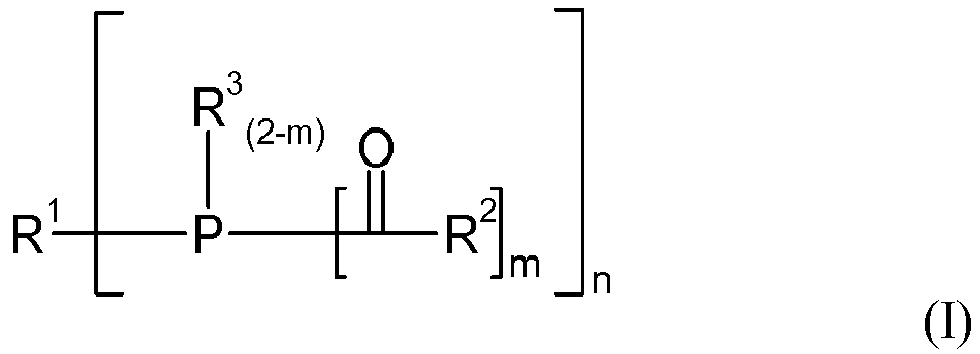
- n
- is an integer, preferably an integer from 1 to 6, more preferably 1, 2, 3 or 4, and even more preferably 1 or 2
- m
- is 1 or 2,
- R1, if n is 1
- is a substituent of formula (IIa)
-C(1)R6 2-C(2)H(Z)(R7) (IIa)
wherein
(1) and (2) indicate the numeration of the carbon atom whereby C(1) is bound to the central phosphorous atom depicted in formula (I) and
Z is a substituent selected from the group consisting of -CN,-NO2, -(CO)H, -(CO)R8, -(CO)OH, -(CO)OR8, -(CO)NH2, -(CO)NH(R8), -(CO)N(R8)2, -(SO2)R8, -(PO)(R8)2,-(PO)(OR8)2, -(PO)(OR8)(R8) or heteroaryl
R6 and R7 each substituent independently is hydrogen, Z or R8 and
R8 independently of further substituents R8 which may be present in the substituent of formula (IIa) is alkyl, alkenyl or aryl or two substituents R8 irrespective of whether they are both part of a substituent Z or belong to different substituents selected from Z, R6 and R7 together are alkanediyl or alkenediyl or alternatively, where two substituents -(CO)R8 are present within the substituent of formulae (IIa) are together -O- or -NR4-, whereby the alkyl, alkenyl, aryl, alkanediyl and alkenediyl substituents are- either not, once, twice or more than twice interrupted by non-successive functional groups selected from the group consisting of:
-O-, -S-, -SO2-, -SO-, -SO2NR4-, NR4SO2-, -NR4-, -CO-, -O(CO)-, (CO)O-, -O(CO)O-, -NR4(CO)NR4-, NR4(CO)-, -(CO)NR4-,-NR4(CO)O-, -O(CO)NR4-, -Si(R5)2-, -OSi(R5)2-, -OSi(R5)2O-,-Si(R5)2O-,
and - either not, additionally or alternatively either once, twice or more than twice interrupted by bivalent residues selected from the group consisting of heterocyclo-diyl, and aryldiyl,
and - either not, additionally or alternatively either once, twice or more than twice substituted by substituents selected from the group consisting of:
oxo, hydroxy, halogen, cyano, azido, C6-C14-aryl, C1-C8-alkoxy, C1-C8-alkylthio, -SO3M, -COOM, PO3M2, -PO(N(R5)2)2, PO(OR5)2,-SO2N(R4)2, -N(R4)2, -CO2N(R5)2, -COR4, -OCOR4, -NR4(CO)R,5-(CO)OR4,-NR4(CO)N(R4)2, -Si(OR5)y(R5)3-y, -OSi(OR5)y(R5)3-y with y = 1, 2 or 3, and preferably also -N(R4)3 +An-, or
- either not, once, twice or more than twice interrupted by non-successive functional groups selected from the group consisting of:
- or R1, if n is 1
- is a substituent of formulae (IIb), (IIc) or (IId)
-C(1)R6 2-N(R8)2 (IIb)
-C(1)R6 2-NH(R8) (IIc)
-(C(1)=O)-NHR8 (IId)
wherein
(1) indicates the carbon atom bound to the central phosphorous atom depicted in formula (I) and
R1, if n is > 1, in particular 2 to 6, preferably 2, 3 or 4 or, in another embodiment, 2 is a substituent of formula (IIe) or (IIf)
R*[C(2)HR9-C(1)(R9)2-]n (IIe)
R**[NH-(C(1)=O)-]n (IIf)
- R*
- is either
a divalent substituent selected from the group consisting of -CO- and -SO2-(for n = 2) or
a n-valent substituent selected from the group consisting of heteroaryl-n-yl and R10(-Het-(C=O)-)n wherein Het independently is either O or NR4 and R10 is alkane-n-yl, alkene-n-yl or aryl-n-yl and wherein the carbonyl carbons are bound to the C(2) carbon atoms
whereby the aforementioned alkane-n-yl and alkene-n-yl substituents of R10 are- either not, once, twice or more than twice interrupted by non-successive functional groups selected from the group consisting of:
-O-, -NR4-, -CO-, -O(CO)-, -(CO)O-, NR4(CO)-, -(CO)NR4-
and - either not, additionally or alternatively either once, twice or more than twice interrupted by aryldiyl,
and - either not, additionally or alternatively either once, twice or more than twice substituted by substituents selected from the group consisting of:
hydroxy, C1-C8-alkoxy, -COOM, -N(R4)2, -CO2N(R5)2, -COR4, -OCOR4, -NR4(CO)R5, -(CO)OR4,
(1) and (2) indicate the numeration of the carbon atom whereby each of the n C(1) carbon atoms is bonded to the central phosphorous atom depicted in formula (I) via the bond "-" shown on the right side of the bracket and
- either not, once, twice or more than twice interrupted by non-successive functional groups selected from the group consisting of:
- R9
- independently of each other are hydrogen, alkyl, alkenyl or aryl or two substituents R9 irrespective of whether they are both bound to C(2) or not are together alkanediyl or alkenediyl
whereby the aforementioned alkyl, alkenyl, alkane-n-yl and alkene-n-yl substituents of R9 are- either not, once, twice or more than twice interrupted by non-successive functional groups selected from the group consisting of:
-O-, -S-, -SO2-, -SO-, -SO2NR4-, NR4SO2-, -NR4-, -CO-, -O(CO)-, (CO)O-, -O(CO)O-, -NR4(CO)NR4-, NR4(CO)-, -(CO)NR4-,-NR4(CO)O-, -O(CO)NR4-, -Si(R5)2-, -OSi(R5)2-, -OSi(R5)2O-,-Si(R5)2O-,
and - either not, additionally or alternatively either once, twice or more than twice interrupted by bivalent residues selected from the group consisting of heterocyclo-diyl, and aryldiyl,
and - either not, additionally or alternatively either once, twice or more than twice substituted by substituents selected from the group consisting of:
oxo, hydroxy, halogen, cyano, azido, C6-C14-aryl, C1-C8-alkoxy, C1-C8-alkylthio, -SO3M, -COOM, PO3M2, -PO(N(R5)2)2, PO(OR5)2,-SO2N(R4)2, -N(R4)2, -CO2N(R5)2, -COR4, -OCOR4, -NR4(CO)R,5-(CO)OR4,-NR4(CO)N(R4)2, -Si(OR5)y(R5)3-y, -OSi(OR5)y(R5)3-y with y = 1, 2 or 3 and preferably also -N (R4)3 +An-,
- either not, once, twice or more than twice interrupted by non-successive functional groups selected from the group consisting of:
- R**
- is a n-valent substituent selected from the group consisting of alkane-n-yl, alkene-n-yl and aryl-n-yl wherby R** is bound to the nitrogen atoms
whereby the aforementioned alkane-n-yl and alkene-n-yl substituents are- either not, once, twice or more than twice interrupted by non-successive functional groups selected from the group consisting of:
-O-, -NR4-, -CO-, -O(CO)-, -(CO)O-, -NR4(CO)-, -NR4(CO)O-,-NR4(CO) NR4-, -(CO)NR4- or isocyanurate, oxadiazintrione, uretdione, biuret or allophanate groups
and - either not, additionally or alternatively either once, twice or more than twice interrupted by aryldiyl,
and - either not, additionally or alternatively either once, twice or more than twice substituted by substituents selected from the group consisting of:
hydroxy, -NCO, C1-C8-alkoxy, -N(R4)2, -CO2N(R5)2, -COR4,-OCOR4, -NR4(CO)R5, -(CO)OR4,
(1) indicates the numeration of the carbon atom whereby each of the n C(1) carbon atoms is bonded to the central phosphorous atom depicted in formula (I) via the bond "-" shown on the right side of the bracket and
- either not, once, twice or more than twice interrupted by non-successive functional groups selected from the group consisting of:
- R2 and R3
- are independently of each other aryl or heterocyclyl, alkyl or alkenyl
whereby the aforementioned alkyl and alkenyl substituents of R2 and R3 are- either not, once, twice or more than twice interrupted by non-successive functional groups selected from the group consisting of:
-O-, -NR4-, -CO-, -OCO-, -O(CO)O-, NR4(CO)-, -NR4(CO)O-, O(CO)NR4-, -NR4(CO)NR4-,
and - either not, additionally or alternatively either once, twice or more than twice interrupted by bivalent residues selected from the group consisting of heterocyclo-diyl, and aryldiyl,
and - either not, additionally or alternatively either once, twice or more than twice substituted by substituents selected from the group consisting of:
oxo, hydroxyl, halogen, cyano, C6-C14-aryl; heterocyclyl, C1-C8-alkoxy, C1-C8-alkylthio, -COOM, -SO3M, -PO3M2, -SO2N(R4)2,-NR4SO2R5, -N(R4)2-, -N+(R4)3An-, -CO2N(R4)2,-COR4-, -OCOR5,-O(CO)OR5, NR4(CO)R4, -NR4(CO)OR4, O(CO)N(R4)2,-NR4(CO)N(R4)2,
- either not, once, twice or more than twice interrupted by non-successive functional groups selected from the group consisting of:
- R4
- is independently selected from the group consisting of hydrogen, C1-C8-alkyl, C6-C14-aryl, and heterocyclyl or N(R4)2 as a whole is a N-containing heterocycle,
- R5
- is independently selected from the group consisting of C1-C8-alkyl, C6-C14-aryl, and heterocyclyl or N(R5)2 as a whole is a N-containing heterocycle
- M
- is hydrogen, or 1/q equivalent of an q-valent metal ion or is an ammonium ion or a guanidinium ion or a primary, secondary, tertiary or quarternary organic ammonium ion, in particular those of formula [N(C1-C18-alkyl)sHt]+ wherein s is 1,2 or 3 and t is (4-s) and
- An-
- is 1/p equivalent of a p-valent anion.
- if n is 1
with compounds of formulae (IVa), (IVb), (IVc) or (IVd)
R6 2C(1)=C(2)(Z)(R7) (IVa)
R6 2C(1)=N+(R8)2An- (IVb)
R6 2C(1)=NR8 (IVc)
R8-NCO (IVd)
- if n is > 1
with compounds of formulae (IVe) or (IVf)
R*[R9C(2)=C(1)(R9)2]n (IVe)
R**[NCO]n (IVf)
wherein in formulae (III) and (IVa) to (IVf)
(1), (2), R2, R3, R6, R7, R8, R9, R*, R**, n, m, An- and Z have the same meaning as described for formulae (I) and (IIa) to (IIf) above and
wherein in formula (II)- M2
- is hydrogen, or 1/q equivalent of an q-valent metal ion or is an ammonium ion or a heterocycylium cation, a guanidinium ion or a primary, secondary, tertiary or quarternary organic ammonium ion, in particular those of formula [N(C1-C18-alkyl)sHt]+ wherein s is 1,2 or 3 and t is (4-s) and
- In one embodiment, where M2 is 1/q equivalent of an q-valent metal ion or a quarternary organic ammonium ion or a heterocyclylium cation an acid, preferably an acid with a pKa of 5 or less at 25°C measured in water or an aqueous reference system is added after the reaction to protonate the intermediates.
- The compounds of formula (I) may be further functionalized by standard operations such as alkylations, nucleophilic substitutions, protonations with acids, deprotonations with bases, optionally followed by ion exchange and the like in order to obtain other compounds of formula (I).
- Further details are given in the examples.
- The scope of the invention encompasses all combinations of substituent definitions, parameters and illustrations set forth above and below, either in general or within areas of preference or preferred embodiments, with one another, i.e., also any combinations between the particular areas and areas of preference.
- Whenever used herein the terms "including", "e.g.", "such as" and "like" are meant in the sense of "including but without being limited to" or "for example without limitation", respectively.
- As used herein, and unless specifically stated otherwise, aryl denotes carbocyclic aromatic substituents, whereby said carbocyclic, aromatic substituents are unsubstituted or substituted by up to five identical or different substituents per cycle. For example and with preference, the substituents are selected from the group consisting of fluorine, bromine, chlorine, iodine, nitro, cyano, formyl or protected formyl, hydroxyl or protected hydroxyl, C1-C8-alkyl, C1-C8-haloalkyl, C1-C8-alkoxy, C1-C8-haloalkoxy, C6-C14-aryl, in particular phenyl and naphthyl, di(C1-C8-alkyl)amino, (C1-C8-alkyl)amino, CO(C1-C8-alkyl), OCO(C1-C8-alkyl), NHCO(C1-C8-alkyl), N(C1-C8-alkyl)CO(C1-C8-alkyl), CO(C6-C14-aryl), OCO(C6-C14-aryl), NHCO(C6-C14-aryl), N(C1-C8-alkyl)CO(C6-C14-aryl), COO-(C1-C8-alkyl), COO-(C6-C14-aryl), CON(C1-C8-alkyl)2 or CONH(C1-C8-alkyl), CO2M, CONH2, SO2NH2, SO2N(C1-C8-alkyl)2, SO3M and PO3M2.
- In a preferred embodiment, the carbocyclic, aromatic substituents are unsubstituted or substituted by up to three identical or different substituents per cycle selected from the group consisting of fluorine, chlorine, cyano, C1-C8-alkyl, C1-C8-haloalkyl, C1-C8-alkoxy, C1-C8-haloalkoxy, C6-C14-aryl, in particular phenyl.
- In a more preferred embodiment the carbocyclic, aromatic substituents are unsubstituted or substituted by up to three identical or different substituents per cycle selected from the group consisting of fluorine, C1-C8-alkyl, C1-C8-perfluoroalkyl, C1-C8-alkoxy, C1-C8-perfluoroalkoxy, and phenyl.
- The definitions given above, including their areas of preference, also apply analogously to aryldiyl and aryl-n-yl substituents. Preferred aryl substituents are C6-C14-aryl substituents, more preferably phenyl, naphthyl, phenanthrenyl and anthracenyl. The term C6-C14 indicates that the number of carbon atoms of the respective carbocyclic, aromatic ring system is from 6 to 14. The possible and preferred substitution patterns mentioned above are likewise applicable.
- As used herein and unless specifically stated otherwise, heterocyclyl denotes heterocyclic aliphatic, aromatic or mixed aliphatic and aromatic substituents in which no, one, two or three skeleton atoms per cycle, but at least one skeleton atom in the entire cyclic system is a heteroatom selected from the group consisting of nitrogen, sulphur and oxygen which are unsubstituted or substituted by up to five identical or different substituents per cycle, whereby the substituents are selected from the same group as given above for carbocyclic aromatic substituents including the areas of preference.
- Preferred heterocyclyl-substituents and heteroaryl-substituents respectively are pyridinyl, oxazolyl, thiophen-yl, benzofuranyl, benzothiophen-yl, dibenzofuranyl, dibenzothiophenyl, furanyl, indolyl, pyridazinyl, pyrazinyl, imidazolyl, pyrimidinyl and quinolinyl, either unsubstituted or substituted with one, two or three substituents selected from the group consisting of fluorine, C1-C8-alkyl, C1-C8-perfluoroalkyl, C1-C8-alkoxy, C1-C8-perfluoroalkoxy, and phenyl.
- The definitions given above, including their areas of preference, also apply analogously to heterocyclylium and heteroarylium cations and the bivalent heterocyclo-diyl and heteroaryldiyl substituents.
- Preferred heterocyclylium cations are N-(C1-C8-alkyl)imidazolium or pyridinium cations.
- As used herein, and unless specifically stated otherwise, protected formyl is a formyl substituent which is protected by conversion to an aminal, acetal or a mixed aminal acetal, whereby the aminals, acetals and mixed aminal acetals are either acyclic or cyclic.
- For example, and with preference, protected formyl is 1,1-(2,4-dioxycyclopentanediyl).
- As used herein, and unless specifically stated otherwise, protected hydroxyl is a hydroxyl radical which is protected by conversion to a ketal, acetal or a mixed aminal acetal, whereby the aminals, acetals and mixed aminal acetals are either acyclic or cyclic. A specific example of protected hydroxyl is tetrahydropyranyl (O-THP).
- As used herein, and unless specifically stated otherwise, alkyl, alkanediyl, alkenyl, alkenediyl, alkane-n-yl and alkene-n-yl are straight-chained, cyclic either in part or as a whole, branched or unbranched.
- The term C1-C18-alkyl indicates that the straight-chained, cyclic either in part or as a whole, branched or unbranched alkyl substituent contains from 1 to 18 carbon atoms excluding the carbon atoms of optionally present substituents to the C1-C18-alkyl substituent. The same analogously applies to alkanediyl, alkenyl, alkenediyl, alkane-n-yl and alkene-n-yl and further substituents having an indicated number of carbon atoms.
- For the avoidance of doubt the term alkenyl denotes a susbtituent comprising at least one carbon-carbon double bond, irrespective of its location within the straight-chained, cyclic either in part or as a whole, branched or unbranched substituent.
- Specific examples of C1-C4-alkyl are methyl, ethyl, n-propyl, isopropyl, n-butyl, tert-butyl. Additional examples for C1-C8-alkyl are n-pentyl, cyclohexyl, n-hexyl, n-heptyl, n-octyl, isooctyl. Additional examples for C1-C18-alkyl are norbornyl, adamantyl, n-decyl, n-dodecyl, n-hexadecyl, n-octadecyl.
- Specific examples of C1-C8-alkanediyl-substituents are methylene, 1,1-ethylene, 1,2-ethylene, 1,1-propylene, 1,2-propylene, 1,3-propylene, 1,1-butylene, 1,2-butylene, 2,3-butylene and 1,4-butylene, 1,5-pentylene, 1,6-hexylene, 1,1-cyclohexylene, 1,4-cyclohexylene, 1,2-cyclohexylene and 1,8-octylene.
- Specific examples of C1-C4-alkoxy-substituents are methoxy, ethoxy, isopropoxy, n-propoxy, n-butoxy and tert-butoxy. An additional example for C1-C8-alkoxy is cyclohexyloxy.
- Specific examples of C2-C18-alkenyl and C2-C8-alkenyl-substituents are allyl, 3-propenyl and buten-2-yl.
- As used hereinabove, C1-C8-haloalkyl and C1-C8-haloalkoxy are C1-C8-alkyl and C1-C8 -alkoxy sustituents which are once, more than once or fully substituted by halogen atoms. Substituents which are fully substituted by fluorine are referred to as C1-C8-perfluoroalkyl and C1-C8-perfluoroalkoxy, respectively.
- Specific examples of C1-C8-haloalkyl-substituents are trifluoromethyl, 2,2,2-trifluoroethyl, chloromethyl, fluoromethyl, bromomethyl, 2-bromoethyl, 2-chloroethyl, nonafluorobutyl and n-perfluorooctyl.
- The process according to the invention requires employment of compounds of formula (III). Such compounds may be prepared in any manner known per se for example and preferably by the steps of:
- A) contacting elemental phosphorous with a alkali or alkaline earth metal optionally in the presence of a catalyst or an activator in a solvent to obtain metal phosphides M3 3P, wherein M3 is an alkali or ½ equivalent of an alkaline earth metal, whereby the phosphides are usually present in a polymeric form and are therefore occasionally referred to as pholyphosphides
- B) optionally adding a proton source, optionally in the presence of a catalyst or an activator to obtain metal dihydrogen phosphides M3PH2 which may depending on the proton source exist as complexes;
- C) reacting said dihydrogenphosphides with either
- two equivalents of acid halides of formula (VI)

- or first with one equivalent of acid halide of formula (VI)
and subsequently with one equivalent of formula (VII)
LG-R3 (VII)
or vice versa
to obtain compounds of formula (III) wherein m is 1
and to the extent M3 differs from M2 further reaction with either metal salts of formula (VIII),
M2Halq (VIII)
wherein q denotes the valence of the metal ion M2
or acids of formula (IX)
HAn (IX)
wherein An is 1/p equivalent of a p-valent anion.
R2, R3, m and M2 have the same meaning given above for formula (I) and
LG denotes a leaving group, preferably chlorine, bromine or iodine or C1-C8-alkylsulfonyloxy. - two equivalents of acid halides of formula (VI)
- Alternatively compounds of formula (III) with m = 1 are prepared for example and preferably by the step of contacting phosphines H2PR3, with one equivalent of acid halide of formula (VI) in the presence of two equivalents of a base or by contacting phosphides M3HPR3, with one equivalent of acid halide of formula (VI) and to the extent M3 differs from M2 further reaction with either metal salts of formula (VIII), whereby in formulae (III), (IV), (V), (VI), (VII) and (VIII) R2, R3, m and M2 have the same meaning given above for formula (I) and LG denotes a leaving group preferably chlorine, bromine or iodine or C1-C8-alkylsulfonyloxy.
- For the avoidance of doubt, compounds of formula (III) as depicted above shall also encompass their isomers of formulae (IIIa), (IIIb) and (IIIc) which are typically present and observable in solution and solid state:

- Formula (III) as depicted above shall also encompass dimers, trimers and higher aggregated complexes as well as solvate complexes or other compounds wherein the Metal is complexed of the compounds depicted therein.
their isomers of formulae (IIIa), (IIIb) and (IIIc) which are typically present and observable in solution and solid state:
In one embodiment in compounds of formulae (IVa) and (I), with R1 being a substituent of formula (IIa) - n
- is 1 and m is 1 or 2, preferably 2 and
- Z
- is a substituent selected from the group consisting of -CN, -(CO)R8, -(CO)OR8,-(CO)N(R8)2, -(SO2)R8, -(PO)(R8)2, -(PO)(OR8)2, -(PO)(OR8)(R8), or 2-pyridyl
- R6 and R7
- independently of each other are hydrogen, Z or R8 and
- R8
- independently of further substituents R8 which may be present in the substituent of formula (IIa) is C1-C4-alkyl, C2-C4-alkenyl or C6-C14-aryl or two substituents R8 irrespective of whether they are both part of a substituent Z or belong to different substituents selected from Z, R6 and R7 together are C1-C4-alkanediyl or C2-C4-alkenediyl or alternatively, where two substituents -(CO)R8 are present within the substituent of formulas (IIa) are together -O- or -NR4-,
whereby the C1-C4-alkyl, C2-C4-alkenyl, C1-C4-alkanediyl and C2-C4-alkenediyl substituents are- either not or once interrupted by non-successive functional groups selected from the group consisting of:
-O-, -NR4-, -CO-, -O(CO)-, (CO)O- or -O(CO)O-,
and - either not, additionally or alternatively either once, twice or more than twice substituted by substituents selected from the group consisting of:
oxo, hydroxy, halogen, cyano, C6-C14-aryl, C1-C4-alkyl, C1-C4-alkoxy, C2-C4-alkenyl, PO(OR5)2, -N(R4)2, -CO2N(R5)2,-Si(OR5)y(R5)3-y, -OSi(OR5)y(R5)3-y with y = 1, 2 or 3, and preferably also -N(R4)3 +Ar- ,
- either not or once interrupted by non-successive functional groups selected from the group consisting of:
- In another embodiment in compounds of formulae (IVa) and (I), with R1 being a substituent of formula (IIa)
- n
- is 1 and m is 1 or 2, preferably 2 and
- Z
- is a substituent selected from the group consisting of -CN, -(CO)R8, -(CO)OR8,-(CO)N(R8)2, -(SO2)R8, -(PO)(R8)2, -(PO)(OR8)2, or 2-pyridyl
- R6
- is hydrogen
- R7
- is hydrogen, Z or R8 and
- R8
- independently of further substituents R8 which may be present in the substituent of formula (IIa) is C1-C4-alkyl, C2-C4-alkenyl or two substituents R8 irrespective of whether they are both part of a substituent Z or belong to different substituents selected from Z, R6 and R7 together are C1-C4-alkanediyl or C2-C4-alkenediyl or alternatively, where two substituents -(CO)R8 are present within the substituent of formulas (IIa) are together -O- or -NR4-,
whereby the C1-C4-alkyl, C2-C4-alkenyl, C1-C4-alkanediyl and C2-C4-alkenediyl substituents are- either not or once interrupted by non-successive functional groups selected from the group consisting of:
-O-, -NR4-, -CO-
and - either not, additionally or alternatively once, twice or more than twice substituted by substituents selected from the group consisting of:
oxo, hydroxy, C1-C4-alkoxy, C2-C4-alkenyl, PO(OR5)2, -N(R4)2,-CO2N(R5)2, -Si(OR5)y(R5)3-y, -OSi(OR5)y(R5)3-y with y = 1, 2 or 3, and preferably also -N(R4)3 +An-,
- either not or once interrupted by non-successive functional groups selected from the group consisting of:
- In another embodiment in compounds of formulae (IVa) and (I), with R1 being a substituent of formula (IIa)
- n
- is 1 and m is 1 or 2, preferably 2 and
- Z
- is a substituent selected from the group consisting of -CN, -(CO)OR8, -(SO2)R8,-(PO)(R8)2, -(PO)(OR8)2, or 2-pyridyl
- R6
- is hydrogen
- R7
- is hydrogen, Z or Methyl and
- R8
- independently of further substituents R8 which may be present in the substituent of formula (IIa) is C1-C4-alkyl, C2-C4-alkenyl or two substituents R8 irrespective of whether they are both part of a substituent Z or belong to different substituents selected from Z, R6 and R7 together are C1-C4-alkanediyl or C2-C4-alkenediyl or alternatively, where two substituents -(CO)R8 are present within the substituent of formulas (IIa) are together -O- or -NR4-,
whereby the C1-C4-alkyl, C2-C4-alkenyl, C1-C4-alkanediyl and C2-C4-alkenediyl substituents are- either not or once interrupted by non-successive functional groups selected from the group consisting of:
-O-, -NR4-,
and - either not, additionally or alternatively once, twice or more than twice substituted by substituents selected from the group consisting of:
hydroxy, C1-C4-alkoxy, C2-C4-alkenyl, PO(OR5)2, -N(R4)2, -CO2N(R5)2, -Si(OR5)y(R5)3-y, -OSi(OR5)y(R5)3-y with y = 1, 2 or 3, and preferably also -N(R4)3 +An-,
- either not or once interrupted by non-successive functional groups selected from the group consisting of:
- In a further embodiment the following compounds of formulae (IVa) are used:
- C1-C8-alkyl esters of acrylic acid or methacrylic acid whereby C1-C8-alkyl is unsubstituted or substituted according to the substitution pattern described above, preferably methyl-, ethyl-, n-butyl-, iso-butyl, tert.-butyl-, 2-ethylhexyl- and 2-hydroxyethyl acrylate, isobornyl acrylate, 3-(acryloyloxy)propyltrimethoxy-silane, 2-acryloxyethyltrimethylammoniumchloride,
- α-unsaturated sulfones such as phenylvinyl sulfone
- α-unsaturated lactones such as α-methylene-γ-butyrolactone
- α-unsaturated C1-C8-alkyl phosphonates compounds such as diethyl vinylphosphonate
- aromatic compounds such as 2- and 4-vinylpyridine
- nitriles such as acrylonitrile
- C1-C8-alkyl esters of other unsaturated acids such as crotonic acid, maleic acid, fumaric acid, itaconic acid and cinnamic acid whereby C1-C8-alkyl is unsubstituted or substituted according to the substitution pattern described above
- anhydrides of maleic acid and itaconic acid
- In a further embodiment the following compounds of formulae (IVa) are used:
itaconic anhydride, maleimide, acrylonitrile, α-methylene-γ-butyrolactone, phenyl vinyl sulfone, diethyl vinylphosphonate, methylacrylate, 3-(acryloyloxy)propyltrimethoxysilane, dimethyl itaconate, vinyl acrylate, 2-vinylpyridine, 2-acrylamido-2-hydroxymethyl-1,3-propanediol. - In one embodiment compounds of formulae (IVb) and (I), with R1 being a substituent of formula (IIb) R6 is hydrogen , R8 is C1-C8-alkyl and An- is a halide. An example of a compound of formula (IVb) is N,N-dimethylmethyleneiminium chloride.
- In another embodiment compounds (IVc) and (I), with R1 being a substituent of formula (IIc) R6 is C1-C8-alkyl or C6-C14-aryl and R8 is C1-C8-alkyl or C6-C14-aryl.
- In one embodiment compounds of formulae (IVd) and (I), with R1 being a substituent of formula (IId) R8 is C1-C8-alkyl, C2-C8-alkyl or C6-C14-aryl. An example of a compound of formula (IVd) is cyclohexylisocyanate.
- In one embodiment in compounds of formulae (IVe) and (I), with R1 being a substituent of formula (IIe)
n is 2 and m is 1 or 2, preferably 2 and - R*
- is -CO- or -SO2- , preferably -SO2- and
- R9
- independently of each other are hydrogen, C1-C8-alkyl, or two substituents R9 irrespective of whether they are both bound to C(2) or not are together C2-C8-alkanediyl, preferably all substituents R9 are hydrogen.
- One specific compound of formula (IVe) is divinylsulfone.
- In one further embodiment in compounds of formulae (I), with R1 being a substituent of formula (IIa) or (IIe)
m is 1 or 2, preferably 2 and
R* is a substituent of formula (VIa) or (VIb) or (VIc) or (VId) or (VIe)


R11-[X-]zzOR30 (VIe)
wherein
in formula (VIa) n is 1, 2, 3 or 4
in formula (VIb) n is 1, 2 or 3
in formula (VIc) and VI(d) n is 1 or 2
in formula (VIe) n is 1
and wherein - n of the substituents R11
- are -C(1)H2-C(2)HR15-(C=O)- wherein (1) indicates the numeration of the carbon atom whereby each of the n C(1) carbon atoms is bound to the central phosphorous atom depicted in formula (I) and R11 is bound to X at the carbonyl carbon and wherein R15 is hydrogen or methyl
and the remainder substituents R11, if any, are either hydrogen or C(1)H2=C(2)HR15-(C=O)-, - each X
- is independently selected from the group consisting of
-OCH2-CH2-, -OCH(CH3)-CH2-, -OCH2-CH(CH3)-, -OCH2-C(CH3)2-, -O-C(CH3)2-CH2-, and - u, v, w and z
- are independently selected from 0 or an integer from 1 to 20, preferably 0 or an integer from 1 to 10, more preferably zero or an integer from 1 to 5. In another embodiment u, v, w and z are all 0
- zz
- is selected from an integer of from 1 to 100, preferably an integer of from 2 to 100, more preferably an integer of from 3 to 20.
- R12 and R13
- are independently selected from the group consisting of hydrogen or C6-C14-aryl or C1-C18-alkyl
- R14
- is C2-C18-alkane-diyl or X2 wherein X2 is independently selected from the group consisting of -CHR16-CH2-(O-CHR16-CH2-)f-O-(CHR16CH2)-, -CH2-CHR16-(O-CH2-CHR16-)f-O-(CHR16CH2)-, with f being 0 or an integer of 1 to 20 and R16 being methyl or hydrogen.
- R30
- is selected from the group consisting of hydrogen or C6-C14-aryl or C1-C18-alkyl, whereby hydrogen, methyl, ethyl, n-propyl, isopropyl, tert.-butyl and phenyl are preferred, and hydrogen. methyl and ethyl are even more preferred.
- Compounds of formulae (VIa) to (VIe) may be obtained by reacting the compounds of formulae (VIIa) to (VIIe) with compounds of formula (III):


R17-[X-]zzOR30 (VIIe)
wherein - the substituents R17
- are each independently, preferably identically selected from the group consisting of hydrogen or C(1)H2=C(2)HR15-(C=O)-,
- Specific compounds of formula (VIIa) are mono-, di-, tri- or tetraacrylated or - methacrylated pentaerythrol or mixtures thereof or their ethoxylated or propoxylated or mixed ethoxylated and propoxylated analogoues
- Specific compounds of formula (VIIb) are mono-, di- or tri-acrylated or -methacrylated trimethylolpropane or mono-, di- or tri-acrylated or -methacrylated glycerol or mixtures thereof or their ethoxylated or propoxylated or mixed ethoxylated and propoxylated analogoues. Further examples 1,3-propanedioldiacrylate and 1,3-butanedioldiacrylate.
- Specific compounds of formula (VIIc) are, 1,3-butanedioldiacrylate, 1,5-pentanedioldiacrylate, 1,6-hexanedioldiacrylate, glyceroldi- or -triacrylate, di- or polyacrylates of sugar alcohols such as sorbitol, mannitol, diglycerol, threitol, erythrol polyethylenglycols, epoxy(meth)acrylates, urethane(meth)acrylates and polycarbonate(meth)acrylates.
- Specific compounds of formula (VIId) are 1,2-propanedioldiacrylate, 1,4-butanedioldiacrylate, 1,5-pentanedioldiacrylate, 1,6-hexanedioldiacrylate, mono, di- or polyacrylates of sugar alcohols such as sorbitol, mannitol, diglycerol, threitol, erythrol polyethylenglycols.
- Specific compounds of formula (VIIe) are acrylic or methacrylic esters of monomethyl or monoethylethers of polyethylene glycols or polypropylene glycols wherein zz is an integer of 2 to 100, preferably 3 to 20.
- Compounds of formulae (VIa) to (VId) are particularly useful as multifunctional photoinitiators having highly valuable crosslinking and bonding capabilities which were not known before.
- Compounds of formulae (VIa) to (VId) where at least one of u,v,z, and y is not zero and those compounds of formula (VIe) are particularly useful as photoinitiators having (in addition thereto) high efficiency as well as good emulsifying capabilities which allows to use them as photoinitiators in emulsion polymerizations with superior performance.
- In one embodiment in compounds of formulae (I) and (III)
- m
- is 1 or 2, preferably 2 and
- R2
- is C6-C14-aryl or heterocyclyl or
is C1-C18-alkyl or C2-C18-alkenyl
which is either not, once, twice or more than twice interrupted by non-successive functional groups selected from the group consisting of:
-O-, -NR4-, -N+(R4)2An--, -CO-, NR4(CO)-, -NR4(CO)O-, (CO)NR4-,
and which is not, additionally or alternatively either once, twice or more than twice substituted by substituents selected from the group consisting of:
halogen, cyano, C6-C14-aryl; heterocyclyl, C1-C8-alkyl, C1-C8-alkoxy, C1-C8-alkylthio, C2-C8-alkenyl, C4-C15-arylalkyl, -COOM, SO2N(R3)2-, N(R4)2-, -N+(R4)3An-, -CO2N(R4)2, - R4
- is independently selected from the group consisting hydrogen, C1-C8-alkyl, C6-C14-aryl, C7-C15-arylalkyl and heterocyclyl or N(R4)2 as a whole is a N-containing heterocycle or N+(R4)2An- and N+(R4)3An- as a whole is or contains a cationic N-containing heterocycle with a counteranion,
- R5
- is independently selected from the group consisting C1-C8-alkyl, C6-C14-aryl, C7-C15-arylalkyl and heterocyclyl or N(R5)2 as a whole is a N-containing heterocycle or N+(R5)2An- and N+(R5)3An- as a whole is or contains a cationic N-containing heterocycle with a counteranion,
- M
- is hydrogen, lithium, sodium, potassium, one half equivalent of calcium, zinc or iron (II), or one third equivalent of aluminium (III) or is an ammonium ion or a primary, secondary, tertiary or quarternary organic ammonium ion, and
- An-
- is 1/p equivalent of an p-valent anion.
- In another embodiment in compounds of formulae (I) and (III)
- m
- is 2,
- R2
- is C6-C14-aryl, preferably mesityl or 2,6-dimethoxyphenyl, more preferably mesityl.
- In one embodiment in compounds of formula (I) M2 is hydrogen or sodium.
- The process is typically carried out by adding the compounds of formulae (IVa) to (IVf) either neat or dissolved or suspended in a solvent to a neat compound of formula (III) or a solution or suspension thereof and, where M2 is hydrogen, the base. Thereby a reaction mixture is formed.
- Alternatively the process is carried out by adding the compound of formula (III) either neat or dissolved or suspended in a solvent and, where M2 is hydrogen, the base to a neat compound of formula (IVa) to (IVf) or a solution or suspension thereof. Thereby a reaction mixture is formed.
- The reaction time is typically in the range of from 5 min to 24 hours, preferably 30 min to 12 hours.
- Suitable solvents are those which do not or virtually not react under formation of new covalent bonds with the compounds of formulae (III) and (IVa) to (IVf) employed in the reaction.
- Such solvents include
- aromatic solvents such as benzene, toluene and the isomeric xylenes,
- ethers such as diethylether, methyl tert.butyl ether, tetrahydrofurane, dioxane, dimethoxyethane, diethoxyethan and higher glycolethers;
- C1-C8 mono-, di- or trialcohols or ether alcohols such as methanol, ethanol, n-propanol, isopropanol, glycerol, glycol, 1,4-butanediol, diethyleneglycol or triethyleneglycol,
- amides such as dimethylformamide,
- sulfones such as tetraethylensulfone,
- esters such as ethylacetate and
- water or
- It is quite surprising that the reaction can be carried out in water since this allows to perform the process environmentially friendly.
- The amount of solvent is not critical at all and is just limited by commercial aspects, since they have to be removed if the compounds shall finally be isolated. Typically the amount of solvent is chosen such that the final product is completely soluble in the organic solvent.
- To facilitate the reaction mixing energy e.g. by standard agitators stirrers and/or static mixing elements is introduced into the reaction mixture.
- Even though not necessary, mixing can also be supported by using high force dispersion devices such as, for example, ultrasound sonotrodes or high pressure homogenizers.
- The process may either be performed batchwise or continuously.
- A typical and preferred reaction temperature range to carry out the process is from -30°C to 120°C, preferably from -10 to 80°C and even more preferably from 0 to 40°C.
- It is evident to those skilled in the art, that where the desired reaction temperature is above the boiling point at 1013 hPa of the solvent employed, the reaction is carried out under sufficient pressure.
- A typical and preferred reaction pressure range to carry out the process is from 50 hPa to 10 MPa, preferably from 500 hPa to 1 MPa and even more preferably from 800 hPa to 1,2 MPa. Most preferably the reaction is carried out under ambient pressure.
- During the reaction compounds of formula (I) are formed. If M2 is 1/q equivalent of an q-valent metal ion or a quarternary organic ammonium ion or a heterocyclylium cation salts of compounds of formula (I) are formed which are also covered by this invention. In this case an acid is added after the reaction to obtain compounds of formula (I). Suitable acids are those having a pKa of 7 or less, preferably 5 or less, more preferably 2 or less at 25°C measured in water.
- Examples of suitable acids include hydrogen chloride in diethylether, sulphuric acid, carboxylic acids such as formic acid and acetic acid.
- If M2 is hydrogen the reaction is carried out in the presence of base. Where in addition to compounds of formula (III) where M2 is hydrogen further compounds of formula (III) are used where M2 is not hydrogen the latter compounds can serve as a base without the necessity to add other bases
- The amount of base is not critical and might be in the range of from 0.0001 to 100 mol equivalents with respect to the compounds of formula (III), preferably in the range of from 0.001 to 10 mol equivalents, more preferably in the range of from 0.05 to 1 mol equivalents and even more preferably in the range of from 0.05 to 0.5 mol equivalents.
- Suitable bases include Ammonia, primary, secondary or tertiary amines such as triethylamine, triethanolamine and DBN, N-heteroaromatic compounds such as unsubstituted or substituted pyridines or chinolines, alcoholates such as lithium-, sodium- and potassium- -methoxide, -ethoxide and -tert. butoxide, amides such as lithium-diisoproylamide, hydroxides such as lithium, sodium and potassium hydroxide and carbonates such as lithium, sodium and potassium carbonate. The carbonates and hydroxides are preferably employed when water is used as solvent.
- In one embodiment the bases are removed after reaction from the reaction mixture by adding an acid, preferably those acids as defined above, and removing the salts formed thereby by sedimentation and decanting, filtration or centrifugation, preferably by filtration.
- The molar ratio of compounds of formula (IVa) to (IVe) to those of formula (III) depends on the integer n, i.e. the number of acylphosphino groups to be finally present in compounds of formula (I). Typically from 0,8 to 1,2 mol of compounds of formula (III) are employed per acylphosphino group to be introduced, preferably 0,9 to 1,0 mol.
- Most of the compounds obtained by the reaction according to the invention are novel. Therefore, one further aspect of the invention relates to said novel compounds of formula (I) with compounds
tert.-butyl 3-(bis(2,4,6-dimethoxybenzoyl)phosphino)propanoate, 3-(bis(2,4,6-trimethylbenzoyl)phosphino)propanitrile and 2-(bis(2,4,6-trimethylbenzoyl)phosphino)ethyl-diethylphosphonate
being excluded since they are known fromWO2006/056541 . - The preferred substitution pattern disclosed above for compounds of formula (I) a likewise applicable here.
- Specific examples are
3-((bis(2,4,6-trimethylbenzoyl)phosphino)methyl)-dihydrofuran-2,5-dione, 3-(bis(2,4,6-trimethylbenzoyl)phosphino)pyrrolidine-2,5-dione, 3-(bis(2,4,6-trimethylbenzoyl)phosphino)propanenitrile, 3-((bis(2,4,6-trimethylbenzoyl)phosphino)methyl)-dihydrofuran-2(3H)-one, di-(2-(bis(2,4,6-trimethylbenzoyl)phosphino)ethyl)-sulfone, ((bis(2,4,6-trimethylbenzoyl)phosphino)ethyl)-phenyl-sulfone, Diethyl 2-(bis(2,4,6-trimethylbenzoyl)phosphino)ethylphosphonate, methyl 3-(bis(2,4,6-trimethylbenzoyl)phosphino)propanoate, 3-(trimethoxysilyl)propyl 3-(bis(2,4,6-trimethylbenzoyl)phosphino)propanoate, dimethyl 2-((bis(2,4,6-trimethylbenzoyl)phosphino)methyl)succinate, vinyl 3-(bis(2,4,6-trimethylbenzoyl)phosphino)propanoate, N,N-methylene-(bis-(bis(2,4,6-trimethylbenzoyl)phosphino)propanamide), 2-(2-(bis(2,4,6-trimethylbenzoyl)phosphino)ethyl)-pyridine, (bis(2,4,6-trimethylbenzoyl)phosphoryl)-N-cyclohexylformamide, N-((bis(2,4,6-trimethylbenzoyl)phosphino)methyl)-N,N-dimethylamine, N-((bis(2,4,6-trimethylbenzoyl)phosphino)methyl)-N,N,N-trimethylammonium triflate, 3-(bis(2,4,6-trimethylbenzoyl)phosphino)propanoic acid 2-(2-ethoxyethoxy) ethylester, bis-(3-[2-(2-ethoxyethoxy)ethoxycarbonyl]-propyl-(2,4,6-trimethylbenzoyl)-phosphine, trimethylolpropane tris-[3-(bis(2,4,6-trimethylbenzoyl)phosphino)propanoate], trimethylolpropane monoacrylate bis-[3-(bis(2,4,6-trimethylbenzoyl)phosphino) propanoate], trimethylolpropane bisacrylate mono-[3-(bis(2,4,6-trimethylbenzoyl)phosphino)propanoate], dimethyl 2-(bis(2,4,6-trimethylbenzoyl)phosphino)fumarate, dimethyl 2-(bis(2,4,6-trimethylbenzoyl)phosphino)maleate and 3-(bis(2,4,6-trimethylbenzoyl)phosphino)propanoyl-oxyethyltrimethylammonium chloride. - Compounds or formula (I) are particularly useful as precursor materials for compounds of formula (V)

- R1, R2, R3, n and m
- have the same meaning as described for formula (I) above including the same areas of preference and
- X
- is oxygen or sulphur, preferably oxygen
- Most of the compounds of formula (V) are also novel. Therefore, one further aspect of the invention relates to said novel compounds of formula (V) with compounds
tert.-butyl 3-(bis(2,4,6-dimethoxybenzoyl)phosphoryl)propanoate, 3-(bis(2,4,6-trimethylbenzoyl)phosphoryl)propanitrile and 2-(bis(2,4,6-trimethylbenzoyl)phosphoryl)ethyl-diethylphosphonate
being excluded since they are known fromWO2006/056541 . - The preferred substitution pattern disclosed above for compounds of formula (I) a analogously applicable here.
- Specific examples are 3-((bis(2,4,6-trimethylbenzoyl)phosphoryl)methyl)-dihydrofuran-2,5-dione, 2-((bis(2,4,6-trimethylbenzoyl)phosphoryl)methyl)succinic acid, 3-(bis(2,4,6-trimethylbenzoyl)phosphoryl)pyrrolidine-2,5-dione, 3-(bis(2,4,6-trimethylbenzoyl)phosphoryl)propanenitrile, 3-((bis(2,4,6-trimethylbenzoyl)phosphoryl)methyl)-dihydrofuran-2(3H)-one, di-(2-(bis(2,4,6-trimethylbenzoyl)phosphoryl)ethyl)-sulfone, ((bis(2,4,6-trimethylbenzoyl)phosphoryl)ethyl)-phenyl-sulfone, diethyl 2-(bis(2,4,6-trimethylbenzoyl)phosphoryl)ethylphosphonate, methyl 3-(bis(2,4,6-trimethylbenzoyl)phosphoryl)propanoate, 3-(trimethoxysilyl)propyl 3-(bis(2,4,6-trimethylbenzoyl)phosphoryl)propanoate, dimethyl 2-((bis(2,4,6-trimethylbenzoyl)phosphoryl)methyl)succinate, vinyl 3-(bis(2,4,6-trimethylbenzoyl)phosphoryl)propanoate, N,N-methylene-bis-(bis(2,4,6-trimethylbenzoyl)phosphoryl)propanamide), 2-(2-(bis(2,4,6-trimethylbenzoyl)phosphoryl)ethyl)-pyridine, 3-(bis(2,4,6-trimethylbenzoyl)phosphoryl)-N-(1,3-dihydroxy-2-(hydroxymethyl)propan-2-yl)propanamide, (bis(2,4,6-trimethylbenzoyl)phosphoryl)-N-cyclohexylformamide, methyl 3-(phenyl(2,4,6-trimethylbenzoyl)phosphoryl)propanoate, 2-(2-(phenyl-(2,4,6-trimethylbenzoyl)phosphoryl)ethyl)-pyridine, di-(2-(phenyl-(2,4,6-trimethylbenzoyl)phosphoryl)ethyl)-sulfone, 3-(bis(2,4,6-trimethylbenzoyl)phosphoryl)propanoic acid 2-(2-ethoxyethoxy) ethylester, bis-(3-[2-(2-ethoxyethoxy)ethoxycarbonyl]-propyl-(2,4,6-trimethylbenzoyl)-phosphine oxide, trimethylolpropane tris-[3-(bis(2,4,6.trimethylbenzoyl)phosphoryl) propanoate], trimethylolpropane monoacrylate bis-[3-(bis(2,4,6.trimethylbenzoyl)phosphoryl) propanoate], trimethylolpropane bisacrylate mono-[3-(bis(2,4,6.trimethylbenzoyl)-phosphoryl) propanoate], dimethyl 2-(bis(2,4,6-trimethylbenzoyl)phosphino)fumarate, dimethyl 2-(bis(2,4,6-trimethylbenzoyl)phosphino)maleate and 3-(bis(2,4,6-trimethylbenzoyl)phosphoryl)propanoyl-oxyethyltrimethylammonium chloride.
- Compounds of formula (V) may be obtained by reaction of compounds of formula (I) with an oxidizing agent to obtain compounds of formula (V) where X is oxygen or a sulfidizing agent to obtain compounds of formula (V) where X is sulphur in a manner well known to those skilled in the art and as e.g. disclosed in
WO2006/056541 . - Suitable oxidizing agents are: hydrogen peroxide, which is preferably employed as aqueous solution, e.g. with 30 wt.-%, organic peroxides such as tert-butylhydroperoxide; oxygen e.g. in the form of air, or sodium hypochlorite.
- Suitable sulfidizing agents are: elemental sulphur or organic polysulfides.
- In one embodiment the oxidation or suldidation is carried out in the same reaction media as the process for the preparation of compounds of formula (I), i.e. as a one-pot-reaction.
- The main advantage of the process according to the invention is that it allows the efficient and high-yielding synthesis of compounds of formulae (I) and (V) with a mild, variety of functional groups which are not easily available via known routes.
- Compounds of formula (V) are particularly useful as photoinitiators. Therefore one further aspect of the invention relates to a photoinitiated polymerization process in particular for the polymerization of polymerizable monomers wherein compounds of formula (V) are employed.
- Such processes are particularly useful for the preparation of polymer nanoparticles, coatings, adhesives, inks and painting materials. Therefore the invention further relates to polymer nanoparticles, coatings, adhesives, inks and painting materials obtainable by such process.
- The invention is further illustrated by the examples without being limited thereby.
- In a 100 mL thick-walled Schlenk flask equipped with a teflon screw cap, sodium (1.73 g, 0.075 mmol, 3 eq.) and red phosphorus (0.78 g, 0.025 mmol, 1 eq.) were put together under inert conditions. A glass covered magnetic stirrer was added and 20 mL of ammonia were condensed into the flask, by cooling with dry ice/ acetone to -78°C. Subsequently, dimethoxyethane (dme) (20 mL) was added and the flask was closed and warmed up to room temperature. After 90 min, stirring at room temperature a change in colour from blue to dark yellow was observed and after another 30 min, the colour became intensively yellow. The pressure in the reaction vessel was 7 to 8 bar. The reaction mixture was cooled down to -40°C. The Schlenk flask, which had now a pressure of 1 bar, was opened and tert-butanol (3.71 g, 0.05 mol, 2 eq.) was added. The reaction mixture was warmed up to room temperature over a period of two hours. Finally, the solvent was completely removed in vacuo at room temperature. The remaining oil was dissolved in dme (40 mL). Mesitoyl chloride (9.15 g, 0.05 mol, 2 eq.) was added dropwise.
- i): Isolation of the product under dry conditions: The reaction mixture was stirred for one hour at room temperature, the precipitate of sodium chloride was removed by filtration and the solvent was evaporated in vacuo. The pure microcrystalline product can be obtained by dissolving the sodium bis(mesitoyl)phosphide in dme and precipitation with n-hexane (Yield: 5.89 g, 67.7 %).
- ii). Working up with degassed water: The reaction mixture was mixed with 100 mL degassed, distilled water. After stirring the solution until the sodium chloride was completely dissolved, the reaction mixture was extracted three times with 50 mL of toluene. After removing the toluene in vacuo, the pure product remains. It can contain small amounts of water, which can be completely removed by azeotropic distillation with toluene. The product is dissolved in toluene and the solvent is removed in vacuo afterwards again. This procedure has to be repeated two or three times. The yield is the same as for procedure a).
- The phosphane was obtained by adding an equimolar amount of hydrochloric acid in ether (2 M) to the compound obtrained according to example 1, filtering off the resulting sodium chloride and evaporating the solvent in vacuo.
- The phosphane PhPH2 was prepared according to the procedure described by Grützmacher et al. CHIMIA 2008, 62, No. 1/2. A solution of PhPH2 (0.38 mL, 3.46 mmol) and NaOtBu (0.67 g, 6.92 mmol, 2 eq.) in toluene (10 mL) was prepared in a 50 mL Schlenk flask under an argon atmosphere. Subsequently, mesitoyl chloride (0.58 mL, 3.46 mmol, 1 eq.) was added dropwise to the solution at 0°C. The reaction mixture was allowed to warm to RT and stirred for 2 h, the precipitate of sodium chloride was removed by filtration and the solvent was removed in vacuo to yield a pale yellow solid (0.79 g, 2.84 mmol, 82 %).
31P{1H} NMR (101.3 MHz, C6D6, 298 K): δ = 49.8 ((E)-isomer), 83.1 ((Z)-isomer) ppm. - A solution of the phosphane or phosphide and optionally triethylamine in either dimethoxyethane (dme) or tetrahydrofurane (thf) was prepared in a 50 mL Schlenk flask under an inert atmosphere of argon (first solution). Subsequently, a solution of a compound selected from those of formulae (IVa) to (IVe) in dme or thf or the neat compound (hereinafter collectively referred to as second solution) was slowly added. After stirring for twelve hours at room temperature, a 2M solution of hydrochloric acid in diethylether was added in an equimolar amount to neutralize the triethylamine. The reaction mixture was stirred for another hour at room temperature, before the solvent was removed under reduced pressure. The solid residue was dissolved in toluene and the insoluble precipitate of triethylamine hydrochloride was separated by filtration. The solution volume was reduced in vacuo to half of its volume and layered with half of the remaining volume of hexane. The obtained crystalline solid was collected and dried under high vacuum for twelve hours.
- The oxidant was added to a solution of the acylphosphane in toluene and the reaction mixture vigorously stirred at room temperature for twelve hours under an inert atmosphere (argon) and exclusion of light in a 50 mL Schlenk flask. Thereafter the solvent was removed under reduced pressure. The resulting product was recrystallized from a polar solvent layered with a non polar solvent and storage at -15° under exclusion of light. The precipitate was collected by filtration and dried under vacuum for twelve hours.
-
- First solution: HP(COMes)2 (3 g, 9.19 mmol) and triethylamine (0.92 mmol) in dme (20 mL)
- Second solution: itaconic anhydride (1.03 g, 9.19 mmol) in dme (10 mL)
Amount of toluene: 40 mL
Yield: 3.87 g, 96 % th.
31P{1H} NMR (121.5 MHz, C6D6, 298 K): δ = 48.7 ppm - Acylphosphane: 1.019 g (2.32 mmol) of compound obtained according to example 4a Amount of toluene: 15 ml
Oxidant: tert-butyl hydroperoxide (0.465 mL, 1.1 eq., 2.56 mmol, 5.5M in decane)
Recrystallization: from 7 mL toluene layered with hexane (2mL)
Yield: 0.85 g, 81 % th.
31P{1H} NMR (81 MHz, C6D6, 298 K): δ = 22.5 ppm - Acylphosphane: 1.58 g (3.60 mmol) of compound obtained according to example 4a
Amount of toluene: 20 ml
Oxidant: aqueous hydrogen peroxide (0.82 mL, 2.2 eq., 7.93 mmol, 30%)
Recrystallization: from 35 mL diethyl ether layered with hexane (2mL)
Yield: 1.53 g, 90 % th.
31P{1H} NMR (121.5 MHz, C6D6, 298 K): δ = 24.0 ppm -
- First solution: HP(COMes)2 (0.5 g, 1.53 mmol) and triethylamine (0.15 mmol) in dme (3 mL)
- Second solution: maleimide (149 mg, 1.53 mmol) in dme (2 mL)
Amount of toluene: 20 mL
Yield: 0.63 g, 97 % th.
31P{1H} NMR (121.5 MHz, d8-thf, 298 K): δ = 71.7 ppm - Acylphosphane: 500 mg (1.18 mmol) of compound obtained according to example 5a
Amount of toluene: 10 ml
Oxidant: tert-butyl hydroperoxide (0.24 mL, 1.1 eq., 1.30 mmol, 5.5M in decane)
Recrystallization: none, but washing with hexane (3 x 7 mL)
Yield: 0.475 g, 92 % th.
31P{1H} NMR (202.5 MHz, d8-thf, 298 K): δ = 25.2 ppm -
- First solution: HP(COMes)2 (0.5 g, 1.53 mmol) and triethylamine (0.15 mmol) in dme (5 mL)
- Second solution: neat acrylonitrile (0.1 mL, 1.53 mmol)
Amount of toluene: 7 mL
Yield: 0.57 g, 99 % th.
31P NMR (162 MHz, d8-thf, 298 K): δ = 49.9 ppm (t, 2 J PH = 11.91 Hz) - Acylphosphane: 418 mg (1.10 mmol) of compound obtained according to example 6a
Amount of toluene: 5 ml
Oxidant: aqueous hydrogen peroxide (0.13 mL, 1.1 eq., 1.21 mmol, 30%)
Recrystallization: from 10 mL toluene layered with hexane (5 mL)
Yield: 0.37 g, 85 % th.
31P{1H} NMR (202.5 MHz, C6D6, 298 K): δ = 23.3 ppm -
- First solution: HP(COMes)2 (3 g, 9.19 mmol) and triethylamine (0.92 mmol) in dme (30 mL)
- Second solution: neat α-methylene-γ-butyrolactone (0.805 mL, 9.19 mmol)
Amount of toluene: 40 mL
Yield: 3.71 g, 95 % th.
31P{1H} NMR (121.5 MHz, d8-thf, 298 K): δ = 49.1 ppm - Acylphosphane: 1.118 g (2.63 mmol) of compound obtained according to example 7a
Amount of toluene: 10 ml
Oxidant: tert-butyl hydroperoxide (0.53 mL, 1.1 eq., 2.90 mmol, 5.5M in decane)
Recrystallization: from 4 mL toluene layered with hexane (3 mL)
Yield: 0.95 g, 82 % th.
31P{1H} NMR (202.5 MHz, C6D6, 298 K): δ = 25.6 ppm -
- First solution: HP(COMes)2 (1.455 g, 4.46 mmol) and triethylamine (0.45 mmol) in dme (15 mL)
- Second solution: neat divinylsulfone (0.223 mL, 2.23 mmol)
Amount of toluene: 40 mL
Yield: 3.4 g, 99 % th.
31P{1H} NMR (121.5 MHz, d8-thf, 298 K): δ = 53.3 ppm - Acylphosphane: 1.257 g (1.63 mmol) of compound obtained according to example 8a
Amount of toluene: 15 ml
Oxidant: aqueous hydrogen peroxide (0.37 mL, 2.2 eq., 3.59 mmol, 30%)
Recrystallization: none, but washing with hexane (3 x 7 mL)
Yield: 1.25 g, 96 % th.
31P{1H} NMR (162 MHz, C6D6, 298 K): δ = 23.0 ppm -
- First solution: HP(COMes)2 (0,5 g, 1.53 mmol) and triethylamine (0.15 mmol) in dme (3 mL)
- Second solution: phenyl vinyl sulfone (258 mg, 1.53 mmol) in dme (2mL)
Amount of toluene: 20 mL
Yield: 0.71 g, 94 % th.
31P{1H} NMR (121.5 MHz, d8-thf, 298 K): δ = 50.0 ppm - Acylphosphane: 0.31 g (0.63 mmol) of compound obtained according to example 9a
Amount of toluene: 5 ml
Oxidant: aqueous hydrogen peroxide (0.071 mL, 2.2 eq., 0.69 mmol, 30%)
Recrystallization: none, but washing with hexane (3 x 5 mL)
Yield: 0.29 g, 90 % th.
31P{1H} NMR (202.5 MHz, C6D6, 298 K): δ = 22.9 ppm -
- First solution: HP(COMes)2 (1.03 g, 3.16 mmol) and triethylamine (0.32 mmol) in dme (10 mL)
- Second solution: neat diethyl vinylphosphonate (0.485 mL, 3.16 mmol)
Amount of toluene: 40 mL
Yield: 1.38 g, 89 % th., yellow oil
31P{1H} NMR (121.5 MHz, d8-thf, 298 K): δ = 30.6 ppm (d, J PP = 55.35 Hz), 57.05 ppm (d, J PP = 55.35 Hz) - Acylphosphane: 0.89 g (1.81 mmol) of compound obtained according to example 10a
Amount of toluene: 10 ml
Oxidant: aqueous hydrogen peroxide (0.21 mL, 2.2 eq., 2.00 mmol, 30%)
Recrystallization: none, but washing with hexane (3 x 7 mL)
Yield: 90 % th.
31P{1H} NMR (80 MHz, toluene, 298 K): δ = 24.44 ppm (d, J PP = 57.6 Hz), 29.18 ppm (d, J PP = 57.6 Hz) -
- First solution: HP(COMes)2 (514 mg, 1.57 mmol) and triethylamine (0.16 mmol) in dme (5 mL)
- Second solution: neat methylacrylate (0.142 mL, 1.57 mmol)
Note: Reaction was carried out at 40°C for twelve hours
Amount of toluene: 6 mL
Yield: 0.63 g, 98 % th.
31P{1H} NMR (121.5 MHz, d8-thf, 298 K): δ = 50.5 ppm - Acylphosphane: 0.33 g (0.79 mmol) of compound obtained according to example 11a
Amount of toluene: 5 ml
Oxidant: tert-butyl hydroperoxide (0.16 mL, 1.1 eq., 0.87 mmol, 5.5M in decane)
Recrystallization: from 7 mL toluene layered with hexane (2mL)
Yield: 0.32 g, 95 % th., yellow oil after additional, final washing with 3 x 5 mL hexane and drying
31P{1H} NMR (202.5 MHz, C6D6, 298 K): δ = 26.5 ppm -
- First solution: HP(COMes)2 (3 g, 9.19 mmol) and triethylamine (0.92 mmol) in dme (30 mL)
- Second solution: neat 3-(acryloyloxy)propyltrimethoxy-silane (2.032 mL, 9.19 mmol)
Note: Reaction was carried out at 60°C for twelve hours
Amount of toluene: 6 mL
Yield: 4.79 g, 93 % th., yellow oil after additional, final washing with 3 x 7 mL hexane and drying
31P NMR (121.5 MHz, d8-thf, 298 K): δ = 52.1 ppm (t, 2 J PH = 11.48 Hz) - Acylphosphane: 2.67 g (4.76 mmol) of compound obtained according to example 12a
Amount of toluene: 20 ml
Oxidant: aqueous hydrogen peroxide (0.54 mL, 2.2 eq., 5.24 mmol, 30%)
Recrystallization: none, but washing with hexane (3 x 8 mL)
Yield: 87 % th.
31P{1H} NMR (121.5 MHz, CDCl3, 298 K): δ = 25.8 ppm -
- First solution: HP(COMes)2 (3 g, 9.19 mmol) and triethylamine (0.92 mmol) in dme (20 mL)
- Second solution: dimethyl itaconate (1.454 g, 9.19 mmol) in dme (10 mL)
Note: Reaction was carried out at 60°C for twelve hours
Amount of toluene: 40 mL
Yield: 4.19 g, 94 % th., yellow oil after additional, final washing with 3 x 7 mL hexane and drying
31P{1H} NMR (162 MHz, d8-thf, 298 K): δ = 49.4 ppm - Acylphosphane: 3.72 g (0.77 mmol) of compound obtained according to example 13a
Amount of toluene: 25 ml
Oxidant: aqueous hydrogen peroxide (0.87 mL, 2.2 eq., 0.85 mmol, 30%)
Recrystallization: none, but washing with hexane (3 x 7 mL)
Yield: 97 % th.
31P{1H} NMR (121.5 MHz, CDCl3, 298 K): δ = 25.5 ppm -
- First solution: HP(COMes)2 (2 g, 6.13 mmol) and triethylamine (0.61 mmol) in dme (20 mL)
- Second solution: neat vinyl acrylate (0.64 mL,6.13 mmol)
Amount of toluene: 30 mL
Yield: 2.55 g, 98 % th.
31P{1H} NMR (121.5 MHz, C6D6, 298 K): δ = 51.9 ppm - Acylphosphane: 3.72 g (0.77 mmol) of compound obtained according to example 13a
Amount of toluene: 25 ml
Oxidant: oxygen dried over phosphorous pentoxide was slowly passed through the stirred solution (
Recrystallization: from toluene (3 mL) layered with hexane (1 mL)
Yield: 88 % th.
31P{1H} NMR (121.5 MHz, CDCl3, 298 K): δ = 24.8 ppm -
- First solution: HP(COMes)2 (2,87 g, 8.78 mmol) and triethylamine (0.88 mmol) in dme (30 mL)
- Second solution: neat N,N-methylene-bis-acrylamide (0.690 g, 0.5 eq., 4.39 mmol)
Note: Reaction was carried out at 50°C for twelve hours
Amount of toluene: 60 mL
Yield: 3.484 g, 99 % th., yellow solid after additional, final washing with 3 x 8 mL hexane and drying
31P{1H} NMR (121.5 MHz, d8-thf, 298 K): δ = 50.5 ppm, 50.7 ppm - Acylphosphane: 2.98 g (3.70 mmol) of compound obtained according to example 15a
Amount of toluene: 15 ml
Oxidant: aqueous hydrogen peroxide (0.84 mL, 2.2 eq., 8.14 mmol, 30%)
Recrystallization: none, but washing with hexane (3 x 10 mL)
Yield: 2.55 g, 82 % th.
31P{1H} NMR (202.5 MHz, CDCl3, 298 K): δ = 26.8 ppm -
- First solution: HP(COMes)2 (3,15 g, 9.64 mmol) in dme (30 mL)
Note: Triethylamine was not added since vinylpyridine itself serves as a base - Second solution: neat 2-vinylpyridine (1.04 mL, 9.64 mmol)
Note: Reaction was carried out at 50°C for twelve hours
Amount of toluene: 60 mL
Yield: 3.83 g, 92 % th. , yellow solid after additional, final washing with 3 x 5 mL hexane and drying
31P{1H} NMR (202.5 MHz, dme, 298 K): δ = 52.44 ppm - A 50 mL Schlenk flask was charged with HP(COMes)2 (0.76 g, 2.33 mmol), which was suspended in H2O (10 mL) under an argon atmosphere. Subsequently, neat 2-vinylpyridine (0.25 mL, 1 eq., 2.33 mmol) was added to the solution. The reaction mixture was allowed to stir at room temperature for 12 h. The formation of the addition product 2-(2-(bis(2,4,6-trimethylbenzoyl)phosphino)ethyl)-pyridine was confirmed by 31P-NMR spectroscopy (δ = 50.1 ppm). The solution was adjusted to a pH-value of 7 by adding NH4Cl (76 mg, 0.61 eq., 1.42 mmol). Furthermore, aqueous H2O2 was added to the solution. After a reaction time of 12 h at rt, the reaction mixture was treated extracted with dichloromethane (2 x 5 mL). The organic phases were combined, dried over NaSO4 and the solvent was removed in vacuo to yield a yellow solid (0.87 g, 1.98 mmol, 85 %).
31P{1H} NMR (101.3 MHz, D2O, 298 K): δ = 24.4 ppm. - Acylphosphane: 339 mg (0.79 mmol) of compound obtained according to example 16a
Amount of toluene: none, solvent employed instead: dme (5 ml)
Oxidant: tert-butyl hydroperoxide (0.16 mL, 1.1 eq., 0.86 mmol, 5.5M in decane)
Recrystallization: none, but washed with hexane (3 x 5 mL)
Yield: 0.34 g, 97 % th.
31P{1H} NMR (101.3 MHz, C6D6, 298 K): δ = 27.1 ppm -
- First solution: HP(COMes)2 (500 mg, 1.53 mmol) and triethylamine (0.15 mmol) in dme (5 mL)
- Second solution: neat 2-acrylamido-2-hydroxymethyl-1,3-propanediol (268 mg, 1.53 mmol)
Note: Reaction was carried out at 50°C for twentyfour hours
Amount of toluene: 15 mL
Yield: not determined, toluene solution was directly employed for oxidation
Oxidant: aqueous hydrogen peroxide (0.17 mL, 1.1 eq., 1.68 mmol, 30 %)
Recrystallization: none, but washed with hexane (3 x 3 mL)
Yield: 0.68 g, 86 % th.
31P{1H} NMR (121.5 MHz, CDCl3, 298 K): δ = 26.1 and 25.9 ppm -
- First solution: HP(COMes)2 (1,098 g, 3.36 mmol) and triethylamine (0.17 mmol) in dme (8 mL)
- Second solution: neat degassed cyclohexyl isocyanate (0.43 mL, 3.36 mmol)
Note: Reaction was carried out at room temperature for two hours
Amount of toluene: 10 mL
Yield: not determined, toluene solution was directly employed for oxidation
Oxidant: tert-butyl hydroperoxide (0.35 mL, 1.1 eq., 3.6 mmol, 5.5M in decane)
Recrystallization: none
Yield: 1.43 g, 91 % th.
31P{1H} NMR (202.5 MHz, d8-thf, 298 K): δ = 0.1 ppm -
- First solution: NaP(COMes)2 (434 mg, 1.12 mmol) in thf (5 mL)
- Second solution: N,N-dimethylmethyleneiminium chloride (105 mg, 1.12 mmol) in thf (1 mL, suspension)
Amount of toluene: 20 mL, Sodium chloride was separated by filtration
Yield: 372 mg, 87 % th. , yellow solid after additional, final washing with 3 x 1 mL hexane and drying
31P{1H} NMR (162 MHz, thf, 298 K): δ = 39.6 ppm - A 20 mL Schlenk flask was charged with the phosphine obtained according to example 19a) (151 mg, 0.39 mmol), which was dissolved in thf (4 mL). Subsequently, methyl triflate (45.3 µL, 0.39 mmol) in thf (5 mL) was added dropwise to the stirred solution. After a reaction time of 2h at rt, the solvent was removed under reduced pressure. The solid residue was dissolved in an ethanol (5 mL) acetonitrile (2mL) mixture. Subsequently, oxygen was slowly passed through the stirred solution at rt for 1 h. The solvent was removed in vacuo and the pale yellow solid obtained was recrystallised from dichloromethane. The product was dried under high vacuum for twelve hours to yield 196 mg (0.35 mmol, 89 % th.).
31P{1H} NMR (101.3 MHz, CDCl3, 298 K): δ = 10.3 ppm - A solution of NaPPh(COMes) (30 mg, 0.11 mmol) prepared according to example 3 in dme (0.5 mL) was prepared in an NMR-tube. Subsequently, a diethyl ether solution of hydrochloric acid (65 µL, 0.13 mmol, 1.2 eq., 2M) was added. After mixing, the solution was concentrated under reduced pressure. The white solid residue of HPPh(COMes) was was dissolved in dme (0.5 mL). A 31P-NMR spectrum was recorded to observe the chemical shifts for the enol and keto form of HPPh(COMes) δ = 49.90 ppm (s) and δ = - 20.11 ppm (d, J PH = 235 Hz) respectively.
Methyl acrylate (19.5 µL, 0.22 mmol, 2 eq.) and triethylamine (5 µL, 0.04 mmol, 33 mol-%) were added to the solution, which was then warmed to 60°C for twelve hours. Product formation was confirmed by 31P-NMR spectroscopy δ = 11.12 ppm (101.3 MHz, dme, 298 K). - Finally, aqueous hydrogen peroxide (17 µL, 0.16 mmol, 1.5 eq., 30%) was added to the solution and mixed for one hour. The desired product was obtained, which could be confirmed by 31P-NMR spectroscopy.
31P{1H} NMR (202.5 MHz, dme, 298 K): δ = 27.9 ppm - A solution of NaPPh(COMes) (30 mg, 0.11 mmol) prepared according to example 3 in dme (0.5 mL) was prepared in an NMR-tube. Subsequently, a diethyl ether solution of hydrochloric acid (65 µL, 0.13 mmol, 1.2 eq., 2M) was added. After mixing, the solution was concentrated under reduced pressure. The white solid residue of HPPh(COMes) was was dissolved in dme (0.5 mL). A 31P-NMR spectrum was recorded to observe the chemical shifts for the enol and keto form of HPPh(COMes) δ = 49.90 ppm (s) and δ = - 20.11 ppm (d, J PH = 235 Hz) respectively.
2-Vinylpyridine (23 µL, 0.22 mmol, 2 eq.) and was added to the solution, which was then warmed to 60°C for twelve hours. Product formation was confirmed by 31P-NMR spectroscopy δ = 14.65 ppm (202.5 MHz, dme, 298 K).
Finally, aqueous hydrogen peroxide (17 µL, 0.16 mmol, 1.5 eq., 30%) was added to the solution and mixed for one hour. The desired product was obtained, which could be confirmed by 31P-NMR spectroscopy.
31P{1H} NMR (202.5 MHz, dme, 298 K): δ = 29.4 ppm. - A solution of NaPPh(COMes) (30 mg, 0.11 mmol) prepared according to example 3) in dme (0.5 mL) was prepared in an NMR-tube. Subsequently, a diethyl ether solution of hydrochloric acid (65 µL, 0.13 mmol, 1.2 eq., 2M) was added. After mixing, the solution was concentrated under reduced pressure. The white solid residue of HPPh(COMes) was was dissolved in dme (0.5 mL). A 31P-NMR spectrum was recorded to observe the chemical shifts for the enol and keto form of HPPh(COMes) δ = 49.90 ppm (s) and δ = - 20.11 ppm (d, J PH = 235 Hz) respectively.
Divinyl sulfone (5.4 µL, 0.06 mmol, 0.5 eq.) and was added to the solution, which was then warmed to 60°C for twelve hours. Product formation was confirmed by 31P-NMR spectroscopy δ = 11.66 ppm (202.5 MHz, dme, 298 K). - Finally, aqueous hydrogen peroxide (17 µL, 0.16 mmol, 1.5 eq., 30%) was added to the solution and mixed for one hour. The desired product was obtained, which could be confirmed by 31P-NMR spectroscopy.
31P NMR (202.5 MHz, dme, 298 K): δ = 26.4 ppm. - Bis(mesitoyl)phosphane (HP(COMes)2, 3.916 g, 12 mmol) was dissolved in dme (40 ml) under argon and 2-(2-ethoxyethoxy) ethyl acrylate (2.259 g, 12 mmol, 1eq.) and NEt3 (0.17 ml, 1.2 mmol, 10 %) was added. The reaction mixture was stirred at room temperature for 12 h before HC1 was added (2M in diethyl ether, 0.6 mL, 1.2 mmol, 0.1 eq.) dropwise at 0 °C. The mixture was stirred for 30 min. and then dme was removed under reduced pressure. The residue was dissolved in toluene (20 mL) and the precipitated triethylamine hydrochloride was removed by filtration. Subsequently, aqueous hydrogen peroxide (30 %, 0.8 mL, 2.2 eq.) was added under exclusion of light over a period of 15 minutes at 0 °C. Subsequently, the reaction mixture was stirred for 6 h. The resulting yellow solution was concentrated and dissolved in 20 mL THF and dried over Na2SO4. After filtration the solvent was removed under vacuum for 12 h to yield 5.437 g (10.25 mmol, 85.4 %) of an yellow oil.
31P{1H} NMR (121.5 MHz, CDCl3) δ[ppm] = 25.09. - Red phosphorous (P4, 0.248 g, 2 mmol) and naphthalene (0.104 g, 0.8 mmol, 0.1 eq.) were suspended in 10 ml dme. Freshly cut sodium pieces (Na, 0.552 g, 24 mmol, 3 eq.) were subsequently added to the suspension. The mixture was stirred for 12 hours, then tBuOH (1.61 ml, 16 mmol, 2 eq.) in 5 ml dme was added dropwise to the mixture at 0 °C. The resulting black suspension was stirred for an additional 2 hours. Subsequently, mesityl(ethylcarboxylate) (1.78 mL, 8.8 mmol, 1.1 eq.) was added and reacted at 60 °C for 16 h to give Na[HP-CO(Mes)]. To this yellow suspension, HCl (2M in diethyl ether, 12 mL, 24 mmol, 3 eq.) was added dropwise at 0 °C and the reaction mixture was stirred for 30 min.. Subsequently, the solvent and all volatiles were removed under reduced pressure.
- The residue was again dissolved in dme (10 ml) and 2-(2-ethoxyethoxy) ethyl acrylate (3.0 ml, 16 mmol, 2 eq.) and 1,5-diazabicyclo-[4,3,0]-non-5-ene (DBN, 0.1 ml, 0.8 mmol, 10%) were added at 0 °C. The mixture was warmed to room temp. and stirred for 1 h. Then HCl (2M in Diethyl ether, 0.4 mL, 0.8 mmol, 0.1 eq.) was added dropwise at 0 °C and the mixture stirred for 30 min before dme and all volatiles were removed under reduced pressure. The residue was dissolved in toluene (25 mL) and the precipitated salts were removed by filtration. Subsequently, aqueous hydrogen peroxide (30 %, 1.9 mL, 2.3 eq.) was added under exclusion of light over a period of 15 minutes at 0 °C and the mixture stirred for 1 h. The resulting yellowish solution was concentrated and dissolved in 50 mL dichloromethane and dried over Mg2SO4. After filtration the solvent was removed and the residue dried for 12 h under vacuum to yield 3.679 g (6.43 mmol, 80.3 %) of a slightly yellow oil.
31P{1H} NMR (121.5 MHz, CDCl3) δ[ppm] = 38.5. - A solution of HP(COMes)2 (3.031 g, 9.29 mmol, 3 eq.) and NEt3 (94 µL, 0.93 mmol, 0.3 eq.) in dme (30 ml) was prepared in a 100 ml Schlenk flask. After the addition of trimethylolpropane triacrylate (0.834 mL, 3.10 mmol, 1 eq.), the solution was stirred at room temperature for 12 h. A solution of HCl in diethyl ether (0.5 ml, 0.93 mmol, 0.3 eq.) and the reaction mixture stirred for 1 h at room temperature. The solvent was removed under vacuum, toluene (15 ml) was added and the precipitate of triethylammonium chloride was separated by filtration. After the addition of aqueous hydrogen peroxide (3.2 mL, 30.66 mmol, 3.3 eq., 30 wt.-%) at 0°C, the reaction mixture was stirred at room temperature for 12 h. The solvent was removed in vacuo, the residual solid was dissolved in diethyl ether (50 mL) and dried over NaSO4. After filtration, the solvent was removed under reduced pressure to obtain a yellow solid (3.531 g, 2.70 mmol, 87%, M = 1309.39 g/mol).
31P{1H} NMR (121.49 MHz, C6D6, 298 K): δ = 26.62 ppm; UV/VIS λ [nm] = 240 (sh.), 291, 362, 394; IR v [cm-1] =; ESI MS [M + NH4]+ m/z = 1340.5753, meas. 1340.5735; m.p. 79°C. - A solution of HP(COMes)2 (150 mg, 0.460 mmol, 1.5 eq.) and NEt3 (7 µL, 0.05 mmol, 0.15 eq.) in 1,2-dimethoxyethane (dme, 1.5 ml) was prepared in a 100 ml Schlenk flask. After the addition of trimethylolpropane triacrylate (82 µL, 0.306 mmol, 1 eq.), the solution was stirred at room temperature for 12 h. A solution of HCl in diethyl ether (25 µl, 0.05 mmol, 0.15 eq.) and the reaction mixture stirred for 1 h at room temperature. The solvent was removed under vacuum, toluene (1.5 ml) was added and the precipitate of triethylammonium chloride was separated by filtration. The solvent was removed in vacuo, the residual solid was dissolved in dme (3 mL) and dry air was passed through the solution for 20 min before stirring the solution for 3 h at room temperature. After removal of the solvent under reduced pressure the yellow solid residue was dried under high vacuum for 2 h to obtain the desired product mixture (243 mg, 93%).
31P NMR (101.3 MHz, thf, 298 K): δ = 25.22, 25.26, 25.38 ppm. - In an NMR tube HP(COMes)2 (21 mg, 0.064 mmol, 1eq.) was dissolved in dme (0.5 mL). Triethylamine (1 µL, 11 mol-%) and dimethyl acetylene dicarboxylate (7.9 µL, 0.064 mmol, 1eq.) were added to the solution. After mixing for 30 min a 31P NMR spectrum was recorded.
31P NMR (121.49 MHz, dme, 298 K) δ [ppm] = 56.93 (d, 3 J PH(cis) = 21.87 Hz) and 59.72 (d, 3 J PH(trans) = 14.58 Hz) -

- In a 100 mL Schlenk flask HP(COMes)2 (1.19 g, 3.65 mmol, 1 eq.) was suspended in degassed, destilled water (10 mL). NEt3 (50 µL, 0.365 mmol, 0.1 eq.) followed by 2-acryloxyethyltrimethylammonium chloride (1 mL, 3.65 mmol, 1 eq., 80 wt.-% in water) was added to the suspension. The flask was first kept in a ultra-sound bath at 40°C for 2 h. Subsequently, the reaction mixture was allowed to stir at room temperature for 12 h. Aqueous concentrated hydrochloric acid (33 µL, 0.1 eq., 37 wt.-%) was added to adjust the pH to around 5 to 6. After the addition of aq. hydrogen peroxide (0.38 mL, 3.65 mmol, 1 eq., 30 wt.-%) at 0°C, the reaction mixture was stirred at room temperature for 12 h. The obtained yellow precipitate was collected by filtration and dried under high vacuum for 4 h (first fraction, 0.359 g, 18 %). The remaining solution was concentrated in vacuo and the residual solid was recrystallised from ethanol. A yellow solid was obtained (second fraction, 1.17 g, 60 %, M = 536.04 g/mol). Total yield: 78 %.
31P{1H} NMR (101.3 MHz, H2O, 298K): 25.33 ppm. - A solution of the photoinitiator (PI) (0.1 mol-%) in the monomer (styrene (S), vinyl acetate (VA))was prepared in a degassed quartz tube sealed with a septum. The sample was irradiated with UV light under vigorous stirring for 1.5 h at room temperature. The obtained polymers were washed with methanol and dried under high vacuum for 1 h.
- In a quartz tube sealed with septum 12 mL degassed SDS solution (1.7 weight-%) and the (PI 0.14 mol-%) were mixed. Subsequently, the monomer was added and the suspension was stirred vigorously for 15 min. The sample was irradiated with UV light for 1.5 h, before precipitating the polymer with methanol.
- UV irradiation was carried out for all examples 28 to 31 with a mercury vapour pressure lamp (Heraeus TQ 150, 150 W) inside a quartz dip tube, which was immersed into a temperature controlled solvent bath.
-
Ex. PI according to Ex.: M (PI) [mg] monomer V (monomer) [mL] Yield [%] 28 (EP) 7a 10.8 S 2 74.7 29 (EP) 4c 11.4 S 2 84.7 30 (BP) 5b 14.5 VA 3 63.6 31 (BP) 8b 26.9 VA 3 77.6 - The polymer of example 29 was not soluble in chloroform of DMF and could therefore not be characterised by size exclusion chromatography (SEC).
- The given amount of photoinitiator was mixed with degassed, distilled water (10 mL for the surfactant free emulsion polymerization, SFEP) or SDS-solution (2 mL, 10 wt-%) and styrene (1ml) in a 15 mL glass vial. The obtained suspension was stirred vigorously for 15 min prior to irradiation. The mixture was subsequently irradiated with blue LED light for 1,5 h whilst stirring, to yield a polystyrene dispersion in water. Irradiation experiments with blue LED light were performed in the cavity of an aluminium cylinder (d = 12 cm, h = 25 cm) fitted with a 5 m self-adhesive LED strip (λmax = 465 nm, 60 LEDs per meter) connected to a power-supply unit.
-
Ex. PI according to Ex.: M (PI) [mg] Result: 32 (SDS) 18 11.2 (1.23 wt.-%) White polystyrene latex 33 (SDS) 19b 11.5 (1.49 wt.-% White polystyrene latex 34 (SFEP) 23 149 (16.4 wt.-%) White polystyrene latex, DLS: Zav =127 nm, PDI = 0.19 DLS = Dynamic Light Scattering, PDI = Polydispersity Index - The photoinitiator (PI) was dissolved in the monomer (n-butylacrylate, BA or 1,6-hexandioldiacrylate, HDDA) and the solution was transferred to a round glass dish such that the bottom of the dish was covered by the liquid. The mixture was subsequently irradiated from above at room temperature with a mercury vapour pressure lamp (Heraeus TQ 150, 150 W) inside a quartz dip tube, which was immersed into a temperature controlled solvent bath for 1.5 h (example 39: 2h).
-
Ex. PI according to ex. M (PI) [mg] monomer M V (M) [mL] polymer characterisation 35 25a 42 (2.5 wt-%) BA 1.5 gel like colourless polymer, swellable in thf 36 14b 19.7 (1.76 wt-%) BA 1.5 gel like colourless polymer, insoluble in thf 37 15b 42 (2.5 wt-%) BA 1.5 gel like colourless polymer, swellable in thf 38 25b 42 (2.5 wt-%) BA 1.5 rubber like, colourless polymer, insoluble in thf 39 25a 30 (0.59 wt-%) HDDA 5 Solid,brittle, colourless polymer, insoluble in thf - A solution of the monomer (1.5 mL) and the photoinitiator (PI) in the solvent was prepared in a 15 mL glass vial sealed with a septum, under an argon atmosphere. The solution was irradiated with blue LED light as described for examples 32 to 34 for 2 hours (ex. 40) or 1,5 hours (ex. 41) whilst stirring.
-
Ex. PI according to ex. M (PI) [mg] monomer M V (M) [mL] solvent polymer characterisation 40 23 42 (2.5 wt-%) BA 1.5 dme (2ml) gel like colourless polymer 41 27 42 (2.5 wt-%) AETMACL 2.3 water (5ml) water soluble polymer AETMACL: 2-acryloxy-ethyltri-methyl-ammonium chloride (80% in H2O)

31P NMR (101.25 MHz): δ = 84.1 ppm (br.).
Claims (15)
- A process for the preparation of compounds of formula (I):
 n is an integer > 1m is 1 or 2,R1 is a substituent of formula (IIe) or (IIf)
R*[C(2)HR9-C(1)(R9)2-]n (IIe)
R**[NH-(C(1)=O)-]n (IIf)
whereby in formula (IIe)R* is eitherand whereby in formula (IIf)
a divalent substituent selected from the group consisting of -CO- and-SO2- (for n = 2) or
a n-valent substituent selected from the group consisting of heteroaryl-n-yl and R10(-Het-(C=O)-)n wherein Het independently is either O or NR4 and R10 is alkane-n-yl, alkene-n-yl or aryl-n-yl and wherein the carbonyl carbons are bound to the C(2) carbon atoms
whereby the aforementioned alkane-n-yl and alkene-n-yl substituents of R10 are• either not, once, twice or more than twice interrupted by non-successive functional groups selected from the group consisting of:
-O-, -NR4-, -CO-, -O(CO)-, -(CO)O-, NR4(CO)-, -(CO)NR4-
and• either not, additionally or alternatively either once, twice or more than twice interrupted by aryldiyl,
and• either not, additionally or alternatively either once, twice or more than twice substituted by substituents selected from the group consisting of:
hydroxy, C1-C8-alkoxy, -COOM, -N(R4)2, -CO2N(R5)2, -COR4,-OCOR4, -NR4(CO)R5, -(CO)OR4,(1) and (2) indicate the numeration of the carbon atom whereby each of the n C(1) carbon atoms is bonded to the central phosphorous atom depicted in formula (I) via the bond "-" shown on the right side of the bracket andR9 independently of each other are hydrogen, alkyl, alkenyl or aryl or two substituents R9 irrespective of whether they are both bound to C(2) or not are together alkanediyl or alkenediylwhereby the aforementioned alkyl, alkenyl, alkane-n-yl and alkene-n-yl substituents of R9 are• either not, once, twice or more than twice interrupted by non-successive functional groups selected from the group consisting of:
-O-, -S-, -SO2-, -SO-, -SO2NR4-, NR4SO2-, -NR4-, -CO-, -O(CO)-, (CO)O-, -O(CO)O-, -NR4(CO)NR4-, NR4(CO)-, -(CO)NR4-,-NR4(CO)O-, -O(CO)NR4-, -Si(R5)2-, -OSi(R5)2-, -OSi(R5)2O-,-Si(R5)2O-,
and• either not, additionally or alternatively either once, twice or more than twice interrupted by bivalent residues selected from the group consisting of heterocyclo-diyl, and aryldiyl,
and• either not, additionally or alternatively either once, twice or more than twice substituted by substituents selected from the group consisting of:
oxo, hydroxy, halogen, cyano, azido, C6-C14-aryl, C1-C8-alkoxy, C1-C8-alkylthio, -SO3M, -COOM, PO3M2, -PO(N(R5)2)2, PO(OR5)2,-SO2N(R4)2, -N(R4)2, -N(R4)3 +An-, -CO2N(R5)2, -COR4, -OCOR4,-NR4(CO)R5, -(CO)OR4,-NR4(CO)N(R4)2, -Si(OR5)y(R5)3-y,-OSi(OR5)y(R5)3-y with y = 1, 2 or 3,R** is a n-valent substituent selected from the group consisting of alkane-n-yl, alkene-n-yl and aryl-n-yl wherby R** is bound to the nitrogen atoms whereby the aforementioned alkane-n-yl and alkene-n-yl substituents are• either not, once, twice or more than twice interrupted by non-successive functional groups selected from the group consisting of:
-O-, -NR4-, -CO-, -O(CO)-, -(CO)O-, -NR4(CO)-, -NR4(CO)O-,-NR4(CO) NR4-, -(CO)NR4- or isocyanurate, oxadiazintrione, uretdione, biuret or allophanate groups
and• either not, additionally or alternatively either once, twice or more than twice interrupted by aryldiyl,
and• either not, additionally or alternatively either once, twice or more than twice substituted by substituents selected from the group consisting of:
hydroxy, -NCO, C1-C8-alkoxy, -N(R4)2, -CO2N(R5)2, -COR4,-OCOR4, -NR4(CO)R5, -(CO)OR4,(1) indicates the numeration of the carbon atom whereby each of the n C(1) carbon atoms is bonded to the central phosphorous atom depicted in formula (I) via the bond "-" shown on the right side of the bracket andR2 and R3 are independently of each other aryl or heterocyclyl, alkyl or alkenyl whereby the aforementioned alkyl and alkenyl substituents of R2 and R3 arethe process comprising at least the step of reacting compounds of formula (III)• either not, once, twice or more than twice interrupted by non-successive functional groups selected from the group consisting of:
-O-, -NR4-, -CO-, -OCO-, -O(CO)O-, NR4(CO)-,-NR4(CO)O-, O(CO)NR4-, -NR4(CO)NR4-,
and• either not, additionally or alternatively either once, twice or more than twice interrupted by bivalent residues selected from the group consisting of heterocyclo-diyl, and aryldiyl,
and• either not, additionally or alternatively either once, twice or more than twice substituted by substituents selected from the group consisting of:
oxo, hydroxyl, halogen, cyano, C6-C14-aryl; heterocyclyl, C1-C8-alkoxy, C1-C8-alkylthio, -COOM, -SO3M, -PO3M2,-SO2N(R4)2, -NR4SO2R5, -N(R4)2-, -N+(R4)3An-, -CO2N(R4)2,-COR4-, -OCOR5, -O(CO)OR5, NR4(CO)R4, -NR4(CO)OR4, O(CO)N(R 4)2, -NR4(CO)N(R4)2, whereby in all formulae where usedR4 is independently selected from the group consisting of hydrogen, C1-C8-alkyl, C6-C14-aryl, and heterocyclyl or N(R4)2 as a whole is a N-containing heterocycle,R5 is independently selected from the group consisting of C1-C8-alkyl, C6-C14-aryl, and heterocyclyl or N(R5)2 as a whole is a N-containing heterocycleM is hydrogen, or 1/q equivalent of an q-valent metal ion or is an ammonium ion or a guanidinium ion or a primary, secondary, tertiary or quarternary organic ammonium ion, in particular those of formula [N(C1-C18-alkyl)sHt]+ wherein s is 1,2 or 3 and t is (4-s) andAn- is 1/p equivalent of a p-valent anion.
R*[R9C(2)=C(1)(R9)2]n (IVe)
R**[NCO]n (IVf)
wherein in formulae (III) and (IVa) to (IVf)
(1), (2), R2, R3, R9, R*, R**, n and m have the same meaning as described for formulae (I) and (IIa) to (IIf) above and
wherein in formula (II)M2 is hydrogen, or 1/q equivalent of an q-valent metal ion or is an ammonium ion or a heterocycylium cation, a guanidinium ion or a primary, secondary, tertiary or quarternary organic ammonium ion andwhereby the reaction if M2 is hydrogen is carried out in the presence of a base. - A process according to claim 1, wherein in formulae (IIe) and (IIf)R9 independently of each other are hydrogen, alkyl, alkenyl or aryl or two substituents R9 irrespective of whether they are both bound to C(2) or not are together alkanediyl or alkenediylwhereby the aforementioned alkyl, alkenyl, alkane-n-yl and alkene-n-yl substituents of R9 are• either not, once, twice or more than twice interrupted by non-successive functional groups selected from the group consisting of:
-O-, -S-, -SO2-, -SO-, -SO2NR4-, NR4SO2-, -NR4-, -CO-, -O(CO)-, (CO)O-, -O(CO)O-, -NR4(CO)NR4-, NR4(CO)-, -(CO)NR4-,-NR4(CO)O-, -O(CO)NR4-, -Si(R5)2-, -OSi(R5)2-, -OSi(R5)2O-,-Si(R5)2O-,
and• either not, additionally or alternatively either once, twice or more than twice interrupted by bivalent residues selected from the group consisting of heterocyclo-diyl, and aryldiyl,
and• either not, additionally or alternatively either once, twice or more than twice substituted by substituents selected from the group consisting of:
oxo, hydroxy, halogen, cyano, azido, C6-C14-aryl, C1-C8-alkoxy, C1-C8-alkylthio, -SO3M, -COOM, PO3M2, -PO(N(R5)2)2, PO(OR5)2,-SO2N(R4)2, -N(R4)2, -N+(R4)3An-, -CO2N(R5)2, -COR4, -OCOR4,-NR4(CO)R5, -(CO)OR4, -NR4(CO)N(R4)2, -Si(OR5)y(R5)3-y,-OSi(OR5)y(R5)3-y with y = 1, 2 or 3. - A process according to claim 1 or 2, wherein if M2 is 1/q equivalent of an q-valent metal ion or a quarternary organic ammonium ion or a heterocyclylium cation an acid, preferably an acid with a pKa of 5 or less at 25°C measured in water or an aqueous reference system is added after the reaction to protonate the intermediates.
- A process according to anyone of claims 1 to 3, wherein in compounds of formulae (IVe) and (I), with R1 being a substituent of formula (IIe)R* is -CO- or -SO2-, preferably -SO2- andn is 2 and m is 1 or 2, preferably 2 andR9 independently of each other are hydrogen, C1-C8-alkyl, or two substituents R9 irrespective of whether they are both bound to C(2) or not are together C2-C8-alkanediyl, preferably all substituents R9 are hydrogenorR* is a substituent of formula (VIa) or (VIb) or (VIc) or (VId)wherein
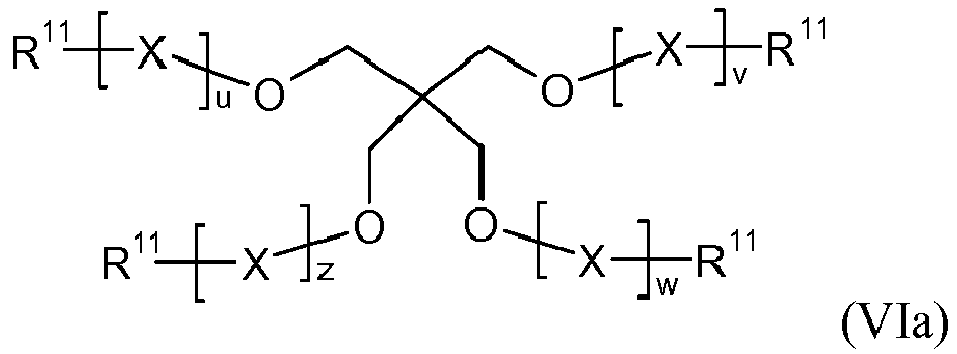


in formula (VIa) n is 2, 3 or 4
in formula (VIb) n is 2 or 3
in formula (VIc) and VI(d) n is 2
and whereinn of the substituents R11 are -C(1)H2-C(2)HR15-(C=O)- wherein (1) indicates the numeration of the carbon atom whereby each of the n C(1) carbon atoms is bound to the central phosphorous atom depicted in formula (I) and R11 is bound to X at the carbonyl carbon and wherein R15 is hydrogen or methyl
and the remainder substituents R11, if any, are either hydrogen or C(1)H2=C(2)HR15-(C=O)-,each X is independently selected from the group consisting of
-OCH2-CH2-, -OCH(CH3)-CH2-, -OCH2-CH(CH3)-, -OCH2-C(CH3)2-, -O-C(CH3)2-CH2-, andu, v, w and z are independently selected from 0 or an integer from 1 to 20, preferably 0 oder an integer from 1 to 10, more preferably zero or an integer from 1 to 5,zz is selected from an integer of from 1 to 100, preferably an integer of from 2 to 100, more preferably an integer of from 3 to 20,R12 and R13 are independently selected from the group consisting of hydrogen or C6-C14-aryl or C1-C18-alkylR14 is C2-C18-alkane-diyl or X2 wherein X2 is independently selected from the group consisting of -CHR16-CH2-(O-CHR16-CH2-)f-O-(CHR16CH2)-, -CH2-CHR16-(O-CH2-CHR16-)f-O-(CHR16CH2)-, with f being 0 or an integer of 1 to 20 and R16 being methyl or hydrogen andR30 is selected from the group consisting of hydrogen or C6-C14-aryl or C1-C18-alkyl, whereby hydrogen, methyl, ethyl, n-propyl, isopropyl, tert.-butyl and phenyl are preferred, and hydrogen. methyl and ethyl are even more preferred. - A process according to anyone of claims 1 to 4, wherein in compounds of formulae (I) and (III)m is 1 or 2, preferably 2 andR2 is C6-C14-aryl or heterocyclyl or is C1-C18-alkyl or C2-C18-alkenylwhereby the aforementioned substituents C1-C18-alkyl or C2-C18-alkenyl of R2 are either not, once, twice or more than twice interrupted by non-successive functional groups selected from the group consisting of:
-O-, -NR4-, -N+(R4)2An--, -CO-, NR4(CO)-, -NR4(CO)O-, (CO)NR4-,
and which is not, additionally or alternatively either once, twice or more than twice substituted by substituents selected from the group consisting of:
halogen, cyano, C6-C14-aryl; heterocyclyl, C1-C8-alkyl, C1-C8-alkoxy, C1-C8-alkylthio, C2-C8-alkenyl, C4-C15-arylalkyl, -COOM, SO2N(R3)2-, N(R4)2-, -N+(R4)3An-, -CO2N(R4)2,
wherebyR4 is independently selected from the group consisting hydrogen, C1-C8-alkyl, C6-C14-aryl, C7-C15-arylalkyl and heterocyclyl or N(R4)2 as a whole is a N-containing heterocycle or N+(R4)2An- and N+(R4)3An- as a whole is or contains a cationic N-containing heterocycle with a counteranion,R5 is independently selected from the group consisting C1-C8-alkyl, C6-C14-aryl, C7-C15-arylalkyl and heterocyclyl or N(R5)2 as a whole is a N-containing heterocycle or N+(R5)2An- and N+(R5)3An- as a whole is or contains a cationic N-containing heterocycle with a counteranion,M is hydrogen, lithium, sodium, potassium, one half equivalent of calcium, zinc or iron (II), or one third equivalent of aluminium (III) or is an ammonium ion or a primary, secondary, tertiary or quarternary organic ammonium ion, andAn- is 1/p equivalent of an p-valent anion. - A process according to anyone of claims 1 to 5, whereinm is 2,R2 is C6-C14-aryl, preferably mesityl or 2,6-dimethoxyphenyl, more preferably mesityl.
- A process according to anyone of claims 1 to 6, wherein the process is carried out in water.
- A process for the preparation of compounds of formula (V)
 R1, R2, R3, n and m have the same meaning as described for formula (I) in claim 1X is oxygen or sulphurwherein compounds of formula (I) as defined in claim 1 are prepared by a process according to any one of claims 1 to 7 and reacted with an oxidizing agent or a sulfidizing agent.
 - Compounds as described in formula (I) of claim 1.
- Compounds according to claim 9 wherein
R1 is a substituent of formula (IIe)
m is 1 or 2, preferably 2 and
R* is a substituent of formula (VIa) or (VIb) or (VIc) or (VId)


in formula (VIa) n is 2, 3 or 4
in formula (VIb) n is 2 or 3
in formula (VIc) and VI(d) n is 2
and whereinn of the substituents R11 are -C(1)H2-C(2)HR15-(C=O)- wherein (1) indicates the numeration of the carbon atom whereby each of the n C(1) carbon atoms is bound to the central phosphorous atom depicted in formula (I) and R11 is bound to X at the carbonyl carbon and wherein R15 is hydrogen or methyl
and the remainder substituents R11, if any, are either hydrogen or C(1)H2=C(2)HR15-(C=O)-,each X is independently selected from the group consisting of
-OCH2-CH2-, -OCH(CH3)-CH2-, -OCH2-CH(CH3)-, -OCH2-C(CH3)2-, -O-C(CH3)2-CH2-, andu, v, w and z are independently selected from 0 or an integer from 1 to 20, preferably 0 or an integer from 1 to 10, more preferably zero or an integer from 1 to 5,zz is selected from an integer of from 1 to 100, preferably an integer of from 2 to 100, more preferably an integer of from 3 to 20,R12 and R13 are independently selected from the group consisting of hydrogen or C6-C14-aryl or C1-C18-alkylR14 is C2-C18-alkane-diyl or X2 wherein X2 is independently selected from the group consisting of -CHR16-CH2-(O-CHR16-CH2-)f-O-(CHR16CH2)-, -CH2-CHR16-(O-CH2-CHR16-)f-O-(CHR16CH2)-, with f being 0 or an integer of 1 to 20 and R16 being methyl or hydrogen,R30 is selected from the group consisting of hydrogen or C6-C14-aryl or C1-C18-alkyl, whereby hydrogen, methyl, ethyl, n-propyl, isopropyl, tert.-butyl and phenyl are preferred, and hydrogen. methyl and ethyl are even more preferred. - The following compounds according to claim 9:
di-(2-(bis(2,4,6-trimethylbenzoyl)phosphino)ethyl)-sulfone, trimethylolpropane tris-[3-(bis(2,4,6-trimethylbenzoyl)phosphino) propanoate] and trimethylolpropane monoacrylate bis-[3-(bis(2,4,6-trimethylbenzoyl)phosphino) propanoate]. - Compounds of formula (V)
 R1, R2, R3, n and m have the same meaning as described for formula (I) of claim 1 andX is oxygen or sulphur, preferably oxygen.
 - Compounds according to claim 12 wherein
R1 is a substituent of formula (IIe)
m is 1 or 2, preferably 2 and
R* is a substituent of formula (VIa) or (VIb) or (VIc) or (VId)


in formula (VIa) n is 2, 3 or 4
in formula (VIb) n is 2 or 3
in formula (VIc) and VI(d) n is 2
and whereinn of the substituents R11 are -C(1)H2-C(2)HR15-(C=O)- wherein (1) indicates the numeration of the carbon atom whereby each of the n C(1) carbon atoms is bound to the central phosphorous atom depicted in formula (I) and R11 is bound to X at the carbonyl carbon and wherein R15 is hydrogen or methyl
and the remainder substituents R11, if any, are either hydrogen or C(1)H2=C(2)HR15-(C=O)-,each X is independently selected from the group consisting of
-OCH2-CH2-, -OCH(CH3)-CH2-, -OCH2-CH(CH3)-, -OCH2-C(CH3)2-, -O-C(CH3)2-CH2-, andu, v, w and z are independently selected from 0 or an integer from 1 to 20, preferably 0 or an integer from 1 to 10, more preferably zero or an integer from 1 to 5,zz is selected from an integer of from 1 to 100, preferably an integer of from 2 to 100, more preferably an integer of from 3 to 20,R12 and R13 are independently selected from the group consisting of hydrogen or C6-C14-aryl or C1-C18-alkylR14 is C2-C18-alkane-diyl or X2 wherein X2 is independently selected from the group consisting of -CHR16-CH2-(O-CHR16-CH2-)f-O-(CHR16CH2)-, -CH2-CHR16-(O-CH2-CHR16-)f-O-(CHR16CH2)-, with f being 0 or an integer of 1 to 20 and R16 being methyl or hydrogen,R30 is selected from the group consisting of hydrogen or C6-C14-aryl or C1-C18-alkyl, whereby hydrogen, methyl, ethyl, n-propyl, isopropyl, tert.-butyl and phenyl are preferred, and hydrogen. methyl and ethyl are even more preferred. - The following compounds according to claim 13:
di-(2-(bis(2,4,6-trimethylbenzoyl)phosphoryl)ethyl)-sulfone, trimethylolpropane tris-[3-(bis(2,4,6-trimethylbenzoyl)phosphoryl) propanoate] and trimethylolpropane monoacrylate bis-[3-(bis(2,4,6-trimethylbenzoyl)phosphoryl) propanoate]. - Use of Compounds according to claims 12 to 14 as photoinitiators.
Applications Claiming Priority (4)
| Application Number | Priority Date | Filing Date | Title |
|---|---|---|---|
| EP12006822 | 2012-10-01 | ||
| EP13003616 | 2013-07-18 | ||
| PCT/EP2013/070378 WO2014053455A1 (en) | 2012-10-01 | 2013-09-30 | A process for the preparation of acylphosphanes |
| EP13771462.2A EP2903995B1 (en) | 2012-10-01 | 2013-09-30 | A process for the preparation of acylphosphanes |
Related Parent Applications (1)
| Application Number | Title | Priority Date | Filing Date |
|---|---|---|---|
| EP13771462.2A Division EP2903995B1 (en) | 2012-10-01 | 2013-09-30 | A process for the preparation of acylphosphanes |
Publications (2)
| Publication Number | Publication Date |
|---|---|
| EP3508489A1 true EP3508489A1 (en) | 2019-07-10 |
| EP3508489B1 EP3508489B1 (en) | 2021-04-14 |
Family
ID=49301475
Family Applications (2)
| Application Number | Title | Priority Date | Filing Date |
|---|---|---|---|
| EP19151535.2A Active EP3508489B1 (en) | 2012-10-01 | 2013-09-30 | A process for the preparation of acylphosphanes |
| EP13771462.2A Active EP2903995B1 (en) | 2012-10-01 | 2013-09-30 | A process for the preparation of acylphosphanes |
Family Applications After (1)
| Application Number | Title | Priority Date | Filing Date |
|---|---|---|---|
| EP13771462.2A Active EP2903995B1 (en) | 2012-10-01 | 2013-09-30 | A process for the preparation of acylphosphanes |
Country Status (9)
| Country | Link |
|---|---|
| US (2) | US9701700B2 (en) |
| EP (2) | EP3508489B1 (en) |
| JP (1) | JP6445438B2 (en) |
| KR (1) | KR102135300B1 (en) |
| CN (2) | CN108383874B (en) |
| BR (1) | BR112015007295B1 (en) |
| ES (2) | ES2881686T3 (en) |
| RU (1) | RU2719592C2 (en) |
| WO (1) | WO2014053455A1 (en) |
Families Citing this family (14)
| Publication number | Priority date | Publication date | Assignee | Title |
|---|---|---|---|---|
| EP3031798B1 (en) * | 2014-12-10 | 2017-09-27 | Belenos Clean Power Holding AG | A novel cross-linker for the preparation of a new family of single ion conduction polymers for electrochemical devices and such polymers |
| EP3296301A1 (en) | 2016-09-19 | 2018-03-21 | ETH Zürich | A versatile process for the preparation of acylphosphines |
| US20190275201A1 (en) | 2016-11-16 | 2019-09-12 | Ecole Polytechnique Federale De Lausanne (Epfl) | Photopolymerizable bone filler material |
| EP3409680B1 (en) * | 2017-05-30 | 2021-01-06 | IGM Group B.V. | Synthesis of bis(acyl)phosphines by activation of unreactive metal phosphides |
| CN107400144B (en) * | 2017-08-03 | 2020-04-14 | 深圳有为技术控股集团有限公司 | Acylphosphine (oxy) compounds, process for their preparation and their use |
| EP3539924A1 (en) | 2018-03-14 | 2019-09-18 | ETH Zurich | Novel vinyl phosphines and photo-initiators obtainable therefrom |
| EP3539969A1 (en) | 2018-03-14 | 2019-09-18 | ETH Zurich | Novel photo-initiators and their application |
| EP3847179A1 (en) | 2018-09-07 | 2021-07-14 | IGM Resins Italia S.r.l. | Multifunctional bisacylphosphine oxide photoinitiators |
| EP3747942A1 (en) | 2019-06-05 | 2020-12-09 | EMPA Eidgenössische Materialprüfungs- und Forschungsanstalt | Bridged phosphorus based flame retardants |
| CN114728520B (en) | 2019-11-11 | 2024-03-08 | 富士胶片株式会社 | Active energy ray-curable ink and image recording method |
| EP4114339A1 (en) | 2020-05-29 | 2023-01-11 | Lumendo AG | Crosslinkable prepolymers for chemically stable polymer gels |
| CN112547122A (en) * | 2020-12-18 | 2021-03-26 | 商河知济新材料技术中心 | Use of tert-butoxide and pyridinium salts in the preparation of a photoinitiator |
| US20260109820A1 (en) | 2022-09-15 | 2026-04-23 | Elkem Silicones France Sas | Additive manufacturing method for producing a silicone elastomer article |
| CN120365331B (en) * | 2025-06-26 | 2025-11-04 | 北京大学深圳研究生院 | Photoinitiator and preparation method thereof |
Citations (5)
| Publication number | Priority date | Publication date | Assignee | Title |
|---|---|---|---|---|
| EP1135399A1 (en) | 1998-11-30 | 2001-09-26 | Ciba SC Holding AG | Process for preparing acylphosphines and derivatives |
| WO2005014605A1 (en) | 2003-07-18 | 2005-02-17 | Ciba Specialty Chemicals Holding Inc. | Process for preparing acylphosphanes and derivatives thereof |
| WO2006056541A1 (en) | 2004-11-23 | 2006-06-01 | Ciba Specialty Chemicals Holding Inc. | Process for preparing acylphosphanes and derivatives thereof |
| WO2006074983A1 (en) | 2005-01-17 | 2006-07-20 | Ciba Specialty Chemicals Holding Inc. | Process for preparing acylphosphanes and their oxides and sulphides |
| WO2011003772A1 (en) * | 2009-07-06 | 2011-01-13 | Basf Se | Polymer-bound bisacylphosphine oxides |
Family Cites Families (14)
| Publication number | Priority date | Publication date | Assignee | Title |
|---|---|---|---|---|
| US2957931A (en) * | 1949-07-28 | 1960-10-25 | Socony Mobil Oil Co Inc | Synthesis of compounds having a carbonphosphorus linkage |
| US2822376A (en) * | 1957-02-27 | 1958-02-04 | American Cyanamid Co | Reaction of phosphine with alpha, beta-unsatu-rated compounds |
| TW303379B (en) * | 1994-03-02 | 1997-04-21 | Ciba Sc Holding Ag | |
| RU2141962C1 (en) * | 1994-07-29 | 1999-11-27 | Пферси Хеми ГмбХ | Method of preparing diesters of phosphonecarboxylic acid derivatives |
| SG53043A1 (en) | 1996-08-28 | 1998-09-28 | Ciba Geigy Ag | Molecular complex compounds as photoinitiators |
| JP2001200007A (en) * | 2000-01-19 | 2001-07-24 | Shin Etsu Chem Co Ltd | Photocurable resin composition and coating material for optical fiber |
| GB2360283B (en) | 2000-02-08 | 2002-08-21 | Ciba Sc Holding Ag | Monoacylarylphosphines and acylphosphine oxides and sulphides |
| JP2005509685A (en) * | 2001-11-20 | 2005-04-14 | チバ スペシャルティ ケミカルズ ホールディング インコーポレーテッド | Multimeric forms of acylphosphines and their derivatives |
| JP2003228150A (en) * | 2002-02-04 | 2003-08-15 | Konica Corp | Photothermographic imaging material |
| US7196228B2 (en) | 2002-06-11 | 2007-03-27 | Ciba Specialty Chemicals Corporation | Multimer forms of mono-and bis-acylphosphine oxides |
| JP4971138B2 (en) | 2004-04-15 | 2012-07-11 | チバ ホールディング インコーポレーテッド | Photocuring method using light emitting diode |
| JP2007272106A (en) * | 2006-03-31 | 2007-10-18 | Fujifilm Corp | Hologram recording medium composition and hologram recording medium |
| KR101486738B1 (en) | 2006-07-04 | 2015-01-28 | 시바 홀딩 인크 | Water based concentrated product forms of photoinitiators made by a heterophase polymerization technique |
| CN102471150B (en) | 2010-06-30 | 2014-05-07 | 帝斯曼知识产权资产管理有限公司 | D1492 Liquid bisacylphosphine oxide photoinitiators and their use in radiation curable compositions |
-
2013
- 2013-09-30 ES ES19151535T patent/ES2881686T3/en active Active
- 2013-09-30 CN CN201810249476.7A patent/CN108383874B/en active Active
- 2013-09-30 CN CN201380051352.3A patent/CN104703995B/en active Active
- 2013-09-30 BR BR112015007295-0A patent/BR112015007295B1/en active IP Right Grant
- 2013-09-30 JP JP2015533630A patent/JP6445438B2/en active Active
- 2013-09-30 ES ES13771462T patent/ES2720760T3/en active Active
- 2013-09-30 WO PCT/EP2013/070378 patent/WO2014053455A1/en not_active Ceased
- 2013-09-30 RU RU2015116292A patent/RU2719592C2/en active
- 2013-09-30 EP EP19151535.2A patent/EP3508489B1/en active Active
- 2013-09-30 KR KR1020157011628A patent/KR102135300B1/en active Active
- 2013-09-30 EP EP13771462.2A patent/EP2903995B1/en active Active
- 2013-09-30 US US14/432,212 patent/US9701700B2/en active Active
-
2017
- 2017-05-24 US US15/603,467 patent/US10273258B2/en active Active
Patent Citations (5)
| Publication number | Priority date | Publication date | Assignee | Title |
|---|---|---|---|---|
| EP1135399A1 (en) | 1998-11-30 | 2001-09-26 | Ciba SC Holding AG | Process for preparing acylphosphines and derivatives |
| WO2005014605A1 (en) | 2003-07-18 | 2005-02-17 | Ciba Specialty Chemicals Holding Inc. | Process for preparing acylphosphanes and derivatives thereof |
| WO2006056541A1 (en) | 2004-11-23 | 2006-06-01 | Ciba Specialty Chemicals Holding Inc. | Process for preparing acylphosphanes and derivatives thereof |
| WO2006074983A1 (en) | 2005-01-17 | 2006-07-20 | Ciba Specialty Chemicals Holding Inc. | Process for preparing acylphosphanes and their oxides and sulphides |
| WO2011003772A1 (en) * | 2009-07-06 | 2011-01-13 | Basf Se | Polymer-bound bisacylphosphine oxides |
Non-Patent Citations (1)
| Title |
|---|
| GRUTZMACHER ET AL., CHIMIA, vol. 62, no. 1/2, 2008 |
Also Published As
| Publication number | Publication date |
|---|---|
| CN104703995B (en) | 2018-04-20 |
| ES2881686T3 (en) | 2021-11-30 |
| WO2014053455A1 (en) | 2014-04-10 |
| CN108383874B (en) | 2021-10-08 |
| CN104703995A (en) | 2015-06-10 |
| CN108383874A (en) | 2018-08-10 |
| RU2015116292A (en) | 2016-11-27 |
| US9701700B2 (en) | 2017-07-11 |
| BR112015007295A2 (en) | 2017-07-04 |
| BR112015007295B1 (en) | 2021-12-14 |
| JP6445438B2 (en) | 2018-12-26 |
| KR102135300B1 (en) | 2020-08-27 |
| EP2903995A1 (en) | 2015-08-12 |
| US20180002357A1 (en) | 2018-01-04 |
| JP2015532275A (en) | 2015-11-09 |
| ES2720760T3 (en) | 2019-07-24 |
| EP3508489B1 (en) | 2021-04-14 |
| RU2719592C2 (en) | 2020-04-21 |
| US10273258B2 (en) | 2019-04-30 |
| US20150299231A1 (en) | 2015-10-22 |
| EP2903995B1 (en) | 2019-01-16 |
| KR20150064747A (en) | 2015-06-11 |
Similar Documents
| Publication | Publication Date | Title |
|---|---|---|
| EP3508489B1 (en) | A process for the preparation of acylphosphanes | |
| JP5148283B2 (en) | Method for producing acylphosphane and derivatives thereof | |
| US10889603B2 (en) | Versatile process for the preparation of acylphosphines | |
| CN112154149B (en) | Novel vinylphosphines and photoinitiators obtainable therefrom | |
| KR20170051260A (en) | N-Heterocyclic carbene metallocene compounds and method for preparing the same | |
| EP3539969A1 (en) | Novel photo-initiators and their application | |
| CN113179642A (en) | Method for producing alkenyl phosphorus compound | |
| Rajalakshmi et al. | Synthesis of dialkyl 2-(Methacryloyloxyethyl) phosphonates, their characterization and polymerization | |
| WO2005014560A1 (en) | A process for the preparation of phenyltetrazole derivatives | |
| JP2010116323A (en) | Silicon compound, organic-inorganic composite and organic-inorganic composite polymer | |
| Chernysheva et al. | Synthesis of vinylphosphine oxides: vinyl selenides as vinylating agents | |
| JPH07113036B2 (en) | Phosphorus-containing acrylic compound and method for producing the same | |
| JPS6277393A (en) | Production of alpha-silylacrylic acid ester | |
| JP2006248935A (en) | Method for producing phosphorus-substituted porphyrin compound | |
| KR20070018716A (en) | Process for preparing organosilicon compound |
Legal Events
| Date | Code | Title | Description |
|---|---|---|---|
| PUAI | Public reference made under article 153(3) epc to a published international application that has entered the european phase |
Free format text: ORIGINAL CODE: 0009012 |
|
| STAA | Information on the status of an ep patent application or granted ep patent |
Free format text: STATUS: THE APPLICATION HAS BEEN PUBLISHED |
|
| AC | Divisional application: reference to earlier application |
Ref document number: 2903995 Country of ref document: EP Kind code of ref document: P |
|
| AK | Designated contracting states |
Kind code of ref document: A1 Designated state(s): AL AT BE BG CH CY CZ DE DK EE ES FI FR GB GR HR HU IE IS IT LI LT LU LV MC MK MT NL NO PL PT RO RS SE SI SK SM TR |
|
| STAA | Information on the status of an ep patent application or granted ep patent |
Free format text: STATUS: REQUEST FOR EXAMINATION WAS MADE |
|
| 17P | Request for examination filed |
Effective date: 20200110 |
|
| RBV | Designated contracting states (corrected) |
Designated state(s): AL AT BE BG CH CY CZ DE DK EE ES FI FR GB GR HR HU IE IS IT LI LT LU LV MC MK MT NL NO PL PT RO RS SE SI SK SM TR |
|
| GRAP | Despatch of communication of intention to grant a patent |
Free format text: ORIGINAL CODE: EPIDOSNIGR1 |
|
| STAA | Information on the status of an ep patent application or granted ep patent |
Free format text: STATUS: GRANT OF PATENT IS INTENDED |
|
| INTG | Intention to grant announced |
Effective date: 20200806 |
|
| RAP1 | Party data changed (applicant data changed or rights of an application transferred) |
Owner name: ETH ZUERICH |
|
| GRAS | Grant fee paid |
Free format text: ORIGINAL CODE: EPIDOSNIGR3 |
|
| GRAJ | Information related to disapproval of communication of intention to grant by the applicant or resumption of examination proceedings by the epo deleted |
Free format text: ORIGINAL CODE: EPIDOSDIGR1 |
|
| GRAL | Information related to payment of fee for publishing/printing deleted |
Free format text: ORIGINAL CODE: EPIDOSDIGR3 |
|
| STAA | Information on the status of an ep patent application or granted ep patent |
Free format text: STATUS: REQUEST FOR EXAMINATION WAS MADE |
|
| INTC | Intention to grant announced (deleted) | ||
| GRAP | Despatch of communication of intention to grant a patent |
Free format text: ORIGINAL CODE: EPIDOSNIGR1 |
|
| STAA | Information on the status of an ep patent application or granted ep patent |
Free format text: STATUS: GRANT OF PATENT IS INTENDED |
|
| GRAJ | Information related to disapproval of communication of intention to grant by the applicant or resumption of examination proceedings by the epo deleted |
Free format text: ORIGINAL CODE: EPIDOSDIGR1 |
|
| INTG | Intention to grant announced |
Effective date: 20210115 |
|
| GRAP | Despatch of communication of intention to grant a patent |
Free format text: ORIGINAL CODE: EPIDOSNIGR1 |
|
| INTG | Intention to grant announced |
Effective date: 20210202 |
|
| GRAA | (expected) grant |
Free format text: ORIGINAL CODE: 0009210 |
|
| STAA | Information on the status of an ep patent application or granted ep patent |
Free format text: STATUS: THE PATENT HAS BEEN GRANTED |
|
| AC | Divisional application: reference to earlier application |
Ref document number: 2903995 Country of ref document: EP Kind code of ref document: P |
|
| AK | Designated contracting states |
Kind code of ref document: B1 Designated state(s): AL AT BE BG CH CY CZ DE DK EE ES FI FR GB GR HR HU IE IS IT LI LT LU LV MC MK MT NL NO PL PT RO RS SE SI SK SM TR |
|
| REG | Reference to a national code |
Ref country code: GB Ref legal event code: FG4D |
|
| REG | Reference to a national code |
Ref country code: CH Ref legal event code: EP |
|
| REG | Reference to a national code |
Ref country code: DE Ref legal event code: R096 Ref document number: 602013076962 Country of ref document: DE |
|
| REG | Reference to a national code |
Ref country code: IE Ref legal event code: FG4D |
|
| REG | Reference to a national code |
Ref country code: AT Ref legal event code: REF Ref document number: 1382299 Country of ref document: AT Kind code of ref document: T Effective date: 20210515 |
|
| REG | Reference to a national code |
Ref country code: NL Ref legal event code: FP |
|
| REG | Reference to a national code |
Ref country code: LT Ref legal event code: MG9D |
|
| PG25 | Lapsed in a contracting state [announced via postgrant information from national office to epo] |
Ref country code: LT Free format text: LAPSE BECAUSE OF FAILURE TO SUBMIT A TRANSLATION OF THE DESCRIPTION OR TO PAY THE FEE WITHIN THE PRESCRIBED TIME-LIMIT Effective date: 20210414 Ref country code: HR Free format text: LAPSE BECAUSE OF FAILURE TO SUBMIT A TRANSLATION OF THE DESCRIPTION OR TO PAY THE FEE WITHIN THE PRESCRIBED TIME-LIMIT Effective date: 20210414 Ref country code: FI Free format text: LAPSE BECAUSE OF FAILURE TO SUBMIT A TRANSLATION OF THE DESCRIPTION OR TO PAY THE FEE WITHIN THE PRESCRIBED TIME-LIMIT Effective date: 20210414 Ref country code: BG Free format text: LAPSE BECAUSE OF FAILURE TO SUBMIT A TRANSLATION OF THE DESCRIPTION OR TO PAY THE FEE WITHIN THE PRESCRIBED TIME-LIMIT Effective date: 20210714 |
|
| PG25 | Lapsed in a contracting state [announced via postgrant information from national office to epo] |
Ref country code: IS Free format text: LAPSE BECAUSE OF FAILURE TO SUBMIT A TRANSLATION OF THE DESCRIPTION OR TO PAY THE FEE WITHIN THE PRESCRIBED TIME-LIMIT Effective date: 20210814 Ref country code: GR Free format text: LAPSE BECAUSE OF FAILURE TO SUBMIT A TRANSLATION OF THE DESCRIPTION OR TO PAY THE FEE WITHIN THE PRESCRIBED TIME-LIMIT Effective date: 20210715 Ref country code: PL Free format text: LAPSE BECAUSE OF FAILURE TO SUBMIT A TRANSLATION OF THE DESCRIPTION OR TO PAY THE FEE WITHIN THE PRESCRIBED TIME-LIMIT Effective date: 20210414 Ref country code: LV Free format text: LAPSE BECAUSE OF FAILURE TO SUBMIT A TRANSLATION OF THE DESCRIPTION OR TO PAY THE FEE WITHIN THE PRESCRIBED TIME-LIMIT Effective date: 20210414 Ref country code: NO Free format text: LAPSE BECAUSE OF FAILURE TO SUBMIT A TRANSLATION OF THE DESCRIPTION OR TO PAY THE FEE WITHIN THE PRESCRIBED TIME-LIMIT Effective date: 20210714 Ref country code: RS Free format text: LAPSE BECAUSE OF FAILURE TO SUBMIT A TRANSLATION OF THE DESCRIPTION OR TO PAY THE FEE WITHIN THE PRESCRIBED TIME-LIMIT Effective date: 20210414 Ref country code: PT Free format text: LAPSE BECAUSE OF FAILURE TO SUBMIT A TRANSLATION OF THE DESCRIPTION OR TO PAY THE FEE WITHIN THE PRESCRIBED TIME-LIMIT Effective date: 20210816 Ref country code: SE Free format text: LAPSE BECAUSE OF FAILURE TO SUBMIT A TRANSLATION OF THE DESCRIPTION OR TO PAY THE FEE WITHIN THE PRESCRIBED TIME-LIMIT Effective date: 20210414 |
|
| REG | Reference to a national code |
Ref country code: ES Ref legal event code: FG2A Ref document number: 2881686 Country of ref document: ES Kind code of ref document: T3 Effective date: 20211130 |
|
| REG | Reference to a national code |
Ref country code: AT Ref legal event code: UEP Ref document number: 1382299 Country of ref document: AT Kind code of ref document: T Effective date: 20210414 |
|
| REG | Reference to a national code |
Ref country code: DE Ref legal event code: R097 Ref document number: 602013076962 Country of ref document: DE |
|
| PG25 | Lapsed in a contracting state [announced via postgrant information from national office to epo] |
Ref country code: SK Free format text: LAPSE BECAUSE OF FAILURE TO SUBMIT A TRANSLATION OF THE DESCRIPTION OR TO PAY THE FEE WITHIN THE PRESCRIBED TIME-LIMIT Effective date: 20210414 Ref country code: EE Free format text: LAPSE BECAUSE OF FAILURE TO SUBMIT A TRANSLATION OF THE DESCRIPTION OR TO PAY THE FEE WITHIN THE PRESCRIBED TIME-LIMIT Effective date: 20210414 Ref country code: RO Free format text: LAPSE BECAUSE OF FAILURE TO SUBMIT A TRANSLATION OF THE DESCRIPTION OR TO PAY THE FEE WITHIN THE PRESCRIBED TIME-LIMIT Effective date: 20210414 Ref country code: SM Free format text: LAPSE BECAUSE OF FAILURE TO SUBMIT A TRANSLATION OF THE DESCRIPTION OR TO PAY THE FEE WITHIN THE PRESCRIBED TIME-LIMIT Effective date: 20210414 Ref country code: DK Free format text: LAPSE BECAUSE OF FAILURE TO SUBMIT A TRANSLATION OF THE DESCRIPTION OR TO PAY THE FEE WITHIN THE PRESCRIBED TIME-LIMIT Effective date: 20210414 Ref country code: CZ Free format text: LAPSE BECAUSE OF FAILURE TO SUBMIT A TRANSLATION OF THE DESCRIPTION OR TO PAY THE FEE WITHIN THE PRESCRIBED TIME-LIMIT Effective date: 20210414 |
|
| PLBE | No opposition filed within time limit |
Free format text: ORIGINAL CODE: 0009261 |
|
| STAA | Information on the status of an ep patent application or granted ep patent |
Free format text: STATUS: NO OPPOSITION FILED WITHIN TIME LIMIT |
|
| 26N | No opposition filed |
Effective date: 20220117 |
|
| PG25 | Lapsed in a contracting state [announced via postgrant information from national office to epo] |
Ref country code: IS Free format text: LAPSE BECAUSE OF FAILURE TO SUBMIT A TRANSLATION OF THE DESCRIPTION OR TO PAY THE FEE WITHIN THE PRESCRIBED TIME-LIMIT Effective date: 20210814 Ref country code: MC Free format text: LAPSE BECAUSE OF FAILURE TO SUBMIT A TRANSLATION OF THE DESCRIPTION OR TO PAY THE FEE WITHIN THE PRESCRIBED TIME-LIMIT Effective date: 20210414 Ref country code: AL Free format text: LAPSE BECAUSE OF FAILURE TO SUBMIT A TRANSLATION OF THE DESCRIPTION OR TO PAY THE FEE WITHIN THE PRESCRIBED TIME-LIMIT Effective date: 20210414 |
|
| PG25 | Lapsed in a contracting state [announced via postgrant information from national office to epo] |
Ref country code: LU Free format text: LAPSE BECAUSE OF NON-PAYMENT OF DUE FEES Effective date: 20210930 Ref country code: IE Free format text: LAPSE BECAUSE OF NON-PAYMENT OF DUE FEES Effective date: 20210930 |
|
| PG25 | Lapsed in a contracting state [announced via postgrant information from national office to epo] |
Ref country code: CY Free format text: LAPSE BECAUSE OF FAILURE TO SUBMIT A TRANSLATION OF THE DESCRIPTION OR TO PAY THE FEE WITHIN THE PRESCRIBED TIME-LIMIT Effective date: 20210414 |
|
| PG25 | Lapsed in a contracting state [announced via postgrant information from national office to epo] |
Ref country code: HU Free format text: LAPSE BECAUSE OF FAILURE TO SUBMIT A TRANSLATION OF THE DESCRIPTION OR TO PAY THE FEE WITHIN THE PRESCRIBED TIME-LIMIT; INVALID AB INITIO Effective date: 20130930 |
|
| PG25 | Lapsed in a contracting state [announced via postgrant information from national office to epo] |
Ref country code: MK Free format text: LAPSE BECAUSE OF FAILURE TO SUBMIT A TRANSLATION OF THE DESCRIPTION OR TO PAY THE FEE WITHIN THE PRESCRIBED TIME-LIMIT Effective date: 20210414 |
|
| PG25 | Lapsed in a contracting state [announced via postgrant information from national office to epo] |
Ref country code: MT Free format text: LAPSE BECAUSE OF FAILURE TO SUBMIT A TRANSLATION OF THE DESCRIPTION OR TO PAY THE FEE WITHIN THE PRESCRIBED TIME-LIMIT Effective date: 20210414 |
|
| REG | Reference to a national code |
Ref country code: CH Ref legal event code: U11 Free format text: ST27 STATUS EVENT CODE: U-0-0-U10-U11 (AS PROVIDED BY THE NATIONAL OFFICE) Effective date: 20251001 |
|
| PGFP | Annual fee paid to national office [announced via postgrant information from national office to epo] |
Ref country code: DE Payment date: 20250919 Year of fee payment: 13 |
|
| PGFP | Annual fee paid to national office [announced via postgrant information from national office to epo] |
Ref country code: NL Payment date: 20250922 Year of fee payment: 13 |
|
| PGFP | Annual fee paid to national office [announced via postgrant information from national office to epo] |
Ref country code: BE Payment date: 20250919 Year of fee payment: 13 Ref country code: GB Payment date: 20250923 Year of fee payment: 13 |
|
| PGFP | Annual fee paid to national office [announced via postgrant information from national office to epo] |
Ref country code: AT Payment date: 20250918 Year of fee payment: 13 Ref country code: FR Payment date: 20250924 Year of fee payment: 13 |
|
| PG25 | Lapsed in a contracting state [announced via postgrant information from national office to epo] |
Ref country code: TR Free format text: LAPSE BECAUSE OF FAILURE TO SUBMIT A TRANSLATION OF THE DESCRIPTION OR TO PAY THE FEE WITHIN THE PRESCRIBED TIME-LIMIT Effective date: 20210414 |
|
| PGFP | Annual fee paid to national office [announced via postgrant information from national office to epo] |
Ref country code: IT Payment date: 20250930 Year of fee payment: 13 |
|
| PGFP | Annual fee paid to national office [announced via postgrant information from national office to epo] |
Ref country code: CH Payment date: 20251001 Year of fee payment: 13 |
|
| PGFP | Annual fee paid to national office [announced via postgrant information from national office to epo] |
Ref country code: ES Payment date: 20251020 Year of fee payment: 13 |