EP3505570B1 - Addition-curable silicone rubber composition and airbag - Google Patents
Addition-curable silicone rubber composition and airbag Download PDFInfo
- Publication number
- EP3505570B1 EP3505570B1 EP17843426.2A EP17843426A EP3505570B1 EP 3505570 B1 EP3505570 B1 EP 3505570B1 EP 17843426 A EP17843426 A EP 17843426A EP 3505570 B1 EP3505570 B1 EP 3505570B1
- Authority
- EP
- European Patent Office
- Prior art keywords
- silicon
- component
- silicone rubber
- bonded hydrogen
- group
- Prior art date
- Legal status (The legal status is an assumption and is not a legal conclusion. Google has not performed a legal analysis and makes no representation as to the accuracy of the status listed.)
- Active
Links
Classifications
-
- C—CHEMISTRY; METALLURGY
- C08—ORGANIC MACROMOLECULAR COMPOUNDS; THEIR PREPARATION OR CHEMICAL WORKING-UP; COMPOSITIONS BASED THEREON
- C08G—MACROMOLECULAR COMPOUNDS OBTAINED OTHERWISE THAN BY REACTIONS ONLY INVOLVING UNSATURATED CARBON-TO-CARBON BONDS
- C08G77/00—Macromolecular compounds obtained by reactions forming a linkage containing silicon with or without sulfur, nitrogen, oxygen or carbon in the main chain of the macromolecule
- C08G77/04—Polysiloxanes
- C08G77/12—Polysiloxanes containing silicon bound to hydrogen
-
- C—CHEMISTRY; METALLURGY
- C08—ORGANIC MACROMOLECULAR COMPOUNDS; THEIR PREPARATION OR CHEMICAL WORKING-UP; COMPOSITIONS BASED THEREON
- C08L—COMPOSITIONS OF MACROMOLECULAR COMPOUNDS
- C08L83/00—Compositions of macromolecular compounds obtained by reactions forming in the main chain of the macromolecule a linkage containing silicon with or without sulfur, nitrogen, oxygen or carbon only; Compositions of derivatives of such polymers
- C08L83/04—Polysiloxanes
-
- B—PERFORMING OPERATIONS; TRANSPORTING
- B60—VEHICLES IN GENERAL
- B60R—VEHICLES, VEHICLE FITTINGS, OR VEHICLE PARTS, NOT OTHERWISE PROVIDED FOR
- B60R21/00—Arrangements or fittings on vehicles for protecting or preventing injuries to occupants or pedestrians in case of accidents or other traffic risks
- B60R21/02—Occupant safety arrangements or fittings, e.g. crash pads
- B60R21/16—Inflatable occupant restraints or confinements designed to inflate upon impact or impending impact, e.g. air bags
- B60R21/23—Inflatable members
- B60R21/235—Inflatable members characterised by their material
-
- C—CHEMISTRY; METALLURGY
- C08—ORGANIC MACROMOLECULAR COMPOUNDS; THEIR PREPARATION OR CHEMICAL WORKING-UP; COMPOSITIONS BASED THEREON
- C08G—MACROMOLECULAR COMPOUNDS OBTAINED OTHERWISE THAN BY REACTIONS ONLY INVOLVING UNSATURATED CARBON-TO-CARBON BONDS
- C08G77/00—Macromolecular compounds obtained by reactions forming a linkage containing silicon with or without sulfur, nitrogen, oxygen or carbon in the main chain of the macromolecule
- C08G77/04—Polysiloxanes
- C08G77/06—Preparatory processes
- C08G77/08—Preparatory processes characterised by the catalysts used
-
- C—CHEMISTRY; METALLURGY
- C08—ORGANIC MACROMOLECULAR COMPOUNDS; THEIR PREPARATION OR CHEMICAL WORKING-UP; COMPOSITIONS BASED THEREON
- C08G—MACROMOLECULAR COMPOUNDS OBTAINED OTHERWISE THAN BY REACTIONS ONLY INVOLVING UNSATURATED CARBON-TO-CARBON BONDS
- C08G77/00—Macromolecular compounds obtained by reactions forming a linkage containing silicon with or without sulfur, nitrogen, oxygen or carbon in the main chain of the macromolecule
- C08G77/04—Polysiloxanes
- C08G77/20—Polysiloxanes containing silicon bound to unsaturated aliphatic groups
-
- C—CHEMISTRY; METALLURGY
- C08—ORGANIC MACROMOLECULAR COMPOUNDS; THEIR PREPARATION OR CHEMICAL WORKING-UP; COMPOSITIONS BASED THEREON
- C08K—Use of inorganic or non-macromolecular organic substances as compounding ingredients
- C08K3/00—Use of inorganic substances as compounding ingredients
- C08K3/34—Silicon-containing compounds
- C08K3/36—Silica
-
- C—CHEMISTRY; METALLURGY
- C08—ORGANIC MACROMOLECULAR COMPOUNDS; THEIR PREPARATION OR CHEMICAL WORKING-UP; COMPOSITIONS BASED THEREON
- C08K—Use of inorganic or non-macromolecular organic substances as compounding ingredients
- C08K5/00—Use of organic ingredients
- C08K5/16—Nitrogen-containing compounds
- C08K5/34—Heterocyclic compounds having nitrogen in the ring
- C08K5/3467—Heterocyclic compounds having nitrogen in the ring having more than two nitrogen atoms in the ring
- C08K5/3477—Six-membered rings
- C08K5/3492—Triazines
- C08K5/34924—Triazines containing cyanurate groups; Tautomers thereof
-
- C—CHEMISTRY; METALLURGY
- C08—ORGANIC MACROMOLECULAR COMPOUNDS; THEIR PREPARATION OR CHEMICAL WORKING-UP; COMPOSITIONS BASED THEREON
- C08K—Use of inorganic or non-macromolecular organic substances as compounding ingredients
- C08K5/00—Use of organic ingredients
- C08K5/54—Silicon-containing compounds
- C08K5/544—Silicon-containing compounds containing nitrogen
- C08K5/5455—Silicon-containing compounds containing nitrogen containing at least one group
-
- C—CHEMISTRY; METALLURGY
- C08—ORGANIC MACROMOLECULAR COMPOUNDS; THEIR PREPARATION OR CHEMICAL WORKING-UP; COMPOSITIONS BASED THEREON
- C08K—Use of inorganic or non-macromolecular organic substances as compounding ingredients
- C08K5/00—Use of organic ingredients
- C08K5/56—Organo-metallic compounds, i.e. organic compounds containing a metal-to-carbon bond
-
- C—CHEMISTRY; METALLURGY
- C09—DYES; PAINTS; POLISHES; NATURAL RESINS; ADHESIVES; COMPOSITIONS NOT OTHERWISE PROVIDED FOR; APPLICATIONS OF MATERIALS NOT OTHERWISE PROVIDED FOR
- C09D—COATING COMPOSITIONS, e.g. PAINTS, VARNISHES OR LACQUERS; FILLING PASTES; CHEMICAL PAINT OR INK REMOVERS; INKS; CORRECTING FLUIDS; WOODSTAINS; PASTES OR SOLIDS FOR COLOURING OR PRINTING; USE OF MATERIALS THEREFOR
- C09D183/00—Coating compositions based on macromolecular compounds obtained by reactions forming in the main chain of the macromolecule a linkage containing silicon, with or without sulfur, nitrogen, oxygen, or carbon only; Coating compositions based on derivatives of such polymers
- C09D183/04—Polysiloxanes
-
- D—TEXTILES; PAPER
- D06—TREATMENT OF TEXTILES OR THE LIKE; LAUNDERING; FLEXIBLE MATERIALS NOT OTHERWISE PROVIDED FOR
- D06N—WALL, FLOOR, OR LIKE COVERING MATERIALS, e.g. LINOLEUM, OILCLOTH, ARTIFICIAL LEATHER, ROOFING FELT, CONSISTING OF A FIBROUS WEB COATED WITH A LAYER OF MACROMOLECULAR MATERIAL; FLEXIBLE SHEET MATERIAL NOT OTHERWISE PROVIDED FOR
- D06N3/00—Artificial leather, oilcloth or other material obtained by covering fibrous webs with macromolecular material, e.g. resins, rubber or derivatives thereof
- D06N3/04—Artificial leather, oilcloth or other material obtained by covering fibrous webs with macromolecular material, e.g. resins, rubber or derivatives thereof with macromolecular compounds obtained by reactions only involving carbon-to-carbon unsaturated bonds
-
- D—TEXTILES; PAPER
- D06—TREATMENT OF TEXTILES OR THE LIKE; LAUNDERING; FLEXIBLE MATERIALS NOT OTHERWISE PROVIDED FOR
- D06N—WALL, FLOOR, OR LIKE COVERING MATERIALS, e.g. LINOLEUM, OILCLOTH, ARTIFICIAL LEATHER, ROOFING FELT, CONSISTING OF A FIBROUS WEB COATED WITH A LAYER OF MACROMOLECULAR MATERIAL; FLEXIBLE SHEET MATERIAL NOT OTHERWISE PROVIDED FOR
- D06N3/00—Artificial leather, oilcloth or other material obtained by covering fibrous webs with macromolecular material, e.g. resins, rubber or derivatives thereof
- D06N3/12—Artificial leather, oilcloth or other material obtained by covering fibrous webs with macromolecular material, e.g. resins, rubber or derivatives thereof with macromolecular compounds obtained otherwise than by reactions only involving carbon-to-carbon unsaturated bonds, e.g. gelatine proteins
- D06N3/128—Artificial leather, oilcloth or other material obtained by covering fibrous webs with macromolecular material, e.g. resins, rubber or derivatives thereof with macromolecular compounds obtained otherwise than by reactions only involving carbon-to-carbon unsaturated bonds, e.g. gelatine proteins with silicon polymers
-
- C—CHEMISTRY; METALLURGY
- C08—ORGANIC MACROMOLECULAR COMPOUNDS; THEIR PREPARATION OR CHEMICAL WORKING-UP; COMPOSITIONS BASED THEREON
- C08K—Use of inorganic or non-macromolecular organic substances as compounding ingredients
- C08K2201/00—Specific properties of additives
- C08K2201/002—Physical properties
- C08K2201/006—Additives being defined by their surface area
-
- C—CHEMISTRY; METALLURGY
- C08—ORGANIC MACROMOLECULAR COMPOUNDS; THEIR PREPARATION OR CHEMICAL WORKING-UP; COMPOSITIONS BASED THEREON
- C08L—COMPOSITIONS OF MACROMOLECULAR COMPOUNDS
- C08L2205/00—Polymer mixtures characterised by other features
- C08L2205/02—Polymer mixtures characterised by other features containing two or more polymers of the same C08L -group
- C08L2205/025—Polymer mixtures characterised by other features containing two or more polymers of the same C08L -group containing two or more polymers of the same hierarchy C08L, and differing only in parameters such as density, comonomer content, molecular weight, structure
-
- C—CHEMISTRY; METALLURGY
- C08—ORGANIC MACROMOLECULAR COMPOUNDS; THEIR PREPARATION OR CHEMICAL WORKING-UP; COMPOSITIONS BASED THEREON
- C08L—COMPOSITIONS OF MACROMOLECULAR COMPOUNDS
- C08L2205/00—Polymer mixtures characterised by other features
- C08L2205/03—Polymer mixtures characterised by other features containing three or more polymers in a blend
-
- D—TEXTILES; PAPER
- D06—TREATMENT OF TEXTILES OR THE LIKE; LAUNDERING; FLEXIBLE MATERIALS NOT OTHERWISE PROVIDED FOR
- D06N—WALL, FLOOR, OR LIKE COVERING MATERIALS, e.g. LINOLEUM, OILCLOTH, ARTIFICIAL LEATHER, ROOFING FELT, CONSISTING OF A FIBROUS WEB COATED WITH A LAYER OF MACROMOLECULAR MATERIAL; FLEXIBLE SHEET MATERIAL NOT OTHERWISE PROVIDED FOR
- D06N2211/00—Specially adapted uses
- D06N2211/12—Decorative or sun protection articles
- D06N2211/26—Vehicles, transportation
- D06N2211/268—Airbags
Definitions
- This invention relates to airbags such as curtain airbags having a silicone rubber coating layer formed on textile fabric such as nylon 66 and a liquid addition-curable silicone rubber composition useful for the preparation of airbags.
- silicone rubber compositions for airbags are proposed for the purpose of forming a rubber coating on textile surface.
- an airbag-forming addition curable liquid silicone rubber composition comprising an inorganic filler, siloxane resin, and epoxy-containing silicon compound added, the composition having improved adhesion to base fabric
- Patent Document 1 an addition curable liquid silicone rubber coating composition comprising an inorganic filler, siloxane resin, organotitanium compound and alkyl silicate added, the composition developing improved adhesion to base fabric by low-temperature brief heating
- Patent Document 3 an airbag-forming silicone rubber composition comprising a vinyl-containing organopolysiloxane having a limited viscosity and having thin coating ability
- a rubber coating composition having added thereto wet silica having an average specific surface area of 150 to 250 m 2 /g as measured by the BET method and an average particle size of up to 20 ⁇ m, the composition being suitable for forming rubber coated textile
- Patent document EP 1 688 463 A describes an addition-curable silicone rubber composition used for coating a base fabric for the manufacture of a curtain air bag.
- the liquid silicone coating composition comprises 100 parts by mass of an organopolysiloxane comprising a blend of an organopolysiloxane end-capped by a vinyldimethylsilyl group (M Vi ) and having a viscosity of 30,000 mPa.s, an organopolysiloxane end-capped by a vinyldimethylsilyl group (M Vi ) and having a viscosity of 5,000 mPa.s and a branched organopolysiloxane having M, M Vi and Q units and an organohydrogensiloxane comprising a blend of an organopolysiloxane end-capped by dimethylhydrogensilyl groups (M H ), an organopolysiloxane comprising SiH along the chain (D H units) and a organohydrogens
- the molar ration SiH/vinyl is 1.6 to 2.2.
- the composition may further comprise 40 parts by weight of silica having a BET of 300 m 2 /g, an adhesion imparting agent (gycidyl-containing alkoxysilane), an addition reaction catalyst (platinium-based) and an organotitanate catalyst.
- Patent document JP 2014 136722 describes a liquid silicone rubber composition used for coating fabric for the manufacture of air bag.
- the composition ocomprises an alkenyl group-containing organopolysiloxane having at least two alkenyl groups per molecule, a three-dimensional network organopolysiloxane resin having M, M Vi and Q units, silica fine powder, a silica surface treatment agent, water, organohydrogen polysiloxane, an addition reaction catalyst and an adhesion-promoting silicon-based compound.
- the organohydrogenpolysiloxane is a linear polysiloxane comprising Si-H along the chain (D H units).
- Patent document WO 2011/082136 relates to a silicone rubber composition used for coating a fabric for the manufacture of air bags and able to provide reduced gas permeability and good air tightness to the woven air bags.
- the silicone composition comprises an organopolysiloxane having having at least two alkenyl groups per molecule, an organosilicon crosslinker having at least three silicon-bonded hydrogen atoms, a catalyst able to promote the addition reaction (platinium-based compound) and a reinforcing filler such as silica.
- the composition in particular comprises an organohydrogenpolysiloxane having a linear structure and comprising Si-H along the chain (D H units).
- patent document JP 2013 112722 describes a silicone rubber composition used as adhesive for sealing/sewing air bag fabric already coated with a silicone composition.
- the composition comprises 70 parts by mass of an organopolysiloxane comprising a blend of an organopolysiloxane end-capped by a vinyldimethylsilyl group (M Vi ) and having a viscosity of 100,000 mPa.s and an organopolysiloxane end-capped by a vinyldimethylsilyl group (M Vi ) and having a viscosity of 10,000 mPa.s, an organohydrogensiloxane comprising a blend of an organopolysiloxane end-capped by dimethylhydrogensilyl groups (M H ) and comprising SiH along the chain (D H units) and a cyclic organohydrogensiloxane of general formula D (CH3H7) D 3 H .
- the composition may further comprise silica having a BET of 200
- curtain airbags are mounted from the front pillar along the roof side and required to maintain inflation for a certain period of time for protecting the head or preventing ejection in collision or rollover incidents.
- the aforementioned compositions are unsatisfactory in preventing leakage of inflator gas and sustaining inflation for a certain time.
- An object of the invention which has been made under the above-mentioned circumstances, is to provide an airbag, typically curtain airbag capable of preventing leakage of inflator gas and sustaining inflation for some time, and a liquid addition-curable silicone rubber composition useful in preparing the same.
- the invention provides an addition-curable silicone rubber composition and an airbag as defined below.
- the airbag typically curtain airbag, to which the liquid addition-curable silicone rubber composition of the invention is applied, is capable of preventing leakage of inflator gas and sustaining inflation for a sufficient time.
- the liquid addition-curable silicone rubber composition cures into a cured product which is satisfactory in physical properties including hardness, tensile strength, and elongation at break, as well as adhesion to airbag base fabric.
- the invention provides an addition-curable silicone rubber composition
- an addition-curable silicone rubber composition comprising components (A) to (E) defined below, which is liquid at room temperature (25°C). These components are described below in detail.
- viscosity refers to a viscosity measured at 25°C by the method of JIS Z8803:2011, and represents a value measured by a rotational viscometer.
- Component (A) which is the base of the inventive composition, is an organopolysiloxane having on the average at least 2 silicon-bonded alkenyl groups per molecule, preferably on the average at most 20, more preferably on the average at most 10 silicon-bonded alkenyl groups per molecule.
- the silicon-bonded alkenyl groups are typically of 2 to 8 carbon atoms, preferably 2 to 4 carbon atoms. Examples include vinyl, allyl, propenyl, butenyl, pentenyl, hexenyl, cyclohexenyl, and heptenyl, with vinyl being preferred.
- the bonding position of silicon-bonded alkenyl group in the organopolysiloxane as component (A) may be a molecular chain end or molecular chain non-end (i.e., molecular chain side chain other than the molecular chain end), or both.
- Silicon-bonded organic groups other than the silicon-bonded alkenyl groups include aliphatic unsaturation-free, substituted or unsubstituted monovalent hydrocarbon groups of typically 1 to 12 carbon atoms, preferably 1 to 10 carbon atoms. Examples thereof include alkyl groups such as methyl, ethyl, propyl, isopropyl, isobutyl, tert-butyl, butyl, pentyl, hexyl and heptyl; cycloalkyl groups such as cyclopentyl and cyclohexyl; aryl groups such as phenyl, tolyl, xylyl and naphthyl; aralkyl groups such as benzyl and phenethyl; and halogenated alkyl groups in which hydrogen atom in their functionality is substituted by a halogen atom such as chlorine or fluorine, such as chloromethyl, 3-chloropropyl, and 3,3,3-trifluoro
- the content of silicon-bonded alkenyl groups in component (A) is typically 0.001 to 10 mol%, preferably 0.01 to 5 mol% based on the overall silicon-bonded organic groups.
- the molecular structure of the organopolysiloxane as component (A) is not particularly limited and may be straight, branched or cyclic.
- Preferred is a straight diorganopolysiloxane having a backbone consisting essentially of repeating R 2 SiO 2/2 units wherein R is a monovalent hydrocarbon group (i.e., diorganosiloxane units) and capped at both ends of the molecular chain with R 3 SiO 1/2 units wherein R is as defined above (i.e., triorganosiloxy units).
- backbone consisting essentially of R 2 SiO 2/2 units means that R 2 SiO 2/2 units account for typically 99 to 100 mol%, preferably 99.5 to 100 mol% of the siloxane units constituting the backbone exclusive of both ends of the molecular chain.
- R is a monovalent hydrocarbon group which has typically 1 to 12 carbon atoms, preferably 1 to 10 carbon atoms. Examples include those exemplified above for the silicon-bonded alkenyl group, and those exemplified above for the silicon-bonded organic group other than the silicon-bonded alkenyl group.
- the organopolysiloxane as component (A) has a viscosity of preferably 100 to 500,000 mPa ⁇ s, more preferably 10,000 to 200,000 mPa-s, because the resulting composition is easy to handle and the cured product thereof has satisfactory physical properties including hardness, elongation at break and tensile strength.
- the organopolysiloxane as component (A) has the average compositional formula (5).
- R 2 is independently a C 1 -C 12 alkyl group or C 6 -C 12 aryl group
- R 3 is independently a C 2 -C 8 alkenyl group
- a is a number of 1.8 to 2.2, preferably 1.9 to 2.0
- b is a number of 0.0001 to 0.2, preferably 0.001 to 0.1
- a+b is a number of 1.85 to 2.3, preferably 1.95 to 2.05.
- R 2 is selected from alkyl groups of 1 to 12 carbon atoms, preferably 1 to 10 carbon atoms and aryl groups of 6 to 12 carbon atoms, preferably 6 to 10 carbon atoms. Examples include those exemplified above for the silicon-bonded organic group other than the silicon-bonded alkenyl group.
- R 3 is an alkenyl group, which has typically 2 to 8 carbon atoms, preferably 2 to 4 carbon atoms. Examples include those exemplified above for the silicon-bonded alkenyl group.
- organopolysiloxane as component (A) examples include molecular chain both end trimethylsiloxy-capped dimethylsiloxane/methylvinylsiloxane copolymers,
- the organopolysiloxane as component (A) may be used alone or in admixture.
- component (A) preferably contains (A-1) an alkenyl-containing organopolysiloxane containing at least two C 2 -C 8 alkenyl groups per molecule and having a viscosity at 25°C of at least 70,000 mPa ⁇ s, especially 80,000 to 120,000 mPa-s as measured by the method of JIS Z8803:2011 and more preferably in combination with (A-2) an alkenyl-containing organopolysiloxane containing at least two C 2 -C 8 alkenyl groups per molecule and having a viscosity at 25°C of 10,000 to 50,000 mPa ⁇ s, especially 20,000 to 40,000 mPa ⁇ s as measured by the method of JIS Z8803:2011.
- a blend ratio of (A-1) to (A-2) preferably ranges from 1/9 to 9/1 in weight ratio.
- a mixture in the range is satisfactory in preventing leakage of inflator gas and sustaining inflation for a certain time.
- the resulting liquid addition-curable silicone rubber composition cures into a cured product which is satisfactory in physical properties including hardness, tensile strength, and elongation at break, as well as adhesion to airbag base fabric.
- the liquid addition-curable silicone rubber composition is fully compatible with airbag fabric.
- Component (B) is a cyclic organohydrogenpolysiloxane. It is a component that functions to extend the molecular chain length of component (A) upon curing of the resulting composition and contributes to an improvement in the sustainment of airbag inflation time. Since interaction under the impetus of intermolecular forces occurs between alkyl or aryl groups in its molecule and polymer molecules in the airbag base fabric such as nylon 66, nylon 6, polyester fibers, aramid fibers, polyamide fibers or polyester fibers, it is also a component that improves the adhesion of the composition to the base fabric.
- the cyclic organohydrogenpolysiloxane has a molecular structure of the formula (1).
- R 1 is a C 1 -C 12 alkyl group
- R 2 is a C 1 -C 12 alkyl group or C 6 -C 12 aryl group
- m is an integer of 1 to 3
- n is an integer of 1 to 3
- m+n is 4 or 5.
- R 1 is an alkyl group of 1 to 12 carbon atoms, preferably 1 to 8 carbon atoms. Examples include methyl, ethyl, propyl, isopropyl, isobutyl, tert-butyl, butyl, pentyl, hexyl and heptyl, with methyl and isopropyl being preferred.
- R 2 is selected from alkyl groups of 1 to 12 carbon atoms, preferably 1 to 8 carbon atoms and aryl groups of 6 to 12 carbon atoms, preferably 6 to 8 carbon atoms. Examples include those exemplified above for the silicon-bonded organic group other than the silicon-bonded alkenyl group in component (A).
- the cyclic organohydrogenpolysiloxane as component (B) is blended in an amount as described later in conjunction with component (C).
- the cyclic organohydrogenpolysiloxane as component (B) may be used alone or in admixture.
- Component (C) is an organohydrogenpolysiloxane having at least two silicon-bonded hydrogen atoms per molecule, represented by the average compositional formula (2): [Chem. 7] R 2 e H f SiO (4-e-f)/2 (2) wherein R 2 is selected from a C 1 -C 12 alkyl group and C 6 -C 12 aryl group, e is a number of 0.7 to 2.1, f is a number of 0.001 to 1.0, and e+f is a number of 0.8 to 2.7, preferably e is a number of 1.0 to 2.0, f is a number of 0.01 to 1.0, and e+f is a number of 1.1 to 2.5.
- the organohydrogenpolysiloxane as component (C) has preferably 2 to 200, more preferably 2 to 100 silicon-bonded hydrogen atoms (i.e., SiH groups) per molecule, and 20 to 100%, preferably 30 to 100% (on number basis) of the SiH groups are present in organohydrogensiloxane units of the formula: R 2 HSiO 2/2 . It has a viscosity at 25°C of 1 to 10,000 mPa ⁇ s, preferably 10 to 5,000 mPa ⁇ s. Notably the organohydrogenpolysiloxane is free of aliphatic unsaturation in the molecule.
- the molecular structure of the organohydrogenpolysiloxane as component (C) is not particularly limited, and may be, for example, linear, branched, or three-dimensional network (exclusive of wholly cyclic one), preferably substantially linear.
- a cyclic siloxane may be bonded to the molecular chain end.
- substantially linear structure means that R 6 2 SiO 2/2 units (wherein R 6 is independently hydrogen or R 2 ) account for typically 99 to 100 mol%, preferably 99.5 to 100 mol% of the siloxane units constituting the backbone exclusive of molecular chain both ends (in case of a cyclic siloxane being bonded thereto, the cyclic siloxane).
- the silicon-bonded hydrogen atom may be positioned at a molecular chain end or a molecular chain non-end or both.
- the silicon-bonded hydrogen atom may be positioned in the cyclic siloxane.
- organohydrogenpolysiloxane as component (C) examples include those containing R 2 HSiO 2/2 units (wherein R 2 is as defined above), and optionally R 2 2 R 6 SiO 1/2 units (wherein R 6 is as defined above) and/or R 2 2 SiO 2/2 units in the molecule.
- organohydrogenpolysiloxane as component (C) include 1,3,5,7-tetramethylcyclotetrasiloxane,
- Amounts of components (B) and (C) blended are such that the total number of silicon atom-bonded hydrogen atoms in components (B) and (C) is 1 to 7 (i.e., a molar ratio of 1/1 to 7/1), preferably 1 to 5, more preferably 1 to 3 per silicon atom-bonded alkenyl group in component (A), and the number (or moles) of silicon atom-bonded hydrogen atoms in component (B) is 1 to 30%, preferably 2 to 20% of the number (or moles) of silicon atom-bonded hydrogen atoms in components (B) and (C). If these numbers (or amounts) are outside the ranges, the air tightness of an airbag during inflation is inferior.
- the organohydrogenpolysiloxane as component (C) may be used alone or in admixture.
- component (C) On use of a mixture of two or more organohydrogenpolysiloxanes, one is preferably (C-1) an organohydrogenpolysiloxane having at least one silicon-bonded hydrogen atom (SiH group) at each of molecular end and side chain. More preferably, component (C) further contains at least one of (C-2) an organohydrogenpolysiloxane having a silicon-bonded hydrogen atom (SiH group) only at a side chain of the molecular chain and (C-3) an organohydrogenpolysiloxane having a silicon-bonded hydrogen atom (SiH group) only at an end of the molecular chain.
- component (C) further contains at least one of (C-2) an organohydrogenpolysiloxane having a silicon-bonded hydrogen atom (SiH group) only at a side chain of the molecular chain and (C-3) an organohydrogenpolysiloxane having a silicon-bonded hydrogen atom
- the liquid addition-curable silicone rubber composition cures into a cured product which is satisfactory in physical properties including hardness, tensile strength, and elongation at break, as well as adhesion to airbag base fabric. It is thus useful as a liquid silicone rubber coating composition applicable to airbag base fabric.
- Component (D) is finely divided silica which serves as a reinforcement, that is, to impart a high tear strength to the cured composition.
- Use of finely divided silica enables to form a coating layer having improved tear strength.
- the finely divided silica should have a specific surface area of at least 50 m 2 /g, preferably 50 to 400 m 2 /g, and more preferably 100 to 300 m 2 /g, as measured by the BET method. Silica with a specific surface area of less than 50 m 2 /g may sometimes fail to impart satisfactory tear strength to the composition.
- the finely divided silica as component (D) may be any known silica used as a reinforcing filler for conventional silicone rubber, provided that the silica has a BET specific surface area within the above-indicated range.
- Exemplary silicas include precipitated silica, fumed silica and fired silica.
- finely divided silica may be used directly without modification, it is advantageous to treat silica with organosilicon compounds to render surfaces hydrophobic because the use of hydrophobic finely divided silica can impart a good flow to the composition.
- organosilicon compounds include hexaorganodisilazanes such as hexamethyldisilazane, divinyltetramethyldisilazane, and dimethyltetravinyldisilazane; alkoxysilanes such as methyltrimethoxysilane, ethyltrimethoxysilane, propyltrimethoxysilane, butyltrimethoxysilane, dimethyldimethoxysilane, diethyldimethoxysilane, vinyltriethoxysilane, vinyltrimethoxysilane, trimethylmethoxysilane, triethylmethoxysilane, vinyltris(methoxyethoxy)silane, and divinyldimethoxysilane; methylchlorosilanes such as trimethylchlorosilane, dimethyldichlorosilane, and methyltrichlorosilane; and dimethylpolysiloxan
- the amount of component (D) compounded is 0.1 to 50 parts by weight, preferably 1 to 50 parts by weight, and more preferably 5 to 40 parts by weight per 100 parts by weight of the organopolysiloxane (A). Too less amounts may fail to provide the desired tear strength whereas too much amounts may compromise the flow of the composition, making the coating operation difficult.
- the finely divided silica as component (D) may be used alone or in admixture.
- Component (E) is an addition reaction catalyst, which promotes the addition reaction between silicon-bonded alkenyl groups in component (A) and SiH groups in components (B) and (C).
- suitable catalysts include, for example, platinum group metals such as platinum, palladium, and rhodium; chloroplatinic acid; alcohol-modified chloroplatinic acid; coordination compounds of chloroplatinic acid with olefins, vinylsiloxane or acetylene compounds; platinum group metal compounds such as tetrakis(triphenylphosphine)palladium and chlorotris(triphenylphosphine)rhodium. The platinum group metal compounds are preferred.
- Component (E) may be compounded in a catalytic amount, preferably in an amount of 1 to 500 ppm, and more preferably 10 to 100 ppm, expressed as the weight of catalyst metal element based on the total weight of components (A) to (C). If the amount is too less, the addition reaction may become very slow, or the composition may not cure. If the amount is too much, the cured composition may have poor heat resistance.
- the addition reaction catalyst as component (E) may be used alone or in admixture.
- addition curable silicone rubber composition contains components (A) to (E) as essential components, the following components may be further added.
- Component (F) is a tackifier, which is effective for improving the adhesion of the composition to synthetic fiber woven fabric bases, non-woven fabric bases, thermoplastic resin sheets or film bases for airbags.
- the tackifier is not particularly limited as long as it can improve the self-adhesion of the composition.
- Exemplary tackifiers include organosilicon compound-based tackifiers and non-silicon organic compound-based tackifiers.
- suitable organosilicon compound-based tackifiers include tackifiers composed of organosilicon compounds such as organosilanes and organopolysiloxanes other than components (A) to (C), and suitable non-silicon organic compound-based tackifiers include tackifiers composed of organic acid allyl esters and epoxy ring-opening catalysts. These catalysts may be used alone or in admixture.
- the organic acid allyl esters are esters containing no silicon atom in the molecule, for example, organic acid allyl esters having one allyl group and at least one ester group in the molecule.
- exemplary organic acids include unsaturated carboxylic acids such as acrylic acid, methacrylic acid, and vinylacetic acid; aromatic carboxylic acids such as benzoic acid, phthalic acid, pyromellitic acid; and saturated fatty acids such as acetic acid, propionic acid, butyric acid and lauric acid.
- Suitable allyl esters of these organic acids include, for example, allyl esters of unsaturated carboxylic acids such as acrylic acid, methacrylic acid, and vinylacetic acid; allyl esters of aromatic carboxylic acids such as allyl benzoate, diallyl phthalate, tetraallyl pyromellitate; and allyl esters of saturated fatty acids such as allyl acetate, allyl propionate, allyl butyrate, allyl valerate, and allyl laurate.
- unsaturated carboxylic acids such as acrylic acid, methacrylic acid, and vinylacetic acid
- aromatic carboxylic acids such as allyl benzoate, diallyl phthalate, tetraallyl pyromellitate
- allyl esters of saturated fatty acids such as allyl acetate, allyl propionate, allyl butyrate, allyl valerate, and allyl laurate.
- the epoxy ring-opening catalysts are catalysts containing no silicon atom in the molecule, for example, epoxy ring-opening catalysts of organic metal chelate, amine, amide, imidazole, and acid anhydride types.
- Suitable organosilicon compounds include organosilanes having at least one functional group, preferably at least two functional groups selected from silicon-bonded alkenyl groups such as vinyl and allyl, an epoxy group bonded to a silicon atom via a carbon atom in an alkylene group optionally containing at least one ether bonding oxygen atom such as ⁇ -glycidoxypropyl and ⁇ -(3,4-epoxycyclohexyl)ethyl; acryloxy and methacryloxy groups bonded to a silicon atom via a carbon atom in an alkylene group such as ⁇ -acryloxypropyl and ⁇ -methacryloxypropyl; alkoxy groups such as methoxy, ethoxy, propoxy, and butoxy; alkoxysilyl groups bonded to a silicon atom via an alkylene group and optionally containing one or two ester structures, urethane structures, or ether structures such as trimethoxysilyl, triethoxysilyl and methyl
- the composition contains as component (F) an alkoxysilyl-modified isocyanurate compound having the formula (3): wherein R 4 is an allyl group or a group having the formula (4): wherein R 5 is a C 1 -C 6 monovalent hydrocarbon group, R 6 is a C 1 -C 4 alkyl group, and x is 2 or 3, at least two of groups R 4 being groups of formula (4).
- component (F) an alkoxysilyl-modified isocyanurate compound having the formula (3): wherein R 4 is an allyl group or a group having the formula (4): wherein R 5 is a C 1 -C 6 monovalent hydrocarbon group, R 6 is a C 1 -C 4 alkyl group, and x is 2 or 3, at least two of groups R 4 being groups of formula (4).
- n is an integer of 1 to 98.
- Component (F) is compounded in an amount of 0.05 to 5 parts by weight, preferably 0.1 to 2 parts by weight per 100 parts by weight of the organopolysiloxane as component (A). If the amount is too less, the composition may not be fully adhesive. Too much amounts add to the cost, rendering the composition uneconomical.
- the tackifier as component (F) may be used alone or in admixture.
- Component (G) is a condensation catalyst, which is at least one compound selected from organotitanium compounds and organozirconium compounds and which functions as a condensation co-catalyst for component (F) for promoting adhesion.
- Component (G) may be used alone or in admixture.
- Exemplary of component (G) are titanium-based condensation co-catalysts including organic titanic acid esters such as titanium tetraisopropoxide, titanium tetra-n-butoxide and titanium tetra-2-ethylhexoxide, and organic titanium chelate compounds such as titanium diisopropoxy(acetylacetonate), titanium diisopropoxybis(ethylacetoacetate) and titanium tetraacetylacetonate; and zirconium-based condensation co-catalysts including organic zirconium esters such as zirconium tetra-n-propoxide and zirconium tetra-n-butoxide, and organic zirconium chelate compounds such as zirconium tributoxymonoacetylacetonate, zirconium monobutoxyacetylacetonate bis(ethylacetoacetate), and zirconium tetraacetylacetonate.
- Component (G), organotitanium compound or organozirconium compound is an optional component which is blended if necessary.
- the amount of component (G) blended is typically up to about 5 parts by weight (0 to 5 parts by weight) per 100 parts by weight of component (A), and when used, 0.1 to 5 parts by weight and more preferably 0.2 to 2 parts by weight. If the amount is less than 0.1 part by weight, the cured composition may experience a loss of adhesion permanence under hot humid conditions. If the amount is more than 5 parts by weight, the cured composition is likely to lose heat resistance.
- composition of the invention may further include other optional components as long as the object of the invention is not compromised.
- the other components are given below. Each of the other components may be used alone or in admixture.
- the reaction inhibitor is not particularly limited as long as it is a compound having a cure reaction inhibiting effect on the addition reaction catalyst. Any of inhibitors which are well known in the art may be used. Examples of such inhibitor include phosphorus-containing compounds such as triphenylphosphine, nitrogen-containing compounds such as tributylamine, tetramethylethylenediamine and benzotriazole, sulfur-containing compounds, acetylene compounds such as acetylene alcohols, compounds having two or more alkenyl groups, hydroperoxy compounds, and malic acid derivatives.
- the extent of the cure-retarding effect achieved by the inhibitor varies according to the chemical structure of the inhibitor. It is thus preferable to adjust the amount of inhibitor included in the composition so as to be optimal for a particular inhibitor compound used. By blending an appropriate amount of the inhibitor, the composition is improved in long-term shelf stability at room temperature and curability.
- the composition of the invention may have further added thereto inorganic or organic fillers as described below.
- inorganic fillers include crystalline silica, hollow fillers, silsesquioxane, fumed titanium dioxide, magnesium oxide, zinc oxide, iron oxide, aluminum hydroxide, magnesium carbonate, calcium carbonate, zinc carbonate, laminar mica, carbon black, diatomaceous earth, and glass fibers; inorganic fillers which are treated with organosilicon compounds such as organoalkoxysilane compounds, organochlorosilane compounds, organosilazane compounds and low-molecular-weight siloxane compounds, to render the surface hydrophobic; silicone rubber powders; silicone resin powders, etc.
- organopolysiloxanes having on the molecule one silicon-bonded hydrogen atom and bearing no other functional groups e.g., functional groups listed above for the organosilicon compounds
- organopolysiloxanes having neither silicon-bonded hydrogen atoms nor silicon-bonded alkenyl groups solvents such as water and organic solvents, creep hardening inhibitors, plasticizers, thixotropic agents, pigments, dyes and mildew-proofing agents.
- the preparation conditions, curing method and curing conditions of the inventive composition may be well-known preparation conditions, curing method and curing conditions.
- Typical curing conditions include 120 to 200°C and 1 to 10 minutes.
- the composition of the invention is advantageously used in airbags, especially curtain airbags.
- Airbags on which a silicone rubber coating layer is formed of a cured product of the composition, may be of well-known construction, for example, of hollow weave structure having a silicone rubber coating layer formed thereon.
- Exemplary of the airbag are airbags of hollow weave structure including a base fabric which is a woven fabric made of synthetic fibers such as nylon 66, nylon 6, polyester fibers, aramid fibers, various polyamide fibers and various polyester fibers.
- a conventional method may be used to coat the composition onto the base fabric.
- the thickness of a coating layer is, for example, about 10 to 150 g/m 2 , preferably about 15 to 80 g/m 2 , and most preferably about 20 to 60 g/m 2 in dry state.
- the viscosity is a value measured at 25°C by the method of JIS Z8803:2011.
- a kneader On a kneader, 60 parts of molecular chain both end vinyldimethylsiloxy-capped dimethylpolysiloxane having a viscosity of about 30,000 mPa ⁇ s, 8 parts of hexamethyldisiloxane, 2 parts of water, and 40 parts of finely divided silica having a specific surface area of about 300 m 2 /g by the BET method (tradename: Aerosil 300, Nippon Aerosil Co., Ltd.) were mixed for 1 hour. Thereafter, the temperature in the kneader was elevated to 150°C, followed by 2 hours of mixing.
- the total number of silicon-bonded hydrogen atoms in components (B) and (C) was 1.5 per silicon-bonded alkenyl group in component (A), and the number of silicon-bonded hydrogen atoms in component (B) was 13% based on the total number of silicon-bonded hydrogen atoms in components (B) and (C).
- H/V is a molar ratio of the total of silicon-bonded hydrogen atoms in components (B) and (C) to silicon-bonded alkenyl groups in component (A).
- the molar ratio (in %) of silicon-bonded hydrogen atoms in component (B) is a molar ratio (in %) of silicon-bonded hydrogen atoms in component (B) to the total of silicon-bonded hydrogen atoms in components (B) and (C).
- Composition 1 was cured by heating at 150°C for 5 minutes.
- a test sheet was prepared therefrom according to JIS K6249:2003. The test sheet was measured for hardness, tensile strength and elongation at break.
- Composition 1 was coated onto a hollow-weave airbag base fabric of nylon 66 (210 deniers) with a coater to a coating weight of 50 g/m 2 which was the minimum coating weight capable of uniform coating without variations, and heat cured in an oven at 200°C for 1 minute, yielding a hollow weave airbag.
- This airbag was subjected to an air tightness test. In the air tightness test, the airbag was inflated under a pressure of 100 kPa, and the residual pressure after 30 seconds was measured. Air tightness was evaluated in terms of the measured value.
- the composition was coated onto an airbag base fabric of nylon 66 (210 deniers) in a coating weight of 50 g/m 2 and heated at 200°C for 1 minute. On this coated fabric, a Scott type crumpling test was carried out.
- the Scott type crumpling test was carried out according to the method of JIS K6404-6:1999, using a Scott type crumpling tester (Scott type crumple-flex abrasion tester, Toyo Seiki Co., Ltd.).
- the silicone rubber-coated nylon fabric was subjected to 500 cycles of the Scott type crumpling test under a loading pressure of 19.6 N, after which the coating was visually observed for breakage.
- the sample was rated "pass" when the silicone rubber coating layer did not peel from the coated surface, and "reject" when peeled.
- the total number of silicon-bonded hydrogen atoms in components (B) and (C) was 1.5 per silicon-bonded alkenyl group in component (A), and the number of silicon-bonded hydrogen atoms in component (B) was 13% based on the total number of silicon-bonded hydrogen atoms in components (B) and (C).
- Example 1 As in Example 1, a test sheet, a hollow weave airbag, and a coated base fabric were prepared and tested. The results are also shown in Table 1.
- the total number of silicon-bonded hydrogen atoms in components (B) and (C) was 1.5 per silicon-bonded alkenyl group in component (A), and the number of silicon-bonded hydrogen atoms in component (B) was 0% based on the total number of silicon-bonded hydrogen atoms in components (B) and (C).
- Example 1 As in Example 1, a test sheet, a hollow weave airbag, and a coated base fabric were prepared and tested. The results are also shown in Table 1.
- the total number of silicon-bonded hydrogen atoms in components (B) and (C) was 1.5 per silicon-bonded alkenyl group in component (A), and the number of silicon-bonded hydrogen atoms in component (B) was 0% based on the total number of silicon-bonded hydrogen atoms in components (B) and (C).
- Example 1 As in Example 1, a test sheet, a hollow weave airbag, and a coated base fabric were prepared and tested. The results are also shown in Table 1. [Table 1] Example 1 Example 2 Comparative Example 1 Comparative Example 2 Hardness (Durometer Type A) 7 6 7 10 Tensile strength (MPa) 4.0 3.5 3.0 4.8 Elongation at break (%) 1,500 1,490 1,420 1,300 H/V 1.5 1.5 1.5 1.5 Ratio of hydrogen atom in (B) 13 13 0 0 Air tightness (kPa) 80 75 30 10 Scott type crumpling test Pass Pass Reject Reject
Landscapes
- Chemical & Material Sciences (AREA)
- Chemical Kinetics & Catalysis (AREA)
- Organic Chemistry (AREA)
- Health & Medical Sciences (AREA)
- Medicinal Chemistry (AREA)
- Polymers & Plastics (AREA)
- Engineering & Computer Science (AREA)
- Mechanical Engineering (AREA)
- Textile Engineering (AREA)
- Dispersion Chemistry (AREA)
- Life Sciences & Earth Sciences (AREA)
- Materials Engineering (AREA)
- Wood Science & Technology (AREA)
- Compositions Of Macromolecular Compounds (AREA)
- Air Bags (AREA)
Description
- This invention relates to airbags such as curtain airbags having a silicone rubber coating layer formed on textile fabric such as nylon 66 and a liquid addition-curable silicone rubber composition useful for the preparation of airbags.
- In the prior art, silicone rubber compositions for airbags are proposed for the purpose of forming a rubber coating on textile surface. For example, there are known an airbag-forming addition curable liquid silicone rubber composition comprising an inorganic filler, siloxane resin, and epoxy-containing silicon compound added, the composition having improved adhesion to base fabric (Patent Document 1); an addition curable liquid silicone rubber coating composition comprising an inorganic filler, siloxane resin, organotitanium compound and alkyl silicate added, the composition developing improved adhesion to base fabric by low-temperature brief heating (Patent Document 2); an airbag-forming silicone rubber composition comprising a vinyl-containing organopolysiloxane having a limited viscosity and having thin coating ability (Patent Document 3); and a rubber coating composition having added thereto wet silica having an average specific surface area of 150 to 250 m2/g as measured by the BET method and an average particle size of up to 20 µm, the composition being suitable for forming rubber coated textile with minimized tack (Patent Document 4).
- Patent document
EP 1 688 463 A describes an addition-curable silicone rubber composition used for coating a base fabric for the manufacture of a curtain air bag. The liquid silicone coating composition comprises 100 parts by mass of an organopolysiloxane comprising a blend of an organopolysiloxane end-capped by a vinyldimethylsilyl group (MVi) and having a viscosity of 30,000 mPa.s, an organopolysiloxane end-capped by a vinyldimethylsilyl group (MVi) and having a viscosity of 5,000 mPa.s and a branched organopolysiloxane having M, MVi and Q units and an organohydrogensiloxane comprising a blend of an organopolysiloxane end-capped by dimethylhydrogensilyl groups (MH), an organopolysiloxane comprising SiH along the chain (DH units) and a organohydrogensiloxane having mainly a linear structure and of general formula D4 H-CH2-CH2-D201-CH2-CH2-DH 4 . The molar ration SiH/vinyl is 1.6 to 2.2. The composition may further comprise 40 parts by weight of silica having a BET of 300 m2/g, an adhesion imparting agent (gycidyl-containing alkoxysilane), an addition reaction catalyst (platinium-based) and an organotitanate catalyst. - Patent document
JP 2014 136722 - Patent document
WO 2011/082136 relates to a silicone rubber composition used for coating a fabric for the manufacture of air bags and able to provide reduced gas permeability and good air tightness to the woven air bags. The silicone composition comprises an organopolysiloxane having having at least two alkenyl groups per molecule, an organosilicon crosslinker having at least three silicon-bonded hydrogen atoms, a catalyst able to promote the addition reaction (platinium-based compound) and a reinforcing filler such as silica. The composition in particular comprises an organohydrogenpolysiloxane having a linear structure and comprising Si-H along the chain (DH units). Finally, patent documentJP 2013 112722 - Unlike the airbags mounted at driver and front seats, curtain airbags are mounted from the front pillar along the roof side and required to maintain inflation for a certain period of time for protecting the head or preventing ejection in collision or rollover incidents. When used in the preparation of curtain airbags, the aforementioned compositions are unsatisfactory in preventing leakage of inflator gas and sustaining inflation for a certain time.
-
- Patent Document 1:
JP-A H05-214295 - Patent Document 2:
JP-A 2002-138249 - Patent Document 3:
JP-A 2001-287610 - Patent Document 4:
JP-A 2001-059052 - An object of the invention, which has been made under the above-mentioned circumstances, is to provide an airbag, typically curtain airbag capable of preventing leakage of inflator gas and sustaining inflation for some time, and a liquid addition-curable silicone rubber composition useful in preparing the same.
- Making extensive investigations to attain the above object, the inventors have reached the invention.
- The invention provides an addition-curable silicone rubber composition and an airbag as defined below.
- [1] An addition-curable silicone rubber composition comprising:
- (A) 100 parts by weight of an organopolysiloxane having at least two C2-C8 alkenyl groups per molecule,
- (B) a cyclic organohydrogenpolysiloxane having the formula (1):
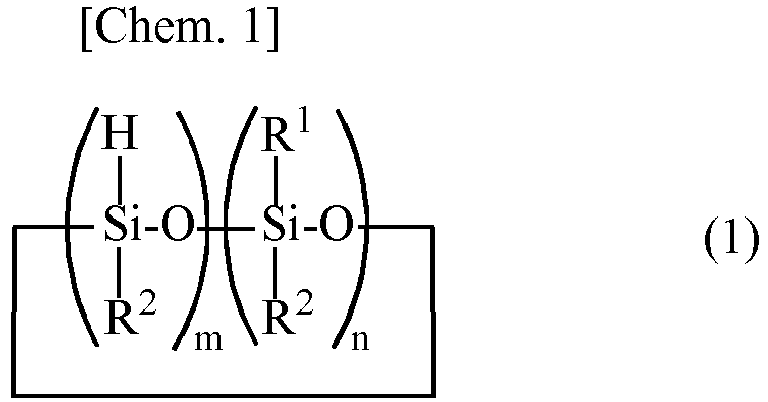
- (C) an organohydrogenpolysiloxane having at least two silicon-bonded hydrogen atoms per molecule, represented by the average compositional formula (2):
[Chem. 2]
R2 eHfSiO(4-e-f)/2 (2)
wherein R2 is as defined above, e is a number of 0.7 to 2.1, f is a number of 0.001 to 1.0, e+f is a number of 0.8 to 2.7,
the amounts of components (B) and (C) blended being such that the total number of silicon-bonded hydrogen atoms in components (B) and (C) is 1 to 7 per silicon-bonded alkenyl group in component (A), and the number of silicon-bonded hydrogen atoms in component (B) is 1 to 30% based on the total number of silicon-bonded hydrogen atoms in components (B) and (C), - (D) 0.1 to 50 parts by weight of finely divided silica having a specific surface area of at least 50 m2/g as measured by the BET method,
- (E) a catalytic amount of an addition reaction catalyst,
- (F) a tackifier, and
- (G) at least one condensation catalyst selected from organotitanium compounds and organozirconium compounds.
- [3] The addition-curable silicone rubber composition of [2] wherein component (F) contains an alkoxysilyl-modified isocyanurate compound having the formula (3):


- [4] The addition-curable silicone rubber composition of any one of [1] to [3] wherein component (A) contains (A-1) an alkenyl-containing organopolysiloxane containing at least two C2-C8 alkenyl groups per molecule and having a viscosity of at least 70,000 mPa·s at 25°C as measured by the method of JIS Z8803:2011.
- [5] The addition-curable silicone rubber composition of [4] wherein component (A) further contains (A-2) an alkenyl-containing organopolysiloxane containing at least two C2-C8 alkenyl groups per molecule and having a viscosity of 10,000 to 50,000 mPa·s at 25°C as measured by the method of JIS Z8803:2011.
- [6] The addition-curable silicone rubber composition of any one of [1] to [5] wherein component (B) is a cyclic organohydrogenpolysiloxane of formula (1) wherein m=n=2.
- [7] The addition-curable silicone rubber composition of any one of [1] to [6] wherein component (C) contains (C-1) an organohydrogenpolysiloxane having at least one silicon-bonded hydrogen atom (SiH group) at each of molecular chain end and side chain.
- [8] The addition-curable silicone rubber composition of [7] wherein component (C) further contains at least one of
- (C-2) an organohydrogenpolysiloxane having a silicon-bonded hydrogen atom (SiH group) only at a side chain of the molecular chain and
- (C-3) an organohydrogenpolysiloxane having a silicon-bonded hydrogen atom (SiH group) only at an end of the molecular chain.
- [9] An airbag comprising a base fabric and a cured film of the addition-curable silicone rubber composition of any one of [1] to [8] thereon.
- [10] The airbag of [9] having a hollow weave structure.
- [11] The airbag of [9] or [10] for use as a curtain airbag.
- The airbag, typically curtain airbag, to which the liquid addition-curable silicone rubber composition of the invention is applied, is capable of preventing leakage of inflator gas and sustaining inflation for a sufficient time. The liquid addition-curable silicone rubber composition cures into a cured product which is satisfactory in physical properties including hardness, tensile strength, and elongation at break, as well as adhesion to airbag base fabric.
- The invention provides an addition-curable silicone rubber composition comprising components (A) to (E) defined below, which is liquid at room temperature (25°C). These components are described below in detail. As used herein, the term "viscosity" refers to a viscosity measured at 25°C by the method of JIS Z8803:2011, and represents a value measured by a rotational viscometer.
- Component (A), which is the base of the inventive composition, is an organopolysiloxane having on the average at least 2 silicon-bonded alkenyl groups per molecule, preferably on the average at most 20, more preferably on the average at most 10 silicon-bonded alkenyl groups per molecule.
- The silicon-bonded alkenyl groups are typically of 2 to 8 carbon atoms, preferably 2 to 4 carbon atoms. Examples include vinyl, allyl, propenyl, butenyl, pentenyl, hexenyl, cyclohexenyl, and heptenyl, with vinyl being preferred. The bonding position of silicon-bonded alkenyl group in the organopolysiloxane as component (A) may be a molecular chain end or molecular chain non-end (i.e., molecular chain side chain other than the molecular chain end), or both.
- Silicon-bonded organic groups other than the silicon-bonded alkenyl groups include aliphatic unsaturation-free, substituted or unsubstituted monovalent hydrocarbon groups of typically 1 to 12 carbon atoms, preferably 1 to 10 carbon atoms. Examples thereof include alkyl groups such as methyl, ethyl, propyl, isopropyl, isobutyl, tert-butyl, butyl, pentyl, hexyl and heptyl; cycloalkyl groups such as cyclopentyl and cyclohexyl; aryl groups such as phenyl, tolyl, xylyl and naphthyl; aralkyl groups such as benzyl and phenethyl; and halogenated alkyl groups in which hydrogen atom in their functionality is substituted by a halogen atom such as chlorine or fluorine, such as chloromethyl, 3-chloropropyl, and 3,3,3-trifluoropropyl. Preferred are methyl and phenyl.
- The content of silicon-bonded alkenyl groups in component (A) is typically 0.001 to 10 mol%, preferably 0.01 to 5 mol% based on the overall silicon-bonded organic groups.
- The molecular structure of the organopolysiloxane as component (A) is not particularly limited and may be straight, branched or cyclic. Preferred is a straight diorganopolysiloxane having a backbone consisting essentially of repeating R2SiO2/2 units wherein R is a monovalent hydrocarbon group (i.e., diorganosiloxane units) and capped at both ends of the molecular chain with R3SiO1/2 units wherein R is as defined above (i.e., triorganosiloxy units). As used herein, the term "backbone consisting essentially of R2SiO2/2 units" means that R2SiO2/2 units account for typically 99 to 100 mol%, preferably 99.5 to 100 mol% of the siloxane units constituting the backbone exclusive of both ends of the molecular chain.
- In the above formula, R is a monovalent hydrocarbon group which has typically 1 to 12 carbon atoms, preferably 1 to 10 carbon atoms. Examples include those exemplified above for the silicon-bonded alkenyl group, and those exemplified above for the silicon-bonded organic group other than the silicon-bonded alkenyl group.
- The organopolysiloxane as component (A) has a viscosity of preferably 100 to 500,000 mPa·s, more preferably 10,000 to 200,000 mPa-s, because the resulting composition is easy to handle and the cured product thereof has satisfactory physical properties including hardness, elongation at break and tensile strength.
- Preferably the organopolysiloxane as component (A) has the average compositional formula (5).
[Chem. 5]
R2 aR3 bSiO(4-a-b)/2 (5)
Herein R2 is independently a C1-C12 alkyl group or C6-C12 aryl group, R3 is independently a C2-C8 alkenyl group, a is a number of 1.8 to 2.2, preferably 1.9 to 2.0, b is a number of 0.0001 to 0.2, preferably 0.001 to 0.1, and a+b is a number of 1.85 to 2.3, preferably 1.95 to 2.05. - In average compositional formula (5), R2 is selected from alkyl groups of 1 to 12 carbon atoms, preferably 1 to 10 carbon atoms and aryl groups of 6 to 12 carbon atoms, preferably 6 to 10 carbon atoms. Examples include those exemplified above for the silicon-bonded organic group other than the silicon-bonded alkenyl group.
- In average compositional formula (5), R3 is an alkenyl group, which has typically 2 to 8 carbon atoms, preferably 2 to 4 carbon atoms. Examples include those exemplified above for the silicon-bonded alkenyl group.
- Examples of the organopolysiloxane as component (A) include molecular chain both end trimethylsiloxy-capped dimethylsiloxane/methylvinylsiloxane copolymers,
- molecular chain both end trimethylsiloxy-capped methylvinylpolysiloxane,
- molecular chain both end trimethoxysiloxy-capped
- dimethylsiloxane/methylvinylsiloxane/methylphenylsiloxane copolymers,
- molecular chain both end dimethylvinylsiloxy-capped dimethylpolysiloxane,
- molecular chain both end dimethylvinylsiloxy-capped methylvinylpolysiloxane,
- molecular chain both end dimethylvinylsiloxy-capped dimethylsiloxane/methylvinylsiloxane copolymers,
- molecular chain both end dimethylvinylsiloxy-capped
- dimethylsiloxane/methylvinylsiloxane/methylphenylsiloxane copolymers,
- molecular chain both end divinylmethylsiloxy-capped dimethylpolysiloxane,
- molecular chain both end divinylmethylsiloxy-capped dimethylsiloxane/methylvinylsiloxane copolymers,
- molecular chain both end trivinylsiloxy-capped dimethylpolysiloxane,
- molecular chain both end trivinylsiloxy-capped dimethylsiloxane/methylvinylsiloxane copolymers,
- organosiloxane copolymers consisting of siloxane units of the formula: R2 3SiO0.5 (wherein R2 is as defined above), siloxane units of the formula: R2 2R3SiO0.5 (wherein R3 is as defined above), siloxane units of the formula: R2 2SiO, and siloxane units of the formula: SiO2,
- organosiloxane copolymers consisting of siloxane units of the formula: R2 3SiO0.5, siloxane units of the formula: R2 2R3SiO0.5, and siloxane units of the formula: SiO2,
- organosiloxane copolymers consisting of siloxane units of the formula: R2 2R3SiO0.5, siloxane units of the formula: R2 2SiO, and siloxane units of the formula: SiO2, and
- organosiloxane copolymers consisting of siloxane units of the formula: R2R3SiO and siloxane units of the formula: R2SiO1.5 or siloxane units of the formula: R3SiO1.5.
- The organopolysiloxane as component (A) may be used alone or in admixture.
- On use of a mixture of two or more organopolysiloxanes, component (A) preferably contains (A-1) an alkenyl-containing organopolysiloxane containing at least two C2-C8 alkenyl groups per molecule and having a viscosity at 25°C of at least 70,000 mPa·s, especially 80,000 to 120,000 mPa-s as measured by the method of JIS Z8803:2011 and more preferably in combination with (A-2) an alkenyl-containing organopolysiloxane containing at least two C2-C8 alkenyl groups per molecule and having a viscosity at 25°C of 10,000 to 50,000 mPa·s, especially 20,000 to 40,000 mPa·s as measured by the method of JIS Z8803:2011. A blend ratio of (A-1) to (A-2) preferably ranges from 1/9 to 9/1 in weight ratio. A mixture in the range is satisfactory in preventing leakage of inflator gas and sustaining inflation for a certain time. The resulting liquid addition-curable silicone rubber composition cures into a cured product which is satisfactory in physical properties including hardness, tensile strength, and elongation at break, as well as adhesion to airbag base fabric. Thus the liquid addition-curable silicone rubber composition is fully compatible with airbag fabric.
- Component (B) is a cyclic organohydrogenpolysiloxane. It is a component that functions to extend the molecular chain length of component (A) upon curing of the resulting composition and contributes to an improvement in the sustainment of airbag inflation time. Since interaction under the impetus of intermolecular forces occurs between alkyl or aryl groups in its molecule and polymer molecules in the airbag base fabric such as nylon 66, nylon 6, polyester fibers, aramid fibers, polyamide fibers or polyester fibers, it is also a component that improves the adhesion of the composition to the base fabric.
- The cyclic organohydrogenpolysiloxane has a molecular structure of the formula (1).

- In formula (1), R1 is an alkyl group of 1 to 12 carbon atoms, preferably 1 to 8 carbon atoms. Examples include methyl, ethyl, propyl, isopropyl, isobutyl, tert-butyl, butyl, pentyl, hexyl and heptyl, with methyl and isopropyl being preferred.
- In formula (1), R2 is selected from alkyl groups of 1 to 12 carbon atoms, preferably 1 to 8 carbon atoms and aryl groups of 6 to 12 carbon atoms, preferably 6 to 8 carbon atoms. Examples include those exemplified above for the silicon-bonded organic group other than the silicon-bonded alkenyl group in component (A).
- The cyclic organohydrogenpolysiloxane as component (B) is blended in an amount as described later in conjunction with component (C). The cyclic organohydrogenpolysiloxane as component (B) may be used alone or in admixture.
- Component (C) is an organohydrogenpolysiloxane having at least two silicon-bonded hydrogen atoms per molecule, represented by the average compositional formula (2):
[Chem. 7]
R2 eHfSiO(4-e-f)/2 (2)
wherein R2 is selected from a C1-C12 alkyl group and C6-C12 aryl group, e is a number of 0.7 to 2.1, f is a number of 0.001 to 1.0, and e+f is a number of 0.8 to 2.7, preferably e is a number of 1.0 to 2.0, f is a number of 0.01 to 1.0, and e+f is a number of 1.1 to 2.5. - The organohydrogenpolysiloxane as component (C) has preferably 2 to 200, more preferably 2 to 100 silicon-bonded hydrogen atoms (i.e., SiH groups) per molecule, and 20 to 100%, preferably 30 to 100% (on number basis) of the SiH groups are present in organohydrogensiloxane units of the formula: R2HSiO2/2. It has a viscosity at 25°C of 1 to 10,000 mPa·s, preferably 10 to 5,000 mPa·s. Notably the organohydrogenpolysiloxane is free of aliphatic unsaturation in the molecule.
- The molecular structure of the organohydrogenpolysiloxane as component (C) is not particularly limited, and may be, for example, linear, branched, or three-dimensional network (exclusive of wholly cyclic one), preferably substantially linear. A cyclic siloxane may be bonded to the molecular chain end. As used herein, the term "substantially linear" structure means that R6 2SiO2/2 units (wherein R6 is independently hydrogen or R2) account for typically 99 to 100 mol%, preferably 99.5 to 100 mol% of the siloxane units constituting the backbone exclusive of molecular chain both ends (in case of a cyclic siloxane being bonded thereto, the cyclic siloxane).
- In the molecule of organohydrogenpolysiloxane (C), the silicon-bonded hydrogen atom may be positioned at a molecular chain end or a molecular chain non-end or both. When a cyclic siloxane is bonded to the molecular chain end, the silicon-bonded hydrogen atom may be positioned in the cyclic siloxane.
- Examples of the organohydrogenpolysiloxane as component (C) include those containing R2HSiO2/2 units (wherein R2 is as defined above), and optionally R2 2R6SiO1/2 units (wherein R6 is as defined above) and/or R2 2SiO2/2 units in the molecule.
- Illustrative examples of the organohydrogenpolysiloxane as component (C) include 1,3,5,7-tetramethylcyclotetrasiloxane,
- methylhydrogencyclopolysiloxane,
- methylhydrogensiloxane/dimethylsiloxane cyclic copolymers,
- both end trimethylsiloxy-capped methylhydrogenpolysiloxane,
- both end trimethylsiloxy-capped dimethylsiloxane/methylhydrogensiloxane copolymers,
- both end dimethylhydrogensiloxy-capped dimethylsiloxane/methylhydrogensiloxane copolymers,
- both end trimethylsiloxy-capped methylhydrogensiloxane/diphenylsiloxane copolymers,
- both end trimethylsiloxy-capped
- methylhydrogensiloxane/diphenylsiloxane/dimethylsiloxane copolymers,
- both end trimethylsiloxy-capped
- methylhydrogensiloxane/methylphenylsiloxane/dimethylsiloxane copolymers,
- both end dimethylhydrogensiloxy-capped
- methylhydrogensiloxane/dimethylsiloxane/diphenylsiloxane copolymers,
- both end dimethylhydrogensiloxy-capped
- methylhydrogensiloxane/dimethylsiloxane/methylphenylsiloxane copolymers, copolymers consisting of (CH3)(H)SiO2/2 units, (CH3)3SiO1/2 units and SiO4/2 units, copolymers consisting of (CH3)(H)SiO2/2 units, (CH3)2SiO2/2 units, (CH3)3SiO1/2 units and SiO4/2 units, copolymers consisting of (CH3)(H)SiO2/2 units, (CH3)2(H)SiO1/2 units, (CH3)3SiO1/2 units and SiO4/2 units, and copolymers consisting of (CH3)(H)SiO2/2 units, (CH3)2(H)SiO1/2 units, (CH3)2SiO2/2 units, (CH3)3SiO1/2 units and SiO4/2 units. More preferred examples are given below.
- Amounts of components (B) and (C) blended are such that the total number of silicon atom-bonded hydrogen atoms in components (B) and (C) is 1 to 7 (i.e., a molar ratio of 1/1 to 7/1), preferably 1 to 5, more preferably 1 to 3 per silicon atom-bonded alkenyl group in component (A), and the number (or moles) of silicon atom-bonded hydrogen atoms in component (B) is 1 to 30%, preferably 2 to 20% of the number (or moles) of silicon atom-bonded hydrogen atoms in components (B) and (C). If these numbers (or amounts) are outside the ranges, the air tightness of an airbag during inflation is inferior.
- The organohydrogenpolysiloxane as component (C) may be used alone or in admixture.
- On use of a mixture of two or more organohydrogenpolysiloxanes, one is preferably (C-1) an organohydrogenpolysiloxane having at least one silicon-bonded hydrogen atom (SiH group) at each of molecular end and side chain. More preferably, component (C) further contains at least one of (C-2) an organohydrogenpolysiloxane having a silicon-bonded hydrogen atom (SiH group) only at a side chain of the molecular chain and (C-3) an organohydrogenpolysiloxane having a silicon-bonded hydrogen atom (SiH group) only at an end of the molecular chain. On use of (C-1) and (C-2) or (C-3), their blend ratio is preferably from 9.99:0.01 to 0.01:9.99 in weight ratio. On use of (C-1), (C-2) and (C-3), their blend ratio is preferably from 9.98:0.01 :0.01 to 0.01 :5.00:4.99 in weight ratio. These ranges ensure that the composition is effective for preventing leakage of inflator gas and sustaining inflation for a sufficient time. The liquid addition-curable silicone rubber composition cures into a cured product which is satisfactory in physical properties including hardness, tensile strength, and elongation at break, as well as adhesion to airbag base fabric. It is thus useful as a liquid silicone rubber coating composition applicable to airbag base fabric.
- Component (D) is finely divided silica which serves as a reinforcement, that is, to impart a high tear strength to the cured composition. Use of finely divided silica enables to form a coating layer having improved tear strength. The finely divided silica should have a specific surface area of at least 50 m2/g, preferably 50 to 400 m2/g, and more preferably 100 to 300 m2/g, as measured by the BET method. Silica with a specific surface area of less than 50 m2/g may sometimes fail to impart satisfactory tear strength to the composition.
- The finely divided silica as component (D) may be any known silica used as a reinforcing filler for conventional silicone rubber, provided that the silica has a BET specific surface area within the above-indicated range. Exemplary silicas include precipitated silica, fumed silica and fired silica. Although finely divided silica may be used directly without modification, it is advantageous to treat silica with organosilicon compounds to render surfaces hydrophobic because the use of hydrophobic finely divided silica can impart a good flow to the composition. Exemplary organosilicon compounds include hexaorganodisilazanes such as hexamethyldisilazane, divinyltetramethyldisilazane, and dimethyltetravinyldisilazane; alkoxysilanes such as methyltrimethoxysilane, ethyltrimethoxysilane, propyltrimethoxysilane, butyltrimethoxysilane, dimethyldimethoxysilane, diethyldimethoxysilane, vinyltriethoxysilane, vinyltrimethoxysilane, trimethylmethoxysilane, triethylmethoxysilane, vinyltris(methoxyethoxy)silane, and divinyldimethoxysilane; methylchlorosilanes such as trimethylchlorosilane, dimethyldichlorosilane, and methyltrichlorosilane; and dimethylpolysiloxane free of silicon-bonded alkenyl groups and silicon-bonded hydrogen atoms.
- The amount of component (D) compounded is 0.1 to 50 parts by weight, preferably 1 to 50 parts by weight, and more preferably 5 to 40 parts by weight per 100 parts by weight of the organopolysiloxane (A). Too less amounts may fail to provide the desired tear strength whereas too much amounts may compromise the flow of the composition, making the coating operation difficult.
- The finely divided silica as component (D) may be used alone or in admixture.
- Component (E) is an addition reaction catalyst, which promotes the addition reaction between silicon-bonded alkenyl groups in component (A) and SiH groups in components (B) and (C). Although the addition reaction catalyst is not particularly limited, suitable catalysts include, for example, platinum group metals such as platinum, palladium, and rhodium; chloroplatinic acid; alcohol-modified chloroplatinic acid; coordination compounds of chloroplatinic acid with olefins, vinylsiloxane or acetylene compounds; platinum group metal compounds such as tetrakis(triphenylphosphine)palladium and chlorotris(triphenylphosphine)rhodium. The platinum group metal compounds are preferred.
- Component (E) may be compounded in a catalytic amount, preferably in an amount of 1 to 500 ppm, and more preferably 10 to 100 ppm, expressed as the weight of catalyst metal element based on the total weight of components (A) to (C). If the amount is too less, the addition reaction may become very slow, or the composition may not cure. If the amount is too much, the cured composition may have poor heat resistance.
- The addition reaction catalyst as component (E) may be used alone or in admixture.
- While the addition curable silicone rubber composition contains components (A) to (E) as essential components, the following components may be further added.
- Component (F) is a tackifier, which is effective for improving the adhesion of the composition to synthetic fiber woven fabric bases, non-woven fabric bases, thermoplastic resin sheets or film bases for airbags. The tackifier is not particularly limited as long as it can improve the self-adhesion of the composition. Exemplary tackifiers include organosilicon compound-based tackifiers and non-silicon organic compound-based tackifiers. Specifically, suitable organosilicon compound-based tackifiers include tackifiers composed of organosilicon compounds such as organosilanes and organopolysiloxanes other than components (A) to (C), and suitable non-silicon organic compound-based tackifiers include tackifiers composed of organic acid allyl esters and epoxy ring-opening catalysts. These catalysts may be used alone or in admixture.
- The organic acid allyl esters are esters containing no silicon atom in the molecule, for example, organic acid allyl esters having one allyl group and at least one ester group in the molecule. Exemplary organic acids include unsaturated carboxylic acids such as acrylic acid, methacrylic acid, and vinylacetic acid; aromatic carboxylic acids such as benzoic acid, phthalic acid, pyromellitic acid; and saturated fatty acids such as acetic acid, propionic acid, butyric acid and lauric acid. Suitable allyl esters of these organic acids include, for example, allyl esters of unsaturated carboxylic acids such as acrylic acid, methacrylic acid, and vinylacetic acid; allyl esters of aromatic carboxylic acids such as allyl benzoate, diallyl phthalate, tetraallyl pyromellitate; and allyl esters of saturated fatty acids such as allyl acetate, allyl propionate, allyl butyrate, allyl valerate, and allyl laurate.
- The epoxy ring-opening catalysts are catalysts containing no silicon atom in the molecule, for example, epoxy ring-opening catalysts of organic metal chelate, amine, amide, imidazole, and acid anhydride types.
- Suitable organosilicon compounds include organosilanes having at least one functional group, preferably at least two functional groups selected from silicon-bonded alkenyl groups such as vinyl and allyl, an epoxy group bonded to a silicon atom via a carbon atom in an alkylene group optionally containing at least one ether bonding oxygen atom such as γ-glycidoxypropyl and β-(3,4-epoxycyclohexyl)ethyl; acryloxy and methacryloxy groups bonded to a silicon atom via a carbon atom in an alkylene group such as γ-acryloxypropyl and γ-methacryloxypropyl; alkoxy groups such as methoxy, ethoxy, propoxy, and butoxy; alkoxysilyl groups bonded to a silicon atom via an alkylene group and optionally containing one or two ester structures, urethane structures, or ether structures such as trimethoxysilyl, triethoxysilyl and methyldimethoxysilyl; isocyanate groups; and SiH groups; linear or cyclic siloxane oligomers of 3 to 100, preferably 3 to 50, more preferably 5 to 20 silicon atoms, other than components (A) to (C); (alkoxy)silyl-modified compounds of triallyl isocyanurate and siloxane derivatives thereof, with the compounds having at least two functional groups per molecule being preferred.
- Preferably, the composition contains as component (F) an alkoxysilyl-modified isocyanurate compound having the formula (3):


- Examples of the organosilicon compound are given below.

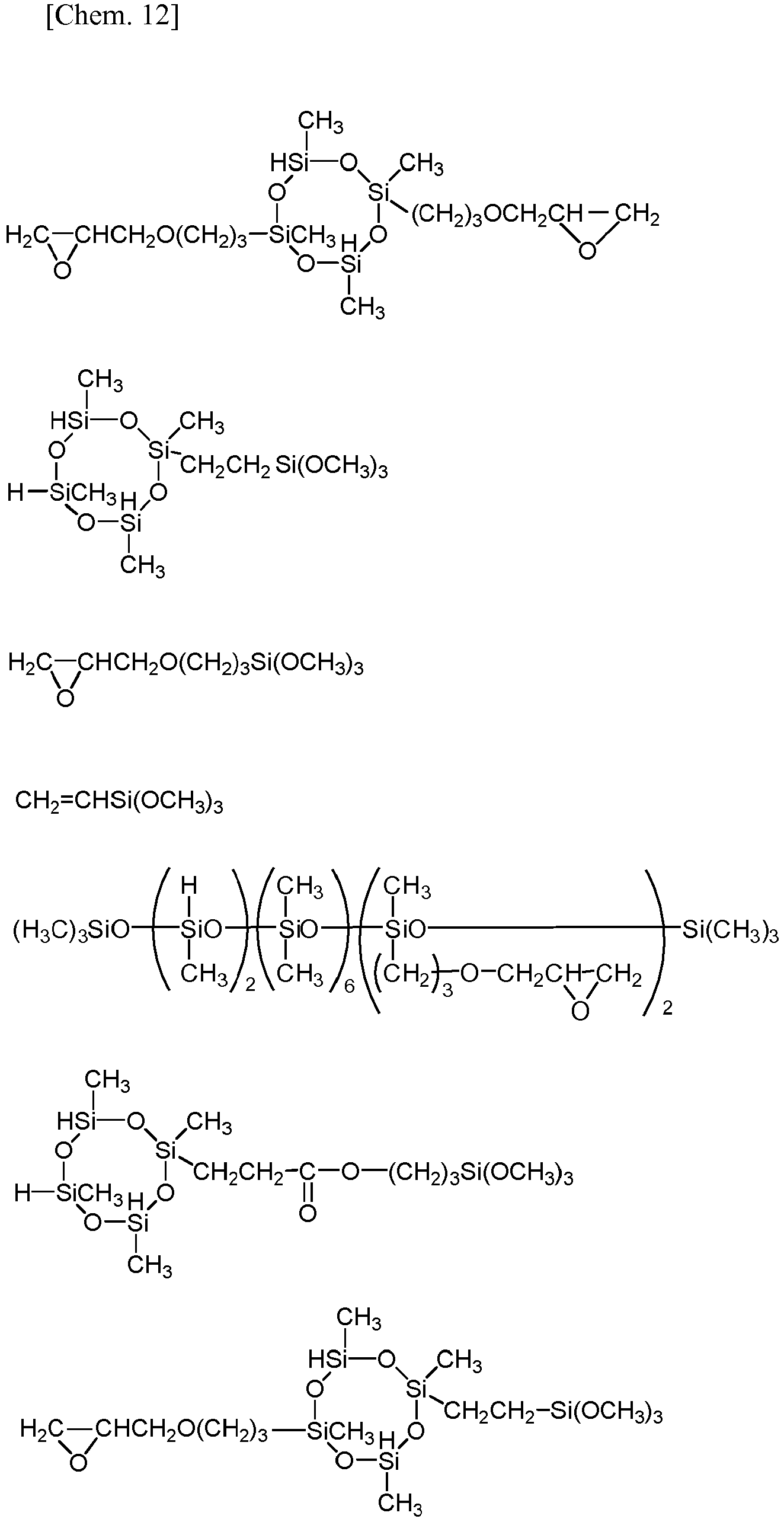


- Component (F) is compounded in an amount of 0.05 to 5 parts by weight, preferably 0.1 to 2 parts by weight per 100 parts by weight of the organopolysiloxane as component (A). If the amount is too less, the composition may not be fully adhesive. Too much amounts add to the cost, rendering the composition uneconomical.
- The tackifier as component (F) may be used alone or in admixture.
- Component (G) is a condensation catalyst, which is at least one compound selected from organotitanium compounds and organozirconium compounds and which functions as a condensation co-catalyst for component (F) for promoting adhesion. Component (G) may be used alone or in admixture. Exemplary of component (G) are titanium-based condensation co-catalysts including organic titanic acid esters such as titanium tetraisopropoxide, titanium tetra-n-butoxide and titanium tetra-2-ethylhexoxide, and organic titanium chelate compounds such as titanium diisopropoxy(acetylacetonate), titanium diisopropoxybis(ethylacetoacetate) and titanium tetraacetylacetonate; and zirconium-based condensation co-catalysts including organic zirconium esters such as zirconium tetra-n-propoxide and zirconium tetra-n-butoxide, and organic zirconium chelate compounds such as zirconium tributoxymonoacetylacetonate, zirconium monobutoxyacetylacetonate bis(ethylacetoacetate), and zirconium tetraacetylacetonate.
- Component (G), organotitanium compound or organozirconium compound is an optional component which is blended if necessary. The amount of component (G) blended is typically up to about 5 parts by weight (0 to 5 parts by weight) per 100 parts by weight of component (A), and when used, 0.1 to 5 parts by weight and more preferably 0.2 to 2 parts by weight. If the amount is less than 0.1 part by weight, the cured composition may experience a loss of adhesion permanence under hot humid conditions. If the amount is more than 5 parts by weight, the cured composition is likely to lose heat resistance.
- Besides the foregoing components (A) to (G), the composition of the invention may further include other optional components as long as the object of the invention is not compromised. Examples of the other components are given below. Each of the other components may be used alone or in admixture.
- The reaction inhibitor is not particularly limited as long as it is a compound having a cure reaction inhibiting effect on the addition reaction catalyst. Any of inhibitors which are well known in the art may be used. Examples of such inhibitor include phosphorus-containing compounds such as triphenylphosphine, nitrogen-containing compounds such as tributylamine, tetramethylethylenediamine and benzotriazole, sulfur-containing compounds, acetylene compounds such as acetylene alcohols, compounds having two or more alkenyl groups, hydroperoxy compounds, and malic acid derivatives. The extent of the cure-retarding effect achieved by the inhibitor varies according to the chemical structure of the inhibitor. It is thus preferable to adjust the amount of inhibitor included in the composition so as to be optimal for a particular inhibitor compound used. By blending an appropriate amount of the inhibitor, the composition is improved in long-term shelf stability at room temperature and curability.
- Besides the finely divided silica as component (D) such as precipitated silica, fumed silica and fired silica, the composition of the invention may have further added thereto inorganic or organic fillers as described below. Exemplary inorganic fillers include crystalline silica, hollow fillers, silsesquioxane, fumed titanium dioxide, magnesium oxide, zinc oxide, iron oxide, aluminum hydroxide, magnesium carbonate, calcium carbonate, zinc carbonate, laminar mica, carbon black, diatomaceous earth, and glass fibers; inorganic fillers which are treated with organosilicon compounds such as organoalkoxysilane compounds, organochlorosilane compounds, organosilazane compounds and low-molecular-weight siloxane compounds, to render the surface hydrophobic; silicone rubber powders; silicone resin powders, etc.
- Besides, optional components may be further included, for example, organopolysiloxanes having on the molecule one silicon-bonded hydrogen atom and bearing no other functional groups (e.g., functional groups listed above for the organosilicon compounds), organopolysiloxanes having neither silicon-bonded hydrogen atoms nor silicon-bonded alkenyl groups, solvents such as water and organic solvents, creep hardening inhibitors, plasticizers, thixotropic agents, pigments, dyes and mildew-proofing agents.
- The preparation conditions, curing method and curing conditions of the inventive composition may be well-known preparation conditions, curing method and curing conditions. Typical curing conditions include 120 to 200°C and 1 to 10 minutes.
- The composition of the invention is advantageously used in airbags, especially curtain airbags. Airbags, on which a silicone rubber coating layer is formed of a cured product of the composition, may be of well-known construction, for example, of hollow weave structure having a silicone rubber coating layer formed thereon. Exemplary of the airbag are airbags of hollow weave structure including a base fabric which is a woven fabric made of synthetic fibers such as nylon 66, nylon 6, polyester fibers, aramid fibers, various polyamide fibers and various polyester fibers.
- In the preparation of such airbags, a conventional method may be used to coat the composition onto the base fabric. The thickness of a coating layer (or surface coating weight) is, for example, about 10 to 150 g/m2, preferably about 15 to 80 g/m2, and most preferably about 20 to 60 g/m2 in dry state.
- Examples and Comparative Examples are given below for illustrating the invention, but the invention is by no means limited thereto. Notably, all parts are by weight. The viscosity is a value measured at 25°C by the method of JIS Z8803:2011.
- On a kneader, 60 parts of molecular chain both end vinyldimethylsiloxy-capped dimethylpolysiloxane having a viscosity of about 30,000 mPa·s, 8 parts of hexamethyldisiloxane, 2 parts of water, and 40 parts of finely divided silica having a specific surface area of about 300 m2/g by the BET method (tradename: Aerosil 300, Nippon Aerosil Co., Ltd.) were mixed for 1 hour. Thereafter, the temperature in the kneader was elevated to 150°C, followed by 2 hours of mixing. Then the temperature was lowered to 100°C, after which 30 parts of molecular chain both end vinyldimethylsiloxy-capped dimethylpolysiloxane having a viscosity of about 30,000 mPa·s was added. The ingredients were mixed until uniform, obtaining Base Compound I.
- Composition 1 was prepared by mixing 108 parts of Base Compound I with 62.4 parts of molecular chain both end vinyldimethylsiloxy-capped dimethylpolysiloxane having a viscosity of about 100,000 mPa·s, 0.2 part of cyclic organohydrogenpolysiloxane shown below as Compound 1 (silicon-bonded hydrogen atom content = 0.62 wt%), 11.5 parts of dimethylsiloxane/methylhydrogensiloxane copolymer capped at molecular chain both ends with dimethylhydrogensiloxy, containing silicon-bonded hydrogen atoms at both ends and non-end positions of the molecular chain, and having a viscosity of 90 mPa·s (silicon-bonded hydrogen atom content = 0.06 wt%), 0.10 part of dimethylsiloxane/methylhydrogensiloxane copolymer capped at molecular chain both ends with trimethylsiloxy, containing silicon-bonded hydrogen atoms on side chains of the molecular chain, and having a viscosity of 45 mPa·s (silicon-bonded hydrogen atom content = 1.08 wt%), 0.25 part of alkoxysilyl-modified isocyanurate compound shown below as Compound 2, 0.30 part of γ-glycidoxypropyltrimethoxysilane shown below as Compound 3, 0.15 part of 1-ethynylcyclohexanol, 0.20 part of a dimethylpolysiloxane solution of chloroplatinic acid/1,3-divinyltetramethyldisiloxane complex having a platinum atom content of 1 wt%, and 0.26 part of zirconium tetraacetylacetonate.


- Notably, in Composition 1, the total number of silicon-bonded hydrogen atoms in components (B) and (C) was 1.5 per silicon-bonded alkenyl group in component (A), and the number of silicon-bonded hydrogen atoms in component (B) was 13% based on the total number of silicon-bonded hydrogen atoms in components (B) and (C).
- The results including H/V and the molar ratio (in %) of silicon-bonded hydrogen atoms in component (B) are shown in Table 1. It is noted that H/V is a molar ratio of the total of silicon-bonded hydrogen atoms in components (B) and (C) to silicon-bonded alkenyl groups in component (A). The molar ratio (in %) of silicon-bonded hydrogen atoms in component (B) is a molar ratio (in %) of silicon-bonded hydrogen atoms in component (B) to the total of silicon-bonded hydrogen atoms in components (B) and (C).
- Composition 1 was cured by heating at 150°C for 5 minutes. A test sheet was prepared therefrom according to JIS K6249:2003. The test sheet was measured for hardness, tensile strength and elongation at break.
- Separately, Composition 1 was coated onto a hollow-weave airbag base fabric of nylon 66 (210 deniers) with a coater to a coating weight of 50 g/m2 which was the minimum coating weight capable of uniform coating without variations, and heat cured in an oven at 200°C for 1 minute, yielding a hollow weave airbag. This airbag was subjected to an air tightness test. In the air tightness test, the airbag was inflated under a pressure of 100 kPa, and the residual pressure after 30 seconds was measured. Air tightness was evaluated in terms of the measured value.
- The composition was coated onto an airbag base fabric of nylon 66 (210 deniers) in a coating weight of 50 g/m2 and heated at 200°C for 1 minute. On this coated fabric, a Scott type crumpling test was carried out.
- The Scott type crumpling test was carried out according to the method of JIS K6404-6:1999, using a Scott type crumpling tester (Scott type crumple-flex abrasion tester, Toyo Seiki Co., Ltd.). The silicone rubber-coated nylon fabric was subjected to 500 cycles of the Scott type crumpling test under a loading pressure of 19.6 N, after which the coating was visually observed for breakage. The sample was rated "pass" when the silicone rubber coating layer did not peel from the coated surface, and "reject" when peeled.
- Composition 2 was prepared by mixing 108 parts of Base Compound I in Example 1 with 62.4 parts of molecular chain both end vinyldimethylsiloxy-capped dimethylpolysiloxane having a viscosity of about 100,000 mPa·s, 0.24 part of cyclic organohydrogenpolysiloxane shown below as Compound 4 (silicon-bonded hydrogen atom content = 0.51 wt%), 11.5 parts of dimethylsiloxane/methylhydrogensiloxane copolymer capped at molecular chain both ends with dimethylhydrogensiloxy, containing silicon-bonded hydrogen atoms at both ends and non-end positions of the molecular chain, and having a viscosity of 90 mPa·s (silicon-bonded hydrogen atom content = 0.06 wt%), 0.10 part of dimethylsiloxane/methylhydrogensiloxane copolymer capped at molecular chain both ends with trimethylsiloxy, containing silicon-bonded hydrogen atoms at side chains of the molecular chain, and having a viscosity of 45 mPa·s (silicon-bonded hydrogen atom content = 1.08 wt%), 0.25 part of alkoxy-modified isocyanurate compound shown below as Compound 5, 0.30 part of γ-glycidoxypropyltrimethoxysilane shown below as Compound 3, 0.15 part of 1-ethynylcyclohexanol, 0.20 part of a dimethylpolysiloxane solution of chloroplatinic acid/1,3-divinyltetramethyldisiloxane complex having a platinum atom content of 1 wt%, and 0.26 part of zirconium tetraacetylacetonate.
-


- Notably, in Composition 1, the total number of silicon-bonded hydrogen atoms in components (B) and (C) was 1.5 per silicon-bonded alkenyl group in component (A), and the number of silicon-bonded hydrogen atoms in component (B) was 13% based on the total number of silicon-bonded hydrogen atoms in components (B) and (C).
- As in Example 1, a test sheet, a hollow weave airbag, and a coated base fabric were prepared and tested. The results are also shown in Table 1.
- Composition 3 was prepared by mixing 108 parts of Base Compound I in Example 1 with 62.4 parts of molecular chain both end vinyldimethylsiloxy-capped dimethylpolysiloxane having a viscosity of about 100,000 mPa·s, 0.94 part of dimethylpolysiloxane containing one silicon-bonded hydrogen atom in the form of a dimethylhydrogensiloxy group at each end of the molecular chain and having a viscosity of 18 mPa·s (silicon-bonded hydrogen atom content = 0.13 wt%), 11.5 parts of dimethylsiloxane/methylhydrogensiloxane copolymer capped at molecular chain both ends with dimethylhydrogensiloxy, containing silicon-bonded hydrogen atoms at both ends and non-end positions of the molecular chain, and having a viscosity of 90 mPa·s (silicon-bonded hydrogen atom content = 0.06 wt%), 0.10 part of dimethylsiloxane/methylhydrogensiloxane copolymer capped at molecular chain both ends with trimethylsiloxy, containing silicon-bonded hydrogen atoms on side chains of the molecular chain, and having a viscosity of 45 mPa·s (silicon-bonded hydrogen atom content = 1.08 wt%), 0.25 part of alkoxysilyl-modified isocyanurate compound shown below as Compound 2, 0.30 part of γ-glycidoxypropyltrimethoxysilane shown below as Compound 3, 0.15 part of 1-ethynylcyclohexanol, 0.20 part of a dimethylpolysiloxane solution of chloroplatinic acid/1,3-divinyltetramethyldisiloxane complex having a platinum atom content of 1 wt%, and 0.26 part of zirconium tetraacetylacetonate.
-


- Notably, in Composition 1, the total number of silicon-bonded hydrogen atoms in components (B) and (C) was 1.5 per silicon-bonded alkenyl group in component (A), and the number of silicon-bonded hydrogen atoms in component (B) was 0% based on the total number of silicon-bonded hydrogen atoms in components (B) and (C).
- As in Example 1, a test sheet, a hollow weave airbag, and a coated base fabric were prepared and tested. The results are also shown in Table 1.
- Composition 4 was prepared by mixing 108 parts of Base Compound I in Example 1 with 62.4 parts of molecular chain both end vinyldimethylsiloxy-capped dimethylpolysiloxane having a viscosity of about 100,000 mPa·s, 13.5 parts of dimethylsiloxane/methylhydrogensiloxane copolymer capped with dimethylhydrogensiloxy at both ends of the molecular chain, containing silicon-bonded hydrogen atoms at both ends and non-end positions of the molecular chain and having a viscosity of 90 mPa·s (silicon-bonded hydrogen atom content = 0.06 wt%), 0.10 part of dimethylsiloxane/methylhydrogensiloxane copolymer capped at molecular chain both ends with trimethylsiloxy, containing silicon-bonded hydrogen atoms on side chains of the molecular chain, and having a viscosity of 45 mPa·s (silicon-bonded hydrogen atom content = 1.08 wt%), 0.25 part of alkoxysilyl-modified isocyanurate compound shown below as Compound 2, 0.30 part of y-glycidoxypropyltrimethoxysilane shown below as Compound 3, 0.15 part of 1-ethynylcyclohexanol, 0.20 part of a dimethylpolysiloxane solution of chloroplatinic acid/1,3-divinyltetramethyldisiloxane complex having a platinum atom content of 1 wt%, and 0.26 part of zirconium tetraacetylacetonate.
-


- Notably, in Composition 1, the total number of silicon-bonded hydrogen atoms in components (B) and (C) was 1.5 per silicon-bonded alkenyl group in component (A), and the number of silicon-bonded hydrogen atoms in component (B) was 0% based on the total number of silicon-bonded hydrogen atoms in components (B) and (C).
- As in Example 1, a test sheet, a hollow weave airbag, and a coated base fabric were prepared and tested. The results are also shown in Table 1.
[Table 1] Example 1 Example 2 Comparative Example 1 Comparative Example 2 Hardness (Durometer Type A) 7 6 7 10 Tensile strength (MPa) 4.0 3.5 3.0 4.8 Elongation at break (%) 1,500 1,490 1,420 1,300 H/V 1.5 1.5 1.5 1.5 Ratio of hydrogen atom in (B) 13 13 0 0 Air tightness (kPa) 80 75 30 10 Scott type crumpling test Pass Pass Reject Reject

Claims (10)
- An addition-curable silicone rubber composition comprising:(A) 100 parts by weight of an organopolysiloxane having at least two C2-C8 alkenyl groups per molecule,(B) a cyclic organohydrogenpolysiloxane having the formula (1):
 (C) an organohydrogenpolysiloxane having at least two silicon-bonded hydrogen atoms per molecule, represented by the average compositional formula (2):
[Chem. 2]
R2 eHfSiO(4-e-f)/2 (2)
wherein R2 is as defined above, e is a number of 0.7 to 2.1, f is a number of 0.001 to 1.0, e+f is a number of 0.8 to 2.7,
the amounts of components (B) and (C) blended being such that the total number of silicon-bonded hydrogen atoms in components (B) and (C) is 1 to 7 per silicon-bonded alkenyl group in component (A), and the number of silicon-bonded hydrogen atoms in component (B) is 1 to 30% based on the total number of silicon-bonded hydrogen atoms in components (B) and (C),(D) 0.1 to 50 parts by weight of finely divided silica having a specific surface area of at least 50 m2/g as measured by the BET method,(E) a catalytic amount of an addition reaction catalyst,(F) a tackifier, and(G) at least one condensation catalyst selected from organotitanium compounds and organozirconium compounds. - The addition-curable silicone rubber composition of claim 1 wherein component (F) contains an alkoxysilyl-modified isocyanurate compound having the formula (3):


- The addition-curable silicone rubber composition of claim 1 or 2 wherein component (A) contains (A-1) an alkenyl-containing organopolysiloxane containing at least two C2-C8 alkenyl groups per molecule and having a viscosity of at least 70,000 mPa·s at 25°C as measured by the method of JIS Z8803:2011.
- The addition-curable silicone rubber composition of claim 3 wherein component (A) further contains (A-2) an alkenyl-containing organopolysiloxane containing at least two C2-C8 alkenyl groups per molecule and having a viscosity of 10,000 to 50,000 mPa s at 25°C as measured by the method of JIS Z8803:2011.
- The addition-curable silicone rubber composition of any one of claims 1 to 4 wherein component (B) is a cyclic organohydrogenpolysiloxane of formula (1) wherein m=n=2.
- The addition-curable silicone rubber composition of any one of claims 1 to 5 wherein component (C) contains (C-1) an organohydrogenpolysiloxane having at least one silicon-bonded hydrogen atom (SiH group) at each of molecular chain end and side chain.
- The addition-curable silicone rubber composition of claim 7 wherein component (C) further contains at least one of(C-2) an organohydrogenpolysiloxane having a silicon-bonded hydrogen atom (SiH group) only at a side chain of the molecular chain and(C-3) an organohydrogenpolysiloxane having a silicon-bonded hydrogen atom (SiH group) only at an end of the molecular chain.
- An airbag comprising a base fabric and a cured film of the addition-curable silicone rubber composition of any one of claims 1 to 7 thereon.
- The airbag of claim 8 having a hollow weave structure.
- The airbag of claim 8 or 9 for use as a curtain airbag.
Applications Claiming Priority (2)
| Application Number | Priority Date | Filing Date | Title |
|---|---|---|---|
| JP2016165594A JP6690468B2 (en) | 2016-08-26 | 2016-08-26 | Addition-curable silicone rubber composition and air bag |
| PCT/JP2017/029144 WO2018037942A1 (en) | 2016-08-26 | 2017-08-10 | Addition-curable silicone rubber composition and airbag |
Publications (3)
| Publication Number | Publication Date |
|---|---|
| EP3505570A1 EP3505570A1 (en) | 2019-07-03 |
| EP3505570A4 EP3505570A4 (en) | 2020-05-20 |
| EP3505570B1 true EP3505570B1 (en) | 2024-02-21 |
Family
ID=61246639
Family Applications (1)
| Application Number | Title | Priority Date | Filing Date |
|---|---|---|---|
| EP17843426.2A Active EP3505570B1 (en) | 2016-08-26 | 2017-08-10 | Addition-curable silicone rubber composition and airbag |
Country Status (6)
| Country | Link |
|---|---|
| US (1) | US20200231808A1 (en) |
| EP (1) | EP3505570B1 (en) |
| JP (1) | JP6690468B2 (en) |
| KR (1) | KR102430709B1 (en) |
| CN (1) | CN109642080B (en) |
| WO (1) | WO2018037942A1 (en) |
Families Citing this family (3)
| Publication number | Priority date | Publication date | Assignee | Title |
|---|---|---|---|---|
| WO2021012135A1 (en) * | 2019-07-22 | 2021-01-28 | Wacker Chemie Ag | Silicone composition |
| JP7790890B2 (en) * | 2021-07-29 | 2025-12-23 | 信越化学工業株式会社 | Addition-curable fluorosilicone composition, silicone rubber, and molded article |
| JP2023152553A (en) * | 2022-04-04 | 2023-10-17 | 信越化学工業株式会社 | Addition curing liquid silicone rubber composition for airbags and airbags |
Family Cites Families (17)
| Publication number | Priority date | Publication date | Assignee | Title |
|---|---|---|---|---|
| JP2978319B2 (en) * | 1991-10-31 | 1999-11-15 | 東レ・ダウコーニング・シリコーン株式会社 | Base fabric for airbag |
| JP2592021B2 (en) | 1992-01-31 | 1997-03-19 | 東レ・ダウコーニング・シリコーン株式会社 | Liquid silicone rubber composition for airbag coating |
| JP3945082B2 (en) | 1999-08-24 | 2007-07-18 | 信越化学工業株式会社 | Liquid silicone rubber composition for coating and airbag fabric |
| JP4493798B2 (en) | 2000-04-07 | 2010-06-30 | 旭化成せんい株式会社 | Coating composition for airbag and airbag |
| JP4913275B2 (en) | 2000-11-01 | 2012-04-11 | 東レ・ダウコーニング株式会社 | Liquid silicone rubber coating composition |
| JP4305640B2 (en) * | 2003-09-08 | 2009-07-29 | 信越化学工業株式会社 | Silicone rubber coating composition for air bag and air bag |
| JP4430470B2 (en) * | 2004-07-09 | 2010-03-10 | 信越化学工業株式会社 | Addition reaction curable silicone rubber composition |
| DE602006001874D1 (en) * | 2005-02-04 | 2008-09-04 | Shinetsu Chemical Co | Liquid silicone rubber coating and side airbag |
| WO2008020605A1 (en) * | 2006-08-14 | 2008-02-21 | Dow Corning Toray Co., Ltd. | Silicone rubber composition for coating of woven fabric, and coated woven fabric |
| WO2011082136A1 (en) * | 2009-12-30 | 2011-07-07 | Dow Corning Corporation | Silicone coatings on air bags |
| JP5660920B2 (en) * | 2011-02-15 | 2015-01-28 | 信越化学工業株式会社 | Manufacturing method of air bag base fabric and air bag base fabric |
| JP5605345B2 (en) * | 2011-10-19 | 2014-10-15 | 信越化学工業株式会社 | Liquid silicone rubber coating composition, curtain airbag and method for producing the same |
| JP5644744B2 (en) * | 2011-11-28 | 2014-12-24 | 信越化学工業株式会社 | Silicone elastic adhesive composition for airbag and airbag |
| JP2013159670A (en) * | 2012-02-02 | 2013-08-19 | Dow Corning Toray Co Ltd | Curable silicone composition, its cured product, and optical semiconductor device |
| JP5799915B2 (en) * | 2012-08-20 | 2015-10-28 | 信越化学工業株式会社 | Addition-curing self-adhesive silicone rubber composition |
| JP5895857B2 (en) * | 2013-01-16 | 2016-03-30 | 信越化学工業株式会社 | Method for producing liquid silicone rubber coating composition for curtain airbag |
| JP5983566B2 (en) * | 2013-09-05 | 2016-08-31 | 信越化学工業株式会社 | Addition-curable liquid silicone rubber composition and cured silicone rubber |
-
2016
- 2016-08-26 JP JP2016165594A patent/JP6690468B2/en active Active
-
2017
- 2017-08-10 US US16/305,288 patent/US20200231808A1/en not_active Abandoned
- 2017-08-10 EP EP17843426.2A patent/EP3505570B1/en active Active
- 2017-08-10 WO PCT/JP2017/029144 patent/WO2018037942A1/en not_active Ceased
- 2017-08-10 KR KR1020187038081A patent/KR102430709B1/en active Active
- 2017-08-10 CN CN201780051171.9A patent/CN109642080B/en active Active
Also Published As
| Publication number | Publication date |
|---|---|
| KR102430709B1 (en) | 2022-08-09 |
| JP6690468B2 (en) | 2020-04-28 |
| CN109642080B (en) | 2022-03-08 |
| EP3505570A1 (en) | 2019-07-03 |
| US20200231808A1 (en) | 2020-07-23 |
| WO2018037942A1 (en) | 2018-03-01 |
| EP3505570A4 (en) | 2020-05-20 |
| CN109642080A (en) | 2019-04-16 |
| JP2018030964A (en) | 2018-03-01 |
| KR20190045098A (en) | 2019-05-02 |
Similar Documents
| Publication | Publication Date | Title |
|---|---|---|
| CN102449071B (en) | Coating composition and textiles coated therewith | |
| EP1865039B1 (en) | Liquid silicone rubber coating composition, curtain air bag, and method of producing same | |
| EP1688463B1 (en) | Liquid silicone rubber coating agent composition and curtain air bag | |
| JP5761103B2 (en) | Liquid silicone rubber coating composition for curtain airbag and method for producing the same | |
| JP5142071B2 (en) | Liquid silicone rubber coating composition, curtain airbag and method for producing the same | |
| EP3653671B1 (en) | Addition-curable silicone rubber composition and air bag | |
| JP5397326B2 (en) | Liquid silicone rubber coating composition, curtain airbag and method for producing the same | |
| EP2028233B1 (en) | Liquid silicone rubber coating composition, curtain air bag, and method of producing same | |
| EP1967562B1 (en) | Liquid silicone rubber coating composition, curtain air bag, and method of producing same | |
| EP3505570B1 (en) | Addition-curable silicone rubber composition and airbag | |
| KR101194500B1 (en) | Liquid Silicone Rubber Coating Composition, and Airbag Using the Same | |
| JP4835849B2 (en) | Liquid silicone rubber coating composition and method for producing the same | |
| JP4883258B2 (en) | Liquid silicone rubber coating composition and air bag | |
| JP2005336270A (en) | Liquid silicone rubber coating composition and air bag | |
| JP4993914B2 (en) | Liquid silicone rubber coating composition and curtain airbag | |
| JP2006063208A (en) | Liquid silicone rubber coating composition and air bag |
Legal Events
| Date | Code | Title | Description |
|---|---|---|---|
| STAA | Information on the status of an ep patent application or granted ep patent |
Free format text: STATUS: THE INTERNATIONAL PUBLICATION HAS BEEN MADE |
|
| PUAI | Public reference made under article 153(3) epc to a published international application that has entered the european phase |
Free format text: ORIGINAL CODE: 0009012 |
|
| STAA | Information on the status of an ep patent application or granted ep patent |
Free format text: STATUS: REQUEST FOR EXAMINATION WAS MADE |
|
| 17P | Request for examination filed |
Effective date: 20190227 |
|
| AK | Designated contracting states |
Kind code of ref document: A1 Designated state(s): AL AT BE BG CH CY CZ DE DK EE ES FI FR GB GR HR HU IE IS IT LI LT LU LV MC MK MT NL NO PL PT RO RS SE SI SK SM TR |
|
| AX | Request for extension of the european patent |
Extension state: BA ME |
|
| DAV | Request for validation of the european patent (deleted) | ||
| DAX | Request for extension of the european patent (deleted) | ||
| A4 | Supplementary search report drawn up and despatched |
Effective date: 20200422 |
|
| RIC1 | Information provided on ipc code assigned before grant |
Ipc: C08L 83/04 20060101ALI20200416BHEP Ipc: B60R 21/235 20060101ALI20200416BHEP Ipc: C08G 77/20 20060101ALI20200416BHEP Ipc: C08K 3/36 20060101ALI20200416BHEP Ipc: C09D 183/04 20060101ALI20200416BHEP Ipc: D06M 15/643 20060101ALI20200416BHEP Ipc: C08G 77/12 20060101ALI20200416BHEP Ipc: C08K 5/5455 20060101ALI20200416BHEP Ipc: C08L 83/07 20060101AFI20200416BHEP Ipc: C08K 5/56 20060101ALI20200416BHEP Ipc: D06N 3/12 20060101ALI20200416BHEP Ipc: C08L 83/05 20060101ALI20200416BHEP |
|
| GRAP | Despatch of communication of intention to grant a patent |
Free format text: ORIGINAL CODE: EPIDOSNIGR1 |
|
| STAA | Information on the status of an ep patent application or granted ep patent |
Free format text: STATUS: GRANT OF PATENT IS INTENDED |
|
| INTG | Intention to grant announced |
Effective date: 20231012 |
|
| GRAS | Grant fee paid |
Free format text: ORIGINAL CODE: EPIDOSNIGR3 |
|
| GRAA | (expected) grant |
Free format text: ORIGINAL CODE: 0009210 |
|
| STAA | Information on the status of an ep patent application or granted ep patent |
Free format text: STATUS: THE PATENT HAS BEEN GRANTED |
|
| AK | Designated contracting states |
Kind code of ref document: B1 Designated state(s): AL AT BE BG CH CY CZ DE DK EE ES FI FR GB GR HR HU IE IS IT LI LT LU LV MC MK MT NL NO PL PT RO RS SE SI SK SM TR |
|
| REG | Reference to a national code |
Ref country code: GB Ref legal event code: FG4D |
|
| REG | Reference to a national code |
Ref country code: CH Ref legal event code: EP |
|
| REG | Reference to a national code |
Ref country code: DE Ref legal event code: R096 Ref document number: 602017079405 Country of ref document: DE |
|
| REG | Reference to a national code |
Ref country code: IE Ref legal event code: FG4D |
|
| REG | Reference to a national code |
Ref country code: LT Ref legal event code: MG9D |
|
| REG | Reference to a national code |
Ref country code: NL Ref legal event code: MP Effective date: 20240221 |
|
| PG25 | Lapsed in a contracting state [announced via postgrant information from national office to epo] |
Ref country code: IS Free format text: LAPSE BECAUSE OF FAILURE TO SUBMIT A TRANSLATION OF THE DESCRIPTION OR TO PAY THE FEE WITHIN THE PRESCRIBED TIME-LIMIT Effective date: 20240621 |
|
| PG25 | Lapsed in a contracting state [announced via postgrant information from national office to epo] |
Ref country code: LT Free format text: LAPSE BECAUSE OF FAILURE TO SUBMIT A TRANSLATION OF THE DESCRIPTION OR TO PAY THE FEE WITHIN THE PRESCRIBED TIME-LIMIT Effective date: 20240221 |
|
| PG25 | Lapsed in a contracting state [announced via postgrant information from national office to epo] |
Ref country code: GR Free format text: LAPSE BECAUSE OF FAILURE TO SUBMIT A TRANSLATION OF THE DESCRIPTION OR TO PAY THE FEE WITHIN THE PRESCRIBED TIME-LIMIT Effective date: 20240522 |
|
| REG | Reference to a national code |
Ref country code: AT Ref legal event code: MK05 Ref document number: 1659092 Country of ref document: AT Kind code of ref document: T Effective date: 20240221 |
|
| PG25 | Lapsed in a contracting state [announced via postgrant information from national office to epo] |
Ref country code: HR Free format text: LAPSE BECAUSE OF FAILURE TO SUBMIT A TRANSLATION OF THE DESCRIPTION OR TO PAY THE FEE WITHIN THE PRESCRIBED TIME-LIMIT Effective date: 20240221 Ref country code: RS Free format text: LAPSE BECAUSE OF FAILURE TO SUBMIT A TRANSLATION OF THE DESCRIPTION OR TO PAY THE FEE WITHIN THE PRESCRIBED TIME-LIMIT Effective date: 20240521 Ref country code: NL Free format text: LAPSE BECAUSE OF FAILURE TO SUBMIT A TRANSLATION OF THE DESCRIPTION OR TO PAY THE FEE WITHIN THE PRESCRIBED TIME-LIMIT Effective date: 20240221 |
|
| PG25 | Lapsed in a contracting state [announced via postgrant information from national office to epo] |
Ref country code: ES Free format text: LAPSE BECAUSE OF FAILURE TO SUBMIT A TRANSLATION OF THE DESCRIPTION OR TO PAY THE FEE WITHIN THE PRESCRIBED TIME-LIMIT Effective date: 20240221 |
|
| PG25 | Lapsed in a contracting state [announced via postgrant information from national office to epo] |
Ref country code: AT Free format text: LAPSE BECAUSE OF FAILURE TO SUBMIT A TRANSLATION OF THE DESCRIPTION OR TO PAY THE FEE WITHIN THE PRESCRIBED TIME-LIMIT Effective date: 20240221 |
|
| PG25 | Lapsed in a contracting state [announced via postgrant information from national office to epo] |
Ref country code: RS Free format text: LAPSE BECAUSE OF FAILURE TO SUBMIT A TRANSLATION OF THE DESCRIPTION OR TO PAY THE FEE WITHIN THE PRESCRIBED TIME-LIMIT Effective date: 20240521 Ref country code: NO Free format text: LAPSE BECAUSE OF FAILURE TO SUBMIT A TRANSLATION OF THE DESCRIPTION OR TO PAY THE FEE WITHIN THE PRESCRIBED TIME-LIMIT Effective date: 20240521 Ref country code: NL Free format text: LAPSE BECAUSE OF FAILURE TO SUBMIT A TRANSLATION OF THE DESCRIPTION OR TO PAY THE FEE WITHIN THE PRESCRIBED TIME-LIMIT Effective date: 20240221 Ref country code: LT Free format text: LAPSE BECAUSE OF FAILURE TO SUBMIT A TRANSLATION OF THE DESCRIPTION OR TO PAY THE FEE WITHIN THE PRESCRIBED TIME-LIMIT Effective date: 20240221 Ref country code: IS Free format text: LAPSE BECAUSE OF FAILURE TO SUBMIT A TRANSLATION OF THE DESCRIPTION OR TO PAY THE FEE WITHIN THE PRESCRIBED TIME-LIMIT Effective date: 20240621 Ref country code: HR Free format text: LAPSE BECAUSE OF FAILURE TO SUBMIT A TRANSLATION OF THE DESCRIPTION OR TO PAY THE FEE WITHIN THE PRESCRIBED TIME-LIMIT Effective date: 20240221 Ref country code: GR Free format text: LAPSE BECAUSE OF FAILURE TO SUBMIT A TRANSLATION OF THE DESCRIPTION OR TO PAY THE FEE WITHIN THE PRESCRIBED TIME-LIMIT Effective date: 20240522 Ref country code: FI Free format text: LAPSE BECAUSE OF FAILURE TO SUBMIT A TRANSLATION OF THE DESCRIPTION OR TO PAY THE FEE WITHIN THE PRESCRIBED TIME-LIMIT Effective date: 20240221 Ref country code: ES Free format text: LAPSE BECAUSE OF FAILURE TO SUBMIT A TRANSLATION OF THE DESCRIPTION OR TO PAY THE FEE WITHIN THE PRESCRIBED TIME-LIMIT Effective date: 20240221 Ref country code: BG Free format text: LAPSE BECAUSE OF FAILURE TO SUBMIT A TRANSLATION OF THE DESCRIPTION OR TO PAY THE FEE WITHIN THE PRESCRIBED TIME-LIMIT Effective date: 20240221 Ref country code: AT Free format text: LAPSE BECAUSE OF FAILURE TO SUBMIT A TRANSLATION OF THE DESCRIPTION OR TO PAY THE FEE WITHIN THE PRESCRIBED TIME-LIMIT Effective date: 20240221 |
|
| PG25 | Lapsed in a contracting state [announced via postgrant information from national office to epo] |
Ref country code: PT Free format text: LAPSE BECAUSE OF FAILURE TO SUBMIT A TRANSLATION OF THE DESCRIPTION OR TO PAY THE FEE WITHIN THE PRESCRIBED TIME-LIMIT Effective date: 20240621 Ref country code: PL Free format text: LAPSE BECAUSE OF FAILURE TO SUBMIT A TRANSLATION OF THE DESCRIPTION OR TO PAY THE FEE WITHIN THE PRESCRIBED TIME-LIMIT Effective date: 20240221 |
|
| PG25 | Lapsed in a contracting state [announced via postgrant information from national office to epo] |
Ref country code: SE Free format text: LAPSE BECAUSE OF FAILURE TO SUBMIT A TRANSLATION OF THE DESCRIPTION OR TO PAY THE FEE WITHIN THE PRESCRIBED TIME-LIMIT Effective date: 20240221 Ref country code: PT Free format text: LAPSE BECAUSE OF FAILURE TO SUBMIT A TRANSLATION OF THE DESCRIPTION OR TO PAY THE FEE WITHIN THE PRESCRIBED TIME-LIMIT Effective date: 20240621 Ref country code: PL Free format text: LAPSE BECAUSE OF FAILURE TO SUBMIT A TRANSLATION OF THE DESCRIPTION OR TO PAY THE FEE WITHIN THE PRESCRIBED TIME-LIMIT Effective date: 20240221 Ref country code: LV Free format text: LAPSE BECAUSE OF FAILURE TO SUBMIT A TRANSLATION OF THE DESCRIPTION OR TO PAY THE FEE WITHIN THE PRESCRIBED TIME-LIMIT Effective date: 20240221 |
|
| PG25 | Lapsed in a contracting state [announced via postgrant information from national office to epo] |
Ref country code: DK Free format text: LAPSE BECAUSE OF FAILURE TO SUBMIT A TRANSLATION OF THE DESCRIPTION OR TO PAY THE FEE WITHIN THE PRESCRIBED TIME-LIMIT Effective date: 20240221 |
|
| PG25 | Lapsed in a contracting state [announced via postgrant information from national office to epo] |
Ref country code: SM Free format text: LAPSE BECAUSE OF FAILURE TO SUBMIT A TRANSLATION OF THE DESCRIPTION OR TO PAY THE FEE WITHIN THE PRESCRIBED TIME-LIMIT Effective date: 20240221 |
|
| PG25 | Lapsed in a contracting state [announced via postgrant information from national office to epo] |
Ref country code: CZ Free format text: LAPSE BECAUSE OF FAILURE TO SUBMIT A TRANSLATION OF THE DESCRIPTION OR TO PAY THE FEE WITHIN THE PRESCRIBED TIME-LIMIT Effective date: 20240221 Ref country code: EE Free format text: LAPSE BECAUSE OF FAILURE TO SUBMIT A TRANSLATION OF THE DESCRIPTION OR TO PAY THE FEE WITHIN THE PRESCRIBED TIME-LIMIT Effective date: 20240221 |
|
| PG25 | Lapsed in a contracting state [announced via postgrant information from national office to epo] |
Ref country code: SK Free format text: LAPSE BECAUSE OF FAILURE TO SUBMIT A TRANSLATION OF THE DESCRIPTION OR TO PAY THE FEE WITHIN THE PRESCRIBED TIME-LIMIT Effective date: 20240221 |
|
| PG25 | Lapsed in a contracting state [announced via postgrant information from national office to epo] |
Ref country code: SM Free format text: LAPSE BECAUSE OF FAILURE TO SUBMIT A TRANSLATION OF THE DESCRIPTION OR TO PAY THE FEE WITHIN THE PRESCRIBED TIME-LIMIT Effective date: 20240221 Ref country code: SK Free format text: LAPSE BECAUSE OF FAILURE TO SUBMIT A TRANSLATION OF THE DESCRIPTION OR TO PAY THE FEE WITHIN THE PRESCRIBED TIME-LIMIT Effective date: 20240221 Ref country code: RO Free format text: LAPSE BECAUSE OF FAILURE TO SUBMIT A TRANSLATION OF THE DESCRIPTION OR TO PAY THE FEE WITHIN THE PRESCRIBED TIME-LIMIT Effective date: 20240221 Ref country code: EE Free format text: LAPSE BECAUSE OF FAILURE TO SUBMIT A TRANSLATION OF THE DESCRIPTION OR TO PAY THE FEE WITHIN THE PRESCRIBED TIME-LIMIT Effective date: 20240221 Ref country code: DK Free format text: LAPSE BECAUSE OF FAILURE TO SUBMIT A TRANSLATION OF THE DESCRIPTION OR TO PAY THE FEE WITHIN THE PRESCRIBED TIME-LIMIT Effective date: 20240221 Ref country code: CZ Free format text: LAPSE BECAUSE OF FAILURE TO SUBMIT A TRANSLATION OF THE DESCRIPTION OR TO PAY THE FEE WITHIN THE PRESCRIBED TIME-LIMIT Effective date: 20240221 |
|
| REG | Reference to a national code |
Ref country code: DE Ref legal event code: R097 Ref document number: 602017079405 Country of ref document: DE |
|
| PG25 | Lapsed in a contracting state [announced via postgrant information from national office to epo] |
Ref country code: IT Free format text: LAPSE BECAUSE OF FAILURE TO SUBMIT A TRANSLATION OF THE DESCRIPTION OR TO PAY THE FEE WITHIN THE PRESCRIBED TIME-LIMIT Effective date: 20240221 |
|
| PLBE | No opposition filed within time limit |
Free format text: ORIGINAL CODE: 0009261 |
|
| STAA | Information on the status of an ep patent application or granted ep patent |
Free format text: STATUS: NO OPPOSITION FILED WITHIN TIME LIMIT |
|
| PG25 | Lapsed in a contracting state [announced via postgrant information from national office to epo] |
Ref country code: IT Free format text: LAPSE BECAUSE OF FAILURE TO SUBMIT A TRANSLATION OF THE DESCRIPTION OR TO PAY THE FEE WITHIN THE PRESCRIBED TIME-LIMIT Effective date: 20240221 |
|
| 26N | No opposition filed |
Effective date: 20241122 |
|
| REG | Reference to a national code |
Ref country code: CH Ref legal event code: PL |
|
| PG25 | Lapsed in a contracting state [announced via postgrant information from national office to epo] |
Ref country code: LU Free format text: LAPSE BECAUSE OF NON-PAYMENT OF DUE FEES Effective date: 20240810 |
|
| GBPC | Gb: european patent ceased through non-payment of renewal fee |
Effective date: 20240810 |
|
| PG25 | Lapsed in a contracting state [announced via postgrant information from national office to epo] |
Ref country code: CH Free format text: LAPSE BECAUSE OF NON-PAYMENT OF DUE FEES Effective date: 20240831 Ref country code: SI Free format text: LAPSE BECAUSE OF FAILURE TO SUBMIT A TRANSLATION OF THE DESCRIPTION OR TO PAY THE FEE WITHIN THE PRESCRIBED TIME-LIMIT Effective date: 20240221 Ref country code: MC Free format text: LAPSE BECAUSE OF FAILURE TO SUBMIT A TRANSLATION OF THE DESCRIPTION OR TO PAY THE FEE WITHIN THE PRESCRIBED TIME-LIMIT Effective date: 20240221 |
|
| REG | Reference to a national code |
Ref country code: BE Ref legal event code: MM Effective date: 20240831 |
|
| PG25 | Lapsed in a contracting state [announced via postgrant information from national office to epo] |
Ref country code: GB Free format text: LAPSE BECAUSE OF NON-PAYMENT OF DUE FEES Effective date: 20240810 |
|
| PG25 | Lapsed in a contracting state [announced via postgrant information from national office to epo] |
Ref country code: BE Free format text: LAPSE BECAUSE OF NON-PAYMENT OF DUE FEES Effective date: 20240831 |
|
| PG25 | Lapsed in a contracting state [announced via postgrant information from national office to epo] |
Ref country code: IE Free format text: LAPSE BECAUSE OF NON-PAYMENT OF DUE FEES Effective date: 20240810 |
|
| PGFP | Annual fee paid to national office [announced via postgrant information from national office to epo] |
Ref country code: DE Payment date: 20250820 Year of fee payment: 9 |
|
| PGFP | Annual fee paid to national office [announced via postgrant information from national office to epo] |
Ref country code: FR Payment date: 20250828 Year of fee payment: 9 |
|
| PG25 | Lapsed in a contracting state [announced via postgrant information from national office to epo] |
Ref country code: CY Free format text: LAPSE BECAUSE OF FAILURE TO SUBMIT A TRANSLATION OF THE DESCRIPTION OR TO PAY THE FEE WITHIN THE PRESCRIBED TIME-LIMIT; INVALID AB INITIO Effective date: 20170810 |
|
| PG25 | Lapsed in a contracting state [announced via postgrant information from national office to epo] |
Ref country code: HU Free format text: LAPSE BECAUSE OF FAILURE TO SUBMIT A TRANSLATION OF THE DESCRIPTION OR TO PAY THE FEE WITHIN THE PRESCRIBED TIME-LIMIT; INVALID AB INITIO Effective date: 20170810 |