EP3505509A1 - Methods for the preparation of arylcycloalkylamine derivatives - Google Patents
Methods for the preparation of arylcycloalkylamine derivatives Download PDFInfo
- Publication number
- EP3505509A1 EP3505509A1 EP17211200.5A EP17211200A EP3505509A1 EP 3505509 A1 EP3505509 A1 EP 3505509A1 EP 17211200 A EP17211200 A EP 17211200A EP 3505509 A1 EP3505509 A1 EP 3505509A1
- Authority
- EP
- European Patent Office
- Prior art keywords
- compound
- formula
- fluidic
- additive
- group
- Prior art date
- Legal status (The legal status is an assumption and is not a legal conclusion. Google has not performed a legal analysis and makes no representation as to the accuracy of the status listed.)
- Withdrawn
Links
- 0 C*C1(CCCC1)C(c1ccccc1N)=O Chemical compound C*C1(CCCC1)C(c1ccccc1N)=O 0.000 description 1
Images


Classifications
-
- C—CHEMISTRY; METALLURGY
- C07—ORGANIC CHEMISTRY
- C07C—ACYCLIC OR CARBOCYCLIC COMPOUNDS
- C07C209/00—Preparation of compounds containing amino groups bound to a carbon skeleton
- C07C209/80—Preparation of compounds containing amino groups bound to a carbon skeleton by photochemical reactions; by using free radicals
-
- C—CHEMISTRY; METALLURGY
- C07—ORGANIC CHEMISTRY
- C07C—ACYCLIC OR CARBOCYCLIC COMPOUNDS
- C07C45/00—Preparation of compounds having >C = O groups bound only to carbon or hydrogen atoms; Preparation of chelates of such compounds
- C07C45/004—Preparation of compounds having >C = O groups bound only to carbon or hydrogen atoms; Preparation of chelates of such compounds by reaction with organometalhalides
-
- C—CHEMISTRY; METALLURGY
- C07—ORGANIC CHEMISTRY
- C07C—ACYCLIC OR CARBOCYCLIC COMPOUNDS
- C07C209/00—Preparation of compounds containing amino groups bound to a carbon skeleton
- C07C209/82—Purification; Separation; Stabilisation; Use of additives
- C07C209/86—Separation
-
- C—CHEMISTRY; METALLURGY
- C07—ORGANIC CHEMISTRY
- C07C—ACYCLIC OR CARBOCYCLIC COMPOUNDS
- C07C221/00—Preparation of compounds containing amino groups and doubly-bound oxygen atoms bound to the same carbon skeleton
-
- C—CHEMISTRY; METALLURGY
- C07—ORGANIC CHEMISTRY
- C07C—ACYCLIC OR CARBOCYCLIC COMPOUNDS
- C07C45/00—Preparation of compounds having >C = O groups bound only to carbon or hydrogen atoms; Preparation of chelates of such compounds
- C07C45/61—Preparation of compounds having >C = O groups bound only to carbon or hydrogen atoms; Preparation of chelates of such compounds by reactions not involving the formation of >C = O groups
- C07C45/64—Preparation of compounds having >C = O groups bound only to carbon or hydrogen atoms; Preparation of chelates of such compounds by reactions not involving the formation of >C = O groups by introduction of functional groups containing oxygen only in singly bound form
-
- C—CHEMISTRY; METALLURGY
- C07—ORGANIC CHEMISTRY
- C07C—ACYCLIC OR CARBOCYCLIC COMPOUNDS
- C07C2601/00—Systems containing only non-condensed rings
- C07C2601/06—Systems containing only non-condensed rings with a five-membered ring
- C07C2601/08—Systems containing only non-condensed rings with a five-membered ring the ring being saturated
Definitions
- the present invention relates to an improved process for the atom-economic preparation of libraries of significant arylcycloalkylamine derivatives, or intermediates thereof.
- arylcycloalkylamine derivatives include phenylcyclidine 0 and ketamine rac- 1.
- Arylcyclohexylamine derivatives are a class of important pharmaceutically active ingredients.
- a typical arylcyclohexylamine derivative bears a cyclohexylamine backbone featuring an aryl moiety attachment.
- Important characteristics of arylcyclohexylamine derivatives are (a) that the aryl moiety is in geminal position to the amine; (b) the amine is typically secondary or tertiary.
- Phencyclidine is one of the first arylcyclohexylamine that was reported with recognized anesthetic properties, as well as dissociative hallucinogenic and euphoriant effects.
- Ketamine belongs to the arylcyclohexylamine pharmaceutical class, and was first accepted as an ingredient for anesthetic cocktails in the late 1960s on humans and for veterinary use. Because of strong dissociative side effects, it has become a Schedule III, non-narcotic substance under the Controlled Substances Act since 1999.
- Ketamine is now considered as a breakthrough medication for treating major depressive disorders with imminent risk for suicide, and is listed on the World Health Organization (WHO) list of essential medicines. According to WHO, depression will become the second cause of disability by 2020, after cardiovascular diseases. Today, the global burden of depression is a major public health challenge, both at the social and economic levels. Despite the availability of various antidepressants, several weeks, if not months, are necessary to be effective on patients. Ketamine, on the contrary, is effective after the first intake ( M. W. Tyler et al., ACS Chem. Neurosci. 2017, 8, 1122 ).
- Ketamine (also known as 2-(2-chlorophenyl)-2-(methylamino)-cyclohexanone) bears one stereogenic center that accounts for 2 enantiomers, namely, ( S )-2-(2-chlorophenyl)-2-(methylamino)-cyclohexanone (a.k.a. Esketamine, referred to herein as the compound of formula 1a ) and ( R )-2-(2-chlorophenyl)-2-(methylamino)-cyclohexanone (a.k.a. Arketamine, referred to herein as the compound of formula 1b ).
- ketamine acts on the central nervous system (CNS). It is a non-competitive glutamatergic N -Methyl-D-aspartate (NMDA) receptor antagonist with moderate potency.
- CNS central nervous system
- NMDA N -Methyl-D-aspartate
- the ( S )-enantiomer 1a is more potent (IC 50 : 465 nM) than the ( R )-enantiomer 1b (IC 50 : 1.340 nM).
- ketamine consists of an aqueous solution of the racemate as a hydrochloride salt (Ketalar, Calypsol, Vetalar). Eskatemine is also sold as an aqueous solution of the hydrochloride under the brand name Ketanest.
- Ketamine is exclusively produced in batch, according to stepwise, time-consuming processes that use environmentally harmful/unsafe conditions or reagents.
- Racemate refers to a 50:50 mixture of enantiomer 1a and 1b, without discrimination.
- the original procedure reported in the early 1960s by C. L. Stevens ( US Patent 3254124 ), involves 4 different steps that are typically run sequentially, in temporally and spatially disconnected macroscopic batch reactors. This sequence of reactions is particularly long (over 7 days from advanced starting material 2 ), and prone to many side reactions (Scheme 1).
- Step 1 involves the bromation of intermediate 2, typically with N -bromosuccinimide or bromine, benozyl peroxide and carbon tetrachloride.
- Step 3 involves the thermolysis of 4a toward the formation of rac- 1 in refluxing decalin (b.p. 186 °C) or in refluxing dichlorobenzene (b.p. 180 °C) for 2 h.
- Step 4 aims at the formation of the hydrochloric salt rac - 1 ⁇ HCl.
- Steps 3 and 4 can be combined (step 3') upon thermolysis of 4a in the presence of an acid, such as HCl.
- Steps 2 and 3 lead to significant impurities.
- Step 3 is very sensitive to reaction time and temperature.
- the presence of impurity 4b negatively affects the thermolysis step.
- the present invention significantly reduces the impurity profile, the environmental footprint and the costs associated with conventional processes toward significant arylcycloalkylamine derivatives.
- a significant arylcycloalkylamine derivative is ketamine rac- 1 , which is defined a compound of formula I wherein R represents a chlorine atom in ortho position to the cycloalkyl moiety, R 1 represents a methyl group, R 2 represents a hydrogen atom, R 3 represents a hydrogen atom, Y represents a CH 2 group, n represents 1, and m represents 2, and the compound is pharmaceutically formulated as a hydrochloride salt.
- Advantages of performing one or more of steps (a), (b), and/or (c) in a fluidic network include:
- one or more of the steps of the method may comprise one or more of the following steps: (i) flowing a fluid sample into a micro-/meso-channel; and/or (ii) performing an in-line purification; and/or (iii) performing an in-line analysis; and/or (iv) performing a chemical reaction in the micro-/meso-channel.
- Some steps of this method can be performed in batch to produce chemical intermediates which can next be transformed under continuous-flow conditions, such as for process steps involving high temperature or conditions that would typically be considered unsafe under batch conditions by one skilled in the art.
- step (a) of the method comprises reacting a compound of formula (II) with an oxygenating compound, a first additive which is a reductant and a second additive which is a base in a solvent in the fluidic network under thermal conditions to a compound of formula (III).
- step (a) of the method comprises reacting a compound of formula (II) with an oxygenating compound, a first additive which is a reductant and a second additive which is a base for a reaction time of about 60 min or less, to produce a compound of formula (III).
- a fluidic network comprising micro- and/or meso-channels is utilized in step (a) of the method.
- a micro-channel means a channel with an internal dimension of from 100 ⁇ m to 850 ⁇ m
- micro-fluidic reactor means a reactor which comprises a network of micro-channels and various fluidic elements assembled in modules
- meso-channel means a channel with an internal dimension of from 850 ⁇ m to 2000 ⁇ m
- meso-fluidic reactor means a reactor which comprises a network of meso-channels and various fluidic elements assembled in modules. Reaction time may alternatively be expressed as a residence time in the fluidic network.
- Residence time means the actual process time under the specific process conditions (temperature, pressure, irradiation) inside the controlled environment of a micro-/meso-fluidic reactor and is generally expressed in minutes.
- the residence time may be calculated from the ratio of the internal volume of a fluidic reactor and the total flow rate in the fluidic reactor.
- step (a) of the method comprises reacting a compound of formula (II) with an oxygenating compound, and a first additive and second additive which is a catalyst in a solvent in the fluidic network under photochemical conditions to a compound of formula (III).
- step (a) of the method comprises reacting a compound of formula (II) with an oxygenating compound, a first additive which is a reductant and a second additive which is a catalyst for a reaction time of about 60 min or less, to produce a compound of formula (III).
- step (a) of the method comprises using a fluidic network comprising transparent micro- and/or meso-channels.
- a transparent micro- and/or meso-channel is a micro- and/or meso-channel constructed from a material that is fully transparent to light.
- the material of micro- and/or meso-channel is transparent to light with wavelengths ranging from 300 to 800 nm, but more specifically from 400 to 600 nm.
- a transparent micro- and/or meso channel may be constructed from glass, fused silica, and/or a transparent polymer.
- step (a) can be telescoped to subsequent process operations, such as to step (b).
- step (a) can be telescoped to a subsequent process operation such that step (a) additionally comprises a step of an in- or off-line downstream purification including quench, liquid-liquid extraction, liquid-liquid separation, gas-liquid separation, filtration on silica gel or in-line crystallization.
- liquid-liquid extraction requires the injection of a secondary phase, such as an additional reagent in a solvent.
- in-line liquid-liquid or gas-liquid separation involves a membrane or a settling tank.
- the liquid-liquid separation and the gas-liquid separation are effected at the same time.
- telescoping means the integration of multiple process or chemical operations within the same uninterrupted fluidic reactor network.
- one or more steps of the method of the invention comprises in-line analysis including but not restricted to in-line IR monitoring or other spectroscopic methods for process monitoring purposes.
- the method comprises a continuous-flow method for synthesizing a compound of formula (I).
- the method of the invention includes flowing a fluid sample comprising a compound of formula (IV) into a micro-/meso-channel; and/or performing an in-line purification of the compound of formula (IV); and/or performing an in-line analysis of the compound of formula (IV); and/or performing a chemical reaction, in the micro-/meso-channel, to convert the compound of formula (IV) to the compound of formula (I).
- step (b) comprises an imination reaction. In some embodiments, step (b) may have a yield of more than 50%. In some embodiments, step (b) uses a fluidic network comprising micro- and/or meso-channels. In some embodiments, step (b) comprises use of a third additive which is a dehydration reagent. In some embodiments, a dehydrating reagent may be a dehydrating solvent. In some embodiments, step (b) is performed in a dehydrating solvent.
- dehydrating reagent is a co-reagent such as triethylorthoformate, sulfuric acid, and/or a solvent such as absolute ethanol (or anhydrous ethanol).
- step (b) can be telescoped to subsequent process operations, such as to step (c).
- step (b) may be telescoped to a subsequent process operation such that step (b) additionally comprises a step of an in- or off-line downstream purification including quench, liquid-liquid extraction, liquid-liquid separation, or gas-liquid separation.
- in-line liquid-liquid or gas-liquid separation involves a membrane or a settling tank.
- the liquid-liquid separation and the gas-liquid separation are effected at the same time.
- step (b) of the method is performed for a reaction time of about 60 min or less.
- Reaction time may alternatively be expressed as a residence time in the fluidic network.
- step (b) can be telescoped to subsequent chemical operations, including chemical reactions, such as step (c).
- step (c) comprises a thermal rearrangement reaction. In some embodiments, step (c) may have a yield of more than 50%. In some embodiments, step (c) uses a fluidic network comprising micro- and/or meso-channels. In some embodiments, step (c) requires a third additive such as a Br ⁇ nsted or a Lewis acid. In some embodiments, step (c) is performed in the same solvent as for steps (a) and/or (b).
- step (c) can be telescoped to subsequent process operations, such that step (c) additionally comprises a step of an in- or off-line downstream purification including quench, liquid-liquid extraction, liquid-liquid separation, gas-liquid separation, filtration on silica gel or in-line crystallization.
- step (c) additionally comprises a step of an in- or off-line downstream purification including quench, liquid-liquid extraction, liquid-liquid separation, gas-liquid separation, filtration on silica gel or in-line crystallization.
- step (c) can be telescoped to subsequent chemical transformations including:
- step (c) of the method is performed for a reaction time of about 60 min or less. Reaction time may alternatively be expressed as a residence time in the fluidic network. In some embodiments, step (c) (i) of the method is performed for a reaction time of about 30 min or less. In some embodiments, steps (c) (ii) of the method of the invention are performed for a reaction time of about 60 min or less. Reaction time may alternatively be expressed as a residence time in the fluidic network.
- step (b) and (c) of the method are combined and performed simultaneously for a reaction time of about 60 min or less in the same fluidic network comprising micro- and/or meso-channels.
- step (c) can be telescoped to subsequent process operations.
- step (c) additionally comprises a step of an injection of a solution comprising a pharmaceutically acceptable acid to react with a free base of formula (I), such that a salt of the said acid and the compound of formula (I) is formed.
- step (c) additionally comprises a step of an injection of antisolvent in a section of fluidic network comprising a micro- and/or meso-channel to crystallize a pharmaceutically acceptable acid to form a salt of a compound of formula (I), or an analog thereof.
- an antisolvent is a solvent in which a salt of a compound of formula (I) is less soluble.
- a solvent/antisolvent mixture is a component for obtaining crystals.
- the effluent of step (c) is collected in a batch surge, and the antisolvent is added afterwards.
- (c) can be telescoped to a step that comprises flowing a salt of a compound of formula (I) in a section of fluidic network comprising a micro- and/or meso-channel in which the temperature is decreased from an initial value to a target lower temperature.
- the initial value is the process temperature of step (c)
- the target lower temperature is from 100°C to -25 °C, for example from 50°C to 5 °C.
- step (c) The purpose of the process of decreasing the temperature is to create a supersaturation, and is known by one skilled in the art as cooling crystallization.
- the effluent of step (c) is collected in a batch surge, and the cooling crystallization is performed afterwards.
- the solvent used is an alcohol in which the solubility of a pharmaceutically acceptable salt of a compound of formula (I) can be altered either by cooling or by adding an antisolvent.
- the pharmaceutically acceptable salt of a compound of formula (I) is a hydrochloride salt.
- the antisolvent is an ether (such as a dialkyl ether) or an oxygenous heterocycle (such as, but not restricted to, tetrahydrofuran or 1,4-dioaxane), or an alkane (such as, but not restricted to, hexane or heptane), or a cycloalkane (such as, but not restricted, cyclohexane).
- the ratio by volume of antisolvent to solvent may range from 1:1 to 1:10, for example from 1:1 to 1:3.
- the method of invention may be performed using a fully telescoped system.
- a fully telescoped system comprises a series of micro- and/or meso- reactors which perform the steps of the method of the invention in sequence, without any interruption or isolation or handling of an intermediate compound. Advantages of using a fully telescoped system include that it can give:
- the compound of formula (II) which is the starting material of the method of the invention is available following an adapted procedure from the art, such as the one disclosed in US 7,638,651 B2 .
- the compound of formula (II) may be prepared under a continuous-flow strategy using a flow reactor comprising micro- and/or meso-fluidic modules.
- the compound of formula (II) may be obtained under continuous-flow conditions by adapting the known batch procedures. In some embodiments, the conditions may require solids packed in column reactors.
- the oxygenating agent used in the method of the invention may be gaseous dioxygen. In some embodiments, the oxygenating agent used in the method of the invention may be a solvent saturated in dioxygen. In some embodiments, the oxygenating agent used in the method of the invention may be a peroxide, such as hydrogen peroxide.
- a suitable first additive is a reductant such as an inorganic or an organic reductant.
- organic reductants include, but are not restricted to, an aryl or alkyl phosphine (such as triphenylphosphine or tris(2-carboxyethyl)phosphine), a phosphite (such as trimethylphosphite or triethylphosphite), or a sulfide (such as glutathione, cysteine, methionine, dithiothritol or a derivative thereof).
- Suitable examples of an inorganic reductant include, but are not restricted to, a sulfite or metabisulfite derived from an alkaline or alkaline earth metal. A typical example may include sodium or potassium sulfite.
- a second additive is a base such as an inorganic or an organic base where step (a) is carried out under thermal conditions.
- Suitable examples of an organic bases include, but are not restricted to, trialkylamine (such as trimethylamine or diisopropylethylamine), tetramethylguanidine and other guanidine derivatives, 1,8-diazabicycloundec-7-ene (DBU) and other nitrogenous heterocyclic bases, or phosphazene-type bases.
- Suitable examples of an inorganic bases include, but are not restricted to, carbonates or hydroxides derived from alkaline or alkaline earth metals. A typical example may include potassium or cesium hydroxides, or the corresponding carbonates.
- a second additive is a catalyst where step (a) is carried out under photochemical conditions.
- the catalyst may be a photosensitizing molecule.
- a photosensitizing molecule also known as photosensitizer, is a molecule that produces a chemical change in another molecule under light irradiation with a specific wavelength.
- a catalyst is a component of chemical process that is used in sub-stoichiometric amounts, such as 0.01 to 50 mol%, and preferably between 0.1 and 5 mol%.
- Suitable photosensitizing molecules include, but are not restricted to, Eosine Y, Methylene Blue, a porphyrine and a derivative thereof.
- a suitable catalyst is Rose Bengal or a derivative thereof.
- the catalyst may be homogeneous or heterogeneous wherein a homogenous catalyst is a catalyst that is completely soluble in the reaction mixture and a heterogeneous catalyst may be a homogenous catalyst covalently anchored on an insoluble substrate such as a nano- or micrometric particle composed of silica, titania, or a polymeric material.
- the catalyst may be anchored or coated on an internal wall of a micro- and/or meso-fluidic module.
- the heterogeneous catalyst may be fed into a reactor with the reaction mixture as a slurry or a stable colloidal solution.
- the method of the invention may use a protic polar solvent such as a lower alkyl alcohol.
- steps (a)-(c) may use the same solvent.
- steps (a)-(c) may be carried out in different solvents.
- the solvent remains unaltered in steps (a)-(c).
- the method of the invention comprises performing steps (a) to (c) using the same flow of solvent which carries the various chemical intermediates through a flow reactor comprising micro- and/or meso-fluidic modules, where the solvent has a high solubility of the chemicals in the flow.
- the solvent provides a concentration of from 0.01 to 9 mol/L, for example from 0.1 and 2 mol/L.
- the solvent may be ethanol.
- a binary mixture of protic polar and aprotic polar solvents can be used. Suitable aprotic polar solvents include, but are not restricted to, propylene carbonate, dimethylformamide, and/or dimethylsulfoxide. Suitable binary solvent mixtures have a composition volume ratio ranging from 1000:1 to 1:1 protic/aprotic.
- the aprotic polar solvent component may be a co-reactant.
- the method of the invention may comprise a fifth additive which increases solubility of the second additive which is a base.
- the fifth additive may be a phase transfer catalyst.
- Acceptable phase transfer catalysts include a quaternary ammonium salt, such as tetrabutylammonium chloride, or trioctylmethylammonium chloride.
- the phase transfer catalyst may be used in an amount from 0.01 mol% to 50 mol%, for example from 1 mol% to 15 mol% with reference to a limiting reactant. It should be understood herein that the limiting reactant is the reference reagent (typically said in default (in mol), while the other stoichiometric reagents are in excess).
- the limiting regent may be used in an amount of one molar equivalent; in comparison a reagent in excess is used in an amount of more than one equivalent.
- steps (a), (b) and (c) of the method of the invention may be telescoped by using photochemical oxygenation of a compound of formula (II) with mixing under thermal conditions with a nitrogen-containing nucleophile. It has surprisingly been found that such a method directly yields a compound of formula (I).
- acyl means a moiety of formula -C(O)-R 7 where R 7 represents a hydrogen atom or an alkyl, cycloalkyl or aryl group.
- Amino means a moiety of formula -NR 8 R 9 where each of R 8 and R 9 independently represents a hydrogen atom or a lower alkyl group.
- Alkoxy means a moiety of formula -OR 10 where R 10 represents an alkyl group. In some embodiments, an alkoxy group may be a methoxy group (-OCH 3 ).
- Alkyl means a monovalent optionally substituted saturated straight- or branched- chain hydrocarbon group containing from 1 to 8 carbon atoms.
- each alkyl group may, optionally, be substituted with one or more amino, hydroxyl or sulfhydryl groups.
- Perfluoroalkyl means a monovalent optionally substituted saturated straight- or branched- chain alkyl group containing from 1 to 8 carbon atoms in which every hydrogen has been replaced by a fluorine.
- Aryl means a monovalent optionally substituted mono-, bi- or tricyclic aromatic hydrocarbon group having from 6 to 14 ring carbon atoms; for example a phenyl group.
- Aryloxy means a group of formula -OR 11 wherein R 11 represents an aryl group. In some embodiments, an alkoxy group may be phenoxy.
- Carboxyl means a moiety of formula -C(O)OR 12 wherein R 12 represents a hydrogen atom or an alkyl, cycloalkyl or aryl group.
- Cycloalkyl means a saturated optionally substituted monovalent mono- or bicyclic hydrocarbon moiety of from 3 to 10 ring carbon atoms. In some embodiments, the cycloalkyl moiety contains from 4 to 8 ring carbon atoms, for example cycloalkyl may be cyclohexyl.
- Halogen means a chlorine, fluorine, bromine or iodine atom. In some embodiments, halogen may be a chlorine or bromine atom.
- Heteroaryl means a monovalent monocyclic or bicyclic aromatic moiety of from 5 to 12 ring atoms containing one, two, or three ring heteroatoms each of which is independently selected from a nitrogen, oxygen, and/or sulfur atom, where the remaining ring atoms are each a carbon atom.
- Hydroxyl means a -OH moiety.
- Lower alkyl means a saturated optionally substituted straight- or branched- chain hydrocarbon containing from 1 to 4 carbon atoms. In some embodiments, lower alkyl means a methyl moiety.
- Niro means a -NO 2 group.
- Cyano means a -CN group.
- a prodrug of a compound of formula (I) may be prepared by modifying one or more functional group(s) present in the compound of formula (I) such that the modified functional group(s) may be cleaved in vivo to release the corresponding compound of formula (I).
- a prodrug may include a compound of formula (I) which has a hydroxy, amino, or sulfhydryl substituent which is bonded to a prodrug group such that the prodrug group may be cleaved in vivo to generate a compound of formula (I) having a free hydroxyl, amino, or sulfhydryl group, respectively.
- prodrugs include an ester or carbamate of a hydroxy functional group in a compound of formula (I).
- Organic base means any nitrogenous organic compound with basic properties such as, but not restricted to, triethylamine, N,N-diisopropylethylamine, tetramethylguanidine, 1,8-diazabicycloundec-7-ene.
- Inorganic base means any inorganic salt derived from alkaline or alkaline earth metals with basic properties such as, but not restricted to, NaOH, KOH, CsOH, Na 2 CO 3 , K 2 CO 3 or Cs 2 CO 3 , or a corresponding phosphates.
- a reductant means any inorganic or an organic molecules that could reduce oxygenated intermediates such as peroxides or hydroperoxides, such as, but not restricted to, triphenylphosphine or tris(2-carboxyethyl)phosphine, or trimethylphosphite, or glutathione, cysteine, methionine, dithiothreitol or derivatives thereof, sulfites or metabisulfites derived from alkaline or alkaline earth metals such as Na 2 SO 3 , K 2 SO 3 or Na 2 S 2 O 5 .
- Photosensitizing molecules include, but are not restricted to, Rose Bengal, Methylene Blue, porphyrine, and/or a derivative thereof.
- “Pharmaceutically acceptable salt” means a conventional non-toxic salt, such as a salt derived from an inorganic acid (such as hydrochloric, hydrobromic, sulfuric, phosphoric, and/or nitric acid), an organic acid (such as acetic, propionic, succinic, glycolic, stearic, lactic, malic, tartaric, citric, glutamic, aspartic, benzoic, salicylic, oxalic, and/or ascorbic acid).
- a pharmaceutically acceptable salt may be prepared in a conventional manner, e.g., by reacting a free base form of the compound of formula (I) with a suitable acid.
- Precursor means a compound of formula (II), a compound of formula (III), or a compound of formula (IV),
- the method of the invention uses a fluidic network to generate intensified continuous-flow thermal conditions for synthesizing a pharmaceutically active species (such as a compound of formula (I)), or a pharmaceutically active species precursor thereof (such as a compound of formula (III) or a compound of formula (IV) ) within a short reaction time such as a reaction time less than an hour, such as less than 30 minutes or less than 5 min by utilizing a temperature from room temperature to 260 °C, for example from 30 °C to 220 °C, and a counter pressure ranging from 1 to 100 bar, for example from 10 to 70 bar.
- a pharmaceutically active species such as a compound of formula (I)
- a pharmaceutically active species precursor thereof such as a compound of formula (III) or a compound of formula (IV)
- a short reaction time such as a reaction time less than an hour, such as less than 30 minutes or less than 5 min by utilizing a temperature from room temperature to 260 °C, for example from 30 °C to 2
- the counter-pressure is a pressure that is set at a downstream part of the reactor by the operator (for example, by using a pressure regulator). It sets the entire internal pressure of the reactor at the same value, and enables, for instance, use of a higher temperature than the boiling point of a solvent under atmospheric pressure (for example ethanol can be used as a liquid at 200 °C).
- the present invention uses intensified continuous-flow photochemical conditions for synthesizing a pharmaceutically active species precursor (such as a compound of formula (III) ) using a short reaction time such as a reaction time less than 2 hours, such as a reaction time less than 60 min by utilizing a light source emitting in the 250 to 850 nm wavelength range, for example from 350 to 600 nm, and more specifically from 450 to 540 nm and a temperature from room temperature to 100 °C, for example from 20 °C to 45 °C, and a counter pressure from 1 to 100 bar, for example from 2 to 20 bar.
- a pharmaceutically active species precursor such as a compound of formula (III)
- a short reaction time such as a reaction time less than 2 hours, such as a reaction time less than 60 min by utilizing a light source emitting in the 250 to 850 nm wavelength range, for example from 350 to 600 nm, and more specifically from 450 to 540 nm and a temperature from room temperature to 100 °C
- the present invention also discloses the integration or telescoping of multiple steps, including chemical and process steps for synthesizing a pharmaceutically active species (such as a compound of formula (I) ), or pharmaceutically active species precursor thereof (such as a compound of formula (III) or a compound of formula (IV)).
- a pharmaceutically active species such as a compound of formula (I)
- pharmaceutically active species precursor thereof such as a compound of formula (III) or a compound of formula (IV)
- the method of the invention uses a process parameter such as a flow rate which may be from 1 ⁇ L/min to 5000 mL/min, optionally from 100 ⁇ L/min to 100 mL/min, and more specifically from 10 ⁇ L/min to 30 mL/min.
- the method of the invention uses a fluidic network which comprises one or more fluidic modules, each associated with a specific process step such as, but not restricted to, in-line purification, in-line analysis and a chemical transformation.
- a fluidic module may be constructed from a material with a high tolerance to a wide range of chemicals and a good tolerance to high temperature and pressure, such as glass, specialty glass, quartz, fused silica, a perfluorinated polymer such as PFA, ETFE, PTFE, a ceramic such as silicon carbide (SiC), and/or a metal such as copper, any grade of stainless steel (SS), Hastelloy, and/or titanium.
- the fluidic network may comprise a micro-fluidic module constructed from a coil of a perfluorinated polymer with at least one defined section and volume where the section is the internal diameter of the fluidic network and volume is the internal volume of at least a part of the fluidic network, optionally the volume of the entire fluidic network.
- the fluidic network reactor comprises a meso-fluidic module constructed from specialty glass with at least one defined section and volume.
- a fluidic module may be constructed from a transparent material, such as glass, specialty glass such as Pyrex glass, quartz or fused silica, and/or a perfluorinated polymer such as PFA, ETFE or PTFE.
- one or more fluidic module may be constructed from a ceramic such as SiC or a metal such as SS.
- one or more fluidic modules are constructed from a perfluorinated polymer such as PFA, ETFE or PTFE embedded in a metal tubular casing such as copper tubing.
- two or more fluidic networks may be operated in series and/or in parallel; the two or more fluidic networks may be substantially identical.
- Fluidic network 10 comprises 7 fluidic modules 102,103,105,108,109,110,112. Fluidic modules 102,103,105,108,109,110,112 form three distinct fluidic assemblies I, II and III. Fluidic assembly I comprises fluidic modules 102,103,105, fluidic assembly II comprises fluidic modules 108,109,110 and fluidic assembly III is composed of fluidic module 112. Fluidic modules 102,103,105,108,109,110,112 may be connected in series, and fluidic assemblies I, II and III can be operated as a fully telescoped process. Alternatively, assemblies I, II and III can be disconnected and run independently.
- the first fluidic module 102 of fluidic network 10 has two input connectors 100,101.
- the third fluidic module 105 of fluidic network 10 has one input connector 104 and one output connector 106.
- the fourth fluidic module 108 of fluidic network 10 has one input connector 107.
- the sixth fluidic module 110 of fluidic network 10 has one output connector 111.
- the last module 112 of fluidic network 10 has one output connectors 113.
- the fluidic reactor network 10 comprises a first module 102 and a second module 103 fluidically connected to the first module 102, and a third module 105 fluidically connected to the second module 103 in series, and a fourth module 108 fluidically connected to the third module 105 in series, and a fifth module 109 fluidically connected to the fourth module 108 in series, and a sixth module 110 fluidically connected to the fifth module 109 in series, and a seventh module 112 fluidically connected to the sixth module 110 in series.
- Additional fluidic modules may be connected in series to include additional unit operations such as in-line purification, in-line analysis or chemical transformation.
- in-line analysis includes in-line spectroscopic methods, for example in-line IR.
- the fluidic reactor network may be duplicated and run in parallel to increase productivity.
- the internal diameter of the fluidic reactor network can be significantly increased for increasing the productivity.
- the first fluidic module 102 is dedicated to mixing two fluids which are input into module 102 by input connectors 100,101 where the two fluids contain at least a compound of formula (II) and an oxygenating agent.
- fluidic module 102 may be composed of one or more embedded mixers or one or more independent mixing elements, such as an arrow-head mixer, a T-mixer, Y-mixer, cross-junction and/or static micromixer, made either of glass, stainless steel, polymeric material and/or a ceramic material, or a membrane or a porous material, or a combination of two or more of the aforementioned materials.
- the second fluidic module 103 has an integrated heat exchanger which may be operated at a temperature ranging from -10 °C to 200 °C.
- a thermostat or a cryostat or any thermoregulatory device may be utilized to control the temperature of fluidic module 103.
- fluidic module 103 may have more than one section such that some sections of fluidic module 103 may be operated at different temperatures at the same time, for example at temperature above 100 °C for a first section of fluidic module 103, and below 50 °C in a last section of fluidic module 103.
- fluidic module 103 may be operated at a pressure ranging from 1 to 30 bar.
- fluidic module 103 has an integrated static mixer.
- fluidic module 103 may be increased by inserting an additional fluidic element.
- fluidic module 103 is constructed from a transparent material enabling the irradiation of the internal volume of fluidic module 103.
- fluidic module 103 has an integrated light source such as a fluorescent light source, low/medium/high pressure mercury vapor light, a halogen light or LEDs with appropriate wavelengths ranging from 250 to 850 nm wavelength range, for example from 350 to 600 nm, and more specifically from 450 to 540 nm.
- the third fluidic module 105 is composed of an inlet for an additive fluid 104, a mixing area, a separation device, an outlet 106 for a waste stream and a back-pressure regulator on each outlet set wherein the back-pressure regulators have a cracking pressure ranging from 1 to 30 bar, for example from 5 to 15 bar.
- the additive fluid 104 contains a reductant in an appropriate solvent.
- the mixing area may be composed of one or more mixing elements such as an arrow-head mixer, T-mixer, Y-mixer, cross-junction or static micromixer, made either of glass, stainless steel, a polymeric material and/or a ceramic material, or a combination of two or more of the aforementioned materials.
- the mixing area may also be composed of a packed-bed reactor packed with beads made of an inert material such as glass, stainless steel or ceramic with a diameter ranging from 0.05 to 1 mm, for example from 0.1 to 0.2 mm.
- fluidic module 105 is composed of one or more elements for performing quench, liquid-liquid extraction, liquid-liquid separation, gas-liquid separation involving a membrane or a settling tank.
- the outlet 106 is redirected to a waste tank which contains a gas.
- in-line analysis including, but not restricted to, in-line IR monitoring or other spectroscopic methods, may be integrated in fluidic module 105.
- fluidic module 105 only regulates the upstream pressure, ranging from 1 to 30 bar, for example from 5 to 15 bar.
- the fourth fluidic module 108 is dedicated to adding fluid via inlet 107 to the main organic effluent from upstream fluidic module 105, and to mixing these two fluids that contain at least a pharmaceutically active species precursor such as a hydroxylated compound of formula (III).
- Fluid 107 may comprise at least a nitrogen-containing nucleophile.
- fluidic module 108 may comprise an embedded mixer or an inserted independent fluidic element, such as an arrow-head mixer, T-mixer, Y-mixer, cross-junction or static micromixer, made of glass, stainless steel, polymeric material and/or ceramic.
- the fifth fluidic module 109 is integrated with a heat exchanger, and may be operated at a temperature ranging from 20 to 250 °C, for example from 80 to 160 °C.
- a thermostat or a cryostat or other thermoregulatory device may be utilized to control the temperature of fluidic module 109.
- fluidic module 108 may comprise two or more sections such that one or more sections of fluidic module 108 may each be operated at different temperatures at the same time, for example at a temperature above 50 °C for the first section of fluidic module 109, and at a temperature below 200 °C in the last section of fluidic element 109.
- fluidic module 109 has integrated static mixers.
- fluidic module 109 may be increased by inserting one or more additional fluidic elements.
- fluidic module 109 may comprises an integrated back-pressure regulator having a cracking pressure setting ranging from 1 to 30 bar, for example from 4 and 15 bar.
- fluidic modules 108,109 can be disconnected from fluidic module 105, and the corresponding processes may be run independently.
- the sixth fluidic module 110 integrates additional downstream operations is composed of an outlet 111 for a waste stream and a back-pressure regulator on each outlet set wherein the back-pressure regulators have a cracking pressure ranging from 1 to 30 bar, for example from 5 to 15 bar.
- fluidic module 110 is composed of one or more elements for performing quench, liquid-liquid extraction, liquid-liquid separation, gas-liquid separation involving a membrane or a settling tank.
- the outlet 111 is redirected to a waste tank which contains a gas and/or a liquid.
- in-line analysis including, but not restricted to, in-line IR monitoring or other spectroscopic methods, may be integrated in fluidic module 110.
- fluidic module 110 only regulates the upstream pressure, ranging from 1 to 30 bar, for example from 5 to 15 bar.
- the seventh fluidic module 112 is integrated with a heat exchanger and a high pressure pumping system, and may be operated at a temperature ranging from 20 to 250 °C, for example from 120 to 220 °C.
- a thermostat or a cryostat or other thermoregulatory device may be utilized to control the temperature of fluidic module 112.
- fluidic module 112 may comprise two or more sections such that one or more sections of fluidic module 112 may each be operated at different temperatures at the same time, for example at a temperature above 100 °C for the first section of fluidic module 112, and at a temperature below 200 °C in the last section of fluidic element 112.
- fluidic module 112 may be increased by inserting one or more additional fluidic elements.
- fluidic module 112 may comprise an integrated back-pressure regulator having a cracking pressure setting ranging from 1 to 100 bar, for example from 20 to 70 bar.
- fluidic module 112 can be disconnected from fluidic module 110, and the corresponding processes may be run independently.
- fluidic module 112 integrates one or more additional downstream operations such as liquid-liquid extraction, liquid-liquid separation, liquid-solid separation, crystallization, mixing with another fluid containing at least one solvent, formulation, temperature control such as but not restricted to cooling, crystallization, automated collection and/or in-line analysis.
- Fluid 113 comprises an organic solvent, and/or a pharmaceutically active species precursor in solution and/or a pharmaceutically active species in solution and/or a formulation of pharmaceutically active species in solution.
- fluid 113 comprises a carrier fluid comprising an organic solvent, and/or organic impurities in solution, and/or a pharmaceutically active species precursor in suspension and/or a pharmaceutically active species in suspension and/or a formulation of pharmaceutically active species in suspension.
- Fluidic network 20 comprises a first module 202 and a second module 203 fluidically connected to the first module 202, and a third module 205 fluidically connected to the second module 203 in series.
- One or more additional fluidic modules may be connected in series to include one or more additional unit operations such as in-line purification, in-line analysis or chemical transformation.
- in-line analysis includes in-line spectroscopic methods, for example in-line IR.
- the fluidic reactor network may be duplicated and run in parallel to increase productivity.
- the internal diameter of the fluidic reactor network can be significantly increased for increasing the productivity.
- the first fluidic module 202 is dedicated to mixing two fluids which are input into module 202 by input connectors 200,201 where the two fluids contain at least a compound of formula (IV) which is a hydroxylated imino-arylcycloalkylamine precursor and an acid in a solvent.
- fluidic module 202 may be composed of one or more embedded mixers or independent mixing elements, such as an arrow-head mixer, T-mixer, Y-mixer, cross-junction and/or static micromixer, made of glass, stainless steel, polymeric material and/or a ceramic material, or a combination of two or more of the aforementioned materials.
- the second fluidic module 203 has an integrated heat exchanger which may be operated at a temperature ranging from 20 to 250 °C, for example from 120 to 220 °C.
- a thermostat or a cryostat or any thermoregulatory device may be utilized to control the temperature of fluidic module 203.
- fluidic module 203 may have more than one section such that some sections of fluidic module 203 may be operated at different temperatures at the same time, for example at a temperature above 100 °C for a first section of fluidic module 203, and below 250 °C in a last section of fluidic module 203.
- fluidic module 203 may be operated at a pressure ranging from 1 to 100 bar, for example from 20 to 70 bar.
- fluidic module 203 has an integrated static mixer.
- the internal volume of fluidic module 203 may be increased by inserting an additional fluidic element.
- the third fluidic module 205 is composed of an inlet for an additive fluid 204, a mixing area, and a back-pressure regulator with a cracking pressure ranging from 1 to 100 bar, for example from 20 to 70 bar.
- the additive fluid 204 contains an antisolvent.
- the mixing area may be composed of one or more mixing elements such as an arrow-head mixer, T-mixer, Y-mixer, cross-junction and/or static micromixer, made either of glass, stainless steel, a polymeric material and/or a ceramic material, or a combination of two or more of the aforementioned materials.
- fluidic module 205 integrates one or more additional downstream operations such as liquid-liquid extraction, liquid-liquid separation, liquid-solid separation, crystallization, mixing with another fluid containing at least one solvent, formulation, temperature control such as but not restricted to cooling, crystallization, automated collection and/or in-line analysis.
- Fluid 206 comprises an organic solvent, and/or a pharmaceutically active species precursor in solution and/or a pharmaceutically active species in solution and/or a formulation of pharmaceutically active species in solution.
- fluid 206 comprises a carrier fluid comprising an organic solvent, and/or organic impurities in solution, and/or a pharmaceutically active species precursor in suspension and/or a pharmaceutically active species in suspension and/or a formulation of pharmaceutically active species in suspension.
- Fluidic network 30 comprises a first module 302 and a second module 303 fluidically connected to the first module 302, and a third module 304 fluidically connected to the second module 303 in series. Additional fluidic modules may be connected in series to include one or more additional unit operations such as in-line purification, in-line analysis or chemical transformation. In some embodiments, in-line analysis includes an in-line spectroscopic method, for example in-line IR. In some embodiments, the fluidic reactor network may be duplicated and run in parallel to increase productivity.
- the first fluidic module 302 is dedicated to mixing two fluids which are input into module 302 by input connectors 300,301 where the two fluids contain at least a compound of formula (III) which is a hydroxylated arylcycloalkylamine precursor and a nitrogen-containing nucleophile in a solvent.
- fluidic module 302 may be composed of one or more embedded mixers or independent mixing elements, such as an arrow-head mixer, T-mixer, Y-mixer, cross-junction and/or static micromixer, made of glass, stainless steel, a polymeric material and/or a ceramic material, or a combination of two or more of the aforementioned materials.
- the second fluidic module 303 has an integrated heat exchanger which may be operated at a temperature ranging from 20 to 250 °C, for example from 80 to 160 °C.
- a thermostat or a cryostat or any thermoregulatory device may be utilized to control the temperature of fluidic module 303.
- fluidic module 303 may be operated at a pressure ranging from 1 to 100 bar, for example from 20 to 70 bar.
- fluidic module 303 has an integrated static mixer.
- the internal volume of fluidic module 303 may be increased by inserting an additional fluidic element.
- the third fluidic module 304 has an integrated heat exchanger which may be operated at a temperature ranging from 20 to 250 °C, for example from 160 to 220 °C.
- a thermostat or a cryostat or any thermoregulatory device may be utilized to control the temperature of fluidic module 304.
- fluidic module 304 may be operated at a pressure ranging from 1 to 100 bar, for example from 20 to 70 bar.
- fluidic module 304 has an integrated static mixer.
- the internal volume of fluidic module 304 may be increased by inserting an additional fluidic element.
- fluidic module 304 integrates one or more additional downstream operations such as liquid-liquid extraction, liquid-liquid separation, liquid-solid separation, crystallization, mixing with another fluid containing at least one solvent, formulation, temperature control such as but not restricted to cooling, crystallization, automated collection and/or in-line analysis.
- Fluid 305 comprises an organic solvent, and/or a pharmaceutically active species precursor in solution and/or a pharmaceutically active species in solution and/or a formulation of pharmaceutically active species in solution.
- fluid 305 comprises a carrier fluid comprising an organic solvent, and/or organic impurities in solution, and/or a pharmaceutically active species precursor in suspension and/or a pharmaceutically active species in suspension and/or a formulation of pharmaceutically active species in suspension.
- a flame-dried 500 mL round-bottom flask was charged with a second additive in the form of a base which is cesium carbonate (Cs 2 CO 3 ) (3.16 g, 9.71 mmol, 0.2 eq.) and a first additive in the form of a reductant which is triethyl phosphite (P(OEt) 3 ) (16.5 mL, 96.22 mmol, 2 eq.), (2-chlorophenyl)(cyclopentyl)methanone (IIa) (10.05 g, 48.16 mmol, 1 eq.) and dimethyl sulfoxide (DMSO) (100 mL).
- a base is cesium carbonate (Cs 2 CO 3 ) (3.16 g, 9.71 mmol, 0.2 eq.)
- P(OEt) 3 triethyl phosphite
- a feed solution containing (2-chlorophenyl)(cyclopentyl)methanone (IIa) 0.1 M) and a second additive in the form of a base which is cesium carbonate (Cs 2 CO 3 ) (20 mol%) and in ethanol containing dimethyl sulfoxide (DMSO) (5% volume) was pumped at a flow rate of 0.1 mL min -1 and mixed with a stream of oxygen gas (10 mL ⁇ min -1 ).
- Oxygen (AirLiquide, Alphagaz 1) and the liquid feed solution were mixed through a static mixer (T-Mixer, IDEX-Upchurch, natural PEEK 1/4-28 thread for 1/16" o.d. tubing, 0.02" through hole) placed upstream the reaction coil.
- the resulting reaction mixture was reacted for 15 min in the reaction coil under thermal conditions at 25°C (room temperature).
- the continuous-flow setup for the oxygenation of (2-chlorophenyl)(cyclopentyl)methanone (IIa) was constructed from a high purity PFA capillary (800 ⁇ m internal diameter) wrapped in coils around a thermoregulated aluminum cylinder. A back-pressure regulator set at 250 psi was inserted downstream.
- the reactor effluent was collected, quenched with a first additive which is a reductant in the form of sodium metabisulfite (Na 2 S 2 O 5 ) and processed, affording compound (2-chlorophenyl)(1-hydroxycyclopentyl)methanone (IIIa) was obtained in 70% conversion.
- a feed solution containing (2-chlorophenyl)(cyclopentyl)methanone (IIa) (0.1 M) in ethanol containing a second additive which is in the form of a photosensitizer which is Rose Bengal (5 mol%) was pumped at a flow rate of 0.1 mL min -1 and mixed with a stream of oxygen gas (10 mL ⁇ min -1 ).
- Oxygen (AirLiquide, Alphagaz 1) and the liquid feed solution were mixed through a static mixer (T-Mixer, IDEX-Upchurch, natural PEEK 1/4-28 thread for 1/16" o.d. tubing, 0.02" through hole) placed upstream the irradiation coil.
- the resulting reaction mixture was reacted for 15 min in the irradiation coil.
- the continuous-flow setup for the photocatalytic oxygenation of (2-chlorophenyl)(cyclopentyl)methanone (IIa) was constructed from a high purity PFA capillary (800 ⁇ m internal diameter) wrapped in coils around a reflective, thermoregulated aluminum cylinder.
- the PFA coils were surrounded by 4 adjustable heat-sink integrated pillars each supporting 3 high power LEDs (540 nm, LZ1-00G102, Led Engin). The LEDs were mounted to face towards the PFA coil wrapped around the central cylinder.
- a back-pressure regulator set at 250 psi was inserted downstream.
- the reactor effluent was collected, quenched with a first additive which is a reductant in the form of sodium metabisulfite (Na 2 S 2 O 5 ) and processed, affording compound (2-chlorophenyl)(1-hydroxycyclopentyl)methanone (IIIa) in 40% conversion.
- a first additive which is a reductant in the form of sodium metabisulfite (Na 2 S 2 O 5 ) and processed, affording compound (2-chlorophenyl)(1-hydroxycyclopentyl)methanone (IIIa) in 40% conversion.
- a feed solution containing (2-chlorophenyl)(1-hydroxycyclopentyl)methanone (IIIa) (0.36 M) in ethanol was pumped at a flow rate of 0.1 mL min -1 and mixed through a static mixer (T-Mixer, IDEX-Upchurch, natural PEEK 1/4-28 thread for 1/16" o.d. tubing, 0.02" through hole) with a stream containing a nitrogen-containing nucleophile in the form of methylamine (MeNH 2 ) in ethanol.
- the static mixer was placed upstream the reaction coil.
- the resulting reaction mixture was reacted for 4-15 min in the reaction coil (Table 1).
- the continuous-flow setup was constructed from a high purity PFA capillary (800 ⁇ m internal diameter) wrapped in coils around a thermoregulated aluminum cylinder. A back-pressure regulator set at 250 psi was inserted downstream. The reactor effluent was collected and concentrated to afford 1-[(2-chlorophenyl)(methylimino)methyl]cyclopentanol (IVa) in 11-85% conversion.
- Table 1 Entry MeNH 2 (equiv.) Residence time (min) Temperature (°C) Conversion (%) 1 10 4 80 11 2 10 4 100 15 3 10 4 120 29 4 5 6 120 33 5 5 11 120 55 6 5 15 130 85
- a feed solution containing (2-chlorophenyl)(1-hydroxycyclopentyl)methanone (IIIa) (0.36 M) in ethanol was pumped at a flow rate of 0.1 mL min -1 and mixed through a static mixer (T-Mixer, IDEX-Upchurch, natural PEEK 1/4-28 thread for 1/16" o.d. tubing, 0.02" through hole) with a stream containing a nitrogen-containing nucleophile in the form of methylamine (MeNH 2 ) in ethanol.
- the static mixer was placed upstream the reaction coil.
- the resulting reaction mixture was reacted for 15 min in the reaction coil operated at 130 °C.
- the continuous-flow setup was constructed from a stainless steel tubing (500 ⁇ m internal diameter) wrapped in coils.
- the reactor effluent was next conveyed to a second reaction coil operated at 180 °C.
- the second reaction coil was constructed from stainless steel tubing (500 ⁇ m internal diameter) wrapped in coils (2.5 mL internal volume, corresponding to a total residence time of 15 min).
- a back-pressure regulator set at 500 psi was inserted downstream.
- the crude effluent was collected and analyzed.
- the reactor was operated at 175 °C under 250 psi of counter-pressure.
- the reactor effluent was collected and processed, affording ( R,S )-ketamine hydrochloride ( rac -1 ⁇ HCl) in 70% yield (> 99% purity, HPLC).
Landscapes
- Chemical & Material Sciences (AREA)
- Organic Chemistry (AREA)
- Chemical Kinetics & Catalysis (AREA)
- Life Sciences & Earth Sciences (AREA)
- Biophysics (AREA)
- General Chemical & Material Sciences (AREA)
- Organic Low-Molecular-Weight Compounds And Preparation Thereof (AREA)
Abstract
The invention provides a method for synthesizing a compound of formulawherein each R independently represents an optionally substituted aryl, heteroaryl, alkyl, perfluoroalkyl, cycloalkyl, alkoxy, aryloxy, acyl, carboxyl, hydroxyl, halogen, amino, nitro, cyano, sulfo or sulfhydryl group, inorposition to the cycloalkylamine moiety; Rand Reach independently represents a hydrogen atom, a lower alkyl group or a cycloalkyl group; Rrepresents a hydrogen group, substituted aryl, heteroaryl, alkyl, perfluoroalkyl, cycloalkyl, alkoxy, aryloxy group; Y represents an oxygen atom, a sulfur atom, a NH group, a NHRgroup or a CHgroup; R, R, and Reach independently represents an alkyl, aryl or a heteroaryl group; and n and m each independently represents an integer from 1 to 5; or a pharmaceutically acceptable salt thereof; or a precursor thereof; wherein the method comprises one or more of the following steps:(a) reacting a compound of formula ()wherein R, R, Y, n and m are as defined above in relation to the compound of formula () with an oxygenating agent, a first additive and optionally a second additive in a solvent in a fluidic network or in a batch process under thermal and/or photochemical conditions to form a compound of formula ():wherein R, R, Y, n and m are as defined above in relation to the compound of formula (I),(b) reacting a compound of formula () with a nitrogen containing nucleophile, optionally in the presence of a third additive in the fluidic network or in a batch process under thermal conditions to form a compound of formula ():wherein R, R, R, R, Y, n and m are as defined above in relation to the compound of formula (); and/or(c) reacting a compound of formula () in a fluidic network or in a batch process, optionally in the presence of a fourth additive, under thermal conditions to form a compound of formula ();wherein one or more of steps (a), (b) and/or (c) is carried out in a fluidic network that comprises micro- and/or meso-channels.
Description
- The present invention relates to an improved process for the atom-economic preparation of libraries of significant arylcycloalkylamine derivatives, or intermediates thereof.
- Significant arylcycloalkylamine derivatives include phenylcyclidine 0 and ketamine rac- 1.

- Arylcyclohexylamine derivatives are a class of important pharmaceutically active ingredients. A typical arylcyclohexylamine derivative bears a cyclohexylamine backbone featuring an aryl moiety attachment. Important characteristics of arylcyclohexylamine derivatives are (a) that the aryl moiety is in geminal position to the amine; (b) the amine is typically secondary or tertiary.
- Phencyclidine is one of the first arylcyclohexylamine that was reported with recognized anesthetic properties, as well as dissociative hallucinogenic and euphoriant effects.
- Ketamine belongs to the arylcyclohexylamine pharmaceutical class, and was first accepted as an ingredient for anesthetic cocktails in the late 1960s on humans and for veterinary use. Because of strong dissociative side effects, it has become a Schedule III, non-narcotic substance under the Controlled Substances Act since 1999.
- Ketamine is now considered as a breakthrough medication for treating major depressive disorders with imminent risk for suicide, and is listed on the World Health Organization (WHO) list of essential medicines. According to WHO, depression will become the second cause of disability by 2020, after cardiovascular diseases. Today, the global burden of depression is a major public health challenge, both at the social and economic levels. Despite the availability of various antidepressants, several weeks, if not months, are necessary to be effective on patients. Ketamine, on the contrary, is effective after the first intake (M. W. Tyler et al., ACS Chem. Neurosci. 2017, 8, 1122).
- Ketamine, (also known as 2-(2-chlorophenyl)-2-(methylamino)-cyclohexanone) bears one stereogenic center that accounts for 2 enantiomers, namely, (S)-2-(2-chlorophenyl)-2-(methylamino)-cyclohexanone (a.k.a. Esketamine, referred to herein as the compound of formula 1a) and (R)-2-(2-chlorophenyl)-2-(methylamino)-cyclohexanone (a.k.a. Arketamine, referred to herein as the compound of formula 1b).

- The most active enantiomer of ketamine is 1a, although there is still much debate regarding the intimate mechanism of action leading to its antidepressant activity. The pharmacology profile of ketamine is complex and not completely resolved yet. According to Tyler et al., ketamine acts on the central nervous system (CNS). It is a non-competitive glutamatergic N-Methyl-D-aspartate (NMDA) receptor antagonist with moderate potency. The (S)-enantiomer 1a is more potent (IC50: 465 nM) than the (R)-enantiomer 1b (IC50: 1.340 nM).
- The most common pharmaceutical formulation of ketamine consists of an aqueous solution of the racemate as a hydrochloride salt (Ketalar, Calypsol, Vetalar). Eskatemine is also sold as an aqueous solution of the hydrochloride under the brand name Ketanest.
- Ketamine is exclusively produced in batch, according to stepwise, time-consuming processes that use environmentally harmful/unsafe conditions or reagents.
- A variety of methods have been reported in the art for the preparation of ketamine. Some of these methods afforded the racemate. "Racemate" refers to a 50:50 mixture of enantiomer 1a and 1b, without discrimination. For instance, the original procedure reported in the early 1960s by C. L. Stevens (
US Patent 3254124 ), involves 4 different steps that are typically run sequentially, in temporally and spatially disconnected macroscopic batch reactors. This sequence of reactions is particularly long (over 7 days from advanced starting material 2), and prone to many side reactions (Scheme 1). Step 1 involves the bromation of intermediate 2, typically with N-bromosuccinimide or bromine, benozyl peroxide and carbon tetrachloride. Although alternative methods using copper salts were reported, (Gant, T.G. US Patent 7638651 B2 ) this step generates a considerable amount of waste, and the resulting bromoketone 3 is reported as instable. Bromoketone 3 is next reacted with pure methylamine at room temperature leading to hydroxyimine 4a. The latter step is time consuming (5 days), and comes with major impurities that require extensive purification. One of the main impurities (4b) corresponds to formula (2), and it affects drastically the purity of 1. Step 3 involves the thermolysis of 4a toward the formation of rac- 1 in refluxing decalin (b.p. 186 °C) or in refluxing dichlorobenzene (b.p. 180 °C) for 2 h. Step 4 aims at the formation of the hydrochloric salt rac-1·HCl. Steps 3 and 4 can be combined (step 3') upon thermolysis of 4a in the presence of an acid, such as HCl. Steps 2 and 3 lead to significant impurities. Step 3 is very sensitive to reaction time and temperature. The presence of impurity 4b negatively affects the thermolysis step.
-

- More recently, a copper-assisted method utilizing ammonium nitrate for the direct nitration of cyclic ketones was reported by Zhang Z.Q et al in Org.Lett 2017, 19 (5), 1124-1127. The method was also applied for the preparation of racemic ketamine (rac- 1), with an overall isolated yield of 25% (3 steps).
- Other methods were dedicated to the enantioselective preparation of 1a or 1b. Some methods use expensive metal catalysts or organocatalysts combined with time-consuming multistep sequences, affording ketamine with combined yields ranging from 21 to 30% overall and enantiomeric excesses of up to 99%. For instance, Yokoyama et al. (Tetrahedron 2009, 65 (27), 5181-5191) reported in 2009 an asymmetric synthesis of esketamine 1a according to 10 steps in 21% overall yield (99% ee). In 2015, Toste et al. (J. Am. Chem. Soc. 2015, 137 (9), 3205-3208) reported a procedure for the direct asymmetric amination of α-substituted ketones with di-tert-butyl azodicarboxylates catalyzed by a chiral organophosphoric acid. Esketamine 1a was obtained accordingly in 30% overall yield (99% ee).
- These methods reported in the art come with shortcomings associated with poor global efficiency (low yield) and poor atom-economy (lots of waste). Some of these methods use unstable chemical intermediates, which are prone to decomposition or give rise to side reactions, hence impacting the final purity. These methods also come with shortcomings associated to trace contamination of the final product with toxic metals. These methods use environmental unfriendly conditions, noxious reagents and solvents. These methods use stepwise macroscopic batch processes, which come with various shortcomings inherent to the technology, such as poor mixing and heat transfer, which ultimately account for low productivity, quality deficiency and poor flexibility. A high chemical risk is associated with classical large scale, stepwise batch processes, in particular for multistep sequences involving high temperatures and/or strong oxidizers in conjunction with flammable organic solvents. Batch reactors also come with internal temperature gradients that are deleterious for chemical processes using sensitive substrates. Poor thermal control on such processes leads to low purity profiles, hence increasing process costs with extensive purifications.
- A way of ameliorating these problems has been sought.
- According to the invention there is provided a method for synthesizing a compound of formula

- wherein each R independently represents an optionally substituted aryl, heteroaryl, alkyl, perfluoroalkyl, cycloalkyl, alkoxy, aryloxy, acyl, carboxyl, hydroxyl, halogen, amino, nitro, cyano, sulfo or sulfhydryl group, in ortho, meta or para position to the cycloalkylamine moiety;
- R1, R2, and R3 each independently represent a hydrogen atom, a lower alkyl group or a cycloalkyl group;
- Y represents an oxygen atom, a sulfur atom, a NH group, a NHR6 group or a CH2 group;
- R4, R5, and R6 each independently represent an alkyl, aryl or a heteroaryl group; and
- n and m each independently represent an integer from 1 to 5; and
- (a) reacting a compound of formula (II)


- (b) reacting a compound of formula (III) with a nitrogen containing nucleophile, optionally in the presence of a third additive in the fluidic network or in a batch process under thermal conditions to form a compound of formula (IV):

- (c) reacting a compound of formula (IV) in a fluidic network or in a batch process, optionally in the presence of a fourth additive, under thermal conditions to form a compound of formula (I);
- The present invention significantly reduces the impurity profile, the environmental footprint and the costs associated with conventional processes toward significant arylcycloalkylamine derivatives.
- A significant arylcycloalkylamine derivative is ketamine rac- 1 , which is defined a compound of formula I wherein R represents a chlorine atom in ortho position to the cycloalkyl moiety, R1 represents a methyl group, R2 represents a hydrogen atom, R3 represents a hydrogen atom, Y represents a CH2 group, n represents 1, and m represents 2, and the compound is pharmaceutically formulated as a hydrochloride salt.
- Advantages of performing one or more of steps (a), (b), and/or (c) in a fluidic network include:
- a low environmental footprint, and uses environment-friendly conditions;
- production of significant arylcycloalkylamine derivatives related to ketamine in high overall yields and excellent purity;
- accurate control on the reaction conditions, such as a control of the temperature, the pressure, the irradiation time, the flow rate and the local stoichiometry;
- allows to quickly expose chemicals to high reaction temperatures without the formation of deleterious temperature gradients:
- permits to obtain a product with a constant quality and purity profile;
- enables a substantially safer handling of an oxygenating agent in the presence of flammable organic solvents at high temperature;
- provides a scalable, safe and intensified continuous-flow process towards an arylcycloalkylamine derivatives related to ketamine or a prodrug or a derivative or an intermediate thereof with high atom-economy and high efficiency;
- enables short reaction times
- the fluidic network setup may use intensified thermal conditions to accelerate the chemical processes and reactions, and at least one critical step can be alternatively performed under photochemical conditions;
- by streamlining multiple operations within the same uninterrupted fluidic reactor network comprising micro-/meso-channels, the present invention thus alleviates the handling of any of the chemical intermediates and large inventories of chemical intermediates;
- the process is amenable to the production of libraries of ketamine analogs using diverse arylcycloalkylamine precursors with various aromatic substitution, diverse (hetero)cycloalkyl fragments and various amines;
- the process further enables a productivity that can be adapted depending on the demand. Each step of the process can be run independently or conjointly in the continuous-flow micro-/meso-reactor network.
- In some embodiments, one or more of the steps of the method may comprise one or more of the following steps: (i) flowing a fluid sample into a micro-/meso-channel; and/or (ii) performing an in-line purification; and/or (iii) performing an in-line analysis; and/or (iv) performing a chemical reaction in the micro-/meso-channel.
- Some steps of this method can be performed in batch to produce chemical intermediates which can next be transformed under continuous-flow conditions, such as for process steps involving high temperature or conditions that would typically be considered unsafe under batch conditions by one skilled in the art.
- In some embodiments, step (a) of the method comprises reacting a compound of formula (II) with an oxygenating compound, a first additive which is a reductant and a second additive which is a base in a solvent in the fluidic network under thermal conditions to a compound of formula (III). In some embodiments, step (a) of the method comprises reacting a compound of formula (II) with an oxygenating compound, a first additive which is a reductant and a second additive which is a base for a reaction time of about 60 min or less, to produce a compound of formula (III).
- In some embodiments, a fluidic network comprising micro- and/or meso-channels is utilized in step (a) of the method. Herein a micro-channel means a channel with an internal dimension of from 100 µm to 850 µm; micro-fluidic reactor means a reactor which comprises a network of micro-channels and various fluidic elements assembled in modules; meso-channel means a channel with an internal dimension of from 850 µm to 2000 µm; meso-fluidic reactor means a reactor which comprises a network of meso-channels and various fluidic elements assembled in modules. Reaction time may alternatively be expressed as a residence time in the fluidic network. Residence time means the actual process time under the specific process conditions (temperature, pressure, irradiation) inside the controlled environment of a micro-/meso-fluidic reactor and is generally expressed in minutes. The residence time may be calculated from the ratio of the internal volume of a fluidic reactor and the total flow rate in the fluidic reactor.
- In some embodiments, step (a) of the method comprises reacting a compound of formula (II) with an oxygenating compound, and a first additive and second additive which is a catalyst in a solvent in the fluidic network under photochemical conditions to a compound of formula (III). In some embodiments, step (a) of the method comprises reacting a compound of formula (II) with an oxygenating compound, a first additive which is a reductant and a second additive which is a catalyst for a reaction time of about 60 min or less, to produce a compound of formula (III).
- In some embodiments, step (a) of the method comprises using a fluidic network comprising transparent micro- and/or meso-channels. Herein, a transparent micro- and/or meso-channel is a micro- and/or meso-channel constructed from a material that is fully transparent to light. In some embodiments, the material of micro- and/or meso-channel is transparent to light with wavelengths ranging from 300 to 800 nm, but more specifically from 400 to 600 nm. In some embodiments, a transparent micro- and/or meso channel may be constructed from glass, fused silica, and/or a transparent polymer.
- In some embodiments, step (a) can be telescoped to subsequent process operations, such as to step (b). In some embodiments, step (a) can be telescoped to a subsequent process operation such that step (a) additionally comprises a step of an in- or off-line downstream purification including quench, liquid-liquid extraction, liquid-liquid separation, gas-liquid separation, filtration on silica gel or in-line crystallization. In some embodiments, liquid-liquid extraction requires the injection of a secondary phase, such as an additional reagent in a solvent. In some embodiments, in-line liquid-liquid or gas-liquid separation involves a membrane or a settling tank. In some embodiments, the liquid-liquid separation and the gas-liquid separation are effected at the same time. Herein, telescoping means the integration of multiple process or chemical operations within the same uninterrupted fluidic reactor network. In some embodiments, one or more steps of the method of the invention comprises in-line analysis including but not restricted to in-line IR monitoring or other spectroscopic methods for process monitoring purposes.
- In some embodiments, the method comprises a continuous-flow method for synthesizing a compound of formula (I). In some embodiments, the method of the invention includes flowing a fluid sample comprising a compound of formula (IV) into a micro-/meso-channel; and/or performing an in-line purification of the compound of formula (IV); and/or performing an in-line analysis of the compound of formula (IV); and/or performing a chemical reaction, in the micro-/meso-channel, to convert the compound of formula (IV) to the compound of formula (I).
- In some embodiments, step (b) comprises an imination reaction. In some embodiments, step (b) may have a yield of more than 50%. In some embodiments, step (b) uses a fluidic network comprising micro- and/or meso-channels. In some embodiments, step (b) comprises use of a third additive which is a dehydration reagent. In some embodiments, a dehydrating reagent may be a dehydrating solvent. In some embodiments, step (b) is performed in a dehydrating solvent. An example of dehydrating reagent is a co-reagent such as triethylorthoformate, sulfuric acid, and/or a solvent such as absolute ethanol (or anhydrous ethanol).
- In some embodiments, step (b) can be telescoped to subsequent process operations, such as to step (c). In some embodiments, step (b) may be telescoped to a subsequent process operation such that step (b) additionally comprises a step of an in- or off-line downstream purification including quench, liquid-liquid extraction, liquid-liquid separation, or gas-liquid separation. In some embodiments, in-line liquid-liquid or gas-liquid separation involves a membrane or a settling tank. In some embodiments, the liquid-liquid separation and the gas-liquid separation are effected at the same time.
- In some embodiments, step (b) of the method is performed for a reaction time of about 60 min or less. Reaction time may alternatively be expressed as a residence time in the fluidic network.
- In some embodiments, step (b) can be telescoped to subsequent chemical operations, including chemical reactions, such as step (c).
- In some embodiments, step (c) comprises a thermal rearrangement reaction. In some embodiments, step (c) may have a yield of more than 50%. In some embodiments, step (c) uses a fluidic network comprising micro- and/or meso-channels. In some embodiments, step (c) requires a third additive such as a Brønsted or a Lewis acid. In some embodiments, step (c) is performed in the same solvent as for steps (a) and/or (b).
- In some embodiments, step (c) can be telescoped to subsequent process operations, such that step (c) additionally comprises a step of an in- or off-line downstream purification including quench, liquid-liquid extraction, liquid-liquid separation, gas-liquid separation, filtration on silica gel or in-line crystallization.
- In some embodiments, step (c) can be telescoped to subsequent chemical transformations including:
- (i) reaction of a compound of formula (I) with a pharmaceutically acceptable acid to form a pharmaceutically acceptable salt of a compound of formula (I), or an analog thereof; and/or
- (ii) a reaction of a compound of formula (I) with an organic and/or inorganic base or acid to increase the amount of a specific stereoisomer of the compound of formula (I), such as Esketamine (1a).
- In some embodiments, step (c) of the method is performed for a reaction time of about 60 min or less. Reaction time may alternatively be expressed as a residence time in the fluidic network. In some embodiments, step (c) (i) of the method is performed for a reaction time of about 30 min or less. In some embodiments, steps (c) (ii) of the method of the invention are performed for a reaction time of about 60 min or less. Reaction time may alternatively be expressed as a residence time in the fluidic network.
- In some embodiments, step (b) and (c) of the method are combined and performed simultaneously for a reaction time of about 60 min or less in the same fluidic network comprising micro- and/or meso-channels.
- In some embodiments, step (c) can be telescoped to subsequent process operations. In some embodiments, step (c) additionally comprises a step of an injection of a solution comprising a pharmaceutically acceptable acid to react with a free base of formula (I), such that a salt of the said acid and the compound of formula (I) is formed. In some embodiments, step (c) additionally comprises a step of an injection of antisolvent in a section of fluidic network comprising a micro- and/or meso-channel to crystallize a pharmaceutically acceptable acid to form a salt of a compound of formula (I), or an analog thereof. Herein, it should be understood that an antisolvent is a solvent in which a salt of a compound of formula (I) is less soluble. A solvent/antisolvent mixture is a component for obtaining crystals. In some embodiments, the effluent of step (c) is collected in a batch surge, and the antisolvent is added afterwards. In some embodiments, (c) can be telescoped to a step that comprises flowing a salt of a compound of formula (I) in a section of fluidic network comprising a micro- and/or meso-channel in which the temperature is decreased from an initial value to a target lower temperature. In some embodiments, the initial value is the process temperature of step (c), and the target lower temperature is from 100°C to -25 °C, for example from 50°C to 5 °C. The purpose of the process of decreasing the temperature is to create a supersaturation, and is known by one skilled in the art as cooling crystallization. In some embodiments, the effluent of step (c) is collected in a batch surge, and the cooling crystallization is performed afterwards.
- In some embodiments, in step (c) the solvent used is an alcohol in which the solubility of a pharmaceutically acceptable salt of a compound of formula (I) can be altered either by cooling or by adding an antisolvent. In some embodiment the pharmaceutically acceptable salt of a compound of formula (I) is a hydrochloride salt. In some embodiments, the antisolvent is an ether (such as a dialkyl ether) or an oxygenous heterocycle (such as, but not restricted to, tetrahydrofuran or 1,4-dioaxane), or an alkane (such as, but not restricted to, hexane or heptane), or a cycloalkane (such as, but not restricted, cyclohexane). In some embodiments, the ratio by volume of antisolvent to solvent may range from 1:1 to 1:10, for example from 1:1 to 1:3.
- In some embodiments, the method of invention may be performed using a fully telescoped system. A fully telescoped system comprises a series of micro- and/or meso- reactors which perform the steps of the method of the invention in sequence, without any interruption or isolation or handling of an intermediate compound. Advantages of using a fully telescoped system include that it can give:
- a compound of formula (I) as a free base in at least 50% isolated yield (99% conversion of the compound of formula (II)). (It should be understood that a free base is a nitrogen-containing molecule where the nitrogen atom has not reacted with a pharmaceutically acceptable acid.);
- a racemic ketamine of formula 1a+1b as a free base in at least 50% isolated yield (99% conversion of the compound of formula (II);
- a pharmaceutically acceptable salt in at least 50% isolated yield (99% conversion of the starting arylcycloalkylamine precursor of formula (II) (a typical example of a pharmaceutically acceptable salt is as a hydrochloride salt); and
- a racemic ketamine of formula 1a+1b as a pharmaceutically acceptable salt in at least 50% isolated yield (99% conversion of the starting arylcycloalkylamine precursor of formula (II) (a typical example of a pharmaceutically acceptable salt is as a hydrochloride salt).
- The compound of formula (II) which is the starting material of the method of the invention is available following an adapted procedure from the art, such as the one disclosed in
US 7,638,651 B2 . In some embodiments, the compound of formula (II) may be prepared under a continuous-flow strategy using a flow reactor comprising micro- and/or meso-fluidic modules. In some embodiments, the compound of formula (II) may be obtained under continuous-flow conditions by adapting the known batch procedures. In some embodiments, the conditions may require solids packed in column reactors. - In some embodiments, the oxygenating agent used in the method of the invention may be gaseous dioxygen. In some embodiments, the oxygenating agent used in the method of the invention may be a solvent saturated in dioxygen. In some embodiments, the oxygenating agent used in the method of the invention may be a peroxide, such as hydrogen peroxide.
- In some embodiments, a suitable first additive is a reductant such as an inorganic or an organic reductant. Suitable examples of organic reductants include, but are not restricted to, an aryl or alkyl phosphine (such as triphenylphosphine or tris(2-carboxyethyl)phosphine), a phosphite (such as trimethylphosphite or triethylphosphite), or a sulfide (such as glutathione, cysteine, methionine, dithiothritol or a derivative thereof). Suitable examples of an inorganic reductant include, but are not restricted to, a sulfite or metabisulfite derived from an alkaline or alkaline earth metal. A typical example may include sodium or potassium sulfite.
- In some embodiments, a second additive is a base such as an inorganic or an organic base where step (a) is carried out under thermal conditions. Suitable examples of an organic bases include, but are not restricted to, trialkylamine (such as trimethylamine or diisopropylethylamine), tetramethylguanidine and other guanidine derivatives, 1,8-diazabicycloundec-7-ene (DBU) and other nitrogenous heterocyclic bases, or phosphazene-type bases. Suitable examples of an inorganic bases include, but are not restricted to, carbonates or hydroxides derived from alkaline or alkaline earth metals. A typical example may include potassium or cesium hydroxides, or the corresponding carbonates.
- In some embodiments, a second additive is a catalyst where step (a) is carried out under photochemical conditions. The catalyst may be a photosensitizing molecule. A photosensitizing molecule, also known as photosensitizer, is a molecule that produces a chemical change in another molecule under light irradiation with a specific wavelength. A catalyst is a component of chemical process that is used in sub-stoichiometric amounts, such as 0.01 to 50 mol%, and preferably between 0.1 and 5 mol%. Suitable photosensitizing molecules include, but are not restricted to, Eosine Y, Methylene Blue, a porphyrine and a derivative thereof. In some embodiments, a suitable catalyst is Rose Bengal or a derivative thereof. In some embodiments, the catalyst may be homogeneous or heterogeneous wherein a homogenous catalyst is a catalyst that is completely soluble in the reaction mixture and a heterogeneous catalyst may be a homogenous catalyst covalently anchored on an insoluble substrate such as a nano- or micrometric particle composed of silica, titania, or a polymeric material. In some embodiments, the catalyst may be anchored or coated on an internal wall of a micro- and/or meso-fluidic module. In some embodiments, the heterogeneous catalyst may be fed into a reactor with the reaction mixture as a slurry or a stable colloidal solution.
- In some embodiments, the method of the invention may use a protic polar solvent such as a lower alkyl alcohol. In some embodiments, steps (a)-(c) may use the same solvent. In some embodiments, steps (a)-(c) may be carried out in different solvents. In some embodiments, the solvent remains unaltered in steps (a)-(c). In some embodiments, the method of the invention comprises performing steps (a) to (c) using the same flow of solvent which carries the various chemical intermediates through a flow reactor comprising micro- and/or meso-fluidic modules, where the solvent has a high solubility of the chemicals in the flow. In some embodiments, the solvent provides a concentration of from 0.01 to 9 mol/L, for example from 0.1 and 2 mol/L. In some embodiments, the solvent may be ethanol. In some embodiments, a binary mixture of protic polar and aprotic polar solvents can be used. Suitable aprotic polar solvents include, but are not restricted to, propylene carbonate, dimethylformamide, and/or dimethylsulfoxide. Suitable binary solvent mixtures have a composition volume ratio ranging from 1000:1 to 1:1 protic/aprotic. In some embodiments, the aprotic polar solvent component may be a co-reactant. In some embodiments, the method of the invention may comprise a fifth additive which increases solubility of the second additive which is a base. In some embodiments, the fifth additive may be a phase transfer catalyst. Acceptable phase transfer catalysts include a quaternary ammonium salt, such as tetrabutylammonium chloride, or trioctylmethylammonium chloride. In some embodiments, the phase transfer catalyst may be used in an amount from 0.01 mol% to 50 mol%, for example from 1 mol% to 15 mol% with reference to a limiting reactant. It should be understood herein that the limiting reactant is the reference reagent (typically said in default (in mol), while the other stoichiometric reagents are in excess). In some embodiments, the limiting regent may be used in an amount of one molar equivalent; in comparison a reagent in excess is used in an amount of more than one equivalent.
- In some embodiments, steps (a), (b) and (c) of the method of the invention may be telescoped by using photochemical oxygenation of a compound of formula (II) with mixing under thermal conditions with a nitrogen-containing nucleophile. It has surprisingly been found that such a method directly yields a compound of formula (I).
- Herein "acyl" means a moiety of formula -C(O)-R7 where R7 represents a hydrogen atom or an alkyl, cycloalkyl or aryl group. "Amino" means a moiety of formula -NR8R9 where each of R8 and R9 independently represents a hydrogen atom or a lower alkyl group. "Alkoxy" means a moiety of formula -OR10 where R10 represents an alkyl group. In some embodiments, an alkoxy group may be a methoxy group (-OCH3). "Alkyl" means a monovalent optionally substituted saturated straight- or branched- chain hydrocarbon group containing from 1 to 8 carbon atoms. In some embodiments, each alkyl group may, optionally, be substituted with one or more amino, hydroxyl or sulfhydryl groups. "Perfluoroalkyl" means a monovalent optionally substituted saturated straight- or branched- chain alkyl group containing from 1 to 8 carbon atoms in which every hydrogen has been replaced by a fluorine. "Aryl" means a monovalent optionally substituted mono-, bi- or tricyclic aromatic hydrocarbon group having from 6 to 14 ring carbon atoms; for example a phenyl group. "Aryloxy" means a group of formula -OR11 wherein R11 represents an aryl group. In some embodiments, an alkoxy group may be phenoxy. "Carboxyl" means a moiety of formula -C(O)OR12 wherein R12 represents a hydrogen atom or an alkyl, cycloalkyl or aryl group. "Cycloalkyl" means a saturated optionally substituted monovalent mono- or bicyclic hydrocarbon moiety of from 3 to 10 ring carbon atoms. In some embodiments, the cycloalkyl moiety contains from 4 to 8 ring carbon atoms, for example cycloalkyl may be cyclohexyl. "Halogen" means a chlorine, fluorine, bromine or iodine atom. In some embodiments, halogen may be a chlorine or bromine atom. "Heteroaryl" means a monovalent monocyclic or bicyclic aromatic moiety of from 5 to 12 ring atoms containing one, two, or three ring heteroatoms each of which is independently selected from a nitrogen, oxygen, and/or sulfur atom, where the remaining ring atoms are each a carbon atom. "Hydroxyl" means a -OH moiety. "Lower alkyl" means a saturated optionally substituted straight- or branched- chain hydrocarbon containing from 1 to 4 carbon atoms. In some embodiments, lower alkyl means a methyl moiety. "Nitro" means a -NO2 group. "Cyano" means a -CN group. "Sulfhydryl" means a -SH group. "Sulfo" means a -SO3H group. "Nitrogen-containing nucleophile" means any primary or secondary amine bearing alkyl, cycloalkyl or aryl moieties. "Prodrug" means any compound which releases a compound of formula (I) related to ketamine in vivo when such prodrug is administered to a mammal. In some embodiments, a prodrug of a compound of formula (I) may be prepared by modifying one or more functional group(s) present in the compound of formula (I) such that the modified functional group(s) may be cleaved in vivo to release the corresponding compound of formula (I). For example, a prodrug may include a compound of formula (I) which has a hydroxy, amino, or sulfhydryl substituent which is bonded to a prodrug group such that the prodrug group may be cleaved in vivo to generate a compound of formula (I) having a free hydroxyl, amino, or sulfhydryl group, respectively. Examples of prodrugs include an ester or carbamate of a hydroxy functional group in a compound of formula (I). "Organic base" means any nitrogenous organic compound with basic properties such as, but not restricted to, triethylamine, N,N-diisopropylethylamine, tetramethylguanidine, 1,8-diazabicycloundec-7-ene. "Inorganic base" means any inorganic salt derived from alkaline or alkaline earth metals with basic properties such as, but not restricted to, NaOH, KOH, CsOH, Na2CO3, K2CO3 or Cs2CO3, or a corresponding phosphates. "A reductant" means any inorganic or an organic molecules that could reduce oxygenated intermediates such as peroxides or hydroperoxides, such as, but not restricted to, triphenylphosphine or tris(2-carboxyethyl)phosphine, or trimethylphosphite, or glutathione, cysteine, methionine, dithiothreitol or derivatives thereof, sulfites or metabisulfites derived from alkaline or alkaline earth metals such as Na2SO3, K2SO3 or Na2S2O5. Photosensitizing molecules include, but are not restricted to, Rose Bengal, Methylene Blue, porphyrine, and/or a derivative thereof. "Pharmaceutically acceptable salt" means a conventional non-toxic salt, such as a salt derived from an inorganic acid (such as hydrochloric, hydrobromic, sulfuric, phosphoric, and/or nitric acid), an organic acid (such as acetic, propionic, succinic, glycolic, stearic, lactic, malic, tartaric, citric, glutamic, aspartic, benzoic, salicylic, oxalic, and/or ascorbic acid). A pharmaceutically acceptable salt may be prepared in a conventional manner, e.g., by reacting a free base form of the compound of formula (I) with a suitable acid. "Precursor" means a compound of formula (II), a compound of formula (III), or a compound of formula (IV),
- In some embodiments, the method of the invention uses a fluidic network to generate intensified continuous-flow thermal conditions for synthesizing a pharmaceutically active species (such as a compound of formula (I)), or a pharmaceutically active species precursor thereof (such as a compound of formula (III) or a compound of formula (IV)) within a short reaction time such as a reaction time less than an hour, such as less than 30 minutes or less than 5 min by utilizing a temperature from room temperature to 260 °C, for example from 30 °C to 220 °C, and a counter pressure ranging from 1 to 100 bar, for example from 10 to 70 bar. Herein, it should be understood that the counter-pressure is a pressure that is set at a downstream part of the reactor by the operator (for example, by using a pressure regulator). It sets the entire internal pressure of the reactor at the same value, and enables, for instance, use of a higher temperature than the boiling point of a solvent under atmospheric pressure (for example ethanol can be used as a liquid at 200 °C).
- In some embodiments, the present invention uses intensified continuous-flow photochemical conditions for synthesizing a pharmaceutically active species precursor (such as a compound of formula (III)) using a short reaction time such as a reaction time less than 2 hours, such as a reaction time less than 60 min by utilizing a light source emitting in the 250 to 850 nm wavelength range, for example from 350 to 600 nm, and more specifically from 450 to 540 nm and a temperature from room temperature to 100 °C, for example from 20 °C to 45 °C, and a counter pressure from 1 to 100 bar, for example from 2 to 20 bar. The present invention also discloses the integration or telescoping of multiple steps, including chemical and process steps for synthesizing a pharmaceutically active species (such as a compound of formula (I)), or pharmaceutically active species precursor thereof (such as a compound of formula (III) or a compound of formula (IV)). In some embodiments, the method of the invention uses a process parameter such as a flow rate which may be from 1 µL/min to 5000 mL/min, optionally from 100 µL/min to 100 mL/min, and more specifically from 10 µL/min to 30 mL/min.
- In some embodiments, the method of the invention uses a fluidic network which comprises one or more fluidic modules, each associated with a specific process step such as, but not restricted to, in-line purification, in-line analysis and a chemical transformation. In some embodiments, a fluidic module may be constructed from a material with a high tolerance to a wide range of chemicals and a good tolerance to high temperature and pressure, such as glass, specialty glass, quartz, fused silica, a perfluorinated polymer such as PFA, ETFE, PTFE, a ceramic such as silicon carbide (SiC), and/or a metal such as copper, any grade of stainless steel (SS), Hastelloy, and/or titanium. In some embodiments, the fluidic network may comprise a micro-fluidic module constructed from a coil of a perfluorinated polymer with at least one defined section and volume where the section is the internal diameter of the fluidic network and volume is the internal volume of at least a part of the fluidic network, optionally the volume of the entire fluidic network. In some embodiments, the fluidic network reactor comprises a meso-fluidic module constructed from specialty glass with at least one defined section and volume. In some embodiments, a fluidic module may be constructed from a transparent material, such as glass, specialty glass such as Pyrex glass, quartz or fused silica, and/or a perfluorinated polymer such as PFA, ETFE or PTFE. In some embodiments, one or more fluidic module may be constructed from a ceramic such as SiC or a metal such as SS. In some embodiments, one or more fluidic modules are constructed from a perfluorinated polymer such as PFA, ETFE or PTFE embedded in a metal tubular casing such as copper tubing. In some embodiments, two or more fluidic networks may be operated in series and/or in parallel; the two or more fluidic networks may be substantially identical.
- The invention is illustrated with reference to the following Figures of the accompanying drawings which are not intended to limit the scope of the claimed invention:
-
FIGURE 1 shows a schematic plan view of a first embodiment of a fluidic network for use in the method of the invention; -
FIGURE 2 shows a schematic plan view of a second embodiment of a fluidic network for use in the method of the invention; and -
FIGURE 3 shows a schematic plan view of a third embodiment of a fluidic network for use in the method of the invention. - A first embodiment of a fluidic network for use in the method of the invention is indicated generally at 10 on
Figure 1 .Fluidic network 10 comprises 7 fluidic modules 102,103,105,108,109,110,112. Fluidic modules 102,103,105,108,109,110,112 form three distinct fluidic assemblies I, II and III. Fluidic assembly I comprises fluidic modules 102,103,105, fluidic assembly II comprises fluidic modules 108,109,110 and fluidic assembly III is composed offluidic module 112. Fluidic modules 102,103,105,108,109,110,112 may be connected in series, and fluidic assemblies I, II and III can be operated as a fully telescoped process. Alternatively, assemblies I, II and III can be disconnected and run independently. Thefirst fluidic module 102 offluidic network 10 has two input connectors 100,101. Thethird fluidic module 105 offluidic network 10 has oneinput connector 104 and oneoutput connector 106. Thefourth fluidic module 108 offluidic network 10 has oneinput connector 107. Thesixth fluidic module 110 offluidic network 10 has oneoutput connector 111. Thelast module 112 offluidic network 10 has oneoutput connectors 113. - The
fluidic reactor network 10 comprises afirst module 102 and asecond module 103 fluidically connected to thefirst module 102, and athird module 105 fluidically connected to thesecond module 103 in series, and afourth module 108 fluidically connected to thethird module 105 in series, and afifth module 109 fluidically connected to thefourth module 108 in series, and asixth module 110 fluidically connected to thefifth module 109 in series, and aseventh module 112 fluidically connected to thesixth module 110 in series. Additional fluidic modules may be connected in series to include additional unit operations such as in-line purification, in-line analysis or chemical transformation. In some embodiments, in-line analysis includes in-line spectroscopic methods, for example in-line IR. In some embodiments, the fluidic reactor network may be duplicated and run in parallel to increase productivity. In some embodiments, the internal diameter of the fluidic reactor network can be significantly increased for increasing the productivity. - The
first fluidic module 102 is dedicated to mixing two fluids which are input intomodule 102 by input connectors 100,101 where the two fluids contain at least a compound of formula (II) and an oxygenating agent. In an alternative embodiment,fluidic module 102 may be composed of one or more embedded mixers or one or more independent mixing elements, such as an arrow-head mixer, a T-mixer, Y-mixer, cross-junction and/or static micromixer, made either of glass, stainless steel, polymeric material and/or a ceramic material, or a membrane or a porous material, or a combination of two or more of the aforementioned materials. - The
second fluidic module 103 has an integrated heat exchanger which may be operated at a temperature ranging from -10 °C to 200 °C. In an alternative embodiment, a thermostat or a cryostat or any thermoregulatory device may be utilized to control the temperature offluidic module 103. In an alternative embodiment,fluidic module 103 may have more than one section such that some sections offluidic module 103 may be operated at different temperatures at the same time, for example at temperature above 100 °C for a first section offluidic module 103, and below 50 °C in a last section offluidic module 103. In an alternative embodiment,fluidic module 103 may be operated at a pressure ranging from 1 to 30 bar. In an alternative embodiment,fluidic module 103 has an integrated static mixer. In an alternative embodiment, the internal volume offluidic module 103 may be increased by inserting an additional fluidic element. In an alternative embodiment,fluidic module 103 is constructed from a transparent material enabling the irradiation of the internal volume offluidic module 103. In an alternative embodiment,fluidic module 103 has an integrated light source such as a fluorescent light source, low/medium/high pressure mercury vapor light, a halogen light or LEDs with appropriate wavelengths ranging from 250 to 850 nm wavelength range, for example from 350 to 600 nm, and more specifically from 450 to 540 nm. - The
third fluidic module 105 is composed of an inlet for anadditive fluid 104, a mixing area, a separation device, anoutlet 106 for a waste stream and a back-pressure regulator on each outlet set wherein the back-pressure regulators have a cracking pressure ranging from 1 to 30 bar, for example from 5 to 15 bar. In an alternative embodiment, theadditive fluid 104 contains a reductant in an appropriate solvent. The mixing area may be composed of one or more mixing elements such as an arrow-head mixer, T-mixer, Y-mixer, cross-junction or static micromixer, made either of glass, stainless steel, a polymeric material and/or a ceramic material, or a combination of two or more of the aforementioned materials. The mixing area may also be composed of a packed-bed reactor packed with beads made of an inert material such as glass, stainless steel or ceramic with a diameter ranging from 0.05 to 1 mm, for example from 0.1 to 0.2 mm. In an alternative embodiment,fluidic module 105 is composed of one or more elements for performing quench, liquid-liquid extraction, liquid-liquid separation, gas-liquid separation involving a membrane or a settling tank. In an alternative embodiment, theoutlet 106 is redirected to a waste tank which contains a gas. In an alternative embodiment, in-line analysis including, but not restricted to, in-line IR monitoring or other spectroscopic methods, may be integrated influidic module 105. In an alternative embodiment,fluidic module 105 only regulates the upstream pressure, ranging from 1 to 30 bar, for example from 5 to 15 bar. - The
fourth fluidic module 108 is dedicated to adding fluid viainlet 107 to the main organic effluent fromupstream fluidic module 105, and to mixing these two fluids that contain at least a pharmaceutically active species precursor such as a hydroxylated compound of formula (III).Fluid 107 may comprise at least a nitrogen-containing nucleophile. In an alternative embodiment,fluidic module 108 may comprise an embedded mixer or an inserted independent fluidic element, such as an arrow-head mixer, T-mixer, Y-mixer, cross-junction or static micromixer, made of glass, stainless steel, polymeric material and/or ceramic. - The
fifth fluidic module 109 is integrated with a heat exchanger, and may be operated at a temperature ranging from 20 to 250 °C, for example from 80 to 160 °C. In an alternative embodiment, a thermostat or a cryostat or other thermoregulatory device may be utilized to control the temperature offluidic module 109. In an alternative embodiment,fluidic module 108 may comprise two or more sections such that one or more sections offluidic module 108 may each be operated at different temperatures at the same time, for example at a temperature above 50 °C for the first section offluidic module 109, and at a temperature below 200 °C in the last section offluidic element 109. In an alternative embodiment,fluidic module 109 has integrated static mixers. In an alternative embodiment, the internal volume offluidic module 109 may be increased by inserting one or more additional fluidic elements. In an alternative embodiment,fluidic module 109 may comprises an integrated back-pressure regulator having a cracking pressure setting ranging from 1 to 30 bar, for example from 4 and 15 bar. In an alternative embodiment, fluidic modules 108,109 can be disconnected fromfluidic module 105, and the corresponding processes may be run independently. - The
sixth fluidic module 110 integrates additional downstream operations is composed of anoutlet 111 for a waste stream and a back-pressure regulator on each outlet set wherein the back-pressure regulators have a cracking pressure ranging from 1 to 30 bar, for example from 5 to 15 bar. In an alternative embodiment,fluidic module 110 is composed of one or more elements for performing quench, liquid-liquid extraction, liquid-liquid separation, gas-liquid separation involving a membrane or a settling tank. In an alternative embodiment, theoutlet 111 is redirected to a waste tank which contains a gas and/or a liquid. In an alternative embodiment, in-line analysis including, but not restricted to, in-line IR monitoring or other spectroscopic methods, may be integrated influidic module 110. In an alternative embodiment,fluidic module 110 only regulates the upstream pressure, ranging from 1 to 30 bar, for example from 5 to 15 bar. - The
seventh fluidic module 112 is integrated with a heat exchanger and a high pressure pumping system, and may be operated at a temperature ranging from 20 to 250 °C, for example from 120 to 220 °C. In an alternative embodiment, a thermostat or a cryostat or other thermoregulatory device may be utilized to control the temperature offluidic module 112. In an alternative embodiment,fluidic module 112 may comprise two or more sections such that one or more sections offluidic module 112 may each be operated at different temperatures at the same time, for example at a temperature above 100 °C for the first section offluidic module 112, and at a temperature below 200 °C in the last section offluidic element 112. In an alternative embodiment, the internal volume offluidic module 112 may be increased by inserting one or more additional fluidic elements. In an alternative embodiment,fluidic module 112 may comprise an integrated back-pressure regulator having a cracking pressure setting ranging from 1 to 100 bar, for example from 20 to 70 bar. In an alternative embodiment,fluidic module 112 can be disconnected fromfluidic module 110, and the corresponding processes may be run independently. In an alternative embodiment,fluidic module 112 integrates one or more additional downstream operations such as liquid-liquid extraction, liquid-liquid separation, liquid-solid separation, crystallization, mixing with another fluid containing at least one solvent, formulation, temperature control such as but not restricted to cooling, crystallization, automated collection and/or in-line analysis.Fluid 113 comprises an organic solvent, and/or a pharmaceutically active species precursor in solution and/or a pharmaceutically active species in solution and/or a formulation of pharmaceutically active species in solution. In an alternative embodiment,fluid 113 comprises a carrier fluid comprising an organic solvent, and/or organic impurities in solution, and/or a pharmaceutically active species precursor in suspension and/or a pharmaceutically active species in suspension and/or a formulation of pharmaceutically active species in suspension. - A fluidic network according to a second embodiment of the invention for use in the method of the invention is indicated generally at 20 on
Figure 2 of the accompanying drawings.Fluidic network 20 comprises afirst module 202 and asecond module 203 fluidically connected to thefirst module 202, and athird module 205 fluidically connected to thesecond module 203 in series. One or more additional fluidic modules may be connected in series to include one or more additional unit operations such as in-line purification, in-line analysis or chemical transformation. In some embodiments, in-line analysis includes in-line spectroscopic methods, for example in-line IR. In some embodiments, the fluidic reactor network may be duplicated and run in parallel to increase productivity. In some embodiments, the internal diameter of the fluidic reactor network can be significantly increased for increasing the productivity. - The
first fluidic module 202 is dedicated to mixing two fluids which are input intomodule 202 by input connectors 200,201 where the two fluids contain at least a compound of formula (IV) which is a hydroxylated imino-arylcycloalkylamine precursor and an acid in a solvent. In an alternative embodiment,fluidic module 202 may be composed of one or more embedded mixers or independent mixing elements, such as an arrow-head mixer, T-mixer, Y-mixer, cross-junction and/or static micromixer, made of glass, stainless steel, polymeric material and/or a ceramic material, or a combination of two or more of the aforementioned materials. - The
second fluidic module 203 has an integrated heat exchanger which may be operated at a temperature ranging from 20 to 250 °C, for example from 120 to 220 °C. In an alternative embodiment, a thermostat or a cryostat or any thermoregulatory device may be utilized to control the temperature offluidic module 203. In an alternative embodiment,fluidic module 203 may have more than one section such that some sections offluidic module 203 may be operated at different temperatures at the same time, for example at a temperature above 100 °C for a first section offluidic module 203, and below 250 °C in a last section offluidic module 203. In an alternative embodiment,fluidic module 203 may be operated at a pressure ranging from 1 to 100 bar, for example from 20 to 70 bar. In an alternative embodiment,fluidic module 203 has an integrated static mixer. In an alternative embodiment, the internal volume offluidic module 203 may be increased by inserting an additional fluidic element. - The
third fluidic module 205 is composed of an inlet for anadditive fluid 204, a mixing area, and a back-pressure regulator with a cracking pressure ranging from 1 to 100 bar, for example from 20 to 70 bar. In an alternative embodiment, theadditive fluid 204 contains an antisolvent. The mixing area may be composed of one or more mixing elements such as an arrow-head mixer, T-mixer, Y-mixer, cross-junction and/or static micromixer, made either of glass, stainless steel, a polymeric material and/or a ceramic material, or a combination of two or more of the aforementioned materials. In an alternative embodiment,fluidic module 205 integrates one or more additional downstream operations such as liquid-liquid extraction, liquid-liquid separation, liquid-solid separation, crystallization, mixing with another fluid containing at least one solvent, formulation, temperature control such as but not restricted to cooling, crystallization, automated collection and/or in-line analysis.Fluid 206 comprises an organic solvent, and/or a pharmaceutically active species precursor in solution and/or a pharmaceutically active species in solution and/or a formulation of pharmaceutically active species in solution. In an alternative embodiment,fluid 206 comprises a carrier fluid comprising an organic solvent, and/or organic impurities in solution, and/or a pharmaceutically active species precursor in suspension and/or a pharmaceutically active species in suspension and/or a formulation of pharmaceutically active species in suspension. - A fluidic network according to a third embodiment of the invention for use in the method of the invention is indicated generally at 30 on
Figure 3 of the accompanying drawings.Fluidic network 30 comprises afirst module 302 and asecond module 303 fluidically connected to thefirst module 302, and athird module 304 fluidically connected to thesecond module 303 in series. Additional fluidic modules may be connected in series to include one or more additional unit operations such as in-line purification, in-line analysis or chemical transformation. In some embodiments, in-line analysis includes an in-line spectroscopic method, for example in-line IR. In some embodiments, the fluidic reactor network may be duplicated and run in parallel to increase productivity. - The
first fluidic module 302 is dedicated to mixing two fluids which are input intomodule 302 by input connectors 300,301 where the two fluids contain at least a compound of formula (III) which is a hydroxylated arylcycloalkylamine precursor and a nitrogen-containing nucleophile in a solvent. In an alternative embodiment,fluidic module 302 may be composed of one or more embedded mixers or independent mixing elements, such as an arrow-head mixer, T-mixer, Y-mixer, cross-junction and/or static micromixer, made of glass, stainless steel, a polymeric material and/or a ceramic material, or a combination of two or more of the aforementioned materials. - The
second fluidic module 303 has an integrated heat exchanger which may be operated at a temperature ranging from 20 to 250 °C, for example from 80 to 160 °C. In an alternative embodiment, a thermostat or a cryostat or any thermoregulatory device may be utilized to control the temperature offluidic module 303. In an alternative embodiment,fluidic module 303 may be operated at a pressure ranging from 1 to 100 bar, for example from 20 to 70 bar. In an alternative embodiment,fluidic module 303 has an integrated static mixer. In an alternative embodiment, the internal volume offluidic module 303 may be increased by inserting an additional fluidic element. - The
third fluidic module 304 has an integrated heat exchanger which may be operated at a temperature ranging from 20 to 250 °C, for example from 160 to 220 °C. In an alternative embodiment, a thermostat or a cryostat or any thermoregulatory device may be utilized to control the temperature offluidic module 304. In an alternative embodiment,fluidic module 304 may be operated at a pressure ranging from 1 to 100 bar, for example from 20 to 70 bar. In an alternative embodiment,fluidic module 304 has an integrated static mixer. In an alternative embodiment, the internal volume offluidic module 304 may be increased by inserting an additional fluidic element. In an alternative embodiment,fluidic module 304 integrates one or more additional downstream operations such as liquid-liquid extraction, liquid-liquid separation, liquid-solid separation, crystallization, mixing with another fluid containing at least one solvent, formulation, temperature control such as but not restricted to cooling, crystallization, automated collection and/or in-line analysis.Fluid 305 comprises an organic solvent, and/or a pharmaceutically active species precursor in solution and/or a pharmaceutically active species in solution and/or a formulation of pharmaceutically active species in solution. In an alternative embodiment,fluid 305 comprises a carrier fluid comprising an organic solvent, and/or organic impurities in solution, and/or a pharmaceutically active species precursor in suspension and/or a pharmaceutically active species in suspension and/or a formulation of pharmaceutically active species in suspension. - The invention will now be illustrated by reference to the following Examples which are not intended to limit the scope of the invention claimed.
-

- 3.04 g (125 mmol, 1 eq.) of magnesium powder were charged in a flame-dried 500 mL round-bottom two-neck flask equipped with a condenser, and covered with 100 mL of freshly distilled diethyl ether. To the suspension were added dropwise 20.5 g (0.138 mol, 1.1 eq.) of bromocyclopentane over 1 h, and the solution was maintained at a gentle reflux upon disappearance of the magnesium. Then, a solution of 0.179 g (1.25 mmol, 0.01 eq.) of copper (I) bromide (CuBr) and 0.280 g of (1,4-diazabicyclo[2.2.2]octane) DABCO (2.5 mmol, 0.02 eq.) in 10 mL of dry diethyl ether was added in one portion to the Grignard reagent. In another flame-dried Schlenk tube, a solution of 17.2 g of 2-chlorobenzonitrile (125 mmol, 1 eq.) in 100 mL of dry diethyl ether was prepared, and next cannulated to the Grignard reagent. The resulting mixture was stirred overnight. Afterwards, the reaction mixture was cooled in an ice-bath, and 100 mL of aqueous HCI (1.2 M) were added. The solution was stirred for 6 h, and then extracted with 5x 40 mL of diethyl ether. The organic extracts were washed with 50 mL of brine, dried over anhydrous magnesium sulfate, filtrated and concentrated under reduced pressure. 13.04 g of 2-chlorophenyl)(cyclopentyl)methanone (IIa) were obtained after bulb-to-bulb distillation (50% overall yield). Characterization 1H NMR (250 MHz, CDCI3) 7.51-7.14 (m, 1H), 3.52 (p, J = 7.8 Hz, 0H), 1.99-1.74 (m, 1H), 1.73-1.44 (m, 1H). 13C NMR (100.6 MHz, CDCl3) 206.8, 140.3, 130.6, 29.4, 26.0.
- A flame-dried 500 mL round-bottom flask was charged with a second additive in the form of a base which is cesium carbonate (Cs2CO3) (3.16 g, 9.71 mmol, 0.2 eq.) and a first additive in the form of a reductant which is triethyl phosphite (P(OEt)3) (16.5 mL, 96.22 mmol, 2 eq.), (2-chlorophenyl)(cyclopentyl)methanone (IIa) (10.05 g, 48.16 mmol, 1 eq.) and dimethyl sulfoxide (DMSO) (100 mL). The resulting suspension was stirred under an oxygen (O2) atmosphere for 24 h at room temperature. The solution was next diluted with ethyl acetate (250 mL), washed with 200 mL of brine, extracted with ethyl acetate (
3x 100 mL). The resulting solution in ethyl acetate was dried over magnesium sulfate (MgSO4), filtrated and concentrate under reduced pressure. The product was purified on silica gel by chromatography, and compound (2-chlorophenyl)(cyclopentyl)methanone (IIa) was obtained as a pale-yellow oil (10.43 g, 96% yield). Characterization 1H NMR (400 MHz, CDCl3) 7.42 (dd, J = 8.0, 1.4 Hz, 1H), 7.37 (td, J = 8.0, 7.6, 1.8 Hz, 1H), 7.31 (td, J = 7.4, 1.4 Hz, 1H), 7.26 (dd, J = 7.5, 1.8 Hz, 1H), 3.24 (s, 1H), 2.22-2.07 (m, 2H), 2.00-1.84 (m, 4H), 1.76 (m, 2H). 13C NMR (100.6 MHz, CDCl3) 209.4, 138.3, 130.7, 130.3, 129.9, 127.2, 126.4, 88.5, 39.3, 24.3. ESI: [M+Na]+ calcd: 247.04963, found: 247.04961. - A flame-dried 500 mL round-bottom flask was charged with (2-chlorophenyl)(cyclopentyl)methanone (IIa)(10.05 g, 48.16 mmol, 1 eq.) and a second additive which is in the form of a photosensitizer which is Rose Bengal (5 mol%) and ethanol (100 mL). The resulting suspension was stirred under an oxygen (O2) atmosphere for 10 h at room temperature upon irradiation at 540 nm (12 LEDs). A solution of a first additive which is a reductant in the form of triethyl phosphite (P(OEt)3) (16.5 mL, 96.22 mmol, 2 eq.) in ethanol was added, and the solution was stirred for 1 h at room temperature. The solvent was removed under reduced pressure, and compound (2-chlorophenyl)(1-hydroxycyclopentyl)methanone (IIIa) was obtained in 30% conversion.
- A feed solution containing (2-chlorophenyl)(cyclopentyl)methanone (IIa) 0.1 M) and a second additive in the form of a base which is cesium carbonate (Cs2CO3) (20 mol%) and in ethanol containing dimethyl sulfoxide (DMSO) (5% volume) was pumped at a flow rate of 0.1 mL min-1 and mixed with a stream of oxygen gas (10 mL·min-1). Oxygen (AirLiquide, Alphagaz 1) and the liquid feed solution were mixed through a static mixer (T-Mixer, IDEX-Upchurch, natural PEEK 1/4-28 thread for 1/16" o.d. tubing, 0.02" through hole) placed upstream the reaction coil. The resulting reaction mixture was reacted for 15 min in the reaction coil under thermal conditions at 25°C (room temperature). The continuous-flow setup for the oxygenation of (2-chlorophenyl)(cyclopentyl)methanone (IIa) was constructed from a high purity PFA capillary (800 µm internal diameter) wrapped in coils around a thermoregulated aluminum cylinder. A back-pressure regulator set at 250 psi was inserted downstream. The reactor effluent was collected, quenched with a first additive which is a reductant in the form of sodium metabisulfite (Na2S2O5) and processed, affording compound (2-chlorophenyl)(1-hydroxycyclopentyl)methanone (IIIa) was obtained in 70% conversion.
- A feed solution containing (2-chlorophenyl)(cyclopentyl)methanone (IIa) (0.1 M) in ethanol containing a second additive which is in the form of a photosensitizer which is Rose Bengal (5 mol%) was pumped at a flow rate of 0.1 mL min-1 and mixed with a stream of oxygen gas (10 mL·min-1). Oxygen (AirLiquide, Alphagaz 1) and the liquid feed solution were mixed through a static mixer (T-Mixer, IDEX-Upchurch, natural PEEK 1/4-28 thread for 1/16" o.d. tubing, 0.02" through hole) placed upstream the irradiation coil. The resulting reaction mixture was reacted for 15 min in the irradiation coil. The continuous-flow setup for the photocatalytic oxygenation of (2-chlorophenyl)(cyclopentyl)methanone (IIa) was constructed from a high purity PFA capillary (800 µm internal diameter) wrapped in coils around a reflective, thermoregulated aluminum cylinder. The PFA coils were surrounded by 4 adjustable heat-sink integrated pillars each supporting 3 high power LEDs (540 nm, LZ1-00G102, Led Engin). The LEDs were mounted to face towards the PFA coil wrapped around the central cylinder. A back-pressure regulator set at 250 psi was inserted downstream. The reactor effluent was collected, quenched with a first additive which is a reductant in the form of sodium metabisulfite (Na2S2O5) and processed, affording compound (2-chlorophenyl)(1-hydroxycyclopentyl)methanone (IIIa) in 40% conversion.
- A 250 mL round-bottom flask was charged with 20g (90mmol, 1 eq) of (2-chlorophenyl)(1-hydroxycyclopentyl)methanone (IIIa) and 60 mL (90 mmol, 5 eq.) of a 33 wt.-% solution of a nitrogen-containing nucleophile in the form of methylamine (MeNH2) in absolute ethanol, and hermetically sealed. The resulting mixture was stirred at room temperature for 6 days. The solvent was then removed under reduced pressure, and 1-[(2-chlorophenyl)(methylimino)methyl]cyclopentanol (IVa) was obtained as a pale-yellow solid was obtained (97 % yield). Characterization 1H NMR (400 MHz, CDCl3) 7.50-7.45 (m, 1H), 7.40-7.31 (m, 2H), 7.11-7.06 (m, 1H), 5.84-5.02 (m, 1H), 3.03 (s, 3H), 2.02-1.86 (m, 4H), 1.85-1.75 (m, 1H), 1.74-1.49 (m, 3H). 13C NMR (100.6 MHz, CDCl3) 173.0, 134.0, 129.9, 129.8, 128.9, 126.6, 84.3, 39.4, 38.3, 37.9, 23.6, 23.4. ESI-HRMS: [M+H]+ calcd: 238.09932, found: 238.09920.
- A feed solution containing (2-chlorophenyl)(1-hydroxycyclopentyl)methanone (IIIa) (0.36 M) in ethanol was pumped at a flow rate of 0.1 mL min-1 and mixed through a static mixer (T-Mixer, IDEX-Upchurch, natural PEEK 1/4-28 thread for 1/16" o.d. tubing, 0.02" through hole) with a stream containing a nitrogen-containing nucleophile in the form of methylamine (MeNH2) in ethanol. The static mixer was placed upstream the reaction coil. The resulting reaction mixture was reacted for 4-15 min in the reaction coil (Table 1). The continuous-flow setup was constructed from a high purity PFA capillary (800 µm internal diameter) wrapped in coils around a thermoregulated aluminum cylinder. A back-pressure regulator set at 250 psi was inserted downstream. The reactor effluent was collected and concentrated to afford 1-[(2-chlorophenyl)(methylimino)methyl]cyclopentanol (IVa) in 11-85% conversion.
Table 1 Entry MeNH2 (equiv.) Residence time (min) Temperature (°C) Conversion (%) 1 10 4 80 11 2 10 4 100 15 3 10 4 120 29 4 5 6 120 33 5 5 11 120 55 6 5 15 130 85 - A solution of 1-[(2-chlorophenyl)(methylimino)methyl]cyclopentanol (IVa) in absolute ethanol (0.36 M) was injected at a flow rate of 0.1 mL min-1 with a HPLC pump toward a stainless steel microfluidic reactor loop (2.5 mL internal volume, corresponding to a residence time of 25 min). The reactor was operated under thermal conditions at 180 °C under 250 psi of counter-pressure. The reactor effluent was collected and processed, affording (R,S)-ketamine rac-1 free base in 30% yield. Characterization 1H NMR (400 MHz, CDCl3) 7.55 (dd, J = 7.8, 1.7 Hz, 1H), 7.38 (dd, J = 7.8, 1.5 Hz, 1H), 7.32 (td, J = 7.6, 1.5 Hz, 1H), 7.28-7.21 (m, 1H), 2.87-2.70 (m, 1H), 2.59-2.41 (m, 2H), 2.11 (s, 3H), 2.00 (ddt, J = 12.1, 6.9, 4.8 Hz, 1H), 1.94-1.81 (m, 1H), 1.81-1.68 (m, 3H). 13C NMR (100.6 MHz, CDCl3) 209.2, 137.9, 133.8, 131.2, 129.4, 128.7, 126.6, 70.2, 39.6, 38.7, 29.1, 28.1, 21.9. ESI-HRMS: [M+H]+ calcd: 238.09932, found: 238.09936.
- A solution of 1-[(2-chlorophenyl)(methylimino)methyl]cyclopentanol (IVa) in toluene (0.36 M) was injected at a flow rate of 0.1 mL min-1 with a HPLC pump toward a stainless steel microfluidic reactor loop (2.5 mL internal volume, corresponding to a residence time of 25 min). The reactor was operated at various temperatures under 1000 psi of counter-pressure (Table 2). The reactor effluent was collected and processed, affording (R,S)-ketamine rac-1 free base in 12-70% yield.
Table 2 Entry Residence time (min) Temperature (°C) Yield (%) 1 25 180 12 2 25 200 30 3 25 220 70 4 25 240 decomposition 5 25 260 decomposition 6 5 260 decomposition - A feed solution containing (2-chlorophenyl)(1-hydroxycyclopentyl)methanone (IIIa) (0.36 M) in ethanol was pumped at a flow rate of 0.1 mL min-1 and mixed through a static mixer (T-Mixer, IDEX-Upchurch, natural PEEK 1/4-28 thread for 1/16" o.d. tubing, 0.02" through hole) with a stream containing a nitrogen-containing nucleophile in the form of methylamine (MeNH2) in ethanol. The static mixer was placed upstream the reaction coil. The resulting reaction mixture was reacted for 15 min in the reaction coil operated at 130 °C. The continuous-flow setup was constructed from a stainless steel tubing (500 µm internal diameter) wrapped in coils. The reactor effluent was next conveyed to a second reaction coil operated at 180 °C. The second reaction coil was constructed from stainless steel tubing (500 µm internal diameter) wrapped in coils (2.5 mL internal volume, corresponding to a total residence time of 15 min). A back-pressure regulator set at 500 psi was inserted downstream. The crude effluent was collected and analyzed. It contained 63% of compound 1-[(2-chlorophenyl)(methylimino)methyl]cyclopentanol (IVa), 7% of rac-ketamine and 30% of unreacted (2-chlorophenyl)(1-hydroxycyclopentyl)methanone (IIIa).
- A solution of 1-[(2-chlorophenyl)(methylimino)methyl]cyclopentanol (IVa) (2.00 g, 8.41 mmol, 1 eq.) was dissolved in 20 mL of o-dichlorobenzene in the presence of 2.11 mL (8.44 mmol, 2 eq.) of dioxane solution of hydrochloric acid, and the resulting mixture was refluxed for 30 min in a round-bottom flask equipped with a condenser. The mixture was allowed to cool down to room temperature, and a white precipitate was collected. The solid was filtrated and washed with 50 mL of diethyl ether. (R,S)-ketamine hydrochloride (rac-1·HCl) was obtained with 74% yield. Characterization 1H NMR (400 MHz, D2O) 7.86 - 7.73 (m, 1H), 7.52 (d, J = 5.9 Hz, 3H), 3.36-3.15 (m, 1H), 2.46 (dd, J = 11.7, 6.1 Hz, 2H), 2.33 (s, 3H), 2.01 (dt, J = 16.5, 3.8 Hz, 1H), 1.90-1.74, (m, 2H), 1.64 (dtt, J = 16.4, 13.1, 4.3 Hz, 2H). 13C NMR (100.6 MHz, D2O) 211.1, 132.8, 132.0, 131.8, 72.6, 39.5, 36.2, 30.1, 27.1, 21.2. ESI-HRMS: [M+H]+ calcd: 238.09932, found: 238.09946.
- A solution of 1-[(2-chlorophenyl)(methylimino)methyl]cyclopentanol (IVa) in absolute ethanol (0.36 M) was pumped at a flow rate of 0.24 mL min-1 with a HPLC pump, and a solution of a fourth additive in the form of a pharmaceutically acceptable acid which is HCI in absolute ethanol (0.9 M) was pumped at a flow rate of 0.16 mL min-1 with a metal-free HPLC pump. Both streams were mixed through a static PEEK T-mixer, and next reacted in a microfluidic reactor loop constructed from a PFA capillary embed in a copper coil (2 mL internal volume, corresponding to a residence time of 5 min). The reactor was operated at 175 °C under 250 psi of counter-pressure. The reactor effluent was collected and processed, affording (R,S)-ketamine hydrochloride (rac-1·HCl) in 70% yield (> 99% purity, HPLC).
Claims (17)
- A method for synthesizing a compound of formula
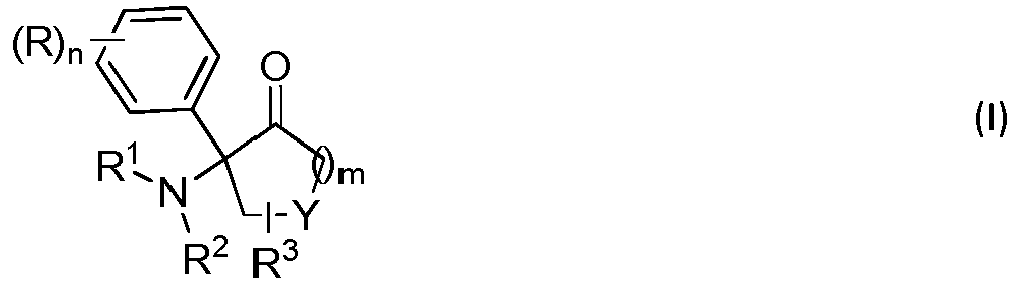 wherein each R independently represents an optionally substituted aryl, heteroaryl, alkyl, perfluoroalkyl, cycloalkyl, alkoxy, aryloxy, acyl, carboxyl, hydroxyl, halogen, amino, nitro, cyano, sulfo or sulfhydryl group, in ortho, meta or para position to the cycloalkylamine moiety;R1 and R2 each independently represents a hydrogen atom, a lower alkyl group or a cycloalkyl group;R3 represents a hydrogen group, substituted aryl, heteroaryl, alkyl, perfluoroalkyl, cycloalkyl, alkoxy, aryloxy group;Y represents an oxygen atom, a sulfur atom, a NH group, a NHR6 group or a CH2 group;R4, R5 and R6 each independently represents an alkyl, aryl or a heteroaryl group;N and m each independently represents an integer from 1 to 5;or a pharmaceutically acceptable salt thereof; or a precursor thereof; wherein the method comprises one or more of the following steps:(a) reacting a compound of formula (II)
 (b) reacting a compound of formula (III) with a nitrogen containing nucleophile, optionally in the presence of a third additive, in the fluidic network or in a batch process under thermal conditions to form a compound of formula (IV)
 (c) reacting a compound of formula (IV) in a fluidic network or in a batch process, optionally in the presence of a fourth additive, under thermal conditions to form a compound of formula (I);wherein one or more of steps (a), (b) and/or (c) is carried out in a fluidic network that comprises micro- and/or meso-channels.
 - A method as defined in Claim 1 wherein the fluidic network comprises transparent micro- and/or meso-channels where step (a) is carried out under photochemical conditions.
- A method as defined in Claim 1 or Claim 2 wherein one or more of the steps comprises one or more of the following steps: (i) flowing a fluid sample into a micro-/meso-channel; and/or (ii) performing an in-line purification; and/or (iii) performing an in-line analysis; and/or (iv) performing a chemical reaction in the micro-/meso-channel.
- A method as defined in any one of the preceding Claims wherein step (a) comprises reacting a compound of formula (II) with an oxygenating agent, a first additive and a second additive which is a base in a solvent under thermal conditions to form a compound of formula (III).
- A method as defined in any one of the preceding Claims wherein step (a) comprises reacting a compound of formula (II) with an oxygenating agent, a first additive and a second additive which is a catalyst in a solvent in a fluidic network under photochemical conditions to form a compound of formula (III).
- A method as defined in any one of the preceding Claims wherein step (a) is telescoped to step (b); preferably step (a) additionally comprises a step of an in- or off-line downstream purification including quench, liquid-liquid extraction, liquid-liquid separation, gas-liquid separation, filtration on silica gel or in-line crystallization.
- A method as defined in any one of the preceding Claims wherein steps (a), (b), and (c) are carried out in a fluidic network that comprises micro- and/or meso-channels; preferably the method comprises a continuous-flow method for synthesizing a compound of formula (I).
- A method as defined in any one of the preceding Claims wherein step (c) comprises flowing a fluid sample comprising a compound of formula (IV) into a micro-/meso-channel; and/or performing an in-line purification of the compound of formula (IV); and/or performing an in-line analysis of the compound of formula (IV); and/or performing a chemical reaction, in the micro-/meso-channel, to convert the compound of formula (IV) to the compound of formula (I).
- A method as defined in any one of the preceding Claims wherein step (b) further comprises a dehydration reagent.
- A method as defined in any one of the preceding Claims wherein step (b) is carried out at a temperature from 100°C to 180°C.
- A method as defined in any one of the preceding Claims wherein step (b) is telescoped to step (c); preferably step (b) additionally comprises a step of an in- or off-line downstream purification including quench, liquid-liquid extraction, liquid-liquid separation, or gas-liquid separation.
- A method as defined in any one of the preceding Claims wherein step (c) comprises a third additive which is an acid.
- A method as defined in any one of the preceding Claims wherein step (c) is carried out at a temperature of from 160°C to 230°C.
- A method as defined in anyone of the preceding Claims wherein step (c) is telescoped to a subsequent process operation; preferably, such that step (c) additionally comprises a step of an in- or off-line downstream purification including quench, liquid-liquid extraction, liquid-liquid separation, gas-liquid separation, filtration on silica gel or in-line crystallization.
- A method as defined in any one of the preceding Claims wherein step (c) is telescoped to a subsequent chemical transformation; preferably step (c) additionally comprises a step of:reacting a compound of formula (I) with a pharmaceutically acceptable acid to form a pharmaceutically acceptable salt of a compound of formula (I), or an analog thereof;reacting a compound of formula (I) with an organic and/or inorganic base or acid to increase the amount of a specific stereoisomer of the compound of formula (I).
- A method as defined in anyone of the preceding Claims wherein step (c) is telescoped to a subsequent process operation; preferably step (c) additionally comprises a step of:injection of a solution comprising a pharmaceutically acceptable acid to react with a free base of formula (I), such that a salt of the said acid and the compound of formula (I) is formed;injection of antisolvent in a section of fluidic network comprising a micro- and/or meso-channel to crystallize a pharmaceutically acceptable acid to form a salt of a compound of formula (I), or an analog thereof; and/orflowing a salt of a compound of formula (I) in a section of fluidic network comprising a micro- and/or meso-channel in which the temperature is decreased from an initial value to a target lower temperature.
- A method as defined in any one of the preceding Claims wherein step (c) reacting the compound of formula (IV) in a solvent which is an alcohol in which the solubility of a pharmaceutically acceptable salt of a compound of formula (I) can be altered either by cooling or by adding an antisolvent; preferably the pharmaceutically acceptable salt of a compound of formula (I) is a hydrochloride salt; preferably the antisolvent is an ether, an oxygenous heterocycle, an alkane, or a cycloalkane.
Priority Applications (7)
| Application Number | Priority Date | Filing Date | Title |
|---|---|---|---|
| EP17211200.5A EP3505509A1 (en) | 2017-12-29 | 2017-12-29 | Methods for the preparation of arylcycloalkylamine derivatives |
| CA3122627A CA3122627A1 (en) | 2017-12-29 | 2018-12-27 | Improvements in or relating to organic material |
| EP18839675.8A EP3700887B1 (en) | 2017-12-29 | 2018-12-27 | Processes for the preparation of aryl cycloalkylamine derivatives |
| PCT/EP2018/097033 WO2019129815A1 (en) | 2017-12-29 | 2018-12-27 | Improvements in or relating to organic material |
| CN201880084355.XA CN111527064B (en) | 2017-12-29 | 2018-12-27 | Organic materials or improvements related thereto |
| US16/896,909 US11286230B2 (en) | 2017-12-29 | 2020-06-09 | Ketamine flow synthesis |
| US17/581,578 US11718578B2 (en) | 2017-12-29 | 2022-01-21 | Ketamine flow synthesis |
Applications Claiming Priority (1)
| Application Number | Priority Date | Filing Date | Title |
|---|---|---|---|
| EP17211200.5A EP3505509A1 (en) | 2017-12-29 | 2017-12-29 | Methods for the preparation of arylcycloalkylamine derivatives |
Publications (1)
| Publication Number | Publication Date |
|---|---|
| EP3505509A1 true EP3505509A1 (en) | 2019-07-03 |
Family
ID=60856980
Family Applications (2)
| Application Number | Title | Priority Date | Filing Date |
|---|---|---|---|
| EP17211200.5A Withdrawn EP3505509A1 (en) | 2017-12-29 | 2017-12-29 | Methods for the preparation of arylcycloalkylamine derivatives |
| EP18839675.8A Active EP3700887B1 (en) | 2017-12-29 | 2018-12-27 | Processes for the preparation of aryl cycloalkylamine derivatives |
Family Applications After (1)
| Application Number | Title | Priority Date | Filing Date |
|---|---|---|---|
| EP18839675.8A Active EP3700887B1 (en) | 2017-12-29 | 2018-12-27 | Processes for the preparation of aryl cycloalkylamine derivatives |
Country Status (5)
| Country | Link |
|---|---|
| US (2) | US11286230B2 (en) |
| EP (2) | EP3505509A1 (en) |
| CN (1) | CN111527064B (en) |
| CA (1) | CA3122627A1 (en) |
| WO (1) | WO2019129815A1 (en) |
Cited By (3)
| Publication number | Priority date | Publication date | Assignee | Title |
|---|---|---|---|---|
| CN112299972A (en) * | 2019-08-02 | 2021-02-02 | 扬子江药业集团有限公司 | Preparation method of high-purity esketamine hydrochloride ketone body |
| US10919842B2 (en) | 2016-03-25 | 2021-02-16 | The United States Of America, As Represented By The Secretary, Department Of Health And Human Services | Crystal forms and methods of synthesis of (2R, 6R)-hydroxynorketamine and (2S, 6S)-hydroxynorketamine |
| CN114605240A (en) * | 2020-12-09 | 2022-06-10 | 宜昌人福药业有限责任公司 | A kind of preparation method of esketamine hydrochloride synthetic intermediate |
Families Citing this family (8)
| Publication number | Priority date | Publication date | Assignee | Title |
|---|---|---|---|---|
| HRP20211629T1 (en) | 2013-09-13 | 2022-02-04 | National University Corporation Chiba University | Application of r-ketamine and salt thereof as pharmaceuticals |
| CN118453559A (en) | 2018-02-15 | 2024-08-09 | 国立大学法人千叶大学 | Preventive or therapeutic agent for inflammatory disease or bone disease and pharmaceutical composition |
| CA3099293A1 (en) | 2018-05-04 | 2019-11-07 | Perception Neuroscience, Inc. | Methods of treating substance abuse |
| CN115190815B (en) | 2019-12-26 | 2024-06-18 | 吉尔伽美什制药公司 | Arylcyclohexylamine derivatives and their use in the treatment of mental disorders |
| EP4084791B1 (en) | 2020-02-18 | 2024-12-18 | Gilgamesh Pharmaceuticals, Inc. | Specific tryptamines for use in the treatment of mood disorders |
| CN114249794B (en) * | 2021-12-22 | 2023-06-23 | 深圳瑞德林生物技术有限公司 | Synthesis method of oxidized glutathione |
| US12129234B1 (en) | 2023-08-03 | 2024-10-29 | Gilgamesh Pharmaceuticals, Inc. | Crystalline salts of N-ethyl-(5-fluoro-1H-indol-3-yl)-N-methylethan-1-amine |
| US12180158B1 (en) | 2023-08-03 | 2024-12-31 | Gilgamesh Pharmaceuticals, Inc. | Crystalline fumarate salts of n-ethyl-2-(5-fluoro-1H-indol-3-yl)-n-methylethan-1-amine |
Citations (2)
| Publication number | Priority date | Publication date | Assignee | Title |
|---|---|---|---|---|
| US3254124A (en) | 1962-06-29 | 1966-05-31 | Parke Davis & Co | Aminoketones and methods for their production |
| US20080268071A1 (en) * | 2007-04-26 | 2008-10-30 | Auspex Pharmaceuticals, Inc. | Substituted cyclohexanones |
Family Cites Families (7)
| Publication number | Priority date | Publication date | Assignee | Title |
|---|---|---|---|---|
| DE217511C (en) | ||||
| DE233121C (en) | ||||
| US3394182A (en) * | 1962-06-29 | 1968-07-23 | Parke Davis & Co | Alpha-hydroxyimines and methods for their production |
| DD217511A1 (en) * | 1983-07-25 | 1985-01-16 | Dresden Arzneimittel | PROCESS FOR THE PREPARATION OF 2- (2'-CHLOROPHENYL) -2- (METHYLAMINO) -CYCLOHEXANONE AND THEIR SALTS |
| DD233121B1 (en) * | 1984-07-17 | 1988-10-19 | Dresden Arzneimittel | METHOD FOR CLEANING KETAMINE HYDROCHLORIDE |
| US9073819B2 (en) * | 2011-06-30 | 2015-07-07 | University Of South Florida | Compositions, methods of use, and methods of treatment |
| CN103613478B (en) * | 2013-10-25 | 2015-05-06 | 北京大学 | Synthetic method of alpha-hydroxyl carbonyl compound |
-
2017
- 2017-12-29 EP EP17211200.5A patent/EP3505509A1/en not_active Withdrawn
-
2018
- 2018-12-27 WO PCT/EP2018/097033 patent/WO2019129815A1/en not_active Ceased
- 2018-12-27 CA CA3122627A patent/CA3122627A1/en active Pending
- 2018-12-27 EP EP18839675.8A patent/EP3700887B1/en active Active
- 2018-12-27 CN CN201880084355.XA patent/CN111527064B/en active Active
-
2020
- 2020-06-09 US US16/896,909 patent/US11286230B2/en active Active
-
2022
- 2022-01-21 US US17/581,578 patent/US11718578B2/en active Active
Patent Citations (3)
| Publication number | Priority date | Publication date | Assignee | Title |
|---|---|---|---|---|
| US3254124A (en) | 1962-06-29 | 1966-05-31 | Parke Davis & Co | Aminoketones and methods for their production |
| US20080268071A1 (en) * | 2007-04-26 | 2008-10-30 | Auspex Pharmaceuticals, Inc. | Substituted cyclohexanones |
| US7638651B2 (en) | 2007-04-26 | 2009-12-29 | Auspex Pharmaceuticals | Substituted cyclohexanones |
Non-Patent Citations (5)
| Title |
|---|
| JUDIT NÉMETHNÉ-SÓVÁGÓ ET AL: "MICROREACTORS: A NEW CONCEPT FOR CHEMICAL SYNTHESIS AND TECHNOLOGICAL FEASIBILITY (Review)", MATERIALS SCIENCE AND ENGINEERING, vol. 39, no. 2, 1 January 2014 (2014-01-01), pages 89 - 101, XP055454701 * |
| M. W. TYLER ET AL., ACS CHEM. NEUROSCI., vol. 8, 2017, pages 1122 |
| TOSTE ET AL., J. AM. CHEM. SOC., vol. 137, no. 9, 2015, pages 3205 - 3208 |
| YOKOYAMA ET AL., TETRAHEDRON, vol. 65, no. 27, 2009, pages 5181 - 5191 |
| ZHANG Z.Q ET AL., ORG.LETT, vol. 19, no. 5, 2017, pages 1124 - 1127 |
Cited By (7)
| Publication number | Priority date | Publication date | Assignee | Title |
|---|---|---|---|---|
| US10919842B2 (en) | 2016-03-25 | 2021-02-16 | The United States Of America, As Represented By The Secretary, Department Of Health And Human Services | Crystal forms and methods of synthesis of (2R, 6R)-hydroxynorketamine and (2S, 6S)-hydroxynorketamine |
| US11613514B2 (en) | 2016-03-25 | 2023-03-28 | The United States Of America, As Represented By The Secretary, Department Of Health And Human Services | Crystal forms and methods of synthesis of (2R, 6R)-hydroxynorketamine and (2S, 6S)-hydroxynorketamine |
| US12473251B2 (en) | 2016-03-25 | 2025-11-18 | The United States Of America, As Represented By The Secretary, Department Of Health And Human Services | Crystal forms and methods of synthesis of (2R, 6R)-hydroxynorketamine and (2S, 6S)-hydroxynorketamine |
| CN112299972A (en) * | 2019-08-02 | 2021-02-02 | 扬子江药业集团有限公司 | Preparation method of high-purity esketamine hydrochloride ketone body |
| CN112299972B (en) * | 2019-08-02 | 2023-03-14 | 扬子江药业集团有限公司 | Preparation method of high-purity esketamine hydrochloride ketone body |
| CN114605240A (en) * | 2020-12-09 | 2022-06-10 | 宜昌人福药业有限责任公司 | A kind of preparation method of esketamine hydrochloride synthetic intermediate |
| CN114605240B (en) * | 2020-12-09 | 2023-06-06 | 宜昌人福药业有限责任公司 | A kind of preparation method of esketamine hydrochloride synthetic intermediate |
Also Published As
| Publication number | Publication date |
|---|---|
| CA3122627A1 (en) | 2019-07-04 |
| US20220144751A1 (en) | 2022-05-12 |
| WO2019129815A1 (en) | 2019-07-04 |
| CN111527064A (en) | 2020-08-11 |
| EP3700887B1 (en) | 2021-08-04 |
| US20200299224A1 (en) | 2020-09-24 |
| US11286230B2 (en) | 2022-03-29 |
| CN111527064B (en) | 2024-03-15 |
| US11718578B2 (en) | 2023-08-08 |
| EP3700887A1 (en) | 2020-09-02 |
Similar Documents
| Publication | Publication Date | Title |
|---|---|---|
| US11718578B2 (en) | Ketamine flow synthesis | |
| JP4727228B2 (en) | Pseudoionone and process for continuous production of ionone | |
| CN114456121B (en) | Synthesis method of 1,2, 4-triazole derivative | |
| CN111072605B (en) | A kind of preparation method of fluoroalkyl substituted benzofuran derivative or indole derivative | |
| CN104177395A (en) | Benzyne precursor and synthesis method thereof | |
| CN103214446B (en) | Asymmetric synthesis method of chromanones derivate | |
| JP7084937B2 (en) | How to make efavirenz | |
| Baumann | Integrating reactive distillation with continuous flow processing | |
| CN109516968A (en) | Using phenol and α-halogenatedketone as the method for Material synthesis benzofuran derivatives | |
| Nguyen et al. | Nucleophilic fluorination of alkynyliodonium salts by alkali metal fluorides: access to fluorovinylic compounds | |
| CN105017081B (en) | A kind of preparation method of sitagliptin intermediate | |
| Paleta et al. | New nucleophilic rearrangement in the mechanism of the three-component domino cyclisation affording fluoroalkylated (pyrrolo) quinazolines | |
| KR101404616B1 (en) | Method for Preparation of γ-fluorinated ketone derivatives | |
| US20210395185A1 (en) | Scalable synthesis of optically active 1-cyclopropylalkyl-1-amines | |
| CN111153832B (en) | Preparation method of cinacalcet impurity | |
| JP5912584B2 (en) | Method for producing 1-alkylimidazole compound | |
| JP5263732B2 (en) | Process for producing optically active 1,2-diamine compound and optically active catalyst | |
| WO2015146881A1 (en) | Process for producing 1-arylimino-2-vinylcyclopropanecarboxylic acid derivative | |
| Sabot et al. | Novel chiral derivatizing isothiocyanate-based agent for the enantiomeric excess determination of amines | |
| EP3296292A1 (en) | Method for the preparation of alkyl phenidates | |
| US12116345B2 (en) | Low-temperature continuous-flow preparation method of bedaquiline | |
| CN101184724A (en) | Process for producing acetoacetate arylamide | |
| KR101960859B1 (en) | Method for preparation of chiral 2-fluoro-1,3-dikeone derivatives | |
| Zheng et al. | Selective synthesis of multifunctionalized cyclopent-3-ene-1-carboxamides and 2-oxabicyclo [2.2. 1] heptane derivatives | |
| EP1683791B1 (en) | Process for the epoxidation of olefins with hydrogen peroxide by ruthenium complex catalysed reaction |
Legal Events
| Date | Code | Title | Description |
|---|---|---|---|
| PUAI | Public reference made under article 153(3) epc to a published international application that has entered the european phase |
Free format text: ORIGINAL CODE: 0009012 |
|
| STAA | Information on the status of an ep patent application or granted ep patent |
Free format text: STATUS: THE APPLICATION HAS BEEN PUBLISHED |
|
| AK | Designated contracting states |
Kind code of ref document: A1 Designated state(s): AL AT BE BG CH CY CZ DE DK EE ES FI FR GB GR HR HU IE IS IT LI LT LU LV MC MK MT NL NO PL PT RO RS SE SI SK SM TR |
|
| AX | Request for extension of the european patent |
Extension state: BA ME |
|
| STAA | Information on the status of an ep patent application or granted ep patent |
Free format text: STATUS: THE APPLICATION IS DEEMED TO BE WITHDRAWN |
|
| 18D | Application deemed to be withdrawn |
Effective date: 20200104 |