EP3502327B1 - Composite core yarn, article of clothing comprising a composite core yarn, method for producing a composite core yarn and use of a composite core yarn - Google Patents
Composite core yarn, article of clothing comprising a composite core yarn, method for producing a composite core yarn and use of a composite core yarn Download PDFInfo
- Publication number
- EP3502327B1 EP3502327B1 EP17210449.9A EP17210449A EP3502327B1 EP 3502327 B1 EP3502327 B1 EP 3502327B1 EP 17210449 A EP17210449 A EP 17210449A EP 3502327 B1 EP3502327 B1 EP 3502327B1
- Authority
- EP
- European Patent Office
- Prior art keywords
- filament
- core yarn
- composite core
- article
- clothing
- Prior art date
- Legal status (The legal status is an assumption and is not a legal conclusion. Google has not performed a legal analysis and makes no representation as to the accuracy of the status listed.)
- Active
Links
Images


Classifications
-
- D—TEXTILES; PAPER
- D02—YARNS; MECHANICAL FINISHING OF YARNS OR ROPES; WARPING OR BEAMING
- D02G—CRIMPING OR CURLING FIBRES, FILAMENTS, THREADS, OR YARNS; YARNS OR THREADS
- D02G3/00—Yarns or threads, e.g. fancy yarns; Processes or apparatus for the production thereof, not otherwise provided for
-
- A—HUMAN NECESSITIES
- A61—MEDICAL OR VETERINARY SCIENCE; HYGIENE
- A61B—DIAGNOSIS; SURGERY; IDENTIFICATION
- A61B5/00—Measuring for diagnostic purposes; Identification of persons
- A61B5/24—Detecting, measuring or recording bioelectric or biomagnetic signals of the body or parts thereof
- A61B5/25—Bioelectric electrodes therefor
- A61B5/263—Bioelectric electrodes therefor characterised by the electrode materials
- A61B5/27—Conductive fabrics or textiles
-
- A—HUMAN NECESSITIES
- A61—MEDICAL OR VETERINARY SCIENCE; HYGIENE
- A61B—DIAGNOSIS; SURGERY; IDENTIFICATION
- A61B5/00—Measuring for diagnostic purposes; Identification of persons
- A61B5/68—Arrangements of detecting, measuring or recording means, e.g. sensors, in relation to patient
- A61B5/6801—Arrangements of detecting, measuring or recording means, e.g. sensors, in relation to patient specially adapted to be attached to or worn on the body surface
- A61B5/6802—Sensor mounted on worn items
- A61B5/6804—Garments; Clothes
- A61B5/6805—Vests, e.g. shirts or gowns
-
- D—TEXTILES; PAPER
- D02—YARNS; MECHANICAL FINISHING OF YARNS OR ROPES; WARPING OR BEAMING
- D02G—CRIMPING OR CURLING FIBRES, FILAMENTS, THREADS, OR YARNS; YARNS OR THREADS
- D02G3/00—Yarns or threads, e.g. fancy yarns; Processes or apparatus for the production thereof, not otherwise provided for
- D02G3/02—Yarns or threads characterised by the material or by the materials from which they are made
- D02G3/12—Threads containing metallic filaments or strips
-
- D—TEXTILES; PAPER
- D02—YARNS; MECHANICAL FINISHING OF YARNS OR ROPES; WARPING OR BEAMING
- D02G—CRIMPING OR CURLING FIBRES, FILAMENTS, THREADS, OR YARNS; YARNS OR THREADS
- D02G3/00—Yarns or threads, e.g. fancy yarns; Processes or apparatus for the production thereof, not otherwise provided for
- D02G3/22—Yarns or threads characterised by constructional features, e.g. blending, filament/fibre
- D02G3/32—Elastic yarns or threads ; Production of plied or cored yarns, one of which is elastic
-
- D—TEXTILES; PAPER
- D02—YARNS; MECHANICAL FINISHING OF YARNS OR ROPES; WARPING OR BEAMING
- D02G—CRIMPING OR CURLING FIBRES, FILAMENTS, THREADS, OR YARNS; YARNS OR THREADS
- D02G3/00—Yarns or threads, e.g. fancy yarns; Processes or apparatus for the production thereof, not otherwise provided for
- D02G3/22—Yarns or threads characterised by constructional features, e.g. blending, filament/fibre
- D02G3/36—Cored or coated yarns or threads
-
- D—TEXTILES; PAPER
- D02—YARNS; MECHANICAL FINISHING OF YARNS OR ROPES; WARPING OR BEAMING
- D02G—CRIMPING OR CURLING FIBRES, FILAMENTS, THREADS, OR YARNS; YARNS OR THREADS
- D02G3/00—Yarns or threads, e.g. fancy yarns; Processes or apparatus for the production thereof, not otherwise provided for
- D02G3/44—Yarns or threads characterised by the purpose for which they are designed
- D02G3/441—Yarns or threads with antistatic, conductive or radiation-shielding properties
-
- A—HUMAN NECESSITIES
- A41—WEARING APPAREL
- A41D—OUTERWEAR; PROTECTIVE GARMENTS; ACCESSORIES
- A41D1/00—Garments
- A41D1/002—Garments adapted to accommodate electronic equipment
-
- A—HUMAN NECESSITIES
- A61—MEDICAL OR VETERINARY SCIENCE; HYGIENE
- A61B—DIAGNOSIS; SURGERY; IDENTIFICATION
- A61B2560/00—Constructional details of operational features of apparatus; Accessories for medical measuring apparatus
- A61B2560/04—Constructional details of apparatus
- A61B2560/0462—Apparatus with built-in sensors
-
- A—HUMAN NECESSITIES
- A61—MEDICAL OR VETERINARY SCIENCE; HYGIENE
- A61B—DIAGNOSIS; SURGERY; IDENTIFICATION
- A61B5/00—Measuring for diagnostic purposes; Identification of persons
- A61B5/02—Detecting, measuring or recording for evaluating the cardiovascular system, e.g. pulse, heart rate, blood pressure or blood flow
- A61B5/024—Measuring pulse rate or heart rate
- A61B5/02438—Measuring pulse rate or heart rate with portable devices, e.g. worn by the patient
-
- A—HUMAN NECESSITIES
- A61—MEDICAL OR VETERINARY SCIENCE; HYGIENE
- A61B—DIAGNOSIS; SURGERY; IDENTIFICATION
- A61B5/00—Measuring for diagnostic purposes; Identification of persons
- A61B5/24—Detecting, measuring or recording bioelectric or biomagnetic signals of the body or parts thereof
- A61B5/316—Modalities, i.e. specific diagnostic methods
- A61B5/318—Heart-related electrical modalities, e.g. electrocardiography [ECG]
- A61B5/332—Portable devices specially adapted therefor
-
- D—TEXTILES; PAPER
- D10—INDEXING SCHEME ASSOCIATED WITH SUBLASSES OF SECTION D, RELATING TO TEXTILES
- D10B—INDEXING SCHEME ASSOCIATED WITH SUBLASSES OF SECTION D, RELATING TO TEXTILES
- D10B2401/00—Physical properties
- D10B2401/16—Physical properties antistatic; conductive
-
- D—TEXTILES; PAPER
- D10—INDEXING SCHEME ASSOCIATED WITH SUBLASSES OF SECTION D, RELATING TO TEXTILES
- D10B—INDEXING SCHEME ASSOCIATED WITH SUBLASSES OF SECTION D, RELATING TO TEXTILES
- D10B2401/00—Physical properties
- D10B2401/18—Physical properties including electronic components
-
- D—TEXTILES; PAPER
- D10—INDEXING SCHEME ASSOCIATED WITH SUBLASSES OF SECTION D, RELATING TO TEXTILES
- D10B—INDEXING SCHEME ASSOCIATED WITH SUBLASSES OF SECTION D, RELATING TO TEXTILES
- D10B2501/00—Wearing apparel
-
- D—TEXTILES; PAPER
- D10—INDEXING SCHEME ASSOCIATED WITH SUBLASSES OF SECTION D, RELATING TO TEXTILES
- D10B—INDEXING SCHEME ASSOCIATED WITH SUBLASSES OF SECTION D, RELATING TO TEXTILES
- D10B2509/00—Medical; Hygiene
Definitions
- the present invention relates to a composite core yarn which has electric conductivity.
- Yarns which have electric conductivity may be used in various fields such as clothing applications or in the semi-conductor industry.
- US 2014/0242868 A1 describes an electrically conductive yarn used for textiles wherein staple and metal fibers are mixed, which mixture then forms the yarn.
- electrically conductive yarns are e.g. disclosed in US 2014/0170919 A1 and WO 2014/092781 A1 .
- a core is provided which is encapsulated by first and second electrically conductive layers surrounding the core.
- This encapsulated wire is also encapsulated by a conventional polymer layer, to provide electric isolation.
- metallic filaments are provided, which are embedded in an insulation material, which is encapsulated by a polymer layer to provide an electric isolation
- a further yarn which is an elastic ring spun yarn is disclosed in EP 2 145 034 B1 .
- an elastic core filament is provided, around which further filaments may be twisted by ring spinning.
- This twisted core is encapsulated by so-called staple fibers, which are made of natural materials, to provide a natural feeling to the yarn.
- the present invention provides a high performance yarn having an improved electric conductivity combined with adaptable surface optic and/or haptic aspects.
- the present invention is focused to a core yarn comprising at least two electrically conductive filaments as a core and a cover layer which encapsulates the core, wherein the cover layer comprises staple fibers, wherein the core further comprises an elastic filament having an elasticity in at least longitudinal direction thereof, wherein the elastic filament is a separate filament and not constituted by the at least two conductive filaments, wherein the at least two conductive filaments are wound around the elastic filament, wherein one of the at least two conductive filaments is a metal filament made of a metallic material, and the other of the at least two conductive filaments is a coated filament having a core of a substantially not electrically conducting material, and a surface layer of an electrically conductive material.
- the core yarn has a cover layer comprising staple fibers.
- staple fibers are distinct fibers which have a certain length.
- the staple fibers may comprise a plurality of different lengths.
- Such staple fibers in textile technology are named non-continuous fibers for differentiating these fibers from so-called continuous filament fibers. These filaments may have an indefinite length.
- the encapsulation of the electrically conductive filaments which serve as the core ensures the adaptability of the surface properties of the core yarn.
- the yarn may (according to a non-claimed variant) also be enough to provide only one electrically conductive filament instead of at least two electrically conductive filaments.
- the filament is constituted by the later described coated filament, which may have a non-electrically conductive core and an electrically conductive cover layer.
- the core of the composite core yarn further comprises an elastic filament.
- Elasticity is the ability to deform reversibly under stress.
- the endurance of the yarn can be further improved.
- forces may act in longitudinal direction without breaking the complete yarn.
- the elasticity may have a young modulus (in GPa) of 0.01 to 5, more preferably 0.01 to 0.5 in particular, 0.01 to 0.1.
- the elongation may be in the range of 1 to 500%.
- the % value defines the relative elongation from a relaxed state to a state, where the yarn is expanded to the maximum where a reversible contraction can still occur.
- Further preferred elongations are: 2%, 3%, 4%, 6%, 8%, 10%, 13%, 15%, 18%, 20%, 50%, 100%, 200%, 300%, 400%.
- the aforementioned values may each separately serve as lower or upper borders.
- the elastic filament is a separate filament which is not constituted by the at least two conductive filaments.
- the composite core yarn at least comprises three filaments which at least three filaments make up the core which is embedded in the cover layer comprising staple fibers.
- the at least one of the electrically conductive filaments may have a respective elasticity to also constitute the elastic filament.
- the electing of at least three filaments provides further possibilities for the adaptability of the composite core yarn.
- the at least two conductive filaments are wound around the elastic filament. This may be done by a ring spinning technique as is described in EP 2 145 034 B1 .
- the electrically conductive filaments are wound around the elastic filament, there is the advantage that the electrically conductive filaments, which may be filaments having no substantial elasticity, are able to expand in length and not be broken by expansion.
- the breakage probability that at least one electrically conductive filament is broken increases in comparison with the situation where the respective electrically conductive filaments are wound around the elastic filament.
- the core material basically defines the elongation properties of the filament while the respective coating defines the electric conduction properties.
- this metal filament is very susceptible to breaking which is not the case for the coated filament.
- the coated filament may simultaneously provide the elasticity to simultaneously constitute the elastic filament.
- the composite core yarn is a ring spun core yarn.
- the filaments and/or also the staple fiber material which may be supplied as roving is fed e.g. in drafting rollers and thereafter spun and wound around a rotating spindle. Further details concerning the ring spinning are described in EP 2 145 034 B1 , in particular [0049] to [0053] and Fig. 4 therof.
- the staple fibers may comprise at least one or a mixture of fibers from the group of: natural and/or synthetic fibers and/or fibers made of the following materials: cotton , viscose, polyester, wool, linen, alpaca, vicuna, angora, cashmere, kapok, manila, flax, hemp, ramie, hessian, sisal, coir, asbestos, glass, azlon, acetate, triacetate, acryl, aramid, nylon, olefin, which are used to form the cover layer, can be selected from the following: cotton, viscose, polyester, wool, linen, alpaca, vicuna, angora, cashmere, kapok, manila, flax, hemp ramie, jute, sisal, coir, asbestos, glass, azlon, acetate, triacetate, acryl, aramid, nylon, olefin.
- the respective fibers made of the aforementioned material may be used as a single material fiber mixture or a composition of any one of the aforementioned different material fibers in one of different lengths.
- the respective fibers may be natural fibers and/or synthetic fibers.
- the metal which forms the metal filament or the electrical conductive material of the surface layer of the coated filament may be selected from the following elements or alloys thereof: copper, silver, iron, gold, magnesium, steel. Any other electrically conductive metal or metal alloy may also be utilized.
- the respective non-electrically conductive material constituting the core of the coated filament may be selected from the following: polyamide (PA), Polyethersulfon (PES), Polybutylenterephthalat (PBT), Polyethylenterephthalat (PET) and a combination thereof. Any other continuous filament which is made of natural synthetic and regenerated materials can be used as a core of a coated filament.
- PA polyamide
- PES Polyethersulfon
- PBT Polybutylenterephthalat
- PET Polyethylenterephthalat
- the metal filament may have a thickness of 0.0001micron to 1.5000 micron. Further preferred thicknesses are: 0.0010 micron, 0.0100 micron, 0.1000 micron; 0.5000 micron, 1.0000 micron, or any sum or difference of one or more of the aforementioned values.
- the aforementioned values may each separately serve as lower or upper borders of a thickness range. The thickness on the one hand defines the conductivity as well as the probability that the yarn breaks. Therefore, the selection of the respective metal filament thickness in the aforementioned ranges depends on the desired properties of the final core yarn.
- the thickness of the coated filament and/or the thickness of the elastic filament may be between 1 or 5.498 denier (corresponding to 1.11 dTex or 6108,9 dTex). Further preferred thicknesses are: 1.500 denier, 1.800 denier, 2.500 denier, 3.000 denier, 4.400 denier, 5.000 denier (corresponding respectively to 1666,6 dTex, 2000 dTex, 2777,8 dTex, 3333,3 dTex, 4888,9 dTex or 5555,6 dTex). The aforementioned values may each separately serve as lower or upper borders of a thickness range.
- Denier is a unit of measurement for the linear mass density of fibers in grams per 9.000 meters of the fiber. This means that 1 denier is 1 gram per 9000 meter. In other words, denier is measured in mass of yarn in g per 9000 meter.
- the core yarn itself which may have the cover layer of staple fibers and at least two filaments, has a thickness preferably between 1 and 6.000 denier (corresponding to 1.11 dTex or 6108,9 dTex). Further preferred thicknesses are: 1.500 denier, 1.800 denier, 2.500 denier, 3.000 denier, 4.400 denier, 5.000 denier (corresponding respectively to 1 666,6 dText, 2000 dTex, 2777,8 dText, 3333,3 dTex, 4888,9 dTex or 5555,6 dTex). The aforementioned values may each separately serve as lower or upper borders of a thickness range.
- a woven fabric which comprises the composite core yarn described in the foregoing section.
- the composite core yarn may constitute the warp and/or weft yarn of the woven fabric.
- the present invention is not delimited to woven fabrics. Also other fabrics like knitted fabric, or non woven fabrics can contain the yarn as a component or may be completely set up of this yarn.
- the inventive yarn may be used in circular knitted and/or in flat knitted fabrics.
- a knitted fabric comprising the inventive composite core yarn may also be provided.
- an article of clothing which comprises the aforementioned composite core yarn.
- the article of clothing includes shoes, t-shirts, jackets, but however, first layer clothing such as socks, underwear t-shirts are preferred because the functionality of the articles with the electric conductivity may then provide a better transmission/contact with the human body, when a human being wears the respective article.
- first layer clothing such as socks, underwear t-shirts are preferred because the functionality of the articles with the electric conductivity may then provide a better transmission/contact with the human body, when a human being wears the respective article.
- the article of clothing is not delimited thereto and may be any article of clothing.
- wire paths may be provided.
- the wire path is comprised of the composite core yarn or may be in particular constituted by the composite core yarn, having a configuration which is described in the foregoing section.
- the wire path may extend within the woven fabric or may be embroidered on the material of which the article of clothing is made.
- the wire path may be a distinctive path which extends from one specific location of the clothing to a second specific location of the clothing to allow the selective transfer of signals between the respective two locations.
- the respective article of clothing may have one or more electrodes which are connected to a respective end of one wire path and the other end of the wire path may be connectable to a control station, which control station is adapted to communicate with the electrode.
- Each respective wire path may have an electrically non-conductive coating which prevents the transfer of the electric current in the radial direction of the wire path to the surrounding area.
- a pocket for containing the respective control station may be incorporated in the clothing.
- the control station may be connected to respective terminals which are provided at ends of the respective wire paths to transfer signals via the wire paths to the electrodes.
- Electrode pads may be patches of a conductive material, for example, a woven or non-woven textile material which is integrally formed in the article of clothing.
- the article of clothing may have a plurality of wire paths which are connected to respective electrodes wherein at least one electrode is positioned in the region of the human heart and at least a further electrode is positioned at an extremity of the human body, for example at one or both shoulders, and/or at one or both hips and/or at one or both knees, and/or at one or both feet, and/or at one or both hands.
- the respective article of clothing has a certain compression functionality and thus is a piece of compression clothing as otherwise the respective interaction of the sensors/electrodes and the human body is probably not sufficient for receiving good signals to track the physical activity of the human body.
- the control station may be adapted to supply an electric current to the electrodes and to receive information from the electrodes to display a physical activity of the human body.
- a method according to claim 18, is provided for producing a composite core yarn.
- the use of the aforementioned composite core yarn is disclosed for at least one of the following aspects: use in mobile devices, use in sensor elements, use as filter elements, use in health care facilities, use for microwave applications, use in sportswear, use in health gear, use in smart textiles and use in gloves and for use in soft rooftops for convertible automobiles. Further areas of utilization are any areas where the following technical functions are advantageous conductive properties, anti-static properties, anti-bacterial properties, anti-fungal properties, electromagnetic shielding properties.
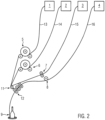
- Reference numbers 1 to 4 as denoted in Figure 2 are bobbins from which the roving 16 (bobbin having reference number 4) or filaments (bobbins having reference numbers 1, 2 and 3) are supplied to a respective drafting 5, 6, 7, 8 stage which comprises drafting rollers
- the roving or filament are supplied from the bobbins 1, 2, 3, and 4 to the drafting rollers contained in a respective drafting stage 5, 6, 7, 8), where the material is drafted between the drafting rollers. From the stage the drafted material is supplied to a spindle 9 (ring spinning spindle).
- each section for producing one single inventive yarn.
- two or more of said sections may be placed one after each other in the horizontal direction.
- Each section may be one unit wherein a plurality of units may be provided one subsequent to the other to make a plurality of yarns simultaneously.
- a twisting stage 11 is provided wherein in the present arrangement shown in Figure 3 the filaments 13, 14, and 15 from the bobbins 1, 2 and 3 are first wound around each other and, thus, twisted.
- an encapsulation stage 12 Downstream of the twisting stage 11 and upstream of the spindle 9 there is an encapsulation stage 12 provided wherein the respective roving 16, comprising the staple fibers, is made to form the cover layer encapsulating the twisted core, which is constituted by the filament 13, 14 and 15.
- the respective filament having reference sign 13 is a metal filament which is made of a metal material
- the filament having reference sign 14 is a coated filament having a core of a substantially not electrically conductive material and a surface layer of an electric conductive material
- the filament with reference sign 15 is an elastic filament having a certain elasticity in at least the longitudinal direction.
- the roving comprising the staple fibers, is provided in the encapsulation stage 12 to form an encapsulating cover layer to the core which is made up of the metal filament 13, the coated filament 14 and the elastic filament 15.
- the preparation of the composite core yarn is not delimited to the method of ring spanning, but can be made by any method which is able to provide a cover layer which encapsulates the core which comprises one or more filaments.
- Alternatives of such ring spinning methods are open end spinning and air jet spinning.
- the at least two conductive filaments are selected from the group of the following: a) a metal filament made of a metallic material, and b) a coated filament.
- the coated filament has a core of a substantially not electrical conducting material and a surface layer of an electrical conductive material. It is so that one of the at least two filaments is the metal filament and that the at least second of the filaments, is the coated filament.
- the elastic filament is a separate filament which is not constituted by the at least two conductive filaments.
- the composite core yarn at least comprises three filaments which at least three filaments make up the core which is embedded in the cover layer comprising staple fibers.
- Staple fibers in the meaning of the present invention are fibers or clusters of fibers which have a single or different length.
- a filament is a single fiber having a substantially indefinite length.
- the inner center of the core of the composite core yarn is constituted by the elastic filament 15 while the respective electrically conductive filaments 13, 14, in particular the metal filament 13 and the coated filament 14, is wound around the elastic filament.
- the staple fibers may comprise at least one or a mixture of fibers from the group of: natural, and/or synthetic fibers and/or fibers made of the following materials: cotton, viscose, polyester, wool, linen, alpaca, vicuna, angora, cashmere, kapok, manila, flax, hemp, ramie, hessian, sisal, coir, asbestos, glass, azlon, acetate, triacetate, acryl, aramid, nylon, olefin which are used to form the cover layer can be selected from the following: cotton, viscose, polyester, wool, linen, alpaca, vicuna, angora, cashmere, kapok, manila, flax, hemp ramie, jute, sisal, coir, asbestos, glass, azlon, acetate, triacetate, acryl, aramid, nylon, olefin.
- the metal which forms the metal filament 13 or the electrically conductive material of the surface layer of the coated filament 14, may be selected from the following elements or alloys thereof: copper, silver, iron, gold, magnesium, steel.
- the respective non-electrically conductive material constituting the core of the coated filament 14 may be selected from the following: polyamide (PA), Polyethersulfon (PES), Polybutylenterephthalat (PBT), Polyethylenterephthalat (PET) and a combination thereof.
- PA polyamide
- PES Polyethersulfon
- PBT Polybutylenterephthalat
- PET Polyethylenterephthalat
- the metal filament 13 may have a thickness of 0.0001micron to 1.500 micron. Further preferred thicknesses are: 0.0010 micron, 0.0100 micron, 0.1000 micron; 0.5000 micron, 1.0000 micron, or any sum or difference of one or more of the aforementioned values.
- the aforementioned values may each separately serve as lower or upper borders of a thickness range.
- the thickness on the one hand defines the conductivity as well as the probability that the yarn breaks. Therefore, the selection of the respective metal filament thickness in the aforementioned ranges depends on the desired properties of the final core yarn.
- the thickness of the coated filament 14 and/or the thickness of the elastic filament 15 may be between 1 or 5.498 denier (corresponding to 1.11 dTex or 6108,9 dTex). Further preferred thicknesses are: 1.500 denier, 1.800 denier, 2.500 denier, 3.000 denier, 4.400 denier, 5.000 denier (corresponding respectively to 1 666,6 dTex, 2000 dTex, 2777,8 dTex, 3333,3 dTex, 4888,9 dTex or 5555,6 dTex). The aforementioned values may each separately serve as lower or upper borders of a thickness range.
- Denier is a unit of measurement for the linear mass density of fibers in grams per 9000 meters of the fiber. This means that 1 denier is 1 gram per 9000 meter.
- the core yarn itself which may have the cover layer of staple fibers and at least two filaments, has a thickness preferably between 1 and 6.000 denier (corresponding to 1.11 dTex or 6108,9 dTex). Further preferred thicknesses are: 1.500 denier, 1.800 denier, 2.500 denier, 3.000 denier, 4.400 denier, 5.000 denier (corresponding respectively to 1 666,6 dTex, 2000 dTex, 2777,8 dTex, 3333,3 dTex, 4888,9 dTex or 5555,6 dTex). The aforementioned values may each separately serve as lower or upper borders of a thickness range.
- the respective elastic filament 15 twisted together with the metal filament 13 and the coated filament 14 before the encapsulation with the staple fibers is done.
- any further, alternative sequence may be used.
- only two fibers may be twisted or only a single fiber may be encapsulated by the staple fibers.
- one of the electrically conductive filaments is a metal filament and that the other filament is a coated electrically conductive filament, this is also not essential and any combination thereof also more than two electrically conductive filaments can be used which can be wound around an elastic filament or which may be aligned in parallel to each other.
- This composite core yarn may be used for providing one or more electric paths 22 in an article of clothing.
- An example of such an article of clothing is the t-shirt shown in Figure 3 .
- articles of clothing are for instance, shoes, gloves, socks, underwear, t-shirts, pullovers and jackets may also be used.
- first layer clothing such as socks, underwear t-shirts are preferred, because the functionality of the articles with the electric conductivity may then provide a better transmission/contact with the human body, when a human being wears the respective article.
- the article of clothing is not delimited thereto and may be any article of clothing.
- FIG. 3 It is shown in Figure 3 that there are provided in total 10 electrically conductive paths 22 which connect a respective control station 17 with respective electrodes 18, 19, 20.
- the group of electrodes having reference sign 18, are provided on the t-shirt in a region of the heart of a human being.
- the respective electrodes having reference sign 19 are provided at the extremities of the main body, in particular, at both front sides of the shoulders.
- the respective electrodes having reference sign 20 are provided at the extremities of the main body, in particular, at both and both front sides of the hips.
- Electrodes which are made in the present embodiment as electrode pads, and the control station 17 signals can be transferred via the wire paths 22.
- a physical activity of the heart or any other physical activity may be measured.
- the electrode pads may be made of an electrically conductive material, also a woven or nonwoven material which is integrally formed in the material of the t-shirt or the article of clothing itself.
- the respective control station 17 may be mounted deconnectably from respective plug/s which are provided at the ends of the wire paths 22.
- the respective control station 17 may be provided in a pocket 21 of the clothing.
- the respective control station 17 may be controlled e.g. by means of wireless communication.
- the respective wire path may be encapsulated in a non-conductive material such that a non-conductive coating prevents a transfer of an electric current between the wire path core and the radial surrounding area.
- the wire path may be embroidered in the article of clothing.
- This example concerning the t-shirt is only one example where the composite core yarn may be used in applications.
- Other applications are: use in mobile devices, use in sensor elements, use as filter elements, use in health care facilities, use for microwave applications, use in sportswear, use in health gear, use in smart textiles and use in gloves and for use in soft rooftops for convertible automobiles.
Landscapes
- Engineering & Computer Science (AREA)
- Mechanical Engineering (AREA)
- Textile Engineering (AREA)
- Life Sciences & Earth Sciences (AREA)
- Health & Medical Sciences (AREA)
- Medical Informatics (AREA)
- General Health & Medical Sciences (AREA)
- Pathology (AREA)
- Biomedical Technology (AREA)
- Heart & Thoracic Surgery (AREA)
- Physics & Mathematics (AREA)
- Molecular Biology (AREA)
- Surgery (AREA)
- Animal Behavior & Ethology (AREA)
- Biophysics (AREA)
- Public Health (AREA)
- Veterinary Medicine (AREA)
- Yarns And Mechanical Finishing Of Yarns Or Ropes (AREA)
- Woven Fabrics (AREA)
- Professional, Industrial, Or Sporting Protective Garments (AREA)
- Measurement And Recording Of Electrical Phenomena And Electrical Characteristics Of The Living Body (AREA)
- Knitting Of Fabric (AREA)
Description
- The present invention relates to a composite core yarn which has electric conductivity.
- Yarns which have electric conductivity may be used in various fields such as clothing applications or in the semi-conductor industry.
-
US 2014/0242868 A1 describes an electrically conductive yarn used for textiles wherein staple and metal fibers are mixed, which mixture then forms the yarn. - In the field of electronics, electrically conductive yarns are e.g. disclosed in
US 2014/0170919 A1 andWO 2014/092781 A1 . - In
US 2014/0170919 A1 , a core is provided which is encapsulated by first and second electrically conductive layers surrounding the core. This encapsulated wire is also encapsulated by a conventional polymer layer, to provide electric isolation. - In
WO 2014/092781 A1 metallic filaments are provided, which are embedded in an insulation material, which is encapsulated by a polymer layer to provide an electric isolation - A further yarn which is an elastic ring spun yarn, is disclosed in
EP 2 145 034 B1 . To create a natural feeling in combination with high stability and endurance, an elastic core filament is provided, around which further filaments may be twisted by ring spinning. This twisted core is encapsulated by so-called staple fibers, which are made of natural materials, to provide a natural feeling to the yarn. - Further relevant prior art is described in
WO 2006/102560 A1 ,KR 2014 0017335 A EP 1 549 793 A1 ,US 2010/108225 A1 ,WO 01/98572 A2 WO 2017/020112 A1 ,WO 2017/051378 A1 ,WO 99/64657 A2 EP 2 505 090 A2 ,WO 2007/050650 A2 ,WO 2010/045155 A2 ,CN 102 312 307 B . - The present invention provides a high performance yarn having an improved electric conductivity combined with adaptable surface optic and/or haptic aspects.
- In order to solve the aforementioned problem, according to a first arrangement a core yarn having the features defined in
claim 1 is provided. - In particular, the present invention is focused to a core yarn comprising at least two electrically conductive filaments as a core and a cover layer which encapsulates the core, wherein the cover layer comprises staple fibers, wherein the core further comprises an elastic filament having an elasticity in at least longitudinal direction thereof, wherein the elastic filament is a separate filament and not constituted by the at least two conductive filaments, wherein the at least two conductive filaments are wound around the elastic filament, wherein one of the at least two conductive filaments is a metal filament made of a metallic material, and the other of the at least two conductive filaments is a coated filament having a core of a substantially not electrically conducting material, and a surface layer of an electrically conductive material.
- In the following different configurations are described, however the scope of protection is defined by the claims. The further variants described throughout the application, which do not fall under the scope of the claims, are helpful for understanding the present invention.
- The core yarn has a cover layer comprising staple fibers. Such staple fibers are distinct fibers which have a certain length. The staple fibers may comprise a plurality of different lengths. Such staple fibers in textile technology are named non-continuous fibers for differentiating these fibers from so-called continuous filament fibers. These filaments may have an indefinite length.
- By providing a cover layer, comprising staple fibers or, which is preferable, constituted by staple fibers, the encapsulation of the electrically conductive filaments which serve as the core, ensures the adaptability of the surface properties of the core yarn.
- Depending on the utilization of the yarn it may (according to a non-claimed variant) also be enough to provide only one electrically conductive filament instead of at least two electrically conductive filaments. This is in particular the case it the filament is constituted by the later described coated filament, which may have a non-electrically conductive core and an electrically conductive cover layer.
- According to the present invention, the core of the composite core yarn further comprises an elastic filament. Elasticity is the ability to deform reversibly under stress. By combining the elasticity with an electric conductivity, the endurance of the yarn can be further improved. In particular, forces may act in longitudinal direction without breaking the complete yarn.
- The elasticity may have a young modulus (in GPa) of 0.01 to 5, more preferably 0.01 to 0.5 in particular, 0.01 to 0.1. Alternatively or additionally the elongation may be in the range of 1 to 500%. Wherein the % value defines the relative elongation from a relaxed state to a state, where the yarn is expanded to the maximum where a reversible contraction can still occur. Further preferred elongations are: 2%, 3%, 4%, 6%, 8%, 10%, 13%, 15%, 18%, 20%, 50%, 100%, 200%, 300%, 400%. The aforementioned values may each separately serve as lower or upper borders.
- According to the present invention, the elastic filament is a separate filament which is not constituted by the at least two conductive filaments. Hence, the composite core yarn at least comprises three filaments which at least three filaments make up the core which is embedded in the cover layer comprising staple fibers. By combining at least one, or preferably only one elastic filament, with at least two electrically conductive filaments, the endurance of the yarn can be improved since the stretch abilities are good which reduces the probability that the conductivity of the yarn is distorted if one electrically conductive filament breaks, as there is still a second electrically conductive filament present. While it is advantageous that the electrically conductive filaments are made of a different material and/or constitution, electrically conductive filaments having the same composition and/or constitution are usable as well.
- Additionally, the at least one of the electrically conductive filaments may have a respective elasticity to also constitute the elastic filament.
- The electing of at least three filaments (which is in accordance with the present invention) provides further possibilities for the adaptability of the composite core yarn. According to the invention, the at least two conductive filaments are wound around the elastic filament. This may be done by a ring spinning technique as is described in
EP 2 145 034 B1 . When the respective electrically conductive filaments are wound around the elastic filament, there is the advantage that the electrically conductive filaments, which may be filaments having no substantial elasticity, are able to expand in length and not be broken by expansion. When, for example, the electrically conductive filaments are aligned in parallel with respect to each other in the longitudinal direction in the core and not wound around an elastic filament or any other filament, the breakage probability that at least one electrically conductive filament is broken, increases in comparison with the situation where the respective electrically conductive filaments are wound around the elastic filament. By having the different types of electrically conductive filaments, the physical property of the composite core yarn can be tuned. - In particular, by combining an electrically conducting coating with a non-electrical conductive core, the core material basically defines the elongation properties of the filament while the respective coating defines the electric conduction properties. Conversely thereto, when a metal filament is used, this metal filament is very susceptible to breaking which is not the case for the coated filament.
- The coated filament may simultaneously provide the elasticity to simultaneously constitute the elastic filament.
- According to a further arrangement, the composite core yarn is a ring spun core yarn.
- In such ring spinning, the filaments and/or also the staple fiber material which may be supplied as roving, is fed e.g. in drafting rollers and thereafter spun and wound around a rotating spindle. Further details concerning the ring spinning are described in
EP 2 145 034 B1 , in particular [0049] to [0053] and Fig. 4 therof. - The staple fibers may comprise at least one or a mixture of fibers from the group of: natural and/or synthetic fibers and/or fibers made of the following materials: cotton , viscose, polyester, wool, linen, alpaca, vicuna, angora, cashmere, kapok, manila, flax, hemp, ramie, hessian, sisal, coir, asbestos, glass, azlon, acetate, triacetate, acryl, aramid, nylon, olefin, which are used to form the cover layer, can be selected from the following: cotton, viscose, polyester, wool, linen, alpaca, vicuna, angora, cashmere, kapok, manila, flax, hemp ramie, jute, sisal, coir, asbestos, glass, azlon, acetate, triacetate, acryl, aramid, nylon, olefin. The respective fibers made of the aforementioned material may be used as a single material fiber mixture or a composition of any one of the aforementioned different material fibers in one of different lengths. The respective fibers may be natural fibers and/or synthetic fibers. The metal which forms the metal filament or the electrical conductive material of the surface layer of the coated filament may be selected from the following elements or alloys thereof: copper, silver, iron, gold, magnesium, steel. Any other electrically conductive metal or metal alloy may also be utilized.
- The respective non-electrically conductive material constituting the core of the coated filament may be selected from the following: polyamide (PA), Polyethersulfon (PES), Polybutylenterephthalat (PBT), Polyethylenterephthalat (PET) and a combination thereof. Any other continuous filament which is made of natural synthetic and regenerated materials can be used as a core of a coated filament.
- The metal filament may have a thickness of 0.0001micron to 1.5000 micron. Further preferred thicknesses are: 0.0010 micron, 0.0100 micron, 0.1000 micron; 0.5000 micron, 1.0000 micron, or any sum or difference of one or more of the aforementioned values. The aforementioned values may each separately serve as lower or upper borders of a thickness range. The thickness on the one hand defines the conductivity as well as the probability that the yarn breaks. Therefore, the selection of the respective metal filament thickness in the aforementioned ranges depends on the desired properties of the final core yarn.
- The thickness of the coated filament and/or the thickness of the elastic filament may be between 1 or 5.498 denier (corresponding to 1.11 dTex or 6108,9 dTex). Further preferred thicknesses are: 1.500 denier, 1.800 denier, 2.500 denier, 3.000 denier, 4.400 denier, 5.000 denier (corresponding respectively to 1666,6 dTex, 2000 dTex, 2777,8 dTex, 3333,3 dTex, 4888,9 dTex or 5555,6 dTex). The aforementioned values may each separately serve as lower or upper borders of a thickness range.
- Denier is a unit of measurement for the linear mass density of fibers in grams per 9.000 meters of the fiber. This means that 1 denier is 1 gram per 9000 meter. In other words, denier is measured in mass of yarn in g per 9000 meter.
- The core yarn itself, which may have the cover layer of staple fibers and at least two filaments, has a thickness preferably between 1 and 6.000 denier (corresponding to 1.11 dTex or 6108,9 dTex). Further preferred thicknesses are: 1.500 denier, 1.800 denier, 2.500 denier, 3.000 denier, 4.400 denier, 5.000 denier (corresponding respectively to 1 666,6 dText, 2000 dTex, 2777,8 dText, 3333,3 dTex, 4888,9 dTex or 5555,6 dTex). The aforementioned values may each separately serve as lower or upper borders of a thickness range.
- According to a further aspect, a woven fabric is provided which comprises the composite core yarn described in the foregoing section. In particular, the composite core yarn may constitute the warp and/or weft yarn of the woven fabric.
- However, the present invention is not delimited to woven fabrics. Also other fabrics like knitted fabric, or non woven fabrics can contain the yarn as a component or may be completely set up of this yarn. The inventive yarn may be used in circular knitted and/or in flat knitted fabrics.
- A knitted fabric comprising the inventive composite core yarn may also be provided.
- According to a further aspect, an article of clothing is provided which comprises the aforementioned composite core yarn.
- The article of clothing includes shoes, t-shirts, jackets, but however, first layer clothing such as socks, underwear t-shirts are preferred because the functionality of the articles with the electric conductivity may then provide a better transmission/contact with the human body, when a human being wears the respective article. However, the article of clothing is not delimited thereto and may be any article of clothing.
- In the article of clothing, one or more wire paths may be provided. The wire path is comprised of the composite core yarn or may be in particular constituted by the composite core yarn, having a configuration which is described in the foregoing section.
- The wire path may extend within the woven fabric or may be embroidered on the material of which the article of clothing is made.
- The wire path may be a distinctive path which extends from one specific location of the clothing to a second specific location of the clothing to allow the selective transfer of signals between the respective two locations.
- The respective article of clothing may have one or more electrodes which are connected to a respective end of one wire path and the other end of the wire path may be connectable to a control station, which control station is adapted to communicate with the electrode.
- By doing so it is not necessary to provide distinct, commonly known cables from the location where the control station is mounted, to the location where the electrodes which may serve as sensors for sensing body functions, are provided.
- Each respective wire path may have an electrically non-conductive coating which prevents the transfer of the electric current in the radial direction of the wire path to the surrounding area.
- A pocket for containing the respective control station may be incorporated in the clothing. The control station may be connected to respective terminals which are provided at ends of the respective wire paths to transfer signals via the wire paths to the electrodes.
- The electrodes may be electrode pads. Electrode pads may be patches of a conductive material, for example, a woven or non-woven textile material which is integrally formed in the article of clothing.
- The article of clothing may have a plurality of wire paths which are connected to respective electrodes wherein at least one electrode is positioned in the region of the human heart and at least a further electrode is positioned at an extremity of the human body, for example at one or both shoulders, and/or at one or both hips and/or at one or both knees, and/or at one or both feet, and/or at one or both hands.
- With such a constitution, physical functions, in particular, heart functions may be measured.
- It is preferred that the respective article of clothing has a certain compression functionality and thus is a piece of compression clothing as otherwise the respective interaction of the sensors/electrodes and the human body is probably not sufficient for receiving good signals to track the physical activity of the human body.
- The control station may be adapted to supply an electric current to the electrodes and to receive information from the electrodes to display a physical activity of the human body.
- According to a further aspect, a method according to
claim 18, is provided for producing a composite core yarn. - Examples of such spinning methods are ring spinning, open end spinning and air jet spinning. However, in particular the utilization of a ring spinning method is advantageous.
- The use of the aforementioned composite core yarn is disclosed for at least one of the following aspects: use in mobile devices, use in sensor elements, use as filter elements, use in health care facilities, use for microwave applications, use in sportswear, use in health gear, use in smart textiles and use in gloves and for use in soft rooftops for convertible automobiles. Further areas of utilization are any areas where the following technical functions are advantageous conductive properties, anti-static properties, anti-bacterial properties, anti-fungal properties, electromagnetic shielding properties.
- For facilitating the understanding of the invention, some specific embodiments are explained in the following which, however, do not limit the scope of the general description.
- The respective features, which are mentioned in the foregoing, and the distinct features outlined in the following with respect to the specific examples may be combined with each other in any form.
- In particular,
-
Figure 1a shows a cross-section of a first arrangement of a composite core yarn; -
Figure 1b , shows a view along the longitudinal direction of the core of the composite core yarn shown inFigure 1a ; -
Figure 2 shows an example of a ring spinning machine and process to form the core yarn shown inFigure 1a , and -
Figure 3 shows an example of an article of clothing which is a compression t-shirt in which wire paths constituted by composite core yarn ofFigure 1a are provided. - A sketch of a ring spinning machine is shown in
Figure 2 .Reference numbers 1 to 4 as denoted inFigure 2 are bobbins from which the roving 16 (bobbin having reference number 4) or filaments (bobbins havingreference numbers 1, 2 and 3) are supplied to arespective drafting - The roving or filament are supplied from the
bobbins respective drafting stage - The respective set up shown in
Figure 2 is not intended to delimit the invention. However, therespective bobbins - Moreover it should be noted, that in
Figure 2 there is only shown one section for producing one single inventive yarn. However, two or more of said sections may be placed one after each other in the horizontal direction. Each section may be one unit wherein a plurality of units may be provided one subsequent to the other to make a plurality of yarns simultaneously. - Between the drafting stage and the spindle in the present stage a twisting
stage 11 is provided wherein in the present arrangement shown inFigure 3 thefilaments bobbins - Downstream of the twisting
stage 11 and upstream of the spindle 9 there is anencapsulation stage 12 provided wherein the respective roving 16, comprising the staple fibers, is made to form the cover layer encapsulating the twisted core, which is constituted by thefilament - In the example shown in
Figure 2 , the respective filament havingreference sign 13 is a metal filament which is made of a metal material, the filament havingreference sign 14 is a coated filament having a core of a substantially not electrically conductive material and a surface layer of an electric conductive material and the filament withreference sign 15 is an elastic filament having a certain elasticity in at least the longitudinal direction. - In the case in
Figure 2 , therespective metal filament 13 and thecoated filament 14 are wound around theelastic filament 15 in the twistingstage 11. - Thereafter, the roving, comprising the staple fibers, is provided in the
encapsulation stage 12 to form an encapsulating cover layer to the core which is made up of themetal filament 13, thecoated filament 14 and theelastic filament 15. - Although in the present case, a ring spinning is described, the preparation of the composite core yarn is not delimited to the method of ring spanning, but can be made by any method which is able to provide a cover layer which encapsulates the core which comprises one or more filaments. Alternatives of such ring spinning methods are open end spinning and air jet spinning.
- The at least two conductive filaments are selected from the group of the following: a) a metal filament made of a metallic material, and b) a coated filament. The coated filament has a core of a substantially not electrical conducting material and a surface layer of an electrical conductive material. It is so that one of the at least two filaments is the metal filament and that the at least second of the filaments, is the coated filament. By having the different types of electrically conductive filaments, the physical properties of the composite core yarn can be adapted.
- The elastic filament is a separate filament which is not constituted by the at least two conductive filaments. Hence, the composite core yarn at least comprises three filaments which at least three filaments make up the core which is embedded in the cover layer comprising staple fibers. By combining at least one, or preferably only one elastic filament with at least two electrically conductive filaments, the endurance of the yarn can be improved, as the stretch abilities are good, and the probability that the conductivity in the yarn is distorted if one electrically conductive filament breaks, is reduced as there is still a second electrically conductive filament present. It is advantageous that the electrically conductive filaments are made of a different material and/or constitution, but however also electrically conductive filaments having the same composition and/or constitution are useable.
- Staple fibers in the meaning of the present invention are fibers or clusters of fibers which have a single or different length. Conversely thereto, a filament is a single fiber having a substantially indefinite length.
- This explanation corresponds to the understanding of "staple fiber" and "filament" in the textile industry.
- A composite core yarn which is generated by ring spinning, as described with reference to
Figure 2 , is shown inFigure 1a and Figure 1b . - In
Figure 1b , the inner center of the core of the composite core yarn is constituted by theelastic filament 15 while the respective electricallyconductive filaments metal filament 13 and thecoated filament 14, is wound around the elastic filament. - The staple fibers may comprise at least one or a mixture of fibers from the group of: natural, and/or synthetic fibers and/or fibers made of the following materials: cotton, viscose, polyester, wool, linen, alpaca, vicuna, angora, cashmere, kapok, manila, flax, hemp, ramie, hessian, sisal, coir, asbestos, glass, azlon, acetate, triacetate, acryl, aramid, nylon, olefin which are used to form the cover layer can be selected from the following: cotton, viscose, polyester, wool, linen, alpaca, vicuna, angora, cashmere, kapok, manila, flax, hemp ramie, jute, sisal, coir, asbestos, glass, azlon, acetate, triacetate, acryl, aramid, nylon, olefin. The respective fibers made of the aforementioned material may be used as a single material fiber mixture or a composition of any one of the aforementioned different material fibers in one of different lengths. The respective fibers may be natural fibers and/or synthetic fibers.
- The metal which forms the
metal filament 13 or the electrically conductive material of the surface layer of thecoated filament 14, may be selected from the following elements or alloys thereof: copper, silver, iron, gold, magnesium, steel. - The respective non-electrically conductive material constituting the core of the
coated filament 14 may be selected from the following: polyamide (PA), Polyethersulfon (PES), Polybutylenterephthalat (PBT), Polyethylenterephthalat (PET) and a combination thereof. - The
metal filament 13 may have a thickness of 0.0001micron to 1.500 micron. Further preferred thicknesses are: 0.0010 micron, 0.0100 micron, 0.1000 micron; 0.5000 micron, 1.0000 micron, or any sum or difference of one or more of the aforementioned values. - The aforementioned values may each separately serve as lower or upper borders of a thickness range. The thickness on the one hand defines the conductivity as well as the probability that the yarn breaks. Therefore, the selection of the respective metal filament thickness in the aforementioned ranges depends on the desired properties of the final core yarn.
- The thickness of the
coated filament 14 and/or the thickness of theelastic filament 15 may be between 1 or 5.498 denier (corresponding to 1.11 dTex or 6108,9 dTex). Further preferred thicknesses are: 1.500 denier, 1.800 denier, 2.500 denier, 3.000 denier, 4.400 denier, 5.000 denier (corresponding respectively to 1 666,6 dTex, 2000 dTex, 2777,8 dTex, 3333,3 dTex, 4888,9 dTex or 5555,6 dTex). The aforementioned values may each separately serve as lower or upper borders of a thickness range. - Denier is a unit of measurement for the linear mass density of fibers in grams per 9000 meters of the fiber. This means that 1 denier is 1 gram per 9000 meter.
- The core yarn itself, which may have the cover layer of staple fibers and at least two filaments, has a thickness preferably between 1 and 6.000 denier (corresponding to 1.11 dTex or 6108,9 dTex). Further preferred thicknesses are: 1.500 denier, 1.800 denier, 2.500 denier, 3.000 denier, 4.400 denier, 5.000 denier (corresponding respectively to 1 666,6 dTex, 2000 dTex, 2777,8 dTex, 3333,3 dTex, 4888,9 dTex or 5555,6 dTex). The aforementioned values may each separately serve as lower or upper borders of a thickness range.
- In the embodiment shown in
Fig. 2 , first the respectiveelastic filament 15 twisted together with themetal filament 13 and thecoated filament 14 before the encapsulation with the staple fibers is done. However, any further, alternative sequence may be used. For example, only two fibers may be twisted or only a single fiber may be encapsulated by the staple fibers. It is also shown in this figure that one of the electrically conductive filaments is a metal filament and that the other filament is a coated electrically conductive filament, this is also not essential and any combination thereof also more than two electrically conductive filaments can be used which can be wound around an elastic filament or which may be aligned in parallel to each other. - This composite core yarn may be used for providing one or more
electric paths 22 in an article of clothing. - An example of such an article of clothing is the t-shirt shown in
Figure 3 . - Other examples of articles of clothing are for instance, shoes, gloves, socks, underwear, t-shirts, pullovers and jackets may also be used. However, first layer clothing such as socks, underwear t-shirts are preferred, because the functionality of the articles with the electric conductivity may then provide a better transmission/contact with the human body, when a human being wears the respective article. However, the article of clothing is not delimited thereto and may be any article of clothing.
- It is shown in
Figure 3 that there are provided in total 10 electricallyconductive paths 22 which connect arespective control station 17 withrespective electrodes reference sign 18, are provided on the t-shirt in a region of the heart of a human being. The respective electrodes having reference sign 19 are provided at the extremities of the main body, in particular, at both front sides of the shoulders. The respective electrodes having reference sign 20 are provided at the extremities of the main body, in particular, at both and both front sides of the hips. - Between the respective electrodes which are made in the present embodiment as electrode pads, and the
control station 17 signals can be transferred via thewire paths 22. Thus, a physical activity of the heart or any other physical activity may be measured. - The electrode pads may be made of an electrically conductive material, also a woven or nonwoven material which is integrally formed in the material of the t-shirt or the article of clothing itself.
- The
respective control station 17 may be mounted deconnectably from respective plug/s which are provided at the ends of thewire paths 22. - The
respective control station 17 may be provided in apocket 21 of the clothing. - Via an Application (App) on a mobile device, the
respective control station 17 may be controlled e.g. by means of wireless communication. - The respective wire path may be encapsulated in a non-conductive material such that a non-conductive coating prevents a transfer of an electric current between the wire path core and the radial surrounding area.
- In particular, the wire path may be embroidered in the article of clothing.
- However, any other attachments to the article of clothing are also possible.
- This example concerning the t-shirt is only one example where the composite core yarn may be used in applications. Other applications are: use in mobile devices, use in sensor elements, use as filter elements, use in health care facilities, use for microwave applications, use in sportswear, use in health gear, use in smart textiles and use in gloves and for use in soft rooftops for convertible automobiles.
-
- 1, 2, 3, 4
- Bobbin
- 5, 6, 7, 8
- Drafting stage
- 9
- Spindle
- 10
- Cover layer
- 11
- Twisting stage
- 12
- Encapsulation stage
- 13
- Metal filament
- 14
- Coated filament
- 15
- Elastic filament
- 16
- Roving
- 17
- Control station
- 18
- Electrode
- 19
- Electrode
- 20
- Electrode
- 21
- 22
- Wire path
Claims (18)
- Composite core yarn comprising at least two electrically conductive filaments (13, 14) as a core and a cover layer (10) which encapsulates the core, wherein the cover layer (10) comprises staple fibers, wherein the core further comprises an elastic filament (15) having an elasticity in at least longitudinal direction thereof, wherein the elastic filament (15) is a separate filament and not constituted by the at least two conductive filaments (13, 14), wherein the at least two conductive filaments (13, 14) are wound around the elastic filament (15), wherein one of the at least two conductive filaments (13, 14) is a metal filament (13) made of a metallic material; and the other of the at least two conductive filaments (13, 14) is a coated filament (14) having a core of a substantially not electrically conducting material, and a surface layer of an electrically conductive material.
- Composite core yarn according to claim 1, characterized in that the elastic filament (15) has an elasticity in the range of 1 to 500%.
- Composite core yarn according to any of claims 1 or 2, characterized in that in the coated filament (14) at least the filament core having an elasticity in at least a longitudinal direction thereof.
- Composite core yarn according to any one of the foregoing claims, characterized in that the composite core yarn is a ring spun yarn.
- Composite core yarn according to any one of the foregoing claims, characterized in that the staple fibers comprises at least one or a mixture of fibers from the group of: natural and/or synthetic fibers and/or fibers made of the following materials: cotton viscose, polyester, wool, linen, alpaca, vicuna, angora, cashmere, kapok, manila, flax, hemp, ramie, hessian, sisal, coir, asbestos, glass, azlon, acetate, triacetate, acryl, aramid, nylon, olefin.
- Composite core yarn according to any one of the foregoing claims 1 to 5, characterized in that the metal form which the metal filament (13) is made and/or the electrically conductive material of the surface layer of the coated filament (14) is selected from the following: copper, silver, steel, iron, gold, magnesium and alloys thereof, or any other electrically conductive metal or metal alloy.
- Composite core yarn according to any one of the foregoing claims, characterized in that the substantially not electrically conducting material of the core of the coated filament (14) is selected from the following: polyamide (PA), Polyethersulfon (PES), Polybutylenterephthalat (PBT), Polyethylenterephthalat (PET) and a combination thereof.
- Composite core yarn according to any one of the foregoing claims 1 to 7, characterized in that the metal filament has a thickness of 0,0001 micron to 1500 micron.
- Composite core yarn according to any one of the foregoing claims 1 to 8, characterized in that the coated filament (14) and/or elastic filament (15) has a thickness from 1 denier to 5498 denier (corresponding to 1.11 dTex or 6108,9 dTex).
- Composite core yarn according to any one of the foregoing claims, characterized in that the composite core yarn has a thickness of denier 1 to 6000 denier (corresponding to 1.11 dTex or 6666,7 dTex).
- An article of clothing comprising the composite core yarn according to any one of the foregoing claims 1 to 10.
- The article of clothing according to claim 11, characterized in that the article of clothing is provided with one or more wire paths (22) which comprise the composite core yarn, which wire path is/are adapted to be connected between an electrode (18, 19, 20) mounted on an inner surface of the article of clothing and a control station (17), which is adapted to communicate with the electrode (18, 19, 20).
- The article of clothing according to claim 12, characterized in that the wire path (22) has an electrically non-conductive coating which prevents the transfer of an electric current between a wire path core and the radial surrounding area thereof.
- The article of clothing according to claim 12 or claim 13, characterized in that the wire path (22) is embroidered to the article of clothing.
- The article of clothing according to any one of claims 12 to 14, characterized in that the article of clothing further comprises at least one electrode (18, 19, 20) mounted on an inner surface thereof, such that it is configured to be brought into contact with a human bodies skin directly or indirectly, when the article of clothing is worn by the human being, and a pocket (21), which is adapted to receive a control station (17), which is adapted to communicate with the electrode (18, 19, 20) via the wire path (22).
- The article of clothing according to any one of claims 12 to 15, characterized in that a plurality of wire paths (22) are provided which are connected to a respective electrode (18, 19, 20), wherein from the electrodes (18, 19, 20) at least one is adapted to be in the region of a human being's heart, and at least one is adapted to be positioned at an extremity of the human being, away from the region of the heart when the article of clothing is worn by the human being.
- The article of clothing according to claims 12 and 15 or to claims 12 and 16, characterized in that the control station (17) is adapted to supply an electric current to the electrodes and to receive information from the electrodes to display a physical activity of a human being when the article of clothing is worn by the human being.
- Method of producing a composite core yarn having the features of any one of claims 1 to 10,
the method comprises the steps ofsupplying at least two electrically conductive filaments (13, 14) and an elastic filament (15) having an elasticity in at least longitudinal direction thereof as a core,supplying staple fibers, andspinning the at least two electrically conductive filaments (13, 14) and the elastic filament (15), such that the at least two electrically conductive filaments (13, 14) are wound around the elastic filament (15), with the staple fibers such that the cover layer (10) which comprises the staple fibers encapsulates the core to form the conductive yarn.
Priority Applications (14)
| Application Number | Priority Date | Filing Date | Title |
|---|---|---|---|
| RS20250451A RS66783B1 (en) | 2017-12-22 | 2017-12-22 | Composite core yarn, article of clothing comprising a composite core yarn, method for producing a composite core yarn and use of a composite core yarn |
| HUE17210449A HUE071449T2 (en) | 2017-12-22 | 2017-12-22 | Composite core yarn, clothing article with composite core yarn, method for producing composite core yarn, application of composite core yarn |
| ES17210449T ES3016011T3 (en) | 2017-12-22 | 2017-12-22 | Composite core yarn, article of clothing comprising a composite core yarn, method for producing a composite core yarn and use of a composite core yarn |
| PL17210449.9T PL3502327T3 (en) | 2017-12-22 | 2017-12-22 | Composite core yarn, article of clothing comprising a composite core yarn, method for producing a composite core yarn and use of a composite core yarn |
| EP17210449.9A EP3502327B1 (en) | 2017-12-22 | 2017-12-22 | Composite core yarn, article of clothing comprising a composite core yarn, method for producing a composite core yarn and use of a composite core yarn |
| EP22179817.6A EP4089215A1 (en) | 2017-12-22 | 2017-12-22 | Article of clothing comprising a composite core yarn |
| HRP20250435TT HRP20250435T1 (en) | 2017-12-22 | 2017-12-22 | Composite core yarn, article of clothing comprising a composite core yarn, method for producing a composite core yarn and use of a composite core yarn |
| US16/957,084 US12247328B2 (en) | 2017-12-22 | 2018-12-21 | Composite core yarn, article of clothing comprising a composite core yarn, method for producing a composite core yarn and use of a composite core yarn |
| JP2020554932A JP7308224B2 (en) | 2017-12-22 | 2018-12-21 | Composite core yarns, garments containing composite core yarns, methods of making composite core yarns and uses of composite core yarns |
| PCT/EP2018/086696 WO2019122378A1 (en) | 2017-12-22 | 2018-12-21 | Composite core yarn, article of clothing comprising a composite core yarn, method for producing a composite core yarn and use of a composite core yarn |
| RU2020123614A RU2750863C1 (en) | 2017-12-22 | 2018-12-21 | Core composite yarn, a garment containing core composite yarn, a method for producing core composite yarn, and the use of core composite yarn |
| TW107146351A TWI815839B (en) | 2017-12-22 | 2018-12-21 | Composite core yarn, article of clothing comprising a composite core yarn, method for producing a composite core yarn |
| CA3086287A CA3086287C (en) | 2017-12-22 | 2018-12-21 | Composite core yarn, article of clothing comprising a composite core yarn, method for producing a composite core yarn and use of a composite core yarn |
| UAA202004495A UA124956C2 (en) | 2017-12-22 | 2018-12-21 | COMPOSITE YARN WITH CORE, ARTICLE OF CLOTHING COMPRISING COMPOSITE YARN WITH CORE, METHOD FOR PRODUCING COMPOSITE YARN WITH CORE AND APPLICATION OF COMPOSITE YARN WITH CORE |
Applications Claiming Priority (1)
| Application Number | Priority Date | Filing Date | Title |
|---|---|---|---|
| EP17210449.9A EP3502327B1 (en) | 2017-12-22 | 2017-12-22 | Composite core yarn, article of clothing comprising a composite core yarn, method for producing a composite core yarn and use of a composite core yarn |
Related Child Applications (2)
| Application Number | Title | Priority Date | Filing Date |
|---|---|---|---|
| EP22179817.6A Division-Into EP4089215A1 (en) | 2017-12-22 | 2017-12-22 | Article of clothing comprising a composite core yarn |
| EP22179817.6A Division EP4089215A1 (en) | 2017-12-22 | 2017-12-22 | Article of clothing comprising a composite core yarn |
Publications (3)
| Publication Number | Publication Date |
|---|---|
| EP3502327A1 EP3502327A1 (en) | 2019-06-26 |
| EP3502327B1 true EP3502327B1 (en) | 2025-02-19 |
| EP3502327C0 EP3502327C0 (en) | 2025-02-19 |
Family
ID=60888254
Family Applications (2)
| Application Number | Title | Priority Date | Filing Date |
|---|---|---|---|
| EP22179817.6A Pending EP4089215A1 (en) | 2017-12-22 | 2017-12-22 | Article of clothing comprising a composite core yarn |
| EP17210449.9A Active EP3502327B1 (en) | 2017-12-22 | 2017-12-22 | Composite core yarn, article of clothing comprising a composite core yarn, method for producing a composite core yarn and use of a composite core yarn |
Family Applications Before (1)
| Application Number | Title | Priority Date | Filing Date |
|---|---|---|---|
| EP22179817.6A Pending EP4089215A1 (en) | 2017-12-22 | 2017-12-22 | Article of clothing comprising a composite core yarn |
Country Status (13)
| Country | Link |
|---|---|
| US (1) | US12247328B2 (en) |
| EP (2) | EP4089215A1 (en) |
| JP (1) | JP7308224B2 (en) |
| CA (1) | CA3086287C (en) |
| ES (1) | ES3016011T3 (en) |
| HR (1) | HRP20250435T1 (en) |
| HU (1) | HUE071449T2 (en) |
| PL (1) | PL3502327T3 (en) |
| RS (1) | RS66783B1 (en) |
| RU (1) | RU2750863C1 (en) |
| TW (1) | TWI815839B (en) |
| UA (1) | UA124956C2 (en) |
| WO (1) | WO2019122378A1 (en) |
Families Citing this family (21)
| Publication number | Priority date | Publication date | Assignee | Title |
|---|---|---|---|---|
| JP2022515512A (en) * | 2018-12-28 | 2022-02-18 | サンコ テキスタイル イスレットメレリ サン ベ ティク エーエス | Elastic garments and how to make them |
| US11891729B2 (en) * | 2019-04-10 | 2024-02-06 | Propel, LLC | Machine-knittable conductive hybrid yarns |
| CN110129942B (en) * | 2019-06-14 | 2020-09-25 | 武汉纺织大学 | Elastic conductive yarn and preparation method thereof |
| CN110512327A (en) * | 2019-08-23 | 2019-11-29 | 浙江中鼎纺织股份有限公司 | A kind of preparation method of the high-elastic core-spun composite yarn of half worsted |
| JP7392123B2 (en) * | 2019-09-09 | 2023-12-05 | クロノライフ | Conductive thread and worn articles containing the thread |
| US12433509B2 (en) | 2019-09-09 | 2025-10-07 | Chronolife | Elongation sensor and wearable article including the elongation sensor |
| CN110699804A (en) * | 2019-10-16 | 2020-01-17 | 江苏华鹿纺织有限公司 | Sirospun yarn based on CM800 stretch yarn and preparation method thereof |
| US11598027B2 (en) * | 2019-12-18 | 2023-03-07 | Patrick Yarn Mills, Inc. | Methods and systems for forming a composite yarn |
| EP3859063B1 (en) * | 2020-02-03 | 2024-04-17 | Linificio e Canapificio Nazionale S.r.l. Societa' Benefit | Elastic linen yarn |
| JP2021132883A (en) * | 2020-02-27 | 2021-09-13 | 東洋紡株式会社 | clothing |
| US20210324548A1 (en) * | 2020-04-17 | 2021-10-21 | Universal Fibers, Inc. | Sharp color effect yarn |
| CN111350019A (en) * | 2020-04-17 | 2020-06-30 | 杨一伟 | Weaving method of moisture-absorbing heating antibacterial fabric |
| CN112680847A (en) * | 2020-12-08 | 2021-04-20 | 安徽颍上县富颍纺织有限公司 | Wear-resisting anti-fracture blended cotton yarn |
| CN112680848B (en) * | 2020-12-08 | 2021-10-29 | 安徽颍上县富颍纺织有限公司 | Blending cotton yarn with antistatic effect |
| JP7590062B2 (en) * | 2021-03-02 | 2024-11-26 | サンコ テキスタイル イスレットメレリ サン ベ ティク エーエス | Protective Fabric |
| WO2022228330A1 (en) * | 2021-04-27 | 2022-11-03 | 华中科技大学 | Sensing fiber, multifunctional fabric, preparation method therefor and application thereof |
| CN113174670B (en) * | 2021-04-27 | 2023-06-09 | 华中科技大学 | A kind of pressure sensing fiber, yarn, fabric, device and preparation method thereof |
| WO2023274884A1 (en) | 2021-06-28 | 2023-01-05 | Trevira Gmbh | Electrically conductive yarn |
| CN113737343B (en) * | 2021-07-30 | 2022-09-30 | 浙江龙仕达科技股份有限公司 | Preparation method of elastic yarn coated yarn |
| CN115012085A (en) * | 2022-06-30 | 2022-09-06 | 浙江亚特新材料股份有限公司 | A kind of elastic slub hemp brocade air-coated wire |
| CN118241354B (en) * | 2024-03-14 | 2026-04-28 | 浙江理工大学 | Smart conductive composite yarn with negative Poisson's ratio nanofiber structure and its preparation method |
Citations (1)
| Publication number | Priority date | Publication date | Assignee | Title |
|---|---|---|---|---|
| EP1549793B1 (en) * | 2002-06-06 | 2007-04-11 | E.I. Du Pont De Nemours And Company | Fire-retardant fabric with improved tear, cut, and abrasion resistance |
Family Cites Families (36)
| Publication number | Priority date | Publication date | Assignee | Title |
|---|---|---|---|---|
| US6047203A (en) | 1997-03-17 | 2000-04-04 | Nims, Inc. | Physiologic signs feedback system |
| US6381482B1 (en) * | 1998-05-13 | 2002-04-30 | Georgia Tech Research Corp. | Fabric or garment with integrated flexible information infrastructure |
| US6210771B1 (en) * | 1997-09-24 | 2001-04-03 | Massachusetts Institute Of Technology | Electrically active textiles and articles made therefrom |
| US6534175B1 (en) * | 2000-06-16 | 2003-03-18 | E. I. Du Pont De Nemours And Company | Cut resistant fabric |
| RU2206649C1 (en) * | 2001-10-15 | 2003-06-20 | Волгоградский государственный технический университет | Composite material |
| DE10200965A1 (en) * | 2002-01-12 | 2003-07-31 | Rolf Schumacher | core yarn |
| PT1537264E (en) * | 2002-09-14 | 2006-09-29 | Zimmermann Gmbh & Co Kg W | WIRES ELECTRO-CONDUCTORS |
| US7178323B2 (en) * | 2005-03-24 | 2007-02-20 | Supreme Elastic Corporation | Multi-component yarn, method of making and method of using the same |
| US20070089800A1 (en) * | 2005-10-24 | 2007-04-26 | Sensatex, Inc. | Fabrics and Garments with Information Infrastructure |
| CN200981909Y (en) * | 2006-05-23 | 2007-11-28 | 卜凡刚 | Silver coating fibre composite yarn |
| US9131892B2 (en) | 2006-07-25 | 2015-09-15 | Gal Markel | Wearable items providing physiological, environmental and situational parameter monitoring |
| ES2616332T3 (en) | 2007-04-17 | 2017-06-12 | International Textile Group, Inc. | Denim fabric |
| KR100863064B1 (en) * | 2007-08-03 | 2008-10-13 | 한국전자통신연구원 | Clothing for measuring bio-signals and its manufacturing method |
| WO2009037631A1 (en) * | 2007-09-21 | 2009-03-26 | Koninklijke Philips Electronics N.V. | Conductive yarn for electronic textile applications |
| EP2347043B1 (en) * | 2008-10-17 | 2018-11-21 | Invista Technologies S.à.r.l. | Bicomponent spandex |
| US20100108225A1 (en) * | 2008-10-30 | 2010-05-06 | E. I. Du Pont De Nemours And Company | Non-Load Bearing Cut Resistant Tire Side-wall Component Comprising Knitted Textile Fabric, Tire Containing Said Component, and Processes for Making Same |
| US8818478B2 (en) * | 2011-03-31 | 2014-08-26 | Adidas Ag | Sensor garment |
| JP5883923B2 (en) | 2011-04-12 | 2016-03-15 | スマート ソリュションズ テクノロジーズ, エス.エル. | Fabric for acquiring physiological signals |
| US9302254B2 (en) | 2011-04-15 | 2016-04-05 | Exxonmobil Chemical Patents Inc. | Synthesis and use of M41S family molecular sieves |
| CN102312307B (en) * | 2011-08-23 | 2014-04-02 | 东华大学 | Wave-absorbing high-elasticity yarn and production equipment and production method thereof |
| KR101982282B1 (en) * | 2012-07-31 | 2019-05-24 | 삼성전자주식회사 | Stretchable and conductive composite fiber yarn, manufacturing method thereof, and stretchable and conductive composite spun yarn including the same |
| WO2014041032A1 (en) * | 2012-09-11 | 2014-03-20 | L.I.F.E. Corporation S.A. | Wearable communication platform |
| TWI512155B (en) * | 2012-11-28 | 2015-12-11 | Univ Nat Taipei Technology | Core-spun yarn, fabric, and method for manufacturing the same |
| US9822470B2 (en) | 2012-12-14 | 2017-11-21 | Intel Corporation | Flexible embedded interconnects |
| US10081887B2 (en) | 2012-12-14 | 2018-09-25 | Intel Corporation | Electrically functional fabric for flexible electronics |
| US20140180624A1 (en) * | 2012-12-21 | 2014-06-26 | Dmitri E. Nikonov | Sensing and responsive fabric |
| US20140242868A1 (en) | 2013-02-22 | 2014-08-28 | King's Metal Fiber Technologies Co., Ltd. | Moisture-retaining and electrically conductive structure |
| WO2014192002A1 (en) | 2013-06-01 | 2014-12-04 | Healthwatch Ltd. | Wearable fetal monitoring system having textile electrodes |
| CN105939660B (en) * | 2014-01-28 | 2019-07-26 | 日本电信电话株式会社 | Signal of organism detects dress material |
| US10945663B2 (en) | 2014-11-04 | 2021-03-16 | North Carolina State University | Smart sensing systems and related methods |
| WO2016131936A2 (en) * | 2015-02-18 | 2016-08-25 | Wearable Life Science Gmbh | Device, system and method for the transmission of stimuli |
| JP2017089052A (en) * | 2015-11-10 | 2017-05-25 | グンゼ株式会社 | Clothing for biometric data acquisition |
| WO2017020112A1 (en) * | 2015-08-05 | 2017-02-09 | Chahine Tony | Textile-based product |
| WO2017051378A1 (en) * | 2015-09-25 | 2017-03-30 | Welspun India Limited | Textile articles and systems for liquid detection |
| EP3693057B1 (en) * | 2015-11-23 | 2022-10-12 | Zoll Medical Corporation | Garments for wearable medical devices |
| US12286729B2 (en) * | 2017-05-04 | 2025-04-29 | Sanko Tekstil Iletmeleri San. Ve Tic. A.S. | Yarns with conductive elastomeric cores, fabrics and garments formed of the same, and methods for producing the same |
-
2017
- 2017-12-22 HU HUE17210449A patent/HUE071449T2/en unknown
- 2017-12-22 PL PL17210449.9T patent/PL3502327T3/en unknown
- 2017-12-22 HR HRP20250435TT patent/HRP20250435T1/en unknown
- 2017-12-22 RS RS20250451A patent/RS66783B1/en unknown
- 2017-12-22 ES ES17210449T patent/ES3016011T3/en active Active
- 2017-12-22 EP EP22179817.6A patent/EP4089215A1/en active Pending
- 2017-12-22 EP EP17210449.9A patent/EP3502327B1/en active Active
-
2018
- 2018-12-21 UA UAA202004495A patent/UA124956C2/en unknown
- 2018-12-21 RU RU2020123614A patent/RU2750863C1/en active
- 2018-12-21 WO PCT/EP2018/086696 patent/WO2019122378A1/en not_active Ceased
- 2018-12-21 JP JP2020554932A patent/JP7308224B2/en active Active
- 2018-12-21 TW TW107146351A patent/TWI815839B/en active
- 2018-12-21 US US16/957,084 patent/US12247328B2/en active Active
- 2018-12-21 CA CA3086287A patent/CA3086287C/en active Active
Patent Citations (1)
| Publication number | Priority date | Publication date | Assignee | Title |
|---|---|---|---|---|
| EP1549793B1 (en) * | 2002-06-06 | 2007-04-11 | E.I. Du Pont De Nemours And Company | Fire-retardant fabric with improved tear, cut, and abrasion resistance |
Also Published As
| Publication number | Publication date |
|---|---|
| TWI815839B (en) | 2023-09-21 |
| CA3086287A1 (en) | 2019-06-27 |
| UA124956C2 (en) | 2021-12-15 |
| HRP20250435T1 (en) | 2025-06-06 |
| EP3502327A1 (en) | 2019-06-26 |
| ES3016011T3 (en) | 2025-05-08 |
| RS66783B1 (en) | 2025-06-30 |
| US12247328B2 (en) | 2025-03-11 |
| CA3086287C (en) | 2023-10-03 |
| EP3502327C0 (en) | 2025-02-19 |
| HUE071449T2 (en) | 2025-08-28 |
| WO2019122378A1 (en) | 2019-06-27 |
| PL3502327T3 (en) | 2025-06-09 |
| EP4089215A1 (en) | 2022-11-16 |
| JP2021509159A (en) | 2021-03-18 |
| TW201932658A (en) | 2019-08-16 |
| US20200347527A1 (en) | 2020-11-05 |
| RU2750863C1 (en) | 2021-07-05 |
| JP7308224B2 (en) | 2023-07-13 |
Similar Documents
| Publication | Publication Date | Title |
|---|---|---|
| CA3086287C (en) | Composite core yarn, article of clothing comprising a composite core yarn, method for producing a composite core yarn and use of a composite core yarn | |
| US12286729B2 (en) | Yarns with conductive elastomeric cores, fabrics and garments formed of the same, and methods for producing the same | |
| EP4442878A1 (en) | Fabric with moisture management function | |
| JP4920349B2 (en) | Conductive and elastically stretchable hybrid yarn, method for producing the same, and textile product using this type of hybrid yarn | |
| JP2007063742A5 (en) | ||
| JP2017218683A (en) | Textile products and metal fibers | |
| US20210189609A1 (en) | Methods and systems for forming a composite yarn | |
| WO2016135562A1 (en) | Form fitting garments and methods for making same | |
| EP2140051A1 (en) | Engineered textile yarn | |
| CN101240475B (en) | Electronic textile | |
| US10370782B1 (en) | Article of apparel | |
| JP2018009259A (en) | Electric circuit sewing thread | |
| KR100895092B1 (en) | Conductive sewing thread for smart fabrics that can be applied as a power supply and data transmission line | |
| CN207685448U (en) | A kind of tencel covering yarn structure | |
| HK40025161B (en) | Yarns with conductive elastomeric cores, fabrics and garments formed of the same, and methods for producing the same | |
| HK40025161A (en) | Yarns with conductive elastomeric cores, fabrics and garments formed of the same, and methods for producing the same |
Legal Events
| Date | Code | Title | Description |
|---|---|---|---|
| PUAI | Public reference made under article 153(3) epc to a published international application that has entered the european phase |
Free format text: ORIGINAL CODE: 0009012 |
|
| STAA | Information on the status of an ep patent application or granted ep patent |
Free format text: STATUS: THE APPLICATION HAS BEEN PUBLISHED |
|
| AK | Designated contracting states |
Kind code of ref document: A1 Designated state(s): AL AT BE BG CH CY CZ DE DK EE ES FI FR GB GR HR HU IE IS IT LI LT LU LV MC MK MT NL NO PL PT RO RS SE SI SK SM TR |
|
| AX | Request for extension of the european patent |
Extension state: BA ME |
|
| STAA | Information on the status of an ep patent application or granted ep patent |
Free format text: STATUS: REQUEST FOR EXAMINATION WAS MADE |
|
| 17P | Request for examination filed |
Effective date: 20191108 |
|
| RBV | Designated contracting states (corrected) |
Designated state(s): AL AT BE BG CH CY CZ DE DK EE ES FI FR GB GR HR HU IE IS IT LI LT LU LV MC MK MT NL NO PL PT RO RS SE SI SK SM TR |
|
| STAA | Information on the status of an ep patent application or granted ep patent |
Free format text: STATUS: EXAMINATION IS IN PROGRESS |
|
| 17Q | First examination report despatched |
Effective date: 20221012 |
|
| GRAP | Despatch of communication of intention to grant a patent |
Free format text: ORIGINAL CODE: EPIDOSNIGR1 |
|
| STAA | Information on the status of an ep patent application or granted ep patent |
Free format text: STATUS: GRANT OF PATENT IS INTENDED |
|
| INTG | Intention to grant announced |
Effective date: 20240429 |
|
| GRAJ | Information related to disapproval of communication of intention to grant by the applicant or resumption of examination proceedings by the epo deleted |
Free format text: ORIGINAL CODE: EPIDOSDIGR1 |
|
| STAA | Information on the status of an ep patent application or granted ep patent |
Free format text: STATUS: EXAMINATION IS IN PROGRESS |
|
| RAP3 | Party data changed (applicant data changed or rights of an application transferred) |
Owner name: SANKO TEKSTIL ISLETMELERI SAN. TIC. A.S. |
|
| GRAP | Despatch of communication of intention to grant a patent |
Free format text: ORIGINAL CODE: EPIDOSNIGR1 |
|
| STAA | Information on the status of an ep patent application or granted ep patent |
Free format text: STATUS: GRANT OF PATENT IS INTENDED |
|
| INTC | Intention to grant announced (deleted) | ||
| INTG | Intention to grant announced |
Effective date: 20240926 |
|
| GRAS | Grant fee paid |
Free format text: ORIGINAL CODE: EPIDOSNIGR3 |
|
| GRAA | (expected) grant |
Free format text: ORIGINAL CODE: 0009210 |
|
| STAA | Information on the status of an ep patent application or granted ep patent |
Free format text: STATUS: THE PATENT HAS BEEN GRANTED |
|
| AK | Designated contracting states |
Kind code of ref document: B1 Designated state(s): AL AT BE BG CH CY CZ DE DK EE ES FI FR GB GR HR HU IE IS IT LI LT LU LV MC MK MT NL NO PL PT RO RS SE SI SK SM TR |
|
| REG | Reference to a national code |
Ref country code: GB Ref legal event code: FG4D |
|
| RIN1 | Information on inventor provided before grant (corrected) |
Inventor name: AYDIN, AHMET GOEKHAN Inventor name: KONUKOGLU, HAKAN |
|
| REG | Reference to a national code |
Ref country code: CH Ref legal event code: EP |
|
| REG | Reference to a national code |
Ref country code: IE Ref legal event code: FG4D |
|
| REG | Reference to a national code |
Ref country code: DE Ref legal event code: R096 Ref document number: 602017087833 Country of ref document: DE |
|
| U01 | Request for unitary effect filed |
Effective date: 20250318 |
|
| U07 | Unitary effect registered |
Designated state(s): AT BE BG DE DK EE FI FR IT LT LU LV MT NL PT RO SE SI Effective date: 20250324 |
|
| REG | Reference to a national code |
Ref country code: ES Ref legal event code: FG2A Ref document number: 3016011 Country of ref document: ES Kind code of ref document: T3 Effective date: 20250508 |
|
| REG | Reference to a national code |
Ref country code: HR Ref legal event code: T1PR Ref document number: P20250435 Country of ref document: HR |
|
| REG | Reference to a national code |
Ref country code: SK Ref legal event code: T3 Ref document number: E 46340 Country of ref document: SK |
|
| REG | Reference to a national code |
Ref country code: GR Ref legal event code: EP Ref document number: 20250400961 Country of ref document: GR Effective date: 20250613 |
|
| REG | Reference to a national code |
Ref country code: HU Ref legal event code: AG4A Ref document number: E071449 Country of ref document: HU |
|
| PG25 | Lapsed in a contracting state [announced via postgrant information from national office to epo] |
Ref country code: SM Free format text: LAPSE BECAUSE OF FAILURE TO SUBMIT A TRANSLATION OF THE DESCRIPTION OR TO PAY THE FEE WITHIN THE PRESCRIBED TIME-LIMIT Effective date: 20250219 |
|
| PLBE | No opposition filed within time limit |
Free format text: ORIGINAL CODE: 0009261 |
|
| STAA | Information on the status of an ep patent application or granted ep patent |
Free format text: STATUS: NO OPPOSITION FILED WITHIN TIME LIMIT |
|
| REG | Reference to a national code |
Ref country code: CH Ref legal event code: L10 Free format text: ST27 STATUS EVENT CODE: U-0-0-L10-L00 (AS PROVIDED BY THE NATIONAL OFFICE) Effective date: 20251231 |
|
| REG | Reference to a national code |
Ref country code: CH Ref legal event code: U11 Free format text: ST27 STATUS EVENT CODE: U-0-0-U10-U11 (AS PROVIDED BY THE NATIONAL OFFICE) Effective date: 20260101 |
|
| PGFP | Annual fee paid to national office [announced via postgrant information from national office to epo] |
Ref country code: IS Payment date: 20251215 Year of fee payment: 9 |
|
| PGFP | Annual fee paid to national office [announced via postgrant information from national office to epo] |
Ref country code: GB Payment date: 20251229 Year of fee payment: 9 |
|
| PGFP | Annual fee paid to national office [announced via postgrant information from national office to epo] |
Ref country code: NO Payment date: 20251222 Year of fee payment: 9 |
|
| PGFP | Annual fee paid to national office [announced via postgrant information from national office to epo] |
Ref country code: MK Payment date: 20251212 Year of fee payment: 9 |
|
| PGFP | Annual fee paid to national office [announced via postgrant information from national office to epo] |
Ref country code: HR Payment date: 20251212 Year of fee payment: 9 Ref country code: HU Payment date: 20251223 Year of fee payment: 9 |
|
| PGFP | Annual fee paid to national office [announced via postgrant information from national office to epo] |
Ref country code: AL Payment date: 20251214 Year of fee payment: 9 Ref country code: TR Payment date: 20251215 Year of fee payment: 9 Ref country code: GR Payment date: 20251222 Year of fee payment: 9 |
|
| REG | Reference to a national code |
Ref country code: HR Ref legal event code: ODRP Ref document number: P20250435 Country of ref document: HR Payment date: 20251212 Year of fee payment: 9 |
|
| PGFP | Annual fee paid to national office [announced via postgrant information from national office to epo] |
Ref country code: IE Payment date: 20251217 Year of fee payment: 9 Ref country code: CZ Payment date: 20251215 Year of fee payment: 9 |
|
| PGFP | Annual fee paid to national office [announced via postgrant information from national office to epo] |
Ref country code: PL Payment date: 20251212 Year of fee payment: 9 |
|
| PGFP | Annual fee paid to national office [announced via postgrant information from national office to epo] |
Ref country code: SK Payment date: 20251215 Year of fee payment: 9 |
|
| 26N | No opposition filed |
Effective date: 20251120 |
|
| PGFP | Annual fee paid to national office [announced via postgrant information from national office to epo] |
Ref country code: RS Payment date: 20251215 Year of fee payment: 9 |
|
| U20 | Renewal fee for the european patent with unitary effect paid |
Year of fee payment: 9 Effective date: 20251222 |
|
| PGFP | Annual fee paid to national office [announced via postgrant information from national office to epo] |
Ref country code: ES Payment date: 20260102 Year of fee payment: 9 |
|
| PGFP | Annual fee paid to national office [announced via postgrant information from national office to epo] |
Ref country code: CH Payment date: 20260101 Year of fee payment: 9 |