EP3502161A1 - Process for polymerizing ss-butyrolactone - Google Patents
Process for polymerizing ss-butyrolactone Download PDFInfo
- Publication number
- EP3502161A1 EP3502161A1 EP17210556.1A EP17210556A EP3502161A1 EP 3502161 A1 EP3502161 A1 EP 3502161A1 EP 17210556 A EP17210556 A EP 17210556A EP 3502161 A1 EP3502161 A1 EP 3502161A1
- Authority
- EP
- European Patent Office
- Prior art keywords
- catalyst
- ligand
- earth metal
- rare earth
- solvent
- Prior art date
- Legal status (The legal status is an assumption and is not a legal conclusion. Google has not performed a legal analysis and makes no representation as to the accuracy of the status listed.)
- Withdrawn
Links
- 238000000034 method Methods 0.000 title claims abstract description 42
- GSCLMSFRWBPUSK-UHFFFAOYSA-N beta-Butyrolactone Chemical compound CC1CC(=O)O1 GSCLMSFRWBPUSK-UHFFFAOYSA-N 0.000 title claims abstract description 28
- 230000000379 polymerizing effect Effects 0.000 title claims abstract description 6
- 239000003446 ligand Substances 0.000 claims abstract description 101
- 239000003054 catalyst Substances 0.000 claims abstract description 70
- 239000003999 initiator Substances 0.000 claims abstract description 57
- 239000002904 solvent Substances 0.000 claims abstract description 50
- 229910052761 rare earth metal Inorganic materials 0.000 claims abstract description 43
- 150000002910 rare earth metals Chemical class 0.000 claims abstract description 40
- 230000000269 nucleophilic effect Effects 0.000 claims abstract description 24
- 239000003426 co-catalyst Substances 0.000 claims abstract description 17
- 239000003513 alkali Substances 0.000 claims abstract description 10
- 229920000642 polymer Polymers 0.000 claims description 64
- 239000000178 monomer Substances 0.000 claims description 27
- WYURNTSHIVDZCO-UHFFFAOYSA-N Tetrahydrofuran Chemical compound C1CCOC1 WYURNTSHIVDZCO-UHFFFAOYSA-N 0.000 claims description 16
- 150000001875 compounds Chemical class 0.000 claims description 15
- -1 methyl-silyl group Chemical group 0.000 claims description 15
- 150000002909 rare earth metal compounds Chemical class 0.000 claims description 13
- 239000000203 mixture Substances 0.000 claims description 10
- YLQBMQCUIZJEEH-UHFFFAOYSA-N tetrahydrofuran Natural products C=1C=COC=1 YLQBMQCUIZJEEH-UHFFFAOYSA-N 0.000 claims description 8
- 229910052736 halogen Inorganic materials 0.000 claims description 7
- 150000002367 halogens Chemical class 0.000 claims description 7
- 238000011065 in-situ storage Methods 0.000 claims description 7
- 125000003837 (C1-C20) alkyl group Chemical group 0.000 claims description 6
- 125000006736 (C6-C20) aryl group Chemical group 0.000 claims description 6
- 229920000331 Polyhydroxybutyrate Polymers 0.000 claims description 5
- 239000011541 reaction mixture Substances 0.000 claims description 5
- 229910052727 yttrium Inorganic materials 0.000 claims description 5
- 125000003368 amide group Chemical group 0.000 claims description 4
- LMBFAGIMSUYTBN-MPZNNTNKSA-N teixobactin Chemical compound C([C@H](C(=O)N[C@@H]([C@@H](C)CC)C(=O)N[C@@H](CO)C(=O)N[C@H](CCC(N)=O)C(=O)N[C@H]([C@@H](C)CC)C(=O)N[C@@H]([C@@H](C)CC)C(=O)N[C@@H](CO)C(=O)N[C@H]1C(N[C@@H](C)C(=O)N[C@@H](C[C@@H]2NC(=N)NC2)C(=O)N[C@H](C(=O)O[C@H]1C)[C@@H](C)CC)=O)NC)C1=CC=CC=C1 LMBFAGIMSUYTBN-MPZNNTNKSA-N 0.000 claims description 4
- VWQVUPCCIRVNHF-UHFFFAOYSA-N yttrium atom Chemical compound [Y] VWQVUPCCIRVNHF-UHFFFAOYSA-N 0.000 claims description 4
- 229910052783 alkali metal Inorganic materials 0.000 claims description 3
- 150000001340 alkali metals Chemical class 0.000 claims description 3
- 125000003710 aryl alkyl group Chemical group 0.000 claims description 3
- 229910052751 metal Inorganic materials 0.000 claims description 3
- 239000002184 metal Substances 0.000 claims description 3
- 125000005353 silylalkyl group Chemical group 0.000 claims description 3
- ITMCEJHCFYSIIV-UHFFFAOYSA-M triflate Chemical compound [O-]S(=O)(=O)C(F)(F)F ITMCEJHCFYSIIV-UHFFFAOYSA-M 0.000 claims description 3
- 229910052765 Lutetium Inorganic materials 0.000 claims description 2
- 150000001447 alkali salts Chemical class 0.000 claims description 2
- 150000004703 alkoxides Chemical class 0.000 claims description 2
- 229910052747 lanthanoid Inorganic materials 0.000 claims description 2
- 150000002602 lanthanoids Chemical class 0.000 claims description 2
- 229910052746 lanthanum Inorganic materials 0.000 claims description 2
- FZLIPJUXYLNCLC-UHFFFAOYSA-N lanthanum atom Chemical compound [La] FZLIPJUXYLNCLC-UHFFFAOYSA-N 0.000 claims description 2
- OHSVLFRHMCKCQY-UHFFFAOYSA-N lutetium atom Chemical compound [Lu] OHSVLFRHMCKCQY-UHFFFAOYSA-N 0.000 claims description 2
- 229910052706 scandium Inorganic materials 0.000 claims description 2
- SIXSYDAISGFNSX-UHFFFAOYSA-N scandium atom Chemical compound [Sc] SIXSYDAISGFNSX-UHFFFAOYSA-N 0.000 claims description 2
- 239000005015 poly(hydroxybutyrate) Substances 0.000 claims 2
- 229910052772 Samarium Inorganic materials 0.000 claims 1
- 229910052771 Terbium Inorganic materials 0.000 claims 1
- 229910052769 Ytterbium Inorganic materials 0.000 claims 1
- 229910003002 lithium salt Inorganic materials 0.000 claims 1
- 159000000002 lithium salts Chemical group 0.000 claims 1
- XAEFZNCEHLXOMS-UHFFFAOYSA-M potassium benzoate Chemical group [K+].[O-]C(=O)C1=CC=CC=C1 XAEFZNCEHLXOMS-UHFFFAOYSA-M 0.000 claims 1
- KZUNJOHGWZRPMI-UHFFFAOYSA-N samarium atom Chemical compound [Sm] KZUNJOHGWZRPMI-UHFFFAOYSA-N 0.000 claims 1
- GZCRRIHWUXGPOV-UHFFFAOYSA-N terbium atom Chemical compound [Tb] GZCRRIHWUXGPOV-UHFFFAOYSA-N 0.000 claims 1
- NAWDYIZEMPQZHO-UHFFFAOYSA-N ytterbium Chemical compound [Yb] NAWDYIZEMPQZHO-UHFFFAOYSA-N 0.000 claims 1
- 229920000070 poly-3-hydroxybutyrate Polymers 0.000 description 24
- 238000006116 polymerization reaction Methods 0.000 description 17
- RTZKZFJDLAIYFH-UHFFFAOYSA-N Diethyl ether Chemical compound CCOCC RTZKZFJDLAIYFH-UHFFFAOYSA-N 0.000 description 14
- YXFVVABEGXRONW-UHFFFAOYSA-N Toluene Chemical compound CC1=CC=CC=C1 YXFVVABEGXRONW-UHFFFAOYSA-N 0.000 description 12
- 238000006243 chemical reaction Methods 0.000 description 10
- 238000002844 melting Methods 0.000 description 8
- 230000008018 melting Effects 0.000 description 8
- 125000000217 alkyl group Chemical group 0.000 description 7
- YMWUJEATGCHHMB-UHFFFAOYSA-N Dichloromethane Chemical compound ClCCl YMWUJEATGCHHMB-UHFFFAOYSA-N 0.000 description 6
- 238000002955 isolation Methods 0.000 description 6
- 125000004178 (C1-C4) alkyl group Chemical group 0.000 description 5
- OKTJSMMVPCPJKN-UHFFFAOYSA-N Carbon Chemical group [C] OKTJSMMVPCPJKN-UHFFFAOYSA-N 0.000 description 5
- 238000013459 approach Methods 0.000 description 5
- 230000004888 barrier function Effects 0.000 description 5
- 238000010586 diagram Methods 0.000 description 5
- 125000001072 heteroaryl group Chemical group 0.000 description 5
- 125000002887 hydroxy group Chemical group [H]O* 0.000 description 5
- 125000001624 naphthyl group Chemical group 0.000 description 5
- 229910052760 oxygen Inorganic materials 0.000 description 5
- RYHBNJHYFVUHQT-UHFFFAOYSA-N 1,4-Dioxane Chemical compound C1COCCO1 RYHBNJHYFVUHQT-UHFFFAOYSA-N 0.000 description 4
- HBAQYPYDRFILMT-UHFFFAOYSA-N 8-[3-(1-cyclopropylpyrazol-4-yl)-1H-pyrazolo[4,3-d]pyrimidin-5-yl]-3-methyl-3,8-diazabicyclo[3.2.1]octan-2-one Chemical class C1(CC1)N1N=CC(=C1)C1=NNC2=C1N=C(N=C2)N1C2C(N(CC1CC2)C)=O HBAQYPYDRFILMT-UHFFFAOYSA-N 0.000 description 4
- IJGRMHOSHXDMSA-UHFFFAOYSA-N Atomic nitrogen Chemical compound N#N IJGRMHOSHXDMSA-UHFFFAOYSA-N 0.000 description 4
- OFBQJSOFQDEBGM-UHFFFAOYSA-N Pentane Chemical compound CCCCC OFBQJSOFQDEBGM-UHFFFAOYSA-N 0.000 description 4
- HEDRZPFGACZZDS-MICDWDOJSA-N Trichloro(2H)methane Chemical compound [2H]C(Cl)(Cl)Cl HEDRZPFGACZZDS-MICDWDOJSA-N 0.000 description 4
- 238000004458 analytical method Methods 0.000 description 4
- 125000003118 aryl group Chemical group 0.000 description 4
- QVGXLLKOCUKJST-UHFFFAOYSA-N atomic oxygen Chemical compound [O] QVGXLLKOCUKJST-UHFFFAOYSA-N 0.000 description 4
- 230000003197 catalytic effect Effects 0.000 description 4
- 229960004132 diethyl ether Drugs 0.000 description 4
- 230000000694 effects Effects 0.000 description 4
- 238000004519 manufacturing process Methods 0.000 description 4
- 239000001301 oxygen Substances 0.000 description 4
- DVWQNBIUTWDZMW-UHFFFAOYSA-N 1-naphthalen-1-ylnaphthalen-2-ol Chemical class C1=CC=C2C(C3=C4C=CC=CC4=CC=C3O)=CC=CC2=C1 DVWQNBIUTWDZMW-UHFFFAOYSA-N 0.000 description 3
- MZRVEZGGRBJDDB-UHFFFAOYSA-N N-Butyllithium Chemical compound [Li]CCCC MZRVEZGGRBJDDB-UHFFFAOYSA-N 0.000 description 3
- 229910052799 carbon Inorganic materials 0.000 description 3
- 239000003795 chemical substances by application Substances 0.000 description 3
- 238000002474 experimental method Methods 0.000 description 3
- 229910052757 nitrogen Inorganic materials 0.000 description 3
- 125000002971 oxazolyl group Chemical group 0.000 description 3
- 239000000047 product Substances 0.000 description 3
- 229920001169 thermoplastic Polymers 0.000 description 3
- 239000004416 thermosoftening plastic Substances 0.000 description 3
- 125000004665 trialkylsilyl group Chemical group 0.000 description 3
- GSCLMSFRWBPUSK-GSVOUGTGSA-N (4r)-4-methyloxetan-2-one Chemical compound C[C@@H]1CC(=O)O1 GSCLMSFRWBPUSK-GSVOUGTGSA-N 0.000 description 2
- GSCLMSFRWBPUSK-VKHMYHEASA-N (4s)-4-methyloxetan-2-one Chemical compound C[C@H]1CC(=O)O1 GSCLMSFRWBPUSK-VKHMYHEASA-N 0.000 description 2
- PPTXVXKCQZKFBN-UHFFFAOYSA-N (S)-(-)-1,1'-Bi-2-naphthol Chemical compound C1=CC=C2C(C3=C4C=CC=CC4=CC=C3O)=C(O)C=CC2=C1 PPTXVXKCQZKFBN-UHFFFAOYSA-N 0.000 description 2
- HEDRZPFGACZZDS-UHFFFAOYSA-N Chloroform Chemical compound ClC(Cl)Cl HEDRZPFGACZZDS-UHFFFAOYSA-N 0.000 description 2
- WHXSMMKQMYFTQS-UHFFFAOYSA-N Lithium Chemical compound [Li] WHXSMMKQMYFTQS-UHFFFAOYSA-N 0.000 description 2
- 238000005481 NMR spectroscopy Methods 0.000 description 2
- 239000004743 Polypropylene Substances 0.000 description 2
- 125000004429 atom Chemical group 0.000 description 2
- ZDZHCHYQNPQSGG-UHFFFAOYSA-N binaphthyl group Chemical group C1(=CC=CC2=CC=CC=C12)C1=CC=CC2=CC=CC=C12 ZDZHCHYQNPQSGG-UHFFFAOYSA-N 0.000 description 2
- 229920002988 biodegradable polymer Polymers 0.000 description 2
- 239000004621 biodegradable polymer Substances 0.000 description 2
- 230000015572 biosynthetic process Effects 0.000 description 2
- 125000002915 carbonyl group Chemical group [*:2]C([*:1])=O 0.000 description 2
- 238000000354 decomposition reaction Methods 0.000 description 2
- ZUOUZKKEUPVFJK-UHFFFAOYSA-N diphenyl Chemical compound C1=CC=CC=C1C1=CC=CC=C1 ZUOUZKKEUPVFJK-UHFFFAOYSA-N 0.000 description 2
- 238000000855 fermentation Methods 0.000 description 2
- 230000004151 fermentation Effects 0.000 description 2
- 125000005842 heteroatom Chemical group 0.000 description 2
- 125000000623 heterocyclic group Chemical group 0.000 description 2
- 229920001580 isotactic polymer Polymers 0.000 description 2
- 229910052744 lithium Inorganic materials 0.000 description 2
- 239000000463 material Substances 0.000 description 2
- 125000000325 methylidene group Chemical group [H]C([H])=* 0.000 description 2
- 244000005700 microbiome Species 0.000 description 2
- 125000004433 nitrogen atom Chemical group N* 0.000 description 2
- 238000004806 packaging method and process Methods 0.000 description 2
- 125000001997 phenyl group Chemical group [H]C1=C([H])C([H])=C(*)C([H])=C1[H] 0.000 description 2
- 229920001155 polypropylene Polymers 0.000 description 2
- 239000000376 reactant Substances 0.000 description 2
- 238000003786 synthesis reaction Methods 0.000 description 2
- 125000000008 (C1-C10) alkyl group Chemical group 0.000 description 1
- WHBMMWSBFZVSSR-GSVOUGTGSA-N (R)-3-hydroxybutyric acid Chemical compound C[C@@H](O)CC(O)=O WHBMMWSBFZVSSR-GSVOUGTGSA-N 0.000 description 1
- 238000001644 13C nuclear magnetic resonance spectroscopy Methods 0.000 description 1
- OBOSXEWFRARQPU-UHFFFAOYSA-N 2-n,2-n-dimethylpyridine-2,5-diamine Chemical compound CN(C)C1=CC=C(N)C=N1 OBOSXEWFRARQPU-UHFFFAOYSA-N 0.000 description 1
- CPELXLSAUQHCOX-UHFFFAOYSA-M Bromide Chemical compound [Br-] CPELXLSAUQHCOX-UHFFFAOYSA-M 0.000 description 1
- WKBOTKDWSSQWDR-UHFFFAOYSA-N Bromine atom Chemical compound [Br] WKBOTKDWSSQWDR-UHFFFAOYSA-N 0.000 description 1
- VEXZGXHMUGYJMC-UHFFFAOYSA-M Chloride anion Chemical compound [Cl-] VEXZGXHMUGYJMC-UHFFFAOYSA-M 0.000 description 1
- ZAMOUSCENKQFHK-UHFFFAOYSA-N Chlorine atom Chemical compound [Cl] ZAMOUSCENKQFHK-UHFFFAOYSA-N 0.000 description 1
- KRHYYFGTRYWZRS-UHFFFAOYSA-M Fluoride anion Chemical compound [F-] KRHYYFGTRYWZRS-UHFFFAOYSA-M 0.000 description 1
- PXGOKWXKJXAPGV-UHFFFAOYSA-N Fluorine Chemical compound FF PXGOKWXKJXAPGV-UHFFFAOYSA-N 0.000 description 1
- WQZGKKKJIJFFOK-GASJEMHNSA-N Glucose Natural products OC[C@H]1OC(O)[C@H](O)[C@@H](O)[C@@H]1O WQZGKKKJIJFFOK-GASJEMHNSA-N 0.000 description 1
- 238000006736 Huisgen cycloaddition reaction Methods 0.000 description 1
- 239000004793 Polystyrene Substances 0.000 description 1
- ZLMJMSJWJFRBEC-UHFFFAOYSA-N Potassium Chemical compound [K] ZLMJMSJWJFRBEC-UHFFFAOYSA-N 0.000 description 1
- GOOHAUXETOMSMM-UHFFFAOYSA-N Propylene oxide Chemical compound CC1CO1 GOOHAUXETOMSMM-UHFFFAOYSA-N 0.000 description 1
- XMIJDTGORVPYLW-UHFFFAOYSA-N [SiH2] Chemical compound [SiH2] XMIJDTGORVPYLW-UHFFFAOYSA-N 0.000 description 1
- 239000002253 acid Substances 0.000 description 1
- 150000007513 acids Chemical class 0.000 description 1
- 230000004913 activation Effects 0.000 description 1
- 150000001298 alcohols Chemical class 0.000 description 1
- 150000001336 alkenes Chemical class 0.000 description 1
- 150000001412 amines Chemical class 0.000 description 1
- 150000001450 anions Chemical class 0.000 description 1
- 125000001797 benzyl group Chemical group [H]C1=C([H])C([H])=C(C([H])=C1[H])C([H])([H])* 0.000 description 1
- 229920001222 biopolymer Polymers 0.000 description 1
- 235000010290 biphenyl Nutrition 0.000 description 1
- 239000004305 biphenyl Substances 0.000 description 1
- GDTBXPJZTBHREO-UHFFFAOYSA-N bromine Substances BrBr GDTBXPJZTBHREO-UHFFFAOYSA-N 0.000 description 1
- 229910052794 bromium Inorganic materials 0.000 description 1
- 125000004432 carbon atom Chemical group C* 0.000 description 1
- 239000003153 chemical reaction reagent Substances 0.000 description 1
- 229910052801 chlorine Inorganic materials 0.000 description 1
- 239000000460 chlorine Substances 0.000 description 1
- 229920001577 copolymer Polymers 0.000 description 1
- 230000007423 decrease Effects 0.000 description 1
- 230000003247 decreasing effect Effects 0.000 description 1
- 238000003379 elimination reaction Methods 0.000 description 1
- 239000003480 eluent Substances 0.000 description 1
- 125000001495 ethyl group Chemical group [H]C([H])([H])C([H])([H])* 0.000 description 1
- 239000012530 fluid Substances 0.000 description 1
- 229910052731 fluorine Inorganic materials 0.000 description 1
- 239000011737 fluorine Substances 0.000 description 1
- 125000002541 furyl group Chemical group 0.000 description 1
- 239000008103 glucose Substances 0.000 description 1
- XMBWDFGMSWQBCA-UHFFFAOYSA-N hydrogen iodide Chemical compound I XMBWDFGMSWQBCA-UHFFFAOYSA-N 0.000 description 1
- 238000010348 incorporation Methods 0.000 description 1
- PNDPGZBMCMUPRI-UHFFFAOYSA-N iodine Chemical compound II PNDPGZBMCMUPRI-UHFFFAOYSA-N 0.000 description 1
- 125000000959 isobutyl group Chemical group [H]C([H])([H])C([H])(C([H])([H])[H])C([H])([H])* 0.000 description 1
- 125000001449 isopropyl group Chemical group [H]C([H])([H])C([H])(*)C([H])([H])[H] 0.000 description 1
- 125000001786 isothiazolyl group Chemical group 0.000 description 1
- 125000000842 isoxazolyl group Chemical group 0.000 description 1
- 125000002496 methyl group Chemical group [H]C([H])([H])* 0.000 description 1
- 230000000813 microbial effect Effects 0.000 description 1
- 125000004108 n-butyl group Chemical group [H]C([H])([H])C([H])([H])C([H])([H])C([H])([H])* 0.000 description 1
- 125000004123 n-propyl group Chemical group [H]C([H])([H])C([H])([H])C([H])([H])* 0.000 description 1
- 238000005580 one pot reaction Methods 0.000 description 1
- 125000002524 organometallic group Chemical group 0.000 description 1
- 125000001181 organosilyl group Chemical group [SiH3]* 0.000 description 1
- 239000003208 petroleum Substances 0.000 description 1
- 229920000728 polyester Polymers 0.000 description 1
- 239000002685 polymerization catalyst Substances 0.000 description 1
- 229920002223 polystyrene Polymers 0.000 description 1
- 229910052700 potassium Inorganic materials 0.000 description 1
- 239000011591 potassium Substances 0.000 description 1
- 239000002244 precipitate Substances 0.000 description 1
- 125000002924 primary amino group Chemical group [H]N([H])* 0.000 description 1
- 239000003586 protic polar solvent Substances 0.000 description 1
- 125000004076 pyridyl group Chemical group 0.000 description 1
- 125000000168 pyrrolyl group Chemical group 0.000 description 1
- 230000035484 reaction time Effects 0.000 description 1
- 238000007151 ring opening polymerisation reaction Methods 0.000 description 1
- 238000009666 routine test Methods 0.000 description 1
- 238000000926 separation method Methods 0.000 description 1
- 241000894007 species Species 0.000 description 1
- 238000001228 spectrum Methods 0.000 description 1
- 238000012721 stereospecific polymerization Methods 0.000 description 1
- 125000001424 substituent group Chemical group 0.000 description 1
- 125000000547 substituted alkyl group Chemical group 0.000 description 1
- 238000006467 substitution reaction Methods 0.000 description 1
- 229910052717 sulfur Inorganic materials 0.000 description 1
- 238000001308 synthesis method Methods 0.000 description 1
- 125000000335 thiazolyl group Chemical group 0.000 description 1
- 125000001544 thienyl group Chemical group 0.000 description 1
- 230000007306 turnover Effects 0.000 description 1
- 238000005406 washing Methods 0.000 description 1
- 150000003748 yttrium compounds Chemical class 0.000 description 1
Images


Classifications
-
- C—CHEMISTRY; METALLURGY
- C08—ORGANIC MACROMOLECULAR COMPOUNDS; THEIR PREPARATION OR CHEMICAL WORKING-UP; COMPOSITIONS BASED THEREON
- C08G—MACROMOLECULAR COMPOUNDS OBTAINED OTHERWISE THAN BY REACTIONS ONLY INVOLVING UNSATURATED CARBON-TO-CARBON BONDS
- C08G63/00—Macromolecular compounds obtained by reactions forming a carboxylic ester link in the main chain of the macromolecule
- C08G63/78—Preparation processes
- C08G63/82—Preparation processes characterised by the catalyst used
- C08G63/84—Boron, aluminium, gallium, indium, thallium, rare-earth metals, or compounds thereof
-
- C—CHEMISTRY; METALLURGY
- C07—ORGANIC CHEMISTRY
- C07F—ACYCLIC, CARBOCYCLIC OR HETEROCYCLIC COMPOUNDS CONTAINING ELEMENTS OTHER THAN CARBON, HYDROGEN, HALOGEN, OXYGEN, NITROGEN, SULFUR, SELENIUM OR TELLURIUM
- C07F5/00—Compounds containing elements of Groups 3 or 13 of the Periodic Table
- C07F5/003—Compounds containing elements of Groups 3 or 13 of the Periodic Table without C-Metal linkages
-
- C—CHEMISTRY; METALLURGY
- C08—ORGANIC MACROMOLECULAR COMPOUNDS; THEIR PREPARATION OR CHEMICAL WORKING-UP; COMPOSITIONS BASED THEREON
- C08G—MACROMOLECULAR COMPOUNDS OBTAINED OTHERWISE THAN BY REACTIONS ONLY INVOLVING UNSATURATED CARBON-TO-CARBON BONDS
- C08G63/00—Macromolecular compounds obtained by reactions forming a carboxylic ester link in the main chain of the macromolecule
- C08G63/02—Polyesters derived from hydroxycarboxylic acids or from polycarboxylic acids and polyhydroxy compounds
- C08G63/06—Polyesters derived from hydroxycarboxylic acids or from polycarboxylic acids and polyhydroxy compounds derived from hydroxycarboxylic acids
- C08G63/08—Lactones or lactides
Definitions
- the present invention is concerned with a process for polymerizing racemic ⁇ -butyrolactone. to obtain polymers with high isotacticity, and with a polymer obtained with this process.
- Poly(3-hydroxybutyrate) is a biopolymer that is produced by microorganisms. In its natural form it is a strictly isotactic polyester of the monomer 3-(R)-hydroxybutyric acid. This polymer is highly valuable as it is biodegradable, is a renewable resource, has barrier properties and has convenient thermoplastic properties similar to those of polypropylene. Although natural PHB is a valuable resource, there are some properties which could be improved, in particular the thermoplastic properties. Moreover, it is desirable to provide a synthetic process for preparing these polymers.
- ⁇ -butyrolactone as a monomer for PHB synthesis is obtainable by a synthesis method using propylene oxide and CO 2 , i.e. readily available cheap products.
- this method yields racemic ⁇ -butyrolactone which consists of same amounts of (R)- and (S)- ⁇ -butyrolactone. It is desirable to be able to use racemic ß-butyrolactone for producing isotactic PHB.
- those PHB polymer products that are presently available are either not biodegradable or have less desirable mechanical properties.
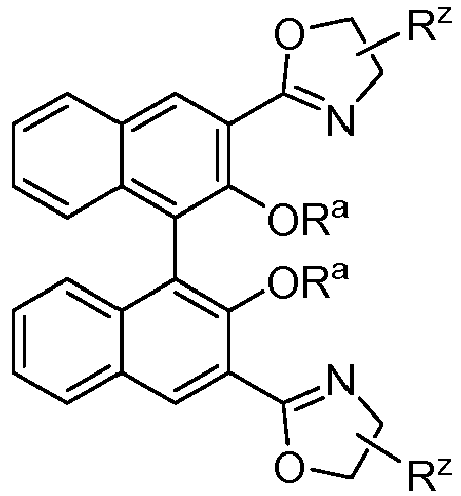
- a process for polymerizing ß-butyrolactone with an isotacticity of at least 60% comprises contacting racemic ß-butyrolactone or an enantiomer thereof with a catalyst/initiator system which comprises a rare earth metal, a chiral ligand, at least one nuceophilic ligand, at least one solvent ligand, and optionally an alkali based co-catalyst, wherein the chiral ligand is an enantiomer of a unit of formula I wherein each R z independently is linear or branched, substituted or unsubstituted C 1 -C 20 alkyl, substituted or unsubstituted C 6 -C 20 aryl, substituted or unsubstituted C 5 -C 20 heteroaryl, or halogen; wherein each R a independently is H or an alkali metal.
- a catalyst/initiator system which comprises a rare earth metal, a chiral ligand, at
- the catalyst/initiator system that is used in the method of the present invention is based on a rare earth metal and comprises a chiral ligand as essential part of the system.
- the catalyst/initiator system is obtained by contacting a chiral ligand of formula I with a compound of formula II: M R x n R y m and optionally an alkali based co-catalyst,
- the catalyst/initiator system is obtained by contacting a chiral ligand of formula I with a rare earth metal compound of formula III MX 3 (R y ) m , wherein M is a rare earth metal, R y and m are as defined above and each X independently is halogenide, triflate, or C 1 -C 20 alkoxide, and with a solvent, and optionally an alkali based co-catalyst, For activation the obtained complex is contacted with an alkali salt of a nucleophilic ligand (co-catalyst).
- a complex which comprises a rare earth metal atom bound/associated with the chiral ligand and with at least one nucleophilic ligand and/or solvent ligand.
- the complex can also include alkali species, for example lithium or potassium halogenides.
- the catalyst/initiator system can be obtained with or without a co-catalyst.
- the catalyst/initiator system of the present invention can be obtained by first preparing a rare earth metal compound of formula II, wherein the rare earth metal atom carries already at least one nucleophilic ligand and at least one solvent ligand. It is also possible to prepare the catalyst/initiator system in a one pot reaction, with or without a co-catalyst. Furthermore, after the reaction the complete catalyst/initiator system can be isolated or the reaction mixture can be used directly. In other words, the catalyst/initiator system can be either prepared in situ, i.e. the components of the system can be added to the monomer composition and the system provides the catalytic activity directly. It is also possible to prepare the catalyst/initiator system separately, isolate it and to add it to the monomer composition.
- a catalyst/initiator system comprising a rare earth metal based compound, a chiral ligand and optionally an alkali-based co-catalyst allows to polymerize racemic ⁇ -butyrolactone to obtain isotactic PHB with either a majority of (R)-enantiomers or a majority of (S)-enantiomers.
- a racemic mixture of monomers is used, the polymer comprises only one type of enantiomers with some imperfections.
- imperfections in the polymer introduced by the catalyst/initiator system of the present invention provide for the improved mechanical properties.
- the amount or percentage of imperfections can be controlled in the process of the present invention by parameters as disclosed below, and it should be low enough to maintain the biodegradability which is a valuable property of the polymer.
- rare earth metal refers to the group as defined by IUPAC, i.e. scandium, yttrium and lanthanum and lanthanides. Specific examples of rare earth metals are yttrium and lutetium.
- a “chiral ligand” refers to a unit that has an axial chirality and has at least one chiral center. Because of the axial chirality the unit can occur in at least two enantiomeric units, one of the enantiomeric units ((R)- or (S)-compound) is used for the catalyst/initiator system of the present invention.
- solvent ligand is a ligand that is based on a solvent, such as tetrahydrofuran, and can associate with the rare earth metal.
- a "nucleophilic ligand” is a ligand that can associate with the rare earth metal because of a nucleophilic site, such as nucleophilic nitrogen or nucleophilic carbon groups. Examples are substituted amido ligands, C 1 -C 20 alkoxides and di- or trialkyl methyl-silyl groups. Otherwise the structure of the ligand is not critical as long as it does not interfere with bonding/association of rare earth metal.
- Examples for a substituted amido ligand or carbon-ligand are NR b R c R d , OR b and CHR b R c , wherein each of R b ,R, c and R d independently is H or a group selected from linear or branched, substituted or unsubstituted C 1 -C 20 alkyl, substituted or unsubstituted C 6 -C 20 aryl, substituted or unsubstituted C 5 -C 20 heteroaryl, arylalkyl, silylalkyl, wherein the substitution can be as defined below.
- n+m corresponds to the coordination number or number of association/bonding sites of the rare earth metal that is the core of the catalyst.
- the number of available sites for association or bonding with the rare earth metal is the number that is occupied by ligands.
- Rare earth metals normally have a coordination number of up to 9.
- the sum of n and m can be an integer up to 9, such as 3, 4, or 6.
- a linear or branched C 1 -C 20 -alkyl is an alkyl group having 1 to 20 carbon atoms which can be in a line or can have branches, such as a C 1 -C 10 alkyl group, particularly a C 1 -C 4 alkyl group.
- a substituted alkyl is an alkyl which is substituted with groups like OH, NH 2 , NHR, NR 2 , OH, OR, SH, SR, halogen, wherein halogen comprises chlorine, iodine, fluorine, and bromine, wherein R is C 1 -C 4 -alkyl.
- C 6 -C 20 -aryl refers to an aromatic group, like benzyl, phenyl, naphthyl, biphenyl etc.
- Arylalkyl refers to a C 6 -C 20 -aryl group substituted with alkyl as defined above.
- Silylalkyl refers to silyl units carrying one, two or three C 1 -C 4 -alkyl groups. such as Si(alk) 3 , SiH(alk) 2 , SiH 2 (alk), wherein alk is C 1 -C 4 -alkyl.
- Nucleophilic carbon groups are carbon comprising groups carrying 1-3 mono-, di- or trialkylsilyl units
- Alkoxide refers to an O-Alkyl group, wherein "alkyl” is a linear or branched C 1 -C 20 -alkyl, as defined above, preferably an O-C 1 C 10 alkyl group.
- C 5 -C 20 -heteroaryl refers to heteroaryl groups, i.e. aromatic groups comprising at least one heteroatom, wherein the heteroatom is selected from N, S, and O.
- heteroaryl are furanyl, thienyl, pyrrolyl, pyridyl, isochinolyl, oxazolyl, isoxazolyl, thiazolyl, isothiazolyl etc.
- a "monomer composition” is a composition comprising at least monomers to be polymerized, i.e. ß-butyrolactone and can comprise additionally one or more solvents. If a copolymer shall be produced, the composition can comprise further monomers. As ß-butyrolactone is fluid at room temperature, it can be used as it is. The monomer can also be used in a solvent such as toluene.
- the catalyst/initiator system of the present invention comprises a rare earth metal based catalyst and a chiral ligand wherein the rare earth metal is in complex with the chiral ligand which occupies 4 association/bonding sites, at least some of the remaining association/bonding sites of the rare earth metal are occupied by ligands, i.e. nucleophilic ligands and/or solvent ligands, and/or anions like halogenide, triflate, or C 1 -C 20 alkoxide up to the coordination number.
- ligands i.e. nucleophilic ligands and/or solvent ligands, and/or anions like halogenide, triflate, or C 1 -C 20 alkoxide up to the coordination number.
- the catalyst/initiator system of the present invention can be prepared by reacting a chiral ligand and a rare earth metal based compound.
- the chiral ligand is an important part of the system, as it provides for the incorporation of one type of enantiomer of ⁇ -butyrolactone in the polymer chain.
- the chiral ligand used according to the present invention is an enantiomer of a compound of formula I: wherein R a and R z as defined above.
- This compound is a substituted binaphthol, examples of which are well-known in the art under the name BINOL-box.
- Methods for producing these compounds are well-known to the skilled person and have been published in the literature, for example Kodama, H., Ito, J., Hori, K., Ohta, T., & Furukawa, I. (2000).
- the core of this compound is a binaphthyl group, i.e. two naphthyl groups connected by a 1-1 bond. Both carry a hydroxy group in position 2 and a heterocyclic group in position 3. This part of the core provides for the complex with the rare earth metal which is necessary for the catalytic activity.
- the two heterocyclic groups carry a group R z at position 4 or 5, preferably at position 4.
- R z can be substituted or unsubstituted alkyl, substituted or unsubstituted aryl, heteroaryl, or halogen. This group is not critical as long as it does not interfere with or affect the bonding of the rare earth metal to the four specific association sites of this unit.
- R z for example can be linear or branched alkyl, such as methyl, ethyl, n-propyl, n-butyl, isobutyl or isopropyl.
- the alkyl chain can be substituted by groups like hydroxy, amino, halogen.
- R z can also be an aryl group like phenyl or naphthyl or a heteroaryl group.
- R z can be bound to the oxazolyl group in two configurations.
- both groups R z have the same configuration, i.e. are both (R) or both (S).
- (R)(R)-BINOL box means that the two naphthyl rings are in (R) configuration and both R z groups are in (R) configuration.
- An (S)(R)-BINOL box refers to a compound wherein the two naphthyl rings are in (S) configuration and both groups R z are in (R) configuration etc.
- the chiral ligand as defined above and in the claims is reacted/has been reacted with a rare earth metal based compound to obtain the system that provides activity as polymerization catalyst.
- the rare earth metal binds/coordinates with the chiral ligand via the two OR a groups and via the nitrogen atoms of the heteroaryl rings.
- the active catalyst/initiator system which activates a monomer for polymerization is a complex which is formed by contacting the chiral ligand with the rare earth metal based compound. This complex can be obtained either by separate reaction and isolation of the complex or in situ.
- the chiral ligand is contacted with a rare earth metal compound according to formula II. It has been found that a compound of formula II which comprises a nucleophilic ligand is active enough to combine with the OH groups of the chiral ligand (amine elimination reaction), i.e. with R a being H. In this approach no co-catalyst is necessary, although it can be used. Thus, in a variation of this method, an alkali compound like n-butyl lithium can be used to activate one or both OH groups of the chiral ligand for bonding. The alkali metal of the deprotonating agent in this approach can become part of the catalyst/initiator complex.
- ligands of the rare earth metal compound of formula II are replaced by bonding/association with the chiral ligand but some remain. It is assumed that at least one nucleophilic ligand and at least one solvent ligand are necessary for the activity of the catalyst/initiator complex of the present invention. These ligands can be provided by using a rare earth metal compound of formula II for preparing the complex.
- the rare earth metal in addition to the association with the chiral ligand associates with or carries further ligand(s), at least one nucleophilic ligand and/or at least one solvent ligand, to obtain a coordination number of 6,
- the solvent ligand can be provided by the rare earth metal compound of formula II or can be attached from the reaction mixture, when said mixture comprises a solvent.
- the solvent ligand is a solvent molecule, such as a molecule from the solvent used for dissolving the rare earth metal salt and/or the system or which is present in a compound of formula II as R y .
- a solvent ligand can be exchanged easily when contacted with a monomer. It can be any solvent that is used for this type of compounds and is able to coordinate to metal centers, such as tetrahydrofuran (THF), 1,4-dioxane or diethylether. Other solvents can also be used as long as they have no active proton, protic solvents like alcohols or acids are not suitable. Preferred are solvents that have oxygen but no active proton like dioxane, THF or ether.
- the nucleophilic ligand can be a nitrogen and/or carbon and/or oxygen comprising group, for example a substituted amino or amido group, such as a dialkylamido, diarylamido or disilylalkylamido group carrying 1-3 trialkylsilyl units, such as N(SiH(alk) 2 ) 2 or N(Si(alk) 3 ) 2 ,.
- a substituted amino or amido group such as a dialkylamido, diarylamido or disilylalkylamido group carrying 1-3 trialkylsilyl units, such as N(SiH(alk) 2 ) 2 or N(Si(alk) 3 ) 2 ,.
- Examples for carbon comprising nucleophilic groups are groups carrying 1-3 mono-, di- or trialkylsilyl units, such as CH 2 Si(alk) 3 , CH(Si(alk) 3 ) 2 , CH(SiH(alk) 2 ) 2 , C(Si(alk) 3 ) 3 , wherein alk is C 1 -C 4 -alkyl.
- yttrium compounds having 3 nucleophilic ligands and up to 3 solvent ligands.
- the number of ligands depends on the number of available association/binding sites of the metal.
- a useful rare earth compound is the following:
- the catalyst/initiator complex obtained allows to polymerize ß-butyrolactone at room temperature (about 20°C) and yields isotactic PHB with a P m between about 0.6 and about 0.9, such as 0.7 to about 0.88, depending on the reaction conditions, the used solvents and the chirality of the chiral ligand with some imperfections.
- the core atom associates with the two hydroxy groups of the binaphthyl and with the two nitrogen atoms of the oxazole rings.
- This complex can be isolated by washing with an apolar solvent like pentane or diethylether.
- the catalyst/initiator system is very active and results in a high polymerization rate.
- the catalyst/initiator complex can also be used without isolation as can be seen in scheme 2:
- the reaction is carried out in a solvent like THF, 1,4-dioxane, diethylether or another solvent.
- the reactants are reacted at room temperature for some time, the reaction time is not critical, it can be a few minutes up to an hour, for example 10 to 40 minutes, but also longer, such as overnight. If an in situ catalyst/initiator system is used the reagents can be reacted for some minutes up to a day or more, such as 0.5 to 24 hours or 1 to 12 hours, for example overnight.
- the active catalyst/initiator system is prepared in situ, the reaction mixture comprising the catalyst/initiator complex is used directly for polymerization of ß-butyrolactone.
- the polymerization can be carried out at room temperature (about 20°C).
- PHB is obtained with an isotacticity/P m of 0.70.
- one measure to control isotacticiy of the polymer is to control the purity of the catalyst/initiator complex - the higher the purity of the catalyst/initiator complex the lower the amount of imperfections and the higher the isotacticity.
- the active catalyst/initiator system is prepared by deprotonating a chiral ligand of formula I and reacting it with a rare earth metal compound like yttrium chloride as rare earth metal compound in the presence of an oxygen containing solvent which can serve as a solvent ligand R y . Thereafter, the complex obtained is reacted with a co-catalyst and subsequently polymerization is performed as can be seen in Scheme 3
- the chiral ligand is activated by a deprotonating agent like nBuLi and, thus, makes available the binding sites for the rare earth metal.
- the rare earth metal compound is added as rare earth metal salt, such as halogenide.
- the compound After isolation the compound is activated with co-catalyst lithium bis(dimethyl)silyl amide (LIBDSA) to provide at least one nucleophilic ligand.
- LIBDSA co-catalyst lithium bis(dimethyl)silyl amide
- the catalyst/initiator complex obtained is used for polymerization, it is active at room temperature and yields PHB with high isotacticity of 0.79. It has been found that the use of a co-catalyst reduces the number of imperfections and increases the degree of isotacticity. At the same time polymerization speed is reduced.
- a further embodiment is shown in Scheme 4, where a deprotonating agent is used to deprotonate the OH groups of the chiral ligand and the activated chiral ligand then is reacted with a rare earth metal compound of formula II to form a catalyst/initiator complex of the present invention.
- This catalyst/initiator complex can be isolated by using a solvent like pentane. It is also possible to use the reaction mixture without isolation.
- the catalyst/initiator system of the present invention that can be obtained as outlined above provides for stereospecific polymerization because of its structural composition.
- the catalyst/initiator system of the present invention comprises as essential part a chiral ligand, a 1,1'-binaphthol based ligand which is referred to as chiral ligand.
- this ligand has at least two chiral centers, the chirality of the binaphthol, and the position of the two substituents R z .
- the chiral ligand can be in (R)(R)-, (S)(R)-, (R)(S)- and (S)(S)-form. This form has an influence on the microstructure which is obtained for the polymer. It is easy to find out which monomer is preferred by a chosen catalyst/initiator complex by some routine tests.
- the components can be reacted separately, isolated and then used in isolated form or the components can be mixed and the mixture can be used as it is without isolation.
- Critical for the catalyst/initiator system of the present invention is that it comprises a chiral ligand, a rare earth metal atom as core or catalytic atom, at least one nucleophilic ligand and at least one solvent ligand which can be exchanged for a monomer for the polymerization reaction.
- the catalyst/initiator system of the present invention selectively polymerizes one enantiomer of ⁇ -butyrolactone, either (R)- ⁇ -butyrolactone or (S)- ⁇ -butyrolactone, with some imperfections, which is desirable.
- the polymerization reaction takes place in solution.
- the ⁇ -butyrolactone can be used as solvent or a solvent that can dissolve the reactants can be used.
- useful solvents are toluene, THF, 1,4-dioxane and diethylether. It is also possible to run the polymerization without a solvent because the monomer, i.e. ⁇ -butyrolactone, can serve as solvent itself. As, however, the system becomes more viscous when the polymer chains become longer, a solvent is advisable if high molecular weights are considered.
- the solvent ligand of the catalyst/initiator complex or, in case of an in situ catalyst/initiator complex, the solvent used has an influence on isotacticity. Without being bound by theory it is assumed that this is due to the fact that the solvent ligand in the catalyst/initiator system has an influence on the type of monomers that is taken up and added to the polymer chain. In this regard it was found that dichloromethane is a good solvent to obtain an isotacticity in the desired range, i.e. 60 to 80% isotacticity. Toluene is a solvent which increases the speed of polymerization.
- the solubility is not as high as with dichloromethane so that polymer chains precipitate when they become too long. Therefore, toluene can be used as solvent if polymers with a medium to low molecular weight are desired.
- THF is a solvent that coordinates very well with the rare earth metal and can be added as ligand. Thereby, catalyst activity and polymerization speed can be decreased, which has an influence on isotacticity, it is lower.
- any factor, that has an influence on the polymerization rate can also influence isotacticity. Therefore, the ratio of monomer and catalyst can also influence isotacticity.
- Another aspect of the present invention are polymers that have been obtained with a method as described. These polymers are superior to known polymers as they have a high enough isotacticity to be biodegradable but have a controllable number of imperfections to allow for superior mechanical properties.
- a desirable range of isotacticity is 50 to 90%, preferably 55 to 85 %, and in particular 60 to 80%.
- NMR kinetic experiments can be carried out to determine catalyst activities as is known to the skilled person.
- conversions from NMR values are recorded in a conversion or turnover per time diagram. From the conversion rates it can be seen that either the S-monomer or the R-monomer is consumed as about 50% of the monomer is consumed and about 50% of the monomer remain, this shows that only one of the enantiomers of the ⁇ -butyrolactone has been consumed, by analyzing which of both enantiomers remains in solution it can be analyzed which preference the system has.
- Fig. 1 shows a conversion per time diagram for racemic ⁇ -butyrolactone using a catalyst/initiator system as described in detail with reference to the schemes. From the curve it can be seen that only one enantiomer was converted. To determine if a system is specific for R- or S-monomer, experiments with either R-monomer or S-monomer can be conducted.
- the thermal properties of the polymer can be evaluated by DSC determination. It is the object of the present invention to provide polymers having a lower melt temperature than the isotactic PHBs known in the art.
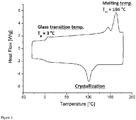
- Fig. 3 shows the DSC diagram for a PHB example that has been obtained using the process of the present invention. It can be seen that the melting temperature T m is 166°C and, thus, lower than the melting point of known polymers.
- GPC analysis can be used as is known in the art, For polymers produced with the catalyst/initiator system of the present invention GPC analysis was carried out on a Polymer Laboratories GPC50 Plus chromatograph. As eluent, chloroform was used. Polystyrene standards were used for calibration.
- the polymers obtained with a process of the present invention have very valuable properties.
- the mechanical properties are similar to those of petroleum based polymers like isotactic polypropylene and, therefore, can be used for similar applications, such as packaging.
- PHB polymers of the state of the art have a melting point which is close to the decomposition point, processability of these polymers is restricted.
- the polymers obtained with the process of the present invention have a much better processability because their melting point is lower.
- the process of the present invention it is possible to improve the mechanical properties of PHB polymers.
- those polymers have only some imperfections but otherwise are highly isotactic, they have a high biodegradability and can be used as biodegradable polymers.
- other useful properties like barrier properties are maintained with the polymers of the present invention.
- the present invention provides a process for obtaining very valuable polymers with predeterminable parameters.
Landscapes
- Chemical & Material Sciences (AREA)
- Organic Chemistry (AREA)
- Health & Medical Sciences (AREA)
- Chemical Kinetics & Catalysis (AREA)
- Medicinal Chemistry (AREA)
- Polymers & Plastics (AREA)
- Polymerization Catalysts (AREA)
- Transition And Organic Metals Composition Catalysts For Addition Polymerization (AREA)
Abstract
A process for polymerizing ß-butyrolactone is disclosed comprising contacting racemic ß-butyrolactone or an enantiomer thereof with a catalyst/initiator system which comprises a rare earth metal, a chiral ligand, at least one nucleophilic ligand, at least one solvent ligand, and optionally an alkali based co-catalyst.
Description
- The present invention is concerned with a process for polymerizing racemic β-butyrolactone. to obtain polymers with high isotacticity, and with a polymer obtained with this process.
- Poly(3-hydroxybutyrate) (PHB) is a biopolymer that is produced by microorganisms. In its natural form it is a strictly isotactic polyester of the monomer 3-(R)-hydroxybutyric acid. This polymer is highly valuable as it is biodegradable, is a renewable resource, has barrier properties and has convenient thermoplastic properties similar to those of polypropylene. Although natural PHB is a valuable resource, there are some properties which could be improved, in particular the thermoplastic properties. Moreover, it is desirable to provide a synthetic process for preparing these polymers.
- It is known to produce PHB polymers by fermentation of glucose containing materials, i.e. food resources. From an ethical view it is not desirable to use food materials for the production of technical products. Moreover, using a fermentation process results in a polymer which is similar to the polymer produced by microorganisms, i.e. a highly isotactic (R)-polymer, and has the same disadvantages. Due to the high crystallinity of these polymers it is very brittle and has a melting temperature which is near the decomposition temperature which makes its processability impossible.
- β-butyrolactone as a monomer for PHB synthesis is obtainable by a synthesis method using propylene oxide and CO2, i.e. readily available cheap products. However, this method yields racemic β-butyrolactone which consists of same amounts of (R)- and (S)- β-butyrolactone. It is desirable to be able to use racemic ß-butyrolactone for producing isotactic PHB.
- Methods have been described for the synthesis of PHB polymers via a ring opening polymerization using different catalysts. Many catalysts have been developed in the past, but most of these catalysts produce only atactic or syndiotactic PHB polymers. These syndiotactic or atactic PHB polymers have inferior properties than isotactic polymers. In particular they are not biodegradable and the thermoplastic properties are not optimal.
- Thus, those PHB polymer products that are presently available are either not biodegradable or have less desirable mechanical properties.
- Although, it would be possible to prepare isotactic PHB polymers by using enantiomerically pure β-butyrolactone, i.e. either only the (R)-enantiomer or only the (S)-enantiomer, this option is not feasible as the separation of enantiomers is very time and cost consuming.
- Thus, it is an object of the present invention to provide a process wherein racemic β-butyrolactone can be used and nevertheless an isotactic polymer can be obtained. Moreover, it was an object of the present invention to provide a process for preparing PHB polymers having improved mechanical properties but at the same time are biodegradable. Moreover, it was an object to provide a process for preparing a polymer with a predetermined percentage of isotacticity. It was another object of the present invention to provide a polymer that can be produced from monomers that are readily available and/or can be produced from cheap components. Furthermore, it was an object of the present invention to provide a polymer having barrier properties.
- All these objects are obtained by using a process as defined in claim 1 and by polymers obtained by the processes described in this application.
- A process for polymerizing ß-butyrolactone with an isotacticity of at least 60% is provided which comprises contacting racemic ß-butyrolactone or an enantiomer thereof with a catalyst/initiator system which comprises a rare earth metal, a chiral ligand, at least one nuceophilic ligand, at least one solvent ligand, and optionally an alkali based co-catalyst, wherein the chiral ligand is an enantiomer of a unit of formula I
- The catalyst/initiator system that is used in the method of the present invention is based on a rare earth metal and comprises a chiral ligand as essential part of the system.
- In one embodiment the catalyst/initiator system is obtained by contacting a chiral ligand of formula I with a compound of formula II:

- wherein M is a rare earth metal,
- each Rx independently is a nucleophilic ligand,
- each Ry independently is a solvent ligand,
- n is an integer from 1-5, such as 1-3,
- m is an integer from 0-5, such as 1-3 with the proviso that n + m is an integer corresponding to the number of association/bonding sites of the rare earth metal, the upper limit of which is the number of available association/bonding sites on the rare earth metal, which is up to 9, such as 5 or 6.
- In another embodiment the catalyst/initiator system is obtained by contacting a chiral ligand of formula I with a rare earth metal compound of formula III MX3(Ry)m, wherein M is a rare earth metal, Ry and m are as defined above and each X independently is halogenide, triflate, or C1-C20 alkoxide, and with a solvent, and optionally an alkali based co-catalyst, For activation the obtained complex is contacted with an alkali salt of a nucleophilic ligand (co-catalyst). When contacting these components a complex is obtained which comprises a rare earth metal atom bound/associated with the chiral ligand and with at least one nucleophilic ligand and/or solvent ligand. When this route is used, the complex can also include alkali species, for example lithium or potassium halogenides.
- The catalyst/initiator system can be obtained with or without a co-catalyst. Moreover, the catalyst/initiator system of the present invention can be obtained by first preparing a rare earth metal compound of formula II, wherein the rare earth metal atom carries already at least one nucleophilic ligand and at least one solvent ligand. It is also possible to prepare the catalyst/initiator system in a one pot reaction, with or without a co-catalyst. Furthermore, after the reaction the complete catalyst/initiator system can be isolated or the reaction mixture can be used directly. In other words, the catalyst/initiator system can be either prepared in situ, i.e. the components of the system can be added to the monomer composition and the system provides the catalytic activity directly. It is also possible to prepare the catalyst/initiator system separately, isolate it and to add it to the monomer composition.
- Surprisingly it has been found that when using a catalyst/initiator system as defined in claim 1 it is possible to produce PHB polymers that have a predeterminable amount of isotacticity, a predeterminable amount of imperfections and combine mechanical strength with biodegradability. Such biodegradable polymers can be used for many purposes, for example for packaging. Moreover, it has been found that these polymers still have highly desirable barrier properties, in particular have a high oxygen barrier. By introducing imperfections the mechanical properties are improved compared to natural occurring or microbial produced PHB polymers, i.e. the polymers produced with the process of the present invention have a lower melting point, are less brittle and rigid and have a higher tensile strength.
- These valuable properties are obtained by using the process of the present invention, in particular by using the catalyst/initiator system as defined in claim 1.
- It has been found that a catalyst/initiator system comprising a rare earth metal based compound, a chiral ligand and optionally an alkali-based co-catalyst allows to polymerize racemic β-butyrolactone to obtain isotactic PHB with either a majority of (R)-enantiomers or a majority of (S)-enantiomers. Although a racemic mixture of monomers is used, the polymer comprises only one type of enantiomers with some imperfections. These imperfections in the polymer introduced by the catalyst/initiator system of the present invention provide for the improved mechanical properties. The amount or percentage of imperfections can be controlled in the process of the present invention by parameters as disclosed below, and it should be low enough to maintain the biodegradability which is a valuable property of the polymer.
- The figures further explain the subject matter of the present invention.
-
Fig. 1 shows a conversion per time diagram for racemic β-butyrolactone using a catalyst/initiator system of the present invention. -
Fig. 2 shows 13C-NMR-spectrograms which are used to determine the microstructure of the polymer obtained with a process of the present invention. For analysis it is possible to either evaluate the carbonyl signal at 169 ppm (seeFig. 2a ) or the methylene signal at 40 ppm (seeFigs. 2b-d ). The ratio between the isotactic part of the polymer (mm and rm) and the syndiotactic part (rr and mr) has been calculated for PHB examples in deuterated chloroform with different isotacticity ratios from 0.70 to 0.88. -
Fig. 3 shows the DSC diagram for a PHB example that has been obtained using the process of the present invention. It can be seen that the melting temperature Tm is 166°C and, thus, lower than the melting point of known polymers. - The following definitions are used in the present application.
- The term "rare earth metal" refers to the group as defined by IUPAC, i.e. scandium, yttrium and lanthanum and lanthanides. Specific examples of rare earth metals are yttrium and lutetium.
- A "chiral ligand" refers to a unit that has an axial chirality and has at least one chiral center. Because of the axial chirality the unit can occur in at least two enantiomeric units, one of the enantiomeric units ((R)- or (S)-compound) is used for the catalyst/initiator system of the present invention.
- A "solvent ligand" is a ligand that is based on a solvent, such as tetrahydrofuran, and can associate with the rare earth metal.
- A "nucleophilic ligand" is a ligand that can associate with the rare earth metal because of a nucleophilic site, such as nucleophilic nitrogen or nucleophilic carbon groups. Examples are substituted amido ligands, C1-C20 alkoxides and di- or trialkyl methyl-silyl groups. Otherwise the structure of the ligand is not critical as long as it does not interfere with bonding/association of rare earth metal. Examples for a substituted amido ligand or carbon-ligand are NRbRcRd, ORb and CHRbRc, wherein each of Rb,R,c and Rd independently is H or a group selected from linear or branched, substituted or unsubstituted C1-C20 alkyl, substituted or unsubstituted C6-C20 aryl, substituted or unsubstituted C5-C20 heteroaryl, arylalkyl, silylalkyl, wherein the substitution can be as defined below.
- The integer n+m corresponds to the coordination number or number of association/bonding sites of the rare earth metal that is the core of the catalyst. The number of available sites for association or bonding with the rare earth metal is the number that is occupied by ligands. Rare earth metals normally have a coordination number of up to 9. Thus, the sum of n and m can be an integer up to 9, such as 3, 4, or 6.
- A linear or branched C1-C20-alkyl is an alkyl group having 1 to 20 carbon atoms which can be in a line or can have branches, such as a C1-C10 alkyl group, particularly a C1-C4 alkyl group. A substituted alkyl is an alkyl which is substituted with groups like OH, NH2, NHR, NR2, OH, OR, SH, SR, halogen, wherein halogen comprises chlorine, iodine, fluorine, and bromine, wherein R is C1-C4-alkyl.
- C6-C20-aryl refers to an aromatic group, like benzyl, phenyl, naphthyl, biphenyl etc.
- Arylalkyl refers to a C6-C20-aryl group substituted with alkyl as defined above.
- Silylalkyl refers to silyl units carrying one, two or three C1-C4-alkyl groups. such as Si(alk)3, SiH(alk)2, SiH2(alk), wherein alk is C1-C4-alkyl.
- Nucleophilic carbon groups are carbon comprising groups carrying 1-3 mono-, di- or trialkylsilyl units,
- Alkoxide refers to an O-Alkyl group, wherein "alkyl" is a linear or branched C1-C20-alkyl, as defined above, preferably an O-C1C10 alkyl group.
- C5-C20-heteroaryl refers to heteroaryl groups, i.e. aromatic groups comprising at least one heteroatom, wherein the heteroatom is selected from N, S, and O. Examples for heteroaryl are furanyl, thienyl, pyrrolyl, pyridyl, isochinolyl, oxazolyl, isoxazolyl, thiazolyl, isothiazolyl etc.
- The terms "halogen" or "halogenide" comprise chloro, fluoro, bromo, iodo, or chloride, fluoride, bromide, iodide, respectively.
- A "monomer composition" is a composition comprising at least monomers to be polymerized, i.e. ß-butyrolactone and can comprise additionally one or more solvents. If a copolymer shall be produced, the composition can comprise further monomers. As ß-butyrolactone is fluid at room temperature, it can be used as it is. The monomer can also be used in a solvent such as toluene.
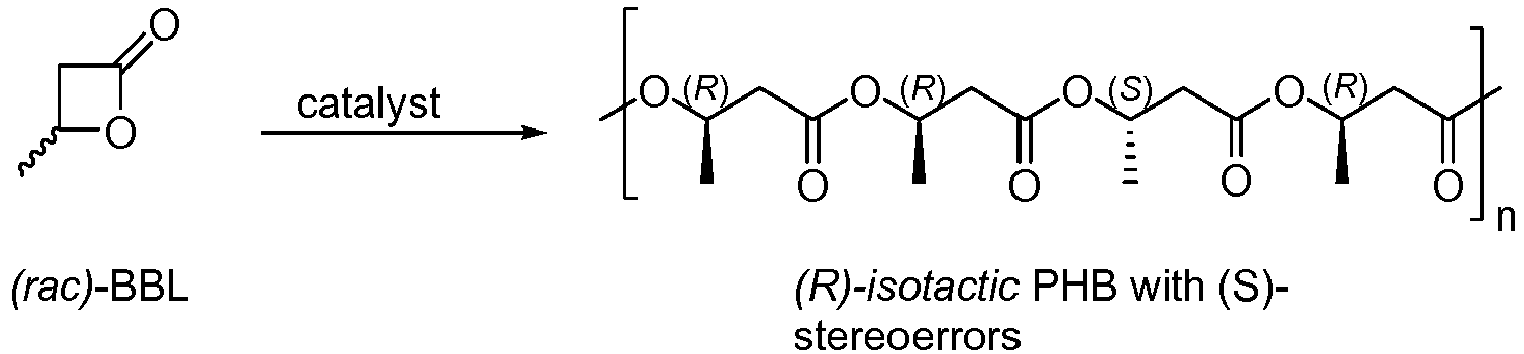
- For polymerizing β-butyrolactone having desirable properties a specific catalyst/initiator system is used. In general the polymerization can be summarized as follows:
- The catalyst/initiator system of the present invention comprises a rare earth metal based catalyst and a chiral ligand wherein the rare earth metal is in complex with the chiral ligand which occupies 4 association/bonding sites, at least some of the remaining association/bonding sites of the rare earth metal are occupied by ligands, i.e. nucleophilic ligands and/or solvent ligands, and/or anions like halogenide, triflate, or C1-C20 alkoxide up to the coordination number.
- The catalyst/initiator system of the present invention can be prepared by reacting a chiral ligand and a rare earth metal based compound. The chiral ligand is an important part of the system, as it provides for the incorporation of one type of enantiomer of β-butyrolactone in the polymer chain. The chiral ligand used according to the present invention is an enantiomer of a compound of formula I:

- This compound is a substituted binaphthol, examples of which are well-known in the art under the name BINOL-box. Methods for producing these compounds are well-known to the skilled person and have been published in the literature, for example Kodama, H., Ito, J., Hori, K., Ohta, T., & Furukawa, I. (2000). Lanthanide-catalyzed asymmetric 1, 3-dipolar cycloaddition of nitrones to alkenes using 3, 3'-bis (2-oxazolyl)-1, 1'-bi-2-naphthol (BINOL-Box) ligands. Journal of Organometallic Chemistry, 603(1), 6-12. The core of this compound is a binaphthyl group, i.e. two naphthyl groups connected by a 1-1 bond. Both carry a hydroxy group in
position 2 and a heterocyclic group in position 3. This part of the core provides for the complex with the rare earth metal which is necessary for the catalytic activity. The two heterocyclic groups carry a group Rz atposition 4 or 5, preferably atposition 4. Rz can be substituted or unsubstituted alkyl, substituted or unsubstituted aryl, heteroaryl, or halogen. This group is not critical as long as it does not interfere with or affect the bonding of the rare earth metal to the four specific association sites of this unit. Rz for example can be linear or branched alkyl, such as methyl, ethyl, n-propyl, n-butyl, isobutyl or isopropyl. The alkyl chain can be substituted by groups like hydroxy, amino, halogen. Rz can also be an aryl group like phenyl or naphthyl or a heteroaryl group. Rz can be bound to the oxazolyl group in two configurations. For the chiral ligand of the present invention it is preferred that both groups Rz have the same configuration, i.e. are both (R) or both (S). Therefore, when it is referred to the chiral ligand the term "(R)(R)-BINOL box" means that the two naphthyl rings are in (R) configuration and both Rz groups are in (R) configuration. An (S)(R)-BINOL box refers to a compound wherein the two naphthyl rings are in (S) configuration and both groups Rz are in (R) configuration etc. - The chiral ligand as defined above and in the claims is reacted/has been reacted with a rare earth metal based compound to obtain the system that provides activity as polymerization catalyst. In the catalyst/initiator complex in its active form the rare earth metal binds/coordinates with the chiral ligand via the two ORa groups and via the nitrogen atoms of the heteroaryl rings.
- Producing such complexes is known to the skilled person. There are different approaches to obtain such complexes. The active catalyst/initiator system, which activates a monomer for polymerization is a complex which is formed by contacting the chiral ligand with the rare earth metal based compound. This complex can be obtained either by separate reaction and isolation of the complex or in situ.
- In one approach the chiral ligand is contacted with a rare earth metal compound according to formula II. It has been found that a compound of formula II which comprises a nucleophilic ligand is active enough to combine with the OH groups of the chiral ligand (amine elimination reaction), i.e. with Ra being H. In this approach no co-catalyst is necessary, although it can be used. Thus, in a variation of this method, an alkali compound like n-butyl lithium can be used to activate one or both OH groups of the chiral ligand for bonding. The alkali metal of the deprotonating agent in this approach can become part of the catalyst/initiator complex.
- It is assumed without being bound by theory that some of the ligands of the rare earth metal compound of formula II are replaced by bonding/association with the chiral ligand but some remain. It is assumed that at least one nucleophilic ligand and at least one solvent ligand are necessary for the activity of the catalyst/initiator complex of the present invention. These ligands can be provided by using a rare earth metal compound of formula II for preparing the complex. As outlined before, in the complex the rare earth metal in addition to the association with the chiral ligand associates with or carries further ligand(s), at least one nucleophilic ligand and/or at least one solvent ligand, to obtain a coordination number of 6, The solvent ligand can be provided by the rare earth metal compound of formula II or can be attached from the reaction mixture, when said mixture comprises a solvent.
- The solvent ligand is a solvent molecule, such as a molecule from the solvent used for dissolving the rare earth metal salt and/or the system or which is present in a compound of formula II as Ry. A solvent ligand can be exchanged easily when contacted with a monomer. It can be any solvent that is used for this type of compounds and is able to coordinate to metal centers, such as tetrahydrofuran (THF), 1,4-dioxane or diethylether. Other solvents can also be used as long as they have no active proton, protic solvents like alcohols or acids are not suitable. Preferred are solvents that have oxygen but no active proton like dioxane, THF or ether.
- The nucleophilic ligand can be a nitrogen and/or carbon and/or oxygen comprising group, for example a substituted amino or amido group, such as a dialkylamido, diarylamido or disilylalkylamido group carrying 1-3 trialkylsilyl units, such as N(SiH(alk)2)2 or N(Si(alk)3)2,. Examples for carbon comprising nucleophilic groups are groups carrying 1-3 mono-, di- or trialkylsilyl units, such as CH2Si(alk)3, CH(Si(alk)3)2, CH(SiH(alk)2)2, C(Si(alk)3)3, wherein alk is C1-C4-alkyl.
- Compounds that are well suited for this approach are yttrium compounds having 3 nucleophilic ligands and up to 3 solvent ligands. The number of ligands depends on the number of available association/binding sites of the metal. A useful rare earth compound is the following:

- Without being bound by theory it is assumed that when contacting this type of rare earth metal compound with a chiral ligand some of the ligands are replaced by bonds to the chiral ligand, whereas some ligands remain which then provide for the catalytic activity for polymerization.

- The catalyst/initiator complex obtained allows to polymerize ß-butyrolactone at room temperature (about 20°C) and yields isotactic PHB with a Pm between about 0.6 and about 0.9, such as 0.7 to about 0.88, depending on the reaction conditions, the used solvents and the chirality of the chiral ligand with some imperfections.
- It is assumed that when contacting the chiral ligand with a rare earth metal compound like the yttrium compound shown above, the core atom associates with the two hydroxy groups of the binaphthyl and with the two nitrogen atoms of the oxazole rings. This complex can be isolated by washing with an apolar solvent like pentane or diethylether. The catalyst/initiator system is very active and results in a high polymerization rate.
- The catalyst/initiator complex can also be used without isolation as can be seen in scheme 2:

- The reaction is carried out in a solvent like THF, 1,4-dioxane, diethylether or another solvent. The reactants are reacted at room temperature for some time, the reaction time is not critical, it can be a few minutes up to an hour, for example 10 to 40 minutes, but also longer, such as overnight. If an in situ catalyst/initiator system is used the reagents can be reacted for some minutes up to a day or more, such as 0.5 to 24 hours or 1 to 12 hours, for example overnight.
- As an example the active catalyst/initiator system is prepared in situ, the reaction mixture comprising the catalyst/initiator complex is used directly for polymerization of ß-butyrolactone. The polymerization can be carried out at room temperature (about 20°C). PHB is obtained with an isotacticity/Pm of 0.70. Thus, when using an isolated catalyst/initiator complex the number of imperfections is lower than when using catalyst/initiator complex without isolation. This shows that one measure to control isotacticiy of the polymer is to control the purity of the catalyst/initiator complex - the higher the purity of the catalyst/initiator complex the lower the amount of imperfections and the higher the isotacticity.
- In another embodiment the active catalyst/initiator system is prepared by deprotonating a chiral ligand of formula I and reacting it with a rare earth metal compound like yttrium chloride as rare earth metal compound in the presence of an oxygen containing solvent which can serve as a solvent ligand Ry. Thereafter, the complex obtained is reacted with a co-catalyst and subsequently polymerization is performed as can be seen in Scheme 3

- Without being bound by theory the structure of one embodiment of a catalyst/initiator complex of the present invention can be depicted as follows:

- A further embodiment is shown in
Scheme 4, where a deprotonating agent is used to deprotonate the OH groups of the chiral ligand and the activated chiral ligand then is reacted with a rare earth metal compound of formula II to form a catalyst/initiator complex of the present invention. This catalyst/initiator complex can be isolated by using a solvent like pentane. It is also possible to use the reaction mixture without isolation.
- The catalyst/initiator system of the present invention that can be obtained as outlined above provides for stereospecific polymerization because of its structural composition. The catalyst/initiator system of the present invention comprises as essential part a chiral ligand, a 1,1'-binaphthol based ligand which is referred to as chiral ligand. As outlined before, this ligand has at least two chiral centers, the chirality of the binaphthol, and the position of the two substituents Rz. Thus, the chiral ligand can be in (R)(R)-, (S)(R)-, (R)(S)- and (S)(S)-form. This form has an influence on the microstructure which is obtained for the polymer. It is easy to find out which monomer is preferred by a chosen catalyst/initiator complex by some routine tests.
- For preparing the catalyst/initiator system of the present invention either the components can be reacted separately, isolated and then used in isolated form or the components can be mixed and the mixture can be used as it is without isolation.
- It has been found that the purer the catalyst system is, the more selective it is, i.e. the higher the amount of isotacticity is. With the isolated catalyst/initiator system an isotacticity rate of up to about 0.9, such as 0.88 can be obtained. Thus, the degree of isotacticity can be controlled by using an isolated versus an in situ catalyst/initiator complex.
- Critical for the catalyst/initiator system of the present invention is that it comprises a chiral ligand, a rare earth metal atom as core or catalytic atom, at least one nucleophilic ligand and at least one solvent ligand which can be exchanged for a monomer for the polymerization reaction.
- The catalyst/initiator system of the present invention selectively polymerizes one enantiomer of β-butyrolactone, either (R)-β-butyrolactone or (S)-β-butyrolactone, with some imperfections, which is desirable.
- The polymerization reaction takes place in solution. The β-butyrolactone can be used as solvent or a solvent that can dissolve the reactants can be used. Examples for useful solvents are toluene, THF, 1,4-dioxane and diethylether. It is also possible to run the polymerization without a solvent because the monomer, i.e. β-butyrolactone, can serve as solvent itself. As, however, the system becomes more viscous when the polymer chains become longer, a solvent is advisable if high molecular weights are considered.
- It was found that the slower the polymerization reaction is the more exact the monomers are added to the polymer chain so that the isotacticity becomes higher. On the other hand, when speed is increased, for example by increasing the temperature of the reaction the polymerization rate becomes faster and the number of imperfections increases. In this case isotacticity decreases.
- Furthermore, it was found that the solvent ligand of the catalyst/initiator complex or, in case of an in situ catalyst/initiator complex, the solvent used, has an influence on isotacticity. Without being bound by theory it is assumed that this is due to the fact that the solvent ligand in the catalyst/initiator system has an influence on the type of monomers that is taken up and added to the polymer chain. In this regard it was found that dichloromethane is a good solvent to obtain an isotacticity in the desired range, i.e. 60 to 80% isotacticity. Toluene is a solvent which increases the speed of polymerization. The solubility is not as high as with dichloromethane so that polymer chains precipitate when they become too long. Therefore, toluene can be used as solvent if polymers with a medium to low molecular weight are desired. Furthermore, THF is a solvent that coordinates very well with the rare earth metal and can be added as ligand. Thereby, catalyst activity and polymerization speed can be decreased, which has an influence on isotacticity, it is lower.
- Any factor, that has an influence on the the polymerization rate can also influence isotacticity. Therefore, the ratio of monomer and catalyst can also influence isotacticity.
- By controlling the isotacticity of the polymer built with the catalyst/initiator system of the present invention and by controlling the number of imperfections, it is possible to fine tune the properties of the polymer that is obtained. Thereby the mechanical properties of the polymer can be optimized. By selecting the temperature, the solvent, the configuration of the chiral ligand and the ligands of the rare earth metal based catalyst it is possible to produce PHBs with different microstructures. This is particularly valuable.
- Another aspect of the present invention are polymers that have been obtained with a method as described. These polymers are superior to known polymers as they have a high enough isotacticity to be biodegradable but have a controllable number of imperfections to allow for superior mechanical properties. A desirable range of isotacticity is 50 to 90%, preferably 55 to 85 %, and in particular 60 to 80%.
- The polymers obtained with the method of the present invention have been analyzed with methods as described in the following. To find the best suited catalyst/initiator system for a specific polymer experiments can be carried out as is explained in detail below.
- NMR kinetic experiments can be carried out to determine catalyst activities as is known to the skilled person. For this purpose, conversions from NMR values are recorded in a conversion or turnover per time diagram. From the conversion rates it can be seen that either the S-monomer or the R-monomer is consumed as about 50% of the monomer is consumed and about 50% of the monomer remain, this shows that only one of the enantiomers of the β-butyrolactone has been consumed, by analyzing which of both enantiomers remains in solution it can be analyzed which preference the system has.
Fig. 1 shows a conversion per time diagram for racemic β-butyrolactone using a catalyst/initiator system as described in detail with reference to the schemes. From the curve it can be seen that only one enantiomer was converted. To determine if a system is specific for R- or S-monomer, experiments with either R-monomer or S-monomer can be conducted. - Isotacticity is analyzed as is known in the art. 13C-NMR-spectroscopy can be used to determine the microstructure of the polymer obtained with a process of the present invention. For analysis it is possible to either evaluate the carbonyl signal at 169 ppm (see
Fig. 2a ) or the methylene signal at 40 ppm (seeFigs. 2b-d ). The ratio between the isotactic part of the polymer (mm and rm) and the syndiotactic part (rr and mr) has been evaluated.. Evaluated is the probability for meso-connections (Pm-value; meso = two adjacent centers having the same orientation).Fig. 2 shows some spectra of PHB examples in deuterated chloroform with different isotacticity ratios from 0.70 to 0.88. - The thermal properties of the polymer can be evaluated by DSC determination. It is the object of the present invention to provide polymers having a lower melt temperature than the isotactic PHBs known in the art.
Fig. 3 shows the DSC diagram for a PHB example that has been obtained using the process of the present invention. It can be seen that the melting temperature Tm is 166°C and, thus, lower than the melting point of known polymers. - For molecular weight determinations, GPC analysis can be used as is known in the art, For polymers produced with the catalyst/initiator system of the present invention GPC analysis was carried out on a Polymer Laboratories GPC50 Plus chromatograph. As eluent, chloroform was used. Polystyrene standards were used for calibration.
- It was found that the polymers obtained with a process of the present invention have very valuable properties. The mechanical properties are similar to those of petroleum based polymers like isotactic polypropylene and, therefore, can be used for similar applications, such as packaging. PHB polymers of the state of the art have a melting point which is close to the decomposition point, processability of these polymers is restricted. In contrast thereto the polymers obtained with the process of the present invention have a much better processability because their melting point is lower. Furthermore it has been found that when using the process of the present invention polymers are obtained which have a higher tensile strength than those isotactic PHBs known from the prior art. Thus, with the process of the present invention it is possible to improve the mechanical properties of PHB polymers. As those polymers have only some imperfections but otherwise are highly isotactic, they have a high biodegradability and can be used as biodegradable polymers. Furthermore, it has been found that other useful properties like barrier properties are maintained with the polymers of the present invention.
- In summary the present invention provides a process for obtaining very valuable polymers with predeterminable parameters.
Claims (15)
- A process for polymerizing ß-butyrolactone comprising contacting racemic ß-butyrolactone or an enantiomer thereof with a catalyst/initiator system which comprises a rare earth metal, a chiral ligand, at least one nucleophilic ligand, at least one solvent ligand, and optionally an alkali based co-catalyst, wherein the chiral ligand is an enantiomer of a unit of formula I
 wherein each Rz independently is linear or branched, substituted or unsubstituted C1-C20 alkyl, substituted or unsubstituted C6-C20 aryl, substituted or unsubstituted C5-C20 heteroaryl, or halogen;wherein each Ra independently is H or an alkali metal.
 - The process of claim 1 wherein the catalyst/initiator system is a rare earth metal based complex which has been obtained by contacting a chiral ligand of formula I with a compound of formula II:
 wherein M is a rare earth metal,each Rx independently is a nucleophilic ligand,each Ry independently is a solvent ligand,n is an integer from 1-5,m is an integer from 0-5 with the proviso that n + m is an integer corresponding to the number of available association/bonding sites of the rare earth metal.
 - The process of claim 1, wherein the catalyst/initiator system is a rare earth metal based complex which has been obtained by contacting a chiral ligand of formula I with a rare earth metal compound of formula III, a solvent, and optionally an alkali based co-catalyst,
wherein the earth metal based compound is a compound of formula III wherein M is a rare earth metal,each X independently is halogenide, triflate, or C1-C20 alkoxide;each Ry independently is a solvent ligand,m is an integer from 0-5 andcontacting the complex obtained with an alkali salt of a nucleophilic ligand.
 - The process of one of the preceding claims wherein the catalyst/initator system is prepared in situ.
- The process of one of claims 1-3 wherein the catalyst/initator system is isolated from the reaction mixture and added to a monomer composition comprising ß-butyrolactone.
- The process of one of the preceding claims wherein the rare earth metal is yttrium, lutetium, scandium, ytterbium, terbium, samarium, lanthanum or a lanthanide, wherein optionally the rare earth metal is yttrium.
- The process of one of the preceding claims wherein n is 1-3 and m is 1-3.
- The process of one of the preceding claims wherein the monomer is racemic ß-butyrolactone.
- The process of one of the preceding claims wherein the nucleophilic ligand is an amido group, an alkoxide or a di- or trialkyl methyl-silyl group, preferably a group selected from NRbRcRd, ORb and CHRbRc, wherein each of Rb,R,c and Rd independently is H or a group selected from linear or branched, substituted or unsubstituted C1-C20 alkyl, C6-C20 aryl, arylalkyl, silylalkyl.
- The process of one of the preceding claims wherein at least one nucleophilic ligand is n N(SiHMe2)2 group.
- The process of one of the preceding claims wherein at least one solvent ligand is tetrahydrofuran.
- The process of one of the preceding claims wherein the co-catalyst is a lithium salt (LiN(SiHMe2)2) or wherein the co-catalyst is a potassium salt (K(N(SiMe3)2).
- The process of one of the preceding claims wherein the catalyst has one of the following formulae:


- Polyhydroxybutyrate polymer obtained with a process of one of claims 1-13.
- Polyhydroxybutyrate polymer of claim 14 having a Pm between 0.6 and 0.9.
Priority Applications (6)
| Application Number | Priority Date | Filing Date | Title |
|---|---|---|---|
| EP17210556.1A EP3502161A1 (en) | 2017-12-23 | 2017-12-23 | Process for polymerizing ss-butyrolactone |
| BR112020012671-3A BR112020012671A2 (en) | 2017-12-23 | 2018-11-21 | process for polymerizing ss-butyrolactone |
| PCT/EP2018/082120 WO2019120846A1 (en) | 2017-12-23 | 2018-11-21 | PROCESS FOR POLYMERIZING ß-BUTYROLACTONE |
| US16/954,684 US11459423B2 (en) | 2017-12-23 | 2018-11-21 | Process for polymerizing β-butyrolactone |
| EP18803453.2A EP3728393A1 (en) | 2017-12-23 | 2018-11-21 | PROCESS FOR POLYMERIZING ß-BUTYROLACTONE |
| US17/829,490 US11685810B2 (en) | 2017-12-23 | 2022-06-01 | Process for polymerizing beta-butyrolactone |
Applications Claiming Priority (1)
| Application Number | Priority Date | Filing Date | Title |
|---|---|---|---|
| EP17210556.1A EP3502161A1 (en) | 2017-12-23 | 2017-12-23 | Process for polymerizing ss-butyrolactone |
Publications (1)
| Publication Number | Publication Date |
|---|---|
| EP3502161A1 true EP3502161A1 (en) | 2019-06-26 |
Family
ID=60971925
Family Applications (2)
| Application Number | Title | Priority Date | Filing Date |
|---|---|---|---|
| EP17210556.1A Withdrawn EP3502161A1 (en) | 2017-12-23 | 2017-12-23 | Process for polymerizing ss-butyrolactone |
| EP18803453.2A Withdrawn EP3728393A1 (en) | 2017-12-23 | 2018-11-21 | PROCESS FOR POLYMERIZING ß-BUTYROLACTONE |
Family Applications After (1)
| Application Number | Title | Priority Date | Filing Date |
|---|---|---|---|
| EP18803453.2A Withdrawn EP3728393A1 (en) | 2017-12-23 | 2018-11-21 | PROCESS FOR POLYMERIZING ß-BUTYROLACTONE |
Country Status (4)
| Country | Link |
|---|---|
| US (2) | US11459423B2 (en) |
| EP (2) | EP3502161A1 (en) |
| BR (1) | BR112020012671A2 (en) |
| WO (1) | WO2019120846A1 (en) |
Cited By (1)
| Publication number | Priority date | Publication date | Assignee | Title |
|---|---|---|---|---|
| US20220389157A1 (en) * | 2017-12-23 | 2022-12-08 | Technische Universität München | Process for polymerizing beta-butyrolactone |
Families Citing this family (2)
| Publication number | Priority date | Publication date | Assignee | Title |
|---|---|---|---|---|
| CN115260217B (en) * | 2022-08-19 | 2024-06-07 | 大连理工大学 | A type of bridged bisoxazoline rare earth metal catalyst, preparation method and application |
| EP4598979A1 (en) | 2022-10-06 | 2025-08-13 | Technische Universität München | Catalysts and processes for stereoselective ring-opening polymerization |
Family Cites Families (2)
| Publication number | Priority date | Publication date | Assignee | Title |
|---|---|---|---|---|
| DE3502161C2 (en) * | 1984-01-24 | 1995-07-06 | Canon Denshi Kk | Magnetic head assembly |
| EP3502161A1 (en) * | 2017-12-23 | 2019-06-26 | Technische Universität München | Process for polymerizing ss-butyrolactone |
-
2017
- 2017-12-23 EP EP17210556.1A patent/EP3502161A1/en not_active Withdrawn
-
2018
- 2018-11-21 US US16/954,684 patent/US11459423B2/en active Active
- 2018-11-21 BR BR112020012671-3A patent/BR112020012671A2/en not_active Application Discontinuation
- 2018-11-21 WO PCT/EP2018/082120 patent/WO2019120846A1/en not_active Ceased
- 2018-11-21 EP EP18803453.2A patent/EP3728393A1/en not_active Withdrawn
-
2022
- 2022-06-01 US US17/829,490 patent/US11685810B2/en active Active
Non-Patent Citations (4)
| Title |
|---|
| KODAMA, H.; ITO, J.; HORI, K.; OHTA, T.; FURUKAWA, I.: "Lanthanide-catalyzed asymmetric 1, 3-dipolar cycloaddition of nitrones to alkenes using 3, 3'-bis (2-oxazolyl)-1, 1'-bi-2-naphthol (BINOL-Box) ligands", JOURNAL OF ORGANOMETALLIC CHEMISTRY, vol. 603, no. 1, 2000, pages 6 - 12, XP004213433, DOI: doi:10.1016/S0022-328X(00)00024-3 |
| MANUELA ZINTL ET AL: "Variably Isotactic Poly(hydroxybutyrate) from Racemic [beta]-Butyrolactone: Microstructure Control by Achiral Chromium(III) Salophen Complexes", ANGEWANDTE CHEMIE INTERNATIONAL EDITION, vol. 47, no. 18, 21 April 2008 (2008-04-21), pages 3458 - 3460, XP055485647, ISSN: 1433-7851, DOI: 10.1002/anie.200703859 * |
| NOUREDDINE AJELLAL ET AL: "Polymerization of racemic [beta]-butyrolactone using supported catalysts: a simple access to isotactic polymers", CHEMICAL COMMUNICATIONS, vol. 46, no. 7, 1 January 2010 (2010-01-01), pages 1032, XP055485642, ISSN: 1359-7345, DOI: 10.1039/b923546a * |
| ROMAIN LIGNY ET AL: "Highly Syndiotactic or Isotactic Polyhydroxyalkanoates by Ligand-Controlled Yttrium-Catalyzed Stereoselective Ring-Opening Polymerization of Functional Racemic [beta]-Lactones", ANGEWANDTE CHEMIE INTERNATIONAL EDITION, vol. 56, no. 35, 21 August 2017 (2017-08-21), pages 10388 - 10393, XP055485567, ISSN: 1433-7851, DOI: 10.1002/anie.201704283 * |
Cited By (2)
| Publication number | Priority date | Publication date | Assignee | Title |
|---|---|---|---|---|
| US20220389157A1 (en) * | 2017-12-23 | 2022-12-08 | Technische Universität München | Process for polymerizing beta-butyrolactone |
| US11685810B2 (en) | 2017-12-23 | 2023-06-27 | Technische Universität München | Process for polymerizing beta-butyrolactone |
Also Published As
| Publication number | Publication date |
|---|---|
| WO2019120846A1 (en) | 2019-06-27 |
| BR112020012671A2 (en) | 2020-12-01 |
| US11459423B2 (en) | 2022-10-04 |
| EP3728393A1 (en) | 2020-10-28 |
| US20220389157A1 (en) | 2022-12-08 |
| US11685810B2 (en) | 2023-06-27 |
| US20200354515A1 (en) | 2020-11-12 |
Similar Documents
| Publication | Publication Date | Title |
|---|---|---|
| US11685810B2 (en) | Process for polymerizing beta-butyrolactone | |
| Brulé et al. | Metal‐Catalyzed Synthesis of Alternating Copolymers | |
| WO2011158241A1 (en) | Salalen ligands and organometallic complexes | |
| Huang et al. | Ring-opening polymerization of rac-lactide and α-methyltrimethylene carbonate catalyzed by magnesium and zinc complexes derived from binaphthyl-based iminophenolate ligands | |
| CN105229018A (en) | A kind of novel transition metal Primary Catalysts and preparation technology thereof | |
| JP4590284B2 (en) | Method for producing polycarbonate | |
| Eckert et al. | Simple is best: Diamine zinc complexes as unexpected catalysts in lactide polymerisation | |
| CN101412727B (en) | Imidazolidinyl bridged bis(aryloxide) rare-earth metal aminate and catalysis use thereof | |
| JP2002506475A (en) | Functionalized carbon monoxide copolymer | |
| MacLachlan et al. | Synthesis, characterization, and ring-opening polymerization of a novel [1] silaferrocenophane with two ferrocenyl substituents at silicon | |
| He et al. | Ni (II) and Pd (II) complexes bearing benzocyclohexane–ketoarylimine for copolymerization of norbornene with 5‐norbornene‐2‐carboxylic ester | |
| JP2021001332A (en) | Ethylene ionomer for soft sheet and molding thereof | |
| JP2021008613A (en) | Ethylene ionomers for gaskets and their moldings | |
| Choffat et al. | Polystannanes: Polymers of a Molecular, Jacketed Metal–Wire Structure | |
| JP2020143276A (en) | Multinary ionomer | |
| Zhou et al. | Synthesis and characterization of polycholesteryl methacrylate–polyhydroxyethyl methyacrylate block copolymers | |
| KR101508152B1 (en) | Catalyst for norbornene monomer polymerization and method for producing norbornene polymer | |
| JP2021001333A (en) | Resin composition for film and ethylenic film using the same | |
| CN114891035B (en) | Difunctional tetranuclear metal lithium complex and preparation method and application thereof | |
| JPH07304834A (en) | Method for producing cyclic olefin polymer | |
| JP2523337B2 (en) | Polymer liquid crystal material | |
| JP2003505564A (en) | Method for producing olefin / carbon monoxide copolymer | |
| JP6421814B2 (en) | Transition metal complex, process for producing the same, and catalyst for metathesis reaction | |
| JP6726521B2 (en) | Substituted polyacetylene having optically active group and method for producing the same | |
| JP5797497B2 (en) | Tridentate rhodium complex, substituted acetylene polymerization initiator, and method for producing substituted polyacetylene derivative using the same |
Legal Events
| Date | Code | Title | Description |
|---|---|---|---|
| PUAI | Public reference made under article 153(3) epc to a published international application that has entered the european phase |
Free format text: ORIGINAL CODE: 0009012 |
|
| AK | Designated contracting states |
Kind code of ref document: A1 Designated state(s): AL AT BE BG CH CY CZ DE DK EE ES FI FR GB GR HR HU IE IS IT LI LT LU LV MC MK MT NL NO PL PT RO RS SE SI SK SM TR |
|
| AX | Request for extension of the european patent |
Extension state: BA ME |
|
| STAA | Information on the status of an ep patent application or granted ep patent |
Free format text: STATUS: THE APPLICATION IS DEEMED TO BE WITHDRAWN |
|
| 18D | Application deemed to be withdrawn |
Effective date: 20200103 |