EP3501639A1 - Methane oxidation catalyst - Google Patents
Methane oxidation catalyst Download PDFInfo
- Publication number
- EP3501639A1 EP3501639A1 EP17841278.9A EP17841278A EP3501639A1 EP 3501639 A1 EP3501639 A1 EP 3501639A1 EP 17841278 A EP17841278 A EP 17841278A EP 3501639 A1 EP3501639 A1 EP 3501639A1
- Authority
- EP
- European Patent Office
- Prior art keywords
- tin oxide
- platinum
- oxidation catalyst
- methane oxidation
- supported
- Prior art date
- Legal status (The legal status is an assumption and is not a legal conclusion. Google has not performed a legal analysis and makes no representation as to the accuracy of the status listed.)
- Pending
Links
Images

Classifications
-
- B—PERFORMING OPERATIONS; TRANSPORTING
- B01—PHYSICAL OR CHEMICAL PROCESSES OR APPARATUS IN GENERAL
- B01J—CHEMICAL OR PHYSICAL PROCESSES, e.g. CATALYSIS OR COLLOID CHEMISTRY; THEIR RELEVANT APPARATUS
- B01J23/00—Catalysts comprising metals or metal oxides or hydroxides, not provided for in group B01J21/00
- B01J23/38—Catalysts comprising metals or metal oxides or hydroxides, not provided for in group B01J21/00 of noble metals
- B01J23/40—Catalysts comprising metals or metal oxides or hydroxides, not provided for in group B01J21/00 of noble metals of the platinum group metals
- B01J23/42—Platinum
-
- B—PERFORMING OPERATIONS; TRANSPORTING
- B01—PHYSICAL OR CHEMICAL PROCESSES OR APPARATUS IN GENERAL
- B01D—SEPARATION
- B01D53/00—Separation of gases or vapours; Recovering vapours of volatile solvents from gases; Chemical or biological purification of waste gases, e.g. engine exhaust gases, smoke, fumes, flue gases, aerosols
- B01D53/34—Chemical or biological purification of waste gases
- B01D53/92—Chemical or biological purification of waste gases of engine exhaust gases
- B01D53/94—Chemical or biological purification of waste gases of engine exhaust gases by catalytic processes
-
- B—PERFORMING OPERATIONS; TRANSPORTING
- B01—PHYSICAL OR CHEMICAL PROCESSES OR APPARATUS IN GENERAL
- B01J—CHEMICAL OR PHYSICAL PROCESSES, e.g. CATALYSIS OR COLLOID CHEMISTRY; THEIR RELEVANT APPARATUS
- B01J23/00—Catalysts comprising metals or metal oxides or hydroxides, not provided for in group B01J21/00
- B01J23/38—Catalysts comprising metals or metal oxides or hydroxides, not provided for in group B01J21/00 of noble metals
- B01J23/54—Catalysts comprising metals or metal oxides or hydroxides, not provided for in group B01J21/00 of noble metals combined with metals, oxides or hydroxides provided for in groups B01J23/02 - B01J23/36
- B01J23/56—Platinum group metals
- B01J23/62—Platinum group metals with gallium, indium, thallium, germanium, tin or lead
-
- B—PERFORMING OPERATIONS; TRANSPORTING
- B01—PHYSICAL OR CHEMICAL PROCESSES OR APPARATUS IN GENERAL
- B01J—CHEMICAL OR PHYSICAL PROCESSES, e.g. CATALYSIS OR COLLOID CHEMISTRY; THEIR RELEVANT APPARATUS
- B01J23/00—Catalysts comprising metals or metal oxides or hydroxides, not provided for in group B01J21/00
- B01J23/38—Catalysts comprising metals or metal oxides or hydroxides, not provided for in group B01J21/00 of noble metals
- B01J23/54—Catalysts comprising metals or metal oxides or hydroxides, not provided for in group B01J21/00 of noble metals combined with metals, oxides or hydroxides provided for in groups B01J23/02 - B01J23/36
- B01J23/56—Platinum group metals
- B01J23/62—Platinum group metals with gallium, indium, thallium, germanium, tin or lead
- B01J23/622—Platinum group metals with gallium, indium, thallium, germanium, tin or lead with germanium, tin or lead
- B01J23/626—Platinum group metals with gallium, indium, thallium, germanium, tin or lead with germanium, tin or lead with tin
-
- B—PERFORMING OPERATIONS; TRANSPORTING
- B01—PHYSICAL OR CHEMICAL PROCESSES OR APPARATUS IN GENERAL
- B01J—CHEMICAL OR PHYSICAL PROCESSES, e.g. CATALYSIS OR COLLOID CHEMISTRY; THEIR RELEVANT APPARATUS
- B01J35/00—Catalysts, in general, characterised by their form or physical properties
- B01J35/30—Catalysts, in general, characterised by their form or physical properties characterised by their physical properties
- B01J35/391—Physical properties of the active metal ingredient
- B01J35/392—Metal surface area
-
- B—PERFORMING OPERATIONS; TRANSPORTING
- B01—PHYSICAL OR CHEMICAL PROCESSES OR APPARATUS IN GENERAL
- B01J—CHEMICAL OR PHYSICAL PROCESSES, e.g. CATALYSIS OR COLLOID CHEMISTRY; THEIR RELEVANT APPARATUS
- B01J35/00—Catalysts, in general, characterised by their form or physical properties
- B01J35/30—Catalysts, in general, characterised by their form or physical properties characterised by their physical properties
- B01J35/391—Physical properties of the active metal ingredient
- B01J35/393—Metal or metal oxide crystallite size
-
- B—PERFORMING OPERATIONS; TRANSPORTING
- B01—PHYSICAL OR CHEMICAL PROCESSES OR APPARATUS IN GENERAL
- B01J—CHEMICAL OR PHYSICAL PROCESSES, e.g. CATALYSIS OR COLLOID CHEMISTRY; THEIR RELEVANT APPARATUS
- B01J35/00—Catalysts, in general, characterised by their form or physical properties
- B01J35/30—Catalysts, in general, characterised by their form or physical properties characterised by their physical properties
- B01J35/391—Physical properties of the active metal ingredient
- B01J35/394—Metal dispersion value, e.g. percentage or fraction
-
- B—PERFORMING OPERATIONS; TRANSPORTING
- B01—PHYSICAL OR CHEMICAL PROCESSES OR APPARATUS IN GENERAL
- B01J—CHEMICAL OR PHYSICAL PROCESSES, e.g. CATALYSIS OR COLLOID CHEMISTRY; THEIR RELEVANT APPARATUS
- B01J35/00—Catalysts, in general, characterised by their form or physical properties
- B01J35/40—Catalysts, in general, characterised by their form or physical properties characterised by dimensions, e.g. grain size
-
- B—PERFORMING OPERATIONS; TRANSPORTING
- B01—PHYSICAL OR CHEMICAL PROCESSES OR APPARATUS IN GENERAL
- B01J—CHEMICAL OR PHYSICAL PROCESSES, e.g. CATALYSIS OR COLLOID CHEMISTRY; THEIR RELEVANT APPARATUS
- B01J35/00—Catalysts, in general, characterised by their form or physical properties
- B01J35/40—Catalysts, in general, characterised by their form or physical properties characterised by dimensions, e.g. grain size
- B01J35/45—Nanoparticles
-
- B—PERFORMING OPERATIONS; TRANSPORTING
- B01—PHYSICAL OR CHEMICAL PROCESSES OR APPARATUS IN GENERAL
- B01J—CHEMICAL OR PHYSICAL PROCESSES, e.g. CATALYSIS OR COLLOID CHEMISTRY; THEIR RELEVANT APPARATUS
- B01J35/00—Catalysts, in general, characterised by their form or physical properties
- B01J35/60—Catalysts, in general, characterised by their form or physical properties characterised by their surface properties or porosity
-
- B—PERFORMING OPERATIONS; TRANSPORTING
- B01—PHYSICAL OR CHEMICAL PROCESSES OR APPARATUS IN GENERAL
- B01J—CHEMICAL OR PHYSICAL PROCESSES, e.g. CATALYSIS OR COLLOID CHEMISTRY; THEIR RELEVANT APPARATUS
- B01J35/00—Catalysts, in general, characterised by their form or physical properties
- B01J35/60—Catalysts, in general, characterised by their form or physical properties characterised by their surface properties or porosity
- B01J35/61—Surface area
- B01J35/612—Surface area less than 10 m2/g
-
- B—PERFORMING OPERATIONS; TRANSPORTING
- B01—PHYSICAL OR CHEMICAL PROCESSES OR APPARATUS IN GENERAL
- B01J—CHEMICAL OR PHYSICAL PROCESSES, e.g. CATALYSIS OR COLLOID CHEMISTRY; THEIR RELEVANT APPARATUS
- B01J35/00—Catalysts, in general, characterised by their form or physical properties
- B01J35/60—Catalysts, in general, characterised by their form or physical properties characterised by their surface properties or porosity
- B01J35/61—Surface area
- B01J35/613—10-100 m2/g
-
- B—PERFORMING OPERATIONS; TRANSPORTING
- B01—PHYSICAL OR CHEMICAL PROCESSES OR APPARATUS IN GENERAL
- B01J—CHEMICAL OR PHYSICAL PROCESSES, e.g. CATALYSIS OR COLLOID CHEMISTRY; THEIR RELEVANT APPARATUS
- B01J37/00—Processes, in general, for preparing catalysts; Processes, in general, for activation of catalysts
- B01J37/0009—Use of binding agents; Moulding; Pressing; Powdering; Granulating; Addition of materials ameliorating the mechanical properties of the product catalyst
-
- B—PERFORMING OPERATIONS; TRANSPORTING
- B01—PHYSICAL OR CHEMICAL PROCESSES OR APPARATUS IN GENERAL
- B01J—CHEMICAL OR PHYSICAL PROCESSES, e.g. CATALYSIS OR COLLOID CHEMISTRY; THEIR RELEVANT APPARATUS
- B01J37/00—Processes, in general, for preparing catalysts; Processes, in general, for activation of catalysts
- B01J37/0009—Use of binding agents; Moulding; Pressing; Powdering; Granulating; Addition of materials ameliorating the mechanical properties of the product catalyst
- B01J37/0027—Powdering
-
- B—PERFORMING OPERATIONS; TRANSPORTING
- B01—PHYSICAL OR CHEMICAL PROCESSES OR APPARATUS IN GENERAL
- B01J—CHEMICAL OR PHYSICAL PROCESSES, e.g. CATALYSIS OR COLLOID CHEMISTRY; THEIR RELEVANT APPARATUS
- B01J37/00—Processes, in general, for preparing catalysts; Processes, in general, for activation of catalysts
- B01J37/02—Impregnation, coating or precipitation
- B01J37/0201—Impregnation
- B01J37/0213—Preparation of the impregnating solution
-
- F—MECHANICAL ENGINEERING; LIGHTING; HEATING; WEAPONS; BLASTING
- F01—MACHINES OR ENGINES IN GENERAL; ENGINE PLANTS IN GENERAL; STEAM ENGINES
- F01N—GAS-FLOW SILENCERS OR EXHAUST APPARATUS FOR MACHINES OR ENGINES IN GENERAL; GAS-FLOW SILENCERS OR EXHAUST APPARATUS FOR INTERNAL-COMBUSTION ENGINES
- F01N3/00—Exhaust or silencing apparatus having means for purifying, rendering innocuous, or otherwise treating exhaust
- F01N3/08—Exhaust or silencing apparatus having means for purifying, rendering innocuous, or otherwise treating exhaust for rendering innocuous
- F01N3/10—Exhaust or silencing apparatus having means for purifying, rendering innocuous, or otherwise treating exhaust for rendering innocuous by thermal or catalytic conversion of noxious components of exhaust
-
- F—MECHANICAL ENGINEERING; LIGHTING; HEATING; WEAPONS; BLASTING
- F01—MACHINES OR ENGINES IN GENERAL; ENGINE PLANTS IN GENERAL; STEAM ENGINES
- F01N—GAS-FLOW SILENCERS OR EXHAUST APPARATUS FOR MACHINES OR ENGINES IN GENERAL; GAS-FLOW SILENCERS OR EXHAUST APPARATUS FOR INTERNAL-COMBUSTION ENGINES
- F01N3/00—Exhaust or silencing apparatus having means for purifying, rendering innocuous, or otherwise treating exhaust
- F01N3/08—Exhaust or silencing apparatus having means for purifying, rendering innocuous, or otherwise treating exhaust for rendering innocuous
- F01N3/10—Exhaust or silencing apparatus having means for purifying, rendering innocuous, or otherwise treating exhaust for rendering innocuous by thermal or catalytic conversion of noxious components of exhaust
- F01N3/18—Exhaust or silencing apparatus having means for purifying, rendering innocuous, or otherwise treating exhaust for rendering innocuous by thermal or catalytic conversion of noxious components of exhaust characterised by methods of operation; Control
- F01N3/20—Exhaust or silencing apparatus having means for purifying, rendering innocuous, or otherwise treating exhaust for rendering innocuous by thermal or catalytic conversion of noxious components of exhaust characterised by methods of operation; Control specially adapted for catalytic conversion
- F01N3/206—Adding periodically or continuously substances to exhaust gases for promoting purification, e.g. catalytic material in liquid form, NOx reducing agents
- F01N3/2066—Selective catalytic reduction [SCR]
-
- F—MECHANICAL ENGINEERING; LIGHTING; HEATING; WEAPONS; BLASTING
- F01—MACHINES OR ENGINES IN GENERAL; ENGINE PLANTS IN GENERAL; STEAM ENGINES
- F01N—GAS-FLOW SILENCERS OR EXHAUST APPARATUS FOR MACHINES OR ENGINES IN GENERAL; GAS-FLOW SILENCERS OR EXHAUST APPARATUS FOR INTERNAL-COMBUSTION ENGINES
- F01N3/00—Exhaust or silencing apparatus having means for purifying, rendering innocuous, or otherwise treating exhaust
- F01N3/08—Exhaust or silencing apparatus having means for purifying, rendering innocuous, or otherwise treating exhaust for rendering innocuous
- F01N3/10—Exhaust or silencing apparatus having means for purifying, rendering innocuous, or otherwise treating exhaust for rendering innocuous by thermal or catalytic conversion of noxious components of exhaust
- F01N3/24—Exhaust or silencing apparatus having means for purifying, rendering innocuous, or otherwise treating exhaust for rendering innocuous by thermal or catalytic conversion of noxious components of exhaust characterised by constructional aspects of converting apparatus
- F01N3/28—Construction of catalytic reactors
-
- B—PERFORMING OPERATIONS; TRANSPORTING
- B01—PHYSICAL OR CHEMICAL PROCESSES OR APPARATUS IN GENERAL
- B01J—CHEMICAL OR PHYSICAL PROCESSES, e.g. CATALYSIS OR COLLOID CHEMISTRY; THEIR RELEVANT APPARATUS
- B01J2235/00—Indexing scheme associated with group B01J35/00, related to the analysis techniques used to determine the catalysts form or properties
-
- B—PERFORMING OPERATIONS; TRANSPORTING
- B01—PHYSICAL OR CHEMICAL PROCESSES OR APPARATUS IN GENERAL
- B01J—CHEMICAL OR PHYSICAL PROCESSES, e.g. CATALYSIS OR COLLOID CHEMISTRY; THEIR RELEVANT APPARATUS
- B01J2235/00—Indexing scheme associated with group B01J35/00, related to the analysis techniques used to determine the catalysts form or properties
- B01J2235/15—X-ray diffraction
-
- B—PERFORMING OPERATIONS; TRANSPORTING
- B01—PHYSICAL OR CHEMICAL PROCESSES OR APPARATUS IN GENERAL
- B01J—CHEMICAL OR PHYSICAL PROCESSES, e.g. CATALYSIS OR COLLOID CHEMISTRY; THEIR RELEVANT APPARATUS
- B01J2235/00—Indexing scheme associated with group B01J35/00, related to the analysis techniques used to determine the catalysts form or properties
- B01J2235/30—Scanning electron microscopy; Transmission electron microscopy
-
- F—MECHANICAL ENGINEERING; LIGHTING; HEATING; WEAPONS; BLASTING
- F01—MACHINES OR ENGINES IN GENERAL; ENGINE PLANTS IN GENERAL; STEAM ENGINES
- F01N—GAS-FLOW SILENCERS OR EXHAUST APPARATUS FOR MACHINES OR ENGINES IN GENERAL; GAS-FLOW SILENCERS OR EXHAUST APPARATUS FOR INTERNAL-COMBUSTION ENGINES
- F01N2370/00—Selection of materials for exhaust purification
- F01N2370/02—Selection of materials for exhaust purification used in catalytic reactors
Definitions
- the present invention relates to a methane oxidation catalyst for oxidizing unburned methane in exhaust gas.
- Diesel engines for, for example, electrical generators and ships currently use heavy oil as fuel.
- heavy oil as fuel.
- full-scale studies on the use of CH 4 fuel as an alternative to heavy oil have started.
- a typical internal-combustion engine that uses CH 4 fuel is a gaseous-fueled engine.
- a gaseous-fueled engine is one of the engines used for cogeneration that generates electricity by burning gas, and utilizes the exhaust heat for thermal demands, such as cooling and heating or hot-water supply.
- Gaseous-fueled engines are advantageous in that they emit less CO 2 , and can run efficiently even on a low-calorific gas generated, for example, in a gasifying and melting furnace, as well as on natural gas or city gas.
- City gas is a gaseous fuel mainly containing natural gas, and typically contains 87 % by volume or more of methane.
- gaseous-fueled engines have a problem in that 0.2% to 2% unburned methane is produced, that is, "methane slip” occurs.
- Methane (CH 4 ) has a global warming potential 25 times greater than CO 2 , and unburned methane in exhaust gas needs to be removed through oxidation.
- Patent Literature 1 Japanese Unexamined Patent Application Publication No. 2000-254505 .
- the catalyst is highly resistant to inhibition of its catalytic activity by sulfur oxide.
- Patent Literature 2 Japanese Unexamined Patent Application Publication No. 2004-351236 describes a catalyst for removing methane in combustion exhaust gas through oxidation at low temperatures.
- the catalyst is characterized by platinum being supported on porous tin oxide, and effectively removes methane in a sulfur oxide-containing combustion exhaust gas through oxidation in a low temperature range of 500 °C or below, particularly 450-350 °C for a long time without containing palladium which is considered to be a noble metal for oxidizing methane.
- Patent Literature 3 Japanese Unexamined Patent Application Publication 2006-272079 . describes a catalyst having improved durability in which platinum is supported on tin oxide and on which iridium as a catalytic promoter is further supported for removing methane in a sulfur oxide-containing combustion exhaust gas through oxidation.
- the present invention provides a novel methane oxidation catalyst as a further improved catalyst in which platinum is supported on tin oxide that exhibits superior methane oxidation activity at lower temperatures.
- the present invention provides a methane oxidation catalyst for oxidizing methane in exhaust gas, in which platinum is supported on tin oxide.
- the methane oxidation catalyst according to the present invention in which platinum is supported on tin oxide can exhibit superior methane oxidation activity at lower temperatures if the formula (1) above is satisfied.
- the methane oxidation catalyst according to one embodiment of the present invention (hereinafter referred to as "the present methane oxidation catalyst”) is a methane oxidation catalyst in which platinum is supported on tin oxide and which has a catalytic activity of oxidizing methane in exhaust gas.
- x a platinum content (wt%) relative to tin oxide
- platinum which has an extremely smaller particle diameter than tin oxide, is highly dispersed and supported on the surface of tin oxide, and thus superior methane oxidation activity can be exerted at lower temperatures.
- XRD X-ray diffractometer
- platinum which has an extremely smaller particle diameter than tin oxide, is highly dispersed and supported on the surface of tin oxide, and thus superior methane oxidation activity can be exerted at lower temperatures.
- the present methane oxidation catalyst satisfying formula (1) or both formulas (1) and (2) is produced preferably by, as described later, dissolving dinitrodiamine-Pt in nitric acid to prepare a platinum solution having a pH of 2 or less, preferably 1 or less, heating the solution, and then adding tin oxide powder to the solution.
- a tin oxide having a high specific surface area is also preferably used.
- this manufacturing method is not limitative.
- the present methane oxidation catalyst preferably has a volume cumulative particle diameter D50 (hereinafter referred to as "D50") measured using a laser diffraction particle size distribution measurement apparatus of 0.1 ⁇ m to 100 ⁇ m.
- D50 volume cumulative particle diameter measured using a laser diffraction particle size distribution measurement apparatus of 0.1 ⁇ m to 100 ⁇ m.
- the present methane oxidation catalyst having a D50 of 0.1 ⁇ m or more has a higher strength when formed into a honeycomb or pellet structure, and the present methane oxidation catalyst having a D50 of 100 ⁇ m or less can allow the platinum particles to be uniformly dispersed and supported on the surface of tin oxide.
- the present methane oxidation catalyst preferably has a D50 of 0.1 ⁇ m to 100 ⁇ m, and, within this range, more preferably 0.5 ⁇ m or more, or 50 ⁇ m or less, and still more preferably 1.0 ⁇ m or more or 20 ⁇ m or less.
- the D50 of the present methane oxidation catalyst can be adjusted by, for example, optimizing drying and calcining conditions in the manufacturing process of the catalyst, or mechanically crushing tin oxide using, for example, a bead mill before or after platinum is supported on tin oxide.
- these methods are not limitative.
- the tin oxide as a support preferably has a specific surface area, after calcining, of 10 to 100 m 2 /g.
- Tin oxide having a specific surface area of 10 m 2 /g or more and 100 m 2 /g or less can allow platinum particles to be uniformly dispersed on its surface.
- the tin oxide has a specific surface area of preferably 10 to 100 m 2 /g, and, within this range, more preferably 20 m 2 /g or more, or 90 m 2 /g or less, and still more preferably 35 m 2 /g or more, or 60 m 2 /g or less.
- the specific surface area of tin oxide can be adjusted by, for example, optimizing synthesis, drying, and calcining conditions in the manufacturing process of tin oxide, or mechanically crushing tin oxide using, for example, a bead mill.
- optimizing synthesis, drying, and calcining conditions in the manufacturing process of tin oxide or mechanically crushing tin oxide using, for example, a bead mill.
- mechanically crushing tin oxide using, for example, a bead mill.
- these methods are not limitative.
- various elements can be solid-solubilized in tin oxide, or the surface of tin oxide can be covered with a compound of such elements.
- examples of such elements include Si, Al, Zr, Ce, La, Fe, Mn, Ni, Co, Cu, W, Mo, V, Ca, Ba, Mg, Pd, Rh, and Ru.
- the present methane oxidation catalyst preferably includes tin oxide with a crystallite diameter of 5 nm to 100 nm.
- Tin oxide with a crystallite diameter of 5 nm to 100 nm can allow platinum particles to be uniformly dispersed and supported on the surface of tin oxide, and thus can allow the supported platinum to be present on the surface of the tin oxide in a highly dispersed manner.
- the tin oxide has a crystallite diameter of preferably 5 nm to 100 nm, and, within this range, more preferably 10 nm or more, or 50 nm or less, and still more preferably 12 nm or more, or 35 nm or less.
- the crystallite diameter of tin oxide can be adjusted by, for example, optimizing synthesis, drying, and calcining conditions in the manufacturing process of tin oxide, or mechanically crushing tin oxide using, for example, a bead mill.
- these methods are not limitative.
- XRD X-ray diffractometer
- y 1.0 or less indicates that platinum in the form of very fine particulates is highly dispersed and supported on the surface of tin oxide.
- the platinum has many active sites, and can exert superior methane oxidation activity at lower temperatures.
- y is preferably 1.0 or less, and, within this range, more preferably 0.1 or more, or 0.6 or less.
- XRD X-ray diffractometer
- z is preferably 1.0 or less, and, within this range, more preferably 0.05 or more, or 0.3 or less.
- the present methane oxidation catalyst in which y is 1.0 or less, or z is 1.0 or less is preferably produced by, as described later, dissolving dinitrodiamine-Pt in nitric acid to prepare a platinum solution with a pH of 2 or less, preferably 1 or less, heating the solution, and then adding tin oxide to the solution.
- this manufacturing method is not limitative.
- the amount of platinum oxide is preferably 45 atom % or less of all the platinum supported on tin oxide. This means non-oxide platinum with superior oxidation activity is contained in a greater amount, resulting in higher methane oxidation performance.
- the non-oxide platinum as used herein means metal platinum or Pt-Sn alloy, or both.
- the amount of platinum oxide is thus preferably 45 atom % or less, more preferably 40 atom % or less, and still more preferably 25 atom % or less of all the platinum supported on tin oxide.
- the present methane oxidation catalyst preferably contains platinum which is supported on tin oxide with a particle diameter, or an average primary particle diameter, of 0.5 nm to 2.5 nm, which is measured by observation using a transmission electron microscope (TEM).
- TEM transmission electron microscope
- Platinum with a particle diameter of 0.5 nm to 2.5 nm can be highly dispersed on tin oxide.
- platinum which is supported on tin oxide has a particle diameter of preferably 0.5 nm to 2.5 nm, and, within this range, more preferably 0.5 nm or more, or 2.0 nm or less, and still more preferably 0.7 nm or more, or 1.5 nm or less.
- the particle diameter of platinum can be adjusted by, for example, adjusting the types of platinum salts, or platinum support conditions including the temperature, pH, and concentration of the platinum solution to be used. However, this method is not limitative.
- the present methane oxidation catalyst preferably contains no coarse platinum particles for efficiently improving methane oxidation activity.
- platinum preferably has a maximum particle diameter of 50 nm or less.
- the maximum particle diameter of the present methane oxidation catalyst can be adjusted by, for example, optimizing the type of platinum solution salts, or platinum support conditions including the temperature and pH of the platinum solution to be used. However, this method is not limitative.
- the present methane oxidation catalyst preferably has a platinum content of 0.5 to 35 wt% relative to tin oxide.
- a platinum content of 0.5 wt% or more relative to tin oxide enables methane to be efficiently oxidized, and 35 wt% or less can reduce coarsening of platinum particles.
- the platinum content relative to tin oxide is preferably 0.5 to 35 wt%, and, within this range, more preferably 1 wt% or more, or 20 wt% or less, and still more preferably 3 wt% or more, or 15 wt% or less.
- the platinum content (wt%) can be measured by the method of: dissolving the present methane oxidation catalyst by an appropriate method to prepare a solution, subjecting the solution to ICP emission spectrometry to measure Pt ion concentration A (wt%) and Sn ion concentration B (wt%), and using the values of A and B and the formula below to calculate the platinum content relative to tin oxide (wt%).
- platinum content x A / B ⁇ molecular weight of SnO 2 / atomic weight of Sn ⁇ 100
- the present methane oxidation catalyst may be produced by, for example, the method of adding tin oxide powder (SnO 2 powder) to a platinum solution (Pt solution) to allow the SnO 2 particles to support Pt, followed by drying and calcining. More specifically, dinitrodiamine-Pt is dissolved in nitric acid to prepare a platinum solution with a pH of 2 or less, preferably 1 or less, the solution is then heated to a temperature of 50 °C to 80 °C, to the solution, tin oxide powder is then added to allow the tin oxide particles to support platinum, followed by evaporation to dryness, drying, and calcining to obtain the present methane oxidation catalyst.
- tin oxide powder SnO 2 powder
- Pt solution platinum solution
- dinitrodiamine-Pt is dissolved in nitric acid to prepare a platinum solution with a pH of 2 or less, preferably 1 or less
- the solution is then heated to a temperature of 50 °C to
- This manufacturing method enables tin oxide to support ultrafine platinum particles in a uniformly dispersed manner as the present methane oxidation catalyst, because, the present inventors consider, heating a platinum solution after its preparation to 50 °C to 80 °C allows the platinum complexes in the solution to appropriately aggregate, and the appropriately aggregated platinum complexes adhere to the surfaces of tin oxide particles charged into the solution in a manner appropriately spaced apart from one another.
- the present methane oxidation catalyst may be used in the form of, for example, powder, grains, or granules (including spherical shapes). However, these forms are not limitative.
- the present methane oxidation catalyst is formed into, for example, a powdery methane oxidation catalyst.
- the powdery methane oxidation catalyst can be further formed into pellet (cylindrical or ring-shaped), tablet, honeycomb (monolith structure) or plate (layered) shaped compacts, or methane oxidation catalyst compacts. These compacts can be further laminated on a substrate formed from ceramics or a metal material.
- the substrate may be formed from a heat resistant material such as ceramics, or a metal material.
- the ceramic substrate may be formed from a fire-resistant ceramic material, examples of which include cordierite, cordierite-alpha alumina, silicon-nitride, zircon-mullite, alumina-silica magnesia, zircon-silicate, sillimanite, magnesium silicate, zircon, petalite, alpha alumina, and aluminosilicates.
- a fire-resistant ceramic material examples of which include cordierite, cordierite-alpha alumina, silicon-nitride, zircon-mullite, alumina-silica magnesia, zircon-silicate, sillimanite, magnesium silicate, zircon, petalite, alpha alumina, and aluminosilicates.
- the metal substrate may be formed from a heat resistant metal, examples of which include stainless steel and other appropriate iron-based heat resistant alloys.
- the substrate may have a honeycomb, pellet, or spherical shape.
- the honeycomb-shaped substrate may be formed from a cordierite material, such as ceramics, or a metal material, such as ferritic stainless steel.
- the present methane oxidation catalyst supported on a honeycomb substrate can exert methane oxidation activity at further lower temperatures.
- the catalyst of this structure can be formed, for example, by mixing and stirring the present methane oxidation catalyst, a binder as appropriate, and water to prepare slurry, applying the slurry onto a substrate, such as a ceramic honeycomb structure, and calcining them to allow a layer of the present catalyst to be formed on a surface of the substrate.
- the catalyst of this structure may be manufactured in any known method, and is not limited to the method described above.
- the catalyst layer may be a single layer or may consist of multiple layers regardless of the manufacturing methods.
- the present methane oxidation catalyst has superior methane oxidation activity, and thus can maintain about the same low-temperature activity with less Pt content than conventional methane oxidation catalysts.
- C to D includes “preferably greater than C” or “preferably less than D” as well as “C or more and D or less” unless otherwise noted.
- C or more where C denotes any number, or "D or less” where D denotes any number, includes “preferably greater than C” or "preferably less than D”.
- Dinitrodiamine-Pt was dissolved in ammonia water to prepare a Pt solution with a pH of 10, and the solution was heated to 60 °C.
- the solution was then heated to evaporate to dryness, further dried with a large hot-air dryer, calcined at 550 °C for 3 hours in the atmospheric environment, and crushed in a mortar to obtain tin oxide powder on which Pt is supported (sample).
- Dinitrodiamine-Pt was dissolved in ammonia water to prepare a Pt solution with a pH of 10, and the solution was heated to 60 °C.
- the solution was then heated to evaporate to dryness, further dried with a large hot-air dryer, calcined at 550 °C for 3 hours in the atmospheric environment, and crushed in a mortar to obtain tin oxide powder on which Pt is supported (sample).
- Dinitrodiamine-Pt was dissolved in nitric acid to prepare a Pt solution with a pH of 1 or less, and the solution was then heated to 60 °C.
- the solution was then heated to evaporate to dryness, further dried with a large hot-air dryer, calcined at 550 °C for 3 hours in the atmospheric environment, and crushed in a mortar to obtain tin oxide powder on which Pt is supported (sample).
- Pt content was varied to obtain Pt solutions having a Pt (platinum) content relative to SnO 2 of 2 wt% (Example 1-1), 4 wt% (Example 1-2), 8 wt% (Example 1-3), and 12 wt% (Example 1-4).
- Dinitrodiamine-Pt was dissolved in nitric acid to prepare a Pt solution with a pH of 1 or less, and the solution was then heated to 60 °C.
- the solution was then heated to evaporate to dryness, further dried with a large hot-air dryer, calcined at 550 °C for 3 hours in the atmospheric environment, and crushed in a mortar to obtain tin oxide powder on which Pt is supported (sample).
- Pt content was varied to obtain Pt solutions having a Pt (platinum) content relative to SnO 2 of 2 wt% (Example 2-1), 4 wt% (Example 2-2), 8 wt% (Example 2-3), and 12 wt% (Example 2-4).
- crystallite diameters of tin oxide (host material) in the tin oxide powders on which Pt is supported obtained in Examples and Comparative Examples were each measured by the Rietveld method as described below.
- the tin oxide powders on which Pt is supported obtained in Examples and Comparative Examples were observed using a transmission electron microscope (H-9000UHR manufactured by Hitachi) at an acceleration voltage of 200 kV and at 50000 x magnification. Primary particles of the platinum in each image were counted for 200 of them using Feret's diameter, and their average diameter was calculated as a platinum particle diameter (TEM diameter) of each sample.
- H-9000UHR manufactured by Hitachi a transmission electron microscope
- the tin oxide powders on which Pt is supported obtained in Examples and Comparative Examples were subjected to X-ray photoelectron spectroscopy (XPS) surface analysis using an X-ray photoelectron spectrometer (VersaProve II manufactured by ULVAC-PHI) to measure a rate of Pt metal: R Pt-metal (atom %) and a rate of Pt oxide: R Pt-oxide (atom %). Using these values and the formula below, the rate of platinum oxide (atom %) for each sample was calculated.
- the X-ray source was Al radiation (1486. 6 eV) .
- platinum oxide rate R Pt ⁇ oxide / R Pt ⁇ metal + R Pt ⁇ oxide ⁇ 100
- the rate of platinum oxide in platinum which is supported on tin oxide is the rate of platinum oxide defined by formula above in the analysis area on the surface and its neighborhood of a methane oxidation catalyst measured by X-ray photoelectron spectroscopy.
- the tin oxide powders on which Pt is supported obtained in Examples and Comparative Examples were subjected to an apparatus RINT-TTRIII manufactured by Rigaku to measure their diffraction patterns under the conditions described below, and their respective peak intensity ratios were obtained based on the diffraction patterns.
- the tin oxide powders on which Pt is supported obtained in Examples and Comparative Examples were granulated to catalytic particles with a particle size of 0.35 mm to 0.6 mm. 0.05 g of the respective catalytic particles were then filled into a quartz reactor with a ⁇ 10 mm.
- a model gas (inlet gas) with the composition: CH 4 : 0.2%, O 2 : 10%, CO 2 : 4.9%, H 2 O: 10%, N 2 Balance: 75% was supplied at a space velocity (SV) of 150000 h -1 , and the CH 4 concentration of the gas passed through the catalytic particles (outlet gas) was measured using a hydrogen flame ionization detector while the temperature was raised to 600 °C at a rate of 10 °C /min. The difference in CH 4 concentration between the inlet gas and the outlet gas was used to calculate the conversion rate.
- T 50 is the temperature at which the conversion rate reaches 50%.
Landscapes
- Chemical & Material Sciences (AREA)
- Engineering & Computer Science (AREA)
- Chemical Kinetics & Catalysis (AREA)
- Organic Chemistry (AREA)
- Materials Engineering (AREA)
- Combustion & Propulsion (AREA)
- Health & Medical Sciences (AREA)
- Toxicology (AREA)
- General Engineering & Computer Science (AREA)
- Mechanical Engineering (AREA)
- Environmental & Geological Engineering (AREA)
- Oil, Petroleum & Natural Gas (AREA)
- General Chemical & Material Sciences (AREA)
- Analytical Chemistry (AREA)
- Biomedical Technology (AREA)
- Catalysts (AREA)
- Exhaust Gas Treatment By Means Of Catalyst (AREA)
- Exhaust Gas After Treatment (AREA)
- Dispersion Chemistry (AREA)
- Crystallography & Structural Chemistry (AREA)
Abstract
Description
- The present invention relates to a methane oxidation catalyst for oxidizing unburned methane in exhaust gas.
- Diesel engines for, for example, electrical generators and ships currently use heavy oil as fuel. However, because of the need to preserve and improve the environment, full-scale studies on the use of CH4 fuel as an alternative to heavy oil have started.
- A typical internal-combustion engine that uses CH4 fuel is a gaseous-fueled engine.
- A gaseous-fueled engine is one of the engines used for cogeneration that generates electricity by burning gas, and utilizes the exhaust heat for thermal demands, such as cooling and heating or hot-water supply.
- Gaseous-fueled engines are advantageous in that they emit less CO2, and can run efficiently even on a low-calorific gas generated, for example, in a gasifying and melting furnace, as well as on natural gas or city gas. City gas is a gaseous fuel mainly containing natural gas, and typically contains 87 % by volume or more of methane.
- However, gaseous-fueled engines have a problem in that 0.2% to 2% unburned methane is produced, that is, "methane slip" occurs. Methane (CH4) has a global warming potential 25 times greater than CO2, and unburned methane in exhaust gas needs to be removed through oxidation.
- Thus, various oxidation catalysts for oxidizing residuals including such unburned methane have been developed.
- For example, Patent Literature 1 (Japanese Unexamined Patent Application Publication No.
2000-254505 - Patent Literature 2 (Japanese Unexamined Patent Application Publication No.
2004-351236 - Patent Literature 3 (Japanese Unexamined Patent Application Publication
2006-272079 -
- Patent Literature 1: Japanese Unexamined Patent Application Publication
2000-254505 - Patent Literature 2: Japanese Unexamined Patent Application Publication
2004-351236 - Patent Literature 3: Japanese Unexamined Patent Application Publication
2006-272079 - The present invention provides a novel methane oxidation catalyst as a further improved catalyst in which platinum is supported on tin oxide that exhibits superior methane oxidation activity at lower temperatures.
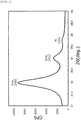
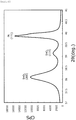
- The present invention provides a methane oxidation catalyst for oxidizing methane in exhaust gas, in which platinum is supported on tin oxide. The catalyst satisfies formula (1) below where x is a platinum content (wt%) relative to tin oxide, and y is a ratio of a peak intensity of (111)-faceted platinum relative to a peak intensity of (111)-faceted tin oxide (Pt (111)/SnO2 (111)) in a diffraction pattern (2θ = 37 to 41°) obtained using an X-ray diffractometer (XRD).

- The methane oxidation catalyst according to the present invention in which platinum is supported on tin oxide can exhibit superior methane oxidation activity at lower temperatures if the formula (1) above is satisfied.
-
-
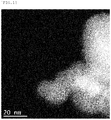
Fig. 1 is a TEM image of tin oxide powder on which Pt is supported according to Example 1-3. -
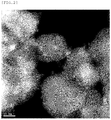
Fig. 2 is a TEM image of tin oxide powder on which Pt is supported according to Comparative Example 1-3. -
Fig. 3 is a diffraction pattern (2θ = 37 to 41°) of tin oxide powder on which Pt is supported according to Example 1-3 obtained using an X-ray diffractometer (XRD). -
Fig. 4 is a diffraction pattern (2θ = 37 to 41°) of tin oxide powder on which Pt is supported according to Comparative Example 1-3 obtained using an X-ray diffractometer (XRD). -
Fig. 5 is a graph showing the relationship between Pt content and 50% CH4 conversion temperature (T50) for Examples and Comparative Examples. - The present invention will now be described by means of embodiments. However, the present invention is not limited to the embodiments described below.
- The methane oxidation catalyst according to one embodiment of the present invention (hereinafter referred to as "the present methane oxidation catalyst") is a methane oxidation catalyst in which platinum is supported on tin oxide and which has a catalytic activity of oxidizing methane in exhaust gas.
- The present methane oxidation catalyst satisfies formula (1), where x is a platinum content (wt%) relative to tin oxide, and y is a ratio of a peak intensity of (111)-faceted platinum relative to a peak intensity of (111)-faceted tin oxide (Pt(111)/SnO2(111)), in a diffraction pattern (2θ = 37 to 41°) obtained using an X-ray diffractometer (XRD).

- When formula (1) is satisfied, platinum, which has an extremely smaller particle diameter than tin oxide, is highly dispersed and supported on the surface of tin oxide, and thus superior methane oxidation activity can be exerted at lower temperatures.
- The present methane oxidation catalyst preferably satisfies formula (2), where x is a platinum content (wt%) relative to tin oxide, and z is a ratio of a peak intensity of (111)-faceted platinum relative to a peak intensity of (200)-faceted tin oxide (Pt (111)/SnO2 (200)), in a diffraction pattern (2θ = 37 to 41°) obtained using an X-ray diffractometer (XRD).

- When formula (2) is satisfied, platinum, which has an extremely smaller particle diameter than tin oxide, is highly dispersed and supported on the surface of tin oxide, and thus superior methane oxidation activity can be exerted at lower temperatures.
- The present methane oxidation catalyst satisfying formula (1) or both formulas (1) and (2) is produced preferably by, as described later, dissolving dinitrodiamine-Pt in nitric acid to prepare a platinum solution having a pH of 2 or less, preferably 1 or less, heating the solution, and then adding tin oxide powder to the solution. A tin oxide having a high specific surface area is also preferably used. However, this manufacturing method is not limitative.
- The present methane oxidation catalyst preferably has a volume cumulative particle diameter D50 (hereinafter referred to as "D50") measured using a laser diffraction particle size distribution measurement apparatus of 0.1 µm to 100 µm.
- The present methane oxidation catalyst having a D50 of 0.1 µm or more has a higher strength when formed into a honeycomb or pellet structure, and the present methane oxidation catalyst having a D50 of 100 µm or less can allow the platinum particles to be uniformly dispersed and supported on the surface of tin oxide.
- For these reasons, the present methane oxidation catalyst preferably has a D50 of 0.1 µm to 100 µm, and, within this range, more preferably 0.5 µm or more, or 50 µm or less, and still more preferably 1.0 µm or more or 20 µm or less.
- The D50 of the present methane oxidation catalyst can be adjusted by, for example, optimizing drying and calcining conditions in the manufacturing process of the catalyst, or mechanically crushing tin oxide using, for example, a bead mill before or after platinum is supported on tin oxide. However, these methods are not limitative.
- In the present methane oxidation catalyst, the tin oxide as a support preferably has a specific surface area, after calcining, of 10 to 100 m2/g.
- Tin oxide having a specific surface area of 10 m2/g or more and 100 m2/g or less can allow platinum particles to be uniformly dispersed on its surface.
- For this reason, the tin oxide has a specific surface area of preferably 10 to 100 m2/g, and, within this range, more preferably 20 m2/g or more, or 90 m2/g or less, and still more preferably 35 m2/g or more, or 60 m2/g or less.
- The specific surface area of tin oxide can be adjusted by, for example, optimizing synthesis, drying, and calcining conditions in the manufacturing process of tin oxide, or mechanically crushing tin oxide using, for example, a bead mill. However, these methods are not limitative.
- To reduce sintering of tin oxide to reduce a decrease in its specific surface area after calcining, various elements can be solid-solubilized in tin oxide, or the surface of tin oxide can be covered with a compound of such elements. Examples of such elements include Si, Al, Zr, Ce, La, Fe, Mn, Ni, Co, Cu, W, Mo, V, Ca, Ba, Mg, Pd, Rh, and Ru.
- The present methane oxidation catalyst preferably includes tin oxide with a crystallite diameter of 5 nm to 100 nm.
- Tin oxide with a crystallite diameter of 5 nm to 100 nm can allow platinum particles to be uniformly dispersed and supported on the surface of tin oxide, and thus can allow the supported platinum to be present on the surface of the tin oxide in a highly dispersed manner.
- For this reason, the tin oxide has a crystallite diameter of preferably 5 nm to 100 nm, and, within this range, more preferably 10 nm or more, or 50 nm or less, and still more preferably 12 nm or more, or 35 nm or less.
- The crystallite diameter of tin oxide can be adjusted by, for example, optimizing synthesis, drying, and calcining conditions in the manufacturing process of tin oxide, or mechanically crushing tin oxide using, for example, a bead mill. However, these methods are not limitative.
- The present methane oxidation catalyst preferably has a y of 1.0 or less where y is a ratio of a peak intensity of (111)-faceted platinum relative to a peak intensity of (111)-faceted tin oxide (Pt(111)/SnO2(111)) in a diffraction pattern (2θ = 37 to 41°) obtained using an X-ray diffractometer (XRD). This also includes the case where y is zero, in other words, no peak of platinum appears in the diffraction pattern of the methane oxidation catalyst although platinum is contained.
- Above mentioned y being 1.0 or less indicates that platinum in the form of very fine particulates is highly dispersed and supported on the surface of tin oxide. Thus, the platinum has many active sites, and can exert superior methane oxidation activity at lower temperatures.
- For this reason, y is preferably 1.0 or less, and, within this range, more preferably 0.1 or more, or 0.6 or less.
- The present methane oxidation catalyst preferably has a z of 1.0 or less where z is a ratio of a peak intensity of (111)-faceted platinum relative to a peak intensity of (200)-faceted tin oxide (Pt (111)/SnO2 (200)) in a diffraction pattern (2θ = 37 to 41°) obtained using an X-ray diffractometer (XRD). This also includes the case where z is zero, in other words, no peak of platinum appears in the diffraction pattern of the methane oxidation catalyst although platinum is contained.
- For this reason, z is preferably 1.0 or less, and, within this range, more preferably 0.05 or more, or 0.3 or less.
- The present methane oxidation catalyst in which y is 1.0 or less, or z is 1.0 or less is preferably produced by, as described later, dissolving dinitrodiamine-Pt in nitric acid to prepare a platinum solution with a pH of 2 or less, preferably 1 or less, heating the solution, and then adding tin oxide to the solution. However, this manufacturing method is not limitative.
- In the present methane oxidation catalyst, the amount of platinum oxide is preferably 45 atom % or less of all the platinum supported on tin oxide. This means non-oxide platinum with superior oxidation activity is contained in a greater amount, resulting in higher methane oxidation performance. The non-oxide platinum as used herein means metal platinum or Pt-Sn alloy, or both.
- In the present methane oxidation catalyst, the amount of platinum oxide is thus preferably 45 atom % or less, more preferably 40 atom % or less, and still more preferably 25 atom % or less of all the platinum supported on tin oxide.
- The present methane oxidation catalyst preferably contains platinum which is supported on tin oxide with a particle diameter, or an average primary particle diameter, of 0.5 nm to 2.5 nm, which is measured by observation using a transmission electron microscope (TEM).
- Platinum with a particle diameter of 0.5 nm to 2.5 nm can be highly dispersed on tin oxide.
- For this reason, platinum which is supported on tin oxide has a particle diameter of preferably 0.5 nm to 2.5 nm, and, within this range, more preferably 0.5 nm or more, or 2.0 nm or less, and still more preferably 0.7 nm or more, or 1.5 nm or less.
- The particle diameter of platinum can be adjusted by, for example, adjusting the types of platinum salts, or platinum support conditions including the temperature, pH, and concentration of the platinum solution to be used. However, this method is not limitative.
- The present methane oxidation catalyst preferably contains no coarse platinum particles for efficiently improving methane oxidation activity. Thus, platinum preferably has a maximum particle diameter of 50 nm or less.
- The maximum particle diameter of the present methane oxidation catalyst can be adjusted by, for example, optimizing the type of platinum solution salts, or platinum support conditions including the temperature and pH of the platinum solution to be used. However, this method is not limitative.
- The present methane oxidation catalyst preferably has a platinum content of 0.5 to 35 wt% relative to tin oxide.
- A platinum content of 0.5 wt% or more relative to tin oxide enables methane to be efficiently oxidized, and 35 wt% or less can reduce coarsening of platinum particles.
- For these reasons, the platinum content relative to tin oxide is preferably 0.5 to 35 wt%, and, within this range, more preferably 1 wt% or more, or 20 wt% or less, and still more preferably 3 wt% or more, or 15 wt% or less.
- The platinum content (wt%) can be measured by the method of: dissolving the present methane oxidation catalyst by an appropriate method to prepare a solution, subjecting the solution to ICP emission spectrometry to measure Pt ion concentration A (wt%) and Sn ion concentration B (wt%), and using the values of A and B and the formula below to calculate the platinum content relative to tin oxide (wt%).

- The present methane oxidation catalyst may be produced by, for example, the method of adding tin oxide powder (SnO2 powder) to a platinum solution (Pt solution) to allow the SnO2 particles to support Pt, followed by drying and calcining. More specifically, dinitrodiamine-Pt is dissolved in nitric acid to prepare a platinum solution with a pH of 2 or less, preferably 1 or less, the solution is then heated to a temperature of 50 °C to 80 °C, to the solution, tin oxide powder is then added to allow the tin oxide particles to support platinum, followed by evaporation to dryness, drying, and calcining to obtain the present methane oxidation catalyst. This manufacturing method enables tin oxide to support ultrafine platinum particles in a uniformly dispersed manner as the present methane oxidation catalyst, because, the present inventors consider, heating a platinum solution after its preparation to 50 °C to 80 °C allows the platinum complexes in the solution to appropriately aggregate, and the appropriately aggregated platinum complexes adhere to the surfaces of tin oxide particles charged into the solution in a manner appropriately spaced apart from one another.
- The present methane oxidation catalyst may be used in the form of, for example, powder, grains, or granules (including spherical shapes). However, these forms are not limitative.
- The present methane oxidation catalyst is formed into, for example, a powdery methane oxidation catalyst. The powdery methane oxidation catalyst can be further formed into pellet (cylindrical or ring-shaped), tablet, honeycomb (monolith structure) or plate (layered) shaped compacts, or methane oxidation catalyst compacts. These compacts can be further laminated on a substrate formed from ceramics or a metal material.
- The substrate may be formed from a heat resistant material such as ceramics, or a metal material.
- The ceramic substrate may be formed from a fire-resistant ceramic material, examples of which include cordierite, cordierite-alpha alumina, silicon-nitride, zircon-mullite, alumina-silica magnesia, zircon-silicate, sillimanite, magnesium silicate, zircon, petalite, alpha alumina, and aluminosilicates.
- The metal substrate may be formed from a heat resistant metal, examples of which include stainless steel and other appropriate iron-based heat resistant alloys.
- The substrate may have a honeycomb, pellet, or spherical shape.
- The honeycomb-shaped substrate may be formed from a cordierite material, such as ceramics, or a metal material, such as ferritic stainless steel.
- It has been found that the present methane oxidation catalyst supported on a honeycomb substrate can exert methane oxidation activity at further lower temperatures.
- The catalyst of this structure can be formed, for example, by mixing and stirring the present methane oxidation catalyst, a binder as appropriate, and water to prepare slurry, applying the slurry onto a substrate, such as a ceramic honeycomb structure, and calcining them to allow a layer of the present catalyst to be formed on a surface of the substrate.
- The catalyst of this structure may be manufactured in any known method, and is not limited to the method described above.
- The catalyst layer may be a single layer or may consist of multiple layers regardless of the manufacturing methods.
- The present methane oxidation catalyst has superior methane oxidation activity, and thus can maintain about the same low-temperature activity with less Pt content than conventional methane oxidation catalysts.
- As used herein, the phrase "C to D", where C and D denote any numbers, includes "preferably greater than C" or "preferably less than D" as well as "C or more and D or less" unless otherwise noted.
- "C or more", where C denotes any number, or "D or less" where D denotes any number, includes "preferably greater than C" or "preferably less than D".
- The present invention will now be further described in detail with reference to Examples and Comparative Examples below.
- Dinitrodiamine-Pt was dissolved in ammonia water to prepare a Pt solution with a pH of 10, and the solution was heated to 60 °C. To the Pt solution, tin oxide powder with a predetermined concentration (D50 = 44 µm, BET = 14 m2/g) was added to allow the SnO2 particles to support Pt. The solution was then heated to evaporate to dryness, further dried with a large hot-air dryer, calcined at 550 °C for 3 hours in the atmospheric environment, and crushed in a mortar to obtain tin oxide powder on which Pt is supported (sample).
- In the preparation of a Pt solution above, the Pt content was varied to obtain Pt solutions having a Pt (platinum) content relative to SnO2 of 2 wt% (Comparative Example 1-1), 4 wt% (Comparative Example 1-2), 8 wt% (Comparative Example 1-3), and 12 wt% (Comparative Example 1-4).
- Dinitrodiamine-Pt was dissolved in ammonia water to prepare a Pt solution with a pH of 10, and the solution was heated to 60 °C. To the Pt solution, tin oxide powder with a predetermined concentration (D50 = 1.2 µm, BET = 39 m2/g) was added to allow the SnO2 particles to support Pt. The solution was then heated to evaporate to dryness, further dried with a large hot-air dryer, calcined at 550 °C for 3 hours in the atmospheric environment, and crushed in a mortar to obtain tin oxide powder on which Pt is supported (sample).
- In the preparation of a Pt solution above, the Pt content was varied to obtain Pt solutions having a Pt (platinum) content relative to SnO2 of 2 wt% (Comparative Example 2-1), 4 wt% (Comparative Example 2-2), 8 wt% (Comparative Example 2-3), and 12 wt% (Comparative Example 2-4).
- Dinitrodiamine-Pt was dissolved in nitric acid to prepare a Pt solution with a pH of 1 or less, and the solution was then heated to 60 °C. To the Pt solution, tin oxide powder with a predetermined concentration (D50 = 44 µm, BET = 14 m2/g) was added to allow the SnO2 particles to support Pt. The solution was then heated to evaporate to dryness, further dried with a large hot-air dryer, calcined at 550 °C for 3 hours in the atmospheric environment, and crushed in a mortar to obtain tin oxide powder on which Pt is supported (sample).
- In the preparation of a Pt solution above, the Pt content was varied to obtain Pt solutions having a Pt (platinum) content relative to SnO2 of 2 wt% (Example 1-1), 4 wt% (Example 1-2), 8 wt% (Example 1-3), and 12 wt% (Example 1-4).
- Dinitrodiamine-Pt was dissolved in nitric acid to prepare a Pt solution with a pH of 1 or less, and the solution was then heated to 60 °C. To the Pt solution, tin oxide powder with a predetermined concentration (D50 = 1.2 µm, BET = 39 m2/g) was added to allow the SnO2 particles to support Pt. The solution was then heated to evaporate to dryness, further dried with a large hot-air dryer, calcined at 550 °C for 3 hours in the atmospheric environment, and crushed in a mortar to obtain tin oxide powder on which Pt is supported (sample).
- In the preparation of a Pt solution above, the Pt content was varied to obtain Pt solutions having a Pt (platinum) content relative to SnO2 of 2 wt% (Example 2-1), 4 wt% (Example 2-2), 8 wt% (Example 2-3), and 12 wt% (Example 2-4).
- The crystallite diameters of tin oxide (host material) in the tin oxide powders on which Pt is supported obtained in Examples and Comparative Examples were each measured by the Rietveld method as described below.
- An X-ray diffractometer using Cu-Kα radiation (RINT-TTRIII manufactured by Rigaku) was used, and analysis was carried out using MDI Jade 7 software for analysis (manufactured by Materials Date) .
-
- X-ray source: CuKα, Operational axis: 2θ/θ, Measurement method: sequential, Counting unit: cps
- Start angle: 5°, End angle: 80°,
- Sampling width: 0.02°, Scan speed: 20°/min,
- Voltage: 50 kV, Current: 300 mA
- Divergence slit: 2/3°, Vertical divergence: 10 mm
- Scattering slit: 2/3°, Receiving slit: 0.15 mm
- The tin oxide powders on which Pt is supported obtained in Examples and Comparative Examples were observed using a transmission electron microscope (H-9000UHR manufactured by Hitachi) at an acceleration voltage of 200 kV and at 50000 x magnification. Primary particles of the platinum in each image were counted for 200 of them using Feret's diameter, and their average diameter was calculated as a platinum particle diameter (TEM diameter) of each sample.
- The tin oxide powders on which Pt is supported obtained in Examples and Comparative Examples were subjected to X-ray photoelectron spectroscopy (XPS) surface analysis using an X-ray photoelectron spectrometer (VersaProve II manufactured by ULVAC-PHI) to measure a rate of Pt metal: RPt-metal (atom %) and a rate of Pt oxide: RPt-oxide (atom %). Using these values and the formula below, the rate of platinum oxide (atom %) for each sample was calculated. The X-ray source was Al radiation (1486. 6 eV) .

- As used herein, the rate of platinum oxide in platinum which is supported on tin oxide is the rate of platinum oxide defined by formula above in the analysis area on the surface and its neighborhood of a methane oxidation catalyst measured by X-ray photoelectron spectroscopy.
- The tin oxide powders on which Pt is supported obtained in Examples and Comparative Examples were subjected to an apparatus RINT-TTRIII manufactured by Rigaku to measure their diffraction patterns under the conditions described below, and their respective peak intensity ratios were obtained based on the diffraction patterns.
-
- X-ray source: CuKα, Operational axis: 2θ/θ, Measurement method: sequential, Counting unit: cps
- Start angle: 37°, End angle: 41°,
- Sampling width: 0.01°, Scan speed: 0.1°/min,
- Voltage: 50 kV, Current: 300 mA
- Divergence slit: 2/3°, Vertical divergence: 10 mm
- Scattering slit: 2/3°, Receiving slit: 0.15 mm
- In Table 1 below, in the diffraction pattern (2θ = 37 to 41°), samples satisfying formula (1): y ≤ 0.27 x, where x is a platinum content (wt%) relative to tin oxide, and y is a ratio of a peak intensity of (111)-faceted platinum relative to a peak intensity of (111)-faceted tin oxide (Pt(111)/SnO2(111)), were indicated with a "○", and samples failing to satisfy formula (1) were indicated with a "×".
- In the diffraction pattern (2θ = 37 to 41°), samples satisfying formula (2): z ≤ 0.1 x, where x is a platinum content (wt%) relative to tin oxide, and z is a ratio of a peak intensity of (111)-faceted platinum relative to the peak intensity of (200)-faceted tin oxide (Pt (111)/SnO2 (200)), were indicated with a "○", and samples failing to satisfy formula (1) were indicated with a "×".
- The tin oxide powders on which Pt is supported obtained in Examples and Comparative Examples were granulated to catalytic particles with a particle size of 0.35 mm to 0.6 mm. 0.05 g of the respective catalytic particles were then filled into a quartz reactor with a φ 10 mm. To each reactor, a model gas (inlet gas) with the composition: CH4: 0.2%, O2: 10%, CO2: 4.9%, H2O: 10%, N2 Balance: 75% was supplied at a space velocity (SV) of 150000 h-1, and the CH4 concentration of the gas passed through the catalytic particles (outlet gas) was measured using a hydrogen flame ionization detector while the temperature was raised to 600 °C at a rate of 10 °C /min. The difference in CH4 concentration between the inlet gas and the outlet gas was used to calculate the conversion rate. T50 is the temperature at which the conversion rate reaches 50%.
[Table 1] Crystallite diameter of tin oxide supporting Pt (nm) Particle diameter of Pt (nm) Ratie of Pt oxide (atom%) Pt content (wt%) Pt(111) /SnO2(111) Pt(111) /SnO2(200) Formula (1) y≦0.27x Formula (2) z≦0.1x 50% CH4 conversion Temp. (T50) x y z y-0.27x Formula(1) z-0.1x Formula (2) °C Comp. Ex 1-1 30 3.2 52 2 1.71 0.47 1.17 × 0.27 × 556 Comp. Ex 1-2 4 4.05 1.17 2.97 × 0.77 × 519 Comp. Ex 1-3 8 5.10 1.49 2.94 × 0.69 × 517 Comp. Ex 1-4 12 6.01 1.80 2.77 × 0.60 × 510 Comp. Ex 2-1 15 2.6 38 2 0.81 0.33 0.27 × 0.13 × 532 Comp. Ex 2-2 4 1.77 0.74 0.69 × 0.34 × 487 Comp. Ex 2-3 8 7.18 3.12 5.02 × 2.32 × 469 Comp. Ex 2-4 12 3.43 1.62 0.19 × 0.42 × 462 Example 1-1 30 1.7 52 2 0.24 0.06 -0.30 ○ -0.14 ○ 515 Example 1-2 4 0.24 0.07 -0.84 ○ -0.33 ○ 464 Example 1-3 8 0.41 0.12 -1.75 ○ -0.68 ○ 444 Example 1-4 12 2.68 0.81 -0.56 ○ -0.39 ○ 442 Example2-1 15 1.1 21 2 0.45 0.18 -0.09 ○ -0.02 ○ 497 Example2-2 4 0.44 0.18 -0.64 ○ -0.22 ○ 434 Example2-3 8 0.51 0.22 -1.65 ○ -0.58 ○ 433 Example2-4 12 0.55 0.24 -2.69 ○ -0.96 ○ 422 - Examples above and the results of experiments carried out so far by the present inventors revealed that in the diffraction patterns of methane oxidation catalysts in which platinum is supported on tin oxide, the methane oxidation catalysts of Examples satisfying formula (1): y ≤ 0.27 x, where x is a platinum content (wt%) relative to tin oxide, and y is a ratio of a peak intensity of (111)-faceted platinum relative to a peak intensity of (111)-faceted tin oxide (Pt(111)/SnO2(111)), showed a superior methane oxidation activity at lower temperatures than Comparative Examples with the same platinum content. Thus, the methane oxidation catalysts of Examples with even less Pt content can exert a methane oxidation activity greater than or equal to Comparative Examples.
- This is seemingly because platinum with a very smaller particle diameter than tin oxide is highly dispersed and supported on the surfaces of the tin oxide particles.
Claims (8)
- A methane oxidation catalyst for oxidizing methane in exhaust gas having a structure in which platinum is supported on tin oxide, wherein formula (1) is satisfied in a diffraction pattern (2θ = 37 to 41°) obtained using an X-ray diffractometer (XRD).

- The methane oxidation catalyst according to claim 1, having a platinum content relative to tin oxide of 0.5 to 35 wt%.
- The methane oxidation catalyst according to claim 1 or 2, wherein y in the formula (1) is 1.0 or less.
- The methane oxidation catalyst according to any one of claims 1 to 3, wherein Pt oxide accounts for 45 atom % or less of the platinum supported on tin oxide.
- The methane oxidation catalyst according to any one of claims 1 to 4, wherein the platinum which is supported on tin oxide has a particle diameter determined by observation with a transmission electron microscope (TEM) of 0.5 nm to 2.5 nm.
- The methane oxidation catalyst according to any one of claims 1 to 5, wherein the tin oxide has a specific surface area of 10 to 100 m2/g.
- A methane oxidation catalyst molded product obtained by molding the methane oxidation catalyst according to any one of claims 1 to 6.
- A methane oxidation catalyst structure, comprising the methane oxidation catalyst molded product according to claim 7 and a substrate.
Applications Claiming Priority (2)
| Application Number | Priority Date | Filing Date | Title |
|---|---|---|---|
| JP2016160055 | 2016-08-17 | ||
| PCT/JP2017/022291 WO2018034050A1 (en) | 2016-08-17 | 2017-06-16 | Methane oxidation catalyst |
Publications (2)
| Publication Number | Publication Date |
|---|---|
| EP3501639A1 true EP3501639A1 (en) | 2019-06-26 |
| EP3501639A4 EP3501639A4 (en) | 2020-04-01 |
Family
ID=61196607
Family Applications (1)
| Application Number | Title | Priority Date | Filing Date |
|---|---|---|---|
| EP17841278.9A Pending EP3501639A4 (en) | 2016-08-17 | 2017-06-16 | METHANE OXIDATION CATALYST |
Country Status (5)
| Country | Link |
|---|---|
| US (1) | US20190193056A1 (en) |
| EP (1) | EP3501639A4 (en) |
| JP (1) | JP6670386B2 (en) |
| CN (1) | CN109562357B (en) |
| WO (1) | WO2018034050A1 (en) |
Families Citing this family (7)
| Publication number | Priority date | Publication date | Assignee | Title |
|---|---|---|---|---|
| EP3667315B1 (en) * | 2018-12-12 | 2025-03-26 | HORIBA, Ltd. | Exhaust gas analysis apparatus, and exhaust gas analysis method |
| US20230105398A1 (en) * | 2020-03-27 | 2023-04-06 | Mitsui Mining & Smelting Co., Ltd. | Electrode catalyst layer for electrochemical cells, membrane electrode assembly for electrochemical cells, and electrochemical cell |
| US11745173B2 (en) * | 2020-03-31 | 2023-09-05 | Johnson Matthey Public Limited Company | Tin incorporated catalysts for gasoline engine exhaust gas treatments |
| JP6883135B1 (en) * | 2020-05-15 | 2021-06-09 | 田中貴金属工業株式会社 | Methane combustion catalyst, its manufacturing method, and combustion exhaust gas purification method |
| CN115916398A (en) * | 2020-06-09 | 2023-04-04 | 三井金属矿业株式会社 | Composition for undercoat layer, undercoat layer, catalyst for purifying exhaust gas and exhaust gas purifying device provided with undercoat layer |
| JP7038269B1 (en) | 2021-01-07 | 2022-03-17 | 田中貴金属工業株式会社 | Methane combustion catalyst, its manufacturing method, and combustion exhaust gas purification method |
| JP7178127B1 (en) * | 2021-07-01 | 2022-11-25 | 石福金属興業株式会社 | METHOD FOR MANUFACTURING FUEL CELL ELECTROCATALYST |
Family Cites Families (61)
| Publication number | Priority date | Publication date | Assignee | Title |
|---|---|---|---|---|
| US3494599A (en) * | 1967-10-06 | 1970-02-10 | Scheu Prod Co | Portable forced-air heater |
| US3740328A (en) * | 1969-03-17 | 1973-06-19 | Universal Oil Prod Co | Hydrocarbon conversion process and catalyst therefor |
| US3632525A (en) * | 1969-04-25 | 1972-01-04 | Universal Oil Prod Co | Hydrocarbon isomerization catalyst |
| US3772397A (en) * | 1969-04-25 | 1973-11-13 | Universal Oil Prod Co | Hydrocarbon isomerization process |
| US3692701A (en) * | 1970-07-15 | 1972-09-19 | Phillips Petroleum Co | Group viii metals on tin-containing supports dehydrogenation catalysts |
| US3702294A (en) * | 1971-05-10 | 1972-11-07 | Universal Oil Prod Co | Trimetallic hydrocarbon conversion catalyst and uses thereof |
| US3878131A (en) * | 1971-09-29 | 1975-04-15 | Universal Oil Prod Co | Multicomponent dehydrogenation catalyst |
| US3745112A (en) * | 1971-11-23 | 1973-07-10 | Universal Oil Prod Co | Platinum-tin uniformly dispersed hydro-carbon conversion catalyst and process |
| US3847794A (en) * | 1971-11-23 | 1974-11-12 | Universal Oil Prod Co | Sulfur-free reforming with a platinum-tin catalyst |
| US3846283A (en) * | 1971-11-23 | 1974-11-05 | Universal Oil Prod Co | Bimetallic catalytic reforming with halogen addition |
| SE369164B (en) * | 1972-04-24 | 1974-08-12 | Ab Rockwool | |
| US3968053A (en) * | 1973-10-12 | 1976-07-06 | Universal Oil Products Company | Catalytic reforming with an activated bimetallic catalytic composite |
| US3948804A (en) * | 1973-12-10 | 1976-04-06 | Universal Oil Products Company | Superactive acidic bimetallic catalytic composite and use thereof in conversion of hydrocarbons |
| US4032434A (en) * | 1973-12-10 | 1977-06-28 | Uop Inc. | Conversion of hydrocarbons with a superactive acidic bimetallic catalytic composite |
| US4117082A (en) * | 1974-04-19 | 1978-09-26 | Figaro Giken Co., Ltd. | Method of completely oxidizing carbon monoxide |
| US3992476A (en) * | 1974-06-19 | 1976-11-16 | Universal Oil Products Company | Paraffin isomerizaton with a catalytic composite of platinum or palladium metal, rhodium metal, tin oxide, halogen and alumina carrier |
| US3986948A (en) * | 1974-06-19 | 1976-10-19 | Universal Oil Products Company | Hydrocarbon conversion with a sulfided acidic multimetallic catalytic composite |
| US4008180A (en) * | 1974-06-19 | 1977-02-15 | Universal Oil Products Company | Dehydrogenation method and multimetallic catalytic composite for use therein |
| US4016068A (en) * | 1974-06-21 | 1977-04-05 | Uop Inc. | Catalytic reforming with an activated bimetallic catalytic composite |
| US3951867A (en) * | 1974-10-07 | 1976-04-20 | Corning Glass Works | Coprecipitated CeO2 --SnO2 catalyst supports |
| US4072731A (en) * | 1975-04-16 | 1978-02-07 | Uop Inc. | Dehydrocyclization with an acidic multimetallic catalytic composite |
| US4124649A (en) * | 1975-04-24 | 1978-11-07 | Uop Inc. | Hydrocarbon dehydrogenation method |
| US4018845A (en) * | 1975-06-06 | 1977-04-19 | Uop Inc. | Hydrocarbon isomerization process |
| US4024199A (en) * | 1975-06-06 | 1977-05-17 | Uop Inc. | Hydrocarbon isomerization process |
| US4018839A (en) * | 1975-06-06 | 1977-04-19 | Uop Inc. | Hydrocarbon isomerization process |
| JPS5588848A (en) * | 1978-12-27 | 1980-07-04 | Tanaka Kikinzoku Kogyo Kk | Production of exhaust gas cleaning catalyst |
| US4486547A (en) * | 1981-11-05 | 1984-12-04 | Uop Inc. | Indium-containing dehydrogenation catalyst |
| EP0089183B1 (en) * | 1982-03-12 | 1987-07-08 | Cjb Developments Limited | Process for the removal of hydrogen from gases |
| US4520223A (en) * | 1982-05-19 | 1985-05-28 | Mcginnis Roger N | Dehydrogenation process |
| US4522935A (en) * | 1983-06-02 | 1985-06-11 | Uop Inc. | Platinum and indium-containing catalyst for reforming hydrocarbons |
| US4529505A (en) * | 1983-06-02 | 1985-07-16 | Uop Inc. | Indium-containing catalyst for reforming hydrocarbons |
| US4551574A (en) * | 1983-06-02 | 1985-11-05 | Uop Inc. | Indium-containing dehydrogenation catalyst |
| US4487848A (en) * | 1983-06-02 | 1984-12-11 | Uop Inc. | Indium-containing catalyst for reforming hydrocarbons |
| US4839330A (en) * | 1986-06-12 | 1989-06-13 | The United States Of America As Repesented By The Administrator Of The National Aeronautics And Space Administration | Isotope exchange in oxide-containing catalyst |
| US4830844A (en) * | 1987-10-06 | 1989-05-16 | Phillips Petroleum Company | Oxidation of carbon monoxide and catalyst composition therefor |
| US4991181A (en) * | 1989-01-18 | 1991-02-05 | The United States Of America As Represented By The Administrator Of The National Aeronautics And Space Administration | Catalyst for carbon monoxide oxidation |
| US4912082A (en) * | 1989-01-18 | 1990-03-27 | The United States Of America As Represeted By The Administrator Of The National Aeronautics And Space Administration | Catalyst for carbon monoxide oxidation |
| GB9010709D0 (en) * | 1990-05-12 | 1990-07-04 | Johnson Matthey Plc | Catalytic reduction |
| US5220091A (en) * | 1992-02-26 | 1993-06-15 | Phillips Petroleum Company | Alkane dehydrogenation |
| JPH06305715A (en) * | 1993-04-19 | 1994-11-01 | Mitsubishi Gas Chem Co Inc | Production of hydrogen peroxide |
| GB9316955D0 (en) * | 1993-08-14 | 1993-09-29 | Johnson Matthey Plc | Improvements in catalysts |
| US5922487A (en) * | 1995-01-24 | 1999-07-13 | Tanaka Kikinzoku Kogyo K.K. | Anode electrocatalyst for fuel cell and process of preparing same |
| US5994606A (en) * | 1995-03-08 | 1999-11-30 | Mitsubishi Chemical Corporation | Method for dehydrogenation of hydrocarbon |
| US5905180A (en) * | 1996-01-22 | 1999-05-18 | Regents Of The University Of Minnesota | Catalytic oxidative dehydrogenation process and catalyst |
| US6132694A (en) * | 1997-12-16 | 2000-10-17 | The United States Of America As Represented By The Administrator Of The National Aeronautics And Space Administration | Catalyst for oxidation of volatile organic compounds |
| JP2002253969A (en) * | 2001-03-02 | 2002-09-10 | Osaka Gas Co Ltd | Catalyst for purifying waste gas and method of purifying waste gas |
| US7390768B2 (en) * | 2002-01-22 | 2008-06-24 | The United States Of America As Represented By The Administrator Of The National Aeronautics And Space Administration | Stabilized tin-oxide-based oxidation/reduction catalysts |
| JP4283037B2 (en) * | 2003-05-26 | 2009-06-24 | 東京瓦斯株式会社 | Catalyst for oxidation removal of methane in exhaust gas and exhaust gas purification method |
| US7897293B2 (en) * | 2003-10-20 | 2011-03-01 | The United States Of America As Represented By The Secretary Of The Navy | Platinum-impregnated hydrous tin oxide catalysts |
| US7371358B2 (en) * | 2004-10-25 | 2008-05-13 | The United States Of America As Represented By The Administrator Of The National Aeronautics And Space Administration | Catalyst for treatment and control of post-combustion emissions |
| JP2006159021A (en) * | 2004-12-03 | 2006-06-22 | Toyota Motor Corp | Exhaust gas purification catalyst |
| US7332454B2 (en) * | 2005-03-16 | 2008-02-19 | Sud-Chemie Inc. | Oxidation catalyst on a substrate utilized for the purification of exhaust gases |
| JP4429950B2 (en) * | 2005-03-28 | 2010-03-10 | 東京瓦斯株式会社 | Catalyst for removing oxidation of methane from combustion exhaust gas and exhaust gas purification method |
| US7655595B2 (en) * | 2006-06-02 | 2010-02-02 | United States Of America As Represented By The Administrator Of The National Aeronautics And Space Administration | Sol-gel based oxidation catalyst and coating system using same |
| KR20090076408A (en) * | 2008-01-08 | 2009-07-13 | 삼성에스디아이 주식회사 | Lee Jong-sang Platinum Catalyst and Solar Cell Using the Same |
| US8637714B2 (en) * | 2008-07-31 | 2014-01-28 | Celanese International Corporation | Process for producing ethanol over catalysts containing platinum and palladium |
| US8309772B2 (en) * | 2008-07-31 | 2012-11-13 | Celanese International Corporation | Tunable catalyst gas phase hydrogenation of carboxylic acids |
| WO2010048407A1 (en) * | 2008-10-24 | 2010-04-29 | Nanosys, Inc. | Electrochemical catalysts for fuel cells |
| JP5836149B2 (en) * | 2011-03-08 | 2015-12-24 | 大阪瓦斯株式会社 | Methane oxidation removal catalyst and methane oxidation removal method |
| PL231314B1 (en) * | 2012-11-07 | 2019-02-28 | Univ Jagiellonski | Oxide catalyst carrier for low temperature combustion of methane from sources of low-calorie and its manufacturing |
| CN105797766B (en) * | 2016-04-21 | 2019-08-30 | 中广核研究院有限公司 | Monolithic catalyst for catalytic combustion of methane and preparation method thereof |
-
2017
- 2017-06-16 WO PCT/JP2017/022291 patent/WO2018034050A1/en not_active Ceased
- 2017-06-16 US US16/325,637 patent/US20190193056A1/en not_active Abandoned
- 2017-06-16 JP JP2018534280A patent/JP6670386B2/en active Active
- 2017-06-16 CN CN201780047552.XA patent/CN109562357B/en active Active
- 2017-06-16 EP EP17841278.9A patent/EP3501639A4/en active Pending
Also Published As
| Publication number | Publication date |
|---|---|
| JPWO2018034050A1 (en) | 2019-04-11 |
| US20190193056A1 (en) | 2019-06-27 |
| EP3501639A4 (en) | 2020-04-01 |
| CN109562357A (en) | 2019-04-02 |
| CN109562357B (en) | 2022-03-11 |
| JP6670386B2 (en) | 2020-03-18 |
| WO2018034050A1 (en) | 2018-02-22 |
Similar Documents
| Publication | Publication Date | Title |
|---|---|---|
| US20190193056A1 (en) | Methane oxidation catalyst | |
| EP2050497B1 (en) | Exhaust gas purifying catalyst and method of preparation | |
| EP2452750B1 (en) | Exhaust gas purifying catalyst and method for producing same | |
| JP5202336B2 (en) | Catalyst system used in automobile exhaust gas purification device, exhaust gas purification device using the same, and exhaust gas purification method | |
| EP3673992B1 (en) | Methane oxidizing catalyst | |
| WO2006030763A1 (en) | Cerium-zirconium-base composite oxide, process for producing the same, oxygen storage/release material using said cerium-zirconium-base composite oxide, exhaust gas purification catalyst, and exhaust gas purification method | |
| JP6319278B2 (en) | Method for producing oxygen storage material | |
| JP6514112B2 (en) | Exhaust gas purification catalyst | |
| JP5975104B2 (en) | Exhaust gas purification catalyst and method for producing the same | |
| EP1946834A1 (en) | Catalyst carrier particle, exhaust gas purifying catalyst, and methods for producing those | |
| JP4165419B2 (en) | Method for producing metal oxide particles and exhaust gas purification catalyst | |
| WO2018088201A1 (en) | Exhaust gas purifying three-way catalyst, method for manufacturing same, and exhaust gas purifying catalyst converter | |
| EP4066922A1 (en) | Catalyst composition for exhaust gas purification use, and catalyst for exhaust gas purification use | |
| JP2001347167A (en) | Exhaust gas purification catalyst | |
| JP6532825B2 (en) | Exhaust gas purification catalyst | |
| JP5116276B2 (en) | Powder comprising oxide microcrystal particles, catalyst using the same, and method for producing the same | |
| CN111278555B (en) | Composition for exhaust gas purification | |
| JP4670603B2 (en) | Catalyst particles and method for producing the same | |
| WO2016047504A1 (en) | Steam reforming catalyst composition and steam reforming catalyst | |
| Enache et al. | One step solid-state synthesis of lanthanum cobalt oxide perovskites as catalysts for oxygen evolution in alkaline media | |
| CN117504842B (en) | Catalyst for exhaust purification | |
| US20250229256A1 (en) | Exhaust gas purifying catalyst | |
| JP7748917B2 (en) | Methane combustion catalyst and method for producing same | |
| CN120265384A (en) | Three-way catalyst compositions comprising intermetallic compounds | |
| CN117120161A (en) | Exhaust gas purification catalyst composition and exhaust gas purification catalyst |
Legal Events
| Date | Code | Title | Description |
|---|---|---|---|
| STAA | Information on the status of an ep patent application or granted ep patent |
Free format text: STATUS: THE INTERNATIONAL PUBLICATION HAS BEEN MADE |
|
| PUAI | Public reference made under article 153(3) epc to a published international application that has entered the european phase |
Free format text: ORIGINAL CODE: 0009012 |
|
| STAA | Information on the status of an ep patent application or granted ep patent |
Free format text: STATUS: REQUEST FOR EXAMINATION WAS MADE |
|
| 17P | Request for examination filed |
Effective date: 20190111 |
|
| AK | Designated contracting states |
Kind code of ref document: A1 Designated state(s): AL AT BE BG CH CY CZ DE DK EE ES FI FR GB GR HR HU IE IS IT LI LT LU LV MC MK MT NL NO PL PT RO RS SE SI SK SM TR |
|
| AX | Request for extension of the european patent |
Extension state: BA ME |
|
| DAV | Request for validation of the european patent (deleted) | ||
| DAX | Request for extension of the european patent (deleted) | ||
| A4 | Supplementary search report drawn up and despatched |
Effective date: 20200304 |
|
| RIC1 | Information provided on ipc code assigned before grant |
Ipc: B01D 53/94 20060101ALI20200227BHEP Ipc: B01J 35/10 20060101ALI20200227BHEP Ipc: F01N 3/28 20060101ALI20200227BHEP Ipc: B01J 37/02 20060101ALI20200227BHEP Ipc: B01J 37/00 20060101ALI20200227BHEP Ipc: B01J 23/42 20060101ALI20200227BHEP Ipc: F01N 3/10 20060101ALI20200227BHEP Ipc: B01J 23/62 20060101AFI20200227BHEP Ipc: B01J 35/02 20060101ALI20200227BHEP Ipc: B01J 35/00 20060101ALI20200227BHEP |
|
| RAP1 | Party data changed (applicant data changed or rights of an application transferred) |
Owner name: MITSUI MINING & SMELTING CO., LTD. |
|
| STAA | Information on the status of an ep patent application or granted ep patent |
Free format text: STATUS: EXAMINATION IS IN PROGRESS |
|
| 17Q | First examination report despatched |
Effective date: 20230426 |
|
| RAP3 | Party data changed (applicant data changed or rights of an application transferred) |
Owner name: MITSUI KINZOKU COMPANY, LIMITED |