EP3501283A1 - Compositions and methods for increasing sugar yield from harvested sugar cane - Google Patents
Compositions and methods for increasing sugar yield from harvested sugar cane Download PDFInfo
- Publication number
- EP3501283A1 EP3501283A1 EP17208590.4A EP17208590A EP3501283A1 EP 3501283 A1 EP3501283 A1 EP 3501283A1 EP 17208590 A EP17208590 A EP 17208590A EP 3501283 A1 EP3501283 A1 EP 3501283A1
- Authority
- EP
- European Patent Office
- Prior art keywords
- acid
- ppm
- sugar cane
- antimicrobial
- peracid
- Prior art date
- Legal status (The legal status is an assumption and is not a legal conclusion. Google has not performed a legal analysis and makes no representation as to the accuracy of the status listed.)
- Withdrawn
Links
- 239000000203 mixture Substances 0.000 title claims abstract description 157
- 240000000111 Saccharum officinarum Species 0.000 title claims abstract description 139
- 235000007201 Saccharum officinarum Nutrition 0.000 title claims abstract description 139
- 238000000034 method Methods 0.000 title claims abstract description 70
- 230000000845 anti-microbial effect Effects 0.000 claims abstract description 98
- 150000004965 peroxy acids Chemical class 0.000 claims abstract description 63
- 229930006000 Sucrose Natural products 0.000 claims abstract description 55
- CZMRCDWAGMRECN-UGDNZRGBSA-N Sucrose Chemical compound O[C@H]1[C@H](O)[C@@H](CO)O[C@@]1(CO)O[C@@H]1[C@H](O)[C@@H](O)[C@H](O)[C@@H](CO)O1 CZMRCDWAGMRECN-UGDNZRGBSA-N 0.000 claims abstract description 55
- 239000005720 sucrose Substances 0.000 claims abstract description 53
- 238000003306 harvesting Methods 0.000 claims abstract description 22
- QTBSBXVTEAMEQO-UHFFFAOYSA-N Acetic acid Chemical compound CC(O)=O QTBSBXVTEAMEQO-UHFFFAOYSA-N 0.000 claims description 72
- MHAJPDPJQMAIIY-UHFFFAOYSA-N Hydrogen peroxide Chemical compound OO MHAJPDPJQMAIIY-UHFFFAOYSA-N 0.000 claims description 49
- KFSLWBXXFJQRDL-UHFFFAOYSA-N Peracetic acid Chemical compound CC(=O)OO KFSLWBXXFJQRDL-UHFFFAOYSA-N 0.000 claims description 44
- SCKXCAADGDQQCS-UHFFFAOYSA-N Performic acid Chemical compound OOC=O SCKXCAADGDQQCS-UHFFFAOYSA-N 0.000 claims description 39
- 150000001732 carboxylic acid derivatives Chemical class 0.000 claims description 34
- XLYOFNOQVPJJNP-UHFFFAOYSA-N water Substances O XLYOFNOQVPJJNP-UHFFFAOYSA-N 0.000 claims description 33
- 238000005507 spraying Methods 0.000 claims description 32
- 239000002738 chelating agent Substances 0.000 claims description 28
- WWZKQHOCKIZLMA-UHFFFAOYSA-N octanoic acid Chemical compound CCCCCCCC(O)=O WWZKQHOCKIZLMA-UHFFFAOYSA-N 0.000 claims description 27
- 235000011054 acetic acid Nutrition 0.000 claims description 24
- -1 sanitizers Substances 0.000 claims description 23
- 150000002978 peroxides Chemical class 0.000 claims description 20
- 239000004599 antimicrobial Substances 0.000 claims description 19
- 239000004615 ingredient Substances 0.000 claims description 17
- WPYMKLBDIGXBTP-UHFFFAOYSA-N benzoic acid Chemical compound OC(=O)C1=CC=CC=C1 WPYMKLBDIGXBTP-UHFFFAOYSA-N 0.000 claims description 14
- OBETXYAYXDNJHR-UHFFFAOYSA-N alpha-ethylcaproic acid Natural products CCCCC(CC)C(O)=O OBETXYAYXDNJHR-UHFFFAOYSA-N 0.000 claims description 13
- 239000002562 thickening agent Substances 0.000 claims description 13
- ABLZXFCXXLZCGV-UHFFFAOYSA-N Phosphorous acid Chemical compound OP(O)=O ABLZXFCXXLZCGV-UHFFFAOYSA-N 0.000 claims description 12
- XBDQKXXYIPTUBI-UHFFFAOYSA-N dimethylselenoniopropionate Natural products CCC(O)=O XBDQKXXYIPTUBI-UHFFFAOYSA-N 0.000 claims description 12
- BDAGIHXWWSANSR-UHFFFAOYSA-N methanoic acid Natural products OC=O BDAGIHXWWSANSR-UHFFFAOYSA-N 0.000 claims description 12
- FBUKVWPVBMHYJY-UHFFFAOYSA-N nonanoic acid Chemical compound CCCCCCCCC(O)=O FBUKVWPVBMHYJY-UHFFFAOYSA-N 0.000 claims description 12
- 230000015556 catabolic process Effects 0.000 claims description 11
- 150000001875 compounds Chemical class 0.000 claims description 11
- 238000006731 degradation reaction Methods 0.000 claims description 11
- CVXHBROPWMVEQO-UHFFFAOYSA-N Peroxyoctanoic acid Chemical compound CCCCCCCC(=O)OO CVXHBROPWMVEQO-UHFFFAOYSA-N 0.000 claims description 9
- OSVXSBDYLRYLIG-UHFFFAOYSA-N dioxidochlorine(.) Chemical compound O=Cl=O OSVXSBDYLRYLIG-UHFFFAOYSA-N 0.000 claims description 8
- DQRQIQZHRCRSDB-UHFFFAOYSA-M potassium;n-methylcarbamodithioate Chemical compound [K+].CNC([S-])=S DQRQIQZHRCRSDB-UHFFFAOYSA-M 0.000 claims description 8
- 239000005711 Benzoic acid Substances 0.000 claims description 7
- PIICEJLVQHRZGT-UHFFFAOYSA-N Ethylenediamine Chemical compound NCCN PIICEJLVQHRZGT-UHFFFAOYSA-N 0.000 claims description 7
- 235000010233 benzoic acid Nutrition 0.000 claims description 7
- 150000003856 quaternary ammonium compounds Chemical class 0.000 claims description 7
- YGSDEFSMJLZEOE-UHFFFAOYSA-N salicylic acid Chemical compound OC(=O)C1=CC=CC=C1O YGSDEFSMJLZEOE-UHFFFAOYSA-N 0.000 claims description 7
- GYSCBCSGKXNZRH-UHFFFAOYSA-N 1-benzothiophene-2-carboxamide Chemical compound C1=CC=C2SC(C(=O)N)=CC2=C1 GYSCBCSGKXNZRH-UHFFFAOYSA-N 0.000 claims description 6
- OSWFIVFLDKOXQC-UHFFFAOYSA-N 4-(3-methoxyphenyl)aniline Chemical compound COC1=CC=CC(C=2C=CC(N)=CC=2)=C1 OSWFIVFLDKOXQC-UHFFFAOYSA-N 0.000 claims description 6
- AWQSAIIDOMEEOD-UHFFFAOYSA-N 5,5-Dimethyl-4-(3-oxobutyl)dihydro-2(3H)-furanone Chemical compound CC(=O)CCC1CC(=O)OC1(C)C AWQSAIIDOMEEOD-UHFFFAOYSA-N 0.000 claims description 6
- 108010062877 Bacteriocins Proteins 0.000 claims description 6
- GHVNFZFCNZKVNT-UHFFFAOYSA-N Decanoic acid Natural products CCCCCCCCCC(O)=O GHVNFZFCNZKVNT-UHFFFAOYSA-N 0.000 claims description 6
- 102000004190 Enzymes Human genes 0.000 claims description 6
- 108090000790 Enzymes Proteins 0.000 claims description 6
- 239000012530 fluid Substances 0.000 claims description 6
- 235000019253 formic acid Nutrition 0.000 claims description 6
- 235000019260 propionic acid Nutrition 0.000 claims description 6
- IUVKMZGDUIUOCP-BTNSXGMBSA-N quinbolone Chemical compound O([C@H]1CC[C@H]2[C@H]3[C@@H]([C@]4(C=CC(=O)C=C4CC3)C)CC[C@@]21C)C1=CCCC1 IUVKMZGDUIUOCP-BTNSXGMBSA-N 0.000 claims description 6
- 239000005708 Sodium hypochlorite Substances 0.000 claims description 5
- SUKJFIGYRHOWBL-UHFFFAOYSA-N sodium hypochlorite Chemical compound [Na+].Cl[O-] SUKJFIGYRHOWBL-UHFFFAOYSA-N 0.000 claims description 5
- 239000000341 volatile oil Substances 0.000 claims description 5
- GSFSVEDCYBDIGW-UHFFFAOYSA-N 2-(1,3-benzothiazol-2-yl)-6-chlorophenol Chemical compound OC1=C(Cl)C=CC=C1C1=NC2=CC=CC=C2S1 GSFSVEDCYBDIGW-UHFFFAOYSA-N 0.000 claims description 4
- 244000215068 Acacia senegal Species 0.000 claims description 4
- 229920001817 Agar Polymers 0.000 claims description 4
- SRIQFCJARAPHRI-UHFFFAOYSA-N Alginin Natural products COc1cc(O)c2C(=O)C(=C(Oc2c1O)c3ccc(OC4OC(C(O)C(O)C4O)C(=O)O)cc3)O SRIQFCJARAPHRI-UHFFFAOYSA-N 0.000 claims description 4
- 239000004155 Chlorine dioxide Substances 0.000 claims description 4
- 102000008186 Collagen Human genes 0.000 claims description 4
- 108010035532 Collagen Proteins 0.000 claims description 4
- 229920002261 Corn starch Polymers 0.000 claims description 4
- QXNVGIXVLWOKEQ-UHFFFAOYSA-N Disodium Chemical compound [Na][Na] QXNVGIXVLWOKEQ-UHFFFAOYSA-N 0.000 claims description 4
- 240000000745 Erythronium japonicum Species 0.000 claims description 4
- 235000000495 Erythronium japonicum Nutrition 0.000 claims description 4
- 108010010803 Gelatin Proteins 0.000 claims description 4
- 229920002907 Guar gum Polymers 0.000 claims description 4
- 229920000084 Gum arabic Polymers 0.000 claims description 4
- 229920000161 Locust bean gum Polymers 0.000 claims description 4
- 240000003183 Manihot esculenta Species 0.000 claims description 4
- 235000016735 Manihot esculenta subsp esculenta Nutrition 0.000 claims description 4
- 244000151018 Maranta arundinacea Species 0.000 claims description 4
- 235000010804 Maranta arundinacea Nutrition 0.000 claims description 4
- BQCADISMDOOEFD-UHFFFAOYSA-N Silver Chemical compound [Ag] BQCADISMDOOEFD-UHFFFAOYSA-N 0.000 claims description 4
- 229920002472 Starch Polymers 0.000 claims description 4
- 235000012419 Thalia geniculata Nutrition 0.000 claims description 4
- 239000000205 acacia gum Substances 0.000 claims description 4
- 235000010489 acacia gum Nutrition 0.000 claims description 4
- 239000008272 agar Substances 0.000 claims description 4
- 235000010419 agar Nutrition 0.000 claims description 4
- XKXHCNPAFAXVRZ-UHFFFAOYSA-N benzylazanium;chloride Chemical class [Cl-].[NH3+]CC1=CC=CC=C1 XKXHCNPAFAXVRZ-UHFFFAOYSA-N 0.000 claims description 4
- 235000010418 carrageenan Nutrition 0.000 claims description 4
- 239000000679 carrageenan Substances 0.000 claims description 4
- 229920001525 carrageenan Polymers 0.000 claims description 4
- 229940113118 carrageenan Drugs 0.000 claims description 4
- 239000001913 cellulose Substances 0.000 claims description 4
- 229920002678 cellulose Polymers 0.000 claims description 4
- 235000010980 cellulose Nutrition 0.000 claims description 4
- 239000003795 chemical substances by application Substances 0.000 claims description 4
- 235000019398 chlorine dioxide Nutrition 0.000 claims description 4
- 229920001436 collagen Polymers 0.000 claims description 4
- 239000008120 corn starch Substances 0.000 claims description 4
- 229940099112 cornstarch Drugs 0.000 claims description 4
- 239000008273 gelatin Substances 0.000 claims description 4
- 229920000159 gelatin Polymers 0.000 claims description 4
- 235000019322 gelatine Nutrition 0.000 claims description 4
- 235000011852 gelatine desserts Nutrition 0.000 claims description 4
- 239000000665 guar gum Substances 0.000 claims description 4
- 235000010417 guar gum Nutrition 0.000 claims description 4
- 229960002154 guar gum Drugs 0.000 claims description 4
- 235000010420 locust bean gum Nutrition 0.000 claims description 4
- 239000000711 locust bean gum Substances 0.000 claims description 4
- UQJQVUOTMVCFHX-UHFFFAOYSA-L nabam Chemical compound [Na+].[Na+].[S-]C(=S)NCCNC([S-])=S UQJQVUOTMVCFHX-UHFFFAOYSA-L 0.000 claims description 4
- 235000010987 pectin Nutrition 0.000 claims description 4
- 239000001814 pectin Substances 0.000 claims description 4
- 229920001277 pectin Polymers 0.000 claims description 4
- 229920001592 potato starch Polymers 0.000 claims description 4
- 229910052709 silver Inorganic materials 0.000 claims description 4
- 239000004332 silver Substances 0.000 claims description 4
- 239000008107 starch Substances 0.000 claims description 4
- 235000019698 starch Nutrition 0.000 claims description 4
- 229920001285 xanthan gum Polymers 0.000 claims description 4
- UHVMMEOXYDMDKI-JKYCWFKZSA-L zinc;1-(5-cyanopyridin-2-yl)-3-[(1s,2s)-2-(6-fluoro-2-hydroxy-3-propanoylphenyl)cyclopropyl]urea;diacetate Chemical compound [Zn+2].CC([O-])=O.CC([O-])=O.CCC(=O)C1=CC=C(F)C([C@H]2[C@H](C2)NC(=O)NC=2N=CC(=CC=2)C#N)=C1O UHVMMEOXYDMDKI-JKYCWFKZSA-L 0.000 claims description 4
- FYYHWMGAXLPEAU-UHFFFAOYSA-N Magnesium Chemical compound [Mg] FYYHWMGAXLPEAU-UHFFFAOYSA-N 0.000 claims description 3
- 239000006057 Non-nutritive feed additive Substances 0.000 claims description 3
- 239000011777 magnesium Substances 0.000 claims description 3
- 229910052749 magnesium Inorganic materials 0.000 claims description 3
- 239000003960 organic solvent Substances 0.000 claims description 3
- 239000003002 pH adjusting agent Substances 0.000 claims description 3
- 239000003755 preservative agent Substances 0.000 claims description 3
- 229920002307 Dextran Polymers 0.000 abstract description 22
- 235000011389 fruit/vegetable juice Nutrition 0.000 abstract description 15
- 238000012545 processing Methods 0.000 abstract description 14
- 230000000813 microbial effect Effects 0.000 abstract description 13
- 238000011109 contamination Methods 0.000 abstract description 9
- 238000004519 manufacturing process Methods 0.000 abstract description 4
- 230000001580 bacterial effect Effects 0.000 abstract description 3
- 230000002503 metabolic effect Effects 0.000 abstract description 3
- 239000000243 solution Substances 0.000 description 76
- 229960004793 sucrose Drugs 0.000 description 49
- 239000002253 acid Substances 0.000 description 30
- 239000012141 concentrate Substances 0.000 description 23
- LFQSCWFLJHTTHZ-UHFFFAOYSA-N Ethanol Chemical compound CCO LFQSCWFLJHTTHZ-UHFFFAOYSA-N 0.000 description 19
- 150000003839 salts Chemical class 0.000 description 18
- 150000007513 acids Chemical class 0.000 description 14
- 238000011282 treatment Methods 0.000 description 11
- 150000001735 carboxylic acids Chemical class 0.000 description 10
- 235000013305 food Nutrition 0.000 description 8
- 239000000126 substance Substances 0.000 description 8
- 238000006243 chemical reaction Methods 0.000 description 7
- 241000894006 Bacteria Species 0.000 description 6
- 239000007921 spray Substances 0.000 description 6
- 239000003381 stabilizer Substances 0.000 description 6
- 238000012360 testing method Methods 0.000 description 6
- 239000002671 adjuvant Substances 0.000 description 5
- DGAQECJNVWCQMB-PUAWFVPOSA-M Ilexoside XXIX Chemical compound C[C@@H]1CC[C@@]2(CC[C@@]3(C(=CC[C@H]4[C@]3(CC[C@@H]5[C@@]4(CC[C@@H](C5(C)C)OS(=O)(=O)[O-])C)C)[C@@H]2[C@]1(C)O)C)C(=O)O[C@H]6[C@@H]([C@H]([C@@H]([C@H](O6)CO)O)O)O.[Na+] DGAQECJNVWCQMB-PUAWFVPOSA-M 0.000 description 4
- 241001124569 Lycaenidae Species 0.000 description 4
- 125000000217 alkyl group Chemical group 0.000 description 4
- 239000000470 constituent Substances 0.000 description 4
- 238000000354 decomposition reaction Methods 0.000 description 4
- 229910052708 sodium Inorganic materials 0.000 description 4
- 239000011734 sodium Substances 0.000 description 4
- 241000196324 Embryophyta Species 0.000 description 3
- DBVJJBKOTRCVKF-UHFFFAOYSA-N Etidronic acid Chemical compound OP(=O)(O)C(O)(C)P(O)(O)=O DBVJJBKOTRCVKF-UHFFFAOYSA-N 0.000 description 3
- ZLMJMSJWJFRBEC-UHFFFAOYSA-N Potassium Chemical compound [K] ZLMJMSJWJFRBEC-UHFFFAOYSA-N 0.000 description 3
- 230000000844 anti-bacterial effect Effects 0.000 description 3
- 125000003118 aryl group Chemical group 0.000 description 3
- 239000003899 bactericide agent Substances 0.000 description 3
- 230000008901 benefit Effects 0.000 description 3
- 239000003139 biocide Substances 0.000 description 3
- 125000003178 carboxy group Chemical group [H]OC(*)=O 0.000 description 3
- KRKNYBCHXYNGOX-UHFFFAOYSA-N citric acid Chemical compound OC(=O)CC(O)(C(O)=O)CC(O)=O KRKNYBCHXYNGOX-UHFFFAOYSA-N 0.000 description 3
- 238000002474 experimental method Methods 0.000 description 3
- 238000000855 fermentation Methods 0.000 description 3
- 230000004151 fermentation Effects 0.000 description 3
- 230000006872 improvement Effects 0.000 description 3
- 150000007522 mineralic acids Chemical class 0.000 description 3
- 150000003009 phosphonic acids Chemical class 0.000 description 3
- 229910052700 potassium Inorganic materials 0.000 description 3
- 239000011591 potassium Substances 0.000 description 3
- 238000011084 recovery Methods 0.000 description 3
- 241000894007 species Species 0.000 description 3
- BJHZMIPASCHBRO-UHFFFAOYSA-N sulfomethaneperoxoic acid Chemical class OOC(=O)S(O)(=O)=O BJHZMIPASCHBRO-UHFFFAOYSA-N 0.000 description 3
- URDCARMUOSMFFI-UHFFFAOYSA-N 2-[2-[bis(carboxymethyl)amino]ethyl-(2-hydroxyethyl)amino]acetic acid Chemical compound OCCN(CC(O)=O)CCN(CC(O)=O)CC(O)=O URDCARMUOSMFFI-UHFFFAOYSA-N 0.000 description 2
- LJGHYPLBDBRCRZ-UHFFFAOYSA-N 3-(3-aminophenyl)sulfonylaniline Chemical compound NC1=CC=CC(S(=O)(=O)C=2C=C(N)C=CC=2)=C1 LJGHYPLBDBRCRZ-UHFFFAOYSA-N 0.000 description 2
- OKTJSMMVPCPJKN-UHFFFAOYSA-N Carbon Chemical group [C] OKTJSMMVPCPJKN-UHFFFAOYSA-N 0.000 description 2
- CURLTUGMZLYLDI-UHFFFAOYSA-N Carbon dioxide Chemical compound O=C=O CURLTUGMZLYLDI-UHFFFAOYSA-N 0.000 description 2
- RGHNJXZEOKUKBD-SQOUGZDYSA-N D-gluconic acid Chemical compound OC[C@@H](O)[C@@H](O)[C@H](O)[C@@H](O)C(O)=O RGHNJXZEOKUKBD-SQOUGZDYSA-N 0.000 description 2
- KCXVZYZYPLLWCC-UHFFFAOYSA-N EDTA Chemical compound OC(=O)CN(CC(O)=O)CCN(CC(O)=O)CC(O)=O KCXVZYZYPLLWCC-UHFFFAOYSA-N 0.000 description 2
- 241000252164 Elopidae Species 0.000 description 2
- 235000002756 Erythrina berteroana Nutrition 0.000 description 2
- WQZGKKKJIJFFOK-GASJEMHNSA-N Glucose Natural products OC[C@H]1OC(O)[C@H](O)[C@@H](O)[C@@H]1O WQZGKKKJIJFFOK-GASJEMHNSA-N 0.000 description 2
- 229910019142 PO4 Inorganic materials 0.000 description 2
- 230000009471 action Effects 0.000 description 2
- WNLRTRBMVRJNCN-UHFFFAOYSA-N adipic acid Chemical compound OC(=O)CCCCC(O)=O WNLRTRBMVRJNCN-UHFFFAOYSA-N 0.000 description 2
- 125000001931 aliphatic group Chemical group 0.000 description 2
- 150000003863 ammonium salts Chemical class 0.000 description 2
- 238000004458 analytical method Methods 0.000 description 2
- QVGXLLKOCUKJST-UHFFFAOYSA-N atomic oxygen Chemical compound [O] QVGXLLKOCUKJST-UHFFFAOYSA-N 0.000 description 2
- 235000010338 boric acid Nutrition 0.000 description 2
- 239000006172 buffering agent Substances 0.000 description 2
- 230000003139 buffering effect Effects 0.000 description 2
- 125000004432 carbon atom Chemical group C* 0.000 description 2
- BVKZGUZCCUSVTD-UHFFFAOYSA-N carbonic acid Chemical class OC(O)=O BVKZGUZCCUSVTD-UHFFFAOYSA-N 0.000 description 2
- 239000008139 complexing agent Substances 0.000 description 2
- 238000010586 diagram Methods 0.000 description 2
- 238000007865 diluting Methods 0.000 description 2
- 238000010790 dilution Methods 0.000 description 2
- 239000012895 dilution Substances 0.000 description 2
- WJJMNDUMQPNECX-UHFFFAOYSA-N dipicolinic acid Chemical compound OC(=O)C1=CC=CC(C(O)=O)=N1 WJJMNDUMQPNECX-UHFFFAOYSA-N 0.000 description 2
- 230000000694 effects Effects 0.000 description 2
- 230000007613 environmental effect Effects 0.000 description 2
- 235000013373 food additive Nutrition 0.000 description 2
- 239000002778 food additive Substances 0.000 description 2
- 238000009472 formulation Methods 0.000 description 2
- 239000000446 fuel Substances 0.000 description 2
- 239000008103 glucose Substances 0.000 description 2
- MNWFXJYAOYHMED-UHFFFAOYSA-N heptanoic acid group Chemical group C(CCCCCC)(=O)O MNWFXJYAOYHMED-UHFFFAOYSA-N 0.000 description 2
- 125000000623 heterocyclic group Chemical group 0.000 description 2
- 244000005700 microbiome Species 0.000 description 2
- FUZZWVXGSFPDMH-UHFFFAOYSA-N n-hexanoic acid Natural products CCCCCC(O)=O FUZZWVXGSFPDMH-UHFFFAOYSA-N 0.000 description 2
- 239000007800 oxidant agent Substances 0.000 description 2
- 239000001301 oxygen Substances 0.000 description 2
- 229910052760 oxygen Inorganic materials 0.000 description 2
- 125000000864 peroxy group Chemical group O(O*)* 0.000 description 2
- SIOXPEMLGUPBBT-UHFFFAOYSA-N picolinic acid Chemical compound OC(=O)C1=CC=CC=N1 SIOXPEMLGUPBBT-UHFFFAOYSA-N 0.000 description 2
- 125000002924 primary amino group Chemical group [H]N([H])* 0.000 description 2
- 238000005086 pumping Methods 0.000 description 2
- 239000003352 sequestering agent Substances 0.000 description 2
- 235000002639 sodium chloride Nutrition 0.000 description 2
- 239000007787 solid Substances 0.000 description 2
- BJEPYKJPYRNKOW-REOHCLBHSA-N (S)-malic acid Chemical compound OC(=O)[C@@H](O)CC(O)=O BJEPYKJPYRNKOW-REOHCLBHSA-N 0.000 description 1
- UTDAXGOLADNBDV-UHFFFAOYSA-N 10,11-disulfoundecaneperoxoic acid Chemical compound OOC(=O)CCCCCCCCC(S(O)(=O)=O)CS(O)(=O)=O UTDAXGOLADNBDV-UHFFFAOYSA-N 0.000 description 1
- ZILCWPAPMSAYJU-UHFFFAOYSA-N 10-hydroxy-9-sulfooctadecaneperoxoic acid Chemical compound CCCCCCCCC(O)C(S(O)(=O)=O)CCCCCCCC(=O)OO ZILCWPAPMSAYJU-UHFFFAOYSA-N 0.000 description 1
- YDTLSRLZPLVLEL-UHFFFAOYSA-N 10-sulfooctadecaneperoxoic acid Chemical compound CCCCCCCCC(S(O)(=O)=O)CCCCCCCCC(=O)OO YDTLSRLZPLVLEL-UHFFFAOYSA-N 0.000 description 1
- JAKHGPAFQCOIDS-UHFFFAOYSA-N 10-sulfoundecaneperoxoic acid Chemical compound OS(=O)(=O)C(C)CCCCCCCCC(=O)OO JAKHGPAFQCOIDS-UHFFFAOYSA-N 0.000 description 1
- PWKXPXVKNYXHFL-UHFFFAOYSA-N 11-sulfoundecaneperoxoic acid Chemical compound OOC(=O)CCCCCCCCCCS(O)(=O)=O PWKXPXVKNYXHFL-UHFFFAOYSA-N 0.000 description 1
- JKTORXLUQLQJCM-UHFFFAOYSA-N 4-phosphonobutylphosphonic acid Chemical compound OP(O)(=O)CCCCP(O)(O)=O JKTORXLUQLQJCM-UHFFFAOYSA-N 0.000 description 1
- CVZQLXXIEOYOTR-UHFFFAOYSA-N 8-(3-octyloxiran-2-yl)-8-sulfooctaneperoxoic acid Chemical compound CCCCCCCCC1OC1C(CCCCCCC(=O)OO)S(O)(=O)=O CVZQLXXIEOYOTR-UHFFFAOYSA-N 0.000 description 1
- WTHNPOZLLZCWAS-UHFFFAOYSA-N 9,10-dihydroxy-11-sulfooctadecaneperoxoic acid Chemical compound CCCCCCCC(S(O)(=O)=O)C(O)C(O)CCCCCCCC(=O)OO WTHNPOZLLZCWAS-UHFFFAOYSA-N 0.000 description 1
- IEYNIQOPPVXFPS-UHFFFAOYSA-N 9,10-dihydroxy-9-sulfooctadecaneperoxoic acid Chemical compound CCCCCCCCC(O)C(O)(S(O)(=O)=O)CCCCCCCC(=O)OO IEYNIQOPPVXFPS-UHFFFAOYSA-N 0.000 description 1
- DGSQXWWBKJJJOM-UHFFFAOYSA-N 9,10-disulfooctadecaneperoxoic acid Chemical compound CCCCCCCCC(S(O)(=O)=O)C(S(O)(=O)=O)CCCCCCCC(=O)OO DGSQXWWBKJJJOM-UHFFFAOYSA-N 0.000 description 1
- IVRXTYCQMSLTPC-UHFFFAOYSA-N 9-hydroxy-10-sulfooctadecaneperoxoic acid Chemical compound CCCCCCCCC(S(O)(=O)=O)C(O)CCCCCCCC(=O)OO IVRXTYCQMSLTPC-UHFFFAOYSA-N 0.000 description 1
- AEPPMUBFUBKTAE-UHFFFAOYSA-N 9-sulfooctadecaneperoxoic acid Chemical compound CCCCCCCCCC(S(O)(=O)=O)CCCCCCCC(=O)OO AEPPMUBFUBKTAE-UHFFFAOYSA-N 0.000 description 1
- OYPRJOBELJOOCE-UHFFFAOYSA-N Calcium Chemical compound [Ca] OYPRJOBELJOOCE-UHFFFAOYSA-N 0.000 description 1
- KXDHJXZQYSOELW-UHFFFAOYSA-N Carbamic acid Chemical class NC(O)=O KXDHJXZQYSOELW-UHFFFAOYSA-N 0.000 description 1
- RGHNJXZEOKUKBD-UHFFFAOYSA-N D-gluconic acid Natural products OCC(O)C(O)C(O)C(O)C(O)=O RGHNJXZEOKUKBD-UHFFFAOYSA-N 0.000 description 1
- FEWJPZIEWOKRBE-JCYAYHJZSA-N Dextrotartaric acid Chemical compound OC(=O)[C@H](O)[C@@H](O)C(O)=O FEWJPZIEWOKRBE-JCYAYHJZSA-N 0.000 description 1
- RPNUMPOLZDHAAY-UHFFFAOYSA-N Diethylenetriamine Chemical compound NCCNCCN RPNUMPOLZDHAAY-UHFFFAOYSA-N 0.000 description 1
- VGGSQFUCUMXWEO-UHFFFAOYSA-N Ethene Chemical compound C=C VGGSQFUCUMXWEO-UHFFFAOYSA-N 0.000 description 1
- 239000005977 Ethylene Substances 0.000 description 1
- 229930091371 Fructose Natural products 0.000 description 1
- 239000005715 Fructose Substances 0.000 description 1
- RFSUNEUAIZKAJO-ARQDHWQXSA-N Fructose Chemical compound OC[C@H]1O[C@](O)(CO)[C@@H](O)[C@@H]1O RFSUNEUAIZKAJO-ARQDHWQXSA-N 0.000 description 1
- WHUUTDBJXJRKMK-UHFFFAOYSA-N Glutamic acid Natural products OC(=O)C(N)CCC(O)=O WHUUTDBJXJRKMK-UHFFFAOYSA-N 0.000 description 1
- UFHFLCQGNIYNRP-UHFFFAOYSA-N Hydrogen Chemical compound [H][H] UFHFLCQGNIYNRP-UHFFFAOYSA-N 0.000 description 1
- WHUUTDBJXJRKMK-VKHMYHEASA-N L-glutamic acid Chemical compound OC(=O)[C@@H](N)CCC(O)=O WHUUTDBJXJRKMK-VKHMYHEASA-N 0.000 description 1
- 241000192130 Leuconostoc mesenteroides Species 0.000 description 1
- CSNNHWWHGAXBCP-UHFFFAOYSA-L Magnesium sulfate Chemical class [Mg+2].[O-][S+2]([O-])([O-])[O-] CSNNHWWHGAXBCP-UHFFFAOYSA-L 0.000 description 1
- WTBIAPVQQBCLFP-UHFFFAOYSA-N N.N.N.CC(O)=O.CC(O)=O.CC(O)=O.CC(O)=O.CC(O)=O Chemical compound N.N.N.CC(O)=O.CC(O)=O.CC(O)=O.CC(O)=O.CC(O)=O WTBIAPVQQBCLFP-UHFFFAOYSA-N 0.000 description 1
- CBENFWSGALASAD-UHFFFAOYSA-N Ozone Chemical compound [O-][O+]=O CBENFWSGALASAD-UHFFFAOYSA-N 0.000 description 1
- 229910018828 PO3H2 Inorganic materials 0.000 description 1
- 206010034962 Photopsia Diseases 0.000 description 1
- 241000209504 Poaceae Species 0.000 description 1
- LCTONWCANYUPML-UHFFFAOYSA-M Pyruvate Chemical compound CC(=O)C([O-])=O LCTONWCANYUPML-UHFFFAOYSA-M 0.000 description 1
- 241000209051 Saccharum Species 0.000 description 1
- KDYFGRWQOYBRFD-UHFFFAOYSA-N Succinic acid Natural products OC(=O)CCC(O)=O KDYFGRWQOYBRFD-UHFFFAOYSA-N 0.000 description 1
- YSMRWXYRXBRSND-UHFFFAOYSA-N TOTP Chemical compound CC1=CC=CC=C1OP(=O)(OC=1C(=CC=CC=1)C)OC1=CC=CC=C1C YSMRWXYRXBRSND-UHFFFAOYSA-N 0.000 description 1
- FEWJPZIEWOKRBE-UHFFFAOYSA-N Tartaric acid Natural products [H+].[H+].[O-]C(=O)C(O)C(O)C([O-])=O FEWJPZIEWOKRBE-UHFFFAOYSA-N 0.000 description 1
- GSEJCLTVZPLZKY-UHFFFAOYSA-N Triethanolamine Chemical class OCCN(CCO)CCO GSEJCLTVZPLZKY-UHFFFAOYSA-N 0.000 description 1
- 230000002378 acidificating effect Effects 0.000 description 1
- NIXOWILDQLNWCW-UHFFFAOYSA-N acrylic acid group Chemical group C(C=C)(=O)O NIXOWILDQLNWCW-UHFFFAOYSA-N 0.000 description 1
- 239000001361 adipic acid Substances 0.000 description 1
- 235000011037 adipic acid Nutrition 0.000 description 1
- 235000013334 alcoholic beverage Nutrition 0.000 description 1
- 150000001299 aldehydes Chemical class 0.000 description 1
- 125000002723 alicyclic group Chemical group 0.000 description 1
- 229910052783 alkali metal Inorganic materials 0.000 description 1
- BJEPYKJPYRNKOW-UHFFFAOYSA-N alpha-hydroxysuccinic acid Natural products OC(=O)C(O)CC(O)=O BJEPYKJPYRNKOW-UHFFFAOYSA-N 0.000 description 1
- 235000001014 amino acid Nutrition 0.000 description 1
- 150000001413 amino acids Chemical class 0.000 description 1
- 150000008064 anhydrides Chemical class 0.000 description 1
- 125000003710 aryl alkyl group Chemical group 0.000 description 1
- 238000006701 autoxidation reaction Methods 0.000 description 1
- 239000012752 auxiliary agent Substances 0.000 description 1
- 239000002585 base Substances 0.000 description 1
- 230000009286 beneficial effect Effects 0.000 description 1
- GONOPSZTUGRENK-UHFFFAOYSA-N benzyl(trichloro)silane Chemical compound Cl[Si](Cl)(Cl)CC1=CC=CC=C1 GONOPSZTUGRENK-UHFFFAOYSA-N 0.000 description 1
- WQZGKKKJIJFFOK-VFUOTHLCSA-N beta-D-glucose Chemical compound OC[C@H]1O[C@@H](O)[C@H](O)[C@@H](O)[C@@H]1O WQZGKKKJIJFFOK-VFUOTHLCSA-N 0.000 description 1
- 230000033228 biological regulation Effects 0.000 description 1
- QAOWNCQODCNURD-UHFFFAOYSA-M bisulphate group Chemical group S([O-])(O)(=O)=O QAOWNCQODCNURD-UHFFFAOYSA-M 0.000 description 1
- KGBXLFKZBHKPEV-UHFFFAOYSA-N boric acid Chemical compound OB(O)O KGBXLFKZBHKPEV-UHFFFAOYSA-N 0.000 description 1
- 239000004327 boric acid Substances 0.000 description 1
- 125000005619 boric acid group Chemical class 0.000 description 1
- 150000001642 boronic acid derivatives Chemical class 0.000 description 1
- 230000001680 brushing effect Effects 0.000 description 1
- 239000000872 buffer Substances 0.000 description 1
- LOGBRYZYTBQBTB-UHFFFAOYSA-N butane-1,2,4-tricarboxylic acid Chemical compound OC(=O)CCC(C(O)=O)CC(O)=O LOGBRYZYTBQBTB-UHFFFAOYSA-N 0.000 description 1
- KDYFGRWQOYBRFD-NUQCWPJISA-N butanedioic acid Chemical compound O[14C](=O)CC[14C](O)=O KDYFGRWQOYBRFD-NUQCWPJISA-N 0.000 description 1
- ADKBGLXGTKOWIU-UHFFFAOYSA-N butanediperoxoic acid Chemical compound OOC(=O)CCC(=O)OO ADKBGLXGTKOWIU-UHFFFAOYSA-N 0.000 description 1
- 239000001506 calcium phosphate Substances 0.000 description 1
- 229910000389 calcium phosphate Inorganic materials 0.000 description 1
- 235000011010 calcium phosphates Nutrition 0.000 description 1
- 238000004364 calculation method Methods 0.000 description 1
- 239000001569 carbon dioxide Substances 0.000 description 1
- 229910002092 carbon dioxide Inorganic materials 0.000 description 1
- MMCOUVMKNAHQOY-UHFFFAOYSA-N carbonoperoxoic acid Chemical compound OOC(O)=O MMCOUVMKNAHQOY-UHFFFAOYSA-N 0.000 description 1
- 125000004181 carboxyalkyl group Chemical group 0.000 description 1
- 150000001244 carboxylic acid anhydrides Chemical class 0.000 description 1
- 239000003054 catalyst Substances 0.000 description 1
- 150000001805 chlorine compounds Chemical class 0.000 description 1
- 238000004587 chromatography analysis Methods 0.000 description 1
- 235000015165 citric acid Nutrition 0.000 description 1
- 125000000753 cycloalkyl group Chemical group 0.000 description 1
- 230000003247 decreasing effect Effects 0.000 description 1
- 238000001514 detection method Methods 0.000 description 1
- 235000014113 dietary fatty acids Nutrition 0.000 description 1
- 239000000539 dimer Substances 0.000 description 1
- BEFDCLMNVWHSGT-UHFFFAOYSA-N ethenylcyclopentane Chemical compound C=CC1CCCC1 BEFDCLMNVWHSGT-UHFFFAOYSA-N 0.000 description 1
- 239000000194 fatty acid Substances 0.000 description 1
- 229930195729 fatty acid Natural products 0.000 description 1
- 150000004665 fatty acids Chemical class 0.000 description 1
- 238000005187 foaming Methods 0.000 description 1
- 239000004088 foaming agent Substances 0.000 description 1
- 125000000524 functional group Chemical group 0.000 description 1
- 230000002070 germicidal effect Effects 0.000 description 1
- 239000000174 gluconic acid Substances 0.000 description 1
- 235000012208 gluconic acid Nutrition 0.000 description 1
- 239000004220 glutamic acid Substances 0.000 description 1
- 235000013922 glutamic acid Nutrition 0.000 description 1
- 150000004678 hydrides Chemical class 0.000 description 1
- 239000001257 hydrogen Substances 0.000 description 1
- 229910052739 hydrogen Inorganic materials 0.000 description 1
- 230000005661 hydrophobic surface Effects 0.000 description 1
- 239000003752 hydrotrope Substances 0.000 description 1
- 230000002045 lasting effect Effects 0.000 description 1
- 239000007788 liquid Substances 0.000 description 1
- 239000000391 magnesium silicate Substances 0.000 description 1
- 235000012243 magnesium silicates Nutrition 0.000 description 1
- 235000019341 magnesium sulphate Nutrition 0.000 description 1
- 239000001630 malic acid Substances 0.000 description 1
- 235000011090 malic acid Nutrition 0.000 description 1
- 229910052751 metal Inorganic materials 0.000 description 1
- 239000002184 metal Substances 0.000 description 1
- 229910021645 metal ion Inorganic materials 0.000 description 1
- 239000003595 mist Substances 0.000 description 1
- 238000012986 modification Methods 0.000 description 1
- 230000004048 modification Effects 0.000 description 1
- LNOPIUAQISRISI-UHFFFAOYSA-N n'-hydroxy-2-propan-2-ylsulfonylethanimidamide Chemical compound CC(C)S(=O)(=O)CC(N)=NO LNOPIUAQISRISI-UHFFFAOYSA-N 0.000 description 1
- 150000007524 organic acids Chemical class 0.000 description 1
- 235000005985 organic acids Nutrition 0.000 description 1
- 150000001451 organic peroxides Chemical class 0.000 description 1
- 150000004028 organic sulfates Chemical class 0.000 description 1
- 230000033116 oxidation-reduction process Effects 0.000 description 1
- NFHFRUOZVGFOOS-UHFFFAOYSA-N palladium;triphenylphosphane Chemical compound [Pd].C1=CC=CC=C1P(C=1C=CC=CC=1)C1=CC=CC=C1.C1=CC=CC=C1P(C=1C=CC=CC=1)C1=CC=CC=C1.C1=CC=CC=C1P(C=1C=CC=CC=1)C1=CC=CC=C1.C1=CC=CC=C1P(C=1C=CC=CC=1)C1=CC=CC=C1 NFHFRUOZVGFOOS-UHFFFAOYSA-N 0.000 description 1
- FJKROLUGYXJWQN-UHFFFAOYSA-N papa-hydroxy-benzoic acid Natural products OC(=O)C1=CC=C(O)C=C1 FJKROLUGYXJWQN-UHFFFAOYSA-N 0.000 description 1
- 230000037361 pathway Effects 0.000 description 1
- JRKICGRDRMAZLK-UHFFFAOYSA-L peroxydisulfate Chemical compound [O-]S(=O)(=O)OOS([O-])(=O)=O JRKICGRDRMAZLK-UHFFFAOYSA-L 0.000 description 1
- 235000021317 phosphate Nutrition 0.000 description 1
- 229910000065 phosphene Inorganic materials 0.000 description 1
- 150000003013 phosphoric acid derivatives Chemical class 0.000 description 1
- 229940081066 picolinic acid Drugs 0.000 description 1
- 235000019353 potassium silicate Nutrition 0.000 description 1
- 235000011151 potassium sulphates Nutrition 0.000 description 1
- 230000008569 process Effects 0.000 description 1
- CZPZWMPYEINMCF-UHFFFAOYSA-N propaneperoxoic acid Chemical compound CCC(=O)OO CZPZWMPYEINMCF-UHFFFAOYSA-N 0.000 description 1
- GJAWHXHKYYXBSV-UHFFFAOYSA-N quinolinic acid Chemical compound OC(=O)C1=CC=CN=C1C(O)=O GJAWHXHKYYXBSV-UHFFFAOYSA-N 0.000 description 1
- 230000009467 reduction Effects 0.000 description 1
- 229960004889 salicylic acid Drugs 0.000 description 1
- 239000000523 sample Substances 0.000 description 1
- 229920006395 saturated elastomer Polymers 0.000 description 1
- 150000004760 silicates Chemical class 0.000 description 1
- PFUVRDFDKPNGAV-UHFFFAOYSA-N sodium peroxide Chemical compound [Na+].[Na+].[O-][O-] PFUVRDFDKPNGAV-UHFFFAOYSA-N 0.000 description 1
- 239000001488 sodium phosphate Substances 0.000 description 1
- 229910000162 sodium phosphate Inorganic materials 0.000 description 1
- 235000011008 sodium phosphates Nutrition 0.000 description 1
- 235000019351 sodium silicates Nutrition 0.000 description 1
- 235000011152 sodium sulphate Nutrition 0.000 description 1
- MWNQXXOSWHCCOZ-UHFFFAOYSA-L sodium;oxido carbonate Chemical compound [Na+].[O-]OC([O-])=O MWNQXXOSWHCCOZ-UHFFFAOYSA-L 0.000 description 1
- 239000002904 solvent Substances 0.000 description 1
- 239000004334 sorbic acid Substances 0.000 description 1
- 235000010199 sorbic acid Nutrition 0.000 description 1
- 229940075582 sorbic acid Drugs 0.000 description 1
- 238000004611 spectroscopical analysis Methods 0.000 description 1
- 230000006641 stabilisation Effects 0.000 description 1
- 238000011105 stabilization Methods 0.000 description 1
- 230000000087 stabilizing effect Effects 0.000 description 1
- 150000003467 sulfuric acid derivatives Chemical class 0.000 description 1
- 230000002459 sustained effect Effects 0.000 description 1
- 239000011975 tartaric acid Substances 0.000 description 1
- 235000002906 tartaric acid Nutrition 0.000 description 1
- 238000004448 titration Methods 0.000 description 1
- 229910001428 transition metal ion Inorganic materials 0.000 description 1
- 150000003628 tricarboxylic acids Chemical class 0.000 description 1
- WUUHFRRPHJEEKV-UHFFFAOYSA-N tripotassium borate Chemical class [K+].[K+].[K+].[O-]B([O-])[O-] WUUHFRRPHJEEKV-UHFFFAOYSA-N 0.000 description 1
- LWIHDJKSTIGBAC-UHFFFAOYSA-K tripotassium phosphate Chemical compound [K+].[K+].[K+].[O-]P([O-])([O-])=O LWIHDJKSTIGBAC-UHFFFAOYSA-K 0.000 description 1
- RYFMWSXOAZQYPI-UHFFFAOYSA-K trisodium phosphate Chemical compound [Na+].[Na+].[Na+].[O-]P([O-])([O-])=O RYFMWSXOAZQYPI-UHFFFAOYSA-K 0.000 description 1
- 238000009736 wetting Methods 0.000 description 1
- 239000000080 wetting agent Substances 0.000 description 1
Images


Classifications
-
- A—HUMAN NECESSITIES
- A01—AGRICULTURE; FORESTRY; ANIMAL HUSBANDRY; HUNTING; TRAPPING; FISHING
- A01N—PRESERVATION OF BODIES OF HUMANS OR ANIMALS OR PLANTS OR PARTS THEREOF; BIOCIDES, e.g. AS DISINFECTANTS, AS PESTICIDES OR AS HERBICIDES; PEST REPELLANTS OR ATTRACTANTS; PLANT GROWTH REGULATORS
- A01N37/00—Biocides, pest repellants or attractants, or plant growth regulators containing organic compounds containing a carbon atom having three bonds to hetero atoms with at the most two bonds to halogen, e.g. carboxylic acids
- A01N37/02—Saturated carboxylic acids or thio analogues thereof; Derivatives thereof
-
- A—HUMAN NECESSITIES
- A01—AGRICULTURE; FORESTRY; ANIMAL HUSBANDRY; HUNTING; TRAPPING; FISHING
- A01D—HARVESTING; MOWING
- A01D43/00—Mowers combined with apparatus performing additional operations while mowing
- A01D43/14—Mowers combined with apparatus performing additional operations while mowing with dispensing apparatus, e.g. for fertilisers, herbicides or preservatives
-
- A—HUMAN NECESSITIES
- A01—AGRICULTURE; FORESTRY; ANIMAL HUSBANDRY; HUNTING; TRAPPING; FISHING
- A01N—PRESERVATION OF BODIES OF HUMANS OR ANIMALS OR PLANTS OR PARTS THEREOF; BIOCIDES, e.g. AS DISINFECTANTS, AS PESTICIDES OR AS HERBICIDES; PEST REPELLANTS OR ATTRACTANTS; PLANT GROWTH REGULATORS
- A01N37/00—Biocides, pest repellants or attractants, or plant growth regulators containing organic compounds containing a carbon atom having three bonds to hetero atoms with at the most two bonds to halogen, e.g. carboxylic acids
- A01N37/16—Biocides, pest repellants or attractants, or plant growth regulators containing organic compounds containing a carbon atom having three bonds to hetero atoms with at the most two bonds to halogen, e.g. carboxylic acids containing the group; Thio analogues thereof
-
- A—HUMAN NECESSITIES
- A01—AGRICULTURE; FORESTRY; ANIMAL HUSBANDRY; HUNTING; TRAPPING; FISHING
- A01N—PRESERVATION OF BODIES OF HUMANS OR ANIMALS OR PLANTS OR PARTS THEREOF; BIOCIDES, e.g. AS DISINFECTANTS, AS PESTICIDES OR AS HERBICIDES; PEST REPELLANTS OR ATTRACTANTS; PLANT GROWTH REGULATORS
- A01N59/00—Biocides, pest repellants or attractants, or plant growth regulators containing elements or inorganic compounds
-
- A—HUMAN NECESSITIES
- A01—AGRICULTURE; FORESTRY; ANIMAL HUSBANDRY; HUNTING; TRAPPING; FISHING
- A01N—PRESERVATION OF BODIES OF HUMANS OR ANIMALS OR PLANTS OR PARTS THEREOF; BIOCIDES, e.g. AS DISINFECTANTS, AS PESTICIDES OR AS HERBICIDES; PEST REPELLANTS OR ATTRACTANTS; PLANT GROWTH REGULATORS
- A01N59/00—Biocides, pest repellants or attractants, or plant growth regulators containing elements or inorganic compounds
- A01N59/26—Phosphorus; Compounds thereof
-
- A—HUMAN NECESSITIES
- A01—AGRICULTURE; FORESTRY; ANIMAL HUSBANDRY; HUNTING; TRAPPING; FISHING
- A01D—HARVESTING; MOWING
- A01D45/00—Harvesting of standing crops
- A01D45/10—Harvesting of standing crops of sugar cane
Definitions
- compositions and method for increasing sugar yield from harvested sugar cane relate to compositions and method for increasing sugar yield from harvested sugar cane.
- the disclosed compositions and methods provide immediate control of environmental bacteria that can reduce the sucrose yield of cut sugar cane by applying antimicrobial treatment immediately after cutting during harvest.
- Sugar cane is the largest source of sucrose in the world.
- Sugar cane is the common term for various species of grasses in the genus Saccharum. It is harvested by cutting the stalks at the base just above ground level. This can be done manually or with mechanical harvesters. After harvesting, the sugar cane is quickly transported to mills for processing.
- Sucrose cane sugar
- Ethanol can be formed by fermenting the sucrose for alcohol or fuel.
- sucrose content of the cane begins to deteriorate rapidly due to microbial conversion of sucrose into dextran.
- Leuconostoc mesenteroide, and Weissellia confuse have been identified as bacterial species that cause most sucrose degradation in sugar cane.
- various chemical treatments are applied to the pressed cane juice to control degradation of sucrose.
- a method of increasing sucrose yield from sugar cane is provided.
- a peracid antimicrobial composition is applied to the cut sugar cane.
- the peracid antimicrobial composition comprises from about 1250 to about 6300 ppm carboxylic acid; from about 600 to 3050 ppm peroxycarboxylic acid; from about 450 to about 2250 ppm peroxide; from about 0 to about 150 ppm chelating agent and water.
- the peracid antimicrobial composition can further include additional agents selected from chelating agents, organic solvents, sanitizers, antimicrobial agents, magnesium, rheological, pH modifiers, preservatives, processing aids, or other functional ingredients.
- the peracid antimicrobial composition is applied to the cut sugar cane within up to 2 hours of harvesting, or within up to 15 minutes of harvesting.
- the peroxycarboxylic acid may be peroxyacetic acid, peroxyoctanoic acid, or a combination thereof.
- the peroxide is hydrogen peroxide.
- the chelating agent comprises phosphonic acid.
- the peracid antimicrobial composition further comprises a thickening agent selected from the group consisting of xantham gum, guar gum, arrowroot, cornstarch, katakuri starch, potato starch, tapioca, sago, alginin, locust bean gum, collagen, gelatin, agar, carrageenan pectin, cellulose, and gum Arabic.
- a method of increasing sucrose yield in harvested sugar cane comprises diluting a concentrate composition at a rate of 1:50 to 1:2000 with water to form a use solution.
- the concentrate composition comprises from about 5 to about 60 wt-% carboxylic acid; from about 4 to about 30 wt-% peroxycarboxylic acid; and from about 5 to about 30 wt-% peroxide.
- the use solution is applied to sugar cane within up to 12 hours of cutting the sugar cane.
- the carboxylic acid comprises one or more of formic acid, acetic acid, propionic acid, heptanoic acid, octanoic acid, nonanoic acid, decanoic acid, benzoic acid, and salicyclic acid.
- the carboxylic acid comprises from 30 to 60 wt-% acetic acid.
- the peroxide comprises from 10 to 25 wt-% hydrogen peroxide.
- the diluted use solution may be applied by one or more of spraying, dripping, immersing, misting, or dunking. In some aspects, applying occurs within 0.1 seconds to 8 minutes of cutting or within 1 second to 6 hours of cutting the sugar cane. In some embodiments, the applying is performed by spraying with an applicator affixed to a sugar cane harvester. In other embodiments, the applying is performed manually by spraying the cut cane with a handheld or backpack spraying device. In some embodiments, the concentrate composition further comprises a chelating agent.
- a method for increasing sucrose yield from harvested sugar cane by applying a use solution comprising from about 950 to 2500 ppm peroxycarboxylic acid to sugar cane within up to 4 hours of cutting the sugar cane.
- the use solution may be applied to the cut sugar cane with a spraying apparatus affixed to a sugar cane harvester or manually to cut sugar cane with a handheld or backpack spraying device.
- the use solution is applied to the cut sugar cane within about 30 minutes of harvesting.
- the peroxycarboxylic acid is selected from the group consisting of peroxyacetic acid, peroxyoctanoic acid, performic acid, a sulfonated peroxycarboxylic acid, and mixtures thereof. In some aspects, the peroxycarboxylic acid comprises 900 ppm to 1100 ppm peroxyacetic acid or 2250 ppm to 2600 ppm peroxyacetic acid.
- the antimicrobial solution used with the system comprises from about 1800 to about 2200 ppm acetic acid; from about 900 to 1100 ppm peroxyacetic acid; from about 650 to about 800 ppm hydrogen peroxide; from about 60 to about 70 ppm phosphonic acid chelating agent; and water.
- the antimicrobial solution used with the system comprises from about 4700 to about 5400 ppm acetic acid; from about from about 2250 to about 2600 ppm peroxyacetic acid; from about 1650 to about 1950 ppm hydrogen peroxide; from about 150 to about 170 ppm phosphonic acid chelating agent; and water.
- the antimicrobial solution can further include an additional carboxylic acid and peroxycarboxylic acid.
- the antimicrobial solution can further include an additional antimicrobial agent selected from the group consisting of disodium cyanodithiomidocarbonate, ethylenediamine, potassium N-methyldithiocarbamate, disodium ethylenebisdithiocarbamate, sodium dimethyldithiocarbamate, potassium N-methyldithiocarbamate, 2,2-Dibromo-3-nitrilopropionamine, and benzyl ammonium chloride.
- sucrose can be fermented to produce ethanol.
- sucrose is fermented to produce alcoholic beverages such as rum.
- sucrose is fermented to produce ethanol fuel.
- the process of fermentation follows the same steps. First, the sucrose is cleaved into glucose and fructose. The glucose is then broken down into pyruvate which is then converted to ethanol and carbon dioxide. Improvements in sucrose yield and purity can lead to a cleaner, more productive fermentation process. Additionally, antimicrobial treatment can eliminate acid producing bacteria that can stymie the fermentation process.
- compositions preferably include only ingredients that can be employed in food products or in food transport, handling, or processing, for example, according to government rules and regulations.
- weight percent (wt-%), percent by weight, % by weight, and the like are synonyms that refer to the concentration of a substance as the weight of that substance divided by the total weight of the composition and multiplied by 100.
- peroxycarboxylic acid composition or “peroxycarboxylic acids” refer to a composition or mixture including more than one peroxycarboxylic acid, such as a composition or mixture including peroxyacetic acid and peroxyoctanoic acid.
- the term "active" when applied to a peroxycarboxylic acid or another peroxy containing compound refers to the wt-% of peroxycarboxylic acid or peroxy compound in the composition that can be detected by a suitable analytical technique, for example, by titration, chromatography, spectroscopy, oxidation-reduction probe, amperometrically, or similar peracid detection method.
- the term "about" modifying the quantity of an ingredient in the disclosed compositions or employed in the disclosed methods refers to variation in the numerical quantity that can occur, for example, through typical measuring and liquid handling procedures used for making concentrates or use solutions in the real world; through inadvertent error in these procedures; through differences in the manufacture, source, or purity of the ingredients employed to make the compositions or carry out the methods; and the like.
- the term about also encompasses amounts that differ due to different equilibrium conditions for a composition resulting from a particular initial mixture. Whether or not modified by the term "about”, the claims include equivalents to the quantities.
- compositions or combination "consisting essentially" of certain ingredients refers to a composition including those ingredients and lacking any ingredient that materially affects the basic and novel characteristics of the composition or method.
- compositions of the present disclosure provide a concentrate and diluted end use composition that include a sufficient quantity of chemistry to control microbial conversion of sucrose to dextran on cut sugar cane for a period of time between harvesting the sugar cane and processing the sugar cane at a mill.
- the composition is a peroxycarboxylic acid concentrate that is diluted before applying to cut sugar cane. More than one carboxylic and peroxycarboxylic acid can be included in the composition. Additional auxiliary agents can be included in the composition to provide additional benefits such as defoaming or stabilization properties.
- other antimicrobial compositions can be utilized such as sodium hypochlorite, quaternary ammonium compounds, and essential oils.
- the peracid compositions are effective for controlling microbial contamination of freshly harvested sugar cane.
- the peracids compositions beneficially do not have residual antimicrobial activity on the sugar cane to affect food safety because the peracids naturally break down into water, oxygen, and acid. Thus, the composition does not need to be rinsed from the sugar cane after treatment.
- the composition includes effective amounts of peracids, also known as peroxyacids or peroxycarboxylic acids.
- the antimicrobial composition includes one or more carboxylic acids.
- carboxylic acids have the formula R-COOH wherein the R may represent any number of different groups including aliphatic groups, alicyclic groups, aromatic groups, heterocyclic groups, all of which may be saturated or unsaturated as well as substituted or unsubstituted.
- Carboxylic acids also occur having one, two, three, or more carboxyl groups.
- Carboxylic acids which are generally useful in the disclosed compositions and methods are those which comprise peroxycarboxylic acids.
- Peroxycarboxylic acids generally have the formula R(CO 3 H)N, where R is an alkyl, arylalkyl, cycloalkyl, carboxy alkyl, carboxyester alkyl, aromatic or heterocyclic group, and N is one or two, or named by prefixing the parent acid with peroxy.
- the carboxylic acid and peroxycarboxylic acid have a primary carbon chain of 2 to 12.
- the primary alkyl or aryl chain is that carbon chain of the molecule having the greatest length of carbon atoms and directly appending carboxyl functional groups.
- carboxylic acids examples include acetic acid, propionic acid, formic acid, hexanoic acid, heptanoic acid, octanoic acid, nonanoic acid, decanoic acid, benzoic acid, salicylic acid, and mixtures thereof.
- Longer chain carboxylic acid analogues, including hexanoic, heptanoic, octanoic, nonanoic, and decanoic can be additionally antimicrobial and reduce surface tension to assist in wetting of hydrophobic surfaces.
- Preferred peroxycarobxylic acids include peroxyacetic acid, peroxypropionic acid, peroxyoctanoic acid, peroxyformic acid, peroxyglycolic acid, peroxysuccinic acid, or mixtures thereof.
- Peroxycarboxylic acids can be made by the direct, acid catalyzed equilibrium action of hydrogen peroxide with the carboxylic acid, by autoxidation of aldehydes, from acid chlorides, and hydrides, or carboxylic anhydrides with hydrogen or sodium peroxide, from electrolytic cells, and through the use of a catalyst such as an enzyme.
- the peroxycarboxylic acid is or includes a sulfoperoxycarboxylic acids or "sulfonated peroxycarboxylic acids.”
- Sulfoperoxycarboxylic acids are the peroxycarboxylic acid form of a sulfonated carboxylic acid.
- Preferred sulfoperoxycarboxylic acids include 9, 10-dihydroxy-9-sulfooctadecaneperoxoic acid, 10-hydroxy-9-sulfooctadecaneperoxoic acid, 9-sulfooctadecaneperoxoic acid, 11-sulfoundecaneperoxoic acid, 10,11-disulfoundecaneperoxoic acid, 8-(3-octyloxiran-2-yl)-8-sulfooctaneperoxoic acid, 9,10-dihydroxy-11-sulfooctadecaneperoxoic acid, 8-(3-octyloxiran-2-yl)-11-sulfooctaneperoxoic acid, 9-hydroxy-10-sulfooctadecaneperoxoic acid, 10-sulfooctadecaneperoxoic acid, 9,10-disulfoocta
- the use solution preferably includes from about 600 ppm to about 3050 ppm of the peracid, from about 950 ppm to about 2500 ppm of the peracid, from about 900 ppm to about 1100 ppm, or from about 2250 ppm to about 2600 ppm of the peracid.
- compositions typically also include a peroxide constituent, particularly for equilibrium-based peracid systems.
- Hydrogen peroxide in combination with the percarboxylic acid provides antimicrobial action against microorganisms. Additionally, hydrogen peroxide can provide an effervescent action which can irrigate any surface to which it is applied.
- An advantage of hydrogen peroxide is the food compatibility of this composition upon use and decomposition. For example, combinations of peroxyacetic acid, and hydrogen peroxide result in acetic acid, water, and oxygen upon decomposition, all of which are food product compatible.
- oxidizing agents can be used for generating peroxycarboxylic acids.
- Suitable oxidizing agents include inorganic and organic peroxides, such as, salts of perborate, percarbonate, and persulfate, percarbonic acid, and ozone. Hydrogen peroxide is generally preferred for several reasons. After application of the H 2 O 2 /peroxycarboxylic acid germicidal agent, the residue left merely includes water and an acidic constituent.
- the composition is free or substantially free of a peroxide.
- the antimicrobial composition of or employed in the disclosed methods can also include any number of adjuvants.
- the composition can include stabilizing agents, wetting agents, hydrotropes, thickeners, foaming agents, chelating agents, builders, pH adjusters, among any number of constituents which can be added to the composition.
- Such adjuvants can be preformulated with the composition or added to the system simultaneously, or even after, the addition of the composition.
- the composition can also contain any number of other constituents as necessitated by the application.
- compositions may optionally include components such as stabilizing agents, particularly those suitable for stabilizing peroxygen compounds or peroxycarboxylic acids.
- stabilizing agents include organic chelating compounds that sequester metal ions in solution, particularly most transition metal ions, which would promote decomposition of any peroxygen compounds therein.
- Typical complexing agents include organic amino- or hydroxy-polyphosphonic acid complexing agents (either in acid or soluble salt forms), carboxylic acids, hydroxycarboxylic acids, or aminocarboxylic acids.
- Chelating agents or sequestrants generally useful as stabilizing agents include salts or acids of (expressed in acid form) dipicolinic acid, picolinic acid, gluconic acid, quinolinic acid, and alkyl diamine polyacetic acid-type chelating agents such as ethylenediamine tetraacetic acid (EDTA), hydroxyethylethylene diamine triacetic acid (HEDTA), and ethylene triaminepentaacetic acid, acrylic and polyacrylic acid-type stabilizing agents, phosphonic acid, and phosphonate-type chelating agents among others.
- EDTA ethylenediamine tetraacetic acid
- HEDTA hydroxyethylethylene diamine triacetic acid
- acrylic and polyacrylic acid-type stabilizing agents phosphonic acid, and phosphonate-type chelating agents among others.
- Preferable sequestrants include phosphonic acids and phosphonate salts including 1-hydroxy ethylidene-1,1-diphosphonic acid (CH 3 C(PO 3 H 2 ) 2 OH)(HEDP); ethylenediamine tetrakis methylenephosphonic acid (EDTMP); diethylenetriamine pentakis methylenephosphonic acid (DTPMP); cyclohexane-1,2-tetramethylene phosphonic acid; amino[tri(methylene phosphonic acid)]; (ethylene diamine[tetra methylene-phosphonic acid)]; 2-phosphene butane-1,2,4-tricarboxylic acid; as well as the alkyl metal salts, ammonium salts, or alkyloyl amine salts, such as mono, di, or tetra-ethanolamine salts.
- phosphonic acids and phosphonate salts including 1-hydroxy ethylidene-1,1-diphosphonic acid (CH 3 C(PO 3
- phosphonates sold under the trade name DEQUEST® including, for example, 1-hydroxyethylidene-1,1-diphosphonic acid, available from Monsanto Industrial Chemicals Co., St. Louis, Mo., as DEQUEST® 2010; amino(tri(methylenephosphonic acid)), (N[CH2PO3H2]3), available from Monsanto as DEQUEST® 2000; ethylenediamine[tetra(methylenephosphonic acid)] available from Monsanto as DEQUEST® 2041; and 2-phosphonobutane-1,2,4-tricarboxylic acid available from Mobay Chemical Corporation, Inorganic Chemicals Division, Pittsburgh, Pa., as Bayhibit AM.
- the above-mentioned phosphonic acids can also be used in the form of water soluble acid salts, particularly the alkali metal salts, such as sodium or potassium; the ammonium salts or the alkylol amine salts where the alkylol has 2 to 3 carbon atoms, such as mono-, di-, or triethanolamine salts. If desired, mixtures of the individual phosphonic acids or their acid salts can also be used.
- compositions may optionally include buffering agents to stabilize the pH of an antimicrobial solution.
- the compositions might include buffering adjuvants such as weak inorganic acids, organic acids, organic salts, and inorganic salts for buffering purposes. These might include an inorganic-based salt or weak inorganic acids including phosphates (including mono-, di-, or tri-basic potassium, calcium, or sodium phosphate), sulfates (including sodium, potassium, and magnesium sulfates), bisulfates, silicates (including sodium, potassium, and magnesium silicates), borates (including sodium or potassium borates, and boric acid), sulfamic acid; organic-based compounds such as malic acid, tartaric acid, citric acid, acetic acid, glycolic, glutamic acid, sorbic acid, benzoic acid, adipic acid, succinic acid, diacetate salts, or dimer and fatty acids; or mixtures thereof.
- buffering adjuvants such as weak inorganic acids
- Some additional acids or salts include aliphatic or olefinic carboxylic acids or carboxylate salts, aromatic carboxylic acids or carboxylic salts, inorganic acids or salts, polymeric carboxylic acids or carboxylate salts, organic-phosphonates, organic-phosphates or their salts, organic-sulfonates, organic-sulfates or their salts, organic boric acids or salts, amino acids or salts, or mixtures thereof.
- the buffer includes carboxylic acids, di/tri-carboxylic acids, hydroxy carboxylic acids, or alpha-hydroxy carboxylic acids- or their salts, anhydride, or esters-such as glycolic, lactic, malic, citric, tartaric, acetic, diacetate, butyric, octanoic, heptanoic, nonanoic, decanoic, malonic, adipic, succinic, salicylic, fumaric, maleic, acetoacetic, oxalacetic, pyruvic, ⁇ -ketoglutaric, and so forth.
- mild acids are used.
- the composition at use dilution has a pH of from about 1 to about 6, preferably 2 to about 5, and most preferably 2.6 to about 4.6.
- thickening agents are included in the compositions.
- the thickening agents aid to increase droplet size of the solutions when applied with spray applicators.
- the solutions are generally applied to sugar cane outdoors. Larger droplet size reduces the amount of solution that is blown by wind.
- Appropriate thickening agents for use in the solutions of the present disclosure include food grade thickeners. Specific examples of food grade thickening agents include xantham gum, guar gum, arrowroot, cornstarch, katakuri starch, potato starch, tapioca, sago, alginin, locust bean gum, collagen, gelatin, agar, carrageenan pectin, cellulose, gum Arabic, and the like.
- the compounds may include one or more non-peracid antimicrobial compounds.
- Other biocides that may be applied separately or in combination with peroxycarboxylic acids include quaternary ammonium compounds, preferably the quaternary ammonium compounds that have been approved for use as food contact sanitizers. More preferably, quaternary ammonium compounds that are approved for directed food additive, such as ethyl lauryl arginate are selected.
- Other biocides include electrolyzed water, essential oils with antimicrobial efficacy, ozonized water generated onsite, chlorine dioxide, and octanoic acid.
- Preferred biocides include hydrogen peroxide, octanoic acid, silver-containing compounds, and sodium hypochlorite.
- antimicrobials that could be added to the solutions of this disclosure include bactericides, phages, and bacteriocins.
- Chemicals typically used to control microorganisms in sugar mills may also be applied to the freshly harvested sugar cane. Such chemicals include disodium cyanodithiomidocarbonate, ethylenediamine, potassium N-methyldithiocarbamate, disodium ethylenebisdithiocarbamate, sodium dimethyldithiocarbamate, potassium N-methyldithiocarbamate, 2,2-Dibromo-3-nitrilopropionamine, benzyl ammonium chlorides, and combinations thereof.
- the following tables provide exemplary formulations for peracid-containing antimicrobial compositions that are effective for reducing sucrose degradation in harvested sugar cane.
- the adjuvants described above can be added in some embodiments.
- compositions include concentrate compositions and use compositions.
- an antimicrobial concentrate composition can be diluted, for example with water, to form an antimicrobial use composition.
- the concentrate composition is diluted into water employed for spraying harvested sugar cane.
- a preferred antimicrobial concentrate composition can be prepared according to the proportions described in Table 1. After combining the ingredients in these proportions, certain ingredients, such as the acetic acid and hydrogen peroxide, react to form peroxyacetic acid.
- Table 1 Initial Concentrate Composition Ingredient 1 st Exemplary Range 2 nd Exemplary Range 3rd Exemplary Range Carboxylic acid 20-70 wt-% 30-60 wt-% 40-50 wt-% Peroxide 5-30 wt-% 10-25 wt-% 15-20 wt-% Chelating Agent 0-10 wt-% 0.1-5 wt-% 0.5-1.5 wt-%
- a preferred antimicrobial concentrate composition produces an equilibrium mixture having the proportions described in Table 2.
- Table 2 Equilibrium Concentrate Composition (after approximately 2 weeks) Ingredient 1 st Exemplary Range 2 nd Exemplary Range 3rd Exemplary Range Carboxylic acid 5-60 wt-% 20-45 wt-% 30-35 wt-% Peroxycarboxylic acid 4-30 wt-% 8-24 wt-% 12-18 wt-% Peroxide 5-30 wt-% 8-20 wt-% 10-15 wt-% Chelating Agent 0-10 wt-% 0.1-5 wt-% 0.5-1.5 wt-%
- compositions also include antimicrobial use compositions.
- Preferred antimicrobial use compositions include the amounts of ingredients listed in Table 3 with a balance of water.
- the concentrate compositions of Tables 1 and 2 are diluted by 1:50-2000 with water.
- the concentrate compositions may be diluted by water or other solvents at a rate of 1:75-1:750 or 1:125-1:400.
- Different dilutions of a concentrate composition can result in different levels of the components of the use composition, generally maintaining the relative proportions.
- a use composition can have concentrations twice, one half, or one quarter those listed below in Table 3.
- Table 3 Equilibrium Diluted Use Composition Ingredient 1 st Exemplary Range (ppm) 2 nd Exemplary Range (ppm) 3rd Exemplary Range (ppm) 4 th Exemplary Range (ppm) Carboxylic acid 1250-6300 1950-5150 1800-2200 4700-5400 Peroxycarboxylic acid 600-3050 950-2500 900-1100 2250-2600 Peroxide 450-2250 700-1850 650-800 1650-1950 Chelating Agent 0-200 65-165 60-70 150-170
- Methods include applying the above-described compositions to sugar cane after harvesting.
- the use solution is applied to the cut sugar cane within a short period of time following harvest.
- the use solution can be applied in the field or during transportation.
- Application of the compositions prevents degradation of sucrose within the sugar cane while the cane is being transported to a mill for processing, thereby increasing the sucrose yield.
- compositions can be applied to the cut sugar cane in any way that allows the peracid-containing antimicrobial composition to contact the portions of the cane exposed when the cane is cut during harvesting.
- the cane is particularly susceptible to microbial contamination at cut sites.
- the bacteria accesses the cane juice and thus the sucrose through the weak points at those cuts.
- the metabolic activity of the environmental bacteria can be reduced thus decreasing the amount of sucrose that is converted to dextran.
- Example methods of application include foaming, misting, spraying, brushing, pouring, dousing, dunking, submerging, and the like.
- the diluted use solution is sprayed onto freshly cut sugar cane. Spraying can provide relatively even coverage of the cane surface while minimizing the amount of composition used.
- the dilute use composition is sprayed onto freshly cut sugar cane by hand.
- Much of the world's sugar cane crop is harvested manually with machetes or other means of cutting the stalks of the cane near the ground.
- the freshly cut cane can be treated within minutes by using a handheld spraying device or backpack spraying device.
- Such devices generally include a reservoir for containing solution which is in fluid connection with a spray wand. Pressure is applied to the reservoir by a manual pump or by motorized means, which allows for the solution to be expelled from the wand in a mist or spray.
- Handheld spraying devices use smaller reservoirs that are carried by a person in one hand with the wand in the other hand.
- smaller handheld spraying devices may have a reservoir that is directly connected to the spraying apparatus for one-handed use.
- Trigger spray attachments may be used with small reservoirs of solution.
- Backpack spraying devices strap the reservoir to the back of a person and a spraying wand is connected to the reservoir. The person uses one or two hands to operate the spraying wand.
- sugar cane is cut with machetes.
- the pieces of cane are stacked in rows so that the cut ends are facing outwards.
- a person with a spraying device can easily spray solution on the ends of the cut sugar cane by walking along the row of piled sugar cane.
- a backpack sprayer such as those made by MATABI or STIHL.
- the use solutions can be applied manually to cut sugar cane by quickly submerging the cane in a receptacle containing the use solution in order to coat the cane surface.
- the cane can remain in the solution until it reaches the mill or it can be moved to another receptacle after the surface of the cane is coated in the solution.
- the dilute use composition is applied to cut sugar cane that is harvested mechanically.
- Harvesters cut the sugar cane and chop the cane into smaller pieces. The cane pieces are then deposited into a trailer for transport to a mill.
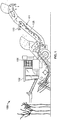
- a spraying system such as that depicted in the diagram of FIG. 1 can be assembled on the harvester to apply the use composition onto the cane immediately after it is cut.
- a sugar cane harvester 102 has an elevator 104 for transporting freshly cut sugar cane into a receptacle such as a cane wagon.
- An antimicrobial solution reservoir 106 is affixed to the sugar cane harvester 102 and contains antimicrobial solution.
- a fluid line 108 connects the antimicrobial solution reservoir 106 to a spraying apparatus 110.
- a pumping system (not shown) provides pressure to the reservoir 106 to force the antimicrobial solution through the fluid line 108 and out of the spraying apparatus 110.
- the spraying apparatus 110 is affixed to the harvester's elevator 104 in order to spray the antimicrobial solution onto the freshly cut sugar cane before it is transported into a cane wagon.
- the antimicrobial compositions are applied to harvested sugar cane within a short period of time in order to most effectively prevent microbial contamination and degradation of sucrose.
- the compositions are applied after cutting the cane within up to 48 hours, within up to 24 hours, within up to 12 hours, within up to 4 hours, within up to 2 hours, within up to 30 minutes, within up to 15 minutes, within up to 5 minutes, within up to 2 minutes, within up to 1 minute, and within up to 30 seconds.
- the compositions are applied to the sugar cane within 1 second to 24 hours, 2 seconds to 8 hours, 3 seconds to 2 hours, 0.001 seconds to 20 minutes, 0.01 seconds to 12 minutes, 0.1 seconds to 8 minutes, 0.5 seconds to 3 minutes, 0.1 seconds to 30 minutes, 1 second to 15 minutes, 5 seconds to 5 minutes, or 15 seconds to 1 minute of cutting the cane.
- the antimicrobial compositions must contact the sugar cane for a length of time sufficient to prevent microbial contamination.
- the sugar cane may be contacted with the composition for periods of time that are longer than needed to treat the microbial contamination.
- the antimicrobial composition may be in contact with the sugar cane for the entire duration of time that the cane is being transported to a mill for processing.
- the sugar cane is contacted with the antimicrobial composition for a period of time lasting from 2 seconds to 72 hours, 5 seconds to 36 hours, 5 seconds to 12 hours, 10 seconds to 6 hours, 10 seconds to 2 hours, 30 seconds to 6 hours, 30 seconds to 45 minutes, 1 minute to 3 hours, 1 minute to 20 minutes, 5 minutes to 1 hour, 5 minutes to 15 minutes, or 10 minutes to 30 minutes.
- the compositions do not require rinsing from the sugar cane.
- the antimicrobial compositions may be applied to the harvested sugar cane in more than one application. In some instances, it may be beneficial to apply the composition more than once if the time between harvest and processing is particularly lengthy. For example, if the sugar cane is treated with a use solution within 30 minutes of harvest, but will travel for at least 48 hours before arriving at a mill for processing, additional use solution may be applied to the sugar cane while the cane is in transit. In some embodiments, antimicrobial compositions are applied to harvested sugar cane every 24 hours, every 12 hours, every 6 hours, every 3 hours, or every hour as the cane is transported to a mill to maximize sucrose yields.
- a field experiment was conducted to determine whether application of a peracid composition to freshly cut sugar cane impacted sucrose yield.
- a first test group consisted of ten transportation carts filled with freshly harvested cane. The harvested sugar cane in these transportation carts was treated with a 100 ppm peracid solution by pumping the solution through a hose and manually spraying the harvested cane with this solution.
- a second test group consisted of ten transportation carts filled with freshly harvested cane. This second test group of transportation carts was not treated with a peracid solution. Both groups of sugar cane were within the same field and were harvested at the same time.
- FIG. 4 illustrates a scatter graph showing purity plotted against dextran amount for treated vs. untreated sugar cane. It is observed that the carts in which the composition was applied show the lowest values of dextran and the highest values of juice purity. Inversely, carts which were not treated show higher values of dextran and lower purity values.
- FIG. 6 illustrates a scatter graph plotting the amount of dextran against the amount of cane juice. It is observed that the higher yield is obtained from cane with lower dextran content.
- a second field experiment was performed to evaluate the yield improvement benefits achieved by treating freshly harvested sugar cane with a peracid solution.
- Representative samples of harvested sugar cane were collected upon delivery to the processing mill, and tested for sucrose yield potential to determine impact of the peracid solution application via mechanized harvester. This experiment was performed over the course of several weeks to demonstrate effect throughout a harvest season.
Landscapes
- Life Sciences & Earth Sciences (AREA)
- Environmental Sciences (AREA)
- Dentistry (AREA)
- Plant Pathology (AREA)
- Health & Medical Sciences (AREA)
- Engineering & Computer Science (AREA)
- Pest Control & Pesticides (AREA)
- General Health & Medical Sciences (AREA)
- Wood Science & Technology (AREA)
- Zoology (AREA)
- Agronomy & Crop Science (AREA)
- Chemical & Material Sciences (AREA)
- Inorganic Chemistry (AREA)
- Agricultural Chemicals And Associated Chemicals (AREA)
- Saccharide Compounds (AREA)
Abstract
Compositions and methods for increasing sugar yield from harvested sugar cane are described. Antimicrobial compositions are applied to freshly cut sugar cane to increase sugar yield. Without being bound by theory, it is believed that the peracid-containing compositions serve to prevent microbial contamination between harvest and processing in a mill. The peracid-containing compositions inhibit bacterial metabolic activity which converts sucrose found in sugar cane juice into dextran. Preventing production of dextran improves sucrose yields and purity in treated sugar cane.
Description
- The present disclosure relates to compositions and method for increasing sugar yield from harvested sugar cane. In particular, the disclosed compositions and methods provide immediate control of environmental bacteria that can reduce the sucrose yield of cut sugar cane by applying antimicrobial treatment immediately after cutting during harvest.
- Sugar cane is the largest source of sucrose in the world. Sugar cane is the common term for various species of grasses in the genus Saccharum. It is harvested by cutting the stalks at the base just above ground level. This can be done manually or with mechanical harvesters. After harvesting, the sugar cane is quickly transported to mills for processing. Sucrose (cane sugar) is produced from the cane juice. Ethanol can be formed by fermenting the sucrose for alcohol or fuel.
- From the time the sugar cane is cut, the sucrose content of the cane begins to deteriorate rapidly due to microbial conversion of sucrose into dextran. In particular, Leuconostoc mesenteroide, and Weissellia confuse have been identified as bacterial species that cause most sucrose degradation in sugar cane. Once the cut sugar cane arrives at the mill, various chemical treatments are applied to the pressed cane juice to control degradation of sucrose. However, there remains a need to reduce or prevent degradation of sucrose from the time the cane is harvested in the field to the time the cane juice is extracted in the mill. Preventing degradation of sucrose before cane arrives at the mill will improve overall sugar yields.
- It is against this background that the present disclosure is made.
- The present disclosure relates to compositions and methods for treating harvested sugar cane to reduce microbial contamination. Microbial control treatments are immediately applied to the cut sugar cane to prevent bacteria from infecting the sugar juice while the cane is being transported to a processing mill. Preventing microbial contamination also prevents conversion of sucrose into dextran, which thereby reduces sugar purity. Treatment of the sugar cane with peracid-containing compositions improves the overall sucrose yield of the cane by reducing the amount of sucrose that is converted to dextran.
- In one aspect, a method of increasing sucrose yield from sugar cane is provided. A peracid antimicrobial composition is applied to the cut sugar cane. The peracid antimicrobial composition comprises from about 1250 to about 6300 ppm carboxylic acid; from about 600 to 3050 ppm peroxycarboxylic acid; from about 450 to about 2250 ppm peroxide; from about 0 to about 150 ppm chelating agent and water. The peracid antimicrobial composition can further include additional agents selected from chelating agents, organic solvents, sanitizers, antimicrobial agents, magnesium, rheological, pH modifiers, preservatives, processing aids, or other functional ingredients. In some embodiments, the peracid antimicrobial composition is applied to the cut sugar cane within up to 2 hours of harvesting, or within up to 15 minutes of harvesting.
- In some aspects, the peracid antimicrobial composition comprises from about 1950 to about 5150 ppm carboxylic acid; from about 950 to 2500 ppm peroxycarboxylic acid; from about 700 to about 1850 ppm peroxide; from about 65 to about 165 ppm chelating agent; and water. The carboxylic acid in the antimicrobial composition may be selected from the group consisting of formic acid, acetic acid, propionic acid, heptanoic acid, octanoic acid, nonanoic acid, decanoic acid, benzoic acid, and salicyclic acid. In some embodiments, the carboxylic acid is acetic acid or a combination of acetic acid and octanoic acid. The peroxycarboxylic acid may be peroxyacetic acid, peroxyoctanoic acid, or a combination thereof. In some aspects, the peroxide is hydrogen peroxide. In some aspects the chelating agent comprises phosphonic acid. In some embodiments, the peracid antimicrobial composition further comprises a thickening agent selected from the group consisting of xantham gum, guar gum, arrowroot, cornstarch, katakuri starch, potato starch, tapioca, sago, alginin, locust bean gum, collagen, gelatin, agar, carrageenan pectin, cellulose, and gum Arabic.
- In another aspect, a method of increasing sucrose yield in harvested sugar cane comprises diluting a concentrate composition at a rate of 1:50 to 1:2000 with water to form a use solution. The concentrate composition comprises from about 5 to about 60 wt-% carboxylic acid; from about 4 to about 30 wt-% peroxycarboxylic acid; and from about 5 to about 30 wt-% peroxide. The use solution is applied to sugar cane within up to 12 hours of cutting the sugar cane. In some embodiments, the carboxylic acid comprises one or more of formic acid, acetic acid, propionic acid, heptanoic acid, octanoic acid, nonanoic acid, decanoic acid, benzoic acid, and salicyclic acid. In some aspects, the carboxylic acid comprises from 30 to 60 wt-% acetic acid. In some embodiments, the peroxide comprises from 10 to 25 wt-% hydrogen peroxide. The diluted use solution may be applied by one or more of spraying, dripping, immersing, misting, or dunking. In some aspects, applying occurs within 0.1 seconds to 8 minutes of cutting or within 1 second to 6 hours of cutting the sugar cane. In some embodiments, the applying is performed by spraying with an applicator affixed to a sugar cane harvester. In other embodiments, the applying is performed manually by spraying the cut cane with a handheld or backpack spraying device. In some embodiments, the concentrate composition further comprises a chelating agent. In some aspects, the concentrate composition is diluted at a rate of 1:125-1:400 with water to form the use solution. In some aspects, the carboxylic acid comprises octanoic acid and acetic acid and the peroxycarboxylic acid comprises peroxyoctanoic acid and peroxyacetic acid. In some embodiments, the concentrate composition further comprises an additional antimicrobial selected from the group consisting of enzymes, bactericides, phages, and bacteriocins.
- In yet another aspect, a method is provided for increasing sucrose yield from harvested sugar cane by applying a use solution comprising from about 950 to 2500 ppm peroxycarboxylic acid to sugar cane within up to 4 hours of cutting the sugar cane. The use solution may be applied to the cut sugar cane with a spraying apparatus affixed to a sugar cane harvester or manually to cut sugar cane with a handheld or backpack spraying device. In some aspects, the use solution is applied to the cut sugar cane within about 30 minutes of harvesting. In some embodiments, the peroxycarboxylic acid is selected from the group consisting of peroxyacetic acid, peroxyoctanoic acid, performic acid, a sulfonated peroxycarboxylic acid, and mixtures thereof. In some aspects, the peroxycarboxylic acid comprises 900 ppm to 1100 ppm peroxyacetic acid or 2250 ppm to 2600 ppm peroxyacetic acid.
- In one aspect, a system for increasing sucrose yield from sugar cane is provided. The system includes a sugar cane harvester having an elevator. An antimicrobial solution reservoir is affixed to the sugar cane harvester and the antimicrobial solution reservoir contains an antimicrobial solution that inhibits degradation of sucrose. A spraying apparatus in fluid connection with the antimicrobial solution reservoir is attached to the elevator. The antimicrobial solution may be selected from the group consisting of quaternary ammonium compounds, electrolyzed water, essential oils with antimicrobial efficacy, ozonized water generated onsite, chlorine dioxide, peracids, hydrogen peroxide, silver-containing compounds, phages, bacteriocins, enzymes, and sodium hypochlorite. The antimicrobial solution may further comprise a thickening agent.
- In some embodiments, the antimicrobial solution used with the system comprises from about 1800 to about 2200 ppm acetic acid; from about 900 to 1100 ppm peroxyacetic acid; from about 650 to about 800 ppm hydrogen peroxide; from about 60 to about 70 ppm phosphonic acid chelating agent; and water. In other embodiments, the antimicrobial solution used with the system comprises from about 4700 to about 5400 ppm acetic acid; from about from about 2250 to about 2600 ppm peroxyacetic acid; from about 1650 to about 1950 ppm hydrogen peroxide; from about 150 to about 170 ppm phosphonic acid chelating agent; and water. In either of these embodiments, the antimicrobial solution can further include an additional carboxylic acid and peroxycarboxylic acid. The antimicrobial solution can further include an additional antimicrobial agent selected from the group consisting of disodium cyanodithiomidocarbonate, ethylenediamine, potassium N-methyldithiocarbamate, disodium ethylenebisdithiocarbamate, sodium dimethyldithiocarbamate, potassium N-methyldithiocarbamate, 2,2-Dibromo-3-nitrilopropionamine, and benzyl ammonium chloride.
- The invention relates to the following aspects:
- 1. A method of increasing sucrose yield from harvested sugar cane, the method comprising:
- applying a peracid antimicrobial composition to the cut sugar cane, the peracid antimicrobial composition comprising:
- from about 1250 to about 6300 ppm carboxylic acid;
- from about 600 to 3050 ppm peroxycarboxylic acid;
- from about 450 to about 2250 ppm peroxide;
- from about 0 to about 150 ppm chelating agent and
- water.
- applying a peracid antimicrobial composition to the cut sugar cane, the peracid antimicrobial composition comprising:
- 2. The method of aspect 1, wherein the peracid antimicrobial composition further comprises additional agents selected from chelating agents, organic solvents, sanitizers, antimicrobial agents, magnesium, rheological, pH modifiers, preservatives, processing aids, or other functional ingredients
- 3. The method according to
aspect 1 or 2, wherein the peracid antimicrobial composition is applied to the cut sugar cane within up to 2 hours of harvesting. - 4. The method according to
aspect 1 or 2, wherein the peracid antimicrobial composition is applied to the cut sugar cane within up to 15 minutes of harvesting. - 5. The method according to any one of aspects 1 to 4, wherein the peracid antimicrobial composition comprises:
- from about 1950 to about 5150 ppm carboxylic acid;
- from about 950 to 2500 ppm peroxycarboxylic acid;
- from about 700 to about 1850 ppm peroxide;
- from about 65 to about 165 ppm chelating agent; and
- water.
- 6. The method according to any one of aspects 1 to 5, wherein the carboxylic acid is selected from the group consisting of formic acid, acetic acid, propionic acid, heptanoic acid, octanoic acid, nonanoic acid, decanoic acid, benzoic acid, and salicyclic acid.
- 7. The method of aspect 6, wherein the carboxylic acid comprises acetic acid.
- 8. The method of aspect 7, wherein the carboxylic acid further comprises octanoic acid.
- 9. The method according to any one of aspects 1 to 8, wherein the peroxycarboxylic acid comprises peroxyacetic acid, peroxyoctanoic acid, or a mixture thereof.
- 10. The method according to any one of aspects 1 to 9, wherein the peroxide comprises hydrogen peroxide.
- 11. The method according to any one of aspects 1 to 10, wherein the chelating agent comprises phosphonic acid.
- 12. The method according to any one of aspects 1 to 11, wherein the peracid antimicrobial composition further comprises a thickening agent selected from the group consisting of xantham gum, guar gum, arrowroot, cornstarch, katakuri starch, potato starch, tapioca, sago, alginin, locust bean gum, collagen, gelatin, agar, carrageenan pectin, cellulose, and gum Arabic.
- 13. A method for increasing sucrose yield in harvested sugar cane, the method comprising:
- diluting a concentrate composition at a rate of 1:50-1:2000 with water to form a use solution, the concentrate composition comprising:
- from about 5 to about 60 wt-% carboxylic acid;
- from about 4 to about 30 wt-% peroxycarboxylic acid; and
- from about 5 to about 30 wt-% peroxide; and
- applying the use solution to sugar cane within up to 24 hours of cutting the sugar cane.
- diluting a concentrate composition at a rate of 1:50-1:2000 with water to form a use solution, the concentrate composition comprising:
- 14. The method of aspect 13, wherein the carboxylic acid comprises one or more of formic acid, acetic acid, propionic acid, heptanoic acid, octanoic acid, nonanoic acid, decanoic acid, benzoic acid, and salicyclic acid.
- 15. The method of aspect 13, wherein the carboxylic acid comprises from 30 to 60 wt-% acetic acid.
- 16. The method according to any one of aspects 13 to 15, wherein the peroxide comprises from 10 to 25 wt-% hydrogen peroxide.
- 17. The method according to any one of aspects 13 to 16, wherein the diluted use solution is applied by one or more of spraying, dripping, immersing, misting, or dunking.
- 18. The method according to any one of aspects 13 to 17, wherein the applying occurs within 0.1 seconds to 8 minutes of cutting.
- 19. The method according to any one of aspects 13 to 17, wherein the applying occurs within 1 second to 6 hours of cutting.
- 20. The method according to any one of aspects 13 to 19, wherein the applying is performed by spraying with an applicator affixed to a sugar cane harvester.
- 21. The method according to any one of aspects 13 to 19, wherein the applying is performed manually by spraying the cut cane with a handheld or backpack spraying device.
- 22. The method according to any one of aspects 13 to 21, wherein the concentrate composition further comprises a chelating agent.
- 23. The method according to any one of aspects 13 to 22, wherein the concentrate composition is diluted at a rate of 1:125-1:400 with water to form the use solution.
- 24. The method according to any one of aspects 13 and 16 to 23, wherein the carboxylic acid comprises octanoic acid and acetic acid and the peroxycarboxylic acid comprises peroxyoctanoic acid and peroxyacetic acid.
- 25. The method according to any one of aspects 13 to 24, wherein the concentrate composition further comprises an additional antimicrobial selected from the group consisting of enzymes, bactericides, phages, and bacteriocins.
- 26. A method for increasing sucrose yield from harvested sugar cane, the method comprising:
- applying a use solution comprising from about 950 to 2500 ppm peroxycarboxylic acid to sugar cane within up to 4 hours of cutting the sugar cane.
- 27. The method of aspect 26, wherein the use solution is applied to the cut sugar cane with a spraying apparatus affixed to a sugar cane harvester.
- 28. The method of aspect 26, wherein the use solution is manually applied to the cut sugar cane with a handheld or backpack spraying device.
- 29. The method according to any one of aspects 26 to 28, wherein the use solution is applied to the cut sugar cane within about 30 minutes of harvesting.
- 30. The method according to any one of aspects 26 to 29, wherein the peroxycarboxylic acid is selected from the group consisting of peroxyacetic acid, peroxyoctanoic acid, performic acid, a sulfonated peroxycarboxylic acid, and mixtures thereof.
- 31. The method according to any one of aspects 26 to 29, wherein the peroxycarboxylic acid comprises 900 ppm to 1100 ppm peroxyacetic acid.
- 32. The method according to any one of aspects 26 to 29, wherein the peroxycarboxylic acid comprises 2250 ppm to 2600 ppm peroxyacetic acid.
- 33. A system for increasing sucrose yield in sugar cane comprising:
- a sugar cane harvester having an elevator;
- an antimicrobial solution reservoir affixed to the sugar cane harvester, the antimicrobial solution reservoir containing an antimicrobial solution that inhibits degradation of sucrose; and
- a spraying apparatus in fluid connection with the antimicrobial solution reservoir attached to the elevator.
- 34. The system of aspect 33, wherein the antimicrobial solution is selected from the group consisting of quaternary ammonium compounds, electrolyzed water, essential oils with antimicrobial efficacy, ozonized water generated onsite, chlorine dioxide, peracids, hydrogen peroxide, silver-containing compounds, phages, bacteriocins, enzymes, and sodium hypochlorite.
- 35. The system of aspect 33, wherein the antimicrobial solution comprises:
- from about 1800 to about 2200 ppm acetic acid;
- from about 900 to 1100 ppm peroxyacetic acid;
- from about 650 to about 800 ppm hydrogen peroxide;
- from about 60 to about 70 ppm phosphonic acid chelating agent; and
- water.
- 36. The system of aspect 33, wherein the antimicrobial solution comprises:
- from about 4700 to about 5400 ppm acetic acid;
- from about 2250 to about 2600 ppm peroxyacetic acid;
- from about 1650 to about 1950 ppm hydrogen peroxide;
- from about 150 to about 170 ppm phosphonic acid chelating agent; and
- water.
- 37. The system according to any one of aspects 33 to 36, wherein the antimicrobial solution further comprises a thickening agent.
- 38. The system according to aspect 35 or 36, wherein the antimicrobial solution further comprises an additional carboxylic acid and peroxycarboxylic acid.
- 39. The system according to any one of aspects 33 to 37, wherein the antimicrobial solution further comprises an additional antimicrobial agent selected from the group consisting of disodium cyanodithiomidocarbonate, ethylenediamine, potassium N-methyldithiocarbamate, disodium ethylenebisdithiocarbamate, sodium dimethyldithiocarbamate, potassium N-methyldithiocarbamate, 2,2-Dibromo-3-nitrilopropionamine, and benzyl ammonium chlorides.
-
-
FIG. 1 is a schematic diagram of an exemplary apparatus for applying an antimicrobial composition to sugar cane during harvesting. -
FIG. 2 is a bar graph depicting the average ppm of dextran per mass of solids produced in sugar cane treated with a peracid-containing antimicrobial composition compared to untreated sugar cane. -
FIG. 3 is a bar graph depicting the average sugar cane juice purity produced by sugar cane treated with a peracid-containing antimicrobial composition compared to untreated sugar cane. -
FIG. 4 is a scatter graph depicting purity vs. dextran content of sugar cane treated with a peracid-containing antimicrobial composition compared to untreated sugar cane. -
FIG. 5 is a bar graph depicting the average sucrose yield produced by sugar cane treated with a peracid-containing antimicrobial composition compared to untreated sugar cane. -
FIG. 6 is a scatter graph depicting yield vs. dextran content of sugar cane treated with a peracid-containing antimicrobial composition compared to untreated sugar cane. - Compositions and methods are described herein for reducing microbial contamination of cut sugar cane and thus preventing conversion of sucrose in the cane juice of the sugar cane into dextran by metabolic activity of bacteria. Application of an antimicrobial composition to freshly harvested sugar cane inhibits degradation of sucrose, improving overall yields and purity. A sufficient amount of antimicrobial composition is applied to provide microbial control for a period of time such that cut cane delivered to a mill for further processing arrives with higher yield potential.
- The compositions and methods provided herein are effective for increasing the yield potential of not only sucrose production, but also ethanol production. Sucrose can be fermented to produce ethanol. In some embodiments, sucrose is fermented to produce alcoholic beverages such as rum. In other embodiments, sucrose is fermented to produce ethanol fuel. Regardless of the use of the ethanol, the process of fermentation follows the same steps. First, the sucrose is cleaved into glucose and fructose. The glucose is then broken down into pyruvate which is then converted to ethanol and carbon dioxide. Improvements in sucrose yield and purity can lead to a cleaner, more productive fermentation process. Additionally, antimicrobial treatment can eliminate acid producing bacteria that can stymie the fermentation process.
- The compositions preferably include only ingredients that can be employed in food products or in food transport, handling, or processing, for example, according to government rules and regulations.
- As used herein, weight percent (wt-%), percent by weight, % by weight, and the like are synonyms that refer to the concentration of a substance as the weight of that substance divided by the total weight of the composition and multiplied by 100.
- As used herein, the terms "mixed" or "mixture" when used relating to "peroxycarboxylic acid composition" or "peroxycarboxylic acids" refer to a composition or mixture including more than one peroxycarboxylic acid, such as a composition or mixture including peroxyacetic acid and peroxyoctanoic acid.
- As used herein, the term "active" when applied to a peroxycarboxylic acid or another peroxy containing compound refers to the wt-% of peroxycarboxylic acid or peroxy compound in the composition that can be detected by a suitable analytical technique, for example, by titration, chromatography, spectroscopy, oxidation-reduction probe, amperometrically, or similar peracid detection method.
- As used herein, the term "about" modifying the quantity of an ingredient in the disclosed compositions or employed in the disclosed methods refers to variation in the numerical quantity that can occur, for example, through typical measuring and liquid handling procedures used for making concentrates or use solutions in the real world; through inadvertent error in these procedures; through differences in the manufacture, source, or purity of the ingredients employed to make the compositions or carry out the methods; and the like. The term about also encompasses amounts that differ due to different equilibrium conditions for a composition resulting from a particular initial mixture. Whether or not modified by the term "about", the claims include equivalents to the quantities.
- As used herein, a composition or combination "consisting essentially" of certain ingredients refers to a composition including those ingredients and lacking any ingredient that materially affects the basic and novel characteristics of the composition or method.
- Compositions of the present disclosure provide a concentrate and diluted end use composition that include a sufficient quantity of chemistry to control microbial conversion of sucrose to dextran on cut sugar cane for a period of time between harvesting the sugar cane and processing the sugar cane at a mill. In one embodiment the composition is a peroxycarboxylic acid concentrate that is diluted before applying to cut sugar cane. More than one carboxylic and peroxycarboxylic acid can be included in the composition. Additional auxiliary agents can be included in the composition to provide additional benefits such as defoaming or stabilization properties. In other embodiments, other antimicrobial compositions can be utilized such as sodium hypochlorite, quaternary ammonium compounds, and essential oils.
- The peracid compositions are effective for controlling microbial contamination of freshly harvested sugar cane. The peracids compositions beneficially do not have residual antimicrobial activity on the sugar cane to affect food safety because the peracids naturally break down into water, oxygen, and acid. Thus, the composition does not need to be rinsed from the sugar cane after treatment.
- In exemplary embodiments, the composition includes effective amounts of peracids, also known as peroxyacids or peroxycarboxylic acids.
- The antimicrobial composition includes one or more carboxylic acids. Generally, carboxylic acids have the formula R-COOH wherein the R may represent any number of different groups including aliphatic groups, alicyclic groups, aromatic groups, heterocyclic groups, all of which may be saturated or unsaturated as well as substituted or unsubstituted. Carboxylic acids also occur having one, two, three, or more carboxyl groups.
- Carboxylic acids which are generally useful in the disclosed compositions and methods are those which comprise peroxycarboxylic acids. Peroxycarboxylic acids generally have the formula R(CO3H)N, where R is an alkyl, arylalkyl, cycloalkyl, carboxy alkyl, carboxyester alkyl, aromatic or heterocyclic group, and N is one or two, or named by prefixing the parent acid with peroxy. Preferably, the carboxylic acid and peroxycarboxylic acid have a primary carbon chain of 2 to 12. The primary alkyl or aryl chain is that carbon chain of the molecule having the greatest length of carbon atoms and directly appending carboxyl functional groups. Examples of suitable carboxylic acids include acetic acid, propionic acid, formic acid, hexanoic acid, heptanoic acid, octanoic acid, nonanoic acid, decanoic acid, benzoic acid, salicylic acid, and mixtures thereof. Longer chain carboxylic acid analogues, including hexanoic, heptanoic, octanoic, nonanoic, and decanoic, can be additionally antimicrobial and reduce surface tension to assist in wetting of hydrophobic surfaces. Preferred peroxycarobxylic acids include peroxyacetic acid, peroxypropionic acid, peroxyoctanoic acid, peroxyformic acid, peroxyglycolic acid, peroxysuccinic acid, or mixtures thereof.
- Peroxycarboxylic acids can be made by the direct, acid catalyzed equilibrium action of hydrogen peroxide with the carboxylic acid, by autoxidation of aldehydes, from acid chlorides, and hydrides, or carboxylic anhydrides with hydrogen or sodium peroxide, from electrolytic cells, and through the use of a catalyst such as an enzyme.
- In some embodiments, the peroxycarboxylic acid is or includes a sulfoperoxycarboxylic acids or "sulfonated peroxycarboxylic acids." Sulfoperoxycarboxylic acids are the peroxycarboxylic acid form of a sulfonated carboxylic acid. Preferred sulfoperoxycarboxylic acids include 9, 10-dihydroxy-9-sulfooctadecaneperoxoic acid, 10-hydroxy-9-sulfooctadecaneperoxoic acid, 9-sulfooctadecaneperoxoic acid, 11-sulfoundecaneperoxoic acid, 10,11-disulfoundecaneperoxoic acid, 8-(3-octyloxiran-2-yl)-8-sulfooctaneperoxoic acid, 9,10-dihydroxy-11-sulfooctadecaneperoxoic acid, 8-(3-octyloxiran-2-yl)-11-sulfooctaneperoxoic acid, 9-hydroxy-10-sulfooctadecaneperoxoic acid, 10-sulfooctadecaneperoxoic acid, 9,10-disulfooctadecaneperoxoic acid, 10-sulfoundecaneperoxoic acid, and the like.
- Regardless of the pathway by which the peracid is generated, the use solution preferably includes from about 600 ppm to about 3050 ppm of the peracid, from about 950 ppm to about 2500 ppm of the peracid, from about 900 ppm to about 1100 ppm, or from about 2250 ppm to about 2600 ppm of the peracid.
- The compositions typically also include a peroxide constituent, particularly for equilibrium-based peracid systems. Hydrogen peroxide in combination with the percarboxylic acid provides antimicrobial action against microorganisms. Additionally, hydrogen peroxide can provide an effervescent action which can irrigate any surface to which it is applied. An advantage of hydrogen peroxide is the food compatibility of this composition upon use and decomposition. For example, combinations of peroxyacetic acid, and hydrogen peroxide result in acetic acid, water, and oxygen upon decomposition, all of which are food product compatible.
- Many oxidizing agents can be used for generating peroxycarboxylic acids. Suitable oxidizing agents, in addition to hydrogen peroxide, include inorganic and organic peroxides, such as, salts of perborate, percarbonate, and persulfate, percarbonic acid, and ozone. Hydrogen peroxide is generally preferred for several reasons. After application of the H2O2/peroxycarboxylic acid germicidal agent, the residue left merely includes water and an acidic constituent.
- In some embodiments that are not based on an equilibrium reaction between a carboxylic acid and a peroxide, the composition is free or substantially free of a peroxide.
- The antimicrobial composition of or employed in the disclosed methods can also include any number of adjuvants. Specifically, the composition can include stabilizing agents, wetting agents, hydrotropes, thickeners, foaming agents, chelating agents, builders, pH adjusters, among any number of constituents which can be added to the composition. Such adjuvants can be preformulated with the composition or added to the system simultaneously, or even after, the addition of the composition. The composition can also contain any number of other constituents as necessitated by the application.
- The compositions may optionally include components such as stabilizing agents, particularly those suitable for stabilizing peroxygen compounds or peroxycarboxylic acids. Such stabilizers include organic chelating compounds that sequester metal ions in solution, particularly most transition metal ions, which would promote decomposition of any peroxygen compounds therein. Typical complexing agents include organic amino- or hydroxy-polyphosphonic acid complexing agents (either in acid or soluble salt forms), carboxylic acids, hydroxycarboxylic acids, or aminocarboxylic acids.
- Chelating agents or sequestrants generally useful as stabilizing agents include salts or acids of (expressed in acid form) dipicolinic acid, picolinic acid, gluconic acid, quinolinic acid, and alkyl diamine polyacetic acid-type chelating agents such as ethylenediamine tetraacetic acid (EDTA), hydroxyethylethylene diamine triacetic acid (HEDTA), and ethylene triaminepentaacetic acid, acrylic and polyacrylic acid-type stabilizing agents, phosphonic acid, and phosphonate-type chelating agents among others. Preferable sequestrants include phosphonic acids and phosphonate salts including 1-hydroxy ethylidene-1,1-diphosphonic acid (CH3C(PO3H2)2OH)(HEDP); ethylenediamine tetrakis methylenephosphonic acid (EDTMP); diethylenetriamine pentakis methylenephosphonic acid (DTPMP); cyclohexane-1,2-tetramethylene phosphonic acid; amino[tri(methylene phosphonic acid)]; (ethylene diamine[tetra methylene-phosphonic acid)]; 2-phosphene butane-1,2,4-tricarboxylic acid; as well as the alkyl metal salts, ammonium salts, or alkyloyl amine salts, such as mono, di, or tetra-ethanolamine salts.
- Commercially available food additive chelating agents include phosphonates sold under the trade name DEQUEST® including, for example, 1-hydroxyethylidene-1,1-diphosphonic acid, available from Monsanto Industrial Chemicals Co., St. Louis, Mo., as DEQUEST® 2010; amino(tri(methylenephosphonic acid)), (N[CH2PO3H2]3), available from Monsanto as DEQUEST® 2000; ethylenediamine[tetra(methylenephosphonic acid)] available from Monsanto as DEQUEST® 2041; and 2-phosphonobutane-1,2,4-tricarboxylic acid available from Mobay Chemical Corporation, Inorganic Chemicals Division, Pittsburgh, Pa., as Bayhibit AM.
- The above-mentioned phosphonic acids can also be used in the form of water soluble acid salts, particularly the alkali metal salts, such as sodium or potassium; the ammonium salts or the alkylol amine salts where the alkylol has 2 to 3 carbon atoms, such as mono-, di-, or triethanolamine salts. If desired, mixtures of the individual phosphonic acids or their acid salts can also be used.
- The compositions may optionally include buffering agents to stabilize the pH of an antimicrobial solution. The compositions might include buffering adjuvants such as weak inorganic acids, organic acids, organic salts, and inorganic salts for buffering purposes. These might include an inorganic-based salt or weak inorganic acids including phosphates (including mono-, di-, or tri-basic potassium, calcium, or sodium phosphate), sulfates (including sodium, potassium, and magnesium sulfates), bisulfates, silicates (including sodium, potassium, and magnesium silicates), borates (including sodium or potassium borates, and boric acid), sulfamic acid; organic-based compounds such as malic acid, tartaric acid, citric acid, acetic acid, glycolic, glutamic acid, sorbic acid, benzoic acid, adipic acid, succinic acid, diacetate salts, or dimer and fatty acids; or mixtures thereof.
- Some additional acids or salts include aliphatic or olefinic carboxylic acids or carboxylate salts, aromatic carboxylic acids or carboxylic salts, inorganic acids or salts, polymeric carboxylic acids or carboxylate salts, organic-phosphonates, organic-phosphates or their salts, organic-sulfonates, organic-sulfates or their salts, organic boric acids or salts, amino acids or salts, or mixtures thereof. Most preferably the buffer includes carboxylic acids, di/tri-carboxylic acids, hydroxy carboxylic acids, or alpha-hydroxy carboxylic acids- or their salts, anhydride, or esters-such as glycolic, lactic, malic, citric, tartaric, acetic, diacetate, butyric, octanoic, heptanoic, nonanoic, decanoic, malonic, adipic, succinic, salicylic, fumaric, maleic, acetoacetic, oxalacetic, pyruvic, α-ketoglutaric, and so forth. Preferably mild acids are used.
- The composition at use dilution has a pH of from about 1 to about 6, preferably 2 to about 5, and most preferably 2.6 to about 4.6.
- In some embodiments, thickening agents are included in the compositions. The thickening agents aid to increase droplet size of the solutions when applied with spray applicators. The solutions are generally applied to sugar cane outdoors. Larger droplet size reduces the amount of solution that is blown by wind. Appropriate thickening agents for use in the solutions of the present disclosure include food grade thickeners. Specific examples of food grade thickening agents include xantham gum, guar gum, arrowroot, cornstarch, katakuri starch, potato starch, tapioca, sago, alginin, locust bean gum, collagen, gelatin, agar, carrageenan pectin, cellulose, gum Arabic, and the like.
- In some embodiments, the compounds may include one or more non-peracid antimicrobial compounds. Other biocides that may be applied separately or in combination with peroxycarboxylic acids include quaternary ammonium compounds, preferably the quaternary ammonium compounds that have been approved for use as food contact sanitizers. More preferably, quaternary ammonium compounds that are approved for directed food additive, such as ethyl lauryl arginate are selected. Other biocides include electrolyzed water, essential oils with antimicrobial efficacy, ozonized water generated onsite, chlorine dioxide, and octanoic acid. Preferred biocides include hydrogen peroxide, octanoic acid, silver-containing compounds, and sodium hypochlorite.
- Other antimicrobials that could be added to the solutions of this disclosure include bactericides, phages, and bacteriocins. Chemicals typically used to control microorganisms in sugar mills may also be applied to the freshly harvested sugar cane. Such chemicals include disodium cyanodithiomidocarbonate, ethylenediamine, potassium N-methyldithiocarbamate, disodium ethylenebisdithiocarbamate, sodium dimethyldithiocarbamate, potassium N-methyldithiocarbamate, 2,2-Dibromo-3-nitrilopropionamine, benzyl ammonium chlorides, and combinations thereof.
- The following tables provide exemplary formulations for peracid-containing antimicrobial compositions that are effective for reducing sucrose degradation in harvested sugar cane. In addition to the ingredients provided in these tables, the adjuvants described above can be added in some embodiments.
- The preferred compositions include concentrate compositions and use compositions. Typically, an antimicrobial concentrate composition can be diluted, for example with water, to form an antimicrobial use composition. In a preferred embodiment, the concentrate composition is diluted into water employed for spraying harvested sugar cane.
- A preferred antimicrobial concentrate composition can be prepared according to the proportions described in Table 1. After combining the ingredients in these proportions, certain ingredients, such as the acetic acid and hydrogen peroxide, react to form peroxyacetic acid.
Table 1: Initial Concentrate Composition Ingredient 1st Exemplary Range 2nd Exemplary Range 3rd Exemplary Range Carboxylic acid 20-70 wt-% 30-60 wt-% 40-50 wt-% Peroxide 5-30 wt-% 10-25 wt-% 15-20 wt-% Chelating Agent 0-10 wt-% 0.1-5 wt-% 0.5-1.5 wt-% - By about two weeks after combining, the reaction of these ingredients has approached equilibrium. That is, the relative amounts of one or more of peroxyacetic acid, acetic acid, and hydrogen peroxide will be roughly constant. The equilibrium amount will be affected by decomposition or other reaction, if any, of any labile species. A preferred antimicrobial concentrate composition produces an equilibrium mixture having the proportions described in Table 2.
Table 2: Equilibrium Concentrate Composition (after approximately 2 weeks) Ingredient 1st Exemplary Range 2nd Exemplary Range 3rd Exemplary Range Carboxylic acid 5-60 wt-% 20-45 wt-% 30-35 wt-% Peroxycarboxylic acid 4-30 wt-% 8-24 wt-% 12-18 wt-% Peroxide 5-30 wt-% 8-20 wt-% 10-15 wt-% Chelating Agent 0-10 wt-% 0.1-5 wt-% 0.5-1.5 wt-% - The compositions also include antimicrobial use compositions. Preferred antimicrobial use compositions include the amounts of ingredients listed in Table 3 with a balance of water. In some embodiments, the concentrate compositions of Tables 1 and 2 are diluted by 1:50-2000 with water. The concentrate compositions may be diluted by water or other solvents at a rate of 1:75-1:750 or 1:125-1:400. Different dilutions of a concentrate composition can result in different levels of the components of the use composition, generally maintaining the relative proportions. For example, a use composition can have concentrations twice, one half, or one quarter those listed below in Table 3.
Table 3: Equilibrium Diluted Use Composition Ingredient 1st Exemplary Range (ppm) 2nd Exemplary Range (ppm) 3rd Exemplary Range (ppm) 4th Exemplary Range (ppm) Carboxylic acid 1250-6300 1950-5150 1800-2200 4700-5400 Peroxycarboxylic acid 600-3050 950-2500 900-1100 2250-2600 Peroxide 450-2250 700-1850 650-800 1650-1950 Chelating Agent 0-200 65-165 60-70 150-170 - Methods include applying the above-described compositions to sugar cane after harvesting. The use solution is applied to the cut sugar cane within a short period of time following harvest. For example, the use solution can be applied in the field or during transportation. Application of the compositions prevents degradation of sucrose within the sugar cane while the cane is being transported to a mill for processing, thereby increasing the sucrose yield.
- The compositions can be applied to the cut sugar cane in any way that allows the peracid-containing antimicrobial composition to contact the portions of the cane exposed when the cane is cut during harvesting. The cane is particularly susceptible to microbial contamination at cut sites. The bacteria accesses the cane juice and thus the sucrose through the weak points at those cuts. By applying the composition to the susceptible sites on the cut cane, the metabolic activity of the environmental bacteria can be reduced thus decreasing the amount of sucrose that is converted to dextran. Example methods of application include foaming, misting, spraying, brushing, pouring, dousing, dunking, submerging, and the like. In preferred embodiments, the diluted use solution is sprayed onto freshly cut sugar cane. Spraying can provide relatively even coverage of the cane surface while minimizing the amount of composition used.
- Applying the composition to cut cane as opposed to living cane is preferred. Sugar cane stalks are shrouded in leaves prior to being cut and harvested, preventing access to the sucrose-containing portions of the plant. The leaves prevent adequate exposure of any treatment chemistry that could be applied to the plant while still growing. Additionally, a much greater supply of chemical solution would be required to adequately cover the surface area of an intact plant. Waiting to treat the cane until after cutting allows for the exposed cut surface to be directly treated. The antimicrobial compositions described here do not exhibit sustained effects, so the compositions are only applied when treatment is needed. Thus applying the composition before harvest would result in either ineffective treatment or the solution would have to be applied immediately before harvest.
- In some embodiments, the dilute use composition is sprayed onto freshly cut sugar cane by hand. Much of the world's sugar cane crop is harvested manually with machetes or other means of cutting the stalks of the cane near the ground. The freshly cut cane can be treated within minutes by using a handheld spraying device or backpack spraying device. Such devices generally include a reservoir for containing solution which is in fluid connection with a spray wand. Pressure is applied to the reservoir by a manual pump or by motorized means, which allows for the solution to be expelled from the wand in a mist or spray. Handheld spraying devices use smaller reservoirs that are carried by a person in one hand with the wand in the other hand. Alternatively, smaller handheld spraying devices may have a reservoir that is directly connected to the spraying apparatus for one-handed use. Trigger spray attachments may be used with small reservoirs of solution. Backpack spraying devices strap the reservoir to the back of a person and a spraying wand is connected to the reservoir. The person uses one or two hands to operate the spraying wand.
- In one method of manual harvesting, sugar cane is cut with machetes. The pieces of cane are stacked in rows so that the cut ends are facing outwards. A person with a spraying device can easily spray solution on the ends of the cut sugar cane by walking along the row of piled sugar cane. For large quantities of sugar cane that is harvested manually, it may be preferable to use a backpack sprayer such as those made by MATABI or STIHL.
- Alternatively, the use solutions can be applied manually to cut sugar cane by quickly submerging the cane in a receptacle containing the use solution in order to coat the cane surface. The cane can remain in the solution until it reaches the mill or it can be moved to another receptacle after the surface of the cane is coated in the solution.
- In other embodiments, the dilute use composition is applied to cut sugar cane that is harvested mechanically. Harvesters cut the sugar cane and chop the cane into smaller pieces. The cane pieces are then deposited into a trailer for transport to a mill. A spraying system, such as that depicted in the diagram of
FIG. 1 can be assembled on the harvester to apply the use composition onto the cane immediately after it is cut. - In the
example system 100 ofFIG. 1 , asugar cane harvester 102 has anelevator 104 for transporting freshly cut sugar cane into a receptacle such as a cane wagon. Anantimicrobial solution reservoir 106 is affixed to thesugar cane harvester 102 and contains antimicrobial solution. Afluid line 108 connects theantimicrobial solution reservoir 106 to aspraying apparatus 110. A pumping system (not shown) provides pressure to thereservoir 106 to force the antimicrobial solution through thefluid line 108 and out of thespraying apparatus 110. In some embodiments thespraying apparatus 110 is affixed to the harvester'selevator 104 in order to spray the antimicrobial solution onto the freshly cut sugar cane before it is transported into a cane wagon. - The antimicrobial compositions are applied to harvested sugar cane within a short period of time in order to most effectively prevent microbial contamination and degradation of sucrose. In exemplary embodiments, the compositions are applied after cutting the cane within up to 48 hours, within up to 24 hours, within up to 12 hours, within up to 4 hours, within up to 2 hours, within up to 30 minutes, within up to 15 minutes, within up to 5 minutes, within up to 2 minutes, within up to 1 minute, and within up to 30 seconds. In some embodiments, the compositions are applied to the sugar cane within 1 second to 24 hours, 2 seconds to 8 hours, 3 seconds to 2 hours, 0.001 seconds to 20 minutes, 0.01 seconds to 12 minutes, 0.1 seconds to 8 minutes, 0.5 seconds to 3 minutes, 0.1 seconds to 30 minutes, 1 second to 15 minutes, 5 seconds to 5 minutes, or 15 seconds to 1 minute of cutting the cane.
- The antimicrobial compositions must contact the sugar cane for a length of time sufficient to prevent microbial contamination. The sugar cane may be contacted with the composition for periods of time that are longer than needed to treat the microbial contamination. For example, the antimicrobial composition may be in contact with the sugar cane for the entire duration of time that the cane is being transported to a mill for processing. For example, in some embodiments, the sugar cane is contacted with the antimicrobial composition for a period of time lasting from 2 seconds to 72 hours, 5 seconds to 36 hours, 5 seconds to 12 hours, 10 seconds to 6 hours, 10 seconds to 2 hours, 30 seconds to 6 hours, 30 seconds to 45 minutes, 1 minute to 3 hours, 1 minute to 20 minutes, 5 minutes to 1 hour, 5 minutes to 15 minutes, or 10 minutes to 30 minutes. The compositions do not require rinsing from the sugar cane.
- The antimicrobial compositions may be applied to the harvested sugar cane in more than one application. In some instances, it may be beneficial to apply the composition more than once if the time between harvest and processing is particularly lengthy. For example, if the sugar cane is treated with a use solution within 30 minutes of harvest, but will travel for at least 48 hours before arriving at a mill for processing, additional use solution may be applied to the sugar cane while the cane is in transit. In some embodiments, antimicrobial compositions are applied to harvested sugar cane every 24 hours, every 12 hours, every 6 hours, every 3 hours, or every hour as the cane is transported to a mill to maximize sucrose yields.
- A field experiment was conducted to determine whether application of a peracid composition to freshly cut sugar cane impacted sucrose yield. A first test group consisted of ten transportation carts filled with freshly harvested cane. The harvested sugar cane in these transportation carts was treated with a 100 ppm peracid solution by pumping the solution through a hose and manually spraying the harvested cane with this solution. A second test group consisted of ten transportation carts filled with freshly harvested cane. This second test group of transportation carts was not treated with a peracid solution. Both groups of sugar cane were within the same field and were harvested at the same time.
- From these 20 transportation carts, several tests were performed on representative samples of cane upon delivery to the processing mill. The quantity of dextran per unit mass was recorded and the amount was compared between the first test group for cane treated with peracid and the second test group for untreated cane. The results are summarized in Table 6 and shown in
FIG. 2 . Levels of dextran were consistently lower in sugar cane that had peracid composition applied than the untreated sugar cane. Lower dextran levels result in higher sucrose yields.Table 6: dextran produced in mg/Kg of solid mass Date Treated Untreated Difference 05/05/2015 322.46 402.67 (80.21) 06/05/2015 198.73 281.85 (83.13) 07/05/2015 386.42 583.43 (197.01) 08/05/2015 190.73 209.16 (18.43) 09/05/2015 206.65 263.47 (56.82) Average 261.00 348.12 (87.12) - Next, the purity of the sugar cane juice extracted from the cane was examined to determine if application of the peracid composition had an effect. Table 7 and
FIG. 3 illustrate the results. The purity of cane juice derived from sugar cane treated with the peracid composition was consistently higher than sugar cane that was untreated.Table 7: Percent purity of sucrose in sugar cane juice Date Treated Untreated Difference 05/05/2015 79.55 76.01 3.54 06/05/2015 87.07 81.37 5.70 07/05/2015 83.78 81.87 1.92 08/05/2015 82.60 81.95 0.65 09/05/2015 84.72 83.29 1.43 Average 83.55 80.90 2.65 -
FIG. 4 illustrates a scatter graph showing purity plotted against dextran amount for treated vs. untreated sugar cane. It is observed that the carts in which the composition was applied show the lowest values of dextran and the highest values of juice purity. Inversely, carts which were not treated show higher values of dextran and lower purity values. - Next the yield in Kg sugar per tonne of sugar cane was recorded. Again, the yield was consistently higher in sugar cane which was treated with the peracid composition. Results are shown in Table 8 and
Figure 5 .Table 8: yield in Kg sugar per tonne cane Date Treated Untreated Difference 05/05/2015 97.26 85.67 11.59 06/05/2015 139.58 107.45 32.13 07/05/2015 129.00 118.68 10.32 08/05/2015 127.37 116.18 11.18 09/05/2015 144.86 132.45 12.40 Average 127.61 112.09 15.52 - Finally, an analysis demonstrating recovery of sugar yields was conducted. This demonstrates an improvement in yield potential of cane delivered to a mill for processing. On average, there is a potential increase of recovery of sugar of between 0.83 Kg/tonne to 7.30 Kg/tonne with an average of 3.39 kg/tonne as shown in Table 9.
Table 9: Sugar Recovery in kg/tonne Date Treated Untreated Difference in Purity Recovered Sugar 05/05/2015 79.55 76.01 3.54 4.53 kg/Tonne 06/05/2015 87.07 81.37 5.70 7.30 kg/Tonne 07/05/2015 83.78 81.87 1.92 2.45 kg/Tonne 08/05/2015 82.60 81.95 0.65 0.83 kg/Tonne 09/05/2015 84.72 83.29 1.43 1.83 kg/Tonne Average 83.55 80.90 2.65 3.39 kg/Tonne -
FIG. 6 illustrates a scatter graph plotting the amount of dextran against the amount of cane juice. It is observed that the higher yield is obtained from cane with lower dextran content. - There is evidence indicating that applying the peracid composition in the field to freshly cut sugar cane and antimicrobial treatment in mills improves the reduction in purity between the primary and diluted juices. A decrease in dextran improves the juice purity and yield. Treating cane with a peracid solution reduces the bacterial growth rate in the cane, as evidenced by finding smaller amounts of dextran on sugar cane that was treated as compared to untreated cane harvested at the same time.
- A second field experiment was performed to evaluate the yield improvement benefits achieved by treating freshly harvested sugar cane with a peracid solution.
- Several mechanized harvesters were adapted with an automated dispensing system to apply a 2400ppm peracid solution to freshly harvested sugar cane at a rate of application of about 1.8 L peracid solution per tonne of sugar cane harvested. Additional harvesters were not modified with this dispensing equipment and did not apply peracid solution to harvested sugar cane. Sugar cane treated with peracid solution, and cane not treated with peracid solution, were harvested from the same fields, but collected in separate transportation carts and delivered to the processing mill.
- Representative samples of harvested sugar cane were collected upon delivery to the processing mill, and tested for sucrose yield potential to determine impact of the peracid solution application via mechanized harvester. This experiment was performed over the course of several weeks to demonstrate effect throughout a harvest season.
- On average, the peracid treatment on freshly harvested sugar cane enabled an increase in sucrose yield of 2.14 Kg sucrose per tonne cane harvested. This relates to about a 1.66% increase in sucrose yield from the same amount of harvested sugar cane. To add relevance to this figure, the country of Guatemala produced about 2.82 million tonnes of sugar in 2016. According to one calculation, if even 20% of the total harvested sugar cane was treated as described in this example, an additional 12,091 tonnes of sugar could have been produced from the same amount of harvested sugar cane. At an average wholesale market price of white sugar in Guatemala of about 14.28 USD per 100 lbs. sugar, this equates to a potential gross revenue increase of about 3,806,416 USD for one year.
- While certain embodiments have been described, other embodiments may exist. While the specification includes a detailed description, the invention's scope is indicated by the following claims. Furthermore, while the specification has been described in language specific to structural features and/or methodological acts, the claims are not limited to the features or acts described above. Rather, the specific features and acts described above are disclosed as illustrative aspects and embodiments of the invention. Various other aspects, embodiments, modifications, and equivalents thereof which, after reading the description herein, may suggest themselves to one of ordinary skill in the art without departing from the spirit of the present disclosure or the scope of the claimed subject matter.
Claims (19)
- A method of increasing sucrose yield from harvested sugar cane, the
method comprising:applying a peracid antimicrobial composition to the cut sugar cane, the peracid antimicrobial composition comprising:from about 1250 to about 6300 ppm carboxylic acid;from about 600 to 3050 ppm peroxycarboxylic acid;from about 450 to about 2250 ppm peroxide;from about 0 to about 150 ppm chelating agent andwater. - The method of claim 1, wherein the peracid antimicrobial composition further comprises additional agents selected from chelating agents, organic solvents, sanitizers, antimicrobial agents, magnesium, rheological, pH modifiers, preservatives, processing aids, or other functional ingredients
- The method according to claim 1 or 2, wherein the peracid antimicrobial composition is applied to the cut sugar cane within up to 2 hours of harvesting.
- The method according to claim 1 or 2, wherein the peracid antimicrobial composition is applied to the cut sugar cane within up to 15 minutes of harvesting.
- The method according to any one of claims 1 to 4, wherein the peracid antimicrobial composition comprises:from about 1950 to about 5150 ppm carboxylic acid;from about 950 to 2500 ppm peroxycarboxylic acid;from about 700 to about 1850 ppm peroxide;from about 65 to about 165 ppm chelating agent; andwater.
- The method according to any one of claims 1 to 5, wherein the carboxylic acid is selected from the group consisting of formic acid, acetic acid, propionic acid, heptanoic acid, octanoic acid, nonanoic acid, decanoic acid, benzoic acid, and salicyclic acid.
- The method of claim 6, wherein the carboxylic acid comprises acetic acid.
- The method of claim 7, wherein the carboxylic acid further comprises octanoic acid.
- The method according to any one of claims 1 to 8, wherein the peroxycarboxylic acid comprises peroxyacetic acid, peroxyoctanoic acid, or a mixture thereof.
- The method according to any one of claims 1 to 9, wherein the peroxide comprises hydrogen peroxide.
- The method according to any one of claims 1 to 10, wherein the chelating agent comprises phosphonic acid.
- The method according to any one of claims 1 to 11, wherein the peracid antimicrobial composition further comprises a thickening agent selected from the group consisting of xantham gum, guar gum, arrowroot, cornstarch, katakuri starch, potato starch, tapioca, sago, alginin, locust bean gum, collagen, gelatin, agar, carrageenan pectin, cellulose, and gum Arabic.
- A system for increasing sucrose yield in sugar cane comprising:a sugar cane harvester having an elevator;an antimicrobial solution reservoir affixed to the sugar cane harvester, the antimicrobial solution reservoir containing an antimicrobial solution that inhibits degradation of sucrose; anda spraying apparatus in fluid connection with the antimicrobial solution reservoir attached to the elevator.
- The system of claim 13, wherein the antimicrobial solution is selected from the group consisting of quaternary ammonium compounds, electrolyzed water, essential oils with antimicrobial efficacy, ozonized water generated onsite, chlorine dioxide, peracids, hydrogen peroxide, silver-containing compounds, phages, bacteriocins, enzymes, and sodium hypochlorite.
- The system of claim 13, wherein the antimicrobial solution comprises:from about 1800 to about 2200 ppm acetic acid;from about 900 to 1100 ppm peroxyacetic acid;from about 650 to about 800 ppm hydrogen peroxide;from about 60 to about 70 ppm phosphonic acid chelating agent; andwater.
- The system of claim 13, wherein the antimicrobial solution comprises:from about 4700 to about 5400 ppm acetic acid;from about 2250 to about 2600 ppm peroxyacetic acid;from about 1650 to about 1950 ppm hydrogen peroxide;from about 150 to about 170 ppm phosphonic acid chelating agent; andwater.
- The system according to any one of claims 13 to 16, wherein the antimicrobial solution further comprises a thickening agent.
- The system according to claim 15 or 16, wherein the antimicrobial solution further comprises an additional carboxylic acid and peroxycarboxylic acid.
- The system according to any one of claims 13 to 17, wherein the antimicrobial solution further comprises an additional antimicrobial agent selected from the group consisting of disodium cyanodithiomidocarbonate, ethylenediamine, potassium N-methyldithiocarbamate, disodium ethylenebisdithiocarbamate, sodium dimethyldithiocarbamate, potassium N-methyldithiocarbamate, 2,2-Dibromo-3-nitrilopropionamine, and benzyl ammonium chlorides.
Priority Applications (8)
| Application Number | Priority Date | Filing Date | Title |
|---|---|---|---|
| EP17208590.4A EP3501283A1 (en) | 2017-12-19 | 2017-12-19 | Compositions and methods for increasing sugar yield from harvested sugar cane |
| PCT/US2018/065528 WO2019125917A1 (en) | 2017-12-19 | 2018-12-13 | Compositions and methods for increasing sugar yield from harvested sugar cane |
| BR122023027167-0A BR122023027167A2 (en) | 2017-12-19 | 2018-12-13 | METHOD AND SYSTEM FOR INCREASING SUCROSE YIELD FROM HARVESTED SUGAR CANE |
| MX2020006501A MX2020006501A (en) | 2017-12-19 | 2018-12-13 | Compositions and methods for increasing sugar yield from harvested sugar cane. |
| BR112020011982-2A BR112020011982B1 (en) | 2017-12-19 | 2018-12-13 | METHOD TO INCREASE SUCROSE YIELD FROM HARVESTED SUGAR CANE |
| ARP180103725A AR113654A1 (en) | 2017-12-19 | 2018-12-19 | COMPOSITIONS AND METHODS TO INCREASE THE YIELD OF SUGAR OBTAINED FROM HARVESTED SUGAR CANE |
| ARP200101719A AR119748A2 (en) | 2017-12-19 | 2020-06-18 | COMPOSITIONS AND METHODS TO INCREASE THE YIELD OF SUGAR OBTAINED FROM HARVESTED SUGARCANE |
| MX2025000410A MX2025000410A (en) | 2017-12-19 | 2020-07-13 | Compositions and methods for increasing sugar yield from harvested sugar cane |
Applications Claiming Priority (1)
| Application Number | Priority Date | Filing Date | Title |
|---|---|---|---|
| EP17208590.4A EP3501283A1 (en) | 2017-12-19 | 2017-12-19 | Compositions and methods for increasing sugar yield from harvested sugar cane |
Publications (1)
| Publication Number | Publication Date |
|---|---|
| EP3501283A1 true EP3501283A1 (en) | 2019-06-26 |
Family
ID=60674037
Family Applications (1)
| Application Number | Title | Priority Date | Filing Date |
|---|---|---|---|
| EP17208590.4A Withdrawn EP3501283A1 (en) | 2017-12-19 | 2017-12-19 | Compositions and methods for increasing sugar yield from harvested sugar cane |
Country Status (5)
| Country | Link |
|---|---|
| EP (1) | EP3501283A1 (en) |
| AR (2) | AR113654A1 (en) |
| BR (1) | BR122023027167A2 (en) |
| MX (2) | MX2020006501A (en) |
| WO (1) | WO2019125917A1 (en) |
Cited By (2)
| Publication number | Priority date | Publication date | Assignee | Title |
|---|---|---|---|---|
| CN112889456A (en) * | 2021-01-19 | 2021-06-04 | 中国热带农业科学院热带生物技术研究所 | Cassava stem cutting and returning all-in-one machine |
| WO2022136951A1 (en) * | 2020-12-21 | 2022-06-30 | Agco Do Brasil Soluções Agrícolas Ltda. | Sugarcane harvester with improved extractor assembly near chopping section |
Families Citing this family (4)
| Publication number | Priority date | Publication date | Assignee | Title |
|---|---|---|---|---|
| EP3589125A1 (en) | 2017-03-01 | 2020-01-08 | Ecolab USA, Inc. | Reduced inhalation hazard sanitizers and disinfectants via high molecular weight polymers |
| CN111642350B (en) * | 2020-06-30 | 2022-03-04 | 广西壮族自治区农业科学院 | A kind of cultivation method of fruit cane |
| CA3190261A1 (en) * | 2020-07-31 | 2022-04-21 | Hydrite Chemical Co. | Method for controlling microbial growth in sugar processing |
| WO2022061104A1 (en) | 2020-09-18 | 2022-03-24 | Ecolab Usa Inc. | Reduced misting peracid based cleaning, sanitizing, and disinfecting compositions via the use of high molecular weight polymers |
Citations (3)
| Publication number | Priority date | Publication date | Assignee | Title |
|---|---|---|---|---|
| WO2002003799A2 (en) * | 2000-07-12 | 2002-01-17 | Ecolab Inc. | Inhibition of microbial growth in aqueous food transport and process streams |
| US20030026846A1 (en) * | 2001-06-29 | 2003-02-06 | Ecolab Inc. | Peroxy acid treatment to control pathogenic organisms on growing plants |
| US20050016145A1 (en) * | 2003-07-14 | 2005-01-27 | Huff Jim T. | Biocide applicator for sugar cane |
Family Cites Families (2)
| Publication number | Priority date | Publication date | Assignee | Title |
|---|---|---|---|---|
| SE502211C2 (en) * | 1990-05-10 | 1995-09-18 | Eka Nobel Ab | Methods to counteract microbial growth of thermophilic bacteria and composition thereof |
| CN101232823B (en) | 2005-07-25 | 2012-12-12 | 埃科莱布有限公司 | Antimicrobial composition for food |
-
2017
- 2017-12-19 EP EP17208590.4A patent/EP3501283A1/en not_active Withdrawn
-
2018
- 2018-12-13 BR BR122023027167-0A patent/BR122023027167A2/en not_active Application Discontinuation
- 2018-12-13 WO PCT/US2018/065528 patent/WO2019125917A1/en not_active Ceased
- 2018-12-13 MX MX2020006501A patent/MX2020006501A/en unknown
- 2018-12-19 AR ARP180103725A patent/AR113654A1/en active IP Right Grant
-
2020
- 2020-06-18 AR ARP200101719A patent/AR119748A2/en active IP Right Grant
- 2020-07-13 MX MX2025000410A patent/MX2025000410A/en unknown
Patent Citations (3)
| Publication number | Priority date | Publication date | Assignee | Title |
|---|---|---|---|---|
| WO2002003799A2 (en) * | 2000-07-12 | 2002-01-17 | Ecolab Inc. | Inhibition of microbial growth in aqueous food transport and process streams |
| US20030026846A1 (en) * | 2001-06-29 | 2003-02-06 | Ecolab Inc. | Peroxy acid treatment to control pathogenic organisms on growing plants |
| US20050016145A1 (en) * | 2003-07-14 | 2005-01-27 | Huff Jim T. | Biocide applicator for sugar cane |
Cited By (3)
| Publication number | Priority date | Publication date | Assignee | Title |
|---|---|---|---|---|
| WO2022136951A1 (en) * | 2020-12-21 | 2022-06-30 | Agco Do Brasil Soluções Agrícolas Ltda. | Sugarcane harvester with improved extractor assembly near chopping section |
| US12520763B2 (en) | 2020-12-21 | 2026-01-13 | Agco Do Brasil Solucoes Agricolas LTDA. | Sugarcane harvester with improved extractor assembly near chopping section |
| CN112889456A (en) * | 2021-01-19 | 2021-06-04 | 中国热带农业科学院热带生物技术研究所 | Cassava stem cutting and returning all-in-one machine |
Also Published As
| Publication number | Publication date |
|---|---|
| BR122023027167A2 (en) | 2024-01-23 |
| AR113654A1 (en) | 2020-05-27 |
| WO2019125917A1 (en) | 2019-06-27 |
| AR119748A2 (en) | 2022-01-05 |
| MX2025000410A (en) | 2025-02-10 |
| BR112020011982A2 (en) | 2020-11-17 |
| MX2020006501A (en) | 2020-09-17 |
Similar Documents
| Publication | Publication Date | Title |
|---|---|---|
| WO2019125917A1 (en) | Compositions and methods for increasing sugar yield from harvested sugar cane | |
| US6635286B2 (en) | Peroxy acid treatment to control pathogenic organisms on growing plants | |
| AU675975B2 (en) | Process for inhibition of microbial growth in aqueous transport streams | |
| JP4763128B2 (en) | Peroxyacid treatment to control pathogenic organisms on growing plants | |
| AU2022221481A1 (en) | Stable percarboxylic acid compositions and uses thereof | |
| CN1076164C (en) | Compositions and uses thereof | |
| CA2415109C (en) | Method and composition for inhibition of microbial growth in aqueous food transport and process streams | |
| US20100021558A1 (en) | Dilute Aqueous Peracid Solutions and Stabilization Method | |
| US7919122B2 (en) | Composition for production of a sterilizer and a process for producing organic peracid | |
| EP1478232A1 (en) | Diester dicarboxylate antimicrobial compositions and methods employing them | |
| CA2550353A1 (en) | Process for the disinfection and/or preservation of harvested plant material | |
| AU687856B2 (en) | Solid, dry, chlorine-free antimicrobial compositions | |
| BR112020011982B1 (en) | METHOD TO INCREASE SUCROSE YIELD FROM HARVESTED SUGAR CANE | |
| BR122024013450A2 (en) | METHOD AND SYSTEM FOR INCREASING SUCROSE YIELD FROM HARVESTED SUGARCANE | |
| US20120207851A1 (en) | Biocide compositions and related methods | |
| EP0562898A2 (en) | Agent for retaining vitality of cut flower and method for retaining the same | |
| WO1995028840A1 (en) | Hydrogen peroxide composition formulated for the preventive and curative treatment of diseases affecting the foliage and aerial parts of plants | |
| JP3011534B2 (en) | Life prolonging agent for cut flowers and life prolonging method | |
| KR20030069973A (en) | Application of hydrogen peroxide generating agent for clean crop production | |
| US20250000096A1 (en) | Antimicrobial composition with a low odor | |
| US20120208888A1 (en) | Biocide compositions and related methods | |
| WO2006065397A2 (en) | Plant growth stimulant with nutritive supplement | |
| BRPI0902405A2 (en) | agricultural syrup for pathogens, agricultural use of peracetic acid syrup against pathogens, process for preparing a peracetic acid syrup against pathogens, process for using peracetic acid syrup |
Legal Events
| Date | Code | Title | Description |
|---|---|---|---|
| PUAI | Public reference made under article 153(3) epc to a published international application that has entered the european phase |
Free format text: ORIGINAL CODE: 0009012 |
|
| AK | Designated contracting states |
Kind code of ref document: A1 Designated state(s): AL AT BE BG CH CY CZ DE DK EE ES FI FR GB GR HR HU IE IS IT LI LT LU LV MC MK MT NL NO PL PT RO RS SE SI SK SM TR |
|
| AX | Request for extension of the european patent |
Extension state: BA ME |
|
| STAA | Information on the status of an ep patent application or granted ep patent |
Free format text: STATUS: THE APPLICATION HAS BEEN WITHDRAWN |
|
| 18W | Application withdrawn |
Effective date: 20191119 |