EP3499415A1 - Verfahren und bildverarbeitungseinheit zum aufbringen einer verarbeitungseinheit zum anwenden eines neuronalen konvolutionsnetzwerks auf ein bild - Google Patents
Verfahren und bildverarbeitungseinheit zum aufbringen einer verarbeitungseinheit zum anwenden eines neuronalen konvolutionsnetzwerks auf ein bild Download PDFInfo
- Publication number
- EP3499415A1 EP3499415A1 EP17207325.6A EP17207325A EP3499415A1 EP 3499415 A1 EP3499415 A1 EP 3499415A1 EP 17207325 A EP17207325 A EP 17207325A EP 3499415 A1 EP3499415 A1 EP 3499415A1
- Authority
- EP
- European Patent Office
- Prior art keywords
- feature
- image
- kernel
- feature map
- size
- Prior art date
- Legal status (The legal status is an assumption and is not a legal conclusion. Google has not performed a legal analysis and makes no representation as to the accuracy of the status listed.)
- Withdrawn
Links
Images


Classifications
-
- G—PHYSICS
- G06—COMPUTING OR CALCULATING; COUNTING
- G06V—IMAGE OR VIDEO RECOGNITION OR UNDERSTANDING
- G06V10/00—Arrangements for image or video recognition or understanding
- G06V10/20—Image preprocessing
- G06V10/24—Aligning, centring, orientation detection or correction of the image
-
- G—PHYSICS
- G06—COMPUTING OR CALCULATING; COUNTING
- G06F—ELECTRIC DIGITAL DATA PROCESSING
- G06F18/00—Pattern recognition
- G06F18/20—Analysing
- G06F18/21—Design or setup of recognition systems or techniques; Extraction of features in feature space; Blind source separation
-
- G—PHYSICS
- G06—COMPUTING OR CALCULATING; COUNTING
- G06N—COMPUTING ARRANGEMENTS BASED ON SPECIFIC COMPUTATIONAL MODELS
- G06N3/00—Computing arrangements based on biological models
- G06N3/02—Neural networks
- G06N3/04—Architecture, e.g. interconnection topology
- G06N3/045—Combinations of networks
-
- G—PHYSICS
- G06—COMPUTING OR CALCULATING; COUNTING
- G06N—COMPUTING ARRANGEMENTS BASED ON SPECIFIC COMPUTATIONAL MODELS
- G06N3/00—Computing arrangements based on biological models
- G06N3/02—Neural networks
- G06N3/04—Architecture, e.g. interconnection topology
- G06N3/0464—Convolutional networks [CNN, ConvNet]
-
- G—PHYSICS
- G06—COMPUTING OR CALCULATING; COUNTING
- G06N—COMPUTING ARRANGEMENTS BASED ON SPECIFIC COMPUTATIONAL MODELS
- G06N3/00—Computing arrangements based on biological models
- G06N3/02—Neural networks
- G06N3/08—Learning methods
-
- G—PHYSICS
- G06—COMPUTING OR CALCULATING; COUNTING
- G06T—IMAGE DATA PROCESSING OR GENERATION, IN GENERAL
- G06T7/00—Image analysis
- G06T7/40—Analysis of texture
- G06T7/41—Analysis of texture based on statistical description of texture
- G06T7/44—Analysis of texture based on statistical description of texture using image operators, e.g. filters, edge density metrics or local histograms
-
- G—PHYSICS
- G06—COMPUTING OR CALCULATING; COUNTING
- G06T—IMAGE DATA PROCESSING OR GENERATION, IN GENERAL
- G06T7/00—Image analysis
- G06T7/97—Determining parameters from multiple pictures
-
- G—PHYSICS
- G06—COMPUTING OR CALCULATING; COUNTING
- G06V—IMAGE OR VIDEO RECOGNITION OR UNDERSTANDING
- G06V10/00—Arrangements for image or video recognition or understanding
- G06V10/40—Extraction of image or video features
- G06V10/44—Local feature extraction by analysis of parts of the pattern, e.g. by detecting edges, contours, loops, corners, strokes or intersections; Connectivity analysis, e.g. of connected components
- G06V10/443—Local feature extraction by analysis of parts of the pattern, e.g. by detecting edges, contours, loops, corners, strokes or intersections; Connectivity analysis, e.g. of connected components by matching or filtering
- G06V10/449—Biologically inspired filters, e.g. difference of Gaussians [DoG] or Gabor filters
- G06V10/451—Biologically inspired filters, e.g. difference of Gaussians [DoG] or Gabor filters with interaction between the filter responses, e.g. cortical complex cells
- G06V10/454—Integrating the filters into a hierarchical structure, e.g. convolutional neural networks [CNN]
Definitions
- the embodiments herein relate to image processing by use of convolutional neural networks.
- a method and an image processing entity for applying a convolutional neural network to an image of a second image size are disclosed.
- a corresponding computer program and a computer program carrier are also disclosed.
- convolutional neural networks Within the field of image processing, a particular genre relates to object detection by means convolutional neural networks.
- the use of convolutional neural networks has become increasingly popular e.g. due to their computational efficiency.
- a known convolutional neural network configured to identify an object, such as a car, a cat, a human or the like, in an image, takes the image as input and provides a score e.g. as a probability that the object is present in the image.
- a filter kernel is applied in a sliding-window fashion over the entire image. Accordingly, the filter kernel is applied and moved along rows columns until the entire image has been analysed.
- An amount of pixels that the filter kernel is moved is often referred to as a stride.
- a stride of one pixel is used in many situations.
- the filter kernel assumes in this way a number of positions by which the entire image is covered. At each position, the filter kernel is convoluted with a respective portion of the entire image. The respective portion has the same size as the filter kernel, e.g. 3 x 3 pixels, 5 x 5 pixels, etc. The respective portion is often referred to as a receptive field of the filter kernel.
- the convolution result is a single scalar value that is usually passed through a non-linear function, for each position. Once the convolutions are completed, a so-called feature map, comprising the values for all positions, is obtained.
- the convolutional neural network can be configured with one or more convolutional actions, each action resulting in a respective feature map that is used as input to subsequent actions.
- the convolutional neural network can also be configured with one or more pooling actions, wherein each pooling action results in that a dimension of an input feature map is reduced.
- a so called pooling kernel is applied in a sliding-window fashion over the input feature map.
- the term "stride" can be used to describe how the pooling kernel is moved across the image to cover its entirety.
- a so called fully connected layer is obtained by applying to e.g. the last feature map, a respective filter for each object type to be recognized and/or classified in case the network is trained as a classifier.
- the fully connected layer is a vector in which each index corresponds to a respective object type and the respective score of each index represents a probability.
- a size of the respective filter is equal to the last feature map as indicated by the wording "fully connected".
- the score thus indicate probability that the object of a corresponding object type is present in the image.
- the result layer comprises a single scalar value.
- the fully connected layer is a vector.
- the convolutional neural network When using convolutional neural networks for object detection, the convolutional neural network needs to be trained with images of a certain size. The convolutional neural network can then be applied to images of that certain size. This is problematic, since technology evolves quickly and cameras with higher and higher image resolution constantly appear on the market.
- An object may be to improve efficiency, e.g. reduce computing needs, of feature detection using convolutional neural networks of the above mentioned kind.
- the object is achieved by a method for applying a convolutional neural network to an image.
- the convolutional neural network comprises a convolutional kernel for convolving with images of a first image size to render feature maps and a feature kernel, e.g. used to obtain a so-called fully connected layer, trained to identify a feature in the images based on the feature maps.
- the first image size is less than a second image size of the image to which the convolutional neural network is applied.
- the image is processed while using the convolutional kernel to render a feature map, whereby a second feature map size of the feature map is greater than a first feature map size of the feature maps with which the feature kernel was trained.
- the feature kernel is repeatedly applied to the feature map in a stepwise manner.
- the feature kernel was trained to identify the feature based on the feature maps of the first feature map size. Accordingly, the feature kernel has the first feature map size as well.
- the feature maps were obtained by convolving the convolutional kernel over images having the first image size, which causes, at least due to the convolution, the feature map to have the second feature map size.
- the stepwise manner is represented by a step size that is greater than half of the first feature map size.
- the object is achieved by an image processing entity configured for performing the method above.
- the object is achieved by a computer program and a computer program carrier corresponding to the aspects above.
- the step size is greater than half of the first feature map size, a reduction of calculations needed to cover the entire feature map is achieved as compared to the calculations needed when using a step size of one as proposed in the overfeat-article.
- the step size may be above one and essentially up to the width of the feature kernel, i.e. the first feature map size.
- the embodiments herein may be used. However, gain due to the reduction of calculations may be more prominent when the step size is greater than half of the first feature map size.
- the step size is less than twice the first feature map size, or approximately twice the first feature map size, since it is expected that the loss of information at greater step sizes may not be compensated for with the embodiment herein. Effects of the present invention are thus extra beneficial for embodiments where large, in terms of pixels, input images are used. In this way the present invention enables continued use of already trained networks when input images grow larger and larger due to the continuous development of image sensors.
- feature detection refers to identification, classification, or detection of objects.
- the feature detection stage refers to identification, classification or detection of features.
- features could correspond to cats, cars or any other object or parts of an object that may be shown in the image.
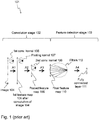
- Figure 1 shows a neural network 101 comprising a convolution stage 102 and a feature detection stage 103, which sometimes may be referred to as a fully connected stage.
- the convolution stage 102 convolves, in action A1, an image 104 by sliding a first convolutional kernel 105 over the image 104 to obtain a first feature map 106.
- the image 104 sometimes referred to as "input image", is illustrated as seen from one side, but the image may typically have a height and a width.
- the image includes a number of pixels, wherein each pixel corresponds to position in the image 104.
- Each pixel may further be represented by a depth for colour components as is known in the art. For example, the pixel may have a depth of three to represent the colours, red, green and blue.
- the first convolutional kernel 105 may typically have a width and a height, but may also include a depth.
- the image 104 is padded with zeros such that the 1 st feature map 106 obtains the same size as the image 104.
- the sliding of the first convolutional kernel 105 is performed by moving the first convolutional kernel 105 along rows and columns of the image 104 until the entire image 104 has been covered.
- An amount that the first convolutional kernel 105 is moved is herein referred to as a stride size, which may for example be expressed as a number of pixels.
- the stride size may be the same or different of movements along rows and columns.
- stride may refer to displacement of consecutive applications of a convolutional kernel to an original image, or an intermediate feature map.
- a pooling of the 1 st feature map 106 is performed by sliding, or moving, a pooling kernel 107 over the 1 st feature map 106 to obtain a pooled feature map 108.
- the pooling kernel 107 is moved over the first feature map 106 until its entirety is covered.
- the pooled feature map 108 and/or the polling kernel 107 may have a width and a height and possibly also a depth. In this manner, averaging, maximum selection of activations in the 1 st feature map 106 may be obtained according to known manners.
- the pooled feature map 108 is convolved by sliding a second convolutional kernel 109 of the pooled feature map 108.
- the pooled feature map 108 is padded with zeros according to known manners.
- a final feature map 110 is obtained.
- the final feature map 110 and/or the second convolutional kernel 109 may have a width and a height and possibly also a depth.
- a value of the final feature map 110 may contain information from a particular area of the image 104. Sometimes, the value is referred to as an activation, node, point or the like.
- a fully connected layer 111 is obtained by applying filters 112 connecting to all nodes in the final feature map 110. This is illustrated by action A4.
- Each activation of the fully connected layer 111 may indicate a probability that the feature to be detected was present in the image 104.
- the fully connected layer may be a scalar value, and in case the convolutional neural network is trained to detect a number of features, the fully connected layer may have a dimension that corresponds to the number of features to be detected.
- the filters 112 may have a width and a height and possibly also a depth such as to match size of the final feature map.
- Figure 2 illustrates training of an exemplifying conical convolutional neural network 200 to be used with some embodiments herein and Figure 3 illustrates application of the exemplifying conical convolutional neural network 200 of Figure 2 according to the embodiments herein.
- image is used herein to refer to an entire image. Notably, this example may preferably be applied for training of position 9 in Figure 6 below.
- image borders would cause truncation at one or more sides of a cone 220, where sides of the cone 220 correspond to the image's borders.
- each convolutional action renders its respective feature map 207-211, where the respective feature map denoted 211 may be referred to as a final feature map.
- the term "convolutional kernel” refers to a kernel, a filter a convolutional filter or the like.
- a size of the respective convolutional kernels 202-206 may be 1x1, 2x2, 3x3, 4x4, 5x5, etc. depending on use case.
- the respective convolution kernels 202-206 may also have a depth that is equal to the number of colours/filter channels in the preceding layer.
- the first image size IS1 of the images 201 and sizes of the respective convolutional kernels 202, 203, 204, 205 are matched such that the five convolutional actions results in the final feature map 211, which has a first feature map size FMS1 that is equal to a feature kernel size FKS of a feature kernel 212, which may be used to obtain an activation of a so-called fully connected layer 215.
- FMS1 first feature map size
- FKS feature kernel size
- size when used in connection with the term “image”, “feature map”, “feature kernel” or the like, typically refers to a size in terms of pixels, in x/y-direction and sometimes also colour depth.
- size greater than may mean that at least one the aforementioned directions/depth is greater than its corresponding direction/depth in the image, kernel, map etc. with which it is compared.
- the exemplifying conical convolutional neural network 200 comprises a further conical convolution stage 213 and a further feature detection stage 214, where the word "further” distinguishes these stages from the stages mentioned with reference to Figure 1 .
- the exemplifying conical convolutional neural network 200 may typically not include zero-padding.
- the zero-padding may be left out thanks to a conical form used during training, as illustrated in Figure 2 , of the exemplifying conical convolutional neural network 200.
- Zero-padding is normally used in order to allow convolutional kernels to be applied at edge pixels, or near edge pixels. Thanks to that the further convolutional stage 213 is free from zero-padding, or at least partially free from zero-padding, it may be ensured that the respective feature maps 207, 208, 209, 210, 211, or at least some of them, only includes information originating from actual image data, i.e. the respective feature maps 207, 208, 209, 210, 211, or at least some of them, does hence not include diluted information partly originating from zeros that the images 201 have been padded with. As a consequence, the final feature map 211 only includes information that originates from actual image data.
- the exemplifying conical convolutional neural network 200 may, or may not, include pooling. Pooling is known in the art and is not illustrated here for reasons of simplicity. It may nevertheless be noted that pooling may preferably follow the same scheme as illustrated in Figure 6 for the convolutions. For example, the pooling may preferably use partial zero-padding for the border positions.
- architecture of neural networks is herein defined by sizes of involved matrices, such as images, feature maps, convolutional kernels, feature kernel(s), or the like, as well as how these matrices are combined, e.g. convolved, with each other.
- convoluting convolutional kernels to cover the image is performed while using a certain stride.
- the certain stride i.e. a size of the certain stride, makes a building block to define the architecture of the neural networks.
- FIG. 3 application of an exemplifying conical convolutional neural network 200 of Figure 2 is illustrated. Accordingly, an image 301 is feed into the further conical convolution stage 213 of the exemplifying conical convolutional neural network 200.
- the image 301 has a second image size IS2 that is greater than the first image size IS1 of the images 201 that the exemplifying conical convolutional neural network 200 was trained with according to Figure 2 .
- Figure 3 the further conical convolution stage 213 remains the same as described in Figure 2 .
- the further feature detection stage 214 of Figure 2 is, however, adapted in order to compensate for that the image 301, having the second image size IS2 that is greater than the first image size IS1, is fed into the further conical convolution stage 213. Therefore, Figure 3 illustrates a further conical convolutional neural network 300, having the same further convolutional stage 213 and a yet further feature detection stage 303, which is based on the further feature detection stage 214.
- the yet further feature detection stage 303 includes adaptions that compensates for the second image size IS2 as will be explained below, e.g. with reference to Figure 5 .
- the yet further feature detection stage 303 reuses the feature kernel 212 without changes thereto. This is greatly advantageous since training is a time consuming and cumbersome task.
- a fully connected layer 310 is obtained, in which there will be one score of each position at which the feature kernel 212 has been applied to the feature map 302. These scores may thus be associated with one and the same object type or the like. Further feature kernels (not shown) may be applied to obtain scores for any further object types or the like when applicable.
- the further conical convolutional neural network 300 it is made possible to "see further away” in the image 301 of the second image size IS2 due to its higher resolution, while the feature kernel 212 has been trained with the images 201 of the first image size IS1.
- the further conical convolutional neural network 300 may detect features of the same minimum pixel size as the conical convolutional neural network 200.
- a higher resolution image such as the image 301, with the same field-of-view as the images 201, this will amount to seeing features further away, e.g. from an observer, camera or the like.
- FIG 4 illustrates a block diagram of an image processing entity 400 configured to perform exemplifying methods according to embodiments herein.
- the image processing entity 400 such as a digital camera, a surveillance camera, a mobile device including an image sensor, a computer, a software application executing in a computer system or the like, is described in more detail with reference to Figure 7 below.
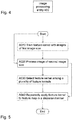
- FIG 5 a schematic flowchart of the exemplifying methods in the image processing entity 400 is shown.
- actions that appear in some embodiments are indicated by dashed lines.
- the image processing entity 400 performs a method for applying a convolutional neural network, such as the exemplifying convolutional neural network 300 of Figure 3 , to an image, such as the image 301.
- a convolutional neural network such as the exemplifying convolutional neural network 300 of Figure 3
- the convolutional neural network comprises a convolutional kernel, such as one or more of the convolutional kernels 202-206, for convolving with images, such as the images 201, of the first image size IS1 to render feature maps, such as respective final feature maps 211 for each of the images 201 or other non-final feature maps.
- a convolutional kernel such as one or more of the convolutional kernels 202-206, for convolving with images, such as the images 201, of the first image size IS1 to render feature maps, such as respective final feature maps 211 for each of the images 201 or other non-final feature maps.
- the convolutional neural network comprises the feature kernel 212 trained to identify a feature, or at least one feature, in the images 201 based on the feature maps.
- the convolutional neural network may comprise one or more further feature kernels (not shown) in order to identify one or more further respective features, e.g. one for each feature kernel.
- the first image size IS1 is less than the second image size IM2 of the image 301 to which the convolutional neural network is applied.
- the convolutional neural network Before applying the convolutional neural network to the image 301, the convolutional neural network may be trained as follows.
- the image processing entity 400 may train the exemplifying conical convolutional neural network 200 of Figure 2 with images of the first image size IS1.
- the image processing entity 400, or said any other computing device may train the feature kernel based of feature maps obtained from the images of the first image size IS1.
- the image processing entity 400 processes the image 301 while using the convolutional kernel to render the feature map 302.
- the second feature map size FMS2 of the feature map 302 is greater than the first feature map size FMS1 of the feature maps 211 with which the feature kernel 212 was trained.
- the feature map 302 may typically be obtained by convolving the convolutional kernel 202-206 over the image 301 having the second image size IS2 without zero-padding.
- the feature map 302 may typically be rendered as a final feature map by means of the convolutional kernels 202-206.
- the image processing entity 400 may select, e.g. before performing action A040, a particular feature kernel among a plurality of feature kernels based on a position of the feature kernel relatively the feature map, i.e. the position within the feature map 302 at which the particular feature kernel to be selected shall be applied.
- the plurality of feature kernels includes a respective feature kernel that may have been trained at a respective one of these nine positions.
- the image processing entity 400 selects the respective feature kernel that is associated with, i.e. trained for, the position.
- the position is thus a current position at which the particular feature kernel to be selected shall be applied.
- the image processing entity 400 repeatedly applies the feature kernel, i.e. the selected feature kernel when applicable, to the feature map 302 in a stepwise manner.
- the feature kernel was trained to identify the feature based on the feature maps 211 of the first feature map size FMS1.
- the feature kernel has the first feature map size.
- the feature maps 211 were obtained by convolving the convolutional kernel 202-206 over images 201 having the first image size IS1, which causes, at least due to the convolution, the feature map 302 to have the second feature map size FMS2.
- the stepwise manner is represented by a step size that is greater than half of the first feature map size FMS1. At least two consecutive applications of the feature kernel may be applied such that the step size is less than or equal to the first feature map size FMS1. It may be preferred that there is no, or little, overlap between consecutive applications of the feature kernel. Therefore, the step size is often set to be equal to the first feature map size FMS1. With the step size as specified herein, major computational gain may be obtained as compared to the "overfeat-article" mentioned in the background section, since much fewer calculation are needed in order to cover the entire feature map 302.
- step may refer to displacement of consecutive applications of the feature kernel to the feature map, being too large for the feature kernel to analyse in "one step", i.e. the feature map is greater than the feature kernel.
- the feature kernel 212 may be applied three times to feature map 302, e.g. at different positions of the feature map 302, in order to analyse the entirety of the feature map 302. This will thus result in three values, or scores, indicating probability of identification of the feature for which the feature kernel was trained to identify. There may be no or little overlap between applications of the feature kernel, i.e. due to that the step size is approximately equal to the first feature map size. Then, it may be that the three different scores provide some information about where in the image 301 the feature may have been identified.
- a first value of the three values is 0.9, a second value of the three values is 0.2, and a third value of the three values is 0.1, then it may - depending on the order the values are organized - be that the feature is identified in e.g. a top left corner of the image 301.
- each score may also, or alternatively, be possible to consolidate each score, originating from respective applications of the feature kernel, or even respective feature kernels, into a common score for each feature to be identified.
- the common score may be calculated as a mean value of the scores for identification of the feature, a maximum value from among the scores for identification etc. In view of the preceding example, it may be that the maximum value of 0.9 may be selected as the common score.
- the method above may be re-run on a downscaled image version of the image 301, or several re-runs on several scales if needed.
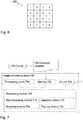
- FIG. 6 illustrates nine different positions 1-9 with in an exemplifying feature map 600, such as the final feature map, onto which the selected feature kernel is to be applied.
- the second image size is four times the first image size in two directions.
- the second image size is 16 times the first image size.
- a first corner position 1 may be located at an upper left corner of the feature map 600.
- a second corner position 3 may be located at an upper right corner of the feature map 600.
- a third corner position 6 may be located at a lower left corner of the feature map 600.
- a fourth corner position 8 may be located at a lower right corner of the feature map 600.
- the two upper edge positions 2 there are two upper edge positions 2, two left edge positions 4, two right edge positions 5 and two lower edge positions 7.
- the two upper edge positions 2 are associated with one feature kernel.
- the two left edge positions 4, the two right edge positions 5 and the two lower edge positions 7 are associated with one respective feature kernel.
- FIG. 7 a schematic block diagram of embodiments of the image processing entity 400 of Figure 4 is shown.
- modules and the like that appear in some embodiments are indicated by dashed lines.
- the image processing entity 400 may comprise a processing module 701, such as a means for performing the methods described herein.
- the means may be embodied in the form of one or more hardware modules and/or one or more software modules
- the image processing entity 400 may further comprise a memory 702.
- the memory may comprise, such as contain or store, instructions, e.g. in the form of a computer program 703, which may comprise computer readable code units.
- the image processing entity 400 and/or the processing module 701 comprises a processing circuit 704 as an exemplifying hardware module, which may comprise one or more processors.
- the processing module 701 may be embodied in the form of, or 'realized by', the processing circuit 704.
- the instructions may be executable by the processing circuit 704, whereby the image processing entity 400 is operative to perform the methods of Figure 5 .
- the instructions when executed by the image processing entity 400 and/or the processing circuit 704, may cause the image processing entity 400 to perform the method according to Figure 5 .
- an image processing entity 400 for applying a convolutional neural network to an image.
- the convolutional neural network comprises a convolutional kernel for convolving with images of a first image size to render feature maps and a feature kernel trained to identify a feature in the images based on the feature maps, wherein the first image size is less than a second image size of the image to which the convolutional network is applied.
- the memory 702 contains the instructions executable by said processing circuit 704 whereby the image processing entity 400 is operative for:
- Figure 7 further illustrates a carrier 705, or program carrier, which comprises the computer program 703 as described directly above.
- the carrier 705 may be one of an electronic signal, an optical signal, a radio signal and a computer readable medium.
- the image processing entity 400 and/or the processing module 701 may comprise one or more of a sub-processing module 710, an applying module 720, a selecting module 730 and a training module 740 as exemplifying hardware modules.
- a sub-processing module 710 an applying module 720
- a selecting module 730 a selecting module 730
- a training module 740 as exemplifying hardware modules.
- one or more of the aforementioned exemplifying hardware modules may be implemented as one or more software modules.
- the processing module 701 comprises an Input/Output unit 706.
- the image processing entity 400 is configured for applying a convolutional neural network to an image.
- the image processing entity 400 and/or the processing module 701 and/or the sub-processing module 710 is configured for processing the image while using the convolutional kernel to render a feature map, whereby a second feature map size of the feature map is greater than a first feature map size of the feature maps with which the feature kernel was trained.
- the image processing entity 400 and/or the processing module 701 and/or the applying module 720 may be configured for repeatedly applying the feature kernel to the feature map in a stepwise manner, wherein the feature kernel was trained to identify the feature based on the feature maps of the first feature map size, wherein the feature kernel has the first feature map size, wherein the feature maps were obtained by convolving the convolutional kernel over images having the first image size, which causes, at least due to the convolution, the feature map to have the second feature map size, wherein the stepwise manner is represented by a step size that is greater than half of the first feature map size.
- the image processing entity 400 and/or the processing module 701 and/or the selecting module 730 may be configured for selecting the feature kernel among a plurality of feature kernels based on a position of the feature kernel relatively the feature map.
- the image processing entity 400 and/or the processing module 701 and/or the training module 740 may be configured for training the exemplifying conical convolutional neural network 200 of Figure 2 with images of the first image size IS1.
- module may refer to one or more functional modules, each of which may be implemented as one or more hardware modules and/or one or more software modules and/or a combined software/hardware module in a node.
- the module may represent a functional unit realized as software and/or hardware of the node.
- the term "computer program carrier”, “program carrier”, or “carrier” may refer to one of an electronic signal, an optical signal, a radio signal, and a computer readable medium.
- the computer program carrier may exclude transitory, propagating signals, such as the electronic, optical and/or radio signal.
- the computer program carrier may be a non-transitory carrier, such as a non-transitory computer readable medium.
- processing module may include one or more hardware modules, one or more software modules or a combination thereof. Any such module, be it a hardware, software or a combined hardware-software module, may be a determining means, estimating means, capturing means, associating means, comparing means, identification means, selecting means, receiving means, sending means or the like as disclosed herein.
- the expression “means” may be a module corresponding to the modules listed above in conjunction with the Figures.
- software module may refer to a software application, a Dynamic Link Library (DLL), a software component, a software object, an object according to Component Object Model (COM), a software component, a software function, a software engine, an executable binary software file or the like.
- DLL Dynamic Link Library
- COM Component Object Model
- processing module or “processing circuit” may herein encompass a processing unit, comprising e.g. one or more processors, an Application Specific integrated Circuit (ASIC), a Field-Programmable Gate Array (FPGA) or the like.
- ASIC Application Specific integrated Circuit
- FPGA Field-Programmable Gate Array
- the processing circuit or the like may comprise one or more processor kernels.
- the expression “configured to/for” may mean that a processing circuit is configured to, such as adapted to or operative to, by means of software configuration and/or hardware configuration, perform one or more of the actions described herein.
- memory may refer to a hard disk, a magnetic storage medium, a portable computer diskette or disc, flash memory, random access memory (RAM) or the like. Furthermore, the term “memory” may refer to an internal register memory of a processor or the like.
- the term "computer readable medium” may be a Universal Serial Bus (USB) memory, a DVD-disc, a Blu-ray disc, a software module that is received as a stream of data, a Flash memory, a hard drive, a memory card, such as a MemoryStick, a Multimedia Card (MMC), Secure Digital (SD) card, etc.
- USB Universal Serial Bus
- MMC Multimedia Card
- SD Secure Digital
- One or more of the aforementioned examples of computer readable medium may be provided as one or more computer program products.
- computer readable code units may be text of a computer program, parts of or an entire binary file representing a computer program in a compiled format or anything there between.
- number and/or value may be any kind of digit, such as binary, real, imaginary or rational number or the like. Moreover, “number” and/or “value” may be one or more characters, such as a letter or a string of letters. “Number” and/or “value” may also be represented by a string of bits, i.e. zeros and/or ones.
- a set of may refer to one or more of something.
- a set of devices may refer to one or more devices
- a set of parameters may refer to one or more parameters or the like according to the embodiments herein.
Landscapes
- Engineering & Computer Science (AREA)
- Physics & Mathematics (AREA)
- Theoretical Computer Science (AREA)
- General Physics & Mathematics (AREA)
- Evolutionary Computation (AREA)
- Life Sciences & Earth Sciences (AREA)
- Artificial Intelligence (AREA)
- Computer Vision & Pattern Recognition (AREA)
- Biomedical Technology (AREA)
- Data Mining & Analysis (AREA)
- Molecular Biology (AREA)
- General Health & Medical Sciences (AREA)
- Health & Medical Sciences (AREA)
- General Engineering & Computer Science (AREA)
- Multimedia (AREA)
- Computational Linguistics (AREA)
- Biophysics (AREA)
- Computing Systems (AREA)
- Mathematical Physics (AREA)
- Software Systems (AREA)
- Biodiversity & Conservation Biology (AREA)
- Probability & Statistics with Applications (AREA)
- Bioinformatics & Computational Biology (AREA)
- Evolutionary Biology (AREA)
- Bioinformatics & Cheminformatics (AREA)
- Image Analysis (AREA)
Priority Applications (3)
| Application Number | Priority Date | Filing Date | Title |
|---|---|---|---|
| EP17207325.6A EP3499415A1 (de) | 2017-12-14 | 2017-12-14 | Verfahren und bildverarbeitungseinheit zum aufbringen einer verarbeitungseinheit zum anwenden eines neuronalen konvolutionsnetzwerks auf ein bild |
| US16/208,587 US10832076B2 (en) | 2017-12-14 | 2018-12-04 | Method and image processing entity for applying a convolutional neural network to an image |
| CN201811525270.9A CN109961083B (zh) | 2017-12-14 | 2018-12-13 | 用于将卷积神经网络应用于图像的方法和图像处理实体 |
Applications Claiming Priority (1)
| Application Number | Priority Date | Filing Date | Title |
|---|---|---|---|
| EP17207325.6A EP3499415A1 (de) | 2017-12-14 | 2017-12-14 | Verfahren und bildverarbeitungseinheit zum aufbringen einer verarbeitungseinheit zum anwenden eines neuronalen konvolutionsnetzwerks auf ein bild |
Publications (1)
| Publication Number | Publication Date |
|---|---|
| EP3499415A1 true EP3499415A1 (de) | 2019-06-19 |
Family
ID=60915207
Family Applications (1)
| Application Number | Title | Priority Date | Filing Date |
|---|---|---|---|
| EP17207325.6A Withdrawn EP3499415A1 (de) | 2017-12-14 | 2017-12-14 | Verfahren und bildverarbeitungseinheit zum aufbringen einer verarbeitungseinheit zum anwenden eines neuronalen konvolutionsnetzwerks auf ein bild |
Country Status (3)
| Country | Link |
|---|---|
| US (1) | US10832076B2 (de) |
| EP (1) | EP3499415A1 (de) |
| CN (1) | CN109961083B (de) |
Cited By (1)
| Publication number | Priority date | Publication date | Assignee | Title |
|---|---|---|---|---|
| CN111767928A (zh) * | 2020-06-28 | 2020-10-13 | 中国矿业大学 | 基于卷积神经网络提取图像特征信息的方法及装置 |
Families Citing this family (3)
| Publication number | Priority date | Publication date | Assignee | Title |
|---|---|---|---|---|
| WO2022173665A1 (en) * | 2021-02-12 | 2022-08-18 | Carnegie Mellon University | System and method for unsupervised object deformation using feature map-level data augmentation |
| WO2022213843A1 (zh) * | 2021-04-08 | 2022-10-13 | 华为技术有限公司 | 一种图像处理方法、训练方法及装置 |
| KR20240114966A (ko) * | 2023-01-18 | 2024-07-25 | 광주과학기술원 | 합성곱 신경망의 특징 맵에 기반한 분포 외 탐지 시스템 및 방법 |
Citations (1)
| Publication number | Priority date | Publication date | Assignee | Title |
|---|---|---|---|---|
| US20170083796A1 (en) * | 2015-09-18 | 2017-03-23 | Panasonic Intellectual Property Corporation Of America | Image recognition method |
Family Cites Families (9)
| Publication number | Priority date | Publication date | Assignee | Title |
|---|---|---|---|---|
| US8873838B2 (en) * | 2013-03-14 | 2014-10-28 | Google Inc. | Method and apparatus for characterizing an image |
| IL231862A (en) * | 2014-04-01 | 2015-04-30 | Superfish Ltd | Image representation using a neural network |
| CN106156807B (zh) * | 2015-04-02 | 2020-06-02 | 华中科技大学 | 卷积神经网络模型的训练方法及装置 |
| US9767381B2 (en) * | 2015-09-22 | 2017-09-19 | Xerox Corporation | Similarity-based detection of prominent objects using deep CNN pooling layers as features |
| CN105787488B (zh) * | 2016-03-02 | 2019-04-30 | 浙江宇视科技有限公司 | 由全局向局部传递的图像特征提取方法及装置 |
| KR102631381B1 (ko) * | 2016-11-07 | 2024-01-31 | 삼성전자주식회사 | 컨볼루션 신경망 처리 방법 및 장치 |
| CN107145902B (zh) * | 2017-04-27 | 2019-10-11 | 厦门美图之家科技有限公司 | 一种基于卷积神经网络的图像处理方法、装置及移动终端 |
| CN107066995A (zh) * | 2017-05-25 | 2017-08-18 | 中国矿业大学 | 一种基于卷积神经网络的遥感图像桥梁检测方法 |
| CN110838124B (zh) * | 2017-09-12 | 2021-06-18 | 深圳科亚医疗科技有限公司 | 用于分割具有稀疏分布的对象的图像的方法、系统和介质 |
-
2017
- 2017-12-14 EP EP17207325.6A patent/EP3499415A1/de not_active Withdrawn
-
2018
- 2018-12-04 US US16/208,587 patent/US10832076B2/en active Active
- 2018-12-13 CN CN201811525270.9A patent/CN109961083B/zh active Active
Patent Citations (1)
| Publication number | Priority date | Publication date | Assignee | Title |
|---|---|---|---|---|
| US20170083796A1 (en) * | 2015-09-18 | 2017-03-23 | Panasonic Intellectual Property Corporation Of America | Image recognition method |
Non-Patent Citations (3)
| Title |
|---|
| ALEX KRIZHEVSKY ET AL: "ImageNet classification with deep convolutional neural networks", COMMUNICATIONS OF THE ACM, ASSOCIATION FOR COMPUTING MACHINERY, INC, UNITED STATES, vol. 60, no. 6, 24 May 2017 (2017-05-24), pages 84 - 90, XP058339266, ISSN: 0001-0782, DOI: 10.1145/3065386 * |
| KAIMING HE ET AL: "Spatial Pyramid Pooling in Deep Convolutional Networks for Visual Recognition", IEEE TRANSACTIONS ON PATTERN ANALYSIS AND MACHINE INTELLIGENCE, 1 January 2015 (2015-01-01), United States, pages 1904 - 1916, XP055389892, Retrieved from the Internet <URL:https://arxiv.org/pdf/1406.4729v2.pdf> [retrieved on 20180508], DOI: 10.1109/TPAMI.2015.2389824 * |
| P. SERMANET ET AL., OVERFEAT: INTEGRATED RECOGNITION, LOCALIZATION AND DETECTION USING CONVOLUTIONAL NETWORKS, 24 February 2014 (2014-02-24) |
Cited By (2)
| Publication number | Priority date | Publication date | Assignee | Title |
|---|---|---|---|---|
| CN111767928A (zh) * | 2020-06-28 | 2020-10-13 | 中国矿业大学 | 基于卷积神经网络提取图像特征信息的方法及装置 |
| CN111767928B (zh) * | 2020-06-28 | 2023-08-08 | 中国矿业大学 | 基于卷积神经网络提取图像特征信息的方法及装置 |
Also Published As
| Publication number | Publication date |
|---|---|
| CN109961083A (zh) | 2019-07-02 |
| US10832076B2 (en) | 2020-11-10 |
| CN109961083B (zh) | 2021-11-16 |
| US20190188512A1 (en) | 2019-06-20 |
Similar Documents
| Publication | Publication Date | Title |
|---|---|---|
| CN108111714B (zh) | 基于多透镜的捕获设备和方法 | |
| US10832076B2 (en) | Method and image processing entity for applying a convolutional neural network to an image | |
| CN111047615B (zh) | 基于图像的直线检测方法、装置以及电子设备 | |
| WO2018036293A1 (zh) | 图像分割方法、装置及全卷积网络系统 | |
| JP5985622B2 (ja) | オプティカルフローを決定するためのコンテンツ適応型システム、方法、及び装置 | |
| CN110176024B (zh) | 在视频中对目标进行检测的方法、装置、设备和存储介质 | |
| US8417047B2 (en) | Noise suppression in low light images | |
| US11615612B2 (en) | Systems and methods for image feature extraction | |
| CN115578590A (zh) | 基于卷积神经网络模型的图像识别方法、装置及终端设备 | |
| WO2020098360A1 (en) | Method, system, and computer-readable medium for processing images using cross-stage skip connections | |
| US11941781B2 (en) | Method and apparatus for restoring image | |
| CN113298187B (zh) | 图像处理方法及装置、计算机可读存储介质 | |
| CN112348116B (zh) | 利用空间上下文的目标检测方法、装置和计算机设备 | |
| CN110516731B (zh) | 一种基于深度学习的视觉里程计特征点检测方法及系统 | |
| CN109886390B (zh) | 卷积神经网络模型优化方法、装置、计算机设备及存储介质 | |
| CN111161299A (zh) | 影像分割方法、计算机程序、存储介质及电子装置 | |
| CN112016577A (zh) | 图像处理方法和装置 | |
| CN111145196A (zh) | 图像分割方法、装置及服务器 | |
| CN114596210A (zh) | 噪声估计方法、装置、终端设备及计算机可读存储介质 | |
| CN111292331B (zh) | 图像处理的方法与装置 | |
| JP6963038B2 (ja) | 画像処理装置および画像処理方法 | |
| CN115082867B (zh) | 用于对象检测的方法和系统 | |
| US20130343655A1 (en) | Apparatus and method extracting feature information of a source image | |
| CN111507252A (zh) | 人体跌倒检测装置、方法、电子终端及存储介质 | |
| CN111160340A (zh) | 一种运动目标检测方法、装置、存储介质及终端设备 |
Legal Events
| Date | Code | Title | Description |
|---|---|---|---|
| PUAI | Public reference made under article 153(3) epc to a published international application that has entered the european phase |
Free format text: ORIGINAL CODE: 0009012 |
|
| STAA | Information on the status of an ep patent application or granted ep patent |
Free format text: STATUS: REQUEST FOR EXAMINATION WAS MADE |
|
| 17P | Request for examination filed |
Effective date: 20180925 |
|
| AK | Designated contracting states |
Kind code of ref document: A1 Designated state(s): AL AT BE BG CH CY CZ DE DK EE ES FI FR GB GR HR HU IE IS IT LI LT LU LV MC MK MT NL NO PL PT RO RS SE SI SK SM TR |
|
| AX | Request for extension of the european patent |
Extension state: BA ME |
|
| STAA | Information on the status of an ep patent application or granted ep patent |
Free format text: STATUS: EXAMINATION IS IN PROGRESS |
|
| 17Q | First examination report despatched |
Effective date: 20190722 |
|
| RAP1 | Party data changed (applicant data changed or rights of an application transferred) |
Owner name: AXIS AB |
|
| STAA | Information on the status of an ep patent application or granted ep patent |
Free format text: STATUS: THE APPLICATION HAS BEEN WITHDRAWN |
|
| 18W | Application withdrawn |
Effective date: 20210413 |