EP3496169A1 - Secondary battery - Google Patents
Secondary battery Download PDFInfo
- Publication number
- EP3496169A1 EP3496169A1 EP17836760.3A EP17836760A EP3496169A1 EP 3496169 A1 EP3496169 A1 EP 3496169A1 EP 17836760 A EP17836760 A EP 17836760A EP 3496169 A1 EP3496169 A1 EP 3496169A1
- Authority
- EP
- European Patent Office
- Prior art keywords
- oxide semiconductor
- layer
- type oxide
- electrode
- secondary battery
- Prior art date
- Legal status (The legal status is an assumption and is not a legal conclusion. Google has not performed a legal analysis and makes no representation as to the accuracy of the status listed.)
- Granted
Links
Images
Classifications
-
- H—ELECTRICITY
- H01—ELECTRIC ELEMENTS
- H01M—PROCESSES OR MEANS, e.g. BATTERIES, FOR THE DIRECT CONVERSION OF CHEMICAL ENERGY INTO ELECTRICAL ENERGY
- H01M4/00—Electrodes
- H01M4/02—Electrodes composed of, or comprising, active material
- H01M4/13—Electrodes for accumulators with non-aqueous electrolyte, e.g. for lithium-accumulators; Processes of manufacture thereof
- H01M4/131—Electrodes based on mixed oxides or hydroxides, or on mixtures of oxides or hydroxides, e.g. LiCoOx
-
- H—ELECTRICITY
- H10—SEMICONDUCTOR DEVICES; ELECTRIC SOLID-STATE DEVICES NOT OTHERWISE PROVIDED FOR
- H10N—ELECTRIC SOLID-STATE DEVICES NOT OTHERWISE PROVIDED FOR
- H10N99/00—Subject matter not provided for in other groups of this subclass
-
- H—ELECTRICITY
- H01—ELECTRIC ELEMENTS
- H01G—CAPACITORS; CAPACITORS, RECTIFIERS, DETECTORS, SWITCHING DEVICES, LIGHT-SENSITIVE OR TEMPERATURE-SENSITIVE DEVICES OF THE ELECTROLYTIC TYPE
- H01G4/00—Fixed capacitors; Processes of their manufacture
- H01G4/002—Details
- H01G4/005—Electrodes
- H01G4/008—Selection of materials
-
- H—ELECTRICITY
- H01—ELECTRIC ELEMENTS
- H01G—CAPACITORS; CAPACITORS, RECTIFIERS, DETECTORS, SWITCHING DEVICES, LIGHT-SENSITIVE OR TEMPERATURE-SENSITIVE DEVICES OF THE ELECTROLYTIC TYPE
- H01G11/00—Hybrid capacitors, i.e. capacitors having different positive and negative electrodes; Electric double-layer [EDL] capacitors; Processes for the manufacture thereof or of parts thereof
- H01G11/22—Electrodes
- H01G11/26—Electrodes characterised by their structure, e.g. multi-layered, porosity or surface features
-
- H—ELECTRICITY
- H01—ELECTRIC ELEMENTS
- H01G—CAPACITORS; CAPACITORS, RECTIFIERS, DETECTORS, SWITCHING DEVICES, LIGHT-SENSITIVE OR TEMPERATURE-SENSITIVE DEVICES OF THE ELECTROLYTIC TYPE
- H01G11/00—Hybrid capacitors, i.e. capacitors having different positive and negative electrodes; Electric double-layer [EDL] capacitors; Processes for the manufacture thereof or of parts thereof
- H01G11/54—Electrolytes
- H01G11/56—Solid electrolytes, e.g. gels; Additives therein
-
- H—ELECTRICITY
- H01—ELECTRIC ELEMENTS
- H01G—CAPACITORS; CAPACITORS, RECTIFIERS, DETECTORS, SWITCHING DEVICES, LIGHT-SENSITIVE OR TEMPERATURE-SENSITIVE DEVICES OF THE ELECTROLYTIC TYPE
- H01G4/00—Fixed capacitors; Processes of their manufacture
- H01G4/33—Thin- or thick-film capacitors (thin- or thick-film circuits; capacitors without a potential-jump or surface barrier specially adapted for integrated circuits, details thereof, multistep manufacturing processes therefor)
-
- H—ELECTRICITY
- H01—ELECTRIC ELEMENTS
- H01M—PROCESSES OR MEANS, e.g. BATTERIES, FOR THE DIRECT CONVERSION OF CHEMICAL ENERGY INTO ELECTRICAL ENERGY
- H01M10/00—Secondary cells; Manufacture thereof
- H01M10/36—Accumulators not provided for in groups H01M10/05-H01M10/34
-
- H—ELECTRICITY
- H01—ELECTRIC ELEMENTS
- H01M—PROCESSES OR MEANS, e.g. BATTERIES, FOR THE DIRECT CONVERSION OF CHEMICAL ENERGY INTO ELECTRICAL ENERGY
- H01M4/00—Electrodes
- H01M4/02—Electrodes composed of, or comprising, active material
- H01M4/36—Selection of substances as active materials, active masses, active liquids
- H01M4/38—Selection of substances as active materials, active masses, active liquids of elements or alloys
- H01M4/387—Tin or alloys based on tin
-
- H—ELECTRICITY
- H10—SEMICONDUCTOR DEVICES; ELECTRIC SOLID-STATE DEVICES NOT OTHERWISE PROVIDED FOR
- H10D—INORGANIC ELECTRIC SEMICONDUCTOR DEVICES
- H10D64/00—Electrodes of devices having potential barriers
- H10D64/01—Manufacture or treatment
- H10D64/011—Manufacture or treatment of electrodes ohmically coupled to a semiconductor
-
- H—ELECTRICITY
- H10—SEMICONDUCTOR DEVICES; ELECTRIC SOLID-STATE DEVICES NOT OTHERWISE PROVIDED FOR
- H10D—INORGANIC ELECTRIC SEMICONDUCTOR DEVICES
- H10D1/00—Resistors, capacitors or inductors
- H10D1/60—Capacitors
- H10D1/68—Capacitors having no potential barriers
- H10D1/692—Electrodes
- H10D1/696—Electrodes comprising multiple layers, e.g. comprising a barrier layer and a metal layer
-
- Y—GENERAL TAGGING OF NEW TECHNOLOGICAL DEVELOPMENTS; GENERAL TAGGING OF CROSS-SECTIONAL TECHNOLOGIES SPANNING OVER SEVERAL SECTIONS OF THE IPC; TECHNICAL SUBJECTS COVERED BY FORMER USPC CROSS-REFERENCE ART COLLECTIONS [XRACs] AND DIGESTS
- Y02—TECHNOLOGIES OR APPLICATIONS FOR MITIGATION OR ADAPTATION AGAINST CLIMATE CHANGE
- Y02E—REDUCTION OF GREENHOUSE GAS [GHG] EMISSIONS, RELATED TO ENERGY GENERATION, TRANSMISSION OR DISTRIBUTION
- Y02E60/00—Enabling technologies; Technologies with a potential or indirect contribution to GHG emissions mitigation
- Y02E60/10—Energy storage using batteries
Definitions
- the present invention relates to a technique for improving the performance of a secondary battery.
- Patent Literature 1 discloses a power storage element including, between a first electrode and a second electrode, a power storage layer containing a mixture of an insulating material and n-type semiconductor particles.
- a p-type semiconductor layer is arranged between the power storage layer and the second electrode.
- a leakage suppression layer is arranged between the p-type semiconductor layer and the power storage layer.
- the leakage suppression layer is formed of at least one selected from silicon dioxide, aluminium oxide, or magnesium oxide.
- Patent Literature 2 discloses a power storage element including, between a first electrode and a second electrode, a power storage layer containing a mixture of an insulating material and n-type semiconductor particles.
- a p-type semiconductor layer is arranged between the power storage layer and the second electrode.
- a diffusion suppression layer having the resistivity of 1000 ⁇ cm or less is arranged between the first electrode and the power storage layer.
- the diffusion suppression layer is formed of nitride, carbide, and boride.
- Patent Literature 2 The diffusion suppression layer in Patent Literature 2 is used to suppress the components of the substrate arranged under the first electrode or of the first electrode from diffusing in the power storage layer, and is not arranged to prevent oxidation of the surface of the first electrode. That is, oxidation of the surface of the first electrode cannot be prevented in Patent Literature 2, and the oxidation increases the electric resistance between the first electrode and the power storage layer. Accordingly, it is difficult to obtain desired performance of the battery.
- the present invention has been made in view of the above problems, and to provide a technique for improving the performance of a secondary battery.
- a secondary battery includes a first electrode, a second electrode, a charging layer arranged between the first electrode and the second electrode and containing a mixture of an insulating material and a first n-type oxide semiconductor material, an n-type oxide semiconductor layer arranged between the charging layer and the first electrode and containing a second n-type oxide semiconductor material, a p-type oxide semiconductor layer arranged between the charging layer and the second electrode and containing a p-type oxide semiconductor material, a mixture layer arranged between the charging layer and the p-type oxide semiconductor layer and containing a mixture of silicon oxide and a third n-type oxide semiconductor material, and a conductive layer arranged between the first electrode and the n-type oxide semiconductor layer and containing a metal material.
- the third n-type oxide semiconductor material may be tin oxide.
- the conductive layer may contain the same metallic element as a metallic element contained in the second n-type oxide semiconductor material.
- the conductive layer may contain a metallic element having higher electric conductivity than electric conductivity of a metallic element contained in the second n-type oxide semiconductor material.
- the second n-type oxide semiconductor material may be titanium oxide.
- the conductive layer may include a titanium film provided to be in contact with the n-type oxide semiconductor layer.
- the conductive layer may have a laminated structure including a tungsten film and the titanium film, and the tungsten film may be provided to be in contact with the first electrode.
- the conductive layer may include a first metal film being in contact with the n-type oxide semiconductor layer, and a second metal film being in contact with the first electrode, in which the first metal film may contain the same metallic element as a metallic element contained in the second n-type oxide semiconductor material.
- the second metal film may contain a metallic element having higher electric conductivity than electric conductivity of a metallic element contained in the second n-type oxide semiconductor material.
- the mixture layer may have a thickness of 100 nm to 250 nm.
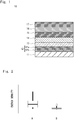
- Fig. 1 is a cross-sectional view schematically showing a structure of the secondary battery 10.
- the secondary battery 10 has a laminated structure in which a first electrode 11, a conductive layer 12, an n-type oxide semiconductor layer 13, a charging layer 14, a mixture layer 15, a p-type oxide semiconductor layer 16, and a second electrode 17 are laminated in this order.
- the first electrode 11 is formed of a conductive sheet or a conductive substrate and serves as a base material for providing the laminated structure.
- a metal foil sheet or the like can be used as the first electrode 11.
- a steel use stainless (SUS) sheet is used as the first electrode 11.
- a metal foil sheet made of copper, aluminium, or the like can be used as the first electrode 11.
- the first electrode 11 can be formed on the based material.
- a metal material such as chromium (Cr) or titanium (Ti)
- Cr chromium
- Ti titanium
- An alloy film containing aluminium (Al), silver (Ag), or the like can be also used as the material of the first electrode 11.
- the first electrode 11 can be formed similarly to the second electrode 17 to be described later.
- the conductive layer 12 can be formed of a metal material.
- the conductive layer 12 has a single layer structure consisting of a first metal film 12a, or a double layer structure consisting of a first metal film 12a and a second metal film 12b.
- Fig. 1 shows the double layer structure consisting of the first metal film 12a and the second metal film 12b.
- the second metal film 12b is in contact with the first electrode 11
- the first metal film 12a is in contact with the n-type oxide semiconductor layer 13.
- the first metal film 12a is in contact with the n-type oxide semiconductor layer 13 and the first electrode 11.
- the material of the first metal film 12a preferably contains the same metallic element as the n-type oxide semiconductor layer 13.
- the first metal film 12a is preferably titanium (Ti).
- the material of the first metal film 12a preferably contains an metallic element having higher electric conductivity than the electric conductivity of the metallic element contained in the n-type oxide semiconductor layer 13.
- the first metal film 12a is preferably titanium (Ti), an alloy containing titanium (Ti), aluminium (Al), an alloy containing aluminium (Al), chromium (Cr), or nickel (Ni).
- the second metal film 12b preferably contains a metallic element having higher electric conductivity than, for example, the electric conductivity of the metallic element contained in the n-type oxide semiconductor layer 13.
- the n-type oxide semiconductor layer 13 is titanium oxide (TiO2)
- the second metal film 12b is preferably aluminium (Al) or tungsten (W).
- the conductive layer 12 may have, for example, a single layer structure consisting of the first metal film 12a being a titanium (Ti) film or a double layer structure consisting of the first metal film 12a being a titanium (Ti) film and the second metal film 12b being a tungsten (W) film.
- the thickness of the conductive layer 12 is 15 nm to 300 nm.
- the conductive layer 12 can be formed on the first electrode 11 by sputtering or evaporation deposition.
- the n-type oxide semiconductor layer 13 contains a second n-type oxide semiconductor material.
- a second n-type oxide semiconductor material titanium dioxide (TiO2), tin oxide (SnO2), zinc oxide (ZnO), or the like can be used.
- the thickness of the n-type oxide semiconductor layer 13 is preferably 30 nm to 120 nm.
- titanium oxide having the thickness of 60 to 120 nm can be used as the n-type oxide semiconductor layer 13.
- the n-type oxide semiconductor layer 13 is formed on the first electrode 11 by sputtering or evaporation deposition.
- the charging layer 14 is formed of a mixture of an insulating material and an n-type oxide semiconductor material.
- n-type oxide semiconductor material a first n-type oxide semiconductor material
- n-type oxide semiconductor fine particles can be used as the n-type oxide semiconductor material (a first n-type oxide semiconductor material) of the charging layer 14.
- the n-type oxide semiconductor is turned into a layer having a charging function because the optical excitation structure is changed by irradiation with a ultraviolet ray.
- the n-type oxide semiconductor contains a mixture of an n-type oxide semiconductor material and an insulating material.
- silicone resin is can be used.
- a silicon compound (silicone), such as silicon oxide, having a main skeleton by a siloxane bond is preferably used as the insulating material.
- the charging layer 14 is formed of silicon oxide and titanium dioxide which is used as the first n-type oxide semiconductor material.
- tin oxide (SnO2) or zinc oxide (ZnO) is suitable for the n-type oxide semiconductor material to be used for the charging layer 14.
- a material obtained by mixing two of titanium dioxide, tin oxide, and zinc oxide or all of them can be also used.
- a manufacturing process of the charging layer 14 is described below.
- a coating liquid is prepared by mixing, into a solvent, a mixture of a precursor of titanium oxide, tin oxide, or zinc oxide and silicone oil.
- a coating liquid is prepared by mixing fatty acid titanium and silicone oil into a solvent.
- the coating liquids are applied on the n-type oxide semiconductor layer 13 by a spin coating method, a slit coating method, or the like.
- the coating film is dried and calcined to form the charging layer 14 on the n-type oxide semiconductor layer 13.
- the precursor for example, titanium stearate which is a precursor of titanium oxide can be used. Titanium oxide, tin oxide, and zinc oxide are formed by decomposing aliphatic acid salt which is a precursor of metal oxide.
- the charging layer 14 after drying and calcining may be irradiated with a ultraviolet ray to be UV-cured.
- oxide semiconductor fine particles for titanium oxide, tin oxide, zinc oxide, or the like are mixed with silicone oil to obtain a liquid mixture. Then, the liquid mixture is mixed into a solvent to obtain a coating liquid. The coating liquid is applied on the n-type oxide semiconductor layer 13 by a spin coating method, a slit coating method, or the like. The coating film is dried, calcined, and UV-cured to form the charging layer 14.
- the mixture layer 15 is formed of a mixture of an insulating material and an n-type oxide semiconductor material.
- silicon oxide can be used.
- the mixture layer 15 contains silicon dioxide (SiO2).
- the insulating material of the mixture layer 15 may be the same material as the insulating material of the charging layer 14.
- the material of the n-type oxide semiconductor material tin oxide (SnO) can be used.
- the mixture layer 15 contains a mixture of silicon oxide and tin oxide.
- the n-type oxide semiconductor material is added to silicon oxide, silicon nitride, or silicone oil.
- the n-type oxide semiconductor is diffused in silicon dioxide which is the insulating material.
- the first n-type oxide semiconductor material contained in the charging layer 14 may be the same as or different from the second n-type oxide semiconductor material contained in the n-type oxide semiconductor layer 13.
- the n-type oxide semiconductor material contained in the charging layer 14 may be tin oxide or another n-type oxide semiconductor material except for tin oxide.
- the thickness of the charging layer 14 is, for example, 200 nm to 1000 nm, and the thickness of the mixture layer 15 is 100 nm to 150 nm.
- the mixture layer 15 can be formed to have the thickness of 50 nm to 250 nm. More preferably, the mixture layer 15 may be formed to have the thickness of 150 nm to 200 nm.
- the mixture layer 15 can be formed in a similar manufacturing process to that for the charging layer 14.
- a coating liquid is prepared by mixing, into a solvent, a mixture of a precursor of tin oxide and silicone oil. Then, the coating liquid is applied on the charging layer 14 by a spin coating method, a slit coating method, or the like. The coating film is dried and calcined to form the mixture layer 15 on the charging layer 14.
- Tin oxide is formed by decomposing aliphatic acid which is a precursor of oxide semiconductor.
- the mixture layer 15 after drying and calcining may be irradiated with a ultraviolet ray to be UV-cured.
- oxide semiconductor fine particles for the oxide semiconductor material. Nanoparticles of tin oxide are mixed with silicone oil to obtain a liquid mixture. Then, the liquid mixture is mixed into a solvent to obtain a coating liquid. The coating liquid is applied on the charging layer 14 by a spin coating method, a slit coating method, or the like. The coating film is dried, calcined, and UV-cured to form the mixture layer 15.
- the p-type oxide semiconductor layer 16 contains a p-type oxide semiconductor material.
- a p-type oxide semiconductor material As the material of the p-type oxide semiconductor layer 16, nickel oxide (NiO), copper-aluminium oxide (CuAlO2), or the like can be used.
- the p-type oxide semiconductor layer 16 is a nickel oxide film having the thickness of 400 nm.
- the p-type oxide semiconductor layer 16 is formed on the mixture layer 15 by a film forming method such as sputtering or evaporation deposition.
- the second electrode 17 is only required to be formed of a conductive film.
- a metal material such as chromium (Cr) or copper (Cu)
- Cr chromium
- Cu copper
- a silver (Ag) alloy containing aluminium (Al) is also used.
- a forming method of the second electrode 22 includes vapor deposition such as spattering, ion plating, electron beam deposition, vacuum deposition or chemical deposition.
- the metal electrode can be formed by an electrolytic plating method or an electroless plating method.
- the metal used for plating is generally copper, a copper alloy, nickel, aluminium, silver, gold, zinc, tin, or the like.
- the second electrode 17 is an Al film having the thickness of 300 nm.
- the mixture layer 15 is arranged between the charging layer 14 and the p-type oxide semiconductor layer 16.
- the mixture layer 15 is formed of a mixture of silicon oxide and a third n-type oxide semiconductor material (a conductive material).
- a conductive material In comparison with a layer formed only of silicon oxide (an insulating material), the electric conductivity of the layer in the secondary battery according to the present embodiment can be adjusted by a conductive material, and it is possible to secure a certain level of electric conductivity although the mixture layer 15 is thickened. That is, it is possible for the mixture layer 15 to have a desired thickness in the secondary battery according to the present embodiment. Accordingly, it is possible to improve the performance of the secondary battery 10.
- the mixture layer 15 since it is possible for the mixture layer 15 to have a desired thickness while a certain level of conductivity is secured, it is unnecessary to form a layer to be thin in order not to obstruct the charge transfer unlike a layer formed only of silicon oxide (an insulating material). Thus, it is possible to prevent an uneven layer from being formed. That is, it is possible to avoid failures, such as localized dielectric breakdown in an uneven layer, in the secondary battery according to the present embodiment.
- the conductive layer 12 is arranged between the first electrode 11 and the n-type oxide semiconductor layer 13 in the secondary battery 10 according to the present embodiment.
- the conductive layer 12 has a single layer structure including a titanium (Ti) film as the first metal film 12a or a double layer structure including a titanium (Ti) film as the first metal film 12a and a tungsten (W) film as the second metal film 12b.
- the conductive layer 12 containing a metal material (the metal material preferably contains the same metallic element as the metallic element contained in the n-type oxide semiconductor layer 13 or a metallic element having higher electric conductivity than that of the metallic element contained in the n-type oxide semiconductor layer 13) is arranged between the first electrode 11 and the n-type oxide semiconductor layer 13. For this reason, the current flows more easily from the first electrode 11 to the n-type oxide semiconductor layer 13 in comparison with the case where the conductive layer 12 is not arranged. That is, by arranging the conductive layer 12, the electric conductivity from the first electrode 11 to the n-type oxide semiconductor layer 13 can be adjusted. In addition, by arranging the conductive layer 12, it is possible to improve the adhesion between the first electrode 11 and the n-type oxide semiconductor layer 13.
- the electric conductivity between the first electrode 11 and the charging layer 14 is lowered.
- the conductive layer 12 By arranging the conductive layer 12 on the first electrode 11, it is possible to secure a certain level of electric conductivity while oxidation of the surface of the first electrode 11 is reduced.
- the conductive layer 12 (the first metal film 12a) preferably includes a titanium film which is the same metallic element as that of the n-type oxide semiconductor layer 13. This titanium film secures a certain level of electric conductivity and serves as an adhesion layer improving the adhesion between the first electrode 11 and the n-type oxide semiconductor layer 13.
- the conductive layer 12 has a double layer structure (the first metal film 12a and the second metal film 12b), it is possible to suppress migration of the heavy metal forming the first electrode 11 to the n-type oxide semiconductor layer 13 and to improve the adhesion between the layer arranged on the second metal film 12b and the layer arranged under the second metal film 12b, in addition to the effects (conductivity and adhesion) when the conductive layer 12 has the single layer structure.
- the details of these effects are described with reference to an example in which the second metal film 12b is tungsten, and the second n-type oxide semiconductor material contained in the n-type oxide semiconductor layer 13 is titanium oxide (that is, the n-type oxide semiconductor layer 13 contains titanium as the metallic element).
- the electric resistivity of tungsten (W) is 5.29 ⁇ 10-8 ⁇ m.
- the electric resistivity of titanium is 4.27 ⁇ 10-7 ⁇ m.
- the electric resistivity is the reciprocal of the electric conductivity. That is, the metallic element contained in the second metal film 12b has higher electric conductivity than that of the metallic element contained in the second n-type oxide semiconductor material.
- the second metal film 12b by arranging the second metal film 12b, it is possible to secure electric conductivity between the first electrode 11 and the n-type oxide semiconductor layer 13. For example, although it can be possible to suppress migration by only arranging a layer having low electric conductivity, the resistance is too high to secure electric conductivity, and desired performance of the battery cannot be obtained. It is important to arrange a layer having higher electric conductivity than that of the metallic element contained in the second n-type oxide semiconductor material, as the second metal film according to the present embodiment.
- the conductive layer 12 being a titanium film to have the thickness of 15 nm
- the n-type oxide semiconductor layer 13 being a TiO film to have the thickness of 60 nm
- the charging layer 14 to have the thickness of 1000 nm
- the mixture layer 15 to have the thickness of 150 nm
- the p-type oxide semiconductor layer 16 being an NiO film to have the thickness of 400 nm
- the second electrode 17 being an Al film to have the thickness of 300 nm
- Fig. 2 shows measurement results of energy density in the cases where the conductive layer 12 is provided and is not provided.
- a measurement result A indicates the measurement result of a secondary battery in which the conductive layer 12 is a titanium single layer.
- a measurement result B indicates the measurement result of a secondary battery in which the conductive layer 12 is not provided and the first electrode 11 is in contact with the n-type oxide semiconductor layer 13.
- the n-type oxide semiconductor material of the n-type oxide semiconductor layer 13 is titanium oxide.
- Fig. 2 shows the measurement result of each secondary battery in which the thickness of the charging layer 14 is 200 nm and the thicknesses of other layers are changed.
- the measurement result A in Fig. 2 indicates the measurement result of the secondary battery satisfying the following (condition 1) to (condition 4).
- the measurement result B indicates the measurement result of the secondary battery satisfying the above (condition 1) to (condition 3). That is, the measurement result B shows the measurement result of the secondary battery in which the conductive layer 12 is not provided.
- the measurement result of a secondary battery in which the conductive layer 12 is a double layer using tungsten as the first metal film 12a and titanium as the second metal film 12b has been substantially the same as the measurement result A of the secondary battery in which the conductive layer 12 is a titanium single layer.
- the measurement values of the energy density in 15 samples are shown in a form of box plot.
- the upper 25% and the lower 25% of the 15 samples are represented as boxes.
- the median of 15 samples is indicated by a thick horizontal line.
- the vertical axis indicates the energy density (Wh/l). Comparing the measurement result A in which the conductive layer 12 is provided with the measurement result B in which the conductive layer 12 is not provided, the measurement result A in which the conductive layer 12 is provided indicates that higher energy density is obtained.
- the second metal film 12b may contain a metallic element having higher electric conductivity than the electric conductivity of the metallic element contained in the n-type oxide semiconductor layer 13 and having a higher work function than the electric conductivity of the metallic element contained in the n-type oxide semiconductor layer 13.
- the n-type oxide semiconductor layer 13 is titanium oxide (TiO2)
- the second metal film 12b is preferably tungsten (W).
- the work function of tungsten (W) is 4.52 eV.
- the work function of titanium is 4.14 eV.
Landscapes
- Engineering & Computer Science (AREA)
- Power Engineering (AREA)
- Chemical & Material Sciences (AREA)
- Chemical Kinetics & Catalysis (AREA)
- Electrochemistry (AREA)
- Microelectronics & Electronic Packaging (AREA)
- General Chemical & Material Sciences (AREA)
- Manufacturing & Machinery (AREA)
- Materials Engineering (AREA)
- Battery Electrode And Active Subsutance (AREA)
- Hybrid Cells (AREA)
- Secondary Cells (AREA)
- Sealing Battery Cases Or Jackets (AREA)
Abstract
Description
- The present invention relates to a technique for improving the performance of a secondary battery.
- Patent Literature 1 discloses a power storage element including, between a first electrode and a second electrode, a power storage layer containing a mixture of an insulating material and n-type semiconductor particles. In addition, a p-type semiconductor layer is arranged between the power storage layer and the second electrode. Furthermore, a leakage suppression layer is arranged between the p-type semiconductor layer and the power storage layer. The leakage suppression layer is formed of at least one selected from silicon dioxide, aluminium oxide, or magnesium oxide.
-
Patent Literature 2 discloses a power storage element including, between a first electrode and a second electrode, a power storage layer containing a mixture of an insulating material and n-type semiconductor particles. In addition, a p-type semiconductor layer is arranged between the power storage layer and the second electrode. Furthermore, a diffusion suppression layer having the resistivity of 1000 µΩ·cm or less is arranged between the first electrode and the power storage layer. The diffusion suppression layer is formed of nitride, carbide, and boride. -
- Patent Literature 1: Japanese Unexamined Patent Application Publication No.
2016-82125 - Patent Literature 2: Japanese Unexamined Patent Application Publication No.
2016-91931 - It has been desired to further improve the performance of secondary batteries. For example, when the leakage suppression layer in Patent Literature 1 is thickened to adequately obtain the leakage suppression effect, the charge transfer is restricted, and the performance of the battery is deteriorated. Alternatively, when the leakage suppression layer is thinned by using, for example, silicon dioxide as the material of the leakage suppression layer in order not to restrict the charge transfer, an uneven layer can be easily formed, which causes localized dielectric breakdown, and it is difficult to obtain desired performance of the battery.
- The diffusion suppression layer in
Patent Literature 2 is used to suppress the components of the substrate arranged under the first electrode or of the first electrode from diffusing in the power storage layer, and is not arranged to prevent oxidation of the surface of the first electrode. That is, oxidation of the surface of the first electrode cannot be prevented inPatent Literature 2, and the oxidation increases the electric resistance between the first electrode and the power storage layer. Accordingly, it is difficult to obtain desired performance of the battery. - The present invention has been made in view of the above problems, and to provide a technique for improving the performance of a secondary battery.
- A secondary battery according to an aspect of the present embodiment includes a first electrode, a second electrode, a charging layer arranged between the first electrode and the second electrode and containing a mixture of an insulating material and a first n-type oxide semiconductor material, an n-type oxide semiconductor layer arranged between the charging layer and the first electrode and containing a second n-type oxide semiconductor material, a p-type oxide semiconductor layer arranged between the charging layer and the second electrode and containing a p-type oxide semiconductor material, a mixture layer arranged between the charging layer and the p-type oxide semiconductor layer and containing a mixture of silicon oxide and a third n-type oxide semiconductor material, and a conductive layer arranged between the first electrode and the n-type oxide semiconductor layer and containing a metal material.
- The third n-type oxide semiconductor material may be tin oxide.
- The conductive layer may contain the same metallic element as a metallic element contained in the second n-type oxide semiconductor material.
- The conductive layer may contain a metallic element having higher electric conductivity than electric conductivity of a metallic element contained in the second n-type oxide semiconductor material.
- The second n-type oxide semiconductor material may be titanium oxide.
- The conductive layer may include a titanium film provided to be in contact with the n-type oxide semiconductor layer.
- The conductive layer may have a laminated structure including a tungsten film and the titanium film, and the tungsten film may be provided to be in contact with the first electrode.
- The conductive layer may include a first metal film being in contact with the n-type oxide semiconductor layer, and a second metal film being in contact with the first electrode, in which the first metal film may contain the same metallic element as a metallic element contained in the second n-type oxide semiconductor material.
- The second metal film may contain a metallic element having higher electric conductivity than electric conductivity of a metallic element contained in the second n-type oxide semiconductor material.
- The mixture layer may have a thickness of 100 nm to 250 nm.
- According to the present invention, it is possible to provide a technique for improving the performance of a secondary battery.
-
-
Fig. 1 is a diagram showing a laminated structure of a secondary battery; and -
Fig. 2 is a graph showing the difference in energy density in the cases where a conductive layer is provided and is not provided. - Hereinafter, an example of a secondary battery according to an embodiment of the present invention is described with reference to the drawings. The following is merely for describing a suitable embodiment of the present invention, and the technical scope of the present invention is not limited to the following embodiment.
- With reference to
Fig. 1 , a laminated structure of asecondary battery 10 according to the present embodiment is described.Fig. 1 is a cross-sectional view schematically showing a structure of thesecondary battery 10. Thesecondary battery 10 has a laminated structure in which afirst electrode 11, aconductive layer 12, an n-typeoxide semiconductor layer 13, acharging layer 14, amixture layer 15, a p-typeoxide semiconductor layer 16, and asecond electrode 17 are laminated in this order. - The
first electrode 11 is formed of a conductive sheet or a conductive substrate and serves as a base material for providing the laminated structure. For example, a metal foil sheet or the like can be used as thefirst electrode 11. In this description, a steel use stainless (SUS) sheet is used as thefirst electrode 11. Alternatively, a metal foil sheet made of copper, aluminium, or the like can be used as thefirst electrode 11. - In addition, by preparing a base material made of an insulating material, the
first electrode 11 can be formed on the based material. In the case of thefirst electrode 11 to be formed on the base material, a metal material, such as chromium (Cr) or titanium (Ti), can be used as the material of thefirst electrode 11. An alloy film containing aluminium (Al), silver (Ag), or the like can be also used as the material of thefirst electrode 11. In the case of thefirst electrode 11 to be formed on the base material, thefirst electrode 11 can be formed similarly to thesecond electrode 17 to be described later. - The
conductive layer 12 can be formed of a metal material. Theconductive layer 12 has a single layer structure consisting of a first metal film 12a, or a double layer structure consisting of a first metal film 12a and a second metal film 12b.Fig. 1 shows the double layer structure consisting of the first metal film 12a and the second metal film 12b. In the case of theconductive layer 12 having the double layer structure, the second metal film 12b is in contact with thefirst electrode 11, and the first metal film 12a is in contact with the n-typeoxide semiconductor layer 13. In the case of theconductive layer 12 having the single layer structure, the first metal film 12a is in contact with the n-typeoxide semiconductor layer 13 and thefirst electrode 11. - The material of the first metal film 12a preferably contains the same metallic element as the n-type
oxide semiconductor layer 13. For example, when the n-typeoxide semiconductor layer 13 is titanium oxide (Ti02), the first metal film 12a is preferably titanium (Ti). In addition, the material of the first metal film 12a preferably contains an metallic element having higher electric conductivity than the electric conductivity of the metallic element contained in the n-typeoxide semiconductor layer 13. For example, when the n-typeoxide semiconductor layer 13 is titanium oxide (TiO2), the first metal film 12a is preferably titanium (Ti), an alloy containing titanium (Ti), aluminium (Al), an alloy containing aluminium (Al), chromium (Cr), or nickel (Ni). - The second metal film 12b preferably contains a metallic element having higher electric conductivity than, for example, the electric conductivity of the metallic element contained in the n-type
oxide semiconductor layer 13. For example, when the n-typeoxide semiconductor layer 13 is titanium oxide (TiO2), the second metal film 12b is preferably aluminium (Al) or tungsten (W). - The
conductive layer 12 may have, for example, a single layer structure consisting of the first metal film 12a being a titanium (Ti) film or a double layer structure consisting of the first metal film 12a being a titanium (Ti) film and the second metal film 12b being a tungsten (W) film. The thickness of theconductive layer 12 is 15 nm to 300 nm. Theconductive layer 12 can be formed on thefirst electrode 11 by sputtering or evaporation deposition. - The n-type
oxide semiconductor layer 13 contains a second n-type oxide semiconductor material. As the material of the n-typeoxide semiconductor layer 13, titanium dioxide (TiO2), tin oxide (SnO2), zinc oxide (ZnO), or the like can be used. The thickness of the n-typeoxide semiconductor layer 13 is preferably 30 nm to 120 nm. For example, titanium oxide having the thickness of 60 to 120 nm can be used as the n-typeoxide semiconductor layer 13. For example, the n-typeoxide semiconductor layer 13 is formed on thefirst electrode 11 by sputtering or evaporation deposition. - The
charging layer 14 is formed of a mixture of an insulating material and an n-type oxide semiconductor material. For example, as the n-type oxide semiconductor material (a first n-type oxide semiconductor material) of thecharging layer 14, n-type oxide semiconductor fine particles can be used. The n-type oxide semiconductor is turned into a layer having a charging function because the optical excitation structure is changed by irradiation with a ultraviolet ray. The n-type oxide semiconductor contains a mixture of an n-type oxide semiconductor material and an insulating material. As the insulating material, silicone resin is can be used. For example, a silicon compound (silicone), such as silicon oxide, having a main skeleton by a siloxane bond is preferably used as the insulating material. - For example, the
charging layer 14 is formed of silicon oxide and titanium dioxide which is used as the first n-type oxide semiconductor material. Besides, tin oxide (SnO2) or zinc oxide (ZnO) is suitable for the n-type oxide semiconductor material to be used for thecharging layer 14. A material obtained by mixing two of titanium dioxide, tin oxide, and zinc oxide or all of them can be also used. - A manufacturing process of the
charging layer 14 is described below. First, a coating liquid is prepared by mixing, into a solvent, a mixture of a precursor of titanium oxide, tin oxide, or zinc oxide and silicone oil. A coating liquid is prepared by mixing fatty acid titanium and silicone oil into a solvent. Then, the coating liquids are applied on the n-typeoxide semiconductor layer 13 by a spin coating method, a slit coating method, or the like. The coating film is dried and calcined to form thecharging layer 14 on the n-typeoxide semiconductor layer 13. Note that, as an example of the precursor, for example, titanium stearate which is a precursor of titanium oxide can be used. Titanium oxide, tin oxide, and zinc oxide are formed by decomposing aliphatic acid salt which is a precursor of metal oxide. Thecharging layer 14 after drying and calcining may be irradiated with a ultraviolet ray to be UV-cured. - Note that, it is also possible to use, instead of a precursor, oxide semiconductor fine particles for titanium oxide, tin oxide, zinc oxide, or the like. Nanoparticles of titanium oxide or zinc oxide are mixed with silicone oil to obtain a liquid mixture. Then, the liquid mixture is mixed into a solvent to obtain a coating liquid. The coating liquid is applied on the n-type
oxide semiconductor layer 13 by a spin coating method, a slit coating method, or the like. The coating film is dried, calcined, and UV-cured to form thecharging layer 14. - The
mixture layer 15 is formed of a mixture of an insulating material and an n-type oxide semiconductor material. As the material of the insulating material, silicon oxide can be used. For example, when the insulating material is silicon oxide, themixture layer 15 contains silicon dioxide (SiO2). The insulating material of themixture layer 15 may be the same material as the insulating material of thecharging layer 14. - As the material of the n-type oxide semiconductor material, tin oxide (SnO) can be used. In this case, the
mixture layer 15 contains a mixture of silicon oxide and tin oxide. In themixture layer 15, the n-type oxide semiconductor material is added to silicon oxide, silicon nitride, or silicone oil. The n-type oxide semiconductor is diffused in silicon dioxide which is the insulating material. - The first n-type oxide semiconductor material contained in the
charging layer 14 may be the same as or different from the second n-type oxide semiconductor material contained in the n-typeoxide semiconductor layer 13. For example, when the n-type oxide semiconductor material contained in themixture layer 15 is tin oxide, the n-type oxide semiconductor material contained in thecharging layer 14 may be tin oxide or another n-type oxide semiconductor material except for tin oxide. - The thickness of the
charging layer 14 is, for example, 200 nm to 1000 nm, and the thickness of themixture layer 15 is 100 nm to 150 nm. Themixture layer 15 can be formed to have the thickness of 50 nm to 250 nm. More preferably, themixture layer 15 may be formed to have the thickness of 150 nm to 200 nm. - The
mixture layer 15 can be formed in a similar manufacturing process to that for thecharging layer 14. First, a coating liquid is prepared by mixing, into a solvent, a mixture of a precursor of tin oxide and silicone oil. Then, the coating liquid is applied on thecharging layer 14 by a spin coating method, a slit coating method, or the like. The coating film is dried and calcined to form themixture layer 15 on thecharging layer 14. Tin oxide is formed by decomposing aliphatic acid which is a precursor of oxide semiconductor. Themixture layer 15 after drying and calcining may be irradiated with a ultraviolet ray to be UV-cured. - Note that, it is also possible to use, instead of a precursor, oxide semiconductor fine particles for the oxide semiconductor material. Nanoparticles of tin oxide are mixed with silicone oil to obtain a liquid mixture. Then, the liquid mixture is mixed into a solvent to obtain a coating liquid. The coating liquid is applied on the
charging layer 14 by a spin coating method, a slit coating method, or the like. The coating film is dried, calcined, and UV-cured to form themixture layer 15. - The p-type
oxide semiconductor layer 16 contains a p-type oxide semiconductor material. As the material of the p-typeoxide semiconductor layer 16, nickel oxide (NiO), copper-aluminium oxide (CuAlO2), or the like can be used. For example, the p-typeoxide semiconductor layer 16 is a nickel oxide film having the thickness of 400 nm. The p-typeoxide semiconductor layer 16 is formed on themixture layer 15 by a film forming method such as sputtering or evaporation deposition. - The
second electrode 17 is only required to be formed of a conductive film. As the material of thesecond electrode 17, a metal material, such as chromium (Cr) or copper (Cu), can be used. Besides, a silver (Ag) alloy containing aluminium (Al) is also used. A forming method of the second electrode 22 includes vapor deposition such as spattering, ion plating, electron beam deposition, vacuum deposition or chemical deposition. In addition, the metal electrode can be formed by an electrolytic plating method or an electroless plating method. The metal used for plating is generally copper, a copper alloy, nickel, aluminium, silver, gold, zinc, tin, or the like. For example, thesecond electrode 17 is an Al film having the thickness of 300 nm. - In the
secondary battery 10 according to the present embodiment, themixture layer 15 is arranged between the charginglayer 14 and the p-typeoxide semiconductor layer 16. Themixture layer 15 is formed of a mixture of silicon oxide and a third n-type oxide semiconductor material (a conductive material). In comparison with a layer formed only of silicon oxide (an insulating material), the electric conductivity of the layer in the secondary battery according to the present embodiment can be adjusted by a conductive material, and it is possible to secure a certain level of electric conductivity although themixture layer 15 is thickened. That is, it is possible for themixture layer 15 to have a desired thickness in the secondary battery according to the present embodiment. Accordingly, it is possible to improve the performance of thesecondary battery 10. - In addition, since it is possible for the
mixture layer 15 to have a desired thickness while a certain level of conductivity is secured, it is unnecessary to form a layer to be thin in order not to obstruct the charge transfer unlike a layer formed only of silicon oxide (an insulating material). Thus, it is possible to prevent an uneven layer from being formed. That is, it is possible to avoid failures, such as localized dielectric breakdown in an uneven layer, in the secondary battery according to the present embodiment. - Furthermore, the
conductive layer 12 is arranged between thefirst electrode 11 and the n-typeoxide semiconductor layer 13 in thesecondary battery 10 according to the present embodiment. Theconductive layer 12 has a single layer structure including a titanium (Ti) film as the first metal film 12a or a double layer structure including a titanium (Ti) film as the first metal film 12a and a tungsten (W) film as the second metal film 12b. - When the
conductive layer 12 has a single layer structure (the first metal film 12a), theconductive layer 12 containing a metal material (the metal material preferably contains the same metallic element as the metallic element contained in the n-typeoxide semiconductor layer 13 or a metallic element having higher electric conductivity than that of the metallic element contained in the n-type oxide semiconductor layer 13) is arranged between thefirst electrode 11 and the n-typeoxide semiconductor layer 13. For this reason, the current flows more easily from thefirst electrode 11 to the n-typeoxide semiconductor layer 13 in comparison with the case where theconductive layer 12 is not arranged. That is, by arranging theconductive layer 12, the electric conductivity from thefirst electrode 11 to the n-typeoxide semiconductor layer 13 can be adjusted. In addition, by arranging theconductive layer 12, it is possible to improve the adhesion between thefirst electrode 11 and the n-typeoxide semiconductor layer 13. - When the surface of the
first electrode 11 is oxidized without theconductive layer 12, the electric conductivity between thefirst electrode 11 and thecharging layer 14 is lowered. By arranging theconductive layer 12 on thefirst electrode 11, it is possible to secure a certain level of electric conductivity while oxidation of the surface of thefirst electrode 11 is reduced. - When the n-type
oxide semiconductor layer 13 is titanium oxide, the conductive layer 12 (the first metal film 12a) preferably includes a titanium film which is the same metallic element as that of the n-typeoxide semiconductor layer 13. This titanium film secures a certain level of electric conductivity and serves as an adhesion layer improving the adhesion between thefirst electrode 11 and the n-typeoxide semiconductor layer 13. - When the
conductive layer 12 has a double layer structure (the first metal film 12a and the second metal film 12b), it is possible to suppress migration of the heavy metal forming thefirst electrode 11 to the n-typeoxide semiconductor layer 13 and to improve the adhesion between the layer arranged on the second metal film 12b and the layer arranged under the second metal film 12b, in addition to the effects (conductivity and adhesion) when theconductive layer 12 has the single layer structure. The details of these effects are described with reference to an example in which the second metal film 12b is tungsten, and the second n-type oxide semiconductor material contained in the n-typeoxide semiconductor layer 13 is titanium oxide (that is, the n-typeoxide semiconductor layer 13 contains titanium as the metallic element). - The electric resistivity of tungsten (W) is 5.29×10⁻⁸ Ωm. The electric resistivity of titanium is 4.27×10⁻⁷ Ωm. The electric resistivity is the reciprocal of the electric conductivity. That is, the metallic element contained in the second metal film 12b has higher electric conductivity than that of the metallic element contained in the second n-type oxide semiconductor material. In other words, by arranging the second metal film 12b, it is possible to secure electric conductivity between the
first electrode 11 and the n-typeoxide semiconductor layer 13. For example, although it can be possible to suppress migration by only arranging a layer having low electric conductivity, the resistance is too high to secure electric conductivity, and desired performance of the battery cannot be obtained. It is important to arrange a layer having higher electric conductivity than that of the metallic element contained in the second n-type oxide semiconductor material, as the second metal film according to the present embodiment. - By forming the
conductive layer 12 being a titanium film to have the thickness of 15 nm, the n-typeoxide semiconductor layer 13 being a TiO film to have the thickness of 60 nm, thecharging layer 14 to have the thickness of 1000 nm, themixture layer 15 to have the thickness of 150 nm, the p-typeoxide semiconductor layer 16 being an NiO film to have the thickness of 400 nm, and thesecond electrode 17 being an Al film to have the thickness of 300 nm, it is possible to obtain high performance. -
Fig. 2 shows measurement results of energy density in the cases where theconductive layer 12 is provided and is not provided. A measurement result A indicates the measurement result of a secondary battery in which theconductive layer 12 is a titanium single layer. A measurement result B indicates the measurement result of a secondary battery in which theconductive layer 12 is not provided and thefirst electrode 11 is in contact with the n-typeoxide semiconductor layer 13. Here, the n-type oxide semiconductor material of the n-typeoxide semiconductor layer 13 is titanium oxide. In addition,Fig. 2 shows the measurement result of each secondary battery in which the thickness of thecharging layer 14 is 200 nm and the thicknesses of other layers are changed. - Specifically, the measurement result A in
Fig. 2 indicates the measurement result of the secondary battery satisfying the following (condition 1) to (condition 4). - (Condition 1) The thickness of the n-type
oxide semiconductor layer 13 is changed in the range of 65 to 120 nm. - (Condition 2) The thickness of the
mixture layer 15 is changed in the range of 100 to 250 nm. - (Condition 3) A SUS foil is used as the
first electrode 11 and its thickness is changed in the range of 5 to 10 um. - (Condition 4) The
conductive layer 12 is provided in the secondary battery and the thickness of theconductive layer 12 is changed in the range of 15 to 120 nm. - The measurement result B indicates the measurement result of the secondary battery satisfying the above (condition 1) to (condition 3). That is, the measurement result B shows the measurement result of the secondary battery in which the
conductive layer 12 is not provided. In addition, the measurement result of a secondary battery in which theconductive layer 12 is a double layer using tungsten as the first metal film 12a and titanium as the second metal film 12b has been substantially the same as the measurement result A of the secondary battery in which theconductive layer 12 is a titanium single layer. - In each of the measurement results A and B in
Fig. 2 , the measurement values of the energy density in 15 samples are shown in a form of box plot. In the box plot form, the upper 25% and the lower 25% of the 15 samples are represented as boxes. The median of 15 samples is indicated by a thick horizontal line. The vertical axis indicates the energy density (Wh/l). Comparing the measurement result A in which theconductive layer 12 is provided with the measurement result B in which theconductive layer 12 is not provided, the measurement result A in which theconductive layer 12 is provided indicates that higher energy density is obtained. - Note that, the second metal film 12b may contain a metallic element having higher electric conductivity than the electric conductivity of the metallic element contained in the n-type
oxide semiconductor layer 13 and having a higher work function than the electric conductivity of the metallic element contained in the n-typeoxide semiconductor layer 13. For example, when the n-typeoxide semiconductor layer 13 is titanium oxide (TiO2), the second metal film 12b is preferably tungsten (W). Note that, the work function of tungsten (W) is 4.52 eV. The work function of titanium is 4.14 eV. - An example of an embodiment of the present invention has been described above, and the present invention includes appropriate modifications that do not harm its purposes and advantages and is not limited by the above embodiment.
- This application is based upon and claims the benefit of priority of Japanese Patent Application No.
2016-151073 filed on August 1, 2016 -
- 10
- Secondary battery
- 11
- First electrode
- 12
- Conductive layer
- 12a
- First metal film
- 12b
- Second metal film
- 13
- N-type oxide semiconductor layer
- 14
- Charging layer
- 15
- Mixture layer
- 16
- P-type oxide semiconductor layer
- 17
- Second electrode
Claims (10)
- A secondary battery comprising:a first electrode;a second electrode;a charging layer arranged between the first electrode and the second electrode and containing a mixture of an insulating material and a first n-type oxide semiconductor material;an n-type oxide semiconductor layer arranged between the charging layer and the first electrode and containing a second n-type oxide semiconductor material;a p-type oxide semiconductor layer arranged between the charging layer and the second electrode and containing a p-type oxide semiconductor material;a mixture layer arranged between the charging layer and the p-type oxide semiconductor layer and containing a mixture of silicon oxide and a third n-type oxide semiconductor material; anda conductive layer arranged between the first electrode and the n-type oxide semiconductor layer and containing a metal material.
- The secondary battery according to Claim 1, wherein the third n-type oxide semiconductor material is tin oxide.
- The secondary battery according to Claim 1 or 2, wherein the conductive layer contains the same metallic element as a metallic element contained in the second n-type oxide semiconductor material.
- The secondary battery according to Claim 1 or 2, wherein the conductive layer contains a metallic element having higher electric conductivity than electric conductivity of a metallic element contained in the second n-type oxide semiconductor material.
- The secondary battery according to Claim 1 or 2, wherein the second n-type oxide semiconductor material is titanium oxide.
- The secondary battery according to Claim 5, wherein the conductive layer includes a titanium film provided to be in contact with the n-type oxide semiconductor layer.
- The secondary battery according to Claim 6, wherein
the conductive layer has a laminated structure including a tungsten film and the titanium film, and
the tungsten film is provided to be in contact with the first electrode. - The secondary battery according to Claim 1, wherein
the conductive layer comprises:a first metal film being in contact with the n-type oxide semiconductor layer; anda second metal film being in contact with the first electrode,wherein the first metal film contains the same metallic element as a metallic element contained in the second n-type oxide semiconductor material. - The secondary battery according to Claim 8, wherein the second metal film contains a metallic element having higher electric conductivity than electric conductivity of the metallic element contained in the second n-type oxide semiconductor material.
- The secondary battery according to any one of Claims 1 to 9, wherein the mixture layer has a thickness of 100 nm to 250 nm.
Applications Claiming Priority (2)
| Application Number | Priority Date | Filing Date | Title |
|---|---|---|---|
| JP2016151073A JP6813982B2 (en) | 2016-08-01 | 2016-08-01 | Rechargeable battery |
| PCT/JP2017/026386 WO2018025654A1 (en) | 2016-08-01 | 2017-07-21 | Secondary battery |
Publications (3)
| Publication Number | Publication Date |
|---|---|
| EP3496169A1 true EP3496169A1 (en) | 2019-06-12 |
| EP3496169A4 EP3496169A4 (en) | 2020-03-25 |
| EP3496169B1 EP3496169B1 (en) | 2022-04-13 |
Family
ID=61072690
Family Applications (1)
| Application Number | Title | Priority Date | Filing Date |
|---|---|---|---|
| EP17836760.3A Active EP3496169B1 (en) | 2016-08-01 | 2017-07-21 | Secondary battery |
Country Status (8)
| Country | Link |
|---|---|
| US (1) | US10991933B2 (en) |
| EP (1) | EP3496169B1 (en) |
| JP (1) | JP6813982B2 (en) |
| KR (1) | KR102166157B1 (en) |
| CN (1) | CN109564970B (en) |
| CA (1) | CA3032257C (en) |
| TW (1) | TWI650890B (en) |
| WO (1) | WO2018025654A1 (en) |
Cited By (1)
| Publication number | Priority date | Publication date | Assignee | Title |
|---|---|---|---|---|
| JP2020080368A (en) * | 2018-11-13 | 2020-05-28 | 株式会社日本マイクロニクス | Secondary battery and manufacturing method |
Families Citing this family (4)
| Publication number | Priority date | Publication date | Assignee | Title |
|---|---|---|---|---|
| JP7075717B2 (en) * | 2017-03-15 | 2022-05-26 | 株式会社日本マイクロニクス | Power storage device |
| JP7023049B2 (en) * | 2017-03-16 | 2022-02-21 | 株式会社日本マイクロニクス | Secondary battery |
| JP7122981B2 (en) * | 2019-01-31 | 2022-08-22 | 株式会社日本マイクロニクス | secondary battery |
| JP1754098S (en) * | 2023-01-19 | 2023-09-28 | hair iron |
Family Cites Families (23)
| Publication number | Priority date | Publication date | Assignee | Title |
|---|---|---|---|---|
| JPS6079775A (en) * | 1983-10-06 | 1985-05-07 | Nec Corp | ohmic electrode |
| RU2357313C2 (en) * | 2002-07-01 | 2009-05-27 | Рольф АЙСЕНРИНГ | Method of making super capacitors or quantum accumulators and super capacitor or quantum accumulator |
| JP4447358B2 (en) * | 2004-03-31 | 2010-04-07 | 大日本印刷株式会社 | Organic semiconductor device |
| KR100753824B1 (en) * | 2005-12-08 | 2007-08-31 | 한국전자통신연구원 | All-solid-state primary film battery and method of manufacturing the same |
| KR101308096B1 (en) * | 2006-06-20 | 2013-09-12 | 강원대학교산학협력단 | Anode for rechargeable lithium thin film battery, method of preparing thereof, and rechargeable lithium thin film battery comprising the same |
| KR100943173B1 (en) | 2007-11-19 | 2010-02-19 | 한국전자통신연구원 | Dye-Sensitized Solar Cell Including Electrode Using Porous Conductive Layer |
| JP5544774B2 (en) * | 2008-08-27 | 2014-07-09 | 三菱マテリアル株式会社 | Multi-junction solar cell |
| JP5326743B2 (en) * | 2009-03-30 | 2013-10-30 | 大日本印刷株式会社 | Organic thin film solar cell and method for producing the same |
| KR101605765B1 (en) * | 2010-10-07 | 2016-03-24 | 구엘라 테크놀로지 가부시키가이샤 | Secondary cell |
| KR101654114B1 (en) * | 2011-10-30 | 2016-09-05 | 가부시키가이샤 니혼 마이크로닉스 | Repeatedly chargeable and dischargeable quantum battery |
| EP2772935A4 (en) * | 2011-10-30 | 2015-04-01 | Nihon Micronics Kk | DEVICE AND METHOD FOR QUANTITA CELL TESTING BY SEMICONDUCTOR PROBE |
| WO2013183132A1 (en) * | 2012-06-06 | 2013-12-12 | 株式会社日本マイクロニクス | Electrode structure of solid type rechargeable battery |
| JP6032817B2 (en) | 2013-12-17 | 2016-11-30 | 信越化学工業株式会社 | Cosmetics |
| JP6367575B2 (en) * | 2014-02-25 | 2018-08-01 | 株式会社日本マイクロニクス | Secondary battery mounted circuit chip and manufacturing method thereof |
| CN106463617B (en) * | 2014-03-18 | 2019-08-16 | 日本麦可罗尼克斯股份有限公司 | Battery |
| JP6443798B2 (en) * | 2014-03-24 | 2018-12-26 | パナソニックIpマネジメント株式会社 | Power storage device and method for manufacturing power storage device |
| JP2016028408A (en) * | 2014-03-24 | 2016-02-25 | パナソニックIpマネジメント株式会社 | Power storage device and method for manufacturing power storage device |
| JPWO2016043234A1 (en) * | 2014-09-18 | 2017-07-06 | 国立研究開発法人科学技術振興機構 | METAL OXIDE THIN FILM, ORGANIC ELECTROLUMINESCENT DEVICE EQUIPPED WITH THIS THIN FILM, SOLAR CELL, AND METHOD FOR PRODUCING THIN FILM |
| JP2016082125A (en) | 2014-10-20 | 2016-05-16 | パナソニックIpマネジメント株式会社 | Power storage element and manufacturing method of power storage element |
| JP2016091931A (en) | 2014-11-10 | 2016-05-23 | パナソニックIpマネジメント株式会社 | Power storage device and method for manufacturing power storage device |
| KR20160082125A (en) | 2014-12-31 | 2016-07-08 | 삼성전기주식회사 | Antenna module and method for connecting antenna |
| JP2016127166A (en) * | 2015-01-05 | 2016-07-11 | パナソニックIpマネジメント株式会社 | Power storage element and manufacturing method for the same |
| JP2016151073A (en) | 2015-02-18 | 2016-08-22 | 三菱重工業株式会社 | Black liquor recovery boiler |
-
2016
- 2016-08-01 JP JP2016151073A patent/JP6813982B2/en active Active
-
2017
- 2017-07-21 WO PCT/JP2017/026386 patent/WO2018025654A1/en not_active Ceased
- 2017-07-21 US US16/322,398 patent/US10991933B2/en active Active
- 2017-07-21 CN CN201780047913.0A patent/CN109564970B/en active Active
- 2017-07-21 EP EP17836760.3A patent/EP3496169B1/en active Active
- 2017-07-21 KR KR1020197004267A patent/KR102166157B1/en active Active
- 2017-07-21 CA CA3032257A patent/CA3032257C/en active Active
- 2017-07-31 TW TW106125722A patent/TWI650890B/en active
Cited By (1)
| Publication number | Priority date | Publication date | Assignee | Title |
|---|---|---|---|---|
| JP2020080368A (en) * | 2018-11-13 | 2020-05-28 | 株式会社日本マイクロニクス | Secondary battery and manufacturing method |
Also Published As
| Publication number | Publication date |
|---|---|
| JP6813982B2 (en) | 2021-01-13 |
| CA3032257C (en) | 2021-10-19 |
| TW201810786A (en) | 2018-03-16 |
| KR20190028509A (en) | 2019-03-18 |
| TWI650890B (en) | 2019-02-11 |
| EP3496169A4 (en) | 2020-03-25 |
| CN109564970A (en) | 2019-04-02 |
| EP3496169B1 (en) | 2022-04-13 |
| CA3032257A1 (en) | 2018-02-08 |
| US10991933B2 (en) | 2021-04-27 |
| CN109564970B (en) | 2022-10-21 |
| WO2018025654A1 (en) | 2018-02-08 |
| JP2018022719A (en) | 2018-02-08 |
| KR102166157B1 (en) | 2020-10-15 |
| US20200185701A1 (en) | 2020-06-11 |
Similar Documents
| Publication | Publication Date | Title |
|---|---|---|
| US10991933B2 (en) | Secondary battery | |
| CN105830227B (en) | Solar cell and manufacturing method thereof | |
| JP5542801B2 (en) | Electrode structure, capacitor, battery, and manufacturing method of electrode structure | |
| JPWO2015029290A1 (en) | All-solid lithium secondary battery | |
| US20250218695A1 (en) | Capacitor | |
| US8587928B2 (en) | Electrode for capacitor and capacitor | |
| JP5634184B2 (en) | Conductive layer-coated aluminum material and method for producing the same | |
| CN102822919B (en) | Manufacturing method of electrode structure, electrode structure and capacitor | |
| JP2019140053A (en) | Secondary battery | |
| JP6656848B2 (en) | Method for manufacturing oxide semiconductor secondary battery | |
| EP3882996B1 (en) | Secondary battery and manufacturing method therefor | |
| TW201941486A (en) | Secondary cell and method for manufacturing secondary cell | |
| Drivas et al. | Interface band offset determination of ultra-thin oxides grown on TiO2 and ZnO by x-ray photoelectron spectroscopy | |
| US20230250542A1 (en) | Electrode | |
| EP3920301A1 (en) | Secondary battery | |
| Covelli et al. | Photoelectron Spectroscopic Determination of the Interfacial Energetics of Metal Oxide Protection Layers on p-InP Photocathodes | |
| JP2013077676A (en) | Manufacturing method of electrode structure, electrode structure and capacitor | |
| WO2019230216A1 (en) | Secondary battery, and manufacturing method therefor |
Legal Events
| Date | Code | Title | Description |
|---|---|---|---|
| STAA | Information on the status of an ep patent application or granted ep patent |
Free format text: STATUS: THE INTERNATIONAL PUBLICATION HAS BEEN MADE |
|
| PUAI | Public reference made under article 153(3) epc to a published international application that has entered the european phase |
Free format text: ORIGINAL CODE: 0009012 |
|
| STAA | Information on the status of an ep patent application or granted ep patent |
Free format text: STATUS: REQUEST FOR EXAMINATION WAS MADE |
|
| 17P | Request for examination filed |
Effective date: 20190208 |
|
| AK | Designated contracting states |
Kind code of ref document: A1 Designated state(s): AL AT BE BG CH CY CZ DE DK EE ES FI FR GB GR HR HU IE IS IT LI LT LU LV MC MK MT NL NO PL PT RO RS SE SI SK SM TR |
|
| AX | Request for extension of the european patent |
Extension state: BA ME |
|
| DAV | Request for validation of the european patent (deleted) | ||
| DAX | Request for extension of the european patent (deleted) | ||
| A4 | Supplementary search report drawn up and despatched |
Effective date: 20200221 |
|
| RIC1 | Information provided on ipc code assigned before grant |
Ipc: H01G 4/008 20060101ALI20200217BHEP Ipc: H01G 11/56 20130101AFI20200217BHEP Ipc: H01G 4/33 20060101ALI20200217BHEP Ipc: H01L 49/02 20060101ALI20200217BHEP Ipc: H01G 11/26 20130101ALI20200217BHEP Ipc: H01M 14/00 20060101ALI20200217BHEP Ipc: H01M 10/36 20100101ALI20200217BHEP |
|
| REG | Reference to a national code |
Ref country code: DE Ref legal event code: R079 Ref document number: 602017056035 Country of ref document: DE Free format text: PREVIOUS MAIN CLASS: H01L0049000000 Ipc: H01G0011560000 |
|
| GRAP | Despatch of communication of intention to grant a patent |
Free format text: ORIGINAL CODE: EPIDOSNIGR1 |
|
| STAA | Information on the status of an ep patent application or granted ep patent |
Free format text: STATUS: GRANT OF PATENT IS INTENDED |
|
| RIC1 | Information provided on ipc code assigned before grant |
Ipc: H01M 14/00 20060101ALI20211102BHEP Ipc: H01M 10/36 20100101ALI20211102BHEP Ipc: H01L 49/02 20060101ALI20211102BHEP Ipc: H01G 4/33 20060101ALI20211102BHEP Ipc: H01G 4/008 20060101ALI20211102BHEP Ipc: H01G 11/26 20130101ALI20211102BHEP Ipc: H01G 11/56 20130101AFI20211102BHEP |
|
| INTG | Intention to grant announced |
Effective date: 20211125 |
|
| GRAS | Grant fee paid |
Free format text: ORIGINAL CODE: EPIDOSNIGR3 |
|
| GRAA | (expected) grant |
Free format text: ORIGINAL CODE: 0009210 |
|
| STAA | Information on the status of an ep patent application or granted ep patent |
Free format text: STATUS: THE PATENT HAS BEEN GRANTED |
|
| AK | Designated contracting states |
Kind code of ref document: B1 Designated state(s): AL AT BE BG CH CY CZ DE DK EE ES FI FR GB GR HR HU IE IS IT LI LT LU LV MC MK MT NL NO PL PT RO RS SE SI SK SM TR |
|
| REG | Reference to a national code |
Ref country code: GB Ref legal event code: FG4D |
|
| REG | Reference to a national code |
Ref country code: CH Ref legal event code: EP |
|
| REG | Reference to a national code |
Ref country code: DE Ref legal event code: R096 Ref document number: 602017056035 Country of ref document: DE |
|
| REG | Reference to a national code |
Ref country code: IE Ref legal event code: FG4D |
|
| REG | Reference to a national code |
Ref country code: AT Ref legal event code: REF Ref document number: 1484064 Country of ref document: AT Kind code of ref document: T Effective date: 20220515 |
|
| REG | Reference to a national code |
Ref country code: LT Ref legal event code: MG9D |
|
| REG | Reference to a national code |
Ref country code: NL Ref legal event code: MP Effective date: 20220413 |
|
| REG | Reference to a national code |
Ref country code: AT Ref legal event code: MK05 Ref document number: 1484064 Country of ref document: AT Kind code of ref document: T Effective date: 20220413 |
|
| PG25 | Lapsed in a contracting state [announced via postgrant information from national office to epo] |
Ref country code: NL Free format text: LAPSE BECAUSE OF FAILURE TO SUBMIT A TRANSLATION OF THE DESCRIPTION OR TO PAY THE FEE WITHIN THE PRESCRIBED TIME-LIMIT Effective date: 20220413 |
|
| PG25 | Lapsed in a contracting state [announced via postgrant information from national office to epo] |
Ref country code: SE Free format text: LAPSE BECAUSE OF FAILURE TO SUBMIT A TRANSLATION OF THE DESCRIPTION OR TO PAY THE FEE WITHIN THE PRESCRIBED TIME-LIMIT Effective date: 20220413 Ref country code: PT Free format text: LAPSE BECAUSE OF FAILURE TO SUBMIT A TRANSLATION OF THE DESCRIPTION OR TO PAY THE FEE WITHIN THE PRESCRIBED TIME-LIMIT Effective date: 20220816 Ref country code: NO Free format text: LAPSE BECAUSE OF FAILURE TO SUBMIT A TRANSLATION OF THE DESCRIPTION OR TO PAY THE FEE WITHIN THE PRESCRIBED TIME-LIMIT Effective date: 20220713 Ref country code: LT Free format text: LAPSE BECAUSE OF FAILURE TO SUBMIT A TRANSLATION OF THE DESCRIPTION OR TO PAY THE FEE WITHIN THE PRESCRIBED TIME-LIMIT Effective date: 20220413 Ref country code: HR Free format text: LAPSE BECAUSE OF FAILURE TO SUBMIT A TRANSLATION OF THE DESCRIPTION OR TO PAY THE FEE WITHIN THE PRESCRIBED TIME-LIMIT Effective date: 20220413 Ref country code: GR Free format text: LAPSE BECAUSE OF FAILURE TO SUBMIT A TRANSLATION OF THE DESCRIPTION OR TO PAY THE FEE WITHIN THE PRESCRIBED TIME-LIMIT Effective date: 20220714 Ref country code: FI Free format text: LAPSE BECAUSE OF FAILURE TO SUBMIT A TRANSLATION OF THE DESCRIPTION OR TO PAY THE FEE WITHIN THE PRESCRIBED TIME-LIMIT Effective date: 20220413 Ref country code: ES Free format text: LAPSE BECAUSE OF FAILURE TO SUBMIT A TRANSLATION OF THE DESCRIPTION OR TO PAY THE FEE WITHIN THE PRESCRIBED TIME-LIMIT Effective date: 20220413 Ref country code: BG Free format text: LAPSE BECAUSE OF FAILURE TO SUBMIT A TRANSLATION OF THE DESCRIPTION OR TO PAY THE FEE WITHIN THE PRESCRIBED TIME-LIMIT Effective date: 20220713 Ref country code: AT Free format text: LAPSE BECAUSE OF FAILURE TO SUBMIT A TRANSLATION OF THE DESCRIPTION OR TO PAY THE FEE WITHIN THE PRESCRIBED TIME-LIMIT Effective date: 20220413 |
|
| PG25 | Lapsed in a contracting state [announced via postgrant information from national office to epo] |
Ref country code: RS Free format text: LAPSE BECAUSE OF FAILURE TO SUBMIT A TRANSLATION OF THE DESCRIPTION OR TO PAY THE FEE WITHIN THE PRESCRIBED TIME-LIMIT Effective date: 20220413 Ref country code: PL Free format text: LAPSE BECAUSE OF FAILURE TO SUBMIT A TRANSLATION OF THE DESCRIPTION OR TO PAY THE FEE WITHIN THE PRESCRIBED TIME-LIMIT Effective date: 20220413 Ref country code: LV Free format text: LAPSE BECAUSE OF FAILURE TO SUBMIT A TRANSLATION OF THE DESCRIPTION OR TO PAY THE FEE WITHIN THE PRESCRIBED TIME-LIMIT Effective date: 20220413 Ref country code: IS Free format text: LAPSE BECAUSE OF FAILURE TO SUBMIT A TRANSLATION OF THE DESCRIPTION OR TO PAY THE FEE WITHIN THE PRESCRIBED TIME-LIMIT Effective date: 20220813 |
|
| REG | Reference to a national code |
Ref country code: DE Ref legal event code: R097 Ref document number: 602017056035 Country of ref document: DE |
|
| PG25 | Lapsed in a contracting state [announced via postgrant information from national office to epo] |
Ref country code: SM Free format text: LAPSE BECAUSE OF FAILURE TO SUBMIT A TRANSLATION OF THE DESCRIPTION OR TO PAY THE FEE WITHIN THE PRESCRIBED TIME-LIMIT Effective date: 20220413 Ref country code: SK Free format text: LAPSE BECAUSE OF FAILURE TO SUBMIT A TRANSLATION OF THE DESCRIPTION OR TO PAY THE FEE WITHIN THE PRESCRIBED TIME-LIMIT Effective date: 20220413 Ref country code: RO Free format text: LAPSE BECAUSE OF FAILURE TO SUBMIT A TRANSLATION OF THE DESCRIPTION OR TO PAY THE FEE WITHIN THE PRESCRIBED TIME-LIMIT Effective date: 20220413 Ref country code: EE Free format text: LAPSE BECAUSE OF FAILURE TO SUBMIT A TRANSLATION OF THE DESCRIPTION OR TO PAY THE FEE WITHIN THE PRESCRIBED TIME-LIMIT Effective date: 20220413 Ref country code: DK Free format text: LAPSE BECAUSE OF FAILURE TO SUBMIT A TRANSLATION OF THE DESCRIPTION OR TO PAY THE FEE WITHIN THE PRESCRIBED TIME-LIMIT Effective date: 20220413 Ref country code: CZ Free format text: LAPSE BECAUSE OF FAILURE TO SUBMIT A TRANSLATION OF THE DESCRIPTION OR TO PAY THE FEE WITHIN THE PRESCRIBED TIME-LIMIT Effective date: 20220413 |
|
| PLBE | No opposition filed within time limit |
Free format text: ORIGINAL CODE: 0009261 |
|
| STAA | Information on the status of an ep patent application or granted ep patent |
Free format text: STATUS: NO OPPOSITION FILED WITHIN TIME LIMIT |
|
| PG25 | Lapsed in a contracting state [announced via postgrant information from national office to epo] |
Ref country code: MC Free format text: LAPSE BECAUSE OF FAILURE TO SUBMIT A TRANSLATION OF THE DESCRIPTION OR TO PAY THE FEE WITHIN THE PRESCRIBED TIME-LIMIT Effective date: 20220413 |
|
| REG | Reference to a national code |
Ref country code: CH Ref legal event code: PL |
|
| 26N | No opposition filed |
Effective date: 20230116 |
|
| GBPC | Gb: european patent ceased through non-payment of renewal fee |
Effective date: 20220721 |
|
| REG | Reference to a national code |
Ref country code: BE Ref legal event code: MM Effective date: 20220731 |
|
| PG25 | Lapsed in a contracting state [announced via postgrant information from national office to epo] |
Ref country code: AL Free format text: LAPSE BECAUSE OF FAILURE TO SUBMIT A TRANSLATION OF THE DESCRIPTION OR TO PAY THE FEE WITHIN THE PRESCRIBED TIME-LIMIT Effective date: 20220413 |
|
| PG25 | Lapsed in a contracting state [announced via postgrant information from national office to epo] |
Ref country code: LU Free format text: LAPSE BECAUSE OF NON-PAYMENT OF DUE FEES Effective date: 20220721 Ref country code: LI Free format text: LAPSE BECAUSE OF NON-PAYMENT OF DUE FEES Effective date: 20220731 Ref country code: CH Free format text: LAPSE BECAUSE OF NON-PAYMENT OF DUE FEES Effective date: 20220731 |
|
| PG25 | Lapsed in a contracting state [announced via postgrant information from national office to epo] |
Ref country code: SI Free format text: LAPSE BECAUSE OF FAILURE TO SUBMIT A TRANSLATION OF THE DESCRIPTION OR TO PAY THE FEE WITHIN THE PRESCRIBED TIME-LIMIT Effective date: 20220413 Ref country code: GB Free format text: LAPSE BECAUSE OF NON-PAYMENT OF DUE FEES Effective date: 20220721 Ref country code: BE Free format text: LAPSE BECAUSE OF NON-PAYMENT OF DUE FEES Effective date: 20220731 |
|
| PG25 | Lapsed in a contracting state [announced via postgrant information from national office to epo] |
Ref country code: IE Free format text: LAPSE BECAUSE OF NON-PAYMENT OF DUE FEES Effective date: 20220721 |
|
| P01 | Opt-out of the competence of the unified patent court (upc) registered |
Effective date: 20231201 |
|
| PG25 | Lapsed in a contracting state [announced via postgrant information from national office to epo] |
Ref country code: IT Free format text: LAPSE BECAUSE OF FAILURE TO SUBMIT A TRANSLATION OF THE DESCRIPTION OR TO PAY THE FEE WITHIN THE PRESCRIBED TIME-LIMIT Effective date: 20220413 |
|
| PG25 | Lapsed in a contracting state [announced via postgrant information from national office to epo] |
Ref country code: HU Free format text: LAPSE BECAUSE OF FAILURE TO SUBMIT A TRANSLATION OF THE DESCRIPTION OR TO PAY THE FEE WITHIN THE PRESCRIBED TIME-LIMIT; INVALID AB INITIO Effective date: 20170721 |
|
| PG25 | Lapsed in a contracting state [announced via postgrant information from national office to epo] |
Ref country code: MK Free format text: LAPSE BECAUSE OF FAILURE TO SUBMIT A TRANSLATION OF THE DESCRIPTION OR TO PAY THE FEE WITHIN THE PRESCRIBED TIME-LIMIT Effective date: 20220413 Ref country code: CY Free format text: LAPSE BECAUSE OF FAILURE TO SUBMIT A TRANSLATION OF THE DESCRIPTION OR TO PAY THE FEE WITHIN THE PRESCRIBED TIME-LIMIT Effective date: 20220413 |
|
| PG25 | Lapsed in a contracting state [announced via postgrant information from national office to epo] |
Ref country code: MT Free format text: LAPSE BECAUSE OF FAILURE TO SUBMIT A TRANSLATION OF THE DESCRIPTION OR TO PAY THE FEE WITHIN THE PRESCRIBED TIME-LIMIT Effective date: 20220413 |
|
| PG25 | Lapsed in a contracting state [announced via postgrant information from national office to epo] |
Ref country code: BG Free format text: LAPSE BECAUSE OF FAILURE TO SUBMIT A TRANSLATION OF THE DESCRIPTION OR TO PAY THE FEE WITHIN THE PRESCRIBED TIME-LIMIT Effective date: 20220413 |
|
| PG25 | Lapsed in a contracting state [announced via postgrant information from national office to epo] |
Ref country code: BG Free format text: LAPSE BECAUSE OF FAILURE TO SUBMIT A TRANSLATION OF THE DESCRIPTION OR TO PAY THE FEE WITHIN THE PRESCRIBED TIME-LIMIT Effective date: 20220413 |
|
| PGFP | Annual fee paid to national office [announced via postgrant information from national office to epo] |
Ref country code: DE Payment date: 20250722 Year of fee payment: 9 |
|
| PGFP | Annual fee paid to national office [announced via postgrant information from national office to epo] |
Ref country code: FR Payment date: 20250725 Year of fee payment: 9 |
|
| PG25 | Lapsed in a contracting state [announced via postgrant information from national office to epo] |
Ref country code: TR Free format text: LAPSE BECAUSE OF FAILURE TO SUBMIT A TRANSLATION OF THE DESCRIPTION OR TO PAY THE FEE WITHIN THE PRESCRIBED TIME-LIMIT Effective date: 20220413 |