EP3496076B1 - Sealing of a package - Google Patents
Sealing of a package Download PDFInfo
- Publication number
- EP3496076B1 EP3496076B1 EP18397530.9A EP18397530A EP3496076B1 EP 3496076 B1 EP3496076 B1 EP 3496076B1 EP 18397530 A EP18397530 A EP 18397530A EP 3496076 B1 EP3496076 B1 EP 3496076B1
- Authority
- EP
- European Patent Office
- Prior art keywords
- label
- package
- luminescence
- ultraviolet
- sealing
- Prior art date
- Legal status (The legal status is an assumption and is not a legal conclusion. Google has not performed a legal analysis and makes no representation as to the accuracy of the status listed.)
- Active
Links
Images


Classifications
-
- B—PERFORMING OPERATIONS; TRANSPORTING
- B65—CONVEYING; PACKING; STORING; HANDLING THIN OR FILAMENTARY MATERIAL
- B65B—MACHINES, APPARATUS OR DEVICES FOR, OR METHODS OF, PACKAGING ARTICLES OR MATERIALS; UNPACKING
- B65B51/00—Devices for, or methods of, sealing or securing package folds or closures; Devices for gathering or twisting wrappers, or necks of bags
- B65B51/04—Applying separate sealing or securing members, e.g. clips
-
- G—PHYSICS
- G09—EDUCATION; CRYPTOGRAPHY; DISPLAY; ADVERTISING; SEALS
- G09F—DISPLAYING; ADVERTISING; SIGNS; LABELS OR NAME-PLATES; SEALS
- G09F3/00—Labels, tag tickets, or similar identification or indication means; Seals; Postage or like stamps
- G09F3/02—Forms or constructions
- G09F3/0291—Labels or tickets undergoing a change under particular conditions, e.g. heat, radiation, passage of time
- G09F3/0292—Labels or tickets undergoing a change under particular conditions, e.g. heat, radiation, passage of time tamper indicating labels
-
- G—PHYSICS
- G09—EDUCATION; CRYPTOGRAPHY; DISPLAY; ADVERTISING; SEALS
- G09F—DISPLAYING; ADVERTISING; SIGNS; LABELS OR NAME-PLATES; SEALS
- G09F13/00—Illuminated signs; Luminous advertising
- G09F13/20—Illuminated signs; Luminous advertising with luminescent surfaces or parts
-
- G—PHYSICS
- G09—EDUCATION; CRYPTOGRAPHY; DISPLAY; ADVERTISING; SEALS
- G09F—DISPLAYING; ADVERTISING; SIGNS; LABELS OR NAME-PLATES; SEALS
- G09F3/00—Labels, tag tickets, or similar identification or indication means; Seals; Postage or like stamps
- G09F3/02—Forms or constructions
- G09F3/0291—Labels or tickets undergoing a change under particular conditions, e.g. heat, radiation, passage of time
- G09F3/0294—Labels or tickets undergoing a change under particular conditions, e.g. heat, radiation, passage of time where the change is not permanent, e.g. labels only readable under a special light, temperature indicating labels and the like
-
- G—PHYSICS
- G09—EDUCATION; CRYPTOGRAPHY; DISPLAY; ADVERTISING; SEALS
- G09F—DISPLAYING; ADVERTISING; SIGNS; LABELS OR NAME-PLATES; SEALS
- G09F3/00—Labels, tag tickets, or similar identification or indication means; Seals; Postage or like stamps
- G09F3/02—Forms or constructions
- G09F3/03—Forms or constructions of security seals
- G09F3/0305—Forms or constructions of security seals characterised by the type of seal used
- G09F3/0341—Forms or constructions of security seals characterised by the type of seal used having label sealing means
-
- G—PHYSICS
- G09—EDUCATION; CRYPTOGRAPHY; DISPLAY; ADVERTISING; SEALS
- G09F—DISPLAYING; ADVERTISING; SIGNS; LABELS OR NAME-PLATES; SEALS
- G09F3/00—Labels, tag tickets, or similar identification or indication means; Seals; Postage or like stamps
- G09F3/02—Forms or constructions
- G09F3/03—Forms or constructions of security seals
- G09F3/0376—Forms or constructions of security seals using a special technique to detect tampering, e.g. by ultrasonic or optical means
-
- G—PHYSICS
- G09—EDUCATION; CRYPTOGRAPHY; DISPLAY; ADVERTISING; SEALS
- G09F—DISPLAYING; ADVERTISING; SIGNS; LABELS OR NAME-PLATES; SEALS
- G09F3/00—Labels, tag tickets, or similar identification or indication means; Seals; Postage or like stamps
- G09F3/02—Forms or constructions
- G09F2003/023—Adhesive
-
- G—PHYSICS
- G09—EDUCATION; CRYPTOGRAPHY; DISPLAY; ADVERTISING; SEALS
- G09F—DISPLAYING; ADVERTISING; SIGNS; LABELS OR NAME-PLATES; SEALS
- G09F3/00—Labels, tag tickets, or similar identification or indication means; Seals; Postage or like stamps
- G09F3/02—Forms or constructions
- G09F2003/0257—Multilayer
-
- G—PHYSICS
- G09—EDUCATION; CRYPTOGRAPHY; DISPLAY; ADVERTISING; SEALS
- G09F—DISPLAYING; ADVERTISING; SIGNS; LABELS OR NAME-PLATES; SEALS
- G09F3/00—Labels, tag tickets, or similar identification or indication means; Seals; Postage or like stamps
- G09F3/02—Forms or constructions
- G09F2003/0272—Labels for containers
-
- G—PHYSICS
- G09—EDUCATION; CRYPTOGRAPHY; DISPLAY; ADVERTISING; SEALS
- G09F—DISPLAYING; ADVERTISING; SIGNS; LABELS OR NAME-PLATES; SEALS
- G09F3/00—Labels, tag tickets, or similar identification or indication means; Seals; Postage or like stamps
- G09F3/02—Forms or constructions
- G09F2003/0276—Safety features, e.g. colour, prominent part, logo
- G09F2003/0277—Tamper resistant
Definitions
- Some variations relate to a combination of a sealing label and a package. Some variations relate to method of attaching a sealing label onto a package.
- the sealing label may include one or more anti-tampering features.
- An opening joint of a package may be sealed with a label.
- Such sealing label may be visually transparent so that the sealing does not visually interfere with the overall appearance of the package.
- the sealing label may be attached to the package in such a way that the package cannot be opened without damaging the package or without damaging the label.
- the presence of an intact sealing label on the package may be interpreted to indicate that the package has not been tampered.
- the presence of an intact sealing label on the package may be interpreted to indicate e.g. that the original contents of the package has not been replaced with a falsified product.
- Pharmaceutical packaging is one area where stringent requirements exist that every package is properly sealed before the product is provided for end use such as retailing. Additionally, pharmaceutical packages are typically small or rather moderate sized and therefore have limited surface area to be occupied with sealing label due to the fact that the surface area is also occupied with obligatory visual product information as well as other, typically brand related information.
- a pharmaceutical package may be, for example, a cardboard box having white basic colour. Further, because the end user of the product may have some physical inabilities, the sealing label may need to be easy to open after purchase, but yet to provide confirmation that the package has not been tampered prior to the end use.
- the sealing label needs to be made fully or in most part visually transparent, small in size and located to cover only a certain part of the seam of the opening joint of the package. This then creates certain challenges in dispensing the label correctly on the package and ensuring the every package has been properly sealed with a label when leaving the packaging line.
- the sealing label visually transparent and also easily conformable (flexible) over the seam of the package, rather thin filmic carrier materials need to be used and these thin materials may create further challenges in the label dispensing phase especially when high speed dispensing is used, where the release of the labels from the release liner becomes critical.
- EP 1850308 discloses an adhesive label having a printing surface where information is printed using an ink which emits fluorescence due to the irradiation of excitation light, and to which excitation light is irradiated in order to read the information, wherein the adhesive label comprises a first light absorbing agent which absorbs the excitation light, and a second light absorbing agent which absorbs light having a wavelength for detection in the fluorescence.
- Some variations may relate to a sealing label. Some variations may relate to a combination of a package and a sealing label. Some variations may relate to a method of attaching a sealing label to a package. The invention, defined in claim 1, relates to a method of checking whether a package has been provided with a sealing label. Some variations may relate to a sealing label including one or more anti-tampering features.
- a sealing label onto a package wherein the label is attached to the package such that an opening joint of the package is located between two attachment regions of the label, the label comprising:
- the current invention aims to solve the problem that has become very evident when using visually transparent labels on packages that themselves in the packaging substrate material or in any additional layers such as package coatings, protective sheets or other labels comprise activatable components that will produce luminescence when excited with ultraviolet radiation.
- This phenomena in practise hinders the use of the prior art ultraviolet excitation methods to identify the existence and/or location of the label on the package because when illuminated with ultraviolet, the label allows the ultraviolet radiation to pass through the labels and excite the luminescence in the package material itself regardless the existence or non-existence of the label. Then the excited and typically visual luminescence passes back through the visually transparent label and no significant difference can be identified in the level or the luminescence with the label in place or not.
- this problem is solved by adding at least one visually transparent but ultraviolet blocking component to the label so that the label will not pass ultraviolet radiation in significant amounts onto the package material and thus the label prevents the luminescence to become created in the package material. This allows high luminescence contrast to become identified depending the label being present in the measurement location or not.
- the sealing label according to the invention may be attached to a package, which is a package for pharmaceutical products.
- a package which is a package for pharmaceutical products.
- Such package may comprise varnished cardboard which typically for improved visual appearance contains optical brightener agents (OBAs).
- OBAs optical brightener agents
- the OBA contained in the packaging material itself may emit luminescence when illuminated with ultraviolet radiation and thus interfere with the ultraviolet luminescence based identification of the transparent sealing label.
- the OBA containing package may also be other than a pharmaceutical package, for example, the package may be a sealed letter or envelope or a logistic package that needs to be sealed to identify unauthorized opening.
- the label may be used as a tamper-evident seal.
- the further properties of the tamper-evident label may be selected such that it is difficult or impossible to separate the label from the package, for example from varnished cardboard or paper material of the package without damaging both the label and the package. Separating the label from the package may cause detectable damage both to the label and to the package. Separating the label from the package may, at a very high probability, cause visually detectable damage both to the label and to the package. This makes unauthorized re-use of the label and the package more difficult. An unaltered label on the surface of the package may be interpreted to be an indication that the package has not been tampered.
- the properties of the tamper-evident label may be selected such that separating the label away from the package causes detectable irreversible stretching of the label itself and detectable tearing of the package surface material. Said stretching and tearing may be visually detectable. Separating the label from the package may inevitably cause visual indications to the label and to the package, which may make unauthorized re-use of the label and the package more difficult. In an embodiment, separating the label from a package may damage the surface of the package. In an embodiment, separating the label from a package may cause so severe damage to the package that the package cannot be used again.
- the sealing label of the invention may be used in any type of packages, which packages comprise some radiation activatable component or components that can be excited to provide luminescence upon excitation with ultraviolet radiation, and where existence or location of the sealing label would need to be verified during packaging or in later phases of the value chain.
- packages and product may include, but are not limited to high end cosmetics, alcohols, other chemical or mechanical products, products with limited warranty if packages are opened, letters, envelopes, packages used in postal packets or other logistic packets, high end consumer products, clothing related or any situations where the sealing label is used on materials that could with their own ultraviolet luminescence interfere with the ultraviolet based verification of the sealing label existence or positioning.
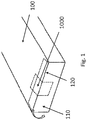
- an opening joint 110 of a package 100 may be sealed with a label 1000.
- the label may be visually transparent so that the sealing does not visually interfere with the overall appearance of the package or does not block view onto any markings on the package and left under the label 1000.
- the size and location of the label 1000 over the seam 120 of the opening joint 110 may vary and the label may have been selected to have a circular, oval, rectangular or other suitable shape. Further, even if being made of visually transparent materials, the label 1000 may itself comprise one or more visual markings which represents, for example, a trade mark or other information associated with the packaged product. Such visual markings can be normally printed on any surface or layer of the label 1000, and they may also include special markings, which may be e.g. a hologram or other type of markings difficult to replicate and adding security or anti-tampering features into the label 1000.
- the label 1000 may be attached to the package 100 such that package cannot be opened without damaging the package or without damaging the label.
- the presence of an intact sealing label 1000 on the package 100 may be interpreted to indicate that the package has not been tampered.
- the presence of an intact sealing label on the package may be interpreted to indicate e.g. that the original contents of the package has not been replaced with a falsified product.
- the visually transparent sealing label 1000 is arranged over the seam 120 of the opening joint 110 of the package 100.
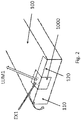
- EX1 luminescence LUM1 is generated in the material of package 100 in case the sealing label 1000 is of prior art type of design and without capability to block the ultraviolet radiation and the materials of the package 100 contain component or components that can be excited with ultraviolet to create luminescence.
- the known prior art solutions to verify the existence or location of transparent labels are based on adding ultraviolet luminescent pigment materials on the label 1000 itself. Such approach is successful only if the package 100 itself does not contain materials that could be excited with the ultraviolet radiation. This is the case, for example, for glass bottles or glass ampoules which are often used also in pharmaceutical applications. In such situations the prior art type luminescent labels 1000 have been successfully used even when the labels have been produced being transparent. The only luminescence becomes created in the label as the package itself does not comprise any luminescence materials.
- OBAs optical brightener agents
- FBAs fluorescent brightening agents
- FWAs fluorescent whitening agents
- UVA ultraviolet A wavelengths
- luminescent materials will luminesce, that is, give off visible light radiation, when energized by a source of ultraviolet light.
- the decay time, or relaxation time, or half-life of the phosphorescent materials must be short enough for the luminescence to have a readily measurable emission component.
- Fluorescent emission is usually understood as a short-lived period of light emission compared to phosphorescence, which is more long-lived and continues certain time after ultraviolet excitation has been ended.
- OBA, FBA or FWA are used to enhance the appearance of colour of, for example, fabric, paper, cardboard, different type of coating or paints by inducing a "whitening" effect; they help to make intrinsically yellow/orange materials look less so by compensating the deficit in blue and purple light reflected by the material with the blue and purple optical emission of the fluorophore or phosphor component.
- the most common classes of compounds with this property are the known as various stilbenes and their derivatives.
- UVA range near ultraviolet range
- FBA range near ultraviolet range
- These sensors may provide various light spot sizes ranging, for example, from one to 10 mm and may operate at sensor-to-target distances of 25 to 300 mm.
- the target material has a luminescent characteristic it will emit visible light when positioned in the sensor's light spot. This visible light is then measured by the sensor and an output signals is provided to process equipment to indicate the presence of the target material. Since the sensor sample rates may be up to kilohertz (kHz), this combined with small spot size allows high spatial resolution to be achieved and high-speed processes to be monitored on the manufacturing line.
- kHz kilohertz
- Fig. 3 describes schematically the challenge when trying to verify the existence of label 1000 on package 100.
- the signals LUM1 and LUM2 may be of similar, or only slightly different magnitude. Even in the case that materials of label 1000 has been further added with traces of OBA, FBA, FWA to make the label itself to create luminance, the difference between signals LUM1 and LUM2 may not become highly obvious.
- the difference in signals LUM1:LUM2 (or LUM2:LUM1) for reliable identification of the label may need to be at least 1:1.5, 1:2, 1:5 or even in the excess of 1:10.
- Such high difference in signals LUM1 and LUM2 would eliminate effectively errors in identification and compensate for any tolerances in the measurement device or optical properties of the package or the label.
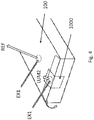
- Fig.4 illustrates now schematically the identification method according to the invention.
- Label 1000 sealing the package 100 has now been equipped with ultraviolet blocking capability, which may block at least 30 %, 50 %, 75 % or even in the excess of 95 % of the ultraviolet radiation between 340-370 nm or 320-380 nm or UVA wavelength range.
- This in turn effectively prevents luminance LUM2 being created by the OBA, FBA, FWA or similar materials contained in the package 100. Therefore, if a reference luminescence measurement REF is performed from the package at the location without a label, the difference in magnitude of the signals LUM2 and REF is significant and easy to identify.
- the existence or location of the label 1000 on the package 100 is determined primarily based on the relative lack (non-existence or small magnitude) of the luminescence signal LUM2 on the location of the label 1000, in order to continuously verify that the measurement system is working correctly, a reference signal REF at the location without a label may be measured occasionally or in synchrony for each package.
- Reference signal REF can be used to verify that the package 100 was present for the measurement (generating expected level of luminescence) and that the measurement system is working correctly even no or low signal levels are measured for label luminescence LUM2. Therefore, according to one embodiment of the invention the measurement is performed as such differential measurement.
- One important technical benefit of the invention is that existing ultraviolet sensor systems based on ultraviolet excitation and measuring luminescence can be easily converted for the use according to the invention.
- the only change required is to adjust the triggering indicating existence of the label to be "inverted", in other words lack of signal or low level signals indicate existence of label and high level signals indicate a missing labels.
- the spot type measurement systems can be readily modified to make measurements synchronized to the movement of the packages on the production line and thus to provide LUM2 and REF measurements from individual packages.
- the activatable component of the package material under the label may provide a reduced luminescence value when the label is illuminated with ultraviolet radiation, due to the ultraviolet blocking capability of the label.
- a label-free reference location of the package material may provide a reference luminescence value when the package material is illuminated with the ultraviolet radiation.
- the reduced luminescence value may be substantially lower than the reference luminescence value.
- the reduced luminescence value may be e.g. smaller than 30 %, smaller than 50%, smaller than 75%, or even smaller than 95% of the reference luminescence value, in a situation where the label and the reference location are illuminated with the ultraviolet illumination.
- the package material under the sealing label may be substantially similar to the package material at the label-free reference location.
- the activatable component e.g. OBA, FBA, FWA
- the method may comprise:
- the method may comprise determining whether the sealing label is present in the measurement location based on the difference between the measured luminescence and a reference value.
- the sealing label may be determined to be present e.g. in a situation where the measured luminescence is lower than a first limit value.
- the method may comprise measuring a reference luminescence value by performing a reference luminescence measurement at a location of the package without a label, wherein the first limit value may be e.g. lower than 30 %, lower than 50%, lower than 75%, or even lower than 95% of the reference luminescence value.
- the method may comprise measuring luminescence excited by the ultraviolet illumination from the measurement location.
- the sealing label may be determined to be missing or not in a correct position in a situation where the measured luminescence is higher than a second limit value.
- the method may comprise measuring a label-free luminescence value by performing a reference luminescence measurement at a label-free location.
- the method may comprise determining based on the measured label-free luminescence value whether the package is present at the label-free location or not, by comparing the measured label-free luminescence value with a predetermined value.
- the method may comprise determining that the package is present e.g. in a situation where the measured label-free luminescence value is within a predetermined range of values.
- the method may comprise detecting that the package is missing when measured label-free luminescence value is substantially lower than a predetermined value.
- Figs 5a-5e illustrate in schematic cross n views some potential structures of visually transparent labels 1000 with ultraviolet blocking capability according to the invention.
- filmic label carrier material 1100 has been introduced with ultraviolet blocking component.
- Adhesive 1200 has been left unmodified in this respect.
- the carrier material 1100 is normal filmic material without ultraviolet blocking component but instead adhesive 1200 is introduced with material blocking ultraviolet radiation.
- the ultraviolet blocking is introduced in the top coating layer 1100 and/or in the primer layer 1120.
- These layers may be, for example, lacquer or varnish layers containing ultraviolet blocking components.
- the carrier material 1100 may also be over laminated with an additional filmic layer (not shown) having been treated to block ultraviolet, for example by a suitable further top coat layer.
- the carrier material 1100 has been thin film coated to have physical metallic or metal oxide coating layer to block ultraviolet but being very thin allowing the carrier material to be visually transparent.
- Fig 5e indicates further additional printing 1300 in the label 1000.
- the printing may be introduced on the top surface of the transparent label structure or also in between the carrier 1100 and adhesive 1200 layers.
- the printing itself may act as an ultraviolet blocking layer and in this case the label 1000 may be printed in full or in most of its area which such ink, which may be fully or partially visually transparent.
- any combination of the embodiments in Figs 5a-5e is possible to introduce the ultraviolet blocking capability to one or more of the layers of the label 1000.
- layer contains or “layer carriers” ultraviolet blocking component should be understood widely. That is a layer can, for example, comprise various amounts of one or more ultraviolet blocking substance or agent, or the layer can be coated or treated on its one or more surfaces with such substances or agents which coatings can then be understood themselves as separate layers. The amount and location of the ultraviolet blocking substances or agents may be divided into different layers of the label to achieve the necessary level of blocking.
- the label laminate with the carrier 1100 and adhesive 1200 and with the optional release liner may be originally manufactured with the ultraviolet blocking capability or alternatively the ultraviolet blocking capability may be added to the existing label laminate later, for example, during the converting of the label laminate at the die-cutter or at the printer. This may be done, for example, by adding the ultraviolet blocking top cot varnish to the laminate before or after converting/printing.
- the ultraviolet blocking top coat or primer on the back side of the carrier may individually have coating weight in the range of 0.5 - 3.0 g/m 2 .
- the transparent, clear filmic carrier material may selected from the following materials:
- the clear adhesive may have a coating weight in the range of 10-35 g/m 2 and produced as pressure sensitive adhesive.
- the chemistry of the adhesive may be selected from the following types:
- Ultraviolet blocking may include ultraviolet absorbers, which again may be based on chemical or physical absorbers or combinations therein. Further, ultraviolet absorbers may further be used together with ultraviolet protector molecules that are capable of interfering with and/or preventing the deleterious effects of ultraviolet on materials. Ultraviolet blocking may be arranged to cover any or several of the ultraviolet wavelength ranges: ultraviolet C (UVC 200-290 nm), ultraviolet B (UVB 290-320 nm), and ultraviolet A (UVA 320-400 nm).
- Some but not limiting examples of chemical ultraviolet absorbers are the following or their derivatives: aminobenzoates, cinnamates, salicylates, octocrylenes, oxalanilides, ensulizoles, benzophenones, benzotriazoles, oxybenzones, anthranilates, avobenzones, ecamsules, methylene-bis-benzotriazolyl tetramethylbutylphenol (MBBT), triazines such as bis-ethylhexyloxyphenol methoxyphenyl triazine (BEMT) or hydroxybenzotriazoles.
- aminobenzoates aminobenzoates, cinnamates, salicylates, octocrylenes, oxalanilides, ensulizoles, benzophenones, benzotriazoles, oxybenzones, anthranilates, avobenzones, ecamsules, methylene
- Some but not limiting examples of physical ultraviolet absorbers are : organic microparticles comprising, for example, titanium dioxide or zinc oxide, different type of ultrafine nanomaterials with diameters less than 100 nm, thin film coatings such as metallic, metallic oxide or ceramic thin film coatings.
- the above mentioned chemical and physical absorbers may be included in one or more of the layers of the label and one or more absorbers can be used simultaneously in one or more layers to produce the required level of ultraviolet absorption and blockage.
- the materials and the thickness of the label may be selected such that the label may be easily bent over a corner to seal the package. Consequently, the label may easily conform to the potentially three-dimensional shape of the package.
- the carrier layer 1100 may be easily stretched when pulled by a pulling force.
- the carrier layer 1100 may be irreversibly stretched when pulled by the pulling force.
- the elongation of the layer 1100 at break may be e.g. in the range of 350 percent to 800 percent.
- the carrier layer 1100 may comprise filmic material and the material may be suitable for pharmaceutical use.
- the carrier layer 1100 may be produced e.g. by casting.
- the machine direction (MD) refers to the direction of movement of the film when the film is produced by a production apparatus.
- the cross machine direction (CD) is perpendicular to the machine direction (MD).
- the layer 1100 may be produced e.g. such that the layer 1100 is not significantly stretched during said producing or alternatively, the layer 1100 may have been oriented either in MD and/or TD directions.
- composition of the adhesive layer 1200 may be selected such that the adhesive layer 1200 forms a sufficiently strong bond between the carrier layer 1100 and the surface of the package 100.
- the adhesive layer 1200 may comprise e.g. a water-based polymer composition or solvent based composition.
- the adhesive may be selected such that the adhesive is approved for use in pharmaceutical applications.
- the adhesive may be selected such that the adhesive is approved for use with foodstuff packages.
- the adhesive may be pressure sensitive adhesive.
- the adhesive may a durable adhesive.
- the label may be used as a tamper-evident seal.
- the properties of the tamper-evident label may be selected such that it is difficult or impossible to separate the label from the package without damaging either the label or the package or both of them. Separating the label from the package may cause detectable damage both to the label and to the package. This may make unauthorized re-use of the label and the package more difficult.
- An unaltered label on the surface of the package may be interpreted to be an indication that the package has not been tampered.
- the label may comprise further anti-tampering features, for example VOID-functionality, which upon removal of the label creates a visual effect indicating that the seal is void.
- the label may comprise further safety features, such as hologram or other markings that are difficult to replicate by unauthorized parties.
Landscapes
- Engineering & Computer Science (AREA)
- Physics & Mathematics (AREA)
- General Physics & Mathematics (AREA)
- Theoretical Computer Science (AREA)
- Computer Security & Cryptography (AREA)
- Mechanical Engineering (AREA)
- Packages (AREA)
- Investigating, Analyzing Materials By Fluorescence Or Luminescence (AREA)
- Details Of Rigid Or Semi-Rigid Containers (AREA)
Description
- Some variations relate to a combination of a sealing label and a package. Some variations relate to method of attaching a sealing label onto a package. The sealing label may include one or more anti-tampering features.
- An opening joint of a package may be sealed with a label. Such sealing label may be visually transparent so that the sealing does not visually interfere with the overall appearance of the package.
- For anti-tampering, the sealing label may be attached to the package in such a way that the package cannot be opened without damaging the package or without damaging the label. The presence of an intact sealing label on the package may be interpreted to indicate that the package has not been tampered. The presence of an intact sealing label on the package may be interpreted to indicate e.g. that the original contents of the package has not been replaced with a falsified product.
- Pharmaceutical packaging is one area where stringent requirements exist that every package is properly sealed before the product is provided for end use such as retailing. Additionally, pharmaceutical packages are typically small or rather moderate sized and therefore have limited surface area to be occupied with sealing label due to the fact that the surface area is also occupied with obligatory visual product information as well as other, typically brand related information. A pharmaceutical package may be, for example, a cardboard box having white basic colour. Further, because the end user of the product may have some physical inabilities, the sealing label may need to be easy to open after purchase, but yet to provide confirmation that the package has not been tampered prior to the end use.
- The above and other requirements may lead to solution that the sealing label needs to be made fully or in most part visually transparent, small in size and located to cover only a certain part of the seam of the opening joint of the package. This then creates certain challenges in dispensing the label correctly on the package and ensuring the every package has been properly sealed with a label when leaving the packaging line. In order to make the sealing label visually transparent and also easily conformable (flexible) over the seam of the package, rather thin filmic carrier materials need to be used and these thin materials may create further challenges in the label dispensing phase especially when high speed dispensing is used, where the release of the labels from the release liner becomes critical. Thus, confirming with high certainty that the package has been correctly sealed with a transparent label becomes technically rather challenging.
- In prior art, methods based on ultraviolet excited luminescence has been used in corresponding situations for detecting label presence on the package. In this technique, suitable luminescence pigment is arranged on the label, wherein when illuminating the package with ultraviolet light, the luminescence from the label verifies the existence and correct location of the transparent label on the package. This technique requires use of special ultraviolet luminescent pigments in the label, which is certain applications may be not preferable from the chemical contamination or migration point of view, as well as inducing extra cost in the manufacturing of the labels.
- Therefore, there still exists a need to develop better techniques and labels to seal certain type of packages with transparent or mainly transparent sealing labels.
-
EP 1850308 discloses an adhesive label having a printing surface where information is printed using an ink which emits fluorescence due to the irradiation of excitation light, and to which excitation light is irradiated in order to read the information, wherein the adhesive label comprises a first light absorbing agent which absorbs the excitation light, and a second light absorbing agent which absorbs light having a wavelength for detection in the fluorescence. - Some variations may relate to a sealing label. Some variations may relate to a combination of a package and a sealing label. Some variations may relate to a method of attaching a sealing label to a package. The invention, defined in claim 1, relates to a method of checking whether a package has been provided with a sealing label. Some variations may relate to a sealing label including one or more anti-tampering features.
- The sealing label may comprise:
- a visually transparent carrier layer, and
- a visually transparent adhesive layer,
- a visually transparent carrier layer, and
- a visually transparent adhesive layer,
wherein at least of one the carrier layer or adhesive layer contains or carries ultraviolet blocking component to prevent ultraviolet radiation passing through the label,
and the package comprising - an activatable component that upon excitation with ultraviolet radiation emits luminescence.
- According to an aspect, there is provided a method of attaching a sealing label onto a package, wherein the label is attached to the package such that an opening joint of the package is located between two attachment regions of the label, the label comprising:
- a visually transparent carrier layer, and
- a visually transparent adhesive layer,
wherein at least of one the carrier layer or adhesive layer contains or carries ultraviolet blocking component to prevent ultraviolet radiation passing through the label,
and the package comprising- an activatable component that upon excitation with ultraviolet radiation emits luminescence,
wherein the existence of the sealing label on the package is verified by - illuminating the sealing label on the package with ultraviolet radiation and
- observing the relative lack of luminescence from excited by said ultraviolet illumination from the sealing label and from the package material under the sealing label.
- an activatable component that upon excitation with ultraviolet radiation emits luminescence,
- Some aspects are defined in the claims.
- The current invention aims to solve the problem that has become very evident when using visually transparent labels on packages that themselves in the packaging substrate material or in any additional layers such as package coatings, protective sheets or other labels comprise activatable components that will produce luminescence when excited with ultraviolet radiation. This phenomena in practise hinders the use of the prior art ultraviolet excitation methods to identify the existence and/or location of the label on the package because when illuminated with ultraviolet, the label allows the ultraviolet radiation to pass through the labels and excite the luminescence in the package material itself regardless the existence or non-existence of the label. Then the excited and typically visual luminescence passes back through the visually transparent label and no significant difference can be identified in the level or the luminescence with the label in place or not.
- In this invention, this problem is solved by adding at least one visually transparent but ultraviolet blocking component to the label so that the label will not pass ultraviolet radiation in significant amounts onto the package material and thus the label prevents the luminescence to become created in the package material. This allows high luminescence contrast to become identified depending the label being present in the measurement location or not.
- The sealing label according to the invention may be attached to a package, which is a package for pharmaceutical products. Such package may comprise varnished cardboard which typically for improved visual appearance contains optical brightener agents (OBAs). The OBA contained in the packaging material itself may emit luminescence when illuminated with ultraviolet radiation and thus interfere with the ultraviolet luminescence based identification of the transparent sealing label. The OBA containing package may also be other than a pharmaceutical package, for example, the package may be a sealed letter or envelope or a logistic package that needs to be sealed to identify unauthorized opening.
- The label may be used as a tamper-evident seal. The further properties of the tamper-evident label may be selected such that it is difficult or impossible to separate the label from the package, for example from varnished cardboard or paper material of the package without damaging both the label and the package. Separating the label from the package may cause detectable damage both to the label and to the package. Separating the label from the package may, at a very high probability, cause visually detectable damage both to the label and to the package. This makes unauthorized re-use of the label and the package more difficult. An unaltered label on the surface of the package may be interpreted to be an indication that the package has not been tampered.
- The properties of the tamper-evident label may be selected such that separating the label away from the package causes detectable irreversible stretching of the label itself and detectable tearing of the package surface material. Said stretching and tearing may be visually detectable. Separating the label from the package may inevitably cause visual indications to the label and to the package, which may make unauthorized re-use of the label and the package more difficult. In an embodiment, separating the label from a package may damage the surface of the package. In an embodiment, separating the label from a package may cause so severe damage to the package that the package cannot be used again.
- The sealing label of the invention may be used in any type of packages, which packages comprise some radiation activatable component or components that can be excited to provide luminescence upon excitation with ultraviolet radiation, and where existence or location of the sealing label would need to be verified during packaging or in later phases of the value chain. Such packages and product may include, but are not limited to high end cosmetics, alcohols, other chemical or mechanical products, products with limited warranty if packages are opened, letters, envelopes, packages used in postal packets or other logistic packets, high end consumer products, clothing related or any situations where the sealing label is used on materials that could with their own ultraviolet luminescence interfere with the ultraviolet based verification of the sealing label existence or positioning.
- In the following examples, several variations will be described in more detail with reference to the appended drawings, in which
-
Fig. 1 shows, by way of example, in a three dimensional view, a combination of apackage 100 and asealing label 1000. -
Fig. 2 shows, by way of example, in a three dimensional view, asealing label 1000 being probed with ultraviolet excitation EX1 producing luminescence LUM1. -
Fig 3 shows, by way of example, in a three dimensional view, the neglible difference of luminescence LUM1 and LUM2 when excited with ultraviolet excitation EX1 in presence of the label or without presence of the label. -
Fig. 4 shows, by way of example, in a three dimensional view, measuring a reference value of luminescence REF to be compared with the luminescence value LUM2 from the location of theultraviolet blocking label 1000. -
Figs 5a-5e show, by way of examples, in a cross section views, the some potential structures of thesealing label 1000 according to the invention. - Referring to
Fig. 1 , anopening joint 110 of apackage 100 may be sealed with alabel 1000. The label may be visually transparent so that the sealing does not visually interfere with the overall appearance of the package or does not block view onto any markings on the package and left under thelabel 1000. - The size and location of the
label 1000 over theseam 120 of the opening joint 110 may vary and the label may have been selected to have a circular, oval, rectangular or other suitable shape. Further, even if being made of visually transparent materials, thelabel 1000 may itself comprise one or more visual markings which represents, for example, a trade mark or other information associated with the packaged product. Such visual markings can be normally printed on any surface or layer of thelabel 1000, and they may also include special markings, which may be e.g. a hologram or other type of markings difficult to replicate and adding security or anti-tampering features into thelabel 1000. - For anti-tampering, the
label 1000 may be attached to thepackage 100 such that package cannot be opened without damaging the package or without damaging the label. The presence of anintact sealing label 1000 on thepackage 100 may be interpreted to indicate that the package has not been tampered. The presence of an intact sealing label on the package may be interpreted to indicate e.g. that the original contents of the package has not been replaced with a falsified product. - Referring to
Fig. 2 , the visuallytransparent sealing label 1000 is arranged over theseam 120 of theopening joint 110 of thepackage 100. When excited with ultraviolet radiation EX1 luminescence LUM1 is generated in the material ofpackage 100 in case thesealing label 1000 is of prior art type of design and without capability to block the ultraviolet radiation and the materials of thepackage 100 contain component or components that can be excited with ultraviolet to create luminescence. - The known prior art solutions to verify the existence or location of transparent labels are based on adding ultraviolet luminescent pigment materials on the
label 1000 itself. Such approach is successful only if thepackage 100 itself does not contain materials that could be excited with the ultraviolet radiation. This is the case, for example, for glass bottles or glass ampoules which are often used also in pharmaceutical applications. In such situations the prior art typeluminescent labels 1000 have been successfully used even when the labels have been produced being transparent. The only luminescence becomes created in the label as the package itself does not comprise any luminescence materials. - However, for other packaging materials containing ultraviolet excitable components, such prior art approach is not satisfactory. As an example, one of packaging materials challenging in this respect is white cardboard containing optical brightener agents to improve the visual appearance of the package. The combination of such small sized packages that also need to be sealed with small sized visually transparent labels exists in pharmaceutical, i.e. medicine packaging.
- In addition to optical brightener agents (OBAs), there are also other ultraviolet excitable components such as fluorescent brightening agents (FBAs), or fluorescent whitening agents (FWAs). These all are chemical compounds that absorb light in the ultraviolet and violet region (usually 340-370 nm) of the electro-magnetic spectrum, and re-emit light in the visible blue region (typically 420-470 nm) by fluorescence or luminescence. The excitation wavelength range of OBAs, FBAs or FWAs overlap typically with the ultraviolet A wavelengths (UVA) in the range from 320 nm up to 400 nm.
- The terms "luminescence", "luminescent material, "luminescent component" or "luminescent agent" and words of similar import as used in this specification are used to indicate material which will emit radiant energy when exposed to ultraviolet light. Fluorescent and phosphorescent materials are included within the broad term "luminescent" Characteristically, luminescent materials will luminesce, that is, give off visible light radiation, when energized by a source of ultraviolet light. The decay time, or relaxation time, or half-life of the phosphorescent materials must be short enough for the luminescence to have a readily measurable emission component. Fluorescent emission is usually understood as a short-lived period of light emission compared to phosphorescence, which is more long-lived and continues certain time after ultraviolet excitation has been ended.
- These aforementioned additives OBA, FBA or FWA are used to enhance the appearance of colour of, for example, fabric, paper, cardboard, different type of coating or paints by inducing a "whitening" effect; they help to make intrinsically yellow/orange materials look less so by compensating the deficit in blue and purple light reflected by the material with the blue and purple optical emission of the fluorophore or phosphor component. The most common classes of compounds with this property are the known as various stilbenes and their derivatives.
- Commercially available ultraviolet inspection methods are typically based on the use of sensors that provide a light output in the near ultraviolet range (∼ UVA range), from about 320 to 380 nm, which heavily overlaps with the excitation wavelengths of typical OBA, FBA or FWA materials. These sensors may provide various light spot sizes ranging, for example, from one to 10 mm and may operate at sensor-to-target distances of 25 to 300 mm. When the target material has a luminescent characteristic it will emit visible light when positioned in the sensor's light spot. This visible light is then measured by the sensor and an output signals is provided to process equipment to indicate the presence of the target material. Since the sensor sample rates may be up to kilohertz (kHz), this combined with small spot size allows high spatial resolution to be achieved and high-speed processes to be monitored on the manufacturing line.
-
Fig. 3 . describes schematically the challenge when trying to verify the existence oflabel 1000 onpackage 100. In case the material ofpackage 100 contains OBA, FBA or FWA materials, then for a transparent,non-UV blocking label 1000 the signals LUM1 and LUM2 may be of similar, or only slightly different magnitude. Even in the case that materials oflabel 1000 has been further added with traces of OBA, FBA, FWA to make the label itself to create luminance, the difference between signals LUM1 and LUM2 may not become highly obvious. - It should be understood that in practise for measurements performed in typical production line environment, the difference in signals LUM1:LUM2 (or LUM2:LUM1) for reliable identification of the label may need to be at least 1:1.5, 1:2, 1:5 or even in the excess of 1:10. Such high difference in signals LUM1 and LUM2 would eliminate effectively errors in identification and compensate for any tolerances in the measurement device or optical properties of the package or the label.
-
Fig.4 illustrates now schematically the identification method according to the invention.Label 1000 sealing thepackage 100 has now been equipped with ultraviolet blocking capability, which may block at least 30 %, 50 %, 75 % or even in the excess of 95 % of the ultraviolet radiation between 340-370 nm or 320-380 nm or UVA wavelength range. This in turn effectively prevents luminance LUM2 being created by the OBA, FBA, FWA or similar materials contained in thepackage 100. Therefore, if a reference luminescence measurement REF is performed from the package at the location without a label, the difference in magnitude of the signals LUM2 and REF is significant and easy to identify. - Because in this invention the existence or location of the
label 1000 on thepackage 100 is determined primarily based on the relative lack (non-existence or small magnitude) of the luminescence signal LUM2 on the location of thelabel 1000, in order to continuously verify that the measurement system is working correctly, a reference signal REF at the location without a label may be measured occasionally or in synchrony for each package. Reference signal REF can be used to verify that thepackage 100 was present for the measurement (generating expected level of luminescence) and that the measurement system is working correctly even no or low signal levels are measured for label luminescence LUM2. Therefore, according to one embodiment of the invention the measurement is performed as such differential measurement. - One important technical benefit of the invention is that existing ultraviolet sensor systems based on ultraviolet excitation and measuring luminescence can be easily converted for the use according to the invention. In principle the only change required is to adjust the triggering indicating existence of the label to be "inverted", in other words lack of signal or low level signals indicate existence of label and high level signals indicate a missing labels. The spot type measurement systems can be readily modified to make measurements synchronized to the movement of the packages on the production line and thus to provide LUM2 and REF measurements from individual packages.
- The activatable component of the package material under the label may provide a reduced luminescence value when the label is illuminated with ultraviolet radiation, due to the ultraviolet blocking capability of the label.
- A label-free reference location of the package material may provide a reference luminescence value when the package material is illuminated with the ultraviolet radiation.
- The reduced luminescence value may be substantially lower than the reference luminescence value. The reduced luminescence value may be e.g. smaller than 30 %, smaller than 50%, smaller than 75%, or even smaller than 95% of the reference luminescence value, in a situation where the label and the reference location are illuminated with the ultraviolet illumination.
- The package material under the sealing label may be substantially similar to the package material at the label-free reference location. In an embodiment, the activatable component (e.g. OBA, FBA, FWA) may be substantially evenly distributed over the outer surface area of the package.
- The method may comprise:
- providing a package such that the material of the package comprises an activatable component that upon excitation with ultraviolet radiation emits luminescence,
- providing a sealing label, which comprises a visually transparent carrier layer and a visually transparent adhesive layer, wherein at least one the carrier layer or adhesive layer contains or carries ultraviolet blocking component to prevent ultraviolet radiation passing through the label,
- attaching the label to the package,
- illuminating a measurement location of the package with ultraviolet radiation,
- measuring luminescence excited by the ultraviolet illumination from the measurement location, and
- identifying existence and/or location of the label based on a difference between the measured luminescence and a reference value.
- The method may comprise determining whether the sealing label is present in the measurement location based on the difference between the measured luminescence and a reference value.
- The sealing label may be determined to be present e.g. in a situation where the measured luminescence is lower than a first limit value.
- The method may comprise measuring a reference luminescence value by performing a reference luminescence measurement at a location of the package without a label, wherein the first limit value may be e.g. lower than 30 %, lower than 50%, lower than 75%, or even lower than 95% of the reference luminescence value.
- The method may comprise measuring luminescence excited by the ultraviolet illumination from the measurement location. The sealing label may be determined to be missing or not in a correct position in a situation where the measured luminescence is higher than a second limit value.
- The method may comprise measuring a label-free luminescence value by performing a reference luminescence measurement at a label-free location. The method may comprise determining based on the measured label-free luminescence value whether the package is present at the label-free location or not, by comparing the measured label-free luminescence value with a predetermined value. The method may comprise determining that the package is present e.g. in a situation where the measured label-free luminescence value is within a predetermined range of values. The method may comprise detecting that the package is missing when measured label-free luminescence value is substantially lower than a predetermined value.
-
Figs 5a-5e illustrate in schematic cross n views some potential structures of visuallytransparent labels 1000 with ultraviolet blocking capability according to the invention. - In
Fig. 5a filmiclabel carrier material 1100 has been introduced with ultraviolet blocking component.Adhesive 1200 has been left unmodified in this respect. - In
Fig. 5a thecarrier material 1100 is normal filmic material without ultraviolet blocking component but instead adhesive 1200 is introduced with material blocking ultraviolet radiation. - In
Fig. 5c and Fig. 5d the ultraviolet blocking is introduced in thetop coating layer 1100 and/or in theprimer layer 1120. These layers may be, for example, lacquer or varnish layers containing ultraviolet blocking components. Alternatively, thecarrier material 1100 may also be over laminated with an additional filmic layer (not shown) having been treated to block ultraviolet, for example by a suitable further top coat layer. A further possibility is that thecarrier material 1100 has been thin film coated to have physical metallic or metal oxide coating layer to block ultraviolet but being very thin allowing the carrier material to be visually transparent. -
Fig 5e indicates furtheradditional printing 1300 in thelabel 1000. The printing may be introduced on the top surface of the transparent label structure or also in between thecarrier 1100 and adhesive 1200 layers. As one alternative, the printing itself may act as an ultraviolet blocking layer and in this case thelabel 1000 may be printed in full or in most of its area which such ink, which may be fully or partially visually transparent. - It is to be understood that any combination of the embodiments in
Figs 5a-5e is possible to introduce the ultraviolet blocking capability to one or more of the layers of thelabel 1000. In this specification expressions "layer contains" or "layer carriers" ultraviolet blocking component should be understood widely. That is a layer can, for example, comprise various amounts of one or more ultraviolet blocking substance or agent, or the layer can be coated or treated on its one or more surfaces with such substances or agents which coatings can then be understood themselves as separate layers. The amount and location of the ultraviolet blocking substances or agents may be divided into different layers of the label to achieve the necessary level of blocking. - Further, it should be understood that the label laminate with the
carrier 1100 and adhesive 1200 and with the optional release liner (not shown) may be originally manufactured with the ultraviolet blocking capability or alternatively the ultraviolet blocking capability may be added to the existing label laminate later, for example, during the converting of the label laminate at the die-cutter or at the printer. This may be done, for example, by adding the ultraviolet blocking top cot varnish to the laminate before or after converting/printing. - Some examples of possible materials of the label according to the invention.
- In one variation, the ultraviolet blocking top coat or primer on the back side of the carrier may individually have coating weight in the range of 0.5 - 3.0 g/m2.
- In one variation, the transparent, clear filmic carrier material may selected from the following materials:
- polyethylene terephthalate with thickness of 12 - 50 micrometers
- polypropylene with thickness of 25- 60 micrometers
- polyethylene with thickness of 30-70 micrometers
- acrylate film with thickness of 30-60 micrometers
- void security film with thickness of 30-60 mm
- In variation, the clear adhesive may have a coating weight in the range of 10-35 g/m2 and produced as pressure sensitive adhesive. The chemistry of the adhesive may be selected from the following types:
- water dispersion based adhesive
- acrylic adhesive
- polyurethane adhesive
- solid based adhesive
- hot melt adhesive
- ultraviolet cross linkable adhesive
- moisture cross linkable adhesive
- Ultraviolet blocking may include ultraviolet absorbers, which again may be based on chemical or physical absorbers or combinations therein. Further, ultraviolet absorbers may further be used together with ultraviolet protector molecules that are capable of interfering with and/or preventing the deleterious effects of ultraviolet on materials. Ultraviolet blocking may be arranged to cover any or several of the ultraviolet wavelength ranges: ultraviolet C (UVC 200-290 nm), ultraviolet B (UVB 290-320 nm), and ultraviolet A (UVA 320-400 nm).
- Some but not limiting examples of chemical ultraviolet absorbers are the following or their derivatives: aminobenzoates, cinnamates, salicylates, octocrylenes, oxalanilides, ensulizoles, benzophenones, benzotriazoles, oxybenzones, anthranilates, avobenzones, ecamsules, methylene-bis-benzotriazolyl tetramethylbutylphenol (MBBT), triazines such as bis-ethylhexyloxyphenol methoxyphenyl triazine (BEMT) or hydroxybenzotriazoles.
- Some but not limiting examples of physical ultraviolet absorbers are : organic microparticles comprising, for example, titanium dioxide or zinc oxide, different type of ultrafine nanomaterials with diameters less than 100 nm, thin film coatings such as metallic, metallic oxide or ceramic thin film coatings.
- The above mentioned chemical and physical absorbers may be included in one or more of the layers of the label and one or more absorbers can be used simultaneously in one or more layers to produce the required level of ultraviolet absorption and blockage.
- In general, the materials and the thickness of the label may be selected such that the label may be easily bent over a corner to seal the package. Consequently, the label may easily conform to the potentially three-dimensional shape of the package.
- The
carrier layer 1100 may be easily stretched when pulled by a pulling force. Thecarrier layer 1100 may be irreversibly stretched when pulled by the pulling force. The elongation of thelayer 1100 at break may be e.g. in the range of 350 percent to 800 percent. Thecarrier layer 1100 may comprise filmic material and the material may be suitable for pharmaceutical use. - The
carrier layer 1100 may be produced e.g. by casting. The machine direction (MD) refers to the direction of movement of the film when the film is produced by a production apparatus. The cross machine direction (CD) is perpendicular to the machine direction (MD). Thelayer 1100 may be produced e.g. such that thelayer 1100 is not significantly stretched during said producing or alternatively, thelayer 1100 may have been oriented either in MD and/or TD directions. - The composition of the
adhesive layer 1200 may be selected such that theadhesive layer 1200 forms a sufficiently strong bond between thecarrier layer 1100 and the surface of thepackage 100. - The
adhesive layer 1200 may comprise e.g. a water-based polymer composition or solvent based composition. In an embodiment, the adhesive may be selected such that the adhesive is approved for use in pharmaceutical applications. The adhesive may be selected such that the adhesive is approved for use with foodstuff packages. The adhesive may be pressure sensitive adhesive. The adhesive may a durable adhesive. - The label may be used as a tamper-evident seal. The properties of the tamper-evident label may be selected such that it is difficult or impossible to separate the label from the package without damaging either the label or the package or both of them. Separating the label from the package may cause detectable damage both to the label and to the package. This may make unauthorized re-use of the label and the package more difficult. An unaltered label on the surface of the package may be interpreted to be an indication that the package has not been tampered.
- The label may comprise further anti-tampering features, for example VOID-functionality, which upon removal of the label creates a visual effect indicating that the seal is void. Further, the label may comprise further safety features, such as hologram or other markings that are difficult to replicate by unauthorized parties.
- For the person skilled in the art, it will be clear that modifications and variations of the structures and the methods according to the present invention are perceivable. The figures are schematic. The particular embodiments described above with reference to the accompanying drawings are illustrative only and not meant to limit the scope of the invention, which is defined by the appended claims.
Claims (10)
- A method of attaching a sealing label (1000) onto a package (100), the label (1000) comprising a visually transparent carrier layer (1100) and a visually transparent adhesive layer (1200), wherein at least of one of the carrier layer (1100) or adhesive layer (1200) contains or carries ultraviolet blocking component to prevent ultraviolet radiation (EX1) passing through the label (1000), the package (100) comprising an activatable component that upon excitation with ultraviolet radiation (EX1) emits luminescence (LUM1),
characterized in that the label (1000) is adhesively attached to the package (100) such that an opening joint (110) of the package (100) is located between two adhesive attachment regions of the label (1000),
the method comprising verifying the existence of the sealing label (1000) on the package (100), wherein said verifying comprises:- illuminating the sealing label (1000) on the package (100) with ultraviolet radiation (EX1), and- observing the relative lack of luminescence excited by said ultraviolet illumination (EX1) from the sealing label (1000) and from the package material under the sealing label (1000). - The method according to claim 1, wherein the sealing label (1000) in visually transparent and the activatable component in the package (100) is optical brightener agent (OBA), fluorescent brightening agent (FBA), or fluorescent whitening agent (FWA).
- The method according to claim 1 or 2, wherein an ultraviolet blocking wavelength range of the label (1000) overlaps with a wavelength range for excitation of the activatable component in the package (100).
- The method according to any of the claims 1 to 3, wherein an ultraviolet blocking wavelength range of the label (1000) overlaps with the ultraviolet wavelength range UVA, and wherein a wavelength range for excitation of the activatable component in the package (100) overlaps with the ultraviolet wavelength range UVA.
- The method of claim 1, comprising:- illuminating a measurement location of the package (100) with ultraviolet radiation (EX1),- measuring luminescence (LUM1, LUM2) excited by the ultraviolet illumination (EX1) from the measurement location, and- identifying existence and/or location of the label (1000) based on a difference between the measured luminescence (LUM1, LUM2) and a reference value.
- The method of claim 5 comprising determining whether the sealing label (1000) is present in the measurement location based on the difference between the measured luminescence (LUM1, LUM2) and a reference value.
- The method of claim 5, wherein the sealing label is determined to be present in a situation where the measured luminescence (LUM2) is lower than a first limit value.
- The method of claim 7 comprising measuring the reference value by performing a reference luminescence measurement at a location of the package (100) without a label (1000), wherein the first limit value is lower than 50% of the reference value.
- The method according to any of the claims 5 to 7 comprising measuring a label-free luminescence signal (REF) by performing a luminescence measurement at a label-free location.
- The method of claim 9 comprising determining based on the measured label-free luminescence signal (REF) whether the package (100) is present, by comparing the measured label-free luminescence signal (REF) with a predetermined value.
Applications Claiming Priority (1)
| Application Number | Priority Date | Filing Date | Title |
|---|---|---|---|
| FI20176098A FI128112B (en) | 2017-12-08 | 2017-12-08 | Sealing of a package |
Publications (2)
| Publication Number | Publication Date |
|---|---|
| EP3496076A1 EP3496076A1 (en) | 2019-06-12 |
| EP3496076B1 true EP3496076B1 (en) | 2021-07-07 |
Family
ID=64661264
Family Applications (1)
| Application Number | Title | Priority Date | Filing Date |
|---|---|---|---|
| EP18397530.9A Active EP3496076B1 (en) | 2017-12-08 | 2018-12-03 | Sealing of a package |
Country Status (3)
| Country | Link |
|---|---|
| US (1) | US10934040B2 (en) |
| EP (1) | EP3496076B1 (en) |
| FI (1) | FI128112B (en) |
Families Citing this family (2)
| Publication number | Priority date | Publication date | Assignee | Title |
|---|---|---|---|---|
| US11060945B2 (en) * | 2018-05-22 | 2021-07-13 | Paxxus, Inc. | Ultra-violet fluorescing sealant |
| EP3591642A1 (en) * | 2018-07-02 | 2020-01-08 | UPM Raflatac Oy | Sealing label |
Family Cites Families (24)
| Publication number | Priority date | Publication date | Assignee | Title |
|---|---|---|---|---|
| DE4236393B4 (en) * | 1992-10-28 | 2004-04-01 | Pago Etikettiersysteme Gmbh | originality closure |
| US5605738A (en) * | 1993-09-30 | 1997-02-25 | Angstrom Technologies, Inc. | Tamper resistant system using ultraviolet fluorescent chemicals |
| US5658648A (en) | 1995-08-23 | 1997-08-19 | Wisconsin Label Corporation | Labels for electrical cord sets |
| US6395376B1 (en) * | 1999-01-22 | 2002-05-28 | 3M Innovative Properties Company | Tamper indicating adhesive device |
| AU7843800A (en) * | 1999-09-30 | 2001-04-30 | Dna Technologies, Inc. | Product authentication system |
| US20050084645A1 (en) * | 2002-02-07 | 2005-04-21 | Selinfreund Richard H. | Method and system for optical disc copy-protection |
| EP1420381A1 (en) * | 2002-11-12 | 2004-05-19 | Hauni Maschinenbau AG | Method and device for identification and checking of authentificity of products |
| JP2007292932A (en) * | 2006-04-24 | 2007-11-08 | Oji Tac Hanbai Kk | Adhesive label, adhesive label with release sheet and information reading method |
| DE602007006428D1 (en) * | 2007-04-25 | 2010-06-24 | Sihl Gmbh | Adhesive, transparent paper / foil laminates |
| JP2009023100A (en) * | 2007-07-17 | 2009-02-05 | Toppan Printing Co Ltd | Laminated material that absorbs ultraviolet rays and transmits visible light, a package, a press-through package, and a shrink label using the laminated material |
| US20100208313A1 (en) * | 2009-02-17 | 2010-08-19 | Horgan Adrian M | Security and sensing elements with volume holograms |
| DE102010028818A1 (en) * | 2010-05-10 | 2011-11-10 | Swiss Authentication Research And Development Ag | Combination of luminescent substances |
| JP2012203161A (en) | 2011-03-25 | 2012-10-22 | Dainippon Printing Co Ltd | Hologram label |
| EP2689412A1 (en) * | 2011-03-25 | 2014-01-29 | Avery Dennison Corporation | Authenticating label |
| US20130089721A1 (en) * | 2011-08-02 | 2013-04-11 | Tracy Paolilli | Non-iridescent film with polymeric particles in primer layer |
| WO2013134654A1 (en) * | 2012-03-09 | 2013-09-12 | United States Postal Service | Method and system for item authentication and customization |
| US20130239874A1 (en) | 2012-03-15 | 2013-09-19 | Temptime Corporation | Robust, ultraviolet-protected ambient condition history indicator and method of making same |
| GB201222961D0 (en) * | 2012-12-19 | 2013-01-30 | Innovia Films Ltd | Label |
| EP2874136A1 (en) * | 2013-11-15 | 2015-05-20 | Matteo Marchesano | Device for recognising the authenticity of a packaged product to be sold |
| US9501958B2 (en) * | 2014-12-23 | 2016-11-22 | Upm Raflatac Oy | Sealing label |
| US9367849B1 (en) * | 2015-05-21 | 2016-06-14 | Owens-Brockway Glass Container Inc. | Packaging authentication |
| DE102015014039A1 (en) * | 2015-10-30 | 2017-05-04 | Giesecke & Devrient Gmbh | Security element with an optically variable structure |
| GB201522491D0 (en) * | 2015-12-21 | 2016-02-03 | 3M Innovative Properties Co | Tamper-evident label containing an irreversible photochromic substance |
| US10288555B2 (en) * | 2016-10-24 | 2019-05-14 | Thermo Fisher Scientific, Inc. | Tamper seal detection system and method of use |
-
2017
- 2017-12-08 FI FI20176098A patent/FI128112B/en active IP Right Grant
-
2018
- 2018-12-03 EP EP18397530.9A patent/EP3496076B1/en active Active
- 2018-12-04 US US16/208,969 patent/US10934040B2/en active Active
Also Published As
| Publication number | Publication date |
|---|---|
| US10934040B2 (en) | 2021-03-02 |
| FI128112B (en) | 2019-10-15 |
| EP3496076A1 (en) | 2019-06-12 |
| US20190180649A1 (en) | 2019-06-13 |
| FI20176098A1 (en) | 2019-06-09 |
Similar Documents
| Publication | Publication Date | Title |
|---|---|---|
| US5605738A (en) | Tamper resistant system using ultraviolet fluorescent chemicals | |
| US7781037B2 (en) | Security seals for containers and methods of using the same for authentication | |
| CN101044536B (en) | Security Markers in Adhesive Plastic Film Laminates for Pharmaceutical Packaging | |
| US10926574B2 (en) | Security element formed from at least two inks applied in overlapping patterns, articles carrying the security element, and authentication methods | |
| EP0990890A1 (en) | Method of determining authenticity of a packaged product | |
| JP2014508976A (en) | Certification label | |
| EP2308037A1 (en) | Security label laminate and method of labeling | |
| US10934040B2 (en) | Sealing label and method of sealing a package | |
| US20040050740A1 (en) | Tamper evident packaging | |
| US20070197383A1 (en) | Method for Detecting Damage | |
| WO2014014509A1 (en) | Articles, methods of validating the same, and validation systems employing decay constant modulation | |
| CN104067297A (en) | Multi wavelength excitation/emission authentication and detection scheme | |
| WO2017112507A2 (en) | Tamper-evident label containing an irreversible photochromic substance | |
| US10940712B2 (en) | Arrangement, article having a security feature and method for the manufacture of an arrangement for a security feature | |
| US20080283612A1 (en) | System and method for determining product counterfeiting and diversion | |
| US7335899B2 (en) | Media for detection of X-ray exposure | |
| JP7108402B2 (en) | adhesive film | |
| JP2017072545A (en) | Composition and compact produced using the same | |
| CN1058798C (en) | X-ray fluorescent forge-proof method and sign for goods | |
| JP7323165B2 (en) | Lid material for PTP package | |
| US20100006637A1 (en) | Apparatus and method for detecting at least one object in a package | |
| JP2009282271A (en) | Braille label | |
| US20230374328A1 (en) | Post-treated titanium dioxide pigment with at least one security feature | |
| JP2015223766A (en) | PIN information printed matter and its judgment method | |
| US20210332253A1 (en) | Ink composition for ptp package, and ink |
Legal Events
| Date | Code | Title | Description |
|---|---|---|---|
| PUAI | Public reference made under article 153(3) epc to a published international application that has entered the european phase |
Free format text: ORIGINAL CODE: 0009012 |
|
| STAA | Information on the status of an ep patent application or granted ep patent |
Free format text: STATUS: THE APPLICATION HAS BEEN PUBLISHED |
|
| AK | Designated contracting states |
Kind code of ref document: A1 Designated state(s): AL AT BE BG CH CY CZ DE DK EE ES FI FR GB GR HR HU IE IS IT LI LT LU LV MC MK MT NL NO PL PT RO RS SE SI SK SM TR |
|
| AX | Request for extension of the european patent |
Extension state: BA ME |
|
| STAA | Information on the status of an ep patent application or granted ep patent |
Free format text: STATUS: REQUEST FOR EXAMINATION WAS MADE |
|
| 17P | Request for examination filed |
Effective date: 20191205 |
|
| RBV | Designated contracting states (corrected) |
Designated state(s): AL AT BE BG CH CY CZ DE DK EE ES FI FR GB GR HR HU IE IS IT LI LT LU LV MC MK MT NL NO PL PT RO RS SE SI SK SM TR |
|
| GRAP | Despatch of communication of intention to grant a patent |
Free format text: ORIGINAL CODE: EPIDOSNIGR1 |
|
| STAA | Information on the status of an ep patent application or granted ep patent |
Free format text: STATUS: GRANT OF PATENT IS INTENDED |
|
| INTG | Intention to grant announced |
Effective date: 20210128 |
|
| GRAS | Grant fee paid |
Free format text: ORIGINAL CODE: EPIDOSNIGR3 |
|
| GRAA | (expected) grant |
Free format text: ORIGINAL CODE: 0009210 |
|
| STAA | Information on the status of an ep patent application or granted ep patent |
Free format text: STATUS: THE PATENT HAS BEEN GRANTED |
|
| AK | Designated contracting states |
Kind code of ref document: B1 Designated state(s): AL AT BE BG CH CY CZ DE DK EE ES FI FR GB GR HR HU IE IS IT LI LT LU LV MC MK MT NL NO PL PT RO RS SE SI SK SM TR |
|
| REG | Reference to a national code |
Ref country code: GB Ref legal event code: FG4D |
|
| REG | Reference to a national code |
Ref country code: AT Ref legal event code: REF Ref document number: 1409347 Country of ref document: AT Kind code of ref document: T Effective date: 20210715 |
|
| REG | Reference to a national code |
Ref country code: DE Ref legal event code: R096 Ref document number: 602018019658 Country of ref document: DE |
|
| REG | Reference to a national code |
Ref country code: IE Ref legal event code: FG4D |
|
| REG | Reference to a national code |
Ref country code: LT Ref legal event code: MG9D |
|
| REG | Reference to a national code |
Ref country code: NL Ref legal event code: MP Effective date: 20210707 |
|
| REG | Reference to a national code |
Ref country code: AT Ref legal event code: MK05 Ref document number: 1409347 Country of ref document: AT Kind code of ref document: T Effective date: 20210707 |
|
| PG25 | Lapsed in a contracting state [announced via postgrant information from national office to epo] |
Ref country code: BG Free format text: LAPSE BECAUSE OF FAILURE TO SUBMIT A TRANSLATION OF THE DESCRIPTION OR TO PAY THE FEE WITHIN THE PRESCRIBED TIME-LIMIT Effective date: 20211007 Ref country code: AT Free format text: LAPSE BECAUSE OF FAILURE TO SUBMIT A TRANSLATION OF THE DESCRIPTION OR TO PAY THE FEE WITHIN THE PRESCRIBED TIME-LIMIT Effective date: 20210707 Ref country code: LT Free format text: LAPSE BECAUSE OF FAILURE TO SUBMIT A TRANSLATION OF THE DESCRIPTION OR TO PAY THE FEE WITHIN THE PRESCRIBED TIME-LIMIT Effective date: 20210707 Ref country code: PT Free format text: LAPSE BECAUSE OF FAILURE TO SUBMIT A TRANSLATION OF THE DESCRIPTION OR TO PAY THE FEE WITHIN THE PRESCRIBED TIME-LIMIT Effective date: 20211108 Ref country code: NL Free format text: LAPSE BECAUSE OF FAILURE TO SUBMIT A TRANSLATION OF THE DESCRIPTION OR TO PAY THE FEE WITHIN THE PRESCRIBED TIME-LIMIT Effective date: 20210707 Ref country code: NO Free format text: LAPSE BECAUSE OF FAILURE TO SUBMIT A TRANSLATION OF THE DESCRIPTION OR TO PAY THE FEE WITHIN THE PRESCRIBED TIME-LIMIT Effective date: 20211007 Ref country code: HR Free format text: LAPSE BECAUSE OF FAILURE TO SUBMIT A TRANSLATION OF THE DESCRIPTION OR TO PAY THE FEE WITHIN THE PRESCRIBED TIME-LIMIT Effective date: 20210707 Ref country code: ES Free format text: LAPSE BECAUSE OF FAILURE TO SUBMIT A TRANSLATION OF THE DESCRIPTION OR TO PAY THE FEE WITHIN THE PRESCRIBED TIME-LIMIT Effective date: 20210707 Ref country code: FI Free format text: LAPSE BECAUSE OF FAILURE TO SUBMIT A TRANSLATION OF THE DESCRIPTION OR TO PAY THE FEE WITHIN THE PRESCRIBED TIME-LIMIT Effective date: 20210707 Ref country code: SE Free format text: LAPSE BECAUSE OF FAILURE TO SUBMIT A TRANSLATION OF THE DESCRIPTION OR TO PAY THE FEE WITHIN THE PRESCRIBED TIME-LIMIT Effective date: 20210707 Ref country code: RS Free format text: LAPSE BECAUSE OF FAILURE TO SUBMIT A TRANSLATION OF THE DESCRIPTION OR TO PAY THE FEE WITHIN THE PRESCRIBED TIME-LIMIT Effective date: 20210707 |
|
| PG25 | Lapsed in a contracting state [announced via postgrant information from national office to epo] |
Ref country code: PL Free format text: LAPSE BECAUSE OF FAILURE TO SUBMIT A TRANSLATION OF THE DESCRIPTION OR TO PAY THE FEE WITHIN THE PRESCRIBED TIME-LIMIT Effective date: 20210707 Ref country code: LV Free format text: LAPSE BECAUSE OF FAILURE TO SUBMIT A TRANSLATION OF THE DESCRIPTION OR TO PAY THE FEE WITHIN THE PRESCRIBED TIME-LIMIT Effective date: 20210707 Ref country code: GR Free format text: LAPSE BECAUSE OF FAILURE TO SUBMIT A TRANSLATION OF THE DESCRIPTION OR TO PAY THE FEE WITHIN THE PRESCRIBED TIME-LIMIT Effective date: 20211008 |
|
| REG | Reference to a national code |
Ref country code: DE Ref legal event code: R097 Ref document number: 602018019658 Country of ref document: DE |
|
| PG25 | Lapsed in a contracting state [announced via postgrant information from national office to epo] |
Ref country code: DK Free format text: LAPSE BECAUSE OF FAILURE TO SUBMIT A TRANSLATION OF THE DESCRIPTION OR TO PAY THE FEE WITHIN THE PRESCRIBED TIME-LIMIT Effective date: 20210707 |
|
| PLBE | No opposition filed within time limit |
Free format text: ORIGINAL CODE: 0009261 |
|
| STAA | Information on the status of an ep patent application or granted ep patent |
Free format text: STATUS: NO OPPOSITION FILED WITHIN TIME LIMIT |
|
| PG25 | Lapsed in a contracting state [announced via postgrant information from national office to epo] |
Ref country code: SM Free format text: LAPSE BECAUSE OF FAILURE TO SUBMIT A TRANSLATION OF THE DESCRIPTION OR TO PAY THE FEE WITHIN THE PRESCRIBED TIME-LIMIT Effective date: 20210707 Ref country code: SK Free format text: LAPSE BECAUSE OF FAILURE TO SUBMIT A TRANSLATION OF THE DESCRIPTION OR TO PAY THE FEE WITHIN THE PRESCRIBED TIME-LIMIT Effective date: 20210707 Ref country code: RO Free format text: LAPSE BECAUSE OF FAILURE TO SUBMIT A TRANSLATION OF THE DESCRIPTION OR TO PAY THE FEE WITHIN THE PRESCRIBED TIME-LIMIT Effective date: 20210707 Ref country code: EE Free format text: LAPSE BECAUSE OF FAILURE TO SUBMIT A TRANSLATION OF THE DESCRIPTION OR TO PAY THE FEE WITHIN THE PRESCRIBED TIME-LIMIT Effective date: 20210707 Ref country code: CZ Free format text: LAPSE BECAUSE OF FAILURE TO SUBMIT A TRANSLATION OF THE DESCRIPTION OR TO PAY THE FEE WITHIN THE PRESCRIBED TIME-LIMIT Effective date: 20210707 Ref country code: AL Free format text: LAPSE BECAUSE OF FAILURE TO SUBMIT A TRANSLATION OF THE DESCRIPTION OR TO PAY THE FEE WITHIN THE PRESCRIBED TIME-LIMIT Effective date: 20210707 |
|
| 26N | No opposition filed |
Effective date: 20220408 |
|
| PG25 | Lapsed in a contracting state [announced via postgrant information from national office to epo] |
Ref country code: MC Free format text: LAPSE BECAUSE OF FAILURE TO SUBMIT A TRANSLATION OF THE DESCRIPTION OR TO PAY THE FEE WITHIN THE PRESCRIBED TIME-LIMIT Effective date: 20210707 Ref country code: IT Free format text: LAPSE BECAUSE OF FAILURE TO SUBMIT A TRANSLATION OF THE DESCRIPTION OR TO PAY THE FEE WITHIN THE PRESCRIBED TIME-LIMIT Effective date: 20210707 |
|
| REG | Reference to a national code |
Ref country code: CH Ref legal event code: PL |
|
| REG | Reference to a national code |
Ref country code: BE Ref legal event code: MM Effective date: 20211231 |
|
| PG25 | Lapsed in a contracting state [announced via postgrant information from national office to epo] |
Ref country code: LU Free format text: LAPSE BECAUSE OF NON-PAYMENT OF DUE FEES Effective date: 20211203 Ref country code: IE Free format text: LAPSE BECAUSE OF NON-PAYMENT OF DUE FEES Effective date: 20211203 |
|
| PG25 | Lapsed in a contracting state [announced via postgrant information from national office to epo] |
Ref country code: BE Free format text: LAPSE BECAUSE OF NON-PAYMENT OF DUE FEES Effective date: 20211231 |
|
| PG25 | Lapsed in a contracting state [announced via postgrant information from national office to epo] |
Ref country code: LI Free format text: LAPSE BECAUSE OF NON-PAYMENT OF DUE FEES Effective date: 20211231 Ref country code: CH Free format text: LAPSE BECAUSE OF NON-PAYMENT OF DUE FEES Effective date: 20211231 |
|
| P01 | Opt-out of the competence of the unified patent court (upc) registered |
Effective date: 20230524 |
|
| PG25 | Lapsed in a contracting state [announced via postgrant information from national office to epo] |
Ref country code: CY Free format text: LAPSE BECAUSE OF FAILURE TO SUBMIT A TRANSLATION OF THE DESCRIPTION OR TO PAY THE FEE WITHIN THE PRESCRIBED TIME-LIMIT Effective date: 20210707 |
|
| PG25 | Lapsed in a contracting state [announced via postgrant information from national office to epo] |
Ref country code: HU Free format text: LAPSE BECAUSE OF FAILURE TO SUBMIT A TRANSLATION OF THE DESCRIPTION OR TO PAY THE FEE WITHIN THE PRESCRIBED TIME-LIMIT; INVALID AB INITIO Effective date: 20181203 |
|
| PG25 | Lapsed in a contracting state [announced via postgrant information from national office to epo] |
Ref country code: MK Free format text: LAPSE BECAUSE OF FAILURE TO SUBMIT A TRANSLATION OF THE DESCRIPTION OR TO PAY THE FEE WITHIN THE PRESCRIBED TIME-LIMIT Effective date: 20210707 |
|
| PG25 | Lapsed in a contracting state [announced via postgrant information from national office to epo] |
Ref country code: MT Free format text: LAPSE BECAUSE OF FAILURE TO SUBMIT A TRANSLATION OF THE DESCRIPTION OR TO PAY THE FEE WITHIN THE PRESCRIBED TIME-LIMIT Effective date: 20210707 |
|
| PG25 | Lapsed in a contracting state [announced via postgrant information from national office to epo] |
Ref country code: TR Free format text: LAPSE BECAUSE OF FAILURE TO SUBMIT A TRANSLATION OF THE DESCRIPTION OR TO PAY THE FEE WITHIN THE PRESCRIBED TIME-LIMIT Effective date: 20210707 |
|
| PGFP | Annual fee paid to national office [announced via postgrant information from national office to epo] |
Ref country code: GB Payment date: 20251229 Year of fee payment: 8 |
|
| PGFP | Annual fee paid to national office [announced via postgrant information from national office to epo] |
Ref country code: FR Payment date: 20251226 Year of fee payment: 8 |
|
| PGFP | Annual fee paid to national office [announced via postgrant information from national office to epo] |
Ref country code: DE Payment date: 20251229 Year of fee payment: 8 |