EP3492727A1 - Industrial vehicle work guide system - Google Patents
Industrial vehicle work guide system Download PDFInfo
- Publication number
- EP3492727A1 EP3492727A1 EP17837238.9A EP17837238A EP3492727A1 EP 3492727 A1 EP3492727 A1 EP 3492727A1 EP 17837238 A EP17837238 A EP 17837238A EP 3492727 A1 EP3492727 A1 EP 3492727A1
- Authority
- EP
- European Patent Office
- Prior art keywords
- work
- fuel efficiency
- industrial vehicle
- guide system
- engine speed
- Prior art date
- Legal status (The legal status is an assumption and is not a legal conclusion. Google has not performed a legal analysis and makes no representation as to the accuracy of the status listed.)
- Granted
Links
Images


Classifications
-
- F—MECHANICAL ENGINEERING; LIGHTING; HEATING; WEAPONS; BLASTING
- F02—COMBUSTION ENGINES; HOT-GAS OR COMBUSTION-PRODUCT ENGINE PLANTS
- F02D—CONTROLLING COMBUSTION ENGINES
- F02D41/00—Electrical control of supply of combustible mixture or its constituents
- F02D41/24—Electrical control of supply of combustible mixture or its constituents characterised by the use of digital means
- F02D41/2406—Electrical control of supply of combustible mixture or its constituents characterised by the use of digital means using essentially read only memories
-
- F—MECHANICAL ENGINEERING; LIGHTING; HEATING; WEAPONS; BLASTING
- F02—COMBUSTION ENGINES; HOT-GAS OR COMBUSTION-PRODUCT ENGINE PLANTS
- F02D—CONTROLLING COMBUSTION ENGINES
- F02D41/00—Electrical control of supply of combustible mixture or its constituents
- F02D41/24—Electrical control of supply of combustible mixture or its constituents characterised by the use of digital means
- F02D41/2406—Electrical control of supply of combustible mixture or its constituents characterised by the use of digital means using essentially read only memories
- F02D41/2425—Particular ways of programming the data
- F02D41/2429—Methods of calibrating or learning
-
- B—PERFORMING OPERATIONS; TRANSPORTING
- B66—HOISTING; LIFTING; HAULING
- B66F—HOISTING, LIFTING, HAULING OR PUSHING, NOT OTHERWISE PROVIDED FOR, e.g. DEVICES WHICH APPLY A LIFTING OR PUSHING FORCE DIRECTLY TO THE SURFACE OF A LOAD
- B66F9/00—Devices for lifting or lowering bulky or heavy goods for loading or unloading purposes
- B66F9/06—Devices for lifting or lowering bulky or heavy goods for loading or unloading purposes movable, with their loads, on wheels or the like, e.g. fork-lift trucks
- B66F9/075—Constructional features or details
-
- B—PERFORMING OPERATIONS; TRANSPORTING
- B66—HOISTING; LIFTING; HAULING
- B66F—HOISTING, LIFTING, HAULING OR PUSHING, NOT OTHERWISE PROVIDED FOR, e.g. DEVICES WHICH APPLY A LIFTING OR PUSHING FORCE DIRECTLY TO THE SURFACE OF A LOAD
- B66F9/00—Devices for lifting or lowering bulky or heavy goods for loading or unloading purposes
- B66F9/06—Devices for lifting or lowering bulky or heavy goods for loading or unloading purposes movable, with their loads, on wheels or the like, e.g. fork-lift trucks
- B66F9/075—Constructional features or details
- B66F9/07572—Propulsion arrangements
-
- B—PERFORMING OPERATIONS; TRANSPORTING
- B66—HOISTING; LIFTING; HAULING
- B66F—HOISTING, LIFTING, HAULING OR PUSHING, NOT OTHERWISE PROVIDED FOR, e.g. DEVICES WHICH APPLY A LIFTING OR PUSHING FORCE DIRECTLY TO THE SURFACE OF A LOAD
- B66F9/00—Devices for lifting or lowering bulky or heavy goods for loading or unloading purposes
- B66F9/06—Devices for lifting or lowering bulky or heavy goods for loading or unloading purposes movable, with their loads, on wheels or the like, e.g. fork-lift trucks
- B66F9/075—Constructional features or details
- B66F9/0759—Details of operating station, e.g. seats, levers, operator platforms, cabin suspension
-
- E—FIXED CONSTRUCTIONS
- E02—HYDRAULIC ENGINEERING; FOUNDATIONS; SOIL SHIFTING
- E02F—DREDGING; SOIL-SHIFTING
- E02F9/00—Component parts of dredgers or soil-shifting machines, not restricted to one of the kinds covered by groups E02F3/00 - E02F7/00
- E02F9/20—Drives; Control devices
- E02F9/2025—Particular purposes of control systems not otherwise provided for
-
- F—MECHANICAL ENGINEERING; LIGHTING; HEATING; WEAPONS; BLASTING
- F02—COMBUSTION ENGINES; HOT-GAS OR COMBUSTION-PRODUCT ENGINE PLANTS
- F02D—CONTROLLING COMBUSTION ENGINES
- F02D41/00—Electrical control of supply of combustible mixture or its constituents
- F02D41/24—Electrical control of supply of combustible mixture or its constituents characterised by the use of digital means
-
- G—PHYSICS
- G01—MEASURING; TESTING
- G01G—WEIGHING
- G01G19/00—Weighing apparatus or methods adapted for special purposes not provided for in the preceding groups
- G01G19/02—Weighing apparatus or methods adapted for special purposes not provided for in the preceding groups for weighing wheeled or rolling bodies, e.g. vehicles
-
- G—PHYSICS
- G07—CHECKING-DEVICES
- G07C—TIME OR ATTENDANCE REGISTERS; REGISTERING OR INDICATING THE WORKING OF MACHINES; GENERATING RANDOM NUMBERS; VOTING OR LOTTERY APPARATUS; ARRANGEMENTS, SYSTEMS OR APPARATUS FOR CHECKING NOT PROVIDED FOR ELSEWHERE
- G07C5/00—Registering or indicating the working of vehicles
- G07C5/08—Registering or indicating performance data other than driving, working, idle, or waiting time, with or without registering driving, working, idle or waiting time
- G07C5/0808—Diagnosing performance data
-
- F—MECHANICAL ENGINEERING; LIGHTING; HEATING; WEAPONS; BLASTING
- F02—COMBUSTION ENGINES; HOT-GAS OR COMBUSTION-PRODUCT ENGINE PLANTS
- F02D—CONTROLLING COMBUSTION ENGINES
- F02D2200/00—Input parameters for engine control
- F02D2200/02—Input parameters for engine control the parameters being related to the engine
- F02D2200/06—Fuel or fuel supply system parameters
- F02D2200/0625—Fuel consumption, e.g. measured in fuel liters per 100 kms or miles per gallon
-
- F—MECHANICAL ENGINEERING; LIGHTING; HEATING; WEAPONS; BLASTING
- F02—COMBUSTION ENGINES; HOT-GAS OR COMBUSTION-PRODUCT ENGINE PLANTS
- F02D—CONTROLLING COMBUSTION ENGINES
- F02D2200/00—Input parameters for engine control
- F02D2200/02—Input parameters for engine control the parameters being related to the engine
- F02D2200/10—Parameters related to the engine output, e.g. engine torque or engine speed
- F02D2200/1002—Output torque
-
- F—MECHANICAL ENGINEERING; LIGHTING; HEATING; WEAPONS; BLASTING
- F02—COMBUSTION ENGINES; HOT-GAS OR COMBUSTION-PRODUCT ENGINE PLANTS
- F02D—CONTROLLING COMBUSTION ENGINES
- F02D2200/00—Input parameters for engine control
- F02D2200/02—Input parameters for engine control the parameters being related to the engine
- F02D2200/10—Parameters related to the engine output, e.g. engine torque or engine speed
- F02D2200/101—Engine speed
Definitions
- the present invention relates to an industrial vehicle work guide system.
- a forklift is a representative industrial vehicle used for lifting and loading and unloading cargo having relatively large weight or used for lifting cargo having large weight and transporting the cargo to a position desired by a worker.
- An excavator operates working machinery by using an operation lever, an operation pedal, and the like within a cabin or an operating room.
- a hydraulic cylinder or a hydraulic actuator is operated, so that the working machinery performs work.
- the representative work of the forklift is work of lifting and loading and unloading cargo having large weight, work of transporting cargo, and the like, and in the repeated work, it is known that a work operation pattern of a skilled operator improves efficiency of an operation capacity and considerably improves fuel efficiency.
- an efficient work guide system for unskilled people or beginners is not provided, so that there is a problem in that unskilled people or beginners inevitably need to acquire an efficient work operation pattern through a repeated experience while spending lots of time and making many efforts in an actual work field for a long time.
- the present invention is conceived to solve the foregoing problems in the related art, and an object of the present invention is to provide an industrial vehicle work guide system, which is capable of providing a driver with guidance so as to improve fuel efficiency during an operation of an industrial vehicle.
- an exemplary embodiment of the present invention provides an industrial vehicle work guide system, including: a memory configured to store engine used data, a driving time, a fuel consumption amount, and reference fuel efficiency; a display module configured to output a guide message; and an analysis module configured to calculate actual fuel efficiency by using the engine used data, the driving time, and the fuel consumption amount, compare the actual fuel efficiency with the reference fuel efficiency, and control the display module so that the display module outputs a guide message when the actual fuel efficiency is lower than the reference fuel efficiency.
- the engine used data may include information about an engine speed and an engine output.
- the analysis module may extract an engine speed, which is most frequently used by an operator, from the engine used data, compare the extracted engine speed, which is most frequently used by the operator, with a preset most efficient engine speed, and output the guide message through the display module so that the engine speed, which is most frequently used by the operator, is close to the most efficient engine speed.
- the reference fuel efficiency may be fuel efficiency when reference work consisting of two or more of load loading/unloading work, inching work, traveling work, complex operation work is performed.
- the reference fuel efficiency may include fuel efficiency (L/hr) defined with a fuel consumption amount per driving time (hr).
- the reference fuel efficiency may include a work amount per hour (Cycle/hr) defined with a work cycle per driving time (hr).
- the industrial vehicle work guide system may further include a load sensor configured to measure weight of the cargo loaded on the industrial vehicle, in which the analysis module may calculate the work cycle based on pressure measured by the load sensor.
- the reference fuel efficiency may be defined with a fuel consumption amount per work cycle (Cycle).
- the reference fuel efficiency may be set based on each cargo located on the industrial vehicle and each engine speed.
- actual fuel efficiency of an operator is compared with reference fuel efficiency by the analysis module and when the actual fuel efficiency is lower than reference fuel efficiency, a guide message is output through the display module, thereby improving fuel efficiency of the industrial vehicle regardless of a skill level of the operator.
- An industrial vehicle work guide system is for the purpose of actively inducing a fuel efficient operation habit from a driver by comparing actual fuel efficiency with reference fuel efficiency according to an operation habit of an operator.
- FIG. 1 is a diagram illustrating a general configuration of an industrial vehicle work guide system according to an exemplary embodiment of the present invention.
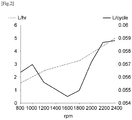
- FIG. 2 is a diagram illustrating an exemplary embodiment of reference fuel efficiency
- FIG. 3 is a diagram illustrating an exemplary embodiment, in which a usage region of engine used data is divided based on a basic operation of an industrial vehicle
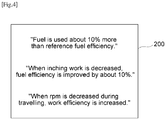
- FIG. 4 is a diagram illustrating an exemplary embodiment of a guide message displayed on a display module.
- the industrial vehicle work guide system may include an analysis module 100, a display module 200, an electronic control unit 300, a load sensor 400, and a memory 500.
- the electronic control unit 300 controls various devices including an engine of the industrial vehicle.
- the memory 500 may store information including engine used data, a driving time, and a fuel consumption amount of the industrial vehicle.
- the engine used data, the driving time, and the fuel consumption amount stored in the memory 500 may be provided from the electronic control unit 300.
- the engine used data is engine-related information stored when the industrial vehicle is driven. As illustrated in FIG. 3 , the engine used data may include engine speed and engine output information. The engine used data may be accumulated and stored according to the driving of the industrial vehicle. The accumulated time, in which the engine used data is stored, may be different according to a storage capacity of the memory 500. When the engine used data exceeds the storage capacity of the memory 500, the engine used data may be accumulated and stored in a scheme in which the first input engine used data is first deleted.
- the load sensor 400 measures weight of cargo loaded on the industrial vehicle.
- the load sensor 400 may measure pressure generated by the weight of the cargo and transmit the measured pressure to the electronic control unit 300 and the memory 500.
- the load sensor 400 may measure pressure applied to a fork of a construction machine.
- the display module 200 may be controlled by the analysis module 100 according to the analysis result of the analysis module 100 and display a guide message.
- the analysis module 100 may calculate actual fuel efficiency of the industrial vehicle operated by an operation of an operator, and compare the calculated actual fuel efficiency with reference fuel efficiency, and control the display module 200 so that the display module 200 outputs a guide message corresponding to the comparison result.
- the analysis module 100 may receive the engine used data, the driving time, the fuel consumption amount, and the cargo weight information from the memory 500, and analyze an operation pattern of the operator based on the received engine used data, driving time, fuel consumption amount, and cargo weight information.
- the fuel consumption amount information transferred from the memory 500 to the analysis module 100 may include information about a fuel consumption amount within the most recent one hour.
- the reference fuel efficiency is a value serving as a reference for comparing the actual fuel efficiency when the industrial vehicle is operated by the operation of the operator.
- the reference fuel efficiency may be fuel efficiency when the industrial vehicle performs reference work. Accordingly, in order to set the reference fuel efficiency that is the comparison reference of the actual fuel efficiency, the reference work may be set.
- the reference work may consist of two or more basic work.
- the basic work is a basic unit of work, which the industrial vehicle may perform, and may include load loading and unloading work, inching work, travelling work, and complex operation work.
- the reference work may be a standard work mode of a VDI test mode that is a forklift fuel efficiency test mode.
- the reference work may consist of a combination of various basic work, which the industrial vehicle may perform, in addition to the foregoing work.
- the engine used data is represented in a specific pattern. As illustrated in FIG. 3 , when the industrial vehicle performs load loading/unloading work, the engine used data is positioned in region A1, in which an engine speed is low and an engine output is low. When the industrial vehicle performs inching work, the engine used data is positioned in region A2, in which an engine speed is high and an engine output is low. When the industrial vehicle performs travelling work, the engine used data is positioned in region A4, in which an engine speed is high and an engine output is high. When the industrial vehicle performs complex operation work, the engine used data is positioned in region A3, in which an engine speed is low and an engine output is high.
- the engine used data represents different patterns according to the kind of performed basic operation, so that it is possible to calculate a ratio of each of the basic work of the reference work based on the pattern.
- a ratio of each of the load loading/unloading work, the inching work, the travelling work, and the complex operation work of the reference work may be stored in the memory 500.
- reference fuel efficiency may be set based on the determined reference work.
- the reference fuel efficiency may include fuel efficiency (L/hr), a work amount per hour (Cycle/hr), and work efficiency (L/Cycle).
- the reference fuel efficiency may be pre-set by a method, such as a test, and stored in the memory 500.
- the fuel efficiency (L/hr) may be defined with a fuel consumption amount (1) per driving time (hr) of the industrial vehicle.
- the analysis module 100 may receive the fuel consumption amount (1) and the driving time from the electronic control unit 300 and calculate fuel efficiency (L/hr).
- the work amount (Cycle/hr) per hour may be defined with a work cycle (Cycle) per driving time (hr).
- the work cycle (Cycle) is a work unit consisting of two or more reference work for performing specific work performed by the industrial vehicle. For example, in the case of work of lifting cargo laid on a floor and loading the cargo on a vehicle located in another place, from the work of lifting the cargo laid on the floor to the work of loading the cargo on the vehicle through the travelling work is one cycle, and the cycle may be repeatedly performed.
- the work efficiency (L/Cycle) may be defined with a fuel consumption amount (1) per one work cycle (Cycle).
- the analysis module 100 may calculate work efficiency (L/Cycle) based on the calculated fuel efficiency (L/hr) and work amount per hour (Cycle/hr).
- Each of the reference fuel efficiency may be pre-set by a test, and may be set based on each weight of cargo and each engine speed.
- FIG. 2 illustrates a relation between fuel efficiency (L/hr) and work efficiency (L/Cycle) based on each engine speed for specific cargo weight.
- the set reference fuel efficiency is stored in the memory 500 of the industrial vehicle.
- the industrial vehicle is driven and performs work, so that the information, such as the engine used data, the driving time, and the fuel consumption amount, for calculating actual fuel efficiency is accumulated in the memory 500.
- the analysis module 100 may calculate actual fuel efficiency of the industrial vehicle based on the information provided from the memory 500 and the load sensor 400.
- the fuel efficiency (L/hr) may be calculated by dividing the fuel consumption amount by the driving time. As necessary, the fuel efficiency (L/hr) may be calculated based on the fuel consumption amount within the most recent one hour.
- the analysis module 100 may calculate a work cycle of construction machinery based on pressure information received from the load sensor 400.
- the construction machinery generally performs an operation of lifting cargo, travelling, and unloading the cargo again, and in this case, the operation of lifting the cargo increases pressure detected by the load sensor 400 and the operation of unloading the cargo decreases pressure detected by the load sensor 400.
- a time point, at which the pressure detected by the load sensor 400 is increased, to a time point, at which the pressure detected by the load sensor 400 is decreased, may be calculated as one work cycle, and the analysis module 100 may calculate the number of work cycles performed based on the pressure information received from the load sensor 400.
- the work amount per hour (Cycle/hr) may be calculated by using the calculated work cycle (Cycle).
- the analysis module 100 may calculate work efficiency (L/Cycle) based on the calculated fuel efficiency (L/hr) and work amount per hour (Cycle/hr).
- the analysis module 100 may calculate actual fuel efficiency based on each engine speed.
- the engine speed may be set with a section.
- the section may be set for every 100 rpm. Accordingly, the analysis module 100 may calculate actual fuel efficiency based on each engine speed section, such as actual fuel efficiency in a section of 800 rpm and actual fuel efficiency in a section of 900 rpm.
- the analysis module 100 may analyze the engine used data, and extract an engine speed which the operator most frequently uses.
- the analysis module 100 may classify the engine used data to one of the plurality of basic work by substituting the engine used data to the preset reference, such as the reference illustrated in FIG. 3 , and then calculate a ratio between the plurality of basic work.
- the plurality of basic work may be the load loading/unloading work, the inching work, the travelling work, and the complex operation work.
- the analysis module 100 compares the actual efficiency with the reference fuel efficiency at each engine speed. For example, the analysis module 100 compares the actual fuel efficiency (L/hr), the actual work amount per hour (Cycle/hr), and the actual work efficiency (L/Cycle) at 1,600 rpm with the reference fuel efficiency. The analysis module 100 may compare the actual fuel efficiency with the reference fuel efficiency, and when the actual fuel efficiency is lower than the reference fuel efficiency, the analysis module 100 may output a guide message through the display module 200. In this case, the guide message may include, for example, "use the neutral mode, rather than inching, during load work" and "when an accelerator pedal is less used by 10% during work, work efficiency is increased 10%".
- the analysis module 100 may compare the extracted most frequent engine speed of the operator with the most efficient engine speed, and then output the guide message so that the most frequent engine speed of the operator is close to the most efficient engine speed.
- the most efficient engine speed may be set by a test in advance, and be, for example, 1,600 rpm, at which the work efficiency (L/Cycle) is highest in FIG. 2 .
Landscapes
- Engineering & Computer Science (AREA)
- Structural Engineering (AREA)
- Transportation (AREA)
- Mechanical Engineering (AREA)
- Civil Engineering (AREA)
- Combustion & Propulsion (AREA)
- Chemical & Material Sciences (AREA)
- Life Sciences & Earth Sciences (AREA)
- Geology (AREA)
- General Engineering & Computer Science (AREA)
- General Physics & Mathematics (AREA)
- Physics & Mathematics (AREA)
- Mining & Mineral Resources (AREA)
- Combined Controls Of Internal Combustion Engines (AREA)
- Control Of Vehicle Engines Or Engines For Specific Uses (AREA)
Abstract
Description
- The present invention relates to an industrial vehicle work guide system.
- A forklift is a representative industrial vehicle used for lifting and loading and unloading cargo having relatively large weight or used for lifting cargo having large weight and transporting the cargo to a position desired by a worker. An excavator operates working machinery by using an operation lever, an operation pedal, and the like within a cabin or an operating room. When the operation lever, the operation pedal, and the like are operated in the state where the forklift starts, a hydraulic cylinder or a hydraulic actuator is operated, so that the working machinery performs work.
- The representative work of the forklift is work of lifting and loading and unloading cargo having large weight, work of transporting cargo, and the like, and in the repeated work, it is known that a work operation pattern of a skilled operator improves efficiency of an operation capacity and considerably improves fuel efficiency. However, even though work is performed in the same work environment by using the same equipment, unskilled operators or beginners have different work operation patterns, for example, a degree of pushing the operation pedal of the operation pedal or an operation direction of the operation lever, or the operation amount, and are not accustomed to control an operation time of the operation pedal and/or the operation lever, so that the working machinery is inefficiently operated, and depending on the case, there is a problem in that the working machinery is excessively lifted or is unnecessarily operated, so that fuel efficiency is wasted and an operation capacity is increased. In the related art, an efficient work guide system for unskilled people or beginners is not provided, so that there is a problem in that unskilled people or beginners inevitably need to acquire an efficient work operation pattern through a repeated experience while spending lots of time and making many efforts in an actual work field for a long time.
- The present invention is conceived to solve the foregoing problems in the related art, and an object of the present invention is to provide an industrial vehicle work guide system, which is capable of providing a driver with guidance so as to improve fuel efficiency during an operation of an industrial vehicle.
- In order to solve the foregoing problems, an exemplary embodiment of the present invention provides an industrial vehicle work guide system, including: a memory configured to store engine used data, a driving time, a fuel consumption amount, and reference fuel efficiency; a display module configured to output a guide message; and an analysis module configured to calculate actual fuel efficiency by using the engine used data, the driving time, and the fuel consumption amount, compare the actual fuel efficiency with the reference fuel efficiency, and control the display module so that the display module outputs a guide message when the actual fuel efficiency is lower than the reference fuel efficiency.
- In this case, the engine used data may include information about an engine speed and an engine output.
- Further, the analysis module may extract an engine speed, which is most frequently used by an operator, from the engine used data, compare the extracted engine speed, which is most frequently used by the operator, with a preset most efficient engine speed, and output the guide message through the display module so that the engine speed, which is most frequently used by the operator, is close to the most efficient engine speed.
- Further, the reference fuel efficiency may be fuel efficiency when reference work consisting of two or more of load loading/unloading work, inching work, traveling work, complex operation work is performed.
- Further, the reference fuel efficiency may include fuel efficiency (L/hr) defined with a fuel consumption amount per driving time (hr).
- Further, the reference fuel efficiency may include a work amount per hour (Cycle/hr) defined with a work cycle per driving time (hr).
- Further, the industrial vehicle work guide system may further include a load sensor configured to measure weight of the cargo loaded on the industrial vehicle, in which the analysis module may calculate the work cycle based on pressure measured by the load sensor.
- Further, the reference fuel efficiency may be defined with a fuel consumption amount per work cycle (Cycle).
- Further, the reference fuel efficiency may be set based on each cargo located on the industrial vehicle and each engine speed.
- According to the exemplary embodiment of the present invention, actual fuel efficiency of an operator is compared with reference fuel efficiency by the analysis module and when the actual fuel efficiency is lower than reference fuel efficiency, a guide message is output through the display module, thereby improving fuel efficiency of the industrial vehicle regardless of a skill level of the operator.
-
-
FIG. 1 is a diagram illustrating a general configuration of an industrial vehicle work guide system according to an exemplary embodiment of the present invention. -
FIG. 2 is a diagram illustrating an exemplary embodiment of reference fuel efficiency. -
FIG. 3 is a diagram illustrating an exemplary embodiment, in which a usage region of engine used data is divided. -
FIG. 4 is a diagram illustrating an exemplary embodiment of a guide message displayed on a display module. - Hereinafter, an exemplary embodiment of the present invention will be described in detail with reference to the accompanying drawings. First of all, we should note that in giving reference numerals to elements of each drawing, like reference numerals refer to like elements even though like elements are shown in different drawings. In the following description of the exemplary embodiment, a detailed description of known configurations or functions incorporated herein will be omitted when it is judged that the detailed description may make the subject matter of the present disclosure unclear.
- An industrial vehicle work guide system according to an exemplary embodiment of the present invention is for the purpose of actively inducing a fuel efficient operation habit from a driver by comparing actual fuel efficiency with reference fuel efficiency according to an operation habit of an operator.
-
FIG. 1 is a diagram illustrating a general configuration of an industrial vehicle work guide system according to an exemplary embodiment of the present invention.FIG. 2 is a diagram illustrating an exemplary embodiment of reference fuel efficiency,FIG. 3 is a diagram illustrating an exemplary embodiment, in which a usage region of engine used data is divided based on a basic operation of an industrial vehicle, andFIG. 4 is a diagram illustrating an exemplary embodiment of a guide message displayed on a display module. - Referring to
FIG. 1 , the industrial vehicle work guide system according to the exemplary embodiment of the present invention may include ananalysis module 100, adisplay module 200, anelectronic control unit 300, aload sensor 400, and amemory 500. - The
electronic control unit 300 controls various devices including an engine of the industrial vehicle. Thememory 500 may store information including engine used data, a driving time, and a fuel consumption amount of the industrial vehicle. The engine used data, the driving time, and the fuel consumption amount stored in thememory 500 may be provided from theelectronic control unit 300. - The engine used data is engine-related information stored when the industrial vehicle is driven. As illustrated in
FIG. 3 , the engine used data may include engine speed and engine output information. The engine used data may be accumulated and stored according to the driving of the industrial vehicle. The accumulated time, in which the engine used data is stored, may be different according to a storage capacity of thememory 500. When the engine used data exceeds the storage capacity of thememory 500, the engine used data may be accumulated and stored in a scheme in which the first input engine used data is first deleted. - The
load sensor 400 measures weight of cargo loaded on the industrial vehicle. Theload sensor 400 may measure pressure generated by the weight of the cargo and transmit the measured pressure to theelectronic control unit 300 and thememory 500. For example, theload sensor 400 may measure pressure applied to a fork of a construction machine. - The
display module 200 may be controlled by theanalysis module 100 according to the analysis result of theanalysis module 100 and display a guide message. - The
analysis module 100 may calculate actual fuel efficiency of the industrial vehicle operated by an operation of an operator, and compare the calculated actual fuel efficiency with reference fuel efficiency, and control thedisplay module 200 so that thedisplay module 200 outputs a guide message corresponding to the comparison result. - The
analysis module 100 may receive the engine used data, the driving time, the fuel consumption amount, and the cargo weight information from thememory 500, and analyze an operation pattern of the operator based on the received engine used data, driving time, fuel consumption amount, and cargo weight information. In this case, the fuel consumption amount information transferred from thememory 500 to theanalysis module 100 may include information about a fuel consumption amount within the most recent one hour. - The reference fuel efficiency is a value serving as a reference for comparing the actual fuel efficiency when the industrial vehicle is operated by the operation of the operator. The reference fuel efficiency may be fuel efficiency when the industrial vehicle performs reference work. Accordingly, in order to set the reference fuel efficiency that is the comparison reference of the actual fuel efficiency, the reference work may be set.
- The reference work may consist of two or more basic work. The basic work is a basic unit of work, which the industrial vehicle may perform, and may include load loading and unloading work, inching work, travelling work, and complex operation work. For example, the reference work may be a standard work mode of a VDI test mode that is a forklift fuel efficiency test mode. The reference work may consist of a combination of various basic work, which the industrial vehicle may perform, in addition to the foregoing work.
- When the industrial vehicle performs each basic work, the engine used data is represented in a specific pattern. As illustrated in
FIG. 3 , when the industrial vehicle performs load loading/unloading work, the engine used data is positioned in region A1, in which an engine speed is low and an engine output is low. When the industrial vehicle performs inching work, the engine used data is positioned in region A2, in which an engine speed is high and an engine output is low. When the industrial vehicle performs travelling work, the engine used data is positioned in region A4, in which an engine speed is high and an engine output is high. When the industrial vehicle performs complex operation work, the engine used data is positioned in region A3, in which an engine speed is low and an engine output is high. As described above, the engine used data represents different patterns according to the kind of performed basic operation, so that it is possible to calculate a ratio of each of the basic work of the reference work based on the pattern. A ratio of each of the load loading/unloading work, the inching work, the travelling work, and the complex operation work of the reference work may be stored in thememory 500. - When the reference work is determined, reference fuel efficiency may be set based on the determined reference work. The reference fuel efficiency may include fuel efficiency (L/hr), a work amount per hour (Cycle/hr), and work efficiency (L/Cycle). The reference fuel efficiency may be pre-set by a method, such as a test, and stored in the
memory 500. - The fuel efficiency (L/hr) may be defined with a fuel consumption amount (1) per driving time (hr) of the industrial vehicle. The
analysis module 100 may receive the fuel consumption amount (1) and the driving time from theelectronic control unit 300 and calculate fuel efficiency (L/hr). - The work amount (Cycle/hr) per hour may be defined with a work cycle (Cycle) per driving time (hr). In this case, the work cycle (Cycle) is a work unit consisting of two or more reference work for performing specific work performed by the industrial vehicle. For example, in the case of work of lifting cargo laid on a floor and loading the cargo on a vehicle located in another place, from the work of lifting the cargo laid on the floor to the work of loading the cargo on the vehicle through the travelling work is one cycle, and the cycle may be repeatedly performed.
- The work efficiency (L/Cycle) may be defined with a fuel consumption amount (1) per one work cycle (Cycle). The
analysis module 100 may calculate work efficiency (L/Cycle) based on the calculated fuel efficiency (L/hr) and work amount per hour (Cycle/hr). - Each of the reference fuel efficiency may be pre-set by a test, and may be set based on each weight of cargo and each engine speed.
FIG. 2 illustrates a relation between fuel efficiency (L/hr) and work efficiency (L/Cycle) based on each engine speed for specific cargo weight. - When the reference fuel efficiency is set, the set reference fuel efficiency is stored in the
memory 500 of the industrial vehicle. In this state, the industrial vehicle is driven and performs work, so that the information, such as the engine used data, the driving time, and the fuel consumption amount, for calculating actual fuel efficiency is accumulated in thememory 500. Accordingly, theanalysis module 100 may calculate actual fuel efficiency of the industrial vehicle based on the information provided from thememory 500 and theload sensor 400. - The fuel efficiency (L/hr) may be calculated by dividing the fuel consumption amount by the driving time. As necessary, the fuel efficiency (L/hr) may be calculated based on the fuel consumption amount within the most recent one hour.
- The
analysis module 100 may calculate a work cycle of construction machinery based on pressure information received from theload sensor 400. For example, the construction machinery generally performs an operation of lifting cargo, travelling, and unloading the cargo again, and in this case, the operation of lifting the cargo increases pressure detected by theload sensor 400 and the operation of unloading the cargo decreases pressure detected by theload sensor 400. Accordingly, a time point, at which the pressure detected by theload sensor 400 is increased, to a time point, at which the pressure detected by theload sensor 400 is decreased, may be calculated as one work cycle, and theanalysis module 100 may calculate the number of work cycles performed based on the pressure information received from theload sensor 400. The work amount per hour (Cycle/hr) may be calculated by using the calculated work cycle (Cycle). - The
analysis module 100 may calculate work efficiency (L/Cycle) based on the calculated fuel efficiency (L/hr) and work amount per hour (Cycle/hr). - The
analysis module 100 may calculate actual fuel efficiency based on each engine speed. In this case, the engine speed may be set with a section. In this case, the section may be set for every 100 rpm. Accordingly, theanalysis module 100 may calculate actual fuel efficiency based on each engine speed section, such as actual fuel efficiency in a section of 800 rpm and actual fuel efficiency in a section of 900 rpm. - Further, the
analysis module 100 may analyze the engine used data, and extract an engine speed which the operator most frequently uses. - Further, the
analysis module 100 may classify the engine used data to one of the plurality of basic work by substituting the engine used data to the preset reference, such as the reference illustrated inFIG. 3 , and then calculate a ratio between the plurality of basic work. As described above, the plurality of basic work may be the load loading/unloading work, the inching work, the travelling work, and the complex operation work. - The
analysis module 100 compares the actual efficiency with the reference fuel efficiency at each engine speed. For example, theanalysis module 100 compares the actual fuel efficiency (L/hr), the actual work amount per hour (Cycle/hr), and the actual work efficiency (L/Cycle) at 1,600 rpm with the reference fuel efficiency. Theanalysis module 100 may compare the actual fuel efficiency with the reference fuel efficiency, and when the actual fuel efficiency is lower than the reference fuel efficiency, theanalysis module 100 may output a guide message through thedisplay module 200. In this case, the guide message may include, for example, "use the neutral mode, rather than inching, during load work" and "when an accelerator pedal is less used by 10% during work, work efficiency is increased 10%". - Further, the
analysis module 100 may compare the extracted most frequent engine speed of the operator with the most efficient engine speed, and then output the guide message so that the most frequent engine speed of the operator is close to the most efficient engine speed. In this case, the most efficient engine speed may be set by a test in advance, and be, for example, 1,600 rpm, at which the work efficiency (L/Cycle) is highest inFIG. 2 . - Although a preferred embodiment of the present invention has been described for illustrative purposes, those skilled in the art will appreciate that various modifications, additions and substitutions are possible, without departing from the scope and spirit of the invention as disclosed in the accompanying claims. Therefore, the embodiments disclosed in the present invention are intended to illustrate the technical idea of the present invention, and the scope of the present invention is not limited by the embodiment. The scope of the present invention shall be construed on the basis of the accompanying claims in such a manner that all of the technical ideas included within the scope equivalent to the claims belong to the scope of the present invention.
- In the industrial vehicle work guide system according to the present invention, actual fuel efficiency of an operator is compared with reference fuel efficiency by the analysis module and when the actual fuel efficiency is lower than reference fuel efficiency, a guide message is output through the display module, thereby effectively improving fuel efficiency of the industrial vehicle regardless of a skill level of the operator.
-
100: Analysis module 200: Display module 300: Electronic control unit 400: Load sensor 500: Memory
Claims (9)
- An industrial vehicle work guide system, comprising:a memory configured to store engine used data, a driving time, a fuel consumption amount, and reference fuel efficiency;a display module configured to output a guide message; andan analysis module configured to calculate actual fuel efficiency by using the engine used data, the driving time, and the fuel consumption amount, compare the actual fuel efficiency with the reference fuel efficiency, and control the display module so that the display module outputs a guide message when the actual fuel efficiency is lower than the reference fuel efficiency.
- The industrial vehicle work guide system of claim 1, wherein the engine used data includes information about an engine speed and an engine output.
- The industrial vehicle work guide system of claim 2, wherein the analysis module extracts an engine speed, which is most frequently used by an operator, from the engine used data, compares the extracted engine speed, which is most frequently used by the operator, with a preset most efficient engine speed, and outputs the guide message through the display module so that the engine speed, which is most frequently used by the operator, is close to the most efficient engine speed.
- The industrial vehicle work guide system of claim 1, wherein the reference fuel efficiency is fuel efficiency when reference work consisting of two or more of load loading/unloading work, inching work, traveling work, complex operation work is performed.
- The industrial vehicle work guide system of claim 1, wherein the reference fuel efficiency includes fuel efficiency defined with a fuel consumption amount per driving time.
- The industrial vehicle work guide system of claim 1, wherein
the reference fuel efficiency includes a work amount per hour defined with a work cycle per driving time. - The industrial vehicle work guide system of claim 6, further comprising:a load sensor configured to measure weight of the cargo loaded on the industrial vehicle,wherein the analysis module calculates the work cycle based on pressure measured by the load sensor.
- The industrial vehicle work guide system of claim 1, wherein
the reference fuel efficiency includes work efficiency defined with a fuel consumption amount per work cycle. - The industrial vehicle work guide system of claim 1, wherein the reference fuel efficiency is set based on each cargo located on the industrial vehicle and each engine speed.
Applications Claiming Priority (2)
| Application Number | Priority Date | Filing Date | Title |
|---|---|---|---|
| KR1020160098384A KR102007553B1 (en) | 2016-08-02 | 2016-08-02 | Work guide system for a work vehicle |
| PCT/KR2017/008330 WO2018026187A1 (en) | 2016-08-02 | 2017-08-02 | Industrial vehicle work guide system |
Publications (3)
| Publication Number | Publication Date |
|---|---|
| EP3492727A1 true EP3492727A1 (en) | 2019-06-05 |
| EP3492727A4 EP3492727A4 (en) | 2019-08-14 |
| EP3492727B1 EP3492727B1 (en) | 2021-11-03 |
Family
ID=61072932
Family Applications (1)
| Application Number | Title | Priority Date | Filing Date |
|---|---|---|---|
| EP17837238.9A Active EP3492727B1 (en) | 2016-08-02 | 2017-08-02 | Industrial vehicle work guide system |
Country Status (5)
| Country | Link |
|---|---|
| US (1) | US11434845B2 (en) |
| EP (1) | EP3492727B1 (en) |
| KR (1) | KR102007553B1 (en) |
| CN (1) | CN109937294B (en) |
| WO (1) | WO2018026187A1 (en) |
Family Cites Families (24)
| Publication number | Priority date | Publication date | Assignee | Title |
|---|---|---|---|---|
| GB1555598A (en) | 1977-10-20 | 1979-11-14 | Pye Electronic Prod Ltd | Load measuring arrangements for fork lift trucks or the like |
| KR19990018156A (en) | 1997-08-26 | 1999-03-15 | 이충열 | Forklift danger warning system |
| KR100540446B1 (en) * | 1998-11-25 | 2006-02-28 | 볼보 컨스트럭션 이키프먼트 홀딩 스웨덴 에이비 | Engine Speed Control Method of Wheeled Excavator_ |
| JP2001002372A (en) * | 1999-06-24 | 2001-01-09 | Mitsubishi Heavy Ind Ltd | Carrying device |
| JP4629377B2 (en) * | 2003-09-02 | 2011-02-09 | 株式会社小松製作所 | Construction machinery |
| US7026557B2 (en) | 2003-10-30 | 2006-04-11 | Mettler-Toledo | Apparatus and method for weighting objects on a fork lift truck |
| KR200344391Y1 (en) | 2003-12-05 | 2004-03-11 | 김문기 | scale device for forklift |
| US7454282B2 (en) * | 2004-10-21 | 2008-11-18 | Komatsu Ltd. | Engine output control device and engine output control method for working machine |
| KR100906821B1 (en) * | 2004-12-09 | 2009-07-09 | 현대중공업 주식회사 | Excavator's operation information management display device and its method |
| JP5119938B2 (en) * | 2008-01-17 | 2013-01-16 | 日産自動車株式会社 | Fuel consumption display device for vehicles |
| JP4774096B2 (en) * | 2008-11-17 | 2011-09-14 | 日立建機株式会社 | Exhaust gas purification system for work machines |
| JP5381106B2 (en) * | 2009-01-07 | 2014-01-08 | コベルコクレーン株式会社 | Crane operation evaluation device |
| JP2010188961A (en) * | 2009-02-20 | 2010-09-02 | Kubota Corp | Display structure of working machine |
| KR101625682B1 (en) * | 2009-12-24 | 2016-05-31 | 두산인프라코어 주식회사 | Fuel consumption rate display apparatus, fuel consumption rate display method and standard fuel rate calculation method for construction machinery |
| US8779306B2 (en) | 2010-02-19 | 2014-07-15 | Methode Electronics, Inc. | Weight sensing method and apparatus for forklifts |
| KR101422817B1 (en) * | 2010-06-25 | 2014-07-24 | 현대중공업 주식회사 | The Control Method of Hybrid Excavators |
| KR101737639B1 (en) * | 2011-01-24 | 2017-05-19 | 두산인프라코어 주식회사 | Eco training system for a heavy equipment and Control method thereof |
| KR102004000B1 (en) * | 2012-12-26 | 2019-07-25 | 두산인프라코어 주식회사 | Apparatus for displaying work prosedure guide of construction equipment using head up display and method thereof |
| CN103115651B (en) * | 2013-02-26 | 2015-05-13 | 广东交通职业技术学院 | Method for detecting fuel consumption of vehicle in transient road-test standard state |
| JP6247552B2 (en) * | 2014-01-30 | 2017-12-13 | 日立建機株式会社 | Construction machine operation support system |
| KR20150139263A (en) * | 2014-06-03 | 2015-12-11 | 기아자동차주식회사 | Apparatus and method for detecting decline of fuel efficiency of vehicle |
| TWI586570B (en) * | 2014-09-19 | 2017-06-11 | 元智大學 | System and method for analyzing fuel consumption base on driving behavior |
| US9513151B2 (en) * | 2015-02-27 | 2016-12-06 | TrueLite Trace, Inc. | Fuel waste variable identification and analysis system |
| CN105402039B (en) * | 2015-12-21 | 2018-05-11 | 徐州燕大传动与控制技术有限公司 | A kind of rotary drilling rig power matching method based on moment of torsion Yu rotating speed complex controll |
-
2016
- 2016-08-02 KR KR1020160098384A patent/KR102007553B1/en active Active
-
2017
- 2017-08-02 EP EP17837238.9A patent/EP3492727B1/en active Active
- 2017-08-02 US US16/322,527 patent/US11434845B2/en active Active
- 2017-08-02 WO PCT/KR2017/008330 patent/WO2018026187A1/en not_active Ceased
- 2017-08-02 CN CN201780048863.8A patent/CN109937294B/en active Active
Also Published As
| Publication number | Publication date |
|---|---|
| KR20180014938A (en) | 2018-02-12 |
| CN109937294A (en) | 2019-06-25 |
| US20210372341A1 (en) | 2021-12-02 |
| WO2018026187A1 (en) | 2018-02-08 |
| EP3492727A4 (en) | 2019-08-14 |
| KR102007553B1 (en) | 2019-10-21 |
| CN109937294B (en) | 2022-05-10 |
| EP3492727B1 (en) | 2021-11-03 |
| US11434845B2 (en) | 2022-09-06 |
Similar Documents
| Publication | Publication Date | Title |
|---|---|---|
| US8095280B2 (en) | Method for adjusting engine speed based on power usage of machine | |
| US8838331B2 (en) | Payload material density calculation and machine using same | |
| US12030747B2 (en) | Work machine | |
| US20150002303A1 (en) | System to display remaining payload weight for a truck | |
| JP4440271B2 (en) | Engine output control device and engine output control method for work vehicle | |
| US9939311B2 (en) | System and method to display and track machine interrupted loading cycles | |
| EP2868901A1 (en) | Wheel loader and wheel loader engine control method | |
| CN104234116A (en) | System and method for dig detection | |
| US20230175232A1 (en) | Autonomous loading operations of a mining machine | |
| CA3035333A1 (en) | Transporter vehicle management system and transporter vehicle management method | |
| JP2018120260A (en) | Cargo handling support system | |
| JPWO2015037064A1 (en) | Time series data analysis method and apparatus | |
| US11434845B2 (en) | Industrial vehicle work guide system | |
| DE112020003303T5 (en) | CONTROL OF AN ENGINE OF A MACHINE BASED ON DETECTED LOAD REQUIREMENTS OF THE MACHINE | |
| CN111221330A (en) | Unmanned forklift motion control method and unmanned forklift assembly motion control method | |
| AU2021235367B2 (en) | System and method for controlling transport vehicle | |
| US9493928B2 (en) | Method and apparatus for controlling engine of wheel loader | |
| US9863120B2 (en) | System and method for controlling a machine implement | |
| CN105174141B (en) | Door frame mechanism localization method, controller and system | |
| KR101737639B1 (en) | Eco training system for a heavy equipment and Control method thereof | |
| EP3385456A1 (en) | Method of controlling a flow rate of a construction machine and system for performing the same | |
| KR102461072B1 (en) | Auto idle control apparatus and method for construction machinery | |
| KR102126589B1 (en) | Method and Apparatus for Controlling Engine of Construction Machinery | |
| EP4488900A1 (en) | A transport asset monitoring system for monitoring operating states of one or more transport assets and a method to be executed in the transport asset monitoring system | |
| US20160297441A1 (en) | System and method for machine cost optimization |
Legal Events
| Date | Code | Title | Description |
|---|---|---|---|
| STAA | Information on the status of an ep patent application or granted ep patent |
Free format text: STATUS: THE INTERNATIONAL PUBLICATION HAS BEEN MADE |
|
| PUAI | Public reference made under article 153(3) epc to a published international application that has entered the european phase |
Free format text: ORIGINAL CODE: 0009012 |
|
| STAA | Information on the status of an ep patent application or granted ep patent |
Free format text: STATUS: REQUEST FOR EXAMINATION WAS MADE |
|
| 17P | Request for examination filed |
Effective date: 20190226 |
|
| AK | Designated contracting states |
Kind code of ref document: A1 Designated state(s): AL AT BE BG CH CY CZ DE DK EE ES FI FR GB GR HR HU IE IS IT LI LT LU LV MC MK MT NL NO PL PT RO RS SE SI SK SM TR |
|
| AX | Request for extension of the european patent |
Extension state: BA ME |
|
| A4 | Supplementary search report drawn up and despatched |
Effective date: 20190716 |
|
| RIC1 | Information provided on ipc code assigned before grant |
Ipc: B66F 9/075 20060101ALI20190710BHEP Ipc: F02D 41/24 20060101AFI20190710BHEP Ipc: G01G 19/02 20060101ALI20190710BHEP |
|
| RIN1 | Information on inventor provided before grant (corrected) |
Inventor name: LEE, BYUNG KWON |
|
| DAV | Request for validation of the european patent (deleted) | ||
| DAX | Request for extension of the european patent (deleted) | ||
| REG | Reference to a national code |
Ref country code: DE Ref legal event code: R079 Ref document number: 602017048840 Country of ref document: DE Free format text: PREVIOUS MAIN CLASS: F02D0041240000 Ipc: B66F0009075000 |
|
| RIC1 | Information provided on ipc code assigned before grant |
Ipc: G01G 19/02 20060101ALI20210226BHEP Ipc: B66F 9/075 20060101AFI20210226BHEP Ipc: F02D 41/24 20060101ALI20210226BHEP |
|
| GRAP | Despatch of communication of intention to grant a patent |
Free format text: ORIGINAL CODE: EPIDOSNIGR1 |
|
| STAA | Information on the status of an ep patent application or granted ep patent |
Free format text: STATUS: GRANT OF PATENT IS INTENDED |
|
| INTG | Intention to grant announced |
Effective date: 20210518 |
|
| GRAS | Grant fee paid |
Free format text: ORIGINAL CODE: EPIDOSNIGR3 |
|
| GRAA | (expected) grant |
Free format text: ORIGINAL CODE: 0009210 |
|
| STAA | Information on the status of an ep patent application or granted ep patent |
Free format text: STATUS: THE PATENT HAS BEEN GRANTED |
|
| RAP1 | Party data changed (applicant data changed or rights of an application transferred) |
Owner name: DOOSAN INDUSTRIAL VEHICLE CO., LTD. |
|
| AK | Designated contracting states |
Kind code of ref document: B1 Designated state(s): AL AT BE BG CH CY CZ DE DK EE ES FI FR GB GR HR HU IE IS IT LI LT LU LV MC MK MT NL NO PL PT RO RS SE SI SK SM TR |
|
| RAP3 | Party data changed (applicant data changed or rights of an application transferred) |
Owner name: DOOSAN INDUSTRIAL VEHICLE CO., LTD. |
|
| REG | Reference to a national code |
Ref country code: GB Ref legal event code: FG4D |
|
| REG | Reference to a national code |
Ref country code: AT Ref legal event code: REF Ref document number: 1443809 Country of ref document: AT Kind code of ref document: T Effective date: 20211115 Ref country code: CH Ref legal event code: EP |
|
| REG | Reference to a national code |
Ref country code: DE Ref legal event code: R096 Ref document number: 602017048840 Country of ref document: DE |
|
| REG | Reference to a national code |
Ref country code: IE Ref legal event code: FG4D |
|
| REG | Reference to a national code |
Ref country code: SE Ref legal event code: TRGR |
|
| REG | Reference to a national code |
Ref country code: LT Ref legal event code: MG9D |
|
| REG | Reference to a national code |
Ref country code: NL Ref legal event code: MP Effective date: 20211103 |
|
| REG | Reference to a national code |
Ref country code: AT Ref legal event code: MK05 Ref document number: 1443809 Country of ref document: AT Kind code of ref document: T Effective date: 20211103 |
|
| PG25 | Lapsed in a contracting state [announced via postgrant information from national office to epo] |
Ref country code: RS Free format text: LAPSE BECAUSE OF FAILURE TO SUBMIT A TRANSLATION OF THE DESCRIPTION OR TO PAY THE FEE WITHIN THE PRESCRIBED TIME-LIMIT Effective date: 20211103 Ref country code: LT Free format text: LAPSE BECAUSE OF FAILURE TO SUBMIT A TRANSLATION OF THE DESCRIPTION OR TO PAY THE FEE WITHIN THE PRESCRIBED TIME-LIMIT Effective date: 20211103 Ref country code: FI Free format text: LAPSE BECAUSE OF FAILURE TO SUBMIT A TRANSLATION OF THE DESCRIPTION OR TO PAY THE FEE WITHIN THE PRESCRIBED TIME-LIMIT Effective date: 20211103 Ref country code: BG Free format text: LAPSE BECAUSE OF FAILURE TO SUBMIT A TRANSLATION OF THE DESCRIPTION OR TO PAY THE FEE WITHIN THE PRESCRIBED TIME-LIMIT Effective date: 20220203 Ref country code: AT Free format text: LAPSE BECAUSE OF FAILURE TO SUBMIT A TRANSLATION OF THE DESCRIPTION OR TO PAY THE FEE WITHIN THE PRESCRIBED TIME-LIMIT Effective date: 20211103 |
|
| PG25 | Lapsed in a contracting state [announced via postgrant information from national office to epo] |
Ref country code: IS Free format text: LAPSE BECAUSE OF FAILURE TO SUBMIT A TRANSLATION OF THE DESCRIPTION OR TO PAY THE FEE WITHIN THE PRESCRIBED TIME-LIMIT Effective date: 20220303 Ref country code: PT Free format text: LAPSE BECAUSE OF FAILURE TO SUBMIT A TRANSLATION OF THE DESCRIPTION OR TO PAY THE FEE WITHIN THE PRESCRIBED TIME-LIMIT Effective date: 20220303 Ref country code: PL Free format text: LAPSE BECAUSE OF FAILURE TO SUBMIT A TRANSLATION OF THE DESCRIPTION OR TO PAY THE FEE WITHIN THE PRESCRIBED TIME-LIMIT Effective date: 20211103 Ref country code: NO Free format text: LAPSE BECAUSE OF FAILURE TO SUBMIT A TRANSLATION OF THE DESCRIPTION OR TO PAY THE FEE WITHIN THE PRESCRIBED TIME-LIMIT Effective date: 20220203 Ref country code: NL Free format text: LAPSE BECAUSE OF FAILURE TO SUBMIT A TRANSLATION OF THE DESCRIPTION OR TO PAY THE FEE WITHIN THE PRESCRIBED TIME-LIMIT Effective date: 20211103 Ref country code: LV Free format text: LAPSE BECAUSE OF FAILURE TO SUBMIT A TRANSLATION OF THE DESCRIPTION OR TO PAY THE FEE WITHIN THE PRESCRIBED TIME-LIMIT Effective date: 20211103 Ref country code: HR Free format text: LAPSE BECAUSE OF FAILURE TO SUBMIT A TRANSLATION OF THE DESCRIPTION OR TO PAY THE FEE WITHIN THE PRESCRIBED TIME-LIMIT Effective date: 20211103 Ref country code: GR Free format text: LAPSE BECAUSE OF FAILURE TO SUBMIT A TRANSLATION OF THE DESCRIPTION OR TO PAY THE FEE WITHIN THE PRESCRIBED TIME-LIMIT Effective date: 20220204 Ref country code: ES Free format text: LAPSE BECAUSE OF FAILURE TO SUBMIT A TRANSLATION OF THE DESCRIPTION OR TO PAY THE FEE WITHIN THE PRESCRIBED TIME-LIMIT Effective date: 20211103 |
|
| PG25 | Lapsed in a contracting state [announced via postgrant information from national office to epo] |
Ref country code: SM Free format text: LAPSE BECAUSE OF FAILURE TO SUBMIT A TRANSLATION OF THE DESCRIPTION OR TO PAY THE FEE WITHIN THE PRESCRIBED TIME-LIMIT Effective date: 20211103 Ref country code: SK Free format text: LAPSE BECAUSE OF FAILURE TO SUBMIT A TRANSLATION OF THE DESCRIPTION OR TO PAY THE FEE WITHIN THE PRESCRIBED TIME-LIMIT Effective date: 20211103 Ref country code: RO Free format text: LAPSE BECAUSE OF FAILURE TO SUBMIT A TRANSLATION OF THE DESCRIPTION OR TO PAY THE FEE WITHIN THE PRESCRIBED TIME-LIMIT Effective date: 20211103 Ref country code: EE Free format text: LAPSE BECAUSE OF FAILURE TO SUBMIT A TRANSLATION OF THE DESCRIPTION OR TO PAY THE FEE WITHIN THE PRESCRIBED TIME-LIMIT Effective date: 20211103 Ref country code: DK Free format text: LAPSE BECAUSE OF FAILURE TO SUBMIT A TRANSLATION OF THE DESCRIPTION OR TO PAY THE FEE WITHIN THE PRESCRIBED TIME-LIMIT Effective date: 20211103 Ref country code: CZ Free format text: LAPSE BECAUSE OF FAILURE TO SUBMIT A TRANSLATION OF THE DESCRIPTION OR TO PAY THE FEE WITHIN THE PRESCRIBED TIME-LIMIT Effective date: 20211103 |
|
| REG | Reference to a national code |
Ref country code: DE Ref legal event code: R097 Ref document number: 602017048840 Country of ref document: DE |
|
| PLBE | No opposition filed within time limit |
Free format text: ORIGINAL CODE: 0009261 |
|
| STAA | Information on the status of an ep patent application or granted ep patent |
Free format text: STATUS: NO OPPOSITION FILED WITHIN TIME LIMIT |
|
| 26N | No opposition filed |
Effective date: 20220804 |
|
| PG25 | Lapsed in a contracting state [announced via postgrant information from national office to epo] |
Ref country code: AL Free format text: LAPSE BECAUSE OF FAILURE TO SUBMIT A TRANSLATION OF THE DESCRIPTION OR TO PAY THE FEE WITHIN THE PRESCRIBED TIME-LIMIT Effective date: 20211103 |
|
| PG25 | Lapsed in a contracting state [announced via postgrant information from national office to epo] |
Ref country code: SI Free format text: LAPSE BECAUSE OF FAILURE TO SUBMIT A TRANSLATION OF THE DESCRIPTION OR TO PAY THE FEE WITHIN THE PRESCRIBED TIME-LIMIT Effective date: 20211103 |
|
| PG25 | Lapsed in a contracting state [announced via postgrant information from national office to epo] |
Ref country code: MC Free format text: LAPSE BECAUSE OF FAILURE TO SUBMIT A TRANSLATION OF THE DESCRIPTION OR TO PAY THE FEE WITHIN THE PRESCRIBED TIME-LIMIT Effective date: 20211103 |
|
| REG | Reference to a national code |
Ref country code: CH Ref legal event code: PL |
|
| PG25 | Lapsed in a contracting state [announced via postgrant information from national office to epo] |
Ref country code: LU Free format text: LAPSE BECAUSE OF NON-PAYMENT OF DUE FEES Effective date: 20220802 Ref country code: LI Free format text: LAPSE BECAUSE OF NON-PAYMENT OF DUE FEES Effective date: 20220831 Ref country code: CH Free format text: LAPSE BECAUSE OF NON-PAYMENT OF DUE FEES Effective date: 20220831 |
|
| REG | Reference to a national code |
Ref country code: BE Ref legal event code: MM Effective date: 20220831 |
|
| PG25 | Lapsed in a contracting state [announced via postgrant information from national office to epo] |
Ref country code: IE Free format text: LAPSE BECAUSE OF NON-PAYMENT OF DUE FEES Effective date: 20220802 |
|
| PG25 | Lapsed in a contracting state [announced via postgrant information from national office to epo] |
Ref country code: BE Free format text: LAPSE BECAUSE OF NON-PAYMENT OF DUE FEES Effective date: 20220831 |
|
| PG25 | Lapsed in a contracting state [announced via postgrant information from national office to epo] |
Ref country code: HU Free format text: LAPSE BECAUSE OF FAILURE TO SUBMIT A TRANSLATION OF THE DESCRIPTION OR TO PAY THE FEE WITHIN THE PRESCRIBED TIME-LIMIT; INVALID AB INITIO Effective date: 20170802 |
|
| PG25 | Lapsed in a contracting state [announced via postgrant information from national office to epo] |
Ref country code: MK Free format text: LAPSE BECAUSE OF FAILURE TO SUBMIT A TRANSLATION OF THE DESCRIPTION OR TO PAY THE FEE WITHIN THE PRESCRIBED TIME-LIMIT Effective date: 20211103 Ref country code: CY Free format text: LAPSE BECAUSE OF FAILURE TO SUBMIT A TRANSLATION OF THE DESCRIPTION OR TO PAY THE FEE WITHIN THE PRESCRIBED TIME-LIMIT Effective date: 20211103 |
|
| REG | Reference to a national code |
Ref country code: DE Ref legal event code: R081 Ref document number: 602017048840 Country of ref document: DE Owner name: DOOSAN BOBCAT KOREA CO., LTD., KR Free format text: FORMER OWNER: DOOSAN INDUSTRIAL VEHICLE CO., LTD., INCHEON, KR |
|
| PG25 | Lapsed in a contracting state [announced via postgrant information from national office to epo] |
Ref country code: MT Free format text: LAPSE BECAUSE OF FAILURE TO SUBMIT A TRANSLATION OF THE DESCRIPTION OR TO PAY THE FEE WITHIN THE PRESCRIBED TIME-LIMIT Effective date: 20211103 |
|
| PGFP | Annual fee paid to national office [announced via postgrant information from national office to epo] |
Ref country code: DE Payment date: 20250702 Year of fee payment: 9 |
|
| PGFP | Annual fee paid to national office [announced via postgrant information from national office to epo] |
Ref country code: IT Payment date: 20250722 Year of fee payment: 9 |
|
| PGFP | Annual fee paid to national office [announced via postgrant information from national office to epo] |
Ref country code: GB Payment date: 20250703 Year of fee payment: 9 |
|
| PGFP | Annual fee paid to national office [announced via postgrant information from national office to epo] |
Ref country code: FR Payment date: 20250703 Year of fee payment: 9 |
|
| PGFP | Annual fee paid to national office [announced via postgrant information from national office to epo] |
Ref country code: SE Payment date: 20250702 Year of fee payment: 9 |
|
| PG25 | Lapsed in a contracting state [announced via postgrant information from national office to epo] |
Ref country code: TR Free format text: LAPSE BECAUSE OF FAILURE TO SUBMIT A TRANSLATION OF THE DESCRIPTION OR TO PAY THE FEE WITHIN THE PRESCRIBED TIME-LIMIT Effective date: 20211103 |