EP3492524A1 - Polypropylene resin composition - Google Patents
Polypropylene resin composition Download PDFInfo
- Publication number
- EP3492524A1 EP3492524A1 EP17834212.7A EP17834212A EP3492524A1 EP 3492524 A1 EP3492524 A1 EP 3492524A1 EP 17834212 A EP17834212 A EP 17834212A EP 3492524 A1 EP3492524 A1 EP 3492524A1
- Authority
- EP
- European Patent Office
- Prior art keywords
- component
- parts
- content
- weight
- refractive index
- Prior art date
- Legal status (The legal status is an assumption and is not a legal conclusion. Google has not performed a legal analysis and makes no representation as to the accuracy of the status listed.)
- Granted
Links
Images
Classifications
-
- C—CHEMISTRY; METALLURGY
- C08—ORGANIC MACROMOLECULAR COMPOUNDS; THEIR PREPARATION OR CHEMICAL WORKING-UP; COMPOSITIONS BASED THEREON
- C08L—COMPOSITIONS OF MACROMOLECULAR COMPOUNDS
- C08L23/00—Compositions of homopolymers or copolymers of unsaturated aliphatic hydrocarbons having only one carbon-to-carbon double bond; Compositions of derivatives of such polymers
- C08L23/02—Compositions of homopolymers or copolymers of unsaturated aliphatic hydrocarbons having only one carbon-to-carbon double bond; Compositions of derivatives of such polymers not modified by chemical after-treatment
- C08L23/10—Homopolymers or copolymers of propene
- C08L23/12—Polypropene
-
- C—CHEMISTRY; METALLURGY
- C08—ORGANIC MACROMOLECULAR COMPOUNDS; THEIR PREPARATION OR CHEMICAL WORKING-UP; COMPOSITIONS BASED THEREON
- C08L—COMPOSITIONS OF MACROMOLECULAR COMPOUNDS
- C08L23/00—Compositions of homopolymers or copolymers of unsaturated aliphatic hydrocarbons having only one carbon-to-carbon double bond; Compositions of derivatives of such polymers
- C08L23/02—Compositions of homopolymers or copolymers of unsaturated aliphatic hydrocarbons having only one carbon-to-carbon double bond; Compositions of derivatives of such polymers not modified by chemical after-treatment
- C08L23/10—Homopolymers or copolymers of propene
-
- C—CHEMISTRY; METALLURGY
- C08—ORGANIC MACROMOLECULAR COMPOUNDS; THEIR PREPARATION OR CHEMICAL WORKING-UP; COMPOSITIONS BASED THEREON
- C08K—Use of inorganic or non-macromolecular organic substances as compounding ingredients
- C08K3/00—Use of inorganic substances as compounding ingredients
- C08K3/34—Silicon-containing compounds
-
- C—CHEMISTRY; METALLURGY
- C08—ORGANIC MACROMOLECULAR COMPOUNDS; THEIR PREPARATION OR CHEMICAL WORKING-UP; COMPOSITIONS BASED THEREON
- C08L—COMPOSITIONS OF MACROMOLECULAR COMPOUNDS
- C08L71/00—Compositions of polyethers obtained by reactions forming an ether link in the main chain; Compositions of derivatives of such polymers
- C08L71/02—Polyalkylene oxides
-
- C—CHEMISTRY; METALLURGY
- C08—ORGANIC MACROMOLECULAR COMPOUNDS; THEIR PREPARATION OR CHEMICAL WORKING-UP; COMPOSITIONS BASED THEREON
- C08L—COMPOSITIONS OF MACROMOLECULAR COMPOUNDS
- C08L71/00—Compositions of polyethers obtained by reactions forming an ether link in the main chain; Compositions of derivatives of such polymers
- C08L71/08—Polyethers derived from hydroxy compounds or from their metallic derivatives
-
- C—CHEMISTRY; METALLURGY
- C08—ORGANIC MACROMOLECULAR COMPOUNDS; THEIR PREPARATION OR CHEMICAL WORKING-UP; COMPOSITIONS BASED THEREON
- C08K—Use of inorganic or non-macromolecular organic substances as compounding ingredients
- C08K2201/00—Specific properties of additives
- C08K2201/002—Physical properties
- C08K2201/003—Additives being defined by their diameter
-
- C—CHEMISTRY; METALLURGY
- C08—ORGANIC MACROMOLECULAR COMPOUNDS; THEIR PREPARATION OR CHEMICAL WORKING-UP; COMPOSITIONS BASED THEREON
- C08K—Use of inorganic or non-macromolecular organic substances as compounding ingredients
- C08K2201/00—Specific properties of additives
- C08K2201/002—Physical properties
- C08K2201/005—Additives being defined by their particle size in general
Definitions
- the present invention relates to a polypropylene resin composition capable of producing a molded article excellent in scratch resistance, rigidity and impact resistance.
- polyvinyl chloride has been the mainstream.
- replacement with a polypropylene composite material blended with talc proceeds because of excellence in moldability, lightweight, recyclability, economy, and the like.
- the polypropylene composite material is likely to cause material failure starting from talc and has a disadvantage of poor scratch resistance and impact resistance.
- Patent Document 1 there is proposed a composition in which the scratch resistance is improved by adding an aliphatic amide to a polypropylene composite material blended with talc.
- the aliphatic amide is relatively compatible with polypropylene and hardly migrates onto the surface of molded article so that improvement effect of the scratch resistance is not sufficiently obtained.
- Patent Document 1 JP-A-2010-43252
- An object of the present invention is to provide a polypropylene resin composition capable of producing a molded article excellent in scratch resistance, rigidity and impact resistance.
- a polypropylene resin composition of the present invention comprises component (A), component (B) and component (C) shown below, wherein a content of the component (A) is from 70 to 90 parts by weight, a content of the component (B) is from 10 to 30 parts by weight, and a content of the component (C) is from 1 to 5 parts by weight, when a total of the content of the component (A) and the content of the component (B) is taken as 100 parts by weight:
- a polypropylene resin composition capable of producing a molded article excellent in scratch resistance, rigidity and impact resistance can be provided by blending a specific polyethylene glycol into polypropylene blended with talc, thereby enhancing lubricity of the surface of molded article and interfacial strength between polypropylene and talc.
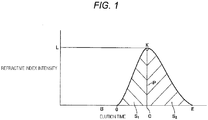
- FIG. 1 is a drawing of a model chromatogram for illustrating peak areas S 1 and S 2 as defined in the invention.
- Polypropylene (A) used in the invention includes homopolypropylene obtained by sole polymerization of propylene, a random polypropylene obtained by copolymerization of propylene and ethylene, and a block polypropylene obtained by sole polymerization of propylene to form homopolypropylene and subsequent copolymerization of propylene and ethylene in the presence of the homopolypropylene.
- a block polypropylene is particularly preferred from the standpoint of impact resistance and rigidity.
- Block polypropylene includes, for example, J708UG, J830HV and J715M all manufactured by Prime Polymer Co., Ltd., PMA60Z and PMB60A all manufactured by SunAllomer Ltd., and BC02N and BC03GS all manufactured by Japan Polypropylene Corp.
- the talc used in the invention has an average particle diameter measured by a laser diffraction method in the range from 1 ⁇ m to 8 ⁇ m.
- the average particle diameter is larger than 8 ⁇ m, the scratch resistance deteriorates.
- the average particle diameter is smaller than 1 ⁇ m, a cohesive force between talc particles is large to cause dispersion failure in polypropylene so that the scratch resistance and rigidity deteriorate.
- the polyethylene glycol used in the invention has a molecular weight at the maximum point of refractive index intensity in a chromatogram obtained by gel permeation chromatography using a differential refractometer of from 2,000 to 4,000, and S 2 /S 1 of from 1.3 to 2.0, when a peak area from an elution start point to an elution time corresponding to the maximum point of refractive index intensity is taken as S 1 and a peak area from the elution time corresponding to the maximum point of refractive index intensity to an elution end point is taken as S 2 .
- the molecular weight described above of polyethylene glycol is less than 2,000, the scratch resistance deteriorates even when the peak area ratio S 2 /S 1 described above is from 1.3 to 2.0. Further, when the molecular weight described above is more than 4,000, the rigidity tends to deteriorate, even when the peak area ratio S 2 /S 1 described above is from 1.3 to 2.0. From these standpoints, the molecular weight of polyethylene glycol is more preferably 2,500 or more and is more preferably 3,500 or less.
- the S 2 /S 1 is more than 2.0, the scratch resistance deteriorates even when the molecular weight described above of polyethylene glycol is from 2,000 to 4,000. From this standpoint, the S 2 /S 1 is more preferably 1.8 or less, and particularly preferably 1.6 or less. Further, when the peak area ratio S 2 /S 1 described above is less than 1.3, the production thereof is difficult and the rigidity and impact resistance deteriorate.
- the peak area ratio (S 2 /S 1 ) is defined by a chromatogram obtained with gel permeation chromatography (GPC) using a differential refractometer.
- the chromatogram is a graph showing a relation between a refractive index intensity and an elution time.
- FIG. 1 is a model drawing of a chromatogram obtained by gel permeation chromatography of polyethylene glycol and the horizontal axis indicates an elution time and the vertical axis indicates a refractive index intensity obtained by using a differential refractometer.
- Polyethylene glycol ordinarily has one maximum point of refractive index intensity of chromatogram in gel permeation chromatography and shows a unimodal peak. In this case, peaks arising from a developing solvent and the like used in the gel permeation chromatograph and pseudo peaks due to fluctuations of the baseline arising from a column and an apparatus used are excluded.
- a peak area from an elution start point O to an elution time C corresponding to the maximum point of refractive index intensity K is taken as S 1 .
- the elution time C indicates an intersection point of a perpendicular line P drawn from the maximum point K of refractive index intensity to the baseline B.
- a peak area from the elution time C to an elution end point E is taken as S 2 .
- the peak area S 1 corresponds to an amount of a component of a relatively high molecular weight side
- the peak area S 2 corresponds to an amount of a component of a relatively low molecular weight side.
- the condition that S 2 /S 1 is from 1.3 to 2.0 means that the component of a low molecular weight side is much than the component of a high molecular weight side to some extent, and this molecular weight balance contributes to the scratch resistance, rigidity and impact resistance of the polypropylene resin composition.
- the gel permeation chromatography (GPC) for obtaining the peak area ratio (S 2 /S 1 ) described above is performed by using TOSOH HLC-8320GPC as a GPC system and two TOSOH TSKgel Super Multipore HZ-M columns and one TOSOH TSKgel Super H-RC column connected in series as a column.
- a column temperature is set to 40°C, polystyrene is used as a standard substance, and tetrahydrofuran is used as a developing solvent.
- the developing solvent is poured at a flow rate of 1 ml/min, 0.1 ml of a sample solution having a sample concentration of 0.1% by weight is injected, and a chromatogram indicated by the refractive index intensity and the elution time is obtained using the EcoSEC-Work Station GPC calculation program.
- a content of the component (A) is from 70 to 90 parts by weight and a content of the component (B) is from 10 to 30 parts by weight, when the total of the content of the component (A) and the content of the component (B) is taken as 100 parts by weight.
- the content of the component (B) (talc) exceeds 30 parts by weight, the scratch resistance and impact resistance of the resin composition deteriorate. Further, when the content of the component (B) is less than 10 parts by weight, the rigidity and impact resistance of the resin composition deteriorate.
- a content of polyethylene glycol (C) is from 1 to 5 parts by weight, when the total of the content of polypropylene (A) and the content of talc (B) is taken as 100 parts by weight. Because of this, the scratch resistance, rigidity and impact resistance of the polypropylene resin composition are improved. From this standpoint, the content of polyethylene glycol (C) is more preferably 2 parts by weight or more and is more preferably 4 parts by weight or less.
- additives for example, rubber, a plasticizer, a softening agent, an antioxidant, a processing aid, a flame retardant, an ultraviolet absorber or a coloring agent may be added in a range in which the effect is not impaired.
- the polypropylene resin composition according to the invention can be produced by melting and kneading (A) polypropylene, (B) talc and (C) polyethylene glycol.
- the kneading temperature is suitably from 180 to 260°C, and preferably from 200 to 240°C.
- a continuous type extruder for example, a single screw extruder, a twin screw extruder, a biaxial rotor-type extruder can be used.
- the polypropylene resin composition obtained can be molded in a prescribed form by a known molding method, for example, an extrusion molding method, an injection molding method, a blow molding method or a compression molding method.
- the polypropylene resin composition according to the invention is excellent in the scratch resistance, rigidity and impact resistance. Because of this, the polypropylene resin composition can be used as materials of an interior component for automobile, for example, an instrument panel or a door trim.
- Each component was dry-blended in the composition shown in Table 1 and Table 2 and kneaded and granulated by a twin screw extruder at a preset temperature of 230°C to obtain a polypropylene resin composition.
- the polypropylene resin composition obtained was injection-molded by an injection molding machine at a cylinder temperature of 230°C and a mold temperature of 30°C, and the scratch resistance, rigidity and impact resistance were evaluated.
- the molecular weight of polyethylene glycol (C) is a weight average molecular weight at the maximum point of refractive index intensity in a chromatogram obtained by gel permeation chromatography using a differential refractometer.
- Scratches of a grid pattern formed by 20 vertical and horizontal lines at intervals of 2 mm were formed on a test piece (80 mm ⁇ 55mm ⁇ t2mm) by Scratch Tester 430P manufactured by ERICHSEN under the conditions of a load of 5N, a pin shape of 1 mm ⁇ and a scratch speed of 1,000 mm/min.
- lightness L was measured by SQ-2000 manufactured by Nippon Denshoku Industries Co., Ltd. under the conditions of a C illuminant, a visual field of 10° and a measurement surface of ⁇ 30mm and a difference ( ⁇ L) thereof was calculated.
- the L is a value of L*a*b* color space defined in JIS Z 8781-4.
- Flexural modulus was measured at 23°C and a flexural speed of 2 mm/min in accordance with JIS K 7203.
- Izod impact strength of a notched test piece was measured at 23°C in accordance with JIS K 7110.
- Example 1 Polypropylene (B) Talc (C) Polyethylene Glycol Scratch Resistance Rigidity Impact Resistance Parts by Weight Average Particle Diameter (mm) Parts by Weight Molecular Weight S 2 /S 1 Parts by Weight ⁇ L - Flexural Modulus (MPa) Izod (kJ/m 2 )
- Example 1 80 3 20 3,500 1.3 3 0.5 2100 11
- Example 2 70 3 30 3,500 1.3 3 0.7 2200 10
- Example 3 90 3 10 3,500 1.3 3 0.4 2000 10
- Example 4 80 1 20 3,500 1.3 3 0.8 2100 13
- Example 5 80 8 20 3,500 1.3 3 0.7 2100 10
- Example 6 80 3 20 2,500 1.3 3 0.6 2100 11
- Example 7 80 3 20 3,400 1.6 3 1.0 2000 12
- Example 8 80 3 20 3,400 1.8 3 1.2 2000 13
- Example 9 80 3 20 3,500 1.3 1 1.5 2300 11
- Example 10 80 3 20 3,500 1.3 5 0.9 2000 11
- Examples 1 to 10 were all excellent in the scratch resistance, rigidity and impact resistance.
- Comparative Example 1 was inferior in the scratch resistance and impact resistance due to the excess of talc.
- Comparative Example 2 was inferior in the rigidity and impact resistance due to a too small amount of talc.
- Comparative Example 3 was inferior in all performances due to a too small average particle diameter of talc.
- Comparative Example 4 was inferior in the scratch resistance due to a too large average particle diameter of talc.
- Comparative Example 5 was inferior in the scratch resistance due to a too low molecular weight of polyethylene glycol. Comparative Example 6 was inferior in the rigidity due to a too high molecular weight of polyethylene glycol.
- Comparative Example 7 was inferior in the scratch resistance due to a too large peak area ratio S 2 /S 1 in gel permeation chromatography of polyethylene glycol. Comparative Example 8 was inferior in the scratch resistance and impact resistance due to a too small blending amount of polyethylene glycol. Comparative Example 9 was inferior in all performances due to a too large blending amount of polyethylene glycol.
- Blending Examples 1 to 3 as polypropylene, J708UG manufactured by Prime Polymer Co., Ltd. was used, as talc, talc having an average particle diameter of 3 ⁇ m was used, and as polyethylene glycol, polyethylene glycol having a molecular weight of 3,500 and S 2 /S 1 of 1.3 was used.
- the polypropylene resin composition obtained in Blending Examples 1 to 3 were all excellent in the scratch resistance, rigidity and impact resistance.
Landscapes
- Chemical & Material Sciences (AREA)
- Health & Medical Sciences (AREA)
- Chemical Kinetics & Catalysis (AREA)
- Medicinal Chemistry (AREA)
- Polymers & Plastics (AREA)
- Organic Chemistry (AREA)
- Compositions Of Macromolecular Compounds (AREA)
Abstract
Description
- The present invention relates to a polypropylene resin composition capable of producing a molded article excellent in scratch resistance, rigidity and impact resistance.
- Hitherto, as materials of an interior component for automobile, for example, an instrument panel or a door trim, polyvinyl chloride has been the mainstream. But, replacement with a polypropylene composite material blended with talc proceeds because of excellence in moldability, lightweight, recyclability, economy, and the like. However, the polypropylene composite material is likely to cause material failure starting from talc and has a disadvantage of poor scratch resistance and impact resistance.
- Scratch formed on the polypropylene composite material blended with talc causes light scattering because fine unevenness is formed on the surface of the scratch due to the material failure starting from talc and has a problem in that the scratch is noticeable whitish. In order to solve the problem, various techniques have been proposed. For example, in Patent Document 1 there is proposed a composition in which the scratch resistance is improved by adding an aliphatic amide to a polypropylene composite material blended with talc. However, the aliphatic amide is relatively compatible with polypropylene and hardly migrates onto the surface of molded article so that improvement effect of the scratch resistance is not sufficiently obtained.
- Patent Document 1:
JP-A-2010-43252 - An object of the present invention is to provide a polypropylene resin composition capable of producing a molded article excellent in scratch resistance, rigidity and impact resistance.
- A polypropylene resin composition of the present invention comprises component (A), component (B) and component (C) shown below, wherein a content of the component (A) is from 70 to 90 parts by weight, a content of the component (B) is from 10 to 30 parts by weight, and a content of the component (C) is from 1 to 5 parts by weight, when a total of the content of the component (A) and the content of the component (B) is taken as 100 parts by weight:
- (A) polypropylene,
- (B) talc having an average particle diameter of 1 µm to 8 µm,
- (C) polyethylene glycol, wherein a molecular weight at a maximum point of refractive index intensity in a chromatogram obtained by gel permeation chromatography using a differential refractometer is from 2,000 to 4,000, and S2/S1 is from 1.3 to 2.0, when a peak area from an elution start point to an elution time corresponding to the maximum point of refractive index intensity is taken as S1 and a peak area from the elution time corresponding to the maximum point of refractive index intensity to an elution end point is taken as S2.
- According to the invention, a polypropylene resin composition capable of producing a molded article excellent in scratch resistance, rigidity and impact resistance can be provided by blending a specific polyethylene glycol into polypropylene blended with talc, thereby enhancing lubricity of the surface of molded article and interfacial strength between polypropylene and talc.
-
FIG. 1 is a drawing of a model chromatogram for illustrating peak areas S1 and S2 as defined in the invention. - Hereinafter, the invention will be described in detail.
- Polypropylene (A) used in the invention includes homopolypropylene obtained by sole polymerization of propylene, a random polypropylene obtained by copolymerization of propylene and ethylene, and a block polypropylene obtained by sole polymerization of propylene to form homopolypropylene and subsequent copolymerization of propylene and ethylene in the presence of the homopolypropylene. Among these, a block polypropylene is particularly preferred from the standpoint of impact resistance and rigidity.
- Block polypropylene includes, for example, J708UG, J830HV and J715M all manufactured by Prime Polymer Co., Ltd., PMA60Z and PMB60A all manufactured by SunAllomer Ltd., and BC02N and BC03GS all manufactured by Japan Polypropylene Corp.
- The talc used in the invention has an average particle diameter measured by a laser diffraction method in the range from 1 µm to 8 µm. When the average particle diameter is larger than 8 µm, the scratch resistance deteriorates. When the average particle diameter is smaller than 1 µm, a cohesive force between talc particles is large to cause dispersion failure in polypropylene so that the scratch resistance and rigidity deteriorate.
- The polyethylene glycol used in the invention has a molecular weight at the maximum point of refractive index intensity in a chromatogram obtained by gel permeation chromatography using a differential refractometer of from 2,000 to 4,000, and S2/S1 of from 1.3 to 2.0, when a peak area from an elution start point to an elution time corresponding to the maximum point of refractive index intensity is taken as S1 and a peak area from the elution time corresponding to the maximum point of refractive index intensity to an elution end point is taken as S2. When the molecular weight described above of polyethylene glycol is less than 2,000, the scratch resistance deteriorates even when the peak area ratio S2/S1 described above is from 1.3 to 2.0. Further, when the molecular weight described above is more than 4,000, the rigidity tends to deteriorate, even when the peak area ratio S2/S1 described above is from 1.3 to 2.0. From these standpoints, the molecular weight of polyethylene glycol is more preferably 2,500 or more and is more preferably 3,500 or less.
- When the peak area ratio S2/S1 described above is more than 2.0, the scratch resistance deteriorates even when the molecular weight described above of polyethylene glycol is from 2,000 to 4,000. From this standpoint, the S2/S1 is more preferably 1.8 or less, and particularly preferably 1.6 or less. Further, when the peak area ratio S2/S1 described above is less than 1.3, the production thereof is difficult and the rigidity and impact resistance deteriorate.
- This requirement is further described hereinafter.
- The peak area ratio (S2/S1) is defined by a chromatogram obtained with gel permeation chromatography (GPC) using a differential refractometer. The chromatogram is a graph showing a relation between a refractive index intensity and an elution time.
- Herein,
FIG. 1 is a model drawing of a chromatogram obtained by gel permeation chromatography of polyethylene glycol and the horizontal axis indicates an elution time and the vertical axis indicates a refractive index intensity obtained by using a differential refractometer. - When a sample solution is injected into a gel permeation chromatograph to develop, elution starts from a molecule having a highest molecular weight and an elution curve rises with increase in the refractive index intensity. Then, after passing through the maximum point K of refractive index intensity, the elution curve declines.
- Polyethylene glycol ordinarily has one maximum point of refractive index intensity of chromatogram in gel permeation chromatography and shows a unimodal peak. In this case, peaks arising from a developing solvent and the like used in the gel permeation chromatograph and pseudo peaks due to fluctuations of the baseline arising from a column and an apparatus used are excluded.
- Here, a peak area from an elution start point O to an elution time C corresponding to the maximum point of refractive index intensity K is taken as S1. Besides, the elution time C indicates an intersection point of a perpendicular line P drawn from the maximum point K of refractive index intensity to the baseline B. Further, a peak area from the elution time C to an elution end point E is taken as S2. The peak area S1 corresponds to an amount of a component of a relatively high molecular weight side, and the peak area S2 corresponds to an amount of a component of a relatively low molecular weight side. The condition that S2/S1 is from 1.3 to 2.0 means that the component of a low molecular weight side is much than the component of a high molecular weight side to some extent, and this molecular weight balance contributes to the scratch resistance, rigidity and impact resistance of the polypropylene resin composition.
- In the invention, the gel permeation chromatography (GPC) for obtaining the peak area ratio (S2/S1) described above is performed by using TOSOH HLC-8320GPC as a GPC system and two TOSOH TSKgel Super Multipore HZ-M columns and one TOSOH TSKgel Super H-RC column connected in series as a column. A column temperature is set to 40°C, polystyrene is used as a standard substance, and tetrahydrofuran is used as a developing solvent. The developing solvent is poured at a flow rate of 1 ml/min, 0.1 ml of a sample solution having a sample concentration of 0.1% by weight is injected, and a chromatogram indicated by the refractive index intensity and the elution time is obtained using the EcoSEC-Work Station GPC calculation program.
- In the invention, a content of the component (A) is from 70 to 90 parts by weight and a content of the component (B) is from 10 to 30 parts by weight, when the total of the content of the component (A) and the content of the component (B) is taken as 100 parts by weight. When the content of the component (B) (talc) exceeds 30 parts by weight, the scratch resistance and impact resistance of the resin composition deteriorate. Further, when the content of the component (B) is less than 10 parts by weight, the rigidity and impact resistance of the resin composition deteriorate.
- A content of polyethylene glycol (C) is from 1 to 5 parts by weight, when the total of the content of polypropylene (A) and the content of talc (B) is taken as 100 parts by weight. Because of this, the scratch resistance, rigidity and impact resistance of the polypropylene resin composition are improved. From this standpoint, the content of polyethylene glycol (C) is more preferably 2 parts by weight or more and is more preferably 4 parts by weight or less.
- To the polypropylene resin composition according to the invention, other additives, for example, rubber, a plasticizer, a softening agent, an antioxidant, a processing aid, a flame retardant, an ultraviolet absorber or a coloring agent may be added in a range in which the effect is not impaired.
- The polypropylene resin composition according to the invention can be produced by melting and kneading (A) polypropylene, (B) talc and (C) polyethylene glycol. The kneading temperature is suitably from 180 to 260°C, and preferably from 200 to 240°C.
- In the kneading of (A) polypropylene, (B) talc and (C) polyethylene glycol, a continuous type extruder, for example, a single screw extruder, a twin screw extruder, a biaxial rotor-type extruder can be used. The polypropylene resin composition obtained can be molded in a prescribed form by a known molding method, for example, an extrusion molding method, an injection molding method, a blow molding method or a compression molding method.
- The polypropylene resin composition according to the invention is excellent in the scratch resistance, rigidity and impact resistance. Because of this, the polypropylene resin composition can be used as materials of an interior component for automobile, for example, an instrument panel or a door trim.
- The invention will be described more specifically with reference to the examples.
- Each component was dry-blended in the composition shown in Table 1 and Table 2 and kneaded and granulated by a twin screw extruder at a preset temperature of 230°C to obtain a polypropylene resin composition. The polypropylene resin composition obtained was injection-molded by an injection molding machine at a cylinder temperature of 230°C and a mold temperature of 30°C, and the scratch resistance, rigidity and impact resistance were evaluated.
- In Tables 1 and 2, the molecular weight of polyethylene glycol (C) is a weight average molecular weight at the maximum point of refractive index intensity in a chromatogram obtained by gel permeation chromatography using a differential refractometer.
- Evaluation methods of the respective performances are as follows.
- Scratches of a grid pattern formed by 20 vertical and horizontal lines at intervals of 2 mm were formed on a test piece (80 mm × 55mm × t2mm) by Scratch Tester 430P manufactured by ERICHSEN under the conditions of a load of 5N, a pin shape of 1 mmφ and a scratch speed of 1,000 mm/min. Before and after the scratching of the test piece, lightness L was measured by SQ-2000 manufactured by Nippon Denshoku Industries Co., Ltd. under the conditions of a C illuminant, a visual field of 10° and a measurement surface of φ30mm and a difference (ΔL) thereof was calculated. The L is a value of L*a*b* color space defined in JIS Z 8781-4.
- Flexural modulus was measured at 23°C and a flexural speed of 2 mm/min in accordance with JIS K 7203.
- Izod impact strength of a notched test piece was measured at 23°C in accordance with JIS K 7110.
-
TABLE 1 (A) Polypropylene (B) Talc (C) Polyethylene Glycol Scratch Resistance Rigidity Impact Resistance Parts by Weight Average Particle Diameter (mm) Parts by Weight Molecular Weight S2/S1 Parts by Weight ΔL - Flexural Modulus (MPa) Izod (kJ/m2) Example 1 80 3 20 3,500 1.3 3 0.5 2100 11 Example 2 70 3 30 3,500 1.3 3 0.7 2200 10 Example 3 90 3 10 3,500 1.3 3 0.4 2000 10 Example 4 80 1 20 3,500 1.3 3 0.8 2100 13 Example 5 80 8 20 3,500 1.3 3 0.7 2100 10 Example 6 80 3 20 2,500 1.3 3 0.6 2100 11 Example 7 80 3 20 3,400 1.6 3 1.0 2000 12 Example 8 80 3 20 3,400 1.8 3 1.2 2000 13 Example 9 80 3 20 3,500 1.3 1 1.5 2300 11 Example 10 80 3 20 3,500 1.3 5 0.9 2000 11 -
TABLE 2 (A) Polypropylene (B) Talc (C) Polyethylene Glycol Scratch Resistance Rigidity Impact Resistance Parts by Weight Average Particle Diameter (mm) Parts by Weight Molecular Weight S2/S1 Parts by Weight ΔL - Flexural Modulus (MPa) Izod (kJ/m2) Comparative Example 1 60 3 40 3,500 1.3 3 3.5 2300 5 Comparative Example 2 100 - 0 3,500 1.3 3 0.3 1700 6 Comparative Example 3 80 0.5 20 3,500 1.3 3 2.9 1600 5 Comparative Example 4 80 15 20 3,500 1.3 3 4.0 2000 10 Comparative Example 5 80 3 20 1,200 1.3 3 2.6 2100 10 Comparative Example 6 80 3 20 12,000 1.8 3 1.3 1900 9 Comparative Example 7 80 3 20 3,400 2.1 3 1.7 2200 11 Comparative Example 8 80 3 20 3,500 1.3 0.5 2.4 2100 7 Comparative Example 9 80 3 20 3,500 1.3 10 1.6 1800 4 - As is apparent from the results shown in Table 1, Examples 1 to 10 were all excellent in the scratch resistance, rigidity and impact resistance.
- On the other hand, Comparative Examples 1 to 9 were insufficient in balance of these performances.
- Specifically, Comparative Example 1 was inferior in the scratch resistance and impact resistance due to the excess of talc. Comparative Example 2 was inferior in the rigidity and impact resistance due to a too small amount of talc. Comparative Example 3 was inferior in all performances due to a too small average particle diameter of talc. Comparative Example 4 was inferior in the scratch resistance due to a too large average particle diameter of talc.
- Comparative Example 5 was inferior in the scratch resistance due to a too low molecular weight of polyethylene glycol. Comparative Example 6 was inferior in the rigidity due to a too high molecular weight of polyethylene glycol.
- Comparative Example 7 was inferior in the scratch resistance due to a too large peak area ratio S2/S1 in gel permeation chromatography of polyethylene glycol. Comparative Example 8 was inferior in the scratch resistance and impact resistance due to a too small blending amount of polyethylene glycol. Comparative Example 9 was inferior in all performances due to a too large blending amount of polyethylene glycol.
- Hereinafter, preferable blending examples of the polypropylene resin composition according to the invention are described. In Blending Examples 1 to 3, as polypropylene, J708UG manufactured by Prime Polymer Co., Ltd. was used, as talc, talc having an average particle diameter of 3 µm was used, and as polyethylene glycol, polyethylene glycol having a molecular weight of 3,500 and S2/S1 of 1.3 was used.
-
Polypropylene 80 parts by weight Talc 20 parts by weight Polyethylene glycol 3 parts by weight Ethylene propylene rubber 10 parts by weight Pentaerythritol tetrakis[3-(3,5-di-tert-butyl-4-hydroxyphenyl)propionate] 0.1 part by weight Tris(2,4-di-tert-butylphenyl)phosphite 0.1 part by weight -
Polypropylene 70 parts by weight Talc 30 parts by weight Polyethylene glycol 3 parts by weight 2-(5-Chloro-2H-benzotriazol-2-yl)-6-tert-butyl-4-methylphenol 0.1 part by weight Tetrakis(2,2,6,6-tetramethyl-4-piperidyl)butane-1,2,3,4-tetrac arboxylate 0.1 part by weight -
Polypropylene 80 parts by weight Talc 20 parts by weight Polyethylene glycol 3 parts by weight Carbon black 1 part by weight 2,6-di-tert-butyl-p-cresol 0.1 part by weight Calcium stearate 0.1 part by weight Bis(2,2,6,6-tetramethyl-4-piperidyl)sebacate 0.2 parts by weight - The polypropylene resin composition obtained in Blending Examples 1 to 3 were all excellent in the scratch resistance, rigidity and impact resistance.
- While the invention has been described in detail and with reference to specific embodiments thereof, it will be apparent to those skilled in the art that various changes and modifications can be made therein without departing from the spirit and scope of the invention.
- This application is based on a Japanese patent application filed on July 26, 2016 (Japanese Patent Application No.
2016-146064
Claims (1)
- A polypropylene resin composition comprising component (A), component (B) and component (C) shown below, wherein a content of the component (A) is from 70 to 90 parts by weight, a content of the component (B) is from 10 to 30 parts by weight, and a content of the component (C) is from 1 to 5 parts by weight, when a total of the content of the component (A) and the content of the component (B) is taken as 100 parts by weight:(A) polypropylene,(B) talc having an average particle diameter of 1 µm to 8 µm,(C) polyethylene glycol, wherein a molecular weight at a maximum point of refractive index intensity in a chromatogram obtained by gel permeation chromatography using a differential refractometer is from 2,000 to 4,000, and S2/S1 is from 1.3 to 2.0, when a peak area from an elution start point to an elution time corresponding to the maximum point of refractive index intensity is taken as S1 and a peak area from the elution time corresponding to the maximum point of refractive index intensity to an elution end point is taken as S2.
Applications Claiming Priority (2)
| Application Number | Priority Date | Filing Date | Title |
|---|---|---|---|
| JP2016146064 | 2016-07-26 | ||
| PCT/JP2017/026595 WO2018021206A1 (en) | 2016-07-26 | 2017-07-24 | Polypropylene resin composition |
Publications (3)
| Publication Number | Publication Date |
|---|---|
| EP3492524A1 true EP3492524A1 (en) | 2019-06-05 |
| EP3492524A4 EP3492524A4 (en) | 2020-04-08 |
| EP3492524B1 EP3492524B1 (en) | 2020-12-09 |
Family
ID=61016154
Family Applications (1)
| Application Number | Title | Priority Date | Filing Date |
|---|---|---|---|
| EP17834212.7A Active EP3492524B1 (en) | 2016-07-26 | 2017-07-24 | Polypropylene resin composition |
Country Status (7)
| Country | Link |
|---|---|
| US (1) | US10889706B2 (en) |
| EP (1) | EP3492524B1 (en) |
| JP (1) | JP6916990B2 (en) |
| KR (1) | KR102220988B1 (en) |
| CN (1) | CN109563325B (en) |
| ES (1) | ES2852352T3 (en) |
| WO (1) | WO2018021206A1 (en) |
Family Cites Families (19)
| Publication number | Priority date | Publication date | Assignee | Title |
|---|---|---|---|---|
| JPH0525333A (en) * | 1991-05-10 | 1993-02-02 | Sekisui Chem Co Ltd | Resin composition for injection molding |
| JP2000327850A (en) * | 1999-05-20 | 2000-11-28 | Calp Corp | Polyolefin resin composition |
| WO2001034701A1 (en) | 1999-11-11 | 2001-05-17 | Japan Polychem Corporation | Propylene resin composition and method for molding the same |
| JP2001348471A (en) * | 2000-06-08 | 2001-12-18 | Japan Polychem Corp | Propylene resin composition |
| JP4798592B2 (en) * | 2001-03-22 | 2011-10-19 | 株式会社プライムポリマー | Polypropylene resin composition and biaxially stretched film |
| JP2006083197A (en) * | 2004-09-14 | 2006-03-30 | Sumika Color Kk | Method for producing molded article and inorganic filler-containing ethylene copolymer rubber |
| JP2006083198A (en) * | 2004-09-14 | 2006-03-30 | Sumika Color Kk | Manufacturing method of molded body |
| JP5201784B2 (en) | 2005-07-01 | 2013-06-05 | 旭有機材工業株式会社 | Propylene-based resin composition for piping members, and piping members and multilayer piping members molded using the same |
| ES2355843T3 (en) * | 2005-07-01 | 2011-03-31 | Asahi Organic Chemicals Industry Co., Ltd. | PROPYLENE RESIN COMPOSITION FOR A PIPE MEMBER, MOLDED PIPE MEMBER USING IT, AND MULTI-PIPE PIPE MEMBER. |
| JP4927522B2 (en) * | 2006-12-27 | 2012-05-09 | 三井化学株式会社 | Propylene resin composition and molded article thereof |
| JP5106917B2 (en) * | 2007-05-08 | 2012-12-26 | 住友化学株式会社 | Polypropylene resin composition |
| JP5467590B2 (en) | 2008-07-15 | 2014-04-09 | 日本ポリプロ株式会社 | A polypropylene resin composition and a molded article formed by molding the composition. |
| BRPI1014244A2 (en) * | 2009-06-22 | 2019-09-24 | Borealis Ag | stabilized polypropylene-talc compound. |
| JP2012036345A (en) * | 2010-08-11 | 2012-02-23 | Prime Polymer Co Ltd | Polypropylene resin composition and airbag cover comprising the same |
| JP5700768B2 (en) * | 2010-10-07 | 2015-04-15 | 日産自動車株式会社 | Propylene resin composition, method for producing propylene resin composition, and molded article for automobile parts |
| CN103224665A (en) * | 2013-01-01 | 2013-07-31 | 深圳迅宝环保股份有限公司 | Formula and production technology of polypropylene composite material |
| CN103224664A (en) * | 2013-01-01 | 2013-07-31 | 深圳迅宝环保股份有限公司 | Formula of polypropylene composite material |
| CN105199220A (en) | 2015-09-17 | 2015-12-30 | 苏州新区佳合塑胶有限公司 | Polypropylene composite |
| JP6824511B2 (en) * | 2016-07-26 | 2021-02-03 | 日油株式会社 | Polypropylene resin composition |
-
2017
- 2017-07-24 US US16/315,705 patent/US10889706B2/en active Active
- 2017-07-24 JP JP2017142386A patent/JP6916990B2/en active Active
- 2017-07-24 KR KR1020197002575A patent/KR102220988B1/en active Active
- 2017-07-24 WO PCT/JP2017/026595 patent/WO2018021206A1/en not_active Ceased
- 2017-07-24 EP EP17834212.7A patent/EP3492524B1/en active Active
- 2017-07-24 CN CN201780046607.5A patent/CN109563325B/en active Active
- 2017-07-24 ES ES17834212T patent/ES2852352T3/en active Active
Also Published As
| Publication number | Publication date |
|---|---|
| JP2018021192A (en) | 2018-02-08 |
| ES2852352T3 (en) | 2021-09-13 |
| JP6916990B2 (en) | 2021-08-11 |
| CN109563325A (en) | 2019-04-02 |
| WO2018021206A1 (en) | 2018-02-01 |
| KR20190032391A (en) | 2019-03-27 |
| CN109563325B (en) | 2021-03-09 |
| US20190300687A1 (en) | 2019-10-03 |
| KR102220988B1 (en) | 2021-02-26 |
| EP3492524B1 (en) | 2020-12-09 |
| US10889706B2 (en) | 2021-01-12 |
| EP3492524A4 (en) | 2020-04-08 |
Similar Documents
| Publication | Publication Date | Title |
|---|---|---|
| KR101459951B1 (en) | Compositions of polypropylene having excellent tectility and scratch resistance | |
| US20100098907A1 (en) | Molding compound for matt molded polyacrylate bodies | |
| EP3771729B1 (en) | Thermoplastic resin composition and molded product using the same | |
| KR101795179B1 (en) | A resin composition for coating on plastic glazing, a plastic glazing coated therewith and a method for preparation the plastic glazing | |
| KR20220106409A (en) | Thermoplastic resin composition, method for preparing the thermoplastic resin composition and molding products thereof | |
| KR102257967B1 (en) | Heat-resistant resin composition and automobile spoiler using the same | |
| KR102072433B1 (en) | Thermoplastic resin composition | |
| EP3492524B1 (en) | Polypropylene resin composition | |
| KR102186778B1 (en) | Polyamide alloy resin composition, method for preparing the composition, and molding products comprising the composition | |
| KR102886297B1 (en) | Thermoplastic resin composition, method for preparing the thermoplastic resin composition and molding products thereof | |
| CN112480550B (en) | Floating-fiber-free high-welding-strength soft touch polypropylene composite material and preparation method thereof | |
| JP6824511B2 (en) | Polypropylene resin composition | |
| JP6824510B2 (en) | Polypropylene resin composition | |
| JP2019099782A (en) | Polypropylene resin composition | |
| KR20230173881A (en) | Thermoplastic resin composition, method for preparing the same and molded article therefrom | |
| KR20240051416A (en) | Thermoplastic resin composition, method for preparing the thermoplastic resin composition and molding products thereof | |
| KR101747647B1 (en) | Talc-free polypropylene composition with long lasting scratch resistance, and method of manufacturing the same | |
| KR20130044858A (en) | Method of high stregth and light weight polymer alloy with forming epoxy resin | |
| KR20150076619A (en) | Polyamide Reinforced Resin Composition | |
| EP3943545B1 (en) | Thermoplastic resin composition | |
| KR102954203B1 (en) | Thermoplastic resin composition, method for preparing the thermoplastic resin composition and molding products thereof | |
| KR102833260B1 (en) | Thermoplastic resin composition, method for preparing the thermoplastic resin composition and molding products thereof | |
| KR100714887B1 (en) | Thermoplastic resin composition excellent in transparency and work stability | |
| KR20120045951A (en) | Poly propylene resin composition for interior materials of automobile | |
| KR20230025982A (en) | A polyamide resin composition and a molded article manufactured using the same |
Legal Events
| Date | Code | Title | Description |
|---|---|---|---|
| STAA | Information on the status of an ep patent application or granted ep patent |
Free format text: STATUS: THE INTERNATIONAL PUBLICATION HAS BEEN MADE |
|
| PUAI | Public reference made under article 153(3) epc to a published international application that has entered the european phase |
Free format text: ORIGINAL CODE: 0009012 |
|
| STAA | Information on the status of an ep patent application or granted ep patent |
Free format text: STATUS: REQUEST FOR EXAMINATION WAS MADE |
|
| 17P | Request for examination filed |
Effective date: 20190122 |
|
| AK | Designated contracting states |
Kind code of ref document: A1 Designated state(s): AL AT BE BG CH CY CZ DE DK EE ES FI FR GB GR HR HU IE IS IT LI LT LU LV MC MK MT NL NO PL PT RO RS SE SI SK SM TR |
|
| AX | Request for extension of the european patent |
Extension state: BA ME |
|
| DAV | Request for validation of the european patent (deleted) | ||
| DAX | Request for extension of the european patent (deleted) | ||
| A4 | Supplementary search report drawn up and despatched |
Effective date: 20200311 |
|
| RIC1 | Information provided on ipc code assigned before grant |
Ipc: C08K 3/34 20060101ALI20200304BHEP Ipc: C08L 23/10 20060101ALI20200304BHEP Ipc: C08L 71/02 20060101ALI20200304BHEP Ipc: C08L 23/12 20060101AFI20200304BHEP |
|
| RIC1 | Information provided on ipc code assigned before grant |
Ipc: C08K 3/34 20060101ALI20200603BHEP Ipc: C08L 23/10 20060101ALI20200603BHEP Ipc: C08L 23/12 20060101AFI20200603BHEP Ipc: C08L 71/02 20060101ALI20200603BHEP |
|
| GRAP | Despatch of communication of intention to grant a patent |
Free format text: ORIGINAL CODE: EPIDOSNIGR1 |
|
| STAA | Information on the status of an ep patent application or granted ep patent |
Free format text: STATUS: GRANT OF PATENT IS INTENDED |
|
| INTG | Intention to grant announced |
Effective date: 20200722 |
|
| RIN1 | Information on inventor provided before grant (corrected) |
Inventor name: MOTTATE, KAZUOMI Inventor name: TAMURA, TORU |
|
| GRAS | Grant fee paid |
Free format text: ORIGINAL CODE: EPIDOSNIGR3 |
|
| GRAA | (expected) grant |
Free format text: ORIGINAL CODE: 0009210 |
|
| STAA | Information on the status of an ep patent application or granted ep patent |
Free format text: STATUS: THE PATENT HAS BEEN GRANTED |
|
| AK | Designated contracting states |
Kind code of ref document: B1 Designated state(s): AL AT BE BG CH CY CZ DE DK EE ES FI FR GB GR HR HU IE IS IT LI LT LU LV MC MK MT NL NO PL PT RO RS SE SI SK SM TR |
|
| REG | Reference to a national code |
Ref country code: GB Ref legal event code: FG4D |
|
| REG | Reference to a national code |
Ref country code: AT Ref legal event code: REF Ref document number: 1343417 Country of ref document: AT Kind code of ref document: T Effective date: 20201215 Ref country code: CH Ref legal event code: EP |
|
| REG | Reference to a national code |
Ref country code: DE Ref legal event code: R096 Ref document number: 602017029421 Country of ref document: DE |
|
| REG | Reference to a national code |
Ref country code: IE Ref legal event code: FG4D |
|
| PG25 | Lapsed in a contracting state [announced via postgrant information from national office to epo] |
Ref country code: NO Free format text: LAPSE BECAUSE OF FAILURE TO SUBMIT A TRANSLATION OF THE DESCRIPTION OR TO PAY THE FEE WITHIN THE PRESCRIBED TIME-LIMIT Effective date: 20210309 Ref country code: GR Free format text: LAPSE BECAUSE OF FAILURE TO SUBMIT A TRANSLATION OF THE DESCRIPTION OR TO PAY THE FEE WITHIN THE PRESCRIBED TIME-LIMIT Effective date: 20210310 Ref country code: FI Free format text: LAPSE BECAUSE OF FAILURE TO SUBMIT A TRANSLATION OF THE DESCRIPTION OR TO PAY THE FEE WITHIN THE PRESCRIBED TIME-LIMIT Effective date: 20201209 Ref country code: RS Free format text: LAPSE BECAUSE OF FAILURE TO SUBMIT A TRANSLATION OF THE DESCRIPTION OR TO PAY THE FEE WITHIN THE PRESCRIBED TIME-LIMIT Effective date: 20201209 |
|
| REG | Reference to a national code |
Ref country code: AT Ref legal event code: MK05 Ref document number: 1343417 Country of ref document: AT Kind code of ref document: T Effective date: 20201209 |
|
| PG25 | Lapsed in a contracting state [announced via postgrant information from national office to epo] |
Ref country code: LV Free format text: LAPSE BECAUSE OF FAILURE TO SUBMIT A TRANSLATION OF THE DESCRIPTION OR TO PAY THE FEE WITHIN THE PRESCRIBED TIME-LIMIT Effective date: 20201209 Ref country code: BG Free format text: LAPSE BECAUSE OF FAILURE TO SUBMIT A TRANSLATION OF THE DESCRIPTION OR TO PAY THE FEE WITHIN THE PRESCRIBED TIME-LIMIT Effective date: 20210309 |
|
| REG | Reference to a national code |
Ref country code: NL Ref legal event code: MP Effective date: 20201209 |
|
| PG25 | Lapsed in a contracting state [announced via postgrant information from national office to epo] |
Ref country code: HR Free format text: LAPSE BECAUSE OF FAILURE TO SUBMIT A TRANSLATION OF THE DESCRIPTION OR TO PAY THE FEE WITHIN THE PRESCRIBED TIME-LIMIT Effective date: 20201209 Ref country code: NL Free format text: LAPSE BECAUSE OF FAILURE TO SUBMIT A TRANSLATION OF THE DESCRIPTION OR TO PAY THE FEE WITHIN THE PRESCRIBED TIME-LIMIT Effective date: 20201209 |
|
| REG | Reference to a national code |
Ref country code: LT Ref legal event code: MG9D |
|
| PG25 | Lapsed in a contracting state [announced via postgrant information from national office to epo] |
Ref country code: LT Free format text: LAPSE BECAUSE OF FAILURE TO SUBMIT A TRANSLATION OF THE DESCRIPTION OR TO PAY THE FEE WITHIN THE PRESCRIBED TIME-LIMIT Effective date: 20201209 Ref country code: EE Free format text: LAPSE BECAUSE OF FAILURE TO SUBMIT A TRANSLATION OF THE DESCRIPTION OR TO PAY THE FEE WITHIN THE PRESCRIBED TIME-LIMIT Effective date: 20201209 Ref country code: CZ Free format text: LAPSE BECAUSE OF FAILURE TO SUBMIT A TRANSLATION OF THE DESCRIPTION OR TO PAY THE FEE WITHIN THE PRESCRIBED TIME-LIMIT Effective date: 20201209 Ref country code: SM Free format text: LAPSE BECAUSE OF FAILURE TO SUBMIT A TRANSLATION OF THE DESCRIPTION OR TO PAY THE FEE WITHIN THE PRESCRIBED TIME-LIMIT Effective date: 20201209 Ref country code: PT Free format text: LAPSE BECAUSE OF FAILURE TO SUBMIT A TRANSLATION OF THE DESCRIPTION OR TO PAY THE FEE WITHIN THE PRESCRIBED TIME-LIMIT Effective date: 20210409 Ref country code: SK Free format text: LAPSE BECAUSE OF FAILURE TO SUBMIT A TRANSLATION OF THE DESCRIPTION OR TO PAY THE FEE WITHIN THE PRESCRIBED TIME-LIMIT Effective date: 20201209 Ref country code: RO Free format text: LAPSE BECAUSE OF FAILURE TO SUBMIT A TRANSLATION OF THE DESCRIPTION OR TO PAY THE FEE WITHIN THE PRESCRIBED TIME-LIMIT Effective date: 20201209 |
|
| PG25 | Lapsed in a contracting state [announced via postgrant information from national office to epo] |
Ref country code: AT Free format text: LAPSE BECAUSE OF FAILURE TO SUBMIT A TRANSLATION OF THE DESCRIPTION OR TO PAY THE FEE WITHIN THE PRESCRIBED TIME-LIMIT Effective date: 20201209 Ref country code: PL Free format text: LAPSE BECAUSE OF FAILURE TO SUBMIT A TRANSLATION OF THE DESCRIPTION OR TO PAY THE FEE WITHIN THE PRESCRIBED TIME-LIMIT Effective date: 20201209 |
|
| REG | Reference to a national code |
Ref country code: DE Ref legal event code: R097 Ref document number: 602017029421 Country of ref document: DE |
|
| REG | Reference to a national code |
Ref country code: ES Ref legal event code: FG2A Ref document number: 2852352 Country of ref document: ES Kind code of ref document: T3 Effective date: 20210913 |
|
| PG25 | Lapsed in a contracting state [announced via postgrant information from national office to epo] |
Ref country code: IS Free format text: LAPSE BECAUSE OF FAILURE TO SUBMIT A TRANSLATION OF THE DESCRIPTION OR TO PAY THE FEE WITHIN THE PRESCRIBED TIME-LIMIT Effective date: 20210409 |
|
| PLBE | No opposition filed within time limit |
Free format text: ORIGINAL CODE: 0009261 |
|
| STAA | Information on the status of an ep patent application or granted ep patent |
Free format text: STATUS: NO OPPOSITION FILED WITHIN TIME LIMIT |
|
| PG25 | Lapsed in a contracting state [announced via postgrant information from national office to epo] |
Ref country code: AL Free format text: LAPSE BECAUSE OF FAILURE TO SUBMIT A TRANSLATION OF THE DESCRIPTION OR TO PAY THE FEE WITHIN THE PRESCRIBED TIME-LIMIT Effective date: 20201209 |
|
| 26N | No opposition filed |
Effective date: 20210910 |
|
| PG25 | Lapsed in a contracting state [announced via postgrant information from national office to epo] |
Ref country code: SI Free format text: LAPSE BECAUSE OF FAILURE TO SUBMIT A TRANSLATION OF THE DESCRIPTION OR TO PAY THE FEE WITHIN THE PRESCRIBED TIME-LIMIT Effective date: 20201209 Ref country code: DK Free format text: LAPSE BECAUSE OF FAILURE TO SUBMIT A TRANSLATION OF THE DESCRIPTION OR TO PAY THE FEE WITHIN THE PRESCRIBED TIME-LIMIT Effective date: 20201209 |
|
| REG | Reference to a national code |
Ref country code: CH Ref legal event code: PL |
|
| PG25 | Lapsed in a contracting state [announced via postgrant information from national office to epo] |
Ref country code: MC Free format text: LAPSE BECAUSE OF FAILURE TO SUBMIT A TRANSLATION OF THE DESCRIPTION OR TO PAY THE FEE WITHIN THE PRESCRIBED TIME-LIMIT Effective date: 20201209 |
|
| REG | Reference to a national code |
Ref country code: BE Ref legal event code: MM Effective date: 20210731 |
|
| PG25 | Lapsed in a contracting state [announced via postgrant information from national office to epo] |
Ref country code: LI Free format text: LAPSE BECAUSE OF NON-PAYMENT OF DUE FEES Effective date: 20210731 Ref country code: CH Free format text: LAPSE BECAUSE OF NON-PAYMENT OF DUE FEES Effective date: 20210731 |
|
| PG25 | Lapsed in a contracting state [announced via postgrant information from national office to epo] |
Ref country code: IS Free format text: LAPSE BECAUSE OF FAILURE TO SUBMIT A TRANSLATION OF THE DESCRIPTION OR TO PAY THE FEE WITHIN THE PRESCRIBED TIME-LIMIT Effective date: 20210409 Ref country code: LU Free format text: LAPSE BECAUSE OF NON-PAYMENT OF DUE FEES Effective date: 20210724 |
|
| PG25 | Lapsed in a contracting state [announced via postgrant information from national office to epo] |
Ref country code: IE Free format text: LAPSE BECAUSE OF NON-PAYMENT OF DUE FEES Effective date: 20210724 Ref country code: BE Free format text: LAPSE BECAUSE OF NON-PAYMENT OF DUE FEES Effective date: 20210731 |
|
| P01 | Opt-out of the competence of the unified patent court (upc) registered |
Effective date: 20230410 |
|
| PG25 | Lapsed in a contracting state [announced via postgrant information from national office to epo] |
Ref country code: CY Free format text: LAPSE BECAUSE OF FAILURE TO SUBMIT A TRANSLATION OF THE DESCRIPTION OR TO PAY THE FEE WITHIN THE PRESCRIBED TIME-LIMIT Effective date: 20201209 |
|
| PG25 | Lapsed in a contracting state [announced via postgrant information from national office to epo] |
Ref country code: HU Free format text: LAPSE BECAUSE OF FAILURE TO SUBMIT A TRANSLATION OF THE DESCRIPTION OR TO PAY THE FEE WITHIN THE PRESCRIBED TIME-LIMIT; INVALID AB INITIO Effective date: 20170724 |
|
| PG25 | Lapsed in a contracting state [announced via postgrant information from national office to epo] |
Ref country code: MK Free format text: LAPSE BECAUSE OF FAILURE TO SUBMIT A TRANSLATION OF THE DESCRIPTION OR TO PAY THE FEE WITHIN THE PRESCRIBED TIME-LIMIT Effective date: 20201209 |
|
| PG25 | Lapsed in a contracting state [announced via postgrant information from national office to epo] |
Ref country code: MT Free format text: LAPSE BECAUSE OF FAILURE TO SUBMIT A TRANSLATION OF THE DESCRIPTION OR TO PAY THE FEE WITHIN THE PRESCRIBED TIME-LIMIT Effective date: 20201209 |
|
| PGFP | Annual fee paid to national office [announced via postgrant information from national office to epo] |
Ref country code: ES Payment date: 20250826 Year of fee payment: 9 |
|
| PGFP | Annual fee paid to national office [announced via postgrant information from national office to epo] |
Ref country code: DE Payment date: 20250722 Year of fee payment: 9 |
|
| PGFP | Annual fee paid to national office [announced via postgrant information from national office to epo] |
Ref country code: IT Payment date: 20250724 Year of fee payment: 9 |
|
| PGFP | Annual fee paid to national office [announced via postgrant information from national office to epo] |
Ref country code: GB Payment date: 20250722 Year of fee payment: 9 |
|
| PGFP | Annual fee paid to national office [announced via postgrant information from national office to epo] |
Ref country code: FR Payment date: 20250725 Year of fee payment: 9 |
|
| PGFP | Annual fee paid to national office [announced via postgrant information from national office to epo] |
Ref country code: SE Payment date: 20250722 Year of fee payment: 9 |
|
| PG25 | Lapsed in a contracting state [announced via postgrant information from national office to epo] |
Ref country code: TR Free format text: LAPSE BECAUSE OF FAILURE TO SUBMIT A TRANSLATION OF THE DESCRIPTION OR TO PAY THE FEE WITHIN THE PRESCRIBED TIME-LIMIT Effective date: 20201209 |