EP3492475A1 - New cycloadduct precursors of dihalobenzophenones and preparations thereof - Google Patents
New cycloadduct precursors of dihalobenzophenones and preparations thereof Download PDFInfo
- Publication number
- EP3492475A1 EP3492475A1 EP17306689.5A EP17306689A EP3492475A1 EP 3492475 A1 EP3492475 A1 EP 3492475A1 EP 17306689 A EP17306689 A EP 17306689A EP 3492475 A1 EP3492475 A1 EP 3492475A1
- Authority
- EP
- European Patent Office
- Prior art keywords
- formula
- compound
- iii
- chlorine
- halofuran
- Prior art date
- Legal status (The legal status is an assumption and is not a legal conclusion. Google has not performed a legal analysis and makes no representation as to the accuracy of the status listed.)
- Withdrawn
Links
- 238000002360 preparation method Methods 0.000 title claims abstract description 17
- 239000002243 precursor Substances 0.000 title description 2
- 150000001875 compounds Chemical class 0.000 claims abstract description 48
- 239000000460 chlorine Substances 0.000 claims abstract description 18
- 229910052801 chlorine Inorganic materials 0.000 claims abstract description 18
- ZAMOUSCENKQFHK-UHFFFAOYSA-N Chlorine atom Chemical compound [Cl] ZAMOUSCENKQFHK-UHFFFAOYSA-N 0.000 claims abstract description 17
- GDTBXPJZTBHREO-UHFFFAOYSA-N bromine Substances BrBr GDTBXPJZTBHREO-UHFFFAOYSA-N 0.000 claims abstract description 16
- 229910052794 bromium Inorganic materials 0.000 claims abstract description 16
- 229910052731 fluorine Inorganic materials 0.000 claims abstract description 16
- 239000011737 fluorine Substances 0.000 claims abstract description 15
- 125000005843 halogen group Chemical group 0.000 claims abstract description 15
- WKBOTKDWSSQWDR-UHFFFAOYSA-N Bromine atom Chemical compound [Br] WKBOTKDWSSQWDR-UHFFFAOYSA-N 0.000 claims abstract description 13
- PXGOKWXKJXAPGV-UHFFFAOYSA-N Fluorine Chemical compound FF PXGOKWXKJXAPGV-UHFFFAOYSA-N 0.000 claims abstract description 12
- PNDPGZBMCMUPRI-UHFFFAOYSA-N iodine Chemical compound II PNDPGZBMCMUPRI-UHFFFAOYSA-N 0.000 claims abstract description 9
- 238000000034 method Methods 0.000 claims description 32
- 238000005899 aromatization reaction Methods 0.000 claims description 20
- KWYUFKZDYYNOTN-UHFFFAOYSA-M Potassium hydroxide Chemical compound [OH-].[K+] KWYUFKZDYYNOTN-UHFFFAOYSA-M 0.000 claims description 18
- UCUUFSAXZMGPGH-UHFFFAOYSA-N penta-1,4-dien-3-one Chemical compound C=CC(=O)C=C UCUUFSAXZMGPGH-UHFFFAOYSA-N 0.000 claims description 18
- HEMHJVSKTPXQMS-UHFFFAOYSA-M Sodium hydroxide Chemical compound [OH-].[Na+] HEMHJVSKTPXQMS-UHFFFAOYSA-M 0.000 claims description 15
- 229920006260 polyaryletherketone Polymers 0.000 claims description 15
- 230000018044 dehydration Effects 0.000 claims description 13
- 238000006297 dehydration reaction Methods 0.000 claims description 13
- IAZDPXIOMUYVGZ-UHFFFAOYSA-N Dimethylsulphoxide Chemical compound CS(C)=O IAZDPXIOMUYVGZ-UHFFFAOYSA-N 0.000 claims description 11
- WQDUMFSSJAZKTM-UHFFFAOYSA-N Sodium methoxide Chemical compound [Na+].[O-]C WQDUMFSSJAZKTM-UHFFFAOYSA-N 0.000 claims description 10
- 230000015572 biosynthetic process Effects 0.000 claims description 10
- 238000004519 manufacturing process Methods 0.000 claims description 9
- 229920002530 polyetherether ketone Polymers 0.000 claims description 6
- LXWLEQZDXOQZGW-UHFFFAOYSA-N 3-bromofuran Chemical compound BrC=1C=COC=1 LXWLEQZDXOQZGW-UHFFFAOYSA-N 0.000 claims description 5
- 239000003513 alkali Substances 0.000 claims description 5
- JPPBBGANXNRTBE-UHFFFAOYSA-N 3-chlorofuran Chemical compound ClC=1C=COC=1 JPPBBGANXNRTBE-UHFFFAOYSA-N 0.000 claims description 3
- ZCYVEMRRCGMTRW-UHFFFAOYSA-N 7553-56-2 Chemical compound [I] ZCYVEMRRCGMTRW-UHFFFAOYSA-N 0.000 claims description 3
- 229910001854 alkali hydroxide Inorganic materials 0.000 claims description 3
- 150000008044 alkali metal hydroxides Chemical class 0.000 claims description 3
- 125000001246 bromo group Chemical group Br* 0.000 claims description 3
- 229910052740 iodine Inorganic materials 0.000 claims description 3
- 239000011630 iodine Substances 0.000 claims description 3
- BDAWXSQJJCIFIK-UHFFFAOYSA-N potassium methoxide Chemical compound [K+].[O-]C BDAWXSQJJCIFIK-UHFFFAOYSA-N 0.000 claims description 3
- 238000003786 synthesis reaction Methods 0.000 claims description 3
- LFQSCWFLJHTTHZ-UHFFFAOYSA-N Ethanol Chemical compound CCO LFQSCWFLJHTTHZ-UHFFFAOYSA-N 0.000 claims description 2
- 125000001153 fluoro group Chemical group F* 0.000 claims description 2
- NBTOZLQBSIZIKS-UHFFFAOYSA-N methoxide Chemical compound [O-]C NBTOZLQBSIZIKS-UHFFFAOYSA-N 0.000 claims description 2
- 238000005698 Diels-Alder reaction Methods 0.000 description 25
- 238000006243 chemical reaction Methods 0.000 description 17
- 239000002904 solvent Substances 0.000 description 12
- YMWUJEATGCHHMB-UHFFFAOYSA-N Dichloromethane Chemical compound ClCCl YMWUJEATGCHHMB-UHFFFAOYSA-N 0.000 description 9
- ZMANZCXQSJIPKH-UHFFFAOYSA-N Triethylamine Chemical compound CCN(CC)CC ZMANZCXQSJIPKH-UHFFFAOYSA-N 0.000 description 9
- -1 aliphatic alcohols Chemical class 0.000 description 9
- 239000000203 mixture Substances 0.000 description 9
- LSQARZALBDFYQZ-UHFFFAOYSA-N 4,4'-difluorobenzophenone Chemical compound C1=CC(F)=CC=C1C(=O)C1=CC=C(F)C=C1 LSQARZALBDFYQZ-UHFFFAOYSA-N 0.000 description 7
- 239000003054 catalyst Substances 0.000 description 7
- QIGBRXMKCJKVMJ-UHFFFAOYSA-N Hydroquinone Chemical compound OC1=CC=C(O)C=C1 QIGBRXMKCJKVMJ-UHFFFAOYSA-N 0.000 description 6
- NBIIXXVUZAFLBC-UHFFFAOYSA-N Phosphoric acid Chemical compound OP(O)(O)=O NBIIXXVUZAFLBC-UHFFFAOYSA-N 0.000 description 6
- JUJWROOIHBZHMG-UHFFFAOYSA-N Pyridine Chemical compound C1=CC=NC=C1 JUJWROOIHBZHMG-UHFFFAOYSA-N 0.000 description 6
- IISBACLAFKSPIT-UHFFFAOYSA-N bisphenol A Chemical compound C=1C=C(O)C=CC=1C(C)(C)C1=CC=C(O)C=C1 IISBACLAFKSPIT-UHFFFAOYSA-N 0.000 description 6
- 229920000642 polymer Polymers 0.000 description 6
- 239000011541 reaction mixture Substances 0.000 description 5
- 229930185605 Bisphenol Natural products 0.000 description 4
- YLQBMQCUIZJEEH-UHFFFAOYSA-N Furan Chemical compound C=1C=COC=1 YLQBMQCUIZJEEH-UHFFFAOYSA-N 0.000 description 4
- VEXZGXHMUGYJMC-UHFFFAOYSA-N Hydrochloric acid Chemical compound Cl VEXZGXHMUGYJMC-UHFFFAOYSA-N 0.000 description 4
- KFZMGEQAYNKOFK-UHFFFAOYSA-N Isopropanol Chemical compound CC(C)O KFZMGEQAYNKOFK-UHFFFAOYSA-N 0.000 description 4
- 125000004432 carbon atom Chemical group C* 0.000 description 4
- HYBBIBNJHNGZAN-UHFFFAOYSA-N furfural Chemical compound O=CC1=CC=CO1 HYBBIBNJHNGZAN-UHFFFAOYSA-N 0.000 description 4
- 239000007858 starting material Substances 0.000 description 4
- 239000010457 zeolite Substances 0.000 description 4
- RTZKZFJDLAIYFH-UHFFFAOYSA-N Diethyl ether Chemical compound CCOCC RTZKZFJDLAIYFH-UHFFFAOYSA-N 0.000 description 3
- WSFSSNUMVMOOMR-UHFFFAOYSA-N Formaldehyde Chemical compound O=C WSFSSNUMVMOOMR-UHFFFAOYSA-N 0.000 description 3
- WMFOQBRAJBCJND-UHFFFAOYSA-M Lithium hydroxide Chemical compound [Li+].[OH-] WMFOQBRAJBCJND-UHFFFAOYSA-M 0.000 description 3
- OKKJLVBELUTLKV-UHFFFAOYSA-N Methanol Chemical compound OC OKKJLVBELUTLKV-UHFFFAOYSA-N 0.000 description 3
- VYPSYNLAJGMNEJ-UHFFFAOYSA-N Silicium dioxide Chemical compound O=[Si]=O VYPSYNLAJGMNEJ-UHFFFAOYSA-N 0.000 description 3
- YXFVVABEGXRONW-UHFFFAOYSA-N Toluene Chemical compound CC1=CC=CC=C1 YXFVVABEGXRONW-UHFFFAOYSA-N 0.000 description 3
- 230000002378 acidificating effect Effects 0.000 description 3
- 229910000147 aluminium phosphate Inorganic materials 0.000 description 3
- 125000003118 aryl group Chemical group 0.000 description 3
- 238000002955 isolation Methods 0.000 description 3
- BLQJIBCZHWBKSL-UHFFFAOYSA-L magnesium iodide Chemical compound [Mg+2].[I-].[I-] BLQJIBCZHWBKSL-UHFFFAOYSA-L 0.000 description 3
- 229910001641 magnesium iodide Inorganic materials 0.000 description 3
- 238000010534 nucleophilic substitution reaction Methods 0.000 description 3
- 239000000047 product Substances 0.000 description 3
- UMJSCPRVCHMLSP-UHFFFAOYSA-N pyridine Natural products COC1=CC=CN=C1 UMJSCPRVCHMLSP-UHFFFAOYSA-N 0.000 description 3
- 150000003462 sulfoxides Chemical class 0.000 description 3
- 150000003512 tertiary amines Chemical class 0.000 description 3
- ZHJZMUSEZIVLML-UHFFFAOYSA-N (3-bromophenyl)-(4-bromophenyl)methanone Chemical compound C1=CC(Br)=CC=C1C(=O)C1=CC=CC(Br)=C1 ZHJZMUSEZIVLML-UHFFFAOYSA-N 0.000 description 2
- HZNVUJQVZSTENZ-UHFFFAOYSA-N 2,3-dichloro-5,6-dicyano-1,4-benzoquinone Chemical compound ClC1=C(Cl)C(=O)C(C#N)=C(C#N)C1=O HZNVUJQVZSTENZ-UHFFFAOYSA-N 0.000 description 2
- BMYNFMYTOJXKLE-UHFFFAOYSA-N 3-azaniumyl-2-hydroxypropanoate Chemical compound NCC(O)C(O)=O BMYNFMYTOJXKLE-UHFFFAOYSA-N 0.000 description 2
- CSCPPACGZOOCGX-UHFFFAOYSA-N Acetone Chemical compound CC(C)=O CSCPPACGZOOCGX-UHFFFAOYSA-N 0.000 description 2
- OKTJSMMVPCPJKN-UHFFFAOYSA-N Carbon Chemical compound [C] OKTJSMMVPCPJKN-UHFFFAOYSA-N 0.000 description 2
- HEDRZPFGACZZDS-UHFFFAOYSA-N Chloroform Chemical compound ClC(Cl)Cl HEDRZPFGACZZDS-UHFFFAOYSA-N 0.000 description 2
- IAZDPXIOMUYVGZ-WFGJKAKNSA-N Dimethyl sulfoxide Chemical compound [2H]C([2H])([2H])S(=O)C([2H])([2H])[2H] IAZDPXIOMUYVGZ-WFGJKAKNSA-N 0.000 description 2
- KRHYYFGTRYWZRS-UHFFFAOYSA-M Fluoride anion Chemical compound [F-] KRHYYFGTRYWZRS-UHFFFAOYSA-M 0.000 description 2
- TWRXJAOTZQYOKJ-UHFFFAOYSA-L Magnesium chloride Chemical compound [Mg+2].[Cl-].[Cl-] TWRXJAOTZQYOKJ-UHFFFAOYSA-L 0.000 description 2
- JGFZNNIVVJXRND-UHFFFAOYSA-N N,N-Diisopropylethylamine (DIPEA) Chemical compound CCN(C(C)C)C(C)C JGFZNNIVVJXRND-UHFFFAOYSA-N 0.000 description 2
- 238000005481 NMR spectroscopy Methods 0.000 description 2
- GRYLNZFGIOXLOG-UHFFFAOYSA-N Nitric acid Chemical compound O[N+]([O-])=O GRYLNZFGIOXLOG-UHFFFAOYSA-N 0.000 description 2
- CDBYLPFSWZWCQE-UHFFFAOYSA-L Sodium Carbonate Chemical compound [Na+].[Na+].[O-]C([O-])=O CDBYLPFSWZWCQE-UHFFFAOYSA-L 0.000 description 2
- QAOWNCQODCNURD-UHFFFAOYSA-N Sulfuric acid Chemical compound OS(O)(=O)=O QAOWNCQODCNURD-UHFFFAOYSA-N 0.000 description 2
- MCMNRKCIXSYSNV-UHFFFAOYSA-N Zirconium dioxide Chemical compound O=[Zr]=O MCMNRKCIXSYSNV-UHFFFAOYSA-N 0.000 description 2
- 125000000217 alkyl group Chemical group 0.000 description 2
- PNEYBMLMFCGWSK-UHFFFAOYSA-N aluminium oxide Inorganic materials [O-2].[O-2].[O-2].[Al+3].[Al+3] PNEYBMLMFCGWSK-UHFFFAOYSA-N 0.000 description 2
- VSCWAEJMTAWNJL-UHFFFAOYSA-K aluminium trichloride Chemical compound Cl[Al](Cl)Cl VSCWAEJMTAWNJL-UHFFFAOYSA-K 0.000 description 2
- 239000002585 base Substances 0.000 description 2
- LFABNOYDEODDFX-UHFFFAOYSA-N bis(4-bromophenyl)methanone Chemical compound C1=CC(Br)=CC=C1C(=O)C1=CC=C(Br)C=C1 LFABNOYDEODDFX-UHFFFAOYSA-N 0.000 description 2
- WTEOIRVLGSZEPR-UHFFFAOYSA-N boron trifluoride Chemical compound FB(F)F WTEOIRVLGSZEPR-UHFFFAOYSA-N 0.000 description 2
- VYLVYHXQOHJDJL-UHFFFAOYSA-K cerium trichloride Chemical compound Cl[Ce](Cl)Cl VYLVYHXQOHJDJL-UHFFFAOYSA-K 0.000 description 2
- 239000013065 commercial product Substances 0.000 description 2
- ORTQZVOHEJQUHG-UHFFFAOYSA-L copper(II) chloride Chemical compound Cl[Cu]Cl ORTQZVOHEJQUHG-UHFFFAOYSA-L 0.000 description 2
- 238000004817 gas chromatography Methods 0.000 description 2
- 125000002887 hydroxy group Chemical group [H]O* 0.000 description 2
- PSCMQHVBLHHWTO-UHFFFAOYSA-K indium(iii) chloride Chemical compound Cl[In](Cl)Cl PSCMQHVBLHHWTO-UHFFFAOYSA-K 0.000 description 2
- RBTARNINKXHZNM-UHFFFAOYSA-K iron trichloride Chemical compound Cl[Fe](Cl)Cl RBTARNINKXHZNM-UHFFFAOYSA-K 0.000 description 2
- 229910052751 metal Inorganic materials 0.000 description 2
- 239000002184 metal Substances 0.000 description 2
- 150000002736 metal compounds Chemical class 0.000 description 2
- VNWKTOKETHGBQD-UHFFFAOYSA-N methane Chemical compound C VNWKTOKETHGBQD-UHFFFAOYSA-N 0.000 description 2
- 239000000178 monomer Substances 0.000 description 2
- 229910017604 nitric acid Inorganic materials 0.000 description 2
- 150000007524 organic acids Chemical class 0.000 description 2
- 230000003647 oxidation Effects 0.000 description 2
- 238000007254 oxidation reaction Methods 0.000 description 2
- ICMWSAALRSINTC-UHFFFAOYSA-N penta-1,4-dien-3-ol Chemical compound C=CC(O)C=C ICMWSAALRSINTC-UHFFFAOYSA-N 0.000 description 2
- 239000004810 polytetrafluoroethylene Substances 0.000 description 2
- 229920001343 polytetrafluoroethylene Polymers 0.000 description 2
- BWHMMNNQKKPAPP-UHFFFAOYSA-L potassium carbonate Chemical compound [K+].[K+].[O-]C([O-])=O BWHMMNNQKKPAPP-UHFFFAOYSA-L 0.000 description 2
- NROKBHXJSPEDAR-UHFFFAOYSA-M potassium fluoride Chemical compound [F-].[K+] NROKBHXJSPEDAR-UHFFFAOYSA-M 0.000 description 2
- 239000001117 sulphuric acid Substances 0.000 description 2
- 235000011149 sulphuric acid Nutrition 0.000 description 2
- VNDYJBBGRKZCSX-UHFFFAOYSA-L zinc bromide Chemical compound Br[Zn]Br VNDYJBBGRKZCSX-UHFFFAOYSA-L 0.000 description 2
- JIAARYAFYJHUJI-UHFFFAOYSA-L zinc dichloride Chemical compound [Cl-].[Cl-].[Zn+2] JIAARYAFYJHUJI-UHFFFAOYSA-L 0.000 description 2
- UAYWVJHJZHQCIE-UHFFFAOYSA-L zinc iodide Chemical compound I[Zn]I UAYWVJHJZHQCIE-UHFFFAOYSA-L 0.000 description 2
- BZWGZQNUCNUCES-UHFFFAOYSA-N (2,3-dibromophenyl)-phenylmethanone Chemical compound BrC1=CC=CC(C(=O)C=2C=CC=CC=2)=C1Br BZWGZQNUCNUCES-UHFFFAOYSA-N 0.000 description 1
- JVWRMAONKJMECW-UHFFFAOYSA-N 1,5-dibromopentan-3-one Chemical compound BrCCC(=O)CCBr JVWRMAONKJMECW-UHFFFAOYSA-N 0.000 description 1
- 238000005160 1H NMR spectroscopy Methods 0.000 description 1
- MFGOFGRYDNHJTA-UHFFFAOYSA-N 2-amino-1-(2-fluorophenyl)ethanol Chemical compound NCC(O)C1=CC=CC=C1F MFGOFGRYDNHJTA-UHFFFAOYSA-N 0.000 description 1
- VPWNQTHUCYMVMZ-UHFFFAOYSA-N 4,4'-sulfonyldiphenol Chemical compound C1=CC(O)=CC=C1S(=O)(=O)C1=CC=C(O)C=C1 VPWNQTHUCYMVMZ-UHFFFAOYSA-N 0.000 description 1
- 229910015900 BF3 Inorganic materials 0.000 description 1
- 239000007848 Bronsted acid Substances 0.000 description 1
- 229910004664 Cerium(III) chloride Inorganic materials 0.000 description 1
- 229910021592 Copper(II) chloride Inorganic materials 0.000 description 1
- XDTMQSROBMDMFD-UHFFFAOYSA-N Cyclohexane Chemical compound C1CCCCC1 XDTMQSROBMDMFD-UHFFFAOYSA-N 0.000 description 1
- XEKOWRVHYACXOJ-UHFFFAOYSA-N Ethyl acetate Chemical compound CCOC(C)=O XEKOWRVHYACXOJ-UHFFFAOYSA-N 0.000 description 1
- 229910021577 Iron(II) chloride Inorganic materials 0.000 description 1
- 229910021578 Iron(III) chloride Inorganic materials 0.000 description 1
- 239000002841 Lewis acid Substances 0.000 description 1
- MPCRDALPQLDDFX-UHFFFAOYSA-L Magnesium perchlorate Chemical compound [Mg+2].[O-]Cl(=O)(=O)=O.[O-]Cl(=O)(=O)=O MPCRDALPQLDDFX-UHFFFAOYSA-L 0.000 description 1
- 238000006683 Mannich reaction Methods 0.000 description 1
- AFVFQIVMOAPDHO-UHFFFAOYSA-N Methanesulfonic acid Chemical compound CS(O)(=O)=O AFVFQIVMOAPDHO-UHFFFAOYSA-N 0.000 description 1
- 229920008285 Poly(ether ketone) PEK Polymers 0.000 description 1
- 229910021627 Tin(IV) chloride Inorganic materials 0.000 description 1
- ZOIORXHNWRGPMV-UHFFFAOYSA-N acetic acid;zinc Chemical compound [Zn].CC(O)=O.CC(O)=O ZOIORXHNWRGPMV-UHFFFAOYSA-N 0.000 description 1
- 239000002253 acid Substances 0.000 description 1
- 150000007513 acids Chemical class 0.000 description 1
- 239000000654 additive Substances 0.000 description 1
- 150000001298 alcohols Chemical class 0.000 description 1
- 150000001335 aliphatic alkanes Chemical class 0.000 description 1
- 229910052783 alkali metal Inorganic materials 0.000 description 1
- 150000001340 alkali metals Chemical class 0.000 description 1
- 229910052784 alkaline earth metal Inorganic materials 0.000 description 1
- 150000001342 alkaline earth metals Chemical class 0.000 description 1
- 150000004703 alkoxides Chemical class 0.000 description 1
- 125000005037 alkyl phenyl group Chemical group 0.000 description 1
- 239000011959 amorphous silica alumina Substances 0.000 description 1
- 239000012300 argon atmosphere Substances 0.000 description 1
- 150000001491 aromatic compounds Chemical class 0.000 description 1
- VCCBEIPGXKNHFW-UHFFFAOYSA-N biphenyl-4,4'-diol Chemical group C1=CC(O)=CC=C1C1=CC=C(O)C=C1 VCCBEIPGXKNHFW-UHFFFAOYSA-N 0.000 description 1
- NYENCOMLZDQKNH-UHFFFAOYSA-K bis(trifluoromethylsulfonyloxy)bismuthanyl trifluoromethanesulfonate Chemical compound [Bi+3].[O-]S(=O)(=O)C(F)(F)F.[O-]S(=O)(=O)C(F)(F)F.[O-]S(=O)(=O)C(F)(F)F NYENCOMLZDQKNH-UHFFFAOYSA-K 0.000 description 1
- JHXKRIRFYBPWGE-UHFFFAOYSA-K bismuth chloride Chemical compound Cl[Bi](Cl)Cl JHXKRIRFYBPWGE-UHFFFAOYSA-K 0.000 description 1
- 239000006227 byproduct Substances 0.000 description 1
- HUCVOHYBFXVBRW-UHFFFAOYSA-M caesium hydroxide Inorganic materials [OH-].[Cs+] HUCVOHYBFXVBRW-UHFFFAOYSA-M 0.000 description 1
- 150000001735 carboxylic acids Chemical class 0.000 description 1
- 125000001309 chloro group Chemical group Cl* 0.000 description 1
- 238000004587 chromatography analysis Methods 0.000 description 1
- YNYHGRUPNQLZHB-UHFFFAOYSA-M copper(1+);trifluoromethanesulfonate Chemical compound [Cu+].[O-]S(=O)(=O)C(F)(F)F YNYHGRUPNQLZHB-UHFFFAOYSA-M 0.000 description 1
- 238000006352 cycloaddition reaction Methods 0.000 description 1
- HPXRVTGHNJAIIH-UHFFFAOYSA-N cyclohexanol Chemical compound OC1CCCCC1 HPXRVTGHNJAIIH-UHFFFAOYSA-N 0.000 description 1
- 230000006324 decarbonylation Effects 0.000 description 1
- 238000006606 decarbonylation reaction Methods 0.000 description 1
- KWZWNVAHEQHCTQ-UHFFFAOYSA-N diacetyloxyboranyl acetate Chemical compound CC(=O)OB(OC(C)=O)OC(C)=O KWZWNVAHEQHCTQ-UHFFFAOYSA-N 0.000 description 1
- YNLAOSYQHBDIKW-UHFFFAOYSA-M diethylaluminium chloride Chemical compound CC[Al](Cl)CC YNLAOSYQHBDIKW-UHFFFAOYSA-M 0.000 description 1
- 238000006073 displacement reaction Methods 0.000 description 1
- 238000010828 elution Methods 0.000 description 1
- UAIZDWNSWGTKFZ-UHFFFAOYSA-L ethylaluminum(2+);dichloride Chemical compound CC[Al](Cl)Cl UAIZDWNSWGTKFZ-UHFFFAOYSA-L 0.000 description 1
- 238000001704 evaporation Methods 0.000 description 1
- 230000008020 evaporation Effects 0.000 description 1
- 239000000706 filtrate Substances 0.000 description 1
- 238000001914 filtration Methods 0.000 description 1
- 150000002222 fluorine compounds Chemical class 0.000 description 1
- PDPJQWYGJJBYLF-UHFFFAOYSA-J hafnium tetrachloride Chemical compound Cl[Hf](Cl)(Cl)Cl PDPJQWYGJJBYLF-UHFFFAOYSA-J 0.000 description 1
- 239000002815 homogeneous catalyst Substances 0.000 description 1
- 125000004435 hydrogen atom Chemical group [H]* 0.000 description 1
- 150000004679 hydroxides Chemical class 0.000 description 1
- 229910052500 inorganic mineral Inorganic materials 0.000 description 1
- 238000005342 ion exchange Methods 0.000 description 1
- 239000003456 ion exchange resin Substances 0.000 description 1
- 229920003303 ion-exchange polymer Polymers 0.000 description 1
- 239000002608 ionic liquid Substances 0.000 description 1
- NMCUIPGRVMDVDB-UHFFFAOYSA-L iron dichloride Chemical compound Cl[Fe]Cl NMCUIPGRVMDVDB-UHFFFAOYSA-L 0.000 description 1
- PVFSDGKDKFSOTB-UHFFFAOYSA-K iron(3+);triacetate Chemical compound [Fe+3].CC([O-])=O.CC([O-])=O.CC([O-])=O PVFSDGKDKFSOTB-UHFFFAOYSA-K 0.000 description 1
- LNOZJRCUHSPCDZ-UHFFFAOYSA-L iron(ii) acetate Chemical compound [Fe+2].CC([O-])=O.CC([O-])=O LNOZJRCUHSPCDZ-UHFFFAOYSA-L 0.000 description 1
- 150000002576 ketones Chemical class 0.000 description 1
- 150000007517 lewis acids Chemical class 0.000 description 1
- 239000007788 liquid Substances 0.000 description 1
- 238000004811 liquid chromatography Methods 0.000 description 1
- MHCFAGZWMAWTNR-UHFFFAOYSA-M lithium perchlorate Chemical compound [Li+].[O-]Cl(=O)(=O)=O MHCFAGZWMAWTNR-UHFFFAOYSA-M 0.000 description 1
- 229910001486 lithium perchlorate Inorganic materials 0.000 description 1
- MCVFFRWZNYZUIJ-UHFFFAOYSA-M lithium;trifluoromethanesulfonate Chemical compound [Li+].[O-]S(=O)(=O)C(F)(F)F MCVFFRWZNYZUIJ-UHFFFAOYSA-M 0.000 description 1
- OTCKOJUMXQWKQG-UHFFFAOYSA-L magnesium bromide Chemical compound [Mg+2].[Br-].[Br-] OTCKOJUMXQWKQG-UHFFFAOYSA-L 0.000 description 1
- 229910001623 magnesium bromide Inorganic materials 0.000 description 1
- 229910001629 magnesium chloride Inorganic materials 0.000 description 1
- 230000008018 melting Effects 0.000 description 1
- 238000002844 melting Methods 0.000 description 1
- 150000002739 metals Chemical class 0.000 description 1
- 150000004704 methoxides Chemical class 0.000 description 1
- 125000001570 methylene group Chemical group [H]C([H])([*:1])[*:2] 0.000 description 1
- 150000007522 mineralic acids Chemical class 0.000 description 1
- 229910000510 noble metal Inorganic materials 0.000 description 1
- 239000012038 nucleophile Substances 0.000 description 1
- 230000000269 nucleophilic effect Effects 0.000 description 1
- 235000005985 organic acids Nutrition 0.000 description 1
- 125000004430 oxygen atom Chemical group O* 0.000 description 1
- 229960004624 perflexane Drugs 0.000 description 1
- ZJIJAJXFLBMLCK-UHFFFAOYSA-N perfluorohexane Chemical compound FC(F)(F)C(F)(F)C(F)(F)C(F)(F)C(F)(F)C(F)(F)F ZJIJAJXFLBMLCK-UHFFFAOYSA-N 0.000 description 1
- 238000006068 polycondensation reaction Methods 0.000 description 1
- 229910000027 potassium carbonate Inorganic materials 0.000 description 1
- 239000011698 potassium fluoride Substances 0.000 description 1
- 235000003270 potassium fluoride Nutrition 0.000 description 1
- 238000000746 purification Methods 0.000 description 1
- 229910052761 rare earth metal Inorganic materials 0.000 description 1
- 150000002910 rare earth metals Chemical class 0.000 description 1
- 239000000376 reactant Substances 0.000 description 1
- 239000012429 reaction media Substances 0.000 description 1
- 238000001953 recrystallisation Methods 0.000 description 1
- HZXJVDYQRYYYOR-UHFFFAOYSA-K scandium(iii) trifluoromethanesulfonate Chemical compound [Sc+3].[O-]S(=O)(=O)C(F)(F)F.[O-]S(=O)(=O)C(F)(F)F.[O-]S(=O)(=O)C(F)(F)F HZXJVDYQRYYYOR-UHFFFAOYSA-K 0.000 description 1
- 238000000926 separation method Methods 0.000 description 1
- 239000000741 silica gel Substances 0.000 description 1
- 229910002027 silica gel Inorganic materials 0.000 description 1
- 239000000377 silicon dioxide Substances 0.000 description 1
- 229910000029 sodium carbonate Inorganic materials 0.000 description 1
- 239000007787 solid Substances 0.000 description 1
- 239000011949 solid catalyst Substances 0.000 description 1
- 239000000126 substance Substances 0.000 description 1
- ISXOBTBCNRIIQO-UHFFFAOYSA-N tetrahydrothiophene 1-oxide Chemical compound O=S1CCCC1 ISXOBTBCNRIIQO-UHFFFAOYSA-N 0.000 description 1
- HPGGPRDJHPYFRM-UHFFFAOYSA-J tin(iv) chloride Chemical compound Cl[Sn](Cl)(Cl)Cl HPGGPRDJHPYFRM-UHFFFAOYSA-J 0.000 description 1
- XJDNKRIXUMDJCW-UHFFFAOYSA-J titanium tetrachloride Chemical compound Cl[Ti](Cl)(Cl)Cl XJDNKRIXUMDJCW-UHFFFAOYSA-J 0.000 description 1
- VXUYXOFXAQZZMF-UHFFFAOYSA-N titanium(IV) isopropoxide Chemical compound CC(C)O[Ti](OC(C)C)(OC(C)C)OC(C)C VXUYXOFXAQZZMF-UHFFFAOYSA-N 0.000 description 1
- JOXIMZWYDAKGHI-UHFFFAOYSA-N toluene-4-sulfonic acid Chemical compound CC1=CC=C(S(O)(=O)=O)C=C1 JOXIMZWYDAKGHI-UHFFFAOYSA-N 0.000 description 1
- 229910052723 transition metal Inorganic materials 0.000 description 1
- 150000003624 transition metals Chemical class 0.000 description 1
- AHZJKOKFZJYCLG-UHFFFAOYSA-K trifluoromethanesulfonate;ytterbium(3+) Chemical compound [Yb+3].[O-]S(=O)(=O)C(F)(F)F.[O-]S(=O)(=O)C(F)(F)F.[O-]S(=O)(=O)C(F)(F)F AHZJKOKFZJYCLG-UHFFFAOYSA-K 0.000 description 1
- JLTRXTDYQLMHGR-UHFFFAOYSA-N trimethylaluminium Chemical compound C[Al](C)C JLTRXTDYQLMHGR-UHFFFAOYSA-N 0.000 description 1
- FTVLMFQEYACZNP-UHFFFAOYSA-N trimethylsilyl trifluoromethanesulfonate Chemical compound C[Si](C)(C)OS(=O)(=O)C(F)(F)F FTVLMFQEYACZNP-UHFFFAOYSA-N 0.000 description 1
- MXSVLWZRHLXFKH-UHFFFAOYSA-N triphenylborane Chemical compound C1=CC=CC=C1B(C=1C=CC=CC=1)C1=CC=CC=C1 MXSVLWZRHLXFKH-UHFFFAOYSA-N 0.000 description 1
- XLYOFNOQVPJJNP-UHFFFAOYSA-N water Substances O XLYOFNOQVPJJNP-UHFFFAOYSA-N 0.000 description 1
- 239000004246 zinc acetate Substances 0.000 description 1
- 229940102001 zinc bromide Drugs 0.000 description 1
- 239000011592 zinc chloride Substances 0.000 description 1
- 235000005074 zinc chloride Nutrition 0.000 description 1
- DUNKXUFBGCUVQW-UHFFFAOYSA-J zirconium tetrachloride Chemical compound Cl[Zr](Cl)(Cl)Cl DUNKXUFBGCUVQW-UHFFFAOYSA-J 0.000 description 1
Classifications
-
- C—CHEMISTRY; METALLURGY
- C07—ORGANIC CHEMISTRY
- C07D—HETEROCYCLIC COMPOUNDS
- C07D519/00—Heterocyclic compounds containing more than one system of two or more relevant hetero rings condensed among themselves or condensed with a common carbocyclic ring system not provided for in groups C07D453/00 or C07D455/00
-
- C—CHEMISTRY; METALLURGY
- C07—ORGANIC CHEMISTRY
- C07C—ACYCLIC OR CARBOCYCLIC COMPOUNDS
- C07C45/00—Preparation of compounds having >C = O groups bound only to carbon or hydrogen atoms; Preparation of chelates of such compounds
- C07C45/61—Preparation of compounds having >C = O groups bound only to carbon or hydrogen atoms; Preparation of chelates of such compounds by reactions not involving the formation of >C = O groups
- C07C45/65—Preparation of compounds having >C = O groups bound only to carbon or hydrogen atoms; Preparation of chelates of such compounds by reactions not involving the formation of >C = O groups by splitting-off hydrogen atoms or functional groups; by hydrogenolysis of functional groups
- C07C45/66—Preparation of compounds having >C = O groups bound only to carbon or hydrogen atoms; Preparation of chelates of such compounds by reactions not involving the formation of >C = O groups by splitting-off hydrogen atoms or functional groups; by hydrogenolysis of functional groups by dehydration
-
- C—CHEMISTRY; METALLURGY
- C07—ORGANIC CHEMISTRY
- C07C—ACYCLIC OR CARBOCYCLIC COMPOUNDS
- C07C49/00—Ketones; Ketenes; Dimeric ketenes; Ketonic chelates
- C07C49/76—Ketones containing a keto group bound to a six-membered aromatic ring
- C07C49/80—Ketones containing a keto group bound to a six-membered aromatic ring containing halogen
- C07C49/813—Ketones containing a keto group bound to a six-membered aromatic ring containing halogen polycyclic
Definitions
- the present invention pertains, as new and useful chemical compounds, to specific di-(halo-oxanorbornene)ketones, obtainable by cycloaddition between a divinylketone and a halofuran (Diels-Alder reaction) and to their use as precursors for the preparation of dihalobenzophenones.
- Dihalobenzophenones are valuable chemical compounds which are known to the art. They are mainly prepared by oxidation of the methylene group of a dihalodiphenyl methane to provide the corresponding dihalobenzophenone.
- Various other methods are known, such as those described in US 4943358 , WO 2012/001131 , US 5777172 and in Dunlop et al., "The preparation of 4-fluoro- and 4,4'-difluorobenzophenone", J. Am. Chem. Soc., 1933, 55(4), pp. 1665-1666 .
- a non-exhaustive summary of other available processes for the manufacture of 4,4'-difluorobenzophenone may also be found in US 7687668 .
- 4,4'-difluorobenzophenone (4,4'-DFBP) is the central starting material for preparing poly(aryl ether ketone)s (PAEK) which are a well-known class of engineering polymers used in various fields. These are high-performance polymers with constantly growing annual production volumes, so that the volume of 4,4'-DFBP produced worldwide annually is also included in the growth.
- PAEK poly(aryl ether ketone)s
- PEEK poly(ether ether ketone)
- the present invention aims at providing a new and efficient process for the preparation of dihalobenzophenones.
- Another objective of the present invention is to provide a process for the preparation of dihalobenzophenones involving renewable starting materials.
- the present invention therefore relates to a compound of formula (I): wherein X represents a halogen atom selected from the group consisting of fluorine, chlorine, bromine and iodine.
- X represents a halogen atom selected from the group consisting of fluorine, chlorine, bromine and iodine.
- the halogen atom is selected from bromine and chlorine, more preferably chlorine.
- Another object of the invention relates to a process for the preparation of a compound of formula (I) as defined above, comprising reacting divinylketone with a halofuran of formula (II): wherein X is as defined above, and optionally further isolating compound of formula (I).
- the halofuran is 3-chlorofuran or 3-bromofuran.
- the molar ratio of the halofuran of formula (II) to divinylketone is of at least 2/1.
- the present invention further relates to the use of a compound of formula (I) as defined above, for the preparation of a 4,4'-dihalobenzophenone of formula (III): wherein X is as defined above.
- Another object of the invention relates to a process for the preparation of a 4,4'-dihalobenzophenone of formula (III): wherein X represents a halogen atom selected from the group consisting of fluorine, chlorine, bromine and iodine, comprising carrying out the dehydration/aromatization of a compound of formula (I): wherein X is as defined above.
- the dehydration/aromatization is carried out in the presence of an alkali methoxide, preferably sodium methoxide or potassium methoxide, or an alkali hydroxide, preferably sodium hydroxide or potassium hydroxide.
- an alkali methoxide preferably sodium methoxide or potassium methoxide
- an alkali hydroxide preferably sodium hydroxide or potassium hydroxide.
- the dehydration/aromatization is carried out in the presence of a solvent.
- the solvent is advantageously chosen from alcohols, sulfoxides and mixtures thereof. It is preferably chosen from C 1 -C 6 (especially C 1 -C 4 ) aliphatic alcohols, cyclohexanol, dialkyl sulfoxides wherein each out of the 2 alkyl groups contains from 1 to 6 carbon atoms (especially from 1 to 4 carbon atoms), alkyl phenyl sulfoxides wherein the alkyl group contains from 1 to 6 carbon atoms (especially from 1 to 4 carbon atoms), tetrahydrothiophene 1-oxide and mixtures thereof. Good results were obtained notably when using dimethyl sulfoxide (DMSO) as the solvent.
- DMSO dimethyl sulfoxide
- Another object of the invention relates to a process for the preparation of a 4,4'-dihalobenzophenone of formula (III): wherein X represents a halogen atom selected from the group consisting of fluorine, chlorine, bromine and iodine, comprising:
- compound of formula (I) is prepared by reacting divinylketone with a halofuran of formula (II): wherein X is as defined above.
- one of the advantages of the invention is to provide a process for the preparation of 4,4'-dihalobenzophenones involving renewable starting materials.
- the present invention is directed to a compound of formula (I): wherein X represents a halogen atom selected from the group consisting of fluorine, chlorine, bromine and iodine.
- X represents a halogen atom selected from the group consisting of fluorine, chlorine, bromine and iodine.
- the halogen atom is selected from bromine and chlorine, more preferably chlorine.
- Compound of formula (I) may be prepared from divinylketone and a halofuran of formula (II): wherein X is as defined above.
- the halofuran of formula (II) is 3-chlorofuran or 3-bromofuran.
- the halofuran of formula (II) can be obtained from furan according to processes known to the person skilled in the art.
- Document US 2,773,882 describes such a process.
- Furan may be prepared by decarbonylation of furfural which is obtained from a renewable resource, see for example US 4,764,627 and US 8,754,245 .
- Suitable renewable resources as well as suitable methods for their conversion into furfural are known to the person skilled in the art.
- the halofuran of formula (II) may be prepared by any other conventional chemical reactions, or may be also commercially available products.
- Divinylketone can be obtained from formaldehyde and acetone, for example via the Mannich reaction as described in J. Gen. Chem. USSR, Volume 33(5), p. 1512 (1963 ), from 1,5-dibromopentan-3-one as described in Chem. Eur. J. 2007, 13, pp. 3354-3368 , or by oxidation of divinyl carbinol as described in Org. Biomol. Chem., 2010, 8, pp. 751-754 .
- the present invention therefore also provides a process for the production of a compound of formula (I), comprising reacting divinylketone with a halofuran of formula (II).
- Compounds of formula (I), (I') and (I") can be present as endo- or exo-isomer.
- each cycle of the compounds of formula (I), (I') and (I") can be either in exo configuration or endo configuration, also these possible isomers are included within the scope of the present invention.
- the molar ratio of compounds of formula (I) to compound of formula (I') is of at least 50/50, preferably at least 70/30, more preferably at least 80/20.
- the conversion of the Diels-Alder reaction is of at least 50%, preferably at least 70%, more preferably at least 90%.
- the Diels-Alder reaction between the halofuran of formula (II) and divinylketone can be carried out under usual Diels-Alder conditions known to the person skilled in the art.
- the Diels-Alder reaction may be conducted with or without a catalyst.
- catalysts can improve kinetics and selectivity of the Diels-Alder reaction.
- Known Diels-Alder catalysts may be used and may include Lewis acids, such aluminium chloride, ethylaluminium dichloride, diethylaluminium chloride, trimethyl aluminium, bismuth (III) chloride, bismuth (III) trifluoromethanesulfonate, boron trifluoride, boron triacetate, cerium (III) chloride, copper (I) trifluoromethanesulfonate, copper (II) chloride, hafnium (IV) chloride, iron (II) chloride, iron (II) acetate, iron (III) chloride, iron (III) acetate, lithium perchlorate, lithium trifluoromethanesulfonate, magnesium bromide, magnesium iodide, magnesium chloride, magnesium perchlorate,
- One of the preferred Diels-Alder catalysts is magnesium iodide.
- activated carbon, silica, alumina, silica-alumina, zirconia and zeolites may be used as such or as support for a catalytically active metal or metal compound.
- Suitable metals or metal compounds include alkali metals, alkaline earth metals, transition metals, noble metals, rare earth metals.
- the catalysts can be acidic, e.g. by treating supports with phosphoric acid, or by ion exchange of zeolites to render them into their acidic form.
- solid catalysts include amorphous silica-alumina, zeolites, preferably zeolites in their H-form, and acidic ion exchange resins.
- Suitable catalysts that are liquids or that may be dissolved in the appropriate solvent to yield a homogeneous catalyst environment, include organic and inorganic acids, such as alkane carboxylic acid, arene carboxylic acid, sulphuric acid, phosphoric acid, hydrochloric acid, hydrobromic acid and nitric acid.
- organic and inorganic acids such as alkane carboxylic acid, arene carboxylic acid, sulphuric acid, phosphoric acid, hydrochloric acid, hydrobromic acid and nitric acid.
- the Diels-Alder reaction may be carried out with or without a solvent.
- Suitable solvents may be selected from pyridine, tertiary amines such as triethylamine and diisopropylethylamine, chloroform, dichloromethane, diethyl ether, perfluorinated alkanes such as perfluorohexane, toluene, water and ionic liquids such as 1-butyl-3-methylimidazolium tetrafluoroborate and 1-butyl-3-methylimidazolium hexafluorophosphate, alone or in a mixture.
- Preferred solvents are pyridine and tertiary amines, such as triethylamine. In case a catalyst is used, it is preferred to use dichloromethane as solvent or to use no solvent at all.
- the reaction may be carried out at any suitable temperature, for example from about -80 to about 120 °C, preferably from about -20 to about 100 °C, more preferably from about -10 to about 80 °C, for a time sufficient to convert the starting compounds into the desired Diels-Alder adduct, such as about 10 minutes to about 6 days, preferably about 3 hours to about 4 days, more preferably about 3 hours to about 2 days.
- the reaction can be carried out at ambient pressure or under increased pressure. In a preferred embodiment, the reaction is carried out at ambient pressure, such as about 1 bar, or at a pressure of up to 10 bars, preferably up to 5 bars, more preferably up to 2 bars.
- the molar ratio of the halofuran of formula (II) to divinylketone is close to stoichiometry (namely 2/1), or above.
- the Applicant has found that a molar ratio of the halofuran of formula (II) to divinylketone greater than 2/1 allows for the displacement of the Diels-Alder reaction towards the formation of the cycloadduct of formula (I).
- the process according to the invention may comprise a further step of isolation of compound of formula (I).
- Suitable methods of isolation and purification are known to the person skilled in the art.
- chromatography techniques such as liquid chromatography, may be particularly efficient in the process according to the invention.
- the present invention also relates to a process for the preparation of a 4,4'-dihalobenzophenone of formula (III): wherein X represents a halogen atom selected from the group consisting of fluorine, chlorine, bromine and iodine, comprising carrying out the dehydration/aromatization of the compound of formula (I) as defined above.
- X is selected from fluorine and bromine, more preferably fluorine.
- the dehydration/aromatization may be represented by the following scheme:
- the reaction conditions for aromatization of the compound of formula (I) are known to a person skilled in the art.
- the aromatization reaction of the compound of formula (I) requires basic reaction conditions, for example in the presence of an alkoxide compound or hydroxide compound.
- Suitable alkoxides may be selected from alkali methoxides, such as sodium methoxide and potassium methoxide, preferably sodium methoxide.
- Suitable hydroxides may be selected from alkali hydroxides, such as sodium hydroxide, potassium hydroxide, lithium hydroxide, cesium hydroxide, preferably sodium hydroxide and potassium hydroxide, more preferably potassium hydroxide.
- Suitable solvents for the aromatization reaction may be for example a sulfoxide such as DMSO or an alcohol such as isopropanol.
- the aromatization reaction may be carried out at any suitable temperature, for example from about -10 to about 120 °C, preferably from about -5 to about 80 °C, more preferably from about 0 to about 40 °C.
- Another object of the invention relates to a process for producing a 4,4'-dihalobenzophenone of formula (III): wherein X represents a halogen atom selected from the group consisting of fluorine, chlorine, bromine and iodine, comprising:
- 4,4'-difluorobenzophenone may be prepared by effecting a halogen-fluorine exchanging reaction between compound of formula (III) wherein X is chlorine, bromine or iodine, and an alkali fluoride, such as potassium fluoride, as described in US 4,453,009 .
- the compound of formula (I) is obtained by a Diels-Alder reaction between divinylketone and the above-described halofuran of formula (II) according to the process previously detailed.
- composition of formula (I) may be carried out before step b).
- the mixture obtained at the end of the Diels-Alder reaction and comprising structural isomers of formula (I), (I') and (I") can be directly used in the subsequent step of dehydration/aromatization.
- a mixture comprising the following structural isomers is obtained after completing the aromatization:
- 4,4'-dihalobenzophenone of formula (III) is further isolated by separation methods known to the person skilled in the art.
- recrystallization may be carried out according to the method described in document US 4,873,372 .
- PAEK Poly(aryl ether ketone)s
- PAEK polymers are generally prepared by aromatic nucleophilic substitution of both the halogenides of a 4,4'-dihalobenzophenone (especially, by aromatic nucleophilic substitution of both the fluorides of 4,4'-difluorobenzophenone) by a nucleophilic oxygen atom from a co-monomer.
- p-hydroquinone commonly referred to as "hydroquinone” and/or at least one bisphenol (such as bisphenol A, bisphenol S, bisphenol O, 4,4'-dihydroxybiphenyl and mixtures thereof) can be used as the co-monomer;
- the hydrogen atom from each of the two aromatic hydroxyl groups of p-hydroquinone and/or of the bisphenol is advantageously deprotonated with at least one base (such as NaOH, Na 2 CO 3 , K 2 CO 3 and mixtures thereof) to form a nucleophile which reacts with the 4,4'-dihalobenzophenone (preferably, 4,4'-difluorobenzophenone) to form a PAEK polymer via a nucleophilic substitution mechanism, with the halogen atoms of the 4,4'-dihalobenzophenone acting as leaving groups.
- base such as NaOH, Na 2 CO 3 , K 2 CO 3 and mixtures thereof
- an object of the present invention concerns a process for the manufacture of a (poly aryl ether ketone), said process comprising the following steps:
Landscapes
- Chemical & Material Sciences (AREA)
- Organic Chemistry (AREA)
- Chemical Kinetics & Catalysis (AREA)
- Organic Low-Molecular-Weight Compounds And Preparation Thereof (AREA)
- Low-Molecular Organic Synthesis Reactions Using Catalysts (AREA)
Abstract
The invention relates to new compounds of formula (I):wherein X represents a halogen atom selected from the group consisting of fluorine, chlorine, bromine and iodine, which are useful for the preparation of 4,4'dihalobenzophenones of formula (III):wherein X is as defined above.
Description
- The present invention pertains, as new and useful chemical compounds, to specific di-(halo-oxanorbornene)ketones, obtainable by cycloaddition between a divinylketone and a halofuran (Diels-Alder reaction) and to their use as precursors for the preparation of dihalobenzophenones.
- Dihalobenzophenones are valuable chemical compounds which are known to the art. They are mainly prepared by oxidation of the methylene group of a dihalodiphenyl methane to provide the corresponding dihalobenzophenone. Various other methods are known, such as those described in
US 4943358 ,WO 2012/001131 ,US 5777172 and in Dunlop et al., "The preparation of 4-fluoro- and 4,4'-difluorobenzophenone", J. Am. Chem. Soc., 1933, 55(4), pp. 1665-1666. A non-exhaustive summary of other available processes for the manufacture of 4,4'-difluorobenzophenone may also be found inUS 7687668 . - 4,4'-difluorobenzophenone (4,4'-DFBP) is the central starting material for preparing poly(aryl ether ketone)s (PAEK) which are a well-known class of engineering polymers used in various fields. These are high-performance polymers with constantly growing annual production volumes, so that the volume of 4,4'-DFBP produced worldwide annually is also included in the growth. The most important PAEK are the poly(ether ketone) (PEK) and poly(ether ether ketone) (PEEK), which feature melting points of above 330°C and high chemicals resistance.
- The present invention aims at providing a new and efficient process for the preparation of dihalobenzophenones.
- Another objective of the present invention is to provide a process for the preparation of dihalobenzophenones involving renewable starting materials.
- The present invention therefore relates to a compound of formula (I):

Preferably, the halogen atom is selected from bromine and chlorine, more preferably chlorine. - Another object of the invention relates to a process for the preparation of a compound of formula (I) as defined above, comprising reacting divinylketone with a halofuran of formula (II):

and optionally further isolating compound of formula (I).
Preferably, the halofuran is 3-chlorofuran or 3-bromofuran. - According to an embodiment, the molar ratio of the halofuran of formula (II) to divinylketone is of at least 2/1.
- The present invention further relates to the use of a compound of formula (I) as defined above, for the preparation of a 4,4'-dihalobenzophenone of formula (III):

Another object of the invention relates to a process for the preparation of a 4,4'-dihalobenzophenone of formula (III):
comprising carrying out the dehydration/aromatization of a compound of formula (I):
- According to an embodiment, the dehydration/aromatization is carried out in the presence of an alkali methoxide, preferably sodium methoxide or potassium methoxide, or an alkali hydroxide, preferably sodium hydroxide or potassium hydroxide.
- According to an embodiment, the dehydration/aromatization is carried out in the presence of a solvent. The solvent is advantageously chosen from alcohols, sulfoxides and mixtures thereof. It is preferably chosen from C1-C6 (especially C1-C4) aliphatic alcohols, cyclohexanol, dialkyl sulfoxides wherein each out of the 2 alkyl groups contains from 1 to 6 carbon atoms (especially from 1 to 4 carbon atoms), alkyl phenyl sulfoxides wherein the alkyl group contains from 1 to 6 carbon atoms (especially from 1 to 4 carbon atoms), tetrahydrothiophene 1-oxide and mixtures thereof. Good results were obtained notably when using dimethyl sulfoxide (DMSO) as the solvent.
- Another object of the invention relates to a process for the preparation of a 4,4'-dihalobenzophenone of formula (III):

comprising: - a) providing a compound of formula (I):

- b) carrying out the dehydration/aromatization of said compound of formula (I),
- c) optionally further isolating compound of formula (III).
- According to an embodiment of the invention, compound of formula (I) is prepared by reacting divinylketone with a halofuran of formula (II):

- As already mentioned, one of the advantages of the invention is to provide a process for the preparation of 4,4'-dihalobenzophenones involving renewable starting materials.
- Moreover, it has been surprisingly found that the process for the preparation of compound of formula (I) according to the invention allows satisfactory conversion and selectivity.
- The present invention is directed to a compound of formula (I):

In a preferred embodiment of the invention, the halogen atom is selected from bromine and chlorine, more preferably chlorine. - Compound of formula (I) may be prepared from divinylketone and a halofuran of formula (II):

Preferably, the halofuran of formula (II) is 3-chlorofuran or 3-bromofuran. - The halofuran of formula (II) can be obtained from furan according to processes known to the person skilled in the art. Document
US 2,773,882 describes such a process.
Furan may be prepared by decarbonylation of furfural which is obtained from a renewable resource, see for exampleUS 4,764,627 andUS 8,754,245 . Suitable renewable resources as well as suitable methods for their conversion into furfural are known to the person skilled in the art.
Alternatively, the halofuran of formula (II) may be prepared by any other conventional chemical reactions, or may be also commercially available products. - Divinylketone can be obtained from formaldehyde and acetone, for example via the Mannich reaction as described in J. Gen. Chem. USSR, Volume 33(5), p. 1512 (1963), from 1,5-dibromopentan-3-one as described in Chem. Eur. J. 2007, 13, pp. 3354-3368, or by oxidation of divinyl carbinol as described in Org. Biomol. Chem., 2010, 8, pp. 751-754.
- It has been surprisingly found that a Diels-Alder reaction efficiently occurs between the halofuran of formula (II) and divinylketone resulting in the formation of a double cycloadduct of formula (I) as defined above. Moreover, it has been surprisingly found that the Diels-Alder reaction between the halofuran of formula (II) and divinylketone leads to the formation of compounds of formula (I) with a good conversion, a low amount of by-products and a good selectivity (i.e. para/para).
- The present invention therefore also provides a process for the production of a compound of formula (I), comprising reacting divinylketone with a halofuran of formula (II).
- The Diels-Alder reaction between the halofuran of formula (II) and divinylketone leads to the formation of two main structural isomers represented below, one of which being the compound of formula (I):

- Other isomers might be also obtained in minor amounts, in particular the compound of formula (I"):
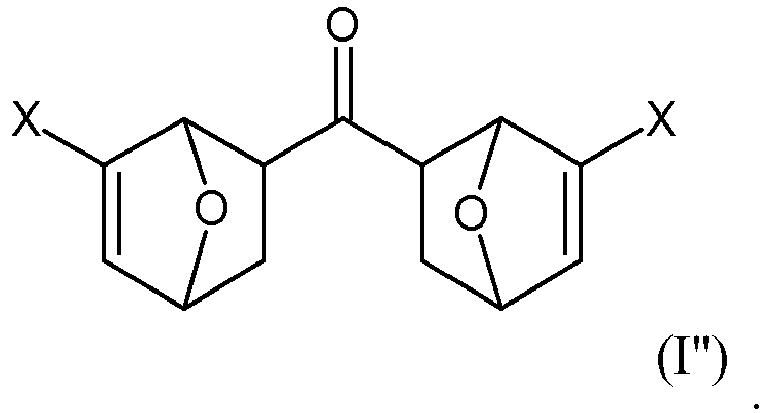
- Compounds of formula (I), (I') and (I") can be present as endo- or exo-isomer. In particular, each cycle of the compounds of formula (I), (I') and (I") can be either in exo configuration or endo configuration, also these possible isomers are included within the scope of the present invention.
- According to an embodiment of the invention, the molar ratio of compounds of formula (I) to compound of formula (I') is of at least 50/50, preferably at least 70/30, more preferably at least 80/20.
- According to an embodiment of the invention, the conversion of the Diels-Alder reaction is of at least 50%, preferably at least 70%, more preferably at least 90%.
- The Diels-Alder reaction between the halofuran of formula (II) and divinylketone can be carried out under usual Diels-Alder conditions known to the person skilled in the art.
- The Diels-Alder reaction may be conducted with or without a catalyst. The use of catalysts can improve kinetics and selectivity of the Diels-Alder reaction. Known Diels-Alder catalysts may be used and may include Lewis acids, such aluminium chloride, ethylaluminium dichloride, diethylaluminium chloride, trimethyl aluminium, bismuth (III) chloride, bismuth (III) trifluoromethanesulfonate, boron trifluoride, boron triacetate, cerium (III) chloride, copper (I) trifluoromethanesulfonate, copper (II) chloride, hafnium (IV) chloride, iron (II) chloride, iron (II) acetate, iron (III) chloride, iron (III) acetate, lithium perchlorate, lithium trifluoromethanesulfonate, magnesium bromide, magnesium iodide, magnesium chloride, magnesium perchlorate, scandium (III) trifluoromethanesulfonate, tin (IV) chloride, titanium (IV) chloride, titanium (IV) isopropoxide, N-trimethylsilyl-bis(trifluoromethanesulfonyl)imide, trimethylsilyl trifluoromethanesulfonate, ytterbium (III) trifluoromethanesulfonate, zinc chloride, zinc bromide, zinc iodide, zinc acetate and zirconium (IV) chloride, indium (III) chloride, triphenylborane, Bronsted acids, such as inorganic mineral acids, e.g. sulphuric acid, phosphoric acid, nitric acid, hydrobromic acid or hydrochloric acid, and organic acids such as methane sulphonic acid, p-toluenesulphonic acid or carboxylic acids. One of the preferred Diels-Alder catalysts is magnesium iodide.
- Alternatively, activated carbon, silica, alumina, silica-alumina, zirconia and zeolites may be used as such or as support for a catalytically active metal or metal compound. Suitable metals or metal compounds include alkali metals, alkaline earth metals, transition metals, noble metals, rare earth metals. The catalysts can be acidic, e.g. by treating supports with phosphoric acid, or by ion exchange of zeolites to render them into their acidic form. Examples of solid catalysts include amorphous silica-alumina, zeolites, preferably zeolites in their H-form, and acidic ion exchange resins. Other suitable catalysts that are liquids or that may be dissolved in the appropriate solvent to yield a homogeneous catalyst environment, include organic and inorganic acids, such as alkane carboxylic acid, arene carboxylic acid, sulphuric acid, phosphoric acid, hydrochloric acid, hydrobromic acid and nitric acid.
- The Diels-Alder reaction may be carried out with or without a solvent. Suitable solvents may be selected from pyridine, tertiary amines such as triethylamine and diisopropylethylamine, chloroform, dichloromethane, diethyl ether, perfluorinated alkanes such as perfluorohexane, toluene, water and ionic liquids such as 1-butyl-3-methylimidazolium tetrafluoroborate and 1-butyl-3-methylimidazolium hexafluorophosphate, alone or in a mixture. Preferred solvents are pyridine and tertiary amines, such as triethylamine. In case a catalyst is used, it is preferred to use dichloromethane as solvent or to use no solvent at all.
- The Applicant has also surprisingly noticed that, under solvent conditions, certain basic additives such as pyridine and tertiary amines, such as triethylamine, stabilize the reactants which allows an excess of the halofuran of formula (II) to be used in order to increase the conversion of the Diels-Alder reaction. The excess of the halofuran used may be recovered once the reaction is completed.
- The reaction may be carried out at any suitable temperature, for example from about -80 to about 120 °C, preferably from about -20 to about 100 °C, more preferably from about -10 to about 80 °C, for a time sufficient to convert the starting compounds into the desired Diels-Alder adduct, such as about 10 minutes to about 6 days, preferably about 3 hours to about 4 days, more preferably about 3 hours to about 2 days. The reaction can be carried out at ambient pressure or under increased pressure. In a preferred embodiment, the reaction is carried out at ambient pressure, such as about 1 bar, or at a pressure of up to 10 bars, preferably up to 5 bars, more preferably up to 2 bars.
- According to an embodiment of the invention, the molar ratio of the halofuran of formula (II) to divinylketone is close to stoichiometry (namely 2/1), or above.
The Applicant has found that a molar ratio of the halofuran of formula (II) to divinylketone greater than 2/1 allows for the displacement of the Diels-Alder reaction towards the formation of the cycloadduct of formula (I). - The process according to the invention may comprise a further step of isolation of compound of formula (I). Suitable methods of isolation and purification are known to the person skilled in the art. For example, chromatography techniques, such as liquid chromatography, may be particularly efficient in the process according to the invention.
- The present invention also relates to a process for the preparation of a 4,4'-dihalobenzophenone of formula (III):

Preferably, X is selected from fluorine and bromine, more preferably fluorine. - The dehydration/aromatization may be represented by the following scheme:

- According to an embodiment of the invention, the aromatization reaction of the compound of formula (I) requires basic reaction conditions, for example in the presence of an alkoxide compound or hydroxide compound. Suitable alkoxides may be selected from alkali methoxides, such as sodium methoxide and potassium methoxide, preferably sodium methoxide. Suitable hydroxides may be selected from alkali hydroxides, such as sodium hydroxide, potassium hydroxide, lithium hydroxide, cesium hydroxide, preferably sodium hydroxide and potassium hydroxide, more preferably potassium hydroxide.
- Suitable solvents for the aromatization reaction may be for example a sulfoxide such as DMSO or an alcohol such as isopropanol.
- The aromatization reaction may be carried out at any suitable temperature, for example from about -10 to about 120 °C, preferably from about -5 to about 80 °C, more preferably from about 0 to about 40 °C.
- Another object of the invention relates to a process for producing a 4,4'-dihalobenzophenone of formula (III):

comprising: - a) providing a compound of formula (I) as defined above,
- b) carrying out the dehydration/aromatization of said compound of formula (I).
- Alternatively, 4,4'-difluorobenzophenone may be prepared by effecting a halogen-fluorine exchanging reaction between compound of formula (III) wherein X is chlorine, bromine or iodine, and an alkali fluoride, such as potassium fluoride, as described in
US 4,453,009 . - According to an embodiment of the invention, the compound of formula (I) is obtained by a Diels-Alder reaction between divinylketone and the above-described halofuran of formula (II) according to the process previously detailed.
- Once the Diels-Alder reaction is completed, isolation of composition of formula (I) may be carried out before step b).
- Alternatively, the mixture obtained at the end of the Diels-Alder reaction and comprising structural isomers of formula (I), (I') and (I") can be directly used in the subsequent step of dehydration/aromatization. In this case, a mixture comprising the following structural isomers is obtained after completing the aromatization:


- According to an embodiment of the invention, 4,4'-dihalobenzophenone of formula (III) is further isolated by separation methods known to the person skilled in the art. For example, recrystallization may be carried out according to the method described in document
US 4,873,372 . - Poly(aryl ether ketone)s (PAEK) are a well known class of engineering polymers useful in various fields of scientific and commercial endeavour. PAEK polymers are generally prepared by aromatic nucleophilic substitution of both the halogenides of a 4,4'-dihalobenzophenone (especially, by aromatic nucleophilic substitution of both the fluorides of 4,4'-difluorobenzophenone) by a nucleophilic oxygen atom from a co-monomer. For example, p-hydroquinone, commonly referred to as "hydroquinone" and/or at least one bisphenol (such as bisphenol A, bisphenol S, bisphenol O, 4,4'-dihydroxybiphenyl and mixtures thereof) can be used as the co-monomer; the hydrogen atom from each of the two aromatic hydroxyl groups of p-hydroquinone and/or of the bisphenol is advantageously deprotonated with at least one base (such as NaOH, Na2CO3, K2CO3 and mixtures thereof) to form a nucleophile which reacts with the 4,4'-dihalobenzophenone (preferably, 4,4'-difluorobenzophenone) to form a PAEK polymer via a nucleophilic substitution mechanism, with the halogen atoms of the 4,4'-dihalobenzophenone acting as leaving groups. Processes for preparing PAEK polymers, including those using a 4,4'-dihalobenzophenone such as 4,4'-difluorobenzophenone, can be found notably in
U.S. Pat. Nos. 3,953,400 ,3,956,240 ,3,928,295 , and4,176,222 , all incorporated herein by reference. - Then, facets of the invention relate to :
- the use of a 4,4'-dihalobenzophenone of formula (III) prepared from a compound of formula (I) as previously defined for the manufacture of a poly(aryl ether ketone), in particular poly(ether ether ketone),
- the use of a compound of formula (I) as previously defined for the manufacture of a poly(aryl ether ketone), in particular poly(ether ether ketone), typically with a 4,4'-dihalobenzophenone of formula (III) as synthesis intermediate, and
- the use of a 4,4'-dihalobenzophenone of formula (III) as synthesis intermediate in the manufacture of a poly(aryl ether ketone) [in particular poly(ether ether ketone] from a compound of formula (I) as above defined.
- Precisely an object of the present invention concerns a process for the manufacture of a (poly aryl ether ketone), said process comprising the following steps:
- i) providing a compound of formula (I) as defined above,
- ii) carrying out the dehydration/aromatization of said compound of formula (I) to prepare a 4,4'-dihalobenzophenone of formula (III) as defined above,
- iii) optionally, isolating the 4,4'-dihalobenzophenone,
- iv) optionally, effecting a halogen-fluorine exchanging reaction between the 4,4'-dihalobenzophenone and an alkali fluoride as explained above ,
- v) carrying out the polycondensation of the 4,4'-dihalobenzophenone with at least one aromatic compound comprising 2 hydroxyl groups, in particular with hydroquinone and/or at least one bisphenol, preferably in the presence of at least one base.
- The present invention will now be illustrated by the following examples, which are not intended to be limiting.
- In a Schlenk tube under argon atmosphere, divinyl carbinol (1.0 g, 11.9 mmol) was dissolved in dichloromethane (19 mL), then 2,3-dichloro-5,6-dicyano-1,4-benzoquinone was added (2.94 g, 13.0 mmol). The reaction mixture was stirred at 25°C for 18 hours. The solid part of the reaction media was removed by filtration, and to the filtrate cooled at 0°C were added MgI2 (496 mg, 1.78 mmol) and 3-bromofuran (8.74 g, 59.5 mmol). The reaction mixture was stirred at 0°C for 18 hours. An NMR analysis of a sample after 3 hours of reaction showed a near complete conversion to the double Diels-Alder adducts. The crude reaction mixture was passed through a short pad of silica gel (elution AcOEt/cyclohexane 50/50). After evaporation of the solvents in vacuo, 4.83 g of a mixture of Diels-Alder adducts (purity 84% in NMR analysis) were obtained.
- In a carousel tube fitted with a PTFE septum screw cap, Diels-Alder adducts from the example a) (206 mg, 0.46 mmol), dimethyl sulfoxide (1.5 ml) and sodium methoxide solution (25 wt. % in methanol; 41 mg; 0.19 mmol) were charged. The reaction mixture was stirred at room temperature during 2 hours. 1H NMR (DMSO-d6) show the conversion of the cycloadducts and the formation of dibromobenzophenone (δ 7.78, (d, J= 8.8 Hz), 7.67 (d, J=8.8Hz)). GC analysis calibrated with the commercial product show the formation of 30 mg of 4,4'-dibromobenzophenone and 3 mg of 3,4'-dibromobenzophenone, corresponding to a yield of 21 % for those 2 products.
- In a carousel tube fitted with a PTFE septum screw cap, Diels-Alder adducts from the example a) (202 mg, 0.45 mmol) is weighted. A solution of potassium hydroxide (85%, 39 mg, 0.59 mmol) in isopropanol (1.23 g) was added at 15°C. The reaction mixture was stirred at room temperature during 30 minutes. GC analysis calibrated with the commercial product show the formation of 46 mg of in 4,4'-dibromobenzophenone and 21 mg of 3,4'- dibromobenzophenone, corresponding to a yield of 44 % for those 2 products.
Claims (15)
- Compound of formula (I):

- Compound according to claim 1, wherein the halogen atom is selected from bromine and chlorine, preferably chlorine.
- Process for the preparation of a compound of formula (I) as defined in claim 1 or 2, comprising reacting divinylketone with a halofuran of formula (II):

and optionally further isolating compound of formula (I). - Process according to claim 3, wherein the halofuran is 3-chlorofuran or 3-bromofuran.
- Process according to claim 3 or 4, wherein the molar ratio of the halofuran of formula (II) to divinylketone is of at least 2/1.
- Use of a compound of formula (I) as defined in claim 1 or 2, for the preparation of a 4,4'-dihalobenzophenone of formula (III):

- Process for the preparation of a 4,4'-dihalobenzophenone of formula (III):

comprising carrying out the dehydration/aromatization of a compound of formula (I):
- Process according to claim 7, wherein the dehydration/aromatization is carried out in the presence of an alkali methoxide, preferably sodium methoxide or potassium methoxide, or an alkali hydroxide, preferably sodium hydroxide or potassium hydroxide.
- Process according to claim 7 or 8, wherein the dehydration/aromatization is carried out in the presence of DMSO or an alcohol.
- Process for the preparation of a 4,4'-dihalobenzophenone of formula (III):

comprising:a) providing a compound of formula (I): b) carrying out the dehydration/aromatization of said compound of formula (I),c) optionally further isolating compound of formula (III).
 - Process according to claim 10, wherein compound of formula (I) is prepared by reacting divinylketone with a halofuran of formula (II):

- Use of a compound of formula (I) as defined in claim 1 or 2 for the manufacture of a poly(aryl ether ketone).
- Use according to claim 12, wherein the poly(aryl ether ketone) is poly(ether ether ketone).
- Use of a 4,4'-dihalobenzophenone of formula (III)

- Use according to claim 14, wherein X represents a fluorine atom.
Priority Applications (5)
| Application Number | Priority Date | Filing Date | Title |
|---|---|---|---|
| EP17306689.5A EP3492475A1 (en) | 2017-12-01 | 2017-12-01 | New cycloadduct precursors of dihalobenzophenones and preparations thereof |
| US16/764,169 US20200369684A1 (en) | 2017-12-01 | 2018-11-30 | New cycloadduct precursors of dihalobenzophenones and preparations thereof |
| EP18807678.0A EP3717493A1 (en) | 2017-12-01 | 2018-11-30 | New cycloadduct precursors of dihalobenzophenones and preparations thereof |
| PCT/EP2018/083242 WO2019106197A1 (en) | 2017-12-01 | 2018-11-30 | New cycloadduct precursors of dihalobenzophenones and preparations thereof |
| CN201880077906.XA CN111417641A (en) | 2017-12-01 | 2018-11-30 | Novel cycloadduct precursors of dihalobenzophenones and their preparation |
Applications Claiming Priority (1)
| Application Number | Priority Date | Filing Date | Title |
|---|---|---|---|
| EP17306689.5A EP3492475A1 (en) | 2017-12-01 | 2017-12-01 | New cycloadduct precursors of dihalobenzophenones and preparations thereof |
Publications (1)
| Publication Number | Publication Date |
|---|---|
| EP3492475A1 true EP3492475A1 (en) | 2019-06-05 |
Family
ID=60654904
Family Applications (2)
| Application Number | Title | Priority Date | Filing Date |
|---|---|---|---|
| EP17306689.5A Withdrawn EP3492475A1 (en) | 2017-12-01 | 2017-12-01 | New cycloadduct precursors of dihalobenzophenones and preparations thereof |
| EP18807678.0A Withdrawn EP3717493A1 (en) | 2017-12-01 | 2018-11-30 | New cycloadduct precursors of dihalobenzophenones and preparations thereof |
Family Applications After (1)
| Application Number | Title | Priority Date | Filing Date |
|---|---|---|---|
| EP18807678.0A Withdrawn EP3717493A1 (en) | 2017-12-01 | 2018-11-30 | New cycloadduct precursors of dihalobenzophenones and preparations thereof |
Country Status (4)
| Country | Link |
|---|---|
| US (1) | US20200369684A1 (en) |
| EP (2) | EP3492475A1 (en) |
| CN (1) | CN111417641A (en) |
| WO (1) | WO2019106197A1 (en) |
Citations (15)
| Publication number | Priority date | Publication date | Assignee | Title |
|---|---|---|---|---|
| US2405267A (en) * | 1944-10-27 | 1946-08-06 | Us Agriculture | 3, 6-epoxycyclohexene |
| US2773882A (en) | 1952-05-07 | 1956-12-11 | Pennsylvania Salt Mfg Co | Process for preparing 3-halofuran |
| US3928295A (en) | 1973-05-25 | 1975-12-23 | Ici Ltd | Aromatic polymers containing ketone linking groups and process for their preparation |
| US3953400A (en) | 1972-01-17 | 1976-04-27 | Raychem Corporation | Polyketones and methods therefor |
| US3956240A (en) | 1973-07-12 | 1976-05-11 | Raychem Corporation | Novel polyketones |
| US4176222A (en) | 1977-02-01 | 1979-11-27 | Imperial Chemical Industries Limited | Production of aromatic polyethers |
| US4453009A (en) | 1982-10-08 | 1984-06-05 | Mitsui Toatsu Chemicals, Inc. | Process for producing fluorobenzophenone derivatives |
| US4764627A (en) | 1987-04-06 | 1988-08-16 | The United States Of America As Represented By The United States Department Of Energy | Process for producing furan from furfural aldehyde |
| US4873372A (en) | 1987-02-17 | 1989-10-10 | Basf Aktiengesellschaft | Isolation of 4,4'-dichlorodiphenyl sulfone |
| US4943358A (en) | 1988-03-19 | 1990-07-24 | Interox Chemicals Limited | Oxidation process |
| US5777172A (en) | 1994-05-16 | 1998-07-07 | Zeneca Limited | Process for the preparation of benzophenthiones and benzophenones |
| US7687668B2 (en) | 2005-08-04 | 2010-03-30 | Evonik Fibres Gmbh | Process for preparing 4,4′ difluorobenzophenone |
| WO2012001131A1 (en) | 2010-07-02 | 2012-01-05 | Solvay Specialty Polymers Usa, L.L.C. | Method of making poly(aryl ether ketones) from 4,4' difluorobenzophenone comprising oxidizing species and/or nitro compounds |
| US8754245B2 (en) | 2009-08-31 | 2014-06-17 | E I Du Pont De Nemours And Company | Vapor-phase decarbonylation process |
| WO2017096559A1 (en) * | 2015-12-09 | 2017-06-15 | Rhodia Operations | Production of xylene derivatives |
Family Cites Families (4)
| Publication number | Priority date | Publication date | Assignee | Title |
|---|---|---|---|---|
| GB2238791A (en) * | 1989-12-06 | 1991-06-12 | Shell Int Research | Process for polymerizing oxanorbornenes and polymers obtainable by the process |
| WO2002022619A1 (en) * | 2000-09-18 | 2002-03-21 | Kuraray Co., Ltd. | Process for preparation of 7-oxabicyclo[2.2.1]hept-5-ene-2-carboxylic acid derivatives |
| JP2009515840A (en) * | 2005-11-14 | 2009-04-16 | ハー・ルンドベック・アクチエゼルスカベット | Manufacturing method of escitalopram |
| WO2015065722A1 (en) * | 2013-11-01 | 2015-05-07 | Exxonmobil Chemical Patents Inc. | Process to produce terephthalic acid |
-
2017
- 2017-12-01 EP EP17306689.5A patent/EP3492475A1/en not_active Withdrawn
-
2018
- 2018-11-30 CN CN201880077906.XA patent/CN111417641A/en active Pending
- 2018-11-30 EP EP18807678.0A patent/EP3717493A1/en not_active Withdrawn
- 2018-11-30 US US16/764,169 patent/US20200369684A1/en not_active Abandoned
- 2018-11-30 WO PCT/EP2018/083242 patent/WO2019106197A1/en not_active Ceased
Patent Citations (16)
| Publication number | Priority date | Publication date | Assignee | Title |
|---|---|---|---|---|
| US2405267A (en) * | 1944-10-27 | 1946-08-06 | Us Agriculture | 3, 6-epoxycyclohexene |
| US2773882A (en) | 1952-05-07 | 1956-12-11 | Pennsylvania Salt Mfg Co | Process for preparing 3-halofuran |
| US3953400A (en) | 1972-01-17 | 1976-04-27 | Raychem Corporation | Polyketones and methods therefor |
| US3928295A (en) | 1973-05-25 | 1975-12-23 | Ici Ltd | Aromatic polymers containing ketone linking groups and process for their preparation |
| US3956240B1 (en) | 1973-07-12 | 1988-12-27 | ||
| US3956240A (en) | 1973-07-12 | 1976-05-11 | Raychem Corporation | Novel polyketones |
| US4176222A (en) | 1977-02-01 | 1979-11-27 | Imperial Chemical Industries Limited | Production of aromatic polyethers |
| US4453009A (en) | 1982-10-08 | 1984-06-05 | Mitsui Toatsu Chemicals, Inc. | Process for producing fluorobenzophenone derivatives |
| US4873372A (en) | 1987-02-17 | 1989-10-10 | Basf Aktiengesellschaft | Isolation of 4,4'-dichlorodiphenyl sulfone |
| US4764627A (en) | 1987-04-06 | 1988-08-16 | The United States Of America As Represented By The United States Department Of Energy | Process for producing furan from furfural aldehyde |
| US4943358A (en) | 1988-03-19 | 1990-07-24 | Interox Chemicals Limited | Oxidation process |
| US5777172A (en) | 1994-05-16 | 1998-07-07 | Zeneca Limited | Process for the preparation of benzophenthiones and benzophenones |
| US7687668B2 (en) | 2005-08-04 | 2010-03-30 | Evonik Fibres Gmbh | Process for preparing 4,4′ difluorobenzophenone |
| US8754245B2 (en) | 2009-08-31 | 2014-06-17 | E I Du Pont De Nemours And Company | Vapor-phase decarbonylation process |
| WO2012001131A1 (en) | 2010-07-02 | 2012-01-05 | Solvay Specialty Polymers Usa, L.L.C. | Method of making poly(aryl ether ketones) from 4,4' difluorobenzophenone comprising oxidizing species and/or nitro compounds |
| WO2017096559A1 (en) * | 2015-12-09 | 2017-06-15 | Rhodia Operations | Production of xylene derivatives |
Non-Patent Citations (4)
| Title |
|---|
| CHERN. EUR. J., vol. 13, 2007, pages 3354 - 3368 |
| DUNLOP ET AL.: "The preparation of 4- uoro- and 4,4'-difluorobenzophenone", J. AM. CHERN. SOC., vol. 55, no. 4, 1933, pages 1665 - 1666 |
| J. GEN. CHERN. USSR, vol. 33, no. 5, 1963, pages 1512 |
| ORG. BIOMOL. CHERN., vol. 8, 2010, pages 751 - 754 |
Also Published As
| Publication number | Publication date |
|---|---|
| US20200369684A1 (en) | 2020-11-26 |
| EP3717493A1 (en) | 2020-10-07 |
| CN111417641A (en) | 2020-07-14 |
| WO2019106197A1 (en) | 2019-06-06 |
Similar Documents
| Publication | Publication Date | Title |
|---|---|---|
| JP3357608B2 (en) | Fluorination method with aminosulfur trifluoride | |
| EP2319621A2 (en) | Base stable ionic liquids | |
| Kyasa et al. | Synthesis of S, S, O-orthoesters and 1, 1-difluoroalkyl ethers via reaction of peroxides with lithiated 1, 3-dithianes | |
| EP3099657B1 (en) | Process of production of 2,5-dimethylphenol | |
| EP3121160B1 (en) | Method for producing compound having oxydifluoromethylene skeleton | |
| EP3492475A1 (en) | New cycloadduct precursors of dihalobenzophenones and preparations thereof | |
| JP5186910B2 (en) | Method for producing tris (perfluoroalkanesulfonyl) methidoate | |
| EP3848359B1 (en) | Method for producing trifluoropyruvate fluoride dimer, and method for producing perfluoro(2,4-dimethyl-2-fluoroformyl-1,3-dioxolane) | |
| EP3492449B1 (en) | Process for the preparation of dihalobenzophenones, new chemicals useful for its implementation and methods for preparing said chemicals | |
| EP3736259B1 (en) | New cycloadduct precursors of dihalobenzophenones and preparations thereof | |
| JP2012131720A (en) | Method of producing methylenedianiline derivative | |
| EP3181545B1 (en) | Process for the preparation of ospemifene | |
| JP6498048B2 (en) | Fluorine-containing organic compound and method for producing biaryl compound using this and Grignard reagent | |
| EP3736260A1 (en) | Process for the preparation of dihalobenzophenones, new chemicals useful for its implementation and methods for preparing said chemicals | |
| JP6429105B2 (en) | Diaryliodonium salt | |
| JP4258695B2 (en) | O- (perfluoroalkyl) dibenzofuranium salt derivative, production intermediate thereof, production method of the production intermediate, perfluoroalkylating agent, and perfluoroalkylation method | |
| JP5553623B2 (en) | Perfluoroalkyl (organo zinc) -lithium complex and method for producing perfluoroalkyl group-containing alcohols using the same | |
| DHINGRA et al. | Synthesis of Fluoro-Aromatics by Balz-Schiemann Reaction–A Greener Approach | |
| US4997989A (en) | Tert-butylalkynols | |
| Yao et al. | A route to hydroxylfluorenes: TsOH-mediated condensation reactions of 1, 3-diketones with propargylic alcohols | |
| JP4364545B2 (en) | Novel difluorotetrahydrothiophene 1,1-dioxide and process for producing the same | |
| Spialter et al. | Tetracyclohexylsilane: The resolution of an enigma | |
| Battiste et al. | An aberrant rearrangement in the reaction of 1, 2-dibromo-3, 3-difluorocyclopropene with anthracene | |
| JP2014234370A (en) | PRODUCTION METHOD OF α-FLUOROACETOPHENONE DERIVATIVE | |
| KR20170115941A (en) | Production method of tetrahydro-2h-pyran derivatives |
Legal Events
| Date | Code | Title | Description |
|---|---|---|---|
| PUAI | Public reference made under article 153(3) epc to a published international application that has entered the european phase |
Free format text: ORIGINAL CODE: 0009012 |
|
| STAA | Information on the status of an ep patent application or granted ep patent |
Free format text: STATUS: THE APPLICATION HAS BEEN PUBLISHED |
|
| AK | Designated contracting states |
Kind code of ref document: A1 Designated state(s): AL AT BE BG CH CY CZ DE DK EE ES FI FR GB GR HR HU IE IS IT LI LT LU LV MC MK MT NL NO PL PT RO RS SE SI SK SM TR |
|
| AX | Request for extension of the european patent |
Extension state: BA ME |
|
| STAA | Information on the status of an ep patent application or granted ep patent |
Free format text: STATUS: THE APPLICATION IS DEEMED TO BE WITHDRAWN |
|
| 18D | Application deemed to be withdrawn |
Effective date: 20191206 |