EP3491237B1 - Disk brake for a brake disk ring of an azimuth drive of a wind power installation - Google Patents
Disk brake for a brake disk ring of an azimuth drive of a wind power installation Download PDFInfo
- Publication number
- EP3491237B1 EP3491237B1 EP17739284.2A EP17739284A EP3491237B1 EP 3491237 B1 EP3491237 B1 EP 3491237B1 EP 17739284 A EP17739284 A EP 17739284A EP 3491237 B1 EP3491237 B1 EP 3491237B1
- Authority
- EP
- European Patent Office
- Prior art keywords
- housing
- brake
- cleansing
- disk
- friction lining
- Prior art date
- Legal status (The legal status is an assumption and is not a legal conclusion. Google has not performed a legal analysis and makes no representation as to the accuracy of the status listed.)
- Active
Links
Images
Classifications
-
- F—MECHANICAL ENGINEERING; LIGHTING; HEATING; WEAPONS; BLASTING
- F03—MACHINES OR ENGINES FOR LIQUIDS; WIND, SPRING, OR WEIGHT MOTORS; PRODUCING MECHANICAL POWER OR A REACTIVE PROPULSIVE THRUST, NOT OTHERWISE PROVIDED FOR
- F03D—WIND MOTORS
- F03D7/00—Controlling wind motors
- F03D7/02—Controlling wind motors the wind motors having rotation axis substantially parallel to the air flow entering the rotor
- F03D7/0244—Controlling wind motors the wind motors having rotation axis substantially parallel to the air flow entering the rotor for braking
- F03D7/0248—Controlling wind motors the wind motors having rotation axis substantially parallel to the air flow entering the rotor for braking by mechanical means acting on the power train
-
- F—MECHANICAL ENGINEERING; LIGHTING; HEATING; WEAPONS; BLASTING
- F03—MACHINES OR ENGINES FOR LIQUIDS; WIND, SPRING, OR WEIGHT MOTORS; PRODUCING MECHANICAL POWER OR A REACTIVE PROPULSIVE THRUST, NOT OTHERWISE PROVIDED FOR
- F03D—WIND MOTORS
- F03D7/00—Controlling wind motors
- F03D7/02—Controlling wind motors the wind motors having rotation axis substantially parallel to the air flow entering the rotor
- F03D7/0204—Controlling wind motors the wind motors having rotation axis substantially parallel to the air flow entering the rotor for orientation in relation to wind direction
-
- F—MECHANICAL ENGINEERING; LIGHTING; HEATING; WEAPONS; BLASTING
- F03—MACHINES OR ENGINES FOR LIQUIDS; WIND, SPRING, OR WEIGHT MOTORS; PRODUCING MECHANICAL POWER OR A REACTIVE PROPULSIVE THRUST, NOT OTHERWISE PROVIDED FOR
- F03D—WIND MOTORS
- F03D7/00—Controlling wind motors
- F03D7/02—Controlling wind motors the wind motors having rotation axis substantially parallel to the air flow entering the rotor
- F03D7/0244—Controlling wind motors the wind motors having rotation axis substantially parallel to the air flow entering the rotor for braking
-
- F—MECHANICAL ENGINEERING; LIGHTING; HEATING; WEAPONS; BLASTING
- F03—MACHINES OR ENGINES FOR LIQUIDS; WIND, SPRING, OR WEIGHT MOTORS; PRODUCING MECHANICAL POWER OR A REACTIVE PROPULSIVE THRUST, NOT OTHERWISE PROVIDED FOR
- F03D—WIND MOTORS
- F03D80/00—Details, components or accessories not provided for in groups F03D1/00 - F03D17/00
- F03D80/50—Maintenance or repair
- F03D80/55—Cleaning
-
- F—MECHANICAL ENGINEERING; LIGHTING; HEATING; WEAPONS; BLASTING
- F16—ENGINEERING ELEMENTS AND UNITS; GENERAL MEASURES FOR PRODUCING AND MAINTAINING EFFECTIVE FUNCTIONING OF MACHINES OR INSTALLATIONS; THERMAL INSULATION IN GENERAL
- F16D—COUPLINGS FOR TRANSMITTING ROTATION; CLUTCHES; BRAKES
- F16D55/00—Brakes with substantially-radial braking surfaces pressed together in axial direction, e.g. disc brakes
- F16D55/02—Brakes with substantially-radial braking surfaces pressed together in axial direction, e.g. disc brakes with axially-movable discs or pads pressed against axially-located rotating members
- F16D55/22—Brakes with substantially-radial braking surfaces pressed together in axial direction, e.g. disc brakes with axially-movable discs or pads pressed against axially-located rotating members by clamping an axially-located rotating disc between movable braking members, e.g. movable brake discs or brake pads
- F16D55/224—Brakes with substantially-radial braking surfaces pressed together in axial direction, e.g. disc brakes with axially-movable discs or pads pressed against axially-located rotating members by clamping an axially-located rotating disc between movable braking members, e.g. movable brake discs or brake pads with a common actuating member for the braking members
- F16D55/225—Brakes with substantially-radial braking surfaces pressed together in axial direction, e.g. disc brakes with axially-movable discs or pads pressed against axially-located rotating members by clamping an axially-located rotating disc between movable braking members, e.g. movable brake discs or brake pads with a common actuating member for the braking members the braking members being brake pads
-
- F—MECHANICAL ENGINEERING; LIGHTING; HEATING; WEAPONS; BLASTING
- F16—ENGINEERING ELEMENTS AND UNITS; GENERAL MEASURES FOR PRODUCING AND MAINTAINING EFFECTIVE FUNCTIONING OF MACHINES OR INSTALLATIONS; THERMAL INSULATION IN GENERAL
- F16D—COUPLINGS FOR TRANSMITTING ROTATION; CLUTCHES; BRAKES
- F16D65/00—Parts or details
- F16D65/0043—Brake maintenance and assembly, tools therefor
-
- F—MECHANICAL ENGINEERING; LIGHTING; HEATING; WEAPONS; BLASTING
- F16—ENGINEERING ELEMENTS AND UNITS; GENERAL MEASURES FOR PRODUCING AND MAINTAINING EFFECTIVE FUNCTIONING OF MACHINES OR INSTALLATIONS; THERMAL INSULATION IN GENERAL
- F16D—COUPLINGS FOR TRANSMITTING ROTATION; CLUTCHES; BRAKES
- F16D65/00—Parts or details
- F16D65/02—Braking members; Mounting thereof
- F16D65/04—Bands, shoes or pads; Pivots or supporting members therefor
- F16D65/092—Bands, shoes or pads; Pivots or supporting members therefor for axially-engaging brakes, e.g. disc brakes
-
- F—MECHANICAL ENGINEERING; LIGHTING; HEATING; WEAPONS; BLASTING
- F16—ENGINEERING ELEMENTS AND UNITS; GENERAL MEASURES FOR PRODUCING AND MAINTAINING EFFECTIVE FUNCTIONING OF MACHINES OR INSTALLATIONS; THERMAL INSULATION IN GENERAL
- F16D—COUPLINGS FOR TRANSMITTING ROTATION; CLUTCHES; BRAKES
- F16D65/00—Parts or details
- F16D65/02—Braking members; Mounting thereof
- F16D65/12—Discs; Drums for disc brakes
- F16D65/121—Discs; Drums for disc brakes consisting of at least three circumferentially arranged segments
-
- F—MECHANICAL ENGINEERING; LIGHTING; HEATING; WEAPONS; BLASTING
- F05—INDEXING SCHEMES RELATING TO ENGINES OR PUMPS IN VARIOUS SUBCLASSES OF CLASSES F01-F04
- F05B—INDEXING SCHEME RELATING TO WIND, SPRING, WEIGHT, INERTIA OR LIKE MOTORS, TO MACHINES OR ENGINES FOR LIQUIDS COVERED BY SUBCLASSES F03B, F03D AND F03G
- F05B2260/00—Function
- F05B2260/90—Braking
- F05B2260/902—Braking using frictional mechanical forces
-
- F—MECHANICAL ENGINEERING; LIGHTING; HEATING; WEAPONS; BLASTING
- F16—ENGINEERING ELEMENTS AND UNITS; GENERAL MEASURES FOR PRODUCING AND MAINTAINING EFFECTIVE FUNCTIONING OF MACHINES OR INSTALLATIONS; THERMAL INSULATION IN GENERAL
- F16D—COUPLINGS FOR TRANSMITTING ROTATION; CLUTCHES; BRAKES
- F16D2121/00—Type of actuator operation force
- F16D2121/02—Fluid pressure
- F16D2121/04—Fluid pressure acting on a piston-type actuator, e.g. for liquid pressure
-
- Y—GENERAL TAGGING OF NEW TECHNOLOGICAL DEVELOPMENTS; GENERAL TAGGING OF CROSS-SECTIONAL TECHNOLOGIES SPANNING OVER SEVERAL SECTIONS OF THE IPC; TECHNICAL SUBJECTS COVERED BY FORMER USPC CROSS-REFERENCE ART COLLECTIONS [XRACs] AND DIGESTS
- Y02—TECHNOLOGIES OR APPLICATIONS FOR MITIGATION OR ADAPTATION AGAINST CLIMATE CHANGE
- Y02E—REDUCTION OF GREENHOUSE GAS [GHG] EMISSIONS, RELATED TO ENERGY GENERATION, TRANSMISSION OR DISTRIBUTION
- Y02E10/00—Energy generation through renewable energy sources
- Y02E10/70—Wind energy
- Y02E10/72—Wind turbines with rotation axis in wind direction
Definitions
- the invention relates to a disc brake for a brake disc ring of an azimuth drive of a wind power plant with a brake housing which has two housing halves which flank a receiving mouth for the brake disc ring on opposite sides, with at least two brake pistons being mounted in each housing half, which hydraulically apply friction lining to the receiving mouth. wherein at least one housing half has a cleaning channel which extends from a rear side of the housing to a front area of the housing in which the receiving mouth and the friction lining carriers are provided.
- the KR 101 464 598 B1 discloses a disc brake for a brake disc ring of an azimuth drive of a wind power plant, which has a brake housing which is provided with two housing halves which flank a receiving mouth for the brake disc ring on opposite sides. How Fig. 3 and Fig. 5 the D6 can be removed, one housing half has a channel which extends from a rear side of the housing to a front area of the housing where the receiving mouth of the brake housing begins.
- the wind turbine has a horizontally rotatable pulpit that is rotated by means of an azimuth drive.
- a horizontally arranged brake disc ring is provided, which is hydraulically acted upon by a large number of disc brakes which are identical to one another.
- Each disc brake has a brake housing which forms a receiving mouth for the brake disc ring.
- the brake housing has two housing halves which, when the disk brake is installed, flank the brake disk ring on the top and bottom.
- two brake pistons are arranged, which are movable orthogonally to a corresponding surface of the brake disk ring.
- the brake pistons act on friction lining carriers, which interact via corresponding friction linings with the surfaces of the brake disc ring serving as friction surfaces in order to brake or release the brake disc ring.
- the object of the invention is to create a disc brake of the type mentioned at the outset which can reduce the generation of noise during operation.
- the solution according to the invention uses the knowledge that squeaking noises occur when a pulpit of a wind power plant is adjusted by brake dust in the area of the brake disk ring, the cause of which is frictional wear of the friction linings of the disk brake.
- the invention Solution it is possible to get from the rear of the housing with appropriate cleaning elements into the area of the receiving mouth and consequently into the area of the friction lining carrier in order to remove brake dust there by means of the cleaning elements.
- the possibility of removing brake dust in a gap area of the receiving mouth of the brake housing itself makes it possible to keep the surfaces of the brake disk ring clean and thus to reduce the generation of noise during operation of the disk brake.
- the cleaning channel can either be formed in only one housing half or in both housing halves.
- the cleaning channel is open both to the rear of the housing and to the front area of the housing, ie to the receiving mouth, so that a suitable cleaning element can be positioned or pushed through from a rear side to enable cleaning in the front of the housing, ie in the area of the friction lining and the receiving mouth .
- the cleaning channel thus represents a passage through the part of the housing halves of the brake housing lying one on top of the other.
- at least one upper housing half of the brake housing is provided with the cleaning channel - based on an installed operating state of the disc brake.
- Corresponding abrasion, which forms between friction linings and corresponding surfaces of the brake disk ring, is preferably deposited between the adjacent friction lining carriers in each case of one housing half. When the brake disc ring is rotated, this abrasion is pressed between the corresponding friction lining and the brake disc ring, which can lead to glazing of the friction lining.
- the abrasion in the area of the receiving mouth and in particular between the adjacent friction lining carriers can be removed via the cleaning channel, whereby glazing of the friction linings can be avoided.
- the cleaning channel is advantageously dimensioned in such a way that the receiving mouth of the brake housing in the area of the upper and lower friction lining carriers is accessible from the rear of the housing for a corresponding cleaning element. According to the invention, the cleaning channel continues in the area of the receiving mouth in a cleaning groove which is open to a housing front side.
- the cleaning channel is provided in alignment with at least one central web between two adjacent friction lining carriers.
- a single cleaning channel is provided in the area of the corresponding housing half. If there are more than two friction lining carriers in the area of each housing half, a correspondingly increased number of cleaning channels is provided in the area of the central webs between two adjacent friction lining carriers.
- the cleaning groove has an inclination in the direction of the housing front side relative to a horizontal plane in which the friction lining carriers are arranged, with a bottom of the cleaning groove moving away from the horizontal plane towards the housing front side. This creates a slope in the manner of a slide, which enables a further improved removal of brake dust, i.e. abrasion, from the area of the central web between two friction lining carriers.
- a cross-sectional area of the cleaning groove increases continuously towards the front of the housing.
- An increase in the cross-sectional area of the cleaning groove is achieved in particular by continuously increasing the width of a bottom of the cleaning groove towards the front of the housing, as a result of which a sliding function for abrasion swept into the cleaning groove is further improved.
- the cleaning groove is designed in the shape of a channel.
- both housing halves jointly form the cleaning channel, and a cleaning groove is provided in each case in both housing halves in the area of the receiving mouth.
- the cleaning channel is aligned with the corresponding cleaning groove.
- both cleaning grooves are designed mirror-symmetrically to a horizontal parting plane of the housing halves and are each provided with a slope.
- the cleaning grooves as well as the at least one cleaning channel are formed in one piece in the brake housing, in particular on the two housing halves.
- a wind turbine according to Fig. 1 has a stationary tower 1, which is attached to a base and protrudes vertically upwards from the base.
- a pulpit 2 is mounted rotatably about a vertical central longitudinal axis of the tower 1.
- the pulpit 2 carries a rotor 3, which acts on an electrical generator inside the pulpit 2 via a gear.
- the pulpit 2 is rotated by an azimuth drive, not shown in detail.
- the pulpit 2 is aligned with the corresponding wind direction in such a way that the rotor 3 is always directed into the wind.
- the pulpit is assigned a horizontally aligned brake disk ring 4, which is non-rotatable with the pulpit 2.
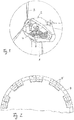
- a large number of disc brakes 5 act on the brake disc ring 4 ( Fig. 2 ), which are arranged distributed over the circumference of the brake disk ring 4 and which are fixed to the tower 1 in a stationary manner.
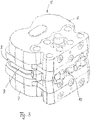
- Each disc brake 5 is hydraulically actuated and has according to the Figures 3 to 5 a brake housing, which is composed of two housing halves 6 and 7 is.
- the two housing halves 6 and 7 are mirror-symmetrical to a central horizontal plane, but are otherwise identical to one another. Both housing halves 6 and 7 have a rear housing area in which the housing halves 6 and 7 lie on top of one another and are firmly connected to one another via screw connections (not shown). Both housing halves 6 and 7 are also spaced apart from one another in a housing front area, forming a receiving mouth 8.
- the receiving mouth 8 forms a gap which extends over the entire width of the brake housing into the housing front area and is open on three sides, through which the brake disk ring 4 is passed.
- the two housing halves 6 and 7 consequently flank the brake disk ring 4 in the area of its upper side and in the area of its lower side in parallel.
- two brake pistons are mounted in a reciprocating manner, which act on a friction lining carrier 9 in the area of the receiving mouth 8, which is clamped in a corresponding receiving area of the respective housing half 6, 7.
- a friction lining carrier 9 When pressure is applied by an assigned brake piston, the respective friction lining carriers 9 are pressed against the corresponding surface of the brake disk ring.
- Each friction lining carrier 9 carries a friction lining in a manner not shown in detail.
- the two friction lining carriers 9 each of a housing half 6, 7 are acted upon in pairs by the respective pair of brake pistons.
- the opposing pairs of brake pistons in the two housing halves 6 and 7 can move in opposite directions, synchronously, so that the friction linings are pressed against the top and bottom of the brake disc ring 4 at the same time when the disc brake is acted upon accordingly.
- the corresponding housing half 6, 7 has a central web 12 which separates the two receiving spaces for the two friction lining carriers 9 of the respective housing half 6, 7 from one another.
- the two housing halves 6, 7 rest against one another in their rear housing area.
- This rear housing area is provided with a cleaning channel 10 in the center and in alignment with the central web 12 of the front housing area, which is open both towards the front towards the receiving mouth 8 and towards the rear towards a rear side of the housing.
- the cleaning channel 10 is formed by an open channel section in each case in the respective housing half 6, 7, the open channel sections being designed mirror-symmetrically to the parting plane, but otherwise identical to one another.
- the closed cleaning channel 10, which has a rectangular free cross-section, is formed by the two housing halves 6 and 7 lying one on top of the other in the rear housing area.
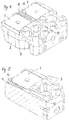
- a cleaning groove 11 is also provided in each housing half 6, 7, which is aligned with the cleaning channel 10 and inclined towards a housing front side, ie away from the cleaning channel 10.
- the cleaning groove 11 in the area of the lower housing half 7 is designed to be continuously sloping towards the front of the housing, which results in the function of a slide.
- the complementary cleaning groove in the area of the upper housing half 6 rises relative to the horizontal parting plane towards the front of the housing, specifically mirror-symmetrically to the inclination of the cleaning groove 11 in the lower housing half 7.
- the cleaning groove 11 also widens towards the front of the housing on both sides in the manner of a funnel , whereby the free cross section of the cleaning groove 11 inevitably increases towards the front of the housing.
- the cleaning groove 11 is formed like a channel with a base and two side walls in the area of the central web 12.
- the base drops continuously towards the front of the housing, which inevitably means that the two side walls towards the front of the housing are always higher. This is because the central web 12 has an edge region which remains parallel to the horizontal parting plane.
- the corresponding cleaning brush is dimensioned such that it can be manually pushed through the cleaning channel 10 both above and below the brake disk ring to the respective central web 12 of the upper housing half 6 or the lower housing half 7 by a corresponding operator. This ensures that corresponding abrasion can be removed both in the area of the upper housing half 6 and in the area of the lower housing half 7.
- Both the cleaning channel 10 and the cleaning grooves 11 are formed in one piece in the two housing halves 6, 7 during the manufacture of the housing halves.
- the corresponding channel sections of the cleaning channel 10 and the cleaning grooves 11 are preferably already provided in a casting tool for producing the housing halves 6, 7, so that the channel sections for the cleaning channel 10 and the cleaning grooves 11 are introduced as cast metal parts directly after the completion of the housing halves 6 and 7 without additional machining.
Landscapes
- Engineering & Computer Science (AREA)
- General Engineering & Computer Science (AREA)
- Mechanical Engineering (AREA)
- Life Sciences & Earth Sciences (AREA)
- Sustainable Development (AREA)
- Sustainable Energy (AREA)
- Chemical & Material Sciences (AREA)
- Combustion & Propulsion (AREA)
- Braking Arrangements (AREA)
Description
Die Erfindung betrifft eine Scheibenbremse für einen Bremsscheibenring eines Azimutantriebs einer Windkraftanlage mit einem Bremsengehäuse, das zwei Gehäusehälften aufweist, die auf gegenüberliegenden Seiten ein Aufnahmemaul für den Bremsscheibenring flankieren, wobei in jeder Gehäusehälfte wenigstens zwei Bremskolben gelagert sind, die dem Aufnahmemaul zugeordnete Reibbelagträger hydraulisch beaufschlagen, wobei wenigstens eine Gehäusehälfte einen Reinigungskanal aufweist, der sich von einer Gehäuserückseite zu einem Gehäusefrontbereich erstreckt, in dem das Aufnahmemaul und die Reibbelagträger vorgesehen sind.The invention relates to a disc brake for a brake disc ring of an azimuth drive of a wind power plant with a brake housing which has two housing halves which flank a receiving mouth for the brake disc ring on opposite sides, with at least two brake pistons being mounted in each housing half, which hydraulically apply friction lining to the receiving mouth. wherein at least one housing half has a cleaning channel which extends from a rear side of the housing to a front area of the housing in which the receiving mouth and the friction lining carriers are provided.
Die
Eine weitere Scheibenbremse ist aus der
Aufgabe der Erfindung ist es, eine Scheibenbremse der eingangs genannten Art zu schaffen, die im Betrieb Geräuschbildungen reduzieren kann.The object of the invention is to create a disc brake of the type mentioned at the outset which can reduce the generation of noise during operation.
Diese Aufgabe wird durch die Merkmale des Anspruchs 1 gelöst. Die erfindungsgemäße Lösung nutzt die Erkenntnis, dass Quietschgeräusche bei der Verstellung einer Kanzel einer Windkraftanlage durch Bremsstaub im Bereich des Bremsscheibenrings entstehen, dessen Ursache Reibverschleiß der Reibbeläge der Scheibenbremse ist. Durch die erfindungsgemäße Lösung ist es möglich, von der Gehäuserückseite her mit entsprechenden Reinigungselementen in den Bereich des Aufnahmemauls und demzufolge in den Bereich der Reibbelagträger zu gelangen, um dort mittels der Reinigungselemente Bremsstaub zu entfernen. Durch die Möglichkeit einer Entfernung von Bremsstaub in einem Spaltbereich des Aufnahmemauls des Bremsengehäuses selbst ist es möglich, die Oberflächen des Bremsscheibenrings sauber zu halten und so eine Geräuschbildung im Betrieb der Scheibenbremse zu reduzieren. Der Reinigungskanal kann entweder lediglich in einer Gehäusehälfte oder aber in beiden Gehäusehälften ausgebildet sein. Der Reinigungskanal ist sowohl zur Gehäuserückseite als auch zum Gehäusefrontbereich hin, d.h. zum Aufnahmemaul, offen, so dass ein geeignetes Reinigungselement von einer Rückseite her positioniert oder hindurchgesteckt werden kann, um eine Reinigung im Gehäusefrontbereich, d.h. im Bereich der Reibbelagträger und des Aufnahmemauls, zu ermöglichen. Der Reinigungskanal stellt somit einen durch den aufeinanderliegenden Teil der Gehäusehälften des Bremsengehäuses hindurchgehenden Durchtritt dar. In besonders vorteilhafter Weise ist wenigstens eine obere Gehäusehälfte des Bremsengehäuses - auf einen montierten Betriebszustand der Scheibenbremse bezogen - mit dem Reinigungskanal versehen. Aufgrund der horizontalen Ausrichtung des Bremsscheibenrings bleibt insbesondere auf der Oberseite des Bremsscheibenrings pulverförmiger Reibverschleiß liegen, der durch das Reinigungselement entfernt werden kann. Der Reinigungskanal im Bereich der oberen Gehäusehälfte reicht aus, um für das Reinigungselement die Oberseite des Bremsscheibenrings zugänglich zu machen. Als Reinigungselement ist vorzugsweise ein Gebläse, ein Staubsauger oder eine mechanische Reinigungsbürste, insbesondere eine Flaschenbürste, vorgesehen. Entsprechender Abrieb, der sich zwischen Reibbelägen und entsprechenden Oberflächen des Bremsscheibenrings bildet, setzt sich bevorzugt zwischen den benachbarten Reibbelagträgern jeweils einer Gehäusehälfte ab. Dieser Abrieb wird beim Drehen des Bremsscheibenrings zwischen den entsprechenden Reibbelag und den Bremsscheibenring gedrückt, wodurch es zu einer Verglasung des Reibbelags kommen kann. Eine entsprechende Verglasung des Reibbelags führt zum einen zu einem unerwünschten Quietschen. Zum anderen verlieren derartige verglaste Reibbeläge ihre Reibeigenschaften und demzufolge ihre Bremseigenschaften, wodurch diese ausgetauscht werden müssen. Durch die erfindungsgemäße Lösung kann über den Reinigungskanal der Abrieb im Bereich des Aufnahmemauls und insbesondere zwischen den benachbarten Reibbelagträgern entfernt werden, wodurch eine Verglasung der Reibbeläge vermieden werden kann. Vorteilhaft ist der Reinigungskanal so dimensioniert, dass von der Gehäuserückseite aus das Aufnahmemaul des Bremsengehäuses im Bereich der oberen und der unteren Reibbelagträger für ein entsprechendes Reinigungselement zugänglich ist. Erfindungsgemäß setzt der Reinigungskanal sich im Bereich des Aufnahmemauls fort in eine Reinigungsnut, die offen zu einer Gehäusefrontseite hin ist. Dadurch ist es möglich, von der Gehäuserückseite her mittels einer entsprechenden Reinigungsbürste den Abrieb, der sich zwischen den Reibbelagträgern im Bereich des Mittelstegs und damit im Bereich des Aufnahmemauls angesammelt hat, zur Gehäusefrontseite hin herauszufördern, insbesondere herauszuschieben. Dabei wird die Reinigungsbürste von hinten durch den Reinigungskanal hindurchgeführt und dann im Bereich des Aufnahmemauls hin und her bewegt. Alternativ oder ergänzend wird mittels eines Druck- oder Sauggebläses, das rückseitig an einer offenen Stirnseite des Reinigungskanals angesetzt wird, ein Saug- oder Druckluftstrom erzeugt, der die gewünschte Staubentfernung bewirkt.This object is achieved by the features of
In Ausgestaltung der Erfindung ist der Reinigungskanal fluchtend zu wenigstens einem Mittelsteg zwischen jeweils zwei benachbarten Reibbelagträgern vorgesehen. Bei lediglich zwei benachbarten Reibbelagträgern ist ein einzelner Reinigungskanal im Bereich der entsprechenden Gehäusehälfte vorgesehen. Bei mehr als zwei Reibbelagträgern im Bereich jeder Gehäusehälfte ist eine entsprechend erhöhte Anzahl von Reinigungskanälen im Bereich der Mittelstege zwischen jeweils zwei benachbarten Reibbelagträgern vorgesehen.In an embodiment of the invention, the cleaning channel is provided in alignment with at least one central web between two adjacent friction lining carriers. In the case of only two adjacent friction lining carriers, a single cleaning channel is provided in the area of the corresponding housing half. If there are more than two friction lining carriers in the area of each housing half, a correspondingly increased number of cleaning channels is provided in the area of the central webs between two adjacent friction lining carriers.
In weiterer Ausgestaltung der Erfindung weist die Reinigungsnut in Richtung der Gehäusefrontseite eine Neigung relativ zu einer Horizontalebene auf, in der die Reibbelagträger angeordnet sind, wobei ein Boden der Reinigungsnut sich zur Gehäusefrontseite hin von der Horizontalebene entfernt. Dadurch wird ein Gefälle nach Art einer Rutsche gebildet, die ein weiter verbessertes Entfernen von Bremsstaub, d.h. von Abrieb, aus dem Bereich des Mittelstegs zwischen jeweils zwei Reibbelagträgern ermöglicht.In a further embodiment of the invention, the cleaning groove has an inclination in the direction of the housing front side relative to a horizontal plane in which the friction lining carriers are arranged, with a bottom of the cleaning groove moving away from the horizontal plane towards the housing front side. This creates a slope in the manner of a slide, which enables a further improved removal of brake dust, i.e. abrasion, from the area of the central web between two friction lining carriers.
In weiterer Ausgestaltung der Erfindung vergrößert eine Querschnittsfläche der Reinigungsnut sich zur Gehäusefrontseite hin kontinuierlich. Eine Vergrößerung der Querschnittsfläche der Reinigungsnut wird insbesondere durch eine kontinuierliche Vergrößerung der Breite eines Bodens der Reinigungsnut zur Gehäusefrontseite hin erzielt, wodurch eine Rutschfunktion für in die Reinigungsnut gekehrten Abrieb weiter verbessert wird.In a further embodiment of the invention, a cross-sectional area of the cleaning groove increases continuously towards the front of the housing. An increase in the cross-sectional area of the cleaning groove is achieved in particular by continuously increasing the width of a bottom of the cleaning groove towards the front of the housing, as a result of which a sliding function for abrasion swept into the cleaning groove is further improved.
In weiterer Ausgestaltung der Erfindung ist die Reinigungsnut rinnenförmig ausgeführt. Mittels einer Reinigungsbürste kann demzufolge der sich zwischen den Reibbelagträgern ansammelnde Abrieb in die Reinigungsnut gekehrt und in einfacher Weise zur Gehäusefrontseite hin herausgekehrt werden.In a further embodiment of the invention, the cleaning groove is designed in the shape of a channel. By means of a cleaning brush, the abrasion that collects between the friction lining carriers can consequently be swept into the cleaning groove and swept out in a simple manner towards the front of the housing.
In weiterer Ausgestaltung der Erfindung bilden beide Gehäusehälften gemeinsam den Reinigungskanal, und im Bereich des Aufnahmemauls ist in beiden Gehäusehälften jeweils eine Reinigungsnut vorgesehen. Der Reinigungskanal geht jeweils fluchtend in die entsprechende Reinigungsnut über.In a further embodiment of the invention, both housing halves jointly form the cleaning channel, and a cleaning groove is provided in each case in both housing halves in the area of the receiving mouth. The cleaning channel is aligned with the corresponding cleaning groove.
In weiterer Ausgestaltung der Erfindung sind beide Reinigungsnuten spiegelsymmetrisch zu einer horizontalen Trennebene der Gehäusehälften gestaltet und mit jeweils einer Neigung versehen. Die Reinigungsnuten wie auch der wenigstens eine Reinigungskanal sind einstückig im Bremsengehäuse ausgeformt, insbesondere an den beiden Gehäusehälften.In a further embodiment of the invention, both cleaning grooves are designed mirror-symmetrically to a horizontal parting plane of the housing halves and are each provided with a slope. The cleaning grooves as well as the at least one cleaning channel are formed in one piece in the brake housing, in particular on the two housing halves.
Weitere Vorteile und Merkmale der Erfindung ergeben sich aus den Ansprüchen sowie aus der nachfolgenden Beschreibung eines bevorzugten Ausführungsbeispiels der Erfindung, das anhand der Zeichnungen dargestellt ist.
- Fig. 1
- zeigt schematisch einen Ausschnitt einer Windkraftanlage im Bereich einer drehbaren Kanzel mit Ausführungsformen erfindungsgemäßer Scheibenbremsen,
- Fig. 2
- schematisch in einer Draufsicht eine Hälfte eines Bremsscheibenrings mit mehreren Scheibenbremsen gemäß einer Ausführungsform der Erfindung,
- Fig. 3
- in vergrößerter perspektivischer Darstellung eine Ausführungsform einer erfindungsgemäßen Scheibenbremse nach den
Fig. 1 und 2 , - Fig. 4
- eine untere Hälfte der Scheibenbremse nach
Fig. 3 und - Fig. 5
- in perspektivischer Längsschnittdarstellung die untere Bremsenhälfte gemäß
Fig. 4 .
- Fig. 1
- shows schematically a section of a wind turbine in the area of a rotatable pulpit with embodiments of disc brakes according to the invention,
- Fig. 2
- schematically in a plan view one half of a brake disc ring with several disc brakes according to an embodiment of the invention,
- Fig. 3
- in an enlarged perspective view an embodiment of a disc brake according to the invention according to the
Figs. 1 and 2 , - Fig. 4
- a lower half of the disc brake after
Fig. 3 and - Fig. 5
- in a perspective longitudinal sectional view of the lower brake half according to
Fig. 4 .
Eine Windkraftanlage gemäß
Die Verdrehung der Kanzel 2 erfolgt durch einen nicht näher dargestellten Azimutantrieb. Dabei wird die Kanzel 2 derart nach der entsprechenden Windrichtung ausgerichtet, dass der Rotor 3 immer in den Wind gerichtet ist. Zur Sicherung der jeweils eingestellten Drehstellung ist der Kanzel ein horizontal ausgerichteter Bremsscheibenring 4 zugeordnet, der drehfest mit der Kanzel 2 ist. An dem Bremsscheibenring 4 greift eine Vielzahl von Scheibenbremsen 5 an (
In beiden Gehäusehälften 6 und 7 sind jeweils zwei Bremskolben hubbeweglich gelagert, die im Bereich des Aufnahmemauls 8 auf jeweils einen Reibbelagträger 9 wirken, der in einem entsprechenden Aufnahmebereich der jeweiligen Gehäusehälfte 6, 7 geklemmt ist. Bei Druckbeaufschlagung durch einen zugeordneten Bremskolben werden die jeweiligen Reibbelagträger 9 gegen die entsprechende Oberfläche des Bremsscheibenrings gedrückt. Jeder Reibbelagträger 9 trägt in nicht näher dargestellter Weise jeweils einen Reibbelag. Die beiden Reibbelagträger 9 jeweils einer Gehäusehälfte 6, 7 werden paarweise durch das jeweilige Paar von Bremskolben synchron beaufschlagt. Die einander paarweise gegenüberliegenden Bremskolben in den beiden Gehäusehälften 6 und 7 sind gegenläufig zueinander synchron beweglich, so dass ein gleichzeitiges Pressen der Reibbeläge gegen die Oberseite und die Unterseite des Bremsscheibenrings 4 bei entsprechend hydraulischer Beaufschlagung der Scheibenbremse erfolgt. Zwischen den beiden Reibbelagträgern 9 einer Gehäusehälfte 6, 7 weist die entsprechende Gehäusehälfte 6, 7 einen Mittelsteg 12 auf, der die beiden Aufnahmeräume für die beiden Reibbelagträger 9 der jeweiligen Gehäusehälfte 6, 7 voneinander trennt.In both
Im Bereich einer horizontalen Trennebene der beiden Gehäusehälften 6, 7, die auch eine horizontale Mittelebene des Aufnahmemauls 8 bildet, liegen die beiden Gehäusehälften 6, 7 in ihrem Gehäuserückbereich aneinander an. Dieser Gehäuserückbereich ist mittig und fluchtend zu dem Mittelsteg 12 des Gehäusefrontbereichs mit einem Reinigungskanal 10 versehen, der sowohl nach vorne zum Aufnahmemaul 8 hin als auch nach hinten zu einer Gehäuserückseite hin offen ist. Der Reinigungskanal 10 wird durch jeweils einen offenen Kanalabschnitt in der jeweiligen Gehäusehälfte 6, 7 gebildet, wobei die offenen Kanalabschnitte spiegelsymmetrisch zu der Trennebene, im Übrigen jedoch identisch zueinander gestaltet sind. Durch das Aufeinanderliegen der beiden Gehäusehälften 6 und 7 im Gehäuserückbereich wird der geschlossene Reinigungskanal 10 gebildet, der einen rechteckigen freien Querschnitt aufweist.In the area of a horizontal parting plane of the two
Im Bereich des Mittelstegs 12 zwischen den beiden Reibbelagträgern 9 im Gehäusefrontbereich ist zudem eine Reinigungsnut 11 in jeder Gehäusehälfte 6, 7 vorgesehen, die mit dem Reinigungskanal 10 fluchtet und zu einer Gehäusefrontseite hin, d.h. vom Reinigungskanal 10 weg, geneigt ist. Dabei ist die Reinigungsnut 11 im Bereich der unteren Gehäusehälfte 7 zur Gehäusefrontseite hin stetig abfallend gestaltet, wodurch sich die Funktion einer Rutsche ergibt. Die komplementäre Reinigungsnut im Bereich der oberen Gehäusehälfte 6 steigt relativ zur horizontalen Trennebene zur Gehäusefrontseite hin an, und zwar spiegelsymmetrisch zu der Neigung der Reinigungsnut 11 in der unteren Gehäusehälfte 7. Die Reinigungsnut 11 erweitert sich zudem zur Gehäusefrontseite hin zu beiden Seiten nach Art eines Trichters, wodurch sich auch der freie Querschnitt der Reinigungsnut 11 zwangsläufig zur Gehäusefrontseite hin vergrößert. Anhand der
Sobald sich im Betrieb der Scheibenbremse 5 Bremsstaub, d.h. Abrieb, im Bereich des Aufnahmemauls 8 zwischen die Reibbelagträger 9, d.h. im Bereich des Mittelstegs 12, absetzt, kann mittels einer Reinigungsbürste, die von einer Gehäuserückseite in den Reinigungskanal 10 eingeführt und nach vorne zum Mittelsteg 12 hingeschoben wird, dieser Bremsstaub zur Gehäusefrontseite hin herausgeschoben oder herausgekehrt werden. Dabei wird der Bremsstaub in die Reinigungsnut 11 hineingeschoben. Da die Reinigungsnut 11 sich zur Gehäusefrontseite hin erweitert, ist ein äußerst einfaches Entfernen des Bremsstaubs zur Gehäusefrontseite hin ermöglicht.As soon as brake dust, ie abrasion, settles in the area of the receiving
Die entsprechende Reinigungsbürste ist derart dimensioniert, dass sie durch den Reinigungskanal 10 sowohl oberhalb als auch unterhalb des Bremsscheibenrings zu dem jeweiligen Mittelsteg 12 der oberen Gehäusehälfte 6 oder der unteren Gehäusehälfte 7 durch eine entsprechende Bedienperson manuell geschoben werden kann. Dadurch ist gewährleistet, dass entsprechender Abrieb sowohl im Bereich der oberen Gehäusehälfte 6 als auch im Bereich der unteren Gehäusehälfte 7 entfernt werden kann.The corresponding cleaning brush is dimensioned such that it can be manually pushed through the cleaning
Sowohl der Reinigungskanal 10 als auch die Reinigungsnuten 11 sind in den beiden Gehäusehälften 6, 7 jeweils bei der Herstellung der Gehäusehälften einstückig mit ausgeformt. Vorzugsweise sind die entsprechenden Kanalabschnitte des Reinigungskanals 10 sowie die Reinigungsnuten 11 bereits in einem Gusswerkzeug zur Herstellung der Gehäusehälften 6, 7 vorgesehen, so dass die Kanalabschnitte für den Reinigungskanal 10 sowie die Reinigungsnuten 11 ohne zusätzliche spanende Bearbeitung direkt nach der Fertigstellung der Gehäusehälften 6 und 7 als Metallgussteile mit eingebracht sind.Both the cleaning
Claims (7)
- Disk brake for a brake disk ring (4) of an azimuth drive of a wind power installation having a brake housing which comprises two housing halves (6, 7) which flank on opposite sides a receiving jaw (8) for the brake disk ring (4), wherein in each housing half (6, 7) at least two brake pistons are mounted, which hydraulically pressurize friction lining carriers (9) associated with the receiving jaw (8), wherein at least one housing half (7) includes a cleansing channel (10) which extends from a housing rear side to a housing front area, where the receiving jaw (8) and the friction lining carriers (9) are provided,
characterized in that
the cleansing channel (10), in the vicinity of the receiving jaw (8), is continued in a cleansing groove (11) which is open towards a housing front side. - Disk brake according to claim 1, characterized in that the cleansing channel (10) is provided in alignment with at least one centre bar (12) between each two adjacent friction lining carriers (9).
- Disk brake according to claim 1, characterized in that the cleansing groove (11) has an inclination relative to a horizontal plane in the direction of the housing front side, where the friction lining carriers (9) are disposed, wherein a bottom of the cleansing groove (11) is more remote from the horizontal plane towards the housing front side.
- Disk brake according to claim 1 or 3, characterized in that a cross-sectional area of the cleansing groove (11) is increasing continuously towards the housing front side.
- Disk brake according to any of claims 1, 3 or 4, characterized in that the cleansing groove (11) is trough shaped.
- Disk brake according to any of the preceding claims, characterized in that both housing halves (6, 7) together form the cleansing channel (10), and in that, in the vicinity of the receiving jaw (8), in each of the two housing halves (6, 7) a respective cleansing groove is provided.
- Disk brake according to claim 6, characterized in that both cleansing grooves (11) are designed with mirror symmetry to a horizontal separating plane of the housing halves (6, 7) and each provided with a respective inclination.
Applications Claiming Priority (2)
| Application Number | Priority Date | Filing Date | Title |
|---|---|---|---|
| DE102016213824.3A DE102016213824A1 (en) | 2016-07-27 | 2016-07-27 | Disc brake for a brake disc ring of an azimuth drive of a wind turbine |
| PCT/EP2017/067760 WO2018019606A1 (en) | 2016-07-27 | 2017-07-13 | Disk brake for a brake disk ring of an azimuth drive of a wind power installation |
Publications (2)
| Publication Number | Publication Date |
|---|---|
| EP3491237A1 EP3491237A1 (en) | 2019-06-05 |
| EP3491237B1 true EP3491237B1 (en) | 2021-05-12 |
Family
ID=59325319
Family Applications (1)
| Application Number | Title | Priority Date | Filing Date |
|---|---|---|---|
| EP17739284.2A Active EP3491237B1 (en) | 2016-07-27 | 2017-07-13 | Disk brake for a brake disk ring of an azimuth drive of a wind power installation |
Country Status (7)
| Country | Link |
|---|---|
| US (1) | US10823143B2 (en) |
| EP (1) | EP3491237B1 (en) |
| CN (1) | CN109790820B (en) |
| DE (1) | DE102016213824A1 (en) |
| DK (1) | DK3491237T3 (en) |
| ES (1) | ES2882009T3 (en) |
| WO (1) | WO2018019606A1 (en) |
Families Citing this family (6)
| Publication number | Priority date | Publication date | Assignee | Title |
|---|---|---|---|---|
| CN108443092B (en) * | 2018-03-31 | 2023-10-27 | 长沙智纯机械设备有限公司 | Yaw brake disc high-altitude repairing device of wind generating set and using method thereof |
| CN108607826A (en) * | 2018-06-06 | 2018-10-02 | 华仪风能有限公司 | Wind generating set yaw brake bush removing surface tooling and its method for cleaning |
| US10975732B2 (en) * | 2019-04-04 | 2021-04-13 | General Electric Company | Rotor turning device for balancing a wind turbine rotor |
| US11592003B2 (en) | 2020-02-25 | 2023-02-28 | General Electric Company | Yaw braking assembly of a wind turbine |
| CN114060240B (en) * | 2020-07-29 | 2023-05-09 | 新疆金风科技股份有限公司 | Cleaning device for yaw brake disc and wind power generating set |
| CN113236685B (en) * | 2021-05-19 | 2023-04-07 | 宿迁学院 | Electronic mechanical brake |
Citations (1)
| Publication number | Priority date | Publication date | Assignee | Title |
|---|---|---|---|---|
| KR101464598B1 (en) * | 2013-09-24 | 2014-11-25 | 상신브레이크주식회사 | Yaw brake for wind power generator having pad guide device |
Family Cites Families (12)
| Publication number | Priority date | Publication date | Assignee | Title |
|---|---|---|---|---|
| JPH0313376Y2 (en) * | 1984-09-14 | 1991-03-27 | ||
| EP1016804B1 (en) * | 1998-12-31 | 2004-10-06 | Freni Brembo S.p.A. | Cooling device for motor vehicle disk brake |
| DE102008008437B4 (en) | 2008-02-09 | 2010-08-12 | Nordex Energy Gmbh | Azimuth brake for a wind turbine and method for operating a wind turbine with an azimuth brake |
| DE102009049906A1 (en) | 2009-10-12 | 2011-04-14 | Stromag Wep Gmbh | Disk brake for azimuth drive of horizontally rotating housing of wind turbine, has brake housing which has central holding fixture for disk ring to be braked, where holding fixture is assigned to upper or lower cam movable brake shoes |
| CA2716139A1 (en) | 2010-10-01 | 2012-04-01 | Torx Friction Corporation | Noise-damping friction pads |
| CN102493917A (en) | 2011-12-28 | 2012-06-13 | 新疆金风科技股份有限公司 | Brake disc of yaw system for wind driven generator |
| DE102012202438B3 (en) | 2012-02-17 | 2013-03-28 | Stromag Wep Gmbh | Hydraulic actuatable disk brake for azimuth drive used for rotating horizontal rotatable nacelle of wind power plant around vertical rotational axis, has pressure sensor detecting and signalizing leakage occurred in region of annular seal |
| ES2549531T3 (en) * | 2012-10-19 | 2015-10-29 | Nordex Energy Gmbh | Procedure and cleaning plate for cleaning a brake of a wind power installation |
| ES2580039T3 (en) | 2013-05-24 | 2016-08-18 | S.B. Patent Holdings Aps | Wind turbine provided with a yaw brake |
| KR20150033805A (en) * | 2013-09-24 | 2015-04-02 | 상신브레이크주식회사 | Yaw brke for wind power generator having a middle bar |
| CN104074891B (en) * | 2014-06-04 | 2016-08-17 | 焦作瑞塞尔盘式制动器有限公司 | hydraulic direct-acting brake |
| ES2661265T3 (en) * | 2015-09-04 | 2018-03-28 | S.B. Patent Holding Aps | Maintenance system and method for maintaining a brake device of a braking system that has a horizontally arranged brake disc |
-
2016
- 2016-07-27 DE DE102016213824.3A patent/DE102016213824A1/en not_active Ceased
-
2017
- 2017-07-13 CN CN201780046196.XA patent/CN109790820B/en active Active
- 2017-07-13 ES ES17739284T patent/ES2882009T3/en active Active
- 2017-07-13 WO PCT/EP2017/067760 patent/WO2018019606A1/en not_active Ceased
- 2017-07-13 EP EP17739284.2A patent/EP3491237B1/en active Active
- 2017-07-13 US US16/319,979 patent/US10823143B2/en not_active Expired - Fee Related
- 2017-07-13 DK DK17739284.2T patent/DK3491237T3/en active
Patent Citations (1)
| Publication number | Priority date | Publication date | Assignee | Title |
|---|---|---|---|---|
| KR101464598B1 (en) * | 2013-09-24 | 2014-11-25 | 상신브레이크주식회사 | Yaw brake for wind power generator having pad guide device |
Also Published As
| Publication number | Publication date |
|---|---|
| CN109790820A (en) | 2019-05-21 |
| WO2018019606A1 (en) | 2018-02-01 |
| CN109790820B (en) | 2021-07-09 |
| US20190264654A1 (en) | 2019-08-29 |
| DE102016213824A1 (en) | 2018-02-01 |
| US10823143B2 (en) | 2020-11-03 |
| ES2882009T3 (en) | 2021-11-30 |
| DK3491237T3 (en) | 2021-08-09 |
| EP3491237A1 (en) | 2019-06-05 |
Similar Documents
| Publication | Publication Date | Title |
|---|---|---|
| WO2018019606A1 (en) | Disk brake for a brake disk ring of an azimuth drive of a wind power installation | |
| DE102010053879A1 (en) | Collection device for brake dust | |
| EP1842620B1 (en) | Cover for machine tool guides | |
| DE102016104969A1 (en) | Disc brake for a commercial vehicle | |
| DE68905025T2 (en) | DEVICE FOR REMOVING CHIPS FOR MULTI-SPINDLE MACHINE TOOLS. | |
| WO2006045412A2 (en) | Extruder | |
| DE202009016149U1 (en) | Disc brake for an azimuth drive of a wind turbine | |
| DE102013015873A1 (en) | Stripping device for road milling machine, has support plate whose height is adjusted such that scraping edges of scraper blade and a partial scraper are transversely formed with respect to working direction and are set at same height | |
| EP2722550B1 (en) | Method and cleaning panel for cleaning a brake of a wind turbine | |
| DE102013018093B3 (en) | pressing device | |
| DE102005052434B4 (en) | Disc brake, in particular for a commercial vehicle | |
| DE102008007193B4 (en) | Stripping roller for a textile machine | |
| DE102022000524A1 (en) | Device for hanging a curtain | |
| DE102012013490B4 (en) | Building opening shading device, guide rail for this and clip in the guide rail clip profile | |
| DE7829168U1 (en) | DISC BRAKE | |
| DE2342111C3 (en) | Method and device for producing channels in foam | |
| DE102019111343B4 (en) | Holding device | |
| DE202010003071U1 (en) | Louvre window | |
| DE102007029119A1 (en) | Closure unit for injection molding machine, includes fast-action catch connection between displacement unit and central mold section to facilitate mold exchange | |
| DE102018127475B4 (en) | Brake pad holder for a rail vehicle | |
| DE2429654C3 (en) | Holding device for nozzle plates in extrusion presses for thermoplastic melts | |
| WO2025082902A1 (en) | Filtrate collection channel | |
| DE1965958B2 (en) | Oscillating movement lawn sprinkler - uses water inlet via hollow shaft carrying reduction gear and turbine | |
| DE102012106188A1 (en) | Tool assembly for manufacture of wall slots for electrical installations in buildings, has portion of locating bolt that is removably attached to machine tool for assembling of cutting tool passing removably through recess | |
| DE2158693C3 (en) | Pressure or suction valve, especially for reciprocating compressors |
Legal Events
| Date | Code | Title | Description |
|---|---|---|---|
| STAA | Information on the status of an ep patent application or granted ep patent |
Free format text: STATUS: UNKNOWN |
|
| STAA | Information on the status of an ep patent application or granted ep patent |
Free format text: STATUS: THE INTERNATIONAL PUBLICATION HAS BEEN MADE |
|
| PUAI | Public reference made under article 153(3) epc to a published international application that has entered the european phase |
Free format text: ORIGINAL CODE: 0009012 |
|
| STAA | Information on the status of an ep patent application or granted ep patent |
Free format text: STATUS: REQUEST FOR EXAMINATION WAS MADE |
|
| 17P | Request for examination filed |
Effective date: 20190121 |
|
| AK | Designated contracting states |
Kind code of ref document: A1 Designated state(s): AL AT BE BG CH CY CZ DE DK EE ES FI FR GB GR HR HU IE IS IT LI LT LU LV MC MK MT NL NO PL PT RO RS SE SI SK SM TR |
|
| AX | Request for extension of the european patent |
Extension state: BA ME |
|
| DAV | Request for validation of the european patent (deleted) | ||
| DAX | Request for extension of the european patent (deleted) | ||
| STAA | Information on the status of an ep patent application or granted ep patent |
Free format text: STATUS: EXAMINATION IS IN PROGRESS |
|
| 17Q | First examination report despatched |
Effective date: 20200228 |
|
| GRAP | Despatch of communication of intention to grant a patent |
Free format text: ORIGINAL CODE: EPIDOSNIGR1 |
|
| STAA | Information on the status of an ep patent application or granted ep patent |
Free format text: STATUS: GRANT OF PATENT IS INTENDED |
|
| RIC1 | Information provided on ipc code assigned before grant |
Ipc: F03D 7/02 20060101AFI20201127BHEP Ipc: F16D 121/04 20120101ALI20201127BHEP Ipc: F03D 80/55 20160101ALI20201127BHEP Ipc: F16D 55/225 20060101ALI20201127BHEP Ipc: F16D 65/00 20060101ALI20201127BHEP |
|
| INTG | Intention to grant announced |
Effective date: 20201218 |
|
| GRAS | Grant fee paid |
Free format text: ORIGINAL CODE: EPIDOSNIGR3 |
|
| GRAA | (expected) grant |
Free format text: ORIGINAL CODE: 0009210 |
|
| STAA | Information on the status of an ep patent application or granted ep patent |
Free format text: STATUS: THE PATENT HAS BEEN GRANTED |
|
| AK | Designated contracting states |
Kind code of ref document: B1 Designated state(s): AL AT BE BG CH CY CZ DE DK EE ES FI FR GB GR HR HU IE IS IT LI LT LU LV MC MK MT NL NO PL PT RO RS SE SI SK SM TR |
|
| REG | Reference to a national code |
Ref country code: GB Ref legal event code: FG4D Free format text: NOT ENGLISH |
|
| REG | Reference to a national code |
Ref country code: CH Ref legal event code: EP |
|
| REG | Reference to a national code |
Ref country code: DE Ref legal event code: R096 Ref document number: 502017010351 Country of ref document: DE |
|
| REG | Reference to a national code |
Ref country code: IE Ref legal event code: FG4D Free format text: LANGUAGE OF EP DOCUMENT: GERMAN |
|
| REG | Reference to a national code |
Ref country code: AT Ref legal event code: REF Ref document number: 1392343 Country of ref document: AT Kind code of ref document: T Effective date: 20210615 |
|
| REG | Reference to a national code |
Ref country code: DK Ref legal event code: T3 Effective date: 20210804 |
|
| REG | Reference to a national code |
Ref country code: SE Ref legal event code: TRGR |
|
| REG | Reference to a national code |
Ref country code: LT Ref legal event code: MG9D |
|
| REG | Reference to a national code |
Ref country code: NL Ref legal event code: MP Effective date: 20210512 |
|
| PG25 | Lapsed in a contracting state [announced via postgrant information from national office to epo] |
Ref country code: FI Free format text: LAPSE BECAUSE OF FAILURE TO SUBMIT A TRANSLATION OF THE DESCRIPTION OR TO PAY THE FEE WITHIN THE PRESCRIBED TIME-LIMIT Effective date: 20210512 Ref country code: LT Free format text: LAPSE BECAUSE OF FAILURE TO SUBMIT A TRANSLATION OF THE DESCRIPTION OR TO PAY THE FEE WITHIN THE PRESCRIBED TIME-LIMIT Effective date: 20210512 Ref country code: BG Free format text: LAPSE BECAUSE OF FAILURE TO SUBMIT A TRANSLATION OF THE DESCRIPTION OR TO PAY THE FEE WITHIN THE PRESCRIBED TIME-LIMIT Effective date: 20210812 Ref country code: HR Free format text: LAPSE BECAUSE OF FAILURE TO SUBMIT A TRANSLATION OF THE DESCRIPTION OR TO PAY THE FEE WITHIN THE PRESCRIBED TIME-LIMIT Effective date: 20210512 |
|
| PG25 | Lapsed in a contracting state [announced via postgrant information from national office to epo] |
Ref country code: LV Free format text: LAPSE BECAUSE OF FAILURE TO SUBMIT A TRANSLATION OF THE DESCRIPTION OR TO PAY THE FEE WITHIN THE PRESCRIBED TIME-LIMIT Effective date: 20210512 Ref country code: IS Free format text: LAPSE BECAUSE OF FAILURE TO SUBMIT A TRANSLATION OF THE DESCRIPTION OR TO PAY THE FEE WITHIN THE PRESCRIBED TIME-LIMIT Effective date: 20210912 Ref country code: GR Free format text: LAPSE BECAUSE OF FAILURE TO SUBMIT A TRANSLATION OF THE DESCRIPTION OR TO PAY THE FEE WITHIN THE PRESCRIBED TIME-LIMIT Effective date: 20210813 Ref country code: RS Free format text: LAPSE BECAUSE OF FAILURE TO SUBMIT A TRANSLATION OF THE DESCRIPTION OR TO PAY THE FEE WITHIN THE PRESCRIBED TIME-LIMIT Effective date: 20210512 Ref country code: NO Free format text: LAPSE BECAUSE OF FAILURE TO SUBMIT A TRANSLATION OF THE DESCRIPTION OR TO PAY THE FEE WITHIN THE PRESCRIBED TIME-LIMIT Effective date: 20210812 Ref country code: PT Free format text: LAPSE BECAUSE OF FAILURE TO SUBMIT A TRANSLATION OF THE DESCRIPTION OR TO PAY THE FEE WITHIN THE PRESCRIBED TIME-LIMIT Effective date: 20210913 Ref country code: PL Free format text: LAPSE BECAUSE OF FAILURE TO SUBMIT A TRANSLATION OF THE DESCRIPTION OR TO PAY THE FEE WITHIN THE PRESCRIBED TIME-LIMIT Effective date: 20210512 |
|
| REG | Reference to a national code |
Ref country code: ES Ref legal event code: FG2A Ref document number: 2882009 Country of ref document: ES Kind code of ref document: T3 Effective date: 20211130 |
|
| PG25 | Lapsed in a contracting state [announced via postgrant information from national office to epo] |
Ref country code: NL Free format text: LAPSE BECAUSE OF FAILURE TO SUBMIT A TRANSLATION OF THE DESCRIPTION OR TO PAY THE FEE WITHIN THE PRESCRIBED TIME-LIMIT Effective date: 20210512 |
|
| PG25 | Lapsed in a contracting state [announced via postgrant information from national office to epo] |
Ref country code: RO Free format text: LAPSE BECAUSE OF FAILURE TO SUBMIT A TRANSLATION OF THE DESCRIPTION OR TO PAY THE FEE WITHIN THE PRESCRIBED TIME-LIMIT Effective date: 20210512 Ref country code: CZ Free format text: LAPSE BECAUSE OF FAILURE TO SUBMIT A TRANSLATION OF THE DESCRIPTION OR TO PAY THE FEE WITHIN THE PRESCRIBED TIME-LIMIT Effective date: 20210512 Ref country code: EE Free format text: LAPSE BECAUSE OF FAILURE TO SUBMIT A TRANSLATION OF THE DESCRIPTION OR TO PAY THE FEE WITHIN THE PRESCRIBED TIME-LIMIT Effective date: 20210512 Ref country code: SK Free format text: LAPSE BECAUSE OF FAILURE TO SUBMIT A TRANSLATION OF THE DESCRIPTION OR TO PAY THE FEE WITHIN THE PRESCRIBED TIME-LIMIT Effective date: 20210512 Ref country code: SM Free format text: LAPSE BECAUSE OF FAILURE TO SUBMIT A TRANSLATION OF THE DESCRIPTION OR TO PAY THE FEE WITHIN THE PRESCRIBED TIME-LIMIT Effective date: 20210512 |
|
| REG | Reference to a national code |
Ref country code: DE Ref legal event code: R097 Ref document number: 502017010351 Country of ref document: DE |
|
| REG | Reference to a national code |
Ref country code: CH Ref legal event code: PL |
|
| PLBE | No opposition filed within time limit |
Free format text: ORIGINAL CODE: 0009261 |
|
| STAA | Information on the status of an ep patent application or granted ep patent |
Free format text: STATUS: NO OPPOSITION FILED WITHIN TIME LIMIT |
|
| PG25 | Lapsed in a contracting state [announced via postgrant information from national office to epo] |
Ref country code: MC Free format text: LAPSE BECAUSE OF FAILURE TO SUBMIT A TRANSLATION OF THE DESCRIPTION OR TO PAY THE FEE WITHIN THE PRESCRIBED TIME-LIMIT Effective date: 20210512 |
|
| REG | Reference to a national code |
Ref country code: BE Ref legal event code: MM Effective date: 20210731 |
|
| 26N | No opposition filed |
Effective date: 20220215 |
|
| PG25 | Lapsed in a contracting state [announced via postgrant information from national office to epo] |
Ref country code: LI Free format text: LAPSE BECAUSE OF NON-PAYMENT OF DUE FEES Effective date: 20210731 Ref country code: CH Free format text: LAPSE BECAUSE OF NON-PAYMENT OF DUE FEES Effective date: 20210731 |
|
| PG25 | Lapsed in a contracting state [announced via postgrant information from national office to epo] |
Ref country code: IS Free format text: LAPSE BECAUSE OF FAILURE TO SUBMIT A TRANSLATION OF THE DESCRIPTION OR TO PAY THE FEE WITHIN THE PRESCRIBED TIME-LIMIT Effective date: 20210912 Ref country code: LU Free format text: LAPSE BECAUSE OF NON-PAYMENT OF DUE FEES Effective date: 20210713 Ref country code: FR Free format text: LAPSE BECAUSE OF NON-PAYMENT OF DUE FEES Effective date: 20210731 Ref country code: AL Free format text: LAPSE BECAUSE OF FAILURE TO SUBMIT A TRANSLATION OF THE DESCRIPTION OR TO PAY THE FEE WITHIN THE PRESCRIBED TIME-LIMIT Effective date: 20210512 |
|
| PG25 | Lapsed in a contracting state [announced via postgrant information from national office to epo] |
Ref country code: IT Free format text: LAPSE BECAUSE OF FAILURE TO SUBMIT A TRANSLATION OF THE DESCRIPTION OR TO PAY THE FEE WITHIN THE PRESCRIBED TIME-LIMIT Effective date: 20210512 Ref country code: BE Free format text: LAPSE BECAUSE OF NON-PAYMENT OF DUE FEES Effective date: 20210731 |
|
| P01 | Opt-out of the competence of the unified patent court (upc) registered |
Effective date: 20230504 |
|
| PG25 | Lapsed in a contracting state [announced via postgrant information from national office to epo] |
Ref country code: CY Free format text: LAPSE BECAUSE OF FAILURE TO SUBMIT A TRANSLATION OF THE DESCRIPTION OR TO PAY THE FEE WITHIN THE PRESCRIBED TIME-LIMIT Effective date: 20210512 |
|
| PG25 | Lapsed in a contracting state [announced via postgrant information from national office to epo] |
Ref country code: HU Free format text: LAPSE BECAUSE OF FAILURE TO SUBMIT A TRANSLATION OF THE DESCRIPTION OR TO PAY THE FEE WITHIN THE PRESCRIBED TIME-LIMIT; INVALID AB INITIO Effective date: 20170713 |
|
| REG | Reference to a national code |
Ref country code: AT Ref legal event code: MM01 Ref document number: 1392343 Country of ref document: AT Kind code of ref document: T Effective date: 20220713 |
|
| PG25 | Lapsed in a contracting state [announced via postgrant information from national office to epo] |
Ref country code: AT Free format text: LAPSE BECAUSE OF NON-PAYMENT OF DUE FEES Effective date: 20220713 |
|
| PG25 | Lapsed in a contracting state [announced via postgrant information from national office to epo] |
Ref country code: MK Free format text: LAPSE BECAUSE OF FAILURE TO SUBMIT A TRANSLATION OF THE DESCRIPTION OR TO PAY THE FEE WITHIN THE PRESCRIBED TIME-LIMIT Effective date: 20210512 |
|
| PG25 | Lapsed in a contracting state [announced via postgrant information from national office to epo] |
Ref country code: MT Free format text: LAPSE BECAUSE OF FAILURE TO SUBMIT A TRANSLATION OF THE DESCRIPTION OR TO PAY THE FEE WITHIN THE PRESCRIBED TIME-LIMIT Effective date: 20210512 |
|
| PGFP | Annual fee paid to national office [announced via postgrant information from national office to epo] |
Ref country code: ES Payment date: 20250801 Year of fee payment: 9 |
|
| PGFP | Annual fee paid to national office [announced via postgrant information from national office to epo] |
Ref country code: DK Payment date: 20250725 Year of fee payment: 9 Ref country code: DE Payment date: 20250729 Year of fee payment: 9 |
|
| PGFP | Annual fee paid to national office [announced via postgrant information from national office to epo] |
Ref country code: TR Payment date: 20250709 Year of fee payment: 9 |
|
| PGFP | Annual fee paid to national office [announced via postgrant information from national office to epo] |
Ref country code: GB Payment date: 20250728 Year of fee payment: 9 |
|
| PGFP | Annual fee paid to national office [announced via postgrant information from national office to epo] |
Ref country code: SE Payment date: 20250727 Year of fee payment: 9 |
|
| PGFP | Annual fee paid to national office [announced via postgrant information from national office to epo] |
Ref country code: IE Payment date: 20250728 Year of fee payment: 9 |