EP3490930B1 - Verfahren zur herstellung von dispersionen von auf thermisch oxidiertem kohlenstoff basierenden materialen - Google Patents
Verfahren zur herstellung von dispersionen von auf thermisch oxidiertem kohlenstoff basierenden materialen Download PDFInfo
- Publication number
- EP3490930B1 EP3490930B1 EP16774555.3A EP16774555A EP3490930B1 EP 3490930 B1 EP3490930 B1 EP 3490930B1 EP 16774555 A EP16774555 A EP 16774555A EP 3490930 B1 EP3490930 B1 EP 3490930B1
- Authority
- EP
- European Patent Office
- Prior art keywords
- temperature
- carbon
- based material
- atmosphere
- weight
- Prior art date
- Legal status (The legal status is an assumption and is not a legal conclusion. Google has not performed a legal analysis and makes no representation as to the accuracy of the status listed.)
- Active
Links
Images




Classifications
-
- C—CHEMISTRY; METALLURGY
- C01—INORGANIC CHEMISTRY
- C01B—NON-METALLIC ELEMENTS; COMPOUNDS THEREOF; METALLOIDS OR COMPOUNDS THEREOF NOT COVERED BY SUBCLASS C01C
- C01B32/00—Carbon; Compounds thereof
- C01B32/15—Nano-sized carbon materials
- C01B32/182—Graphene
- C01B32/194—After-treatment
-
- B—PERFORMING OPERATIONS; TRANSPORTING
- B01—PHYSICAL OR CHEMICAL PROCESSES OR APPARATUS IN GENERAL
- B01J—CHEMICAL OR PHYSICAL PROCESSES, e.g. CATALYSIS OR COLLOID CHEMISTRY; THEIR RELEVANT APPARATUS
- B01J8/00—Chemical or physical processes in general, conducted in the presence of fluids and solid particles; Apparatus for such processes
- B01J8/008—Details of the reactor or of the particulate material; Processes to increase or to retard the rate of reaction
-
- C—CHEMISTRY; METALLURGY
- C01—INORGANIC CHEMISTRY
- C01B—NON-METALLIC ELEMENTS; COMPOUNDS THEREOF; METALLOIDS OR COMPOUNDS THEREOF NOT COVERED BY SUBCLASS C01C
- C01B32/00—Carbon; Compounds thereof
- C01B32/15—Nano-sized carbon materials
- C01B32/158—Carbon nanotubes
- C01B32/168—After-treatment
- C01B32/174—Derivatisation; Solubilisation; Dispersion in solvents
-
- G—PHYSICS
- G01—MEASURING; TESTING
- G01N—INVESTIGATING OR ANALYSING MATERIALS BY DETERMINING THEIR CHEMICAL OR PHYSICAL PROPERTIES
- G01N5/00—Analysing materials by weighing, e.g. weighing small particles separated from a gas or liquid
- G01N5/04—Analysing materials by weighing, e.g. weighing small particles separated from a gas or liquid by removing a component, e.g. by evaporation, and weighing the remainder
-
- C—CHEMISTRY; METALLURGY
- C01—INORGANIC CHEMISTRY
- C01B—NON-METALLIC ELEMENTS; COMPOUNDS THEREOF; METALLOIDS OR COMPOUNDS THEREOF NOT COVERED BY SUBCLASS C01C
- C01B2202/00—Structure or properties of carbon nanotubes
- C01B2202/06—Multi-walled nanotubes
-
- C—CHEMISTRY; METALLURGY
- C01—INORGANIC CHEMISTRY
- C01P—INDEXING SCHEME RELATING TO STRUCTURAL AND PHYSICAL ASPECTS OF SOLID INORGANIC COMPOUNDS
- C01P2002/00—Crystal-structural characteristics
- C01P2002/80—Crystal-structural characteristics defined by measured data other than those specified in group C01P2002/70
- C01P2002/82—Crystal-structural characteristics defined by measured data other than those specified in group C01P2002/70 by IR- or Raman-data
-
- C—CHEMISTRY; METALLURGY
- C01—INORGANIC CHEMISTRY
- C01P—INDEXING SCHEME RELATING TO STRUCTURAL AND PHYSICAL ASPECTS OF SOLID INORGANIC COMPOUNDS
- C01P2004/00—Particle morphology
- C01P2004/01—Particle morphology depicted by an image
- C01P2004/03—Particle morphology depicted by an image obtained by SEM
-
- C—CHEMISTRY; METALLURGY
- C01—INORGANIC CHEMISTRY
- C01P—INDEXING SCHEME RELATING TO STRUCTURAL AND PHYSICAL ASPECTS OF SOLID INORGANIC COMPOUNDS
- C01P2004/00—Particle morphology
- C01P2004/10—Particle morphology extending in one dimension, e.g. needle-like
- C01P2004/13—Nanotubes
- C01P2004/133—Multiwall nanotubes
-
- C—CHEMISTRY; METALLURGY
- C01—INORGANIC CHEMISTRY
- C01P—INDEXING SCHEME RELATING TO STRUCTURAL AND PHYSICAL ASPECTS OF SOLID INORGANIC COMPOUNDS
- C01P2004/00—Particle morphology
- C01P2004/20—Particle morphology extending in two dimensions, e.g. plate-like
- C01P2004/24—Nanoplates, i.e. plate-like particles with a thickness from 1-100 nanometer
-
- C—CHEMISTRY; METALLURGY
- C01—INORGANIC CHEMISTRY
- C01P—INDEXING SCHEME RELATING TO STRUCTURAL AND PHYSICAL ASPECTS OF SOLID INORGANIC COMPOUNDS
- C01P2006/00—Physical properties of inorganic compounds
- C01P2006/22—Rheological behaviour as dispersion, e.g. viscosity, sedimentation stability
Definitions
- the present disclosure is directed to the thermal oxidation of carbon-based materials, and more particularly to dispersions of thermally oxidized carbon-based materials and methods of making same.
- Carbon-based materials such as carbon nanotubes, graphene nanoplatelets, and the like, can be used as additives to improve the properties of materials.
- WO 20015/077524 the disclosure of which is incorporated herein by reference, describes the use of carbon-based materials to improve electrical conductivity in cement or cement composites.
- Carbon-based materials have also been added to polymers or resins to improve thermal or electrical conductivity, permeability, and mechanical properties, such as strength, stiffness or surface toughness, (see Science 297, 787-792 (2002 ); Chem. Biol. 9, 674-679 (2005 ); Chem. Res. 35, 1096-1104 (2002 ); Compos. Sci. Technol. 69, 1985-1990 (2009 ))
- EP2404873 describes a process for the production of carbon nanotubes in which, after formation of the nanotubes, they may be heated in an oxidizing atmosphere to remove amorphous carbon.
- a method of preparing a dispersion of a carbon-based material comprises exposing carbon-based material selected from the group consisting of multi-walled carbon nanotubes, graphene, and graphene nanoplatelets to an atmosphere comprising between 0.5% v/v and 5.0% v/v of oxygen at an oxidation temperature between 350°C and 425°C for a period of exposure between 10 minutes and 2 hours to obtain a thermally oxidized material; and dispersing the thermally oxidized material in a polar liquid medium.
- the carbon-based material is a multi-layered graphene or graphene-like material.
- the atmosphere includes an oxidizing gas selected from the group consisting of air, oxygen (O 2 ), nitrogen (N 2 ), carbon monoxide (CO), nitrogen monoxide (NO), sulfur monoxide (SO), sulfur dioxide (SO 2 ), and combinations thereof.
- an oxidizing gas selected from the group consisting of air, oxygen (O 2 ), nitrogen (N 2 ), carbon monoxide (CO), nitrogen monoxide (NO), sulfur monoxide (SO), sulfur dioxide (SO 2 ), and combinations thereof.
- the atmosphere includes at least one second gas.
- the second gas is selected from the group consisting of nitrogen (N 2 ), argon (Ar), helium (He), carbon dioxide (CO 2 ), and combinations thereof.
- the atmosphere includes between about 80 % v/v and about 99.5 % v/v of the second gas.
- the atmosphere includes about 8% v/v nitrogen (N 2 ), and about 90% v/v of argon (Ar).
- the method further comprises determining the oxidizing temperature prior to exposing the carbon-based material to the said atmosphere to obtain a thermally oxidized material.
- determining the oxidizing temperature comprises exposing a test sample of the carbon-based material having a known initial weight to the atmosphere; heating the test sample at a heating rate from an initial temperature below the temperature at which the carbon-based material oxidizes to a final temperature above the temperature at which the carbon-based material oxidizes; and weighing the test sample during the heating at a plurality of temperatures between the initial temperature and the final temperature, wherein a temperature increment between each weighing is about 10 or less; determining as a threshold temperature the first temperature at which the weight of the test sample is less than the initial weight; and selecting as the oxidizing temperature a temperature that is between about 50°C and about 100°C below the threshold temperature.
- the temperature increment between each weighing is between about 1°C and about 5°C.
- the weight of the test sample at the threshold temperature is less than about 1 wt% less than the initial weight of the test sample.
- the heating rate is between about 1°C/min. and about 10°C/min.
- the dispersing include sonicating the thermally oxidized material in the liquid medium.
- the liquid medium is water.
- a concentration of the thermally oxidized material in the liquid medium is between about 5 wt% and about 10 wt% of the total weight of the liquid medium.
- a method of preparing a dispersion of a carbon-based material comprises determining a threshold temperature at which a specific carbon-based material begins to oxidize in a given atmosphere; exposing the carbon-based material to the given atmosphere at an oxidation temperature less than the threshold temperature for a time sufficient to at least partially oxidize the carbon-based material; and dispersing the at least partially oxidized carbon-based material in an aqueous medium.
- the resultant dispersions can be utilized as additives in composite materials, such as polymers, cements, and the like.
- the dispersed materials may also serve as a precursor to subsequent chemical reactions which may not be accessible to or as efficient with non-dispersed materials.
- the dispersed material can also create advantages for chemical functionalization. For example, wet functionalization needs a surface that is easily attachable.
- the dispersed materials can avoid the formation of aggregates and increase the interaction between the surface of the dispersed materials and reactants.
- the percentages and ratios used herein are by weight of the total composition and measurements made are at about room temperature and normal pressure unless otherwise designated.
- Room temperature as defined herein means a temperature between about 22°C and about 26°C. Temperatures are in degrees Celsius unless specified otherwise.
- Ranges recited herein may include the endpoints, including those that recite a range "between" two values. It should be further understood that a description in range format is merely for convenience and brevity and should not be construed as an inflexible limitation on the scope of the invention. Accordingly, the description of a range should be considered to have specifically disclosed all the possible sub-ranges as well as individual numerical values within that range. For example, the description of a range such as from 1 to 6 should be considered to have specifically disclosed sub-ranges such as from 1 to 3, from 1 to 4, from 1 to 5, from 2 to 4, from 2 to 6, from 3 to 6, etc., as well as individual numbers within that range, for example, 1, 2, 2.3, 3, 4, 5, 5.7 and 6. This applies regardless of the breadth of the range.
- v/v means volume of a given material relative to a volume of a total mixture which includes the material.
- an oxidizing atmosphere having about 2% v/v oxygen means that the atmosphere includes 2 parts by volume of oxygen, relative to 100 parts of the total volume of the atmosphere.
- weight percent means the weight of a given material relative to the weight of a total mixture which includes the material.
- a dispersion having about 2 wt% carbon-based material means that the dispersion includes 2 parts by weight of the carbon-based material relative to 100 parts of the total weight of the dispersion.
- carbon-based materials used in the processes described herein may be micro- or nano-scale materials.
- carbon-based materials may be formed from the carbon allotrope graphene, a planar array of sp2 bonded carbon atoms that form an interconnected network of five-, six- and seven-membered rings.
- Carbon-based materials may include high aspect ratio graphene cylinders, often referred to as carbon nanotubes.
- Carbon nanotubes may be classified as single- and multi-walled.
- Single-walled nanotubes are composed of a single graphitic cylinder in which the diameter may vary from about 0.7 nm to about 2 nm and the length may range from about 50 nm to several centimeters.
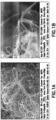
- Multi-walled nanotubes are composed of several concentric graphitic layers, the nanotubes having an overall diameter between about 10 nm and about 200 nm with lengths from about 1 micron to several centimeters. While a number of size ranges for the nanotubes have been included for illustrative purposes, this is not intended to limit the disclosure, as other preparations of carbon nanotubes may be used. Examples of carbon nanotubes that may be used in the processes described herein include NANOCYL ® NC7000 TM , which are multi-walled carbon nanotubes available from Nanocyl SA of Sambreville, Belgium. Scanning electron microscopy micrographs of multi-walled carbon nanotubes are depicted in Figs. 1A and 1B .
- carbon-based materials that may be used in the processes described herein may include any member of the family of fullerenes, buckypaper, nanofiber, nanoplatelets, nano-onions, nanohorns, and functionalized derivatives thereof.
- the carbon-based materials can include hydrogen (H).
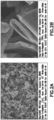
- the materials may also contain oxygen, for example, at the edges of the material, as well as interstitial and substitutional elements, such as boron, nitrogen or silicon, as a consequence of some high energy treatments and/or synthesis processes. Included among these materials are graphene nanoplatelets such as those available from Cheap Tubes, Inc. of Grafton, Vermont. Scanning electron microscopy micrographs of graphene nanoplatelets are depicted in Figs. 2A and 2B .
- the graphene nanoplatelets can include several sheets of graphene, wherein each sheet may have a thickness between about 3 nm and about 10 nm. The overall thickness of the graphene nanoplatelets may be on the order of about 100 nm.
- FIG. 3 A flow chart for a method 200 of preparing a dispersion of thermally oxidized carbon-based material is depicted in Fig. 3 .
- the method may be performed using any number of carbon-based materials, and also may be performed using other hydrophobic materials that are not carbon-based, but that can be oxidized.
- a threshold temperature for the thermal oxidation of the specific carbon-based material being processed can be determined.
- the term “threshold temperature” means, when the carbon-based material is heated in a given atmosphere, the temperature at which the carbon-based material first begins to lose weight, i.e., the first temperature at which the weight of the carbon-based material is less than its initial weight.
- the threshold temperature may be considered to be the temperature at which a curve of the derivative of weight loss as a function of temperature turns from zero to negative.
- the threshold temperature may be considered to be the temperature at which the sample begins to lose mass due to oxidation.
- the threshold temperature ranges from about 400°C to about 475°C.
- the threshold temperature may be determined by heating a sample of the carbon-based material having a known initial weight in a given oxidizing atmosphere over a range of temperatures and measuring the weight loss of the sample.
- the sample is heated at a heating rate from an initial temperature below the temperature at which the carbon-based material oxidizes to a final temperature above the temperature at which the carbon-based material oxidizes.
- the heating rate ranges from about 1°C/min to about 10°C/min. In one embodiment, the heating rate is about 5°C/min.
- the sample is heated, it is weighed at a plurality of temperatures, with the temperature increment between each weight measurement being about 10°C or less, in other non-limiting examples between about 1°C and about 10°C.
- thermogravametric analyzer One apparatus that may be used to perform the weight loss measurements is a thermogravametric analyzer (TGA).
- Thermogravametric analyzers include those manufactured by Mettler Toledo of Columbus, Ohio, such as the Mettler Toledo 1600.
- the threshold temperature may be determined from a graph of the weight loss data as a function of temperature, or by numerical methods known to one of ordinary skill in the art.
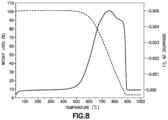
- Fig. 4 is a graph showing weight loss and derivatives of the weight loss as a function of temperature as obtained from thermogravametric analysis of pristine multi-walled carbon nanotubes.
- the threshold temperature is about 450°C, which is seen to be the approximate temperature at which weight loss begins.
- the threshold temperature can change with crystal detectivity of the material.
- multi-walled carbon nanotubes prepared by two distinct synthesis processes may have different crystal defectivities. Each time a different material is used, the threshold temperature should be determined.
- the threshold temperature can vary and may depend on the identity or particular batch of a given material. For example, a first batch of multi-walled carbon nanotubes may exhibit a different threshold temperature than a second batch of substantially the same multi-walled carbon nanotubes. Such difference may be due to a different size distribution of the carbon nanotubes in the batch, a different manufacturing process, a different level of amorphous carbon or impurity content, or the like. Similarly, carbon nanotubes can have a different threshold temperature than graphene nanoplatelets due to the different structures of these respective materials.
- the oxidizing atmosphere should include a sufficient amount of oxygen to at least partially oxidize a surface of the carbon-based material at temperatures sufficient for oxidation to occur.
- oxidation of the surface of the carbon-based material may include a chemical reaction on at least an outermost layer of the carbon-based material which can improve its hydrophilicity.
- the oxidizing atmosphere includes an oxidizing gas, such as oxygen in its pure form (O 2 ) and/or as a component of another gas, such as air, carbon monoxide (CO), nitrogen monoxide (NO), sulfur monoxide (SO), sulfur dioxide (SO 2 ), or combinations thereof.
- Oxygen containing oxidizing gases can be contemplated for use in the oxidizing atmosphere, provided these gases facilitate formation of oxygenated groups on surfaces of the carbon-based materials.
- the oxidizing atmosphere can include CO, which is generally safe to use and produces fewer side effects. Side effects can include acidic and/or corrosive solution in contact with water.
- the amount of pure oxygen in the oxidizing atmosphere may be less than about 20% v/v; in some embodiments, less than about 15% v/v; in other embodiments, less than about 10% v/v; and in still other embodiments, less than about 5% v/v. In these last embodiments, the amount of oxygen in the oxidizing atmosphere may be between about 0.5% v/v and about 5% v/v, or between about 2% v/v and about 5% v/v. In one particular embodiment, the oxidizing atmosphere includes about 2% v/v of pure oxygen (O 2 ).
- the carbon-based material may be oxidized in an uncontrolled fashion, which can damage the material with a resultant loss of its mechanical/thermal/electrical properties.
- the O 2 content is too low, an effective oxidation may not occur or the process time may become-excessively long.
- the oxidizing atmosphere used to determine the threshold temperature (202) could cause near complete or complete oxidation and destruction of the sample of carbon-based material used to make the determination.
- an oxidizing atmosphere with a low content of oxygen for example less than about 5 % (v/v)
- the amount of oxygen to be included in the atmosphere (202) consideration may be given to the fact that the oxidizing atmosphere will be utilized to partially oxidize the surface of the carbon-based material in subsequent method 204 (discussed below) at a temperature below the threshold temperature.
- the oxidizing atmosphere may include one or more second gases.
- Second gases may include gases that react with oxygen or with the carbon-based material to improve the hydrophilicity of the carbon-based material, gases that are inert in the presence of oxygen and the carbon-based material, and/or inert gases.
- Second gases can include nitrogen (N 2 ), argon (Ar), helium (He), carbon dioxide (CO 2 ), or combinations thereof.
- the second gas is Ar, N 2 , or a combination thereof.
- the oxidizing atmosphere will include a high percentage of one or more second gases.
- the oxidizing atmosphere may include between about 80% v/v and about 99.5% v/v of the second gases; in some embodiments, between about 85% v/v and about 99.5% v/v of the second gases; in other embodiments, between about 90% v/v and about 99.5% v/v of the second gases; and in further embodiments, between about 95% v/v and about 99.5% v/v of the second gases.
- the second gases are nitrogen and argon in amounts of about 8% v/v and about 90% v/v, respectively.
- the carbon-based material may be thermally oxidized by exposure to the oxidizing atmosphere at an oxidation temperature for a selected amount of time (204).
- the oxidation temperature can be a temperature that is high enough to at least partially oxidize the carbon-based material to improve its hydrophilicity, but sufficiently below the threshold temperature so as to limit or prevent damage to the properties of the material, such as the mechanical properties, electrical properties, or other properties that typically may be damaged by oxidation.
- the surface of the carbon-based material may be partially oxidized to add functional groups that can improve the hydrophilicity of the material in an aqueous medium.
- the structure of the carbon-based material may begin to break down, where functional groups are not added to the surface of the material, but the material surface is eroded through the formation of carbon-containing gases by reaction between the atmosphere and the surface of the material.
- the oxidation temperature may vary, for example, based on the specific carbon-based material being oxidized and the amount of oxygen in the oxidizing atmosphere. For example, the oxidation temperature may be below the threshold temperature by a greater amount when the oxidizing atmosphere has a higher content of oxygen. Further, the oxidation temperature may be selected based upon the degree of hydrophilicity desired in the carbon-based material.
- the oxidation temperature may be selected to obtain a greater degree of hydrophilicity in the oxidized material, which may enable a higher concentration of the material to be dispersed in an aqueous media.
- the oxidation temperature may be about 50°C to about 100°C below the threshold temperature; in other embodiments, about 60°C to about 90°C below the threshold temperature; and in still other embodiments, about 70°C to about 80°C below the threshold temperature.
- the oxidizing temperature ranges from about 350°C to about 425°C.
- the thermal oxidation of the carbon-based material at the oxidation temperature may result in an overall weight loss of less than about 2% over the duration of exposure to the oxidizing atmosphere at the oxidation temperature. In other embodiments, the overall weight loss may be less than about 1%, and in still other embodiments, the overall weight loss may be less than about 0.5%.
- the amount of time that the carbon-based material is exposed to the oxidizing conditions may be any suitable amount of time necessary to thermally oxidize the carbon-based material to improve its hydrophilicity.
- the amount of time may be sufficient to obtain an overall weight loss as described in the preceding paragraph. This time is between 10 minutes and 2 hours
- the thermally oxidized carbon-based material is dispersed in a liquid medium (206).
- the liquid medium may be an aqueous medium.
- the liquid medium is water.
- other polar media are contemplated.
- Liquid media can include alcohols, tetrahydrofuran (THF), dimethyl sulfoxide (DMSO), acetone, or combinations thereof.
- the oxidized carbon-based material may be added to the liquid media in amounts between about 0.01% and about 0.5% by weight, based on the weight of the liquid media. In other embodiments, the oxidized carbon-based material may be added to the liquid media in amounts between about 0.05% and about 0.25% by weight, based on the weight of the liquid media.
- the oxidized carbon-based material and the liquid media may be mixed by any suitable method known in the art to disperse the material in the liquid media.
- Methods for dispersing the material may include stirring, tumbling, sonication, or combinations thereof.
- the mixture (about 20 ml total volume) is sonicated for about 10 minutes or less using a tip sonicator (Vibra-Cell TM , made by Sonics and Materials, Inc. of Newtown, Connecticut, USA) at a sonication power of about 70 to 100 watts.
- the threshold temperature for Nanocyl ® NC 7000 TM multi-walled carbon nanotubes was determined as follows. About 8 mg of the carbon nanotubes in a 150 ⁇ L alumina pot was placed in a Mettler Toledo 1600 TGA. The nanotubes were exposed to a gas mixture of about 2% v/v oxygen (O 2 ), about 8% v/v nitrogen (N 2 ), and about 90% v/v argon (Ar) at a flow rate of about 50 ml/min. The nanotubes were heated at a rate of about 10°C/min. The resulting weight loss data and corresponding derivative data are depicted in Fig. 4 . As shown, the threshold temperature for this carbon-based material processed under these conditions is about 450°C as determined by a visual inspection of the weight loss derivative data.
- Nanocyl ® NC 7000 TM carbon nanotubes was then thermally oxidized at about 350°C, about 100°C below the threshold temperature, for about 60 minutes using the same gas mixture, flow rate, and heating rate as used to obtain the threshold temperature.
- the overall weight loss after 60 minutes of thermal oxidation is less than about 1%.
- Raman Spectroscopy Karl Optical Systems, Inc. of Ann Arbor, Michigan, USA, Invictus 785 nm diode laser, spectra acquired at 20 mW, 10 seconds, 3 accumulations confirms that the oxidized nanotubes were not measurably damaged by these oxidation conditions.
- FIGS. 6A and 6B depict Raman spectra of the pristine carbon nanotubes ( i.e. , prior to thermal oxidation) and the oxidized nanotubes, respectively.
- the ratio of intensity of the D peak to the G peak in both spectra is about 1.68, confirming that the nanotubes are not measurably damaged by the aforementioned thermal oxidation process.
- the correlation between peaks in Raman Spectra and defects in carbon-based materials is discussed in any of the following, M.S. Dresselhaus, G. Dresselhaus, A. Jorio, A.G. Souza Filho, R. Saito, Carbon 40, 2043 (2002 ); M.S. Dresselhaus, G. Dresselhaus, R. Saito, A.
- Example 1 8 mg of the same Nanocyl ® NC7000 TM carbon nanotubes as were used in Example 1 was thermally oxidized at a temperature of about 400°C, about 50°C below the threshold temperature determined above, for about 60 minutes using the same gas mixture, flow rate, and heating rate as in Example 1. As shown in Fig. 5 , under these sub-threshold temperature conditions, the overall weight loss after 60 minutes of thermal oxidation is less than about 1%. Moreover, Raman Spectroscopy (not shown) yielded similar results to those for Example 1 in terms of defect content when compared to pristine carbon nanotubes.
- a dispersion using a starting amount of 8 mg of these thermally oxidized carbon nanotubes were prepared in the same manner as in Example 1.
- the dispersion is depicted in Fig. 7 .
- the bundling in the dispersion when compared to the dispersion of Example 1 may indicate that the oxidized carbon nanotubes of Example 2 are not as efficiently dispersed as those of Example 1, suggesting that excess oxidation, compared to Example 1, burns down the more sensitive material, and the more stable material doesn't get sufficiently oxidized, resulting in less material being dispersed.
- 'sensitive material' may be a material that reacts quickly to an oxidizing gas, such as amorphous carbon or defects present in the surface of the carbon-based material.
- a “stable material” may be a material that does not react quickly, such as a graphitic material that is generally free of defects.
- Example 2 8 mg of the same Nanocyl ® NC7000 TM carbon nanotubes as were used in Example 1 was thermally oxidized at a temperature of about 450°C, the threshold temperature, for 60 minutes using the same gas mixture, flow rate, and heating rate as in Example 1. As shown in Fig. 5 , the overall weight loss after 60 minutes at threshold temperature conditions is about 7-8%. Moreover, Raman Spectroscopy (not shown) confirmed that the oxidized carbon nanotubes are measurably damaged at these oxidation temperatures compared to the pristine carbon nanotubes.
- a dispersion and a diluted dispersion using a starting amount of 8 mg of these thermally oxidized carbon nanotubes were prepared in the same manner as in Example 1.
- the dispersion and the diluted dispersion are depicted in Fig. 7 .
- the light contrast in the diluted dispersion confirms that the oxidized carbon nanotubes are not efficiently dispersed in water, suggesting the sensitive material has been over oxidized, leaving the stable material with less oxidized groups to aide dispersion in water.
- 10A and 10B depict Raman spectra of the pristine nanoplatelets (i.e., prior to thermal oxidation) and the oxidized nanoplatelets, respectively.
- the ratio of intensity of the D peak to the G peak in both spectra is about 0.85 and about 0.82, respectively, confirming that the nanoplatlets are not measurably damaged by the aforementioned thermal oxidation process.
- Embodiments of the disclosure may be used in oilfield applications to assist the dispersion of carbon nanotubes in cement. Incorporating a small amount (as low as 0.1% in weight) of carbon nanotubes and carbon fibers in oilwell cement will produce an electric conductive network in the cement nanocomposite. As both carbon nanotubes and carbon fibers exhibit piezoresistive electrochemical properties, these conductive networks can be used in sensing mechanical stresses. In fact, when subjected to stress/strain, carbon nanotubes show electrical properties which change with the level of stress/strain, expressing a linear and reversible piezoresistive response. Carbon nanotubes may be used in cement composites as embedded stress sensors in oilfield applications to measure mechanical stress and formation of microcracks.
- piezoresistive cement nanocomposites This is useful to prevent or minimize issues related with cement sheath failure in the annulus between casing and formation. Further details of piezoresistive cement nanocomposites may be found in United States Application Serial Number: 15/036,975 , now US patent 10,167,714 entitled “Piezoresistive cement nanocomposites”. Thermal oxidation of carbon nanotubes will aid the dispersion of these carbon nanotubes in cement used in oilfield applications.
Landscapes
- Chemical & Material Sciences (AREA)
- Organic Chemistry (AREA)
- Nanotechnology (AREA)
- Materials Engineering (AREA)
- Engineering & Computer Science (AREA)
- Inorganic Chemistry (AREA)
- Analytical Chemistry (AREA)
- General Physics & Mathematics (AREA)
- Immunology (AREA)
- Pathology (AREA)
- General Health & Medical Sciences (AREA)
- Chemical Kinetics & Catalysis (AREA)
- Biochemistry (AREA)
- Physics & Mathematics (AREA)
- Life Sciences & Earth Sciences (AREA)
- Health & Medical Sciences (AREA)
- Carbon And Carbon Compounds (AREA)
Claims (13)
- Ein Verfahren zum Herstellen einer Dispersion eines kohlenstoffhaltigen Materials, wobei das Verfahren Folgendes umfasst:Exponieren von kohlenstoffhaltigem Material, ausgewählt aus der Gruppe bestehend aus mehrwandigen Kohlenstoff-Nanoröhren, Graphen und Graphen-Nanoplättchen, an eine Atmosphäre, die zwischen 0,5 Vol.-% und 5,0 Vol.-% Sauerstoff umfasst, bei einer Oxidationstemperatur zwischen 350 °C und 425 °C über einen Expositionszeitraum zwischen 10 Minuten und 2 Stunden, um ein thermisch oxidiertes Material zu erhalten; undDispergieren des thermisch oxidierten Materials in einem polaren flüssigen Medium.
- Das Verfahren nach Anspruch 1, wobei das kohlenstoffhaltige Material ein mehrschichtiges Graphen oder ein graphen-ähnliches Material ist.
- Das Verfahren nach Anspruch 1, wobei die Atmosphäre ein oxidierendes Gas, ausgewählt aus der Gruppe bestehend aus Luft, Sauerstoff (O2), Stickstoff (N2), Kohlenmonoxid (CO), Stickstoffmonoxid (NO), Schwefelmonoxid (SO), Schwefeldioxid (SO2), und Kombinationen daraus beinhaltet.
- Das Verfahren nach Anspruch 1, wobei die Atmosphäre mindestens ein zweites Gas, ausgewählt aus der Gruppe bestehend aus Stickstoff (N2), Argon (Ar), Helium (He), Kohlendioxid (CO2) und Kombinationen daraus beinhaltet.
- Das Verfahren nach Anspruch 4, wobei die Atmosphäre zwischen 80 Vol.-% und 99,5 Vol.- % des zweiten Gases beinhaltet.
- Das Verfahren nach Anspruch 4, wobei die Atmosphäre Stickstoff (N2) und Argon (Ar) beinhaltet.
- Das Verfahren nach Anspruch 1, ferner umfassend:
Bestimmen der Oxidationstemperatur vor dem Exponieren des kohlenstoffhaltigen Materials an die Atmosphäre, um ein thermisch oxidiertes Material zu erhalten; wobei das Bestimmen der Oxidationstemperatur Folgendes umfasst:Exponieren einer Testprobe des kohlenstoffhaltigen Materials mit einem bekannten Anfangsgewicht an die Atmosphäre;Erhitzen der Testprobe mit einer Aufheizrate von einer Anfangstemperatur unterhalb der Temperatur, bei der das kohlenstoffhaltige Material oxidiert, bis zu einer Endtemperatur oberhalb der Temperatur, bei der das kohlenstoffhaltige Material oxidiert;Wiegen der Testprobe während des Erhitzens bei mehreren Temperaturen zwischen der Anfangs- und der Endtemperatur, wobei eine Temperaturerhöhung zwischen jedem Wiegevorgang höchstens 10 °C beträgt;Bestimmen der ersten Temperatur, bei der das Gewicht der Testprobe unter dem Anfangsgewicht liegt, als Schwellentemperatur; undWählen der Oxidationstemperatur als eine Temperatur, die zwischen 50 °C und 100 °C unter der Schwellentemperatur sowie zwischen 350 °C und 425 °C liegt. - Das Verfahren nach Anspruch 7, wobei die Temperaturerhöhung zwischen jedem Wiegevorgang zwischen 1 °C und 5 °C liegt.
- Das Verfahren nach Anspruch 7, wobei das Gewicht der Testprobe bei der Schwellentemperatur weniger als 1 Gew.-% geringer ist als das Anfangsgewicht der Testprobe.
- Das Verfahren nach Anspruch 7, wobei die Aufheizrate zwischen 1 °C/min und 10 °C/min liegt.
- Das Verfahren nach Anspruch 1, wobei das Dispergieren das Beschallen des thermisch oxidierten Materials in dem flüssigen Medium umfasst.
- Das Verfahren nach Anspruch 1, wobei das polare flüssige Medium aus Wasser, Alkoholen, Tetrahydrofuran (THF), Dimethylsulfoxid (DMSO), Aceton oder Kombinationen daraus ausgewählt ist.
- Das Verfahren nach Anspruch 1, wobei eine Konzentration des thermisch oxidierten Materials im flüssigen Medium zwischen 0,01 Gew.-% und 0,5 Gew.-% des Gesamtgewichts des flüssigen Mediums liegt.
Applications Claiming Priority (1)
| Application Number | Priority Date | Filing Date | Title |
|---|---|---|---|
| PCT/IT2016/000181 WO2018020519A1 (en) | 2016-07-27 | 2016-07-27 | Process for the production of dispersions of thermally oxidised carbon-based materials |
Publications (2)
| Publication Number | Publication Date |
|---|---|
| EP3490930A1 EP3490930A1 (de) | 2019-06-05 |
| EP3490930B1 true EP3490930B1 (de) | 2024-06-19 |
Family
ID=57018162
Family Applications (1)
| Application Number | Title | Priority Date | Filing Date |
|---|---|---|---|
| EP16774555.3A Active EP3490930B1 (de) | 2016-07-27 | 2016-07-27 | Verfahren zur herstellung von dispersionen von auf thermisch oxidiertem kohlenstoff basierenden materialen |
Country Status (3)
| Country | Link |
|---|---|
| US (1) | US11427473B2 (de) |
| EP (1) | EP3490930B1 (de) |
| WO (1) | WO2018020519A1 (de) |
Family Cites Families (4)
| Publication number | Priority date | Publication date | Assignee | Title |
|---|---|---|---|---|
| WO2001007694A1 (en) | 1999-07-21 | 2001-02-01 | Hyperion Catalysis International, Inc. | Methods of oxidizing multiwalled carbon nanotubes |
| US8216541B2 (en) | 2008-09-03 | 2012-07-10 | Nanotek Instruments, Inc. | Process for producing dispersible and conductive nano graphene platelets from non-oxidized graphitic materials |
| TWI519471B (zh) * | 2009-03-04 | 2016-02-01 | 東麗股份有限公司 | 含有奈米管之組成物、奈米碳管製造用觸媒體及奈米碳管水性分散液 |
| WO2015077524A1 (en) | 2013-11-22 | 2015-05-28 | Schlumberger Canada Limited | Piezoresistive cement nanocomposites |
-
2016
- 2016-07-27 WO PCT/IT2016/000181 patent/WO2018020519A1/en not_active Ceased
- 2016-07-27 US US16/320,891 patent/US11427473B2/en active Active
- 2016-07-27 EP EP16774555.3A patent/EP3490930B1/de active Active
Non-Patent Citations (1)
| Title |
|---|
| CHEN YUAN ET AL: "Low-Defect, Purified, Narrowly ( n , m )-Dispersed Single-Walled Carbon Nanotubes Grown from Cobalt-Incorporated MCM-41", ACS NANO, vol. 1, no. 4, 30 November 2007 (2007-11-30), US, pages 327 - 336, XP055900563, ISSN: 1936-0851, DOI: 10.1021/nn700106c * |
Also Published As
| Publication number | Publication date |
|---|---|
| WO2018020519A1 (en) | 2018-02-01 |
| US11427473B2 (en) | 2022-08-30 |
| EP3490930A1 (de) | 2019-06-05 |
| US20190161353A1 (en) | 2019-05-30 |
Similar Documents
| Publication | Publication Date | Title |
|---|---|---|
| Tian et al. | Graphene oxides for homogeneous dispersion of carbon nanotubes | |
| US9475921B2 (en) | Nanoplate-nanotube composites, methods for production thereof and products obtained therefrom | |
| Zhou et al. | Effective control of nanodefects in multiwalled carbon nanotubes by acid treatment | |
| Chen et al. | Novel boron nitride hollow nanoribbons | |
| Hong et al. | Investigations on the thermal conductivity of composites reinforced with carbon nanotubes | |
| Liang et al. | Highly exfoliated water-soluble single-walled carbon nanotubes | |
| Hong et al. | Effects of oxidative conditions on properties of multi-walled carbon nanotubes in polymer nanocomposites | |
| Dementev et al. | Purification of carbon nanotubes by dynamic oxidation in air | |
| Hou et al. | Double-wall carbon nanotube transparent conductive films with excellent performance | |
| KR20150075503A (ko) | 파괴인성이 우수한 그래핀-세라믹 복합체의 제조방법 | |
| Chang et al. | Strain-induced D band observed in carbon nanotubes | |
| JP7848845B2 (ja) | 繊維状炭素ナノ構造体 | |
| Mateos-Gil et al. | Electroactive carbon nanoforms: a comparative study via sequential arylation and click chemistry reactions | |
| Trakakis et al. | Epoxidized multi-walled carbon nanotube buckypapers: A scaffold for polymer nanocomposites with enhanced mechanical properties | |
| US20190367370A1 (en) | Method of producing surface-treated carbon nanostructures | |
| Turan et al. | Novel insights into the dispersed and acid-mediated surface modification of the carbon nanofibers | |
| Brandao et al. | The influence of oxygen-containing functional groups on the dispersion of single-walled carbon nanotubes in amide solvents | |
| Yang et al. | Understanding Oxygen Bubble‐Triggered Exfoliation of Graphite Toward the Low‐Defect Graphene | |
| Li et al. | Mechanical and NH3 sensing properties of long multi-walled carbon nanotube ropes | |
| Yi et al. | Enhanced mechanical strength and electrical conductivity of carbon-nanotube/TiC hybrid fibers | |
| Matsumoto et al. | Quantitative assessment of the effect of purity on the properties of single wall carbon nanotubes | |
| US11427473B2 (en) | Process for the production of dispersions of thermally oxidised carbon-based materials | |
| Bepete et al. | 1.08 Carbon Nanotubes: Electronic Structure and Spectroscopy☆ | |
| KR100663893B1 (ko) | 탄소나노튜브-금속 나노입자 혼성물 및 그 제조방법 | |
| Huynh et al. | Facile covalent functionalization of boron nitride nanotubes via coupling reaction |
Legal Events
| Date | Code | Title | Description |
|---|---|---|---|
| STAA | Information on the status of an ep patent application or granted ep patent |
Free format text: STATUS: UNKNOWN |
|
| STAA | Information on the status of an ep patent application or granted ep patent |
Free format text: STATUS: THE INTERNATIONAL PUBLICATION HAS BEEN MADE |
|
| PUAI | Public reference made under article 153(3) epc to a published international application that has entered the european phase |
Free format text: ORIGINAL CODE: 0009012 |
|
| STAA | Information on the status of an ep patent application or granted ep patent |
Free format text: STATUS: REQUEST FOR EXAMINATION WAS MADE |
|
| 17P | Request for examination filed |
Effective date: 20190222 |
|
| AK | Designated contracting states |
Kind code of ref document: A1 Designated state(s): AL AT BE BG CH CY CZ DE DK EE ES FI FR GB GR HR HU IE IS IT LI LT LU LV MC MK MT NL NO PL PT RO RS SE SI SK SM TR |
|
| AX | Request for extension of the european patent |
Extension state: BA ME |
|
| DAV | Request for validation of the european patent (deleted) | ||
| DAX | Request for extension of the european patent (deleted) | ||
| STAA | Information on the status of an ep patent application or granted ep patent |
Free format text: STATUS: EXAMINATION IS IN PROGRESS |
|
| 17Q | First examination report despatched |
Effective date: 20220322 |
|
| GRAP | Despatch of communication of intention to grant a patent |
Free format text: ORIGINAL CODE: EPIDOSNIGR1 |
|
| STAA | Information on the status of an ep patent application or granted ep patent |
Free format text: STATUS: GRANT OF PATENT IS INTENDED |
|
| INTG | Intention to grant announced |
Effective date: 20240201 |
|
| GRAS | Grant fee paid |
Free format text: ORIGINAL CODE: EPIDOSNIGR3 |
|
| GRAA | (expected) grant |
Free format text: ORIGINAL CODE: 0009210 |
|
| STAA | Information on the status of an ep patent application or granted ep patent |
Free format text: STATUS: THE PATENT HAS BEEN GRANTED |
|
| AK | Designated contracting states |
Kind code of ref document: B1 Designated state(s): AL AT BE BG CH CY CZ DE DK EE ES FI FR GB GR HR HU IE IS IT LI LT LU LV MC MK MT NL NO PL PT RO RS SE SI SK SM TR |
|
| REG | Reference to a national code |
Ref country code: GB Ref legal event code: FG4D |
|
| REG | Reference to a national code |
Ref country code: CH Ref legal event code: EP |
|
| REG | Reference to a national code |
Ref country code: DE Ref legal event code: R096 Ref document number: 602016088038 Country of ref document: DE |
|
| PG25 | Lapsed in a contracting state [announced via postgrant information from national office to epo] |
Ref country code: BG Free format text: LAPSE BECAUSE OF FAILURE TO SUBMIT A TRANSLATION OF THE DESCRIPTION OR TO PAY THE FEE WITHIN THE PRESCRIBED TIME-LIMIT Effective date: 20240619 |
|
| PG25 | Lapsed in a contracting state [announced via postgrant information from national office to epo] |
Ref country code: FI Free format text: LAPSE BECAUSE OF FAILURE TO SUBMIT A TRANSLATION OF THE DESCRIPTION OR TO PAY THE FEE WITHIN THE PRESCRIBED TIME-LIMIT Effective date: 20240619 Ref country code: HR Free format text: LAPSE BECAUSE OF FAILURE TO SUBMIT A TRANSLATION OF THE DESCRIPTION OR TO PAY THE FEE WITHIN THE PRESCRIBED TIME-LIMIT Effective date: 20240619 |
|
| REG | Reference to a national code |
Ref country code: LT Ref legal event code: MG9D |
|
| PG25 | Lapsed in a contracting state [announced via postgrant information from national office to epo] |
Ref country code: GR Free format text: LAPSE BECAUSE OF FAILURE TO SUBMIT A TRANSLATION OF THE DESCRIPTION OR TO PAY THE FEE WITHIN THE PRESCRIBED TIME-LIMIT Effective date: 20240920 |
|
| REG | Reference to a national code |
Ref country code: NL Ref legal event code: MP Effective date: 20240619 |
|
| PG25 | Lapsed in a contracting state [announced via postgrant information from national office to epo] |
Ref country code: LV Free format text: LAPSE BECAUSE OF FAILURE TO SUBMIT A TRANSLATION OF THE DESCRIPTION OR TO PAY THE FEE WITHIN THE PRESCRIBED TIME-LIMIT Effective date: 20240619 |
|
| PG25 | Lapsed in a contracting state [announced via postgrant information from national office to epo] |
Ref country code: NO Free format text: LAPSE BECAUSE OF FAILURE TO SUBMIT A TRANSLATION OF THE DESCRIPTION OR TO PAY THE FEE WITHIN THE PRESCRIBED TIME-LIMIT Effective date: 20240919 Ref country code: LV Free format text: LAPSE BECAUSE OF FAILURE TO SUBMIT A TRANSLATION OF THE DESCRIPTION OR TO PAY THE FEE WITHIN THE PRESCRIBED TIME-LIMIT Effective date: 20240619 Ref country code: HR Free format text: LAPSE BECAUSE OF FAILURE TO SUBMIT A TRANSLATION OF THE DESCRIPTION OR TO PAY THE FEE WITHIN THE PRESCRIBED TIME-LIMIT Effective date: 20240619 Ref country code: GR Free format text: LAPSE BECAUSE OF FAILURE TO SUBMIT A TRANSLATION OF THE DESCRIPTION OR TO PAY THE FEE WITHIN THE PRESCRIBED TIME-LIMIT Effective date: 20240920 Ref country code: FI Free format text: LAPSE BECAUSE OF FAILURE TO SUBMIT A TRANSLATION OF THE DESCRIPTION OR TO PAY THE FEE WITHIN THE PRESCRIBED TIME-LIMIT Effective date: 20240619 Ref country code: BG Free format text: LAPSE BECAUSE OF FAILURE TO SUBMIT A TRANSLATION OF THE DESCRIPTION OR TO PAY THE FEE WITHIN THE PRESCRIBED TIME-LIMIT Effective date: 20240619 Ref country code: RS Free format text: LAPSE BECAUSE OF FAILURE TO SUBMIT A TRANSLATION OF THE DESCRIPTION OR TO PAY THE FEE WITHIN THE PRESCRIBED TIME-LIMIT Effective date: 20240919 |
|
| PG25 | Lapsed in a contracting state [announced via postgrant information from national office to epo] |
Ref country code: NL Free format text: LAPSE BECAUSE OF FAILURE TO SUBMIT A TRANSLATION OF THE DESCRIPTION OR TO PAY THE FEE WITHIN THE PRESCRIBED TIME-LIMIT Effective date: 20240619 |
|
| REG | Reference to a national code |
Ref country code: AT Ref legal event code: MK05 Ref document number: 1695823 Country of ref document: AT Kind code of ref document: T Effective date: 20240619 |
|
| PG25 | Lapsed in a contracting state [announced via postgrant information from national office to epo] |
Ref country code: NL Free format text: LAPSE BECAUSE OF FAILURE TO SUBMIT A TRANSLATION OF THE DESCRIPTION OR TO PAY THE FEE WITHIN THE PRESCRIBED TIME-LIMIT Effective date: 20240619 |
|
| PG25 | Lapsed in a contracting state [announced via postgrant information from national office to epo] |
Ref country code: PT Free format text: LAPSE BECAUSE OF FAILURE TO SUBMIT A TRANSLATION OF THE DESCRIPTION OR TO PAY THE FEE WITHIN THE PRESCRIBED TIME-LIMIT Effective date: 20241021 |
|
| PG25 | Lapsed in a contracting state [announced via postgrant information from national office to epo] |
Ref country code: PT Free format text: LAPSE BECAUSE OF FAILURE TO SUBMIT A TRANSLATION OF THE DESCRIPTION OR TO PAY THE FEE WITHIN THE PRESCRIBED TIME-LIMIT Effective date: 20241021 |
|
| PG25 | Lapsed in a contracting state [announced via postgrant information from national office to epo] |
Ref country code: PL Free format text: LAPSE BECAUSE OF FAILURE TO SUBMIT A TRANSLATION OF THE DESCRIPTION OR TO PAY THE FEE WITHIN THE PRESCRIBED TIME-LIMIT Effective date: 20240619 |
|
| PG25 | Lapsed in a contracting state [announced via postgrant information from national office to epo] |
Ref country code: EE Free format text: LAPSE BECAUSE OF FAILURE TO SUBMIT A TRANSLATION OF THE DESCRIPTION OR TO PAY THE FEE WITHIN THE PRESCRIBED TIME-LIMIT Effective date: 20240619 |
|
| PG25 | Lapsed in a contracting state [announced via postgrant information from national office to epo] |
Ref country code: IS Free format text: LAPSE BECAUSE OF FAILURE TO SUBMIT A TRANSLATION OF THE DESCRIPTION OR TO PAY THE FEE WITHIN THE PRESCRIBED TIME-LIMIT Effective date: 20241019 Ref country code: AT Free format text: LAPSE BECAUSE OF FAILURE TO SUBMIT A TRANSLATION OF THE DESCRIPTION OR TO PAY THE FEE WITHIN THE PRESCRIBED TIME-LIMIT Effective date: 20240619 |
|
| PG25 | Lapsed in a contracting state [announced via postgrant information from national office to epo] |
Ref country code: CZ Free format text: LAPSE BECAUSE OF FAILURE TO SUBMIT A TRANSLATION OF THE DESCRIPTION OR TO PAY THE FEE WITHIN THE PRESCRIBED TIME-LIMIT Effective date: 20240619 |
|
| PG25 | Lapsed in a contracting state [announced via postgrant information from national office to epo] |
Ref country code: SK Free format text: LAPSE BECAUSE OF FAILURE TO SUBMIT A TRANSLATION OF THE DESCRIPTION OR TO PAY THE FEE WITHIN THE PRESCRIBED TIME-LIMIT Effective date: 20240619 Ref country code: RO Free format text: LAPSE BECAUSE OF FAILURE TO SUBMIT A TRANSLATION OF THE DESCRIPTION OR TO PAY THE FEE WITHIN THE PRESCRIBED TIME-LIMIT Effective date: 20240619 |
|
| PG25 | Lapsed in a contracting state [announced via postgrant information from national office to epo] |
Ref country code: ES Free format text: LAPSE BECAUSE OF FAILURE TO SUBMIT A TRANSLATION OF THE DESCRIPTION OR TO PAY THE FEE WITHIN THE PRESCRIBED TIME-LIMIT Effective date: 20240619 Ref country code: SM Free format text: LAPSE BECAUSE OF FAILURE TO SUBMIT A TRANSLATION OF THE DESCRIPTION OR TO PAY THE FEE WITHIN THE PRESCRIBED TIME-LIMIT Effective date: 20240619 |
|
| PG25 | Lapsed in a contracting state [announced via postgrant information from national office to epo] |
Ref country code: SM Free format text: LAPSE BECAUSE OF FAILURE TO SUBMIT A TRANSLATION OF THE DESCRIPTION OR TO PAY THE FEE WITHIN THE PRESCRIBED TIME-LIMIT Effective date: 20240619 Ref country code: SK Free format text: LAPSE BECAUSE OF FAILURE TO SUBMIT A TRANSLATION OF THE DESCRIPTION OR TO PAY THE FEE WITHIN THE PRESCRIBED TIME-LIMIT Effective date: 20240619 Ref country code: RO Free format text: LAPSE BECAUSE OF FAILURE TO SUBMIT A TRANSLATION OF THE DESCRIPTION OR TO PAY THE FEE WITHIN THE PRESCRIBED TIME-LIMIT Effective date: 20240619 Ref country code: PL Free format text: LAPSE BECAUSE OF FAILURE TO SUBMIT A TRANSLATION OF THE DESCRIPTION OR TO PAY THE FEE WITHIN THE PRESCRIBED TIME-LIMIT Effective date: 20240619 Ref country code: IS Free format text: LAPSE BECAUSE OF FAILURE TO SUBMIT A TRANSLATION OF THE DESCRIPTION OR TO PAY THE FEE WITHIN THE PRESCRIBED TIME-LIMIT Effective date: 20241019 Ref country code: ES Free format text: LAPSE BECAUSE OF FAILURE TO SUBMIT A TRANSLATION OF THE DESCRIPTION OR TO PAY THE FEE WITHIN THE PRESCRIBED TIME-LIMIT Effective date: 20240619 Ref country code: EE Free format text: LAPSE BECAUSE OF FAILURE TO SUBMIT A TRANSLATION OF THE DESCRIPTION OR TO PAY THE FEE WITHIN THE PRESCRIBED TIME-LIMIT Effective date: 20240619 Ref country code: CZ Free format text: LAPSE BECAUSE OF FAILURE TO SUBMIT A TRANSLATION OF THE DESCRIPTION OR TO PAY THE FEE WITHIN THE PRESCRIBED TIME-LIMIT Effective date: 20240619 Ref country code: AT Free format text: LAPSE BECAUSE OF FAILURE TO SUBMIT A TRANSLATION OF THE DESCRIPTION OR TO PAY THE FEE WITHIN THE PRESCRIBED TIME-LIMIT Effective date: 20240619 |
|
| REG | Reference to a national code |
Ref country code: DE Ref legal event code: R119 Ref document number: 602016088038 Country of ref document: DE |
|
| REG | Reference to a national code |
Ref country code: CH Ref legal event code: PL |
|
| PG25 | Lapsed in a contracting state [announced via postgrant information from national office to epo] |
Ref country code: LU Free format text: LAPSE BECAUSE OF NON-PAYMENT OF DUE FEES Effective date: 20240727 |
|
| PG25 | Lapsed in a contracting state [announced via postgrant information from national office to epo] |
Ref country code: MC Free format text: LAPSE BECAUSE OF FAILURE TO SUBMIT A TRANSLATION OF THE DESCRIPTION OR TO PAY THE FEE WITHIN THE PRESCRIBED TIME-LIMIT Effective date: 20240619 |
|
| PG25 | Lapsed in a contracting state [announced via postgrant information from national office to epo] |
Ref country code: MC Free format text: LAPSE BECAUSE OF FAILURE TO SUBMIT A TRANSLATION OF THE DESCRIPTION OR TO PAY THE FEE WITHIN THE PRESCRIBED TIME-LIMIT Effective date: 20240619 Ref country code: LU Free format text: LAPSE BECAUSE OF NON-PAYMENT OF DUE FEES Effective date: 20240727 |
|
| PG25 | Lapsed in a contracting state [announced via postgrant information from national office to epo] |
Ref country code: DE Free format text: LAPSE BECAUSE OF NON-PAYMENT OF DUE FEES Effective date: 20250201 |
|
| PG25 | Lapsed in a contracting state [announced via postgrant information from national office to epo] |
Ref country code: DK Free format text: LAPSE BECAUSE OF FAILURE TO SUBMIT A TRANSLATION OF THE DESCRIPTION OR TO PAY THE FEE WITHIN THE PRESCRIBED TIME-LIMIT Effective date: 20240619 |
|
| PG25 | Lapsed in a contracting state [announced via postgrant information from national office to epo] |
Ref country code: CH Free format text: LAPSE BECAUSE OF NON-PAYMENT OF DUE FEES Effective date: 20240731 Ref country code: BE Free format text: LAPSE BECAUSE OF NON-PAYMENT OF DUE FEES Effective date: 20240731 |
|
| PLBE | No opposition filed within time limit |
Free format text: ORIGINAL CODE: 0009261 |
|
| STAA | Information on the status of an ep patent application or granted ep patent |
Free format text: STATUS: NO OPPOSITION FILED WITHIN TIME LIMIT |
|
| 26N | No opposition filed |
Effective date: 20250320 |
|
| GBPC | Gb: european patent ceased through non-payment of renewal fee |
Effective date: 20240919 |
|
| REG | Reference to a national code |
Ref country code: BE Ref legal event code: MM Effective date: 20240731 |
|
| PG25 | Lapsed in a contracting state [announced via postgrant information from national office to epo] |
Ref country code: GB Free format text: LAPSE BECAUSE OF NON-PAYMENT OF DUE FEES Effective date: 20240919 |
|
| PG25 | Lapsed in a contracting state [announced via postgrant information from national office to epo] |
Ref country code: FR Free format text: LAPSE BECAUSE OF NON-PAYMENT OF DUE FEES Effective date: 20240819 |
|
| PG25 | Lapsed in a contracting state [announced via postgrant information from national office to epo] |
Ref country code: IE Free format text: LAPSE BECAUSE OF NON-PAYMENT OF DUE FEES Effective date: 20240727 |
|
| PG25 | Lapsed in a contracting state [announced via postgrant information from national office to epo] |
Ref country code: SE Free format text: LAPSE BECAUSE OF FAILURE TO SUBMIT A TRANSLATION OF THE DESCRIPTION OR TO PAY THE FEE WITHIN THE PRESCRIBED TIME-LIMIT Effective date: 20240619 |
|
| PGFP | Annual fee paid to national office [announced via postgrant information from national office to epo] |
Ref country code: IT Payment date: 20250623 Year of fee payment: 10 |
|
| PG25 | Lapsed in a contracting state [announced via postgrant information from national office to epo] |
Ref country code: CY Free format text: LAPSE BECAUSE OF FAILURE TO SUBMIT A TRANSLATION OF THE DESCRIPTION OR TO PAY THE FEE WITHIN THE PRESCRIBED TIME-LIMIT; INVALID AB INITIO Effective date: 20160727 |
|
| PG25 | Lapsed in a contracting state [announced via postgrant information from national office to epo] |
Ref country code: HU Free format text: LAPSE BECAUSE OF FAILURE TO SUBMIT A TRANSLATION OF THE DESCRIPTION OR TO PAY THE FEE WITHIN THE PRESCRIBED TIME-LIMIT; INVALID AB INITIO Effective date: 20160727 |